Archive
WBC17: Speed Tasting, White and Rosé
Here we go again – living through the madness of the Wine Bloggers Conference – this is where wine geeks get together, taste incredible amounts of wine (thank you, liver, I hope you can forgive me again), talk about the wine all day (and good portion of the night) long, but above all, share their common passion – the wine.
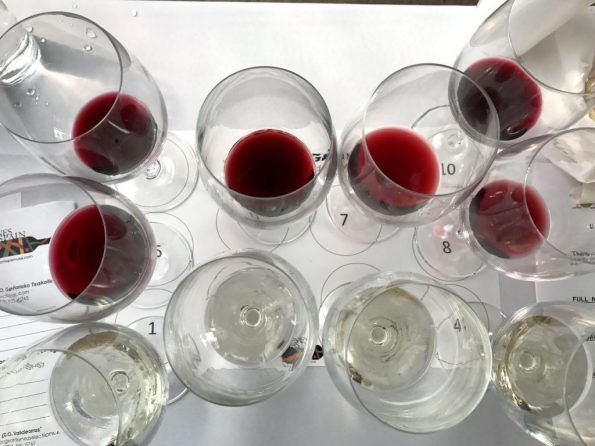
This is my third conference, and speed tasting is definitely one of my favorite exercises. During an hour-long session, wineries from all over the world line up to present their wines to the bloggers. Each winery gets 5 minutes to present their wine – which includes pouring, talking and answering questions. Bloggers sit in groups of 10 at the tables and each group gets the same 5 minutes to taste the wine, ask questions, take pictures, and share the wines on the social media. Yes, it is very intense.
This is definitely a fun session (fun is not universal here – I know a number of very well respected bloggers who refuse to participate in the speed tasting) – however, it should be well understood that this is really “shoot from the hip” type of tasting – 5 minutes is absolutely not enough to truly understand the wine, and you get the wine in whatever state it is (you can’t let it open in the glass, nope). However, this is how the wines are evaluated at any large trade tasting, sans the social media sharing, so this is all about your first reaction – that’s what is going into your quick notes.
Our session at WBC17 included wines mostly from California, with the addition of some international wines. While the session was called “white and Rosé”, we didn’t get to taste any Rosé – but keep in mind that we only were able to taste 10 out of more than 25 wines. I shared all of my impressions and pictures on twitter – however while working on this post I realized that I forgot to include 2 pictures, and all of my tweets went out as replies. Yeah, live and learn.
Nevertheless, here is the blog report of the same, with the addition of missing pictures:
Wine #1: 2016 Ledson Winery Viognier Sonoma Coast (13.5% ABV, $32) – I always approach Viognier with trepidation – this is one of the grapes which are easy to screw up. To my delight, this was very well done wine – nose, palate – very enjoyable. Reasonable value at $32.
Wine #2: Naked Wines Naked Cowboy Sauvignon Blanc (13% ABV, $32) – the wine states appellation America on the front label, however, all the grapes come from the vineyards in Washington. This is a good wine – I’m not sold on QPR, though…
Wine #3: 2015 Matthiasson Winery White Blend Napa Valley (12.9% ABV, $40) – a blend of 4 grapes, mostly Italian varietals.
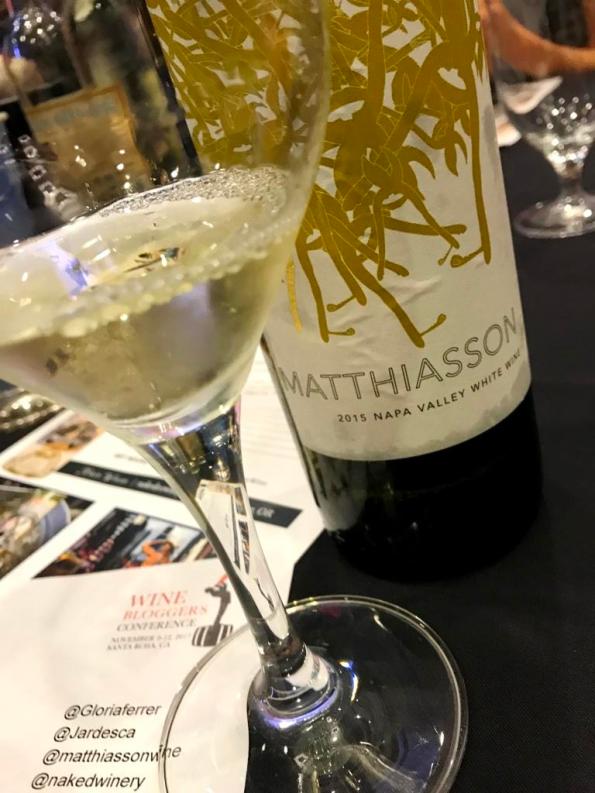
Wine #4: Jardesca White Aperitiva California (17% ABV, $30) – this is fortified wine with the addition of fruit – just add ice, and you can start entertaining. Love the label.
Wine #5: 2010 Gloria Ferrer Anniversary Cuvée Carneros (12.5% ABV, $40) – love Gloria Ferrer wines. This was big and voluptuous sparkler, slightly bigger than a typical Brut.
Wine #6: 2016 Selva Capuzzo Turbiana Lugana ($18) – not bad, and the least expensive wine in the tasting.
Wine #7: 2015 Mt. Beautiful Chardonnay New Zealand (14.5% ABV, $22) – this was a very good rendition of Chardonnay and an excellent price for the New Zealand Chardonnay overall.
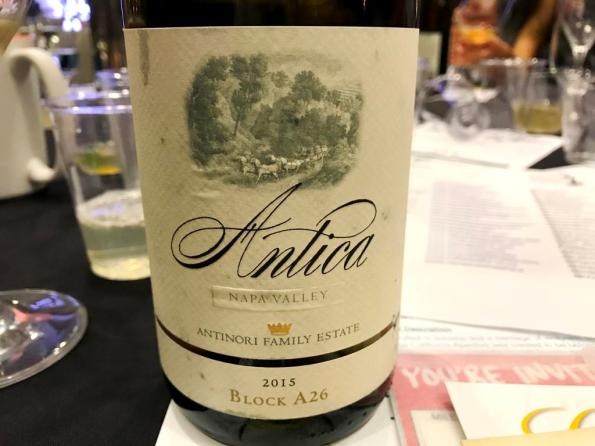
Wine #8: 2015 Antinori Estates Antica Chardonnay Napa Valley (14.5% ABV, $55) – interesting wine. QPR didn’t work for me…
Wine #9: 2016 Hanna Winery Sauvignon Blanc Russian River Valley (13.2% ABV, $19) – Hanna is one of my favorite producers, and this Sauvignon Blanc was delicious. Was super-excited to find a classic cat pee on the nose…
Wine #10: 2014 Leto Cellars Chardonnay Napa Valley (14% ABV, $30) – this wine was an enigma. We tasted multiple bottles and still couldn’t figure it out. Oh well, this was the last one anyway.
This completes my first WBC17 speed tasting report. Red wines will be next! Cheers!
Spain’s Great Match – Rare Grapes, Delicious Wines, Great Values
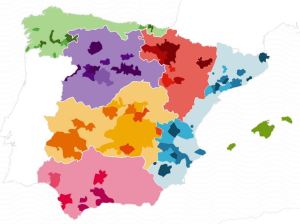
Source: Wines from Spain USA
I discovered the real greatness of the Spanish wines about 10 years ago, thanks to the wonderful seminar at maybe the best source of the Spanish wines in New York – the PJ Wine store. I had an occasional Rioja here and there before, but tasting through the full line of best of the best in Rioja, starting from the legendary 1964 vintage, was a true eye opener, and ever since, Spanish wines hold a special place in my winelover’s heart. If I need an ultimate solace in the wine glass, yes, 9 out of 10, it will be a Rioja.
Spain has the biggest vineyard area plantings in the world, so no matter how great Rioja is, Spain is so much more than just the Rioja. As I became a big fan of the Spanish wines (search this blog under the “Spanish wine” category), it became truly fascinating to follow all the changes and see the appearance of the totally new regions and reincarnation of the ancient, authentic grapes – Spain is home to about 400 grape varieties, out of which only about 20 can be considered “mainstream”.
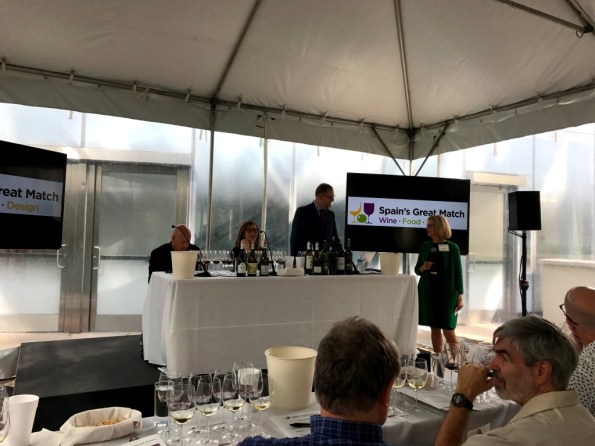
What is the better way to learn about new wines if not the [big] wine tasting? Thanks to the Wines from Spain USA, the 24th annual “Spain’s Great Match – Wine, Food, Design” event offered exactly that – a big wine tasting (more than 300 wines), educational wine seminars and authentic Spanish food.
I had a pleasure of attending these events for the last few years, including the special 30th Anniversary of Spanish wines in the USA, where the incredible tasting in the main seminar included once-in-a-lifetime wines such as 2005 Clos Erasmus from Priorat, a Robert Parker 100-points rated wine. Every year’s event offered unique and different educational opportunities as well as the tasting of the latest and greatest wine releases from all major Spanish regions.
The first seminar offered during this year’s event was focused on the Spain’s rare grapes. Ask a winelover to come up with the list of the commonly used Spanish grapes – I’m sure that going beyond Tempranillo, Garnacha (Grenache) and Albariño will be challenging. Some of the adventurous wine geeks might add Graciano, Viura, and Verdejo. Meanwhile, remember – 400 varieties – versus 6 which we just mentioned. Spanish winemakers definitely got some options.
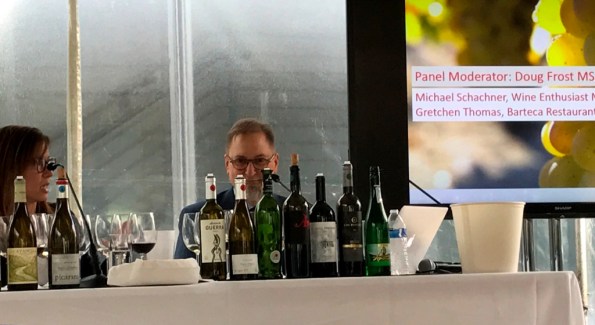
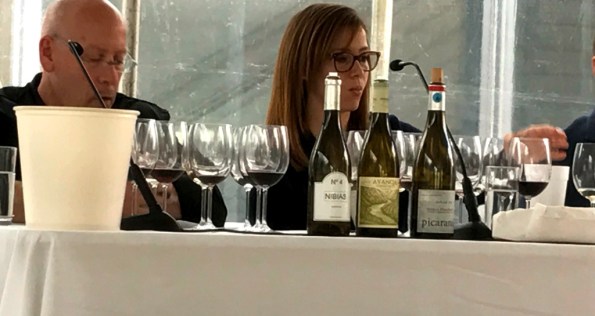
So the first seminar, led by Doug Frost, one of the only 4 people in the world who are both Master Sommelier and Master of Wine, Gretchen Thomson, Wine Director for Barteca Restaurant Group, overseeing the largest in the country portfolio of Spanish wines, and Michael Schachner, Spanish and South American Editor for Wine Enthusiast Magazine, addressed exactly this issue. We had an opportunity to taste and discuss 10 wines made from the little known Spanish grapes.
 As some of you might know, I’m a grape geek myself. The little box in the upper section of the Talk-a-Vino web page shows a counter for the number of grapes I had an opportunity to taste, so from the 10 grapes we tasted, I found only one I didn’t have before. The wines were interesting, however, I would not necessarily agree with the choice of wines to showcase particular grapes – but I wouldn’t stand a chance against such a distinguished panel of experts, so you can dismiss this statement. 🙂
Anyway, for what it worth, below are my tasting notes. Don’t have any good pictures for you, as I had no opportunity to take pictures of these wines in between the different events. Here we go:
2016 Ameztoi Txakolina D.O. Getariako Txakolina (Grape – Hondarrabi Zuri)
Beautiful nose, fresh, lemon notes, herbs, inviting. Crisp, cut through acidity, touch of fizz, would perfectly match oysters, seafood, most reminiscent of Mucadet.
2014 Bodega Chacón Buelta D.O. Cangas (grape: Albarín Blanco, new grape for me)
Off-putting nose – strong gasoline, aggressive herbal notes. The palate is interesting – lychees, pear, appears almost oxidative/”orange”.
2016 Avancia Cuvée de O D.O. Valdeorras (grape: Godello)
Intense nose, white stone fruit, nicely restrained, peaches undertones with clean acidity on the palate with clean acidity – excellent
2014 Bodegas Maranones Picarana D.O. Viños de Madrid (grape: Albillo Blanco, high altitude vineyards, 2000–2500 feet, barrel fermented)
Open, intense, touch of gunflint, reminiscent of Chardonnay, apples, vanilla – excellent. Plump, Marsanne-like on the palate, touch of tannins, very nice overall
2016 Armas de Guerra Tinta D.O. Bierso (grape: Mencía)
Intense, freshly crushed berries on the nose. Outstanding on the palate, tannins, burst of pepper, crisp, dry, very little fruit, medium body. Very interesting and different expression of Mencía.
2011 Raúl Pérez Prieto Picudo V.T. Castilla y Léon (grape: Prieto Picudo)
Delicious nose, open berries, sweet oak, overall on the nose – classic California. Lots going on on the palate – touch of sweetness, blackberries, nice swing of tannins, medium+ body.
2015 Bermejo Listán Negro D.O. Lanzarote (grape: Listán Negro, 13% ABV)
Smelling a cement truck – just fresh cement, plus intense herbal notes. Chipotle, poblano peppers dominate noticeably dusty palate – unique and different. (Too unique?)
2015 Ànima Negra ÀN V.T. Mallorca (grape: Callet)
Fresh open nose, fresh blueberries, and strawberries. Funky undertones on the palate, aggressive tannins (French oak), limited fruit. Interesting food wine
2014 Mustiguillo Finca Terrerazo Pago El Terrerazo (grape: Bobal)
Closed nose. A tiny hint of fruit, more perceived than real. Tight palate, noticeable oak, touch of cherries, good balance of fruit and acidity. Needs time. Want to try again in 10–15 years.
2013 Torres Cos Perpetual D.O.Ca. Priorat (grape: Cariñena)
Nice nose, cherries, dark chocolate, fresh leaves undertones. Aggressive tannins, green notes (tree branches), initial sweet notes immediately followed by astringent profile.
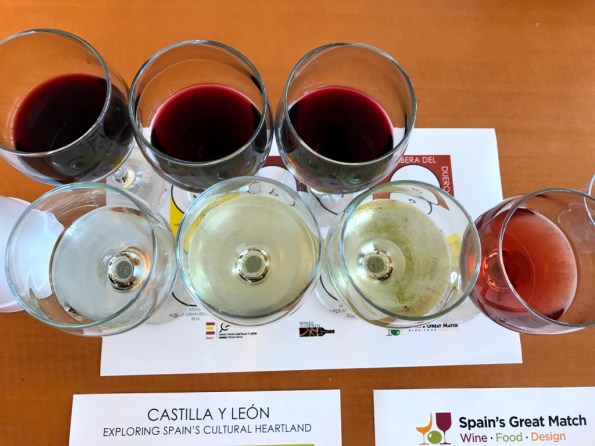
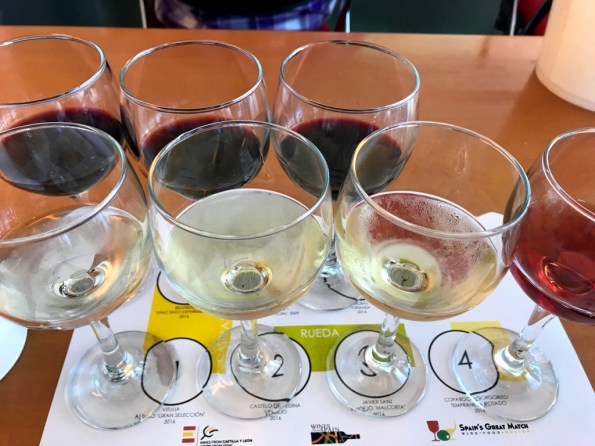
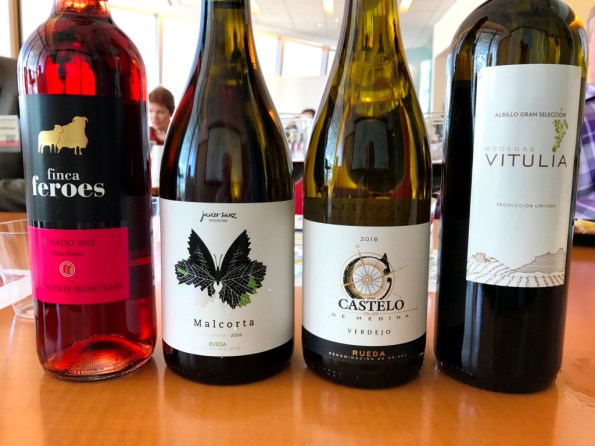
Our next seminar was dedicated to the wines and culture of the Castilla y León, an administrative region in the Northern part of Spain. Castilla y León includes a number of winemaking regions – some of the best, essentially – Ribera del Duero, Toro, Rueda among others. The seminar was led by charismatic Marnie Old – I have to honestly say that this was one of the very best wine seminars I ever attended – great delivery, lots of energy, excellent presentation.
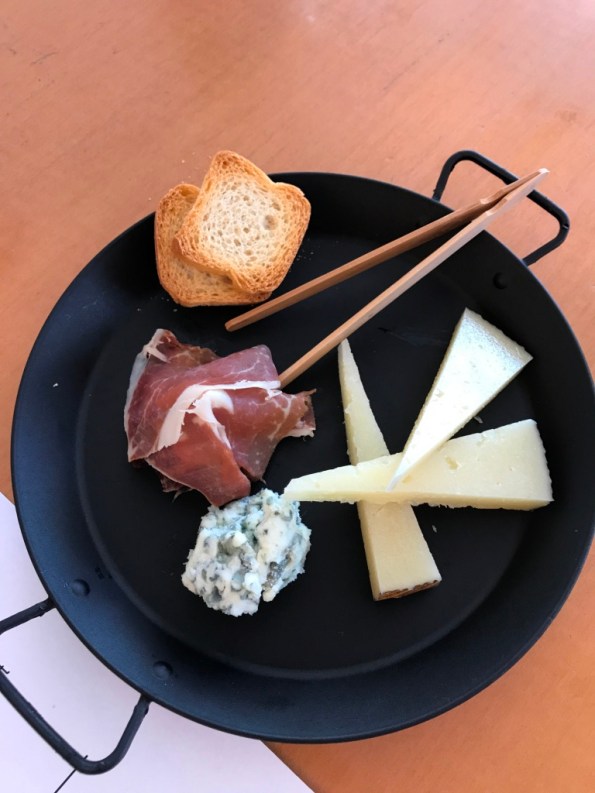
We had an opportunity to taste 7 different wines and also try some of the Castilla y León authentic foods – a few kinds of cheese (Valdeon, a blue cheese, was my favorite), Jamon (Jamón Guijuelo, to be precise) and more. I really didn’t care for the Rosé, so below you will find the notes for the wines we tasted:
2016 Bodegas Vitulia Albillo Gran Selección Vino de la Tierra de Castilla y León ($18, 12.5% ABV, 100% Albillo Mayor)
Simple, crisp, acidic, refreshing. Plus another new grape.
2016 Bodega Castelo de Medina Verdejo Rueda D.O. ($19.95, 13.5% ABV, 100% Verdejo)
White stone fruit, intense, fresh, floral fruit on the nose. Palate is dominated by the herbs, similar to Sancerre, lemon, medium body, very nice
2016 Bodega Javier Sanz V Malcorta Rueda D.O. (13% ABV, $26, 100% Verdejo Malcorta)
Javier Sanz’s effort is dedicated to restoring pre-phylloxera vineyards – this is where the fruit for this wine came from. The nose is a pure wow – intense, camphor oil, sandalwood, rosemary. Palate is delicious, perfectly balanced, candied lemon, nutmeg, medium+ body, clean acidity, an excellent wine. Yes, and another new grape.
2016 Vino Bigardo Tinto Experimental (100% Tinta de Toro) – an interesting wine. Made by a rebel winemaker, who doesn’t want to make the wine according to the appellation laws, so the wine is unclassified. 20–100 years old wine, 45 passes during the harvest, micro-fermentation. Nose has lots of young, bright fruit, freshly crushed berries, reminiscent of Monastrell, unusual. Young fruit on the palate, but with undertones of stewed fruit, hint of the roasted meat. This is experimental wine all right, but this is not a successful wine in my book.
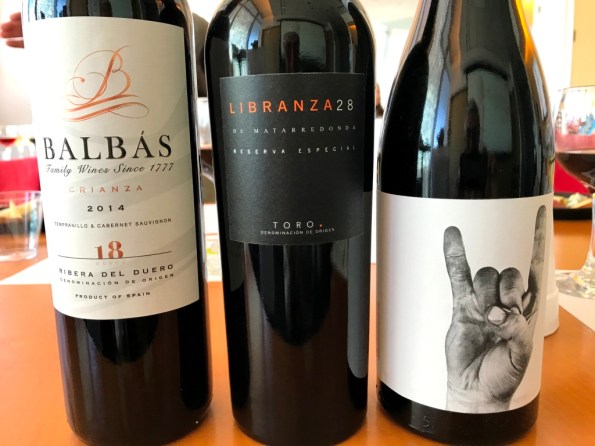
2009 Bodegas Matarredonda Libranza 28 Reserva Especial DO Toro ($45, 100% Tinta de Toro, ungrafted vines, on average 70 years old)
Spicy nose with a whiff of cinnamon, sweet oak, classic Cabernet nose overall. On the palate very tight, the real Toro, powerful, dark fruit, nice – but needs time. Pairs surprisingly outstanding with the local Valdeon Blue Cheese.
2014 Bodegas Balbás Crianza Ribera Del Duero D.O. ($27.99, 90% Tempranillo, 10% Cabernet Sauvignon, 18 months in French oak barrels)
This wine comes from one of the founding estates in the region, established in 1777.
Dusty nose, muted fruit, distant hint of dried cherries. On the palate – cherries, cherry pit, roasted meat, coffee, great concentration, fresh, clean – very good wine overall.
I was registered for two more seminars, but then there were lots of wines to taste, so I decided to proceed with the tasting. Below are mentions of the wines I liked. I have separated the wines into my top choices (both white and red), and then separately sparkling (Cava), white and red wines I feel comfortably happy to recommend. For what it worth, here we go:


Top wines:
2016 Bodega Javier Sanz V Malcorta Rueda DO ($26) – see my notes above, definitely was the star
2014 CVNE Monopole Blanco Seco Rioja ($22) – Monopole is one of my favorite white Rioja in general, but this wine is taken to the next level by spending some time in oak – lots of increased complexity. Delicious.
2013 Bodegas Prineos Garnacha DO Somontano ($12.99) – round and delicious. Great value
2011 Bodegas Beronia III a.C. Beronia DOCa Rioja ($79.99) – 70 years old vines. Unique and beautiful, produced only in exceptional vintages. standout.
2015 Bodegas Garcia Carrión Mayoral Reservado DOP Jumilla ($12.99, Syrah/Cabernet Sauvignon/Petit Verdot) – a standout. Perfectly balanced, great flavor profile and QPR which can’t be beat.
2014 El Coto Crianza DOCa Rioja ($13) – an incredible value, perfectly soft and round
2008 El Coto de Imaz Gran Reserva DOCa Rioja ($44) – perfectly drinkable, but can still age. Delicious and a great value.
2010 Gratavinum GV5 DOCa Priorat ($80) – excellent wine
Also very good:


Cava:
NV Anna de Codorniu Blanc de Blancs Brut Reserva DO Cava ($14.99) – never disappoints. Great value.
NV Anna de Codorniu Brut Rosé DO Cava ($14.99) – one of my perennial favorites.
2010 Parés Baltà Cava Blanca Cusiné DO Cava ($40) – very good quality, comparable to vintage Champagne.
NV Segura Viudos Reserva Heredad DO Cava ($25) – another one of my favorites. Delicious.
2010 Torelló 225 Brut Nature Gran Reserva DO Cava ($35) – very good


White:
2016 Bodegas Sommos Las Bas Gewürztraminer DO Somontano ($25.99) – Gewurtztraminer is a tough grape for making a round, balanced wine – and this one was exactly that.
2015 Baigorri Barrel Fermented White DOCa Rioja ($30) – very nice
2016 Bodegas Beronia Viura DOCa Rioja ($14.99) – clean, refreshing
2016 El Coto Blanco DOCa Rioja ($11) – outstanding and an excellent value
2013 Bodegas Enate “Chardonnay 234” Enate DO Somontano ($12.99) – classic, very good.


Rioja:
2013 Bodegas Muga Reserva DOCa Rioja ($28) – one of the iconic producers, very good wine.
2011 Marqués de Riscal Reserva DOCa Rioja ($18) – excellent value
2005 Marqués de Riscal Gran Reserva DOCa Rioja ($48) – very good
2010 Marqués de Riscal Baron de Chirel Reserva DOCa Rioja ($79) – very good
2011 Bodegas Faustino V Rioja Reserva DOCa Rioja ($15) – very good value
2005 Bodegas Faustino I Rioja Gran Reserva DOCa Rioja ($35) – another very good QPR example
2012 Bodegas Beronia Reserva DOCa Rioja ($19.99) – excellent
2008 Bodegas Beronia Gran Reserva DOCa Rioja ($31.99) – excellent, and great value
2012 El Coto de Imaz Reserva DOCa Rioja ($24)
2008 Viñedos y Bodegas Sierra Cantabria Finca El Bosque DOCa Rioha ($95) – probably the most expensive wine in the tasting, and it is not ready to drink. Needs time, lots of time.
2007 Señorio de San Vicente San Vicente DOCa Rioja ($52, new grape – Tempranillo peluda)


Other red:
2016 Bodegas Sommos Merlot DO Somontano ($25.99)
2012 Bodegas Viñas Del Vero Secastilla DO Somontano ($44.95)
2009 Bodegas Paniza Artigazo Edición Limitada DOP Cariñena ($24..99)
2010 Bodegas Corral Don Jacobo Rioja Reserva DOCa Rioja ($22) – delicious and a great value
2014 Bodegas Volver DO LaMancha ($16) – one of my perennial favorites, big and powerful
2012 Finca Villacreces Ribera del Duero DO ($35) – this wine never disappoints – perfect example of what Ribera del Duero is capable of
2013 Bodegas Hacienda Monasterio, Ribera del Duero DO ($40) – delicious
2015 Bodegas Garcia Carrión Mayoral Chester DOP Jumilla ($12.99, Monastrell/Petite Verdot)
2014 Bodegas Garcia Carrión Pata Negra Apasionado ($12.99, Monastrell/Petit Verdot/Cabernet Sauvignon/Syrah)
2014 Torres Salmos DOCa Priorat ($35) – very good
2015 Teso La Monja Almirez DO Toro ($52) – still needs time
2007 Teso La Monja DO Toro ($25) – nice, but definitely needs time
And then, of course, there was food. Cheese and olives were a staple, and many other dishes were carried out all the time. I also discovered my new favorite sparkling mineral water – Vichy Catalan. It is sold at some of the stores, such as Fairway Market, so if you like sparkling water, you might want to give it a try.


That’s all I have for you, my friends. Spain’s Great Match is an annual event, so even if you missed this year, you should definitely plan to attend the next – you can see a full schedule here. Also, if you live in or will visit Chicago, you can still attend it on November 2nd. Either way – drink more Spanish wines, my friends! Cheers!
Exploring Wines Of New Zealand – With Villa Maria on Snooth
Wines of New Zealand need no introduction – for sure to the oenophiles. Winemaking started in New Zealand in the 1850s, but it really flourished in the second half of the 20th century, when jet travel allowed much easier access to the future winemakers to get educated and experienced in Europe. Since the 1990s, New Zealand greatly embraced sustainability and … screw tops. I’m definitely very happy about the first – sustainable farming always leads to the better wines and happier environment. The screw tops – they are fine, I’m not convinced though that they are the best for aging the wines properly. However, I don’t want to convert this post neither into a rant, nor into a debate, so let’s just move on.
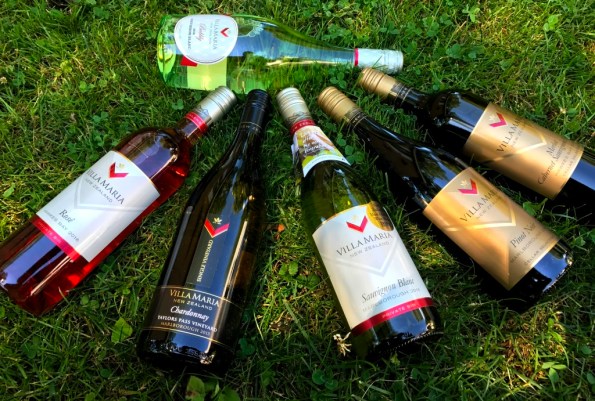 The story of Villa Maria winery is easily an exemplary story of realizing the “American Dream” – only in this case, it is, of course, have to be called a “New Zealand dream” (I hope such a concept exists).
George Fistonich started in 1961, at the age of 21, with one acre of vines in Auckland. In 1962, he harvested the grapes and produced the wines under the name of Villa Maria. That was the beginning of the journey of one man, who had the passion, vision, perseverance and enough obsession to make it. Villa Maria was a one man operation through the 60s, hiring its first staff in the early 70s, and now employing 250 people and exporting their wines to the 50 countries. As a perfect proof of making it, George Fistonich became Sir George Fistonich, receiving the first knighthood in the country for the services to New Zealand’s wine industry.
Villa Maria today has vineyards located in Auckland, Gisborne, Hawkes Bay and Marlborough regions. The grapes range from the New Zealand’s staples such as Sauvignon Blanc and Pinot Noir to such an obscure varietals as Arneis and Verdelho. Villa Maria became a cork-free zone in 2001. And I can tell you, they really treat sustainability seriously – the Villa Maria bottles were some of the lightest wine bottles I ever came across, which I’m sure greatly affects the carbon footprint.
A week or so ago, I was a part of the big group of winelovers tasting Villa Maria wines together in the virtual tasting organized by Snooth (no worries, the wines were real). Here are my notes from tasting and also, re-tasting of the wines.


First, two of the Sauvignon Blanc wines. First one was called “bubbly” as it was lightly carbonated – and it was definitely a fun wine, perfect for a summer picnic, fresh and delightful. And the Marlborough Sauvignon Blanc was simply a classic New Zealand Sauvignon Blanc, done with a perfect restraint:
2016 Villa Maria Bubbly Sauvignon Blanc Marlborough (12.5% ABV, $15)
C: literally non-existent
N: touch of grass and currant, a classic SB, restrained.
P: nice, touch of bubbles, touch of sweetness, black currant, nice and round, refreshing.
V: 8-/8, definitely nice
2016 Villa Maria Private Bin Sauvignon Blanc Marlborough (12.5% ABV, $13)
C: straw pale
N: pure cassis, beautiful, freshly cut grass, classic
P: excellent balance, acidity, currant and a touch of grass. Nice and pleasant.
V: 8, I can drink this at any time, excellent wine


Now, the Rosé and then Chardonnay. The Villa Maria Rosé is predominantly Merlot. It is light and simple, but it has enough finesse to pass one of my personal tests – I particularly like the white and Rosé wines which are well drinkable when they are a bit warm – it is annoying to maintain the wines at the ice cold level (at home, for sure). The Rosé was delicious and drinkable even at the room temperature, so it definitely passed that test. And as for the Chardonnay – I know that I will be in the tiny minority from our tasting group, but I found it to be just okay. It had all the classic Chardonnay traits, but, somehow, didn’t hit the home run for me…
2016 Villa Maria Private Bin Rosé Hawkes Bay (12.5% ABV, $14)
C: Pink
N: strawberries and strawberry leaves, round and pleasant
P: strawberries, touch of sweetness, could use a touch more acidity, but still, nice and delicate
V: 8-, definitely improved the next day, more delicate, better balance
2015 Villa Maria Single Vineyard Taylors Pass Chardonnay Marlborough (13.5% ABV, $45)
C: straw pale
N: creamy, vanilla, freshly baked brioche buns with a touch of butter on them
P: Granny Smith apples smothered in butter, good acidity, excellent midpalate weight, nicely plump, but clean. Nice cleansing acidity on the finish.
V: 7+, needs food.


Now, the reds. Pinot Noir was unusual compared to what I typically expect from the Marlboro Pinot Noir. It was heavier than I expected, and on the day 3, it became a lot closer to the powerful Oregonian Pinot (which is a good deal at $26, right? ). The Merlot blend was an enigma. It opened up beautifully as I just opened the bottle, but then it went back into its shell and never came out of it, even on the day 3 …
2014 Villa Maria Cellar Selection Pinot Noir Marlborough (13.5% ABV, $26)
C: bright ruby
N: touch of sweet cherries, violet
P: tart cherries, tart acidity, touch of tobacco
V: 7, 7+ on the day 3 – showed a lot more fruit on the palate, Oregonian notes of dark power, espresso, mocha, with sweet core of cherries and plums.
2013 Villa Maria Cellar Selection Merlot/Cabernet Sauvignon Hawkes Bay (13.5% ABV, $20, 70% Merlot, 23% Cabernet Sauvignon, 7% Malbec)
C: dark garnet, almost black
N: medium intensity, baking powder, vanilla, sweet mocha
P: black currant, ripe and sweet, touch of espresso, tar, dark fruit, dry, tannic finish
V: 7, unusual experience …
Have you had any of these wines? What are your thoughts? Cheers!
Franciacorta: Unique, Different and Authentic
“Sir, I will be very happy to work with you to improve the quality of your wines, but I have one request”, said young oenologist. “What is it?“ said Guido Berlucchi, the man famously known throughout the whole Franciacorta for his aristocratic, elegant lifestyle. “I would like to make Champagne here, in Franciacorta”.
The year was 1955, and young oenologist’s name was Franco Ziliani. Guido Berlucchi, while may be surprised, was not shy of taking the risk, and Franco Zeliani got to work. First vintages were a total disaster – awfully tasting wines, blown up bottles. But in 1961, the patience and perseverance paid off, and first 3000 bottles of the Franciacorta sparkling wine came into being.
Mr. Berlucchi invited his influential friends from Milan to try the wines, and they all happened to like it. The new chapter in the Franciacorta history was opened.

Map of Franciacorta region
The wine was produced in Franciacorta literally forever. The land surrounding Lake Iseo from the south was strategically located along the trade path between Turin and Rome. In the 11th century, the monks created a special zone called Curtefranca to encourage land development and commerce – “Curte” in this case represents “land”, and Franca, while sounds related to France, has nothing to do with it – it simply means “free of taxes” in Italian. The primary focus in Curtefranca was agriculture, and can you imagine agriculture in Italy without making the wine?
As the time went on, the Curtefranca became known as Franciacorta – however, the Curtefranca name didn’t disappear and since 2008 it is a designation for Franciacorta still wines.
That first 1961 vintage at Berlucchi became a turning point for the whole region which was before mostly known for its red still wines. Producers started changing their ways and make sparking wines, and Franciacorta DOC was established in 1967 with 11 sparkling wine producers. Franciacorta became first DOC in Italy to require all sparkling wines to be produced by the metodo classico. In 1990, the Consorzio per la tutela del Franciacorta was formed and became a major regulatory body for sparkling wine production; in 1995 Franciacorta was awarded a DOCG status, top level of quality for the Italian wines. Starting from August of 2003, Franciacorta became the only region in Italy where the wines can be labeled only as Franciacorta and not Franciacorta DOCG – similar to the Champagne where the word AOC doesn’t appear on the label.
If you are like me, I’m sure you are dying to hear a few more facts. Today, Franciacorta comprise about 7,500 acres of vineyards and produces about 15,000,000 bottles per year; there are about 200 grape growers in Franciacorta, 116 of them produce their own wines. 65% of all the vineyards are organic, and conversion to organic methods continues.

Chardonnay, Pinot Noir and Pinot Blanc are the only permitted varieties in production of Franciacorta, with Pinot Blanc being somewhat of a bastard child, as the grape is even more finicky to properly produce than Pinot Noir – while some of the producers phasing it out (e.g. Berlucchi), the others love the perfumy bright character which the grape can impart on the resulting wines.
Franciacorta’s climate is very conducive to getting grapes ripen perfectly. The climate is generally mild, with consistently warm summer days. The Lake Iseo creates a cooling effect during the summer nights, helping grapes to reach the levels of phenolic ripeness which is very difficult to achieve (if not impossible) in the Champagne. During winter, the lake provides a softening effect, protecting vines from the very low temperatures.


Unquestionably Champagne was an inspiration for the ways and means of the Franciacorta sparkling wines – as expected if you use metodo classico production. However, Franciacorta is largely moving past the “Champagne copycat” status and actively seeks and creates its own unique style, not only by stricter aging requirements (both non-vintage and vintage Franciacorta must be aged on the lees for longer than the Champagne in the same category), but by the whole method of production – for instance, by using only stainless steel tanks for the fermentation or relying much less on blending and more on the quality of the grapes from the given vintage.


Franciacorta is obsessed with quality. It starts in the vineyard, where even if not certified, most of the grapes are growing as organic. New vines are often planted at a very high density, to force the roots to go deep down as they have no room to grow to the sides. The yield is well limited to about 4 tons per acre. All the grapes are harvested by hand (this is a requirement of Franciacorta DOCG). The grapes are cooled down before the pressing – and in the case of Ca’del Bosco, one of the premier producers in the region, the grapes are even washed and then dried, using specially created complex of the machines.
Getting the grapes into the winery is only the beginning of the quest for quality. We talked to many winemakers, and they were all repeating the same words – “gentle pressing”. There is a tremendous focus on gentle handling of the grapes, using various types of presses. Arturo Ziliani, the son of Franco Ziliani, who is in charge of winemaking at Berlucchi, gave us the best explanation. “Think about a lemon. Cut it, and right under the skin, you will see the white layer – pith. When you quickly juice the lemon, lots of that pith ends up in the juice, rendering it cloudy – and adding bitterness and extra acidity. If we would juice the lemon slowly without destroying the pith, the resulting juice would be clear – and lemonade would need a lot less sugar to make. While much thinner, grapes also have the layer of pith right under the skin – and when we press the grapes, we want to avoid crushing it as much as possible”.
Even gentle pressing alone is not enough. Franciacorta regulations allow up to 65% of grape mass to be pressed. Most of the winemakers press less, at around 50%, in some cases even limiting only by 30%. At all stages of the process, there is a great effort to protect grapes and wine from oxidation; such focused handling also allows to greatly reduce the levels of added SO2 – while the law allows up to 210 mg/liter, many winemakers limit it at only 50 mg/liter.
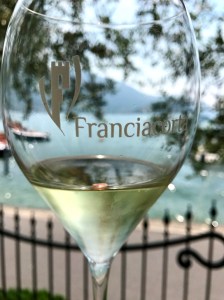
Obsession with the quality. Attention to detail. How do you drink your bubbles? The flute, you say? Where you ever able to perceive the full bouquet of your sparkling wine through that small opening on top of the flute? Well, leave the flute for Champagne, but if you want to enjoy Franciacorta, you will have to dump it (whatever way you see fit) and upgrade to something better – an official Franciacorta glass. It is specifically designed to enhance the visual and sensual qualities of your bubbles in the glass. The shape allows concentrating the aromas. And the glass is specifically made with the slight imperfections at the bottom to help form beautiful bubble traces better (perfectly polished glass doesn’t allow bubbles to form).

Obsession with quality. Attention to detail. Passion. So what makes Franciacorta unique, different and authentic? It is all of the above. Franciacorta is a unique place, with its own terroir, its own ways of making the wines, and really its own, authentic sparkling wines. Franciacorta shouldn’t be compared to Champagne, for sure not anymore, not based on the tasting of 50 or so wines during our 5 days there. Well, maybe except one thing – similar to Champagne, it should be simply called by the name. You will make all hard working Franciacorta producers very happy next time at a restaurant, when you will have a reason to celebrate (and every new day is enough reason in itself), by simply saying “Waiter, please bring Franciacorta, the best one you got!”
Rosé Showdown – California Versus Spain
A glass of wine as an “adult beverage of choice” continues its growth in popularity. If we will take a closer look at that world of wine, we will discover that there are two types of wine which are leading that growth pattern – those two types would be Sparkling and Rosé. I’m not talking about the growth in the dollar amounts or number of bottles produced, but rather a growth in attention and demand. Today, you will be pressed hard to find a winery around the world which doesn’t produce at least one type of Rosé and one type of sparkling wine – for sure this is the case with Rosé. The production might be tiny (few hundreds of cases or even less) and far less than the demand is – but it is the wine which commands lots of attention.
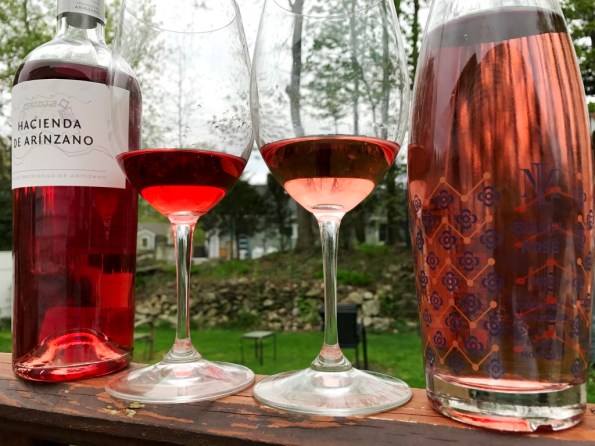
Another “phenomenon” makes me happy about the Rosé – it is slowly losing its “Rosé is only for a summer” connotation and becomes more and more acceptable and requested as a year-round drink. Rosé is a serious wine, with its own unique taste profile and capability to showcase terroir and grape variety, same as any other red or white, with two additional benefits. For one, I would dare to say that in general terms, Rosé’s versatility around food surpasses the white and the red wines – oh well, this might be only me. And the second one is pure aesthetics – the pink palette of Rosé, with possibly more shades than the proverbial 50, looks gorgeous, sexy and inviting – just take a look above and see if you are agreeing with me.
When I was offered to try two Rosé samples, of course, I couldn’t say no. The first wine was familiar to me, as I had a pleasure of trying 2015 vintage of Hacienda de Arinzano Rosé last year. The second one was the wine which I never saw before – Isabel Rosé from California. Thus it became an interesting experiment to see how the two wines would fare side by side.
If anything, putting Rosé from Spain and California on the “same page” makes sense as Rosé is clearly a “new phenomenon” for both regions, growing to prominence over the last 3-4 years at the most. Of course, Rosé was produced in Spain and California in much earlier days – but it was rather an exception and not the norm – unless we want to count white Zinfandel as a Rosé which I personally refuse to do. Until a few years ago, the only Spanish Rosé I knew about was the one from Lopez de Heredia ( which was outstanding). For the American Rosé, even if they were produced, they were really not that good (take a look at the blog post on Vinography called “Why Does American Rosé Suck” – no further comments needed?). Fast forward to today, and you can find lots of beautiful Rosé wines coming from Spain; American Rosé became a standout, as proven in the virtual tasting last year at the #winestudio.
Our first contender today comes from the first Pago estate in Northern Spain – Pago denomination signifies the highest quality of wines, this coveted level is not easy to achieve. Hacienda de Arinzano Rosé is made out of the 100% Tempranillo, in the “proper” way – by macerating the juice with the skins for 6-8 hours. Don’t you love the color of this wine?
The California’s Isabel Rosé is definitely a formidable opponent, as you can see starting from the bottle itself. Glass enclosure, beautiful shape and painted bottle – really curious how many people dare to discard the bottle once they finish the wine instead of keeping it (all I can tell you that I kept mine). A different but equally beautiful color on the mostly Cabernet Sauvignon wine, again produced in the classic style from one of the very best vintages in California (2016 had almost ideal growing conditions, watch out for those Cab prices) – and at one of the well-respected wineries, Michael Mondavi family estates.


As you can tell, it is definitely a game of equals, and for what it worth, my tasting notes are below:
2016 Hacienda de Arínzano Rosé Tempranillo (14% ABV, $20, 100% Tempranillo)
C: bright concentrated pink
N: onion peel, fresh crunchy berries
P: intense, red fruit, plums, crisp, good acidity, medium body, will stand to wide variety of dishes
V: 8-, excellent
2016 Isabel Rosé by Michael Mondavi Family Estate California (13.5% ABV, $15, 75% Cabernet Sauvignon, 23.5% Barbera, 1.5% Muscat)
C: light pink
N: intense fresh strawberries, herbal undertones
P: strawberries, good acidity, very dry – not bone dry, but quite dry, refreshing
V: 8-/8, light but affirmative, don’t overchill – needs to warm up a bit to become richer
Well, here we are, my friends. There was only one winner in this competition – me. Yes, I got to enjoy two outstanding wines, which will perfectly fit any table at any occasion, and at the price, an absolute majority of the budgets. Both will be great on a summer day, a winter day, with food or without it. Grab one or both, chill and enjoy! And if you had any one of these wines, I would be really interested in your opinion. Cheers!
Thinking About Albariño, or Notes from Albariño Deep Immersion with Snooth
For the first time I tried Albariño wine around 12 years ago, during my brief stint as a sommelier at a small restaurant. I remember the producer – Burgans. I remember liking the wine quite a bit, and since that time, Albariño surely became a part of my regular “wines to drink” list. My longest (and still current) Albariño love is Bodegas La Caña Albariño, which typically has a small amount of wine aged in oak, offering great level of complexity – but this is not what we will be talking about today.
The history of Albariño traces back to the 12th century in the Rias Baixas region in Spain (legend has it that Rias Baixas was a resting place for a brief moment for the God’s hand after the creation – you don’t have to believe it, of course). In 1980, Rias Baixes became a DO named after it’s main grape, Albariño, changing its name to Rias Baixas DO in 1986 (EU laws don’t allow for the Denomination of Origin to be named after a single grape). Over the years, Albariño started finding its way to the consumers around the world, often touted as an alternative to the Chardonnay. Considering the location (Atlantic coast) and cuisine (heavily dominated by shellfish/fish) of Rias Baixes, it is not surprising that Albariño, which typically shows crisp acidity, is perfectly marrying variety of seafood dishes.
If you think about winemaking around the world, there are some common trends no matter where the wines are made. One particular trend I want to mention is better understanding of the local terroir. Every new vintage adds the details to the knowledge of successes and failures – which vineyard produced better fruit, how the fruit was different, how even better fruit can be produced. With this knowledge, winemakers can identify the differences between seemingly close vineyards, understand that those differences are not accidental, and that those differences are worthy to be noted, used and even stressed – now the one, seemingly monolithic “terroir” region can be split into a smaller pieces.
This is what leads to the creation of the new regions and sub-regions, and you can see it around the world. For instance, only a few years ago, practically all Sauvignon Blanc wines from Marlboro in New Zealand were only identified on the labels as Marlboro. Today, Marlboro Sauvignon Blanc wines proudly identify themselves as Wairau Valley or Awatere Valley, and you can find detailed notes stressing their unique characteristics.
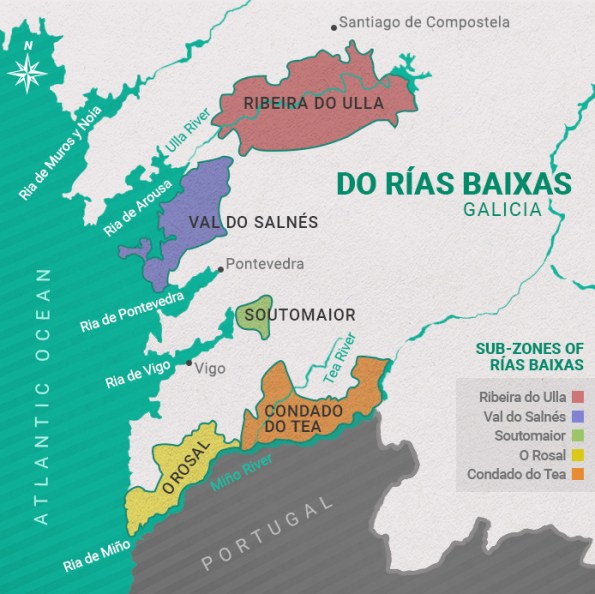
Rias Baixas Map wine regions map. Source: Rias Baixas Wine
Same processes of creating smaller, more focused viticultural areas is taking place all over the world – and Rias Baixas is not an exception. Today, Rias Baixas DO has 5 defined sub-regions – Val do Salnés, the oldest and best known source of Albariño wines; Soutomaior, Contado do Tea, O Rosal and Ribeira do Ulla. Each sub-region has its own soil and climate conditions, the terroir, which translates into the differences in the wines.


Last week I was lucky to participate in the special virtual tasting organized by Snooth, one of the best online sources of the wine knowledge. In the tasting, we had an opportunity to experience 10 different Albariño wines, representing 3 different sub-regions, and of course to discuss the wines in the rapid-fire chat.
I have to honestly admit – I didn’t wait until the official tasting to taste the wines – as the wines arrived a few weeks before the tasting, I took my time to try them slowly, as 10 wines within one our and engaging conversation using one’s fingers is quite difficult to do. I also didn’t know the order of tasting, so my tasting was done at random, where during our online chat the tasting was going from one sub-region to another – the tasting notes below appear in the tasting order at the event.
Here are my notes:


Sub-region: Val do Salnés:
2015 Martin Codax Albariño Rias Baixas DO (12.5% ABV, $16.99)
C: light yellow
N: medium intensity, fresh lemon notes
P: lemon and lemon zest, cut through acidity, medium palate, clean
V: 7+, surprisingly nice pairing with a spicy pepper spread
2015 Condes de Albarei Albariño Rias Baixas DO (12.5% ABV, $15)
C: light golden
N: medium intensity, lemon, green apple
P: touch of sweetness, Meyer lemon, good acidity, medium body, clean
V: 7/7+, nice, simple
2015 Vionta Albariño Limited Release Rias Baixas DO (12.5% ABV, $15)
C: light golden
N: medium intensity, grassy, more of a Sancerre style, touch of lemon and hay
P: crispy, fresh, clean acidity, lemon, medium body, good balance overall, round
V: 7+/8-, very well executed.
2016 Pazo Señorans Albariño Rias Baixas DO (13.5% ABV, $25)
C: straw
N: medium intensity, grass, fresh lemons
P: crisp acidity, touch of salinity, lemon, touch of volcanic minerality, interesting complexity
V: 8-, drinkable by itself, but craves food


Sub-region: Contado do Tea:
2015 Pazo de San Mauro Albariño Rias Baixas DO (12.5% ABV, $17)
C: light straw
N: honey, flowers, honeydew, delicious and inviting
P: great complexity, touch of honey without sweetness – you know you have honey in the glass, but no sugar, clean acidic finish, medium body, unusual and interesting
V: 8/8+, most interesting of the group, very unusual
2016 Señorío de Rubiós Robaliño Albariño Rias Baixas DO (12.5% ABV, $18)
C: straw pale, a welcome relief from all the 2015 so far
N: intense, lemon, candied lemon
P: off-dry, bright, crisp, white plums, hint of pineapple
V: 8-, nice and pleasant, easy to drink


Sub-region: O Rosal
2015 Altos de Torona Albariño Sobre Lías Rias Baixas DO (13% ABV, $14)
C: light golden
N: minerality, white stone fruit, medium intensity
P: fresh, crisp, nice lemon notes, craving oysters, cut through acidity
V: 8-/8, nice on its own on a hot summer day, and will be great with seafood, especially shellfish.
2015 Santiago Ruiz O Rosal White Wine Rias Baixas DO (13% ABV, $20, blend of Albariño and Loureiro with small addition of Treixadura)
C: straw
N: medium intensity, nice white fruit (peach) and floral notes, touch of tropical fruit like guava
P: medium body, soft, round, white stone fruit, good acidity, fresh, excellent balance
V: 8-/8, definitely one of my favorites
2015 Valmiñor Albariño Edición Especial 10 Años Rias Baixas DO (12.5% ABV, $18.99)
C: golden
N: intense, white stone fruit, fresh, white plums
P: lip smacking acidity, fresh, open, lemon, herbs, very dry, medium body, medium finish
V: 7+, very pleasant, will be perfect for any summer day, or any day with seafood. Makes you crave oysters.
2015 Bodegas Terras Gauda Abadía de San Compo Albariño Rias Baixas DO (12.5% ABV, $20)
C: golden
N: medium intensity, touch of lemon, white stone fruit
P: clean acidity, slightly off dry, under-ripe yellow plums, medium body
V: 7+, nice and quaffable.
Did I clearly tasted the differences in the wines from the different regions? No, I wouldn’t say so – however, as you can tell from the notes and ratings, I liked the most two Albariño wines from the Contado do Tea region. Will the Albariño get more distinguishable – you bet. Should you go and open a bottle of Albariño right this moment – absolutely, go and do it now.
That’s all I have for you, my friends. Don’t forget that upcoming Sunday is Mother’s Day in the USA – I’m sure Mom would greatly appreciate nice and refreshing glass of Albariño – and note that some of the very cool labels in the wines we tried (wink, wink). Cheers!
Of Cabs and Tomatoes, or Having Fun with a Blind Tasting
 “By the way”, my friend texted me, “your text says “tomato wine” – was that an autocorrect”? My response was “Nope. You’ll see”.
Drinking wine is fun (if you disagree, you shouldn’t read this blog). There are many things which we, oenophiles, self-proclaimed wine aficionados, can do to maximize that fun. We age wines, we decant wines, we use fancy openers and pourers, we play with temperature and glasses of different forms and sizes.
One of ultimate fun exercises oenophiles can engage in is a blind tasting. Blind tasting is a “truth serum” for the wine lovers, it levels the playing field for all. Blind tasting eliminates all “external” factors – price (ha, I paid $300 for this bottle, beat that), prestige, winemaker’s pedigree, weight of the terroir (ahh, Bordeaux, it must be amazing), cute and elaborate labels, critics and friends opinion – and leaves your palate one on one with the content of the glass. Don’t say “I hate Chardonnay and I never drink it”, as you don’t know what is in your glass. Don’t say “I don’t like Australian wines”, as you don’t know what is in your glass. Anyone who ever played the game of the blind tasting can surely attest to what I’m saying here. If you never experienced fun and joy of the blind tasting, you are missing and you are missing a lot – but it is easy to fix.
Our tradition of wine dinners goes back more than 5 years, and most of the wine dinners include blind tasting part (here are the posts for some of the past events – Pinot Noir, Champagne, Chardonnay). A few weeks ago, we managed to align everyone’s schedule for a wine dinner and a blind tasting with a simple and non-pretentious subject – Cabernet Sauvignon :).
 Remember the dialog at the beginning of this post? I have friends who know my obsession with the wine, and always try to surprise me with various oddities. One of such oddities was a bottle of tomato wine which they brought from Canada. I didn’t want to drink that wine by myself, so the wine dinner was an excellent opportunity to share it with friends. As guests were arriving, I decided to play a role of the mean host (okay, not too mean). Outside of the friend who knew about the tomato wine, the rest were presented with the pour of the white wine and the request to guess what grape that might be. Literally nobody wanted to believe that this was a tomato wine – I had to show the bottle as a proof.


Have I tasted this wine blind, I’m sure I would be in the same boat as all of my friends – this 2013 Domaine de la Vallée du Bras OMERTO Vin Apéritif de Tomate Moelleux Québec (16% ABV) was fresh, with good acidity, touch of raisins on the nose, medium to full body and notes of the white stone fruit on the palate – for me, Vouvray (Chenin Blanc from Loire) is the one which comes to mind to give you the best analogy. This wine is produced from the locally grown heirloom tomatoes – and it is also a vintage – I’m seriously impressed (find it and taste it).
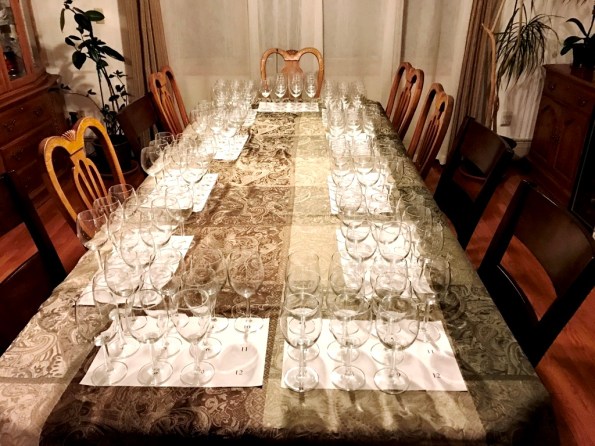
And to the blind tasting off we went. 10 wines were wrapped in the paper bags, opened and randomly numbered (my daughter usually does the honors), then poured into the glasses. The only thing we knew that all the wines will be predominantly Cabernet Sauvignon – no price or region limits.


Below are my notes, in our tasting order, both with my initial impressions and some updates over the next few days as I tasted leftover wines. And by the way, don’t think of this tasting of some stuck-up, snotty process – we openly exchange our thoughts, but each person’s individual palate is an ultimate purveyor of truth here:
#1:
C: almost black
N: restrained
P: bright fruit, pronounced tannins, delicious.
P: 2nd day – outstanding, firm structure, eucalyptus, dusty profile, tannins are still fresh.
V: 2013/2014, new world , considerably improved by the end of the tasting!
#2:
N: blueberry pie notes
P: beautiful, bright, cassis, blueberry pie with tobacco undertones on the second day, excellent
V: Lange
#3:
N: savory,
P: crispy, fresh, great fruit
P: 2nd day – firm structure, perfect balance, dark cocoa, cassis. Truly an enjoyable wine
V: nice finish,
#4
N: strange, rotten cabbage, musty cellar
N: 2nd day: an improvement, tobacco with touch of barnyard on top of cassis
P: nice, bright,
P: 2nd day: great improvement, very enjoyable, shouting a bit of mature fruit with bright acidity and touch of fresh plums.
V: India?
#5:
N: coffee, mocca, dust, excellent
N: 2nd day: coffee and roasted meat
P: nice fruit, bright, spicy
P: 2nd day: palate shifted towards savory too much meat. Probably perfect with the steak, but craving more balance on its own.
V: nice, young
#6:
N: blueberry pie, nice
N: 2nd day: pure candy on the nose, more of a lollipop quality, or may be stewed strawberries.
P: sour cherry, wow
P: sour cherries continuing, albeit more muted than yesterday
V: nothing from Cab, but nice. An okay wine.
#7:
N: nice balance, good fruit
P: great, dusty palate, firm structure, excellent, precision
V: outstanding
#8:
N: nice dusty nose,
P: crispy, tart, limited fruit
V: not bad, but not great.
V: day 2 – past prime 😦
#9:
N: nice, classic
N: 2nd day: added perfume and explicit anise notes
P: beautiful, excellent, mint, classic
P: 2nd day: dark, powerful, compressed, espresso, a lot more dense than the day before.
V: excellent
V: 2nd day: less enjoyable than the day before, closed up, lost the finesse.
#10:
N: young berries, same on the day 2 but a bit more composed.
P: young crushed berries
P: 2nd day: a bit more restrained. Young berry notes without supporting structure. Not my wine, but might have its audience.
P: 5th day: the sweetness is gone, and the classic Cab showed up, touch of cassis and mint, excellent
V: 1st day – it’s ok, 5th day – very impressive
During the tasting, we decide on two of our favorite wines. After tasting is done, we take a vote, with each person allowed to vote for two of their favorite wines. These are just two favorites, without prioritizing between the two. Below are the results of the vote for our group of 11 people:
#1 – 1
#2 – 1
#3 – 7
#4 – 1
#5 – 0
#6 – 2
#7 – 4
#8 – 1
#9 – 4
#10 – 1
As you can tell, the most favorite wine was wine #3 (7 votes out of 11), and the second favorite was a tie between wines #7 and #9, each of them getting 4 votes out of 11. Now, drumroll please – and the most favorite wine of the blind Cabernet Sauvignon tasting was … 2006 Staglin family Cabernet Sauvignon! Staglin Family Cab is definitely not a slouch in the world of cult California wines, and the group clearly fell for it. Here is the full lineup, in the order of tasting:
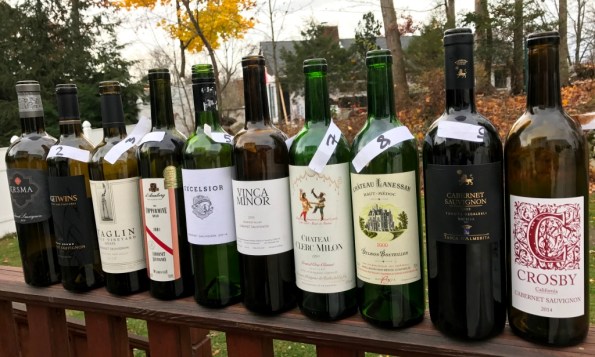 Here are the details for all the wines:
#1: 2012 KRSMA Estates Cabernet Sauvignon Hampi Hills Vineyard, India (13.5% ABV)
#2: 2013 LangeTwins Vineyard Cabernet Sauvignon Lodi, California (14.4% ABV)
#3: 2006 Staglin Family Vineyard Estate Cabernet Sauvignon Rutherford, Napa Valley (14.9% ABV)
#4: 2002 d’Arenberg The Coppermine Road Cabernet Sauvignon McLaren Vale, Australia (14.5% ABV)
#5: 2014 Excelsior Cabernet Sauvignon WO Robertson, South Africa (14% ABV)
#6: 2015 Vinca Minor Cabernet Sauvignon Redwood Valley California (12% ABV, 1 barrel produced)
#7: 1995 Château Clerc Milon Grand Cru Classé Pauillac AOC (12.5% ABV)
#8: 2000 Château Lanessan Delbos-Bouteiller Haut-Médoc AOC (13% ABV)
#9: 2009 Tasca D’Almerita Tenuta Regaleali Cabernet Sauvignon Sicilia IGT (14.5% ABV)
#10: 2014 Crosby Cabernet Sauvignon California (13.5% ABV)
10 wines, 6 countries, 10 different regions, $7.95 – $150 price range, 1995 – 2015 vintage range – I think we did pretty well in terms of diversity. Staglin Family being the favorite wine is not that surprising (but still interesting, considering that it is the most expensive wine in the lineup at $149). My biggest surprises, though, were super-solid KRSMA Cabernet Sauvignon from India (India? really?), an excellent Cabernet Sauvignon from Sicily (who would’ve thought!), and the cheapest wine in the group, Crosby Cabernet Sauvignon ($7.95), which opened up magnificently 5 days after the bottle was opened – of course, nobody has a desire to wait that long for the wine, but forgetting a few bottles in the cellar might be a right move.
The dinner quickly followed the tasting (after 110 glasses were safely removed from the table). I don’t have much in terms of pictures, but we had Russian Meat Soup (recipe here) and beef roast as the main dish. The deserts were pretty spectacular and paired very well with Cabernet wines:


And that concludes my report about our great fun with Cabernet Sauvignon wines and the blind tasting. Now is your time to share your blind tasting and odd wines stories – and if you had any of the wines I mentioned here, I want to know your opinion about them.
Lastly, if you never experienced the pleasures of the blind tasting, you must fix it as soon as possible. Cheers!
Life’s Happy Moments – Virtual Lodi Wine Tasting on Snooth
When I got an offer to participate in the Lodi wine virtual tasting on Snooth, my first reaction was “that’s okay. I just was in Lodi just recently for the Wine Bloggers Conference (WBC16), and still perfectly remember it”. Then the second thought came in – “but it is Lodi, remember? Great wines, great people, why not”?
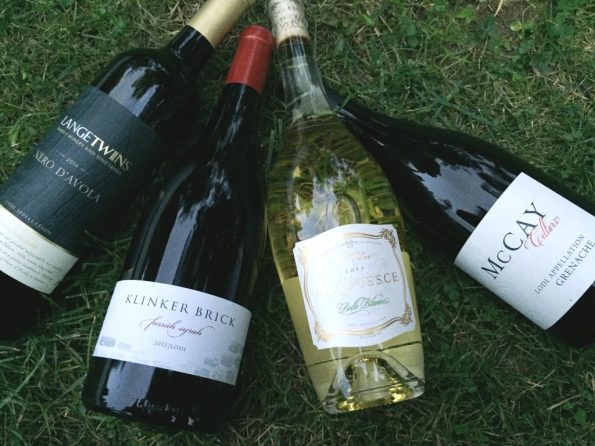
When I opened the box with samples, huge smile embellished my face (this post would be perfect for the Monthly Wine Writing Challenge #28 (#MWWC28), as the theme was “Smile” – if only it would be written on time, sigh). Do you smile when you run into a good old friend who you are genuinely happy to see? Yep, that was me at that moment.
Looking at the bottles one by one, you can imagine me talking and thinking.
Acquiesce. I heard people raving about their wines, but never tried it – great, now I will! LangeTwins – the flow of happy memories – we visited the winery with the group of bloggers and had an incredible time there; so glad to be drinking their wine again. McCay – an immediate image of Mike McCay, pouring his Zinfandel out of the double-magnum during the dinner at the WBC16 – another huge happy smile. So looking forward trying this Grenache. Klinker Brick – had their Zinfandel during speed tasting, but heard a lot about the Syrah – now I can taste it, great!
Then the day of the tasting arrived, and for an hour, I was among friends, feeling more like a WBC16 reunion – the fact that we didn’t see each other was not a problem – it was easy to imagine happy and smiley faces, tasting delicious wines, and excitedly talking across each other. Exactly as we did in August back in Lodi.
I have to be entirely honest – we had great hosts for this session – Tim Gaiser, Master Sommelier, Stuart Spencer, who represented both Lodi Winegrape Commission and his own winery, St. Amant, and Mike McCay of McCay Cellars – but I was entirely focused on the chat window, so I don’t have much of their conversation to share with you. But – I’m happy share the tasting notes for these delicious Lodi wines.


2015 Acquiesce Belle Blanc Mokelumne River Lodi (13.5% ABV, $26, 45% Grenache Blanc, 45% Roussanne, 10% Viognier, 288 cases)
C: light golden
N: intense lemon, lemon peel, candied lemon (hint of), white stone fruit
P: creamy, plump, touch of candied lemon, long acidity-dominated finish
V: 8, easy to drink from the start. The wine kept evolving for the next 5 days – definitely an age worthy wine which will bring you lots of pleasure.
2014 LangeTwins Vineyards Nero d’Avola Red Tail Vineyard Lodi (13% ABV, $20)
C: bright garnet
N: ripe sweet plums and earthiness, medium intensity
P: clean herbal profile first, sweet basil, then layer of fresh, ripe blueberries – clean, well-structured, perfectly balanced.
V: 8-, excellent pop and pour wine, should be easily a crowd pleaser
2013 McCay Cellars Grenache Abba Vineyard Lodi (14.2% ABV, $32, 309 cases)
C: smokey Ruby
N: intense gunflint, granit, underripe plums
P: smoke, mix of tart and sweet cherries, clean acidity, firm structure and medium body, crisp
V: 8+, outstanding. Once you start drinking, you can’t stop
2013 Klinker Brick Farrah Syrah Mokelumne River Lodi (14.9% ABV, $20)
C: dark garnet, almost black
N: intense aromatics, espresso, mocca, mint, raspberries, red fruit, very inviting and promising
P: wow, intense, mint, eucalyptus, blueberries, tar, spicy core, good acidity, velvety present texture, long finish
V: 8/8+, very good from get go, should improve with time
I would like to thank the kind folks at Snooth for arranging this delicious tasting. And for you, my friends – yes, those wines are made in a very small quantities, but if you will make an effort to find them (many might be available directly from the wineries), you will be well rewarded. These are the wines worth seeking. Cheers!
Craving Bordeaux Again
Source: Cru Bourgeois
If you listen to the stories of oenophiles, learning how they become who they are (oenophiles, wine lovers, it is), you will hear often that their world was changed with the first sip of that coveted First Growth (best of the best in Bordeaux wines), or another Bordeaux bottle of the similar pedigree – this might not be the story of millennials, but for sure it is the one for the older generations.
As I started getting into the wines, I developed utmost respect to the Bordeaux wines first by reading all possible books and articles about the Bordeaux greatness – this was well before China put the Bordeaux world upside down. This was also happening around the Vintage of the Century in the year 2000, when each and every magazine was going nuts about the greatness of that said vintage. At that time it was still possible to buy Chateau Latour for about $90, which was completely unthinkable to me as a spending on a single bottle of wine.
My first experience with Bordeaux was $6 or $7 Bordeaux AOC or Bordeaux Superiore AOC wine, acquired at a local supermarket in New Jersey – I’m sure I don’t need to describe to you how those wines tasted like – think green branches, lots and lots of green branches, and don’t add any fruit…
Needless to say that this type of experience, coupled with prices for the better Bordeaux wines increasing faster than disappearing TGV train and discovering that the wine world is bigger than anyone’s imagination with more wines to try than there are days in an average human life, put a damper on my interest to Bordeaux wines. Don’t get me wrong – I was privileged to taste Chateau Margaux 2000, and it was beyond amazing, along with lots of other absolutely delicious Bordeaux wines. But the end result is that you will practically never find me in the Bordeaux aisle at the wine store – I will drink Bordeaux if offered or recommended, but will not proactively seek it on my own.
Until now.
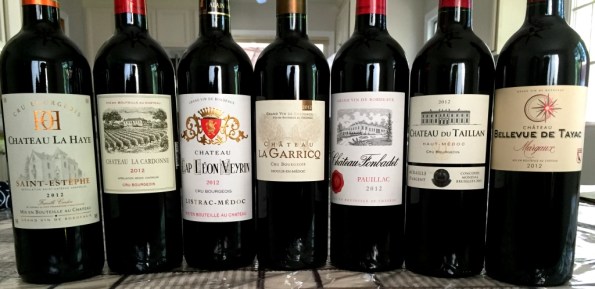
Back in June, I was lucky to be invited to Cru Bourgeois virtual tasting. First of all, that means that I had to drink a lot of Bordeaux wines. Leaving that aside, it was also interesting to find women winemakers behind all of those wines – and practically all of them representing their multi-generational winemaking families.
Before we talk about wines which made me craving Bordeaux again, let’s talk about Cru Bourgeois, as this is not just some random designation.
Origins of the Cru Bourgeois go back to the Middle Ages, so you can imagine that it is impossible to give it due respect in the few lines of the blog post. According to the official Crus Bourgeois description, “The bourgeois were inhabitants of the “bourg” of Bordeaux, a town of merchants and craftsmen. During the period of English rule, they acquired rights and privileges, including exemption from taxes on the sale of the wines from their vineyards both locally (Guyenne) and abroad.
By the fifteenth century, enriched by international commerce, the bourgeois of Bordeaux were able to acquire the finest properties in the region, which gradually acquired the name of “Crus des Bourgeois”.”
Cru Bourgeois classification significantly predates the the famous 1855 Bordeaux classification, but it also went through multiple turbulent times affected by French Revolution and later on by the Great Depression of 1929. In the early 19th century, Cru Bourgeois classification included about 300 producers; 248 Crus Bourgeois were listed in 1858 (divided into 3 categories); in 1932, Bordeaux wine brokers designated 444 Crus Bourgeois.
Source: Crus Bourgeois
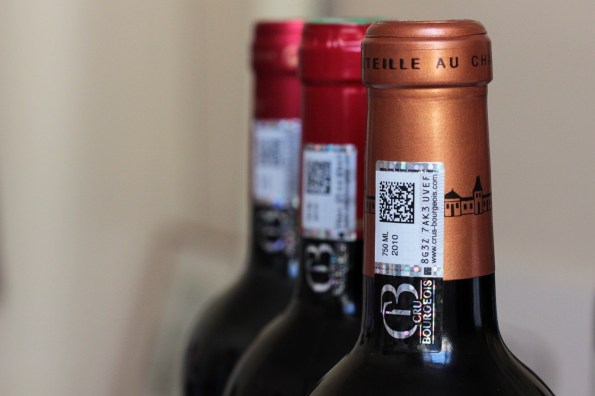
Fast forward, the latest chapter in Crus Bourgeois history started in 2010, when union of the Crus Bourgeois du Médoc finalized its new quality procedures and published its first official selection of the Crus Bourgeois producers. The whole idea behind the Cru Bourgeois classification is to control quality and ensure that the Cru Bourgeois sticker on the bottle gives consumers piece of mind. Crus Bourgeois du Médoc classification covers 8 AOCs – Médoc, Haut-Médoc, Listrac-Médoc, Moulis en Médoc, Margaux, Saint Julien, Pauillac and Saint Estèphe. If producers from those appellations would like to be listed in the official Crus Bourgeois classification, they have to apply for it, pass the inspection and continue operating within the quality requirements of the classification – otherwise, their status will be revoked. Each bottle from the officially classified Chateaux carries a secure sticker which can be easily scanned to obtain all authentic information about producer, vintage and the wine.


To give you an idea about the process, for the 2013 classification, 251 producers were selected from 400 applications – as you can tell, obtaining Crus Bourgeois status is not guaranteed. Few more numbers – Crus Bourgeois production for 2013 stood at about 20 million bottles, representing about 26% of the total wine production in Médoc. For the past 6 vintages (starting from 2008), total Crus Bourgeois du Médoc production was about 166 million bottles. Well, if you need more facts and numbers, you can continue reading on the official Crus Bourgeois du Médoc web site.
Now, let’s talk about the virtual tasting. It was done in the usual format, over the UStream, with live chat and ability to ask questions, which was, of course, a big part of fun. Seven producers represented seven Crus Bourgeois regions (out of 8 – very nice coverage). Every winemaker had a few minutes to introduce themselves and their wines – I did my best to capture at least a few words coming from each presenter – this is easier said than done, so below are the results of my efforts together with detailed tasting notes (except one wine – you will see below). Overall, very impressive level of quality.
Here we go:
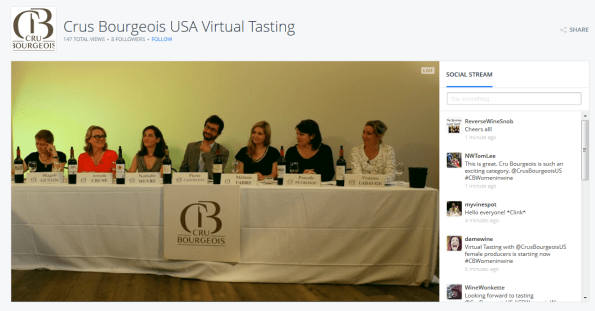
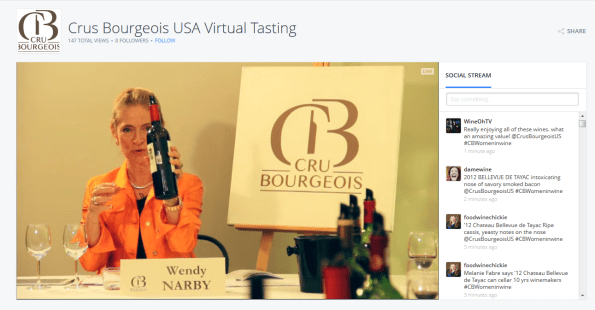
Magali Gyuon – the wines should be drunk at the right time – only 2009 ch la Cardonne is available on US market. 2012 is an exception. It is very good At the moment. It will close in 1–2 years, and then it will reopen in about 4 years – I have to say that this is perfectly resonates with my viewpoint on the wines – I truly believe that many wines have their “close up”, “sleeper” periods and if you are unlucky to open wine in such a period, you might not be able to enjoy it at all. This is why you always need to buy more than one bottle 🙂
2012 Château La Cardonne Médoc AOC (13% ABV, $25, 50% Merlot, 45% Cabernet-Sauvignon, 5% Cabernet Franc, 12 mo in French oak)
C: garnet
N: warm, inviting, dark berries, cassis, sage
P: round, supple, touch of green undertones, but good balance overall. Acidity on the finish even on the day two.
V: 7+, rating unchanged on the second day
Armelle Cruse – Château has open door policy. Studied in California, and she wanted to reintroduce the same style in Bordeaux. First women to become a winemaker in the family (out of 5 girls).
2012 Château du Taillan Haut-Médoc (14.5% ABV, $25, 70% Merlot, 20% Cabernet Sauvignon, 10% Cabernet Franc, 12 mo in French oak)
C: dark Ruby
N: fresh fruit, warm, open
P: fruit core, but finish is very tart, almost bitter. Needs time? yes! Much more round and approacheable on the second day; dark concentrated fruit.
V: 7- first day, 8- on the second day – much improved, tannins subsided, fruit appeared
Nathalie Meyre, has B&B at the château, winery in the family for 6 generations
2012 Château Cap Léon Veyrin Listrac-Médoc (13.5% ABV, $30, 60% Merlot, 35% Cabernet Sauvignon, 5% Petit Verdot, 12 mo in French oak)
C: dark garnet, almost black
N: freshly crushed cherries, touch of the savory notes
P: supple, fresh, good acidity, cherries, touch of white pepper, good balance, excellent spicy aftertaste
V: 8-, excellent wine, this verdict stands on the second day, may be the wine is a bit softer, but still with a good balance.
Pierre Cazeneuve represented his mother, who is the winemaker. Has strong marketing presence on Internet.
2012 Château La Garricq Moulis-en-Médoc (13% ABV, $21, 48% Merlot, 40% Cabernet Sauvignon, 12% Petit Verdot, 12 in French and American oak)
C: dark garnet
N: warm, inviting, cassis, eucalyptus,
P: Classic, cassis, green bell pepper, perfect balance, perfect tannin core on the finish – just right.
V: 8, excellent right now and has a great promise of aging; 8+/9- on the second day.
Mélanie Fabre – taking care of the vineyard and also a winemaker, works in partnership with parents. Makes the wine she likes – fruit forward and balanced.
2012 Château Bellevue de Tayac Margaux AOC (13% ABV, $30, 70% Merlot, 20% Cabernet Sauvignon, 10% Petit Verdot, 12-18 mo ageing )
C: dark garnet, almost black
N: roasted meat, smoke, dark, brooding, tar, pencil shavings
P: dark fruit, more roasted meat, good concentration, excellent balance
V: 8, excellent, second day is equally good. Round.
Pascals Peyronie – small property works very hard and can produce wines at the reasonable price ( I have cheaper than the famous neighbors). Society of women in winemaking, 12 members, formed in 1994, first organization in France.
2012 Château Fonbadet Pauillac AOC (13% ABV, $54, 65% Cabernet Sauvignon, 35% Merlot, 16-18 mo in French oak)
C: dark garnet
N: borderline corked, can’t evaluate
Violaine Labauge – involved in the marketing of the wine. The Château belongs to the same family for 3 centuries. Wine is made to be enjoyable now but can be cellared for 10–15 years.
2012 Château La Haye Saint-Estèphe AOC (13.5% ABV, $20, 50% Merlot, 45% Cabernet Sauvignon, 5% Petit Verdot, 12-14 mo in oak)
C: dark garnet, almost black
N: mostly closed, touch of fruit and kitchen spices
P: nice touch of cherries, pencil shavings, soft, round, explicit minerality, good acidity, good balance
V: 7+/8-, rating stands the second day.
That’s all I have for you for today, my friends. I’m glad to find some great values coming from Bordeaux – I’m sure more is to come. What were your recent Bordeaux discoveries? How often do you drink Bordeaux wines? What do you think of them? Put that comments section to the good use! Cheers!
Fall in Montefalco: Revisiting Beauty of Montefalco Rosso and Power of Sagrantino
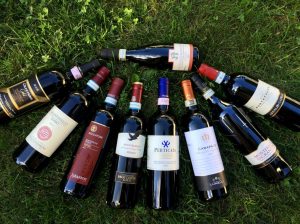 History of the grapes is full of mistaken identity cases, survival fights, global dominance going nearly extinct – yes, these are the grapes I’m talking about, not people. There are also “lost and found” stories, as in the case of Sagrantino, the Italian grape from Umbria. Sagrantino was a very popular grape for more than 500 years – until it practically disappeared in the 1960s, and made almost miraculous comeback due to the effort of the few passionate winegrowers.
My first meaningful encounter with Sagrantino wines took place 3 years ago, when I participated in the virtual tasting of the wines from Montefalco – Sagrantino’s growing region in Umbria. I don’t want to repeat everything I learned about Sagrantino the last time, so please take a look here for some interesting fun facts about Sagrantino (for instance – did you know that Sagrantino has the highest polyphenol concentration among all commonly used red grapes?).
Two groups of red wines produced in Montefalco. One is Montefalco Rosso DOC, where it is required that the wine would have at least 70% of Sangiovese, up to 15% of Sagrantino and up to 15% of the other red grapes (however, these percentages are changing). The second one is Montefalco Sagrantino DOCG, with the wines made out of 100% Sagrantino grapes. Montefalco Sagrantino DOCG also includes production of the sweet Passito wines – as you would expect, after harvest, the grape bunches are left to dry on the mats for at least 2 month, before pressing and fermenting together with the skins. High tannin content helps to alleviate the sweetness of the wines.
Our tasting, very appropriately called “Fall in Montefalco”, was conducted in the virtual format, with the group of 9 winemakers presenting their wines remotely from Italy. Live Q&A discussion was accompanying the tasting via the Ustream channel (take a look at the live feed to the right).
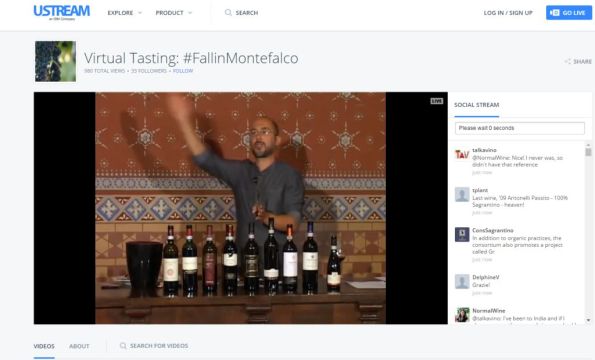
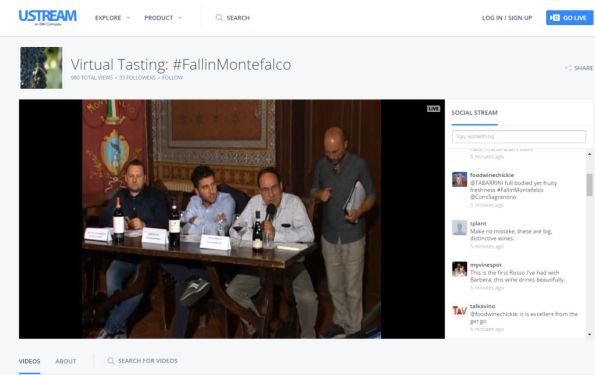
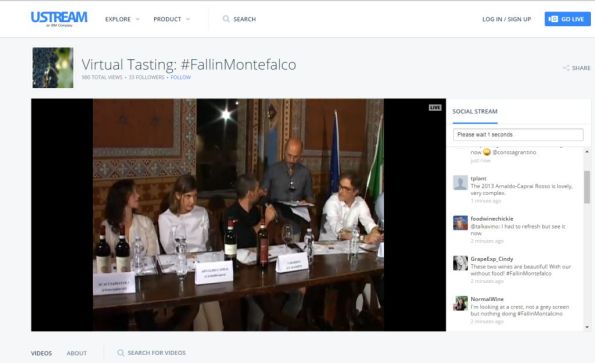
Few interesting facts from this presentation: There are currently 700 hectares (1750 acres) of Sagrantino planted in Montefalco, and there are 70 wine producers in the region. Current production of Montefalco Sagrantino is about 1.3M bottles, and Montefalco Rosso is about 2.2M. Someone asked one of my favorite questions of all the producers in the studio – what is the oldest vintage of Sagrantino you have in your cellars? Going around the room, this is what I was able to capture (as usual, it is hard to follow presentation and chat with people at the same time) – the oldest vintage Custodia has in the cellar is 2003, Arnaldo Caprai still has 1979 Sagrantino; Tabarrini’s oldest is 1996 and then 1999.
Before I leave you with my tasting notes I can say that overall, the wines in the tasting showed nice improvement, comparing with the wines we were drinking 3 years ago – you will also see it in my ratings, which are also higher across the board. Also as you will see from the notes, I have a sweet tooth – and not afraid to show it – Passito was my favorite wine in the tasting. Don’t get me wrong – again, all the wines were excellent, and if I have to use one word common description, the word would be “elegant”.
Here are my tasting notes:
2013 Broccatelli Galli Montefalco Rosso DOC (13.5% ABV, $19, Sagrantino/Sangiovese blend)
C: dark Ruby
N: cherries, herbs, touch of minerality
P: bright tart cherry, leather, tobacco, cherry pit, medium body, easy to drink
V: 7+/8-, simple and nice, would work well with food
2013 Arnaldo Caprai Montefalco Rosso (14% ABV, $21, 70% Sangiovese, 15% sagrantino, 15% Merlot)
C: dark garnet
N: beautiful, open, inviting, red fruit
P: warm, spicy, velvety, medium body, front tannins on the finish, leaves surprisingly light perception. Touch of characteristic leather.
V: 8/8+ (definitely 8+ on a second day, very round and elevated)
2012 Scacciadiavoli Montefalco Rosso DOC (14.5% ABV, $20)
C: Dark garnet
N: herbs, sage, touch of cherries, restrained
P: medium body, good acidity, leather, cherries and cherries pit, soft, polished, easy to drink, soft tannins, very round overall, medium finish
V: 8, was perfect PnP wine, delicious and makes you crave for more
2013 Tabarrini Boccatone Montefalco Rosso DOC (14.5% ABV, SRP $28)
C: dark garnet
N: intense, sweet plums and cherries, sandalwood, complex
P: complex flavors, lots going on, cherries, earth, nice tart, soft, supple, layered, spicy notes
V: 8/8+, will evolve with time
2011 Perticaia Montefalco Sagrantino DOCG (14.5% ABV, $55)
C: dark garnet, practically black
N: ripe red fruit (restrained), baking spices
P: tart cherries, velvety, firm structure, full weight in the mouth, full bodied, very present, “Rutherford dust”, cherry pit mid palate
V: 8+, delicious powerful wine – if you like powerful wines
2006 Tenute Del Cerro Còlpertone Gold Montefalco Sagrantino DOCG (15% ABV, $50)
C: garnet with brick hue
N: cherries, eucalyptus, oregano, intense, balsamic
P: round, layered, earthy, cherries, medium to long finish, powerful, excellent balance, another 10 years to evolve
V: 8/8+, delicious
2010 Tenute Lunelli Carapace Montefalco Sagrantino DOCG (15% ABV, $35)
C: garnet
N: earthy, herbaceous, touch of cherries, medium intensity
P: round, fresh, open, cherries, tartness gets a bit in the way, but wine is very enjoyable from the first pour and sip. Long finish.
V: 8+, excellent
2010 Terre De la Custodia Montefalco Sagrantino DOCG (14.5% ABV, $45)
C: bright garnet
N: barnyard, medium intensity, ripe plums, roasted meat
P: crushed berries, acidity, tannins jump in quickly, very enjoyable but needs time
V: 8/8+, delicious Italian wine, will open up in about 10 years…
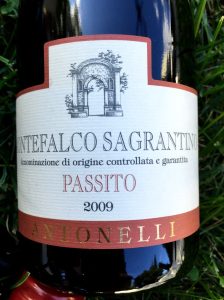
2009 Antonelli Passito Montefalco Sagrantino DOCG (14% ABV, $49)
C: dark garnet, almost black
N: dried fruit, figs, raisins, delicate – not overpowering
P: wow. And another wow. Dried fruit, but perfectly restrained. Cherry pit, tannins, acidity, tartness. Perfect balance, and very try finish.
V: 9, needs time, superbly delicious and enjoyable as it is, but will evolve amazingly…
That was an excellent tasting, I’m glad to be a part of the Fall in Montefalco.
What is your experience and opinion of Sagrantino wines? Cheers!
Last Bottle Sign Up ($10 credit)





