Archive
Restaurant Files: 360 Experience – Çka ka Qëllu in Stamford, Connecticut
Wow, it’s been over 4 years since I posted about the restaurant visit on these pages. “Restaurant files” used to be a regular feature on this blog, and yesterday’s restaurant experience offered a perfect opportunity to bring it back, so here we are.
Think about your restaurant visits. Sometimes, we love the food, but the wine list is not up to snuff, and the cocktails are just bland and tasteless. Sometimes, the food and wine are amazing, but you can’t stand the ambiance (this was my case recently while visiting Firefly in Las Vegas – one of my favorite restaurants, just moved to the new location, and the food became even better while I actively despised the decor). Sometimes, all is great, but not the service. Some other times, all is good, but the experience simply can’t cost that much.

And then there are those where everything works, delivering that wonderful feeling of a great, memorable experience. I took the liberty to call such a situation a 360 experience – an all-around happy experience.
I was interested in visiting this new restaurant in Stamford, Çka ka Qëllu, for a while. The restaurant offers Albanian cuisine which I’m not familiar with. And it is not only food – the wine list also contains a couple of Albanian wines. I never had Albanian wines, so I’m obviously curious – and it is also an opportunity to add a checkmark to my collection of wines around the world. Last but not least is the fact that the restaurant participates in Marriott’s Eat Around Town program – who can say no to the bonus points?


The moment we walked into the restaurant, we were instantly transported to different place and different time. I remember walking in the center of Tokyo, along a wide, modern street, wondering what restaurant my host is taking me to. We took a turn under the bridge, and we instantly traveled probably 400 years back, to the old place where food was cooked by the open fire in the tiny stores, and dining tables were rustic, eternal wooden benches. At the Çka ka Qëllu, I had exactly the same feeling – we traveled to medieval Europe, just 3 miles away from our house. All the decor, the tunnel leading to the kitchen, the old clock on the wall… The whole time we were at the restaurant, I kept looking for more of the unique tiny details.


First, the drinks. Out of the long list of craft cocktails, my wife went for the Strawberry Margarita, which was absolutely delightful – very reasonable sweetness and a pop of fresh strawberries. I knew that I wanted to try an Albanian wine – I didn’t see it offered by the glass, but when I asked our waiter if I can get a glass of Albanian white wine, the answer was “of course”. I was honestly not expecting much, but the very first whiff of the glass of the 2019 Stone Castle Chardonnay Reserve Rahoveci Valley Kosovo brought me to the happy land. This was beautiful, classic Chardonnay, with vanilla, apples, a hint of perfectly integrated butter notes with honey – as classic as Chardonnay gets.
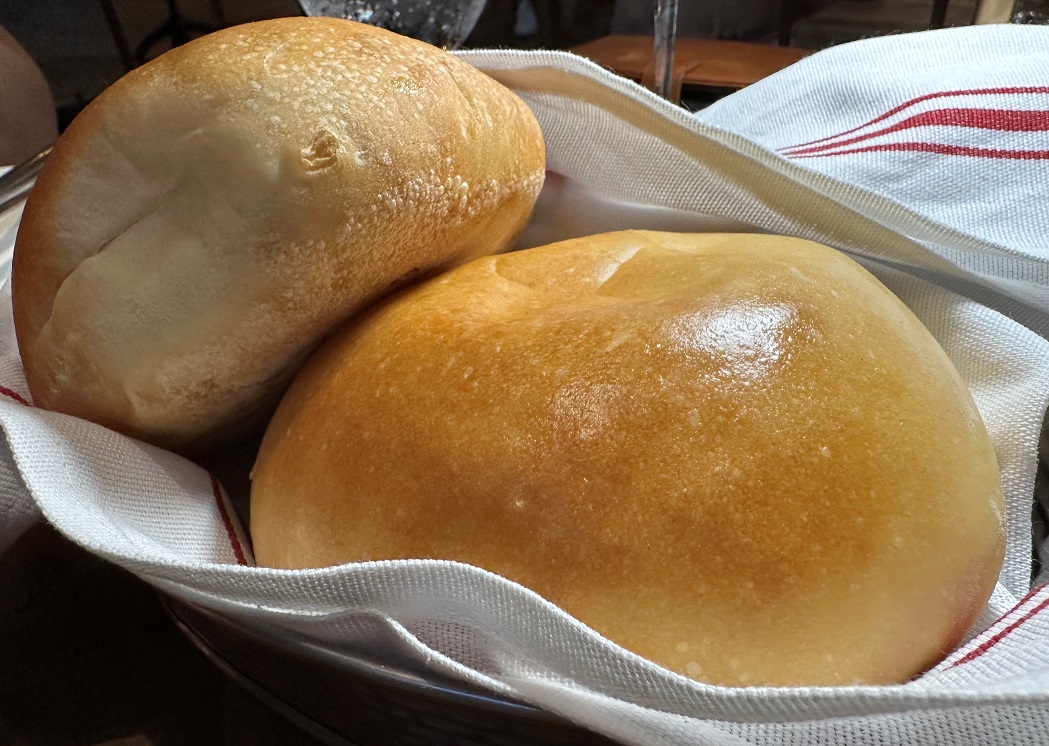


We ordered a few appetizers – Pepper Dip, Mantia (veal-stuffed small fried dumplings), and Burek (a pastry with cheese or meat, we ordered cheese). The appetizers showed up with two loaves of fresh bread which I’m sure is made at a restaurant. That bread was absolutely delicious and was perfect with the pepper dip. As a bonus, the flavor of the cheese the pepper dip was made with was reminiscent of the famous Georgian Khachapuri. The dumplings were delicious too. Burek was served with two sauces – a sweet pepper relish and another one reminiscent of the fresh buttermilk – not sure what it was, but very tasty.


For the main course, my wife decided on Qofte (traditional Albanian grilled veal meatballs marined with onions, crushed red pepper & herbs) – delicious is not even a sufficient word that can describe the flavor profile. I’ve chosen Fasul (soup style traditional dish with simmering white beans, and onions, slowly cooked in meat). I love white beans in any form, and by description, the dish was reminiscent of my beloved French Cassoulet, so I decided on this entree as soon as I saw it on the menu. I made the right choice – the dish was served in a small clay vessel and this dish was a pure comfort on the plate – delicious to the smallest, tiniest little morsel.
Traveling through space and time with Çka ka Qëllu made for a great Friday evening – a true 360, all-around experience (I didn’t mention the service that was timely, attentive, and friendly), just a few minutes away from our house. If you are living in Stamford or nearby, Çka ka Qëllu is definitely a place to visit. And you can thank me later – but don’t feel obliged.
We will definitely be back. Cheers!
Wine Weekend of Ups and Downs
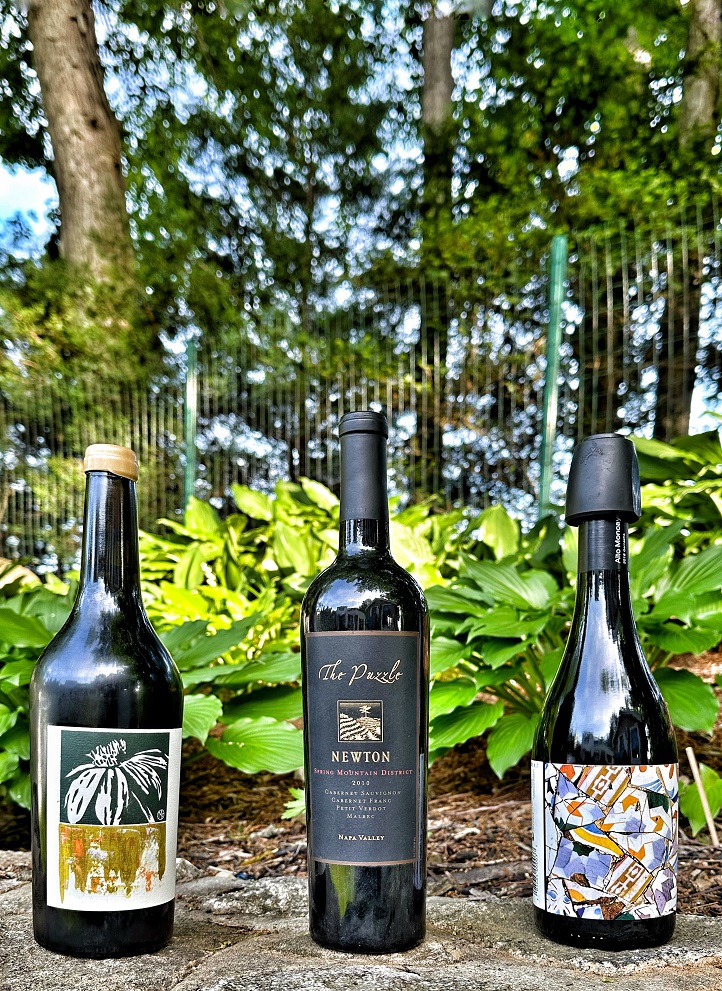 The life of an oenophile is never dull – of course, if an oenophile chooses such.
UP
Let’s talk about “ups” first.
Sine Qua Non. The legendary Sine Qua Non. The Sine Qua Non winery is unique in many ways. First and foremost, Sine Qua Non wines are unique. Of course, every winemaker is sure that his or her wines are unique. But for Sine Qua Non, these are not just bragging words. Every vintage, a different set of wines is produced, and wines do not or rarely repeat year after year. Each wine has a label designed by Manfred Krankl, who owns the winery together with his wife Elaine. And the wines are impossible to get – I had to wait for 10+ years to move from the waiting list to the mailing list.
My sister-in-law and her husband were visiting over the weekend. They both enjoy wine very much – which is a perfect reason to get out a special bottle. Sine Qua Non is better known for its Rhone-style reds, but they produce white wines as well. One of the first wines in my allocation was Sine Qua Non white wine. Communal notes on the internet seem to indicate that SQN white wines shouldn’t be aged for too long, so I decided that 4 years is a good age for this wine, to avoid any possible regrets (who am I kidding – there are always regrets when it comes to wine).


2019 Sine Qua Non Distenta 1 California White Wine (15.3% ABV) is a blend of 41% Roussanne, 26% Chardonnay, 14% Petit Manseng, 12% Viognier and 7% Muskat (Gelber Muskateller), fermented in barrel and matured on its lees, 23 months in 64% new French oak. The sublime nose of whitestone fruit, herbs, and flowers, with a distant hint of tropical fruit. And the palate, the bouquet… As a child, I loved to sing, and I spent some time in the chorus. I was perfectly fine singing in unison, but for the life of me, I could never do the canon, the subtype of polyphonic singing, where each singer has their own melody, and those melodies harmoniously combine together. This wine delivered such a canon singing – beautiful notes of sage, eucalyptus, tobacco, and whitestone fruit were changing into tropical fruit with a touch of bright honey notes. Somehow, it was possible to taste both profiles at the same time. I know I’m not describing it well, but this was the wine I really didn’t want to end… (Drinkability: 9)
By the way, an added bonus – it appears that I never had the Gelber Muskateller grape – and now I can unexpectedly increase my grape count.


DOWN
Over the years, I got two bottles of red wine from Newton Vineyards, a well-respected California winery, as presents, both from the same 2010 vintage, and both identical. I know the producer’s name, but it seems that I only tasted Newton Chardonnay before, and I have no memories of tasting their red wines.
Both bottles were gifted by the sister-in-law and her husband I just mentioned, so I thought their visit was a perfect opportunity to enjoy this wine together.
And so I opened the bottle of 2010 Newton The Puzzle Spring Mountain District Napa Valley (14.5% ABV, 60% Cabernet Sauvignon, 18% Cabernet Franc, 18% Petit Verdot, 4% Malbec).
And the bottle was corked.
I just recently mentioned in one of the social media discussions that I rarely encounter corked California wines. I guess I jinxed it… The cork faint was ever so slightly noticeable on the nose, and the palate kind of seemed okay, so I even decanted it and we even tried drinking it. The decanting made the corked nature of the wine even more apparent, and I pulled the second bottle.
The second bottle was not corked, and it was drinkable. However, it was a bit underwhelming. The fruit was there, it was possible to taste the cassis, but considering that this was a Californian wine, it showed leaner than expected. I would generally consider that Californian wine of such level need at least 20 years to develop, and under normal circumstances I would leave the second bottle alone for another 5-7 years, but oh well. We did enjoy it, of course, I was just hoping we would enjoy it more. (Drinkability: 8- )
STILL DOWN
I’m not going in chronological order here. The Newton red was planned to be the main wine to serve with dinner. As a “pre-gaming”, I gleefully pulled out the 2018 Alto Moncayo Veraton Campo de Borja (15.5% ABV). I opened a bottle of this 100% Garnacha last year, and it was absolutely spectacular from the get-go – succulent cherries and layers of pleasure. I loved the wine so much that it was included in the top two dozen list of 2022 wines as number 13.
Feeling great about myself, I opened the bottle and poured wine into the glasses. At the first tiniest sip, instead of excitement, my instant thought was “ohhh nooo, why is it so sweet???”. I also instantly knew that I’m in trouble with my sister-in-law, as she stopped drinking California Pinot Noirs for being too sweet… And her reaction was exactly what I was afraid of. After the first sip, she raised her head from the glass, looked at me inquisitively, and said with a wry smile “but why is it so sweet?”. This is when we put this bottle aside and proceeded with The Puzzle – and you just read how swimmingly well it went.
Truly, whatever goes up will go down.
AND UP AGAIN
Whatever went down still has a chance to go up.
The very next day, Veraton somewhat solidified at its core, the sweetness subsided, and the structure started to appear. On the third day, the wine was as delicious as I was expecting it to be – succulent ripe cherries, juicy and generous, with crunchy acidity and perfect balance. (Drinkability: 8+).
Here you go, my friends. Another weekend in wine – sometimes you win, sometimes you learn. With the exception of the corked bottle, which is never okay – but as my sales team always said, “it comes with the territory” – it was a great wine weekend, even with all the ups and downs. How was yours?
Weekend in Turley, With a Dash Of Carlisle and Hardy
Many moons ago, my friend Henry and I discovered Turley wines. We were at a restaurant in Manhattan with our wives, either before or after the Broadway show, and on the wine list, Turley Zinfandel (either Juvenile or Old Vines) was one of the reasonably priced wines, so that was the wine we ordered. I don’t remember if I heard about Turley before (maybe), but tasting that wine was a pivotal moment – we fell in love with Turley wines.
Turley Wine Cellars was founded in Napa Valley by emergency room physician, Larry Turley in 1993, and went on to become one of the most prominent Zinfandel producers in the US. Turley produces about 50 different wines from about 50 different vineyards, most of them organically farmed, from all around California. Many of those vineyards date back to the late 1800s. While Turley might be best known for its Zinfandel and Petitte Sirah, they also produce a number of white wines, a number of other reds, and even Cabernet Sauvignon, first produced in 2010, and eloquently called The Label (Larry Turley’s famous saying was that Cabernet drinkers drink “the label”, hence the name – I had my own share of troubles with this wine).
Turley wines are hard to get in the store, and if you really would like to enjoy them at will, you need to be on the Turley mailing list. Turley was one of the very first mailing lists I managed to get on more than 10 years ago, and I had been a happy customer ever since. My friend Henry finally got his first allocation about two years back.
A place on the mailing list still doesn’t guarantee you access to each and every wine Turley makes, and their list operates on a “first come, first serve” basis – I missed quite a few wines that were included in my offering, but disappeared much sooner than I could make up my mind.
Last Saturday, Henry was coming over for dinner, so I had to make it a Turley evening.
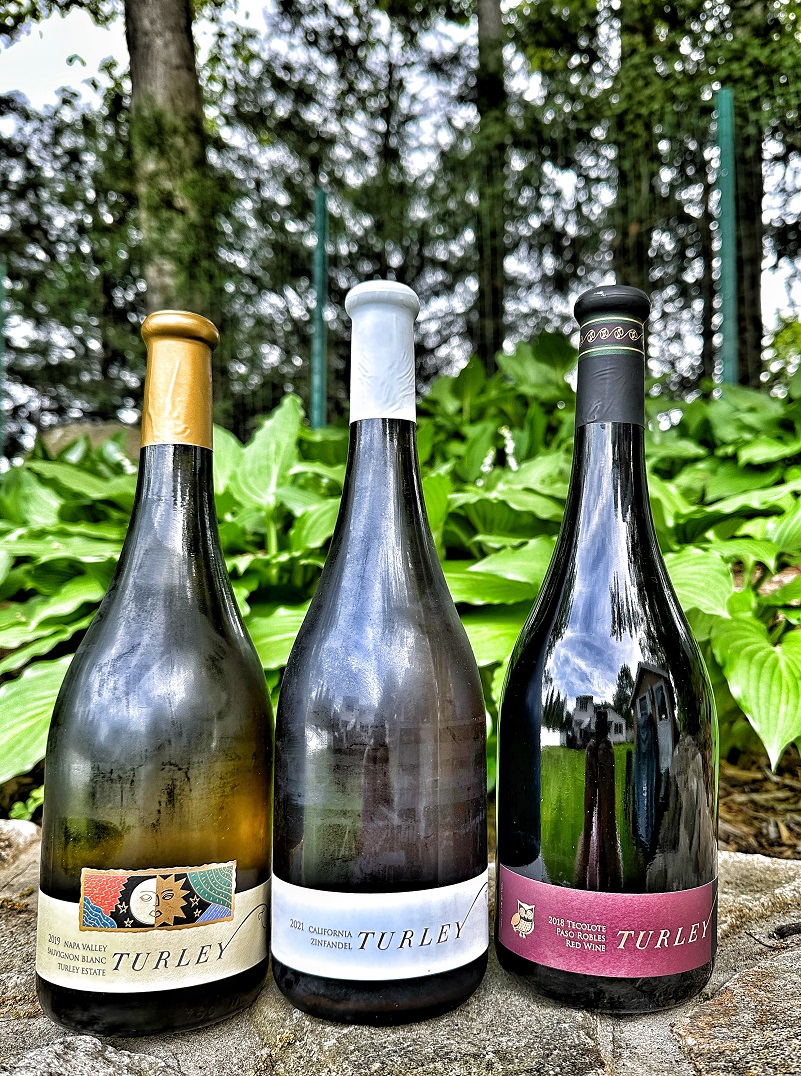
Turley makes only two white wines – Sauvignon Blanc and a blend called White Coat. The wine we opened was the 2019 Turley Estate Sauvignon Blanc Turley Estate Napa Valley (13.4% ABV). It is interesting that Sauvignon Blanc was one of the original wines produced back in 1993. Sauvignon Blanc plantings at Turles Estate were replaced with Zinfandel, but then Sauvignon Blanc was planted again on a small section of the dry-farmed, certified organic vineyard. The wine was fermented using natural yeast and it was bottled after 6 months in 100% French, used oak barrels. The wine was an absolute delight, showing beautiful whitestone fruit, perfectly present, perfectly elegant, with fruit and acidity singing in complete balance.
I had a little bit left in the bottle after that evening, and on Sunday I was able to please the most discerning palate in our household – my mother-in-law. She came over for Mother’s Day on Sunday and wanted to drink the white wine. When it comes to wine, she is completely unpredictable, and I always try to pour her wine without showing the bottle – she has lots of preconceived notions about wines and the regions, so I’m always trying to make sure she will just try the wine first, and then I can tell her where it is from. To my delight, she liked the wine, and even when I told her the wine was from California, she still liked it – a serious achievement in this household.
Our next wine was 2021 Turley Zinfandel Rosé California (12% ABV). This wine sometimes is called White Zinfandel, but only to poke fun at the uninitiated (and the bottle is adorned with the white label). This wine is impossible to score – you literally have to press “buy” as soon as your summer offering arrives. The wine is fermented in stainless steel and aged in used French barriques. It is lip-smacking, it speaks cranberries and strawberries, it is very Provençal in its presentation, but Californian in its soul.
And then there was Tecolote – 2018 Turley Tecolote Paso Robles Red Wine (15.7% ABV). This wine is rarer than rare, as you need to know it exists, to begin with. I got it once through some special holiday offer, but it is never included into the standard seasonal offerings. This wine is typically only available in the tasting room, but being a mailing list member has some advantages – I asked if I can get a few bottles, and they arrived just in time for us to enjoy. This wine is a Spanish-inspired blend of 60% of Grenache and 40% Carignane, coming from the specific block in Pesenti Vineyard, planted in the 1920s. Tecolote means “owl” in Spanish, and this is how the vineyard block is also called. The wine offered layers of lip-smacking black cherries, kitchen spices and sweet tobacco. A perfect balance of textual presence, fruit and acidity made this wine disappear in no time…
Next, let me step away from the wine for a bit – but not from the grapes. I rarely talk about cognac on these pages, but then I have an experience to share.


On an average day, I’m a scotch drinker. But of course, I would never refuse a sip of a good cognac. The keyword is “good” – nowadays, it is difficult to find a good-tasting cognac at a reasonable price in the US. However, my recent cognac tasting with my school friend led me to the discovery of Cognac Expert. Subsequently, I got a recommendation from Cognac Expert for the cognac I now enjoy immensely – without any need to break the bank – Hardy Legend 1863 Cognac. This cognac was produced by the Cognac House of Hardy, to commemorate the founding of the Hardy house back in – yes, you guessed it – 1863. This cognac is a blend of spirits made from the grapes coming from Borderies and Petite Champagne growing areas, aged from 2 to 12 years and finished in classic Limousine oak. From the first enticing smell to the long-lasting, coffee-loaded finish, this cognac offers the ultimate pleasure of balance of fruit, spices, and acidity. And at $40, this might be the best QPR cognac out there today.
Last but not least – 2015 Carlisle Mourvedre Bedrock Vineyard Sonoma Valley (14.9% ABV), which I opened on Sunday. Carlisle is another one of my favorite producers, specializing in Zinfandel, Syrah, and Petite Sirah – and some other grapes. The fruit for this wine came from the 130+ years old vineyard, planted in 1888. The wine was aged in French oak, 20% new. It is interesting that stylistically, this wine was similar to Turley Tecolote – succulent tart cherries on the nose and the palate, a touch of eucalyptus, refreshing acidity, perfect balance. This was an excellent wine to finish the weekend right.
Here you are, my friends – my weekend wine story. If you can find any of the wines mentioned in this post you should definitely look for them. And if you like cognac, this Hardy 1863 Legend is hard to beat. And you know where to find it.
Nevermind. I should have never told you that.
Until the next time – cheers!
Uruguay Wines – Coming Of Age
Do you know the problem many wine lovers share? We are creatures of habit.
Once we develop our inner “favorite wine” profile, we don’t let any changes happen to it. We like what we like. Never heard of this region? Thank you, I’ll pass. God forbid we fall in love with the particular producer – this is even worse than the region – nothing is ever good enough outside of the circle of our favorites.
And this is generally okay. Except we are putting ourselves in danger of losing on new, enlightening, delicious experiences.
When I was invited to the Uruguay wine webinar, my first reaction was “nah”. I mean, Uruguay, really? Between Chile and Argentina, my South American world-class wine circle is already full – do I need to bother with the wines from a totally unknown region?
On second thought – this is a webinar. Wine is coming to me, not like I need to travel somewhere to taste the wines I can potentially be disappointed by. Why not?
I’m glad I accepted the invitation. Both the information and the wines were lots of fun. We learned that while Uruguay has a population of 3.5M people, 2nd smallest size-wise country in Latin America, the country has a 98.7% level of literacy, the highest in Latin America. People in Uruguay are mainly descendants of Italians and Spaniards so they literally have wine embedded in their DNA.
Winemaking in Uruguay started in the 13th century. Today, there are 164 active wineries, producing 70M bottles of wine annually. Uruguay is currently in the process of implementing its own sustainability program. And by the way, the oldest winery in Uruguay dates back to 1854 and is called Los Cerros de San Juan (still open today!).
Uruguay has primarily a maritime climate with strong Atlantic influence, with the majority of low-lying coastal vineyards. Uruguay’s climate is closer to Bordeaux than the rest of South America, and it is significantly wetter if compared with Chile, where it rains only during the winter. Soils are clay based with lots of river deposits. Uruguay has six main winemaking areas, boasting 5 different terroirs. Warm and cold ocean currents collide right around Uruguay, creating significant influence. Interestingly enough, Uruguay is the only winemaking country in South America whose terroir is affected by the Atlantic Ocean.
When it comes to grapes, there are 14,804 acres under vine (a little smaller than Alexander Valley in California). Tannat is unquestionably a star, accounting for 27% of vineyard plantings., but it is not the only grape, obviously – Merlot, Cabernet Sauvignon, Cabernet Franc, Sauvignon Blanc are all quite popular as well.
And before we talk about wines, few more interesting tidbits: cows outnumber humans in Uruguay 4 to 1 and Uruguayans consume more meat per capita than any other country in the world!
Okay, now you know all that I learned in the webinar, and we can talk about the wines.
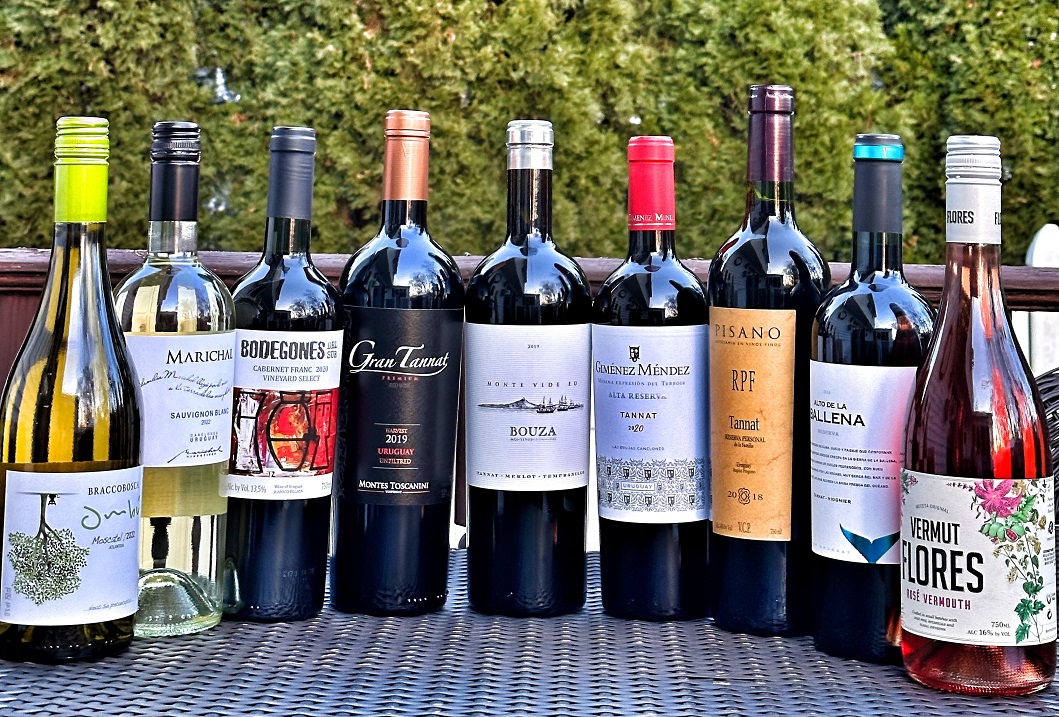
We had 2 whites, 6 reds, and one Vermouth wine in the tasting. Spoiler alert: I literally liked them all. In the blind tasting, these wines would be surely regarded as world-class, placing them in California, France, maybe Chile – Uruguayan origin of these wines would be a total surprise for many – for sure for me. And yet, here they are – world-class wines from Uruguay.
2022 Marichal Sauvignon Blanc Canelones Uruguay (12.5% ABV, $14)
C: light golden
N: plump, round, Whitestone fruit, a hint of gunflint
P: crisp acidity, fresh, bright. More resembling Muscadelle than anything else. Good balance.
V: 8, very refreshing.
2022 Bracco Bosca Ombú Moscatel Atlantida East Costal Region of Uruguay (13% ABV, $16)
C: light golden
N: very interesting. Muscat’s spicy, nutmeg profile comes as a distant hint. A touch of perfume
P: restrained tropical fruit with an acidic finish.
V: 7, not balanced enough for me; On the second and third days the wine showed much better, more coherent and more elegant – Drinkability: 8-.
2020 Familia Deicas Bodegones del Sur Vineyards Select Cabernet Franc Juanico Region Uruguay (13.5% ABV, $20, 30% aged in American and French oak)
C: Beautiful bright ruby
N: round vanilla, new world style
P: interestingly restrained on the palate, with noticeable tannins. The palate shows the absolutely old world (Saumur, Chinon). Interesting cranberry notes after an hour and a half in the open bottle.
V: 7+/8-, a bit unexpected, but not bad
Improved on the second day, became more round. Final: 8-
2020 Giménez Méndez Alta Reserva Tannat Las Brujas Canelonés Uruguay (14% ABV, $18, aged for 9 months)
C: Dark Garnet
N: Open, inviting, dark fruit, blackberries
P: Dark fruit, firm structure, smokey undertones, herbs, very good balance.
V: 8, well drinkable now
2019 Montes Toscanini Gran Tannat Premium Uruguay (14% ABV, $59, 18 months aged in oak, BAB with a huge punt)
C: dark garnet, practically black
N: wow. Cassis, sweet oak, eucalyptus, open, inviting, invigorating. In a blind tasting, I would bet my life on Napa Cabernet Sauvignon.
P: the palate is leaner than the nose suggests. Red and black fruit weave around a firm structure, tannins showed up a while after opening.
V: 8-/8, very impressive
2018 Pisano RPF Reserva de la Familia Tannat Region Progreso Uruguay (% ABV, $24, 10–12 months in French oak)
C: dark garnet
N: dark fruit, coffee, smoke
P: a hint of smoke, sapidity, dark, concentrated but not overpowering. Good balance, medium-long finish
V: 8-/8, very nice. Will be great with the steak.
2018 Alto de la Ballena Tannat – Viognier Uruguay (14% ABV, $24, 85% Tannat, 15% Viognier)
C: Dark garnet, almost black
N: herbs-forward nose, sage, a hint of cherries
P: fresh fruit, salivating acidity, sage, firm structure, and perfectly lingering cherries and cherries pit finish.
V: 8, great by itself, and will be great with beef roast
2019 Bouza Monte Vide Eu Montevideo Uruguay (13.5% ABV, $67, 20% Tempranillo, 30% Merlot, 50% Tannat, vinified separately, 16 months in French and American oak barrels)
C: dark garnet with a beautiful ruby hue
N: very complex, cherries, rosemary
P: roasted notes, dark fruit, elegant package, firm structure with a perfectly balanced mouthfeel.
V: 8, excellent, a world-class wine.
Basta Spirit Vermut Flores Rosé Uruguay (16% ABV, $16, Tannat, 27 botanicals)
C: beautiful salmon pink
N: Herbaceous, but a bit strange, stewed strawberries
P: a bit too sweet for my palate.
V: I’m very particular about the vermouth, so this is probably not the one for me.
Here you are, my friends. Next time you see an Uruguayan wine on the shelf, obey your thirst and grab it – and you don’t even have to thank me later.
OTBN Conundrum
OTBN, short for Open That Bottle Night, is my favorite wine holiday. Nowadays, there are lots and lots of wine holidays, usually associated with a particular grape – International Chardonnay Day, International Cabernet Day, Beaujolais Nouveau celebration, and so on. The majority of such wine holidays encourage you to open a bottle of wine made from a particular grape, whether there is a story behind the bottle or not. You can take these grape holidays with all seriousness and meticulously prepare and select the right bottle, or you can just grab any random bottle you will see in the store – or skip the grape holiday altogether if you don’t feel like drinking Cabernet Sauvignon or Chardonnay on that particular day.
OTBN is different. OTBN was invented for people who take their wine seriously. Or maybe rather those who take their wine too seriously. Over the years, we accumulate wine bottles that are deemed special; brought home from the winery you visited in France; got this bottle after an amazing tasting event; a bottle from an amazing family vacation many years ago; a bottle given to you by a dear friend. We can continue on and on, but you got the point.
Many of those special bottles in your collection would have some similar traits: they exist in the quantity of 1 and they are too special to be opened at random. Those special single bottles stay put in your cellar, waiting for the special company, special circumstances, special moment, special friend’s visit to be opened and enjoyed. More often than not, they keep waiting, and waiting, and waiting, because that special moment keeps not happening. And then, when it finally arrives, you might open that special bottle you preserved with the best care in the world, only to find that the content can solicit the memory but can’t bring you joy anymore because the wine in the bottle simply turned past prime. And it also kind of ruins the moment. This is why OTBN was invented, and this is what makes it such a great holiday for all the winos out there.
My personal conundrum draws exactly along the lines I just described. I have a lot of single bottles (actually, an absolute majority of my wines in single bottles – I practically never buy any wine by the case), and as such making a decision about a “special” bottle of wine for an event or a holiday, never mind the hallmark of them all, OTBN, a long and tedious process. “Is this bottle good enough? Okay, but I only have one. What if I will open it now and would never know how great it could’ve been? What do I do? What do I do?”
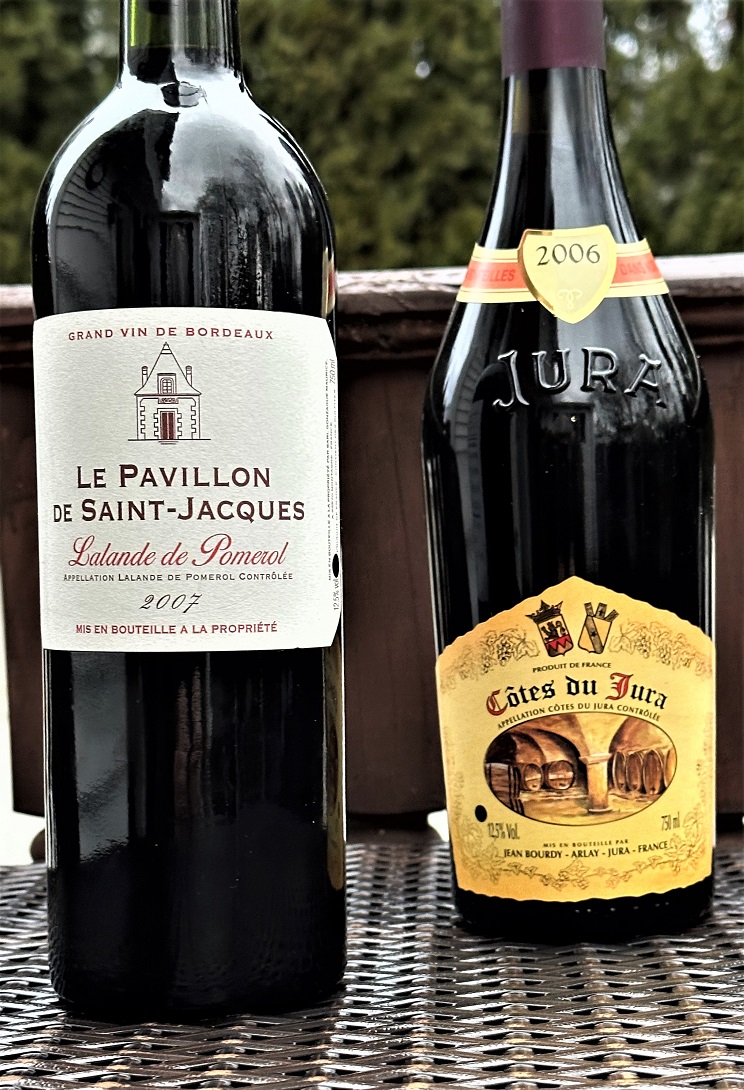
Same as the last year, I had to celebrate OTBN early this year due to the business trip spanning over the intended OTBN last Saturday of the month, February 25th. My wife doesn’t drink much wine nowadays, so I had to count primarily on myself. I had no good ideas coming to my head, there were no special bottles of wine I was ready to sacrifice. Looking at one of the wine fridges, I noticed the bottle of Jean Bourdy from Jura.
I don’t take Jura wines lightly, they are very hard to procure in the US. And then Jean Bourdy is a legend in itself – I better have a damn good reason to open such a special bottle. Then I thought that I already had some Jean Boardy in the past – maybe I would find some notes in the blog? I entered Jean Bourdy in the search box, and sure enough, this post came up. I tasted this wine in 2011 when I attended a Natural Wines seminar at PJ Wine store in New York – my first, a truly memorable encounter with natural (low intervention) wines as a category. I tasted this exact wine, 2006 Jean Bourdy Cotes Du Jura Rouge (fun fact: 2006 was the first vintage of Biodynamic wine production at Caves Jean Bourdy). I really liked the wine then, and my note said “It appears that wines of Jean Bourdy are known to age very well (note to self)”. As soon I saw this “note to self”, I instantly put that single bottle of Jean Bourdy back, as 17 years is most likely not an age for it.
In the same post, I noticed another wine that happened to be next to Jean Bourdy bottle on the same shelf – 2007 Le Pavillon de Saint Jacques Lalande de Pomerol. I pulled this bottle many times from the fridge before, always remembering that this was a natural wine, but again, no moment felt special enough. Then I read my note from 2011, which was clearly less than favorable. Here it is in its entirety:
“Very interesting. Smells like dirt, pure dirt after the rain. Very vegetative, no fruit on the palate, just pure dirt again. Almost no acidity. This wine was fermented in concrete tanks, aged for 18 months. It is “certified organic” and made with 90% Merlot and 10% Cabernet Franc – classic Pomerol wine. I would love to taste it in 10-15 years – I think it will greatly evolve, but it is not easy to say ” I like it” now”.
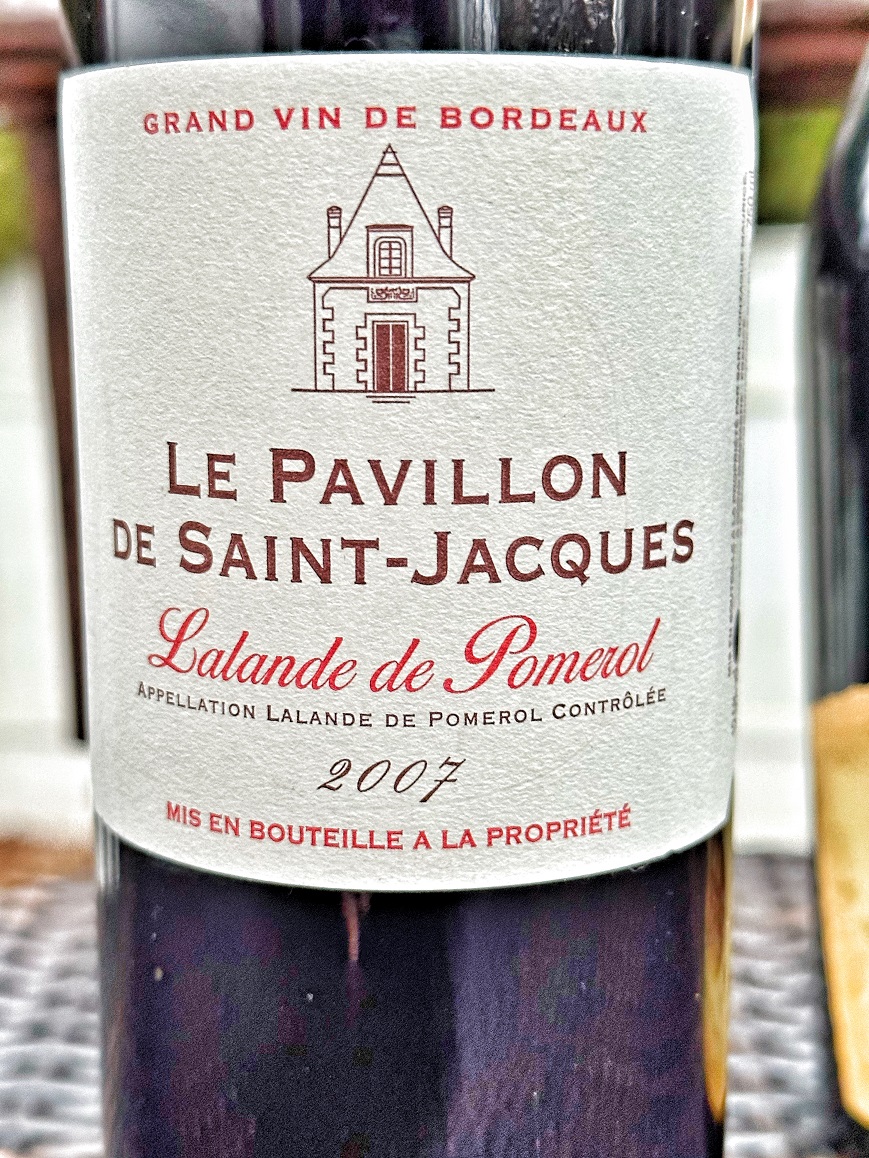
This “note to self” clearly stated that the wine was not good in 2011, but I should give it another try in 10-15 years. I was pretty much in the middle of that suggested term – 12 years after the original tasting, so opening that bottle all of a sudden became a perfect thing to do.
Cork came out easily, showing a good amount of crystals on the bottom, but otherwise perfectly fresh. The first sip instantly put my inner wine geek into a nirvana state. Barnyard. Pure, beautiful barnyard. If you belong to the group which screams “brett” at the first whiff of the barnyard smell on the wine, I’m sorry but we can’t be friends. Yes, there are limits to everything, but the reasonable amount (don’t ask me to quantify, everyone has to define their own “reasonable amount”) enhances the wine pleasure for me. I typically find barnyard associated with Syrah wines – possibly, this was my first Bordeaux with the barnyard aroma – but the barnyard aromas were followed by the classic, concentrated cassis. Layered, concentrated, softly rolling harmonious wine with perfect, firm structure and clean acidity. Beautiful, classic Bordeaux. This was truly an OTBN-worthy pure pleasure experience (by the way, my wife also loved the wine very much).
Here you go – my typical wine selection conundrum, happily resolved to make another memorable night. And as a bonus, the expectation of improvement of the wine with age fully came through (patting myself on the back).
The official OTBN night is almost here. You still have time to select the bottle or 5, maybe get some friends together and make some wonderful wine memories. If you want to celebrate only one wine holiday a year, make it OTBN – don’t risk the wine not being there for you, or you not being there for the wine.
And please share your OTBN stories – I would love to hear them.
Neyen, The Spirit Of Apalta
What do you think of Chilean wines? Have you had Chilean wines which took your breath away?
While you ponder that, let’s talk about Chilean wines.
Nobody can question today’s grandstanding of the Chilean wines in the world. According to Wikipedia, Chile is 7th largest wine producer in the world and 5th largest exporter – the ranking positions change every year, but there is a clear growth trend for Chilean wines, both in terms of volume and value. And Chile is one of the worldwide leaders in sustainable and organic viticulture, setting a clear example for the rest of the wine-producing world.
Not changing the subject, but what do you think of organic wines? I remember that 10-12 years ago, organic wines were few far and between, and those proudly displaying “organic” on the labels were largely undrinkable. The situation changed, mostly unnoticeably, and I can say that today at least 25% of the wines I get to drink during a year are made with organic grapes, and this number is definitely higher if we are talking about the samples I receive for the reviews.
If we are touching memory lane, who remembers Chilean flagships, Fronterra and Concha y Toro Cabernet Sauvignon and Chardonnay available for around $10 in 1.5L size? Those were the stars of any party, taste being much less important than the price. And again, slowly but surely this all changed, and Chilean wines now commend the full respect of wine lovers around the world, on the level of prized Bordeaux, Napa Cabs, and Brunellos.
Now, the reason behind this little Chilean wine excerpt is my recent encounter with pure pleasure – you know how much I value that element of wine drinking – the wine should give pleasure, otherwise, what is the point of drinking it. The wine I want to share with you today is the 2017 Neyen Apalta Estate Chile (13.5% ABV, $64.99, 50% Cabernet Sauvignon, 50% Carmenere, 14 months in 225L French oak barrels, 6 months in 3,000L foudres).
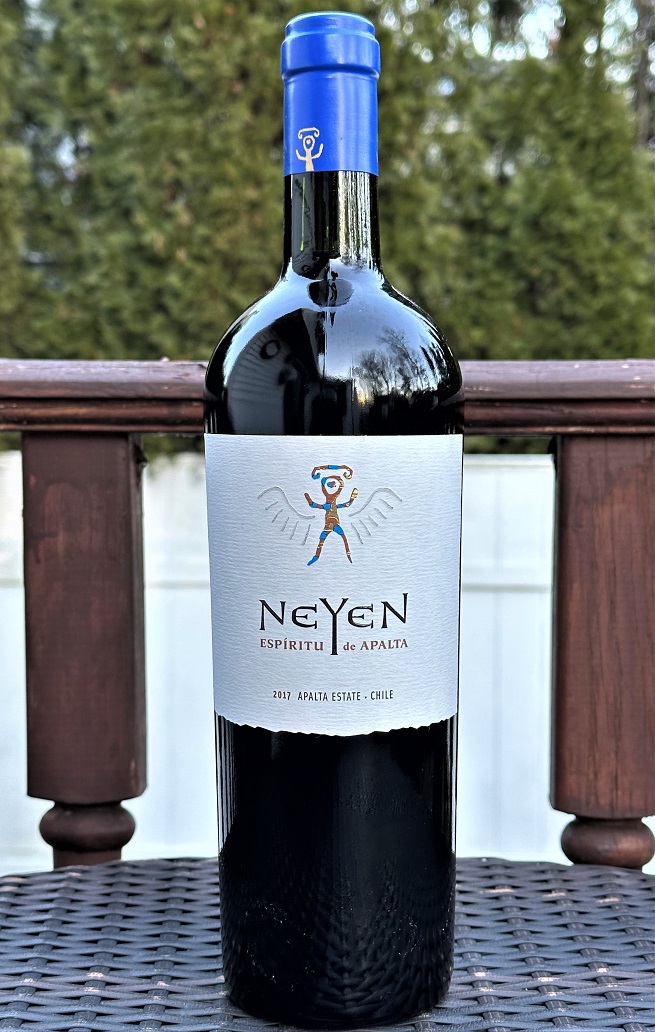
Neyen is a unique estate, a parcel of land situated between the Andes Mountains and the Coastal Range. Cabernet Sauvignon vines were planted there in 1889, joined by Carmenere in 1936. Soils at this organically farmed, low-intervention vineyard provide good drainage, and the semi-arid climate allows for the slow ripening of the grapes, maybe with the assistance of the Neyen, the Spirit of Apalta. Grapes are harvested by hand at the first light, sorted, destemmed, and subjected to the magic of winemaking. In most of the years, the blend stays at a consistent 50% Cabernet Sauvignon and 50% Carmenere, even though in some of the years different proportions are used.
When I opened the bottle and poured the first glass, I was really unconvinced. The wine was drinkable but didn’t incite any “oh my god” reactions which I expected at least based on the price. I pumped the air out and put the bottle aside for the evening.
The next day, I pulled the stopper out, poured a glass and the very first whiff brought the sacred “oh wow”. The cassis and eucalyptus were enveloping the senses, making it impossible to put the glass down and promising a lot more to come with the sip. Wine requires time to be enjoyed, you can’t hurry it. Finally, after a minute or so of just enjoying the aroma, I went for a sip. To my delight, the aromatic experience continued in full force on the palate. More cassis, more eucalyptus, layers of dark fruit, and silky, soft tannins were making the taste buds dance. The experience was taking me precisely between the worlds – the precision and structure of the old world Bordeaux was perfectly coupled with the youthful exuberance of the new world Napa Cab. Don’t get me wrong – this wine doesn’t need Bordeaux or Napa references, this wine perfectly exists in a class of its own, a perfect combination of ungrafted French Cabernet Sauvignon from 130 years old vines and Chile’s own Carmenere. (Drinkability 9-)
Here you are, my friends. A superb Chilean wine that is sure to bring a smile to your face. With holidays or without, winter or summer – this wine has a lot to give. Magic of the Neyen, the Spirit of Apalta? I will let you find the bottle and decide on your own.
By the way, how about the question I asked you at the beginning? Can you name some Chilean wines that took your breath away?
Daily Glass: Unexpectedly Stunning
Expect the unexpected.
When people hear that beaten up “expect the unexpected”, I’m sure in at least 80% of the cases, the expectations are negative. “Expect the unexpected” generally implies that one should always be prepared to deal with seemingly unexpected and often hostile circumstances.
In the wine world, we might want to adjust the “expect the unexpected” ever so slightly. By its nature, wine is always unexpected. Bottle variations, spoiled wine (think corked, for example), serving temperature, ambiance, food, company – everything affects the taste of wine – and I’m not even talking about root and flower days. Every bottle is a mystery – even if you had that same wine from the same producer and the same vintage 100 times before, when you are looking for pleasure you should open the bottle with trepidation. Every bottle is a mystery, and you never know what you will find inside.
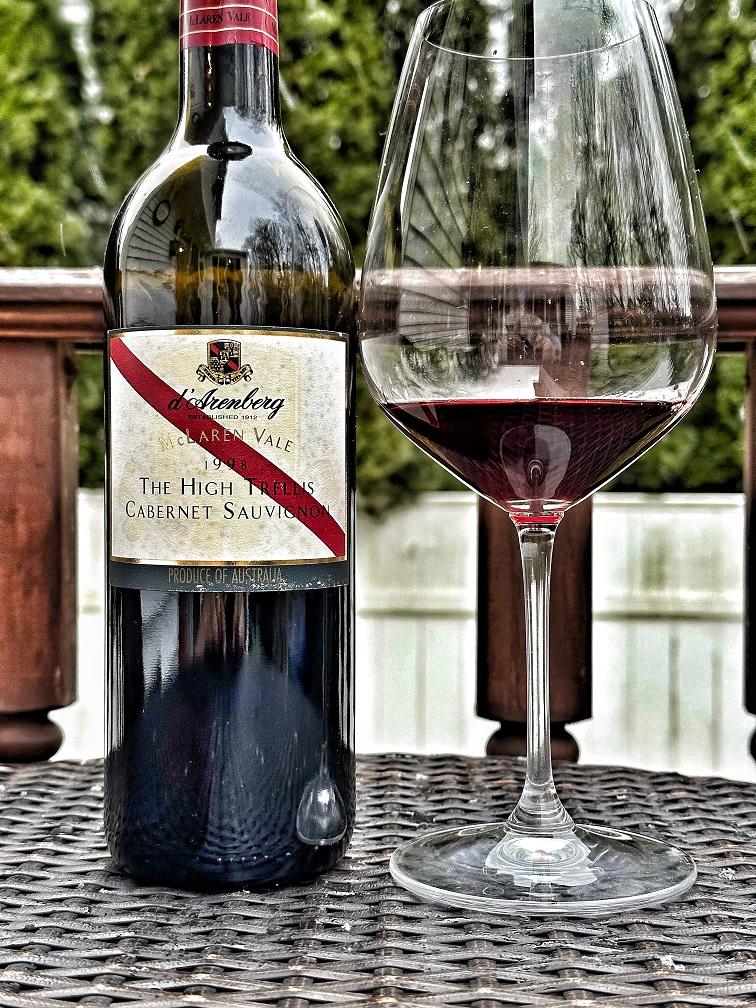
I already had this exact wine before. 1998 d’Arenberg Cabernet Sauvignon High Trellis McLaren Vale was number 16 on my top 20 wines of 2020 list. 1998 is one of the special years in my book, so I’m always on the lookout for affordable 1998 wines. I came across this specific wine at the Benchmark Wine Group wine store, and at $19 per bottle, it was well worth the risk. Of course, d’Arenberg is an excellent producer and I trust their wines – but aging the wine changes a lot of things and nobody can truly predict what would happen with wine as the result of the aging.
When it comes to aged wines, when everything works well, the expectations are resembling the bell curve. In the optimal case, we expect the wine to gradually improve, then stay at its peak, and then gradually decline. But every bottle has its own bell curve associated with it – how long will it take for the wine to reach the top of the peak, for how long the wine will stay at the peak, when the wine will start declining – every bottle has its own story, and nobody can predict how a particular bottle of wine would behave. This makes drinking aged wines great fun – you never know what you will find behind the cork. This also makes drinking the aged wines a source of frustration – until you successfully pull the cork out, take a sip, and smile happily, the frustration lingers.
You are unquestionably doubling this frustration when you are opening the aged wine you already enjoyed before. In general, before you open the wine, you base your expectations on the reputation of the producer, the region, the winery, and maybe on the vintage. Once you tasted the wine, you acquire the frame of reference, so when you will be opening the bottle of the same wine as you already had, your expectations are based on your prior experience – “ahh, I liked it before, I hope the wine will be as good as it was the last time”.
The last Sunday, we had a good reason to open a bottle from the 1998 vintage, so this was the bottle I decided on – for no particular reason, the decision formed in the head by itself. I used the ah-so to gently extract the cork, only to find out that I had no reason to worry, and the regular corkscrew would do just fine – the cork was in very good shape.
Once in the glass, the color increased the hopes for the enjoyable experience – dark ruby, not a hint of brickish color which old reds might acquire. And the first whiff from the glass put absolutely all the worries away. Ripe cassis, eucalyptus, a touch of sweet oak – the aroma was beautifully enticing, seducing you only as the Cabernet Sauvignon can. And the palate… The palate completed this mesmerizing experience, offering ripe dark fruit, cassis, still fresh and firm structure, a beautiful herbal bouquet, and a perfect balance. Not to try to take anything from the Australian wines, this was a Napa Cab-like experience. (Drinkability: 8+/9-).
I pumped the air out and couldn’t get to the wine for the next two days. On the third day, I poured a glass, this time expecting that the wine is gone. To my total surprise, the wine closed up, now more resembling the young Brunello, perfectly firm, dense, and cherry-forward. The fact that the wine was perfectly fine 3 days after being opened gives me hope that the wine will be good at least for another 15 years – and this time around yes, I have another bottle.
Here is my story of the sudden pleasure. Do you like aged wines? Are you intimidated by aged wines? Do you also expect the unexpected? Let me know what you think.
Until the next time – cheers!
When in Spain…
My last trip to Europe was in September 2019. Next were the 3 strange years (you know what I’m talking about). And then suddenly I had to come to Europe for work meetings for 2 straight weeks – first week in Spain, then in France. It honestly felt very strange, visiting Europe after such a long break, but I’m afraid I will start sounding very stupid if I will continue complaining…
Before we talk about Spain – I love sunsets and sunrises around the planes – I’m sure you know that there will be quite a few pictures in this post, so here you go…


So what one does do upon arrival to Spain? Okay, I have no idea what people actually do when they come to Spain. And my course of action is largely independent of the destination – I need to find sparkling water for my hotel room, as this is the form of water I always prefer. And of course, being in Europe, I need to check the prices of wine and probably get a bottle or two for the room.
Arriving in Malaga on Sunday didn’t really help with things. Why? I don’t know if this is very typical of Spain (I suspect so) or just for Malaga, but no matter what Google says the absolute majority of the supermarkets are closed (as well as most of the regular stores). I made 2-3 attempts to rely on Google’s recommendations only to find places closed. I almost gave up but decided to give it one more try. This walk was successful, and I ended up with 3 bottles of wine, 3 bottles of seltzer, and some other provisions to make hotel room life more fun (glad I had a little fridge in the room).
Of course, the point of the excursion was not just to get the wine, but also to see the prices and selection. A good number of wines were priced in the range which doesn’t exist in the USA, no matter what and where you are buying – from €2.50 to €4. You can also see a variety of “Tetrapak” wine options, priced extremely reasonably, barely a €1 for a liter and similar prices for the six-packs. Definitely beats “wine-in-the-can” prices in the US which can easily exceed an obnoxious $10 for a can and more.
Later in the week I managed to get to a supermarket, so you can see the price observation in the pictures below. It is interesting the Albariño wines were priced almost at the level of the prices in the US – while many of the wines were available for a “buck fifty” or so. Go figure…
Anyway, I settled for two bottles of red and one white, each under €4.


After getting back to my room, I happily enjoyed both of the reds, which both happened to be Tempranillo wines. I did like 2017 Félix Solís Winery Viña Albali Reserva Valdepeñas DO (13% ABV) a bit more as it was perfectly approachable from the get-go, with elegant dark fruit and spices. The 2019 Bodegas Los Llamos Señorio de Los Llamos Tempranillo Valdepeñas DO (12.5% ABV) was a bit more restrained and needed more time to open. Both wines lasted pretty much through the entire week by just putting the cork back. The 2021 Sitial Verdejo Rueda DO (13% ABV) was opened a few days later, and it was a perfectly happy Verdejo rendition with a touch of freshly cut grass and lemon, fully matching the expectations.


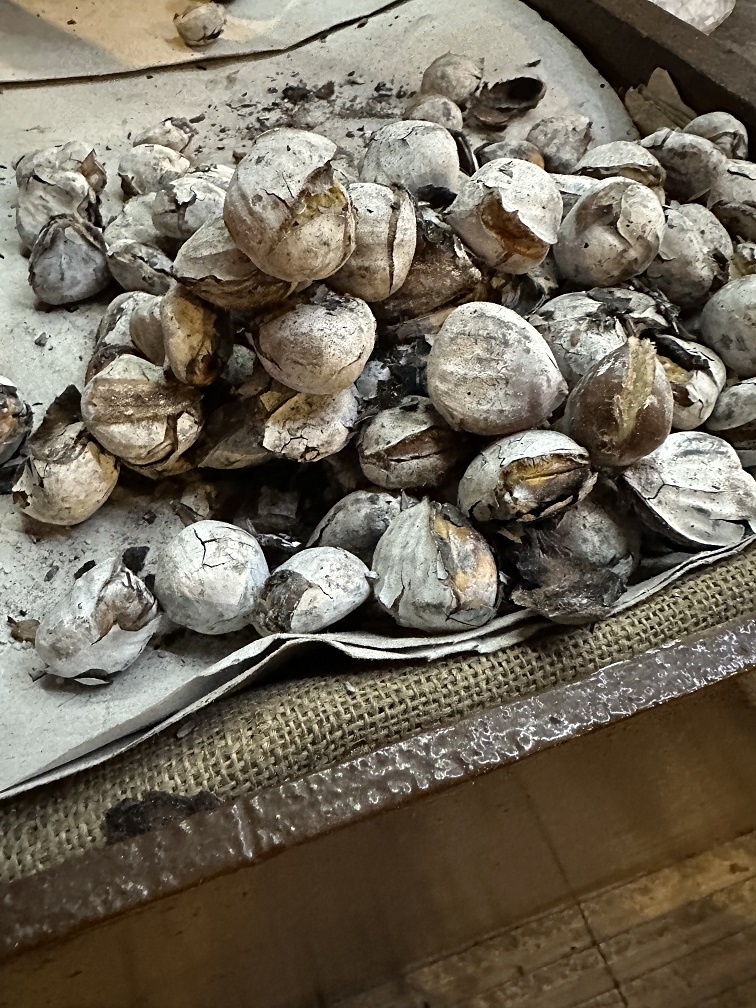
After my colleagues arrived in the evening, we took a little stroll to the historical town, where in addition to the very enjoyable walk and pleasant sightseeing I came across one of the tastiest discoveries of the entire trip – roasted chestnuts.
Before you say “duh”, let me explain. Of course, I read many times that roasted chestnuts are “the thing”. I tried to roast them at home in the oven – never happy with the result. Yes, it might be me, might be the chestnuts we get in the US, might be the method. Nevertheless, the chestnuts were in my “I don’t get it” book.
Walking in Malaga, first I noticed the smell. The delightful smell of food and smoke. And then we saw the street vendors, roasting chestnuts in the little stands, looking similar to the hot dog stands in Manhattan. That aroma in the air… absolutely dreamy…
But what’s more important is that the taste was sublime. You take this warm chestnut in your hands, break the thin shell and enjoy the crumbly, slightly sweet and barely starchy “nut” which falls apart in your mouth. I’m salivating as I’m writing this – that food experience pretty much beats Jamon in my book.

This was my first time visiting Spain, so of course, it was nice to see the words of others materialize in the Jamon abundance everywhere – little stores, restaurants, everywhere. I love how those sandwiches are presented – it is really hard to walk by and not get one.


Speaking of food, I found an unexpected dish to be interestingly widespread – Russian Salad. We had it with the catering during lunches and I saw it on the menu of a number of restaurants and even in the eateries at the airport.
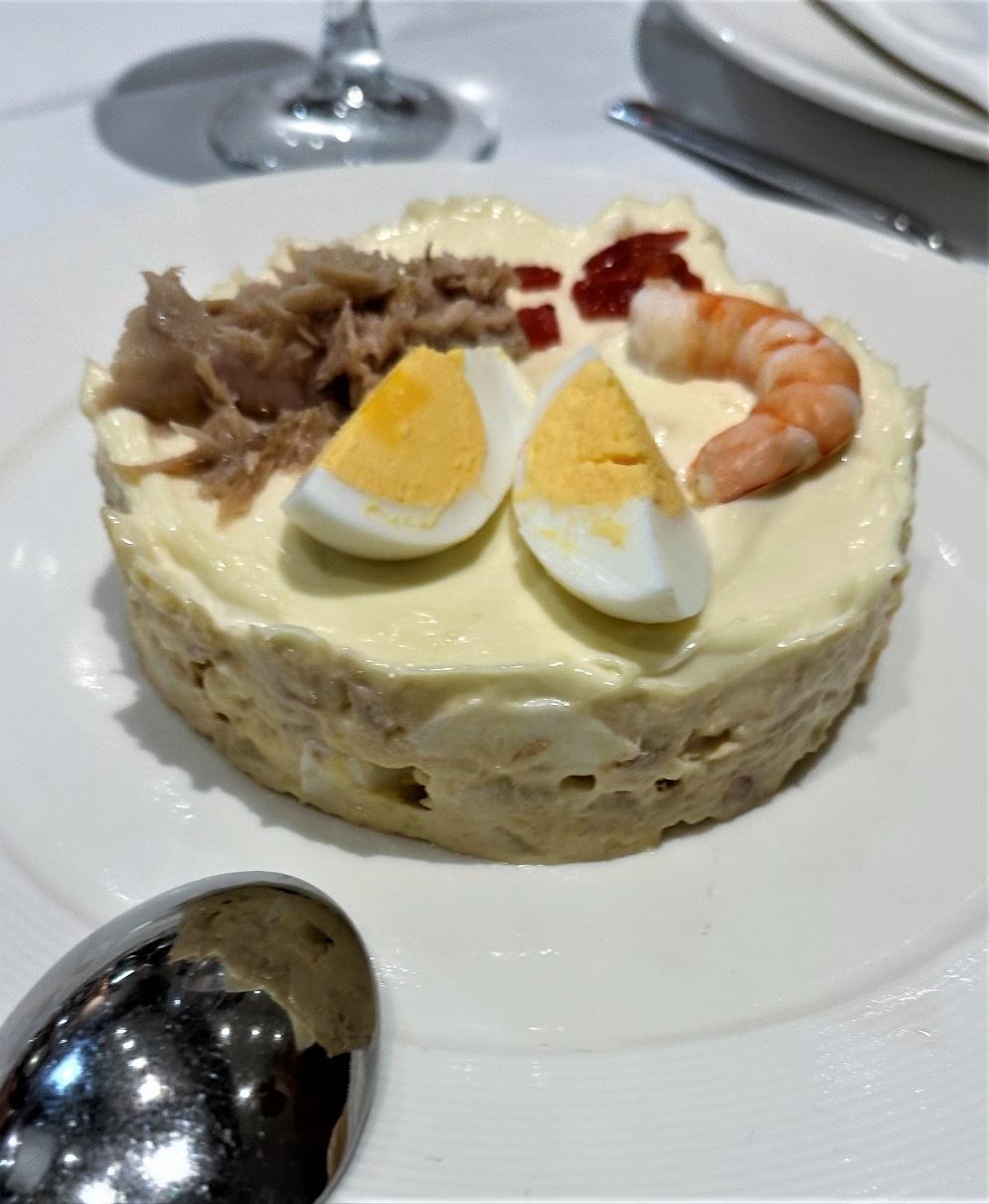
I don’t know if this dish is popular only in Malaga or in Spain overall – Malaga used to be very popular among Russian tourists, and this might have something to do with this dish. Anyway, if I was able to dissect correctly, the salad consists of boiled potatoes, eggs, salmon, and mayo. It was quite tasty on a few occasions I had it.
Now, let’s talk more about wines. We had an event dinner at the restaurant in the old town. The wine was simply offered by the color – white or red – with a sheepish comment by the waiter “ohh, the red is local”. I decided to start with the white and to say that I thoroughly enjoyed my choice would be an understatement. This 2021 Bodegas Barbadillo Castillo de San Diego Palomino Fino (13% ABV) had a deep inviting nose of whitestone fruit with minerally undertones, and the palate had a great depth of white plums and sage with the roundness and plumpness which I typically observe on the best renditions of the Roussanne. Outstanding.
Then, of course, I asked to try the red, not having much of an expectation remembering the shy enforcement.


Wow! I couldn’t understand what was happening. I was supposedly drinking local Malaga wine which I know nothing about, but we are in Spain – how come this wine tastes like a perfectly round, exuberant, in-your-face Bordeaux at its peak? What is this all-around beautiful cassis doing in the local Malaga wine? Something happened to my palate? When I got a chance to look at the back label of this 2012 Bodegas Excelencia Los Frontones Crianza Sierras de Málaga DO (13.5% ABV), things got back to normal – Cabernet Sauvignon, Cabernet Franc, Tempranillo, and Syrah. I did a bit of the reading afterward and it appears that the Malaga area had a lot of French winemaking influence, hence the use of Bordeaux varieties. For the 10 years old, this wine was absolutely in its prime and absolutely enjoyable.
Later during the week, I had another enjoyable encounter with local Malaga wine – 2018 Bodegas Pérez Hidalgo Vega del Geva Sierras de Málaga DO (14% ABV), a blend of Syrah, Cabernet Sauvignon and Merlot. A bit tighter than the previous wine, but still very much cassis and eucalyptus forward, round, layered, and delicious.
My last evening in Malaga was full of pure, hedonistic pleasure – but this deserves a post on its own.


Here you are, my friends. I have to declare my first visit to Spain a success, and I truly hope to be back in the near future.
And A Little Bit Of Cognac
– I’m tired of drinking scotch. Next time, can we try something else? How about cognac, for example?
– Cognac? Why not? Next time, we will drink cognac.
This was a conversation with my high-school friend earlier this year. She visits a few times a year, and it is customary for us to taste 10-15 different whiskeys during one of the nights during her visit. This is easy to do, as, after the wine, whiskey (primarily scotch or equivalents, such as Japanese whiskey) is my next favorite type of alcohol. At any given moment I have probably 20+ bottles opened – unlike wine, once opened, whiskey can still last forever, so I have no issues opening a bottle, even for a tiny sip. Whiskey tasting on short notice? No problem, let’s do it. But cognac?
I like cognac as well. Totally different bouquet compared with whiskey, the pleasure of eloping the brandy sniffer and letting the aromatics charm you as the amber liquid gently heats up in your hand… Love cognac – however, I still prefer whiskey on an average day. As a result, if I can find 20+ open whiskey bottles on a given day, I would only have 1, 2, or maybe 3 cognac bottles on hand – that doesn’t make it an interesting tasting by any means.
Let’s take a few minutes to talk about cognac first. Same as scotch is a type of whiskey, cognac belongs to the broader spirits category called brandy. Brandy is defined as the hard liquor (35% – 60% alcohol by volume) produced from wine, which can be a grape wine or a fruit wine, by the process of distillation. Cognac is the most famous type of brandy, produced in France in the Cognac region – as you might expect, Cognac name is protected and Cognac can only come from the Cognac region in France.
There are a few classifications that are important for Cognac. The first one is geographic – not any different from any wine classifications. Cognac can be sub-divided into 6 growing areas, or crus – Grande Champagne, Petite Champagne, Borderies, Fins Bois, Bons Bois, and Bois Ordinaires (you can find all the detailed explanations and a map in this excellent blog post). These crus are always identified on the label if the appellation’s requirements are satisfied – but the majority of the cognacs are simply identified as “cognac”, meaning that the grapes can be coming from any vineyard within the Cognac region. There is one more classification that is not precisely geographically delimited – Fine Champagne, which allows mixing grapes from Grand Champagne (at least 50%) and Petite Champagne regions. Of course, there are single vineyard options, but those are rare.
Another classification that potentially has higher prominence for cognac lovers is the age of the liquid in the bottle. Upon distillation, future cognac is clear. All of the beautiful amber colors are acquired during aging in the oak barrels. The age classifications are typically depicted on the bottles in the form of the following abbreviations:
VS (Very Special) – aged at least 2 years in the barrel
VSOP (Very Special Old Pale) – at least 4 years
XO (Extra Old) – at least 10 years
There are other age classification types – XXO, Napoleon, Extra, Réserve – but I would like to offer you another excellent article if you are interested in learning more. While the price of cognac will depend on age, it is not the only dependency – the producer’s name and geographic region need to be taken into account to understand the pricing. You can often find an XO cognac from an unknown producer to cost less than a simple VS from a well-known one, so the age statement alone doesn’t identify the price.
One more note before we get back to our tasting. Approximately 150 miles southeast of Cognac lies another famous french brandy region – Armagnac. Armagnac is also made out of grapes and has its own geographical and aging classifications we are not going to get into here. While there are aromatic and stylistic differences between Cognac and Armagnac, it is important to know that Armagnac is typically cheaper than cognac at the same level of quality. Also, lots of Armagnacs specify the year they were distilled, which makes them an amazing birthday present…
And then, of course, there are brandies, which sometimes can be amazing, and sometimes … just not. Unlike Cognac or Armagnac, brandies are typically not regulated, which means that you need to know what you are buying. Some of the brandies can be amazingly tasty – my favorite brandy when vacationing in Mexico is 10 years old Torres – easily beats all of the big names lifeless VS…
Now, let’s get back to our cognac tasting story. As you might imagine, I decided not to limit the selection to the Cognac alone, and include brandy and Armagnac as it would be possible – however, talking about the prep to the tasting, I would generally use the term “cognac” while talking about my quest.
As I promised the cognac tasting I had to actually find what we will be tasting. And it is much easier said than done. Go to your neighborhood liquor store and compare the size of the cognac and whiskey sections (if your store doesn’t have the cognac section at all, don’t get upset). A typical cognac selection at the store is very limited – and it gets very expensive very quickly,
Okay, so I will be very smart about it, I thought. I need to look for the miniature bottles (50 ml, sometimes 100ml), and tasting sets.
While working on this post, I decided to look at the “popularity” of cognac through the sales numbers. According to this article, cognac sales increased substantially, not only in value but also in volume, comparing 2021 sales with 2020 and even with 2019. As theoretical numbers, it is easy to accept, especially with the value – the average price for the XO cognac almost doubled over the past 5 years. In practical terms, the cognac shelves at most of the wine stores I visited are very short and sometimes even not existing. What’s even worse, finding the miniatures (50 ml) of cognac was mission impossible, with some stores having only one type, and many having none. Our local Total Wine in Norwalk offered a breakthrough – I was able to pick up 6 cognacs and brandies at once.


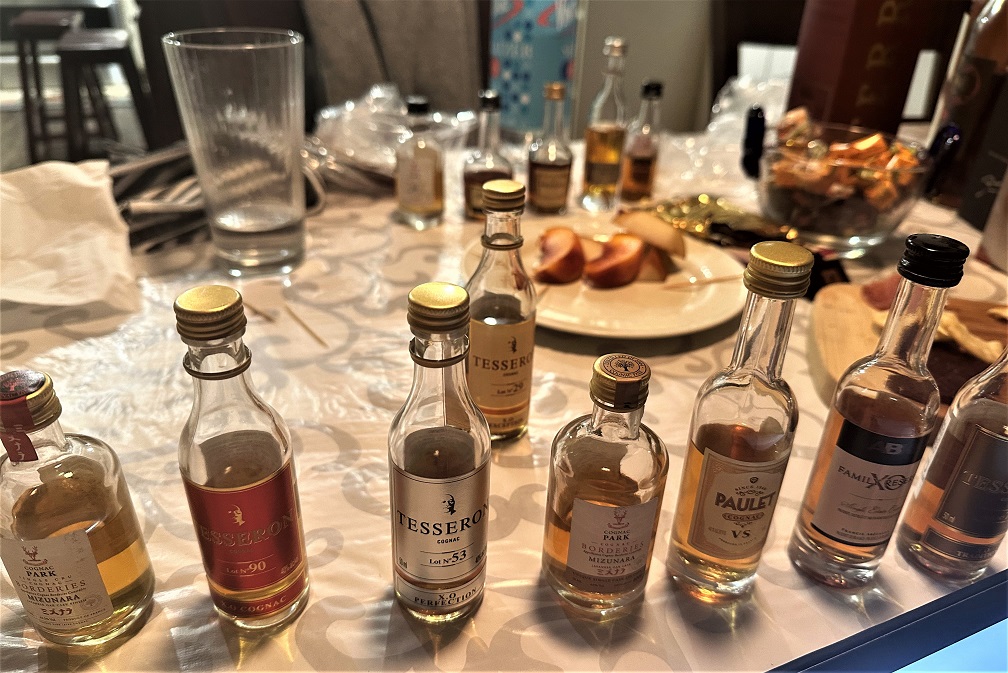
My friend Zak was able to find me a tasting set from cognac Tesseron, which included 4 different bottlings of XO-level cognac. The set contains 4 different cognacs – Lot No 90, Lot No 76, Lot No 53, and Lot No 29, where the number gives you an approximate year(s) when the cognac was distilled – in 1990 – 1991, 1976, 1050-1952, and 1930s. Lot 29 contains a third of the cognac from the 1906 vintage – it is not every day you get to drink alcohol at such an age. Lot 29 also received 100 points from Robert Parker (not that it matters, but still).
I found the second set on the Cognac-Expert website – Park Cognac Mizunara cognac, a set of 3 Park cognacs from Bordieres finished in Japanese oak called Mizunara. Note of advice – if you like cognac, cognac-expert might be a site for you.
With this, we were all set for tasting. Finally, my friend arrived at the end of September, and we were able to get to it.
Below are my notes from the tasting. The notes are similar to any wine notes I would put out in this blog. Does it make sense for the cognac? Maybe yes, maybe no, but this is the best I can do. As a bare minimum, you will get an idea. During the tasting, we also decided which cognacs/brandies would be worth re-tasting (round 2) and then we rated all the cognacs to decide on our top favorites. Without further ado, here are the results:

E&J V.S. Brandy
Sweet fruit on the nose
Caramel candy on the palate, just caramel.
E&J V.S.O.P. Grand Blue Brandy
Sweet fruit on the nose, dry fruit
Burnt sugar on the palate, pure milk chocolate candy with fruit preserve. Horrible.
Paul Mason Grande Amber Brandy
Dark red fruit, herbs
Touch of sweetness, good restrained, good balance
Hennessy Very Special Cognac
Dry fruit on the nose
Wooden notes, a touch of sweetness, lacks excitement
Courvoisier V.S. Cognac
Oak notes on the nose
Nice restraint, but mostly flat
A. De Fussigny Sélection Fine Cognac
Beautiful nose, sandalwood, nice perfume
Disjointed on the palate, needs more balance
Paulet VS Cognac
Nice complexity on the nose
Good fruity palate, perfectly integrated, excellent balance.
Very good, perfectly elegant, round 2 – final verdict #3
ABK6 Family Reserve XO Single Estate Cognac
Beautiful nose, you can smell the grapes
Perfect complexity, wild apricot, wild apricot pit, a hint of sweetness, but dry finish
Excellent, round 2 – final verdict #6
Park Cognac Borderies AOC Mizunara Japanese Oak Cask Finish
Wow. Cigar box, medicine box, great complexity
Amazing complexity, perfect balance, cigar box, apricot, one of the very best
Wow. Round 2 – final verdict – #1, best of the tasting
Park Cognac Borderies AOC Mizunara Japanese Oak Cask Finish Single Cru 10 years aged
Very complex nose
On the palate, effervescent, but not as impressive as the second one
Very good, round 2 – final verdict #11
Park Cognac Borderies AOC Mizunara Japanese Oak Cask Finish Unique Single Cask Edition Distilled 2004
Amazing nose, very complex
Very complex, spicy oak, delicious
Excellent, round 2 – final verdict #9
Tesseron Cognac Lot N 90 XO
Wow, spicy pepper nose, sweet fruit, amazing
Great complexity, fruity notes, excellent balance
Round 2 – final verdict – #5
Tesseron Cognac Lot N 76 XO Tradition
Dry fruit, wild flowers
Interesting complexity, but not harmonious
Round 2, final verdict – #10
Tesseron Cognac Lot N 53 XO Perfection
Very feminine on the nose, delicate, perfumy, plums, vanilla
Floral complexity, elegant, delicious
Excellent, round 2 – final verdict – #8
Tesseron Cognac Lot N 29 XO Exception
Beautiful nose, complex, round
Herbal notes, plums, spices, perfectly balanced.
Very good, round 2 – final verdict #7
Saint-Vivant Armagnac AOC
Lemon and herbs on the nose
Touch of oak, good acidity, a touch of herbs.
Pierre Ferrand 1er Cru de Cognac Reserve Grand Champagne AOC
Fruity, elegant
Beautiful fruit on the palate, plums, a touch of chocolate, perfectly balanced
Excellent, round 2 – final verdict – #4
1966 Darroze Bas-Armagnac
Very complex, Forrest underbrush, spices, white pepper
Dark chocolate, dried fruit, perfectly restrained
Superb, round 2 – final verdict – #2
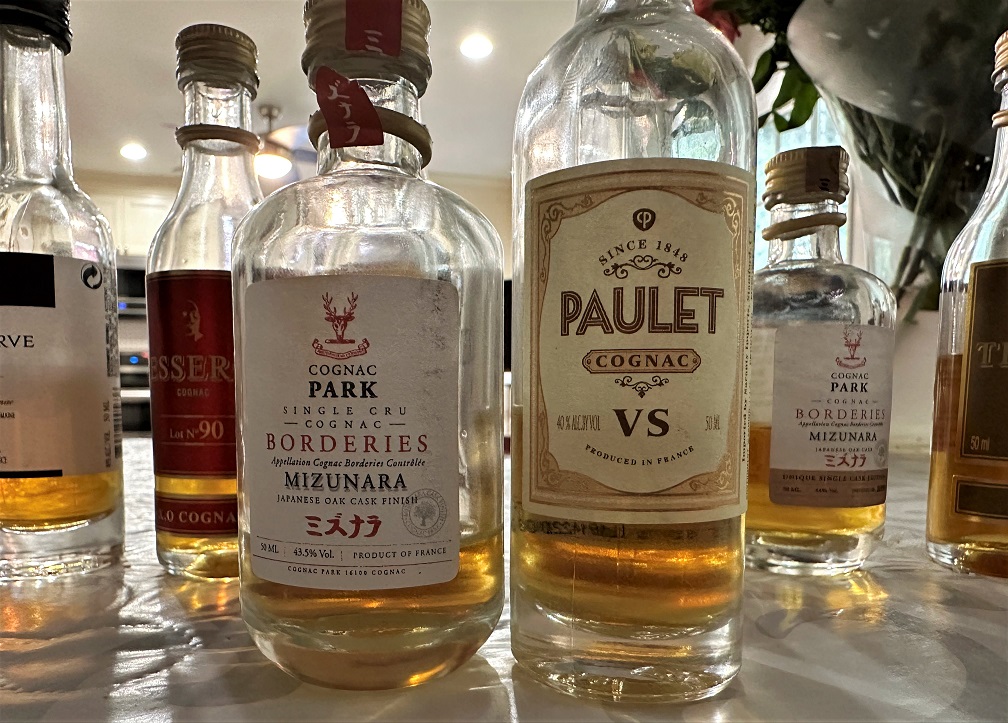
As you can tell, Cognac Park Mizunara Borderies AOC was our top choice, followed by the 1966 Darroze Bas-Armagnac and then Paulet VS cognac ($25 at Total Wine, winery direct program).
Here you go, my friends – an account of the cognac tasting. With the exception of E&J, which humans should not drink, this was a great tasting.
What do think of cognac? Do you like drinking it? Any favorites?
Daily Glass: Monday Night Wine
Monday night. The first working day of the week is over. Or it might not be over, who knows. But it is Monday, and the week is just starting. Is there a wine more suitable for Monday than any other day of the week?
Friday night is easy. Friday always means fun and celebration. Friday is already playful, so unless you have serious dinner plans aligned, Friday night wine might be even a cocktail for all I can tell.
I guess Saturday is asking for a serious wine, no matter what. It’s the middle of the weekend which is always special. Thursday… well, I don’t know about Thursday, let’s get back to Monday.
So how do we select the wine for Monday night? Most likely, you are at home. Most likely, it is only you and your spouse drinking. Most likely, you are not in a hurry. Most likely, you can take your time and enjoy that glass for as long as you want. Considering all of these “most likely” circumstances, let’s settle on the thought-provoking wine. The wine which shows its beauty slowly, sniff by sniff, sip by sip.
Can you think of a wine that would match this description?
While you think about it, I will lead by example and offer to talk about my Monday wine.
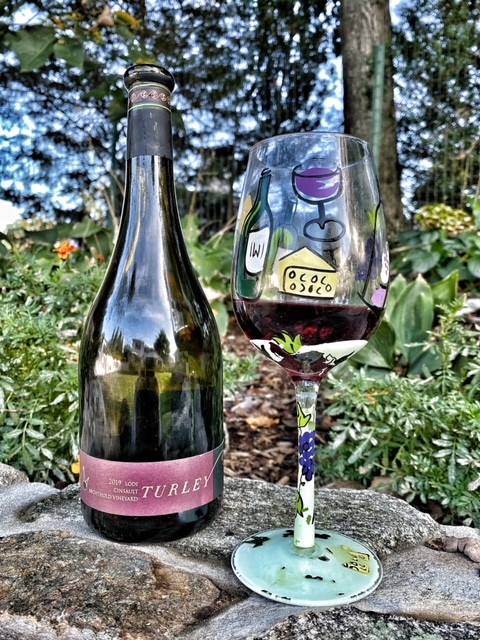
2019 Turley Bechtold Vineyard Cinsault Lodi (12.4% ABV). Wine from one of my favorite producers – Turley. Wine from one of my favorite wine regions in California (and not only in California) – Lodi.
Lodi flies under the radar for a lot of wine lovers. Everybody knows Napa and Sonoma. Californian Pinot Noir aficionados probably know Santa Barbara County. Meanwhile, Lodi is where Robert Mondavi went to high school and where his father run the grape-packing business. Lodi is the single largest AVA in North America, and Lodi is where Napa winemakers go to get their grapes. Maybe most importantly, Lodi is home to a number of old, continuously producing vineyards. Of course, everyone likes to lay a claim to the “oldest vineyard” here and there – however, Bechtold vineyard in Lodi was planted in 1886, and oldest or not, 136 years of continuously producing fruit deserves the utmost respect.
Lodi might be best known for its old vines Zinfandels, but our Monday wine tonight is made out of Cinsault, a grape typically used in Rhône and Provence. Cinsault wines typically offer a fruity and floral profile with some pungent undertones.
2019 Turley Cinsault was made using whole cluster fermentation with natural yeast and aged for about 7 months in used French oak barrels. The result was the wine that delivered that thought-provoking Monday night experience we were talking about.
On the nose, the wine offered fresh berries and a hint of the forest floor. On the palate, there was a delicate interplay of raspberries, sour cherries, tartness, and acidity, all packaged together delicately but firmly, and finishing off with sour cherries and cherry pits, long-lasting and offering an opportunity to enjoy a quiet moment. (Drinkability: 8/8+)
That’s how my Monday night wine was (delicious!). How was yours?
Last Bottle Sign Up ($10 credit)




 Talk-A-Vino