Archive
Starfield Vineyards: Delicious Wines, Passion, and a Dash of Astronomy
Do you know what happens when you combine the passion for astronomy, photography, and winemaking together? It is not a trick question. And this question has a simple answer.
Tasty wine.
Let’s start with the Astronomy.
Father and son duo, Tom and Rob Sinton, believe that not only is the location of the vineyard very important (of course), but the exposure to the stars makes it extra special (hence the name of the vineyard, Starfield). Okay, it is not just stars, even though it is easier to observe them from a high mountain elevation, such as the one where Starfield vineyards are located in the Sierra Nevada Mountains in California. In addition to stars looking down at the vineyards, the vineyards are also surrounded by a large assortment of pine trees. High elevation allows for more oil to permeate the leaves, the bark, and the grape skins themselves, imparting more spice and flavor.
Next, the Photography.
You know that legends warn you about looking directly at the sun (you can lose your sight). And if you ever tried to look directly at the sun with an unprotected eye, the experience becomes too painful too quickly. But you still can, with the help of a special technique in photography called a pinhole camera. And when you are up in the mountains, and you know how to construct a pinhole camera, you can get pictures of the beautiful sun arches, called solargraphs. Next? You can use your solargraph pictures on your wine labels, aligning each unique solargraph with the unique wine in the bottle. Let us get back to the solargraphs in the moment.
Now, let’s talk about the Vineyard…
Let’s remember, the Sierra Nevada Mountains are located in El Dorado, where the gold rush originated, and where the rush might still be strong (I have no idea if the gold can still be found). Considering that Sintons have an affinity for Rhône grape varieties, and taking into account the “rush”, it might not be even surprising that, after extensive research, the Sintons planted 31 acres of grapes, consisting of 17 varieties in twenty-four blocks of roughly 1.5 acres each. Grenache, Syrah, Mourvèdre, Cinsaut, Counoise, Tannat, Grenache Blanc, Marsanne, Roussanne and Viognier make up 66% of the vineyard. Aglianico, Barbera, Fiano and Muscat of Alexandria make up 30% of the vineyard, and the balance consists of Tannat, Tempranillo and Petite Sirah.
We mentioned all the surrounding trees before; to complete the picture of the vineyards, there are a few more things to mention. The Starfield Vineyards has practiced sustainable, fish-friendly farming since 2012. Some patches of the forest are left untouched around the vineyards, and cover crops are allowed to flourish to protect the harmonious habitat, in tune with nature.
And now, the Wines.
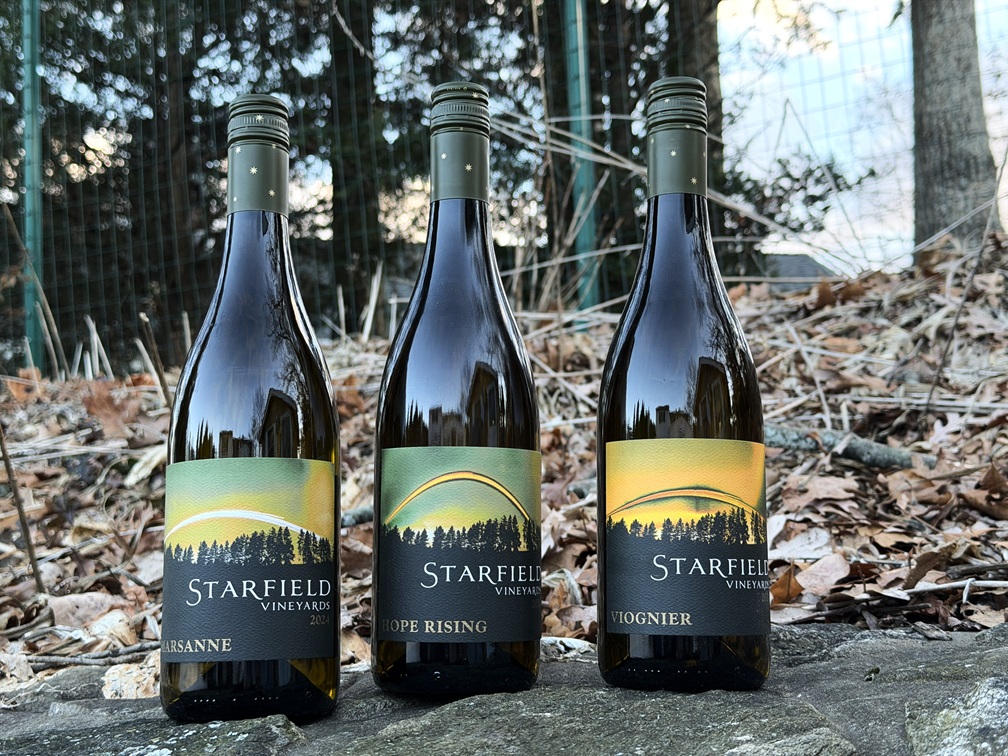
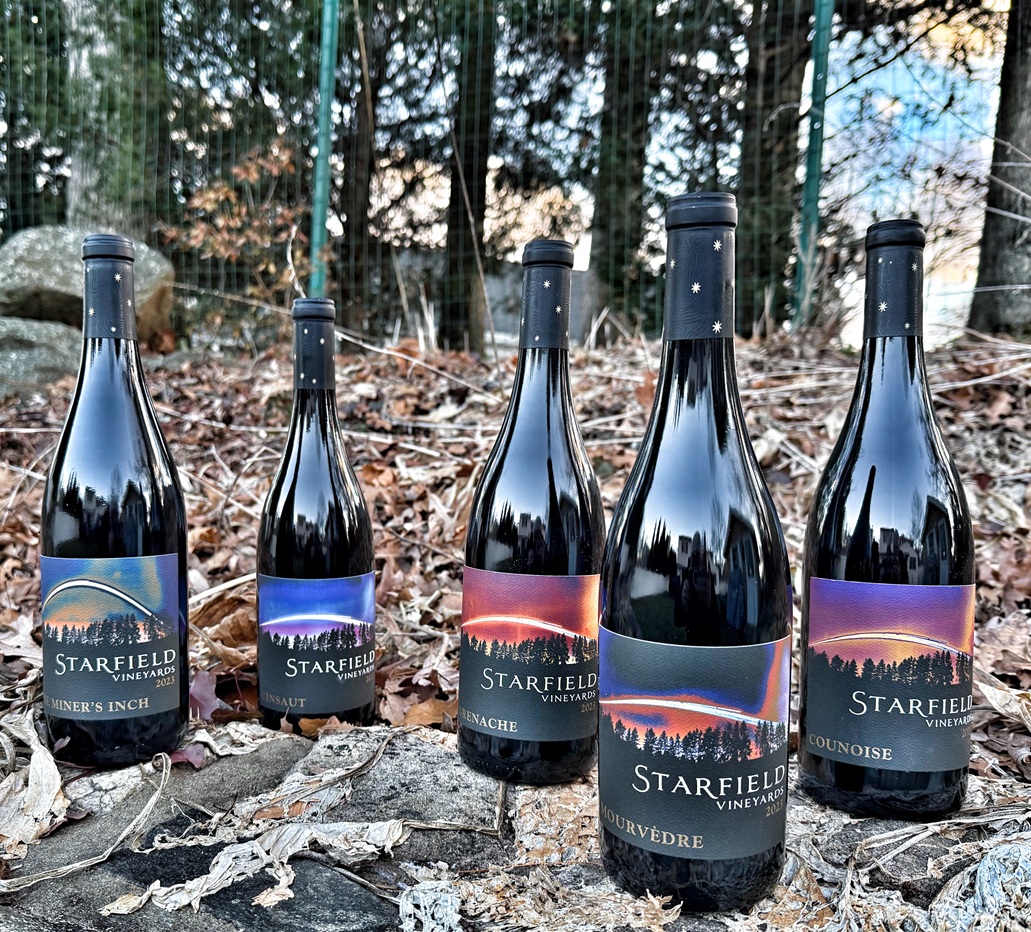
First, please take a look at the labels. I got a set of 8 samples, 5 reds and 3 whites, and as you can tell, all the labels are adorned with a picture of a solargraph, and each solargraph is different in its color and shape. I was curious about all the differences, and I had an opportunity to ask Rob Sinton to explain the logic. Here is his reply:
“Each Solargraph is intentionally different. The lower, shallower arcs are reserved for single-varietal wines, while the taller, more expansive arches represent blends, wines that become greater than the sum of their parts. Each image is then colorized to reflect the spirit of the wine itself, a kind of visual synesthesia for flavor and texture.”
Talk about Passion.
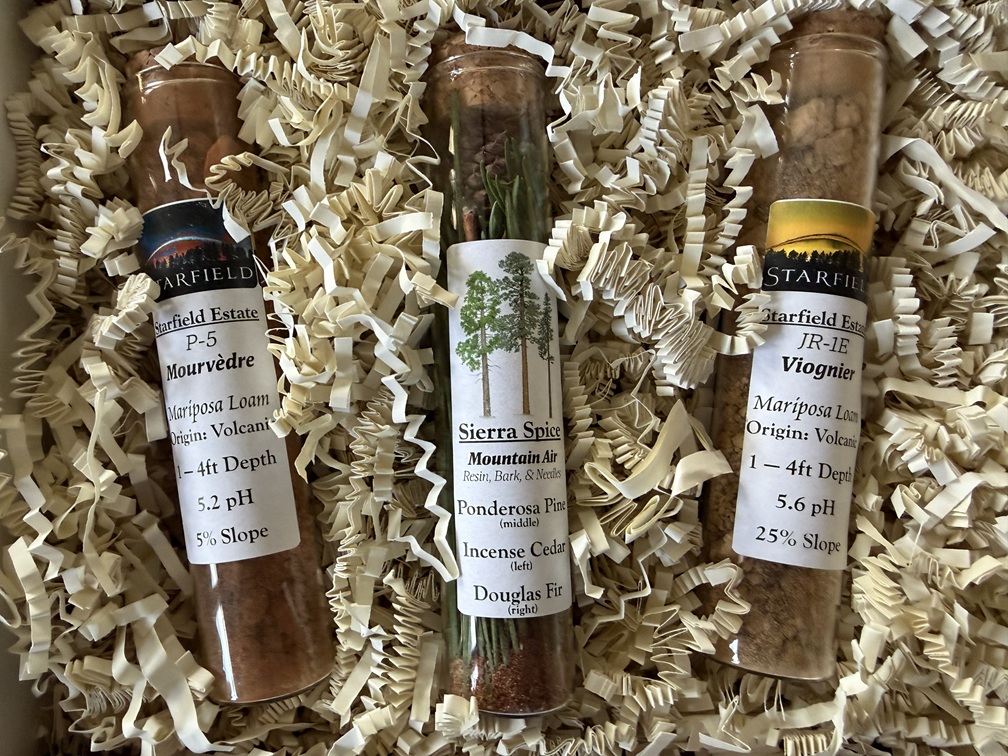
In the wine world, passion has no limits. When visiting the winery, you often hear about the soil. Sometimes, you can see the soil, or, rather, soils, on various displays. But getting samples, maybe there was one time when I got some soil samples with the wines. With the samples from Starfield Vineyards, I got tubes with two samples of soil from two different plots, as well as the sample of the Sierra Spice (as Tom and Rob call it) mountain air with the needles of Ponderosa Pine, Incense Cedar, and Douglas Fir. I used that tube when tasting the wines, and it definitely helped to better understand what you are tasting.
And take a look at the wines themselves. Every year Starfield Vineyards produces 20-25 different wines, including Sparkling, Rosé, and dessert wines. The majority of the wines I tasted were single-grape (or almost single-grape). What is interesting is that Sintons represented Mediterranean varieties so well that they, for example, are one of the very few, if not the only winery (in the world!) that produces single-grape Counoise. They had some wine professional in training for sommelier positions and such reach out to them specifically to taste that wine, as that was the only opportunity to taste single-grape Counoise.
And now it is time to talk about the actual wines. I had an opportunity to taste a number of the new release wines from Starfield Vineyards, and the wines were literally one better than another:
2024 Starfield Vineyards Viognier El Dorado (13.7% ABV, SRP $36; 275 cases made; 93% Viognier, 5% Roussanne, 2% Marsanne)
Straw pale
Beautifully perfumy nose, white stone fruit
A touch of peach, spicy undertones, hint of honeysuckle, delicious.
8
2024 Starfield Vineyards Marsanne El Dorado (12.9% ABV, $36; 72 cases; 95% Marsanne, 5% Roussanne)
Straw pale
Muted nose with a distant hint of white fruit and minerality
A couple of days after opening, the wine developed a characteristic Marsanne plumpness, elevated by acidity. Still sufficiently light, but texturally present wine.
8, will be great with food, let’s say some creamy chicken dish.
2024 Starfield Vineyards Hope Rising El Dorado (13.4% ABV, $36; 181 cases; 45% Marsanne, 45% Roussanne, 10% Viognier)
Straw pale
Very interesting. After smelling the tube (very intense), the wine exhibits very similar profile, only a bit more delicate – but still similar aromatics of Douglas fir, pine and cedar. Wow.
Beautiful palate, tropical fruit with a touch of butter and plumpness of Marsanne/Roussanne, and a hint of viognier spiciness. Excellent.
8+
2022 Starfield Vineyards Mourvèdre El Dorado (14.3% ABV, $42; 342 cases; 99% Mourvèdre, 1% Roussanne)
Dark garnet
Beautiful nose of fresh succulent fruit, wild berries, eucalyptus
Generous, luscious, layered, dark dusty fruit, perfect balance, hint of tobacco, medium finish
8+, beautiful even on the day 4
2022 Starfield Vineyards Miner’s Inch El Dorado (14.2% ABV, $38; 208 cases made; 30% Grenache, 17% Aglianico, 14% Tempranillo, 14% Petite Sirah, 9% Mourvèdre, 9% Cinsaut, 4% Roussanne)
Dark Garnet
Cherries and cedar on the nose
Cherries, a touch of tobacco, earthy minerally undertones, well integrated tannins, perfect acidity, perfect balance. Will age very well.
8+, excellent
2022 Starfield Vineyards Counoise El Dorado (13.4% ABV, $38; 95 cases; 95% Counoise, 5% Grenache)
Dark ruby
Earthy, minerally nose with fresh berries, crisp, inviting
Fresh berries, tangy, medium to full body, pleasantly gripping tannins deliver an excellent depth to perceivably light wine. Good acidity, excellent balance, long minerally driven finish.
8/8+, outstanding. Food friendly, even food demanding wine. Makes me think of savory rack of lamb.
2023 Starfield Vineyards Grenache El Dorado (14.1% ABV, $42; 378 cases; 100% Grenache)
Dusty Ruby, probably the lightest Grenache I ever saw
Minerality, earth, a touch of iodine, cherries and a hint of oregano
Underripe, greenish fruit, lean, tart with sweet cherries coming through as an undertone.
7+, this wine is built for aging.
2023 Starfield Vineyards Cinsault El Dorado (13.3% ABV, $38; 461 cases; 95% Cinsaut, 5% Grenache).
Ruby
Tart fresh berries, rocks and underbrush, may be a touch of tobacco
Fresh raspberries, tart cherries, a touch of smoke, crisp, light, acidic
8-, a food wine, also should age well
There you are, my friends. Astronomy, photography, passion, delicious wines.
Follow your passion. It will lead you to happiness.
The Art of Living: Gouveia Vineyards in Connecticut
 The art of living.
Joie de vivre.
We are so entrenched in our infinitely accelerating lives (or at least so it seems) that we forget to live. We forget to enjoy those little simple moments that actually make life worth living.
The daily grind. Work, kids, worries, joys, celebrations and disappointments. Often one after another at a breakneck speed. All equally important. But you know what else is important? The ability to enjoy the moment. Enjoy it by yourself. Enjoy it with the family. Enjoy it with the friends.
Slow down. Look around and see, it is really important not just to look but to actually see. See, process, and appreciate what you see, appreciate what you have. A beautiful sky. A glimpse of color not too far away. The sound of a bee. A friend’s smile. Time grinding to a halt. Capture that moment and treasure it. This is what the art of living is all about. Treasure the moment.
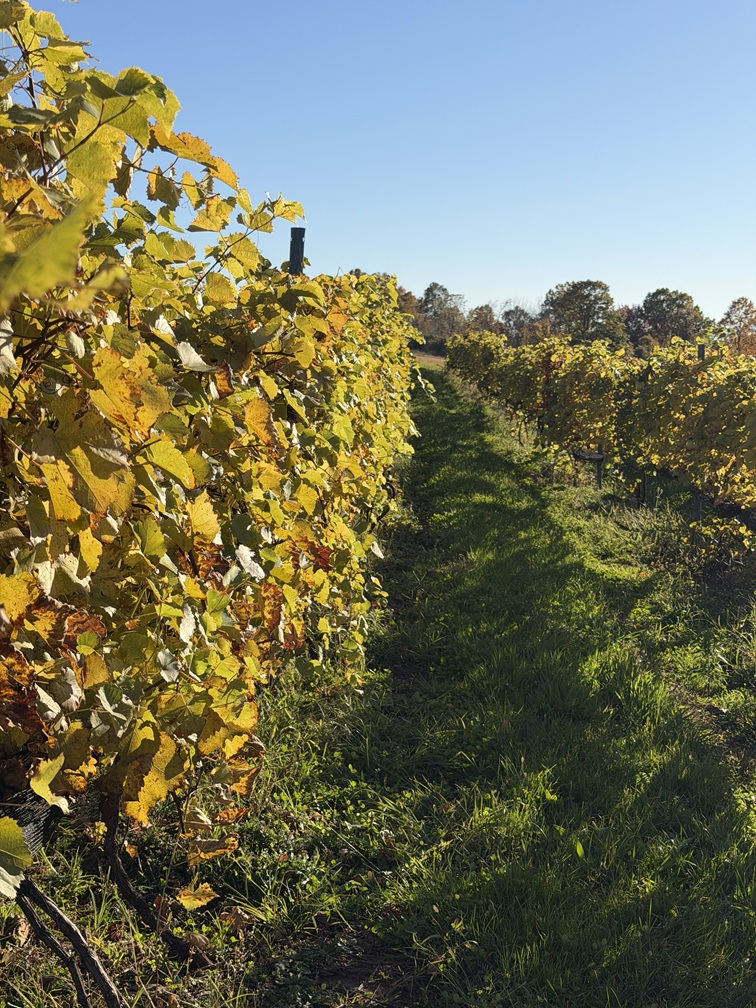
The vineyard is a perfect place to experience the art of living. Tranquility of the rows of vines, the air, sometimes still and quiet, the colors. The vineyard is a perfect place – especially when someone can make it such a perfect place.
Gouveia Vineyards in Wallingford, in central Connecticut, was a product of imagination and a bit of obsession of Joe Gouveia. Born in a rural village in Portugal, Joe came to the US with his family at the age of fifteen. When later on he discovered the hilly terrain in Wallingford, a dream was born, and the dream became a reality in the form of the Gouveia Vineyards winery in 1999.
Our discovery of Gouveia Vineyards was simply a matter of chance. The weather was great over the past weekend, so our main plan was to hike at the Sleeping Giant State Park in Hamden, Connecticut. A few days prior, I stopped by the Murray Cheese store at Grand Central Market in New York’s Grand Central Terminal and picked up a few interesting cheeses. I’m sure you already see a connection, right? You say cheese, and I say wine! Cheese needs wine, therefore, let’s look for a winery to enjoy cheese with wine and company!
A quick search for wineries in close proximity to the Sleeping Giant Park brought back the name Gouveia, about a 20-minute drive. I checked the website, and I really liked what I saw. No, not just the wines, even though the selection looked good. But even better, the FAQ section had two answers which were literally a balm for my soul. First, it said, “Food is welcome! Please bring your food”. And then it also said, “we have tables, but if you want to bring your own chair in case we get busy, you are welcome to do so”.
Let me explain the significance of these two answers (a mini-rant is incoming).
I understand that the winery is a business. I understand that a winery has to make money. But it is also important to make your customers happy, without looking for an opportunity to milk them at every possible occasion. We used to go to Paumanok Winery on Long Island. We would bring our food (sandwiches, cheeses, etc.), find a table, and spend the next 2-3 hours slowly enjoying wine and the company of each other. We did it year after year, until people at Paumanok got simply greedy. We were told all of a sudden, “No, you can’t bring food; you have to buy food”. So we said fine, let’s buy food. I remember we ordered a truffle mousse pâté, which was $11. Next, we received a plate with truffle mousse pâté from Trader Joe ($3.99 at that time), served directly in the plastic container (they removed the wrap, wow!) with a few crackers, I think also directly from Trader Joe’s. Look, Paumanok makes good wine and is free to run business whatever way they want, but this was the last time we set foot at that winery.
This is why when I saw that food is welcome and we don’t even need to reserve a table, I was very happy. Whether the wines were good or bad was not even relevant anymore.
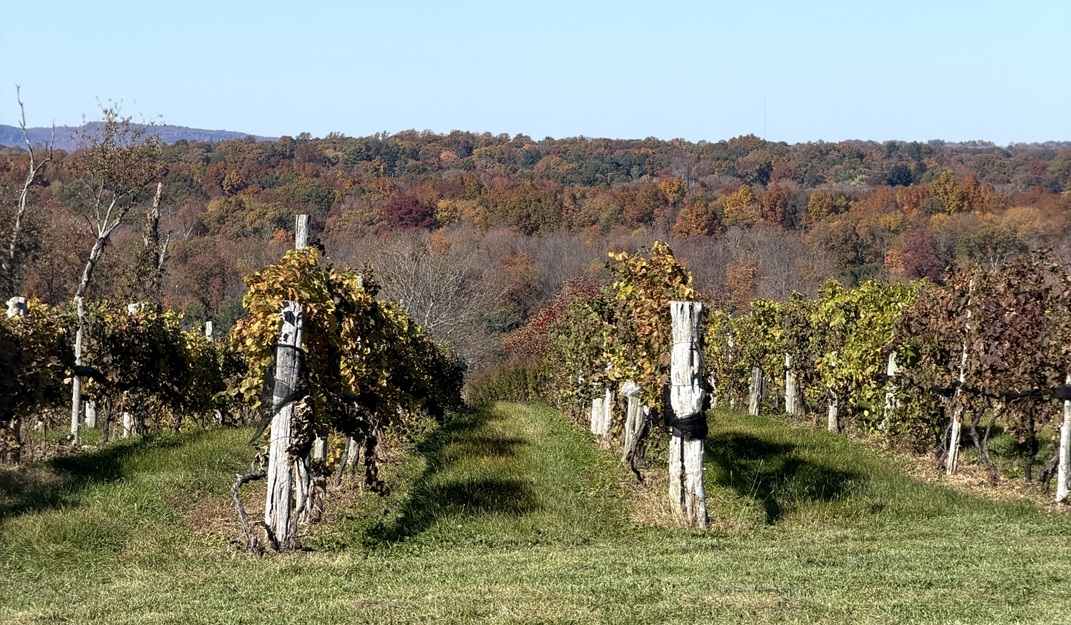 As we arrived at the winery, looking at the number of parked cars, my first thought was “ohhh, we really are going to use our lawn chairs…”. And I was wrong! There were a lot of people there, but there were even more tables! We had no problems finding a table literally 20 feet from the first row of the vines. The next 2 hours (or more; I was really ignoring time) were literally a dream – slowly sipping the wine, taking little bites of food, talking or enjoying the silence… The time has stopped…
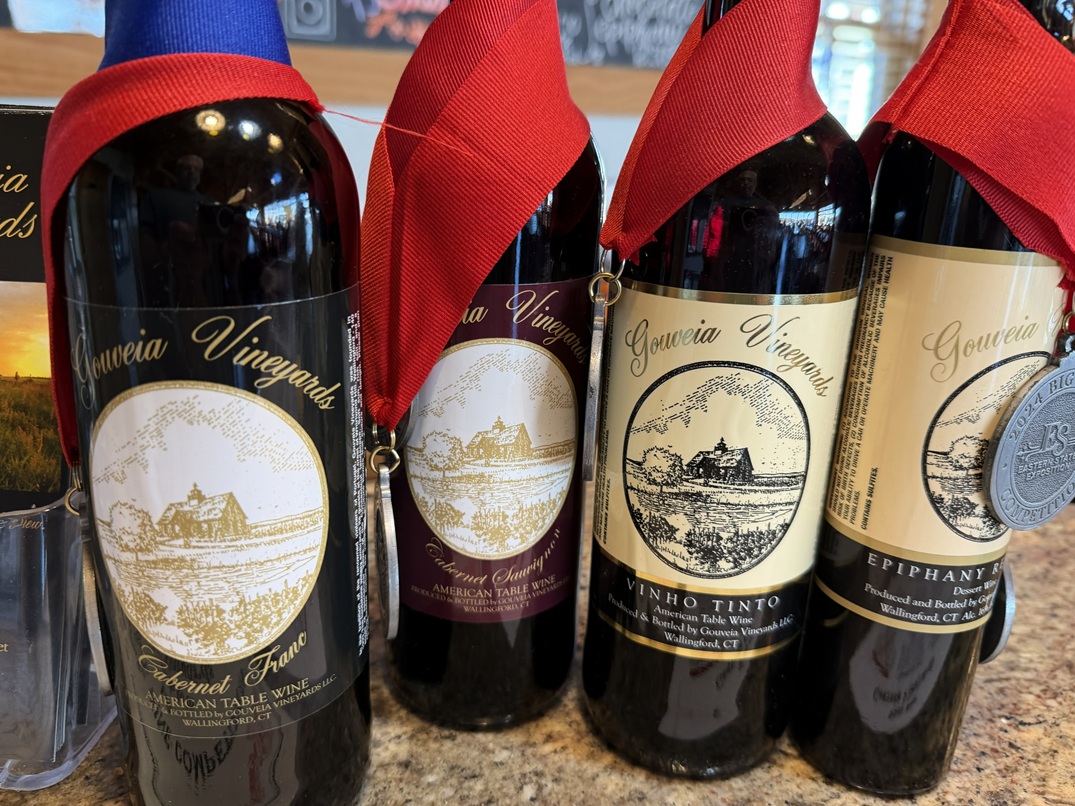
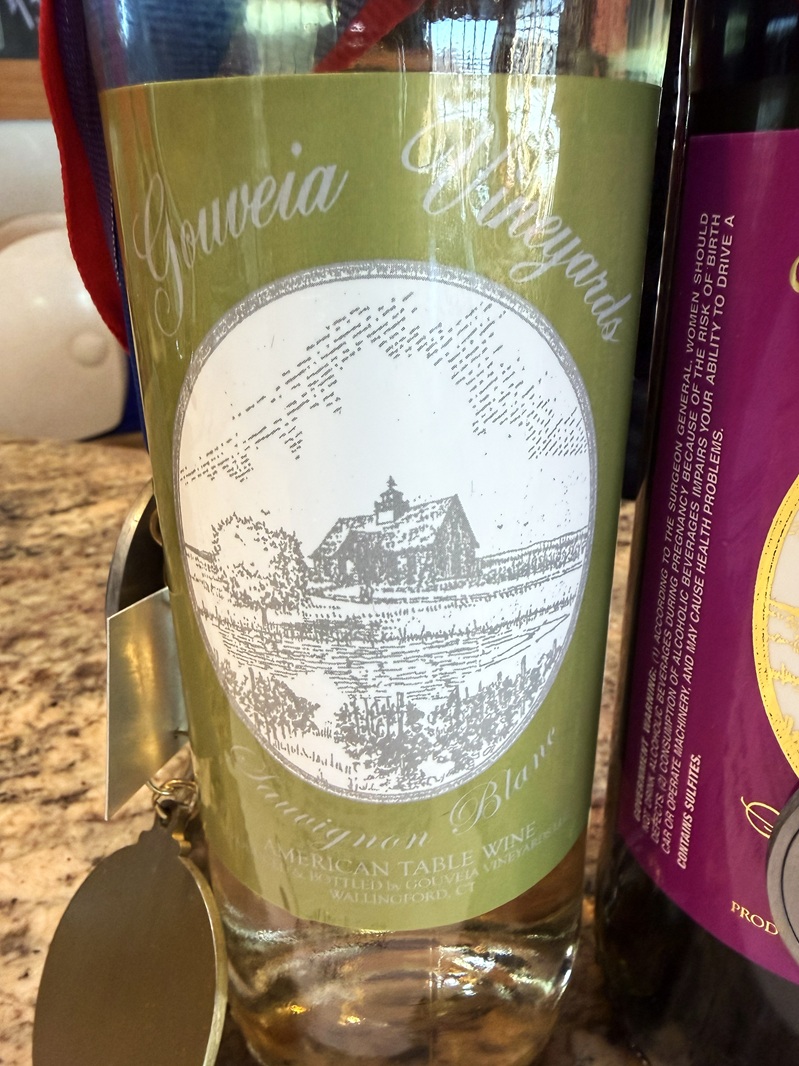
Gouveia Vineyards had 11 white wines, 7 red wines, and 2 dessert wines available for tasting. We took 2 tasting flights of 5 wines (each tasting flight is $20) to try 5 white and 5 red wines. Letting the wine snob speak for a second, I have to say that I was surprised, as literally all 10 wines we tried were well drinkable. If you will look at my notes from the tour of Connecticut vineyards about 12 years ago, you will understand that 10 out of 10 is quite a fit.
To give you a quick rundown of what we tried:
White wines:
Steel-aged Chardonnay – very good, apples, Meyer lemon, a touch of vanilla.
Sauvignon Blanc – excellent, lemon-forward, with tropical fruit undertones, crisp and fresh, more of the Loire style than a New World style.
Dry Rosé – very nice as well, with some onion peel and a touch of cranberries
Seyval Blanc – very much on point, a touch of tropical fruit with a clean finish
Muscat – again, a typical, varietally correct Muscat with some residual sweetness but well balanced.
Red wines were at least equally impressive, if not even more:
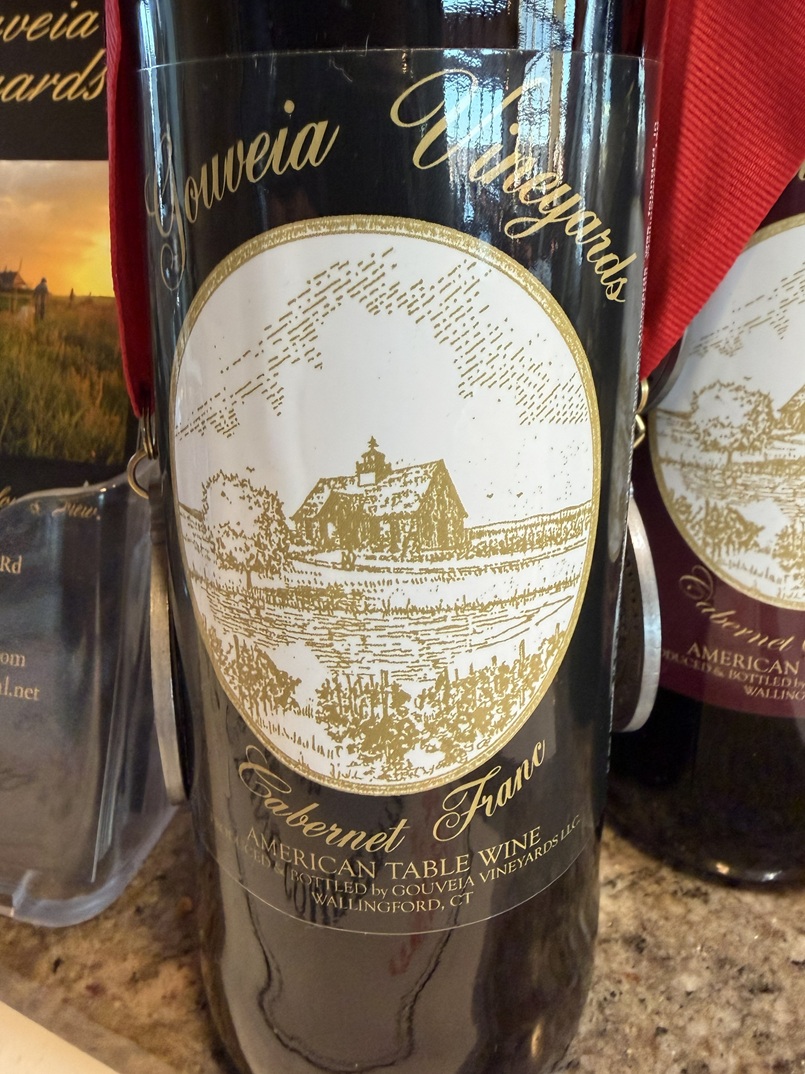
Cabernet Franc – this was my personal favorite out of 10 wines we tried. This Cabernet Franc was textbook Loire version, with cassis and bell peppers, perfectly balanced and simply reminding how good old-world Cabernet Franc can be.
Merlot had some cherries, maybe a hint of cassis, dark, firmly structured.
Stone House Red boasted fresh berries, light and playful.
Vinho Tinto, clearly a nod to Joe’s birthplace. The wine was restrained, tight, and firmly structured.
Semi-sweet Sunset Red was open, inviting, and an easy drink.
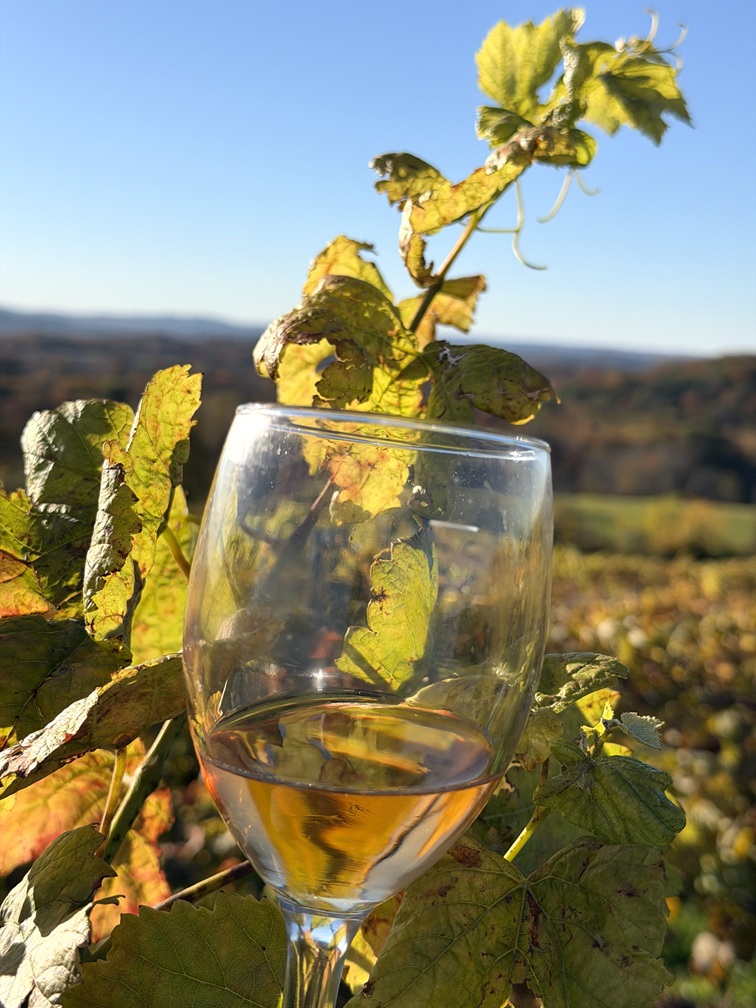
I was so focused on having a good time that I forgot my responsibilities as a blogger… I didn’t take any pictures of wine and food, tasting flights, or the winery itself. But I took plenty of fascinating pictures of the vine leaves, some of them boasting bright autumn colors.
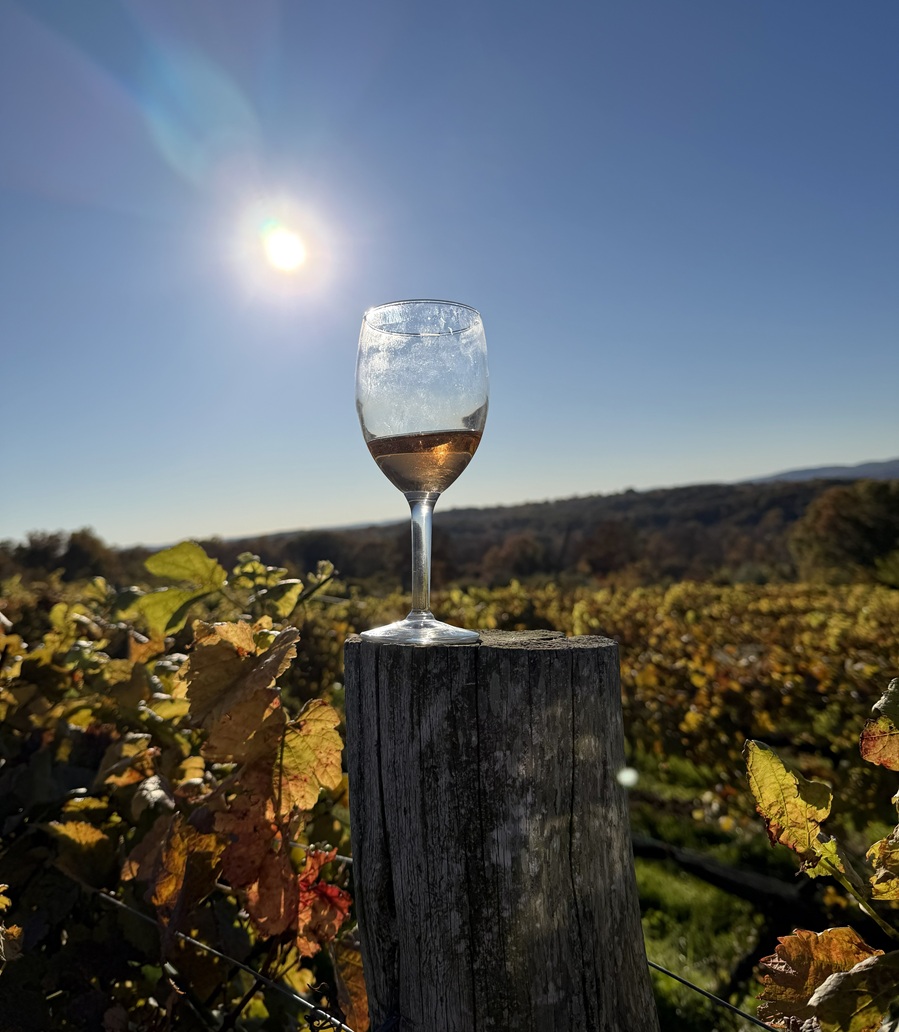
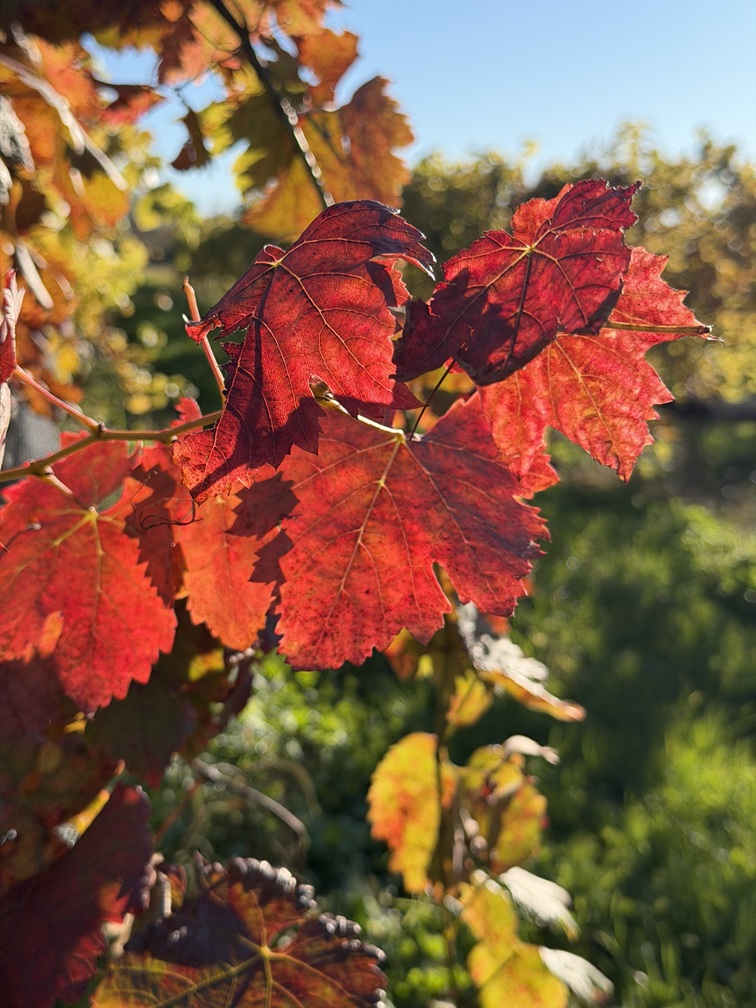
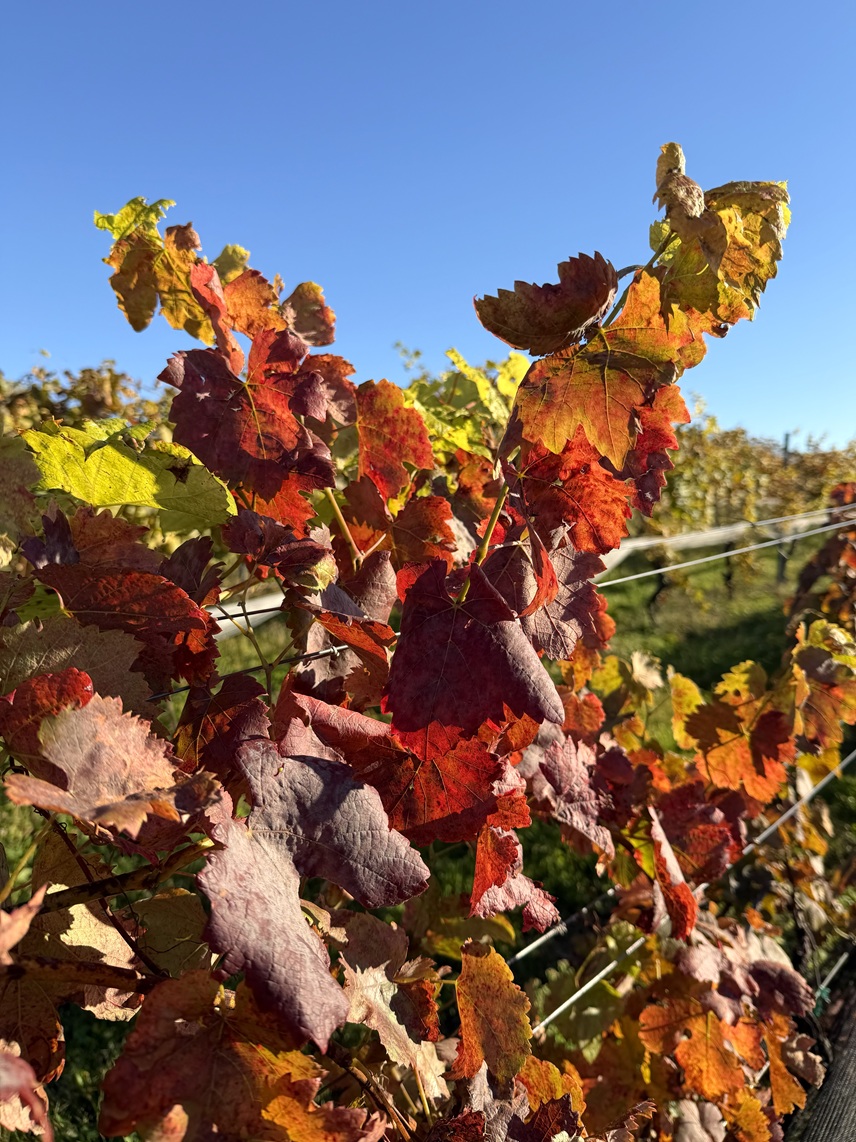
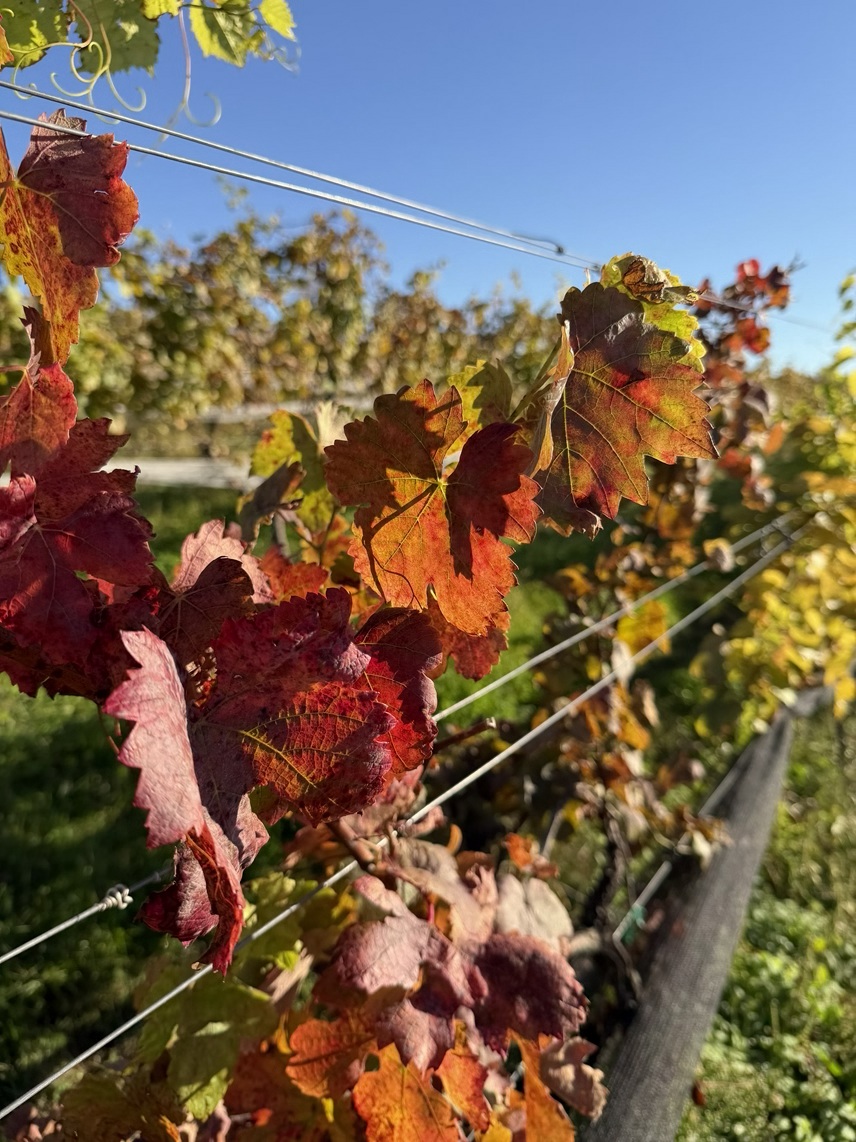
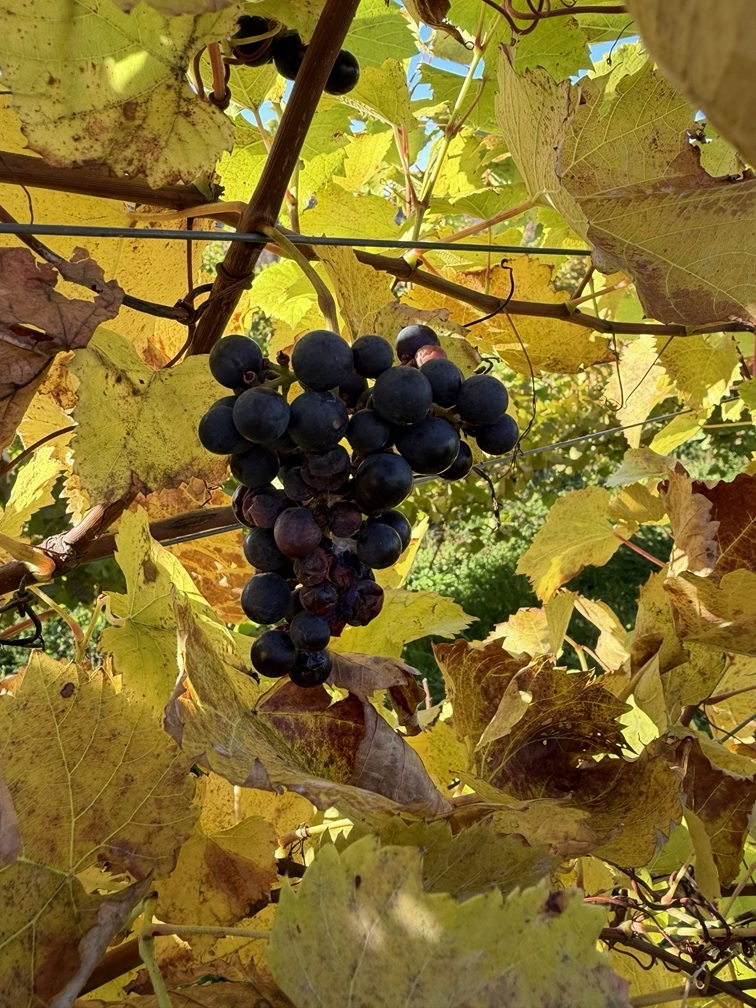
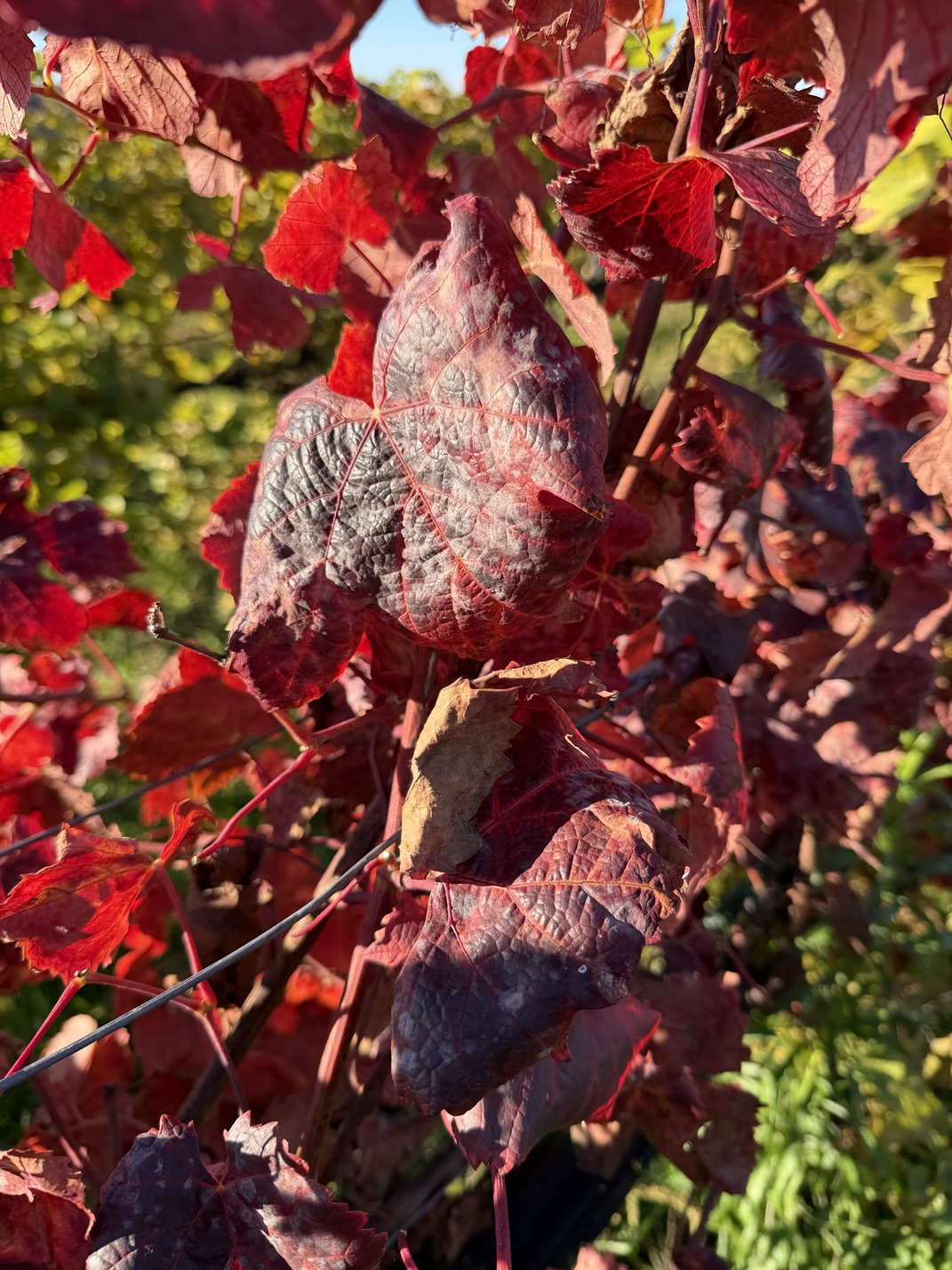
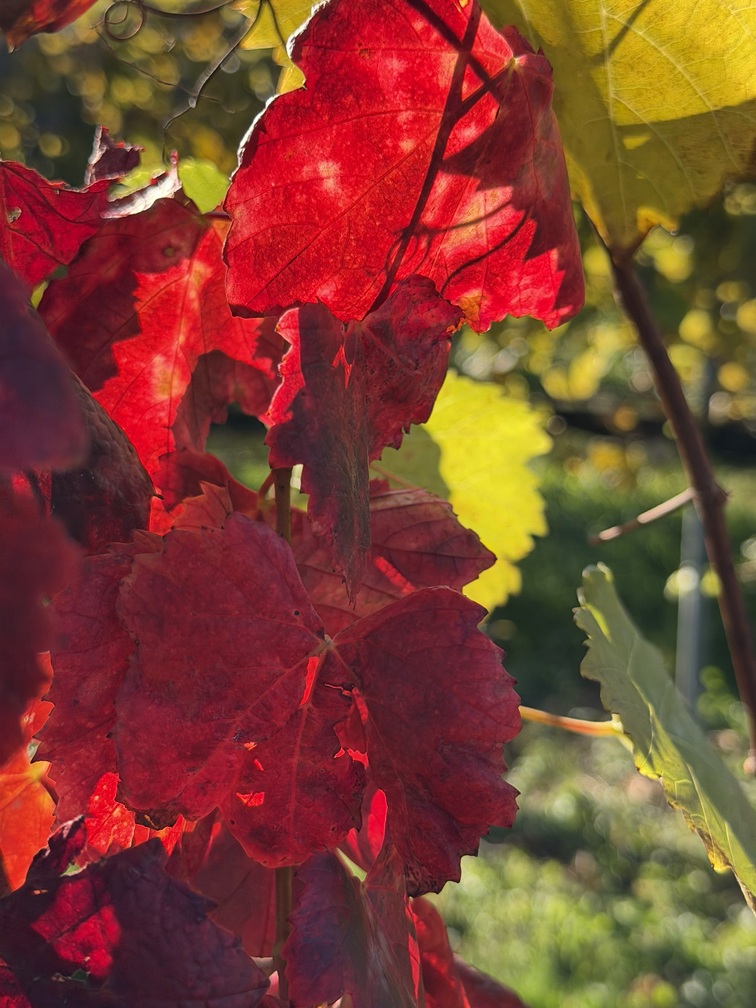
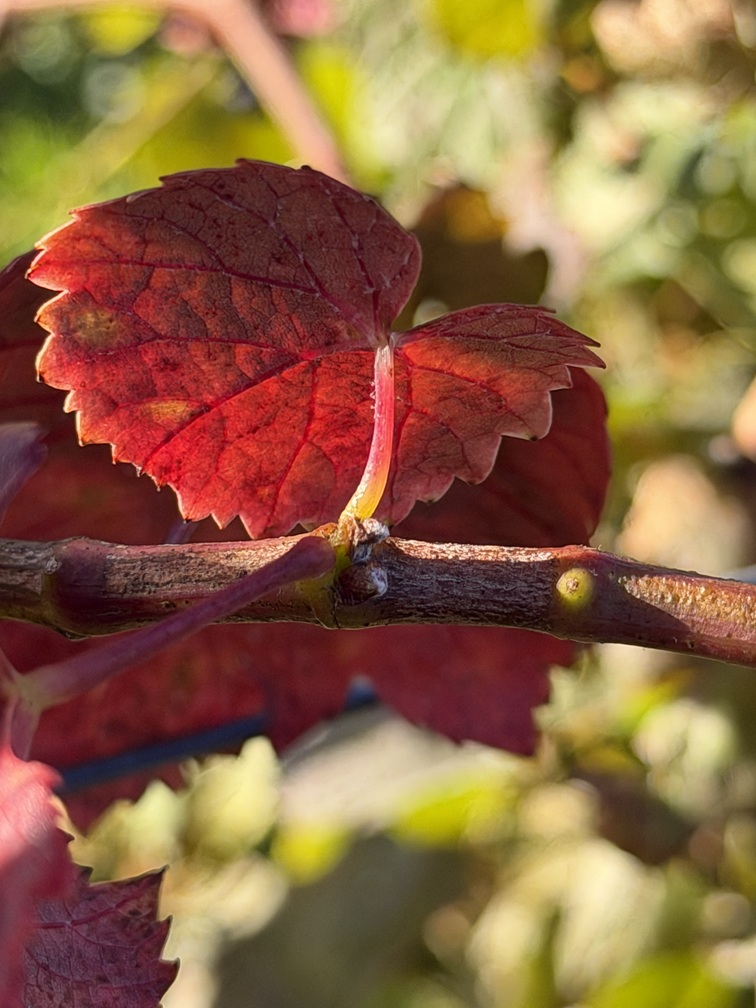
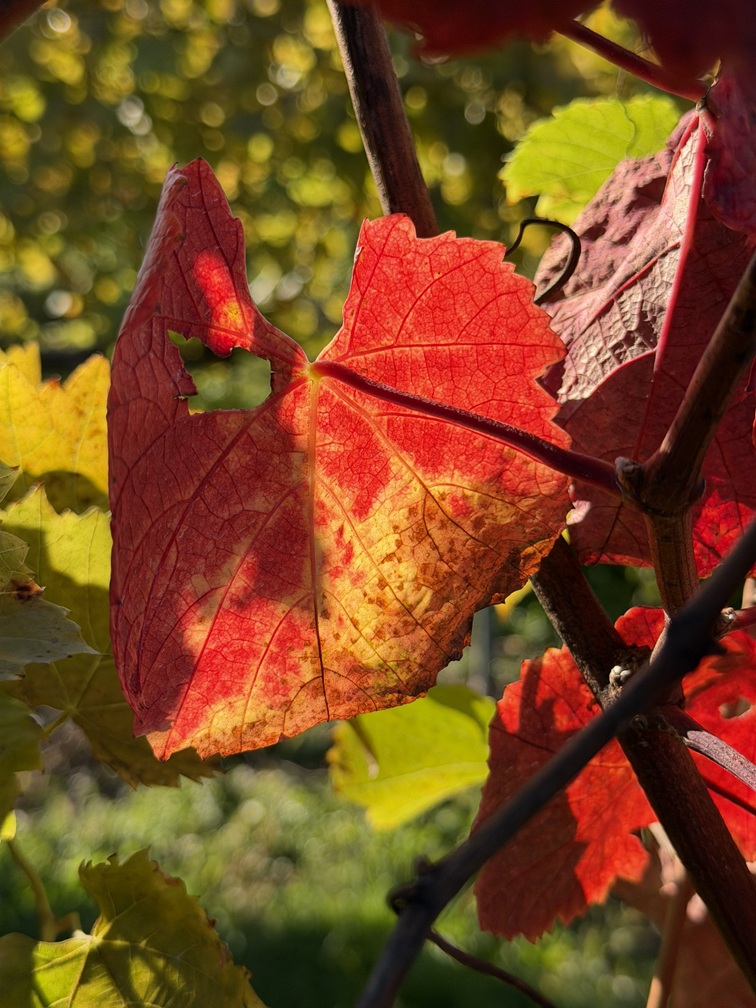
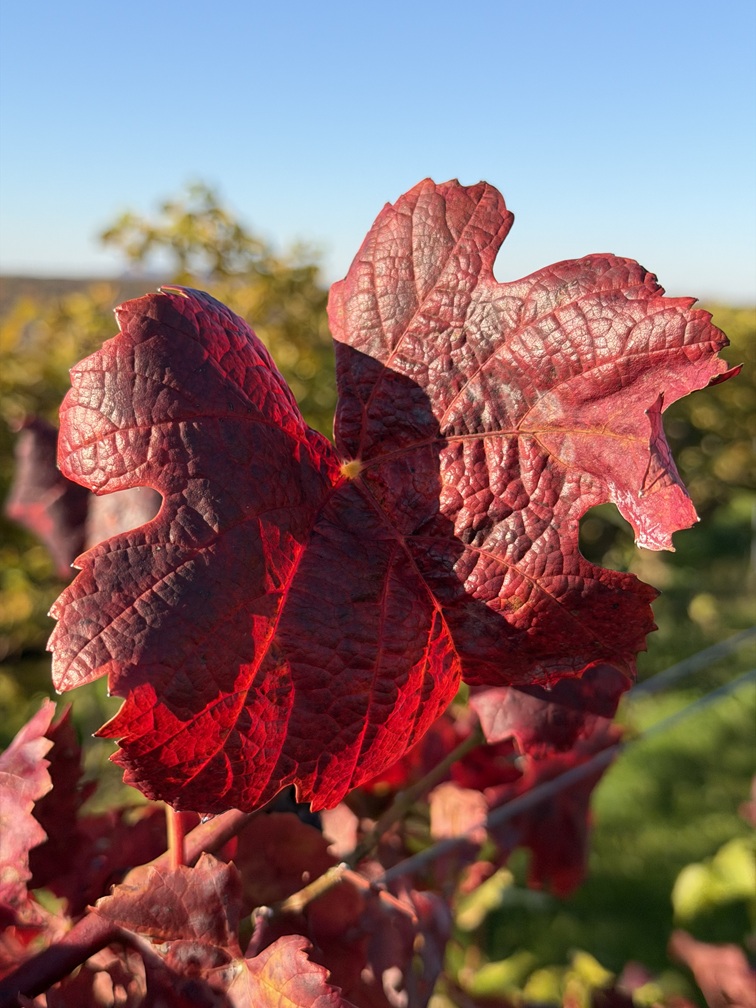
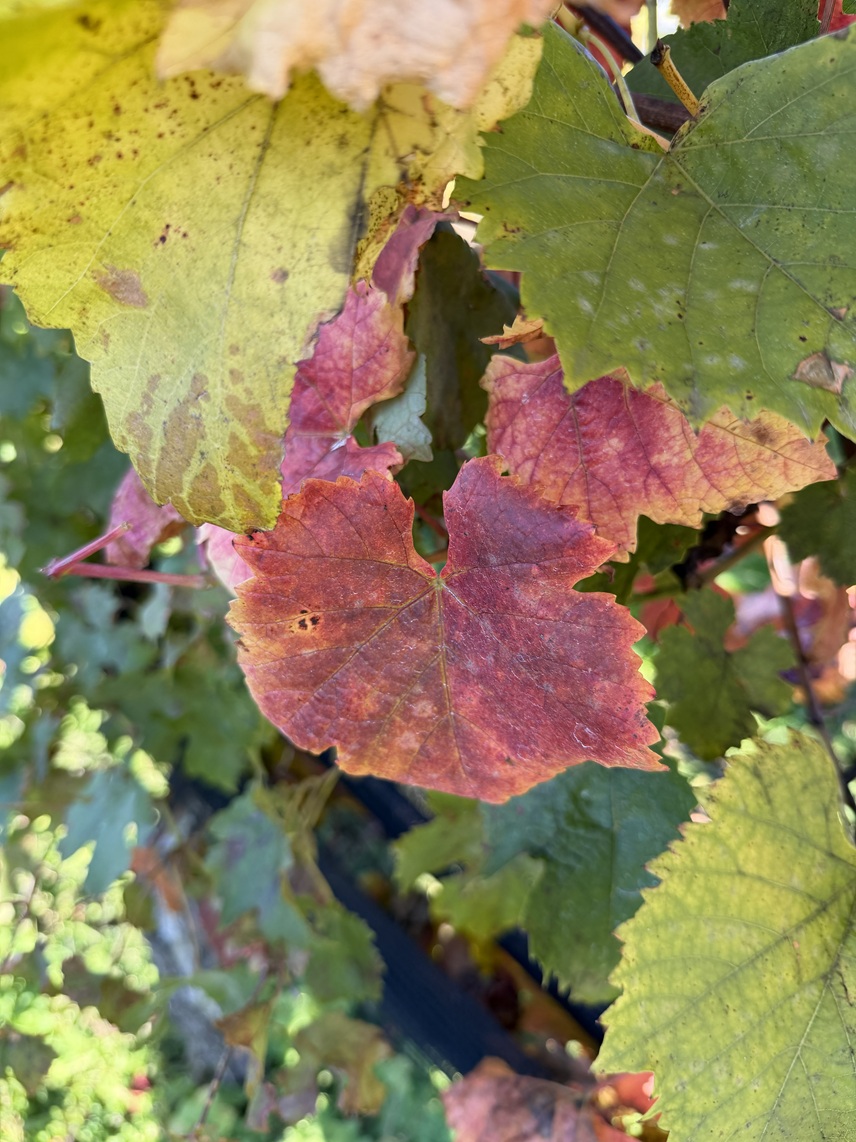
Joe had a vision of Gouveia Vineyards as the place where people can get together and enjoy their lives – I think this mission was accomplished perfectly.
Next time you are looking for a winery to visit for a good glass of wine and The Art of Living experience, please include Gouveia Vineyards in your short list.
Art of living.
Enjoy the little moments that comprise life.
Beauty is Everywhere: Fall Colors 2026
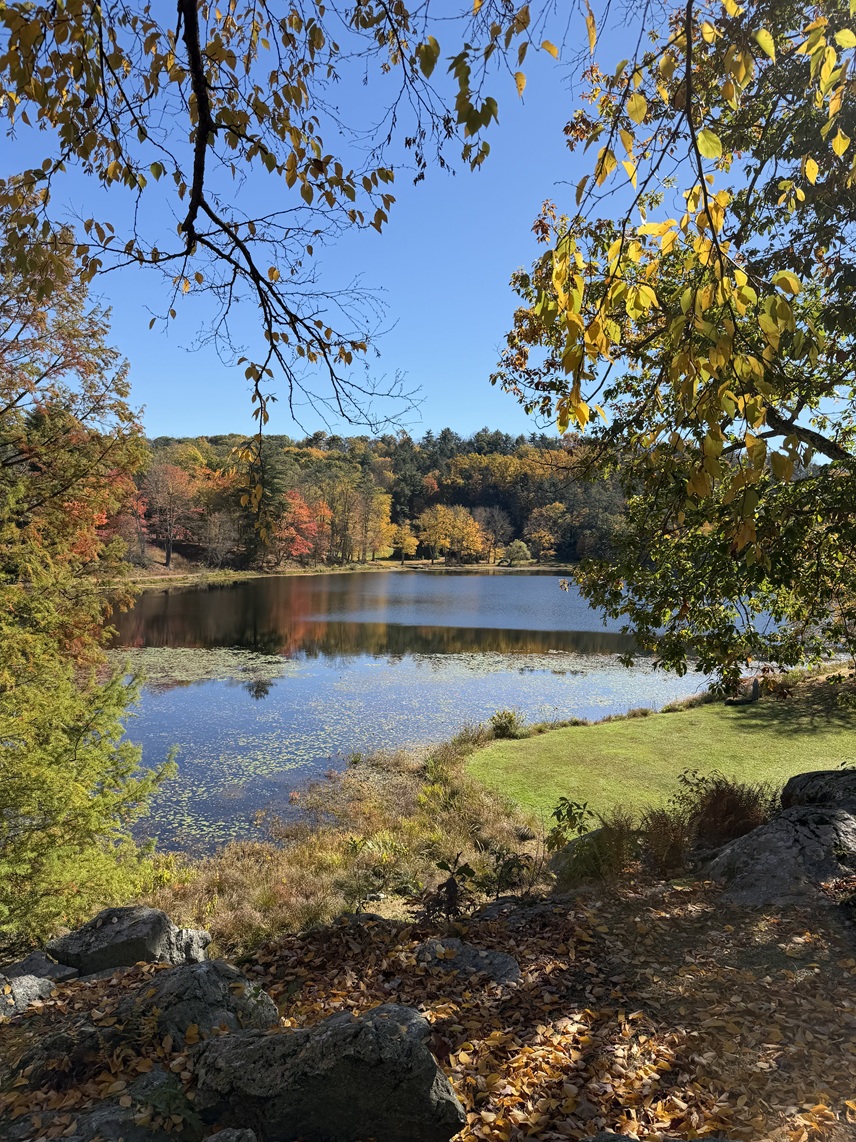
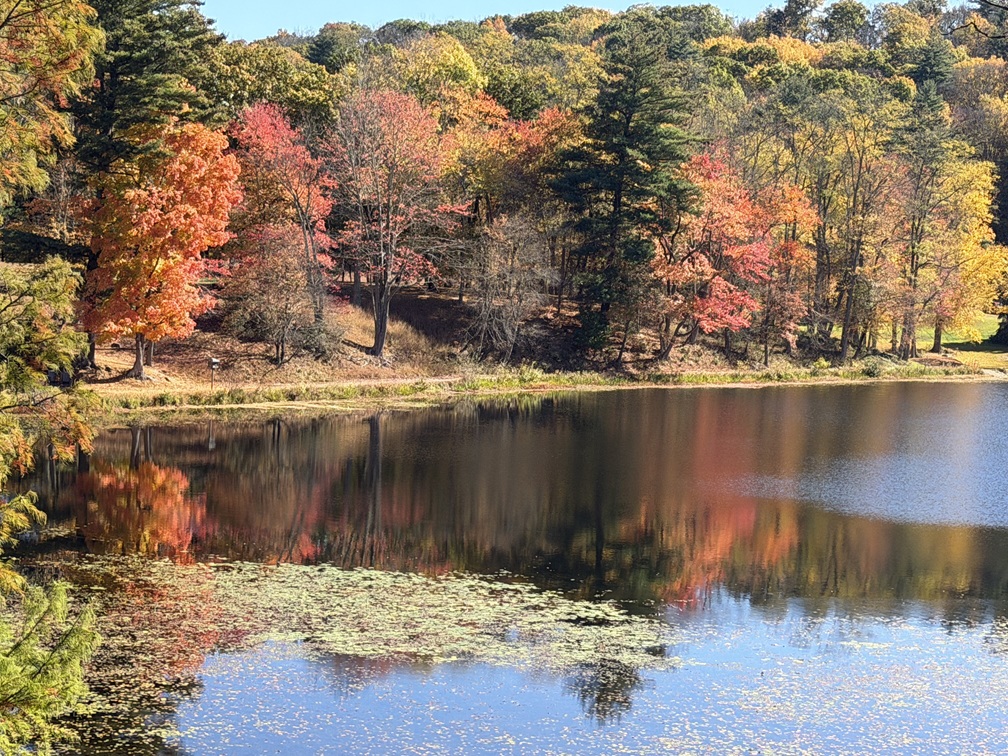
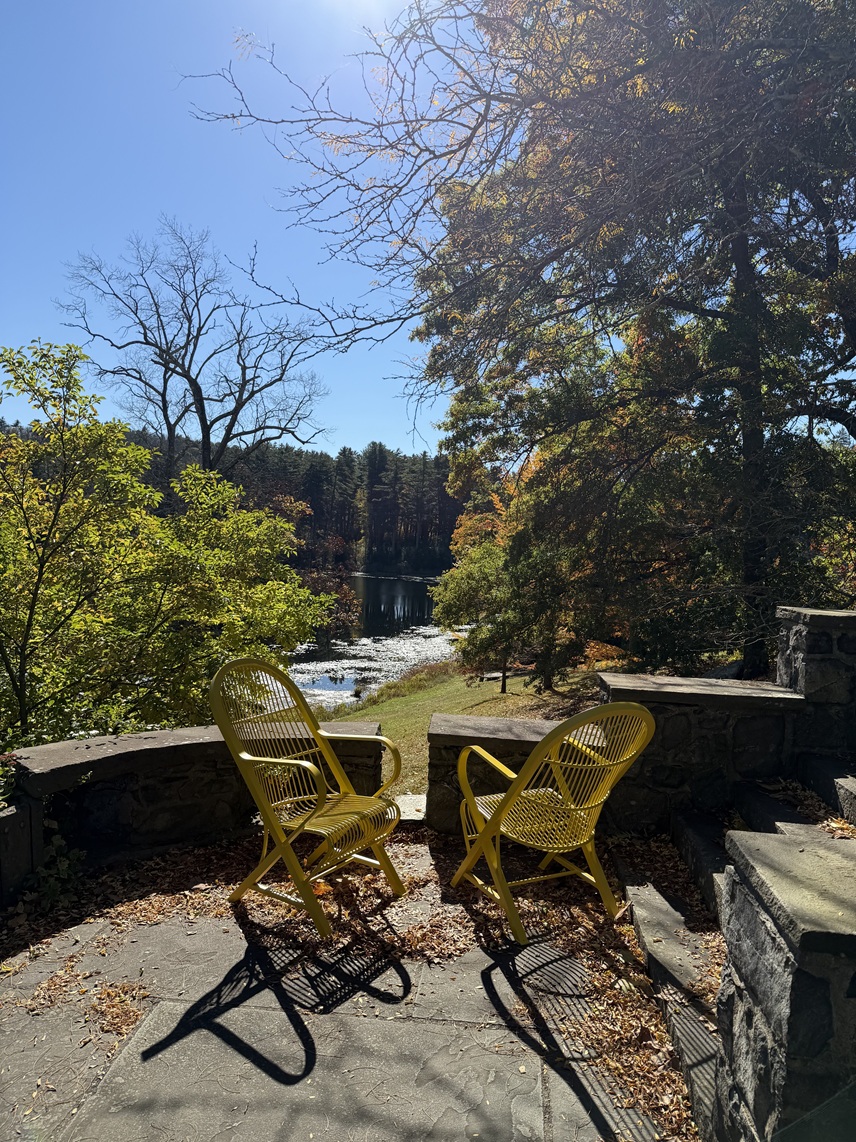
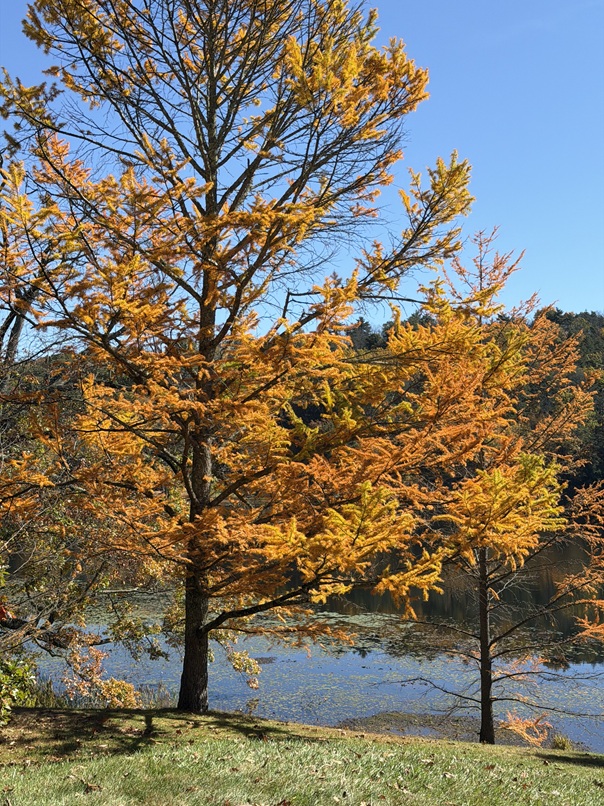
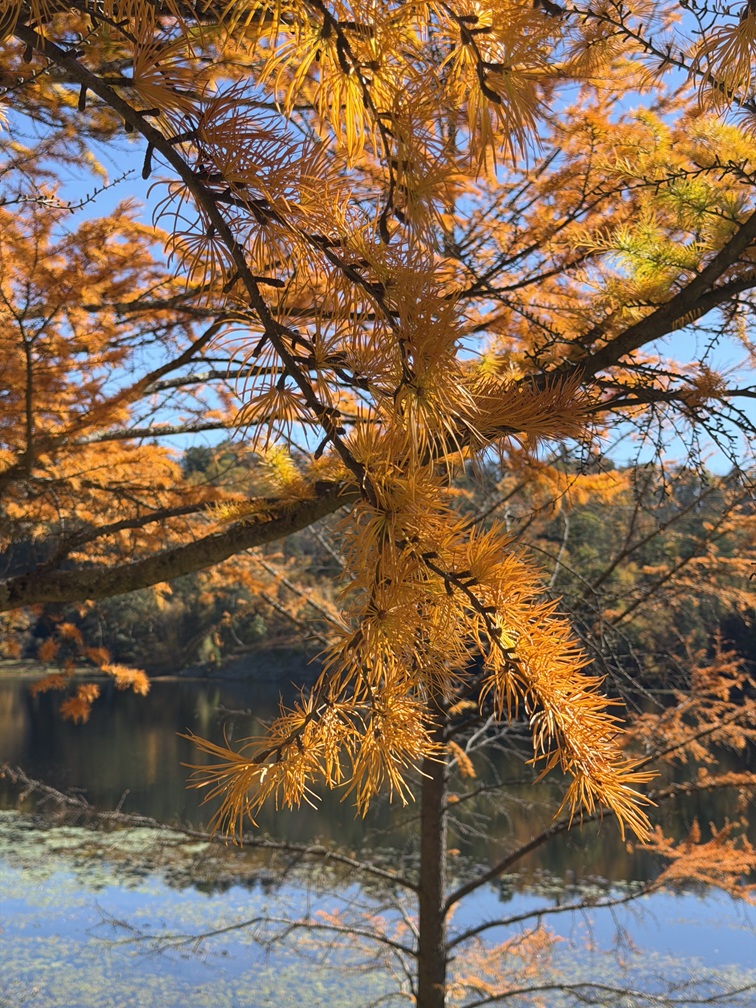
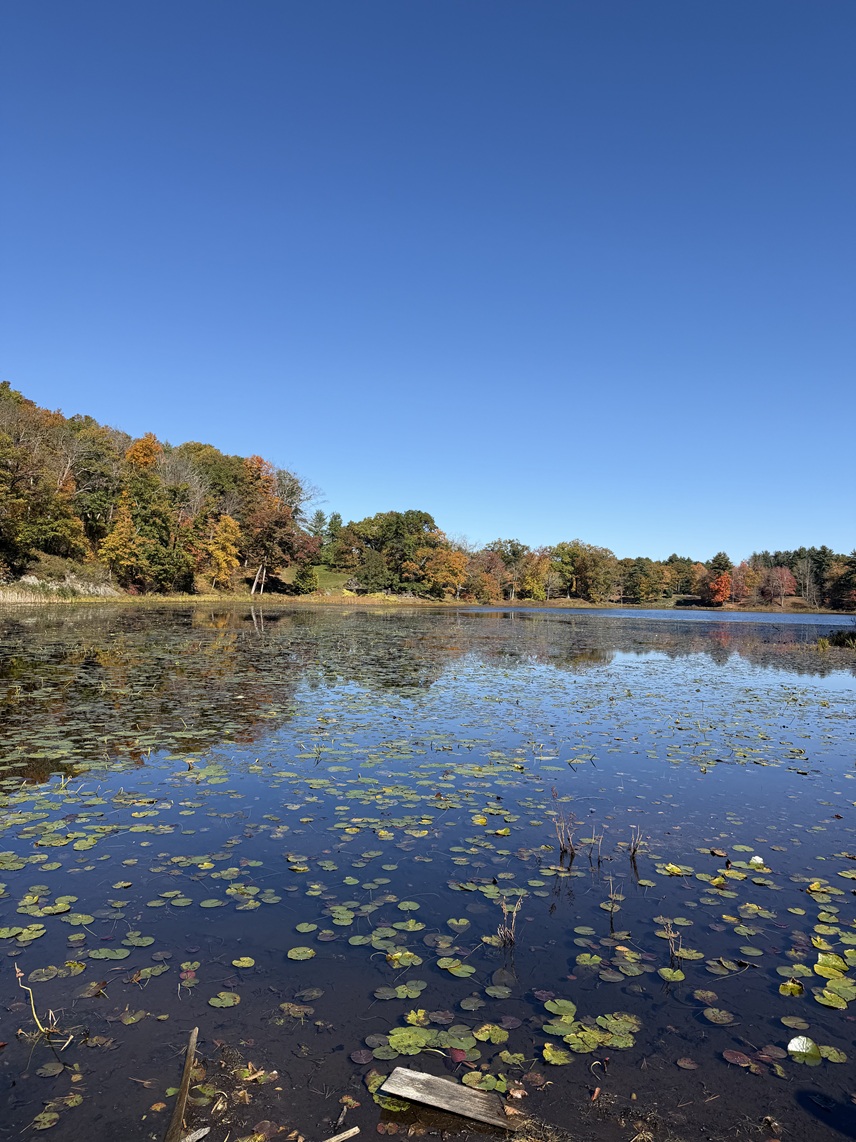
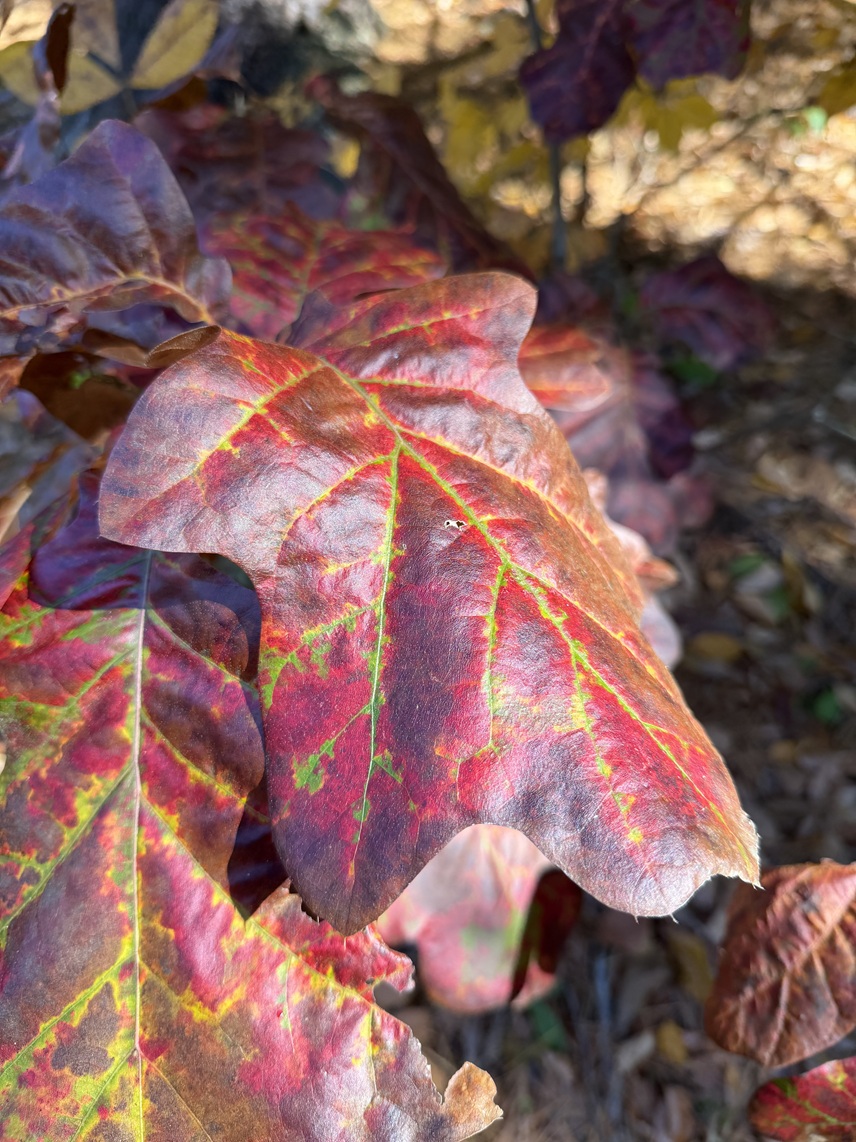
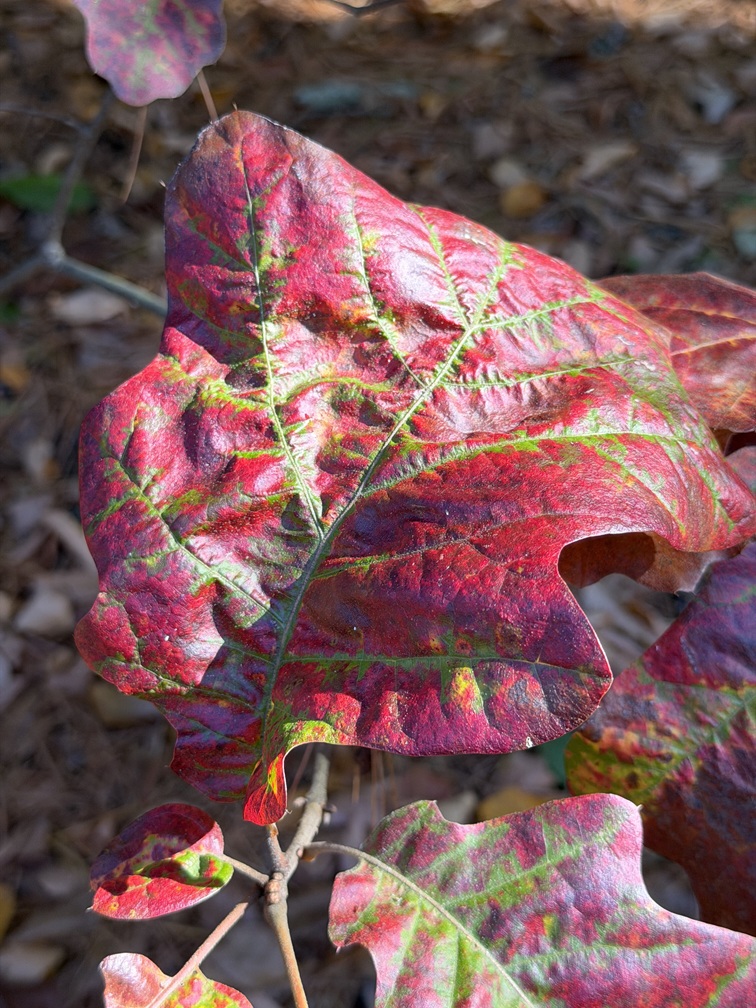
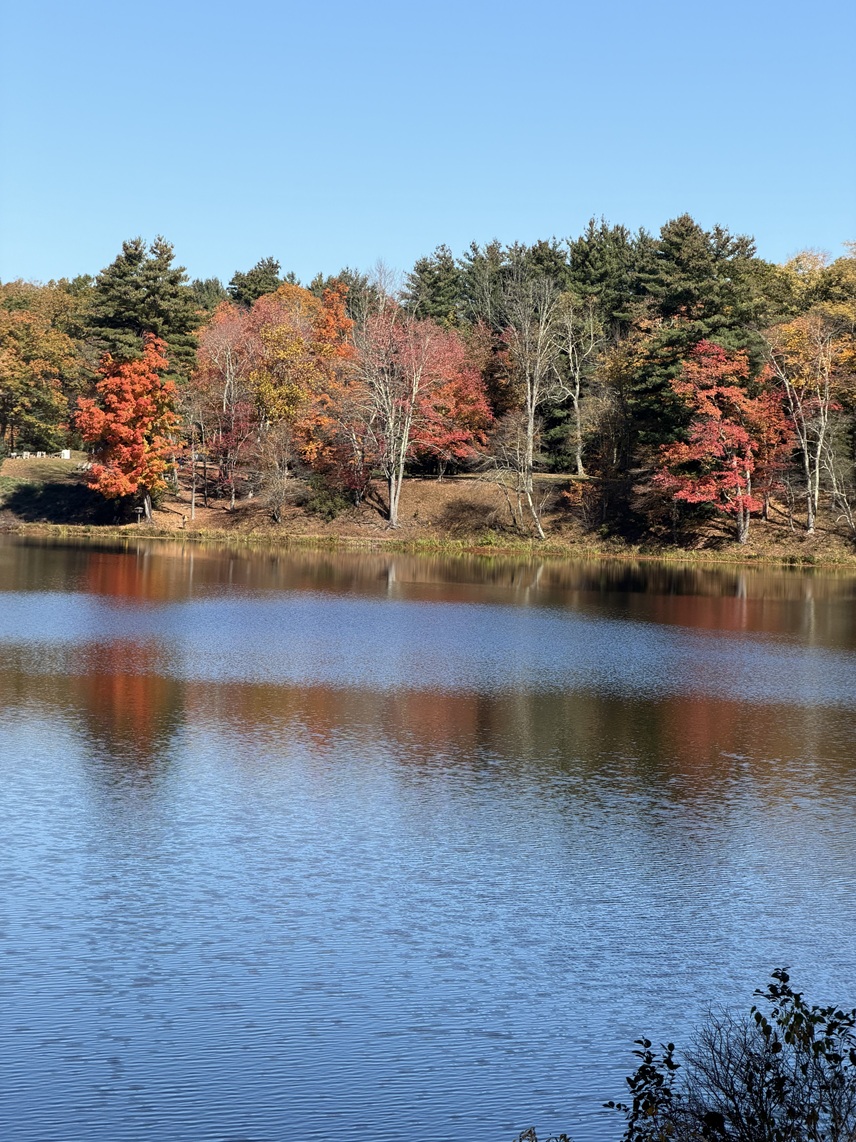
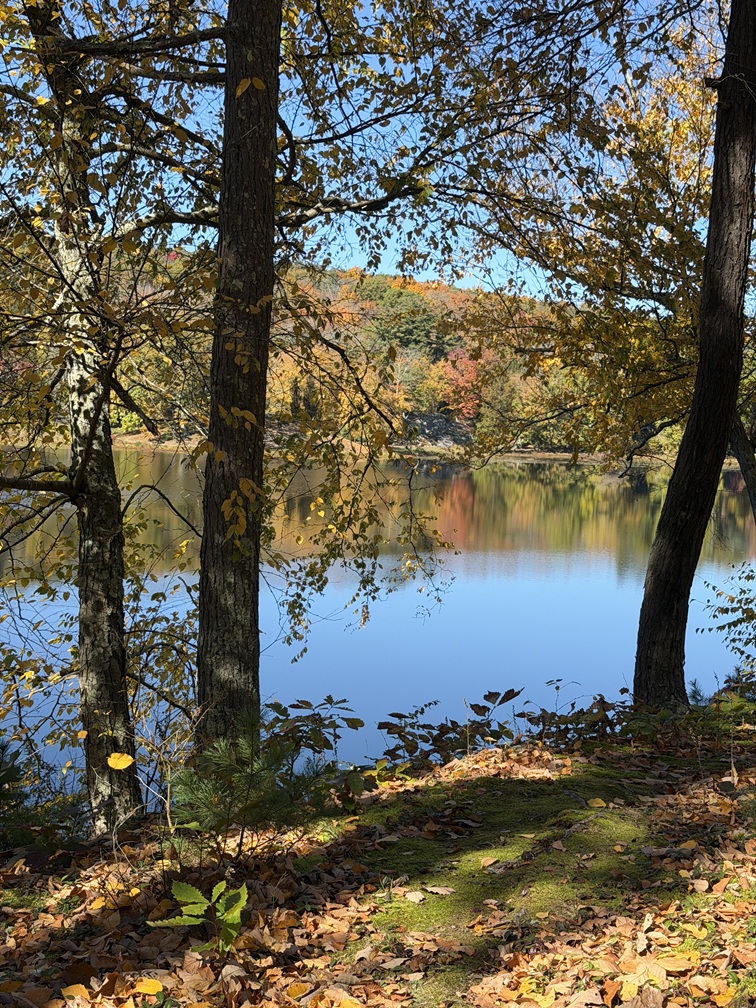
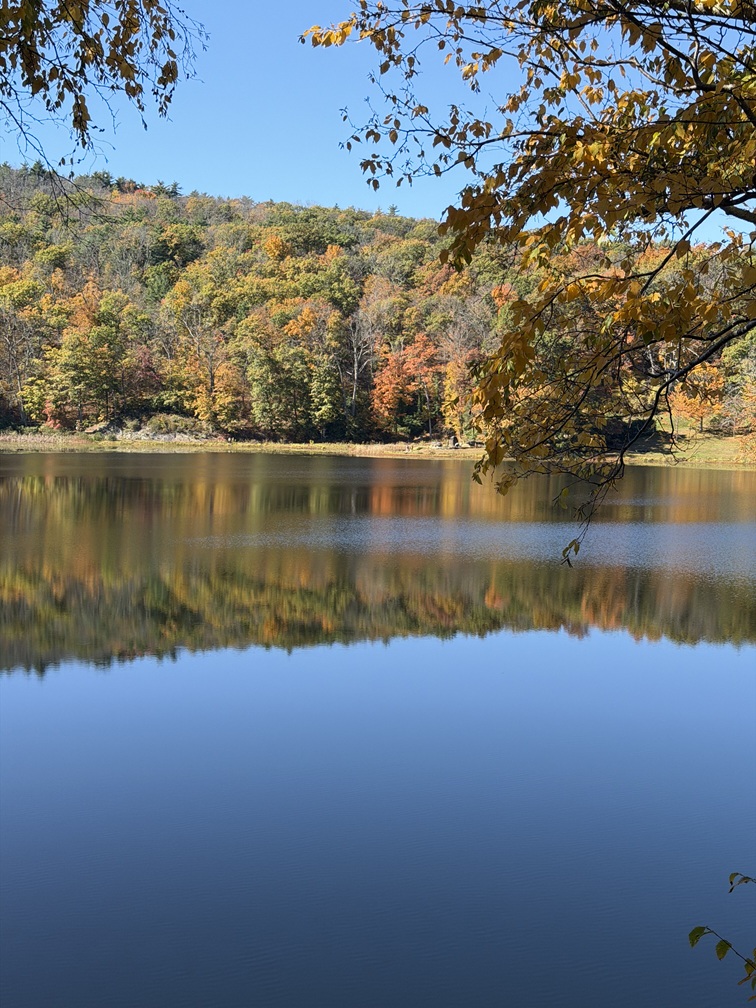
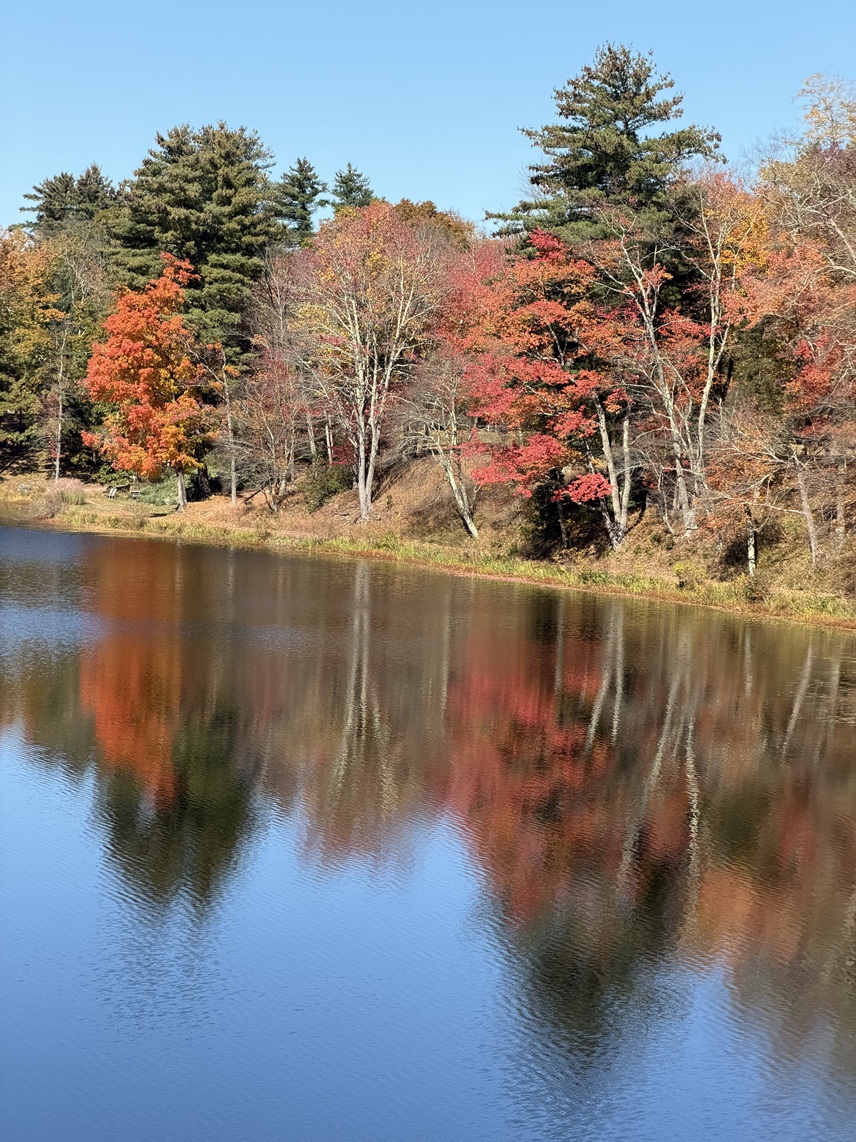
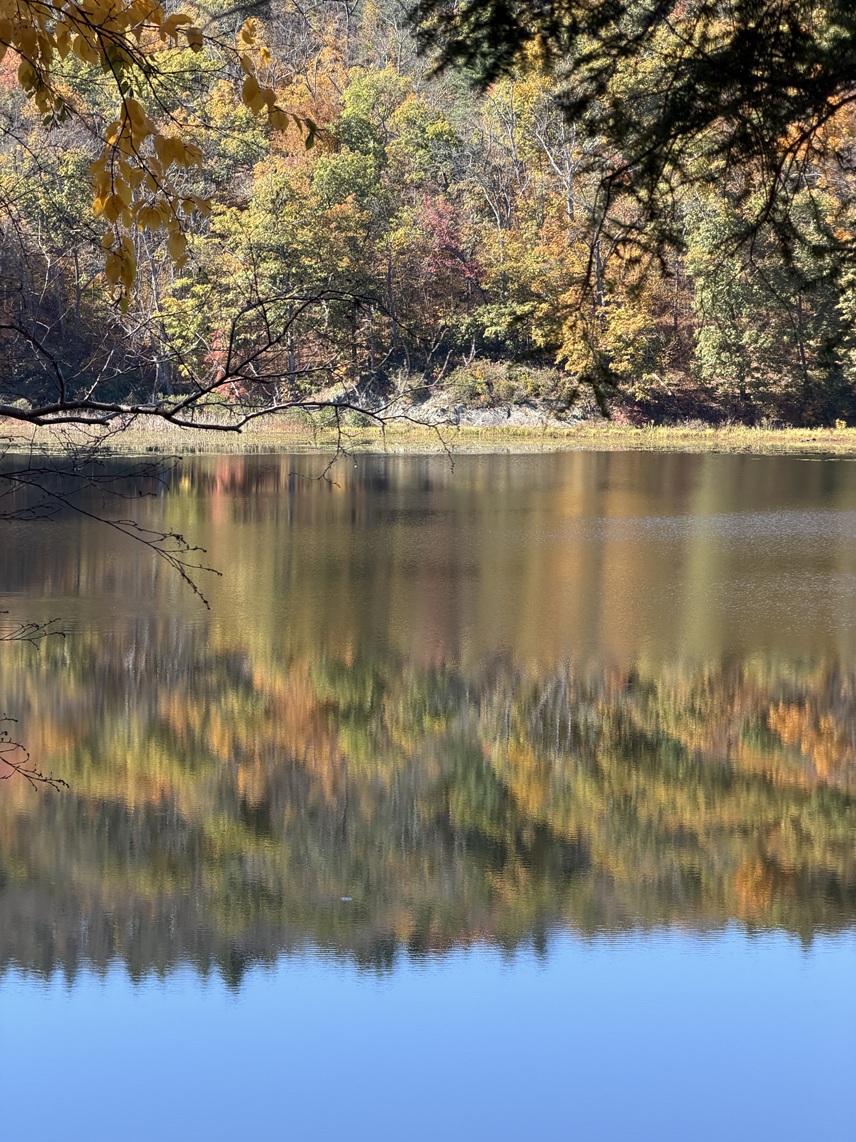
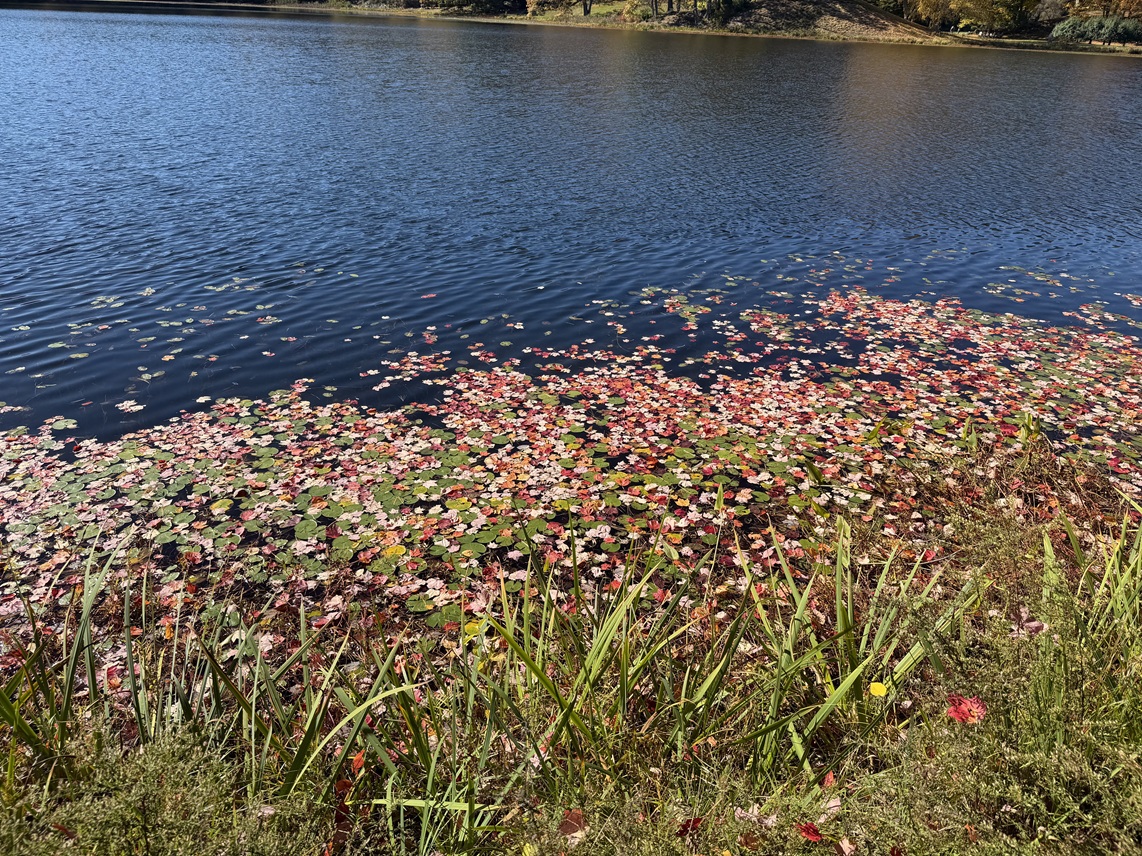
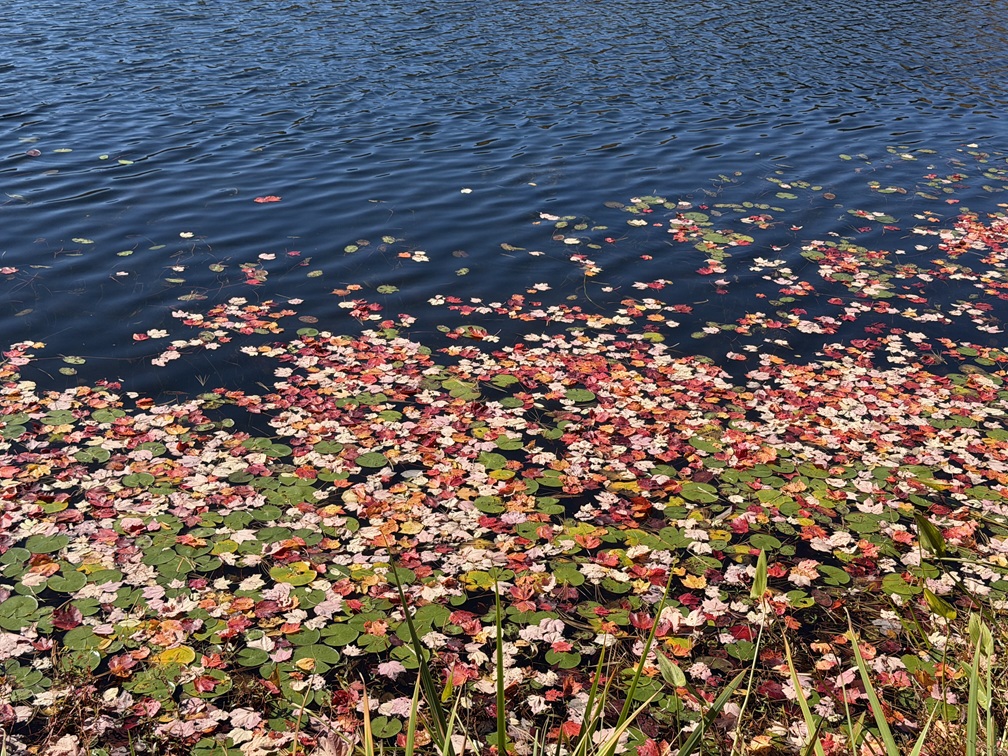
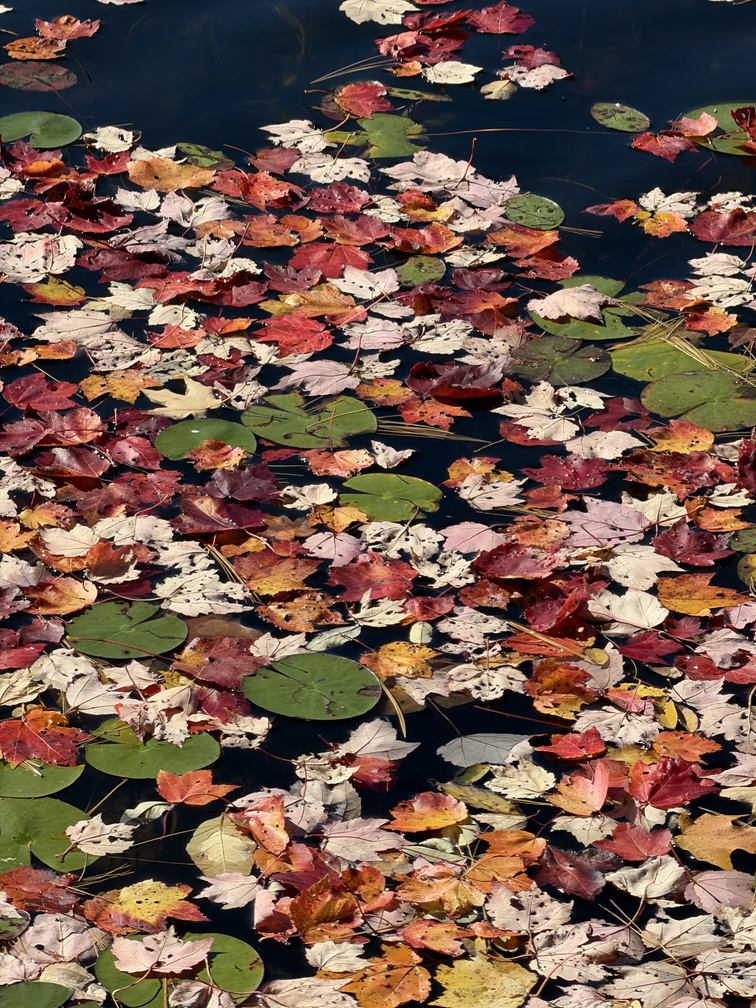
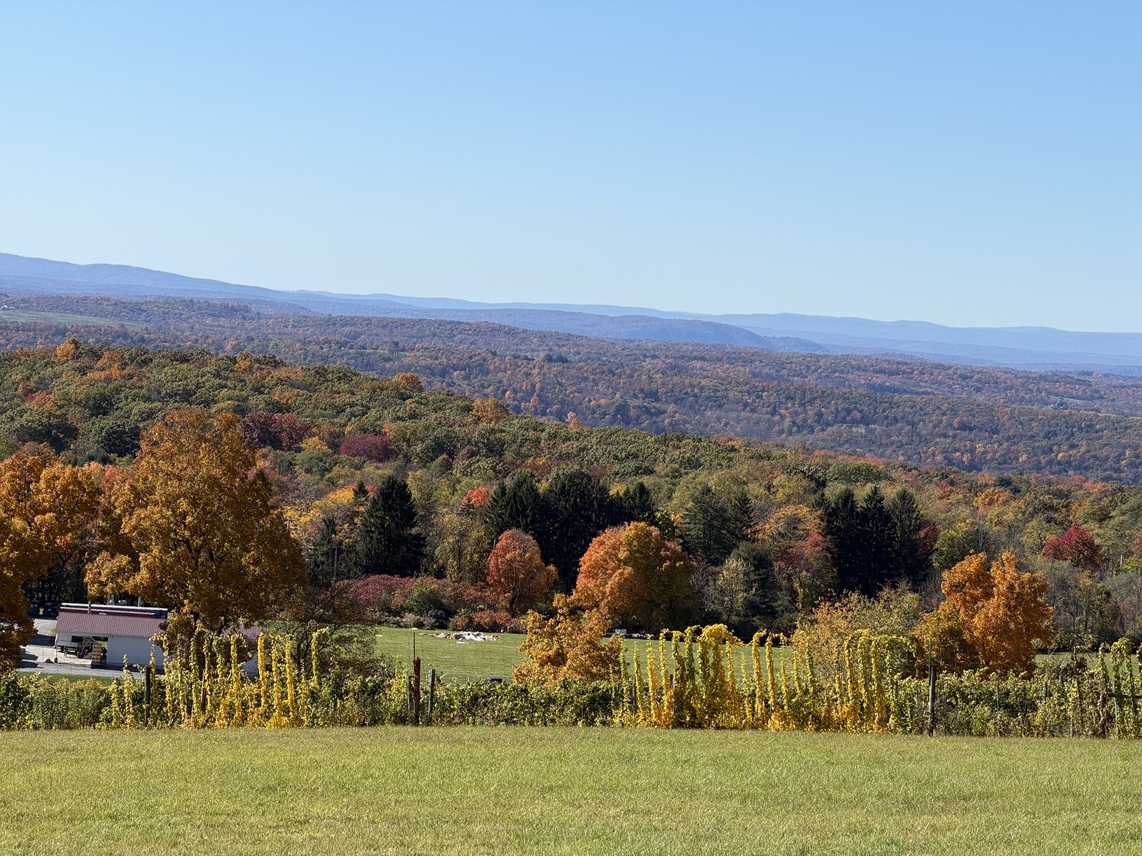
It is still here. I took a drive today on the Merritt Parkway in Connecticut, one of the most beautiful highways in the US, and I enjoyed that drive immensely. A full display of all shades of yellow with red, orange, and light brown painted all over it.
Every year, these autumn colors are different in their intensity and timing, often affected by one’s mood, but we will leave mood out of it. This year we were blessed with a long, slow, and exuberant display. Thank you, Mother Nature!
As you might remember, this blog is about wine, food, and life. Today, we are not talking about wine or food. It is all about life in its full beauty.
These “Fall Colors” posts are very traditional on this blog. I love photography almost as much as I love wine, so I take every opportunity to inundate you with as many pictures as I possibly can, especially when it comes to the beautiful display of leaves. If you are curious, here you can find past fall colors posts: 2012, 2013, 2015, 2018, 2021, 2023, and 2024.
Sometimes, I just walk around my neighbourhood. Sometimes, the colors come from short trips around New England, New York, and more. The 2026 display comes from the 2 trips we took: one in New York and one in Connecticut.
First, we went to a beautiful Chinese garden called Innisfree Garden, located about an hour and a half from Stamford, in the town of Millbrook. We visited the garden a few times in the past, I’m surprised that I never mentioned it on this blog.
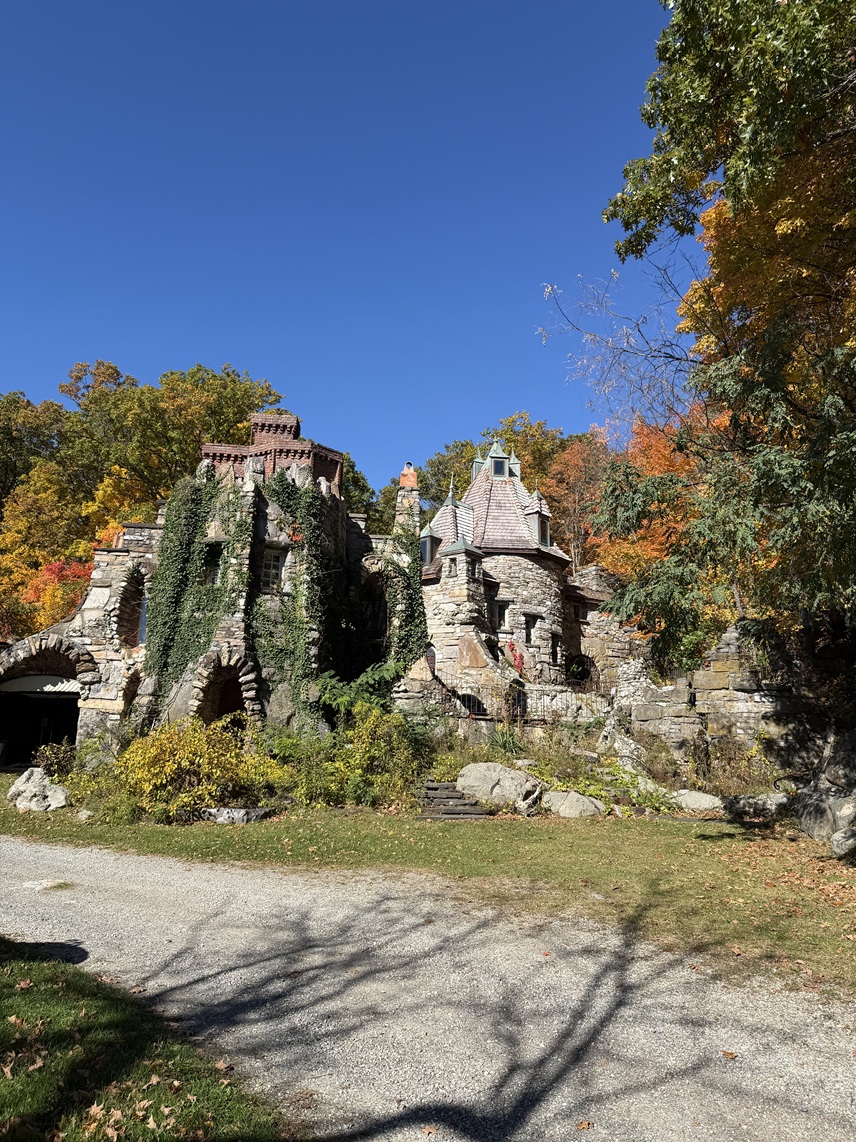
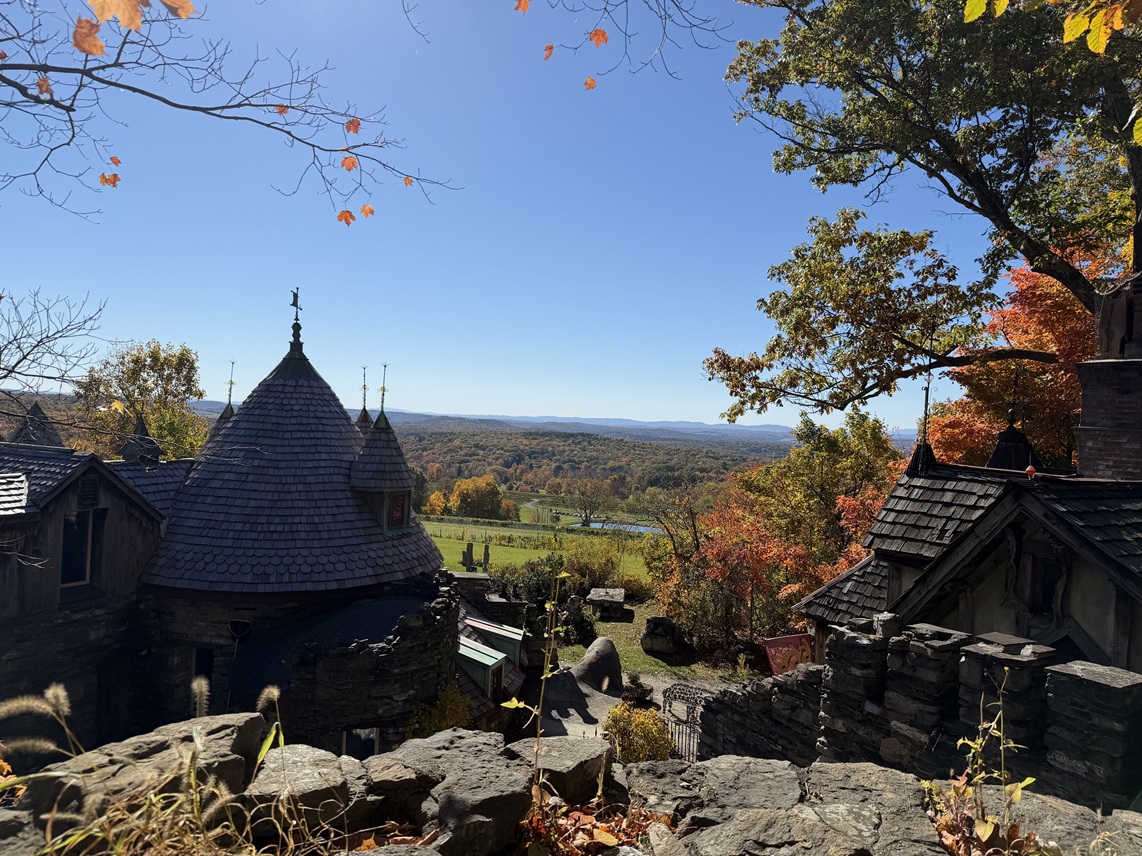
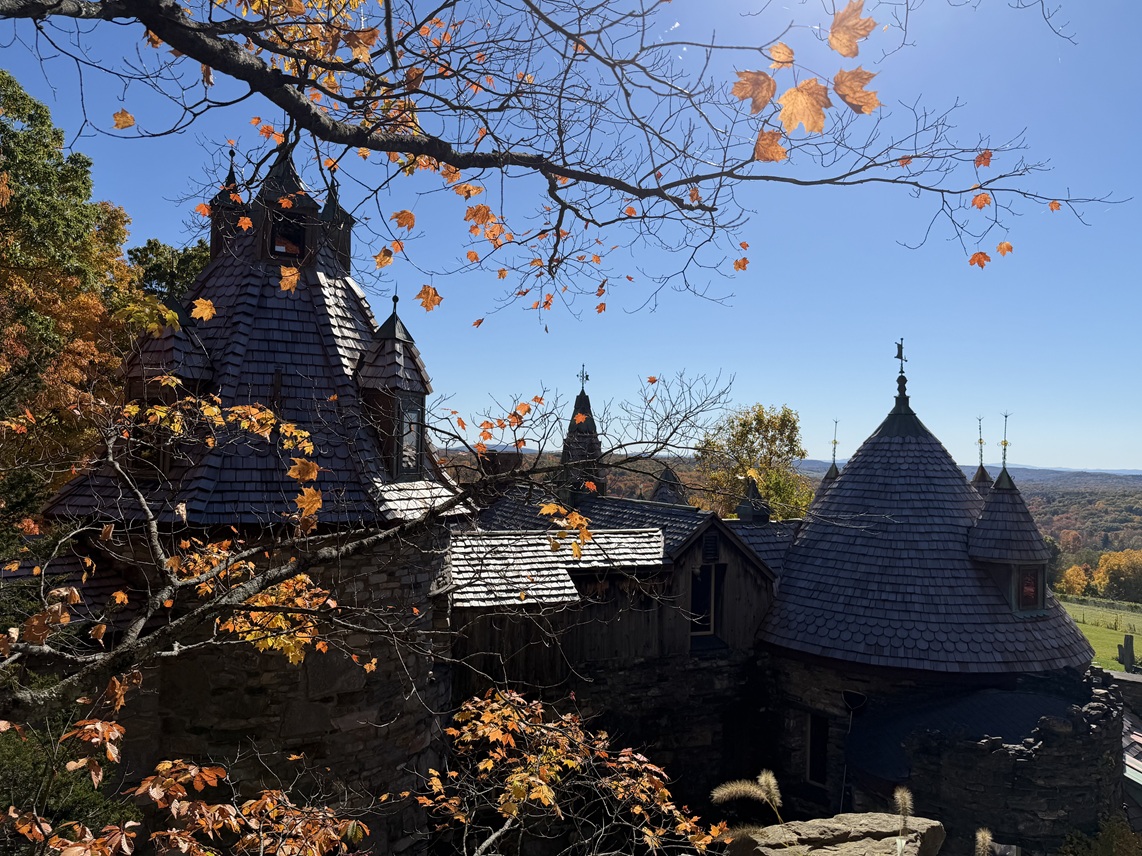
Next, if you are in Millbrook, you must visit Wing’s Castle. I wrote about Wing’s Castle before in full detail, so I will not repeat it here, but hey, if you are anywhere near Millbrook, visiting Wing’s Castle is literally mandatory.
Last weekend, we went to the Sleeping Giant State Park in Connecticut, with an excellent hike and magnificent views, and then visited Gouveia Vineyards, but this will be the subject of its own post.
Now, without further ado, it is time for many, many pictures.
First, from our walk in Innisfree Gardens:
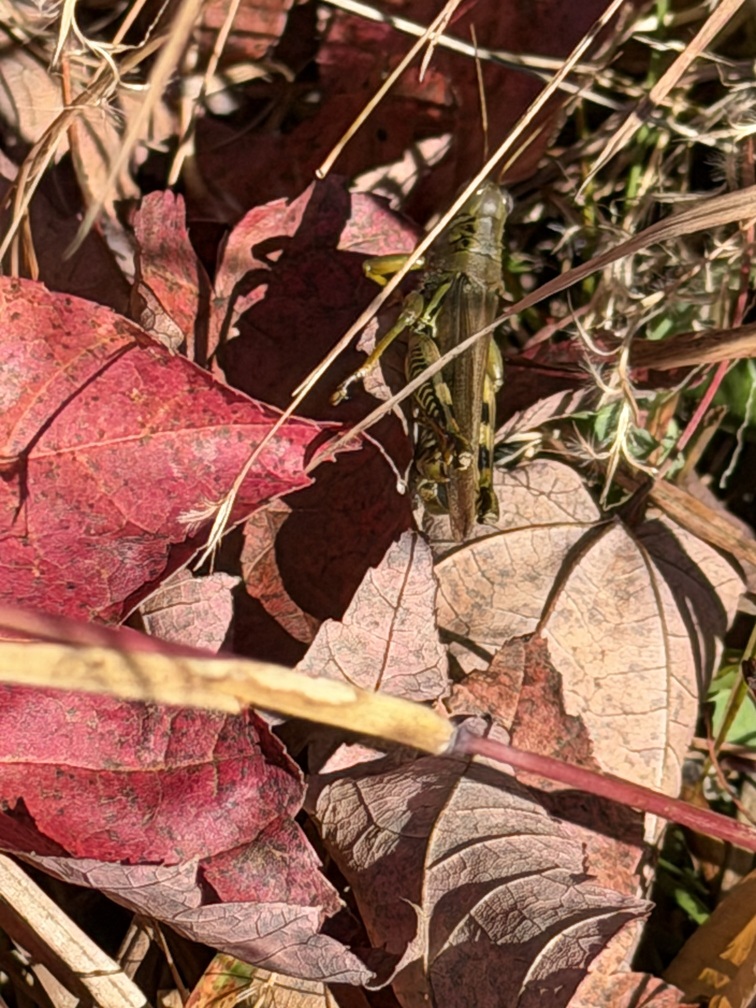
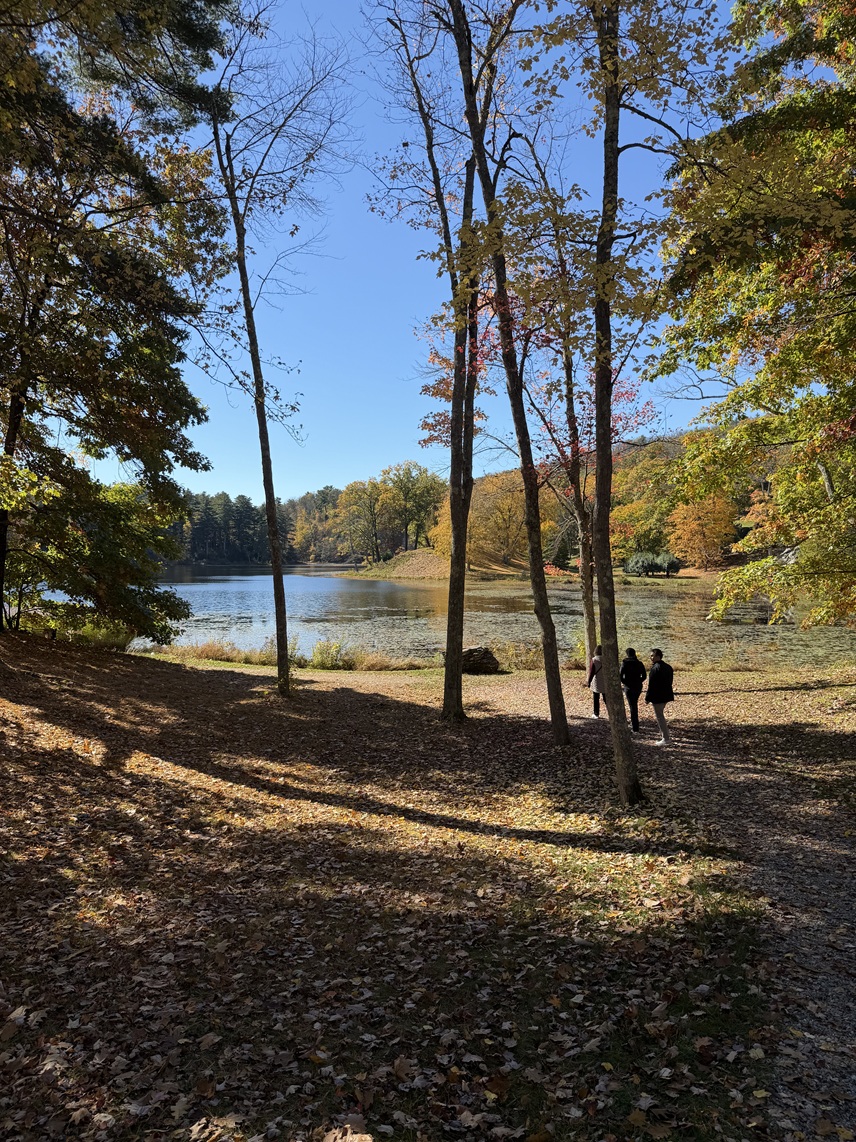
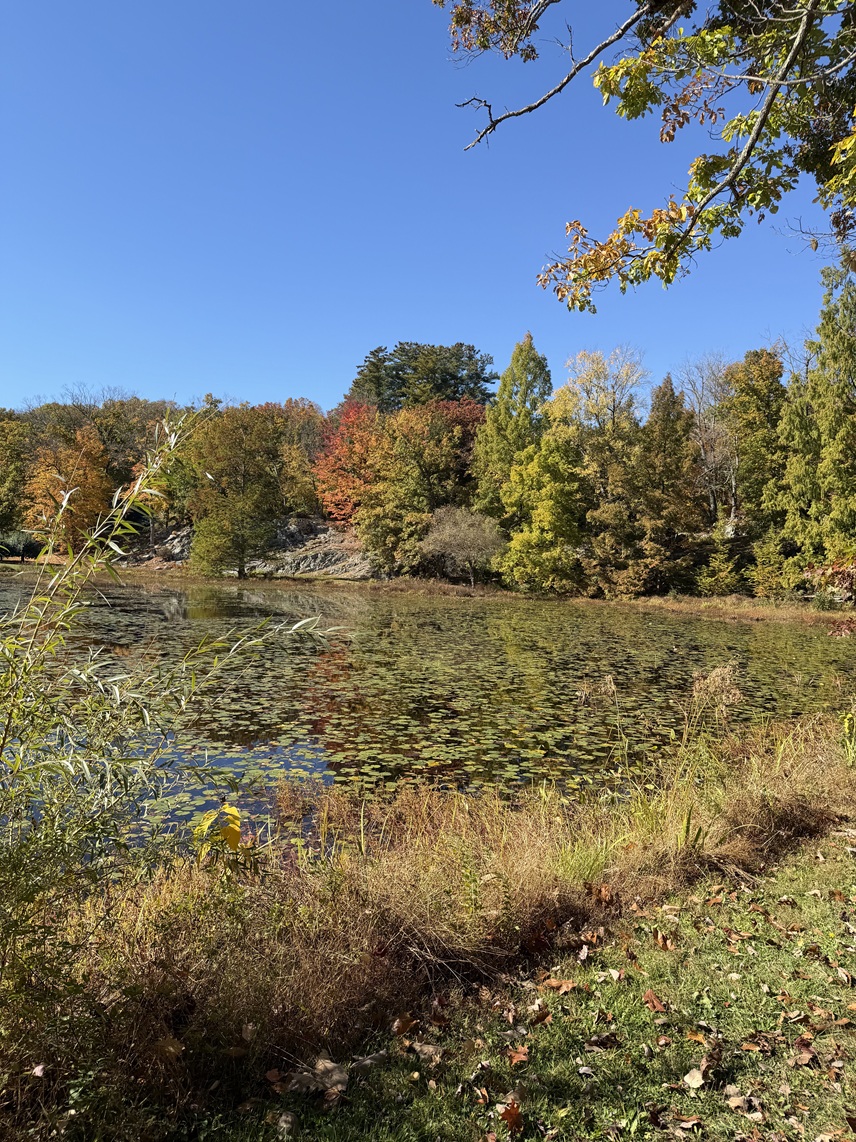
Now, the Wing’s Castle (just for fun, you can compare these pictures with the ones in the blog post I mentioned before):
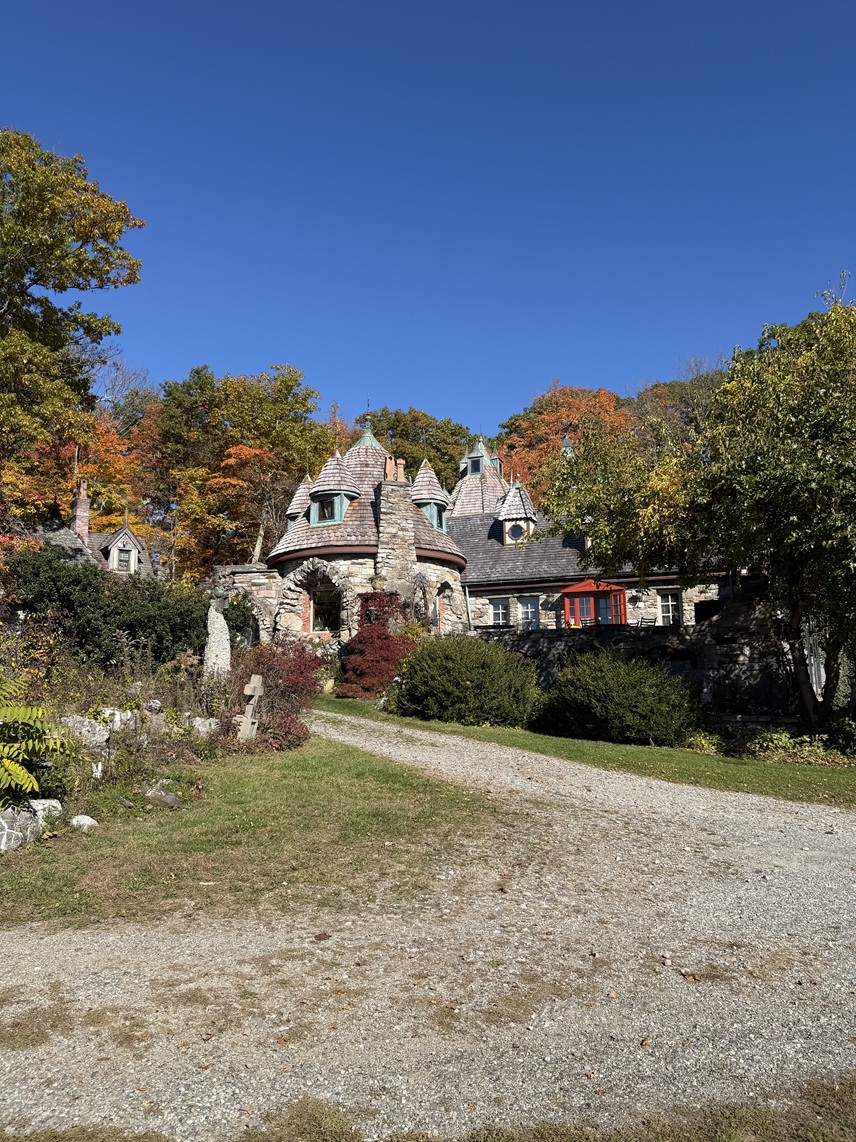

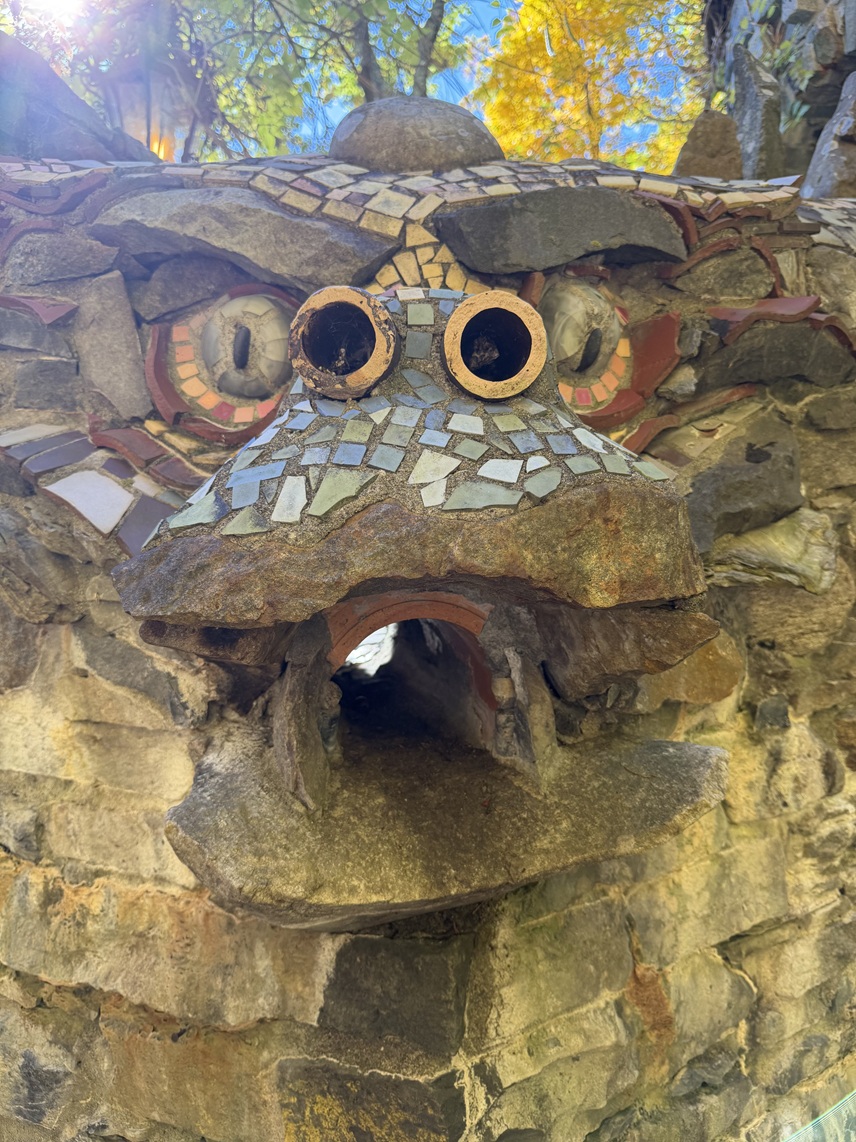
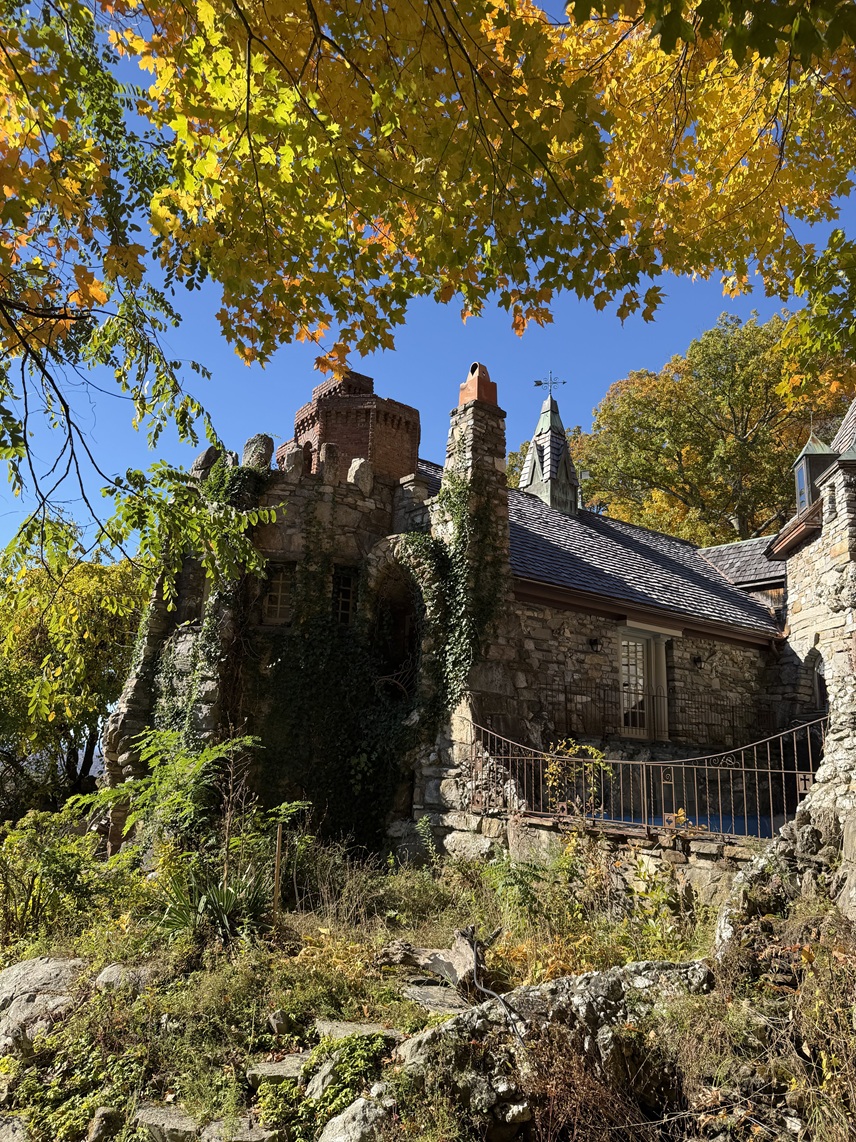
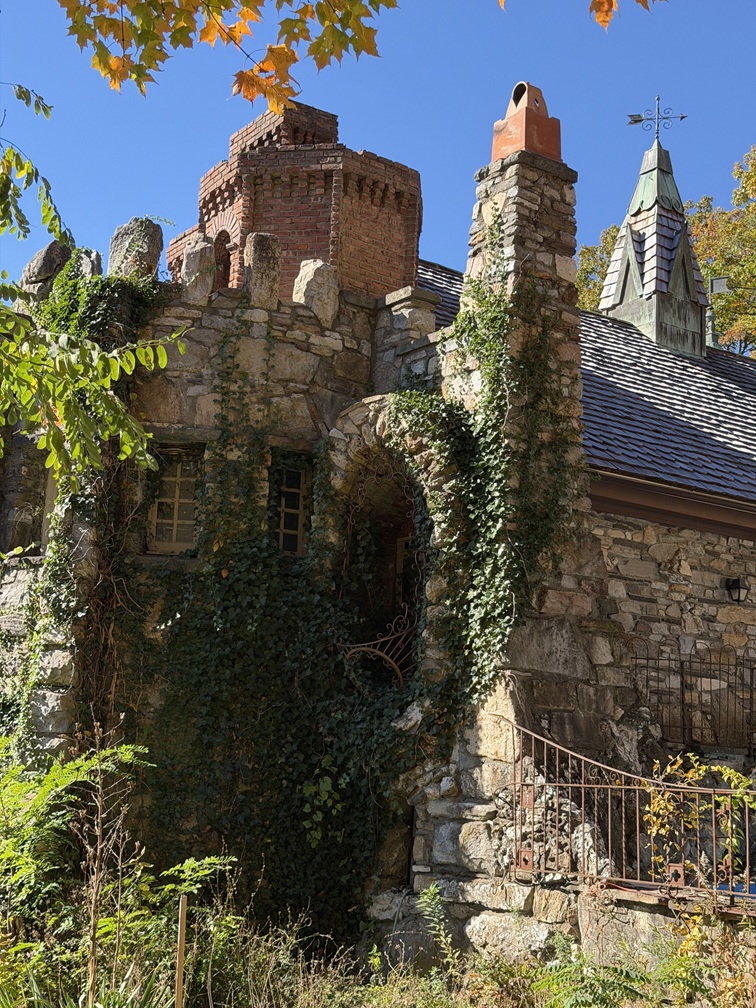
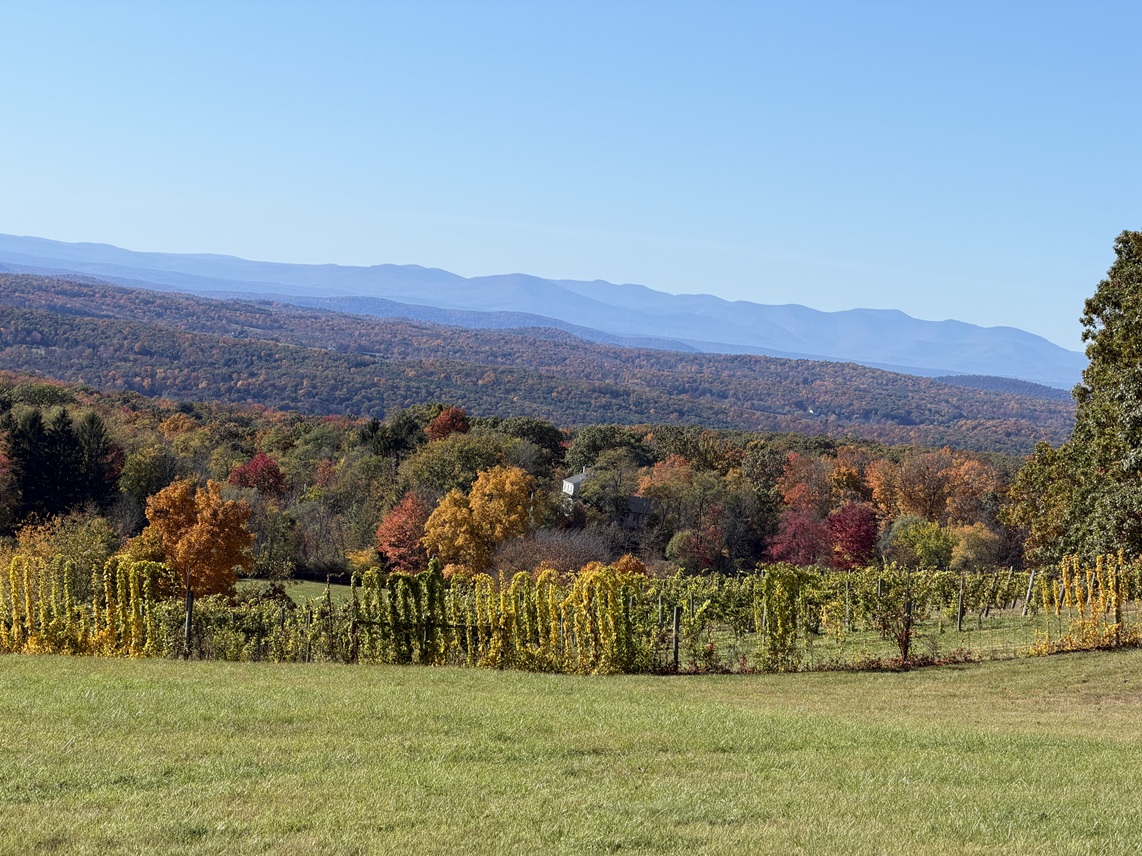
And finishing up with the pictures from the Sleeping Giant State Park:




Hope you enjoyed the display of colors.
Mother Nature – thank you again!
Of Wine and Image
Let me warn you upfront – I’m not sure what this post will be about. Will probably end up with a loose collection of thoughts, most likely a bunch of random incoherent nonsense. A lame attempt at conscious analysis of the subconscious. So if you got something better to do (I’m sure you have), you can just stop reading it already. If you decide to stay, don’t tell me I didn’t warn you.
Wine is subjective. Hell, wine might be the most subjective product out there. And probably the most discretionary one too. If needed, you can easily live without wine. If you will not have water to drink, you will eventually die. If you will not have food, you will eventually die. If you will not have wine, nothing will happen to you – as long as you have water and food, you will be totally fine without wine. You might be emotionally damaged :), but hey, you will be physically fine.
Love of wine is acquired. We are not born with the love of wine. Sugar – yeah, I guess sweet is one of the very first tastes we recognize and acquire, coming with mother’s milk. Growing up, at some point, wine might become a subject of interest, but there is no rule of life that clearly states “you must love wine”. And I would argue that the love of wine is something we build as an image of in our heads first. As kids, we might read about wine in the books, we might see our parents enjoy it, we might see our parent’s friends enjoy it, and that image of “wine is a good thing” is getting slowly ingrained in our minds, possibly even making into the subconscious level.
We start with wine in a very general way – wine at large is something interesting. Here it is wine as a whole, a concept of a liquid in the bottle, without any regard to the regions, grapes, or producers. Our image here is very simple – a bottle, or a liquid poured from a bottle into a glass. From here on, it is entirely up to us how many details we want to add to this image and how obsessed we are willing to become.
Assuming we are interested in the subject, we begin our knowledge quest. First we learn about countries – “ahh, I had an amazing Italian wine yesterday”, “aha, this wine is from New Zealand? Cool”. Next, we start learning about grapes “Waiter, do you have any Chardonnay here?”, and deepen our knowledge of places, advancing from the countries to the regions “Bordeaux, I only drink wines from Bordeaux”. Continuing our learning, we are diving into producers, vineyards, critics’ scores, and social status values. Now the wine’s image is very rich, and it is easy to lose our way, as the image of wine might easily trumpet the wine itself.
“Wine should give you pleasure”. These are defining words of my wine teacher, Kevin Zraly, that he constantly repeated in the Windows on the World wine school classes. I also love to repeat these words whenever appropriate when talking about wine. By the way, you can laugh if you want, but now, while working on this post, I suddenly realized that “pleasure” here can have double meaning. It can be an actual hedonistic pleasure of drinking the wine in your glass, or it can be a pleasure of ownership, acquiring a rare bottle with the purpose of “collecting”, most probably reselling later for a profit. Nothing wrong with that, but this is not the direction I want to explore right now. So the wine you drink should give you pleasure – please hold that thought, we are going to come back to it in a moment.
We have established that the image of wine is rather complex. Interestingly enough, it doesn’t mean that the wine itself, the liquid in your glass, is complex. When I ask people if they like the wine they are drinking, and they tell me that they don’t know enough about wine to answer that question, I always tell them the same thing – you DO NOT need to know anything about wine to enjoy it. Wine is binary – you either like it or you don’t. And this statement, “wine is binary”, holds true whether you only drink wine twice a year or if you are a master sommelier. The only way to truly assess the wine is to taste blind, ideally when you know nothing about it. Why? Because that image in our head is not innocent. It affects the way we perceive the wine.
Once we learn that the wine in our glass costs $100 per bottle, produced by a famous producer, was impossible to acquire, or that only 1,000 bottles were produced, the image in our head becomes a key factor. Our mind is instantly makes an effort to find the way to enjoy the wine. Not “objectively”, but because the wine with such an image must be good by definition. When Larry Turley was saying that California Cabernet Sauvignon lovers “drink the label”, this is basically what it has subsided to. At this point, we might forget what we have established – “wine is binary”, and “wine should give you pleasure”.
As warned at the beginning of this post, the subject is complicated. Image is very important in the wine world. In order to form an image, we need to learn about the wine – read about it, talk to someone. We learn through the stories. The image is formed through the stories. And what is even more important, wine is sold through the stories. The wine stories are written in the articles, on producer websites, on the bottles’ back labels. I’ve heard many times that millennials and Gen Z are buying the wines with the stories. Stories are important, they build an image, they build an image of the producer, an image of the wine. Many people participate in creation of the stories and an image – winemakers themselves, wine writers, wine critics, sommeliers, and many others. We are good at creating a great image (or a bad image – a glass of Merlot, anyone?). Only now we might be overlooking a problem – the image might be better than the wine.
Wine is binary.
Wine should give you pleasure.
Would you want a second glass?
Time to tell the truth, right?
While I often think about this exact subject, what provoked this post was a wine tasting I attended last week, all well-known producers. While waiting for the tasting to start, I was talking to fellow wine lovers, and these were the things we talked about – the stories and wines, and how they can mismatch.
There were 9 well-known, well-established, well-regarded producers in the tasting, presenting a total of 32 wines. Out of these 9 producers, I truly enjoyed the wines from two. Then there were literally two more wines from two producers, and there were maybe 7 that were “meh, I can drink it”. The rest of them, simply put, didn’t give me any pleasure. Two of the Allegrini Amarone wines were all about oak, with the winemaker boasting about keeping the wine for 45 months in new French oak (I couldn’t hold myself; I asked, “Why???”). Ratti Barolos were made in the traditional way, in large Slavonian oak casks, and they were simply locking my palate with fresh tannins, to the point of losing any senses. Yes, if I decanted those wines for 3, 4, maybe 5 hours, they would probably show better. But this is something you should be willing and prepared to do (meaning – you can’t just open the bottle at the time when your dinner guests have already arrived). Louis M Martini from California: the wines that used to be beautiful and affordable when Louis Martini himself was around have proven again that they have become nothing but soulless, commercial wines, presenting 3 expensive wines none of which were enjoyable.
Look, by no means am I saying these were bad wines. I would use such a term, “bad wine”, only if the wine is spoiled. If the wine is corked, oxidized, has bacterial spoilage – yes, that would be a bad wine, the wine nobody is supposed to drink. The wines such as the ones I mentioned above, I categorize differently: these are not my wines. These wines are not for me. These wines don’t give me pleasure. That’s it. This is as basic as it gets. Remember, wine is binary.
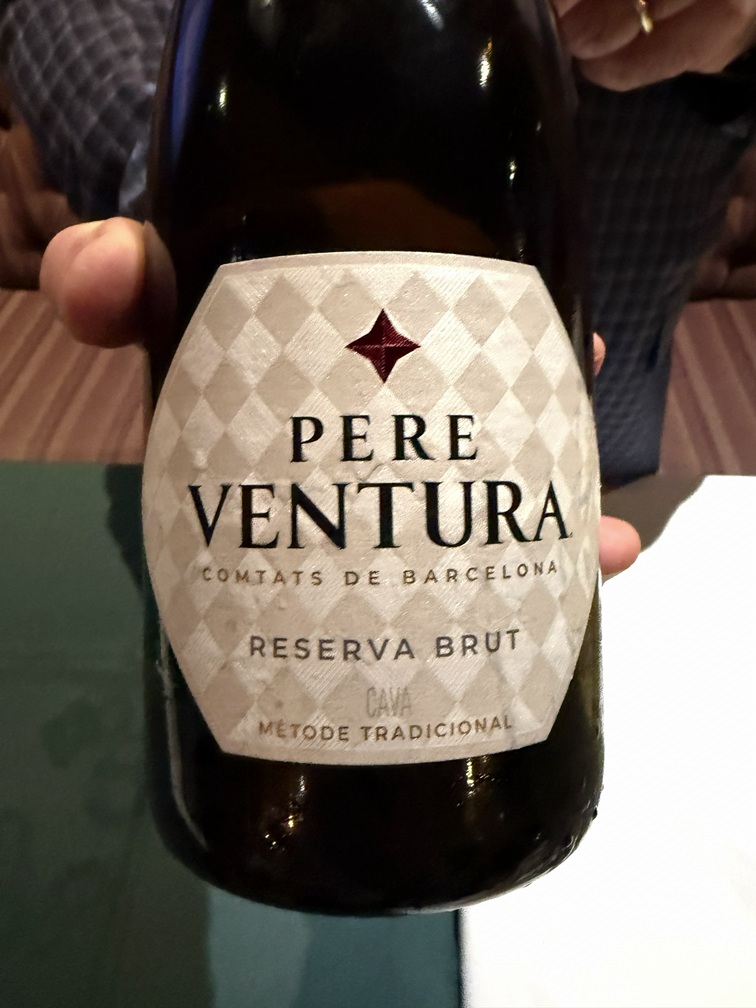
Nothing here is black and white. For example, Allegrini presented 3 wines. Two of the Amarone had way too much oak for my taste, including the 2016 Fieramonte single vineyard, commanding about $250 in retail. But their simple, introductory-level 2023 Allegrini “Palazzo della Torre” Veneto IGT was delicious, fruity, open, layered, and perfectly balanced. 2013 Ratti Marcenasco Barolo DOCG was also almost enjoyable, needing maybe only a few more hours to decant. And I have to mention Non-vintage Pere Ventura Reserva Cava DO, which was a superb sparkling wine, toasty, yeasty, bone dry, and delicious, even disregarding the fact that it would give any Champagne a great run for the money.
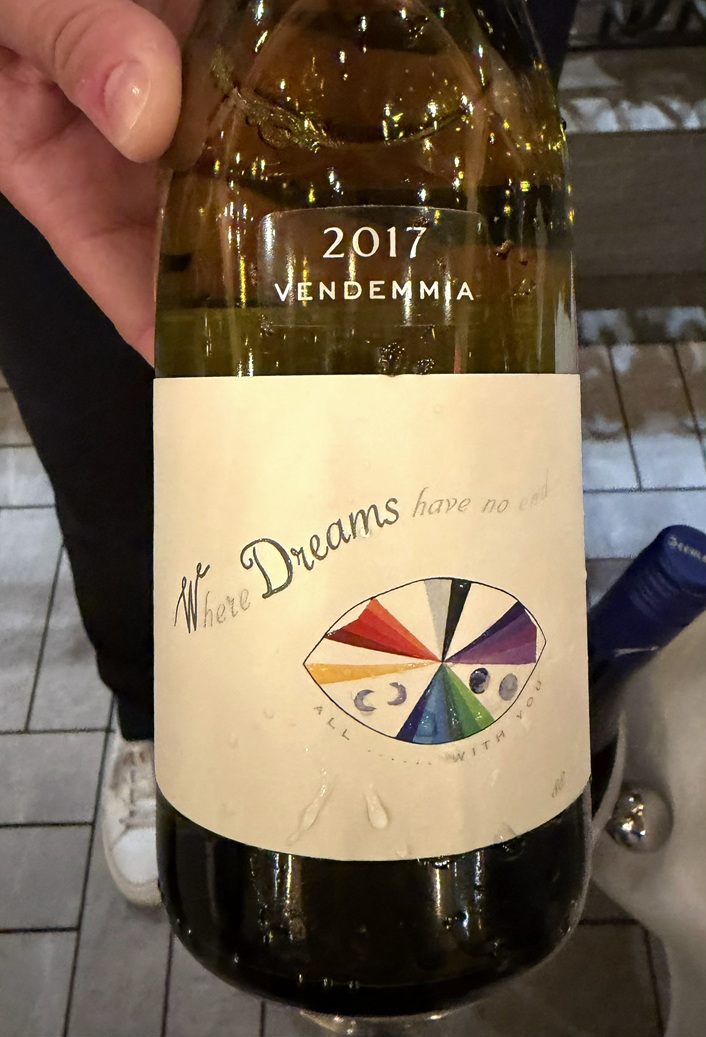
I enjoyed everything that was poured by Jermann, an excellent producer from Northern Italy. 2023 Jermann Vintage Tunina Venezia Giulia IGT, 2023 Jermann “W… Dreams” Venezia Giulia IGT, 2025 Jermann Pinot Grigio Friuli DOC, and 2017 Jermann “W… Dreams” Venezia Giulia IGT were all superb, beautifully balanced, and delicious.


The second producer I really enjoyed the wines from was Pahlmeyer from Napa Valley in California. 2023 Pahlmeyer Jayson Chardonnay was round and elegant, harmonious and on point. 2022 Pahlmeyer Jayson Red Blend and 2022 Pahlmeyer Proprietary Red were both round, balanced, and delicious. The 2022 Pahlmeyer Jayson Cabernet Sauvignon was my favorite, with a textbook Cabernet Sauvignon profile of cassis and eucalyptus, elegant and perfectly balanced.
So what is this post all about? It is not a rant per se, this is simply a brain dump of the oenophile who wants to share his love of wine with everybody. Sometimes the image and the wine match, and this is the best you can ask for. And sometimes, they are not. But this is all in your head. You are the one who needs to find out.
There is still more, but if you are still reading this, you deserve some rest and a glass of wine that gives you pleasure. What we didn’t talk about is how The Image affects not only wine lovers – the image also affects the winemakers. Once image, story, reputation are built, the wine has to match. If the winery is associated with an image of exclusive, expensive wine, producing tasty inexpensive wine might be a challenge. In the name of the image, the winemaker has to produce the wine that will match – in price, exclusivity, methods of production, or a critic’s scoring. As I said, you’ve read enough, it is time to wrap up.
To finish this piece, I would like to paraphrase the famous saying “life is too short to drink bad wine”, because as a statement it is simply wrong, in most cases equating “bad” with “inexpensive”. The right way to put it is “life is too short to drink wines you don’t enjoy”.
Life is too short to drink wines that don’t give you pleasure. Don’t listen to anyone who tells you otherwise. Trust your palate. Remember, the stories are what you listen to, but the wine is what you drink. And it is binary.
Wine should give you pleasure.
Go have fun.
Merlot On My Mind
Being obsessed over a grape lately?
I have. Not even sure why, but I have.
Merlot had been on my mind. Why Merlot? Why now? I don’t know. I’m sure something triggered it, but I really have no clue as to what and why.
Merlot’s name might not be around since the 13th century as Pinot Noir has, or the 15th century as Riesling, but it is a well-known grape from Bordeaux, first mentioned in 1874. Merlot is one of the main grapes in Bordeaux, alongside Cabernet Sauvignon and Cabernet Franc, named after a blackbird (Merle is a French name for the blackbird), either for color similarities between the grape and the bird’s appearance, or maybe due to the bird’s appetite for the tasty grapes.
Merlot today is one of the most planted grapes in the world – for example, it might surprise you, but Merlot is the second most planted grape in Tuscany after Sangiovese. And it is also the main (and only) grape in some of the best wines in the world, such as Petrus, Le Pin, Masseto, Tua Rita Redigaffe, and others. And yet Merlot’s standing was badly hurt in the United States, all based on the famous words of the middle-aged man going through a middle-age life crisis – “I’m not drinking f-ing Merlot” in the 2004 flick “Sideways”:
Considering the effect this movie had on the Merlot wines in the USA, it really should be studied as one of the earliest and most effective testaments to the dangers of “influencers”. Facebook was in its infancy, the first iPhone was 3 years away, and Twitter, Instagram, and TikTok were not even the products of the wildest imagination – and yet this 2-hour movie woven around California wine country with loudly proclaimed love for Pinot Noir and disdain for Merlot managed to inflict very significant damage to the Merlot market in the US, at least the California Merlot (of course, when the bottle says Petrus or Masseto, the majority of wine drinkers have no clue that the Sideways’ hated grape is inside).
I would perfectly understand if Merlot’s reputation would suffer due to a scandal, such as the Austrian Antifreeze scandal in 1985, which literally killed the Austrian wine industry for a long time, or Brunellogate in 2008, with the aftershocks still experienced even today. But it was nothing like that – there were only the words “I’m not drinking the f-ing Merlot,” which led to significant consequences. Merlot sales dropped 2% – 4% in 2005 – 2008 following the movie release in 2004. Merlot share of crushed grapes in California went down from 20% to 13% by 2008. Merlot plantings were reduced roughly by 35% between 20004 and 2023. Many wine stores simply removed California Merlot from the shelves. There is also another estimate that Merlot lost $400M in unrealized sales from 2004 until 2014. All in all, a very dramatic consequence of the “rage over a grape”.
As I mentioned before, I really don’t get it. My experience with Merlot wines is exactly on par with any other “major grapes”, both in terms of wines that I liked and wines that I didn’t like, so truly, the effect of Sideways is an enigma – but again, it has to be studied in depth to understand how “influencing” works. Okay, enough of this.
I don’t know if Merlot has fully recovered today, and again, there are many regions around the world where Merlot’s standing was not hurt, especially in the regions where the Merlot name doesn’t readily appear on the front label. Amazing Merlot wines are made in Argentina, Australia, California, Chile, France, Israel, Italy, New York (particularly on Long Island), Spain, Virginia, Washington, and everywhere in between. And it is not just places – it is also wine styles! Today, in addition to the still red wines, you can also find sparkling Merlot, white Merlot, Merlot Rosé, and late harvest Merlot. Very few red wines can brag about such a range of expression, and Merlot is one of them.
As you well know, the truth in wine is in the glass. Which means… wine tasting! And we are planning one! The blind tasting of Merlot from 11 regions (Australia, Chile, California, France, Italy, Long Island, Mexico, Romania, South Africa, Virginia, Washington) is in the works, and will be reported on in due time. Meanwhile, I’m sure many of you have never watched Sideways, so consider this a lesson in wine influencing and go watch it… Just remember that California Merlot is not that bad, and California Pinot Noir is not that good… And I’m off to listen to the rain and wind…
Tales of Kosher Alcohol
Wine is wine, right? So is whiskey, tequila, vodka, rum, and all the other liquors, do you agree?
Leaving cost aside, when choosing alcohol, your typical selection categories are “sustainable”, “organic”, “vegan”, “artisanal”, “biodynamic”, plus all the “certified” categories. And then there is a world of kosher, which trumpets all of those.
I’m sure many of you have heard of kosher food and many rules associated with it, in purchasing the ingredients, cooking, and consuming (don’t mix meat and dairy, for example). But wine is wine, right?
Ahh, no. There is kosher wine, and there is all other wine. And even the word “kosher” by itself is not enough when it comes to wine – the most important word on the bottle of kosher wine is not an appellation, not the name of the producer, not the name of the grape. The most important word is Mevushal.


Okay, if you are just buying the wine for yourself, and you observe kashrut laws, for the wine to be marked as kosher would be a perfectly safe choice. However, if you plan to drink that kosher wine anywhere outside of your house, you want to bring it to a kosher restaurant or to an event, this is where just the word “kosher” is not enough – the word you are looking for is “Mevushal”. The word must be present on the label, or you better leave your bottle at home.
Similar to any food which can be kosher or not, the kosher laws in winemaking are applied at all different stages of wine production, basically from planting and caring for the vineyard until the wine finally goes into the bottle. I have no intentions of diving too deep into the rules – just ask your trusted AI friend, and you will get as much (or much more) information as you want. But as we already said many times, just the word “kosher” on the bottle is not enough.
The kashrut laws extend further than just the liquid in the bottle. It also covers the service, the process of opening the bottle and pouring it into the glasses. And here is the culprit. The moment a non-Jewish person opens the bottle of kosher wine, the wine becomes non-kosher. same goes for the non-Jewish person pouring the wine into the glasses. And as you can imagine, this is an absolutely standard service situation, at any restaurant and any event. So now, finally, Mevushal is to the rescue! If the wine is marked “Mevushal”, then anyone can open the bottle and serve the wine, and it will continue being kosher!
While important for the kashrut, Mevushal used to be almost a swear word among wine lovers. 20-30 years ago, no wine aficionado would touch the wine marked as Mevushal. The reason is simple. To ensure that kosher wine remains kosher no matter who pours it, the wine had to undergo the Mevushal process.
Actually, if you like wine and want to know what “mevushal” means, the translation itself should really scare you – the word means “to cook” or “to boil“. If you ever have forgotten a bottle of wine in the car on a hot summer day, you perfectly know why “cooked wine” is such a swear word in the wine lover’s lexicon. So to become “mevushal”, the entirety of the wine had to be heated up to 180°F (82°C) – then the wine becomes mevushal and can be handled by anyone. And in the old days, the wine would also become undrinkable for the absolute majority of wine lovers. But thanks to modern science and technology, the mevushal process now is very similar to flash pasteurization – wine is heated very quickly, for less than a minute, and then immediately cooled off, thus avoiding inflicting any essential damage on the taste of the wine.
Whew, I hope you got it now. The kosher, mevushal, and the whole nine yards associated with it.


But, the fun with kosher alcohol is only starting now. As you now learned how sacred the grapes are in the Jewish religion, the game with all other types of alcohol becomes even more complicated, as you never know where the pitfalls are located.
Basically, you can look at it like this: if the liquor has anything to do with grapes in any shape and form (grapes/grape juice, wine barrels, whatever else you can think of), unless the bottle is marked as “kosher”, it can’t be served at a kosher restaurant or an event. For example, the vodka made from potatoes or wheat is perfectly appropriate. If the vodka is made from grapes – not at all, unless the bottle says it is kosher. If vodka was flavored by the wine/grape byproduct – again “NO”, unless it is marked “kosher”.
It all might sound somewhat innocent until you realize that lots and lots of higher-end scotches are “non-kosher” – for example, the majority of the Macallan scotches are not kosher. All of the double-wood, sherry cask, port cask, burgundy wine cask finishes and so on render the whisky “non-kosher” and can’t be served. That also affects quite a few of the Anejo tequilas… You really need to spend time to figure out a full pedigree on a bottle of scotch you are planning to serve at your event, or risk it being rejected by the caterer.
Anyway, you might imagine that I didn’t wake up in the morning with the thought “why don’t I write an extensive post about kosher alcohol laws”. Had to plan for a big event later on, so all the learnings were necessary and fresh, hence the desire to share.
We got together to taste some wines and to decide on our choices. The Georgian kosher wine I was able to procure would be a fine choice – tasty, not overpowering, well balanced – but “not mevushal” on the back label rendered it a “no go” option.
Tequila seems to be a popular choice of a sipping alcohol nowadays, and if it is just a blanco, no wood aging is involved, it is fine. Basically, all of tequila blanco is a safe choice even without saying “kosher” on the bottle, it is made out of the agave plant. The problem with good tequila is availability – for example, even the Ocho you can see in the picture is not really available, so we are going with Don Abraham Blanco, which is also hard to procure.
I already explained the problem with scotch, so the only options are the scotch which was not aged or finished in any of the wine casks. Balvenie 14 is simply too expensive, so we tasted both Johnnie Walker 18 and Tomintoul 16, and settled on the Johnnie Walker 18 as it was a bit more structured than Tomintoul.
There you are, my friends. Here is my story of selecting proper kosher wines for an event – and my hope that now you are a tiny bit more educated about the intricacies of kosher alcohol than before.
Until next time – cheers!
Following State Dinner, [Re]Discovering Hopkins Vineyard
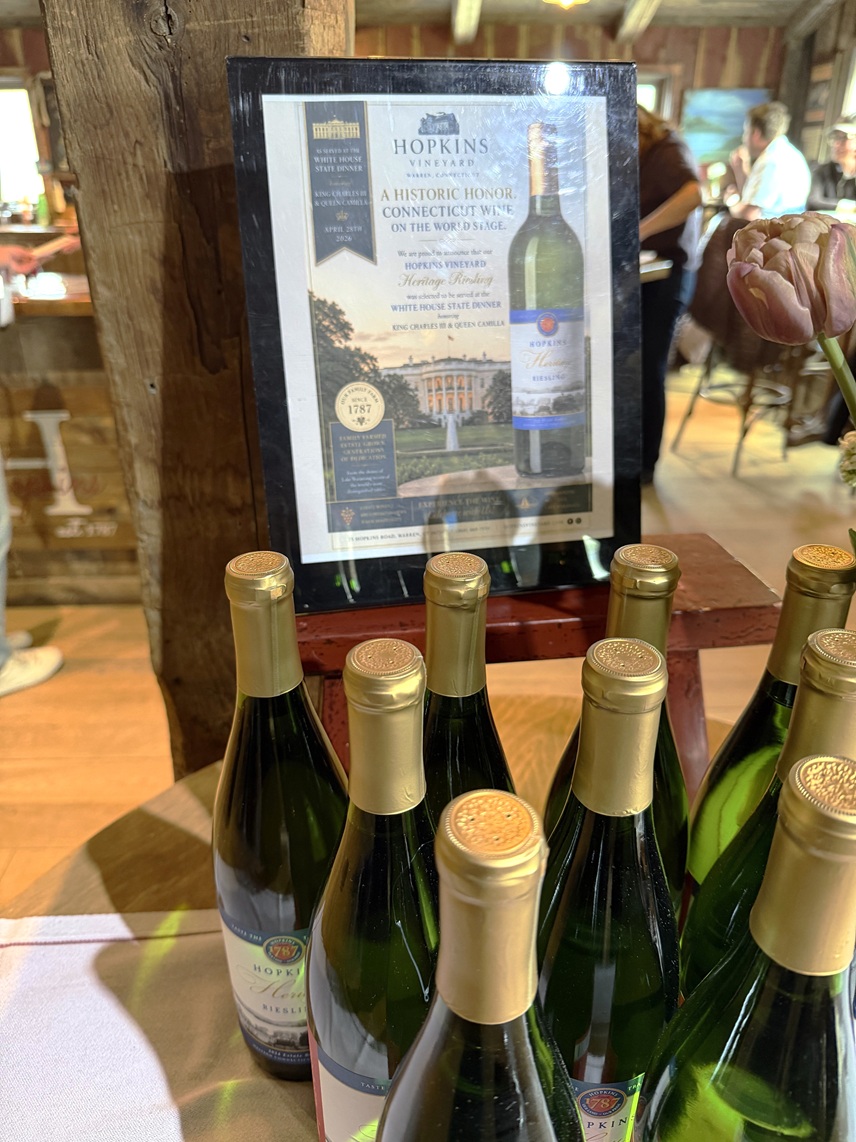 State Dinners are always fun.
Right?
Well, never been to one, so I can only assume. But no matter, we are here only for the wine, and maybe food.
I had been following the subject of State Dinners for as long as this blog has existed. For example, here is a post analyzing the selection of wines at Obama’s state dinner at the end of his presidency. You expect that the State Dinner represents your country, so only the best of the best should be served – yet when it comes to hundreds of thousands of wines (I’m talking about different labels and vintages, not production quantities) available, it is clear that deciding on “best” is not a simple task.
Once I heard of the dinner in honor of the King of England’s state visit, I knew I had to do some sleuthing. This time, it was very easy, as all information was clearly presented on White House’s website. Having an experience with web links disappearing with time, I will respectfully allow myself to copy the information from the White House website, so it will be available here for anyone who comes across this post some years later – here is the link to the original information.
MENU
First Course
Garden Vegetable Velouté (Hearts of Palm, Toasted Shallots, Micro Mint)Second Course
Spring Herbed Ravioli (Ricotta Cheese, Morels, Parmesan Emulsion)Third Course
Dover Sole Meunière (Potato Pavé, Spring Ramps, Snow Peas, Parsley Oil)Dessert
White House Honey & Vanilla Bean Crémeux (Flourless Chocolate Gâteau, Almond Joconde, Crème Fraîche Ice Cream)WINES
The following wines were selected to complement the menu while honoring the shared heritage and enduring friendship between the United States and the United Kingdom, and celebrating the strength of American winemaking today.
Hopkins Riesling “Heritage” 2024, Hopkins Vineyard, Connecticut
The Penner-Ash Pinot Noir “Willamette Valley” 2022, Penner-Ash Wine Cellars, Oregon
The Newton Chardonnay “Unfiltered” 2022, Newton Vineyard, California
Food sounds great, but we are here for the wines, so let’s talk about them.
First, highlighted in blue above is the explanation for the rationale behind choosing the wines. And knowing Melania’s level of attention to detail, we also have to assume that while representing the heritage is important, the wines have to pair well with the food.
I can perfectly see how Penner-Ash Pinot Noir, the wine from one of the most respected producers in Oregon, can perfectly match that pasta, anchoring on the Morel mushroom element, probably to perfectly complement the dish.
While I’m not really familiar with Newton Unfiltered Chardonnay, any California Chardonnay can be considered “iconic”, so again, I can see it perfectly complementing delicate Dover Sole in buttery sauce.
Which leaves us with Hopkins Heritage Riesling, and here we need to take a pause.
I have to be honest. When I saw a wine from Connecticut to be one of the 3 wines served at the State Dinner, my first reaction was “what?????? come again????”. I live in Connecticut. A few years back, we visited several Connecticut wineries with friends, and we were not very impressed.
Okay, so I wrote “a few years back” above, and then decided to check if I wrote anything about that visit. Well, yes, I did. And if 11 still qualifies as “a few”, we are good, but nevertheless, that visit took place in 2015. Yes, 11 years ago – a good chunk of time in the life of a winery.
In any case, I completely forgot the details of that trip – only a general (not a great one) impression. And you can imagine my surprise seeing a Connecticut wine presented at one of the highest honors in the country. But – I live in Connecticut, remember? Google Maps to the rescue – the Hopkins Vineyard winery is only 1.5 hours away, so it was rather a no-brainer – we have to visit the winery over the weekend and taste the Connecticut Riesling worthy of serving at the State Dinner.
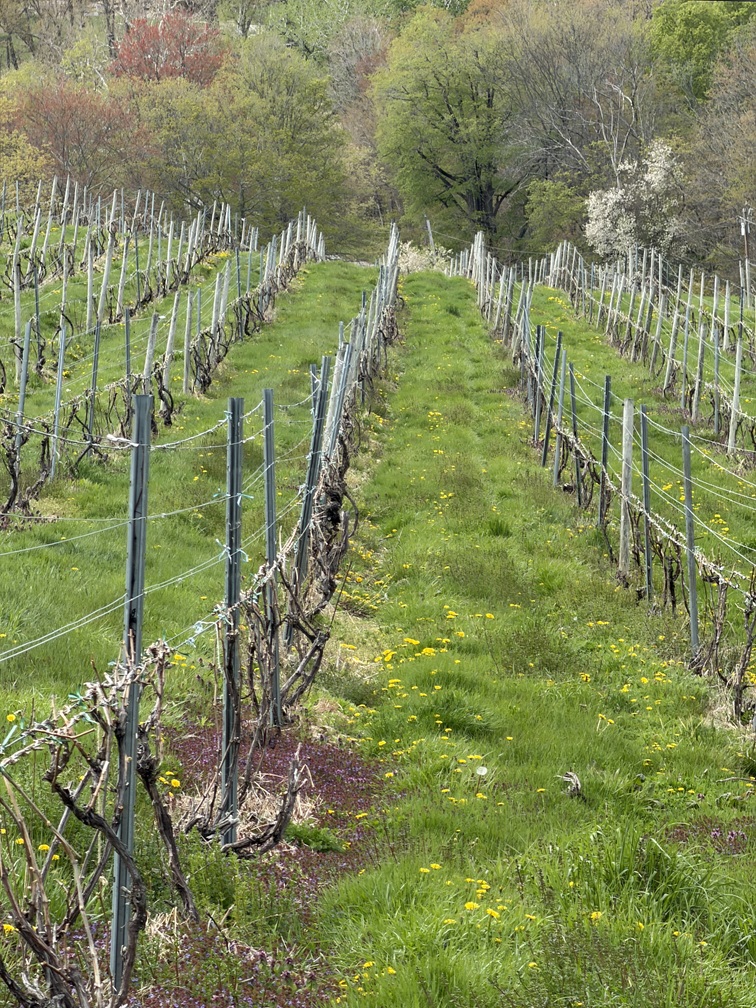
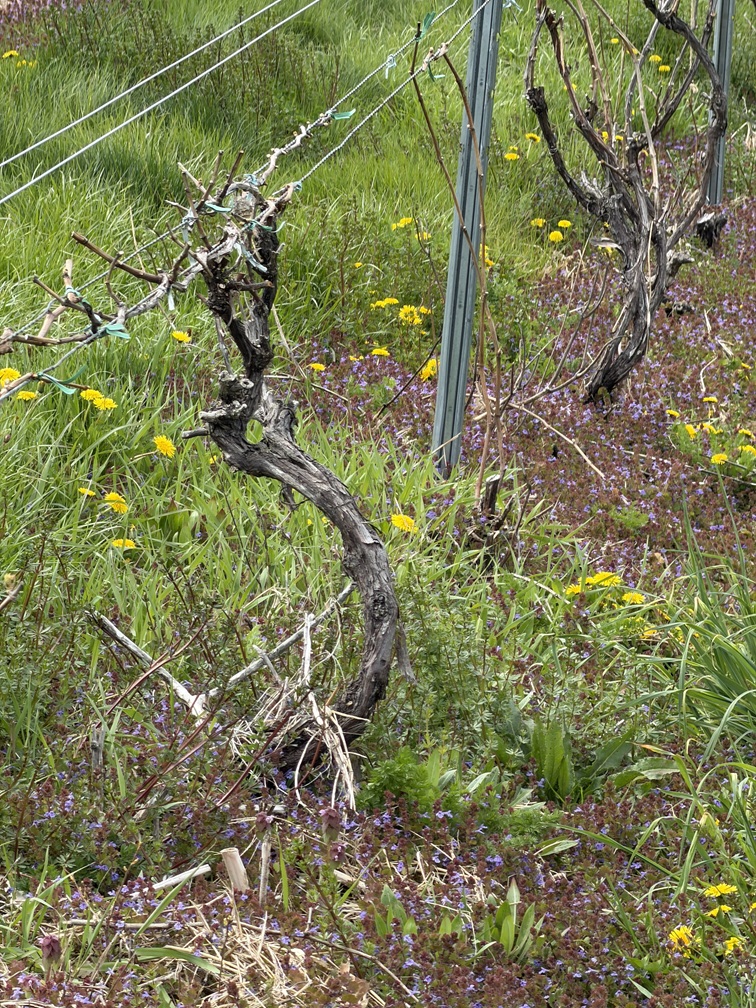
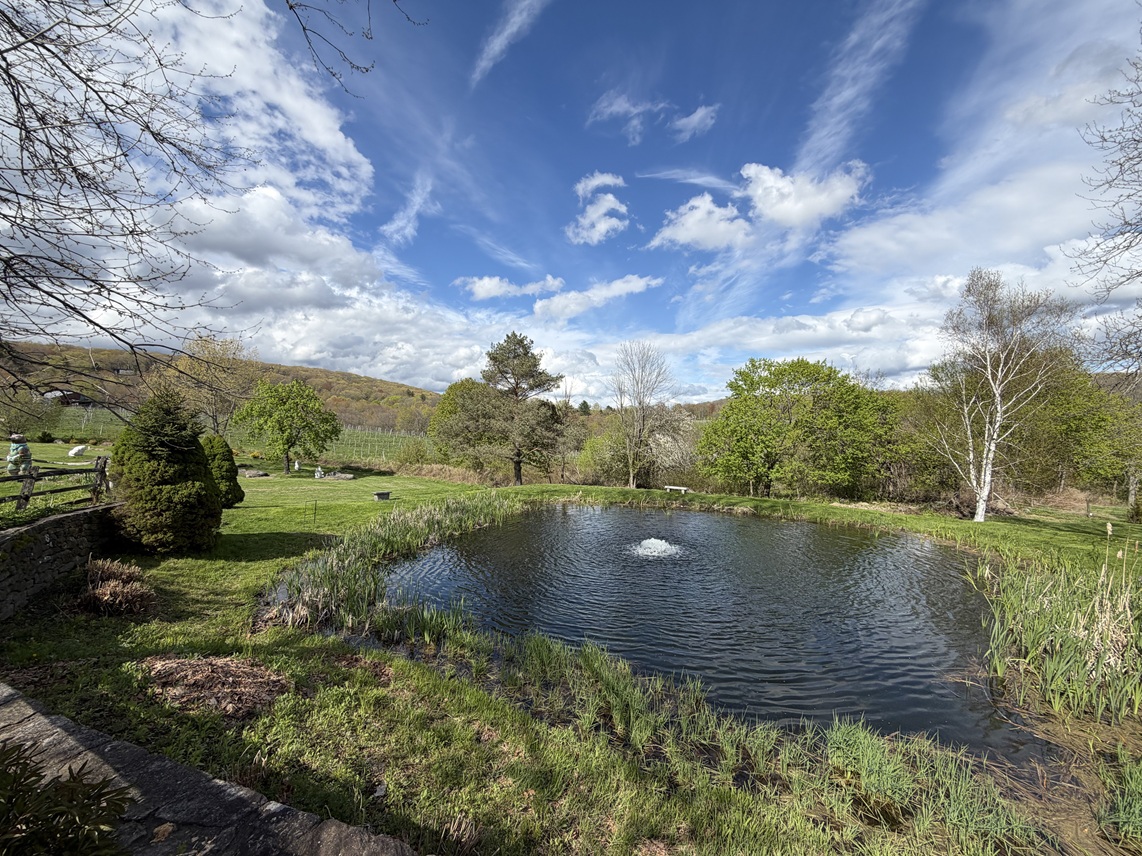
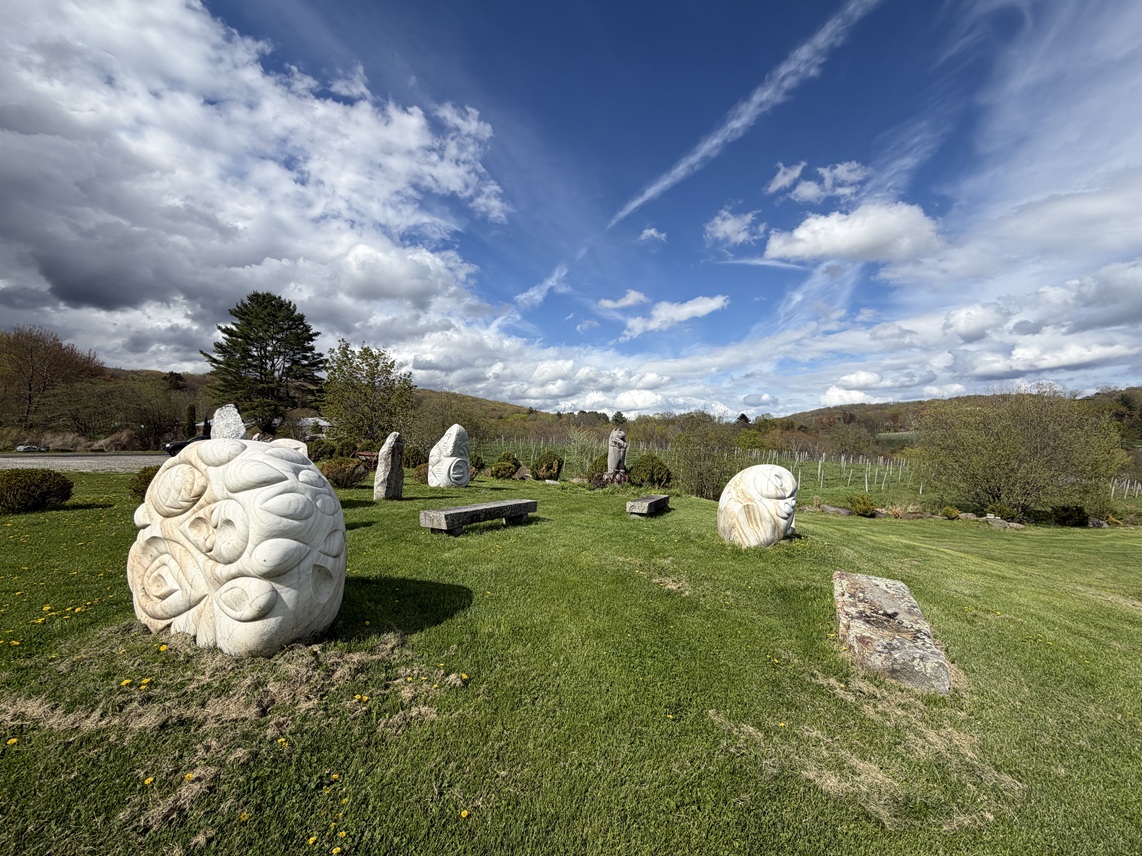
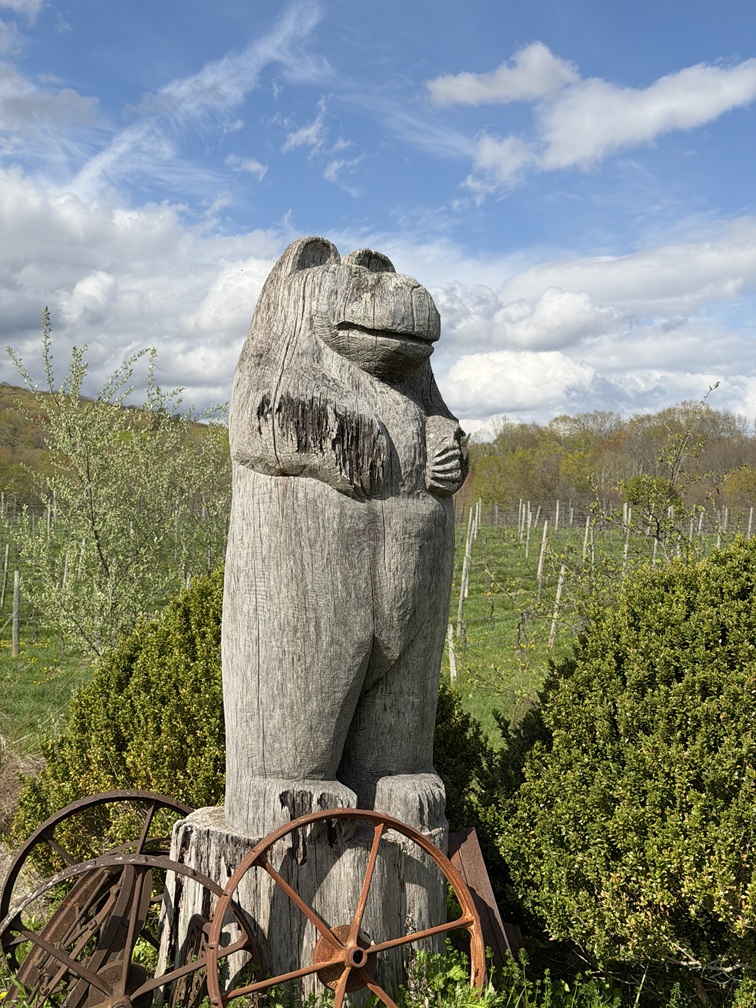
Finding the place was easy. Beautiful location, right by the lake. The winery was quite busy on an average Saturday in May, which is probably not surprising considering all the press they got. Obviously, Riesling had a special recognition. And it was not available for tasting, but we could buy a bottle, one per person. We decided to take a tasting flight, but before we talk about it, let’s answer possibly the most burning question: how did that Hopkins Vineyard Heritage Riesling end up served at the State Dinner?
First, I asked the gentleman who was pouring the wines. He said that he heard that someone had just called from the White House and asked for the wine to be sent there. I was not satisfied with this answer, as in my mind, it can’t be that simple. Then, when we were practically leaving, by pure chance, I ran into Hilary Hopkins Criollo, who happened to be the 10th-generation owner of the Hopkins Vineyard. I asked her the same question: how did it happen that your Riesling was served at the State Dinner, hoping to hear that it was some special connection she had. But actually, the story was exactly as I was already told. Some weeks prior to the State Dinner, Hilary got a call from the White House staff, asking her to send 4 bottles of her Riesling for tasting. A week or so later, she got another call, asking her to send 4 cases of that Riesling to the White House. End of story.
In retrospect, it all makes sense. The dinner was in honor of the King of England, so serving the wine from New England creates a perfect connection to the history. Hopkins Vineyard is the oldest family-owned winery in Connecticut, and the estate was founded in 1787, which makes it almost the same age as the USA itself – another great connection to the heritage, one of the important selection criteria mentioned on the White House website. And lastly, having tasted wines from many wineries in New England, and having tasted Hopkins Vineyards Heritage Riesling, this was potentially the best choice for serving a crisp white wine to complement the first dish on the menu above.
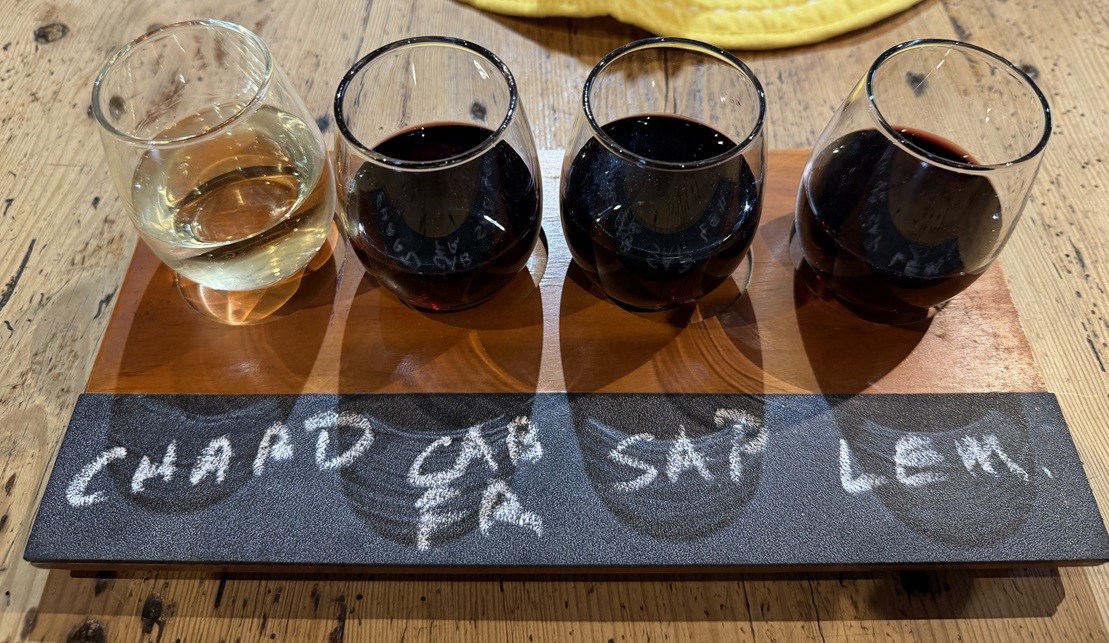
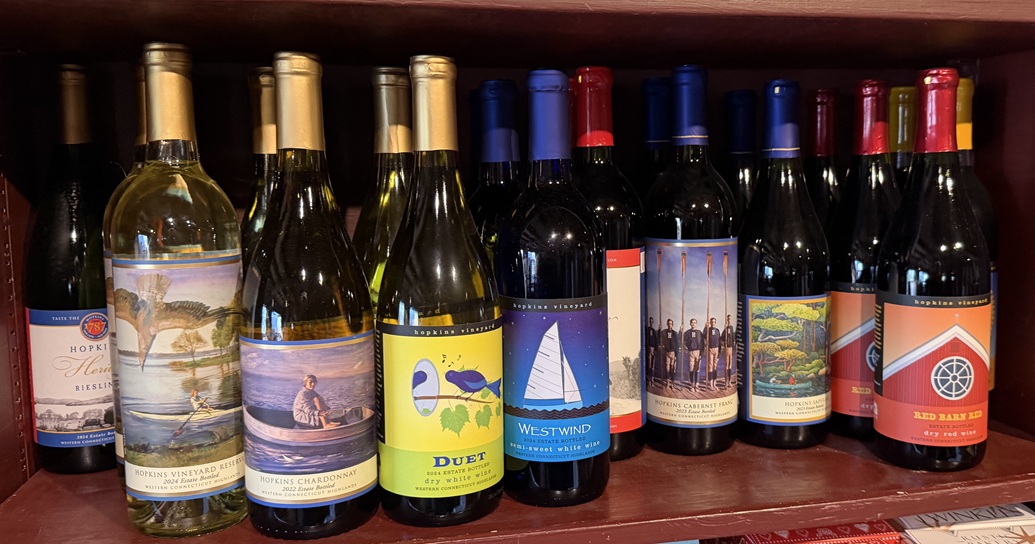


Now, let’s get back to the wines we tasted. You can build your own tasting set, so we took Chardonnay (easy choice :)), Cabernet Franc (a must on the East Coast), Saperavi (how can I resist), and Lemberger (another easy choice). Here are my notes:
2022 Hopkins Vineyard Chardonnay
At first, the nose is closed.
Nice, simple, good acidity, a hint of clove
After it warmed up a bit and opened a bit, a very nice Chardonnay with apples and vanilla. Definitely a solid effort.
2023 Hopkins Vineyard Cabernet Franc
Bell pepper (a hint of)
Bell pepper on the palate, black pepper, round and generous. A bit too warm.
2023 Hopkins Vineyard Saperavi
Mostly herbal nose
Varietally correct palate, needs to be served colder, but it is okay. Mostly acidic finish.
2024 Hopkins Vineyard Lemberger
Hint of dark fruit
Barnyard notes, nice and supple. Quaffable. Needs time to open up.
The Chardonnay was my favorite from this flight. For the reds, they were warmer than I would prefer for my palate, and overall, they were okay but not exciting.
We got our two bottles of Riesling and went back home. But of course, it was impossible to resist, so after a quick chill in the sleeve, the bottle was opened.
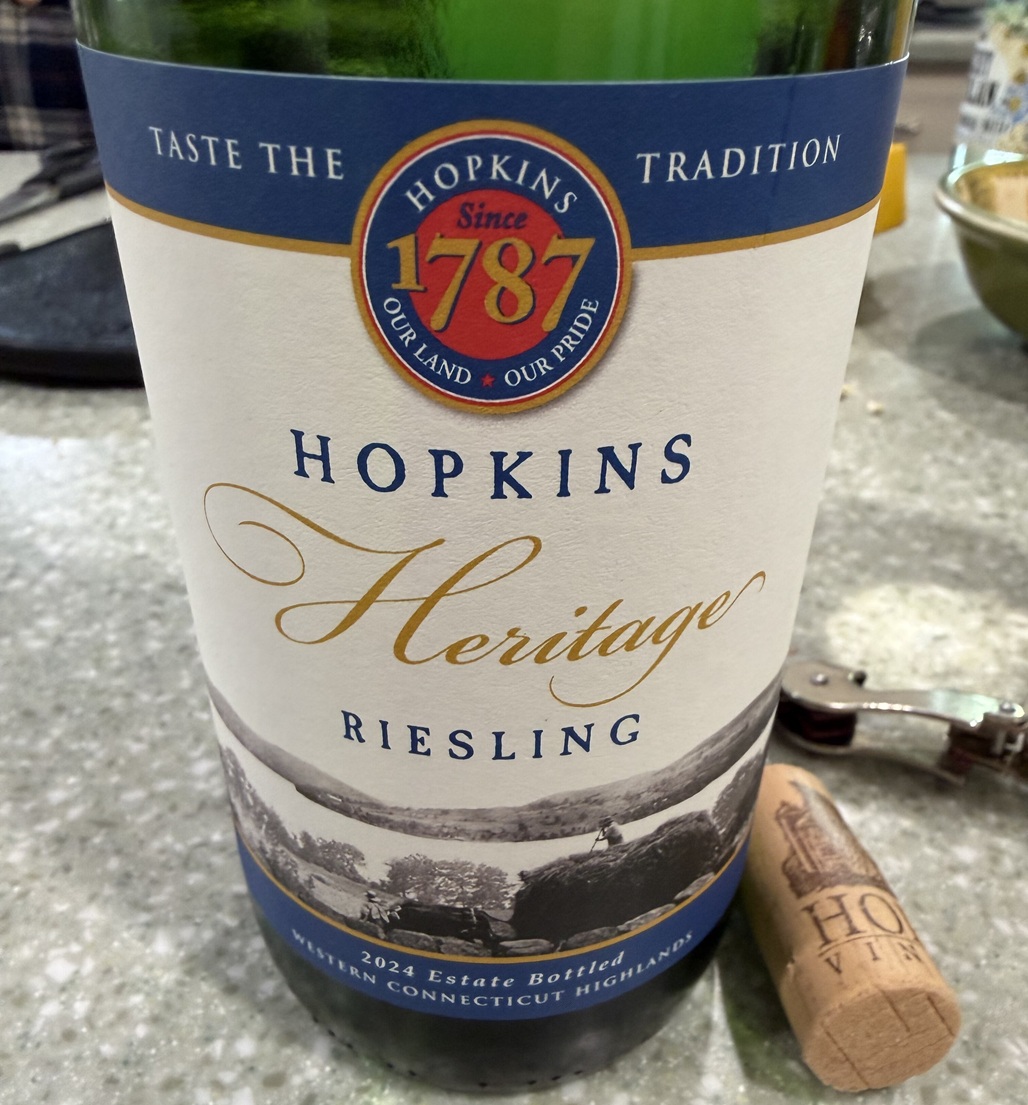
2024 Hopkins Vineyard Heritage Riesling Western Connecticut Highlands (12% ABVF, $33)
Light straw
Hint of tropical fruit on the nose, a hint of honey
Crisp, clear, vibrant, and elegant, a distant hint of tropical fruit, good balance, and great acidity on the finish.
8, very impressive
As you know, one way or another, I usually try to taste the wine over a period of a few days. It happened that I was finishing this bottle 6 days after it was first opened (I simply pumped the air out, as I always do), and the wine was still well drinkable. On the palate, the profile changed a bit, becoming more reminiscent of the East Coast Vidal, thus well adhering to the notion of East Coast terroir if we can define such a thing. But again, still very well drinkable.
Here you are, my friends. A winery rediscovered. And the wine worthy of a king, made (almost) in my backyard. The inner collector of experiences has a huge smile on its face. I still have another bottle to enjoy at some point, but the plan is to lose it for the next 5-10 years.
Until the next time – cheers!
In Memoriam: Michel Rolland
Last week, the world of wine lost an icon. Michel Rolland, often referred to as “flying winemaker”, passed away at the age of 78. Michel Rolland influenced winemaking all around the globe, from France to the US Napa Valley, Argentina, Spain, South Africa, and even Israel.
There is lots and lots written about Michel Rolland in the form of articles and books, and his winemaking practices are sometimes portrayed as controversial. However, I truly believe the wines he helped craft made many wine lovers happy.
I was lucky enough to have the pleasure of sitting across from Michel Rolland and asking him questions – unlike most of my interviews, this one was done face-to-face 10 years ago, during one of his visits to New York. In memory of Michel Rolland, I would like to share that interview again on this blog.
And a Few Good Wines, Previously Was New Year 2026 Wine Escapades
For how long is it appropriate to celebrate the New Year?
Scrap that.
For how long is it appropriate to write a post about New Year’s celebratory wines? A week? Two? Four?
Okay, so as I’m writing this on the last day of the month, this is not a celebratory New Year’s post, but rather an account of wines we had an opportunity to experience.
As a tiny excuse to my tardiness, I want to mention that we celebrated the arrival of the New Year 2026 three times. So here are my notes from those celebrations.
Celebration #1- January 1st, New Year’s Day
To celebrate the New Year in style, I decided to do a Champagne-off between Pol Roger and Bollinger Champagnes. I have a lot of respect but very little experience with both, so I decided to compare them side by side.
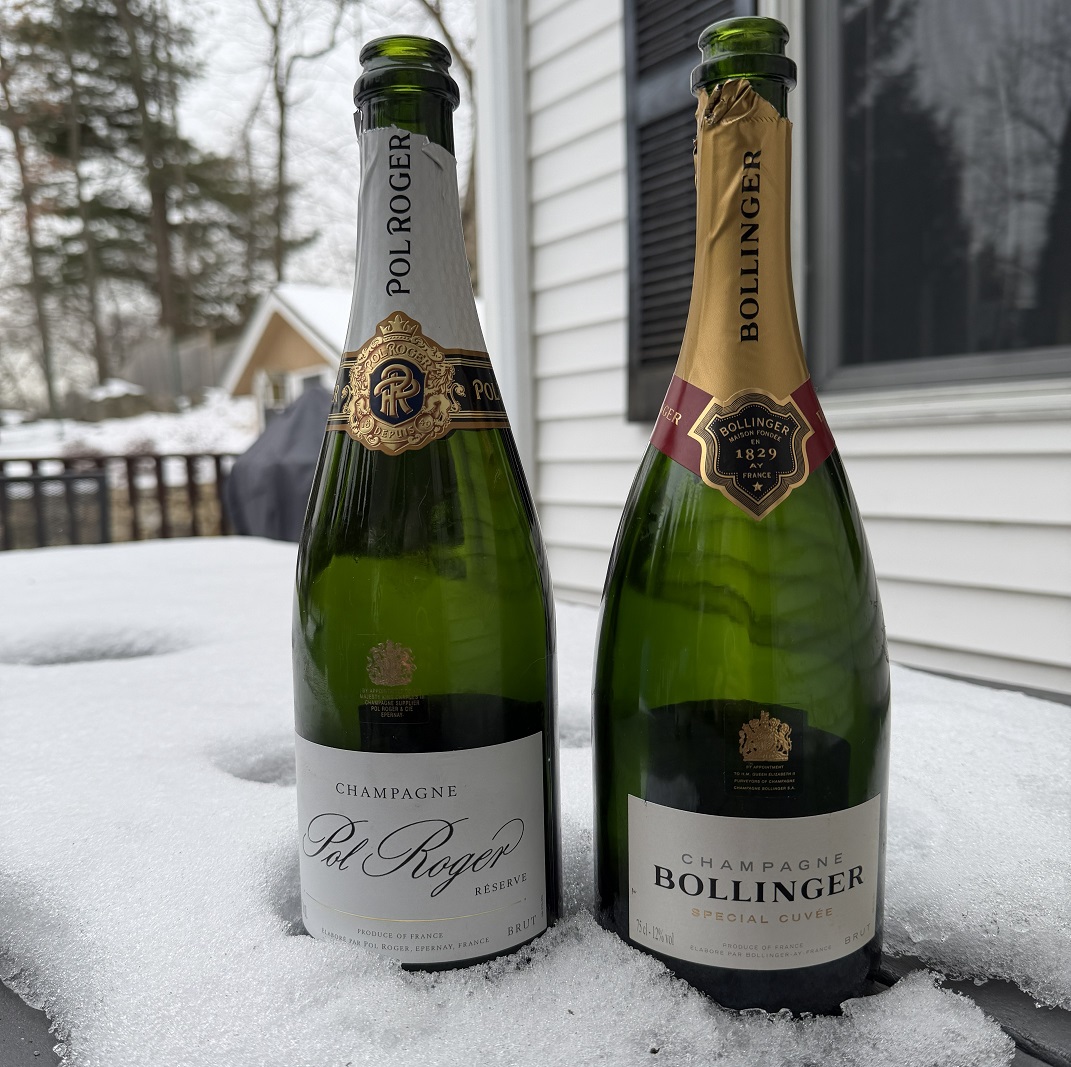
This was definitely an interesting experiment. Upon opening, Bollinger had a somewhat restricted nose, but nice palate with a hint of toasted bread, apples, and lemons. Pol Roger had a beautiful, inviting nose with freshly baked bread, minerality, and green apples. However, it was mostly flat on the palate, so after the first few sips, we decided to drink Bollinger first.
30-40 minutes later, I poured another glass of Pol Roger, and oh, the palate changed dramatically. Now there was everything you want in champagne – toasted notes of the freshly baked bread, apples, lemons, crisp acidity – all elegantly woven together. So while both Champagnes were excellent, my preference lies with Pol Roger.
NV Pol Roger Champagne Reserve Brut (12.5% ABV)
Beautiful, inviting nose, with toasted bread and apples.
Palate initially mostly closed, just acidity. After 30-40 minutes, the palate is alive with toasted bread, apples, lemon, minerality, crisp acidity.
8+
NV Bollinger Champagne Special Cuvée Brut (12% ABV)
Beautiful nose, apples, brioche
Restrained on the palate, lemon, crisp acidity, lots of energy, very elegant.
8, excellent Champagne
I also tasted this sparkling wine, even though it was mostly used in a delicious holiday cocktail:
2021 Casasetaro Pietrafumante Caprettone Spumante Methodo Classico Italy (12.5% ABV, 100% Caprettone (new for me!) grape)
Crisp, refreshing, with steely, minerally acidity. This makes you crave oysters in a heartbeat.
8, excellent
2019 Saxum James Berry Vineyard Paso Robles Willow Creek District (15.9% ABV, 55% Grenache, 29% Mataro, 13% Syrah, 3% Carignan)
Of course, 7 years is not an age when you want to open Saxum wine. Black fruit on the nose with some baking spices. Dark and brooding on the palate, black fruit, cocoa, a hint of the forest floor. A bit more mellow after being open for 3 days, more pleasant to drink.
8, delicious
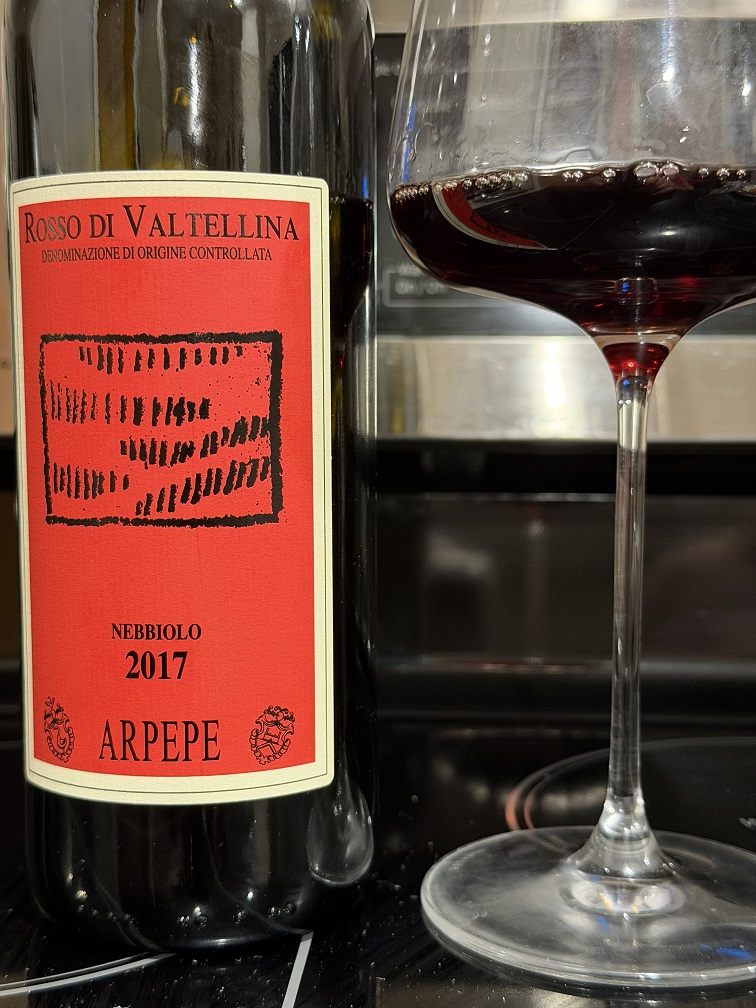
2017 ArPePe Nebbiolo Rosso di Valtellina DOC (13% ABV, 18 months total in big barrels and in bottle)
After a short breathing time, this wine showed brilliantly. Fresh cherries on the nose, restrained.
Cherries and violets on the palate, sandalwood, medium to full body, elegant, round, delicious. Glad we opened it.
8+, delicious
Second celebration:
On Saturday, we got together with friends to continue celebrating the New Year. This time, the wine lineup was a bit different, focusing more on the aged wines and the wines that might be past prime.
We started with a couple of Champagnes:
NV Veuve Fourny & Fils Champagne Brut Rosé Premiere Cru (12% ABV, disgorged 07/15)
Dark golden color
Apples, Almond extract, bread, tertiary aromas
Toasted bread on the palate, apples, brioche, cut through acidity even on day 6 after opening.
8+, while actual bubbles subsided, it was a very tasty wine. Really enjoyable even as a flat wine.
2017 Champagne Christophe Mignon Adn de Foudre Pinot Noir Brut Nature (12% ABV, disgorged 11/01/2024)
Bright Golden color
Apples and fresh bread
Apples, fresh bread, a touch of hazelnuts, cut through acidity. Very refreshing and very enjoyable.
8+, excellent, even on day 6
Next, this white wine was probably the most impressive out of all the wines we tasted that night:
2013 Domaine William Fevre Chablis Grand Cru Bougros (12.5% ABV)
Bright golden
A touch of gunflint, Granny Smith apples, lemon
Fresh, bright, apples, velvety smooth texture, great mid-palate presence, good structure, a distant hint of butter, impeccable balance.
9-/9, outstanding.
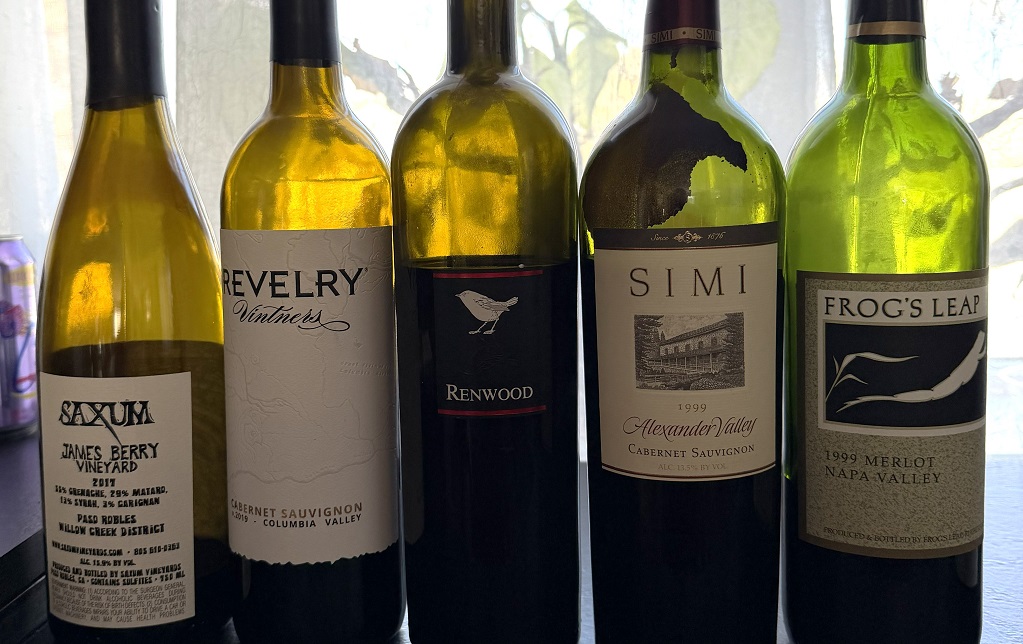
Then there were reds.
1999 Frog’s Leap Merlot Napa Valley (12.5% ABV)
1999 Simi Alexander Valley Cabernet Sauvignon (13.5% ABV)
Both wines were varietally correct upon opening, but it did felt that they were near the peak. No over yet, but having maybe only about 5 years of life left, before they will be officially declared past prime.
8- for each one.
2019 Revelry Vintners Cabernet Sauvignon Columbia Valley (13.9% ABV, 22 months in French oak)
Dark garnet
Cassis, blackberries, eucalyptus
Cassis, mint, blackberries, sweet basil, round, smooth, medium to full body, perfect balance, medium-long finish.
8+/9-, a beautiful wine.
1993 Renwood Grandpère Zinfandel Shenandoah Valley (15% ABV, Bottle #19727 of 1904 cases produced)
Dark garnet
Black fruit, good intensity
Tart blackberries, coffee, a touch of toasted hazelnuts, good acidity, still present tannins with a pleasant grip on the tongue, delicious.
9-, I wish more wines would have this energy and deliver this much pleasure
Celebration Number 3
The week after, we celebrated the New Year. Again. With friends, of course.
First, a couple of Champagnes.
NV Monmarthe Champagne Privilege Brut Premiere Cru (12.5% ABV, 50% Pinot Noir, 50% Chardonnay, aged for 36 months in the cellar)
Outstanding. Inviting nose, fresh apples with a touch of brioche.
Round, generous on the palate, roll-of-your-tongue delicious, fresh and elegant.
8+, excellent
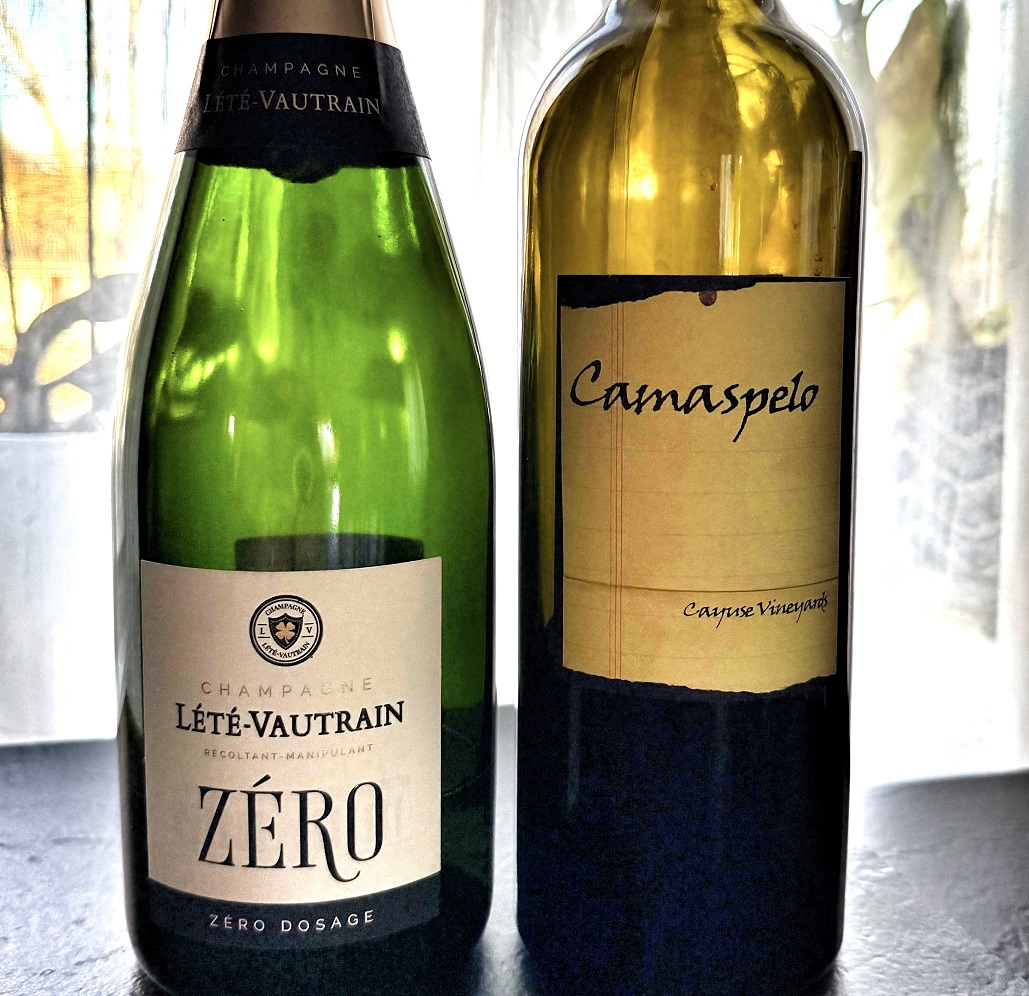
NV Lété-Vautran Chammpagne Zéro Brut (12.5% ABV, 40% Pinot Meunier, 40% Chardonnay, 20% Pinot Noir)
Crisp and fresh on the nose
Palate is crisp to the point of austerity. Elegant, full of energy, very lean.
8+, another wine that is begging to be paired with food
2022 Cayuse Vineyards Camaspelo Walla Walla Valley (13.8% ABV, Cabernet Sauvignon-dominant Bordeaux blend) – I know I was not supposed to touch this bottle, but I couldn’t resist the urge. This wine was clearly opened before its time. Probably 15-20 years would make it a bit more approachable from the get-go.
The wine was decanted, and yet the mineral, volcanic profile was the most prominent, same as with most any of the Cayuse wines in any case. After 2-3 days, the volcanic notes subsided, and the wine appeared more drinkable and enjoyable.
8, definitely needs time
2009 Tallulah Cabernet Sauvignon Napa Valley (14% ABV) – this was my last bottle. The wine was supposed to be special when I bought it, but it never reached that point. Well, until now, but with some reservations – even after decanting this wine, I had to wait for another 3-4 days for the wine to shine in varietally-correct way. But it did. It actually developed a cassis/mint/eucalyptus profile with a dash of dark chocolate.
8+ after extensive decanting.
There you have it, my friends – New Year 2026 wine escapade.
How was your January?
Struggles of the Winelover

Source: Pexels Cup of Couple
Yes, I’m on the streak. A self-focused experiment. I’m curious to see how many posts in a row I can write. Not just “hello – goodbye”, but posts with substance. Well, whatever. This is definitely not the topic of this post.
Oh, and here is a full disclosure – this post is about first-world problems. If you are not interested, you know where to click.
I bet you had no idea that winelovers struggle. No, not when we enjoy a glass of wine. When we enjoy wine, we simply ask for another glass. And no, not when we don’t enjoy wine. Then it is a very simple ask: “Can I have something else, please?” It is really that simple. If you don’t like the particular wine, there is no struggle – you just move on to the next.
The struggle starts when we need to choose the wine. At that moment, the struggle is real. A chain of thought might depend on the setting, but the unending back and forth is always the same.
When you are presented with the wine list at a restaurant, you need to decide based on price, based on mood, based on company, based on food. It always goes “this. Wait, no – this one. Hmmm. No, let’s go to a different region. Ah, yes, this one. No, wait, maybe this? Why is this so expensive? Ohh, why is this so cheap?” Well, got you. The last one is not real. If you know what you are doing, “why is it so cheap” is not the question you concern yourself with. But the rest of it? If you love wine and have ever chosen a bottle in a restaurant, tell me that I’m wrong. I dare you. Tell me that in the comments section. Go ahead, make my day.
The second one might be even worse. Now you need to select a wine for a dinner, get together with friends, a holiday, a birthday, an anniversary – you got the idea, right? This is where the struggle becomes even worse. When you need to choose a wine in the restaurant, you have a limited amount of time and a reasonably limited wine selection. None of it is in play at home. You start worrying about the wine months and months before the event – you can choose not to, of course, but only if you let yourself do this. Now think how many of us allow ourselves not do it, huh?
And here you are really screwed, as you have plenty of time to go “This! No, wait, that! Wait, no, no, I need something else”, following with “Is it too early? Can this already be past prime? It is my only bottle, should I open it now? What if it will be so much better in 10 years?”. And let’s not forget “Will they like it? Is that a good choice for that holiday? Is that special enough for the occasion? Maybe I can do better?” On, and on, and on. Endless. Frustrating. Annoying.
Why all of a sudden all of this soul-pouring sentiment? That’s easy, let me explain.
Any February is a tough month for the struggling winelover. You got Valentine’s Day in the middle of the short month, and then you have Open That Bottle Night (OTBN) on the last Saturday in February. And to add to the struggle, this particular February, we are flying to Florida to see our close friends, and they will have their wedding anniversary during our visit, so I definitely feel that I need to bring something appropriate to celebrate. There you go – three opportunities to struggle.
Source: Pexels Polina Tankilevitch
I still don’t know how we are celebrating Valentine’s Day. I’m sure we are not going to the restaurant, but we might decide to have some company. And it falls on Saturday this year, which is all the more reason to select a good bottle(s). In any case, what should we drink on Valentine’s Day? Yes, bubbles first, that is clear, but even that presents a dilemma. And what should follow the bubbles? What kind of red wine offers the best pairing for Valentine’s Day? If you have any thoughts – go ahead, don’t be shy.
Then the wedding anniversary – do I even have the right bottle for that? I have some vintage Champagnes, but nothing grand enough for the occasion. And while my friends generally like the wine, they are not wine geeks, so well-aged reds might not solicit the response I would want.
Last but not least is the mother of all winelover struggles – OTBN. The holiday was invented to help people crack open that special bottle still waiting for the right moment, which might never come. And yet OTBN is only one night, how many bottles can you open? Selecting the bottle for OTBN is ultra-difficult, especially when one has lots of wines in the quantity of … 1. When you have only one bottle, you need to decide if this is really the time, if the bottle can still improve, if the bottle is special enough. Ah, and please understand that “special” doesn’t mean “expensive”. A special bottle is simply a bottle with an attached memory, and for OTBN, we need to ensure that the bottle is special enough.
Here, I just shared my frustration with you, and I feel better. I even got some ideas for the wine to open on Valentine’s Day. And I’m pretty much decided on the OTBN bottles (it means nothing, really, everything can – and will – change quickly). But I do feel better at the moment.
So what would you tell me? Is this struggle real, or am I a spoiled, undeserving brat? You be the judge of it, but I know how it feels selecting a bottle for a month, in the endless loop between all the wine fridges and shelves. For me, it is definitely real. And for you? Hey, do tell your stories, I’m all ears…
Last Bottle Sign Up ($10 credit)