Archive
Daily Glass: Textbook Precision
Once you fully embrace the wine world, one of the important lessons you learn is rather simple – “there are no guarantees”. The bottle of wine can perfectly say “Cabernet Sauvignon” – there are absolutely no guarantees that Cabernet Sauvignon from Washington, California, and Chile will have any smell and taste similarities, never mind Cabernet Sauvignon from China, Czech Republic, and Moldova. And this is okay, we can all accept it – at the end of the day, the only thing which matter is whether we like the wine or not.
Despite all the differences, when it comes to the major grapes, such as Cabernet Sauvignon, Chardonnay, Merlot, Sauvignon Blanc, Pinot Noir and so on, we usually know how the “classic” wine should taste like – especially if we take any formal wine education or make enough effort to study the wine, pay attention to what we drink and make it a lesson to learn. Yes, there might be a bit of our perception in it too, but still, we usually have that “classic profile ” idea in the mind.
What prompted this post was a lucky happenstance, an encounter with two classic, textbook wine profiles for two nights in the row.
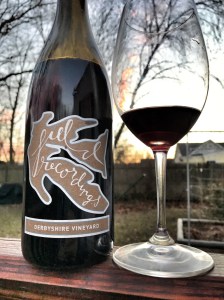 First, there was Pinot Noir. When it comes to Pinot Noir, there are probably four classic profiles – Burgundy (of course!), with lots of dark fruit power and a little bit of funk (especially with age, but drinking young Burgundy is almost like killing a baby, right?). Then you have New Zealand, which usually can be identified by the pronounced acidity. Oregon Pinot Noir often screams minerality, mocha and dark chocolate. And then you got California, with luscious smokey plums and silky, seductive texture.
So the wine I had a pleasure of experiencing was a textbook, unmistakable California Pinot Noir – 2015 Field Recordings Derbyshire Vineyard Pinot Noir San Luis Obispo County (13.1% ABV, $28, 20% whole cluster fermentation, foot tread in open top bins, 12 month in French oak) – smokey plums on the nose, bright cherries and plums profile on the palate with a perfect balance of acidity, velvety layers – tremendous amount of pleasure in every sip. Drinking this wine evokes comparisons with other California classics such as Siduri. It doesn’t reach the ultra-luxurious texture of Sandhi, but if you have any experience with classic California Pinot, one sip of this wine will perfectly put you in the right place.
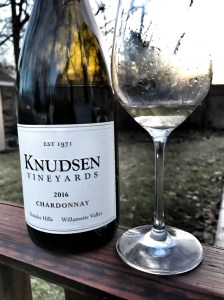 Now, talking about classics, let’s talk about the grape which is not a relative of Pinot Noir, but more often than not, a closest friend and neighbor – Chardonnay. What is interesting about Chardonnay, in my opinion, is that good Chardonnay is a lot more cosmopolitan than a Pinot Noir. With the exception of Chablis, which often can be recognized by the gunflint on the nose, the classic Chardonnay profile includes vanilla, apples and a touch of butter. You can often differentiate Burgundy from California by the amount of butter (California usually offers lots more) and acidity (that’s what you will get with the young Burgundy), but still, Chardonnays from Australia, Burgundy, Chablis, and California have quite a bit of similarity.
Oregon, which is definitely an established world leader when it comes to Pinot Noir, lately also started to show its Chardonnay provenance. Two years ago, I was blown away by the perfection of Vidon Chardonnay. This time around, the 2016 Knudsen Vineyards Chardonnay Dundee Hills (13.5% ABV, $45) made me say “wow” many, many times. Perfect nose of vanilla and golden delicious apples with a distant hint of butter and even honey (honey is usually showing up in Chardonnay after some aging) was supported by the same profile on the palate – vanilla, apples, butter – all perfectly mended together in cohesive, sublime package resting on the vibrant core of acidity. This was definitely a textbook Chardonnay for me, and the one which I would love to see aged, at least for another 5-7 years.
Here you go, my friends – a textbook experience with two classic grapes. What are your textbook wine experiences? Cheers!
Thanksgiving Day Experiences
Thanksgiving is one of my most favorite holidays. It revolves around food. Before you beat me up, of course, it is about family, friends and lots and lots of good reason to be thankful – but still, the food is at the core of this family gathering. This makes me double-happy – I get to spend time with the family and cook my heart out – and let’s not forget the extra bonus – I have a reason to chose special wines.
Since this blog started, there was only one year when I didn’t post about Thanksgiving. Otherwise, I did my best to talk about food and wine experience of this special day, sometimes even with few posts on the subject (you can find those posts here). This year, I had two resolutions for my Thanksgiving dinner. First, it will be simple – which means no Turducken, for instance. Second, I will serve only an American wines – to be more precise, only the wines from California. As Napa and Sonoma greatly suffered from the recent fires, this was only logical to embrace Californian wines to support the people there.
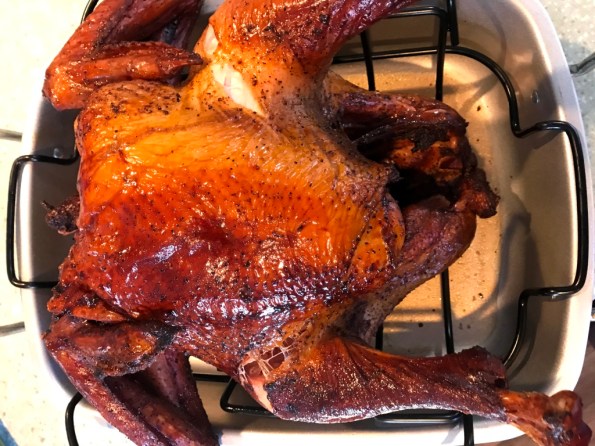
First, let me say a few words about the food. Turkey is a cornerstone of Thanksgiving – at the same time, it is hard to cook a whole turkey in really an exciting way. Over the years, we tried lots and lots of different recipes – with stuffing and without, turducken, smoked, deep fried, deboned… Some were definitely better than the others (turducken is typically a standout), and some of those preparations can be very laborious. Thus this year, I decided the smoked turkey is the way to go.
This was not a random decision – earlier this year I discovered so-called PBC (Pit Barrel Cooker), which I absolutely fell in love with. In the past, I had to spend literally a whole day, dancing around my simple smoker, trying to maintain the temperature and still ending up cooking all the food in the oven. PBC changed that dramatically – no need to precook ribs anymore, just start the fire, hang your piece of meat and come back in a few hours to enjoy. Based on all the prior success, smoking the turkey was simply a done deal.
This might be the simplest turkey I ever have done. Buy already brined turkey (many stores sell pre-brined turkey, which greatly simplifies your life), rub it generously with PBC All-purpose rub, start the fire and just hang it inside the PBC – you can estimate the cooking time based on the size, and of course, use the meat thermometer to make sure the turkey is cooked through.


Another dish I want to mention is the dessert. I got a recipe from a friend, many years ago – however, it was also a while since I made this dessert. I wanted to find a similar recipe online, just to use it as a reference – but failed. So here is the recipe without the usual ingredients and measurements, as here you can make everything approximately. Let’s call this dessert
Crepes Napoleon with Wine-poached Pears and Cranberry sauce
You will need the following:
- 4 firm pears, I recommend Anjou, carefully peeled, halved and cored
- 10-12 crepes (can be more, can be less, depending on how many layers do you want)
- 1 lb cranberry sauce (canned is fine, fresh is better)
- 1 bottle of port – you can use red wine too, but then you would need to add sugar.
- 1 cinnamon stick
- 1/4 teaspoon nutmeg
Put peeled, halved and cored pears into the large pot, cover it with wine, add cinnamon stick and nutmeg, and put it on the stove. Once liquid started boiling, reduce heat and let it simmer for about 30 minutes. Remove from heat, cover and let peras to cool off completely in the wine, preferably overnight (when cool enough, put the whole pot into the refrigerator). Next day, thinly slice pears and put aside. You can also reduce the wine for a later use – it is quite delicious.
You can buy crepes or you can make crepes. If you will decide to make them, Alton Brown has an excellent recipe – this is what I used.


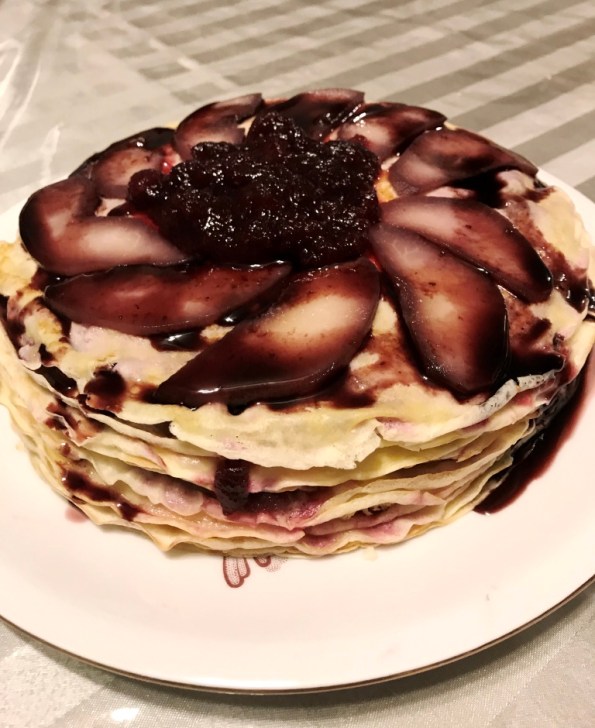
Once crepes are made and cooled off, you are ready to start making the Napoleon! Take a plate you will serve the dessert on. Put the first crepe on the bottom. Thinly spread cranberry sauce. Cover with another crepe. Now take slices of pear and put them around the crepe in a single layer. Cover with another crepe, spread cranberry sauce, cover, put pears and continue the process until you will be satisfied with the overall height of the Napoleon. I recommend a round of pear slices on top with cranberry sauce in the center, but of course, you can make your own decoration. Cover (plastic wrap will do) and put it in the cool place for the flavors to be absorbed into the crepes. Later on, slice and enjoy!
Time to talk wines!


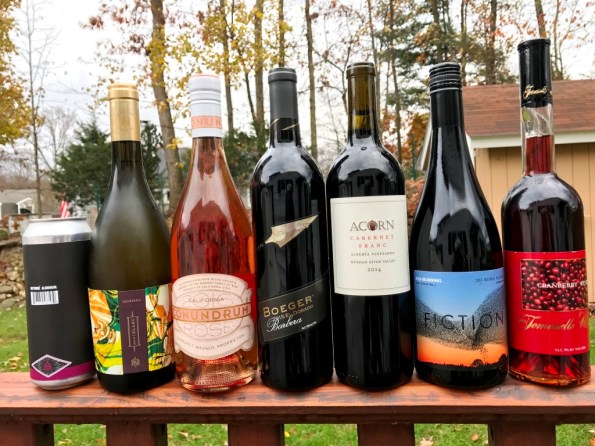
Holiday celebration should start with the sparkling, isn’t it? Finding tasty California sparkling wine is really not a problem. One of my favorite California producers, Field Recordings, offers an interesting selection of the sparkling wines, with most of them packaged in the cans (yes, cans). I had a can of NV Field Recordings Methodé Aluminum Edna Valley (11.9% ABV, 100% Pinot Noir), and it provided a perfect start for the evening – fresh, supple, with good body weight and a nice touch of a fresh bread – definitely was a crowd pleaser.
I wanted to have a full California wine experience, so next, we moved on to Rosé – 2016 Conundrum Rosé California (13.1% ABV). Truth be told, I’m not a fun of Wagner family wines – Conundrum, Meiomi, Caymus – doesn’t matter, they generally don’t work for my palate. So I threw in the bottle of this Conundrum Rosé simply because it was available – I thought we will open it, taste it and move on. Boy, was I wrong. This wine had beautiful strawberries all the way on the nose and the palate, supported by tons of herbs – lavender, mint, basil. Perfect mouthfeel with very good presence, but not overwhelming and with good acidity – this wine was enjoyed to the fullest.
We drink with our eyes first – thus the label on the 2014 Durant and Booth Blanc California (14.6% ABV, $36, blend of Chardonnay, Grenache Blanc, Ribolla Gialla, Roussanne, Greco di Tufo) was extremely drinkable and very promising (the label represents the art technique called water marbling – you can read more here if you are as intrigued as I was). I brought this wine from California after attending Wine Bloggers Conference 2017, where this wine was presented to us at the Napa Valley Vintners lunch – I plan to write a separate post about this event).
As you can tell, this wine is made from quite a few grapes, and I’m typically a bit concerned if the chorus will sing harmoniously. Oh yes, it was – starting from the beautiful touch of butter and vanilla on the nose and the palate, then immediately offering silky plumpness of Roussanne with a gentle touch of butter and tropical fruit on the palate – this delicious wine was gone in no time.


Next, it was the time to move on to the red wines. We started with 2014 Acorn Alegria Vineyards Cabernet Franc Russian River Valley (12.5% ABV, $38, 93% Cabernet Franc, 2% Malbec, 2% Merlot, 2% Petite Verdot, 1% Cabernet Sauvignon and Tannat). All Acorn wines are made from a co-fermented blend of grape varieties which are growing at Acorn’s Alegria Vineyard. This Cabernet Franc had a beautiful open nose with a touch of mint and cassis – the same continued on the palate with more cassis in a smooth, round package, supported by some herbal notes and perfect acidity. It was unmistakably Cabernet Franc, but also unmistakably California Cab Franc, without much of the green bell pepper presence and fruit dominant, but perfectly balanced.
Our last red was coming from the California region I was not really familiar with until now – El Dorado County (it is not only gold you find there, yep). 2015 Boeger Barbera El Dorado (15% ABV) was another wine I brought back from California after the same wine bloggers conference. I tried few of the El Dorado wines at the conference and was not very impressed, so I looked at it as an interesting experiment. Another score! This wine was dense and brooding, with tar and tobacco on the nose, and surprisingly polished dark fruit on the palate with sweet tobacco undertones. To make things even more interesting, I can tell you that we didn’t finish the wine during dinner, so I pumped the air out using the usual Vacuvin, and put the bottle aside almost for 10 days. After 10 days, the wine was still perfectly fresh and enjoyable, which makes me wonder how long this wine can actually age.
Time to finish our Thanksgiving dinner with the dessert. As our planned dessert had cranberry sauce in it, I decided to go with Cranberry wine for dessert. Tomasello Cranberry Wine New Jersey (9% ABV) was a perfect pick for it – good acidity, tart cranberry profile, it played perfectly with our dessert – while the wine was not from California, it still provided a perfect finish for our celebration.
Here we are, my friends. How was your Thanksgiving? Did you enjoy more the turkey, the wines or the company? Cheers!
Daily Glass: Monday Night Escapades
Is there a special wine fitting every day of the week? I would guess that for many, Friday and Saturday are considered special nights, as it’s the weekend, and people think of drinking something better (higher end). Sunday is still the weekend, so the higher calling might still be in order.
But what about Monday? Does your choice of wine for Monday depend on your general outlook on life? “I love Mondays” … said not that many people, but isn’t it great that it is the first day of the week and we have the whole new week ahead of us, with lots of things to do, places to visit and people to meet? I guess one’s personal take on Mondays does depend on one’s take on life, so I will leave it for you to ponder at and if you have any words of wisdom to share, please do so after the beep … err in the comments section below.
I have two wine-related experiences from Monday which I want to share. First, I finally got to open the Field Recording’s Can Club shipment. What’s a big deal, you ask?


Field Recordings is one of the most innovative wineries I know. Small winery in Paso Robles, California, a brainchild of Andrew Jones, a vigneron, who started his career as a grape grower, first and foremost. Ever since I tried his Fiction Red, I became a passionate fan and I’m religiously following everything Filed Recordings does.
A few years ago, Field Recordings started experimenting with the wine in the can. Going beyond just the wine in the can, they also finishing their wines with the beer hops which creates truly a different experience. As soon as the “Can Club” was opened, I joined it. The wines were always good, but the shipments themselves went through a number of changes in the format, and pretty much every shipment had some little (and different) issues associated with them. Until now.
Once I opened the box, my very first reaction was “wow”. In my humble opinion, Field Recordings, under their Alloy Works brand, achieved perfection in the packaging of the canned wine. Simple, elegant, sturdy, economical, easy to handle – unpacking this shipment was absolutely a delightful experience. Ask any oenophile, the first thing which gets everyone excited is the opening of those boxes. With this delivery, Field Recordings Can Club achieved shipping nirvana – I hope they will continue it moving forward.
I can’t tell you much about the wines, as they needed to get chilled and went straight into the fridge; I can only mention that this shipment included 2 cans each of Weissland, sparkling dry hopped Chardonnay; Martian Galaxy – a dry-hopped, sparkling rose, a blend of Gamay and Mourvedre Martian Vineyard in Los Alamos; and Sangria, a blend of freshest, cold-pressed juice cocktail of cranberry, blood orange and lemon from Yes Cocktail Company mixed with Zinfandel from Old Potrero Vineyard. I don’t know about you, but I’m very excited to try these wines – and will report on the experience afterward.
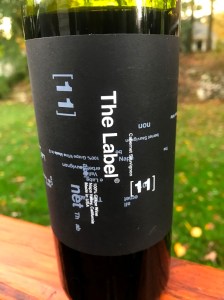 Now, let’s talk about that Monday night wine. Outside of special events, I never know in advance what am I going to open. Deciding on the bottle of wine is somewhat of a frustrating experience (first world problems, I know). Numerous bottles get touched and looked at, then rejected for a myriad of reasons. Finally, one is pulled out – usually for no other reason than “oh well, maybe this will do”. This time around the bottle happened to be Turley Cabernet Sauvignon called The Label.
Turley is not known as the Cabernet Sauvignon powerhouse – it is a coveted and well sought-after Zinfandel producer for the most. A few years ago, Turley finally got into the Cabernet Sauvignon wines and produced the wine which was called “The Label” – named after the words of Larry Turley, the proprietor at Turley Winery, who always said that Cabernet Sauvignon drinkers simply “drink the label”.
I don’t know if this should be considered funny or strange, but it appears that 2011 Turley The Label already was my choice of Monday wine – almost 4 years ago, in January of 2014 (here is the post). I really loved the wine then, but it evolved much further this time around. From the get-go, this 2011 Turley The Label Cabernet Sauvignon Napa Valley (13.4% ABV) showed a beautiful medley of the succulent berries, both on the nose and the palate – blackberries, blueberries, and black currant, tastefully accompanied by mint and eucalyptus and supported by clean acidity (Drinkability: 9-). It was reminiscent of a perfect Turley Zinfandel, fresh and playful – with a character of its own. Last time I said I want to taste this wine in 10 years. After almost four we are going in the right direction – I should have one more bottle somewhere so I will have to be careful to avoid any Monday blues prompts to open this wine until its due time.
What is your perfect Monday wine? Cheers!
Come For The Name, Stay For The Wines: Murrieta’s Well in Livermore Valley
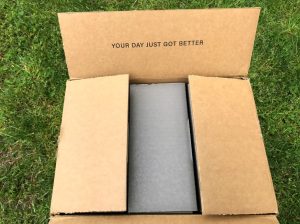 “Your Day Just Got Better” – how fun is it to read something like this? Even if it is written on the cardboard box [ahem, full of wine]? Ahh, sorry. Especially(!) if it is written on the box full of wine!
When I was invited to participate in the Snooth virtual tasting of the wines of Murrieta’s Well, something bothered me in that name. Something very familiar, but I really I couldn’t get a grip as to what it was – until I started working on this post and figured out that Murrieta was referring to Joaquin Murrieta, a Mexican miner turned hero/bandit to avenge his wife in the first half of 19th century. Growing up I remember been moved by a beautiful music and singing in one of the very first rock-opera produced in the former USSR, called “The Star and Death of Joaquin Murrieta” (Звезда и смерть Хоакина Мурьеты). That is what my brain was trying to associate with – but again, this only became obvious after I started working on the post.
Similarly to the Joaquin Murrieta himself, the Murrieta’s Well vineyards go back to the early 1800s. In 1884, Louis Mel purchased the estate, built the winery and planted new vineyards using cuttings brought directly from France, from none less than Chateau d’Yquem and Chateau Margaux. In 1933, he sold the estate to his friend Ernest Wente, and ever since the estate was a part of the Wente properties. Actually, the winery received name “Murrieta’s Well” only in 1990 when it was revived, and from there on the modern history of Murrieta’s Well started. Rest assured that you can still find very old and still producing vines as part of the Murrieta’s Well vineyards.
Before we talk about the wines, let me ask you a sidebar question. Let’s say you are visiting Northern California on business and staying somewhere between San Francisco and San Jose. Let’s assume you have a bit of a free time and want to visit a winery. Outside of the city wineries, which can be found today in many places, what do you think would be the closest “wine country” for you to visit? If you said Napa, it is a wrong answer! Yes, you can go to the Santa Cruz mountains and visit Ridge (good choice), but – your best bet will be Livermore Valley! You will find a good number of excellent producers in Livermore Valley, all within 45 minutes ride (not talking about California traffic here, sorry). If you will go, make sure to include Murrieta’s Well and Wente on your short list.
Now, let’s talk about making the day better – I think kind folks at Murrieta’s Well know how this can be done. When you open the box and first thing you see is a written note “Your Day Just Got Better“, whatever the day you had before, it immediately gets better :). Then you see the bottles, packed with meticulous care, and feel even better. Meticulous care obviously goes not only into the packing, but first and foremost, into the wines themselves. Winemaker Robbie Meyer believes in the art of blending, and I can tell you, one of the flagship blends, The Spur, was my favorite wine of the tasting. Robbie Meyer’s philosophy is to harvest and vinify all the grapes separately, and then combine them into the final blend.


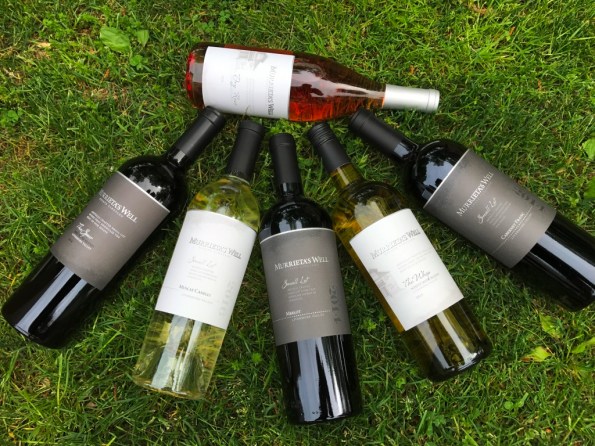 For what it worth, here are my tasting notes for the wines:


2016 Murrieta’s Well Dry Rosé Livermore Valley (14.1% ABV, $30, 55% Grenache, 45% Counoise)
C: pale pink
N: intense, fresh, strawberries and strawberries leaves,
P: perceived sweetness but perfectly dry, underripe strawberries, nice and round
V: 7+/8-
2015 Murrieta’s Well The Whip Livermore Valley (13.5% ABV, $24, 30% Sauvignon Blanc, 30% Semillon, 30% Chardonnay, 7% Viognier, 3% Muscat Canelli)
C: straw pale
N: touch of perfume, tropical white fruit, guava, medium intensity,
P: touch of sweetness, nicely restrained, good acidity in the back, more tropical fruit, good balance
V: 7+
2016 Murrieta’s Well Muscat Canelli Livermore Valley (14.2% ABV, $35, 100% Muscat Canelli, 100 cases produced)
C: light straw
N: perfumy, intense, sweet, intense white fruit
P: grapefruit, grapefruit zest, good acidity, round
V: 7+, excellent summer wine


2014 Murrieta’s Well Small Lot Merlot Livermore Valley (14.1% ABV, $48, 90% Merlot, 7% Cabernet Sauvignon, 3% Petit Verdot)
C: Garnet
N: medium plus intensity, touch of sweet cherries and earthiness, mint, touch of cassis, overall very inviting.
P: good earthy fruit, cassis, medium to full body, touch of sweet oak, outstanding overall
V: 8+, excellent, delicious wine
2014 Murrietta’s Well Small Lot Cabernet Franc Livermore Valley (14.1% ABV, $58, 88% Cabernet Franc, 6% Cabernet Sauvignon, 6% Petit Verdot)
C: dark garnet)
N: touch of vanilla and mint, black and red fruit, medium intensity
P: touch of black currant, vanilla, chewy structure, baking spices, medium to full body.
V: 7+, I like my Cabernet Franc to be a bit leaner, but a very good wine overall.
2014 Murrieta’s Well The Spur Livermore Valley (13.5% ABV, $30, 45% Cabernet Sauvignon, 22% Petite Sirah, 14% Petit Verdot, 10% Merlot, 9% Cabernet Franc)
C: dark garnet
N: crunchy raspberries, intense, tobacco, sage
P: round, layered, black currant, silky smooth, touch of sweet tobacco, eucalyptus, fresh acidity, impeccable balance
V: 8+, this wine would make me happy any day
Whether Joaquin Murrieta was an avenger, hero or bandit – it is hard to tell. We don’t even know if he was just a legend. But – the wines named in his honor are real, and you should definitely look for them. Cheers!
Rosé Showdown – California Versus Spain
A glass of wine as an “adult beverage of choice” continues its growth in popularity. If we will take a closer look at that world of wine, we will discover that there are two types of wine which are leading that growth pattern – those two types would be Sparkling and Rosé. I’m not talking about the growth in the dollar amounts or number of bottles produced, but rather a growth in attention and demand. Today, you will be pressed hard to find a winery around the world which doesn’t produce at least one type of Rosé and one type of sparkling wine – for sure this is the case with Rosé. The production might be tiny (few hundreds of cases or even less) and far less than the demand is – but it is the wine which commands lots of attention.
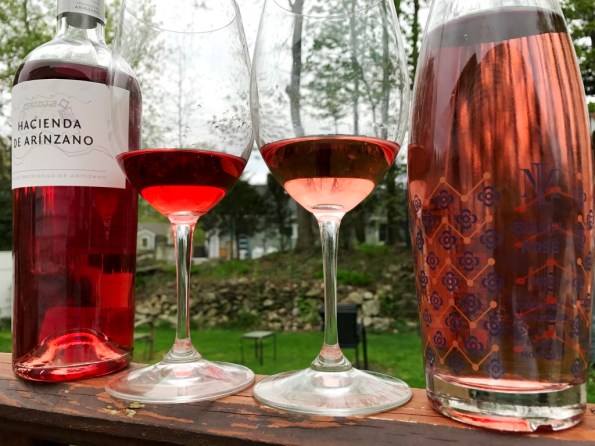
Another “phenomenon” makes me happy about the Rosé – it is slowly losing its “Rosé is only for a summer” connotation and becomes more and more acceptable and requested as a year-round drink. Rosé is a serious wine, with its own unique taste profile and capability to showcase terroir and grape variety, same as any other red or white, with two additional benefits. For one, I would dare to say that in general terms, Rosé’s versatility around food surpasses the white and the red wines – oh well, this might be only me. And the second one is pure aesthetics – the pink palette of Rosé, with possibly more shades than the proverbial 50, looks gorgeous, sexy and inviting – just take a look above and see if you are agreeing with me.
When I was offered to try two Rosé samples, of course, I couldn’t say no. The first wine was familiar to me, as I had a pleasure of trying 2015 vintage of Hacienda de Arinzano Rosé last year. The second one was the wine which I never saw before – Isabel Rosé from California. Thus it became an interesting experiment to see how the two wines would fare side by side.
If anything, putting Rosé from Spain and California on the “same page” makes sense as Rosé is clearly a “new phenomenon” for both regions, growing to prominence over the last 3-4 years at the most. Of course, Rosé was produced in Spain and California in much earlier days – but it was rather an exception and not the norm – unless we want to count white Zinfandel as a Rosé which I personally refuse to do. Until a few years ago, the only Spanish Rosé I knew about was the one from Lopez de Heredia ( which was outstanding). For the American Rosé, even if they were produced, they were really not that good (take a look at the blog post on Vinography called “Why Does American Rosé Suck” – no further comments needed?). Fast forward to today, and you can find lots of beautiful Rosé wines coming from Spain; American Rosé became a standout, as proven in the virtual tasting last year at the #winestudio.
Our first contender today comes from the first Pago estate in Northern Spain – Pago denomination signifies the highest quality of wines, this coveted level is not easy to achieve. Hacienda de Arinzano Rosé is made out of the 100% Tempranillo, in the “proper” way – by macerating the juice with the skins for 6-8 hours. Don’t you love the color of this wine?
The California’s Isabel Rosé is definitely a formidable opponent, as you can see starting from the bottle itself. Glass enclosure, beautiful shape and painted bottle – really curious how many people dare to discard the bottle once they finish the wine instead of keeping it (all I can tell you that I kept mine). A different but equally beautiful color on the mostly Cabernet Sauvignon wine, again produced in the classic style from one of the very best vintages in California (2016 had almost ideal growing conditions, watch out for those Cab prices) – and at one of the well-respected wineries, Michael Mondavi family estates.


As you can tell, it is definitely a game of equals, and for what it worth, my tasting notes are below:
2016 Hacienda de Arínzano Rosé Tempranillo (14% ABV, $20, 100% Tempranillo)
C: bright concentrated pink
N: onion peel, fresh crunchy berries
P: intense, red fruit, plums, crisp, good acidity, medium body, will stand to wide variety of dishes
V: 8-, excellent
2016 Isabel Rosé by Michael Mondavi Family Estate California (13.5% ABV, $15, 75% Cabernet Sauvignon, 23.5% Barbera, 1.5% Muscat)
C: light pink
N: intense fresh strawberries, herbal undertones
P: strawberries, good acidity, very dry – not bone dry, but quite dry, refreshing
V: 8-/8, light but affirmative, don’t overchill – needs to warm up a bit to become richer
Well, here we are, my friends. There was only one winner in this competition – me. Yes, I got to enjoy two outstanding wines, which will perfectly fit any table at any occasion, and at the price, an absolute majority of the budgets. Both will be great on a summer day, a winter day, with food or without it. Grab one or both, chill and enjoy! And if you had any one of these wines, I would be really interested in your opinion. Cheers!
Evening With Friends
I confessed it many times, and I’m glad to do it again – one of my most favorite parts of blogging, and essentially the most important one, is people. Interacting with people is the most prized element of any published blog post; meeting fellow bloggers and finding new friends is a huge cherry on top. I don’t know if the wine has any special qualities, but I have a great personal experience with meeting fellow bloggers face to face for the first time and feeling like I knew them for my whole life.
When I got an email from Jim, an author of JvbUncorked blog, offering to get together a few weeks ago, I knew I had to make it work. When I arrived 20 minutes late to Aldo Sohm Wine Bar in midtown in New York, Jim, Lori (a blogger and the winemaker behind Dracaena Wines) and Lori’s friend, Donna, were already there.
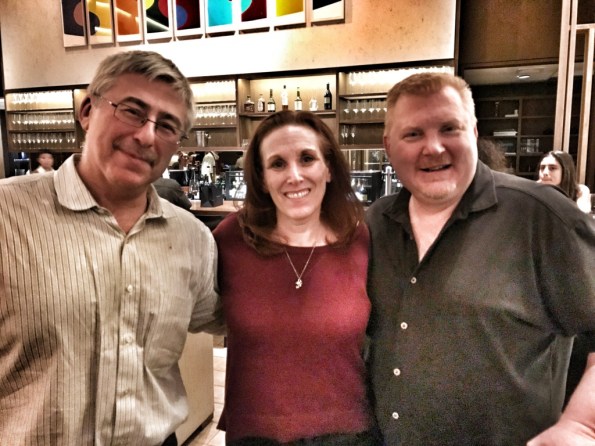 More often than not, when I know what restaurant I’m going to, I like to check the wine list in advance. Aldo Sohm Wine Bar was opened by Aldo Sohm, the Chef Sommelier at Le Bernardine, a world-famous dining destination in New York City. Aldo Sohm is also known for winning numerous Sommelier competitions and was crowned multiple times as “Best Sommelier in Austria”, as well as “Best Sommelier in America” and “Best Sommelier in the World 2008” – you can imagine that the wine list put together by such a wine Pro requires some homework. I don’t know about you but I love and always do my homework, especially if it is connected to wine at least in some way.
In addition a to the substantial wine list, we had another interesting challenge – Donna liked mostly white wines with the nice buttery component to them – but, she was willing to try new wines, which was very helpful, but – the challenge was on.


Being late by 20 minutes had one lucky consequence – the first wine was already chosen and about to be poured by the time I situated myself at the table. We started with 2013 Kuentz-Bas Riesling Cuvée Tradition Alsace ($40) – and it was outstanding. Perfectly bright and intense on the nose, with a whiff of honey and apricot; on the palate, it was live and vibrant, crisp and playful, continuing honey and apricot flavors, supported by clean acidity. An outstanding wine and a great value at a restaurant wine list at $40. Bonus – we got “thumbs up” from Donna – you know how we, wine geeks, feel when someone says about your recommendation “ahh, I like this wine” – the top of the world feeling. Well, kind of, anyway.
As we were pondering at the next wine, it was really hard to decide, especially trying to make everybody happy again. While we were looking at Italian options, feeling “yeah, might be, but really, yeah?”, I took the advantage of my list studying and suggested to try a California Chardonnay. Not just something random, but a very particular Chardonnay – 2012 Sandhi Chardonnay Santa Barbara ($80). Earlier in the year, I had my first experience of Sandhi wines with Sandhi Pinot Noir. Sandhi winery was founded by Rajat Parr, a world-renowned sommelier, a partner at Sandhi winery and one of the founders of IPOB (In Pursuit Of Balance) movement for dialed-down, balanced California wines. The Sandhi Pinot Noir was incredible, which made me really curious about the Chardonnay – and it didn’t disappoint. This 2012 Sandhi Chardonnay had generous, intense, open nose with apples and vanilla, and on the palate, this wine was simply a riot – I experienced similar Chardonnay wines only a few times, mostly from Burgundy, when they get incredible intensity and brightness of golden delicious apples, vanilla and honey, supported by just a hint of butter and clear, vibrant acidity. This was truly a treat. And – yay – we got “thumbs up” from Donna again. Two out of two!


It was the time to move to the reds. While previously looking at the list, I noticed a 2001 Santenay for $77 at the end of the Burgundy section, right after 2001 DRC Romanée St. Vivant for $2650 (need an expense account, anyone got one we can share?). At first I thought there might be a mistake either with the price or a vintage in the online copy (had such experience numerous times), but no – the same Santenay was there on the wine list at the restaurant, for the same $77, so it was not very difficult to convince my partners in crime to go for this wine.
2001 Paul Chapelle 1er Cru Gravière Santenay ($77) was earthy, dry and pretty closed on the nose despite quick decanting. It took the wine a while to start showing some dark fruit, with earthy, minerally notes prevailing at the beginning. I think it took the wine about 45 minutes to give us some dark fruit notes and become a bit brighter. This 16 years old wine still has a lot of life left in it, and it is definitely a food friendly wine. By the way, do you care to guess of Donna liked this wine? Yes, you got that right – no, she didn’t. 2–1.
As our evening was progressing, we got a pleasure of meeting Aldo Sohm in person – he came to our table and introduced himself, so we were able to chat with him for about 10 minutes about all the fun geeky stuff oenophiles enjoy so much – how uneasy it is to find good wines at the good prices, especially when it comes to the Burgundy, with the combination of terrible weather and Burgundy’s love on the upswing around the world. Talking to Aldo was definitely one of the highlights of the evening.
It was getting somewhat late, but the challenge was still in front of us – we managed to score with the white wines for Donna to enjoy, but we had to find the proper red. After going back and force we settled on 2007 La Rioja Alta Viña Ardanza Rioja Reserva ($75). La Rioja Alta doesn’t need much introduction to the wine lovers – one of the very best producers in Rioja, making delicious wine year after year. Of course, this wine was still a baby, but within the reasonable price range, we thought that it would have the best fruit representation, which, again, we were hoping would win Donna’s vote. The wine was every bit as expected – nose of cigar box and vanilla, dense cherries, vanilla and eucalyptus on the palate, touch of sweet oak, full body, noticeable, but well integrated tannins. This was an excellent wine, but … Nope, we didn’t win this one. 2–2. But one super-fun evening.
It was late, and it was the time to go home. But I really hope we are going to do it again. And again. And again. To all the friends – cheers!
Daily Glass: Will It Merlot?
 Yes, the title of this post is a play on the theme of some of the Good Mythical Morning episodes, where Rhett and Link are trying to figure out how far they can take the usual food items in the unusual directions, calling those episodes “Will It …” (if you are not watching the show, you really should, here is the link for you). But this is where the connection with the popular show ends.
And yes, we are talking about Merlot. But that also not very important, as the bottle was not opened just because I wanted to drink Merlot.
The vintage was the culprit – 2002 – as this is the year when my youngest daughter was born. And as I’m sure many of you, oenophiles, out there do, I love opening proper vintages to celebrate birthdays.
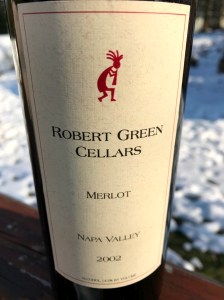
So the question was whether this 2002 Robert Green Cellars Merlot Napa Valley (14% ABV) would be still drinkable in 2017.
I presented this question to a few of the twitter winos, and the consensus was cautiously optimistic, presuming the wine was properly stored (the bottle actually never left wine fridge from the moment it got into the house). Wine Spectator rated 2002 Napa vintage at 89, and “Drink Recommendation” column had gloomy “Past peak” reference. I wanted to learn a bit more about the wine from the producer’s website, but the link on the back label was non-functional, and google didn’t offer much help searching for “Robert Green Cellars”.
Done with theoretical research – the proof is in the pudding wine glass anyway. The cork pulled out in a perfect condition. The wine is in the glass, and the first whiff had nice fruit in it, but the wine tasted a bit off. But – never judge the wine by the first sip, right? This rule is very important when it comes to the young wine, but this is even more important when it comes to the aged wines. 10 minutes in the glass brought this wine together – a perfect core of the dark fruit, maybe a touch of black currant, mint, firm structure, definitely a nice glass of wine.
About an hour and a half after the bottle was opened, it opened up even more, but somewhere in the distance, more on the finish than anything else, tertiary aromas started to appear – this is when I tweeted to the same group that the wine was perfect but at its peak. Another 30 minutes later, the wine started closing back, but only in a good sense – acidity came to the forefront, fresh young black and red fruit came to dominance – I was clearly looking at a young and delicious wine, not more than 3-4 years of age. Then, of course, the bottle was empty.


This was definitely a fun bottle of wine, with the self-attached “first world problems” – would the wine be still good or not. Believe it or not, but there was even the next level of fun associated with that wine. The little pictogram of the flute player, known as Kokopelli, which you see on the front label and the cork itself, most often is associated with fertility. What I didn’t know that Kokopelli also can be credited with the arrival of the spring. I have other 2002 bottles but somehow decided to open this particular one on the second official day of Spiring (the Spring in the USA started on March 20th). Oh well, as I said before, first world problems.
I think this wine Merlot perfectly, and I can only wish you same success and fun with your older bottles. I also want to leave you with the text from the back label of this bottle, as I think it perfectly finishes this post:
“The Joy Bringer” “This flute playing character is often credited with bringing the change of winter to spring, melting the snow and bringing about rain for a successful harvest. He is believed to represent the fertility of the untamed spirit of nature. Perhaps this joyful traveller’s greatest lesson is showing us that we shouldn’t take life so seriously. We hope the spirit of Kokopelli shines through in our wine and that it brings you as much joy and pleasure as it was for us to make. Enjoy the moment. Robert and Sue.”
Samples Galore – Holiday Edition
 Over the last few months, I had an opportunity to try a number of wines. What I didn’t do in timely fashion, however, is to share the tasting notes with you – and this needs to be corrected, which I’m doing with this post.
While I call this post a “holiday edition”, this is strictly due to the fact that this post is coming out during the most festive time of the year. It might be too late to use any of these wines for the gift giving, but you know what – these wines will be perfect for any day, whether it is cold or warm outside, and whether you need a gift or just want to reward yourself (yep, you always deserve an award for just being you).
Let’s start with the sparkling wine – I have one to bring to your attention today. This wine comes from the master of “affordable luxury” Paul Mas (I wrote about his wines a few times in the past – you can find those posts here). This Blanc de Blancs from Languedoc is made out of Chardonnay using the traditional method, and it perfectly on par with Paul Mas sparklers I tasted before:
NV Côté Mas Chardonnay Blanc de Blancs Méthode Traditionelle Vin de France (12% ABV, $15.99, 100% Chardonnay)
N: Pleasant nose with touch of yeast and fresh apples
P: Restrained palate, good acidity, clean, touch Of yeast, hint of Granny Smith apples.
V: 7+


Let’s continue with a few of the white wines. First, one of my perennial favorites – Hanna Sauvignon Blanc. I tasted prior vintages of Hanna Sauvignon Blanc, and this is one of my most favorite styles of California Sauvignon Blanc – grassy, fresh and clean:
2015 Hanna Sauvignon Blanc Russian River Valley Sonoma County (13.2% ABV, $20)
C: straw pale
N: intense, fresh-cut grass, touch of lemon, fresh meadows, you can smell this wine forever.
P: nicely restrained, same grassy notes, touch of black currant (distant hint), perfect balance, refreshing
V: 8+
The next white wine comes from the very creative producer in Oregon – Left Coast Cellars, which also not a stranger to this blog – I had a pleasure of speaking (virtually) with Luke McCollom, winemaker for Left Coast Cellars and taste some of the previous vintages of their wines (here are the links to the two-part interview – Part 1 and Part 2). You can’t go wrong with Oregon Pinot Gris – today this is literally a “classic”:
2015 Left Coast Cellars The Orchards Pinot Gris Willamette Valley (13.7% ABV, $18)
C: Straw pale color
Touch of honeysuckle on the nose once warmed up, White stone fruit initially
Closed up while cold, white ripe fruit once warmed up, good balance, medium body, medium-long finish.
V: 7+
Last but not least is Les Dauphins Côté du Rhône. Rhone whites are fun wines, often very dry in the early years, and “ripening up” as they age. This was unquestionably a young wine which most likely would improve with age:
2013 Les Dauphins Côtes du Rhône Réserve Blanc (12.5% ABV, $11, 65% Grenache, 15% Marsanne, 10% Clairette, 10% Viognier)
C: Light golden
N: touch of honey, white stone fruit
P: white stone fruit, herbs, good acidity, quite astringent
V: 7+, will hold well with and without food
Now, time for the reds. The reds today represent a diverse group, from Australia to Italy to the USA. At the beginning of November, I participated in the #winechat with Michael Twelftree, winemaker for Tow Hands Wines out of Australia. We had an opportunity to taste and discuss three wines from Two Hands – two classic Shiraz wines from Barossa and McLaren Vale regions, and a Cabernet Sauvignon:
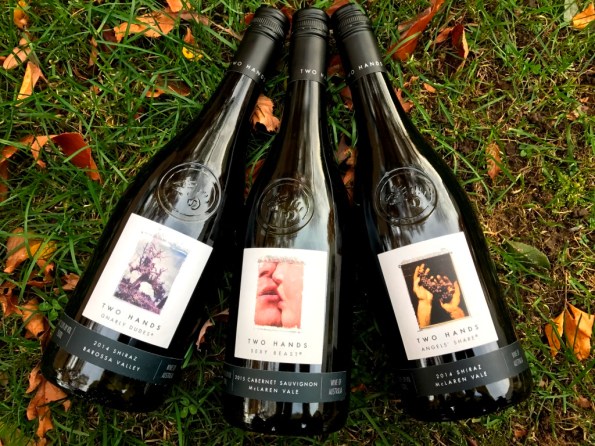 2014 Two Hands Gnarly Dudes Shiraz Barossa Valley (13.5% ABV, $36)
C: Dark garnet, almost black
N: espresso, roasted meat, licorice, blackberries
P: spice, plums, big concentration, touch of salinity, smooth texture, velvety and dusty
V: 8-, good rendition of Shiraz. The wine completely reversed on the Day 2, closed up.
2014 Two Hands Angel’s Share Shiraz McLaren Vale ($14.5% ABV, $36)
C: Dark garnet, almost black
N: intense, powdery, eucalyptus, mocca, licorice, tobacco
P: peppery finish, round, restrained, excellent acidity, bright and crispy red fruit
V: 7+, probably needs time
2015 Two Hands Sexy Beast Cabernet Sauvignon Mclaren Vale (13.8% ABV, $36)
C: Dark garnet, almost black
N: touch of cassis, closed
P: smooth, round, nice cassis backbone, mint, restrained
V: 7/7+, too young, needs time to rest and evolve
Two Italian wines were probably my favorite in this group – Cecchi Chianti and Alta Mora from Sicily:


2014 Cecchi Chianti Classico DOCG (13% ABV, $22, 90% Sangiovese, 10% other grapes)
C: Garnet
N: dark red fruit, dark chocolate, touch of smoke, roasted notes
P: fresh, vibrant, good acidity, touch of pepper, hint of tobacco, crashed raspberries, firm structure
V 8-/8, very enjoyable from get go, will evolve
2014 Cusumano Alta Mora Etna Rosso DOC (14% ABV, $24, 100% Nerello Mascalese)
C: dark garnet
N: playful, open, cherries, mocca,
P: bright, mouthwatering acidity, tart cherries without too much astringency, pronounced minerality, medium body, dry finish
V: 8-
And to finish off, here are two classic grapes – Merlot and Pinot Noir:


2014 Markham Merlot Napa Valley (14.2% ABV, $26, 86% Merlot, 12% Cabernet Sauvignon, 2% Petite Sirah)
C: garnet
N: touch of cassis, mint, alcohol presence is noticeable, dark chocolate
P: round, soft, clean acidity, touch of cassis, underripe raspberries, alcohol and tannins show a bit on their own, peppery finish
V: 7/7+, needs more time? second day definitely showed to wine as more coherent (7+), but it would benefit from more time
2014 Left Coast Cellars Cali’s Cuvée Pinot Noir Willamette Valley (13.5% ABV, $24)
C: Dark garnet
N: Mocca, sage, roasted notes, touch of mushrooms, savory undertones
P: Fresh raspberries, mint, herbs, touch of roasted meat, fresh acidity, mouthwatering finish, medium body, easy to drink
V: 8-, easy to drink, pleasant
We are done here. Have you had any of these wines? What do you think of them? Cheers!
Daily Glass: Ah, Pinot!
Nothing is simple around wine for us, oenophiles, right? We need to meticulously arrange proper experiences – perfectly match wine with food, with the company, with the mood, with the moment. If we don’t, we question ourselves to eternity – what would’ve happened if I would’ve open that other bottle I had in mind; should’ve I just plan it all differently?
But every once in a while, we let our guards down, and let things just happen. When we think about it right after, we realize – wow, totally random, and totally delightful. Yay!
That “random and delightful” was my experience yesterday. My plan was to open a bottle of wine from 1998, and I have a very small selection of those, so the one I picked happened to be a Burgundy. So that one was a special bottle, waiting for the evening and the decanter.
I can’t cook without the wine, so of course, the bottle had to be opened. The “before Thanksgiving” shipment from Field Recordings contained more than one interesting bottle – the one I told you about already was Pét Nat from California. Another bottle I never saw before had a bold Nouveau word printed across shiny, golden label:


I’m an avid fan of the “Beaujolais Nouveau” phenomenon. But I have to admit that a few years back, I tasted few of the attempts by California wineries to join the Nouveau movement, and those were widely unsuccessful.
So how would Field Recordings’ Nouveau rendition fare? Actually, spectacularly. As the label says, the grapes for this wine were hand-harvested only 74 days prior to the bottling. And nevertheless, the wine had all the finesse you expect from the perfectly balanced California Pinot Noir. This 2016 Field Recordings Nouveau California (12.1% ABV, 100% Pinot Noir) had lean, uplifting nose of fresh fruit, but less fruity than typical Nouveau, nothing grapey. On the palate, unmistakably Californian, touch of smoke with fresh plums and a bit of mint. Good acidity, more round than a typical French Nouveau version, perfectly drinkable. 8+. Outstanding, in a word. Would happily drink it again any day.
Remember I told you this was one of the days when things are just happening? I have a good number of bottles in the cellar, but absolute majority of the bottles are in the single amounts – just one bottle of particular wine from particular vintage, and that’s it. Thus sometimes, I spend good 20 minutes trying to select a bottle (in the fear of missing on what it can evolve into) and end up pouring myself a splash of Scotch instead. But yesterday, I had enough courage to grab a bottle of the wine which might be the only bottle in the US – unless someone also has good friends in Switzerland.
This wine was made by the family producer in Vaud region in Switzerland, Henri Cruchon, who I had pleasure meeting about 6 years ago. What makes it special is that this wine, called Nihilo, is not filtered, made from organic grapes, and doesn’t have any added sulfites. To preserve the wine better, the cork is covered in wax. And to be entirely correct, the wine goes beyond organic, as the back label sports Demeter logo, which means that the winery is certified biodynamic.


It is great to know that the wine is non-filtered and organic – but the ultimate verdict is in the glass. This 2015 Henri Cruchon Nihilo La Côte AOC Switzerland (13.5% ABV, blend of Pinot Noir, Gamay and Gamaret) had a spectacular nose, very complex – iodine, anise, crunchy cherries, mint. The palate was equally spectacular with sweet cherries, pepper, roasted notes, peppermint, crispy, fresh blackberries – once you start, you can’t stop. 8+/9-, outstanding wine.
And then there was 1998 Patrick Lesec Gevrey-Chambertin Vieilles Vignes (13% ABV) – an 18 years old Burgundy wine, as Pinot Noir as it can be.
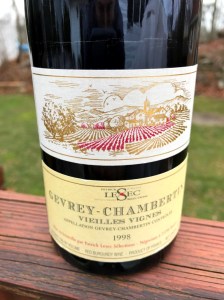 18 years shouldn’t be an age for Burgundy, but I still was a bit concerned. Decided to decant the wine, to avoid sediment and let it breathe a bit, for about an hour. I’m clearly abusing the word “spectacular” in this post, but this is what this wine was. Touch of barnyard on the nose, on the palate – gunflint, smokey cherries, roasted meat, lots of herbs – oregano, mint, sage – every sip was a “wow” experience. By the end of the evening, the wine mellowed out and started showing more of the sweet cherries, still perfectly balanced with acidity. A pure treat for sure. Drinkability: 9.
There you have it, my friends. An accidental and hugely enjoyable Pinot Noir deep immersion – from California to Switzerland to France – very different wines holding one common trait – delivering lots and lots of pleasure. Cheers!
Lodi Thanksgiving – Wine Notes (There Was A Turducken Too)
Yeah, I know – it’s been more than two weeks since Thanksgiving… Well, okay – let’s still talk about it.
I gave you some ideas about the Thanksgiving wines and food with my earlier post, so let me just start with the “prep” picture again:
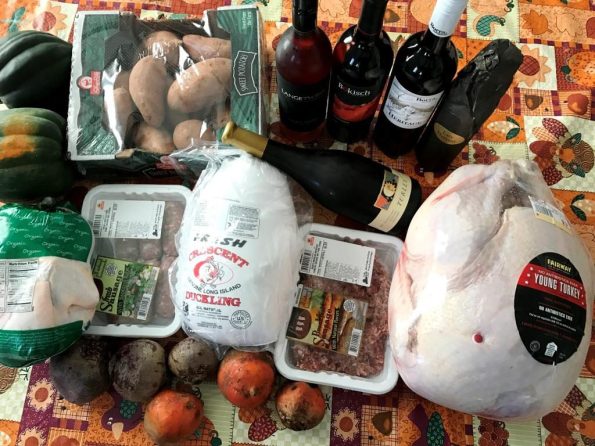 All the birds you see in this picture were converted into a Turducken – chicken inside the duck inside the turkey, all fully deboned except the legs and wings of the turkey. The dish was conceived in the 1980s in the South, popularized around the country in the mid-1990s, and now freely available for order most everywhere (or at least this is my impression).
Deboning takes a bit of a skill, but nothing impossible. There are different schools of thoughts as to how to assemble the birds and what to put between the layers – I used two different types of sausages – you can see them in the picture above. Overall, I tried to follow the recipe on Serious Eats, which is one of the very best “turducken how to” instructions you can find – “tried” is the best way to put it, as I made a few essential mistakes (not cooking the chicken fully first), which led to slightly overcooked dish – nevertheless, it was very tasty, and I would gladly do it again, despite the need to put in the work. Here are my “step-by-step” pictures, from the deboned chicken to the final dish:
-
- 1. Debone the chicken
-
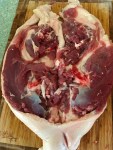
- 2. Debone the duck
-

- 3. Chicken roll is inside the duck
-

- 4. Sear the duck roll
-
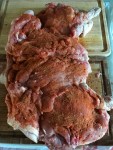
- 5. Debone turkey
-

- 6. Duck roll inside
-
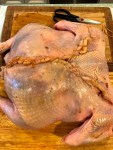
- 7. Sew it all together
-

- 8. Roast in the bag – easiest way to have a moist bird
-

- 9. Done – Turducken is ready
There was plenty of other dishes at the table, but turducken was a star.
Now, let’s talk wine. As you can imagine, Thanksgiving gathering is a not the right place to take detailed notes on the wines. Therefore, I’m sharing here my general impressions.
The day before Thanksgiving the Fall shipment arrived from Field Recordings, and the first bottle which caught my attention was a California Pét Nat:


Pét Nat is a short for Pétillant-naturel, a sparkling wine made with méthode ancestrale, when the wine is bottled before the first fermentatoin is finished – very different from traditional méthode champenoise, where the sparkling wine is made with secondary fermentation in the bottle, done with addition of yeast and sugar. Pét Nat are typically fresh, unfiltered and unpredictable, which makes them even more fun than traditional Champagne. This 2016 Field Recordings Pét Nat Arroyo Grande Valley (100% Chardonnay) was delicious – fresh, creamy, with aromas of toasty bread and fresh apples – an outstanding rendition of Chardonnay.
This wine was the only deviation from Lodi. Our next wine was 2015 LangeTwins Estate Grown Sangiovese Rosé Lodi (12% ABV). While cold, it was crisp and loaded with cranberries, perfectly delicate, without any excess of sugar. As it warmed up, the strawberries took over, mellowing the wine out and making it slightly bigger in the body – and delicious in a whole new way. In a word, a treat.
I can’t describe 2013 Borra Vineyards Heritage Field Blend Lodi (14.5% ABV, 70% Barbera, 10% Carignane, 10% Petite Sirah, 10% Alicante Bouschet) with any other word but riot – tar, tobacco, roasted meat, herbs, dark, muscular, yet round – unique, different and irresistible – the bottle was gone in no time.


2013 Bokisch Vineyards Graciano Lodi (14.5% ABV) was yet another treat – bright, clean, with a good amount of red fruit, herbal underpinning and firm structure. I’m very particular to Spanish grape varietals, and this Graciano rendition was definitely a world class, reminiscent of the best classic versions of the same from Rioja.
NV Lucas Late Harvest Zinfandel Lodi (15.8% ABV) happened to be an enigma. When I tasted the wine at the winery, the wine was mind boggling – rich, concentrated, and perfectly balanced. This wine is quite unique as it is made using the appasimento process, with the grapes partially dried under the sun for a few weeks to concentrate the flavor, before pressing. The bottle which I brought home, was a poor relative of the one I had at the winery – it was not bad, but was completely lacking the opulence and depth of the one I had at the winery. Oh well – this is still one of the pleasures of the wine drinking – you never know what you will find in the bottle.
That essentially concludes the report from our main Thanksgiving celebration. Next day, however, we left to see our close friends in Boston, and at their house, we had two unique wine encounters. One was 1993 (!) Nissley Fantasy Sweet Rosé Wine Lancaster County Pennsylvania (made out of Concord grape). The expectation was that the wine already turned into a vinegar, but instead, we found a port-like wine, with lots of sweetness and also some acidity, so well drinkable overall.
The last surprise was 2006 Yellow Tail Reserve Shiraz Australia (14% ABV), which was still well drinkable, with good concentrated dark fruit, touch of spices, good balance and full body. Well-drinkable 10-years old red wine shouldn’t be a surprise to anyone – but this was actively ridiculed by all the aficionados “creature label” wine, which is not expected to last that long. The bottom line – this wine still delivered lots of pleasure.


Now we are fully done here – this is the story of my Thanksgiving celebration. Did you have any memorable wines this last Thanksgiving? Any unique and interesting dishes? I would love to know. Cheers!
Last Bottle Sign Up ($10 credit)




 Talk-A-Vino