Archive
Daily Glass: Winning and Learning
Sometimes you win, and sometimes you learn.
You never lose – learning is the opposite of winning – I think this is a better approach to life, would you agree?
I love aging my wines. The popular wine press tells people that 95% of the wines in this world are meant to be consumed shortly after purchasing. “Absolute majority of the wine is not meant to be aged,” the message says. I don’t want to obnoxiously invalidate all the expert opinions, but the subject of wine aging is a lot more complicated than the simple statement portrays.
Lots of factors play a role. The wine itself is probably the most critical factor. White wines generally don’t age too well. To be more precise, percentage-wise, a lesser number of white wines can age well compared to red wines. But this doesn’t mean that all red wines age well. For example, red Cotes du Rhone typically don’t age for longer than 4-5 years.
I wish there was an easy method to tell us, wine lovers, that “this wine will age for 30 years”, but “this one got only 10 more left”. There is no such method, however, so we need to rely primarily on our experiences. I’m not trying to disqualify all of the wonderful advice we receive from the wine critic and publications – but it would be rare to receive an aging recommendation there unless the wine is deemed of a “collector” level – which pretty much means that it will not be really affordable.
At this point, you might wonder why is all this commotion with the aging of the wines. Simple. Wine is a living thing. The evolution of the wine continues in the bottle. It is a general hope that wine can improve with time, evolve, become more complex and multidimensional.But the wine can’t evolve forever – at some point it starts “turning”, losing its delicious, attractive qualities.
It is important that the wine drinker can appreciate the beauty of the aged wine – it is not for everyone. I don’t mean it in any disrespectful way – this is simply a matter of taste. One of my most favorite examples is the blind tasting of a few Champagnes which took place during Windows on the World wine classes. After blind tasting 4 Champagnes, the group was asked to vote for their favorite Champagne. Champagne #4 got almost no votes, it was clearly the least favorite of the group of 100+ people. While revealing the wines, Kevin Zraly, our wine teacher, said “and this is why, people, you should not drink vintage Champagne”. Bottle #4 was Dom Perignon – if people would see the label before voting, you know how that would work (”drink up, honey, it is French”). And Vintage Champagne is nothing more than just an aged wine. It is just a matter of taste. The same story goes for food. For example – I love fresh oysters, and I have friends who wouldn’t put an oyster into their mouth even if this will be required to save their own life. Just a matter of taste.
But for those of us who like aged wines, that elusive quest becomes an obsession. I love the Italian term “vino da meditazione”, which applies to the wines which make conversation stop upon the first sip, and puts the whole group of oenophiles into a quiet, self-reflective state. The silence at the table becomes not deafening, but instead a very comfortable one. The silence nobody wants to break.
Okay, such amazing encounters are possible but truly rare. But the pleasure of drinking the well-aged wine is real, and this is what we are seeking. And as we don’t have the scientific method of predicting the peak of enjoyment for a given wine, we have to rely on our own experience. Which takes us back to winning and learning. When we experienced well-aged wine, we clearly won. And when the wine with age doesn’t deliver the pleasure, this is where we learn.
It is not so binary, of course. The point is that no matter what happened, we learn something. When you taste a random but amazing $10 bottle of California red blend (Toasted Head) with 15 years of age on, you learn that inexpensive wines can age too. When you taste 2002 Barolo (Fontanafredda) 10 years after release, and you see that the vintage chart declares this vintage as literally horrible, but the wine tastes good, you learn that the producer matters more than the vintage. When you taste two bottles from the same producer and the same vintage, but you love one of them and can’t stand another, you learn that bottle variation is real and that you have to always manage your expectations.
This whole rambling about winning, learning and aging was prompted by a few wines I opened last week.
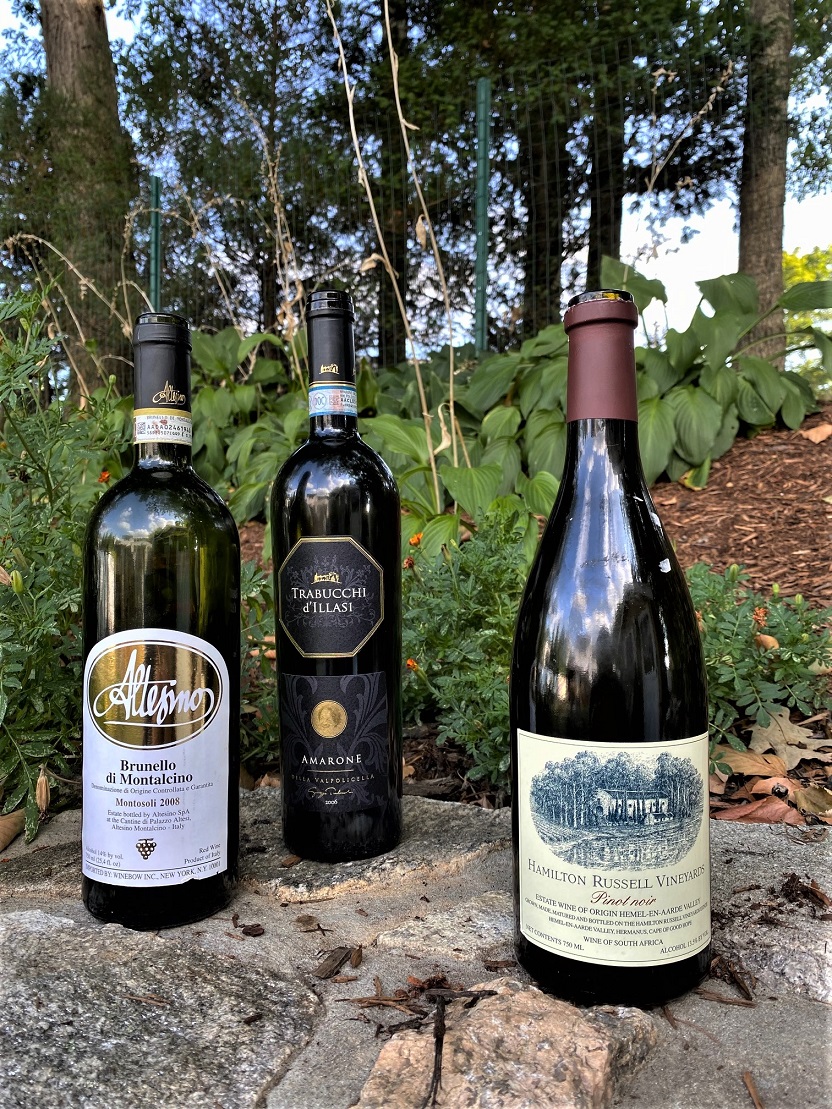
First, the learning part. 12 years ago we did the Pinot Noir blind tasting with friends, with a very unexpected outcome – 2008 Hamilton Russell Pinot Noir from South Africa was the best wine in that blind tasting. I loved the wine so much that I went and got a bottle to keep. Over the years, I made many attempts on the life of this bottle, until the last weekend I decided to share it with a friend. Upon opening the wine was reminiscent of the good Burgundy, with the nose offering some plums, iodine, and smoke. But the wine quickly succumbed to the tertiary aromas of dry herbs and maybe a hint of dried fruit, and while my friend really loved it, this was a complete loss learning in my book.
Then another friend was stopping shortly after his birthday. He always liked the wines, but recently started getting really “more into it”. He was stopping by for the dinner, and when we were talking about wines a few days prior, he mentioned that he started liking the Brunello and Amarone wines. There is no happier moment for the oenophile than to learn what the guest desires to drink – the cellar is instantly paraded in the search for the best and the most appropriate bottle.
I don’t know how I came into possession of the 2008 Altesino Brunello di Montalcino Montosoli, I can only guess I got it as a present. This single vineyard Brunello di Montalcino was absolutely spectacular – beautiful cherries on the palate – not the fresh and crunchy ones, but more subdued, more elegant, eloped in the sage and other herbal aromatics. The wine was spectacular when we opened it, and when I finished the last drop 2 days later (wine was kept in the bottle with the air pumped out), I had a clear feeling of regret as the wine was not gone, but instead was still fresh and even more complex, with a promise of becoming the Vini da meditations in 10 years, same the 1999 Soldera had become for us – alas, I don’t have another bottle…
And then my pet peeve – you know how much I love Amarone. I got a few bottles of the 2006 Trabucchi d’Illasi Amarone della Valpolicella from WTSO 7 years ago. This was my last bottle, and boy it didn’t disappoint. It was absolutely beautiful in its finesse and impeccable balance all the way through. Dried fruit on the nose, powerful, well-structured wine on the palate, with more of the dried fruit, cherries, plums and herbs, and with good acidity, perfect balance and delicious bitter finish. It is not for nothing Amarone means Great Bitter – and there was this pleasant bitterness on the finish, something hard to find in most of the Amarone wines.
Here you are, my friends, my story of winning and learning. Three aged wines, two of them delicious, two that could age for far longer (learning!). One learning experience – but who knows, maybe it was only that particular bottle. Moving on.
What did you win and learn lately?
Anatomy of Flavor
Anatomy of Flavor???
The author clearly goes on a tangent here. Everyone knows what anatomy means, and it has nothing to do with the wine. And nevertheless, let’s take a look at some definitions and see if we can actually analyze the anatomy of flavor.
Webster’s dictionary defines anatomy in a few different ways:


Definition number five describes anatomy as
structural makeup especially of an organism or any of its parts
Anatomy explains to us how living things are constructed. How do they move, jump, roll, smile, and cry.
Of course, the flavor is not a living being – but it is amorous, it changes, it morphs, it is perceived, and it is perceived differently every time, depending on many, many, many factors that we can spend days and days discussing.
I like definition number three more, as it is more appropriate for our purposes:
the art of separating the parts of an organism in order to ascertain their position, relations, structure, and function
Anatomy offers a firm structure – can we apply the same to flavor and understand how our perception of it works? Mostly, and luckily, no – we can’t. We have no idea how we will perceive the flavor of the particular wine once it is open – of course, we have expectations, but this is only one of the subjective factors in our perception of flavor, one of many. Instead, I can offer you to look at how the flavor is being built.
There is also definition number six:
a separating or dividing into parts for detailed examination
Anatomy explains to us how our muscles work and how they grow. Let’s see if we can take a similar look at the flavor of the wine.
We can’t do this with any random wine – if someone makes single-grape Syrah, Grenache, and Pinot Noir wines, all those wines are not connected to each other, they are unique and different – we can not taste Syrah and make expectations about Pinot Noir (assuming these are good quality wines) – as they have nothing in common. Most importantly, they better taste differently. But – there are wines which are perfectly suitable for our exercise. Do I have an example? Of course, glad you asked, but before we talk about particular wines, let’s take a look at the region they are coming from. Let’s go to Northern Italy, to the region called Valpolicella.
Valpolicella is a winemaking region east of Lake Garda, in the province of Verona, which is in turn located in Veneto. The region is influenced by the Alps to the north, Lake Garda to the west, and the Adriatic Sea to the east. Valpolicella received its DOC status in 1968, and Amarone and Recioto received the DOCG status in 2009. In terms of DOC wine production volume, Valpolicella is the second region in Italy after Chianti.
There are a few types of wines produced in the region – Valpolicella DOC, light wines considered to be similar in style to Beaujolais, Valpolicella Superiore, which should be aged at least one year, Valpolicella Ripasso, and, the most coveted wines, Amarone and Recioto.
It is not exactly known when winemaking started in Valpolicella. Still, it is typically associated with the ancient Greeks who were famous for making sweet wines made from partially dried grapes. That tradition of drying grapes before pressing is also a requirement for both Recioto and Amarone wines – this converts grapes to almost raisins and concentrates flavors. A lot of attention is also paid to preventing any sort of rot setting on the grapes as this imparts undesirable flavors.
Talking about red grapes, Corvina, Corvinone, Rondinella, and Molinara are considered the main winemaking grapes, even though many winemakers are trying to avoid Molinara as of late. Corvina should constitute between 45% and 95% of the blend – but up to 50% of Corvina can be substituted with Corvionone, which was identified as a distinct variety and not a clone of Corvina only in 1993. Out of all Val[policella wines, Ripasso stands aside as quite unique – it is made by macerating the Valpolicella wine with the pomace (grape skins) left after making Amarone and Recioto wines, which enriches the flavor of the wine – Valpolicella Ripasso is often referred to as “baby Amarone” (or “poor man Amarone” – you take your pick).
Of all wines made in Valpolicella (most of them are red), Amarone stands apart as the most sought-after. The grapes have to dry for anywhere between 3 and 4 months before they can be pressed to make Amarone. Those dried fruit flavors are retained by the final wine, assuming it is well made. The combination of the dried fruit aromas and powerful, dry, usually high-alcohol wine creates really a unique experience – if you have not had Amarone before, this is something that needs to be experienced by any wine lover.
Also going back to our “premise” with this post – to take a deeper look at the build-up, the anatomy of the flavor, Valpolicella wines offer an almost unique opportunity. Most of the Valpolicella wines are made from the same set of grapes, sometimes even used in the same proportions. The winemaking process is what creates the difference. Base Valpolicella wine can be aged for a year to get to Superiore designation. The same base wine can be macerated with Amarone pomace to become the Ripasso. The same grapes that are used for basic Valpolicella can also dry for 3-4 months, and then become an Amarone.
Let’s go one level deeper and look at some practical examples, shall we?
Tedeschi family ancestors purchased vineyards in Valpolicella four centuries ago, in 1630. The modern history of the Tedeschi winemaking family started 200 years ago, in 1824 when the family winery was established by Niccolò Tedeschi. Today the winery is operated by the fifth generation of the family, continuing the winemaking traditions.
Tedeschi estate is located in the village of Pedemonte di Valpolicella, with 75 acres of vineyards planted on the 200 acres estate. Tedeschi firmly believe that good wines are made in the vineyard, and they focus not only on showcasing the terroir but also conduct studies to understand the soil composition in the vineyard. Another important winemaking element is the use of not only the main 3 Valpolicella grapes (Corvine, Covinone, Rondinella) but the full range of grapes including Rossignola, Oseleta, Negrara, Dindarella, and Forselina. They also produce all types of Valpolicella wines – Valpolicella, Valpolicella Superiore, Ripasso, Amarone, and Recioto.
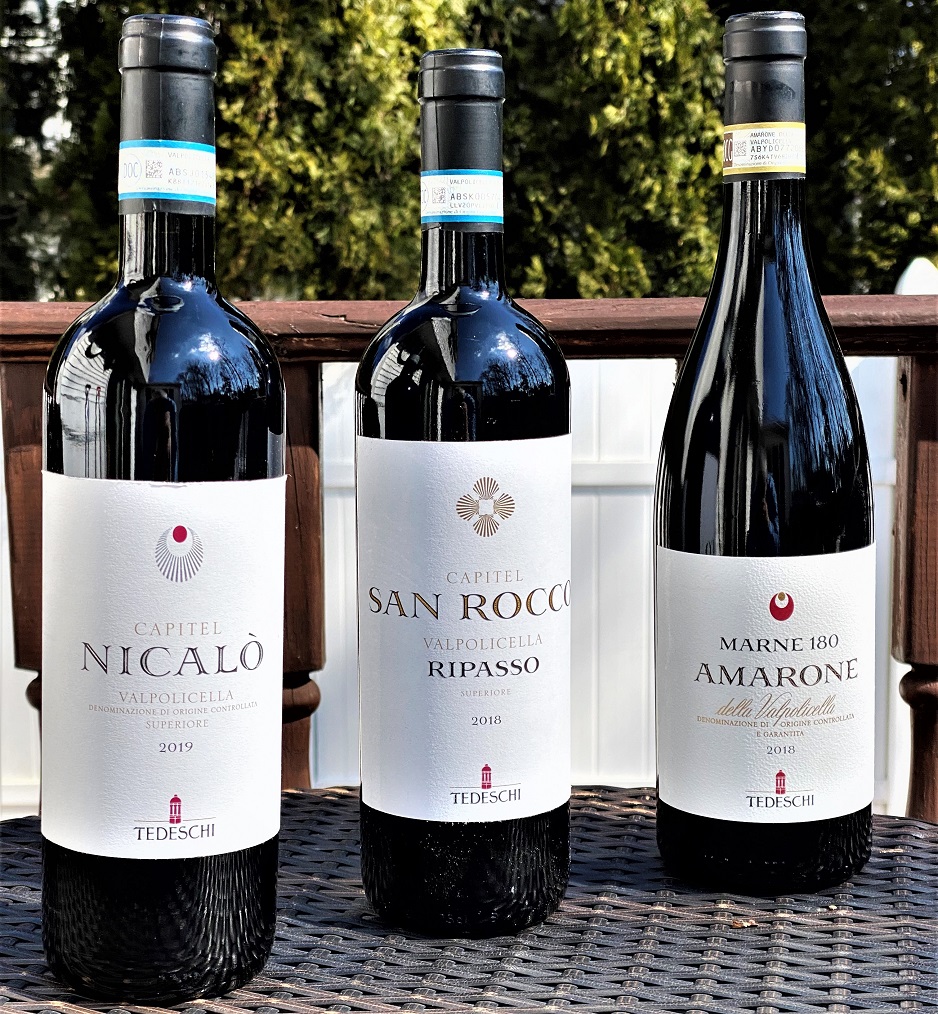
For our “anatomy” exercise, I had an opportunity to taste 3 of the Tedeschi wines – Valpolicella Superiore, Valpolicella Ripasso and Amarone della Valpolicela. All three wines are made from the identical set of grapes, used in the same proportions, so the difference is only in the winemaking techniques. Below are my notes with some additional information about the wines.
2019 Capitel Nicalò Valpolicella Superiore DOC (13.5% ABV, 35% Corvina, 35% Corvinone, 20% Rondinella, 10% Rossignola, Oseleta, Negrara, Dindarella, grapes drying for 1 month, 1-1.5 years in Slavonian oak barrels, 6 months in the bottle)
Dark ruby
Captivating nose of earthy dark fruit, tobacco, rocks
Beautiful fruit, blackberries, cherries, cherry pit, tart, focused, perfectly structured, perfectly balanced – lots of pleasure.
8/8+. Delicious.
2018 Capitel San Rocco Valpolicella Ripasso Superiore DOC (14.5% ABV, 14.5% ABV, 35% Corvina, 35% Corvinone, 20% Rondinella, 10% Rossignola, Oseleta, Negrara, Dindarella, alcoholic fermentation on the marc of Amarone and Recioto for 8-10 days, 1/2 years in Slavonian oak barrels, 6 months in the bottle)
Garnet
A hint of dried fruit, toasted nuts
Round fruit, cherries, soft, approachable, earthy undertones, well-integrated tannins, a hint of tobacco on the finish.
8/8+, delicious.
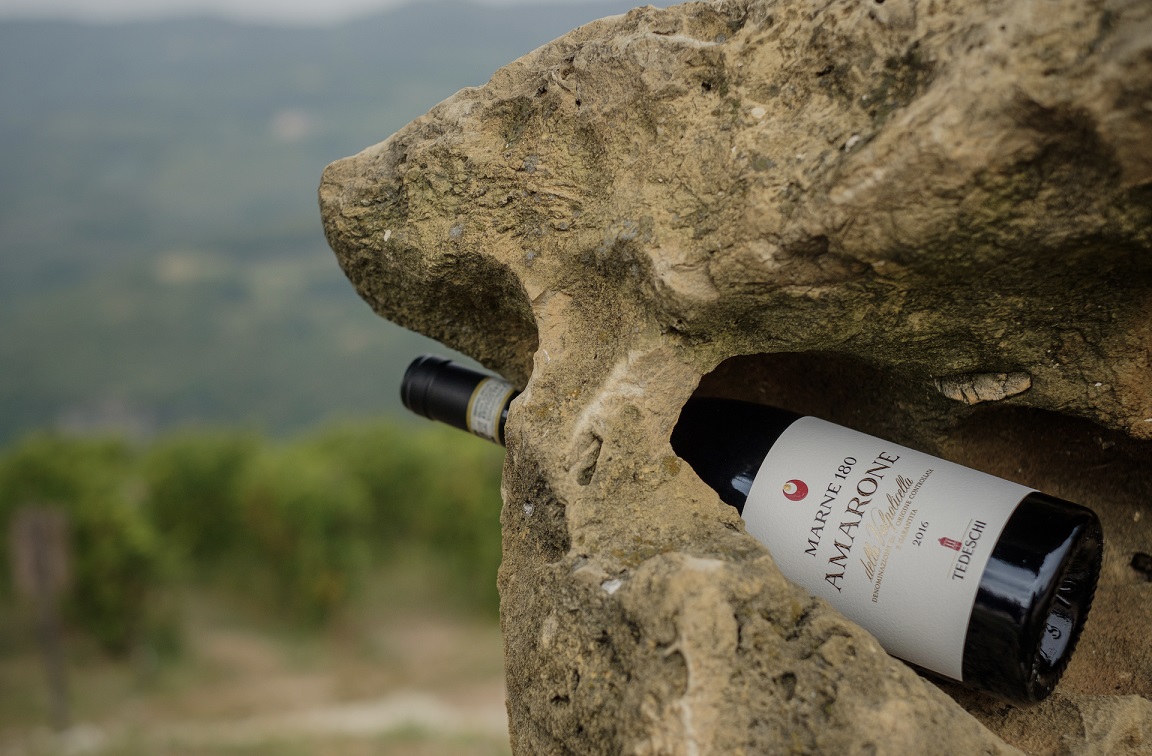
The name Marne 180 is a nod to the marl soils where the vineyard is located and 180 is degrees of exposure, from south-east to south-west. Source: Tedeschi
2018 Marne 180 Amarone della Valpolicella DOCG (16.5% ABV, 14.5% ABV, 35% Corvina, 35% Corvinone, 20% Rondinella, 10% Rossignola, Oseleta, Negrara, Dindarella, grapes drying for 4 months, 30 months in Slavonian oak barrels, 6 months in the bottle)
Dark garnet
Dark, concentrated, forest underbrush
Dried fruit, cherries, intermingled layers, powerful, well structured, delicious.
8+
Can we conclude anything from our flavor research? The wines share some similarities, but this is probably all I can say. I don’t see a clear progression from one wine to another, they are simply tasty wines, each one in its own right. Does it mean that we can’t talk about the anatomy of the flavor? I think we still can, but it is definitely more complicated than it seems.
The important outcome of this research project is three tasty wines from Tedeschi which I’m happy to recommend to you for your daily drinking pleasure. And this is the best conclusion we can make. Cheers!
One on One With Winemaker: Lucio Salamini of Luretta
If you call yourself a wine lover, you definitely have an affinity for Italian wine. I have yet to meet a wine lover who doesn’t like Italian wine – there is such a range of wines coming from Italy, everyone can find at least something which speaks to their heart and palate.
By the same token, I’m sure that the knowledge of Italian wines is quite widespread among the wine-loving public. So let’s play a simple game. There are 20 administrative regions in Italy. I will give you the name of the region, and you will tell me one, the most famous wine associated with that region. Let’s start with Tuscany – what wine do you associate with Tuscany? Of course, you are correct, it is more than one – Chianti, Brunello, super-Tuscan. How about Piedmont? You are right again – Barolo and Barbaresco come to mind first. Veneto? Yes, correct – Valpolicella, and if you said Amarone, you get an extra point (I’m a sucker for a good Amarone).
Now, how about Emilia-Romagna? Are you drawing a blank? I can help you – a large region in northern-central Italy, right above Tuscany? Still nothing? If someone said “Lambrusco”, congratulations, it is actually the most famous wine coming out of Emilia-Romagna, but it is absolutely not the only one.
The winemaking region of Colli Piacentini is located in the western part of Emilia-Romagna, with winemaking history in Colli Piacentini going back to 2000 B.C. Colli Piacentini DOC covers about 9,000 acres of vineyards with various microclimates defined by mountains, hills, and river valleys. There are 16 DOCs within Colli Piacentini, with grape varieties ranging from the typical Italian varieties such as Barbera, Croatina, Malvasia, and Trebbiano to the international stars – Cabernet Sauvignon, Sauvignon Blanc, and others. It is interesting that Colli Piacentini DOC rules allow putting the name of some of the grape varieties on the front label, quite unusual for the old world.
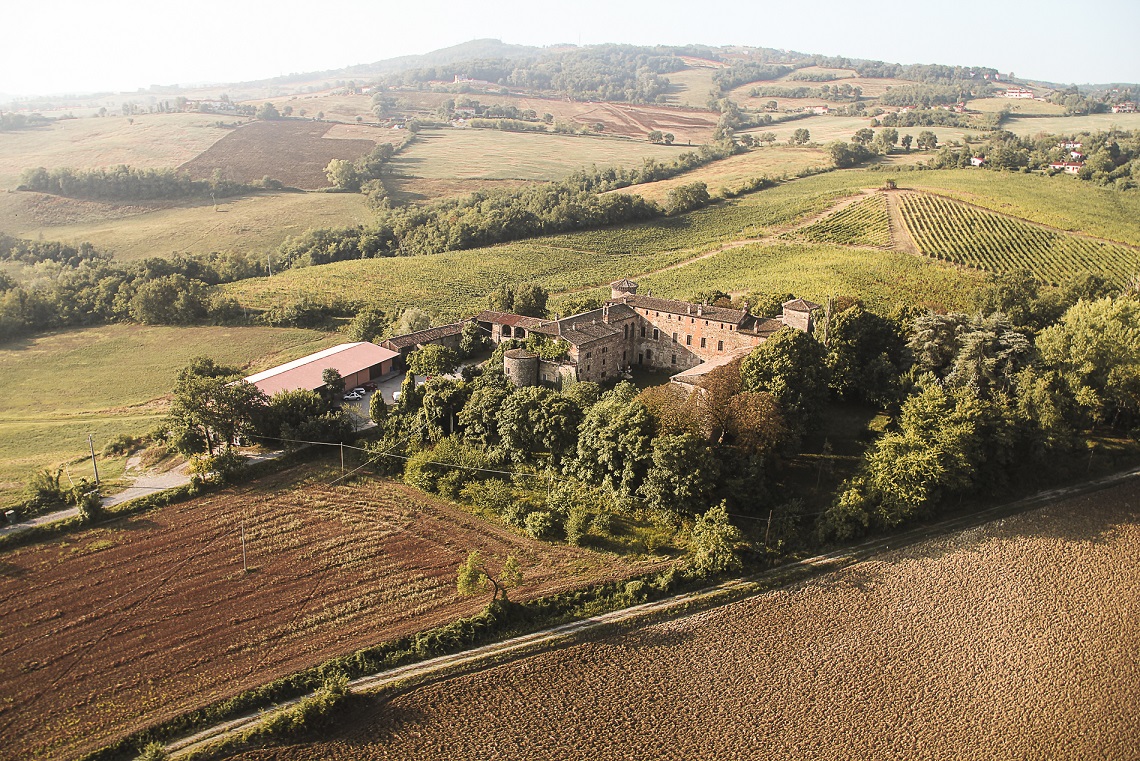
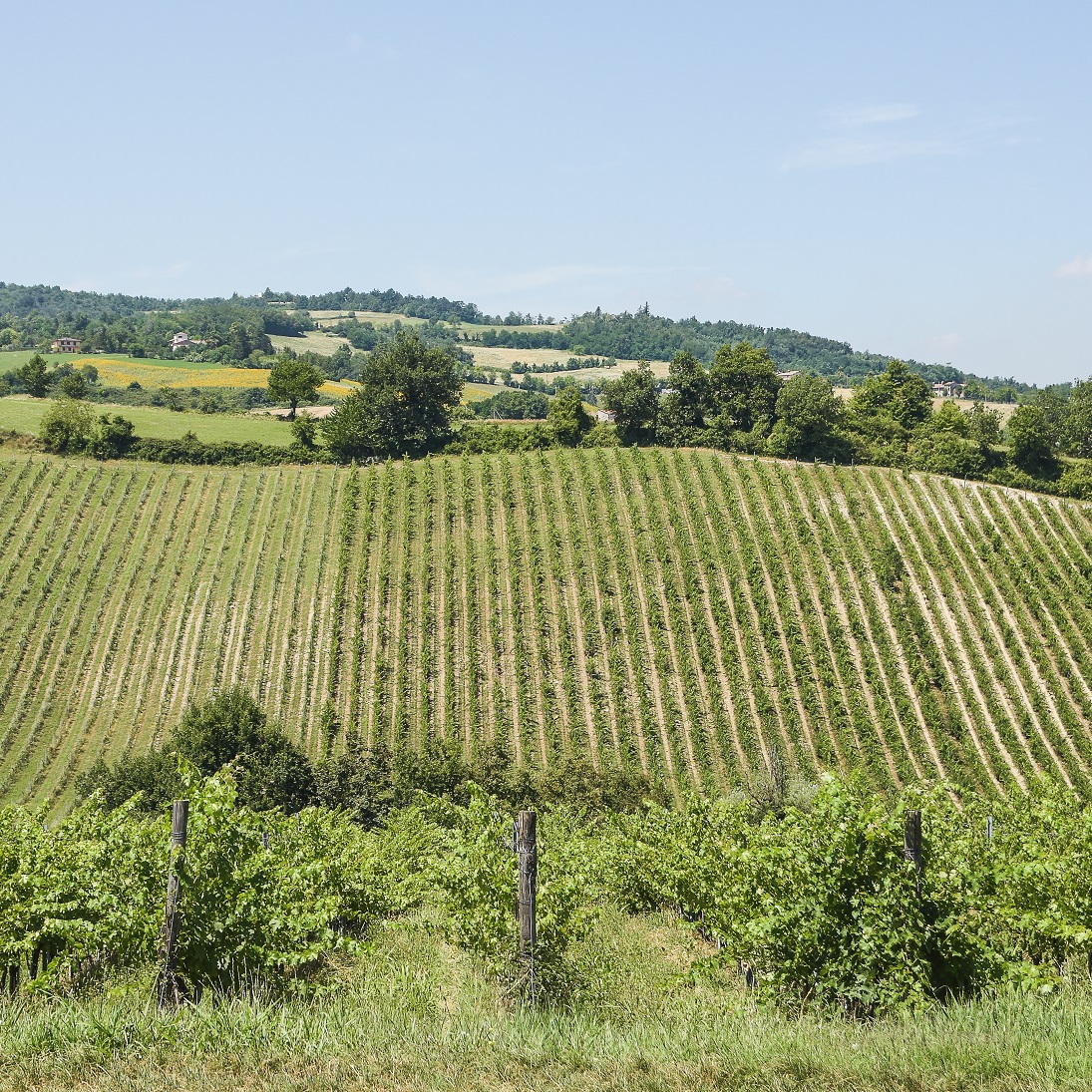
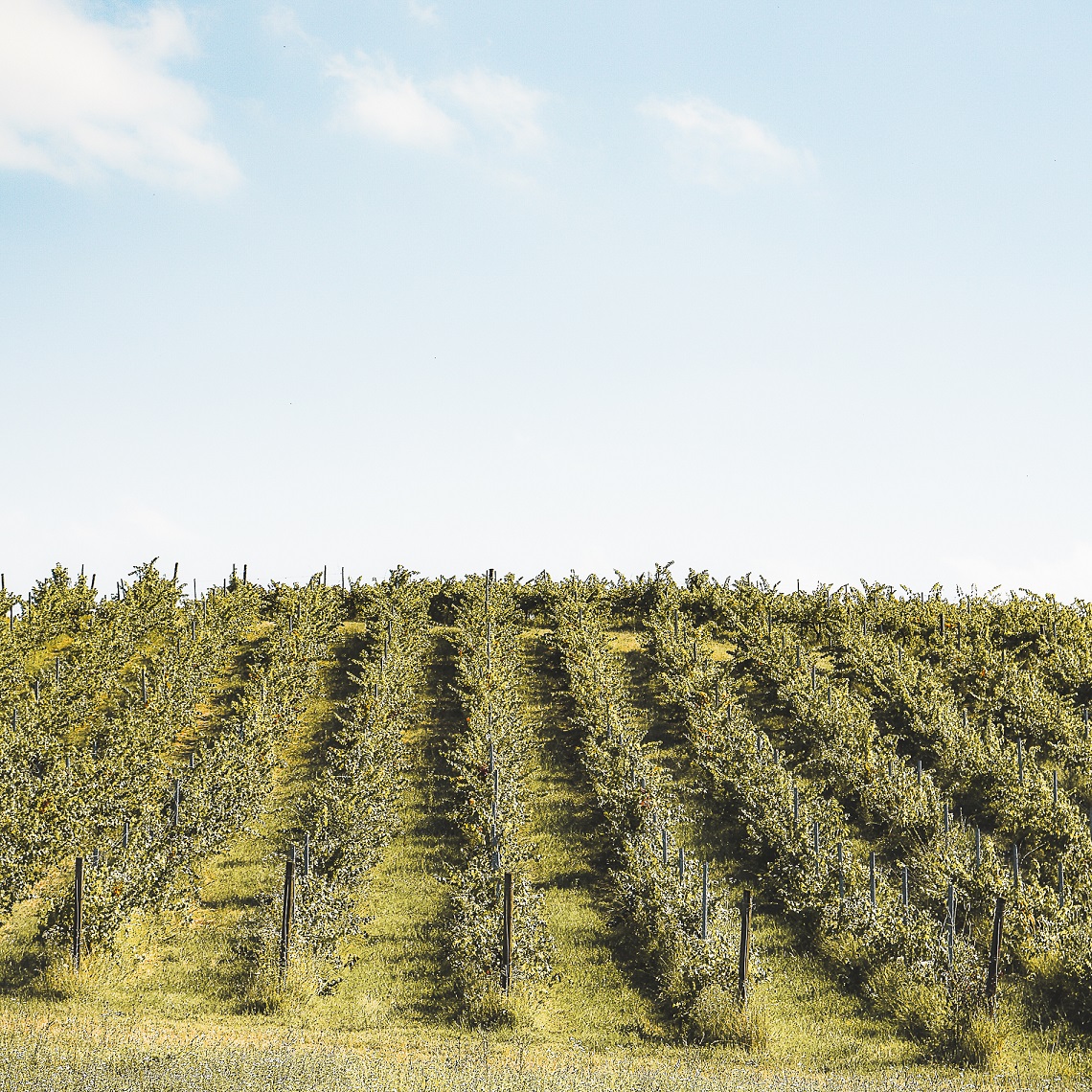
After spending some time in France and learning local agricultural traditions, Felice Salamini, a cattle breeder, came across the Castle of Momeliano, a fortress almost 1,000 years old, nestling in the hills of Emilian valley. This seemed to be an ideal place to grow grapes, make, and age wines, and in 1988 Luretta was born.
Luretta vineyards occupy 123 acres, surrounding Castle of Momeliano on the hill from 800 to 1,650 feet elevation. From the beginning, Luretta started using organic viticulture, with no herbicides, no synthetic fertilizers, and no irrigation. In 2000, Lureta obtained Italian certification for sustainable practices. Many of the French varieties – Cabernet Sauvignon, Merlot, Petitte Verdot, Pinot Noir – are growing there among the indigenous varieties – Barbera, Malvasia, Trebbiano, and many others.
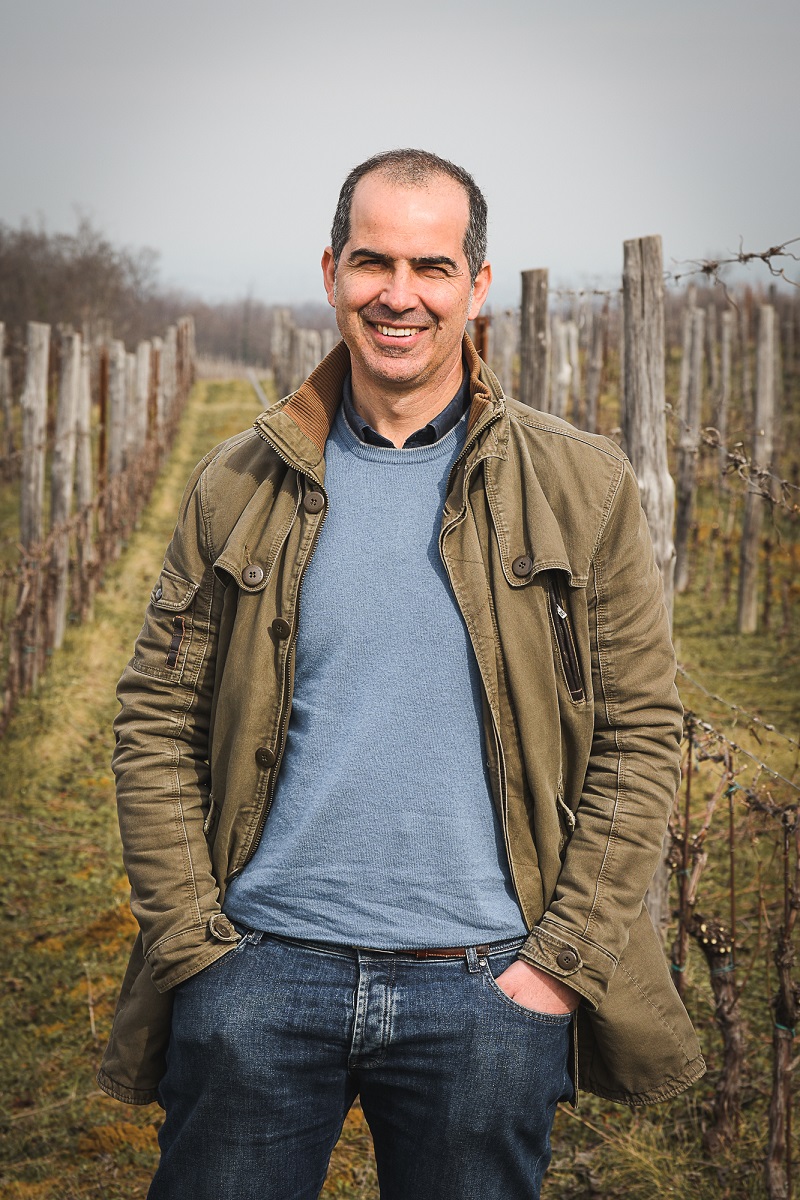
Lucio Salamini. Source: Luretta
Lucio Salamini, the second-generation owner of Luretta, is now leading the charge at the winery, working together with winemaker Alberto Faggiani, the longtime enologist at Jermann, overseeing the annual production of about 300,000 bottles. Each white, red, and sparkling wine produced by Luretta has its own unique story, showcasing the diversity of Colli Piacenti terroir. I had an opportunity to virtually sit down with Lucio and ask him a few questions – here what transpired in our conversation:
[TaV]: Let’s start with your website, which I find very interesting. Each wine has its own set of images associated with it on the website – how do you come up with those images?
[LS]: We really enjoy creating personalized and evocative image for the company. Usually we draft drawings that can create mental associations to get closer to the wine, that recalls its history, flavors, and characteristics, and then we embed them in our labels and throughout the website. We have always been believers of ‘mental’ pairings, so to create a match not just between a wine and a dish, but also a song, a climate, a mood, a season, a moment in the day or a moment in life. These drawings are vehicle for those impalpable connections.
[TaV]: One more question related to the same subject. Each wine also has a quote associated with that specific wine. How do you come up with those? What is the message you are trying to convey?
[LS]: It is a quote I like from a song, a book or a movie. These mental associations help me get deeply into the mood of that specific wine.
[TaV]: You have been farming organically since 2000. Have you ever considered biodynamic farming? What is your take overall on biodynamics?
[LS]: The company has been organic since almost the beginning of its practice, since the early 1990s. Then in 2011, Europe introduced the regulation of Organic Wine and we aligned to sustainable practices also for what concerns the processes in the cellar. However, we do not follow the Steiner philosophy of biodynamic agriculture. I do not often approve it but admire it as a whole concept and I think that this movement is too often carried followed in a superficial way that does not deserve. Biodynamic farming is a way of cultivating the land and making wine aimed to preserve nature and what people drink. It is an all-embracing philosophy and, as such, it should concern the whole lifestyle of the producer and his vision of the world. In this light, for me is not coherent to ship the wine on a boat or a plane to sell it on the other side of the world. But maybe let’s leave this controversy alone!
[TaV]: You have quite an international selection of the grapes – Pinot Noir, Sauvignon Blanc, Cabernet Sauvignon, etc. What made you plant international varieties in the first place? Do you find your terroir particularly conducive to the international varieties?
[LS]: We were pioneers in this area of Piacenza. We had to experiment first in order to understand better. Thus, planting International varieties was a part of a whole pioneristic phase that informed our practice since the beginning. Often, but not always, this has proved us right. Indeed, it is an area that is well suited to international vines as well as, of course, traditional vines.
Besides the drive to try and experiment, we also have a pure deep passion for international varieties.
[TaV]: In a blind tasting, if your Cabernet Sauvignon would be placed together with super-Tuscan, which wine do you think might win?
[LS]: In the autumn of 2021, there was this tasting by the famous critic Daniele Cernilli ( Dr. Wine ) where my cabernet came out very well, despite costing on average a third of the other bottles. And I was very proud of that, of course! In general, though, I believe that parallel tastings should not be done to see who wins but rather to understand and enjoy the differences between the various territories.
[TaV]: The same question as before, but let’s replace super-Tuscan with Napa Valley Cabernet Sauvignon – how do you think your wine would fare against those?
[LS]: I would say that whether the super Tuscans and Napa wines focus on food, power, softness and low acidity, my wine has more tertiary hints of evolution such as spices, aromatic woods, pepper, balsamic, and then, instead of looking for softness, it pushes towards a tannic acid balance in the mouth, underlining the sapid and mineral notes of Colli Piacentini, our soils.
[TaV]: Do you have any plans for additional international varieties – Syrah, for example?
[LS]: I have experimented over the years with plantings of Syrah, Grenache, Cabernet Franc and Petit Verdot. But they have not been successful. And the vineyards were either grubbed up or replanted, proving that not all varieties can adapt to these soils.
[TaV]: You are farming 123 acres of estate vineyards. Have you identified vineyard plots that perform better/different from the others? Do you have any plans for single-plot wines in the future?
[LS]: The map of the single vineyards with names, varieties, altitudes and soil differences will be ready in September. It is a project we have been working on since January. Broadly speaking, we have the autochthonous vines planted up to an altitude of 820 ft above sea level, characterized by the “Terre rosse antiche” (old red soils in English) soil, loaded with red clay.
The international vines, on the other hand, are planted in vineyards ranging from an altitude of 800 ft to 1400 ft above sea level, in the lands of lower Apennines, characterized by a greater concentration of limestone. Most of the vineyards are located within the small Val Luretta – which gives the name to the company- characterized by a temperate microclimate, protected from either spring frosts, summer heat waves and large concentrations of humidity thanks to a lucky flux of air that constantly blows in our lands.


Wine time!
I had an opportunity to taste 2 of Luretta’s wines.
2019 Luretta Boccadirossa Colli Piacentini DOC (13.5% ABV, $30, 100% Malvasia di Candia Aromatica) had beautiful golden color. A beautifully perfumed nose of wild flowers and tropical fruit was supported by the body which was plump and crisp at the same time, with white plums and lemon and a perfectly acidic finish. Overall, solid and delicious.
2018 Luretta Superiore Gutturnio DOC (14.5% ABV, $25, 50% Barbera, 40% Croatina, 9 months in wood) was as quintessential Italian as only the Italian wine can be. The nose of leather and cherries followed by the exquisite palate of sweet cherries, leather, and a hint of tobacco, layered, generous, earthy, and complex.
Here you are, my friends – unexpected, unconventional, and well worth seeking Italian wines, waiting to be discovered by wine lovers around the world. Cheers!
Sangiovese Games and Power of Words
 Okay, folks, this might be the scariest post I have ever written. This might lead to unsubscribes, unfollows, ostracism, and public shaming. Well, it is what it is.
Here it comes, my confession.
I don’t know how Sangiovese tastes like.
Here, I said it. You heard me right, and I can repeat. I do not know how Sangiovese tastes like.
Still here? Okay, then I would like to ask for a chance to explain.
I know how Cabernet Sauvignon tastes like. Whether it is produced in Bordeaux, California, Australia or Tuscany, I still expect to find cassis, maybe eucalyptus, maybe mint, maybe bell peppers.
I know how Pinot Noir tastes like. No matter whether it comes from Burgundy, South Africa, Oregon, New Zealand, or California, I still expect to find cherries, maybe plums, maybe violets, maybe some smoke.
I can continue – I know how Chardonnay tastes like (from anywhere), I know how Riesling tastes like (from anywhere), I know how Sauvignon Blanc tastes like (from anywhere). I still don’t know how Sangiovese tastes like.
While we are talking grapes, we are also talking about the power of words. As soon as we hear Cabernet Sauvignon, Pinot Noir, Chardonnay, Riesling, Sauvignon Blanc, we have an instant mental image, set our expectations, and the first sip of wine is judged against that mental image. Of course, we make regional adjustments – Pinot Noir from Oregon might offer dark chocolate, espresso, and mocha in addition to the cherries, but cherries will be there. Bordeaux (okay, it is usually a blend, so this might be a bad example) is expected to be leaner that’s California Cab, but it will still show that cassis core. And I still have no clue how Sangiovese should taste like.
I know how Brunello tastes. It is 100% Sangiovese, but it has its own unique taste profile with layers of tart cherries and cherry pits framed by oak notes and firm tannins. I know how Vino Nobile de Montepulciano tastes. It is also 100% Sangiovese, with tart cherries usually weaved around a core of acidity. I know how Chianti typically tastes. It has to be at least 80% Sangiovese, plus other grapes, and it will have the cherries usually surrounded by leather and tobacco.
Brunello, Vino Nobile, Chianti are renditions of Sangiovese, but they are references only to themselves. When I hear any of these names, I know what to expect. But I still don’t know how Sangiovese tastes like.
I don’t know if you ever had a chance to experience Shafer Firebreak. This wine used to be made from California Sangiovese (92%) with the addition of Cabernet Sauvignon (8%), the percentages are representative of the last vintage which was in 2003 (Sangiovese plantings were removed after that). This wine had nothing in common with any of the Italian Sangiovese renditions, but instead had a smoke, espresso, and powerful dark fruit. A very memorable rendition of Sangiovese – but not referenceable.


You might be annoyed at this point by me constantly repeating “I don’t know how Sangiovese tastes like” and wondering where I might be going with that. So this post was triggered by a few events. Last year, I got a few samples of Sangiovese from Castello di Amorosa. When I tasted them, they were reminiscent of Chianti, and I even had to open a bottle of Cecchi Chianti, which is an outstanding producer making Sangiovese wines with exemplary regional expressions, to compare. I also tasted a bottle of California Sangiovese which had only a name of Sangiovese, but really tasted more like a fruit compote mixed with a fruit cake. As the end result I realized that I have no idea how Sangiovese actually should taste like – and here I am, pondering at the subject with you, my dear reader (I hope someone is still reading this, eh?)
So let me take you a bit further with a few of the tasting notes and references.
First, I have to say that I probably found what can be considered a reference Sangiovese. Two years ago I had an opportunity to taste a range of wines from Cecchi, and one of the wines was called Sangiovese Toscana IGT. It was not Chianti of any kind, it was pretty much an unadulterated rendition of a pure Sangiovese from the motherland, from Tuscany, which was not even aged in oak, only 2 months in the bottle. Here are the notes:
2018 Cecchi Sangiovese Toscana IGP (13% ABV, $10)
Dark ruby
Cherries, coriander, sage
Light, bright, fresh cherries, crisp acidity, sweet basil, refreshing.
8+, can be perfect even on a summer day, but I can’t complain on a winter day either. Unique and different.
The wine was absolutely spectacular in its pristine beauty and an absolute steal for the money. Ever since I tasted this wine it became my reference for how pure Sangiovese might take like.
Now, the peculiar California Sangiovese I mentioned before was the 2017 Seghesio Venom. 100% Sangiovese from Rattlesnake Hill in Alexander Valley, 14.9% ABV, $55. Seghesio is a Zinfandel specialist, and they are good at that. If this wine would be called Zinfandel, I would have no issue with it. But under Sangiovese name, it makes me only wonder what possessed Seghesio to make a wine like that. A fruit compote with a bit of a structure doesn’t equate to Sangiovese in any shape and form. And at the price, if you just want to drink a California wine, it might be fine, but if you are looking for Sangiovese, just look elsewhere.
Well, you don’t need to look too far. Castello di Amorosa in Napa Valley is really focusing on bringing their Italian heritage to wines they craft in California. Yesterday I talked about their range of Pinot Noir wines, which was excellent. Their California Sangiovese can probably be called a glorious success as I even had to open a bottle of classic Chianti to compare the notes.


I tasted two Sangiovese wines from Castello di Amorosa (for the history of the Castello, which is very fascinating, I would like to refer you to the link I included above).
2017 Castello di Amorosa Sangiovese Napa Valley (14.7% ABV, $36)
Dark garnet
Plums, cherries, baking spices
Plums, tart cherries, light tannins, medium body, good structure, a hint of leather.
8-/8, it is reminiscent of the Chianti, nicely approachable, but will improve with time, judging by the late tannins on the finish on the second day.
2018 Castello di Amorosa Voyager Vineyard Sangiovese Napa Valley (14.5% ABV, $45, single vineyard)
Dark garnet
Smoke, granite, gunflint, tobacco, dark fruit, Very promising.
Tobacco, baking spices, cut through acidity, medium body. Very unusual. Needs a bit of time.
Tart cherries, a hint of vanilla, bright acidity. Reminiscent of Chianti, but not as earthy
8-
And then I opened a bottle of Cecchi Chianti and was pleasantly surprised how successful Castello di Amorosa was with their Californian Sangiovese rendition.
2017 Cecchi Chianti DOCG (13% ABV, $14)
Dark garnet
Herbs with a hint of cherries
Tart cherries, good acidity, fresh berry profile, medium body. Was earthy upon opening, but mellowed out after a few hours in the open bottle.
8-, easy to drink, nice.
As you can tell, the wines are similar, and I would call it a very successful effort.
Well, I still don’t know how Sangiovese should taste like, because this is all in the words. Unless we taste blind, we are bound by the power of words, and therefore our excitement and disappointment are fully dependent on those words. Was the Venom a bad wine? No, but it is an utter disappointment when called a Sangiovese. Thanks to Castello di Amorosa successfully offering a saving grace. While I still don’t know how Sangiovese should taste like, I’m willing to continue the quest for the tastiest rendition.
If you are still with me – thank you for reading and cheers.
So Long, Catarratto. Welcome, Lucido
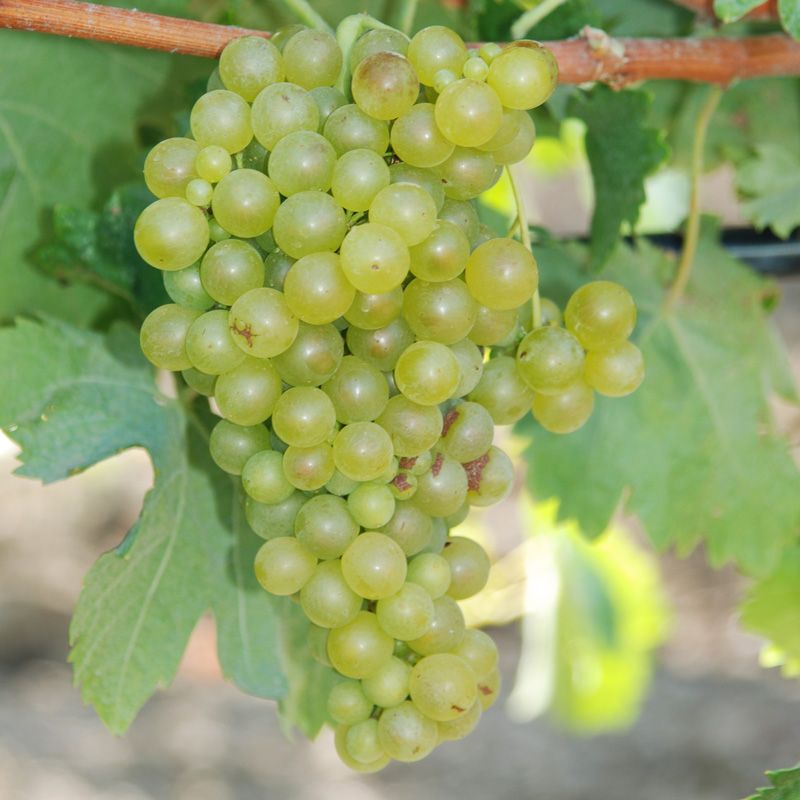
Catarratto grapes. Source: Sicily DOC website
It is a mouthful of the title, isn’t it?
“So long, Catarratto, welcome Lucido” – a bunch of strange words lumped together seemingly without any purpose, right?
Okay, I get it – some explaining is due.
Catarratto is the most planted white grape in Sicily and the second most planted white grape in Italy. Sicily has about 75 acres of Catarratto vines between two of its clones, Catarratto Bianco Comune and Catarratto Bianco Lucido, which represents 30% of the whole vineyard area in Sicily. Catarratto production increased from 17,300 bottles in 2012 to 730,000 bottles in 2020. And it is one of the historical varieties, growing forever on the island, producing fresh, round, and well-balanced wines. Sounds great, right? I would assume that you sense that the “but” is coming. So what is the problem with this picture? The name, Catarratto, is the problem.
Catarratto – pronounced “kah-tahr-rat-to”. Say it a few times, just for fun. Think if you will be comfortable ordering it in the restaurant, while just calling it by name instead of pointing with your finger on the line in the wine list saying “this”, “I want this”.
As Catarratto was growing in popularity, its name became a barrier. People don’t want to be embarrassed. And saying the word you don’t know how to pronounce requires a lot of courage. When Sicilian wines were presented at the seminar in China 10 years ago, there was enough of the anecdotal evidence collected in the form of videos with attendees struggling greatly while trying to pronounce the word Catarratto. And so it was well understood by the Sicilian winemakers that if they want to be successful with the wine which actually well deserves such success, something needs to be done.
Lucido is the name of one of the clones of Catarratto, and it is the name that often was used in ancient times. While Catarratto Bianco Lucido has a slightly different appearance compared with Catarratto Bianco Comune with Lucido grapes being shiny (hence the name), genetic research showed that both grapes are completely identical (speaking of genetics – another Italian grape, Garganega, is considered to be one of the parents of Catarratto, but then nobody knows where Garganega came from… ).
Sicilian DOC Consortium took this grape renaming task to the heart and after 2 years of lobbying, on November 21, 2018, the national Ministry issued a decree allowing the name Lucido to be used for any of the Catarratto wines produced in Sicily.
There are about 530 native grape varieties in existence in Italy, so it is obvious that setting up the precedent with renaming the grape variety was not taken lightly. But in the case of Catarratto/Lucido, it became very clear that considering the volume of production and possibilities of increased international demand, the hard-pronounced name of the grape variety became a gating issue of the wine’s success, and the right decision was made.
While Sicilian winemakers definitely appreciated the opportunity to change the name, it doesn’t mean that in mere 3 years you will see the name Lucido appear on all the wine labels. While we might think that the picture should look like this:


the 3 samples which I received looked like this:
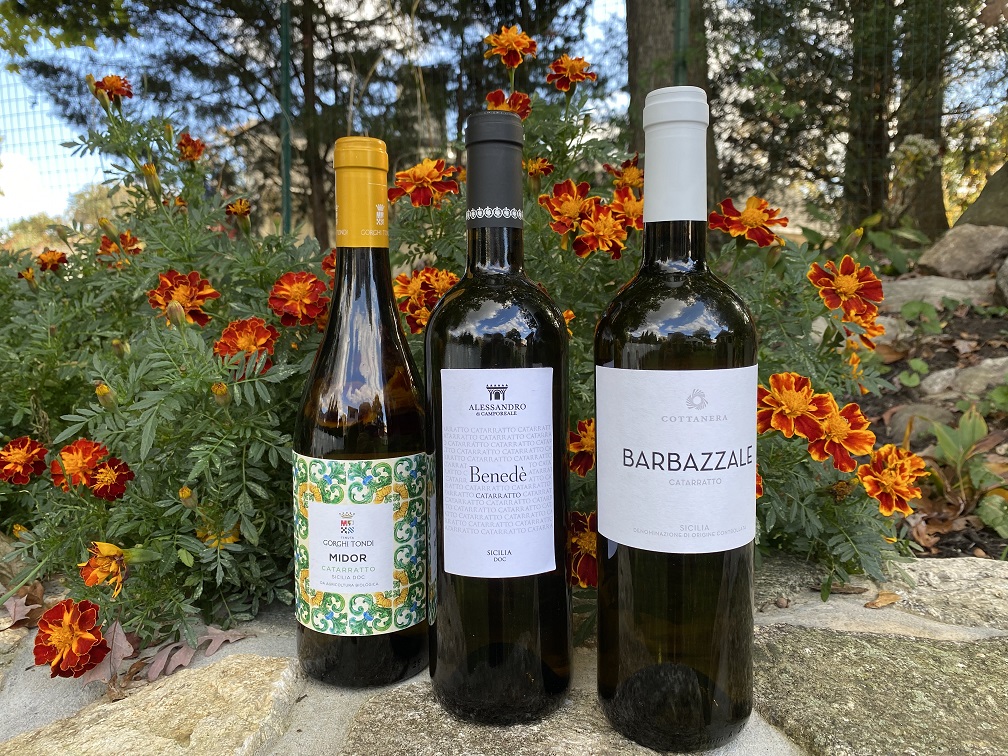
Well, whether Catarratto is difficult to pronounce or not had no bearing on the wines, as I loved all three of them:
2020 Cottanera Barbazzale Catarratto Sicilia DOC (12.5% ABV)
Straw pale
A hint of tropical fruit, lemon, herbs
Round, beautiful, Golden delicious apples, lemon, good acidity, clean and fresh.
8/8+, outstanding.
2020 Tenuta Gorghi Tondi Midor Catarratto Sicilia DOC (12.5% ABV, organic grapes)
Straw pale
Generous nose with a hint of vanilla, honey, and gunflint
Crisp, clear, precise, elegant, beautiful acidity, lemon, more gunflint, and Granny Smith apples.
8+, can be easily confused for a Chardonnay. Wine with finesse.
2019 Alessandro di Camporeale Benedè Catarratto Sicilia DOC (13% ABV)
Straw pale
Lemon, steely minerality
Crisp, tart, lemon, expressive minerality, clean acidity. Very refreshing
8, excellent food-friendly wine
I wouldn’t lie to you – Midor Catarratto was my most favorite wine, and I really admire its tile-styled label.
Catarratto’s name served the eponymous grape well, but the change is coming. It is a slow change, but as long as it is just the change of the name, and we will still get to enjoy the wine inside the bottle, it is the change that will help this wine to deliver pleasure to more wine lovers around the world.
And for you, my wine friends, Catarratto or Lucido – go find this wine and expand your wine vocabulary.
Welcome, Lucido.
P.S. For the grape geeks out there: as I was working on this post, I came across this article, which identifies Mantonico Bianco as the second parent (along with Garganega) of Catarratto. The article is from 2017, so it should be old news, but at least the Wikipedia article on Catarratto has no mention of it…
Daily Glass: For The Love Of Appassimento
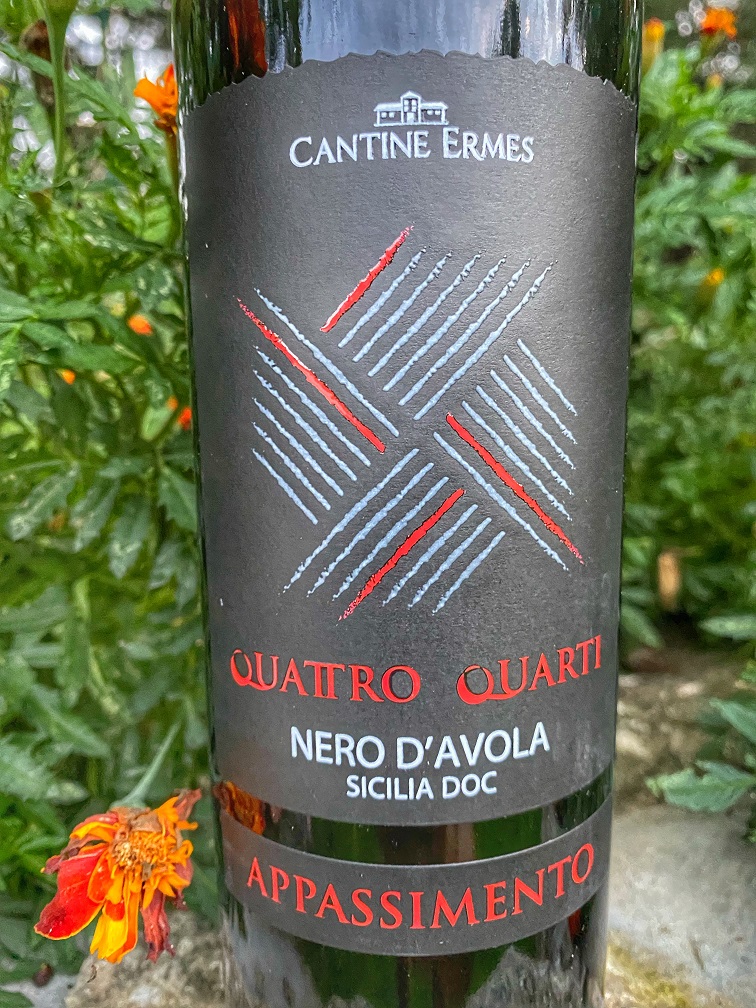 Appassimento is an Italian word that means “drying”. Thus very appropriately, appassimento is the process where after the harvest, grapes are dried for some time (from 3 weeks to 6 months) before being pressed and fermented. Now, the question to the audience: name any wine (just type, no need for producer) which is made from such dried grapes?
If you said Amarone della Valpolicella, Passito di Pantelleria, Recioto di Soave, or Recioto della Valpolicella, you can definitely give yourself a high five. While this method of wine production originated in Greece, Italy produces most of the appassimento wines in the world. Drying of the grapes increases the concentration of flavors and sugars and changes the structure of the tannins, bringing an extra layer of complexity to the wine.
While getting more complexity is great for any wine, it also comes at a cost. Drying of the grapes requires additional space, whether inside with good ventilation, or outside under the sun. There is additional time required to dry the grapes. And while drying, grapes lose moisture, thus you need to use a lot more grapes to get that same bottle of wine – no wonder Amarone is usually an expensive wine – but if you ever experienced good Amarone, or Passito, Recioto, Sfursat (Sforzato di Valtellina), Vin Santo, you know that it was well worth it.
Making wines from partially dried grapes is not limited only to Italy – I had delicious Australian Shiraz made from partially dried grapes (Alfredo Dried Grape Shiraz from South Australia), Pedro Ximenez Sherry from Spain. Overall, the wines from dried grapes are produced in most of the winemaking regions – Eastern Europe, Germany, Greece, USA, and others.
The appassimento wine which I would like to bring to your attention today is produced in Italy, but it is far from common. Nero d’Avola is known to produce big, well-structured Sicilian reds. But when you take Nero d’Avola grapes from four of the areas in Sicily where Nero d’Avola is known to grow best, then you dry the bunches of the grapes for 3 weeks in fruttaia (well-ventilated rooms) and then continue to make wine, you end up with delicious, round, perfectly approachable wine in its youth.
2019 Cantine Ermes Quattro Quarti Nero d’Avola DOC Appassimento (14% ABV, 100% Nero d’Avola, 4 months in 500l oak barrels) is produced by Cantine Ermes we spoke about earlier this year – the coop of 2,355 producers, farming 26,000 acres across a number of provinces in Sicily. The wine was ready to drink from the get-go, offering beautiful dark berries medley with sweet oak, herbs, and a hint of dried fruit, exactly as one would expect when appassimento is involved – soft, layered, comforting, and dangerous – the bottle was gone very quickly, not being able to put the glass down.
This was a perfect example of the appassimento wine – yes, it didn’t have the power of Amarone, but it also didn’t need any cellaring time, offered instant gratification, and it is a lot more affordable. Definitely the wine worth seeking.
Now, what are your favorite appassimento wines – Amarone and not?
Beyond ABC – Wines of Southern Italy

Source: Sud Top Wine
I know, ABC is a loaded acronym. Outside of all the proper uses, it is “Anything But C…”, like it would be in Anything But Chardonnay sentiment. Today, however, let’s give Chardonnay a break, this is not the angle I would like to pursue. ABC here is just a homemade abbreviation, and it simply identifies some of the best-known Italian wines – those which everyone wants to drink.
I’m sure you can decipher this acronym with ease. A in Italian wines would stand for … Amarone, of course! Amarone is one of the most coveted Italian wines, and the best Amarone wines have simply a legendary following.
B is even easier than A. B should be really upgraded, as it is not just B, but rather BBB – Barbaresco, Barolo, Brunello. Some of the most thought-after wines from Piedmont and Tuscany.
And C, of course, is as straightforward as it gets – I know you got it already. Yes, C stands for Chianti, possibly the most famous Italian wine out there.
But today we are leaving our ABCs alone, and traveling down to the Southern part of Italy, hoping to discover some of the local wine treasures. To assist in our quest, we will enlist the help of the Sud Top Wine competition, organized by the Italian food and wine publication Cronachedigusto.it.
Sud Top Wine competition is in its second year, and it covers the wines produced in the Southern regions of Sicily, Sardinia, Basilicata, Calabria, Campania, and Apulia. It is not only the climate that makes Southern regions unique, it is also the grapes that are typically not grown anywhere else in Italy (every rule has an exception, but this is not important at the moment). When it comes to the white grapes, you should expect to find Grillo, Greco di Tufo, Catarratto, Vermentino. For the reds, we are talking about Aglianico, Nero d’Avola, Nerello Moscalese, Primitivo, Cannonau (a.k.a. Grenache).
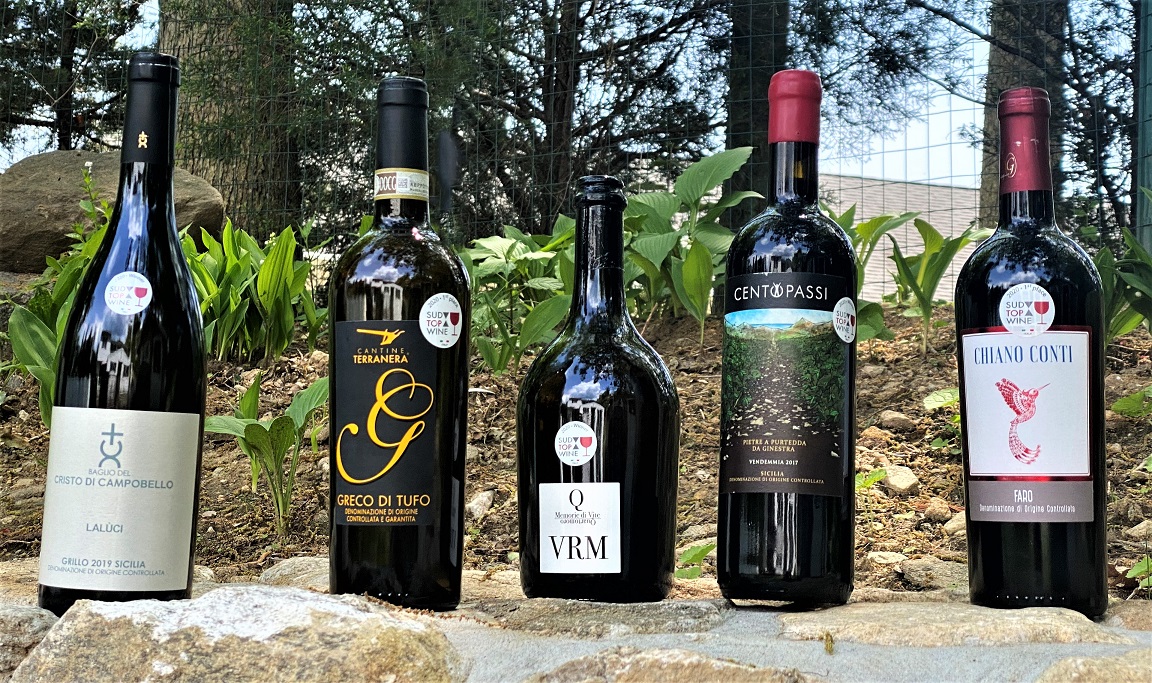 I had an opportunity to taste some of the top awarded wines (samples) from the 2020 competition, so below are my notes:
2018 Cantine Terranera Greco di Tufo DOCG (13% ABV, Sud Top Wine 2020 1st Place)
Light Golden
Whitestone fruit, a touch of honeysuckle
A touch of sweetness, good acidity, nice depth and structure, lemon notes with a hint of candied lemon, excellent balance
8, excellent white wine
2017 Pietre a Purtedda da Ginestra Centopassi Rosso Sicilia DOC (14% ABV, Nerello Moscalese, bio certified, Sud Top Wine 2020 Winner)
Bright ruby
Fresh cherries
Tart cherries, fresh, crisp, succulent, medium body, medium finish, nicely present tannins
8-
2014 Chiano Conti Rosso Faro DOC (13.5% ABV, Nerello Mascalese, Nerello Capuccio, Nero d’Avola, Nocera, Sud Top Wine 2020 1st Place)
Red currant, herbs, earthiness, tobacco
Tart cherries, underbrush, light and earthy
7+, it’s okay, not exactly my style
2016 Quartomoro VRM Memorie di Vite Vermentino di Sardegna DOC (13.5% ABV, Sud Top Wine 2020 Winner)
Light Golden
Intense nose with gunflint, white stone fruit, a touch of vanilla
Beautiful, full-bodied, plump, round, white plums, Meyer lemon, good acidity, good balance
8, delicious.
2019 Baguio del Cristo di Campobello Lalùci Grillo Sicilia DOC (13.5% ABV, Sud Top Wine 2020 Winner)
Straw pale
Complex nose of granite, gunflint, whitestone fruit
Crisp, fresh, a touch of gunflint, fresh lemony acidity, delicious
8+, superb
As you can tell, I really preferred the whites over the reds – but your experience might be different. If you will come across any of these wines, give them a try – you might be pleasantly surprised. Cheers!
Everyday Bubbles
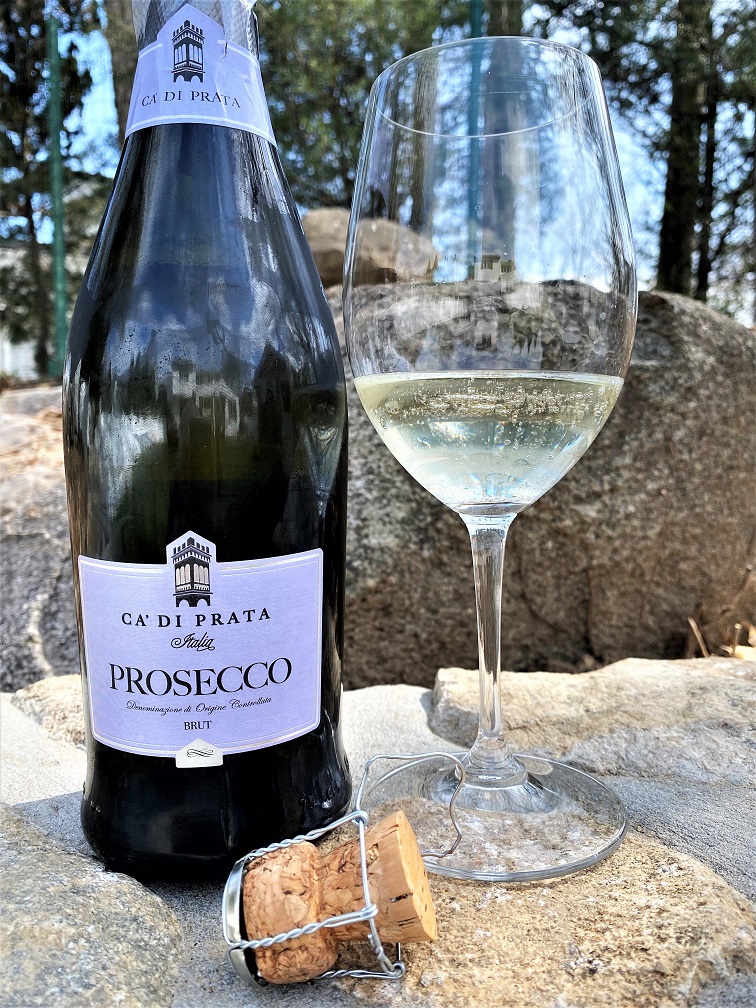 Do you have an everyday wine? An everyday wine is a wine you are happy to open on any day that has a name ending with “y”, like Monday, without any second thoughts. For the wine lover, there is always a ritual to choose the proper wine for each and every occasion (read: an evening after work), so the everyday wine is the wine allowing to circumvent that ritual, just open a bottle, get a glass, pour wine, and instantly feel better.
I would bet that for the majority of the wine lovers, the everyday wine would be a still wine – white, red, maybe a Rosé, but a still wine. There is an aura surrounding the sparkling wines – you can’t open bubbles without a special occasion, and “just another Monday” might not be it. There are many reasons the sparkling wines not considered appropriate for a casual evening. Sparkling wines have the whole celebratory mindset attached to them – “if I’m drinking sparkling wine I have something to celebrate”. Sparkling wines are usually more expensive than quality-comparable still wines. And so it is somewhat difficult to find a sparkling wine that can be designated as an “everyday wine”.
Difficult, but not impossible. Well, yes, it all depends. If you insist on drinking only Champagne, an “everyday Champagne” might be a challenge – at least a financial one. But if you are willing to look outside of Champagne, then Cava, Cremant, and Prosecco offer some good options. I want to bring two of such “everyday bubbles” to your attention.


First, Prosecco. Prosecco, produced in Northern Italy, is a sparkling wine that had been around almost as long as Champagne – with the only difference that it became internationally known only about 30 years ago (you can read the story here). But today, Prosecco is everywhere, and it offers lots of great options to consider for everyday bubbles. As, for example, Ca’ Di Prata, produced by Latentia Winery, and distributed by Mack and Schuhle I already wrote about a few months ago. Ca’ Di Prata takes its name from the town of Prata di Pordenone in Friuli, one of the epicenters of Prosecco production. I had an opportunity to try a few of the Ca’ Di Prata Prosecco wines (samples), and below are my notes:
Ca’ Di Prata Brut Prosecco DOC (11% ABV, $15.99)
Practically clear, nice tangy mousse
Touch of tropical fruit, a hint of honey
Refreshing, Meyer lemon, good acidity, mellow, good volume, a hint of sweet apples
8, very good, easy to drink, simple. Quaffable on its own, but should be perfect for cocktails (Mimosa, anyone?)
Ca’ Di Prata Rosé Extra Dry Prosecco DOC (11% ABV, $16.99, 85% Glera, 15% Pinot Nero)
Light pinkish color, abundant bubbles
Hint of strawberries
Strawberries all the way, a touch of lemon, creamy, inviting, a touch of sweetness, very well balanced.
8-, perfect everyday bubbles
Ca’ Di Prata Extra Dry Valdobbiadene Prosecco DOCG (11% ABV, $17.99)
Almost clear with a greenish hue, good amount of bubbles
Distant hint of an apple and flower petals, refreshing
Green apple, fresh, crisp, initially had a hint of sweetness which subsided, a touch of lemon.
8-, excellent for what it is – easy bubbles.
And then, of course, there is Cava – another perfect candidate for everyday bubbles. Cava is a Spanish sparkling wine, produced in exactly the same way as Champagne (secondary fermentation in the bottle) in Penedes in Catalonia. Cava is currently trying to change its image of simple, inexpensive, and often mediocre quality wine by introducing new categories and new subzones in the region – but this should be a subject for a separate post.
The Cava which I want you to consider for the everyday wine is one of my favorites, both aesthetically and taste-wise – Vilarnau Barcelona. I already wrote about Vilarnau at length before, so for the history, I would like to offer you this link. For this post, I tasted two wines (samples) from the beautifully appointed, Gaudi inspired bottles – here are my notes:
NV Vilarnau Brut Reserva Cava DO (11.5% ABV, $14.99, 50% Macabeo, 35% Parellada, 15% Xarel Lo, 15+ months in the bottle)
Light gold
Herbal, earthy, apple, lemon
Fresh, clean, apples, creamy, good body
7+, perfect for every day
NV Vilarnau Brut Reserva Rosé Cava DO (12% ABV, $15.99, 85% Garnacha, 15% Pinot Noir, 15+ months in the bottle)
Salmon pink
Fresh strawberries, a touch of gunflint
Fresh strawberries, crisp, clean, energetic,
Delicious.
8, excellent
What do you think? Would you make any of these wines your everyday wine? Cheers!
Made With Organic Grapes: Red, White, and Rosé
Have you looked attentively at the wine labels lately? I don’t know about you, but “made with organic grapes” is something I see on more and more wine labels. Red, white, Rosé, bubbles – no exception. As winemaking methods are advancing, organic viticulture is almost becoming a new norm.
While “organic” and “sustainable” are not the same, organic designation is often a stepping stone toward sustainable and biodynamic viticulture. Sustainability seems to be the word of the day, not only in the viticulture but all areas of human activities – but this is a wine blog, so let’s just stay with our beloved subject here.
A few weeks ago, I shared my impressions of the organic wines of Viñedos Veramonte from Chile. As I believe we are looking at the trend, let’s continue our search for organic grapes, and let’s take a quick trip to the old continent – Italy, to be more precise. Once we are in Italy, let’s go to Sicily, where Cantine Ermes had been producing wines since 1998.
Cantine Ermes is a coop-type winery. The numbers behind Cantine Ermes are quite impressive – 2,355 associates, 9 cellars, more than 25,000 acres of land under vineyards, and about 12M bottles annually are sold in 25 countries. Despite its sheer size, Cantine Ermes practices organic and sustainable farming and has tight control over all steps of wine production.
Two wines I tasted brilliantly represented Sicily, made from the local grapes:
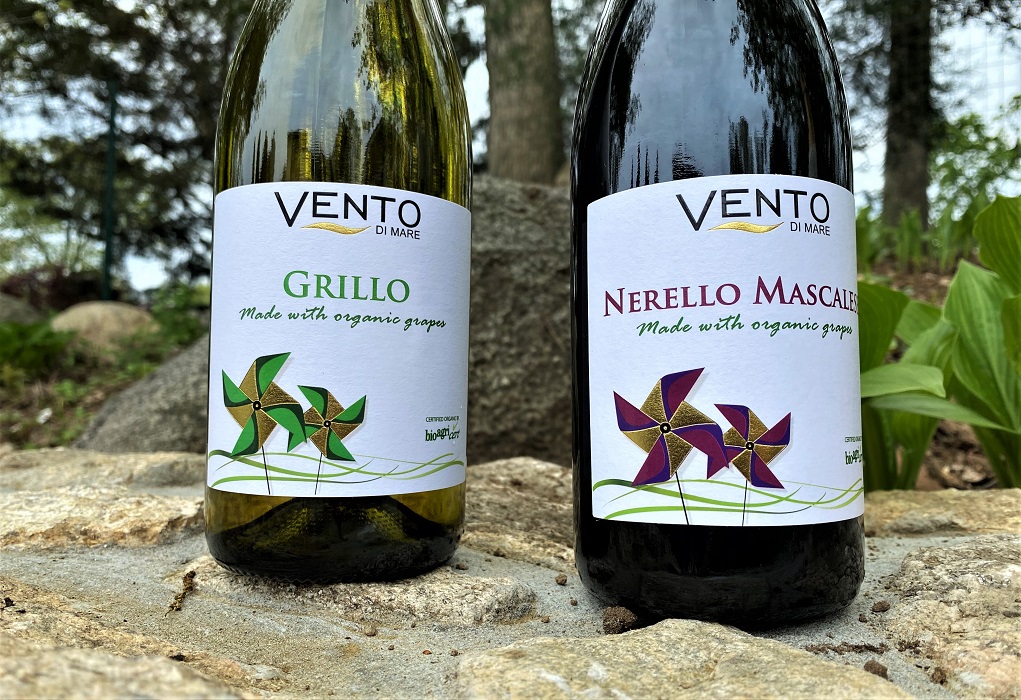
2019 Cantine Ermes Vento Di Mare Nerello Mascalese Terre Siciliane IGT (13.5% ABV, $13)
Ruby red
The nose of freshly crushed berries, cherries, and eucalyptus.
Playful on the palate, a touch of fresh cherries, intense tobacco, minerality, medium body, clean acidity, good balance.
8-/8, perfect on its own, but will play well with food.
2019 Cantine Ermes Vento Di Mare Grillo Sicilia DOC (12.5% ABV, $13)
Light Golden
Fresh lemon, Whitestone fruit, medium+ intensity, inviting
Crisp, clean, fresh lemon, nicely present body, a touch of white plum, good minerality, a hint of sweetness
8/8+, superb, delicious white wine all around.
We are continuing our organic grape quest by going west and leaving the old continent and arriving at Mendoza in Argentina. Earlier this year I discussed sparkling wines of Domaine Bousquet – the product of the obsession of the French winemaker Jean Bousquet, who fell in love with the raw beauty of Gualtallary Valley in Mendoza. Interestingly enough, two sparkling wines I was talking about before were also made from organic grapes – I guess I simply didn’t see it as a trend yet.
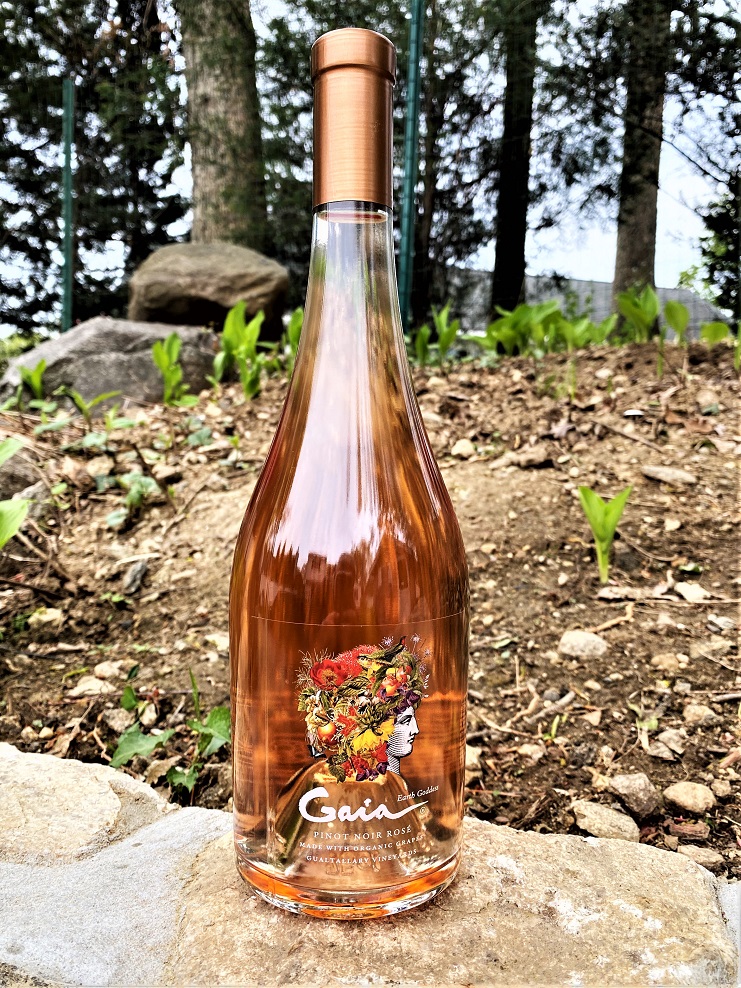
Gaia Rosé is the inaugural vintage of the wine made from 100% Pinot Noir, from the vineyards in the Uco Valley located at the 4,000 feet/1,200 meters elevation. The wine takes its name from Gaia, the ancient Greek goddess of the Earth and an inspiration for the Bousquet family. Just take a look at this beautiful bottle and tell me that you will be able to resist the urge to grab this bottle off the shelf at the first sight.
Here are my thoughts about the wine:
2020 Domaine Bousquet Gaia Pinot Noir Rosé Gualtallary Vineyards Mendoza Argentina (13.1% ABV, $20, vegan friendly)
Light salmon pink
Complex, onion peel, a touch of strawberries
Fresh Strawberries, grapefruit, bright acidity, a touch of sweetness, firm, present
8, delicious. Unusual
Here you are, my friends. Red, white, and Rosé from around the world. made from organic grapes, delicious, affordable, with a great QPR. What else should wine lovers want?
Pleasures of the Obscure – New Discoveries
If you follow this blog for some time, you might (or might not) know that I identify as an obsessed wine geek. There is definitely more than one trait that would allow such an identification, so the particular one I want to talk about here is the love of obscure grapes.
I was bitten by The Wine Century Club bug more than 15 years ago, and since then I’m on the quest to seek the most unusual wines made from the most obscure grapes. The Wine Century Club offers to wine lovers a very simple proposition – for every 100 different grapes you taste, you get to the next level in the club. With more than 1,300 grapes used in wine production today, this shouldn’t be very difficult, shouldn’t it? Yet, of course, it is, as an absolute majority of the wines readily available today in the supermarkets, wine stores, and even from the wineries direct, are made from 50–60 mainstream grapes – the rest requires quite a bit of work of procuring as most of the wines made out of the rare grapes are produced in minuscule quantities and not sold anywhere outside of the immediate area of production.
So if finding those rare and unusual wines is that difficult, why bother you may ask? I can give you a few reasons. One – I can simply tell you that I tried 555 grapes at the time of writing this post, so it kind of “mine is bigger than yours” type of reason. Yep, lame. Let’s leave it.


The better reason is the fact that every bottle of wine made from grapes one never heard of before is an opportunity to experience great pleasure. The grape is unknown, so we have no expectations whatsoever. While drinking Cabernet Sauvignon, that simple little piece of information – the name of the grape you are well familiar with – has a tremendous effect on how you perceive the wine. The level of pleasure will depend on how well the particular wine matches your expectations. It might be the best ever for you in the blind tasting, but in the non-blind setting, you are instantly influenced by your prior experience and thus your level of pleasure is limited by your expectations.
When you pour yourself a glass of Bobal, Trepat, or Hondarrabi Zuri, you are presented with a blank canvas – you can draw any conclusions you want. You will decide if you like the wine not in comparison but simply based on what is in your glass and if it gives you pleasure, or not. Simple, straightforward, easy.
Here, let me share with you my latest encounter with obscure grapes.


Let’s start with the white wine – 2017 Paşaeli Yapincak Thrace Turkey (12% ABV, 100% Yapincak). Yapincak is a native variety of Şarköy – Tekirdağ region in Northern Turkey. The grapes for this wine, produced by Paşaeli winery in Turkey, come from the single vineyard located at about 500 feet elevation, 35 years old vines. Upon opening the wine showed some oxidative notes, I even thought it might be gone already. A few hours later, it cleared up, and presented itself as a medium to full-bodied wine, with fresh lemon and a touch of honey notes, crisp, fresh, easy to drink. This can be a food wine, but it doesn’t have to be, quite enjoyable on its own. (Drinkability: 8-/8)
My rare red wine was really a special experience, as it brought back really special memories. I got this 2014 Agricola Vallecamonica Somnium Vino Rosso (12.5% ABV, 100% Ciass Negher) 4 years ago, during a press trip to the beautiful region of Franciacorta. As we were the guests of the Franciacorta consortium, we were mainly focusing on the Franciacorta sparkling wines. During one of our lunches, I noticed this wine and had to bring it home, albeit only one bottle. This wine is made out of the ancient grape called Ciass Negher in the local dialect, used in the winemaking by the Romans about 2,000 years ago, and resuscitated by Alex Belingheri in his vineyards at Agricola Vallecamonica.
This wine was absolutely unique – as you would expect considering its rare pedigree. I perceived this wine as something in a middle between Pinot Noir and Chianti/Sangiovese. A touch of Pinot Noir’s sweetness, smoke, and violets, with the undertones of leather and tobacco, and a little funk. Each sip was begging for another – easy to drink, perfectly balanced, and delightful. If this would be my everyday wine, I would be perfectly happy about it. (Drinkability: 8+)
Here you are, my friends. The wine pleasures are everywhere – you just need to look for them.
Last Bottle Sign Up ($10 credit)




 Talk-A-Vino