Archive
A Pinot Noir Lesson for Self with Tendril Cellars
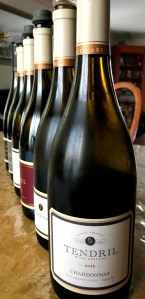 Back in May, we virtually met with Tony Rynders of Tendril Cellars and talked about … many things wine, of course – you can find this conversation here.
Tony is one of the few winemakers I know who teaches people about his wines by conducting organized tastings. As I didn’t have an opportunity to attend any of those events, I decided to run a lesson for myself on the same subject. How you ask? Easy – by tasting the wines blind.
I can literally see the surprised looks and raised eyebrows. How is it a blind tasting if I know already everything about those wines? You see, the lineup I had included 6 wines. Out of those six, four were different Pinot Noirs – different vineyards, different winemaking process, different price points. Obviously I was not planning to try to identify the exact wine, but still – will I be able to taste the difference, and maybe identify the most expensive wine? Comparing Chardonnay and white Pinot Noir should also be a fun exercise, as those are two siblings ruling the world of Champagne. Yep – lots of opportunities for having fun.
Okay, blind tasting it is. The bottles are wrapped, the numbers are randomly assigned. May the taste buds serve me right!
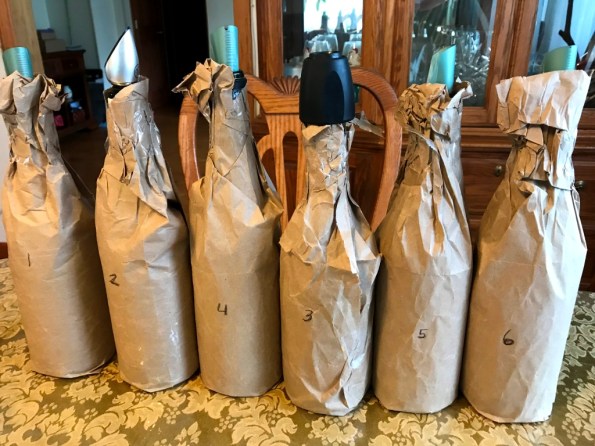
Here are my notes for the wines while tasting them blind:
1 Light golden color
Vanilla, golden delicious,
Bright acidity, vanilla, apples, a touch of honey
2 toasted notes, yeast
Perfect acidity, Granny Smith apples, a touch of honey, toasted notes on the palate, outstanding
white pinot?
3 Dark ruby
Earthy, Rutherford dust on the nose, a touch of roasted meat,
Beautiful palate, soft plums, round, espresso, excellent acidity, wow. ThightRope?
4 Ruby
Concentrated nose, mint, eucalyptus
Concentrated palate, acidity, eucalyptus, sage, violets on the palate. Very unusual. Single Vineyard?
5 Dark ruby
Wow. Blueberries, raspberries, restrained
Very smooth, silky, bright fresh fruit, acidity, firm structure, excellent balance, never-ending finish. Wow. C-Note?
6 Dark ruby
Nose old world style, forest floor, mushrooms, great restraint
Round palate, blackberries, baking spices, soft, delicious. Outstanding. Extrovert?
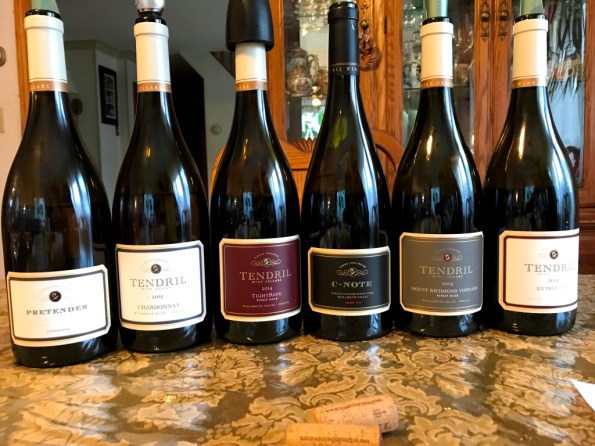
Everyone knows that the best part of the blind tasting is … unwrap! The moment of truth, pure and simple. Here are my notes for the tasting of the wines non-blind, 3 hours after the blind tasting (in the same order):
1 – 2015 Tendril Cellars Pretender Willamette Valley (14.1% ABV, $60, white Pinot Noir)
A bit darker color (golden)
Vanilla, butter
Plump, round, crisp acidity, acidity on the finish (very extensive), plump body.
8, excellent. Reminiscent of a nice Marsanne.
2 – 2015 Tendril Cellars Chardonnay Willamette Valley (13.5% ABV, $40)
Honey, gunflint, vanilla
Brioche, Granny Smith Apple, a touch of butter, clean acidity, excellent
8, outstanding.
3 – 2014 Tendril Cellars Extrovert Pinot Noir Willamette Valley (14.1% ABV, $48)
Beautiful, classic, open Pinot, with cherries, sage, and plums.
Soft cherries and plums on the palate, clean acidity, sage, violets, delicious, wow
8, delicious.
8+/9-, a pure standout. Polished, velvety, seductive, like a light touch on the hand which makes your whole body to vibrate. More reminiscent of CA Pinot than dark and loaded
4 – 2014 Tendril Cellars TightRope Pinot Noir Willamette Valley (14.2% ABV, $64)
Very tight, espresso, licorice, blackberries
Beautiful, sweet fruit, noticeable tannins, very round, medium body, cherries and cherry pit.
8, excellent.
Complex nose of herbs and spices, exotic and unusual.
Wow, great power and complexity, not a typical Pinot, might be more of a Zinfandel or even Syrah profile. Needs time, lots more time.
5 – 2014 Tendril Cellars Pinot Noir Mount Richmond Single Vineyard Willamette Valley (14.1% ABV, $60)
Very unusual. Beets and caramel on the nose, with a touch of dark chocolate.
Blueberries and caramel on the palate, nice salinity, raspberries. Medium+ body. Excellent
8
Very ripe after 2 days been open (air pumped out). Beautiful palate, minerality-driven, cigar box, eucalyptus, tense, powerful. Can be mistaken for a Rioja of a nice caliber.
6 – 2014 Tendril Cellars C-Note Pinot Noir Willamette Valley (14.1% ABV, $100, 100% Whole Cluster, 100% new oak)
Sublime. Can be described only via allegories, such a finesse. Dark chocolate and cherries. Excellent
Equally delicate on the palate, crisp acidity, bright, sweet plums, and tobacco. Outstanding.
8, excellent
Nose is incredible. First, you want to smell.this.wine.for.a.long.time.
Superb, elevated wine, complex, great finesse, and needs time. 8+
As you can tell, I failed miserably. I didn’t identify any of the wines – however, this was perfectly in line with my expectations. What was definitely interesting is that despite the four Pinot Noir wines been all from Oregon and at about the same age, they were absolutely, unquestionably, distinctly different – and strikingly delicious.
Of course, I extended the pleasure of tasting some of those wines over the few days, which is reflected in the tasting notes above.
Here you are, my friends. Blind tasting or not, the Tendril Cellars wines are worth seeking – the virtual tasting will simply not do it – these are the wines to experience. And if you need to choose only one, I can let you in on a secret (don’t tell anyone!) – the Extrovert was my favorite. Cheers!
Thinking About Grenache with Bokisch Vineyards Garnacha
Grenache. Garnacha. Garnatxa. One of the 10 most popular red grapes in the world, one of the most planted grapes in the world (according to the Court of Master Sommeliers, “world’s most widely planted grape”). Some call it “unsung hero”; I generally designate it as King of the Blends. While Grenache can perfectly perform solo (think about Sine Qua Non, Horsepower, No Girls, Bodegas Alto Moncayo, some of the Chateauneuf-du-Pape), it typically plays its part in the blends – that’s what “G” stands for in all of the GSM renditions, whether coming from Australia, Southern Rhône, Southe Africa, or California; it helps with Rioja and Priorat, and with lots of other wines.
Yesterday, wine lovers celebrated International Grenache Day, which prompted some thoughts on the subject. As I confessed many times, I like aged wines. Of course, I thoroughly enjoy the exuberance of the young wines, but my honest preferences are with the wines which gain some complexity after been aged. Out of 10 most popular grapes – Pinot Noir, Tempranillo, Sangiovese, Merlot, Zinfandel, Malbec, Grenache, Cabernet Sauvignon, Nebbiolo, Syrah/Shiraz – Grenache is the one which concerns me the most with its ageability. Of course, the Grenache wines produced by Sine Qua Non, Horsepower, Bodegas Alta Moncaya Aquilon, Châteauneuf-du-Pape from Clos des Papes or Domaine de la Janasse can age perfectly for a very long time – but all of these wines will set you back for hundred(s) of dollars, so their ageability is rather expected. Meanwhile, I had lots of Cabernet Sauvignon, Pinot Noir, Zinfandel, Sangiovese, Tempranillo, Syrah (oh well, pretty much all of those 10 major grapes), priced in the $15-$25 range and age beautifully (here is one example for you) – but I don’t have a great luck with aged Grenache in that price category – maybe because the most of it comes in the blends (don’t try aging Côtes du Rhône reds – it is just not going to happen).

If you are an oenophile who can spend 15 minutes pulling back and forth numerous bottles in your cellar, unable to decide what to open for the evening, I’m sure you really appreciate the grape holidays. Your selection shrinks down, as now only the appropriate bottle can be opened, so the life becomes much easier. This recent Grenache Day gave me a good reason to finally open the bottle of the 2011 Bokisch Vineyards Garnacha Terra Alta Vineyard Clements Hill Lodi (14.5% ABV, $25) – I had this bottle in my hands a few times this year, but always put it back as “not this time” object.
Lodi was one of my relatively recent discoveries as one of the very best wine regions in California, and in the US in general – both with the wines and with the people who make the wines there. Lodi might be most famous for its Zinfandel vineyards, but it is really a capital of Mediterranean grape varieties in the USA, and so Lodi Grenache is something to look for as a category. And if Lodi is the capital, Markus Bokisch might well be the king of those Mediterranean varieties – he started planting Spanish varieties in Lodi back in 1999 and only made his first Zinfandel wines a few years back. Markus’s range includes all best-known Spanish varieties – from Albariño and Verdejo to Garnacha, Monastrell, Tempranillo, and Graciano.
In a word, I made an excellent choice of the celebratory wine for the International Grenache Day, as the wine was beautiful from the get-go. Garnet color; espresso and mint jump right out of the glass, intense aroma, tar, a whiff of the dark chocolate came as the second layer, minerality, spices – I could actually smell this wine for about … forever. The palate? Wow. Tart blackberries, tobacco, a touch of pepper, bright acidity, perfect firm structure, delicious. The wine was going and going, further opening up over the next two days and showing the smoke and rocky minerality which I previously experienced with No Girls Grenache (here is a bonus, Bokisch Garnacha is only a quarter of a price of No Girls Grenache). Drinkability: 8+/9-. The wine was a perfect example of Grenache which can age – and could’ve waited for longer to be opened, for sure – but it was definitely enjoyed (of course this was my only bottle, you don’t need to ask).
What do you think of Grenache? Do you have a favorite Grenache wine or a region? Cheers!
Thinking About Albariño, or Notes from Albariño Deep Immersion with Snooth – 2018 edition
Luckily, Albariño doesn’t need an introduction to the wine lovers anymore (if you think I live in lalaland, please speak up). Albariño is the best known white grape of Spain, making crisp, dry, minerally-infused, refreshing white wines, perfectly suitable to support any seafood dish, as they always had in their native Galicia region. As with most of the white wines, Albariño is typically associated with summer, but it is a versatile wine all year around – and typically very reasonably priced.
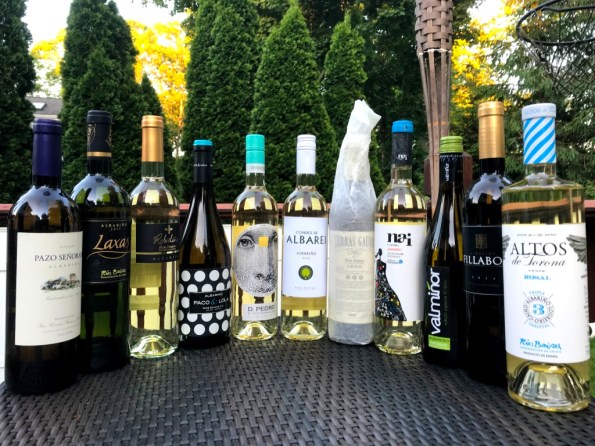
For the second year in the row, I had a pleasure of participating in the virtual tasting of Albariño wines, organized by Snooth, one of the largest online wine communities. I will not delve into the technical details of the region, as I had an extensive coverage in last year’s post, and instead, I will simply share my notes for the wines we tasted.
Here are the notes, sorted by the sub-region of Rias Baixas:


Sub-region: Val do Salnés:
2016 Condes de Albarei Albariño Rias Baixas DO (13.5% ABV, $15)
Light straw
Lemon, lemongrass, hint of peach
Lemon, good minerality, medium body, good mouthfeel, mostly acidity on the finish
8-, good balance, round
2017 Pazo Señorans Albariño Val do Salinés Rías Baixas DO (13.5% ABV, $25)
Straw color
Rich citrus – lemon, grapefruit, orange
Clean acidity, lemon, thyme, good minerality, vibrant, fresh
8-, excellent
2017 Nai e Señora Albariño Val do Salnés Rías Baixas DO (13% ABV, $15.57)
Straw pale
Tropical fruit, white flowers
Round, clean, good balance of fruit and acidity
8, definitely one of the favorites.
2017 Paco & Lola Albariño Rías Baixas DO (13% ABV, $21.99)
Lightest color of all, straw pale
Lemon, mint, nice minerality
Fresh, crisp, cut-trough acidity, lemon grass
8-, round and extremely refreshing


Sub-region: Contado do Tea:
2016 Fillaboa Albariño Rias Baixas DO (13% ABV, $20)
Light golden
Candied lemon, vanilla, touch of butter, medium+ intensity, inviting
Crisp acidity, fresh, touch of salinity, fresh lemon, steely notes, vibrant
8-/8, excellent
2017 Señorío de Rubiós Robaliño Albariño Rias Baixas DO (12.5% ABV, $18)
Straw pale
Sage, lemon, hint of overripe white peach
Good acidity, lemon finish, Meyer lemon notes
7/7+, Needs more vibrancy.
2017 Bodegas As Laxas Albariño Rias Baixas DO (12.5% ABV, $18)
Light straw color
Lemon, touch of minerality,
Minerality, forthcoming acidity, hint of grapefruit, Mayer lemon, good balance
8-, very good, balanced wine


Sub-region: O Rosal:
2017 Valmiñor Albariño Rías Baixas DO (13% ABV, $18.99)
Light gold
Fresh white plums, intense, pineapple, very inviting
Crisp acidity, lemon notes, fresh
7/7+, nice, simple, varietally correct
2016 Don Pedro Albariño De Soutomaior Rias Baixas DO (13% ABV, $18.99)
Light gold
Touch of honeysuckle, white flowers, hint of peach
Crisp acidity, pure lemon, vibrant, clean, lots of minerality, good midpalate weight
8-, steely goodness of the young Chablis, excellent, lots of pleasure. This wine will dramatically evolve over the next 5-7 years.
2017 Altos de Sorona Rosal Rías Baixas DO (12.5% ABV, $20, blend of Albariño, Caiño, Loureiro)
Straw color
Lemon, sea air, minerality
Lemon, crisp acidity, good weight, fresh, vibrant.
8-, excellent balance, can be had by itself as a summer day thirst quencher, or with some oysters (would work beautifully)
2017 Terras Garuda O Rosal Rias Baixas DO (12.5% ABV, $23.99, 70% Albariño, 10% Loureira, 20% Caiño Blanco)
Light golden color
Tropical fruit, guava, candied lemon, vanilla
Rich, generous, hint of watermelon and pineapple, crisp acidity, fresh, vibrant
8-, excellent
If you want to see the recording of the tasting, you can find it here. If you want to try the wines we tasted, most of them are still available on the Snooth website, also at a great price – take a look here.
I have to say that the quality was excellent across all the wines we tasted, with some of the standouts, such as Nai e Señora Albariño. Is Albariño a part of your standard wine routine? Do you have any favorites? Cheers!
P.S. Procrastination sometimes offers benefits – this tasting took place in May, but today (August 1st, 2018) is International Albariño Day, so I guess the post about Albariño is quite appropriate.
The Art of Tempranillo
Source: Vintae.com
I love Tempranillo wines. I wouldn’t call myself an expert, but I had a wide range of Tempranillo – with the exception of Australia, I believe I tried most of the major renditions – Rioja, Ribera Del Duero, Toro, most everywhere else in Spain, Texas, California, Oregon, Washington (am I missing something? do tell!). With all the love and respect to all the regions, if I have to put an order of priorities in that “list”, I would put Rioja first, Ribera del Duero very close second, but the competition for the 3rd place would be severe – in my world, of course.
I like wines of Toro, the closest sibling to the Rioja and Ribera del Duero, but it would be hard for me to place them higher than some of the beautiful Tempranillo renditions from Irwin Family Vineyards, Duchman, or Fields – considering the Toro wines I had in the past. Compared to Rioja and Ribera del Duero, Toro is … well, maybe I need to explain why I keep mentioning Rioja, Ribera del Duero, and Toro together all the time. These are the only three regions in the world where the absolute majority of the red wines is made out of the Tempranillo grapes. Yes, there are Garnacha and Graciano in Rioja, Cabernet Sauvignon and Merlot in Ribera del Duero, but still – most of the red wines in these three regions are made out of the Tempranillo, hence the constant comparison.
Out of the three regions, Toro is south-most one, with an expressly continental climate, low annual rainfall amounts, and significant range of day-night temperatures – which typically translates well into the flavor. Tempranillo is the grape of Toro, but similarly to Tuscany/Brunello, where you have Sangiovese and Sangiovese Grosso, Tempranillo in Toro is known as Tinta de Toro, a.k.a Tempranillo de Castilla, a.k.a. Ink of Toro. The grape is a bit smaller, with thicker skin, which coupled with growing conditions typically results, in massive, concentrated wines requiring extensive aging to become drinkable – I still have a memory of trying Alabaster made by Sierra Cantabria, one of the well-known producers in Toro, which was one of the most massive wines I ever experienced. Nevertheless, as I said at the beginning, Tempranillo is one of the favorites, so when the opportunity called to try 3 wines from Toro, I was definitely curious – and a bit cautious at the same time.
To ease things up, together with the 3 Toro wines from Bodega Matsu came a bottle of Rioja Reserva from Bodega Classica. While coming from unrelated producers, there is a common link between them – this link is called Vintae – a young company with a serious passion for the Spanish wine for the modern world. Vintae, started in 1999 by the Arambarri family, set on changing world’s perception of the Spanish wine as “boring”. To the date, Vintae unifies a collection of 11 different “projects”, all focused on showcasing the regions and the grapes.
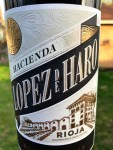
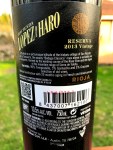
Going back to the wines at hand, let’s talk about Rioja first. The wine comes from Bodega Classica, located in the heart of Rioja Alta. Rioja Alta offers a unique high-altitude setting to produce arguably the best Tempranillo of the whole of Rioja region. Couple that with more than 100 years old vineyards, and you are looking at some tasty opportunities in the bottle, as this Bodega Classica Hacienda López de Haro Rioja Reserva was. Here are my notes:
2013 Bodega Classica Hacienda López de Haro Rioja Reserva DOCa (13.5% ABV, $16.99, 90% Tempranillo, 5% Garnacha, 5% Graciano, 20 months in French and American oak)
Dark garnet color
Pepper, vanilla, raspberries, mushrooms, nice minerality
Medium body, good acidity, noticeable alcohol burn initially, went away in about 15 minutes, good fruit showed up, characteristic cedar notes, good acidity, round, soft.
8-, nice, just give it a bit of time to soften up at the beginning. The second day continued without changes. Good life expectancy, as expected of Rioja Reserva. And an excellent QPR.
Now, let’s go back to Toro. As I already said, in my prior experience, Toro wines were massive and concentrated, requiring long aging to soften and really show a beautiful expression of Tempranillo. And then there were wines called Matsu.
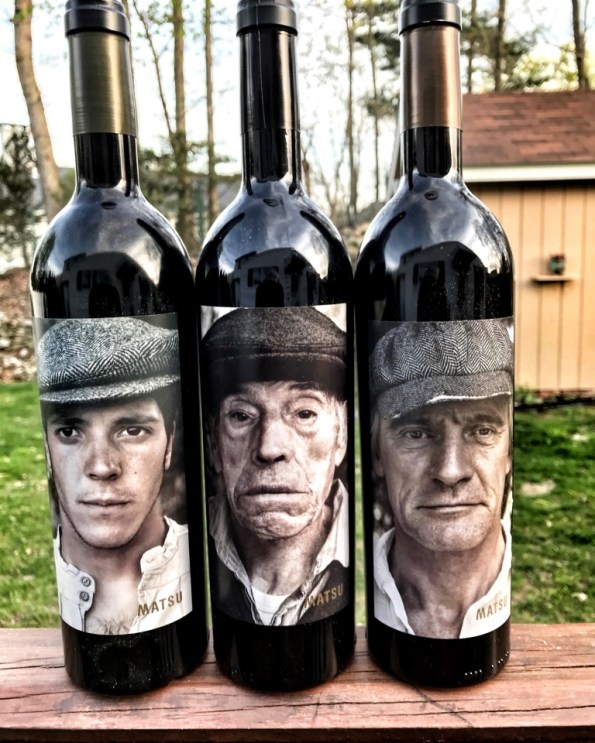
Matsu in means “wait” in Japanese. As we all know, waiting is one of the favorite games of oenophiles. When it comes to the three Matsu wines I had an opportunity to taste, there are many different levels of “waiting”. The wines had been progressively aged for the longer times before the release – 3 months for El Picaro, 14 months for El Recio, 16 months for El Viejo. The grapes were harvested from the vines of different age (again, progressively) – 50-70 years old for El Picaro, 90-100 years old for El Recio, more than 100 years old for El Viejo. See, waiting here is clearly a part of the equation.
And then there are those ultra-creative labels. Not only labels commemorate people who actually worked to create the wines, they clearly identify what you should expect from the wines – in age, in style, and even in price. I conducted a little experiment, first with my kids, and then with the people on Instagram, asking them to identify the most expensive wine – nobody made a mistake, the labels speak very clearly to us.


How were the wines? Surprising. Probably the best Toro wines I ever had – without any regard to the pricing category. Here are my notes, so you can see for yourself:
2016 Bodega Matsu El Picaro Toro DO (14.5% ABV, $13.99, 100% Tinta de Toro, 50 – 70 years old vines, 3 months minimum aging on the lees, concrete tanks)
Bright ruby color, noticeable legs, minimal rim variation
Young fresh berries, medium+ intensity, a touch of vanilla
Surprisingly light on the palate, pleasant tannins, fresh berries, very quaffable.
8-, might be the lightest rendition of Toro I ever had. The smell is a bit more complex on the second day. Palate nicely evolved, good balance, raspberries, no more impression of the young wine, lots of minerality.
2015 Bodega Matsu El Recio Toro DO (14.5% ABV, $21.99, 100% Tinta de Toro, 90 – 100 years old vines, 14 months aging in second use oak barrels)
Garnet color, noticeable legs, minimal rim variation too
Sage, fresh raspberries, quite fruity, roasted notes, minerality, distant hint of cinnamon
Underripe plums, blueberries, thyme, nice herbal component, surprisingly light, still noticeable alcohol, needs more time
8-, needs time. Second day: 8/8+, velvety texture, well integrated, excellent balance, a touch of tobacco and espresso on the palate and ripe plums. Outstanding.
2015 Bodega Matsu El Viejo Toro DO (15% ABV, $46.99, 100% Tinta de Toro, 100+ years old vines, 16 months in new French oak barrels)
Garnet Color, noticeable legs, rim variation is not extensive, but present
Sweet blueberries and raspberries on the nose, sage, sweet oak
8- first day, waiting for more.
Second day: 8, much evolved, more integrated, velvety texture, dark fruit, round, smooth. Will evolve further.
Here you are, my friends – the Art of Wine, from the label to the glass. Very impressive and thought-provoking wines, definitely worth seeking. Have you had any of these wines? Have you had Toro wines before? Do you have any Tempranillo favorites? Cheers!
Stories of Passion and Pinot: Tony Rynders of Tendril Cellars
Wine and passion are indelible. Yes, wine is a business for the most parts, but making a bottle of wine which someone else is desiring to drink is a labor of love, and every such bottle has a bit of the winemaker’s soul invested in it (feel free to call me melodramatic). Thus I’m always happy to talk to the winemakers, trying to understand what moves them, what drives them to do what they do. A lot of my conversations are virtual, and you can find most of them on this blog.
Many of interviews are truly random in terms of profiling the wineries and winemakers. However, about 2 years ago, with a prompt and help of Carl Giavanti, I started a series of posts called Stories of Passion and Pinot, which are dedicated (so far, at least) to the winemakers in Oregon, producing Pinot Noir wines. Winemakers are always passionate about what they do and the grapes they use – but it seems to me that Pinot Noir, being a difficult grape it is, really asking for a special dedication to allow itself to be tamed – hence the name for the series.
My latest addition to the series is a conversation with Tony Rynders, the proprietor and winemaker at the Tendril Wine Cellars, a young winery in Willamette Valley in Oregon (the winery officially started 10 years ago, in 2008). While the winery is young, Tony is an accomplished winemaker, who started making wine back in 1989, honed his craft at the wineries around the world, including 10 years as a head winemaker at Domaine Serene, one of the best-known wineries in Oregon.
When Tendril Cellars started, it owned no vineyards, which essentially gave Tony a flexibility to bring the best fruit from the Oregon vineyards he was already familiar with. To my surprise, Tendril Cellars only offers one single-vineyard bottling in their line of 5 different Pinot Noir wines – but you will find an explanation below. In 2013, Tendril Cellars planted a 19 acres Maverick vineyard in Yamhill-Carlton district with Pinot Noir and Chardonnay – the vineyard already producing the fruit which is going into the Tendril Cellar’s second line of wines, Child’s Play (a creative name for the wine, don’t you think?).
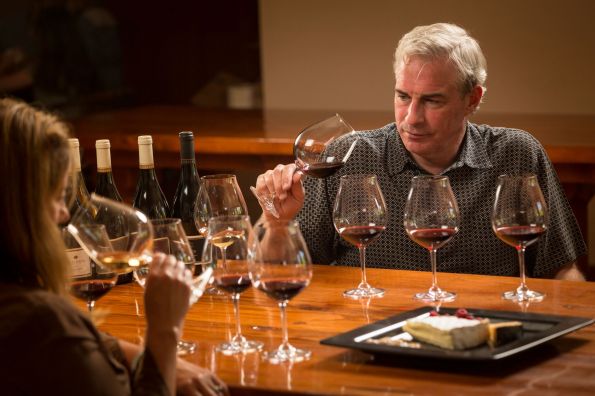
Tony Rynders leading five course tasting
Tony calls his approach to winemaking “low and slow” – letting the nature to do its work. He is also aging all of his Pinot Noir wines for 16-17 months, which I find particularly appealing. And then, how many winemakers do you know who run organized tastings for their customers? That is what Tony does, presenting his wines as a “5-course meal” and explaining the concept of terroir to the wine consumers (after tasting Tendril wines, Tony’s approach to the tasting makes perfect sense to me – but we will discuss it in the next post).
After learning a bit about Tony and Tendril Cellars, I decided that the time came to sit down (yes, virtually) with Tony and ask him a few questions. Here is what transpired.
[TaV]: You started making wine for others in 1989. Was there something which prompted you to start making your own wines in 2010, a pivotal moment, or you simply decided that it is time to make wines “my way”?
[TR]: I have had several opportunities making wine since I began in 1989. Each one has contributed in some way to influence my approach to making wine. I can tell you that I am a much different winemaker today than I was when I started. I think it is critical that we continue to evolve and adapt as the climate, consumers, and wine preferences change.
In fact, I started my own brand, Tendril, in 2008. I was just coming off a 10-year stint as head winemaker at Domaine Serene. It was a highly formative period in my career as there was a massive shift toward new, estate vineyards during my tenure. The creative “heavy lifting” took place largely during my watch. I accomplished everything I set out to and more. It was time for my next big challenge…creating a portfolio of wines for my own brands from scratch. And tell a story about Pinot Noir in a way that it had not yet been told.
[TaV]: You worked at the wineries around the world. Are there any winemakers you would consider your mentors, either directly or indirectly?
[TR]: There is one fact in winemaking that I completely embrace: There is no way to learn it all…I will never stop learning, growing and evolving. Every winemaker I have worked with has mentored me, including but not limited to, Rollin Soles, Ken Wright, Co Dinn, Jean-Francois Pellet and David Forsyth.
[TaV]: Can you explain your “low and slow” approach to the winemaking?
[TR]: Just like the “slow food” movement, I use top quality ingredients (grapes) from attentive, engaged farmers (vineyards) with whom I have a very close relationship. I have hand chosen each of our vineyards myself and each brings a distinctive flavor profile (like spices) in order to make our signature “five-course meal” of Pinot Noir.
For all the Tendril wines, I over-vintage the wines in barrel (at least 16 months) and then bottle age 12 months or more prior to release. The wines are then at the front end of their drinkability curve, with the potential for a decade enjoyment ahead of them.
[TaV]: I find it interesting that in your range of Pinot Noir you have only one vineyard-designated bottling – I always think that designated vineyards and even specific plots are better identify with quality of the grapes and the resulting wines – obviously you don’t see it like that?
[TR]: While I love to make single vineyard wines, I find that not every site is able to produce balanced, compelling and complete wines every year. And that, simply put, is my goal as a winemaker. So this is how the unique story and line-up of wines for Tendril was born. When I started Tendril, I knew that I wanted to do something different with my portfolio of wines. And it took 6 years to complete the lineup (Extrovert 2008, TightRope 2009, Single Vineyard (Guadalupe) 2011, C-Note 2011, Pretender 2013).
The common model that exists for Pinot Noir is the single vineyard model. Wineries make 5-15 (or more) single vineyard wines in a given vintage. The problem is that not all of the sites deliver on their promise of distinctiveness every year. The true test is a horizontal tasting in which all of the wines are evaluated blind. In a given year, some wines are great, some under deliver and some taste quite similar in a given line-up. This is not consistent with my goal.
So, I created my own, unique model for Pinot Noir. Each of my wines is distinctive and complete. Collectively, they show a progression of flavors that mirrors the progression of dishes in a five-course meal. My wines gain in intensity, darker fruit character and structure as the “courses” progress. And each of the wines must re-qualify for their place in the lineup each and every year.
I believe single vineyard wines should be special. Since all wineries charge more money for them, I think they should be worth it. So we typically do just one offering per year that is, simply put, the “wine of the cellar” from just one site. As I had anticipated, it has proven to be rotational (4 vineyards in 7 vintages). It is like a Christmas present in that you don’t know what it is until you open it.
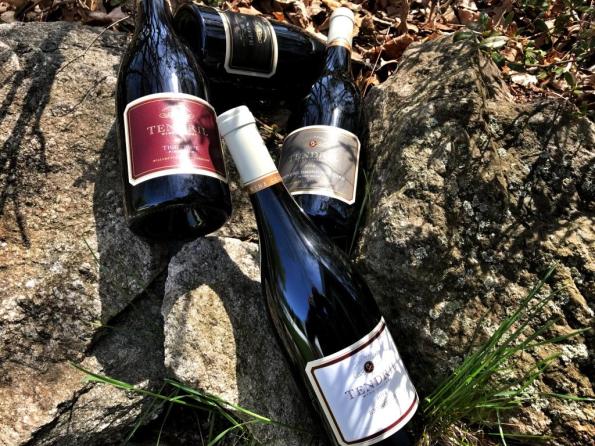
[TaV]: Your C-Note Pinot Noir is designated as “whole cluster fermented” – is that a substantial differentiator to make it the “top of the line” wine, or is there something else behind it?
[TR]: Of the Pinot Noir line-up, the C-Note is the most stylized wine yet at the same time requires the greatest amount of restraint. Whole cluster fermentation of Pinot Noir is a technique that I have only attempted since 2011. The was the first year I made a wine using 100% whole cluster…and it was so successful that it became our first C-Note bottling.
For C-Note, we use 100% Pinot Noir, 100% Whole Cluster fermentation, and age in 100% new French Oak barrels (air dried 3 + years). The restraint comes into play in order to reign in the “whole clustery-ness” and tame the oak impact to mimic a wine with half the new oak exposure. We are extremely gentle with our cap management to control the whole cluster notes and we select the most subtle, elegant barrels coupled with long aging to integrate the oak flavors. C-Note is all about complexity, texture and mind-blowing length. I love making wines that surprise and beguile.
[TaV]: You are one of the very few winemakers who conduct organized tastings. Can you explain what you are trying to showcase with your 5-course Pinot Noir approach?
[TR]: Yes, I believe the best way to showcase these wines and share this unique experience is to do seated tastings. Like a five-course meal, our tasting take time (typically an hour and a half or more). But people leave here feeling that that have experienced something truly special…and that is pretty rare. They are shocked that they enjoyed each and every wine they tasted.
I began working in restaurants at a young age. I cooked for several years and really enjoyed it. A few years after I started making wines, I realized that I was using the exact same skill set to make wine that I used to cook. I am truly a “wine cook” and make wine with that sensibility.
I wanted to showcase a diverse range of flavor profiles that can be accomplished on an annual basis with Pinot Noir in the Willamette Valley. Each offering is distinctive, unique and impeccably balanced. Collectively, they showcase perhaps the greatest range of flavors and textures of Pinot Noir under one brand.
[TaV]: To follow on the previous question, how receptive are your customers (typically) to what you are presenting in the tasting? Do they get your point? Do you offer people to taste the wines blind and to try to identify what they are tasting?
[TR]: The beautiful thing about the “five-course meal” context of our tasting is that EVERYBODY can relate to that experience. People completely get it and they really get into it. The wines show a progression of flavors just like a multi-course meal. They also increase in intensity much like turning up the volume on a radio.
At this stage, the tastings are not blind and are tasted one at a time. And I don’t have the ability to pair food at this time. But we have done the “five-course meal” here at the winery a few times. It was a huge success.


[TaV]: Maybe an odd-ball question here – wine is an adult beverage, and nevertheless, you called your line of wines “Child’s Play” (I personally like it very much, especially the labels). Do you think wine consumers might find this controversial? Did anyone ever comment on this wine name?
[TR]: I am a huge fan of the “double entendre”. Here it is actually triple. 1) My kids playing…my two daughters paintings are the original artwork for all the labels 2) We winemakers are big kids and we get to “play” with offering unique wines (the Pinot Chardonnay is the only still version of Chardonnay and white Pinot Noir in the country…to my knowledge), Zinfandel from WA (a unicorn wine), and a stylistically different Rose of Pinot Noir. The Pinot Noir is just damn good. 3) Child’s Play implies it’s easy…so easy a kid could do it. We are taking the pretension out of wine with the packaging and the wines inside. Great value for money…as it should be.
My customers love it. The only objection came from the Feds…and a simple paragraph explaining point 3) above got us our label approval.
[TaV]: This one is more of the pet peeve question for me. Your Tendril wines are enclosed with the corks (makes me very happy to see it). The Child’s Play line uses screwtops, so obviously the screwtop idea is not foreign to you. I know that some winemakers in Oregon swear by alternative closures (like Don Hagge at Vidon with the glass stopper), but I personally think that the wine needs a cork to age properly. What is your take on this subject?
[TR]: While I like the idea of cork, the execution of the closure has haunted me for my entire career. Corks are highly variable in both their flavor impact on the wines as well as the oxygen permeability. Each one is unique and has an unintended impact on my wine. I believe natural corks are a huge problem and as such, I no longer use them. But I do gladly use a cork product in my Tendril wines (looks like a duck and quacks like a duck) that provides consistency of density and very low aromatic impact. I would be happy to talk to you about this topic some time. I have researched it for years.
Screw caps are new to me, but I love them in the Child’s Play line to further differentiate the brand from Tendril. I think the MSRP $30 price point avoids any potential push back on the choice of closure.
[TaV]: Sparkling wines are so popular nowadays, almost everyone is making them, and often with very good results. Considering your experience at Argyle, should we expect to see Tendril sparkling wine at some point in the future?
[TR]: Maybe…but I will wait until we have a great sparkling wine vintage (cool and slow ripening) to make that decision. If you asked my wife (who is a sparkling junkie), the answer would be yes.
I would only do it if it could have the potential to be a truly special offering.
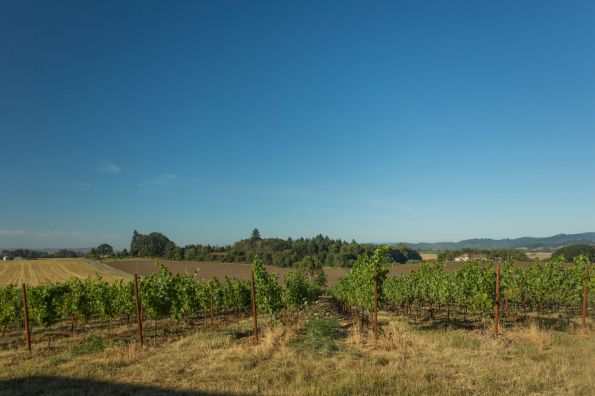
Maverick Vineyard
[TaV]: What is in the store for your new Maverick vineyard? How are you planning to farm it – sustainable, organic, biodynamic? Out of 19 acres, you have 10.5 allocated for Chardonnay and Pinot Noir – what about the rest? Any plans to expand beyond Pinot Noir and Chardonnay – let’s say, Pinot Gris, Riesling, etc?
[TR]: At this time, Maverick is LIVE. We plan to move towards organic over the next few years. It is an incredibly well behaved site that is already producing strong personality wines. I view this as a highly desirable trait for a young vineyard. The Chardonnay for the Pinot Chardonnay (70% of the blend) is all Maverick. This is the first bottled wine coming from Maverick.
No plans for other varietals at this time. But the clonal mix for the Pinot Noir (943, Swan, Calera and Mt. Eden) is pretty unusual.
[TaV]: Oregon is clearly a leader in Pinot Noir, considered by many as simply the best in the world, and it is also getting to the same level of recognition with the Chardonnays. What is ahead for the Oregon wine industry? Is the future bright and sunny, or do you see any clouds on the horizon?
[TR]: To me, the only constant is change. By that I mean that to continue to succeed as an industry, we need to be engaged (both locally and on a world stage), we need to be adaptive (as our climate continues to change, we are in for more and different challenges), and we need to be more concerned about the sustainability of our environment (both locally and throughout the world).
I believe we will have sun and clouds…and perhaps some rain. Just the weather we always have in Oregon 😉
[TaV]: When you are not drinking Tendril wines, what are your favorites from the other producers and/or regions?
[TR]: Lately I have been enjoying Graham-Beck sparkling wine from South Africa.
Or give me a good single malt Scotch…
Here we are, my friends. I’m sure you are thirsty at this point, but we will talk about Tendril Cellars wines in the next post.
To be continued…
Where In The World is Gigondas?
Do you think I’m dumbing it down way out of proportion? Do you think every wine consumer is perfectly familiar with whereabouts of Gigondas and its wines, and thus taking offense in the title of this post? Well, if this is the case, please share your anger in the comments section below and click the “x” in the corner. And if you are still here, let’s talk about the tiny speck of land in the southern part of the Rhone appellation in France.
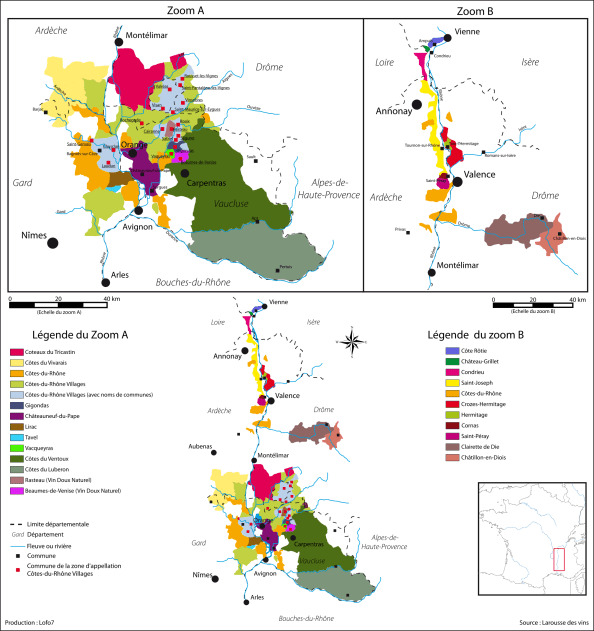
Source: By DalGobboM at French Wikipedia, CC BY-SA 3.0, Link
Size matters, but probably not in this case. Gigondas has only about 3,000 acres of vineyards for the whole appellation (for comparison, E.& J. Gallo in California owns 20,000 acres of vineyards). Nobody knows where Gigondas name came from, but it is known that the wine was consumed in the Gigondas region more than 2,000 years ago. First records of Gigondas vineyard go all the way back to the 12th century. I guess the wine in Gigondas was really good even in the early days, as in 1591 there were first laws enacted, particularly prohibiting the sales of the wine to foreigners. In 1971, Gigondas became the first appellation in Côtes du Rhône-Villages to receive its own AOC status.
Gigondas is the land of Red and Rosé (just Red, mostly). Yep, that’s right – no white wines are produced and no white grapes are grown – at least for the wines produced under the Gigondas designation. The wines of Gigondas stylistically similar to the wines made in the neighboring – also much larger and a lot more famous – appellation of Châteauneuf-du-Pape – despite vignerons mostly working with 4 grapes in Gigondas (out of 8 varieties officially permitted), while folks in Châteauneuf-du-Pape allowed to use 18 in production of their red wines, 9 of which are white. At the end of the day, it is not for nothing both Gigondas and Châteauneuf-du-Pape wines are often classified as “GSM” – which stands for Grenache, Syrah, Mourvèdre – these are the main three grapes, with Grenache typically been a workhorse here (up to 80% allowed in Gigondas wines).
Now, the time has come for an ugly truth. I’m actually not familiar with Gigondas wines. I know and had many of the Châteauneuf-du-Pape wines, but I usually would pass by one or two bottles of Gigondas which most of the stores would offer, and go to the Châteauneuf-du-Pape in the same price range. Thus when I was offered to try 3 different Gigondas wines, my “yes, please!” was very enthusiastic.
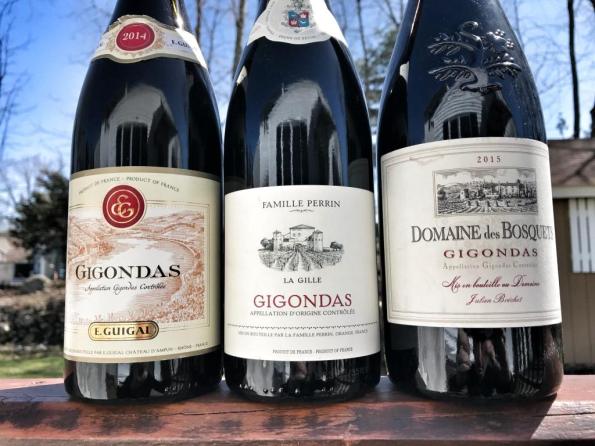
When I mentioned on Twitter that I’m going to play with err, taste a few of the Gigondas wines, I got back an instant outpour of love – and not only to the wines, but to the place. Take a look at these tweets:
It is time to talk about the wines I was able to taste. I had three wines, two from the 2015 vintage and one from 2014. Let’s take a look at the producers first.
The Domaine des Bosquets traces its history back to 14th century. Today, Domaine des Bosquets farms 64 acres of vineyards (50 years old vines), primarily growing Grenache and small amounts of Syrah, Mourvedre, and Cinsault.
The Famille Perrin needs no introduction to the wine lovers. It takes roots in the same 14th century, with its historic Château de Beaucastel. In the 1950s, Famille Perrin became a pioneer of the organic farming, later on extending into the Biodynamic. The Famille Perrin also involved in the multiple projects in France and around the world, and the wine I tasted comes from their La Gille property in Gigondas.
Unlike the two wineries we just talked about, the Guigal Estate was founded in 1946 by Etienne Guigal in Ampuis, a small village Côte-Rôtie appellation. From there on, however, E. Guigal moved to the great prominence, with its so-called “La La” bottlings from Côte-Rôtie (La Mouline, La Turque, La Landonne) becoming an object of desire and obsession for the wine lovers around the world. Guigal Estate produces the wines in multiple appellations throughout both Northern and Southern Rhone, and “Guigal” name on the bottle is typically associated with quality.


I have to honestly tell you – with the exception of E.Guigal, this was not the love at first sight. However, all three wines perfectly evolved on the second day. Here are my notes:
2015 Famille Perrin La Gille Gigondas AOC (14.5% ABV, $38, 80% Grenache, 20% Syrah)
Garnet
Beet juice, mocha, raspberries, medium intensity, minerally undertones
Dense, chewy, blueberries and blueberry compote, eucalyptus, dark chocolate, medium to full body. Long finish.
7+, I would like a bit more balance.
8- second day, the wine is a lot tighter, has firm structure, shows hint of white pepper and by all means a lot more enjoyable. Apparently will improve with time.
2015 Domaine des Bosquets Gigondas AOC (15% ABV, $35, 70% Grenache, 20% Syrah, 10% Mourvèdre and Cinsault, total 30 month aging in oak and concrete)
Dark garnet, almost black
Intense nose of freshly cut berries, vanilla, eucalyptus. Noticeable alcohol as well.
The palate is very intense but also astringent at the same time, black pepper, surprisingly medium body (was expecting bigger body). After 30 minutes in the decanter, the aggressive alcohol is gone. Still, feels that the wine needs time – not ready to drink now. Putting aside for a day.
Day 2 – cherries, mocha, and coffee on the nose. No alcohol, all nice and integrated. The palate shows tart cherries, pepper, vanilla, cut through acidity, medium plus body. Nicely drinkable. 8-/8, very good.
2014 E. Guigal Gigondas AOC (14.5% ABV, $36, 70% Grenache, 20% Syrah, 10% Mourvèdre)
Intense garnet
Open and inviting nose, black pepper, raspberries, mint, cassis
Fresh raspberries and blackberries, hint of mushrooms, nice minerality, a touch of vanilla and pepper, firm structure, good acidity, good balance
8-, a very pleasant and nicely drinkable wine from the get-go.
Day 2: 8+, sweet vanilla, dark chocolate and blueberries on the nose, extremely inviting. The palate evolved dramatically – pepper, raspberries, graphite, nutmeg, violets, firm structure, superb.
Here you are, my friends – my first serious encounter with Gigondas. Looking at the pictures, I would really love to visit Gigondas, and I will be happy to drink the Gigondas wine – just need to fiorget them in the cellar for a while. What is your eperience with Gigondas? Cheers!
Discover Wines Of Loire Valley
What do you think of the wines from the Loire Valley? Why, you say you are not sure? Come on, give yourself a credit – there is a good chance you had Loire Valley wines, but maybe you simply didn’t associate those wines with the Loire Valley? Let me help you – Sancerre, Pouilly-Fumé (not to be confused with Pouilly-Fuissé), Muscadet, Vouvray, Touraine, Anjou, Saumur, Chinon – had any of the wines with these words on the label? Ah, of course, you are saying? Then now you know – those are all the wines from the Loire Valley in France.
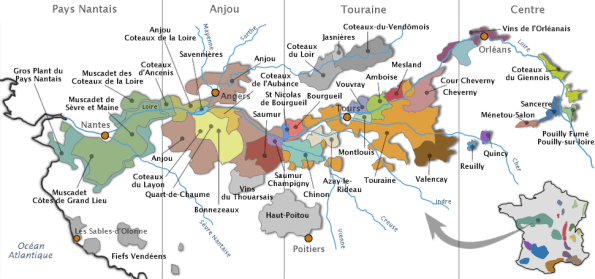
Loire Valley appellations map. Source: http://www.loirevalleywinetour.com/
The Loire Valley is not the most famous winemaking region in France, but it deserves the utmost respect. Here are some facts for you. Number one region in France for production of the white wines. The largest producer of the sparkling wines in France outside of Champagne. Number two producer of Rosè wines in France after Provence. The largest in France vineyard declared UNESCO World Heritage site. 79 sub-appellations and denominations and more than 2,000 years of winemaking history. These numbers speak for themselves. And to round up the stats – five grapes (Sauvignon Blanc, Chenin Blanc, Melon de Bourgeois, Cabernet Franc and Pinot Noir) comprise most of the Loire wines, but a total of 24 grapes are used there.
A few weeks ago, I was happy to attend the “Spring To Loire” trade tasting in New York City, alongside the inimitable, one and only JvB Uncorked – we definitely had lots of fun tasting through the Loire wines together. It was also literally the first tasting this year which I managed to attend, so “happy” is the right word. Besides, I love Loire wines, with Chinon and Saumur been personal pet peeves, as producers of delicious Cabernet Franc.
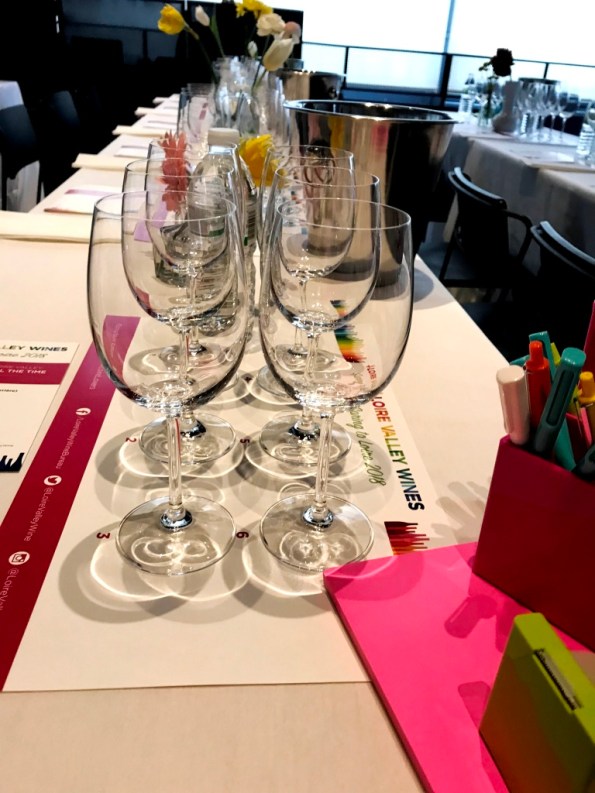
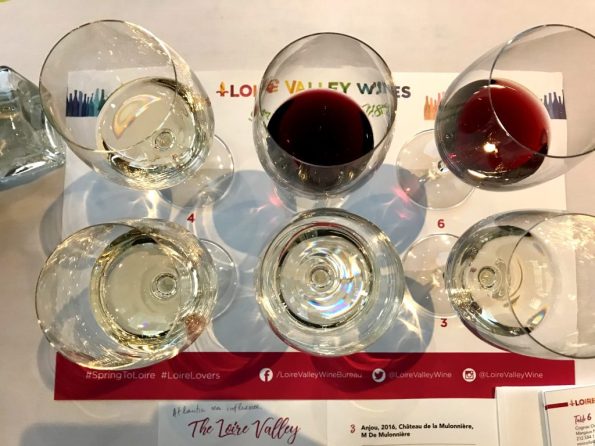
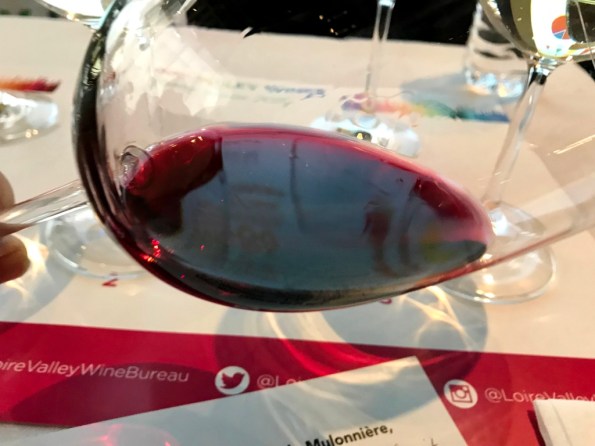
The tasting was unquestionably interesting. First, it had a couple of curious moments. There was a seminar which offered an excellent introduction to the region, tasting all major styles and varieties. Two of the reds in the tasting were rather green and aggressive. At the end of the tasting, I asked a lady sitting next to me how did she liked the wines, and she told me that she didn’t like the red wines individually, but she mixed them (!?!?) and they became more palatable – truly a wow moment in the professional tasting. And then it was another lady who (accidentally or not) dumped what seemed like a whole bottle of perfume on herself – trying to smell nuances of the wine standing next to her was beyond mission impossible. Some memorable moments…
Okay, let’s talk about the wines. I have a few favorites which I will be happy to mention, but first, let me give you my broad stroke impressions.
- Sancerre had a much lesser amount of fresh cut grass than I was expecting. Okay, I’m not an expert on Sancerre evolution, as I rarely drink them. However, based on what I remember from my education and some of the previous experiences, classic Sancerre is supposed to have pronounced grass and cat pee notes – didn’t find much of the Sancerre like that. Touraine Sauvignons, on another hand, were delicious across the board with an abundance of the freshly cut grass.
- Many of the Muscadet-Sèvre-et-Maine wines were lacking the characteristic acidity. When going for Muscadet, I’m expecting acidity which will plucker my mouth and make the cheeks to go meet each other. Many Muscadet in the tasting were nice white wines, but they were lacking their prized quality.
- The Chenin Blanc was a star. We had a number of delicious Vouvray and not only wines, which offered bright acidity, sometimes a touch of sweetness, a round mouthfeel – all which you would expect from a nicely done old world Chenin.
- Many of the Chinon and Saumur Reds were too tannic. This was a total surprise – the wines were fermented and aged in stainless steel tanks, nevertheless, the mouth was drying up almost as much as if you would be tasting the young Barolo. I was told that the whole cluster fermentation and aging was a culprit, but this was not a pleasant surprise. I really expect much more elegant and approachable wines to come from those regions. Nevertheless, we managed to find a few of the superb reds.
Done with my general impressions – here are some limited notes on my favorite wines.


Sparkling:
Crémant de Loire:
NV Maurice Bonnamy Crémant de Loire Brut (SRP: $16.99, 65% Chenin Blanc, 20% Chardonnay, 15% Cabernet Franc) – nice, refreshing, yeasty
NV Maurice Bonnamy Crémant de Loire Rosé (SRP: $16.99, 100% Cabernet Franc) – toasted bread and strawberries, nice, refreshing, great mouthfeel
NV Ackerman Crémant de Loire Brut (70% Sauvignon Blanc, Chardonnay and Cabernet Franc for the rest) – this wine was presented in the seminar, so I had a bit more time to spend with it – great nose, toasted bread, fresh, a touch on a sweeter side but still very nice
White:


Melon de Bourgogne:
2017 Sauvion Muscadet-Sèvre-et-Maine AOC (SRP $13.99) – crisp, fresh, great acidity
2014 Château de la Cormerais Monnieres-Saint Fiacre Muscadet Sèvre et Maine (SRP $19.99) – outstanding. fresh, clean
2012 Domaine de Colombier-Mouzillon-Tillières Muscadet Sèvre et Maine (SRP $19.99) – great complexity


Sauvignon Blanc:
2016 Domaine Pascal Jolivet Les Caillottes Sancerre AOC (SRP: $38) – steely acidity, crisp, a touch of grass.
2015 Domaine Pascal Jolivet Sauvage Sancerre AOC (SRP: $73) – this wine was just ok. The only reason to include it – this was probably the most expensive wine in the tasting, and it really didn’t deliver.
2016 Domaine Michel Vatan Calcaire Sancerre AOC – presented at the seminar – on the nose, minerality, lemon, distant touch of the grass, crisp, fresh. Excellent acidity on the palate, very nice overall.
2017 Raphael Midoir De Silex et Tuffeau Touraine AOC (SRP $14.99) – outstanding. Classic nose, delicious.
2016 Pierre Prieuré & Fils Domaine de Saint-Pierre Sancerre AOC (SRP $19.99) – excellent, fresh
2016 Raphael Midoir La Plaine des Cailloux Touraine-Oisly AOC (SRP $19.99) – outstanding, great complexity.


Chenin Blanc:
2016 Château de la Mulonnière M De Mulonnière Anjou – presented at the seminar – delicious. White stone fruit, peaches on the nose. A touch of sweetness and perfect balance on the palate. Outstanding.
2017 La Croix des Loges Anjou White AOC (SRP $14.99) – outstanding. Clean, fresh, touch of sweetness.
2014 La Croix des Loges Trois Failles Anjou AOC (SRP $22.99) – outstanding, gunflint on the nose, clean, balanced palate.
1977 La Croix des Loges Bonnezeaux AOC – yes, 1977, this is not a typo – this was an off the list, off the charts treat – a Chenin Blanc dessert wine, still elegant and complex.
Other:
2017 Domaine du Colombier Vla de Loire IGP ($14.99, 100% Sauvignon Gris) – excellent, fresh, complex.


Reds:
Cabernet Franc:
2015 Domaines des Varinelles Saumur-Champigny AOC (SRP: $20) – amazing similarity with Lodi wines on the palate – soft, aromatic, touch of cinnamon, ripe blueberries and raspberries, hint of blueberry compote. The similarity with Lodi is mind-boggling. Let’s not forget that this is Cabernet Franc wine, so there must be something there which can explain it. Need to dig deeper into this, I’m really curious.
2015 Domaines des Varinelles Laurintale Saumur-Champigny AOC (SRP: $24) – muted nose, and practically identical on the palate to the previous wine from the same domain. I will look into it… But two superb wines by all means – the wine are coming from the old world, but clearly, are screaming “new world”.
2017 Domaine du Raifault Chinon AOC (SRP: $17.95) – wow! Cassis on the nose, cassis on the palate – spectacular. This was my best of tasting red wine. This wine is not available in the US yes (we tasted one of only two bottles brought in for tasting) – in the process of being imported. Once it arrives, do yourself a favor – go find it and buy a case, or two. You can thank me later.
2016 Sauvion Chinon AOC (SRP: $17.99) – interesting dense nose, great palate, sandalwood, smoke, fresh, present. Tannins are still aggressive, but not as much as others.
Pinot Noir:
2014 Xavier Flouret Domaine de Chatenoy Menetou-Salon AOC (SRP: $20.95) – great Pinot Noir – excellent fresh nose, great balance of dark fruit on the palate, outstanding. 15 generations of vignerons know what they are doing. Definitely one of the highlights of the tasting.
2015 Domaine Gérard Millet Sancerre Red (SRP: $25) – fresh, crisp, herbs, spices, light.
Blends:
2014 Domaine de la Chaise Touraine-Chenonceaux AOC ($22, 70% Cabernet Franc, 30% Côt) – fresh, delicious, cassis and tobacco, excellent balance
The Spring is finally here (or at least it seems so in New York), so go on, find some Loire wines to explore on your own. Cheers!
Welcome Spring With Wines of Lieb Cellars
 Considering the weather in the New England, “spring” is just a word. Still freezing temperatures during the night, and simply cold during the day, despite the sun been in a full swing. I’ve seen plenty of rain and sunshine, but snow and sunshine? For sure this was new for me. So seeing the way Mother Nature is, we simply have to proclaim that Spring has arrived, and behave appropriately – Mother Nature will have to eventually comply with that unyielding demand.
Spring is the renewal time for everything in nature – including wines. No, I didn’t mean the vines, the bud breaking and all other beautiful “new life” occurrences. I actually meant the wines, as to liquid in the bottle. Yes, Spring is the time for … new arrivals, for sure in the Northern hemisphere. New vintages, new wines, new excitement – this is the beauty of the wine. Every vintage is different, every bottle is different – pulling that cork (okay, it is more often twisting the screwtop nowadays) is always an exciting moment – you never know what you will find inside.
Last year I discovered the wines of Lieb Cellars from Long Island, and it was a very tasty discovery – in fact, I called Lieb Cellars wines “happiness-inducing”, so you understand how much I liked them. Obviously, I was very happy to receive the new vintage of the wines from Lieb Cellars and their daughter winery, Bridge Lane Wines.
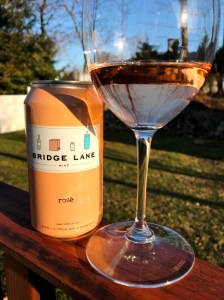
This year, the wines from the Bridge Lane Wines showed up in the new packaging – cans. As an extra bonus, all the cans had winter-defying, bright and cheerful colors – a good way to feel spring even if you still need a thick jacket to spend any time outside. Bridge Lane Wines are now available in 4 different formats – 375 ml (1/2 bottle) cans, standard bottles (750 ml), 3L boxes and 20 liters plastic kegs – whatever format will better suit your needs. The lineup from Bridge Lane Cellars includes Chardonnay, Sauvignon Blanc, White Merlot, Rosé, and Red Blend – and below are my tasting notes (note that all prices are SRP for 375 ml cans):


2017 Bridge Lane Chardonnay New York State (12.5% ABV, $7.99, 100% Chardonnay)
C: straw pale
N: fresh apples, minerality, lemon, medium + intensity
P: crisp, tart, Granny Smith apples, pretty astringent, needs food – shellfish, preferably
V: 7, definitely needs food
2017 Bridge Lane Sauvignon Blanc New York State (12% ABV, $7.99, 100% Sauvignon Blanc)
C: light golden
N: touch of grass, touch of grapefruit,
P: lemony notes, grapefruit, good acidity, fresh
V: 7+, nice and simple
2017 Bridge Lane Rosé New York State (11.9% ABV, $7.99, 45% Cabernet Franc, 27% Merlot, 16% Malbec, 8% Pinot Noir, 4% Pinot Blanc)
C: beautiful salmon pink
N: fresh strawberries, clean, crisp
P: zinging acidity, lemon, crisp, vibrant, hint of underripe strawberries.
V: 8, outstanding. Will be a perfect shellfish wine
2017 Bridge Lane White Merlot New York State (12% ABV, $7.99, 86% Merlot, 8% Pinot Blanc, 3% Riesling, 3% Viognier)
C: straw pale
N: crisp, white stone fruit, green apples
P: crisp, lemon, lemon zest, clean, fresh
V: 7+, reminiscent of unoaked Chardonnay more than anything else
2016 Bridge Lane Red Blend New York State (12.9% ABV, $7.99, 44% Merlot, 22% Cabernet Franc, 13% Petit Verdot, 12% Malbec, 9% Cabernet Sauvignon, 6 months in Hungarian oak)
C: dark ruby
N: currant, eucalyptus, forest underbrush, medium+ intensity
P: crisp, fresh, good acidity, medium body, blackberries, cherries, nice extraction, smooth, good textural presence
V: 8-, very nice
As you can tell, the Rosé and Red Blend were my favorites, but White Merlot was definitely fun, tasty, and creative as well. Now, let’s get to the big guns – the Lieb Cellar main line of wines. I had 4 different wines to try – here we go:

2015 Lieb Cellars Reserve Sparkling Rosé North Fork of Long Island (13.2% ABV, $29.99, 80% Pinot Noir, 20% Chardonnay, 16 months in the bottle)
C: light onion peel pink, fine mousse
N: Provence-like, restrained, touch of fresh strawberries and yeast
P: same fresh strawberries, fresh, perfect acidity, tiny hint of sweetness, perfectly round, delicate and delicious.
V: 8, excellent wine, would happily drink it again at any time
2013 Lieb Cellars Reserve Sparkling Pinot Blanc North Fork of Long Island (13.2% ABV, $29.99, 100% Pinot Blanc, 42 months in the bottle)
C: straw pale, perfect mousse appearance
N: toasted bread (restrained) with a hint of nutmeg, intriguing
P: crisp, fresh, touch of brioche, golden delicious apple, more nutmeg, impeccable balance, delicious.
V: 8/8+, superb
2016 Lieb Cellars Estate Cabernet Franc North Fork of Long Island (12.8% ABV, $29.99, 80% Cabernet Franc, 14% cabernet sauvignon, 4% Petit Verdot, 2% Merlot)
C: dark garnet
N: mint, eucalyptus, underripe black currant, a touch of cherries
P: open, bright, welcoming, medium body, fresh blueberries and sweet cherries, pronounced acidity, good balance.
V: 8-, the wine feels extremely young and hints at a good aging potential.
2016 Lieb Cellars Estate Petit Verdot North Fork of Long Island (13.2% ABV, $35 tasting room only, 90% Petit Verdot, 8% Merlot, 2% Cabernet Sauvignon)
C: dark ruby
N: licorice, mint, grape leaves, a touch of sour cherries, restrained, medium intensity.
P: medium+ body, succulent, lip-smacking acidity, bright blackberries and cherries, impeccable balance
V: 9-, it’s a riot. A perfection of young, fresh, balanced Bordeaux. Dangerous wine – once you start, you can’t stop
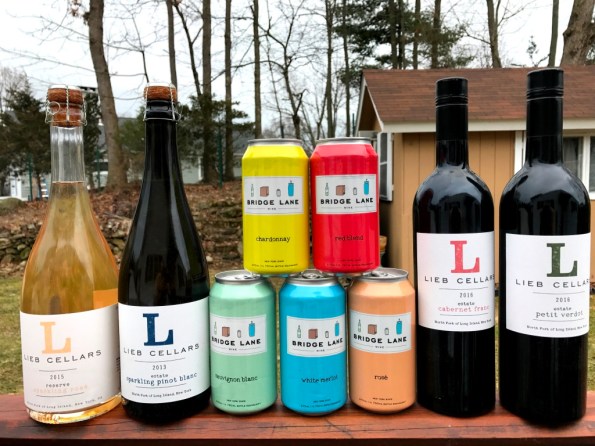
These were excellent wines, I can’t complain much about either one of the four – Sparkling Rosé was outstanding, Sparkling Pinot Blanc was superb and far exceeded my expectations. The Cab Franc was solid, and the Petit Verdot was, as I said, a riot. I did my usual “longevity test” with the Petit Verdot – pour a glass, close the wine, pour another glass next day and so on. For every day the wine stays tasty, I account 5-7 years of the aging time the wine can endure in the cellar. So Petit Verdot was fine for 2 days, but on the day number 3 it went down, so I would probably age it for another 5-7 years, but not much longer. But then with the screwtop, you never know…
Here you are, my friends. Spring, summer, fall or winter – Lieb Cellars have some fun and tasty wines waiting for you. Cheers!
Daily Glass: Textbook Precision
Once you fully embrace the wine world, one of the important lessons you learn is rather simple – “there are no guarantees”. The bottle of wine can perfectly say “Cabernet Sauvignon” – there are absolutely no guarantees that Cabernet Sauvignon from Washington, California, and Chile will have any smell and taste similarities, never mind Cabernet Sauvignon from China, Czech Republic, and Moldova. And this is okay, we can all accept it – at the end of the day, the only thing which matter is whether we like the wine or not.
Despite all the differences, when it comes to the major grapes, such as Cabernet Sauvignon, Chardonnay, Merlot, Sauvignon Blanc, Pinot Noir and so on, we usually know how the “classic” wine should taste like – especially if we take any formal wine education or make enough effort to study the wine, pay attention to what we drink and make it a lesson to learn. Yes, there might be a bit of our perception in it too, but still, we usually have that “classic profile ” idea in the mind.
What prompted this post was a lucky happenstance, an encounter with two classic, textbook wine profiles for two nights in the row.
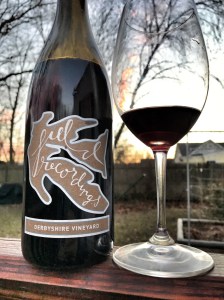 First, there was Pinot Noir. When it comes to Pinot Noir, there are probably four classic profiles – Burgundy (of course!), with lots of dark fruit power and a little bit of funk (especially with age, but drinking young Burgundy is almost like killing a baby, right?). Then you have New Zealand, which usually can be identified by the pronounced acidity. Oregon Pinot Noir often screams minerality, mocha and dark chocolate. And then you got California, with luscious smokey plums and silky, seductive texture.
So the wine I had a pleasure of experiencing was a textbook, unmistakable California Pinot Noir – 2015 Field Recordings Derbyshire Vineyard Pinot Noir San Luis Obispo County (13.1% ABV, $28, 20% whole cluster fermentation, foot tread in open top bins, 12 month in French oak) – smokey plums on the nose, bright cherries and plums profile on the palate with a perfect balance of acidity, velvety layers – tremendous amount of pleasure in every sip. Drinking this wine evokes comparisons with other California classics such as Siduri. It doesn’t reach the ultra-luxurious texture of Sandhi, but if you have any experience with classic California Pinot, one sip of this wine will perfectly put you in the right place.
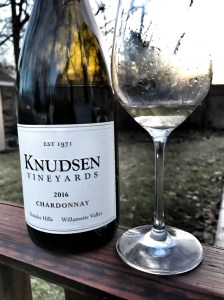 Now, talking about classics, let’s talk about the grape which is not a relative of Pinot Noir, but more often than not, a closest friend and neighbor – Chardonnay. What is interesting about Chardonnay, in my opinion, is that good Chardonnay is a lot more cosmopolitan than a Pinot Noir. With the exception of Chablis, which often can be recognized by the gunflint on the nose, the classic Chardonnay profile includes vanilla, apples and a touch of butter. You can often differentiate Burgundy from California by the amount of butter (California usually offers lots more) and acidity (that’s what you will get with the young Burgundy), but still, Chardonnays from Australia, Burgundy, Chablis, and California have quite a bit of similarity.
Oregon, which is definitely an established world leader when it comes to Pinot Noir, lately also started to show its Chardonnay provenance. Two years ago, I was blown away by the perfection of Vidon Chardonnay. This time around, the 2016 Knudsen Vineyards Chardonnay Dundee Hills (13.5% ABV, $45) made me say “wow” many, many times. Perfect nose of vanilla and golden delicious apples with a distant hint of butter and even honey (honey is usually showing up in Chardonnay after some aging) was supported by the same profile on the palate – vanilla, apples, butter – all perfectly mended together in cohesive, sublime package resting on the vibrant core of acidity. This was definitely a textbook Chardonnay for me, and the one which I would love to see aged, at least for another 5-7 years.
Here you go, my friends – a textbook experience with two classic grapes. What are your textbook wine experiences? Cheers!
Parent, Secret Power, Unsung Hero
You just read the title of this post. What do you think we will be talking about? Of course, it can be a story about a person who had all those great qualities – but this is the wine blog, right? Can all those qualities belong to a grape?
Let’s see. Parent – this is simple. When two grapes are crossed, they will give birth to the new grapes, and, of course, we can call both of the original grapes parents. Unsung hero? This is typically someone who can quietly come to the help of others and solve the big problem or save a life. Apart from saving a life, a grape can be very instrumental in assisting others to do their best, bringing out their best qualities while remaining literally unknown. For example, helping to make delicious wine as part of the blend. Now, the secret power? Every once in a while a person can be on a secret mission and save the world, all alone, “solo” – James Bond meets Wonder Woman, anyone? Okay, okay, I’m only talking about making delicious wines, all by itself, solo.
Now, as we are talking about the grape, can you think of one which would fit this description? There are thousands of grapes used in winemaking, so theoretically, there is more than one grape that will fit this profile, but I would dare to say that one grape might stand above others in all these roles. Know what I’m about to say? There is a good chance you do – you probably guessed it already – I’m talking about Cabernet Franc.
Cabernet Franc grapes, as shown in Wikipedia
It is hard to tell when Cabernet Franc became known as a grape variety. It is definitely old, probably not as old as Chardonnay, which can trace its history all the way to the 11th century, but still older than most other grapes. While Cabernet Franc is typically associated with Bordeaux and Loire, it appears that it originated from the Basque Country in Spain, from where it spread through the south of France and reached Bordeaux.
How Cabernet Franc is a Parent? Based on DNA research, Cabernet Franc was a parent of Cabernet Sauvignon, Merlot, and Carménère – a good group of kids, isn’t it?
How is it an unsung hero? Cabernet Franc ripens at least one week earlier than Cabernet Sauvignon. It can reach phenolic ripeness in the years when Cabernet Sauvignon will not, and thus in the blend, it will be a savior – this is why it was always so loved in Bordeaux, an insurance policy of sorts. While the tasting profile of Cabernet Franc is somewhat similar to Cabernet Sauvignon, it is typically softer and less tannic than its more famous offspring, so it makes the blend more approachable.
The Secret Power? When used in European wines, it is often unknown that the wine is made out of Cabernet Franc. For instance, Chateau Cheval Blanc, one of the most famous Bordeaux wines, is made predominantly out of the Cabernet Franc – but this is not widely known outside of the circle of wine aficionados. How about Olga Raffault Chinon? Chinon, a region in the Loire, is one of the best sources of delicious Cabernet Franc wines, but you have to simply know that. Coming to the new world, Cabernet Franc is not so secret anymore, as you can see it on the label, but I still can let you in on one little secret – this is one of the most versatile red grapes you can find. Talking about the United States, for instance, it is practically the only red grape which can consistently deliver delicious red wines both in California and in New York – and we don’t need to be so confined – Washington and Oregon are doing quite well with the Cabernet Franc, and so do Massachusets, New Jersey, and even Rhode Island. And let’s not forget Canada, where the grape goes beyond dry reds and offers some of the most stunning dessert wines – Cabernet Franc Ice Wine.
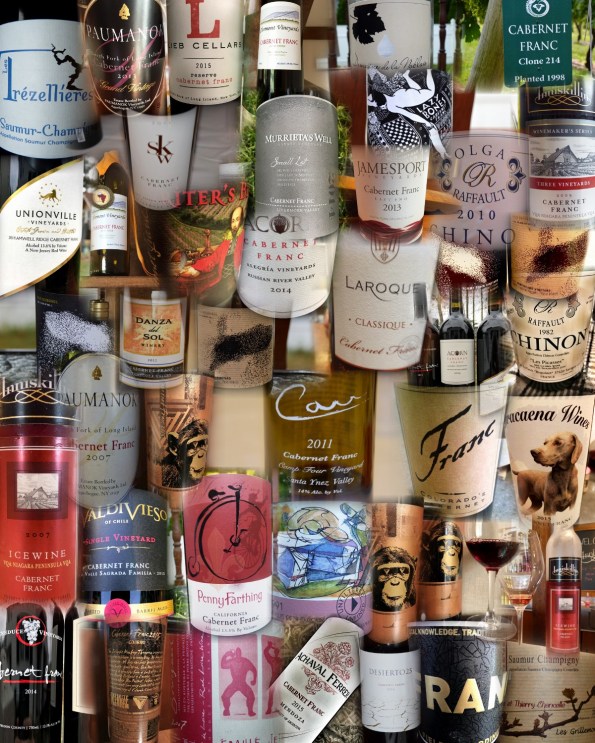
December 4th is when we celebrate this unique variety with the #CabFrancDay. The whole Cabernet Franc extravaganza is a product of the obsession of one person – Lori Budd, who singlehandedly started this grape holiday in 2015. Lori expresses her love for the grape not just by talking about it – she also makes her own Cabernet Franc wine in Paso Robles under the Dracaena Wines label. This year I was able to try the Dracaena Wines Cabernet Franc at the wine bloggers conference, and I can tell you that while I’m very particular about Cabernet Franc wines (prefer more old-world style than new), I really enjoyed Lori’s rendition.
Grape holidays are always fun – you have a good reason to open a special bottle that was stashed in the corner, and share your love for the grape with the world. Cabernet Franc’s celebration is important beyond that simple joy. Take a look at the Wikipedia article – it says that Cabernet Franc is “principally grown for blending with Cabernet Sauvignon and Merlot in the Bordeaux style, but can also be vinified alone”. The Vins de Bordeaux website says that Cabernet Franc “is the ultimate complimentary grape variety”. While this is true, Cabernet Franc is great for blending, this is also the grape which is excellent by itself, and we should recognize and acknowledge that, and change that perception of a “blending grape”.
This year, I had a great experience with beautiful Cabernet Franc wines from all over the world – 1982 Olga Raffault Chinon, Achaval-Ferrer Cabernet Franc from Argentina, Lieb Cabernet Franc from Long Island, New York, Dracaena Cabernet Franc from Paso Robles, and many others. But to celebrate Cabernet Franc Day in style, I had an opportunity to open 3 more wines especially for the holiday – for one, representing both coasts of the USA – and, surprisingly enough, representing both styles of Cabernet Franc, the old world and the new world.


2014 ACORN Alegría Vineyards Cabernet Franc Russian River Valley (12.5% ABV, $38, 93% Cabernet Franc, 2% Malbec, 2% Merlot, 2% Petit Verdot, 1% Cabernet Sauvignon and Tannat, 18 months in barrel) was uniquely Californian in style – in many ways. Alegría Vineyards are Certified Sustainable, which is really the way now for many vineyards in California, with a lot of manual labor-intensive effort going into helping grapes to achieve their best potential. All the wines ACORN produces are made as field blends, where different grapes are co-fermented together, according to the century-old field-blend vineyard traditions. The result was beautifully balanced, fruit-forward wine, boasting pure cassis flavors, supported by the medley of the red fruit and perfect acidity. The wine was clean and delicious.
Two more wines were a total surprise for me. These two Cabernet Franc wines were both made in New Jersey. I have very little experience with New Jersey wines, and that experience was not necessarily all positive, so yes, I didn’t have much expectation as I was pulling the corks, just a hope that the wines would be at least palatable.


While Unionville Vineyards were planted only in 1987 and the winery opened its doors to the public in 1993, the land where the vineyards a located was farmland even before the 1850s. As farmland, it went through many different plantings and such – peach orchard, apple orchard, dairy farm, grains, and horses – but returned to the fruits with the first grapevine plantings in 1987 – this is when the story of Unionville Vineyards started.


Beneduce Vineyards is located in the same Hunterdon County as Unionville Vineyards. Chardonnay, Riesling, and Gewurztraminer are the main white grape varieties at Beneduce Vineyards, and the list of reds includes Pinot Noir, Blaufränkisch and, of course, Cabernet Franc.
Last Bottle Sign Up ($10 credit)




 Talk-A-Vino