Archive
Welcome Spring With Wines of Lieb Cellars
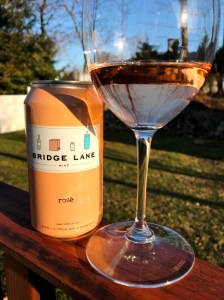 Considering the weather in the New England, “spring” is just a word. Still freezing temperatures during the night, and simply cold during the day, despite the sun been in a full swing. I’ve seen plenty of rain and sunshine, but snow and sunshine? For sure this was new for me. So seeing the way Mother Nature is, we simply have to proclaim that Spring has arrived, and behave appropriately – Mother Nature will have to eventually comply with that unyielding demand.
Spring is the renewal time for everything in nature – including wines. No, I didn’t mean the vines, the bud breaking and all other beautiful “new life” occurrences. I actually meant the wines, as to liquid in the bottle. Yes, Spring is the time for … new arrivals, for sure in the Northern hemisphere. New vintages, new wines, new excitement – this is the beauty of the wine. Every vintage is different, every bottle is different – pulling that cork (okay, it is more often twisting the screwtop nowadays) is always an exciting moment – you never know what you will find inside.
Last year I discovered the wines of Lieb Cellars from Long Island, and it was a very tasty discovery – in fact, I called Lieb Cellars wines “happiness-inducing”, so you understand how much I liked them. Obviously, I was very happy to receive the new vintage of the wines from Lieb Cellars and their daughter winery, Bridge Lane Wines.
This year, the wines from the Bridge Lane Wines showed up in the new packaging – cans. As an extra bonus, all the cans had winter-defying, bright and cheerful colors – a good way to feel spring even if you still need a thick jacket to spend any time outside. Bridge Lane Wines are now available in 4 different formats – 375 ml (1/2 bottle) cans, standard bottles (750 ml), 3L boxes and 20 liters plastic kegs – whatever format will better suit your needs. The lineup from Bridge Lane Cellars includes Chardonnay, Sauvignon Blanc, White Merlot, Rosé, and Red Blend – and below are my tasting notes (note that all prices are SRP for 375 ml cans):


2017 Bridge Lane Chardonnay New York State (12.5% ABV, $7.99, 100% Chardonnay)
C: straw pale
N: fresh apples, minerality, lemon, medium + intensity
P: crisp, tart, Granny Smith apples, pretty astringent, needs food – shellfish, preferably
V: 7, definitely needs food
2017 Bridge Lane Sauvignon Blanc New York State (12% ABV, $7.99, 100% Sauvignon Blanc)
C: light golden
N: touch of grass, touch of grapefruit,
P: lemony notes, grapefruit, good acidity, fresh
V: 7+, nice and simple
2017 Bridge Lane Rosé New York State (11.9% ABV, $7.99, 45% Cabernet Franc, 27% Merlot, 16% Malbec, 8% Pinot Noir, 4% Pinot Blanc)
C: beautiful salmon pink
N: fresh strawberries, clean, crisp
P: zinging acidity, lemon, crisp, vibrant, hint of underripe strawberries.
V: 8, outstanding. Will be a perfect shellfish wine
2017 Bridge Lane White Merlot New York State (12% ABV, $7.99, 86% Merlot, 8% Pinot Blanc, 3% Riesling, 3% Viognier)
C: straw pale
N: crisp, white stone fruit, green apples
P: crisp, lemon, lemon zest, clean, fresh
V: 7+, reminiscent of unoaked Chardonnay more than anything else
2016 Bridge Lane Red Blend New York State (12.9% ABV, $7.99, 44% Merlot, 22% Cabernet Franc, 13% Petit Verdot, 12% Malbec, 9% Cabernet Sauvignon, 6 months in Hungarian oak)
C: dark ruby
N: currant, eucalyptus, forest underbrush, medium+ intensity
P: crisp, fresh, good acidity, medium body, blackberries, cherries, nice extraction, smooth, good textural presence
V: 8-, very nice
As you can tell, the Rosé and Red Blend were my favorites, but White Merlot was definitely fun, tasty, and creative as well. Now, let’s get to the big guns – the Lieb Cellar main line of wines. I had 4 different wines to try – here we go:

2015 Lieb Cellars Reserve Sparkling Rosé North Fork of Long Island (13.2% ABV, $29.99, 80% Pinot Noir, 20% Chardonnay, 16 months in the bottle)
C: light onion peel pink, fine mousse
N: Provence-like, restrained, touch of fresh strawberries and yeast
P: same fresh strawberries, fresh, perfect acidity, tiny hint of sweetness, perfectly round, delicate and delicious.
V: 8, excellent wine, would happily drink it again at any time
2013 Lieb Cellars Reserve Sparkling Pinot Blanc North Fork of Long Island (13.2% ABV, $29.99, 100% Pinot Blanc, 42 months in the bottle)
C: straw pale, perfect mousse appearance
N: toasted bread (restrained) with a hint of nutmeg, intriguing
P: crisp, fresh, touch of brioche, golden delicious apple, more nutmeg, impeccable balance, delicious.
V: 8/8+, superb
2016 Lieb Cellars Estate Cabernet Franc North Fork of Long Island (12.8% ABV, $29.99, 80% Cabernet Franc, 14% cabernet sauvignon, 4% Petit Verdot, 2% Merlot)
C: dark garnet
N: mint, eucalyptus, underripe black currant, a touch of cherries
P: open, bright, welcoming, medium body, fresh blueberries and sweet cherries, pronounced acidity, good balance.
V: 8-, the wine feels extremely young and hints at a good aging potential.
2016 Lieb Cellars Estate Petit Verdot North Fork of Long Island (13.2% ABV, $35 tasting room only, 90% Petit Verdot, 8% Merlot, 2% Cabernet Sauvignon)
C: dark ruby
N: licorice, mint, grape leaves, a touch of sour cherries, restrained, medium intensity.
P: medium+ body, succulent, lip-smacking acidity, bright blackberries and cherries, impeccable balance
V: 9-, it’s a riot. A perfection of young, fresh, balanced Bordeaux. Dangerous wine – once you start, you can’t stop
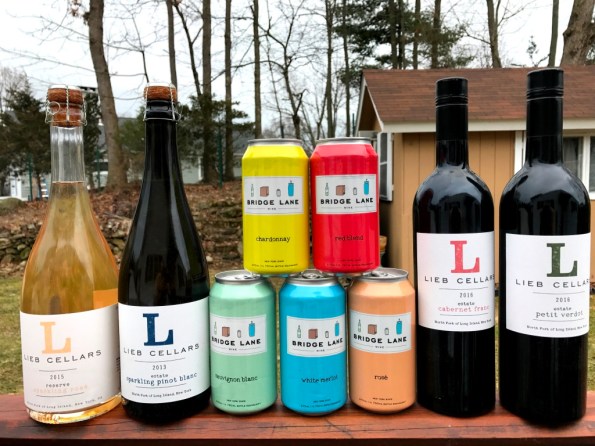
These were excellent wines, I can’t complain much about either one of the four – Sparkling Rosé was outstanding, Sparkling Pinot Blanc was superb and far exceeded my expectations. The Cab Franc was solid, and the Petit Verdot was, as I said, a riot. I did my usual “longevity test” with the Petit Verdot – pour a glass, close the wine, pour another glass next day and so on. For every day the wine stays tasty, I account 5-7 years of the aging time the wine can endure in the cellar. So Petit Verdot was fine for 2 days, but on the day number 3 it went down, so I would probably age it for another 5-7 years, but not much longer. But then with the screwtop, you never know…
Here you are, my friends. Spring, summer, fall or winter – Lieb Cellars have some fun and tasty wines waiting for you. Cheers!
Daily Glass: Textbook Precision
Once you fully embrace the wine world, one of the important lessons you learn is rather simple – “there are no guarantees”. The bottle of wine can perfectly say “Cabernet Sauvignon” – there are absolutely no guarantees that Cabernet Sauvignon from Washington, California, and Chile will have any smell and taste similarities, never mind Cabernet Sauvignon from China, Czech Republic, and Moldova. And this is okay, we can all accept it – at the end of the day, the only thing which matter is whether we like the wine or not.
Despite all the differences, when it comes to the major grapes, such as Cabernet Sauvignon, Chardonnay, Merlot, Sauvignon Blanc, Pinot Noir and so on, we usually know how the “classic” wine should taste like – especially if we take any formal wine education or make enough effort to study the wine, pay attention to what we drink and make it a lesson to learn. Yes, there might be a bit of our perception in it too, but still, we usually have that “classic profile ” idea in the mind.
What prompted this post was a lucky happenstance, an encounter with two classic, textbook wine profiles for two nights in the row.
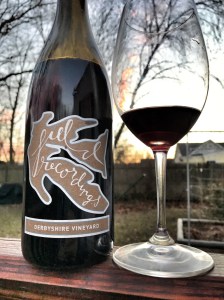 First, there was Pinot Noir. When it comes to Pinot Noir, there are probably four classic profiles – Burgundy (of course!), with lots of dark fruit power and a little bit of funk (especially with age, but drinking young Burgundy is almost like killing a baby, right?). Then you have New Zealand, which usually can be identified by the pronounced acidity. Oregon Pinot Noir often screams minerality, mocha and dark chocolate. And then you got California, with luscious smokey plums and silky, seductive texture.
So the wine I had a pleasure of experiencing was a textbook, unmistakable California Pinot Noir – 2015 Field Recordings Derbyshire Vineyard Pinot Noir San Luis Obispo County (13.1% ABV, $28, 20% whole cluster fermentation, foot tread in open top bins, 12 month in French oak) – smokey plums on the nose, bright cherries and plums profile on the palate with a perfect balance of acidity, velvety layers – tremendous amount of pleasure in every sip. Drinking this wine evokes comparisons with other California classics such as Siduri. It doesn’t reach the ultra-luxurious texture of Sandhi, but if you have any experience with classic California Pinot, one sip of this wine will perfectly put you in the right place.
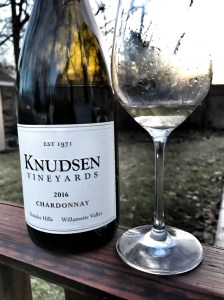 Now, talking about classics, let’s talk about the grape which is not a relative of Pinot Noir, but more often than not, a closest friend and neighbor – Chardonnay. What is interesting about Chardonnay, in my opinion, is that good Chardonnay is a lot more cosmopolitan than a Pinot Noir. With the exception of Chablis, which often can be recognized by the gunflint on the nose, the classic Chardonnay profile includes vanilla, apples and a touch of butter. You can often differentiate Burgundy from California by the amount of butter (California usually offers lots more) and acidity (that’s what you will get with the young Burgundy), but still, Chardonnays from Australia, Burgundy, Chablis, and California have quite a bit of similarity.
Oregon, which is definitely an established world leader when it comes to Pinot Noir, lately also started to show its Chardonnay provenance. Two years ago, I was blown away by the perfection of Vidon Chardonnay. This time around, the 2016 Knudsen Vineyards Chardonnay Dundee Hills (13.5% ABV, $45) made me say “wow” many, many times. Perfect nose of vanilla and golden delicious apples with a distant hint of butter and even honey (honey is usually showing up in Chardonnay after some aging) was supported by the same profile on the palate – vanilla, apples, butter – all perfectly mended together in cohesive, sublime package resting on the vibrant core of acidity. This was definitely a textbook Chardonnay for me, and the one which I would love to see aged, at least for another 5-7 years.
Here you go, my friends – a textbook experience with two classic grapes. What are your textbook wine experiences? Cheers!
Parent, Secret Power, Unsung Hero
You just read the title of this post. What do you think we will be talking about? Of course, it can be a story about a person who had all those great qualities – but this is the wine blog, right? Can all those qualities belong to a grape?
Let’s see. Parent – this is simple. When two grapes are crossed, they will give birth to the new grapes, and, of course, we can call both of the original grapes parents. Unsung hero? This is typically someone who can quietly come to the help of others and solve the big problem or save a life. Apart from saving a life, a grape can be very instrumental in assisting others to do their best, bringing out their best qualities while remaining literally unknown. For example, helping to make delicious wine as part of the blend. Now, the secret power? Every once in a while a person can be on a secret mission and save the world, all alone, “solo” – James Bond meets Wonder Woman, anyone? Okay, okay, I’m only talking about making delicious wines, all by itself, solo.
Now, as we are talking about the grape, can you think of one which would fit this description? There are thousands of grapes used in winemaking, so theoretically, there is more than one grape that will fit this profile, but I would dare to say that one grape might stand above others in all these roles. Know what I’m about to say? There is a good chance you do – you probably guessed it already – I’m talking about Cabernet Franc.
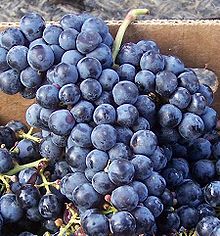
Cabernet Franc grapes, as shown in Wikipedia
It is hard to tell when Cabernet Franc became known as a grape variety. It is definitely old, probably not as old as Chardonnay, which can trace its history all the way to the 11th century, but still older than most other grapes. While Cabernet Franc is typically associated with Bordeaux and Loire, it appears that it originated from the Basque Country in Spain, from where it spread through the south of France and reached Bordeaux.
How Cabernet Franc is a Parent? Based on DNA research, Cabernet Franc was a parent of Cabernet Sauvignon, Merlot, and Carménère – a good group of kids, isn’t it?
How is it an unsung hero? Cabernet Franc ripens at least one week earlier than Cabernet Sauvignon. It can reach phenolic ripeness in the years when Cabernet Sauvignon will not, and thus in the blend, it will be a savior – this is why it was always so loved in Bordeaux, an insurance policy of sorts. While the tasting profile of Cabernet Franc is somewhat similar to Cabernet Sauvignon, it is typically softer and less tannic than its more famous offspring, so it makes the blend more approachable.
The Secret Power? When used in European wines, it is often unknown that the wine is made out of Cabernet Franc. For instance, Chateau Cheval Blanc, one of the most famous Bordeaux wines, is made predominantly out of the Cabernet Franc – but this is not widely known outside of the circle of wine aficionados. How about Olga Raffault Chinon? Chinon, a region in the Loire, is one of the best sources of delicious Cabernet Franc wines, but you have to simply know that. Coming to the new world, Cabernet Franc is not so secret anymore, as you can see it on the label, but I still can let you in on one little secret – this is one of the most versatile red grapes you can find. Talking about the United States, for instance, it is practically the only red grape which can consistently deliver delicious red wines both in California and in New York – and we don’t need to be so confined – Washington and Oregon are doing quite well with the Cabernet Franc, and so do Massachusets, New Jersey, and even Rhode Island. And let’s not forget Canada, where the grape goes beyond dry reds and offers some of the most stunning dessert wines – Cabernet Franc Ice Wine.
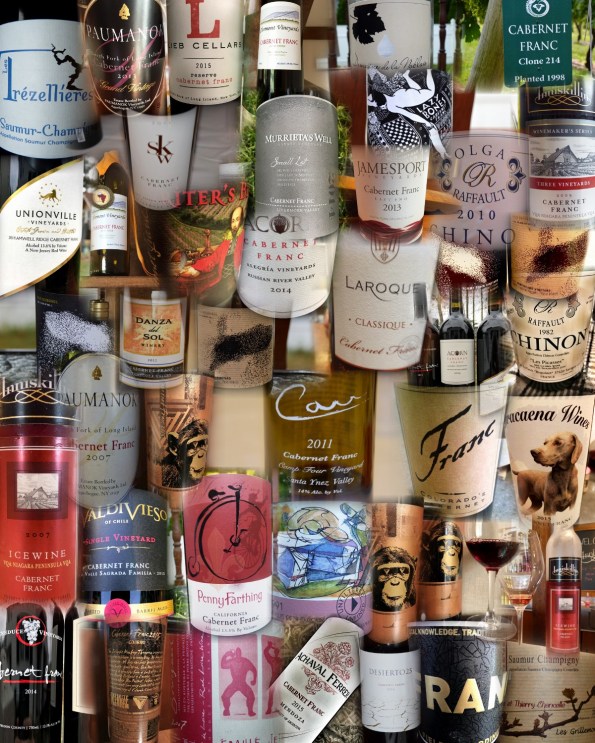
December 4th is when we celebrate this unique variety with the #CabFrancDay. The whole Cabernet Franc extravaganza is a product of the obsession of one person – Lori Budd, who singlehandedly started this grape holiday in 2015. Lori expresses her love for the grape not just by talking about it – she also makes her own Cabernet Franc wine in Paso Robles under the Dracaena Wines label. This year I was able to try the Dracaena Wines Cabernet Franc at the wine bloggers conference, and I can tell you that while I’m very particular about Cabernet Franc wines (prefer more old-world style than new), I really enjoyed Lori’s rendition.
Grape holidays are always fun – you have a good reason to open a special bottle that was stashed in the corner, and share your love for the grape with the world. Cabernet Franc’s celebration is important beyond that simple joy. Take a look at the Wikipedia article – it says that Cabernet Franc is “principally grown for blending with Cabernet Sauvignon and Merlot in the Bordeaux style, but can also be vinified alone”. The Vins de Bordeaux website says that Cabernet Franc “is the ultimate complimentary grape variety”. While this is true, Cabernet Franc is great for blending, this is also the grape which is excellent by itself, and we should recognize and acknowledge that, and change that perception of a “blending grape”.
This year, I had a great experience with beautiful Cabernet Franc wines from all over the world – 1982 Olga Raffault Chinon, Achaval-Ferrer Cabernet Franc from Argentina, Lieb Cabernet Franc from Long Island, New York, Dracaena Cabernet Franc from Paso Robles, and many others. But to celebrate Cabernet Franc Day in style, I had an opportunity to open 3 more wines especially for the holiday – for one, representing both coasts of the USA – and, surprisingly enough, representing both styles of Cabernet Franc, the old world and the new world.


2014 ACORN Alegría Vineyards Cabernet Franc Russian River Valley (12.5% ABV, $38, 93% Cabernet Franc, 2% Malbec, 2% Merlot, 2% Petit Verdot, 1% Cabernet Sauvignon and Tannat, 18 months in barrel) was uniquely Californian in style – in many ways. Alegría Vineyards are Certified Sustainable, which is really the way now for many vineyards in California, with a lot of manual labor-intensive effort going into helping grapes to achieve their best potential. All the wines ACORN produces are made as field blends, where different grapes are co-fermented together, according to the century-old field-blend vineyard traditions. The result was beautifully balanced, fruit-forward wine, boasting pure cassis flavors, supported by the medley of the red fruit and perfect acidity. The wine was clean and delicious.
Two more wines were a total surprise for me. These two Cabernet Franc wines were both made in New Jersey. I have very little experience with New Jersey wines, and that experience was not necessarily all positive, so yes, I didn’t have much expectation as I was pulling the corks, just a hope that the wines would be at least palatable.


While Unionville Vineyards were planted only in 1987 and the winery opened its doors to the public in 1993, the land where the vineyards a located was farmland even before the 1850s. As farmland, it went through many different plantings and such – peach orchard, apple orchard, dairy farm, grains, and horses – but returned to the fruits with the first grapevine plantings in 1987 – this is when the story of Unionville Vineyards started.


Beneduce Vineyards is located in the same Hunterdon County as Unionville Vineyards. Chardonnay, Riesling, and Gewurztraminer are the main white grape varieties at Beneduce Vineyards, and the list of reds includes Pinot Noir, Blaufränkisch and, of course, Cabernet Franc.
Discover Wines of South Africa
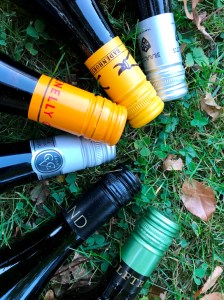 Let me start with a question: when was the last time you had South African wine? You can take a few minutes to ponder at it – but I would bet that if you are a wine consumer in the USA, there is a very good chance that the answer will be “hmmm, never”. But if “never” or “many years ago” is your answer, we need to change that.
The winemaking history in South Africa goes back to the 17th century, when immigrants from Europe brought the vine cuttings with them, as they’ve done in all other places. South African wine story somewhat resembles most of the Europe, as it also includes the phylloxera epidemic and replanting of the vineyards. Unfortunately for South African winemakers and the rest of us, the wine story of South Africa also had heavy political influence, with apartheid, KWV monopoly, and resulting boycott from most of the countries for the majority of the 20th century (here is an article on Wikipedia if you want to learn more). The new chapter for South African wines opened up in the 1990s, with the end of apartheid and subsequent changes in all areas of life, winemaking included.
In the past, South Africa was best known for its Chenin Blanc wines, which was also called Steen. Another grape South Africa was famous for was Pinotage – dinking of the Pinotage wines was likened by some wine critics to the drinking of the “liquified rusty nails”. On much brighter note, while talking about the past, I want to mention Klein Constantia Vin de Constance – the nectar of gods (don’t take my word for it – find it and try it), made from Muscat de Frontignan grapes and favorite wine of the French emperor Napoleon Bonaparte, who was buying it by the barrel (legend has it that it was Napoleon’s deathbed wish wine).
Today South Africa offers lots more than a typical wine consumer would expect. The South African wines are often described as “old world wines masquerading as new world wines”, and this is perfectly showing in the wide range of the wines. You really need to try for yourself South African Chardonnay, Sauvignon Blanc, Pinot Noir, Cabernet Sauvignon, Merlot, Shiraz, and don’t skip the Chenin Blanc, especially if it is an FMC by Ken Forrester. You shouldn’t skip even Pinotage, as it dramatically evolved compared to the old days. The old world winemaking foundation really shows through many of the South African wines today, and they are always ready to surprise a curious wine drinker.
Case in point – our recent virtual tasting on Snooth. We had an opportunity to taste 6 white wines, well representing South African grapes, styles and regions. The tasting included 3 out of the 4 most popular white grapes in South Africa (Chenin Blanc, Chardonnay, and Sauvignon Blanc) – the second most planted grape, Colombard, is used primarily in the brandy production. Another interesting fact for you – until 1981, there was no Chardonnay planted in South Africa, which makes it all more impressive (read my notes below). Two of the Chardonnays and Sauvignon Blanc from the tasting were simply stunning, and the rest of the wines were perfectly suitable for the everyday drinking. What is even better is that you don’t need to rely on my notes if you want to discover what South Africa is capable of – Snooth offers that exact set of 6 wines for purchase, at a very reasonable price of $79.99 for the whole set.
Here are my notes from the tasting:


2016 Glenelly Glass Collection Unoaked Chardonnay WO Stellenbosch (13.5% ABV, $20, 100% Chardonnay)
C: straw pale
N: Beautiful, vanilla, touch of guava, fresh, medium+
P: good acidity, granny smith apple, crisp, maybe a bit too restrained now, lemony acidity on the finish
V: 8, excellent now, but I definitely want to see it evolve.
2016 De Wetshof Estate Limestone Hill Chardonnay WO Robertson (14% ABV, $16, 100% Chardonnay)
C: light golden
N: complex, vanilla, popcorn, medium intensity. Nose clears up as the wine breathes. Golden delicious and honeysuckle appeared. Delicious nose.
P: quite restrained, touch of Granny Smith apples as opposed to the golden delicious. Perfect acidity, vanilla, fresh.
V: 8, will evolve. Definitely an interesting wine.
2016 Badenhorst Family Wines Secateurs Chenin Blanc Swartland WO Steen (12.5% ABV, $15, Chenin Blanc with a sprinkling of Palomino and another secret grape)
C: straw pale
N: interesting, yeast, touch of white stone fruit
P: crisp, restrained, mostly lemony, acidic notes
V: 7, too simple and single-dimensional


2016 Raats Original Chenin Blanc Unwooded WO Stellenbosch (12.5% ABV, $16, 100% Chenin Blanc)
C: straw pale+
N: inviting, medium plus, minerality, hint of peach
P: clean acidity, interesting touch of pear and white plum with acidic finish
V: 7+, interesting wine, by itself and with food.
2014 Thelema Sutherland Sauvignon Blanc WO Elgin (13% ABV, $20)
C: light golden
N: lots of minerality, touch of gunflint, touch of grass (distant hint), white stone fruit as the wine is opening up – doesn’t resemble SB at all
P: crisp, clean, lemon acidity, very restrained, mineral-driven, limestone. Almost astringent. Needs food.
V: rated it first 7+/8-, noting “will be interesting to see how the wine will open up”. More playful after 30 min in the open bottle. Interesting. After two days, this clearly became 8/8+ wine
2016 The Wolftrap White WO Western Cape (13.5% ABV, $12, Viognier 42%; Chenin Blanc 37%; Grenache Blanc 21%)
C: light golden
N: lemony notes, grass
P: a little too simplistic, mostly lemony notes. Drinkable, not great
V: 7, too simple, might work better with food
South African wines are definitely here, at the world-class level. If you pride yourself as a wine lover, they are all ready for your undivided attention.
Beaujolais Nouveau Est Arrivé! 2017 Edition
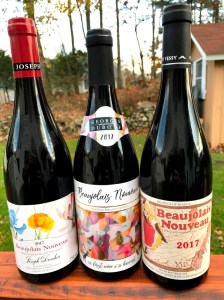 I know, it’s been [more than] a few days since the coveted words “Beaujolais Nouveau Est Arrivé” had been heard again, now in 2017 – but my posting desires don’t always match the real life, hence my Beaujolaies Nouveu notes are arriving a bit late this year.
I definitely like Beaujolais Nouveau – not always the wine itself, but for sure, the idea. It is fun to celebrate new harvest, and that’s what Beaujolais Nouveau does – the wines are made from the freshly harvested grapes, and as such, Beaujolais Nouveau wines are not polished – they are fresh, they are rasp, they want to play and don’t want to have any bounds – the babies, what can you do.
Ever since this blog started, I made an effort to share my notes and thoughts about Beaujolais Nouveau wines – here you can find the posts from 2010, 2011, 2012, 2013, 2014, 2015 and 2016. The 2012 post has a bit more information about the history of the Beaujolais Nouveau and the celebration overall.
Thinking about the year 2017, I wonder if the Beaujolais Nouveau celebration is getting a little smaller? In the past years, many of the wineries around the world (California etc.) also produced their version of the Nouveau wines – I had not seen those in a few years. I didn’t see much of the promotion and event advertisement for the Beaujolais Nouveau celebration in the USA and around the world. It also seems that the wines were priced at a little less – I have a frame of reference as I always buy my Beaujolais Nouveau wines at one and the same store, so it seems that the prices were less by a dollar for all the different brands.
Over the past few years, I noticed that Georges Duboeuf wines are produced with different labels within the same vintage. 2017 was not an exception – I saw different labels on Internet, and I also saw different types of enclosures in the different markets. All 3 wines I tried were enclosed with some type of cork, natural or synthetic. But then I saw Georges Duboeuf wines enclosed with a screwtop, for instance, in Helsinki – you can see it here.
How were the wines, you ask? It seems that modern Beaujolais Nouveau wines keep increasing their extraction and overall mouthfeel – they really don’t feel all that “Nouveau”, except the nose of the freshly crushed berries which is unmistakably present, but even that is getting more restrained and balanced. Definitely interesting wines, definitely drinkable, and dare I say it, possibly ageable past the traditional 9 months? Not that you need to age Beaujolais Nouveau, but it can be an interesting experiment.
Anyway, here are my notes:


Celebrate Zinfandel – 2017 Edition
– “Would you like a glass of Zinfandel”?
– “ahh, sorry, I don’t drink sweet wines”
Have you ever witnessed such dialog, at a bar, restaurant or a tasting? For all of us, oenophiles, the word “Zinfandel” has only one meaning – dense, smokey, brooding, concentrated red wine, with a good amount of fruit and spice. However, for many wine drinkers, the descriptor associated with the Zinfandel is “white” – and the white zinfandel, indeed, is a sweet wine, and it still confuses people.
Zinfandel is often called “an American grape”, despite the fact that it came to America from Croatia (or maybe Italy), where it had a few names on its own. From point of view of the science, Crljenak Kaštelanski, Tribidrag, Primitivo and Zinfandel are all different names for the same grape. From point of view of the producers – not so much, but this is not the subject of to0day’s post.
Zinfandel is really an American phenomenon. It shows the best results in California, and there it can be produced pretty much in any AVA. Napa Valley and Dry Creek Valley are considered two of the top AVAs for Zinfandel. However, last year I visited Lodi as part of the wine bloggers conference, and I absolutely fell in love with the Zinfandel wines Lodi produces.
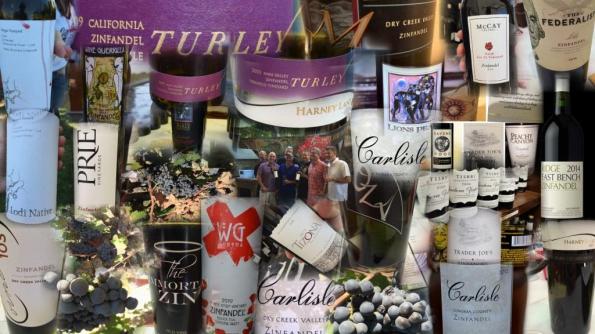
Forty percent of all Zinfandel in California is growing in Lodi, which is rightfully crowned as “Zinfandel Capital”. Lodi is a home to some of the oldest Zinfandel vineyard, dating back to 1888. Lodi also has 750 growers tending to 110,000 acres of the vines. In 2013, winemakers in Lodi started the project called “Lodi Native” – 6 winemakers set the minimalist rules to how the wine can be made, and all 6 winemakers followed the same rules regarding fermentation, use of oak and ageing, so you can taste the difference in the vineyards which bore fruit, unadulterated. Last year I had an opportunity to taste all of the Lodi Native Zinfandel wines, which were pronouncedly different – hopefully, I will still write that post one day…
Good Zinfandel wines might be called the most playful red wines – my favorite descriptor for Zinfandel is “smokey raspberry”, and I’m always very happy to find that in the glass. Even when the label says “Zinfandel”, there are typically few other grapes added to the blend, often in minuscule quantities – Petite Sirah, Cinsault, Alicante Bouschet are all popular blending partners of Zinfandel. There are lots of Zinfandel producers, but I have my own list of personal favorites which I’m happy to share, in no particular order: Carlisle, Rober Biale, St. Francis, Turley, Harney Lane, Bruce Patch, Ridge.
How did you celebrate Zinfandel Day? Who is your favorite producer? Cheers!
Rioja Versus Rioja – Will One Tempranillo More?
The time has come for a battle, where the brother will go against the brother and the blood will spill … – oops, let’s cull the drama before it sets in – it is the wine we are talking about, and if anything will be spilled, it will be the wine – but I promise to be very careful, as red wine is not easy to get off the clothes.
Today, in honor of the International Tempranillo Day, we will put glass to glass some of the best of the best in Rioja’s World. These wines are truly the siblings (brothers or not), as both wines are produced by Compañía Vinícola del Norte del España (the Northern Spanish Wine Company), also known as CVNE, and also sometimes referred to as Cune, due to an interesting style of writing used on the labels.
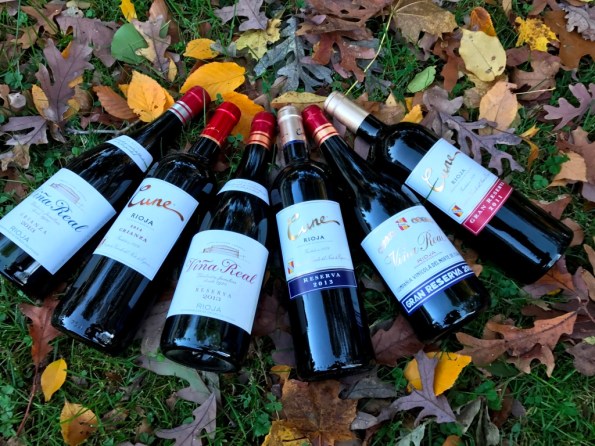
Wines were produced in Spain forever. However, the story of Rioja as we know it, started in the late 19th century, after phylloxera epidemic wiped out most of the vines in Bordeaux, but England’s thirst for Claret Bordeaux was so famous for, was at its pick. Producers in Rioja wanted to become a new source of Claret, and some of the most ambitious producers even set up their new operations right by the train station in Haro, to ensure the best transport for their wines (you can read more here).
CVNE was created by two brothers in 1879, and the ownership stays in the family even today. In 1920, Viña Real line of wines was started to produce Rioja in new, modern style. CVNE owns about 1360 acres of vineyards, located in Rioja Alavesa and Rioja Alta. Both appellations have similar soils and Atlantic coastal climate exposure, however, Rioja Alta vineyards are located at the higher altitudes than Rioja Alavesa, which shows in the resulting fruit.
Before we will enter the battle, we need to establish some ground rules, to make sure that our fighters are in the same “weight category”. The rules are not difficult: there are 4 main varieties which can be used in Rioja – Tempranillo, Garnacha, Graciano and Mazuelo (Carignan). Together, these 4 varieties should represent at least 85% of the blend or 95% of grapes are destemmed; there are few other grapes allowed to be used in the leftover percentage. Crianza wines should be aged for at least 2 years ( 6 months in the cask); Reserva – 3 years (12 months in the cask); Gran Reserva – 5 years (18 months in the cask).
Okay, now that we set the rules, let the fight begin.
Battle Crianza:


2014 Cune Crianza Rioja DOCa (13.5% ABV, $13, 85% Tempranillo, 15% Garnacha and Mazuello, appellation Rioja Alta)
C: Garnet
N: earthy smell, freshly crushed blackberries, acidity, cedar box,
P: medium body, pronounced minerality, restrained fruit, clear acidity, tart cherries, soft, round, hint of tobacco, asking for food
V: 8-, restrained and tart, definitely improved after a few hours of breathing
2013 Viña Real Crianza Rioja DOCa (13.5% ABV, $15, 90% Tempranillo, 10% Garnacha, Graciano and Mazuello, appellation Rioja Alavesa)
C: Garnet
N: surprisingly different, dark fruit, touch of tobacco, touch of sweetness
P: medium+ body, firm structure, cherries and tart of cherries pit, even brighter acidity than a previous wine, more present mouthfeel
V: 8-, a touch fruitier and more round than previous wine. Different but equally good.
Conclusion: Tie. You can definitely taste the difference – Cune Crianza is more restrained and tight, and Viña Real is more round and fruity from the get-go. Slight difference in age and vintage might play a role. The wines would ask for a different food, but otherwise, they are equally good wines.
Battle Reserva:


The Reservas match fair and square – same vintage, same age in barrel, very similar grape composition
2013 Cune Reserva Rioja DOCa (13.5% ABV, $28, 85% Tempranillo, 15% Garnacha, Graciano and Mazuello, appellation Rioja Alta)
C: dark garnet
N: medium+ intensity, leather, touch of sweet plum, cedar box, very inviting
P: medium weight, tart, acidic, a bit of sour cherries, explicit tannins. Needs time.
V: started opening after one hour in the open bottle. More fruit showed up, perfect structure, very pleasant. Excellent overall. 8+/9-
2013 Viña Real Reserva Rioja DOCa (13.5% ABV, $32, 90% Tempranillo, 10% Garnacha, Graciano and Mazuello, appellation Rioja Alavesa)
C: dark garnet
N: medium- intensity, touch of the forest floor, mushrooms, tobacco, eucalyptus
P: cherries, cigar box, medium+ presence on the palate, crisp acidity, very pronounced French oak tannins, needs a lot of time
V: more approachable than the previous one, but still should improve with time – get a case and forget it. Also a great improvement after an hour. Wow. Superb. 8+/9-
Conclusion: Advantage Viña Real. The wines are clearly stylistically different. Appellation might play a role, and the winemaking technique, of course. I slightly preferred Viña Real, as it was a bit more round versus more austere Cune.
Battle Gran Reserva:


Here we have different vintages (both considered excellent, but I think 2010 has a slight edge up over 2011), different appellations and different grape compositions.
2011 Cune Gran Reserva Rioja DOCa (13.5% ABV, $47, 85% Tempranillo, 10% Graciano, 5% Mazuello, appellation Rioja Alta)
C: dark garnet, practically black, with Ruby rim
N: dark fruit, roasted meat notes, sage, eucalyptus
P: forthcoming tannins, tar, cherry, tart, with lip-smacking acidity, really long finish.
V: 8+, within 20 minutes of opening, not ready even remotely. After about 3 hours in the open bottle, the wine became opened up enough to become delicious.
2010 Viña Real Gran Reserva Rioja DOCa (13.5% ABV, $47, 95% Tempranillo, 5% Graciano, appellation Rioja Alavesa)
C: dark garnet, just a shade lighter than the previous wine
N: more open than previous wine – blackberries, graphite, pencil shavings, cedar box, iodine
P: incomparably more drinkable, fresh cherries, open, bright, perfect structure, eucalyptus, nicely integrated tannins
V: 8/8+, you feel the need for time, but the wine is a lot more approachable
Conclusion: Advantage Cune. First, nobody should drink 2010 Gran Reserva now. It is simply a waste. Buy it at a great price, and put it aside for another 15-20 years, especially from the outstanding vintage such as 2010. Just to explain the result here, I slightly preferred the firm structure of Cune versus fruity appeal of Viña Real.
As you can see, we didn’t find a winner of our Tempranillo battle – all 6 wines Tempranillo perfectly, as one would expect from such a great producer as CVNE.
I wish wine would be the only real battle we ever have to fight – wouldn’t that be great? Enjoy your glass of Tempranillo, no matter where it came from and celebrate the noble grape of Spain! Cheers!
Samples Galore: Few Wines For The Fall
Are there different wines for the different seasons? In general, the answer is no. And for sure, in theory, the answer is no. The wines should be paired with food, with mood, with the company, and the actual season should have no effect on your desire to drink Champagne, or Rosé, or ice cold, acidic white or a full-bodied, massive red. Nevertheless, as the temperatures are sliding down, our desire to drink bigger wines proportionally increases. Thus, instead of fighting the trend let’s talk about few wines which would perfectly embellish any cooler autumn night.


So you think we will be only talking about red wines? Nope, we are going to start with the white. Cune Rioja Monopole requires no introduction to the wine lovers – one of the pioneering white Riojas, produced in 1914 for the first time. If you tasted Cune Monopole recently, I’m sure you found it fresh and crips. Turns out, this was not always the style. The traditional, “old school” Monopole was produced as a blend of white grapes (not just 100% Viura), with the addition of a dollop of Sherry (yep, you read it right), and was aged in the oak (read more here). To commemorate 100 years since the inaugural release, Cune produced 2014 Cune Monopole Clásico Blanco Seco (13.2% ABV, $20 ) which is a blend of Viura and other white grapes. After fermentation, a small amount of Manzanilla Sherry from the Hidalgo Sanlúcar de Barrameda was added, and the wine aged in the used Sherry casks for about 8 months. This wine had a great added complexity while remaining fresh and vibrant. Drinkability: 8. You should definitely try it for yourself – if you can find it.
Let’s stay in Spain now for the red. What do you think of the wines from Castilla y León? Castilla y León region is home to some of best of the best in Spain, such as Vega Sicilia and Pingus, both located in Ribera del Duero sub-region. But there are plenty of outstanding wines which are simply designated as Vino de la Tierra de Castilla y León. Vino de la Tierra is considered a lower quality tier than DO or DOC – but some of the winemakers prefer VdT designation as it gives them a lot more freedom to experiment with the wines.


Case in point – Abadia Retuerta winery. Historical roots of Abadia Retuerta go back almost thousand years when Santa María de Retuerta monastery was built on the banks of Duero River, and the first vines were planted. Today, Abadia Retuerta exercises modern approach to winemaking, which they call “plot by plot” – the winery identifies 54 unique parcels of land, each one with its own terroir – no wonder they find DO rules too limiting for the wines they are creating. Here are my [more formal] notes for 2013 Abadia Retuerta Sardon De Duero Selección Especial Vino de la Tierra de Castilla y León – Sardon De Duero (13.5% ABV, $30, 75% Tempranillo, 15% Cabernet Sauvignon, 10% Syrah and other red varieties such as Merlot and Petit Verdot):
C: dark garnet
N: inviting, bright, ripe cherries, mint, roasted meat, very promising, cedar box
P: wow, smooth, layered, luscious, fresh fruit, ripe, cherries, sweet oak, excellent balance
V: 8, lots of pleasure


Now, let’s quickly jump to the other side of the Earth – to Australia, it is. If we are talking about Australia, you probably expect the subject of the discussion will be Shiraz – and this is a perfect guess. The story of Two Hands winery started in 1999 when two friends decided to start making world-class wines showcasing capabilities of different Australian regions, starting with Barossa. Gnarly Dude is one of the wines made by Two Hands, and the name here comes from the way the old Shiraz vines look like. Here are my notes for the 2016 Two Hands Gnarly Dudes Shiraz Barossa Valley (13.8% ABV, $35, 100% Shiraz)
C: dark ruby
N: fresh blackberries, baking spice, tobacco
P: more blackberries, pepper, save, savory notes, medium to full body, good acidity, good balance
V: 7+, very nice overall
Let’s go back to Europe – to Italy to be more precise. Italy is home to lots and lots of world-famous producers, but there are still a few which have more of a “legend” status. One of such producers is Gaja – anyone who is into the wine would immediately jump off the chair at the slightest opportunity to drink Gaja wines.
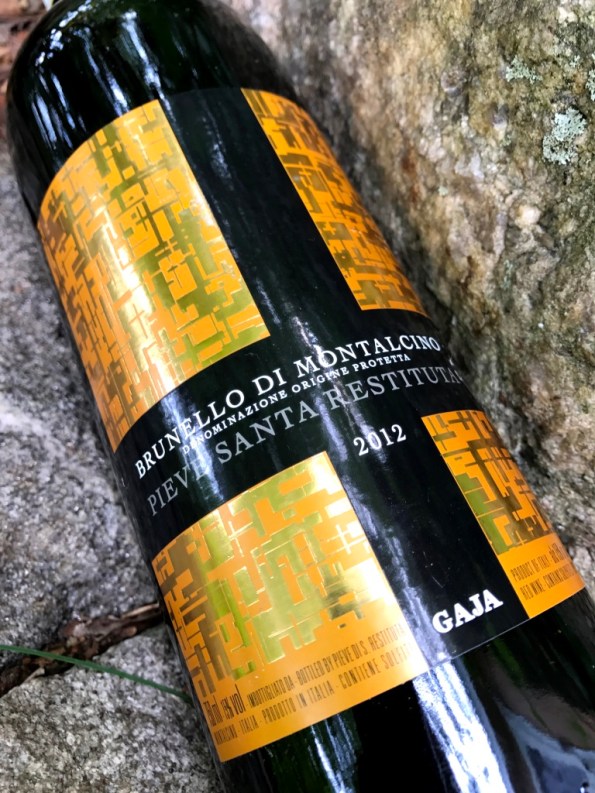 Gaja is most famous for their Piedmont reds – Barolo and Barbaresco. It appears that in addition to the first two Bs (Barolo and Barbaresco), the third “B” group of wines is not foreign to Gaja – if you thought “Brunello”, you were right. Gaja acquired Pieve Santa Restituta estate in Montalcino in 1994, its first venture outside of Piedmont. A “Pieve” is a parish church, and the estate was named after the church which is still present on site – the winemaking history of the estate can be traced all the way back to the 12th century.
In 2005, Gaja produced the first vintage of non-vineyard designated Brunello di Montalcino wine from Pieve Santa Restituta estate – the wine is a blend of Sangiovese Grosso grapes from 4 different vineyards. I had an opportunity to taste 2012 Gaja Pieve Santa Restituta Brunello di Montalcino DOCG (15% ABV, $75, 100% Sangiovese Grosso, 12 months in barrel, 12 months in Botti). I have one single word which would be enough to describe the experience – and the word is “Superb”. The wine had an intense welcoming nose which was unmistakably Italian – ripe cherries and leather. The palate? Where do I start… velvety, perfectly extracted, dense, firmly structured, ripe cherries, lavender, sweet oak, impeccable balance. And dangerous, very dangerous – once you start, you can’t stop (nevermind the 15% ABV). Drinkability: 9
What are your favorite wines to enjoy in the Fall? Cheers!
Stories of Passion and Pinot: Knudsen Vineyards
It takes courage to be a pioneer. It takes vision, belief, perseverance and lots and lots of hard work to convert the dream into reality – but this is how many great wine stories start.
Nobody questions “World Class” status of Oregon wines today. But back in 1971, this was really not the story. One had to see the potential and believe that Oregon is meant to produce the world-class wines. Cal and Julia Lee Knudsen did when they purchased the remnants of the walnut orchard in 1971 and established Knudsen Vineyards. The whole family – Cal, Julia Lee and four of their children worked hard to clean up the land and plant the vines. In 1972, they established a 30 acres vineyard, which was the largest in the Willamette Valley. By 1976, they had 60 acres planted, which made them the biggest in Oregon (as a matter of fact, Knudsen Vineyards still have some of the 1974 vines which produce fruit). Today, Knudsen Vineyards plantings span 130 acres, which is certainly one of the largest in the state where the typical vineyard size is 35 acres. And in 1975, in partnership with Oregon winemaking legend, Dick Erath, Knudsen Erath Winery became first commercial winery in the Dundee Hills appellation.
In 1987, the Australian Brian Croser met Cal, and the new chapter started for Knudsen Vineyards. Cal always had a dream of making sparkling wines, and the Knudsen Vineyards entered into the new partnership, now with the Oregon sparkling wine pioneer, Argyle Winery. Today, many of the Oregon wineries are starting to add Chardonnay to their repertoire – Knudsen Vineyards was growing Chardonnay for the very long time, and Chardonnay is essential for a good sparkling wine. As a matter of fact, Julia Lee’s Block, which you can see designated on one of the top Argyle’s sparkling wines, contains the oldest in the new world plantings of French Chardonnay Dijon clones 76 and 96. Also, while you will not see it widely advertised, Knudsen Vineyards grows 3 acres of Pinot Meunier, used only for the production of Argyle sparklers.
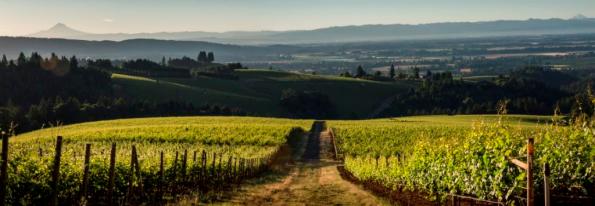
Knudsen Vineyards, Dundee Hills, Willamette Valley, Oregon
Ever since Knudsen Vineyards started working with Argyle, all of their fruit was going into Argyle sparkling wines. Five years ago, the four siblings who run the vineyard now, decided to start producing the wine under their own label, which resulted in the 2012 release of Knudsen Vineyards Pinot Noir. The first release of Chardonnay was added a year after, in 2013. This year, Knudsen Vineyards added the new premium bottling – 2015 Pinot Noir Reserve. All of the wines are produced with the help of the winemaking team at Argyle, which vinifies the juice from the different blocks of the Knudsen Vineyards – but the family gets together to decide on the final blend of the wines they later release.
If you followed any of the Passion and Pinot stories, you probably expect that I will have an interview for you – and you are right. Only this time around, it is slightly different – in addition to the virtual part, I also had an opportunity to sit down face to face with Page Knudsen Cowles, managing partner at Knudsen Vineyards, and extend our virtual conversation with the personal one. I learned lots of interesting things which are really impossible to get to in the format of the virtual interview.
For instance, have you ever heard of the “Suitcase clones“? I certainly never had. It appears that it is a common name for the vine cuttings which are smuggled into the country in the suitcases. For the Knudsen family, the “suitcase” was not exactly a choice tool for vine transportation – the ski bag was the one, as every family skiing vacation in Europe saw new cuttings finding its way home.
At some point, Cal started experimenting with the effects of the birds’ chirping on the vines. The birds’ sounds were played between the rows of the vines. The unfortunate part is that the results of this experiment are not known. But when birds became a problem in the vineyards in 2010/2011, the sound of distressed robin came to the rescue – it was played throughout the night and helped to shoo the birds away – however, made the stay at the small cottage the family has right in the vineyard very problematic.
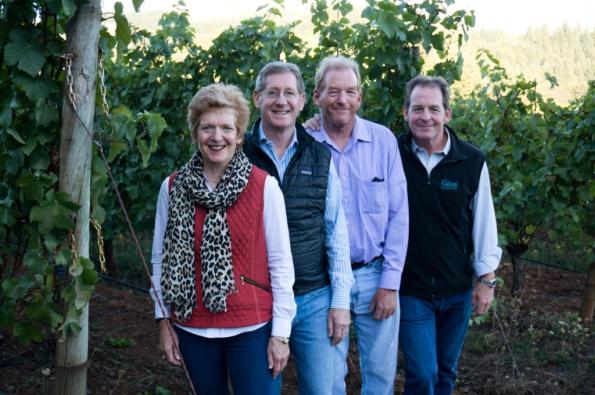
Knudsen Second Generation: Page, Colin, Cal Jr, David
Okay, let’s move on. Let me share with you our [now virtual] conversation with Page Knudsen Cowles. Get a glass of wine in hand, and here you go:
[TaV]: The first vines were planted at Knudsen Vineyards in 1971. Are there any of the original vines still around, and if yes, are they still producing fruit?
[PKC]: The oldest currently-producing vines were planted in 1974. They are Pinot Noir vines that produce fruit for sparkling wine.
[TaV]: I understand that back in 1971, Cal and Julia Lee purchased a 200-acre former walnut tree orchard – are there any of those trees still around and producing [commercially}? Was/is Knudsen family ever in walnut business?
[PKC]: No, the Knudsen family was never in the walnut business. The walnut tree orchard was destroyed in the 1962 Columbus Day storm that wrecked havoc through the Willamette Valley at that time.
[TaV]: The first Knudsen wines under Knudsen Erath label were produced in 1975. Are any of those wines still around? Have you ever tasted wines from that inaugural vintage?
[PKC]: I have not had the pleasure of tasting that very first vintage. I have found in the secondary market a stash of Knudsen Erath Winery 1983 Vintage Select Pinot Noir and some bottles of the Knudsen Erath Winery 1985 Vintage Select Pinot noir. Both wines have held up remarkably well and are fun to drink and share with wine aficionados who appreciate the provenance and age of the wine.
[TaV]: Continuing the previous question, what are the oldest vintages which can be found at the Knudsen Vineyards library? What are the oldest Knudsen wines you ever tasted?
[PKC]: The oldest vintages we have in the Knudsen Vineyards library are:
- 1979 Knudsen Erath Winery Merlot
- 1983, 1985, 1986, 1987 Knudsen Erath Winery Pinot Noir
The oldest wines I have ever tasted are the 1983 and 1985 Knudsen Erath Winery Vintage Select Pinot Noirs.
[TaV]: Today Knudsen Vineyards has about 130 acres under the vines. What grape varietals do you grow today?
[PKC]: We grow 73% Pinot Noir including a variety of French Dijon Clones 667, 777, 115, and 4407, plus the heritage clone Pommard; 24% Chardonnay including the French Dijon clones 76, 95 and 96; and 3% Pinot Meunier.
[TaV]: Knudsen Vineyards just started producing the wines under its own label, and it is not surprising that the first two wines are Pinot Noir and Chardonnay. Moving forward, do you have any plans to start producing any other wines, such as Pinot Gris or Riesling?
[PKC]: No, we do not have plans to produce either of these varietals.
[TaV]: Within the 130 acres of vineyards, you probably identified some of the plots which perform better or, at least, different than the others. Do you plan to produce “single-plot” wines?
[PKC]: Our current planning does not include production of “single plot” wines. We have favorite estate grown blocks that we like to blend when we produce our wines.
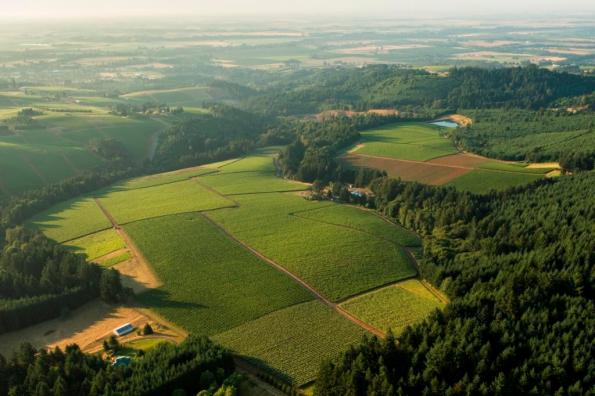
Aerial View over Knudsen Vineyard, Dundee Hills, Willamette Valley, Oregon
[TaV]: Knudsen Vineyards have a strong connection to the production of the sparkling wines through the partnership with Argyle Winery. Nevertheless, do you have any plans to produce sparkling wines under the Knudsen Vineyards label?
[PKC]: Our father, Cal Knudsen, had a love affair with sparkling wines from around the world, though he was most attached to those from the region of Champagne and Oregon sparkling wine. He allied Knudsen Vineyards with Argyle in order to make sparkling wine. Knudsen Vineyards would love to produce a small amount of sparkling wine in the future in honor of our father’s love for that expression of the fruit from our vineyard.
[TaV]: When making wines, do you rely on natural yeast, or do you work with some specific strains of yeast?
[PKC]: I reached out to our winemaker, Nate Klostermann, of Argyle Winery, for the answer to this one. We grow several selected yeast cultures and then inoculate with the one that seems best suited to the vintage.
[TaV]: What kind of oak regimen do you use in the production of your Chardonnay and Pinot Noir?
[PKC]: All of our oak comes from French barrels. Our inaugural 2013 Chardonnay has 35% new oak and was aged over 13 months in barrel; our 2014 Chardonnay had 25% new oak and was aged over 10 months in neutral and new oak barrel; and our 2015 Chardonnay has 27% oak over 10 months in barrel.
For the Pinot Noir, our oak usage is as follows:
Knudsen Vineyards 2014 Pinot Noir 25% new oak barrels; remainder aged in 2 – 4 year old previously used oak barrels; aged for 15 months in barrel, nine months in bottle Knudsen Vineyards 2015 Pinot Noir 20% new oak barrels; remainder aged in 2 – 4 year old previously used oak barrels; aged for 16 months in barrel, nine months in bottle Knudsen Vineyards 2015 Estate Reserve Pinot Noir 35% new oak barrels; remainder aged in 2 – 4 year old previously used oak barrels; aged for 16 months in barrel, nine months in bottle
[TaV]: What is the total production of your Pinot Noir and Chardonnay (how many bottles)? Do you plan to increase the production in the near future or you are happy with the current production?
[PKC]: Currently, we produce between 1,000 and 1,200 cases of our Pinot Noir and Chardonnay combined (between 12,000 and 14,400 bottles). The mix is approximately 60% Pinot Noir and 40% Chardonnay. We are content at this level of production for a couple of years. In the future, we hope to expand.
[TaV]: Is there a “next big grape” for Knudsen Vineyards?
[PKC]: Pinot Noir and Chardonnay are what we intend to grow into the foreseeable future.
[TaV]: What about Willamette valley in general – is it going to stay a Pinot Noir land for the foreseeable future, or would there be a “next big grape”, white or red, for the Willamette Valley?
[PKC]: I believe the North Willamette Valley will stay devoted to Pinot Noir and will increase its production of Chardonnay.
[TaV]: Do you have a dream wine – the wine you always wanted to try, but never have?
[PKC]: I would like to try a bottle of Domaine de la Romanée-Conti from Burgundy and a bottle of any of the Bordeaux First Growth red wines: Château Latour, Château Lafite Rothschild, Château Margaux and Château Haut-Brion. I also would love to try a bottle of Opus One from California.
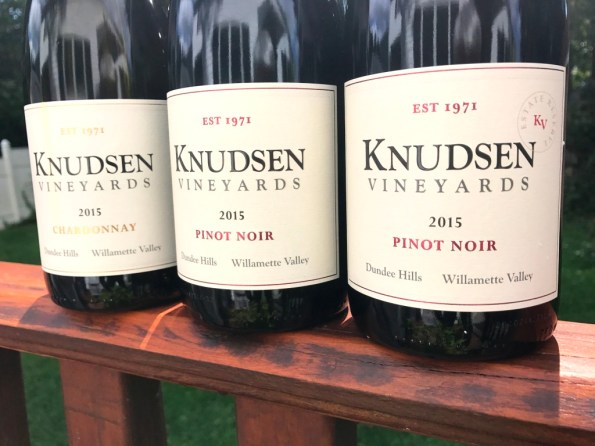
Now for sure it is time to drink the wine. I had an opportunity to try Knudsen Vineyards wines, here are the notes:
2015 Knudsen Vineyards Chardonnay Dundee Hills Willamette Valley (14% ABV, $45)
C: light golden
N: vanilla, touch of toasted oak, medium intensity
P: fresh, crisp, slightly underripe Granny Smith apples, touch of minerality, distant hint of butter and vanilla, quite an acidic finish
V: 8/8+, not bad, but needs time to evolve. Opens in the glass quite elegantly. Second day was outstanding – nice buttery note while fridge cold, and more vanilla-driven as the wine warmed up
2015 Knudsen Vineyards Pinot Noir Dundee Hills Willamette Valley (141% ABV, $55)
C: light bright ruby
N: tart cherries, lavender, hint of smoke
P: cherries, round, good acidity, touch of mushrooms, fresh, Burgundian style
V: 8-, very nice
2015 Knudsen Vineyards Pinot Noir Reserve Dundee Hills Willamette Valley (14.1% ABV, $70)
C: dark ruby
N: smoke, mushrooms and forest floor aromatics
P: cherries, good acidity, layers, smooth, lavender-driven on the second day
V: 8/8+, very polished, elegant, will evolve with time.
Thus we conclude another story of Passion and Pinot (and a little bit of Chardonnay). Wine is a family affair, and Knudsen Vineyards shows it very well. Now the third generation of Knudsens is entering the business, and I’m sure there are lots we should expect to see from the Knudsen Vineyards in the future. Cheers!
Daily Glass: An Australian Score
I pride myself with very wide wine horizon. I scout wines from literally everywhere in the world – China, Japan, Croatia, Bulgaria or Hawaii – bring it on, the more obscure, the better, I will be happy to try them all.
Nevertheless, a majority of my daily drinking evolves around Italy, Spain, and California, with a little injection of France. The rest of the wine regions make a very sporadic appearance at our house – without any prejudice or malicious intent – just stating the fact.
Nevermind China and Japan, which are still going through an adolescence as wine producing countries – let’s talk about Australia instead. About 20 years ago Australia was leading wine imports in the USA. As you would enter a wine store, you were greeted with countless Australian wine selections.
Today, Australian wines are relegated to the back shelves, and they are definitely not on top of the wine consumer’s mind (in the USA for sure). Ups and downs are hard to analyze in the wine world (think of the devastating effect of the movie Sideways on Merlot consumption), and such an analysis is definitely not the point of this post, no matter how interesting such a discussion could’ve been.
As I stated before, Australian wines are rare guests at our table, and this is not deliberate – I enjoyed lots and lots of excellent Australian wines, and have an utmost respect to what this country can deliver. I’m always ready to seize an opportunity to try an Australian wine, especially if it comes with a recommendation.
Such recommendation can present itself in lots of different ways – a friend, a magazine, an Instagram post, a tweet – or an offer from the Last Bottle Wines, especially during the Last Bottle’s infamous Marathon events. During the Last Bottle Marathon, you can buy the wines in single bottle quantities, which I like the most as you can create your own tasting collection quickly and easily.


If the wine is offered for sale by the Last Bottle, it definitely serves as an endorsement for me. The folks at Last Bottle know the wines – if they offer something, it means the wine really worth trying. During the last Marathon, the 2015 Gemtree Uncut Shiraz McLaren Vale (14.5% ABV) attracted my attention. I don’t know what made me click the “buy” button – the name “Gemtree” (sounds interesting, isn’t it?), or the word ‘Uncut” (again, this somehow sounds cool to me as well), but I did click that button quickly. You see, you only have a split second to get the wine – you blink, you lose – and I scored the bottle of this Australian Shiraz.
I pulled the bottle from the wine fridge, twisted the top and poured into the glass. Dark ruby color, a whiff of the blackberries. The palate had a tremendous amount of salinity over the crunchy blackberries – I guess this was an effect of drinking this wine at a cellar temperature. But it was still attractive. While admiring the simple label I saw the word which made me very curious – “Biodynamic”, and then the back label provided lots more information about how this wine was made. To me, “sustainable” is a very important wine keyword, and whatever extras “biodynamic” entails, the biodynamic wine is always a sustainable wine – and it is definitely important for me.
After warming up, the wine became generous, layered, showed soft tannins and perfect crunchy backbone of dark fruit with some dark chocolate notes and touch of a spicy bite – all perfectly balanced and delicious (Drinkability: 8+). The name “Gemtree” kept me intrigued, and the picture on the label was very attractive in its simplicity, so I went to the Gemtree Wines website to learn a bit more. I rarely quote from the winery websites, but I think in this case this is quite appropriate (here is the link to the source):
“This is our Gemtree story…
There was once a tree. Not the tallest tree, nor the oldest tree, but a tree that had put its roots in just the right part of the paddock. Here the soil was deep and layered – sometimes hard and rocky, elsewhere soft and sandy – and the wind had just enough room to move, and even the rain – when it was kind enough to visit – would fall evenly and gently.
Because of its favoured position, the grasses grew tall against its trunk, and the wild flowers were easily encouraged to grow closely around it, and the insects and birds that looked to trees for shelter and for vantage, eagerly moved in.
One day a farmer approached the tree and wondered: “You do not grow the strongest, nor the fastest, so why is it that you grow the best fruit?”
The tree let the answer whisper through the wind in its branches: “If I am shown a patient mind and a gentle hand, if I am left to follow the rhythms of my seasons – to rest in Winter; to revive in Spring; to make busy in Summer; and to provide in Fall – then I can offer fruit that tastes not just of the ground upwards, but also of the sky downwards, and of everything around me.”
The farmer thought to himself: “This is truly a Gemtree – it takes only what it can give back to the land, it contributes to its surroundings, and it provides for those that live around it.”
This is the heart of the Gemtree story: growing better wine ~ naturally.“
Here you are, my friends. I don’t know how often you drink Australian wines, but Gemtree is definitely the name to keep in mind for your next round of wines from down under – I think you will be happy with your score. Cheers!
Last Bottle Sign Up ($10 credit)





