Archive
2 Regions, 3 Glasses, 1 Wine Geek
The assignment was simple. Compare 6 Cabernet Sauvignon wines from 2 famous winemaking regions in Chile. Find differences. decide on a favorite.
As with any assignment, let’s start with the theory.
Cabernet Sauvignon is unquestionably a king of Chilean wines – it is the best-known Chilean wine worldwide and it is the most widely planted red grape variety in Chile. It accounts for about 20%+ of all vineyard plantings in Chile, covering an area of about 99,000 acres, stretching through the entire country from north to south. At the same time, 97% of the Cabernet Sauvignon plantings are located in the Central Valley, spread between O’Higgins, Maule, and Metropolitan Region.
Narrowing it down to the wine-producing DOs, we are looking at the Maipo Valley and Colchagua Valley, two of the best-known Cabernet Sauvignon areas in Chile. These are also the two regions that are the subject of our assignment.
Maipo Valley is one of the oldest winemaking regions in Chile, with its terroir shaped by the Maipo River, which begins at the Maipo volcano, creating a patchwork of valleys at the elevation of 2,500 feet above sea level. Some of the areas in Maipo Valley see a minimal number of sunny days required for the red grapes to fully ripen, with a climate somewhat similar to Bordeaux.
Colchagua Valley lies about 80 miles south of the city of Santiago. Parts of the valley are crisscrossed by the Tinguinirica River, taking its roots from the volcano crater in the Andes, and descending from about 2,000 feet to the 360 feet of elevation above sea level. Colchagua Valley generally offers much warmer daily temperatures compared to the Maipo Valley.
Here are some of the views of the beautiful regions:
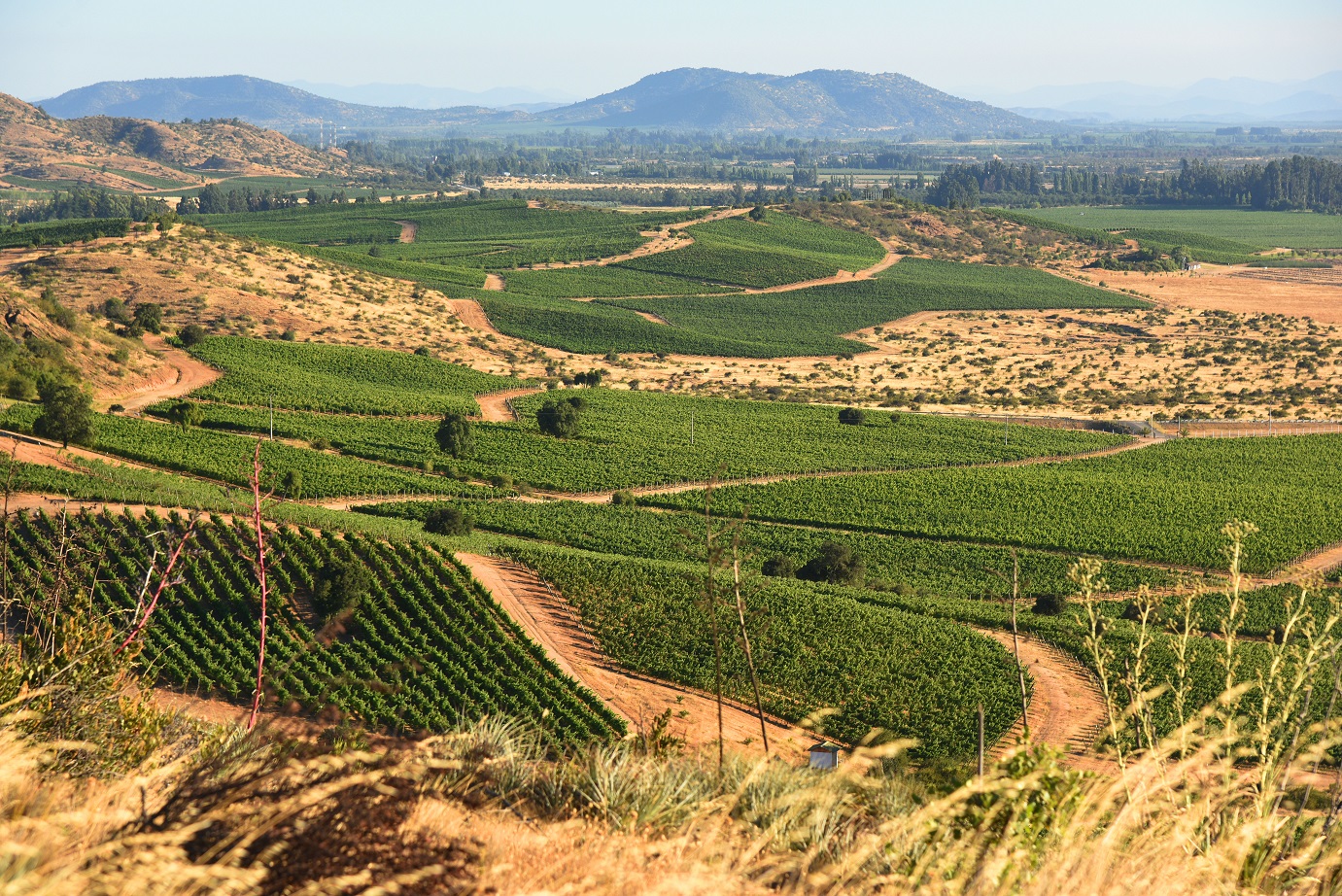
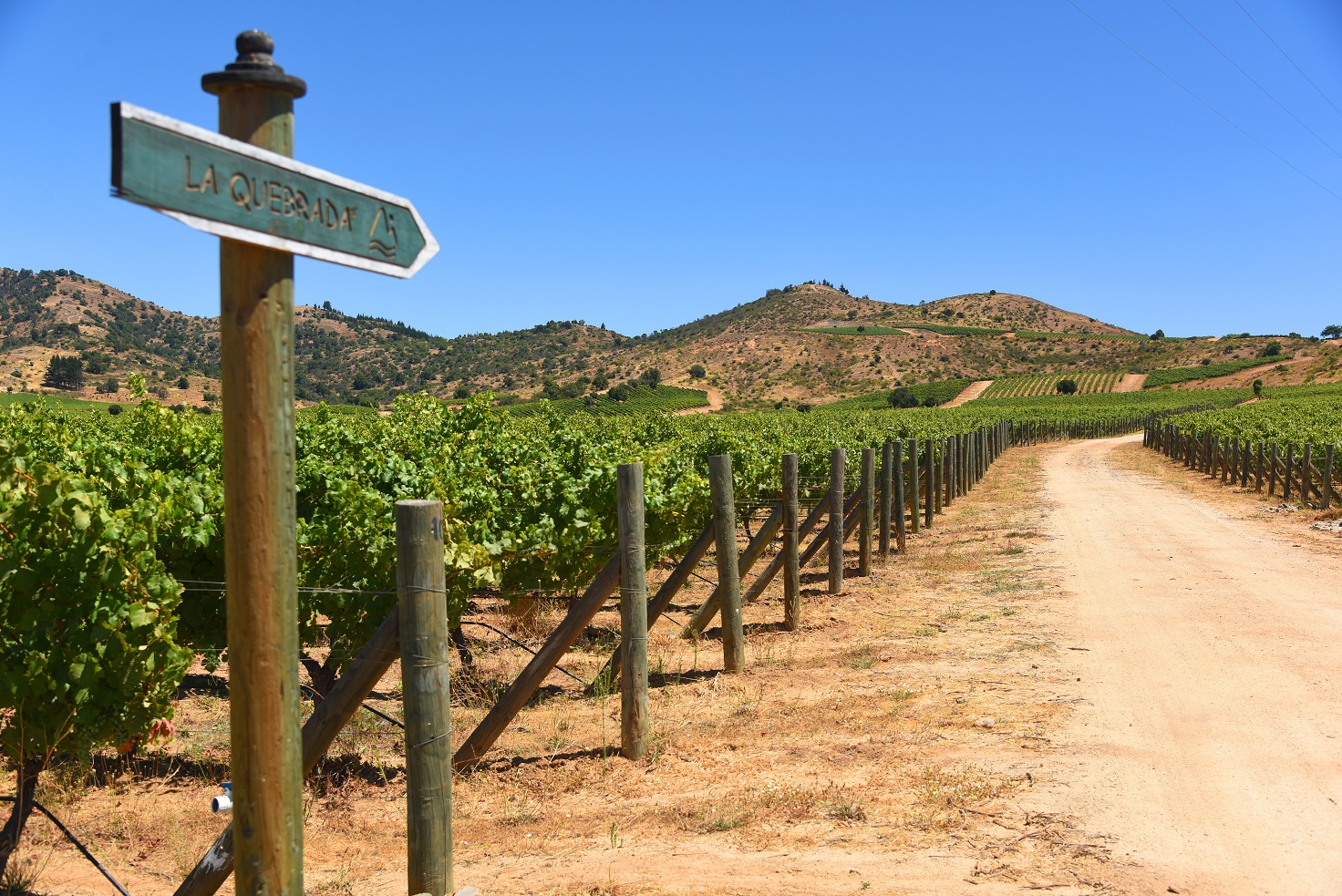
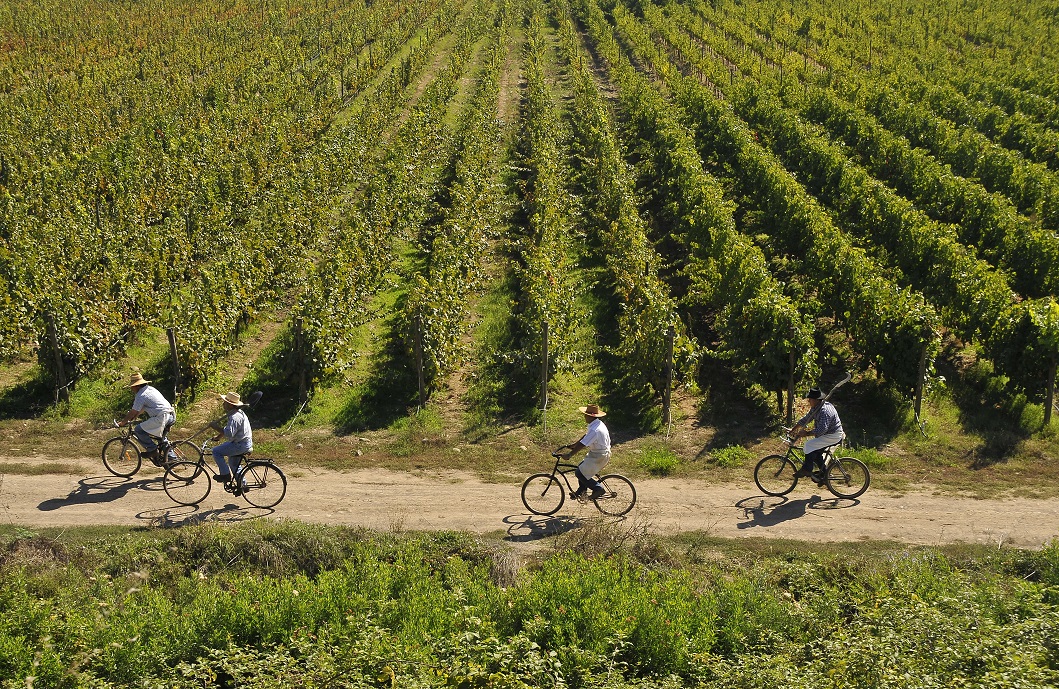
I’m purposefully avoiding descending into the discussion about the different soil types throughout both regions but of course, alluvial soils, colluvial soils, gravel, clay are all intermixed around both regions. I don’t believe I can intelligently speak to the effect of a given soil type as it comes to the resulting taste profile of the wine, but our main difference between the wines from the two regions should be driven by the warmer versus cooler climate and some differences in the elevation.
I hope this is enough of the theory and it is time to get to practice – the lab portion of our assignment.
This is where the inner geek came out guns blazing – and this is where everything all of a sudden became muddy and complicated.
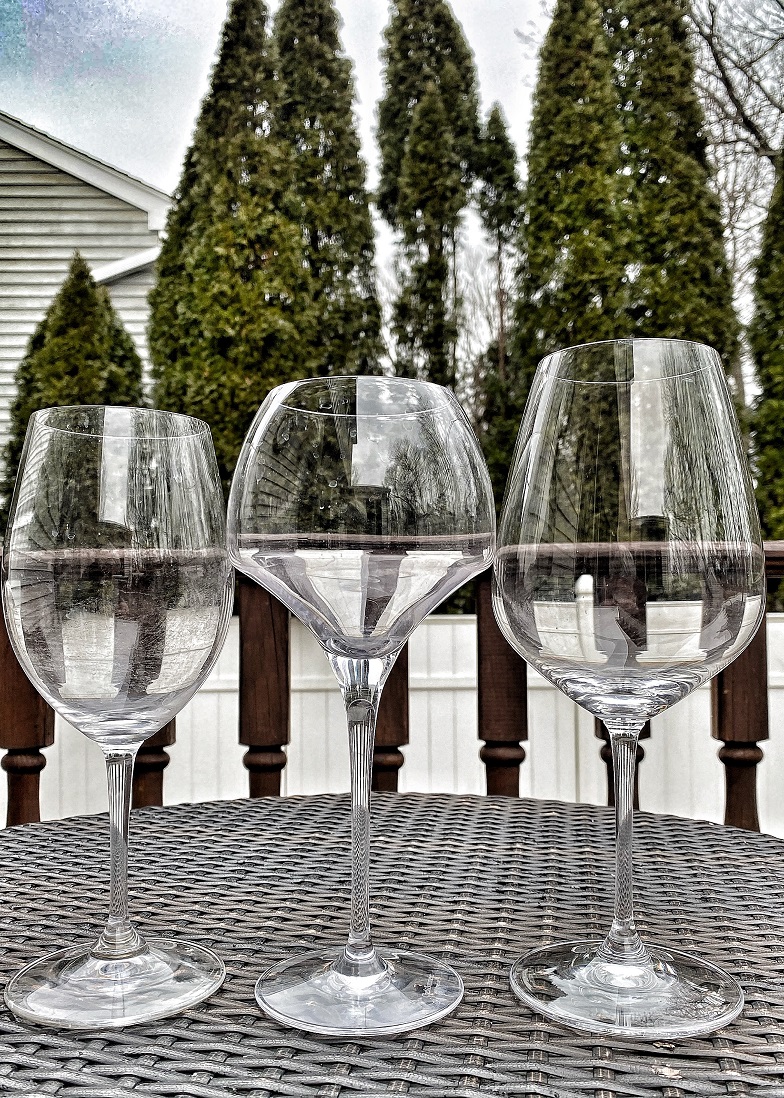
I decided that the challenge of comparing the 6 wines is insufficient, and to make things more fun, I decided to was possessed to try each wine from three different glasses: Glass 1- Riedel Universal tasting glass (this is the one typically offered at all of the wine tastings), Glass 2 – Chef & Sommelier Open’Up glass, one of most aesthetically pleasing glasses for the daily drinking, and Glass 3 – Riedel Radical Cabernet glass (my favorite glass for the Bordeaux varieties).
The wines I tasted all come from well-known producers. I was familiar with some prior to this tasting (Los Vascos, TerraNoble, Maquis) and I had a lot of Los Vascos and TerraNoble Cabernet wines in the past. Regardless, this was quite a respectful selection of the wines, expectedly illustrative to represent the two regions. Three of the wines were 100% Cabernet Sauvignon, and 3 had Cabernet Sauvignon as a dominant component.
To explain in more detail what I did: on the first day, I poured each one of the 6 wines into the 3 glasses – non-blind, one by one. I then tasted each wine from those 3 glasses – you will see the notes below, describing my perception of the same wine in each of the 3 glasses. The glasses had their effect, even though Radical Cab and Open’Up glasses offered mostly similar experiences. Open’Up glass required the bottom section to be sufficiently filled or the nose of the wine was becoming lost. All of the second and third day tastings were done only using the Universal tasting glass. Below you can see all of the tasting notes, from which it is very easy to conclude that I was unable to come to any meaningful conclusions and find any meaningful, region-conforming differences between the wines.
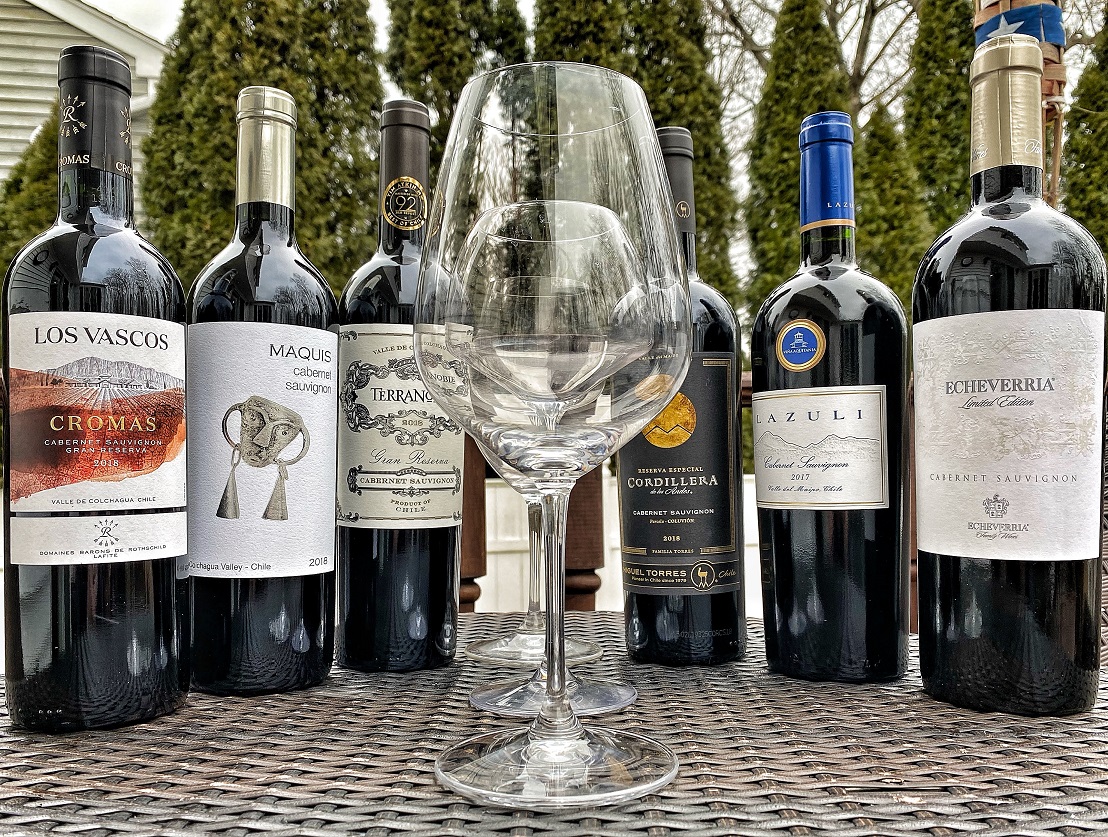
Here we go:
Team Maipo Valley:
2017 Lázuli Cabernet Sauvignon Valle del Maipo (14.5 ABV, $45, 100% Cabernet Sauvignon)
Garnet
Glass 1: dark fruit, concentrated, iodine, forest underbrush, pyrazine
Interesting. Quite restrained. Not a lot going on.
Glass 2: much less expressive, just a hint of pyrazine
It is showing better. No idea how. Crunchy berry, soft tannins, still not very expressive
Glass 3: dark fruit, more focused than glass 1, a hint of bell pepper
Similar to glass 2. Dark fruit, baking spices, lots of minerality. Not very much Caberneish if you ask me.
Day 2: not good
Day 3: Fruit showed up. Fresh berries and eucalyptus. Is this a Cab? Not sure. Is it drinkable? Sure, on the third day.
2018 Miguel Torres Cordillera Cabernet Sauvignon Reserva Especial de Les Andes Valle de Maipo (14% ABV, $20, 100% Cabernet Sauvignon)
Concentrated ruby with bright hues
Glass 1: very similar presentation to the first wine. Dark fruit, a hint of bell pepper, very distant hint, a touch of eucalyptus.
Definitely a Cabernet profile, more explicit than the previous wine. Eucalyptus, cassis, bell pepper practically non-existent.
Glass 2: this glass requires much higher pour to get to the aromatics.
The wine appears more refined and elegant on the nose than glass 1, more focused on eucalyptus and cassis.
Delicious, earthy cab. Good acidity, cassis, earthy and restrained.
Glass 3: interesting. Almost gets to the barnyard space. Definitely more earthy than glass 2.
The best experience. Dark fruit, cassis, pencil shavings, crisp tart finish.
Day 2: good
Day 3: excellent. Dark fruit, eucalyptus. Round tannins, good structure, dark and supple.
2016 Echeverría Cabernet Sauvignon Limited Edition Maipo Valley (14% ABV, $25, 85% Cabernet Sauvignon, 10% Syrah, 5% Carménère)
Dark Garnet
Glass 1: very concentrated. Dark fruit, sapidity, earthiness, a hint of eucalyptus. Interestingly enough, all 3 wines so far are really similar.
The nice initial appearance of the fruit is instantly replaced by tannins. Serious French Oak tannins, front of the mouth is locked.
Glass 2: a much more elegant appearance than Glass 1. A hint of eucalyptus and bell pepper.
Fruitier than the previous 2 wines, nice load of dark berries, and then it is all tannins. Again, the wine appears to be more elegant.
Glass 3: similarly elegant to glass 2. Eucalyptus, bell pepper, and a touch of black pepper.
Berries, eucalyptus, and tannins. Should be outstanding with the steak.
Day 2: Excellent
Day 3: very good, open fruit – but not very much of the cab? I liked it more on the day 2
Overall notes: all 3 wines are very similar on the nose, showing differently on the palate. Earthy, concentrated wines. All need time to open.


Now, team Colchagua Valley:
2018 Maquis Cabernet Sauvignon Gran Reserva Colchagua Valley (14% ABV, $20, 90% Cabernet Sauvignon, 6% Cabernet Franc, 3% Carmenere, 1% Petit Verdot)
Garnet
Glass 1: bright and clean aromatics, cassis, eucalyptus, a hint of bell pepper
Plums, a touch of cherries, not a textbook Cabernet Sauvignon
Glass 2: interesting. Volcanic undertones, gunflint, almost a hint of sulfur, fresh crisp berries
Better showing, brighter fruit, some bitter undertones appeared (whole cluster?)
Glass 3: somewhat similar to the glass 2, but a bit more restrained
Amazing how much glass matters. This is almost at the expected level of Cabernet Sauvignon – a hint of cassis, mint. Still very restrained.
I’m so confused that I had to wash the glass.
Re-taste: it is not bad, but didn’t make a difference. Still, dry restrained, with some bitter notes on the finish.
Day 2: tight and closed
Day 3: definitely better. Bitter notes are gone. But the whole presentation is plum/cherry, not so much of the Cab Sauvignon
2018 Los Vascos Cromas Cabernet Sauvignon Gran Reserva Colchagua Valley (14.5% ABV, $22, 85% Cabernet Sauvignon, 10% Syrah, 5% Carmenere)
Concentrated ruby
Glass 1: dark berries, a hint of cassis, vanilla, bell pepper might be a product of my imagination
Delicious. Fresh, open, clean, dark berries, cassis, bell pepper, eucalyptus. A pretty classic cab if you ask me. Best of tasting so far.
Glass 2: Cassis and mint, medium intensity
Delicious. Very similar to glass 1, somehow with a bit more intensity of the flavors.
Glass 3: very restrained, cassis, bell pepper, a touch of tobacco
Delicious. Exactly as two previous glasses. Happy to drink every day.
Day 2: not good. Tight, closed.
Day 3: lots of tobacco and smoke on the nose. Dark fruit, borderline bitter. I don’t get this wine
2018 TerraNoble Cabernet Sauvignon Gran Reserva Valle de Colchagua (14% ABV, $20, 100% Cabernet Sauvignon)
Garnet color
Glass 1: dark berries, eucalyptus
Delicious. Open, bright, good acidity, ripe fruit, not necessarily a textbook cab, but fresh and delicious.
Glass 2: dark berries, sapidity, earthy, a hint of bell pepper
Fresh, delicious, crisp berries, a touch of cherries, a bit of dark chocolate.
Glass 3: a hint of bell pepper, dark fruit, earthy
Bright, open, good structure of tannins. A cab? Maybe…
Day 2: good
Day 3: beautiful, supple, good tannins, good structure, open fruit, good finish.
On the day 2, my preferences were with these three wines:
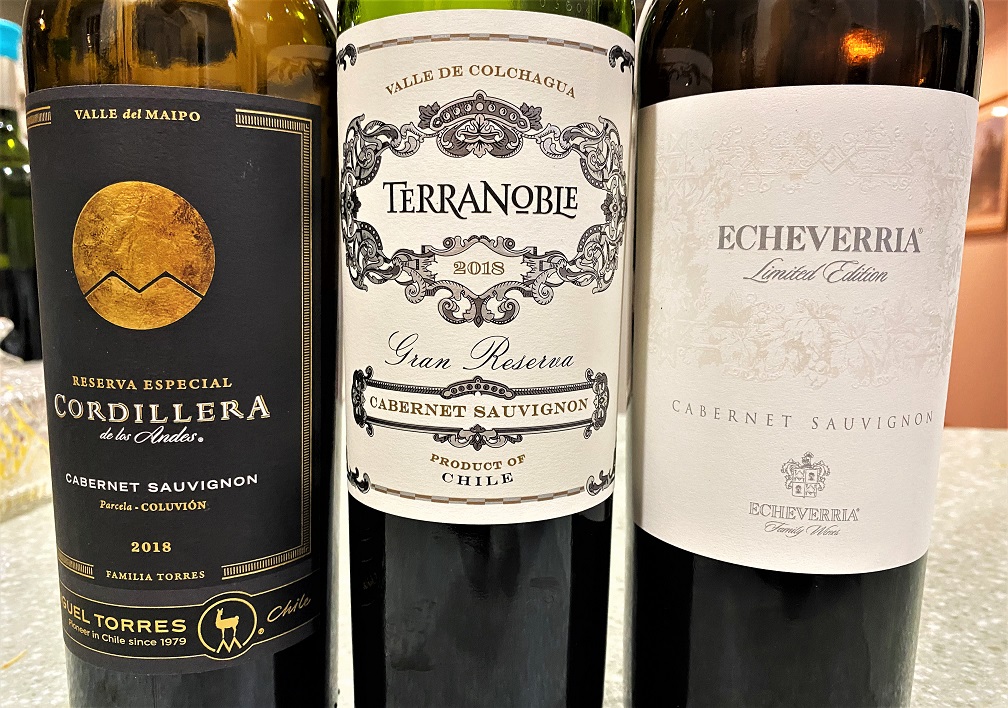
And then there were two. On the third day, I had two wines as my favorites – and they represented two regions.
For the final decision – Torres versus TerraNoble.
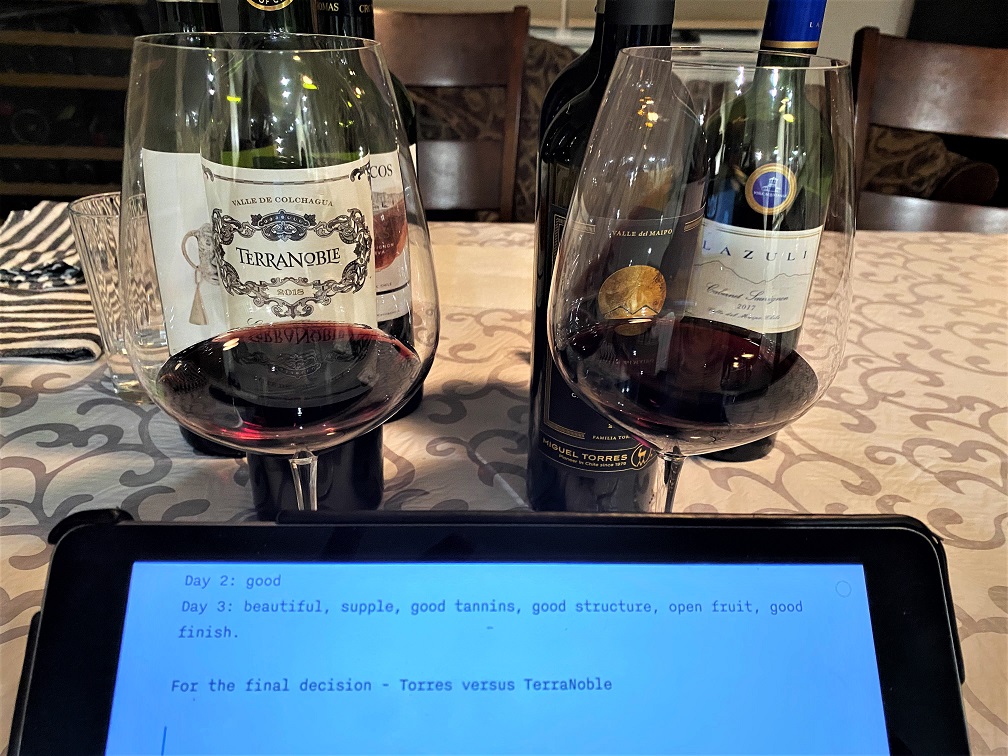
Wine geek at work
Nose: advantage Torres – dark chocolate, a hint of bell pepper. TerraNoble mostly closed
Palate: slight advantage Torres – better structure and better precision. Dark and concentrated. Will continue improving.
The winner: 2018 Miguel Torres Cordillera Cabernet Sauvignon Reserva Especial de Les Andes Valle de Maipo
So we can conclude that Maipo Valley won this strange competition, at least with a margin of error.
The assignment is complete. So what did we learn?
- Don’t play with your glasses, unless this is actually a goal of your exercise. Wine glasses matter and wine glasses
canwill confuse you. - Hey, wine glass matters.
- I probably should’ve done the blind tasting instead
- Chilean Cabs need time. Practically all showed better on the second day.
- I was unable to find the real differences between Colchagua and Maipo wines
Oh well. Play with your wine. Have fun. One way or the other, experience is still an experience, and as long as you desire, there is always something to learn.
Do you have a favorite Chilean Cabernet Sauvignon? Care to share? Cheers!
Stories and Passion and Pinot: Shane Moore of Gran Moraine
“Gran Moraine prides itself on producing experiential art in the form of Chardonnay, Pinot Noir and sparkling wines made to express the exquisite terroir of our Yamhill-Carlton Estate Vineyards.”
Experiential Art.
Not a bad way to introduce the winery, what do you think? Wine is art, all wine lovers can sign under such a statement, so “experiential art” sounds very near and dear to any wine lover’s heart.

Gran Moraine vineyard was planted in 2004 by Premier Pacific Vineyards in the Yamhill-Carlton district of Willamette Valley in Oregon, with 200 acres of hillside vines of Pinot Noir and Chardonnay. The vineyard took its name from moraines, glacial sediment left after the glacier movements in the last ice age. In 2013, the Gran Moraine Vineyard was acquired by Jackson Family and it is one of the 4 major properties owned by the Jackson Family in Oregon Willamette Valley.
I visited Gran Moraine last August and had an opportunity to taste a number of the wines and have a quick chat with the winemaker, Shane Moore. Then I followed up with the usual, virtual “conversation” and here is what transpired:
[TaV]: Was there a pivotal wine in your life?
{SM]: I’ve had plenty of wines that have possibly changed my life’s trajectory. However, I feel like the most pivotal wines in my existence have been those that seem to stop time. These wines provide my most fond wine moments and provide me with the most inspiration.
[TaV]: Is there a winemaker you would call your mentor? Someone you learned the most from as a winemaker?
[SM]: I think if I gave any specific shoutouts I’d be doing a disservice to so many of the amazingly talented and thoughtful winemakers I have had the pleasure to have worked with. Over my time I worked with and under at least 40 winemakers – I for sure learned a great deal from all of them. Another great group I both learned a lot and derived much inspiration from are the seasonal cellar workers we hire each year. With that I’m proud to say many have went on to become winemakers themselves.
[TaV]: Pinot Noir and Chardonnay wines are all about blocks and clones. How many clones of Pinot Noir and how many clones of Chardonnay do you grow? How many individual blocks do you identify for the Pinot Noir and Chardonnay?
[SM]: At the Gran Moraine Vineyard, there are 6 different clones of Pinot Noir and only 2 of Chardonnay. Every block is harvested and vinified separately. At any given time, there are around 100-120 different lots of wines. There are approximately 80 blocks – I don’t bring them all in – it’s too big of a vineyard for that – I bring in what I think of as around the top 30% of the acres.
[TaV]: Following up on the previous question – what is your approach to the blending of the final wines, both Pinot Noir and Chardonnay? Do you ever produce single block or single clone wines, and if you don’t do it now, do you have a plan to start producing such wines in the future?
[SM]: Blending final wines starts with having an abstract notion of the experience which you would like to have said “wine endue.” Then you purposely work within the parameters of the vineyard, the growing season and your production capabilities to craft something with that end goal in mind.
We will sometimes produce single clone or block wines when the wine is so profound that it would be a disservice to humanity to blend it away.
[TaV]: You already produce a few of the sparkling wines. What is your approach to harvesting the grapes for those wines – do you have specific plots which you designate for sparkling wines, or do you take an early pass through the vineyard prior to general harvest to get the grapes for the sparkling wine production?
[SM]: You know when you eat something so acidic that it makes your ears ring? I like to pick the fruit for sparkling wine when it’s just a little riper than that. We use specific blocks for the sparkling wine that are purposely farmed. Generally, these blocks are some of the most marginal sites on the vineyard; for example, north facing and heavier soils.
[TaV]: How much focus the sparkling wines program gets at Gran Moraine? Do you expect to produce more sparkling wines in the future, or you expect to stay at the level where you are at?
[SM]: Sparkling wine is currently about 15% of our production. I can see it growing some, it seems to be very popular.
[TaV]: Gran Moraine is a ~200 acres vineyard. If I understand it correctly, it is all planted with Pinot Noir and Chardonnay. Do you plan to plant any other grapes – Pinot Gris, for example, or will it stay strictly as it is right now?
[SM]: The suitable acres on the piece of land are pretty much planted out. I don’t think we’ll be grafting any of the Chardonnay or Pinot Noir over to anything else anytime soon.
[TaV]: When you make Gran Moraine Chardonnay, is there a specific style you are trying to achieve?
[SM]: I want the Chardonnay to have umami, electricity and tension. Of course, I also want it to be delicious.
[TaV]: Same question for the Gran Moraine Pinot Noir?
[SM]: With the Pinot I try to focus on it being beautiful and sleek creating power and complexity daftly by DJing with great music and surrounding it with happy people.
[TaV]: What are your favorite producers in Oregon? In the USA? In the world?
[SM]: Oregon: Adelsheim, Antica Terra, Antiquim Farm, Alexana, Belle Ponte, Brickhouse, Beaux Freres, Bethel Heights…..that’s just getting to the B’s! Too many really to mention – I’m always trading wine with people. I’m totally in love with Oregon wine.
USA: I’d have to go to CA and say some of my favorites there are Ridge, Drew, Papapietro Perry, Navarro, Hartford.
[TaV]: Is there a winemaker you would love to work with? A dream winemaker so to speak?
[SM]: Jean-Herve and Laurent Chiquet of Jacquesson. I hope they are listening. I’ve got ideas.
[TaV]: What’s ahead for Gran Moraine? Where do you see it in 10 years?
[SM]: We’ll probably be doing the same thing but hopefully with even more intention and weirder.
[TaV]: Is there a dream wine you always wanted to make? What would that be?
[SM]: A great New World Nebbiolo.


Here are the tasting notes for a few of the Gran Moraine wines I had an opportunity to taste during the visit:
Gran Moraine Brut Rosé Sparkling Wine Yamhill-Carlton (58% Pinot Noir, 41% Chardonnay, 6% Pinot Meunier)
Toasted notes on the nose
toasted bread, a touch of yeast, good acidity, crisp, clean
8, delicious
2018 Gran Moraine Chardonnay Yamhill-Carlton
A touch of honey notes, vanilla
Good acidity, good acidity, needs time
7+
2018 Gran Moraine Pinot Noir Estate
Brilliant fresh cherry notes, sage
Crisp, restrained, tart cherries and earthy notes, fresh tannins
7+
2017 Gran Moraine Upland Pinot Noir
Restrained nose, a touch of funk, cherries
Light palate, fresh, bright, cherries and cranberries
8-
Here you go, my friends. Another winery, another story of Passion and Pinot. Until the next time – cheers!
This post is a part of the Stories of Passion and Pinot series – click the link for more stories…
Open That Bottle Night Eve, 2022
And just like that, Open That Bottle Night 2022 is upon us.
Considering the current state of the world, I’m really not in the mood to write about wine when people are dying because of some egomaniacal fucking moron… but based on my inability to do much anything about it, let’s still talk about Open That Bottle Night.
The Open That Bottle Night, or OTBN for short, created by Dorothy J. Gaiter and John Brecher, Wall Street Journal wine writers back in 1999, is always celebrated on the last Saturday in February. OTBN was created to help people to part with that special bottle while it still might taste great. Over the years, it became literally a holiday celebrated all around the world, with people reporting on all the amazing wines, and most importantly, amazing experiences of getting together with friends (here are my reports from the last 3 years – 2019, 2020, and 2021, plus many special reports from 2016).
This year, we had been invited to celebrate a birthday of a dear friend on that exact Saturday of the OTBN, so I have no options but to celebrate the night before or after, or maybe even both (this friend doesn’t care about wine, so combining the birthday celebration with OTBN is not an option). Thus I’m sitting here the night before the OTBN, sipping my OTBN wine and enjoying every little drop of it.
Deciding on the wine worthy of OTBN is always incredibly hard. I love aging wine, so I have a good selection, but it doesn’t mean that deciding on the bottle is easy. There are bottles that I determined to share with friends (actually, all of them, but I have to make exceptions, especially considering the lockdown life of the past 2 years). There are bottles which I don’t want to open too early. There are bottles I’m still not ready to part with. I’m telling you, people – it is difficult.
I don’t have any wine record-keeping system. I have a loose idea of the bottles I have, but I’m always ready to be surprised. Tonight, I opened one of the wine fridges, and pulled out the bottle which I had completely forgotten about – and as a bonus, this bottle also comes with a story.
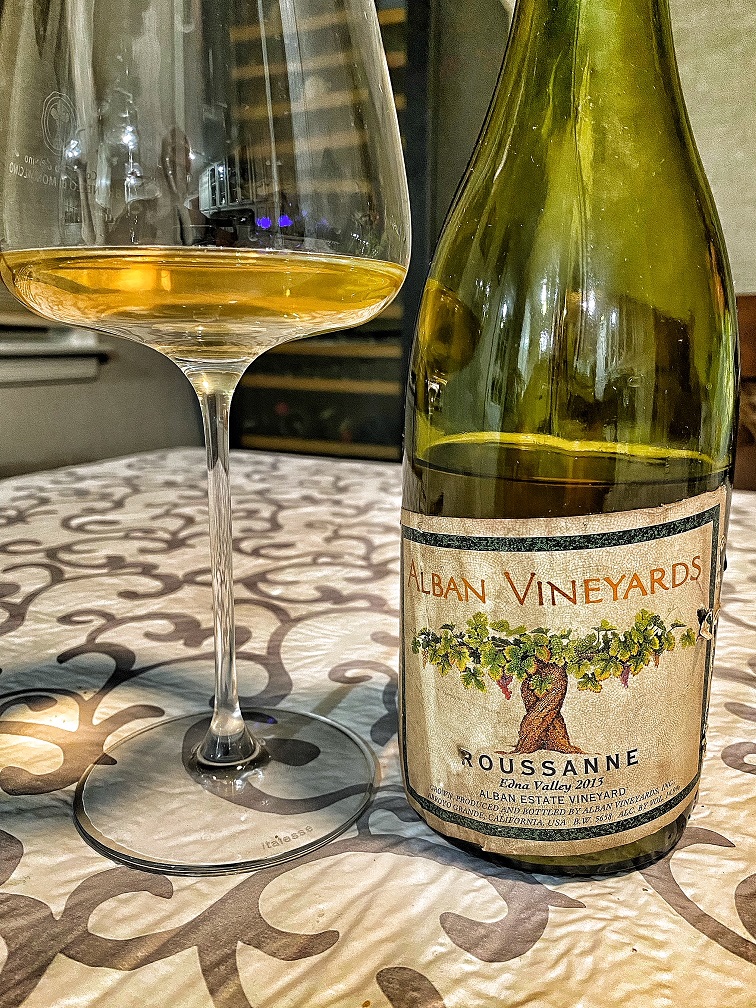
Let me tell you the story first. Take a look at the label – you can see that it looks crooked and dinted. So the rips in the label are from the shelves in my wine fridge, and they are not so interesting. But otherwise, the appearance of this label has a reason. Alban wines are allocated and are hard to get. When I got my allocation some time back, I only wanted to take 2 bottles, so the friend asked if she can have the rest. She filled up the form in her name, got the full allocation, and then shipped my two bottles back to me – a bottle of Patrina Syrah and this bottle of Roussanne. For some mysterious reason, she decided to reuse the inflatable packaging which is sometimes used to ship the wine instead of cardboard or styrofoam. The problem with that air-pumped enclosure is that it is not really reusable and not that reliable. When I got the box, the red liquid was slowly sipping through – you can imagine the fate of Patrina… At least the bottle of Roussanne was intact, with the exception of the label…
Pulling this bottle out from the bottom shelf was a moment of happiness. I love Roussanne, one of my favorite white grape varieties, and for some reason, I had been really craving Roussanne lately. So seeing this bottle which I completely forgot about was a moment of joy – this was IT. A perfect bottle for OTBN.
What can I tell you about this 2013 Alban Roussanne Edna Valley outside of the fact that it offers immense pleasure? We can start with a beautiful golden color. The nose of gunflint and honey at such intensity that you simply don’t want to put the glass down. Sniff, swirl, sniff, swirl, ahh. Gunflint, honey, salinity, and sapidity on the palate. This wine is fresh. This wine is alive, with a cut-through acidity on the long, long finish. This wine is viscous, roll-off-your-tongue goodness – after taking a sip, my wife said “ooh, this wine is fat!”. This wine is perfectly OTBN worthy. Not only that – this wine is perfectly Top 10 wines worthy.
So here is my OTBN story. Even if you don’t feel like celebrating, life is now. It is happening, and no moment will repeat itself. Pull that special bottle. Open that bottle – the special moment has arrived, it is now. Cheers, my friends.
Sangiovese Games and Power of Words
 Okay, folks, this might be the scariest post I have ever written. This might lead to unsubscribes, unfollows, ostracism, and public shaming. Well, it is what it is.
Here it comes, my confession.
I don’t know how Sangiovese tastes like.
Here, I said it. You heard me right, and I can repeat. I do not know how Sangiovese tastes like.
Still here? Okay, then I would like to ask for a chance to explain.
I know how Cabernet Sauvignon tastes like. Whether it is produced in Bordeaux, California, Australia or Tuscany, I still expect to find cassis, maybe eucalyptus, maybe mint, maybe bell peppers.
I know how Pinot Noir tastes like. No matter whether it comes from Burgundy, South Africa, Oregon, New Zealand, or California, I still expect to find cherries, maybe plums, maybe violets, maybe some smoke.
I can continue – I know how Chardonnay tastes like (from anywhere), I know how Riesling tastes like (from anywhere), I know how Sauvignon Blanc tastes like (from anywhere). I still don’t know how Sangiovese tastes like.
While we are talking grapes, we are also talking about the power of words. As soon as we hear Cabernet Sauvignon, Pinot Noir, Chardonnay, Riesling, Sauvignon Blanc, we have an instant mental image, set our expectations, and the first sip of wine is judged against that mental image. Of course, we make regional adjustments – Pinot Noir from Oregon might offer dark chocolate, espresso, and mocha in addition to the cherries, but cherries will be there. Bordeaux (okay, it is usually a blend, so this might be a bad example) is expected to be leaner that’s California Cab, but it will still show that cassis core. And I still have no clue how Sangiovese should taste like.
I know how Brunello tastes. It is 100% Sangiovese, but it has its own unique taste profile with layers of tart cherries and cherry pits framed by oak notes and firm tannins. I know how Vino Nobile de Montepulciano tastes. It is also 100% Sangiovese, with tart cherries usually weaved around a core of acidity. I know how Chianti typically tastes. It has to be at least 80% Sangiovese, plus other grapes, and it will have the cherries usually surrounded by leather and tobacco.
Brunello, Vino Nobile, Chianti are renditions of Sangiovese, but they are references only to themselves. When I hear any of these names, I know what to expect. But I still don’t know how Sangiovese tastes like.
I don’t know if you ever had a chance to experience Shafer Firebreak. This wine used to be made from California Sangiovese (92%) with the addition of Cabernet Sauvignon (8%), the percentages are representative of the last vintage which was in 2003 (Sangiovese plantings were removed after that). This wine had nothing in common with any of the Italian Sangiovese renditions, but instead had a smoke, espresso, and powerful dark fruit. A very memorable rendition of Sangiovese – but not referenceable.


You might be annoyed at this point by me constantly repeating “I don’t know how Sangiovese tastes like” and wondering where I might be going with that. So this post was triggered by a few events. Last year, I got a few samples of Sangiovese from Castello di Amorosa. When I tasted them, they were reminiscent of Chianti, and I even had to open a bottle of Cecchi Chianti, which is an outstanding producer making Sangiovese wines with exemplary regional expressions, to compare. I also tasted a bottle of California Sangiovese which had only a name of Sangiovese, but really tasted more like a fruit compote mixed with a fruit cake. As the end result I realized that I have no idea how Sangiovese actually should taste like – and here I am, pondering at the subject with you, my dear reader (I hope someone is still reading this, eh?)
So let me take you a bit further with a few of the tasting notes and references.
First, I have to say that I probably found what can be considered a reference Sangiovese. Two years ago I had an opportunity to taste a range of wines from Cecchi, and one of the wines was called Sangiovese Toscana IGT. It was not Chianti of any kind, it was pretty much an unadulterated rendition of a pure Sangiovese from the motherland, from Tuscany, which was not even aged in oak, only 2 months in the bottle. Here are the notes:
2018 Cecchi Sangiovese Toscana IGP (13% ABV, $10)
Dark ruby
Cherries, coriander, sage
Light, bright, fresh cherries, crisp acidity, sweet basil, refreshing.
8+, can be perfect even on a summer day, but I can’t complain on a winter day either. Unique and different.
The wine was absolutely spectacular in its pristine beauty and an absolute steal for the money. Ever since I tasted this wine it became my reference for how pure Sangiovese might take like.
Now, the peculiar California Sangiovese I mentioned before was the 2017 Seghesio Venom. 100% Sangiovese from Rattlesnake Hill in Alexander Valley, 14.9% ABV, $55. Seghesio is a Zinfandel specialist, and they are good at that. If this wine would be called Zinfandel, I would have no issue with it. But under Sangiovese name, it makes me only wonder what possessed Seghesio to make a wine like that. A fruit compote with a bit of a structure doesn’t equate to Sangiovese in any shape and form. And at the price, if you just want to drink a California wine, it might be fine, but if you are looking for Sangiovese, just look elsewhere.
Well, you don’t need to look too far. Castello di Amorosa in Napa Valley is really focusing on bringing their Italian heritage to wines they craft in California. Yesterday I talked about their range of Pinot Noir wines, which was excellent. Their California Sangiovese can probably be called a glorious success as I even had to open a bottle of classic Chianti to compare the notes.


I tasted two Sangiovese wines from Castello di Amorosa (for the history of the Castello, which is very fascinating, I would like to refer you to the link I included above).
2017 Castello di Amorosa Sangiovese Napa Valley (14.7% ABV, $36)
Dark garnet
Plums, cherries, baking spices
Plums, tart cherries, light tannins, medium body, good structure, a hint of leather.
8-/8, it is reminiscent of the Chianti, nicely approachable, but will improve with time, judging by the late tannins on the finish on the second day.
2018 Castello di Amorosa Voyager Vineyard Sangiovese Napa Valley (14.5% ABV, $45, single vineyard)
Dark garnet
Smoke, granite, gunflint, tobacco, dark fruit, Very promising.
Tobacco, baking spices, cut through acidity, medium body. Very unusual. Needs a bit of time.
Tart cherries, a hint of vanilla, bright acidity. Reminiscent of Chianti, but not as earthy
8-
And then I opened a bottle of Cecchi Chianti and was pleasantly surprised how successful Castello di Amorosa was with their Californian Sangiovese rendition.
2017 Cecchi Chianti DOCG (13% ABV, $14)
Dark garnet
Herbs with a hint of cherries
Tart cherries, good acidity, fresh berry profile, medium body. Was earthy upon opening, but mellowed out after a few hours in the open bottle.
8-, easy to drink, nice.
As you can tell, the wines are similar, and I would call it a very successful effort.
Well, I still don’t know how Sangiovese should taste like, because this is all in the words. Unless we taste blind, we are bound by the power of words, and therefore our excitement and disappointment are fully dependent on those words. Was the Venom a bad wine? No, but it is an utter disappointment when called a Sangiovese. Thanks to Castello di Amorosa successfully offering a saving grace. While I still don’t know how Sangiovese should taste like, I’m willing to continue the quest for the tastiest rendition.
If you are still with me – thank you for reading and cheers.
Californian Stars, Italian Flair
 Californian stars.
Of course, we are talking about wines and grapes. What would those be?
I recently called California Cabernet Sauvignon a king. We can safely designate Chardonnay as a queen. But who would you call a prince? Capricious, spiky, moody royalty? Whatever grape you think of, the correct answer is Pinot Noir, because this is the grape I mostly would like to talk about today. And tell me if you think Pinot Noir is not qualified for the role of the royal prince – finicky, demanding, and unpredictable.
Okay, we got our stars for the day. Now, the Italian flair. How would you add the Italian flair to the Californian grapes?
There are a few options. For example, you can call your sparkling wine a Spumante. Or you can call your winery Castello, and build it in the form of a medieval Italian castle. You can also make wines out of Sangiovese – but this we will discuss later. Anyway, as you can see, you got options.
Vittorio Sattui, an Italian immigrant, founded St. Helena Wine Cellars in 1885. The business had to be closed due to the prohibition in 1920, but the Sattui family continued living at the winery. In 1975, Dario Sattui, great-grandson of Vittorio, restarted the family business by opening V. Sattui winery in St. Helena.
After finishing college, Dario traveled around Europe and became obsessed with medieval castles, monasteries, farmhouses. In 1993, Dario found the next home for his future winery – 171 acres parcel near Calistoga. In 1994, the construction began initially for the 8,500 sq. ft building without cellars. That slowly morphed into a 121,000 sq. ft. 13th-century Tuscan castle with 107 rooms, drawbridge, five towers, high defensive ramparts, courtyards and loggias, a chapel, stables, an armory, and even a torture chamber. Lots of bricks and artifacts were delivered directly from Europe to ensure the full authenticity of the castle. Castello de Amorosa (Castle of Love) opened its doors to visitors in 2007 after 15 years of construction.
I was fortunate enough to visit the Castello di Amorosa in 2017 as part of the Wine Bloggers Conference 2017 in Santa Rosa, so I can share (inundate is a better word, of course) my first-hand impressions:
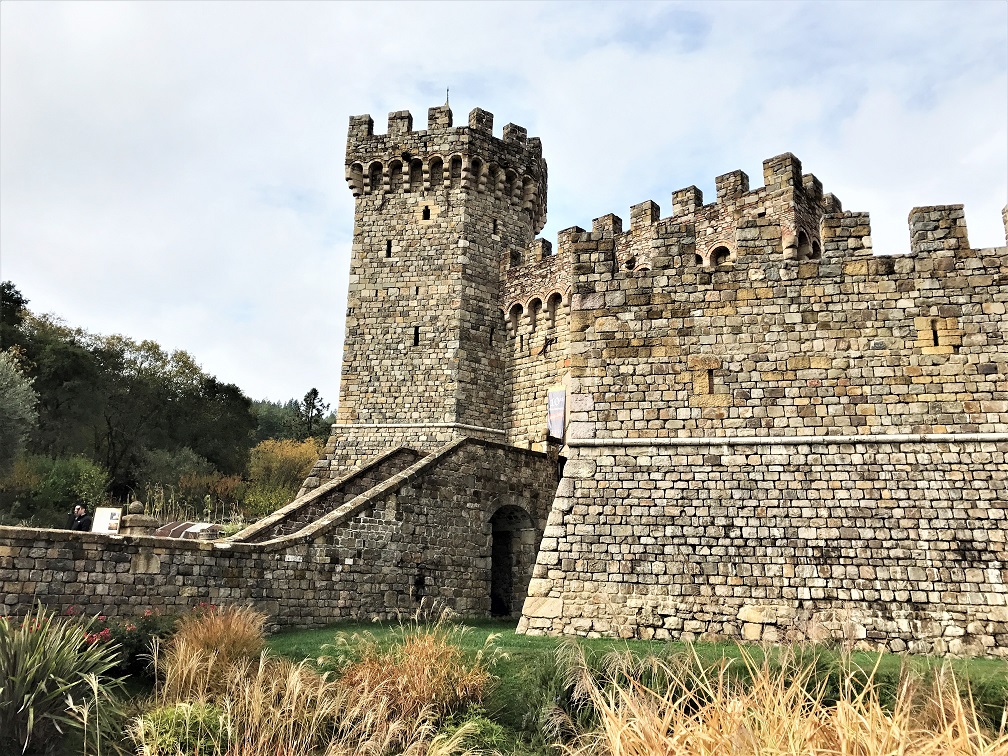
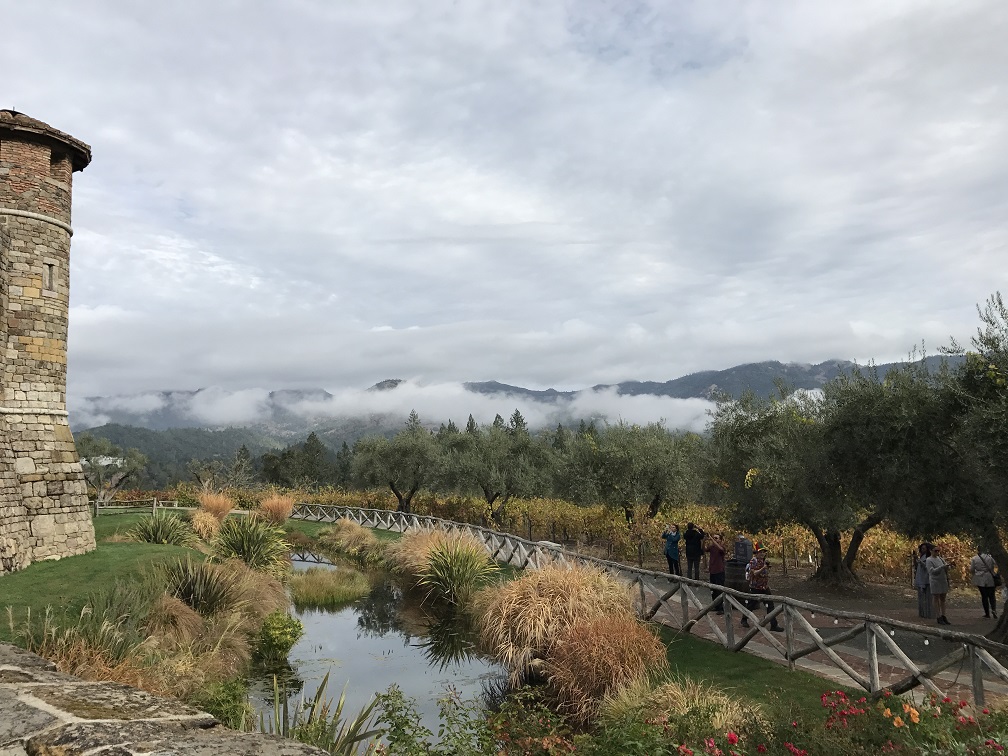


Thinking about misbehaving? Might not be recommended:


Touring the cellars:


The ceiling of the room where we had our tasting in 2017:

A bit of education – Napa Valley Regions:


Castello di Amorosa works with 14 vineyards, most of them in Napa and Sonoma, out of which 6 are estate vineyards. The focus of winemaking is on showcasing each individual terroir and on the small-batch production.
I had an opportunity to taste a range of Pinot Noir expressions from Castello di Amorosa, and I have to honestly say that I was very much impressed with what I found in my glass.


First, two sparkling wines, both produced using the classic method.
2017 Castello di Amorosa Spumante del Castello Brut Napa Valley (12.5% ABV, $39, 73% Chardonnay, 27% Pinot Noir)
Light Golden, fine bubbles
Toasted bread, apples, gunflint
Toasted bread, Granny Smith apples, more gunflint, great minerality, a touch of sweetness, bigger body than typical champagne.
8, excellent,
2017 Castello di Amorosa Spumante del Castello Brut Rosé Napa Valley (12.5% ABV, $49, 100% Pinot Noir)
Salmon pink, fine mousse
Steely strawberries, a hint of toast
Dry, crisp, strawberries, clean acidity, good minerality
8, excellent
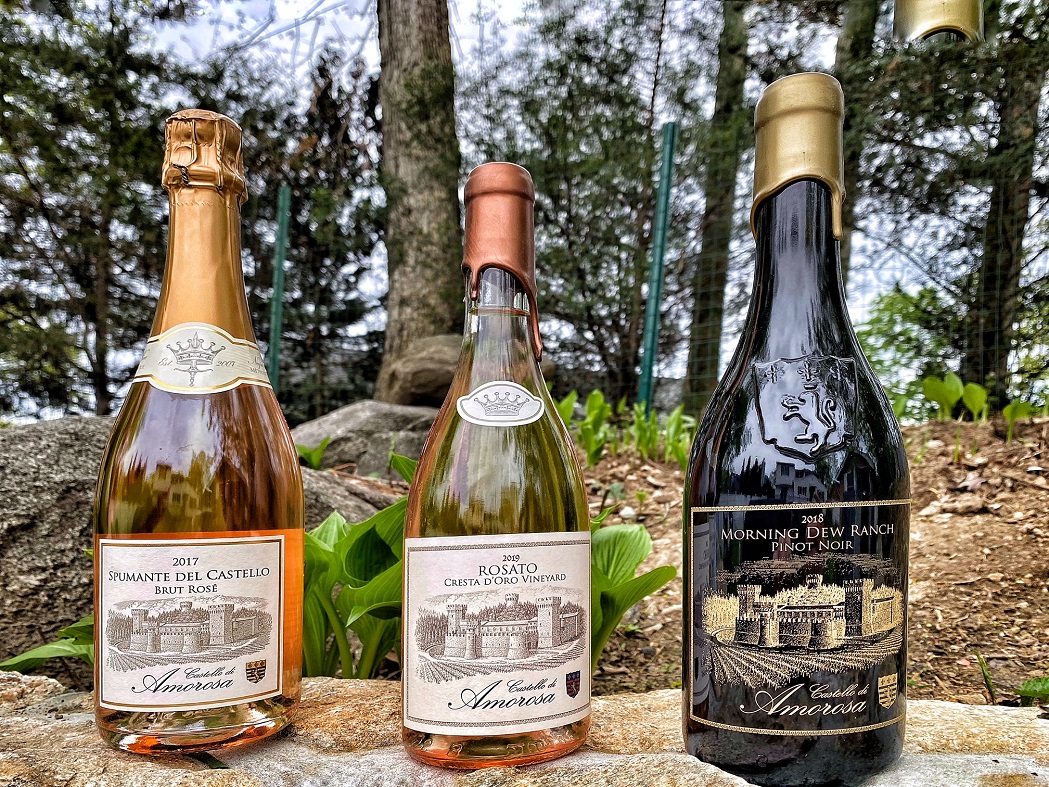
Next up, Rosé. The grapes for this wine come from the Green Valley area in the Russian River Valley AVA, and the wine is partially aged in concrete egg. I had an opportunity to taste both 2019 and 2020 vintages over a few months timeframe, and you can see that my tasting notes are almost identical for both wines. Somehow I missed including this wine into my 2021 top wines list, which makes me upset – this was one of the best Rosé wines and wines overall that I tasted during 2021.
2019 Castello di Amorosa Rosato Cresta d’Oro Vineyard Green Valley of Russian River Valley (13.6% ABV, $39, 100% Pinot Noir)
Light bright pink
Fresh ripe sweet strawberries, good intensity, inviting
Beautiful ripe strawberries, a touch of lemon, clean acidity, impeccable balance. Wow.
9-/9, one of the best Rosé I ever had. Just wow.
2020 Castello di Amorosa Rosato Cresta d’Oro Vineyard Green Valley of Russian River Valley (12.5% ABV, $39, 100% Pinot Noir)
Light bright pink
Fresh strawberries, a touch of herbs, crisp, inviting, and invigorating
Beautiful ripe strawberries, a touch of lemon, clean acidity, impeccable balance. Wow.
9, one of the best Rosé I ever had. Just wow. Superb.
Last up – Pinot Noir from Morning Dew Ranch in Anderson Valley. This vineyard was purchased in 2015 from Burt Williams, founder of the iconic William Selyem Winery. The 12-acre vineyard is in a very cool microclimate and divided into 9 blocks of Pinot Noir planted with DRC, 115, 777, Rochioli, 23, and 828 clones. All the blocks and clones give quite a bit of room to experiment to the winemaking team.
2018 Castello di Amorosa Morning Dew Ranch Pinot Noir Anderson Valley (13.1% ABV, $75, 11 months in Burgundian oak barrels)
Dark ruby
Somewhat unexpressive on the first day, a hint of fruit
Closed up, concentrated, dark fruit, not amazing
Classic Pinot on the second day – iodine, violets, underbrush
Beautifully elegant on the palate – good acidity, smoke, tobacco, fresh berries, cherries, firm structure combined with medium body, medium-long finish.
8+ second day, super-enjoyable.
Here you go, my friends – a little Italian oasis – scratch that – a large Italian Castle in the middle of Napa Valley, producing magnificent California wines. Castello di Amorosa is definitely a unique travel destination and a must-visit if you are ever in the area.
Rethinking Grenache with Wines of Cariñena
I love how the wine world affords us endless learning opportunities – as long as we are willing to learn, of course. Wine is an indelible part of the culture, thus learning about wine extends our understanding and appreciation of the world.
More often than not we simply focus on what’s in the glass – is it tasty, what is that peculiar flavor, do I want another sip or another glass. That is exactly how it should be – after all, wine is just grape juice. But if we are willing to take a step back, think about the wine in the glass, maybe read an article somewhere online or attend a webinar (which usually doesn’t cost anything), in addition to getting hedonistic pleasure from what is in the glass we might also get fascinated by the history and its strong connection to the wine.
The webinar I’m talking about here today took place almost a year ago (yes, I already confessed that I have a lot of catching up to do), but it is still worth talking about.
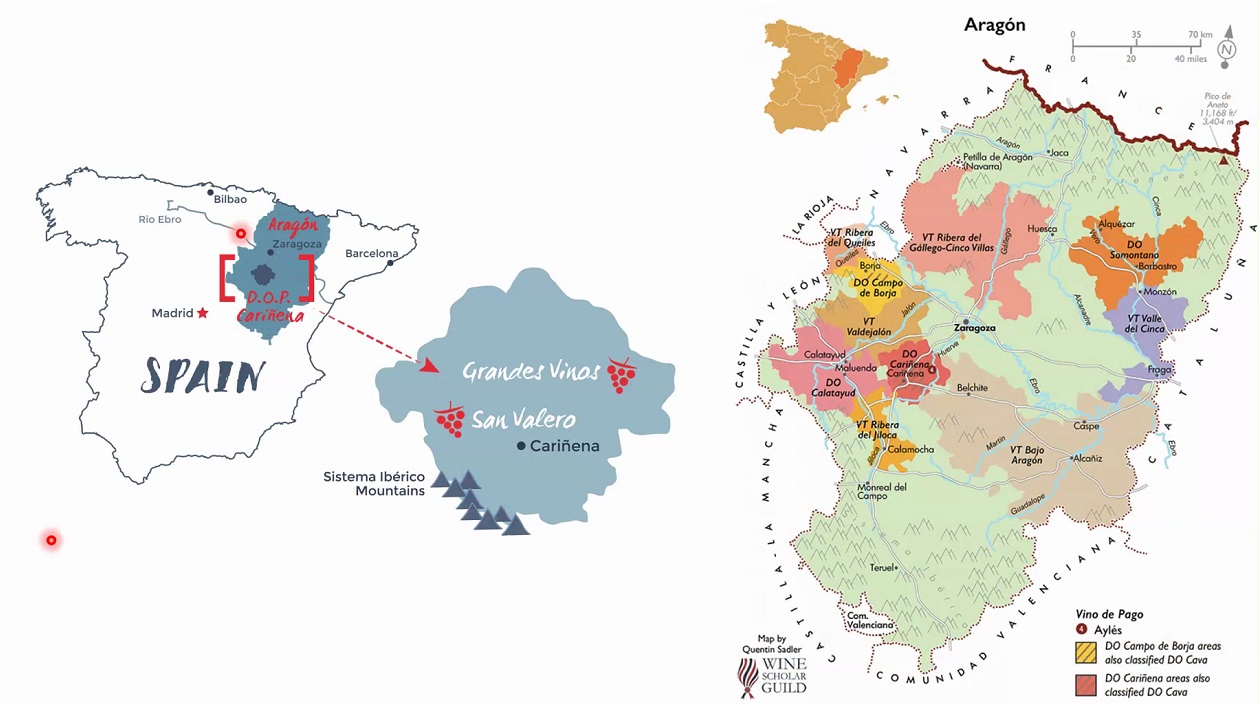
Cariñena is not the oldest winemaking region in the world, but with the first vineyards planted by the Romans around 50 BC, it is definitely old enough. As you can see on the map, Cariñena is located in the Aragon region in Spain. Before Spain became Spain in the last quarter of the 15th century, the Kingdom of Aragon held tremendous power in the 14th-15th centuries over a large portion of present-day eastern Spain, parts of what is now southern France, the Balearic Islands, Sicily, Corsica, Sardinia, Malta, Southern Italy and parts of Greece (source: Wikipedia). While this all should interest the historians, this is also relevant to our wine story. In 1415, King Ferdinand I of Aragon declared a preference for Cariñena wines “above all others.” The red wines of Cariñena were made out of Grenache, better known in Spain as Garnacha, and also known under one of its early synonyms as Tinto Aragonés (red of Aragon).
An interesting sidebar here for you: Sardinia claims that Grenache, locally known as Cannonau, originated in the island. It is entirely possible that it is actually true, and maybe Grenache made it from Sardinia to Cariñena where it became so famous – we have to leave it to the grape historians and detectives to unravel.


Going back to the Aragon Kingdom, what I never realized is that political influence is not limited to laws, money, and goods – the vines are also a subject of political influence. The Kingdom of Aragon presided over its territories and pushed down not only the laws but also grapevines, helping to spread Grenache into all kingdom-controlled territories. Grenache plantings appeared all over Spain, in Souther Rhone and Languedoc, and other areas. Way later, in the 18th century, Grenache also made it to Australia and South and North America, to become one the most planted red grapes in the world.
What is interesting about Grenache is that it doesn’t have its own varietal character. Cabernet Sauvignon and Merlot have bell pepper and cassis. Syrah has its signature black pepper. Grenache doesn’t have its signature profile. It perfectly adapts to a place, becoming a conduit for the terroir. For example, if you ever had Grenache from Washington (No Girls Grenache would be an excellent specimen), and some of the most classic Spanish Grenache such as Alto Moncayo, you would know the tremendous difference in taste profile – Grenache from Washington perfectly conveys the “liquid rock” of mostly volcanic soils, where Alto Moncayo would offer layers of dark chocolate and succulent berries – literally two wines from the different planets.
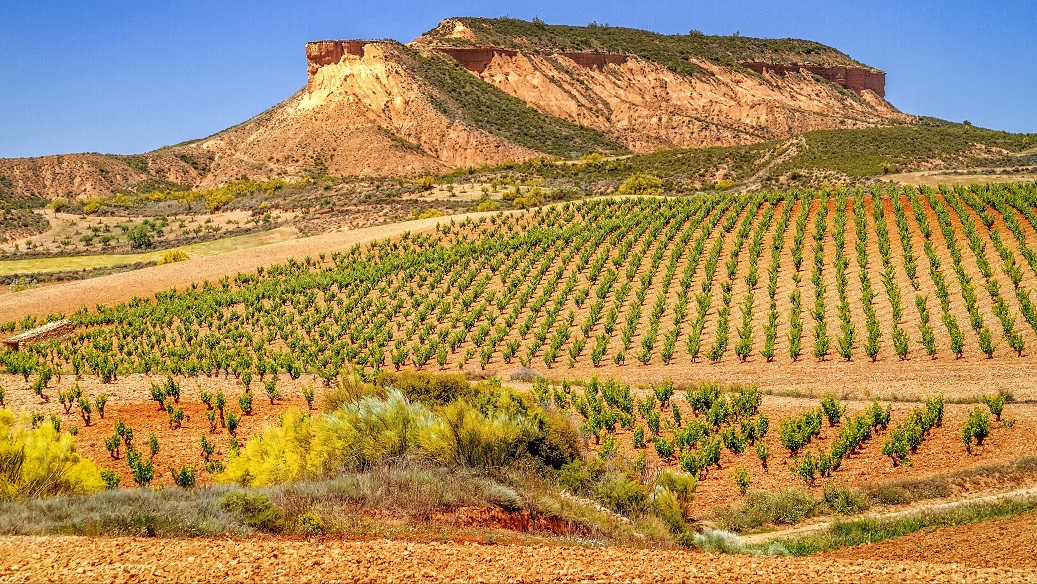
Source: Cariñena Wines
Cariñena is a perfect region for the grape growing – protected by the mountains, it offers long dry summers, cold winters, and very little rain, making the grapes work hard. Cariñena is also a mountainous region, with the majority of the vineyards located at the 1,300 to 2,800 feet elevation – that creates a significant diurnal variation which helps grapes to concentrate flavor. This rather harsh climate also plays a role of a great defender against vine diseases – while most of Europe was devastated by phylloxera in the late 19th century, Cariñena was largely unaffected.
A few more interesting facts about Cariñena. In 1909, King Alfonso XIII of Spain awarded Cariñena a city charter for their growers’ role in helping European vineyards recover from the phylloxera blight. The quality of Cariñena wines was also recognized in modern times when in 1932 it became the second wine region in Spain to receive the status of DO (Denomination of Origin) – the first one was Rioja. And Cariñena is the only region in Spain that has an eponymous grape – Cariñena, better known in the rest of Spain as Mazuelo and Carignan in the rest of the world. Cariñena is another native red grape grown in that region.
In 2016, Wine Enthusiast named Cariñena The Region To Watch, which since then became a slogan for the region, focusing on promoting its wines around the world.
As part of the webinar, I had an opportunity to taste two wines that are well representative of the capabilities of the region.
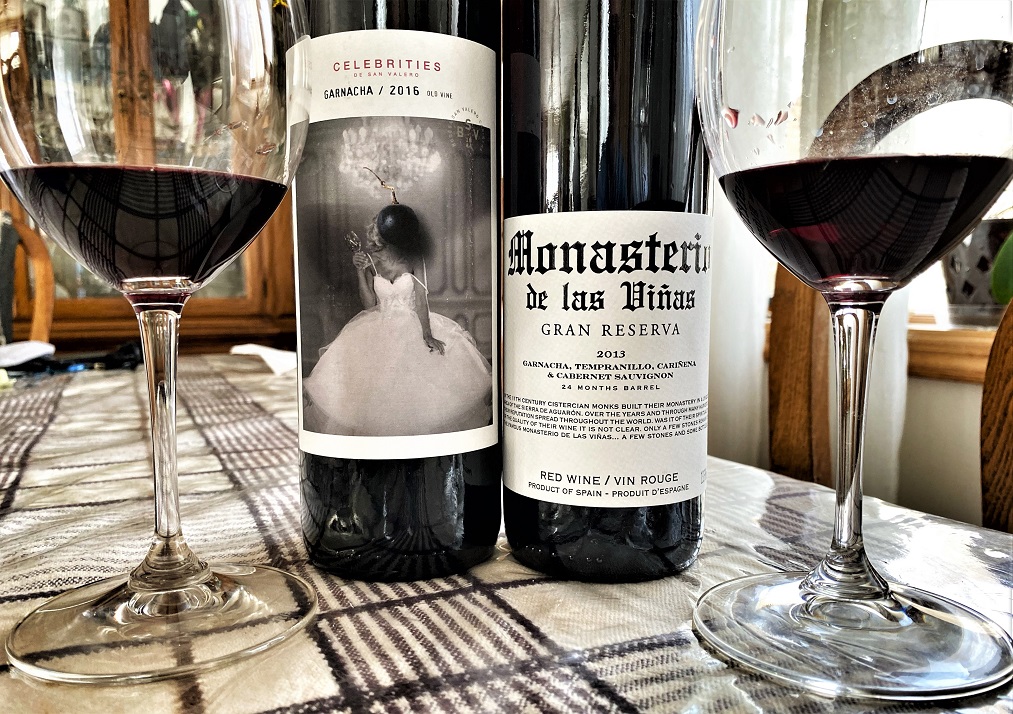
First wine was produced by Bodega San Valero. Bodega San Valero just celebrated 75 years, formed in 1944 by 66 partners. Today, Bodega San Valero works with 500 growers who farm 9,000 acres of vineyards, which represents 30% of the Cariñena DO. They also use 20,000 French and American oak barrels to produce the wines, and 100% of production is done on the property. I wrote about a number of Bodega San Valero wines in this blog, their Particular Grenache being one of my favorite Grenache renditions. This time, I had an opportunity to taste the 2016 Bodega San Valero Celebrity Grenache Old Vines Cariñena DO (14% ABV, $12.99). The wine had blackberries and chalk on the nose, with a hint of dried herbs. After about an hour in the open bottle, the wine became round, with dark fruit, strawberries, and blackberries, pronounced minerality and a touch of chocolate, crisp acidity, and mouthwatering finish. This was rather a food wine, but still nice and easy to drink.
While Grandes Vinos is taking its roots from a number of Cariñena cooperatives beginning from the 1950s, it was officially born in 1997. The cooperative comprises 700 winegrowers, farming more than 11,000 acres of vineyards spawning over 14 Cariñena districts and growing 10 grape varieties. Grandes Vinos produces wine under 9 different wine ranges. One of those wine types is called Igulp and it is a lightly sparkling grape beverage distributed in beer bottles – I would love to try that.
The wine I tried this time was from the Monasterio de las Viñas range. Monasterio de las Viñas pays homage to the actual monastery built by Cistercian monks in the 11th century, in a privileged place of the Sierra de Aguarón, well known for both their spirituality and high quality of their wines.
2013 Monasterio de las Viñas Gran Reserva Cariñena DO (13.5% ABV, $21.99, blend of Garnacha, Tempranillo, Cariñena, and Cabernet Sauvignon, 24 months in the barrels) had an uplifting, vinous nose, inviting and complex – it was creating great expectations about the wine. On the palate, the wine offered red and black fruit, round, good minerality, perfectly balanced, and perfectly integrated. Easy to drink and dangerous.
This was a great learning experience, making me take another look at the wines and try to see just past of what is in the glass. Let’s drink to the learning experiences of our lives, and may you never stop learning. Cheers!
Passion and Pinot Updates: Bells Up Winery
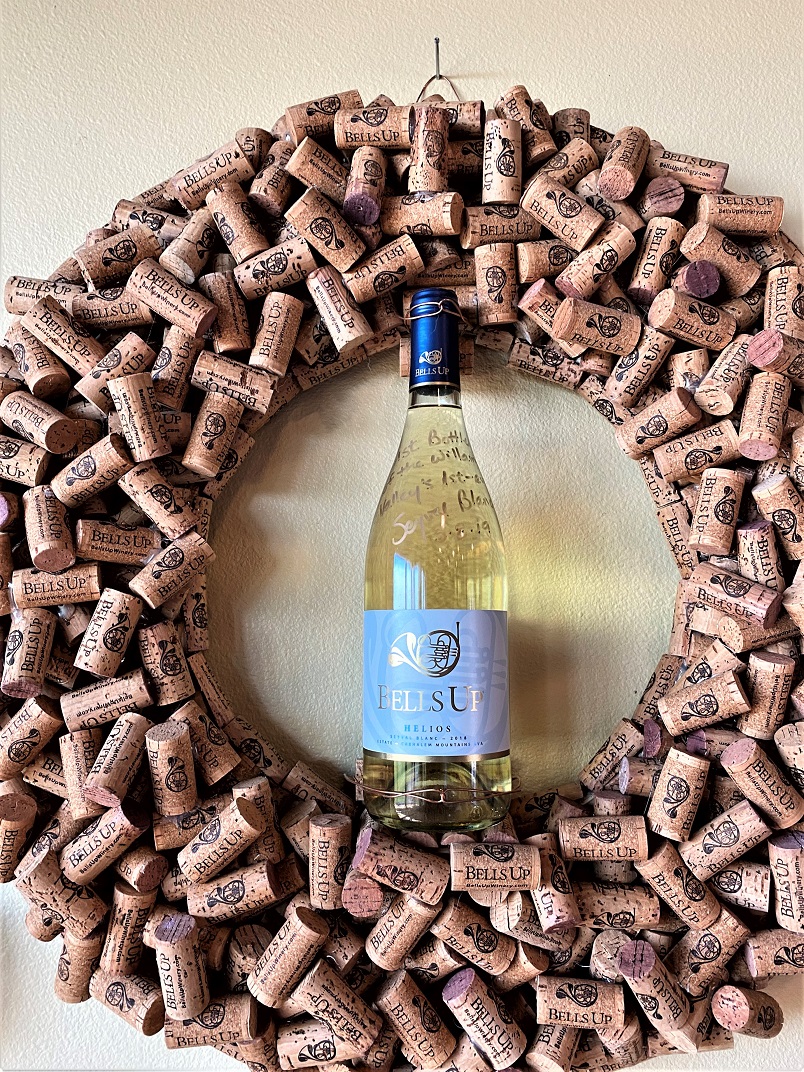 And then we arrived at “micro-boutique, un-domaine” Bells Up Winery, our final stop of the Oregon wine country touring.
Out of 13 wineries profiled in the Stories of Passion and Pinot series, Bells Up is the youngest one, having been founded in 2013, with the first vineyard plantings of Pinot Noir going into the ground in 2014. Despite being a young winery, Dave (the winemaker) and Sara (the Boss) Specter have a clear vision as to where they are going with their distinctly un-domaine wine – if you are curious why I keep saying “un-domaine”, I would like to direct you to the (virtual) interview I did with Dave in 2019 – he explains the concept of un-domaine very well.
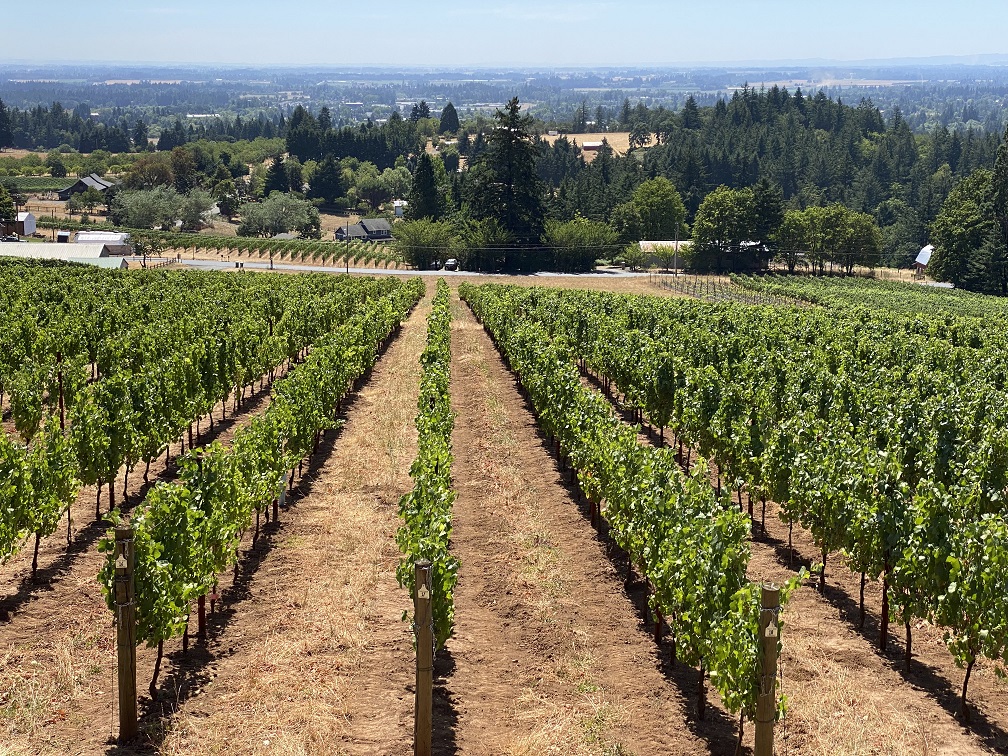
Everything is distinctly un-domaine (see, you need to read that interview) at Bells Up. The vineyard with a gentle slope, the winery right in the middle of the vineyard, a simple but elegantly appointed tasting room with lots of fresh flowers and beautiful views of the vineyards. Here you go – pictures, pictures, pictures:
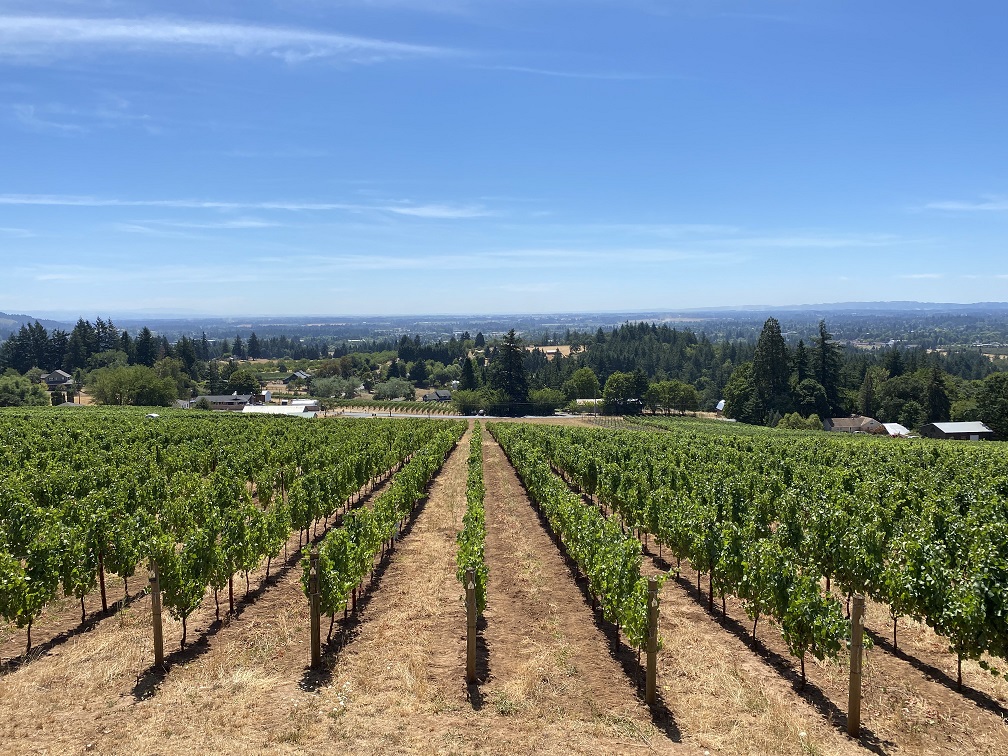


After admiring all the views we proceeded with lunch and tasting. Our lunch was prepared by Sara and while it was somewhat of a simplistic summer chicken salad, the amazing part was that this salad perfectly paired with the majority of wines we tasted – if you ever tried pairing the salad with wine, you would have to agree that achieving great pairing is very far from easy.
As I mentioned, Dave and Sara have a clear vision of the future direction for Bells Up. While Bells Up estate vineyard will be mostly planted with Pinot Noir, and by 2022 Bells Up plans to be at 100% estate fruit for all Pinot Noir bottlings, they have a clear plan for making Bells Up unique and different – growing and producing Pinot Blanc instead of the more commonly available Pinot Gris; being first in Willamette Valley with Seyval Blanc plantings; planting (out of all grapes!) a little known Italian grape Scioppettino; already offering Syrah and adding Cabernet Sauvignon in the 2020 vintage. “Unique and different” is a good description, in my opinion.
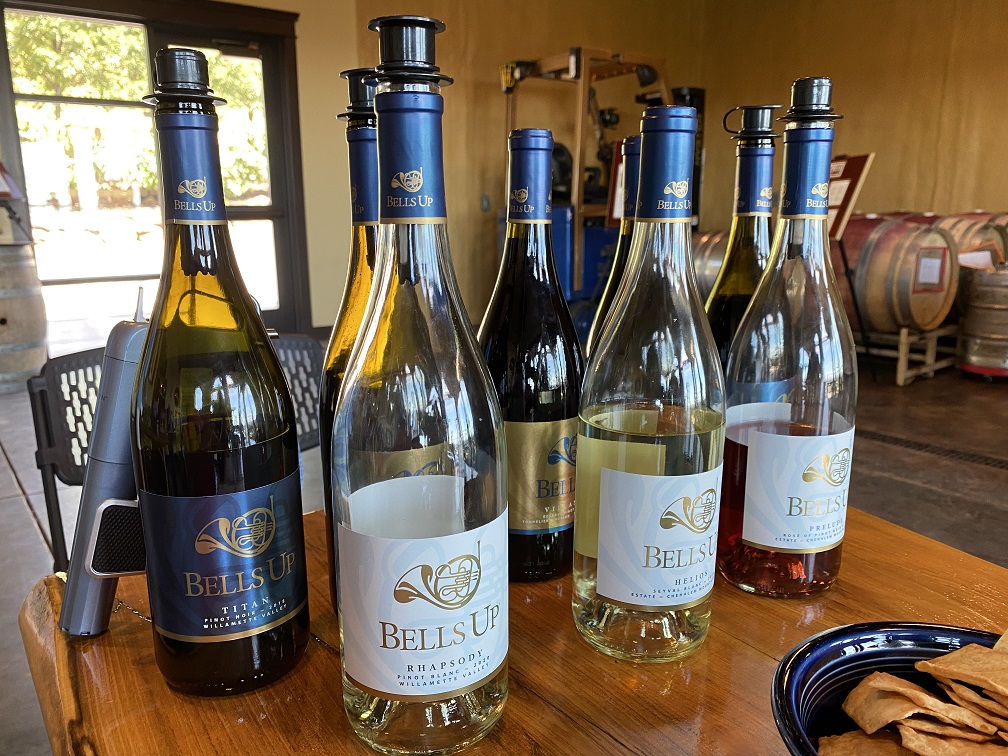


Before we talk about wines I would like to mention that none of the wine names you will see below are random. All the names have connections to the classical music pieces under the same name, and every choice of the name has an explanation as to why the particular piece was selected to connect with a given wine. If you are interested, there is even a Spotify playlist that includes all of the relevant music pieces – you can find that list directly on the Bells Up Our Wines page.
We started our tasting with Pinot Blanc:
2020 Bells Up Rhapsody Pinot Blanc Willamette Valley ($32)
Great complexity, lemon, gunflint
Great acidity, lemon, clean, crisp, refreshing
Perfect pairing with summer chicken salad
8, Excellent
We almost had to beg Dave to let us Seyval Blanc which was practically sold out. As a curiously interesting fact, Seyval Blanc plantings had to be protected by the net, as it happened that birds loved the grapes too.
2020 Bells Up Helios Seyval Blanc Estate Chehalem Mountains AVA ($40)
Gunflint, minerality,
Clean fruit, Meyer lemon, good acidity, good creaminess
Great with summer chicken salad.
8
Next up was Pinot Noir Rosé, the first Pinot Noir wine entirely produced from the estate fruit:
2020 Bells Up Prelude Pinot Noir Rosé Estate Chehalem Mountains AVA ($28)
Strawberries, nice minerality
Strawberries, bigger body than Provence, good acidity, perfect balance.
8-
We followed up with the selection of Bells Up Pinot Noir wines:
2018 Bells Up Titan Pinot Noir Willamette Valley ($44)
Plums, violets, sandalwood
Crisp, clean, crunchy cranberry profile, a hint of cranberries, good acidity on the finish.
8-
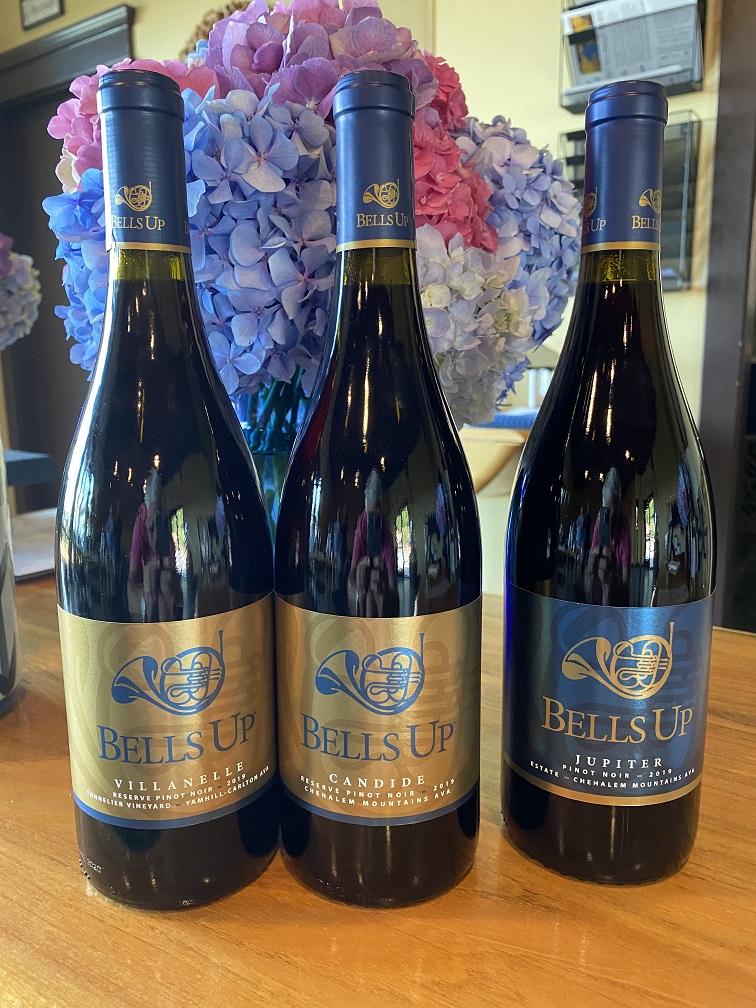
2019 Bells Up Candide Pinot Noir Reserve Chehalem Mountains AVA ($54, 12 months in French oak)
Floral, nutmeg, warm spices
Cherries, cut through acidity, black pepper, perfect balance, delicious
8
2019 Bells Up Villanelle Pinot Noire Reserve Tonnelier Vineyard Yamhill-Carlton AVA ($58, 12 months in French oak, final vintage)
Blackberry/raspberry, Marionberry
Cassis leaves, light crunchy cherries, well-integrated tannins, good acidity on the finish, delicious.
8
2019 Bells Up Jupiter Estate Pinot Noir Chehalem Mountains AVA ($48, 12 months in French Oak)
Underbrush, summer forest, cherries, a touch of tobacco
Crunchy cherries, clean, fresh, delicious
8
While this is not a video, here is Dave talking about Bells Up wines:
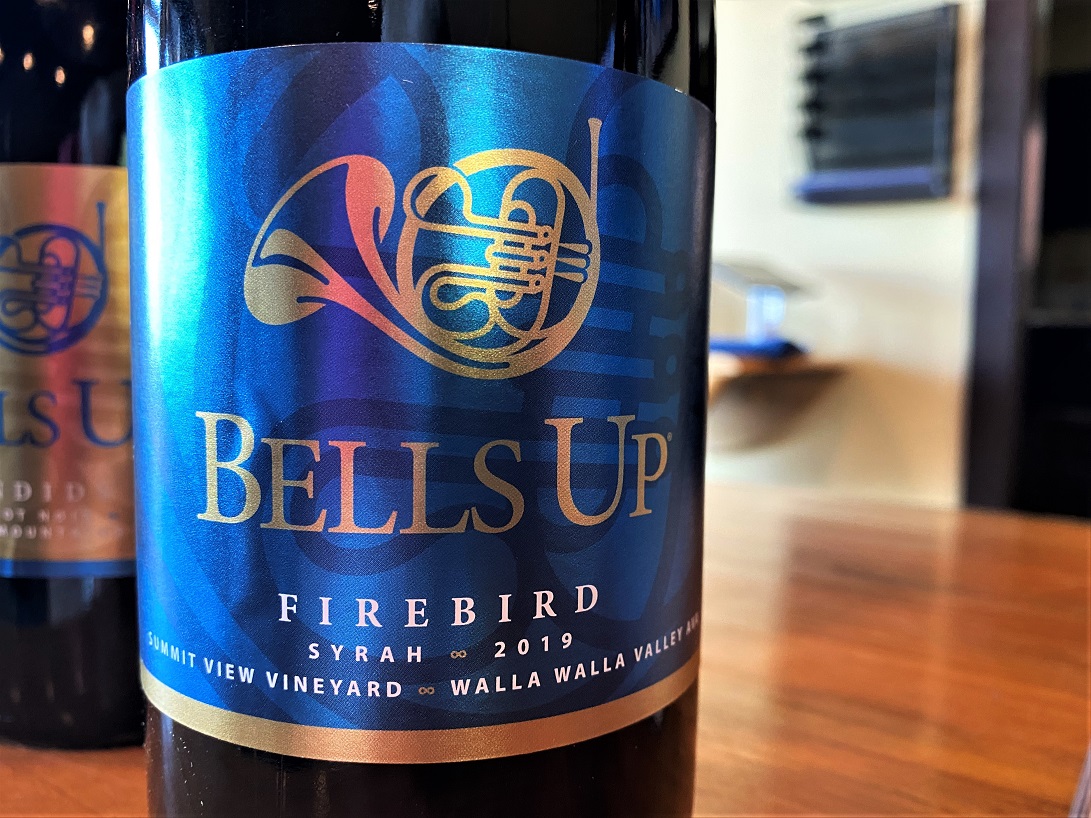
Bells Up Syrah was served with an amazing seedless grape pie. As Sara explained, everyone gives wines as presents in Willamette Valley, but tasty grape pie is almost equivalent to the hard currency when exchanging gifts with neighbors. As I said, the pie was superb, and to think that sweet pie would pair with Walla Walla Syrah? I really wouldn’t – and I would be mistaken.
2019 Bells Up Firebird Syrah Summit View Vineyard Walla Walla Valley AVA ($52, 12 months in French oak)
Blueberries and blackberries on the nose
Berries all the way, nicely balanced
8, Amazing pairing with seedless grape pie with cardamom
Again, we almost had to twist Dave’s arm to let us taste the future release of Cabernet Sauvignon:
2020 Bells Up New World Cabernet Sauvignon Reserve Summit View Vineyard Walla Walla Valley AVA ($68, 12 months in French oak, barrel sample)
A hint of green bell pepper
Cassis, a hint of black pepper on the finish, good, round, smoky undertones.
8-
Here you have the summary of our “un-domaine” experience – an excellent set of wines and super-friendly hosts. If you will find yourself touring Willamette Valley, add Bells Up winery to your “must visit” list.
This is the last update in the Passion and Pinot series. For now, that is.
Until next time…
This post is a part of the Stories of Passion and Pinot series – click the link for more stories…
American Pleasures #6: A Tale of Two Cabs
Wine should give you pleasure – there is no point in drinking the wine if it does not. Lately, I had a number of samples of American wines, that were the delicious standouts – one after another, making me even wonder if someone cursed my palate. I enjoyed all of those wines so much that I decided to designate a new series to them – the American Pleasures.
California Cabernet Sauvignon.
Magical words for any wine connoisseur. Out of more than 100 grape varieties used in wine production in California, I would safely bet that Cabernet Sauvignon clout exceeds that of Chardonnay, Merlot, and Pinot Noir, and even including Pinot Noir in this list is a stretch. Cabernet Sauvignon is The One of California wines (if you are willing to disprove this with actual numbers, I will be happy to publish a correction, but until someone will step forward, this stands as unquestionable truth).
While we can agree that California Cabernet Sauvignon is an object of craving for uncounted many, it also should be recognized as an object of controversy. How do I mean it? Easy. There are probably 50 or so producers whose wines are impossible to get, due to both availability and pricing – you have to be on the mailing list with a waiting list stretching for 20 years or so, and once you get there you should be willing to pay $500++ per bottle of wine you will need to wait for another 10-15 years to enjoy. Alternatively, you need to be prepared to pay an upward of $500 per bottle and scour the internet daily looking for those special bottles.
On the flip side, you can join most of us walking into the wine store asking (begging?) for a good bottle of Cabernet Sauvignon under $20, trying not to notice the poorly hidden smirk on the face of the salesperson, who knows that we are on the quest for the impossible. If you like Cabernet Sauvignon and not buying those wines from your expense account, I’m sure you can relate to the experience firsthand. Even $50 per bottle doesn’t come with any guarantees. But – that number gives us hope. Yes, folks, it is possible to find a good bottle of Cabernet Sauvignon under $50. Let’s talk about it.


Lots of my wine learning and discoveries are linked to unimitable wine educator Kevin Zraly and his Windows on the World Wine School. I remember one of the lessons where we were talking about California Cabernet Sauvignon. One of the wines was particularly good, and I remember Kevin remarking that the wine was produced by Louis M Martini, who doesn’t charge nearly enough for the quality of the wines they produce. That reference got engraved in my memory literally forever, and Louis M Martini became somewhat of the safe bet when looking for reasonably priced and consistent California Cabernet Sauvignon.
Louis M Martiny winery was founded in 1922 when Prohibition was already in full swing. It was actually known as L.M. Martini Grape Products Company and was focused on the production of sacramental wines and concentrate for home winemaking. In 1933, expecting that Prohibition will end, the new winery building was constructed north of the town of Napa. This was the actual beginning of the Louis M Martini winery and pioneering role of the Martini family in the Californian wine industry, helping to establish Napa Valley Vintners Association in 1943, being one of the first to use wind machines to prevent frost in the vineyards, and being one of the first to bottle varietal Merlot in 1970.
Louis M Martini offers a substantial range of wines today, going way beyond standard Sonoma and Napa Cabernet Sauvignon offerings, including Cabernet Sauvignon from some of the best regions in Napa Valley such as Stagecoach Vineyard and Howell Mountain, as well as a number of Merlot, Malbec, Petite Sirah, and Zinfandel wines – unfortunately, most of those are priced well beyond the $50 we are talking about today. Sill, there is Sonoma Valley Cabernet Sauvignon which can be found at around $15, and Napa Valley Cabernet Sauvignon around $35. The Napa Valley bottling I tasted was simply outstanding with or without any regard to the price:
2016 Louis M Martini Cabernet Sauvignon Napa Valley (15.1% ABV, $40)
Garnet
Cassis, eucalyptus, baking spices
Roll of your tongue smooth, velvety, fresh cassis, perfectly ripe fruit but over, firm structure, long finish.
8+/9-, excellent, classic California Cabernet Sauvignon
If Louis M Martini can be called an iconic winery, then our next winery can be only referred to as the most iconic winery in Napa Valley. Charles Krug winery, established in 1861 in Napa Valley by Prussian immigrant Charles Krug was the very first winery in Napa Valley, the 540 acres estate which Charles Krug received via marriage. In 1943, an immigrant family from Italy, Mondavi, purchased the Charles Krug estate which had been run by the family now in 4th generation.
Charles Krug winery also offers a good number of wines, including Chardonnay, Malbec, Merlot, Zinfandel, and others, with Cabernet Sauvignon still being a flagship offering, including clonal selections (one of the Charles Krug Cabernet Sauvignon wines is called X Clone as it is produced as a blend of 10 Cabernet Sauvignon clones). I always wanted to try the Charles Krug wines, and finally, I was able to do so:
2017 Charles Krug Cabernet Sauvignon Napa Valley (14.1% ABV, $39, 87% Cabernet Sauvignon, 5% Merlot, 5% Petit Verdot, 3% Petite Sirah)
Dark garnet
Blueberry, blueberry jam, dark chocolate, pipe tobacco
A touch of nutmeg and cloves, much crispier on the second day, firm tannins, firm structure, good acidity.
8-/8, definite improvement on the second day.
Comparing these two Cabernet Sauvignon wines, Louis M Martini was a perfect pop and pour example, which is ultra rare among California Cabernet Sauvignon, where Charles Krug bottling definitely needed time.
Here you are, my friends. If you are looking for a good bottle of Cabernet Sauvignon under $50, there is still hope!
Passion and Pinot Updates: Utopia Vineyard
 And then we arrived in Utopia.
When your destination is called Utopia Vineyard, poking some fun is irresistible, isn’t it?
Upon our arrival to Utopia Vineyard in Ribbon Ridge AVA, we were warmly greeted by Dan Warnshuis, proprietor and winemaker, who poured us a glass of Utopia Pinot Noir Blanc (yep, a white wine made out of Pinot Noir) and took us on the tour of the vineyard, glass in hand. After speaking with Dan virtually about a year ago, it was definitely a pleasure to shake hands and move from the virtual to the real world where things can be touched and smelled.
Utopia Vineyard looks different from Le Cadeau and Lenné – no fighting with the rocks here. Gentle slope elevation of only 20 feet from top to bottom makes it easier to tend for grapes. Utopia Vineyard is farmed using Sustainable Organic practices and was L.I.V.E. certified in 2008. Dan practices dry farming and uses cover crops every second row – in normal conditions though. Summer 2021 was so dry and hot that by the second week in August when we visited, all of the cover crops were removed so it will not compete with vines for access to water. The grapes looked perfectly healthy and beautiful despite the hot weather – you can see it for yourself in the pictures below.


I don’t know how the actual utopia should look like, but I find these vineyard views pretty compelling:

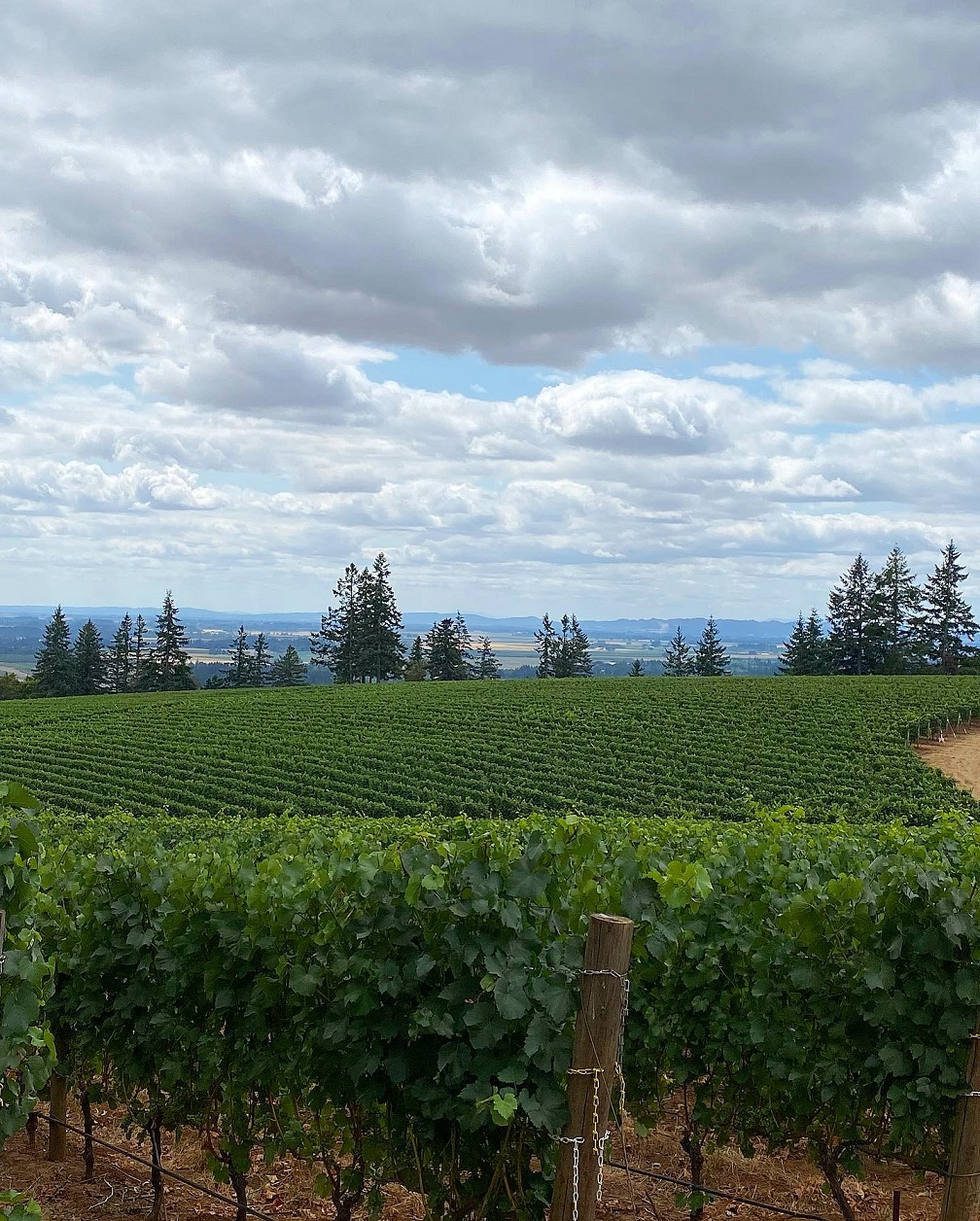
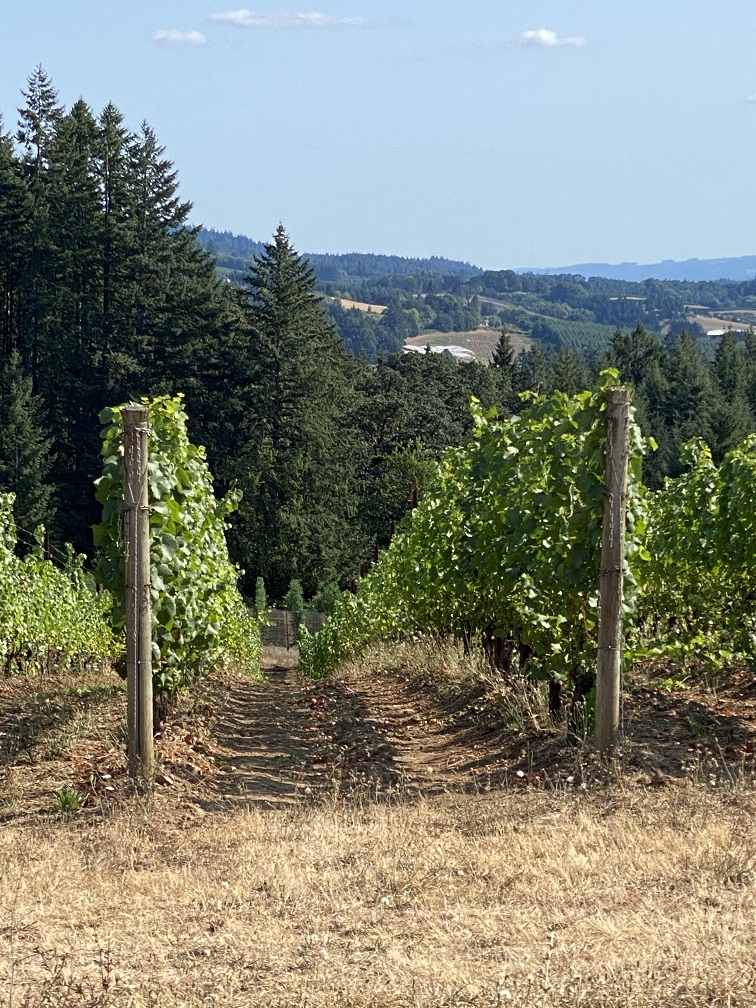
There are 12 clones of Pinot Noir growing at Utopia Vineyard – one of the wines we tasted was made out of all 12 clones. There are also 3 clones of Chardonnay growing there, planted in 2010. Talking about “fashionable wines”, Utopia Vineyard doesn’t produce sparkling wines, but Dan makes Pinot Noir Blanc, a white wine from the red grapes, which we tasted upon arrival, and also had the pleasure of tasting it directly from the barrel (all notes below).
In 2018, Dan acquired additional 35 acres of land not far from Utopia Vineyard’s original location. That parcel of land also had a 5,500 sq. ft building which by the time of our arrival 3 years after the acquisition was fully converted into a state-of-the-art winery. We stopped by the winery a few times during our visit, and what was the most mind-boggling to me was that Dan was pretty much operating everything at the winery just by himself – moving barrels, emptying tanks, and so on. His son-in-law comes to help during the harvest, but otherwise, Dan is a one-man operation.
This additional property also hosts a freshly constructed log cabin which is called exactly that – Utopia Vineyard Log Cabin, which offers beautiful accommodations and spectacular views:
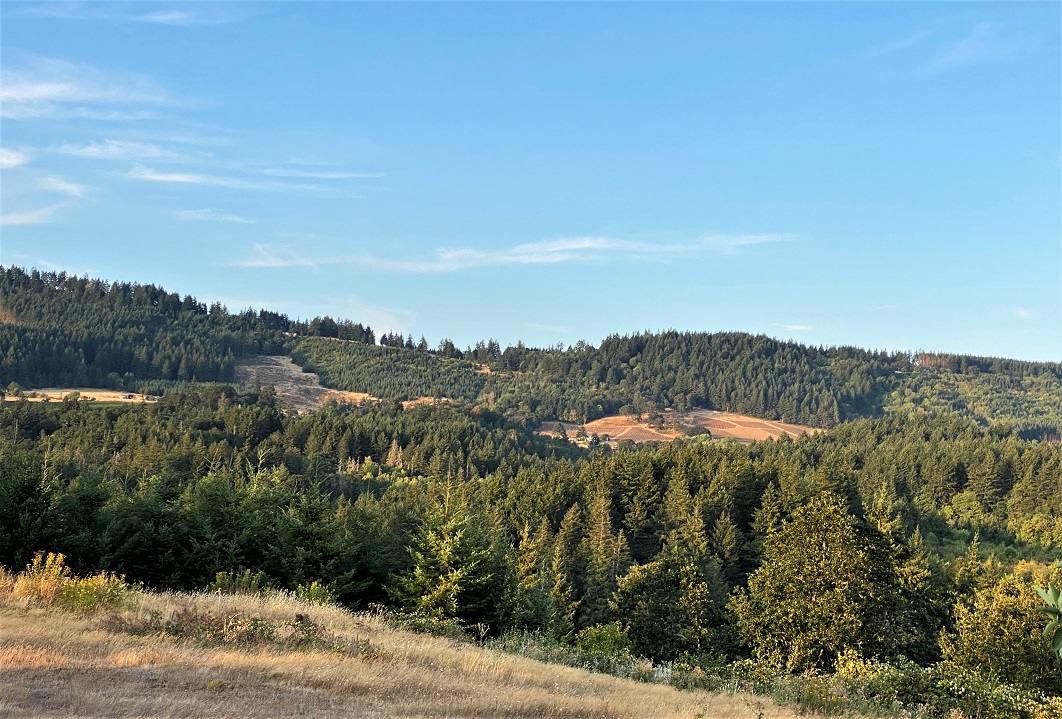
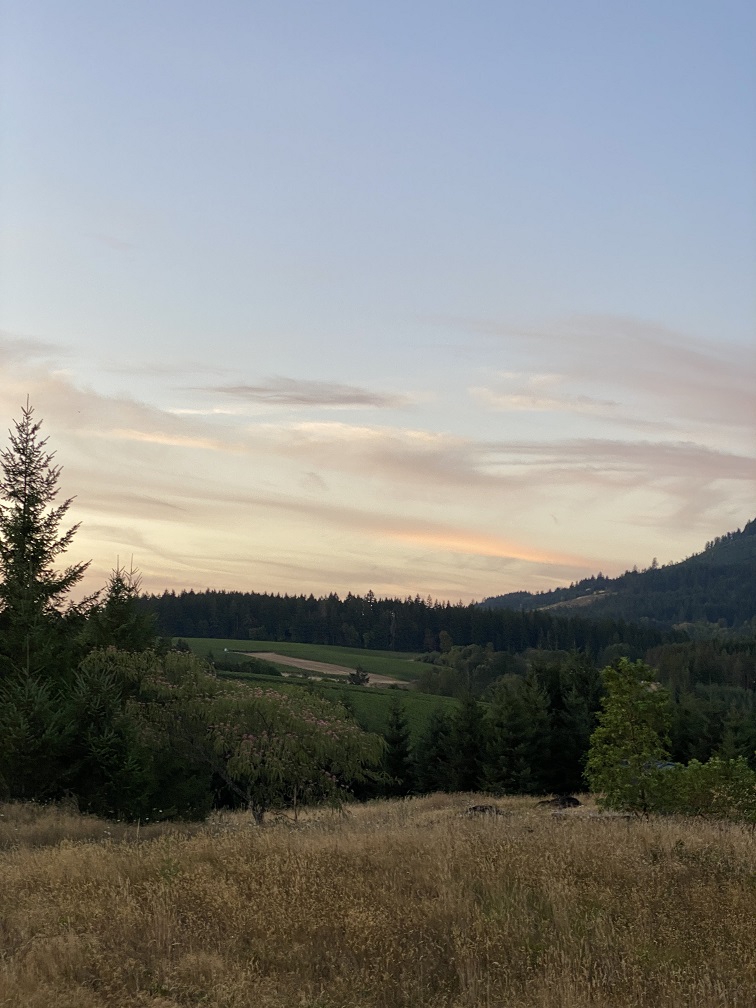
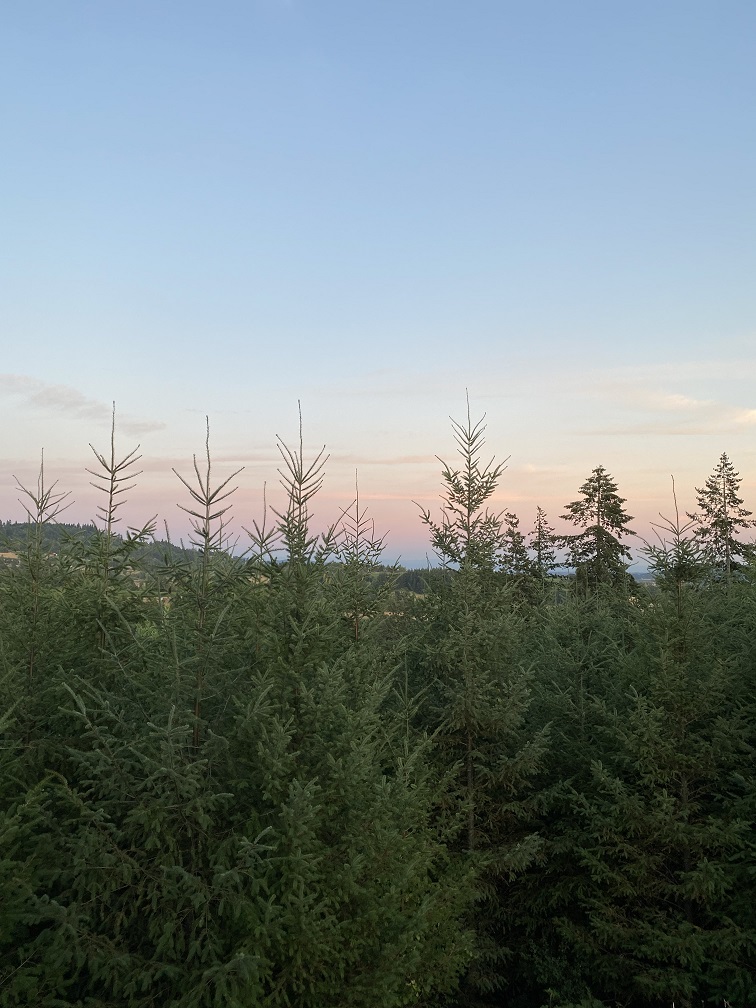

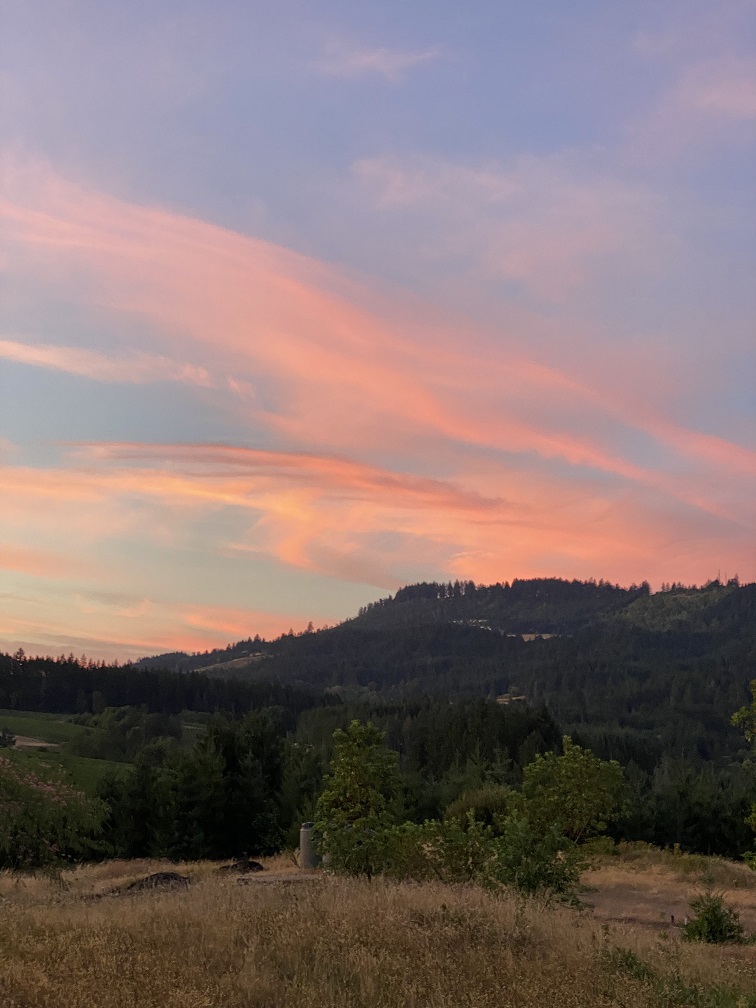
We visited Utopia Vineyard over two evenings and had some delicious food and tasted through a substantial range of Utopia Vineyard wines. I also learned about an interesting berry I never heard of before – Marionberry, which is a type of blackberry, which we tasted in the form of delicious pie – I wish this is something I can find here on the East coast. Marionberry takes its name from Marion County in Oregon, where it was selected in 1956 as a cross between Chehalem and Olallie blackberries.
Time to talk about wines – here are my notes:


2018 Utopia Bliss Pinot Noir Blanc Ribbon Ridge AVA ($45)
The nose of the buckwheat, yellow plums
Plums on the palate, good balance, good acidity, asks for food
8-


2015 Utopia Vineyard Chardonnay Estate Ribbon Ridge AVA ($45)
Nice, delicate, a hint of vanilla
A touch of vanilla, Golden delicious apples, good acidity
7+/8-
I mentioned before that we had an opportunity to taste some wines directly from the barrel.
2020 Chardonnay was outstanding, fresh apples and lemon, clean acidity, perfectly clean, vibrant, and balanced. If I would have an opportunity, I would drink this wine just like that.
2020 Pinot Noir Blanc from the barrel was even more exciting – a touch of toasted bread, a touch of fresh fruit, perfect minerality, vibrant, clean, full of energy. Again, I would love to drink this wine just like that.


2015 Utopia Vineyard Estate Pinot Noir Ribbon Ridge AVA ($55) – all 12 clones are used
Plums, cherries, a touch of iodine
Clean, crisp, plums, cherries and cranberries, good acidity
8, excellent
2014 Utopia Vineyard Estate Pinot Noir Ribbon Ridge AVA ($55)
A touch of sapidity, mushrooms,
Plums, round, soft, clean
8-


2013 Utopia Vineyard Estate Pinot Noir Ribbon Ridge AVA ($55)
Mushrooms, forest floor, underbrush
Earthy, restrained, plums, clean, round
8-
2017 Utopia Vineyard Estate Pinot Noir Ribbon Ridge AVA ($48)
Sweet plums, violets
Raspberries, red berries, round.
7+
2015 Utopia Vineyard Pinot Noir Clone 777 Estate Reserve Ribbon Ridge AVA ($65)
Violets, sweet plums, iodine
7+
2016 Utopia Paradise Pinot Noir Estate Reserve Ribbon Ridge AVA ($75)
Original 2002 plantings.
Mushrooms, underbrush, violets
Clean, ripe cherries, pepper, medium body,
8, excellent
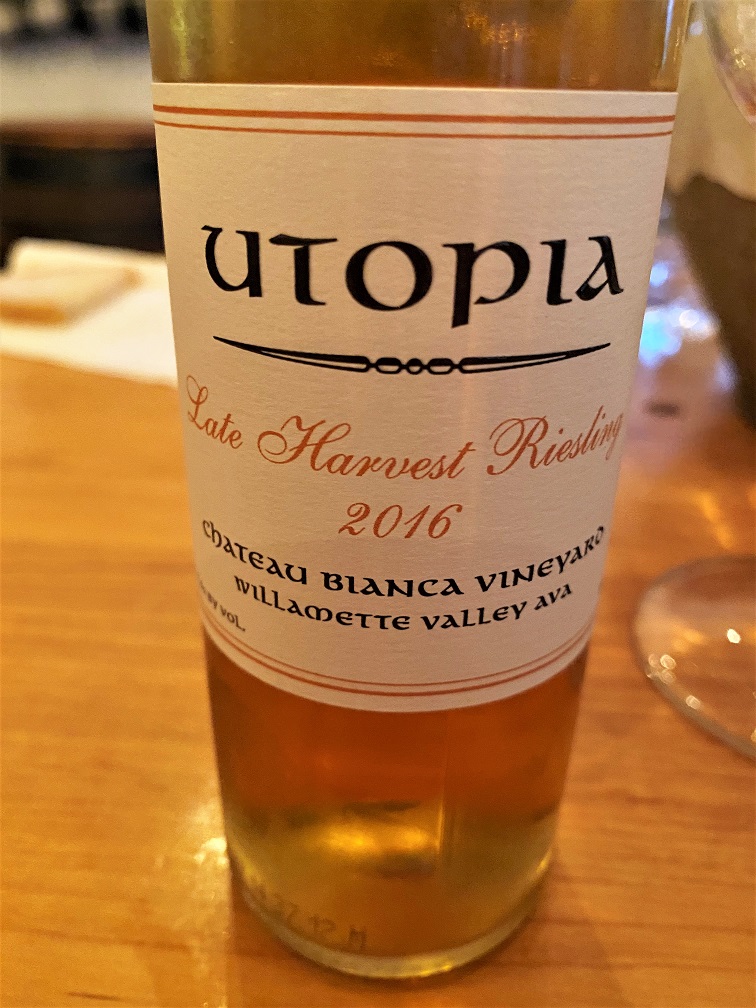
I was also excited to try a late harvest Riesling which was absolutely delicious:
2016 Utopia Late Harvest Riesling Chateau Bianca Vineyard Willamette Valley AVA ($40)
Beautiful apricots, a touch of honey, clean acidity, good balance. Delicious.
8
Talking to Dan we learned that 99 percent of the sales at the winery are direct to consumers, via the wine club and visitors. Dan also has a few customers who like to take his wines as a private label. Dan is very much involved with philanthropy, supporting the Oregon Museum of Science and Industry, The Hampton Opera center in Portland, OR, making wine donations, offering cabin stays, and more.
Utopia Vineyard offers something for everyone – if you will find yourself visiting Portland, you might want to take a 30 minutes trip southwest of Portland and find your utopia there. Or better yet, just stay in the cabin – everything else might be optional.
This post is a part of the Stories of Passion and Pinot series – click the link for more stories…
Passion and Pinot Updates: Lenné Estate
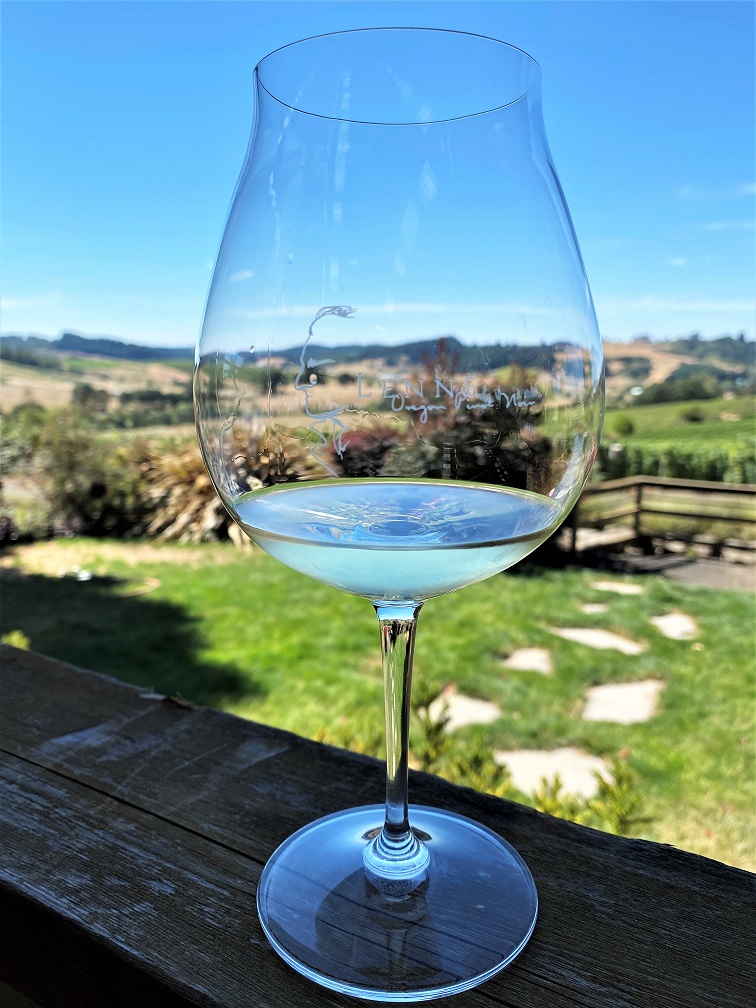 Out of the 13 Oregon wineries profiled to the date in the Stories of Passion and Pinot series, Lenné Estate stands aside. I had my first encounter with Steve Lutz and Lenné Estate in 2014, two years before the Stories of Passion and Pinot series was born, when Steve participated in the #WineChat event on Twitter. This is when I heard for the first time about Peavine soils, a mixture of clay and rocks, and Steve’s relentless, passionate pursuit of Pinot Noir winemaking in the place where it seems no vine can ever grow – read this original post to see what I mean. This passion I learned about while “listening” to Steve for the first time, the passion for the finicky grape became the reason for the name of the series.
When I spoke (virtually) to Steve in 2016 (you can find this conversation here), I learned a lot more about all the hard work establishing the vineyard, about Kill Hill, and about the wines which Steve produces, so when we arrived at Lenné Estate with Carl Giavanti, I felt like I knew Steve for a long time, and almost felt at home in the vineyard.
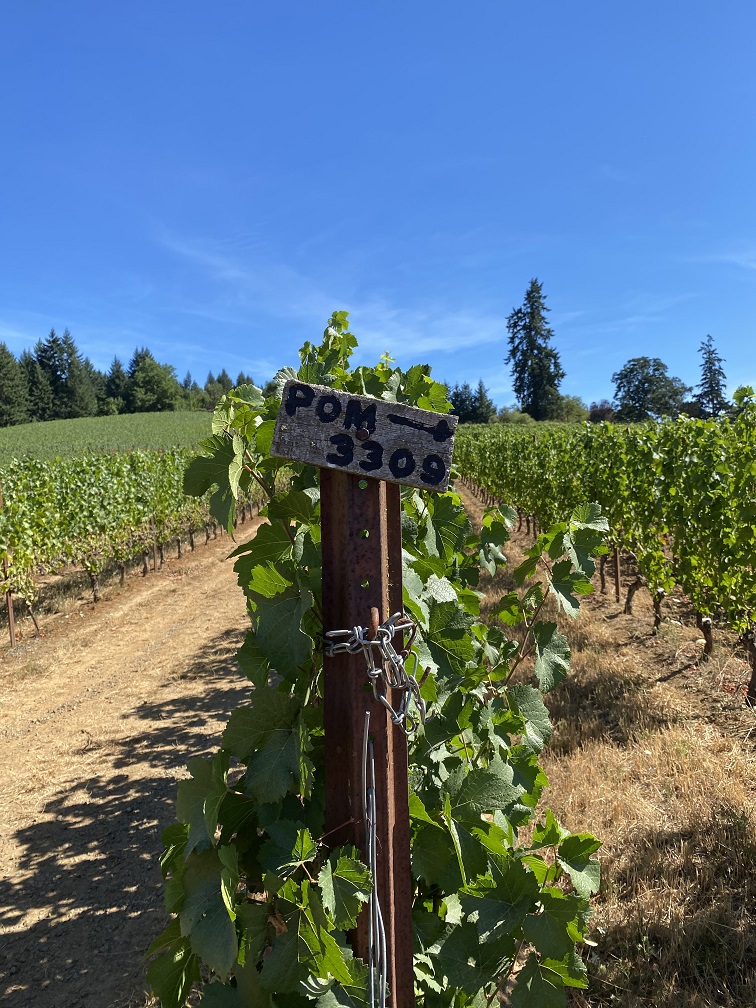
It is one thing to listen to someone talking about the soil, and it is totally different when you look at it (you can touch it too if you want) and think “how anything, really anything can grow in this soil”? Dry farming, no irrigation, and then you look at the soil – and you look at the grapes which it perfectly produces, and you can only say “wow”. I can tell you that out of the number of vineyards we already visited during the trip, the grapes at Lenné looked the best – tight bunches, beautiful colors of veraison, just a pleasure to look at.


More grapes:


We took a walk to the top of Kill Hill, and I can tell you that it was one steep walk. But the views from the vineyard were nothing short of spectacular.


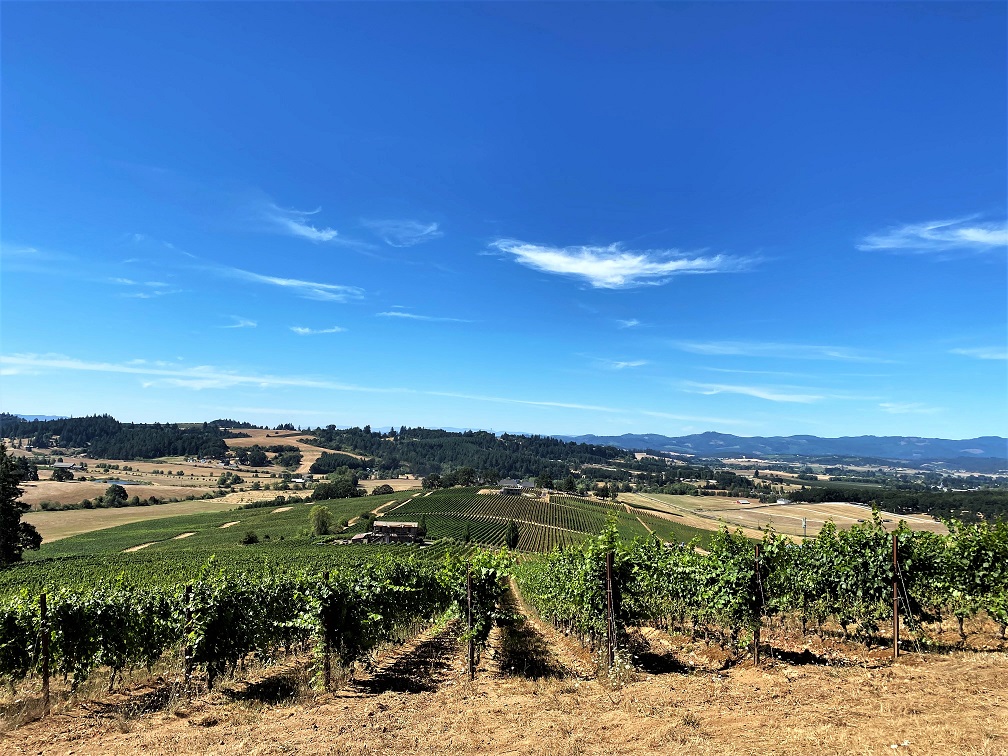

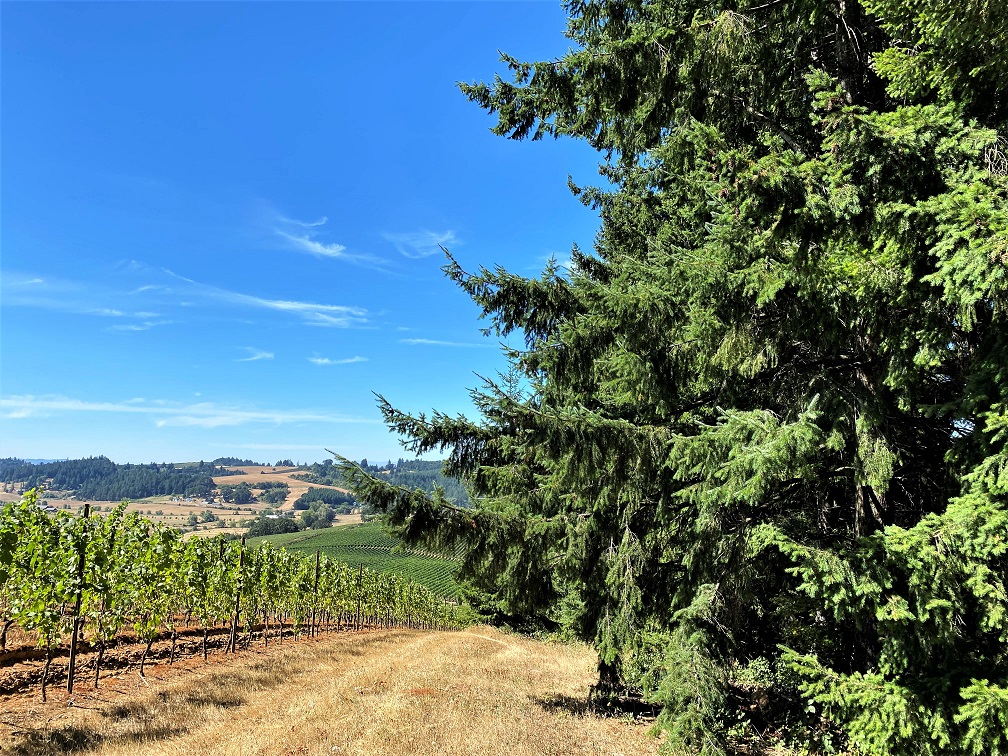
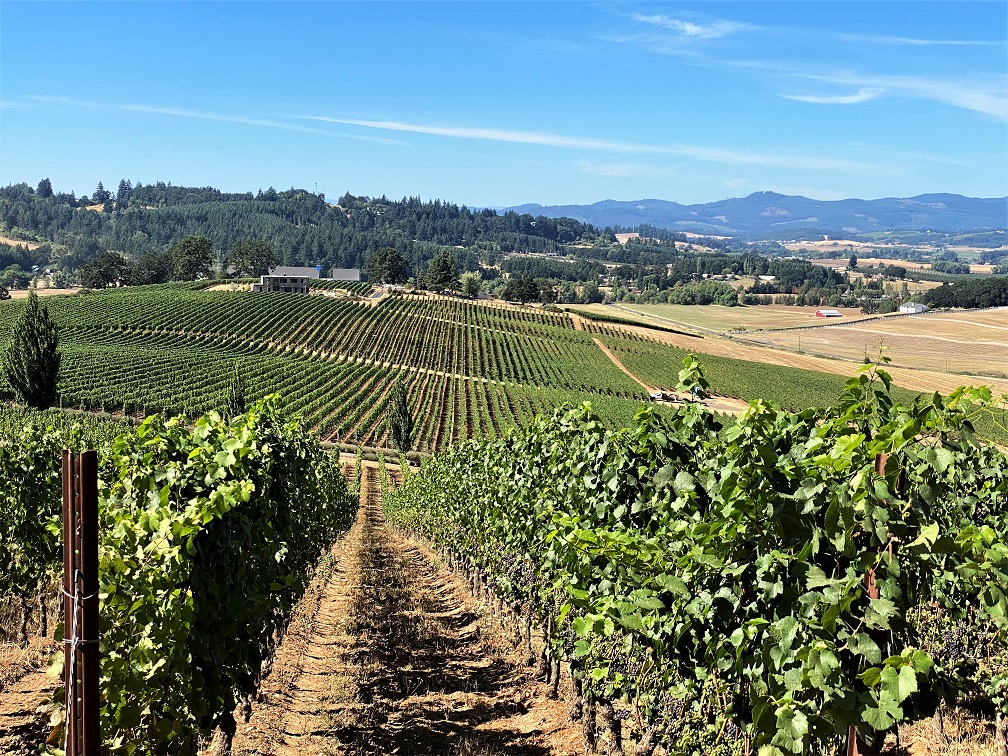
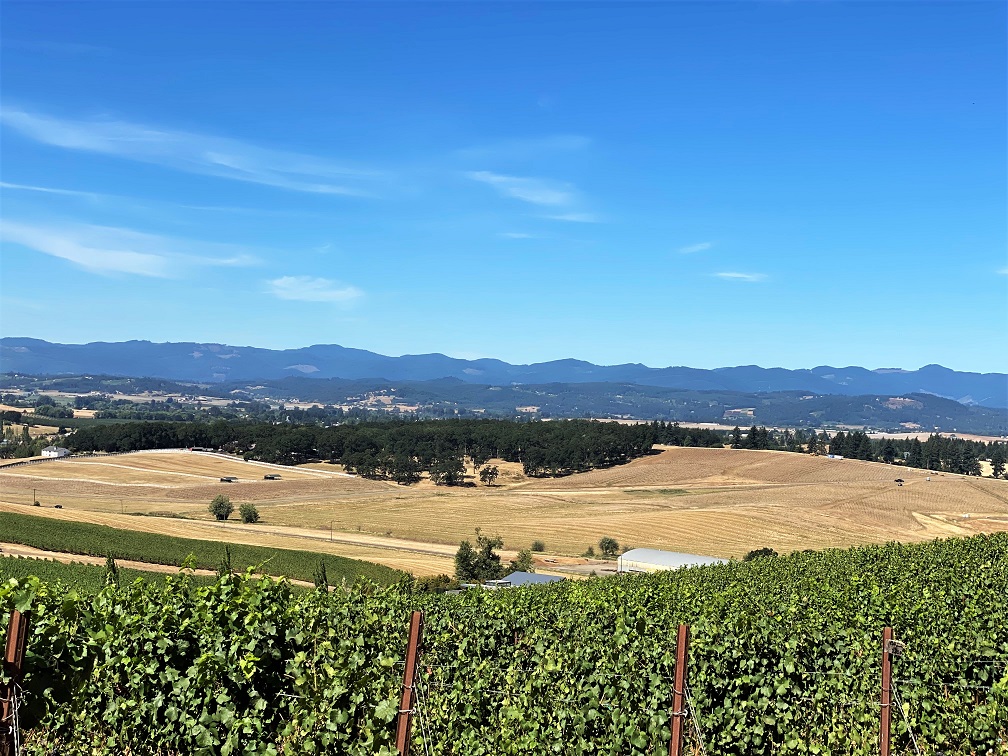
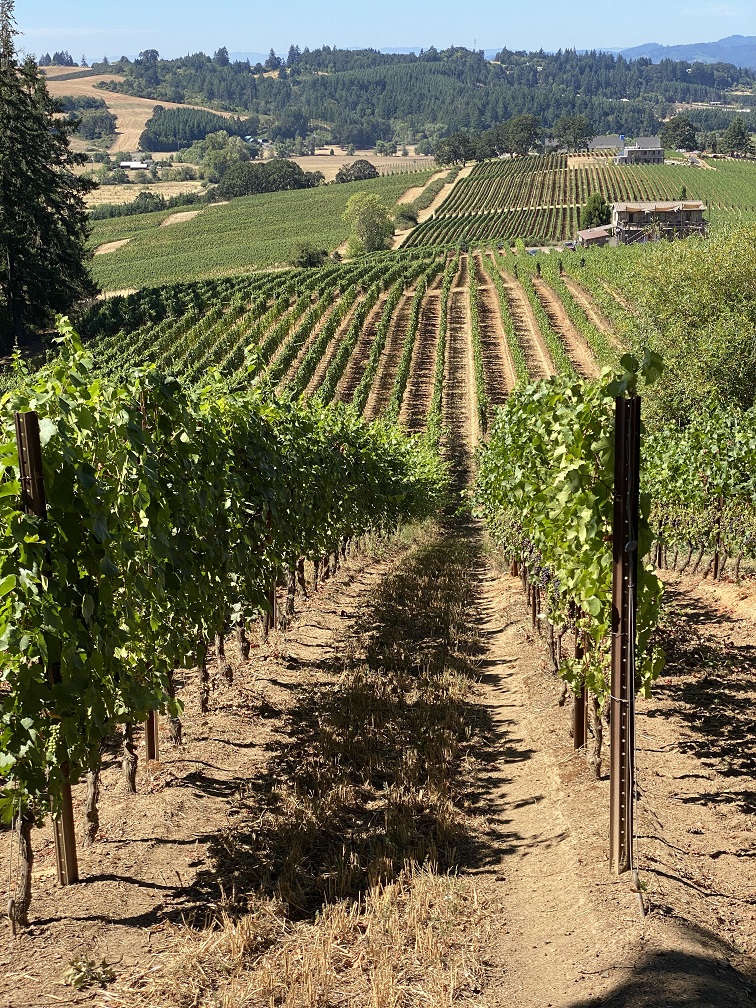
Yes, it is steep!
We talked about winemaking, and Steve mentioned that he typically prefers using commercial yeasts, because they produce more reliable and predictable results – however, he is not foreign to the idea of indigenous yeast, as we tasted in one of the wines. When we spoke back in 2016, Steve was not very big on producing white wines – I was happy to see that he changed his mind and now offers Lenné Estate Chardonnay. However, more as an exception to the rule at this point, Steve is still not ready to produce sparkling wines – however, I hope that this will change at some point – we will have to see.
After the walk, we went back to the tasting room, where Steve set up a full tasting, including the charcuterie and cheese boards.


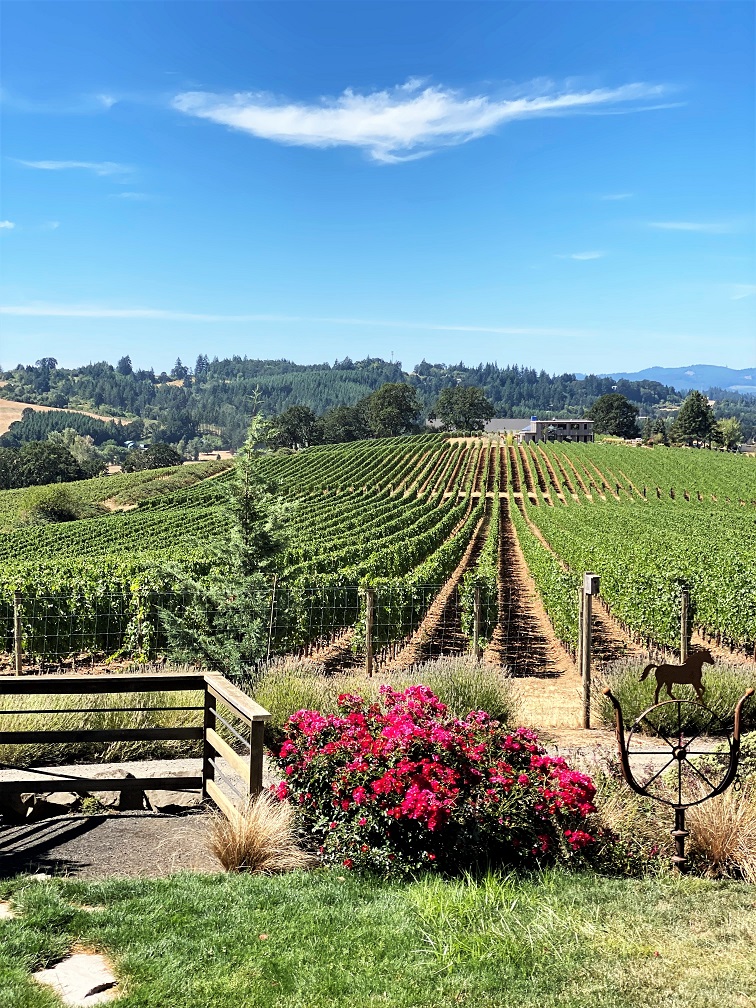
View from the tasting room
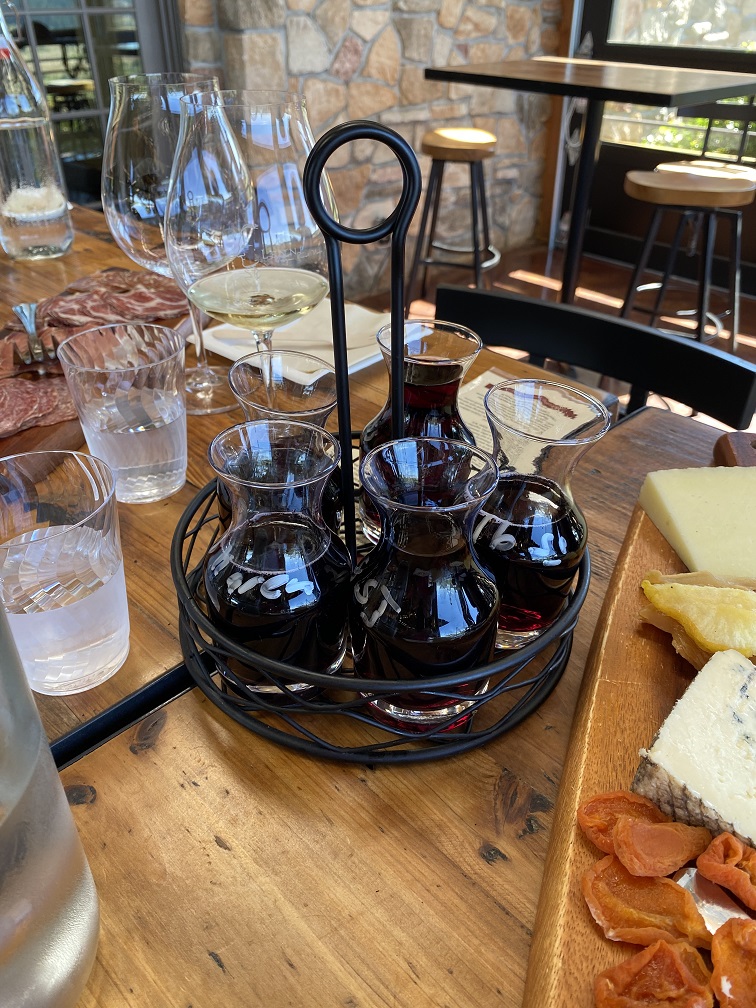
We started tasting with the Chardonnay, which was excellent
2019 Lenné Estate Scarlett’s Reserve Chardonnay Yamhill-Carlton AVA ($58)
A touch of honey, herbs, restrained
Crisp acidity, fresh, bright, Granny Smith apples, a touch of vanilla, creamy, excellent
8
Next, of course, we moved to the Pinot Noirs, where we tasted the whole range – here are tasting notes for the wines including some additional comments regarding the vintage and winemaking:
2017 Lenné Estate South Slope Pinot Noir Yamhill-Carlton AVA ($55)
Hot vintage with a big fruit set
Beautiful nose of sweet cherries and raspberries
Wow, red fruit all the way, cut through acidity, perfect balance
9-, superb
2016 Lenné Estate South Slope Pinot Noir Yamhill-Carlton AVA ($55)
Early vintage, cool August, harvest done by mid-September
Cherries, sage, floral notes
Clean, tart cherries, warm notes, good acidity,
8-
2018 Lenné Estate Sad Jack 777 Pinot Noir Yamhill-Carlton AVA ($55)
Indigenous yeast, spontaneous malolactic
Tart cherries, a hint of cherry pie, savory note
Tart cherries, clean, balanced, crisp, superb
8+
2018 Lenné Estate Karen’s Pommard Pinot Noir Yamhill-Carlton AVA ($60)
Commercial yeast and forced malolactic
Cherry, cherry pie, sweet oak
Tart cherries, dark fruit, good balance, well integrated tannins
8


The last wine was a culmination point of the tasting. “Cinq Élus” means “five chosen”, which in the case of this wine means five best barrels and 5 clones. The wine was simply superb:
2018 Lenné Estate Cinq Élus Pinot Noir Yamhill-Carlton AVA ($85)
5 best barrels from the vintage, 5 clones
The succulent nose of red and black berries, distant hint of gunflint, herbs, great complexity
Restrained, cherries, layered, complex, perfectly integrated, tannins come through on the finish, superb
9-
While we were tasting the wines, we also talked about blind tasting events which Steve runs at the winery, where attendees get an opportunity, for example, to compare Oregon Pinot Noir with the Burgundy, or Yamhill-Carlton Pinot Noir with Dundee Hills Pinot Noir and so on – here you can see what blind tastings are offered. Steve also leads European wine cruises where everything revolves around food and wine, as you can imagine – here you can find information about those.
On the Lenné Estate website, there is also an interesting section called Vintage Charts. Here you can find general information regarding the suggested drinking window for Oregon Pinot Noir in general, as well as particular recommendations specifically pertaining to the Lenné Estate wines.
There you are, my friends. If you are looking for mature, confident, and simply delicious Oregon Pinot Noir, you don’t need to look further than Lenné Estate.
But we are not done here yet. More Passion and Pinot updates are coming – stay tuned…
This post is a part of the Stories of Passion and Pinot series – click the link for more stories…
Last Bottle Sign Up ($10 credit)




 Talk-A-Vino