Archive
Pure Pleasure, And How To Express It
Does this glass give you pleasure?
You take a sip of wine. The wine is sublime. It is beautiful. It is complex. The wine solicits emotion – it makes you happy. It makes you moan quietly inside your head, you might extort an “OMG” or a “Wow”, and after a pause, you take another sip. You are not in a hurry. You want to extend this pleasure for as long as possible.
Wine is art. Wine doesn’t leave you indifferent. Wine solicits emotion.
Painting is art. Painting doesn’t leave you indifferent. Painting solicits emotion.
Music is art. Music doesn’t leave you indifferent. Music solicits emotion.
We can consider wine to be a form of art, the same as painting, music, poetry, architecture, and many other human creations which invite an emotional reaction. Do you know what makes wine a unique form of art? Your utter desire to share it.
You can quietly stare at a beautiful painting for a long time, slowly uncovering little details and being in the moment. Even if you stand next to someone else looking at the same painting, 99 out of 100 you are simply focused on your own personal moment.
When listening to the music, even if you are in the concert hall surrounded by thousands, the music is being played only for you and this is how you want to keep it. You can buy a recording and listen to it 100 times. Just by yourself, and you are happy about it.
Have you seen an oenophile get excited about wine? The excited oenophile grabs the total stranger by the sleeve, shoves the glass into their face and says “here, here, you must try this!!!” It is very important for an oenophile to be able to share the joy of the experience with others. There is an ultimate pleasure in sharing your excitement with others, as wine is an art that needs to be shared.
Sharing pleasure is easy in person. Have you tasted magnificent, life-altering wines in the group? If you had, you probably noticed the collective “ohh”, rolling the eyes, unprompted nodding, maybe a muttered “oh my god”, and then silence. The silence of the greatness of the moment, slowly settling in.
This in-person sharing of the pleasure is simple, and kind of just happens on its own. The real challenge comes when you decide to share that ultimate pleasure with the rest of the world.
So how can one express pure pleasure?
A typical way to describe the wine is via so-called tasting notes. Such tasting notes are often called “technical notes” as they usually describe the wine in terms of appearance, aroma, bouquet, and finish – using analogies such as “brickish color”, “smell of mushrooms”, or “taste of dark cherries”. The wine is described in the terms which the wine drinker is supposed to relate to – and it is a great review if you can relate to all of the terms used without trying to figure out what is Cascarilla and how it actually smells, or how Jabuticaba tastes like. What is usually not found in the tasting notes is the emotion – how this wine might make you feel; will you scream with joy when you will take a sip? Yes, I get it. Even the aromas and flavors are subjective. The emotion which you will experience while drinking the wine is yours and yours only – the person next to you might not experience the same enlightenment – and nevertheless, even the hope for greatness is worth sharing.
Can wine pleasure be expressed in the words by professional wine critics? You be the judge of it. Here is the collection of tatsing notes for the 1966 Domaine de la Romanée-Conti La Tâche Grand Cru. At this link, you will find the reviews from Robert Parker, Jancis Robinson, John Gilman, and others. Here is the best excerpt in my opinion. John Gilman: “La Tâche ‘66 is deep, full and opulent on the palate, with a grandiose delivery of thick, perfumed fruit, excellent balance, plenty of power, great focus and finesse, and an incredibly long, softly-tannic and astoundingly complex finish.” This might be the best description out of the six present, but does it convey the emotion?
Does this wine give you pleasure?
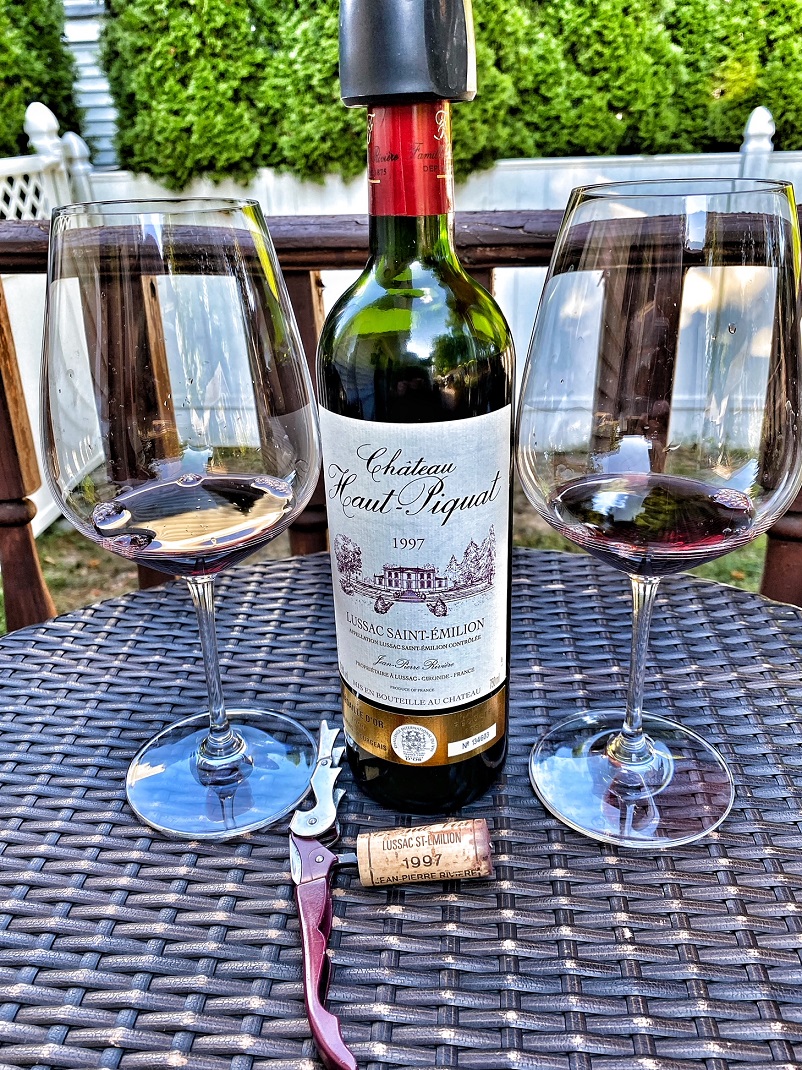
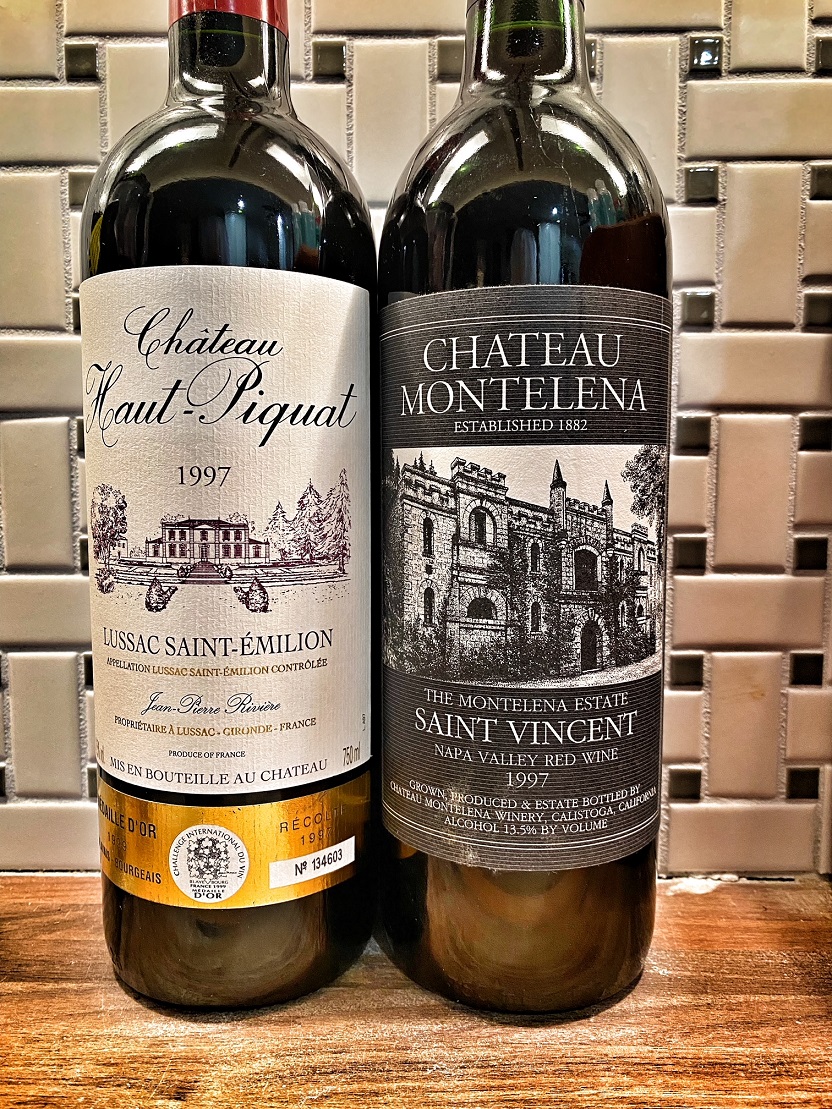
A few days ago, I had the pleasure of drinking two wines from the 1997 vintage (1997 is a special year for our family). These two wines really prompted this post. First, I opened the 1997 Château Haut-Piquat Lussac Saint-Émilion (12.5% ABV, 80% Merlot, 15% Cabernet Sauvignon, 5% Cabernet Franc). The wine was somewhat of a recent find at the Wine Exchange – after getting an email offer to buy 1997 Bordeaux for $19.99, I had no option but to get a few bottles. I was happy to see the cork coming out in its entirety with no issues. I was ready with the decanter, but the wine in the glass was quite approachable. After the initial grippy tannins dissipated in 20-30 minutes, what was left in the glass was an absolutely sublime beauty. You see, this is where the challenge lies. Here is the technical description from the Wine Exchange: “a wine that still possesses a youthful charm as there is something to be said for ex-chateau. A beautiful plum/garnet color with very little lightening for its age. This 1997 is full to medium-bodied, showing lots of forest floor, roasted herbs, cedar, tobacco, black cherry, blackcurrant, and new saddle leather. It is opulent and is just entering its plateau of full maturity. The tannins are soft and subtle with an elegant seamless finish. ”
The description is perfectly fine, but it doesn’t help me to express my emotion. The mind singing with every sip. Pure joy in each and every sip. Enough pleasure in every sip to have the nerve enough to tell my wife, who was enjoying the wine with me “this is almost as good as sex”. A personal perspective for sure, but yes, this was the wine.
I didn’t have many expectations for 1997 Chateau Montelena Saint Vincent Red Wine Napa Valley (13.5% ABV, blend of Zinfandel, Primitivo, Sangiovese). Chateau Montelena is absolutely legendary with its role in the Judgement of Paris, especially if you had an opportunity to see the movie Bottle Shock. But Saint Vincent is an eclectic blend, produced only for 5 years from 1995 till 1999, and it is not given that this type of wine can age for 25 years. While very different from the previous Bordeaux in its profile of cherries, eucalyptus, and herbs, it had such a lip-smacking, savory and satisfying bouquet, that every sip was demanding to be followed by another sip.
Do you want a second glass?
I have no idea how to convey the pure pleasure the wine can bring. Maybe emotion is the key. There are lots of good wines out there. The wines you are happy to drink any day every day. Maybe it is the excitement that needs to be measured. Or maybe this is simply in the unyielding desire to share this pleasure with the world. The act of telling the world how amazing the wine was, and hoping that everybody will see it that way too.
Let’s share our little joys with one another. And if you know how to convey this pure wine pleasure, please let me in on that secret.
Daily Glass: Winning and Learning
Sometimes you win, and sometimes you learn.
You never lose – learning is the opposite of winning – I think this is a better approach to life, would you agree?
I love aging my wines. The popular wine press tells people that 95% of the wines in this world are meant to be consumed shortly after purchasing. “Absolute majority of the wine is not meant to be aged,” the message says. I don’t want to obnoxiously invalidate all the expert opinions, but the subject of wine aging is a lot more complicated than the simple statement portrays.
Lots of factors play a role. The wine itself is probably the most critical factor. White wines generally don’t age too well. To be more precise, percentage-wise, a lesser number of white wines can age well compared to red wines. But this doesn’t mean that all red wines age well. For example, red Cotes du Rhone typically don’t age for longer than 4-5 years.
I wish there was an easy method to tell us, wine lovers, that “this wine will age for 30 years”, but “this one got only 10 more left”. There is no such method, however, so we need to rely primarily on our experiences. I’m not trying to disqualify all of the wonderful advice we receive from the wine critic and publications – but it would be rare to receive an aging recommendation there unless the wine is deemed of a “collector” level – which pretty much means that it will not be really affordable.
At this point, you might wonder why is all this commotion with the aging of the wines. Simple. Wine is a living thing. The evolution of the wine continues in the bottle. It is a general hope that wine can improve with time, evolve, become more complex and multidimensional.But the wine can’t evolve forever – at some point it starts “turning”, losing its delicious, attractive qualities.
It is important that the wine drinker can appreciate the beauty of the aged wine – it is not for everyone. I don’t mean it in any disrespectful way – this is simply a matter of taste. One of my most favorite examples is the blind tasting of a few Champagnes which took place during Windows on the World wine classes. After blind tasting 4 Champagnes, the group was asked to vote for their favorite Champagne. Champagne #4 got almost no votes, it was clearly the least favorite of the group of 100+ people. While revealing the wines, Kevin Zraly, our wine teacher, said “and this is why, people, you should not drink vintage Champagne”. Bottle #4 was Dom Perignon – if people would see the label before voting, you know how that would work (”drink up, honey, it is French”). And Vintage Champagne is nothing more than just an aged wine. It is just a matter of taste. The same story goes for food. For example – I love fresh oysters, and I have friends who wouldn’t put an oyster into their mouth even if this will be required to save their own life. Just a matter of taste.
But for those of us who like aged wines, that elusive quest becomes an obsession. I love the Italian term “vino da meditazione”, which applies to the wines which make conversation stop upon the first sip, and puts the whole group of oenophiles into a quiet, self-reflective state. The silence at the table becomes not deafening, but instead a very comfortable one. The silence nobody wants to break.
Okay, such amazing encounters are possible but truly rare. But the pleasure of drinking the well-aged wine is real, and this is what we are seeking. And as we don’t have the scientific method of predicting the peak of enjoyment for a given wine, we have to rely on our own experience. Which takes us back to winning and learning. When we experienced well-aged wine, we clearly won. And when the wine with age doesn’t deliver the pleasure, this is where we learn.
It is not so binary, of course. The point is that no matter what happened, we learn something. When you taste a random but amazing $10 bottle of California red blend (Toasted Head) with 15 years of age on, you learn that inexpensive wines can age too. When you taste 2002 Barolo (Fontanafredda) 10 years after release, and you see that the vintage chart declares this vintage as literally horrible, but the wine tastes good, you learn that the producer matters more than the vintage. When you taste two bottles from the same producer and the same vintage, but you love one of them and can’t stand another, you learn that bottle variation is real and that you have to always manage your expectations.
This whole rambling about winning, learning and aging was prompted by a few wines I opened last week.
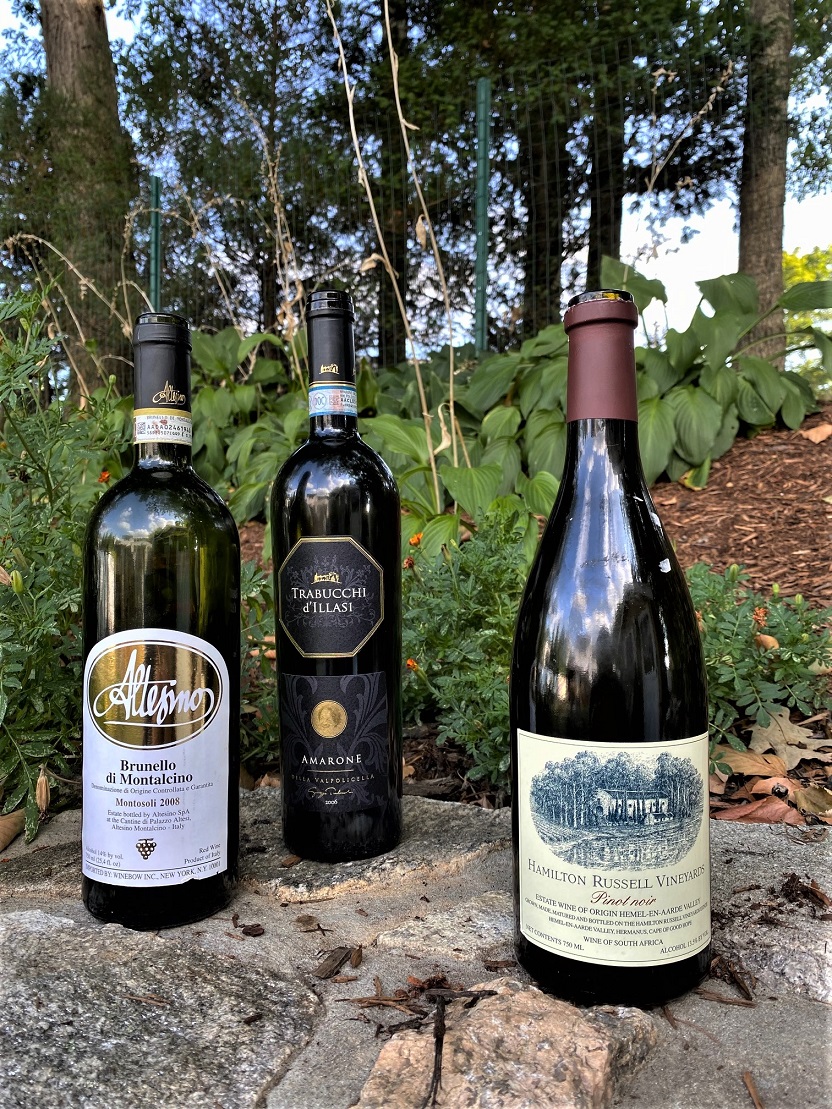
First, the learning part. 12 years ago we did the Pinot Noir blind tasting with friends, with a very unexpected outcome – 2008 Hamilton Russell Pinot Noir from South Africa was the best wine in that blind tasting. I loved the wine so much that I went and got a bottle to keep. Over the years, I made many attempts on the life of this bottle, until the last weekend I decided to share it with a friend. Upon opening the wine was reminiscent of the good Burgundy, with the nose offering some plums, iodine, and smoke. But the wine quickly succumbed to the tertiary aromas of dry herbs and maybe a hint of dried fruit, and while my friend really loved it, this was a complete loss learning in my book.
Then another friend was stopping shortly after his birthday. He always liked the wines, but recently started getting really “more into it”. He was stopping by for the dinner, and when we were talking about wines a few days prior, he mentioned that he started liking the Brunello and Amarone wines. There is no happier moment for the oenophile than to learn what the guest desires to drink – the cellar is instantly paraded in the search for the best and the most appropriate bottle.
I don’t know how I came into possession of the 2008 Altesino Brunello di Montalcino Montosoli, I can only guess I got it as a present. This single vineyard Brunello di Montalcino was absolutely spectacular – beautiful cherries on the palate – not the fresh and crunchy ones, but more subdued, more elegant, eloped in the sage and other herbal aromatics. The wine was spectacular when we opened it, and when I finished the last drop 2 days later (wine was kept in the bottle with the air pumped out), I had a clear feeling of regret as the wine was not gone, but instead was still fresh and even more complex, with a promise of becoming the Vini da meditations in 10 years, same the 1999 Soldera had become for us – alas, I don’t have another bottle…
And then my pet peeve – you know how much I love Amarone. I got a few bottles of the 2006 Trabucchi d’Illasi Amarone della Valpolicella from WTSO 7 years ago. This was my last bottle, and boy it didn’t disappoint. It was absolutely beautiful in its finesse and impeccable balance all the way through. Dried fruit on the nose, powerful, well-structured wine on the palate, with more of the dried fruit, cherries, plums and herbs, and with good acidity, perfect balance and delicious bitter finish. It is not for nothing Amarone means Great Bitter – and there was this pleasant bitterness on the finish, something hard to find in most of the Amarone wines.
Here you are, my friends, my story of winning and learning. Three aged wines, two of them delicious, two that could age for far longer (learning!). One learning experience – but who knows, maybe it was only that particular bottle. Moving on.
What did you win and learn lately?
Celebrate Pinot Noir!
Celebrate Pinot Noir!
Another grape holiday is upon us. This time we celebrate none less than Pinot Noir.
None less, huh? Is Pinot Noir so unique and special? Well, you be the judge.
Pinot Noir is the grape behind the world’s most expensive wines. While there are 10 or so major red grapes (Cabernet Sauvignon, Cabernet Franc, Merlot, Pinot Noir, Sangiovese, Tempranillo, Syrah, Grenache, Zinfandel, Nebbiolo), the ultimate supremacy crown can only be decided between Pinot Noir and Cabernet Sauvignon. Yes, it is bad to use money as a measure of influence, but it is one of the “objective” characteristics of wine in the free market. According to the Wine-Searcher lists of most expensive wines (by the way, there is a new feature on this blog – a new page Most Expensive Wines allows you to see always current list of most expensive wines for a select number of grapes and regions), red Burgundies (made out of 100% Pinot Noir) on average are 12 times (!) more expensive than Cabernet Sauvignon wines
Pinot Noir might be the most versatile red grape out there. Unlike most other red grapes, it produces a full range of wine styles. Let’s see.
White wine? Check. Pinot Noir Blanc is increasingly popular in Oregon and not only. Remember, the juice of Pinot Noir is clear, so it is not a problem to produce white Pinot Noir.
Sparkling wine? Triple check, I guess. Champagne Blanc de Noir is very often made from 100% Pinot Noir grapes and needs to introduction to wine lovers.
Rosé? Check. An increasingly popular addition to the repertoire of any Pinot Noir producer, in Oregon, California, and beyond.
Red wine? Well, duh. No check needed – first and foremost, Pinot Noir is a king of red wines.
Sweet/dessert? This is the only category that is still more an exception than the norm, but if you will look, you will have no problems finding late harvest Pinot Noir wines or Port-style Pinot Noir wines.
See – the whole range of wine styles. You can easily pair a whole dinner, from oysters to fish to steak and then dessert with Pinot Noir wines – try that with Cabernet.
One more unique fact about Pinot Noir is that it is practically never blended with any other grapes, with the exception of Champagne/sparkling wines. There can be lots of Pinot Noir clones mixed together – some of the producers grow 20 clones and more – but still, those are just clones. Of course, there are 100% Cabernet Sauvignon wines out there, but this is far from being the norm.
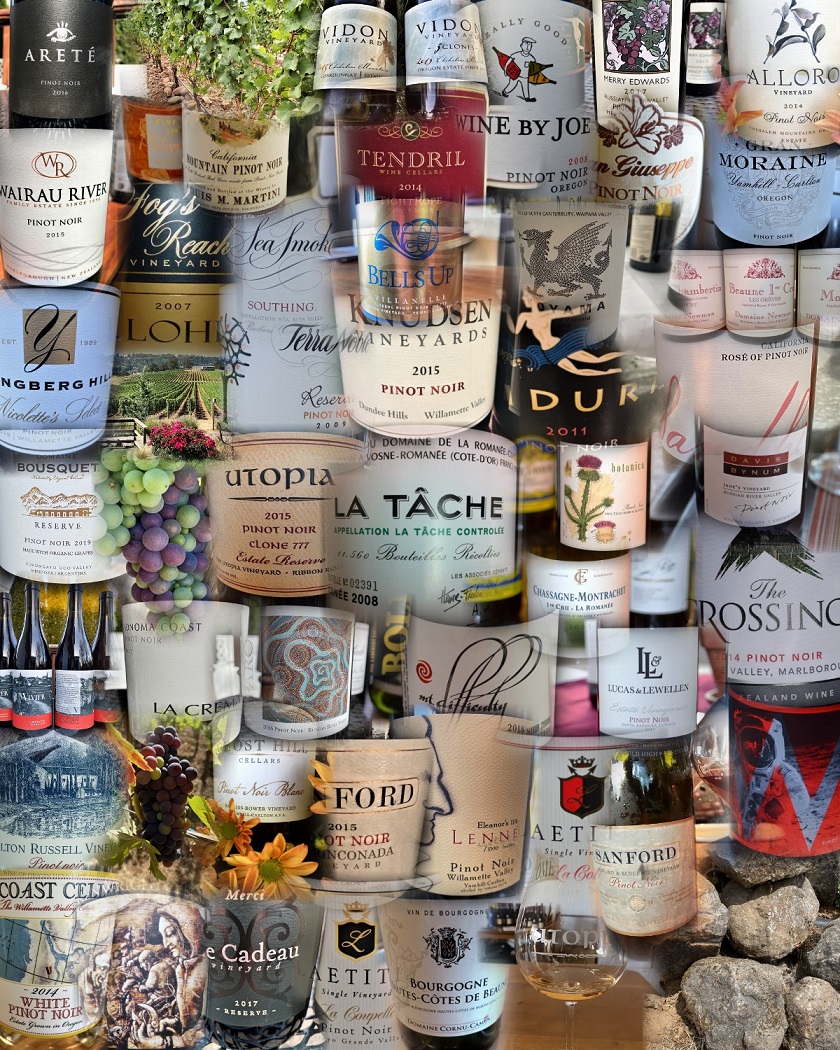
Pinot Noir is featured frequently on this very blog. As I was preparing this post, I decided to look at some statistics. It appears that Pinot Noir is the second most frequently mentioned red grape on the blog, with 356 posts related to the Pinot Noir (Cabernet Sauvignon is mentioned in 445 posts). It is interesting that Chardonnay is mentioned in the 357 posts, literally identical to Pinot Noir.
But it is not just the mentions – there are many memories associated with Pinot Noir.
I love saying that blind tasting is the best arbiter of the wines – in a blind tasting, it is just you and the liquid in the glass, nothing else influences your impression of the wine. It seems that our Pinot Noir blind tasting took place only yesterday – I was literally shocked to see that this post is 12 years old – the tasting took place in August of 2010. Who couldn’ve thought that 2008 Hamilton Russell Pinot Noir from South Africa would be our group’s favorite wine, beating grand cru Burgundy and cult Californian Pinot? I still have a bottle of that wine and I’m looking forward to experiencing the 12 years of evolution.
Another favorite Pinot Noir memory is the 1966 Louis M. Martini California Mountain Pinot Noir – an accidental $25 buy that ended up being a transcendental experience tasting the 48 years old wine from the Cabernet Sauvignon producer who is absolutely not known for the Pinot Noir wines.
And then there are lots and lots of memories of not only the wines but also of the people, passionate Pinot Noir winemakers, acquired through the work on the Stories of Passion and Pinot, an ongoing series of posts dedicated to Oregon Pinot Noir producers and Oregon Pinot Noir wines.
Did I prove my point? Is Pinot Noir the true King of Grapes? I don’t know. But for sure it is a grape worth celebrating. Cheers!
Making The Same Mistakes
Are we humans prone to repeat ourselves all the time? Good and bad – first we repeat what was done again and again, then wonder why we achieve exactly the same result as before. There is nothing wrong with repeating the good things, except that we might be limiting ourselves – think about bench-pressing 150 lb all the time, without ever trying to increase the weight. That’s a good weight to press, of course, but you need to increase the weight if you want your muscles to grow.
The process of repeating the bad things is far more peculiar. We know that something doesn’t work. We know that we did something in the past and it painfully didn’t work. Should we learn? Should the brain have a mental capacity to remember the bad result of the past and then simply remember not to repeat it? You think? This is so obvious, and yet unattainable at the same time. Why? Really, why?
Case in point. My business trip took me to Anaheim in California. Going to Anaheim, people who travel occasionally would fly to LAX (Los Angeles airport), and then have quite an expensive (and potentially very long) taxi ride to get to Anaheim. People who travel know that the closest airport to Anaheim is John Wayne, a.k.a. Orange County a.k.a. Santa Ana airport. As I belong to the second group (I generally travel for business), I took an early morning flight from Newark, NJ to John Wayne airport, arriving even faster than anticipated and enjoying the easy trip.
When traveling inside the US, ideally you want to take the early flight – outside of mechanical and horrible weather issues, you stand the best chance to arrive at your destination on time and in a happy state of mind. As the day progresses, travel becomes more chaotic, as flight schedules start shifting, and every slight delay aggregates to bigger and bigger ones. See, I know my flying rules. And what I said is 10 times true for the most overloaded (and badly run) airports in the country – Newark, Washington Dulles, Houston, Boston are all stand out in this category – by the end of the day, Newark would typically aggregate about 2 to 3 hours delay – and this is in the best weather throughout the country, God forbid it rains somewhere.
See, I know my traveling stuff, right? Do you think this knowledge helped me? Yep. Of course, you figured out the answer already. No, it did not. Instead of taking 6:30 AM out of John Wayne airport to fly back to Newark, I decided to fly at 12:30. Would you expect me to apply my knowledge? Of course, but I didn’t not. After arriving at the airport about two hours prior to my on-time departure, I spent the next 4 and a half hours (that includes 2.5 hours of an actual delay) literally swearing at myself, at United, at Newark, and back to myself. What’s even worse, I managed to repeat yet another old mistake again.
Insanity – repeating the same thing over and over again, every time expecting a different result
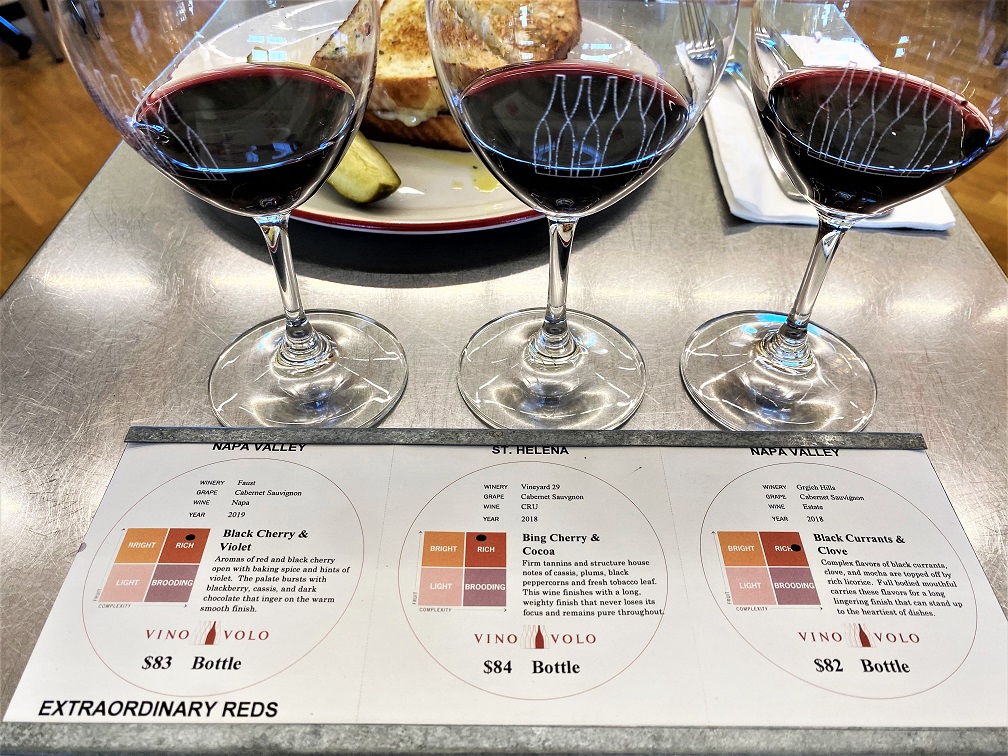
If you like wine, and if you ever traveled through Austin, Portland, San Francisco (and many other) airports, I’m sure you noticed restaurants/bars called Vino Volo. There are more than 50 Vino Volo locations around the country. Everything in Vino Volo revolves around wine. Every restaurant has a great selection of wines by the glass and wines to buy by the bottle – as they are located past security, you can buy a bottle of wine to bring to your destination if you are so inclined.
However, my main attraction at Vino Volo is wine tasting flights. At any given moment, Vino Volo offers 6-8 different tasting flights, red, white, Rosé, each flight typically consisting of 3 wines. Each flight is accompanied by detailed tasting notes. Very often you can find a selection of local wines offered as part of the flights – Oregon wines in Portland, Texas wines in Austin, and so on. When I have time, I never pass on an opportunity to visit a Vino Volo store and taste some new wines.
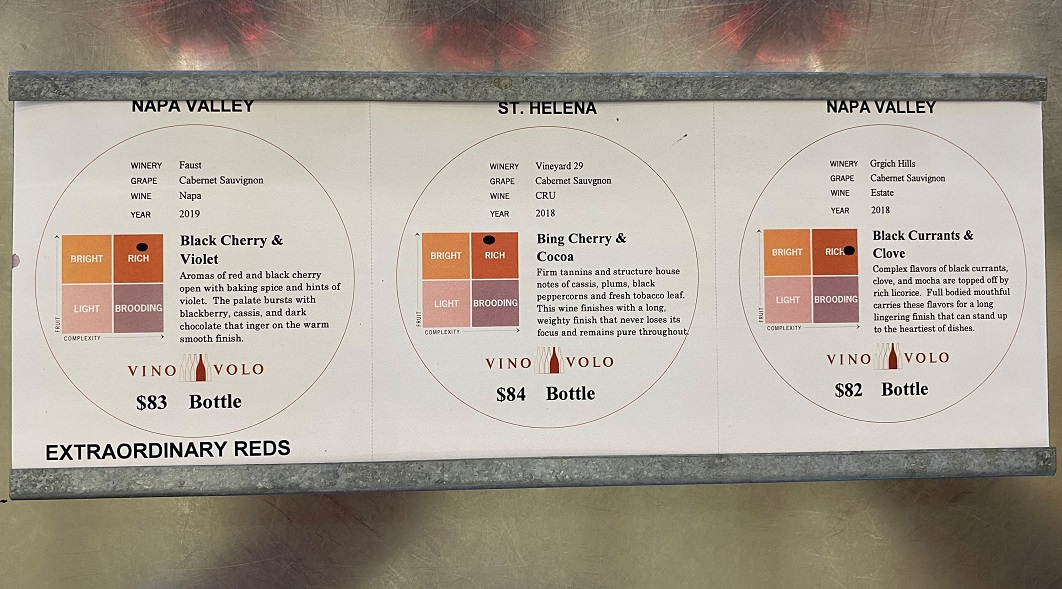
This brings us back to the subject of repeated mistakes. I know full well that young and expensive California Cabernet Sauvignon wines are undrinkable, 9 out of 10. I generally enjoy Vino Volo flights, with one memorable exception being Californian Bordeaux blend Overture, the second label of Opus, which I didn’t enjoy at all. And now, while at the John Wayne airport, I chose the flight of 3 high-end but young California Cabernet Sauvignon wines, instead of taking one of the other 7 or so. Why? Was a driven by the bad mood due to the flight already being delayed? Was there a hidden, subconscious desire to exacerbate the pain? I don’t know. But this was the flight I ordered. And it successfully exacerbated my pain – which you can see in these tasting notes:
2019 Faust Cabernet Sauvignon Napa Valley ($83)
Black currant, cherries, eucalyptus
Gripping tannins, green notes, black currants, tart finish.
Not enjoyable now.
2018 Vineyard 29 CRU Cabernet Sauvignon St. Helena ($84)
Cherries, dust
A bit more balanced than the previous wine, still weaved on the core of green notes, but definitely more approachable and enjoyable than the previous wine. Glimpses of greatness. Maybe decanting for an hour would make a miraculous change.
7+
2018 Grgich Hills Cabernet Sauvignon Estate Napa Valley ($82)
Distant hint of black currants and nutmeg
Tart, green, fruit is hiding. Almost flat in terms of soliciting an emotion.
Why do we do these bad things to ourselves? This question is half rhetorical, half actual. If you know the answer – or have a story to tell – please, I’m all ears.
Anatomy of Flavor
Anatomy of Flavor???
The author clearly goes on a tangent here. Everyone knows what anatomy means, and it has nothing to do with the wine. And nevertheless, let’s take a look at some definitions and see if we can actually analyze the anatomy of flavor.
Webster’s dictionary defines anatomy in a few different ways:


Definition number five describes anatomy as
structural makeup especially of an organism or any of its parts
Anatomy explains to us how living things are constructed. How do they move, jump, roll, smile, and cry.
Of course, the flavor is not a living being – but it is amorous, it changes, it morphs, it is perceived, and it is perceived differently every time, depending on many, many, many factors that we can spend days and days discussing.
I like definition number three more, as it is more appropriate for our purposes:
the art of separating the parts of an organism in order to ascertain their position, relations, structure, and function
Anatomy offers a firm structure – can we apply the same to flavor and understand how our perception of it works? Mostly, and luckily, no – we can’t. We have no idea how we will perceive the flavor of the particular wine once it is open – of course, we have expectations, but this is only one of the subjective factors in our perception of flavor, one of many. Instead, I can offer you to look at how the flavor is being built.
There is also definition number six:
a separating or dividing into parts for detailed examination
Anatomy explains to us how our muscles work and how they grow. Let’s see if we can take a similar look at the flavor of the wine.
We can’t do this with any random wine – if someone makes single-grape Syrah, Grenache, and Pinot Noir wines, all those wines are not connected to each other, they are unique and different – we can not taste Syrah and make expectations about Pinot Noir (assuming these are good quality wines) – as they have nothing in common. Most importantly, they better taste differently. But – there are wines which are perfectly suitable for our exercise. Do I have an example? Of course, glad you asked, but before we talk about particular wines, let’s take a look at the region they are coming from. Let’s go to Northern Italy, to the region called Valpolicella.
Valpolicella is a winemaking region east of Lake Garda, in the province of Verona, which is in turn located in Veneto. The region is influenced by the Alps to the north, Lake Garda to the west, and the Adriatic Sea to the east. Valpolicella received its DOC status in 1968, and Amarone and Recioto received the DOCG status in 2009. In terms of DOC wine production volume, Valpolicella is the second region in Italy after Chianti.
There are a few types of wines produced in the region – Valpolicella DOC, light wines considered to be similar in style to Beaujolais, Valpolicella Superiore, which should be aged at least one year, Valpolicella Ripasso, and, the most coveted wines, Amarone and Recioto.
It is not exactly known when winemaking started in Valpolicella. Still, it is typically associated with the ancient Greeks who were famous for making sweet wines made from partially dried grapes. That tradition of drying grapes before pressing is also a requirement for both Recioto and Amarone wines – this converts grapes to almost raisins and concentrates flavors. A lot of attention is also paid to preventing any sort of rot setting on the grapes as this imparts undesirable flavors.
Talking about red grapes, Corvina, Corvinone, Rondinella, and Molinara are considered the main winemaking grapes, even though many winemakers are trying to avoid Molinara as of late. Corvina should constitute between 45% and 95% of the blend – but up to 50% of Corvina can be substituted with Corvionone, which was identified as a distinct variety and not a clone of Corvina only in 1993. Out of all Val[policella wines, Ripasso stands aside as quite unique – it is made by macerating the Valpolicella wine with the pomace (grape skins) left after making Amarone and Recioto wines, which enriches the flavor of the wine – Valpolicella Ripasso is often referred to as “baby Amarone” (or “poor man Amarone” – you take your pick).
Of all wines made in Valpolicella (most of them are red), Amarone stands apart as the most sought-after. The grapes have to dry for anywhere between 3 and 4 months before they can be pressed to make Amarone. Those dried fruit flavors are retained by the final wine, assuming it is well made. The combination of the dried fruit aromas and powerful, dry, usually high-alcohol wine creates really a unique experience – if you have not had Amarone before, this is something that needs to be experienced by any wine lover.
Also going back to our “premise” with this post – to take a deeper look at the build-up, the anatomy of the flavor, Valpolicella wines offer an almost unique opportunity. Most of the Valpolicella wines are made from the same set of grapes, sometimes even used in the same proportions. The winemaking process is what creates the difference. Base Valpolicella wine can be aged for a year to get to Superiore designation. The same base wine can be macerated with Amarone pomace to become the Ripasso. The same grapes that are used for basic Valpolicella can also dry for 3-4 months, and then become an Amarone.
Let’s go one level deeper and look at some practical examples, shall we?
Tedeschi family ancestors purchased vineyards in Valpolicella four centuries ago, in 1630. The modern history of the Tedeschi winemaking family started 200 years ago, in 1824 when the family winery was established by Niccolò Tedeschi. Today the winery is operated by the fifth generation of the family, continuing the winemaking traditions.
Tedeschi estate is located in the village of Pedemonte di Valpolicella, with 75 acres of vineyards planted on the 200 acres estate. Tedeschi firmly believe that good wines are made in the vineyard, and they focus not only on showcasing the terroir but also conduct studies to understand the soil composition in the vineyard. Another important winemaking element is the use of not only the main 3 Valpolicella grapes (Corvine, Covinone, Rondinella) but the full range of grapes including Rossignola, Oseleta, Negrara, Dindarella, and Forselina. They also produce all types of Valpolicella wines – Valpolicella, Valpolicella Superiore, Ripasso, Amarone, and Recioto.
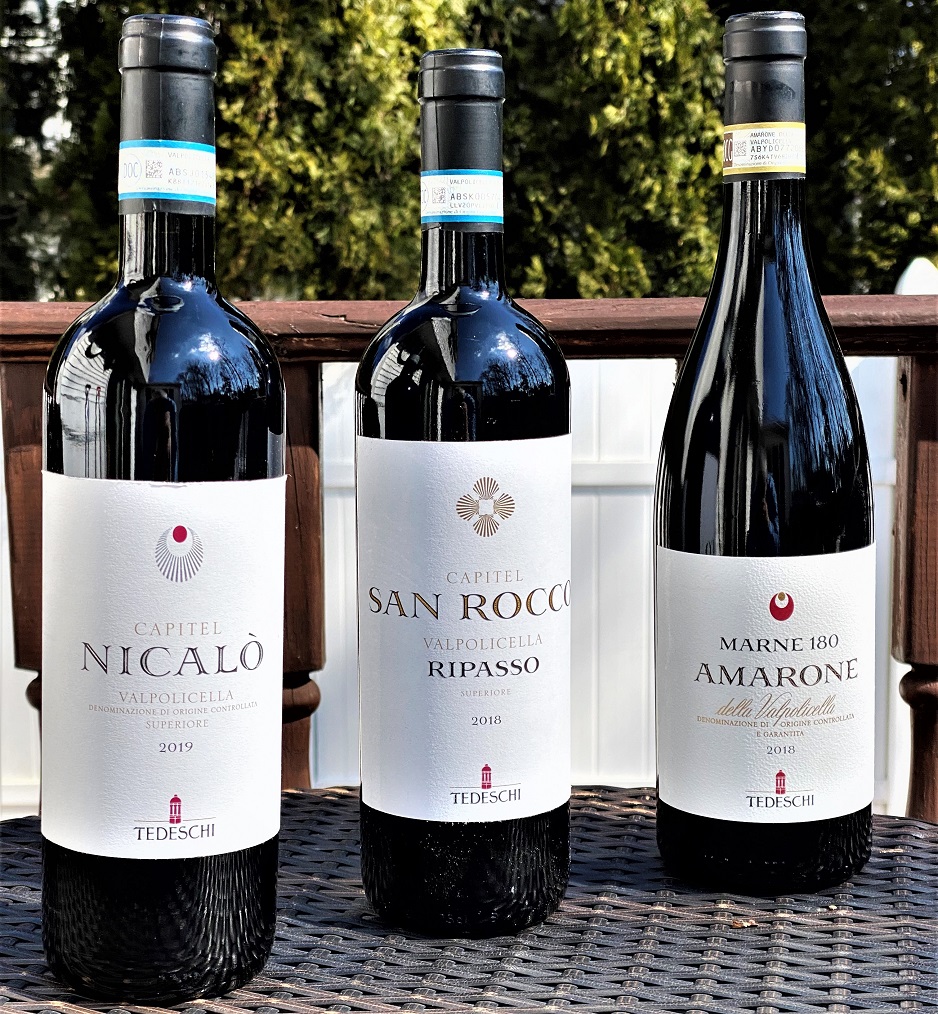
For our “anatomy” exercise, I had an opportunity to taste 3 of the Tedeschi wines – Valpolicella Superiore, Valpolicella Ripasso and Amarone della Valpolicela. All three wines are made from the identical set of grapes, used in the same proportions, so the difference is only in the winemaking techniques. Below are my notes with some additional information about the wines.
2019 Capitel Nicalò Valpolicella Superiore DOC (13.5% ABV, 35% Corvina, 35% Corvinone, 20% Rondinella, 10% Rossignola, Oseleta, Negrara, Dindarella, grapes drying for 1 month, 1-1.5 years in Slavonian oak barrels, 6 months in the bottle)
Dark ruby
Captivating nose of earthy dark fruit, tobacco, rocks
Beautiful fruit, blackberries, cherries, cherry pit, tart, focused, perfectly structured, perfectly balanced – lots of pleasure.
8/8+. Delicious.
2018 Capitel San Rocco Valpolicella Ripasso Superiore DOC (14.5% ABV, 14.5% ABV, 35% Corvina, 35% Corvinone, 20% Rondinella, 10% Rossignola, Oseleta, Negrara, Dindarella, alcoholic fermentation on the marc of Amarone and Recioto for 8-10 days, 1/2 years in Slavonian oak barrels, 6 months in the bottle)
Garnet
A hint of dried fruit, toasted nuts
Round fruit, cherries, soft, approachable, earthy undertones, well-integrated tannins, a hint of tobacco on the finish.
8/8+, delicious.
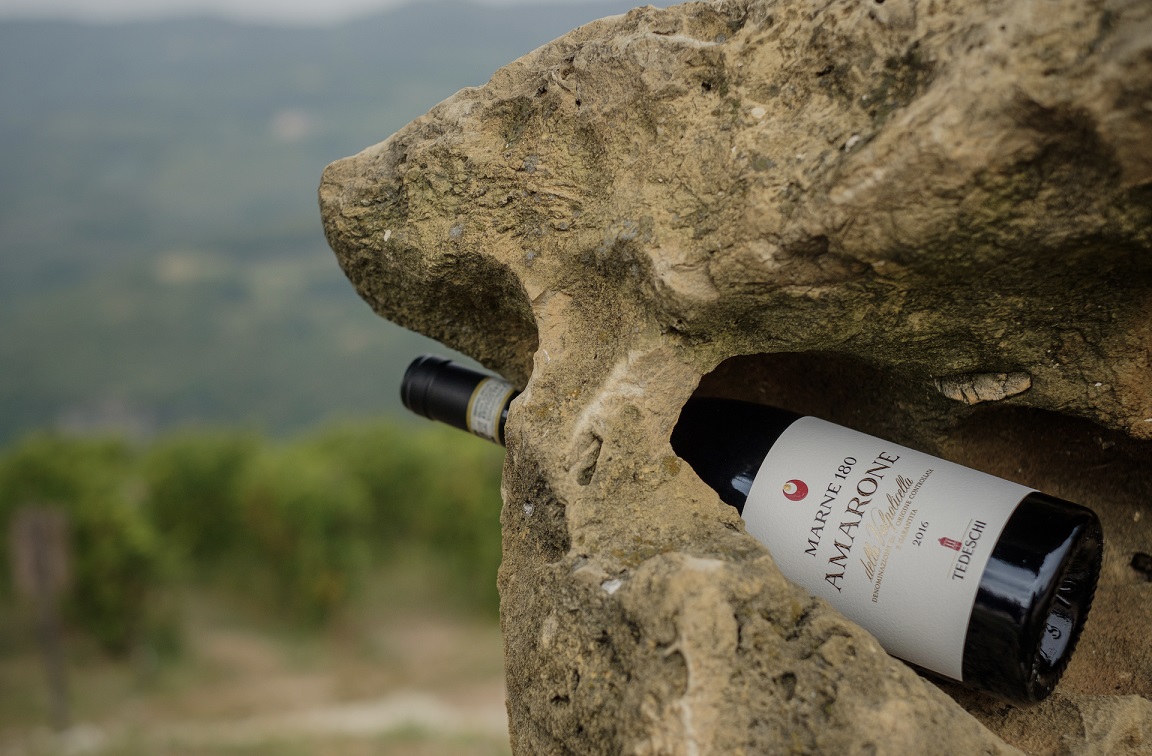
The name Marne 180 is a nod to the marl soils where the vineyard is located and 180 is degrees of exposure, from south-east to south-west. Source: Tedeschi
2018 Marne 180 Amarone della Valpolicella DOCG (16.5% ABV, 14.5% ABV, 35% Corvina, 35% Corvinone, 20% Rondinella, 10% Rossignola, Oseleta, Negrara, Dindarella, grapes drying for 4 months, 30 months in Slavonian oak barrels, 6 months in the bottle)
Dark garnet
Dark, concentrated, forest underbrush
Dried fruit, cherries, intermingled layers, powerful, well structured, delicious.
8+
Can we conclude anything from our flavor research? The wines share some similarities, but this is probably all I can say. I don’t see a clear progression from one wine to another, they are simply tasty wines, each one in its own right. Does it mean that we can’t talk about the anatomy of the flavor? I think we still can, but it is definitely more complicated than it seems.
The important outcome of this research project is three tasty wines from Tedeschi which I’m happy to recommend to you for your daily drinking pleasure. And this is the best conclusion we can make. Cheers!
Trapiche: Beautiful Perfection
Over my lifespan as a wine lover and especially, as a blogger, I tasted tens of thousands of wines. This is not a bragging statement, but purely statistical. Also, out of all those wines, every year a few hundred wines are covered in this blog.
Out of all these wines, there are probably 50 or so that are near and dear to my heart, These are my reference wines. These are the wines I would reach out to illustrate the comparison or simply deliver the message. For example, Bogle Petite Sirah is my favorite example of a budget-priced (typically around $9.99), delicious, consistently drinkable wine. Of course, I occasionally come across wines which equally or even tastier and cost even less, but Bogle is still the wine that is ingrained in my memory, and hence it is my ready-to-use reference.
I always think that all of my reference wines are already covered on the blog – 50-60 wines is not a high number spread out over the 12 years of blogging, and yet from time to time I engage in a futile search for the articles about some of these reference wines, only to say to myself “really?”.
When it comes to Argentinian Malbec, my reference wine is Trapiche Broquel Malbec. Malbec definitely came of age lately, especially with a dramatic increase in popularity over the last few years. While I tasted lots and lots of absolutely delicious renditions of Argentinian Malbec, it is still generally not my go-to wine. But if presented with the Trapiche Broquel Malbec, nobody would need to ask me twice to have a glass or a three.
There are 145 posts in this blog that include the word “Malbec” (not including the one you are reading now). None of these posts talk about my reference wine, Trapiche Broquel Malbec. Well, this is not entirely true – in a few posts, Trapiche Broquel Malbec is used precisely as I presented it here – as a reference. Nevertheless, there are no posts discussing any particular vintages of this wine or presenting any tasting notes.
And so will not be the post you are reading at the moment. But – at least this post is about two of the Trapiche wines I had an opportunity to taste (but none of them are Broquel Malbec).
It is so interesting when you think that you know something, and then it appears that no, you really don’t. I knew the Trapiche name and had a number of their wines over the years, but I had no idea that Trapiche is the biggest winery in Argentina. Founded in 1883, the winery stayed in the family for a long time, transitioning from father to son, until it was acquired by the Grupo Peñaflor, one of the 10 largest wine producers in the world, exporting its wines to more than 90 countries.

Trapiche vineyards span throughout Mendoza, the most famous winemaking region in Argentina from the Andes mountains to the Atlantic ocean around the town of Chapadmalal. Trapiche is using biodynamic farming methods and is very much focused on farmland diversity and sustainability. Trapiche’s hard work and dedication didn’t go unnoticed, acknowledged by multiple international awards, such as the “50 Most Admired Wine Brands” selection by Dinks International (the only winery in Argentian to get on that list 5 times over 5 different vintages), or Wine Enthusiast’s “The New World Winery of the Year” in 2019.
I had two bottles of Trapiche wines to try – 2020 Trapiche Broquel Cabernet Sauvignon Mendoza (14% ABV, $14.99, 100% Cabernet Sauvignon, 14 months in oak barrels) and 2019 Trapiche Gran Medalla Malbec Mendoza (14.5% ABV, $24.99, 100% Malbec, 18 months in new French oak, 1 year in the bottle). I have to tell you that I opened the bottles not without trepidation. I never had either one of these wines, I really like Broquel Malbec, and I really wanted to avoid disappointment…
First I opened Cabernet Sauvignon. The initial nose was not the one typical of the Cabernet Sauvignon – it did smell like a typical Argentinian Malbec would. I wanted to compare the nose side by side, so I quickly opened and poured in the glass the Malbec. The smell was practically identical – the vanilla, warm herbs, plums, with the Malbec bottle offering a bit more intensity. While I appreciate this nose on Malbec, I like the Cabernet Sauvignon to be a bit more traditional.
But the palate of the Cabernet Sauvignon didn’t disappoint, showing cassis with a wallop of dark cherries, a touch of bell peppers, and eucalyptus. As the wine was opening up, it transitioned through a few stages, making cassis more explicit and then adding up the level of acidity on the finish. A very good rendition with an excellent QPR (Drinkability: 8-).
The Gran Medalla Malbec was produced to commemorate the 125th anniversary of the winery, and it is sourced from the best Trapiche vineyard parcels in Uco Valley. And boy, did this wine delivered… This was Malbec like no other. The was the wine that stops you in your tracks; you want the time to stop so you can enjoy that perfect flavor in your mouth endlessly. The wine had the perfect amount of ripe, succulent dark cherries, sweet oak, and sage, weaved around a perfect core of smooth tannins, delivering layers upon layers of pure pleasure. This was the wine that you always dream of drinking, but it is so hard to find. Thinking about the $25 suggested retail price, this wine has great QPR and it is literally a steal if you will be able to find it. (Drinkability: 9-).
There you are, my friends – a case of wine’s beautiful perfection. Which also doesn’t need you to break the bank. Cheers!
2 Regions, 3 Glasses, 1 Wine Geek
The assignment was simple. Compare 6 Cabernet Sauvignon wines from 2 famous winemaking regions in Chile. Find differences. decide on a favorite.
As with any assignment, let’s start with the theory.
Cabernet Sauvignon is unquestionably a king of Chilean wines – it is the best-known Chilean wine worldwide and it is the most widely planted red grape variety in Chile. It accounts for about 20%+ of all vineyard plantings in Chile, covering an area of about 99,000 acres, stretching through the entire country from north to south. At the same time, 97% of the Cabernet Sauvignon plantings are located in the Central Valley, spread between O’Higgins, Maule, and Metropolitan Region.
Narrowing it down to the wine-producing DOs, we are looking at the Maipo Valley and Colchagua Valley, two of the best-known Cabernet Sauvignon areas in Chile. These are also the two regions that are the subject of our assignment.
Maipo Valley is one of the oldest winemaking regions in Chile, with its terroir shaped by the Maipo River, which begins at the Maipo volcano, creating a patchwork of valleys at the elevation of 2,500 feet above sea level. Some of the areas in Maipo Valley see a minimal number of sunny days required for the red grapes to fully ripen, with a climate somewhat similar to Bordeaux.
Colchagua Valley lies about 80 miles south of the city of Santiago. Parts of the valley are crisscrossed by the Tinguinirica River, taking its roots from the volcano crater in the Andes, and descending from about 2,000 feet to the 360 feet of elevation above sea level. Colchagua Valley generally offers much warmer daily temperatures compared to the Maipo Valley.
Here are some of the views of the beautiful regions:
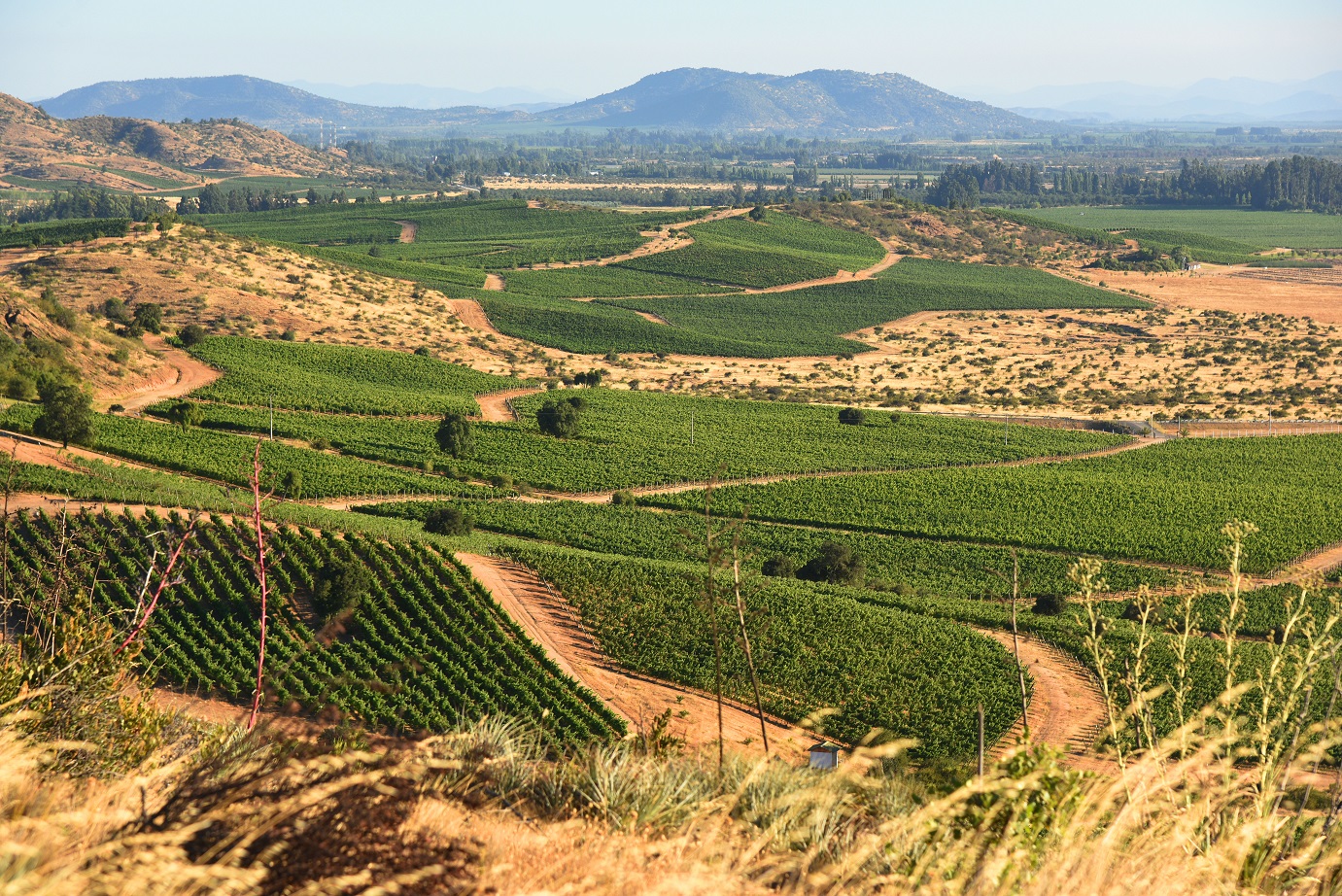
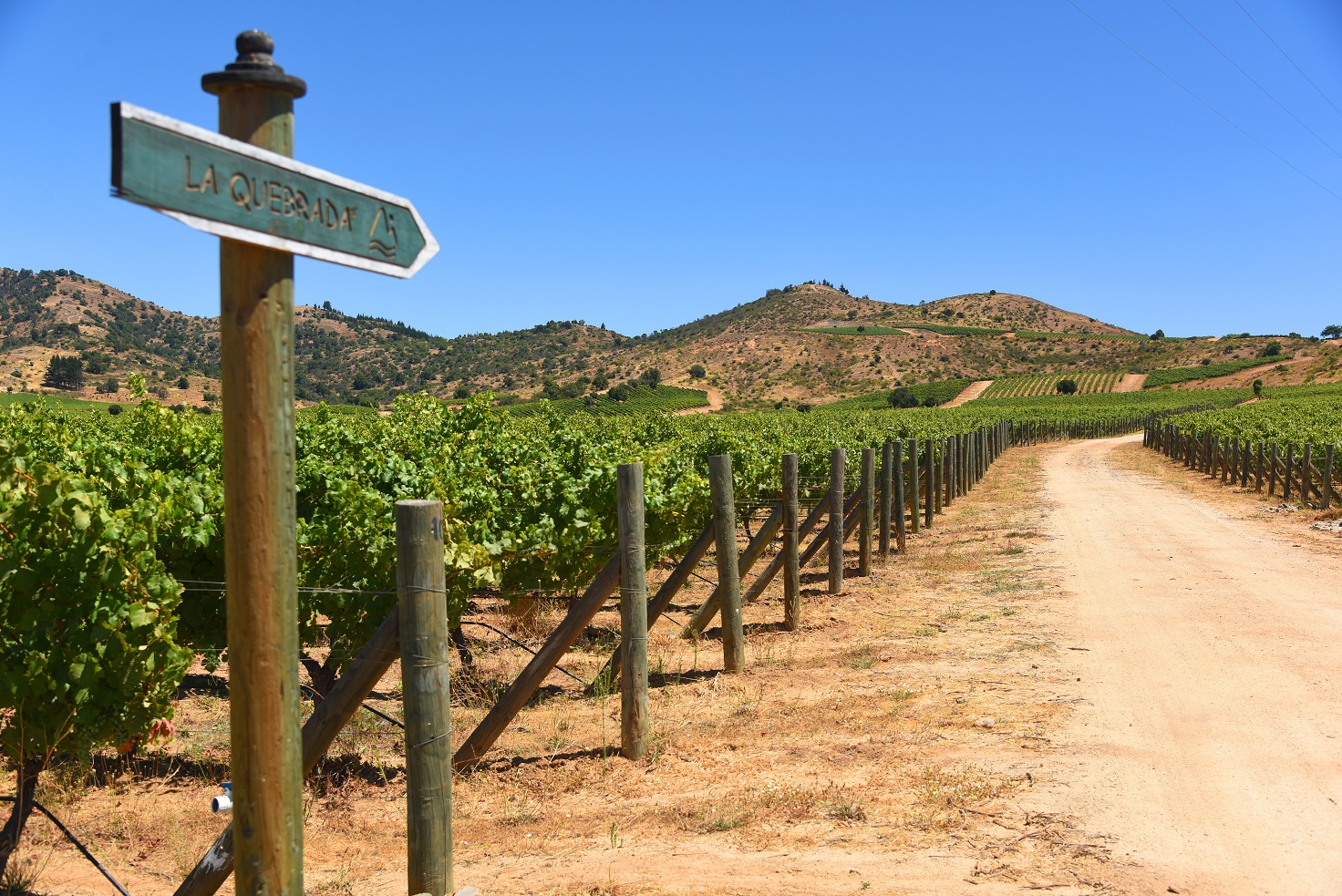
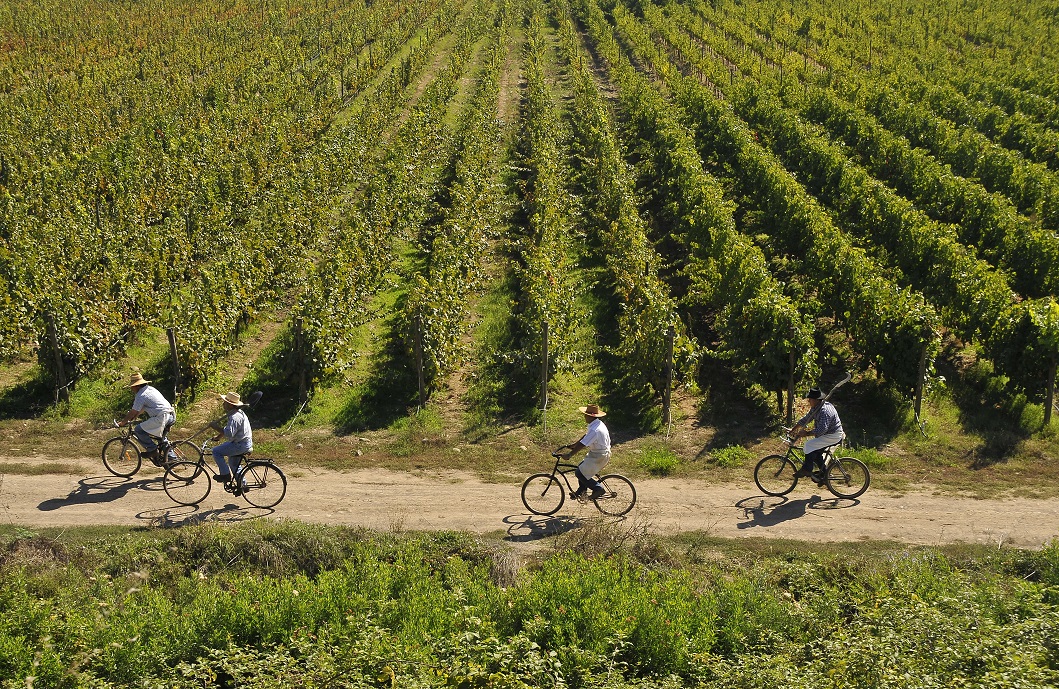
I’m purposefully avoiding descending into the discussion about the different soil types throughout both regions but of course, alluvial soils, colluvial soils, gravel, clay are all intermixed around both regions. I don’t believe I can intelligently speak to the effect of a given soil type as it comes to the resulting taste profile of the wine, but our main difference between the wines from the two regions should be driven by the warmer versus cooler climate and some differences in the elevation.
I hope this is enough of the theory and it is time to get to practice – the lab portion of our assignment.
This is where the inner geek came out guns blazing – and this is where everything all of a sudden became muddy and complicated.
I decided that the challenge of comparing the 6 wines is insufficient, and to make things more fun, I decided to was possessed to try each wine from three different glasses: Glass 1- Riedel Universal tasting glass (this is the one typically offered at all of the wine tastings), Glass 2 – Chef & Sommelier Open’Up glass, one of most aesthetically pleasing glasses for the daily drinking, and Glass 3 – Riedel Radical Cabernet glass (my favorite glass for the Bordeaux varieties).
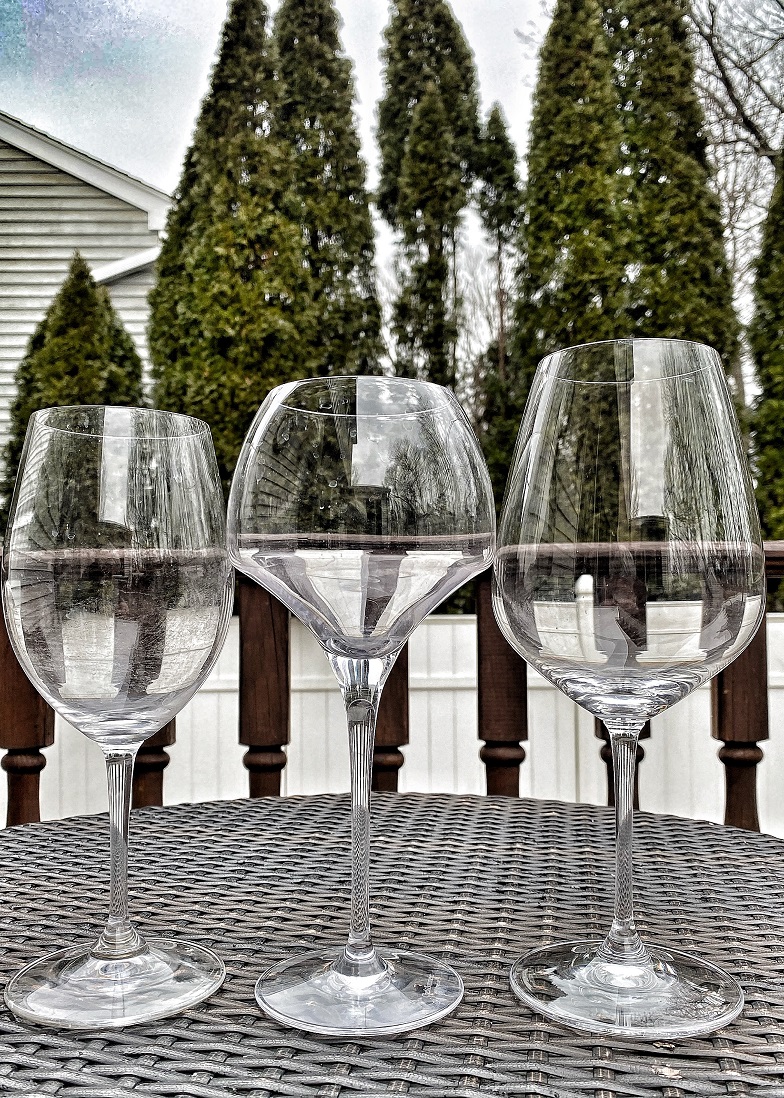
The wines I tasted all come from well-known producers. I was familiar with some prior to this tasting (Los Vascos, TerraNoble, Maquis) and I had a lot of Los Vascos and TerraNoble Cabernet wines in the past. Regardless, this was quite a respectful selection of the wines, expectedly illustrative to represent the two regions. Three of the wines were 100% Cabernet Sauvignon, and 3 had Cabernet Sauvignon as a dominant component.
To explain in more detail what I did: on the first day, I poured each one of the 6 wines into the 3 glasses – non-blind, one by one. I then tasted each wine from those 3 glasses – you will see the notes below, describing my perception of the same wine in each of the 3 glasses. The glasses had their effect, even though Radical Cab and Open’Up glasses offered mostly similar experiences. Open’Up glass required the bottom section to be sufficiently filled or the nose of the wine was becoming lost. All of the second and third day tastings were done only using the Universal tasting glass. Below you can see all of the tasting notes, from which it is very easy to conclude that I was unable to come to any meaningful conclusions and find any meaningful, region-conforming differences between the wines.
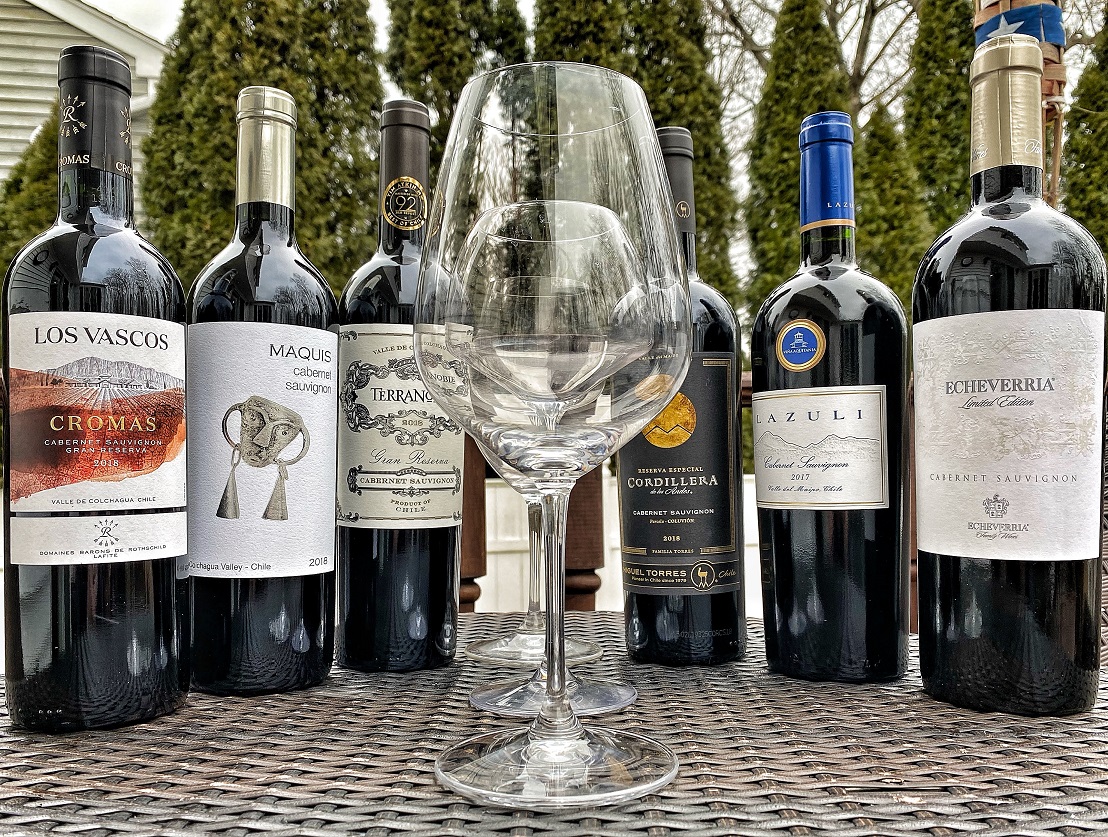
Here we go:
Team Maipo Valley:
2017 Lázuli Cabernet Sauvignon Valle del Maipo (14.5 ABV, $45, 100% Cabernet Sauvignon)
Garnet
Glass 1: dark fruit, concentrated, iodine, forest underbrush, pyrazine
Interesting. Quite restrained. Not a lot going on.
Glass 2: much less expressive, just a hint of pyrazine
It is showing better. No idea how. Crunchy berry, soft tannins, still not very expressive
Glass 3: dark fruit, more focused than glass 1, a hint of bell pepper
Similar to glass 2. Dark fruit, baking spices, lots of minerality. Not very much Caberneish if you ask me.
Day 2: not good
Day 3: Fruit showed up. Fresh berries and eucalyptus. Is this a Cab? Not sure. Is it drinkable? Sure, on the third day.
2018 Miguel Torres Cordillera Cabernet Sauvignon Reserva Especial de Les Andes Valle de Maipo (14% ABV, $20, 100% Cabernet Sauvignon)
Concentrated ruby with bright hues
Glass 1: very similar presentation to the first wine. Dark fruit, a hint of bell pepper, very distant hint, a touch of eucalyptus.
Definitely a Cabernet profile, more explicit than the previous wine. Eucalyptus, cassis, bell pepper practically non-existent.
Glass 2: this glass requires much higher pour to get to the aromatics.
The wine appears more refined and elegant on the nose than glass 1, more focused on eucalyptus and cassis.
Delicious, earthy cab. Good acidity, cassis, earthy and restrained.
Glass 3: interesting. Almost gets to the barnyard space. Definitely more earthy than glass 2.
The best experience. Dark fruit, cassis, pencil shavings, crisp tart finish.
Day 2: good
Day 3: excellent. Dark fruit, eucalyptus. Round tannins, good structure, dark and supple.
2016 Echeverría Cabernet Sauvignon Limited Edition Maipo Valley (14% ABV, $25, 85% Cabernet Sauvignon, 10% Syrah, 5% Carménère)
Dark Garnet
Glass 1: very concentrated. Dark fruit, sapidity, earthiness, a hint of eucalyptus. Interestingly enough, all 3 wines so far are really similar.
The nice initial appearance of the fruit is instantly replaced by tannins. Serious French Oak tannins, front of the mouth is locked.
Glass 2: a much more elegant appearance than Glass 1. A hint of eucalyptus and bell pepper.
Fruitier than the previous 2 wines, nice load of dark berries, and then it is all tannins. Again, the wine appears to be more elegant.
Glass 3: similarly elegant to glass 2. Eucalyptus, bell pepper, and a touch of black pepper.
Berries, eucalyptus, and tannins. Should be outstanding with the steak.
Day 2: Excellent
Day 3: very good, open fruit – but not very much of the cab? I liked it more on the day 2
Overall notes: all 3 wines are very similar on the nose, showing differently on the palate. Earthy, concentrated wines. All need time to open.


Now, team Colchagua Valley:
2018 Maquis Cabernet Sauvignon Gran Reserva Colchagua Valley (14% ABV, $20, 90% Cabernet Sauvignon, 6% Cabernet Franc, 3% Carmenere, 1% Petit Verdot)
Garnet
Glass 1: bright and clean aromatics, cassis, eucalyptus, a hint of bell pepper
Plums, a touch of cherries, not a textbook Cabernet Sauvignon
Glass 2: interesting. Volcanic undertones, gunflint, almost a hint of sulfur, fresh crisp berries
Better showing, brighter fruit, some bitter undertones appeared (whole cluster?)
Glass 3: somewhat similar to the glass 2, but a bit more restrained
Amazing how much glass matters. This is almost at the expected level of Cabernet Sauvignon – a hint of cassis, mint. Still very restrained.
I’m so confused that I had to wash the glass.
Re-taste: it is not bad, but didn’t make a difference. Still, dry restrained, with some bitter notes on the finish.
Day 2: tight and closed
Day 3: definitely better. Bitter notes are gone. But the whole presentation is plum/cherry, not so much of the Cab Sauvignon
2018 Los Vascos Cromas Cabernet Sauvignon Gran Reserva Colchagua Valley (14.5% ABV, $22, 85% Cabernet Sauvignon, 10% Syrah, 5% Carmenere)
Concentrated ruby
Glass 1: dark berries, a hint of cassis, vanilla, bell pepper might be a product of my imagination
Delicious. Fresh, open, clean, dark berries, cassis, bell pepper, eucalyptus. A pretty classic cab if you ask me. Best of tasting so far.
Glass 2: Cassis and mint, medium intensity
Delicious. Very similar to glass 1, somehow with a bit more intensity of the flavors.
Glass 3: very restrained, cassis, bell pepper, a touch of tobacco
Delicious. Exactly as two previous glasses. Happy to drink every day.
Day 2: not good. Tight, closed.
Day 3: lots of tobacco and smoke on the nose. Dark fruit, borderline bitter. I don’t get this wine
2018 TerraNoble Cabernet Sauvignon Gran Reserva Valle de Colchagua (14% ABV, $20, 100% Cabernet Sauvignon)
Garnet color
Glass 1: dark berries, eucalyptus
Delicious. Open, bright, good acidity, ripe fruit, not necessarily a textbook cab, but fresh and delicious.
Glass 2: dark berries, sapidity, earthy, a hint of bell pepper
Fresh, delicious, crisp berries, a touch of cherries, a bit of dark chocolate.
Glass 3: a hint of bell pepper, dark fruit, earthy
Bright, open, good structure of tannins. A cab? Maybe…
Day 2: good
Day 3: beautiful, supple, good tannins, good structure, open fruit, good finish.
On the day 2, my preferences were with these three wines:
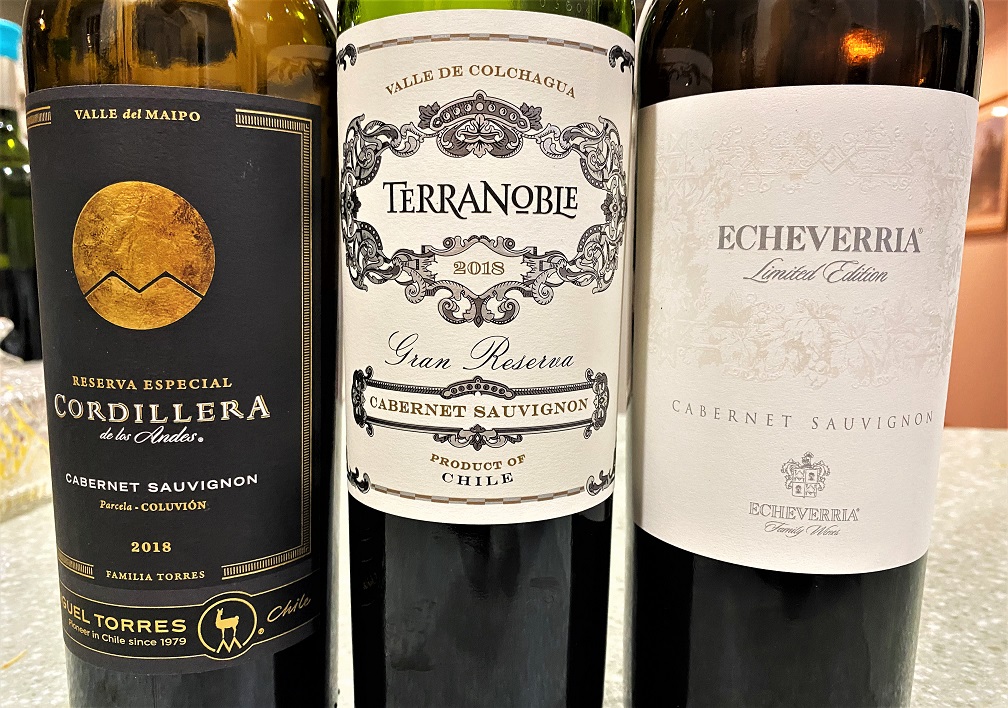
And then there were two. On the third day, I had two wines as my favorites – and they represented two regions.
For the final decision – Torres versus TerraNoble.
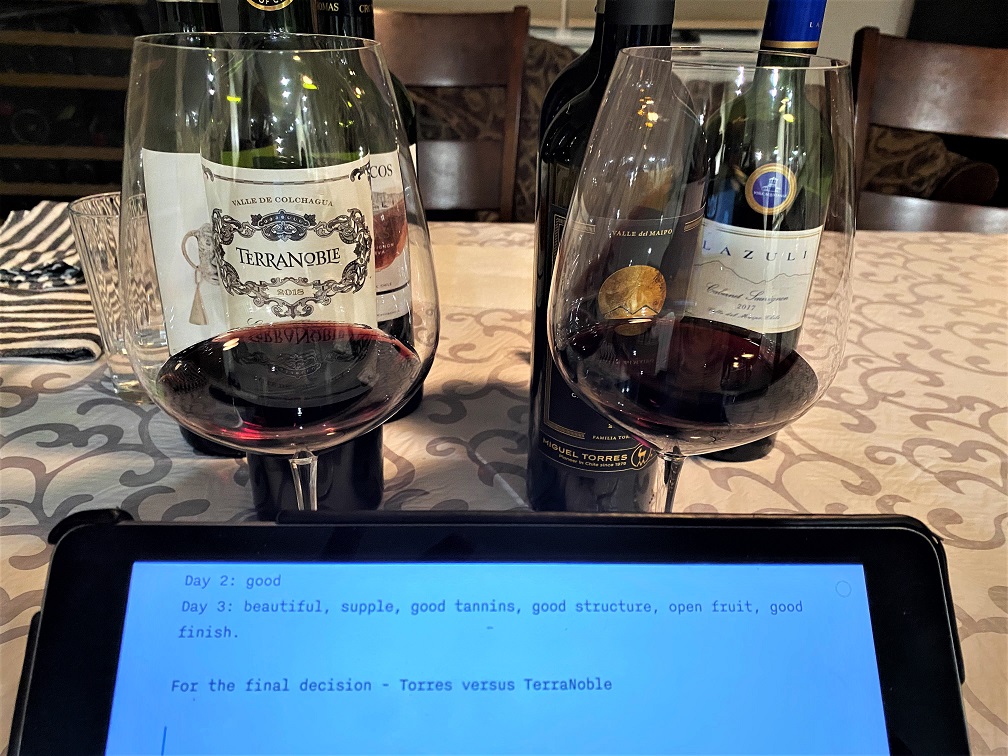
Wine geek at work
Nose: advantage Torres – dark chocolate, a hint of bell pepper. TerraNoble mostly closed
Palate: slight advantage Torres – better structure and better precision. Dark and concentrated. Will continue improving.
The winner: 2018 Miguel Torres Cordillera Cabernet Sauvignon Reserva Especial de Les Andes Valle de Maipo
So we can conclude that Maipo Valley won this strange competition, at least with a margin of error.
The assignment is complete. So what did we learn?
- Don’t play with your glasses, unless this is actually a goal of your exercise. Wine glasses matter and wine glasses
canwill confuse you. - Hey, wine glass matters.
- I probably should’ve done the blind tasting instead
- Chilean Cabs need time. Practically all showed better on the second day.
- I was unable to find the real differences between Colchagua and Maipo wines
Oh well. Play with your wine. Have fun. One way or the other, experience is still an experience, and as long as you desire, there is always something to learn.
Do you have a favorite Chilean Cabernet Sauvignon? Care to share? Cheers!
A Few Days In Seattle
 You know how you can look at something but not see it? Or think that you know something but really not knowing it at all?
I’m sure I don’t make much sense, but let me try explaining it better. I had been visiting Seattle for many years now, considering that Seattle had been a high-tech hub for ages. Seattle, Bellevue, Redmond, space needle, Pike’s Place. So in my mind, I was sure that I was well familiar with Seattle and all it has to offer to the visitors. I knew that in Pike’s Place there is a famous Russian-style eatery, Piroshky Piroshky, and that Pike’s Place Chowder, the winner of all of the New England Chowdafest competitions is also coming from Seattle. But turns out that lots of it was the knowledge, but not the experience. I knew that these places exist, but I actually never experienced them firsthand.
Until now.
I visited Seattle to attend a conference. That conference was actually supposed to take place 2 years ago, but as you are all acutely aware that happened to be the time that never was… The event was hosted by Amazon at their downtown offices, thus I guess for the first time I actually stayed in downtown Seattle and had a little bit of time to explore the city – and gain firsthand experience.
A picture worth a thousand words. So below you will see many, many thousands of words – in the form of the pictures of downtown, Pike’s Place, and the seaside.






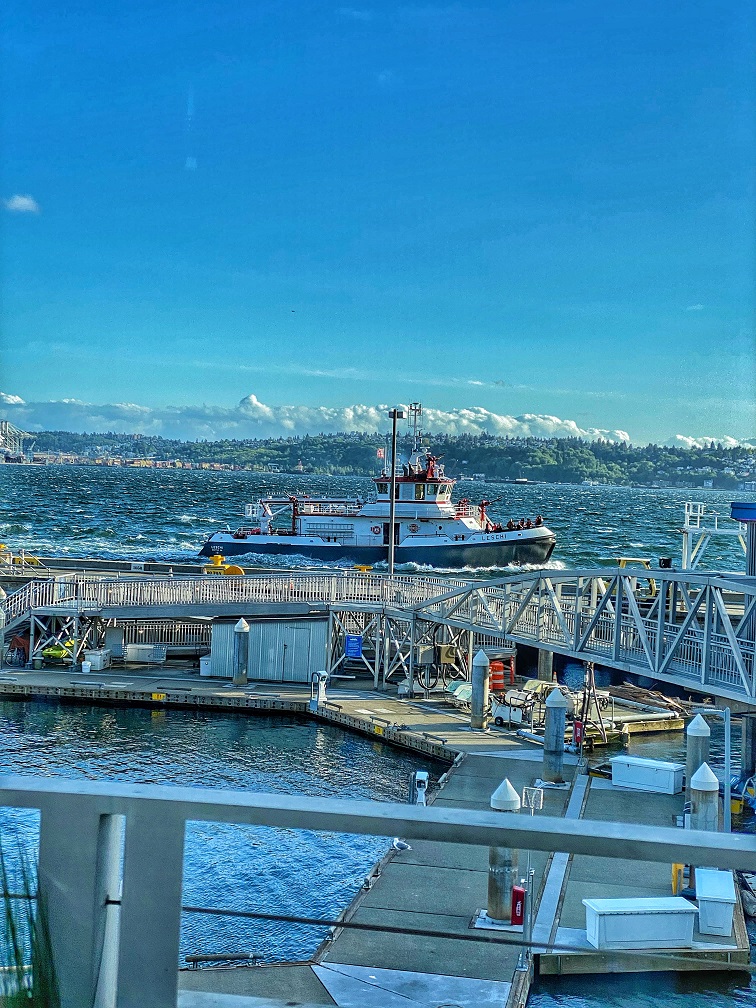

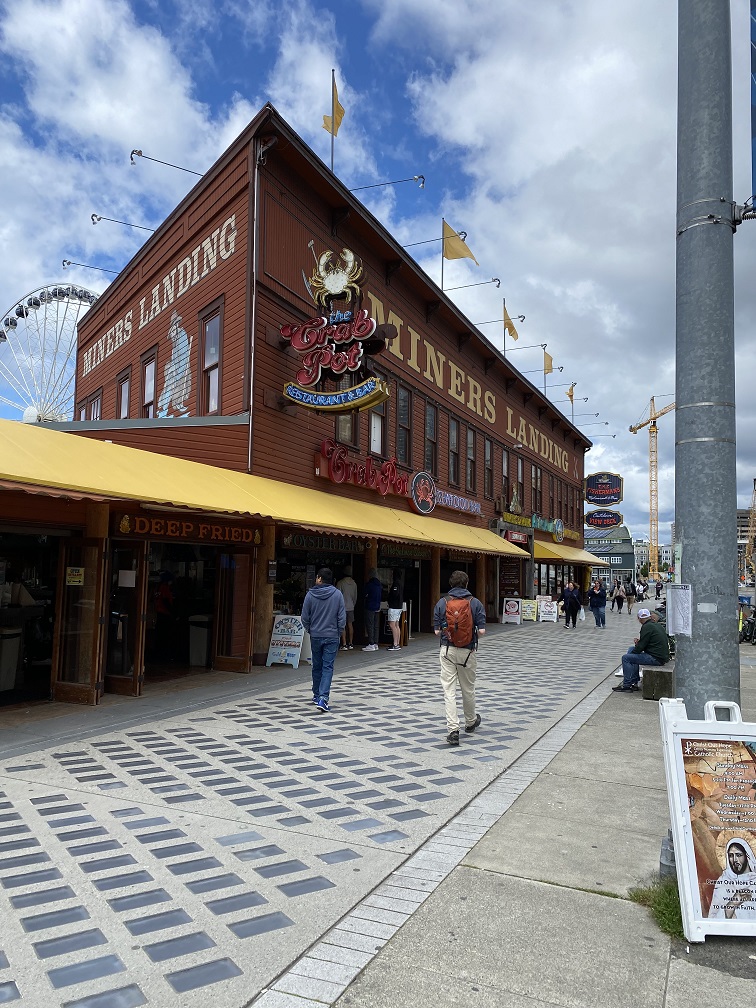





The original Starbucks at Pike’s Place
Now, a few more words about the food experiences.


Piroshky Piroshky had been around for 30 years, and it is definitely one of the staples of the Pike’s Place market, always adorned with a line of hungry guests. I was lucky as I walked up to the door because for some reason there was literally no line – or I simply was a jerk and cut people off without knowing. Either way, I tried two Piroshky, one with salmon, and one with beef and onion (the selection there is quite substantial, including sweets and vegan concoctions, but all the Piroshky are rather large, so there is a limit to how many you can have). Both were tasty, but I wouldn’t say that I was blown away. I would be happy to try them again but it is not something I would crave.
After trying to walk off all some of the calories of Piroshky I came across the Pike’s Place Chowder. I had an image of a nice-looking restaurant in my head, as Pike’s Place Chowder always competed in Chowdafest against actual restaurants – but the place was rather a “hole in the wall” style. Well, “hole in the wall” is synonymous with tasty food more often than not.
I never thought of it, but walking around Pike’s Place and looking at what is offered in all of the numerous eateries I was surprised by the similarities of the food offerings with what I would find on a typical visit to Newport or on Cape Cod, the quintessential New England – fried seafood of all sorts, fried oysters, clams, shrimp, scallops, fish, and yada yada yada. So the coast is a coast, whether the east or the west. Taking this revelation into account, it is not surprising that New England clam chowder was offered pretty much everywhere – and of course, it shouldn’t be surprising that Pike’s Place Chowder can successfully compete at the Chowdafest in New England.


Let’s go back to the Pike’s Place Chowder. The eatery also offers a full variety of seafood, fried and not. But as their menu boasts 8 or so different types of chowders, that is what I was interested in trying. Luckily, the restaurant offers sample packs, so I went for the 4 samples pack, as I was by myself and there is a limit to the amount of New England clam chowder one can consume (especially when two Pirozhki are still occupying the majority of the available stomach space). Another option was 8 samples pack, but that would be a waste of money and food. I decided to get New England clam chowder, Smoked Salmon chowder, Seared Clams chowder, and Market chowder (whatever the chef feels like on a given day). I got the sample pack to go for two reasons – there was absolutely no space to sit, and I still needed to lose at least 5–10 calories, so a walk to the hotel, albeit short, seemed like a good idea.
Remembering my Chowdafest experiences, Pike’s Place Chowder was never my top favorite, and nevertheless, for many years that I attended the Chowdafest, they have always won the New England Clam Chowder category. I only have two explanations for that phenomenon. Factor 1 – intimidation. They always bring a full display of medals to the competition, and when people see it, they are instantly inclined not to argue with success. I’m absolutely positive that same as with the wine if the tasting would be done blind, the results would be totally different. Factor 2 – customer service. At the Chowdafest, there is always a long line to each vendor’s stand. Pike’s Place always brings enough people to be able to carry their chowders around so the people wouldn’t have to wait in line.
See, I got really on a tangent here. As I got to my hotel room and took a first sip of the classic New England clam chowder, my first thought was “it’s okay, but this is not great” – hence the reminiscence on the subject of the Chowdafest. I can name a bunch of clam chowders (including the one which I make – yep, I have the nerve, I know) which I would unquestionably prefer – Grand Central Oyster’s Bar, Rory’s (a local restaurant in Darien, CT, always serving chowder with a tiny bottle of Sherry), and I’m sure many others. All four chowders were fun to try, with Seared Scallop chowder being my favorite. However same as with Piroshky Piroshky, I can eat it again, but that wouldn’t be something I would crave.
Now, to complete my culinary escapades in Seattle, here is one more, now truly unique experience.
I love the concept of “food in season”. Don’t get me wrong – I need my blueberries 365 days a year, whether they are grown locally in Maine or in Chile or Peru. But if you ever being to the “foodie heavens” in Europe – France, Switzerland, and the likes – there are always products which are only available for a short time – as, for example, white asparagus in Geneva which you can find on the restaurants’ menu only for about 3 weeks in the spring.

I never heard of Copper River Salmon before. Copper River is located in Alaska, and the salmon which is caught there is usually available in its fresh form only for a very short time in the spring, from mid-May through June. Copper River salmon is usually equated to the best Japanese marbled beef in its exquisite, luxurious flavor profile. Pier 66 Anthony’s seafood restaurant had just received their shipment of the Copper River Salmon two days prior to our visit, and it was on the dinner menu. We happened to dine at that restaurant on the last night in Seattle, so it was impossible to avoid such a rare treat.
Was that the best piece of salmon I ever had? Probably. It was soft, fluffy, airy, and full of flavor. This is probably something I would crave, and this is definitely the experience to remember. If anything, you should remember the name – Copper River Salmon – just in case the opportunity would present itself.
That’s my account of the few days in Seattle – well worth a visit even without taking the wine into account. But if you like wine like me, the visit to Seattle might be something you should simply crave. Why? I will tell you all about it in the next post…
Snow, Wine, and Valentine
First, there was snow.
Well, not true.
Last Saturday we had a break in winter weather. The thermometer hit 60ºF here in Stamford, and it was perfect grill weather. I’m not at the point of grilling in any weather (some of my friends are), but 60ºF in February definitely calls for some meat on the grill. While the meat was cooking, I enjoyed a beautiful sunset and a glass of 2018 TerraNoble Gran Reserva Carmenere Valle del Maule – the wine had cassis and a signature pyrazine (bell peppers) which was perfectly integrated, and practically disappeared after a few hours, leaving, luscious, layered, roll-of-your-tongue, seductive liquid in the glass (the bottle was practically gone by the end of the evening).


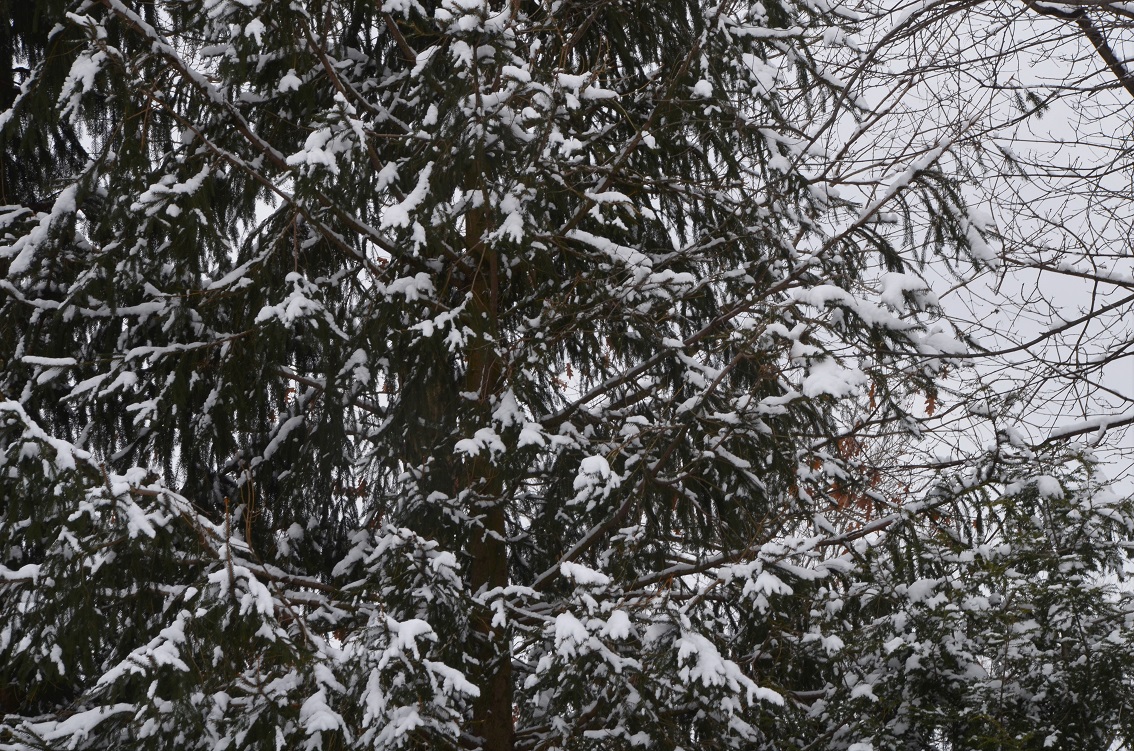
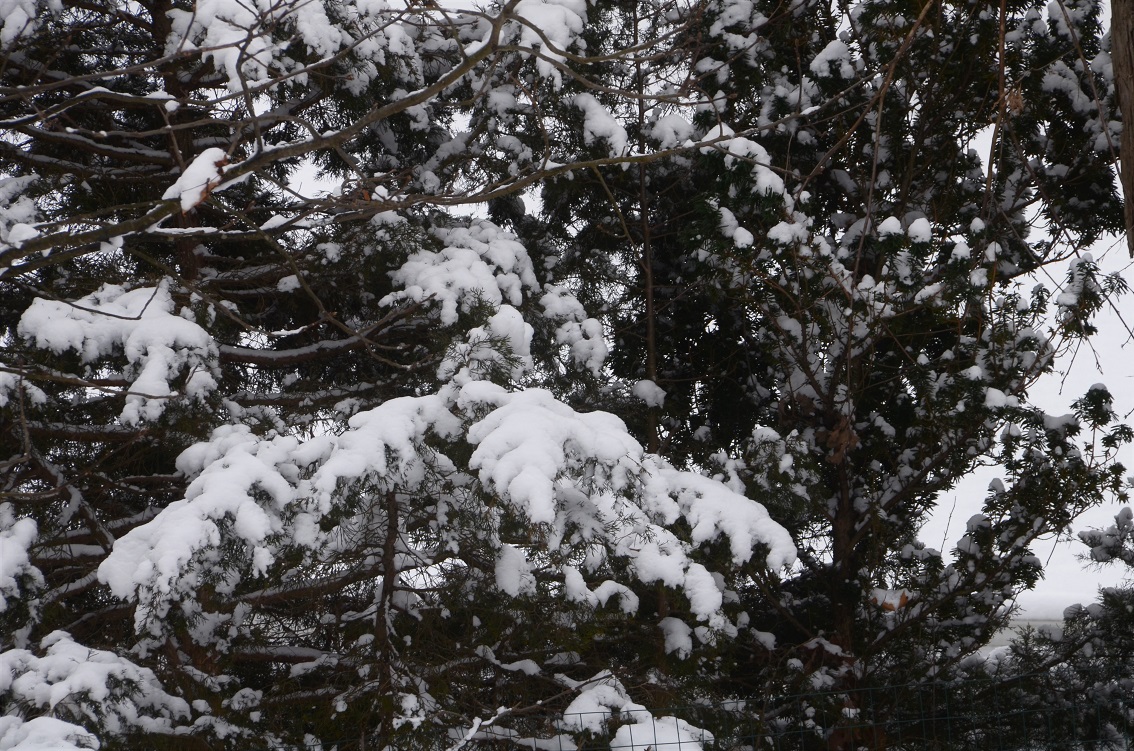
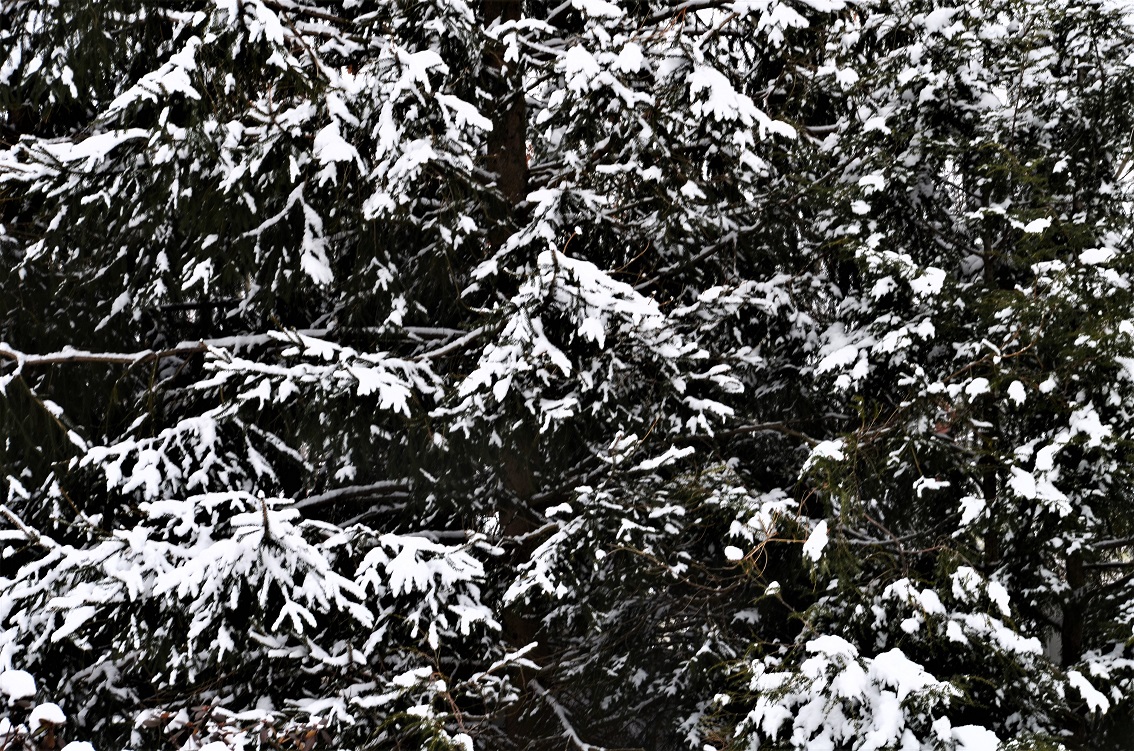
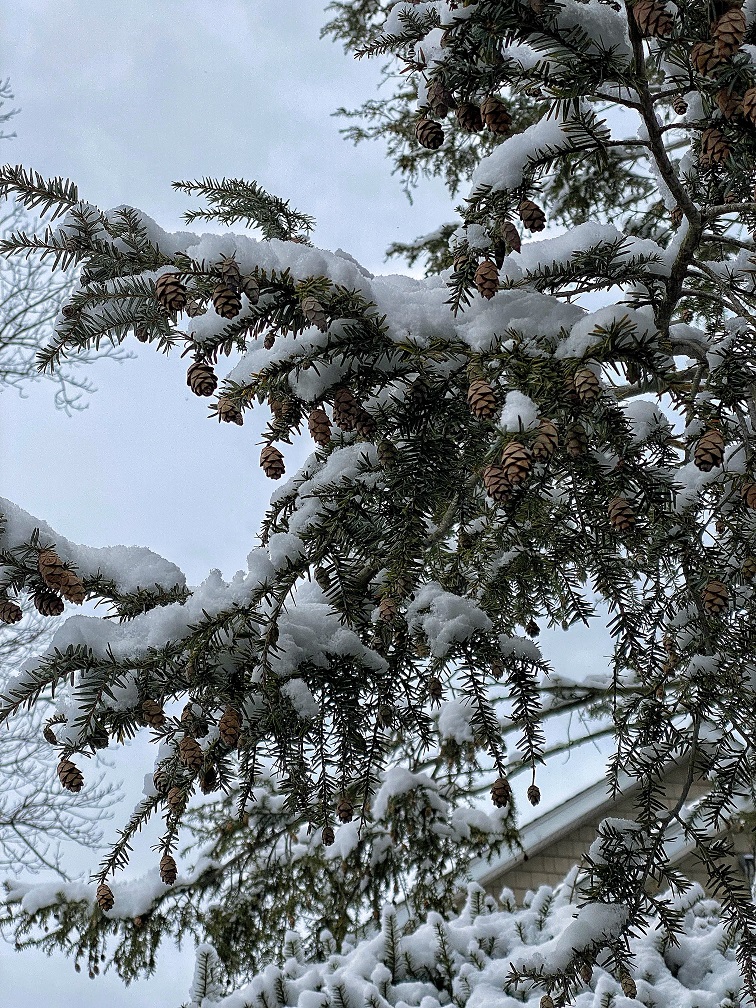
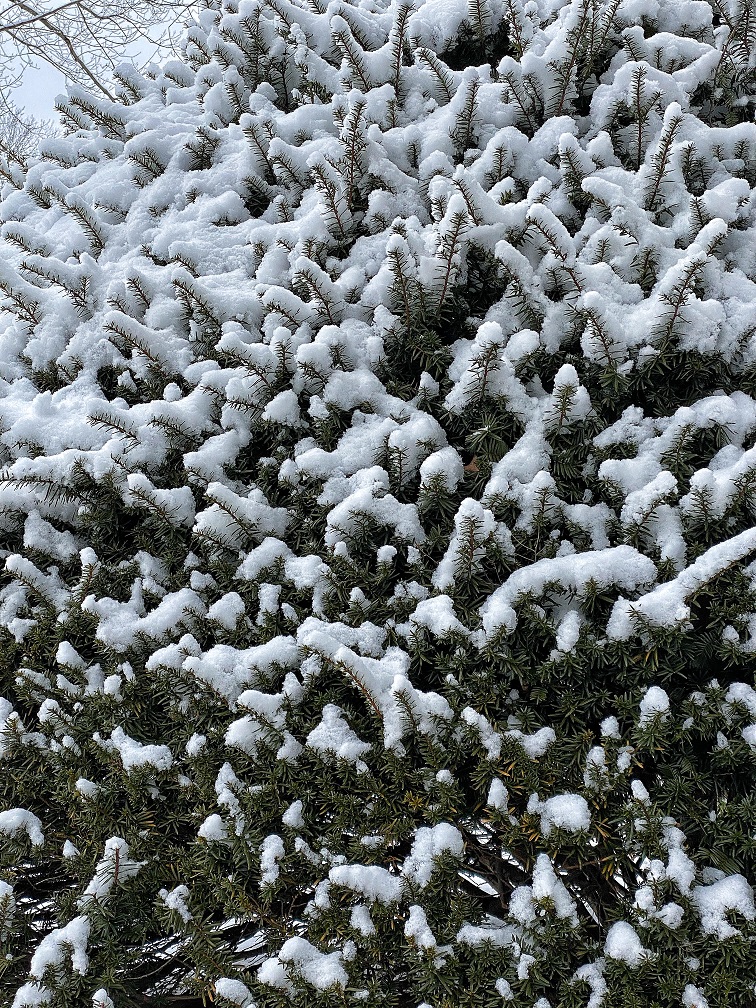
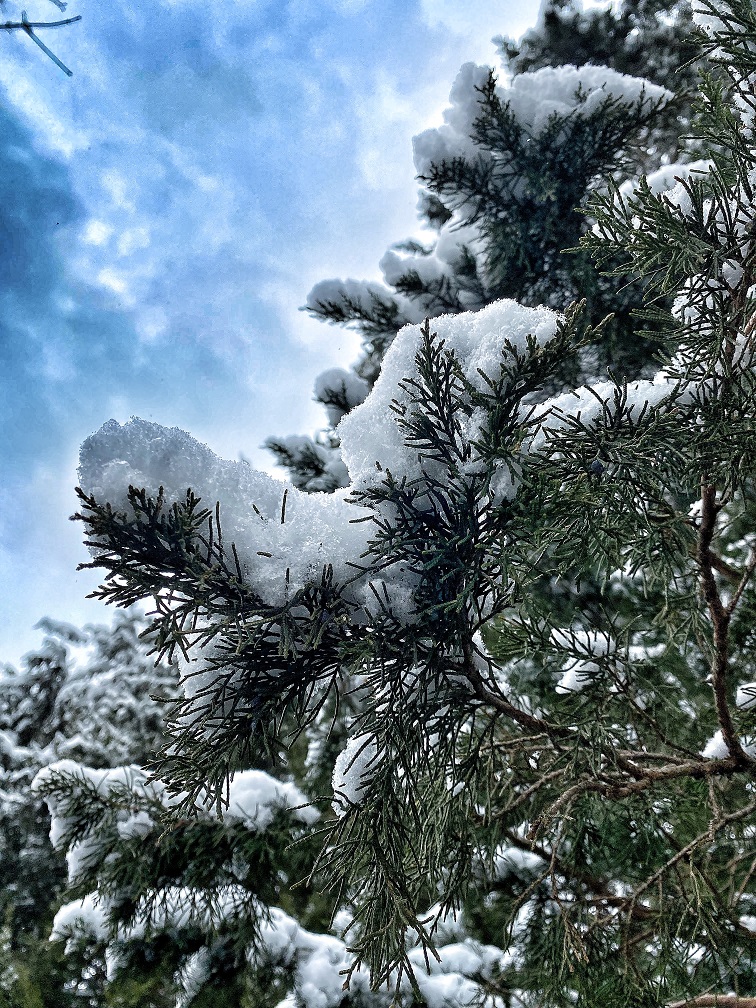
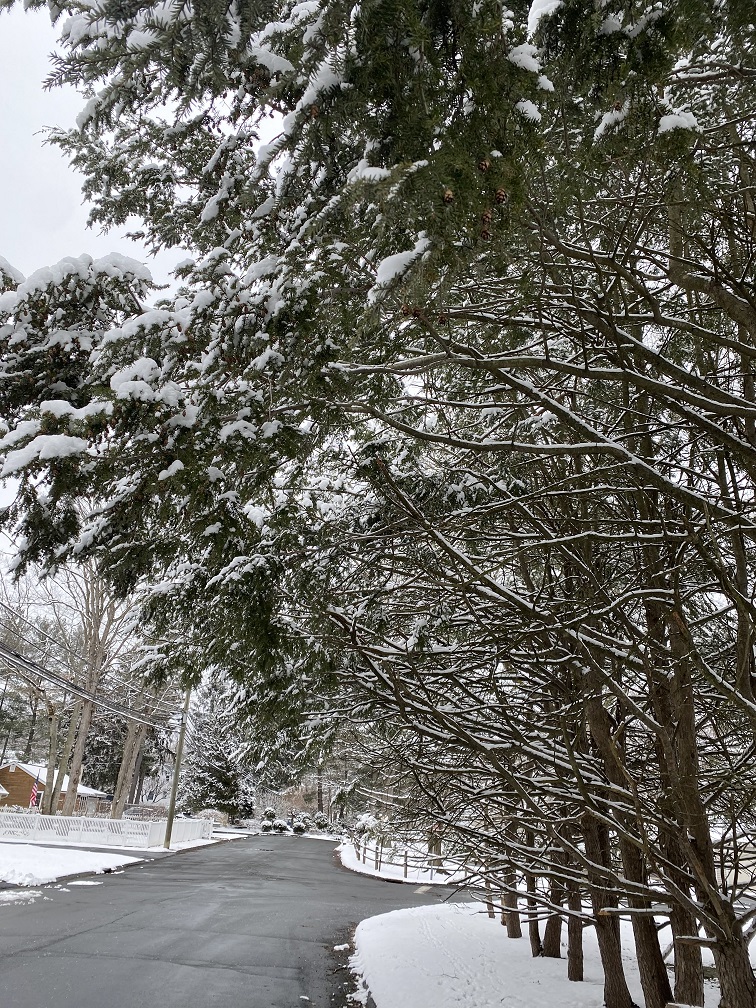
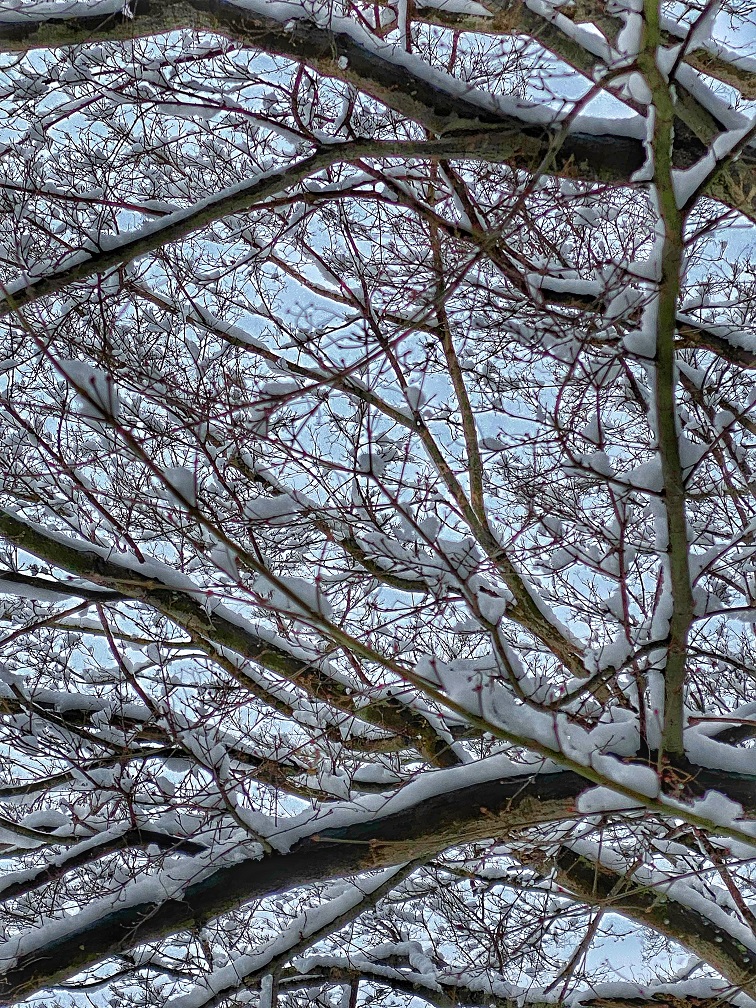
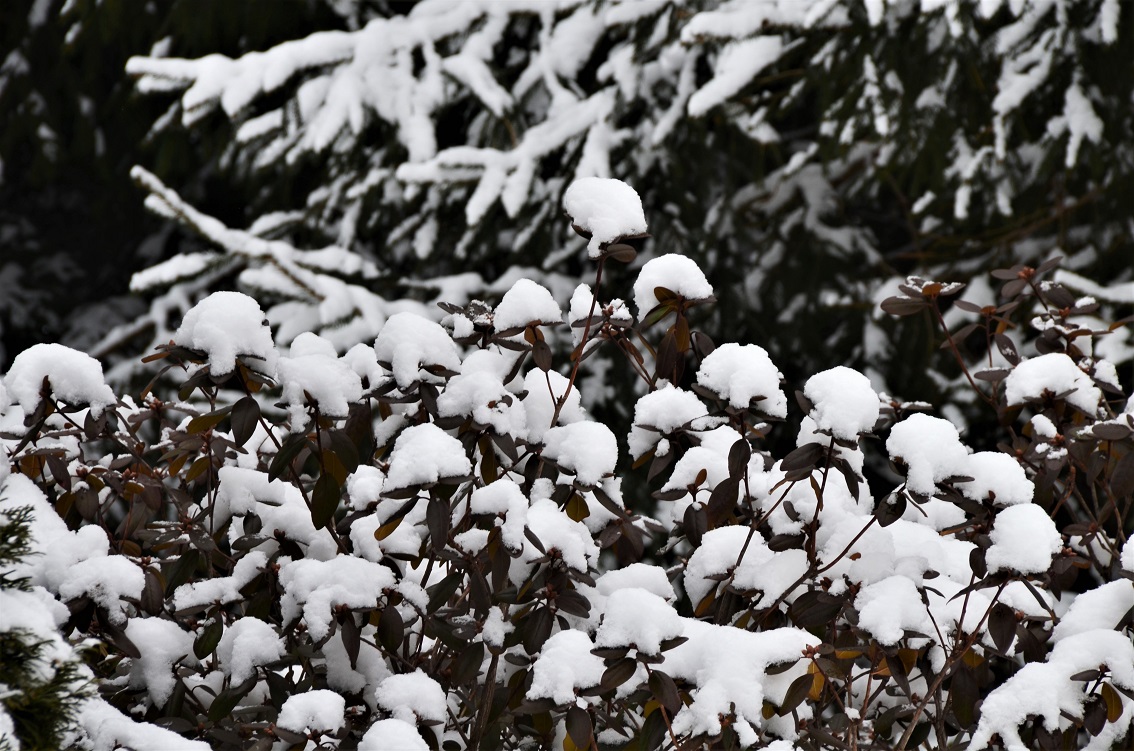
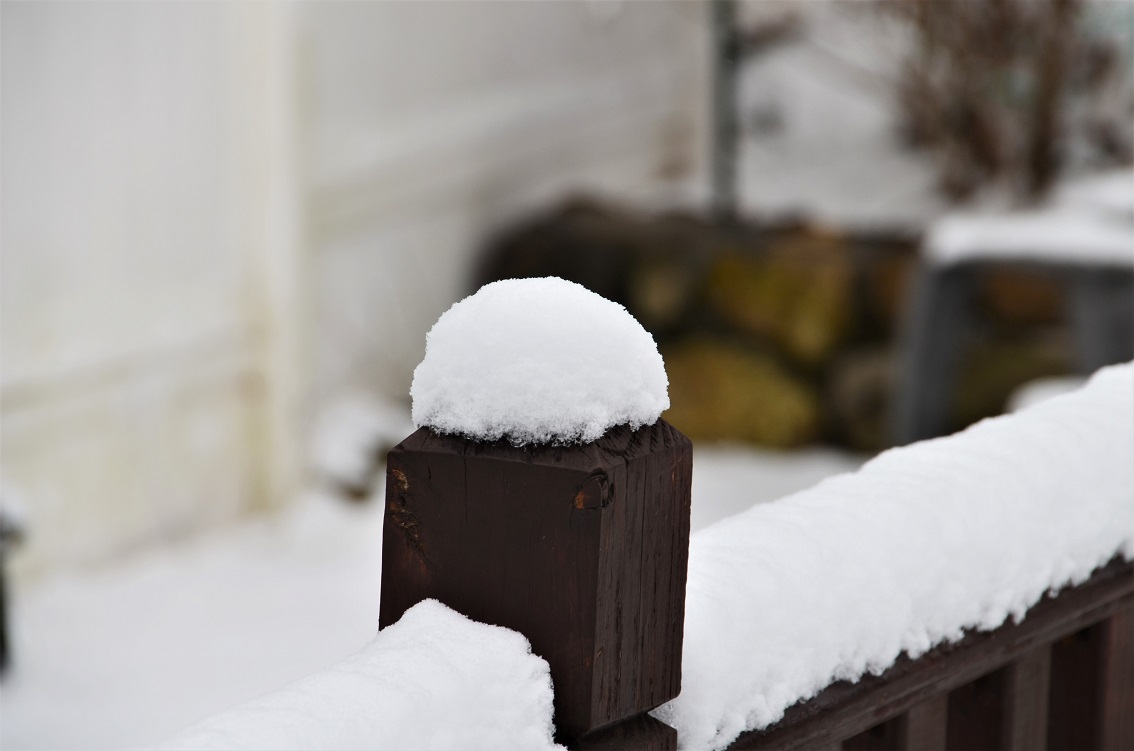
Then, there was snow. This snow was absolutely wonderful for a variety of reasons. For one, it was extremely photogenic, as you will see below (yep, pictures time!). But the main reason was that this snow was a total surprise. There was no weather channel hysteria, forcing people to run into the supermarkets, no warnings. We woke up to the beautiful white blanket, covering the ground, trees, and cars. It was beautiful, it was peaceful, it was happy. I took a few pictures from the deck, and then we took a slow walk with Penny – she kept on happily digging her nose into the snow, and I kept on trying to get a picture of that before the snow was melt, but I was not very successful, so you will not see a dog’s nose below.




For the Super Bowl, the game of power, I decided to open a powerful wine. If you would ask me to name wine that I associate with power, California Petite Sirah would be on the top of my list. This was my last bottle of 2010 Jeff Runquist Salman Vineyard Petite Sirah from Clarksburg – I’m glad I decided to open it, as I think the wine was at its peak. Cherries and cherry pits, on the nose and on the palate, round, succulent, juicy and delicious, with beautiful acidity and impeccable balance. This was definitely one delicious wine.

I also made almond cookies – these are made from almond flour, so they are completely gluten-free, soft, gooey, and delicious.


And Monday was Valentine’s day. For many years we prefer a simple family celebration with kids instead of going to the restaurant to participate in the ritual of poor service and mediocre food. I was really craving bubbles, so 2008 Berlucchi Palazzo Lana Satèn Reserva Franciacorta (disgorged in 2017) was exactly what we wanted – golden delicious apples on the palate and the nose, fine, delicate mousse, round and clean. Very elegant sparkler, good for any occasion.


That concludes the store of the few days in wines and pictures, mostly in pictures. Cheers!
2021 Top Dozen
 Here we go – a culmination point of the year in wine. Whatever 2021 was, it had no shortage of amazing, memorable wines.
Yes, my wine experiences were a little skewed, as you will see from the list, but hey, it just happened to be so.
You can click on any and all the wine names below if you want more information about the wines – I’m only offering brief impressions in this post.
Let’s dive into it, shall we?
12. 2018 Lenné Estate Cinq Élus Pinot Noir Yamhill-Carlton AVA ($85) – Superb Pinot Noir from Oregon. Lots of power, but amazingly balanced now, and has great aging potential. A world-class wine.
11. Osborne Palo Cortado Capuchin VORS ($90?) – This was my favorite sherry from the recent Sherry seminar in New York. Dry fruit, salinity, sapidity, ultra-complex with every little element perfectly in check.
10. 2020 Field Recordings Domo Arigato (Mr. Ramato) Skin Contact Pinot Grigio Central Coast (12% ABV, $25) – I’m a big fan of skin-contact wines (call them orange if you want), and this wine was somehow magical – two of us finished a bottle while talking, and when the bottle was empty, we both shared most sincere amazement – how is that empty? Was someone invisible quietly helping us? Just wow.


9. 2013 Lynmar Estate Chardonnay Russian River Valley (14.5% ABV, $30?) – a perfectly Californian, with a good amount of vanilla and butter, in your face and unapologetic. Beautifully capable to match the mood and deliver what you crave.
8. 2004 Zýmē Kairos Veneto IGT ($NA) – sigh. My last bottle. The closest I got so far to Quintarelli. I opened this bottle to celebrate OTBN (Open That Bottle Night) 2021 – a stunningly beautiful concoction. I’m sure it had at least another 10 years of life left, but hey, no regrets.
7. 2018 Terra Pacem Tempranillo Rogue Valley (14.2% ABV, $34) – This wine spurred a discussion with a fellow wine writer, Jeff Burrows – how should unadulterated Tempranillo taste? Typical Spanish Tempranillo is rarely made without oak. This wine seemed to be pristine and clean, and we agreed that this might perfectly be a textbook Tempranillo example.
6. 2019 Troon Vineyard Estate Syrah Applegate Valley ($35) – Speaking of unadulterated grape expressions – this Syrah was exactly as I always imagine it to be – complex, earthy, and perfectly peppery. Organic, biodynamic, and precise. A pleasure.
5. 2015 Youngberg Hill Vineyards Nicolette’s Select Pinot Noir McMinnville AVA (14.1% ABV, $85) – Pinot Noir overload in the Top Dozen? Impossible. There is never enough of the wines of such pristine beauty. This wine has everything you expect from Pinot Noir – plums, cherries, violets, a firm frame, and finesse, lots of finesse.
4. 2018 Le Cadeau Vineyard Chardonnay Willamette Valley (14.1% ABV, $45) – Le Cadeau was probably the best Oregon Chardonnay I tasted this year, even though deciding on this wine for the Top Dozen list was not simple. It really represents a world-class level of Oregon Chardonnays which now offer outstanding consistency – you can count on vanilla, apples, a hint of honey, and an impeccable balance. A pure joy.


3. 2007 Chappellet Pritchard Hill Napa Valley Cabernet Sauvignon ($NA, $289 for the 2017 vintage) – in a word, amazing. This was California Cabernet Sauvignon which everyone wants to drink. Classic cassis intertwined with hedonistic pleasure.
2. 2011 Gran Enemigo Cabernet Franc Single Vineyard Gualtallary Argentina ($93) – if I would call this wine “bloody brilliant”, would that make me a vampire? Upon opening, this wine was really unmoving. On the second day, this wine was a God’s nectar, bold, concentrated, layered. Incredible.
1. 2019 Battle Creek Cellars Amphora Series Carbonic Red Blend Oregon ($75) – pure, clean, unadulterated pleasure. Oh yes, I already used these words before. You can call me a bad writer, I will be okay with that. But I experienced the joy this wine delivers – and there is a good chance that you did not. Find it, try it – then we will see it an eye to eye.
Here you have it – Talk-a-Vino Top Dozen Wines of 2021.
What were your top wines of 2021?
And Happy New Year 2022!!!
Last Bottle Sign Up ($10 credit)




 Talk-A-Vino