Archive
Restaurant Files: An Ultimate Dining Experience
As a food and wine lover, I know I can’t complain about the lack of great dining experiences. But great doesn’t necessarily mean memorable. I will give you a few minutes to reflect, but seriously, how many dining experiences have stuck in your memory? How many of those experiences were memorable because of the food and wine pairing?
I’m sure you know where I’m heading with this preamble. During my last trip to Sweden, I actually experienced the unique greatness of the food and wine singing together in perfect harmony – and I have to share that with you.
As was going on a business trip to Gothenburg, the second largest city in Sweden, a friend who was already there sent me a restaurant recommendation which he got locally from someone – SK Mat & Människor. I quickly looked at the website, which portrayed a very attractive image, saw that a reservation would be required and quickly made one, as my free time was very limited.
The day before, I decided to check the menu (I like coming to the restaurant prepared if possible) and discovered that the restaurant doesn’t have a menu per se – the restaurant offers two tasting menus with local seasonal ingredients – one with 4 courses and one with 6. The only other information was the required time – a 4-course dinner takes 2 hours, and a 6-course takes at least 2 and a half. Well, it is fun to be surprised, isn’t it?
Upon arrival we were quickly escorted to our table and presented with the printed menus that still didn’t provide much details – 2 tasting menus with available matching wine pairings – that’s it. We decided that 4 courses sounded good enough and let the magic begin.
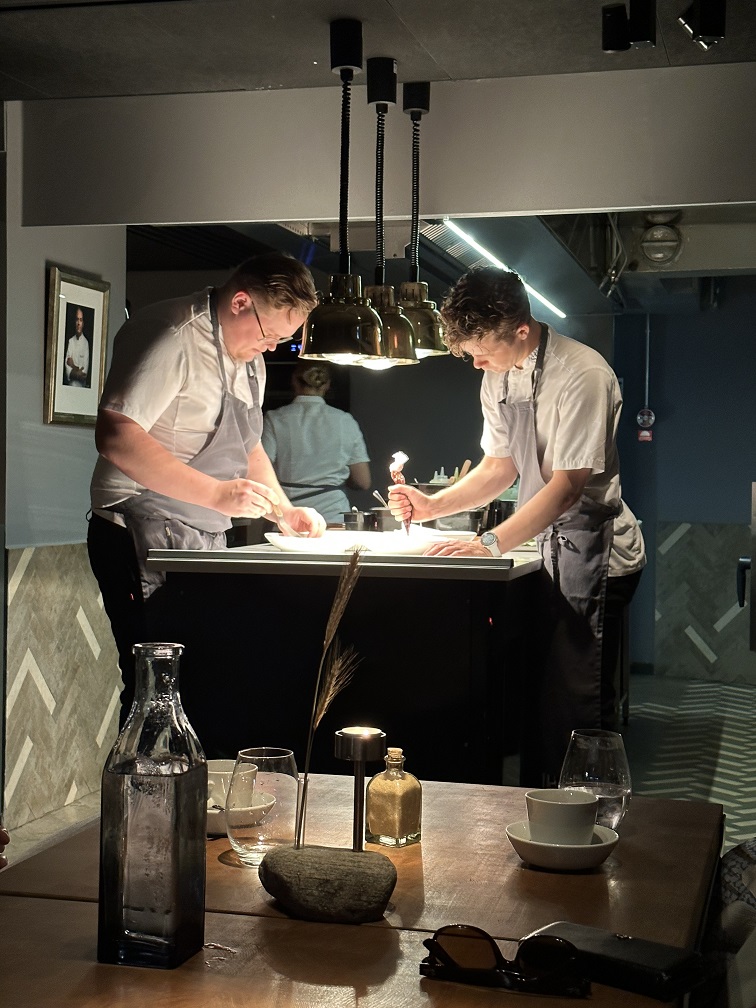
Chefs at work
We were explained that everything at the restaurant is seasonal, locally made and procured. The restaurant has 3 open kitchens, one for cold appetizers, one for warm appetizers and entrees, and one for bread and desserts – yes, fresh bread is made at the restaurant.
The bread arrived first, a little basket with 3 types of bread, and butter which is also made daily at the restaurant, from fresh milk. Also, our first wine was poured – André Lurton Chateau Bonnet Réserve Bordeaux (Sauvignon Blanc/Sémillon), perfectly refreshing as a starter. Next, our first appetizer was presented at a table.


Here lies a problem with how much I can really share with you. The purpose of the dinner was to enjoy it, not to take detailed notes for the blog. I had no printed menu, and each dish was briefly presented by the chef, including all ingredients, spices, and cooking techniques – all within 30 seconds or so. I don’t know about you, but my memory definitely has its limits. Thus my descriptions will be lacking…


The first dish was a fish – I believe haddock (local, of course). I don’t remember any of the spices and condiments, but – the appetizer was brought to the table with a little bowl of grilled tomato broth (yep), and each one of our bowls received two tablespoons of such broth. The appetizer was very tasty and worked well with the wine.
The next wine was the 2020 Leopard’s Leap Culinaria Collection Chenin Blanc Franschhoek Valley South Africa. The wine had a beautiful, concentrated nose, and very good textural presence on the palate, something that good Chenin Blanc can usually deliver.


A warm appetizer was served with this dish – I guess it could be called a confit of artichoke – the artichoke was slowly cooked for a very long time, then deep fried and served with some effervescent cream. The dish was delicious, and pairing with the Chenin Blanc was excellent, with wine complementing and elevating every bite.
The choice of next wine was a bit surprising for me – 2021 Oakridge Over the Shoulder Pinot Noir Yarra Valley Australia. Of course, Australia produces Pinot Noir – but I would definitely look at other regions first if I would want to serve my guests Pinot Noir. The wine was tasty on its own, with a nice nose of smoke, plums, and violets and a firm texture on the palate, definitely on the tart side.


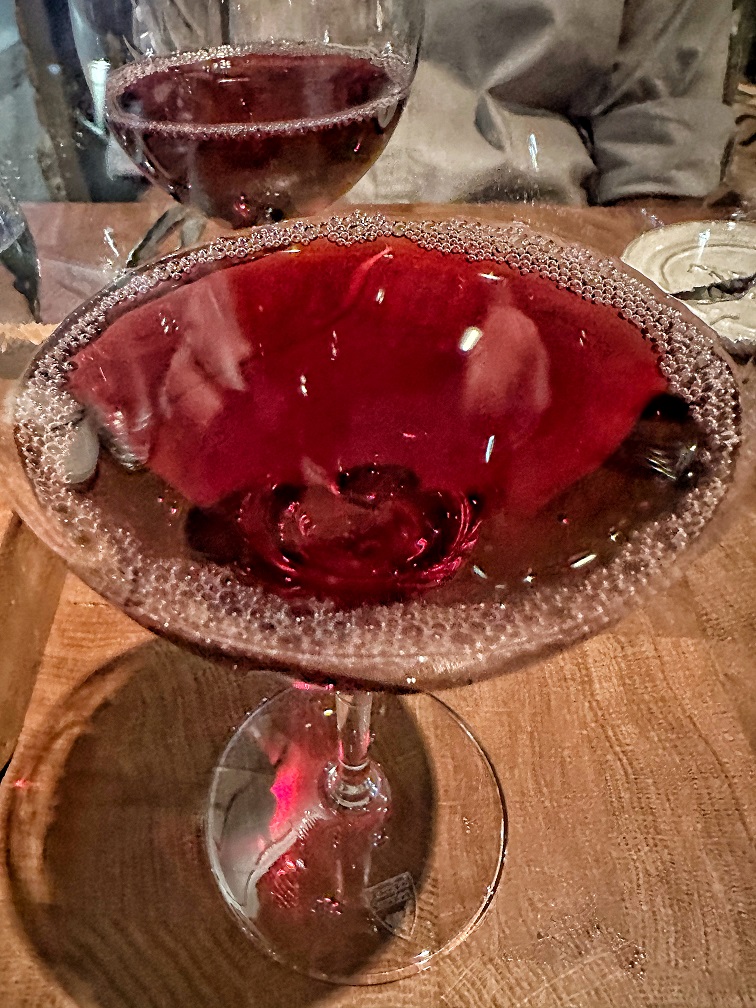
Just look at this color…
Seeing Pinot Noir I was guessing that our main course will be either duck or lamb. To my surprise, we were served local Swedish beef, prepared with celeriac (root of celery) three ways – as a purée, as a spice, and in some other form (sorry, see the note about my memorization skills above), served with the wine reduction sauce. And I don’t know how, but in this dish, taking a bite of food with a sip of that Pinot Noir was akin to some dark magic – remember the restaurant scene in “When Harry Met Sally”? Yeah, that type. Just magic.
Over wine pairing for dessert was essentially a dessert in itself – 2022 Prunotto Asti Spumante DOCG from Italy. The wine was beautiful, pleasantly sweet but with perfect acidity and light fizz, delicious on its own.


Our dessert was a combination of herbal sorbet and local Swedish strawberries. The sorbet was barely sweet and delightful, but taken with a sip of Asti Spumante … OMG (yeah, laugh all you want)… We both agreed that this was truly a “heaven on earth” type of experience… An amazing finish to an amazing meal.
Believe it or not, this dinner took a little bit more than two hours, and the flow of wine and food was such that we didn’t notice how the time had passed. Absolutely different experience compared to an average restaurant visit, where you look at the watch when the bill arrives and realize that you barely spent 50 minutes…
Here you are, my friends. If your travel will take you to Gothenburg, I can’t recommend SK Mat & Människor any higher. Visit, and you will understand.
Alcohol Shenanigans
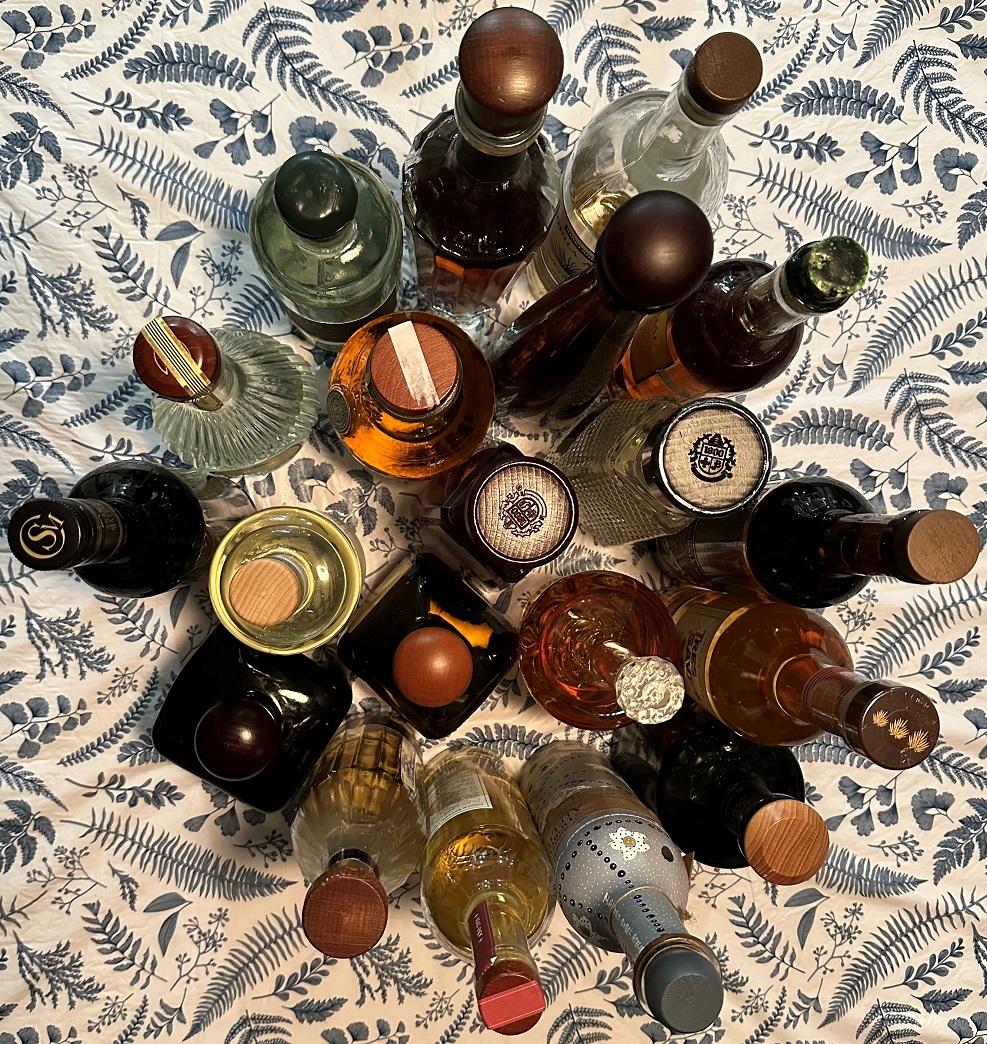 Alcohol Shenanigans.
Yes, I know. The title is not great. Leaves a horrible impression. Sounds like a story about college dorm adventures. And yet this is all I can come up with for this post.
“Next time, we will taste tequila,” said my friend before going home after our cognac tasting. “And I will bring Tequila”, she said.
A few weeks ago, the “next time” arrived – she showed up with about 20 bottles of tequila, mostly anejo with a few interesting oddballs. This is where the shenanigans started.
Mirriam-Webster: Shenanigan Definition: “a: tricky or questionable practices or conduct“
Let’s begin with the fact that we had no idea how you are supposed to taste tequila. Tequila is generally not considered a sipping liquor. Go to the bar, ask for tequila, and it will be served in a shot glass. And here we were not planning on any shots – the plan was to taste tequilas the same way as we do the cognac and scotch. After a short(?) brain freeze, we settled on small glasses – for the people in the US, if you ever bought Tiramisu dessert from Costco – these are the glasses I’m talking about. And off we went.
I think we went through almost a full lineup the first night. I’m sure we made a number of mistakes in the order, as some tequilas tasted sweet and not even reminiscent of a traditional agave – and they tasted very different the next night. And I didn’t mention it before, but we went a bit beyond tequila in the tasting – we also had Mezcal and Sotol. While I’m familiar with Mezcal as a category (side note: Tequila is a subset of Mezcal. Tequila can be made only from blue Agave, but Mezcal can be made from 30 different types of Agave), Sotol was completely new to me.
Sotol is a distilled spirit from Chihuhuan desert in northern Mexico made from the plant called Desert Spoon (there are other scientific names for the plant, but I will leave it for you to research). The plant takes about 15 years to mature, and the yield is about one bottle per plant. Sotol is clearly not widespread at the moment, so I was happy to expand my liquor vocabulary.
This tasting was just for fun, so as you might imagine, I didn’t take any notes. Therefore, the below is just a collection of impressions. We had 3 different types of Don Julio. The Riposado was good, Anejo was very good, and neither one of us cared for Don Julio 1942 Anejo (I call this “overdone”). Chinaco Blanco tequila was very good, restrained and herbal. 1800 Anejo was very good, however, 1800 Anejo Cristalino was even better. I guess when the color was removed to make regular Anejo of the clear color, some of the impurities were filtered out as well, so the resulting tequila was one of the smoothest ever.
Costco’s Kirkland Tequila Anejo was somewhat unimpressive (ok, but too light) – I’m sure it is fine for the money. At some point, we tasted my beloved Tres Generaciones Anejo, which I always compare with the cognac based on its smooth and mellow showing. It had such a pronounced agave taste that I even brought my own bottle thinking that something was wrong with the bottle my friend brought, and my bottle tasted identical. No idea what has happened.
Don Roberto 1924 Anejo was a favorite of my wife and my friend. I liked it too, but it was not my favorite. Casino Azul Anejo, Ocho Single Estate Anejo, Patron Anejo, Centenario Anejo, San Matias Gran Reserva Extra Anejo were all solid, excellent tequilas I would be happy to drink (sip) any day – and yet we had a few more that fared just at an exceptional level.


Wait, before we get to the exceptional ones – the promised oddballs. First, there was not an oddball, but an absolute curveball – 21 Seeds Cucumber Jalapeno Tequila Blanco. It was incredibly spicy to the point of not being able to taste much of anything after a small sip of this fire water. I guess this would be okay as a cocktail mixer, but this is not something I would enjoy by itself.
Los Magos Sotol was very interesting. The herbs were very pronounced on the palate, together with green pepper (not spicy) and cucumber. Truly a unique taste, in a league of its own – of course it makes sense as this was my very first Sotol without any frame of reference.
Next was my personal favorite liquor of the tasting – Mezcal Ilegal Anejo. A typical Mezcal has smoke, both on the nose and on the palate. This Mezcal was truly something else. The only reference I can offer to you is a freshly made log cabin. I don’t know if you ever walked into the log cabin which was recently built – the one that has a smell of freshly cut lumber, this sweet aroma that I can’t really describe. But if you ever experienced that, and if this is something you enjoy, this Mezcal was instantly transporting you to such a cabin – you didn’t even need to close your eyes.


The last Tequila was truly the king of the first night – Gran Centenario Leyenda Extra Anejo. It was round, it was smooth, it was delicious – and it was hiding the agave flavor perfectly well. When I tasted that tequila, I said – tomorrow we are going to compare our “best in show” with cognac. And then we will bring the scotch if we have to.
There is still one more tequila to present – Maestro Dobel Atelier Extra Anejo. A very unique and unusual bottle to begin with. And as far as tequila itself is concerned, it was very round, but somehow was leaving me unmoved, especially in comparison with Gran Centenario. So when we settled for the night’s favorites, Maestro Dobel was not in the picture – but it was a runner-up.

I have to say that I was discouraged by a somewhat puzzling showing of some of the favorite tequilas, so I was convinced that we are not doing the tasting right. The next day, I decided to do a search online to look for recommendations regarding the proper way of tasting the tequila. In one of the first videos, I came across the recommendation to use the Champagne flutes – which made good sense. Our next night’s tasting of Tequila versus Cognac was done using Champagne flutes for Tequila and standard brandy sniffers for the Cognac.
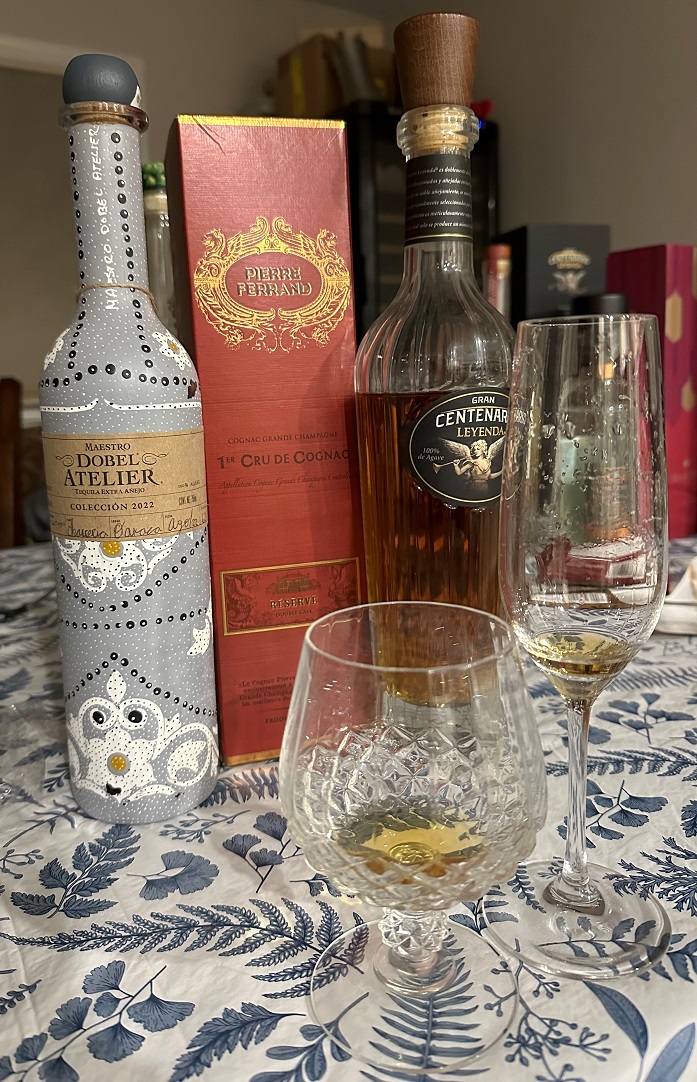
Before we started, I was absolutely sure that cognac, pretty much any decent cognac would have no issues beating tequila in side-by-side tasting. Of course, the only comparison metric we used was a simple “Which liquid do you like more”. And my friend insisted that Dobel Atelier has to be in the tasting – I agreed without much enthusiasm.
As we moved along in the tasting, a simple truth emerged – nothing could beat Dobel Atelier. Granted, I didn’t have the XO-level cognacs to throw into this battle, but we had a few of the excellent cognac specimens – Pierre Ferrand Reserve, Hardy Legend 1863 (spectacular cognac), Park Borderies Mizunara Oak – and Dobel Atelier was still smoother, rounder, and richer than any one of these.
The next night we brought in the Scotch which we both love tremendously. Not only that, but we also decided to switch glasses again and this time we did the tasting using proper, official Glencairn Whisky Tasting glasses. But the story repeated itself. Macallan 15, Macallan 18, Highland Park 16, Lagavulin 16, Glenmorangie 18, Compass Box Affinity – Dobel Atelier was unbeatable…
Truth be told – Dobel Atelier was the most expensive bottle compared with anything else we tasted – if you can find this bottle here in the US (my friend brought it directly from Mexico), it would set you back at least $250. But – I learned about the price of this tequila only after we were done with the tasting, so this was definitely not the factor – and if anything, it would have an opposite effect on me (I’m always a lot more critical of the expensive bottles versus the more reasonably priced ones).

Here you can take another good look at our alcohol shenanigans. Was this tasting a stupid idea? Quite possible. Was it lots of fun? You bet it was. And nobody got hurt 🙂
I’m not trying to be your source of inspiration, but hey, maybe you want to try such a tasting on for size? Cheers!
A Weekend In Unique Wines
A unique wine.
A unique concept.
We can take it to the extreme if we want. Wine in the bottle is a living thing. Wine is changing – for the better or worse, but wine is changing – enzymes are breaking, tannins are fading down. We can claim that every bottle of wine is unique, and similarly to “you can not enter the same river twice”, you can not taste the same wine twice.
Okay, let’s move away from such highly esoteric spaces, and let’s talk about personally unique wine happenings – and I will do my best to explain why I designate each encounter as “unique”.

Unique wine case #1 – “I never had it before”
“light golden color, guava, herbs, med-intensity, inviting; vanilla, apples, lemon, crisp, fresh, round, clean med-long finish” – in all modesty, I’m quoting the description of the wine from my own tweet a few days ago. Looking at this description, what wine do you think was in my glass?
Give it a thought for a few minutes. Meanwhile, I continue.
I will not be playing this #inmyglass game here, of course – especially since I actually borrowed this game from Le Bon Vin #inmyglass. The game was played on Twitter, asking people to identify the place and the grape(s) this wine was made from.
Chardonnay. Chennin Blanc. Sauvignon Blanc. Bordeaux Blend. Garganega from Soave. Lugana. Vermentino. Roero Arneis. These were some of the guesses, I’m sure I’m also missing a whole bunch.
Once we established the place – Italy – and after a few strong hints that the wine is a “curveball” and “thinking out of the box required”, we arrived at the correct answer.
Sangiovese in Bianco. A white wine made from red grapes.
It will not be the first – two out of the 3 main grapes in Champagne are red; Pinot Noir Blanco is quite popular in Oregon; I also had white Merlot and even white Cabernet Franc – and it will not be the last, I’m sure, but this was my personal first experience with white Sangiovese wine.
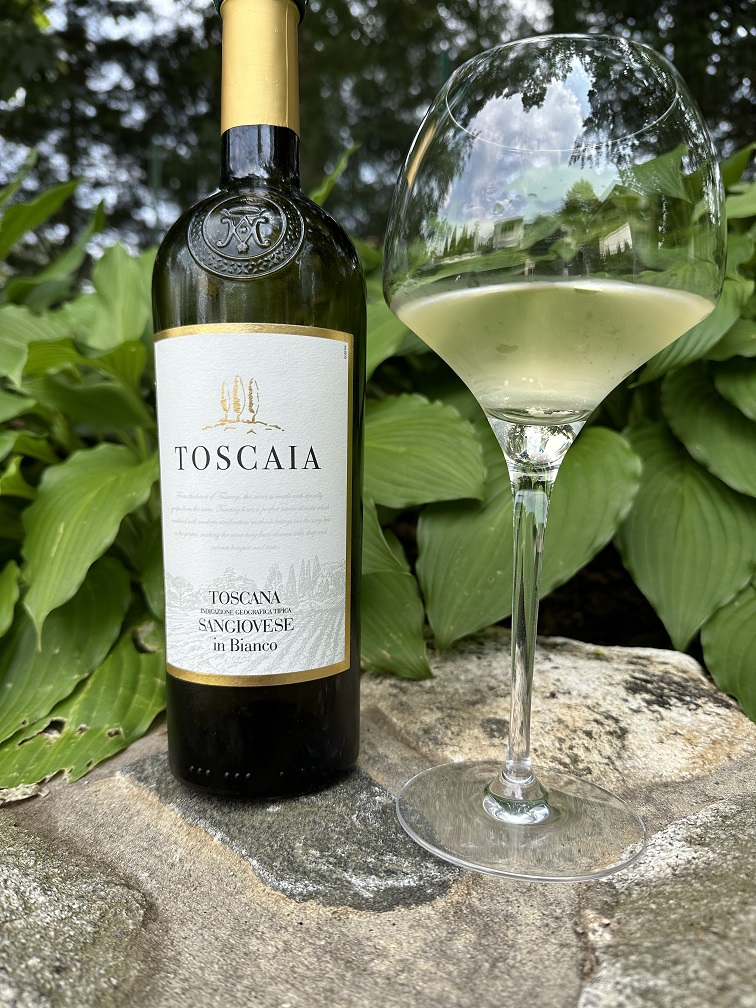
From the very first whiff 2021 La Loggia Toscaia Sangiovese in Bianco Toscana IGT (12.5% ABV) was special. Beautiful aromatics of guava and herbs, followed by a brilliantly balanced presentation on the palate, with lemon, apple and vanilla, crispy, fresh, delicious. If I would try this wine in the blind tasting, I would confidently make my bet on the old world Chardonnay – and yet this wine was made from Sangiovese.
I got this wine from the Last Bottle wines, which means that I might never see the same one again (I have a few more bottles to see how it will age) – but to my delight, I learned that an increasing number of producers offer Sangiovese in Blanco – I just hope the others will be as good as this one.


Unique wine case #2 – I might (will?) never try this again
Every Champagne lover knows Bollinger. A legendary producer whose Champagne was often 007’s wine of choice (yes, it is James Bond I’m talking about). Bollinger even produces one of the Champagnes under the “007” name. But I’m not talking about Champagne here.
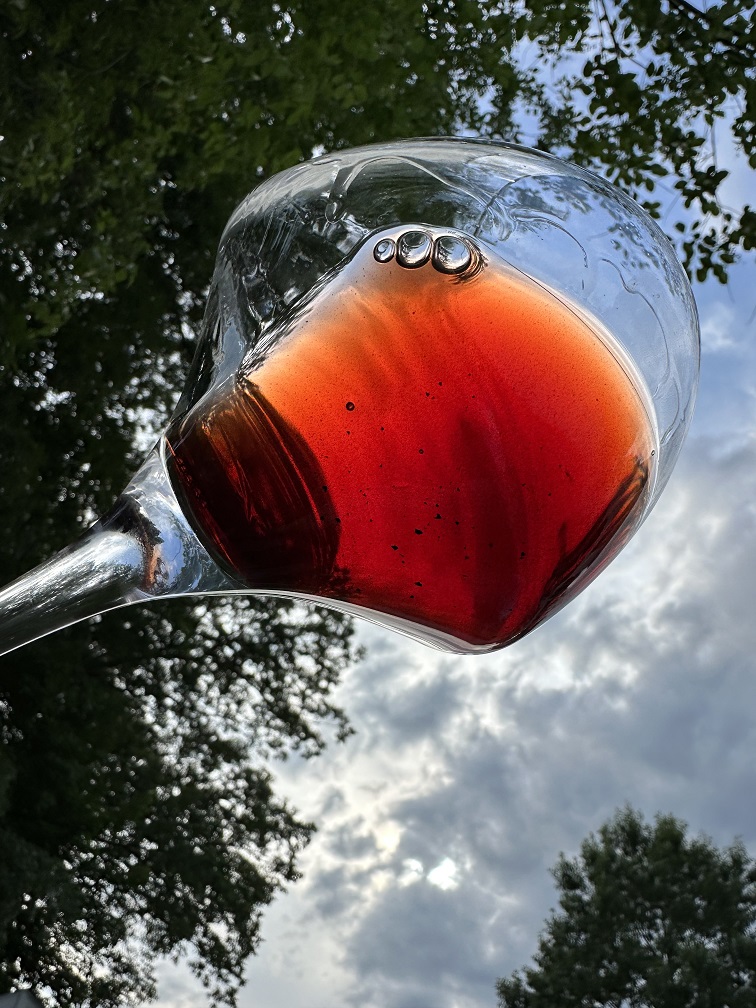
Champagne appellation laws allow production of the still wines. The 2002 Bollinger Ay Rouge La Cote Aux Enfant Coteaux Champenois (12.5% ABV) is red Pinot Noir wine, produced from 2 acres of vineyard called La Cote Aux Enfant located in the heart of Grand Cru Aÿ region and aged in oak casks. This wine is only produced by Bollinger in exceptional years. I had this wine once 9 years ago, and at that time the wine was quite powerful, requiring some time to breathe. This time, the wine was ready to drink from the get-go, offering mostly the tertiary aromas – plums, dried fruit, still having enough acidity and some structure. My daughter offered probably the best descriptor for this wine – she said that the aromatics remind her of an old book – in a good sense. It is the book you lovingly and carefully take into your hands, expecting the magic to happen as you turn the pages. Do I wish I opened this wine 4-5 years ago? You bet. Did I regret my choice of keeping this wine for as long as I did? Not for a split second. A perfect rendition of the mature wine…


Unique wine case #3 – back from the dead and then red with cheese? Surprise!
1998 is one of the special vintages in my book, and I am always on the lookout for 1998 wines for a reasonable price. When I saw 1998 Chateau Saint-Nicolas Fronsac AOC (12.5% ABV) for $19.99 at Wine Exchange, I couldn’t help but grab a few bottles. I opened this bottle right after the 2002 Bollinger. The aromatics were very restrained, and on the palate, the wine just had some glimpses of fruit, but overall the wine gave an impression of the Bordeaux I don’t want to drink. A few hours later, things turned even to the worst – the wine was offering nothing on the nose or on the palate. Of course, it tasted like wine, but it had nothing going I would be able to apply any descriptor to. It was late in the day, so I pumped the air out and decided that I will deal with the wine the next day.
The next day I reopened the wine having literally zero hope for anything even half good happening to this bottle. The smell from the glass offered a glimpse of hope – dark fruit and a hint of eucalyptus showed up. To my delight, the palate completely transformed, offering silky cassis, anis, and lots of herbs. The wine didn’t even give out its age, it was still perfectly fresh with a good amount of acidity.
I had a small cheese board on the table, and without much thought, I took a sip of wine after a cracker with cheese. Combining wine and cheese is a lot more difficult than people like to think, so once again, I didn’t expect much. All of a sudden the taste buds jumped of joy, because the cheese, Bucheron soft-ripened goat cheese from Trader Joe’s, was perfectly complemented by this 21-year-old Bordeaux, creating a new level of hedonistic pleasure. A unique wine transformation and a unique pleasure of elevated food and wine experience – the experience worth remembering.
Here you are – my report on the weekend in unique wines. When was the last time you had a wine which you considered “unique”?
The Land Whispers… You Just Need To Listen
 I love wine dinners. Especially the wine dinners with the winemaker.
I dread wine dinners. Especially the wine dinners with the winemaker.
I know, I don’t make much sense at the moment. Wine dinners are wonderful, and I really do love them. The dreadful part comes from the experience of not being able to write about those wine dinners in a timely fashion. “Timely fashion”, huh – there are wine dinners I never wrote about in 5 years and such memories can hunt you down – they definitely do for me. I don’t know why this is happening on a regular basis – the elation often experienced during open and engaging conversations about wine becomes an ephemeral spirit, woefully resistful and easily escaping the slightest attempt to capture it in the form of words…
Let’s see if I will be able to break my unsettling tradition.
Last week I had a wonderful time and experience tasting the wines of Viñedos Veramonte and speaking with Gonzalo Bertelsen, General Manager and Head Winemaker in a small group of wine lovers, around the dinner table at the Monterey Brasserie in New York. The conversation topics were ranging from low-alcohol wines (is that really a trend? Are people really asking for it or is that just a gimmick?) to the production of organic and biodynamic wines to “why Germans don’t want to drink organic wines from Chile” (I will not tell you why but you are welcome to guess) and to many other far and between. But most importantly we got to enjoy Viñedos Veramonte wines with and without the food.
Viñedos Veramonte was one of the first wineries in the Casablanca region, founded in 1990 by Agustin Huneeus, a Chilean wine pioneer. From the very beginning, the winery embraced organic viticulture – and more recently, the winery spent more than 6 years making estate vineyards officially organic certified, obtaining ECOCERT® organic certification, one of the most respected in the world. The project involved the conversion of more than 1,200 acres of vineyards in Casablanca and Colchagua valleys to organic and biodynamic farming, with the aim to also become fully Demeter’s biodynamic certified – which requires making changes in the winery, not only in the vineyard – plus importers also have to be biodynamic certified.
Viñedos Veramonte produces 4 distinct lines of wines – Veramonte, Ritual, Primus, and Neyen – all from organic grapes, of course. We had an opportunity to taste wines from all 4 lines.


We started with the 2022 Veramonte Sauvignon Blanc Reserva Casablanca Valley ($13.99 SRP). This wine has one of the biggest productions, and it is very important for Veramonte. Preserving freshness is paramount, so special care is taken to prevent any oxidation of the grapes and juice, and the wine is bottled as soon as possible. The wine was herbaceous and crisp, delicious on its own but also nicely supporting our first course – Grande Plateau of seafood containing oysters, clams, tuna tartare, and lobster. The Sauvignon Blanc pairing with the oysters was the best – and the oysters were delicious, probably my favorite component of the Grand Plateau.


Next, we moved on to the 2019 Ritual Chardonnay Casablanca Valley ($20.99 SRP, fermented in oak barrels and concrete tanks). I wrote about Ritual wines many times, last time only a few months ago – the wines are consistently delicious. The wine was paired with a choice of appetizer – crispy artichokes or barbecued prawns. I selected crispy artichokes, forgetting that artichokes are notoriously difficult to be paired with wine. The dish was delicious on its own, and the wine was also good – on its own.
We also tried the 2020 Primus Carmenere Apalta DO ($20.99 SRP) with our appetizer course. The wine was excellent and had a nice profile of cassis supported by the bell peppers, showing off the pyrazines. Some of the winemakers are trying to prevent the pyrazines from showing up by changing growing conditions, harvesting regime and more – but I personally enjoy the pyrazines’ flavor very much, it adds to the authenticity of the wine. While Carmenere was still not a perfect match for the artichokes, it offered a bit better pairing than the Chardonnay.
Now we were ready for the main course, and the new wine arrived.
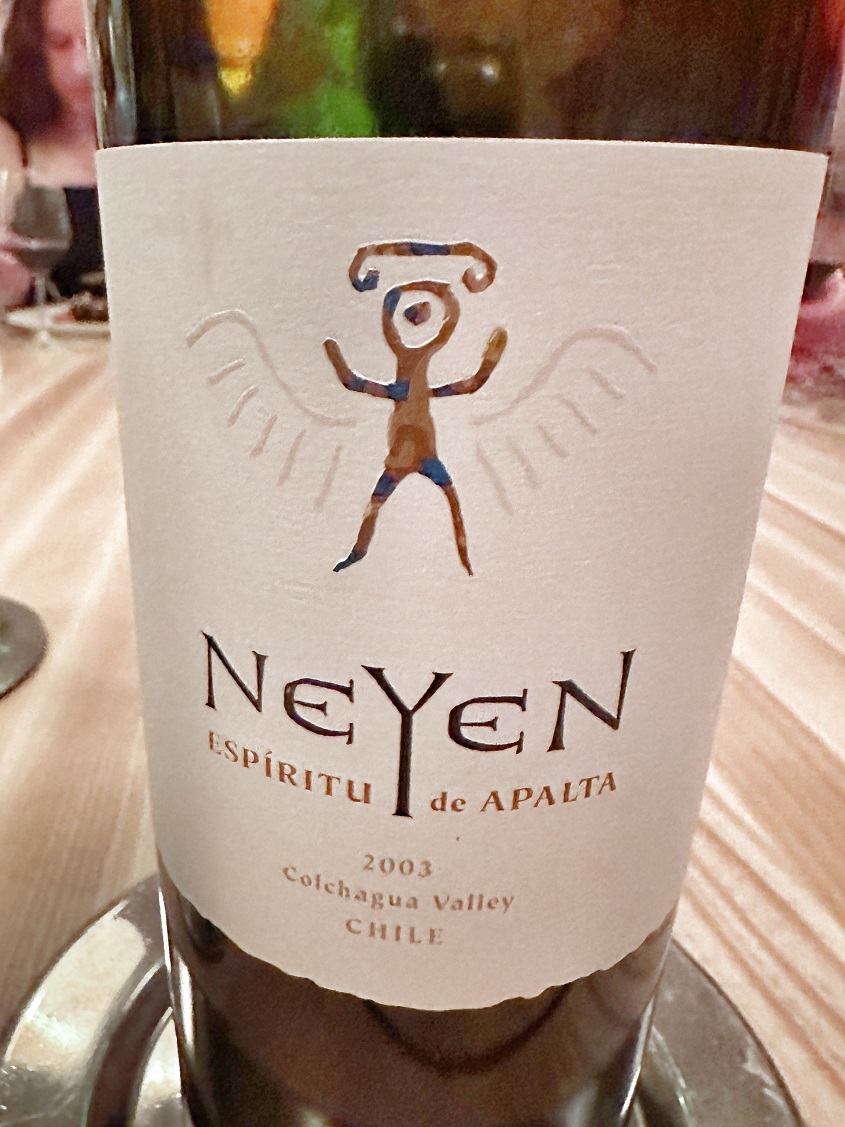


Last December I had an opportunity to try for the first time yet another Veramonte wine called Neyen. Neyen vineyards are located on a small parcel of land situated between the Andes Mountains and the Coastal Range. Neyen wines are literally always a blend of 50% Cabernet Sauvignon and 50% Carmenere, both coming from truly the old vines – Cabernet Sauvignon vines were planted in 1889, joined by Carmenere in 1936, which makes the vines respectively 134 and 87 years old.
In the local dialect, Neyen means “whisper”. The land whispers, you only need to listen to her – low intervention is what the Neyen winemakers practice. And this is the whisper you can taste.
The wine literally stopped me in my tracks. You know that stupid smile that you can’t control when something good is happening? This was my face upon the first whiff of the 2003 Neyen Espíritu de Apalta Apalta DO ($N/A) – the first vintage of Neyen wine ever produced. The time stopped – there was only the endless pleasure of aromatics that only mature wine can bring.
Time, wait. Don’t move. I’m still enjoying it. Please, just a few more moments.
Cassis and eucalyptus on the nose. Cassis and eucalyptus on the palate, silky smooth, perfectly integrated tannins, full body of the mature wine at its absolute peak, pleasure slowly descending layer after layer. This is the case where the words are clearly insufficient to describe the joy of the oenophile, but I hope I offered at least a glimpse.
For the main course, I selected Bluefin Tuna au Poivre with baby beets and citrus sauce – and to my delight, the 2003 Neyen offered a perfect pairing, elevating every bite of the food.
We also had the 2016 Neyen, Espíritu de Apalta Apalta DO ($N/A). Tasting 2016 after 2003 was somewhat of a mistake. 2016 is an excellent wine, but the beautiful core we were able to experience in 2003 was still covered by layers of baby fat, the wine showing a lot richer, almost jammy on the first sip, and in need of time to open up.
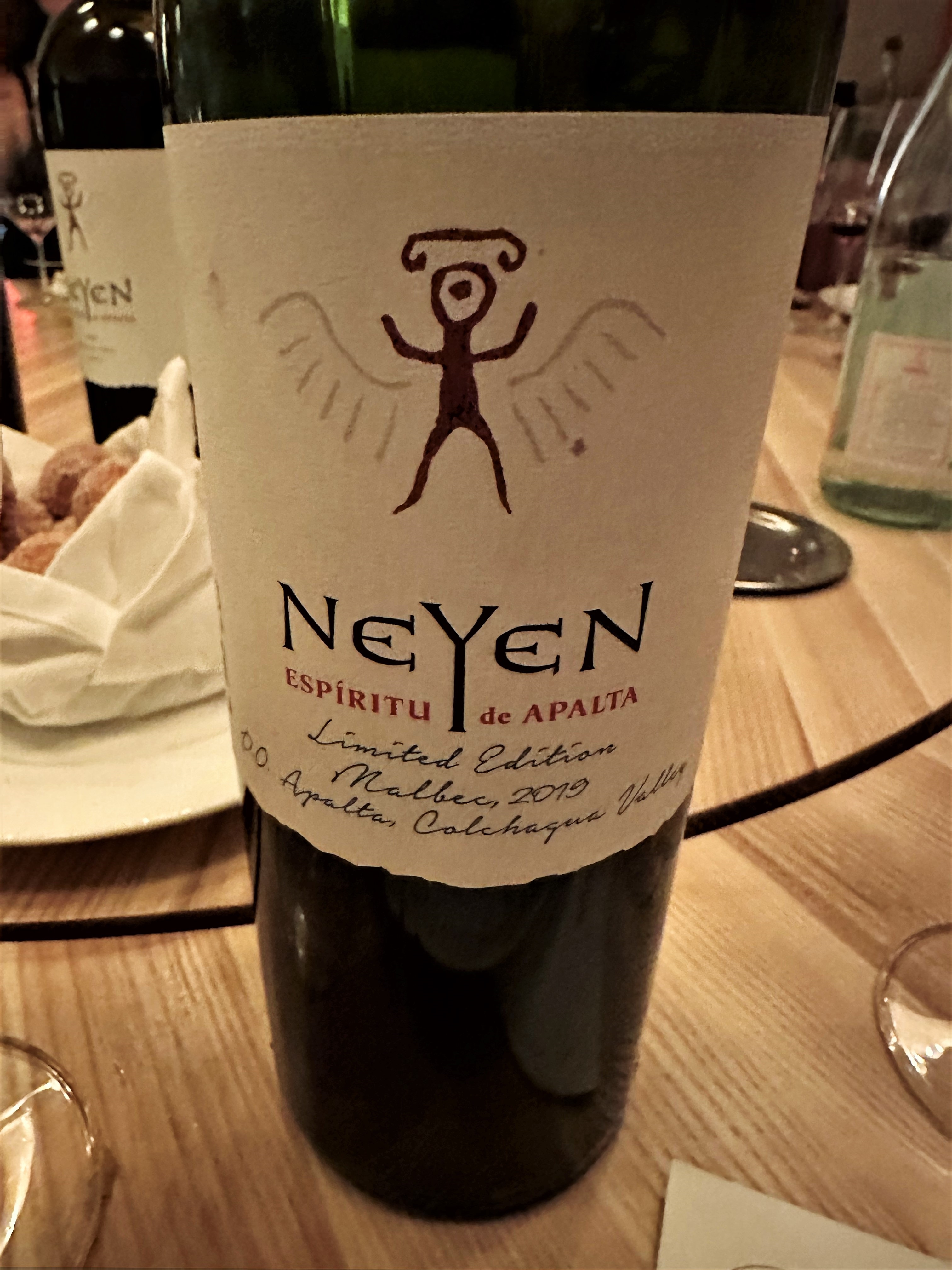
The culmination point of our evening, though, was … a bit unexpectedly, as we are talking about Chilean wines … the Malbec. 2019 Neyen Espíritu de Apalta Malbec Apalta DO ($149.99 SRP). 2016 was the first released vintage of this super low-intervention wine – harvested and destemmed by hand, fermented in small tanks, no machines, no electricity used in the production of this wine, aging only in 3rd and 4th use French oak barrels. This is the crown jewel of the Veramonte Neyen collection – even James Suckling agrees, rating this wine at 100 points. Only 200 cases of the wine were produced in 2019, with the US allocation standing at 40 cases.
The main word I would use to describe this wine would be “elegant”. The wine was showing beautiful eucalyptus notes, a lot leaner than most of the Argentinian Malbecs, begging comparison with old world Malbec, the Cahors. Elegant, layered, delicious.
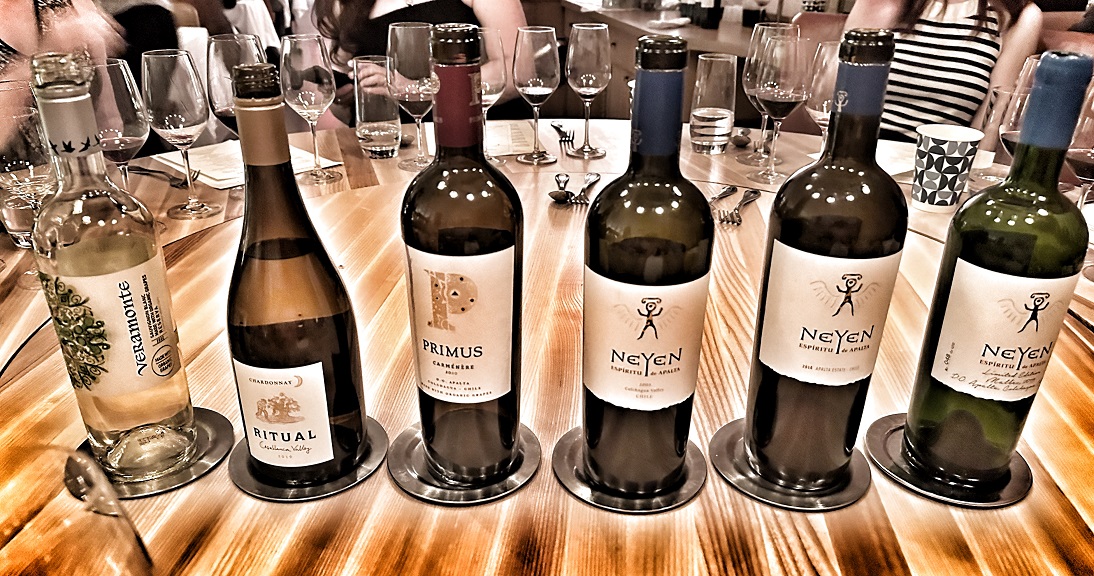
And this, my friends, brings us to the end of the wonderful evening. The company was great, the food was excellent, the wines were amazing.
Mother Nature whispers, and good things happen when we listen. I wish I had a case of this 2003 Neyen Espiritu de Apalta – that would really make me happy. Well, we generally don’t get to have all the things we want – and I’m grateful for the opportunity to experience such wines at least once.
Veramonte wines offer a great selection for every budget and every palate – check them out when you will have a chance. Cheers!
Experience Lugana in New York
“Drink your Lugana young, very young and you will enjoy its freshness. Drink it after two or three years and you will enjoy its fullness. Drink it after ten years and you will be amazed by its dignified authoritativeness. Lugana wines, a rarity of their kind, have an extraordinary ability to make themselves known. If you taste a Lugana, and you are a competent taster, you cannot forget it”
– Luigi Veronelli
Imagine yourself sitting by the lake, a beautiful lake.
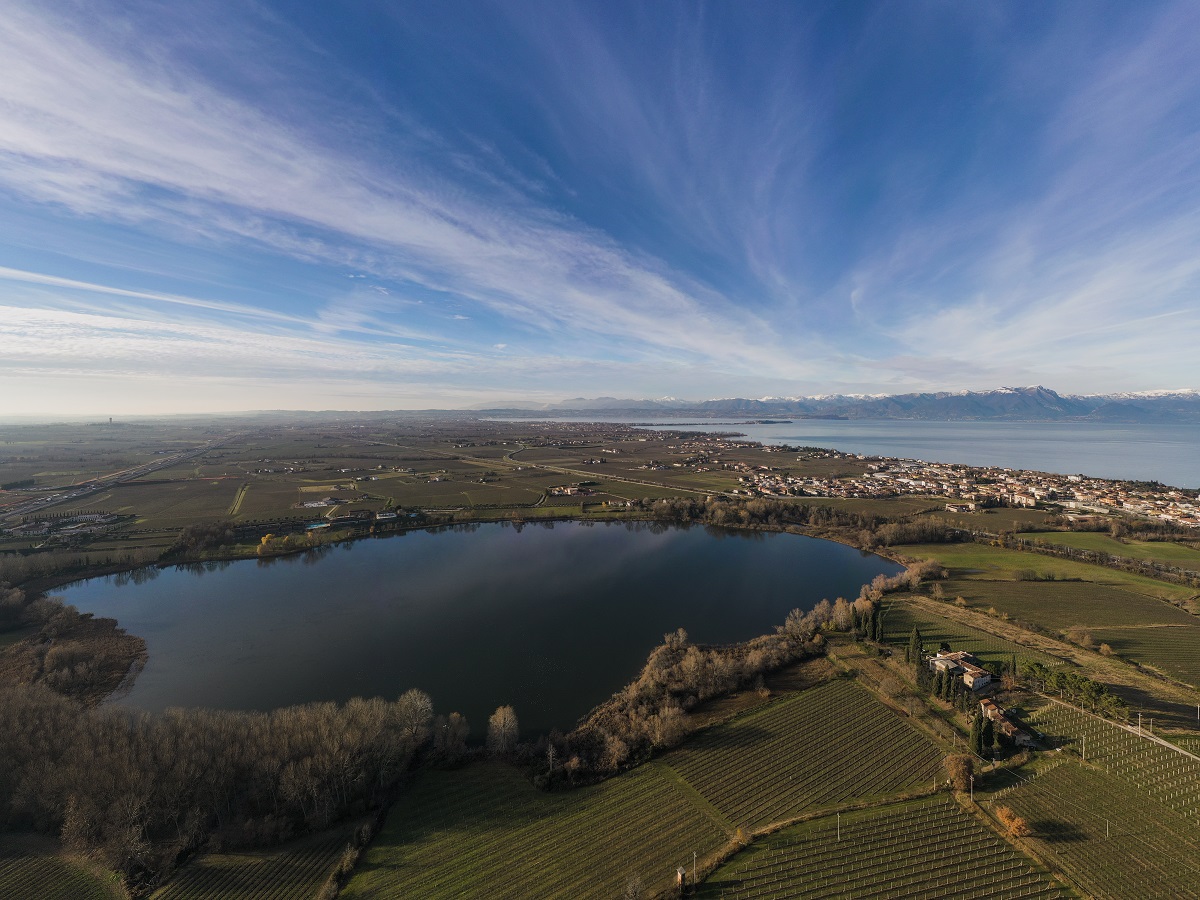
Source: Consorzio Tutela Lugana DOC
Let’s make it more precise, to make the picture vivid.
Imagine yourself sitting by Lake Garda in Northern Italy, on a beautiful summer day. The water is tranquil, there are tiny waves and an endless horizon. Next to you, there is a little table with a glass of white wine. You take the glass, take a sip of the wine. The wine is delicious, it is locally made, it is called Lugana, and you take another sip of the liquid pleasure. You capture the moment of this pure, hedonistic pleasure in your memory, Next, you put the glass down and go back to your happy thoughts. In that moment, life is absolutely perfect.
What if I will tell you that you don’t have to travel to Italy right this moment to experience this life’s perfection? What if this experience can come to you?
If you live in New York or the New York area or plan to visit the city over the next few weeks, you are in luck. Instead of you going to Lugana, Lugana is coming to you. The Lugana wine experience is coming to New York. And this Lugana experience will move past just the Lugana wine itself – it will bring you the ultimate gourmet’s salvation – wine and food paired together.
Starting on Monday, June 12th, 19 producers from Lugana will have their wines paired at a series of dinners taking place at 6 New York restaurants (I will give you a full list of restaurants and producers in a minute). All the wines will be specifically paired with the dishes – and as someone who never visited Lugana, I was really curious about what one can expect to find on such special dinner menus. I reached out to Consorzio Tutela Lugana DOC which is organizing this event, and asked a simple question (or two): What is the traditional Lugana food? What are the traditional pairings for the Lugana dishes and wines? Here is the reply that I received:
“Like all Italian wines with century-long traditions linking them to their place of origin, Lugana is lovingly paired with the classic gastronomic repertoire of the region. This of course includes dishes of freshwater fish: from the lake, river or stream, whether noble or poor. But even better-known sea fish can be happily matched with this refined and versatile white. Therefore the “base” version can be readily paired with seafood antipasti, fried pessìn (small fish or whitebait from the paddy fields), boiled bass, boiled shrimps and large carp. The Superiore and the Riserva are literally the perfect partner for richer and more complex dishes, such as pike in sauce (boiled pike with anchovies lightly sautéed in oil, from Lake Garda of course), grilled eel, trout with grape, risotto with frogs, as well as grilled crustaceans, peppered clams, salted bass, and several white meat dishes, such as chicken, capon and rabbit (especially roasted in the oven). The Vendemmia Tardiva (late harvest) wines are ideally matched with cheeses, from the fresher varieties such as ricotta, robiola and crescenza, to the more seasoned and flavoursome such as several exquisite D.O.P. cheeses like Monte Veronese, Grana Padano and Provolone Valpadana. Spumante has a broad range of possible pairings, since this “bubbly” wine can be served right throughout the meal. However, since a spumante is usually uncorked at the beginning of a lunch or dinner, why not try it with all types of antipasto, ranging from the broad range of tasty local cold meats to the wide variety of egg-based dishes. Instead avoid serving it with dessert. The versatility of this wine does not stop here. International tastes are certainly no obstacle for Lugana. This white wine, either in its “base” version, Spumante, Superiore or Riserva, is in fact the perfect match for raw fish, from the Japanese sashimi and sushi to all the variations on the theme proposed at the international level. It is also ideal with salmon and tuna and the perfect match for seafood finger food. Ideal serving temperature (in broad bowl tulip-shaped wine glasses for all varieties): Lugana Spumante at 8°C; Lugana “base” at 12°C; Lugana Superiore and Riserva at 14°C; Lugana Vendemmia Tardiva at 12°C.”

Lugana wines are produced from the local indigenous variety called Turbiana. Lugana wines can be still, sparkling, and late harvest (sweet), but no matter what the style is, they are literally guaranteed to be delicious. I had an opportunity to do a little preview of what someone might anticipate experiencing during the tasting – here are my notes on 3 wines that will be presented during the tasting:
2022 Corte Sermana Cromalgo Lugana DOC (13% ABV)
Straw pale
Beautiful intensity of tropical fruit, lemon and honey
Lemon and lemon zest, a hint of white peach and underripe white plum, tart, perfectly structured, with medium-long, tart finish
8, delicious.
2022 Ottella Lugana DOC (12.5% ABV)
Straw pale
Tropical fruit, guava, lemon, honey, herbaceous undertones
Crisp, fresh, tight, Meyer lemon, clean acidity, a tiny hint of gunflint.
8, imbues seafood craving
2022 Perla del Garda Lugana DOP (12.5% ABV)
Straw pale
Tropical fruit, honey, fresh, inviting, enticing, seductive. It says “drink me”
Beautiful. Fresh Whitestone fruit, cut through acidity, lemon. Crisp, fresh, delicious. A happy wine that can transpose you.
8+, superb. Had a few friends try this wine too, and they were literally blown away by it.
As promised, here is the list of participating restaurants, dinner dates, and the wines which will be poured at each:
IL FIORISTA (Monday, June 12, 2023)
Le Morette, Mandorlara 2022
Cantine Di Verona, Torre di Falasco 2022
Tommasi, Le Fornaci
VICEVERSA (Tuesday, June 13, 2023)
Ca’ Maiol, Lugana Prestige 2022
Scolari, Lugana Doc Premium 2022
Zenato, Riserva 2020
GNOCCO (Monday, June 19, 2023)
Sguardi di Terra, Riserva 2018 Fachetnabia
Selva Capuzza, Selva 2021
Ceresa, Ceresa 2022
Montonale, Montunal 2022
HEARTH (Monday, June 19, 2023)
Zeni 1870, Vigne Alte 2022
Tenuta Roveglia, Vigne Catullo Riserva 2019
Famiglia Olivini, Lugana 2022
MISIRIZZI (Wednesday, June 21, 2023)
Pasini, Il Lugana 2022
Perla del Garda, Madonna della Scoperta 2021
Citari, Conchiglia 2022
OSTERIA CARLINA TRIBECA (Thursday, June 22, 2023)
Corte Sermana, Riserva 2017
Vigneti Villabella, Lugana 2022
Ottella, Lugana 2022
You can find additional details of the Lugana festivities in New York on the Destination Lugana website.
This is not every day that instead of you going to your travel destination to experience delicious life’s offerings, the travel destination comes to you. This is your chance for a memorable experience and I hope you will not miss it.
And I will be sure to tell you more… Who knows, maybe we will run into each other during one of the dinners. Cheers!
Restaurant Files: 360 Experience – Çka ka Qëllu in Stamford, Connecticut
Wow, it’s been over 4 years since I posted about the restaurant visit on these pages. “Restaurant files” used to be a regular feature on this blog, and yesterday’s restaurant experience offered a perfect opportunity to bring it back, so here we are.
Think about your restaurant visits. Sometimes, we love the food, but the wine list is not up to snuff, and the cocktails are just bland and tasteless. Sometimes, the food and wine are amazing, but you can’t stand the ambiance (this was my case recently while visiting Firefly in Las Vegas – one of my favorite restaurants, just moved to the new location, and the food became even better while I actively despised the decor). Sometimes, all is great, but not the service. Some other times, all is good, but the experience simply can’t cost that much.

And then there are those where everything works, delivering that wonderful feeling of a great, memorable experience. I took the liberty to call such a situation a 360 experience – an all-around happy experience.
I was interested in visiting this new restaurant in Stamford, Çka ka Qëllu, for a while. The restaurant offers Albanian cuisine which I’m not familiar with. And it is not only food – the wine list also contains a couple of Albanian wines. I never had Albanian wines, so I’m obviously curious – and it is also an opportunity to add a checkmark to my collection of wines around the world. Last but not least is the fact that the restaurant participates in Marriott’s Eat Around Town program – who can say no to the bonus points?


The moment we walked into the restaurant, we were instantly transported to different place and different time. I remember walking in the center of Tokyo, along a wide, modern street, wondering what restaurant my host is taking me to. We took a turn under the bridge, and we instantly traveled probably 400 years back, to the old place where food was cooked by the open fire in the tiny stores, and dining tables were rustic, eternal wooden benches. At the Çka ka Qëllu, I had exactly the same feeling – we traveled to medieval Europe, just 3 miles away from our house. All the decor, the tunnel leading to the kitchen, the old clock on the wall… The whole time we were at the restaurant, I kept looking for more of the unique tiny details.


First, the drinks. Out of the long list of craft cocktails, my wife went for the Strawberry Margarita, which was absolutely delightful – very reasonable sweetness and a pop of fresh strawberries. I knew that I wanted to try an Albanian wine – I didn’t see it offered by the glass, but when I asked our waiter if I can get a glass of Albanian white wine, the answer was “of course”. I was honestly not expecting much, but the very first whiff of the glass of the 2019 Stone Castle Chardonnay Reserve Rahoveci Valley Kosovo brought me to the happy land. This was beautiful, classic Chardonnay, with vanilla, apples, a hint of perfectly integrated butter notes with honey – as classic as Chardonnay gets.
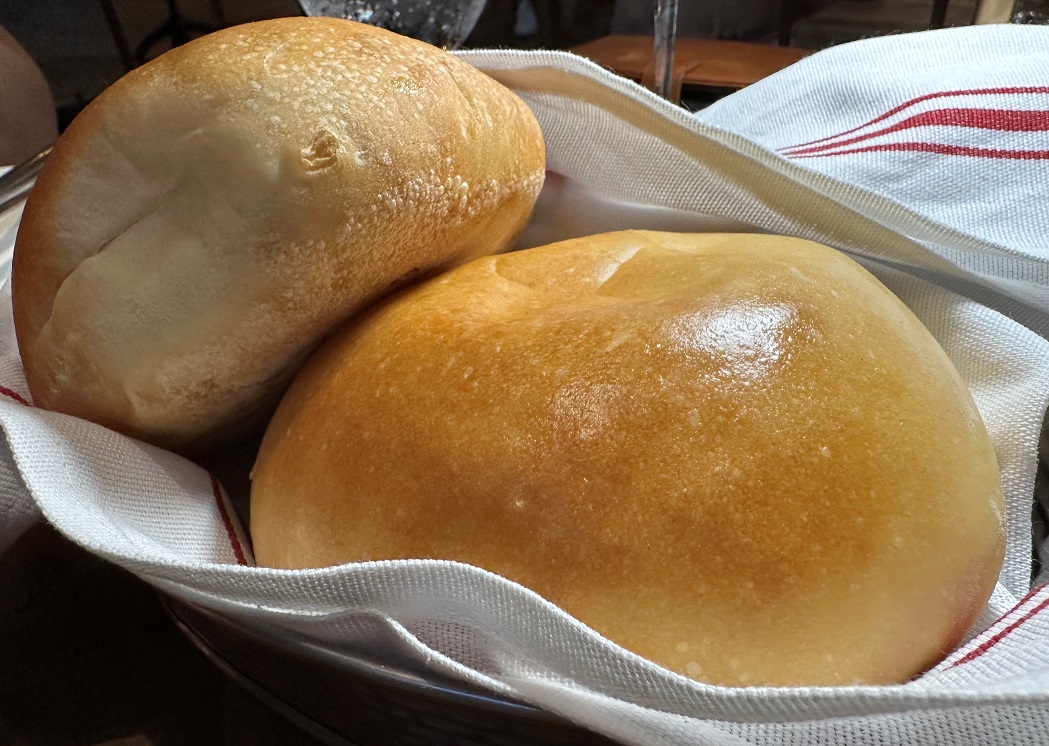


We ordered a few appetizers – Pepper Dip, Mantia (veal-stuffed small fried dumplings), and Burek (a pastry with cheese or meat, we ordered cheese). The appetizers showed up with two loaves of fresh bread which I’m sure is made at a restaurant. That bread was absolutely delicious and was perfect with the pepper dip. As a bonus, the flavor of the cheese the pepper dip was made with was reminiscent of the famous Georgian Khachapuri. The dumplings were delicious too. Burek was served with two sauces – a sweet pepper relish and another one reminiscent of the fresh buttermilk – not sure what it was, but very tasty.


For the main course, my wife decided on Qofte (traditional Albanian grilled veal meatballs marined with onions, crushed red pepper & herbs) – delicious is not even a sufficient word that can describe the flavor profile. I’ve chosen Fasul (soup style traditional dish with simmering white beans, and onions, slowly cooked in meat). I love white beans in any form, and by description, the dish was reminiscent of my beloved French Cassoulet, so I decided on this entree as soon as I saw it on the menu. I made the right choice – the dish was served in a small clay vessel and this dish was a pure comfort on the plate – delicious to the smallest, tiniest little morsel.
Traveling through space and time with Çka ka Qëllu made for a great Friday evening – a true 360, all-around experience (I didn’t mention the service that was timely, attentive, and friendly), just a few minutes away from our house. If you are living in Stamford or nearby, Çka ka Qëllu is definitely a place to visit. And you can thank me later – but don’t feel obliged.
We will definitely be back. Cheers!
Wine Weekend of Ups and Downs
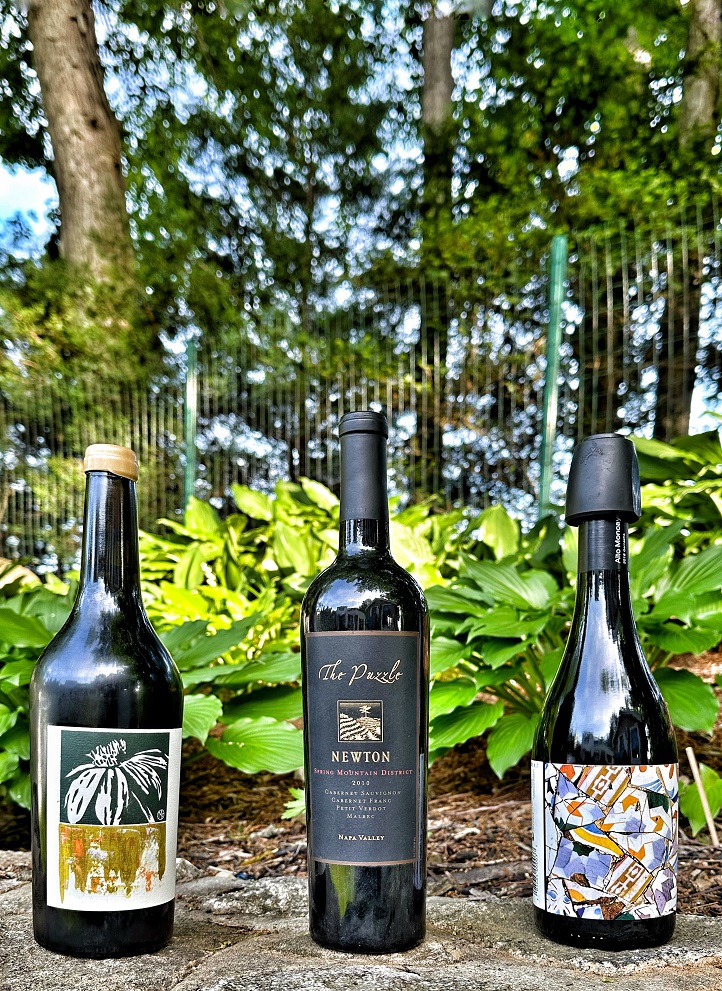 The life of an oenophile is never dull – of course, if an oenophile chooses such.
UP
Let’s talk about “ups” first.
Sine Qua Non. The legendary Sine Qua Non. The Sine Qua Non winery is unique in many ways. First and foremost, Sine Qua Non wines are unique. Of course, every winemaker is sure that his or her wines are unique. But for Sine Qua Non, these are not just bragging words. Every vintage, a different set of wines is produced, and wines do not or rarely repeat year after year. Each wine has a label designed by Manfred Krankl, who owns the winery together with his wife Elaine. And the wines are impossible to get – I had to wait for 10+ years to move from the waiting list to the mailing list.
My sister-in-law and her husband were visiting over the weekend. They both enjoy wine very much – which is a perfect reason to get out a special bottle. Sine Qua Non is better known for its Rhone-style reds, but they produce white wines as well. One of the first wines in my allocation was Sine Qua Non white wine. Communal notes on the internet seem to indicate that SQN white wines shouldn’t be aged for too long, so I decided that 4 years is a good age for this wine, to avoid any possible regrets (who am I kidding – there are always regrets when it comes to wine).


2019 Sine Qua Non Distenta 1 California White Wine (15.3% ABV) is a blend of 41% Roussanne, 26% Chardonnay, 14% Petit Manseng, 12% Viognier and 7% Muskat (Gelber Muskateller), fermented in barrel and matured on its lees, 23 months in 64% new French oak. The sublime nose of whitestone fruit, herbs, and flowers, with a distant hint of tropical fruit. And the palate, the bouquet… As a child, I loved to sing, and I spent some time in the chorus. I was perfectly fine singing in unison, but for the life of me, I could never do the canon, the subtype of polyphonic singing, where each singer has their own melody, and those melodies harmoniously combine together. This wine delivered such a canon singing – beautiful notes of sage, eucalyptus, tobacco, and whitestone fruit were changing into tropical fruit with a touch of bright honey notes. Somehow, it was possible to taste both profiles at the same time. I know I’m not describing it well, but this was the wine I really didn’t want to end… (Drinkability: 9)
By the way, an added bonus – it appears that I never had the Gelber Muskateller grape – and now I can unexpectedly increase my grape count.


DOWN
Over the years, I got two bottles of red wine from Newton Vineyards, a well-respected California winery, as presents, both from the same 2010 vintage, and both identical. I know the producer’s name, but it seems that I only tasted Newton Chardonnay before, and I have no memories of tasting their red wines.
Both bottles were gifted by the sister-in-law and her husband I just mentioned, so I thought their visit was a perfect opportunity to enjoy this wine together.
And so I opened the bottle of 2010 Newton The Puzzle Spring Mountain District Napa Valley (14.5% ABV, 60% Cabernet Sauvignon, 18% Cabernet Franc, 18% Petit Verdot, 4% Malbec).
And the bottle was corked.
I just recently mentioned in one of the social media discussions that I rarely encounter corked California wines. I guess I jinxed it… The cork faint was ever so slightly noticeable on the nose, and the palate kind of seemed okay, so I even decanted it and we even tried drinking it. The decanting made the corked nature of the wine even more apparent, and I pulled the second bottle.
The second bottle was not corked, and it was drinkable. However, it was a bit underwhelming. The fruit was there, it was possible to taste the cassis, but considering that this was a Californian wine, it showed leaner than expected. I would generally consider that Californian wine of such level need at least 20 years to develop, and under normal circumstances I would leave the second bottle alone for another 5-7 years, but oh well. We did enjoy it, of course, I was just hoping we would enjoy it more. (Drinkability: 8- )
STILL DOWN
I’m not going in chronological order here. The Newton red was planned to be the main wine to serve with dinner. As a “pre-gaming”, I gleefully pulled out the 2018 Alto Moncayo Veraton Campo de Borja (15.5% ABV). I opened a bottle of this 100% Garnacha last year, and it was absolutely spectacular from the get-go – succulent cherries and layers of pleasure. I loved the wine so much that it was included in the top two dozen list of 2022 wines as number 13.
Feeling great about myself, I opened the bottle and poured wine into the glasses. At the first tiniest sip, instead of excitement, my instant thought was “ohhh nooo, why is it so sweet???”. I also instantly knew that I’m in trouble with my sister-in-law, as she stopped drinking California Pinot Noirs for being too sweet… And her reaction was exactly what I was afraid of. After the first sip, she raised her head from the glass, looked at me inquisitively, and said with a wry smile “but why is it so sweet?”. This is when we put this bottle aside and proceeded with The Puzzle – and you just read how swimmingly well it went.
Truly, whatever goes up will go down.
AND UP AGAIN
Whatever went down still has a chance to go up.
The very next day, Veraton somewhat solidified at its core, the sweetness subsided, and the structure started to appear. On the third day, the wine was as delicious as I was expecting it to be – succulent ripe cherries, juicy and generous, with crunchy acidity and perfect balance. (Drinkability: 8+).
Here you go, my friends. Another weekend in wine – sometimes you win, sometimes you learn. With the exception of the corked bottle, which is never okay – but as my sales team always said, “it comes with the territory” – it was a great wine weekend, even with all the ups and downs. How was yours?
Weekend in Turley, With a Dash Of Carlisle and Hardy
Many moons ago, my friend Henry and I discovered Turley wines. We were at a restaurant in Manhattan with our wives, either before or after the Broadway show, and on the wine list, Turley Zinfandel (either Juvenile or Old Vines) was one of the reasonably priced wines, so that was the wine we ordered. I don’t remember if I heard about Turley before (maybe), but tasting that wine was a pivotal moment – we fell in love with Turley wines.
Turley Wine Cellars was founded in Napa Valley by emergency room physician, Larry Turley in 1993, and went on to become one of the most prominent Zinfandel producers in the US. Turley produces about 50 different wines from about 50 different vineyards, most of them organically farmed, from all around California. Many of those vineyards date back to the late 1800s. While Turley might be best known for its Zinfandel and Petitte Sirah, they also produce a number of white wines, a number of other reds, and even Cabernet Sauvignon, first produced in 2010, and eloquently called The Label (Larry Turley’s famous saying was that Cabernet drinkers drink “the label”, hence the name – I had my own share of troubles with this wine).
Turley wines are hard to get in the store, and if you really would like to enjoy them at will, you need to be on the Turley mailing list. Turley was one of the very first mailing lists I managed to get on more than 10 years ago, and I had been a happy customer ever since. My friend Henry finally got his first allocation about two years back.
A place on the mailing list still doesn’t guarantee you access to each and every wine Turley makes, and their list operates on a “first come, first serve” basis – I missed quite a few wines that were included in my offering, but disappeared much sooner than I could make up my mind.
Last Saturday, Henry was coming over for dinner, so I had to make it a Turley evening.
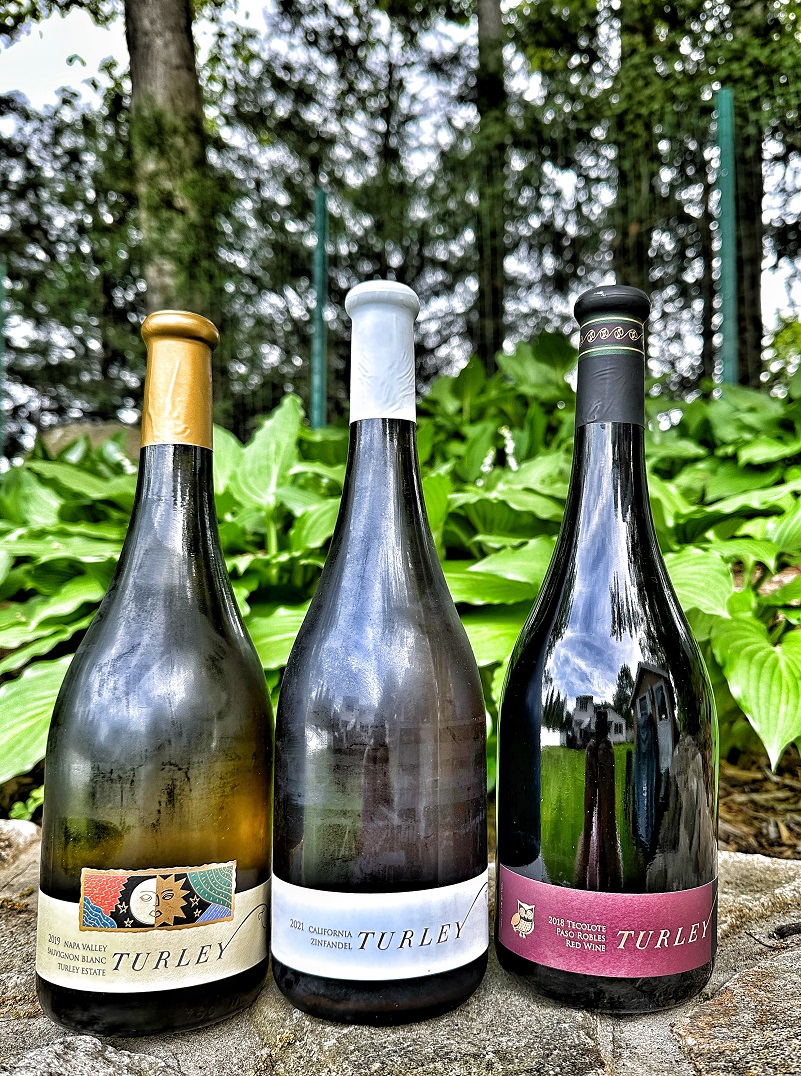
Turley makes only two white wines – Sauvignon Blanc and a blend called White Coat. The wine we opened was the 2019 Turley Estate Sauvignon Blanc Turley Estate Napa Valley (13.4% ABV). It is interesting that Sauvignon Blanc was one of the original wines produced back in 1993. Sauvignon Blanc plantings at Turles Estate were replaced with Zinfandel, but then Sauvignon Blanc was planted again on a small section of the dry-farmed, certified organic vineyard. The wine was fermented using natural yeast and it was bottled after 6 months in 100% French, used oak barrels. The wine was an absolute delight, showing beautiful whitestone fruit, perfectly present, perfectly elegant, with fruit and acidity singing in complete balance.
I had a little bit left in the bottle after that evening, and on Sunday I was able to please the most discerning palate in our household – my mother-in-law. She came over for Mother’s Day on Sunday and wanted to drink the white wine. When it comes to wine, she is completely unpredictable, and I always try to pour her wine without showing the bottle – she has lots of preconceived notions about wines and the regions, so I’m always trying to make sure she will just try the wine first, and then I can tell her where it is from. To my delight, she liked the wine, and even when I told her the wine was from California, she still liked it – a serious achievement in this household.
Our next wine was 2021 Turley Zinfandel Rosé California (12% ABV). This wine sometimes is called White Zinfandel, but only to poke fun at the uninitiated (and the bottle is adorned with the white label). This wine is impossible to score – you literally have to press “buy” as soon as your summer offering arrives. The wine is fermented in stainless steel and aged in used French barriques. It is lip-smacking, it speaks cranberries and strawberries, it is very Provençal in its presentation, but Californian in its soul.
And then there was Tecolote – 2018 Turley Tecolote Paso Robles Red Wine (15.7% ABV). This wine is rarer than rare, as you need to know it exists, to begin with. I got it once through some special holiday offer, but it is never included into the standard seasonal offerings. This wine is typically only available in the tasting room, but being a mailing list member has some advantages – I asked if I can get a few bottles, and they arrived just in time for us to enjoy. This wine is a Spanish-inspired blend of 60% of Grenache and 40% Carignane, coming from the specific block in Pesenti Vineyard, planted in the 1920s. Tecolote means “owl” in Spanish, and this is how the vineyard block is also called. The wine offered layers of lip-smacking black cherries, kitchen spices and sweet tobacco. A perfect balance of textual presence, fruit and acidity made this wine disappear in no time…
Next, let me step away from the wine for a bit – but not from the grapes. I rarely talk about cognac on these pages, but then I have an experience to share.


On an average day, I’m a scotch drinker. But of course, I would never refuse a sip of a good cognac. The keyword is “good” – nowadays, it is difficult to find a good-tasting cognac at a reasonable price in the US. However, my recent cognac tasting with my school friend led me to the discovery of Cognac Expert. Subsequently, I got a recommendation from Cognac Expert for the cognac I now enjoy immensely – without any need to break the bank – Hardy Legend 1863 Cognac. This cognac was produced by the Cognac House of Hardy, to commemorate the founding of the Hardy house back in – yes, you guessed it – 1863. This cognac is a blend of spirits made from the grapes coming from Borderies and Petite Champagne growing areas, aged from 2 to 12 years and finished in classic Limousine oak. From the first enticing smell to the long-lasting, coffee-loaded finish, this cognac offers the ultimate pleasure of balance of fruit, spices, and acidity. And at $40, this might be the best QPR cognac out there today.
Last but not least – 2015 Carlisle Mourvedre Bedrock Vineyard Sonoma Valley (14.9% ABV), which I opened on Sunday. Carlisle is another one of my favorite producers, specializing in Zinfandel, Syrah, and Petite Sirah – and some other grapes. The fruit for this wine came from the 130+ years old vineyard, planted in 1888. The wine was aged in French oak, 20% new. It is interesting that stylistically, this wine was similar to Turley Tecolote – succulent tart cherries on the nose and the palate, a touch of eucalyptus, refreshing acidity, perfect balance. This was an excellent wine to finish the weekend right.
Here you are, my friends – my weekend wine story. If you can find any of the wines mentioned in this post you should definitely look for them. And if you like cognac, this Hardy 1863 Legend is hard to beat. And you know where to find it.
Nevermind. I should have never told you that.
Until the next time – cheers!
Uruguay Wines – Coming Of Age
Do you know the problem many wine lovers share? We are creatures of habit.
Once we develop our inner “favorite wine” profile, we don’t let any changes happen to it. We like what we like. Never heard of this region? Thank you, I’ll pass. God forbid we fall in love with the particular producer – this is even worse than the region – nothing is ever good enough outside of the circle of our favorites.
And this is generally okay. Except we are putting ourselves in danger of losing on new, enlightening, delicious experiences.
When I was invited to the Uruguay wine webinar, my first reaction was “nah”. I mean, Uruguay, really? Between Chile and Argentina, my South American world-class wine circle is already full – do I need to bother with the wines from a totally unknown region?
On second thought – this is a webinar. Wine is coming to me, not like I need to travel somewhere to taste the wines I can potentially be disappointed by. Why not?
I’m glad I accepted the invitation. Both the information and the wines were lots of fun. We learned that while Uruguay has a population of 3.5M people, 2nd smallest size-wise country in Latin America, the country has a 98.7% level of literacy, the highest in Latin America. People in Uruguay are mainly descendants of Italians and Spaniards so they literally have wine embedded in their DNA.
Winemaking in Uruguay started in the 13th century. Today, there are 164 active wineries, producing 70M bottles of wine annually. Uruguay is currently in the process of implementing its own sustainability program. And by the way, the oldest winery in Uruguay dates back to 1854 and is called Los Cerros de San Juan (still open today!).
Uruguay has primarily a maritime climate with strong Atlantic influence, with the majority of low-lying coastal vineyards. Uruguay’s climate is closer to Bordeaux than the rest of South America, and it is significantly wetter if compared with Chile, where it rains only during the winter. Soils are clay based with lots of river deposits. Uruguay has six main winemaking areas, boasting 5 different terroirs. Warm and cold ocean currents collide right around Uruguay, creating significant influence. Interestingly enough, Uruguay is the only winemaking country in South America whose terroir is affected by the Atlantic Ocean.
When it comes to grapes, there are 14,804 acres under vine (a little smaller than Alexander Valley in California). Tannat is unquestionably a star, accounting for 27% of vineyard plantings., but it is not the only grape, obviously – Merlot, Cabernet Sauvignon, Cabernet Franc, Sauvignon Blanc are all quite popular as well.
And before we talk about wines, few more interesting tidbits: cows outnumber humans in Uruguay 4 to 1 and Uruguayans consume more meat per capita than any other country in the world!
Okay, now you know all that I learned in the webinar, and we can talk about the wines.
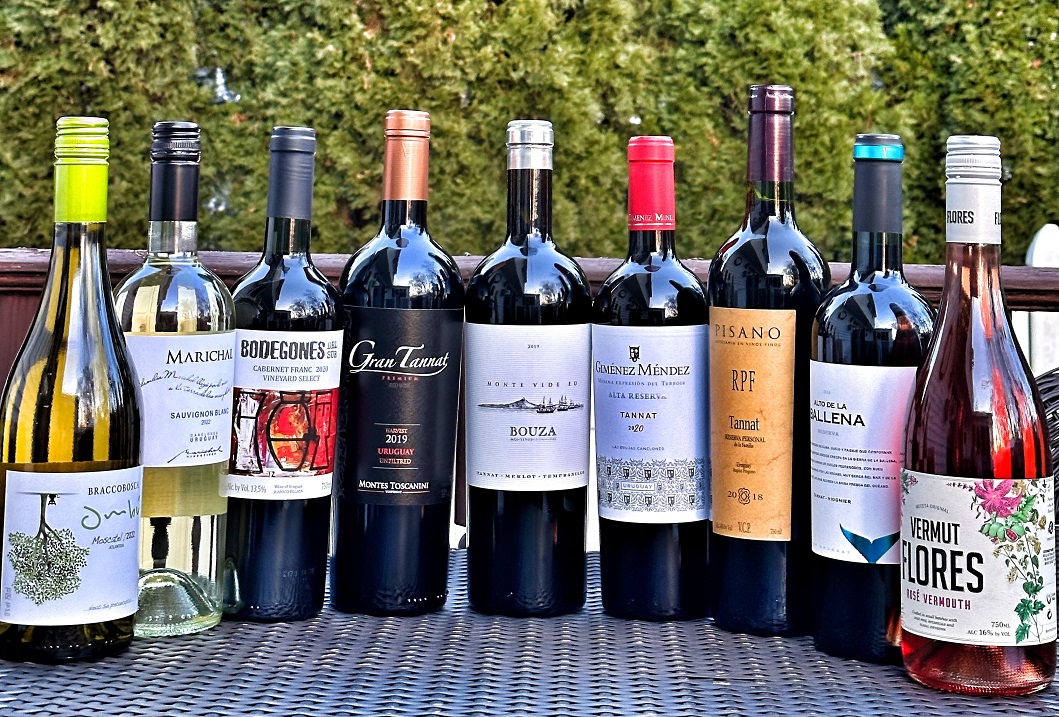
We had 2 whites, 6 reds, and one Vermouth wine in the tasting. Spoiler alert: I literally liked them all. In the blind tasting, these wines would be surely regarded as world-class, placing them in California, France, maybe Chile – Uruguayan origin of these wines would be a total surprise for many – for sure for me. And yet, here they are – world-class wines from Uruguay.
2022 Marichal Sauvignon Blanc Canelones Uruguay (12.5% ABV, $14)
C: light golden
N: plump, round, Whitestone fruit, a hint of gunflint
P: crisp acidity, fresh, bright. More resembling Muscadelle than anything else. Good balance.
V: 8, very refreshing.
2022 Bracco Bosca Ombú Moscatel Atlantida East Costal Region of Uruguay (13% ABV, $16)
C: light golden
N: very interesting. Muscat’s spicy, nutmeg profile comes as a distant hint. A touch of perfume
P: restrained tropical fruit with an acidic finish.
V: 7, not balanced enough for me; On the second and third days the wine showed much better, more coherent and more elegant – Drinkability: 8-.
2020 Familia Deicas Bodegones del Sur Vineyards Select Cabernet Franc Juanico Region Uruguay (13.5% ABV, $20, 30% aged in American and French oak)
C: Beautiful bright ruby
N: round vanilla, new world style
P: interestingly restrained on the palate, with noticeable tannins. The palate shows the absolutely old world (Saumur, Chinon). Interesting cranberry notes after an hour and a half in the open bottle.
V: 7+/8-, a bit unexpected, but not bad
Improved on the second day, became more round. Final: 8-
2020 Giménez Méndez Alta Reserva Tannat Las Brujas Canelonés Uruguay (14% ABV, $18, aged for 9 months)
C: Dark Garnet
N: Open, inviting, dark fruit, blackberries
P: Dark fruit, firm structure, smokey undertones, herbs, very good balance.
V: 8, well drinkable now
2019 Montes Toscanini Gran Tannat Premium Uruguay (14% ABV, $59, 18 months aged in oak, BAB with a huge punt)
C: dark garnet, practically black
N: wow. Cassis, sweet oak, eucalyptus, open, inviting, invigorating. In a blind tasting, I would bet my life on Napa Cabernet Sauvignon.
P: the palate is leaner than the nose suggests. Red and black fruit weave around a firm structure, tannins showed up a while after opening.
V: 8-/8, very impressive
2018 Pisano RPF Reserva de la Familia Tannat Region Progreso Uruguay (% ABV, $24, 10–12 months in French oak)
C: dark garnet
N: dark fruit, coffee, smoke
P: a hint of smoke, sapidity, dark, concentrated but not overpowering. Good balance, medium-long finish
V: 8-/8, very nice. Will be great with the steak.
2018 Alto de la Ballena Tannat – Viognier Uruguay (14% ABV, $24, 85% Tannat, 15% Viognier)
C: Dark garnet, almost black
N: herbs-forward nose, sage, a hint of cherries
P: fresh fruit, salivating acidity, sage, firm structure, and perfectly lingering cherries and cherries pit finish.
V: 8, great by itself, and will be great with beef roast
2019 Bouza Monte Vide Eu Montevideo Uruguay (13.5% ABV, $67, 20% Tempranillo, 30% Merlot, 50% Tannat, vinified separately, 16 months in French and American oak barrels)
C: dark garnet with a beautiful ruby hue
N: very complex, cherries, rosemary
P: roasted notes, dark fruit, elegant package, firm structure with a perfectly balanced mouthfeel.
V: 8, excellent, a world-class wine.
Basta Spirit Vermut Flores Rosé Uruguay (16% ABV, $16, Tannat, 27 botanicals)
C: beautiful salmon pink
N: Herbaceous, but a bit strange, stewed strawberries
P: a bit too sweet for my palate.
V: I’m very particular about the vermouth, so this is probably not the one for me.
Here you are, my friends. Next time you see an Uruguayan wine on the shelf, obey your thirst and grab it – and you don’t even have to thank me later.
OTBN Conundrum
OTBN, short for Open That Bottle Night, is my favorite wine holiday. Nowadays, there are lots and lots of wine holidays, usually associated with a particular grape – International Chardonnay Day, International Cabernet Day, Beaujolais Nouveau celebration, and so on. The majority of such wine holidays encourage you to open a bottle of wine made from a particular grape, whether there is a story behind the bottle or not. You can take these grape holidays with all seriousness and meticulously prepare and select the right bottle, or you can just grab any random bottle you will see in the store – or skip the grape holiday altogether if you don’t feel like drinking Cabernet Sauvignon or Chardonnay on that particular day.
OTBN is different. OTBN was invented for people who take their wine seriously. Or maybe rather those who take their wine too seriously. Over the years, we accumulate wine bottles that are deemed special; brought home from the winery you visited in France; got this bottle after an amazing tasting event; a bottle from an amazing family vacation many years ago; a bottle given to you by a dear friend. We can continue on and on, but you got the point.
Many of those special bottles in your collection would have some similar traits: they exist in the quantity of 1 and they are too special to be opened at random. Those special single bottles stay put in your cellar, waiting for the special company, special circumstances, special moment, special friend’s visit to be opened and enjoyed. More often than not, they keep waiting, and waiting, and waiting, because that special moment keeps not happening. And then, when it finally arrives, you might open that special bottle you preserved with the best care in the world, only to find that the content can solicit the memory but can’t bring you joy anymore because the wine in the bottle simply turned past prime. And it also kind of ruins the moment. This is why OTBN was invented, and this is what makes it such a great holiday for all the winos out there.
My personal conundrum draws exactly along the lines I just described. I have a lot of single bottles (actually, an absolute majority of my wines in single bottles – I practically never buy any wine by the case), and as such making a decision about a “special” bottle of wine for an event or a holiday, never mind the hallmark of them all, OTBN, a long and tedious process. “Is this bottle good enough? Okay, but I only have one. What if I will open it now and would never know how great it could’ve been? What do I do? What do I do?”
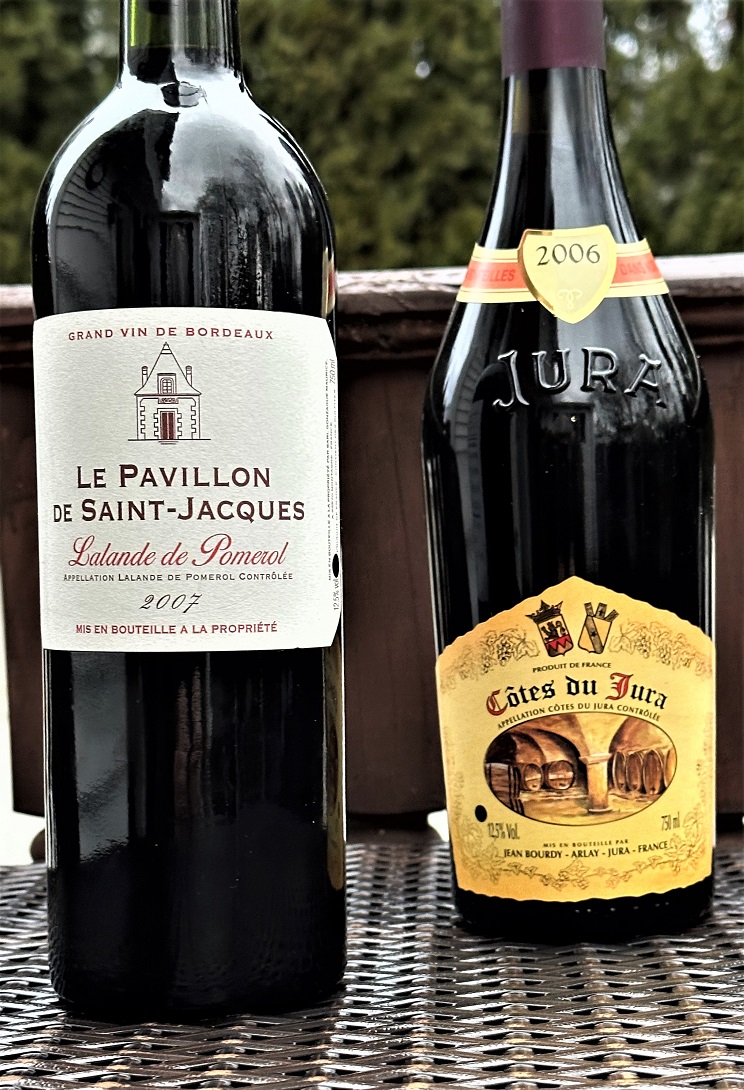
Same as the last year, I had to celebrate OTBN early this year due to the business trip spanning over the intended OTBN last Saturday of the month, February 25th. My wife doesn’t drink much wine nowadays, so I had to count primarily on myself. I had no good ideas coming to my head, there were no special bottles of wine I was ready to sacrifice. Looking at one of the wine fridges, I noticed the bottle of Jean Bourdy from Jura.
I don’t take Jura wines lightly, they are very hard to procure in the US. And then Jean Bourdy is a legend in itself – I better have a damn good reason to open such a special bottle. Then I thought that I already had some Jean Boardy in the past – maybe I would find some notes in the blog? I entered Jean Bourdy in the search box, and sure enough, this post came up. I tasted this wine in 2011 when I attended a Natural Wines seminar at PJ Wine store in New York – my first, a truly memorable encounter with natural (low intervention) wines as a category. I tasted this exact wine, 2006 Jean Bourdy Cotes Du Jura Rouge (fun fact: 2006 was the first vintage of Biodynamic wine production at Caves Jean Bourdy). I really liked the wine then, and my note said “It appears that wines of Jean Bourdy are known to age very well (note to self)”. As soon I saw this “note to self”, I instantly put that single bottle of Jean Bourdy back, as 17 years is most likely not an age for it.
In the same post, I noticed another wine that happened to be next to Jean Bourdy bottle on the same shelf – 2007 Le Pavillon de Saint Jacques Lalande de Pomerol. I pulled this bottle many times from the fridge before, always remembering that this was a natural wine, but again, no moment felt special enough. Then I read my note from 2011, which was clearly less than favorable. Here it is in its entirety:
“Very interesting. Smells like dirt, pure dirt after the rain. Very vegetative, no fruit on the palate, just pure dirt again. Almost no acidity. This wine was fermented in concrete tanks, aged for 18 months. It is “certified organic” and made with 90% Merlot and 10% Cabernet Franc – classic Pomerol wine. I would love to taste it in 10-15 years – I think it will greatly evolve, but it is not easy to say ” I like it” now”.
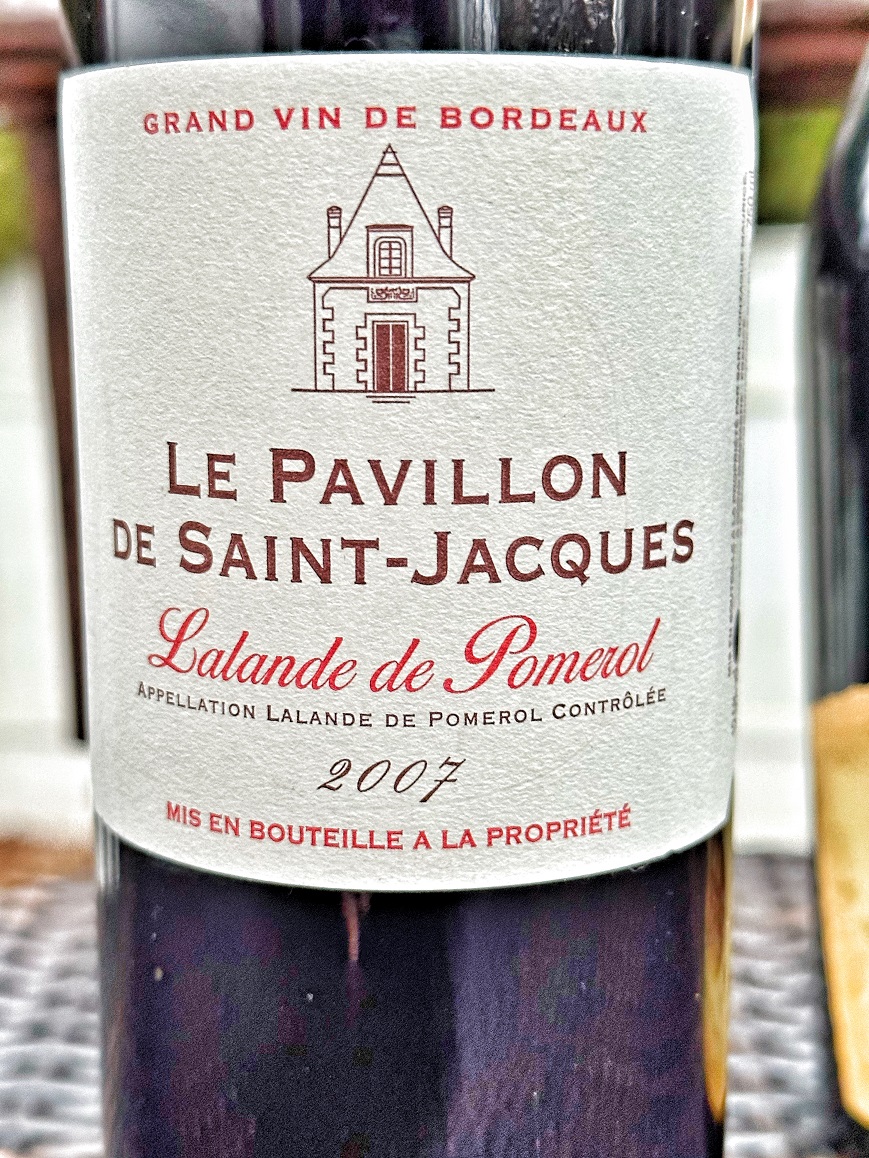
This “note to self” clearly stated that the wine was not good in 2011, but I should give it another try in 10-15 years. I was pretty much in the middle of that suggested term – 12 years after the original tasting, so opening that bottle all of a sudden became a perfect thing to do.
Cork came out easily, showing a good amount of crystals on the bottom, but otherwise perfectly fresh. The first sip instantly put my inner wine geek into a nirvana state. Barnyard. Pure, beautiful barnyard. If you belong to the group which screams “brett” at the first whiff of the barnyard smell on the wine, I’m sorry but we can’t be friends. Yes, there are limits to everything, but the reasonable amount (don’t ask me to quantify, everyone has to define their own “reasonable amount”) enhances the wine pleasure for me. I typically find barnyard associated with Syrah wines – possibly, this was my first Bordeaux with the barnyard aroma – but the barnyard aromas were followed by the classic, concentrated cassis. Layered, concentrated, softly rolling harmonious wine with perfect, firm structure and clean acidity. Beautiful, classic Bordeaux. This was truly an OTBN-worthy pure pleasure experience (by the way, my wife also loved the wine very much).
Here you go – my typical wine selection conundrum, happily resolved to make another memorable night. And as a bonus, the expectation of improvement of the wine with age fully came through (patting myself on the back).
The official OTBN night is almost here. You still have time to select the bottle or 5, maybe get some friends together and make some wonderful wine memories. If you want to celebrate only one wine holiday a year, make it OTBN – don’t risk the wine not being there for you, or you not being there for the wine.
And please share your OTBN stories – I would love to hear them.
Last Bottle Sign Up ($10 credit)





