Celebrating Oregon Wine Month with Potter’s Vineyard Wines
I guess there is something special in the month of May as everybody wants to appropriate it..for their wine purposes. The story differs from year to year, but this particular May 2023 has at least 4 wine designations (if I missed something – I profusely apologize) – May is Finger Lakes Wine Month, Michigan Wine Month, Oregon Wine Month, and Washington Wine Month.
The good thing is – there are 31 days in the month of May – which is enough to celebrate the wines of many more states – or maybe even all 50 – with proper planning. But for today, I only would like to focus on one of the wine months – Oregon.
Oregon wine is near and dear to my heart. First of all, Oregon itself is a beautiful place – I love the pure, open, clean, spacious, and airy pine forest oh so different from New England’s sprawling intersection of ivies, and stunning vineyard views which you can enjoy everywhere. Some of the very best American wines are produced in Oregon. And the longest-running series of articles on this blog – Stories of Passion and Pinot, conversations with winemakers – is dedicated to Oregon winemakers who made Pinot Noir the passion of their lives.
20 years ago, Oregon wines could’ve been known as a one-trick pony with its sole focus on Pinot Noir. Today, that world-class Pinot Noir is joined by Chardonnay, Pinot Gris, Riesling, Syrah, Tempranillo, Sangiovese, and even Tannat. Sparkling wines and Rosé can be found almost at any winery. And Pinot Noir is not just for reds anymore – Pinot Noir Blanc, a.k.a. White Pinot Noir is the wine to look for. Oregon winemakers continue studying their vineyards, identifying unique blocks and plots in a quest to produce the most terroir-driven wines.
One of my most recent conversations in the Passion and Pinot series was with Bill Sanchez, the proprietor and winemaker at Potter’s Vineyard. Potter’s Vineyard is a small, 3.5 acres estate in Laurelwood District AVA in Willamette Valley, producing about 1,000 cases annually. Potter’s Vineyard is organic, LIVE and Salmon Safe certified, and committed to staying small – you can learn about this commitment and the overall philosophy of Potter’s Vineyard from our conversation which can be found here.
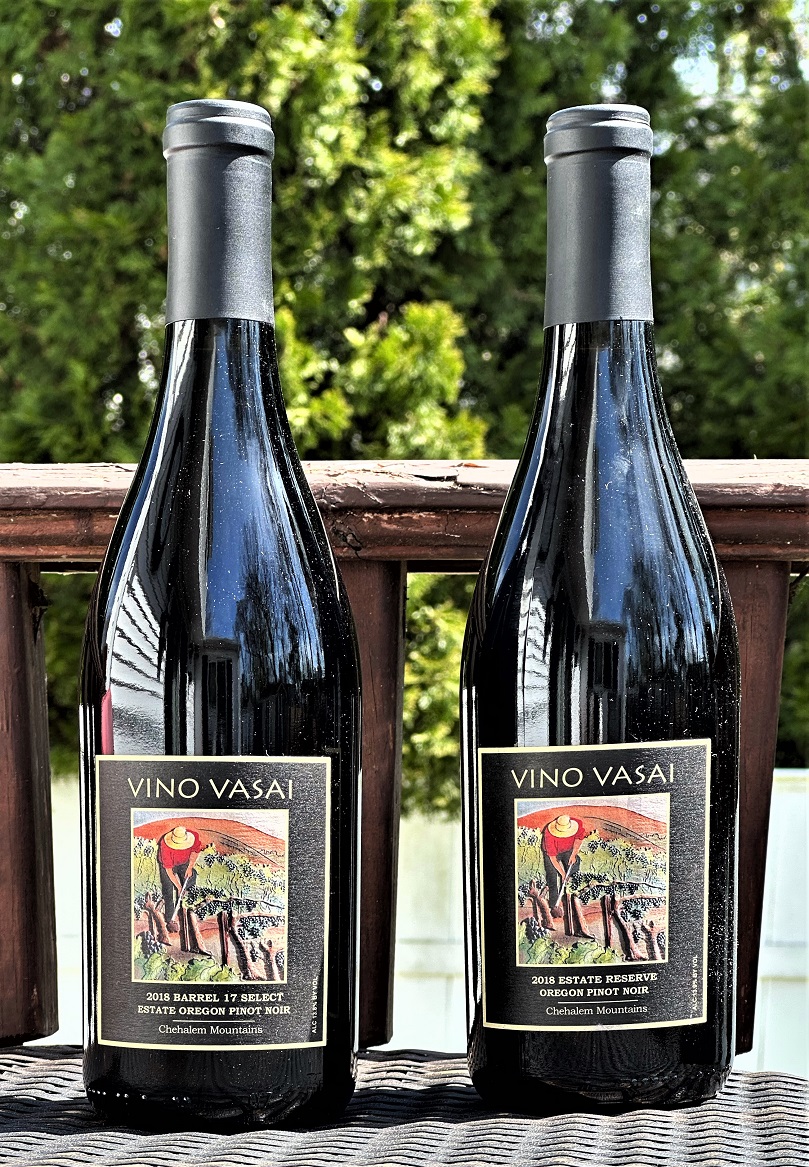
I don’t know about you, but I really admire these labels
Now I had an opportunity to taste a couple of the Potter’s Vineyard estate Pinot Noir wines, Barrel 17 Select and Reserve. Here are my notes:
2018 Vino Vasai Barrel 17 Select Estate Oregon Pinot Noir Chehalem Mountains (13.8% ABV, $48, Dijon clones)
Dark Ruby
Dark cherries, violets, minerality
Dark cherries, plums, medium to full body, firm structure, well-integrated tannins, luscious layers followed by the tart, long finish
8, excellent. Upon opening, the wine was lean and tight, Burgundian style. The next day opened up to show more of the Oregon Pinot power, still governed by restraint.
2018 Vino Vasai Pinot Noir Estate Reserve Chehalem Mountains (13.9% ABV, $58, Pommard clone, 75% new French oak )
Garnet
Beautiful legs (I rarely pay attention to those, but couldn’t help to notice)
Very enticing nose with sweet cherries, plums, eucalyptus
Cherries on the palate, tart, perfectly structured, harmonious and perfectly balanced. Craving food, but I can polish a bottle by myself.
8/8+, excellent.
Here you are, my friends – more of the delicious Oregon wines worth seeking. Oregon wine month is upon us, so if you need any suggestions, just click here.
And don’t be shy – if you got any of the Oregon wine favorites, please comment and leave notes for others.
Until the next time – cheers!
P.S. For more stories of Passion and Pinot please visit the series’ main page.
Chilean Sauvignon Blanc – The Adulthood
This post was supposed to be written last year… And then I almost made it in time for the Sauvignon Blanc day which was celebrated two days ago, on May 6th. Well, it is definitely a “better late than never” post, so for what it worth, let’s dive into it…
Today, friends, we are going to talk about Sauvignon Blanc.
If I would just “shoot from the hip”, Sauvignon Blanc doesn’t stand up as a grape with tremendous clout. Yes, it is one of the three major white wine grapes, along with Chardonnay and Riesling. And yet if there were a grape popularity contest, I would guess the championship would be decided between Cabernet Sauvignon and Chardonnay. Of course, Pinot and Syrah would-be contenders, but I still think the former two are really at the top of wine lovers’ minds.
But let’s take a closer look at Sauvignon Blanc. There is hardly a wine region in the world where Sauvignon Blanc is not growing – no point in recounting them, Sauvignon Blanc is successfully growing everywhere. Sauvignon Blanc makes sparkling, still, and dessert/late harvest wines. It shines solo everywhere, and I’m not talking about “usual suspects” – Sancerre, New Zealand, Chile, California – but I’m talking about some of the world’s best producers. Screaming Eagle, the “cult of the cults” producer in Napa Valley makes Sauvignon Blanc which is more allocated than their Cabernet Sauvignon. Gaja Alteni di Brassica and Poggio alle Gazze dell’Ornellaia, two of the 100% Sauvignon Blancs from Italy – I hope these names need no introduction. Let’s not forget the “Y” dry wine produced by Sauternes legend, Chateau d’Yquem. And then of course, there are countless blends… Sauvignon Blanc is everywhere.
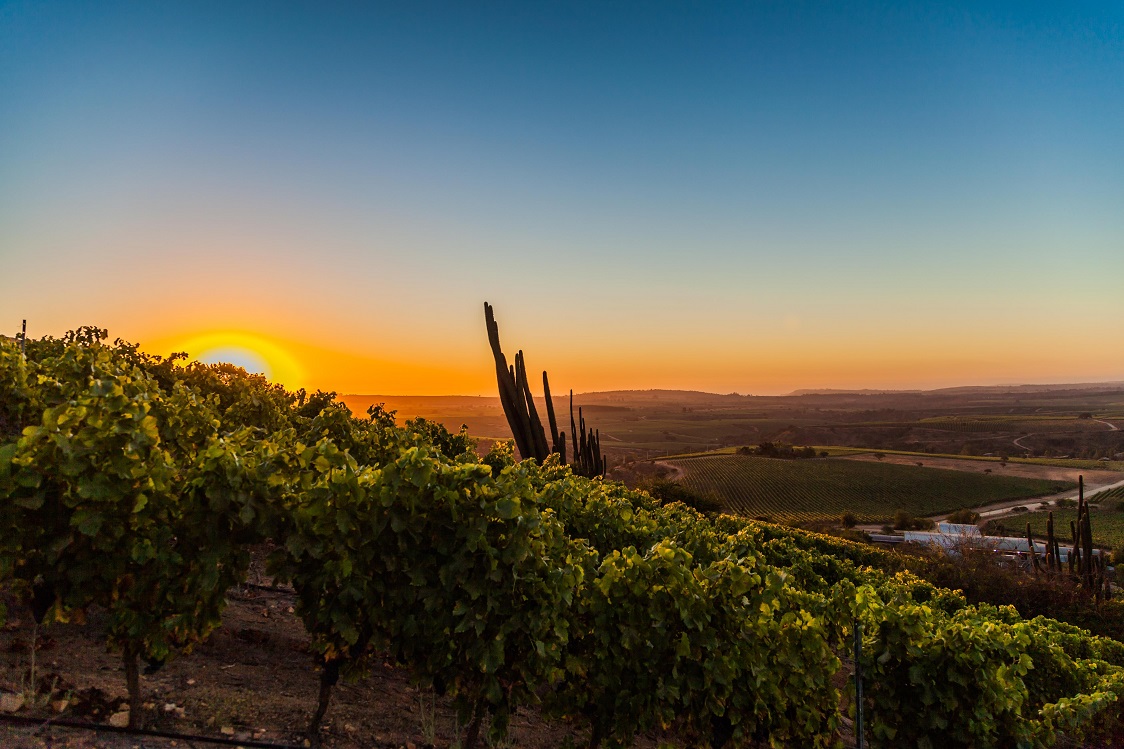
Garces Silva vineyard at sunset credit Jody Hortons
Never mind the blends – let’s talk about pure Sauvignon Blanc wines. In my opinion, there are 4 main distinct styles of Sauvignon Blanc – as there are 4 main production regions that we already mentioned – Sancerre, New Zealand, Chile, and California (Napa Valley primarily). Maybe I should say “there used to be” 4 main styles… In the old days, Sancerre could be identified by aromas of cat pee and freshly cut grass. New Zealand Sauvignon Blanc had a currant profile with currant leaves showing very well. It was popular to refer to the main component of the New Zealand Sauvignon Blanc profile as Gooseberry – I remember wine critics angrily saying that 90% of those who use the descriptor never tasted gooseberry in their lives. Chilean Sauvignon Blanc was similar to New Zealand, only shifting more towards grapefruit and a bit more sweetness in the profile. All three (Sancerre, New Zealand, and Chile) have changed today. And only Napa Valley style has not changed since the moment I tasted Napa Sauvignon Blanc for the first time – freshly cut grass is weaved together with bright but not sweet fruit – it is succulent, it is seductive, it is “in-your-face-beautiful-and-not-ashamed-of-it” – but we will have to talk about Napa Sauvignon Blanc some other day.
For a long time, New Zeland Sauvignon Blancs were consistent, with only Cloudy Bay standing apart from the rest, in a very delicious way. Then New Zealand decided to look for a new Sauvignon Blanc identity at some point, and I had an opportunity to taste this “new identity” at a tasting 8 years ago – it was an interesting experience, please read my notes if you are interested. I don’t know if the Chilean wine industry is closely following New Zealand, or if is this just a common trait of growing up, but this brings us to today’s subject – Chilean Sauvignon Blanc wines.
Compared to the Cabernet Sauvignon, the Chilean staple, Sauvignon Blanc is a very young grape. The first plantings of the Cabernet Sauvignon in Chile go back to the middle of the 19th century. The story of Sauvignon Blanc in Chile only started in the late 1970s. In 1978, there was a total of 8,154 acres of Sauvignon Blanc in Chile, accounting for 3.1% of all grape plantings (land under vine), mostly concentrated in Maule Valley. In the 1980s, new plantings of Sauvignon Blanc started to appear in the coastal regions of Casablanca, as well as Coquimbo, Valparaíso and O’Higgins. Coastal areas offered cooler weather, which brings herbal, citrussy expression with cut-through acidity in Sauvignon Blanc, contrasting with the areas with a continental climate, known to bring those grapefruit/tropical fruit notes I mentioned before as an old signature of Chilean Sauvignon Blanc.

Ventisquero vineyard. Source: Viña Ventisquero
Going beyond just new cooler coastal areas, winemakers also started paying attention to the inherent grape qualities, by choosing to experiment with different clones. Of course, it is only fair to assume that clonal selection is not just Pinot Noir or Chardonnay prerogative – nevertheless, until I started working on this article, I had no idea that Sauvignon Blanc clones are even a thing. Turns out that Davis Clone (#1) is known to impart citrusy qualities, Sancerre Clone (#242) is more herbal and fruity, and then there are other popular French clones #107, #241, and #317.
Today, Sauvignon Blanc is the second most planted grape variety in Chile with 37,614 acres under vine in 2019, accounting for 40% of all white grapes plantings. Sauvignon Blanc is the second most widely produced wine in Chile, with 13% of all the Chilean wine production volume (based on 2021 data). The majority of the Sauvignon Blanc plantings are now located in the coastal regions. Chilean Sauvignon Blanc has definitely grown up and it is ready to conquer the world.
To make the encounter with modern Chilean Sauvignon Blanc wines more practical, I had an opportunity to taste 8 Sauvignon Blanc wines, all coming from different producers and representing a number of regions. Here are my notes:

2021 Montes Sauvignon Blanc Limited Selection Leyda Valley DO (13.5% ABV, $15) – Montes is a very interesting winery in general – I had an opportunity to speak with the winemaker, and to learn more about the winery, you might want to read part 1 and part 2 of our conversation. Sauvignon Blanc grapes used in this wine, clones 1 and 242, were harvested from the vineyard located about 9 miles away from the Pacific Ocean on the western slopes of the Cordillera de la Costa mountain range.
Greenish pale
Inviting nose of fresh berries, grass, cassis leaves, some tropical fruit undertones, Napa SB-like presentation
Fresh, vibrant, tart, lean, lemon, a distant hint of freshly cut grass – truly refreshing on a hot day. Delicious.
8+, superb. Nicely complements creamy goat cheese.
2020 Casas del Bosque La Cantera Sauvignon Blanc Las Dichas Casablanca (13% ABV, $18) – Casas del Bosque is one of my favorite Chilean producers, I had a number of their wines on different occasions. The grape for this wine came from the vineyard located about 10 miles away from the Pacific Ocean, located on the mountain slopes.
Greenish pale
Freshly cut grass, green herbs, medium+ intensity, cassis leaves
Clean, light, good acidity, herbaceous profile, a touch of freshly cut grass. Lean.
8, excellent wine.
2021 Viña Koyle Costa La Flor Sauvignon Blanc San Antonio Leyda (12.5% ABV, $18, organic grapes) – Viña Koyle is one of the well-known Chilean organic wine producers – I had an opportunity to try some of their wines last year while working on the Chilean wines sustainability story last year. The grapes for this wine, clones 1 and 242, came from the vineyard located 5 miles away from the Pacific Ocean. The wine was aged for 4 months on the lees to soften the sharp acidity – as you can see in my notes below, cut-through acidity was still acutely present.
Light golden
Very restrained, distant hint of peach and guava
High acidity, a touch of freshly cut grass which quickly dissipated just leaving a tart finish.
8-, will be interesting with seafood.
2020 Viña Garcés Silva Amayna Sauvignon Blanc Leyda Valley DO (14% ABV, $25) – the grapes were harvested at the vineyard located 8.5 miles from the Pacific Ocean. The wine was aged for 6 months on fine lees.
Greenish pale
A hint of freshly cut grass
Tropical fruit profile with a hint of sweetness and a touch of grass
8-, nice
2020 Matetic EQ Coastal Valle Hermoso Casablanca DO (13.5% ABV, $20) – grapes for this wine came from the biodynamic vineyard in the Rosario Valley in Casablanca, just 3.5 miles away from the ocean.
Straw pale
Steely undertones, a distant hint of gunflint, a touch of lemon
Whitestone fruit, herbs, a touch of cassis leaves, finish is round and gorgeous with a whiff of freshly cut grass. Reminiscent of the Italian renditions of Sauvignon Blanc such as Ornellaia and similar.
8+/9-
2019 Viña Ventisquero Grey Glacier Sauvignon Blanc Atacama Valley (13% ABV, $25) – yet another winery I’m well familiar with. Curious fact – founded in 1998, Viña Ventisquero is turning 25 this year. The vineyard where the grapes for this wine came from is located 15 miles away from the ocean and in the middle of the Atacama desert, taking full advantage of the poor soils. The wine was aged in foudres to enhance its texture and improve aging capabilities.
Greenish pale
A hint of gunflint, earthy undertones, Dias tang hint of lemon
A hint of gunflint, crisp, clean, refreshing, clean acidity on the finish, nice textural presence with some salinity – should be a great oyster chaser.
8/8+, excellent
2021 Viña Tabali Talinay Sauvignon Blanc Valle de Limarí DO (13% ABV, $24) – the vineyard, called Talinay, eponymous with the mountain ridge where it is planted, is located 7 miles away from the ocean.
Greenish white
Minerally-driven nose, limestone, lemon, medium+ intensity
Crisp, fresh, lemon, minerality, a tiny hint of fresh cut grass which comes and goes.
8, this wine is asking for food. I want oysters… works well with Boursin cheese
2020 Viña Morandé Sauvignon Blanc Gran Reserva Casablanca Valley DO (13.5% ABV, $20, 12 months aged in oak foudres and concrete eggs) – Pablo Morandé was a Casablanca Valley pioneer, who started planting Sauvignon Blanc in the 1990s. Grapes for this wine came from Belén vineyard is in the Lo Ovalle region, 14 miles away from the ocean.
Straw pale
Fresh-cut grass with herbal undertones and minerality, sapidity (almost “meaty” smell if it makes any sense)
Clean, crisp palate, freshly cut grass, lemon, crisp acidic finish.
8, elegant and balanced.
Here you are, my friends. Beautiful, minerality-driven, world-class wines, with their own unique and delicious expressions. As you can tell from my notes, the tasting was 8 out of 8 success, which is generally not given.
I don’t know what is your take on Chilean Sauvignon Blanc and when did you taste it last time – it is definitely worth revisiting. and get ready to be pleasantly surprised.
White Wines, Simple and Complex
Is there a definition for simple wine? What about the complex? I’m sure every wine lover can offer their own definition, and everyone will be correct in their own right.
We are not here to search for an absolute truth. We are just having a casual conversation.
In many cases, “simple” would just refer to the price. People don’t want to stress “inexpensive” or “cheap”, they would just say “yeah, I’m just having a glass of this simple wine”.
Another possibility is referring to the taste of wine as “simple” – the wine which is quaffable, but not exciting, not thought-provoking, something you would drink because it is just conveniently available. By no means “simple” implies “bad” – it is still a good wine, but that simplicity makes it a perfect accompaniment for let’s say, a pepperoni pizza or a loaded hot dog. In many cases, simple wine is all you want.
I understand that the title of this post might be a bit misleading, as simple can’t be complex at the same time. But – I have a reason for that. If you will, I’m trying to share a bit of a puzzle here.
Before I will explain the puzzle, let me share my general take on modern wines. I’m talking here about the wines made anywhere in the world, by winemakers who want to make a quality wine – at any price point. I’m talking about the overall quality of the winemaking. Healthier vineyards around the world bear better-quality grapes. A better understanding of the unique composition of the vineyards. A better understanding of the winemaking process. A better understanding of how to keep the winery clean. An increased body of winemaking knowledge. All of these are contributing factors to the better quality of wine which I perceive with many of the simple, everyday wines.
Where am I going with this and what the quality of wines has to do with simple wines? Here it is. I tasted 4 new sample wines for this post. One of them was perfect from the get-go. Three others were well-maid, but not my favorites. After playing with each one of those 3 for a few hours, I put back the corks and the screwtops and left the wines on the countertop for about a week. After that I reluctantly moved those wines into the fridge, thinking that I will taste them one more time later before discarding them.
About a month or so later, I remembered that I have those wines in the fridge, and I should decide what to do with them. To my great surprise, each one of the 3 showed much, much better. The wines became actually delightful, and instead of just discarding the wines, I slowly finished them with pleasure. Here is your puzzle – how and why these simple wines improved, despite not being even stored properly. My only thought is that the answer is probably quite complex, but it probably has something to do with the better quality of the wines – and that’s how it is connected to the diatribe above.
Here are the wines I tasted.
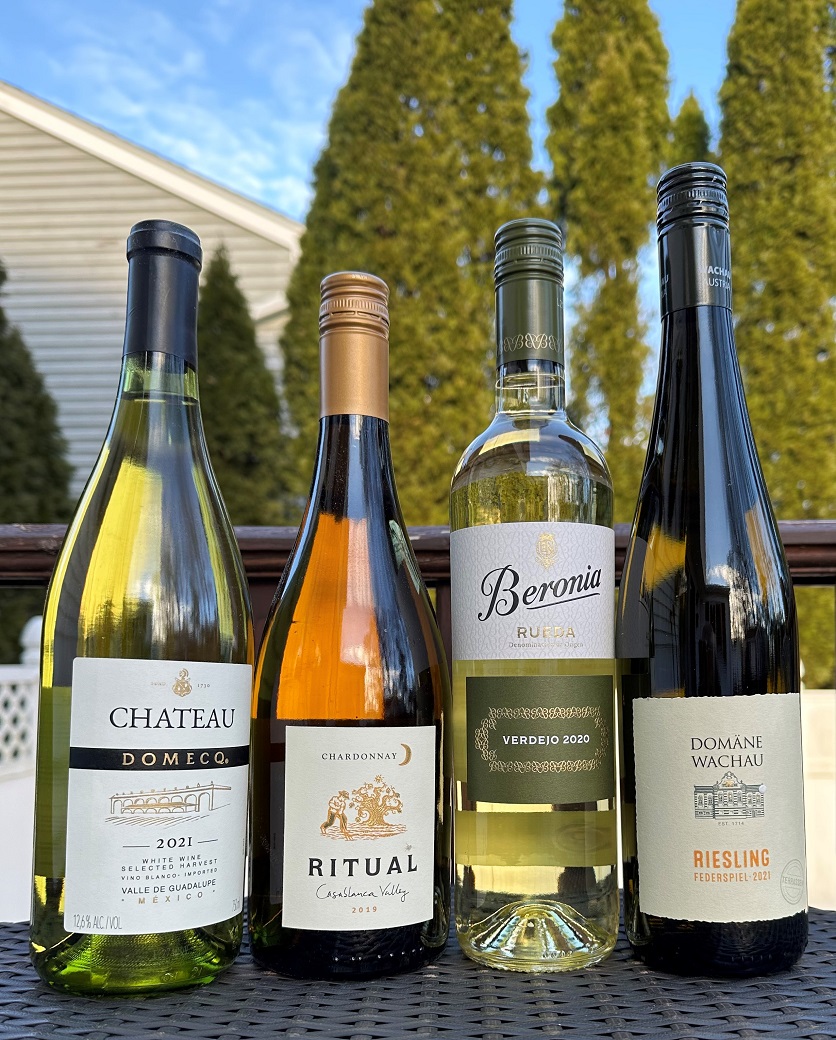
First, 2019 Ritual Chardonnay Casablanca Valley Chile (13.5% ABV, $20.99, organic grapes, certified sustainable). Ritual is an organic wine producer from Chile. I had Ritual wines in the past, and I liked them quite a bit. This Chardonnay, however, was the least exciting out of the four – until those 30+ days later:
Light golden with greenish hue
Gunflint, steel, Whitestone fruit
Green apple, tart, crisp, herbaceous, a touch of smoke. Medium to full body, powerful
7+, needs food, almost asking for a steak.
Second try: outstanding. Better integrated, showing customary Chardonnay apple and vanilla, more round and very well balanced.
Drinkability: 8/8+
Next, 2020 Bodegas Beronia Verdejo Ruedo Spain (13.5% ABV, $13.99, vegan). Bodegas Beronia is a well-known Rioja producer, who also makes wines in Rueda. I had their Rueda bottlings in the past, and always liked them. While initially faring just a bit better than the Ritual, this wine also improved after 30+ days in the fridge:
Light golden
Lemon, sapidity, medium+ intensity
Meyer lemon, lemon zest, crisp, tight and refreshing, good acidity.
8-, an easy supper but will go well with light appetizers.
Second try: the wine became more round, better integrated and better balanced.
Drinkability: 8
From Spain we are moving to Austria – 2021 Domäne Wachau Riesling Federspiel Austria (12% ABV, $18.99, certified sustainable). Domäne Wachau is one of the very best producers in Austria, offering a tremendous range of single vineyard and village wines. I had Domäne Wachau Grüner Veltliner in the past, but this was my first encounter with the Riesling:
Light golden
Meyer lemon, a touch of honey, pleasant
Honey, pear, lemon, beautifully round with cleansing acidity and acidic finish. Delicious.
8/8+, delicious. There was nothing left for the second try 🙂
For our last wine, we are traveling back to the Americas, to Mexico this time – 2021 Chateau Domecq White Wine Valle de Guadalupe México (12.6% ABV, $13.99, 60% Chardonnay, 40% Viognier, fermented and aged in 2nd use French oak barrels for 6 months) – my first encounter with the producer, and possibly the first white wine from Mexico.
Light golden
Heavy nose with sapidity and roasted notes. In a double-blind tasting (black glass) this wine would perfectly qualify as red
Interesting. Unusual. I think Chardonnay and Viognier just have their own lives in this wine.
After a few minutes in the glass, the nose didn’t dissipate, but the palate became a lot cleaner – plump round wine with notes of vanilla and a hint of tropical fruit. Not a bad effort at all.
Drinkability: 8-, unusual.
Second try: after 30+ days, sapidity and roasted meat notes were gone, and similarly to the previous two wines, it became more round and better integrated.
Drinkability: 8-/8
Here you are, my friends – simple wines with a complex story. I might be making things more complicated for no reason – you might be right about that. But if I can make one conclusion from this experience – even if you don’t like the wine, give it a second chance. You might be positively surprised by an outcome.
American Pleasures #8: Flora Springs, Napa Valley
Wine should give you pleasure – there is no point in drinking the wine if it does not. Lately, I have had a number of samples of American wines that were delicious standouts – one after another, making me even wonder if someone cursed my palate. I enjoyed all those wines so much that I decided to designate a new series to them – the American Pleasures.
This very blog was born out of a desire to share with the world the excitement that a glass of wine can bring. To share an appreciation of a well-crafted glass of fermented grape juice that can inspire great paintings, great poetry, and great conversations.
Sometimes, it is not very easy to find the right words to share that excitement. Yes, there is a great arsenal of wine technical terms to describe body, aroma, bouquet, finish – but those words do a very poor job of conveying emotions. Yes, they describe wine, possibly correctly but subjectively (you say it is a blackberry, and I say it is black cherry) and possibly sufficiently to give another wine geek or professional an idea of how the wine might taste. But when one whiff from the glass literally stops you in your tracks, whether the aroma contains raspberries, black currant, or the hair of the wet dog is really irrelevant. What is important is that wine blew your mind and delivered an ultimate pleasure, which you can’t resist but share with the world.
Everyone derives wine pleasure on their own. For me, smell (aroma) and taste (bouquet) are two distinctly different categories. I had wines that had a magnificent aroma, and an underwhelming bouquet. I had wines where the aroma was either absent or borderline terrible, and the bouquet was magnificent. Of course, many have both. Taking about deriving the wine pleasure, mine definitely starts with the nose, the aroma. I’ve had wines that I didn’t start drinking for a good few minutes, just inhaling the aroma exuding from the glass. I can’t tell you why and how this works with the aromatics of some of the wines being so captivating – simply sharing my perspective here.
This was a long introduction to the gist of this post – two wines of Flora Spring from Napa Valley in California that I had an opportunity to taste lately.
From the moment I heard the name Flora Springs for the first time, there was something subconsciously attractive in that name – I have no idea why and how. But ever since the first encounter, I always expect magic while tasting Flora Springs wines.
Flora Springs Winery was founded in 1978 by Flora and Jerry Komes in Napa Valley, rooted deeply in the rich history of the US wine industry’s ups and downs, going from 763 wineries in California to only 40 surviving Prohibition. Name Flora in combination with the natural springs running through the property helped to define the winery’s name – Flora Springs. From the moment the winery was founded, it was truly a family affair, all built and developed by Jerry and Flora, their kids, grandkids and their families – you can learn all of it on Flora Springs’ website – and it is well worth a few minutes of your time.
The line of wines Flora Springs produces is something you would expect from the winery in Napa Valley – Chardonnay, Sauvignon Blanc, Cabernet Sauvignon, Merlot, and a few others. Yet the two wines which prompted this post belong to the Flagship category – the white blend called Soliloquy and the red Bordeaux blend called Trilogy.
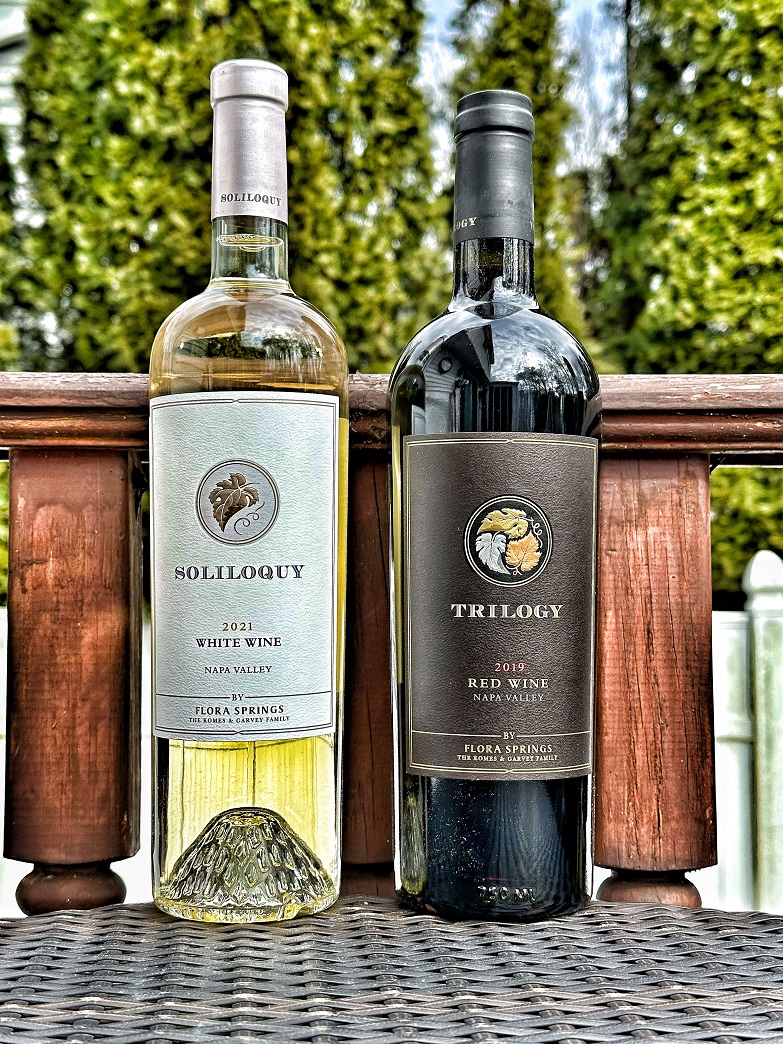
I tried Soliloquy for the first time 13 years ago – no, I don’t have such an amazing memory, I simply have my notes – in this very blog. The wine I tried back then was Sauvignon Blanc from Soliloquy Vineyard. Actually, Soliloquy Sauvignon Blanc is identified as a Sauvignon Blanc clone, certified by the UC Davis to be unique to Flora Springs, so I found that wine to add a unique grape to my collection (I actually added two, as that wine was a blend of Sauvignon Blanc Soliloquy and Sauvignon Musqué). My next encounter was about a year later when I was blown away by the 11 years old Soliloquy bottling.
It is worth noting that in the 1990s, the Soliloquy vines became nearly extinct due to the disease. The winery spent the next 8 years re-growing the Soliloquy vines first in the lab and then in the nursery before the plantings were restored in the vineyard.
2021 Flora Springs Soliloquy Napa Valley (14.2% ABV, SRP $60, 73% Sauvignon Blanc, 12% Chardonnay, 15% Malvasia, 7 months in French oak barrels), the wine which I had, is still made primarily from Soliloquy Sauvignon Blanc with the addition of Chardonnay and Malvasia. The wine offered beautiful bright aromatics, with the whitestone fruit and a distant hint of honey. The palate was full of energy, uplifting, showing more of the white stone fruit, Meyer lemon, crisp acidity, and overall perfect balance. A perfect example of the capabilities of the Napa Valley white.
Not to be overdone, my second wine was 2019 Flora Springs Trilogy Napa Valley (14.2% ABV, SRP $85, 75% Cabernet Sauvignon, 10% Petit Verdot, 8% Cabernet Franc, 7% Malbec, 18 months in French (80%) and American (20%) oak barrels). Trilogy wine was originally produced for the first time in 1984 (thus 2019 is the 35th vintage of the wine), with the name being a nod to the three main Bordeaux varieties comprising the blend.
This wine was truly a show-stopper. On the first whiff, the world slowed down. There was just me and the glass. Pure, delicious black currant, eucalyptus, currant leaves. Round, and around, and around. I few minutes later, I developed the courage to take a sip. To my delight, the palate delivered as much excitement as the nose. Polished, layered, seductive, Bordeaux-style textbook profile, black currants, well-integrated tannins, perfect structure, powerful but perfectly balanced. You really don’t expect the wine like that to be a pop’n’pour wine, and yet it was, in my glass. Absolutely delightful.
There you are, my friends. Another case of delicious American wines, delivering lots and lots of pleasure. These wines are not really everyday sippers but are well worth looking for to brighten up any special occasion.
I have more American pleasures to share, so stay tuned…
Rare Grapes, Obscure Tasting
 What is your take on wines made from rare, unknown grapes? I can tell you about mine – I love them.
I have two reasons for that. Well, it might be even just one, but with two sides, I guess. First, I’m a wine geek. As a wine geek, I love tasting each and every type and style of wine, made from whatever grapes they are. I’m willing to taste absolutely any wine at least once. After the opinion is formed, this might be the first and the last time, but nevertheless, I’m willing to try anything.
The second reason is that I’m not only a geek, I’m also a collector. I like collecting experiences. As such, for example, I keep track of the US states and world countries I had a chance to taste the wine from. And I keep track of grapes I ever tasted, after being bitten by The Wine Century Club‘s bug. If you are reading this blog on a PC, look to the right side of the screen, and you will see “grape count” – this is the number of grapes I have tasted to date (if you are reading on the phone, just scroll down). With my goal of reaching 600 grapes, I can only increase the current count further by finding rare, obscure, unknown grapes to taste.
When I got an invitation to attend the Wines of Crete trade tasting, the key words which made me say “yes” was exactly that – “rare grapes” – there were lots of grapes mentioned in the invitation, and I didn’t recognize at least a half of them, so the opportunity to taste new grapes (and increase the count) was definitely enticing.
I have to tell you upfront – this was the most peculiar trade tasting I have ever attended. Being only an advanced amateur, if this makes any sense, I attend maybe about 10 trade tastings in a good year, so I wouldn’t pretend that “I’ve seen them all”. Nevertheless, I have a frame of reference for successful and unsuccessful wine tastings, for sure in my personal book – so when I tell you that this was the most peculiar one, I mean it. Let’s talk about it.
First, notwithstanding of any peculiarity, we need to acknowledge the wines of Crete. Any time a passionate wine lover has an encounter with a region that has a deep wine history, it creates an emotional response, almost awe. The wine history doesn’t go much deeper than it is on Crete – Crete, the largest island in Greece and 5th largest in Europe is the cradle of European winemaking, having its winemaking history spanning more than 4,000 years, going well beyond 1,500 BC.
Crete represents the first real wine culture in Europe. There is evidence of wine presses (first in Europe from about 1,600 BC), pressed grapes and stems, clay pots and amphorae. The wine was produced commercially, and it was praised by many poets. Shortly after the beginning of the first millennium, Crete became famous for producing sweet wine from sundried grapes, Vinum Passum. Crete wines reached Switzerland, France and Italy, and so did the cuttings of the Cretan vines.
From the 14th to 17th centuries, Crete became famous for producing sweet wines from Malvasia grapes (interesting tidbit: American Journal of Enology & Viticulture registered 49 different varieties of the Malvasia grape). Malvasia vines made it to Italy during the same timeframe.
Cretan winemaking history is not all warm and fuzzy. For almost 200 years Crete was under Turkish occupation, and wine production was truly minimized, mostly for family consumption only. Then at the beginning of the 20th century, immigrants brought Sultanina grapes to Crete – a.k.a. Thompson Seedless – not the grape you want to use in wine production. In 1972, Crete experienced the invasion of Phylloxera.
The rebirth of Cretan winemaking started in the 1990s, and today young winemakers continue looking for their own path, often using indigenous grapes to their advantage.
There are 4 mountain systems on Crete, the island of 160 miles long and about 40 miles wide. The majority of the vineyards on Crete are located on the mountain slopes, at altitudes from 800 to 3,000 ft. Mountains play an important role in protecting vineyards from the hot winds coming from Africa. The climate is warm Mediterranean with annual rainfall between 250 and 900 mm.
There are about 10,000 acres of vineyards on Crete, which are spread between 6 Protected Geographical Indication (PGI) and 7 Protected Denomination of Origin (PDO) winemaking regions. There are 36 wineries on Crete, producing about 4 million bottles of wine annually. There are 11 indigenous grape varieties growing on Crete (White: Vilana, Vidiano, Dafne, Thrapsathiri, Malvasia di Candia, Muscat of Spina, Plyto and Red: Kotsifali, Liatico, Mandilari/Mandilaria, Romeiko), as well as international varieties. And as I already told you before, these indigenous grapes were the main attraction for me.
Okay, so now I shared with you almost everything I learned about the rich history of the wines of Crete – let’s talk about the peculiar part.
Upon arrival at the tasting, I got a booklet listing all the wines which we would be tasting. The booklet was organized by grapes – but interestingly enough, the description of the wines didn’t include any producer names – just vintage, variety(ies), ABV, style of wine, and maturation notes. I never saw anything like that at any of the tastings – unless you maybe run a blind tasting, but never mind.
Next, we proceeded with the masterclass, where we learned about all the history and present day, and had an opportunity to taste 11 wines. While poured, all of the wine bottles were hidden inside the black pouches. In the presentation, there were no producer names mentioned – only grapes and regions were presented.
As we learned, this was not an oversight. As the event was sponsored by the European Union, it was the requirement not to mention the wine producers in the masterclass and in the tasting, so the producers not present at the tasting wouldn’t get upset.
I’ll let this sink in for a moment.
Think about it.
Now, let me ask you – how stupid, unbelievably stupid is it? [I guess this is what happens when lawyers run the business – I didn’t have to say it, but this is my blog, so I can].
I’m a blogger, and I’m only interested in education and tasting some obscure grapes. But let’s say you work at a restaurant. You taste the wine, you like it, and you would like to start offering it at your restaurant – but officially, you are not allowed to know the name of the wine you just tasted. Say what??? What is the point of this tasting? With this “blind tasting” move, you brilliantly hurt everyone – those who sent their wines for the tasting, and those who have not.
Okay, let’s get back to masterclass tasting.
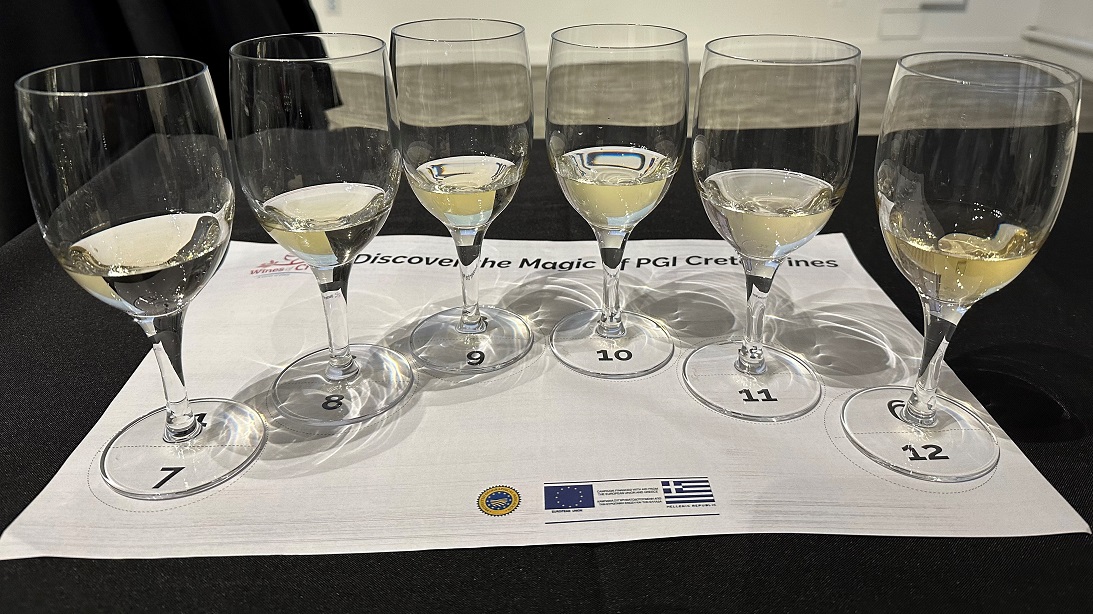
First, we tasted 6 white wines, made from Vilana, Vidiano, Thrapsathiri, and Assyrtiko. Thrapsathiri was a new grape for me, the rest I had tasted before. I don’t believe I liked any of the white wines, unfortunately…
Wine #1 – Vilana grape
Acidic, lean, food-craving
Good
Wine #2 – Vidiano
sweet nose, acidic finish, interesting
Wine #3 – Vidiano
interesting, kind of flat, oily nose, reminiscent of Retsina
Wine #4 – Thrapsathiri
interesting, herbaceous, cut through acidity. Very acidic finish
Wine #5 – Assyrtiko
Smoke, almost moldy on the nose
Corked?
Wine #6 – Vidiano (oak aged)
Plump, oily, full-bodied, crispy finish


Next were 5 reds, made from Liatico, Kotsifali, Mandelaria, and Romeiko. Again, one new grape here – Romeiko. Wine #10 was strange but drinkable. I really loved the Romeiko wine, but this was somewhat of a curveball red wine – it was actually made in the “orange wine” style. Still, this was my favorite wine from the masterclass tasting.
Wine #7 – Liatico 2022
interesting nose, sweet oak
super-tart, tannic, lacks fruit, tart finish
Wine #8 – Liatico/Kotsifali 2016
smoke on the nose, smoke on the palate, insane acidity
Volatile acidity?
Wine #9 – 60% Kotsifali, 40% Mandelaria, 2015
Raisins on the nose, oak, tertiary aromas
flat, tannic, ohhh
Wine #10 – 60% Kotsifali, 40% Syrah, French/American oak aging, 2017
Brett? Spoiled egg level
This is actually drinkable, a little flat on fruit, but good overall
Wine #11 – Romeiko, red grape made as an orange wine
Excellent, delicious, good balance, harmonious, good fruit and acidity, fresh


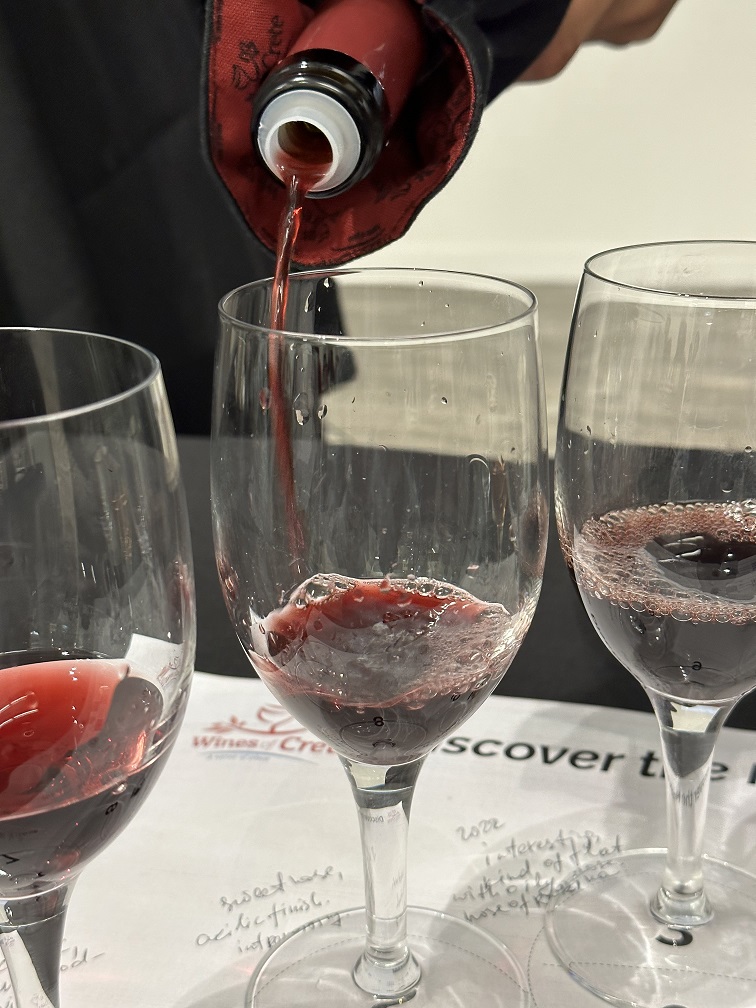
We managed to convince the staff to show us the wines we tasted, at least some of them, so you can see some of the wines we tasted in the picture above.
Main room tasting had its own issues – it appears that due to some issues with the customs, instead of 64 wines only about 15 were present in the tasting. All black bagged, unfortunately. I tasted another grape I never had before – Plyto, and the wine was quite pleasant, but this is all I can tell you.
There you have it, my friends. For me personally, this was not a waste of time, as I managed to pick up three new grapes I never tasted before. But in the large schema of things, this was a wasteful tasting – and it is sad. The effort was put into organizing it, but would it really help to advance the Wines of Crete in the US – I doubt so very much.
I really hope my next wine tasting will fare better…
Celebrate Tannat!
Yesterday, April 14th, Tannat Day was celebrated around the world.
Obviously, I’m late to the “Celebrate Tannat” party, so why even bother, right?
Tell me honestly – have you ever forgotten to wish a happy birthday to a friend on the actual birthday day, only to call the next day, apologize, and still wish a happy birthday? If you have never done that, you can probably skip this post altogether as “too late”. For those who had been in this movie once or twice, let’s still celebrate the Tannat grape.
Tannat is an interesting grape due to a number of reasons. First, this is one of the most tannic grapes out there, with one of the highest levels of phenolic compounds in seeds and skin (you can check this article if you would like to get some actual scientific data), competing for the leadership here with Sagrantino grapes from Umbria in Italy. Second, Tannat’s story is very similar to the story of its very close cousin, Malbec.
I’m not implying that Tannat and Malbec are genetically related. But they share similar lifecycle stories. Both grapes originate from the cradle of the French wine world, Southwest France, also known as Sud Ouest. Once upon a time, Malbec used to be the king of Cahors, and Tannat was ruling in Madiran. Both grapes managed to lose their crowns and were reincarnated in full glory in South America – Malbec found kingship in Argentina, and Tannat became an uncontested star of Uruguayan winemaking.
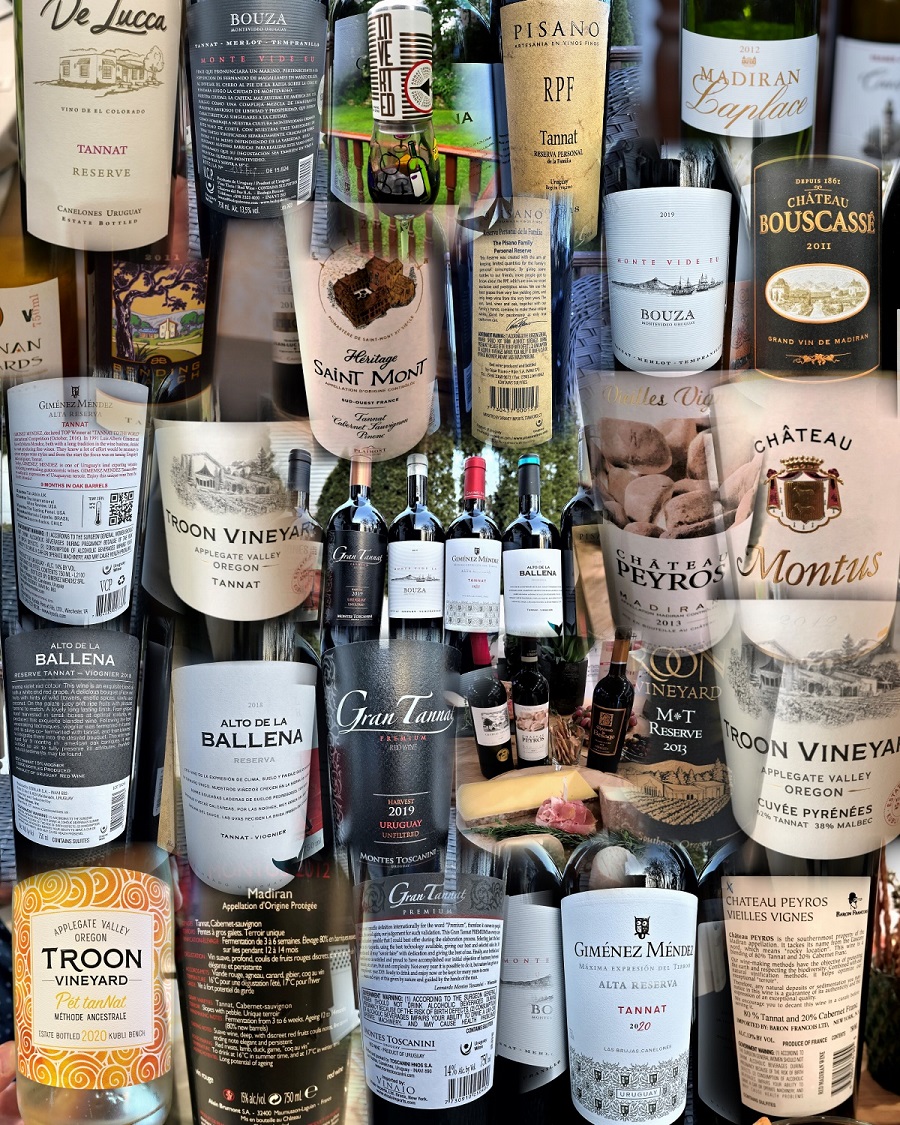
While Tannat found its new home in Uruguay, the grape is actually growing all around the world. But Uruguay is not just the new home. The interesting part about Tannat’s story in Uruguay is that the local winemakers found a way to tame its powerful tannins and acidity, and are able to produce delicious single-grape Tannat wines. However, Tannat can be found in Australia, Chile, Argentina, France, California, Oregon, Texas, and many other winemaking regions, where it is often used as a part of the blend.
While working on this post, I decided to check how often I mentioned Tannat one way or the other in my blog. From almost 1,500 posts, 34 posts contain the word “Tannat”. For comparison, 453 posts contain the words “Cabernet Sauvignon”, 13 times difference. However, just looking at the website word count, the word “Tannat” was mentioned in the blog about 700 times, and Cabernet Sauvignon about 2,500, less than 4 times difference.
Never mind the word count. As we said before, Tannat is the star of Uruguayan winemaking. Also, if you care to look for them, Madiran wines made somewhat of a comeback as of late, and Tannat is a major grape there. You can also find single-grape Tannat wines in Oregon, Texas, and Virginia. Speaking of Oregon, I have to mention the wines of Troon Vineyard. Craig Camp, the head winemaker at Troon, makes wonders with Tannat, from beautiful full-bodied organic reds to sparkling Tannat wines – Pet tanNat is definitely the wine to experience.
And then there is blending. If you would care to look at the list of grapes in the blend, lots of red wines from around the world have some amount of Tannat. Sometimes it is only 1% or 2%, but this might be enough to add acidity and tannins to the blend, to make the wine shine a little bit more.
Playing solo or in a minor supporting role, Tannat is well worth celebrating. Whether you celebrated Tannat yesterday or not, give this grape a chance – you might well like it in your glass.
Latest Wine News and Updates
While wine production is one of the oldest industries in the world, the amount of new, innovative products and scientific breakthroughs in the wine world is nothing short of breathtaking. Let’s take a look at some of the latest news from the field.
Everyone agrees that fake wine is a big problem for the wine industry. There are many tools employed by winemakers to protect the identity of their wines, but the quest for the perfect solution is still ongoing. After 15 years of intensive research, the French INAO (The National Institute of origin and quality), together with the College of Veterinary Medicine at Auburn University in the US announced the successful results of the initial trials of dogs being able to sniff fake wines. As part of the Canine Performance Sciences program, dogs had been trained to identify wines that don’t match the original wine. The training is a very involved process requiring the dog to spend about 2 years at the winery memorizing the original flavor profile of the wines. Once trained, the dogs can easily distinguish the original bottles from the fakes, the same as working dogs who identify illegal substances at customs in airports. The training process is intense and costs about $50K per dog, so this solution is not for every winery. Nevertheless, according to INAO, it will take about 7 years to satisfy all the requests for the dogs received to date.
There are plenty of wine lovers who crave massive, tannin-loaded wines. Such wines are often quite expensive as they require a long aging time in the oak barrels which are costly. What if the oak flavor can be concentrated in the grape itself while it is growing? Impossible, you say? Scientists from UC Davis in California think otherwise. Instead of using the traditional rootstock, UC Davis scientists managed to graft Cabernet Sauvignon vines onto the french Limousin oak rootstock, and after about 7 years of experimentation it seems that resulting wines demonstrate much higher tannin concentration than the wines obtained from the same clone of Cabernet Sauvignon but not grafted on the oak rootstock. Obtaining the same level of tannins would require about 6 months of age for the wines in the control group. Once the research is complete, it will result in significant savings for the wine producers which [hopefully] will be passed on to wine lovers. We should expect to find the first wines based on the results of this research by approximately 2028.
Many wine lovers live with a simple motto – coffee in the morning, wine in the evening. The next news I would like to share with you will, in a way, be related to both beverages. How so? Everyone knows Nespresso, a French company that mastered the simplicity of the perfect cup of espresso at any time with the help of a tiny coffee capsule. Working on a special (very sizeable) grant from French LVMH conglomerate, Nespresso just announced a brand-new machine called – maybe you guessed it – Winepresso. Nespresso scientists found a way to convert the content of the wine bottle to the dry form which is encapsulated in the tiny wine capsule, literally identical to the coffee one. Now, with a push of a button, a perfect glass of your favorite beverage is in your hand at any moment. Based on the opinion of the expert panel, the Winepresso-produced wine is practically identical to the original wine, which is a pretty amazing achievement in itself. The initial set of capsules available upon commercial availability of Winepresso will include two Bordeaux reds, one red from Burgundy, and 3 whites from Loire. It is also known that Nespresso is actively involved in conversations with a few of the famous wineries in Napa Valley. The capsules will be sold in the 5-packs (to be identical to the standard 5 glasses in the bottle of wine). Winepresso machines are expected to appear at select retailers such as Williams-Sonoma and Bloomingdales in time for Christmas shopping. The prices for the capsules and the machines had not been disclosed yet. If successful, you can only imagine how successful this product will be from point of view of sustainability and reduction of the carbon footprint.
Open any news source today, and you are guaranteed to read about ChatGPT, artificial intelligence (AI) software. ChatGPT writes poems, articles, and marketing materials, conducts market research and lots more. It appears that the wine world is starting also to embrace ChatGPT in a variety of ways, many of them quite unexpected. Champagne Piper Heidsieck just announced that they will start a new line of non-vintage Champagne, called Piper Heidsiek AI, where ChatGPT will play the role of the Chef de Cave, responsible for blending the final wines. After the initial offering, both Blanc de Blancs and Blanc de Noirs will be produced. While it is an interesting announcement in itself, I’m concerned with the impact of the ChatGPT on all areas of human lives, now including even wine production. Well, we will see how this story will unfold.
That’s all the latest news I have for you, my friends. Until the next time – cheers!
Celebrate Riesling!
I have to admit, I’m missing most of the grape holidays lately. While checking the Twitter feed today, I was surprised to find out that today we celebrate International Riesling Day. Considering the fact that I never wrote a post about Riesling Day, I couldn’t resist an opportunity to reminisce about my Riesling experiences.
Riesling is one of the 3 main white grape varieties – Chardonnay, Sauvignon Blanc, and Riesling. Of course, there are lots more white grape varieties in the world, but in terms of plantings and production volumes, these three grapes are way ahead of all other white grapes. However, despite the “main variety” consideration, Riesling’s position in the wine world is rather peculiar.
Riesling is capable of a full range of expressions, from bone dry and acidic Rieslings of the Clare Valley in Australia to the dense and viscous late harvest Rieslings made in different parts of the world. Germany, which has about 38% of all Riesling plantings in the world, is typically associated with Riesling – however, there is hardly a wine-producing region in the world where Riesling wines are not made – Germany, Austria, Alsace, Australia, New Zealand, Canada, California, Washington, Oregon, New York – Riesling is literally produced everywhere. And yet walk into any wine store of your choosing – Riesling is typically relegated to the far corner of the store which almost nobody would visit. You can barely find any Riesling on the restaurant’s wine lists. And many consumers are often shy about their love for Riesling as it is almost shameful to be seen with a glass of Riesling in public.
I don’t fully understand the cause of this phenomenon. Germany’s overcomplicated labeling laws might play a role. The fact that it is very difficult to assess the level of sweetness of a bottle of Riesling also plays a role – put a few of the Kabinett Rieslings in the row and see how different the sweetness levels will be where you expect them all to be about the same.
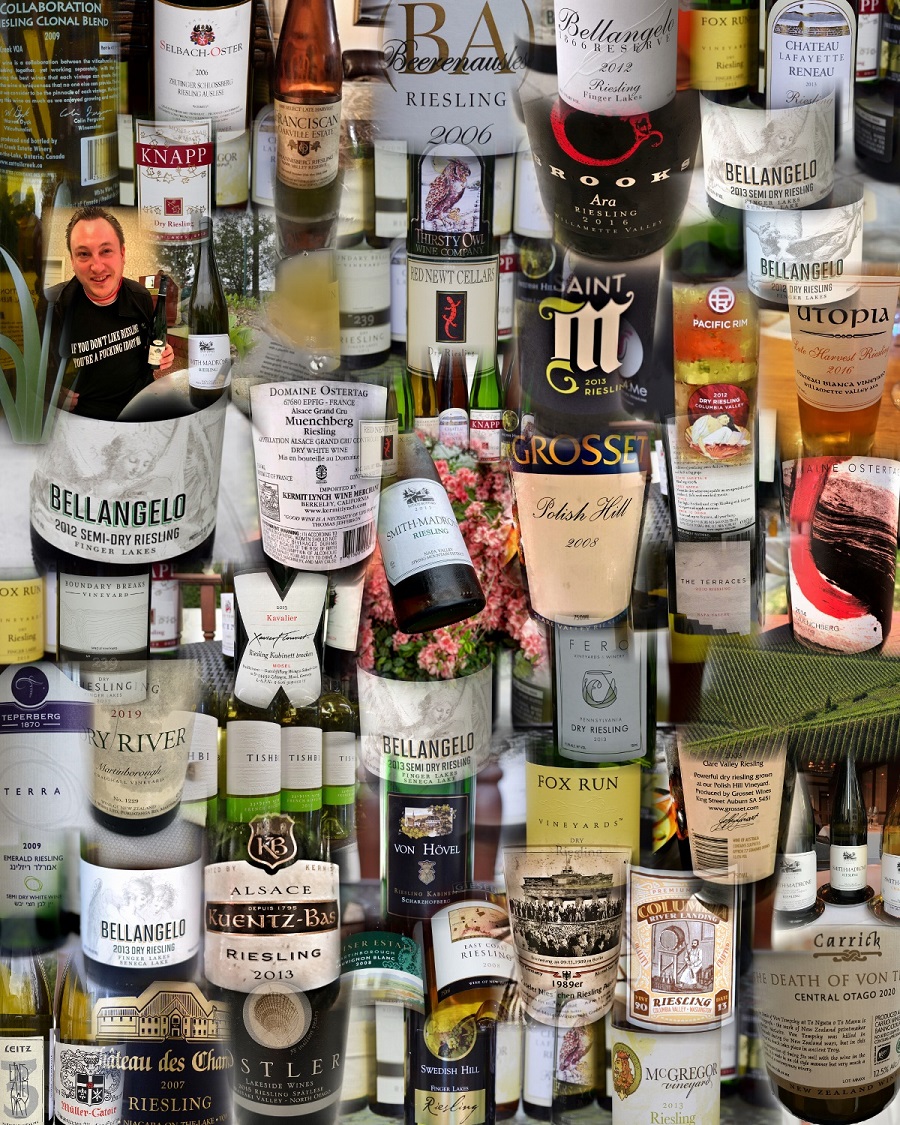 But those of us who trust our own palate and are not afraid of being seen with a glass of Riesling in our hand are typically in for a treat. The everpresent hint of honey, maybe pears, white flowers, and honeysuckle, supported by the cleansing acidity, and hopefully my favorite, a hint of petrol make these wines an absolute delight in my book. Most of the Rieslings also age very well – to understand the pleasure of the 20-30 years old Riesling you simply need to taste one for yourself – the words are very limited in describing the pleasure.
Over the years, I had plenty of delicious Rieslings. And yet if you would ask about the most memorable ones, I would easily give you 3. First, Brooks Ara Riesling from Oregon, which I tasted during a few of the Wine Bloggers Conferences – a pure standout. My next choice would be Smith-Madrone Riesling, which is rather surprising coming from Spring Mountain District in Napa Valley in California – nobody would ever associate California with Riesling, and yet you have a live, delicious proof.
And then, of course, there are Clare Valley Rieslings from Australia. Grosset Polish Hill Riesling from Clare Valley might be a quintessential pleasure, with its high energy, brilliant acidity, intertwined with the fruit – another wine that needs to be tasted to believe it.
I have come across many other excellent renditions of Riesling, but the three I just mentioned are definitely my personal standouts.
What do you think of Rieslings? Do you have your favorite Rieslings which you care to share with everyone?
Happy Reisling Day!
American Pleasures #7: Barra of Mendocino, Part 2
 Wine should give you pleasure – there is no point in drinking the wine if it does not. Lately, I have had a number of samples of American wines, that were delicious standouts – one after another, making me even wonder if someone cursed my palate. I enjoyed all those wines so much that I decided to designate a new series to them – the American Pleasures.
When I tasted Barra of Mendocino wines for the first time, I lamented that I was surprised. Delightfully surprised would be an even better way to put it. My surprise was related to the fact that both Pinot Blanc and Petite Sirah were absolutely delicious pop-and-pour Californian wines. Of course, there are lots and lots of delicious wines made in California, but many of them need time to open up and develop – especially the traditional heavyweights such as Petitte Sirah. And the wines I tasted were delicious and ready to drink from the moment they got into the glass.
Charlie Barra, the founder of the Redwood Valley winery in Mendocino, was farming organically for a very long time. And now Barra of Mendocino bottles carry the official organic certification by CCOF. To celebrate this achievement, Barra released three of their Reserve wines with a brand new label, showing intertwined oak and grape leaves. It took the winery more than a year to come up with this new design, the end product of multiple discussions in the focus groups of the club members, employees, and distributors. The oak tree represents an old oak tree found on the original Redwood Valley Vineyards plot. The grape leaf can be considered a tribute to Charlie Barra’s 70 years of grape growing carrier (he is often regarded as a “godfather of grape growing” in Mendocino county). The result – a beautifully looking bottle of wine. As part of this new design, the winery also eliminated foil caps from these Reserve bottles.
Let me now get back to the surprise associated with Barra wines. I got their three newly released bottles to try – Chardonnay, Pinot Noir, and Cabernet Sauvignon. Now, here lies the danger. This trio can be called THE California wines. Each category by itself – Califonia Chardonnay, California Pinot Noir, California Cabernet Sauvignon sets the bar really, really high. We have all tasted amazing wines in these three categories – that means that the frame of reference has very little room for error. You know my take here – if the bottle says “California Cabernet Sauvignon” on the label, it is better to be THE California Cabernet Sauvignon, the classic as is expected.
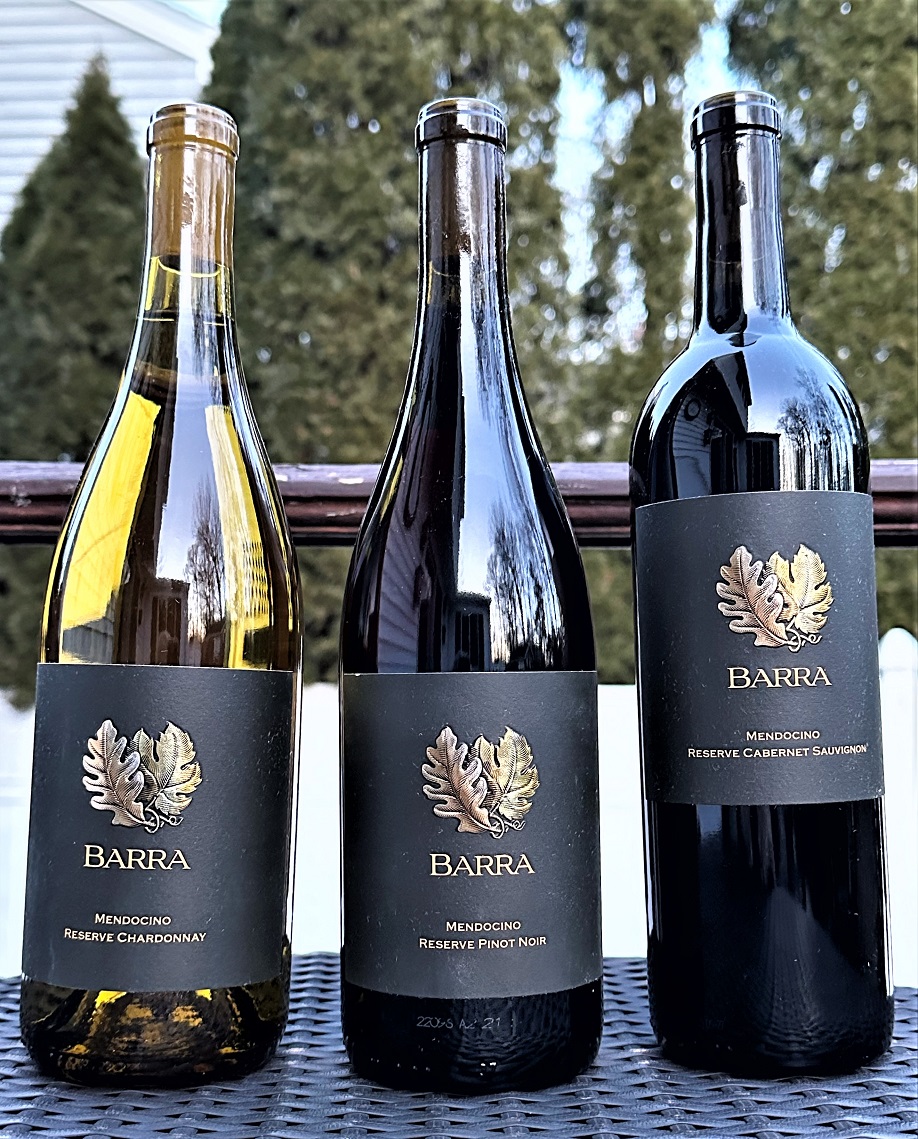
The new surprise? All three wines perfectly delivered. Each one was varietally correct and perfectly matched my expectations. Barra Chardonnay was Californian Chardonnay through and through. And so were Pinot Noir and Cabernet Sauvignon. And they continued to be pop-and-pour wines. And – these are very reasonably priced wines, considering the pleasure they deliver.
Here are my notes:
2021 Barra Chardonnay Reserve Redwood Valley Mendocino (14% ABV, $24, 7 months on the lees, 30% new French Oak, balance in neutral oak, made with organic grapes)
Light golden
A touch of the gunflint, earthy undertones
Buttery profile with green apples, good acidity, round, delicious.
8, beautiful. Would be happy to drink on any occasion.
2021 Barra Pinot Noir Reserve Redwood Valley Mendocino (14.5% ABV, $26, 8 months 25% new French oak, balance in neutral barrels)
Dark ruby
Tart cherries, herbs, restrained
Sweet cherries and plums on the palate, a touch of vanilla, medium body, round, clean, easy to drink
8-, perfectly quaffable.
8 on the second day, it needs a bit of time to show its true beauty.
2020 Barra Cabernet Sauvignon Reserve Redwood Valley Mendocino (14.5% ABV, $28, 18 months 30% new French oak, balance in neutral barrels)
Garnet
Cassis, earth, sweet basil
Dark berries, eucalyptus, minerality, clean acidity, beautifully layered texture. Shows almost sweet upon opening, but quickly loses baby fat to show tight, muscular texture.
8+, outstanding. I can make it my go-to Cabernet Sauvignon easily.
Here you are, my friends. Three delicious wines for you to add to the “find end drink” category – beautifully packaged and now certified organic.
What were your great wine discoveries as of late?
Spanish Wines: Old and New
 If I start calling wines “friends”, does it make me an alcoholic or a sad psychopath?
Whatever. We are who we are.
If you love wines, what are the emotions you experience when looking at a familiar bottle? “Ahh, I know you. Of course, I remember you. Oh, we had a great time together. Remember what happened the last time we met?” Wouldn’t that be very similar to a meeting with an old friend? I’m not equating humans and bottles in any way, but emotions connect us, and good wine always solicits emotion.
What happens when you see a new wine? If something strikes your interest – label, region, producer, grape, anything – your think “yeah, I want to get to know you better”. Making new friends in the human world would work pretty much the same – but I think we better get back to talking about wines before I will dig myself too deep.
I love Spanish wines – and you are well aware of this. I’m always happy to meet old wine friends. I’m equally excited to make new acquaintances. Especially when both old and new friends are Spanish wines.


The first wine I would like to talk about… Well, speaking of friends, it is an old and wonderful friend who makes you feel uneasy at a first sight. You know the feeling when you see an old friend and you are super-happy to embrace him (or her), and then your joy is instantly blemished with the next thought of “ohhh, I promised to send him the book, and I never did”. So this Godello from Arano wines is this exact friend. I had this wine a few years ago, was blown away, promised to myself to write about it – and yet never did. Yep, that feeling.
Speaking about Spanish white wines, most people would probably think of Albarino first, followed by Rueda/Verdejo, and then probably get to white Rioja (usually made from the Viura grape). Meanwhile, Godello might be the most interesting Spanish white grape, in many instances producing white wines easily rivaling the best renditions of Chardonnay. This Godello is definitely in the group:
2020 Virgen Del Galir Pagos del Galir Godello Valdeorras DO (13.5% ABV, $21)
Light golden
Whitestone fruit and lemon
Whitestone fruit, plump, mouthfeel between Chardonnay and Roussanne, round, perfect acidity, delicious.
8+, would perfectly compete with any Chardonnay
Here comes another old friend – Bela, one of the new projects of the Rioja powerhouse CVNE in the Ribera del Duero region. I tasted the 2017 vintage of Bela 3 years ago, which gives me the “old friend” rights. There are some notable differences between 2020 and 2017 vintages – 2017 was well-drinkable almost from the get-go, and 2020 needed 3 days to become the beauty it had become. I don’t know if the oak regimen can actively contribute to such a dire difference (the 2017 vintage spent 6 months in the mix of 1-year-old French and American oak, and 2020 seems to spend 9 months in the new French oak) – but nevertheless, this is definitely the wine for the long haul.
2020 CVNE Bela Ribera del Duero DO (14.5% ABV, $18, 95% Tempranillo, 5% Cabernet Sauvignon and Merlot, 9 months in French Oak barrels, 3 months in the bottle)
Dark Garnet
Earthy spicy herbal nose with dark fruit undertones and a touch of tasted meat
Cherries and cherry pit, tart, focus, firm, concentrated – beautiful on the 3rd day. Day one needed time and day 2 was completely closed.
Drinkability: (day 3): 8+


Now, my most beloved wine category – Rioja.
As you know, everything in life has two sides. Rioja is my favorite wine – but on the flip side, I’m very particular about my Rioja. Despite the absolute world-class of CVNE, I never saw this Bakeder Rioja before, which to me means “proceed with caution”. It appears that this wine is a tribute to the car-free village of La Guardia. As this is a new wine for me, let me quote from the CVNE website: “Bakeder, pronounced back-aid-er, is a wine from Laguardia, a village from Rioja Alavesa. The name, “beautiful as peace” is a loose translation from the Basque language. Let the Whole World know the beauty of the fortified medieval village of Laguardia, protected by its great sierra; its solemn churches and monuments; its historic vineyards, and of course, its magnificent wines.” All my fears dissipated with the first sip:
2019 CVNE Bakeder Rioja Alavesa DOC (13.5% ABV, 100% Tempranillo, 10 months in French oak barrels)
Dark ruby
Cherries, cigar box, eucalyptus
Cherries, plums, well-integrated but present tannins, earthy, firm structure, good acidity, perfect balance. Lots and lots of pleasure.
8+, pop’n’pour the wine you don’t want to stop to drink
The last wine for today comes from the legendary Spanish producer – René Barbier from Clos Mogador in Priorat. Clos Mogador needs no introduction to wine lovers as a producer of some of the most coveted wines in the world. Com Tu, which I never had before, is a relatively new wine, commercially produced only since 2005 from 35-50 years old Garnacha vines. The wine’s name can be summarized as ” I am like you (Com tú), you are like me”, has a lot of meaning and history as a special project, so I would like to simply direct you to the Clos Mogador website to read about it.
2019 Clos Mogador Com Tu Garnatxa Negra de la Figueroa Montsant DO (14.5% ABV, 100% Garnatxa (Grenache), 18 months in a foudre)
Dark ruby
Dark ripe fruit and dark chocolate
Cherries, plums, chocolate, good acidity, sage, good balance.
8, light and pleasant on day 1
Here you are, my friends – some old and some old new “wine faces” – each delivering lots and lots of pleasure.
I wish you many pleasant encounters with friends old and new. Cheers!
Last Bottle Sign Up ($10 credit)




 Talk-A-Vino