A Hidden Obsession
I made an interesting realization today – I have a hidden obsession.
Obsession doesn’t seem to be a good thing, especially when directed at someone. If this is an obsession for something, this is usually a different story.
Can obsession be hidden? Can you not realize that you have an obsession? Does obsession clearly manifest itself, or do we need to engage in a deep self-analysis to realize that we’ve been obsessed?
Okay, please worry not – first, I’m not engaged in obsession research while working on a degree in psychology. Second, we are only talking about my basic, simple, well-known obsession with wine. Nevertheless, today I realized that I had an obsession (a mini obsession? a sub-obsession? you will decide) that was literally hiding in plain sight.
Ten days ago we celebrated the arrival of the Jewish New Year (year 5784 in case you are wondering) – Rosh Hashanah. I always prefer to celebrate Jewish holidays with Israeli wines, but I almost never have any on hand, so I had to take a trip to a wine store. Long story short, I came back with two bottles of wine produced by Shiloh Winery, one of my favorite producers out of Israel.
On a big scale, Israel produces world-class wines. I had been exposed to Israeli wines for more than 25 years as I had been lucky to travel to Israel for work. Lots of Israeli wines are spectacular, but same as everywhere else, you have to go by producers. Some of the best Israeli wines are either not exported at all, or exported in minuscule quantities – and many of them are pretty expensive, especially outside of Israel. So finding good Israeli wines to drink outside of Israel is not necessarily an easy task.
During a dinner at a kosher restaurant in New York 6 years ago, I tasted a red wine called Shiloh Mosaic, and I immediately fell in love with it. The wine was simply a spectacular, rich, and opulent Bordeaux blend – I loved it so much that it made it to the Top Wines of 2017 as number 14. From that moment on, Shiloh literally became my go-to solution for all the Jewish holidays – and yes, you can even say that I became obsessed with it. Another wine from Shiloh, Shiloh Secret Reserve Cabernet Sauvignon made it to my Top 20 of 2020 list as number 18.
As I was getting ready to write this post, I searched my blog for the Shiloh references, and to my surprise, I discovered that Shiloh had been a hidden obsession for a while – for sure way before I thought I “discovered” it in 2017. Shiloh Secret Reserve Shiraz was included in the September 2014 Month in Wines post with a high rating; Shiloh Legend blend was lauded even before that in the May 2014 Month in Wines post. See, nothing can be hidden without becoming apparent – this is how I discovered my hidden obsession.


For this year’s celebration, I went with two wines from Shiloh that I hadn’t seen before – both of them under the Amichai by Shiloh label. As I bought wines at the large wine store, Total Wine, I was sure I would find all the wine information online. However, Shiloh Winery’s website didn’t offer any information about this brand. The distributor’s website offered exactly the same amount of information – zilch. And all my attempts to find any information online didn’t yield any results. Yes, the back labels offered basic facts, such as grape composition and oak regimen, but I was hoping to learn more – the inspiration, why the wines are called the way they are called, you know, the story. I can only assume that the wines represent a new project by Shiloh’s self-taught winemaker, Amichai Lourie, and maybe the project is so new that information didn’t make it to the website. Oh well, at least we got the wine.
I opened these wines for the Rosh Hashanah dinner, and everyone loved them, as both wines were delicious. I managed to save just half of the drop in each bottle so I was able to write my traditional notes the next day:
2018 Amichai by Shiloh Micah Judean Hills Israel (15% ABV, $57, 91% Cabernet Sauvignon, 7% Merlot, 2% Petit Verdot, 15 months in French oak barrels)
Garnet
Currant leaf, sweet cherry, eucalyptus
Cassis, earthy undertones, tobacco, dark, powerful, delicious.
8+, outstanding, will age well for another 10-15 years.
2018 Amichai by Shiloh Solomon Judean Hills Israel (15% ABV, $57, 93% Syrah, 7% Petit Verdot, 15 months in French oak barrels)
Dark garnet, almost black
Dark cherries, blackberries, mineral undertones
Blackberries, tart cherries, firm structure, firm tannins, white pepper, peppery finish, inky and powerful, tannins on the finish. Perfectly balanced.
8+, outstanding. Will age well for another 10-15 years.
Here you are, my friends. My obsession is no longer hidden. And I’m happy to face it, any time. L’Chaim!
When in Sweden…
 Here I am, talking about travel again. Well, this will be mostly about wine, but let’s talk about travel first.
This was my third time visiting Sweden (all three times were for work reasons). My first visit was to Malmo, a town located in the southern part of Sweden close to Copenhagen, and that visit was fully documented here (and here is the bonus part about my day in Copenhagen).
My other two visits were to Gothenburg (also known as Göteborg), the second-largest city in Sweden and the birthplace of Volvo cars. Both times I stayed at the Gothia Towers Hotel. Here comes an interesting (funny?) part. As I made it to the hotel this time, I noticed a large amusement park called Liseberg right across from the hotel entrance, with a Ferris wheel and rollercoasters. While walking with someone to the hotel from the bus stop, I asked if the amusement park was just built, and in response I got a very surprised look and the answer that the park was there even 20 years ago. Turns out my first visit to Gothenburg was in January of 2018, and spending all of the light hours inside the building didn’t give me a chance to see what’s actually around. Kind of funny and strange, I know.
I also remember from the previous visit that I wanted to find a Swedish wine to try. I remember walking into a large liquor store close to the hotel and asking someone if they had any Swedish wine I could buy – and I remember the salesperson telling me apologetically that they didn’t have anything on hand, but that he would be happy to order the wine for me which would take some time to arrive – that, of course, didn’t work for my schedule. Coming back now gave me some sense of hope of finding the local wine to try and adding one more check mark to the Wines of the World table.
Once I got situated at the hotel, my next trip was a traditional walk to the supermarket. For the absolute majority of trips, this is my standard routine – I generally prefer to drink sparkling water in the room, and this is the easiest way to get it (not even the question of least expensive – in many cases, hotels simply can’t supply bottled sparkling water). I’m also always eager to see the wine shelves at the supermarket, to see what is there and at what price. In Sweden, however, it is a bit tricky – alcohol sales are a government monopoly – Systembolaget is the chain of stores that can sell alcohol and liquor in Sweden, and of course, they control the prices and the selection.
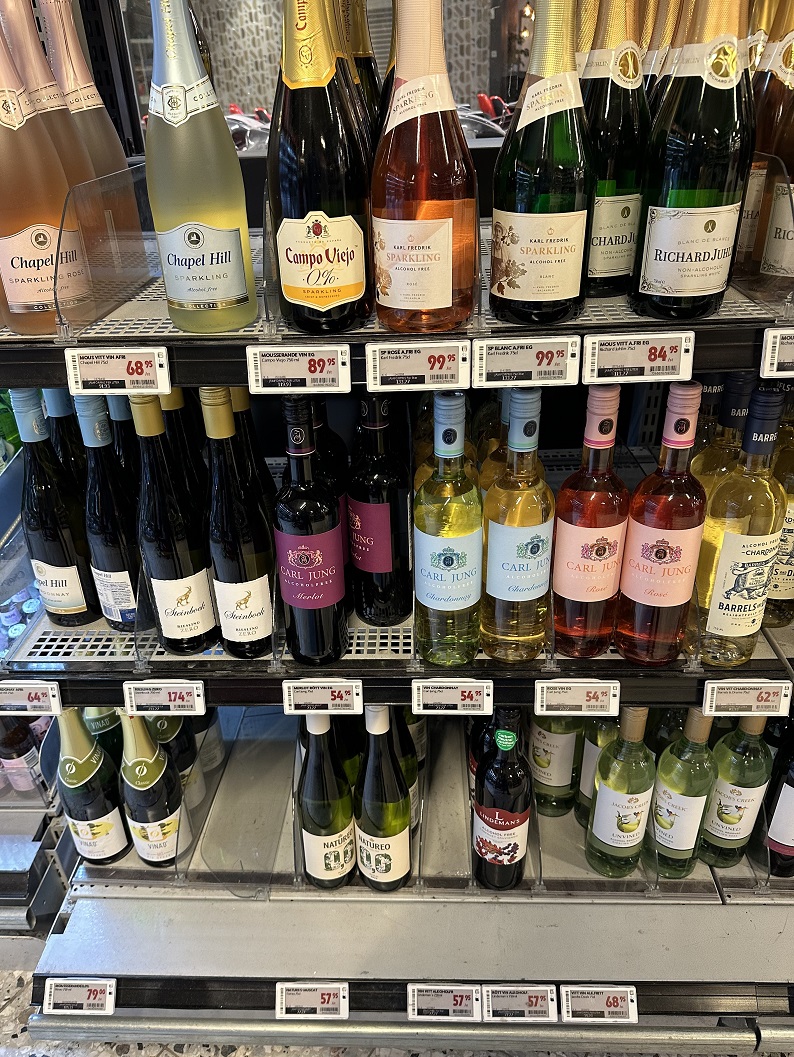
I visited the supermarket on Sunday, and Systembolaget stores are simply closed on Sunday (or at least the one I was near in Gothenburg). The supermarket actually offered wine – alcohol-free wine that is. I guess alcohol-free wine is a thing in Sweden, both locally produced (mostly from fruit, not grapes) and imported wines – and imported alcohol-free selection even included some familiar names, such as Campo Viejo, for example – you can see the sample selection in the pictures below:


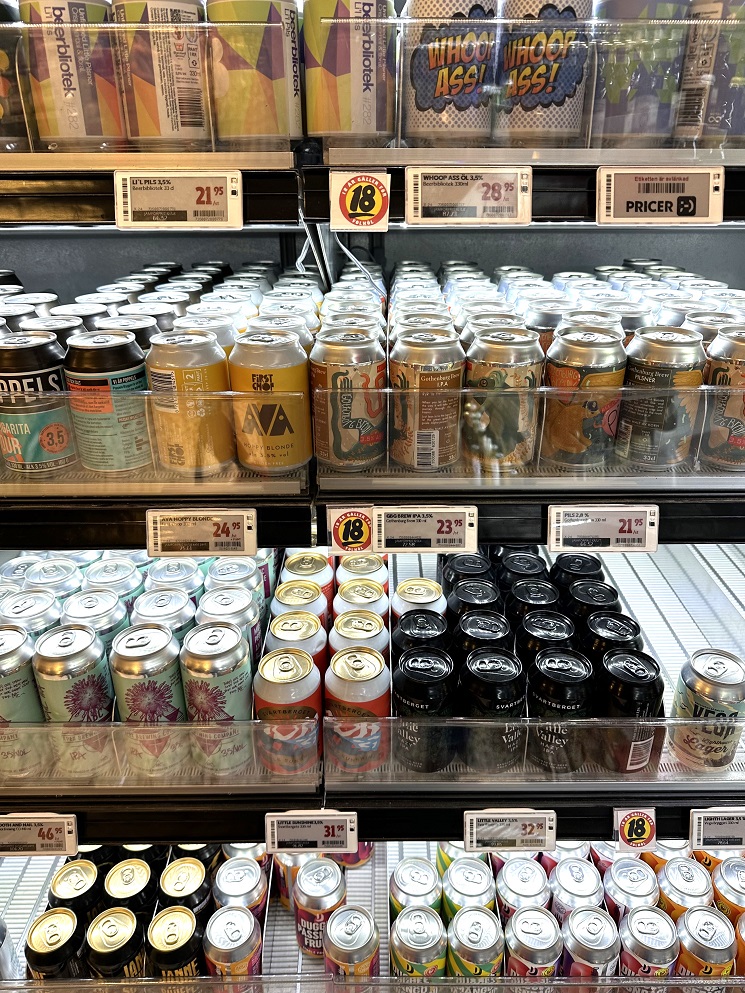
Apparently, low-alcohol beverages are allowed for sale at the supermarket, as there was a good selection of beer, and I even got a few to enjoy later in the room. Moreover, beer was a drink of choice at many of my dinners – while traveling when it comes to the “by glass” selection, I usually prefer beer as it is generally cheaper than wine and more error-prone. I had a number of good local beers during this trip.


And speaking about dinners, some were good, some were barely okay, and some were absolutely stunning (okay, not “some”, just one), as I already wrote about my visit to SK Mat & Manniscor. Actually, outside of that spectacular dinner, I had the best dish at lunch when we stopped by some random Italian place – the wild mushroom risotto was so good I had to literally stop myself from leaking the bowl (no picture though).


Before I will inundate you with pictures of the wines, just a few images of the town. As I mentioned before, this time around I was able to see the amusement park, and my room on the 17th floor afforded pretty good views as well – here is a little assemblage for you.




As I told you before, finding the Swedish wine was an important mission, so I tried to accomplish that at the first opportunity – I only didn’t realize that Systembolaget simply closes at 7 pm, and my meetings are typically not done until almost 8. The first half of the week went by and Thursday was my last hope before I would have to fly back on Friday. I found a little break in the meetings around 5 pm and went to the store.
The store was nice and spacious. After I made a few circles on my own, I realized that I would need some help finding the Swedish wine I was looking for. I asked the lady working there for help – she didn’t look very confident at first but with the help of the computer she was able to locate 3 different Swedish wines – real wines, with alcohol and made from grapes! (Ah, I’m so easily excitable).
As a general observation, I saw a good number of wines at a reasonable price, around $10 or less (divide the price you see in Swedish krona by 10 or 11 – that will give you the price in dollars).
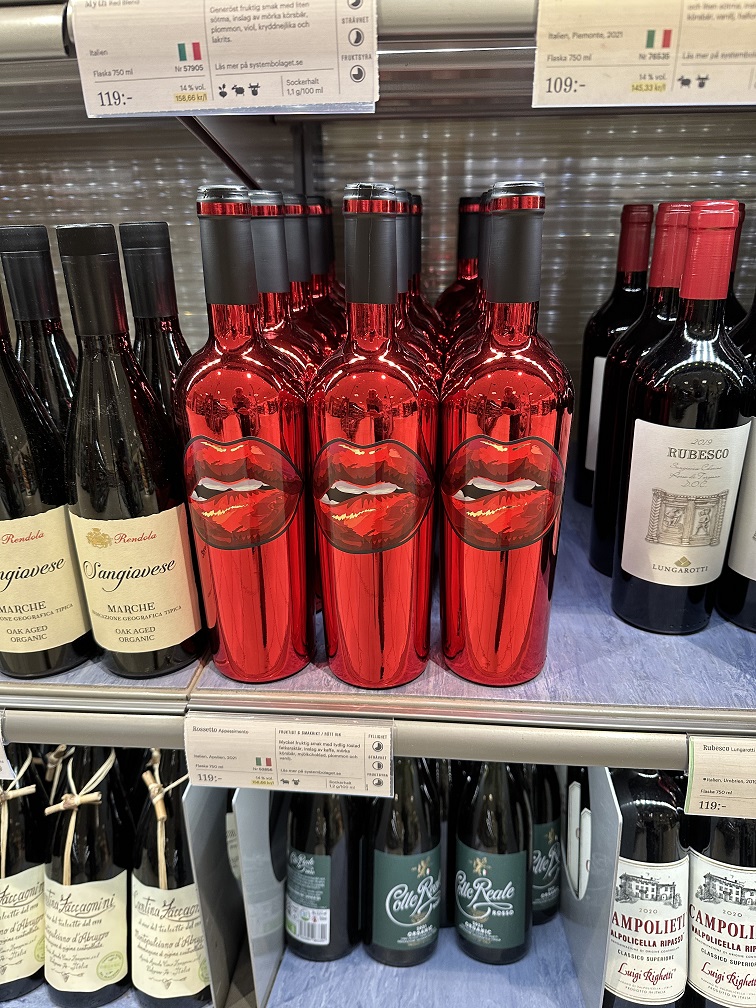
Some of the bottles looked like fun – if I were going on a hot date, I could’ve settled for this one with the lips:
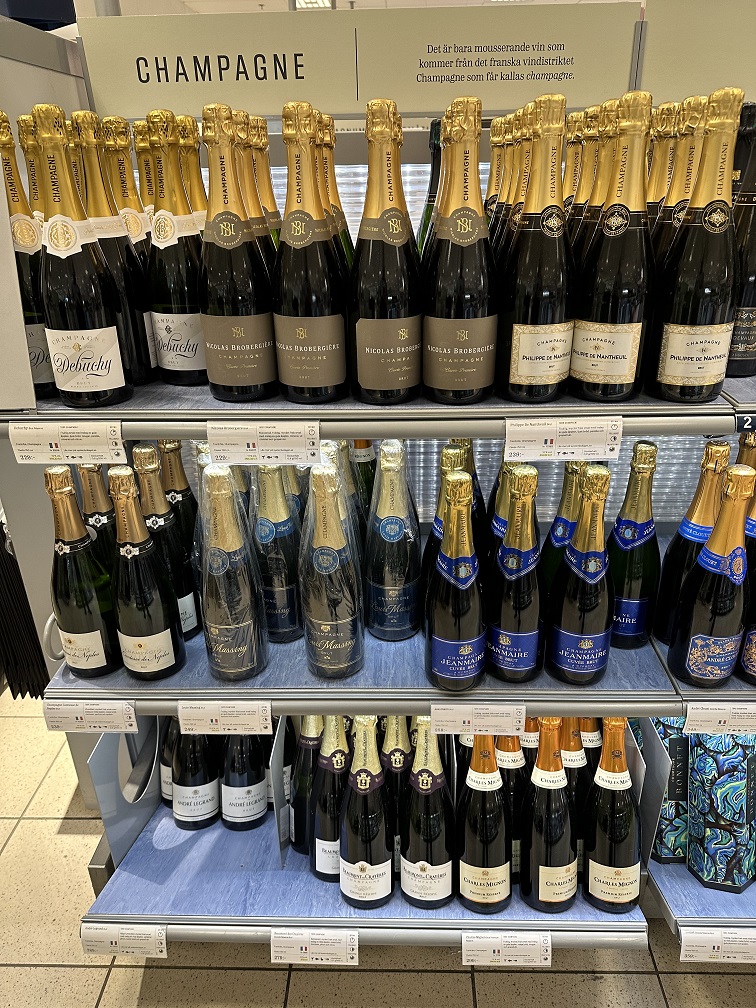
There was a good selection of reasonably priced Champagne, at least considering how much Champagne now costs in the US:
Lots of reasonably priced wines from Italy, France, and Australia:
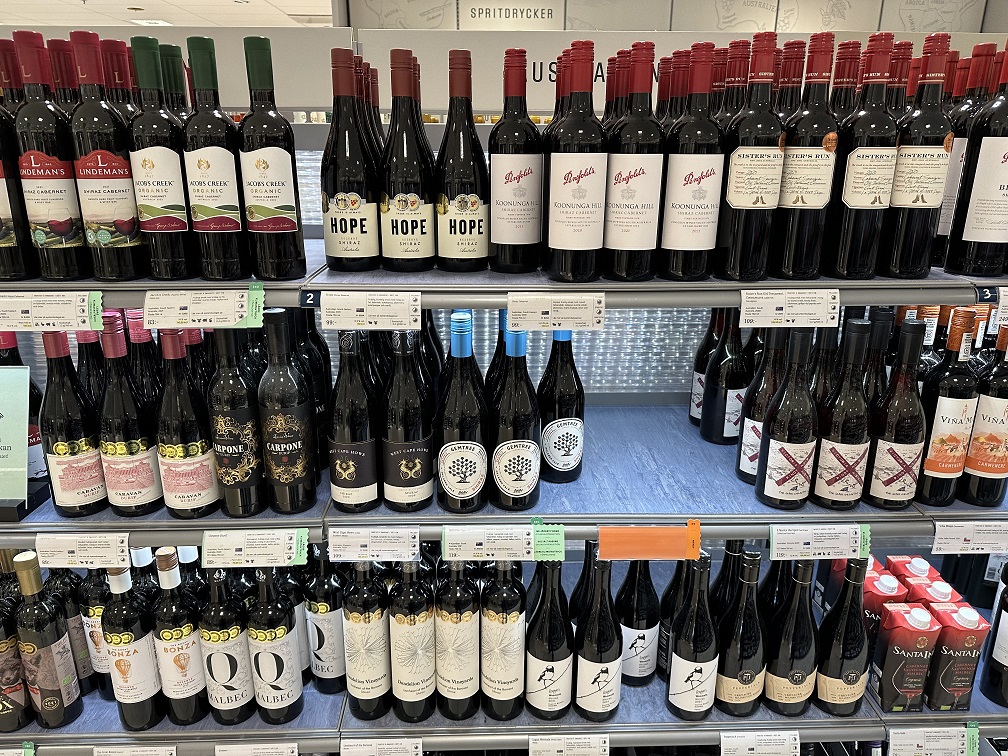
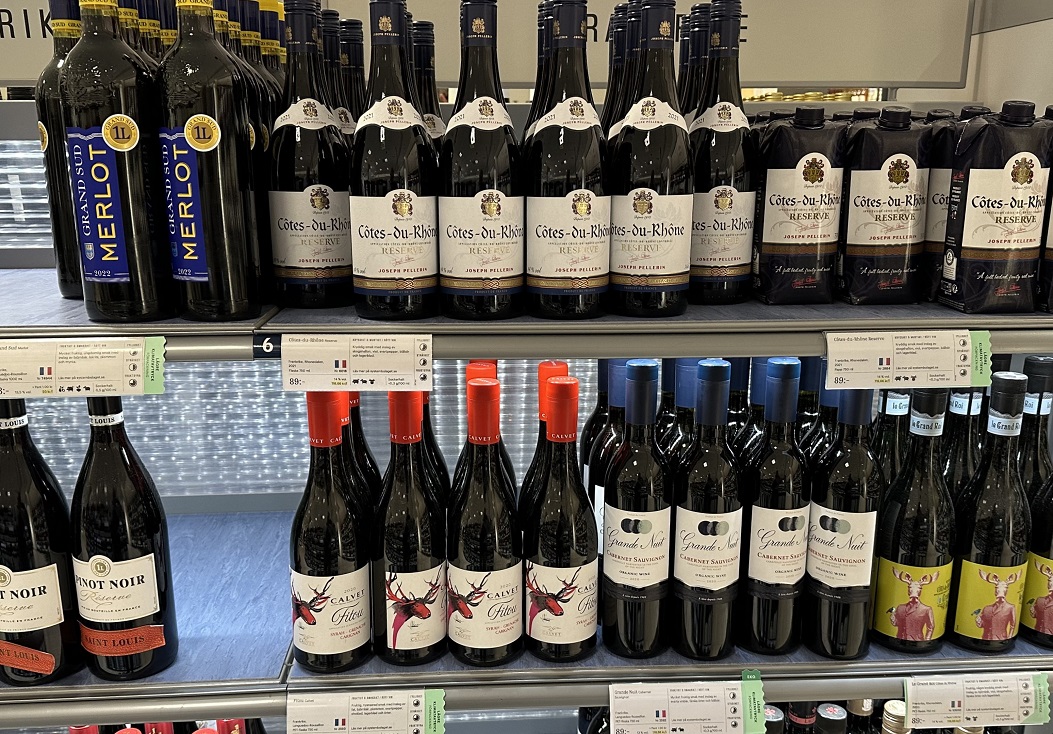
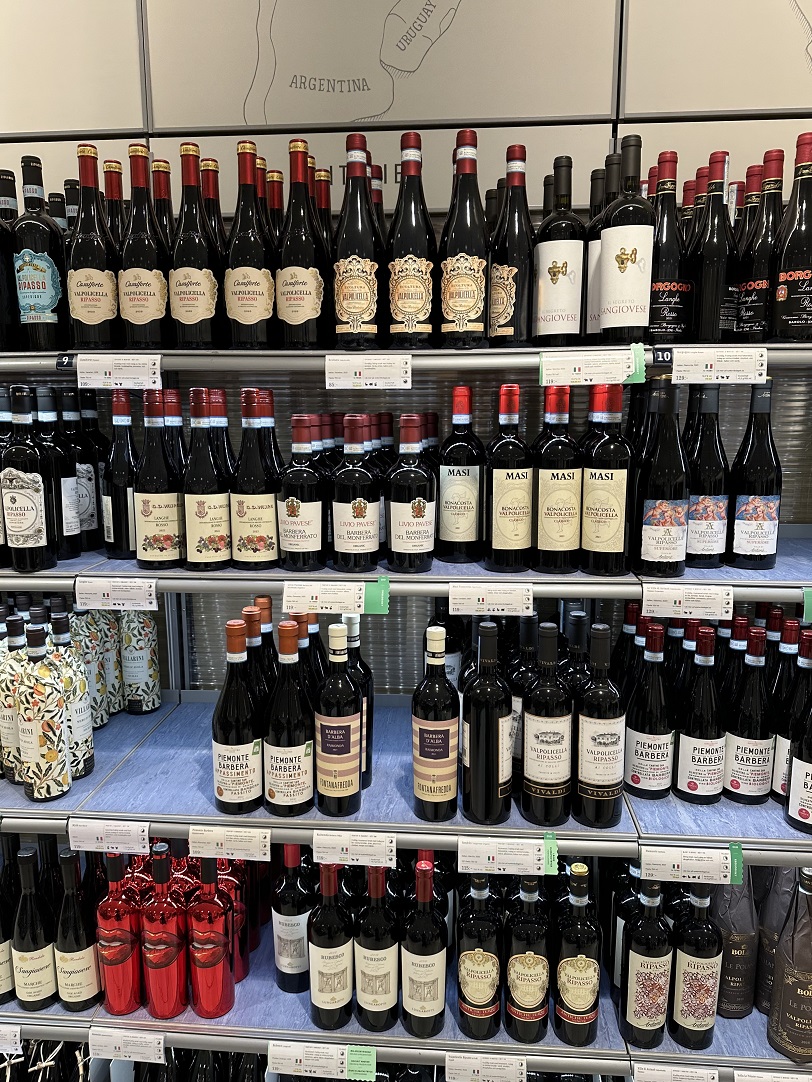
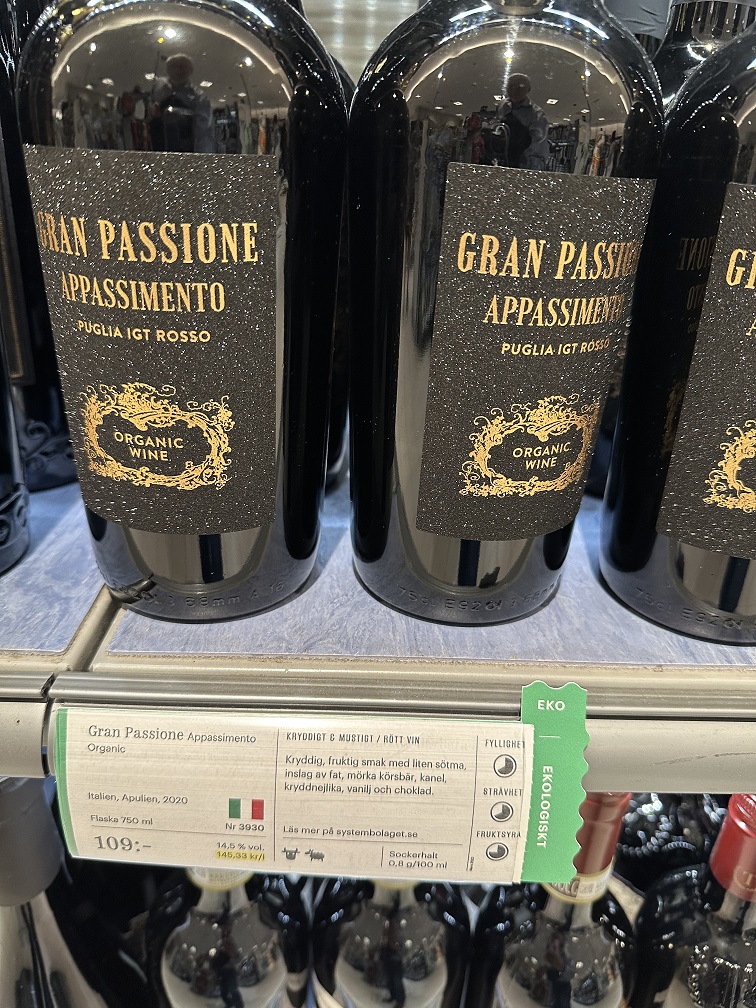
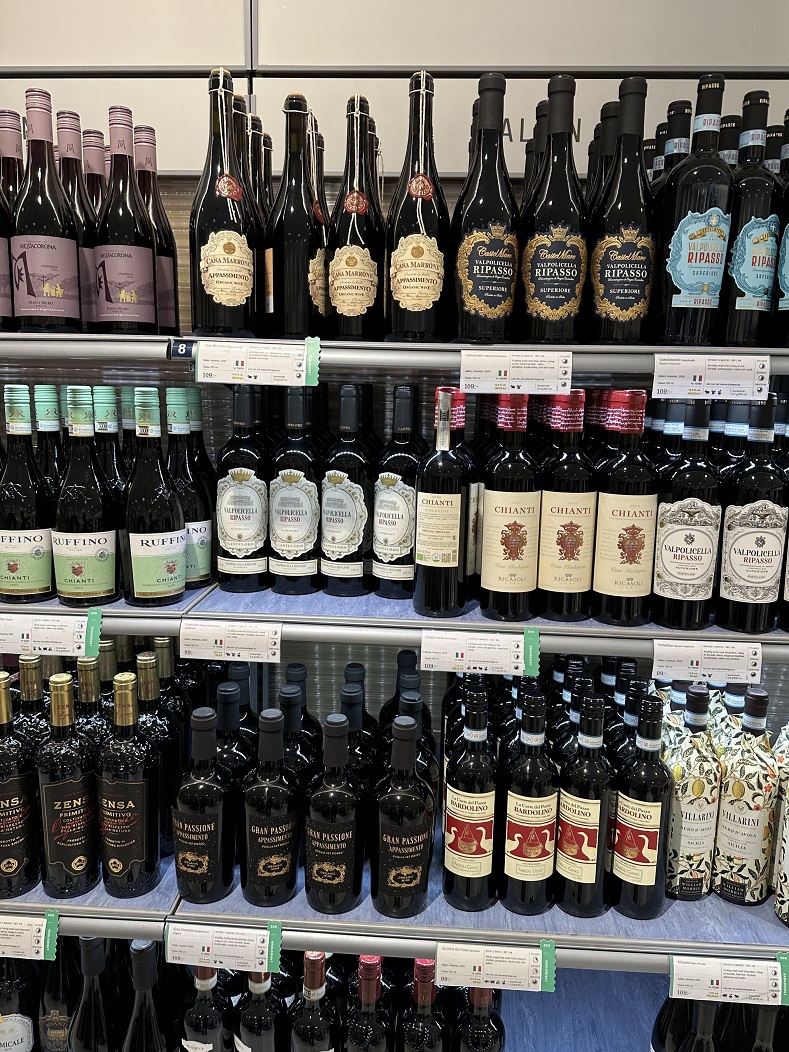
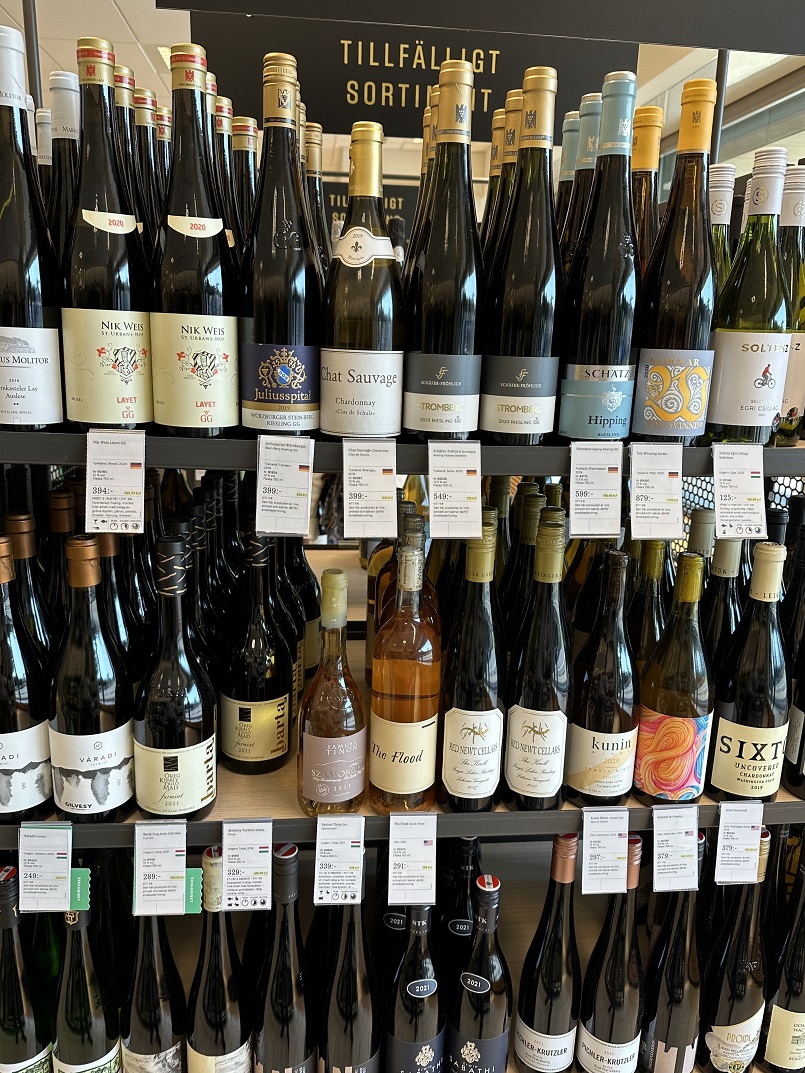
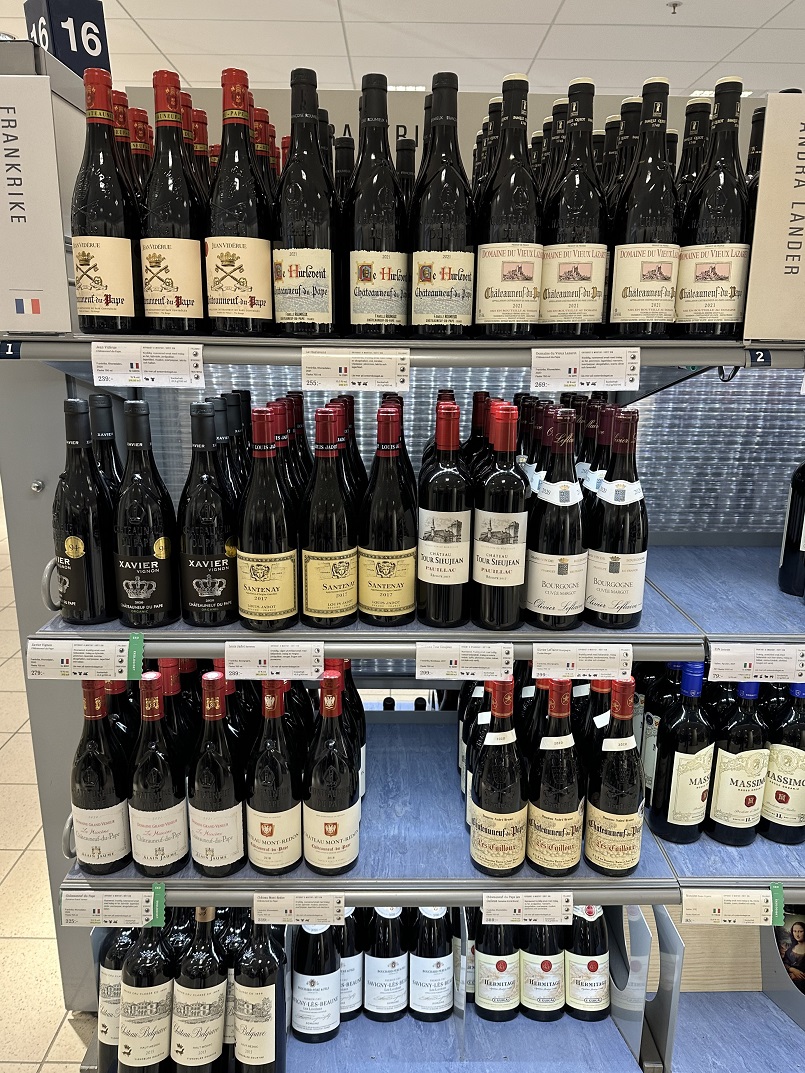
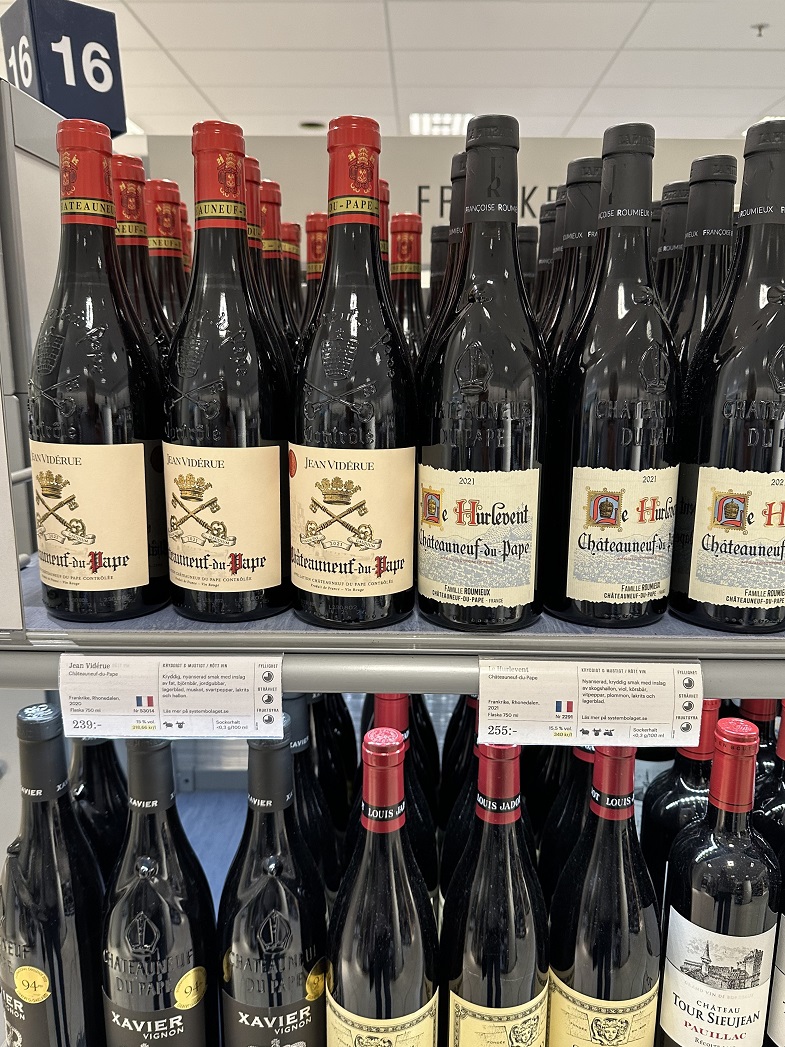
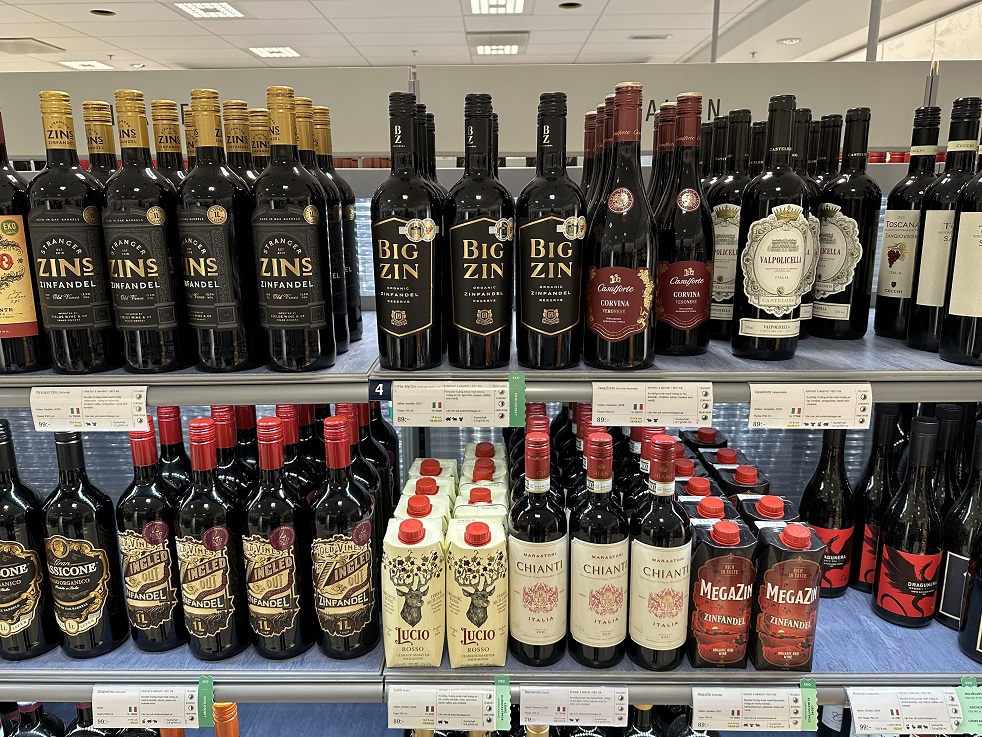
And here we are, the culmination point of the search – Swedish wines. These are quite expensive – yes, I understand it is not easy to grow grapes in Sweden.
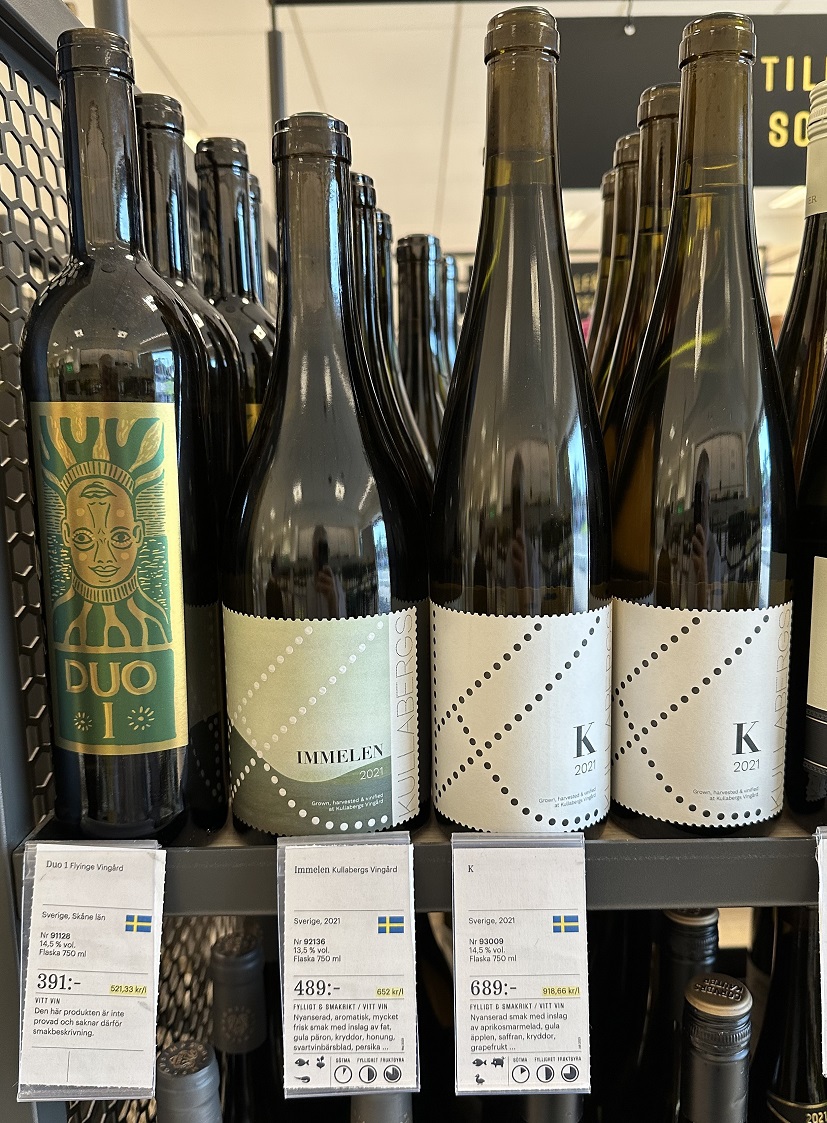
I settled for the “second cheapest wine”, which amounted to the hefty $45 – but hey, the price we pay for our hobbies…


Once I got into the hotel, I had to find a way to quickly chill the bottle, as it was my last evening to taste it and I had no intention of checking my luggage because of a random bottle. I got ice from the machine, added water, and did my best to submerge the bottle into the tiny ice bucket…
Before we talk about the taste, let’s talk about the wine itself – 2021 Kullabergs Vingård Immelen (13.5% ABV, mostly Solaris grape). The winery is located in the southwest part of Sweden, on the Kullaberg peninsula which is also a nature reserve (sometimes called Cape Kullaberg). The Kullabergs vineyard was planted in 2006. One of the main grapes at the vineyard is called Solaris – the grape selected in Germany in 1975, specifically developed to cope with cold climates. The wine I got from the store was mostly made from Solaris, at least according to the back label, even though the only technical note I found on the website was for Immelen 2019 which had 86% Solaris and 7% each of two other grapes.
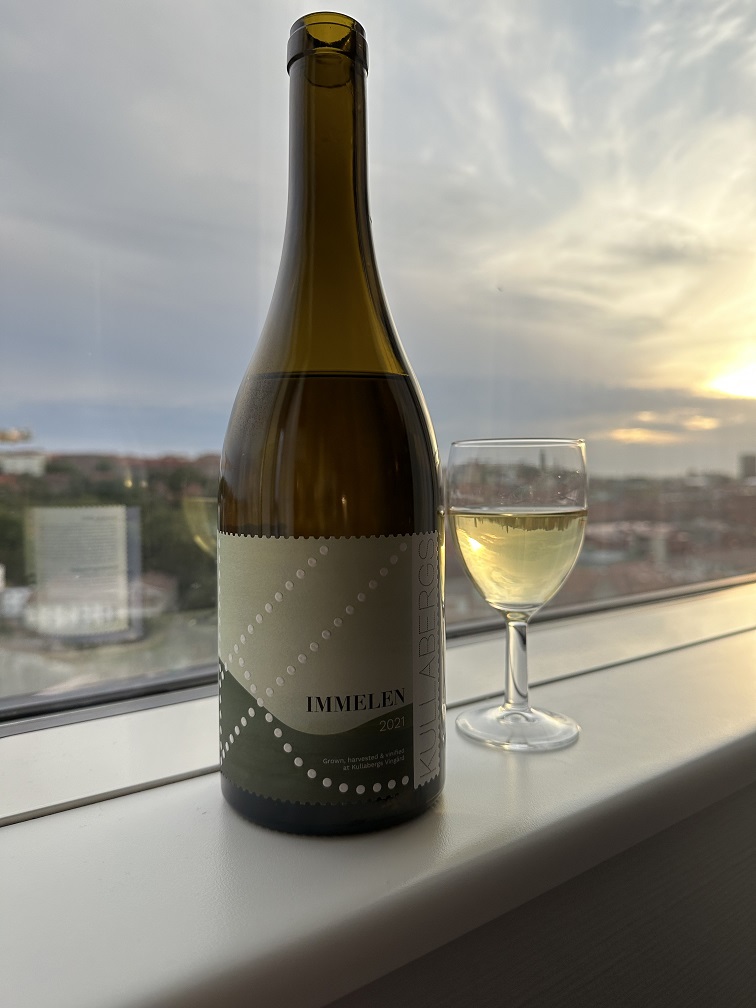
The wine was interesting. I wish I was able to fully chill it, but probably at around 55F it was showing a bit heavy, had notes of tropical fruit on the nose, plump and round body on the palate with a hint of grapefruit peel which offered a touch of bitter notes. Good acidity, and not a bad wine overall. It was reminiscent of Marsanne/Roussanne blends from the Southern Rhone if such a comparison would help. I’m happy I had an opportunity to taste this wine, add a checkmark to my wines of the world list, and a rare grape to the Hexavini journey. At $45, it is okay as once in a while exotic experience, but I will not pay this much for this wine a second time.
Here you are, my friends – a quick report from the trip to Sweden, mostly in pictures.
Hey, I heard Finland is starting to plant vines… guess what I will be hunting down next…
Oh, Grenache
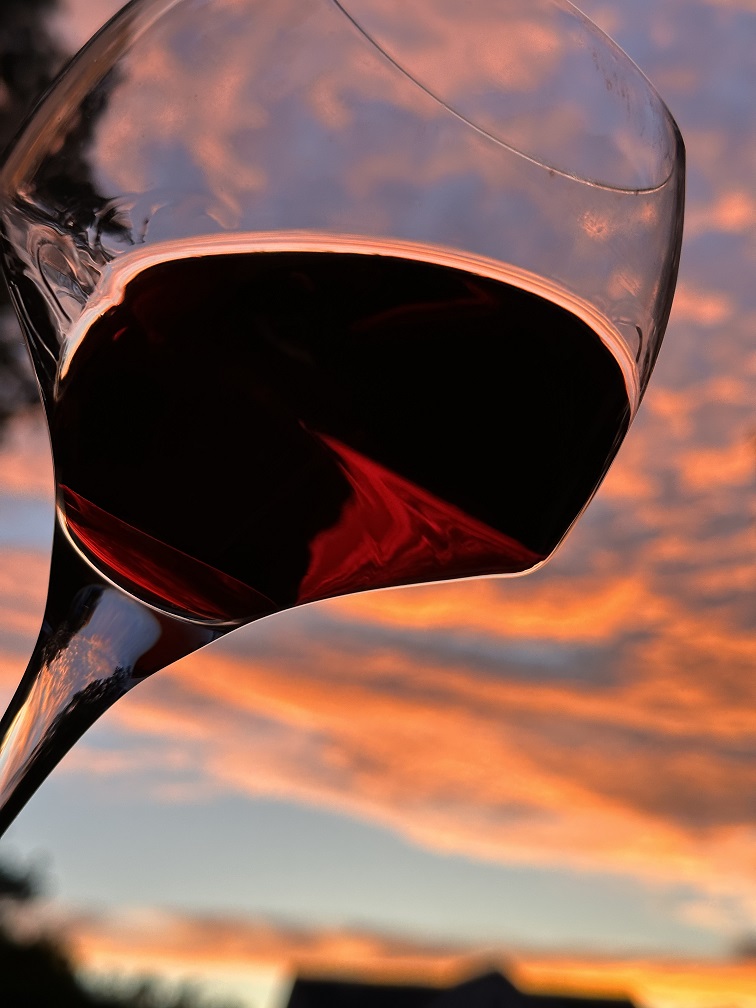 Last Friday, September 15th, we celebrated International Grenache Day. For those rare grape holidays I manage not to miss, I usually write a post on the actual day of celebration. This post didn’t make it on time (obviously), but I managed to open a beautiful bottle, so better late than never…
First, let’s talk about Grenache. Grenache, also known as Garnacha in Spain, is one of the major red wine grapes. Grenache is growing in all major winemaking regions – France, Spain, Italy (under the name of Cannonau), Australia, New Zealand, California, Washington, Israel, and many other places.
I’m sure that when people hear the name Grenache, the instant association is “red wine”. However, close relatives Grenache Blanc and Grenache Gris are also popular grapes, capable of producing delicious white wines – as they do, for example, in Southern Rhône.
Grenache is versatile – it can star on its own, but it is also a great team player. In Spain, Grenache, or rather, Garnacha, is the grape behind some of the most coveted wines of Priorat (Clos Erasmus, anyone?). Campo de Borja in Aragon is another Garnacha’s sacred land – if you have ever experienced the beauty of Alto Moncayo wines, you know what I’m talking about (if you didn’t, it is never too late to rectify). And in some regions, such as Rioja, Garnacha successfully plays a supporting role.
In France, Grenache is the driving force behind the wines of Southern Rhône – Gigondas, Chateauneuf-du-Pape, and everything in between fully relies on Grenache – both solo and as a part of the blend. I’m sure you heard of GSM, which stands for Grenache, Syrah, Mourvèdre – this trio constitutes an absolute majority of Southern Rhône wines, but GSM blends from Australia and the US will give Rhône wines great run for the money.
In the US, Grenache powers many California Rhône Rangers wines – Alban, Saxum, Pax, as well as many of the Washington wines – again, both in solo versions, such as single-vineyard No Girls and Horsepower wines and cult blended renditions such as Sine Qua None.
When it comes to the grape holidays, I take pleasure in going through the labels of the wines I had in the past and building a little collage to represent my experiences with the celebrated grape. I realized that even though I wrote about Grenache Day in the past, I never made a collage – fixing this problem was a lot of fun:
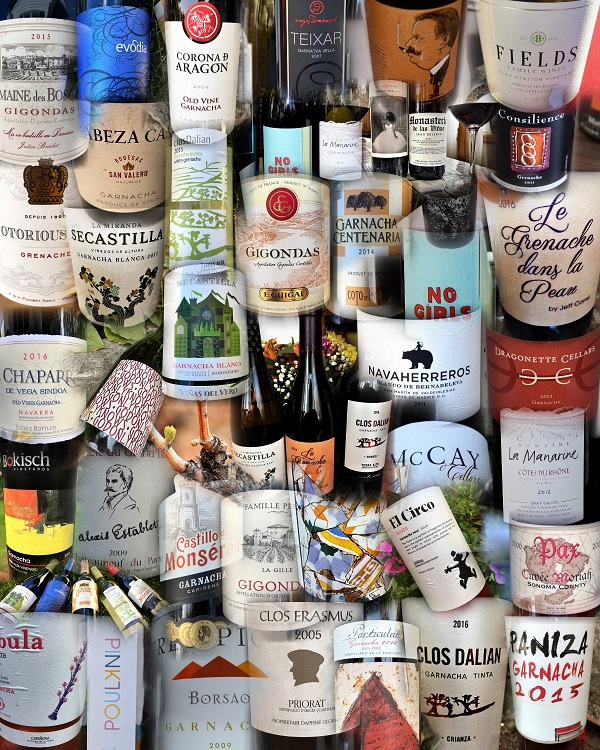
Now, let’s talk about the Grenache that put a smile on my face that Friday – 2015 Carlisle Grenache Rossi Ranch Sonoma Valley (15.4% ABV).
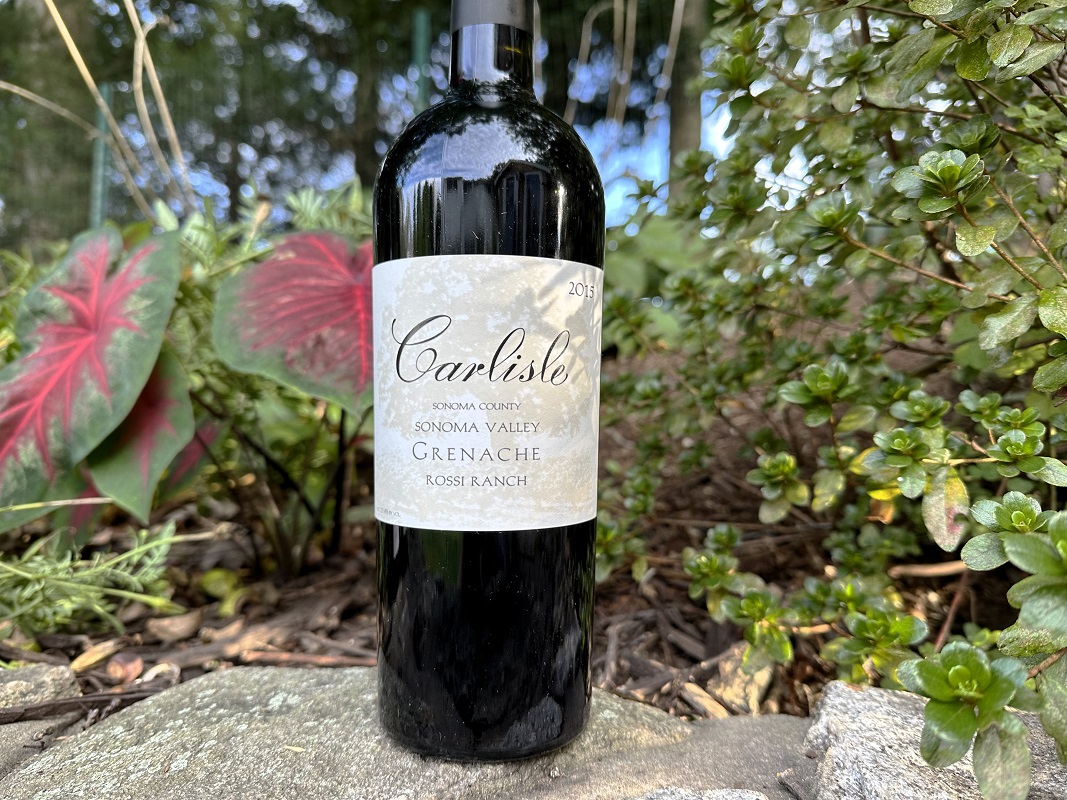
Carlisle is best known for their Zinfandel and Syrah wines. But they also make other wines, such as Grenache, Mourvèdre, Alicante Bouschet, albeit in small quantities and not every year. Carlisle Grenache is a rare animal – I’m not even sure I ever got any other Grenache via the mailing list. It appears that the 2014 vintage was not even bottled, as the wine couldn’t be tamed. However, 2015 worked very well, and Carlisle was able to produce the whooping amount … wait for it … of 77 cases. I don’t even know by what luck I was able to get a bottle, but I’m very happy that I did.
100% Grenache, aged in neutral oak. The wine was stunning – first, the nose, loaded with red berries and herbs, fresh, complex, and vibrant – one of those wines you want to smell indefinitely. When I finally got to sip the wine, it didn’t disappoint – the core of the red fruit, a hint of tobacco and just a tiny splash of dark chocolate, sage, vibrant, full of energy and impeccably balanced. And we got to enjoy the wine over a magnificent sunset – two pleasures at once…
This is my Grenache Day story. What Grenache experiences would you like to share?
Cabernet Sauvignon Reflections on Cabernet Day
Once people realize I’m into wine, 9 times out of 10 someone likes to pop the question – “So, what is your favorite wine”? I really dread this question because I can never answer it, and people think I’m full of pretense.
First, I like wine. Maybe “love” is an even better word. For me, wine is an all-inclusive concept – all types, all regions, all grapes. As long as wine gives pleasure, that is all I need. So it is really hard to pick a favorite. And even if I try, my answer will be different every time – you know how sometimes you are asked to name a favorite book or a favorite movie as an answer to the security question for the new account setup? I always wonder – who can answer that, and then really remember what they said in the first place? I know that it is not me.
But then maybe I had not been honest with myself and I do have a favorite?
It is possible that I’m overthinking such a basic question. But as one of the philosophers said, “Thought spoken is a lie”. In our thoughts, there is a true answer. But every time we try to give it, it is only an approximation – and that’s why the answer to this “favorite” question can be different every time.
Celebration of the International Cabernet Day made me think about this most popular grape in the world and also made me realize – that Cabernet Sauvignon wine might actually be my favorite wine.
How do I mean it?
I’m trying to assess my almost subconscious reaction to hearing about the wine – someone mentions it, I get a promotional email, wine at a restaurant, etc. I believe my brain gives Cabernet Sauvignon preferential treatment, compared to any other wine (interestingly enough, Brunello might be another wine with a similar reaction).
Let me try to explain it better. Let’s say I hear the name Rioja. You know perfectly well that I love Rioja. But just mention of Rioja doesn’t get me excited – I need to know the producer because there is only a handful of producers I trust to offer the wine I will enjoy. A similar story will be with Syrah, Chardonnay, Zinfandel, Riesling, Pinot Noir – I need to know the producer and the region, and then if I hear E. Guigal or M. Chapoutier, the Syrah all of a sudden becomes interesting.
This is not the same with Cabernet Sauvignon. Once I hear about Cabernet Sauvignon, I get instantly excited first, and then wonder about the producer, the region, and so on. I can’t explain this – this might be due to all the wine books I had read in the past. It might be due to the phenomenal encounters such as Vérité, Jordan, Smith-Madrone, Neyers, Kamen, Turley, Chateau Ste. Michelle, Revelry, Neyen, BV, Chateau Margaux and many, many, many others. I don’t know how this works, I’m just doing a bit of the self-searching and it seems to be that this is the case.
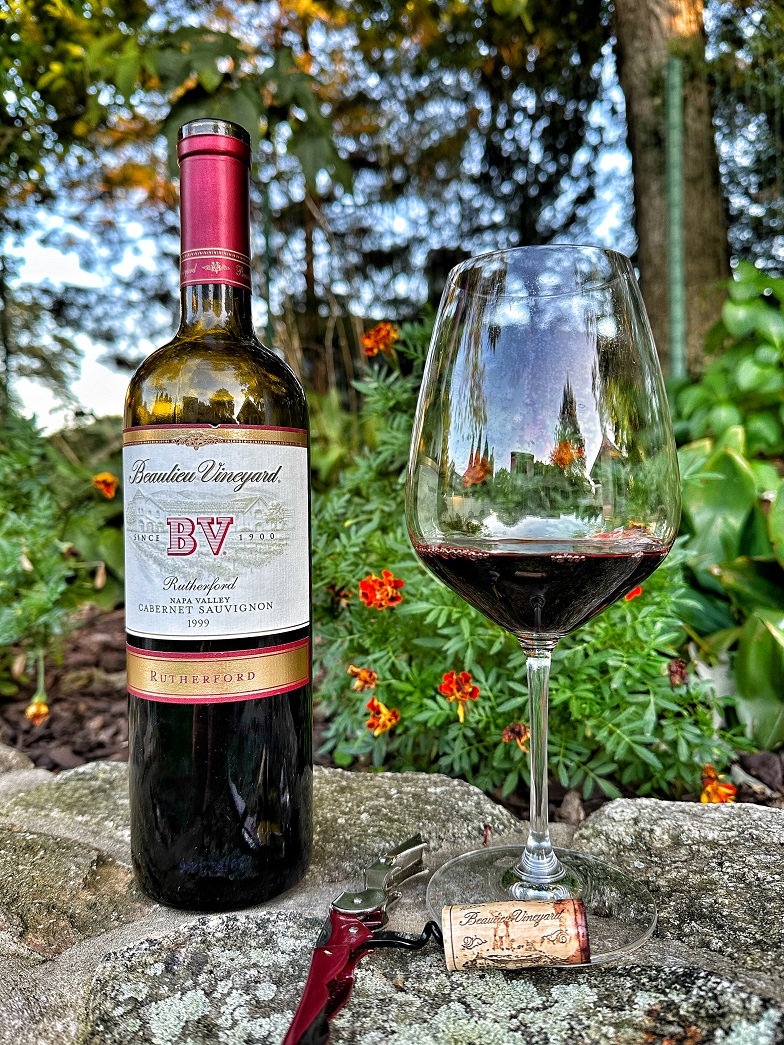
For today’s celebration, I decided to go with the 1999 Beaulieu Vineyards Cabernet Sauvignon Rutherford Napa Valley (13.8% ABV). Drinking this wine brought memories of visiting BV and tasting through the full lineup of wines, including Georges de Latour Private Reserve Cab and Cabernet Sauvignon clonal selections. Despite the 24 years of age, this wine was absolutely youthful and delicious – cassis and eucalyptus on the nose, more of the cassis and eucalyptus on the palate with the addition of cherries. Perfectly present texture, very enjoyable and easily noticeable tannins, perfectly balanced. This is the wine that puts a smile on your face (Drinkability: 8+/9-). Also, as I always maintain that well-made California Cabernet Sauvignon requires between 20 and 30 years of age to be fully enjoyed, and then I find a confirmation to that statement, so that puts another smile on my face.
Here, I said it – Cabernet Sauvignon might be my favorite wine.
But then remember – the thought spoken is a lie.
Frustration of the Oenophile
We have enough sources of frustration in our lives, so wine shouldn’t be one of them. This statement works fine until you become obsessed with wine. Then it becomes a source of joy, happiness, fun, and, of course, frustration.
The concept of frustration is very personable, there is really nothing objective about it. It is generally a choice – you can decide to get frustrated, or you can choose to ignore whatever bothers you. It is not always that simple, of course.
For example, corked wines are a great source of frustration for oenophiles. A corked bottle bothers me very much, but considering my experience with corked wines is not anywhere near the proverbial 8% (knock on wood), I just accept it as an unfortunate part of the wine world. Plastic corks can be a great source of frustration, and so are the bottles with wax tops when the wax is not done right. We can go on with this list and I’m sure every oenophile can choose what frustrates them the most. Most importantly, we feel frustrated with different things on different days.
What prompted this post was frustration with my own choices. And Cayuse wines.
Many years back I was closely following wine writer W. Blake Gray, who was writing a wine column at that time, I believe, for the San Fransico Chronicle. In one of the articles, he mentioned Cayuse Vineyards wines as possibly the best wines produced in the United States. Talk about influences… These got stuck in my head, and getting my hands on the wines of Cayuse became one of my obsessions. I signed up for the mailing list and stayed on the waiting list for close to 10 years until I finally got on.
Cayuse wines are produced by Christophe Baron, a French-born winemaker who fell in love with the rocky soils of Walla Walla Valley. While Cayuse was his original project which brought fame and recognition, Christophe Baron also started a number of other successful projects – No Girls, Horsepower Vineyards, Hors Catégorie Vineyard, and Champagne Christophe Baron (with this he really went back to his roots as he was born in Champagne). While waiting for Cayuse, I actually managed to get on all other mailing lists – but let’s leave those wines aside for a moment and get back to Cayuse.
I’m sure you are curious to see where the aforementioned frustration is coming from – and let me tell you, it is not related to the long wait. My frustration is tied to the wine itself. How? Easy. I don’t enjoy it.
Here, I said it.
Okay, let’s not generalize. I actually enjoyed very much a 9-year-old wine from Cayuse – 2011 Syrah from En Cerise Vineyard in Walla Walla Valley which I had on Thanksgiving in 2020. I liked the wine so much that it became wine #2 on the Top Wines list of 2020. But this happened once. And a few Cayuse bottles that I opened made me question my choices – and became the source of frustration.
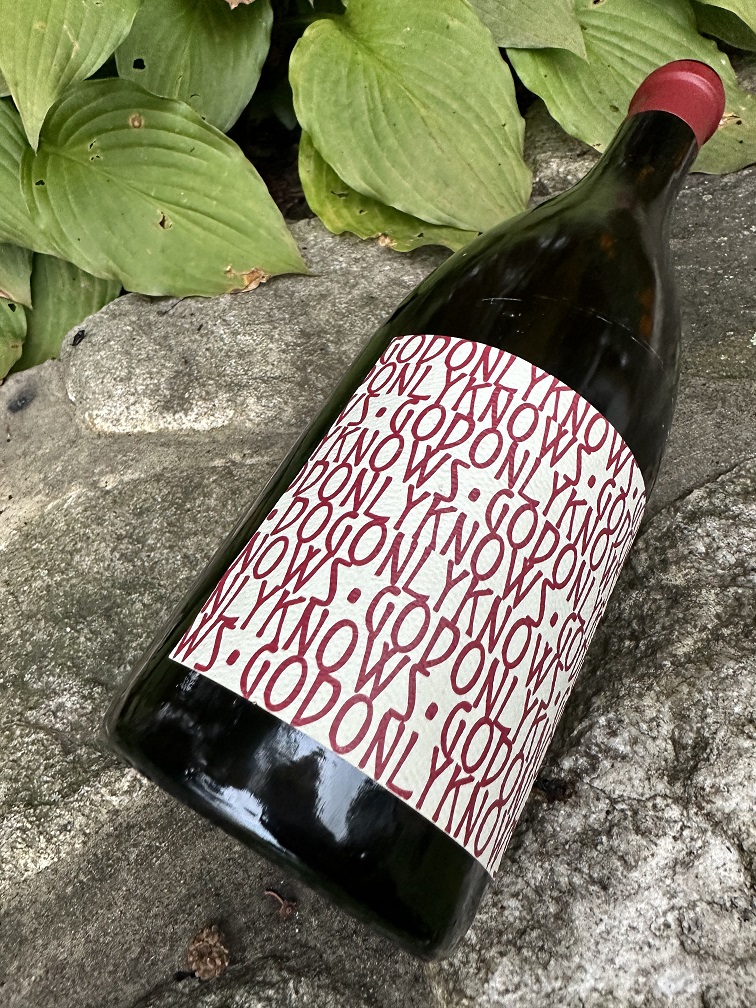
The latest case in point – 2017 Cayuse God Only Knows Armada Vineyard Walla Walla Valley (13.8% ABV). This is 100% Grenache. The wine had somewhat of a muted nose, mostly mineral. At first, the palate had a lot of “liquid rock” power – iodine, pencil shavings, granite, maybe cherry pits. I thought that maybe the wine was too young at 6 years of age, pumped the air out, and let it stand until the next day. The next day didn’t improve the situation much. On the third day, the wine simply became bitter.
When I’m supposedly drinking one of the best wines produced in the US, and I derive no pleasure from it, it becomes concerning. It becomes frustrating. What is wrong with me? How come I can’t appreciate this wine? If I look a the reviews, frustration only deepens. Jeb Dunnuck gave this wine 99 points in 2020, and described it as having a “gorgeous nose of framboise, wild strawberries, sweet mulch, sappy flowers, ground pepper, and liquid violets” – how come I don’t get any of this? Do I have to be a professional wine critic to be able to enjoy the wine? By the way, the continuation of the same review made me say WTF: “This carries to a medium to full-bodied, Burgundian Grenache” – Burgundian Grenache? But Grenache is not produced in Burgundy? Yeah, whatever. The same review also suggests the drinking window between 2021 and 2033, so I’m perfectly in the range. And yet I didn’t enjoy the wine.
I love Grenache wines. Admittedly, many of my great Grenache experiences are connected to Spain, where it is known as Garnacha – how about some Alto Moncayo, for example. I very much enjoy Grenache from France – CdP, Gigondas, other places. Also, California is perfectly capable of producing the most delicious Grenache – we don’t even need to go to the Rhone Rangers – Bokisch and McCay in Lodi do a damn good job representing delicious Grenache. And yet I don’t enjoy what should be one of the best renditions of Grenache in the world. Frustrating.
Cayuse will not be the first “serious” wine I’m unable to enjoy (serious = expensive here, this bottle costs north of $130). Opus One, Joseph Phelps, Corison, Chateau Montelena, many of the Heitz bottlings, Far Niente… There are a number of wines out there I do not seek. But I was really dreaming about getting my hands on Cyuse bottles. This wine was an object of desire and now… this?
I believe Bionic Frog was the wine that made Cayuse famous. Bionic Frog (made from Syrah) is still not a part of my allocation, so I will try to stay the course for now. I will give more chances to Cayuse wines to prove that my latest experience was just a fluke, but I’m afraid I have to leave Cayuse wines aside at the moment and see if time will be able to bring out the pleasure.
Yes, I realize full well that my frustration is the first world problem – and if you have a problem with that, feel free…
For now, I will remain oenophile frustrated.
When in Nashville…
I love visiting new places.
Never been to Nashville before, so I was happy that the work event offered an opportunity to visit.
I had no idea what I will find – I only knew that Nashville was typically used as a synonym for American music, but this was more or less the extent of my knowledge. That and the fact that Tennessee (the state where Nashville is located) is often a synonym for American whiskey. Ahh, and of course, the famous Nashville Hot Chicken…
Okay, so where do we start? As I was visiting Nashville for the work event, with a limited time to explore anything, my observations and notes are strictly based on the little free time I had to explore around the convention hall, the Music City Center. Here is the summary of my basic observation:
- Nashville is a party city (Pedal Tavern, anyone?)
- 90% of the women wear boots (never mind 105F outside)
- Food is very expensive (possibly more expensive than in New York City) – at least where the tourists are
- Nashville Hot Chicken and waffles is delicious
- The number of bars with live music exceeds anything I ever seen in my life
- Surprise: Moonshine can be tasty
Here are a few pictures to share:




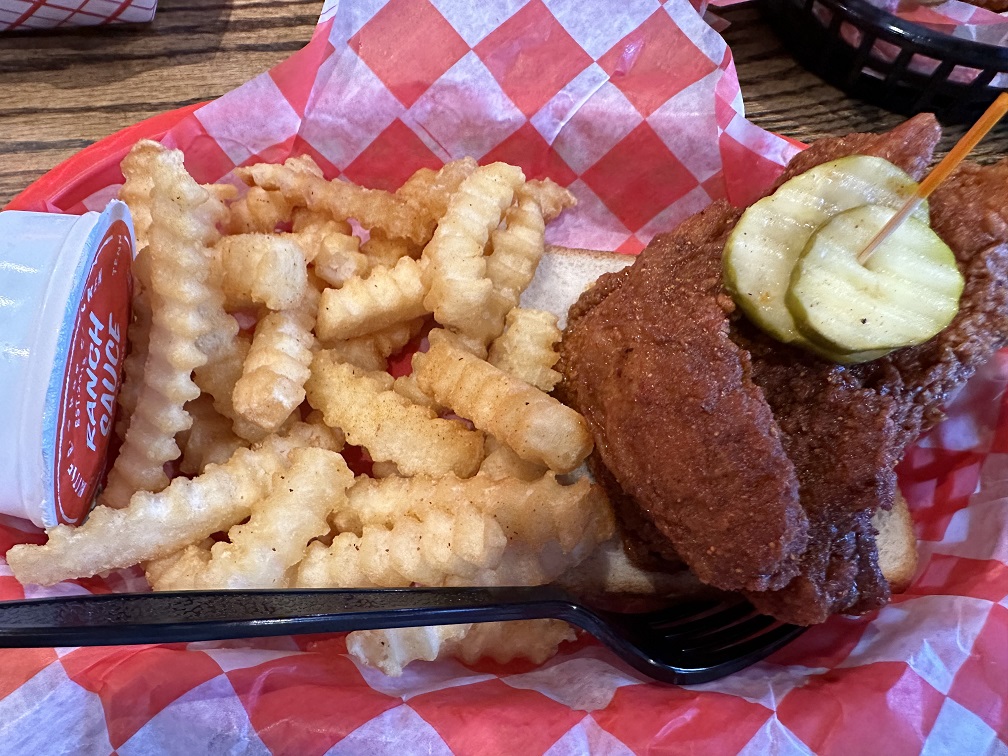
As a foodie, I have to talk about Nashville Hot Chicken first. Nashville Hot is a specific type of preparation of spicy chicken which was originated in Nashville in the 1930s, and attained popularity way outside of Nashville, Tennessee – you can read about the origins of the dish in this Wikipedia article. Tasting Nashville Hot Chicken was one of my top priorities for the trip 🙂 – and the mission was successfully accomplished. First, I stopped for lunch at the place called The Diner. Hot Chicken was on the menu in the chicken and waffle form. There were hot and mild options for the dish, so I had to ask for an explanation of how spicy the “hot” is. I was told that it should be 7 out of 10, which seemed palatable. The result was delicious, and I thoroughly enjoyed hot chicken served on top of the Belgium waffle with a side of maple syrup, washing it down with a local beer.

I also had Nashville Hot Chicken on another occasion – this time at a place called Hattie B’s Hot Chicken, famous for its – you guessed it – Hot Chicken. I’m assuming this was the location where Hattie B’s Hot Chicken journey started (they now operate multiple locations in the South) and it was worth enduring the 40-minute wait even in the 95+ weather. The chicken was tasty – keep in mind though that their “small” chicken portion is actually small, and if you are hungry, definitely go for the large size. My chicken had a spiciness level of “Hot!” and it was hot enough for me. My colleague went for the top “Shut The Cluck Up!!!” and interestingly enough he was not impressed.
I had one more highlight to my dining experience – a Mexican place close to the hotel called Calacas, and it was an excellent case of the “elevated Mexican” cuisine. I had ceviche which was delicious, and also a very unusual version of taco – crispy cauliflower tacos. I ordered it based on the waiter’s recommendation, and it was absolutely delicious, crispy, crunchy, and perfectly seasoned dish.


My next unexpected experience highlight was a visit to Ole Smokey Distillery. I was looking for a place for an early dinner, and this place had good ratings on Yelp. The place is large and consists of a distillery and a food court. In order to eat there you had to order at the counter, find a place to sit and so on – both the concept and the menu didn’t look too attractive, so I decided just to go do the tasting on the distillery side, especially after admiring the shelves.


For $10, you get an opportunity to taste 7 moonshine and whiskeys and a beer of your choice (you also get a credit of $10 for whatever you decide to buy at the store). I have to honestly say that moonshines fared much better than I expected (really tasty fruit), and grilled pineapple whiskey was just a riot – close your eyes, take a sip, and imagine yourself on a tropical island – yep, it was that good. After being really impressed with the tasting, I left the store with Mango Habanero whiskey (the bottle was very much appreciated back at home – the combination of sweet mango with a powerful kick from Habanero was very well received).


And now last but not least – Tennessee wine.
If you have followed this blog for a while, you know how much I love collecting experiences. One such experience is tasting wines made in different states in the US. Every time I visit a new state I’m looking for an opportunity to taste the local wine and ideally, visit the winery.


This was my first time visiting Tennessee, and of course, finding the local wine was high on my agenda. I tried a few of the wine stores, but being in the tourist area didn’t help much. At one of the wine stores I was told that they don’t have any wines from Tennessee, but I continued looking and I found this wine – Amber Falls Winery Madame Muscadine Tennessee (12.5% ABV).
This wine is made from the grape called Carlos Muscadine, which is one of the most standard cultivars of the Muscadine grape. It appears that Muscadine was one of the first native grapes discovered by colonists in America, and it is a popular grape in the Southeast of the USA. Muscadine grape belongs to the Vitis Rotundifolia family – something new for me, as I am primarily familiar with Vitis Vinifera (all major winemaking grapes) and Vitis Labrusca (grapes from this family are native to the Eastern US). Well, live and learn, right?
To be honest, this wine was a waste of $22 – if you ever had Concord or Isabella wines (both are Vitis Labrusca grapes), this wine had a similar profile, but the lack of acidity was making this wine not enjoyable. But – it let me accomplish the mission of adding one more state to the collection. I will also give myself a break and will consider visiting the distillery the same as visiting the winery – so two checkmarks for the table.
Here you are, my friends – a quick report on a few days in Nashville. Cheers!
Restaurant Files: An Ultimate Dining Experience
As a food and wine lover, I know I can’t complain about the lack of great dining experiences. But great doesn’t necessarily mean memorable. I will give you a few minutes to reflect, but seriously, how many dining experiences have stuck in your memory? How many of those experiences were memorable because of the food and wine pairing?
I’m sure you know where I’m heading with this preamble. During my last trip to Sweden, I actually experienced the unique greatness of the food and wine singing together in perfect harmony – and I have to share that with you.
As was going on a business trip to Gothenburg, the second largest city in Sweden, a friend who was already there sent me a restaurant recommendation which he got locally from someone – SK Mat & Människor. I quickly looked at the website, which portrayed a very attractive image, saw that a reservation would be required and quickly made one, as my free time was very limited.
The day before, I decided to check the menu (I like coming to the restaurant prepared if possible) and discovered that the restaurant doesn’t have a menu per se – the restaurant offers two tasting menus with local seasonal ingredients – one with 4 courses and one with 6. The only other information was the required time – a 4-course dinner takes 2 hours, and a 6-course takes at least 2 and a half. Well, it is fun to be surprised, isn’t it?
Upon arrival we were quickly escorted to our table and presented with the printed menus that still didn’t provide much details – 2 tasting menus with available matching wine pairings – that’s it. We decided that 4 courses sounded good enough and let the magic begin.
Chefs at work
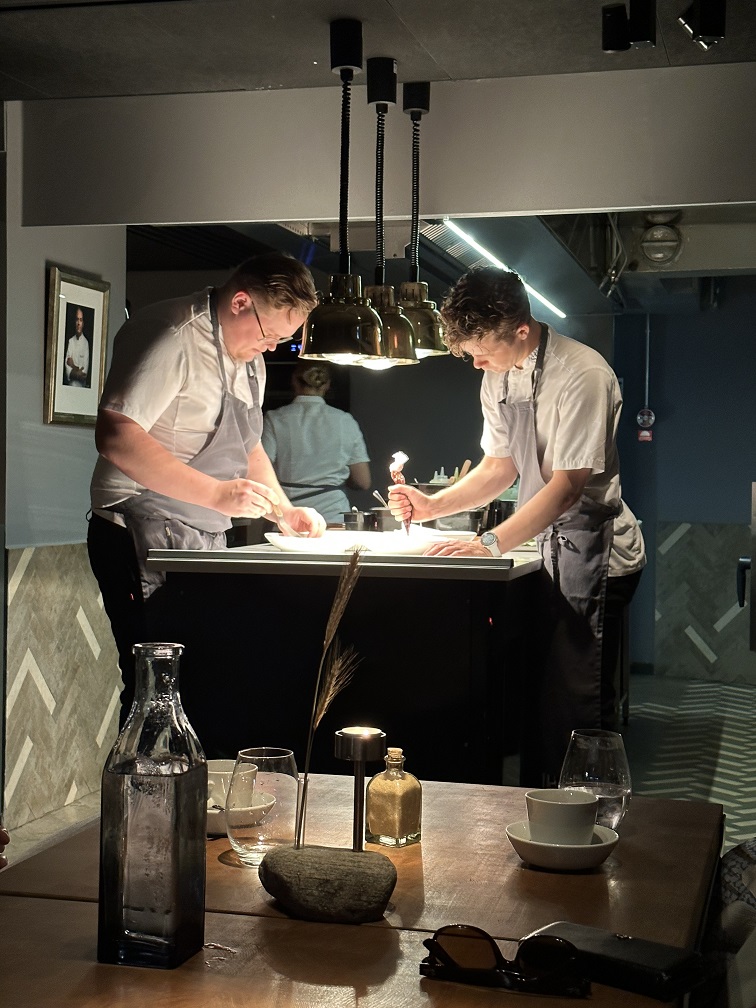
We were explained that everything at the restaurant is seasonal, locally made and procured. The restaurant has 3 open kitchens, one for cold appetizers, one for warm appetizers and entrees, and one for bread and desserts – yes, fresh bread is made at the restaurant.
The bread arrived first, a little basket with 3 types of bread, and butter which is also made daily at the restaurant, from fresh milk. Also, our first wine was poured – André Lurton Chateau Bonnet Réserve Bordeaux (Sauvignon Blanc/Sémillon), perfectly refreshing as a starter. Next, our first appetizer was presented at a table.


Here lies a problem with how much I can really share with you. The purpose of the dinner was to enjoy it, not to take detailed notes for the blog. I had no printed menu, and each dish was briefly presented by the chef, including all ingredients, spices, and cooking techniques – all within 30 seconds or so. I don’t know about you, but my memory definitely has its limits. Thus my descriptions will be lacking…


The first dish was a fish – I believe haddock (local, of course). I don’t remember any of the spices and condiments, but – the appetizer was brought to the table with a little bowl of grilled tomato broth (yep), and each one of our bowls received two tablespoons of such broth. The appetizer was very tasty and worked well with the wine.
The next wine was the 2020 Leopard’s Leap Culinaria Collection Chenin Blanc Franschhoek Valley South Africa. The wine had a beautiful, concentrated nose, and very good textural presence on the palate, something that good Chenin Blanc can usually deliver.


A warm appetizer was served with this dish – I guess it could be called a confit of artichoke – the artichoke was slowly cooked for a very long time, then deep fried and served with some effervescent cream. The dish was delicious, and pairing with the Chenin Blanc was excellent, with wine complementing and elevating every bite.
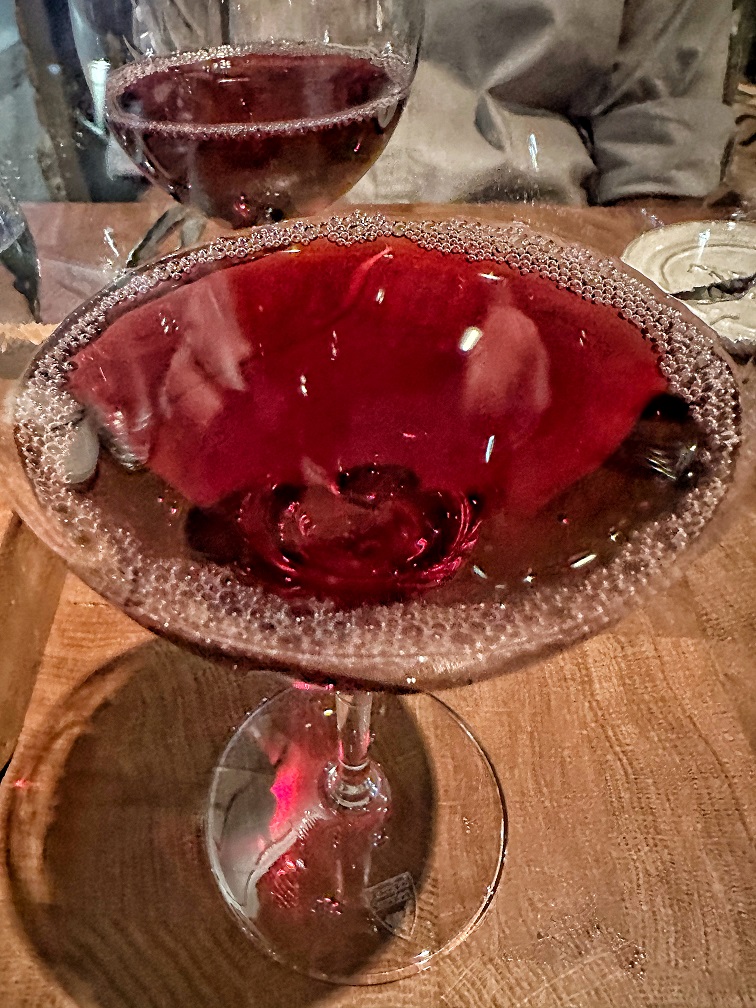
The choice of next wine was a bit surprising for me – 2021 Oakridge Over the Shoulder Pinot Noir Yarra Valley Australia. Of course, Australia produces Pinot Noir – but I would definitely look at other regions first if I would want to serve my guests Pinot Noir. The wine was tasty on its own, with a nice nose of smoke, plums, and violets and a firm texture on the palate, definitely on the tart side.


Just look at this color…
Seeing Pinot Noir I was guessing that our main course will be either duck or lamb. To my surprise, we were served local Swedish beef, prepared with celeriac (root of celery) three ways – as a purée, as a spice, and in some other form (sorry, see the note about my memorization skills above), served with the wine reduction sauce. And I don’t know how, but in this dish, taking a bite of food with a sip of that Pinot Noir was akin to some dark magic – remember the restaurant scene in “When Harry Met Sally”? Yeah, that type. Just magic.
Over wine pairing for dessert was essentially a dessert in itself – 2022 Prunotto Asti Spumante DOCG from Italy. The wine was beautiful, pleasantly sweet but with perfect acidity and light fizz, delicious on its own.


Our dessert was a combination of herbal sorbet and local Swedish strawberries. The sorbet was barely sweet and delightful, but taken with a sip of Asti Spumante … OMG (yeah, laugh all you want)… We both agreed that this was truly a “heaven on earth” type of experience… An amazing finish to an amazing meal.
Believe it or not, this dinner took a little bit more than two hours, and the flow of wine and food was such that we didn’t notice how the time had passed. Absolutely different experience compared to an average restaurant visit, where you look at the watch when the bill arrives and realize that you barely spent 50 minutes…
Here you are, my friends. If your travel will take you to Gothenburg, I can’t recommend SK Mat & Människor any higher. Visit, and you will understand.
Celebrate Pinot Noir!
And just like that, I almost missed International Pinot Noir Day, the celebration of one of the most popular red grapes in the world.
Pinot Noir is definitely one of the most popular, even though great Pinot Noirs are mainly limited to only four countries and regions – Burgundy, Oregon, New Zealand, and California – unlike Cabernet Sauvignon and Merlot, which definitely win the popularity contest worldwide, growing successfully absolutely everywhere. Of course, you have Pinot Nero from Italy, Spätburgunder from Germany, Blauburgunder from Austria, Pinot Noir from Australia, Chile, and Argentina, but those rarely take your breath away.

Most popular or not can be contested, but Pinot Noir without a doubt makes the most expensive wines in the world. You can check it for yourself using this “Most expensive wines” page but at the moment of writing (August 18, 2023), Domaine Leroy Musigny Grand Cru is listed by wine-searcher for $43,869 per bottle, which I believe is more than the whole index of the most expensive Cabernet Sauvignon wines on the same day. I really can’t tell if wine can be worth this much to someone to drink it, but hey, it is a free world.
Pinot Noir is definitely a big subject in this blog. I decided to check on some numbers to see how Pinot Noir would stand up against other grapes. In terms of overall mentions, Pinot Noir is the second red grape with 378 posts mentioning it (Cabernet Sauvignon is ahead by almost 100 with 477 posts mentioning it). However, when it comes to tags, Pinot Noir has the highest number of posts, 79, tagged with “pinot noir”, well ahead of any other grape. This is important simply because the tag is matching the content of the post, so at least 79 posts are dedicated to Pinot Noir.
This shouldn’t come as a surprise as Pinot Noir is one of the central subjects of this blog, starring in the series of the Oregon winemakers’ interviews called Stories of Passion and Pinot. The series contains more than 25 articles, highlighting the “passion for the finicky grape” as I typically like to present it through the series of conversations with winemakers who got bitten by the Pinot Noir bug and never looked back. Whether you like Oregon Pinot Noir or not, I still recommend that you would get a glass (or two, or three) of your favorite Pinot Noir ready and go read some stories.
While I love Pinot Noir, I do have one gripe – the price. You can find an amazing Rioja for under $20. You can definitely find a nice Grenache, Sangiovese, or Syrah in that price range. Heck, you might even get lucky with Cabernet Sauvignon or Bordeaux blend. But with the exception of Chile, there is literally no such thing as a drinkable Pinot Noir in the under $20 range. I can’t refer much to Burgundies, but anything tasty from New Zealand’s Central Otago or Marlboro is pushing $40, and all delicious Oregon Pinot Noirs now really sit north of $50. California might offer some exceptions, but I’m not aware of a drinkable sub-$20 California Pinot Noir. Not that I’m complaining here, just stating the obvious.
As today’s celebration caught me off guard, I didn’t have many options to choose from. I have a few random burgundies which I need to look for and think about, nothing from Oregon or New Zealand, leaving California as a primary hope. I remembered that I should have a California Pinot somewhere as it was recently gifted to me, so I was quickly able to locate the 2017 Etude Fiddlestix Vineyard Pinot Noir Santa Rita Hills (14.1% ABV).
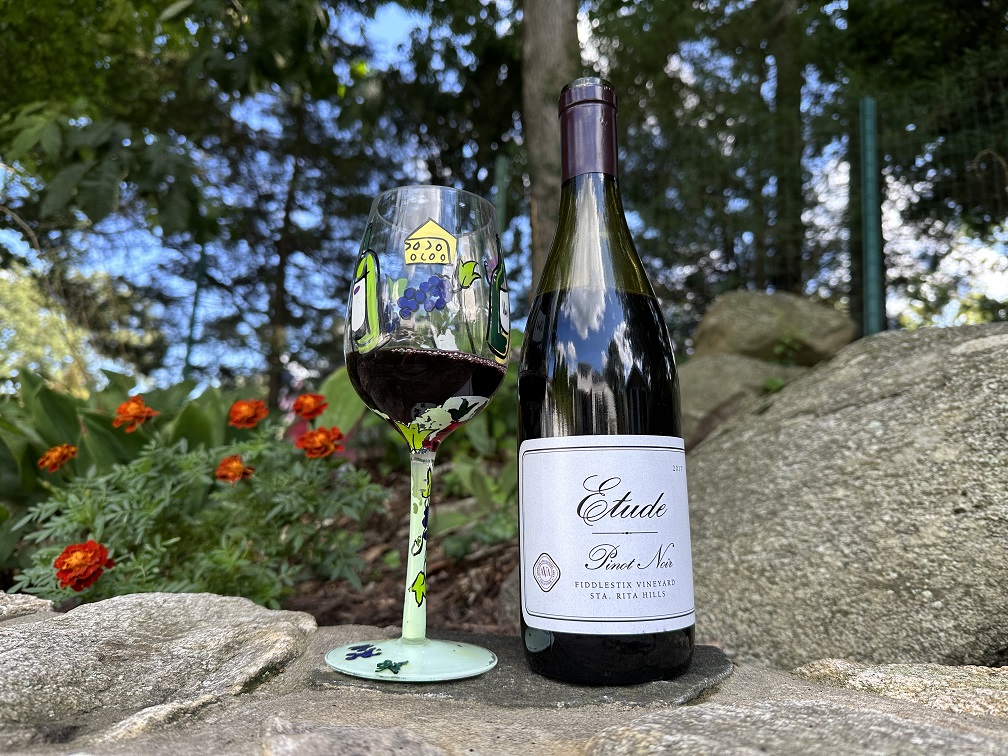
I know the name of the producer – Etude, but I don’t think I had tasted their wines before. Turns out this wine was a very appropriate choice for the Pinot Noir Day celebration, as Etude was founded in 1982 in Carneros in California in a quest to produce world-class Pinot Noir. I love this quote I found on Etude’s website from the founder and winemaker Tony Soter: “Pinot Noir is the most appropriate vehicle with which to study wine growing, precisely because of its demanding nature but also because of its delicacy and transparency. Make no mistake it is a humbling pursuit, but when it’s right, Pinot Noir is a glorious and moving thing. It is in the pursuit of that experience that we all work.” This is a perfect summary of the nature of Pinot Noir that also helps to explain what makes it so good when it is good. Etude produces more than 20 designation-specific Pinot Noir wines – they might be a perfect candidate for the Passion and Pinot series, even if the winery is located in California.
So how was the wine you might ask? In a word, delicious. Dark, unctuous fruit on the nose and the palate, a hint of vanilla, mocha and dark chocolate, nicely layered with perfect structural presence but not overpowering, perfect acidity and perfect balance. An excellent celebratory wine.
There you are, my friends. Another grape holiday just passed by. Hope you had an opportunity to celebrate, and if not – every day is a perfect day to have a glass of Pinot Noir. Until the next time – cheers!
Stories of Passion and Pinot: Kate Ayres of Penner-Ash Wine Cellars
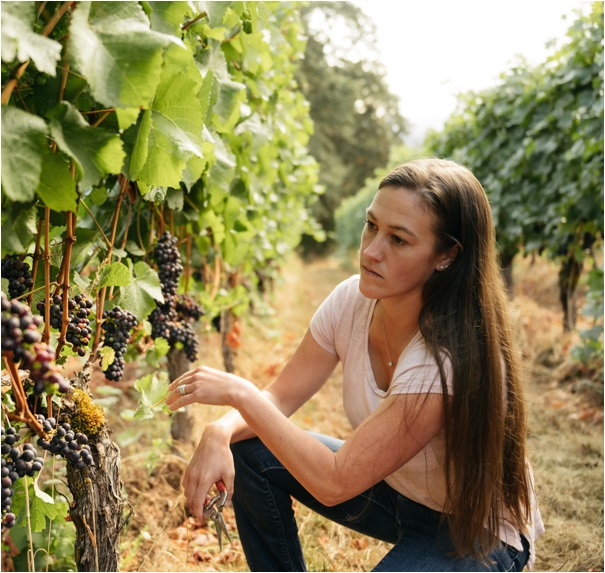
Kate Ayres. Source: Jackson Family Wines
125 cases of Pinot Noir in 1998.
9,000 cases of Pinot Noir, Syrah, Riesling, and Viognier in 2011.
16,000 square-foot winery building designed with human ergonomics in mind.
12 vineyards.
Numerous accolades.
This is a brief “history in numbers” of Penner-Ash Wine Cellars, founded by Lynn and Ron Penner-Ash in Northern Willamette Valley Yamhill-Carlton AVA in 1998. The winery quickly grew to prominence, best known for its lush, layered Pinot Noir. In 2016, Penner-Ash Wine Cellars was acquired by Jackson Family Wines (JFW), joining Gran Moraine, Zena Crown and other Oregon wineries as part of JFW’s “cool-climate” Pinot Noir portfolio.
Kate Ayres had become the Winemaker at Penner-Ash Wine Cellars in the spring of 2018. Continuing traditions is not an easy job, and so I had an opportunity to sit down (virtually) with Kate and ask her a few questions.
Here is what transpired in our conversation.
[TaV]: Reading about the history of the winery, I came across the fact that the winery was designed with “human ergonomics” in mind. Can you expand on this, provide some details for someone who never visited the winery?
[KA]: Lynn and I are both petite female winemakers and that was really a driving factor when creating our gravity flow winery. We tend to ferment in small fermenters (one-, two- and three-ton) that are just short enough that I can smell the tops of each tank at standing height. The tanks are all easily moveable by pallet jack and require very little “heavy lifting.” In addition, because of the tiered nature of the winery, we rarely use pumps and aren’t hauling hoses up and down the winery.
[TaV]: Also in the same historical overview, I found an interesting mention of “unanticipated soil diversity”. Why “unanticipated”, and how is this impactful from the point of view of the Penner-Ash wines overall?
[KA]: I believe this is in respect to our Estate Vineyard. We have 15 acres planted to Pinot Noir in the Yamhill-Carlton AVA, which is typically characterized as sedimentary soil. In the case of our vineyard, we have a volcanic line running down the middle of our upper Pommard and 666 blocks, down through our lower Pommard blocks.
[TaV]: What is your winemaking philosophy – whole cluster fermentation, natural yeast versus inoculated yeast, oak regimen, etc?
[KA]: We love experimentation in the winery and will pivot depending on what the vintage is throwing at us. There are some vineyards that we love to whole cluster ferment, but I wouldn’t consider us a “whole cluster” house. 25-40% in a fermenter is our happy spot. While we have a plethora of inoculated yeast strains we like to use, we are also happy to let tanks head in the native direction when it fits. Our oak regimen has evolved over the years to match our changing environment. We like lower impact barrels that can provide structure and sweetness, but less overt “oaky” aroma. Our basic philosophy at Penner-Ash remains the same as it was on our starting day. We craft beautifully textured and layered wines that are approachable and ageable. This is done with a diversity of vineyard sites, a simple approach to winemaking, and a delicate handling of the wines through their life.
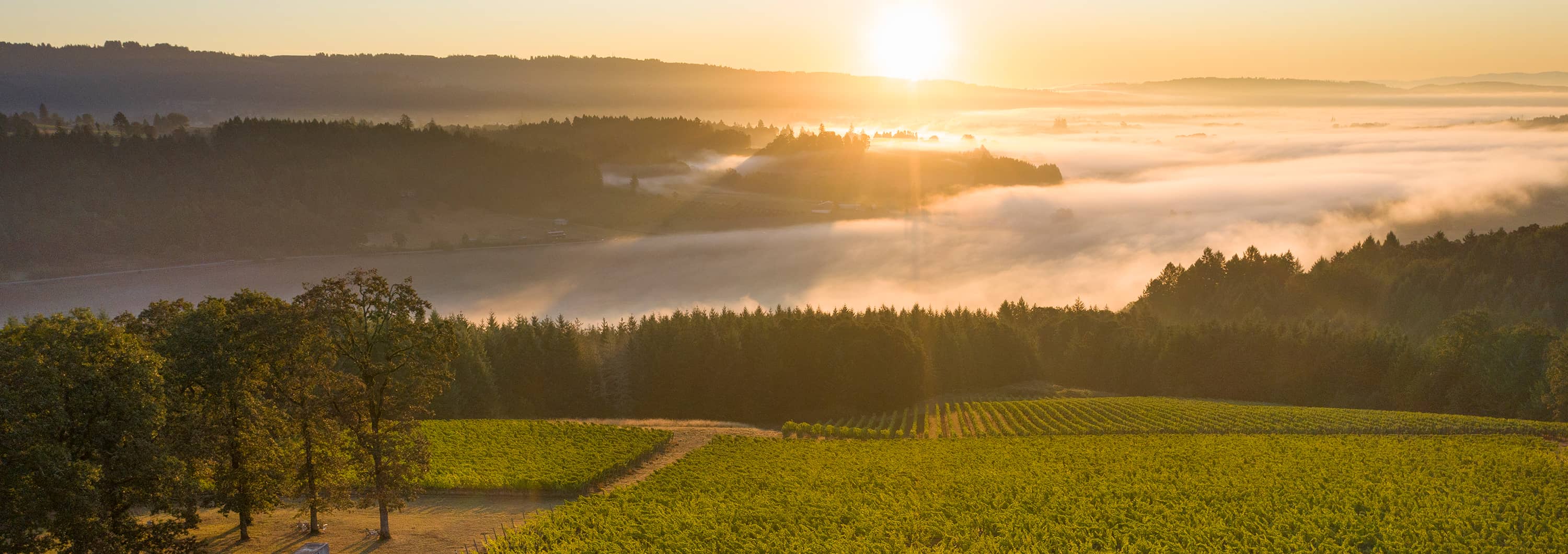
Penner-Ash Cellars. Source: Jackson Family Wines
[TaV]: At Penner-Ash, you get to work with many different vineyards. Do you have a most favorite and most challenging one?
[KA]: How cruel to pit them against each other! Each vineyard is so special to its location, and that is what makes my job so incredibly exciting and invigorating each harvest. For example, there are times when certain weather events just hit a single sub-AVA. So while that particular vineyard might be more difficult for that vintage, other vineyards may remain unaffected.
[TaV]: One question I like to ask all the winemakers I have a chance to speak with – what is your take on biodynamic viticulture?
[KA]: I think this has become such a polarizing question. There are many aspects to biodynamic viticulture which make so much sense to me. Working within the natural balance and diversity of the ecosystem seems like a no-brainer. I find it harder to see the relevance of the spray schedules, mixtures, and decisions based on moon phase.
[TaV]: Based on what I can see on your website, Penner-Ash offers today a large number of white and red wines. Sparkling and Rosé make a notable absence. Do you make any of the sparkling or Rosé? If not, any future plans?
[KA]: We make a rosé, but not a sparkling wine. As you’ve noted, we make many wines. At this point in time, I’d like to keep my focus on those wines that we know and we make well.
[TaV]: Practically all of your wines are vineyard-specific. Have you ever considered producing block-specific wines, from Penner-Ash Estate or any other vineyards?
[KA]: We have dabbled in block specific (clonal specific) wines for fun with the Shea Vineyard and have in the past put together a complete set for the consumer. It was a fun thing to show people, but was a huge labor of love (all hand bottled). They are certainly fun one-off projects to toy with, but harder to consider as a long-term product.
[TaV]: Going back to the wine lineup – the majority of the wines produced by Penner-Ash are Chardonnay and Pinot Noir. And then you have lonely Riesling and Syrah. Any plans for any other grape varieties? Maybe a Pinot Gris? Tempranillo? Something more eclectic?
[KA]: I’d love to dabble in a new red or two and we’ve also done some fun tasting of Chenin Blanc and Sauvignon Blanc from Oregon. I think Sauvignon Blanc coming out of the Willamette Valley is really interesting and fun.
[TaV]: Can you describe your typical day in the vineyards?
[KA]: As the growing season progresses my days usually start in the vineyard for the first couple of hours before returning to the winery to taste/blend/crush samples. We have a lot of vineyards to cover, so I tend to try to visit 2-3 vineyards in a morning if possible.
[TaV]: We can’t ignore climate change – how do you take the effects of it in your day to day operation? How are you taking it into account for the longer period, say the next 10 years?
[KA]: Looking at alternative varieties is certainly high on the list. In the more immediate future I’ve pulled back the amount of cap manipulation the wine sees in its lifetime. There was a time where we would punch down a fermenter three times a day. Now we find ourselves doing one punchdown a day and touching it twice just in the peak of fermentation. Our oak regimen as discussed earlier is also in response to warmer years. Of course it would be remiss of me if I didn’t note that much of the work is done in the vineyard. Whether it be in cover crops, tilling or not tilling between rows, leaf removal (or not), etc. These are all things we are working on for a warmer trend.
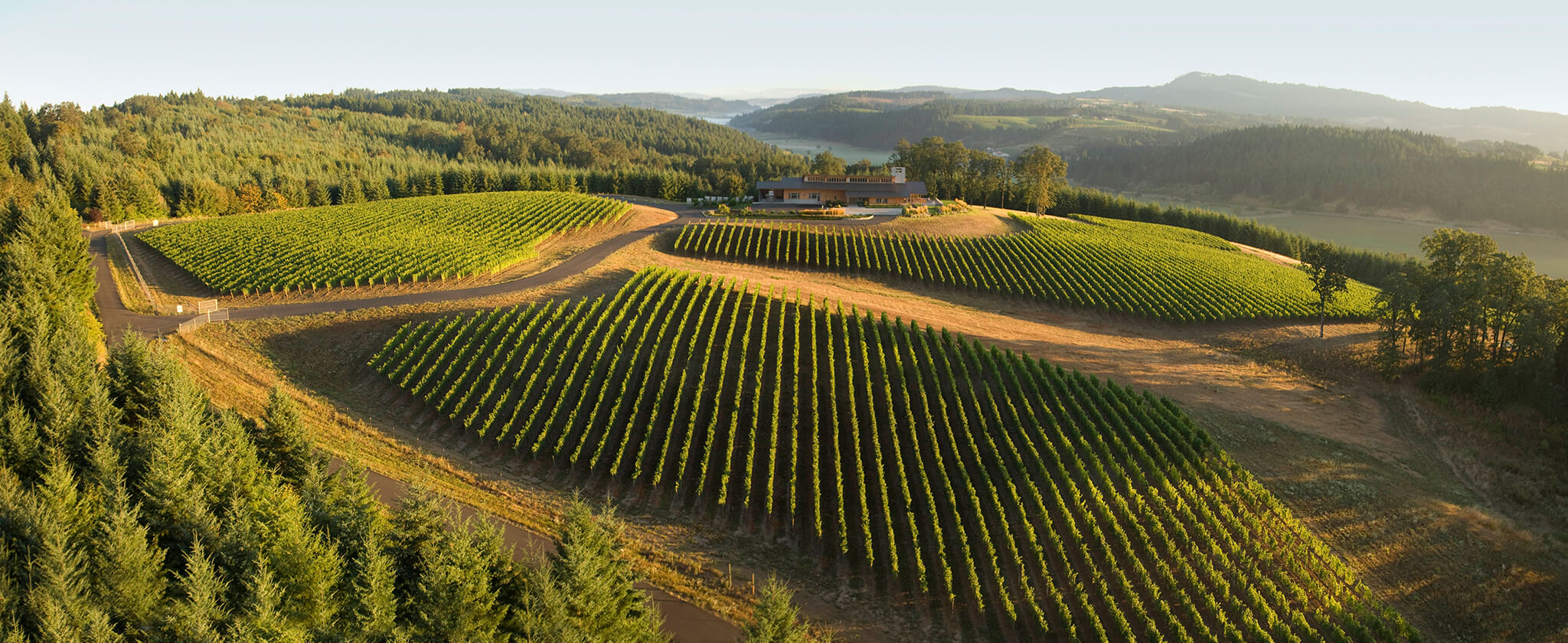
Penner-Ash Cellars. Source: Jackson Family Wines
[TaV]: Given an opportunity to work anywhere in the world, is there a winery or a winemaker you would choose to work at/with?
[KA]: I’ve been lucky enough to work in several winemaking regions in the world, but never in France. Given the relationship with Domaine Drouhin Oregon, I’d love to get a chance to work with Véronique.
[TaV]: Along the same lines – is there a wine you always wanted to make but didn’t get the chance to do it yet?
[KA]: That’s a hard one to answer. There are so many varieties of wine out there that it’s hard to put a finger on what exactly I’d desire to make most. I’m just happy that my early learning years took me to winegrowing areas that broadened my experiences and gave me an opportunity to create many different varieties of wines.
[TaV]: What was it like working with Lynn when you started at Penner-Ash in 2018?
[KA]: I actually started working with Lynn in May of 2016 but was promoted Winemaker in 2018. Working with Lynn has been one of the biggest delights of my career. As we all know, Lynn is a staple in this industry and that in and of itself can be intimidating, but she created such a warm and welcoming environment for me. We really worked in lockstep as she taught me about each of the vineyards we source fruit from; the pillars on which Penner-Ash rests. I can’t begin to recount the funny conversations we shared across the blending table from each other, the barrels we’ve tasted and scored, the fermenters we smelled together each morning. The relationship I was able to form with Lynn over the past nearly seven years has been nothing less than incredible. She was a mentor, but even more she became the most amazing colleague.


As usual, I had an opportunity to try a few wines from the Penner-Ash cellars – here are my notes:
2021 Penner-Ash Chardonnay Willamette Valley (14.6% ABV)
Straw pale
Apples, a touch of vanilla
Clean, crisp, Whitestone fruit and apples on the palate, distant hint of honeysuckle. The fruit quickly dissipated on the finish, with lingering tartness and afterward, acidity.
7+/8-, if you are looking for classic but very lean chardonnay, this is your wine.
2021 Penner-Ash Pinot Noir Willamette Valley (14.1% ABV)
Dark Ruby
Cherries, plums, and violets -classic Pinot nose
Very interesting temperature dependency
At room temperature, the wine appears as classic California Pinot Noir, with sweet cherries, plums, vanilla, borderline flabby
When served chilled, the wine is dark and concentrated, with a core of tart cherries and some espresso notes. Perfectly structured and full of energy.
Room temperature: 7/7+
Fridge temperature: 8-
Here you, my friends. Another story of passion for the finicky grape. Until the next time – cheers!
P.S. For more stories of Passion and Pinot please visit the series’ main page.
A Few Days in Paris
If you have followed this blog for some time, you know what the “a few days” title means. Yes, pictures. Lots and lots of pictures. This post will not be an exception – get ready to scroll.
Pictures have such an important role in our lives. Pictures solicit emotions, bring back memories and moments, and let us re-live those moments. Pictures can also serve as a personal journal, keeping all the dates in perfect order.

Probably my favorite shot of the entire week
Based on the pictures stored on my computer, I was able to figure out that the last time I was in Paris was almost 13 years ago, in October 2010. Of course, even if one is not familiar with Paris from the books, once you visit, that memory will be with you forever. Yes, I knew what I will find in Paris in a general sense, but the particulars, such as navigating this sprawling city, became rather blurred.
Once I arrived, though, it all came back rather quickly. Paris has one of the very best subway systems in the world when it comes to navigation – before every entrance, there is a full list of stations which you will find in a given direction – as long as you know where you are going, getting there is really easy.
This was a trip for work, and I was definitely lucky with the location of the meetings – a stone’s throw from the Eiffel Tower. For 5 days straight, I could look at the Eiffel Tower any time I would want. We even took some pictures from the roof of the building, admiring it from an even closer distance.
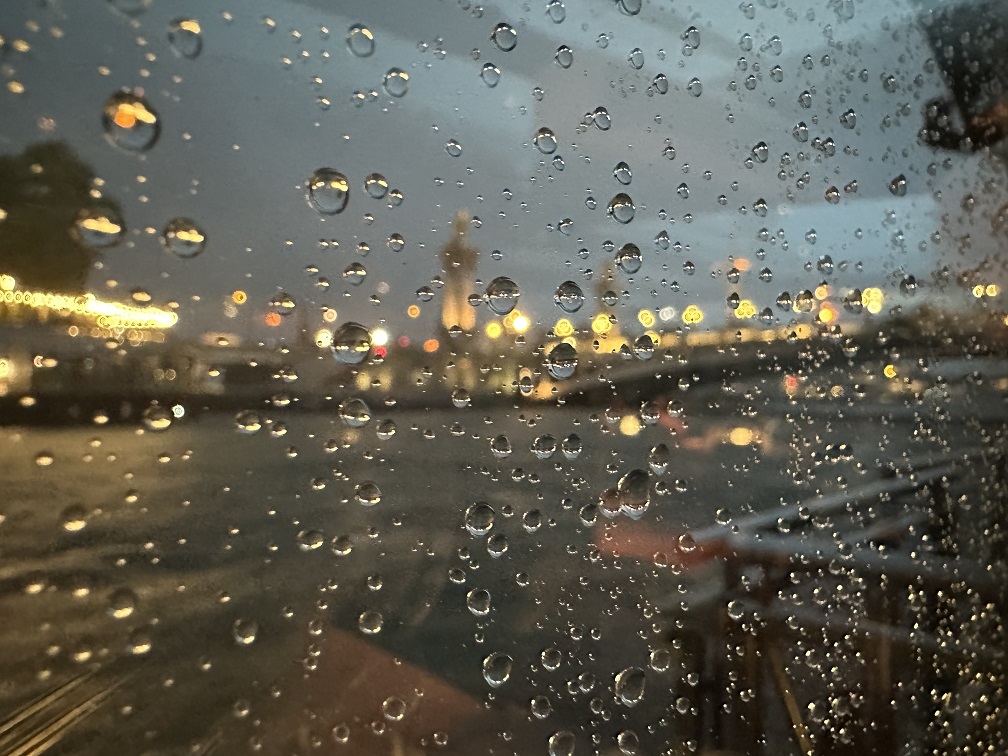
We also had a dinner cruise along the Sienne, allowing this photography junky to take a beautiful picture of the well-lit Eiffel Tower during the night – despite the rain which was going on the whole night but conveniently stopped as we were passing the Eiffel Tower, allowing for some magnificent pictures to be taken.
And then there were numerous strolls around the streets of Paris, allowing more magic to be captured. Remember I promised to inundate you with pictures? Here you go – and when you will be done scrolling, we will switch our attention to – yes, you guessed it – food and wine. See you in a minute or so.

















Now, food and wine, as nobody can talk about Paris without paying attention to food and wine. And wine and food.
Let’s talk about wine first.
First of all, I now did what I usually do during my trips, especially the European ones – visited the supermarket to see the selection of wines. Considering the location in the center of Paris, I think the prices look quite reasonable – good luck finding $3 wines in New York.
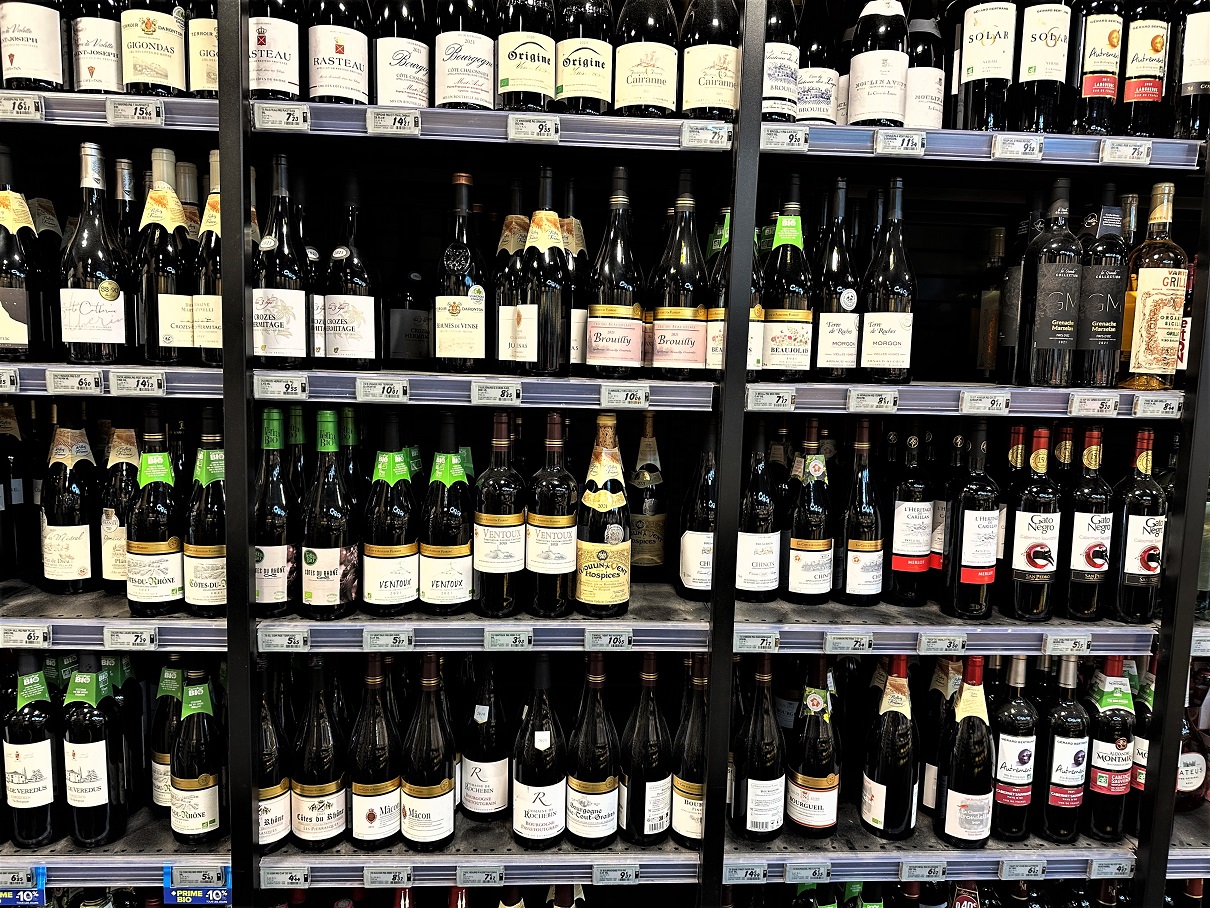


I grabbed two bottles to enjoy in my hotel room during the week. 2020 Rasteau AOP Cru de Cotes du Rhone at €7.23 was a very nice find. The wine needed a bit of time to open, but then offered a smokey, concentrated, powerful mouthfeel with a good amount of dark fruit. My second bottle was a bit more expensive – €9.28. It was 2021 Gérard Bertrand Solar 6 Syrah Cévennes IGP, a certified organic (Bio) and bee-friendly wine from the South of France. Along with Domaines Paul Max, Gérard Bertrand is one of my “safe choices” for situations where I need to pick a decent bottle of wine for a modest amount of money. This Syrah was quite generous, good amount of fruit, a tiny hint of black pepper, round and well-balanced. I run into the Gérard Bertrand wines a few more times during the trip – last time at the airport lounge in the form of the 2021 Gérard Bertrand Crémant de Limoux An 825 Brut, a blend of Chenin Blanc, Chardonnay and Pinot Noir, which was delicious in its own, but also perfect in Mimosa, with its firm structure and consistent bubbles.


I need to mention a few more wines. Of course, when in France, you should drink French wine. Except, maybe, when you are in a kosher restaurant. We visited L’As du Fallafel restaurant twice during the week (one of my colleagues eats Kosher, and then, of course, the food is just tasty), and an Israeli wine was a perfect option in my opinion. 2020 Gamla Cabernet Sauvignon Galilee was well approachable from the get-go, nice amount of dark fruit, good acidity, good structure, well-integrated tannins – a very nice wine overall. Last but not least was Chablis I had at the restaurant called Au Petit Marguery.
2021 Jean-Marc Brocard Chablis Vieilles Vignes de Sainte Claire was excellent. First, there was the nose of sapidity, minerality, and a touch of gunflint. I spent a good few minutes just admiring the aromatics before taking the first sip. The wine continued on the palate offering savory and complex mouthfeel with good acidity and restrained expression of the white-stone fruit. While working on this post, I looked up this wine – turns out that the grapes for this wine are harvested from the 70 years old vineyard with the roots of the vines extending for 25 meters into the Kimmeridgian soil. Now that will guarantee some complexity.
Now, let’s talk about food. There are two restaurants I want to mention. First called Suffren was an accidental find, as we were walking around looking for a place for dinner. I’m glad we stumbled upon it, as the food was outstanding, and the service was even better – happy and friendly. It was fun sitting at the table close to the entrance and observing the people waking in, shaking hands and talking with waiters – truly a neighborhood spot. The steak tartar was my choice of main course, and it was delicious. Everybody also got desserts, and polished their plates – profiteroles, baked Alaska, Crêpes Suzette (made tableside, of course).
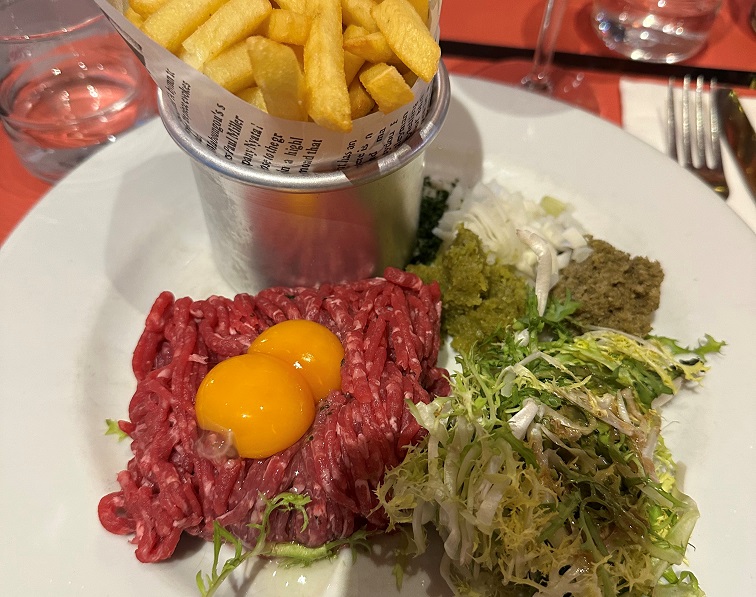 The second restaurant was Au Petit Marguery. I found the restaurant via search as an affordable restaurant offering traditional French cuisine. The food was good even though it didn’t leave me speechless. Foie Gras was good overall, but it was served with some sort of a sweet toast which I didn’t appreciate at all, and I was really expecting more condiments to accompany such a rich dish.


My main course was fish (have no idea which one), which was not bad, but again, not truly memorable. For dessert, I got an oversize profiterole which was not bad but not amazing, but again maybe it was competing with my overinflated expectations.
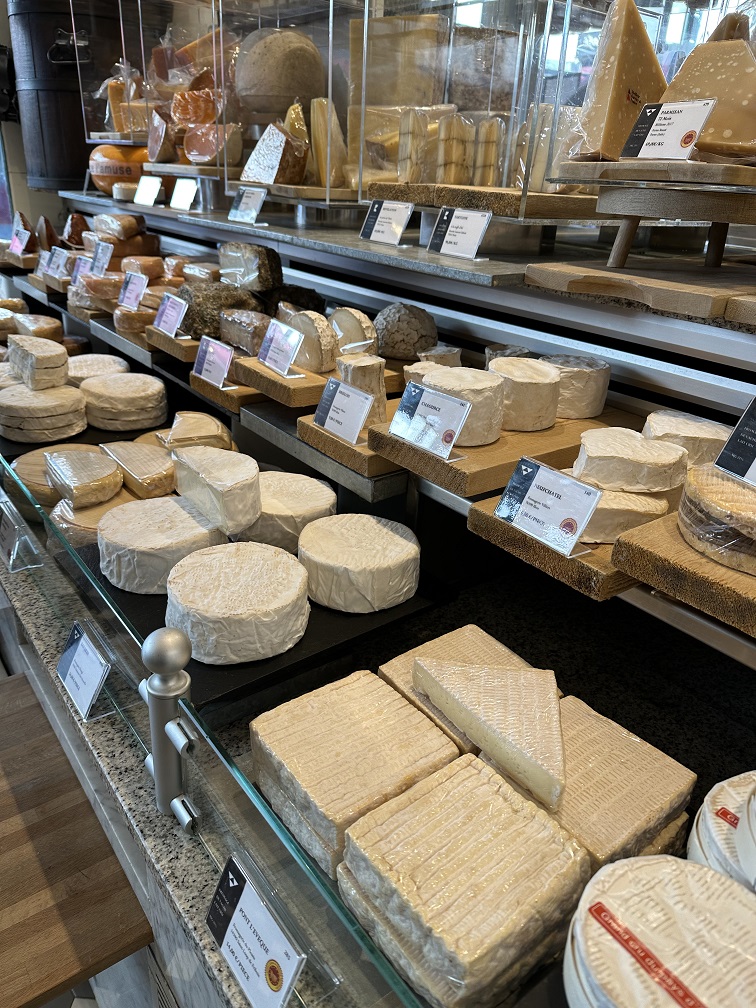
I also stopped by a few of the cheese stores – this is literally a mandatory activity when in France. Tea is something I love, but talk much about tea in this blog. I found my favorite tea store, Mariage Frères, a short walking distance from my hotel, and I got a few teas to bring home. Around the corner from the tea store, I found another one of my favorites – Le Café Lenôtre. I was really hoping for a cup of hot chocolate but was laughed at as nobody else wants to drink hot chocolate in July.


And now you have my full report. It was definitely fun to spend a week in Paris and see how your memories are coming back to you. Before we part, I would like to leave you with one of my favorite pictures, taken during the rainy trip along the Seine. I think it gives you a perfect Paris mood in one shot…
Last Bottle Sign Up ($10 credit)




 Talk-A-Vino