Archive
Celebrate Spring and Creativity with Aridus Wines
 Spring is here in Connecticut. There is still some frost on the cars’ windshields in the morning, but the greens are popping out everywhere, daffodils abound, and cherry trees look pretty in pink. It still feels surreal with the horrible events unfolding in Ukraine, but yes, the Spring has arrived.
Okay, so we acknowledged the Spring, now let’s talk about wines and creativity.
Spring is not only about flowers. Spring is also about new wine releases, such as the one from Aridus Wine Company in Arizona.
Aridus is a family winery in southeastern Arizona, the area where the majority of Arizona’s grape growing is concentrated. Aridus, which means in Latin “dry or arid”, is a young family winery, built on the passion and the desire to make world-class wine. The winery started by purchasing 40 acres of farmland in the Turkey Creek area in 2009. In 2012, a state-of-the-art winery was built, first making wines from the grapes brought in from the vineyards in Arizona, New Mexico, and California. The white grapes were first planted on the estate’s land in 2015, followed by the red grapes in 2017, all using sustainable farming methods.
The white grapes are already used in the estate wines, such as Sauvignon Blanc and Viognier. Being curious about the estate red grape program, I asked Lisa Strid, the Aridus winemaker, when does Aridus plan to produce estate red wines, and here is the answer I received: “We are in the process of transitioning over to estate reds – our first vintage of reds from the vineyard was in 2019 when the Cabernet Sauvignon was on its third leaf. However, I’m not certain as yet whether we’ll be bottling that as 100% estate. We weren’t sure what yields would look like, so in order to ensure we’d have enough Cab for the vintage, we also purchased a few tons from our favorite grower in New Mexico. So it may wind up being a blend for the Aridus tier, and we’ll almost certainly do an estate bottling for the Barrel Select Tier. We just bottled the 2018 Cab Sauv two weeks ago, so it will be at least another year before we actually bottle and release the 2019.
I tasted Aridus wines last year, and I was impressed with the quality. This year, I had an opportunity to taste Aridus wines again, and now I’m impressed not only with the quality but with the creativity. How so? I thought you would never ask – but thank you for this question. To answer I will do something which I generally work very hard to avoid – directly citing the tasting notes. But in this case, the description of the 2019 Aridus Viognier from the tasting notes is simply perfect and worth quoting:
“This year, we conducted extensive testing both in the vineyard and the winery in order to better understand the optimal conditions for growing and fermenting this fruit from our unique corner of the winegrowing world. In the vineyard, we tested a range of UV–blocking netting. We had noticed that since this variety tends to hang below the canopy, it is particularly susceptible to sunburn. We netted two rows each with: 1) a thick bee and wasp netting; 2) Chromatinet Red 30% UV blocking; and 3) Chromatinet Gray 30–35% UV
blocking. These lots were picked separately once they hit brix targets and fermented in identical stainless steel barrels. In the winery, we experimented both with yeast and with fermentation vessels. It is our standard practice to ferment whites in stainless steel, but this year we decided to ferment a control in stainless steel, an experimental lot in a sandstone jar, and another in an acacia wood barrel. In 2018 we performed extensive yeast trials and had alit upon Ferm Aroma White as our favorite of all the yeasts tested. This year, one of our technical reps asked if we wouldn’t mind testing Christian Hansen Jazz direct inoculation yeast on a white variety, and we decided Viognier was the best option. When the bulk of the
Viognier arrived at the winery, we pressed it all to one large tank before racking it off to each of the vessels for fermentation to ensure homogenous juice to best assess the differences between the lots. All in all, we wound up with eight separate trial lots. We definitely found ourselves gravitating towards certain treatments over others (we unanimously loved the sandstone jar), but when it came time to blend, we found that we loved the way that all the lots tasted blended in proportion to the volumes of each of the trials.”
Protecting grapes from sunburn using different methods? Deciding on the best fermentation vessel and playing with the yeast? Aridus might be a young winery, but I would say that older wineries should definitely take notice, especially considering the climate change which is not going to go anywhere.

Moving on from creativity to the glass, here are my notes for the 4 wines I tasted:
2021 Aridus Sauvignon Blanc Cochise County Arizona (13.3% ABV, $35, 90% stainless steel, 10% 4 months in oak, 100% estate fruit)
Straw pale, almost translucent
Tropical fruit, golden delicious apples, round, intense
Tropical fruit, initial sweetness impression quickly replaced by crisp, vibrant acidity, with acidity on the finish. I would say it is Torrontés in the blind tasting, but still, a nice wine.
Drinkability: 8-, easy to drink. A crowd-pleaser – I opened this bottle during dinner with friends – both of my friends loved this wine, and even my kids, who generally don’t drink wine, said that it was excellent.
2019 Aridus Viognier Cochise County Arizona (14.4% ABV, $35, 19 months in oak, 100% estate fruit)
Straw pale
Nicely floral and perfumy on the nose, round, inviting, medium ++ intensity
Round, restrained, elegant, plump, roll-off-your tongue, good acidity
Drinkability: 8-/8, nice and elegant. Was improving over a few days as the bottle was open.
2018 Aridus Syrah Cochise County Arizona (14.5% ABV, $46, 90% Syrah, 10% Viognier, 32 months in oak, 50% new, 50% neutral)
Dark garnet
The nose of plums, cherries, and meat stew
Medium body, tart, firm structure, some underripe dark fruit. Under-extracted for my palate – I want a bigger body on this wine.
Drinkability: 7+, needs time – these were 1st-day impressions
In 4-5 days, 8/8-, round, good amount of fruit, good balance
2019 Aridus Graciano Cochise County Arizona (16.6% ABV, $46, 99% Graciano, 1% Petit Verdot, 16 months in oak)
Dark garnet
Beautiful intense nose, plums, earth, smoke, sage, complex
Cherries, plums, well-integrated tannins, firm structure, generous, layered, perfectly balanced
Drinkability: 8/8+, outstanding. This was my personal favorite from the tasting, offering a good Rioja impersonation. Very well done.
Here you are, my friends. Spring, wine, and creativity. I will gladly drink to all.
Slow, Sustainable, Delicious
“Slow forward”.
Is slow forward good or bad? In a world where instant gratification is a king, moving forward should be fast, right? We all want progress to accelerate, move faster, aren’t we? So slow is not good, right? Well, actually wrong.
Maybe “slow forward” is something we all need to adapt. Move forward, but take our time to enjoy the process of moving forward, instead of constantly being under stress for “not enough hours in a day” – moving fast, but not necessarily forward.

For sure, Herdade de Esporão embraces this “slow forward” process, as this is their motto. Not only motto – it is a principle of operation and the lifestyle, which they would like more people to embrace. Sit down, slow down, have a glass of wine and read their Slow Forward Manifesto, and see if you agree with what it says. Also, note that the slow movement is much bigger than just the one at Herdade de Esporão – you can learn more about it here.
Herdade de Esporão was founded in 1973, when José Roquette and his partner bought the historical Herdade do Esporão estate, located in Reguengos de Monsaraz DOC in Alentejo and tracing its roots back to 1267. The first red wine was produced at the estate in 1985. Fast forward to today, there are more than 40 different grape varieties growing at the estate, along with 4 different types of olive trees, all farmed organically. Conversion of more than 1,300 acres of vineyards and olive groves to all-organic farming started in 2008 and took 11 years to complete. Now Herdade de Esporão is helping growers they are working with to convert to all-organic viticulture as well.
In addition to the 40 grape varieties cultivated in the vineyards, Herdade de Esporão is home to Ampelographic nursery where 189 grape varieties and clones are planted to study the effects of climate change and find ways to adapt to it.
There is a large variety of soils at the estate – enough to hire a geologist to create a soli map. The grapes from the different plots are fermented separately in small batches after the majority of the grapes are crushed by the foot at the winery (yep, slow forward, remember?).
Herdade de Esporão is a big business (one of the largest wine businesses in Portugal) owning a number of wineries in Portugal and selling both in Portugal and around the world, exporting to more than 50 countries. At the same time, Herdade de Esporão is a family company, inspired by the land and respect for the environment. For Herdade de Esporão it is all about environmental, cultural, social, and personal sustainability, adhering to its own principles of Slow Forward lifestyle.


That slow forward lifestyle and respect to the land and the environment translate very well into the wines. I had an opportunity to taste 4 different wines from Herdade de Esporão (samples), and all the wines were absolutely delightful:
2020 Herdade de Esporão Branco Colheita Alentejo (13.5% ABV, $18, 30% Antão Vaz, 30% Viosinho, 30% Alvarinho, 10% other varieties, 4 months on the lees)
Light golden
Beautiful, inviting, open, a hint of tropical fruit, honeysuckle
Round, creamy, explicit minerality, crisp, fresh, a touch of fruit, but overall very dry, good acidity, excellent balance, medium-long finish
8-, excellent, can be confused with lightly oaked Chardonnay.
2020 Herdade de Esporão Branco Reserva Alentejo (13.5% ABV, $20, 30% Antão Vaz, 30%, Arinto, 30%, Roupeiro, 10% other varieties, six months in stainless steel tanks and in new American and French oak barrels)
Straw pale
Fresh meadows and honeysuckle, beautiful
Clean acidity, light representation than the Colheita, lip-smacking acidity, clean, crisp and fresh, excellent balance
8, pure delight. Can be easily confused with Chardonnay.

2018 Herdade de Esporão Tinto Colheita Alentejo (14.5% ABV, $18, 30% Touriga Nacional, 25% Aragonez, 20% Touriga Franca, 15% Alicante Bouschet, 10% Cabernet Sauvignon, 6 months in concrete tanks)
Dark garnet
Earthy, a touch of chalk, dark fruit, warm spices
Open, clean, raspberries, warm spices, good minerality, good structure, a cut-through acidity, medium body, medium-long finish
8-/8, outstanding
2018 Herdade de Esporão Tinto Reserva Alentejo (14.5% ABV, $25, 25% Aragonez, 20% Alicante Bouschet, 15% Cabernet Sauvignon, 15% Trincadeira, 10% Touriga Nacional, 10% Touriga Franca, 5% Syrah, 6 months in concrete tanks)
Dark garnet
Blackberries, earth, a hint of raspberries, dark, concentrated
Cherries, pomegranate, clear minerality, layered, firm structure, fresh and food-friendly
8/8+, outstanding, ready to drink now, great with food (Odjakhuri)
Here you are, my friends – organic, sustainable farming, 4 delicious wines. You don’t need to break the bank to be able to drink them at any time you want, and even more importantly, you can pop, pour and enjoy – almost a rare beauty nowadays.
Slow down and enjoy. Cheers!
Big Game, Big Decisions
I’m sure it is obvious what Big Game we are talking about.
The Super Bowl. One and only entertainment event of the year, almost a national holiday (many say that Monday after the Super Bowl should be made into a national holiday, as sometimes those games end past midnight).
I saw some interesting stats about this Super Bowl LVI (that’s 56 if you are not intimately familiar with Roman numerals). It is expected that 117 million viewers with watch the event – if this will be an actual number of viewers, it would set a new record (the previous one was 114M viewers in 2012), and a substantial increase over last year’s Super Bowl, which only attracted 96.4M of fans. Also, according to CNBC, the American Gaming Association projected that a record 31.4 million Americans would bet $7.6 billion on the Bengals-Rams game. Some staggering numbers, aren’t they?
But forget the numbers – I’m only here for the food 🙂
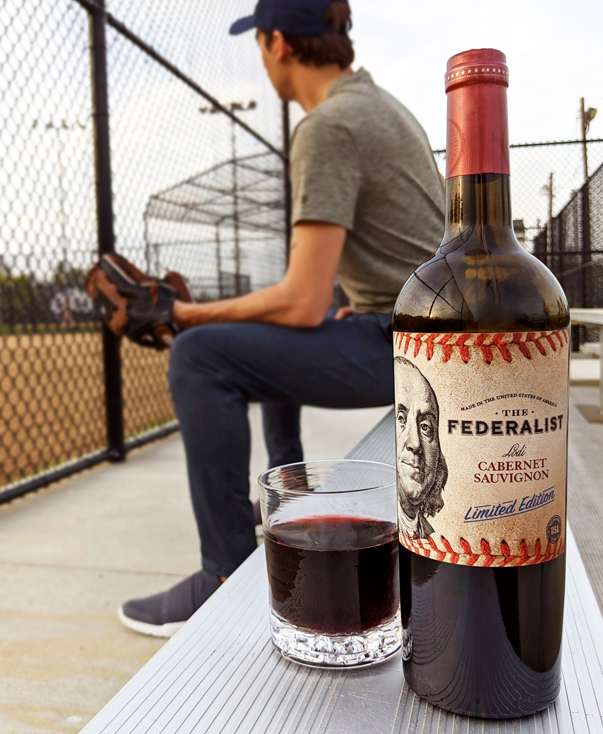
Source: Terlato Wines
So what are the big decisions we are talking about here? Leaving food aside, there is only one big decision to make – and you know which one it is.
Beer or Wine?
In any Super Bowl viewing party preparation discussion, this is an eternal question – what should you drink while watching the big game? What should you serve with the food?
Food is the right starting point for this discussion. I can’t resist throwing in another interesting data point – The National Chicken Council estimates that Americans will consume 1.42 billion wings while the Cincinnati Bengals play the Los Angeles Rams. Yep – 1.42 billion! Super Bowl is a finger food festival – sandwiches, chicken strips, shrimp, chicken wings, and lots of other usually salty and often spicy indulgences. So beer seems to be the obvious answer to our eternal question.
Except when it is not.
Beer is boring. Yes, I drink beer from time to time, but I’m rarely excited about it unless I’m in a pub in the Czech Republic or some other European countries which have a culture of beer drinking – and the beer is served always fresh. Heck, if I would be watching Super Bowl at some Beer Garden in the US, I would definitely stay with beer. But at home, I unquestionably prefer wine. Wine brings excitement, and even if it wouldn’t perfectly complement the food spread on the table, it will make the game a lot more enjoyable to watch.
So how about some hard-core American wine? Does American Craft Wine sound good? An American craft wine for the American craft game – that should work together, right? So the wine I would like to bring to your attention is The Federalist, proudly crafted in California.
The Federalist winery was founded in 2009 in Sonoma, California, with an initial focus on producing Zinfandel – it makes perfect sense for an American craft winery to focus on the grape which America considers uniquely its own. Cabernet Sauvignon, Red Blend, and Chardonnay complete the lineup today, also connecting with another uniquely American product – Bourbon. The second line of Cabernet Sauvignon, Red Blend and Zinfandel wines are aged in the Bourbon barrels, uniquely amplifying the power of traditional Californian varieties.
I had an opportunity to taste a few of the Federalist wines latest releases – here are my notes:
2017 Federalist Cabernet Sauvignon Lodi (13.9% ABV, $17.99, 93% Cabernet Sauvignon, 5% Zinfandel, 2% Petite Sirah, Merlot, and Cabernet Franc, 15 months in 35% new oak)
Light garnet
Cassis, dark berries, eucalyptus, open, inviting
Unmistakable Lodi on the palate, cassis, nutmeg, warm spices, a touch of dark chocolate, good balance, well-integrated tannins, medium-long finish.
8-, easy, simple, will work well with a range of foods.
2018 Federalist Chardonnay Mendocino County (14.5% ABV, $17.99, aged in 35% new oak)
Light golden
A hint of vanilla, Whitestone fruit, a touch of gunflint
Restrained on the palate, golden delicious apples, crisp, fresh, good acidity, medium finish with prevailing acidity.
8-, needs food.
2019 Federalist Zinfandel Dry Creek Valley (15% ABV, $24, 100% Zinfandel, 16 months in 20% new oak)
Dark garnet
Raspberries, eucalyptus, earthy notes
Dark fruit, cut through acidity, well present tannins, a touch of raspberries, medium-plus finish with lots of acidity
7+/8-, food wine, needs time
The Federalist wines are well connected to the big game, being an official premiere wine sponsor of the San Francisco 49ers ( who I would much prefer to see in the Super Bowl together with the Kansas City Chiefs), so it would be only appropriate if you will open a bottle of the Federalist Cabernet Sauvignon to celebrate the big game.
And if not the big game, the Federalist wines are perfectly appropriate to celebrate the next official American holiday, The President’s Day, taking place exactly in a week.
Game, ads, half-time show, food, wine – I wish you a great evening.
Chilean Wines: Sustainability is a Long Game
 Sustainability is a journey.
Sustainability is a lifestyle.
Sustainability is a long game.
Have you ever dieted in your life? Did you achieve the intended results (let’s say, lose 20 pounds)? Did you go back where you started shortly after you stopped the diet? Of course, you already heard this a million times and you know what I’m going to say – diets don’t work. You need to change your lifestyle if you want those lost pounds to never come back, because the diet is a hack, and as such, it can give you only a quick and non-lasting, non-sustainable result.
Sustainability is a lifestyle.
When I think of sustainability my first thought goes to the vineyard. How vineyard integrates into the environment, how vineyard, land, soil, and everything around can happily co-exist now and in the future. My second obvious thought goes to the winery operation – sustainable energy use, recycling, waste reduction.
In 2011, the Chilean wine industry defined its Sustainability Code, a voluntary certification system aimed to improve sustainable practices in the wine companies in Chile. In 2011, it all started in the vineyard. Today, the Sustainability Code for the Chilean Wine Industry (SCWI) represents a colorful flower, consisting of 4 areas, and featuring 351 individual requirements:
- Viticulture (98 individual requirements /Green)
- Vinification, Bottling, and facility operations (65 individual requirements /Red)
- Social (118 individual requirements /Orange)
- Wine Tourism (70 individual requirements /Purple) — new category added in 2020
In the ten years since its inception, SCWI has been adopted by all the country’s leading wine producers and accounts for 80% of Chile’s bottled wine exports. Wines from certified producers come from 123,550 acres of vineyards, out of 485,000 acres of total vineyard space in Chile, so roughly 25%.
The certification is done by the accredited international bodies (ECOCERT from France, NSF from the USA, and SGS from Switzerland, a few more should be added soon), and it is an ongoing process, as re-certification has to be done every two years. Certification has a substantial cost, so Vinos de Chile has a special program in place to help small and medium producers to achieve certification. To date, 80 wineries achieved full certification – if you will look at the list, you will see a lot of familiar names. Some, such as Casa Lapostole, one of the most famous Chilean wineries, use its own set of sustainability rules.


I had an opportunity last year to taste a number of wines from the certified sustainable Chilean wineries. Let’s talk about them.
Viñedos Emiliana (now known as Emiliana Organic Vineyards) was founded in 1986. However it is interesting that if you will check the history section on Emiliana’s website, the time count starts from 1998 – this is when Emiliana began its journey to convert into a sustainable, organic, and biodynamic winery. In 2001, Emiliana became 1st winery in Chile, and 7th in the world to obtain ISO 14001 certification in environmental management. Two years later, Emiliana produced its first organic wines (Coyam was one of them). In 2006, the winery obtained its Demeter certification and produced its first biodynamic wine, 2003 Gê. Moving forward, Emiliana obtained multiple certifications in social responsibility, fair trade, carbon neutrality, and more. As a fun fact, with 2,760 acres in size, Emiliana is the largest biodynamic, sustainable, and organic vineyard in the world.
The wine I tasted for this post was 2018 Coyam. Back in 2015, the 2011 Coyam was my wine of the year. The 2018 Coyam was good, but really needed lots of time to open up.
2018 Emeliana Coyam Colchagua Valley DO (14.4% ABV, $35, 42% Syrah, 39% Carmenere, 6% Cabernet Sauvignon, 5% Garnacha, 3% Malbec, 3% Carignan, 1% Tempranillo, 1% Mourvedre, organic vineyards, vegan)
Dark garnet
Bell pepper, cherries, cassis
Beautiful, cassis, mint, medium-plus body, good balance, good acidity
8, these are the 3rd day notes, this wine needs time.
Viu Manent‘s history began in 1935, when Catalonian immigrant Miguel Viu-García and his two sons founded Bodegas Viu, bottling and selling their own wines. In 1966, Miguel Viu-Manent, one of the sons, acquired an estate in Colchagua Valley which also included 375 acres of vineyards, planted with pre-phylloxera vines. In 1993, Viu Manent became the first Chilean winery to produce, bottle, and label Malbec under its name. In 2001, as a tribute to the founder, Miguel Viu-Manent, Viu Manent produced its single-block Malbec from approximately 100 years old vines. In 2003, the winery started producing its Secreto de Viu Manent line of wines. In 2007, Viu Manent joined the environmental biodiversity program run in Chile by the University Austral of Chile’s Ecology & Biodiversity Institute. In 2018, 3 solar panel energy plants were put into production at the winery and in the vineyards. The winery also participates in wastewater and solid waste management programs and other environmentally-friendly initiatives.
2019 Viu Manent Secreto Malbec Valle de Colchagua (13.5% ABV, $15, Malbec 85%, 15% “Secret”)
Dark garnet, almost black
Raspberries, blackberries, cigar box
Fresh raspberries on the palate, fresh, open, good minerality, a bit astringent on the finish even on the second day. Needs time.
7+ On the second day
8- on the third day
Viña Maquis, an estate located between two rivers, the Tinguiririca River and the Chimbarongo Creek, traces its roots to the 18th century when Jesuit priests were producing noble wines on the property. In the 19th century, the property belonged to the two Chilean presidents who even hosted cabinet meetings at that location. In 1916, the property was acquired by the Hurtado family with the goal of producing fine wines. Viña Maquis was one of the first wineries to obtain sustainability certification. They use in the vineyard energy recovery system based on geothermal heat pump technology for which the winery won the 2013 Innovation Prize for energy saving and carbon footprint reduction awarded by the British-Chilean Chamber of Commerce. They also use biological corridors which host beneficial insects, birds, and animals, and more than 2,600 sheep help control the weeds and fertilize the vineyards.
2018 Viña Maquis Cabernet Franc Gran Reserva Colchagua Valley (14% ABV, $24, 90% Cabernet Franc, 7% Carménère, 3% Petit Verdot)
Dark garnet
Cassis, cassis leaves, a touch of bell pepper
Cassis, blackberries, good acidity, fresh, crisp, medium body.
7+/8-


Concha y Toro is one of the oldest wineries in Chile, founded in 1883 by Melchor Concha y Toro with a dream of producing the best wines. He brought in vines from the Bordeaux and built the winery with all the best equipment at a time. As Concha y Toro was transitioning from a family business to a corporation, 50 years later the wine export started, the Netherlands being a first international destination. In 1987, Concha y Toro released the first vintage of its iconic Cabernet Sauvignon, Don Melchor, named in the honor of the founder. In 2020, James Suckling awarded 2018 Don Melchor a perfect 100 score.
In 2021, Concha y Toro received B Corporation Certification, which recognizes companies around the world that meet the highest standards of environmental management, governance, and social performance. This B Corporation certification included metrics such as 100% drip irrigation, 97% of waste reused/ recycled, 24% reduction of waste over 2018, 83% of energy coming from renewable sources. Concha y Toro also works with the scientific community and Wines of Chile to develop a measurable roadmap for carbon footprint reduction.
2019 Concha y Toro Cabernet Sauvignon Serie Riberas Gran Riserva DO Marchigue (13.5% ABV, $17, 94.5% Cabernet Sauvignon, 3% Carmenere, 2.5% Syrah)
Dark garnet, practically black
Summer meadows, a touch of cassis, hint of mint
Open, fresh with happily gripping tannins (French oak), firm structure, fresh fruit, needs time
8-, will be great with the steak.
8+ second/ third day – wine became more integrated, polished, layered, perfect balance, pleasure in every sip.
In 1885, Francisco Undurraga imported vines from France and Germany and founded the Viña Undurraga winery. In 1903, Viña Undurraga became the first Chilean winery to export its wines to the USA. In 1942, under the management of Pedro Undurraga Fernández, the winery becomes a pioneer in exporting Chilean wines, reaching more than 60 countries. In 2006, the Los Lingues far was acquired, giving a start to Viña Koyle, which in 2009 started the transition to Demeter-certified biodynamic viticulture.
2019 Viña Koyle Carmenere Gran Reserva Alto Colchagua (13.5% ABV, $17, 85% Carmenere, 9% Tempranillo, 6% Petit Verdot)
Dark garnet, practically black
Cassis, a hint of underbrush, fresh dark fruit, inviting
Fresh berries, dark chocolate, a hint of sweet tobacco, round, succulent, excellent t balance, medium-long finish
8, excellent
In 1874, the winemaker Don Franciso de Rojas founded the winery in Maipo Valley which he called Viña de Rojas. In 1876, one of his wines received Silver Medal at a competition in Philadelphia in the USA. Now here is the rare happenstance with the transition of the name from Viña de Rojas to Viña Tarapacá. In 1892, the winery was acquired by Don Antonio Zavala and it became Viña Zavala. After the divorce, the winery became alimony assigned to his wife, who renamed the winery Viña Tarapacá ex Zavala to express her gratitude to her divorce lawyer Don Arturo Alessandri who had a nickname “The Lion of Tarapacá”. In 1992, the winery was acquired by the holding company with a focus on international expansion. In the same year, the winery acquired El Rosario Estate, 6,500 acres parcel, out of which 1530 acres are planted with vines, right in the heart of Maipo Valley. In 2008, Viña Tarapacá became a part of VSPT Group, the second-largest exporter of Chilean wines.
The winery holds a large number of environmental and sustainability certifications, and in 2016 it also became the Chilean winery to build a hydroelectric plant, capable of supplying 60% of all winery’s energy needs.
2018 Viña Tarapacá Red Wine Blend Gran Reserva Maipo Valley (14% ABV, $20, 31% Cabernet Franc, 26% Syrah, 22% Carmenere, 11% Merlot, 10% Cabernet Sauvignon, organic wine)
Dark garnet, almost black
Delicious nose of mint, currant, a touch of sweet basil and thyme
Ripe berries, firm structure, gripping tannins, a touch of cherries and black pepper, good acidity, excellent balance.
8+, delicious, but will be amazing in 10-15 years.
Here you go, my friends. Chilean wineries take sustainability seriously and show the world how it should be done. And they also support it with delicious wines. Sustainability is a lifestyle.
Daily Glass: A Rare Turley, And a Question of Wait
 I love Turley wines.
My first encounter with Turley was way back, maybe 20 years ago, when my friend and I were having dinner at a restaurant in Manhattan, and we saw a bottle of Turley on the wine list, probably a Juvenile Zinfandel or the Old Vines Zin, and it was one of the most affordable wines on the list, so we decided to try it. Right after the first sip, I remember we looked at each other and said ‘wow”. Turley became the love from the first sight sip for both of us, and when I go visit him, I always bring a bottle of Turley, which makes him very happy.
If you will ask a wine lover about Turley, most likely you will get an instant reaction “ahh, Zinfandel”. More advanced wine lovers might also add “oh yes, and Petite Sirah”. First and foremost, Turley Wine Cellars is known for its Zinfandels, and yes, the Petite Sirah. Altogether, Turley produces 50 wines from 50 different vineyards. And while an absolute majority of those wines are Zinfandels, there are few exceptions – two white wines, Sauvignon Blanc and the White Coat, Cinsault from 135 years old Bechthold Vineyard in Lodi, Casa Nuestra and Tecolote red blends, two Cabernet Sauvignon wines, and one Zinfandel Rosé, which sometimes is playfully identified as White Zinfandel (believe me, it is a proper Rosé, not a sweet plonk). With the exception of the Estate Cabernet, it is pure luck when any of these non-Zin, non-Petite Sirah wines are included in your allocation – doesn’t happen often.
Another question we can ask wine lovers – should Zinfandel wines be aged or consumed upon release? I don’t want to get too far into the woods by presenting such a broad question, but for the sake of simplicity here we are talking only about well-made wines from producers such as Turley, Carlisle, Robert Biale, Ridge, and similar. Again, posing this question to the wine lovers I heard the same answer from a number of well-qualified individuums: “I like my Zinfandel with some age on it”.
From my personal experience, mostly with Turley and Carlisle, I definitely appreciate the age on my Zins, but it also depends on the style of the wine. Turley Juvenile and Old Vines Zins are built to be enjoyed young, however, they are also perfectly capable of aging for 8-10 years with no issues. The majority of single-vineyard Zinfandels definitely benefit from aging, and best not being touched for the first 5-7 years upon release. The same applies to the Petite Sirah, probably even in the higher degree – it is better to wait for about 8-10 years to enjoy a bottle of Turley Petite Sirah.
Okay, so this is all nice, cool, and theoretical, but then, in reality, we don’t always follow our own best advice, don’t we?
I generally don’t open a new bottle of wine late in the evening. Yesterday, coming home after Taekwondo training, I realized that I crave a glass of wine. This is really a bad thought at around 9 pm because the process of selecting the bottle to open can take another 30 minutes or so. I have a lot of Turley bottles stored in the simple wine cage, which makes the selection process a lot easier as I don’t need to move the wine fridge shelves back and forth, so this is where I decided to look. I looked past most of the younger Zins – as you remember, I also like them with some age, and then I saw a bottle of 2018 Tecolote. It was pure luck that I had it, as it came via the special offer for the 2020 holiday season – this wine is typically available only in the tasting room. I never had this wine before, which provided a legitimate opportunity to ignore my own aging rules and simply open the bottle, which is exactly what I did.
Tecolote is a blend of 60% Grenache and 40% Carignane, both grapes harvested from dry-farmed Pesenti Vineyard in Paso Robles, from the vines planted in the 1920s. As this is a Catalon-inspired blend, and the grapes come from the specific plot in Pesenti vineyard which looks like an owl, the wine was called Tecolote, which is the Spanish word for “owl”.
Boy, was I happy with my decision… The first sniff of the 2018 Turley Tecolote Red Wine Paso Robles (15.9% ABV) was pure heaven – barnyard, forest underbrush, and spices. I know that the “barnyard” descriptor is polarizing, and deeply hated by some – I always love it, for sure on the red wines (never had it on the white), so I really enjoyed that aroma. On the palate, the wine had pure tart cherries, acidic, juicy, and succulent, fully supporting and continuing the initial enjoyment of the smell. I literally couldn’t stop refilling the glass until only about a third of the bottle was left.
And again I have to state that I’m happy that I left some of the wine for the second day, as the wine transformed. I usually preserve the wines by pumping the air out of the bottle. Sometimes I preserve the wines like that for 2,3,4,5 days, tasting the wine, pumping the air out, and leaving it until the next day. From my experience, I consider that each next day the wine still tastes good or even better than the day before is equivalent to the 5 years of aging. So if you don’t like the barnyard smell, don’t touch your Tecolote for another 5 years. When I opened the wine today, the barnyard smell was gone, and it was replaced by cherries and a telltale sign of Grenache in my book – dark chocolate. The wine also had cherries and dark chocolate on the palate and it was perfectly balanced and absolutely delicious (Drinkability: 9-). What is even more interesting, the wine paired very well with dark chocolate-covered raisins from Trader Joe’s and Italian truffled cheese. Go figure…
Here you are, my friends – a delicious wine, good when young, and perfectly capable of aging. If you can, go find your bottle…
Sangiovese Games and Power of Words
 Okay, folks, this might be the scariest post I have ever written. This might lead to unsubscribes, unfollows, ostracism, and public shaming. Well, it is what it is.
Here it comes, my confession.
I don’t know how Sangiovese tastes like.
Here, I said it. You heard me right, and I can repeat. I do not know how Sangiovese tastes like.
Still here? Okay, then I would like to ask for a chance to explain.
I know how Cabernet Sauvignon tastes like. Whether it is produced in Bordeaux, California, Australia or Tuscany, I still expect to find cassis, maybe eucalyptus, maybe mint, maybe bell peppers.
I know how Pinot Noir tastes like. No matter whether it comes from Burgundy, South Africa, Oregon, New Zealand, or California, I still expect to find cherries, maybe plums, maybe violets, maybe some smoke.
I can continue – I know how Chardonnay tastes like (from anywhere), I know how Riesling tastes like (from anywhere), I know how Sauvignon Blanc tastes like (from anywhere). I still don’t know how Sangiovese tastes like.
While we are talking grapes, we are also talking about the power of words. As soon as we hear Cabernet Sauvignon, Pinot Noir, Chardonnay, Riesling, Sauvignon Blanc, we have an instant mental image, set our expectations, and the first sip of wine is judged against that mental image. Of course, we make regional adjustments – Pinot Noir from Oregon might offer dark chocolate, espresso, and mocha in addition to the cherries, but cherries will be there. Bordeaux (okay, it is usually a blend, so this might be a bad example) is expected to be leaner that’s California Cab, but it will still show that cassis core. And I still have no clue how Sangiovese should taste like.
I know how Brunello tastes. It is 100% Sangiovese, but it has its own unique taste profile with layers of tart cherries and cherry pits framed by oak notes and firm tannins. I know how Vino Nobile de Montepulciano tastes. It is also 100% Sangiovese, with tart cherries usually weaved around a core of acidity. I know how Chianti typically tastes. It has to be at least 80% Sangiovese, plus other grapes, and it will have the cherries usually surrounded by leather and tobacco.
Brunello, Vino Nobile, Chianti are renditions of Sangiovese, but they are references only to themselves. When I hear any of these names, I know what to expect. But I still don’t know how Sangiovese tastes like.
I don’t know if you ever had a chance to experience Shafer Firebreak. This wine used to be made from California Sangiovese (92%) with the addition of Cabernet Sauvignon (8%), the percentages are representative of the last vintage which was in 2003 (Sangiovese plantings were removed after that). This wine had nothing in common with any of the Italian Sangiovese renditions, but instead had a smoke, espresso, and powerful dark fruit. A very memorable rendition of Sangiovese – but not referenceable.


You might be annoyed at this point by me constantly repeating “I don’t know how Sangiovese tastes like” and wondering where I might be going with that. So this post was triggered by a few events. Last year, I got a few samples of Sangiovese from Castello di Amorosa. When I tasted them, they were reminiscent of Chianti, and I even had to open a bottle of Cecchi Chianti, which is an outstanding producer making Sangiovese wines with exemplary regional expressions, to compare. I also tasted a bottle of California Sangiovese which had only a name of Sangiovese, but really tasted more like a fruit compote mixed with a fruit cake. As the end result I realized that I have no idea how Sangiovese actually should taste like – and here I am, pondering at the subject with you, my dear reader (I hope someone is still reading this, eh?)
So let me take you a bit further with a few of the tasting notes and references.
First, I have to say that I probably found what can be considered a reference Sangiovese. Two years ago I had an opportunity to taste a range of wines from Cecchi, and one of the wines was called Sangiovese Toscana IGT. It was not Chianti of any kind, it was pretty much an unadulterated rendition of a pure Sangiovese from the motherland, from Tuscany, which was not even aged in oak, only 2 months in the bottle. Here are the notes:
2018 Cecchi Sangiovese Toscana IGP (13% ABV, $10)
Dark ruby
Cherries, coriander, sage
Light, bright, fresh cherries, crisp acidity, sweet basil, refreshing.
8+, can be perfect even on a summer day, but I can’t complain on a winter day either. Unique and different.
The wine was absolutely spectacular in its pristine beauty and an absolute steal for the money. Ever since I tasted this wine it became my reference for how pure Sangiovese might take like.
Now, the peculiar California Sangiovese I mentioned before was the 2017 Seghesio Venom. 100% Sangiovese from Rattlesnake Hill in Alexander Valley, 14.9% ABV, $55. Seghesio is a Zinfandel specialist, and they are good at that. If this wine would be called Zinfandel, I would have no issue with it. But under Sangiovese name, it makes me only wonder what possessed Seghesio to make a wine like that. A fruit compote with a bit of a structure doesn’t equate to Sangiovese in any shape and form. And at the price, if you just want to drink a California wine, it might be fine, but if you are looking for Sangiovese, just look elsewhere.
Well, you don’t need to look too far. Castello di Amorosa in Napa Valley is really focusing on bringing their Italian heritage to wines they craft in California. Yesterday I talked about their range of Pinot Noir wines, which was excellent. Their California Sangiovese can probably be called a glorious success as I even had to open a bottle of classic Chianti to compare the notes.


I tasted two Sangiovese wines from Castello di Amorosa (for the history of the Castello, which is very fascinating, I would like to refer you to the link I included above).
2017 Castello di Amorosa Sangiovese Napa Valley (14.7% ABV, $36)
Dark garnet
Plums, cherries, baking spices
Plums, tart cherries, light tannins, medium body, good structure, a hint of leather.
8-/8, it is reminiscent of the Chianti, nicely approachable, but will improve with time, judging by the late tannins on the finish on the second day.
2018 Castello di Amorosa Voyager Vineyard Sangiovese Napa Valley (14.5% ABV, $45, single vineyard)
Dark garnet
Smoke, granite, gunflint, tobacco, dark fruit, Very promising.
Tobacco, baking spices, cut through acidity, medium body. Very unusual. Needs a bit of time.
Tart cherries, a hint of vanilla, bright acidity. Reminiscent of Chianti, but not as earthy
8-
And then I opened a bottle of Cecchi Chianti and was pleasantly surprised how successful Castello di Amorosa was with their Californian Sangiovese rendition.
2017 Cecchi Chianti DOCG (13% ABV, $14)
Dark garnet
Herbs with a hint of cherries
Tart cherries, good acidity, fresh berry profile, medium body. Was earthy upon opening, but mellowed out after a few hours in the open bottle.
8-, easy to drink, nice.
As you can tell, the wines are similar, and I would call it a very successful effort.
Well, I still don’t know how Sangiovese should taste like, because this is all in the words. Unless we taste blind, we are bound by the power of words, and therefore our excitement and disappointment are fully dependent on those words. Was the Venom a bad wine? No, but it is an utter disappointment when called a Sangiovese. Thanks to Castello di Amorosa successfully offering a saving grace. While I still don’t know how Sangiovese should taste like, I’m willing to continue the quest for the tastiest rendition.
If you are still with me – thank you for reading and cheers.
Californian Stars, Italian Flair
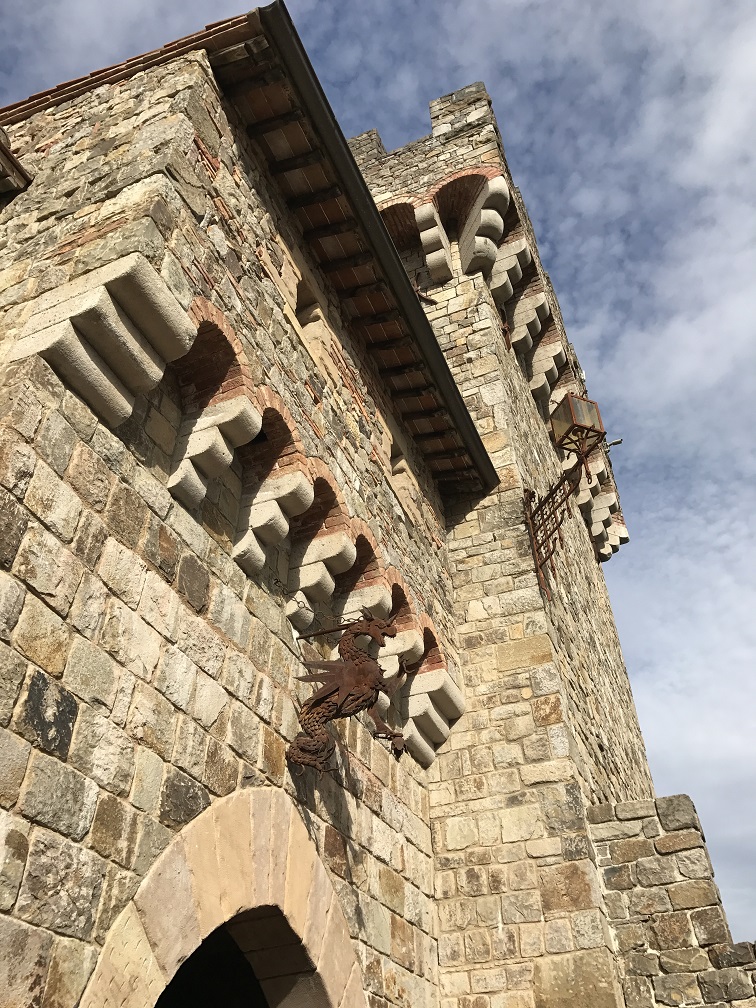 Californian stars.
Of course, we are talking about wines and grapes. What would those be?
I recently called California Cabernet Sauvignon a king. We can safely designate Chardonnay as a queen. But who would you call a prince? Capricious, spiky, moody royalty? Whatever grape you think of, the correct answer is Pinot Noir, because this is the grape I mostly would like to talk about today. And tell me if you think Pinot Noir is not qualified for the role of the royal prince – finicky, demanding, and unpredictable.
Okay, we got our stars for the day. Now, the Italian flair. How would you add the Italian flair to the Californian grapes?
There are a few options. For example, you can call your sparkling wine a Spumante. Or you can call your winery Castello, and build it in the form of a medieval Italian castle. You can also make wines out of Sangiovese – but this we will discuss later. Anyway, as you can see, you got options.
Vittorio Sattui, an Italian immigrant, founded St. Helena Wine Cellars in 1885. The business had to be closed due to the prohibition in 1920, but the Sattui family continued living at the winery. In 1975, Dario Sattui, great-grandson of Vittorio, restarted the family business by opening V. Sattui winery in St. Helena.
After finishing college, Dario traveled around Europe and became obsessed with medieval castles, monasteries, farmhouses. In 1993, Dario found the next home for his future winery – 171 acres parcel near Calistoga. In 1994, the construction began initially for the 8,500 sq. ft building without cellars. That slowly morphed into a 121,000 sq. ft. 13th-century Tuscan castle with 107 rooms, drawbridge, five towers, high defensive ramparts, courtyards and loggias, a chapel, stables, an armory, and even a torture chamber. Lots of bricks and artifacts were delivered directly from Europe to ensure the full authenticity of the castle. Castello de Amorosa (Castle of Love) opened its doors to visitors in 2007 after 15 years of construction.
I was fortunate enough to visit the Castello di Amorosa in 2017 as part of the Wine Bloggers Conference 2017 in Santa Rosa, so I can share (inundate is a better word, of course) my first-hand impressions:
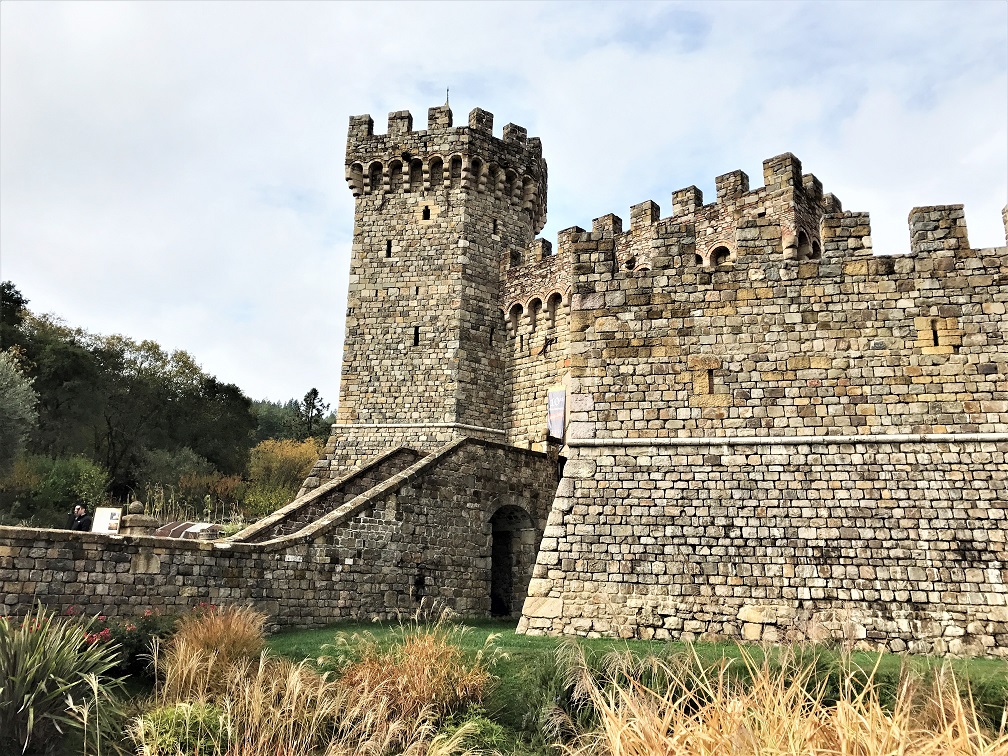
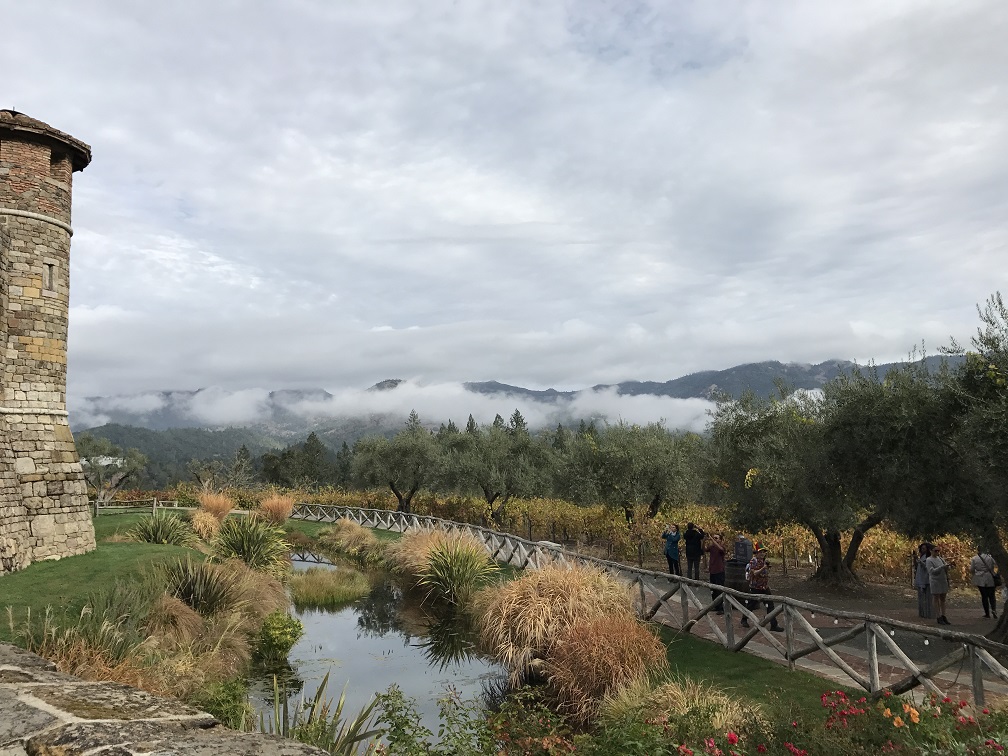


Thinking about misbehaving? Might not be recommended:


Touring the cellars:


The ceiling of the room where we had our tasting in 2017:

A bit of education – Napa Valley Regions:


Castello di Amorosa works with 14 vineyards, most of them in Napa and Sonoma, out of which 6 are estate vineyards. The focus of winemaking is on showcasing each individual terroir and on the small-batch production.
I had an opportunity to taste a range of Pinot Noir expressions from Castello di Amorosa, and I have to honestly say that I was very much impressed with what I found in my glass.


First, two sparkling wines, both produced using the classic method.
2017 Castello di Amorosa Spumante del Castello Brut Napa Valley (12.5% ABV, $39, 73% Chardonnay, 27% Pinot Noir)
Light Golden, fine bubbles
Toasted bread, apples, gunflint
Toasted bread, Granny Smith apples, more gunflint, great minerality, a touch of sweetness, bigger body than typical champagne.
8, excellent,
2017 Castello di Amorosa Spumante del Castello Brut Rosé Napa Valley (12.5% ABV, $49, 100% Pinot Noir)
Salmon pink, fine mousse
Steely strawberries, a hint of toast
Dry, crisp, strawberries, clean acidity, good minerality
8, excellent
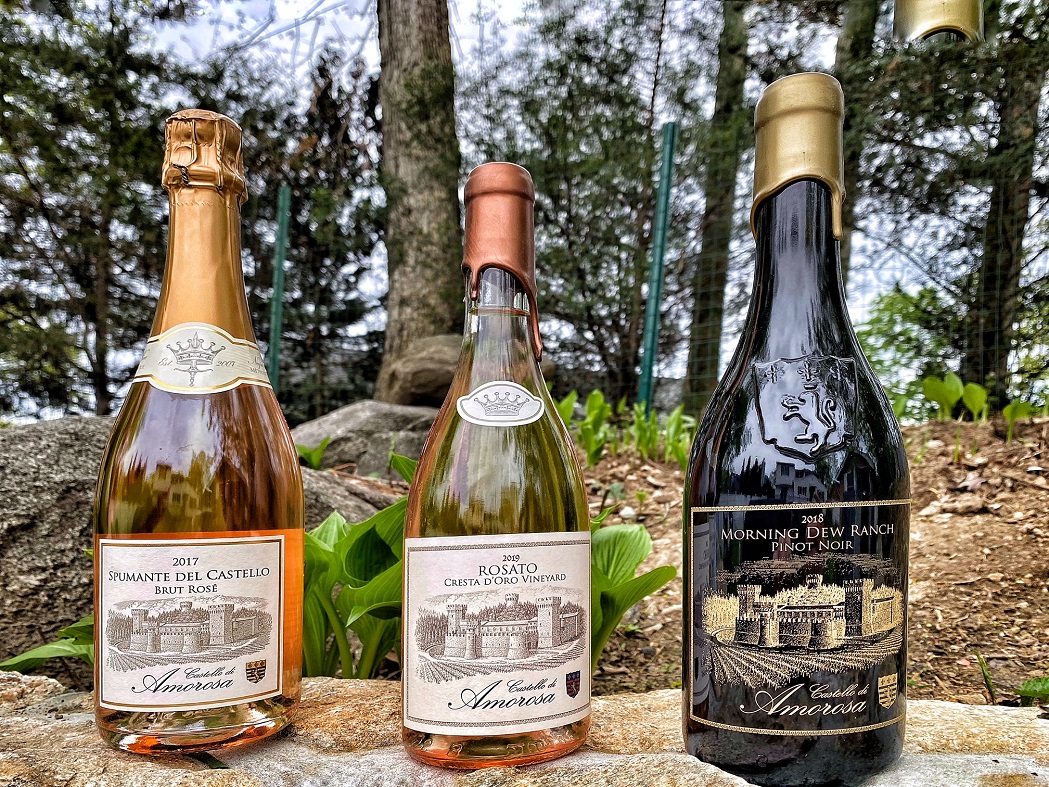
Next up, Rosé. The grapes for this wine come from the Green Valley area in the Russian River Valley AVA, and the wine is partially aged in concrete egg. I had an opportunity to taste both 2019 and 2020 vintages over a few months timeframe, and you can see that my tasting notes are almost identical for both wines. Somehow I missed including this wine into my 2021 top wines list, which makes me upset – this was one of the best Rosé wines and wines overall that I tasted during 2021.
2019 Castello di Amorosa Rosato Cresta d’Oro Vineyard Green Valley of Russian River Valley (13.6% ABV, $39, 100% Pinot Noir)
Light bright pink
Fresh ripe sweet strawberries, good intensity, inviting
Beautiful ripe strawberries, a touch of lemon, clean acidity, impeccable balance. Wow.
9-/9, one of the best Rosé I ever had. Just wow.
2020 Castello di Amorosa Rosato Cresta d’Oro Vineyard Green Valley of Russian River Valley (12.5% ABV, $39, 100% Pinot Noir)
Light bright pink
Fresh strawberries, a touch of herbs, crisp, inviting, and invigorating
Beautiful ripe strawberries, a touch of lemon, clean acidity, impeccable balance. Wow.
9, one of the best Rosé I ever had. Just wow. Superb.
Last up – Pinot Noir from Morning Dew Ranch in Anderson Valley. This vineyard was purchased in 2015 from Burt Williams, founder of the iconic William Selyem Winery. The 12-acre vineyard is in a very cool microclimate and divided into 9 blocks of Pinot Noir planted with DRC, 115, 777, Rochioli, 23, and 828 clones. All the blocks and clones give quite a bit of room to experiment to the winemaking team.
2018 Castello di Amorosa Morning Dew Ranch Pinot Noir Anderson Valley (13.1% ABV, $75, 11 months in Burgundian oak barrels)
Dark ruby
Somewhat unexpressive on the first day, a hint of fruit
Closed up, concentrated, dark fruit, not amazing
Classic Pinot on the second day – iodine, violets, underbrush
Beautifully elegant on the palate – good acidity, smoke, tobacco, fresh berries, cherries, firm structure combined with medium body, medium-long finish.
8+ second day, super-enjoyable.
Here you go, my friends – a little Italian oasis – scratch that – a large Italian Castle in the middle of Napa Valley, producing magnificent California wines. Castello di Amorosa is definitely a unique travel destination and a must-visit if you are ever in the area.
Made With Organic Grapes: A Few Wines From Chile
Chile is a unique winemaking place.
So is each and every wine region in the world – each wine region, big, small, or tiny, can safely state the same – they all have something unique about them, aren’t they?
But really, Chile is unique.
Chile is literally the only wine region in the world untouched by the blight of phylloxera. While it is a big deal, it is not all.
It is easy to grow grapes organically in Chile. The absolute majority of the rain falls in winter, and Chilean vineyards generally enjoy the dry growing season. Dry growing season means no need to worry about fungi, which is where most of the “inorganic” efforts typically go. And Chilean winemakers take advantage of this fact, actively pursuing organic, sustainable, and biodynamic winemaking. Taking its inspiration from the association of organic winegrowers of New Zealand, leading Chilean wineries, such as Viña Emiliana, Odfell, Koyle, Viña Miguel Torres Chile, are all joining forces to create a similar organization that will help with the promotion of Chilean organic wines around the world.
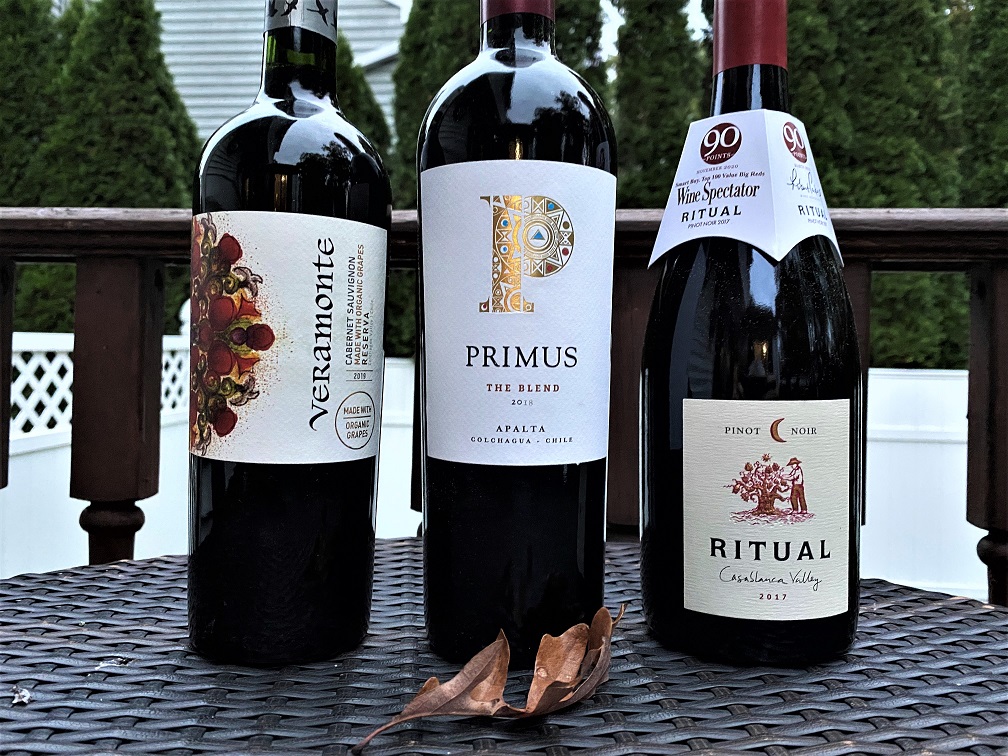
Let’s take a look at a few examples of Chilean organic wines.
Viñedos Veramonte was founded by Agustin Huneeus, a Chilean wine pioneer, in 1990, one of the first wineries in Casablanca Valley. Veramonte’s journey started with Sauvignon Blanc, gradually adding all of the traditional Chilean varieties – Cabernet Sauvignon, Carmenere, and more. In 2019, the winery obtained ECOCERT® organic certification, after 6 years-long journey. The project involved the conversion of more than 1,200 acres of vineyards in Casablanca and Colchagua valleys to organic and biodynamic farming (full Demeter’s biodynamic certification is the next goal). The wine I had an opportunity to taste was Veramonte Cabernet Sauvignon:
2019 Veramonte Cabernet Sauvignon Reserva Colchagua Valley (14% ABV, $11.99, made with organic grapes, Vegan, Certified Sustainable)
Dark garnet
Bell pepper, tobacco
A touch of cassis, tart, medium body, minerality, green notes
7/7+, I would prefer more fruit
The same Agustin Huneeus founded Primus winery more than 20 years ago. The word Primus comes from Latin and it means “the first” or “the first among others”. Primus was one of the very first to create the blend of Cabernet Sauvignon and Carmenere, which became the standard wine of the winery throughout all the years, joined by single-varietal Cabernet Sauvignon and Carmenere wines. The fruit for The Blend comes from Marchigue, a sub-region of Colchagua, and Maipo, from all-organic vineyards.
2018 Primus Red Blend Apalta Colchagua Valley (13.5% ABV, $18.99, 55% Cabernet Sauvignon, 20% Carménère, 10% Syrah, 5% Cabernet Franc, Vegan, Certified Sustainable)
Dark ruby
Cassis, Cherries
Soft, easy to drink, medium body, cassis, cherries, well balanced
8-, good aging potential
Ritual is located in the eastern corner of the Casablanca Valley, not far from the Pacific Ocean. All organic vineyards are surrounded by 6,000 acres of natural forest, which enforces biodiversity and helps with organic and sustainable farming. The estate approaches organic winemaking from all possible angles, making compost from stems and pomace, using cover crops to protect the soil, using sheep to mow the grass and fertilize. Everything in the vineyard and in the winery is done in full harmony with nature.
2017 Ritual Pinot Noir Casablanca Valley (13.5% ABV, $19.99, certified organic vineyards)
Dark garnet
Smoke, plums, minerality
Cherries, plums, violets, herbs, round, soft, restrained, good acidity, clean finish, perfectly balanced.
8, a long-haul wine. Should definitely improve over the next 5-7 years, might be considerably longer.
Here you are my friends – a few of the organic wines from Chile which you should feel good about drinking.
It is not just organic – Chile is leading the world in sustainable winemaking, and we will talk about it in a few days. Stay tuned…
.
American Pleasures #6: A Tale of Two Cabs
Wine should give you pleasure – there is no point in drinking the wine if it does not. Lately, I had a number of samples of American wines, that were the delicious standouts – one after another, making me even wonder if someone cursed my palate. I enjoyed all of those wines so much that I decided to designate a new series to them – the American Pleasures.
California Cabernet Sauvignon.
Magical words for any wine connoisseur. Out of more than 100 grape varieties used in wine production in California, I would safely bet that Cabernet Sauvignon clout exceeds that of Chardonnay, Merlot, and Pinot Noir, and even including Pinot Noir in this list is a stretch. Cabernet Sauvignon is The One of California wines (if you are willing to disprove this with actual numbers, I will be happy to publish a correction, but until someone will step forward, this stands as unquestionable truth).
While we can agree that California Cabernet Sauvignon is an object of craving for uncounted many, it also should be recognized as an object of controversy. How do I mean it? Easy. There are probably 50 or so producers whose wines are impossible to get, due to both availability and pricing – you have to be on the mailing list with a waiting list stretching for 20 years or so, and once you get there you should be willing to pay $500++ per bottle of wine you will need to wait for another 10-15 years to enjoy. Alternatively, you need to be prepared to pay an upward of $500 per bottle and scour the internet daily looking for those special bottles.
On the flip side, you can join most of us walking into the wine store asking (begging?) for a good bottle of Cabernet Sauvignon under $20, trying not to notice the poorly hidden smirk on the face of the salesperson, who knows that we are on the quest for the impossible. If you like Cabernet Sauvignon and not buying those wines from your expense account, I’m sure you can relate to the experience firsthand. Even $50 per bottle doesn’t come with any guarantees. But – that number gives us hope. Yes, folks, it is possible to find a good bottle of Cabernet Sauvignon under $50. Let’s talk about it.


Lots of my wine learning and discoveries are linked to unimitable wine educator Kevin Zraly and his Windows on the World Wine School. I remember one of the lessons where we were talking about California Cabernet Sauvignon. One of the wines was particularly good, and I remember Kevin remarking that the wine was produced by Louis M Martini, who doesn’t charge nearly enough for the quality of the wines they produce. That reference got engraved in my memory literally forever, and Louis M Martini became somewhat of the safe bet when looking for reasonably priced and consistent California Cabernet Sauvignon.
Louis M Martiny winery was founded in 1922 when Prohibition was already in full swing. It was actually known as L.M. Martini Grape Products Company and was focused on the production of sacramental wines and concentrate for home winemaking. In 1933, expecting that Prohibition will end, the new winery building was constructed north of the town of Napa. This was the actual beginning of the Louis M Martini winery and pioneering role of the Martini family in the Californian wine industry, helping to establish Napa Valley Vintners Association in 1943, being one of the first to use wind machines to prevent frost in the vineyards, and being one of the first to bottle varietal Merlot in 1970.
Louis M Martini offers a substantial range of wines today, going way beyond standard Sonoma and Napa Cabernet Sauvignon offerings, including Cabernet Sauvignon from some of the best regions in Napa Valley such as Stagecoach Vineyard and Howell Mountain, as well as a number of Merlot, Malbec, Petite Sirah, and Zinfandel wines – unfortunately, most of those are priced well beyond the $50 we are talking about today. Sill, there is Sonoma Valley Cabernet Sauvignon which can be found at around $15, and Napa Valley Cabernet Sauvignon around $35. The Napa Valley bottling I tasted was simply outstanding with or without any regard to the price:
2016 Louis M Martini Cabernet Sauvignon Napa Valley (15.1% ABV, $40)
Garnet
Cassis, eucalyptus, baking spices
Roll of your tongue smooth, velvety, fresh cassis, perfectly ripe fruit but over, firm structure, long finish.
8+/9-, excellent, classic California Cabernet Sauvignon
If Louis M Martini can be called an iconic winery, then our next winery can be only referred to as the most iconic winery in Napa Valley. Charles Krug winery, established in 1861 in Napa Valley by Prussian immigrant Charles Krug was the very first winery in Napa Valley, the 540 acres estate which Charles Krug received via marriage. In 1943, an immigrant family from Italy, Mondavi, purchased the Charles Krug estate which had been run by the family now in 4th generation.
Charles Krug winery also offers a good number of wines, including Chardonnay, Malbec, Merlot, Zinfandel, and others, with Cabernet Sauvignon still being a flagship offering, including clonal selections (one of the Charles Krug Cabernet Sauvignon wines is called X Clone as it is produced as a blend of 10 Cabernet Sauvignon clones). I always wanted to try the Charles Krug wines, and finally, I was able to do so:
2017 Charles Krug Cabernet Sauvignon Napa Valley (14.1% ABV, $39, 87% Cabernet Sauvignon, 5% Merlot, 5% Petit Verdot, 3% Petite Sirah)
Dark garnet
Blueberry, blueberry jam, dark chocolate, pipe tobacco
A touch of nutmeg and cloves, much crispier on the second day, firm tannins, firm structure, good acidity.
8-/8, definite improvement on the second day.
Comparing these two Cabernet Sauvignon wines, Louis M Martini was a perfect pop and pour example, which is ultra rare among California Cabernet Sauvignon, where Charles Krug bottling definitely needed time.
Here you are, my friends. If you are looking for a good bottle of Cabernet Sauvignon under $50, there is still hope!
Daily Glass: Surprised Not Surprised
First, I want to use this opportunity again to wish everyone a healthy and happy New Year 2022!
Today, I want to talk about a couple of wines – one was surprising (and not), and another one was simply interesting.
Let’s talk about surprises first.
Have you heard of Harry and David? No, not about some random guys named Harry and David, but one of the most famous gourmet food gift catalogs? I don’t know if Harry and David has international fame, but in the USA this is definitely the most famous food gift catalog in existence. I remember for many many years literally drooling over the description of their most famous, and spoon-ready, Royal Riviera® Pears.
Harry and David’s food gifts are not limited to fruit, cheese, and crackers. Many gift selections also include wine, mostly from well-known California wineries – J Vineyards, Talbott, Louis M Martini, and others. And it turns out Harry and David also offers wine under its own label – Harry and David.
When we opened a holiday shipment from our friends, the appearance of Harry and David wines caught me by surprise – I really didn’t expect to see that name on the bottles. To be entirely honest, I’m not a big fan of food gift baskets, even though often they are the most convenient presents. Seeing a catalog-branded wine got my suspicion to the next level though. It is so easy to cut corners and put some random plonk into the bottle with a private label…
To make me worry even more, this was also a bottle of sparkling wine – and for my palate, finding a tasty sparkling wine is even trickier than a regular still wine. So I had a spare bottle of Champagne ready for the backup and only then proceeded with the opening of the Harry and David sparkling wine. The first sip made me instantly grab the bottle and look at the back label. My reaction to the second line on that back label was “aaah, of course, this is why the good taste is not surprising“. The wine was delicious, and the second line on that label said “Southern Oregon”, which instantly lead to the “not surprised” notion – having spent a week in August 2021 in Oregon, good Oregon bubbles are simply expected.


This 2020 Harry and David Vineyards Sparkling Wine Southern Oregon (11.7% ABV) was simply delightful – creamy, consistent mousse on the palate, a touch of fresh apples on the nose, and more of the fresh apples with a touch of the lemon notes on the palate, clean acidity, crisp, perfect balance, pleasure in every sip.
It is a pity that it is practically impossible to find actual wine information on the Harry and David website – or maybe I just lost my searching skills. I spent some time with google and was able to find this article from Oregon Wine Press, from which I learned that in 2012, Harry and David, which is headquartered in Medford, Oregon since 1934, has hired winemaker Linda Donovan of Pallet Wine Company in Medford to make wines for Harry and David. The grapes are primarily sourced from the vineyards in the Rogue Valley in Oregon. I would love to have more details about the vineyards, how they are managed, how the wine is made, and so on, but hey, good wine is a good wine.
Now, let’s talk about interesting wine. I was looking for a wine gift for a friend and came across Sandhi Rosé. Sandhi wines are not widely known, but as I had the pleasure of tasting Sandhi Pinot Noir and Chardonnay, I was definitely interested in trying the Rosé. Sandhi wines are produced by Rajat Parr in Santa Barbara in California, and the whole project was born out of the desire to produce supremely balanced low-alcohol wines.
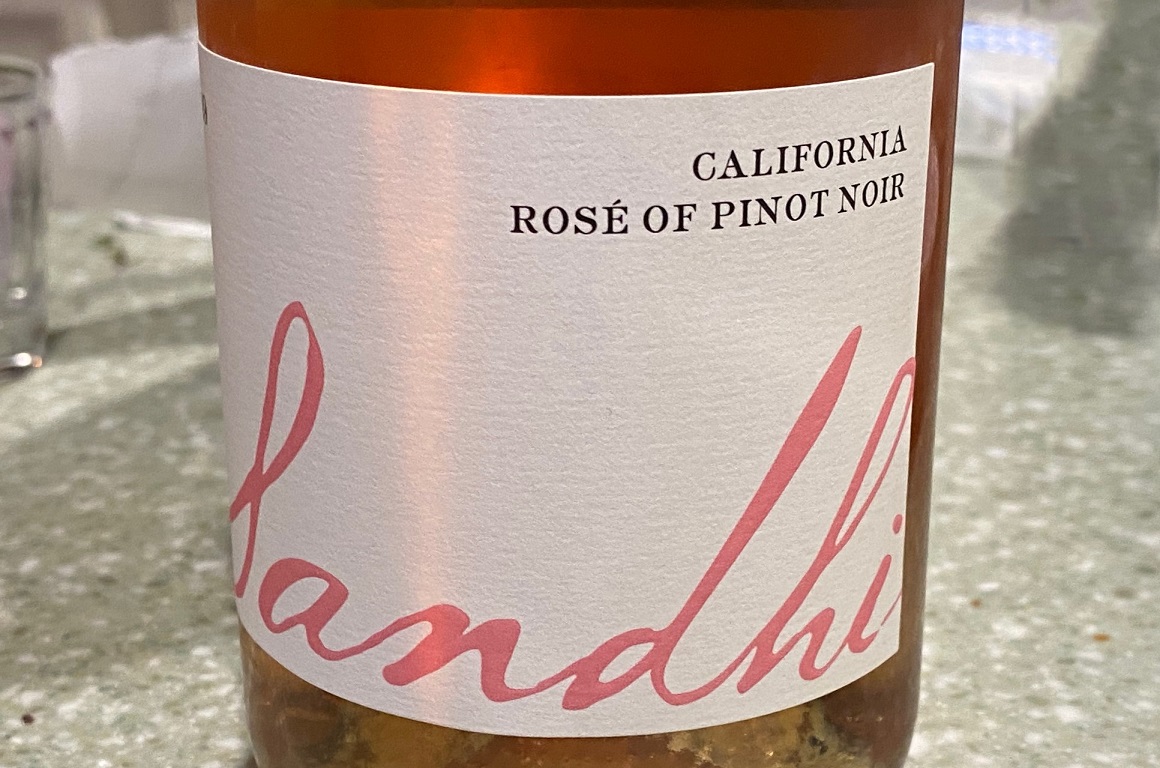
2019 Sandhi Rosé of Pinot Noir California (12.5% ABV, $20) was definitely an interesting wine. In my vocabulary, “interesting” wine or food is rarely a positive descriptor. This Rosé was if not interesting, then puzzling. Taken out of the refrigerator (so probably at around 38°F – 40°F, the wine was mostly closed, offering a bit of sapidity and onion peel, both on the nose and the palate. After warming up in the glass for about 10 minutes, the wine opened up offering a hint of strawberries with a touch of lemon, still void of any sugar but getting much closer to the traditional Provençal in its presentation. The need to play with the temperature was taking a bit away from otherwise a nice wine.
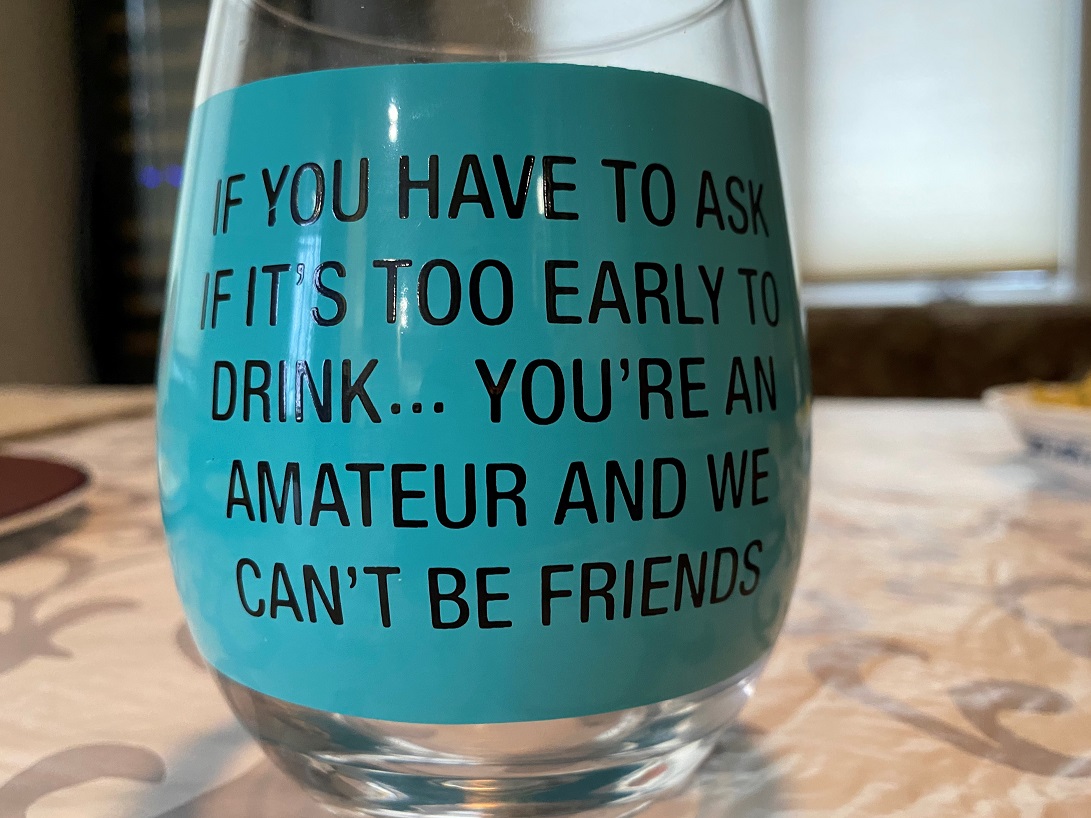
That is my first story of 2022. I want to leave you with a picture of the little present, a wine glass, I got from friends – looks like they know me well! Cheers!
Last Bottle Sign Up ($10 credit)




 Talk-A-Vino