Archive
Latest Wine News and Updates
With the risk of repeating myself, I still have to say – we truly live through the wine revolution nowadays. This revolution takes on many forms. The wine quality is at the highest throughout the world, and it keeps getting better and better every year. Wine is made in far more places than ever before – who would’ve thought 10 years ago that England can produce world-class sparkling wines, rivaling the best Champagne? The wine has shaken off its traditional format of not only the bottle, but even the box, and it is available today in the can and in the keg. Heck, the wine today can be even mixed with CBD (Cannabis) so you can get high quickly and surely. Yep, it is the wine revolution time.
So with this, I want to share with you some of the latest and exciting developments taking place in the world of wine.
Let’s start with an interesting development around high-end wines. Have you ever noticed that many successful (and equally expensive) super-Tuscan wines have names ending in “aia” – Ornellaia, Sassicaia, Solaia – you see the trend, right? Turns out that a couple of the US retail giants – Walmart and Target, to be exact – decided to add high-end Italian wines to their portfolio, and surprisingly (or not?), both went with the super-Tuscan theme and named their new wines – can you guess – Targaia and Walmaia! Targaia is the blend of 70% Merlot and 30% Sangiovese, and Walmaia has a very interesting blend of 80% Cab Franc, 10% Sangiovese and 10% Carignan. 2016 will be the first vintage of Targaia, and Walmaia will debut with the 2015 vintage, both slated to hit the retail shelves later on this year. The release price for Targaia is set for $75, and Walmaia will open at $70 – great price for super-Tuscan wines, where a lot of well-known wines today are offered at the prices well north of $200 per bottle. Will “aia” do the magic trick for Target and Walmart? You will be the judge of it, once you will be able to get your hands on the bottle – hopefully it will not be too difficult, however, the production volumes had not been disclosed, as well as the source vineyards, so we will have to wait and see.
Our next update is about the Coravin, the famous wine preservation system which allows you to extend the life of your precious bottles and enjoy them over a longer period of time than otherwise would be possible. Of Coravin is a tool of choice of many wine writers, restaurateurs, sommeliers and all of the wine lovers, and it works perfectly for most of the wines – with Sparkling wines been a notable exception. And who wouldn’t like to have a small celebratory sip of Dom Perignon, while preserving the rest of the bottle for another special occasion? Coravin set out to solve the sparkling wine issue and reportedly invested more than $3M (USD) into the brand new lab in Switzerland. The initial design seemed to be successful, however, not really commercially viable, considering that the machine was a size of a small desk and weighed around 300 lb. Subsequent tests, however, showed that the researchers still have long ways to go, as the bottle of Dom Perignon shattered into the hundreds of little pieces while operated by the first smaller size prototype – luckily, nobody was hurt and the only loss was the one of a precious liquid. I’m sure Coravin researchers will not give up and sooner rather than later we will be able to enjoy a small pour of delicious Champagne while the rest of the bottle will be safely preserved.
Continuing the subject of bubbles, this next piece might surprise you. I’m sure everybody knows Grey Goose, the famous French vodka, a staple of any top shelf of any self-respecting bar. The problem with vodka is that it is typically relegated only as a mixing component in the cocktails, no matter how high the regard it has. Many vodka producers are trying to change this status quo, but it is usually done by simply infusing vodka with a certain flavor in an attempt to convert it into a sipping drink. Grey Goose decided to try something different, and partnered with Moët & Chandon to create … yes, the sparkling Vodka! The attempts to produce sparkling vodka using the Classic Method were unsuccessful, however, based on the initial reviews, the Charmat method worked just perfectly, with many critics simply raving about the experience. The sparkling Grey Goose vodka is packaged in gold-adorned classic Champagne bottles and it is already available at select retailers in the USA for about $200 per bottle (suggested retail price). While I don’t drink vodka as is, I’m definitely looking forward trying this unusual drink – would be curious in your opinion too.
Now let’s talk about cult wines. Not just any cult wines, but maybe the cult of the cults – Screaming Eagle. I’m sure you know that Screaming Eagle makes the most expensive Cabernet Sauvignon wine in the USA, priced at around $3500 if you can ever find a bottle. But do you know that this is not the most expensive wine made by Screaming Eagle? Until now, their most expensive wine was white – Sauvignon Blanc from Napa Valley, priced north of $4K, and equally impossible to get. Did you noticed I said “until now”? Screaming Eagle is set to beat its own record with the brand new offering to the mailing list members – Cabernet Sauvignon Rosé. It will be priced at $4999 for the mailing list members, and with only 30 cases produced (360 individually numbered bottles), this Screaming Eagle Rosé is expected to disappear in less than a minute after the members will be able to place their release orders. It seems that Rosé is an absolutely unstoppable category, with such heavyweights as Screaming Eagle joining the madness – I just hope not everybody will join their suit for the insane prices. And if you will be able to score a bottle, send me a note – I would looove to help you drink that.
Our last news for today is really from the “hard to believe” category, but I guess everything is possible… For about 10 years now, world famous UC Davis conducted the work to identify the effects of different types of music on the vines, grapes and the resulting wines. Fully independent test vineyards had been set up each with its own winery facilities, to ensure the same type of music is used through all of the stages of the winemaking, from the first bud break until the wine is pressed, aged and bottled. All facilities are outfitted with state-of-the-art Bose sound systems to ensure high-quality sound, both in the vineyards and inside the wineries. Chants, classical music, dance, hip hop, and heavy metal are used in the experiments, each one at its own, individual vineyard. All results are still being processed, and no conclusions had been made yet, however, a recent report from UC Davis really makes you wonder. It appears that after barrel-sampling wine from the vineyard subjected to the heavy metal music for 7 years in the row, visiting scholar, Dr. Drunkken, became extremely violent and attacked his colleagues, initiating an unprovoked, bloody fight. Dr. Drunkken was never previously known for any aggressive behavior, and after he spent a day subdued in the hospital bed, had literally no memories of an accident and couldn’t understand why his hands had been tied. It is completely unknown what triggered such behavior of a generally nice and gentle man, so it seems that researchers just got a lot more work to do. I don’t believe one single accident will derail the whole (expensive!) program, but I’m sure the new level of caution will be asked of everyone involved in this research.
That’s all I have for you today. Until the next time – cheers!
Wine, Super Bowl, and Commercials
Tomorrow is the day when a lot of towns in America will look like ghost towns, as people will be crowded next to the TV screens in their homes and bars to watch one of the most important entertainment events of the year – Super Bowl, also known as The Big Game. There are two main attractions of that night – the game itself and the commercials, which run at some obscene rates, reportedly $5.25M for 30 seconds commercial (going 2007 rate was $2.4M for the same, talk about the absence of inflation). And then, of course, there are food and drinks – you can’t spectate such an event on empty stomach, can you?
Super Bowl and wine … yep, don’t go hand in hand. The drink of choice at all of the Super Bowl party is beer – but of course, it is all about your company and your personal preferences. Have no doubts that wine will be a drink of choice at Casa Talk-a-Vino. But – it is not the subject of the post, it is the commercials I want to talk about.
I learned something very interesting from the Wine Spectator article a couple of days ago – until 2017, there were no wine commercials shown at Super Bowl broadcast. The reason? Anheuser-Busch InBev, the maker of infamous Budweiser beer, owns nationwide rights to alcohol advertisement during the game since 1989 so you can imagine that wine is not on the menu of the beer giant. To circumvent this restriction, one has to get really creative and play “local ad” card.
In 2017, one company (Deutsch Family, the importer) decided it is worth the trouble and went for it, showing the advertisement for Yellow Tail, the Australian wine made by the company called Casella – in the past, holder of the crown of most imported wine in the USA. It appears that trouble was worth it, and the ads affected sales in a very positive way – look at the WS article for more details.
What I want to do here is to share with you the Yellow Tail commercials from 2017, 2018 and 2019:
2017:
2018:
2019:
What do you think? Which one is your favorite? I can definitely get behind this message – “Tastes Like Happy“. And you?
Wine Lover’s Guide To Lesser Known Italian Wine Regions – Salice Salentino
Today, wine lovers, we are going on yet another wine journey in Italy. We are going all the way down almost to the bottom of the heel of the “Italian Boot”, to the area called Salice Salentino.
While we are on our way, I have a question for you – what do you know about first ever Rosé wine – ahh, we are in Italy, so let’s switch to the proper names – so again, what do you know about first ever Rosato wine bottled in Italy and exported to the USA? Do you know where, when, what was the name of it? I’ll let you ponder at it for a bit – the answer will come a bit later. And for now, let’s talk about Salice Salentino.
Salice Salentino is a small town located down south on the “heel” of Italy. If you will find it on the map, you will see that it is situated on a strip of the land, Salento, sandwiched between Adriatic and Ionian Seas (Gulf of Taranto, to be geographically precise). The town supposedly takes its name from the willow trees, which were growing in abundance in the area in the old days – you can see the willow tree showing up in the middle of a shield on Salice Salentino’s coat of arms. I don’t know if the land looked anything the picture below, but it is easy to imagine that this looks very authentic.

The town of Salice Salentino was founded in the 14th century, but wine… The wine was made on that land way, way before – let’s say, about 2000 years before, as the first mentions and artifacts of winemaking in the area go all the way back to at least the 6th century BC. And why not – you got rich soils with a lot of maritime influence, and despite the close proximity of the seas, hot and dry summers, which sport on average 300 sunny days. It is easy for grapes to ripen happily and abundantly in such conditions – may be, too easy – it is difficult to tame that amount of sugar later on at the winery. It is not very surprising that for the longest time, Salice Salentino was known as the source of grapes and bulk wine, and quantity was definitely trumpeting quality.
Come the 20th century, and the situation started to change, with more attention placed on the quality of the wine, controlling the yield and focusing on the quality of the grapes. Historically, Salice Salentino, and the whole big region it is a part of – Puglia – was focused on the red grapes and red wines; ohh – let’s not forget about olive trees (Puglia produces about 50% of all olive oil in Italy – but this is not the subject of today’s conversation). When Salice Salentino DOC was created in 1976, red wines were the only ones allowed under the DOC. Rules were subsequently changed in 1990 and 2010, and now both white and Rosato are produced in Salice Salentino.
To make wine, we need grapes, right? So let’s talk about grapes. Every region in Italy has its own, unique grapes – such grapes are called autochthonous (having a local origin). Salice Salentino is no exception – Negroamaro, Malvasia Nera (Black Malvasia, a red grape which is a sibling of the well known aromatic white grape, Malvasia), and Primitivo are three of the autochthonous grapes in that area.


Negroamaro is definitely the kind of Salice Salentino winemaking. The grape’s name can be translated as “black bitter”, due to its shiny black skin and bitter aromatics. It is widely considered that Negroamaro originated in Salentino area. The grape has no problems with dry hot climate and lack of water and can consistently achieve appropriate levels of ripeness. Most of the Salice Salentino DOC red wines contain 80% to 90% of Negroamaro grape.
Malvasia Nera is a dark-skinned member of Malvasia family. Malvasia Nera is growing around Italy, not only in Salice Salentino, and it is typically used as a blending grape, adding unique aromatics to the resulting wine.
You might not be familiar with Negroamaro and Malvasia Nera, but I’m sure you heard of Primitivo, which after the long research and often heated debates was recognized as an identical grape to American beloved Zinfandel. Primitivo is a star of the surrounding Puglia, especially in Primitivo de Manduria, however, in Salice Salentino it only plays supporting role in some of the blends, particularly with Aleatico.
In addition to the three grapes we already mentioned, Aleatico (red), Chardonnay, Pinot Bianco, and Fiano can be used. Overall, DOC rules allow the production of the full range of wines – sparkling (spumante) white, Rosato, red, and dessert (Dolce and Liquorosso).
Now, it is time to taste some wines. I had an opportunity to taste three of the Salice Salentino wines, but before I will share my tasting notes, let me introduce you to the three wineries.
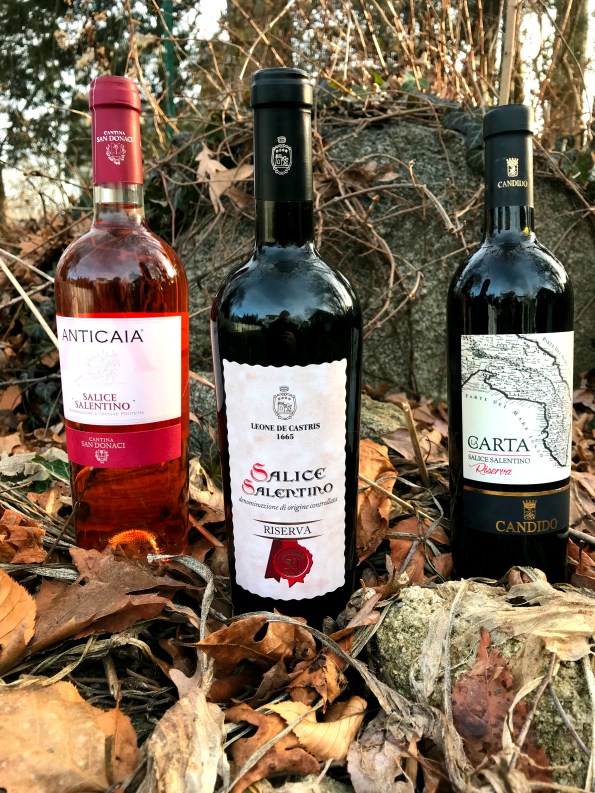
Leone de Castris
This is definitely one of the pioneering wine producers in Salice Salentino. The company started in 1665 in Salice Salentino, by planting vines and olive trees. In the 19th century, the Leone de Castris was exporting bulk wine to the United States. The first bottling under Leone de Castris name was produced in 1925.
Now, remember the question I asked you at the beginning of this post? You probably figured that already (o mighty google), but nevertheless: the very first Rosato produced and sold in Italy, and imported to the United States was made at Leone de Castris winery in 1943, under the name of Five Roses. The name signifies the fact that multiple generations of de Castris had 5 children each.
Gradually, Leone de Castris reduced their land ownership from 5,000 acres to under 900 acres, which is split between the vineyards and olive trees. The winery makes today around 2.5 million bottles per year, which includes red, white, Rosato, and sparkling wines.
Cantina San Donaci
Cantina San Donaci is also one of the oldest wineries in Salice Salentino. It was established in 1933 by 12 local farmers. Today, about 600 partners are involved in all aspects of winemaking – tending to about 1,250 acres of vineyards, harvesting the grapes and making the wines.
Production includes white, Rosato and red wines.
Candido Wines
Candido Wines started in 1929, producing bulk wine obtained from the 1,000 acres of vineyards. In 1957, the bottling started under its own label. Today, the winery owns 350 acres of organically farmed vineyards, focusing on the autochthonous varieties, as well as some of the international ones and producing the typical Salice Salentino range of wines.


Here are the notes for the 3 wines I tasted.
2015 Leone de Castris 50° Vendemmia Salice Salentino Riserva DOC (13.5% ABV, $12, 90% Negroamaro, 10% Malvasia Nera, 12+ months in barrel, 6+ months in bottle)
Dark ruby
Herbs- driven nose – sage, oregano, excellent minerality, underbrush, a touch of cherries
Ripe cherries on the palate, sweet tobacco, well-integrated tannins, a touch of sandalwood. Good balance.
8, the wine is super food-friendly, and it is a lot of wine for the money.
2017 Cantina San Donaci Anticaia Rosato Salice Salentino DOP (13.5% ABV, $8, 90% Negroamaro, 10% Malvasia Nera, 18-20 hours skin contact)
Beautiful Intense Rose color
A touch of strawberries, restrained,
Beautiful strawberries and cranberries, good acidity, fuller body than a typical rose, but nicely balanced, good tartness.
8-, very good
2015 Candido La Carta Salice Salentino Riserva DOC (13.5% ABV, $12, 95% Negroamaro, 5% Malvasia Nera, aged in large casks)
Garnet color
Tobacco, sweet oak, leather, medium plus intensity
Cherries, smoke, round, pleasant well-integrated tannins, delicious.
8+, superb. Absolutely delicious. Outstanding value and QPR.
As you can see, these Salice Salentino wines are offering an outstanding value – at $12, finding the wine which gives you so much pleasure is rather difficult – and these wines delivered. They are perfect on its own and would work very well with food – antipasti, traditional local hard sheep cheeses, such as Pecorino Sardo or Pecorino Romano, hearty stews, you name it.
I hope I helped you to discover a new Italian wine region. If you are looking for every day, great value, delicious glass of wine – Salice Salentino wines are worth seeking and experiencing. Cheers!
Wine Lover’s Guide To Lesser Known Italian Wine Regions – Alto Adige

Italian Wine Regions. source: Wikipedia
Italian wines are some of the most respected wines in the world. Well respected and well known, which is not surprising as Italy is the biggest wine producer and wine exporter in the world. But if you will ask a random wine lover about their favorite Italian wines, there is a good chance that all you will hear will be a few of Bs, most likely a C, and an S on a good day. I’m not trying to be cryptic here, just playing a bit – most likely you will hear about Brunello, Barolo, Chianti, and possibly, Super Tuscan. Some of the more advanced wine lovers might include Amarone. Someone might also include Prosecco, but that would pretty much complete the list.
When it comes to the regions, I expect the story to look very similar – Tuscany and Piedmont are two of the most likely contenders, everything else is open to the chance. Meanwhile, the wine is produced in Italy absolutely everywhere – otherwise, it is not that easy to be the number one wine producer and wine exporter in the world. When I say “wine is produced everywhere in Italy”, I mean exactly that – Italy has 20 administrative regions, and all 20 administrative regions are also wine regions.
There are many reasons why you want to expand your Italian wine horizons. For one, with the exception of Georgia and probably a few others, Italy is one of the oldest wine producing countries in the world with almost 3,000 years of history of the winemaking – that in itself deserves some respect. Another, and more important reason is that lesser-known regions usually mean great value – you can find the wines to enjoy with much better QPR than those coming from the best-known regions. And let’s not forget the sheer abundance of the grape varieties in Italy – about 350 used in winemaking today, out of which about 180 are so-called autochthonous (the grapes which originated in their respective local regions) – that translates into a tremendous range of wines available to the consumer.
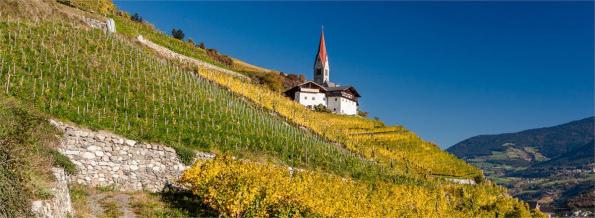
Source: AltoAdigeWines.com
Let’s start our exploration. Let’s go to the northmost part of Italy, between Austria and Switzerland, where the Italian Alps are located. There are few names used for this region – Trentino, South Tyrol (Südtirol) and Alto Adige all point to the same area in the north. One of the oldest winemaking areas in Italy, with about 3,000 years of winemaking history, with the wines having significant Austrian influence and using a number of the same grapes, such as Müller-Thurgau and Gewürztraminer. While the region is small, there are about 5,000 grape growers and 150 wineries in Alto Adige, producing on average about 60% of the white and 40% of the red wines (colder climates enticing more production of the whites). The climate in the region is the Mediterranean, and it allows for proper ripening of both white and red grapes, without much worry about over-riping the grapes (unlike in the South of Italy). You can also imagine that it is not easy to work with the vineyards on the mountainous slopes, so grape cultivation in Aldo Adige is quite demanding.
Out of 17 or so grapes used in the winemaking in Alto Adige, three varieties are considered autochthonous – Gewürztraminer, Lagrein, and Schiava, with both Lagrein and Schiava being red grapes. I’m sure you are perfectly aware of “spicy aromatic” grape – Gewürztraminer is popular most everywhere around the world. However, it is not an easy grape to work with, as it always needs balancing acidity to avoid single-dimensional wines. Alto Adige Gewürztraminer might be one of the very best renditions on the market, along with Gewürztraminer from Alsace.
Lagrein is the indigenous red grape of Alto Adige, known for its high acidity and high level of tannins. Lately, Lagrein gained popularity around the world and now can be found in Australia, New Zealand, and the USA. Schiava, also known as Vernatsch and Trollinger, is the second indigenous red grape in Alto Adige. Schiava is known to produce the lighter-bodied wines with high acidity.
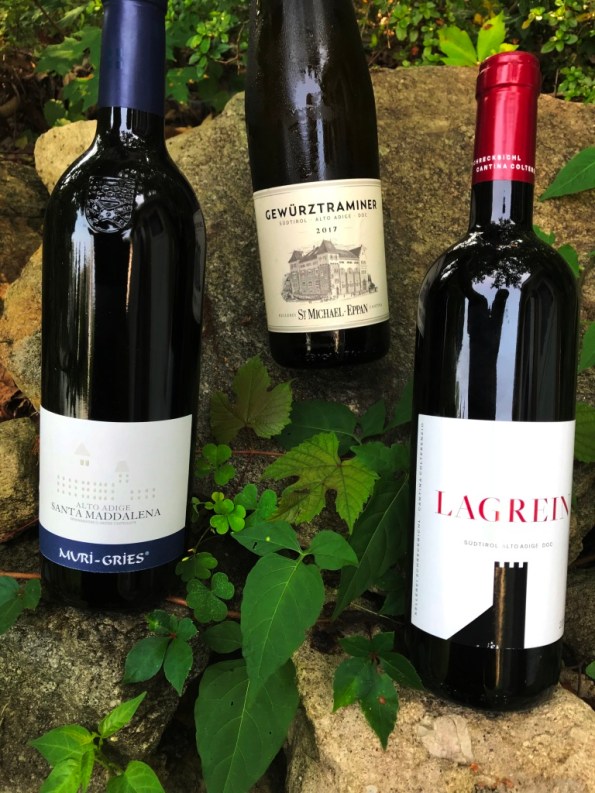


Let’s taste some wine, shall we? Why don’t we try exactly the grapes we were talking about – the autochthonous varieties:
2017 St. Michael-Eppan Gewürztraminer Alto Adige (13.5% ABV, $14) – St. Michael-Eppan winery is a cooperative of 340 winemaking families, formed in 1907. The winery produces a wide range of white, Rosé and red wine.
Light golden color
Intense, lychees and peaches, a touch of guava
More lychees on the palate, nicely restrained compared to the nose, good acidity, a touch of spicy notes, minerality showing up on the finish. very enjoyable.
8-, would be good with the food. Also, expect it to evolve over the next 5-7 years.
2017 Muri-Gries Santa Maddalena Alto Adige (12.5% ABV, $14, Schiava 93% and Lagrein 7%) – MURI-GRIES is the monastery, starting its history in 1845, when Benedictine monks moved into the monastery from Switzerland Today, MURI-GRIES makes a number of wines from Lagrein as one of the favorites, however, today we are tasting the Schiava wine and not the Lagrein from this producer. This Schiava comes from the well regarded single vineyard, Santa Maddalena
Light ruby color
Earthy nose, a touch of underripe raspberries, lavender
The light but supple palate, round and velvety, beautiful silky mouthfeel, more underripe raspberries, a touch of pepper and interesting salinity.
8-/8, the wine to ponder at
2017 Cantina Schreckbichl Colterenzio Lagrein Alto Adige (13% ABV, $14, 100% Lagrein) – and finally, Lagrein. Colterenzio winery was formed in 1960 by a group of 26 winegrowers. Today, more than 300 partners winemakers participate in the work of the winery.
Dark garnet, almost black
Roasted notes, a touch of smoke, black plums, a touch of oregano
Velvety palate, excellent extraction, a touch of pepper and herbaceous notes, black fruit, medium+ body, voluptuous and sexy
8, this wine has a mystery to it.
Alto Adige wines offer all wine lovers an opportunity to drink great wines at the very reasonable prices – may be that’s why we should keep it a secret? Have you had wine from Alto Adige? What do you think of them? Cheers!
Lists Worth Waiting For
Once again, one of my all-time favorite subjects – lists. This time, however, these are the lists with a twist – these are the lists you probably want to know about.
Let’s talk about wine collecting.
I have to say that I don’t consider myself a wine collector. I will gladly identify under multiple “wino” categories. I can identify as wine snob – I have my [strong] preferences and if I’m not careful, they will either slip off my tongue or will be readable off my face as in the open book. I’m definitely a wine geek – wine from the barrel, 2-days fermented juice, obscure grape varieties, wine in the can, wine in the plastic bottle – bring it on, I will happily try it all. I’m a wine lover, oenophile – all of these identities are just fine. Wine collector – I would never present myself as such. I love aged wine – this is the main reason for me to have a “collection” – I buy the wines which I believe (hope?) will improve with time, and I store them to give them time to evolve. In my mind, to be qualified as a wine collector, you need to have more or less an unlimited budget – you taste a good wine, you like it, you say “I’ll take a case” – all of it without paying attention to the price. You are definitely free to disagree with my approach, but this is not what this post is all about.
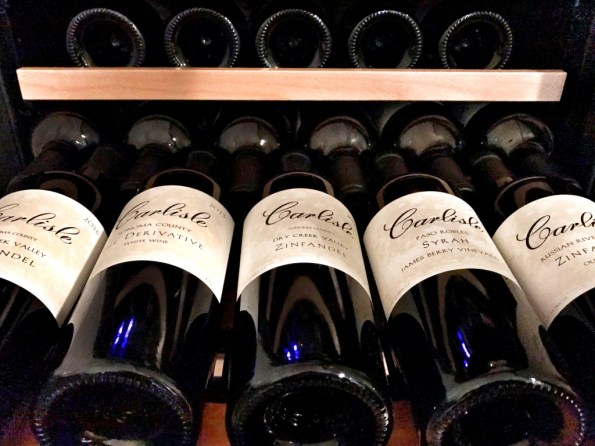
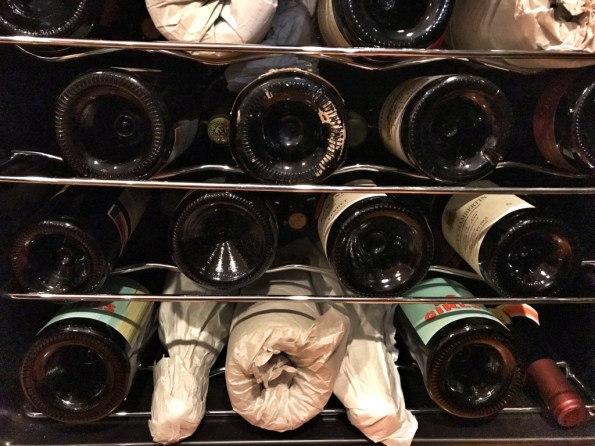
Collector or not, but I’m passionate about wine. I’m paying attention to what I taste. I’m paying attention to what critics have to say. I’m paying attention to what fellow bloggers and writers are saying. Yes, I’m paying attention to the recommendations, reviews, and suggestions – but the trick is to convert the recommendations into the actual wine. You need to be able to find the wine which is so highly recommended – otherwise, the wine will remain only a “fiction”.
If you think that getting the wine everyone wants to drink is easy, you are probably just starting your oenophile journey. Getting the “desired” wine is not even a question of money. Yes, some of these wines are impossible to find and very expensive. But this is not always the case. For example, 2014 Carlisle Syrah Papa’s Block, 96 rating by Wine Spectator, was priced on release at $44. According to Wine-Searcher, it is available only at one single store in the USA. I’m sure you can afford it – but you can’t really find it. And this is just one example. Theoretically, any wine can be acquired from the wine store. In practice, lots and lots of the wines which built their reputation, are not available in the store, neither “brick and mortar” nor online.
This is exactly what I want to share with you today – where and how to find the wines everyone wants to drink. Before we get to it, one important note – everything I will be talking about here is relevant only for the wines in the USA. It is entirely possible that some winery around the world has the same mechanisms in place, but I’m not aware of those wineries – with the exception of Bordeaux En Primeur – however, this is not something I want to talk about today.
Now, how can you reliably get the wines everyone wants to drink? You will need to learn few key terms – “allocated wine“, “allocation” and “mailing list“. The gist of the process can be summed up in one sentence – in order to get highly allocated wine, you need to be on the winery’s mailing list in order to receive your allocation. Sounds simple, isn’t it? Let’s take this summary in pieces.
“Highly allocated wine” simply means that the desirable wine is produced in the limited quantity – 100 cases, 200 cases, whatever the number is – but it is given that demand greatly exceeds supply, and so the wine becomes allocated.
A mailing list is a form of the winery membership which is very different from the typical winery wine club. In the wine club, you say how much you are willing to spend, and the winery will decide what they will send you (yes, you have an option of ordering more, but this is beside the point). Mailing list membership gives you access to desired wines the winery produces, but you still have no guarantee that you can get any wine you want.
Every member of the mailing list receives their allocation – how many bottles of what wine they can buy. Allocation is uniquely tailored to your buying history, position on the mailing list and other factors. Even when you get your allocation, life is still not necessarily perfect – some allocations are guaranteed, and some are offered on “first come, first serve” basis – yes, you have an allocation for the wine, but unless you are buying as soon as you receive the email, the wine you wanted might be already gone – experienced this scenario with Peter Michael and Turley many times.
Lastly, you need to keep in mind that your allocation will not necessarily include all the wines which winery included in so-called Release – some of the wines in the release might not be a part of your allocation. Ahh, and one more thing – in order to be on the mailing list, you need to continue buying the wines. I don’t know if there are minimal quantities, and I know that some of the wineries will allow you to skip one or a few of the mailing list offers and will still keep you on the list. Some wineries, however, warn you in a very direct fashion – if you will not order wine from this offer, you will be taken off the mailing list.
So that’s it, now that you understand how the system works, the rest is easy, right? Let’s find the wines we want, go sign up for the mailing list and start receiving the wines – easy! Not so fast. There is one more term I need to make you familiar with. This is the scary term – it is called “waiting list“. Remember I gave you the gist of the buying process for the highly desirable wines in one sentence? We need now to use a few sentences to fully explain the process:
In order to get highly allocated wine, you need to be on the winery’s mailing list in order to receive your allocation. Before you will get on the mailing list, you will first join the waiting list for that mailing list, as the mailing list has limited capacity.
What’s so scary about the waiting list? You have no idea how long will it take for you to transition from waiting list to the mailing list. I was on the waiting list for about seven years in order to get on Cayuse mailing list. I’m waiting for more than seven years now to get on Saxum and Sine Qua Non mailing lists with no end in sight. So yes, if you want access to the wine, you will have to learn to wait.
That’s about all there is to the allocated wines and mailing lists. I would like to make it clear – mailing list is one of the sources of allocated wines – but it is the only option if you want to be fully in charge of what you will be buying. Wine distributors in the USA also hold positions on various mailing lists and they get access to the allocated wines exactly as individuals do. However, their allocations are also limited, and different stores have different access to those wines. Yes, you can definitely rely on the stores as your source of the allocated wines – for example, Wades Wines in California offers an amazing selection of the allocated wines – but you still have to hunt down the wines you want to drink.
At the beginning of this post, I said that we will be talking about wine collections. So far I explained how you can get wines for your collection – but as someone who had been hunting down collectible wines for a while, I would like to give you a number of suggestions for the wines I consider of being worthy of anyone’s collection – and worth hunting them down and waiting on the lists. Or at least, worthy of most anyone’s collection – for instance, if you don’t like Zinfandel wines as a category, Turley and Carlisle might not be wines you will be interested in. I’m not going to recommend any individual wines – below are the wineries I suggest you will get on the waiting lists for mailing lists, including a short explanation as to why I’m recommending them. I’m also including links for your convenience. The list sorted alphabetically without implying any preferences.
Rhône-style specialist located in Edna Valley in California. Produces both whites and reds. Alban Syrah is a riot, and Alban Viognier might be the best in the country – among other wines. One release per year.
Zinfandel and Syrah specialist. Produces also a number of white wines (Gruner is amazing) and few of the red blends. The wines are released twice a year. Allocations are typically guaranteed until the expiration date of the offer. Majority of the wines are under $50. Wines can be ordered as individual bottles.
One of the very best wineries in the country, located in Walla Walla, Washington. Produces predominantly red wines – Syrah and Grenache rule, but Cabernet and Bordeaux blends supposed to be outstanding. Didn’t have a pleasure of tasting the Cayuse wines yet, but have high expectations. The wines are sold in the 3-packs, so 3 bottles is the smallest quantity you can buy. One release per year.
The winery takes its name from the fact that all the heavy work in the vineyards is done using horses. Another winery from Washington and closely affiliated with Cayuse through Christophe Baron, the winemaker at Cayuse. Produces only Syrah and Grenache. If you like Syrah, Horsepower Syrah is amazing. One release per year, 3-pack offering only.
yet another project of Christophe Baron. Syrah, Grenache, and Tempranillo from Washington. Delicious, terroir-driven wines. One release per year, all wines are available as 3-packs only.
Chardonnay, Pinot Noir, and Cabernet Sauvignon specialist out of Napa. The wines are simply outstanding. Two releases per year. Wines are available in single bottle quantities. Allocations are not guaranteed – first come, first serve.
the winery, located in Paso Robles in California is focused only on 3 varieties – Syrah, Grenache and Mataro (they prefer to use the popular Australian name for Mourvèdre grape). Their wines supposed to be amazing – I’m still waiting (for 7 years now) to find out how amazing.
the legend. I should really stop right here and not even try to describe this winery. Might be the most cult winery in the United States – it’s either Sine Qua Non or Screaming Eagle. These wines are impossible to get (unless you have a spare $1000 – then run to Benchmark Wine website, they have one bottle available at that price). Sine Qua Non makes supposedly amazing wines in California (the winery calls Santa Barbara home), each wine in each vintage having a unique name and unique label. I’m waiting for about 7 years already and will continue to do so.
best known as Zinfandel and Petite Sirah specialists from Paso Robles. Turley produces 47 wines from 50 vineyards. When it comes to Zinfandel, Turley is often considered a hallmark of Zinfandel expression. In addition to Zinfandel and Petite Sirah, Turley produces a small number of whites, plus a number of red blends. A few years ago Turley even started making their own Cabernet Sauvignon wines, called The Label. Most of the wines are priced under $50, with a few exceptions. Two releases per year, plus separate end of the year release for The Label. All wines can be acquired in the single quantities. Your allocation is not guaranteed – first come, first serve.
There you go, my collector and future collector friends – my explanations about inner workings of the desirable (allocated) wines, and the list of the wines I find worth waiting for. I’m sure many of you have your own take on wine collecting and wines worth hunting down – use the comments section to share your opinion with everyone.
Hope you will find this useful. Cheers!
An update: After this post was published, I received a number of suggestions for the lists worth waiting for. I have very little knowledge of most of these wines, but as they came recommended, I will list them here so you can do your own research and make your own decisions: Abreu Vineyards, Aubert Wines, Brand, Hourglass, Quilceda Creek Winery, Scarecrow Wine, Schrader Cellars, Vérité.
Quick Trip Around The World
Travel might be the biggest joy of human existence. Okay, if not the biggest, it is still one of the most essential ones. Travel leads to new experiences – and experiences are the moments which comprise our lives. I’m sure the joy of travel is not universal, but I’m equally sure that it actually is for the majority of the readers of this blog (hoping that there is at least someone reading it?).
Travel typically requires two things – resources and preparation. Heck, with unlimited resources you need no preparation – you can finish your work day, say “I feel like dining at Le Cinq tomorrow”, have your limo take you directly to the airport and off you go. For many of us, this would be just a scene from the movies – which doesn’t make it impossible, right?
For most of us, successful and happy travel would require a bit more effort – find the deal on the airfare, find the deal on the hotel, find out that your passport expired just a week before you need to get on the flight, then listen to the boss complaining that you are leaving without finishing all your important tasks, finally, throwing everything you need but mostly what you don’t into the suitcase 30 minutes before leaving for the airport and starting your so long anticipated travel totally exhausted. More or less, this is the picture, right?
Then every once in a while, there is something even the unlimited funds can’t buy. Time, I’m talking about. When you finish work at 6 in New York, there is no way to be in Madrid in time for dinner. This is where you need a magic trick – and I can offer you one. Actually, you don’t need any magic to travel instantly to many different places – all you need is … well, I’m sure you know it is coming … yes, all you need is wine. The wine has this capacity. Once you look at the label and see it says France, Spain or California, your imagination can easily do the rest. A well-made wine has a sense of place, so once you take a sip, you are instantly transported to the place where wine was made. And if you ever visited the winery or the region where the wine came from, I’m sure you can be instantly overwhelmed with the emotions and memories. No, it is not the same as simply been there, but I’m sure it will still do the trick.
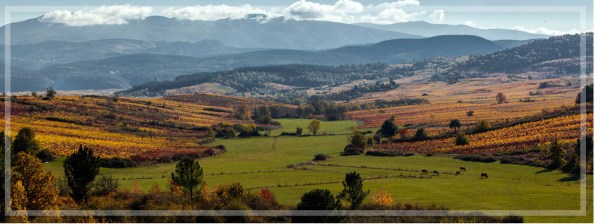
Bierzo, Spain. Source: Bodegas Godelia website
Let’s take wine and let’s travel – how about a quick trip around the world? Let’s start in Spain, in the region called Bierzo, located in the North East part of Spain, close to the Portuguese border. As with many places in the old world, the viticulture originated in the region in the times of the Roman empire. Today, Bierzo is best known for the red wines made out of the grape called Mencía, and Godello and Doña Blanca are the two primary white grapes in the region. Bierzo is known for its special microclimate, conducive for the grape growing, which can be characterized as the continental climate with ocean influence. Bierzo has today about 2,000 grape growers, 75 wineries, and produced about 9 million bottles of wine in 2017.
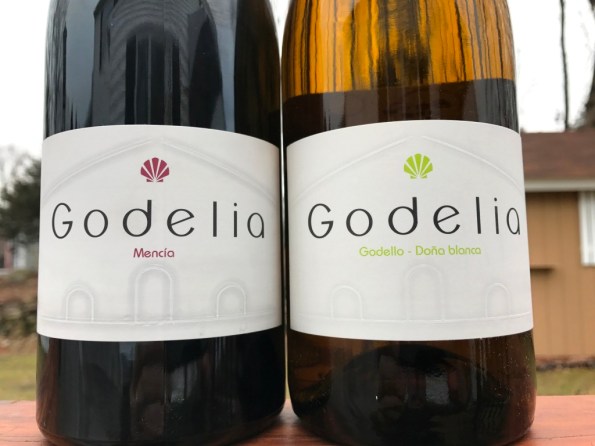
Two wines I want to offer to your attention come from the Bodegas Godelia, about 86 acres estate in Bierzo. The winery was created in 2009, however, their vineyards are much older, from 20 to 90 years old, depending on the grapes, and located at the altitudes of 1,600 to 2,000 feet.
2015 Bodegas Godelia Blanco Bierza DO (13.5% ABV, $17, 80% Godello, 20% Doña Blanca)
C: light golden
N: intense, pear, guava,
P: lemon, honeysuckle, crisp acidity, medium + body, delicious
V: 8-
2012 Bodegas Godelia Mencia Bierzo DO (14.5% ABV, $19, 12 months in oak)
C: dark garnet, almost black
N: warm, inviting, medium+ intensity, a touch of barnyard, spices
P: cherries, baking spices, medium body, violets
V: 7+ on the 2nd day, needs time. Mencia is known to produce massive, chewy wines, so this wine is no exception. 6 years of age is nothing for this wine – it might start opening up after at least another 6.
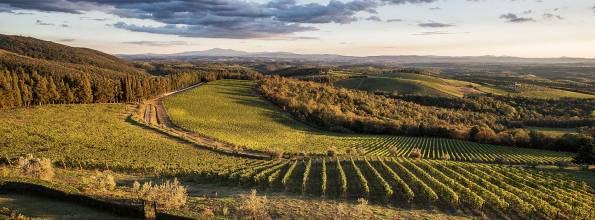
Hills of Tuscany. Source: Barone Ricasoli website
Where should we go after Spain? How about Italy? Let’s visit Tuscany, where 2015 vintage was simply outstanding. Of course, Tuscany is best known for its Chianti wine. At the heart of the Chianti region lays a much smaller region called Chianti Classico – this is where the Chianti wines historically originated from. Inside Chianti Classico, let’s look for the winery called Barone Ricasoli – one of the very first producers in the region, taking its history since 1141. Barone Ricasoli property has a grand looking castle, where some of the stones are still original since 1141, 600 acres of vineyards and 65 acres of olive trees. While Barone Ricasoli is mostly known for the reds, they also produce a few of the white wines, a Rosato, grappa, and of course, the olive oil.


I want to offer you two of the classic Chianti wines from the Chianti Classico area (pun intended):
2015 Barone Ricasoli Brolio Chianti Classico DOCG (13.5% ABV, $18, 80% Sangiovese, 15% Merlot, 5% Cabernet Sauvignon)
C: Garnet
N: Tar, leather, sandalwood, tart cherries
P: Tart cherries, plums, clean acidity, sage, a touch of tobacco, medium plus body, good structure.
V: 8, was excellent from the get-go, got more complexity on the second day.
2015 Barone Ricasoli Brolio Chianti Classico Riserva DOCG (14% ABV, $23, 80% Sangiovese, 15% Merlot, 5% Cabernet Sauvignon)
C: Dark garnet
N: Cherry, Sage, Rosemary, leather, medium plus intensity.
P: Supple berries, tart cherries, firm structure, young tannins, a touch of tobacco, good acidity, tannins on the finish
V: 8, great potential. Right now needs food. While perfectly drinkable now, with time will become a truly delicious sip.
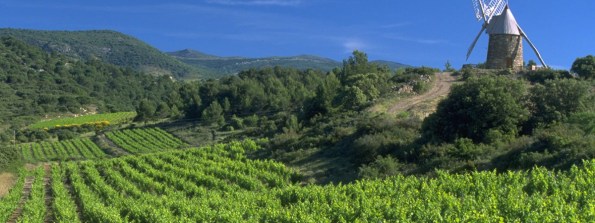
Languedoc. Source: Languedoc-wines.com
We need to complete our old world portion of the tour, so I think the stop in France is a must. How about a quick visit with Paul Mas in Languedoc? Languedoc is the largest wine producing region in France, located in the south, producing a tremendous range of white, sparkling, Rosé and, for the most part, red wines. Domaines Paul Mas is one of my favorite producers I have written about many times. What I love about the wines of Domaines Paul Mas is that you literally can’t go wrong with any of the wines produced at the domain – Sparkling, Rosé, white or reds. Not only the wines taste great, but they are also priced very reasonably – Paul Mas wines saved my wallet at the restaurants on multiple occasions, so they definitely deserve some respect. Here are the wines I want to bring to your attention:


2016 Paul Mas Estate Single Vineyard Collection Chardonnay Saint Hilaire Vineyard Pays d’Oc (13.5% ABV, $12.99)
C: Light golden color
N: Meyer lemon aromatics, hint of white peach, Bosc pear
P: Crisp, tart lemon on the palate, ripe Granny Smith apples, clean, refreshing. Good mid-palate presence, medium finish.
V: 8-, very good.
2016 Paul Mas Estate Single Vineyard Collection Pinot Noir Saint Hilaire Vineyard Pays d’Oc (13.5% ABV, $12.99)
C: Dark ruby
N: Fresh raspberries and cherries on the nose
P: Soft, supple, fresh berries, crisp, fresh, perfect acidity, excellent
V: 7+/8-
2016 Paul Mas Estate Single Vineyard Collection Malbec Saint Hilaire Vineyard Pays d’Oc (13.5% ABV, $12.99, 90% Malbec, 10% Cabernet Franc))
C: Dark garnet
N: Fresh raspberries and blackberries in the nose, nicely inviting
P: Soft, supple, fresh berries, crisp, fresh, perfect acidity, excellent
V: 8-
How is your day going so far? Feel like traveling somewhere? How about we will take a trip to sunny California? California is a big place, so to narrow it down we are actually heading to the Santa Barbara County. Here is a perfect example of the wine being a connector and an instant transporter – as soon as I hear “Santa Barbara County”, the brain instantly serves up the memories of the first Wine Bloggers Conference I attended, WBC14, which took place in Santa Barbara County. Moreover, one of the best experiences of that trip was a visit to the small town of Solvang, which is an incredible place for any wine lover. While visiting Solvang, we tasted the wines produced by Lucas and Lewellen – thus seeing that name on the label was an instant memory trigger.


The wine I want to offer to your attention today is perfectly representative of the capabilities of the Santa Barbara County wine growing region, and at the same time is very non-typical for California. Lucas and Lewellen produce the line of wines under the name of Toccata, which are all Italian varieties and blends, all grown in California. This Toccata Classico was a perfect enigma – varietally correct Tuscan beauty, only made from start to finish in California. In a blind tasting, my guess 100% would be “Chianti!”.
2015 Lucas & Lewellen Toccata Classico Santa Barbara County (14.1% ABV, $29, 50% Sangiovese, 30% Cabernet Sauvignon, 5% Merlot, 5% Cabernet Franc, 5% Freisa, 5% Petit Verdot, 18 months in French Oak, 346 cases produced)
C: Garnet
N: Fresh cherries, touch a leather, medium+ intensity
P: Ripe cherries on the palate, bright, firm structure, fresh, crunchy, touch of leather, excellent complexity, nicely integrated tannins
V: 8+, an excellent rendition of the old world wine in the new world.
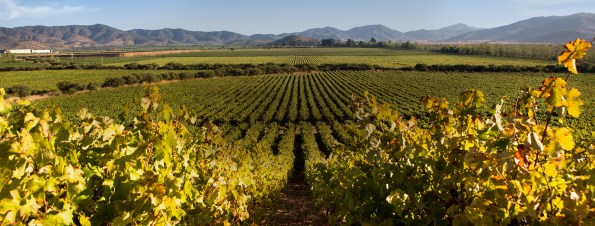
Trinidad Vineyard, Chile. source: Viña Ventisquero website
Hurry up or we will be late for our last destination – Chile. About 25 years ago, Chile was mostly known as a “one-trick pony”, offering bargain-priced Cabernet Sauvignon, Merlot, and Chardonnay. Today, Chile is one of the leading wine producing countries in the world, offering a substantial range of perfectly executed wines, from Chile’s own trademark, Carménere, to Pinot Noir, Syrah, Grenache, and many others.
Today we are visiting Viña Ventisquero, the winery which started only 20 years ago, in 1998, and now offering a diversified set of wines, coming from the different regions and made with the finest attention to detail.
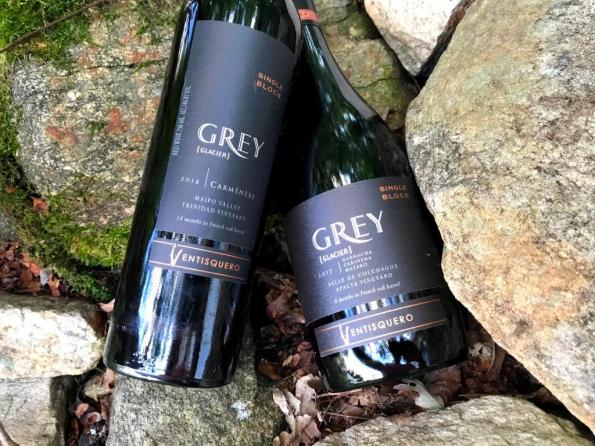
2017 Viña Ventisquero Grey Glacier Single Block Apalta Vineyard Valle de Colchagua (14% ABV, $18, 62% Garnacha, 19% Carinena, 19% Mataro, 6 months in French oak)
C: Ruby
N: Fresh raspberries, medium plus intensity, beautiful
P: Restrained, dark fruit, medium body, minerality, clean acidity, tart raspberries
V: 8-
2014 Viña Ventisquero Grey Glacier Carménere Trinidad VIneyard Maipo Valley (14% ABV, $19, 18 months in French oak)
Dark garnet
A perfect nose of Carménere – mix black currant berries with blackcurrant leaves
Medium to full body, soft, silky, fresh blackcurrant present, anis, good acidity, good balance, very pleasant overall
8/8+, excellent wine
That concludes our trip, my friends. Wasn’t it easy to travel with wine, in the comfort of your living room? Cheers!
Thanksgiving with Smith-Madrone, And a Few More Delights
Holidays are all about pleasure. The pleasure of the company. The pleasure of food. The pleasure of wine. As the very least, they should be.
Let me tell you about the pleasures of my recent Thanksgiving – in one picture:

If this would be an Instagram, I could end my post here, but in this blog, I can add a few words, right?
Let’s talk about the wine first. Everyone has their ideas as what is the best Thanksgiving wine. Some talk about how difficult it is to pair any wine with the Thanksgiving table, due to the large variety of dishes and often prevalent sweet flavors (this is not universal, of course). I have a very simplistic view of the wine and food pairing – give me tasty food and good wine, and if they don’t work together – no problems, I’m happy to consume them one by one. Difficult or not, pairing is not the focal point of my Thanksgiving wine selection. I really have only one strong preference for the Thanksgiving wines – they should be all American. Thanksgiving we celebrate here in the USA is all about this country, and so the wine should match that. And thinking about American wines, you understand how easy it is nowadays to have all-American wine experience.
How many of you heard of Napa Valley? Okay, I see that look, this was a stupid question, I know. But let me go on. How many of you heard of Spring Mountain District? Okay, I see your facial expression changing to say “hmmm, I’m not so sure”. And the last question – how many of you heard of Smith-Madrone? Okay, don’t feel too bad, at the end of the day it is one of the about 400 wineries located in the Napa Valley, so of course, one can’t know all of them. But – this is why I’m talking about it – this is the winery you might want to get better acquainted with.
Smith-Madrone is one of the oldest wineries in Napa Valley, started by brothers Stuart and Charles Smith in 1971. Smith-Madrone property is about 200 acres, with some parts of the vineyards planted more than 100 years ago, all located near the top of the Spring Mountain in Napa Valley. The name Smith-Madrone combines the family name with the name of the evergreen Madrone trees, prominently growing at the property. Well, instead of me trying to regurgitate the past and present of the Smith-Madrone winery, let me direct you to this article – it is a good story, well worth a few minutes of your time.

When was the last time you had Napa Valley Riesling? If you answered “never”, it could’ve been my answer too – until I discovered this Smith-Madrone Riesling. Riesling is simply not a common grape for the Napa Valley, but Smith-Madrone produces the absolutely beautiful rendition of the famous grape. It might be due to the mountain fruit – all the Smith-Madrone vineyards located at the altitude of 1300 to 2000 feet, with slopes reaching 34%. Sustainable dry farming and winemaking practices also play a role, but one way or the other, the 2015 Smith-Madrone Riesling Spring Mountain District Napa Valley (12.9% ABV, $32) was just delicious. varietally correct both on the nose (honeysuckle, a touch of tropical fruit, lemon, apples) and the palate, which was beautifully balanced with golden delicious apples, a touch of honey and acidity. To make me ultra-happy, the Riesling is sported a distant hint of petrol, which is my pet peeve.
2015 Smith-Madrone Chardonnay Spring Mountain District Napa Valley (14.4% ABV, $40, 10 months in French oak) was equally beautiful. Again, the wines of that styling I call in my book “classic”. A touch of vanilla and apples on the nose, a distant hint of butter, continuing with the same vanilla and white apples on the palate. Clean acidity, noticeable minerally undertones, restrained, balanced – a very classic example of “how to do chardonnay right”.
With the risk of sounding very boring and repetitive, I have one more classic wine for you – 2014 Smith-Madrone Cabernet Sauvignon Spring Mountain District Napa Valley (13.9% ABV, $52, 85% Cabernet Sauvignon, 8% Cabernet Franc, 7% Merlot, 70% new French oak, 30% one-year-old French oak for 18 months). How classic was this wine? Bordeaux-classic. The mountain fruit was shining, showing great restraint. This was not an exuberant typical Napa Cab – lean, tight, well-structured, with cassis both on the nose and the palate, the wine was very enjoyable now, and it will be equally or more enjoyable in 30 years.
So that was my main wine story on the Thanksgiving day. The rest was about the food – starting the smoker as 9 am in the 21°F weather (about -6°C), and then watching the turkey slowly getting to the right temperature. The silver lining of that cold weather was the fact that instead of 4-4.5 hours in the smoker, it took about 6 hours to get that big bird to the right doneness – and slower cooking results in more tender and more flavorful meat. A glass of Smith-Madrone Riesling was adding to the cooking enjoyment.


After celebrating Thanksgiving at our house, we went to see our close friends in Boston. What I love about that house is that there are always a few of the older wine bottles laying somewhere on the shelf. You never know what you will find in the older bottle, but that is what makes it fun, isn’t it?


The first bottle I opened was 2007 Tishbi Cabernet-Petite Sirah Shomron Israel (12% ABV, 70% Cabernet Sauvignon, 30% Petite Sirah). Judging by the pronounced brickish, almost orange, color, my first thought was “this probably fully turned”. And it was not! Complex nose of dried fruit and herbs was supported by plums and prunes forward, but balanced palate. Good amount of acidity, tertiary aromas – this was a very enjoyable glass of wine. Only one glass, I have to say – by the time I wanted the second, the wine was gone.
Without much thinking, I pulled another wine, realizing later that I opened another wine from the same vintage – 2007 Marani Kondoli Vineyards Saperavi-Merlot Kakheti Georgia (13.5% ABV). This wine couldn’t be more different from the previous 2007 – dark garnet color, not a sign of any aging, tight, fresh, blackberries and blueberries on the nose and the palate, firm, fresh and young. I’m really curious about how much longer this wine could’ve last.
One last wine to mention – 2010 Massandra White Muscat Crimea Ukraine (16% ABV). Massandra winery roots go back to the old Tsar’s Russia in late 1800, but their cellars hold wines from the 18th century (if you are not familiar with Massandra wines, here is an article by Jancis Robinson). Massandra is best known for sweet fortified Muscat wines, like the one we tasted. To me, this 2010 was most reminiscent of a Sherry, and not necessarily an ultra-balanced one. But then the same Jancis Robinson’s article says that Massandra wines require 45-60 for the full maturity, so I guess the wine tasted within the expectations…
Spring Mountain District in Napa Valley, Israel, Georgia, and Ukraine – not a bad wine play for the holiday, what do you say?
Here you go, my friends. I will leave you with some beautiful wines to look for. And how was your Thanksgiving, if you still remember it? Cheers!
Holiday Gift Guide 2018 – Your Shopping Stops Here

Source: Unsplash.com
Yes, it is that time of the year again. The word “Holidays” is the one you hear the most. Holidays are great – it is the time to celebrate family, friends, life. But – of course, there is a “but” for everything – often, the holidays are not just festive, they can also be stressful and frustrating. No, I’m not necessarily talking about all the extra pounds and the desire to break the scales into the thousand little pieces. I’m mostly talking about the gifts.
We always want to see our family, friends, and colleagues happy – but in the holidays season, we especially want to express our gratitude and appreciation with the gifts. And this is when frustration settles in. We want the gifts to be meaningful and want to see the smile of delight on the faces of the recipients – but finding the right gift might be a mission impossible.
I can’t help you solve this, once and for all. However, if you are reading this post (are you?), there is a chance that you and the people you want to please might be interested in wine. In this case, I might be able to help. Of course, I don’t know your friends. But – all I want to do is to give you some ideas. Once you are armed with the idea, I’m sure you can do the rest – and I will be happy that you will be happy. Well, ohh, let move on.
Here are some suggestions which I hope will reduce the holiday stress for you. In the interest of the full disclosure, I have to tell you that I’m not compensated in any way to give you these recommendations. These recommendations are based on my personal experience, and if you got a wine and food lover in your life, you will find something here to please them. Heck, I would be absolutely delighted with any of those gifts myself – but this, of course, is not about me. Here we go:
Jordan Vineyard and Winery Holiday Gift Guide: While Jordan Winery makes only two wines in Sonoma Valley – Chardonnay and Cabernet Sauvignon, they make them very well. Jordan Gift Guide goes beyond the wine – it also offers gourmet foods, such as American sturgeon caviar and Estate Extra Virgin Olive Oil. Wrapped with the beautiful packaging, Jordan Winery gifts are guaranteed to evoke a huge smile from your gift recipients.
Knudsen Vineyards Gift Sets: Here is another winery which makes only two wines, now in Oregon – Chardonnay and Pinot Noir – but their wines are definitely gift-worthy. I discovered their wines last year, and if you got a Chardonnay or Pinot Noir aficionado you want to please, Knudsen Vineyards wines are up for the task.
Gloria Ferrer Gift Collections: Bubbles and holidays – need I say more? Gloria Ferrer is one of my most favorite sparkling wine producers in California. Classically structured in Champagne style, but with the addition of California’s generous fruitiness, Gloria Ferrer sparkling wines will highlight any celebration. In addition to the beautifully packaged wines, you can find other gift options there – saber, wine glasses and more.

Source: Pexels.com
JUSTIN Winery Gifts: JUSTIN Winery is one of the very best producers in Paso Robles. Their range of Cabernet Sauvignon wines is superb and will make any oenophile happy. However, the gift options go way beyond just wine – coasters, candles, wine openers – there is something there for everyone.
Wente Vineyards Gifts: There is a good chance you never heard of Wente Vineyards before – or the Livermore Valley which it proudly represents. Meanwhile, it is one of the oldest wineries in California (established in 1883), but it is not just the history which is important here. Go ask your favorite California Chardonnay producer what type of Chardonnay grape clone they use – and don’t be surprised to hear “Wente clone”. You will find many delicious gift options available from Wente (don’t worry – their reds are excellent too) – go ahead, surprise the wine lovers on your list – they will thank you later.
Pat LaFrieda Gifts: Now, we can’t leave on the wine alone, can we? Sometimes, we crave meat. Discovery of Pat LaFrieda meats was one of the highlights of the year for me, proving that expensive meat can be still worth the money. You will find a range of gift options at Pat LaFrieda website, from gift cards to the amazing meat combinations. This is the meat which worth the money – take the word of the convert for this.
Kevin Zraly Wine Classes: Who thinks that the gift of wine education is the best gift of all, raise your hand! I honestly do. As someone who had a pleasure of going through the Windows on the World Wine School and listening to Kevin Zraly, I have to say – that experience was incredible. Anyone who wants to learn more about wines of the specific region or style will learn a great deal from the master – and taste an incredible array of wines which one can’t easily get an access to. I guarantee you – your gift recipients will tell that this was the best gift ever.
Here, I hope I made your life easier. No thanks is necessary, but feel free to add my name to your gifting registry at any time. Cheers!
Impromptu Evening With Friends? A Bottle of Golden Bordeaux is All You Need
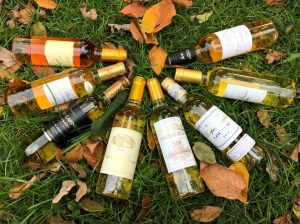 You just came home from work. It was a hard day. The boss [again] didn’t get your idea, and you didn’t get much support from your coworkers either. All you want to do is to crawl into the old trusted chair with your feet, open the book, and get lost in its pages. Tomorrow will be another day, and all the problems will magically solve themselves. Or you will force them to solve themselves. No matter what, but “me evening” is about to begin.
The doorbell rings. Really? The doorbell? What the heck? You sure didn’t invite anyone over. Get the sleepers on, let’s see, maybe it is just a late package. Ahh, it is not a package. It is your friend. And she just had a rough day at work, and she needs at least an ear, and hopefully not a shoulder.
Walk her in, get her situated on the couch. Then you get this burning feeling – something is amiss. Oh yeah, of course – there is nothing on the coffee table, and your friend sheepishly confirms that she is really “not that hungry”, and your perfectly know what it means – while nobody is looking for a 5-course meal, a little something would be great.
You didn’t shop for a while, and all you got is some crackers, some chips, salami and a bit of cheese. And of course, you need to bring a bottle of wine, which is a must for the free-flowing conversation, but what wine would pair well with such an eclectic spread of crackers and salami?
So let’s stop here, as I’m not writing a fiction novel, and let’s analyze the situation. We got chips, crackers, cheese, and salami – what would pair well with it? I’m sure you have your own take on this, but let me give you mine – how about some Golden Bordeaux to pair with this eclectic mix?
If you are curious what Golden Bordeaux is, I’m sure you can easily guess it – heard of Sauternes? Have you ever seen a bottle of Sauternes? Yes, it typically looks like a liquid gold, hence the reference to the Golden Bordeaux.
The term “Sauternes” here is used rather generically, and Golden Bordeaux might be more suitable than just Sauternes – however, while the Golden Bordeaux makes sense, I’m not sure how common the term is.
Of course, first and foremost, Bordeaux is known for its reds (anyone who experienced Bordeaux whites from Pessac-Léognan would easily disagree, but still). However, Bordeaux is a lot more than just the reds. On the left bank of the Gironde river, which splits Bordeaux in half, lies the region called Graves. Inside of Graves resides the small region of Sauternes with its neighbors Monbazillac, Cérons, Loupiac and Cadillac, as well as Barsac which is a sub-region of Sauternes. Together, all these regions are the source of the Golden Bordeaux, the unique white wine made from the partially raisined grapes due to their contact with so-called Noble Rot. It is common to describe Sauternes as sweet, dessert wines – but the flavor profile of these wines goes way beyond just sweet, offering layers of complexity, and therefore suitable for a lot more than just a dessert course.


A few weeks ago, a group of wine aficionados got together for the virtual tasting of the Golden Bordeaux, hosted and guided by the kind folks from Snooth. This tasting went beyond just a standard format of tasting and discussing the wines – we also had an opportunity to experiment with the variety of savory and spicy snacks, which included Sweet Potato and Beet Crackers from Trader Joe’s, Sriracha Cashews, Jalapeno Chicken Chips, Gusto by Olli Calabrese Spicy Salami, and Jack Link Sweet & Hot Jerky. Spicy and sweet, as well as sweet and salty are well-known combinations for anyone who likes pairing wine and food. However, these Golden Bordeaux wines go beyond just sweet, often adding a layer of forest mushrooms and herbs to their taste profile, which helps to complement the ranges of savory dishes.
I had a few surprises and personal learnings in this tasting. I never paid attention to the mushroom undertones in the Golden Bordeaux, so this was definitely an exciting discovery. I also never thought that those wines need some breathing time – and I was wrong, as you can see in the notes below – another little memory knot is in order. I also found out that not all food can be good for the tasting – the Chicken Jalapeño crackers were so spicy for me, that I had my lips burning for an hour in the tasting. It would be fine if this was a pairing and conversation with a friend, but for the next time around, I plan to taste the wines first, and only then try it again with spicy food.
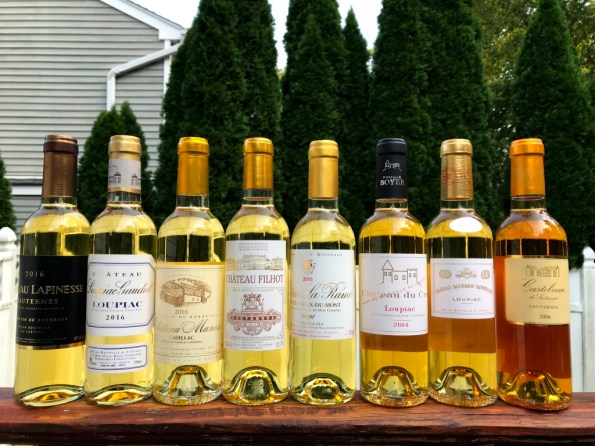
Now, here are my notes from the tasting:
2016 Château Manos Cadillac (13.5% ABV, $12.99, 95% Semillon, 2.5% Sauvignon Blanc, 2.5% Muscadelle)
Light golden color
Peach, honey, beautiful nose, very inviting
Delicious palate, peach, candied peach, caramel, good acidity 8/8-
Very nice with beets crackers from Trader Joe’s
2014 Château du Cros Loupiac (13% ABV, $12, 90% Semillon, Sauvignon Blanc, Muscadelle
Golden color
Complex nose of caramel and herbs, a touch of spicy notes, great complexity
Beautiful concentration on the palate, candied fruit, golden raisins, perfect balance. 8+
Amazingly elevates sweet and hot beef jerky, wow
2016 Château Loupiac-Gaudiet Loupiac (13% ABV, $17, 90% Sémillon, 10% Sauvignon Blanc)
Light golden color
Sweet apples, herbs. Later on: truffles!
First reaction: Sweet apples on the palate – need more acidity
After 20 minutes: good acidity, mushroom, forest floor. 8-
Excellent with hot beef jerky
2011 Château Dauphiné Rondillon Loupiac (13.5% ABV, $28, 80% Semillon, 20% Sauvignon Blanc)
Golden color
Honey, plums, candied plums
First reaction: Burned sugar, then medicinal. Ouch
After 20 minutes been open: sugar plums, white plums, good acidity showed up. 7+/8-
Later on – mushrooms on the nose (really a discovery for me), caramel. Savory caramel on the palate. Interesting – definitely a food wine.
Very good with salami and sweet potatoes crackers
2015 Château La Rame Sainte-Croix-du-Mont (13% ABV, $22, 100% Sémillon)
Golden color
Very restrained, a touch of tropical fruit, distant hint of honey, gasoline added after 20 minutes
First reaction: Candied fruit, really sweet, can use more acidity. 7
After 20 minutes: vanilla, cookies’n’cream, light, good acidity. 8-/8
Tried with hot beef Jerky – not bad
2016 Château Lapinesse Sauternes Grand Vin de Bordeaux (14% ABV, $20, 100% Sémillon)
Golden color
Lemon, lemongrass, touch of honey, white plums
Candied fruit, apples, good acidity. 8
Didn’t make much difference with spicy salami
2006 Castelnau de Suduiraut Sauternes (14% ABV, $90, 99% Semillon, 1% Sauvignon Blanc)
Dark gold color
Honey, candied lemon, touch of caramel
Beautiful palate, fresh caramel, butterscotch cookie, good acidity. Very rich. 8-
Very good with beef jerky, also with jalapeño chicken strips
Here you are, my friends – Golden Bordeaux and eclectic snacks. Get a few bottles on hand – the wines are versatile, and can be enjoyed in many ways – especially when the late night friend pops in.
The Golden Bordeaux wines are definitely underrated – here is the great opportunity to surprise yourself and your friends. And you can thank me later. Cheers!
Sent with Writer
Wine, Wine, Wine – Notes from Martin Scott 2018 Grand Portfolio Tasting
 Martin-Scott is one of the largest wine wholesalers (distributors) in New York, New Jersey, and Connecticut, with a very extensive portfolio well representing all major winemaking countries of the world. I had a pleasure to attend Martin-Scott portfolio tastings in the past, and they were always great with a lot of delicious discoveries. When I had an opportunity to attend the portfolio tasting about a month ago, I was very happy to be able to include it into my schedule.
I wrote about trade portfolio tastings many times in the past. They might seem a bit overwhelming, as you are presented with about 1000 wines and only 4-5 hours of time to taste them. At the same time, the range is incredible and you get an opportunity to expand your wine horizon and always find new favorites.
Here are my general impressions from the tasting:
- I know this is my pet peeve, and I keep talking about it at every occasion, but I have to say it again – new vintages of California reds are using way too much oak. There were lots of California reds from the 2015-2017 vintages which were literally not drinkable due to very high tannins content, to the point of your whole mouth getting numb. Unfortunately, some of the bigger Washington producers follow suit and also make over-oaked red wines. I really don’t understand this trend. Yes, using lots of new oak makes wine more expensive. But it doesn’t make it more enjoyable, for sure when it is young.
- White Burgundies are amazing. I rarely get to drink those wines for the variety of reasons, so I was literally blown away by the beauty and finesse of most everything I tasted. You will see this love expressed in the ratings below.
- South Africa produces some spectacular wines. Check the full list below to see what I really enjoyed.
- There are some excellent spirits made in … Sweden. You really need to taste them to believe them.
- I was able to add one more new (rare) grape to the collection – the grape called Souvignier-Muscaris from France.
Before I will inundate you with my brief notes, just a reminder for the trade tasting ratings I use. Considering the amount of time versus amount of wines, there is no way I can do much of the thoughtful analysis for a hundred plus wines I manage to taste. Thus I use the “+” signs, with “+++” meaning excellent. When I came up with this system, I really didn’t plan to go beyond “+++”, but you will see now “++++” and even “+++++” (very rarely – maybe one in the whole tasting) – you understand what it means. I also use “-|” as a half-point. The list below only includes wines with at least “+++” rating. As these are all new releases just coming into the stores, essentially all the wines on the list represent a “buy” recommendation – whatever you can find and afford. All prices below are an approximation of the suggested retail prices. I’m sure that the actual store price might be lower for many of those wines.
Now, I will leave you to it. Cheers!
Last Bottle Sign Up ($10 credit)




 Talk-A-Vino