Archive
Stories of Passion and Pinot: Looking Back and Looking Forward
Back during the fall of the last year, I ran a series of posts talking about passion and Pinot Noir. Pinot Noir is a finicky grape which, I can only guess, has some enchanting properties – for the winemakers and wine lovers alike. Pinot Noir has an ability to grab you and never let you go – once discovered, it becomes an object of obsessive desire: winemakers go out of their way to make the best Pinot Noir wine, and oenophiles go out of their way to find it.
To give you the best examples of Pinot Noir’s passion and obsession, I decided to [virtually] sat down with a pioneer, a rocket scientist, a soil fanatic, biodynamic believer and some true farmers – all of them from Oregon. Through our conversations, I wanted to convey the unwavering belief in the magic of that little black grape, Pinot Noir.
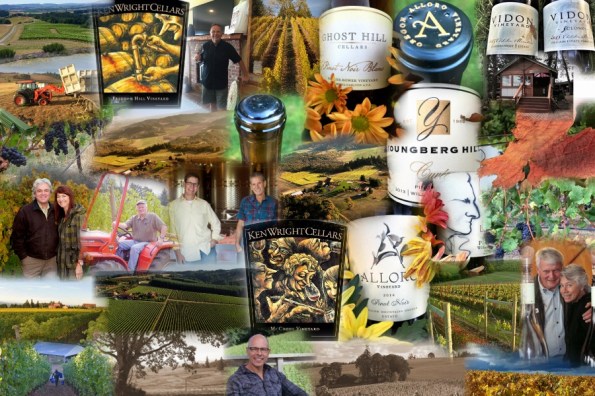
We talked with Ken Wright of Ken Wright Cellars, David Nemarnik of Alloro Vineyard, Mike Bayliss of Ghost Hill Cellars, Wayne Bailey of Youngberg Hill Vineyards, Steve Lutz of Lenné Estate and Don Hagge of Vidon Vineyard – the passion was easy to see, through their words and through their wines.
The essential Pinot Noir map includes four major players – Burgundy, California, New Zealand and Oregon. Out of these four, Oregon usually beats Burgundy in consistency, and often California and New Zealand in finesse. That consistency and finesse don’t go unnoticed – and not only by wine consumers but by the big domestic and international wine businesses and investors as well. Big businesses are great, but – they are, first and foremost, big businesses – and passion is often replaced just by pragmatic business needs and shareholders value.
The wine quality and creativity is on the upswing around the world, and while consumers are driving this trend with an ever increasing thirst for the wine, nothing can be taken for granted – the wines have to find the consumers, and convince them that they are worth paying for.
The big business interest and more and better wines – what does it mean for the Oregon wine industry, the passion and the Pinot Noir? To answer this question, I asked once again for the help of Carl Giavanti of Carl Giavanti Consulting, wine marketing and PR firm, who reached out to the Willamette Valley Wineries Association. As you can imagine, I had more than one question, so here I would like to share with you what I have learned.
First three questions were answered by Anthony King, 2017 President of WVWA Board of Directors and General Manager of the Carlton Winemaker’s Studio:
[TaV]: Willamette Valley squarely joined the ranks of world-class wine regions. Does it mean that everything is great, or you still have big issues to solve on your agenda?
[AK]: Willamette Valley is certainly on the rise and we are all thankful for the attention. Our biggest issue is to continue to share the spotlight with the other classic regions of the world without losing our roots, our authenticity, and collaborative spirit.
[TaV]: It seems that lately big corporations are paying lots of attention for the WV wineries – or rather money, as for example, Jackson Family which acquired 3 WV wineries over a short period of time. Are you concerned with this development? Do you think it might change the soul and spirit of WV wines?
[AK]: Most of us are flattered by the attention that our wines, vineyards, and wineries have been getting from producers all over the world. JFW, in specific, has invested heavily, but have done so with a soft touch and an eye towards the community and their neighbours. In the end, the region will have diversity that consumers will ultimately benefit by. Our hope, however, is that this interest doesn’t drive vineyard and fruit prices into a range that makes the hands-on artisan winemaking that has made Oregon so special too expensive for entry.
[TaV]: There are many white grapes which can be called “next frontier” for the WV wineries – Pinot Gris (yes, okay, this is an old news), Chardonnay, even Riesling. However, if we look at the red grapes, WV wineries are a “one trick pony”, only working with Pinot Noir. Do you see any problems with that? is there a next big red grape for the WV, or is it not necessary?
[AK]: Great question. I don’t think that any of us, as winemakers, regret that we are working with Pinot noir in such an ideal locale. It presents a lifetime of challenges and, hopefully, rewards. Although much more rare, Gamay can be thrilling and has been successful planted alongside Pinot noir. Syrah, too, has a lot of potential, making compelling, Northern Rhone style reds in warmer years. Cooler-climate Italian reds could have potential as well. We’ve already seen an increase in planting of these “other reds,” but the more dramatic shift is (as you mentioned) towards focusing on whites and sparkling wine, which are very well suited to this climate. Ultimately, I foresee increased experimentation with a range of red varieties in the warmer sites in the Willamette Valley in the short-term; time and the weather will tell what succeeds.
The rest of the questions were answered by Emily Nelson, Associate Director for Willamette Valley Wineries Association.
[TaV]: What percentage of WV wineries are LIVE certified? Do you see this number dropping, increasing, staying the same?
[EN]: In 2016, there are 13,170 Oregon vineyard acres certified sustainable, which is 48% of total planted acres in the state. 8,218 acres are LIVE Certified, which is 30% of total planted acres. We do see the number of certified sustainable vineyard acres increasing year after year. As the home of the nation’s most protective land use policies, the first bottle recycling law, and the highest minimum wages for farm workers, it’s fitting that the Oregon wine industry is committed to sustainable farming and winemaking practices.
For LIVE Certified acres in particular, the number has increased annually from 2,368 acres in 2007 to 8,218 acres today.
[TaV]: How important is Biodynamic viticulture for the WV wine industry? Do you see more wineries embracing it?
[EN]: Biodynamic viticulture in Oregon has also steadily increased over the years, from 289 certified acres in 2007 to 1,585 certified acres today. It is an important component of our sustainable character in the region, reinforcing our belief that agriculture in general and viticulture in particular can flourish in harmony with our natural environment. In general, Demeter Biodynamic certification is in accord with many practices that characterize the certification of organic farms. However, certain practices are unique to Biodynamic agriculture, including managing the whole farm as a living organism; maintenance of a healthy, diverse ecosystem that includes not only the earth, but as well the cosmic influences and rhythms of which the earth is a part; and use of the Biodynamic preparations to build soil health through enlivened compost.
[TaV]: Are there any new wineries showing up in the WV? If yes, is there a trend there (more than the last 5/10 years, less than the last 5/10 years, the same?
[EN]: Yes! Our number of wineries in the region has climbed over the last five to ten years. We had about 110 wineries in the Willamette Valley in the year 2000. By 2010 that had more than doubled to 300 wineries. And now in 2016 our most recent census shows 531 wineries in the region. People are drawn to grape growing and winemaking here for many of the same reasons that brought our pioneers in the 1960s—unique climate and soils ideally suited to Pinot noir and a wine industry culture that celebrates collaboration, inventiveness, and land stewardship.
[TaV]: Do you see a lot of foreign capital coming into the WV winemaking industry (buying, partnering, starting new wineries)? Again, is there a trend?
[EN]: There is a trend of outside investment in the Willamette Valley wine industry, and it speaks to the quality of the wines being produced here. We see Burgundian investors who’ve found the New World home of Pinot noir, as well as those from Washington and California who are expanding their premium Pinot noir brands with Willamette Valley wines.
[TaV]: Last question – are there any new and coming, or may be old but coming around wineries wine lovers should watch for? Anything which makes you particularly excited?
[EN]: We’re particularly excited about a few things here: first, many of our pioneering wineries are handing the reigns down to second generation winegrowers and owners. The children who grew up in the vineyards and cellars of the wineries who put our region on the map are now at the helm. They continue to innovate and improve, so watching their brands and their wines flourish and evolve is a thrill. Second, we’re excited about the Burgundian presence in the Valley. French winemakers who come here to experience the Oregonian version of their time-honored grape offer unique expressions of the wines and outside confirmation that there’s something really special happening here. Lastly, we’re excited about new winemakers just entering the industry, who contribute a vibrant sense of experimentation and energy to the Valley.
All the good things come to an end, so this was the last of the conversations in the Passion and Pinot series – for now, at least. As I said before, Pinot Noir has some very special properties, making people fall in love with it and not letting them go. And whether you agree or disagree – you know what to do. Until the next time – cheers!
P.S. Once again, here are the links to the web sites for the wineries profiled in this series:
Alloro Vineyard: www.allorovineyard.com
Ghost Hill Cellars: www.ghosthillcellars.com
Ken Wright Cellars: www.kenwrightcellars.com
Lenné Estate: www.lenneestate.com
Youngberg Hill Vineyards: www.youngberghill.com
Vidon Vineyard: www.vidonvineyard.com
Champagne! Champagne! Conversation with A.J. Ojeda-Pons of The Lambs Club
While some of us insist that Champagne is an everyday wine, majority treat it as a “special occasion” only. Of course, every day with the name ending in “day” is worthy of a special celebration, but jokes aside, most of us need a good reason to pop the cork on that tickling, gently foaming, playful and refreshing nectar.
Lucky for all “special occasion” folks, one such special occasion is almost upon us. What can accentuate “love and romance” better than a glass of bubbly? Yes, bring the Champagne as Valentine’s Day is only a week away!
 To help you celebrate and maybe even answer a question or two which I’m sure you always had, I [virtually] sat down together with A.J. Ojeda-Pons, sommelier at The Lambs Club, one of the popular New York restaurants by the Food Network’s best-dressed star and Iron Chef Geoffrey Zakarian. I need to mention that in addition to being a WSET Advanced Sommelier, A.J. knows a thing or two about style – in 2014, he was the official winner of the U.S. Best Dressed Somm contest by Penfolds and GQ Magazine. And the Champagne? Just take a look at the A.J.’s LinkedIn profile, which says “Drink Champagne Every Day”!
Here is what transpired in our conversation:
[TaV]: Champagne is perfectly appropriate for any celebration, however, it is most often associated with Valentine’s Day – well, after the New Year, of course. When celebrating Valentine’s Day, would you recommend Champagne as the one and only choice of dinner wine, or would you use it just as an opener and then continue with whites and reds?
[A.J.]: Ah! My motto is “Drink Champagne Every Day,” so I often have a whole meal drinking just Champagne. Besides, drinking champagne before a meal is the most civilized thing you could do.
I know that it may be hard for some people to drink bubbles throughout a meal, but if you tailor your menu choices with the champagne that you are drinking, you can have an amazing experience (Think Crudos, Oysters, Fish or Seafood Tartare, Veal, Rabbit or Fish and avoiding red sauces or rich, creamy preparations). Otherwise, if you can’t commit, plan to drink the Champagne for at least half of the dinner and then switch for your main courses. In regards to desserts, champagne could sometimes be a total clash (due to its crispness and acidity) but a nice sorbet or fruit-based dessert will do.
[TaV]: To continue the previous question, just in case you suggested to stay with Champagne all the way, can you make some recommendations for different Champagne or Sparkling wines to complement a three course meal, including dessert? I’m talking not so much about particular producer names, but more about the styles and types of the sparkling wines.
[A.J.]: I like to drink a champagne that has more complexity throughout a full meal, so in that case I would go straight to a vintage champagne, even though it is always more expensive. You will benefit from the extended period of aging, it will have more nuanced layers and complex flavors, and will make it easy to pair with different flavors in various dishes.
[TaV]: Now, let’s actually talk about names. Splitting into three price categories – under $20, $20 to $60 and my favorite, “the sky is the limit”, what are the special Champagne and sparkling wines would you recommend to our readers in each price category?
[A.J.]: For the under $20 category, you won’t find any champagne in the market, unless it is a half bottle, but for that price point you are better off selecting other sparkling wines that are made in the méthode Champenoise. There are not a lot out there, if you can find them, because generally they are not exported or their production is very limited.
For example, from Italy you could try to get Franciacorta from the Lombardy region, from producers like Berlucchi, Il Mosnel or Mirabella. From the Veneto, you could try Il Buglioni spumante, and don’t forget that the Dolomites produce great sparkling, like Castel Noarna and Endrizzi. In Spain you can find great Cava from producers like Gramona, Mestres and Naveran.
If you are really in love with French sparkling, Crémant de [Bourgogne] (Veuve Ambal, Clotilde Davenne), [Jura] (Domaine de la Renardière, Rolet Père & Fils) [Alsace] (Albert Mann, Pierre Sparr or [Limoux] (Tocques et Clochers, Paul Mas) is your answer.
In the $20-60 sweet spot, you’re going to have the majority of Champagne options, from producers like Benoit Lahaye, Laurent Perrier, Dhondt-Grellet, Andre Clouet, Ayala, Billecart-Salmon, Aubry, Deutz, Henriot… open the floodgates!
Sky is the limit… yes, always! Find the Tête de Cuvées from Billecart-Salmon (Le Clos Saint-Hilaire), Pol Roger (Sir Winston Churchill), Charles Heidsieck (Blanc de Millenaires), Krug (Clos de Mesnil) and of course, Moët & Chandon (Cuvée Dom Pérignon).
[TaV]: What do you think of Grower’s Champagne? It is often hard to find, and if you can find it, it usually comes with very little information – is Grower’s Champagne worth seeking?
[A.J.]: Grower Champagne is by far my favorite type of champagne. Yes, they are hard to find at some stores but you can actually purchase quite a few online, if your state allows. Think about it, they ?own the land, they farm it, quite often respecting nature to the T, they produce and sell their own champagne, they don’t sell the fruit to big houses or mass producers. I stock on these a lot.
There are many styles to look forward to and many small producers that just are thrilled to share their farmer love in the language of a great bottle of champagne.

The Club Mezz at The Lambs Club
[TaV]: Over the past few years I had a number of delicious encounters with so-called Pét Nat sparkling wines – what do you think of them? Is this a fad, or will we see more of them? Do you offer Pét Nat at your restaurant?
[A.J.]: These are fun and can be quirky, but really excellent options to explore. I don’t think they are a fad, but you will see them more often in natural wine bars. They’re versatile with food, I must say.
We carry a couple at The Lambs Club and we offer on-and-off a choice by the glass depending on the season. I like them a lot. They are approachable, easy drinking and they also have a variety of styles from different countries. My favorite from California: Birichino, New York State: Channing Daughters, and from France: Chahut et Prodigues and Taille aux Loups!
[TaV]: In your opinion, what is the ideal vessel to serve the Champagne in? Is it the ever so popular flute, or should we rather serve and drink Champagne from the standard white wine glasses?
[A.J.]: Avoid flutes like the Black Plague. They are indeed obsolete, although they are alright for Prosecco. A regular white wine glass will be much better and, in fact, many crystal/glass makers have completely changed the shape of flutes to more white wine glass-shaped. You will be able to experience a lot more of the aromas of the champagne. Great champagne deserves a great glass. I prefer larger Burgundy or Bordeaux glasses for Vintage champagne.
[TaV]: What are your most favorite Champagne producers, if you have any?
[A.J.]: I have so many that I will need an extra page (back to my motto and hashtag, #DrinkChampagneEveryDay) but, here’s a few: Dhondt-Grellet, Billecart-Salmon, Agrapart, Savart, Tarlant, Robert Moncuit, Delamotte, Krug, Guillaume Sergent, Pierre Moncuit, Besserat de Bellefon…
[TaV]: Can you share your most mesmerizing Champagne experience, or most memorable Champagne bottle you ever had?
[A.J.]: It was a Heidsieck Monopole 1945. I was working a collector’s dinner and they had brought so many incredibly old vintage champagnes, but this one was my eye opener. All I could think about was ‘drinking this back then when the war finally ended.’ Seriously.
[TaV]: Last question – do you have a favorite Champagne quote? You know, like the famous [supposedly] Napoleon’s quote “Champagne! In victory one deserves it, in defeat one needs it” – do you have one (or more) which you like the most?
[A.J.]: Yes!!! Always a current quote from the poet Paul Claudel: “In the little moment that remains to us between the crisis and the catastrophe, we may as well drink a glass of champagne.”
There you have it, my friends. Hope you will find our conversation interesting, but most importantly – you don’t have to wait for the Valentine’s Day to get some fizz on. Pop that cork already, will you? Cheers!
Of Cabs and Tomatoes, or Having Fun with a Blind Tasting
 “By the way”, my friend texted me, “your text says “tomato wine” – was that an autocorrect”? My response was “Nope. You’ll see”.
Drinking wine is fun (if you disagree, you shouldn’t read this blog). There are many things which we, oenophiles, self-proclaimed wine aficionados, can do to maximize that fun. We age wines, we decant wines, we use fancy openers and pourers, we play with temperature and glasses of different forms and sizes.
One of ultimate fun exercises oenophiles can engage in is a blind tasting. Blind tasting is a “truth serum” for the wine lovers, it levels the playing field for all. Blind tasting eliminates all “external” factors – price (ha, I paid $300 for this bottle, beat that), prestige, winemaker’s pedigree, weight of the terroir (ahh, Bordeaux, it must be amazing), cute and elaborate labels, critics and friends opinion – and leaves your palate one on one with the content of the glass. Don’t say “I hate Chardonnay and I never drink it”, as you don’t know what is in your glass. Don’t say “I don’t like Australian wines”, as you don’t know what is in your glass. Anyone who ever played the game of the blind tasting can surely attest to what I’m saying here. If you never experienced fun and joy of the blind tasting, you are missing and you are missing a lot – but it is easy to fix.
Our tradition of wine dinners goes back more than 5 years, and most of the wine dinners include blind tasting part (here are the posts for some of the past events – Pinot Noir, Champagne, Chardonnay). A few weeks ago, we managed to align everyone’s schedule for a wine dinner and a blind tasting with a simple and non-pretentious subject – Cabernet Sauvignon :).
 Remember the dialog at the beginning of this post? I have friends who know my obsession with the wine, and always try to surprise me with various oddities. One of such oddities was a bottle of tomato wine which they brought from Canada. I didn’t want to drink that wine by myself, so the wine dinner was an excellent opportunity to share it with friends. As guests were arriving, I decided to play a role of the mean host (okay, not too mean). Outside of the friend who knew about the tomato wine, the rest were presented with the pour of the white wine and the request to guess what grape that might be. Literally nobody wanted to believe that this was a tomato wine – I had to show the bottle as a proof.


Have I tasted this wine blind, I’m sure I would be in the same boat as all of my friends – this 2013 Domaine de la Vallée du Bras OMERTO Vin Apéritif de Tomate Moelleux Québec (16% ABV) was fresh, with good acidity, touch of raisins on the nose, medium to full body and notes of the white stone fruit on the palate – for me, Vouvray (Chenin Blanc from Loire) is the one which comes to mind to give you the best analogy. This wine is produced from the locally grown heirloom tomatoes – and it is also a vintage – I’m seriously impressed (find it and taste it).
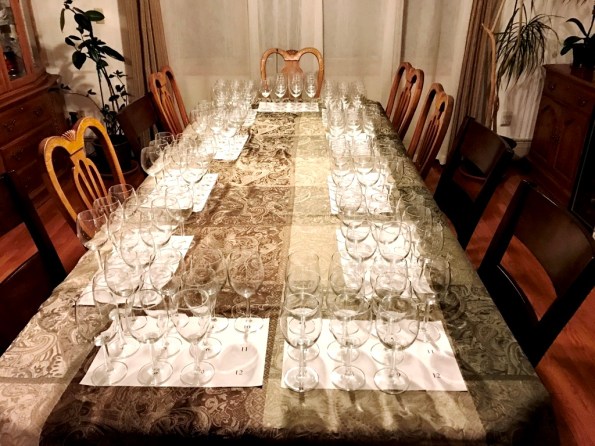
And to the blind tasting off we went. 10 wines were wrapped in the paper bags, opened and randomly numbered (my daughter usually does the honors), then poured into the glasses. The only thing we knew that all the wines will be predominantly Cabernet Sauvignon – no price or region limits.


Below are my notes, in our tasting order, both with my initial impressions and some updates over the next few days as I tasted leftover wines. And by the way, don’t think of this tasting of some stuck-up, snotty process – we openly exchange our thoughts, but each person’s individual palate is an ultimate purveyor of truth here:
#1:
C: almost black
N: restrained
P: bright fruit, pronounced tannins, delicious.
P: 2nd day – outstanding, firm structure, eucalyptus, dusty profile, tannins are still fresh.
V: 2013/2014, new world , considerably improved by the end of the tasting!
#2:
N: blueberry pie notes
P: beautiful, bright, cassis, blueberry pie with tobacco undertones on the second day, excellent
V: Lange
#3:
N: savory,
P: crispy, fresh, great fruit
P: 2nd day – firm structure, perfect balance, dark cocoa, cassis. Truly an enjoyable wine
V: nice finish,
#4
N: strange, rotten cabbage, musty cellar
N: 2nd day: an improvement, tobacco with touch of barnyard on top of cassis
P: nice, bright,
P: 2nd day: great improvement, very enjoyable, shouting a bit of mature fruit with bright acidity and touch of fresh plums.
V: India?
#5:
N: coffee, mocca, dust, excellent
N: 2nd day: coffee and roasted meat
P: nice fruit, bright, spicy
P: 2nd day: palate shifted towards savory too much meat. Probably perfect with the steak, but craving more balance on its own.
V: nice, young
#6:
N: blueberry pie, nice
N: 2nd day: pure candy on the nose, more of a lollipop quality, or may be stewed strawberries.
P: sour cherry, wow
P: sour cherries continuing, albeit more muted than yesterday
V: nothing from Cab, but nice. An okay wine.
#7:
N: nice balance, good fruit
P: great, dusty palate, firm structure, excellent, precision
V: outstanding
#8:
N: nice dusty nose,
P: crispy, tart, limited fruit
V: not bad, but not great.
V: day 2 – past prime 😦
#9:
N: nice, classic
N: 2nd day: added perfume and explicit anise notes
P: beautiful, excellent, mint, classic
P: 2nd day: dark, powerful, compressed, espresso, a lot more dense than the day before.
V: excellent
V: 2nd day: less enjoyable than the day before, closed up, lost the finesse.
#10:
N: young berries, same on the day 2 but a bit more composed.
P: young crushed berries
P: 2nd day: a bit more restrained. Young berry notes without supporting structure. Not my wine, but might have its audience.
P: 5th day: the sweetness is gone, and the classic Cab showed up, touch of cassis and mint, excellent
V: 1st day – it’s ok, 5th day – very impressive
During the tasting, we decide on two of our favorite wines. After tasting is done, we take a vote, with each person allowed to vote for two of their favorite wines. These are just two favorites, without prioritizing between the two. Below are the results of the vote for our group of 11 people:
#1 – 1
#2 – 1
#3 – 7
#4 – 1
#5 – 0
#6 – 2
#7 – 4
#8 – 1
#9 – 4
#10 – 1
As you can tell, the most favorite wine was wine #3 (7 votes out of 11), and the second favorite was a tie between wines #7 and #9, each of them getting 4 votes out of 11. Now, drumroll please – and the most favorite wine of the blind Cabernet Sauvignon tasting was … 2006 Staglin family Cabernet Sauvignon! Staglin Family Cab is definitely not a slouch in the world of cult California wines, and the group clearly fell for it. Here is the full lineup, in the order of tasting:
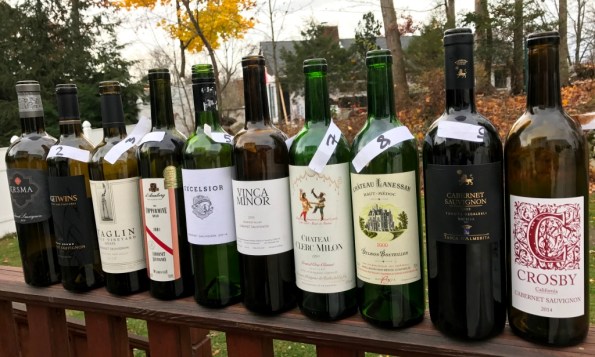 Here are the details for all the wines:
#1: 2012 KRSMA Estates Cabernet Sauvignon Hampi Hills Vineyard, India (13.5% ABV)
#2: 2013 LangeTwins Vineyard Cabernet Sauvignon Lodi, California (14.4% ABV)
#3: 2006 Staglin Family Vineyard Estate Cabernet Sauvignon Rutherford, Napa Valley (14.9% ABV)
#4: 2002 d’Arenberg The Coppermine Road Cabernet Sauvignon McLaren Vale, Australia (14.5% ABV)
#5: 2014 Excelsior Cabernet Sauvignon WO Robertson, South Africa (14% ABV)
#6: 2015 Vinca Minor Cabernet Sauvignon Redwood Valley California (12% ABV, 1 barrel produced)
#7: 1995 Château Clerc Milon Grand Cru Classé Pauillac AOC (12.5% ABV)
#8: 2000 Château Lanessan Delbos-Bouteiller Haut-Médoc AOC (13% ABV)
#9: 2009 Tasca D’Almerita Tenuta Regaleali Cabernet Sauvignon Sicilia IGT (14.5% ABV)
#10: 2014 Crosby Cabernet Sauvignon California (13.5% ABV)
10 wines, 6 countries, 10 different regions, $7.95 – $150 price range, 1995 – 2015 vintage range – I think we did pretty well in terms of diversity. Staglin Family being the favorite wine is not that surprising (but still interesting, considering that it is the most expensive wine in the lineup at $149). My biggest surprises, though, were super-solid KRSMA Cabernet Sauvignon from India (India? really?), an excellent Cabernet Sauvignon from Sicily (who would’ve thought!), and the cheapest wine in the group, Crosby Cabernet Sauvignon ($7.95), which opened up magnificently 5 days after the bottle was opened – of course, nobody has a desire to wait that long for the wine, but forgetting a few bottles in the cellar might be a right move.
The dinner quickly followed the tasting (after 110 glasses were safely removed from the table). I don’t have much in terms of pictures, but we had Russian Meat Soup (recipe here) and beef roast as the main dish. The deserts were pretty spectacular and paired very well with Cabernet wines:


And that concludes my report about our great fun with Cabernet Sauvignon wines and the blind tasting. Now is your time to share your blind tasting and odd wines stories – and if you had any of the wines I mentioned here, I want to know your opinion about them.
Lastly, if you never experienced the pleasures of the blind tasting, you must fix it as soon as possible. Cheers!
Obama’s Last State Dinner – Analyzing Wines
Today the President Obama and the First Lady will be hosting the last (presumably, according to all the notes in the press – but he still has another 2+ months in the office) State Dinner in honor of the Italian prime minister Matteo Renzi and his wife, Agnese Landini.
Yes, this is not typical for this blog to talk about the state dinners, but you know, I’m always curios about the food, and most importantly, the wines which the most powerful man on Earth chooses to serve at such grand events as State Dinners – not sure if the President of the United States personally decides on the wines, but I’m sure he can weight in on the decision.
As this State Dinner will be honoring an Italian PM, it is very appropriate that the food theme will be Italian. What is even more appropriate that Mario Batali, one of my absolute favorite Chefs, will be in charge of this dinner event, working together with the White House kitchen staff.
So far, the Eater provided the description of the event and it is the only web site which posted the dinner menu, including the wines. I took the liberty of copying the menu from the Eater’s web site, so here it is:
First Course
Sweet Potato Agnolotti with Butter and Sage
Wine: 2015 Patina Vermentino “Santa Ynez”
Salad Course
Warm Butternut Squash Salad with Frisee and Pecorino di New York
Wine: 2012 Villa Ragazzi Sangiovese “Napa”
Main Course
Beef Braciola Pinwheel with Horseradish Gremolata and Broccoli Rabe
Wine: 2014 Ridge Vineyards Zinfandel “East Bench”
Dessert
Green Apple Crostata with Thyme Caramel and Buttermilk Gelato
Petit Fours Display:
Sweet Corn Cream and Blackberry Cup
Concord Grape Bittersweet Chocolate Leaf
Orange Fig Slice
Pumpkin Cranberry Tart
Tiramisu
Food sounds very delicious, and I’m sure Mario Batali’s work will be flawless. Let’s talk wines now.
 2015 Patina Vermentino “Santa Ynez” – well, to begin with, there is no wine under such name, or at least I was unable to find it. As with my grape explorations, I had to play a “wine sleuth” many times, so in this case, I can only make an assumption that we are talking about the Vermentino wine from Palmina Winery in Santa Barbara county:
2015 Palmina Vermentino “Santa Ynez” ($28?) – the winery doesn’t list 2015 as available vintage yet, and 2014 vintage of Vermentino is sold out. The 2014 vintage is listed on the web site at $28. Overall, Palmina seems to be specializing in Italian varietals, so this should be an interesting wine. Note that the only bottle image available on the web site was from 2013, so this is what I’m using here.
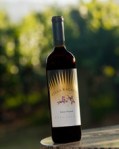 Next wine comes from another California winery I never heard of – Villa Ragazzi. The web site modestly advertises Villa Ragazzi Sangiovese as the best Sangiovese produced in Napa Valley – may be it is, I will let those who tried it be the judge.
2012 Villa Ragazzi Sangiovese “Napa” ($36) – 2012 vintage is not available at the winery anymore, and according to wine-searcher, there is only one shop in US which offers it at $39. The winery offers 2013 vintage at $36 per bottle – with the total production of 112 cases, I can imagine that this wine is pretty hard to find anywhere.
 The last wine on the list comes from the one of the most iconic producers in the USA – Ridge Vineyards. Ridge Vineyards needs no introduction to the wine lovers, producing cult Cabernet Sauvignon wine called Monte Bello and the range of Zinfandel wines from the number of appellations in California, plus many other wines.
2014 Ridge Vineyards Zinfandel “East Bench” ($25 – $30) – 2014 is the current vintage of Ridge East Bench Zinfandel, so all the information is readily available on the winery web site. According to wine-searcher, this wine can be found in many shops, in the price range of $25 to $30.
There you are, my friends – 3 California wines, hand selected for the State Dinner. I’m curious if the sparkling wine will be served before the dinner, and what would be the choices of dessert wines/drinks, assuming those will be served as well – but at this point we can only speculate about those.
Have you had any of these wines? What do you think of the wines, both on their own and as a choice for the State Dinner event? What do you think of intended pairings? Cheers!
One on One With Winemaker: Ken Wright of Ken Wright Cellars
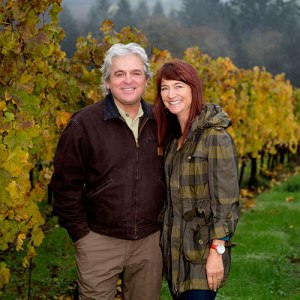
Source: Ken Wright Cellars
Grape grower. Pioneer. Visionary. Winemaker. Mentor. Teacher. Philanthropist.
It makes perfect sense to start our “Stories of Passion and Pinot” series by conversing with Ken Wright. After starting making wines in Willamette Valley in Oregon in 1986, Ken came to the realization of a tremendous diversity of soils and microclimate conditions in the region. Ken was instrumental in establishing 6 AVAs in the region; he also focused his winemaking on showcasing terroir through single-vineyard bottlings. The rest is the history which you can read on Ken Wright Cellars web site and various publications, such as Wine Spectator May 2015 issue.
I have limited exposure to Ken’s wines – the production is small, and there are lots of people who love to drink his wines. But even my limited encounters resulted in long-lasting impressions – and not only the wines but also the labels which you need to see only once to remember forever. Thus when I had an opportunity to ask Ken a few questions, albeit virtually, I was very happy to do so – and the outcome of our conversation you can see below. This might be a tad long, so arm yourself with a nice tall glass of Pinot – and enjoy!
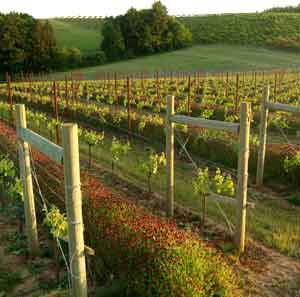
Source: Ken Wright Cellars
- When it comes to the winemaking, is there someone who you would name as your mentor or a teacher?
KW: My first position was in California and included working with Dick Graff of Chalone on their Gavilan brand. Dick started a research group, in 1979 I believe, that met once a month at Mount Eden Vineyards. The group included many of the best wineries in the state including Mt. Eden, Kistler, Calera, Sanford, Acacia, Forman, Chalone and the Paragon group among others. The opportunity, as a novice winemaker, to be part of that group of successful producers allowed me to be part of cutting edge winemaking discussions. Ears were perked, respectfully my mouth was generally closed. I was a sponge.
- As a pioneer and a long standing and successful winemaker, I’m sure many young winemakers look up to you and want to learn from you. Are there any winemakers who you would call your students?
KW: Once I moved to Oregon, in 1986, to pursue the production of Pinot noir I had a learning curve to understand the new area that I was in. During those early years I fell in love with the ability of Pinot noir to connect myself and our buyers with the qualities of individual sites. After blending sites for several years I began in 1990 to produce site specific wines that connected us to place.
In the mid 90’s I was part of a group we created, quite similar to the California research group, that focused on research both in the vineyard and winery. My partners were Bethel Heights, Cristom, Solena and Penner-Ash. Beaux Freres joined at a later date. Our experiments provided a volume of information that I believe changed the way in which we all grew grapes and made wine. That information was openly shared with anyone who cared to ask. Many viticulturists and winemakers are now approaching their craft with the lessons we learned whether or not they are aware of where this information came from. I would not want to take any personal credit for the success of those that have benefited from this work or from my many direct relationships. Information comes from so many sources. If I have benefited someone along the way that would be great but I would only be one of many.
- You personally helped to define 6 AVAs in Oregon. Do you think there are still areas in Oregon which would benefit from their own designated AVAs?
KW: It is a natural evolution for regions to define themselves. All areas must first identify which wine varieties have inherent superiority. It’s a process. What is clear at this time is that the Willamette Valley, particularly the area of the six new AVA’s, is world class. We are producing Pinot noir that is riveting. While there are regions that can say they are older there is no area on the planet that can say they are better, period. I suspect there will be new AVA’s within the six new identified AVA’s that will further define each region in more detail.
- In the description of the Freedom Hill vineyard, there is a mention of Phylloxera. How did it come around? How difficult was it to contain it and deal with it? Is that the only one of your vineyards which was affected?
KW: Phylloxera reared its ugly head in 1990 at Fuqua Vineyard in the Dundee Hills. With the first inexpensive own rooted plantings of Eyrie in 1966, the industry coasted until this time with the hope the blight would never come. But it did. It is impossible to know what the source of the “infection” may have been. This was an older vineyard so unless they were purchasing replacement vines on a regular basis from a nursery that had an issue it would be hard to assign blame on the source of vine material. Not impossible though.
Phylloxera became real in the mid 90’s. Freedom Hill began to fail. Guadalupe began to fail. Shea began to fail. There were a number of others. Vineyard owners, hoping to forestall the infection, did whatever they could to protect their sites. At the time the concern was that the insect was being transferred on soil. We had chlorine foot baths. Incredible cleaning of vineyard equipment. It did not help. It is only my opinion but I believe most of the “infection” was directly from the replacement vines from nurseries that had the bug in their soil material that came with new or replacement vines.
- Can you make parallels between any of your vineyards and Burgundy vineyards, in terms of wines which they are capable of producing?
KW: Burgundy could only hope to make wine that consistently produces the quality of wine that we produce. They are in our rear view mirror. It’s sad that people automatically assume age of region is related to quality. Do truly blind tastings and you will not be able to assign label prestige to the result.
- Same question regarding your wines – would you compare any of your wines with any of the wines from Burgundy, and if yes, which with which?
KW: If there is any comparison I would say that Oregon Pinot noir has a perfect fresh fruit profile. Burgundy tends to be more acidic, angular in youth and less forward.
- It seems that you only produce Pinot Noir from all of the vineyards you are working with, and the only white wine you are producing comes from Washington. Is there a reason why? Have you ever thought of planting white grapes in Oregon?
KW: As a business, anything we produce that is not Pinot noir is harder to sell and less profitable. The entire world recognizes the quality of Pinot noir from our region but no other variety resonates. We have a half acre of the Chardonnay Dijon 548 clone at Savoya. It is delicious but only sold to our mailing list. We will not plant more Chardonnay in my lifetime.


- I find your wine labels fascinating. How do you come up with the designs? Are you making those yourself or you are working with an artist? Do you change any of the labels from vintage to a vintage?
KW: The artist that created our labels is David Berkvam, a Portland native. He is a dessert chef at a local Italian restaurant named Geno’s. The original artworks are 100% beeswax carvings. Incredible depth that we attempt to relay on paper. Our relationship with David began with seeing his work at a gallery in 1999 in Portland.
Our original label for Ken Wright Cellars was a clean, straightforward text only label. It was not memorable or noticeable. My wife Karen and I decided to make a significant change to the look of our label. We asked David to produce a label that showed the efforts of the Mexican laborers in our vineyards during the difficult time of winter pruning. There was no other labor that would do this work. Yet the Mexican women and men who did this work did so with graciousness and humor. That was our first label with David. Now each vineyard has its own artwork from him and each is quite personal for us.
- What is your approach to the oak aging? For how long do you typically age your wines? What type of oak do you use most often?
KW: Unfortunately, we have to use French oak for our wines. Would prefer to buy from the US but our native oak species are very resinous which does not rhyme with Pinot noir. Pinot noir spends 11 months in oak before bottling.
- Based on the information on the web site, your general philosophy around winemaking is “minimal intervention”. Did you ever consider going into organic or even biodynamic wine production?
KW: Winemaking has nothing to do with your farming approach. Yes, the winemaking at the highest level is minimal intervention, assuming a very high level of professional babysitting. All inherent quality comes from the vineyard. Any winemaker at the highest level knows they are subservient to the quality of what they receive.
- You’ve been making wine in Oregon for the very long time. Did you have any scary (okay, most difficult) moments you can share with us?
KW: The beauty of our area is that we do in fact have “vintages”. No robotic wines. The year is reflected in the wine. A great example of a “scary” vintage was 1991. A cool year that produced wine that was at first reticent. With age this vintage proved to be perhaps the best of the decade for most producers.
- Among all the wines you made in Oregon since the beginning, can you share a few of your most favorite vintages and particular wines?
KW: 1990 was the best vintage I have seen in Oregon. An unusual year in that it was amazing for so many regions in the world, Germany, Italy, Champagne, Burgundy and more.
- Do you export your wines outside of the US? If yes, what are your top export destinations?
KW: We export to all provinces of Canada, Sweden, Switzerland, Denmark, France, Italy, Japan, China, Singapore, Hong Kong, Puerto Rico, the Bahamas, South Korea and of course Luxembourg.
- Today, Oregon wines are well known and well recognized by the wine lovers. What is ahead for the Oregon wines? What are the latest trends and new directions for the Oregon wines?
KW: We will always hang our hat on Pinot noir because we truly have a world treasure with this variety. As world markets emerge we will find a place at the table in each of these markets.
- You have a very extensive list of charities you support. How do you go about deciding which charities you are going to support?
KW: Karen and I normally choose to support local charities that keep our immediate area healthy. We have hosted Flavors of Carlton for 15 years which is by far the most impactful event that keeps the pre school, after school, summer work experiences, 12 sports programs and more financially sound. We are founding sponsors of Salud, started in 1992, which is a combined effort of Wineries, hospitals, clinics and Medical Teams International that has provided health care for vineyard workers. Karen and I were the initial 50K endowers of the local Community College program for their vineyard curriculum.
We partnered with the local FFA Alumnae, High School FFA teacher, YC Board, the curriculum writers from the local college and members of our AVA board to create a path for our local young people to get real world experience in growing grapes. We created a 1.5 acre vineyard on the high school property so they would have real world experience, not book knowledge.
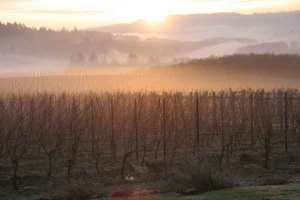
Source: Ken Wright Cellars
We are done – and I hope you are still here, as there was a lot to read (and I thank you for that). Hope you found this interesting, and now have an increased desire to drink Ken Wright Cellars Pinot Noir (good luck with that unless you already have one in your cellar). I also believe that this was an excellent opening into our Stories of Passion and Pinot – you can clearly feel passion and pride in every word of Ken’s answers…
We will continue our series next week, so for now – cheers!
To be continued…
P.S. This post is a part of the “Stories of Passion and Pinot” series <- click the link for more stories.
WBC16: Day 2 – Speed Tasting, Reds
A few days ago I told you about the live blogging session at the Wine Bloggers Conference 2016, dedicated to the White and Rosé wines. On the second day, we had a similar session, only now dedicated to the red wines. The same format – 60 minutes, 19 (or so) tables, 25 (or so) wines, 5 minutes to taste, take pictures, ask questions and share impressions in the social media, of course. Also with the higher chance of damage – clothes damage, it is, as we were dealing with red wine and time-pressed pourers. But this is part of fun, isn’t it?
Same as before, I would like to offer to you my twitter notes. Just to make it even more fun, you can compare my notes with Jim Van Bergen’s, a fellow blogger we had a pleasure of sharing the table with (alongside other great people – I think we had the most fun table in the house).
Here we go:
Wine #1: 2014 The Federalist Zinfandel Lodi ($17.76 MSRP) – very nice start for our Reds extravaganza
Wine #2: 2013 Windrun Pinot Noir Sta Rita Hills (100% Pinot Noir, blend of 5 clones from Lafond Vineyard) – nice and classic California Pinot
Wine #3: 2012 Corner 103 Zinfandel Dry Creek Valley Sonoma County – clean and varietally correct
Wine #4: 2012 Prie Vineyards Zinfandel Lodi – another excellent Zinfandel
Wine #5: 2012 Trione Vineyards Henry’s Blend Alexander Valley (35% Cabernet Sauvignon, 34% Merlot, 13 % Petite Verdot, 13% Cabernet Franc, 5% Malbec) – a welcome deviation from Zinfandel, a classic Bordeaux blend. I also realized that my tweet didn’t have the picture, so picture is now included:
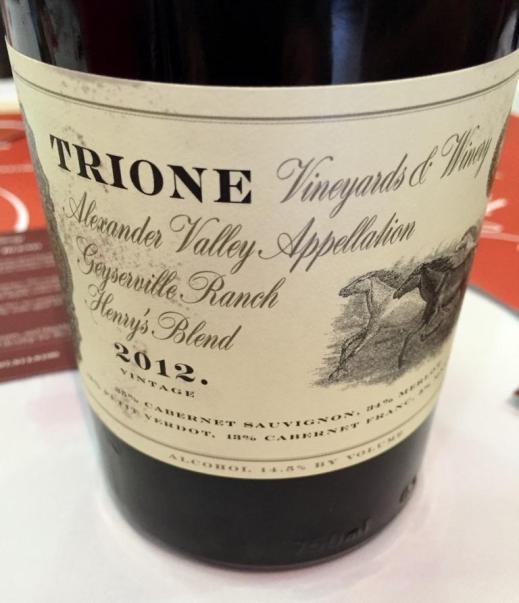
Wine #6: 2013 Peirano Estate ‘The Immortal’ Zin Old Vine Zinfandel (120 years old vines!) – if anything, the age of the vines commands utmost respect. Note that my tweet incorrectly puts the vintage as 2012, where it is 2013 (I blame it on the speed).
Wine #7: 2013 Klinker Brick Farrah Syrah Lodi – an excellent rendition of one of my most favorite grapes
Wine #8: 2013 Abundance Vineyards Carignane Lodi (90% Carignane, 10% Petite Sirah)
Wine #9: 2014 Oak Ridge Winery OZV Old Vine Zinfandel (Zinfandel/Petite Sirah blend) – Number one selling Zinfandel in California and a great value at $10.99
Wine #10: 2013 Harney Lane Old Vine Zinfandel Lizzy James Vineyard Lodi – one of the best Zinfandels in the tasting
Wine #11: 2013 Michael David Winery Inkblot Cabernet Franc Lodi – in the land of Zinfandels, we finished tasting with an absolute standout of 100% Cabernet Franc – you have to taste it for yourself
Here we go, folks. As you can tell, I can’t even count – we had 11 wines and not 10 during these 60 minutes, but yes, it was lots of fun. And I’m far from being done talking about Wine Bloggers Conference 2016 in Lodi.
Until the next time – cheers!
Stories of Passion and Pinot
An important note: Stories of Passion and Pinot is a series that was started in 2016 and it keeps updating year after year with new stories. This post will serve as the starting page for the series and will be constantly updated as new stories are added…
It is easy to declare this grape a king. It is a lot more difficult to have people agree to and support such a designation. And here I am, proclaiming Pinot Noir worthy of the kingship, despite the fact that this title is typically associated with Barolo (made from Nebbiolo grape) or Cabernet Sauvignon.
Barolo might be a king, why not – but its production is confined strictly to Italy, and can be considered minuscule in terms of volume. Cabernet Sauvignon is commanding attention everywhere – but I would argue that it is more because of the ease of appeal to the consumer and thus an opportunity to attach more dollar signs to the respective sticker. Don’t get me wrong – I love good Cabernet Sauvignon as much or more than anyone else, but having gone through so many lifeless editions, I developed a healthy dose of skepticism in relation to this noble grape.
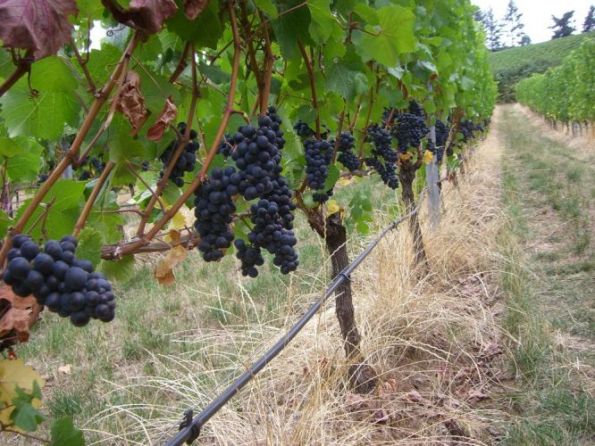
Pinot Noir grapes. Source: Vidon Vineyard
Talking about Pinot Noir, I’m not afraid to again proclaim it a king. If anything, it is the king of passion. Hard to grow – finicky grape, subject to Mother Nature tantrums, prone to cloning, susceptible to grape diseases – and nevertheless passionately embraced by winemakers around the world refusing to grow anything else but this one single grape – a year in, year out.
Historically, Pinot Noir was associated with Burgundy – where the love of the capricious grape originated, and where all the old glory started. Slowly but surely, Pinot Noir spread out in the world, reaching the USA, New Zealand, Australia, Chile, and Argentina – and even Germany, Italy, Spain, Canada, and South Africa are included in this list. Looking at the USA, while the grape started in California, it then made it into Oregon, and now started showing along the East Coast, particularly in Hudson Valley.
I don’t know what makes winemakers so passionate about Pinot Noir. For one, it might be the grape’s affinity to terroir. Soil almost always shines through in Pinot Noir – it is no wonder that Burgundians treasure their soil like gold, not letting a single rock escape its place. While soil is a foundation of the Pinot Noir wines, the weather would actually define the vintage – Pinot Noir is not a grape easily amended in the winery. But when everything works, the pleasures of a good glass of Pinot might be simply unmatched.
However important, terroir alone can’t be “it”. Maybe some people are simply born to be Pinot Noir winemakers? Or maybe this finicky grape has some special magical powers? Same as you, I can’t answer this. But – maybe we shouldn’t guess and simply ask the winemakers?
Willamette Valley in Oregon is truly a special place when it comes to the Pinot Noir. Similar to the Burgundy, Pinot Noir is “it” – the main grape Oregon is known for. It is all in the terroir; the soil is equally precious, and the weather would make the vintage or break it. And passion runs very strong – many people who make Pinot Noir in Oregon are absolutely certain that Oregon is the only place, and Pinot Noir is the only grape. I’m telling you, it is one wicked grape we are talking about.
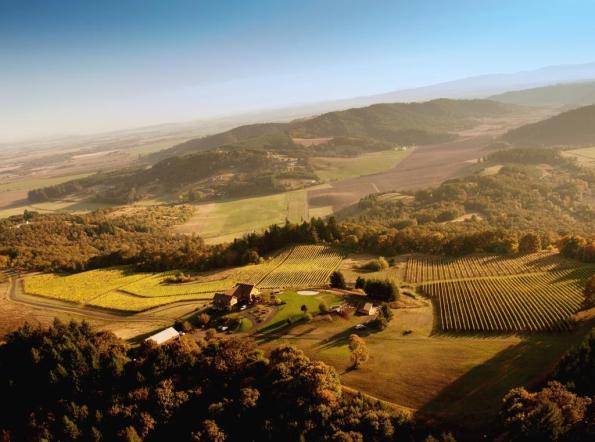
Aerial view of Oregon vineyards. Source: Youngberg Hill Vineyards
I see your raised eyebrow and mouse pointer heading towards that little “x”, as you are tired of all the Pinot Noir mysticism I’m trying to entangle you in. But let me ask for a few more minutes of your time – and not even today, but over the next few weeks.
You see, I was lucky enough to have a conversation (albeit virtual) with a few people who combined Pinot and Passion in Oregon, and can’t see it any other way. What you will hear might surprise you, or maybe it will excite you enough to crave a glass of Oregon Pinot Noir right this second, so before you hear from a pioneer, a farmer, a NASA scientist, and a few other passionate folks, do yourself a favor – make sure you have that Pinot bottle ready. Here are the people you will hear from:
- Ken Wright of Ken Wright Cellars
- David Nemarnik of Alloro Vineyard
- Mike Bayliss of Ghost Hill Cellars
- Wayne Bailey of Youngberg Hill Vineyards
- Steve Lutz of Lenné Estate
- Don Hagge of Vidon Vineyard
I would like to extend a special note of gratitude to Carl Giavanti of Carl Giavanti Consulting, a wine marketing and PR firm, who was very instrumental in making all these interviews possible.
As I publish the posts, I will link them forward (one of the pleasures and advantages of blogging), so at the end of the day, this will be a complete series of stories. And with this – raise a glass of Pinot Noir – and may the Passion be with you. Cheers!
2017 – 2020 Updates:
This Passion and Pinot Series continues to live on. Here is what had been added during these 4 years – and you should expect to see more stories as we continue talking with the winemakers who made Pinot Noir their passion:
- Page Knudsen of Knudsen Cellars
- Tony Rynders of Tendril Cellars
- Dave Specter of Bells Up Winery
- Richard Boyles of Iris Vineyards
- Tom Mortimer of Le Cadeau Vieyard
- Dan Warnshuis of Utopia Vineyard
2021 Updates:
2021 was a good year as I added one more “Passion and Pinot” interview and also met in person with a number of winemakers I only spoke with virtually before – and this resulted in Passion and Pinot Updates.
New interview:
Passion and Pinot Updates:
P.S. Here are the links to the websites for the wineries profiled in this series:
Alloro Vineyard
Battle Creek Cellars
Bells Up Winery
Ghost Hill Cellars
Iris Vineyards
Ken Wright Cellars
Knudsen Vineyards
Le Cadeau Vineyard
Lenné Estate
Tendril Cellars
Vidon Vineyard
Utopia Vineyard
Youngberg Hill Vineyards
WBC16: Day 1 – Speed Tasting, White and Rosé
One of my favorite sessions at Wine Bloggers conference is one hour of pure madness, called Live Blogging, or Speed Tasting. Everybody sit at the round tables, 8 people per table. Each table has a number. There are winemakers with their wines, and typically there are more winemakers than there are tables. Each winemaker gets exactly 5 minutes to pour and present their wines. Each blogger has this exact same 5 minutes to taste, write notes, take pictures and do whatever else they are pleased. At the end of 5 minutes, each winemaker has to move to the next table – no exceptions.
This session usually has love/hate reception from bloggers. I personally love it, and I take that “live” part of this speed tasting very seriously :), twitting about each and every wine as we get to taste them. Now I would like to present to you the recap of this session, so here are all the wines and all of the tweets as this session was evolving in the real time – you can read my notes as part of the tweet:
1st wine – NV J Vineyards Brut Rosé Russain River Valley – delicious start, don’t you think? One of my favorite Californian sparkling wine producers
Next wine: 2014 Concannon Vineyard Asemblage Blanc Reserve Livermore Valley (Sauvignon Blanc and Sémillon blend):
Wine #3: 2014 Peirano Estate Vineyards “The Other” Lodi (65% Chardonnay, 25% Sauvignon Blanc, 10% Viognier)
Wine #4: 2014 Kenefick Ranch Pickett Road White Napa Valley Calistoga (75% Grenache Blanc, 20% Maarsanne, 5% Viognier) – the winery describes this wine as “possibly the best food wine on the planet” – considering the acidity, they might not be too far off. Plus, look at the varietals used in the wine – very interesting.
Wine#5: 2015 Left Coast Cellars White Pinot Noir Oregon – had an opportunity to taste this wine before – 100% Pinot Noir and 100% White, delicious:
Wine #6: 2015 Troon Vineyard Longue Carabine Applegate Valley Southern Oregon (blend of Vermentino, Viognier, Marsanne and Roussanne)- I already wrote about this wine, so here was the second encounter 🙂
Wine #7: 2015 Corner 103 Sauvignon Blanc Sonoma Valley
Wine #8: NV Oak Ridge Winery OZV Rosé California (blend of Zinfandel and Chardonnay):
Wine #9: 2014 Peirano Estate Vineyards Chardonnay The Heritage Collection Lodi – very classic and an excellent value at $14.99 (mentioned in the tweet):
Wine #10: 2001 The Lucas Winery Chardonnay Lodi – this wine deserves its own post, and I wish I had time to visit the winery. This 15 years old California Chardonnay was absolutely mind blowing, deserving the highest praise. The balance and freshness on this wine were just spectacular. Might be easily the best California Chardonnay I ever had (okay – too bold – one of the best for sure):
And we are done here – 10 wines, 60 minutes, lots of fun. The red wines speed tasting took place on the Day 2, and the report is to follow.
Until the next time – cheers!
The Post Which Could Have Many Names
Blog post title is something I consider to be important, may be even essential. Good title facilitates the flow of thoughts and actually, once I get a title in and I’m happy with it, the writing usually flows effortlessly.
The post you are reading could’ve have many different titles, such as “More Creative Wine Labels”, “City Winery with Worldly Wines”, “Secret Wine Santa Over-delivers”, “Art in and of the Wine Labels”, or “Better Late Than Never” and I’m sure I would be able to come up with a few more – hence the title you see at the top. As for all of these possible titles – read on and you will figure it out.
As some of you know, there is a game of Secret Wine Santa, originated by Jeff a.k.a The Drunken Cyclist – here is Jeff’s post about it from the last year. The game, of course, is played closer to the actual Santa-related period. All participants get assigned a random recipient, who then gets from the secret Wine Santa one or two bottles of wine, preferably arriving before Thanksgiving. If you think that I have a nerve talking about Wine Santa when the temperatures on the East Coast are trailing above 90°F – well, may be I do. But I have an excuse – I always wanted to play this game twice a year, but shipping wine during summer is not good for the wine, so much for that thought – but then at least I get to talk about it (no, I didn’t plan it like that – life did).
Of course the Santa stays secret only until the wine arrives. When I opened the box, I found a nice handwritten note from Nancy Koziol, introducing me to the two absolutely gorgeous looking bottles from the winery I never heard of, called Brooklyn Oenology:
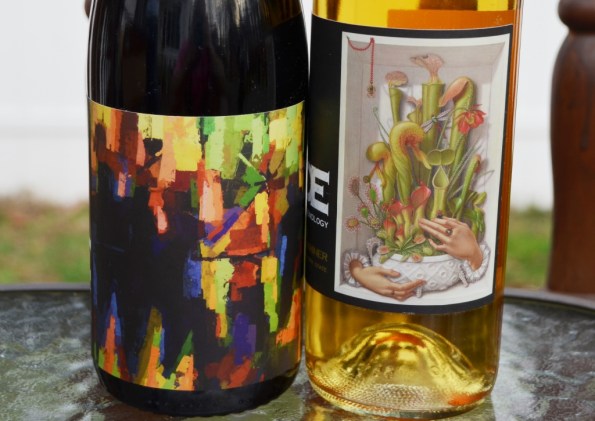
Going beyond the beautiful labels, it turned out that the wines are produced by Brooklyn Oenology, the first urban winery in the New York City – they have a tasting room open in the Williamsburg neighborhood of Brooklyn, so technically right in my backyard (still never visited them so far). Brooklyn Oenology, or BOE for short, sources their grapes from around the New York state (as you can see below in the wine descriptions) and in the future they even plan to bring actual winemaking facilities into Brooklyn.
Now, talking about the labels – not only they are beautiful, but to top that off, BOE really thought of the people like myself, who spend countless hours trying to neatly peal off the labels from the bottles for the notes journals. These labels are peel off labels – how smart is that! I can’t help it not to share this paragraph from the About page on the BOE web site:
“In addition to sourcing New York grapes, BOE draws upon the Brooklyn and greater New York areas to create its identity. Each wine’s label showcases contemporary art by a Brooklyn artist and features a new piece of work for each vintage. They’re not just for viewing; they are double-layer, easy-to-peel stickers, so the customer can preserve the artwork”.
What is most important, that these wines are not just labels – they are first and foremost, unique, different and delicious wines.
For what it worth, here are my notes:
2012 Brooklyn Oenology Gewürztraminer Finger lakes, New York (12.8% ABV, 100% Gewurztraminer, fermented with skin and seeds)
C: concentrated gold, the wine is made with the “orange wine” methodology
N: concentrated honeyed fruit initially, but then quite closed, not perfumy at all, which is usually a trait of Gewürztraminer
P: very unusual, more of a qvevri style, clean acidity, very restrained, but opens up to some nice finish with touch of fruit.
V: 8-, very thought provoking, interesting wine
2010 Brooklyn Oenology Motley Cru North Fork of Long Island, New York (13.5% ABV, 57% Merlot, 19% Syrah, 14% Petit Verdot, 5% Malbec, 5% Cabernet Sauvignon)
C: dark garnet
N: warm, inviting, ripe sweet fruit, blueberries
P: medium to full body, soft, round, fresh fruit, touch of pepper, violet, clean acidity, excellent balance, long lingering finish. On the third day the wine became even more polished. Delicious.
V: 8, an excellent bottle of wine, good for all occasions.
Here is the story of [yet again] boundless creativity and passion in the world of wine. Thank you wine Santa for this wonderful discovery – and I already can’t wait to see what next November might bring. Cheers!
Labels and Beyond – Creativity in the Wine World
There is a famous Russian saying – “meet by the clothes, part by the smarts”. Yes, I know I’m butchering the original with this translation, and typical proper analogy in English will be “Don’t judge the book by its cover” – but I wanted to emphasize that “meet by the clothes” part.
In the world of people, our first impression of the stranger is often directly related to the way the person is dressed – however, once we get into the conversation and get to know the person, the dress becomes of no importance at all – if, of course, we manage to find common ground and enjoy each other’s company. More often than not, we use clothes as a differentiator – this is our way to stand out from the crowd and get noticed – and I’m sure you all can attest – that generally works; clothes matter, especially for the first impression.
This is the wine blog, right? So let’s get to it. What are the “clothes” for wine? The bottle and the label, isn’t it? We, wine drinkers collective, are often very quick to make serious assumptions about the content of the bottle just from a quick glance at the bottle. Ahh, a cute creature? The wine must be cheap and terrible. Look at how solid this heavy bottle with black and gold label is – I’m sure the wine will be delicious. Been there, done that.
The wine today is at a pick of popularity – for sure in the US. Which means that there is more and more wine produced all the time, to the pleasure of a wine drinking public. But here also lies a flip of the silver lining – looking at the wine store shelves is overwhelming, so how can producers ensure that someone will pick the bottle of their wine? This is where the “clothes” come to the play – all other things been equal, the label and the bottle are the only differentiators winemaker got (the brand recognition of course will be superior to the label differentiators, but we should put it aside for the sake of this post). What I’m observing lately is an explosion in creativity in the wine labels, names of the wines and even the bottle shapes (or overall packaging, such as “wine in the can”). And this is what prompted this post – over the month, I came across a few wines which I felt I just wanted to share with all of you.
Here is the first one – Honoro Vera Grenache. When I saw the bottle, it was an instant “wow, that looks beautiful” – I must try it. The fact that it was Spanish Grenache (hard to go wrong with), priced at $7.99, make that decision even easier. And the wine didn’t disappoint with fresh core of the dark fruit and mocha – round and delicious.


The love of the next label might be giving away my age – but this “post card formatting” somehow always attracts my attention, as the nod to the times when people actually used paper and their hands to write, and not only to type. One look at the bottle and I knew I had to get this Bob’s Pinotage from South Africa – and of course at $6.99, the risk was minor. Pinotage used to have a lot of bad rap in the past, but this wine was delicious – fresh strawberries, hint of gaminess, medium to full body, good balance – excellent food friendly wine.


How about the label which takes guessing out of the wine enjoyment? The label on this Rosé La Princess from Provence will change when the wine will be chilled to the suggested drinking temperature, and will definitely encourage you to drink it. One would’ve thought that this is too gimmicky (and I did), and to my delight, I found classic, gentle, strawberry driven, perfectly refreshing wine in this bottle. All for $11.99.


We all know that wine and flowers make perfect gift for anyone. How about the wine which essentially includes flowers? How I mean, you ask? Take a look below – this Côte des Roses bottle features the bottom which looks like a perfect Rose flower. Going all the way, take a look at the pink glass enclosure – isn’t it beautiful? And the best part is that wine itself is a beautiful Rosé – restrained, delicate, tart and refreshing. And despite the overindulgent bottle, the wine retails for the same $11.99 – a great value for Rosé if you ask me.


Let me finish this labels galore with a series belonging to the wine called Machete Red. This wine is produced by the legendary Dave Phinney, and each case sports 12 bottles with 12 different labels – from the same theme. I didn’t have an opportunity to taste this wine, and it retails for quite a bit more than any of the wines I mentioned before ($45.99), so in this particular case I can’t tell you if content of the bottle matches the creativity on outside – but I surely hope it does.

That’s all I have for you for today. What are your creative label discoveries? Cheers!
Last Bottle Sign Up ($10 credit)




 Talk-A-Vino