Archive
Valentine’s Day 2025 – Reflecting on Wines
In my previous post, I complained about frustration with choosing the right wine for the right moment. That post ended with a picture of the wines I selected for Valentine’s Day 2025 – and now I want to talk about those wines.
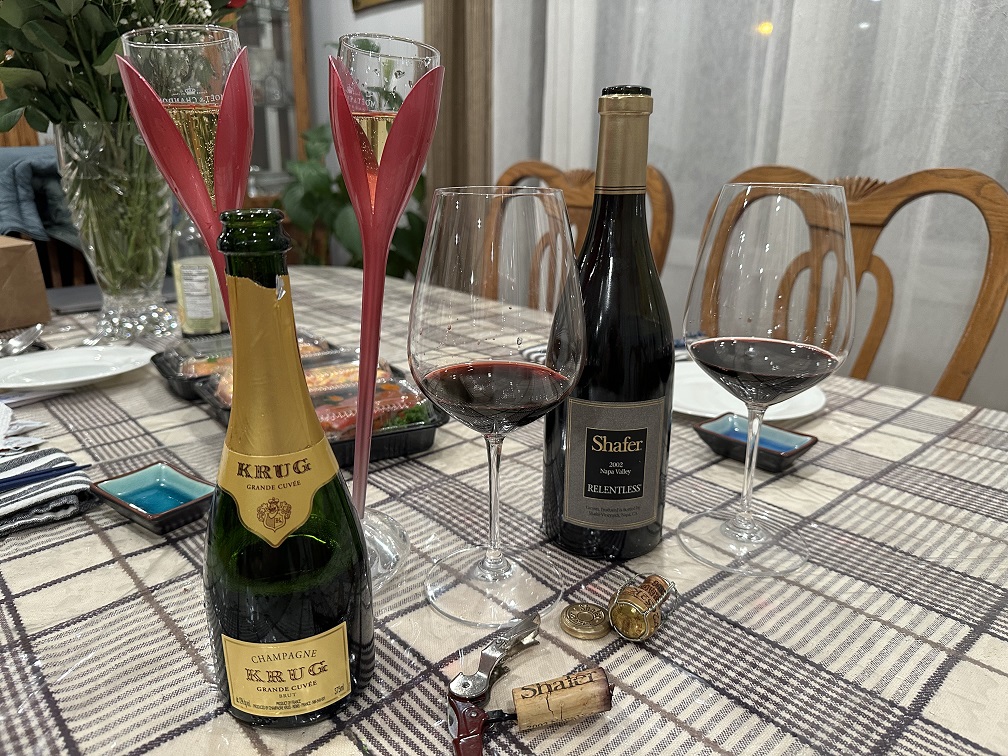
Following my own advice, our first wine was sparkling. Not just any sparkling – it was Champagne. And not just any Champagne – it was Krug.
I don’t want to sound elitist, but the only way to put is this: those who know, know Krug.
For the wine lovers en masse, the epitome of champagne is Dom Perignon. Maybe also Crystal on a good day. Krug definitely is lesser known, but for those who know, Krug is a cult, a religion, the only Champagne one can drink.
I joined that cult after experiencing Krug vintage and non-vintage wines during the PJ Wine Grand tasting in New York in 2010. Krug was an absolute revelation, I have never tasted anything like that ever before.
Then a few years later, in 2012, I came across an article by Alice Feiring, talking about changes in winemaking at Krug in 2003 which she said resulted in more or less the “end of Krug”. I referred to her article in my post, but unfortunately, the original article can’t be found so I can’t share any more details. I only remember tasting Krug at the trade tasting in the same year or maybe the year after, and thinking “well, it is not as good as I remembered it“.
Trade tasting is not always the best place to fully understand the wine, so Krug remained high on my “wines I want” list. Then a few years back, I got this half-bottle of Krug as a present for the new year, and this year I decided that Valentine’s Day is a perfect reason to open that bottle.
After struggling a bit with the cork, I managed to get the wine into our flutes (I know, I know – but it is a holiday, okay?). Smelling and tasting it left both me and my wife underwhelmed. Crisp and acidic for sure, but that’s what literally every other Champagne has, and Krug should really give you more. A few more sips and I closed the bottle, and back into the fridge it went.
Not so long ago, I read an article from a champagne pro, and he suggested that Champagne, similar to any other still wine, can and usually improves after opening. It can be placed into the fridge and enjoyed slowly over the next few days, and many of the Champagnes simply taste better the next day.
Why is this important? When I poured what was left of Krug into the glass the next day (okay, it was a regular glass), that was a totally different wine. Rich, layered, with toasted bread and apples. This was the real deal and it was delicious. I can’t tell you if it tasted like the one I was blown away by in 2010, but it was definitely an excellent Champagne. I guess there is an interesting lesson here for future encounters with Champagne, and not only with Krug.


After Krug’s image was somewhat restored in my eyes, I decided to learn more about the wine. Nowadays every bottle of Krug comes with its own unique code. When you go to the Krug website and type in the code, you get the most detailed information about the wine you can wish for – here are a few excerpts related to my bottle:
“Krug Grande Cuvée 170ème Édition
Composed around the harvest of 2014, Krug Grande Cuvée 170ème Édition is a blend of 195 wines from 12 different years. The youngest is from the year 2014 and the oldest dates back to 1998.
In all, reserve wines from the House’s extensive library made up 45% of the final blend, bringing the breadth and roundness so essential to each Édition of Krug Grande Cuvée.
The final composition of this champagne is 51% Pinot Noir, 38% Chardonnay and 11% Meunier.
Time in the cellar:
This half-bottle spent around 7 years in Krug’s cellars developing its generosity and elegance, receiving its cork in Autumn 2020.”
According to Julie Cavil, Krug Cellar Master:
“In this blend, the dynamic Pinot Noirs of 2014 came from a wide range of plots throughout the Champagne region, while fruity and full-bodied Chardonnays were selected from plots in the Montagne de Reims, Sézannais and Côte des Blancs. The Meuniers from the Vallée de la Marne Rive Gauche were particularly bright, with magnificent fruit expression from plots in Leuvrigny. To complement the wines of the year, we selected reserve Pinot Noirs from plots in the Montagne de Reims Sud renowned for their structure, including an Ambonnay from 2005. Reserve Chardonnays from plot’s wines from Avize and Mesnil-sur-Oger over a wide spectrum of years have a nice share of voice in this blend, while reserve plot’s wines of Meuniers add freshness, intensity and chiselled structure.”
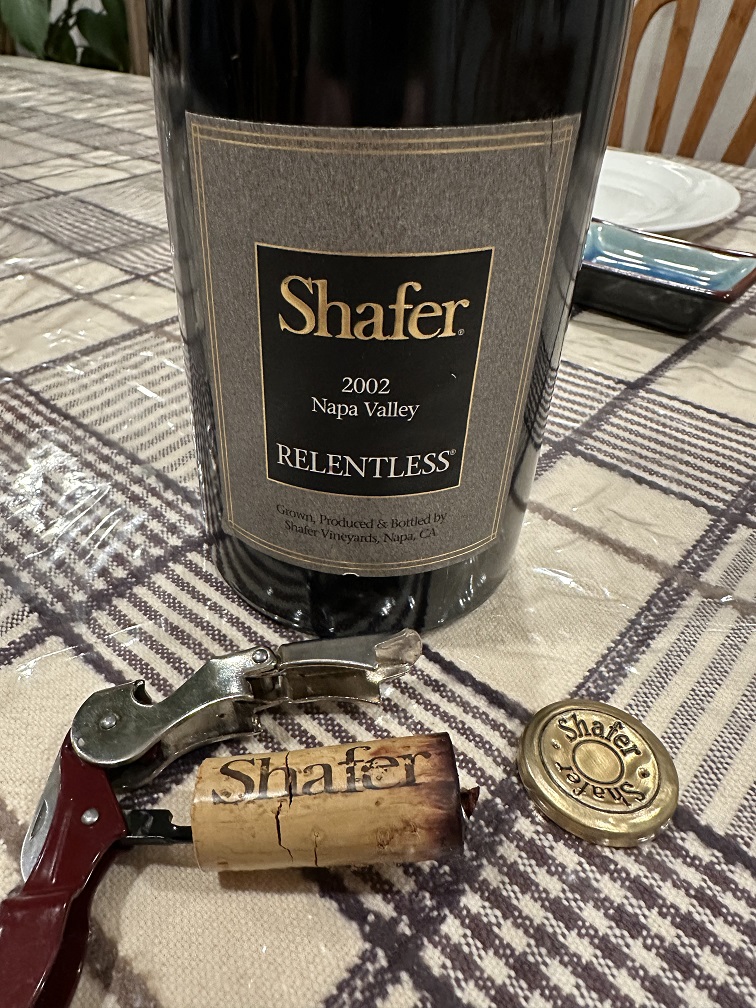
And then there was 2002 Shafer Relentless Napa Valley (14.5% ABV, 80% Syrah, 20% Petite Sirah). I tasted this wine a few times before at the trade tastings, but never had an opportunity to really spend some time with it.
Shafer needs no introductions to California wine lovers, with its fame closely associated with the flagship wine, Shafer Hillside Select Cabernet Sauvignon. Shafer Relentless is not as well known, but this Syrah blend has been around for more than two decades, named in honor of Shafer’s [relentless] winemaker, Elias Fernandez.
We didn’t decant the wine – it would probably help a bit, but I just didn’t want to deal with it. At first, the wine was tight, with well-noticeable tannins and an interplay of tar and cherries, with the addition of pepper. After some time in the glass and opened bottle, the tar subsided, leaving delicious peppery cherries to be admired around a layered but firm core. This 23 years old wine showed beautifully and it was a real treat.
Now the last piece – food. We stopped going out to the restaurants on Valentine’s Day a long time ago – the experience just not worth it. We were craving sushi for some reason, so that is what completed our Valentine’s Day dinner – here you can see some creative rolls from an Asian restaurant not too far from our house.


There you are my friends – our V-day reflections. How was your celebration? Any special wine experiences? Do tell! And until the next time – cheers!
Frustration of the Oenophile – Choosing Wine
First-world problems, I know. Nevertheless, let’s talk about them.
I guess we, oenophiles, are tender creatures. Doesn’t take much to get us frustrated. Wine not tasting the way we expect; not enjoying critic’s choice 100-points wine; close friends not sharing your excitement about the wine in the glass. We can go on and on about these little insignificant things, each one a source of the full-blown frustration. Oenophile’s frustration looks different every day. And mine right now might be the biggest one of all (remember – taste is subjective, so are the feelings) – inability to choose the wine.
Assuming I will be able to finish this post today, tomorrow we are celebrating Valentine’s Day – and what says “I love you” better than a luscious, voluptuous, sexy, and seductive bottle of wine? Forget flowers, flowers don’t stand a chance against such a bottle of wine. But what wine will be luscious, voluptuous, sexy, and seductive? The need to choose that wine properly becomes the cause of the ultimate frustration. But that’s not all, because merely in a week we have to deal with OTBN – Open That Bottle Night – and this is the ultimate “oenophile frustration” cause, as now we need to decide what bottle we kept not opening waiting for a special moment which might either never arrive or already be in the past?
Decisions, decisions, decisions. Trying to select the right bottle of wine for the occasion, you have only a few minutes to agree with yourself on the proper bottle. If you will not arrive at the decision within those few minutes, the next 2, 3, 4 days will be miserable. You are going to pull a bottle, look at it, think about it for a moment, sigh, and put it back. Then repeat the process over and over again, pretty much until you force yourself to feel that you got the right bottle. Possibly to change your mind again in a few hours, or even 20 minutes before the bottle needs to be opened. If you are an oenophile, and you are not going through this pitiful “decision paralysis”, I envy you and congratulate you. And for the rest of us – I share your pain.
So what wine should you select for Valentine’s Day? I already told you – it should be luscious, voluptuous, sexy, and seductive – or not. Of course, there is a big dependency on the food, but don’t try to achieve a perfect match – it’s okay to enjoy your food and wine independently. I have to say that I’m not a big fan of still Rosé wines for Valentine’s Day – yes, it matches the pink color of all the all V-day paraphernalia – but it might not deliver the pleasure you are looking for. I also would suggest avoiding “thought-provoking” wines – rare grapes, natural wines, skin-contact wines, wines from the forgotten corners of the Earth. On a normal day, I’m the first one to ask for an obscure wine, but for Valentine’s Day, wine should give you pleasure, elevate your mood, it should be easy to understand. If upon the first sip you will not say “ahh, this is good”, you’ve chosen the wrong wine – put the cork back and go fetch another bottle.
I love to have bubbles for Valentine’s Day – of course, nothing can beat the classic Champagne (and it perfectly can be pink), but you can’t go wrong with Cremants, Franciacorta, Trento DOC, Cava, and all other méthode champenoise wines. If you like white wines, Chardonnay is your best choice of white V-day wine, pretty much from anywhere in the world, as long as it is not a lifeless purposefully unoaked rendition.
And then, of course, the red. Ideally, the red should have an age on it, to truly deliver all that pleasure upon a first sip. Amarone, Brunello (I would avoid Barolo unless you perfectly know what you are doing), Cabernet Sauvignon and Bordeaux/Cabernet blends, Super-Tuscans, Spanish Grenache, Rioja from a good producer, Syrah and Zinfandel. I’m not trying to make other wines feel bad, but for Valentine’s Day, this is what I would pick from.
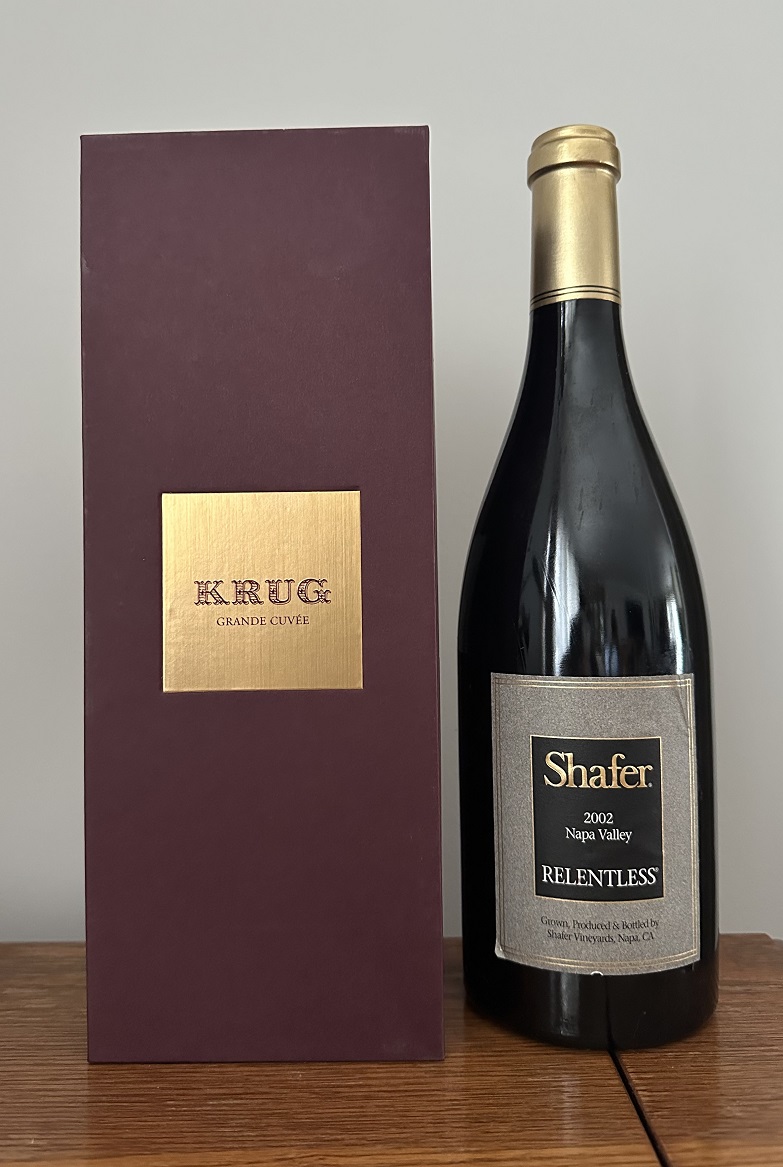
Here is actually what I picked – Champagne and Syrah from California – and I will tell you all about it later on.
If you thought selecting wine for Valentine’s Day was frustrating, it is nothing in comparison with selecting the wine for OTBN.
OTBN (Open That Bottle Night) was invented in 1999 by Dorothy J. Gaiter and John Brecher, writers behind the Wall Street Journal’s wine column at that time. The purpose of the OTBN, which is always celebrated on the last Saturday in February, is to encourage wine lovers around the world to open that special, stashed far away bottle. We all have those bottles that can be categorized as “not today”. These wines typically exist in single quantities in our cellars and always have a memory attached to them.
This is what makes the selection process very difficult – to open or not to open? I have only one such bottle. What if I open it too early – I will never know how amazing it could become over the next 10 years? Once I open that bottle which was gifted by a dear friend, brought back from the amazing trip, acquired in the moment splurge, will my memories be lost forever? Should I just hold on to that bottle instead? Will I open this wine in the right company? Will people truly appreciate the sacrifice I’m making?
Frustrated, frustrated oenophile. It is hard to make wine decisions.
I hope you got my point. And I hope I helped you, at least a tiny bit, to select a proper bottle of wine, at least for Valentine’s Day. And please don’t ignore the OTBN – the right time to open a special bottle of wine is now – you never know, tomorrow the wine might be gone, or you might be gone. Truly, live in the wine moment – at least on the last Saturday in February.
Do you have frustrated oenophile moments of your own? Please share! And I wish you a happy, quick, and not-frustrating-at-all wine selection process, for all the special moments to come. Cheers!
Pinot Noir Battle – Let the Best (but Most Unexpected) Win…Again
It all started with a few tweets. I noticed a very high praise for the German Pinot Noirs shared by some of the European wine lovers I’m connected to on Twitter (still can’t make myself call it X, so you will have to forgive me for that). Particularly, Pinot Noir from Ahr was regarded as the best in the world, handily beating Burgundies on any occasion. I was intrigued and started searching for the Pinot Noir from Ahr, which proved to be challenging.
Ahr is a tiny region, one of the smallest in Germany – according to Wines of Germany, Ahr has only about 529 hectares of vineyards (around 1,323 acres), which comprises 40 single vineyards. 65% of the vineyard area is planted with Pinot Noir, about 860 acres – for comparison, the Jackson Family mostly Pinot Noir plantings in Oregon alone amount to roughly 600 acres. You can imagine that finding Pinot Noir from Ahr in the US was rather challenging.
The more I saw Ahr Pinot-praising tweets, the more I wanted to try it. Then one day I checked Wine.com, and there it was – Pinot Noir from Ahr, made by Meyer-Näkel. I quickly went to the Twitter folks to check if this wine would sufficiently represent the Ahr region, got an approving nod, and bought a bottle.
Once the wine arrived, I thought of the best way to try it. When it comes to learning about wine, tasting wines side by side is the best way to learn. Oh yeah, and if you want to be honest with yourself, blind tasting is the only way. We tend to be led by what we know, by our beliefs. Once we know that the wine costs $100, we want to believe that it is better than the bottle which costs $50. Once we see a bottle of Cabernet Sauvignon from Napa Valley in California, we automatically assume that it will be much better than the Cabernet Sauvignon from Lake County or Lodi. Nothing is wrong with us, this is how the brain works – so once you remove all the factors of influence, once you get one on one with the liquid in your glass without knowing the producer, the region, the price – it is very easy to be honest with yourself. So blind tasting it is.
Sometimes we don’t realize how fast the time passes. I love talking about blind tastings when I’m talking about wine, and I have a few of my favorite blind tasting examples, one of them particularly being the Pinot Noir blind tasting we have done in the past. What I didn’t realize is that the particular wine tasting I remember so well took place almost 15 years ago (time flies, isn’t it). The outcome of the tasting was very surprising, with South African Pinot Noir from Hamilton Russell beating California, Burgundy, and others – 15 years ago I didn’t even know that South Africa produced Pinot Noir!
Many things have happened in the wine world over these 15 years – of course, Pinot Noir is one of the oldest red wines produced in the world, but now it is literally produced everywhere – I don’t know if today there is a country which doesn’t produce Pinot Noir wines (maybe Spain?). Also, the quality of Pinot Noir throughout the world got a lot higher. The tasting you are about to read about is the perfect illustration of both points – the widespread geography and quality.
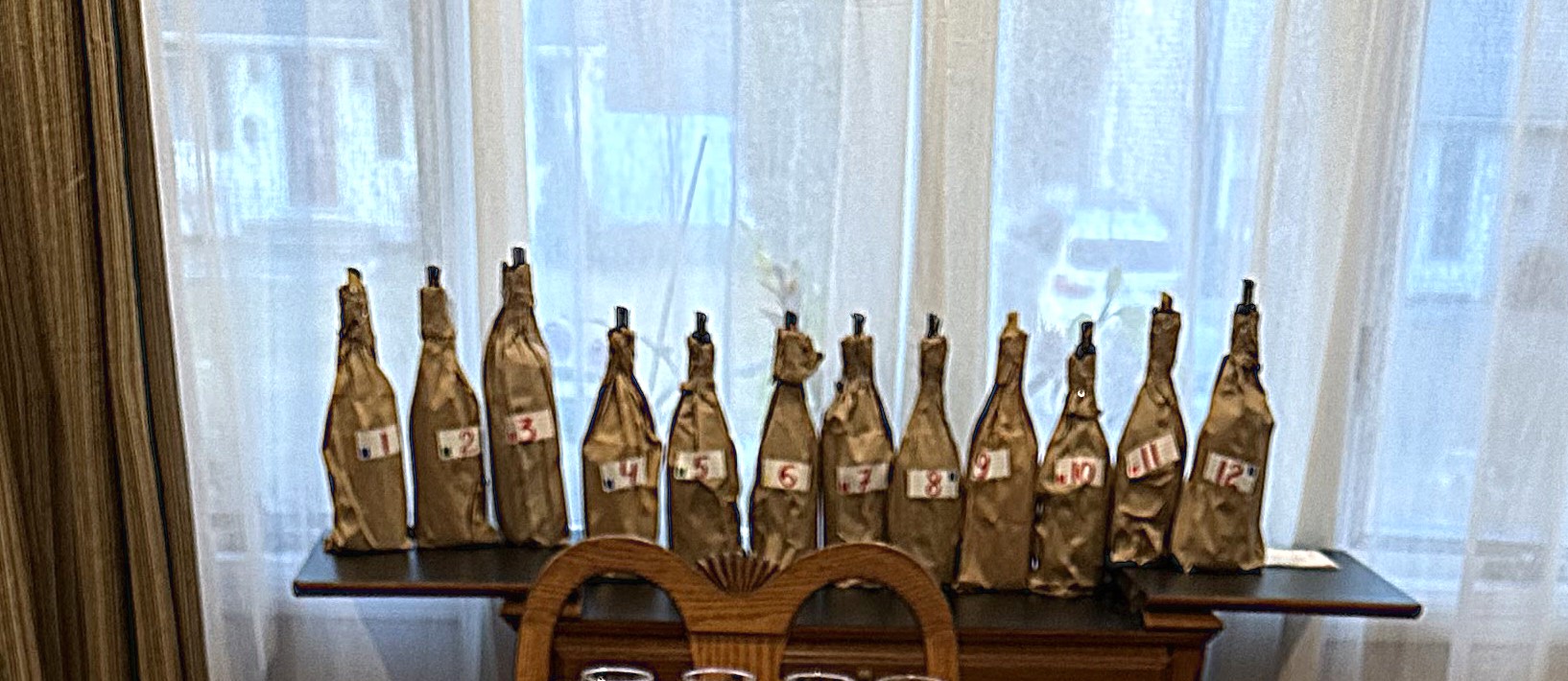
Okay, a blind tasting of Pinot Noir. The Ahr Pinot Noir got high praise, so we need to compare it with the best of the best – which means that we have to have California, Oregon, and Burgundy in the tasting, plus whatever else we might be able to find. I asked for a few samples of Oregon Pinot Noir. Very conveniently, Last Bottle had an offer for Chacra Pinot Noir from Patagonia – a different Pinot Noir from Chacra was James Suckling’s wine of the year recently, so this was a good addition to the tasting. Bottle by bottle, we assembled 12 Pinot Noirs from around the world, and the battlefield was ready to be set up.
This is a blind tasting, so we placed all bottles in the paper bags, and then my daughter who was now a participant in the tasting put the labels randomly on the bags (15 years ago her role was limited only to attaching the labels :)). I also prepared a few of the “reference points” for everybody to use in the form of the crushed fruit in the glass – I didn’t find plums in the store, but we had many other relevant “references” – cherries, pomegranate, blueberries, raspberries, blackberries, and even liquid smoke.


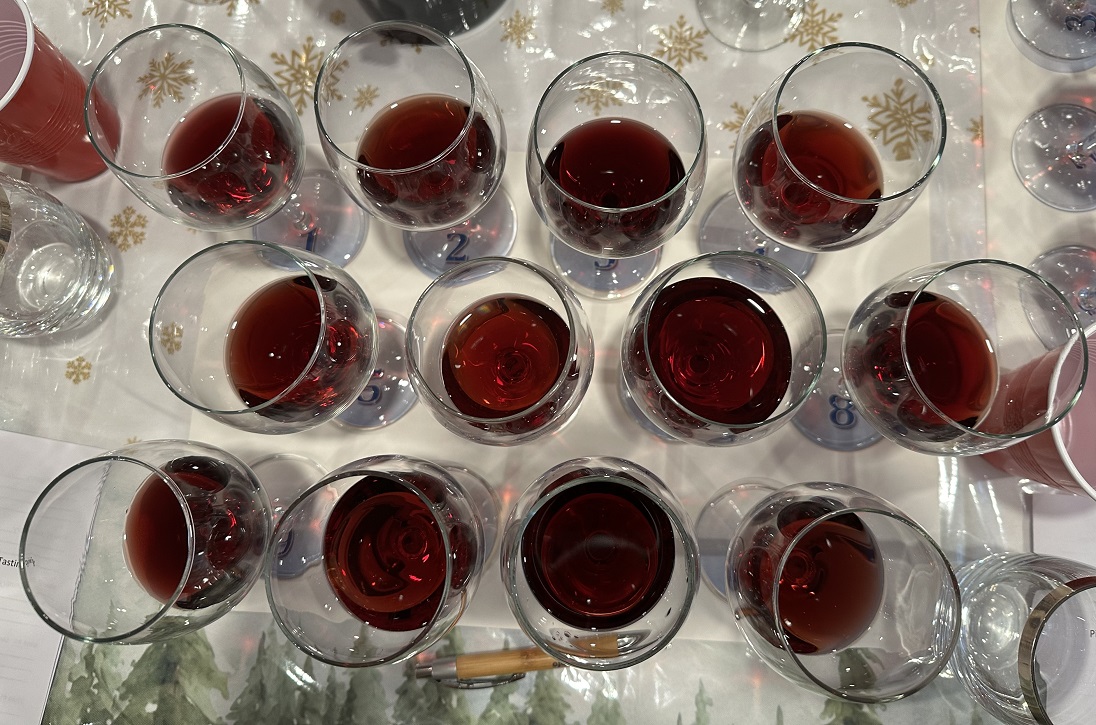
We also had paper for taking notes, and as a reference, I included all the countries that were present in the tasting so we could try guessing the countries for each wine. All countries except the two, as both Zak and I brought in one “surprise” each – Pinot Noir from the countries that are not really known as Pinot Noir producers – we didn’t know what wine the other person was bringing. Here is the list of countries that were offered for everyone’s reference: Argentina (Patagonia), California (Santa Rita Hills), France (Burgundy), Germany (Ahr), New York (Finger Lakes), New Zealand (Central Otago), Oregon (Willamette Valley, 2 wines), Poland, Washington, Surprise 1 (European country not listed above), Surprise 2.
Off we went, tasting and discussing the wines, trying to figure out what was what. Consciously tasting 12 wines in a row is not an easy fit, especially when you try to at least identify the countries. Also, each person (there were 8 of us) was supposed to decide on 3 of their favorite wines so we would be able to vote for the most popular wine of the night, so we had to score each wine. Here score is simply comparative within your notes – 1 through 5, E to A, doesn’t matter, as long as everyone can decide on their favorites.
Here are my notes for all 12 wines as the tasting was happening.
Wine #1: Country: New World (have no idea what I was thinking, I guess something outside of Europe), Vintage: 2021. Cherries, lots of cherries, raspberries, tart cherries on the palate, good balance, nice. Score: 8
Wine #2: Country: Oregon, Vintage: 2021. Iodine, cherries, tart, pepper, tannins, earthy, rocky. Score: 8+
Wine #3: Country: Poland?, Vintage: 2021. Cherries, initially fresh berries, fresh raspberries, sweet cherries, good balance. Score: 8
Wine #4: Country: Argentina?, Vintage: 2019. Gunflint, fresh, crisp, tart, rocky, cherries, excellent. Score:8/8+. Tasting again at the end of the tasting, the wine lost something, so finally score is 8
Wine #5: Country: California?, Vintage: ? Almost black color, dark, aged, medicinal nose, iodine, sweet cherries on the palate, tart. Score: 8-, after retesting later – 8, wine improved.
Wine #6: Country: Oregon? No, Vintage: ?, carrot juice on the nose, very grippy tannins on the palate, cherries. Score: 7+
Wine #7: Country: ? , Vintage: ? Beautiful color, Rutherford dust, hint of cherries, tannins and cherries on the palate, good balance. Score: 8 initially, 8+ after breathing
Wine #8: Country: Germany, Vintage: ? Love the garnet color, smoke, tar, concentrated nose. Wow! Superb – cherries, concentrated, good acidity, good balance. Score: 8++
Wine #9: Country: Oregon, Vintage: ? Pencil shavings, Rutherford dust, tannins, cherries, elegant but needs a touch more acidity. Score: 8
Wine #10: Country: ?, Vintage: ? Pomegranate seeds, cherries, very tight. Cool aid, cherry cola Score: 8-
Wine #11: Country: Finger Lakes, Vintage: ? Smoke and rubber, tar, on the nose. Rubber, tannins, cherries, became more balanced after breathing Score: 7+ initially, improved to 8 on the second tasting.
Wine #12: Country: Oregon, Vintage: ? Cherries, vegetation, cool aid on the nose. Cherries, good balance, good acidity, excellent. Score: 8+, went down to 8 after re-tasting as the finish showed sugar candy.
Ugh, this was not an easy tasting, but it was finally complete. Time to decide on favorites. First, everyone had to make their own decisions for the 3 favorite wines. After re-tasting and struggling, my list of favorites in descending order looked like this:
1st favorite: #8
2nd favorite: #2
3rd favorite: #7
Next, the vote. Remember, each person (there were 8 of us) was allowed to vote for 3 favorite wines, thus we just called the wine number and asked to see a show of hands. Here are the results.
Wine #1 – 1
Wine #2 – 5
Wine #3 – 1
Wine #4 – 0
Wine #5 – 0
Wine #6 – 3
Wine #7 – 3
Wine #8 – 3
Wine #9 – 3
Wine #10 – 1
Wine #11 – 1
Wine #12 – 3
Therefore we had a clear winner – wine number 2, and 5 wines in the second place with 3 votes each – #6, #7, #8, #9, and #12.
Next came the best and final part of the blind tasting – the reveal! Would you believe me If I told you that the revealed bottle elicited a loud “oh, wow, really” literally from everyone? Surprise after surprise after surprise.
The most popular wine? Pinot Noir from (drum roll, please)
Japan!
Seriously, Japan??? How? Yes, Japan makes wine, but to make Pinot Noir that shows better than Oregon, California, Burgundy, and all other countries? Just wow. Apparently, this is an impossible-to-get “cult” wine, produced in minuscule quantities, $100 wholesale but $300 retail if you can even find it? That was the first “surprise” wine.


Pinot Noir from Poland that was very good? How about that? My favorite wine of the tasting, Southern Lines from Central Otago, by some absolute miracle was $15 per bottle – how is that even possible (it is a case buy if you can find it at that price).
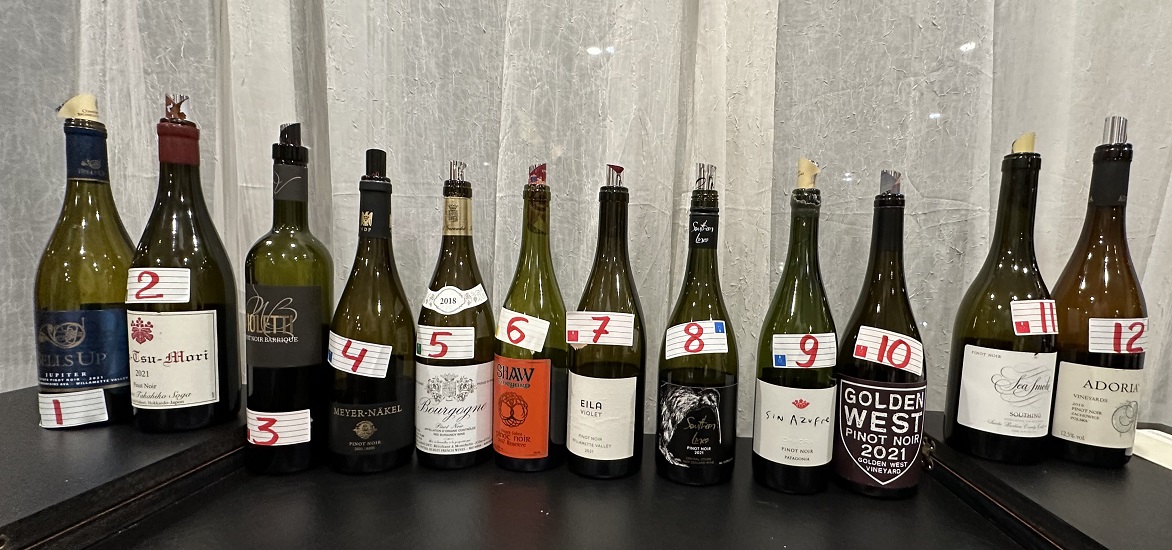
Here is the full list of wines in the numbered order:
- 2021 Bells Up Jupiter Pinot Noir Estate Chehalem Mountains AVA (13.5% ABV, $50)
- 2021 Domaine Takahiko Soga Nana-Tsu-Mori Pinot Noir Hokkaido Japan (13% ABV, $300?)
- 2022 Violetti-Rebbau Pinot Noir Barrique Vin de Pays Suisse (13% ABV, $N/A)
- 2021 Meyer-Näkel Pinot Noir Ahr Germany (12.5% ABV, $56 at Wine.com)
- 2018 Paul Garaudet Pinot Noir Bourgogne AOC (13% ABV, $39)
- 2017 Shaw Vineyard Pinot Noir Reserve Finger Lakes New York (13% ABV, $N/A)
- 2021 EILA Violet Pinot Noir Willamette Valley (12.7% ABV, $65)
- 2021 Southern Lines Pinot Noir Central Otago New Zealand (13.5% ABV, $15)
- 2022 Chakra Sin AzuFre Pinot Noir Patagonia Argentina (12% ABV, $30 Last Bottle)
- 2021 Golden West Pinot Noir Goden West Vineyard Royal Slope Washington (14% ABV, $21)
- 2011 Sea Smoke Southing Pinot Noir Santa Rita Hills Santa Barbara County (14.5% ABV, $100?)
- 2021 Adoria Vineyards Pinot Noir Zachowice Poland (12.5% ABV, $25)
You see, this is what blind tasting does. Under the guise of the brown bag, all wines are “the same”. You are not influenced by anything – “ahh, I brought this wine, it must be better”, “ahh, the guy in the store was raving about it so much”, “ahh, it got 99 points from Suckling” – none of this matters. You let your palate be the judge. Wine has to give you pleasure.


As the wines were left at my house after the tasting, I was the lucky bastard who had an opportunity to taste them over the few next days. This is not how the general population consumes wines, so this has very little bearing on the results and the whole tasting process, but I can tell you that for example, the Sea Smoke Southing became literally my favorite wine – it developed a depth of flavor and a beautiful complexity – if it would taste like that during the tasting it would be handily the wine number 1, for sure for me. The Pinot Noir from Ahr also developed additional layers, with gunflint and roasted meat notes now dominating the flavor profile in a very respectful manner, making it a lot more pleasant to drink – again, in that state it would again get a much higher rating in my book. And pretty much across the board, the Pinot Noirs continued their evolution and most of them were still drinkable even 5 days after being open – a testament to quality.
Here we are. 15 years later, the most unexpected Pinot Noir wins again. But this is the beauty of wine. The mystery, the enigma, the art. Wine is a liquid art form, and this tasting delivered an unmeasurable amount of pleasure and created new memories. This is what life is all about, isn’t it? Creating good great memories. And wine is exceptionally good at that. Onward and upward.
Ode to Cab
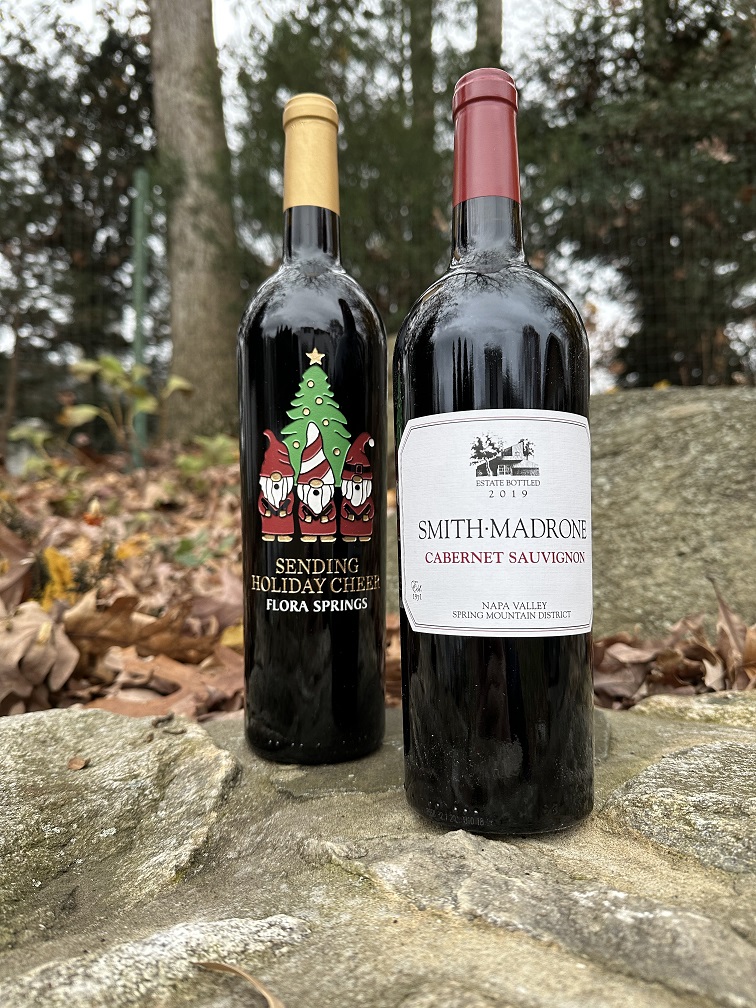 Ode to Cab.
Or we can just call it a Love Letter to Cabernet Sauvignon.
As an oenophile, I always try to maintain my “grape neutrality”. I can never name my favorite type of wine, never mind favorite wine. If you will hard press me against the wall with this question, I might say that it is Rioja, but the reality is a lot more complex than that.
If you search through articles in this blog, you will find a full range of wine styles and grapes. There are many blogs out there that cover specific region(s) or specific types of wine – but when I started writing close to 15 years ago, I knew that I would not be able to do that. This blog is about wine appreciation – any wine. “Wine should give you pleasure” – and so this is what my writing is primarily after – sharing the joy, the pleasure of wine, no matter what is the pedigree. Wines made from little-known grapes – Bobal, Trepat, Kekfrankos, Romorantin by tiny producers can give you as much pleasure as first growth Bordeaux, cult California, or best super-Tuscans. The liquid in the glass matters, and the only opinion that matters is yours and only yours – you can not enjoy the critic’s 100 points in your mouth.
This is my approach – try any wine with an open mind, and always be ready to be pleasantly surprised – or even blown away for that matter. And yet there is something about Cabernet Sauvignon that makes my heart race, especially coming from the producer I know or have heard of. Listen, I’m doing my best to tell you the truth, even though the “thought spoken is a lie”. But the brain gets all excited when I’m opening a bottle of the familiar Cabernet Sauvignon because I already know how good it can be. Very different from the excitement of the possible taste of DRC, Petrus, or Quintarelly (I’m yet to taste either) – because with those I wouldn’t know what to expect. But I do know what to expect from the well-made Cabernet Sauvignon that is ready to drink.
Even with the wines I happily call the favorites, I can’t tell you what I’m expecting to taste. I can’t describe my expectations when tasting La Rioja Alta, Ken Wright Pinot Noir, or Loacker Corte Pavone Brunello di Montalcino. I expect that I will like those wines as I know the producers and had their wines many times before – but I can’t tell you my exact expectations of the aroma or the taste of the wine. With Cabernet Sauvignon, I have very precise expectations of the aroma and the taste for me to like the wine. If I do not find the cassis (black currant) on both nose and palate when the bottle says “Cabernet Sauvignon” on it, there is no way I will like the wine, no matter how good the wine is for anyone else. Eucalyptus, mint, and a good structure are also expected, but with this some variations are possible. But when the expectations are met… the Cabernet Sauvignon is nothing but a pure, hedonistic pleasure.
So yes, deep down, Cabernet Sauvignon might be the most favorite wine of all – I just hope I will remember it next time I’m asked about my favorite wine.
Now, truth be told, I had a good reason for all this rambling about the beauty of Cabernet Sauvignon. A few weeks ago, I had an opportunity to conduct an accidental side-by-side tasting of the California Cabernet Sauvignon and the results were simply amazing.
With this tasting, we are taking a little trip. We will start in Northern California, where Barra of Mendocino is located. I wrote about their wines before, and now I have a few of the latest releases and I thought that Cabernet Sauvignon would be quite appropriate for the tasting.
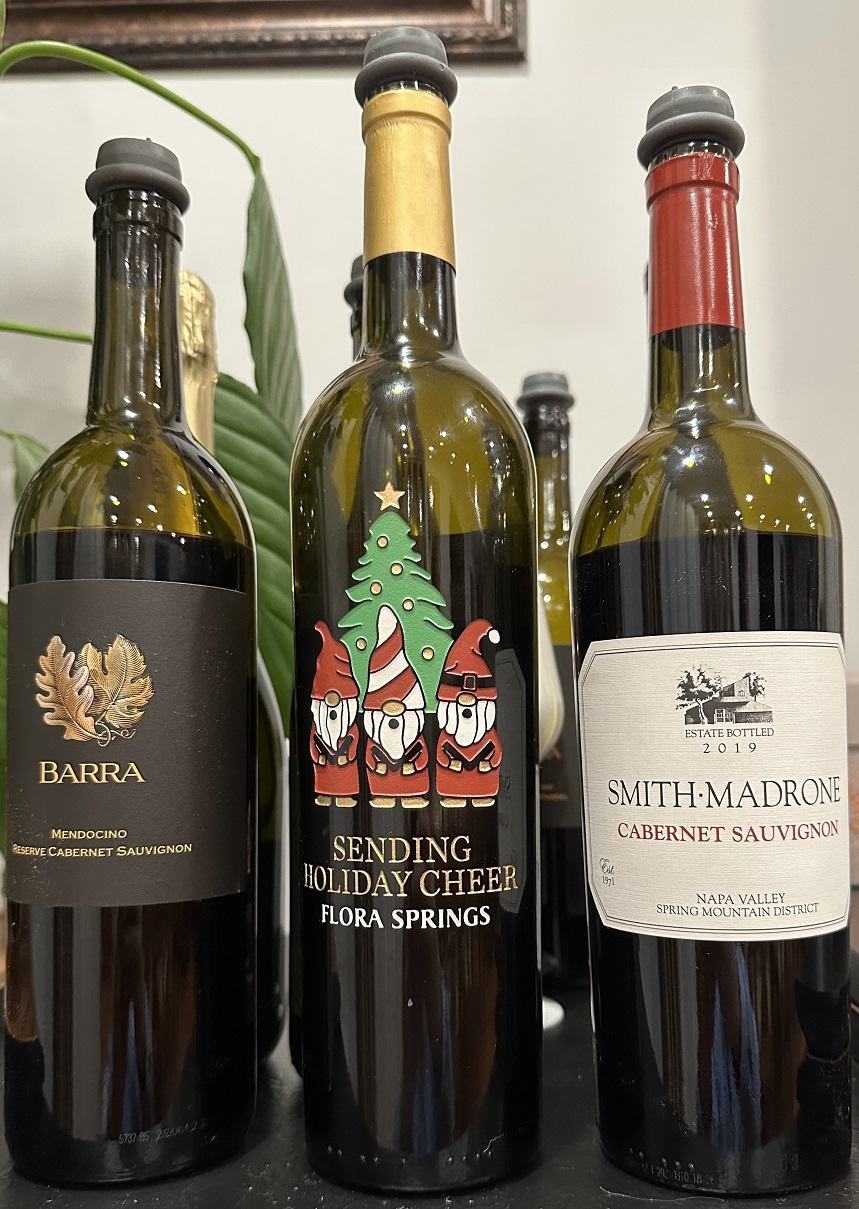
Barra Cabernet Sauvignon was the leanest of 3, but still had a perfectly recognizable Cabernet Sauvignon profile:
2021 Barra Reserve Cabernet Sauvignon Mendocino (14.5% ABV, $28, 18 months 30% new French oak, balance in neutral barrels)
Garnet
Eucalyptus, cherries, a hint of cassis
Eucalyptus, dark berries, cherries, cassis, well integrated tannins, perfect balance, medium-long finish.
8
Moving 80 miles southeast, we now arrive at the Flora Springs winery, located in the heart of the Napa Valley. Again, one of my favorite wineries in California, I wrote about their wines on multiple occasions.
The wine I had an opportunity to taste was a special holiday release. Flora Springs is big on the holiday celebration, so this bottle features etched gnomes, perfectly appropriate for the holidays. But it is what’s inside that counts, and this wine was nothing short of spectacular.
2019 Flora Springs Red Wine Blend Napa Valley (14.5% ABV, $95, predominantly Cabernet Sauvignon, 18 months in 70% French and 30% American oak barrels)
Dark garnet
Cassis, mint, black tea, cassis is playing in and out – you can smell this wine forever. Cassis is prevalent, wow.
Burst of cassis at first, then tannins come in, offering some bitter notes around the otherwise perfect Cabernet core. A very powerful, delicious wine that needs time to soften up. Either decant for a few hours, or lose it in the cellar for 10 years. The winery says you can enjoy it through 2036 – I’m sure you can easily add another 20 years on top of that.
8/8+
Going back about 8 miles northwest, we now arrive at the Smith-Madrone, the winery located in the Spring Mountain district of Napa Valley. Smith-Madrone is yet another one of my favorite wineries, and the one I feel a bit guilty about as a writer. I wrote about Smith-Madrone wines on many occasions in this blog – 5 years ago, Smith-Madrone were my wines of choice to celebrate Thanksgiving; in 2019, Smith-Madrone Cabernet Sauvignon was my wine of the year. And I’m still yearning to write a post fully designated to the winery…
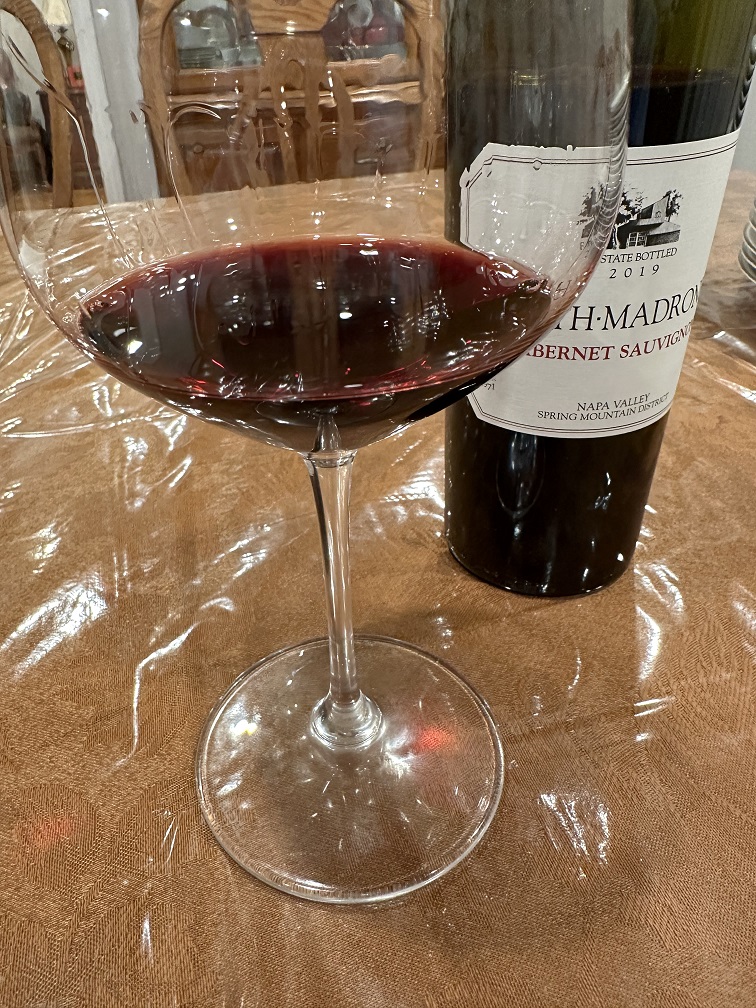
Nevertheless, Smith-Madrone Cabernet Sauvignon to me is one of the most textbook-proper, pure Cabernet Sauvignon wines there is. Not everyone would share my opinion – my sister-in-law with whom I was tasting these 3 Cabs, was preferring Flora Springs Cab, just for the sheer, unashamed beauty. But to me, a more subtle but very confident representation of the Cabernet Sauvignon by Smith-Madrone was just a perfection:
2019 Smith-Madrone Cabernet Sauvignon Spring Mountain District Napa Valley (14.3% ABV, $65, 83% Cabernet Sauvignon, 5% Merlot, 12% Cabernet Franc, 18 months in 55% new French oak)
Brilliant dark ruby
A perfection. A textbook Cabernet Sauvignon cassis, pure, perfectly precise cassis. You can think of a bell pepper – I’m not sure it is there, but it comes to mind.
The palate is amazing – cassis, eucalyptus, perfect minerality, a touch of the pencil shavings, salivating acidity. This is an impeccably balanced wine built for aging. In 10 years, it will be insanely good. In 20 – … well, I don’t want to even think about waiting that long…
9-, pure and superb.
If you like Cabernet Sauvignon, either one of these 3 wines will make you happy – each one perfectly representing their terroir and the vision of the winemaker, and yet unquestionably perfectly representing maybe the most noble grape of all.
So now you know what my secret passion, secret true wine love is. What’s yours?
Wine Weekend of Ups and Downs
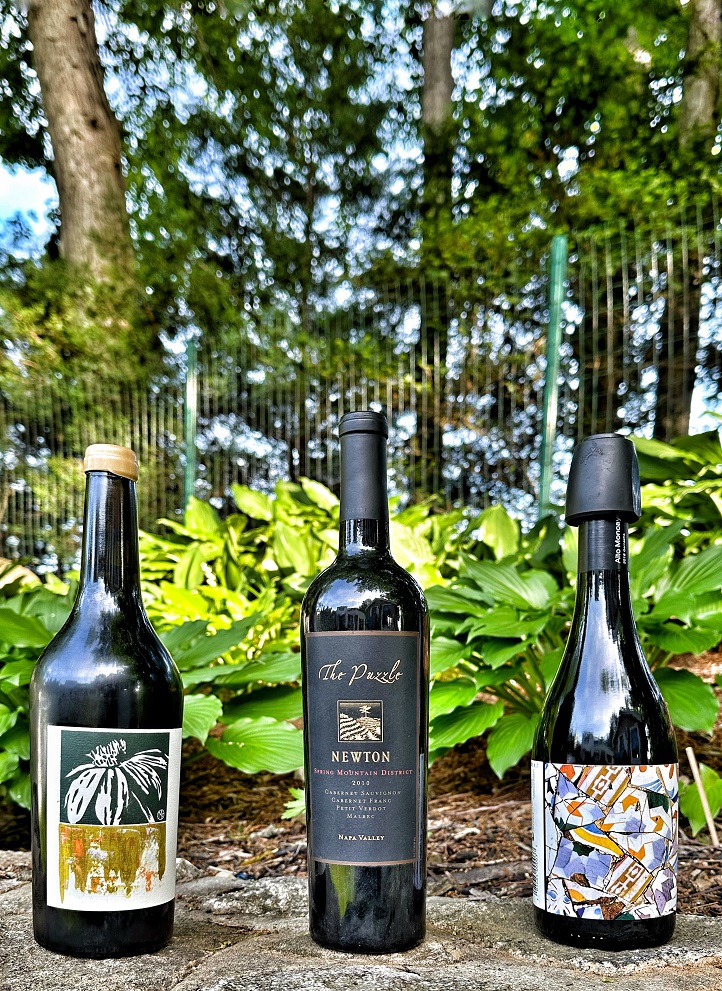 The life of an oenophile is never dull – of course, if an oenophile chooses such.
UP
Let’s talk about “ups” first.
Sine Qua Non. The legendary Sine Qua Non. The Sine Qua Non winery is unique in many ways. First and foremost, Sine Qua Non wines are unique. Of course, every winemaker is sure that his or her wines are unique. But for Sine Qua Non, these are not just bragging words. Every vintage, a different set of wines is produced, and wines do not or rarely repeat year after year. Each wine has a label designed by Manfred Krankl, who owns the winery together with his wife Elaine. And the wines are impossible to get – I had to wait for 10+ years to move from the waiting list to the mailing list.
My sister-in-law and her husband were visiting over the weekend. They both enjoy wine very much – which is a perfect reason to get out a special bottle. Sine Qua Non is better known for its Rhone-style reds, but they produce white wines as well. One of the first wines in my allocation was Sine Qua Non white wine. Communal notes on the internet seem to indicate that SQN white wines shouldn’t be aged for too long, so I decided that 4 years is a good age for this wine, to avoid any possible regrets (who am I kidding – there are always regrets when it comes to wine).


2019 Sine Qua Non Distenta 1 California White Wine (15.3% ABV) is a blend of 41% Roussanne, 26% Chardonnay, 14% Petit Manseng, 12% Viognier and 7% Muskat (Gelber Muskateller), fermented in barrel and matured on its lees, 23 months in 64% new French oak. The sublime nose of whitestone fruit, herbs, and flowers, with a distant hint of tropical fruit. And the palate, the bouquet… As a child, I loved to sing, and I spent some time in the chorus. I was perfectly fine singing in unison, but for the life of me, I could never do the canon, the subtype of polyphonic singing, where each singer has their own melody, and those melodies harmoniously combine together. This wine delivered such a canon singing – beautiful notes of sage, eucalyptus, tobacco, and whitestone fruit were changing into tropical fruit with a touch of bright honey notes. Somehow, it was possible to taste both profiles at the same time. I know I’m not describing it well, but this was the wine I really didn’t want to end… (Drinkability: 9)
By the way, an added bonus – it appears that I never had the Gelber Muskateller grape – and now I can unexpectedly increase my grape count.


DOWN
Over the years, I got two bottles of red wine from Newton Vineyards, a well-respected California winery, as presents, both from the same 2010 vintage, and both identical. I know the producer’s name, but it seems that I only tasted Newton Chardonnay before, and I have no memories of tasting their red wines.
Both bottles were gifted by the sister-in-law and her husband I just mentioned, so I thought their visit was a perfect opportunity to enjoy this wine together.
And so I opened the bottle of 2010 Newton The Puzzle Spring Mountain District Napa Valley (14.5% ABV, 60% Cabernet Sauvignon, 18% Cabernet Franc, 18% Petit Verdot, 4% Malbec).
And the bottle was corked.
I just recently mentioned in one of the social media discussions that I rarely encounter corked California wines. I guess I jinxed it… The cork faint was ever so slightly noticeable on the nose, and the palate kind of seemed okay, so I even decanted it and we even tried drinking it. The decanting made the corked nature of the wine even more apparent, and I pulled the second bottle.
The second bottle was not corked, and it was drinkable. However, it was a bit underwhelming. The fruit was there, it was possible to taste the cassis, but considering that this was a Californian wine, it showed leaner than expected. I would generally consider that Californian wine of such level need at least 20 years to develop, and under normal circumstances I would leave the second bottle alone for another 5-7 years, but oh well. We did enjoy it, of course, I was just hoping we would enjoy it more. (Drinkability: 8- )
STILL DOWN
I’m not going in chronological order here. The Newton red was planned to be the main wine to serve with dinner. As a “pre-gaming”, I gleefully pulled out the 2018 Alto Moncayo Veraton Campo de Borja (15.5% ABV). I opened a bottle of this 100% Garnacha last year, and it was absolutely spectacular from the get-go – succulent cherries and layers of pleasure. I loved the wine so much that it was included in the top two dozen list of 2022 wines as number 13.
Feeling great about myself, I opened the bottle and poured wine into the glasses. At the first tiniest sip, instead of excitement, my instant thought was “ohhh nooo, why is it so sweet???”. I also instantly knew that I’m in trouble with my sister-in-law, as she stopped drinking California Pinot Noirs for being too sweet… And her reaction was exactly what I was afraid of. After the first sip, she raised her head from the glass, looked at me inquisitively, and said with a wry smile “but why is it so sweet?”. This is when we put this bottle aside and proceeded with The Puzzle – and you just read how swimmingly well it went.
Truly, whatever goes up will go down.
AND UP AGAIN
Whatever went down still has a chance to go up.
The very next day, Veraton somewhat solidified at its core, the sweetness subsided, and the structure started to appear. On the third day, the wine was as delicious as I was expecting it to be – succulent ripe cherries, juicy and generous, with crunchy acidity and perfect balance. (Drinkability: 8+).
Here you go, my friends. Another weekend in wine – sometimes you win, sometimes you learn. With the exception of the corked bottle, which is never okay – but as my sales team always said, “it comes with the territory” – it was a great wine weekend, even with all the ups and downs. How was yours?
OTBN Conundrum
OTBN, short for Open That Bottle Night, is my favorite wine holiday. Nowadays, there are lots and lots of wine holidays, usually associated with a particular grape – International Chardonnay Day, International Cabernet Day, Beaujolais Nouveau celebration, and so on. The majority of such wine holidays encourage you to open a bottle of wine made from a particular grape, whether there is a story behind the bottle or not. You can take these grape holidays with all seriousness and meticulously prepare and select the right bottle, or you can just grab any random bottle you will see in the store – or skip the grape holiday altogether if you don’t feel like drinking Cabernet Sauvignon or Chardonnay on that particular day.
OTBN is different. OTBN was invented for people who take their wine seriously. Or maybe rather those who take their wine too seriously. Over the years, we accumulate wine bottles that are deemed special; brought home from the winery you visited in France; got this bottle after an amazing tasting event; a bottle from an amazing family vacation many years ago; a bottle given to you by a dear friend. We can continue on and on, but you got the point.
Many of those special bottles in your collection would have some similar traits: they exist in the quantity of 1 and they are too special to be opened at random. Those special single bottles stay put in your cellar, waiting for the special company, special circumstances, special moment, special friend’s visit to be opened and enjoyed. More often than not, they keep waiting, and waiting, and waiting, because that special moment keeps not happening. And then, when it finally arrives, you might open that special bottle you preserved with the best care in the world, only to find that the content can solicit the memory but can’t bring you joy anymore because the wine in the bottle simply turned past prime. And it also kind of ruins the moment. This is why OTBN was invented, and this is what makes it such a great holiday for all the winos out there.
My personal conundrum draws exactly along the lines I just described. I have a lot of single bottles (actually, an absolute majority of my wines in single bottles – I practically never buy any wine by the case), and as such making a decision about a “special” bottle of wine for an event or a holiday, never mind the hallmark of them all, OTBN, a long and tedious process. “Is this bottle good enough? Okay, but I only have one. What if I will open it now and would never know how great it could’ve been? What do I do? What do I do?”
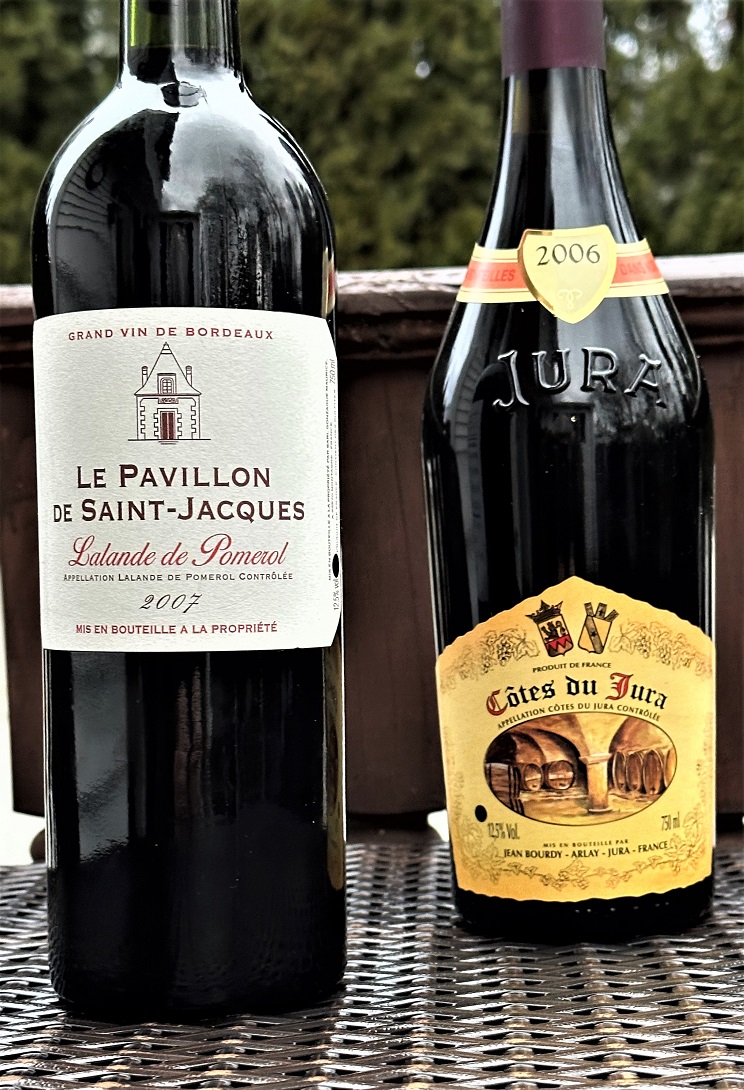
Same as the last year, I had to celebrate OTBN early this year due to the business trip spanning over the intended OTBN last Saturday of the month, February 25th. My wife doesn’t drink much wine nowadays, so I had to count primarily on myself. I had no good ideas coming to my head, there were no special bottles of wine I was ready to sacrifice. Looking at one of the wine fridges, I noticed the bottle of Jean Bourdy from Jura.
I don’t take Jura wines lightly, they are very hard to procure in the US. And then Jean Bourdy is a legend in itself – I better have a damn good reason to open such a special bottle. Then I thought that I already had some Jean Boardy in the past – maybe I would find some notes in the blog? I entered Jean Bourdy in the search box, and sure enough, this post came up. I tasted this wine in 2011 when I attended a Natural Wines seminar at PJ Wine store in New York – my first, a truly memorable encounter with natural (low intervention) wines as a category. I tasted this exact wine, 2006 Jean Bourdy Cotes Du Jura Rouge (fun fact: 2006 was the first vintage of Biodynamic wine production at Caves Jean Bourdy). I really liked the wine then, and my note said “It appears that wines of Jean Bourdy are known to age very well (note to self)”. As soon I saw this “note to self”, I instantly put that single bottle of Jean Bourdy back, as 17 years is most likely not an age for it.
In the same post, I noticed another wine that happened to be next to Jean Bourdy bottle on the same shelf – 2007 Le Pavillon de Saint Jacques Lalande de Pomerol. I pulled this bottle many times from the fridge before, always remembering that this was a natural wine, but again, no moment felt special enough. Then I read my note from 2011, which was clearly less than favorable. Here it is in its entirety:
“Very interesting. Smells like dirt, pure dirt after the rain. Very vegetative, no fruit on the palate, just pure dirt again. Almost no acidity. This wine was fermented in concrete tanks, aged for 18 months. It is “certified organic” and made with 90% Merlot and 10% Cabernet Franc – classic Pomerol wine. I would love to taste it in 10-15 years – I think it will greatly evolve, but it is not easy to say ” I like it” now”.
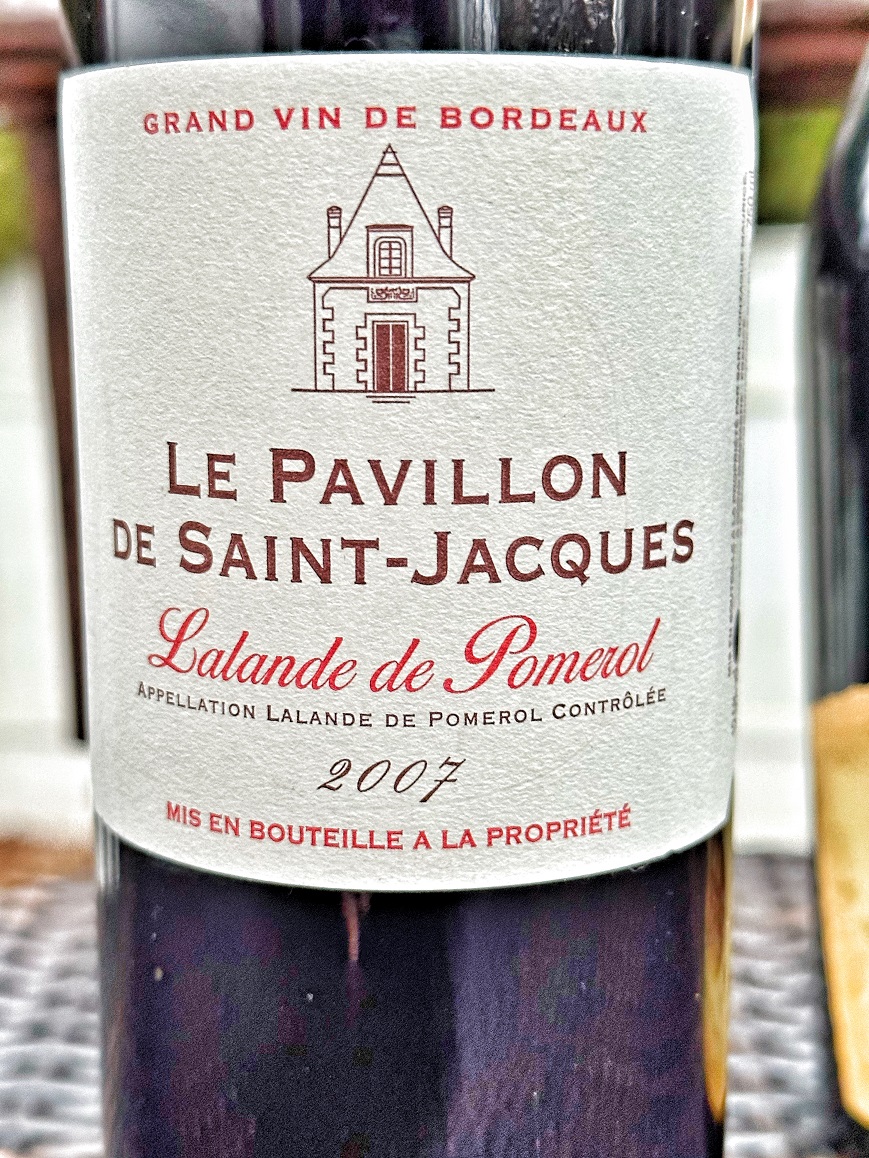
This “note to self” clearly stated that the wine was not good in 2011, but I should give it another try in 10-15 years. I was pretty much in the middle of that suggested term – 12 years after the original tasting, so opening that bottle all of a sudden became a perfect thing to do.
Cork came out easily, showing a good amount of crystals on the bottom, but otherwise perfectly fresh. The first sip instantly put my inner wine geek into a nirvana state. Barnyard. Pure, beautiful barnyard. If you belong to the group which screams “brett” at the first whiff of the barnyard smell on the wine, I’m sorry but we can’t be friends. Yes, there are limits to everything, but the reasonable amount (don’t ask me to quantify, everyone has to define their own “reasonable amount”) enhances the wine pleasure for me. I typically find barnyard associated with Syrah wines – possibly, this was my first Bordeaux with the barnyard aroma – but the barnyard aromas were followed by the classic, concentrated cassis. Layered, concentrated, softly rolling harmonious wine with perfect, firm structure and clean acidity. Beautiful, classic Bordeaux. This was truly an OTBN-worthy pure pleasure experience (by the way, my wife also loved the wine very much).
Here you go – my typical wine selection conundrum, happily resolved to make another memorable night. And as a bonus, the expectation of improvement of the wine with age fully came through (patting myself on the back).
The official OTBN night is almost here. You still have time to select the bottle or 5, maybe get some friends together and make some wonderful wine memories. If you want to celebrate only one wine holiday a year, make it OTBN – don’t risk the wine not being there for you, or you not being there for the wine.
And please share your OTBN stories – I would love to hear them.
Daily Glass: Unexpectedly Stunning
Expect the unexpected.
When people hear that beaten up “expect the unexpected”, I’m sure in at least 80% of the cases, the expectations are negative. “Expect the unexpected” generally implies that one should always be prepared to deal with seemingly unexpected and often hostile circumstances.
In the wine world, we might want to adjust the “expect the unexpected” ever so slightly. By its nature, wine is always unexpected. Bottle variations, spoiled wine (think corked, for example), serving temperature, ambiance, food, company – everything affects the taste of wine – and I’m not even talking about root and flower days. Every bottle is a mystery – even if you had that same wine from the same producer and the same vintage 100 times before, when you are looking for pleasure you should open the bottle with trepidation. Every bottle is a mystery, and you never know what you will find inside.
I already had this exact wine before. 1998 d’Arenberg Cabernet Sauvignon High Trellis McLaren Vale was number 16 on my top 20 wines of 2020 list. 1998 is one of the special years in my book, so I’m always on the lookout for affordable 1998 wines. I came across this specific wine at the Benchmark Wine Group wine store, and at $19 per bottle, it was well worth the risk. Of course, d’Arenberg is an excellent producer and I trust their wines – but aging the wine changes a lot of things and nobody can truly predict what would happen with wine as the result of the aging.
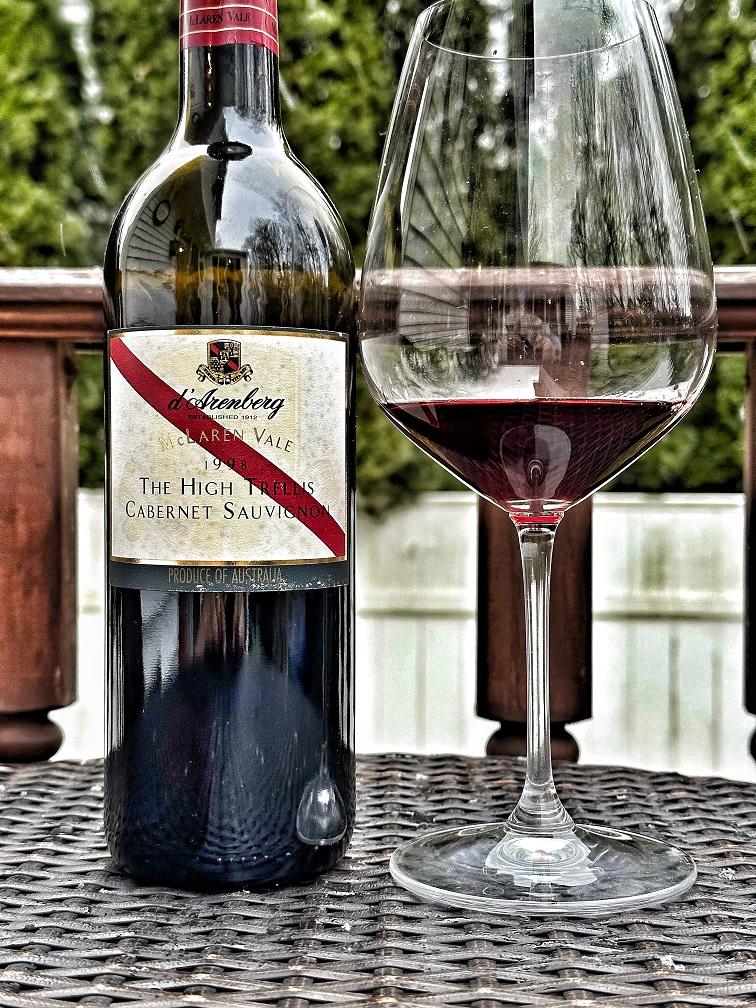
When it comes to aged wines, when everything works well, the expectations are resembling the bell curve. In the optimal case, we expect the wine to gradually improve, then stay at its peak, and then gradually decline. But every bottle has its own bell curve associated with it – how long will it take for the wine to reach the top of the peak, for how long the wine will stay at the peak, when the wine will start declining – every bottle has its own story, and nobody can predict how a particular bottle of wine would behave. This makes drinking aged wines great fun – you never know what you will find behind the cork. This also makes drinking the aged wines a source of frustration – until you successfully pull the cork out, take a sip, and smile happily, the frustration lingers.
You are unquestionably doubling this frustration when you are opening the aged wine you already enjoyed before. In general, before you open the wine, you base your expectations on the reputation of the producer, the region, the winery, and maybe on the vintage. Once you tasted the wine, you acquire the frame of reference, so when you will be opening the bottle of the same wine as you already had, your expectations are based on your prior experience – “ahh, I liked it before, I hope the wine will be as good as it was the last time”.
The last Sunday, we had a good reason to open a bottle from the 1998 vintage, so this was the bottle I decided on – for no particular reason, the decision formed in the head by itself. I used the ah-so to gently extract the cork, only to find out that I had no reason to worry, and the regular corkscrew would do just fine – the cork was in very good shape.
Once in the glass, the color increased the hopes for the enjoyable experience – dark ruby, not a hint of brickish color which old reds might acquire. And the first whiff from the glass put absolutely all the worries away. Ripe cassis, eucalyptus, a touch of sweet oak – the aroma was beautifully enticing, seducing you only as the Cabernet Sauvignon can. And the palate… The palate completed this mesmerizing experience, offering ripe dark fruit, cassis, still fresh and firm structure, a beautiful herbal bouquet, and a perfect balance. Not to try to take anything from the Australian wines, this was a Napa Cab-like experience. (Drinkability: 8+/9-).
I pumped the air out and couldn’t get to the wine for the next two days. On the third day, I poured a glass, this time expecting that the wine is gone. To my total surprise, the wine closed up, now more resembling the young Brunello, perfectly firm, dense, and cherry-forward. The fact that the wine was perfectly fine 3 days after being opened gives me hope that the wine will be good at least for another 15 years – and this time around yes, I have another bottle.
Here is my story of the sudden pleasure. Do you like aged wines? Are you intimidated by aged wines? Do you also expect the unexpected? Let me know what you think.
Until the next time – cheers!
Pure Pleasure, And How To Express It
Does this glass give you pleasure?
You take a sip of wine. The wine is sublime. It is beautiful. It is complex. The wine solicits emotion – it makes you happy. It makes you moan quietly inside your head, you might extort an “OMG” or a “Wow”, and after a pause, you take another sip. You are not in a hurry. You want to extend this pleasure for as long as possible.
Wine is art. Wine doesn’t leave you indifferent. Wine solicits emotion.
Painting is art. Painting doesn’t leave you indifferent. Painting solicits emotion.
Music is art. Music doesn’t leave you indifferent. Music solicits emotion.
We can consider wine to be a form of art, the same as painting, music, poetry, architecture, and many other human creations which invite an emotional reaction. Do you know what makes wine a unique form of art? Your utter desire to share it.
You can quietly stare at a beautiful painting for a long time, slowly uncovering little details and being in the moment. Even if you stand next to someone else looking at the same painting, 99 out of 100 you are simply focused on your own personal moment.
When listening to the music, even if you are in the concert hall surrounded by thousands, the music is being played only for you and this is how you want to keep it. You can buy a recording and listen to it 100 times. Just by yourself, and you are happy about it.
Have you seen an oenophile get excited about wine? The excited oenophile grabs the total stranger by the sleeve, shoves the glass into their face and says “here, here, you must try this!!!” It is very important for an oenophile to be able to share the joy of the experience with others. There is an ultimate pleasure in sharing your excitement with others, as wine is an art that needs to be shared.
Sharing pleasure is easy in person. Have you tasted magnificent, life-altering wines in the group? If you had, you probably noticed the collective “ohh”, rolling the eyes, unprompted nodding, maybe a muttered “oh my god”, and then silence. The silence of the greatness of the moment, slowly settling in.
This in-person sharing of the pleasure is simple, and kind of just happens on its own. The real challenge comes when you decide to share that ultimate pleasure with the rest of the world.
So how can one express pure pleasure?
A typical way to describe the wine is via so-called tasting notes. Such tasting notes are often called “technical notes” as they usually describe the wine in terms of appearance, aroma, bouquet, and finish – using analogies such as “brickish color”, “smell of mushrooms”, or “taste of dark cherries”. The wine is described in the terms which the wine drinker is supposed to relate to – and it is a great review if you can relate to all of the terms used without trying to figure out what is Cascarilla and how it actually smells, or how Jabuticaba tastes like. What is usually not found in the tasting notes is the emotion – how this wine might make you feel; will you scream with joy when you will take a sip? Yes, I get it. Even the aromas and flavors are subjective. The emotion which you will experience while drinking the wine is yours and yours only – the person next to you might not experience the same enlightenment – and nevertheless, even the hope for greatness is worth sharing.
Can wine pleasure be expressed in the words by professional wine critics? You be the judge of it. Here is the collection of tatsing notes for the 1966 Domaine de la Romanée-Conti La Tâche Grand Cru. At this link, you will find the reviews from Robert Parker, Jancis Robinson, John Gilman, and others. Here is the best excerpt in my opinion. John Gilman: “La Tâche ‘66 is deep, full and opulent on the palate, with a grandiose delivery of thick, perfumed fruit, excellent balance, plenty of power, great focus and finesse, and an incredibly long, softly-tannic and astoundingly complex finish.” This might be the best description out of the six present, but does it convey the emotion?
Does this wine give you pleasure?
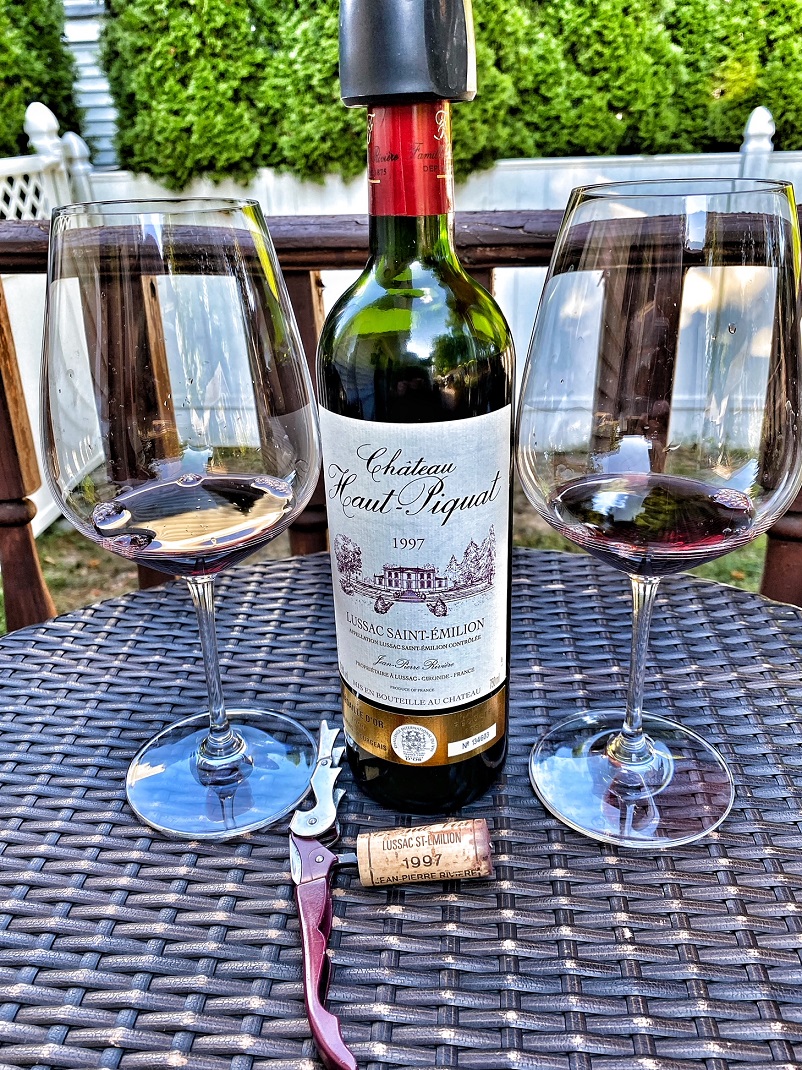
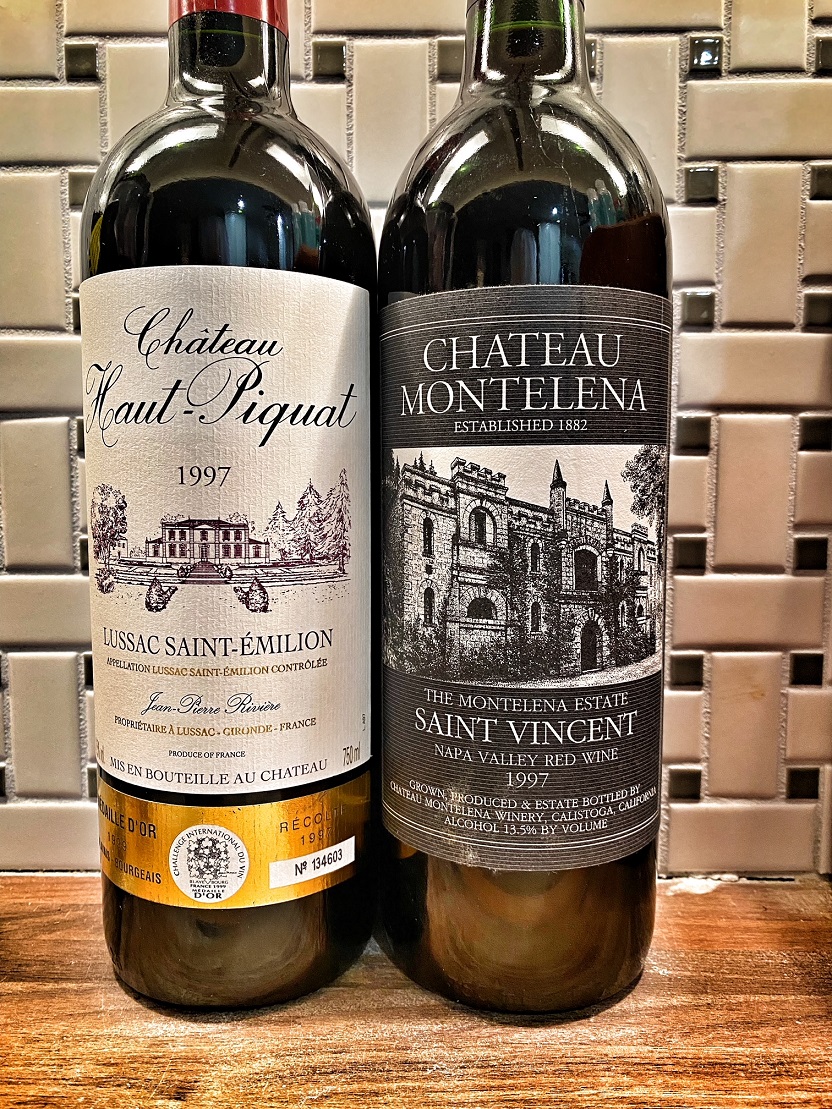
A few days ago, I had the pleasure of drinking two wines from the 1997 vintage (1997 is a special year for our family). These two wines really prompted this post. First, I opened the 1997 Château Haut-Piquat Lussac Saint-Émilion (12.5% ABV, 80% Merlot, 15% Cabernet Sauvignon, 5% Cabernet Franc). The wine was somewhat of a recent find at the Wine Exchange – after getting an email offer to buy 1997 Bordeaux for $19.99, I had no option but to get a few bottles. I was happy to see the cork coming out in its entirety with no issues. I was ready with the decanter, but the wine in the glass was quite approachable. After the initial grippy tannins dissipated in 20-30 minutes, what was left in the glass was an absolutely sublime beauty. You see, this is where the challenge lies. Here is the technical description from the Wine Exchange: “a wine that still possesses a youthful charm as there is something to be said for ex-chateau. A beautiful plum/garnet color with very little lightening for its age. This 1997 is full to medium-bodied, showing lots of forest floor, roasted herbs, cedar, tobacco, black cherry, blackcurrant, and new saddle leather. It is opulent and is just entering its plateau of full maturity. The tannins are soft and subtle with an elegant seamless finish. ”
The description is perfectly fine, but it doesn’t help me to express my emotion. The mind singing with every sip. Pure joy in each and every sip. Enough pleasure in every sip to have the nerve enough to tell my wife, who was enjoying the wine with me “this is almost as good as sex”. A personal perspective for sure, but yes, this was the wine.
I didn’t have many expectations for 1997 Chateau Montelena Saint Vincent Red Wine Napa Valley (13.5% ABV, blend of Zinfandel, Primitivo, Sangiovese). Chateau Montelena is absolutely legendary with its role in the Judgement of Paris, especially if you had an opportunity to see the movie Bottle Shock. But Saint Vincent is an eclectic blend, produced only for 5 years from 1995 till 1999, and it is not given that this type of wine can age for 25 years. While very different from the previous Bordeaux in its profile of cherries, eucalyptus, and herbs, it had such a lip-smacking, savory and satisfying bouquet, that every sip was demanding to be followed by another sip.
Do you want a second glass?
I have no idea how to convey the pure pleasure the wine can bring. Maybe emotion is the key. There are lots of good wines out there. The wines you are happy to drink any day every day. Maybe it is the excitement that needs to be measured. Or maybe this is simply in the unyielding desire to share this pleasure with the world. The act of telling the world how amazing the wine was, and hoping that everybody will see it that way too.
Let’s share our little joys with one another. And if you know how to convey this pure wine pleasure, please let me in on that secret.
Daily Glass: Winning and Learning
Sometimes you win, and sometimes you learn.
You never lose – learning is the opposite of winning – I think this is a better approach to life, would you agree?
I love aging my wines. The popular wine press tells people that 95% of the wines in this world are meant to be consumed shortly after purchasing. “Absolute majority of the wine is not meant to be aged,” the message says. I don’t want to obnoxiously invalidate all the expert opinions, but the subject of wine aging is a lot more complicated than the simple statement portrays.
Lots of factors play a role. The wine itself is probably the most critical factor. White wines generally don’t age too well. To be more precise, percentage-wise, a lesser number of white wines can age well compared to red wines. But this doesn’t mean that all red wines age well. For example, red Cotes du Rhone typically don’t age for longer than 4-5 years.
I wish there was an easy method to tell us, wine lovers, that “this wine will age for 30 years”, but “this one got only 10 more left”. There is no such method, however, so we need to rely primarily on our experiences. I’m not trying to disqualify all of the wonderful advice we receive from the wine critic and publications – but it would be rare to receive an aging recommendation there unless the wine is deemed of a “collector” level – which pretty much means that it will not be really affordable.
At this point, you might wonder why is all this commotion with the aging of the wines. Simple. Wine is a living thing. The evolution of the wine continues in the bottle. It is a general hope that wine can improve with time, evolve, become more complex and multidimensional.But the wine can’t evolve forever – at some point it starts “turning”, losing its delicious, attractive qualities.
It is important that the wine drinker can appreciate the beauty of the aged wine – it is not for everyone. I don’t mean it in any disrespectful way – this is simply a matter of taste. One of my most favorite examples is the blind tasting of a few Champagnes which took place during Windows on the World wine classes. After blind tasting 4 Champagnes, the group was asked to vote for their favorite Champagne. Champagne #4 got almost no votes, it was clearly the least favorite of the group of 100+ people. While revealing the wines, Kevin Zraly, our wine teacher, said “and this is why, people, you should not drink vintage Champagne”. Bottle #4 was Dom Perignon – if people would see the label before voting, you know how that would work (”drink up, honey, it is French”). And Vintage Champagne is nothing more than just an aged wine. It is just a matter of taste. The same story goes for food. For example – I love fresh oysters, and I have friends who wouldn’t put an oyster into their mouth even if this will be required to save their own life. Just a matter of taste.
But for those of us who like aged wines, that elusive quest becomes an obsession. I love the Italian term “vino da meditazione”, which applies to the wines which make conversation stop upon the first sip, and puts the whole group of oenophiles into a quiet, self-reflective state. The silence at the table becomes not deafening, but instead a very comfortable one. The silence nobody wants to break.
Okay, such amazing encounters are possible but truly rare. But the pleasure of drinking the well-aged wine is real, and this is what we are seeking. And as we don’t have the scientific method of predicting the peak of enjoyment for a given wine, we have to rely on our own experience. Which takes us back to winning and learning. When we experienced well-aged wine, we clearly won. And when the wine with age doesn’t deliver the pleasure, this is where we learn.
It is not so binary, of course. The point is that no matter what happened, we learn something. When you taste a random but amazing $10 bottle of California red blend (Toasted Head) with 15 years of age on, you learn that inexpensive wines can age too. When you taste 2002 Barolo (Fontanafredda) 10 years after release, and you see that the vintage chart declares this vintage as literally horrible, but the wine tastes good, you learn that the producer matters more than the vintage. When you taste two bottles from the same producer and the same vintage, but you love one of them and can’t stand another, you learn that bottle variation is real and that you have to always manage your expectations.
This whole rambling about winning, learning and aging was prompted by a few wines I opened last week.
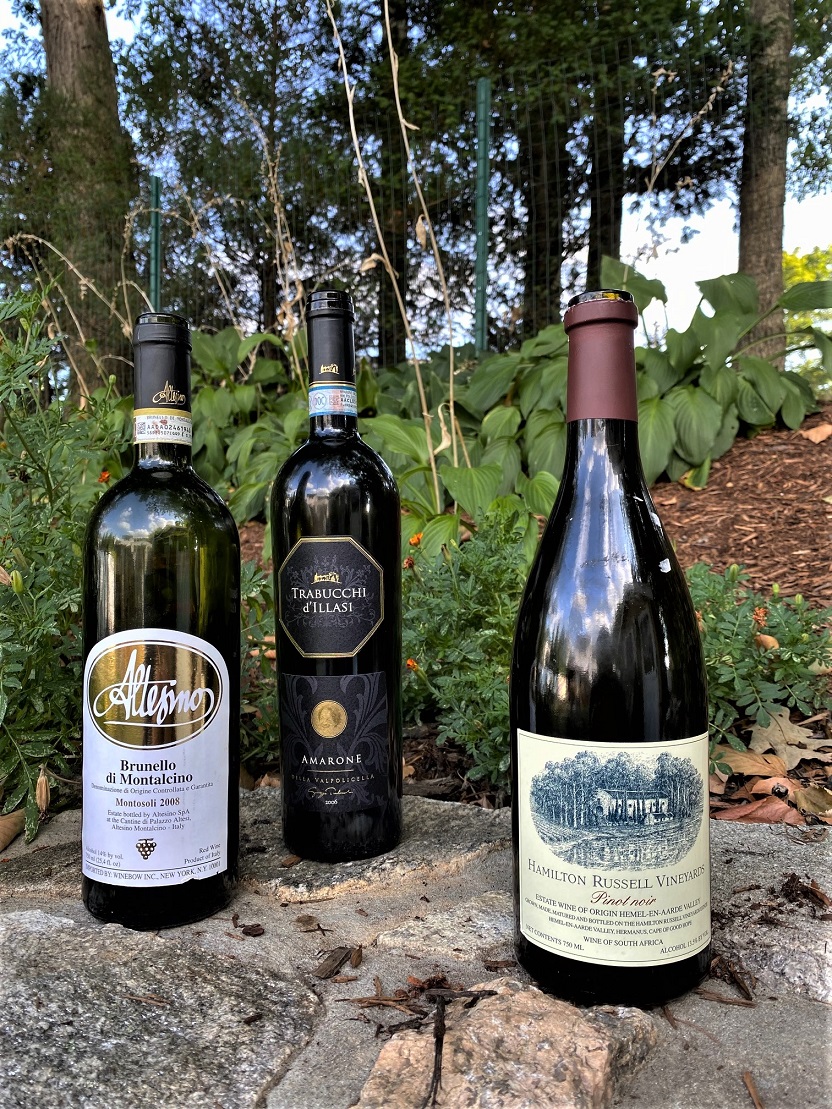
First, the learning part. 12 years ago we did the Pinot Noir blind tasting with friends, with a very unexpected outcome – 2008 Hamilton Russell Pinot Noir from South Africa was the best wine in that blind tasting. I loved the wine so much that I went and got a bottle to keep. Over the years, I made many attempts on the life of this bottle, until the last weekend I decided to share it with a friend. Upon opening the wine was reminiscent of the good Burgundy, with the nose offering some plums, iodine, and smoke. But the wine quickly succumbed to the tertiary aromas of dry herbs and maybe a hint of dried fruit, and while my friend really loved it, this was a complete loss learning in my book.
Then another friend was stopping shortly after his birthday. He always liked the wines, but recently started getting really “more into it”. He was stopping by for the dinner, and when we were talking about wines a few days prior, he mentioned that he started liking the Brunello and Amarone wines. There is no happier moment for the oenophile than to learn what the guest desires to drink – the cellar is instantly paraded in the search for the best and the most appropriate bottle.
I don’t know how I came into possession of the 2008 Altesino Brunello di Montalcino Montosoli, I can only guess I got it as a present. This single vineyard Brunello di Montalcino was absolutely spectacular – beautiful cherries on the palate – not the fresh and crunchy ones, but more subdued, more elegant, eloped in the sage and other herbal aromatics. The wine was spectacular when we opened it, and when I finished the last drop 2 days later (wine was kept in the bottle with the air pumped out), I had a clear feeling of regret as the wine was not gone, but instead was still fresh and even more complex, with a promise of becoming the Vini da meditations in 10 years, same the 1999 Soldera had become for us – alas, I don’t have another bottle…
And then my pet peeve – you know how much I love Amarone. I got a few bottles of the 2006 Trabucchi d’Illasi Amarone della Valpolicella from WTSO 7 years ago. This was my last bottle, and boy it didn’t disappoint. It was absolutely beautiful in its finesse and impeccable balance all the way through. Dried fruit on the nose, powerful, well-structured wine on the palate, with more of the dried fruit, cherries, plums and herbs, and with good acidity, perfect balance and delicious bitter finish. It is not for nothing Amarone means Great Bitter – and there was this pleasant bitterness on the finish, something hard to find in most of the Amarone wines.
Here you are, my friends, my story of winning and learning. Three aged wines, two of them delicious, two that could age for far longer (learning!). One learning experience – but who knows, maybe it was only that particular bottle. Moving on.
What did you win and learn lately?
Guest Post: Treat Yourself – How to Spend the Best Solo Wine Night
Today, I would like to offer to you a guest post by Raichelle Carpio, retail assistant manager at Txanton Philippines. She obtained her Sommelier license with WSET2 by late 2018 and has been working in the hospitality industry over the past 10 years. Her exceptional skills have driven her to the top and the truth is she has a real passion for premium gastronomy, beverage, and service.
In the past, drinking alone was frowned upon. Somehow, it’s seen as the gateway to substance abuse. After all, everyone agrees that wine, or any other alcoholic beverages, for that matter, is better shared. Drinking wine, for most people, is ideally a social activity.
But that has changed due to the pandemic. To curb the spread of the COVID-19 virus, people had to self-quarantine. No social activities were allowed. As a result, wine-drinking shifted from communal to personal. And no one could be judgy about it. After all, we were all in it together. We were all self-isolating with our precious bottle, constantly reminding ourselves of the health benefits of wine, so we don’t feel guilty about drinking solo.
Still, it’s important to stay level-headed as you push through with your solo wine adventures. Pair it with the activities below, so you do not come off as a potential candidate for alcoholics anonymous.

Experiment with recipes that go well with wine
Even if you’re just a casual wine drinker, surely you know by now that white wine goes with fish or chicken, while red pairs best with red meat. Now, why not take your wine and food pairing knowledge to connoisseur levels?
On your solo wine night, don your apron and experiment in the kitchen. Cook something to pair with whatever bottle you have at hand. If you have a bottle of Barbera, it will go down well with a pasta dish like shrimp puttanesca. Ideally, you have gone grocery shopping before your wine date with your lonesome. Otherwise, you might not successfully pull off the dish simply by relying on makeshift ingredients available in your pantry.
Have around-the-world themed dinners
Take your wine and food pairing to the next level with around-the-world themed dinners. Planning to spend the next six Friday nights at home alone? Come up with a scheduled dinner where you take your palate to different countries with exciting culinary cultures. By the end of your quarantine, you will have traveled across six gustatory destinations.
For example, set the first Friday for Indian food. Curried chicken or vegetables will go well with a Riesling and Pinot Grigio. You may include Mexico, Japan, China, Italy, and Greece in your itinerary too.
Join virtual winery tours
Did you know that wineries host virtual tours? And you might find them enjoyable given your passion for wine. These tours will acquaint you with everything there is to learn about winemaking. From how grapes are harvested to how they are processed and stored, you’ll get up close and personal with your favorite beverage.
Look into brands like Martell, Louis M. Martini, Chateau Montelena, Kendall-Jackson, and Matanzas Creek. They are famous for not just their products but also for hosting virtual tours of their vineyards, production facilities, and cellars.

Photo by Matilda Wormwood from Pexels
Learn winemaking
If you got inspired enough by the virtual winery tours you’ve joined, it’s time to take your passion for wine up a notch. Learn winemaking is what we’re saying. No, you do not need a vineyard to pull this off. You can do this straight from home.
You’ll need some equipment, however. Do not worry because it won’t be expensive. Think fermentation containers and straining bags. You can even improvise.
As for ingredients, that’s where you can splurge. You will need lots of wine grapes, filtered water, granulated sugar, and wine yeast. A quick Google search will clue you in about the relatively graspable process of winemaking.
Wine movies marathon
Maybe you’d rather sit back and relax in front of your laptop instead of stressing yourself out cooking a dish in the kitchen or trying out winemaking. That’s OK too. Consider marathoning movies with lots of wine drinking. That way you won’t feel alone. You’ll see people enjoying the same stuff you’re taking pleasure in at the very moment.
Here you cannot go wrong with the film Sideways by award-winning director Alexander Payne, starring Paul Giamatti and Sandra Oh. Basically, the film’s about self-discovery set along California’s vineyards.
Other movies worth checking out include A Good Year, The Secret of Santa Vittoria, and A Walk in the Clouds.
Look into wine investments
Perhaps while nursing a glass of wine, it dawned on you that it’s time to diversify your financial portfolio. That’s an excellent realization to make while drinking solo. Commit to this realization by looking into potential wine investments.
You need to be a connoisseur to invest in wine successfully. If you have yet to fit the bill, do not fret. You have all the time to learn about all things wine. Once you’re confident with the knowledge you’ve acquired, it’s time to put your money in a, well, bottle. If you play it right, that bottle will earn you a massive profit in a decade or two.
You likely already know that drinking wine has health benefits, whether you’re nursing a glass of Spanish wine, Italian wine, or Costco wine. Wine is rich in antioxidants. It regulates your blood sugar and lowers bad cholesterol. It keeps your memory sharp and your heart healthy. These alone should keep guilt at bay whenever you drink wine solo.
Still, it’s worth noting that you must drink responsibly. Anything in excess is never good for anyone. You do not want to give those naysayers the chance to say, “told you so.”
To keep your wine drinking on the safe side, do it alongside other activities. The ones cited above are notable options you have, but they are by no means exhaustive. Get creative.
Last Bottle Sign Up ($10 credit)




 Talk-A-Vino