Archive
American Pleasures #5: Burgundy in California, or the Wonders of Pop’n’Pour
Wine should give you pleasure – there is no point in drinking the wine if it does not. Lately, I had a number of samples of American wines, that were the delicious standouts – one after another, making me even wonder if someone cursed my palate. I enjoyed all of those wines so much that I decided to designate a new series to them – the American Pleasures.
Burgundy in California. Nonsense, right? Burgundy is located in France, and the last thing you want to hear is a review of Hearty Burgundy, proudly produced by Gallo (believe it or not, but you can still buy this wine at about $9 for 1.5L – a great deal, huh?). Rest assured – Gallo is the last wine I want to ever discuss on this blog. I would like, however, to talk about Burgundy’s star grape varieties, which are also working amazingly well in California – yes, you got it – Chardonnay and Pinot Noir.
California produces a lot of wine (#4 in the world, with 248 million cases in 2018), using a lot of different grapes – no matter where those grapes are typically from – from Clairette Blanc to Viura to Nebbiolo to Grenache to Tempranillo, you should expect to find them all in Californian wines. Aside from all of the abundance, there are some grapes that can be called California superstars.
With the white grapes, it is easy – Chardonnay clearly steals the show. California made Chardonnay its own way back, with Chateau Montelena already proving its prowess to the whole world by winning Judgement of Paris in 1976. Chardonnay’s style changed and changed again since those early days of success, and when you are opening a bottle of California Chardonnay today, very often you don’t know what to expect – too much butter, too little butter, too much oak, no oak. Most importantly, you have no guarantees that you will enjoy that bottle.
Speaking about red grapes, ask a wine lover to name the most famous California red grape, and I’m sure 9 out of 10 will say Cabernet Sauvignon. I love California Cabernet Sauvignon as much as every one of those 9 out of 10 people. But based on my experience, the majority of the California Cabernet Sauvignon need time and time again to mellow down, to transform, to become truly enjoyable, and not just “drink the label and keep smiling” type of beverages. California Pinot Noir typically give you a lot more hope for finding the delicious Pop’n’Pour wines. And don’t forget – Pinot Noir, Chardonnay – it is the pleasure we are looking for here, so “pop, pour, drink, and ask for a second glass” is a sequence of events we are hoping for in here.
Here is a collection of the well-known wines I had the pleasure of enjoying – and have been blown away by the Pop’n’Pour quality, truly.
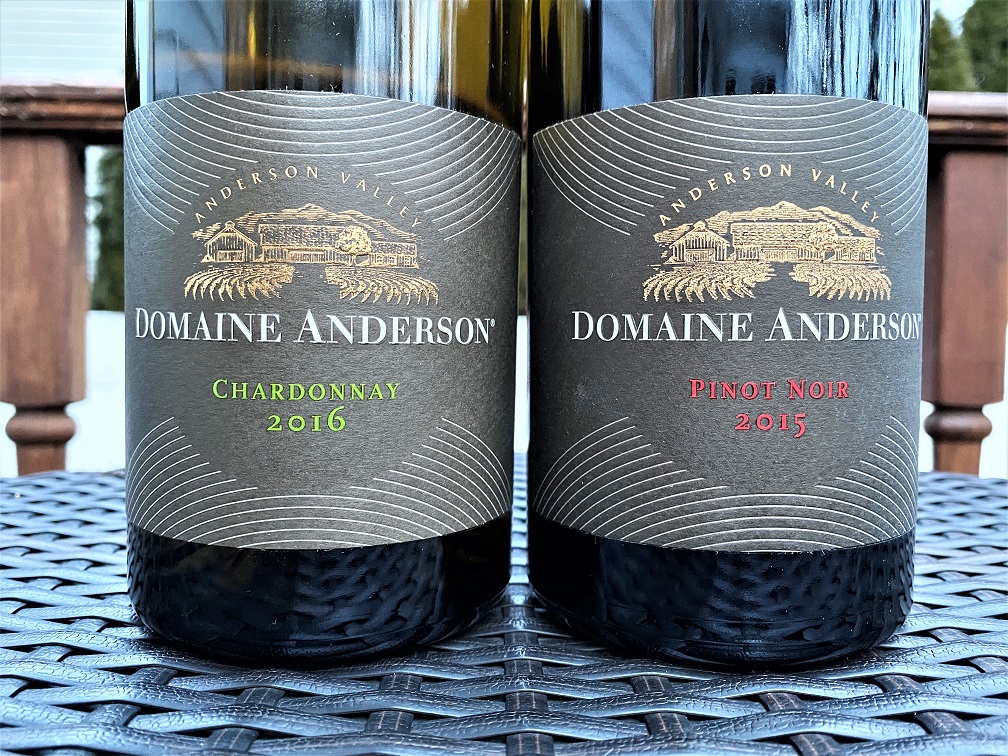
Domaine Anderson takes its roots from 1981, when Jean-Claude Rouzaud, patriarch of the Louis Roederer family came across Anderson Valley along the Mendocino coast in California, in search of the perfect spot to grow Chardonnay and Pinot Noir. Today, Domaine Anderson continues to be run by the Roederer family, farming organically and biodynamically 50 acres of Chardonnay and Pinot Noir vineyards. Here are 3 wines I had an opportunity to taste which were all just a perfection from the moment they were poured into the glass:
2017 Domaine Anderson Chardonnay (13.5% ABV, $30)
Light golden
Touch of honey, a hint of smoke, minerality
Clean acidity, tart lemon, a touch of smoke, texturally present, medium-plus body, earthy underpinning.
8/8+, this wine screams Chablis to me. Superb.
2015 Domain Anderson Pinot Noir Anderson Valley (13.8% ABV, $39.99, 15 months in French oak barrels, 19% new)
Dark ruby
Smoke, violets, earthy notes
Nicely restrained, good minerality, a touch of tart cherries
8, delicious
2017 Domaine Anderson Pinot Noir Anderson Valley (13.6% ABV, $45, 15 months in French oak barrels, 8% new)
Dark Ruby
Stewed plums, smoke, earthy undertones
Plums, cherries, lavender, tar, smoke, sweet tobacco, crisp, fresh, clean acidity, excellent balance
8, nicely restrained Pinot Noir, not over the board.
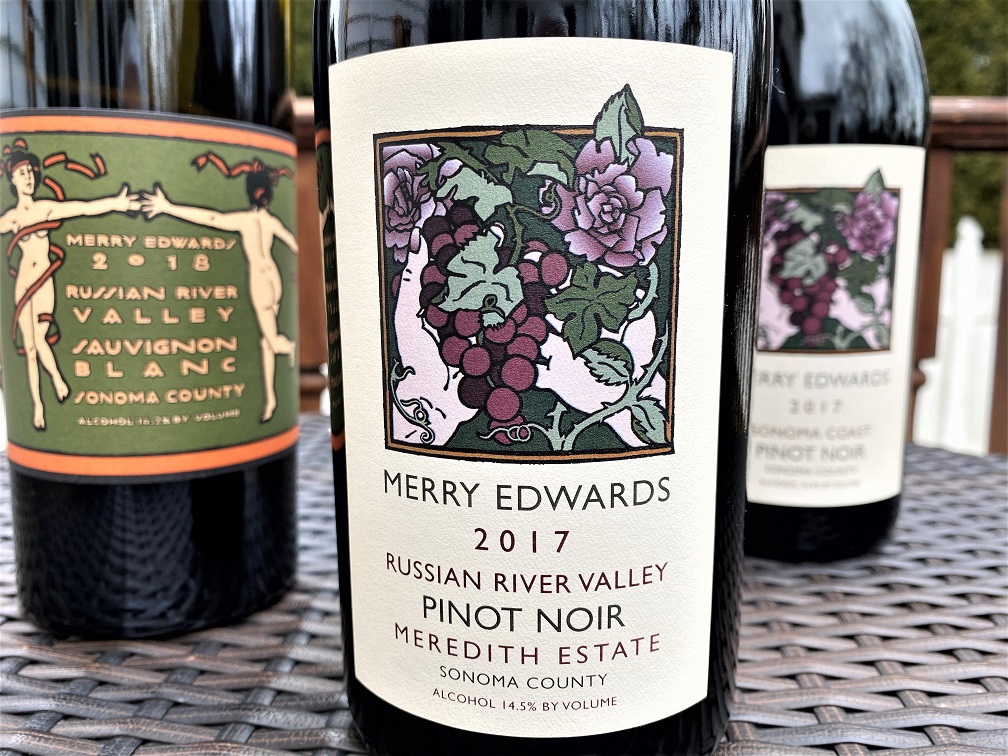
Merry Edwards Winery needs no introduction to wine lovers. Bright and noticeable labels always stand out on the shelf, it is hard to miss them. Merry Edwards’s sole focus is on the Russian River Valley Pinot Noir, which was first produced in 1999 (vintage 1997) – but she is also well known for her Sauvignon Blanc which was first produced in 2001. In addition to the passionate pursuit of Pinot Noir, Merry Edwards is also very passionate about sustainability, which is fully embraced at the winery and in the vineyards – you can read more about sustainability philosophy here.
2017 Merry Edwards Pinot Noir Meredith Estate Russian River Valley Sonoma County (14.5% ABV, $68)
Dark Garnet
Sage, tar, coffee, eucalyptus, freshly crushed dark berries
Tart, fresh cherries, crisp acidity, bright, invigorating
8, very uncalifornian, more Italian than anything else.
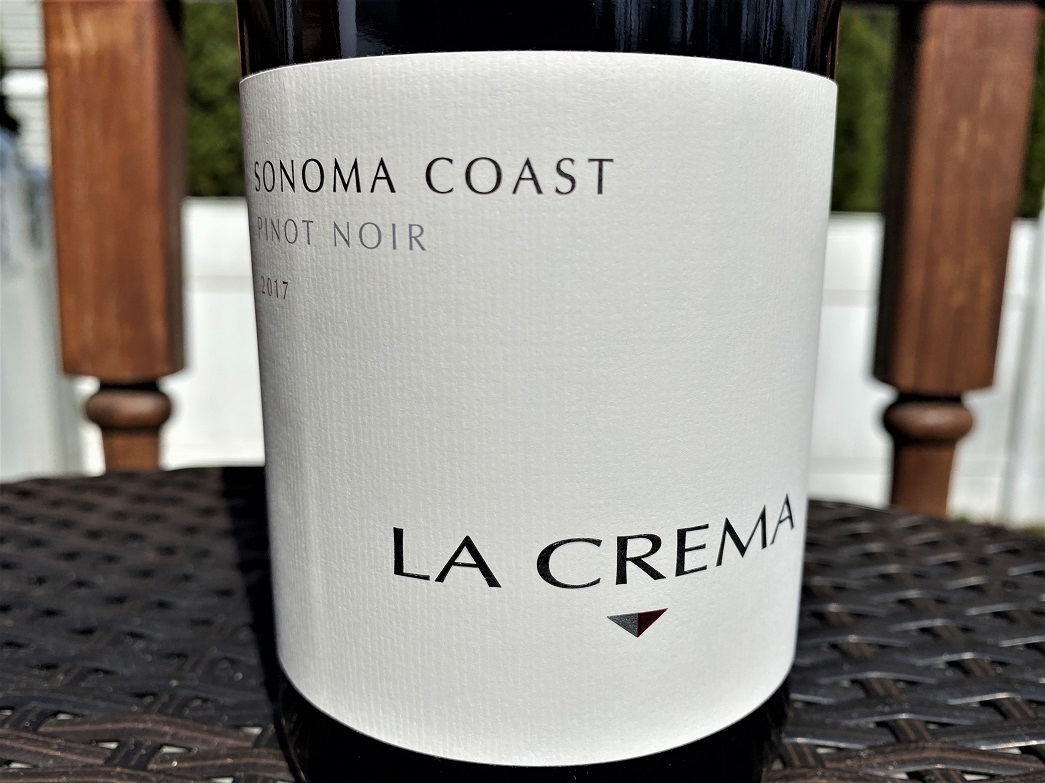
Considering how widely available La Crema wines are, I always made an effort to avoid them as “mass-produced”. After I tasted the wine, I completely changed my opinion – the wines might be produced in large quantities, but these are well-made wines. Also, the winery website has lots of good and well-presented information.
2017 La Crema Pinot Noir Sonoma Coast (13.5% ABV, $25)
Dark intense Ruby
Plums, fresh herbs, mineral undertones
Ripe fresh plums, mint, a touch of stewed strawberries, good acidity, good balance. Interestingly spicy finish.
8-, nice
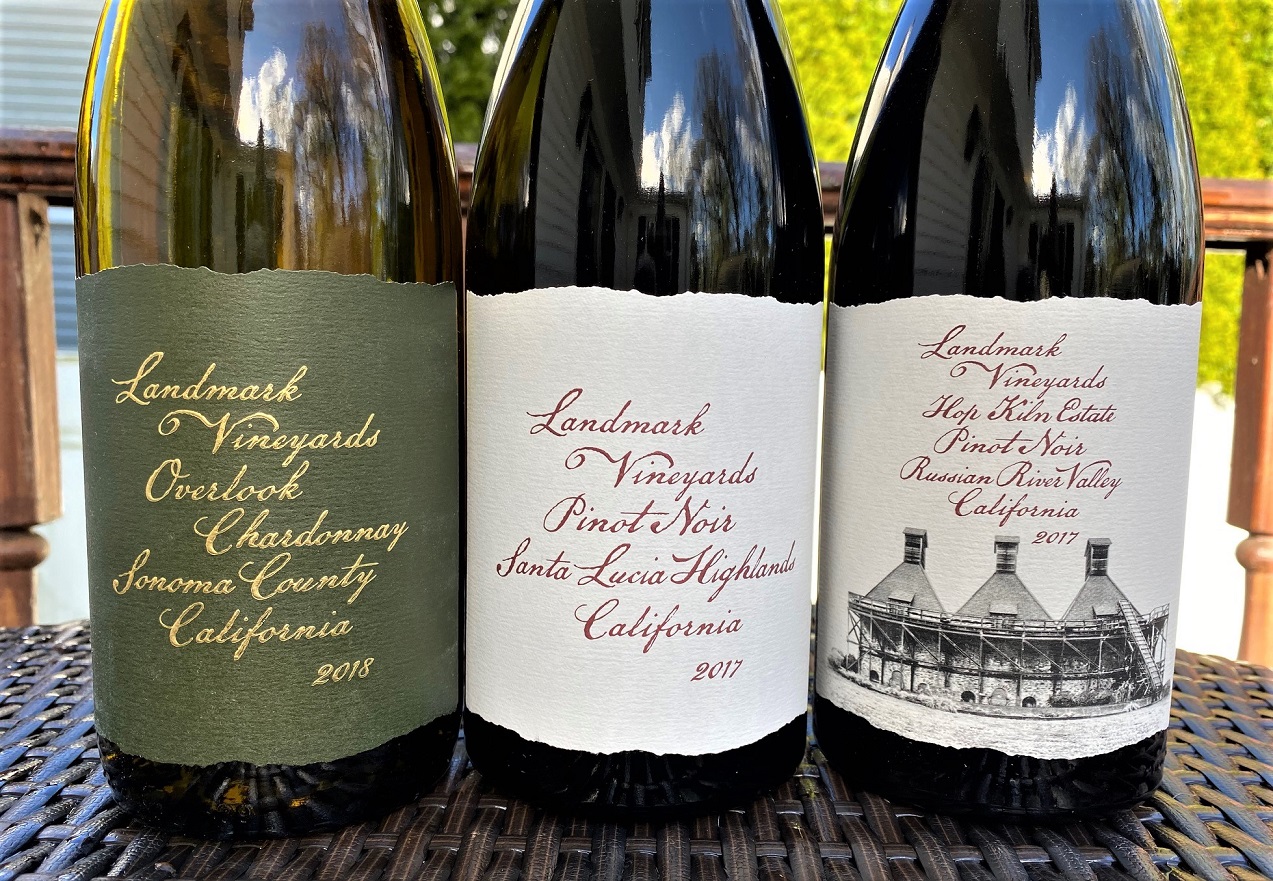


Landmark Vineyards was founded in 1974 by a group of people that included Damaris Deere Ford, the great-great-granddaughter of John Deere. In 1991, Damaris Deere Ford, now a sole proprietor of the Landmark Vineyards, focused exclusively on the production of Chardonnay and released the first vintage of the flagship Overlook Chardonnay. In 1993, Helen Turley started working as a consulting winemaker helping to create the Landmark’s signature style. Two years later, Landmark released the first vintage of its Pinot Noir under the name of Great Detour. In 2016, Landmark Vineyards extended into the Russian River Valley via the acquisition of the Hop Kiln Estate – and this was one of the wines I had an opportunity to taste.
2018 Landmark Vineyards Overlook Chardonnay Sonoma County (14.3% ABV, $27)
Light golden
Vanilla, apple, lemon
Vanilla, a touch of butter, golden delicious apples, citrus profile, roll-off-your-tongue round, excellent balance, delicious
8/8+, excellent
2017 Landmark Vineyards Pinot Noir Santa Lucia Highlands (14.3% ABV, $45, 14 months in French oak, 35% new)
Dark ruby
Plums, dirt, forest floor
Plums, cherries, tobacco, iodine, short finish, good acidity, good balance.
8-, excellent and classic
2017 Landmark Vineyards Pinot Noir Hop Kiln Vineyard Russian River Valley (14.5% ABV, $40, aged in 40% new French oak)
Intense ruby
Cherries, underbrush, the nose says Oregon with dark intensity
Tart cherries, dark chocolate, tobacco, complex bouquet
8/8+, superb.
Here are you – a collection of delicious Pop’n’Pour American Pleasures. And don’t worry, I have a lot more wines to share with you. Cheers!
Chasing DRC
Only yesterday I told you about some of the unicorns I’m chasing (the special breed, those made out of wine). And now I want to talk about the ultimate unicorn, the unicorn of unicorns if you will – Domaine de la Romanée-Conti, usually called by its abbreviated name – DRC.
Life is a series of random events. Sometimes we think we are in control, and sometimes we really are – but more often than not, things are just happening, and they are happening whether we are there to observe, learn, and experience, or not. While the events might be random, it is up to us to look for the patterns or the objects we desire. Once we know what we want, our subconscious is programmed to look for it any time all the time.
I had been following The Wellesley Wine Press blog for a very long time. Robert Dwyer, who is writing it, not only shares his opinion about wines but also has a great talent for finding amazing wine deals, all sorts of special discounts and promotions by credit cards, wineries, and wine merchants. When I got an email about Robert’s new post, “Domaine Romanée Conti meets Sonoma Coast: 2018 Vivier Pinot Noir [$37]”, my fingers were clicking the link even before I finished reading the title of the post, literally a reflexive reaction to detecting the words “Domaine Romanée Conti”.
You see, DRC might be the most coveted wine in the world. If it is not the one, maybe it is one of three or five of the most sought-after wines in the world. It is produced in minuscule amounts, and it is prohibitively, really prohibitively expensive for most of the mere mortals. DRC produces a number of wines, so to give you an example, there were a bit more than 2,000 cases produced of DRC La Tâche 2017, each bottle priced at $4,000+. And I honestly don’t care about owning a bottle, I just want to experience such wine at least once in a lifetime – so yes, the unicorn of unicorns.
You can imagine that opportunity to taste something even remotely related to DRC would trigger an immediate reaction. Skimming through Robert’s article, I learned that Vivier Pinot Noir is produced by Stephane Vivier, who was the winemaker for Hyde de Villaine, DRC’s joint venture in California, who started producing his own wines under the Vivier label. And at $37, this is the closest I can get to DRC without second-mortgaging the house. The same post also explained that the wine is available at Wine Access, the site I already had a good experience with – the rest was a no-brainer.

The wine quickly arrived, and I had to literally hold myself from opening the bottle while the UPS truck barely left the driveway. While I was admiring the simple design of the label, I really liked the description I found there: “Stéphane Vivier is a lazy winemaker. He watches. He waits. He plans. All the while letting the vineyards, the fruit, and “le climat” do the heavy lifting. So when you taste his wine, you taste what created it, not who“. That prompted me to take a look at the Vivier Wines website, where I learned that Stéphane Vivier was born and raised in Burgundy, where he also obtained a degree in viticulture and enology. He started working as a winemaker for Hyde de Villaine in 2002, and in 2009 he started making wines under the Vivier label with his wife Dana.
So how was the 2018 Vivier Pinot Noir Sonoma Coast (12.8% ABV)? Upon pouring into the glass, the first thing to notice was the beautiful, perfumy nose – fresh berries, violets, a touch of strawberries. On the palate, the wine was a typical, well-made Californian Pinot Noir, round, elegant, and polished – but unmistakably Californian, with a good amount of sweetness coming through. I can’t tell you what I was looking for, but I wanted to find something unique, something I didn’t experience in Californian Pinot Noir yet – but that didn’t happen.
On the second day, the wine changed its appearance. Both the nose and the palate pointed directly to Oregon. the nose became more earthy and less perfumy, and on the palate the wine was significantly more restrained, with iodine and earthy notes coming through a lot more noticeably. While the wine on the first day was good, I much more preferred how it was showing on the second day (Drinkability: 8-/8).
There you have it, my friends. Did I find DRC in California? Even if I did, I wouldn’t be able to tell, as I have no frame of reference. Did I discover a tasty Californian Pinot Noir? Absolutely. In 5, or maybe 10 years, it might become even amazing. Chase your dreams, my friends. Cheers!
Stories of Passion and Pinot: Utopia Vineyard
Pinot Noir excites passion. All grapes do, of course, and good winemakers are always passionate, often to the point of obsession. But some of the most desired wines in the world are made out of Pinot Noir, and Pinot Noir is notoriously finicky, mutation-prone grape, difficult to work with. Hence passion is winemaker’s best helper to work with Pinot Noir and produce the best possible wines.
Yes, I’m sure you figured me by now – I’m introducing a new post in the Passion and Pinot series – you can find all the past posts here. And I’m sure today’s subject resonates perfectly with the world we live in right now (for those who might read this post a few years later, look up “covid-19 pandemic”, and you will understand my point). I’m sure we would all much rather live in utopia compare to the self-quarantine and fear of sneezing – and it is the utopia we will be talking about here (don’t worry, there will be plenty of wine).
According to the dictionary, utopia is defined as “an imagined place or state of things in which everything is perfect”. I guess Daniel Warnshuis saw this complete perfection in the 17 acres parcel of land he found on the Ribbon Ridge in the heart of Ribbon Ridge Appellation in Yamhill County in Oregon in early 2000, hence the name Utopia Vineyard.
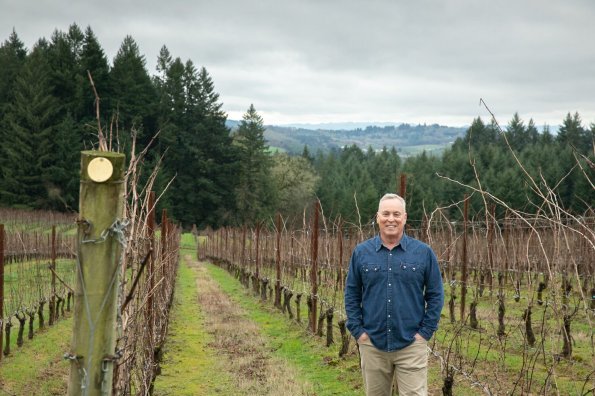
Daniel Warnshuis. Source: Utopia Vineyard
UTOPIA Vineyard had its first commercial vintage in 2006, 413 cases of Pinot Noir. Since then, Pinot Blanc, Chardonnay and a number of other wines had been produced at the winery, and numerous accolades were won at multiple competitions. Utopia, which uses dry farming methods, was L.I.V.E. certified in 2008.
I had an opportunity to [virtually] sit down with Daniel Warnshuis and ask him some questions – here is what transpired in our conversation:
[TaV]: First and foremost – why Utopia? Utopia means an unreachable dream, so what is the reason for this name?
[DW] The classic definition of UTOPIA is the perfect and no place. I am trying to make the perfect Pinot-noir but realize that as a human being I will not achieve perfection. It is, therefore, the goal that I constantly strive for without compromise to make the wine better each and every vintage.
[TaV]: You bought the vineyard in 2000, your first vintage was in 2006. How were those years in between? Did you have any major challenges, or did you just have to wait for the vines to mature?
[DW]: You are correct that I consider 2006 my first commercial vintage (413 cases of Estate Pinot-noir) but I did produce 97 cases of Estate Pinot-noir in 2005. Just to be clear, it was more of an experiment than a vintage. There were a number of challenges in getting the vineyard bootstrapped. First, I had to decide which clones I wanted to plant. I looked around the valley at the time and found that most of the vineyards contained only 2-3 clones and they were mostly the same 2-3 clones, e.g.. Pommard and Dijon 115 or Wadenswil. Or one of the other Dijon clones, mostly 667 and 777. I also detected a certain homogeneity in the wines being produced at that time and I wanted to do something very different. This is what convinced me to plant a total of 12 Pinot-noir clones including several heirloom clones from various existing vineyard sources in CA and OR. Once I settled on the makeup of the vineyard it was mostly a waiting game until the vines began to produce.
[TaV]: You were born and raised on California wines, why build the vineyard in Oregon and not in a Napa or Sonoma?
[DW]: I got exposed to Willamette Valley Pinot-noir early in my wine journey working for Tektronix where my first boss was an avid wine collector and amateur chef who exposed me to Oregon wines. The raw beauty of Oregon and especially Willamette Valley wine country was also a major draw for me along with its nascent state as a wine producing region. It presented a relatively affordable opportunity to get in on the ground floor of the next NAPA. I was a big proponent of Willamette Valley Pinot-noir while still living and running my NAPA wine business at a time when even most savvy wine drinkers were still unaware of what was happening in Oregon.
[TaV]: You’ve been a farmer for 20 years now. What are your main takeaways from this experience?
[DW]: Owning the land is the ultimate advantage for a winemaker because the best wines almost always come from the best fruit. 100% control from vine to wine is the maximum level of control and as a small producer here in Willamette Valley I am as close to a small producer (vigneron) in Burgundy that I can be without being in Burgundy. At Utopia I always want to make the best wine possible for any given vintage, again just like in Burgundy the wine should always be a reflection of the growing season and therefore unique each and every year.

Source: Utopia Vineyard
[TaV]: Do you have a pivotal wine, the one which clearly made you see the wine world differently?
[DW]: Burgundy wines from any small producer in Volnay, Pommard, Mersault (and Mersault, Chassagne and Puligny Montrachet for whites) were pivotal wines for me. The only thing I have found that compares with them are Willamette Valley Pinot-noir’s and now Chardonnay’s from small producers who are owning the land and making the wines in the same tradition.
[TaV]: Is there one Pinot Noir producer or winery you would consider a hallmark, something you would compare your wines to?
[DW]: Dominique Lafon is someone who I have followed for several decades and admire his approach (biodynamic farming and terroir driven) especially for his White Burgundy which I think is sublime. DRC is always mentioned as the ultimate but I would say that I have always and still do admire the smaller producers who are risking everything to make the best wine. This means organic/biodynamic farming even in a challenging vintage, minimalist approach to winemaking and focus on terroir.
[TaV]: What is the difference between the various Pinot Noir wines you are producing? Is it grape selection, individual plots, different oak regimens?
[DW]: Yes, it is all those things, in addition, location in the vineyard, clonal selection for the blends, oak regimen (ex: riper fruit deserves more new French oak such as in my Reserve “Eden” bottling).
[TaV]: Any plans for Utopia sparkling wines? You already growing all necessary components, so do you plan to take the next step?
[DW]: Yes, I would like very much to make sparkling wine. It is challenging as it requires a different setup and 3-4 years to produce the first vintage, but, I have not given up on the concept. I produced my first Port Style wine in 2018 and will bottle it this Fall.
[TaV]: You are now offering Grenache, Mourvedre and GSM wines. For how long you had been producing those? I understand that you source Grenache from Rogue Valley, what about Mourvedre and Syrah? Do you also plan to offer single varietal Syrah?
[DW]: I started producing those varietals in 2009 and actually started with a Syrah and Viognier but switched to Grenache in 2013 and added a GSM in 2014 and a Mourvedre in 2016. As long as I can get quality fruit I will continue to make different varietals. I would like to produce a Cab Franc and maybe even a Bordeaux blend in the future as well. I plan to plant some of these different varieties here on my new property to prepare for the inevitable change in our climate over the next 10 – 20 years.
[TaV]: What are your favorite wines or wine producers in Oregon? In the USA? In the world?
[DW]: In Oregon, Brick House, Beaux Freres, In California, Joseph Phelps, Spottswoode, In the World, anything Burgundy especially any small producers farming organic/biodynamic and terroir driven as well as Mouton Rothschild in Bordeaux.
[TaV]: Did your utopia materialize in your vineyard? Did you find everything you were looking for?
[DW]: Yes, I live on my vineyard and work with my family to produce a unique product that we share with the world. We preserve the land for future generations (organic farming), we give back to our communities, we promote culture of all types and we make our living doing what we love the most. I cannot be any happier than I am at UTOPIA.
[TaV]: Where do you see Utopia Vineyard in the next 10-15 years?
[DW]: More plantings of different varieties especially Rhone and Bordeaux. Possibly produce sparkling wine, continue well managed growth and keep experimenting to make it better each and every time. Create a long lasting legacy and keep it in the family for future generations.


If you are still reading this, I’m sure you are ready for a glass of wine, preferably, an Oregon Pinot Noir. I had an opportunity to taste two of the Utopia Pinot Noir wines, here are the notes:
2014 UTOPIA Pinot Noir Clone 777 Estate Reserve Ribbon Ridge AVA (13.8% ABV, $75)
Dark ruby
Smoke, plums, violets, earthy undertones
Bristling acidity, tart cherries, medium body, minerality, refreshing, inviting, good balance.
8, fresh, clean, easy to drink.
2011 UTOPIA Paradise Pinot Noir Estate Reserve Ribbon Ridge AVA (13% ABV, $85)
Dark garnet
Upon opening, the very extensive barnyard smell was apparent. It disappeared on the second day. Tobacco, earth, tar, and smoke are prevalent on the second day.
The palate is beautifully balanced with tart cherries, plums, violets, a touch of vanilla, baking spices and roasted meat.
8+/9-, delicious, hard-to-stop-drinking wine. Superb.
And we are done here, my friends – one more story of passion, and yes, it involves Pinot Noir.
Obey your passion!
P.S. Here are the links to the posts profiling wineries in this Passion and Pinot series, in alphabetical order:
Alloro Vineyard, Bells Up Winery, Ghost Hill Cellars, Iris Vineyards, Ken Wright Cellars, Knudsen Vineyards, Le Cadeau Vineyard, Lenné Estate, Tendril Cellars, Youngberg Hill Vineyards, Vidon Vineyard
Stories of Passion and Pinot: Le Cadeau Vineyard

Tom and Deb Mortimer. Source: Le Cadeau Vineyard
Hello, wine lovers.
I’m going to ask you for something very valuable – your time. About 20 minutes of it, as this is how long it should take you to read this post, one of the longest posts I ever published. But I’m not asking for your time for free – in return, I’m offering you one of the very best interviews ever published in the Stories of Passion and Pinot series, as well as the overarching One on One With Winemaker conversations.
Winemaking usually starts with passion, courage, and conviction – a belief that “you can”. Really. It is not always a degree in oenology (don’t get me wrong – of course that helps!), but the resolve to get going, as you have a burning desire to make world-class wine no matter what – this might be your main ingredient of success.
Tom and Deb Mortimer had such a resolve to make great Oregon Pinot Noir. After searching for a year, they found an uncultivated parcel of land on the south slope of Parrett Mountain in the Chehalem Mountains AVA, and the hard work began. Planting grapes, understanding your land, learning the soils and microclimates. All with the resolve to produce the best possible Pinot Noir. This is how the story of Le Cadeau Vineyard started (wonder if “Le Cadeau” means something? Keep on reading).
After tasting the wines of Le Cadeau, I was convinced that I want to learn more – which turned into a very enjoyable [virtual] conversation with Tom Mortimer, who generously offered his time to answer all of my questions. And this is what I want to share with you with a full conviction that it is well worth your time.
Here we go:
[TaV]: The story of Le Cadeau Vineyard started in 1996, when you purchased the 28 acres parcel in Chehalem Mountains AVA. When did you come up with the name Le Cadeau? What is the meaning behind this name?
[TM]: Le Cadeau (is French for “the gift”): We like to say that “the wine is not ‘the gift’; rather, “the wine is the excuse”—the true gift is the land and friendships.” When we first saw the Le Cadeau / BHV site, there was no view; it was obscured by scrub-oaks, blackberry bushes, and a lot of brush. Clearing the land was a bit like unwrapping a present, and ultimately a gorgeous view emerged. More significantly, rocky soils are coveted for top-tier vineyard sites. As we cleared the site, the broken volcanic basalt cobbles were revealed; rock in Oregon is rare, so we were very fortunate to find a rocky site. Lastly, wine is inherently relational. Enthusiasts get-into wine for the product, but ultimately, they stay in wine for the people; when the glass is empty, the relationships remain. So “the gift” has multiple manifestations.
[TaV]: When you found the parcel which became the future home for Le Cadeau, you said “For some reason, the property “felt right”. I don’t really know why”. So this was the love at first sight, right? Now, 23 years later, can you maybe better explain that feeling?
[TM]: Part of it was the location—the vineyard is only 35-minutes from downtown Portland, yet it was very serene countryside. We came from suburban Minneapolis to start this project; 22-years ago the Willamette Valley was much less developed, so this location was perfect for us. My wife (and I) didn’t want an isolated, rustic, farm experience. But other than the location, it was a beautiful site—south slope, about the right grade, I was fairly certain the view existed. It just had a different / better feeling than many of the other places we looked at.
At another level, I think I Iiked the fact that it was never-before-cultivated land. There was something about “starting a vineyard from scratch” that was appealing… of course, at the time, I had no idea what I was getting us into… which is actually a good thing. There are plenty of reasons to not take on a project like this. Sometimes it is better to not know what lies ahead.
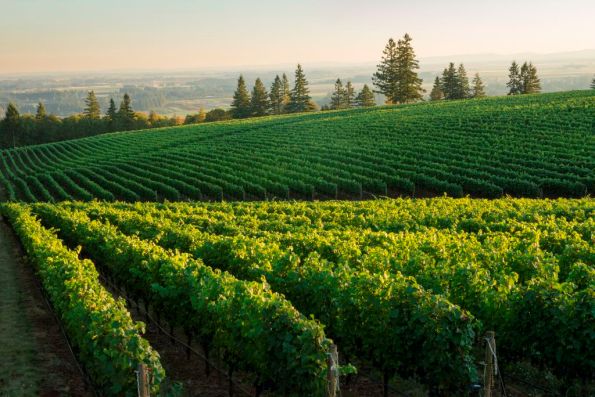
Source: Le Cadeau Vineyard
[TaV]: I really like the name “Black Hole Vineyard”, even though it has not necessarily a positive connotation about it. Have you ever bottled any wine which says “Black Hole Vineyard” on the label? What happened to that name? Is the Black Hole Vineyard simply became Le Cadeau Vineyard, or is it still exists under its own name?
[TM]: There was one “Black Hole” wine made by a fruit client. It was small production, and was only released to his wine club.
Our business is corporately divided into two companies: A farming company (the vineyard), and the wine biz. Most of the fruit from the vineyard is sold to the wine biz, but some is sold to notable clients. The farming company is named Black Hole Vineyard, LLC (or BHV, LLC), while the wine company is Le Cadeau. So in that regard, the name lives on. We also continue to personally refer to it as Black Hole among ourselves, and generally the winemakers like to call it Black Hole, vs. Le Cadeau. But at some point you need to make a brand decision, and focus your time and energy on that brand. We chose Le Cadeau vs. Black Hole. Obviously, it is a much more positive message, though perhaps not as amusing.
[TaV]: What made you believe that you can conquer the rocky soil? What was the drive behind your passion, developing your vineyard against the difficult terrain and the cash flow?
[TM]: As noted above, a good part of my confidence was rooted in ignorance. But as a wine collector I knew that many of the great wines of the world were grown in rocky soils. I figured, “if they can do it, so can I”.
Over the years I have come to discover that there is one tool that is central and more important than any other in developing and farming a rocky site. You might think that the tool is a chisel plow, or a big tractor, or whatever. But the reality is that the single-most-important tool is a checkbook. Unfortunately, unlike many of the folks that get into this business, my checkbook was about the size of a hand-held garden tool. With a vineyard that is raw ground and solid rock, it is better to start with a checkbook that is the size of a bulldozer… and a D8 at that. Fortunately, I kept my day-job.
[TaV]: How many Pinot Noir clones have you planted so far? Why so many?
[TM]: We’re up to about 16-Pinot Noir clones and 6-Chardonnay clones (the first Chardonnay, 2017, to be released in a couple months). Why so many?—there are a handful of reasons:
- a) I cannot recall ever having a single clone wine that I felt was as complete and interesting as a multi-clone wine. We don’t put them all in a single wine; our cuvees result from different combinations of clones, soils, and aspect (climate). Most of the cuvees have 3 to 5 clones, Diversité has the most with 7 that make up the majority of the wine, and another 2 or 3 that are there in small quantities.
- b) Curiosity and experimentation. Quite simply, clones are exciting. You wait for 3-years wondering what the fruit will look like and taste like. Often it takes several more years before you learn about the flavors, texture, physical characteristics of the fruit and how it affects the wine. So there is always a sense of anticipation. I liken clones to colors on an artist’s palette; they add “color” to wine—not in a literal sense, but in terms of variance, nuance, and complexity.
- c) Differentiation. I don’t want to make wine that is like everyone else’s.
- d) Optimization. Folks (i.e., typically winemakers) have varying views of how important clones are in the overall mix of variables. Most agree that the dirt / site are the most important elements, and I’d agree with that. But for many, “clones” would be further down the list. For me, the plant material is very central to extraordinary wine. Great wines only happen when there is great dirt, perfect climate, excellent farming / viticulture, the very best and site-matched plant material, and of course great winemaking. Like many things in life, something can only be as good as its weakest link.


[TaV]: Is there an Oregon (or maybe Burgundian) winery(ies) which were instrumental in the development of your own winemaking style?
[TM]: We have always wanted to make wines that are true to the estate site. In this regard, Le Cadeau is more of a European model, in that the “rock star” is the vineyard, not the winemaker. The wide range of cuvees exist to showcase the range of “faces” of the vineyard. But more recently we’ve been searching for more freshness and aromatic excitement. This is why I engaged our French consultant, Pierre Millemann several years ago. Not surprisingly, this has led us to produce higher acid / lower alcohol wines.
It would be difficult to pick a particular winery to reference against; again, our dirt / site is very unique. There are many wineries, both in Oregon, Europe, (and California) that we respect, but I think it would wrong to say that we try to emulate any of them.
[TaV]: Do you still have any bottles from the 2002 vintage? If you do, how do they hold?
[TM]: I have a few bottles of 2002. The last one I had was about 2-years ago. It was doing well, but I think it was past its prime. Keep in mind that the vines from that vintage were only 4-years old. I recently had an ’05 Diversité from magnum; it is going strong and will continue to last for a long time.
[TaV]: According to what I see on your website, you produce [at least] 7 Pinot Noir wines. Is there an idea behind such a range of Pinot wines? What are you trying to showcase?
[TM]: As noted above, the majority of the cuvees showcase various attributes of the vineyard: Rocky soils (Rocheux); the cooler East-side (Cote Est); clonal diversity (Diversité); heritage clones (Merci Reserve). More recently, we’ve added two cuvees that are more inclusive of winemaking technique—Trajet Reserve is 100% whole cluster; and “Pierre” has considerable input from our consultant, Pierre. It is about “freshness” and higher acidity.
[TaV]: Going back to the Pinot Noir clones – considering the sheer number of them, you must be blending your wines. What is your approach to blending? Do you have any Estate Pinot Noir wines where you trying to maintain consistency throughout the different vintages?
[TM]: Generally we favor co-fermentation of multiple clones in a single tank. Most of the cuvees are made of two separate tank fermentations that go to barrel separately, and are then combined to make the final cuvee. But for the most part, all of the wine from each ferment ultimately goes into the cuvee.
I like to say that the Le Cadeau wines are “made in the vineyard”… I don’t mean that literally, but rather that the specific “Cote Est” fruit is picked separately, and it is made into the Cote Est cuvee. Same for Rocheux, Diversité, and Merci. In this regard, there is clonal consistency from year to year, because the wine for each cuvee is consistently made from the same section of the vineyard. For example, Rocheux is always roughly 45% Dijon 777; 45% Pommard; and 10 % Wadenswil… that is what is planted in the sections where the Rocheux fruit is grown. … and fortunately, the vines don’t move around at night when we’re not looking… that would be a mess.
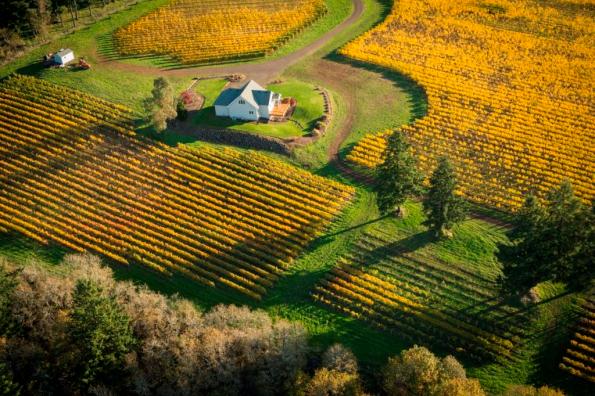
Aerial view over Le Cadeau Vineyard, Chehalem Mountain AVA, Willamette Valley, Oregon. Source: Le Cadeau Vineyard
[TaV]: How did you come to the idea of the Sparkling wines? You offer 2011 vintage sparkling wine, so clearly you started making sparkling wines before they became “the thing” in Oregon, so how did you get there?
[TM]: 2011 was a very cool, late, year, and the clusters were uneven. Some of them were quite large (a fairly rare event, given our rocky soils). On October 15th, the bigger clusters had only gotten to about 19-Brix—not good for still PN. I know we wouldn’t/couldn’t pull them all out on the sorting table, so we did a sort in the vineyard. I told the crew to harvest the three biggest clusters off of each plant in certain sections of the vineyard. Since these were at a perfect stage for sparkling, and we had them hanging on the vine for a full season at that point, it seems silly to drop that fruit on the ground. So we took a shot at sparkling—it worked out very well, so now we make it generally every other year.
[TaV]: I’m sure you knew this question is coming J – it seems that you only work with Pinot Noir grapes. Do you grow any other varieties? Do you have any plans for the white wines? If yes, what grapes would you plant?
[TM]: As noted above, we have 6-clones of Chardonnay that are now in production. The first Chardonnay will be 2017, released in a few months. We’ll only do Chardonnay at Le Cadeau (other than Pinot Noir). But under our other brand, Aubichon, we’ve made some wonderful “Alsatian Style” Pinot Gris, as well as a Pinot Gris-based Rosé, and a wine we call “Sur Peaux”, which is an “orange wine” from Pinot Gris. All the Pinot Gris is sourced from old vine vineyards, about 25-years old. So it’s nice fruit, and the wines are quite special.
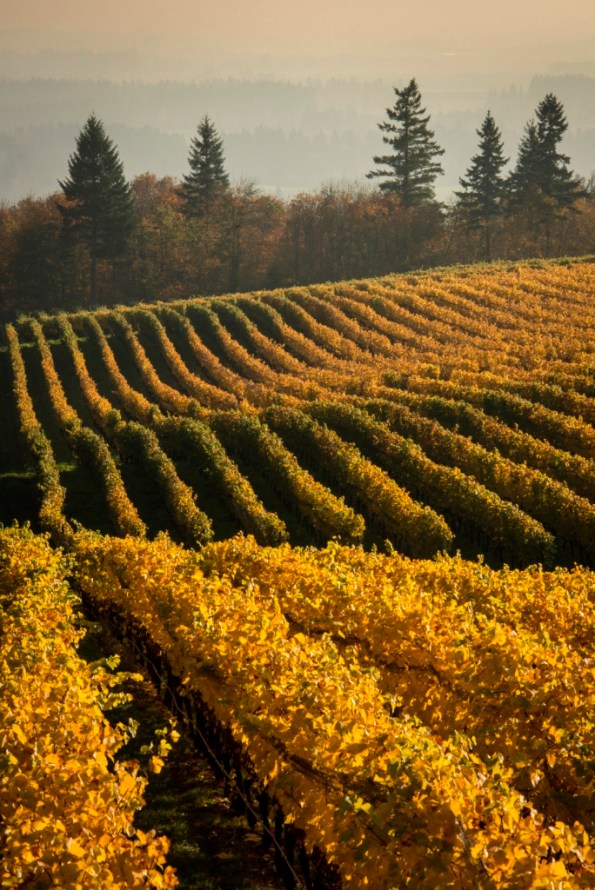
Le Cadeau, Chehalem Mountains AVA, Willamette Valley, Oregon. Source: Le Cadeau Vineyard
[TaV]: And one more common question I like to ask – when you are not drinking your own wines, what are your favorite wines and/or wineries, in Oregon or anywhere in the world?
[TM]: I have a diverse range of preferences:
I’m a huge fan of Weinbach in Alsace; Chave Hermitage is often special, Guigal Condrieu (the good version, not so much the standard one), Huet and Chidane Chenin Blanc; Fevre Chablis; Robert Weil German Reisling (and many others—Keller dry from their rocky vineyard is nice); any good Bonne Mares; love white Bordeaux—Chevalier, Smith H-L, and of course the “big guys”, but they’re too expensive. Barberescos from Italy—Gaja (also like Gaja Chardonnay), and I think Produtorri does an amazing job for the price, along with Albino Rocca. I’ve had a Foradori wine that I thought was special, certain Brunellos, but many have become Parker-ized, that’s unfortunate. I like Ciacci wines though. … the list goes on…
In Oregon, there are many that I respect, and a small group that I like, but I’d prefer to leave those thoughts anonymous.
[TaV]: What is ahead? Where do you see Le Cadeau in 10-15 years?
[TM]: I think we’re just beginning to make our best wines, and really beginning to understand the vineyard’s nuances. Some of our more exciting clones are still quite young, so it will be interesting to see what sort of wines we make from the more exciting clones when the vines are older. The 2018 wines that we have in the barrel are possibly our finest to date. Very excited about getting them into the bottle and out on the market.
I’m hopeful that our Chardonnay program will be noteworthy. Pierre’s guidance on Chardonnay has been very helpful. 2018 in barrel looks to be very promising, and I’m excited about the first 2019 fruit from a rocky grafted section of the vineyard. We have a couple interesting Larry Hyde clones of Chardonnay planted in that area as well. The fruit looks to be quite different. I’ll have a better sense of the Chardonnay potential in another year, but I’m hopeful that we can produce “the real deal”.
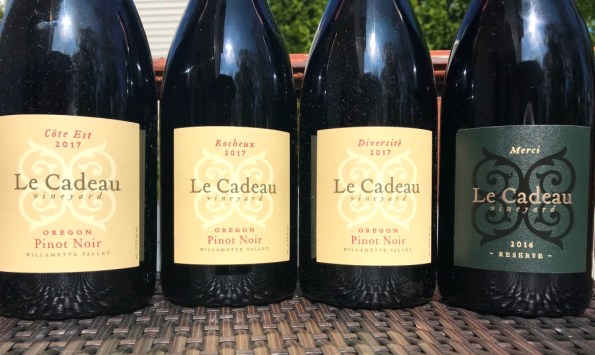
Thirsty? Here are my tasting notes for the wines:
2017 Le Cadeau Côte Est Pinot Noir Willamette Valley (13.9% ABV, $50, 145 cases made)
Dark Ruby
Smoke, plum, iodine, medium-plus intensity
Wow. Touch of smoke, Sage, medicinal notes (cough syrup), good acidity, excellent balance
8
2017 Le Cadeau Rocheux Pinot Noir Willamette Valley (13.2% ABV, $50, 174 cases made)
Dark Ruby
Plums, cherries, violets, intense, inviting
Bright, clean, succulent ripe cherries, licorice, great minerality, excellent balance, superb
8+
2017 Le Cadeau Diversité Estate Pinot Noir Willamette Valley (13.9% ABV, $50, 245 cases made)
Ruby
Delicate, lavender, a touch of smoke, perfect
Beautiful, plums, ripe strawberries, great acidity, baking spices, delicious overall
8+/9-
2016 Le Cadeau Merci Pinot Noir Reserve Chehalem Mountains Willamette Valley (14.1% ABV, $80, 143 cases made)
Garnet
Intense, ripe cherries and plums, candied fruit
Wow, great intensity, cherries, cherry compote, ripe plums, minerally notes, good acidity, good balance
8+
As you can tell, I really liked the wines – they were literally one better than another.
Here you go, my friends – yet another story of Passion and Pinot. I hope you enjoyed reading it as much as I enjoyed writing it, and I thank you for your time and attention.
Will there be more Passion and Pinot stories? Well, do you think the passion ran out of the Pinot winemakers and aficionados? I will bet my virtual DRC bottle that it did not. So we will continue our conversations as soon as the next opportunity will present itself.
Obey your passion!
P.S. Here are the links to the posts profiling wineries in this Passion and Pinot series, in alphabetical order:
Alloro Vineyard, Bells Up Winery, Ghost Hill Cellars, Iris Vineyards, Ken Wright Cellars, Knudsen Vineyards, Lenné Estate, Tendril Cellars, Youngberg Hill Vineyards, Vidon Vineyard
Stories of Passion and Pinot: Iris Vineyards
 Let me ask you something. If you would look at the mountainous parcel of land, completely destroyed by the brutal commercial logging – would you be able to envision there a beautiful Pinot Noir vineyard? (if you answered “no”, same as I did, don’t worry about it – this is why you and I are not in the winemaking business). When Richard Boyles and his wife Pamela saw such a logging-destroyed site at the south end of the Willamette Valley, they were able to see past the nature in distress. They were able to see the future vineyards and even future forest restored where it was before. They purchased about 1,000 acres site in 1992, and it became the home to the Iris Vineyards, with the name inspired by the beautiful wild Douglas iris covering the surrounding hills in spring.
Richard’s fate was sealed at the age of 7, when he assumed assistant winemaker duty to his grandmother, helping her to make the sweet, dessert wine. As they say it in the stories, the rest was history. Richard met Pamela while studying at the University of Oregon. Countless visits to Europe and living there for a while as Richard had a carrier in international business management and hospitality, helped Richard and Pamela to discover their wine passion – Burgundy, and its signature grape – Pinot Noir. That passion for Pinot helped Richard and Pamela to see through the broken trees and realize their dream of making the world-class Pinot Noir.
Well, there is also an additional element to that passion – a principle of Areté. Richard and Pamela learned about Areté in the university, while studying ancient Greek philosophy. This principle simply means that it is one’s moral obligation to achieve the highest potential the person can achieve. Give it a thought – Areté is really a great principal to live by; we will get back to it later on in this post.
Today Iris Vineyards farms about 43 acres of vineyards, located at 800 to 1,100 feet elevation (quite high for the Willamette Valley). The vineyards are surrounded by more than 500 acres of restored forest, mostly Douglas fir and Ponderosa Pine, as well as Oregon white oak. The main vineyard of the estate, Chalice Vineyard, was planted in 1996 and produced its first vintage in 2001. Pinot Noir takes two third of the plantings, following by the Pinot Gris and a small acreage of Chardonnay. Iris Vineyards also produces a number of other, less traditional wines (Viognier, Syrah, and more) from other appellations in Oregon, such as Applegate Valley.
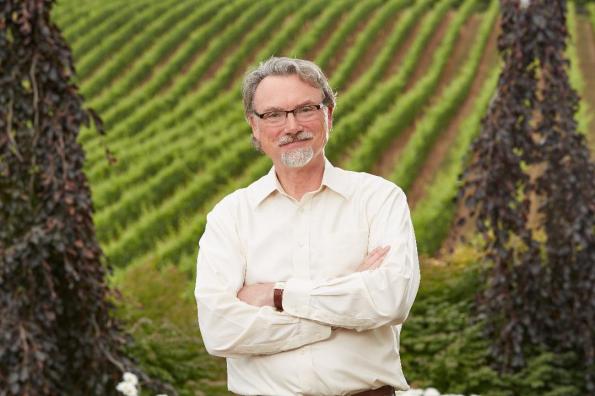
Richard Boyles
I was definitely intrigued by what I learned about the Iris Vineyards, so I took an opportunity to sit down with Richard Boyles (yes, once again it was a virtual conversation) and ask him a few questions. Here is what transpired:
[TaV]: You grew up tasting sweet wines. How did you end up with Pinot Noir becoming a passion?
[RB]: Although my first experience was sweet wines made and sampled with my grandmother, the wines I “grew-up” with were the wines served at family celebrations organized by my dad. These were usually red Bordeaux and reds and whites of Burgundy as well as German Rieslings. As you can see, with the exception of the Rieslings, these were dry wines that were intended to pair with food. I became more focused on Pinot Noir as it became clear that Oregon could grow world-class Pinot Noir with Oregon attitude. After graduation from the U of O, while living in Seattle, Pamela and I continued to explore the world of wine, visiting vineyards, tasting rooms and sampling primarily in Oregon and Washington and occasionally in Napa and Sonoma. Our interest in Pinot Noir solidified as a passion as Pamela and I explored different viticultural areas of Europe when we lived in Germany and Switzerland. We found ourselves gravitating to Burgundy for Pinot and Alsace for Pinot Gris.
[TaV]: What made you think that the parcel of land destroyed by logging would be an ideal place to grow Pinot Noir?
[RB]: In the Pacific Northwest logging is a part of the rural economy and landscape. In the case of our property, the fact that it had been logged and that we took on the legal obligation to replant the forest meant that we were able to acquire large acreage at a modest price. The property had a long history as a mixed forest operation, with cattle and timber harvests providing income to the owners. When we acquired the property, we replanted hundreds of acres of forest before we turned our attention to planting the vineyard on former pasture. The areas for vineyard plantation were selected for the Jory and Bellpine soils, south-facing slopes, elevation and for modestly steep slopes which allow the property to be farmed with standard farm equipment. While our purchase of the property was prompted by the vineyard potential, it has been equally satisfying to plant tens of thousands of Douglas fir trees that have now matured into a forest, an ecosystem really, supporting many species of flora and fauna.
[TaV]: I know that the concept of Areté and its relevance to everything you do is explained on the website, but can you explain one more time for our readers what Areté means for you and how does it apply to the Iris Vineyards and your wines?
[RB]: In addition to what is on the website and press kit, this is what I would say about Areté: Areté is a philosophy or way of being that says, “Hey buddy, you want to excel and standout? Then be deliberate about it. Figure out what skills and knowledge you need, practice them, perfect them if you can. Figure out what else will up your game. Go get that skill or knowledge. Repeat. Because that is what this life is all about. A constant aspiration to live up to the potential that is you. Why would you settle for less?” With respect to Areté at Iris, Areté is a cultural signpost. It tells team members and prospective team members what we value at Iris, how we want to be and be seen as an organization. It tells team members how they can contribute. We can only be an organization that exemplifies Areté if our team members embrace it, make decisions and plans by it. By making it clear what we are about, we attract like-minded team members. And, of course, Areté is a proclamation to the world about aspirations. So, we take it very seriously when we put the Areté name on the label of the wines that are the best examples of our craft.
[TaV]: I would guess that first was Pinot Noir, then Pinot Gris, then Chardonnay (curious – am I right?), but Iris Vineyards today offers way more than just 3 flagship Oregon grapes – how did you get to include Syrah, Tempranillo, Viognier into your repertoire?
[RB]: From the time we committed to establishing a vineyard, Pamela and I planned to grow Pinot Noir, Pinot Gris, and Chardonnay. The expansion into other varietals is the result of two factors: 1) the desire to create variety for our club members; and, 2) our winemaker, Aaron Lieberman’s curiosity, interest and skill at working with grape varieties beyond Pinot Noir, Pinot Gris and Chardonnay.
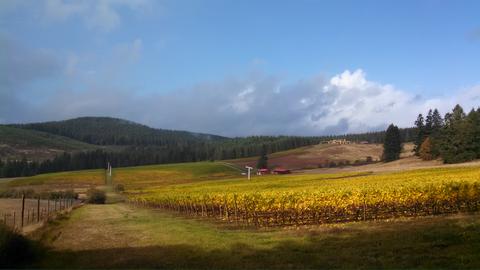
Source: Iris Vineyards
[TaV]: While it is not yet available on your website, I understand that you are about to introduce Iris Sparkling wines. Can you tell me more about this project, starting even with “why sparkling wines”?
[RB]: Much as the reintroduction of the Rosé program was in response to Pamela’s strong interest in Rosé and renewed consumer interest in the category, the sparkling wine program came about as a result of Aaron’s interest in, and interest in the challenge of making sparkling wine. Sparkling wine is the ultimate celebratory beverage. Our club members and tasting room visitors love our Methode Champenois Blanc de Noir and Blanc de Blanc. We reserve a small amount for weddings and other celebrations at the tasting room, though the sparklers routinely sell out prior to the subsequent release. Aaron can expand on what brought him to pursue sparkling.
[TaV]: Will sparkling wines be generally available or they will be offered as winery exclusive/club options?
[RB]: I anticipate that the sparkling wines will be available to club members, available at the tasting room, available to weddings and celebrations held on the property and perhaps to select accounts. I don’t anticipate that it will be available to broad distribution. These are intensely hand made wines requiring lots of time and attention. The sparklers will have an important but limited role in our line-up.
[TaV]: Considering the wide range of grapes you already use, do you have any plans to expand it any further?
[RB]: Our offerings will continue to evolve. Our core business is in Pinot Noir, Pinot Gris, Chardonnay, and Rosé. As we expand our vineyard, we will plant small amounts of Pinot Meunier and Pinot Blanc as well as a broader variety of clones of Pinot Noir and Pinot Gris. Pinot Meunier will have a place in our sparkling program. We will evaluate it as a potential stand-alone variety. Pinot Blanc will be a standalone bottling. I expect we will pare some wines from our current offerings as we respond to the tastes of our club members and tasting room visitors. 8. I’m assuming you started producing wines at the end of the 1990s. Do you still have any of your first releases available in the cellar? How do they hold up? What is the oldest of your own wines you ever tasted?
We first bottled wine under our own label in 2001. Prior to that, we sold the small volume of fruit coming from our vineyards to other producers. We recently sampled a bottle of 2008 Reserve Pinot Noir. We have a single bottle left. I wish we had more in our cellar. While this wine wasn’t deliberately built to last ten years, it is drinking very well. The 2012 Reserve Pinot is drinking nicely. Pamela and I have a few overlooked bottles of 2001 and 2002 Pinot Gris in our personal cellar. These were award winners 15 and sixteen years ago, including double platinum for 2002. As compelling as these wines were at two, three, four and even five-year-olds, they weren’t intended to age and are now past their prime. It’s a good reminder to drink while the drinking is good.
[TaV]: You are practicing sustainable farming. Can you explain what it means for you, how does it relate to the land, vineyards, grapes and so on? Have you ever looked at going Biodynamic?
[RB]: The goal of our farming practices is to produce fruit that meets our particular purposes. We use different farm practices and viticultural techniques for Pinot Noir that’s intended for Rose’ differently than the fruit that is intended for our estate bottling for instance. Our farm practices are conventional as we want to have all the tools available to produce the best fruit for the purpose while supporting the long-term productive capacity of the vineyard and operating a financially sustainable business. Farming isn’t static. We annually review best practices and new literature to improve what we do in the vineyard. While we have considered a Biodynamic approach, we believe we can produce better fruit for our purposes with a conventional approach to farming.
[TaV]: When you are not drinking your own wines, what are your favorite wines from Oregon, and from around the world?
[RB]: One of the notable things about the world of wine today is that so much great (and not so great) wine is accessible from all over the world. We see wine as an exploration, so we regularly try what we haven’t tried before. That is as likely to be a Pinot from a new Oregon producer, a Sauvignon Blanc from a new growing region or an obscure varietal we haven’t tasted in a while. Through exploration, we learn more than returning to the same things repeatedly. That said, we have a broad stable of wines of our own production. We do frequently return to those.
[TaV]: Where do you see Iris Vineyards in 15-20 years from now?
[RB]: I expect that Iris will garner increasing consumer attention as we offer compelling wines at a good value. I expect that we will continue to offer wines across a variety of complex profiles and price points. I don’t say across a variety of quality, because all of our wines are of high quality, they just differ in terms of complexity. Personally, in 15 or twenty years I hope to have more tractor time and hands-on time in the vineyard and in the winery, particularly at crush. Overseeing this and other businesses currently require that I focus on the big picture. It was a “need” to farm and a maker mentality that brought us into the business. I still craft beer, pickle and can. I look forward to re-creating my job description to allow more time in the vineyard and winery and less in the business of running a business.


Yes, I agree with you – it is time to drink. I had an opportunity to taste two of the Iris Vineyards Pinot Noir wines – here are my notes:
2017 Iris Vineyards D Block Pinot Noir Chalice Vineyard Willamette Valley (12.7% ABV, $39.99, 300 cases produced)
Bright Ruby
Light, elegant, plums, cherries, a touch of ripe strawberries
Sweet cherries, plums, great acidity, excellent balance
8-/8, nice and approachable
2016 Iris Vineyards Areté Willamette Valley (14.1% ABV, $59.99, 100 cases produced)
Dark Ruby
Touch of smoke, plums, a hint of cranberries
Iodine, Cherries, a touch of smoke, good balance
8/8+, very good wine, will be interesting to try it again in 10 years…
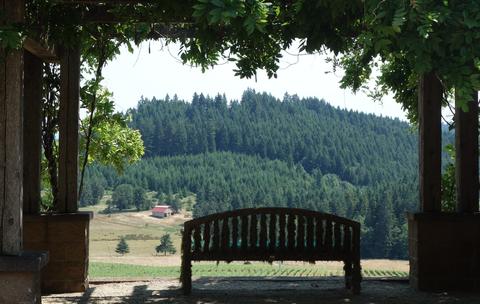
Source: Iris Vineyards
Here you are, my friends – another story of Passion and Pinot. Go pour yourself a glass of Pinot – more stories are ahead…
To be continued…
P.S. Here are the links to the posts profiling wineries in this Passion and Pinot series, in alphabetical order:
Alloro Vineyard, Bells Up Winery, Ghost Hill Cellars, Ken Wright Cellars, Knudsen Vineyards, Lenné Estate, Tendril Cellars, Youngberg Hill Vineyards, Vidon Vineyard
A Pinot Noir Lesson for Self with Tendril Cellars
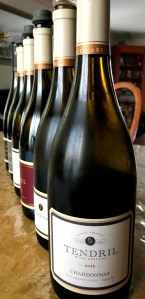 Back in May, we virtually met with Tony Rynders of Tendril Cellars and talked about … many things wine, of course – you can find this conversation here.
Tony is one of the few winemakers I know who teaches people about his wines by conducting organized tastings. As I didn’t have an opportunity to attend any of those events, I decided to run a lesson for myself on the same subject. How you ask? Easy – by tasting the wines blind.
I can literally see the surprised looks and raised eyebrows. How is it a blind tasting if I know already everything about those wines? You see, the lineup I had included 6 wines. Out of those six, four were different Pinot Noirs – different vineyards, different winemaking process, different price points. Obviously I was not planning to try to identify the exact wine, but still – will I be able to taste the difference, and maybe identify the most expensive wine? Comparing Chardonnay and white Pinot Noir should also be a fun exercise, as those are two siblings ruling the world of Champagne. Yep – lots of opportunities for having fun.
Okay, blind tasting it is. The bottles are wrapped, the numbers are randomly assigned. May the taste buds serve me right!
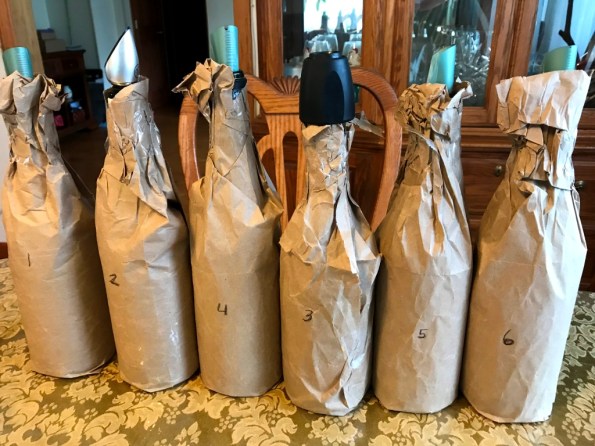
Here are my notes for the wines while tasting them blind:
1 Light golden color
Vanilla, golden delicious,
Bright acidity, vanilla, apples, a touch of honey
2 toasted notes, yeast
Perfect acidity, Granny Smith apples, a touch of honey, toasted notes on the palate, outstanding
white pinot?
3 Dark ruby
Earthy, Rutherford dust on the nose, a touch of roasted meat,
Beautiful palate, soft plums, round, espresso, excellent acidity, wow. ThightRope?
4 Ruby
Concentrated nose, mint, eucalyptus
Concentrated palate, acidity, eucalyptus, sage, violets on the palate. Very unusual. Single Vineyard?
5 Dark ruby
Wow. Blueberries, raspberries, restrained
Very smooth, silky, bright fresh fruit, acidity, firm structure, excellent balance, never-ending finish. Wow. C-Note?
6 Dark ruby
Nose old world style, forest floor, mushrooms, great restraint
Round palate, blackberries, baking spices, soft, delicious. Outstanding. Extrovert?
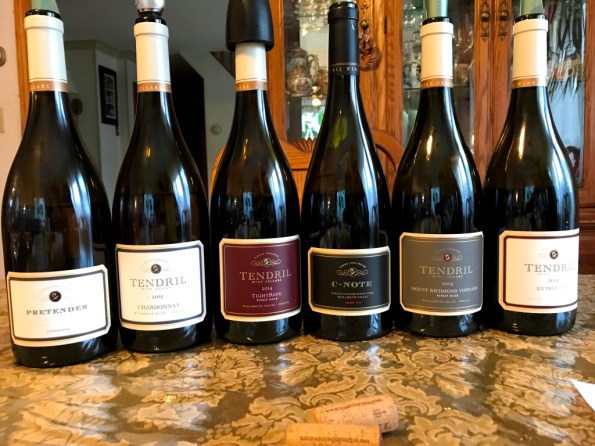
Everyone knows that the best part of the blind tasting is … unwrap! The moment of truth, pure and simple. Here are my notes for the tasting of the wines non-blind, 3 hours after the blind tasting (in the same order):
1 – 2015 Tendril Cellars Pretender Willamette Valley (14.1% ABV, $60, white Pinot Noir)
A bit darker color (golden)
Vanilla, butter
Plump, round, crisp acidity, acidity on the finish (very extensive), plump body.
8, excellent. Reminiscent of a nice Marsanne.
2 – 2015 Tendril Cellars Chardonnay Willamette Valley (13.5% ABV, $40)
Honey, gunflint, vanilla
Brioche, Granny Smith Apple, a touch of butter, clean acidity, excellent
8, outstanding.
3 – 2014 Tendril Cellars Extrovert Pinot Noir Willamette Valley (14.1% ABV, $48)
Beautiful, classic, open Pinot, with cherries, sage, and plums.
Soft cherries and plums on the palate, clean acidity, sage, violets, delicious, wow
8, delicious.
8+/9-, a pure standout. Polished, velvety, seductive, like a light touch on the hand which makes your whole body to vibrate. More reminiscent of CA Pinot than dark and loaded
4 – 2014 Tendril Cellars TightRope Pinot Noir Willamette Valley (14.2% ABV, $64)
Very tight, espresso, licorice, blackberries
Beautiful, sweet fruit, noticeable tannins, very round, medium body, cherries and cherry pit.
8, excellent.
Complex nose of herbs and spices, exotic and unusual.
Wow, great power and complexity, not a typical Pinot, might be more of a Zinfandel or even Syrah profile. Needs time, lots more time.
5 – 2014 Tendril Cellars Pinot Noir Mount Richmond Single Vineyard Willamette Valley (14.1% ABV, $60)
Very unusual. Beets and caramel on the nose, with a touch of dark chocolate.
Blueberries and caramel on the palate, nice salinity, raspberries. Medium+ body. Excellent
8
Very ripe after 2 days been open (air pumped out). Beautiful palate, minerality-driven, cigar box, eucalyptus, tense, powerful. Can be mistaken for a Rioja of a nice caliber.
6 – 2014 Tendril Cellars C-Note Pinot Noir Willamette Valley (14.1% ABV, $100, 100% Whole Cluster, 100% new oak)
Sublime. Can be described only via allegories, such a finesse. Dark chocolate and cherries. Excellent
Equally delicate on the palate, crisp acidity, bright, sweet plums, and tobacco. Outstanding.
8, excellent
Nose is incredible. First, you want to smell.this.wine.for.a.long.time.
Superb, elevated wine, complex, great finesse, and needs time. 8+
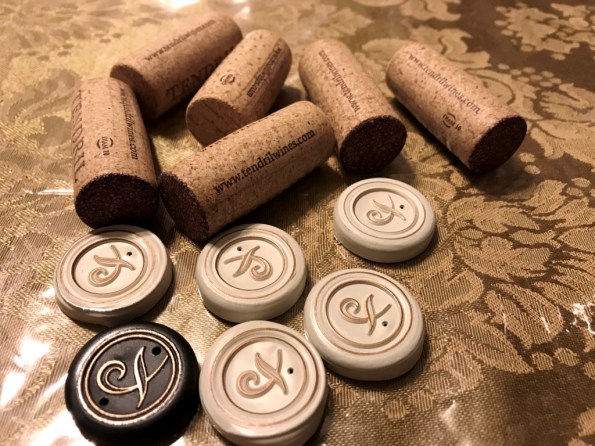
As you can tell, I failed miserably. I didn’t identify any of the wines – however, this was perfectly in line with my expectations. What was definitely interesting is that despite the four Pinot Noir wines been all from Oregon and at about the same age, they were absolutely, unquestionably, distinctly different – and strikingly delicious.
Of course, I extended the pleasure of tasting some of those wines over the few days, which is reflected in the tasting notes above.
Here you are, my friends. Blind tasting or not, the Tendril Cellars wines are worth seeking – the virtual tasting will simply not do it – these are the wines to experience. And if you need to choose only one, I can let you in on a secret (don’t tell anyone!) – the Extrovert was my favorite. Cheers!
Stories of Passion and Pinot: Tony Rynders of Tendril Cellars
Wine and passion are indelible. Yes, wine is a business for the most parts, but making a bottle of wine which someone else is desiring to drink is a labor of love, and every such bottle has a bit of the winemaker’s soul invested in it (feel free to call me melodramatic). Thus I’m always happy to talk to the winemakers, trying to understand what moves them, what drives them to do what they do. A lot of my conversations are virtual, and you can find most of them on this blog.
Many of interviews are truly random in terms of profiling the wineries and winemakers. However, about 2 years ago, with a prompt and help of Carl Giavanti, I started a series of posts called Stories of Passion and Pinot, which are dedicated (so far, at least) to the winemakers in Oregon, producing Pinot Noir wines. Winemakers are always passionate about what they do and the grapes they use – but it seems to me that Pinot Noir, being a difficult grape it is, really asking for a special dedication to allow itself to be tamed – hence the name for the series.
My latest addition to the series is a conversation with Tony Rynders, the proprietor and winemaker at the Tendril Wine Cellars, a young winery in Willamette Valley in Oregon (the winery officially started 10 years ago, in 2008). While the winery is young, Tony is an accomplished winemaker, who started making wine back in 1989, honed his craft at the wineries around the world, including 10 years as a head winemaker at Domaine Serene, one of the best-known wineries in Oregon.
When Tendril Cellars started, it owned no vineyards, which essentially gave Tony a flexibility to bring the best fruit from the Oregon vineyards he was already familiar with. To my surprise, Tendril Cellars only offers one single-vineyard bottling in their line of 5 different Pinot Noir wines – but you will find an explanation below. In 2013, Tendril Cellars planted a 19 acres Maverick vineyard in Yamhill-Carlton district with Pinot Noir and Chardonnay – the vineyard already producing the fruit which is going into the Tendril Cellar’s second line of wines, Child’s Play (a creative name for the wine, don’t you think?).
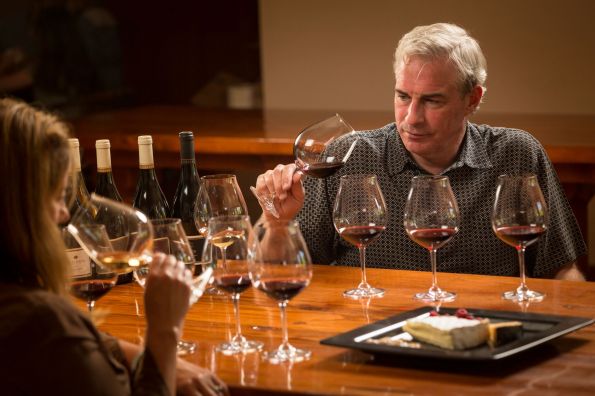
Tony Rynders leading five course tasting
Tony calls his approach to winemaking “low and slow” – letting the nature to do its work. He is also aging all of his Pinot Noir wines for 16-17 months, which I find particularly appealing. And then, how many winemakers do you know who run organized tastings for their customers? That is what Tony does, presenting his wines as a “5-course meal” and explaining the concept of terroir to the wine consumers (after tasting Tendril wines, Tony’s approach to the tasting makes perfect sense to me – but we will discuss it in the next post).
After learning a bit about Tony and Tendril Cellars, I decided that the time came to sit down (yes, virtually) with Tony and ask him a few questions. Here is what transpired.
[TaV]: You started making wine for others in 1989. Was there something which prompted you to start making your own wines in 2010, a pivotal moment, or you simply decided that it is time to make wines “my way”?
[TR]: I have had several opportunities making wine since I began in 1989. Each one has contributed in some way to influence my approach to making wine. I can tell you that I am a much different winemaker today than I was when I started. I think it is critical that we continue to evolve and adapt as the climate, consumers, and wine preferences change.
In fact, I started my own brand, Tendril, in 2008. I was just coming off a 10-year stint as head winemaker at Domaine Serene. It was a highly formative period in my career as there was a massive shift toward new, estate vineyards during my tenure. The creative “heavy lifting” took place largely during my watch. I accomplished everything I set out to and more. It was time for my next big challenge…creating a portfolio of wines for my own brands from scratch. And tell a story about Pinot Noir in a way that it had not yet been told.
[TaV]: You worked at the wineries around the world. Are there any winemakers you would consider your mentors, either directly or indirectly?
[TR]: There is one fact in winemaking that I completely embrace: There is no way to learn it all…I will never stop learning, growing and evolving. Every winemaker I have worked with has mentored me, including but not limited to, Rollin Soles, Ken Wright, Co Dinn, Jean-Francois Pellet and David Forsyth.
[TaV]: Can you explain your “low and slow” approach to the winemaking?
[TR]: Just like the “slow food” movement, I use top quality ingredients (grapes) from attentive, engaged farmers (vineyards) with whom I have a very close relationship. I have hand chosen each of our vineyards myself and each brings a distinctive flavor profile (like spices) in order to make our signature “five-course meal” of Pinot Noir.
For all the Tendril wines, I over-vintage the wines in barrel (at least 16 months) and then bottle age 12 months or more prior to release. The wines are then at the front end of their drinkability curve, with the potential for a decade enjoyment ahead of them.
[TaV]: I find it interesting that in your range of Pinot Noir you have only one vineyard-designated bottling – I always think that designated vineyards and even specific plots are better identify with quality of the grapes and the resulting wines – obviously you don’t see it like that?
[TR]: While I love to make single vineyard wines, I find that not every site is able to produce balanced, compelling and complete wines every year. And that, simply put, is my goal as a winemaker. So this is how the unique story and line-up of wines for Tendril was born. When I started Tendril, I knew that I wanted to do something different with my portfolio of wines. And it took 6 years to complete the lineup (Extrovert 2008, TightRope 2009, Single Vineyard (Guadalupe) 2011, C-Note 2011, Pretender 2013).
The common model that exists for Pinot Noir is the single vineyard model. Wineries make 5-15 (or more) single vineyard wines in a given vintage. The problem is that not all of the sites deliver on their promise of distinctiveness every year. The true test is a horizontal tasting in which all of the wines are evaluated blind. In a given year, some wines are great, some under deliver and some taste quite similar in a given line-up. This is not consistent with my goal.
So, I created my own, unique model for Pinot Noir. Each of my wines is distinctive and complete. Collectively, they show a progression of flavors that mirrors the progression of dishes in a five-course meal. My wines gain in intensity, darker fruit character and structure as the “courses” progress. And each of the wines must re-qualify for their place in the lineup each and every year.
I believe single vineyard wines should be special. Since all wineries charge more money for them, I think they should be worth it. So we typically do just one offering per year that is, simply put, the “wine of the cellar” from just one site. As I had anticipated, it has proven to be rotational (4 vineyards in 7 vintages). It is like a Christmas present in that you don’t know what it is until you open it.
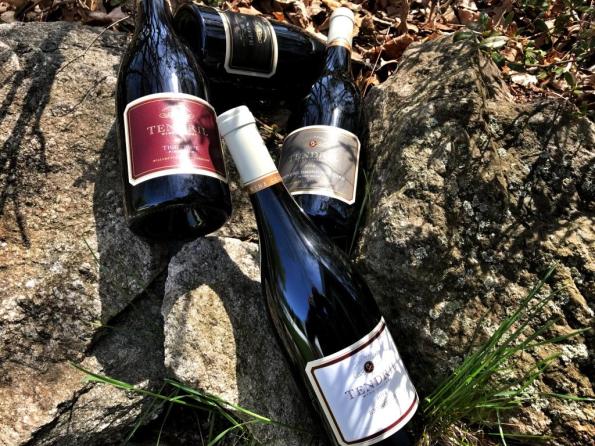
[TaV]: Your C-Note Pinot Noir is designated as “whole cluster fermented” – is that a substantial differentiator to make it the “top of the line” wine, or is there something else behind it?
[TR]: Of the Pinot Noir line-up, the C-Note is the most stylized wine yet at the same time requires the greatest amount of restraint. Whole cluster fermentation of Pinot Noir is a technique that I have only attempted since 2011. The was the first year I made a wine using 100% whole cluster…and it was so successful that it became our first C-Note bottling.
For C-Note, we use 100% Pinot Noir, 100% Whole Cluster fermentation, and age in 100% new French Oak barrels (air dried 3 + years). The restraint comes into play in order to reign in the “whole clustery-ness” and tame the oak impact to mimic a wine with half the new oak exposure. We are extremely gentle with our cap management to control the whole cluster notes and we select the most subtle, elegant barrels coupled with long aging to integrate the oak flavors. C-Note is all about complexity, texture and mind-blowing length. I love making wines that surprise and beguile.
[TaV]: You are one of the very few winemakers who conduct organized tastings. Can you explain what you are trying to showcase with your 5-course Pinot Noir approach?
[TR]: Yes, I believe the best way to showcase these wines and share this unique experience is to do seated tastings. Like a five-course meal, our tasting take time (typically an hour and a half or more). But people leave here feeling that that have experienced something truly special…and that is pretty rare. They are shocked that they enjoyed each and every wine they tasted.
I began working in restaurants at a young age. I cooked for several years and really enjoyed it. A few years after I started making wines, I realized that I was using the exact same skill set to make wine that I used to cook. I am truly a “wine cook” and make wine with that sensibility.
I wanted to showcase a diverse range of flavor profiles that can be accomplished on an annual basis with Pinot Noir in the Willamette Valley. Each offering is distinctive, unique and impeccably balanced. Collectively, they showcase perhaps the greatest range of flavors and textures of Pinot Noir under one brand.
[TaV]: To follow on the previous question, how receptive are your customers (typically) to what you are presenting in the tasting? Do they get your point? Do you offer people to taste the wines blind and to try to identify what they are tasting?
[TR]: The beautiful thing about the “five-course meal” context of our tasting is that EVERYBODY can relate to that experience. People completely get it and they really get into it. The wines show a progression of flavors just like a multi-course meal. They also increase in intensity much like turning up the volume on a radio.
At this stage, the tastings are not blind and are tasted one at a time. And I don’t have the ability to pair food at this time. But we have done the “five-course meal” here at the winery a few times. It was a huge success.


[TaV]: Maybe an odd-ball question here – wine is an adult beverage, and nevertheless, you called your line of wines “Child’s Play” (I personally like it very much, especially the labels). Do you think wine consumers might find this controversial? Did anyone ever comment on this wine name?
[TR]: I am a huge fan of the “double entendre”. Here it is actually triple. 1) My kids playing…my two daughters paintings are the original artwork for all the labels 2) We winemakers are big kids and we get to “play” with offering unique wines (the Pinot Chardonnay is the only still version of Chardonnay and white Pinot Noir in the country…to my knowledge), Zinfandel from WA (a unicorn wine), and a stylistically different Rose of Pinot Noir. The Pinot Noir is just damn good. 3) Child’s Play implies it’s easy…so easy a kid could do it. We are taking the pretension out of wine with the packaging and the wines inside. Great value for money…as it should be.
My customers love it. The only objection came from the Feds…and a simple paragraph explaining point 3) above got us our label approval.
[TaV]: This one is more of the pet peeve question for me. Your Tendril wines are enclosed with the corks (makes me very happy to see it). The Child’s Play line uses screwtops, so obviously the screwtop idea is not foreign to you. I know that some winemakers in Oregon swear by alternative closures (like Don Hagge at Vidon with the glass stopper), but I personally think that the wine needs a cork to age properly. What is your take on this subject?
[TR]: While I like the idea of cork, the execution of the closure has haunted me for my entire career. Corks are highly variable in both their flavor impact on the wines as well as the oxygen permeability. Each one is unique and has an unintended impact on my wine. I believe natural corks are a huge problem and as such, I no longer use them. But I do gladly use a cork product in my Tendril wines (looks like a duck and quacks like a duck) that provides consistency of density and very low aromatic impact. I would be happy to talk to you about this topic some time. I have researched it for years.
Screw caps are new to me, but I love them in the Child’s Play line to further differentiate the brand from Tendril. I think the MSRP $30 price point avoids any potential push back on the choice of closure.
[TaV]: Sparkling wines are so popular nowadays, almost everyone is making them, and often with very good results. Considering your experience at Argyle, should we expect to see Tendril sparkling wine at some point in the future?
[TR]: Maybe…but I will wait until we have a great sparkling wine vintage (cool and slow ripening) to make that decision. If you asked my wife (who is a sparkling junkie), the answer would be yes.
I would only do it if it could have the potential to be a truly special offering.
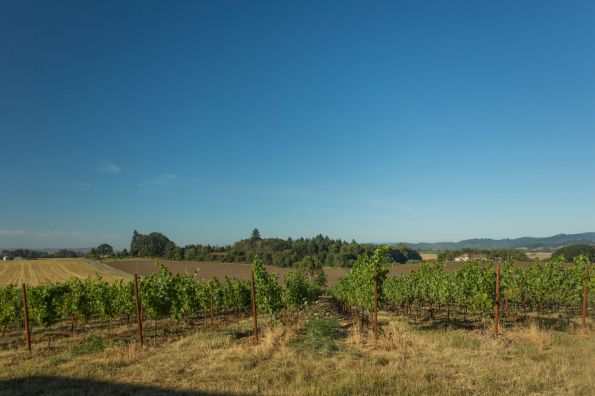
Maverick Vineyard
[TaV]: What is in the store for your new Maverick vineyard? How are you planning to farm it – sustainable, organic, biodynamic? Out of 19 acres, you have 10.5 allocated for Chardonnay and Pinot Noir – what about the rest? Any plans to expand beyond Pinot Noir and Chardonnay – let’s say, Pinot Gris, Riesling, etc?
[TR]: At this time, Maverick is LIVE. We plan to move towards organic over the next few years. It is an incredibly well behaved site that is already producing strong personality wines. I view this as a highly desirable trait for a young vineyard. The Chardonnay for the Pinot Chardonnay (70% of the blend) is all Maverick. This is the first bottled wine coming from Maverick.
No plans for other varietals at this time. But the clonal mix for the Pinot Noir (943, Swan, Calera and Mt. Eden) is pretty unusual.
[TaV]: Oregon is clearly a leader in Pinot Noir, considered by many as simply the best in the world, and it is also getting to the same level of recognition with the Chardonnays. What is ahead for the Oregon wine industry? Is the future bright and sunny, or do you see any clouds on the horizon?
[TR]: To me, the only constant is change. By that I mean that to continue to succeed as an industry, we need to be engaged (both locally and on a world stage), we need to be adaptive (as our climate continues to change, we are in for more and different challenges), and we need to be more concerned about the sustainability of our environment (both locally and throughout the world).
I believe we will have sun and clouds…and perhaps some rain. Just the weather we always have in Oregon 😉
[TaV]: When you are not drinking Tendril wines, what are your favorites from the other producers and/or regions?
[TR]: Lately I have been enjoying Graham-Beck sparkling wine from South Africa.
Or give me a good single malt Scotch…
Here we are, my friends. I’m sure you are thirsty at this point, but we will talk about Tendril Cellars wines in the next post.
To be continued…
Trader Joe’s Wines – Values and More Values
The wine aisles of Trader Joe’s is one of my favorite places to visit when I travel. Where I live, in Connecticut, Trader Joe’s stores are only allowed to sell beer. Trader Joe’s stores are known for their great selection and great prices, and that is true for everything Trader Joe’s sells – including the wine. Thus any Trader Joe’s store which sells wine is an opportunity to visit a toy store for adults, which I definitely can’t miss.
This time around I ventured into the Trader Joe’s in Costa Mesa in California. Usually, the “wine” selection in Trader Joe’s in California goes way beyond just wine – scotch, bourbon, tequila, cognac, and more. At the store in Costa Mesa I was particularly impressed with Mezcal selection – would love to bring some home, but you know how business travel is nowadays – does the bottle worth a trouble of checking in the luggage?
So yes, wine it is. When buying wine at Trader Joe’s during my business trips, I always approach it in a simple way – I’m looking for value. Here is $20, let’s get as many bottles as possible with the $20, and let’s see how they will fare. Truth be told, I rarely manage to stay under $20, but still, I make an effort to be as close as possible to that $20 budget (before taxes, of course).


How does $23.45 sound next to the $20 budget? In absolute terms – I’m over the budget by 17%. In relative terms, 5 bottles of wine for $23.45? If the wine even half drinkable, it is not a bad deal, would you agree? I think so. Oh yes, and I also cheated a bit. Don’t worry, I didn’t cheat anyone in particular, it is this story which has a few flaws, so please allow me to explain.
First, I saw an attractive bottle, unusual shape, attractive label, $9.99, the wine called “Susumaniello” from Puglia – something I never saw before. I was planning to visit my close friends later that day, so I thought that this bottle looked good enough to bring with me (wanna call me a cheap bustard? please, be my guest). But -Trader Joe’s was having a little tasting (they always do for food – I guess they also do it for wine where the wine is sold – for sure in California) – and this exact bottle of wine was offered for tasting. So I did have a sip of 2016 Ruggero di Bardo Susumaniello Puglia IGP ($9.99) – it had a medium body, restrained profile with mostly cherry notes on the palate. To my delight, it appeared that behind the cool label was also a new rare, indigenous grape I never had before – Susumaniello, a nice addition to the collection (I really need to iupdate my “grape counter” on the page).


The wine was good, but I already tasted it, so I needed a different idea for the wine to bring to dinner, so I settled for 2012 Château Roudier Montague-Saint-Emilion (13% ABV, $12.99), which happened to be a classic Bordeaux – well, maybe not so classic but more of modern variation – warm fruit and spices on the nose, black currant on the palate, soft tannins, round, velvety – an excellent Bordeaux for the price. It also paired very well with Korean short ribs (Bulgogi) we had for dinner. Drinkability: 7+/8-, very good overall.
From here on, here are my tasting notes for the five wines I was able to play with over the next few days – these are the wines I paid $23.45 for.


2016 Joseph Händler Riesling Pfalz (9.5% ABV, $4.99) – straw pale color. Nose at first muted, literally nonexistent, then opening up into white flowers, touch of honey and candied peach. Clean acidity, lemon, candied lemon, crisp, good minerality, not over the top. Drinkability: 8-, and incredible value at $4.99. Just wow. I know Rieslings can be inexpensive, but this is a whole lot of German Riesling for the price.
Simpler Wines Too Uncanny Red Wine Blend Australia (13.8% ABV, $2.99/375 ml can) – this wine had no vintage indication, so I guess we should consider it to be a non-vintage. Dark ruby color. Fresh fruity nose, young berries, then herbaceous undertones show up. Very good acidity on the palate, blackberries, cherries, mint, surprisingly balanced and very easy to drink. A bit of an alcohol burn, but still wow. 7+/8-, yet another excellent value. Nicely drinkable on the second day from the open can.
2016 Union Wine Co Underwood Pinot Noir Oregon (13% ABV, $4.99) – as you can see in the picture, the only place where I found a year specified was on the bottom of the can. Is that really vintage indication? I have no idea, but I will consider it to be so.
Ruby color. Mushrooms and smoke on the nose, touch of cherries. Sweet cherries on the palate, nice minerality, good acidity, medium body, good balance, touch of tart raspberries, hint of black pepper. Very nice overall. Drinkability: 8-, impressive.


2016 Nero Marone Edizione Privata Italy (14% ABV, $6.99) dark ruby color. Restrained nose, herbal, not much fruit. A hint of raspberries, tart cherries on the palate, minerality, medium body, good acidity. Interesting, not bad but a bit underwhelming in the amount of fruit. Drinkability: 7+, might be more of a food wine.
2017 Viñas Chileans Rosario Estate Cabernet Sauvignon Reserva Valle Central Chile (13% ABV, $3.49) – a classic Chilean cab, a touch of green bell pepper, soft blueberries and blackberries, medium body, easy to drink from the get-go. Nicely paired with grilled snapper. Drinkability: 7+, truly lots of wine for the money.
Here you are, my friends – another successful encounter with the Trader Joe’s wines. The Riesling was my favorite, but really, all the wines were good and an amazing value. What are your latest value wines discoveries? Can you beat the Pfalz Riesling at $4.99? Cheers!
Daily Glass: Textbook Precision
Once you fully embrace the wine world, one of the important lessons you learn is rather simple – “there are no guarantees”. The bottle of wine can perfectly say “Cabernet Sauvignon” – there are absolutely no guarantees that Cabernet Sauvignon from Washington, California, and Chile will have any smell and taste similarities, never mind Cabernet Sauvignon from China, Czech Republic, and Moldova. And this is okay, we can all accept it – at the end of the day, the only thing which matter is whether we like the wine or not.
Despite all the differences, when it comes to the major grapes, such as Cabernet Sauvignon, Chardonnay, Merlot, Sauvignon Blanc, Pinot Noir and so on, we usually know how the “classic” wine should taste like – especially if we take any formal wine education or make enough effort to study the wine, pay attention to what we drink and make it a lesson to learn. Yes, there might be a bit of our perception in it too, but still, we usually have that “classic profile ” idea in the mind.
What prompted this post was a lucky happenstance, an encounter with two classic, textbook wine profiles for two nights in the row.
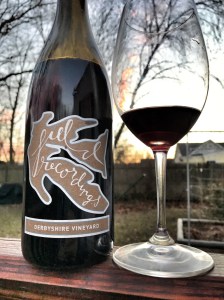 First, there was Pinot Noir. When it comes to Pinot Noir, there are probably four classic profiles – Burgundy (of course!), with lots of dark fruit power and a little bit of funk (especially with age, but drinking young Burgundy is almost like killing a baby, right?). Then you have New Zealand, which usually can be identified by the pronounced acidity. Oregon Pinot Noir often screams minerality, mocha and dark chocolate. And then you got California, with luscious smokey plums and silky, seductive texture.
So the wine I had a pleasure of experiencing was a textbook, unmistakable California Pinot Noir – 2015 Field Recordings Derbyshire Vineyard Pinot Noir San Luis Obispo County (13.1% ABV, $28, 20% whole cluster fermentation, foot tread in open top bins, 12 month in French oak) – smokey plums on the nose, bright cherries and plums profile on the palate with a perfect balance of acidity, velvety layers – tremendous amount of pleasure in every sip. Drinking this wine evokes comparisons with other California classics such as Siduri. It doesn’t reach the ultra-luxurious texture of Sandhi, but if you have any experience with classic California Pinot, one sip of this wine will perfectly put you in the right place.
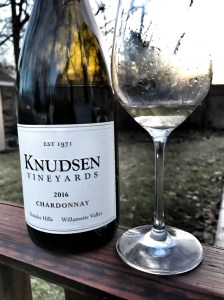 Now, talking about classics, let’s talk about the grape which is not a relative of Pinot Noir, but more often than not, a closest friend and neighbor – Chardonnay. What is interesting about Chardonnay, in my opinion, is that good Chardonnay is a lot more cosmopolitan than a Pinot Noir. With the exception of Chablis, which often can be recognized by the gunflint on the nose, the classic Chardonnay profile includes vanilla, apples and a touch of butter. You can often differentiate Burgundy from California by the amount of butter (California usually offers lots more) and acidity (that’s what you will get with the young Burgundy), but still, Chardonnays from Australia, Burgundy, Chablis, and California have quite a bit of similarity.
Oregon, which is definitely an established world leader when it comes to Pinot Noir, lately also started to show its Chardonnay provenance. Two years ago, I was blown away by the perfection of Vidon Chardonnay. This time around, the 2016 Knudsen Vineyards Chardonnay Dundee Hills (13.5% ABV, $45) made me say “wow” many, many times. Perfect nose of vanilla and golden delicious apples with a distant hint of butter and even honey (honey is usually showing up in Chardonnay after some aging) was supported by the same profile on the palate – vanilla, apples, butter – all perfectly mended together in cohesive, sublime package resting on the vibrant core of acidity. This was definitely a textbook Chardonnay for me, and the one which I would love to see aged, at least for another 5-7 years.
Here you go, my friends – a textbook experience with two classic grapes. What are your textbook wine experiences? Cheers!
Stories of Passion and Pinot: Looking Back and Looking Forward
Back during the fall of the last year, I ran a series of posts talking about passion and Pinot Noir. Pinot Noir is a finicky grape which, I can only guess, has some enchanting properties – for the winemakers and wine lovers alike. Pinot Noir has an ability to grab you and never let you go – once discovered, it becomes an object of obsessive desire: winemakers go out of their way to make the best Pinot Noir wine, and oenophiles go out of their way to find it.
To give you the best examples of Pinot Noir’s passion and obsession, I decided to [virtually] sat down with a pioneer, a rocket scientist, a soil fanatic, biodynamic believer and some true farmers – all of them from Oregon. Through our conversations, I wanted to convey the unwavering belief in the magic of that little black grape, Pinot Noir.
We talked with Ken Wright of Ken Wright Cellars, David Nemarnik of Alloro Vineyard, Mike Bayliss of Ghost Hill Cellars, Wayne Bailey of Youngberg Hill Vineyards, Steve Lutz of Lenné Estate and Don Hagge of Vidon Vineyard – the passion was easy to see, through their words and through their wines.
The essential Pinot Noir map includes four major players – Burgundy, California, New Zealand and Oregon. Out of these four, Oregon usually beats Burgundy in consistency, and often California and New Zealand in finesse. That consistency and finesse don’t go unnoticed – and not only by wine consumers but by the big domestic and international wine businesses and investors as well. Big businesses are great, but – they are, first and foremost, big businesses – and passion is often replaced just by pragmatic business needs and shareholders value.
The wine quality and creativity is on the upswing around the world, and while consumers are driving this trend with an ever increasing thirst for the wine, nothing can be taken for granted – the wines have to find the consumers, and convince them that they are worth paying for.
The big business interest and more and better wines – what does it mean for the Oregon wine industry, the passion and the Pinot Noir? To answer this question, I asked once again for the help of Carl Giavanti of Carl Giavanti Consulting, wine marketing and PR firm, who reached out to the Willamette Valley Wineries Association. As you can imagine, I had more than one question, so here I would like to share with you what I have learned.
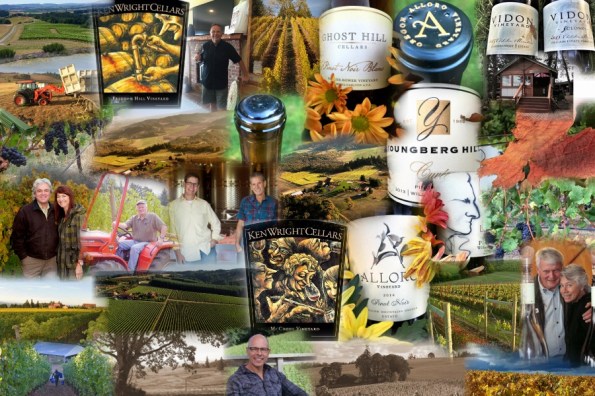
First three questions were answered by Anthony King, 2017 President of WVWA Board of Directors and General Manager of the Carlton Winemaker’s Studio:
[TaV]: Willamette Valley squarely joined the ranks of world-class wine regions. Does it mean that everything is great, or you still have big issues to solve on your agenda?
[AK]: Willamette Valley is certainly on the rise and we are all thankful for the attention. Our biggest issue is to continue to share the spotlight with the other classic regions of the world without losing our roots, our authenticity, and collaborative spirit.
[TaV]: It seems that lately big corporations are paying lots of attention for the WV wineries – or rather money, as for example, Jackson Family which acquired 3 WV wineries over a short period of time. Are you concerned with this development? Do you think it might change the soul and spirit of WV wines?
[AK]: Most of us are flattered by the attention that our wines, vineyards, and wineries have been getting from producers all over the world. JFW, in specific, has invested heavily, but have done so with a soft touch and an eye towards the community and their neighbours. In the end, the region will have diversity that consumers will ultimately benefit by. Our hope, however, is that this interest doesn’t drive vineyard and fruit prices into a range that makes the hands-on artisan winemaking that has made Oregon so special too expensive for entry.
[TaV]: There are many white grapes which can be called “next frontier” for the WV wineries – Pinot Gris (yes, okay, this is an old news), Chardonnay, even Riesling. However, if we look at the red grapes, WV wineries are a “one trick pony”, only working with Pinot Noir. Do you see any problems with that? is there a next big red grape for the WV, or is it not necessary?
[AK]: Great question. I don’t think that any of us, as winemakers, regret that we are working with Pinot noir in such an ideal locale. It presents a lifetime of challenges and, hopefully, rewards. Although much more rare, Gamay can be thrilling and has been successful planted alongside Pinot noir. Syrah, too, has a lot of potential, making compelling, Northern Rhone style reds in warmer years. Cooler-climate Italian reds could have potential as well. We’ve already seen an increase in planting of these “other reds,” but the more dramatic shift is (as you mentioned) towards focusing on whites and sparkling wine, which are very well suited to this climate. Ultimately, I foresee increased experimentation with a range of red varieties in the warmer sites in the Willamette Valley in the short-term; time and the weather will tell what succeeds.
The rest of the questions were answered by Emily Nelson, Associate Director for Willamette Valley Wineries Association.
[TaV]: What percentage of WV wineries are LIVE certified? Do you see this number dropping, increasing, staying the same?
[EN]: In 2016, there are 13,170 Oregon vineyard acres certified sustainable, which is 48% of total planted acres in the state. 8,218 acres are LIVE Certified, which is 30% of total planted acres. We do see the number of certified sustainable vineyard acres increasing year after year. As the home of the nation’s most protective land use policies, the first bottle recycling law, and the highest minimum wages for farm workers, it’s fitting that the Oregon wine industry is committed to sustainable farming and winemaking practices.
For LIVE Certified acres in particular, the number has increased annually from 2,368 acres in 2007 to 8,218 acres today.
[TaV]: How important is Biodynamic viticulture for the WV wine industry? Do you see more wineries embracing it?
[EN]: Biodynamic viticulture in Oregon has also steadily increased over the years, from 289 certified acres in 2007 to 1,585 certified acres today. It is an important component of our sustainable character in the region, reinforcing our belief that agriculture in general and viticulture in particular can flourish in harmony with our natural environment. In general, Demeter Biodynamic certification is in accord with many practices that characterize the certification of organic farms. However, certain practices are unique to Biodynamic agriculture, including managing the whole farm as a living organism; maintenance of a healthy, diverse ecosystem that includes not only the earth, but as well the cosmic influences and rhythms of which the earth is a part; and use of the Biodynamic preparations to build soil health through enlivened compost.
[TaV]: Are there any new wineries showing up in the WV? If yes, is there a trend there (more than the last 5/10 years, less than the last 5/10 years, the same?
[EN]: Yes! Our number of wineries in the region has climbed over the last five to ten years. We had about 110 wineries in the Willamette Valley in the year 2000. By 2010 that had more than doubled to 300 wineries. And now in 2016 our most recent census shows 531 wineries in the region. People are drawn to grape growing and winemaking here for many of the same reasons that brought our pioneers in the 1960s—unique climate and soils ideally suited to Pinot noir and a wine industry culture that celebrates collaboration, inventiveness, and land stewardship.
[TaV]: Do you see a lot of foreign capital coming into the WV winemaking industry (buying, partnering, starting new wineries)? Again, is there a trend?
[EN]: There is a trend of outside investment in the Willamette Valley wine industry, and it speaks to the quality of the wines being produced here. We see Burgundian investors who’ve found the New World home of Pinot noir, as well as those from Washington and California who are expanding their premium Pinot noir brands with Willamette Valley wines.
[TaV]: Last question – are there any new and coming, or may be old but coming around wineries wine lovers should watch for? Anything which makes you particularly excited?
[EN]: We’re particularly excited about a few things here: first, many of our pioneering wineries are handing the reigns down to second generation winegrowers and owners. The children who grew up in the vineyards and cellars of the wineries who put our region on the map are now at the helm. They continue to innovate and improve, so watching their brands and their wines flourish and evolve is a thrill. Second, we’re excited about the Burgundian presence in the Valley. French winemakers who come here to experience the Oregonian version of their time-honored grape offer unique expressions of the wines and outside confirmation that there’s something really special happening here. Lastly, we’re excited about new winemakers just entering the industry, who contribute a vibrant sense of experimentation and energy to the Valley.
All the good things come to an end, so this was the last of the conversations in the Passion and Pinot series – for now, at least. As I said before, Pinot Noir has some very special properties, making people fall in love with it and not letting them go. And whether you agree or disagree – you know what to do. Until the next time – cheers!
P.S. Once again, here are the links to the web sites for the wineries profiled in this series:
Alloro Vineyard: www.allorovineyard.com
Ghost Hill Cellars: www.ghosthillcellars.com
Ken Wright Cellars: www.kenwrightcellars.com
Lenné Estate: www.lenneestate.com
Youngberg Hill Vineyards: www.youngberghill.com
Vidon Vineyard: www.vidonvineyard.com
Last Bottle Sign Up ($10 credit)




 Talk-A-Vino