Archive
CASARENA, The Next Level Of Argentinian Wines
The next level of Argentinian wines – I can literally see a “yeah, come on, really???” reaction from many of you. What does that even mean – the next level?
Okay, no need to get all feisty here – let’s talk about it. Argentinean wines require no introduction to any of the wine lovers today. Argentinian Malbec is practically a mandatory element of any bar or restaurant wine list, on equal footing with Cabernet Sauvignon from California. Cabernet Sauvignon and Bordeaux blends from Argentina also command topmost respect of wine lovers around the world. If the top-level is already achieved, what is the next level above it?
The “next level” here is my attempt to convey the emotion, the excitement of pleasure of tasting the delicious wines. While Argentinian wines are unquestionably the world-class, many of them are hardly distinguishable. The taste of Argentinian Malbec sometimes gets too predictable, and the wines lose their personality. Thus when you discover the wine which doesn’t conform to the “universal profile”, you feel like you are advancing to the next level of the game. I hope my tasting notes will convey my feeling about these wines, but let’s talk about the region first.
I perfectly remember listening to Kevin Zraly explaining the concept of quality of the wines. Imagine the set of enclosed circles. The biggest circle is equated to the big region – let’s say, California. Wines labeled with California as the region can be made from grapes grown anywhere in the state of California. The next circle is a sub-region – let’s say, Napa Valley. Wines labeled as Napa Valley can be produced only from the grapes grown in Napa Valley. That gives us a higher level of confidence in the quality of the wines, as Napa Valley is well known for the quality of the grapes. We can still narrow our circles, and now we are looking at the sub-region of the Napa Valley itself – Howell Mountain, Rutherford, Spring Mountain – there are many. Now your choice of grapes is restricted only to such a sub-region, which often offers a common taste profile coming from the vineyards in that subregion, such as famous Rutherford dust in the Cabernet Sauvignon wines sourced from the Rutherford appellation. And even now we might not be done with our circles, as we can restrict our source of grapes even further to the individual vineyard, such as Beckstoffer To-Kalon, and then even to the individual blocks and plots within the same vineyard. The smaller the circle is, the higher is the quality of the grapes, and that should translate into the quality of the wines.
Let’s now apply our circles to Argentina. We will start in Mendoza, probably the best-known winemaking area in Argentina – think about all the Argentinian Malbecs you are consuming. Continuing narrowing down, let’s now go to the Luján de Cuyo, the region located just south of Mendoza city. Luján de Cuyo is the first officially recognized appellation in Argentina (established in 1993), and home to some of the best known Argentinian wineries such as Catena Zapata and Cheval des Andes. Continuing narrowing down we now need to go to the town of Agrelo, where CASARENA Bodega & Viñedos is located.
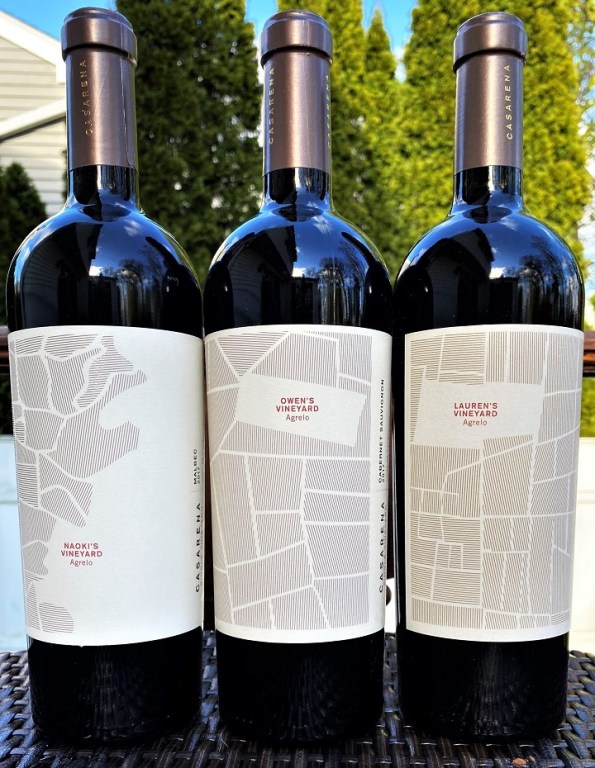
I don’t like to use cliché in my writing. Nevertheless, if I would try to describe what makes Luján de Cuyo (and Agrelo for that matter) a great winemaking region, I feel that I’m doing exactly that – shamelessly using all available wine cliché all the way. See for yourself: Most of the vineyards in the region are located on a high altitude, which increases the sun exposure during the day and also creates a significant temperature drop in the evening – we are talking about significant diurnal temperature variation which slows down the ripening and helps grapes to retain acidity. Close proximity to the Andes creates a desert-like environment as it significantly reduced the rainfall – now we are talking about dry farming. Many vineyards in the region are also located on the rocky soils, forcing the vines to work hard to reach the nutrients. There is rarely greatness without adversity, and the combination of all the factors mentioned above presents exactly the adversity needed to produce excellent grapes – and yes, this unavoidable wine cliché.
CASARENA Bodega & Viñedos was founded in 2007, with the first officially released vintage being 2009, starting, quite expectedly, with Malbec. After tasting its first commercial success with a slew of good critic ratings, CASARENA continued to narrow down the circles and created 7 single-vineyard wines coming from 4 different vineyards. I had the pleasure of tasting samples of 3 of these single-vineyard wines and was literally blown away by the quality.
Here are my notes:
2017 Casarena Malbec Naoki’s Vineyard Agrelo Luján de Cuyo Mendoza (14.5% ABV)
Dark garnet, very inviting
Dark fruit, cassis, tobacco, pencil shavings, a touch of mint
Medium to full body, succulent red fruit, vanilla, perfect acidity, silky smooth, well-integrated tannins, good minerality
8+, balanced, and delicious. Well refined compared to a typical Argentinian Malbec
2017 Casarena Cabernet Sauvignon Owen’s Vineyard Agrlo Luján de Cuyo Mendoza (14% ABV, 80 years old vines)
Dark garnet, practically black
Day 1:
Nose – dark, funky, concentrated, earth, tobacco
The palate is very contrasting to the nose, classic Cab with Cassis and bell pepper, not very expressive
Day 2:
Nose and palate are similar, more of a Malbec style – vanilla, blue fruit, coffee, dark chocolate.
Day 3:
Nose – Autumn forest, cherries, coffee
Palate – classic Bordeaux, a touch of currant, bell peppers, soft, supple, luscious, the well present core of minerality.
8/8+, excellent. My best analogy for this wine would be Dunn Howell Mountain wines, with the dark power imparted on the wines.
2017 Casarena Cabernet Franc Lauren’s Vineyard Agrelo Luján de Cuyo Mendoza (14.2% ABV, 18 months in new French oak)
Dark garnet, almost black
Coffee, a hint of cherries, minerally-driven
Cassis, cherries, soft, round, goos texture
8+, might be my favorite of the tasting.
These are three wines which would bring any dinner or friends gathering to the next level – I don’t know if you can see my point just by reading, the best way would be to pour a glass of CASARENA wine and take a quick trip to Argentina. Cheers!
Good When Young, Good With Age
It’s what you crave, people.
And right now, I’m craving Riesling.
Wine cravings are an interesting phenomenon. Or not. I guess food cravings work in exactly the same way. It appears to be all of a sudden, the desire for a certain food – french fries (oh wait, I always crave french fries), fried chicken, steak, scallops, lasagna, broccoli (really, you say? Yep, I can bet someone is craving broccoli right now). Is it really so unprovoked, so out of blue, or is it our subconscious at play here, collecting little cues here and there?
It is getting warm now, but that alone is not the reason to crave Riesling. But what if I read about other people enjoying the Riesling, with food and without – would that count as an invisible cue? I don’t know, but I can clearly imagine myself with a glass of cold Riesling in hand, don’t even need to close my eyes.
In the world of white wine, Riesling is unquestionably a part of “big three” – Chardonnay, Sauvignon Blanc, and Riesling. At the same time, if you think about typical wine store, Chardonnay and Sauvignon Blanc would take the prime real estate, the most central position on the shelves – and Riesling would be typically relegated to the far-most corner, with a little “Germany” sign next to it, or maybe in the “other whites” section. And it is a pity because scandalously delicious Riesling is produced practically everywhere – Alsace, Australia (Grosset would be an amazing example), New Zealand, Israel, California (how about some Smith-Madrone), Oregon (Brooks Rieslings are sublime), Washington (Chateau Ste. Michelle does an excellent job), and I’m not even talking about New York state or Niagara-on-the-Lake in Canada.
It is not only the hedonistic pleasure that the glass of well-made Riesling readily delivers on its own. Riesling is one of the most versatile food wines – it pairs well with a wide range of dishes and cuisines. And then Riesling has an ability to age not just well, but extremely well. Let’s bring back again the big three. Yes, you can age many of the Chardonnay wines, but rarely for 30, 40, 50 years – I’m sure there are some exceptions, probably in Burgundy, but still, this is not common. Sauvignon Blanc would fare even worse than Chardonnay. But well-made Riesling? 30 years will not be even the age – it will be still youthful and vibrant, with ease.
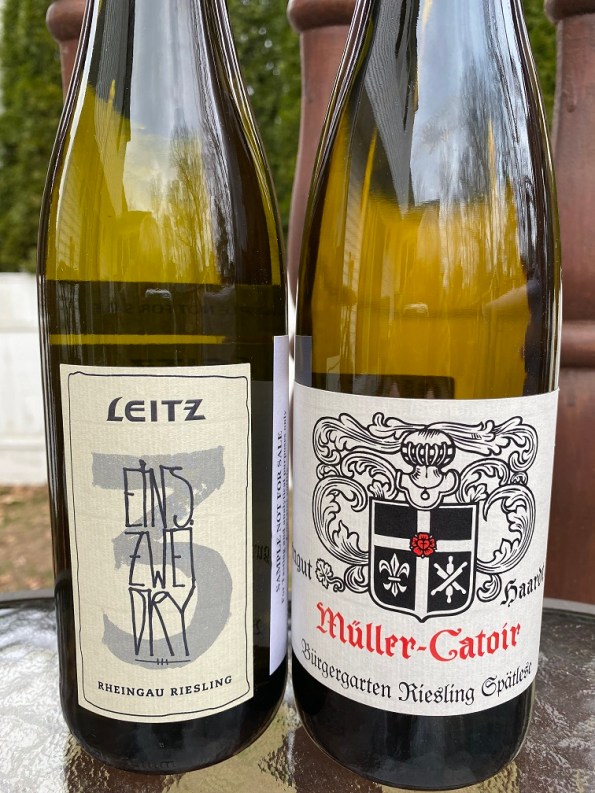
I didn’t have any 30 years old Rieslings recently, but I got two samples with 4 and 8 years of age, and both fared equally well – while even 8 years might be a stretch for many white wines. 2016 Leitz Eins-Zwei-Dry Riesling Trocken Rheingau (12% ABV) was produced by Weingut Leitz, where the family winemaking traditions go back to 1744; 2012 Müller-Catoir Bürgergarten Riesling Spätlese Pfalz (9% ABV) was produced at the Weingut Müller-Catoir which, interestingly enough, was also founded in 1744.
It is interesting that both wines were produced at the wineries with the 9th generation of winemakers (duh – the wineries were founded in the same year, I know). Both wines are pure Riesling wines, both come from the hillside vineyards with some unimaginable slopes. 2016 Riesling is designated as dry, and 2012 is a Spätlese-level, which means that the grapes had a higher sugar content when harvested.
I’m sure you wonder how were the wines? Well, yes, both were delicious. Both were a characteristic Riesling, with honey, honeysuckle, and a touch of lemon on the nose. Of course, Spätlese was sweeter, but not by much. And it is always the acidity which makes or breaks Riesling – both wines showed perfectly balancing, fresh, vibrant acidity. Bottom line – both were equally delicious and ready to be enjoyed on their own or support any food. As for the age… what age? I will be happy to try both in 10 (or 20) years – and I’m sure I would enjoy them very much.
What is your take on Riesling? Do you have any favorites wines or regions? Do tell! Cheers!
Wednesday Meritage: Where To Get Wine [Values]
Meritage Time!
This is a bit of an unusual Meritage post, as it is focused on one single subject – how to maximize your hard-earned dollars while continuing to enjoy your beloved beverage. Plus, I want to share with you my case buy recommendation at the end of this post.
The inspiration for this post were the notes I receive via subscription to the blog by Robert Dwyer called Wellesley Wine Press which I had been following for a long time. Robert has a special talent for finding wine deals and discounts, and he shares all that information in his blog, so we can all benefit from that.
In addition to Robert’s finds, I also want to suggest another source of discounts which might or might not work for you – the American Express credit card. If you don’t own the American Express card, you should skip all this Amex talk and advance to the case discount section. For those of you who has the card you can’t leave home without, please continue reading.
When you log into your account at the American Express website, you can find a section of “Amex Offers & Benefits” at the bottom of the page. There are 100 different offers that are available to you on any given day. I believe those offers are targeted, and I’m not sure if everyone will see the exact same set of offers. Today, out of those 100 offers, 12 are wine-related. These are real savings, I used those offers many times in the past and those are real deals, saving you $20, $30, $50. These offers are easy to use – find what you are interested in using, apply the offer to your card, then make a purchase in required amount before the offer expiration date on the American Express card you applied the offer to, and your credit will be posted automatically within a few business days.
Here is the list of the offers which are currently available for my American Express card – I’m also adding the additional discount information which can be found in Robert’s blog:
Spend $100+, get one time $30 credit. Expires 6/30/2020.
You can add to this a $50 off $150 purchase with the code CN50 – see Robert’s post for explanations and additional discount codes. So technically, you can spend $150 on the wine, and with the combination of these two offers, your cost will be only $70. I took this opportunity to get a few bottles of Grosset Riesling from Clare valley – definitely a great deal.
Spend $250+, receive $50 credit. Expires 9/30/2020. Limit of 3 statement credits (total of $150). Wine Access offers many interesting wines – you can read about my experience here.
Spend $100+, get one time $20 back. Expires 9/1/2020
Spend $250+, get a one-time $50 credit. Expires 8/22/2020. Benchmark Wine Group is one of my favorite online stores to shop for wine – lots of unique and different finds.
The restaurant at Beringer Vineyards or online at beringer.com
Spend $200, get a one-time $60 credit. Expires 8/28/2020. Beringer Vineyards needs no introduction – and this sounds like a good deal.
Spend $250+, get 5,000 additional Membership Rewards points (one time). Expires 7/31/2020. Considering that American Express points can be valued at about one penny per point, 5,000 membership points would equate $50 – a good deal.
Spend $250+, get a one-time $50 credit. Expires 8/23/2020
Spend $200, get a one-time $40 credit. Expires 7/20/2020.
Bcellars.com, the restaurant at B Cellars Vineyards and Winery
Spend $300+, get a one-time $90 credit. Expires 8/18/2020.
Spend $200+, get a one-time $60 credit. Expires 7/27/2020. Another coveted winery on the list.
Spend $50+, get a one-time $15 credit. Expires 7/3/2020.
Spend $20+, get $20 credit. Expires 10/31/2020. Limit of 3 statement credits (total of $60)
These are all the American Express offers which I found available today for my credit card.
And now, for the case recommendations.
You see, when I find a good value wine, I’m always a bit hesitant to share that information with the world – what if there will be not enough left for me? Well, yeah, it is really not about me, right? It is all about delicious wine which you can afford to drink any day. What is also unique about these wines is that they don’t come from Spain, Italy, or France, where you can still find great bargains – these wines are made in California – at Rabbit Ridge Winery in Paso Robles.
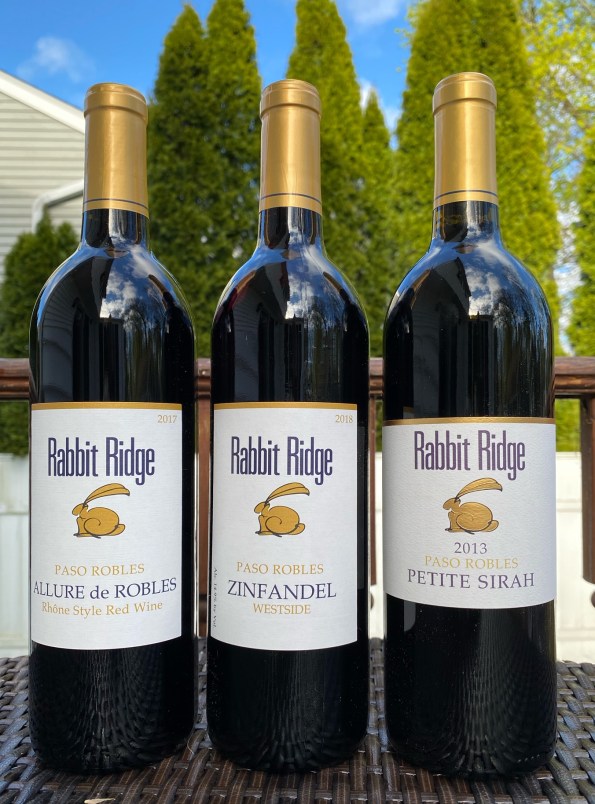
I recently met winemaker and the owner Erich Russell and his wife Joanne at the virtual event organized by John Fodera. We were going to discuss Rabbit Ridge wines, and I ordered a few bottles for that discussion – 2017 Rabbit Ridge Allure de Robles Paso Robles (15.4% ABV, $10(!), Rhone blend), 2018 Rabbit Ridge Zinfandel Westside Paso Robles (114.9% ABV, $15), and 2013 Rabbit Ridge Petite Sirah Paso Robles (14.8% ABV, $20).
Opening a $10 bottle of California wine is hardly possible without trepidation – finding great wines at that price is really challenging. And nevertheless, Allure de Robles was delicious – soft, supple, well-present, and perfectly balanced. Would it compete head to head with the wines from Saxum or Alban – no, of course not. Yet this is an excellent, delicious everyday wine in its own right.
$15 Zinfandel is also not an easy find. Rabbit Ridge West Side Zinfandel was superb – the core of raspberries with a touch of smoke. Yep, delicious is the right word.
$20 Petite Sirah, drinkable upon the opening of the bottle – this doesn’t happen often, if ever. Petite Sirah is tricky and finding drinkable one at that price is also quite difficult – again, Rabbit Ridge perfectly delivered dark and firmly structured core, with the fruit leisurely weaved around it.
If these wines are not the case buy recommendations then I don’t know what is.
Here you go, my friends. I hope you will be able to take advantage of at least some of the offers and don’t miss on those Rabbit Ridge wines – nothing lasts forever… Cheers!
Daily Glass: Meeting The Expectations
Expectations are essential in any area of human life. We find great joy when our expectations are exceeded, no matter what those expectations apply to – service, conversation, book, a dish at a restaurant, final grade – truly anything and everything. We are equally disappointed when our expectations are not met – subpar service, empty talk, boring book, bland dish, a B grade instead of an A. Believe me, works every time. Expectations are important, as they function as gates to happiness.
In theory, having low expectations is a perfect path to happiness – a solid guarantee that expectations will be easily exceeded and we will feel happy. Well, it is easier said than done. More often than not, the expectations are set on a subconscious level. When you read the test question, the brain instantly jumps in “I know the answer!” – left unchecked, the test grade might not meet the expectations. Or think about one of my favorite sources of disappointment while visiting the restaurant – the dish description which doesn’t meet your expectations. If the dish described as “spicy” it is better actually be spicy and not dull…
Expectations work exactly like that in the world of wine. One quick glance at the label unleashes a slew of instant impressions – ahh, Turley, yes, had this last year, maybe a different vintage, I think this is a great year, should be delicious, maybe need some time to breathe, ahh, and I remember not liking that wine at first, yeah, I still remember that… can I pull that cork already? Yep – one quick glance is quite enough.
Exceeding expectations is great, but, more often than not, meeting them is quite enough – especially if your expectations are already high enough. Here is my account of two wines perfectly meeting my expectations.
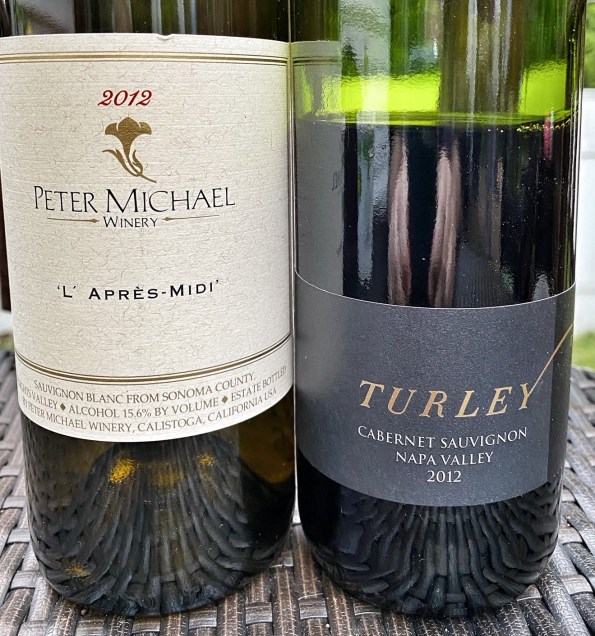
Peter Michael Winery requires no introduction to the wine lovers, producing some of the best Chardonnays, Pinot Noir, and Cabernet Sauvignon wines in California for more than 30 years. Turley Wine Cellars had been around for 27 years, and it is best known as producer of some of the most coveted Zinfandel wines. It is interesting that both wines I’m talking about here are sort of the oddballs for both producers – Peter Michael is not really known for its Sauvignon Blanc, and Larry Turley, the proprietor at Turley wines, was anti-Cabernet Sauvignon for a long time, so I’m not sure if wine lovers are even fully aware that Turley produces Cabernet Sauvignon for the past 5 years.
Both wineries are well known for their quality wines, and when you see their names on the label, you do expect to taste that quality in your glass. 2012 Peter Michael L’Aprés Midi Knights Valley Sonoma County (15.6% ABV) was superb from the get-go – a whiff of the fresh-cut grass, whitestone fruit, round mouthfeel, and clean acidity. The wine was really uncalifornian in its presentation – I would think I’m tasting Sancerre if I would taste this wine blind. The utmost elegance – and 8 years old fresh and vibrant Sauvignon Blanc is not an easy fit.
2012 Turley Cabernet Sauvignon Napa Cellars (14.1% ABV) also tasted as expected. As I opened the bottle, it was not the wine to drink – for sure not for my palate. Big, brooding, jammy, with a lot of semi-sweet dark chocolate and dark fruit. It was quintessential Californian and over the board. I’m sure it doesn’t sound great to many of you, but this is within the expectations, as Californian Cabernet Sauvignon are rarely pop’n’pour wines, and at 8 years of age, they are way too young. However, exactly as expected, the wine became magnificent on the second day. Cassis showed up, smothered with mint, eucalyptus, and a touch of anise. The medley of fruit and herbs was delicious, with perfect balancing acidity and velvety, roll-of-your-tongue, texture. Just the wine I would expect Turley to produce.
How often do you find the wines which meet your expectations? Better yet, how often your wine expectations are exceeded?
American Pleasures #4 – Gratus Vineyards
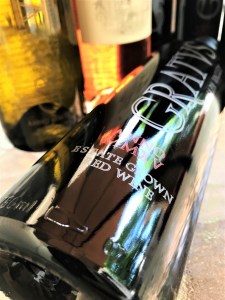 Wine can be many things to many people. Wine can connect people. Wine can bring back memories. Wine can bring back a unique experience, change one’s mood, and help solve a problem.
The wine is also often an expression of gratitude.
Those of us who love wine also love to offer it to others as an expression of our gratitude. We take great care in carefully selecting the wine to express what we feel – it makes us ecstatic when the gift recipient acknowledges our choice.
And then there are those who make wine to express their gratitude – sometimes, they even call their winery to show that, as would be the case for GRATUS Vineyards.
Gratus is Latin for gratitude, and this is exactly what Thomas Wargovich was trying to express by naming his Napa Valley winery GRATUS Vineyards – gratitude to the family, gratitude to his grandparents who came to the USA as millions of others in search of the better life.

Source: GRATUS Vineyards
GRATUS Vineyards is a 27 acres parcel in Pope Valley, the small strip of land adjacent to the famed Howell Mountain. GRATUS Vineyards is not just a winery. While 10 acres are planted with vines, the rest of the parcel constitutes a complex nature habitat, an arboretum with more than 300 rare and endangered species of conifers, trees which bear cones, among other plants. It makes GRATUS Vineyards a unique place with its own soul and personality.
The first vintage at GRATUS Vineyards, 2012, consisted of 75 cases. Current production is about 600 cases, with the wines ranging from the Rhone varietals to the classic California Cabernet Sauvignon and blends. Red wines at GRATUS Vineyards are typically aged for about 22 months in oak.
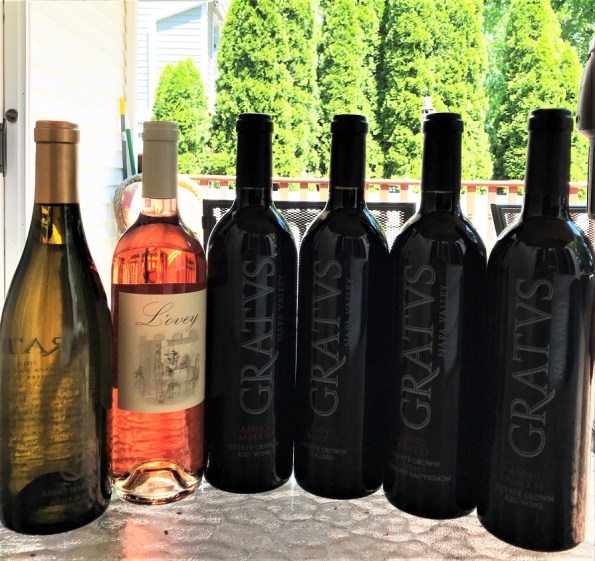
I had an opportunity to taste GRATUS Vineyards wines and was very much impressed with the consistency of the full range I was able to experience. Here are my notes:
2018 Gratus Vineyards White Blend Napa Valley (14.2% ABV, $39, blend of Grenache Blanc, Roussanne, Marsanne, Viognier, and Picpoul Blanc)
Light golden
Whitestone fruit, plums, a touch of lemon, refreshing and inviting
Round, medium-plus weight, noticeable texture, green apple, lemon, good acidity
8-/8, thought-provoking
2018 Gratus Vineyards L’ovey Rosé Napa Valley (14.2% ABV, $23)
Beautiful salmon pink
Light and refreshing strawberries, very inviting
Tart strawberries and cranberries on the palate, crisp, fresh, definitely a bigger body than Provence, and perfectly balanced.
8+, delicious.
2016 Gratus Vineyards Malbec Napa Valley (14.8% ABV, $70)
Dark garnet, practically black
Dark berries, mint, sweet basil, overripe plum
Dark berries, ripe blueberries, and blackberries, iodine, dark chocolate, medium-plus body, smooth, good acidity, good balance, medium finish
8, tasty now, will evolve.
8+ on the third day. The wine lost sweetness and developed dark magic
2015 Gratus Vineyards Red Blend Napa Valley (14.8% ABV, $90, blend of Cabernet Sauvignon, Malbec, and Petite Sirah)
Dark garnet, practically black
Dark chocolate, mocha, cherries, anise
Lip-smacking, cherries, coffee, eucalyptus, full-body, supple, generous.
8, excellent on the 2nd day. It definitely needs time, but has good potential.
2016 Gratus Vineyards Red Blend Napa Valley (14.8% ABV, $80, 80% Cabernet Sauvignon)
Dark garnet, practically black
Black currant, sweet tobacco, a touch of mint
Black currant, cherries, good minerality, fresh, firm structure, good acidity, excellent balance, medium finish.
8/8+, delicious.
2016 Gratus Vineyards Cabernet Sauvignon Reserve Napa Valley (14.8% ABV, $120, 100% Cabernet Sauvignon (clone 15))
Dark garnet, practically black
Day 1: not a lot to report. The wine is massive and closed.
Day 2 notes:
Vanilla, dark chocolate
Dark chocolate, big, brooding, pencil shavings, iodine
8-, an interesting contrast with day 1 – need to wait for the day 3
As you can see, most of the reds are in the “needs time” category, but this is pretty much a signature of the Napa Valley Cabernet Sauvignon and Cabernet Sauvignon-based wines. Hopefully, you got the patience, and the space int he cellar. Cheers!
Have Grenache, Will Travel
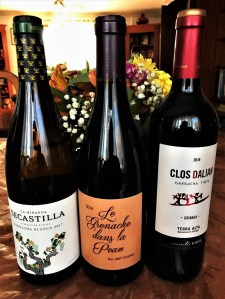 “Have wine, will travel” is one of my favorite openings for a post about wine because this is exactly what wine does – even before you take a sip, just a glance at the label is often sufficient to let your imagination run wild and yes, imagine yourself instantly somewhere 5,000 miles away from where you are now. But never in my scariest, horror-filled dreams, I would imagine that wine, along with pictures, might become the only way for us to travel, even for a day. Sigh.
So today I want to offer you a quick trip with the help of one of the most versatile, most widely planted grape in the world – Grenache, also known as Garnacha.
Grenache is a versatile grape on many different levels. First, it is widely planted. While supremacy of Grenache can be debated between France and Spain, literally every other winemaking country – Australia, Argentina, Chile, Israel, Italy, South Africa, USA, New Zealand – all have significant plantings of Grenache. Next, when we say Grenache, we typically assume red grape and red wine, of course – but Grenache family also includes Grenache Blanc and Grenache Gris. Grenache is capable of an ultra-wide range of expressions – from light and simple, such as Borsao Tres Picos or Delas Côtes du Rhône to bombastic, tremendously concentrated expressions, such as Clos Erasmus, Horsepower and Sine Qua Non. Last but not least is pricing versatility. It wouldn’t surprise anyone that $100 bottle of wine drinks well – any grape can do this. But in under $10 range, very few grapes can excel – but Grenache is one of them, for example, in the form of Honoro Vera.
Today our journey will not be too long, but we are going to make two stops in the countries which can be designated as “classic” Grenache – France and Spain. To help with our travel we can even enlist the help of the website put together to promote European Grenache and Garnacha – you can find the link here.


Our first stop is in the south of France, in the small region called Maury, which in turn is a part of the Roussillon wine region. Winemaking in that area goes back a few thousand years. Maury located on the border with Spain, and it became a part of France only after 1659, so even today there is a lot of Spanish influence in the region. Grenache is the main grape used in the production of Maury wines, and it is considered to be one of the best in France. Maury is best known for its fortified wines, produced in the style similar to port, with the addition of the spirits in the middle of fermentation, which kills the yeast and leaves the sugar level high in the resulting wine. However, it is not the Maury AOC wine I want to offer to you today, but Maury Sec, which is a designation for the dry wines produced in the same region. Our first wine is produced by Jeff Carrel, and it is predominantly Grenache with the addition of Syrah:
2016 Jeff Carrel Le Grenache dans la Peau Maury Sec AOP (15.5% ABV, 80% Grenache / 20% Syrah)
Dark ruby
High Intensity, sweet cherries, cherry compote, tobacco, sweet basil
Sweet cherries, unexpected astringency, good acidity. High alcohol is surprisingly unnoticeable.
7/7+ on the first day, 5 minutes after opening.
8-/8 second day, much more balanced and round, adds a touch of pepper, astringency is gone, excellent.
Now, let’s go to Spain. As we are now in Spain, let’s switch to the proper name for our grape – now it is Garnacha to you. Once here, how about some Garnacha Blanca? The wine had been made in Somontano, an area up north close to the French border for more than 2000 years. Garnacha Blanca is one of the permitted and popular varieties in Somontano. Once in Somontano, we are going to visit Secastillo, the valley which takes its name from the seven castles overlooking it.
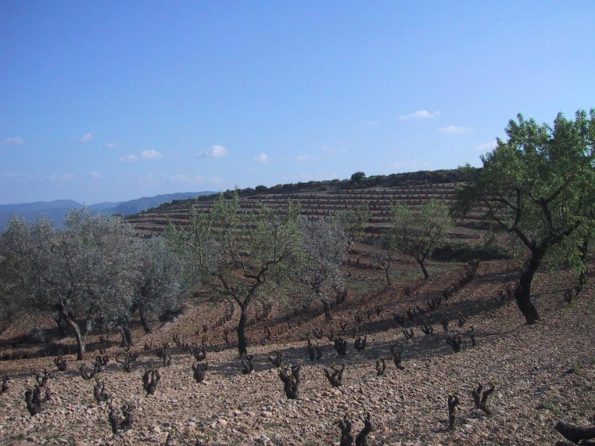
Vinas del Vero vineyards in Secastilla. Source: Gonzales Byass
Viñas del Vero produces the wines here, sourcing the grapes from 100 years old Garnacha vines, growing mostly at the elevation of 2,100+ feet.
2017 Secastilla La Miranda Garnacha Blanca Sonomontano DO (14% ABV)
Straw Pale
Lemon, fresh grass, lemon zest
Whitestone fruit, Meyer lemon, clean acidity, nice and refreshing
7+/8-, very good
Let’s continue our trip going a bit more down south. Now we are in Catalonia, in Terra Alto DO (Terra Alta means High land), where Cellers Unió had been producing wine from the beginning of Terra alto DO been formally established in 1982 (Cellers Unió is a conglomeration of cooperatives which operates across 5 DOs, 11,000 acres of vineyards and includes 20,000 families of growers across 186 cooperatives). Now it is time to drink some classic Garnacha:
2016 Cellers Unio Clos Dalian Garnacha Tinta Crianza Terra Alta DO (13.5% ABV)
Dark Garnet
Cherry Coolaid, sweet cherry, candy
Cherries, fresh sour cherries, wow. Touch of tobacco, earthy undertones, perfect balance, soft and round.
8, excellent
Our trip is over, unfortunately – but see how easy it was? I wish you many great journeys, all enabled with the power of wine glass in your hand. Until we travel again – cheers!
High Altitude Malbec for the World Malbec Day Celebration
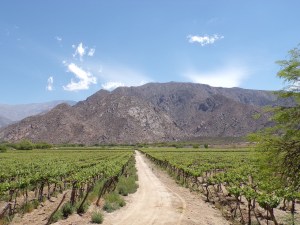
Cafayate desert. Image by gabrielgcossa from Pixabay
Do you like Malbec? If you do, great – you have a perfect reason to celebrate one of the world’s most popular grape on its holiday, World Malbec Day, always celebrated on April 17th. If you don’t – great, as you can taste a lot of wines in order to eventually find Malbec which you will enjoy.
Malbec is one of the unique grapes in the wine world, with a long history full of ups and downs. Malbec history can be traced almost a thousand years back. It used to be one of the most popular and most planted grapes in France. Wine from Cahors, a small region just south of Bordeaux, was famous for its dark and brooding qualities and was very much welcomed by the royals as early as the 1200s (well, the grape is not called Malbec in Cahors – it is known as Côt or Auxerrois). However, as Bordeaux started developing its own brand, it started blocking Cahors wines from reaching its intended destination, as most of the trading routes had to pass through Bordeaux before reaching the wine consumers.
Malbec used to be widely planted in Bordeaux, but this thin-skinned and disease-prone grape was difficult to work with, and it became anything but literally extinct today. Of course, Malbec is still the main grape in Cahors, where it is made into delicious, long-living wines – if you can find them in the wines stores, of course. However, the real fame of Malbec is related to its second motherland – Argentina.
Malbec was brought to Argentina in the mid-19th century and higher elevation vineyards with mostly dry climate happened to be a godsend for the moody grape. From there on, Malbec went on the path of becoming the most famous Argentinian grape. I guarantee you if anyone will ask what is in your glass, and you will say “Malbec”, 99% of the people will have no doubts that you are drinking Argentinian wine – yes, this is a good example of fame. Malbec’s success in the new world didn’t stop in Argentina, as it is successfully growing today in Australia, Chile, California, Texas, and many other places. But it is still the Argentina which rules the Malbec world today.
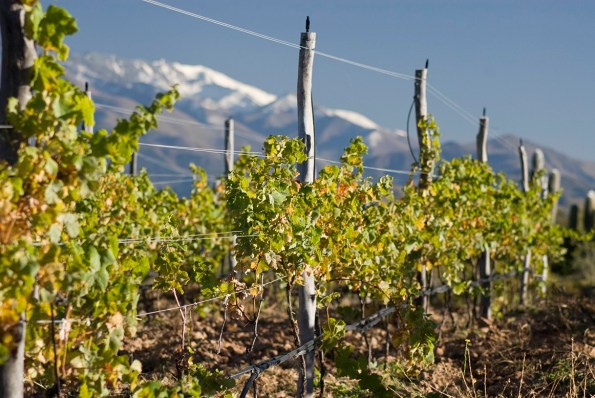
Altura maxima vineyard. Source: Bodegas Colome
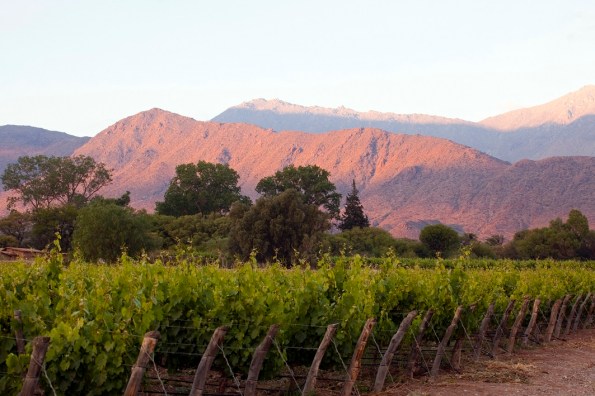
Altura maxima Vineyard. Source: Bodegas Colome
When it comes to Argentinian wine, Mendoza is the first area that comes to mind. It is hardly surprising, as 2/3 or Argentinian wine comes from Mendoza. But it is not Mendoza we are talking about today – we are going higher, much higher – to Salta (Mendoza vineyards are typically located at the 1,800 – 3,400 feet altitude, and in Salta altitude ranges from 7,000 to 10,000 feet). Salta is home to the highest vineyard in the world, Altura Maxima (elevation 10,200 feet/3,100 meters). It is also home to one of the oldest wineries in Argentina, Bodegas Colomé, which was founded in 1831.
I already wrote about the wines of Bodegas Colomé in the past (you can find this post here), as well as the wines from Amalaya, a 10 years old project by Bodegas Colomé in Cafayate desert. It was very interesting to try the same wines only from a different vintage. I can say that there is a noticeable improvement in the quality of the Amalaya – 3 additional years make a lot of difference. The Colomé Estate Malbec was more or less on par with its older brethren – but I certainly like the new label design, the bottle looks more elegant.


Here are my notes for the three of the Malbec wines I was able to taste:
2018 Amalaya Malbec Salta Argentina (13.9% ABV, $16, 85% Malbec, 10% Tannat, 5% Petit Verdot)
Dark garnet
Inviting, eucalyptus, blackberries, crushed berries, baking spices
Fresh berries, coffee, bright, easy to drink, good structure, good acidity, good balance.
8, simple and delicious. Needed a couple of hours to open up.
2017 Colomé Estate Malbec Valle Calchaquí Salta Argentina (14.9% ABV, $25, grapes from vineyards at 7545 to 10,200 feet elevation)
Dark garnet
Vanilla, baking spices, restrained fruit
Vanilla, blueberries, tar, firm structure, very restrained, appears more as an old-world than anything else.
8, excellent.
2018 Colomé Auténtico Malbec Valle Colchaquí Salta Argentina (14.5% ABV, $30, high altitude vineyard ~7000 ft)
Practically black
Vanilla, blueberries, baking spices, inviting
Blueberries, coffee, good acidity, silky smooth, layered, ripe fruit but still balanced.
8, classic and tasty – but needs time. Really opened up only on the day 3
What do you think of Malbec wines? Do you have a favorite producer? How did you celebrate World Malbec Day? Until the next time – cheers!
Stories of Passion and Pinot: Utopia Vineyard
Pinot Noir excites passion. All grapes do, of course, and good winemakers are always passionate, often to the point of obsession. But some of the most desired wines in the world are made out of Pinot Noir, and Pinot Noir is notoriously finicky, mutation-prone grape, difficult to work with. Hence passion is winemaker’s best helper to work with Pinot Noir and produce the best possible wines.
Yes, I’m sure you figured me by now – I’m introducing a new post in the Passion and Pinot series – you can find all the past posts here. And I’m sure today’s subject resonates perfectly with the world we live in right now (for those who might read this post a few years later, look up “covid-19 pandemic”, and you will understand my point). I’m sure we would all much rather live in utopia compare to the self-quarantine and fear of sneezing – and it is the utopia we will be talking about here (don’t worry, there will be plenty of wine).
According to the dictionary, utopia is defined as “an imagined place or state of things in which everything is perfect”. I guess Daniel Warnshuis saw this complete perfection in the 17 acres parcel of land he found on the Ribbon Ridge in the heart of Ribbon Ridge Appellation in Yamhill County in Oregon in early 2000, hence the name Utopia Vineyard.
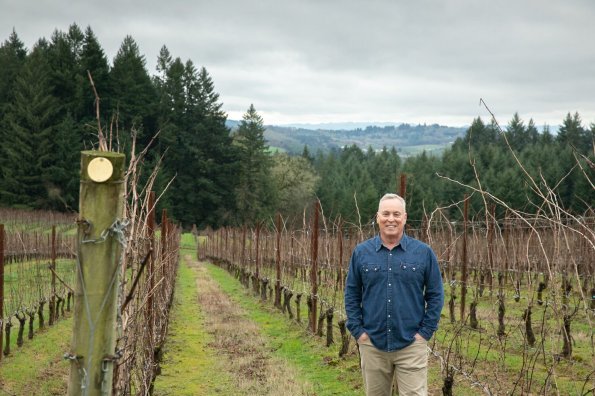
Daniel Warnshuis. Source: Utopia Vineyard
UTOPIA Vineyard had its first commercial vintage in 2006, 413 cases of Pinot Noir. Since then, Pinot Blanc, Chardonnay and a number of other wines had been produced at the winery, and numerous accolades were won at multiple competitions. Utopia, which uses dry farming methods, was L.I.V.E. certified in 2008.
I had an opportunity to [virtually] sit down with Daniel Warnshuis and ask him some questions – here is what transpired in our conversation:
[TaV]: First and foremost – why Utopia? Utopia means an unreachable dream, so what is the reason for this name?
[DW] The classic definition of UTOPIA is the perfect and no place. I am trying to make the perfect Pinot-noir but realize that as a human being I will not achieve perfection. It is, therefore, the goal that I constantly strive for without compromise to make the wine better each and every vintage.
[TaV]: You bought the vineyard in 2000, your first vintage was in 2006. How were those years in between? Did you have any major challenges, or did you just have to wait for the vines to mature?
[DW]: You are correct that I consider 2006 my first commercial vintage (413 cases of Estate Pinot-noir) but I did produce 97 cases of Estate Pinot-noir in 2005. Just to be clear, it was more of an experiment than a vintage. There were a number of challenges in getting the vineyard bootstrapped. First, I had to decide which clones I wanted to plant. I looked around the valley at the time and found that most of the vineyards contained only 2-3 clones and they were mostly the same 2-3 clones, e.g.. Pommard and Dijon 115 or Wadenswil. Or one of the other Dijon clones, mostly 667 and 777. I also detected a certain homogeneity in the wines being produced at that time and I wanted to do something very different. This is what convinced me to plant a total of 12 Pinot-noir clones including several heirloom clones from various existing vineyard sources in CA and OR. Once I settled on the makeup of the vineyard it was mostly a waiting game until the vines began to produce.
[TaV]: You were born and raised on California wines, why build the vineyard in Oregon and not in a Napa or Sonoma?
[DW]: I got exposed to Willamette Valley Pinot-noir early in my wine journey working for Tektronix where my first boss was an avid wine collector and amateur chef who exposed me to Oregon wines. The raw beauty of Oregon and especially Willamette Valley wine country was also a major draw for me along with its nascent state as a wine producing region. It presented a relatively affordable opportunity to get in on the ground floor of the next NAPA. I was a big proponent of Willamette Valley Pinot-noir while still living and running my NAPA wine business at a time when even most savvy wine drinkers were still unaware of what was happening in Oregon.
[TaV]: You’ve been a farmer for 20 years now. What are your main takeaways from this experience?
[DW]: Owning the land is the ultimate advantage for a winemaker because the best wines almost always come from the best fruit. 100% control from vine to wine is the maximum level of control and as a small producer here in Willamette Valley I am as close to a small producer (vigneron) in Burgundy that I can be without being in Burgundy. At Utopia I always want to make the best wine possible for any given vintage, again just like in Burgundy the wine should always be a reflection of the growing season and therefore unique each and every year.

Source: Utopia Vineyard
[TaV]: Do you have a pivotal wine, the one which clearly made you see the wine world differently?
[DW]: Burgundy wines from any small producer in Volnay, Pommard, Mersault (and Mersault, Chassagne and Puligny Montrachet for whites) were pivotal wines for me. The only thing I have found that compares with them are Willamette Valley Pinot-noir’s and now Chardonnay’s from small producers who are owning the land and making the wines in the same tradition.
[TaV]: Is there one Pinot Noir producer or winery you would consider a hallmark, something you would compare your wines to?
[DW]: Dominique Lafon is someone who I have followed for several decades and admire his approach (biodynamic farming and terroir driven) especially for his White Burgundy which I think is sublime. DRC is always mentioned as the ultimate but I would say that I have always and still do admire the smaller producers who are risking everything to make the best wine. This means organic/biodynamic farming even in a challenging vintage, minimalist approach to winemaking and focus on terroir.
[TaV]: What is the difference between the various Pinot Noir wines you are producing? Is it grape selection, individual plots, different oak regimens?
[DW]: Yes, it is all those things, in addition, location in the vineyard, clonal selection for the blends, oak regimen (ex: riper fruit deserves more new French oak such as in my Reserve “Eden” bottling).
[TaV]: Any plans for Utopia sparkling wines? You already growing all necessary components, so do you plan to take the next step?
[DW]: Yes, I would like very much to make sparkling wine. It is challenging as it requires a different setup and 3-4 years to produce the first vintage, but, I have not given up on the concept. I produced my first Port Style wine in 2018 and will bottle it this Fall.
[TaV]: You are now offering Grenache, Mourvedre and GSM wines. For how long you had been producing those? I understand that you source Grenache from Rogue Valley, what about Mourvedre and Syrah? Do you also plan to offer single varietal Syrah?
[DW]: I started producing those varietals in 2009 and actually started with a Syrah and Viognier but switched to Grenache in 2013 and added a GSM in 2014 and a Mourvedre in 2016. As long as I can get quality fruit I will continue to make different varietals. I would like to produce a Cab Franc and maybe even a Bordeaux blend in the future as well. I plan to plant some of these different varieties here on my new property to prepare for the inevitable change in our climate over the next 10 – 20 years.
[TaV]: What are your favorite wines or wine producers in Oregon? In the USA? In the world?
[DW]: In Oregon, Brick House, Beaux Freres, In California, Joseph Phelps, Spottswoode, In the World, anything Burgundy especially any small producers farming organic/biodynamic and terroir driven as well as Mouton Rothschild in Bordeaux.
[TaV]: Did your utopia materialize in your vineyard? Did you find everything you were looking for?
[DW]: Yes, I live on my vineyard and work with my family to produce a unique product that we share with the world. We preserve the land for future generations (organic farming), we give back to our communities, we promote culture of all types and we make our living doing what we love the most. I cannot be any happier than I am at UTOPIA.
[TaV]: Where do you see Utopia Vineyard in the next 10-15 years?
[DW]: More plantings of different varieties especially Rhone and Bordeaux. Possibly produce sparkling wine, continue well managed growth and keep experimenting to make it better each and every time. Create a long lasting legacy and keep it in the family for future generations.


If you are still reading this, I’m sure you are ready for a glass of wine, preferably, an Oregon Pinot Noir. I had an opportunity to taste two of the Utopia Pinot Noir wines, here are the notes:
2014 UTOPIA Pinot Noir Clone 777 Estate Reserve Ribbon Ridge AVA (13.8% ABV, $75)
Dark ruby
Smoke, plums, violets, earthy undertones
Bristling acidity, tart cherries, medium body, minerality, refreshing, inviting, good balance.
8, fresh, clean, easy to drink.
2011 UTOPIA Paradise Pinot Noir Estate Reserve Ribbon Ridge AVA (13% ABV, $85)
Dark garnet
Upon opening, the very extensive barnyard smell was apparent. It disappeared on the second day. Tobacco, earth, tar, and smoke are prevalent on the second day.
The palate is beautifully balanced with tart cherries, plums, violets, a touch of vanilla, baking spices and roasted meat.
8+/9-, delicious, hard-to-stop-drinking wine. Superb.
And we are done here, my friends – one more story of passion, and yes, it involves Pinot Noir.
Obey your passion!
P.S. Here are the links to the posts profiling wineries in this Passion and Pinot series, in alphabetical order:
Alloro Vineyard, Bells Up Winery, Ghost Hill Cellars, Iris Vineyards, Ken Wright Cellars, Knudsen Vineyards, Le Cadeau Vineyard, Lenné Estate, Tendril Cellars, Youngberg Hill Vineyards, Vidon Vineyard
Chemistry of Wine
I don’t want to mislead you – if you are expecting to see any scientific chemical analysis and/or formulae of the wines – you came fo the wrong place. The chemistry I’m talking about here is the one which usually sparkles between the people, creating instant attraction and inability to let go. You know how it is – you meet a person for the first time, and after two sentences, you feel that you knew the person forever and you can now talk endlessly, for hours and hours, and still wanting to talk more. “It’s chemistry” we often say in such cases – and it is the chemistry we want to talk about here, only not between the two persons, but rather a person and the wine.
This chemistry is something hard to explain. It is unexpected. It is a mystery. You don’t know when the chemistry will engage. You meet a person for the first time. You never met the person before. You have no idea as to what to expect. You are careful and reserved. But some words are exchanged, body movements are observed, and the next thing the conversation flowing and 3 hours later you think it was only 15 minutes which have passed, and you want to spend just another 15 minutes with your new friends.
It works exactly the same with the wine. You open a bottle. You pour, swirl, sniff, and sip. You take another sip, murmur something to yourself, and sip again. Next thing you are looking at the two fingers worth of wine left in the bottle and you ask yourself “what just have happened? Was someone else here drinking the wine with me?”. We can call it chemistry. I also like to call this a “dangerous wine” – this is the wine you casually enjoy so much that you lose the sense of time – and measure, of course.
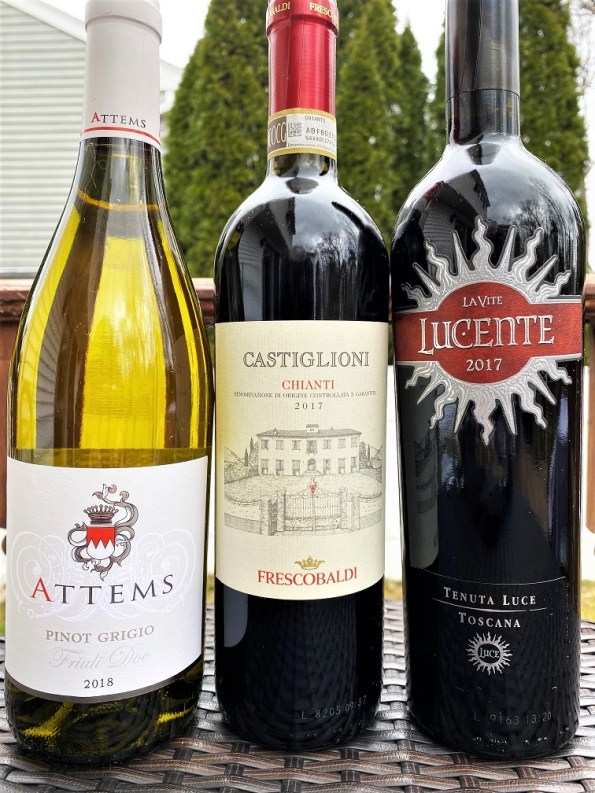
I recently encountered such chemistry with not one, but 3 wines. All three were Italian. All three were dangerously delicious. It was hard to stop replenishing the glass, one sip after another. Do I have a special chemistry with Italian wines? I don’t think so. This has happened in the past, with wines from many regions. But the point of the matter stands – this was an encounter with three delicious wines, which happened to be made in Italy. So let’s talk about them.
Before we talk about individual wines, let’s touch on the common theme which ties them all together – Frescobaldi family. There are more than 700 years of Tuscan wines connected to the Frescobaldi family, Today, Frescobaldi family holdings are spread through the 7 estates in Tuscany (Ammiraglia, Castelgiocondo, Castiglioni, Nipozzano, Perano, Pomino, Remole), plus some of the best of the best in Italian wines – Ornellaia, Masseto, and a few others.


Attems‘ name is associated with winemaking in the Friuli Venezia Giulia for almost a thousand years. Since 2000, Attems is the part of Frescobaldi family holdings. I had Attems wines in the past, such as Attems Ramato, an “orange” wine made out of Pinot Grigio, and I really enjoyed that wine. This time around, I was able to try Attems Pinot Grigio, and I was really happy with what I discovered:
2018 Attems Pinot Grigio Friuli DOC (12.5% ABV, $20)
Straw pale
Lemon, herbs, earthy profile, welcoming
Soft white fruit profile, plums, some tropical fruit, good acidity, nicely present.
8-/8, dangerous, so easy to drink.
Tenuta Castiglioni had been at the center of the Frescobaldi wine story from the very beginning. Owned by the family since the 11th century, the estate takes its history from the Romans who built it along the strategic path connecting northern Tuscany with the city of Rome. I don’t believe I had Tenuta Castiglioni wines before, so this was my first and delicious encounter:
2017 Frescobaldi Castiglioni Chianti DOCG (13% ABV, $16)
Dark garnet
Plums, cherries, vanilla
Soft, round, tobacco, succulent cherries, layered, inviting.
8+, delicious, outstanding, dangerous. Really, really easy to drink.
Tenuta Luce (“luce” means “light” in Italian) is a unique product of the imagination of two of the wine world’s greatest – Vittorio Frescobaldi and Robert Mondavi. After meeting in the nineties, the two men decided to build a new estate in one of the most coveted areas in Tuscany – Montalcino, home to Brunello di Montalcino wines. What makes Tenuta Luce unique is not just the partnership between Frescobaldi and Mondavi, but surely a bold move of planting the Merlot grapes in the land of Sangiovese Grosso. While Tenuta Luce produces Brunello, the flagship wine is called Luce and it is a Merlot/Sangiovese blend. I tasted Luce before and really enjoyed it. This time around, I had an opportunity to try Tenuta Luce second wine, again a Merlot/Sangiovese blend called Lucente – yet another delicious wine:
2017 Tenuta Luce Lucente Toscana IGT (14% ABV, $30, Sangiovese/Merlot blend, 12 months in old and new barriques)
Dark garnet, practically black
Dark cherries, fennel, violets
Cherries, coffee, leather, perfectly structured, crisp acidity, perfectly integrated and balanced tannins.
8, delicious, and hard to stop.
As you can tell from the notes above, I really liked all three wines. Not just liked – after the first glass, there was an unconscious craving for another. And another. And another. It would be quite safe to call this a chemistry – I don’t know if I have a special bonding towards the Italian wines, but these three wines were drinking more like an obsession rather just some other tasty wines. And as it works in human relationships, chemistry is a good thing between the man and the wine. Have you found yours? Cheers!
Open That Local Wine Night
There is a good chance you heard of Open That Bottle Night, or OTBN for short – more than 2 decades old special celebration to encourage people to open their sacred bottle of wine and preferably share it with friends. OTBN is celebrated on the last Saturday in February, and I have to tell you that my last one was magnificent (see for yourself here). Today, while we are still celebrating wine and all the passionate people who put their heart and the soul into those bottles, we want to shift the focus to the bottles with possibly a different pedigree than the OTBN ones – today we focus on the local wines and wineries.
With the wines produced in all 50 states in the USA, the concept of a local winery is not an oxymoron. Local wineries offer a perfect weekend getaway, with wine, food, great discoveries, stories of passion and obsession, live music and simply an opportunity to relax, in the group and small or large. And oenophiles are willing to travel to their local wineries (it takes me about 3 hours of travel by car to the Long Island wineries – and this is perfectly local in my book) – but not today. With the pandemic madness we are living nowadays, we can’t really visit wineries, whether they are 15 minutes from our house or 5 hours – and this is the time when local wineries need our support the most. And actually, you and all of us can support them.
Whatever your “local” winery is, there is a good chance you have a bottle of your favorite local wine in the cellar. Frank Morgan, a veteran wine writer from Virginia, originally suggested making Saturday, March 28th (last Saturday in March) a night to open a bottle of Virginia wine. Lenn Thompson of The Cork Report fame suggested to extend this idea to all of the local wineries, no matter where those wineries are located, and designate that same Saturday as Open That Local Wine night. The event works in a very simple way – decide what bottle to open, open and enjoy it, with food or without, and share your support in social media using hashtag #openlocalwine.
It is obvious that the wineries need our support beyond opening that bottle today, and the best form of support, of course, is simply buying the wines. Literally all the wineries have special incentives for their customers. Many wineries offer free or heavily discounted shipping for their customers, such as a $5 flat rate, for example. If you have your favorite winery, you should check their web site and see what they offer. There are also a few of the winery lists with discounts which I can offer to your attention – here is one focused on the East Coast wineries, and here is another one covering pretty much the whole country.
You also should keep in mind that while you will be engaging in the great deed of supporting the local wineries, you will be in for a lot of pleasure. Amazing wines are produced today literally everywhere, not just in California, Washington, or Oregon. I’m a self-appointed wine snob, and nevertheless, I’m literally blown away every time I’m trying local wines. I had amazing wines last year in New Jersey and Maryland. Then I also discovered an array of amazing “orange” wines at Channing Daughters winery on Long Island (if you want to expand your wine horizon, take a look at this selection), of course in addition to all the whites, Rosé and reds they produce. Really, you have a lot to discover.

Let’s talk about my most recent discovery – Macari Vineyards from North Fork of Long Island. Macari Vineyards were founded in 1995 when the first vines were planted on previously a potato farm. Macari Vineyards uses biodynamic methods and produces some of the best fruit on the East Coast. They produce a range of wines, from more of Long Island traditional Chardonnay, Cabernet Franc, and Merlot to the oddballs such as 100% Pinot Meunier. I had an opportunity to try the samples of two wines Macari Vineyards wines, and I really enjoyed both – here are the notes:
2019 Macari Rosé North Fork of Long Island (12% ABV, $24, Merlot and Malbec blend)
Salmon pink
Herbs, strawberries
Underripe strawberries, crisp, fresh, good acidity.
8-, light and delicious.
2015 Macari Cabernet Franc Reserve North Fork of Long Island (14% ABV, $38, 20 months in 100% neutral French oak)
Dark Garnet
Bell peppers, eucalyptus, sage, cassis leaves
Soft, round, cassis, bell peppers, anise, crispy undertones, mouthwatering acidity, medium body, classic lean New York style.
8+, outstanding, the Cab Franc I love.
So what do you think, can you do it? Open that bottle of the local wine, maybe even get together with the friends – virtually, of course – Facetime, WhatsApp, Facebook, Skype, … and enjoy that bottle. And then go and explore what the local wineries have to offer – the world is your oyster, so any winery can be your local winery. You are up for a lot of tasty discoveries, I guarantee you that. #openlocalwine, my friends!
Last Bottle Sign Up ($10 credit)




 Talk-A-Vino