Archive
Simple Recipes: Roasted Garlic Hummus
Do you like hummus? Well, I can tell you about myself – yes and no.
No questions that everyone’s palate is different, so I can only speak for my perception. I absolutely LOVE well-made hummus – I can eat it by the bowlful. The problem is that it is almost impossible to find well-made hummus here in the US (if you are in Israel, it is an entirely different story). You can occasionally find something decent at an appropriate restaurant (typically Mediterranean or Middle Eastern), but it is practically impossible to find anything decent in the store – I encountered some exceptions, but they are really, really rare (for about 3 months, Costco was offering a hummus brand called Shamir – it was delicious. Then it disappeared, and I simply stopped buying any hummus from Costco).
It is hard to describe “well-made” hummus – it is a combination of taste and texture, and it shouldn’t have the annoying flattening acidity which makes everything taste so dull. So if you like hummus as much as I do, I have a recipe for you which I’m happy to share.

All you need to make a tasty hummus
Making a great hummus is simple – basically, you only need three ingredients to start – chickpeas, also known as garbanzo beans, salt, and olive oil. I’m sure you can make a nice hummus with only these three ingredients, but I like a bit more flavor in mine, so I add another 3 ingredients – garlic, tahini, and lemon. Here is the full list:
Ingredients:
- Dry chickpeas – 1 lb
- Olive oil – 2.5 cups (approx)
- Kosher salt – 2 tablespoons
- Tahini – 1 cup
- Garlic – 1 head plus 3-4 cloves
- Lemon – 1 large or 2 small
There are a few steps involved here. First, you will need roasted garlic-infused olive oil – you can prepare that in advance at any time (store it in a tight container and enjoy for weeks with a slice of bread or use in any cooking which might benefit from the garlic flavor). Roasted garlic-infused oil is very easy to make. Peel and clean a whole head of garlic, then mince it all finely (don’t use a garlic press, I don’t believe it will work well). Pour two cups of the olive oil in a large skillet, and put it on the lowest heat possible. Add minced garlic and let it slowly simmer until garlic will become lightly golden. It is important that you will use the lowest heat setting – even on the medium heat, minced garlic will roast in no time, and oil will not absorb the delicious sweet flavor of roasted garlic. Ideally, it will take you about 15 minutes to get to the lightly golden roasted garlic (don’t let it become dark/brown – at this point, it might become bitter) – you need to lightly stir it occasionally. Once you are done, remove from heat and let it cool off before pouring it off to a container with a tight lid (I use a large glass jar for this purpose).
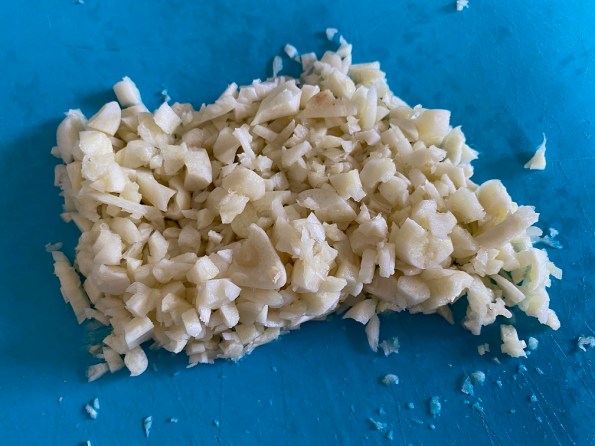
Minced garlic
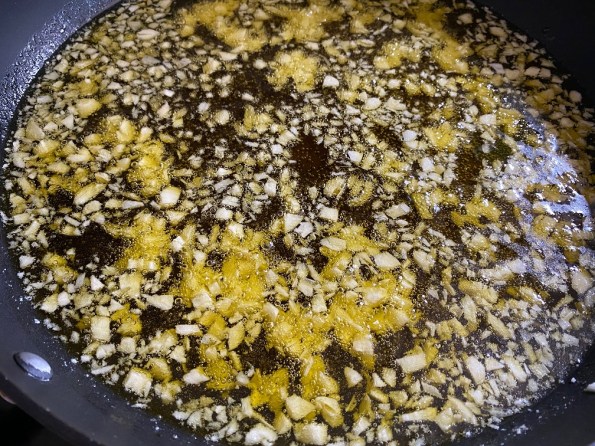
Roasted garlic in progress


Now, let’s start with chickpeas. We are using dry chickpeas here. Yes, you can use the chickpeas from the can, but I don’t believe you will end up with the quality hummus, so it is up to you if you want to cut the corners here. When using dry chickpeas, first you need to soak them. Take large (8 qt) pot, put in dry chickpeas, add about 6 qt of cold (!) water, cover, and let stand overnight. Try not to exceed 12 hours of soaking time – I happened to do so once, and when I opened the pot I found that the water was not clear with some foam on top as some process started with chickpeas – had to throw out the whole batch as I was afraid to cook with them. In the morning, put the pot on the high heat, wait until the water will start boiling. While the pot is starting to boil, you will see foam forming, same as with any broth – I prefer to remove that foam – it might boil over it, true – but again, I prefer to remove it. Once the water is boiling, add 2 tablespoons of the kosher salt, reduce heat and let it simmer until chickpeas are cooked through – will take you about two hours. Once chickpeas are ready, just remove the pot from the hit and put aside – don’t discard water as you will need it later.

Chickpeas before soaking
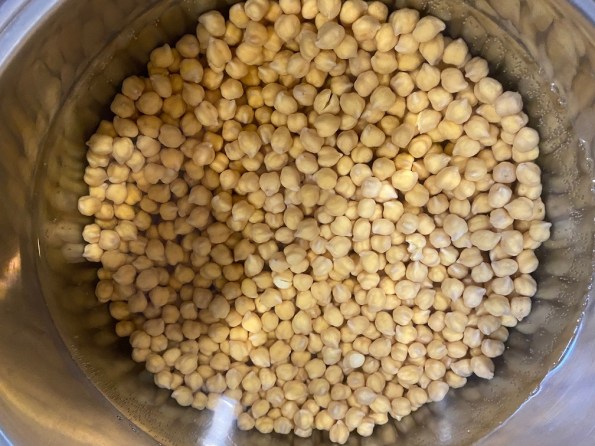
Chickpeas after soaking
Now, for a difficult part. To make hummus smooth and creamy, you need to remove the outer shell from the chickpeas, usually called the skin. This is not a simple task, as you mainly have to do it by hand, once chickpeas are cooked through and cooled off enough that you can handle them. What I’m trying to do it to remove the skins which will float in the pot while chickpeas are cooking, and then I work them one by one for as long as I have enough patience. I read about different methods such as using baking soda to help with the removal of the skin but it doesn’t sound appealing to me, so I never tried that. At the end of the day, if you will not remove all the skins, you will end up with a bit grainier hummus than you might want it to be, but it will be unquestionably tasty.
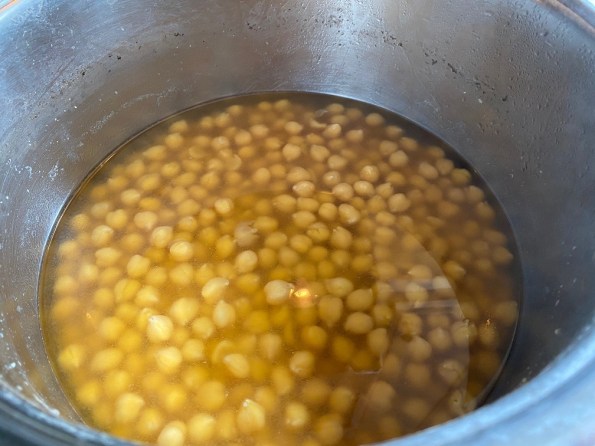
Chickpeas cooking is done


Now, your prep is done, and it is the time to make hummus. You will need a blender at this step. I’m sure you can use an immersion blender, but I’m using the standalone pitcher canister, so all the instructions and illustrations are for this method.
One quick word on tahini before we continue. Tahini is a sesame seed paste, which was always used in Mediterranean/Middle East cooking, and now it became popular in the USA. You can get it online, at many higher-end supermarkets (Whole Foods, Fairway) and even at Trader Joe’s. Once you open a jar, make sure to spend a few minutes to mix it well, as it usually clumps together – use the spoon or a fork to make sure the content of the jar is smooth and well mixed from the bottom to the top.
I prefer to process the chickpeas in two batches. For each batch, I do the following. First, peel 1-2 cloves of garlic and put it in the blender. Add 3-4 of tablespoons of water from the chickpeas pot with some occasional chickpeas. Squeeze juice of 1 lemon (or half of large one). Add two tablespoons of olive oil (garlic-infused or not, makes no difference at this point). Cover and blend until smooth -this will be our base to proceed with the chickpeas. Next, use a colander spoon to add half of the cooked chickpeas into the blender. Add half a cup of tahini and a cup of roasted garlic oil with garlic pieces. Cover and blend until smooth. Once done, move it from the blender to the container. I suggest you will taste it at this point for all the components – do you like what you taste? Need more lemon? Need more salt? Need more tahini? Is that smooth and creamy enough or is it a little tight? The reason you need to do it now because you can fix all the shortcomings with the second batch. Not enough lemon? Add extra. Not enough tahini? Add extra. Too dense? Add more chickpeas liquid or oil. With all the corrections in mind, make the second batch, then combine the two and mix them together. Voilà – your hummus is ready to be enjoyed. Well, make sure it is well chilled, and enjoy. When serving, you can smooth it out and put a drizzle of olive oil on top.


This recipe should give you a basic idea – from here on, you can make it yours by adding and removing any elements. But I would still suggest trying this recipe first and see how you want to change it. Also, keep in mind that the ingredients matter. At this point, I used chickpeas from three different sources – Goya (prepackaged), Fairway organic, and prepackaged ones from Lior (used it for the first time), and all three yielded different results. Fairway organic is my favorite. I’m okay with Goya, and I’m not buying Lior again (not very happy with the result). If you plan on making your own hummus all the time, find what works for you.
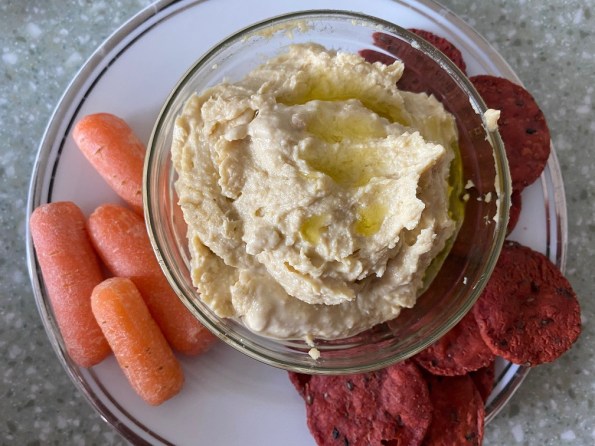
Hummus is served
That’s all I have for you, my friends. Not a word about wine in this post – but I promise to rectify it next time. Cheers!
Big Game and Numbers
As someone who was not born in the USA, it took me a while to warm to the idea of the Super Bowl. One of the “warming” factors was the need to be aware of the super bowl ads, as critical business communication element (of course it is easy now – you can educate yourself quickly and easily online, often even before the event itself) – the Super Bowl ads were easy conversation starter for good 2–3 weeks after the event. Another factor was … come on, you can easily guess it … yes, food. I realized that Super Bowl is simply another opportunity to express your love to your family and friends via cooking, and therefore, it is definitely my type of fun day.
Contrary to what you might expect, I don’t see alcohol as an essential Super Bowl experience element. So much is happening on the screen, between the game itself, the ads, the half-time show that serving a serious, thought-provoking wine would rather become a detractor. I guess this is why beer or a mixed drink makes a better accompaniment for the big game – take a bit of food, often spicy, wash it down with whatever in your glass, preferably something neutral-tasting (don’t think serious craft beers would rate too highly either).
So what are the most popular drinks during Super Bowl? It really depends on where do you live. The folks at Postmates, the largest on-demand delivery network for food, drinks, and groceries, processed some interesting stats which you can find below:

Source: Postmates.com
In this post, you can find a lot more numbers. For example, you can learn that an estimated $14 billion are spent on the Super Bowl celebration every year (no, this is not just food). Or you can find out that Shake Shack was the most popular chain in New York, with 400 orders placed for ShackBurger during Super Bowl night in 2019, and cheese fries were the most popular item in Chicago, with over 2,660 orders placed. Anyway, I will leave to ponder at the numbers on your own. Enjoy!
For The Love Of Chowder – 2019 Edition
Last Sunday, purveyors of the humble soup, also known as Chowder, assembled at the Sherwood Island State Park in Westport, Connecticut, for the 12th annual festival, the Chowdafest. 29 restaurants, mostly from New England, with a notable exception of Pike’s Place restaurant out of Seattle, Washington, competed in 4 categories (New England Clam Chowder, Creative Chowder, Soup/Bisque, and Vegetarian) – and a few thousand (“a few” here might be 2, 3, 5 – the last number I heard was 12) of people came to have a good time, and to help to identify the best chowders.

My empty ballot held in place by muffin pans – an essential tool of chowder lover at Chowdafest
Before I will inundate you with pictures, as usual, let me give you my brief personal take on the event.
For the good part, there were plenty of tasty soups to go around, and an absolute majority of the soups I tasted were quite good. There were also lots of tasty giveaways, with Natalie’s All Natural Juices as my personal favorite.
For the not so good part, the event felt really, really crowded. This was my 5th Chowdafest, and all previous years I was able to visit the absolute majority of the stands within about 2 hours. This time around, I simply gave up at some point, as the lines were just unsurmountable. I believe there were two reasons for that – first, the weather was so-so, and people didn’t have much else to do on that Sunday. Second, and more important – there was lesser number of participants in the competition, thus even the same amount of people as usual had to line up to the fewer number of stands – this year, there were 29 restaurants competing versus 37 last year, and 40 in the two years prior. My last gripe would be with scarcely decorated stands – in the prior years, there were a lot more seasonal decorations seen everywhere – this year, the decorations were quite limited.

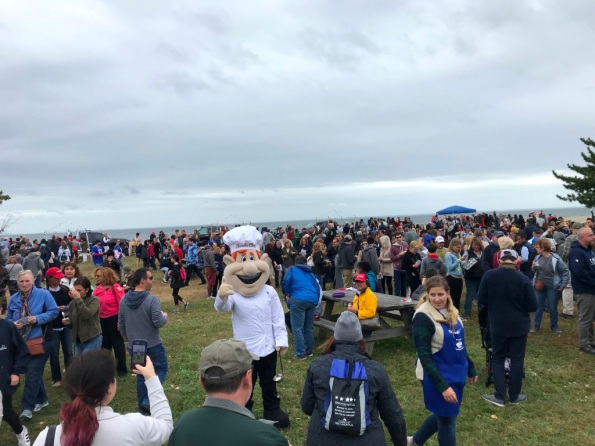
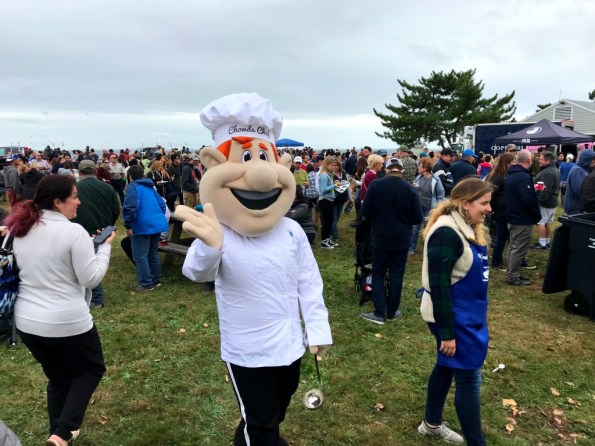


There was a good number of vegetarian soups presented, such as Gazpacho from Rory’s in Darien. Cast Iron Soup from the Cast Iron House in New Haven rightfully won this category as it was one of the very best soups in the competition.


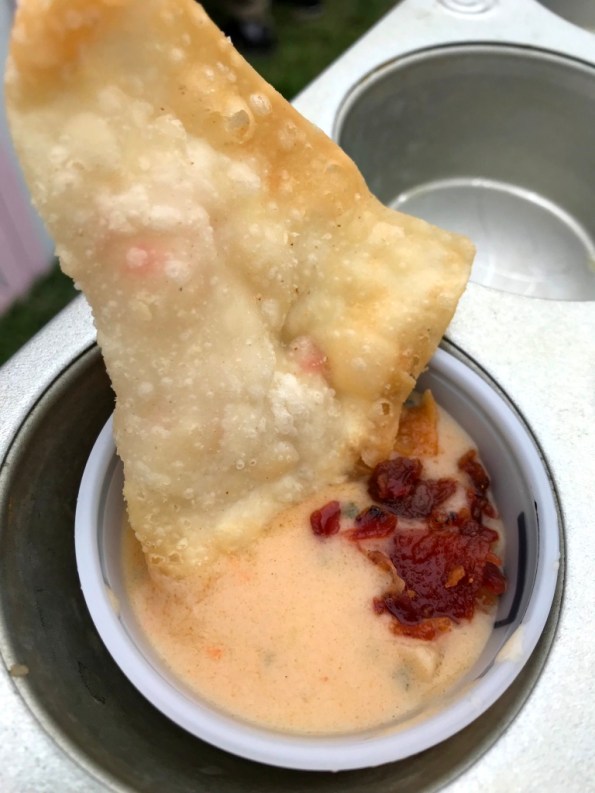
Shrimp and Corn Chowder from the Ribbon Cafe was one of the most creative at the Chowdafest 2019, served with a cheese wonton:


As always, the Chowdafest went way beyond just the soup – Michelle’s Pies were an excellent addition, and as I mentioned, Natalie’s Natural Juices (Beet Orange was my personal favorite) were an excellent thirst quencher.


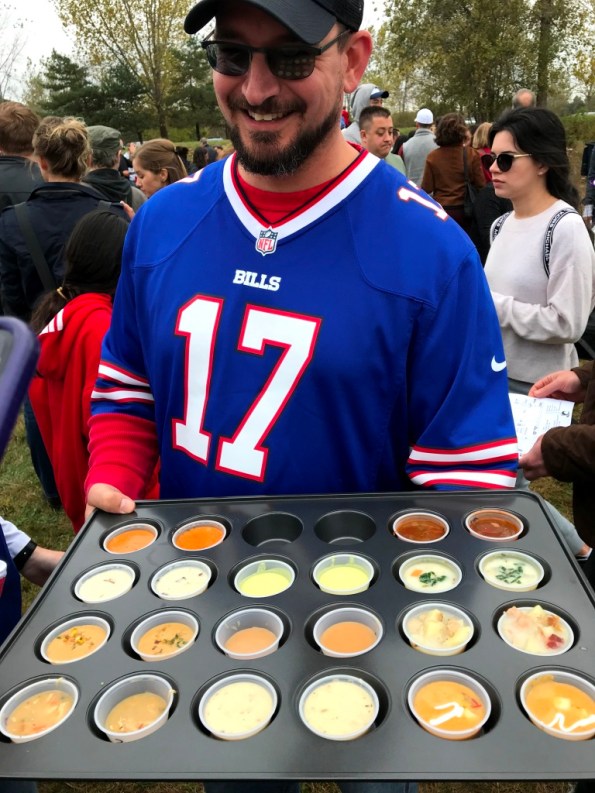
There were also some very creative tasting approaches at the Chowdafest, such as this one:
 Here you can see a glimpse of the prizes, all made by the local artist, Wendy Marciano:

 Let’s talk about the winners. For the 5th year in the row, Pike’s Place out of Seattle took the 1st place in the New England Clam Chowder category. Also for the 5th year in the row, Our House Bistro from Winooski, VT took the Creative Chowder category with its Drunkin Pumpkin Seafood Chowder. Gates from New Cannan, CT won Soup/Bisque category with its Crab & Roasted Corn Bisque, and Old Post Tavern/Cast Iron Chop House from New Haven, CT won Vegetarian category with its Cast Iron Soup. You can find all the results here.
I have to say that I’m convinced that Pike’s Place wins the competition not just because they make the best soup (in my opinion, they are not), but because they also provide the best service. While this was one of the most coveted participants, Pike’s Place stand was practically the only one without a line – they were very efficient in pouring out and simply carrying around their chowder on the large trays, so it was easy for everyone to try it without the need to stand in the long line.

I guess that’s all I wanted to share with you. Before we part, I will show you my ballot which is shamefully incomplete, but this is the best I could do:
 I’m already looking forward to the Chowdafest 2020 – I hope it will be the best and the tastiest and maybe not as crowded as the one this year.
Why You Don’t Want To Miss Chowdafest 2019
Really, why would you want to miss the Chowdafest 2019? If you like chowder or any form of nice, hearty soup – and note, it can be vegetarian soup as well – you can’t have an excuse good enough to miss the 12th annual Chowdafest festivities on October 6, 2019, taking place at the usual place – Sherwood Island State Park in Westport, Connecticut, from 11 AM until 3 PM.
I attended Chowdafest for the past 5 years, and when I’m suggesting that attending the event is well worth the effort of rearranging your Sunday around it, I’m simply speaking from experience (take a look my reports from past Chowdafests here). Chowdafest is a lot of fun – it is not only soups and chowders but lots of samples of cheese, bread, sauces, juices, tea, coffee, ice cream, and more. It is literally fun for all ages (yes, you want to teach your kids what tasty food is from an early age).

One of my very favorite creative chowders – and a winning one!
At the Chowdafest 2019, 30 restaurants will be competing for the titles in the 4 categories – New England Clam Chowder, Creative Chowder, Soup/Bisque, and Vegetarian. Half of the 30 competing restaurants will be participating for the first time, and I’m definitely looking forward to trying new soups such as Mexican style Shrimp Posole Soup, or Buffalo Chicken Noodle Soup. But probably the main question is – will Pike’s Place out of Seattle, Washington, win the classic New England Clam Chowder category for the 5th year in the row? Well, you will need to be there to see it and be a part of it.
I hope I solved for you the problem “What to do on Sunday, October 6th”. See you at the Chowdafest!
June – What a Month, in Wines and Pictures
 June might be my favorite month of the year. There are many reasons for me to say that. For one, it is the very beginning of summer. It is like a Friday night when the whole weekend is still ahead – the same thing with June, the summer is just starting. Then it is the month of my birthday and Father’s Day, which means I get to celebrate a few holidays which are related to me. Throw in the end of school celebration and occasional graduation, and you can clearly tell June brings a lot of reasons to be happy.
This June of 2019 went particularly overboard with all the goodness. At the beginning of the month, I got invited to so many wine tastings and dinners that I had to simply decline the number of invitations. Those which I managed to attend were an absolute standout. Tasting of South African wines was small, but superb, with lots of simply delicious wines. Right after the South African wine tasting, I met with Stefano Ruini, the winemaker for Bodegas Luce, tasted through yet another excellent set of wines and finally realized that Luce, the wine I tasted and admired before, is a Merlot Sangiovese blend produced in the heart of the land of Brunello.
The last event of the same day was a dinner with Michael Benedict and John Terlato of Sanford and Benedict Winery, a pioneer of California Pinot Noir, which took place at the spanking new Hudson Yards, at the Wild Ink restaurant, overlooking freshly minted The Vessel.
My next day was even more memorable, with two hours of the pure joy of talking to Stu Smith of Smith-Madrone Winery in Napa Valley, and tasting (a better way to put it: been blown away by) Stu’s wines, which were simply a standout.
That eventful week ended with the L’Ecole 41, iconic Walla Walla producer’s lunch and vertical tasting, where I finally discovered for myself what is all the fuss about Ferguson.
Then there was Father’s Day, with all the cooking fun and an opportunity to open a special bottle of wine – it is always easier to pull a better bottle when you have a good reason to do so.


My cooking fun was more of the usual – BBQ. However, I experimented with the way the meat was prepared. The chicken breast was marinated overnight in the onion juice if this is a thing – simply a big Vidalia onion pulverized in the blender and then used as a marinade – with the addition of the bbq spices. The lamb was marinated overnight in the buttermilk also with the addition of rosemary, sage, and the spices. The result was outstanding – both chicken and lamb came out juicy, tender, and delicious.
The wine story started with the 2018 Field Recordings Morro View Edna Valley (13.9% ABV, 100% Grüner Veltliner) – fresh undertones of grass, Meyer lemon, bright, crisp acidity – a perfect sip for the summer day.
Two of the Martinelli wines joined the party. Martinelli is most famous as the grape growers, however, they also produced a number of wines under their own name, albeit those are rare. First, we had 2009 Martinelli Syrah Zio Tony Ranch “Gianna Marie” Russian River Valley (15.4% ABV), which took a bit of time to open up into the a delicious, blackberries and pepper concoction, firm and supple.


I only had two bottles of Martinelli so I had no plans to open both on the same occasion. However, when my oldest daughter came and said “Dad, I can have a glass of wine over the next two hours and I want California Pinot Noir” (she has medical condition which generally prevents her from enjoying any type of alcohol), the only wine my brain could think of was 2010 Martinelli Pinot Noir Sonoma Coast (15.5% ABV), as I saw this bottle in the fridge the day before. This was a classic California Pinot Noir, which I generally describe as “plums and smoke” – soft, layered, good amount of fruit without going overboard, delicious long finish – an excellent example of the California Pinot Noir – and by the way, perfectly balanced – 15.5% ABV was absolutely unnoticeable.

The last wine I had high hopes for … well, didn’t work out. Back in 2012, I had 2004 Retro Petite Sirah, which was one of my top dozen wines of 2012. This time I opened 2007 Retro Petite Sirah Howell Mountain (14% ABV), hoping that 12 years is enough for this wine to at least start opening up. Nope, no such luck. The fruit was nowhere to be found, the wine mostly had sapidity, coffee and roasted meat notes on the first day, despite being decanted. It slowly improved day by day and showed some glimpses of the fruit on the third day, but still, it didn’t deliver the pleasure I was hoping for.
Well, let’s stop here. I will tell you about the rest of June in the next post – with lots (lots!) more pictures.
To be continued…
Daily Glass: Enjoy Your Wine and Play With Your Food – Beyond Meat Food, It Is
I appreciate winding down Sunday with a good glass of wine and a family dinner. When it is warm outside, such a Sunday dinner typically means grill – and this past Sunday was not an exception (or maybe it even was a bit of an exception as it was dry and pleasantly warm, and not hot at all, compared to mostly hot and humid weather of the last year).
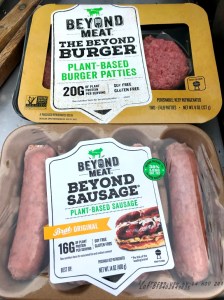
Kids love steak in this house. While shopping for a steak at our local Fairway Market, something caught my eye. Beyond Meat? Really? Both Beyond Meat The Beyond Burger and Beyond Meat Beyond Sausage Original Brat? Wow and double wow!
Let me explain the excitement.
 I have plenty of friends and relatives who are vegans and vegetarians, so with the summertime, the question of a good meat alternative is always becoming hot – when someone visits our house, I really want people to feel included and taken care of, no matter what their dietary restrictions are, so the search for a good vegan burger, etc. was always on. A few years ago, I came across the product called Beyond Burger, made by the company with a catchy name Beyond Meat. The description of Beyond Burger, which offered full resemblance of the regular burger, including the blood, sounded a bit suspicious, so I carefully researched all the ingredients and to my dismay, found that all of the ingredients are natural and there was no red paint added to this product. When I decided to try it, further research proved it to be mission impossible – Beyond Burger was available only at the Whole Foods (which I don’t frequent), and the Internet was full of complaints of the people who desperately tried, but failed to find it in their local stores, as the product was always out of stock. I also learned that in addition to Beyond Burger, the same company is offering a new product called Beyond Sausage, which sounded to me too good to be true. Again, this all was taking place 3-4 years ago.
This year, Beyond Meat went public (and mind you, very successfully – while the initial offering was at $25/share in early May, today it is trading at around $168/share, and it is just about a month later). And it appears that they managed to increase their production and distribution – now I saw the actual product instead of just reading about it. Thus, as you can imagine, I simply had to try it, even though it is quite expensive for what it is – $5.73 for two burger patties and $9.99 for four “bratwurst” sausages – you can buy the pack of 14 real bratwurst sausages at Costo for $8.99. Nevermind all the price talk – the question is simple – is it tasty? Would I be happy to serve it to the guests?
What is the best way to compare wines? The blind tasting, of course. What is the best way to compare foods? Well, the concept of “blind tasting” in wine can’t really apply to the food, unless you would actually blindfold someone, or taste your food in one of those dark rooms were waitstaff wears special goggles. So I didn’t attempt to do any sort of the fair comparison, especially as the dinner plan included steak and not the burgers. However, I had some of the Costco bratwursts in the fridge, so battle sausage was definitely on.


Before we talk about the battle food, let me share with you two delicious wines we got to enjoy on Sunday. First, a Chardonnay from … Italy. Yes, Italy makes excellent white wines, and excellent Italian Chardonnay can be found more often than not – but I still get surprised every time at how good it can be. 2015 Maculan Chardonnay Veneto IGT (12.5% ABV) was delicious from the getgo. Beautiful golden color in the glass, a touch of honey and vanilla on the nose. The palate was plump and generous, with white apples, white plums, a touch of honey and vanilla, good acidity and nice weight. The wine might be close to its prime and offers an ultimate indulgence at the moment as it is perfectly balanced. My wife, who generally don’t drink white wines, said “wow” and asked for another glass.
Sunday calls for some special wine, so I decided to go with 1999 Hendry Block 28 Zinfandel Napa Valley (15.8% ABV). In case you are curious what makes this wine special, it is its age. I don’t drink routinely 20 years old wines (I wish I could), so every time I open a bottle of such an age, it constitutes a “special bottle”. Besides, Zinfandel is one of the pet peeves. The wine just jumped from the glass with the ripe blackberries and blueberries, supported by mocha and sweet oak. The palate offered layers and layers of goodness – ripe berries, a touch of blackberry jam, velvety smooth but well present mouthfeel, lots and lots of pleasure. I can also tell you that I noticed alcohol level only on the label, but not in the glass. A very well made, delicious wine.
Now let’s get back to food, as we have the battle to discuss.
Here is how both products looked before the cooking – note the real bratwurst at the bottom of the picture with sausages. Burgers look scarily realistic, and while Beyond Meat sausages look slightly different than the real sausage, they still look perfectly real overall (there are plenty of different sausages of exactly the same color):


Both burgers and bratwurst should be cooked for 3 minutes per side according to the package instructions, which is exactly what I did. Here is the result, again including the real bratwurst for comparison:


As you can see, Beyond Meat products have somewhat of a yellow hue (okay, this are the iPhone pictures, so you might have to take my word for it). Otherwise, both burgers and saysages perfectly held up to the cooking process and were very easy to handle – maybe even easier than the real meat products, considering the there was no fat coming out to cause the flare ups.
Just so you know we didn’t really convert into the vegans, here are few more dishes from our dinner (yes, this are real meat and real scallops):


And now, to the taste.
I made a small mistake of not creating the full experience out of the burger, meaning having it with a bun, tomato, ketchup and so on. On its own, it was quite decent, with some tiny hints of not been made out of the real meat (but then remember that it was not a blind tasting, so I was clearly influenced by the appearance). The sausage, however, was mind-boggling. It literally was identical to the real bratwurst in the taste profile and texture – I would never be able to distinguish it if I would close my eyes. Simply a wow.
If you read my typical wine posts you would know that at any possible occasion, I like to taste the wines over the course of a few days to see how they will change. When it comes to the food, it is not that I like to taste the food on the second or a third day (by the way, some of the soups and stews actually benefit from an extra day in the fridge), but I can’t stand wasting the food, so I usually make an effort to work on the leftovers for as long as possible or needed. What it has to do with this story? Simple. We had leftovers of both Beyond Meat burgers and bratwursts. Over the next two days, both perfectly held up to the reheating in the microwave, and both were perfectly on point in taste and texture, resembling its real meat brethren even more than on the first day while freshly made.
There you have it, my friends. The verdict on Beyond Meat burgers and bratwursts? Beyond reproach. I will be happy, very happy to serve them to my guests at any gathering. And yes, I hope you enjoyed your Sunday night wines too. Cheers!
For The Love Of Pasta – Pasta Carbonara, It Is
Do you have any secret food vices, the craves for something you shouldn’t eat? Here, I don’t have a problem sharing my secret – my secret crush is pasta.
Why is that a secret crush? Well, you really not supposed to like it. Pasta = Carbs, and Carbs = Bad For You. You don’t have to be Atkins or Keto aficionado – the message about the negative effect of carbs affecting one’s weight and overall health can be loudly heard everywhere. “Ahh, I stopped eating carbs and sugar, and I lost 30 lb and feel great!” And while I understand it, I’m always ready to embrace my secret indulgence – when making evening dinner plans, I’m quietly hoping someone in the family will say “how about pasta”? There is an ultimate level of comfort and pleasure in the simplicity of a properly boiled pasta (al dente) with or without a sauce (just give me some fresh Parmesan, don’t need even the sauce).
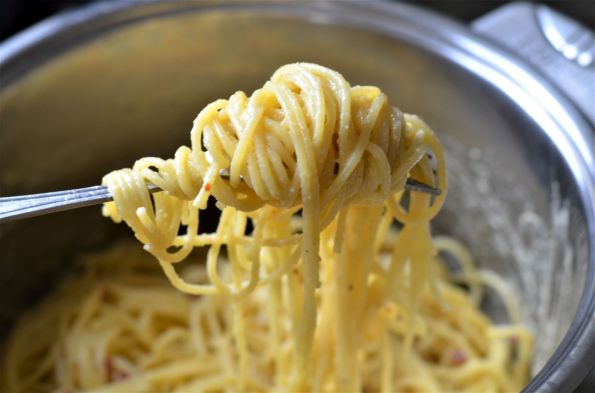
The reason is this “secret” is getting out now is simple. A few days ago I saw a post from Gambero Rosso that on April 6th we will be celebrating first ever #CarbonaraDay. Pasta Carbonara is one of my favorite ways to eat pasta, especially since discovering the Pasta Carbonara recipe by famous New York Chef, restaurateur, and Food Network’s Chopped judge, Marc Murphy.
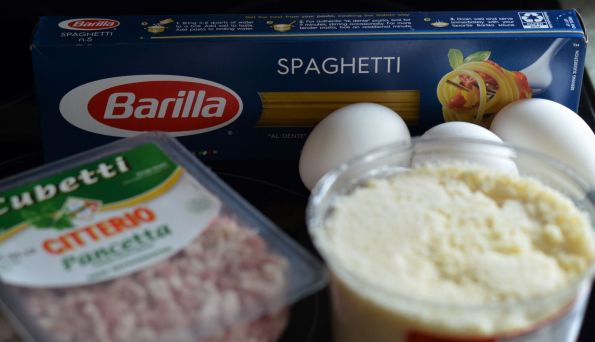
There is never a single recipe for a dish – no matter if the recipe is attributed as “classic”, “best” or “authentic”, there will be lots of variations making the same claim. Pasta Carbonara is no exception – lots of variations exist with heavy cream, peas, other vegetables and so on. What I love about Marc Murphy’s recipe is its rustic simplicity. Four basic ingredients (pasta, bacon, eggs, cheese), about 20 minutes for both preparation and cooking – and delicious meal the family can enjoy. I will not repeat the recipe in this post, you can find it at the link I shared, together with Marc’s story.
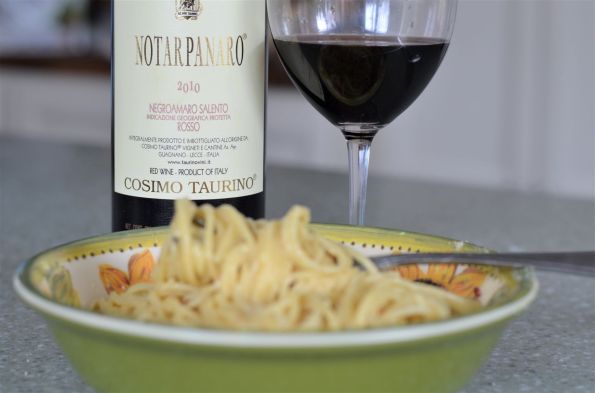
Can we have food without wine? Of course, but this is not very likely in this blog, especially if we are talking about an Italian dish. My decision to pair Pasta Carbonara with 2010 Cosimo Taurino Notarpanaro Negroamaro Rosso Salento IGP was not something long planned – I simply had a bottle open from the day before, and thus it was an easy decision. Negroamaro Salento might be one of the most food-friendly wines – those wines are usually supple and generous with fruit without going overboard, tannins are well integrated, earthy notes are quite noticeable, and acidity brings everything together – in this particular case, the wine was complementing pasta very well, enhancing the pleasure of every bite and sip.

Here you are, my friends, my Pasta Carbonara experience for the first #CarbonaraDay. I told you about my secret food crush – what about you? Cheers!
Valentine’s Day Experiences
 Cooking is the ultimate expression of love. This is always true, but even more though on Valentine’s Day, as the whole holiday is all about love – the holiday which exists since about the 5th century – it is really fun to celebrate something so deeply rooted in history.
Our personal love story was simple – yet, probably, equally uncommon – the love at first sight. It took three days since the moment we saw each other for the first time until everything was decided. So you can imagine that Valentine’s Day was always an important holiday for us. At first, we tried to follow to common path, working hard to score coveted restaurant reservation – until the dinner at one of the most expensive, and supposedly, best Italian restaurants in Connecticut, which we left asking each other “what was that???”. That was the end of our “eating out” Valentine’s Day celebrations, and the beginning of the “eat in” tradition.
One of the advantages of “eat in” celebrations is a much better wine program. You don’t need to desperately comb through the pages of the wine list, finding that you can’t afford any of the wines by the bottle you want to drink, and common sense preventing you from getting any of the wines by the glass which can be classified as a “seemingly affordable rip off”. Instead, you can spend hours combing through your own wine shelves, looking for the bottles which you will deem worthy of a special celebration – and which will also work with the menu you have in mind.

Martinelli Syrah which you see in the picture was a backup wine in case anything will be wrong with the Pinot. Now it is back in the cellar, waiting for its turn.
Last year’s celebration was about steak and Cab – obviously, I couldn’t repeat myself, so the search was on to find an appropriate protein replacement. Somehow that resulted in the duck breast – and what wine does the duck breast call for? Of course, the Pinot Noir!
Before we talk Pinot we need to talk bubbles. Bubbles don’t have to exclusively narrow down to Champagne. Champagne is a wonderful sparkling wine, perfectly appropriate for any celebration – but the world of wine moved up tremendously over the past 15-20 years. I don’t have any stats to prove this objectively, but I have a feeling in the USA at least a third of all wineries if not half of them produce sparkling wine – if not for the wide distribution, then at least for the wine clubs and tasting room visitors.
I also have to say that ever since I visited the Franciacorta region in Lombardy, Italy, Franciacorta sparkling wines became my go-to choice of bubbles for any special celebrations. In my mind, Franciacorta wines are very consistent, and today, as they honed their production methods to perfection, this translates into the “you can’t go wrong with” Franciacorta wines in general. La Valle was one of my top highlights of that Franciacorta trip and the La Valle Rosé really hit the cord then – and it continues to do now. This 2011 La Valle Brut Rosé Franciacorta was superb – fine mousse, delicious strawberries on the nose with the hint of the toasted bread, and more strawberries on the palate – a perfect opener for our evening.
Now, the Pinot time. Similar to the bubbles, Pinot Noir also enjoys quite a universal appeal around the world nowadays. There some regions, however, which do a better job than the others – and California Russain River Valley is definitely one of them. I tried 2007 Charles Mara Pinot Noir for the first time back in 2010. It was silky smooth and powerful at the same time. I was so impressed with this wine that it became the top wine of the inaugural Talk-a-Vino Top Dozen Wines list. I still had a bottle of 2007, and I decided that it would be a perfect choice for our Valentine’s Day dinner – and the wine didn’t disappoint. Now, 9 years later, this 2007 Mara Laughlin Road Ranch Pinot Noir Russian River Valley became even more round and less “in your face”. Characteristic California Pinot plums and smoke on the nose, succulent dark fruit on the palate with a hint of violets, perfect acidity, perfect balance, lots and lots of pleasure. And it also worked perfectly with the duck.


Let’s talk about the duck. I had it a number of times before, either made by friends or at the restaurant – but duck is rarely my go-to dish. The form of duck I cooked before was either duck legs as part of the Cassoulet or the whole duck as part of the Turducken. I never attempted cooking the duck breast before, so obviously was concerned with the outcome. After studying a number of recipes, I was concerned even more, as a number of commentators complained about rendering duck inedible even after repeated attempts, so I was really not sure about my own success.
I don’t know if it was a quality of the ingredient, Moulard Duck Magret, which I got at our local Fairway Market, or the cast iron pan, a combination of the above, or the beginner’s luck, but the duck breast came out perfectly. I also made a Port (you saw it in the picture above) and berries reduction, which elevated the nicely gamey taste of the duck breast and was a bridge to connect it all to Mara Pinot Noir – all in all, a delicious dinner. Nevermind the paper plate in the picture – everything in life has a story, but this is not the story for this blog post.
There you go, my friends – not a timely share, but still an experience worth sharing. If you still remember, I’m curious to know how was your Valentine’s Day dinner. Cheers!
Restaurant Files: Comfort and Classy Italian – Bar Zepoli In Stamford, Connecticut
 Comfort Italian food? Oh, yes! Italian immigrants played a big role in creating the USA as we know it, so it is not surprising that Italian food is one of the most popular here – and yes, more often than not, it falls in the category of “comfort food”. For example, pasta and meatballs – isn’t that just a different way to spell “comfort”? Or how about pizza? Or anything with mozzarella, the word which non-Italians can’t even pronounce in a tasty way (it is “mozzarell” to you!), wouldn’t copious amounts of mozzarella make any dish a comforting one?
Can the food be comforting and classy at the same time? Why not? There are many ways to add a classy element to the comfort dish – presentation might be the simplest one. Or you can just add a tasty cocktail or a glass of wine to the same dish, and all of a sudden you have the next level of experience.
Bar Zepoli has one of the most central restaurant locations in Stamford, right in a middle of the “restaurant district” if Stamford would ever designate one. The restaurant is technically located inside the Marriott Courtyard hotel, but it is easily accessible right from the street without the need to navigate the maze of the hotel and its self-focused guests. Once you walk inside, dark paneling and dim lighting quickly get to you to quickly install “yep, this is comfortable” mood.


As usual, we started with the cocktails. The Pear Bears Margarita (Reposado Tequila, Pear Syrup, Honey Triple Sec, Cinnamon sugar rim) was good, maybe a bit too sweet for my taste. The KGB Will Wait For No One (Apple-infused Vodka, Muddled Cranberries, Ginger Simple Syrup, Ginger Beer and Cider) – I just had to try the wine with such a name. It was again a bit on a sweeter side, but quite tasty nevertheless. The wine list is small but offers a good variety, including some of the “local” selection, such as few wines from the Finger Lakes region.


We started our dinner with a set of appetizers.
Eggplant Rollatini (eggplant cutlets, ricotta, Grana Padano) had excellent seasoning, perfectly executed dish. Zepoli Chicken Wings (classic buffalo, roasted garlic, Parmesan) were delicious, done at the level when you want to lick your fingers after you eat one; let’s not forget an excellent, classy presentation. Marinated Beef Tips (24 hour marinated beef tips, smoked pepper aioli) were literally surprising, as cooking the beef to such a level of tenderness is not easy – excellent, tender beef, melt in your mouth dish.


Our next comfort group included Pizza and Pasta. Margherita (San Marzano tomatoes, basil, fresh mozzarella) was very good; Roasted Butternut Squash (Sage, red onion, kale, mozzarella) not only was tasty, but it was very unique – when was the last time you had a pizza with roasted eggplant on it? This was definitely a first for me. Zepoli Ravioli (whipped ricotta filling, wild mushroom cream, topped with arugula and crispy pancetta) were excellent, rich and generous; Cavatelli (broccoli rabe, sausage, roasted fennel, marinara) was also tasty, and one of my favorites – pasta with sausage is one of my favorite ways to eat pasta.


We closed the main part of our dinner with two of the entrées. Herb Roasted Chicken (free range chicken, red bliss potatoes, baby carrots, peas, pan jus) – spectacular. Everyone who thinks it is easy to prepare a delicious, juicy, not dry and boring chicken is dead wrong – delicious, tasty chicken requires great skill. Bar Zepoli perfectly delivered the deliciousness in one composed dish. If this is not the comfort food, I don’t know what is. When it comes to Braised Short Rib (parsnip puree, sautéed kale, roasted potatoes), short rib might be my favorite cut and preparation of beef – this dish was outstanding, fork tender and flavorful.


Sugar is definitely an element of the comfort. Dessert, anyone? Raspberry Tart (fresh strawberry, caramel sauce, raspberry coulis) was very good, not too sweet. Chocolate Polenta Tart (vanilla ice cream, chocolate sauce, fresh raspberry) was definitely unique – never had polenta-based sweet dishes before. Cheese Cake Crème Brulee (creamy cheesecake, caramelized sugar, marinated strawberry, whipped cream) was again another unique cake, combining two of the classics – Cheesecake and Creme Brulee. last but not least, Cinnamon Zeppole (Italian donuts tossed in cinnamon sugar, with side raspberry sauce) was a perfect finishing note to an excellent dinner.
What are your favorite comfort Italian dishes? Cheers!
Restaurant Files: Eat Well On The Go and Not – Station House in Port Chester, New York
 If we think of the US history, this country was largely developed around and with the railroad infrastructure. The fortunes were built and the country flourished with the advancement of railroads, the ability to transport both people and cargo. The trains powered the first industrial revolution in the US, changing the idea for what is possible and making the country a lot smaller.
Today, the situation is quite different. The plane and the car are definitely the preferred means of conquering the distance in the USA. Of course, the tracks and trains didn’t disappear from the land, but unlike Europe and Asia, passenger trains in the USA are mostly the short haul, helping to offload transportation grid of the large metropolitan cities, without providing much of a meaningful alternative to the plane and the car for any long distance travel.
Okay, after this long intro, let’s go back to the core of this blog – food and wine. Only today, we are talking about food on the go. No matter how and how far you are traveling, you have to be able to eat. Train station, airport, rest area along the highway – ability to find a bite on the go, and preferably a tasty bite, is a key to the happy travel. Of course, safely and timely arriving from point A to point B is a whole substance of the journey, and it is the most essential part – but think about your own travel experience – are you happier when hungry or when well fed? Yeah, I thought so.
When it comes to the food on the go, airports in the USA definitely trumpet the train stations (the only exception might be Grand Central Terminal in New York, which offers a great range of fine dining options, even though United Terminal C at Newark airport might give Grand Central a fight for the supremacy). However, there is one important difference between the train stations and the airports – no matter how amazing the airport food is, it is strictly available “on the go” – you need to be flying somewhere to have a boarding pass in your hand to reach that coveted restaurant, like United Classified. However, you don’t need to be going anywhere (or you might be) to have a great meal at the train station’s restaurant. Case in point – Station House restaurant in Port Chester, New York.
As the name says it, the restaurant is situated in the old Station house at the Port Chester train station (if you are not a commuter, your only challenge might be parking – but this shouldn’t stop you from having a good meal). Once inside, you will find a modern restaurant well placed in somewhat of a nostalgic setting:


We had a dinner at the Station House a while ago, and had an opportunity to taste through a variety of dishes, which will suit you well whether you are truly on the go and want to grab a pizza to shorten your ride, or you are arriving after a long day at work and need to feed the family, or even if you are not going anywhere and simply looking for a quiet dinner in an unpretentious atmosphere.


Assuming you got some time, how about starting your evening with a cocktail? We had New Haven Bound (Tito’s Vodka, Blackberries, Strawberries, Lemon, Soda) which was tangy and refreshing; Hop on Board (Vodka, Honey, IPA, Lemon) was light and crisp. You can start with the cocktails and continue with beer and wine – the restaurant offers a good selection in both categories to perfectly supplement the casual fare.


We had a few appetizers to start. Blue Point Oysters were, well, delicious – what else can you expect from the fresh oysters. Summer Asparagus (Farro, Feta, Tomato, Dijon Vinaigrette) was excellent, with asparagus been snappy and crunchy (overcooked asparagus is a big no-no in my book). Charred Baby Bell Peppers (Basil Sea Salt) were good, Homemade Whipped Ricotta (Honey Herbs, EVOO, Toast Points) was tasty, a good flavor combination.


We continued with Coal-Fired Wings Thyme & Lemon (Sea Salt, Caramelized Onions) – love caramelized onions on anything, and it was a very nice addition to the well-cooked wings. Mama’s Meatballs (Marinara, Provolone, Parsley) were fork-tender and well seasoned; Baked Mac & Cheese (Four Cheese, Béchamel, Bread Crumbs) was homey and comforting.


Every restaurant should have their “specialty”. For Station House, it is the Coal-Fired pizza.

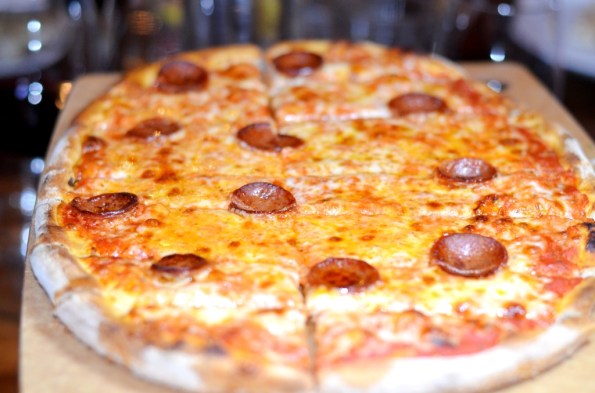
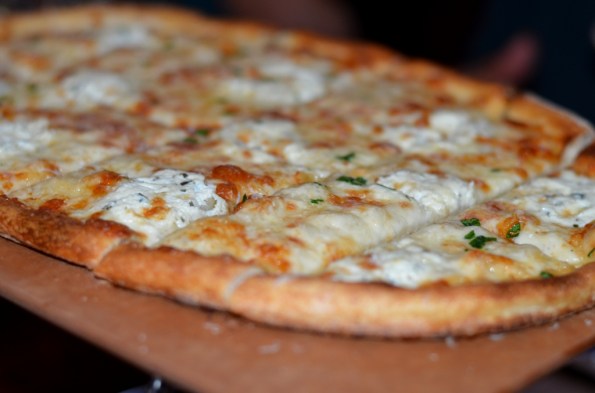
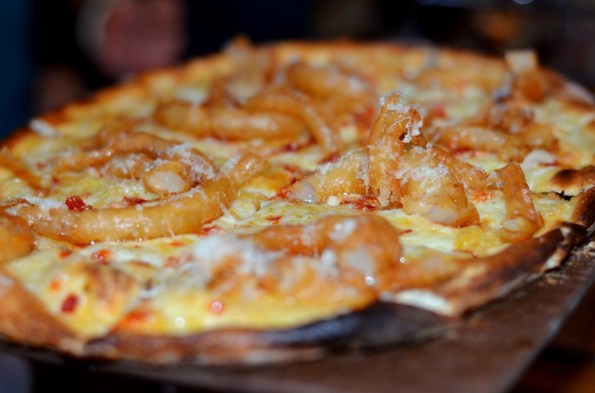
For the regular (tomato-sauce based) pizza, we tried Classic Pepperoni (Tomato, Mozz, Pepperoni), which was excellent, and Clam & Bacon (Littleneck Clams, Parmesan, Garlic Oil, Chili Flakes, Parsley) which was perfectly garlicky (love garlic!). Two of the white pizza were also very tasty, Four Cheese (Fresh Mozz, Herb Ricotta, Fontina, Parmesan, Garlic, Herbs) and Sweet & Spicy (Fried Onion, Cherry Peppers, Fontina, Honey, Provolone), which was, as suggested, deliciously spicy (I find it personally very important that the “advertisement” would match the “content”).
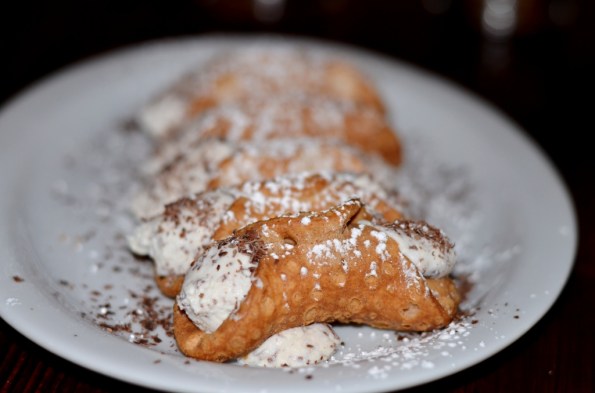
Do you think we left without the dessert? Of course not! Cannoli offered a perfect finish to the casual and comforting meal.
There you are my friends – on the go and not, you can always find a delicious bite by the tracks. Do you have your own train station food standouts? Cheers!
Last Bottle Sign Up ($10 credit)




 Talk-A-Vino