Archive
Lodi Thanksgiving
Thanksgiving is definitely one of my most favorite holidays – maybe because it is so centered on the food. Of course it is about families and friends getting together, and giving thanks for many many things which comprise our lives – we all have a lot to be thankful for. Nevertheless, the food on Thanksgiving is essential, it is a canvas of gathering, and even more importantly so if you are hosting the gathering.
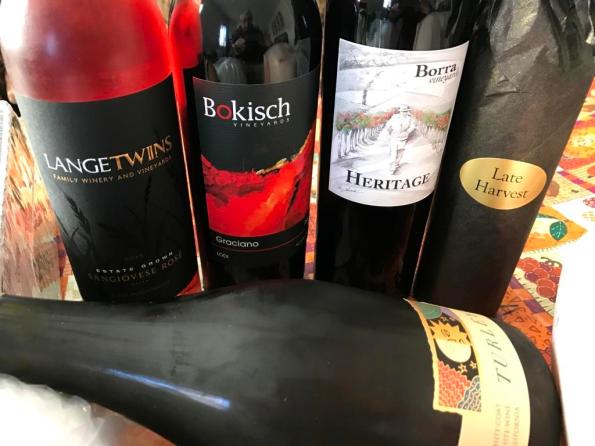
For many years we visited our close friends to celebrate Thanksgiving together with them. This year we are hosting Thanksgiving dinner at our house, which gave me a pleasure of doing a boatload of cooking, and – I’m sure you expected that – to select the wines for the dinner.
Thanksgiving is a quintessential American holiday, so choosing to serve the American wines comes easy and logical. But then America is all about freedom, so of course, you can drink whatever you feel like, I’m just talking about my personal choices. About a month ago I visited Lodi region in California (my second trip there, after Wine Bloggers Conference back in August), and while I was tasting through the line of delicious wines at Bokisch Vineyards, it dawned on me – this year, we should celebrate Thanksgiving with wines from Lodi. Now, as it is almost time to get to the table, this is exactly what we are doing.
Lodi is somewhat under the radar (and believe me – I would love to keep it like that, for it to stay the best kept secret for a few oenophiles only), but totally unique and totally unexpected region, which produces unique and delicious wines. Lodi is a California appellation, yet it produces the world class wines absolute majority would never associate with California. Look at the wines I’m planning to open. Sangiovese Rosé from LangeTwins – yes, an Italian star, Sangiovese, right out of the Central California. Graciano from Bokisch Vineyards – yes, Graciano, the unique grape from Rioja in Spain – this was the wine which prompted this whole “Lodi Thanksgiving” idea. Or how about Borra Vineyards Heritage, a field blend (!) of Barbera, Carignane, Petite Sirah and Alicante Bouschet – here is another core Italian varietal, Barbera. I don’t have a Lodi white wine, this is where Turley White Coat should do, as it contains Grenache Blanc and Verdelho from Lodi. Unique grapes, unique and, most importantly, delicious wines – this is what makes Lodi wines such an easy choice for me.
The Thanksgiving dinner will include the infamous “3 in 1″ bird, the Turducken, and lots of the side dishes – you can see some of the key components in the picture below.
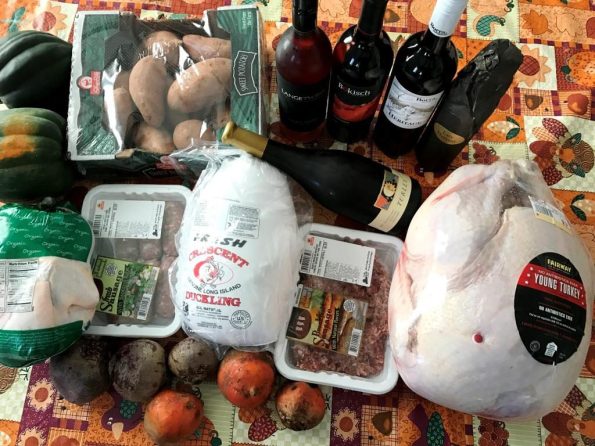
I have an ambitious plan to report on the dinner right after its completion – that might never happen, but I will try. By the way, do you care to guess what wine is hiding behind the wrap? Maybe name the grape, and maybe even the producer? How are you going to celebrate? With what wines? Is there a dish you are looking forward to making or, at least, eating? Happy Thanksgiving! Cheers!
Trader Joe’s Merlot Run
As some of you might know, I can never pass on visiting the local Trader Joe’s when traveling – as long as it offers wine (which seems to be the case so far in the most places I visit). Last week I was in Santa Clara in California, so the trip to the nearby Trader Joe’s was unavoidable.
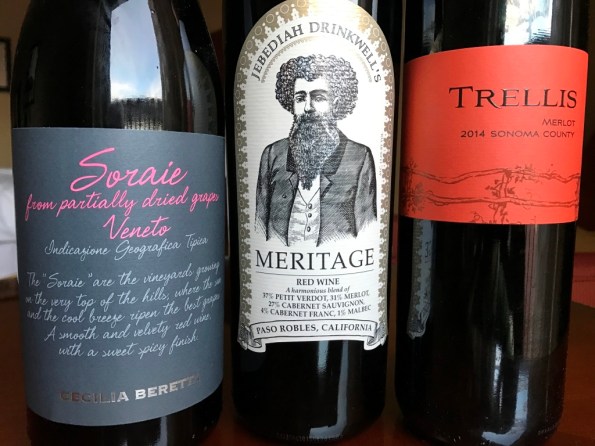 Deciding on what wine to buy at Trader Joe’s is difficult. I always take price into account, but then there are lots of wines in the same, super-reasonable prices range of $5 -$8. The next option is the label – yes, I’m a sucker for creative labels, and then, of course, the region comes to play.
As I slowly walked along the wine shelves, the label of Jebediah Drinkwell’s caught my eye – it was strangely attractive – plus I like Meritage wines, so it was an easy decision. I picked up Trellis Merlot because it was a Merlot (and October is a Merlot month) – and I was really curious to see what $4.99 can buy you from Sonoma. Cecilia Beretta was the third bottle I got – wanted to go outside of California, and “Partially dried grapes” always sounds like a music to me.
Looking at the wines later on, the idea of #MerlotMe dedication came along – would all these wines be Merlot based? To my delight, in addition to the 100% Merlot from Sonoma, two other wines also had substantial Merlot content, so here you go my friends, a Merlot run at Trader Joe’s.


Here are my notes:
NV Jebediah Drinkwell’s Meritage Red Wine Paso Robles ($5.99, 37% Petite Verdot, 31% Merlot, 27% Cabernet Sauvignon, 4% Cabernet Franc, 1% Malbec)
C: dark Ruby
N: touch of smoke, roasted meat,
P: soft fruit, blackberries, tobacco, good acidity, medium-long finish
V: 7+/8-, quite enjoyable
2014 Trellis Merlot Sonoma County (14.5% ABV, $4.99)
C: garnet
N: restrained, distant hint of cassis, herbs
P: soft, round, cassis, good acidity
V: 7+, excellent QPR
2014 Cecilia Beretta Soraie Veneto IGT (14% ABV, $7.99, 40% Merlot, 30% Corvina, 20% Cabernet, 10% Croatina, grapes dried for a few weeks before pressing)
C: dark garnet
N: touch of blueberry pie, quite restrained
P: touch of blueberries, tobacco, hint of dried fruit, good power but round, soft tannins, medium finish
V: 7+, will work well with food – pasta with some hearty tomato sauce would be perfect
As you can tell, it is pretty amazing what $18 can buy you at Trader Joe’s. Also, it is my second experience with non-vintage wine at Trader Joe’s, and I’m definitely impressed with the quality of that wine.
Do you buy wines at Trader Joe’s? Any interesting finds you care to share? Cheers!
Life’s Happy Moments – Virtual Lodi Wine Tasting on Snooth
When I got an offer to participate in the Lodi wine virtual tasting on Snooth, my first reaction was “that’s okay. I just was in Lodi just recently for the Wine Bloggers Conference (WBC16), and still perfectly remember it”. Then the second thought came in – “but it is Lodi, remember? Great wines, great people, why not”?
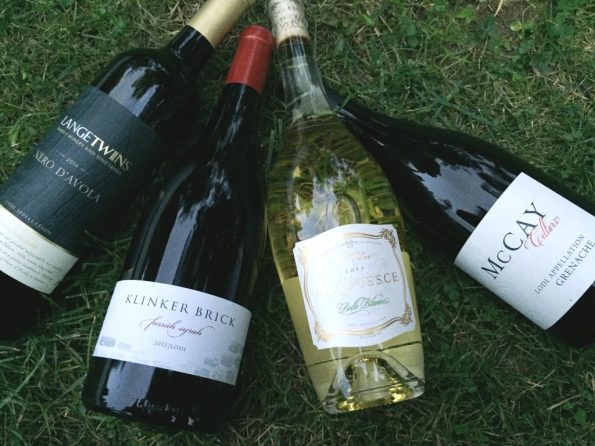
When I opened the box with samples, huge smile embellished my face (this post would be perfect for the Monthly Wine Writing Challenge #28 (#MWWC28), as the theme was “Smile” – if only it would be written on time, sigh). Do you smile when you run into a good old friend who you are genuinely happy to see? Yep, that was me at that moment.
Looking at the bottles one by one, you can imagine me talking and thinking.
Acquiesce. I heard people raving about their wines, but never tried it – great, now I will! LangeTwins – the flow of happy memories – we visited the winery with the group of bloggers and had an incredible time there; so glad to be drinking their wine again. McCay – an immediate image of Mike McCay, pouring his Zinfandel out of the double-magnum during the dinner at the WBC16 – another huge happy smile. So looking forward trying this Grenache. Klinker Brick – had their Zinfandel during speed tasting, but heard a lot about the Syrah – now I can taste it, great!
Then the day of the tasting arrived, and for an hour, I was among friends, feeling more like a WBC16 reunion – the fact that we didn’t see each other was not a problem – it was easy to imagine happy and smiley faces, tasting delicious wines, and excitedly talking across each other. Exactly as we did in August back in Lodi.
I have to be entirely honest – we had great hosts for this session – Tim Gaiser, Master Sommelier, Stuart Spencer, who represented both Lodi Winegrape Commission and his own winery, St. Amant, and Mike McCay of McCay Cellars – but I was entirely focused on the chat window, so I don’t have much of their conversation to share with you. But – I’m happy share the tasting notes for these delicious Lodi wines.


2015 Acquiesce Belle Blanc Mokelumne River Lodi (13.5% ABV, $26, 45% Grenache Blanc, 45% Roussanne, 10% Viognier, 288 cases)
C: light golden
N: intense lemon, lemon peel, candied lemon (hint of), white stone fruit
P: creamy, plump, touch of candied lemon, long acidity-dominated finish
V: 8, easy to drink from the start. The wine kept evolving for the next 5 days – definitely an age worthy wine which will bring you lots of pleasure.
2014 LangeTwins Vineyards Nero d’Avola Red Tail Vineyard Lodi (13% ABV, $20)
C: bright garnet
N: ripe sweet plums and earthiness, medium intensity
P: clean herbal profile first, sweet basil, then layer of fresh, ripe blueberries – clean, well-structured, perfectly balanced.
V: 8-, excellent pop and pour wine, should be easily a crowd pleaser
2013 McCay Cellars Grenache Abba Vineyard Lodi (14.2% ABV, $32, 309 cases)
C: smokey Ruby
N: intense gunflint, granit, underripe plums
P: smoke, mix of tart and sweet cherries, clean acidity, firm structure and medium body, crisp
V: 8+, outstanding. Once you start drinking, you can’t stop
2013 Klinker Brick Farrah Syrah Mokelumne River Lodi (14.9% ABV, $20)
C: dark garnet, almost black
N: intense aromatics, espresso, mocca, mint, raspberries, red fruit, very inviting and promising
P: wow, intense, mint, eucalyptus, blueberries, tar, spicy core, good acidity, velvety present texture, long finish
V: 8/8+, very good from get go, should improve with time
I would like to thank the kind folks at Snooth for arranging this delicious tasting. And for you, my friends – yes, those wines are made in a very small quantities, but if you will make an effort to find them (many might be available directly from the wineries), you will be well rewarded. These are the wines worth seeking. Cheers!
WBC16: Day 2 – Speed Tasting, Reds
A few days ago I told you about the live blogging session at the Wine Bloggers Conference 2016, dedicated to the White and Rosé wines. On the second day, we had a similar session, only now dedicated to the red wines. The same format – 60 minutes, 19 (or so) tables, 25 (or so) wines, 5 minutes to taste, take pictures, ask questions and share impressions in the social media, of course. Also with the higher chance of damage – clothes damage, it is, as we were dealing with red wine and time-pressed pourers. But this is part of fun, isn’t it?
Same as before, I would like to offer to you my twitter notes. Just to make it even more fun, you can compare my notes with Jim Van Bergen’s, a fellow blogger we had a pleasure of sharing the table with (alongside other great people – I think we had the most fun table in the house).
Here we go:
Wine #1: 2014 The Federalist Zinfandel Lodi ($17.76 MSRP) – very nice start for our Reds extravaganza
Wine #2: 2013 Windrun Pinot Noir Sta Rita Hills (100% Pinot Noir, blend of 5 clones from Lafond Vineyard) – nice and classic California Pinot
Wine #3: 2012 Corner 103 Zinfandel Dry Creek Valley Sonoma County – clean and varietally correct
Wine #4: 2012 Prie Vineyards Zinfandel Lodi – another excellent Zinfandel
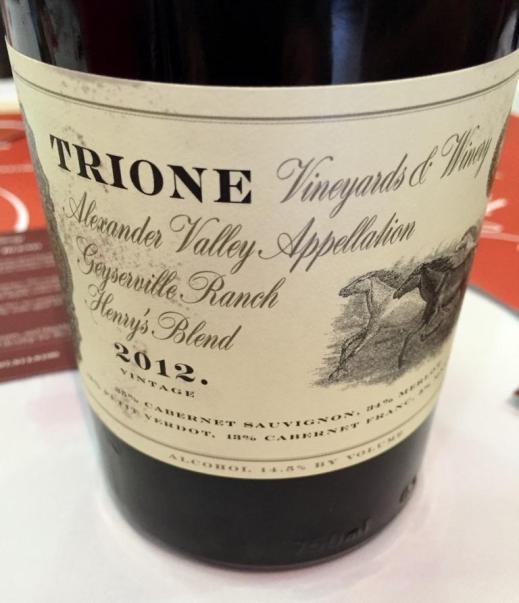
Wine #5: 2012 Trione Vineyards Henry’s Blend Alexander Valley (35% Cabernet Sauvignon, 34% Merlot, 13 % Petite Verdot, 13% Cabernet Franc, 5% Malbec) – a welcome deviation from Zinfandel, a classic Bordeaux blend. I also realized that my tweet didn’t have the picture, so picture is now included:
Wine #6: 2013 Peirano Estate ‘The Immortal’ Zin Old Vine Zinfandel (120 years old vines!) – if anything, the age of the vines commands utmost respect. Note that my tweet incorrectly puts the vintage as 2012, where it is 2013 (I blame it on the speed).
Wine #7: 2013 Klinker Brick Farrah Syrah Lodi – an excellent rendition of one of my most favorite grapes
Wine #8: 2013 Abundance Vineyards Carignane Lodi (90% Carignane, 10% Petite Sirah)
Wine #9: 2014 Oak Ridge Winery OZV Old Vine Zinfandel (Zinfandel/Petite Sirah blend) – Number one selling Zinfandel in California and a great value at $10.99
Wine #10: 2013 Harney Lane Old Vine Zinfandel Lizzy James Vineyard Lodi – one of the best Zinfandels in the tasting
Wine #11: 2013 Michael David Winery Inkblot Cabernet Franc Lodi – in the land of Zinfandels, we finished tasting with an absolute standout of 100% Cabernet Franc – you have to taste it for yourself
Here we go, folks. As you can tell, I can’t even count – we had 11 wines and not 10 during these 60 minutes, but yes, it was lots of fun. And I’m far from being done talking about Wine Bloggers Conference 2016 in Lodi.
Until the next time – cheers!
WBC16: Day 1 – Speed Tasting, White and Rosé
One of my favorite sessions at Wine Bloggers conference is one hour of pure madness, called Live Blogging, or Speed Tasting. Everybody sit at the round tables, 8 people per table. Each table has a number. There are winemakers with their wines, and typically there are more winemakers than there are tables. Each winemaker gets exactly 5 minutes to pour and present their wines. Each blogger has this exact same 5 minutes to taste, write notes, take pictures and do whatever else they are pleased. At the end of 5 minutes, each winemaker has to move to the next table – no exceptions.
This session usually has love/hate reception from bloggers. I personally love it, and I take that “live” part of this speed tasting very seriously :), twitting about each and every wine as we get to taste them. Now I would like to present to you the recap of this session, so here are all the wines and all of the tweets as this session was evolving in the real time – you can read my notes as part of the tweet:
1st wine – NV J Vineyards Brut Rosé Russain River Valley – delicious start, don’t you think? One of my favorite Californian sparkling wine producers
Next wine: 2014 Concannon Vineyard Asemblage Blanc Reserve Livermore Valley (Sauvignon Blanc and Sémillon blend):
Wine #3: 2014 Peirano Estate Vineyards “The Other” Lodi (65% Chardonnay, 25% Sauvignon Blanc, 10% Viognier)
Wine #4: 2014 Kenefick Ranch Pickett Road White Napa Valley Calistoga (75% Grenache Blanc, 20% Maarsanne, 5% Viognier) – the winery describes this wine as “possibly the best food wine on the planet” – considering the acidity, they might not be too far off. Plus, look at the varietals used in the wine – very interesting.
Wine#5: 2015 Left Coast Cellars White Pinot Noir Oregon – had an opportunity to taste this wine before – 100% Pinot Noir and 100% White, delicious:
Wine #6: 2015 Troon Vineyard Longue Carabine Applegate Valley Southern Oregon (blend of Vermentino, Viognier, Marsanne and Roussanne)- I already wrote about this wine, so here was the second encounter 🙂
Wine #7: 2015 Corner 103 Sauvignon Blanc Sonoma Valley
Wine #8: NV Oak Ridge Winery OZV Rosé California (blend of Zinfandel and Chardonnay):
Wine #9: 2014 Peirano Estate Vineyards Chardonnay The Heritage Collection Lodi – very classic and an excellent value at $14.99 (mentioned in the tweet):
Wine #10: 2001 The Lucas Winery Chardonnay Lodi – this wine deserves its own post, and I wish I had time to visit the winery. This 15 years old California Chardonnay was absolutely mind blowing, deserving the highest praise. The balance and freshness on this wine were just spectacular. Might be easily the best California Chardonnay I ever had (okay – too bold – one of the best for sure):
And we are done here – 10 wines, 60 minutes, lots of fun. The red wines speed tasting took place on the Day 2, and the report is to follow.
Until the next time – cheers!
WBC16: Overwhelmed Even Before The Day One
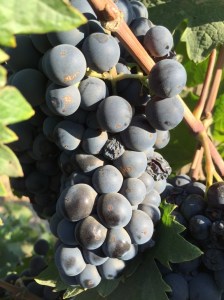 Yet another ambitious plan goes nowhere. While attending the Wine Bloggers Conference 2016 in Lodi, I had a great idea of posting a recap of the prior day in the morning. No need to start checking for the missing posts from me – none of it happened. Every day was so packed from dawn to dusk that what seemed to be a great idea didn’t survive the test of the reality. Yes, I probably could muscle a few lines in, but it would come at the expense of the great time talking to the fellow bloggers, which was the trade off I didn’t want to make.
So here we are, the conference is over, so now I will do my best to share my perspective of the events as they took place. Here we go.
I took a flight early morning on Thursday to arrive to San Francisco. After getting the rental car, my first stop was in Napa, at Oxbow Public Market, where I met for lunch Danielle Irwin and her husband Derek. Oxbow Public Market is a very interesting place, conceptually somewhat close to the Chelsea Markets in New York, only built in modern, contemporary style, with lots of small artisan shops and restaurants, offering food and wine, fresh produce, coffee and whatever else your heart desires. Great place to stop by if you are looking for a break during your winery visits.
It was a great pleasure to meet Danielle and Derek face to face. I had been virtually talking to Danielle for a while – she is writing her blog Danielle Dishes The Vineyard Dirt at Naggiar Vineyards in Sierra Foothills, where her husband Derek is the winemaker. Derek is a vigneron who is involved in a lot of vineyard and winery projects, and he also produces his own wines under Irwin Family Wines label. I had a pleasure of tasting his Tempranillo, which was the first California Tempranillo I ever tasted. Conversation with Derek was an excellent introduction into the Lodi wines, as he gave me some ideas for what to expect there.
A hour an a half later, after a ride along route 12 which I wouldn’t call pleasant (lots of stop and go traffic, not a fun ride) I arrived to the Hampton Inn in Lodi, which became home outside of home for the next 3 days.
The first event of the night was the conference opening reception at the Mohr Fry Ranch, sponsored by Lodi Wine. With that reception came my first real encounter with Lodi wines.
Until coming to Lodi, I only knew it as a source of many Zinfandel wines. And then there was a perception of hot, high alcohol wines, based on the tasting of occasional Cabernet Sauvignon with Lodi regional designation. Yep, that’s all I had on Lodi in my head.
The very first taste of the Lodi wine broke that perception. By the end of the tasting, it was shattered completely and didn’t exist anymore.


I stopped at the table of the Fields Family Wines, and the very first white wine I tasted was 2015 Fields Family Wines Clay Station Vineyard Grenache Blanc Lodi. I never tasted Grenache Blanc from California, let alone the fact that it is coming from one of the hottest regions (yep, sense my fear?) – yet the wine had clean acidity, touch of minerality, restrained fruit – a great start.
You know what – now I’m afraid to bore you away with all this “acidity and restrained fruit”, but this was the trait of literally every Lodi wine I had an opportunity to taste – there were no fruit bombs, there were no hot wines, there were delicious, well made world-class wines, made with love and care. I just have to tell you this, as it was really an overarching impression over the three days of tasting, so now I will [try to] avoid repeating myself all the time.
Have to be honest – the next red wine I approached with trepidation (huh, like the previous one I did not, right). Tempranillo from Lodi? I already told you that I had good experience with Irwin Family Tempranillo from Napa, but it was one particular wine, which doesn’t guarantee anything in a long run. And if you are reading this blog for a while, you know my passion for the Spanish Tempranillo wines – and now in my mind I was facing a clear opportunity to be disappointed. First sip of this 2010 Fields Family Wines Tempranillo Lodi put all my doubts to rest – the wine had a nose of black fruit and spices, and it was dark and brooding on the palate, with those espresso notes so characteristic in the wines of Toro in Spain. An outstanding rendition by all means, and I would love to see it in a blind tasting against the actual Toro wines.
2010 Fields Family Wines Estate Grown Syrah Lodi was an excellent example of the cold climate Syrah – touch of roasted meat, dark fruit, spicy with clean acidity – great rendition of another one of my favorite grapes. 2011 Fields Family Wines Estate Grown Syrah Lodi added more complexity and more roasted meat, all with perfect balance. 2010 Fields Family Wines Petitte Sirah Lodi was simply outstanding, offering silky smooth, velvety texture, supple ripe black and blue fruit with enough acidity in the core to make the wine perfectly balanced. As you can tell, Fields Family Wines provided a splendid introduction into the wines of Lodi.


My [now exciting] Lodi wine deep dive continued at the next table. Successful first experience should’ve really put me at ease – and still, an Albariño on the label triggered a subconscious alarm – Lodi doesn’t leave the impression of the Rias Baixas (not that I visited Spain, unfortunately, but just a mental image of coastal region), so “just in case, prepare for the worst”, the concerned brain said. This happened to be really a needless worry. 2015 Harney Lane Albariño Lodi had a a nose of white fruit and excellent acidity on the palate, which is the typical characteristic of the Spanish Albariño. 2013 Harney Lane Tempranillo Lodi was a bit lighter than the Fields Tempranillo version (it was also 3 years younger), but still preserving the core of dark fruit and good acidity. 2013 Harney Lane Lizzy James Vineyard Old Vines Sinfandel Lodi was as classic as Lodi Zinfandel can be – blueberries, blackberries, spices – very tasty.
I could continue tasting Lodi wines as there were many more winemakers present. However, there is something you need to know about Wine Bloggers Conference. In addition to all of the program events, there are always lots and lots of activities taking place somewhere around the WBC space. Call them private tastings or what, but this is something to pay attention to. Thus we left the reception, and after a short drive arrived at a house where Troon Vineyards tasting was taking place.


Troon Vineyards started in Southern Oregon in 1976 (vines were planted in 1972). I’m sure that when you hear “Oregon wine”, your first thought is Pinot Noir – nevertheless, Troon Vineyard doesn’t produce any Pinot Noir wines, and instead focuses on Mediterranean grape varietals (and Zinfandel). Another interesting fact is that many of the Troon wines (especially the whites) are co-fermented, meaning that different varietals are fermented together at the same time, as opposed to fermenting separately and blending afterwards.
I tried a number of Troon wines, with the two favorites been 2015 Troon Blue Label Longue Carabine, Applegate Valley, Southern Oregon (blend of Vermentino, Viognier, Marsanne and Roussanne) – touch of perfume on the nose, medium to full body with expressive minerality and good acidity. 2013 Troon Black Label M*T Reserve, Applegate Valley, Souther Oregon (blend of Malbec and Tannat) had nose of black fruit with dark core and good structure, medium to full body and good balance.
The last stop of the long day (remember, I left the house at 5 am in the Eastern time zone) was at the Rodney Strong Vineyards party, which was luckily taking place right at the hotel.


Rodney Strong winery had been producing wines in Sonoma for more than 50 years and would well deserve its own post to talk about their long history (the oldest vineyard at Rodney Strong was planted in 1904) and their achievements. But for the sake of this post, let me just talk about few of their wines I had an opportunity to enjoy.
2015 Estate Sauvignon Blanc, Charlotte’s Home, Northern Sonoma was excellent – grassy nose, fresh, crisp and restrained palate, with just a touch of grass and lemon – delicious and very refreshing. 2009 Ramey Platt Vineyard Chardonnay Sonoma Coast was a stand out (no wonder Ramey Chardonnay was one of Decanter magazine’s 10 best Chardonnay wines in the world outside of Burgundy) – classic intense vanilla nose, vanilla apple and pear on the palate, excellent balance and excellent overall. As an extra bonus, the wine was poured from double-magnum (3L) bottle. In case you are wondering about connection here, David Ramey is a consulting winemaker at Rodney Strong.


The reds of Rodney Strong provided an amazing finish to the very long but very exciting day. 2013 Davis Bynum 2013 Jane’s Vineyard Pinot Noir Dijon Clone 115 Russian River Valley was a classic California Pinot Noir – with plums and smoke, soft and round. 2010 Rodney Strong Symmetry Meritage Alexander Valley is one of the very best Bordeaux blends from California – again, classic, classic, classic – cassis, green bell pepper, mint, perfect structure, absolutely delicious wine. The last three reds were flagship single vineyard Cabernet Sauvignon wines – 2009 Rodney Strong Alexander’s Crown Single Vineyard Cabernet Sauvignon Alexander Valley, 2013 Rodney Strong Rockaway Single Vineyard Cabernet Sauvignon Alexander Valley and 2013 Rodney Strong Brothers Single Vineyard Cabernet Sauvignon Alexander Valley. Considering the end of a very long day, I’m not going to give you any details on the notes other than that all three were classic Cabernet wines, pure, varietally correct and delicious – I would love to drink those at any day.
If you are still with me, aren’t you tired reading this post? I’m tired even writing it – but we are done here. My first WBC16 report is over – and more to follow. Cheers!
To be continued…
New and Noteworthy: Two Classic Regions, Three Classic Pairs
I tend to abuse certain words in the conversation, especially when talking on the subject of wine. As you might easily guess, one of such words is “Classic”. I use this word in hope that it is the quickest way to convey my impressions about the wine. For instance, the words “Classic Red Bordeaux” or “Classic White Burgundy” would most likely paint a quick and vivd picture for the most of oenophiles to imagine how the wine actually tastes. While the wine is produced all around the world, such a broad stroke reference can be only applied to the well known and well referred to regions – saying “Classic Red Bio-Bio” (wienmaking region in Chile) or “Classic White Valais” (winemakiing region in Switzerland) would be an empty sound for majority of the wine lovers.
Looking past the regions, we can also apply the word “classic” to the grapes themselves. There are probably 15-20 grapes which can be easily referred to in this way – “classic Cabernet Sauvignon” or “Classic Sauvignon Blanc”, for example, would give you quick pointers to how the wine might taste like. Yes, “Classic Bobal” or “Classic Resi” will leave most of us with no information at all.
As this is not an epistolary exercise on the applications of the word “Classic” in the wine world, let’s get closer to the subject at hand, and talk about few wines in the practical terms. Today I want to talk about 2 classic regions and 3 classic grapes – for sure for those regions. So the classic regions are: California and Oregon. Would you agree that it is easy to refer to these two world renowned winemaking regions as “Classic”? I hope you are nodding. And for the grapes, I also hope you would share my “classic” sentiment – Pinot Noir and Chardonnay from California Napa Valley – aha, I see you smacking your lips. And Pinot Noir and Pinot Gris from Oregon – need I say more?
Talking about the wines from Oregon, the Pinot Noir is of course an uncontested king of the Pacific Northwest of the USA. Commercial Pinot Noir production in Oregon started in the 1960s, and then from the beginning of the 1990s, Pinot Noir from Oregon needed no introduction anymore. With Oregon Pinot Gris, you might argue with my “classic” designation, however, today, you will practically not find a single Oregon winery which will not produce Pinot Gris. Oregon Pinot Gris has its own, easily recognizable style and character, so in my mind, Pinot Gris wines are the “classic” element of the Oregon winemaking.
Thus let me present to you the first two of the “classic” pairs – Pinot Gris and Pinot Noir from two wineries in Oregon: Willamette Valley Vineyards and Pike Road Wines.


Willamette Valley Vineyards was established in 1983, planting Pinot Noir, Pinot Gris and Chardonnay vines where blackberries and plums were growing before. The original Estate vineyard spans 53 acres at the 500 to 750 feet in elevation. Today, Willamette Valley vineyards farms more than 250 acres of vines, including one of the oldest in Oregon, Tualatin Estate, which are all LIVE (Low Input Viticulture and Enology) certified. I had a pleasure of trying Willamette Valley Pinot Gris and Pinot Noir wines earlier in the year, so here are my notes:


2014 Willamette Valley Vineyards Pinot Gris, Willamette Valley, Oregon (12.4% ABV, SRP: $16)
C: straw pale
N: white stone fruit, touch of grass
P: hint of candied lemon, white stone fruit, nicely round, refreshing, good acidity, medium to full body
V: 7+/8-, very pleasant
2013 Willamette Valley Vineyards Pinot Noir Estate Willamette Valley, Oregon (13.7% ABV, SRP: $30, retail: ~$20)
C: beautiful Ruby
N: fragrant, fresh, cranberries with touch of cherries, sweet raspberries
P: wow, lots of fresh fruit – cranberries, raspberries, fresh, super-clean, touch herbal, great restrained finish
8+, one of the most delicious Pinot ever, perfect.
Our second Oregon winery takes its name from the Pike Road, which winds through the hills of Yamhill-Carlton AVA. This is the second winery for the Campbell family, who founded Elk Cove Vineyards in 1974. Pike Road takes advantage of 5 generations of the farming experience, including 40 years of tending the wines.
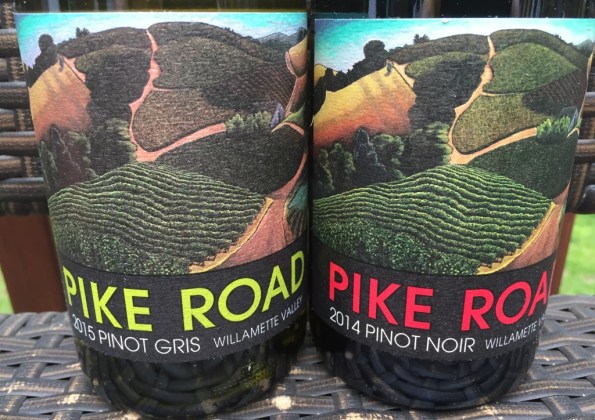


Here are my notes:
2015 Pike Road Pinot Gris Willamette Valley, Oregon (13.5% ABV, SRP: $15)
C: pale greenish color
N: tropical fruit, candied lemon, fresh, intense, inviting
P: crisp, clean, perfect fresh acidity and white stone fruit, creamy. Outstanding.
V: 8-/8, delicious white wine, perfect year around and superb during summer
2014 Pike Road Pinot Noir Willamette Valley, Oregon (13.5% ABV, SRP: $19, 10 month in French oak barrels)
C: dark Ruby
N: delicious. Touch of sweet fruit, open, inviting, raspberries, herbs, super-promising, wow
P: soft, layered, silky, spices on top of traditional smokey profile, triple-wow
V: 8+/9-, wow, totally unexpected and amazing. I know Oregon Pinot delivers, but this far exceeded my expectations. Might be the best QPR for Oregon Pinot Noir in existence. Love rustic labels too.
Our last classic pair comes from the classic of the classics, none less than Napa Valley, and it is Chardonnay and Pinot Noir from Artesa winery. Artesa winery is located in Carneros region of Napa Valley. While Artesa recently celebrated is 25th vintage, their winemaking traditions go way, way, way back – say by another [almost] 500 years. How come? Artesa winery was founded by Codorniu Raventós family from Spain, which takes its winemaking heritage 17 generations back to the 1551. Artesa sustainably farms 150 acres of vines, all Napa Green Land certified, and produces a range of wines, starting with a few sparklers and finishing with another Napa classic – Cabernet Sauvignon. Two wines which I had an opportunity to taste are the new Estate Reserve release from the winery:
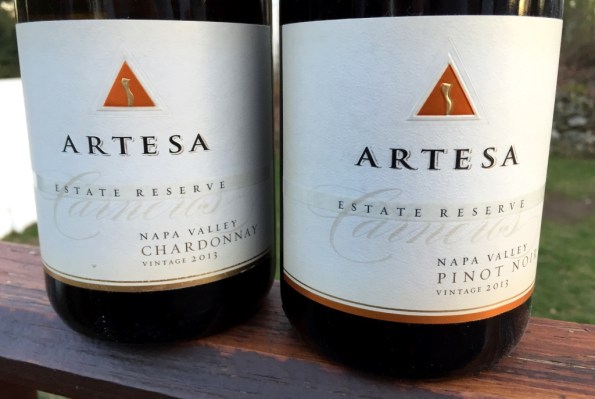
2013 Artesa Estate Reserve Chardonnay Napa Valley (13.9% ABV, SRP: $40)
C: light golden
N: touch of vanilla, hint of butter, white fruit, intense
P: touch of butter, green apples, good acidity, medium to full body, vibrant and balanced
V: 8-, a classic Chardonnay
2013 Artesa Estate Reserve Pinot Noir Napa Valley (14.4% ABV, SRP: $40)
C: dark garnet
N: warm, inviting, sweet plums
P: round, polished, present silky texture, touch of smoke, more plums, minerality, restrained
V: 8-, nice, smooth and restrained
There you have it, my friends – some new and interesting wines worth seeking. And whether they will hit the “classic” note for you – it is entirely your decision. Cheers!
Wine and Beer Lovers, Unite, or Marrying Hops and Grapes
Sacrilege? Possible. Should I be ostracized by beer and wine aficionados alike, and this very blog been banned forever from their reading lists? I will leave it to aficionados to decide. I’m merely doing what I’ve always done in this blog – sharing my experiences, those which I deem worth sharing. That’s all there is to it.
When I got email from Andrew Jones, the winemaker behind one of my favorite labels, Field Recordings, advertising something called “Can Club”, the decision was quick – “yada, yada, yada – I have to do it” (the “yada” part is here to explain how much attention I was paying to the exact email content). Then I glanced over the following: “ Pure, free-run rose from a pair of our westside Paso Robles vineyard partners, mostly Grenache. 100% whole cone citra hops [sic] were added prior to canning. The results, a super refreshing elixir, combining your love of Provence with a touch of Belgian brew. I have a tough time explaining it because it isn’t like anything I have tried before. It’s impossible for me to properly analyze. I just want to drink it.“, and the next thought was “whatever. I have no idea what he is talking about, and I don’t care”. So yes, I signed up.
Few days ago, the door bell rung, and FedEx guy asked me to sign for something which rather resembled the set of engineering drawings – “hmmm, what is it” was my first thought. And then it downed on me (“this box contains alcohol” sign was a good cue) – aha, the can club?! I liked the unorthodox presentation so much that I even shared the puzzle on twitter, asking people to guess how the object in the picture can relate to the wine:
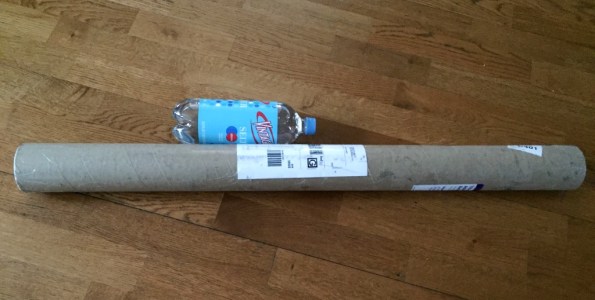 The most prevalent idea was “poster”, so I had to share an answer a few hours after:
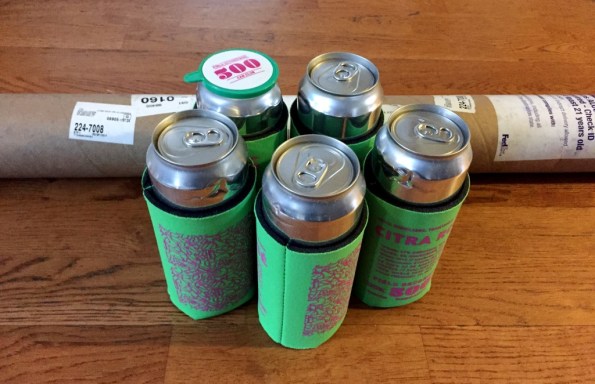 And then I opened the can. The liquid in the glass had an appeal of a perfect Rosé. Classic salmon pink color. On the nose, it was perfectly Provençal Rosé – touch of strawberries, hint of onion peel, refreshing minerality, touch of lemon. And the palate was, once again, perfectly Provençal – strawberries, touch of lemon, fresh, crispy. With the tiny beer bite on the finish. You know, the one which you get from the fruity, light Belgium beer. You don’t have to believe me, but I only read Andrew’s exact words when I sat down to write this post. “love of Provence with a touch of Belgian brew” – wow. It would be rare, very rare case that my take on the wine would match its description with such a precision . And then I have to fully agree with Andrew on one other thing – “ I just want to drink it“.
![Field Recordings Citra Rosé can sleeve [label]](https://i0.wp.com/talk-a-vino.com/wp-content/uploads/2016/04/citra-rosc3a9-can-sleeve-label.jpg?w=186&h=248&ssl=1 "Citra Rosé can sleeve [label]")

![Field Recordings Citra Rosé can sleeve [label]](https://i0.wp.com/talk-a-vino.com/wp-content/uploads/2016/04/citra-rosc3a9-label.jpg?w=212&h=248&ssl=1 "Citra Rosé [label]")
What can I tell you about this 2015 Field Recordings Citra Rosé Paso Robles (13.1% ABV, $14 retail/$10 club – 500ml can, 67% Grenache, 22% Picpoul Blanc, 8% Mourvédre, 3% Syrah)? It was delicious, perfectly combining the best of both beer and wine worlds – crisp, fresh, bright, thoughts provoking. Dangerous as well – as the wine comes in the can, you pretty much treat it as a single serving – while it actually contains more than 3 standard glasses of wine. But I think the taste is well worth that danger. And until you will get your hands on one of those cans, my words are all you got, so yes, take my word for it.
I want to raise my glass to never ending creativity and courage. Beer and wine lovers, rejoice! Cheers!
Daily Glass: Buy By The Name, Remember By The Taste
Winemakers must be some of the most creative people in the world. It is not enough to make a tasty wine (well, at some point it is – it is not easy to reach that point though, not at all) – but the wine also have to make it into a consumer’s hands – yep, someone have to buy it. Selling the wine is not easy, as you need to differentiate from hundreds and hundreds of seemingly indistinguishable bottles. To get there, winemakers have two primary choices of weapons – the label and the name.
I’m a sucker for a good wine label, but right now I just want to talk about the name. Have you ever heard the name of the wine and said “this is it, I must try it”? I had, a number of times. And the wine I want to talk about was exactly such a case.
When I saw the name “Rhapsody En Blu”, somehow, it was speaking to me. I didn’t care what kind of wine was that, what grapes it was made of or what region it came from. The name alone was enough to incite the desire. I don’t remember when did I see this wine name for the first time, but ever since I did, I was on a lookout for it. So when I saw it at the last Last Bottle Wines “everything must go” marathon, my fingers were moving really, really fast – and I got the bottle.


I was tempted a few times to open it, and then Friday night seemed to be a good enough occasion (or may be it was the fact that it was an eve of OTBN). The cork is pulled out, wine goes into the glass. I take a sniff and “oh my god” was the only thing I could say (my wife can attest to this). The smell was exuberant without going overboard – crushed berries, crushed rocks, underbrush, spices, all together warm, inviting and – harmonious. The taste perfectly supported the aroma – gentle ripe fruit, plums, smoke, roasted meat, touch of pepper – perfect acidity, good structure, good power, and once again, perfect balance and – perfect harmony.
According to the Wikipedia, “a rhapsody in music is a one-movement work that is episodic yet integrated, free-flowing in structure, featuring a range of highly contrasted moods, colour and tonality. An air of spontaneous inspiration and a sense of improvisation make it freer in form than a set of variations.” Tasting this wine, that “spontaneous inspiration” and “improvisation” were very easy to relate to.
This wine, 2012 R Squared Wine Company Rhapsody En Blu Red Rhone Blend, Santa Barbara County (14.1% ABV, 42% Grenache, 38% Carignan, 20% Mourvedre) is produced by the R2 (R Squared) Wine Company which makes both blends and single varietal wines from multiple appellations in California. If you care to know, my Drinkability rating for this wine is 8+.
I don’t know if the great match between the name and the wine itself was the accident or a prophecy, but I can tell you that I strongly regret buying only one bottle of this wine. Not sure if you can find it (total production was only 475 cases), but if you will, don’t repeat my mistake.
There is also one more bonus which comes with this wine – it is very easy to pair with music. And the matching pairing should be … yes, Gershwin’s Rhapsody in Blue! If you can’t find the wine, you can at least enjoy the music. Cheers!
World-class American Tempranillo
If you will ask me “what is your favorite wine”, I would always honestly tell you that I don’t have one. Which is generally a true statement. With may be an exception of the Spanish wines – and Tempranillo wines in particular. Deep, deep down, I know that I have a tiny bias towards Tempranillo. Or at least if you will ask about the most memorable wine experiences, Tempranillo wines would be definitely at the forefront.
The “world-class” is not necessarily a generic term when it comes to wines – but this is how I like to refer to the wines which are best of the best in my opinion. The “world-class” in my vocabulary is reserved to the wines which don’t leave you indifferent; these wines solicit emotional response from the person drinking them, and for the most cases that response is a simple three letter “word” – wow (is this actually a word? Not so sure…).
Tempranillo is a great grape of Spain. Rioja, Ribera del Duero and Toro are close to any oenophile’s heart, with lots of unquestionably world-class wines, with hundreds years of winemaking history. Tempranillo made it to the California at the beginning of the 20th century, but was planted in the wrong places too many times (Tempranillo does the best on higher appellations and in the cooler climates), and was mostly used in the blends. In the 1990s, it made it to Oregon, Washington and then Texas, where it started showing excellent results in the single-varietal wines. I had an opportunity to taste single-varietal Tempranillo from Abacela winery in Oregon, and few of the Tempranillo wines from Texas, and they all were good and promising wines.
Couple of days after I published my Spanish Wine Recommendations posts, I got an email from Danielle Irwin, who I knew as a blogger at Naggiar Vineyards, the winery in the Sierra Foothills region in California, where her husband Derek works as a winemaker. Danielle offered to send me a sample of their Tempranillo wine, bottled under their own label as Irwin Family Vineyards. As you can imagine, I gleefully agreed (I rarely refuse a sample, never mind a bottle of Tempranillo), and in a few days the package arrived with two bottles and a letter from Derek inside. The letter included all the technical details regarding the Tempranillo bottle, as to where the grapes were growing (specific plot of the estate vineyard at 1,500 ft elevation), when the grapes were picked (in October 2010), how grapes were fermented (stainless steel and large format French oak barrels) and then how the wine was aged. I let the wine rest for a few days after the trip (to try to avoid “bottle shock”), but then patience worn out, and I opened that bottle…
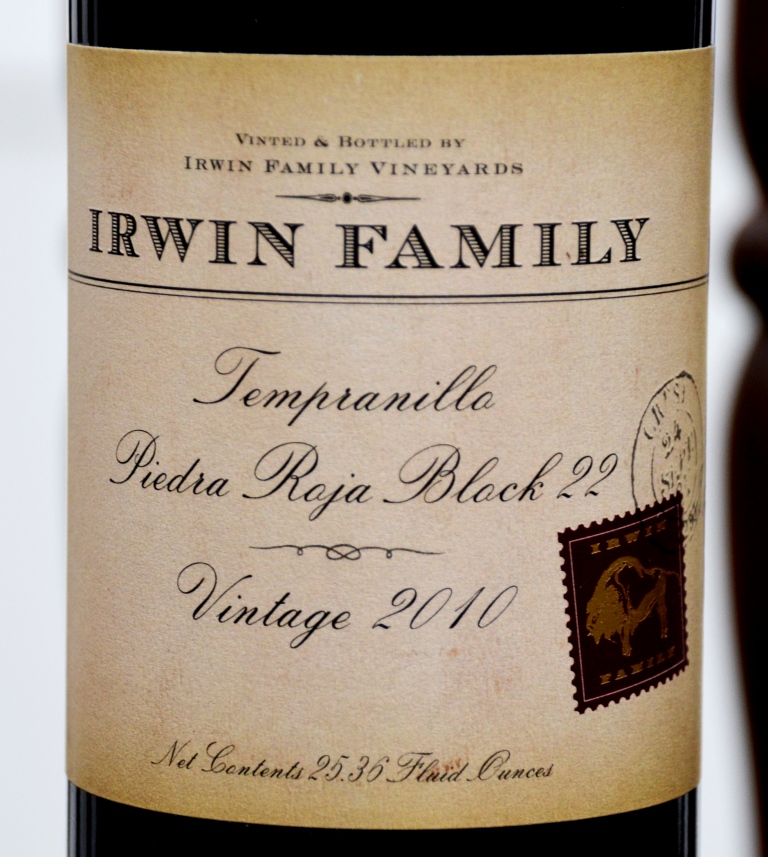
2010 Irwin Family Tempranillo Piedra Roja Block 22 Sierra Foothills ($36, 13.5% ABV, 90% French Oak, 10% American Oak, 28 month)
Color: Dark garnet
Nose: Cherries, cedar box, spices
Palate: Dense, chewy, layered, blackberries, dusty texture (reminiscent of the famous Rutherford Dust). Great complementing tannins, soft but well supporting the structure. Perfect balance. Coffee and mocha in the long lingering finish.
Verdict: outright delicious, world-class wine. Drinkability: 8+. I would drink this wine in a heartbeat at any time. As an interesting side note, the wine paired amazingly well with the Comte cheese.
Derek mentioned in his note that this wine was inspired by the wines of Toro region, which typically are the most concentrated renditions of the Tempranillo, and I definitely see that parallel.
The second bottle was a Tempranillo blend:
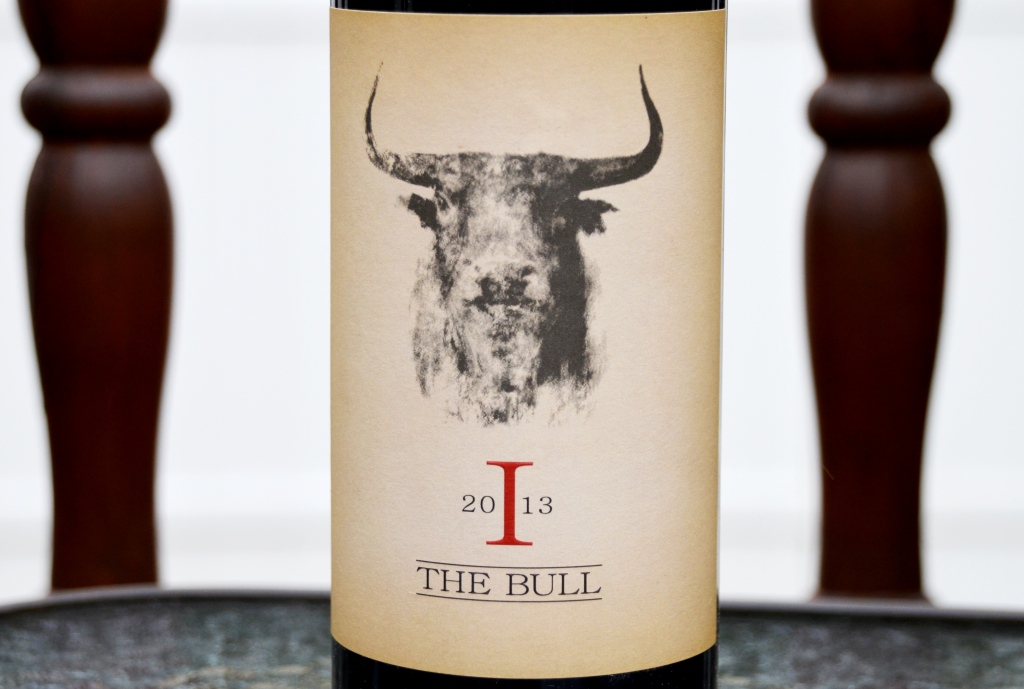
2013 Irwin Family Vineyards The Bull Sierra Foothills ($24, 13.8% ABV, 44% Tempranillo, 28% Malbec, 28% Petite Sirah)
Color: Dark Garnet
Nose: sweet plums, vanilla, nutmeg, dark chocolate
Palate: medium body, touch of spices, perfect acidity, nice textural presence, nutmeg, impeccable balance, lots of dark chocolate both on the palate and in the medium-long finish
Verdict: Delicious! Drinkability: 8. Bonus: works very well with food, especially charcuterie (meat and cheese).
There you go, my friends – two delicious wines from the region which I really want to explore in depth (Sierra Foothills), and the world-class American Tempranillo. You don’t have to believe me – head over to the Napa and taste it at Irwin Family Vineyards, or sign up for their wine club (Tempranillo is only available for the club members). Cheers!
Last Bottle Sign Up ($10 credit)




 Talk-A-Vino