Archive
Open That Bottle Night – OTBN 2019
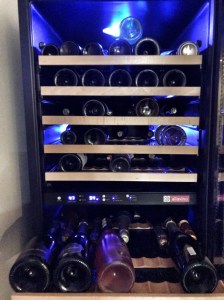 Wine lovers – this is your public service announcement, so listen carefully.
Open That Bottle Night is Saturday, February 23, 2019.
I repeat – OTBN is taking place this coming Saturday! Are you ready?
Okay, so all of you who are familiar with the OTBN, please say “thank you for the reminder” and quietly retreat to your cellars in attempt to solve the unsolvable.
For those who don’t recognize the OTBN term, let me explain.
Open That Bottle Night (OTBN for short) movement was originated by Dorothy J. Gaiter and John Brecher, writers of the Wall Street Journal’s Tastings column. Back in 2000, they decided to help people to put their best wine bottles to the best possible use (e.g., drinking and enjoying them) by designating last Saturday in February as special “pull that cork” day.
All of us, wine lovers, have that “special bottle”. The birth year vintage, a gift from a special friend, a bottle brought from the special trip, a bottle signed by winemaker, special wedding present, or something special we managed to score many, many years ago – it is really not important what makes that bottle special. However, with all those “special bottle” designations, we keep waiting for that special, right, proper, one and only moment to pull that cork – and subsequently, we are risking one of two things:
- we might not be around to enjoy that special bottle of wine (not trying to use any “scare tactics” – this is just a part of life)
- the wine might not be around for us to enjoy it – ever heard of “past prime”?
Nobody knows what is the “right time” for the wine. We have our expectations, of course, but it is in human nature to doubt oneself, and thus we keep arguing with ourselves about the “right moment”. The “right moment” is also something entirely individual – the right age of the wine, a long-fought-for job promotion, wedding anniversary, significant birthday, or simply the right company. And so we are waiting and waiting and waiting – and risking one of the two outcomes I mentioned before. This is where OTBN comes to the rescue. OTBN makes an opening of that prized bottle a good enough reason in itself – it is really a celebration of life as it happens.
Ever since its creation, OTBN was getting an increased following from all over the world, with people from China, Hong Kong, Australia, Japan, Europe and, of course, the USA, gladly reporting about the opening of those long-cherished bottles – and their personal life stories.
It is the right time, wine lovers, to get that bottle ready. If you need any additional instructions, the Wall Street Journal took care of it by publishing the guide to the OTBN, so now you are guaranteed not to make any mistakes. Go, start thinking about that special bottle you are going to enjoy this Saturday – to celebrate life. And don’t forget to share your special moment with all of us. Will be waiting.
Wine and Bacon? Why Not?!
There is a good chance that you love good food and wine pairing as much as the next connoisseur. We all know that successful pairings are very far from trivial, and we also know that not all the foods are good with the wine.
So have you ever thought of pairing bacon with wine? I’m sure that there is a very good chance that such a pairing never crossed your mind, despite the fact that you might love each one on its own – bacon and wine – almost religiously (there are lots of people in this world who will start drooling just at a sound of the word “bacon”).
Before we continue – or before you stop reading this as you don’t eat bacon for whatever reason (religious, veganism, anything) – I need to ask you (beg you?) – please do not fret. Bacon doesn’t have to be made out of pork! In today’s world, besides turkey bacon, which I agree is generally very pedestrian and not satisfying, there are also Beef Bacon, Duck Bacon, and even variety of Vegan Bacon – your life doesn’t have to be bacon-less, even if pork is off the menu for good.
What wine to serve with bacon is typically not the question you are facing, though. The main reason is that in the direct form – a slice of bacon and a glass of wine – they belong to the different, non-overlapping “time zones”. Bacon is a morning food, and wine, umm, really not. Yes, bacon easily takes on the role of a condiment at lunch and dinner, but then it is a whole another story in terms of the wine pairing.
But then there is brunch, where bacon is still a star, and who doesn’t like a glass of wine with their brunch? Or have you ever enjoyed bacon-wrapped dates stuffed with the blue cheese, so popular in many Spanish restaurants? So maybe bacon can be and should be paired with wine? Folks at Drinkable Gifts surely think so, and they even came up with infographics to illustrate their bacon and wine suggestions. As I’m an infographics junkie, I’m happy to share it with you. You can find all the detailed bacon recipes and pairing suggestions here.
I’m also curious in your opinion if you think suggested pairing combinations will work. Enjoy!

Source: DrinkableGifts.com
Tale of Two Reds – Are All Wine Lovers Eternal Optimists?
Let’s talk about red wines. And optimism. The connection between the two? You will see – give me a few minutes.
Let’s start from a simple question – how many chances do you give to a bottle of wine? Fine, let’s rephrase it. You open a bottle of wine. It is not corked, or if you think it is, you are not 100% sure. You taste the wine. The wine is not spoiled, but you don’t like it – doesn’t matter why, we are not interested in the reason – the bottom line is that it doesn’t give you pleasure. What do you do next?
Of course, breathing is the thing. You let the wine breathe – you pour it into a decanter, and let is stand – few hours, at least. You taste it again – and it still doesn’t make you happy. Your next action?
Let’s take a few notes here. First, we are not talking about the wine you feel obliged to drink – it is not a $200 bottle, it is not a first-growth Bordeaux – it is an average bottle of wine, let’s say, of $20-$40 value. Second, it is a quiet evening – let’s say, it is you and your spouse, and you have a luxury of opening another bottle of wine to enjoy.
As we said, two hours in decanter didn’t do anything. And another 4 hours didn’t help either. Or maybe you didn’t use the decanter, as you only wanted a glass, and dealing with moving the wine in and out of decanter was not your priority, so the wine was standing in the open bottle. In any case, it is the end of the day, and it is time to go to sleep – and the wine is still not what you want to drink. What is next?
At this point, you got a few options – leave the bottle on the counter, dump it into the sink, put it aside into the “to cook with” section, or pump the air out and see what the next day will bring. Let’s assume you’ve chosen the latter option, but the next day didn’t improve the situation – for how long will you keep trying?


While I’m sending you on the trip down the memory lane (or maybe not), let me share with you my most recent experience. On December 31st, I opened the bottle of 2012 Codice Citra Laus Vitae Riserva Montepulciano d’Abruzzo DOP (14% ABV, $32). I had very high expectations of this bottle for a few reasons. First, the bottle itself is a BAB (for the uninitiated, it stands for Big Ass Bottle – a heavy, thick glass, pleasant to hold, bottle), which always creates high expectations for me. Second, I have high respect to the Montepulciano d’Abruzzo – was surprised with the quality more often than not. Third, I just tasted through the samples of a new line of wines from the same producer, Codice Citra (the line is called Ferzo), four delicious wines, more about it in a later post – obviously, all of this added up to the expectations. Only the first sip delivered nothing but disappointment.
I took a sip of the wine, all ready to say “wow”, and instead the first thought was – “heat damage”? Most prominent note on the palate was stewed fruit, which is definitely a problem for the 6/7 years old wine, clearly meant to have a long cellar life. What happened? Was the wine stored improperly? No way I can pour this to my guests, so put the cork in, pump the air out and let’s see what will happen.
Every day from there on, I would pull the cork out, pour a glass, taste, and sigh. Still, the stewed fruit in various amounts – day three seem to show some improvement only to go back on day 4. Can you see me winding up the drama? What do you expect happened on day 5?
January 4th, I’m pouring another glass, not expecting anything good, but willing to finish the “experiment”, and subconsciously still surprised that BAB didn’t deliver. The first sip extorts “wow” and the thought of “what just happened”? The core of pure, ripe, tart cherries with a touch of a cherry pit, the hallmark of good Montepulciano, is laughing at me. Firm structure, fresh tannins, balancing acidity – the transformation couldn’t have been more dramatic. I thoroughly enjoyed every last drop of that wine, still utterly amazed at how little I understand in the mystery of the wine.


The second wine, which I happened to open a day later, but played with in parallel to the Montepulciano, worked in a very similar fashion. I got the bottle of 2014 Ernesto Catena “Tikal Amorio” Malbec Mendoza Argentina (13.5% ABV, $30) as the present from Chuck Prevatte of Food, Wine, Beer, Travel blog as part of the “Secret Wine Santa” fun originated and run by Jeff Kralik, a.k.a. The Drunken Cyclist. Chuck sent me a bottle with the message that Malbec is his favorite wine, and he was hoping that I will also enjoy his selection.
Okay, so here is another gaping hole in my “I don’t discriminate against any wine” adage – Argentinian Malbec is not my thing. I will gladly jump at Cahors, but given an option, unless I perfectly know the producer and the wine, I will avoid Argentinian Malbec as a generic category (as an example Broquel, Kaiken, Achaval-Ferrer, Trapiche are all on the “good list”). Yes, I will still try the Malbec I don’t know (someone has to eat the broccoli, right?), but only if asked. If you are interested in the reason, it has something to do with the flavor profile – I had a lot of Argentinian Malbecs which lack acidity and have too much of the overripe fruit and baking spices – interestingly enough, that exact flavor profile often wins the “easy to drink” praise among wine consumers.
Anyway, the Tikal Amorio Malbec had a very attractive label and sounded good from the description – the wine was created for the love of the grape and represented a blend of Malbec grapes from 3 different vineyard sites in Mendoza. Besides, it was recommended, so as I was opening the bottle, the thought was a happy “what if…” The first sip, however, brought (I’m sure you guessed it) the “this is why I don’t like the Argentinian Malbec” sigh – flabby fruit, very little acidity, and lots of baking spices. Ooh. I will spare you the day by day description – not much changed over the three days. But on the 4th day… The first sip brought in perfectly ripe blueberries with the core of acidity – nothing flabby, perfect structure, firm, fresh “pop in your mouth” blueberries with undertones of tobacco. The wine beautifully transformed (another mystery), and similarly to the Montepulciano, was gone in no time.
Here it is, my friends, a tale of two reds – and an ode to the optimism, don’t you think? Have you been in a similar situation? What do you do when you discover the wine you don’t like at first sight? How many chances would you give it? Cheers!
Perfection, or When Everything Works Together…
 If you are into wine and food (or food and wine, whatever your preferences are), I can safely bet you were looking for that climactic moment of combining the food and wine to reach a new, higher level of pleasure. Yes, I’m talking about that “oh my God” moment when your taste buds experienced that already exceptional bite of food becoming something beyond exceptional in combination with the sip of the wine. By the same token, if you were looking for that moment, I’m sure that more often than not (actually, a lot more often than not) you couldn’t find it – those beautiful pairings are often equally evasive.
Here I want to share with you my account of my recent encounter with perfection, that climatic experience if you will.
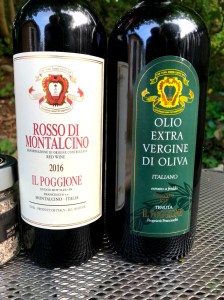
A few months ago I got a box in the mail (one of the little perks of the wine blogger). Inside, there was a bottle of wine, a bottle of olive oil, a jar of sea salt and a recipe – for Bistecca alla Fiorentina.
Bistecca alla Fiorentina is a dish coming from Tuscany (Florence) and depending on the historical account, it traces its origins either to the 16th or the 19th century – well, the history of Bistecca all Fiorentina is definitely not something we will be talking about here, so let’s move on. I’m sure you understand that “Bistecca” simply stands for “beef steak”. However, the recipe calls not for any steak, but specifically for the porterhouse or T-bone steak, which should be simply prepared rare or medium-rare over the charcoal. As the recipe is very simple, here it is in its entirety:
Ingredients (serves 4):
2 (1.5″ thick) bone-in porterhouse steaks (3.5 lb)
1/4 cup Il Poggione EVOO
Tuscan sea salt and freshly ground black pepper, to taste
2 sprigs rosemary


Get the charcoal ready. The distance between the hot charcoal and the steak should be about 4 inches (10 cm). The steak should be at room temperature before you start grilling (it should be out of the fridge for about 10 hours to get to room temperature). Grill steak on one side for 5-8 minutes, flip it with tongs (no forks of any kind!), salt the top surface with Tuscan sea salt and pour some olive oil. Cook for another 5-8 minutes, then stand the steaks on the bone and cook for another 5 minutes. Take it off the heat, put it down to rest, salt the other side and put some olive oil on it. After 5 minutes of rest, you can slice and serve your steak. See, can it get any simpler?


Now, it is time to talk about perfection.
First, the perfection started with the exceptional meat. In addition to what I already described, the box contained a gift card for Pat LaFrieda. The story of Pat LaFrieda Meat Purveyors started at the beginning of the 20th century when Anthony LaFrieda arrived in the USA and opened his first butchery – you can read the rest of the story on Pat LaFrieda website. Whatever the story is, the proof is always in the pudding – or on the fork in this case. I have to honestly tell you that I never had a better steak than this – the meat was sublime and was simply melting in the mouth – a good start for the perfect experience.


The second element of the perfection was, of course, the wine – 2016 Il Poggione Rosso di Montalcino (14% ABV, $27, 12 months in large oak barrels). Tenuta Il Poggione is one of the oldest producers in the Montalcino area, started to make Sangiovese wines – now known as Brunello – at the beginning of the 1900s. Today, it is one of the largest wineries in Montalcino, with 1500 acres, out of which more than 300 acres are under vines and 170 acres planted with olive trees (that Il Poggione EVOO in the package was superb).
The wine actually happened to be one of the best Rosso di Montalcino wines I tasted in a long time. The key word to describe this wine is finesse – it had a welcoming nose of tart cherries, medium intensity, and a hint of herbs. That profile perfectly continued on the palate, where delicate fresh cherries were joined by sage and rosemary, with clean acidity and excellent balance. Definitely one lip-smacking, delicious wine (8+).


Let’s not miss any details – we are talking about the perfect pairing here. As the devil is in the detail, there was one more element – little, but essential – to this amazing pairing, besides superb meat and outstanding wine. The last element? Tuscan sea salt. This was not some random sea salt – this one was Tuscan Sea Salt from AG Ferrari, listing the following ingredients: “Italian sea salt, fresh rosemary, fresh garlic, sugar, fresh sage, ground black pepper” – this Tuscan Sea Salt became the bridge which connected the flavor of the seasoned meat with the perfectly aligned flavor profile of the Il Poggione Rosso di Montalcino, delivering the genius pairing and an amazing experience.
I have to honestly tell you – I tried to replicate this experience two days ago – and failed. I used the same Tuscan Sea Salt, but I had a steak from the local supermarket butcher shop (1/3 of the price compared to Pat LaFrieda), and the wine was 2015 Collosorbo Rosso di Montalcino. The steak was simply not good (happy to be blamed for it as a cook – but I cooked the one from Pat LaFrieda too). The wine was okay, but a lot fruitier than Il Poggione, thus the pairing simply didn’t work. This once again proves my point about the evasive nature of a great wine pairing.
Did you have any climactic food and wine pairing experiences you care to share with the world? Or maybe you want to recount the worst moments? Will be happy to hear about it either way. Cheers!
Have a Car? Love Wine? Let’s Travel!
In today’s world, wine advanced its standing far beyond just an alcoholic drink. Yes, we get a lot of pleasure from the glass of a good wine, but leaving that aside for a moment, just think about the source of the wine – the grapes, the vineyards, the wineries. Think about rows of vines, which are always tended to so they look immaculate, with all those perfectly positioned lines. And then think about all the slopes – vines love hills, so think about all those beautiful rows covering the sides of the hills and mountains and ascending into the fog… And how about all those winding roads, where with every turn you keep repeating “oh my, just look there! Did you see it? Did you see it?” Before the liquid in the bottle, the pleasure comes from admiring all that beauty in its simple, natural form.
Want to see and experience that beauty of the vineyards? Most likely, you will need a car. Of course, you can always hire a driver, but then you are not fully in control as to where you will stop, what you will see, and how slow (or fast) you will go. As most of us, wine lovers, have to travel to see the vineyards, a rental car is our friend. So the CarRentals put together an infographic (love infographic as a concept), presenting 8 different wine routes around the world, giving you all the details you need to enjoy your trip. You can read the detailed descriptions of those eight routes in their blog post.
So, where are you going next? Cheers!

Source: CarRentals.Com
Can You Enjoy The Wine In The Can? Yes You Can!
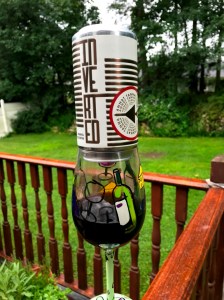 I couldn’t resist a little fun with the title, but really – what do you think of the wines in the can?
Let me ponder at the subject a bit while you give it a thought.
I’m sure that I qualify as one of the pioneers of the wine in the can. Here is an article in LA Times, talking about wines in the can showing up around the USA, and explaining why those make sense. This article appeared in September of 2015. Here is the link to my own post, titled “My First Can of Wine“, written back in November of 2014. So yes, I can claim some familiarity with the subject.
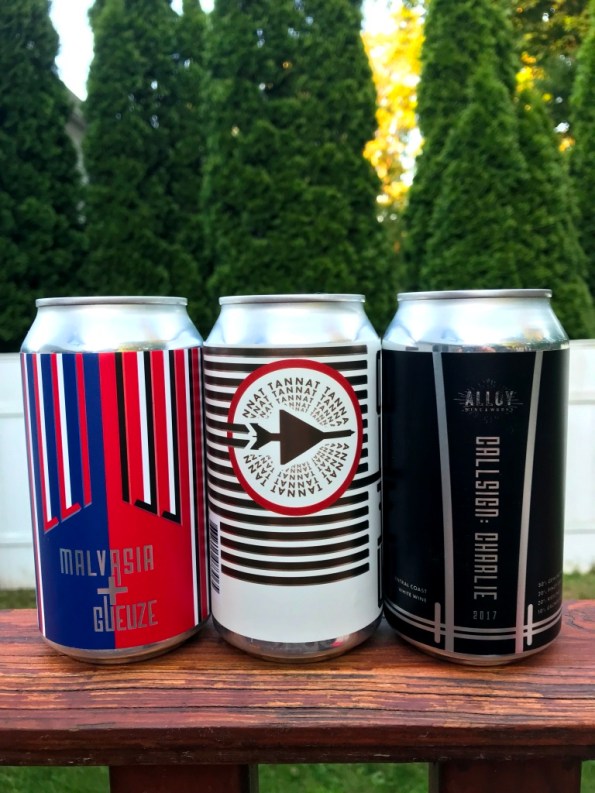
My first can of wine was produced by Field Recordings, a very unorthodox winemaking company to begin with, offering strange wines, with strange labels, unusual blends, aged in unusual barrels (Acacia wood, anyone?) – but ultimately, unquestionably delicious. I wrote numerous posts about Field Recordings wines, starting from 2011 – you can scroll through a few pages here. Field Recordings went on to create a club dedicated to the wines in the can (suggestively called Can Can Club), and then they even created a whole new company, called Alloy Wine Works. One of the fun parts of that Can Can club membership was to observe the progression of packaging and delivery of club shipments of canned wines – from packing bubble-wrapped cans in the same wine shipping box as the regular bottles (didn’t work too well), to the Fedex Tube:


to the practically a masterpiece of packing:


Okay, I probably got a bit off on the tangent here – this post is not about Field Recordings, but rather about wine in the can as a category, so let’s continue our discussion.
First, I think we need to establish a very simple truth – wines in the can are NOT a reduced, lower quality, cheap leftover junk wines – they are full-blown, legit, properly made wine of the same quality as all other wines made at a given winery, simply presented in the different format – a high quality lined aluminum can. These are the same wines, people, and if you want any takeaway from this post, this is my main point. One more time – these are the same wines, which are simply packaged in cans instead of being packaged in the glass bottles.
Now, why do we need wines in the can? I don’t want to get into the whole “cool factor” and “millennials” discussions – yes, those are important, I know, as they further democratize wine and bring new people to try the wine for the first time. But all of these can be categorized as a marketing gimmick, and I want to look for the actual benefits of the canned wines. Let’s see:
- On the go: Canned wines are perfect on the go. It is much easier to stuff a can of wine exactly as you would a can of soda into your backpack, and off you go. When you decide you want to drink the wine, it is very easy to open, and you don’t need to look for the glass. And even two cans of wine will be lighter than one bottle of wine, for the most of the cases. As we said – just get it, and go.
- Safety: Wines in the cans are a lot safer around small children, and generally anywhere where glass is simply a bad idea – like a beach or a pool.
- Convenience: Standard size for a can of wine is 375 ml, which is half of the bottle. If you want to drink white, and your friend is in a mood for a hearty red, having two different cans is easier than opening two bottles of wine.
- Experimenting and variety: with the smaller format and different packaging, there is an opportunity to create new types of wines or even go beyond wine. With Alloy Wine Works, I had wines going way beyond white, red and Rosé – wines finished with beer hops, wines mixed with coffee, plums, stout and lots lots more.
I’m sure there are other benefits of wines in the can, but – do cans of wine have only a good side without a bad one? As you know, this is never the case in life, so let’s talk about challenges:
- This is wine, not a beer!: It is important to remember that a can of wine holds half a bottle of wine – not beer. What’s my point, you ask? A typical can of beer contains less than 4% of alcohol. Typical wine – 13% as the least, so that one can of wine is equivalent to at least three cans of beer in terms of alcohol volume – you better remember that. Half a bottle of wine is not something you can easily dismiss.
- Once it’s open, it’s open: if you just want to have a glass of wine, it is easy with the bottle – open, pour a glass, close the bottle back. It is not going to work like that with the can – once it’s open, it’s open, and there is no going back. This problem has an easy solution – provide a plastic cap which can be used to reclose the can – but so far I didn’t see too many of those sold with the cans.
- Aging: I don’t think this is a real problem, as I don’t expect much of the aging-worthy wines to show up in the can, but in any case, keep in mind that the wine cans are better not be lost in the cellar.
Here you go – my take on the wines in the can. I didn’t plan to include much of tasting notes in this post, but I can tell you that this year I had wines in the can from California, Oregon, Australia and Long Island, and all of them were well made tasty wines.
At this point you had plenty of time to come up with your opinion about the wines in the can – would you please share it with everyone? Here is an easy poll for you – let us know what you think about canned wines! Cheers!
Wine News and Updates From Around The World
I’m happy to live during the times when wine is getting more and more popular – at least if you look at the wineries popping up all over the place, everywhere in the world, new wines coming out from the places where grapes were never planted before, and winemakers everywhere experimenting with new grapes, new tools (when did ceramic egg became “the thing”, huh?), and new styles (bourbon barrel-aged wine, anyone)? There is a tremendous amount of information available to the wine lovers everywhere, so I wanted to bring to your attention some of the latest news and developments in the world of wine which I found the most interesting.
There seems to be quite a bit of research pointing to the health benefits of the moderate wine consumption. More often than not, the health benefit is attributed to the red wine, not so much to the white, Rosé or Champagne. And then we also heard a famous story about Marilyn Monroe taking a Champagne bath (it supposedly took 350 bottles to fill the bathtub). What’s the connection, you ask? Based on the research conducted at Dartmouth University, it appears that Marilyn Monroe was onto something – the Champagne, with its high acidity and tiny persistent bubbles, has a great refreshing effect on the skin, so the 30 minutes bath is highly beneficial and rival most of the known skin rejuvenation treatments in its efficiency. Moving from theory to the practice, Veuve Cliquot, the leading Champagne producer, teamed up with Elizabeth Arden, leading American cosmetics and skin care company, to start offering Champagne treatments at select Red Door spa locations. The price is set for $10,000 for the 30 minutes, and the first 6 months of the appointments were booked within first 30 minutes of the initial offering. First trials at the spa showed excellent results and produced many happy clients. The only challenge? Someone has to constantly watch over the clients and remind them to drink Champagne only from the glass in the hand instead of taking the “deep dives” with their mouth open. Otherwise, the offering had been extremely successful and Veuve Cliquot is even considering to start offering treatments using La Grand Dame, but the pricing had not been unveiled yet.
There are no limits to the winemaking innovations today – aging wines in ceramic eggs and old bourbon barrels, mixing wine and coffee, filtering wines with the beer hops – bare mention of any of these would make winemakers and wine lovers cringe merely 10 years ago – but it is the norm today. Taking winemaking innovation to the next level, BrewDog out of the UK, the legendary producer of the world’s strongest beer (Tactical Nuclear Penguin clocks whooping 32% ABV), teamed up with the Australian winemaking legend, Penfolds, to produce the world’s strongest wine. The wine, called Penge Royal, uses the production methods of the Tactical Nuclear Penguin and Penfold’s flagship wine, Penfolds Grange. After aging the wine for 3 years in the old Scotch barrels, it then spends 60 days at the -32°C, and at the end of that period, reaches 70% ABV, beating most of the Absinthe on the market. It seems that the wine nicely preserves the flavor profile of Grange, but packs a substantial punch – as you would expect. The wine initially will only be available at the select markets in Australia and the UK, with the prices set at $5,000 per bottle. There were only 10 cases of 375 ml bottles produced, and they were all sold out immediately upon the offering. Would love to taste the Penge Royal one day, but getting one would not be easy.
I’m sure you heard about the so-called AI – Artificial Intelligence, and the robots, which will replace humans in pretty much everything we, humans, do. Going beyond the robot bartenders turns out that winemaking is also not immune to the automation and robot’s onslaught. The research team at Oxford University was working for the past two years on creating a robot which will be able to inspect the vineyards and decide on the day of the harvest, make all the decisions at the winery (how long fermentation should take, what strain of yeast to use, how and for how long to age wine, and also how to blend the final product). The project ran into an unexpected issue of many (if not most) of the winemakers not willing to share their knowledge, or even deliberately providing wrong information (no, you can’t wait until -10°C to harvest the Cabernet Sauvignon). Also, first results of blending by the winemaking robot were rather disastrous, with the resulting wine been completely not drinkable, not deserving even to be called a “plonk”. Hopefully the situation will change for the better, and the scientist will be able to make some progress, but for now, we will have to continue trusting humans to have a drinkable wine on the table.
If you are a serious wine enthusiast, I’m sure you run into this dilemma an uncounted number of time – I’m going to the dinner, should I wear a perfume? The perfume would interfere with the smell of wine and get in the way of truly appreciating it, both for oneself and for the people around us, right? The designers at Chanel, a leading French fashion house, set out to help all of us, oenophiles, to solve this dilemma and let us feel good about ourselves while going to a party while not disrupting the sensual pleasures of wine. Chanel’s designers created a new line of perfume specifically for the wine lovers, called W by Coco. The 3 years of experiments and hard work which went into the creation of W by Coco resulted in the perfume which offers a refreshing scent of the perfectly balanced wine, helping you to greatly accentuate aromas of the wine you are about to taste. All the Bordeaux First Growth producers supported the research, and as the result, the W by Coco line includes five different fragrances, one for each of the first growth Chateaux – Château Latour, Château Lafite Rothschild, Château Margaux, Château Haut-Brion and Château Mouton Rothschild. The fragrances available exclusively at Chanel boutiques in Paris, New York, Singapore and Tokyo and will cost wine lovers $450 for 30 ml. Reportedly, Château d’Yquem, Petrus, and Screaming Eagle all lined up to be included into the second release of the W by Coco line, but the date for the second release had not been confirmed yet.
Capitalizing on the popularity of the wine, literally every self-respecting brand is involved in the wine business, whether it is private label wines, special releases or simply store-branded lines of products – I’m sure you all had Kirkland wines, Trader Joe’s wines, Wine Farmer line at Whole Foods and more – never mind wine retailers such as Total Wines who offers thousands of private label wines in their “Winery Direct” program. Yes, we all know that and are usually not surprised by those private label wines. However, Walmart, the largest in the world retailer of discounted goods, managed to surprise everyone (and I meant it), by unveiling their partnership with none less than Old Rip Van Winkle, the producer of the most thought-after bourbon in the world. It appears that two of the iconic American companies joined forces to offer whiskey aficionados two new bourbons – Old Rip Wal Winkle 10 years old and Wal Winkle Special Reserve. The pricing and availability will be announced later, but it is expected that both whiskeys will appear in Walmart stores in the USA only at the beginning of 2019. Walmart shoppers and whiskey lovers, rejoice!
That’s all I have for you, my friends. Cheers!
Thanksgiving Day Experiences
Thanksgiving is one of my most favorite holidays. It revolves around food. Before you beat me up, of course, it is about family, friends and lots and lots of good reason to be thankful – but still, the food is at the core of this family gathering. This makes me double-happy – I get to spend time with the family and cook my heart out – and let’s not forget the extra bonus – I have a reason to chose special wines.
Since this blog started, there was only one year when I didn’t post about Thanksgiving. Otherwise, I did my best to talk about food and wine experience of this special day, sometimes even with few posts on the subject (you can find those posts here). This year, I had two resolutions for my Thanksgiving dinner. First, it will be simple – which means no Turducken, for instance. Second, I will serve only an American wines – to be more precise, only the wines from California. As Napa and Sonoma greatly suffered from the recent fires, this was only logical to embrace Californian wines to support the people there.
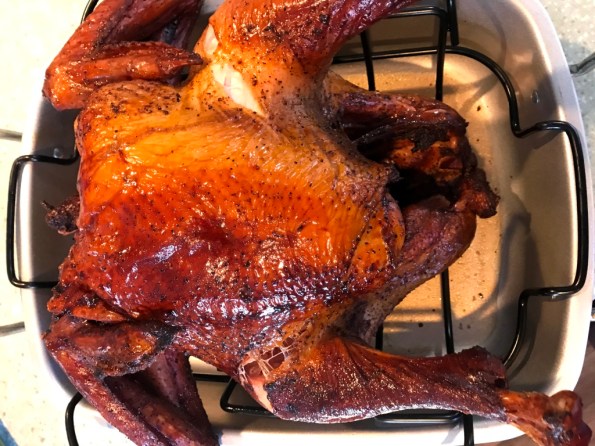
First, let me say a few words about the food. Turkey is a cornerstone of Thanksgiving – at the same time, it is hard to cook a whole turkey in really an exciting way. Over the years, we tried lots and lots of different recipes – with stuffing and without, turducken, smoked, deep fried, deboned… Some were definitely better than the others (turducken is typically a standout), and some of those preparations can be very laborious. Thus this year, I decided the smoked turkey is the way to go.
This was not a random decision – earlier this year I discovered so-called PBC (Pit Barrel Cooker), which I absolutely fell in love with. In the past, I had to spend literally a whole day, dancing around my simple smoker, trying to maintain the temperature and still ending up cooking all the food in the oven. PBC changed that dramatically – no need to precook ribs anymore, just start the fire, hang your piece of meat and come back in a few hours to enjoy. Based on all the prior success, smoking the turkey was simply a done deal.
This might be the simplest turkey I ever have done. Buy already brined turkey (many stores sell pre-brined turkey, which greatly simplifies your life), rub it generously with PBC All-purpose rub, start the fire and just hang it inside the PBC – you can estimate the cooking time based on the size, and of course, use the meat thermometer to make sure the turkey is cooked through.


Another dish I want to mention is the dessert. I got a recipe from a friend, many years ago – however, it was also a while since I made this dessert. I wanted to find a similar recipe online, just to use it as a reference – but failed. So here is the recipe without the usual ingredients and measurements, as here you can make everything approximately. Let’s call this dessert
Crepes Napoleon with Wine-poached Pears and Cranberry sauce
You will need the following:
- 4 firm pears, I recommend Anjou, carefully peeled, halved and cored
- 10-12 crepes (can be more, can be less, depending on how many layers do you want)
- 1 lb cranberry sauce (canned is fine, fresh is better)
- 1 bottle of port – you can use red wine too, but then you would need to add sugar.
- 1 cinnamon stick
- 1/4 teaspoon nutmeg
Put peeled, halved and cored pears into the large pot, cover it with wine, add cinnamon stick and nutmeg, and put it on the stove. Once liquid started boiling, reduce heat and let it simmer for about 30 minutes. Remove from heat, cover and let peras to cool off completely in the wine, preferably overnight (when cool enough, put the whole pot into the refrigerator). Next day, thinly slice pears and put aside. You can also reduce the wine for a later use – it is quite delicious.
You can buy crepes or you can make crepes. If you will decide to make them, Alton Brown has an excellent recipe – this is what I used.


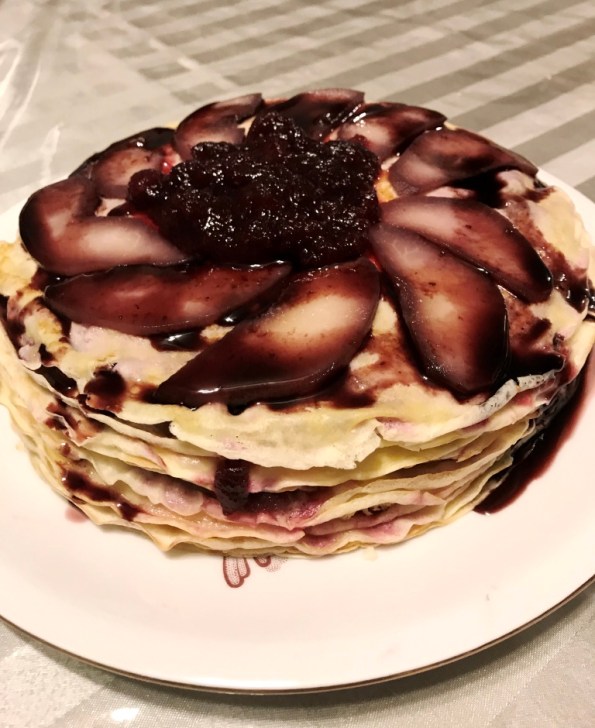
Once crepes are made and cooled off, you are ready to start making the Napoleon! Take a plate you will serve the dessert on. Put the first crepe on the bottom. Thinly spread cranberry sauce. Cover with another crepe. Now take slices of pear and put them around the crepe in a single layer. Cover with another crepe, spread cranberry sauce, cover, put pears and continue the process until you will be satisfied with the overall height of the Napoleon. I recommend a round of pear slices on top with cranberry sauce in the center, but of course, you can make your own decoration. Cover (plastic wrap will do) and put it in the cool place for the flavors to be absorbed into the crepes. Later on, slice and enjoy!
Time to talk wines!


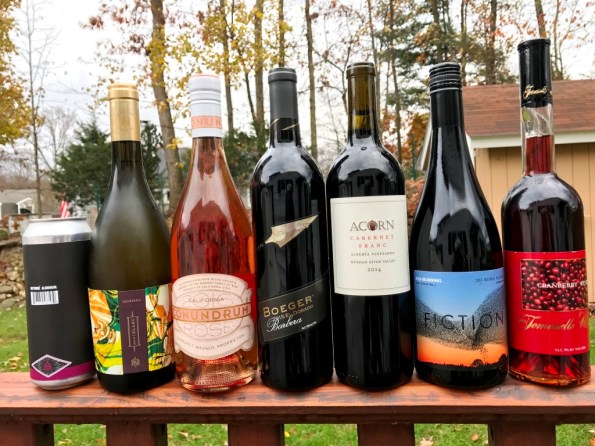
Holiday celebration should start with the sparkling, isn’t it? Finding tasty California sparkling wine is really not a problem. One of my favorite California producers, Field Recordings, offers an interesting selection of the sparkling wines, with most of them packaged in the cans (yes, cans). I had a can of NV Field Recordings Methodé Aluminum Edna Valley (11.9% ABV, 100% Pinot Noir), and it provided a perfect start for the evening – fresh, supple, with good body weight and a nice touch of a fresh bread – definitely was a crowd pleaser.
I wanted to have a full California wine experience, so next, we moved on to Rosé – 2016 Conundrum Rosé California (13.1% ABV). Truth be told, I’m not a fun of Wagner family wines – Conundrum, Meiomi, Caymus – doesn’t matter, they generally don’t work for my palate. So I threw in the bottle of this Conundrum Rosé simply because it was available – I thought we will open it, taste it and move on. Boy, was I wrong. This wine had beautiful strawberries all the way on the nose and the palate, supported by tons of herbs – lavender, mint, basil. Perfect mouthfeel with very good presence, but not overwhelming and with good acidity – this wine was enjoyed to the fullest.
We drink with our eyes first – thus the label on the 2014 Durant and Booth Blanc California (14.6% ABV, $36, blend of Chardonnay, Grenache Blanc, Ribolla Gialla, Roussanne, Greco di Tufo) was extremely drinkable and very promising (the label represents the art technique called water marbling – you can read more here if you are as intrigued as I was). I brought this wine from California after attending Wine Bloggers Conference 2017, where this wine was presented to us at the Napa Valley Vintners lunch – I plan to write a separate post about this event).
As you can tell, this wine is made from quite a few grapes, and I’m typically a bit concerned if the chorus will sing harmoniously. Oh yes, it was – starting from the beautiful touch of butter and vanilla on the nose and the palate, then immediately offering silky plumpness of Roussanne with a gentle touch of butter and tropical fruit on the palate – this delicious wine was gone in no time.


Next, it was the time to move on to the red wines. We started with 2014 Acorn Alegria Vineyards Cabernet Franc Russian River Valley (12.5% ABV, $38, 93% Cabernet Franc, 2% Malbec, 2% Merlot, 2% Petite Verdot, 1% Cabernet Sauvignon and Tannat). All Acorn wines are made from a co-fermented blend of grape varieties which are growing at Acorn’s Alegria Vineyard. This Cabernet Franc had a beautiful open nose with a touch of mint and cassis – the same continued on the palate with more cassis in a smooth, round package, supported by some herbal notes and perfect acidity. It was unmistakably Cabernet Franc, but also unmistakably California Cab Franc, without much of the green bell pepper presence and fruit dominant, but perfectly balanced.
Our last red was coming from the California region I was not really familiar with until now – El Dorado County (it is not only gold you find there, yep). 2015 Boeger Barbera El Dorado (15% ABV) was another wine I brought back from California after the same wine bloggers conference. I tried few of the El Dorado wines at the conference and was not very impressed, so I looked at it as an interesting experiment. Another score! This wine was dense and brooding, with tar and tobacco on the nose, and surprisingly polished dark fruit on the palate with sweet tobacco undertones. To make things even more interesting, I can tell you that we didn’t finish the wine during dinner, so I pumped the air out using the usual Vacuvin, and put the bottle aside almost for 10 days. After 10 days, the wine was still perfectly fresh and enjoyable, which makes me wonder how long this wine can actually age.
Time to finish our Thanksgiving dinner with the dessert. As our planned dessert had cranberry sauce in it, I decided to go with Cranberry wine for dessert. Tomasello Cranberry Wine New Jersey (9% ABV) was a perfect pick for it – good acidity, tart cranberry profile, it played perfectly with our dessert – while the wine was not from California, it still provided a perfect finish for our celebration.
Here we are, my friends. How was your Thanksgiving? Did you enjoy more the turkey, the wines or the company? Cheers!
Daily Glass: Monday Night Escapades
Is there a special wine fitting every day of the week? I would guess that for many, Friday and Saturday are considered special nights, as it’s the weekend, and people think of drinking something better (higher end). Sunday is still the weekend, so the higher calling might still be in order.
But what about Monday? Does your choice of wine for Monday depend on your general outlook on life? “I love Mondays” … said not that many people, but isn’t it great that it is the first day of the week and we have the whole new week ahead of us, with lots of things to do, places to visit and people to meet? I guess one’s personal take on Mondays does depend on one’s take on life, so I will leave it for you to ponder at and if you have any words of wisdom to share, please do so after the beep … err in the comments section below.
I have two wine-related experiences from Monday which I want to share. First, I finally got to open the Field Recording’s Can Club shipment. What’s a big deal, you ask?


Field Recordings is one of the most innovative wineries I know. Small winery in Paso Robles, California, a brainchild of Andrew Jones, a vigneron, who started his career as a grape grower, first and foremost. Ever since I tried his Fiction Red, I became a passionate fan and I’m religiously following everything Filed Recordings does.
A few years ago, Field Recordings started experimenting with the wine in the can. Going beyond just the wine in the can, they also finishing their wines with the beer hops which creates truly a different experience. As soon as the “Can Club” was opened, I joined it. The wines were always good, but the shipments themselves went through a number of changes in the format, and pretty much every shipment had some little (and different) issues associated with them. Until now.
Once I opened the box, my very first reaction was “wow”. In my humble opinion, Field Recordings, under their Alloy Works brand, achieved perfection in the packaging of the canned wine. Simple, elegant, sturdy, economical, easy to handle – unpacking this shipment was absolutely a delightful experience. Ask any oenophile, the first thing which gets everyone excited is the opening of those boxes. With this delivery, Field Recordings Can Club achieved shipping nirvana – I hope they will continue it moving forward.
I can’t tell you much about the wines, as they needed to get chilled and went straight into the fridge; I can only mention that this shipment included 2 cans each of Weissland, sparkling dry hopped Chardonnay; Martian Galaxy – a dry-hopped, sparkling rose, a blend of Gamay and Mourvedre Martian Vineyard in Los Alamos; and Sangria, a blend of freshest, cold-pressed juice cocktail of cranberry, blood orange and lemon from Yes Cocktail Company mixed with Zinfandel from Old Potrero Vineyard. I don’t know about you, but I’m very excited to try these wines – and will report on the experience afterward.
 Now, let’s talk about that Monday night wine. Outside of special events, I never know in advance what am I going to open. Deciding on the bottle of wine is somewhat of a frustrating experience (first world problems, I know). Numerous bottles get touched and looked at, then rejected for a myriad of reasons. Finally, one is pulled out – usually for no other reason than “oh well, maybe this will do”. This time around the bottle happened to be Turley Cabernet Sauvignon called The Label.
Turley is not known as the Cabernet Sauvignon powerhouse – it is a coveted and well sought-after Zinfandel producer for the most. A few years ago, Turley finally got into the Cabernet Sauvignon wines and produced the wine which was called “The Label” – named after the words of Larry Turley, the proprietor at Turley Winery, who always said that Cabernet Sauvignon drinkers simply “drink the label”.
I don’t know if this should be considered funny or strange, but it appears that 2011 Turley The Label already was my choice of Monday wine – almost 4 years ago, in January of 2014 (here is the post). I really loved the wine then, but it evolved much further this time around. From the get-go, this 2011 Turley The Label Cabernet Sauvignon Napa Valley (13.4% ABV) showed a beautiful medley of the succulent berries, both on the nose and the palate – blackberries, blueberries, and black currant, tastefully accompanied by mint and eucalyptus and supported by clean acidity (Drinkability: 9-). It was reminiscent of a perfect Turley Zinfandel, fresh and playful – with a character of its own. Last time I said I want to taste this wine in 10 years. After almost four we are going in the right direction – I should have one more bottle somewhere so I will have to be careful to avoid any Monday blues prompts to open this wine until its due time.
What is your perfect Monday wine? Cheers!
Spain’s Great Match – Rare Grapes, Delicious Wines, Great Values
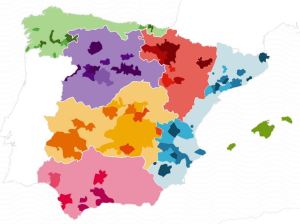
Source: Wines from Spain USA
I discovered the real greatness of the Spanish wines about 10 years ago, thanks to the wonderful seminar at maybe the best source of the Spanish wines in New York – the PJ Wine store. I had an occasional Rioja here and there before, but tasting through the full line of best of the best in Rioja, starting from the legendary 1964 vintage, was a true eye opener, and ever since, Spanish wines hold a special place in my winelover’s heart. If I need an ultimate solace in the wine glass, yes, 9 out of 10, it will be a Rioja.
Spain has the biggest vineyard area plantings in the world, so no matter how great Rioja is, Spain is so much more than just the Rioja. As I became a big fan of the Spanish wines (search this blog under the “Spanish wine” category), it became truly fascinating to follow all the changes and see the appearance of the totally new regions and reincarnation of the ancient, authentic grapes – Spain is home to about 400 grape varieties, out of which only about 20 can be considered “mainstream”.
What is the better way to learn about new wines if not the [big] wine tasting? Thanks to the Wines from Spain USA, the 24th annual “Spain’s Great Match – Wine, Food, Design” event offered exactly that – a big wine tasting (more than 300 wines), educational wine seminars and authentic Spanish food.
I had a pleasure of attending these events for the last few years, including the special 30th Anniversary of Spanish wines in the USA, where the incredible tasting in the main seminar included once-in-a-lifetime wines such as 2005 Clos Erasmus from Priorat, a Robert Parker 100-points rated wine. Every year’s event offered unique and different educational opportunities as well as the tasting of the latest and greatest wine releases from all major Spanish regions.
The first seminar offered during this year’s event was focused on the Spain’s rare grapes. Ask a winelover to come up with the list of the commonly used Spanish grapes – I’m sure that going beyond Tempranillo, Garnacha (Grenache) and Albariño will be challenging. Some of the adventurous wine geeks might add Graciano, Viura, and Verdejo. Meanwhile, remember – 400 varieties – versus 6 which we just mentioned. Spanish winemakers definitely got some options.
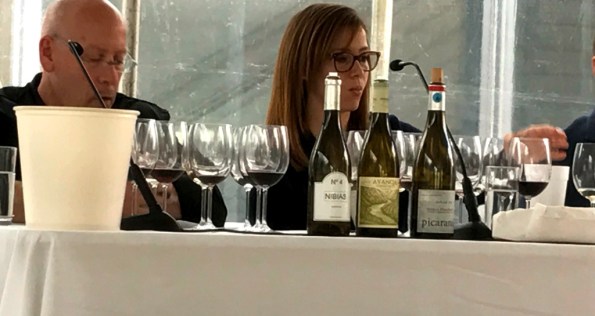
So the first seminar, led by Doug Frost, one of the only 4 people in the world who are both Master Sommelier and Master of Wine, Gretchen Thomson, Wine Director for Barteca Restaurant Group, overseeing the largest in the country portfolio of Spanish wines, and Michael Schachner, Spanish and South American Editor for Wine Enthusiast Magazine, addressed exactly this issue. We had an opportunity to taste and discuss 10 wines made from the little known Spanish grapes.
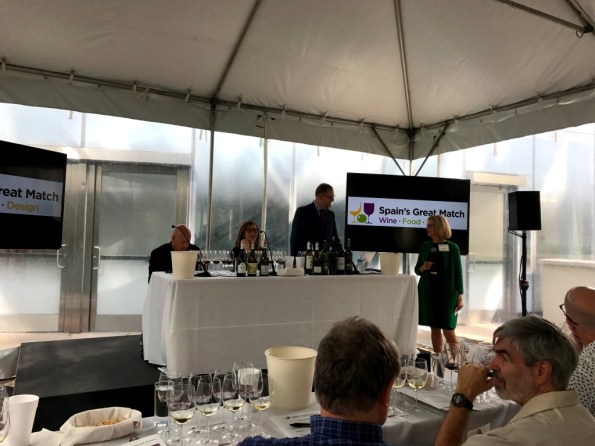
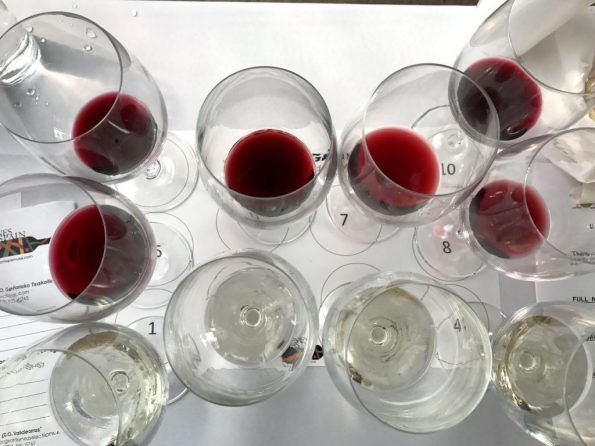
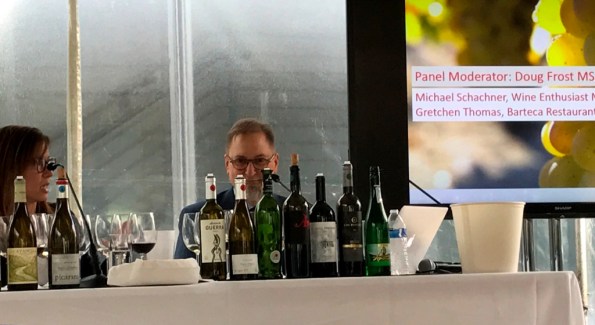
 As some of you might know, I’m a grape geek myself. The little box in the upper section of the Talk-a-Vino web page shows a counter for the number of grapes I had an opportunity to taste, so from the 10 grapes we tasted, I found only one I didn’t have before. The wines were interesting, however, I would not necessarily agree with the choice of wines to showcase particular grapes – but I wouldn’t stand a chance against such a distinguished panel of experts, so you can dismiss this statement. 🙂
Anyway, for what it worth, below are my tasting notes. Don’t have any good pictures for you, as I had no opportunity to take pictures of these wines in between the different events. Here we go:
2016 Ameztoi Txakolina D.O. Getariako Txakolina (Grape – Hondarrabi Zuri)
Beautiful nose, fresh, lemon notes, herbs, inviting. Crisp, cut through acidity, touch of fizz, would perfectly match oysters, seafood, most reminiscent of Mucadet.
2014 Bodega Chacón Buelta D.O. Cangas (grape: Albarín Blanco, new grape for me)
Off-putting nose – strong gasoline, aggressive herbal notes. The palate is interesting – lychees, pear, appears almost oxidative/”orange”.
2016 Avancia Cuvée de O D.O. Valdeorras (grape: Godello)
Intense nose, white stone fruit, nicely restrained, peaches undertones with clean acidity on the palate with clean acidity – excellent
2014 Bodegas Maranones Picarana D.O. Viños de Madrid (grape: Albillo Blanco, high altitude vineyards, 2000–2500 feet, barrel fermented)
Open, intense, touch of gunflint, reminiscent of Chardonnay, apples, vanilla – excellent. Plump, Marsanne-like on the palate, touch of tannins, very nice overall
2016 Armas de Guerra Tinta D.O. Bierso (grape: Mencía)
Intense, freshly crushed berries on the nose. Outstanding on the palate, tannins, burst of pepper, crisp, dry, very little fruit, medium body. Very interesting and different expression of Mencía.
2011 Raúl Pérez Prieto Picudo V.T. Castilla y Léon (grape: Prieto Picudo)
Delicious nose, open berries, sweet oak, overall on the nose – classic California. Lots going on on the palate – touch of sweetness, blackberries, nice swing of tannins, medium+ body.
2015 Bermejo Listán Negro D.O. Lanzarote (grape: Listán Negro, 13% ABV)
Smelling a cement truck – just fresh cement, plus intense herbal notes. Chipotle, poblano peppers dominate noticeably dusty palate – unique and different. (Too unique?)
2015 Ànima Negra ÀN V.T. Mallorca (grape: Callet)
Fresh open nose, fresh blueberries, and strawberries. Funky undertones on the palate, aggressive tannins (French oak), limited fruit. Interesting food wine
2014 Mustiguillo Finca Terrerazo Pago El Terrerazo (grape: Bobal)
Closed nose. A tiny hint of fruit, more perceived than real. Tight palate, noticeable oak, touch of cherries, good balance of fruit and acidity. Needs time. Want to try again in 10–15 years.
2013 Torres Cos Perpetual D.O.Ca. Priorat (grape: Cariñena)
Nice nose, cherries, dark chocolate, fresh leaves undertones. Aggressive tannins, green notes (tree branches), initial sweet notes immediately followed by astringent profile.
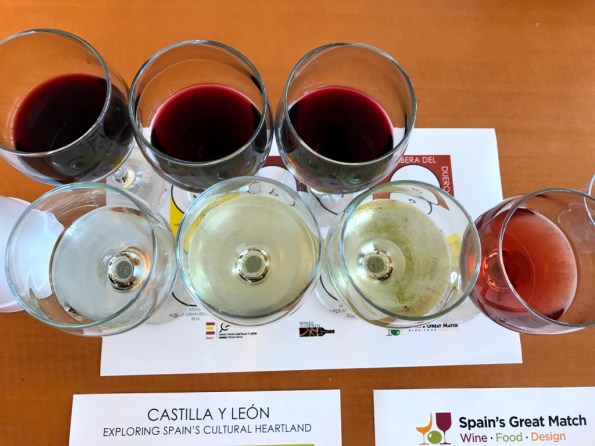
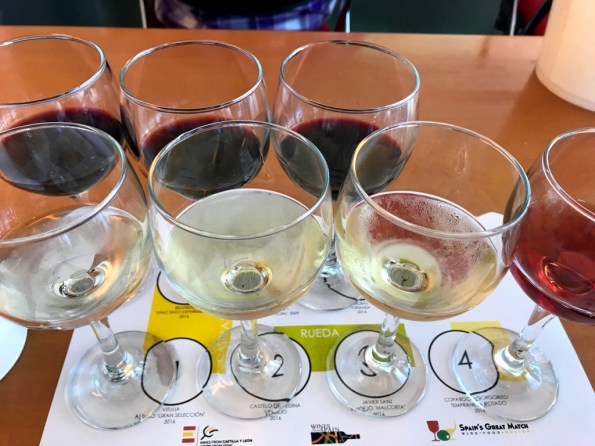
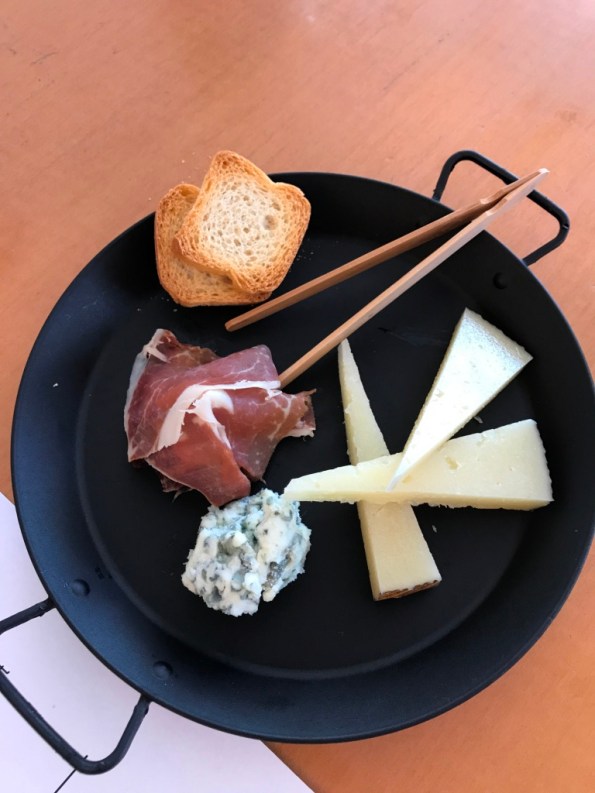
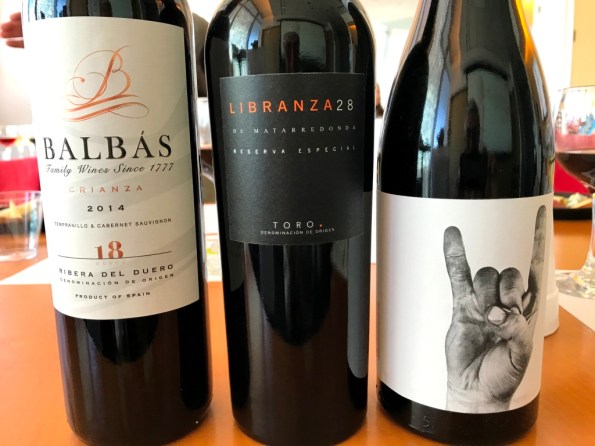
Our next seminar was dedicated to the wines and culture of the Castilla y León, an administrative region in the Northern part of Spain. Castilla y León includes a number of winemaking regions – some of the best, essentially – Ribera del Duero, Toro, Rueda among others. The seminar was led by charismatic Marnie Old – I have to honestly say that this was one of the very best wine seminars I ever attended – great delivery, lots of energy, excellent presentation.
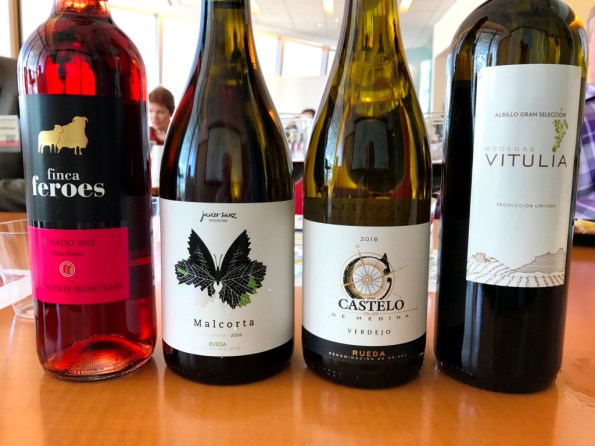
We had an opportunity to taste 7 different wines and also try some of the Castilla y León authentic foods – a few kinds of cheese (Valdeon, a blue cheese, was my favorite), Jamon (Jamón Guijuelo, to be precise) and more. I really didn’t care for the Rosé, so below you will find the notes for the wines we tasted:
2016 Bodegas Vitulia Albillo Gran Selección Vino de la Tierra de Castilla y León ($18, 12.5% ABV, 100% Albillo Mayor)
Simple, crisp, acidic, refreshing. Plus another new grape.
2016 Bodega Castelo de Medina Verdejo Rueda D.O. ($19.95, 13.5% ABV, 100% Verdejo)
White stone fruit, intense, fresh, floral fruit on the nose. Palate is dominated by the herbs, similar to Sancerre, lemon, medium body, very nice
2016 Bodega Javier Sanz V Malcorta Rueda D.O. (13% ABV, $26, 100% Verdejo Malcorta)
Javier Sanz’s effort is dedicated to restoring pre-phylloxera vineyards – this is where the fruit for this wine came from. The nose is a pure wow – intense, camphor oil, sandalwood, rosemary. Palate is delicious, perfectly balanced, candied lemon, nutmeg, medium+ body, clean acidity, an excellent wine. Yes, and another new grape.
2016 Vino Bigardo Tinto Experimental (100% Tinta de Toro) – an interesting wine. Made by a rebel winemaker, who doesn’t want to make the wine according to the appellation laws, so the wine is unclassified. 20–100 years old wine, 45 passes during the harvest, micro-fermentation. Nose has lots of young, bright fruit, freshly crushed berries, reminiscent of Monastrell, unusual. Young fruit on the palate, but with undertones of stewed fruit, hint of the roasted meat. This is experimental wine all right, but this is not a successful wine in my book.
2009 Bodegas Matarredonda Libranza 28 Reserva Especial DO Toro ($45, 100% Tinta de Toro, ungrafted vines, on average 70 years old)
Spicy nose with a whiff of cinnamon, sweet oak, classic Cabernet nose overall. On the palate very tight, the real Toro, powerful, dark fruit, nice – but needs time. Pairs surprisingly outstanding with the local Valdeon Blue Cheese.
2014 Bodegas Balbás Crianza Ribera Del Duero D.O. ($27.99, 90% Tempranillo, 10% Cabernet Sauvignon, 18 months in French oak barrels)
This wine comes from one of the founding estates in the region, established in 1777.
Dusty nose, muted fruit, distant hint of dried cherries. On the palate – cherries, cherry pit, roasted meat, coffee, great concentration, fresh, clean – very good wine overall.
I was registered for two more seminars, but then there were lots of wines to taste, so I decided to proceed with the tasting. Below are mentions of the wines I liked. I have separated the wines into my top choices (both white and red), and then separately sparkling (Cava), white and red wines I feel comfortably happy to recommend. For what it worth, here we go:


Top wines:
2016 Bodega Javier Sanz V Malcorta Rueda DO ($26) – see my notes above, definitely was the star
2014 CVNE Monopole Blanco Seco Rioja ($22) – Monopole is one of my favorite white Rioja in general, but this wine is taken to the next level by spending some time in oak – lots of increased complexity. Delicious.
2013 Bodegas Prineos Garnacha DO Somontano ($12.99) – round and delicious. Great value
2011 Bodegas Beronia III a.C. Beronia DOCa Rioja ($79.99) – 70 years old vines. Unique and beautiful, produced only in exceptional vintages. standout.
2015 Bodegas Garcia Carrión Mayoral Reservado DOP Jumilla ($12.99, Syrah/Cabernet Sauvignon/Petit Verdot) – a standout. Perfectly balanced, great flavor profile and QPR which can’t be beat.
2014 El Coto Crianza DOCa Rioja ($13) – an incredible value, perfectly soft and round
2008 El Coto de Imaz Gran Reserva DOCa Rioja ($44) – perfectly drinkable, but can still age. Delicious and a great value.
2010 Gratavinum GV5 DOCa Priorat ($80) – excellent wine
Also very good:


Cava:
NV Anna de Codorniu Blanc de Blancs Brut Reserva DO Cava ($14.99) – never disappoints. Great value.
NV Anna de Codorniu Brut Rosé DO Cava ($14.99) – one of my perennial favorites.
2010 Parés Baltà Cava Blanca Cusiné DO Cava ($40) – very good quality, comparable to vintage Champagne.
NV Segura Viudos Reserva Heredad DO Cava ($25) – another one of my favorites. Delicious.
2010 Torelló 225 Brut Nature Gran Reserva DO Cava ($35) – very good


White:
2016 Bodegas Sommos Las Bas Gewürztraminer DO Somontano ($25.99) – Gewurtztraminer is a tough grape for making a round, balanced wine – and this one was exactly that.
2015 Baigorri Barrel Fermented White DOCa Rioja ($30) – very nice
2016 Bodegas Beronia Viura DOCa Rioja ($14.99) – clean, refreshing
2016 El Coto Blanco DOCa Rioja ($11) – outstanding and an excellent value
2013 Bodegas Enate “Chardonnay 234” Enate DO Somontano ($12.99) – classic, very good.


Rioja:
2013 Bodegas Muga Reserva DOCa Rioja ($28) – one of the iconic producers, very good wine.
2011 Marqués de Riscal Reserva DOCa Rioja ($18) – excellent value
2005 Marqués de Riscal Gran Reserva DOCa Rioja ($48) – very good
2010 Marqués de Riscal Baron de Chirel Reserva DOCa Rioja ($79) – very good
2011 Bodegas Faustino V Rioja Reserva DOCa Rioja ($15) – very good value
2005 Bodegas Faustino I Rioja Gran Reserva DOCa Rioja ($35) – another very good QPR example
2012 Bodegas Beronia Reserva DOCa Rioja ($19.99) – excellent
2008 Bodegas Beronia Gran Reserva DOCa Rioja ($31.99) – excellent, and great value
2012 El Coto de Imaz Reserva DOCa Rioja ($24)
2008 Viñedos y Bodegas Sierra Cantabria Finca El Bosque DOCa Rioha ($95) – probably the most expensive wine in the tasting, and it is not ready to drink. Needs time, lots of time.
2007 Señorio de San Vicente San Vicente DOCa Rioja ($52, new grape – Tempranillo peluda)


Other red:
2016 Bodegas Sommos Merlot DO Somontano ($25.99)
2012 Bodegas Viñas Del Vero Secastilla DO Somontano ($44.95)
2009 Bodegas Paniza Artigazo Edición Limitada DOP Cariñena ($24..99)
2010 Bodegas Corral Don Jacobo Rioja Reserva DOCa Rioja ($22) – delicious and a great value
2014 Bodegas Volver DO LaMancha ($16) – one of my perennial favorites, big and powerful
2012 Finca Villacreces Ribera del Duero DO ($35) – this wine never disappoints – perfect example of what Ribera del Duero is capable of
2013 Bodegas Hacienda Monasterio, Ribera del Duero DO ($40) – delicious
2015 Bodegas Garcia Carrión Mayoral Chester DOP Jumilla ($12.99, Monastrell/Petite Verdot)
2014 Bodegas Garcia Carrión Pata Negra Apasionado ($12.99, Monastrell/Petit Verdot/Cabernet Sauvignon/Syrah)
2014 Torres Salmos DOCa Priorat ($35) – very good
2015 Teso La Monja Almirez DO Toro ($52) – still needs time
2007 Teso La Monja DO Toro ($25) – nice, but definitely needs time
And then, of course, there was food. Cheese and olives were a staple, and many other dishes were carried out all the time. I also discovered my new favorite sparkling mineral water – Vichy Catalan. It is sold at some of the stores, such as Fairway Market, so if you like sparkling water, you might want to give it a try.


That’s all I have for you, my friends. Spain’s Great Match is an annual event, so even if you missed this year, you should definitely plan to attend the next – you can see a full schedule here. Also, if you live in or will visit Chicago, you can still attend it on November 2nd. Either way – drink more Spanish wines, my friends! Cheers!
Last Bottle Sign Up ($10 credit)




 Talk-A-Vino