Month in Wines – April 2014
April was a good month for the good wines, with some of the gems worthy of Top Dozen consideration. Syrah and Pinot Noir were probably the biggest stars, but not the only stars. I already wrote about some of the wines before, so I will not inundate you with the repetitive details, and instead will simply give you the reference to the prior post. All the wines are rated on the 10 points scale, with + and – adjustments. These summary posts only include the wines with the ratings of 8- and higher – in the very very rare cases, I might include 7+ wines if I feel that the wine was simply unique.
Let’s go!


2010 Lenné Estate Pinot Noir Yamhill-Carlton AVA, Oregon (14% ABV, $45) – dark and delicious, and will age well for the next 10-12 years. 8+
2010 Renieri Invetro Rosso Toscano IGT (14% ABV) – delicious Super-Tuscan, powerful, round, a pure joy. 8+
2011 Michel Chapoutier Tournon Mathilda Shiraz Victoria, Australia (13% ABV, $14.99) – simply spectacular. A clear pepper profile on the nose and the palate. A stunning beauty. 9
2003 J.L. Chave Offerus Saint-Joseph, France (13.5% ABV) – Barnyard, touch of spice (pepper), dark and delicious. 8
2005 Domaine Philippe Bornard Arbois Pupillin La Chamade Ploussard (12.8% ABV) – beautiful, powerful, multi-layred. Pleasure in every sip. 8+
2012 J Wrigley Estate Pinot Noir Proposal Block McMinnville AVA (14% ABV, aged 10 Month in French oak, 250 cases produced. $45 SRP) – chocolate, mocha, a bit of mushrooms. Nice and balanced, and will age well. 8-
2010 Joel Gott Cabernet Sauvignon Napa Valley (SRP: $47.99) – perfect Claret, if you will. This wine would rival many top California Cabernet Sauvignon wines, which would also cost at least 2-3 times as much. 8
2007 La Rioja Alta Vina Alberdi Rioja Riserva, Spain (SRP: $19.99) – Perfect balance of fruit, structure, power and earthiness which only Rioja possess. Beautifully round and delicious. 8+
2001 La Rioja Alta 904 Rioja Gran Riserva, Spain (SRP: $47.99) – Mature and delicious, with lots of subtle nuances. A thought provoking wine. 8+


2009 Shiloh Legend Judean Hills, Israel (14.2% ABV, 45% Shiraz, 40% Petite Sirah, 9% Petite Verdot, 6% Merlot, each grape vinified and oak-cask aged separately for 8 month, then blended and aged for another 8 month) – round, velvety, delicious, with dark fruit core and firm structure. Perfect balance of power and concentration. 8
2012 Tousey Chardonnay Estate, Hudson River, New York (12% ABV) – a Chablis on Hudson would be a good way to define this wine. Chablis style minerality and hint of gunflint on the nose, creamy and round on the palate, with subtle apple and vanilla notes. Delicious Chardonnay. 8-
2012 M. Chapoutier Les Vignes des Bila-Haut White Côtes-du-Roussillon (13% ABV, $13.99, blend of Grenache Blanc, Grenache Gris and Macabeu) – in a word, delicious. Bright white fruit on the nose, fresh lemon, some earthiness. Perfect balance on the palate, each sip makes you crave for another. 8+
2004 Bodegas Ondarre Rioja Reserva Rioja DOC (13% ABV) – dark fruit on the nose, with the hint of eucalyptus and cigar box. Palate full of dark fruit with earthy profile, supple tannins and bright acidity, very balanced. 8-
2010 Chapelle-St-Arnoux Côtes du Rhône AOC (13.5 % ABV, $10.99) – nose of inviting dark fruit, the same on the palate with addition of dark chocolate notes and rounding acidity. Very dense and well structured for Côtes du Rhône. A steal for the price (sorry, it was some sort of closeout). 8
2010 Les Trois Chemins Côtes du Rhône AOP (13% ABV, $8.99) – fresh red fruit on the nose, blackberries and cherries, more of the same on the palate, coupled with bright acidity. Simple and elegant, and beyond steal at the price (again, a closeout of sorts). 8-
That concludes my report on the April wine highlights. Did you taste any of these wines? What were your best wine experiences of the month? Cheers!
Weekly Wine Quiz #101: Grape Trivia – Blends, Part 5
 The Wine Quiz series is not meant to intimidate. The whole idea here is to have fun and learn something new. When answering the questions, it is fully encouraged to use all available sources of information, including Google or any other search engine. There are no embarrassing answers – the most embarrassing thing is not giving it a try…
Welcome to the weekend and your new wine quiz!
We are continuing our grape trivia series, focusing on the blends, even if it is a blend of 1. White, Red, Rosé, Sparkling, Still, Fortified and Dessert – all goes. Oh yes, and we will blend in some regions and even wineries as well, just to make it more fun.
And now, to the quiz!
Q1: White wines of this region are considered to be some of the best white wines in the world, and they are made out of the blend of Marsanne and Roussanne grapes. Do you know what region is that?
Q2: These wines, made out of primarily Grenache and Cinsault, sometimes with the addition of Syrah and Mourvedre, can be only made as Rosé. Can you name these wines?
Q3: Can you continue this sequence? Explain your answer:
Amarone, Vin de Paille, Vin Santo, ?
Q4: This famous Spanish wine is always made out of the Monastrell and Cabernet Sauvignon grapes. The primary wine typically has 70% Cabernet Sauvignon and 30% Monastrell, and the second label has the blend proportions reversed. Can you name both wines?
Q5: What is common between Château d’Yquem and Vega-Sicilia, outside of the fact that both make some of the world’s most famous wines?
Good luck, enjoy the quiz and your weekend! Cheers!
J Wrigley #WineChat – Continuing Oregon Pinot Noir Deep Immersion
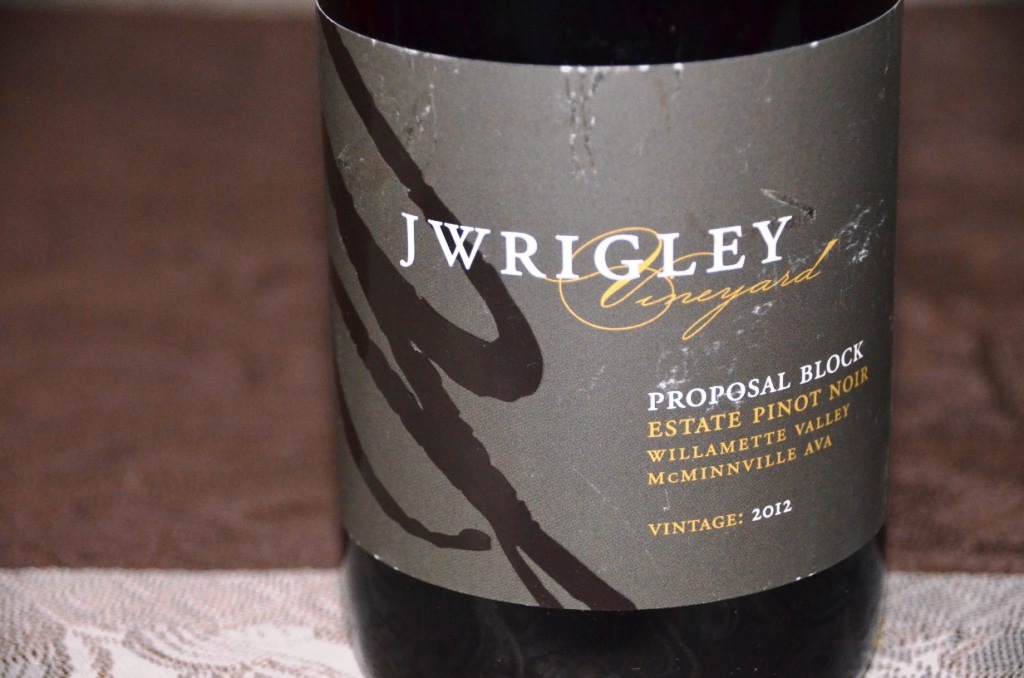 Last Wednesday, April 23, the virtual tasting room opened its #winechat doors to discuss for the third time in the row the endless subject of Oregon Pinot Noir. Presiding over in the hot seat was John Wrigley, the grape grower and winemaker at the J Wrigley Estate in McMinnville AVA in Oregon.
Let me start from the conclusion and tell you what I learned. The terroir, the soil, the elevation, and the winemaker are all matter. Duh, you wanna say? Well, yes, this sounds very pedestrian for the oenophile, like teaching an alphabet to the fifth-grader. However, when you drink the wine made with the soul, when you drink a thought-provoking wine, and when you also get a chance to discuss that thought-provoking wine with the someone who actually made it, and the group of like-minded people, the concept of soil and terroir stops being abstract, and rather becomes something you can…put in your mouth and taste!
We learned a lot during this #winechat. Once again we heard about the peavine soils, which make vines work really hard. We also heard about volcanic rocks and marine sediment soils. You can learn about the soils too – here is the link to the very interesting article about J Wrigley wines, which also includes the video of John Wrigley talking … dirt (not as a matter of speech, but as a substance).
We learned about something called Van Duzer effect. Ever heard of it? A narrow stretch of open land, called Van Duzer corridor, connects Willamette valley to the ocean. Every evening, the cold ocean air runs through that open space to cool off everything in the valley, especially all the grapes growing on elevations. The temperature drop can be in the range of 20°-30°, making grapes to ripen slowly, to retain acidity and concentrate sugars, which in turn means … better wines for us! Here is an article where you can read about Van Duzer effect in far more details.
We also learned about very interesting experiment, called the Cube Project. 3 wineries, 3 winemakers, 9 wines. 3 wineries – Anne Amie from Oregon, Bouchaine from Carneros and Lincourt from Sta. Rita Hills, each took their best Pinot Noir plots, capable of producing at least 6 tons of grapes each, and divided it into 3 equal parcels. Each winemaker had an opportunity to make wines from all three parcels, thus producing 9 different wines. When the wines were tasted by the group of professionals, it was concluded that winemaker style prevails over the terroir – the wines from different plots made by the same winemakers tasted closer than the wines made within the same parcels. I would really love to try all those wines by myself, or at least learn more about how the tasting was conducted – were the wines tasted blind, how many people tasted the wines and the number of other factors would all matter to me. But – as I can’t report first hand, here is a link to the article which explains the experiment in lots of details.
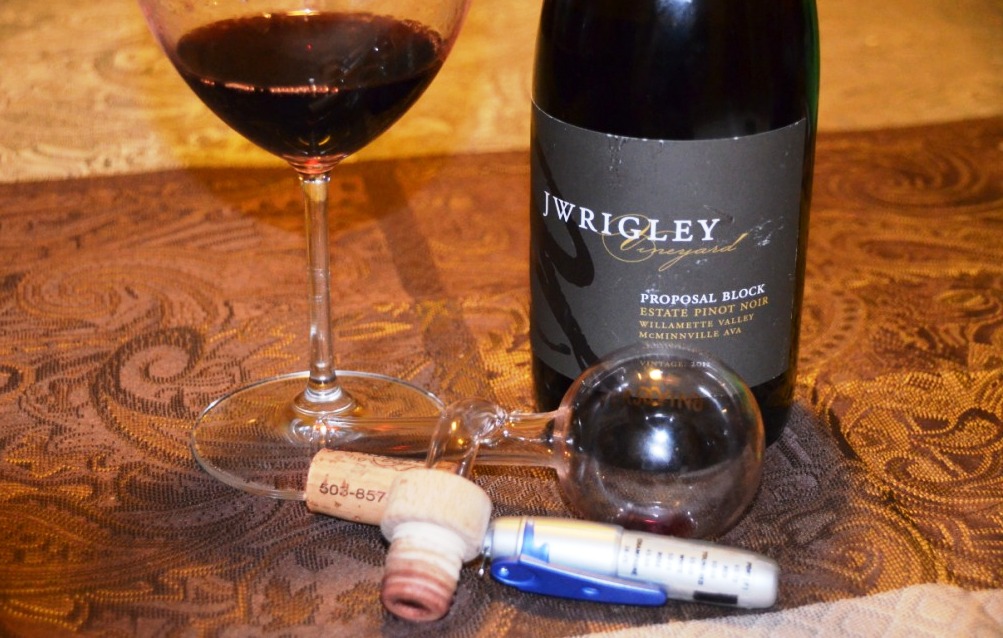
J Wrigley Pinot Noir and tools of the trade
Yes, we learned a lot, but how was the wine, you are probably wondering? This time around, I didn’t play with the temperature, I only measured it once – it was at 22.3°C/72°F. I played a bit with rapid decanting using VersoVino. This 2012 J Wrigley Estate Pinot Noir Proposal Block McMinnville AVA (14% ABV, aged 10 Month in French oak, 250 cases produced. $45 SRP) was very supportive of our conversation. Oh, by the way, can you guess where the name “Proposal Block” comes from? There is a good chance that you guessed it – this was the very first Pinot Noir planted vineyard at the estate, where John Wrigley proposed to his wife (wine and romantics – unbeatable!).
Now, here are some notes regarding the wine:
Color: Garnet
Nose: Fresh, ripe raspberries, floral notes, chocolate, mocha. Smokiness showed up later on.
Palate: Soft, round, good acidity. nice earhiness, dark fruit, very balanced. After a while, smokiness showed up in the back, and the the roasted notes.
Verdict: powerful and balanced Pinot Noir. Will drink well by itself, and can be well paired with food. For the full enjoyment, about one hour decanting is recommended. Will also age well for the next 10-12 years (or may be more, my crystal ball is broken, so I can’t be more precise). Drinkability: 8-
That conclude my report about J Wrigley #winechat and it also concludes the overall Oregon Pinot Noir series – definitely was learning, fun and entertaining experience for me. Don’t be shy – you should really try the #winechat for yourself (every Wednesday, at 9 PM Eastern/6PM Pacific) . Until then – cheers!
Wednesday’s Meritage – Wine Quiz Answer, Wine Blog Awards!, 2013 Bordeaux and Rioja, #winechat tonight
Meritage time!
Let’s start with the answer to the wine quiz #100, Grape Trivia – Blends, Part 4.
For the long time, the grape trivia series was focused on the single grapes. But now we are stirring things up, so all the questions in the quiz are about blends (well, even if it is a blend of one ), as most of the wines in the world are actually blends. As usual, there were 5 questions in the quiz.
Here are the questions, now with the answers:
Q1: True or False: Even if the bottle of wine states the vintage and is made out of 100% of the same grape, there is a very good chance that the wine is still a blend. Explain your answer.
A1: True. Now, this proved to be a very difficult question. Not the “true or false” part of it, of course – but practically nobody (with one exception) managed to provide a satisfactory explanation as to why even if the wine is made out of 100% of the same grape, it is very likely to be still a blend. If wine technical data says that it is made from 100% of Chardonnay, for example, there is no way that any other grapes where blended in. However, have you seen the words “30% malolactic fermentation” or “aged in 15% new French oak barrels”? For the most part, the wine you get in the bottle is the blend – the blend of wines from the different barrels, the blend of wines fermented with different yeasts, or somehow else differently processed. Also (as it was correctly noted in one of the answers), the wine can be made from exact same grape, but be a blend of different vintages (up to 15% allowed in US wines).
Q2: This white grape is known to produce beautiful, delicately perfumed wines. In some appellations in France, it is also the only white grape allowed to be blended into the red wines. Do you know what grape it is?
A2: Viognier. While it makes great wines on its own, it can be blended with Syrah in Northern Rhone or Shiraz in Australia to change the bouquet of the resulting wine.
Q3: What is common between Cabernet Franc, Riesling and Vidal?
A3: All three varietals are used to produce Icewine in Canada.
Q4: Which one is missing?
Rondinella, Corvina, Molinara, ?, Croatina, Negrara, Oseletta
A4: My intended answer was Corvinone, as the grapes listed above are all used in production of Amarone wines. However, I learned quite a bit myself from the answers, and I understand that in Amarone, similar to all other regions in the world, there is an effort to bring back to life many indigenous varieties, thus Forsellina, Pelara and Rossignola would be also all correct answers.
Q5: I’m drinking a delicious French white dry wine, made out of Clairette and Roussane. What AOC designation this wine most likely has?
A5: Châteauneuf-du-Pape. Some of the best white wines in Châteauneuf-du-Pape are made exactly out of the combination of these two grapes. It is possible that such wine would be produced in just a Côtes du Rhône appellation, however, it would be rather expected to see Marsanne as part of the blend, which is a lot easier to produce than Roussanne. However, Marsanne is not allowed in the Châteauneuf-du-Pape wines.
When it comes to the results, I’m very happy with participation in the quiz. However, there was only one full answer for the question #1, which is proven to be most difficult. Thus we don’t have the grand winner(s) this time around, but I would like to definitely acknowledge Gene Castellino (no web site), Julian of vinoinlove and Jennifer (no web site) who all correctly answered 4 questions out of 5. I also would like to acknowledge Steve of Caspernick blog, who provided a good explanation for the question #1. Thank you all for playing, well done!
Now, to the interesting stuff around the vine and the web!
Once again it is the time for Wine Blog Award nominations! This is an 8th annual Blog Awards round, where the best wine blogs are getting their peer recognition. There are 9 different categories for the Wine Blog Awards, so there are plenty of opportunities to get your favorite blogs acknowledged. Here is your link for the Blog Award nominations. And if you like what you read in this blog, I would greatly appreciate your nominations! Note – there are less than 3 days left – nominations are closed on May 2nd, so hurry!
Looks like 2013 vintage didn’t fair too well in some parts of the Europe. Here is an article for you, explaining why 2013 Bordeaux are better be avoided (in a few simple words, it is all about price/performance). Also, 2013 Rioja doesn’t seem to be the vintage to really look forward to – it was rated as “Good” by the Rioja DOC counsel, which is behind “very good” and “excellent” ratings which were given to most of the recent vintages. Of course the things can be worse – there are possible “satisfactory” and “average” ratings, which are even lower than “good”, but those are assigned very rarely. Well, as usual in the average vintages, you need to look for the better producers – as an example, La Rioja Alta Vina Alberdi from 2003 vintage (also rated “good”), was an outstanding wine. Here is the link for the Decanter article where you can read more on the subject of 2013 Rioja.
Last, but not least – new #winechat tonight! This time the subject is the Rhone and Zins of Cline Cellars. I think everybody know Cline Cellars from California as a Zinfandel producer, but looks like we are in for some interesting surprises tonight (Mourvedre, anyone? Marsanne/Roussanne?). To join the #winechat, just click this link at 9 PM Eastern time/ 6 PM Pacific, and you are in! For more information about past and future #winechat events, please use this link for the #winechat FaceBook page. Talk to you tonight!
And we are done here. The glass is empty – but the refill is on its way! Cheers!
Passion For Jura – The Wines
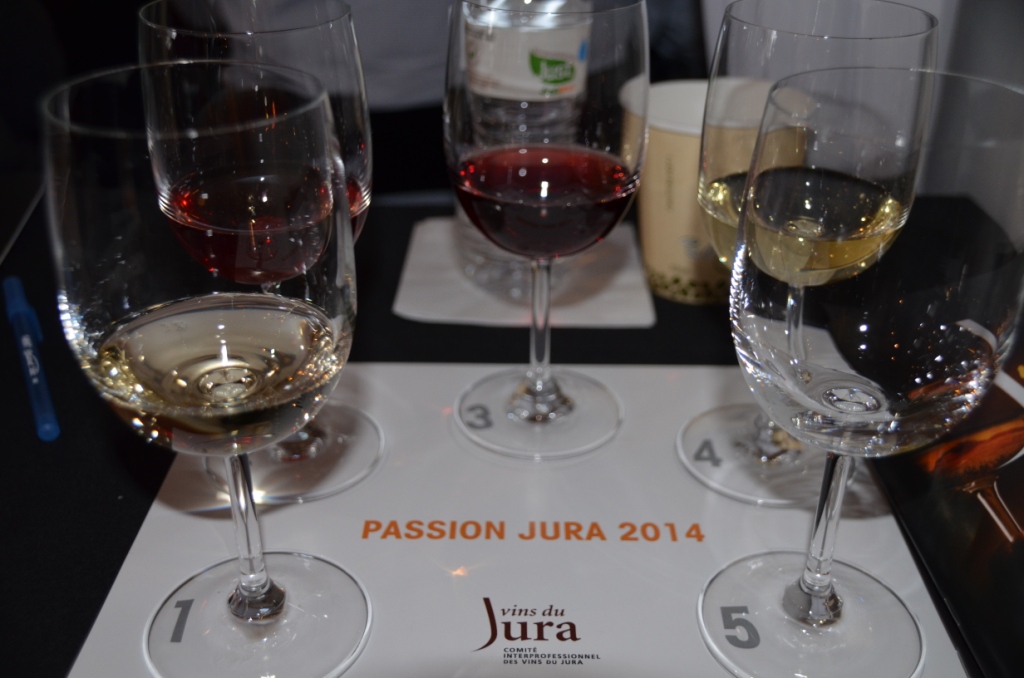 In the previous “Passion for Jura” post, we talked about the region – history, terroir, grapes and types of wines – but we didn’t talk about the wines themselves. “Passion for Jura” was the name of the seminar and tasting which I recently attended in New York city, where I had an opportunity for the first time to really immerse into the fascinating world of one of the oldest wine producing regions, which is really unknown in US.
During the seminar, 6 wines were presented by the winemakers themselves. The idea was to let us experience the full range of the Jura wines (for some strange reason, Vin Jaune was not presented during the seminar). Here are the wines we tasted:
NV Domaine Jacques Tissot Cremant du Jura Blanc Brut (12% ABV) – 100% Chardonnay, refreshing grassy nose, very acidic, bubbles are present but somewhat muted in the glass. Creamy mouthfeel with toasted bread and apple on the nose. Overall, not bad, but lacking a bit an overall energy of the sparkling wine.
2011 Domaine de la Pinte Jura Arbois Polsard de L’Ami Karl (11.5% ABV) – light, refreshing, cranberries with the touch of barnyard, herbs (sage), light but with the nice tannins. Very interesting and very enjoyable.
2011 Benoit Badoz Vermiel (13.5% ABV, 70% Trosseau, 30% Pinot Noir) – fresh grapey nose – not a pronounced as Beaujolais Nouveau, but still quite explicit. Cherries and blackberries show up next. Beautiful, smokey notes on the palate, a bit sharp, but fresh. Clean acidity, long pleasant finish. Somewhat similar to Oregon Pinot Noir, but more round. Also has a noticeable green component.
Compare the colors of the two red wines in the tasting:


2011 Domaine Champ Divin Cotes du Jura (13% ABV, Chardonnay/Savagnin blend) – vanilla, minerality on the nose. Delicious. Acidity and minerality on the palate, fresh apples, very refreshing
2009 Fruitiére D’Arbois Savagnin Arbois AOC (14% ABV, 100% Savagnin) – oxidation is very much pronounced, pretty much like with Sherry, both on the nose and the palate. This wine is typically made as Vin Jaune, but it requires lesser aging time. After the wine breathes, it becomes much less aggressive and comes through as clean, despite the oxidation.
2009 Domaine Pierre Richard Vin de Paille (15% ABV) – delicious nose. Palate is beautiful, with refreshing acidity, touch of bitterness, and full of fresh juicy apricots. Wow!
And here is the list of some of the wines I tasted during the walk around tasting. The place was small, and got very crowded after a while, so I didn’t taste the wines from all 20 producers. As usual for the trade tasting, I’m using the “+” sign system. The wines mentioned below were my favorites, for the most cases with “+++” ratings with some exceptions (of course), such as “++-|” and “++++”.
2010 Domaine Jacques Tissot Arbois Chardonnay (12.5% ABV) – +++, beautiful!
2012 Domaine Jacques Tissot Arbois Chardonnay La Mailloche (12.5% ABV) – +++-|, butter and balance! perfect.
2009 Domaine Jacques Tissot Arbois Savagnin (13% ABV) – +++, very elegant
2006 Domaine Jacques Tissot Arbois Vin Jaune (14.5% ABV) – +++, mushrooms and forest floor! should be amazing with savory dishes. Vin Jaune can last for 6 month after being opened.
2010 Domaine Jacques Tissot Arbois Trousseau (12.5% ABV) – ++-|, clean, elegant, light – red which more feels like white
NV Domaine Jacques Tissot Macvin du Jura (17% ABV) – very unusual palate, with raspberries, almost taste like Framboise, very nice. Can last for 6 month in the fridge.
2010 Domaine Jacques Tissot Cotes du Jura Pinot Noir (12% ABV) – ++-|, very interesting and unusual for a Pinot Noir
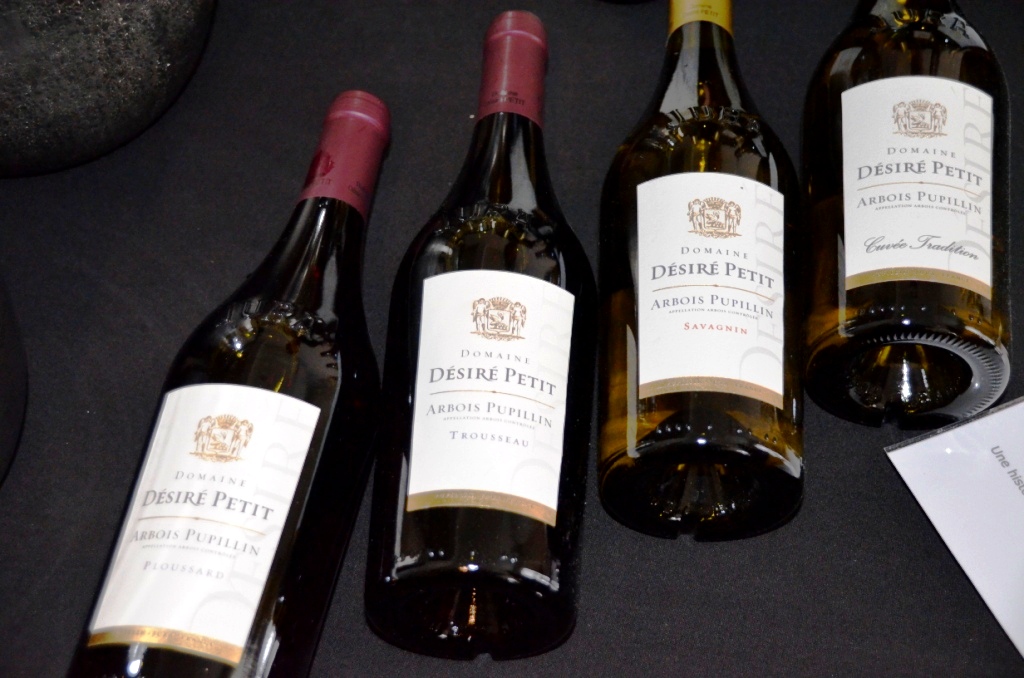
2012 Domaine Désire Petit Ploussard (12.5% ABV) – +++, smokey nose!
2012 Domaine Désire Petit Trousseau (12.5% ABV) – ++-|, dry, clean, nice
2012 Domaine Désire Petit Chardonnay (12.5% ABV) – ++-|, clean, classic, minerality!
2012 Domaine Désire Petit Savagnin Ouillé (13% ABV) – +++, 6 month in oak, very complex wine
2011 Domaine Désire Petit Tradition (12.5% ABV, 25% Savagnin) – +++, perfect acidity
2008 Domaine Désire Petit Savagnin(13% ABV) – ++-|, delicate, elegant
2007 Domaine Désire Petit Vin de Paille (14.5% ABV) – +++, prunes on the nose! perfect balance
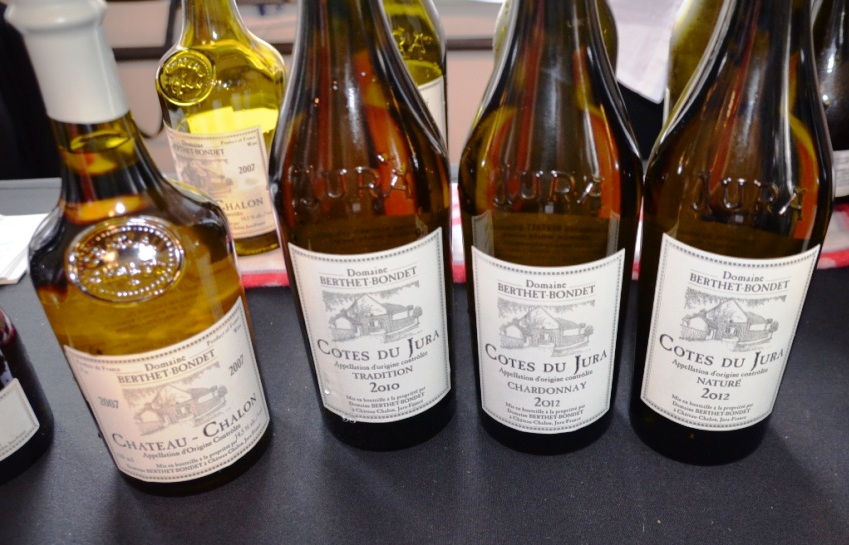
2012 Domaine Berthet-Bondet Cotes du Jura Chardonnay (12.5% ABV) – ++-|, light, round
2012 Domaine Berthet-Bondet Cotes du Jura Naturé (13% ABV) -+++, good fruit
2012 Domaine Berthet-Bondet Cotes du Jura Tradition (13% ABV) -+++, delicious
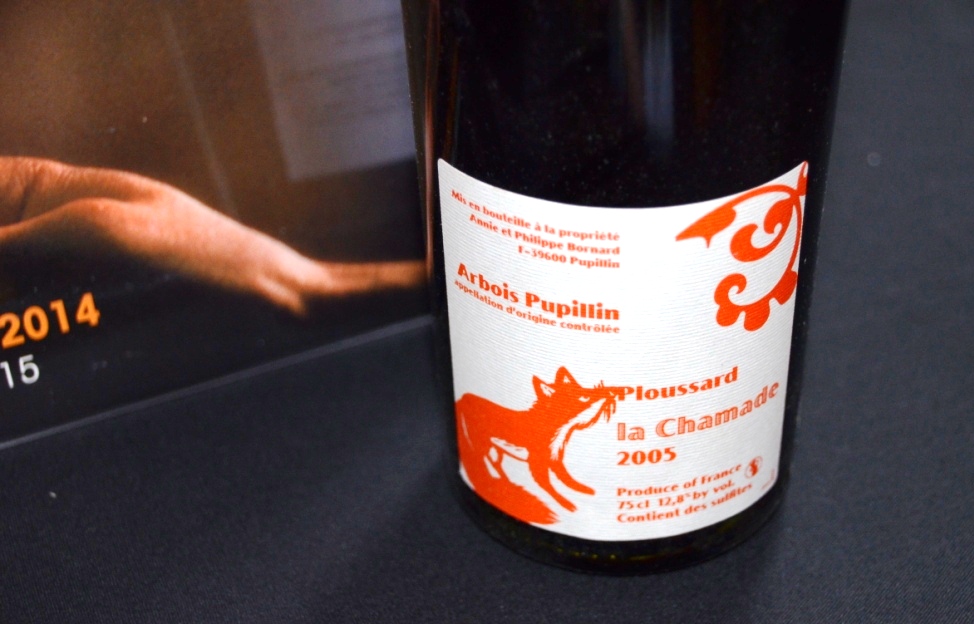
2005 Domaine Philippe Bornard Ploussard La Chamade – Best of tasting!
2005 Domaine Philippe Bornard Arbois Pupillin La Chamade Ploussard (12.8% ABV) – ++++, wow!
2011 Domaine Philippe Bornard Arbois Pupillin La Chamade Ploussard (13.5% ABV) – +++, wow! delicious, sweet undertones
2011 Domaine Philippe Bornard Arbois Pupillin Trousseau Le Ginglet (12% ABV) – +++, delicious complexity in the back
2011 Domaine Philippe Bornard Arbois Pupillin Savagnin Ouille Les Chassagnes (13.5% ABV) – ++-|, complex
2011 Domaine Philippe Bornard Chardonnay Les Gaudrettes (12.5% ABV) – +++, complex, delicate!
2011 Domaine Philippe Bornard Arbois Pupillin L’Ivresse de Noé (14% ABV) – +++, late harvest Savagnin, a touch of sweetness, delicious complexity
I also tasted 4 different Vin Jaune wines from Domaine André & Mireille Tissot, all from 2007 vintage, all single vineyard, and all delicious, with the one from Chateau-Chalon being the best – unfortunately, as all those wines were not listed in the tasting brochure, I can’t give you their exact names – but look for Domaine André & Mireille Tissot Vin Jaune – they are well worth your attention.
That concludes my report on the Passion for Jura tasting. Based on my experience, I can simply tell you – Jura makes delicious wines, and you need to experience them. Go to your wine merchant and ask for the Jura wines by name – and let me know how you will like them. Cheers!
Frank Pepe – Heavenly Pizza in New Haven
 During our bloggers lunch at Frank Pepe Pizzeria Napoletana in Fairfield, CT (here is the link for the fascinating story of the Frank Pepe family and many interesting pizza facts), I learned that charcoal pizza ovens are not created all the same – they need to be seasoned. For the most of the cases, similar to the aging of the wine, oven seasoning is a very gradual process. It simply requires millions of the pizzas to be made over the years in the same oven, over and over again. Pizza oven in New Haven, where Frank Pepe started, is rightly known to be producing very best Frank Pepe pizzas, so during the spring school break, I was determined to go experience Frank Pepe pizza at the source.
I like to see a line at the entrance to the restaurant. Well, kind of. It might suck to stand in line – but when you see the line, it means that the place worth it.
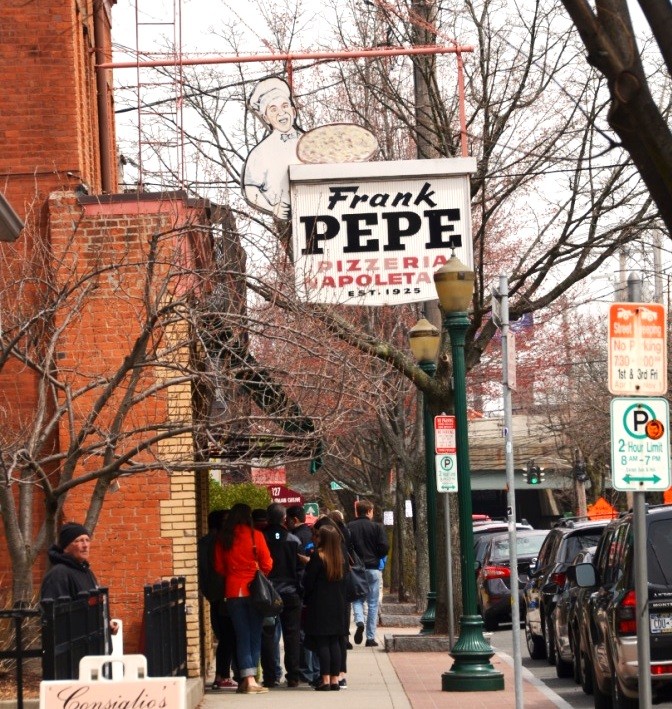
I also can’t really complain about our wait – it took us less than 10 minutes to be seated on Friday at 1 PM during the school break. I was told that over the weekend, the line can extend for the half of the street, but it still worth it.
We got to our table, figured out what we want to eat, ordered the food. While we were waiting for the food to arrive, I took an opportunity to snap a few pictures of the pizza in the process of making. I could probably stand there for an hour, watching well orchestrated, visual symphony of pizzas been assembled, put into the oven, moved inside the oven and coming outside of the oven and being placed on the tray to be delivered to the table. Pictures don’t do the justice to this performance, next time I have to record a video…


We ordered three pizzas. The Original Tomato Pie with Mozzarella, The Original Pie with Bacon and Mushrooms and of course the #1, White Clam Pizza. In a word, incredible. Yes, all three. In the White Clam pizza, the balance of garlic and herbs with the sweetness of fresh clams was just something incredible. The Original Pie – just enough of everything, just perfectly enough. With its seeming simplicity, it is so easy to make even the regular cheese pizza absolutely inedible – too much cheese, too oily, strangely tasting tomatoes, soggy, chewy, tasteless crust – the list of potential pizza flaws is very long. When you taste the Frank Pepe pizza, you taste a perfection. The crust, perfectly charred, perfectly fresh, airy, and sweet and crispy – absolutely a “wow”. I would gladly come back to Frank Pepe pizza to just to eat enough of that crust. The original pie with bacon and mushrooms? Yes, you got it again – perfectly delicious. Smokey bacon, cooked to the perfect consistency – just a fiery of flavor. Ahh, and that crust…


I can tell you – I had a proof that this was absolutely the best pizza when I heard my kids raving about it talking to their friends – our kids are discerning eaters ( yes, you can call them spoiled like that, okay) – so if they are raving about the food, it worth something. And another testament to that – when the friend asked my daughter if that pizza was worth an hour ride in the car, the answer was – absolutely.
Yes, Frank Pepe pizzeria worth a trip – whether you live close enough, or visiting – I highly recommend you will add Frank Pepe Pizzeria (in New Haven, if you can!) to the list of “must experience” attractions. You can thank me later. And by the way – drop me a note – I will be happy to join you. Cheers!
Frank Pepe Pizzeria Napoletana
157 Wooster Street
New Haven, CT 06511
203-865-5762
http://www.pepespizzeria.com/

Weekly Wine Quiz #100: Grape Trivia – Blends, Part 4
The Wine Quiz series is not meant to intimidate. The whole idea here is to have fun and learn something new. When answering the questions, it is fully encouraged to use all available sources of information, including Google or any other search engine. There are no embarrassing answers – the most embarrassing thing is not giving it a try…
Welcome to the weekend and your new wine quiz!
We are continuing our grape trivia series, focusing on the blends, even if it is a blend of 1. White, Red, Rosé, Sparkling, Still, Fortified and Dessert – all goes. Oh yes, and we will blend in some regions as well.
And now, to the quiz!
Q1: True or False: Even if the bottle of wine states the vintage and is made out of 100% of the same grape, there is a very good chance that the wine is still a blend. Explain your answer.
Q2: This white grape is known to produce beautiful, delicately perfumed wines. In some appellations in France, it is also the only white grape allowed to be blended into the red wines. Do you know what grape it is?
Q3: Whats is common between Cabernet Franc, Riesling and Vidal?
Q4: Which one is missing?
Rondinella, Corvina, Molinara, ?, Croatina, Negrara, Oseletta
Q5: I’m drinking a delicious French white dry wine, made out of Clairette and Roussane. What AOC designation this wine most likely has?
Good luck, enjoy the quiz and your weekend! Cheers!
Fears of the Oenophile
 It feels strange, may be even bad, to re-blog your own post, I know. So if you disapprove, lash away in the comments section. But it suddenly came to me, that I already had covered the theme of the Monthly Wine Writing Challenge #9, “Fear“. Re-reading that older post I thought – yes, even if I’m to write the new one, it would still be along the same lines. Thus, here is my #MWWC9 contribution:
Another Wine Marathon – Last Bottle Marathon Madness – Starting Today!
Yes, I know – this is a last minute note – but I just got an e-mail about it…
Only yesterday the dust settled after the WTSO Magnum Marathon, yet another one of my favorite [amazing] value wine purveyors is throwing in a challenge to our wallets and our storage spaces (who had been threatened recently by the significant other to go live outside of the house “if you only…” on one or both counts – raise your hand!) – Last Bottle Madness Marathon will be starting today (04/24) at 12 PM Eastern/ 9 AM Pacific time, and continuing for the next 48 hours, or until the Last Bottle cellar will be empty.
 All the wines will be offered in the rapid succession, without any notifications – no twitter, no e-mails, no text messages. The only way to follow the madness is by constantly refreshing your browser window. There are no minimum requirements – you can buy 1 bottle at a time, it is fine. All the wines you will buy will be shipped together 2-3 weeks after the event.
You will need to have an account with Last Bottle wines, and I suggest that in that account you will have all the information ready to go – speaking from the experience, the wine you want might be well gone by the time you will finish putting in expiration date for your credit card. In case if you don’t have a Last Bottle account already, I will be glad to be your reference – if you will sign up using this link, you will get $5 credit on your first order (yes, I will get $20 credit after your first purchase – but once you are in, now you will be the one who will tell friends about it). In case the link doesn’t work, feel free to send me an e-mail to talkavino-info (at) yahoo (dot) com.
Happy [amazing wine at great value] hunting!
Wednesday’s Meritage – Wine Quiz Answer, Wine and Biodynamics, Rioja Week in New York, Water Witching and #winechat tonight
 Meritage time!
Let’s start with the answer to the wine quiz #99, Grape Trivia – Blends, Part 3.
For the long time, the grape trivia series was focused on the single grapes. But now we are stirring things up, so all the questions in the quiz are about blends (well, even if it is a blend of one), as most of the wines in the world are actually blends. As usual, there were 5 questions in the quiz.
Here are the questions, now with the answers:
Q1: Sangiovese is the main grape used in production of Chianti. By itself, sometimes it might lack the intensity of the color. For a while, another grape was added to Sangiovese wines specifically to enhance their color. Can you name that grape?
A1: Colorino. It was popular addition for a short while, but now only very few producers still add it.
Q2: I’m blending together Xarel-lo, Macabeo and Parellada. Which wine I’m most likely making?
A2: Cava – the Spanish sparkling wine. These three grapes are generally a classic blend for a Spanish Cava.
Q3: In the past, this white grape used to be blended into the Chianti wines, and now its use is simply prohibited in some of those Chianti wines. Can you name that grape?
A3: Trebbiano, a.k.a. Ugni Blanc, a.k.a. Malvasia Fina (be careful – just using the name Malvasia is incorrect). It used to be a required grape in the Chianti blend, which was leading to diluted, dull wines. Since 2006, Trebbiano use is banned in Chianti Classico wines.
Q4: You can say whatever you want, but Bordeaux and Burgundy are the hallmarks of wine world, and everybody try to measure up to them. Name two regions in Italy, one sometimes compared to Bordeaux, and another one to Burgundy.
A4: Tuscany is often compared to Bordeaux, and Piedmont, or to be more specific, Barolo wines, are often compared to the Burgundy. While Tuscany/Bordeaux parallel is more of the terroir/climate based, the reason for Barolo/Burgundy comparison lies in complicated Vineyard/Sub-zone/Cru/Parcel system of wine identification in Barolo.
Q5: Name the missing grape: Crljenak Kaštelanski, Primitivo, ?, Zinfandel
A5: Tribidrag. All the listed grapes are close relatives of Zinfandel, with Tribidrag being recently discovered as direct predecessor of Zinfandel.
When it comes to the results, we had a great participation in the quiz, and we have a winner – Julian of VinoinLove, who correctly answered all 5 questions! Julian get the coveted prize of unlimited bragging rights. Also (no web site), Jeff a.k.a.the drunken cyclist and Mario Plazio (no web site) are all answered correctly 4 questions out of 5, and they get the honorable mention. Well done, everyone – and we are going to continue blending things up for a while.
Now, to the interesting stuff around the vine and the web!
Last week’s #winechat was all about Biodynamics – we were talking about the wines of Youngberg Hill, the winery in Oregon, were the wines are made using biodynamics. I understand that there is a lot of controversy surrounding the concept of Biodynamics, with all the cow horns, bladders and water manipulations – but a lot of it makes sense if you think about the whole approach holistically. I want to share with you a great article from The Oregonian, which explains in detail how biodynamics works in the vineyard.
Rioja is coming to New York City! Starting Saturday, April 26, there will be a whole slew of events taking place all over the city – seminars, tastings, grand tasting, wine and tapas event and more. Don’t miss the opportunity to experience the vibrancy of the magical Rioja – here is your link for all the information regarding the Rioja festivities. I will be attending the trade tasting and seminar on Thursday – drop me a note if you plan to be there as well.
Heard of water witching? It appears that Marc Mondavi, a son of the legendary winemaker Peter Mondavi, not only makes wine in California – he also possesses special abilities to find water under ground, using set of two special rods. Whether you believe in the water witchery or not, this video and the blog post are quite interesting.
Last but least for today – don’t miss the #winechat tonight! Last from the Oregon Pinot Noir series, tonight we will be talking about the wines of J Wrigley Vineyard – #winechat is easy to join on twitter, just follow the #winechat hashtag, and they are always fun! 9 PM Easter/ 6 PM Pacific – don’t miss it!
And we are done here. The glass is empty – but the refill is on its way! Cheers!
Last Bottle Sign Up ($10 credit)




 Talk-A-Vino