Archive
Study in Sustainability: Lugana DOC
If you like wine and read about it from time to time, I’m sure you can easily identify all the buzzwords – organic, biodynamic, sustainable, clean, natural, and there are probably a few more I’m missing. Some of these terms are well defined and well understood, such as organic (even though the meaning of “organic wine” differs in Europe and the USA). Some of those terms are unquestionably controversial, such as “natural”, and don’t even think about discussing “clean” wines. And while I like the “organic” concept, and “biodynamic” sounds whimsical, I believe sustainability is the most important word here.
If we will check the Oxford Languages definition, sustainability is defined as “the ability to be maintained at a certain rate or level”. The second definition is a bit closer to our subject of farming (growing grapes is just one of the farming applications, of course) – “avoidance of the depletion of natural resources in order to maintain an ecological balance” – I’m stressing the word “balance” here, Balance is the name of the game. We get what we want (grapes and wine) without destroying the source, so those who will come after us will have enough left for them, and once they are gone, there will be enough left for yet the others. Primitive drawing skills I have, no doubt, but I’m sure you got the picture I’m trying to paint.
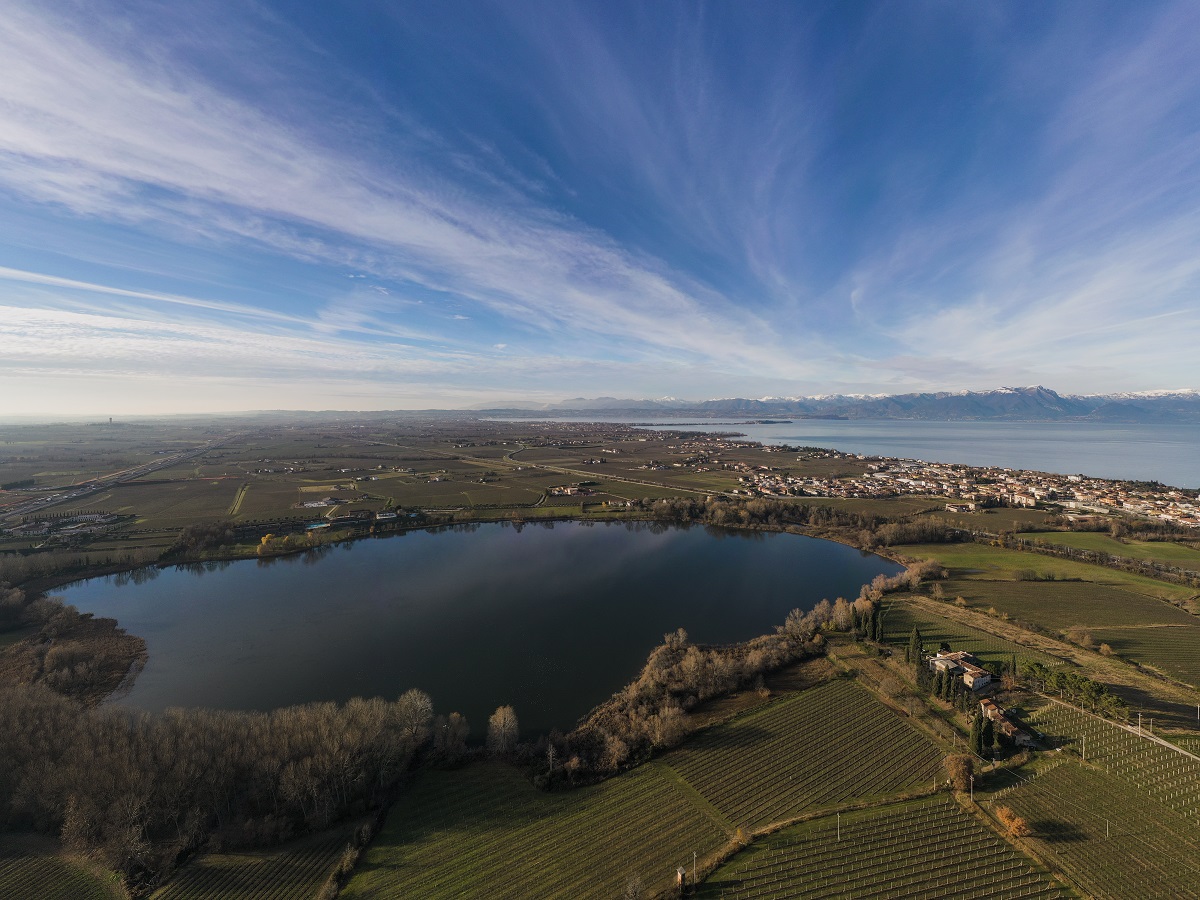
Source: Consorzio Tutela Lugana D.O.C

Source: Consorzio Tutela Lugana D.O.C
Lugana is one of the oldest designated wine-growing areas in Italy, after obtaining its DOC status in 1967, the first in Lombardy, with about 1,000 acres under the vines. Lugana is also one of the few unique DOCs in Italy, spanning two regions and two provinces – the province of Brescia in Lombardy and the province of Verona in Veneto. Most of Lugana’s 5,500 acres of vineyards are adjacent to Lake Garda, which creates a unique, mild microclimate, atypical for Northern Italy. Most of the wine produced in Lugana is white, made out of a local indigenous grape called Turbiana. For a long time, Turbiana was erroneously considered to be Trebbiano di Lugana, until DNA analyses had shown that Turbiana is its own, unique variety.
As in most of Italy, the history of winemaking in Lugana goes back to Roman times, with the wines from the area praised on multiple occasions throughout the times. Lugana managed to stay a best-kept secret for a long time in the 20th century, with its wines being best known to the tourists flocking to the picturesque villages surrounding the lake. Slowly, the quality of the wines prevailed and the wines became thought after around the world, in part due to their excellent aging ability. In 2018, there were 17.5 million bottles produced in Lugana, 70% of which were exported around the world, with the US being Lugana’s 4th largest market.

Source: Consorzio Tutela Lugana D.O.C
Sustainability is definitely a trend among the wineries in Lugana. The winemakers want to preserve their land, their farms, and their vineyards for many generations to come and do everything in their power to make this happen. I wanted to give you a first-hand account of sustainability and virtually sat down with the kind folks at 6 wineries, who answered the same group of questions. Grab a glass of wine (or two), and hear it for yourself.
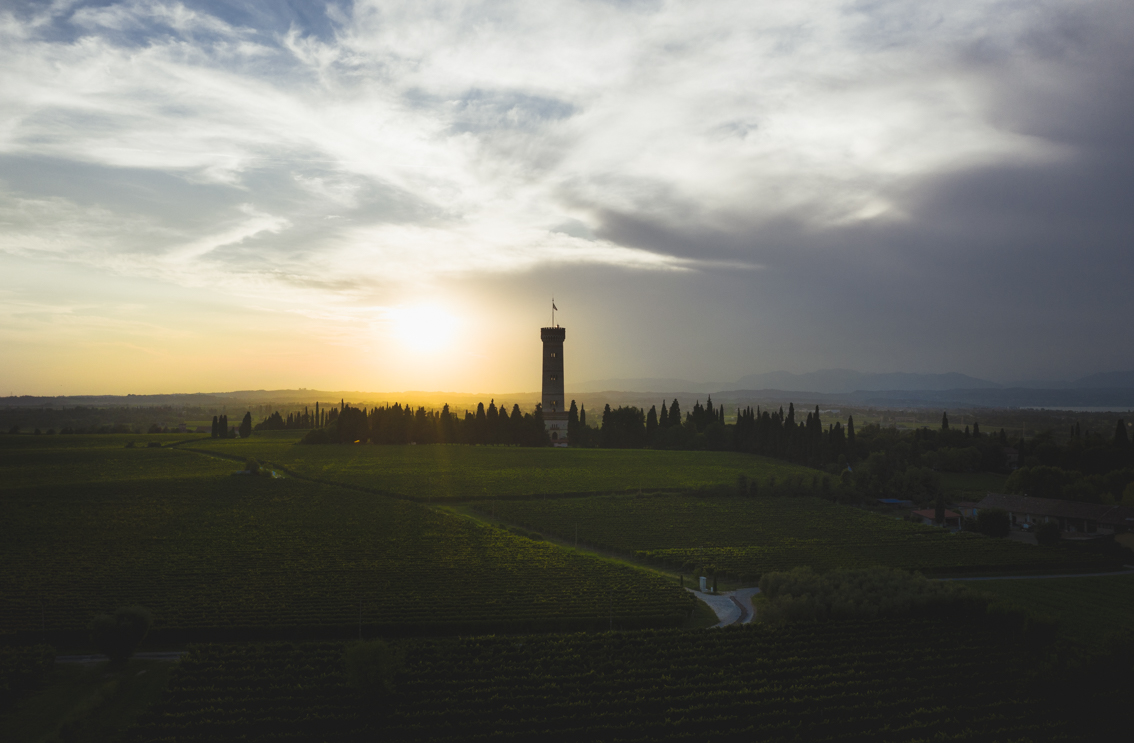
Source: CITARI
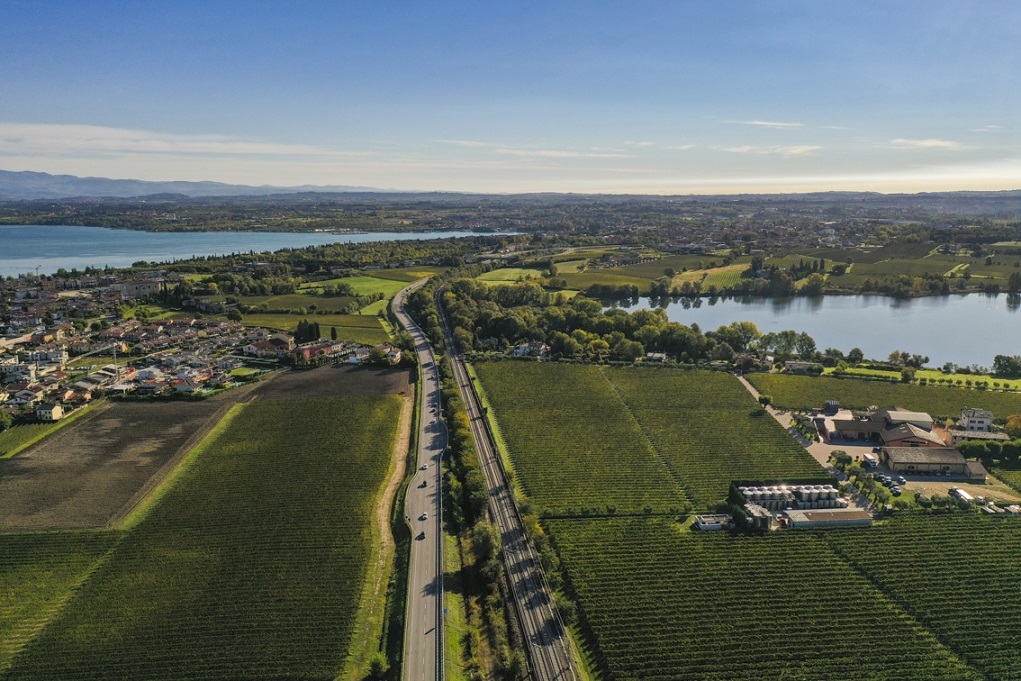
Source: CITARI
CITARI:
CITARI winery was founded in 1975, and today is farming about 90 acres of vineyards, producing about 300,000 bottles of wine annually. CITARI takes advantage of the close proximity of the winery to the vineyards, ensuring that the grapes are processed in the shortest time after the harvest, preserving aromatics and minimizing oxidative processes. CITARI had been recognized as a “Low Environmental Impact Farm” and won the “Verallia Ecofriendly Company” award over a number of years.
Here is our conversation:
– Why sustainability is important to you?
Wine producers, as farmers, are the guardians and keepers of a territory. Sustainability is necessary.
It also helps to obtain a superior quality product, and to maintain this high quality over time.
– How do you define sustainability for your winery, vineyards, and business?
Sustainability helps us to preserve the soil, the area, the quality.
– When did you start the conversion to sustainable viticulture and operations?
About 6 years ago
– How long did it take to achieve your goals?
We are still working on improving the best practices
– Was it worth it?
Of course!
– Would you do it again?
Yes, but better planning first all the costs, even in terms of time spent and bureaucracy.
– When did you achieve sustainability? Do you see a difference in the wines before you used sustainable viticulture and after?
The sustainable agricultural method we use (reductions of treatments and products used, regular controls on soil and plants) respects the soil, the plants and give us a healthier product. We do not have direct feedback from customers about it, but customers are increasing and they like our wines very much!
– What is next – organic, biodynamic, or are you happy with where you are right now?
We are thinking about adding green manure to preserve bees and other “good” insects.
– What advice would you offer to those who are starting a sustainability journey right now?
It is not easy, but it is necessary, be prepared!

Source: Consorzio Tutela Lugana D.O.C
Le Morette:
Azienda Agricola Valerio Zenato Le Morette was founded in 1955, and today farms about 75 acres of vineyards. Sustainability is at the core of operations at Le Morette, and here is how the winery describes this work: “In the vineyard, Le Morette Agricultural Company has chosen precise working methods aimed at a sustainable agriculture, favoring those natural processes that allow to preserve the “environmental resource”, with great attention to the use of water, favoring blooms and proliferation of numerous species of insects useful for the vineyard ecosystem, maintaining the biodiversity of flora and fauna.”
Here is what transpired in our conversation:
– Why sustainability is important to you?
To respect the environment is the key factor for us and means to deeply know every single aspect of it: sustainability, habitat and knowledge represents the focus to carry on a conscious development in the vineyard and in the winery. For us to produce “healthier wine” is a choice, not a constriction.
– How do you define sustainability for your winery, vineyards, and business?
To be Sustainable we follow the “Three E” rules:
1. ECONOMICS: Sustainable means to salvaguard the Companies’ income via the use of techniques with a low environmental impact and measures to avoid wasting water and other natural resources. Costs have to be affordable to be sustainable on a long term basis. Only when the winemaker is earning properly, he’s able to think and develop a proper Environmental and Social Sustainability.
2. ENVIRONMENT: Sustainable winegrowing conserves natural resources, improves air and water quality, and protects ecosystems and wildlife habitat. Sustainability is good for grapes and wine, as well: winegrowing requires in-depth attention to detail and continuous improvement resulting in high quality wine grapes and wine.
3. EQUITY (SOCIAL): Sustainable winegrowing promotes stewardship of natural and human resources, as per eg. supporting internships and education programs for young employees or carrying on healthcare classes and social charity events, contributing to our community culturally and socially.
– When did you start the conversion to sustainable viticulture and operations? How long did it take to achieve your goals?
We’ve always been following sustainable principles since 1960, when our business started with the first few hectares along the Frassino Lake bank in San Benedetto di Lugana, a natural protected site recognized by the European Community. We began as vinenursers and still we are after three generations. Our roots and knowledge of the indigenous variety Turbiana design our path.
– Was it worth it? Would you do it again?
Sure, when you have an inner green soul you have to stay stuck with it. It’s a heritage we’ve received from our grandfather Gino Zenato and is part of our identity. It’s inevitable to be in tune with Nature for us and we are proud to respect our environment every day with a set of concrete approaches and practices to preserve and improve this legacy.
– When did you achieve sustainability? Do you see a difference in the wines before you used sustainable viticulture and after? Do you think your regular customers can also tell the difference?
We received the official Biodiversity Certificate in 2020 from the WBA (World Biodiversity Association) but we’ve always applied sustainable principles since the beginning. We don’t have any difference, then: it belongs to our philosophy.
– What is next – organic, biodynamic, or are you happy with where you are right now?
Our next step is to improve and protect biodiversity in our ecosystem. We already do it but we want to do more, with the belief that a Biodiversity is the key choice for a healthier process whole based on sustainable principles.
– What advice would you offer to those who are starting a sustainability journey right now?
To set up some virtuous practices, essential to advocate biodiversity in the vineyard. Biodiversity is the first pillar for sustainability and whoever wants to start this journey, has to be conscious that being sustainable is not only an ideal choice, but a set of concrete actions that you have to put into practice on a daily basis.

Source: Consorzio Tutela Lugana D.O.C
Famiglia Olivini
Famiglia Olivini was founded in 1970, and today is farming 80 acres of vineyards. With the utmost focus on sustainability, Famiglia Olivini registered a brand called Agricoultura Regionata. In the words of the winery, “Agricoltura Ragionata identifies our working method during the entire vinification process: starting from the seed, soil, vine ending with bottled product. Our main goal is to act in a reasonable (ragionata) and thoughtful way, starting from the work we do in our fields, into the winery and then reflected with how our staff treats the product. We take all these actions in order to insure we avoid any invasive and harmful practices to agriculture (agricoltura).”
Here is what transpired in our conversation:
– Why sustainability is important to you?
Sustainability for us is not just a philosophy, a way of thinking and talk about our daily taking care of the land but is truly a way of working passed down for generations by our founder it is an approach that preserves the territory, the lands, and ultimately shows in all of our products
– How do you define sustainability for your winery, vineyards, and business?
Being sustainable is our working method starting from the seed, soil, vine ending with the bottled product and in every process of the business. The essence of sustainability for us on each of this aspect is ‘keep everything in balance’.
– When did you start the conversion to sustainable viticulture and operations? How long did it take to achieve your goals?
We have conceived our sustainable viticulture in our own registered brand which is Agricoltura Ragionata (Reasonable Agriculture). Before that, our vineyard were already sustainable certified. It did not take much because since ever our ‘best practices’ were naturally considered sustainable.
– Was it worth it? Would you do it again?
Even after the certification, we did not ‘spent’ any logo on the label. Talking about sustainability and Agricoltura Ragionata brand is part of our storytelling. But we have noticed that more and more people are interested to this and like to know that the wines they are drinking are coming from a sustainable viticulture
– When did you achieve sustainability? Do you see a difference in the wines before you used sustainable viticulture and after? Do you think your regular customers can also tell the difference?
Once again, for us the sustainable certification was not a ‘conversion’ but just a certification of our everyday practice in the field. So, we did not see any impact in the quality of the wine. We think people likes to know and be informed about sustainability but not really interested in looking for a difference in the products.
– What is next – organic, biodynamic, or are you happy with where you are right now?
For us it will be nice to make Agricoltura Ragionata a shared brand about sustainability, involving other producers in the use of this brand and practices
– What advice would you offer to those who are starting a sustainability journey right now?
Find your real way before finding a protocol. Sustainability can’t be just a set of rules, must be your way of thinking your land, winery, wines.

Source: Consorzio Tutela Lugana D.O.C
Marangona
Maragonia was founded in 1970, and today farming about 75 acres of land. Some of the vines are 50 years old. Today Marangona is an Organic Farm and uses cement tanks and amphorae in production.
Here is what transpired during our conversation:
– Why sustainability is important to you?
None of us have zero impact on the environment. We all have to do our best to minimize that impact. A careful farm has a big difference compared to a not careful one.
– How do you define sustainability for your winery, vineyards, and business?
Commit day by day to try to make the best decisions to make environment and profit coexist
– When did you start the conversion to sustainable viticulture and operations? How long did it take to achieve your goals?
My sister and I are the new management of the family business, since 2007. Initially in low environmental impact, since 2012 in organic conversion, since 2017 fully certified, both vineyards and cellar.
– Was it worth it? Would you do it again?
Of course,
– When did you achieve sustainability? Do you see a difference in the wines before you used sustainable viticulture and after? Do you think your regular customers can also tell the difference?
Unfortunately, I don’t believe that true sustainability can be achieved.
I believe more about limiting the impact to the minimum possible.
For me the difference is a lot.
For some customers too, for others nothing changes.
So there are no contraindications
– What is next – organic, biodynamic, or are you happy with where you are right now?
At the moment we are certified organic and from a bureaucratic point of view it suits us well, We don’t think we want to increase the amount of paper and documents.
I find the next step of the Biodynamics to be a very remote possibility in our production area. Not all areas and varieties are predisposed to such a strict philosophy.
So for now the goal is to continue learning new things about our vineyards to reduce the environmental impact to a minimum while keeping the qualitative objective we want to have very clear.
– What advice would you offer to those who are starting a sustainability journey right now?
Advice none.
Comparisons on how to deal with different problems certainly as often as possible.

Source: Consorzio Tutela Lugana D.O.C
Montonale
Motonale is the oldest winery we are discussing today, founded in 1911. The winery went through a turbulent history, starting from cleaning 3+ acres of land only with a shovel. In the 60s, the winery expanded to more than 150 acres, only to shrink to harvesting 10 rows in 1998. Two years later, a great-uncle got involved and that became a second birth for the winery. which is now solely focused on sustainability, using manual harvest and local indigenous yeast among many other things.
Here is our conversation:
– Why sustainability is important to you?
Sustainability is important to us because our wines are Mother Earth’s products. We owe her respect, because we do not have to think only about us, but also about the future generations.
– How do you define sustainability for your winery, vineyards, and business?
At Montonale, sustainability is understood as an all-round attitude, all aspects of the production chain are involved. I bring a very topical practical example, considering the critical issues we are experiencing in Europe in terms of energy: the roof of our cellar is entirely covered with photovoltaic panels and to make the most of them we concentrate consumption during the day. A winning choice, because once again this year we will close the winery’s energy consumption balance.
– When did you start the conversion to sustainable viticulture and operations? How long did it take to achieve your goals?
The conversion began 10 years ago with the fourth generation. Our main goal for the next 10 years is to reach a zero-carbon footprint.
– Was it worth it? Would you do it again?
It was obviously worth it and we would do it again. We must preserve our heritage which is connected to the Earth, to the weather and to the environment.
– When did you achieve sustainability? Do you see a difference in the wines before you used sustainable viticulture and after? Do you think your regular customers can also tell the difference?
We have seen and also perceived the difference in tasting our wines, since the process of their production was respectful to the environment where they were born.
– What is next – organic, biodynamic, or are you happy with where you are right now?
As previously mentioned, our main goal is to reach zero CO2 emissions.
– What advice would you offer to those who are starting a sustainability journey right now?
Do it before it is too late, there is no planet B.
Sguardi di Terra
Societa Agricola Sguardi di Terra is the youngest and smallest in our group, founded in 2015 and having around 17 acres under vine. From the moment the winery was formed, the focus was on sustainability and organic viticulture.
In lieu of Q&A, Sguardi di Terra offered the following sustainability information:
Our winery is organically certificated since we bought the vineyards in 2016. This also means that every year deducted audit bodies check that we respect the rules for organic viticulture and every year renew our certificate.
Our company does not have a cellar, we cooperate with Giovanni Pasini winery which is organic too and reflects our values. So we bring them our grapes and then we follow each step of vinification in their cellar.
The decision to buy organic vineyards wasn’t accidental. We truly believe in respect for the environment, by limiting the exploitation of natural resources and contributing to the preservation of biodiversity. Moreover, drinking organic wines is a way to prevent the accumulation of harmful residues in the body. Drinking organic wines = respecting nature + your body.
The advice that we would offer to those who are starting a sustainability journey right now is:
Believe in an ethical approach at every stage of the wine production chain. This is something you must feel inside, not because of the trend. Organic farming is not regarding only the present. It’s about the future too. We should choose organic farming to leave better soil for posterity than we have found.

Are you still here? This is definitely the longest post ever at Talk-a-Vino, and we didn’t even get yet to the wines.
I had an opportunity to try the wines from these 6 wineries (provided as samples), so here are my notes:
2021 Marangona Lugana DOC (12.5% ABV, organic grapes)
Brilliant straw pale
Beautiful, inviting, a touch of lemon, very fresh
Clean, crips, mellow and round. Mayer lemon, perfect acidity, delicious.
8, outstanding
2021 Famiglia Olivini Lugana DOC (13% ABV)
Straw pale, almost clear
A touch of honey, tropical fruit, lemon undertones
Clean, crisp, a hint of honey presence without the sweetness, round, delicious
8-
2021 Citari Conchiglia Lugana DOC (12.5% ABV)
Light straw pale, practically clear
Herbaceous nose, restrained
A hint of tropical fruit, good acidity, clean, refreshing, short to medium finish
8-
2021 Valerio Zenato Le Morette Mandolara Lugana DOC (12.5% ABV)
Straw pale
Hint of Whitestone fruit, very restrained
Peach, herbal undertones, round, plump. Short finish.
8-
2021 Sguardi di Terra Scapüscia Lugana DOC (13% ABV)
Very light golden
Complex nose, honey, spices, open and inviting
A touch of honey, herbs, freshly cut grass.
8-
2021 Montonale Montunal Lugana DOC (13.5% ABV)
Straw pale
Complex, Whitestone fruit, precise
white stone fruit, a touch of honey, good acidity, round, fresh, plump
8, excellent
Here you are, my friends – the story of sustainable viticulture in Lugana.
Hey, and there is more!
Starting on November 7th, Destination Lugana will be celebrated in New York City:
Destination Lugana is a full week of celebration of Lugana DOC wines, during which 28 producers will offer their latest vintages to 13 restaurants in Manhattan. Each location will create a special menu to enhance the qualities and main characteristics of these wines. The project is made possible by the Consorzio Tutela Lugana D.O.C, which has been monitoring, defending, and promoting Lugana D.O.C. wines since 1990.
You will find more information at the official website: https://www.destinationlugana.com/, Here you will also find the list of 13 restaurants in Manhattan that will create special menus.
And we are done. Now it is your chance to discover the beautiful wines of Lugana. Cheers!
One on One with Winemaker – Maya Hood White of Early Mountain Vineyards, Virginia
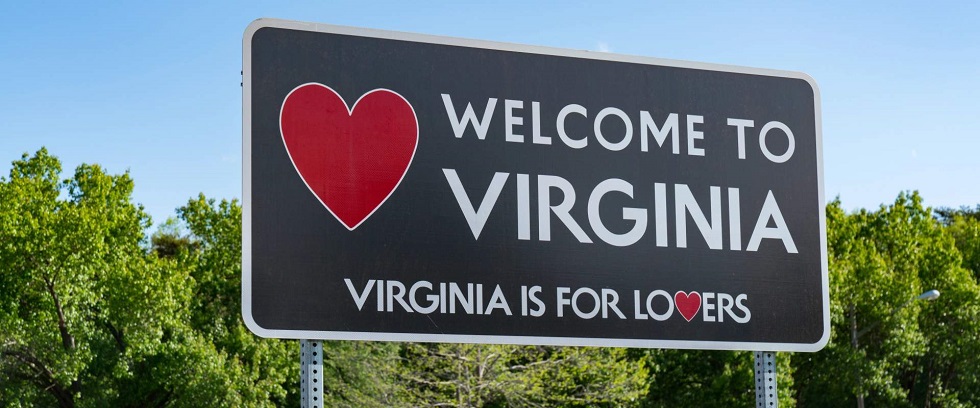
Source: Virginia.org.
Virginia Is For Lovers.
This simple slogan, coined in 1969, became the foundation of one of the best marketing campaigns of all time. It is simple, it gets stuck in your head and once you hear “Virginia” the image of a red heart with the words “Virginia is for Lovers” automatically pops up in your mind.
Virginia is for lovers, but what many people might not realize, Virginia is for Wine Lovers. Virginia is probably the oldest wine-producing state in the USA, where Thomas Jefferson planted vineyards in the last quarter of the 17th Century, way before any wineries were established in New York and California. Virginia’s climate is one of the closest to Bordeaux out of all wine-producing states in the USA. But if you don’t live in Virginia or close by, you might not even know that Virginia produces world-class wines. But Virginia actually does, and we need to rectify this gap in your knowledge, one winery at a time.
Early Mountain is a relatively young winery, founded only 10 years ago, in 2012. However, it was founded by Steve and Jean Case – founders of AOL, the legendary early days Internet provider for millions of Americans. Early Mountain was founded with the vision and mission of representing and promoting the Virginia wine industry. In the Early Mountain tasting room, you can order Best of Virginia wine flights and taste the wines from the 10 vineyards around Virginia – of course, in addition to the full range of wines Early Mountain produces.
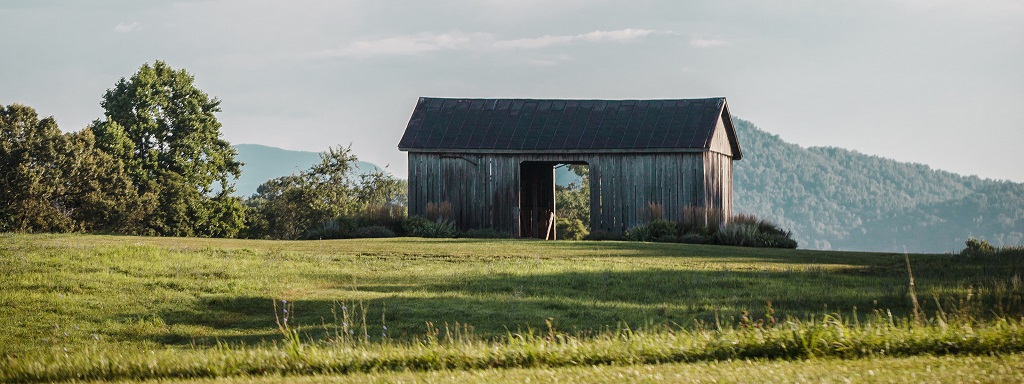
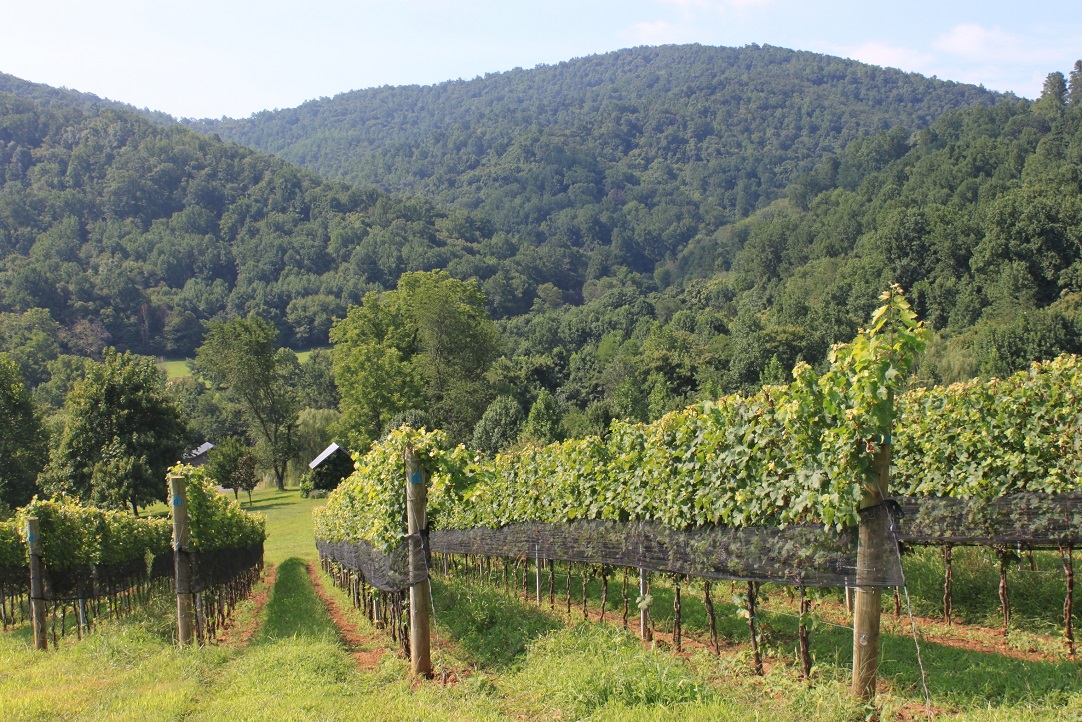
The original Early Mountain vineyard which gives the name to the winery was planted in 2006; the Quaker Run vineyard, the second major holding of Early Mountain was planted in 1999. Early Mountain farms about 350 acres of land, out of which 55 are planted under vines. The estate-produced fruit is also complemented by the fruit coming from the local Virginia growers, in an approximately 50/50 ratio.
I had an opportunity to speak with Maya Hood White, Early Mountain’s winemaker over a zoom session, and taste Early Mountain wines. As this was a live interview, below you will find pretty much a transcript of our conversation, not a detailed account that I manage to provide using an email interview format. I still hope you will get enough information, and most importantly, will be curious enough to go and find Early Mountain wines.
Why Early Mountain?
– The name relates to John Early, a historical figure who lived in Virginia in the second half of the 17th century. There is also a historic building on the property that relates to John Early.
What are those curved lines on your wine label?
– It is a topographic map. The lines represent the true topography of the land surrounding the winery.
What does the logo mean?
– These are letters E and M 🙂 (my reaction – duh…)
What is the meaning of the pointer arrow?
– Again, it is a map attribute, a locational arrow.


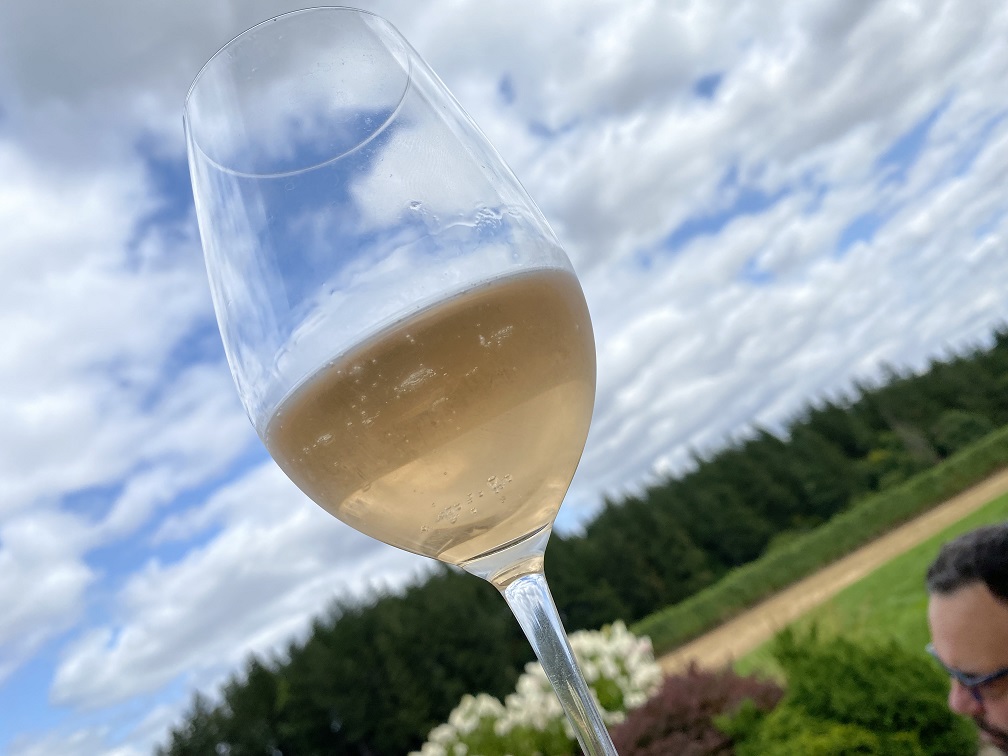
At this point, we poured our first glass, 2021 Early Mountain Rosé Virginia (11.3% ABV, $26, 72% Merlot, 10% Malbec, 9% Cabernet Franc, 6% Cabernet Franc, 3% Syrah) – Early Mountain site fruit is used to produce this wine. Grapes for Rosé are harvested earlier than the grapes for the red wines. Depending on the year some grapes are co-fermented. Mostly stainless steel but some Acacia barrels were used as well. The wine was beautiful, salmon pink color, leading with strawberries, cranberries, and cleansing acidity. Very present, balanced, and refreshing.
Speaking with the winemaker always offers us, mere mortal oenophiles, a chance to geek out and learn. When you hear about clones, the first thought is always Pinot Noir, maybe a Chardonnay. Maya works with clones of Sauvignon Blanc, and those clones produce dramatically different wines. She also works a lot with and was speaking fondly of Petite Manseng, the grape best known in Southwest France. Petite Manseng is producing excellent wines in Virginia, and it makes one of the flagship wines at Early Mountain. Petite Manseng grapes grow in such tight clusters that Maya prefers to harvest them after the rain, it helps to process the grapes better.
I asked Maya about Viognier, which is considered to be a star in Virginia. First, I learned an interesting fact from her: Viognier looks like a white grape version of Syrah – the same format of clusters, the same shape of leaves – I guess it is not surprising that Viognier is often used in winemaking to play together with Syrah. It appears that Viognier was growing before at Early Mountain, and it was pulled out and replaced – Viognier is a problematic grape that ripens irregularly and sometimes doesn’t ripen at all. It is definitely preferred to work with more reliable grapes.
We continued our tasting with 2021 Early Mountain Five Forks Virginia (12.9% ABV, $27, Petit Manseng 59%, Sauvignon Blanc 38%, Malvasia Blanca 2%, Muscat 1%) – rich and inviting white fruit nose, followed by a crisp, clean, playful bouquet on the palate. I loved the plumpness, roundness of the wine, reminding me of my favorite Roussanne bottles. The wine was perfect cold, and it was very tasty at room temperature – this is my standard hallmark test of good white wine – good white wine is delicious cold or not.
And then there was time to ask more questions:
What is your winemaking philosophy?
– Maya oversees grape growing as well as production. Listening to the vineyard – not set on what should be produced from the specific lot. Sites are closely watched for what they can do best – vines can be pulled and replaced.
What does the line of Young Wines represent?
– Approachable, low-intervention, fruit is sourced from the growers in the Shenandoah Valley. Wines are often made using a whole cluster approach. Also, the wines in the Young Wines line appeal more to younger wine drinkers.
Where do you stand on sustainability/organic?
– The low-touch approach, use biodynamic teas, certain blocks are processed only in an “organic” way. The holistic approach to the overall vine growing – over cropping, etc. low touch is a key.
What is your take on biodynamics?
– There is a lot to learn. Compost teas, herbal teas, oak bark – many things work, but the approach is more “what makes sense” than religious.
What winemaking vessels do you use? Oak barrels, amphorae, concrete tanks, stainless steel?
– I gravitate towards bigger casks; we have concrete egg, which is used primarily for whites. We also work with Northern European oak, Acacia wood


Next, we had two Cabernet Franc wines. Cabernet Franc is one of my favorite grapes and a staple of Virginia winemaking, so I was definitely looking forward to trying the wines.
We started with 2020 Early Mountain Cabernet Franc Shenandoah Valley Virginia (13.3% ABV, $30) – pulled from different sites in Shenandoah Valley. Uses larger size barrels, 500 liters or larger, Northern European oak barrels. 2020 was a rainy vintage, and the wine was rather on the mellow side. When I tried the wine during our zoom session, I was not terribly impressed. While the wine had all the traits of Cabernet Franc – cassis, bell pepper – it was a bit underwhelming. The next day, the wine really came around offering a lot more depth and structure.
My second Cabernet Franc was supposed to be a 2019 Cabernet Franc Quaker Run Vineyard, which Maya was absolutely raving about, defining the 2019 vintage as an epiphany. However, the bottle I got was the 2018 Early Mountain Cabernet Franc Quaker Run Vineyard Virginia (12.5% ABV, $45). 2018 was a very challenging vintage – too much rain, even the road was washed away. I never thought of Cabernet Franc in terms of clones, but it appears that this wine was composed of 2 different clones with different aromatics. Despite the vintage challenges (or maybe thanks to? :)) the wine was superb from the getgo – a good amount of dark fruit, good structure, cassis, eucalyptus, herbal underpinning – this Cabernet Franc was more expressive than a typical Chinon or Saumur, but less fruity than a typical west coast Cabernet Franc. Delicious.
Another interesting note from Maya – there is completely anecdotal evidence that in Virginia, even vintages are lean, and odd vintages give you bigger wines. I will need to pay attention next time I will be drinking Virginia wine, to see if this observation would hold true.
And a few more questions to complete our conversation.
How is the harvest in 2022? What to expect?
– Ha! Harvest is still ongoing, 10 days to 2 weeks later than last year, and some of the white grapes are still on the vine. Rain showers got in the way. Reds have another month. Hard to tell yet. There was a got fruit set, some fruit was dropped, so it is too early to tell.
What’s ahead? Single block wines? New varieties?
– New hybrids are coming from Italy – Merlot Kanthus, Sauvignon Rytos, VCR Tocai, The new grapes will account for about 1%. Will be planted in 2023. These new hybrids are important as they are disease resistant, and with grape diseases, the question is not if, but when. There will be also a new wine made from Petite Manseng which was planted instead of Cabernet Sauvignon.
That concluded our conversation with Maya, the time flew by very quickly.
If you are familiar with Virginia wines already, the Early Mountain can offer an excellent refresher course. And if you are not – what are you waiting for? Virginia wine has lots to offer, start your journey already.
Passion and Pinot Updates: Bells Up Winery
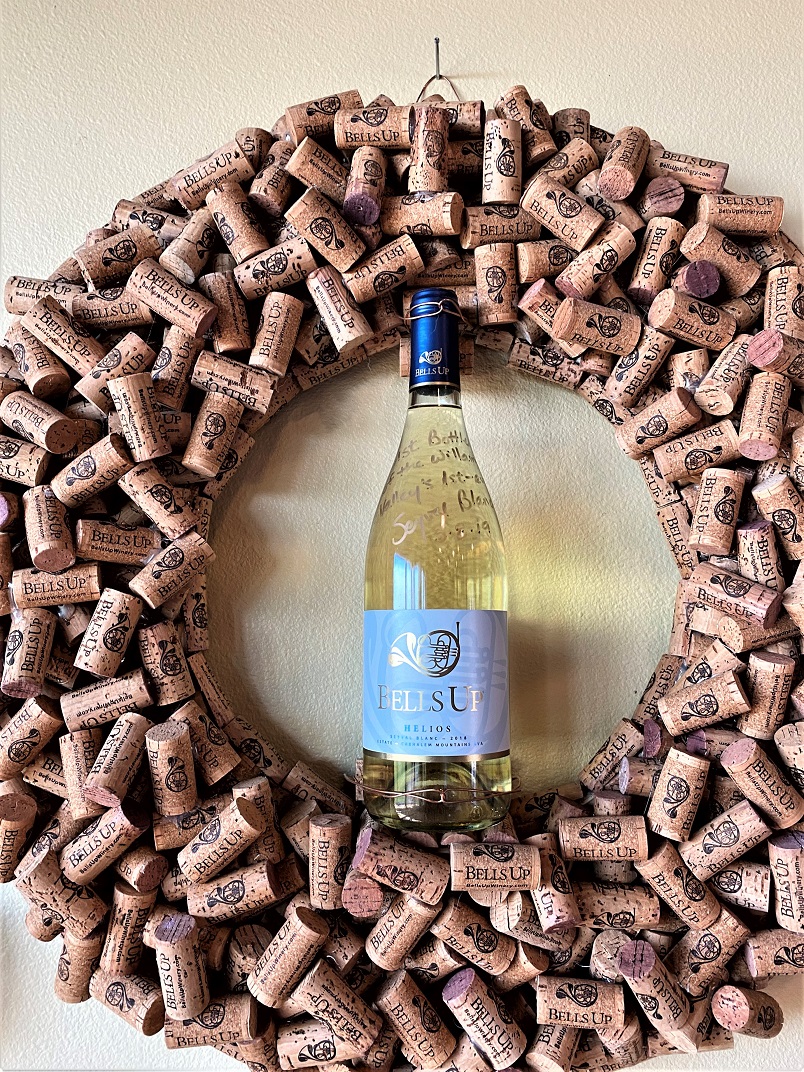 And then we arrived at “micro-boutique, un-domaine” Bells Up Winery, our final stop of the Oregon wine country touring.
Out of 13 wineries profiled in the Stories of Passion and Pinot series, Bells Up is the youngest one, having been founded in 2013, with the first vineyard plantings of Pinot Noir going into the ground in 2014. Despite being a young winery, Dave (the winemaker) and Sara (the Boss) Specter have a clear vision as to where they are going with their distinctly un-domaine wine – if you are curious why I keep saying “un-domaine”, I would like to direct you to the (virtual) interview I did with Dave in 2019 – he explains the concept of un-domaine very well.
Everything is distinctly un-domaine (see, you need to read that interview) at Bells Up. The vineyard with a gentle slope, the winery right in the middle of the vineyard, a simple but elegantly appointed tasting room with lots of fresh flowers and beautiful views of the vineyards. Here you go – pictures, pictures, pictures:
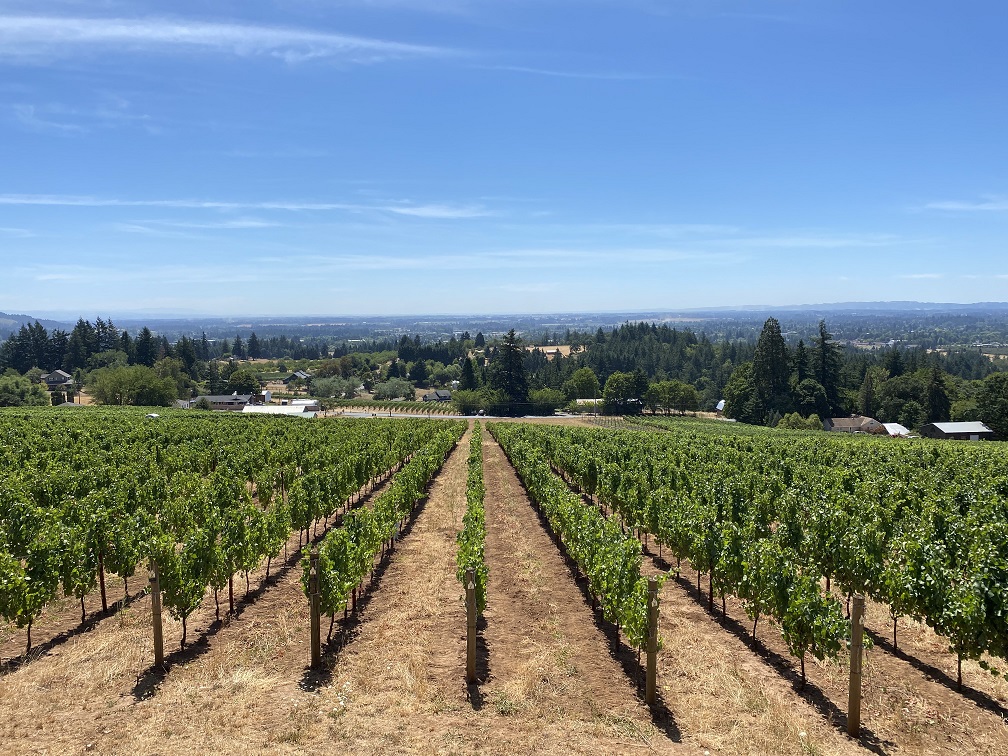


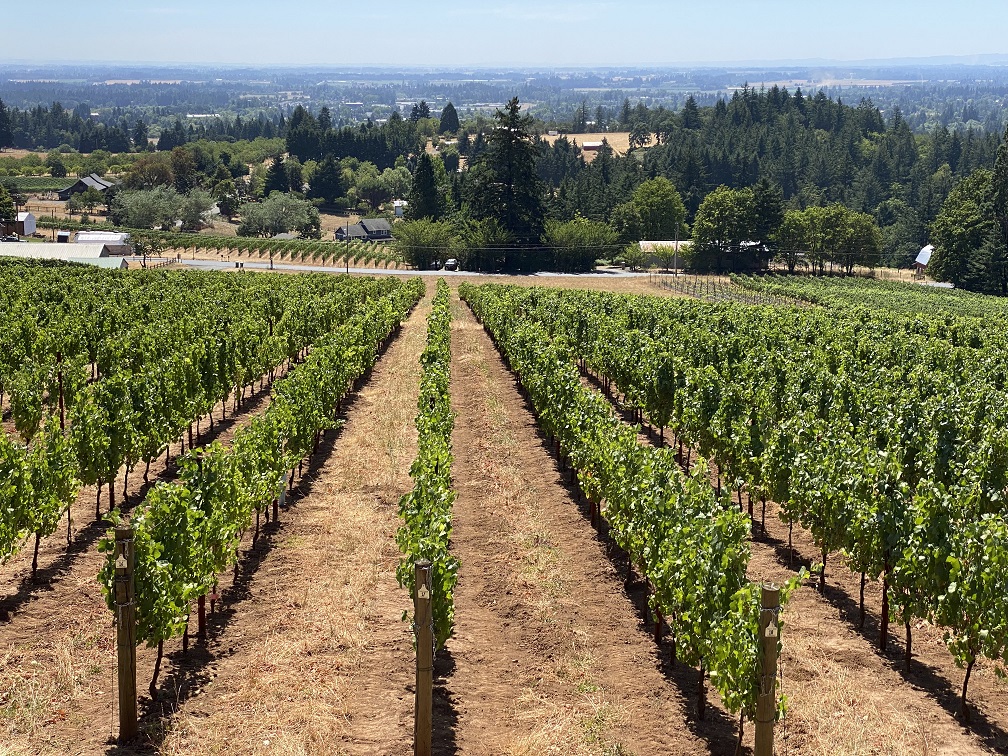
After admiring all the views we proceeded with lunch and tasting. Our lunch was prepared by Sara and while it was somewhat of a simplistic summer chicken salad, the amazing part was that this salad perfectly paired with the majority of wines we tasted – if you ever tried pairing the salad with wine, you would have to agree that achieving great pairing is very far from easy.
As I mentioned, Dave and Sara have a clear vision of the future direction for Bells Up. While Bells Up estate vineyard will be mostly planted with Pinot Noir, and by 2022 Bells Up plans to be at 100% estate fruit for all Pinot Noir bottlings, they have a clear plan for making Bells Up unique and different – growing and producing Pinot Blanc instead of the more commonly available Pinot Gris; being first in Willamette Valley with Seyval Blanc plantings; planting (out of all grapes!) a little known Italian grape Scioppettino; already offering Syrah and adding Cabernet Sauvignon in the 2020 vintage. “Unique and different” is a good description, in my opinion.
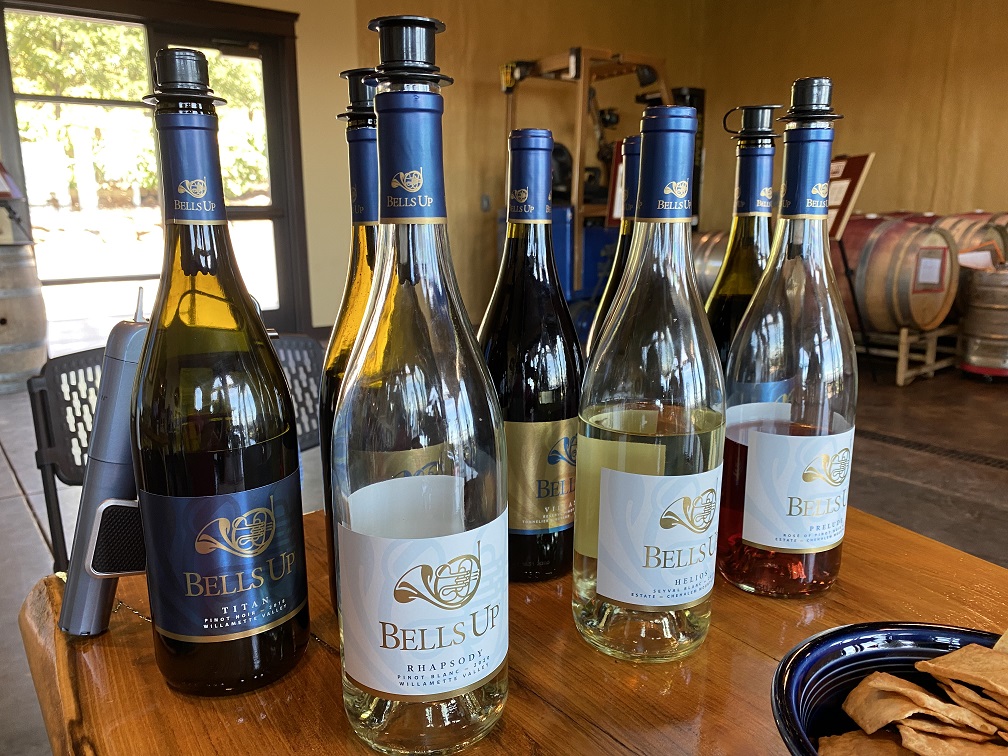


Before we talk about wines I would like to mention that none of the wine names you will see below are random. All the names have connections to the classical music pieces under the same name, and every choice of the name has an explanation as to why the particular piece was selected to connect with a given wine. If you are interested, there is even a Spotify playlist that includes all of the relevant music pieces – you can find that list directly on the Bells Up Our Wines page.
We started our tasting with Pinot Blanc:
2020 Bells Up Rhapsody Pinot Blanc Willamette Valley ($32)
Great complexity, lemon, gunflint
Great acidity, lemon, clean, crisp, refreshing
Perfect pairing with summer chicken salad
8, Excellent
We almost had to beg Dave to let us Seyval Blanc which was practically sold out. As a curiously interesting fact, Seyval Blanc plantings had to be protected by the net, as it happened that birds loved the grapes too.
2020 Bells Up Helios Seyval Blanc Estate Chehalem Mountains AVA ($40)
Gunflint, minerality,
Clean fruit, Meyer lemon, good acidity, good creaminess
Great with summer chicken salad.
8
Next up was Pinot Noir Rosé, the first Pinot Noir wine entirely produced from the estate fruit:
2020 Bells Up Prelude Pinot Noir Rosé Estate Chehalem Mountains AVA ($28)
Strawberries, nice minerality
Strawberries, bigger body than Provence, good acidity, perfect balance.
8-
We followed up with the selection of Bells Up Pinot Noir wines:
2018 Bells Up Titan Pinot Noir Willamette Valley ($44)
Plums, violets, sandalwood
Crisp, clean, crunchy cranberry profile, a hint of cranberries, good acidity on the finish.
8-
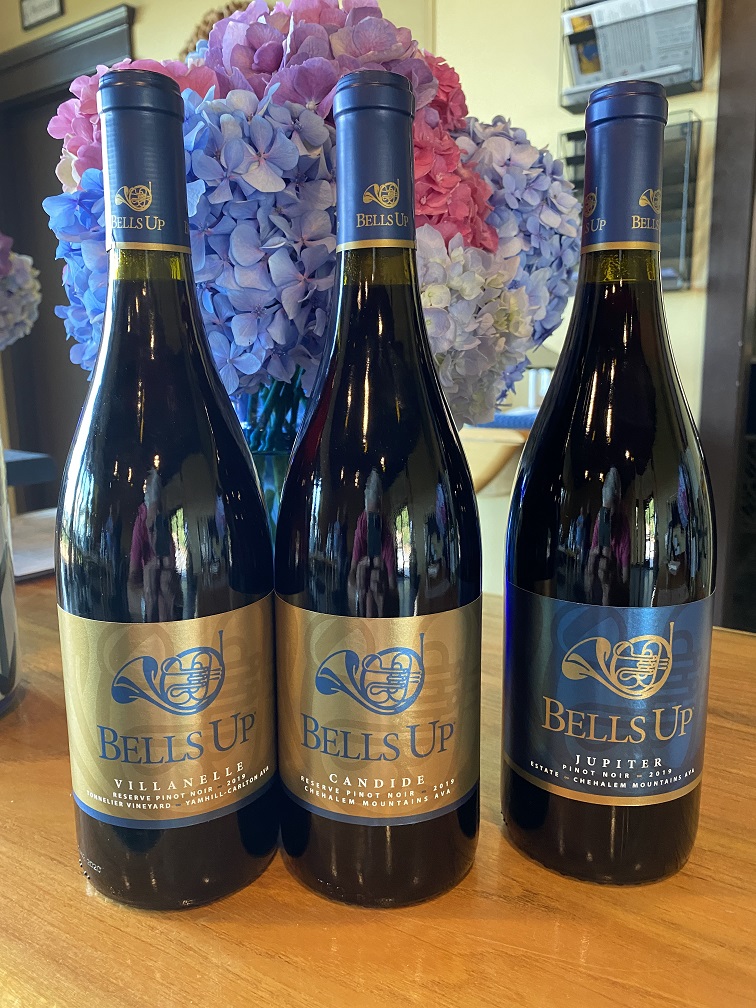
2019 Bells Up Candide Pinot Noir Reserve Chehalem Mountains AVA ($54, 12 months in French oak)
Floral, nutmeg, warm spices
Cherries, cut through acidity, black pepper, perfect balance, delicious
8
2019 Bells Up Villanelle Pinot Noire Reserve Tonnelier Vineyard Yamhill-Carlton AVA ($58, 12 months in French oak, final vintage)
Blackberry/raspberry, Marionberry
Cassis leaves, light crunchy cherries, well-integrated tannins, good acidity on the finish, delicious.
8
2019 Bells Up Jupiter Estate Pinot Noir Chehalem Mountains AVA ($48, 12 months in French Oak)
Underbrush, summer forest, cherries, a touch of tobacco
Crunchy cherries, clean, fresh, delicious
8
While this is not a video, here is Dave talking about Bells Up wines:
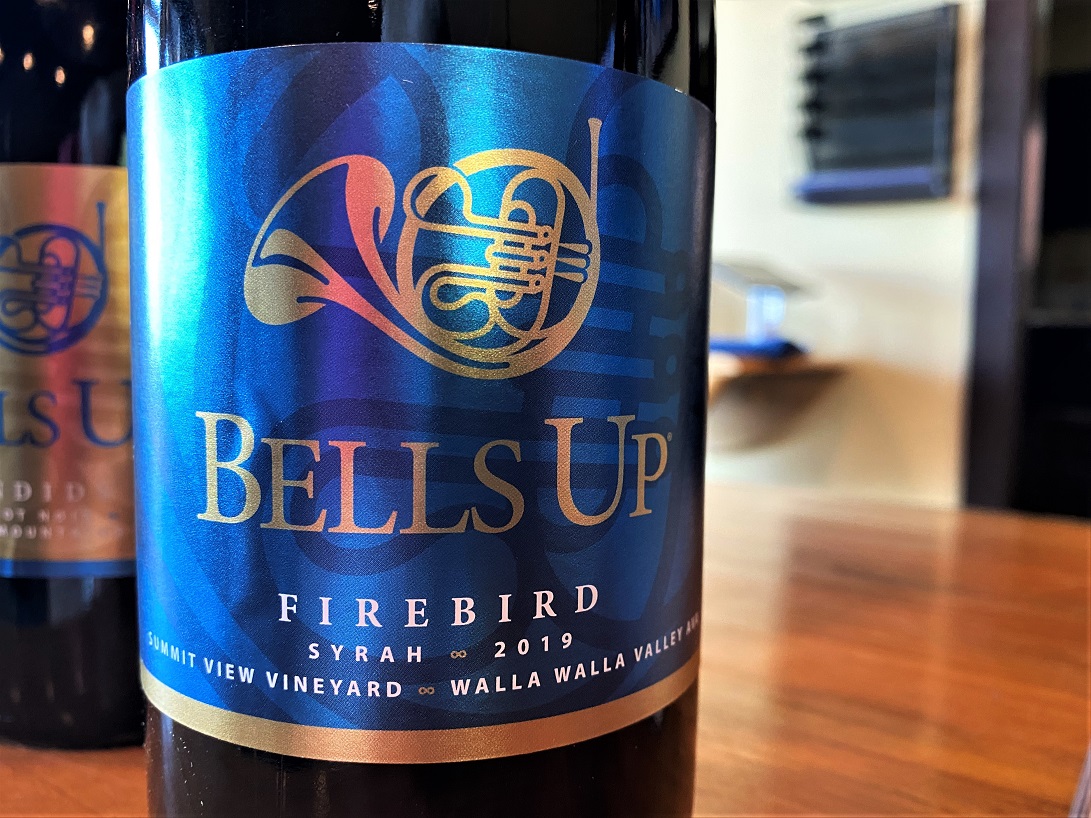
Bells Up Syrah was served with an amazing seedless grape pie. As Sara explained, everyone gives wines as presents in Willamette Valley, but tasty grape pie is almost equivalent to the hard currency when exchanging gifts with neighbors. As I said, the pie was superb, and to think that sweet pie would pair with Walla Walla Syrah? I really wouldn’t – and I would be mistaken.
2019 Bells Up Firebird Syrah Summit View Vineyard Walla Walla Valley AVA ($52, 12 months in French oak)
Blueberries and blackberries on the nose
Berries all the way, nicely balanced
8, Amazing pairing with seedless grape pie with cardamom
Again, we almost had to twist Dave’s arm to let us taste the future release of Cabernet Sauvignon:
2020 Bells Up New World Cabernet Sauvignon Reserve Summit View Vineyard Walla Walla Valley AVA ($68, 12 months in French oak, barrel sample)
A hint of green bell pepper
Cassis, a hint of black pepper on the finish, good, round, smoky undertones.
8-
Here you have the summary of our “un-domaine” experience – an excellent set of wines and super-friendly hosts. If you will find yourself touring Willamette Valley, add Bells Up winery to your “must visit” list.
This is the last update in the Passion and Pinot series. For now, that is.
Until next time…
This post is a part of the Stories of Passion and Pinot series – click the link for more stories…
Passion and Pinot Updates: Utopia Vineyard
 And then we arrived in Utopia.
When your destination is called Utopia Vineyard, poking some fun is irresistible, isn’t it?
Upon our arrival to Utopia Vineyard in Ribbon Ridge AVA, we were warmly greeted by Dan Warnshuis, proprietor and winemaker, who poured us a glass of Utopia Pinot Noir Blanc (yep, a white wine made out of Pinot Noir) and took us on the tour of the vineyard, glass in hand. After speaking with Dan virtually about a year ago, it was definitely a pleasure to shake hands and move from the virtual to the real world where things can be touched and smelled.
Utopia Vineyard looks different from Le Cadeau and Lenné – no fighting with the rocks here. Gentle slope elevation of only 20 feet from top to bottom makes it easier to tend for grapes. Utopia Vineyard is farmed using Sustainable Organic practices and was L.I.V.E. certified in 2008. Dan practices dry farming and uses cover crops every second row – in normal conditions though. Summer 2021 was so dry and hot that by the second week in August when we visited, all of the cover crops were removed so it will not compete with vines for access to water. The grapes looked perfectly healthy and beautiful despite the hot weather – you can see it for yourself in the pictures below.


I don’t know how the actual utopia should look like, but I find these vineyard views pretty compelling:

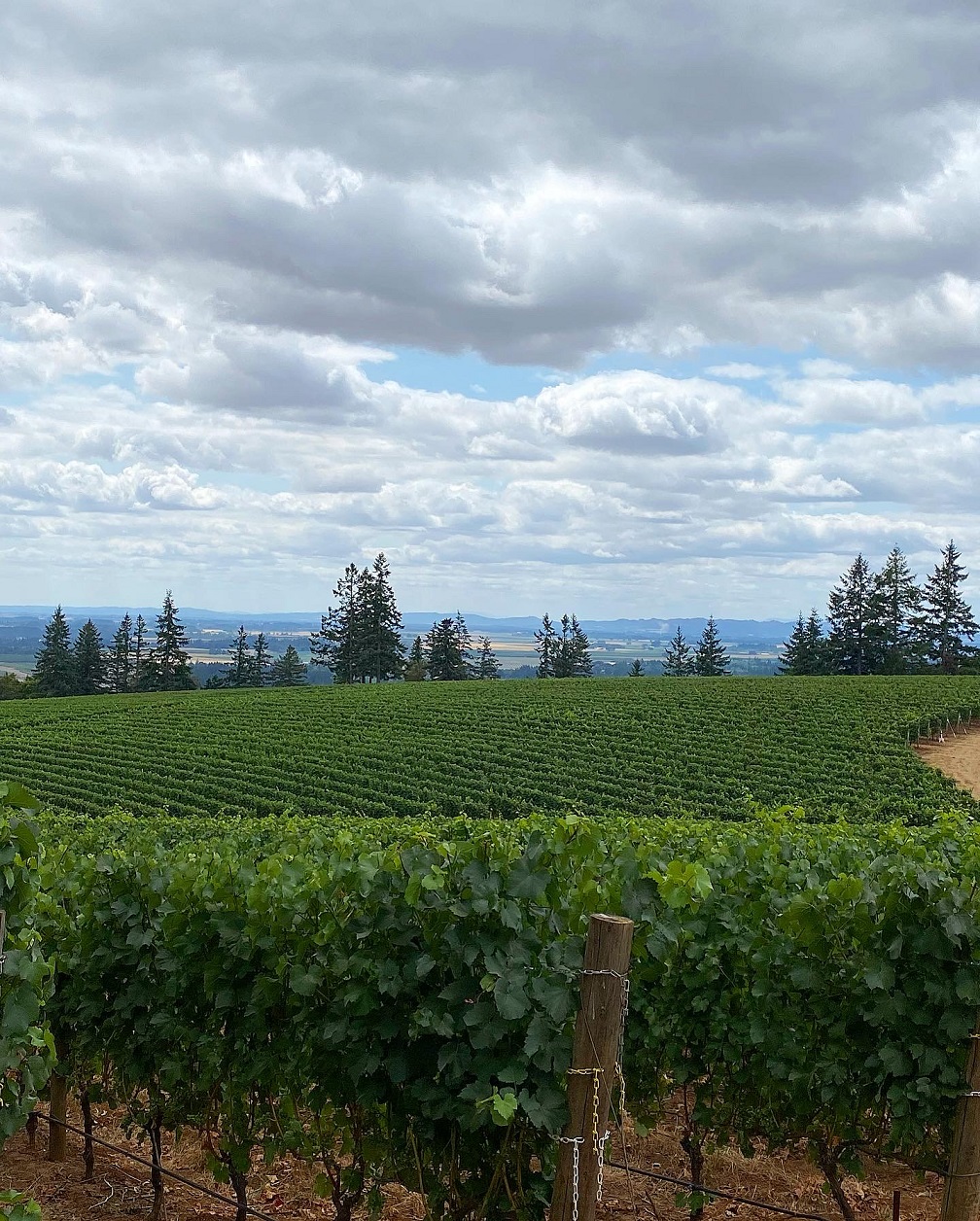
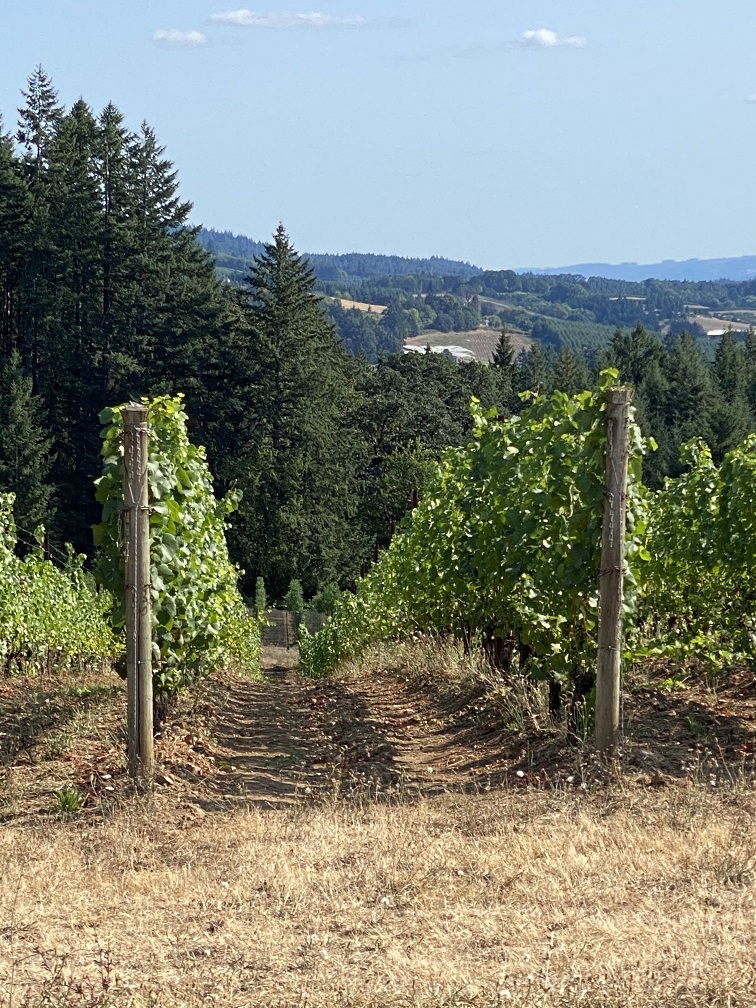
There are 12 clones of Pinot Noir growing at Utopia Vineyard – one of the wines we tasted was made out of all 12 clones. There are also 3 clones of Chardonnay growing there, planted in 2010. Talking about “fashionable wines”, Utopia Vineyard doesn’t produce sparkling wines, but Dan makes Pinot Noir Blanc, a white wine from the red grapes, which we tasted upon arrival, and also had the pleasure of tasting it directly from the barrel (all notes below).
In 2018, Dan acquired additional 35 acres of land not far from Utopia Vineyard’s original location. That parcel of land also had a 5,500 sq. ft building which by the time of our arrival 3 years after the acquisition was fully converted into a state-of-the-art winery. We stopped by the winery a few times during our visit, and what was the most mind-boggling to me was that Dan was pretty much operating everything at the winery just by himself – moving barrels, emptying tanks, and so on. His son-in-law comes to help during the harvest, but otherwise, Dan is a one-man operation.
This additional property also hosts a freshly constructed log cabin which is called exactly that – Utopia Vineyard Log Cabin, which offers beautiful accommodations and spectacular views:
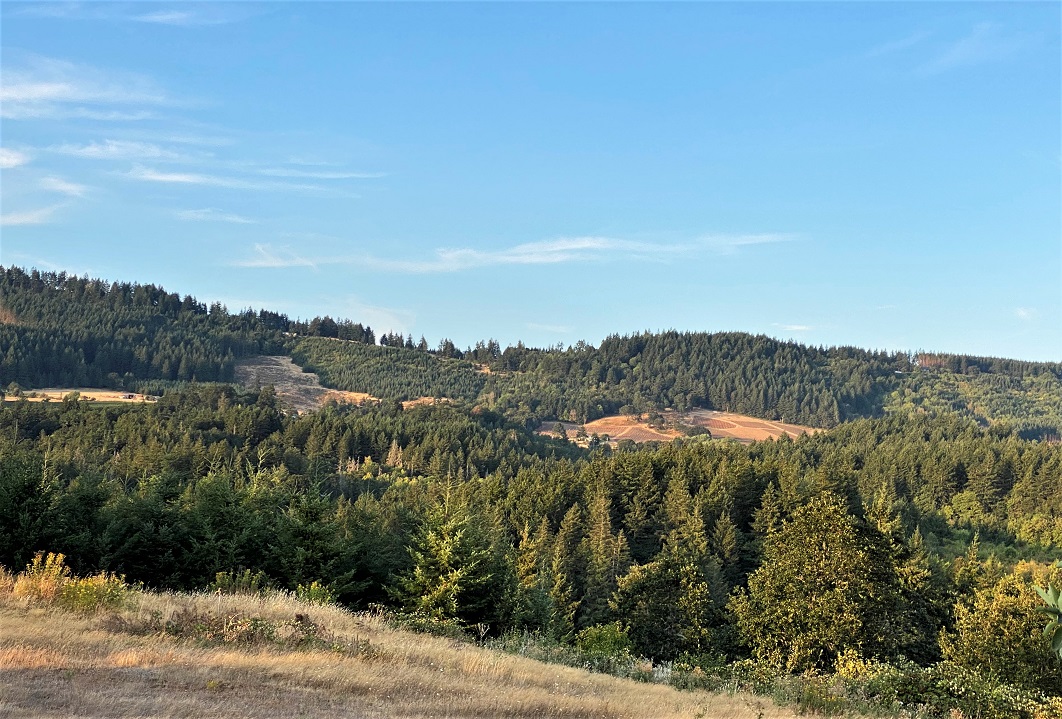
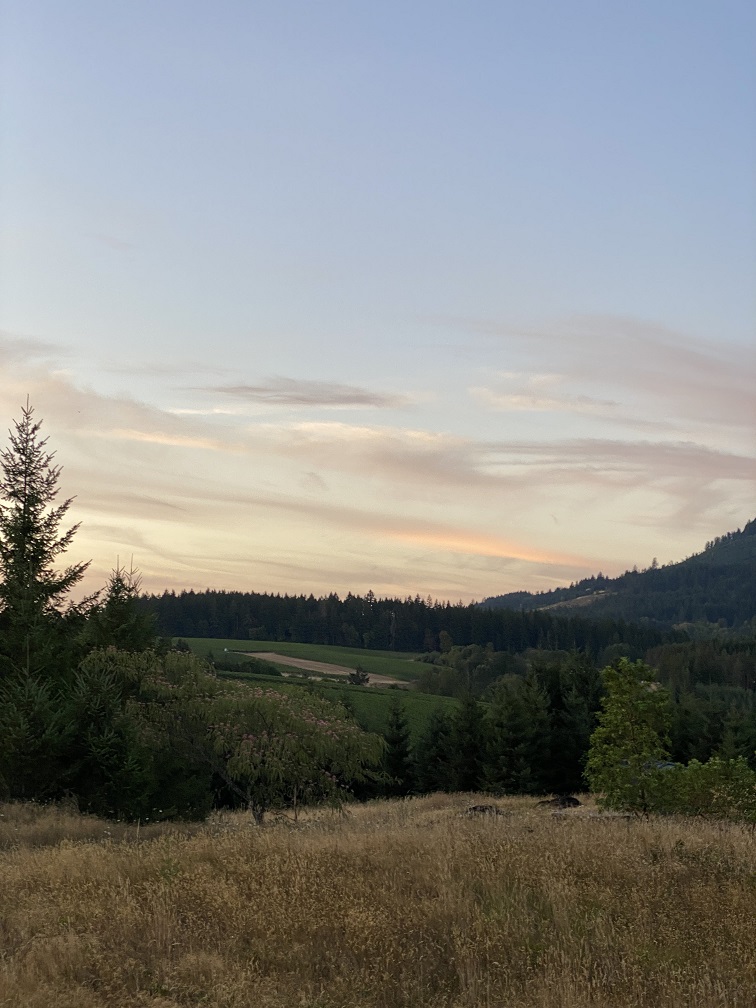
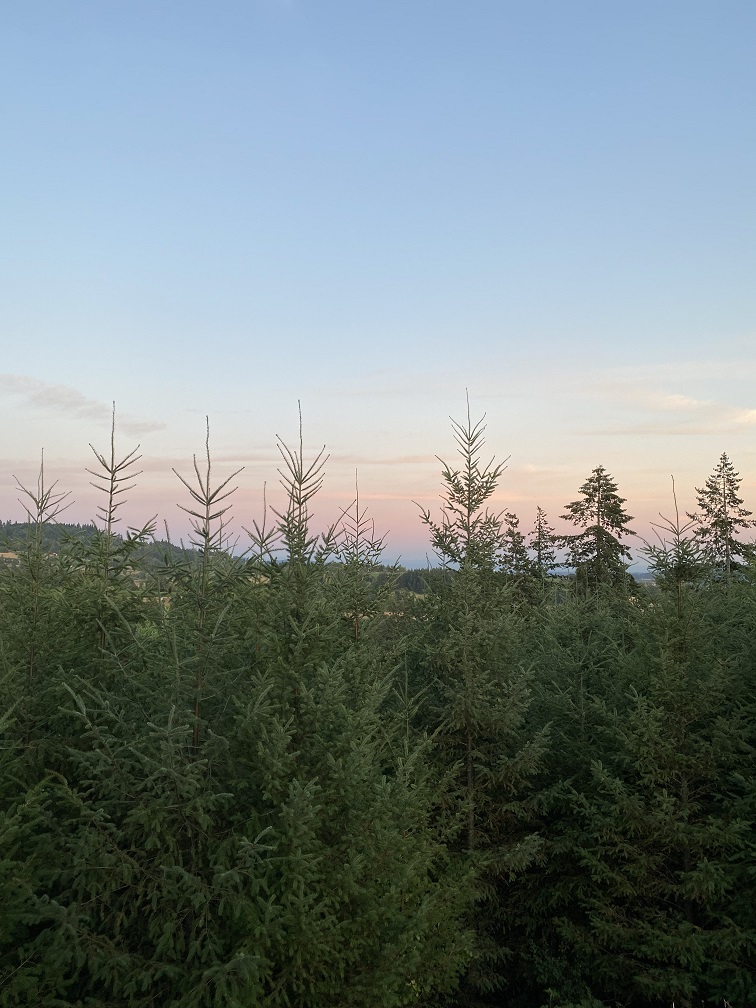

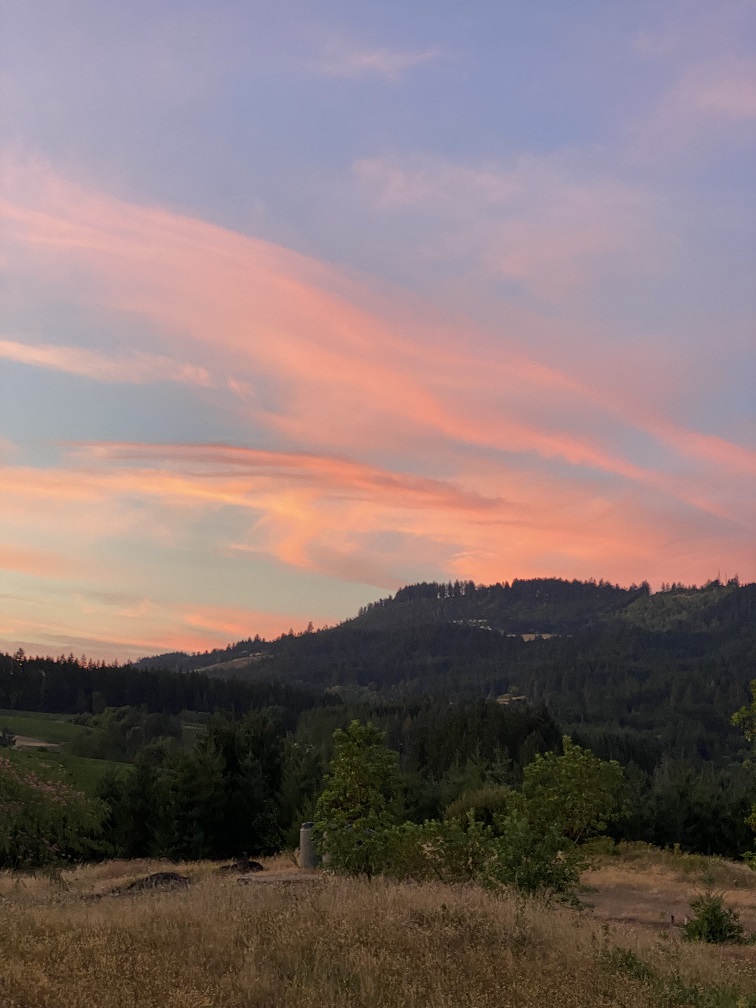
We visited Utopia Vineyard over two evenings and had some delicious food and tasted through a substantial range of Utopia Vineyard wines. I also learned about an interesting berry I never heard of before – Marionberry, which is a type of blackberry, which we tasted in the form of delicious pie – I wish this is something I can find here on the East coast. Marionberry takes its name from Marion County in Oregon, where it was selected in 1956 as a cross between Chehalem and Olallie blackberries.
Time to talk about wines – here are my notes:


2018 Utopia Bliss Pinot Noir Blanc Ribbon Ridge AVA ($45)
The nose of the buckwheat, yellow plums
Plums on the palate, good balance, good acidity, asks for food
8-


2015 Utopia Vineyard Chardonnay Estate Ribbon Ridge AVA ($45)
Nice, delicate, a hint of vanilla
A touch of vanilla, Golden delicious apples, good acidity
7+/8-
I mentioned before that we had an opportunity to taste some wines directly from the barrel.
2020 Chardonnay was outstanding, fresh apples and lemon, clean acidity, perfectly clean, vibrant, and balanced. If I would have an opportunity, I would drink this wine just like that.
2020 Pinot Noir Blanc from the barrel was even more exciting – a touch of toasted bread, a touch of fresh fruit, perfect minerality, vibrant, clean, full of energy. Again, I would love to drink this wine just like that.


2015 Utopia Vineyard Estate Pinot Noir Ribbon Ridge AVA ($55) – all 12 clones are used
Plums, cherries, a touch of iodine
Clean, crisp, plums, cherries and cranberries, good acidity
8, excellent
2014 Utopia Vineyard Estate Pinot Noir Ribbon Ridge AVA ($55)
A touch of sapidity, mushrooms,
Plums, round, soft, clean
8-


2013 Utopia Vineyard Estate Pinot Noir Ribbon Ridge AVA ($55)
Mushrooms, forest floor, underbrush
Earthy, restrained, plums, clean, round
8-
2017 Utopia Vineyard Estate Pinot Noir Ribbon Ridge AVA ($48)
Sweet plums, violets
Raspberries, red berries, round.
7+
2015 Utopia Vineyard Pinot Noir Clone 777 Estate Reserve Ribbon Ridge AVA ($65)
Violets, sweet plums, iodine
7+
2016 Utopia Paradise Pinot Noir Estate Reserve Ribbon Ridge AVA ($75)
Original 2002 plantings.
Mushrooms, underbrush, violets
Clean, ripe cherries, pepper, medium body,
8, excellent
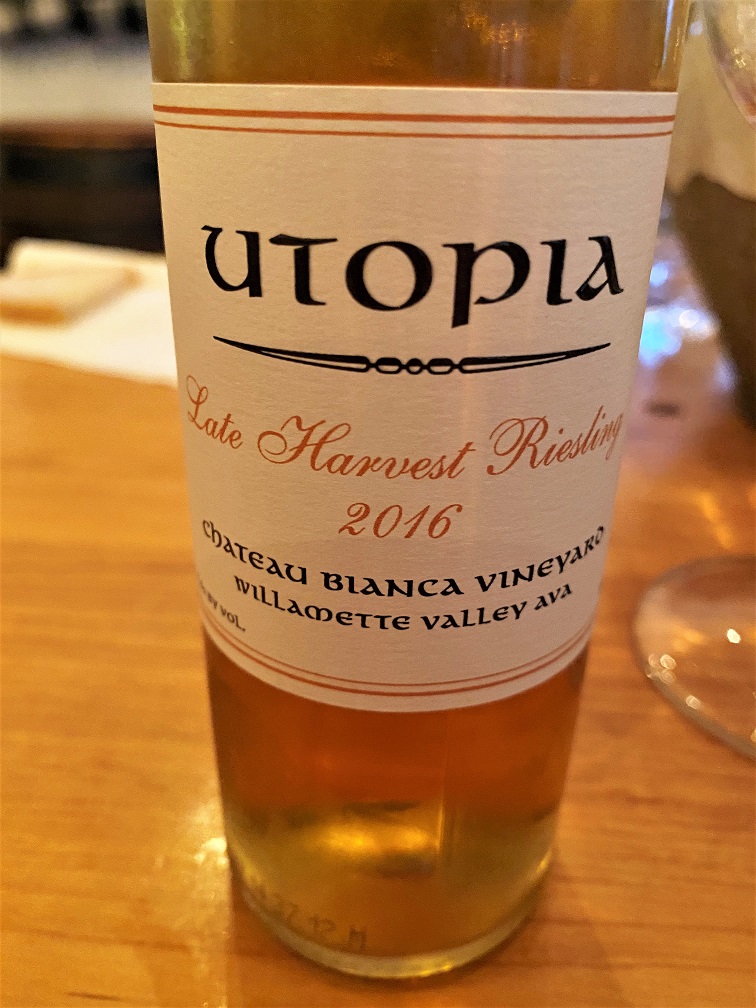
I was also excited to try a late harvest Riesling which was absolutely delicious:
2016 Utopia Late Harvest Riesling Chateau Bianca Vineyard Willamette Valley AVA ($40)
Beautiful apricots, a touch of honey, clean acidity, good balance. Delicious.
8
Talking to Dan we learned that 99 percent of the sales at the winery are direct to consumers, via the wine club and visitors. Dan also has a few customers who like to take his wines as a private label. Dan is very much involved with philanthropy, supporting the Oregon Museum of Science and Industry, The Hampton Opera center in Portland, OR, making wine donations, offering cabin stays, and more.
Utopia Vineyard offers something for everyone – if you will find yourself visiting Portland, you might want to take a 30 minutes trip southwest of Portland and find your utopia there. Or better yet, just stay in the cabin – everything else might be optional.
This post is a part of the Stories of Passion and Pinot series – click the link for more stories…
Passion and Pinot Updates: Lenné Estate
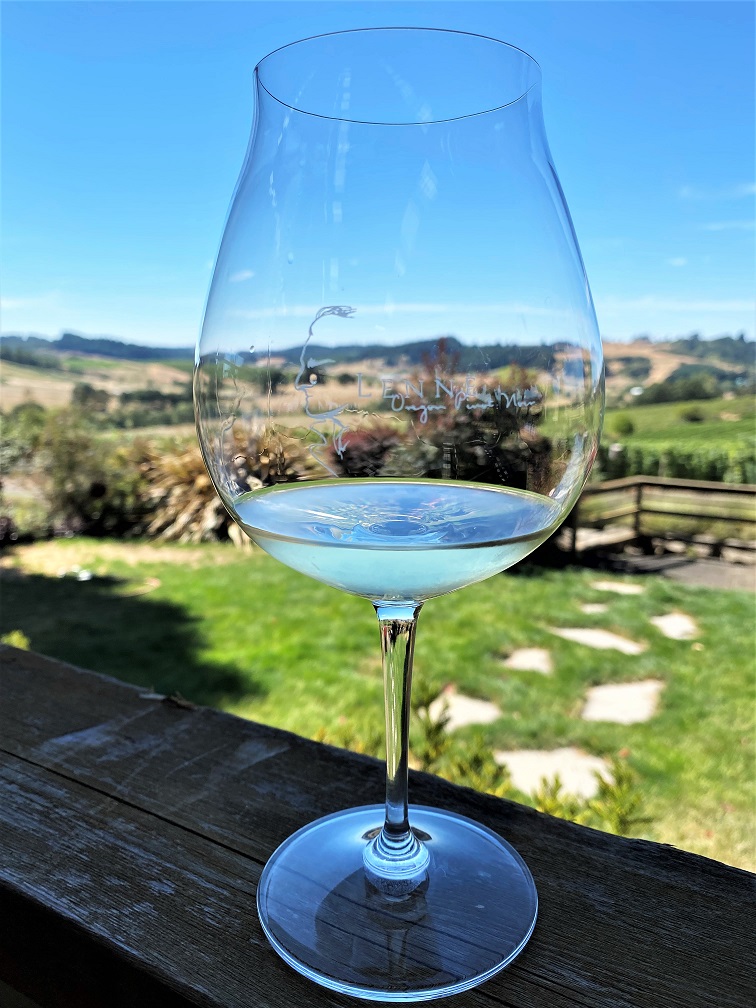 Out of the 13 Oregon wineries profiled to the date in the Stories of Passion and Pinot series, Lenné Estate stands aside. I had my first encounter with Steve Lutz and Lenné Estate in 2014, two years before the Stories of Passion and Pinot series was born, when Steve participated in the #WineChat event on Twitter. This is when I heard for the first time about Peavine soils, a mixture of clay and rocks, and Steve’s relentless, passionate pursuit of Pinot Noir winemaking in the place where it seems no vine can ever grow – read this original post to see what I mean. This passion I learned about while “listening” to Steve for the first time, the passion for the finicky grape became the reason for the name of the series.
When I spoke (virtually) to Steve in 2016 (you can find this conversation here), I learned a lot more about all the hard work establishing the vineyard, about Kill Hill, and about the wines which Steve produces, so when we arrived at Lenné Estate with Carl Giavanti, I felt like I knew Steve for a long time, and almost felt at home in the vineyard.
It is one thing to listen to someone talking about the soil, and it is totally different when you look at it (you can touch it too if you want) and think “how anything, really anything can grow in this soil”? Dry farming, no irrigation, and then you look at the soil – and you look at the grapes which it perfectly produces, and you can only say “wow”. I can tell you that out of the number of vineyards we already visited during the trip, the grapes at Lenné looked the best – tight bunches, beautiful colors of veraison, just a pleasure to look at.


More grapes:


We took a walk to the top of Kill Hill, and I can tell you that it was one steep walk. But the views from the vineyard were nothing short of spectacular.


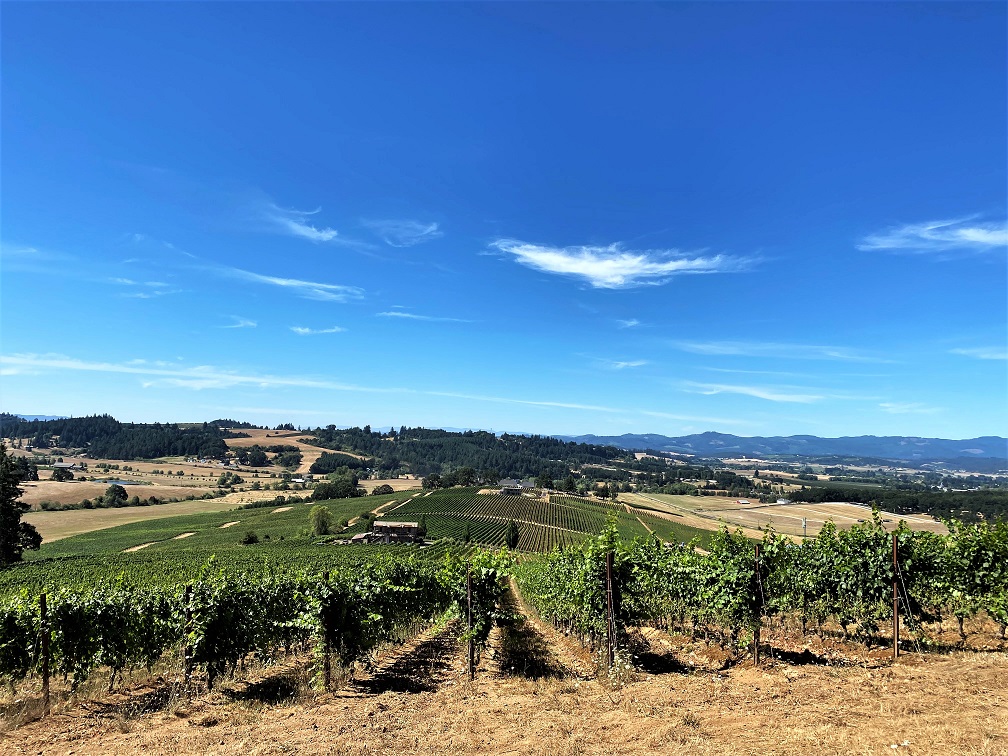

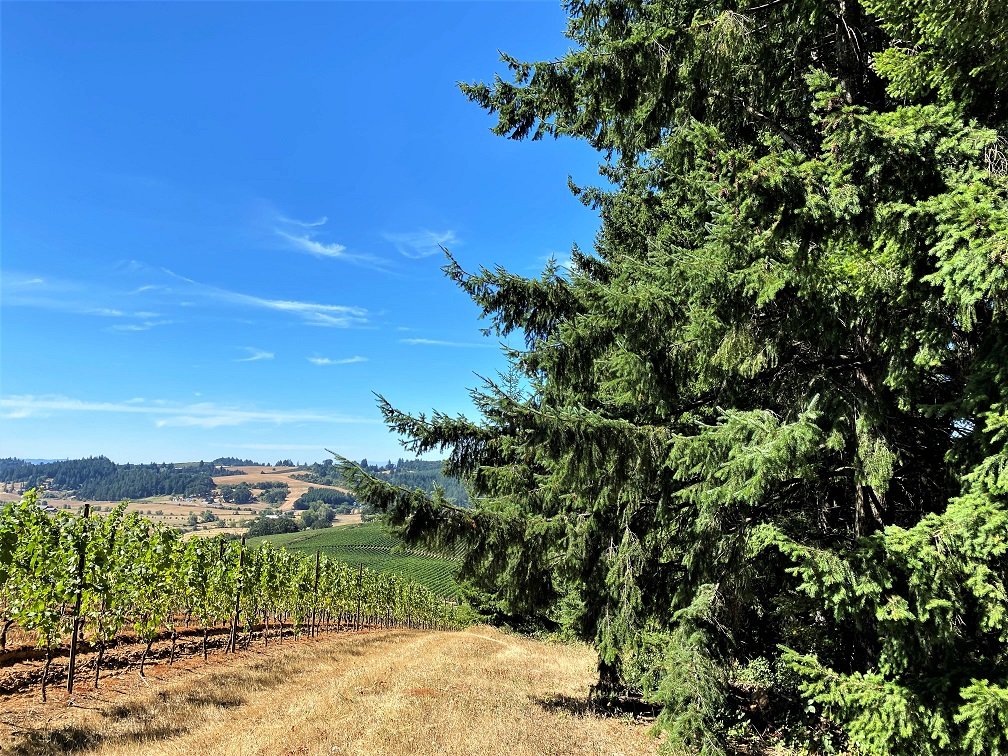
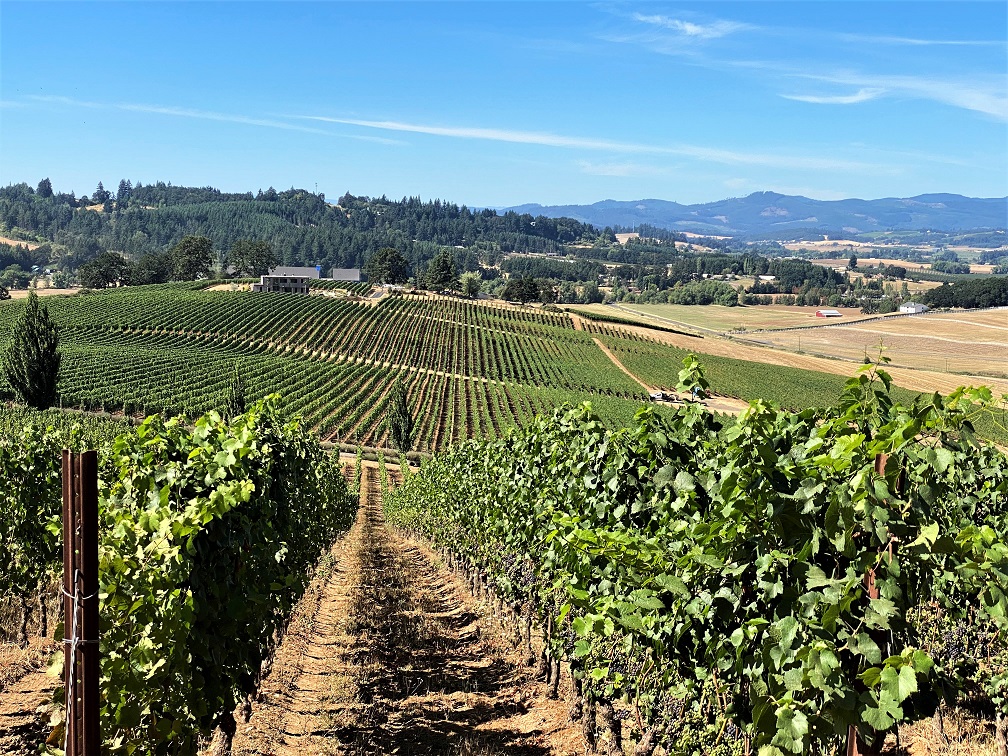
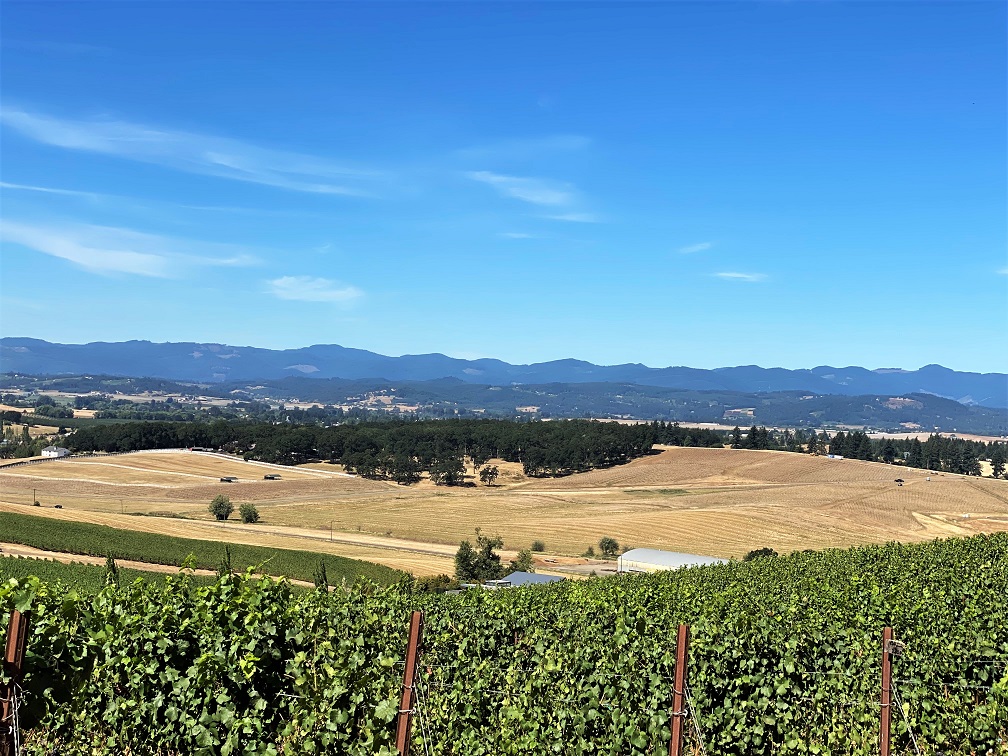
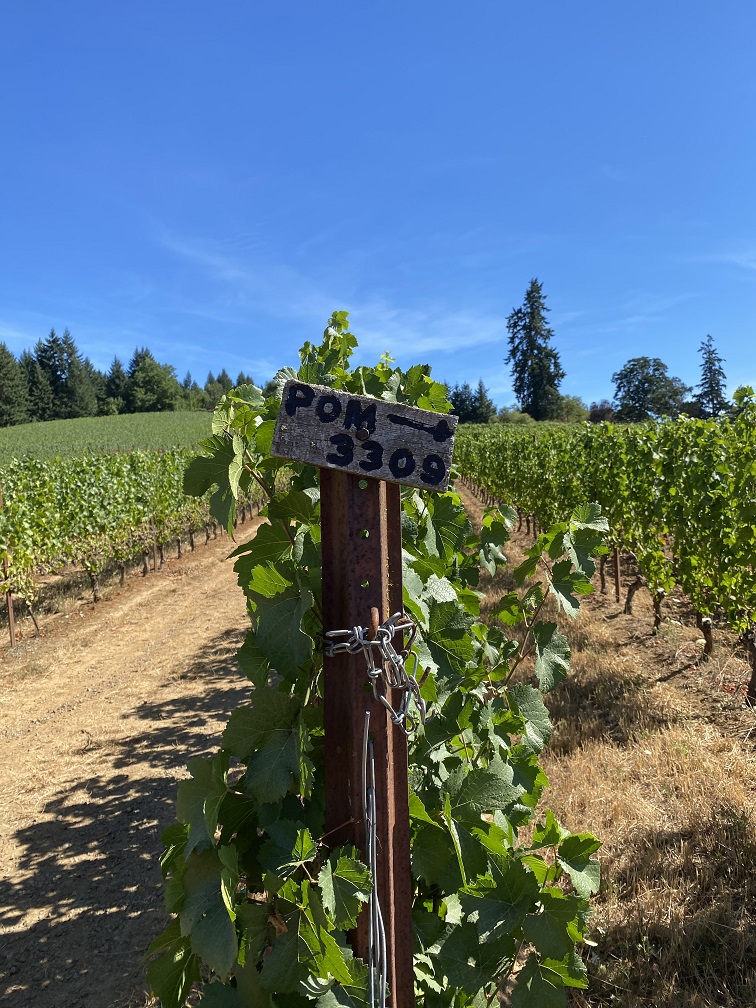
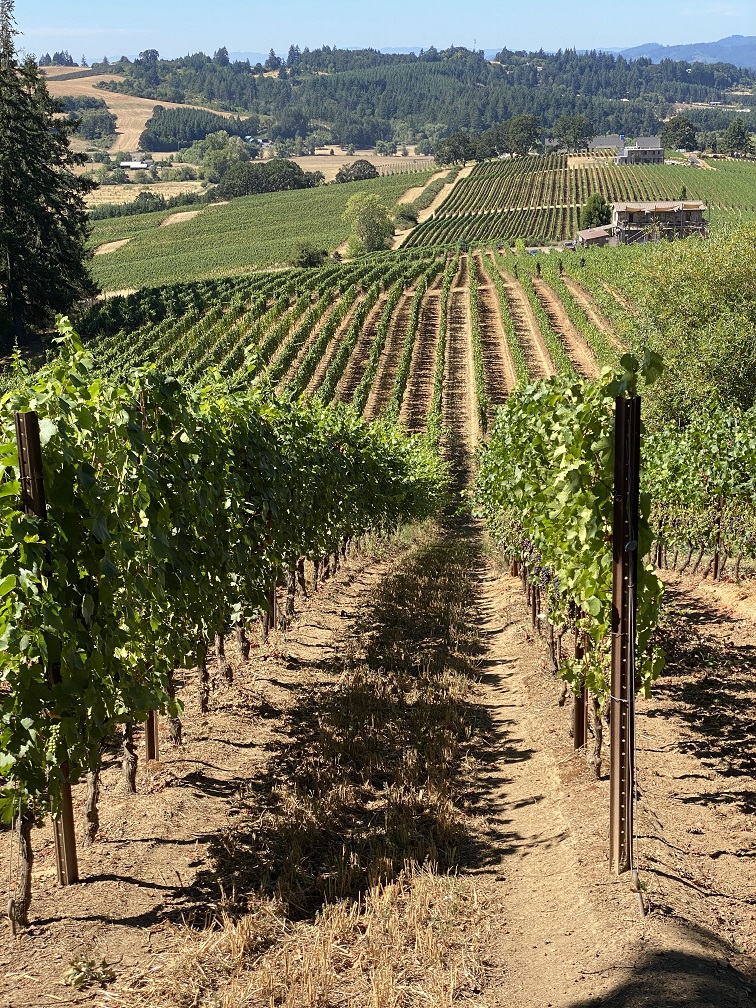
Yes, it is steep!
We talked about winemaking, and Steve mentioned that he typically prefers using commercial yeasts, because they produce more reliable and predictable results – however, he is not foreign to the idea of indigenous yeast, as we tasted in one of the wines. When we spoke back in 2016, Steve was not very big on producing white wines – I was happy to see that he changed his mind and now offers Lenné Estate Chardonnay. However, more as an exception to the rule at this point, Steve is still not ready to produce sparkling wines – however, I hope that this will change at some point – we will have to see.
After the walk, we went back to the tasting room, where Steve set up a full tasting, including the charcuterie and cheese boards.


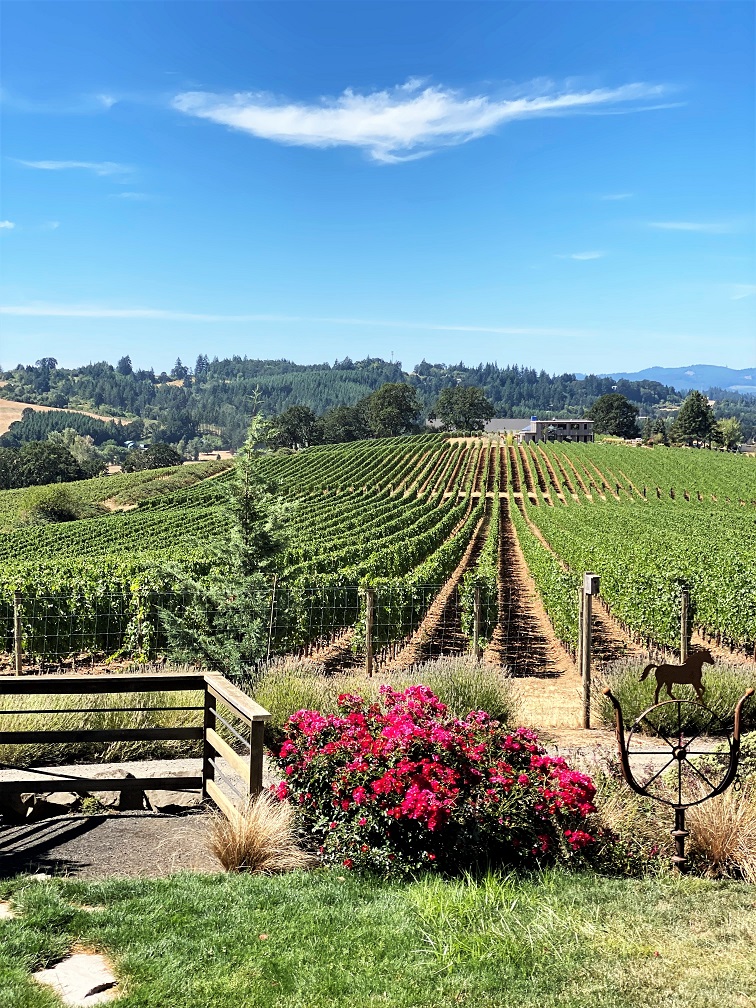
View from the tasting room
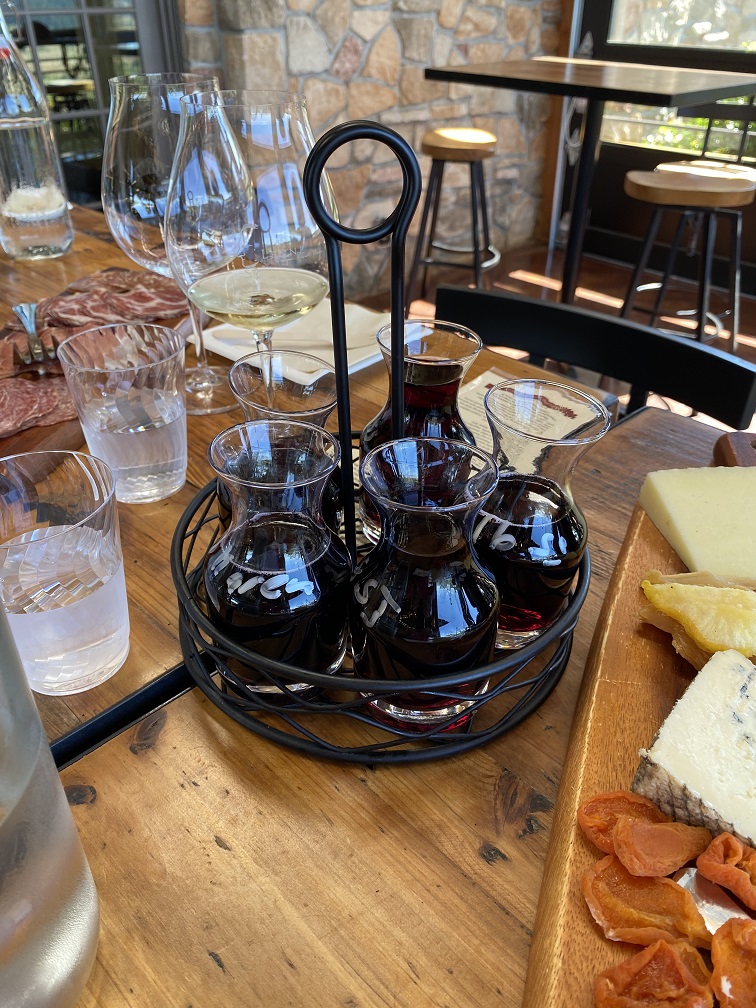
We started tasting with the Chardonnay, which was excellent
2019 Lenné Estate Scarlett’s Reserve Chardonnay Yamhill-Carlton AVA ($58)
A touch of honey, herbs, restrained
Crisp acidity, fresh, bright, Granny Smith apples, a touch of vanilla, creamy, excellent
8
Next, of course, we moved to the Pinot Noirs, where we tasted the whole range – here are tasting notes for the wines including some additional comments regarding the vintage and winemaking:
2017 Lenné Estate South Slope Pinot Noir Yamhill-Carlton AVA ($55)
Hot vintage with a big fruit set
Beautiful nose of sweet cherries and raspberries
Wow, red fruit all the way, cut through acidity, perfect balance
9-, superb
2016 Lenné Estate South Slope Pinot Noir Yamhill-Carlton AVA ($55)
Early vintage, cool August, harvest done by mid-September
Cherries, sage, floral notes
Clean, tart cherries, warm notes, good acidity,
8-
2018 Lenné Estate Sad Jack 777 Pinot Noir Yamhill-Carlton AVA ($55)
Indigenous yeast, spontaneous malolactic
Tart cherries, a hint of cherry pie, savory note
Tart cherries, clean, balanced, crisp, superb
8+
2018 Lenné Estate Karen’s Pommard Pinot Noir Yamhill-Carlton AVA ($60)
Commercial yeast and forced malolactic
Cherry, cherry pie, sweet oak
Tart cherries, dark fruit, good balance, well integrated tannins
8


The last wine was a culmination point of the tasting. “Cinq Élus” means “five chosen”, which in the case of this wine means five best barrels and 5 clones. The wine was simply superb:
2018 Lenné Estate Cinq Élus Pinot Noir Yamhill-Carlton AVA ($85)
5 best barrels from the vintage, 5 clones
The succulent nose of red and black berries, distant hint of gunflint, herbs, great complexity
Restrained, cherries, layered, complex, perfectly integrated, tannins come through on the finish, superb
9-
While we were tasting the wines, we also talked about blind tasting events which Steve runs at the winery, where attendees get an opportunity, for example, to compare Oregon Pinot Noir with the Burgundy, or Yamhill-Carlton Pinot Noir with Dundee Hills Pinot Noir and so on – here you can see what blind tastings are offered. Steve also leads European wine cruises where everything revolves around food and wine, as you can imagine – here you can find information about those.
On the Lenné Estate website, there is also an interesting section called Vintage Charts. Here you can find general information regarding the suggested drinking window for Oregon Pinot Noir in general, as well as particular recommendations specifically pertaining to the Lenné Estate wines.
There you are, my friends. If you are looking for mature, confident, and simply delicious Oregon Pinot Noir, you don’t need to look further than Lenné Estate.
But we are not done here yet. More Passion and Pinot updates are coming – stay tuned…
This post is a part of the Stories of Passion and Pinot series – click the link for more stories…
Passion and Pinot Updates: Le Cadeau Vineyard
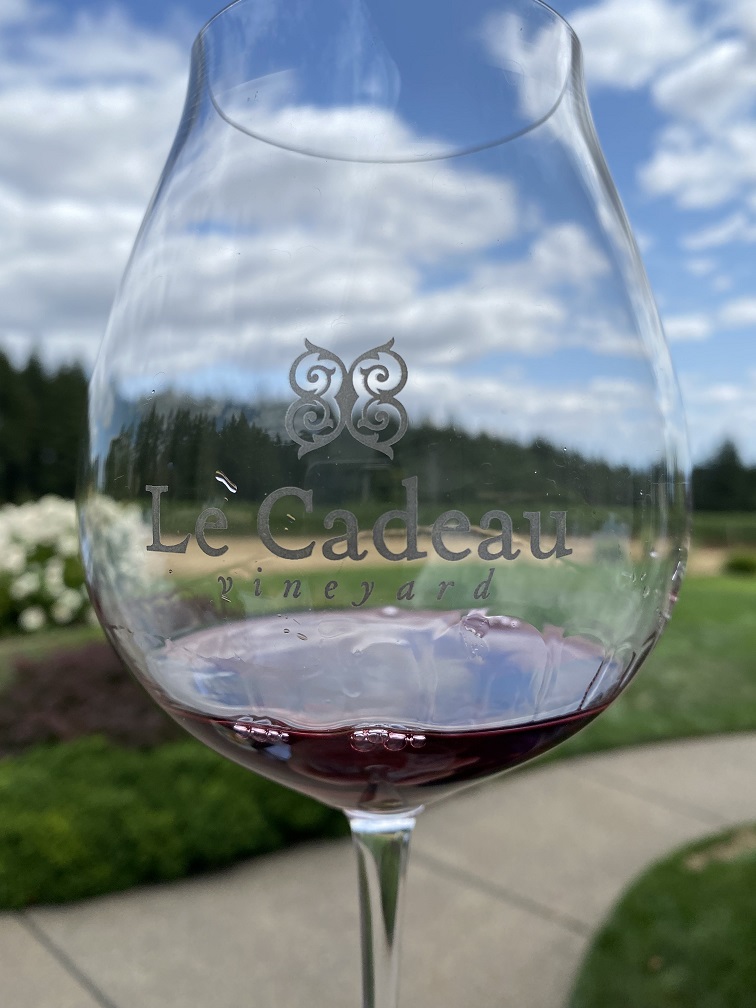 Five years ago, I started a new project in this blog called Stories of Passion and Pinot. The goal of the project was to interview winemakers in Oregon, who passionately went on to grow Pinot Noir and make wines often in conditions that many others would find impossible and untenable. All the way until August of 2021 my interviews were all virtual – I would read about the winery, come with the questions, get the answers, and then publish those conversations in this blog (you can find them using the top menu).
This year I attended Wine Media Conference 2021 which conveniently took place in Eugene, Oregon. After the conference was over, we drove with Carl Giavanti to meet some of the winemakers face to face – and now I can offer you updates, mostly in pictures, lots of pictures, and tasting notes for the wines I had an opportunity to taste.
Le Cadeau Vineyard was our first stop after we left Eugene.
Where do I start? First of all, the views. Le Cadeau Vineyard is a stunning oasis, surrounded by tall pine trees (I already told you how much I love those), and offering amazing views. You be the judge:
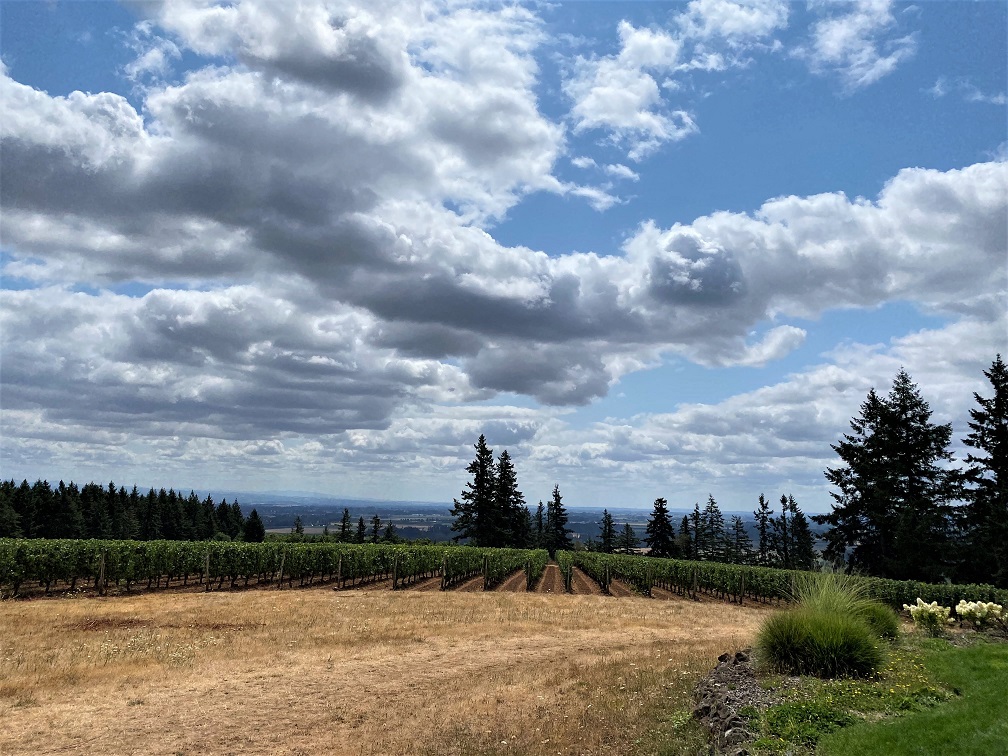
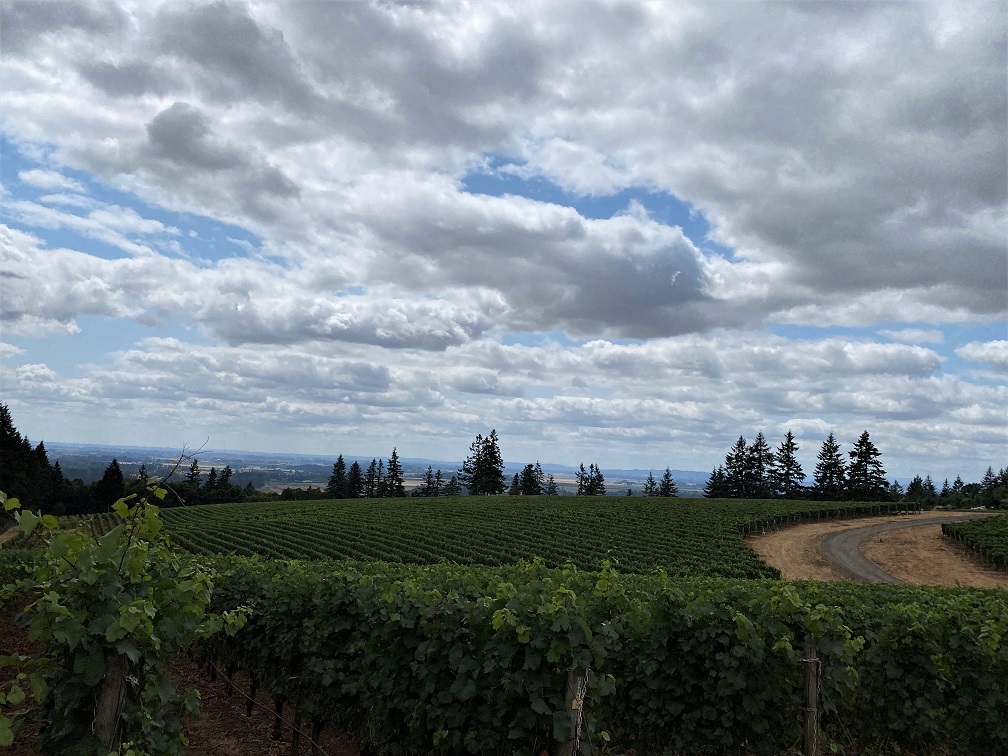
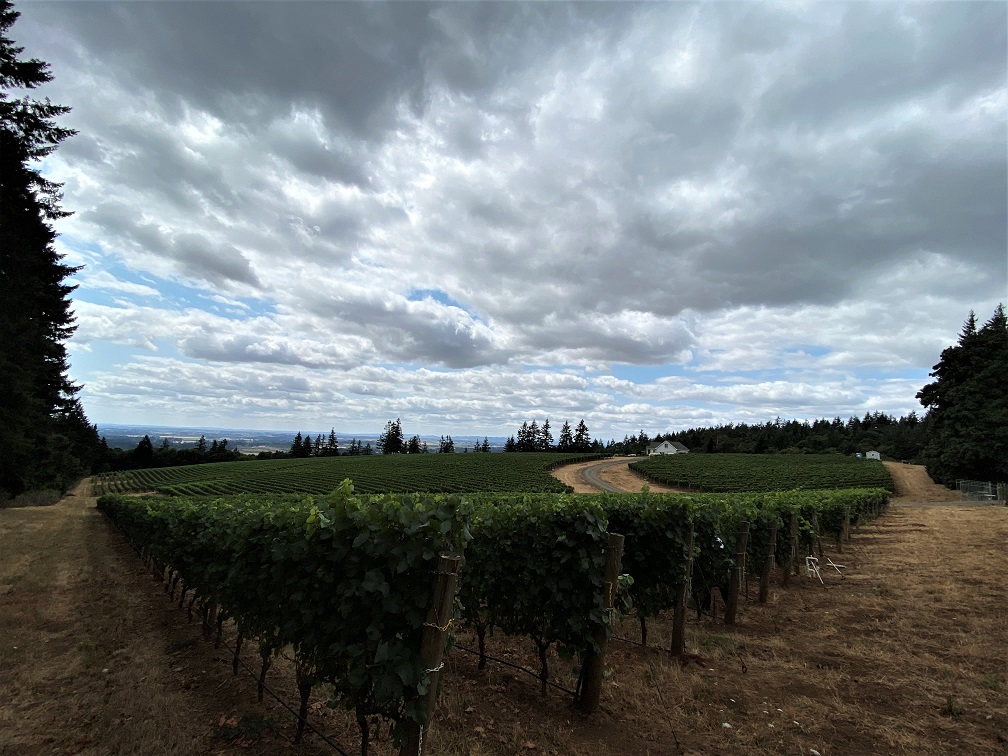
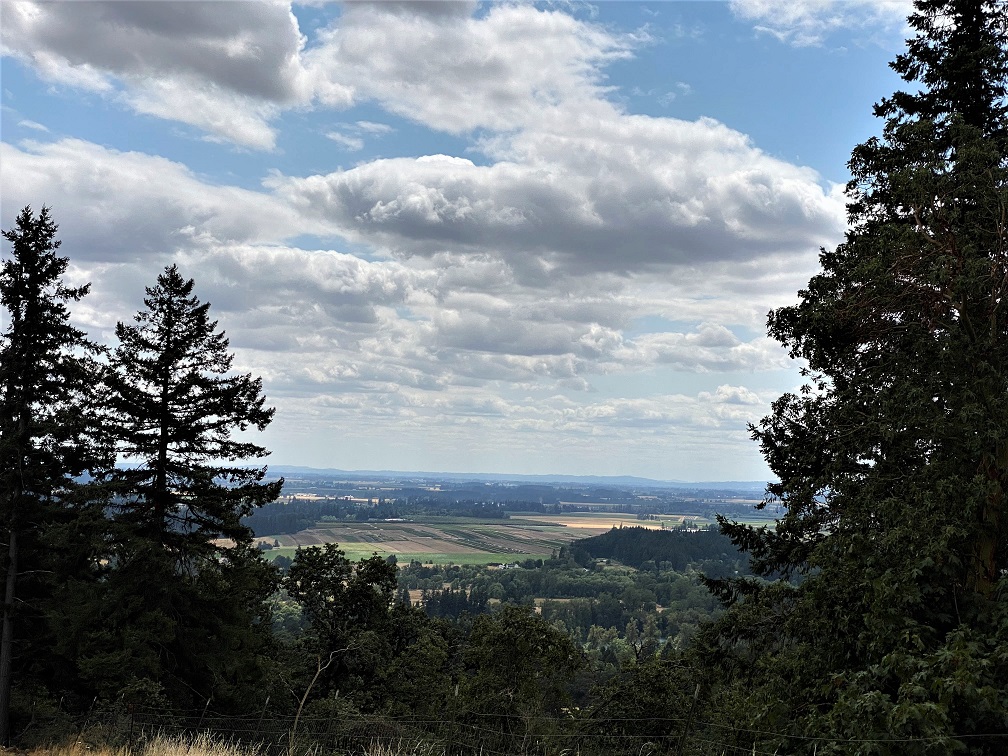
Tom Mortimer slowly walked us through the vineyard, talking about clones and all the work he invested into creating this vineyard simply on top of the rock (you can find the details in the original interview). It turns out that there are 18 Pinot Noir clones used in wine production at Le Cadeau – while I was somewhat shocked to hear that number (sounds high), it was simply due to my ignorance – for example, Sanford winery in Sta. Rita Hills uses more than 50 clones. Considering that Sanford winery is about 25 years older than the Le Cadeau, it is all makes sense. Tom was particularly proud of some of the clones, such as the Calera clone which is based on the DRC, and some additional Vosne clones (not trying to impress with the words here – Vosne here stands for Vosne-Romanée, one of the most coveted Pinot Noir production areas in Burgundy; DRC stands for Domaine Romanée-Conti, probably the most famous Pinot Noir producer in the world; Calera is one of the legendary California Pinot Noir producers and pioneers from Central Coast).
The beginning of August of this year (2021) happened to be the veraison time – the onset of ripening of the grapes when the grapes start changing their color. This was my first time actually being in the vineyard during veraison, so I couldn’t stop taking pictures as I saw bunches with more and more color – here are more pictures:


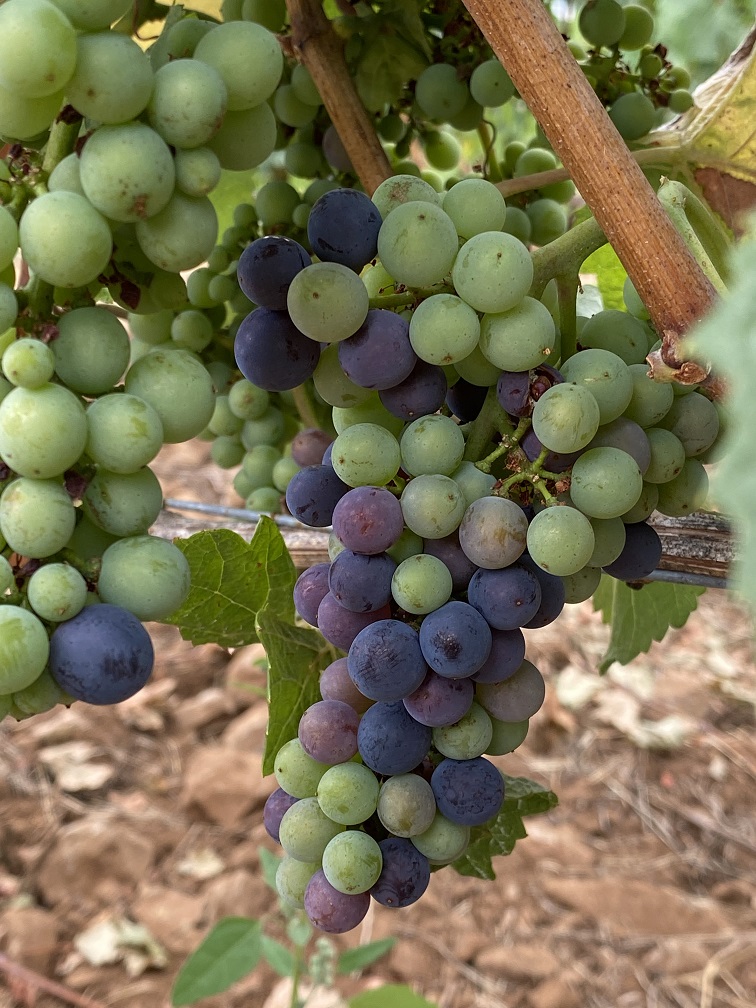


We also saw Chardonnay grapes growing:
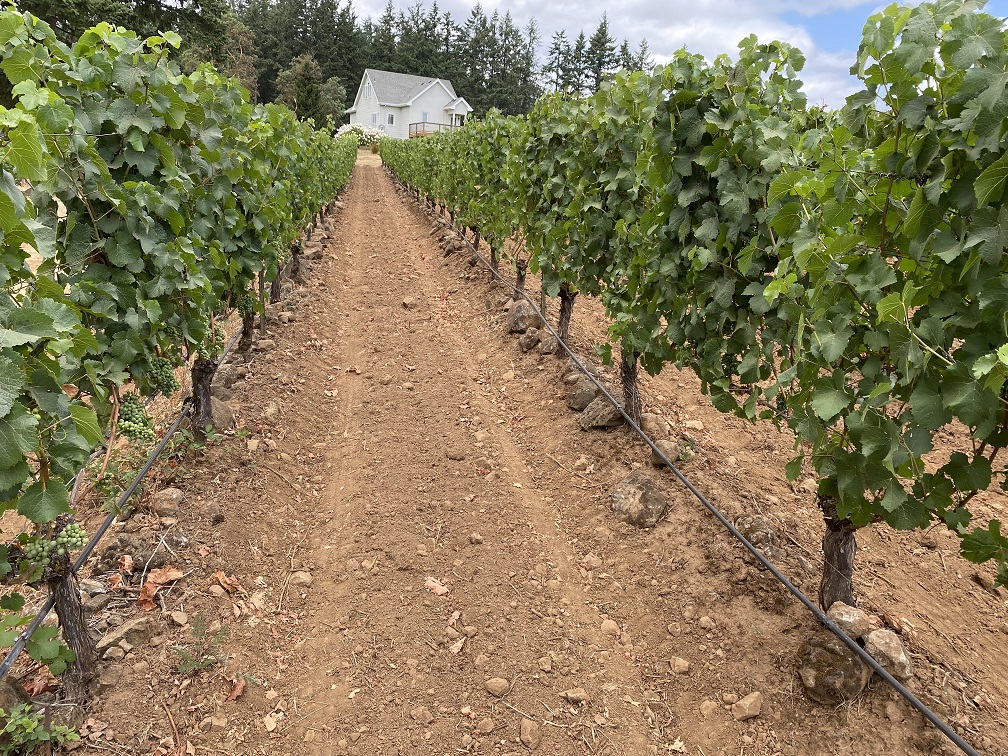
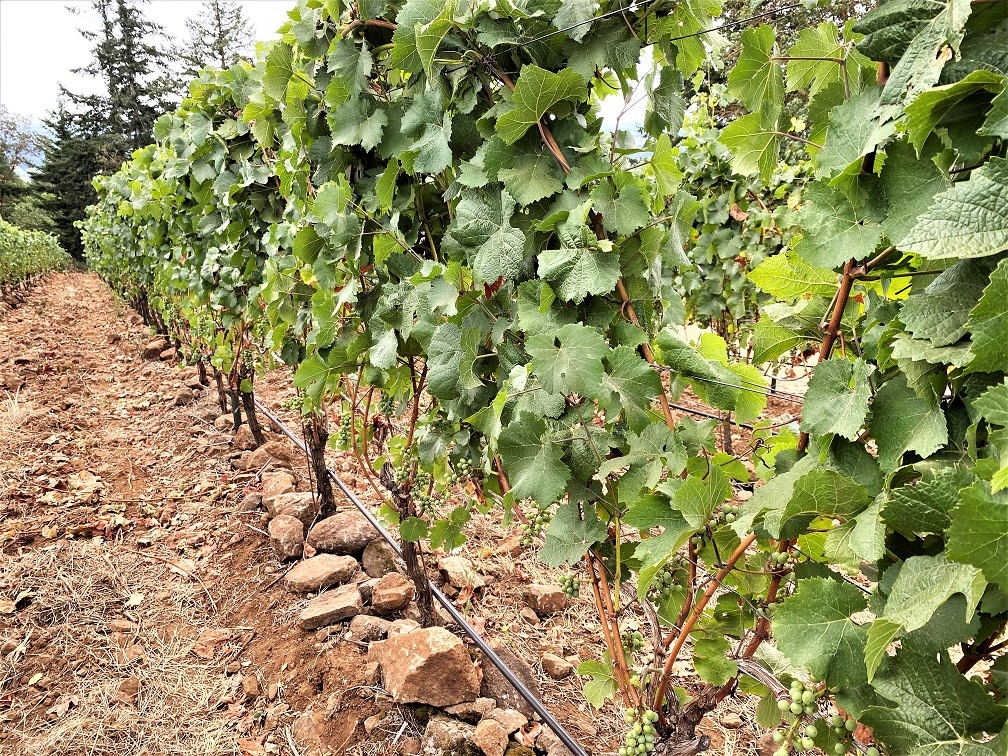
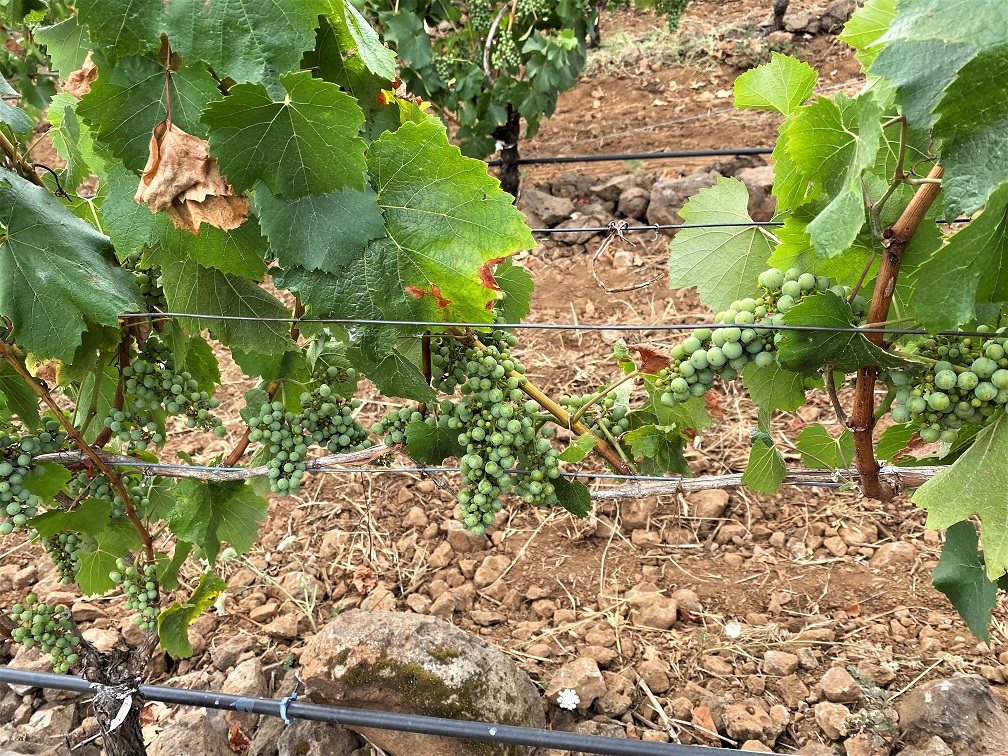
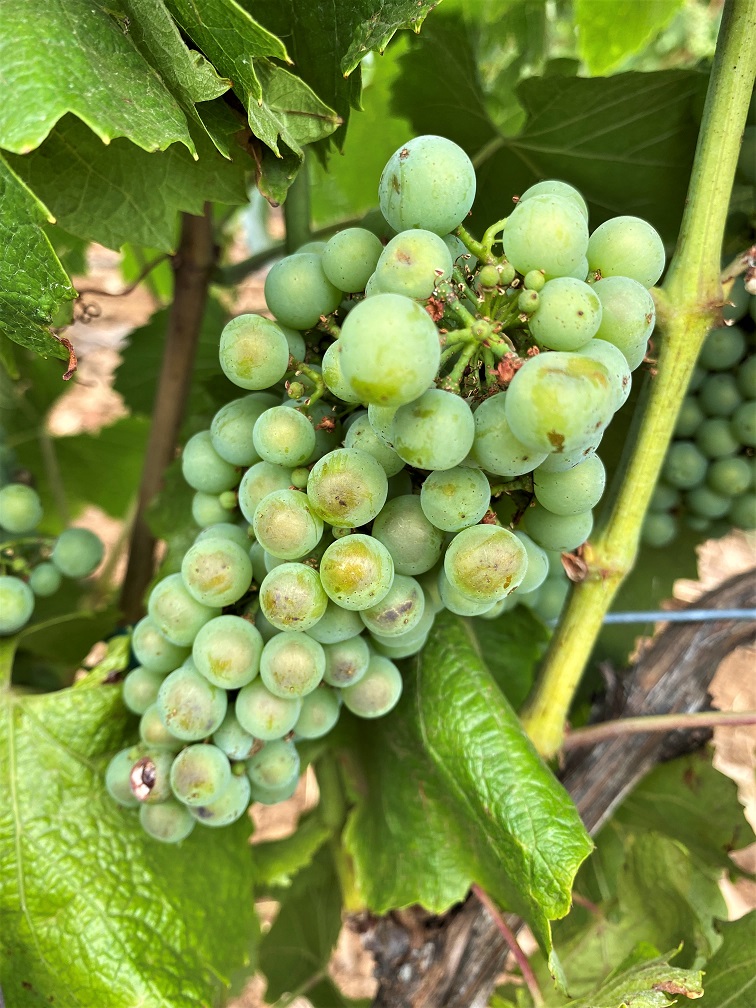
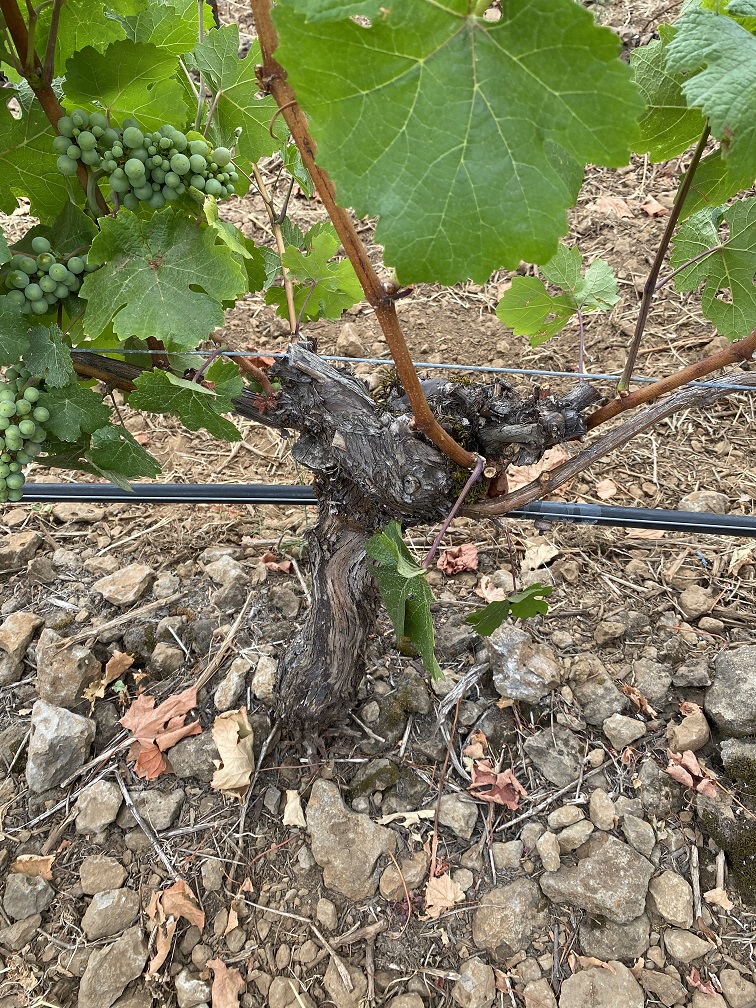
Remember, we are talking about passion here. The amount of labor of love and passion which this vineyard required to be established was simply incredible. Tom had to use a special machine to break through the basalt to help the vine roots to get established. There were a few rows where he decided not to use the machine, and those rows look particularly different from the rest of the vineyard. The rocks which you can see in these pictures give you a good idea of what he had to deal with while establishing the vineyard.


After we finished walking around we sat down to taste the wines with Tom and to continue the conversation about the winemaking. Tom is highly analytical, he uses a lot of different charts, such as Degree Day reports to estimate when he might need to start picking up the grapes based on the historical data and what is the potential weight of the grapes might be at the harvest. Harvest is usually done in multiple passes, depending on the year – in 2015 and 2018, for example, he had to pick grapes 5 times; in 2016 and 2020 there were three picks made.


We started our tasting with 2018 Chardonnay, which was outstanding:
2018 Le Cadeau Vineyard Chardonnay Willamette Valley (14.1% ABV, $45)
Beautiful nose of vanilla with a hint of butter
Vanilla, butter, Granny Smith apples on the palate, beautifully clean and balanced
8+
It is really amazing to see the level of finesse Oregon Chardonnay has developed over the years.


It appears that Tom also makes sparkling wines, and he loves it, as making sparkling wines nicely complements making still wines – you remove perfect grapes for the sparkling (high acid), and the other grapes can ripen better. The sparkling wine we tried, was again, in a word, outstanding:
2013 Le Cadeau Rosé Brut Oregon (13.1% ABV, $50, 4.5 years on the lees)
A touch of funk and toasted bread
Sapidity, yeast, toasted notes, clean acidity, delicious.
8+


Now we moved on to the Pinot Noir. Tom is working with the winemaking team to produce his wines, including the consultant from Burgundy. Le Cadeau makes some of the reserve wines, but those are only produced in the best years. We tasted through the 4 Pinot Noir wines which were all excellent in their own right.
2018 Le Cadeau Côte Est Pinot Noir Willamette Valley (13.9% ABV, $60)
Beautiful cherries on the nose
Cherries on the palate, clean, round, soft, a touch of earthiness, delicious.
8
2018 Le Cadeau Diversité Pinot Noir Chehalem Mountains AVA (14.1% ABV, $60)
Beautiful minerality, sweet cherries, a hint of cranberry
Tart cherries on the palate, pepper, clean, fresh, light
8+
2018 Le Cadeau Rocheux Chehalem Mountains AVA (13.5% ABV, $60)
Stunning nose, cranberries, cherries, violets, a hint of sage
Superb balance of power, fruit, acidity, structure – everything is in perfect harmony.
9-/8+
2017 Le Cadeau Merci Reserve Chehalem Mountains AVA (13.3% ABV, $80)
Incredible aromatics, floral, violets
Beautiful, round, clean, open
8+
It is interesting that when I tasted the 2017 Le Cadeau vintage for the interview post, Diversité was my favorite, and Rocheux was a close second. This time, Rosheux was my favorite Pinot Noir from the tasting.
That’s all I have for my update. I don’t drink much of Burgundy, so I can’t really offer any comparisons – but I don’t think comparisons are needed. Oregon Pinot Noir are unquestionably world-class wines in their own right. I remember reading in Wine Spectator Matt Kramer’s article where he mentioned that the main characteristic of a world-class Pinot Noir is finesse. Going by this measure, Le Cadeau definitely got it – finesse is the virtue of all their wines. If you are looking for the Pinot Noir for a special occasion – don’t look any further than Le Cadeau.
This post is a part of the Stories of Passion and Pinot series – click the link for more stories…
Understanding Ferguson
Do experiences have expiration dates? Of course not. As long as we learn something, the experience has its value – and thus it can be shared.
And so here I am, sharing another experience from 2 years ago. Yesterday, I was talking about the Sanford tasting which took place in June of 2019. Today, I’m sharing yet another experience from the same June of 2019. Just follow along, please.
I remember attending a trade tasting in New York, probably about 5 or 6 years ago. One of the wineries at that tasting was L’Ecole No 41, one of the best wineries in Walla Walla in Washington. The rep poured a taste for me and proudly said “this is Ferguson, our newest vineyard, and this wine is amazing, taste it”. I can still vividly remember the punch of tannins from the first sip and my very first thought “how is this amazing, I can’t taste anything here”.

L’Ecole No 41 needs no introduction to the wine lovers. The third winery in Walla Walla in Washington, founded by Jean and Baker Ferguson in 1983, one year before Walla Walla received an official AVA status. From the moment the winery was created, the focus was always on the Bordeaux varieties – Cabernet Sauvignon, Merlot, Cabernet Franc, Malbec, Petit Verdot.
Seven Hills Vineyard, 230 acres estate on the Oregon side of the appellation, is one of the oldest vineyards in Walla Walla, planted in 1980. L’Ecole No 41 manages Seven Hills Vineyard together with Pepper Bridge Winery and Leonetti Cellars, and it is a source of more than 1/3 of L’Ecole’s total red wine production.
The second vineyard, Pepper Bridge Vineyard, was planted in 1991 on the Washington side of Walla Walla. L’Ecole was the first winery to produce wines from the Pepper Bridge Vineyard.
In 2008, Ferguson Vineyard, named in honor of the founders of the winery, was planted on high elevation (1,350 ft – 1,450 ft) not far from the Seven Hills Vineyard, a thin layer of soil over the fractured basalt from 15-million-year-old lava flows. The vineyard now is 42 acres in size and the source of the latest additions to the L’Ecole portfolio – the one I was unable to appreciate during that trade tasting.


When I got the invite to attend L’Ecole No 41 tasting in New York at the Grapes and Grains restaurant, I got excited about the opportunity to have a deeper dive and learn more about L’Ecole No 41 wines.
What I learned from Constance Savage, General Manager of L’Ecole No 41 is that L’Ecole can be safely called a high mountain desert winery, with only 8” of precipitation per year. Irrigation is available, but very much controlled, forcing the vines to work hard.
The winemaking approach at the winery is very simple – let the terroir speak. Always do the same at the winery, and let Mother Nature to express itself. The winery is not trying to achieve persistent taste – and this can be easily seen in wines through the differences between the vintages. And this all works because the climate is very consistent.
We tasted through 4 sets of wines, each set containing 3 wines. Here is what I tasted with my notes.

The first set consisted of the 3 “classics” from the same 2008 vintage – Merlot, Cabernet Sauvignon, and Cabernet Franc. The wines were 11 years old when I tasted them, and still you can see that they were still showing substantial level tanning and potential to evolve for the next 10–20 years.
2008 L’Ecole no 41 Estate Merlot Seven Hills Vineyard Walla Walla Valley (14.5% ABV, 80% Merlot, 10% Cabernet Sauvignon, 10% Cabernet Franc, 18 months in small French oak barrels, 40% new)
Cherries, iodine, mint
Tart cherries, pepper, a touch of vanilla
8
2008 L’Ecole no 41 Estate Cabernet Franc Seven Hills Vineyard Walla Walla Valley (14.5% ABV, 100% Cabernet Franc, 22 months in small French oak barrels, 33% new, 198 cases produced)
Black currant, a touch of mocha
Tart, black currant, dry, very noticeable tannins
8, Block 8 Cabernet Franc is typically used for blending, except in the best years when enough grapes are harvested, so this wine was produced in 2006 and again in 2008.
2008 L’Ecole no 41 Estate Cabernet Sauvignon Seven Hills Vineyard Walla Walla Valley (14.5% ABV, 100% Cabernet Sauvignon, 22 months in small French oak barrels, 50% new, 188 cases produced)
Touch of sweet oak, black currant
Much more open than cab franc, but still tannins are present

The next set of wines was made with the fruit from Seven Hills Vineyard, and they all belonged to the series called Perigee – as a scientific term, Perigee is the closest point to the Earth in the Moon’s orbit. The focus of these wines is on the earthy characteristics of the Seven Hills Vineyard.
2006 L’Ecole no 41 Perigee Estate Seven Hills Vineyard Walla Walla Valley (14.4% ABV, 56% Cabernet Sauvignon, 34% Merlot, 10% Cabernet Franc, 22 months in small French oak barrels, 50% new)
Great complexity, plums, a touch of smoke and roasted meat, fresh onion peel (sorry about that)
Sweet plums, black currant, vanilla, good acidity, dry finish
8
2011 L’Ecole no 41 Perigee Estate Seven Hills Vineyard Walla Walla Valley (14.5% ABV, 60% Cabernet Sauvignon, 20% Merlot, 10% Cabernet Franc, 6% Malbec, 4% Petit Verdot, 22 months in small French oak barrels, 50% new)
Closed nose
The palate is raspberry driven, good acidity, good minerality
2016 L’Ecole no 41 Perigee Estate Seven Hills Vineyard Walla Walla Valley (14.5% ABV, 52% Cabernet Sauvignon, 21% Merlot, 11% Cabernet Franc, 9% Petit Verdot, 7% Malbec, 22 months in small French oak barrels, 40% new)
Fresh, bright, fresh leaves, freshly crushed berries
Vanilla, plums, mocha, young, big body, soft and velvety initially, with the tannins gripping mouth in the second wave
8
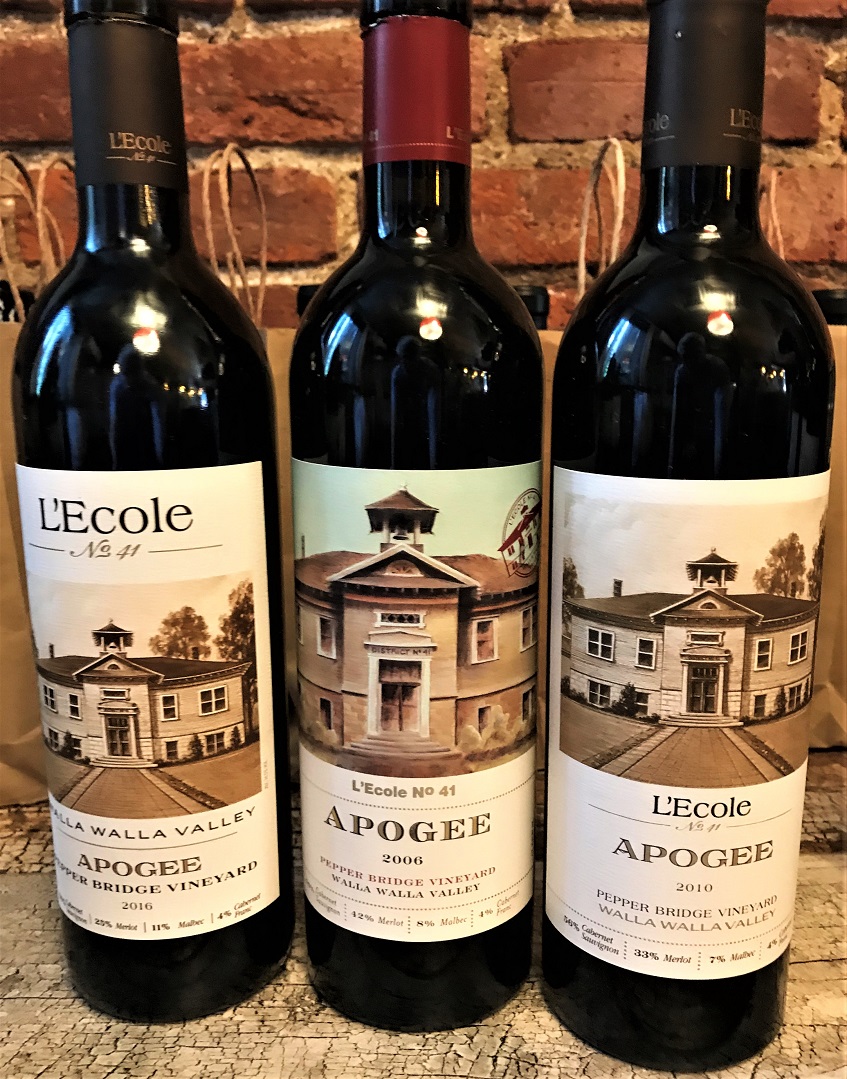
Next, we tasted the Apogee series of wines, sourced from the Pepper Bridge Vineyard. Apogee is the point in the orbit of the Moon when it has the greatest distance to Earth. The focus of these wines is to showcase the ultimate expression of the fruit.
2006 L’Ecole no 41 Apogee Estate Pepper Bridge Vineyard Walla Walla Valley (14.3% ABV, 46% Cabernet Sauvignon, 42% Merlot, 8% Malbec, 4% Cabernet Franc, 22 months in small French oak barrels, 50% new)
Touch of barnyard, intense, blackberries, minerality
Sapidity, onion jam, dark berries, baking spice, minerality,
8, wines are a lot more massive than previous ones
2010 L’Ecole no 41 Apogee Estate Pepper Bridge Vineyard Walla Walla Valley (14.5% ABV, 56% Cabernet Sauvignon, 33% Merlot, 7% Malbec, 4% Cabernet Franc, 22 months in small French oak barrels, 50% new)
Elegant, raspberries, fresh
Round, clean, well-structured tannins, delicious
9-
2016 L’Ecole no 41 Apogee Estate Pepper Bridge Vineyard Walla Walla Valley (14.5% ABV, 60% Cabernet Sauvignon, 25% Merlot, 11% Malbec, 4% Cabernet Franc, 22 months in small French oak barrels, 50% new)
Not ready – beautiful fruit and acidity, but tannins covering completely

And finally, the Ferguson. The vineyard built on top of the balsamic rock, so we should expect to see expressive minerality.
2011 L’Ecole no 41 Estate Ferguson Vineyard Walla Walla Valley (14.5% ABV, 57% Cabernet Sauvignon, 32% Merlot, 11% Cabernet Franc, 22 months in small French oak barrels, 50% new)
Smoke, gunflint, not a lot of fruit
Dark, powerful, perfectly structured, Bordeaux style, perfectly drinkable
9-
2016 L’Ecole no 41 Estate Ferguson Vineyard Walla Walla Valley (14.5% ABV, 62% Cabernet Sauvignon, 26% Merlot, 6% Malbec, 6% Cabernet Franc, 22 months in small French oak barrels, 50% new)
Young fruit, crunchy berries,
Killer tannins, lock your mouth
Not ready
2014 L’Ecole no 41 Cabernet Sauvignon Ferguson Vineyard Walla Walla Valley (14.5% ABV, 100% Cabernet Sauvignon, 22 months in small French oak barrels, 40% new)
Dark fruit, minerality
Touch of Black Currant, coffee, tannins are still overpowering, but you can taste the beauty of the wine. Needs at least another 10 years
8+
So what did I learn about Ferguson? These wines need time. And with time, they can be some of the best wines Washington has to offer.
As you can tell, 2011 Ferguson and 2010 Apogee were two of my most favorite wines, but really, give them time, and you will not go wrong with any of these wines. And it is interesting that all of the 2006 and 2008 can still enjoy more time in the cellar. For sure, L’Ecole makes some serious wines.
Do the experiences have expiration dates? Maybe only those which are not shared. Here, I did my part.
Sanford Winery: Evolution Of Growing Up
In the 1960s, two friends, Michael Benedict and Richard Sanford were looking for a good cool-climate site in California where they would be able to make wine rivaling in quality the best European wines.
In 1971, after successfully completing very extensive research, they decided on the location in the Sta. Rita Hills area, a part of the Santa Ynez Valley about 15 miles east of the Pacific Ocean. They first planted the vineyard to Chardonnay and Riesling, but in 1972 they were the first in the region to plant Pinot Noir (and now these are the oldest Pinot Noir plantings in the country).
In 1997, an adjacent hillside vineyard was planted next to Sanford and Benedict, named La Rinconada, which also became a home to the winery building and the tasting room. In 2001, Sta. Rita Hills area was officially certified as an AVA (American Viticultural Area). In 2002, the Terlato family became involved with the Sanford winery (the winery was only carrying the Sanford name as Michael Benedict part his ways with Richard Sanford in 1980), and in 2005 Terlato family became majority owners and partners at the winery. In 2006, John Terlato got closely involved with the winery operations, and that really opened a new chapter for Sanford winery.
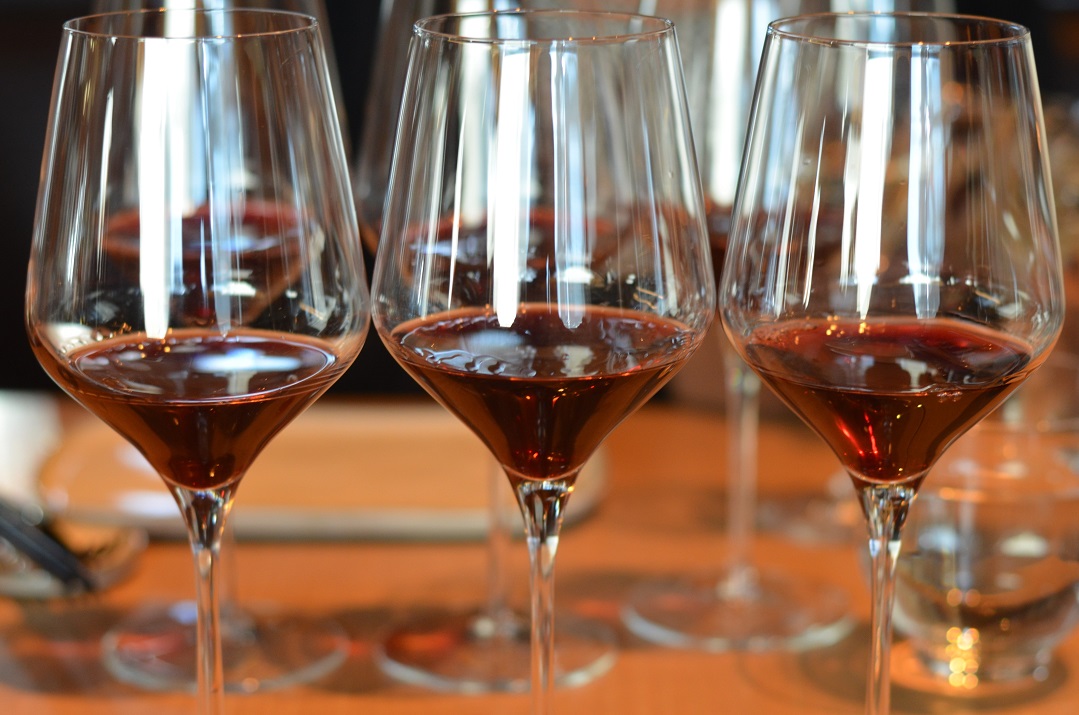
In June of 2019, I got invited to the Sanford winery tasting dinner with John Terlato and Michael Benedict at the Wild Ink restaurant in New York, in one of the hottest neighborhoods – Hudson Yards. I was, obviously, very excited. Which helped me to fail as a wine writer – read on, I will explain.
As we situated at the table, the wines started to appear in rapid succession – 2011 Sanford and Benedict Pinot Noir, 2012 Sanford and Benedict Pinot Noir, then 2013, 2014, 2015, 2016… I didn’t check the press packet in advance of the dinner, and was unprepared for the sheer number of wines presented – also the wines were just brought up one after another, without much of the pause, much of presentation, and too cold – I remember complaining about the wines being too cold and thus really not allowing for a proper evaluation. Don’t get me wrong – I loved the wines, but I had no opportunity to actually compare the vintages and understand the differences. We also tasted 2016 La Rinconada Chardonnay, 2015 Founders’ Vines Chardonnay, 2015 La Rinconada Pinot Noir and 2014 Founders’ Vines Pinot Noir – for which again I didn’t capture a single tasting note, carried away with a conversation, food, delicious wines, and amazing views of the sunset over Hudson.
Or maybe the tasting notes were not that important? In 2006, when John Terlato got involved in Sanford winery operations, he started learning about the best Pinot Noirs in the world. He went to Burgundy, met with winemakers, and tasted lots and lots of wines to understand what can be done differently at Sanford, what is next. He started the vineyard block program at Sanford, identifying unique vineyard blocks at both Sanford and Benedict and La Rinconada, with unique soil, microclimate and terroir, to let literally every bunch of grapes be the best they can be. John brought his notebooks to the dinner, and he was showing us pages and pages of copious notes, both about the wines he tasted in Burgundy and all the experiments and work done at the Sanford vineyards.


Both John and Michael were obviously proud of what they achieved, but what is important, they were both optimistic about their work at the winery and the best yet to come as the learning process doesn’t stop. “I want you to come to the winery and taste 2017, 2018, 2019, 2020, 2021… I want you to see how they [wines] change. I want you to see how much better they will become” said Michael Benedict in his quiet voice sitting next to me.
If I would’ve done my homework before coming to the dinner, I would’ve come armed with some incredible facts summarizing 13 years of hard work at the Sanford vineyards. Here are some numbers for you. 30% of the Sanford and Benedict vineyard are still planted on its original vines, which is very rare in California considering the spread of Phylloxera. The vineyard is home to the oldest Pinot Noir vines in Santa Barbara County, planted in 1971. Sanford and Benedict Vineyard has a total of 144 acres under vines – 109 acres of Pinot Noir, 33 of Chardonnay, and 2 of Viognier. There are more than 20 vineyard blocks identified, and there are more than 11 clones growing there.
La Rinconada, which was planted in 1997, is 117 acres in size, 63 acres of Pinot Noir, and 54 acres of Chardonnay. It also has 20 vineyard blocks and 12 clones. Between 2 vineyards, there are 261 total vine acres, 50+ Vineyard Blocks, 20+ clones, 6+ soil blends.
Taking all of this into perspective, it is amazing how Pinot Noir is becoming an obsession of the winemakers – I see this through all of the Stories of Passion and Pinot, through the deep research of soil done by Alit in Oregon. Identifying vineyard blocks, vinifying blocks separately, using multiple clones, blending, trying, and trying again. Passion and Pinot, truly.
Not writing about that memorable dinner was one of my biggest disappointments – to my disdain, I have a good memory for disappointments, so it was really hunting me down. But sometimes, life offers us second chances.
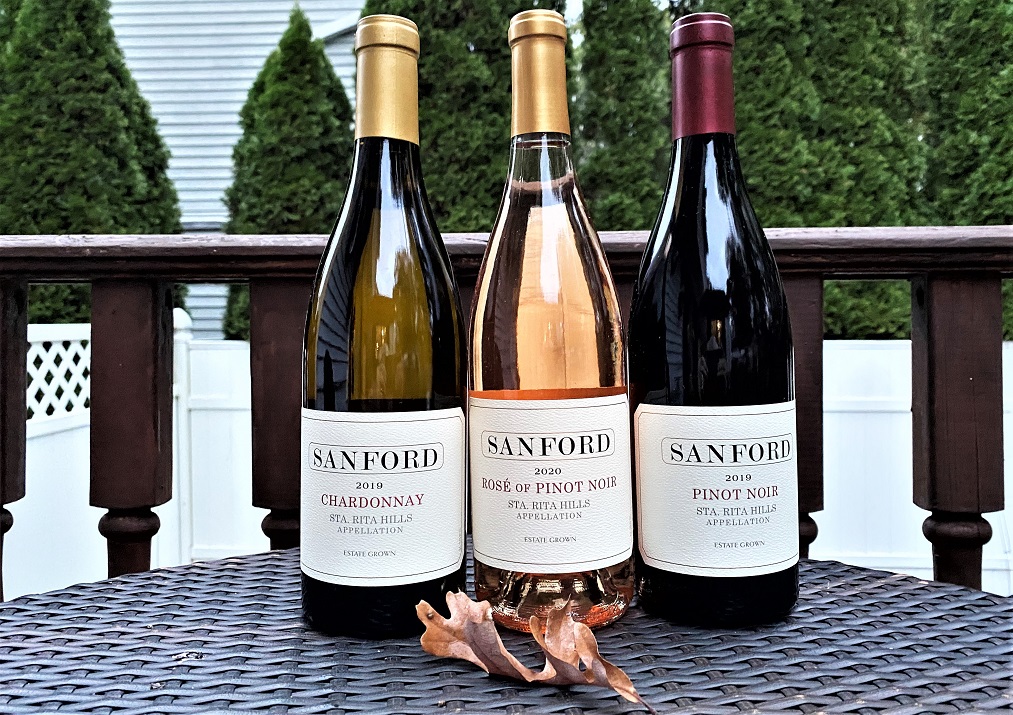
Trey Fletcher got schooled in world-class Pinot Noir and Chardonnay during his tenure at Littorai Winery, also learning biodynamic, organic, and sustainable viticulture at the same time. In 2011, Trey moved to Santa Barbara to become Winemaker and GM at Bien Nacido Vineyards. A few years back, Trey joined the Sanford team as Senior Winemaker, and 2019 became the first vintage where he was responsible for all the winemaking and blending decisions. I had an opportunity to taste Trey’s wines and here are my impressions:
2019 Sanford Chardonnay Sta. Rita Hills (13.5% ABV, $40, aged 11 months in French oak, 25% new)
Light golden
A hint of minerality, vanilla, apple, elegant, inviting
Similar profile on the palate – vanilla, apple, a distant touch of honey, perfect acidity, clean, fresh, delicious
8, an outstanding example of California Chardonnay
2020 Sanford Rosé of Pinot Noir Sta. Rita Hills (13% ABV, $20, aged 6 months in stainless steel and neutral barrels)
Salmon pink
Strawberries, nice mineral component
Tart strawberries, lemon, crisp, fresh, bigger body than a typical Provence, but still light and perfectly balanced. Nice medium-long finish.
8/8+
2019 Sanford Pinot Noir Sta. Rita Hills (13.5% ABV, $45, aged 11 months in French oak, 25% new)
Dark ruby
Plums, cherries, smoke. Classic Pinot nose
Sweet plums, tart cherries, probably a whole cluster fermentation based on a tiny hint of a green bite. Restrained, elegant, the sweetness is just hinted, and overall wine is well structured.
8, Should age well. A California Pinot with a lot of restraint
Pinot and Passion. There is truly something magical about the grape which becomes an obsession and an object of desire. The best proof, however, is always in the glass.
May you never stop growing.
Stories of Passion and Pinot, And Not Only Pinot: Battle Creek Cellars
I love urban wineries (or city wineries as they are often called). Solvang, Woodinville, Walla Walla – each place was different but similar at the same time – unique wines, unique stories, unique experiences. I would venture to say that winemakers at the urban wineries have more freedom to create and experiment, as they can choose the vineyards they want to work with and the style of the wines they want to produce. My latest experience in Portland is a direct confirmation of this.
My last winery visit in Oregon was at the city winery called Battle Creek Cellars, located in Portland’s Pearl District. I was told that I’m going to meet a winemaker who not only makes wines but also plays American football professionally, and has a unique personality. And I had about one hour before I had to start heading to the airport to make my flight – somewhat of a challenge for me as it is in my nature to worry about not missing a flight.
Sarah Cabot, the winemaker, was already waiting for us as we arrived at the tasting room. We grabbed glasses, a few bottles and headed out to the patio in the back to taste wines and to talk.
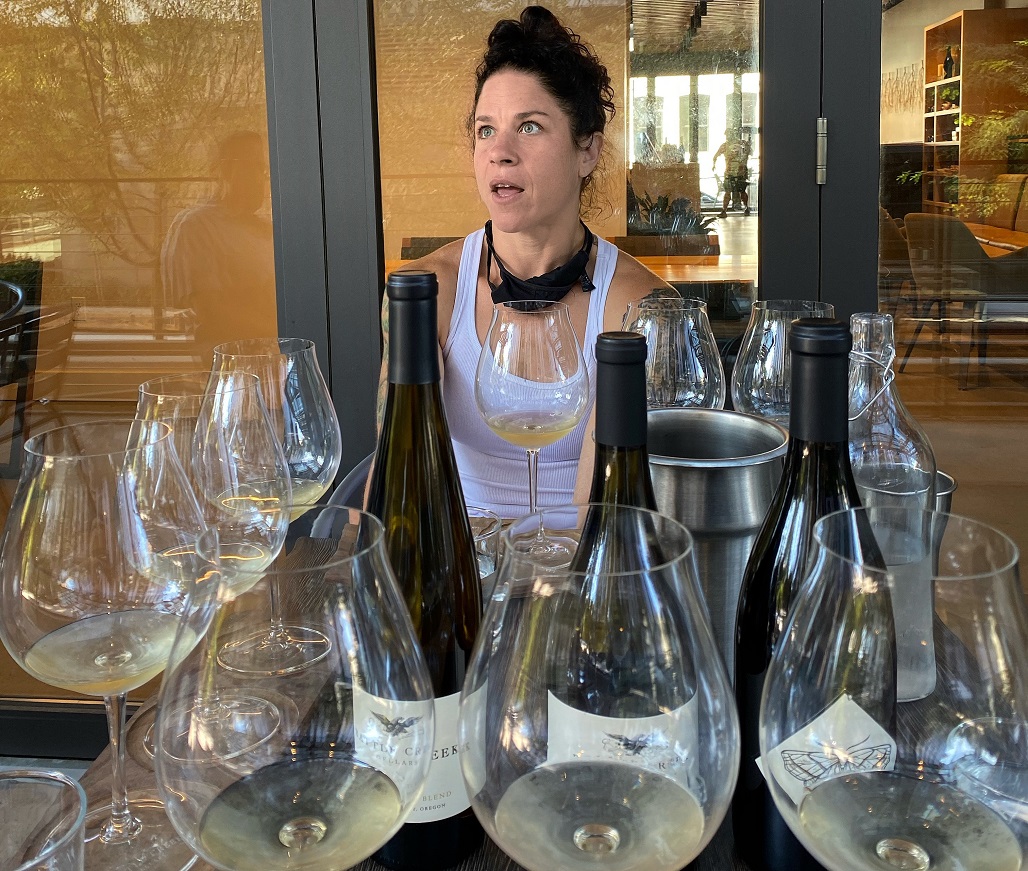
At the city winery, you can expect to find great wines, but you are not necessarily expecting to be blown away by what you taste and what you learn. The wines were absolutely spectacular, starting with the very first one 2018 Battle Creek Cellars Reserve White Blend – the wine had a distinct spicy nose, honey notes, and on the palate was clean, crisp with great acidity, creamy, and very different from the nose. This is where the unique sides of Sarah were already showing – she was getting the fruit from the vineyard where the vinegrower refused to tell her the exact composition of the blend – she only knew that Riesling and Gewürztraminer are a part of the blend, but the exact composition was not known.
Not only Sarah works with unknown grape blends, but she also uses a range of tools to produce the wines. For example, her 2019 Chardonnay Reserve was spectacular – round inviting nose with a hint of honey, and clean, crisp, and creamy green apple driven on the palate, a delicious rendition of Chardonnay – fermented in the sandstone jar.
Talking to Sarah I learned that while Battle Creek Cellars production is about 10,000 cases overall (6000 cases for unconditional Pinot Noir, 4000 cases of the other wines), Sarah is responsible for the production of more than 100,000 cases annually for her parent company, Precept Wine, Northwest’s largest private wine company. I also learned that Sarah greatly values the freedom to experiment which she has while working with her Battle Creek Cellars portfolio and that esoteric elitism, so common in the wine industry, is making her uncomfortable. And the amount of energy Sarah was exuding during our conversation, explaining all the different ways she utilizes when looking for the right vineyards and the right grapes and deciding how she would ferment and age any particular wines, was simply contagious.
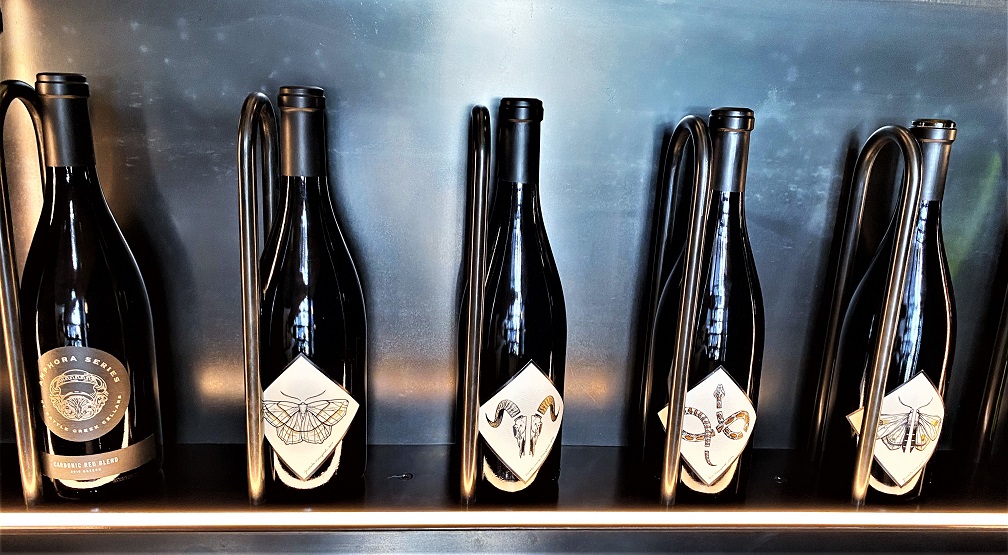


We tasted more wines:
2018 Battle Creek Cellars Reserve Rosé was simply outstanding, offering a whole array of sensory experiences – onion peel color, and the nose which prompted you to imagine yourself walking in the garden and smell strawberries, flowers, and just open meadows. The palate offered great acidity and was fresh and crisp.
2015 Battle Creek Vineyard Pinot Noir from the vineyard planted in 1998 was excellent, with cherries, mushrooms, chocolate on the nose, and more cherries, lean and crisp on the palate. Definitely an aging-worthy wine.
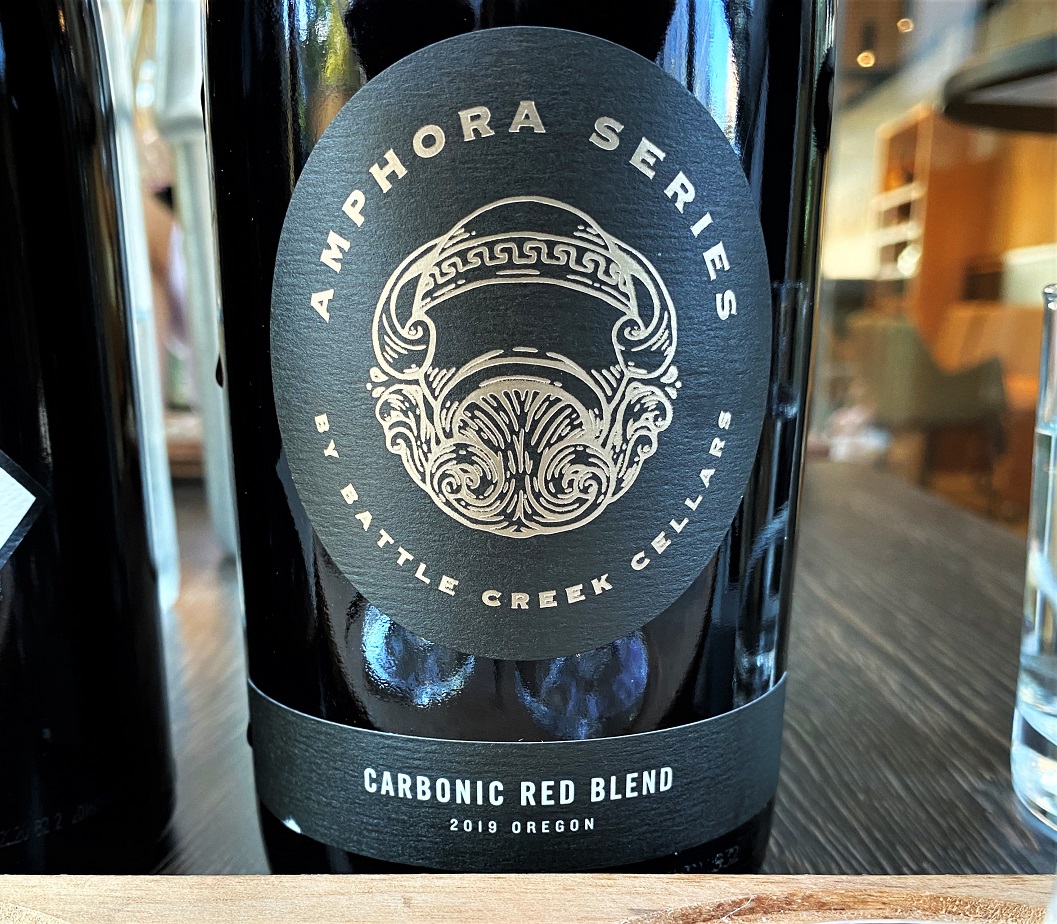 And then there was the 2019 Amphora Series Carbonic Red Blend Oregon which literally blew my mind… Grenache/Malbec blend, fermented whole cluster in amphorae for 30 days with skins. The nose was amazing with crunchy raspberries and cranberries, and then fresh fruit on the palate with beautiful supporting tannins was simply incredible, the wine you have to experience to believe it.
Next, we were out of time – but we agreed to continue the conversation, which we did using both emails with questions and a phone call, so I really had here the full experience as the writer.
Here is what transpired during our follow up conversation:
[TaV]: How did you get into the wine? When did you realize that making wine is your calling?
[SC]: I was working in casual fine dining restaurants as an undergraduate student in Boston and developed an initial fascination with wine there. Eventually, my life brought me back to the West coast and a sommelier I used to work with suggested that I go back to school for enology/viticulture when I mentioned to him that I was feeling unfulfilled in the service industry. I followed his advice and I knew, beyond a shadow of a doubt, that I had found my calling after my first day of classes.
[TaV]: What was the first memorable wine you made, the wine you were completely happy about?
[SC]: I guess that, to me, they have all been memorable in some way. As far as a wine that I’ve been “completely happy” about…I think that would be the 2018 Amphora Riesling. That wine made its own decisions and I couldn’t have made better ones if I had tried. Now, 3 years later, I feel even more ecstatic about it as I notice the developing notes of petrol that I’ve always coveted about fine Rieslings.


[TaV]: You seem to be working with lots of vessels to ferment and age wines – in addition to the standard vessels such as stainless steel and oak, you also use amphora, sandstone jars of different shapes, and probably a bunch of others. How do you decide when to use what, what grapes to put into what vessel and for what wine?
[SC]: This will probably sound a little silly, but the right fruit just seems to end up in the right vessel. It’s a combination of varietal, timing, and my whim in the moment. There’s no real formula to it.
[TaV]: When you were talking about your 2020 carbonic red blend, you mentioned that you instantly fell in love with Merlot you saw, and you wanted to make the wine exactly with the Merlot. How does it work for you? What was so special about that Merlot?
[SC]: More than the grapes themselves, it was the site where they were growing that made me feel inspired to work with Merlot for the first time since I was in school. It’s a special, beautiful, steep and windy vineyard in the Columbia Gorge AVA called Wind Horse Vineyard. The grower is passionate and engaged and I haven’t ever stood in a vineyard quite like it. I thought…if Merlot from anywhere is going to be extra interesting, it’s going to be from here. Sure enough, the aromatics and texture of the finished wine did not disappoint.
[TaV]: Do you use natural or commercial yeast? Winemakers often get religious about their yeast approach – what is yours?
[SC]: Since I make all my wine in a large winery among other producers, I can’t claim that my ferments are all completed by “native” yeast. I do often allow my ferments to begin spontaneously and finish on their own/without the addition of commercial yeast. I do have a few commercial yeasts that I particularly like to use which are all blends of Saccharomyces and non-sacch yeasts. I’ll use these in certain cases when it is a challenging fermentation environment and I don’t want an unwelcome microbial load to mask the fundamental sensory characteristics of the vineyard.
[TaV]: When you select fruit for your next wine, do you take into account factors such as sustainably/organically/biodynamically grown? Do you have any viticultural preferences?
[SC]: More than anything, I prefer to work with growers whose priority is to cultivate a healthy and long-term-sustainable ecosystem in the vineyard. Don’t necessarily have a strong feeling about the certification, but care about the ethos of the grower, how the vineyard is treated, and the surrounding area, not just the production environment. I try to work with the growers who take this symbiotically – sustainability is a key. The intention behind farming matters more than a certificate on a piece of paper.


[TaV]: Is there a winemaker you would call your mentor?
[SC]: Brian O’Donnell at the Belle Pente winery. Brian is the owner and winemaker, and this was my first job in Oregon right after enology school – he definitely created the framework that holds up my knowledge now as a winemaker. He taught me what his philosophy is and left me to my own devices to sink or swim. I made a few mistakes of my own, nothing too costly, but this was the best way to learn. I know general ethos and philosophy, and now it is my time to grow, improvise and get on my feet. There are other incredible winemakers I had mentorship moments with, but Brian is the closest to the real mentor.
[TaV]: Is there a dream wine you always wanted to make? What would that be?
[SC]: The perfect Pinot? Nah. High elevation Ribolla Gialla, oxidized. Similar to what Gravner produces in Friuli, it should have acid but should be ripe enough. I have yet to find the fruit in Oregon.
[TaV]: Your single-vineyard wine labels have beautiful simplicity and different images – what do these images represent?
[SC]: The avatar on each label represents the character of the wine, and it is unique to the vineyard. There are explanations of all the avatars on the back labels. The avatars are used for single-vineyard wines. Even when there is a vintage variation, the barrels selected to be bottled under a single-vineyard label have a consistent profile. The barrels selected to be the most identifiable features of the vineyard – power, finesse – and this is what characters represent.
[TaV]: As I promised, we need to talk about football. Does playing football helps you make wine? How about your work as a winemaker influencing the way you play?
[SC]: Football definitely helps me to do everything. That level of extreme physical exhaustion and violence is very cathartic, and this helps me to be a better winemaker dealing with pressure.
My work as a winemaker has had both positive and negative impacts on my game. As the negative impact, winemaking experience makes me second guess my decisions. However, as a winemaker I learn to react quickly and make decisions quickly, which helps, When I will retire from playing football I will need to start coaching because I will need this in my life.
[TaV]: During our conversation, you mentioned that working with Chardonnay is easy, but working with Pinot Noir is a pain in the butt. Do you care to expand on this? Can you be very specific?
[SC]: Chardonnay is not easy, but easier than Pinot. Working with Pinot is difficult because of the thinner skin and lower levels of phenolics, and it is not as protected by phenolics from the mistakes as Merlot or Syrah and is susceptible to all sorts of issues. Growing Pinot, if temperatures reach 88F, that affects the fruit, the vine can shoot down, and you don’t want to irrigate too much, so there is a constant worry. Because of thinner skin, it raisins a lot easier than others; when it is too wet, it breaks a lot easier than the others. With Pinot Noir, you can’t look away for one second.
[TaV]: Was there a pivotal wine for you, or a pivotal wine experience?
[SC]: There are 3. There is one that made me decide I love Pinot when I was 19 and working at the restaurant – 1996 Hartley-Ostini Hitching Post Pinot Noir from Santa Barbara. It tasted like candy, I was 19, and I loved it.
The red wine which made me realize how versatile the grape variety can be and how much where it grows to make a difference was Guigal Côte-Rôtie. I had learned about Syrah as a blending grape in Southern Rhone or Washington Syrah, and then I tired Côte-Rôtie, and my head was blown.
The white was really an assortment of whites from Trimbacbh – big, round, acidic, ultimate food wines.
[TaV]: Do you have an all-time favorite wine or wines?
[SC]: It will be Morgon. Duboeuff or Jean Foillard grand cru. Moulin-a-Vent would be a close second.
[TaV]: Given the opportunity, is there a winemaker you would want to make the wine with, or the winery you always dreamt of working at?
[SC]: I would love to have the opportunity to work side by side with Gravner or Radican, or anywhere in Jura, producing the traditional wines. Gravner is the ultimate. Gravner is the reason I got amphorae. I love their wines very much and I would love to learn there.
I can tell you that after the conversation with Sarah, I definitely want to try Gravner wines, and I can’t wait to experience the 2020 Amphora series which should be made with that magnificent Merlot…
Here you are, my friends. Another story of passion, Pinot, and not only Pinot, and pushing the envelope as far as it can go. If you are planning to visit Portland, make Battle Creek Cellars your “must stop”. Cheers!
This post is a part of the Stories of Passion and Pinot series – click the link for more stories…
One on One with Winemaker: Dennis Murphy, Caprio Cellars
Source: Caprio Cellars
It is a known fact that wine is produced in all 50 states in the US. And I will clearly risk it to alienate many people, but with all due respect to New York, Texas, and Virginia, there are only three belonging to the “big three” – California, Oregon, and Washington. It is Washington I want to talk about today.
I don’t know how this works, but when I think about Washington wines, I feel warm and fuzzy. I don’t know if it relates to wonderful experiences, such as the visit to Chateau Ste. Michelle, getting lost in Woodinville or exploring Walla Walla, or maybe it is because of some of the most amazing American wines being produced in Washington, such as the whole range of Cayuse wines, L’Ecole No41, Guardian Cellars, Mark Ryan, and countless others.
And today, I want to bring to your attention one of my very latest Washington wine discoveries – Caprio Cellars in Walla Walla.
On one side, Caprio Cellars’ story is absolutely “normal” (yes, an interesting choice of word here – what does “normal” even mean, right?). Dennis Murphy purchased a plot of land in Walla Walla Valley (previously a wheat field) in 2003. The first vines were planted in 2005, and the vineyard was called Eleanor in honor of Dennis’ grandmother, Eleanor Caprio; after the first harvest in 2008, the winery got the name of Caprio Cellars, and the rest is history. The second vineyard, Octave, was planted on the hillside in 2007. The latest high-altitude vineyard, Sanitella, was planted on the Oregon side of the Walla Walla AVA. Bordeaux varieties – Cabernet Sauvignon, Cabernet Franc, Merlot, and Malbec are planted across all three sustainably farmed vineyards, with the addition of Sauvignon Blanc planted on Sanitella.
This is where “normal” ends. What is unique about Caprio cellars is that your tasting is always complimentary (okay, yes, this still can happen in the other places). You also have complimentary chef-prepared dishes accompanying your tasting flight, with the seasonal menu – yes, complimentary, as in “free of charge” (I hope you are getting as impressed as I am because I’m not sure where else you can find that). And Dennis is very passionate about charities he supports. That definitely puts Caprio Cellars in the category of its own.
After tasting a few of the Caprio Cellars wines, I was ready to talk to Dennis. While we were unable to meet in person (something I really hope to rectify in the near future), we sat down with Dennis virtually, and he patiently answered all of my questions – and now I would like to share our conversation with you. Before we begin, one small note – this is a long conversation, and you definitely shouldn’t miss the answers to the questions at the end of this conversation. So I suggest you will settle in your favorite chair, pour yourself a glass of wine, and come along!
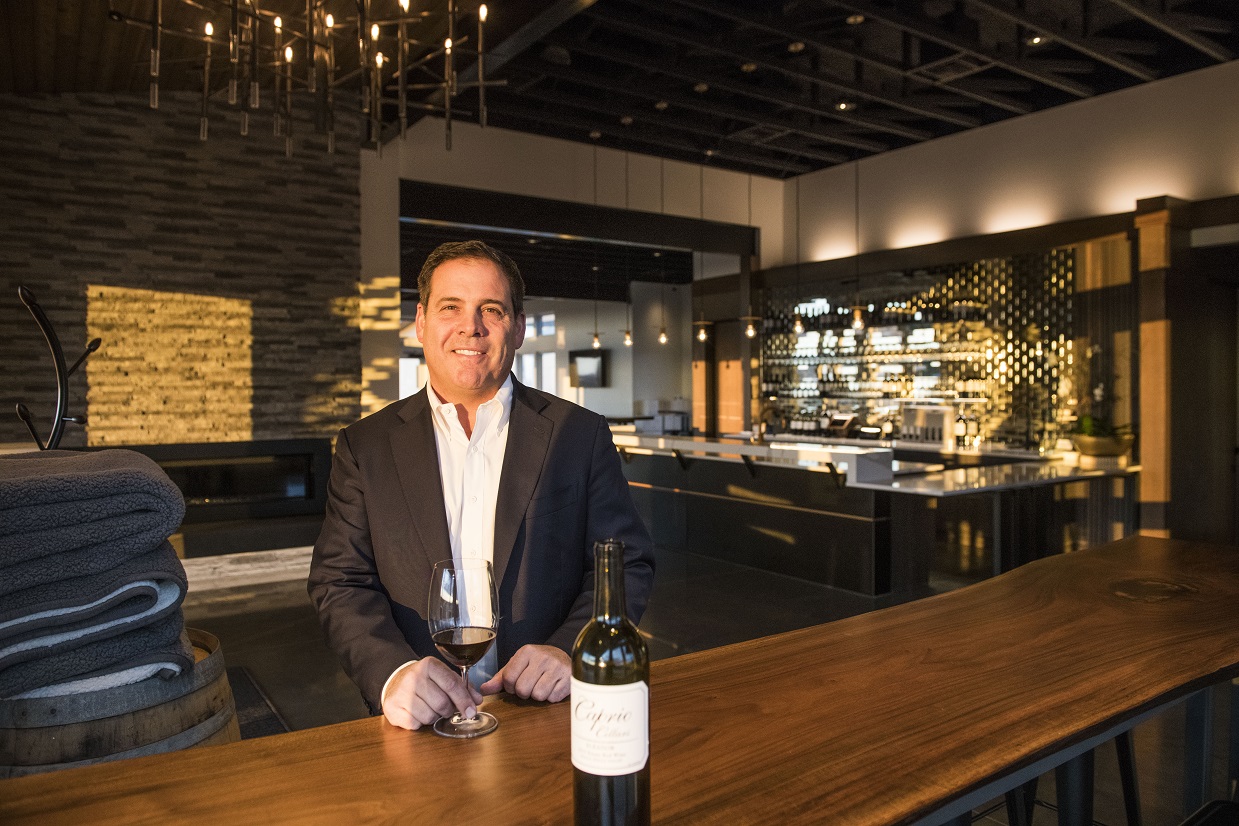
Dennis Murphy. Source: Caprio Cellars
[TaV]: Growing up, what was your exposure to the wine culture?
[DM]: Growing up, I remember my dad and grand parents making wine in the garage or the basement. Some was good, some was not so good. Wine was always a part of the dinner celebration, holidays and family gatherings.
[TaV]: Was there a pivotal wine in your life?
[DM]: The wine that brought me to Walla Walla was L’ Ecole No. 41 Merlot. I tasted this wine at a restaurant in Seattle and was blown away. I then started stopping at the winery and collecting the wine and eventually moved to Walla Walla.
[TaV]: When and how have you decided that you will own a winery?
[DM]: After tasting some Walla Walla wines and visiting Walla Walla, I fell in love with the town and moved. I could feel the energy in the wine scene emerging and moved to Walla Walla in 1999. There were just a hand full of wineries, so I started to make myself available during harvest and made some friends in the wine industry. In 2003 I purchased the winery estate property and in 2005 I planted my first vineyard, the Eleanor Vineyard.
[TaV]: Any plans for stepping outside of Bordeaux play – how about Syrah or Grenache which are so popular in Washington? Or maybe some Sangiovese or Tempranillo?
[DM]: I only make wines that I love to consume. I would look at Grenache, I love Grenache and think that the valley can produce some good fruit. We are making sparkling wine, I am intrigued to make a sparkling Rosé. I believe that focus is required to make world-class wine. I am focused on making world-class red Bordeaux-style wines from Walla Walla.
[TaV]: Considering your Italian heritage, do you have any favorite Italian wine regions, wines, or producers?
[DM]: It will not surprise you, I am a Super Tuscan guy. I think that the Cabernet Sauvignon and Merlot show very well. One of my favorite all time wines is the 1997 Ornellaia.
[TaV]: Are there any wineries and/or winemakers in Walla Walla who you would consider as your source of inspiration?
[DM]: Seven Hills/ Casey McClellan makes my favorite wine in the valley, the Pentad. Casey is a great winemaker, makes solid wines and the valley is fortunate to have him.
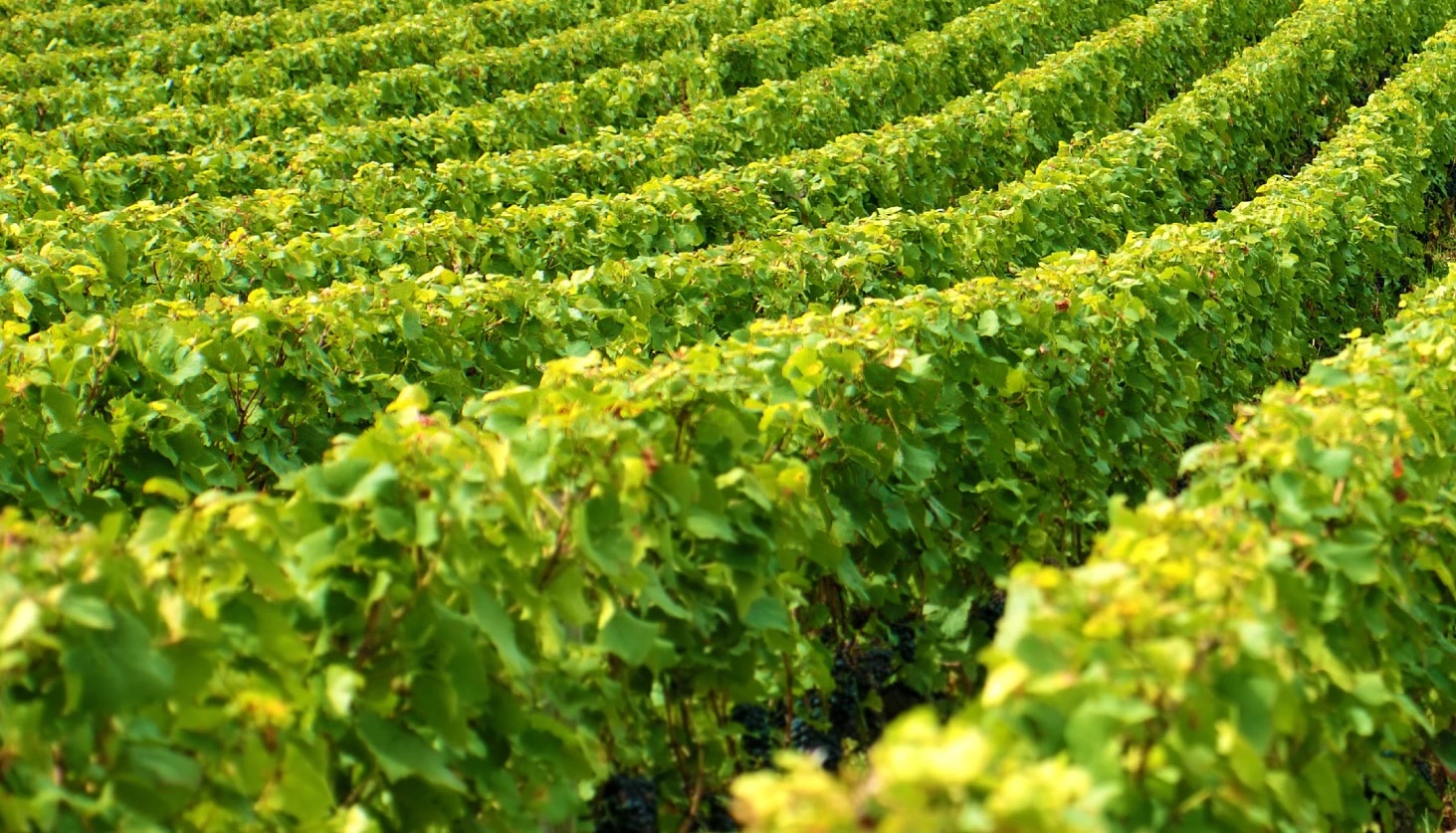
Source: Caprio Cellars
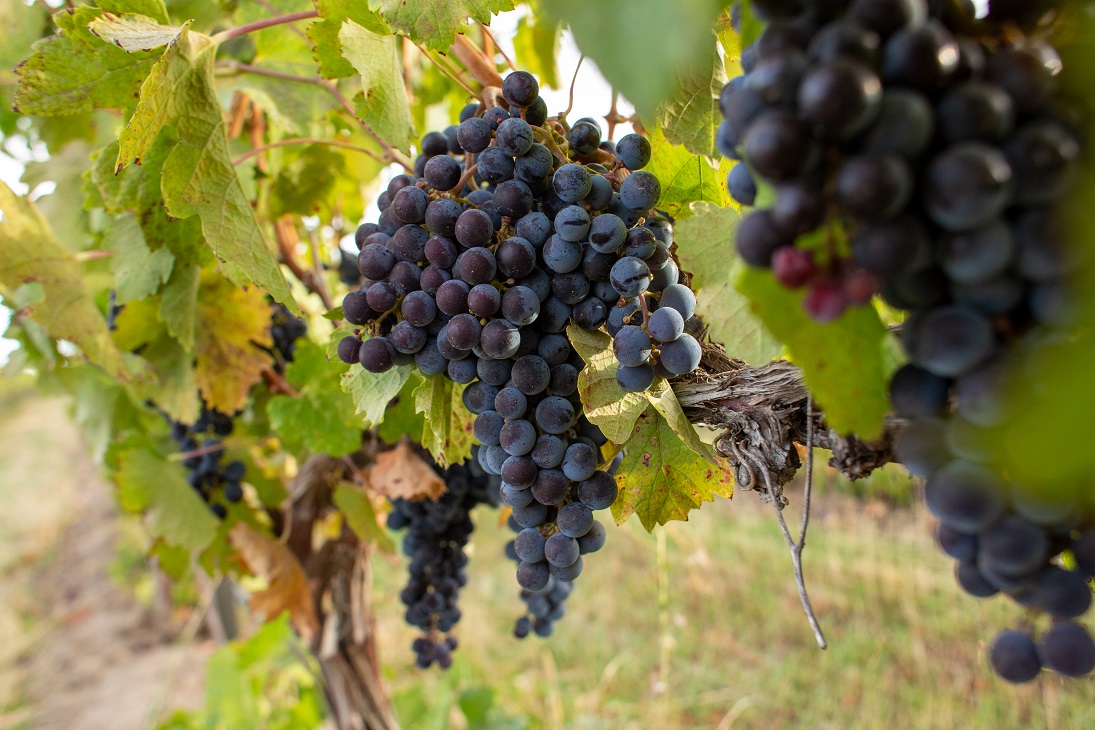
Source: Caprio Cellars
[TaV]: You are practicing sustainable farming – what does it entail in your daily routine?
[DM]: Sustainable farming is really about being as hands off the vineyard as possible, letting the land and crop do their thing naturally. Sustainable farming is very important for the industry and the environment. Mother Nature can provide anything that a chemical or synthetic can provide, you just have to work at it.
[TaV]: Any plans to advance your farming towards biodynamics?
[DM]: I do not have any current plans to farm biodynamic, but I have not ruled it out either.
[TaV]: First harvest at Caprio Cellars was in 2008. Do you still have any of those wines in your cellar? How are they evolving?
[DM]: Yes, I have the 2008 Caprio Cabernet Sauvignon, it was the only wine we made that year. I keep about 50 cases per vintage in the library, this would be considered a lot, but I like to keep more wine around for winemaker dinners, etc. The 2008 Caprio is holding up well and we get to visit it occasionally.
[TaV]: Any plans for more white wines in the future?
[DM]: Caprio grows Sauvignon Blanc and Semillon, these two varietals do well in our higher elevation Sanitella Vineyard. We release our Sauvignon Blanc in the spring, it is a crowd-pleaser and sells out quickly. We also make a rose’ of Cabernet Franc, this is a beautiful spring released wine as well.
[TaV]: Where do you see Caprio Cellars in 10-15 years?
[DM]: Caprio will be at our production goal of 5,000 cases per year. I believe this production is a sweet spot for a winery and you can still maintain quality. We will continue to provide a unique approach to hospitality, I am not sure what is next on that front, but we will continue to be the thought leader in our industry in the Walla Walla valley and push the envelope, it is in our DNA.


Let’s take a little break and taste some wines. I had an opportunity to taste two of the estate wines, Bordeaux blend, Eleanor, from 2017 and 2018 vintages. Here are my notes – and some related conversation right after:
2017 Caprio Cellars Eleanor Estate Red Walla Walla Valley (14.5% ABV, $48, 50% Cabernet Sauvignon, 28% Merlot, 12% Malbec, 10% Cabernet Franc, 65% Octave Vineyard / 35% Eleanor Vineyard, 18 months in 100% French oak – 35% new oak / 65% neutral barrel)
Dark Garnet
Minerality, underbrush, herbal profile – fruit undetectable
Expressive minerality, cherry pit, espresso, massive presence – typical Washington red which needs time (and hope) – and these are second day notes. Too big for my palate on the first day.
7+/8-
2018 Caprio Cellars Eleanor Estate Red Walla Walla Valley (14.5% ABV, $48, 59% Cabernet Sauvignon, 19% Merlot, 15% Malbec, 7% Cabernet Franc, 53% Octave Vineyard / 47% Eleanor Vineyard, 18 months in 100% French oak- 35% new oak / 65% neutral barrel)
Dark garnet
Blackberries, a touch of eucalyptus and cassis
Beautiful. Perfect mid-palate weight, silky smooth and velvety, cassis, cherries, supple, voluptuous.
8+, superb from the get-go.
[TaV]: This question is two-part about the wines I tasted:
First, the bottle of 2017 Eleanor is capped with foil, and 2018 is not. Why the change? Is this going to be the style moving forward?
[DM]: I am a traditional guy, I do love a foil cap on a bottle of wine. In line with our sustainability efforts, we held a customer focus group and it turns out that most customers prefer not to have the foil. We decided to leave it off in 2018 and it has been well received. I believe all future wines will not have a foil cap.
Now, the question which I never ask, but this time I have to. I tasted first 2017 Eleanor Red, and the wine was massive and tight – very typical for Washington reds, I call this type of wines “liquid rock” – lots of minerality and limited fruit. The wine opened up a bit on a second day but still was very tight. 2018 Eleanor Red, on the other hand, was approachable from the get go – Bordeaux style fruit, layered and smooth. Can you explain such a dramatic difference between these two wines? The grape composition is very similar, was that the terroir? Winemaking?
[DM]: Acid – the 2018 was the first vintage I nailed the acid level. It is a tight rope when it comes to acid, but 2018 and the 2019 are near perfect. I was pretty excited when I opened the 2018 Eleanor after bottling. Additionally, the vintages differed, 2017 was a tough year to get ripe, there were some photosynthesis issues that vintage. The 2018 vintage was a playbook vintage. What is funny is that in the tasing room we would taste the 2017 and 2018 side by side and the verdict was a 50/50 split. The 2017 was the fastest selling Eleanor we have produced, but the 2018 Eleanor is a critic’s favorite.
[TaV]: I understand that Caprio Cellars also supports a number of charities. What was the motivation behind this program? How do you decide what charities to support?
[DM]: Giving is a part of my every day living, it is in my fabric as a human. I created the phrase “give as you go”, this phrase is at the core of the purpose statement for my construction company. It was only natural for me to carry this belief to Caprio when we started. Caprio gives resources to many charities, mostly in the form of auction donations of wine and winemaker dinners. The winemaker dinners are very popular and bring a large amount of funds to the charity. Caprio focuses most monetary giving to First Story and Big Brother Big Sister. My construction company founded First Story and it helps families that otherwise would not have a home to get a home of their own. I have been a Big Brother for 18 years now and was on the board of directors, so it is a cause near and dear to me.


[TaV]: Last question is from the “how do they do it???” line. I understand that the wine tastings at Caprio Cellars are complementary. Not only that, but you also feed people! I read a number of discussions on professional wine forums with explanations that winery is a business and that literally how dare the wine lovers to expect their tasting to be complementary. And here is Caprio Cellars which does exactly that. So how do you do it and why? How is it working for you?
[DM]: I had no interest in opening a tasting room and charging a tasting fee. It seems like our industry has evolved into that business model. That model doesn’t make any sense to me. I wanted to disrupt the industry and focus on hospitality and the customer. Specifically focusing on the customer journey. We held focus groups at the beginning with Joseph Michelli (NYT bestselling author and consultant) from the Michelli group. Joseph believes that most businesses do not pay attention to their customers’ needs until it is too late in the customer journey. The Caprio tasting experience is based on the equity theory, I do something nice for you and in return, you will do something nice for me. The majority of the industry takes a tasting fee from the customer and gives it back “if you decide to buy”. We are all adults here; I do not need to take your money and give it back. I spent hours in other tasting rooms watching the customers sit in their group and have an agonizing group discussion on “how are we going to get out of here alive with our tasting fee”, discussions about you not liking the Syrah or him not liking the Chardonnay. Why put your customer through this process? At Caprio, we skip this pain point and we add the pleasure of a hand-crafted food pairing from our Executive Chef Ian Williams. My grandmother Eleanor Caprio is to blame or credit for the food pairing, if she knew I invited you over for a glass of wine and I didn’t offer you food, she would be very disappointed in me. The food program at Caprio was nonnegotiable when we opened, it is part of our program and a distinguishing advantage to our experience. Here is the punch line, if you like the food and wine pairing, we ask you to purchase a couple of additional bottles of Caprio to pay it forward to the next guest in our care. So far it is working out well and the ecosystem is taking care of itself, it is a beautiful thing, but somebody had to have the guts to try it.
Here we are, my friends. A wonderful story of passion, good wine, and a unique business approach. If your travel will bring you to Walla Walla, Caprio Cellars should be on your visit list. And if your travel will not bring you to Walla Walla … change your travel plans! Cheers!
Last Bottle Sign Up ($10 credit)