Archive
The Art Of Italian Wine: Masciarelli
Italian wines are special.
Well, this statement says a lot and nothing at the same time.
Remember, wine is personable and subjective. Everyone has a right to have their own opinion, and that opinion can only be subjective.
What makes Italian wines special? I will allow myself to make a bold claim – Italian wines are distinguishable. At least the well-made Italian wines produced from the core Italian grape varieties. What I’m saying is that when you taste Chianti, Brunello, Nero d’Avola, Montepulciano, Barolo and others, you might not identify the exact wine and the exact producer, but you would be reasonably sure you are drinking an Italian wine.
When you drink wine made from Cabernet Sauvignon or Chardonnay, you might be well able to identify the grape, but the origin of the wine can be equally anywhere in the world – Bordeaux, California, Italy, Spain, Washington, Australia, Chile and everywhere in between can be a source of a great Cabernet Sauvignon. This would be also true for the absolute majority of the so-called international grape varieties – Cabernet Sauvignon, Merlot, Pinot Noir, Grenache, Syrah, Chardonnay, Sauvignon Blanc. But when you taste Sangiovese made in Italy, you might be easily mistaken about the exact region, but you would be reasonably certain you are drinking an Italian wine. An important disclaimer – it would definitely help if this would be a well-made Italian wine.
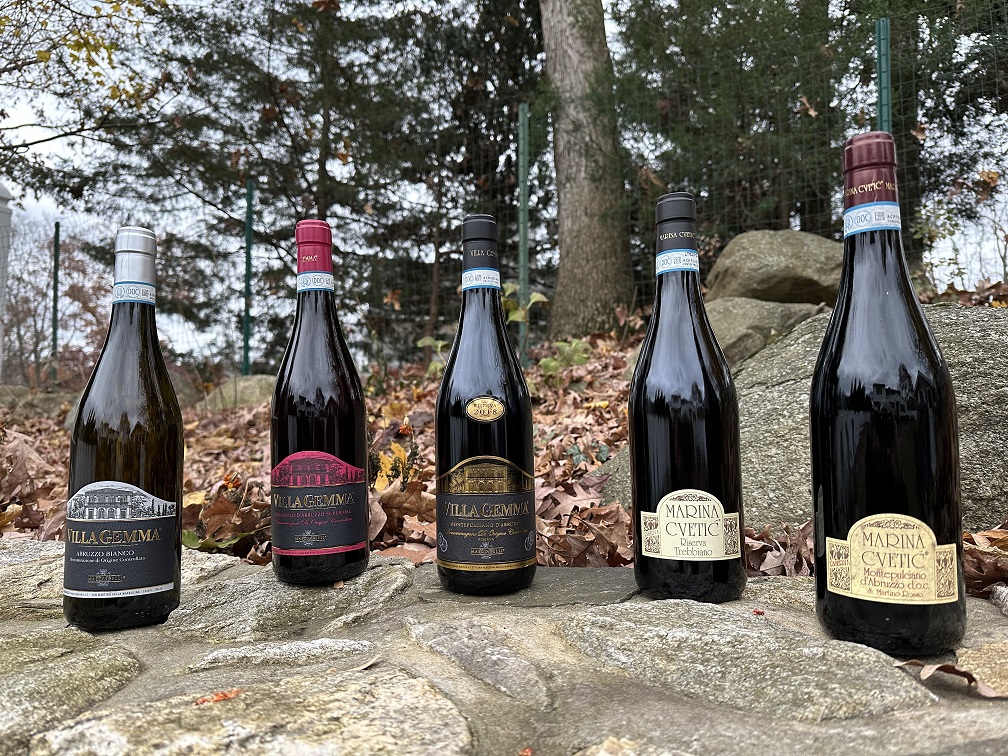
Here is a great example of the well-made, and thus easily recognizable Italian wine – or, rather, wines – Tenute Masciarelli in Abruzzo in Italy.
In terms of “wine time”, Masciarelli is a very young winery, founded in 1981 by Gianni Masciarelli. However, the impact in the wine world is not directly a function of time. Wine has been continuously produced throughout Italy for a few thousand years. In Abruzzo, a province located in central Italy along the Adriatic Sea, Montepulciano is the king. Simple Montepulciano red wines were produced forever in the region, perfectly quaffable, but not really comparable, for example, to the wines of Tuscany. Gianni Masciarelli spearheaded the change in the region, both in grape growing (he introduced the French Guyot training system for vines in the region) and production – he was the first to start using French oak barrels for aging the Montepulciano Abruzzo and Trebbiano d’Abruzzo wines. 1984 saw the first vintage of the Villa Gemma Montepulciano d’Abruzzo, the first of its kind single-vineyard Montepulciano d’Abruzzo wine, which will be celebrating 40 years of production this year.
Today, Masciarelly sustainably produces wines from all 4 provinces in Abruzzo. Annual wine production exceeds 1 million bottles across 7 different lines and 22 wine labels. A few months back, I had an opportunity to review Masciarelli’s introductory Linea Classica – 3 very well-made wines that were not only tasty but easily lasted for 5 days after being open – a testament to quality. Now, I had the pleasure of reviewing the latest releases from two more wine lines – Marina Cvetic and Villa Gemma.
Marina Cvetic line includes 2 of the classics – Trebbiano d’Abruzzo Riserva and Montepulciano d’Abruzzo – the second one is my perrenial favorite, I’m always happy to drink it. Additionally, the Marina Cvetic line includes four of international grape varieties (Chardonnay, Cabernet Sauvignon, Syrah, and Merlot) – however, I don’t think those are available in the US.
Villa Gemma, the winery’s flagship and the oldest produced line, includes three of the Abruzzo’s classics – white blend, Rosé, and Montepulciano d’Abruzzo Riserva.


Here are my notes:
2020 Masciarelli Marina Cvetić Trebbiano D’Abruzzo Riserva DOC (14% ABV, $60, 100% Trebbiano Abruzzese, 20-50 yo vines)
Light golden
A hint of tropical fruit, Whitestone fruit, honeysuckle
Round, clean, fresh, a hint of butter, soft and creamy texture with Meyer lemon finish
8, the wine is a bit aggressive when just opened, don’t over-chill it (I would serve it around 50F) and let it breathe, maybe 30 minutes in a decanter. Will stay fresh in the fridge for a few weeks.
2022 Masciarelli Villa Gemma Abruzzo Bianco DOC (14% ABV, $24, 50% Trebbiano, 30% Pecorino, 20% Cococciola)
Straw pale
whitestone fruit, lemon, clean, inviting
Crisp, clean, good acidity, lemon, expressive minerality, good balance
8, excellent
2022 Masciarelli Villa Gemma Cerasuolo D’Abruzzo Superiore DOC (14% ABV, $24, 100% Montepulciano)
Beautiful cranberry pink
Restrained nose of fresh strawberries, pleasant
Strawberries, cranberries, fresh, bright, excellent acidity, good balance, delicious
8
2019 Masciarelli Marina Cvetić Montepulciano d’Abruzzo Reserva DOC (14.6% ABV, $38, 100% Montepulciano, 15-30 yo vines, 12 months in French oak barrels)
Dark garnet, almost black
Dark cherries, espresso, tar, mocha, medium intensity
Dark cherries, silky smooth with beautifully present tannins, layered, round, well present, delicious.
8+, these are day 2 and day 6 notes, this wine is made of the long haul, was not very enjoyable upon opening, you need to decant it for 2-3 hours or forget it in the cellar for 10-15 years as the least.
2018 Masciarelli Villa Gemma Riserva Montepulciano D’Abruzzo DOC (15% ABV, $98, 100% Montepulciano, 35 yo vines, 12 months in French oak barrels)
Dark garnet, practically black
Black cherries, a hint of a barnyard
Black cherries, cherry pits, silky smooth roll-of-the-tongue texture, good acidity, excellent balance
8+, this is a big wine. It is surprisingly pop’n’pour, but will improve with the cellaring.
Here you are, my friends – wine, a liquid art form, made in Italy.
Do you think that Italian wines are easily distinguishable? What are your favorite Italian wine producers?
As Expected
Is “expectation” a wine term?
In a direct sense it is not, of course – “expectation” is not the name of the grape, not a wine descriptor, and not the name of the winemaking process. And nevertheless, for anyone who proclaims “serious affection, a.k.a love, a.k.a obsession” to the simple beverage produced from the grape juice, I would argue that “expectation” is a wine term, or at least, a wine-related term.
Expectations start from the very first look at the bottle – even before we see the label, the bottle’s shape and overall appearance initiate a thought process regarding the bottle’s content. Obviously, once we carefully look at the label, our expectations are enhanced further. Okay, young Barolo, I need to get the decanter ready. Ohh, this Sauvignon Blanc is too warm – I need to chill it before the guests arrive.
But then these are not even real expectations. Once you recognize the region, the grape, the producer – this is when the mind games of expectations start. Looking at the bottle of Opus One, Petrus, Penfolds Grange, or Dom Perignon, I’m sure that the mind of an average wine lover goes ballistic – “this is going to be amazing”. The brain would not accept anything less. Even after you try the wine, the brain will interject into the message from your palate if it is anything less than “oh my god, I love this”. But before I mount my favorite horse it appears that there is an idiom “to mount a hobbyhorse” (I hope there is a saying like this in English, as there is one in Russian), let me change the direction to where I’m actually trying to arrive.
As we are discussing the meaning of the wine term “expectations”, it is interesting to see how your expectations are built. Let’s say you tried a bottle of wine from an unknown producer, and you liked it. Then you tried another one. And another one – and I don’t mean in one sitting – slowly over time. As you keep liking the wines, your expectations are being built. You try new vintages, new wines from the same producer and your expectations keep growing. Once you become really familiar with the producer, you take a bottle you never had before, and before even opening it, you are confident that this will be a good wine – you expect nothing less. You might not love each and every wine from a given producer after you try them, but at least in terms of expectations, your ways are set. Just to give you an example, I expect excellent wines from La Rioja Alta, Lopez de Heredia, Field Recordings, Turley, Carlisle, Masciarelli, and lots of others – and yet while I’m writing this post, I’m drinking the wine from Carlisle that I don’t really enjoy at this moment (just opened the bottle, the wine needs to breathe). The fact that I don’t enjoy one particular wine doesn’t affect my general expectations – next time, holding a bottle of Carlisls in my hands, I would fully expect that I will like the wine “at hands”.
A “circle of expectations” is not cast in stone. As we taste wines from the new producer, we build confidence and our expectations are growing to the point of this unconditional trust. Today, I want to share with you one of my latest additions – Domaine Bousquet from Argentina.
 Domain Bousquet is not even 30 years old – it was founded in 1997, so in the wine world this is a very short period of time – but take a look at this simple picture above, which perfectly summarises Domain Bousquet’s achievements – Certified Organic with multiple designations, biodynamic Demeter certified, 1st in Argentina and 4 th in the world regenerative organic winery – you can continue researching this very impressive list on your own. But this is the wine we are talking about, so all of the certifications take a back seat to the content of the glass. What’s inside of glass matters – does it give you pleasure or not. And Domaine Bousquet produces damn impressive wines.
I was introduced to the wines of Domaine Bousquet exactly 3 years ago, and that introduction started with their Charmat method sparkling wines – organic, delicious, and inexpensive. Next, in August of the same year, 2021, I had an opportunity to taste an extended lineup of Domaine Bousquet wines, that were also excellent. Earlier this year I was blown away by their unoaked organic wines containing no added SO2, and then one more time in December when I tasted their Classic method sparkling wines which were world-class superb and an absolute steal at $18.
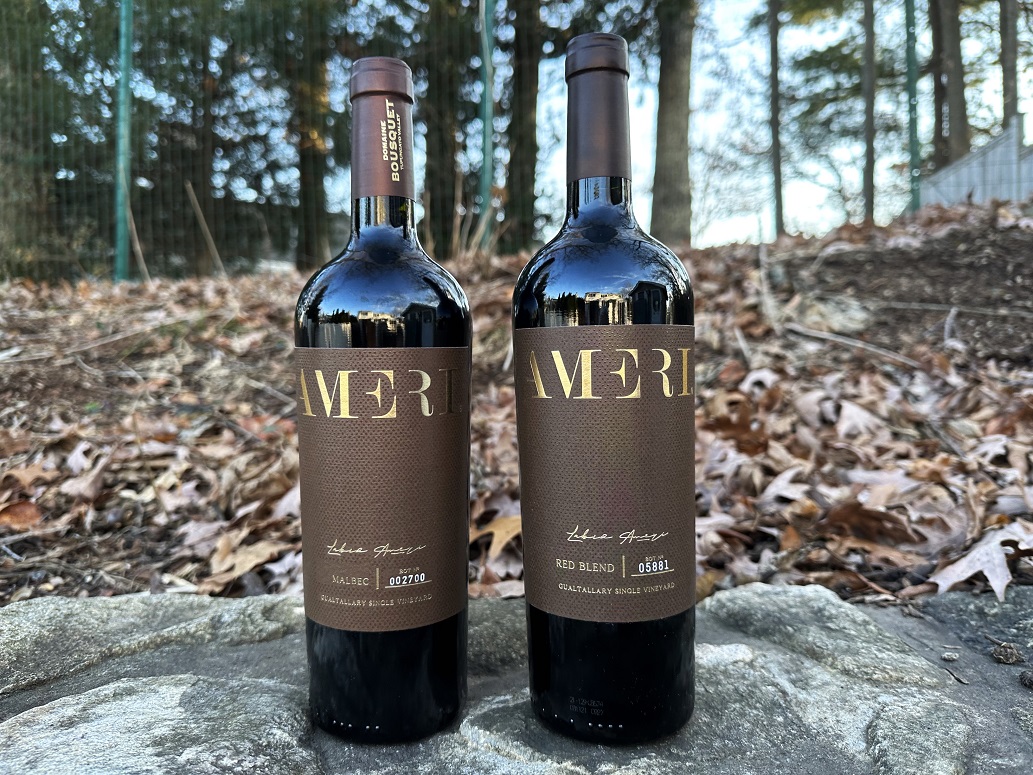 Now, I had an opportunity to taste some of their very best wines. These wines perfectly speak to my obsessed oenophile mind, as they are not even single-vineyard, but rather single-plot wines – and they are produced only in exceptional years. You know that I don’t like quoting the original winery notes, but I feel that in this case it is appropriate:
“Named for Domaine Bousquet co-owner Labid al Ameri, Ameri is not just“single vineyard” but “specific cluster,” and made only in exceptional years. At 1,257m/4,125 ft, the highest of the estate, the certified-organic vineyard, located in Gualtallary in the Andean foothills, gets a perfect combination of near constant intense daytime sunlight and huge day/night temperature differentials. The result is fruit with increased levels of sugar AND acid, flavor, and aromatics.”
Yes, I had expectations regarding these wines. I expected these wines to be well-made and tasty. And my expectations were met. Fully.
Here are my notes:
2020 Domaine Bousquet Ameri Malbec Gualtallary Mendoza Argentina (14.5% ABV, $37, 100% Malbec, 12 months in French oak)
Dark garnet, almost black
Cherries, plums, eucalyptus
Cherries, espresso, firm structure, good acidity, good balance
8, excellent
2020 Domaine Bousquet Ameri Red Blend Gualtallary Mendoza Argentina (14.5% ABV, $37, 60% Malbec, 20% Cabernet Sauvignon,10% Syrah, 10% Merlot, 12 months in French oak)
Dark garnet, almost black
Plums, fresh raspberries, mocha
Cherries, a hint of cassis, eucalyptus, sweet oak, perfectly integrated tannins, firm structure, excellent balance
8, delicious.
Both wines were just perfect from the get-go, but both also lasted for at least 5 days on the counter with the air being pumped out – a testament to the quality.
Here you are, my friends – all-organic, delicious, top-shelf wines from Argentina – delivering the pleasure.
As expected.
Happy Wines of Barra
What are happy wines you may ask? Can the wine be happy? Can the wine be unhappy? Can the wine actually express emotion?
The first two questions probably don’t have an answer. But can the wine express emotion? You bet. That’s the whole point of wine appreciation. The wine that gives you joy. The wine that brings back happy memories. The wine that gives you happiness. The wine that gives you pleasure. The wine that doesn’t leave you indifferent. Not every wine in your glass will do that for you – but some will. I think it will be fair to call them Happy Wines.
Happy wines are those that put a smile on your face. You open a bottle, put the liquid into the glass, swirl, sniff, sip – and smile, because the wine is actually that good. It doesn’t have to be the best wine you ever tasted. It doesn’t have to be expensive or inexpensive. As long as the wine puts a smile on your face and makes you happy, you can call it a Happy Wine.
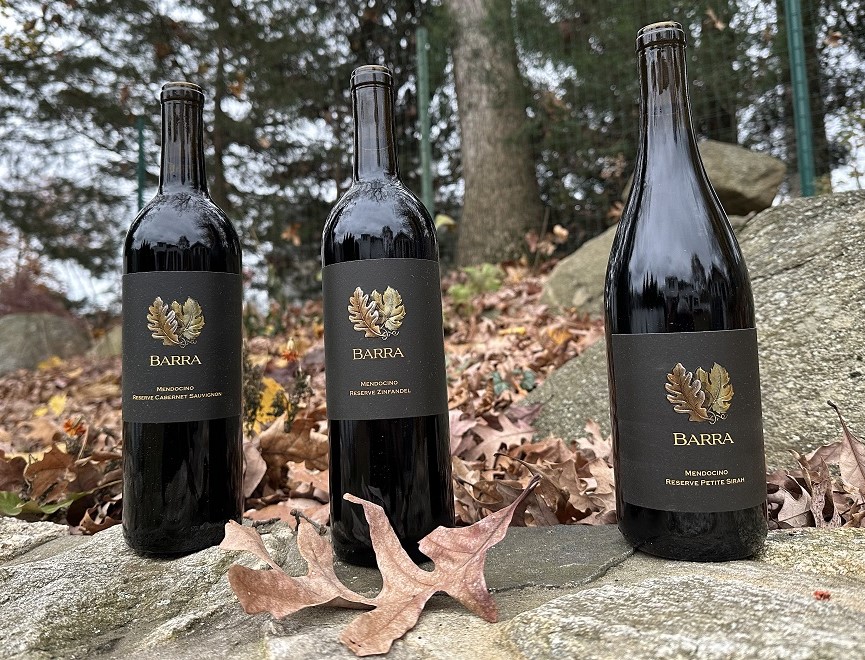
My latest happy wine discovery was the latest release of red wines from Barra of Mendocino. I already wrote about the winery before – you can find the complete two-part story here (part 1 and part 2) with all the details about this 50-year-old, 350-acre organically farmed estate located in Northern California, in Mendocino. Everything I tasted so far from Barra was outstanding, and this latest release of the 3 reserve red wines made from organic grapes didn’t disappoint either.
2020 Barra Reserve Petite Sirah Mendocino County (14.5% ABV, $28, 18 months / 30% new French oak, balance in neutral barrels, organic grapes)
Dark Garnet, practically black
Beautiful nose of red and black fruit
Sweet cherries, perfect acidity, well-integrated luscious tannins, layered, delicious.
8+, outstanding, and a unique rendition of PS which doesn’t require waiting.
2020 Barra Reserve Zinfandel Mendocino County (14.5% ABV, $26, 16 months / 25% new French oak, balance in neutral barrels, organic grapes)
Bright Ruby
Dark fruit and herbs on the nose, a hint of fresh coffee, tobacco
Tobacco, cherries, luscious texture, round, pleasant, with long finish.
8, excellent
I just wrote about Barra Cabernet Sauvignon in the previous post where I tasted it alongside two superb Napa Valley Cabs – but I’m happy to talk about this wine twice in a row 🙂
2021 Barra Reserve Cabernet Sauvignon Mendocino County (14.5% ABV, $28, 18 months / 30% new French oak, balance in neutral barrels, organic grapes)
Garnet
Eucalyptus, cherries, a hint of cassis
Eucalyptus, dark berries, cherries, cassis, well-integrated tannins, perfect balance, medium-long finish.
8, delicious
All three were happy wines – ready to drink from the moment the bottle was open, and thoroughly delicious, putting a smile on your face. I can also tell you that all three of these wines lasted for almost 7 days after being first opened, standing on the counter, with the air being pumped out – this is definitely a testament to the quality and to the longevity of these wines – while these wines will not set you back by anything comparable to any cult Californian wines, I guarantee you that they will age equally well or possibly even better.
Have you tried Barra of Mendocino wines? I would love to see the smile on your face once you do. Cheers!
Ode to Cab
 Ode to Cab.
Or we can just call it a Love Letter to Cabernet Sauvignon.
As an oenophile, I always try to maintain my “grape neutrality”. I can never name my favorite type of wine, never mind favorite wine. If you will hard press me against the wall with this question, I might say that it is Rioja, but the reality is a lot more complex than that.
If you search through articles in this blog, you will find a full range of wine styles and grapes. There are many blogs out there that cover specific region(s) or specific types of wine – but when I started writing close to 15 years ago, I knew that I would not be able to do that. This blog is about wine appreciation – any wine. “Wine should give you pleasure” – and so this is what my writing is primarily after – sharing the joy, the pleasure of wine, no matter what is the pedigree. Wines made from little-known grapes – Bobal, Trepat, Kekfrankos, Romorantin by tiny producers can give you as much pleasure as first growth Bordeaux, cult California, or best super-Tuscans. The liquid in the glass matters, and the only opinion that matters is yours and only yours – you can not enjoy the critic’s 100 points in your mouth.
This is my approach – try any wine with an open mind, and always be ready to be pleasantly surprised – or even blown away for that matter. And yet there is something about Cabernet Sauvignon that makes my heart race, especially coming from the producer I know or have heard of. Listen, I’m doing my best to tell you the truth, even though the “thought spoken is a lie”. But the brain gets all excited when I’m opening a bottle of the familiar Cabernet Sauvignon because I already know how good it can be. Very different from the excitement of the possible taste of DRC, Petrus, or Quintarelly (I’m yet to taste either) – because with those I wouldn’t know what to expect. But I do know what to expect from the well-made Cabernet Sauvignon that is ready to drink.
Even with the wines I happily call the favorites, I can’t tell you what I’m expecting to taste. I can’t describe my expectations when tasting La Rioja Alta, Ken Wright Pinot Noir, or Loacker Corte Pavone Brunello di Montalcino. I expect that I will like those wines as I know the producers and had their wines many times before – but I can’t tell you my exact expectations of the aroma or the taste of the wine. With Cabernet Sauvignon, I have very precise expectations of the aroma and the taste for me to like the wine. If I do not find the cassis (black currant) on both nose and palate when the bottle says “Cabernet Sauvignon” on it, there is no way I will like the wine, no matter how good the wine is for anyone else. Eucalyptus, mint, and a good structure are also expected, but with this some variations are possible. But when the expectations are met… the Cabernet Sauvignon is nothing but a pure, hedonistic pleasure.
So yes, deep down, Cabernet Sauvignon might be the most favorite wine of all – I just hope I will remember it next time I’m asked about my favorite wine.
Now, truth be told, I had a good reason for all this rambling about the beauty of Cabernet Sauvignon. A few weeks ago, I had an opportunity to conduct an accidental side-by-side tasting of the California Cabernet Sauvignon and the results were simply amazing.
With this tasting, we are taking a little trip. We will start in Northern California, where Barra of Mendocino is located. I wrote about their wines before, and now I have a few of the latest releases and I thought that Cabernet Sauvignon would be quite appropriate for the tasting.
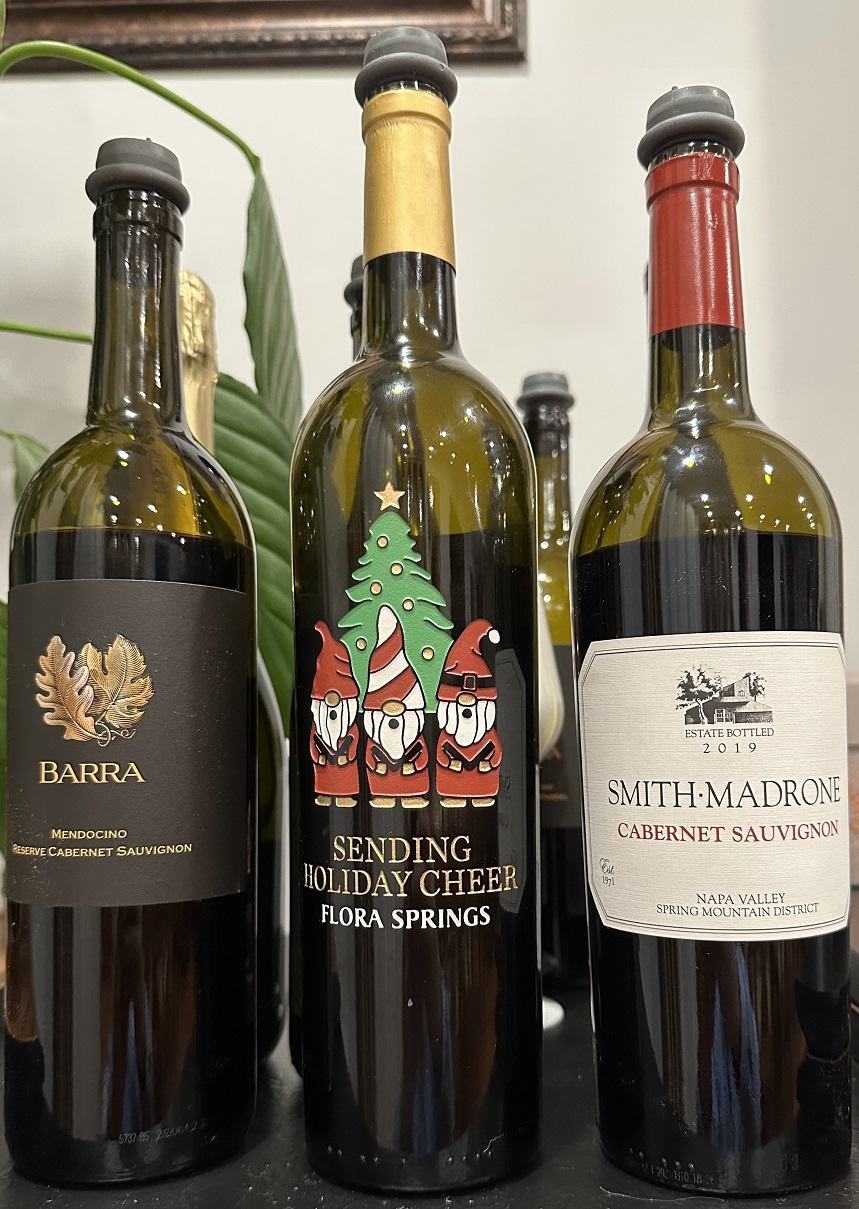
Barra Cabernet Sauvignon was the leanest of 3, but still had a perfectly recognizable Cabernet Sauvignon profile:
2021 Barra Reserve Cabernet Sauvignon Mendocino (14.5% ABV, $28, 18 months 30% new French oak, balance in neutral barrels)
Garnet
Eucalyptus, cherries, a hint of cassis
Eucalyptus, dark berries, cherries, cassis, well integrated tannins, perfect balance, medium-long finish.
8
Moving 80 miles southeast, we now arrive at the Flora Springs winery, located in the heart of the Napa Valley. Again, one of my favorite wineries in California, I wrote about their wines on multiple occasions.
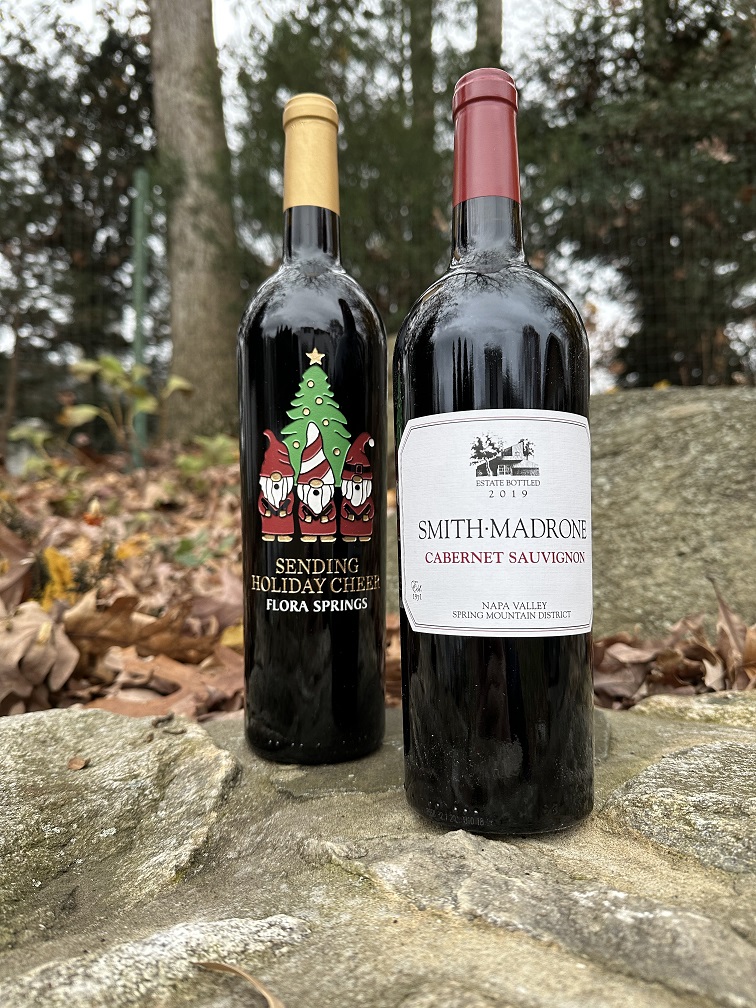
The wine I had an opportunity to taste was a special holiday release. Flora Springs is big on the holiday celebration, so this bottle features etched gnomes, perfectly appropriate for the holidays. But it is what’s inside that counts, and this wine was nothing short of spectacular.
2019 Flora Springs Red Wine Blend Napa Valley (14.5% ABV, $95, predominantly Cabernet Sauvignon, 18 months in 70% French and 30% American oak barrels)
Dark garnet
Cassis, mint, black tea, cassis is playing in and out – you can smell this wine forever. Cassis is prevalent, wow.
Burst of cassis at first, then tannins come in, offering some bitter notes around the otherwise perfect Cabernet core. A very powerful, delicious wine that needs time to soften up. Either decant for a few hours, or lose it in the cellar for 10 years. The winery says you can enjoy it through 2036 – I’m sure you can easily add another 20 years on top of that.
8/8+
Going back about 8 miles northwest, we now arrive at the Smith-Madrone, the winery located in the Spring Mountain district of Napa Valley. Smith-Madrone is yet another one of my favorite wineries, and the one I feel a bit guilty about as a writer. I wrote about Smith-Madrone wines on many occasions in this blog – 5 years ago, Smith-Madrone were my wines of choice to celebrate Thanksgiving; in 2019, Smith-Madrone Cabernet Sauvignon was my wine of the year. And I’m still yearning to write a post fully designated to the winery…
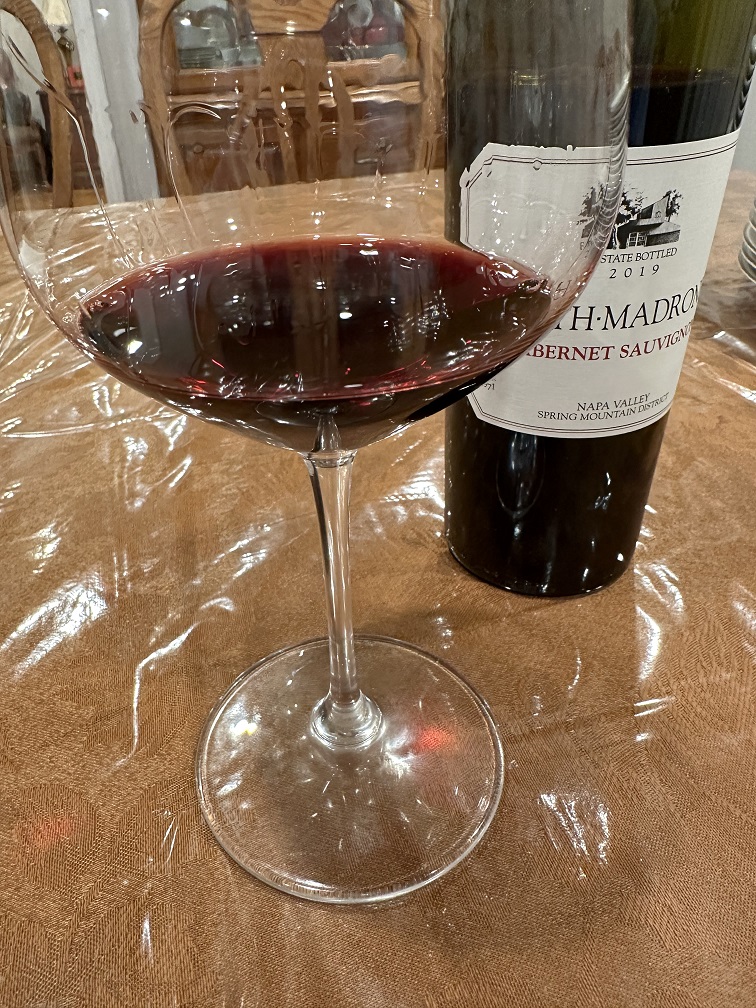
Nevertheless, Smith-Madrone Cabernet Sauvignon to me is one of the most textbook-proper, pure Cabernet Sauvignon wines there is. Not everyone would share my opinion – my sister-in-law with whom I was tasting these 3 Cabs, was preferring Flora Springs Cab, just for the sheer, unashamed beauty. But to me, a more subtle but very confident representation of the Cabernet Sauvignon by Smith-Madrone was just a perfection:
2019 Smith-Madrone Cabernet Sauvignon Spring Mountain District Napa Valley (14.3% ABV, $65, 83% Cabernet Sauvignon, 5% Merlot, 12% Cabernet Franc, 18 months in 55% new French oak)
Brilliant dark ruby
A perfection. A textbook Cabernet Sauvignon cassis, pure, perfectly precise cassis. You can think of a bell pepper – I’m not sure it is there, but it comes to mind.
The palate is amazing – cassis, eucalyptus, perfect minerality, a touch of the pencil shavings, salivating acidity. This is an impeccably balanced wine built for aging. In 10 years, it will be insanely good. In 20 – … well, I don’t want to even think about waiting that long…
9-, pure and superb.
If you like Cabernet Sauvignon, either one of these 3 wines will make you happy – each one perfectly representing their terroir and the vision of the winemaker, and yet unquestionably perfectly representing maybe the most noble grape of all.
So now you know what my secret passion, secret true wine love is. What’s yours?
Rioja Worth Seeking – El Coto de Rioja
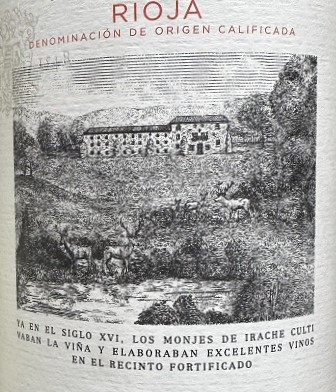 I love Rioja wines.
This is not a secret for anyone who has been following this blog for some time.
But despite such a strong proclamation, this love is not unconditional. Rather, it is very selective.
I have more of an exclusive club in Rioja. This is a club with a very limited membership. Anyone can apply, but only a select few can become members. Those in the club enjoy unconditional love and forgiveness for their little mistakes. For the rest of them… well, good luck making the cut.
I guess I need to change my opening line.
I’m a Rioja snob.
I love Rioja, but this love is very selective.
There, this would be a better opener.
The founding members of my exclusive club are CVNE with all of their lines (Vina Real, Imperial, Contino, …), La Rioja Alta, and Lopez de Heredia. Bodegas Tobias, Bodegas Beronia, and Bodegas Lan also have full membership.
Okay, let’s put another spin on this snobbish endeavor.
Rioja is a large region in Spain. There are about 14,800 grape growers, and about 574 wine producers in Rioja. That means lots of different styles and lots of different quality levels – even though all bottles will say “Rioja” on them. Seeing a bottle of Rioja doesn’t make me excited – seeing the name of a familiar producer who I know makes quality Rioja wine does. Hence my exclusive Rioja “club” – simply the list of my favorite Rioja producers.
What might be more important is that this “club” is actively taking applications (the approval rate is very low though), and I feel that it is time to formally add one more member there – El Coto de Rioja. El Coto wines were mentioned a few times in the blog already, but now let’s make it official.
El Coto de Rioja was founded in 1970 located in the town of Oyón. Over the 50 years of its history, El Coto de Rioja became the largest winery in Rioja, farming 1804 acres of estate vineyards. El Coto de Rioja plantings include 8 individual vineyards located across all Rioja DOCa sub-zones, such as Rioja Alta, Rioja Baja and Rioja Alavesa. One of the vineyards, Finca Carbonera, located in Rioja Alta, is the highest altitude vineyard in Rioja DOCa. In addition to all of the traditional Rioja red grape varieties, a significant portion of plantings are dedicated to the white grape varieties including new ones for Rioja – Verdejo, Chardonnay, and Sauvignon Blanc. El Coto de Rioja also built a winery directly in the vineyard, dedicated to the white wine production.
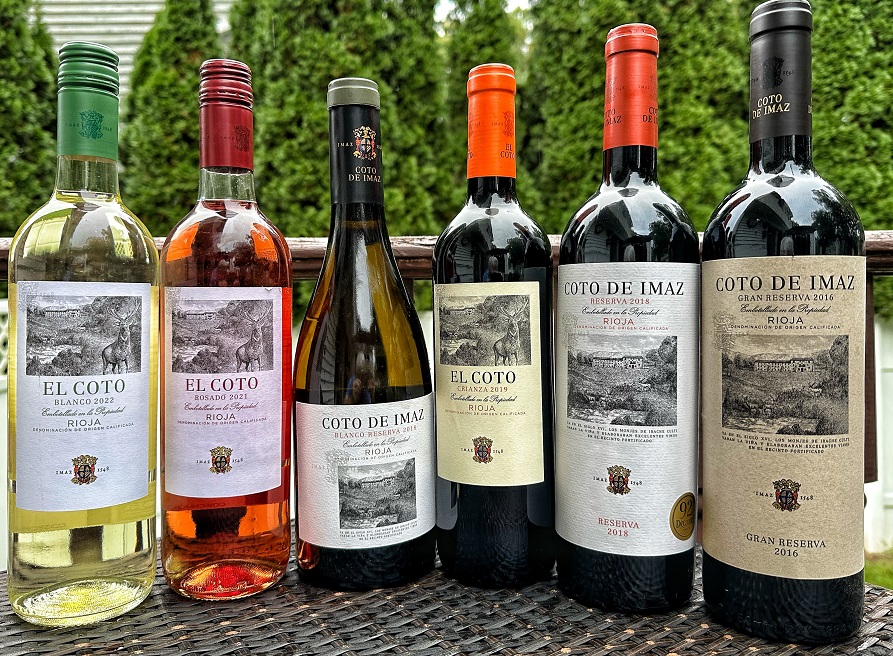
I had an opportunity to taste (samples) a range of wines from El Coto de Rioja – here are my notes:
2022 El Coto Coto de Imaz Blanco Rioja DOC (12% ABV, $11.99, 93% Viura, 4% Sauvignon Blanc, 3% Verdejo)
Pale green
An enticing nose with lemon, acidity and minerality, fresh and vibrant
Lemon, Whitestone fruit, crisp, clean, refreshing.
8, delicious.
2021 El Coto Coto de Imaz Rosado Rioja DOC (13.5% ABV, $11.99, 90% Tempranillo, 10% Garnacha)
Intense salmon pink
Beautiful, inviting, fresh strawberries
Fresh strawberries and cranberries on the palate, pleasant tartness, fresh and round
8, excellent
2018 El Coto Coto De Imaz Blanco Reserva Rioja DOC (12.5% ABV, $24.99, 100% Chardonnay, 12 months in new French oak)
Beautiful light golden color
A touch of butter and vanilla
A hint of butter, vanilla, Granny Smith apples, crisp, elegant, good acidity.
8, I want to try it in 5 years, I expect it to develop beautifully
2019 El Coto Imaz Crianza Rioja DOCa (14.5% ABV, $16.99, 100% Tempranillo, minimum of 12 months in American oak, at least 6 months in the bottle)
Garnet
Dark fruit, sapidity, gunflint, intense
Bright, uplifting, medium body, dark berries, smoke, crisp acidity, very “new world” in style, good balance, tannins show on the finish – will age and evolve well
8-
2018 El Coto Imaz Reserva Rioja DOCa (14.5% ABV, $22.99, 100% Tempranillo, minimum of 18 months in American oak, at least 18 months in the bottle)
Dark garnet
Dark fruit, earthy, being of herbs, medium intensity
Brilliant, classic Rioja, succulent cherries, cedar box, sage, salivating acidity intermingling with well integrated tannins, perfect balance.
8, delicious.
2016 El Coto Imaz Gran Reserva Rioja DOCa (14.5% ABV, $34.99, 100% Tempranillo, minimum of 24 months in American oak, at least 36 months in the bottle)
Dark garnet
A touch of minerality, cigar box, hint of cherries
Black fruit, concentrated, firm structure, well-integrated tannins, good acidity, good balance.
8, very good but will benefit from time in the cellar
I have to honestly say that while the red El Coto wines were good, I loved both whites and Rosé even more. The El Coto Rioja Blanco is a perfect quaffer any time you want a glass of refreshing white wine. Blanco Reserva is in the category of its own, a delicious Chardonnay rendition for any occasion when you crave a thought-provoking white wine.
El Coto de Rioja wines are well worth seeking – they are both delicious and still reasonably priced for the quality they deliver. And they are also widely available, so off you go to the store. Cheers!
Brilliance of the Bubbles
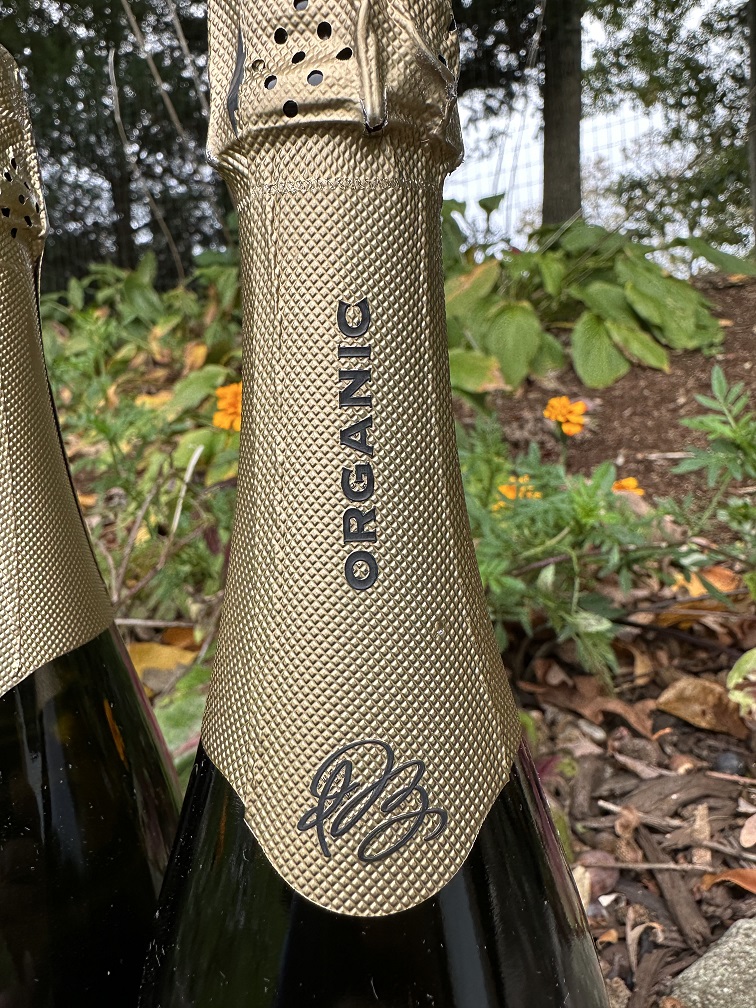 Champagne, anyone?
Well, I’m not in the mood to celebrate anything going on in the world right now. But I still drink wine, and while Champagne = Celebration is deeply ingrained in our minds, here I’m just talking about Champagne as a type of wine, the same as white, red, and Rosé. And I need to further correct myself – I’m not even talking about Champagne, the sparkling wine produced only in the Champagne region of France. The subject of today’s post is generic “bubbles”, the sparkling wine produced elsewhere in the world.
Simplistic on the surface, “bubbles” is an interesting wine category. Nobody is born craving wine, wine is an acquired taste. Bubbles might be the next level of acquired taste compared to wine, especially if we can exclude social pressure from consideration. Classic Champagne typically boasts cut-through acidity and is expected to be devoid of any traces of fruit for the joy of purists. And god forbid any sweetness can be detected in the glass… Not the wine someone intuitively craves. But this is not the biggest issue with the “bubbles”. The bigger problem is that people are well-trained to recognize the word Champagne, and once they hear that word, whether they truly love the liquid in the glass or not becomes irrelevant – “ahh, it is Champagne!”.
As anecdotal evidence, my favorite example is Kevin Zraly’s Windows on the World wine classes. The last class in the series of 8 started with Champagne. 4 wines were poured blindly to the group of roughly 120 students. After tasting all 4 wines, we were asked to have a show of hands for our favorite Champagne. I don’t remember details about wines #1, #2, and #3, but there was a somewhat equal spread between these three wines. Wine #4, however, had barely any hands raised. As the wines were revealed, Kevin Zraly said “and this is why, people, you shouldn’t drink vintage Champagne” – wine #4 was Dom Perignon, creme de la cream of Champagne world. Have we known that we were drinking Dom Perignon, I guarantee that wine #4 would be adored by everyone.
Before you get any wrong ideas, let me assure you – this is not a Champagne-bashing post. I love good Champagne as much as any other hard-core Champagne aficionado is. 2002 Pol Roger Sir Winston Churchill Champagne was my wine of the year in 2016. I have enjoyed immensely Krug, both vintage and non-vintage. Champagne Lanson, Duval-Leroy, Piper-Heidsieck, Bollinger, and on, and on, and on. But the point I’m trying to make here is that when looking for bubbles, you shouldn’t hang up on Champagne and only Champagne – sparkling wines are made everywhere today, and there are lots and lots of very worthy bubbles you can enjoy, as long as you are willing to accept that great sparkling wines don’t have to come only from Champagne.
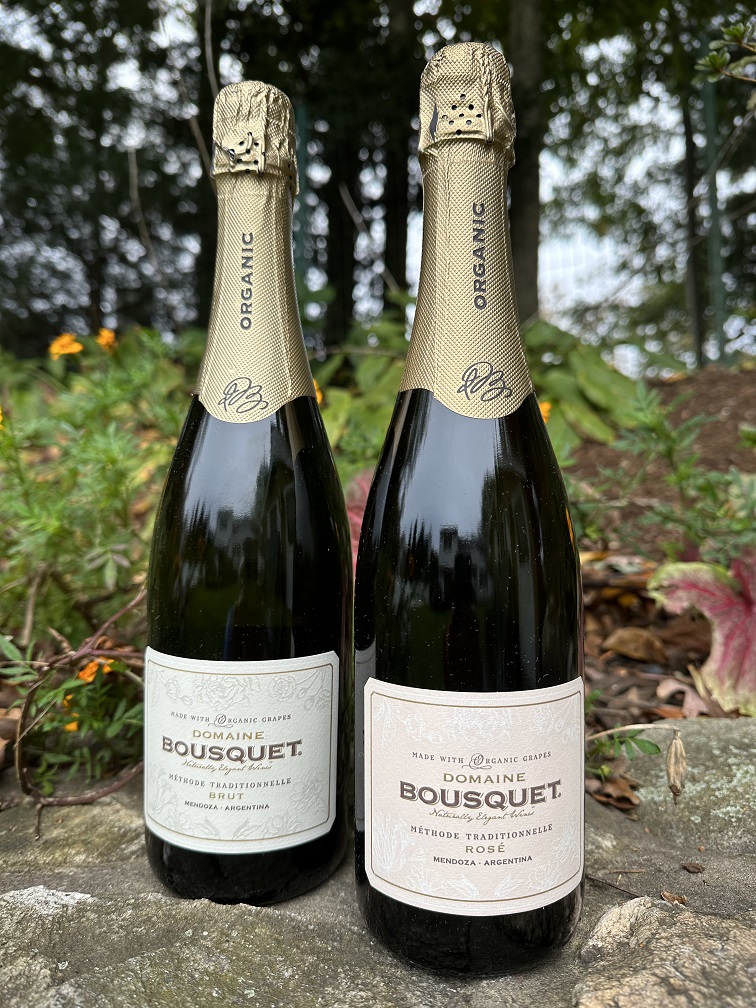
For an example of the great bubbles from outside of Champagne, let’s take a trip to Argentina. On a world scale, Argentina arguably didn’t reach yet the status of a world-class sparkling wine producer. And for me as a wine lover, this is very good news – it means I can still enjoy sparkling wines from Argentina at reasonable prices. Just to give you an example, we can look at the sparkling wines of South Africa, known as Cap Classique. Back 3 years ago, Graham Beck Brut Rosé Methode Cap Classique, one of my favorite sparkling wines from South Africa, could be found at my local wine shop for $16.99. The price two weeks ago? $30.99. So before it happens to Argentinian bubbles, let me bring you into the know.
Please meet Domaine Bousquet. Well, this might not be the correct way to introduce Domaine Bousquet here – if you are reading this blog regularly (are you??) then you already met Domaine Bousquet on multiple occasions. If you look at the Domaine Bousquet website, you will see that they present themselves as the #1 organic, regenerative and sustainable winery in Argentina. When I think of Domaine Bousquet, especially after tasting their wines, my first thought usually is “how do they do it???”. As an example of “how do they do it”, Domaine Bousquet offers USDA-certified organic wines (!) called Virgen that taste great and cost only $13 as the suggested retail price. And my latest discovery in the “how do they do it” category is two of their classic method sparkling wines.
I wrote about Domaine Bousquet sparkling wines before. Those were excellent wines produced using the Charmat method (secondary fermentation in the tank), the same method that is used in the production of Prosecco. These two new wines I’m talking about are produced using the classic method, with the secondary fermentation in the bottle – the same way classic Champagne wines are produced, hence the name Classic Method, a.k.a. Méthode Champenoise, a.k.a. Méthode Traditionnelle.


From the very first whiff, both wines were just spectacular. NV Domaine Bousquet Brut Organic Méthode Traditionnelle Mendoza Argentina (12% ABV, $18 SRP, 75% Chardonnay, 25% Pinot Noir, 6 months on the lees) had a perfect nose of freshly toasted bread, brioche and apples. The palate was followed with the same toasted bread notes, perfectly fine mousse, crispy profile with just apple notes, just a pure delight.
And NV Domaine Bousquet Brut Rosé Organic Méthode Traditionnelle Mendoza Argentina (12% ABV, $18 SRP, 75% Pinot Noir, 25% Chardonnay, 6 months on the lees) was even better – the wine had an absolute precision that only the best Champagne and sparkling wines possess. Salmon pink in the glass, freshly baked, just out of the oven toasted bread on the nose – I couldn’t and didn’t want to put my glass down for a few minutes. After appropriately admiring the bouquet, the first sip perfectly matched the expectations – fine mousse, cut-through acidity, brioche, green apples, perfect structure, impeccable balance.
If I were to pair dinner with these two wines, I would have fresh oysters and seafood with the Brut, and then a steak with the Brut Rosé – you can keep the salad.
Here are two brilliant sparkling wines from Argentina – organic and delicious. In a blind tasting, these two wines can safely challenge any Champagne or sparkling wines – and I would definitely put my money on the Domaine Bousquet wines to win the popular vote.
Taking the price into account, and the holiday season upon us, these are definitely case-buy recommendations – these wines are perfect as a gift and perfect to enjoy at any moment, knowing that you didn’t have to break the bank to get the pleasure.
Have you had these wines? What are your favorite sparkling wines outside of Champagne? Cheers!
Chilean Carménère – World-Class and So Hard To Choose
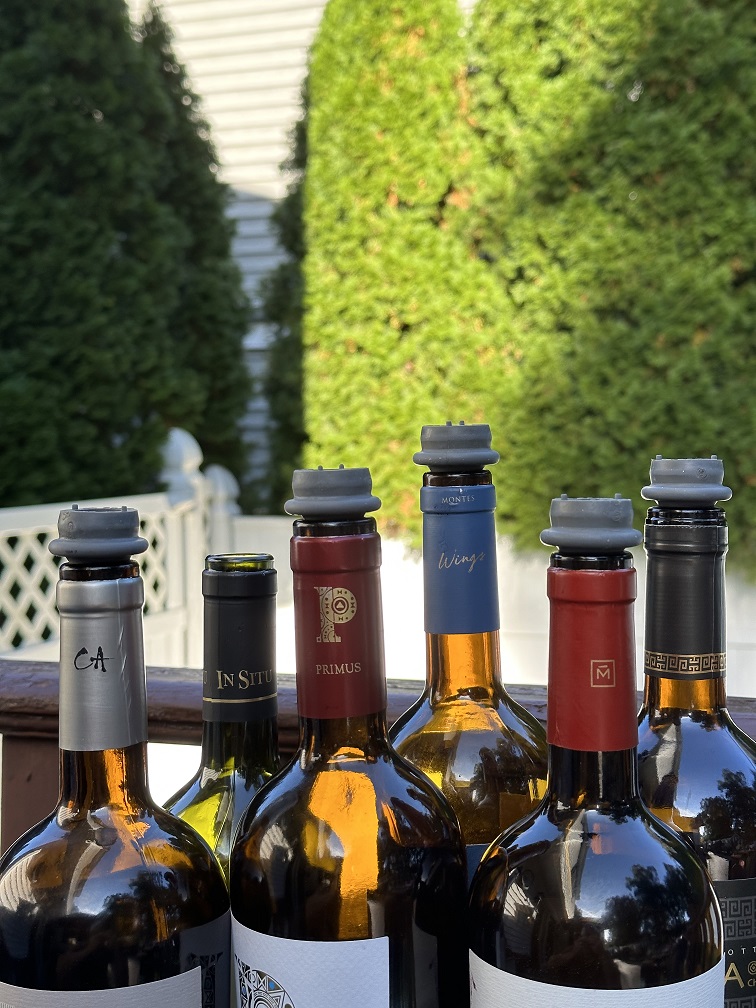 Is 30 years a lot of time or not, what do you think? It depends. If we compare 30 years to the approximate age of Earth at around 4 billion years, it is much smaller than a spec of dust. For a human, that’s quite a bit of time, subject to a personal perception. How about grapes?
Almost 30 years ago, in 1994, it was discovered that the Chilean Merlot grape is not exactly a Merlot. Approximately one-third of the plantings considered to be Merlot happened to be of Merlot’s almost extinct relative – the grape called Carménère. In 1994, there were only 25 acres left in France of the grape which used to be one of the important elements in the Bordeaux blend, now ready to disappear. This discovery also helped to explain the distinct taste of Chilean “Merlot”, loaded with so-called Pyrazines, the compound which leads to the pronounced green bell pepper characteristics in the wine, both in smell and taste.
Chilean winemakers gladly took ownership of the grape which they now could rightfully call “their own”, and the plantings expanded from around 9,000 acres in 1994 to almost 34,000 acres in 2014, eventually steadying at about 25,500 acres in 2021. Along the way, Chilean winemakers worked hard with this grape to literally get rid of the green bell pepper profile, creating a rounder, more fruit-forward wine. Their mission was a total success – for example, looking through the notes of my previous tasting of 7 Carménère wines 3 years ago, not a single wine had any mention of the green bell peppers. Nevertheless, it is interesting that now the pendulum has started swinging the other way, and Chilean winemakers have started thinking about bringing the green bell pepper profile back.
Nothing is instantaneous in the world of wine. Thinking about green bell pepper doesn’t mean it can elegantly show in the wine at will. At least among the 6 Carménère wines I just tasted, only one of them had a distant hint of bell peppers – but the important part was that all 6 were outright delicious. While I managed to choose a favorite, it was like splitting the hair.
Just to give you a perspective on where these 6 wines came from here is the map:
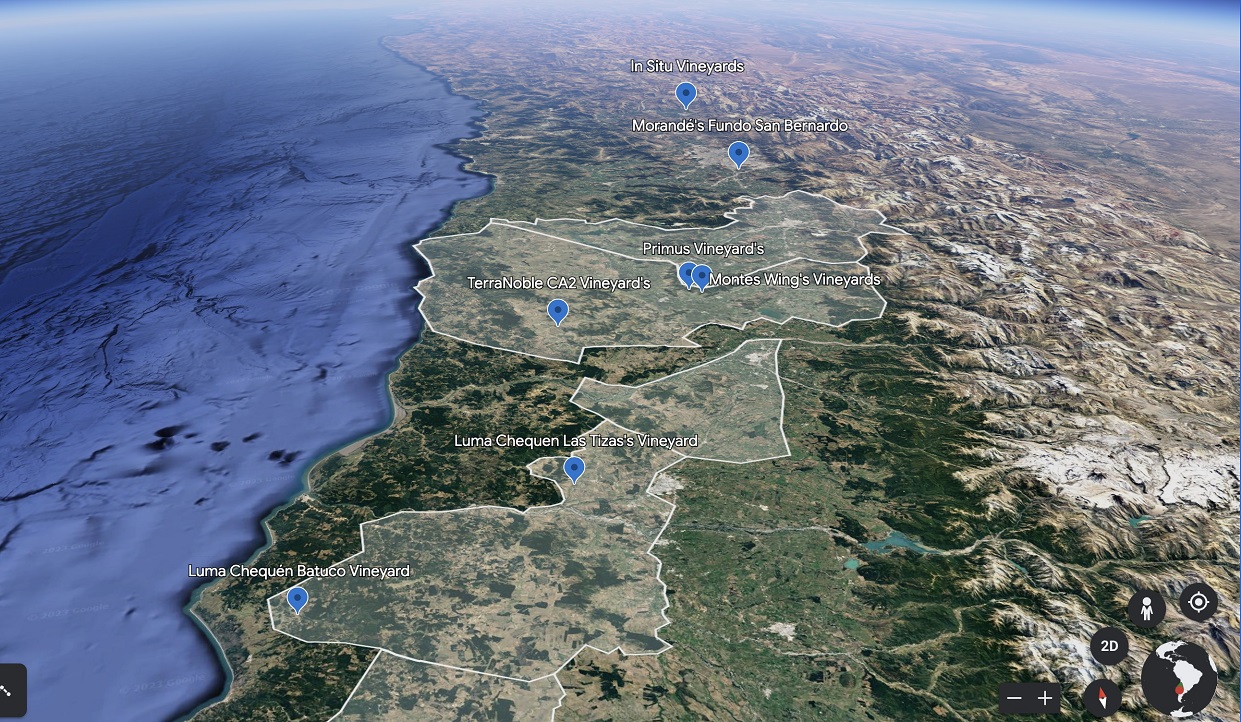 You can see here the proximity to the coast as well as get an idea of the altitude and overall terroir. While there seems to be a good variety of the terroir, all the wines were showing in a similar way – yes, with stylistic differences, but you could tell that the wines are related.
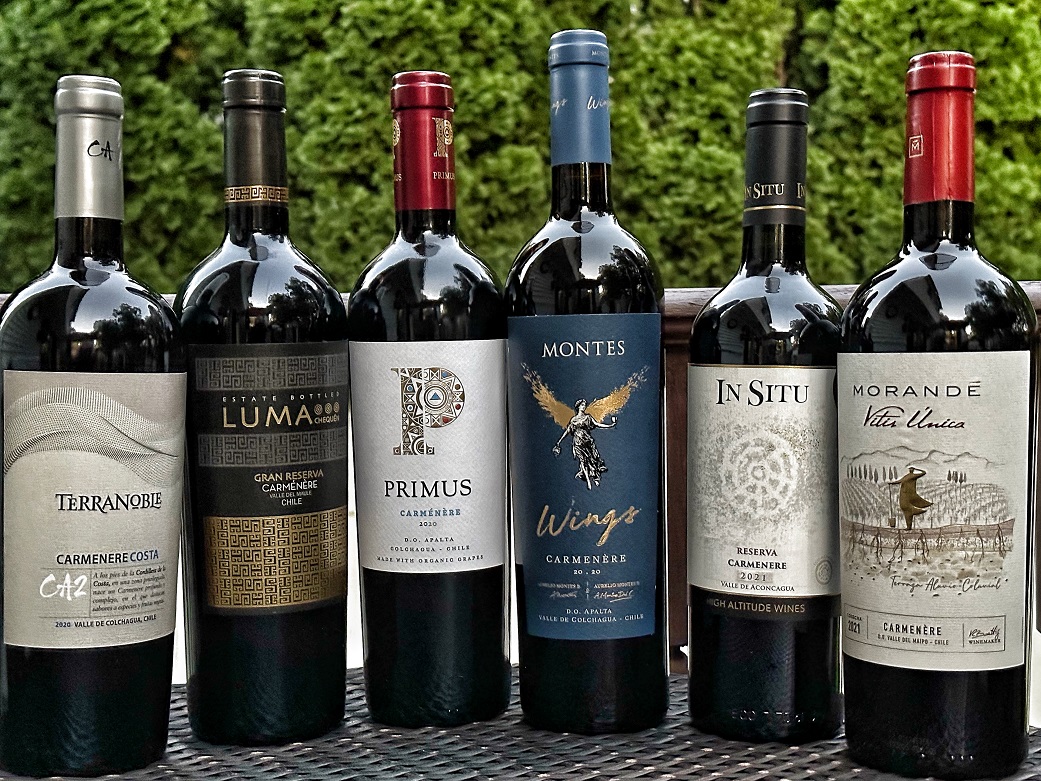
Here are my notes:
2021 Viña San Esteban In Situ Carménère Reserva Valle de Aconcagua DO (13% ABV, $13, 95% Carménère, 5% Cabernet Sauvignon, aged in for 12 months in 50% French and 50% American 225-litre oak barrels, 3+ months in the bottle) – In Situ Family Vineyards was established in 1974 by José Vicente. In 1994, the vineyards were replanted, and the modern winery was built. This certified sustainable winery produces a range of high-altitude wines in Aconagua Valley.
Dark garnet
Beautiful restrained nose of dark fruit, blackberries
Blackberries and raspberries on the palate, crisp acidity, tart, crisp, refreshing, well integrated but present tannins
8
2021 Morandé Vitis Única Carménère Valle del Maipo DO (13.5% ABV, $20, aged for 16 months in 80% in French oak foudres and 20% in new 225 liters French oak barrels) – Viña Morandé was founded in 1996, and went on to become one of the leading wine producers in Chile. The winery is truly innovative and “off-the-beaten-pass”, producing wines from Mediterranean grapes such as Cinsault, Carignan, and Garnacha, and using concrete eggs and large oak foudres for the aging of the wines. The winery was the first in Chile to produce late-harvest wine and the first in Chile to be recognized as 100% sustainable.
Dark garnet
Dark fruit, cedar, a hint of bell peppers
Tart cherries, black currant, zippy acidity, acidity on the finish.
8-/8
2020 TerraNoble CA2 Carménère Costa Valle de Colchagua DO (14.5% ABV, $36, aged 16 months, 42% in new 300-liter barrels, the rest in untoasted foudres) – TerraNoble is one of my favorite Chilean producers. I wrote extensively about TerraNoble in the past, covering particularly the full line of their Carmenere wines.
Dark Garnet, almost black
A touch of barnyard, warm spices, inviting, black currant
Bright, firm structure, cassis, distant hint of bell pepper, good balance, good acidity
8/8+
2020 InVina Luma Chequén Carménère Gran Reserva Valle del Maipo DO (13.9% ABV, $17, 12 months in oak barrels) – InVina was founded in 2007 by the Huber family and went on to become one of the premier producers in Maipo Valley
Dark garnet
Beautiful, nutmeg, sweet oak, superb. Best of tasting so far
Sophisticated, great bouquet, cassis, dark fruit, a touch of dark chocolate, excellent balance.
8+, the favorite of the tasting
2020 Primus Carménère Apalta DO (14.5% ABV, $21, organic grapes, 12 months in French oak barrels, 18% new) – Primus wines are a part of the Viñedos Veramonte, another one of my favorite Chilean producers. I also wrote about Primus Carménère wine extensively in the past, so this was one of the familiar wines in the tasting.
Dark garnet, almost black
Cassis, cassis leaf, sage, inviting, delicious
Dark, brooding, concentrated, earthy, well-integrated but present tannins, full body, needs a steak.
8+, superb on the day 3.
2020 Montes Wings Carménère Apalta DO (14.5% ABV, $55, 85% Carménère, 15% Cabernet Franc, aged for 16 months in 80% new and 20% second-use French oak barrels) – Feng Shui, Gregorian monks chants helping wines age – we can talk about Montes Winery forever. Instead, I will offer you to read my interview with the Founder and Chief Winemaker of Montes Winery Aurelio Montes Sr – here are Part 1 and Part 2 of our conversation.
Dark garnet, almost black
Sage, a hint of cassis, earthy
Bright, elegant, dark fruit, fresh acidity, seeet oak, eucalyptus, layered, luscious.
8+, as good as Luma
Here you are, my friends. Six excellent Carménère wines, making it very difficult to select a favorite. I settled on Luna Carménère Gran Reserva, but honestly, every one of these six are world-class wines I would be happy to drink any day. Do you have your favorite Carménère wines?
Deceptive Simplicity: Masciarelli Linea Classica
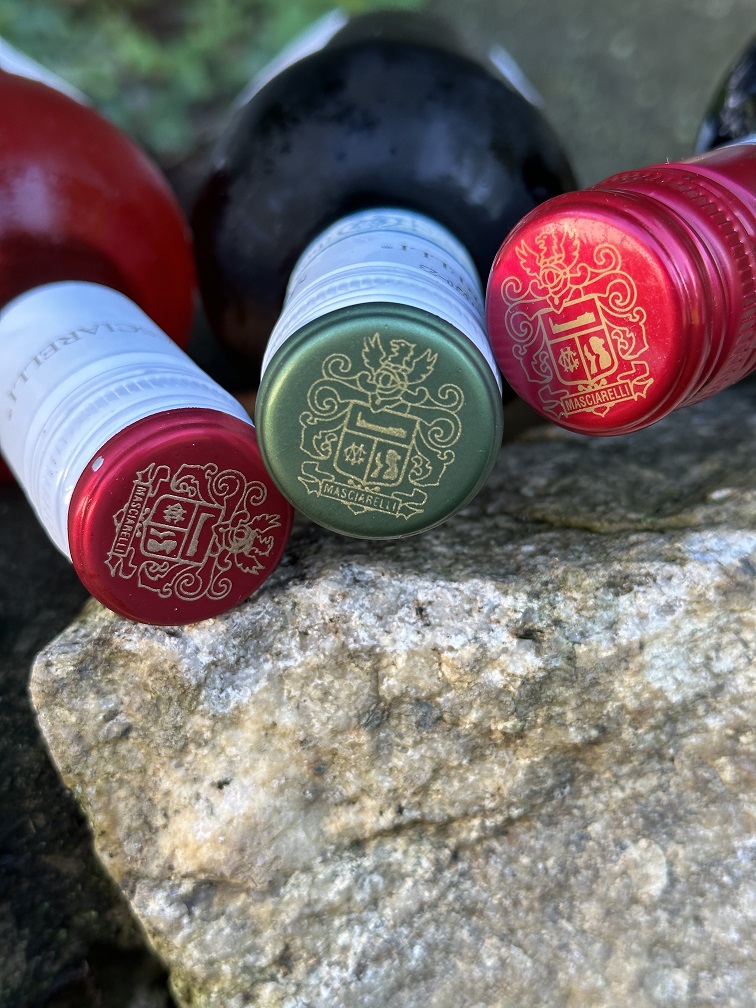 Simple is an interesting word to use around food and wine – there is a lot of dependency on the context.
I love simple recipes – one of my favorite recipes for sauteed eggplant has only 5 ingredients in it, takes 30 minutes to make and the result is consistently delicious. Air-fried salmon bites take less than a minute to prep, consist of only salmon and seasoning, and again, are consistently delicious. Near East couscous takes 5 minutes to make – and it is a perfect side dish every time it is made. When it comes to food, “simple” usually is a good word.
Calling the wine simple requires clarifications, it requires real context. “Simple wine” often means inexpensive, and this is a good thing – as long as the wine tastes good, as long as wine gives you pleasure “simple/inexpensive” is a good word (nobody likes “inexpensive” but crappy). Simple can apply to the label and overall packaging. The wine can also taste simple, and here the truth is in the eye of the beholder – many people prefer simpler-tasting wines so they will not interfere with the food. But if someone is craving complex, thought-provoking, multi-layered wine, “simple” is the last descriptor that someone will be happy about. “Simple wine” has a meaning only in the context.
The interesting part of a “simple wine” designation is that once we call the wine simple based on price and appearance, we make assumptions about the taste. Once we say “simple wine”, we are intuned to take it all the way – assuming that this simply looking wine will be also simply tasting wine.
Can simple packaging and a reasonable price hide the wine of a much grander standing than it appears to be? In other words, can simplicity be deceiving? Of course. Let me present my case to you – a classic lineup (Linea Classica) of wines from Tenuta Agricola Masciarelli in Abruzzo Italy.
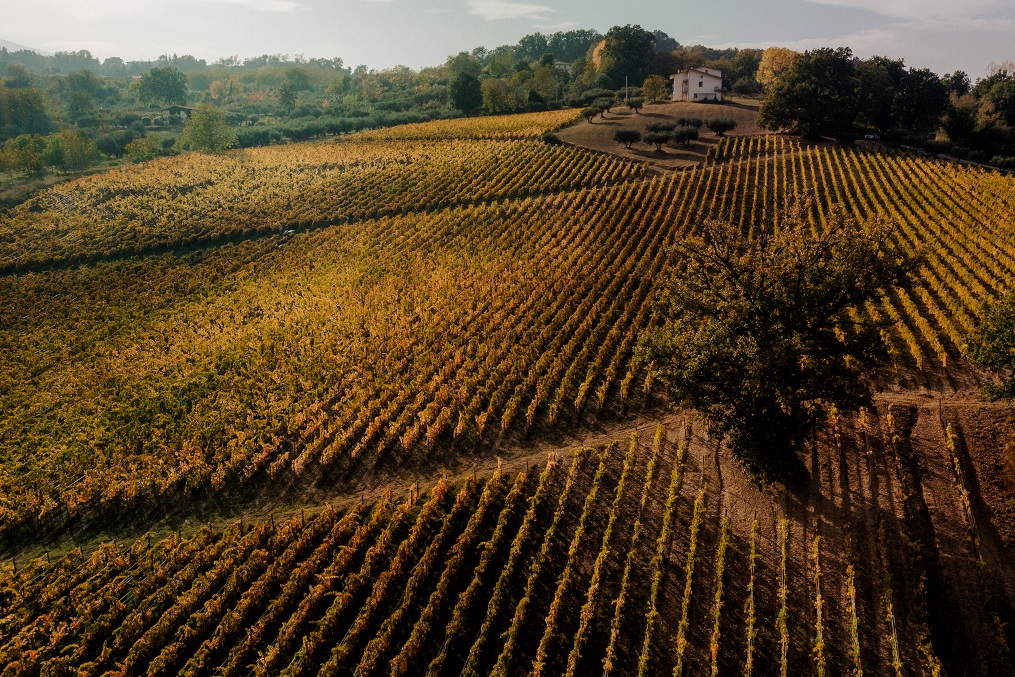
Masciarelli Vineyards. Source: Tenuta Agricola masciarelli
Gianni Masciarelli produced his first vintage of red, white, and Rosé in 1981 from the 5 acres vineyard owned by his grandfather and located near the family house in San Martino in the province of Chieti in Abruzzo. Abruzzo region, located east of Rome along the Adriatic coast is best known for its – here it comes again – simple white and red wines, produced, respectively, from Trebbiano and Montepulciano. From the very beginning, Gianno was convinced that Abruzzo was capable of producing world-class wines. He worked very hard not only in his own winery but pushing forward the whole region. Gianny was the first to introduce a French Guyot training system for the vines and French oak barrels for aging the Montepulciano and Trebbiano wines. By the way, while Trebbiano is a popular white grape that grows all over Italy, Trebbiano Abruzzese is a local ancient Trebbiano clone that is growing only in Abruzzo. Trebbiano Abruzzese has lower yields and produces wines that can age.
Today, Tenuta Agricola Masciarelli is run by Giovanni’s wife, Marina Cvetić, together with their eldest daughter, Miriam Lee Masciarelli. Tenuta Masciarelli is the only winery that owns vineyards in all four provinces in Abruzzo (Chieti, Pescara, Teramo, l’Aquila). The vineyards span 740 acres (300 hectares) and consist of 60 non-adjacent parcels. Masciarelli produces 7 different lines of wines, 4 out of which are exported to the USA. The winery produces about 2.2 million bottles of wine every year that gets exported to 55 countries.
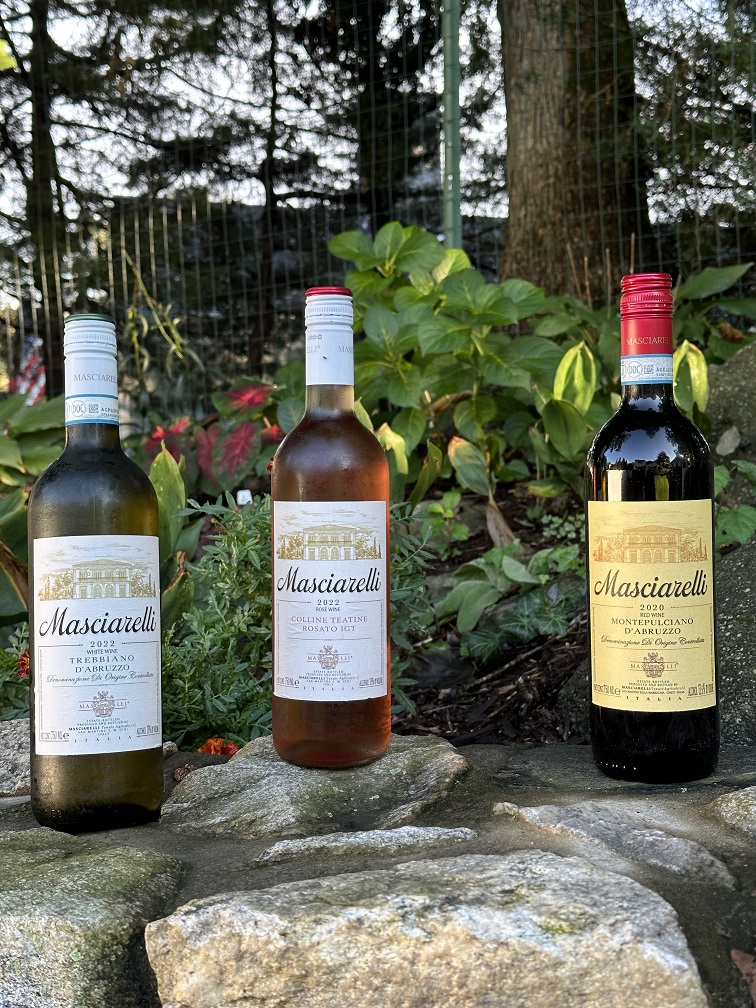 Here are my notes for the Linea Classica wines I had an opportunity to try:
2022 Masciarelli Trebbiano di Abruzzo DOC (13% ABV, $15)
Light golden
Tropical fruit, peach, minerality, medium intensity, inviting
Crisp, fresh, lemon notes, tart minerality, medium long refreshing finish, cleansing acidity, very nice
8-/8
2022 Masciarelli Colline Teatine Rosato IGT (13% ABV, $14)
Beautiful salmon pink
Fresh strawberries on the nose
Strawberries, brilliant fresh strawberries, cranberries, perfect acidity, good mouthfeel presence, crisp and clean finish. Excellent.
8
2020 Masciarelli Montepulciano di Abruzzo DOC (13.5% ABV, $15)
Dark garnet
Earthy, restrained, hint of cherries
Dark tart cherries, succulent, a touch of tobacco, dark, earthy, minerality, good acidity, good balance, medium to full body.
8, excellent
All three wines are unoaked and … yes… simple. At least in their presentation and pricing. But here is the interesting part. You can’t treat them as “simple wines”. Despite being unoaked, all three wines improved on the next day. And the next day. And even the next day. Truth be told, after I just opened and tried the Montepulciano, I was simply upset – the wine was not drinkable. For sure for my palate – green and tart. It became better the next day. And it really blossomed on the third day. In total, I enjoyed this screwtop-capped wine over the 6 days – pouring a glass, twisting the cap back, and leaving it on until the next day on the counter. And the wine kept getting better and better. This is a testament to the quality of this simple wine. And this simple wine can definitely age and it will become better with age. All for under $15.
Simplicity can be deceiving. Don’t take my word for it – try Masciarelli Linea Classica for yourself and let’s compare the notes. Cheers!
American Pleasures #9: Balverne Wines
Wine should give you pleasure – there is no point in drinking wine if it does not. Lately, I have had a number of samples of American wines that were delicious standouts – one after another, making me even wonder if someone cursed my palate. I enjoyed all those wines so much that I decided to designate a new series to them – the American Pleasures.
And we are back to talk about more delicious American wines (after a long and unintended break).
I love how wine not only entices your senses but lets you play a sleuth, a researcher, a scientist, a philosopher – a different role on a different day, or all of them at once – take your pick.
I can give it to you right now [spoilers alert]: I got a sample of three California wines, one better than another, one of them possibly even WOTY 2023 (told ya, spoilers) – and ended up doing the whole research (thanks, Google) trying to connect layers one by one. From the roles I mentioned above, I played mostly a sleuth trying to understand how far history was taking me and how all the little pieces fit together. Ah, never mind, let’s just get to it.
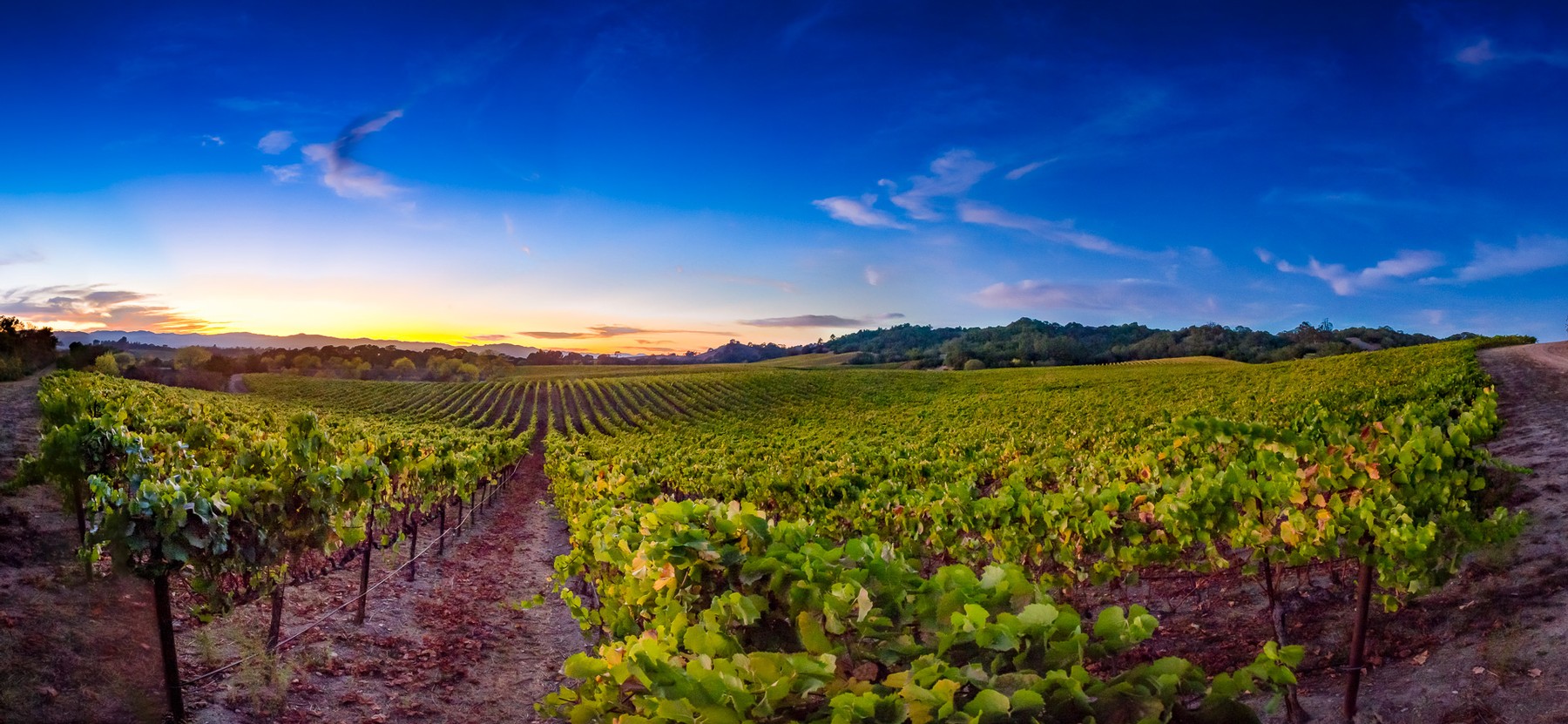
Source: Notre Vue Estates
In the center of this excitement are the wines produced by the Notre Vue Estate (Notre Vue stands for Our View in French) and called Balverne. Notre Vue is a 710 acres estate located in the heart of Sonoma County next to Healdsburg and acquired by Bob and Renee Stein in 1992. The history of the land where the estate is situated goes all the way back to 1841 when it was the part of Rancho Sotoyome land grant of 1841. The grapes had been growing on the estate starting from 1869, and commercially starting from 1907 – I’m assuming after the estate was acquired by Antonio Perelli-Minetti.
Let’s take a quick stop here – have you heard of Antonio Perelli-Minetti? I have to shamefully admit that I never have. We all know who Rober Mondavi and Andrew Tschelisteff are, but Antonio Perelli-Minetti? When Antonio Perelli-Minetti died in August of 1976 at the age of 95, his obituary in S.F. Chronicle was titled “Dean of winemakers is dead at 95″. Dean of winemakers – and with all my passion for wine, all the reading and learning, I never came across his name? Well, it may be just me… But then there is almost nothing written about him, for sure online… Okay, moving along…
The winemaking at the estate started in 1972 under the name of Balverne Cellars – supposedly, Balverne is a hybrid Anglo-French term meaning “a place of trees”, which is very appropriate for the estate. In the 1980s, two recent UC Davis graduates, Doug Nalle and John Kongsgaard (I’m sure both names need no introduction), made the estate famous with Balvernet Cellars wines being served at the White House dinners and at some of the finest restaurants in Los Angeles and New York. After Steins acquired the estate in 1992 they were mostly selling the estate grapes to some of the best wineries in California. The winemaking was reintroduced at the estate in 2005 under the name of Windsor Oaks Vineyards, and in 2013, the Balverne name was brought back.
Whew, done with the history. Let’s talk about the present.
At the heart of the Notre Vue estate lays 350 acres of “Forever Wild” Nature Preserve, covered by a variety of oak trees and inhabited by red-tailed hawks (Red-Tailed Hawk is a symbol of Balverne, depicted on every label), wild turkeys, owls, bluebirds, coyotes, bobcats, grey foxes, hares, rabbits and lots more. This Forever Wild nature oasis is a critical element of sustainable viticulture practiced throughout 250 acres of surrounding vineyards. These Sonoma’s Certified Sustainable vineyards are split into multiple blocks growing 18 grape varieties, and they span two of Sonoma County’s prominent AVAs – Russian River Valley and Chalk Hill.
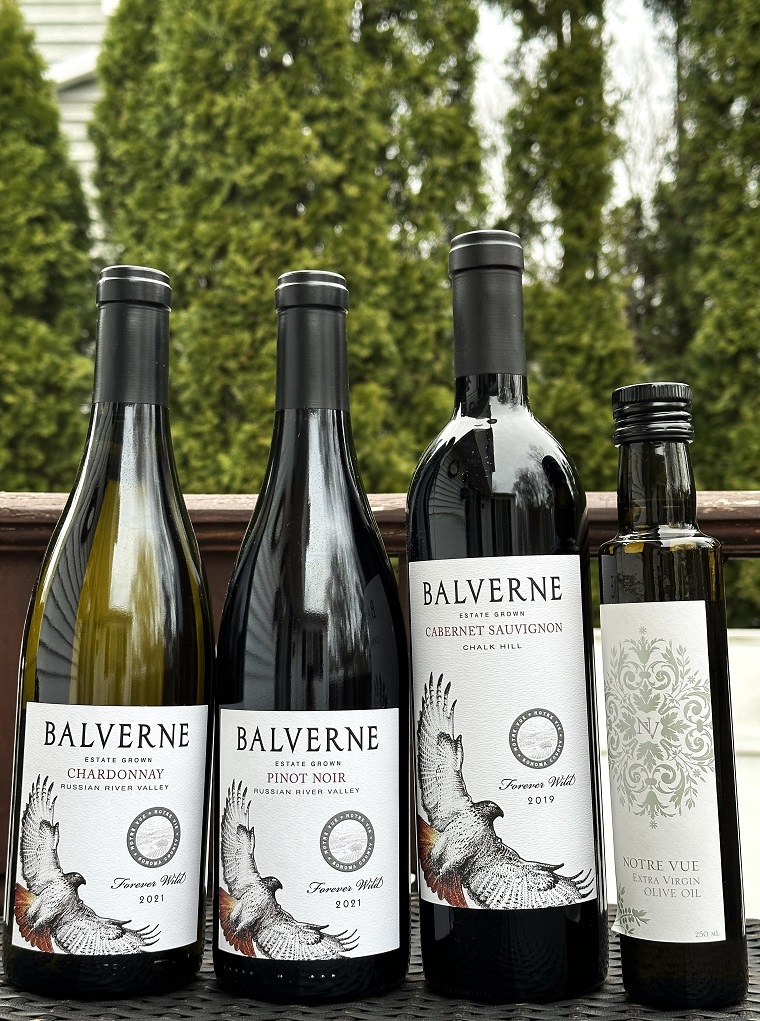 I had an opportunity to try 3 of Balverne’s recent releases – Pinot Noir, Cabernet Sauvignon, and Chardonnay. I would typically start tasting with the white wine – here, as I was tasting in the comfort of the house instead of the tasting room, I started with the red – Pinot Noir. The wine was excellent, tightly woven which is not always the case with California Pinot.
2021 Balverne Pinot Noir Russian River Valley AVA (14% ABV, $35, Pinot Noir clones 459 and 667 with a small percentage of 114 and 115, 9 months in 25% new French oak)
Dark garnet
Plums, violets, intense, inviting
Nicely restrained, dark cherries, tart, crisp, lean, well structured
8, excellent
Cabernet Sauvignon followed, being nothing short of excellent, and perfectly drinkable from the first pour.
2019 Balverne Cabernet Sauvignon Chalk Hill AVA (14.3% ABV, $48, 79% Cabernet Sauvignon, 9% Petit Verdot, 9% Malbec, 3% Cabernet Franc, 18 months in French oak)
Dark garnet
Eucalyptus, cassis
Everything weaves around the acidic core. Perfectly restrained, nice Bordeaux/old world style, harmonious, balanced, delicious.
8+, outstanding.
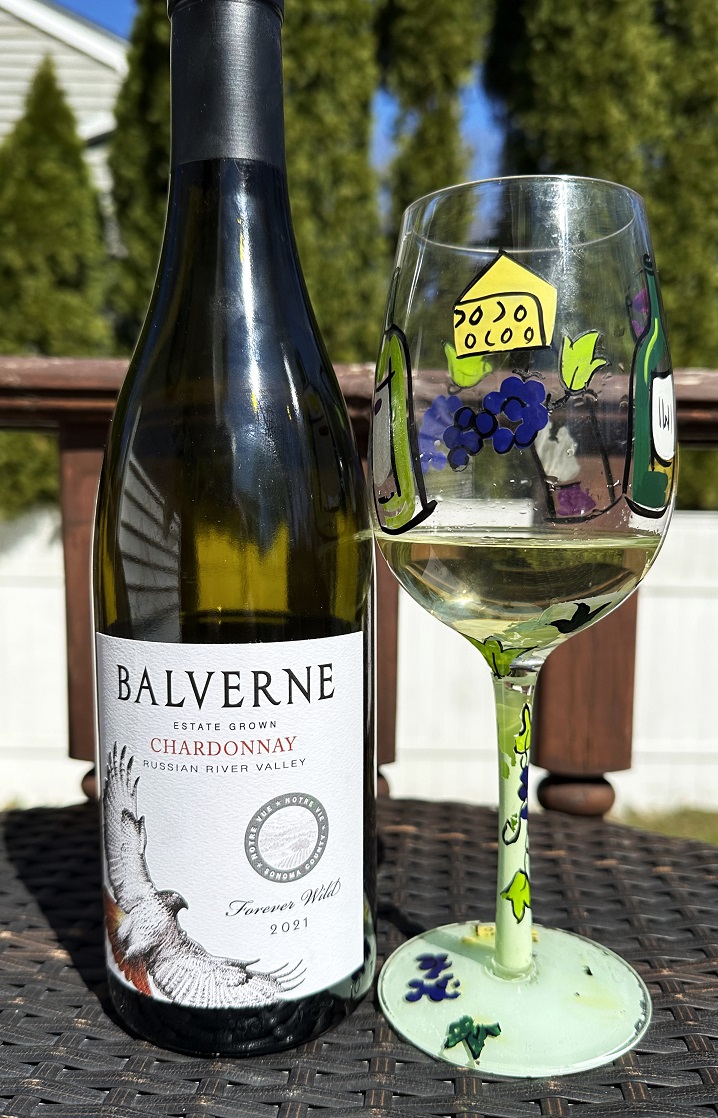 And then came Balverne Chardonnay.
I poured a glass without much thought. Sometimes, it is best to have no expectations – not low, not high, just none. This was the case, even after the first two very successful reds. White wine is difficult. With white wine, the winemaker has nowhere to hide. Even if it will be two out of three, this would be a successful encounter.
The very first whiff of the glass made me literally speechless. The following sip confirmed my excitement:
2021 Balverne Chardonnay Russian River Valley AVA (14.2% ABV, $35, clone 17, 5 months in 20% new French oak)
Light golden
Beautiful, varietally correct nose – vanilla, apple, lemon
The first sip blows your mind – vanilla, golden delicious apple, honey, lemon, minerality – impeccable balance and beauty only a Chardonnay is capable of expressing.
9, spectacular. This wine is just something. Something special.
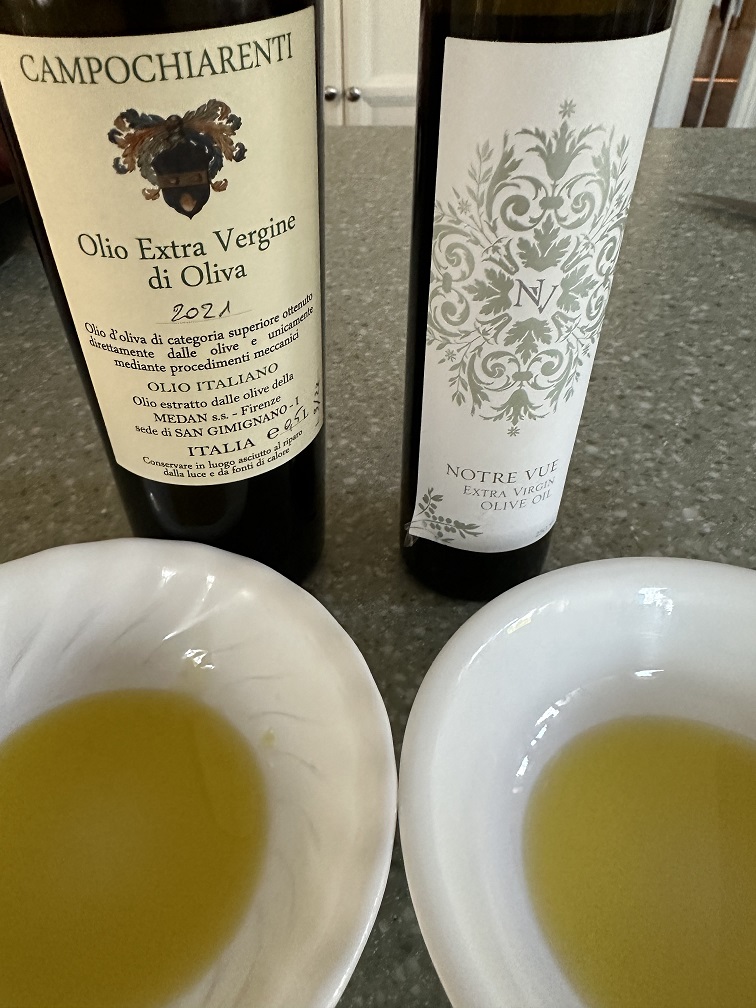
As you might see in one of the pictures above, my sample set went beyond wine – The Notre Vue’s own California Extra Virgin Olive Oil was a part of the package. I decided to do [an unfair] comparison between Californian and Italian EVOO. Both olive oils were expectedly different, with the Italian one showing green, tight, and peppery, and the Californian one being much more fruity. The beauty – it is not a competition, depending on what dish you are using the olive oil for, each one would have its own advantages.
Now you have a complete experience report, including my uninvited research (but everyone is entitled to their own version of fun). What’s important is that I presented to you three excellent wines, both on their own and as a value. Once you taste this Chardonnay, believe me, you’ll understand…
And we are done here. But – I always have more American pleasures to share, so stay tuned…
Virgen Wines – No SO2 Organic and Delicious
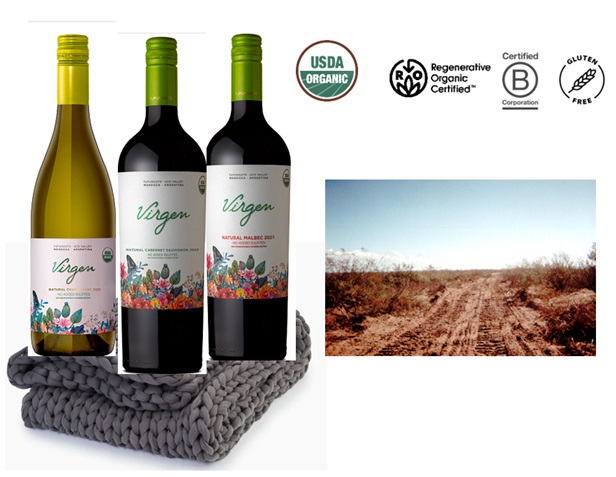 No added SO2.
Organic.
Delicious.
Simple, right?
Organic seems to be the word of the town. Four years ago, in 2019, 6.2% of the vineyards in the world were certified organic. In absolute terms, it doesn’t sound impressive. However, we need to take into account a few factors. First, many vineyards practice organic farming but are not inclined to undergo an official certification process due to the high cost. Second, and probably more important, is that from 2005 till 2019 the organic vineyard plantings increased by 13% per year, compared with non-organic vineyard plantings’ growth rate of 0.4% per year, according to the article in Drinks Business. I have a feeling that the organic vineyard growth could even have accelerated over the last four years, but we will need to wait to see the official data.
But grapes from organic vineyards don’t automatically mean that the wine can be called organic too – this gets a bit tricky, as every country has different rules for what wine can be called “organic” – this is why you can see on many labels the statement “made with organic grapes” instead of simple “organic”.
SO2, an abbreviation for Sulfur Dioxide, is an essential element in winemaking. It is used literally at every stage of the winemaking process because of a few important properties. SO2 is an anti-microbial agent, regulating harmful yeast and bacteria growth in wine. It also has anti-oxidative properties, protecting the wine from oxidation. It is important though that the use of SO2 is not excessive for a variety of reasons – one of such is an allergic reaction it can cause.
So here is the culprit – if you want to import your wine to the USA, and you want to be able to simply state on the label “organic”, you are not allowed to add sulfites (it is okay to add sulfites to the organic wine in Europe and Canada). This doesn’t mean that the wine will have no sulfites – sulfites are a natural by-product of fermentation, and they are always present in wine – but they will be present in minuscule quantities in the organic wines. However, not adding sulfites is not for the faint at heart – considering how many things can go wrong in the winemaking process – this is why today you see the majority of wines labeled with “made from organic grapes”.
Domain Bousquet was founded in 1990 in the high-altitude desert in Tupungato Uco Valley in Mendoza, Argentina, on the pure vision, passion, and conviction of its founder, Jean Bousquet. Jean was told that he is making a mistake of his life when he purchased 1,000 acres of nothing but dry, empty, arid land. Today, Domain Bousquet sustainably and organically farms 667 acres of vineyards, produces 50 million liters of wine, 95% of which is exported to 50 countries around the world, and ranks among the top 20 Argentinian wineries in terms of export. Domaine Bousquet also just extended its leadership in organic winemaking by introducing the wines produced without adding any SO2 – and this is exactly what we are talking about today.
Three new wines were just added to Domaine Bousquet’s collection, under the name of Virgen – Chardonnay, Cabernet Sauvignon, and Malbec. All three are certified USDA organic, unoaked, and have no added SO2. To ensure the proper handling that these wines require, Domaine Bousquet even decided to ship them wrapped in a blanket.
When I received an invitation to review these new wines, my instant inclination was a simple “nope, not doing that”. No USDA organic wines made me excited so far. But the next thought was … well, these are just the samples, it might be interesting – especially if I can compare them with the same wines made in the traditional way – and this is pretty much what I was able to do.

Winemaker Rodrigo Serrano. Source Domaine Bousquet
In my mind, producing wines without SO2 requires a leap of heart. So even before I got the wines, I decided to ask Domaine Bousquet’s winemaker, Rodrigo Serrano, a few questions about his inspiration and goals – here is our short conversation:
[TaV]: You had been farming organically since the beginning, so your wines have always been made from organic grapes. Getting USDA Organic certified is another test, as you now need to certify the entire winemaking process. Why did you decide to opt for this certification?
[RS/DB]: We did it because we had the opportunity to experience it in 2018. Little by little I moved away from the use of SO2, until I suggested trying a wine without using it. I felt like an innovator, without knowing the real magnitude of this.
[TaV]: Virgen wines do not have SO2 added, so special care must be taken during the transport of wines. How did you come up with the idea for a blanket? How does it help protect wines?
[RS/DB]: The theory says that the temperature is very harmful, so in a wine like this, in which there is no protection, extreme care is taken. Today with experience, we understand that both in Virgin and in the rest, the temperature is harmful, so we put the blanket in all shipments. It helps by generating an air chamber between the wall of the transport container and the wine box, obtaining less impact from the outside temperature on our bottles.
[TaV]: What is the expected shelf life of Virgen wines?
[RS/DB]: Initially I was not optimistic, today with more than 5 years of experience, we still have 2018 stock, and it remains correct.
[TaV]: Somewhat related question: Once virgin wines have arrived at someone’s home, how should they be stored? How long can they be stored before having to consume them?
[RS/DB]: It must be stored like the rest, away from light, with a temperature no higher than 20°C and no less than 5°C.
[TaV]: Can “SO2-free” wines age? Did you experiment with that?
[RS/DB]: It is a challenge that we have ahead of us, to work with sulfite-free wines for aging, we are working on it, but for the moment they are only projects.
[TaV]: I see that Domaine Bosquet is not only organic, it is also certified Organic Regenerative. How is Regenerative Organic different from just Organic? What did you have to do to obtain the Regenerative Organic certification? How long did it take you?
[RS/DB]: ROC is something incredible, and for this I recommend watching KISS the Ground. He will answer better than anyone. It took us a few years to certify it, but I don’t work extra, considering that our philosophy coincides 100%
[TaV]: Last question. Far beyond viticulture, Domaine Bosquet is also a certified B Corp. Why did you decide to become a B Corp? Why is this important for you?
[RS/DB]: As with ROC, the coincidence in our philosophy, measuring the social and environmental impact, led us to this certification in a natural way.


Obviously, the proof is in the pudding glass, so next I tasted the wines, and – spoiler alert – was blown away. Here are my notes in the exact order I tasted the wines:
2021 Domaine Bousquet Virgen Natural Cabernet Sauvignon Tupungato Uco Valley Mendoza Argentina (14% ABV, $13, no added SO2)
Dark garnet
Chocolate and tobacco on the nose, a hint of berries
Blackberries, a hint of cassis, black plums, minerally driven, rich and luscious, good structure, crisp acidity.
8, outstanding on its own, and a great surprise as the wine is unoaked.
2021 Domaine Bousquet Virgen Natural Malbec Tupungato Uco Valley Mendoza Argentina (14% ABV, $13, no added SO2)
Dark Garnet
A hint of barnyard upon opening. On the second day barnyard smell disappeared, leaving behind only dark fruit.
On the palate, the wine is just spectacular. Imagine taking a load of perfectly ripe, perfectly crunchy, perfectly fresh berries – blueberries, raspberries, and wild strawberries, and sending it into your mouth – now you know how this wine tastes. Perfect structure, perfect balance, perfect acidity.
8+/9-, kudos to the winemaker.
2022 Domaine Bousquet Virgen Natural Chardonnay Tupungato Uco Valley Mendoza Argentina (13.5% ABV, $13, no added SO2)
Light golden
Asian pear, herbs
The palate is matching the nose, Asian pear, a touch of honey, herbs.
7/7+ first day. The wine somewhat improved on the second day, but overall didn’t go anywhere near the reds
And here is my “Frame of reference”:
2021 Domaine Bousquet Cabernet Sauvignon Reserve Tupungato Uco Valley Mendoza (14.5% ABV, $19.99)
Garnet
Dark berries, cherries
A touch of cassis, eucalyptus, clean, classic, perfectly balanced, good acidity.
8, very good
2021 Domaine Bousquet Malbec Reserve Tupungato Uco Valley Mendoza (14.5% ABV, $19.99)
Garnet
Dark fruit, espressoFresh berries, salivating acidity, medium body, playful, perfectly balanced.
8+, delicious.
Let’s discuss our tasting.
First, both of the no SO2 reds were outstanding. The unadulterated fresh berries are really something to experience when they are delivered in a fully balanced, perfectly structured way. No SO2 Cabernet Sauvignon was perfectly on par with the reserve Cabernet Sauvignon; I liked no SO2 Malbec even more than the reserve version, even though I wouldn’t complain about either. Second, I managed to get the answer to the question about the aging of the no SO2 wines. I left both no SO2 Cabernet Sauvignon and Malbec on the countertop, closing back the screw cap, and the wines were perfectly delicious on the second and third days. In my book, that means that the wines have at least another 10 years of life easily. Not that I’m suggesting that you should age these wines, but it is good to know that you really don’t have to consume them the same day you got them from the store.
Here you are, my friends – organic, no SO2, and delicious. These wines are worth seeking out, whether you care about sulfites or not. And if you have friends who complain about headaches and sulfites – they might love you even more after they will taste these wines. If you had a chance to taste these wines already – let me know what you think!
Last Bottle Sign Up ($10 credit)