Archive
Daily Glass: Enjoy Your Wine and Play With Your Food – Beyond Meat Food, It Is
I appreciate winding down Sunday with a good glass of wine and a family dinner. When it is warm outside, such a Sunday dinner typically means grill – and this past Sunday was not an exception (or maybe it even was a bit of an exception as it was dry and pleasantly warm, and not hot at all, compared to mostly hot and humid weather of the last year).
Kids love steak in this house. While shopping for a steak at our local Fairway Market, something caught my eye. Beyond Meat? Really? Both Beyond Meat The Beyond Burger and Beyond Meat Beyond Sausage Original Brat? Wow and double wow!
Let me explain the excitement.
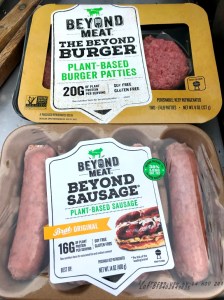 I have plenty of friends and relatives who are vegans and vegetarians, so with the summertime, the question of a good meat alternative is always becoming hot – when someone visits our house, I really want people to feel included and taken care of, no matter what their dietary restrictions are, so the search for a good vegan burger, etc. was always on. A few years ago, I came across the product called Beyond Burger, made by the company with a catchy name Beyond Meat. The description of Beyond Burger, which offered full resemblance of the regular burger, including the blood, sounded a bit suspicious, so I carefully researched all the ingredients and to my dismay, found that all of the ingredients are natural and there was no red paint added to this product. When I decided to try it, further research proved it to be mission impossible – Beyond Burger was available only at the Whole Foods (which I don’t frequent), and the Internet was full of complaints of the people who desperately tried, but failed to find it in their local stores, as the product was always out of stock. I also learned that in addition to Beyond Burger, the same company is offering a new product called Beyond Sausage, which sounded to me too good to be true. Again, this all was taking place 3-4 years ago.
This year, Beyond Meat went public (and mind you, very successfully – while the initial offering was at $25/share in early May, today it is trading at around $168/share, and it is just about a month later). And it appears that they managed to increase their production and distribution – now I saw the actual product instead of just reading about it. Thus, as you can imagine, I simply had to try it, even though it is quite expensive for what it is – $5.73 for two burger patties and $9.99 for four “bratwurst” sausages – you can buy the pack of 14 real bratwurst sausages at Costo for $8.99. Nevermind all the price talk – the question is simple – is it tasty? Would I be happy to serve it to the guests?
What is the best way to compare wines? The blind tasting, of course. What is the best way to compare foods? Well, the concept of “blind tasting” in wine can’t really apply to the food, unless you would actually blindfold someone, or taste your food in one of those dark rooms were waitstaff wears special goggles. So I didn’t attempt to do any sort of the fair comparison, especially as the dinner plan included steak and not the burgers. However, I had some of the Costco bratwursts in the fridge, so battle sausage was definitely on.


Before we talk about the battle food, let me share with you two delicious wines we got to enjoy on Sunday. First, a Chardonnay from … Italy. Yes, Italy makes excellent white wines, and excellent Italian Chardonnay can be found more often than not – but I still get surprised every time at how good it can be. 2015 Maculan Chardonnay Veneto IGT (12.5% ABV) was delicious from the getgo. Beautiful golden color in the glass, a touch of honey and vanilla on the nose. The palate was plump and generous, with white apples, white plums, a touch of honey and vanilla, good acidity and nice weight. The wine might be close to its prime and offers an ultimate indulgence at the moment as it is perfectly balanced. My wife, who generally don’t drink white wines, said “wow” and asked for another glass.
Sunday calls for some special wine, so I decided to go with 1999 Hendry Block 28 Zinfandel Napa Valley (15.8% ABV). In case you are curious what makes this wine special, it is its age. I don’t drink routinely 20 years old wines (I wish I could), so every time I open a bottle of such an age, it constitutes a “special bottle”. Besides, Zinfandel is one of the pet peeves. The wine just jumped from the glass with the ripe blackberries and blueberries, supported by mocha and sweet oak. The palate offered layers and layers of goodness – ripe berries, a touch of blackberry jam, velvety smooth but well present mouthfeel, lots and lots of pleasure. I can also tell you that I noticed alcohol level only on the label, but not in the glass. A very well made, delicious wine.
Now let’s get back to food, as we have the battle to discuss.
Here is how both products looked before the cooking – note the real bratwurst at the bottom of the picture with sausages. Burgers look scarily realistic, and while Beyond Meat sausages look slightly different than the real sausage, they still look perfectly real overall (there are plenty of different sausages of exactly the same color):


Both burgers and bratwurst should be cooked for 3 minutes per side according to the package instructions, which is exactly what I did. Here is the result, again including the real bratwurst for comparison:


As you can see, Beyond Meat products have somewhat of a yellow hue (okay, this are the iPhone pictures, so you might have to take my word for it). Otherwise, both burgers and saysages perfectly held up to the cooking process and were very easy to handle – maybe even easier than the real meat products, considering the there was no fat coming out to cause the flare ups.
Just so you know we didn’t really convert into the vegans, here are few more dishes from our dinner (yes, this are real meat and real scallops):


And now, to the taste.
I made a small mistake of not creating the full experience out of the burger, meaning having it with a bun, tomato, ketchup and so on. On its own, it was quite decent, with some tiny hints of not been made out of the real meat (but then remember that it was not a blind tasting, so I was clearly influenced by the appearance). The sausage, however, was mind-boggling. It literally was identical to the real bratwurst in the taste profile and texture – I would never be able to distinguish it if I would close my eyes. Simply a wow.
If you read my typical wine posts you would know that at any possible occasion, I like to taste the wines over the course of a few days to see how they will change. When it comes to the food, it is not that I like to taste the food on the second or a third day (by the way, some of the soups and stews actually benefit from an extra day in the fridge), but I can’t stand wasting the food, so I usually make an effort to work on the leftovers for as long as possible or needed. What it has to do with this story? Simple. We had leftovers of both Beyond Meat burgers and bratwursts. Over the next two days, both perfectly held up to the reheating in the microwave, and both were perfectly on point in taste and texture, resembling its real meat brethren even more than on the first day while freshly made.
There you have it, my friends. The verdict on Beyond Meat burgers and bratwursts? Beyond reproach. I will be happy, very happy to serve them to my guests at any gathering. And yes, I hope you enjoyed your Sunday night wines too. Cheers!
Rosé All Day
On Saturday we celebrated yet another one of the “National” days – the National Rosé Day (it is always celebrated on second Saturday in June). I don’t know if you actively participated in the celebration or not, but I wanted to use it as an opportunity to ponder at the state of Rosé in the USA (don’t know if this can be extended to the wine consumers worldwide).
I had been writing this blog for almost 10 years. When I started, Rosé was not a “thing”. It was a highly seasonal beverage – appearing in the wine stores at the beginning of summer, and disappearing with the end of the warm weather. If you crave a glass of Rosé in the winter – tough luck, unless you could find some Tavel – Rosé is the only wine produced in that Rhône appellation. Even as recent as 4 -5 years ago, wine aficionados and bloggers would typically lament that people still don’t get the concept of Rosé as simply another type of wine, same as sparkling, white, red or desert, which is not just an occasional summer beverage, but which has its own place and can be consumed any day of the year, whether thermometer says 10°F or a 100°F.
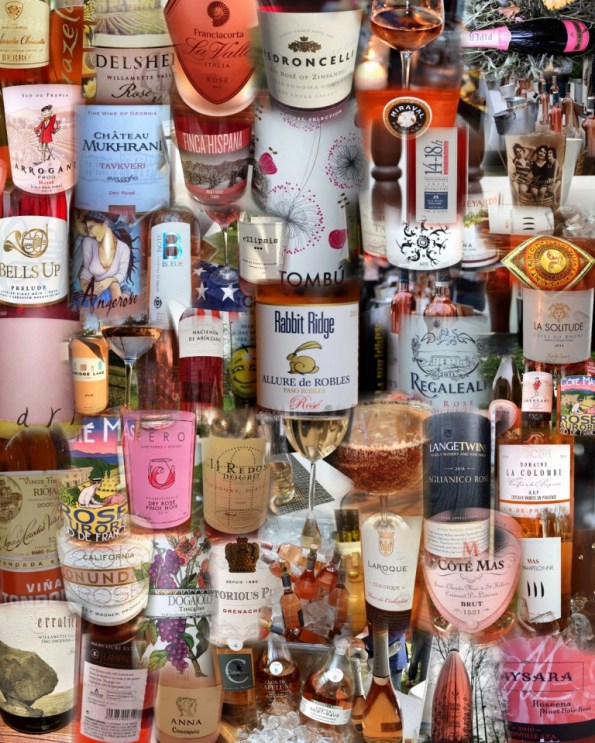
It seems that all this writing, nudging, lamenting, complaining, and most importantly, convincing and educating, resulted in something which can be simply called a “Rosé revolution”. Today, there is hardly a winery left which didn’t add Rosé to its repertoire, both around the world and particularly, in the USA. The Rosé might be produced in the quantity of 10 cases and available only in the winery’s tasting room or to the club members, 1 bottle per year, but nevertheless, Rosé became a staple of attention and it became important. Maybe even too important – some of the wines, such as Lopez de Heredia Viña Tondonia Rosé Gran Reserva used to be available at under $30 and was mostly demanded by the wine geeks. Today, you can’t even find this wine anywhere, and if you will find it, it will set you back for close to $300. Today, while the selection of Rosé in the stores would go down in the winter, there still will be a reasonable selection available all year around. And maybe most importantly, the quality of Rosé has dramatically improved, no matter where in the world it is made or what grapes it is made out of.
It only seems that Rosé is a simple wine and it is easy to make – I guess the bottles with a spectrum of a very happy pink give this impression. In reality, making good Rosé very much on par with proverbial Chef’s test, when the Chef is asked to prepare an omelet and a chicken dish – anyone who had a pleasure of consuming burnt, crunchy eggs and rubber-shoe-dry chicken breast, can easily relate to what I’m talking about here. Rosé is all about balance, and it doesn’t offer too many chances to correct the shortcomings, which can be done for the red and even white wines, using different types of oak barrels and more. With Rosé, it is better to be done right from the very beginning, or else.
I have to honestly tell you that when I’m in the restaurant, especially by myself, Rosé is my typical drink of choice by the glass. It is usually reasonably priced and works well with a wide range of foods, due to the high acidity and gentle fruit expressions. There is typically only one or two different Rosé available on the restaurant’s wine list, which makes the selection process very easy.
Rosé is really not any different than any other wine. Beautiful color notwithstanding, it is all about the balance and it is all about the pleasure. So, what do you think – is Rosé here to stay or is it just a fad which will pass soon? Cheers!
Navarra, Surprising and Not
It is commonly known that Spanish wines are some of the best-kept secrets of the wine world. An oxymoron, you say? Not necessarily. I’m not implying that you need to know the secret knock on the unsightly door in order to acquire Spanish wine. The “secret” simply means that consumers still often overlook Spanish wines as a category, despite the fact that those wines possess some of the best value, the best QPR you can ever find – try a $30 Rioja (for example, La Rioja Alta, Lopez de Heredia) and you will see what I mean.
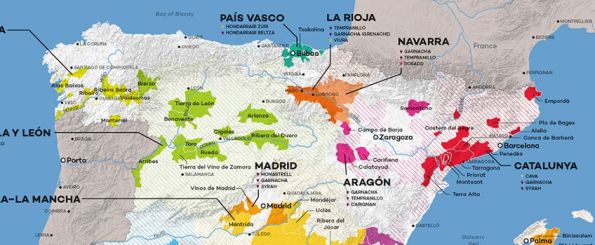
Spanish wine regions. Source: Navarra Wine US
Turns out that even secret wines have deeper secrets, such as Spanish (of course!) wines from Navarra, a northern province known for its unique climate (influenced by Mediterranean, Continental, and Atlantic climates). A long history of a close relationship with France (going back to medieval times) also led to Navarra sporting rather an interesting mix of grapes, with plantings of Garnacha and Tempranillo intermixed with Cabernet Sauvignon, Merlot, and Chardonnay. For a long time, Navarra was known as the “land of Rosé” – today you can find a full selection of white, Rosé and red coming from this small region.
By the way, here is the fun fact for you – in case you are a Game of Thrones fan, you might be interested to know that season six of the popular show was filmed in Navarra, in Bardenas Reales desert – here, you can impress your friends already.
If you are interested in a quick set of numbers (I know I always am) – Navarra has about 27,000 acres of vineyards, located on an average altitude of 1,300 feet (400 meters) above sea level. Annual production is about 70M liters of wine. Most planted grapes are Tempranillo and Garnacha, followed by Cabernet Sauvignon and Merlot. 90% of the wine production are red and Rosé (Rosé is 1/3 of this production), and 10% are white wines. Okay, done with numbers, let’s continue.
With this “secret of secrets” designation, you can probably figure that Navarra wines do not occupy central shelves of the liquor stores – but maybe it is for the better? Of course I mean it in our own, selfish interest – more for us, for the people “in the know”.
I had a pleasure of drinking Navarra wines before – for example, Tempranillo from Bodegas Ochoa is an excellent rendition of one of my most favorite grapes. However, this is where my exposure to the wines of Navarra mostly ends. Thus when I was offered to try a sample of Navarra wines, I quickly agreed.
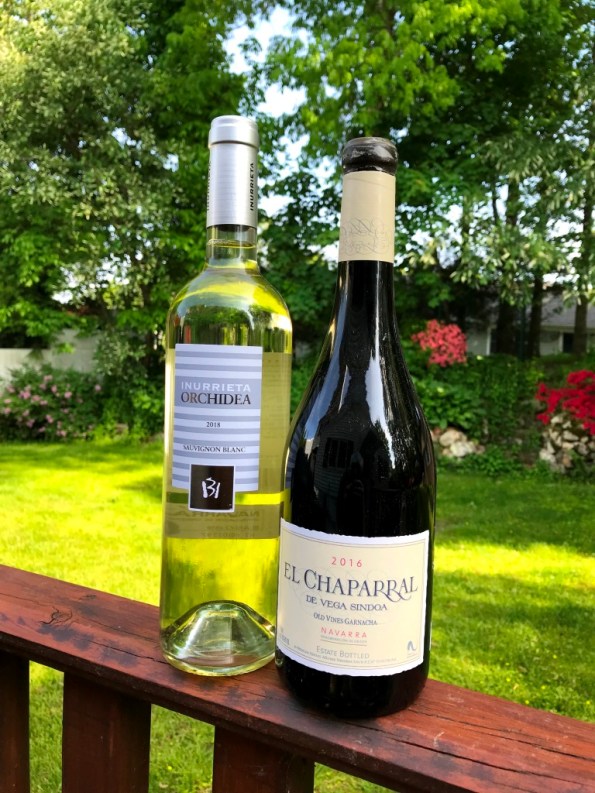
The surprises started upon arrival of the wines. Once I opened the box, finding a bottle of Garnacha made perfect sense. However, not finding a bottle of Rosé was rather surprising – I was sure Rosé would be included in the sample of Navarra wines. And the biggest surprise for me was finding the bottle of … Sauvignon Blanc! No argument here – Spain is often associated with red wines, but it makes excellent white wines – Albariño, Verdejo, Godello, Viura – but 100% Sauvignon Blanc from Spain is not something I see often (Rueda might be an exception, as Sauvignon Blanc is used there too, but mostly for blending).


The surprises continued as I opened the bottle of 2018 Bodegas Inurrieta Orchidea Sauvignon Blanc Navarra (13% ABV, $12). I have to admit, before the first sniff, I was skeptical. The first whiff of the aroma immediately cured all of my worries as the wine was simply stupendous. In a blind tasting, I would instantly place this wine into California – the wine was round and powerful, on the level of Honig or Duckhorn Sauvignon Blanc. A touch of freshly cut grass and currant leaves were unmistakable, supported by golden delicious apple, lemon, and complete absence of grapefruit. Perfectly refreshing, delicious wine – and at the $12 price point, the word “steal” comes to mind. (Drinkability: 8+)
Then there was Garnacha. Garnacha, a.k.a. Grenache is a very interesting grape. Garnacha has a tremendous range of expression, from ultra-powerful likes of Alto Moncayo Aquilon and No Girls Grenache to light and ephemeral Cote du Rhone and Bodegas Tres Picos. The 2016 El Chaparral De Vega Sindoa Old Vines Garnacha Navarra (15% ABV, $15) showed rather in the “ephemeral” category, despite the 15% ABV (I only noticed this high ABV when I was writing this post but not when I tasted the wine). Two main descriptors for this wine are raspberries and pepper. The wine was light, it was playful, full of fresh, ripe, but perfectly crunchy raspberries. Each one of those raspberries had a dash of black pepper on it. Ephemeral, surreal, or simply tasty – I will happily go with either descriptor. Again – excellent, excellent value at $15. (Drinkability: 8+).
Here you go, my friends. You can’t go wrong with either of these wines – not in price, not in the taste, not in the pleasure. Look for the wines of Navarra – you might be on a cusp of your next great wine discovery. Cheers!
Enjoying The Wine In The Can
Let me start with the question: what do you think of wines in the can?
I’ve seen rather an interesting reaction in social media (both Instagram and Twitter) when I post a picture of the wine in the can. It ranges from “Hmmm” to “Really???” to “How you can even talk about wine in the can???” to “I can’t believe there can be any good wine in the can”. Mind you, this doesn’t come from uninitiated people – wine pros of different walks have a very similar reaction when seeing the reference to the wine in the can. And I find this a bit surprising.
It’s been almost 5 years since I tried my first wine in the can. I don’t think I ever had a question “why wine in the can” (my first reaction was “wow, cool, something new and different!”) – my only question was “is it good?”. A can is just a different form of packaging – nothing more and nothing less. If you follow the subject of wine in the can, I’m sure you saw lots of different reasons and explanations to the question of “why” – “democratize wine”, “pinkies down”, “appeal to millennials” and blah blah blah. Whatever. I don’t think that simply putting wine in the can is the “magic bullet” for anything.
Of course, unique and different packaging helps to appeal to potentially a different category of consumers. But – the wine is binary. You either like it – or not. The proverbial question of the desire of the second glass is the key. Consumers might buy the can for the first time for its unique form. But they have to like it to come back and buy it again.
There is another interesting side of wine in the can in addition to the form factor. Making wine in the can allows winemakers to get ultimately creative, as you can work with a very small batches – and you can do truly uncommon things, such as finishing wine with beer hops or mixing Zinfandel with coffee – I’ve had plenty of oddly interesting concoctions, courtesy of Filed Recordings Can Club, the true pioneers of the wine in the can (Field Recordings Wine and Can club is the only wine club I belong to – because it never gets boring with Andrew Jones). Such a variety is also making it interesting for the curious wine lovers, who always have something new and different to try. And if you like something, you really want to run and grab it, while you can – the flip side of the small batch winemaking is that the wine is gone in no time.
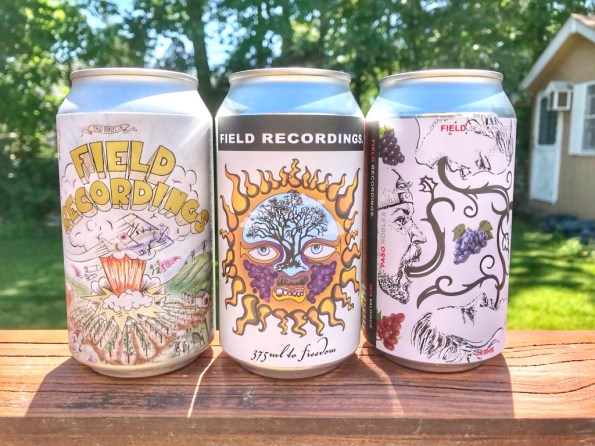
 Just to give an example, here are the notes for two of the latest shipments I received this year from the Field Recordings can club. The first one arrived just a few days ago, but I made an effort to familiarize myself with the wines quickly :). In case you are wondering, all these wines are priced at $5 per 375 ml can, so two cans would be somewhat equal to the $10 bottle of wine.
2018 Field Recordings Chardonnay Coquina VIneyard Rancho Arroyo Grande (12.1% ABV, 6 barrels produced) – fresh crunchy plums all the way, sprinkled with the lemon juice and some granny smith apples. Refreshing, round and delightful. Will make a beautiful summer day even better.
2018 Field Recordings Charbono Guglielmo Giovanni Vineyard Paso Robles (11.8% ABV) – how often do you drink Charbono (known in Argentina as Bonarda)? The producer recommended to serve this wine at the cellar temperature – I had it at a room temperature, and after 5 minutes in the glass (by the way, if you drink at home, feel free to use your favorite glass, you don’t have to drink from the can if you don’t want to) the wine was delicious – medium weight, supple dark fruit and spices, simple and easy to drink. Another winner for the summer day.
2018 Field Recordings Valdiguié Shell Creek Vineyard Paso Robles (13.7% ABV, one puncheon produced) – How about the Valdiguié grape? While typically found in the South of France, in Languedoc, the grape found its way into the US and was known for a while as Napa Gamay. I tried this wine at room temperature (too acidic and herbaceous, literally “leaf-forward”), from the fridge (much better than at the room temperature, good acidity, and underripe berries), and then at the “cellar temperature” (as recommended) – best, with excellent complexity, young berries, fennel, mint and lemon.
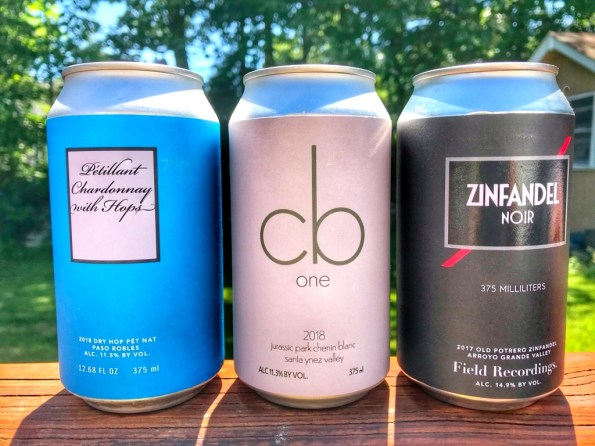 Here are the wines from the shipment earlier this year – note the completely different style of the labels – isn’t it fun? I tried only two of these so far, both superb:
2018 Field Recordings Dry Hop Chardonnay Pét Nat Paso Robles (11.5% ABV, 3 barrels produced) – ohhh, what a pleasure! Light fizz, dry hoppy notes, fresh apple, vibrant acidity, an impression of simply walking in the meadow – the can disappear in a few gulps, literally.
2018 Field Recordings Jurassic Park Chenin Blanc Santa Ynez Valley (11.3% ABV) – Chenin Blanc from Field Recordings never disappoints. This wine was made in two formats – a bottle and a can. It is yet something I need to try, but I have high hopes.
2017 Field Recordings Old Potrero Zinfandel Arroyo Grande Valey (14.9% ABV, 6 barrels produced) – this was mind-boggling. While I accept canned wines wholeheartedly, I still expect canned wines to challenge me – but there was nothing challenging about this wine. From the first smell and sip, this was an amazing California Zinfandel in its beauty – powerful, dense, loaded with blackberries, a touch of dark chocolate, lusciously layered and dangerous (we almost had to fight for the last drops). A wow in the can.
As you can tell, I’m pretty excited about the canned wines I tried – but this is not my main point. I’m simply suggesting that you should look at the wine in the can not as a gimmick, but as a product made with a purpose. Are all wines in the can good? Of course not. There will be some which you will like, and some which you will not. But it is the same with the wine in the bottle – there are some which you like, and some which you don’t. Don’t be afraid of the wine can – just give it a try. And prepare to be pleasantly surprised. Cheers!
Your Wish Is My Command
Oenophiles are very generous people.
I’m not speaking in general terms here – we are only talking about the wine. But when it comes to wine, we are ready to share. We want to share the experience. We want to share the joy of what we consider a great sip of wine with the whole world. It doesn’t always work – what tastes amazing to you, might be unimaginable plonk for someone else – everyone’s palate is different. But when it works, the experience is priceless. When the person takes a sip of the wine and says “OMG”, this is the best feeling in the world. Been able to help someone to share your joy and discover something new is incredible, and I can’t really describe it – I just truly hope you get to experience it at least once.
And then there are some key words which spur oenophile into the action. “I always wanted to try that wine”. “I never tasted the wine from that region”. “Trying this wine was always my dream”. “If I can ever find that wine”. All of these are the phrases which should be used very carefully around oenophiles, as these are the trigger phrases. They make an oenophile jump of joy and immediately devise the plan on mediating the issue in whatever way possible. If you consider yourself an oenophile, I’m sure you can relate. If you are not – I hope you know at least one.
Recently at the birthday party, an old friend said: “I always wanted to drink aged wines, but I don’t know how to find them, they are probably expensive, and I don’t know anything about them”. Can you imagine my ears perked up as soon as I heard it? Oenophile’s joyous moment, an opportunity to share the wine – yes! I gave her advice as to where she can find some aged wines (Benchmark Wines, for instance), but the brain already was put to the task. When we decided to get together for dinner, the first thing I said was “I’m bringing the wines”.

After some deliberation, I came to an agreement with oneself regarding the wine program – you can see the whole program in the picture above. I was happy that I had a reasonably aged sparkling wine – Guido Ferrari. I wrote about Ferrari wines many times, these are definitely some of my favorite sparkling wines. 2005 is still a baby, as this is a current vintage, but still – this is an excellent sparkling wine, and it was a sample so I had to open it in any case – sharing with friends makes me very happy.
I definitely wanted to have a Rosé as part of the repertoire, but the absolute majority of Rosé is not made for aging – and those which age well, are either impossible to find, or very expensive, or both. So yeah, no Rosé. For the white, I decided to go with another one of my favorites – barrel-aged Verdejo, 2009 Shaya Habis. 10 years is not that much in terms of wine age, but most of the white wines don’t age that well, and I didn’t have a nice Burgundy, Chablis or white Rhone to offer instead, so I think 10 years old Verdejo should be interesting enough.
Red wines generally can age. I decided to go with “middle-aged” wines, even though the “middle” varies dramatically between the wines and the regions. My selection – 1995 Estancia Meritage, a Bordeaux style blend from California, 1995 Quinta do Poço do Lobo from Portugal (one of my top dozen wines of 2018), and 1998 Kirkland Ranch Merlot from California. I saw that the folks on Cellar Tracker considered Estancia to be past prime for a while so this will be an interesting experience, no matter what. And the 1998 Merlot I never had before, so this is an excellent opportunity to try it. 2007 Sauternes for dessert? 12 years is not much of age for the Sauternes, but this was one of the few older dessert bottles at my disposal so this would have to do.
The above part of the post was written before the tasting. Now, it is time to tell you how the wines actually fared.
Vintage-designated sparkling wines with some age are not a simple thing for uninitiated wine lovers – many say that Dom Perignon is amazing only because they know how much it costs, not because they enjoy it. This 14 years old, 2005 Giulio Ferrari Riserva del Fondatory was outstanding in my opinion – fresh, complex, elegant, it was truly a beautiful, minerality-driven Chardonnay, enframed with some fine bubbles. You know what was the best part? To hear my friends say “wow” and “I really like it”. Mission accomplished.
 We continued with 2009 Shaya Habis Rueda (100% old vines Verdejo, barrel aged). This wine is one of my favorite Verdejo renditions, typically offering lots of complexity – but I never had it with 10 years of age. The wine was still young and crisp, with minimal fruit expression and tons of minerality, tons. Again, I consider this wine a success as one of my friends literally hugged the bottle and kept drinking this wine, repeating every few minutes “wow, and I even don’t like the whites!”.
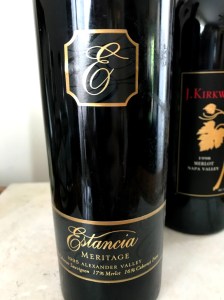
Now, it was not without trepidation that I opened 1995 Estancia Meritage Alexander Valley (67% Cabernet Sauvignon, 17% Merlot, 16% Cabernet Franc), taking into account the negative sentiment on the CT. But – my fears were unfounded. The wine was a perfect example of the nicely aged California wine – yes, it mellowed down and was tertiary aromas-driven, but it stayed that way during the whole evening, and it was a perfect example of what aging does to the wine – simply the next dimension. The aromatics which you can enjoy endlessly, an abundance of lip-smacking plums, touch of eucalyptus, good acidity – a great experience. And yet another “yes” vote in our wine program – everyone liked the wine. Were they simply polite? I don’t know. I hope they actually liked the wine, as I wholeheartedly did.
 The next wine I brought simply as a “safe bet”, just in case Estancia would not work out. While Estancia was fine, I was happy to open this wine, if anything, at least, to compare two of the wines from the same vintage – of course, from very different wine regions. 1995 Caves São João Quinta do Poço do Lobo Reserva from Bairrada in Portugal didn’t change its standing “you are drinking me too early” even for a bit (the wine was only released last year, and I was raving about it before) – elegant, restrained dark fruit and herbs – two of these 1995 wines couldn’t be any more different than they were. Again, I think people liked this wine too – but it was too far into the evening to keep track. In any case, I’m glad I still have a few more bottles left.
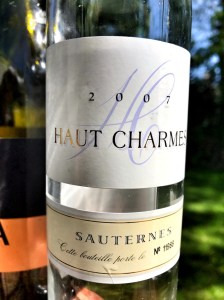
We didn’t open the 1998 Kirkland Merlot – will have to wait for another occasion – but 2007 Haut Charmes from Sauternes was delightful and all apricots, both the nose and the palate. Ripe apricots, candied apricots, apricot jam – all of it was in every sip – oh yeah, don’t worry, all apricots were supported by acidic core. I don’t know if this was a common expression for the aged Sauternes, but there was a lot of pleasure in every sip of that wine.
This is my story of helping friends to experience aged wines. If you ask me, this was a complete success as people got to enjoy something new and different. Have you had any of these wines? What would you open for your friends to try? Cheers!
Wine Love: Lodi, California
 It is with the bittersweet feeling I confess my unconditional love to the wines of Lodi.
It is bittersweet, as on one side when the person is in love, they want to tell the whole world about it. On another side, I don’t want to tell the whole world about it – I want to keep it all to myself. I want Lodi to stay as a secret refuge for those who know. I want the Lodi wines to stay affordable, and the wineries to stay un-Napa – simple, humble, friendly, and worth visiting. But – this is not necessarily right for the winemakers of Lodi, who wants their wines to be known and drunk by the people, and therefore, it is my mission as a wine writer and wine aficionado to help with that, even risking that Lodi might not stay the same.
Bittersweet, yeah.
In general, Lodi is unknown and misunderstood. Wine lovers think that Lodi is only producing Zinfandel and high-power, high-alcohol fruit bombs. This can’t be any further away from the truth about what Lodi really is. So if this is what you thought of Lodi before, take it out of your head, and let me tell you what Lodi really is.
Historically, if California is an agricultural capital of the USA, Lodi is an agricultural capital of California. By the way, do you know where Robert Mondavi (yes, THAT Robert Mondavi) went to the high school? Yep, in Lodi. These are just fun facts, but now let’s get closer to the subject. Lodi is not about Zinfandel. First and foremost, Lodi is home to the Mediterranean grape varieties – Tempranillo, Sangiovese, Viognier, Albariño, Grenache, Cinsault, Syrah, Barbera, and many others. Lodi has a great climate for grape growing – it gets very hot during the day – temperatures in July/August can reach into the lover 100s – however, it cools off very nicely to “ohh, I need a jacket” on August night. That temperature range helps grapes to concentrate the flavor.
Lodi has sandy soils, which are not conducive for phylloxera, thus most vineyards in Lodi are planted on their original rootstocks. Lodi is home to some of the oldest continuously producing vineyards in the USA and in the world – for example, Carignane and Cinsault vineyards are 120+ years old, still bearing wine-worthy fruit. Lodi Rules, developed starting in 1992, became the standard of sustainable winegrowing in California (the same rules are even implemented at Yarden winery in Israel). And one of the most important elements – Lodi winemakers are some of the friendliest wine people you can find.
Until late 2016 I was square with the general public, equating Lodi with Zinfandel only. Then Wine Bloggers Conference happened, hosted in Lodi, and I was blown away by what I discovered upon arriving in Lodi. During that week I was also mesmerized by the attitude and hospitality of the winemakers, who took their time off the most important winemaking activity of the year – harvest – and spent time with the wine bloggers, sharing their love of the land. It is not only about the attitude – the absolute majority of the wines were tasted were delicious – I’m very particular in my expectations as to what good Syrah, Tempranillo, Barbera, or Albariño should taste like.
Two months after the wine bloggers conference I was in the Bay area on the business trip and had an open weekend. I tried to make some appointments in Napa, and when that didn’t work out, I went again to Lodi – had an amazing time tasting through the whole portfolios of Bokisch, Borra Vineyards, and Lucas Winery (the absolute beauty of 15 years old Lucas Chardonnay we tasted at the WBC16 speed tasting session still haunts me). I never wrote about that experience, but this is a whole another matter.

When I got an invitation from Snooth to join the virtual tasting session of Lodi wines, I almost jumped of joy – yes, I will be delighted to experience the Lodi wines, which are still hardly available outside of Lodi or California at the best (or is that a good thing :)?) Six wines, six producers, a unique and unusual set of grapes – what more wine aficionado can be excited about?
Below are my notes and thoughts about the wines. In case you want to follow along with the video of the virtual tasting, which provides way more information than I’m including here, here is the link for you.


2018 Acquiesce Winery & Vineyards Ingénue Mokelumne River AVA Lodi (13% ABV, $32, 35% Clairette Blanche, 35% Grenache Blanc, 20% Bourboulenc, 10% Picpoul Blanc, 350 cases produced) – Sue Tipton, winemaker and owner at Acquiesce Winery is known as a white wine specialist. She produces a range of wines made primarily out of the southern Rhone varieties.
Straw pale color
White stone fruit, candied fruit, concentrated
Day 1:
White stone fruit on the palate, good acidity, minerality, salinity
7+; it is really a 7+ out of respect to the wine which so many bloggers raving about. I clearly don’t get this wine, and no, it doesn’t give me pleasure.
Day 2-4:
Elegant, lemon and white peach notes, clean, good mid-palate weight, definitely resembling white Chateauneuf-du-Pape, uplifting, vibrant, perfectly balanced
8+; OMG. The wines can’t be any more different after being open for a few days. It changed dramatically, it opened up, it showed balance and elegance. This is an excellent wine, just give it 5-10 years to evolve (or longer).
2018 m2 Wines Vermentino Mokelumne River AVA Lodi (12.3% ABV, $20, 250 cases produced) – this Vermentino was unique and different in its show of minerality – it is quite rare for me to taste the wines like that.
Light straw pale, really non-existent color
Minerality-forward nose, granite, lemon undertones
Salinity on the palate, lemon, crisp acidity.
8-, tremendous minerality on this wine, it has more minerality than fruit. This wine also shows a bit more fruit after being opened for a few days, but it still retained all of its minerally character.


LangeTwins Winery & Vineyards 2018 Aglianico Rosé Lodi (13% ABV, $20, winery exclusive) – owned by the twin brothers, as the name says, LangeTwins is quite an unusual winery. Fun fact: their own production under LangeTwins label is quite small – however, as a contract winery their capacity to produce and store wines exceeds 2.2 million gallons. It is not the first time LangeTwins makes delicious Rosé from the Italian grapes – their Sangiovese Rosé has a cult following and impossible to get. This Aglianico Rosé is worthy of joining the cult ranks.
Beautiful pink color
Strawberries on the nose, nicely restrained, some minerality undertones
Delicate, balanced, perfect crunchy strawberries, crisp, refreshing
8, love this wine, would drink it any day
2016 Mettler Family Vineyards Pinotage Lodi (14.9% ABV, $25, winery exclusive, 350 cases produced) – not familiar with the winery, but seeing Pinotage on the label made me really wonder. Pinotage is a South African grape, which now produces much better wines than 20-30 years ago, but still with a very polarizing following (love/hate). This was my first taste of Pinotage produced outside of South Africa – and this was one unique and delicious wine.
Dark Garnet, almost black
Ripe blueberries, a touch of smoke, herbaceous undertones
Silky smooth, dark fruit, a touch of molasses, smoke, good textural presence, minerality, good acidity, good balance
8, lots of pleasure


2016 PRIE Winery Ancient Vine (1900), Block 4 Spenker Ranch Carignane Mokelumne River AVA Lodi (14.4% ABV, $29, 70 cases produced) – Just a thought if drinking the wines made from the grapes harvested from the vine which exists for 120 years, gives me quivers. An absolutely unique experience.
Bright garnet
Roasted meat, granite, chipotle
Great complexity, tart raspberries, rosemary, bright acidity, medium body, distant hint of cinnamon, excellent balance
8+/9-, it might sound like an oxymoron, but this wine is easy to drink and thought-provoking. Lots of pleasure in every sip
2016 Michael David Winery Ink Blot Cabernet Franc Lodi (15% ABV, $35, 85% Cabernet Franc, 8% Cabernet Sauvignon, 7% Petite Sirah, 65% 16 months neutral oak, 35% 16 months new French oak) – Michael David winery is known for its show of power in the wines. But when power is supported by elegance, that’s when you have an ultimate experience.
Dark garnet
Unmistakably Lodi, blueberries and blueberries compote, medium plus intensity, fresh
Lots of fresh berries – blueberries, blackberries, chewy, fleshy, well present. Touch of cinnamon, good acidity, overall good balance.
8, massive wine offering lots of pleasure. It just happened that soon after tasting, I had to leave the town for a business trip, so I just pumped the air out and left it standing on the floor. My wife didn’t have the opportunity to finish it, so when I came back 10 days later, I decided to taste it before I will pour it down the drain. To my horror surprise, the wine was still perfectly drinkable. That technically means that it has great aging potential, so maybe I need to lose a few bottles in my cellar.
Here you are, my friends. I hope I made you curious about the wines of Lodi. Definitely look for them in the store, but also keep Lodi in mind as your next winery excursion trip – just get ready to haul home a few cases of wine. Cheers!
Latest Wine News and Updates
With the risk of repeating myself, I still have to say – we truly live through the wine revolution nowadays. This revolution takes on many forms. The wine quality is at the highest throughout the world, and it keeps getting better and better every year. Wine is made in far more places than ever before – who would’ve thought 10 years ago that England can produce world-class sparkling wines, rivaling the best Champagne? The wine has shaken off its traditional format of not only the bottle, but even the box, and it is available today in the can and in the keg. Heck, the wine today can be even mixed with CBD (Cannabis) so you can get high quickly and surely. Yep, it is the wine revolution time.
So with this, I want to share with you some of the latest and exciting developments taking place in the world of wine.
Let’s start with an interesting development around high-end wines. Have you ever noticed that many successful (and equally expensive) super-Tuscan wines have names ending in “aia” – Ornellaia, Sassicaia, Solaia – you see the trend, right? Turns out that a couple of the US retail giants – Walmart and Target, to be exact – decided to add high-end Italian wines to their portfolio, and surprisingly (or not?), both went with the super-Tuscan theme and named their new wines – can you guess – Targaia and Walmaia! Targaia is the blend of 70% Merlot and 30% Sangiovese, and Walmaia has a very interesting blend of 80% Cab Franc, 10% Sangiovese and 10% Carignan. 2016 will be the first vintage of Targaia, and Walmaia will debut with the 2015 vintage, both slated to hit the retail shelves later on this year. The release price for Targaia is set for $75, and Walmaia will open at $70 – great price for super-Tuscan wines, where a lot of well-known wines today are offered at the prices well north of $200 per bottle. Will “aia” do the magic trick for Target and Walmart? You will be the judge of it, once you will be able to get your hands on the bottle – hopefully it will not be too difficult, however, the production volumes had not been disclosed, as well as the source vineyards, so we will have to wait and see.
Our next update is about the Coravin, the famous wine preservation system which allows you to extend the life of your precious bottles and enjoy them over a longer period of time than otherwise would be possible. Of Coravin is a tool of choice of many wine writers, restaurateurs, sommeliers and all of the wine lovers, and it works perfectly for most of the wines – with Sparkling wines been a notable exception. And who wouldn’t like to have a small celebratory sip of Dom Perignon, while preserving the rest of the bottle for another special occasion? Coravin set out to solve the sparkling wine issue and reportedly invested more than $3M (USD) into the brand new lab in Switzerland. The initial design seemed to be successful, however, not really commercially viable, considering that the machine was a size of a small desk and weighed around 300 lb. Subsequent tests, however, showed that the researchers still have long ways to go, as the bottle of Dom Perignon shattered into the hundreds of little pieces while operated by the first smaller size prototype – luckily, nobody was hurt and the only loss was the one of a precious liquid. I’m sure Coravin researchers will not give up and sooner rather than later we will be able to enjoy a small pour of delicious Champagne while the rest of the bottle will be safely preserved.
Continuing the subject of bubbles, this next piece might surprise you. I’m sure everybody knows Grey Goose, the famous French vodka, a staple of any top shelf of any self-respecting bar. The problem with vodka is that it is typically relegated only as a mixing component in the cocktails, no matter how high the regard it has. Many vodka producers are trying to change this status quo, but it is usually done by simply infusing vodka with a certain flavor in an attempt to convert it into a sipping drink. Grey Goose decided to try something different, and partnered with Moët & Chandon to create … yes, the sparkling Vodka! The attempts to produce sparkling vodka using the Classic Method were unsuccessful, however, based on the initial reviews, the Charmat method worked just perfectly, with many critics simply raving about the experience. The sparkling Grey Goose vodka is packaged in gold-adorned classic Champagne bottles and it is already available at select retailers in the USA for about $200 per bottle (suggested retail price). While I don’t drink vodka as is, I’m definitely looking forward trying this unusual drink – would be curious in your opinion too.
Now let’s talk about cult wines. Not just any cult wines, but maybe the cult of the cults – Screaming Eagle. I’m sure you know that Screaming Eagle makes the most expensive Cabernet Sauvignon wine in the USA, priced at around $3500 if you can ever find a bottle. But do you know that this is not the most expensive wine made by Screaming Eagle? Until now, their most expensive wine was white – Sauvignon Blanc from Napa Valley, priced north of $4K, and equally impossible to get. Did you noticed I said “until now”? Screaming Eagle is set to beat its own record with the brand new offering to the mailing list members – Cabernet Sauvignon Rosé. It will be priced at $4999 for the mailing list members, and with only 30 cases produced (360 individually numbered bottles), this Screaming Eagle Rosé is expected to disappear in less than a minute after the members will be able to place their release orders. It seems that Rosé is an absolutely unstoppable category, with such heavyweights as Screaming Eagle joining the madness – I just hope not everybody will join their suit for the insane prices. And if you will be able to score a bottle, send me a note – I would looove to help you drink that.
Our last news for today is really from the “hard to believe” category, but I guess everything is possible… For about 10 years now, world famous UC Davis conducted the work to identify the effects of different types of music on the vines, grapes and the resulting wines. Fully independent test vineyards had been set up each with its own winery facilities, to ensure the same type of music is used through all of the stages of the winemaking, from the first bud break until the wine is pressed, aged and bottled. All facilities are outfitted with state-of-the-art Bose sound systems to ensure high-quality sound, both in the vineyards and inside the wineries. Chants, classical music, dance, hip hop, and heavy metal are used in the experiments, each one at its own, individual vineyard. All results are still being processed, and no conclusions had been made yet, however, a recent report from UC Davis really makes you wonder. It appears that after barrel-sampling wine from the vineyard subjected to the heavy metal music for 7 years in the row, visiting scholar, Dr. Drunkken, became extremely violent and attacked his colleagues, initiating an unprovoked, bloody fight. Dr. Drunkken was never previously known for any aggressive behavior, and after he spent a day subdued in the hospital bed, had literally no memories of an accident and couldn’t understand why his hands had been tied. It is completely unknown what triggered such behavior of a generally nice and gentle man, so it seems that researchers just got a lot more work to do. I don’t believe one single accident will derail the whole (expensive!) program, but I’m sure the new level of caution will be asked of everyone involved in this research.
That’s all I have for you today. Until the next time – cheers!
OTBN 2019 – What a Night!
Open That Bottle Night (OTBN for short) is my favorite “wine holiday”. Of course, the absolute majority of celebrations in our lives – holidays (Mother’s Day, Father’s Day, Thanksgiving…), birthdays, weddings, anniversaries, promotions – include wine, but strictly in the supporting role. All the “grape days” are about wine, yes – but typically restricted to a specific grape. OTBN is a special day when the wine is a front and center of our celebration – OTBN is all about showing respect to those special bottles which all need the special, perfectly appropriate moment to be opened. OTBN allows us to say “the perfect moment has arrived” and just open That Bottle.
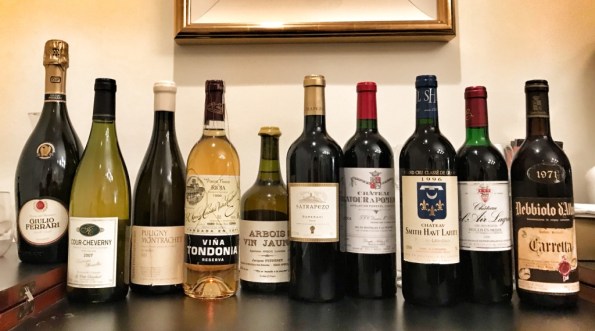
Almost full line up – few bottles are not shown
While I’m celebrating OTBN for a long time, this year’s event helped me to better appreciate the true purpose of this “holiday”. Okay, I have to say that I never had such a massive amount of wine opened for the OTBN – we went through 14 bottles – and each bottle was special in its own way. But until now, all of my OTBN experiences where strictly positive – the majority of the wines opened for OTBN were either at its peak or well drinkable at the moment but still promising to improve with time. But this year, in addition to absolutely stunning, mature, unparalleled wines we had wines which were either past prime or in the strange sleeping mode (yes, I’m an optimist), adding a good reason to follow the founding principals of the OTBN and pull the cork from That Bottle now.
Here are my notes for the wines we opened this year, together with a bit of explanation as to what made this wine special and my impressions.


2001 Giulio Ferrari Riserva del Fondatori Metodo Classico Trento DOC (100% Chardonnay)
Why: I was looking at this bottle for a long time. Ferrari makes some of the very best sparkling wines in Italy, and this is their flagship wine. At 18 years, it is a good age for the sparkling wine – and OTBN is a perfect reason to open a wine like that.
How was it: Amazing. Light bubbles, but the balance is amazing, light toasted notes, wow. The wine stayed fresh throughout the whole evening and was one of everyone’s favorites.
2013 Pierre-Yves Colin-Morey Puligny-Montrachet Le Trezin, Cote de Beaune
Why: Jim had multiple bottles of this wine and was worrying about Premox (Premature oxidation). Thus he put it out just to try.
How was it: Superb. delicious, classic burgundy, beautiful, elegant, round. Another one of the top choices for everyone.


2007 François Cazin Le Petit Chambord Cour-Cheverny AOC
Why: This is one of my favorite wines. When it was 10 years old, was literally blown away
How was it: Underwhelming. A touch of petrol, clean, good acidity, bud no bright fruit. Still delicious in its own way – I would gladly drink it any time. But – lucking the “umpf” which was expected… Still have 2 more bottles – will open later on and see.
2014 Damien Laureau Le Bel Ouvrage Savennières AOC
Why: Well, OTBN is an all-inclusive celebration. I rarely drink Savenniers, so it is always fun to experience something new.
How was it: Ok. For the 5 years old Chenin Blanc from the Loire, it was quite decent. Nice white wine – can’t say much more than that.


1996 Lopez de Heredia Viña Tondonia Blanco Reserva Rioja DOC
Why: why not? Lopez de Heredia is one of the very best Rioja Producers, and their Viña Tondonia Blanco might be one of the best white wines in Spain – at least from point of view of the wines which can age
How was it: A flop. Unless there was a flaw with this particular bottle, this wine was past prime and had no joy in it.
2015 Royal Tokaji The Oddity Hungary (100% Furmint)
Why: Furmit is the grape used in the production of the Hungarian Tokaji wines, some of the very best dessert wines in the world, easily rivaling the best Sauternes. Problem is – it is very difficult to prevent Furmit vineyards from the Noble Rot settling on the grapes – and thus it is rare – and difficult – to produce dry Furmint wine. Here comes The Oddity – dry Furmint wine.
How was it: Very good. Nice, clean, great minerality, balanced well-integrated palate, good acidity. Thank you, Lori, for this delicious find.
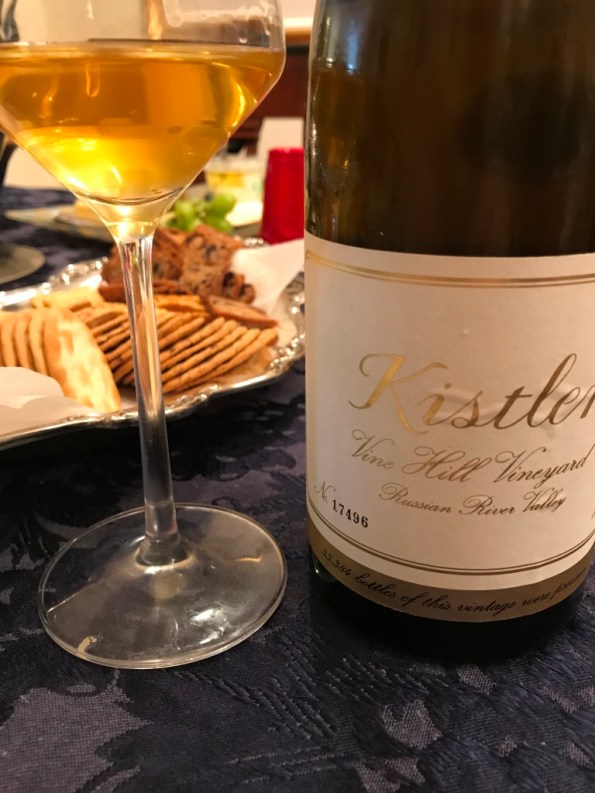
No filter – look at the color of this 24 years old Chardonnay
1995 Kistler Chardonnay Vine Hill Vineyard Russian River Valley
Why: Kistler is one of the best Chardonnay producers in California, so this alone is enough to include such wine into the OTBN line up. But then California Chardonnay rarely built to last for so long, so it was definitely the time to open this bottle.
How was it: Amazing. Almonds, apples, still present vanilla, a touch of smoke, good acidity – amazing for 24 years old white wine


2008 Jacques Puffeney Vin Jaune Arbois Jura
Why: Trying to explain the wine such as Vin Jaune to the uninitiated wine lovers presented an interesting challenge – I failed to explain what “oxidative” means. Anyway, putting this aside – Jura wines are rare. Vin Jaune wines are rare. Jacques Puffeney wines are beyond rare – 2014 was the last vintage which he commercially produced. This wine is absolutely OTBN worthy (thank you, Jim!)
How was it: Amazing. An oxidative nose which was also incredibly attractive, mature fruit, good acidity, elegant, present, delicious wine.
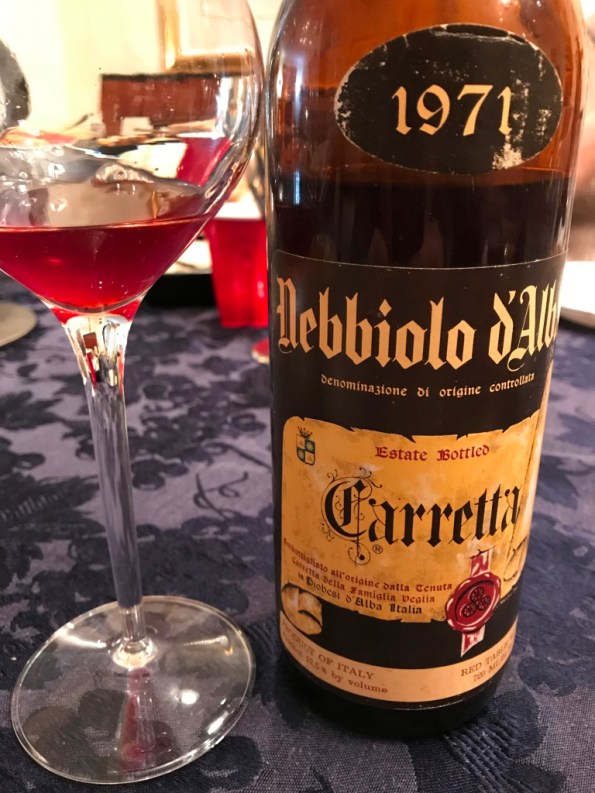
No filter – just look at the color of this wine! Amazing.
1971 Tenuta Carretta Nebbiolo d’Alba DOC
Why: 1971. Need we say more? Yes, the wine of such age is absolutely meant for OTBN.
How was it: Amazing, absolutely amazing. We poured it without decanting. The wine changed dramatically over the course of an hour. My first impressions were: pungent, with clean acidity, mature restrained fruit, still has lots of life left. Wow. About 15 minutes later, the wine totally changed and was the most reminiscent of a nice, concentrated Rosé – cranberries, a touch of strawberries, good acidity, very refreshing. Another 15 minutes made this wine most reminiscent of Jura red, a Poulsard if you will – light, great acidity, a touch of red fruit. Truly an amazing experience. And don’t forget to look at the color of this wine…


1986 Château Bel-Air Lagrave Moulis-en-Médoc AOC
Why: 33 years is a very respectable age for any wine – you really want to ask such wine “how ya doin”
How was it: Wow. Young, beautifully balanced, beautiful Bordeaux, just perfect. In a blind tasting, I would never identify this as a 33 years old wine. Yes, you can call me a failure.
1996 Château Smith Haut Lafitte Pessac-Léognan
Why: My exact question – why? Only because we could?
How was it: not ready. Needs time, mostly locked up. You would never think that 23 years old Bordeaux is not ready to drink, but it was not.


2004 Château Latour à Pomerol Pomerol AOC
Why: Same as previous wine – really, why?
How was it: Not ready. Closed nose, mostly cherries on the palate, need another 10-15 years.
2006 Telavi wine Cellar Satrapezo Saperavi Kakheti Georgia
Why: One of my most favorite Georgian wines. Limited production, a beautiful example of Georgian Saperavi. Most of the wine lovers are still unfamiliar with Georgian wines, so I really wanted to introduce this wine to the people.
How was it: Excellent. Still tight, beautiful fruit, big wine, could use more time. I was a bit concerned that this wine is reaching its peak – I was wrong. I’m sure another 5 years would do wonders here. Oh well…
2005 Weingut Petri Herxheimer Honigsack Scheurebe Trockenbeerenauslese Pfalz Germany (100% Scheurebe)
Why: For one, it is very appropriate to finish a great wine program with the dessert wine. And then how many of you even heard of Scheurebe? Scheurebe grape is a cross between Sylvaner and Riesling. It is quite rare, so yeah, a perfect choice for OTBN.
How was it: Spectacular. Not only it had great acidity which is essential in enjoyable TBA-level sweet wine, but it also showed a mix of honey and herbs – rosemary, sage, thyme – just an unbelievable concoction and ultimate pleasure in every sip. Thank you, Stef, for this treat.
Obviously, I can’t complain about such an amazing OTBN – however, as you saw, we had our share of disappointment. At the same time, the good greatly overweight the bad – 1971 Nebbiolo, 2001 Giulio Ferrari, 1995 Kistler, 2008 Vin Jaune, 1986 Bordeaux were all personal favorites and I would be glad to experience those wines again at any time.
Now that I told you about our OTBN, how was yours?
Open That Bottle Night – OTBN 2019
 Wine lovers – this is your public service announcement, so listen carefully.
Open That Bottle Night is Saturday, February 23, 2019.
I repeat – OTBN is taking place this coming Saturday! Are you ready?
Okay, so all of you who are familiar with the OTBN, please say “thank you for the reminder” and quietly retreat to your cellars in attempt to solve the unsolvable.
For those who don’t recognize the OTBN term, let me explain.
Open That Bottle Night (OTBN for short) movement was originated by Dorothy J. Gaiter and John Brecher, writers of the Wall Street Journal’s Tastings column. Back in 2000, they decided to help people to put their best wine bottles to the best possible use (e.g., drinking and enjoying them) by designating last Saturday in February as special “pull that cork” day.
All of us, wine lovers, have that “special bottle”. The birth year vintage, a gift from a special friend, a bottle brought from the special trip, a bottle signed by winemaker, special wedding present, or something special we managed to score many, many years ago – it is really not important what makes that bottle special. However, with all those “special bottle” designations, we keep waiting for that special, right, proper, one and only moment to pull that cork – and subsequently, we are risking one of two things:
- we might not be around to enjoy that special bottle of wine (not trying to use any “scare tactics” – this is just a part of life)
- the wine might not be around for us to enjoy it – ever heard of “past prime”?
Nobody knows what is the “right time” for the wine. We have our expectations, of course, but it is in human nature to doubt oneself, and thus we keep arguing with ourselves about the “right moment”. The “right moment” is also something entirely individual – the right age of the wine, a long-fought-for job promotion, wedding anniversary, significant birthday, or simply the right company. And so we are waiting and waiting and waiting – and risking one of the two outcomes I mentioned before. This is where OTBN comes to the rescue. OTBN makes an opening of that prized bottle a good enough reason in itself – it is really a celebration of life as it happens.
Ever since its creation, OTBN was getting an increased following from all over the world, with people from China, Hong Kong, Australia, Japan, Europe and, of course, the USA, gladly reporting about the opening of those long-cherished bottles – and their personal life stories.
It is the right time, wine lovers, to get that bottle ready. If you need any additional instructions, the Wall Street Journal took care of it by publishing the guide to the OTBN, so now you are guaranteed not to make any mistakes. Go, start thinking about that special bottle you are going to enjoy this Saturday – to celebrate life. And don’t forget to share your special moment with all of us. Will be waiting.
Daily Glass: The More I Drink, The Less I Understand?
Wine is an enigma.
But you already know that.
The wine had been a serious object of obsession for more than 20 years for me. I went through multiple education programs. Read an uncounted number of wine books and articles. Most importantly, drunk a lot of wine – from the bottles, from the barrels, the juice of freshly harvested grapes and the juice which only had been fermented for a few days. Two days old wine and 80 years old wine. I taste roughly thousands of wines every year (with the help of trade tastings). Yes, the wine is an object of obsession. And yet, I would never say that I figured it out, that I fully understand it.
Wine is an enigma.
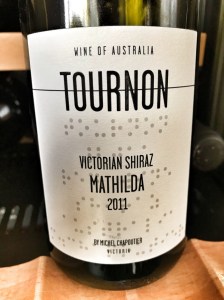 The curse of wine is rather simple – until the cork is pulled (or unscrewed), you don’t know what to expect. A lot of wine bottles look ultimately attractive outside – bottle’s shape and weight play an important role, and then you got the label which, when properly done, is an ultimate seduction device. But once the cork is out, it is only the content that matters – and here we learn that not all the beauty from outside can be found on the inside. The worst part? Until the first sip, we have no way of knowing what we will find, even if we tasted and loved the wine before! Sadly, this is a classic case of any investment prospectus disclaimer – “past performance is no guarantee of the future results”. It is quite possible that you tasted and loved the wine before – nevertheless, every new bottle is a perfect screw up (or a beautiful surprise) opportunity. The wine is an enigma.
Back in 2014, I tasted 2011 Michel Chapoutier Tournon Mathilda Shiraz Victoria, Australia (13% ABV, $14.99) and was blown away by the beautiful purity of that Shiraz. The wine had a clean, herbs-driven profile full of freshly ground pepper – you really had to taste it to believe it. I was so impressed with that wine that it became wine #4 on my Top Dozen list in 2014. I got 6 bottles or so (at $14.99, a great QPR) and was slowly enjoying it over the years. But not always. I remember trying to impress a friend with this wine when I found it available in a restaurant in Florida by the glass. That simply did not work – the wine was flabby and mostly insipid. Then I had opened a bottle last year, only to be able to say “what just happened???”. The wine had just some single note fruit, no pepper, limited acidity, and in a word, was not fun. I was further put down with this wine last year after tasting the current vintage release at the trade tasting – that wine was insipid, cherry cough medicine style.
When I pulled my last bottle from the shelf a few days ago, the thought was – yeah, whatever, let’s just free up some space. Unscrew, pour, sip – oh, my, everything was back as when I fell in love with this wine – fresh pepper, sage, rosemary, intensely herbal with tasteful addition of ripe black plum – as wow wine as it can be. Don’t ask me for explanations or theories – as I said, the more I drink, the less I understand.
Wine is an enigma.
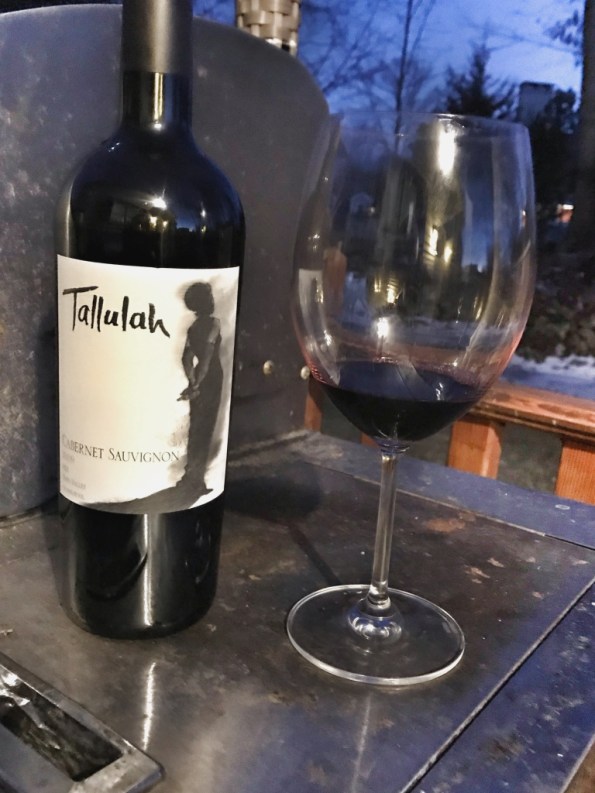
The second story is less unusual, but still in line with what we are talking about here. I got the 2009 Tallulah MD1 Cabernet Sauvignon Napa Valley (14.1% ABV, $75) after reading the skillfully crafted sales pitch by the folks at Benchmark Wine Company. What’s not to like there? Excellent winemaker, Mike Drash; beautiful label, great story of naming the wine after winemaker’s daughter, and maybe most importantly, the cult grape from the cult region – Cabernet Sauvignon from Napa Valley. The first experience with the wine was at the “ohh” level – tight, closed, by all means not ready. The next time I had the same wine was back in 2014, it fared better – I gave it 8- rating, but mostly for the potential, not so much for the actual pleasure delivered by the wine back then.
Looking for the wine to drink last Saturday with the steak (looking for the wine is a physical process of moving the shelves of the wine fridges in and out – I don’t have any record-keeping in place), I saw the bottle top with the characteristic “T” on it. Similar to the wine we discussed before, the thought was “well, why not – I need to free some space anyway”. The first sip solicited an instant “oh, wow” – a Cabernet perfection in the glass, vibrant cassis, eucalyptus, touch of cherries, sweet oak, perfect mid-palate weight, clean acidity, impeccable balance – the wine Napa Valley is so famous for was right there – in my glass.
While working on this post I looked for my previous notes on this wine, and I only found a short reference in the post about “Month in wines”, written precisely 5 years ago, in February of 2014. To my big surprise, in that post, I found the following line: “…definitely needed more time, let’s say, at least 5 years…” – the fact that I randomly pulled this MD1 bottle exactly 5 years after and the wine evolved beautifully – well, I guess, this is just a happenstance…
Wine is an enigma.
But that what makes it an ultimate fun.
Last Bottle Sign Up ($10 credit)





