Archive
For The Love Of The Cab: Cabernet Deep Dive with Domaine Bousquet
I can’t speak for all oenophiles, but at least speaking about moi, there is one question that I dread the most:
What is your favorite wine?
This is not a question I ever want to hear – of course, as soon as people figure that you are “into wine”, this is the question everyone thinks is the most appropriate. And yet this is bad – scrap that – horrible question as it doesn’t have an answer. Or it has an answer – accepting that the answer will be different every time the question is asked.
Maybe a better question to ask is
What is your favorite wine today?
At least this is a question that I can answer.
Today, my favorite wine is Cabernet, or Cabernet Sauvignon and Cabernet Franc, to be more precise. Cabernet is what we are going to talk about today. And not just any Cabernet – all organic Cabernet from Argentina.
I have to admit that Cabernet Sauvignon is one of my most favorite wines not only today but on any day. I find a classic profile of cassis, eucalyptus, and bell pepper, sometimes accompanied by mint and anise simply magical. When I see Cabernet Sauvignon on the label, this immediately sets my expectations – and that is exactly where a huge disappointment opportunity lies. The wine might be very good, but if it is called Cabernet Sauvignon, and then doesn’t offer the aforementioned classic traits, that immediately becomes a letdown, sometimes even unjustifiably so. The good thing is that Argentinian Cabernet Sauvignon is usually very well versed in its classic expression, so it is generally a Cabernet Sauvignon that doesn’t disappoint.
Domaine Bousquet is one of the most impressive wine businesses in the world. I wrote about the history of Domaine Bousquet very extensively on these pages, so I’m not going to regurgitate everything that I already said – instead, I would like to suggest that you read this post, and also this one. However, I will illustrate my statement about the most impressive wine business with a few pictures. Here is what high altitude (1,200 m/4,000 ft) desert looked like in 1990 when Frenchman Jean Bousquet first fell in love with the area while on vacation in Argentina:
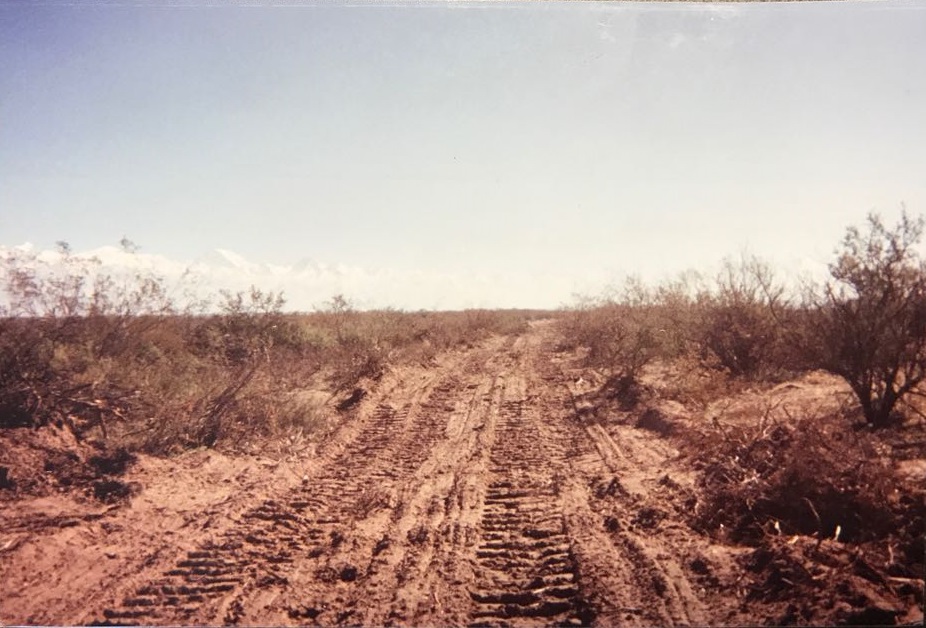
Source: Domaine Bousquet
Here is what it looks like today:
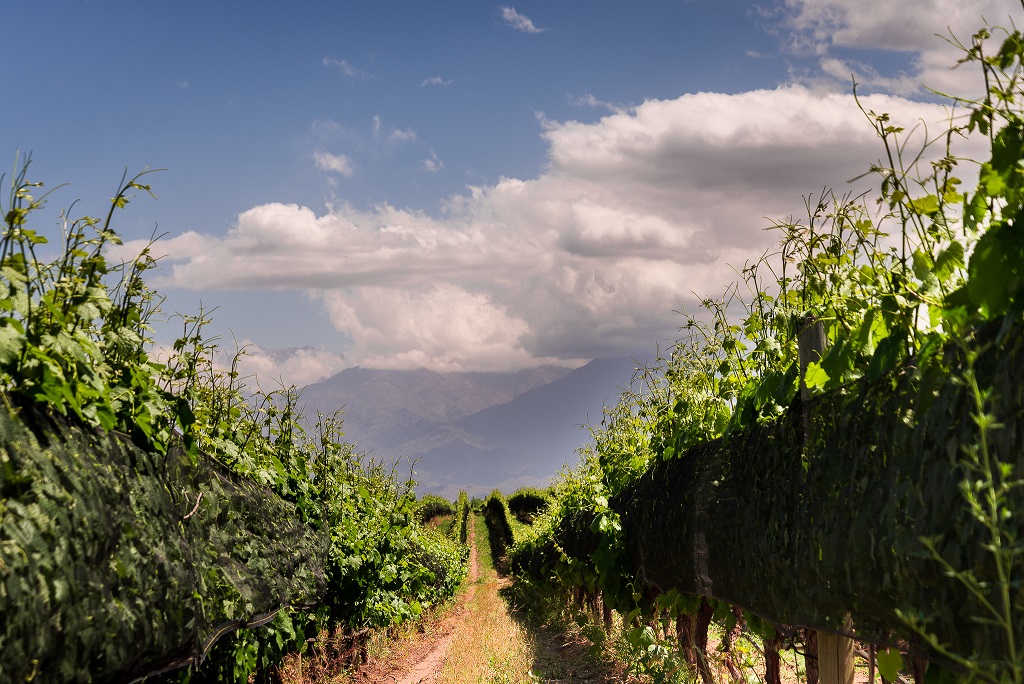
Source: Domaine Bousquet
Here is what domain Bousquet has accomplished in less than 30 years, after being formed in 1997:

Certified B corporation, certified regenerative organic, biodynamic, USDA organic… you can continue decoding the icons on your own. 5 million bottles are produced annually, and I never had a wine from Domaine Bousquet that I didn’t like. I rest my case.
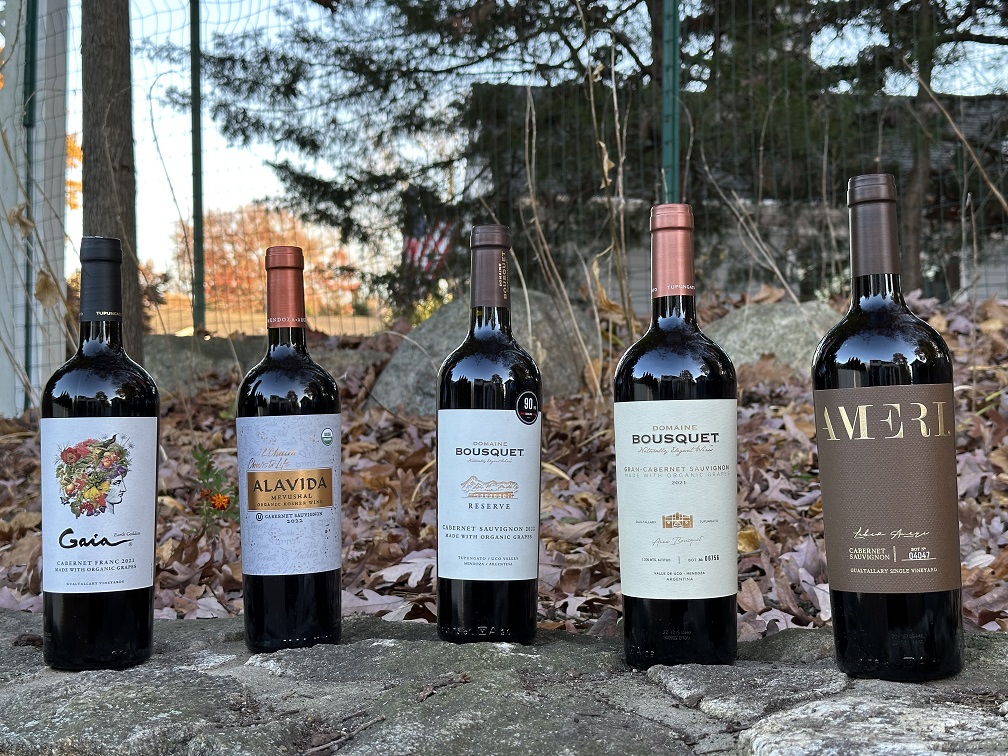
Today we are focusing on Cabernet wines from Domaine Bousquet. While Malbec might be a king of Argentinian wines, Cabernet Sauvignon probably is a royal prince. Argentinian Cabernet Sauvignon wines are world-famous and well sought after. Domaine Bousquet offers a full range of Cabernet wines, both in price and in style. I had an opportunity to taste through such a range, so here are my impressions.
Let’s start with Cabernet Franc first. I love the label for this wine, it is very lively and colorful.
2021 Domaine Bousquet Gaia Organic Cabernet Franc Uco Valley (14.5% ABV, $20, 100% Cabernet Franc, 10 months in used French oak)
Dark garnet
Classic, a distant hint of bell pepper, cassis, eucalyptus.
Cassis, soft tannins with firm structure, a touch of peppery notes, good acidity, excellent balance.
8, delicious and classic
Similar to Hebrew’s L’Chaim! Alavidaalso means To Life! in Spanish. USDA Organic (no SO2 added), unoaked, and Kosher wine is perfect not just for the holidays, but for any day.
2022 Domaine Bousquet Alavida Kosher USDA-Certified Organic Cabernet Sauvignon Uco Valley (14.5% ABV, $18, 100% Cabernet Sauvignon, no added SO2, Kosher)
Dark garnet, almost black
Dark fruit, a hint of dark chocolate
Fresh wild berries, playful, good mid-palate weight, herbs, a touch of sweet oak, excellent balance, delicious.
8, excellent
2022 Domaine Bousquet Cabernet Sauvignon Reserve Tupungato / Uco Valley (14.5% ABV, $18, 6-8 months in French oak, organic grapes, vegan friendly)
Dark garnet
Blueberries on the nose, a hint of eucalyptus
A touch of cassis, tart, a bit astringent, but still well balanced. Tannins are noticeable but well integrated.
7+, needs time
2022 Gran Bousquet Organic Cabernet Sauvignon Uco Valley (14.5% ABV, $25, 85% Cabernet Sauvignon, 15% Malbec, 10 months in French oak, 50% new, 50% used)
Dark garnet
Cassis and eucalyptus in the nose
Cassis, a touch of bell pepper, voluptuous, generous, perfectly balanced, excellent acidity; a delight.
8+, outstanding. This wine was a “California rendition” of Cabernet Sauvignon. Also at this price point, it is a steal.
Ameri is not just a single vineyard but also plot-specific wine made only in exceptional years.
2021 Domaine Bousquet Ameri Single Vineyard Organic Cabertnet Sauvignon Uco Valley (14.5% ABV, $36, 100 Cabernet Sauvignon, 12
months in French oak, 65% new, 35% used)
Dark garnet
Cassis, a hint of bell peppers, a whiff of a leather and sweet oak, complex and inviting.
The beautifully restrained palate leads with acidity, cassis, dark chocolate, well integrated tannins. Wine lost none of its freshness after 3 days. Can age for 25+ years. Outstanding.
8+, delicious. Old world, acidity-driven style, reminiscent of Bordeaux.
Here you are, my friends. 5 beautiful organic, high-altitude Cabernet wines, well worth seeking and enjoying.
Have you had Domaine Bousquet wines? What are your thoughts? Cheers!
No Tricks, Only Treats
Halloween is almost here – are you excited? Did you start planning your Halloween party already? I’m here to help you take it to the next level.
How? Easy. You know that on these pages, wine is the answer, but what is the question?
Well, let’s just clear something up – if you are looking for the wine to pair with candy or deliver a candy-equal amount of sugar in every sip, I can’t help you. But if you believe that your Halloween plans call for a simply delicious sip all of your guests will enjoy, I have something for you.
But first, let’s talk about ghosts. What can be more Halloween-y than a ghost? Ghosts are scary, as they are nowhere and everywhere. Same as with people, ghosts can be mean, but they also can be friendly. And anything and everything can be a ghost. How about a winery? Can a winery be a ghost? If a winery is a ghost, does it mean it is haunted and you should be scared walking into it?
Okay, okay, there is nothing to be afraid of. At the end of the 19th century, there were close to 800 wineries in California. Prohibition, which started in 1920, assisted by the phylloxera epidemic had a dramatic impact on the striving wine business. In the 1933, when prohibition was repealed, only 40 wineries survived. Many of those that didn’t became ghostly encampments, giving birth to the term “ghost winery”.
Flora Springs Winery was founded in 1978 by Flora and Jerry Komes in Napa Valley. Winery’s property included such “ghost winery” – Charles Brockhoff Winery, originally constructed in 1885. That winery was abandoned by the family after prohibition. John Komes, son of Jerry and Flora, completely renovated the old winery which became his family home to this day.
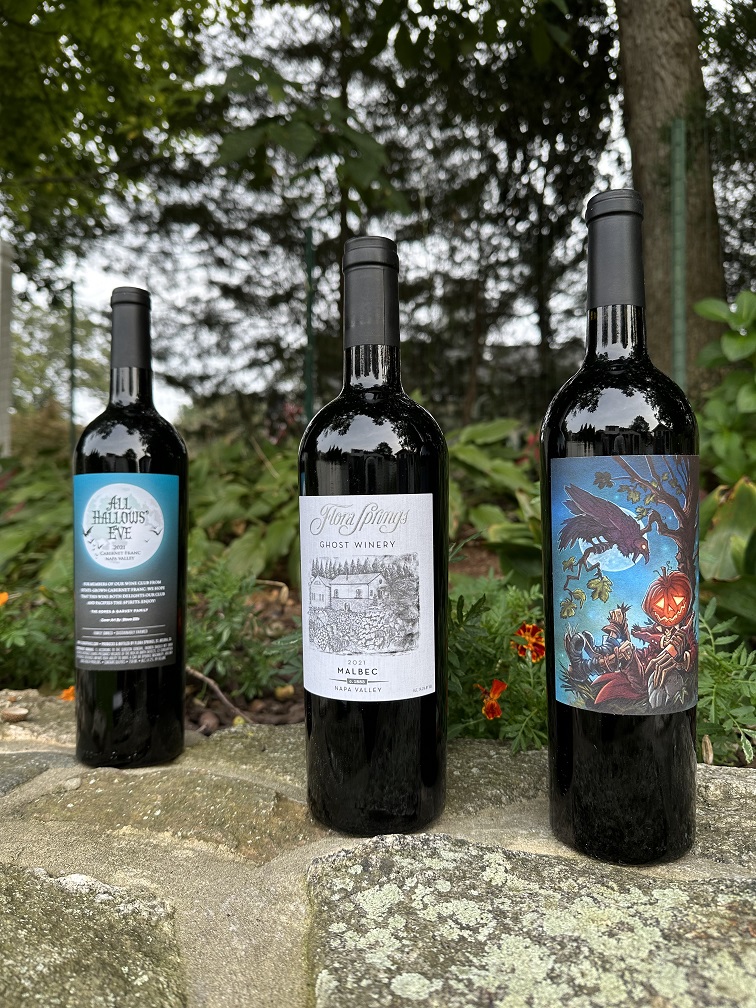
The ghostly past plays an important role at Flora Springs, especially at the time of Halloween, the only time of the year when ghosts are allowed to roam freely. With or without ghosts Halloween has been the subject of special attention at Flora Springs for the past 14 years. Throughout all these years, Flora Springs Winery always released special bottles, produced just for Halloween. Every Halloween bottle has a special label, different every year, designed by different artists. It is not only the label, it is also the grapes – for example, this year’s Halloween wines are made from Cabernet Franc and Malbec, and Flora Springs doesn’t produce any other single grape Cab Franc or Malbec wines. So yes, you can entertain your guests in a unique style.
I was lucky enough to taste samples of both Halloween wines Flora Springs has to offer this year.
Before we talk about wines, I would like to quote the description of the 2021 vintage from the Flora Springs website:
“The 2021 vintage in Napa Valley will be remembered for a smooth, uneventful growing season and harvest that produced low yields of intensely-flavored, small-sized grape clusters. The season started off with very little rain and continued as a dry, sunny summer led to a relatively cool fall with weeks of lovely weather. 2021 represented the second drought year in a row, and while concerning in the long term, the dry weather resulted in a more natural crop load on the vines, requiring less pruning and dropping of fruit. The resulting grapes were packed full of flavor leading to powerful, concentrated wines. ”


Now, let’s talk about Cab Franc.
The label for 2021 All Hallows Eve Cabernet Franc was produced by Steve Ellis, an artist who created illustrations for Marvel, DC, and many other franchises. This label is a perfect embodiment of the Halloween spirit, and it perfectly extends the collection of unique Halloween labels Flora Springs amassed over the year – take a look here, it is really fun. Here are my tasting notes for the wine:
2021 Flora Springs All Hallows Eve Cabernet Franc Napa Valley (14.2% ABV, $75, 18 months in French oak barrels, 350 cases produced)
Dark purple with a bright purple hue on the rim. And then it’s black
Inviting nose of sweet cherry and blueberry pie
More of the fresh blueberry pie profile with good acidity in the aftertaste, velvety, seductive, layered, smooth, very smooth – I guess luscious is a better word.
This is how California producers like to see Cabernet Franc. I’m missing pyrazines, my beloved bell peppers.
It shows a little bit lighter on the second day than on the first. 3rd day didn’t change much compared to the 2nd day. And then the bottle was empty
Drinkability: 8-/8, overall very good


And then there was Malbec. Napa Valley Malbec is quite rare and unique, and this wine didn’t disappoint – I also love the artistic rendering of the ghost winery on the label – it is simple and incredibly attractive at the same time.
2021 Flora Springs Ghost Winery Malbec Napa Valley (14.2% ABV, $60, 18 months in 60% French and 40% American oak barrels, 350 cases produced)
Dark garnet, practically black, but when low in the glass offers a beautiful dark purple hue
Succulent black raspberries on the nose
Inky, sweet cherries and cherry pit, a touch of sweet basil, beautiful textural presence, dark, concentrated, perfectly balanced.
Drinkability: 8+
There you are, my friends. A perfect set of wines to celebrate Halloween in style. Both wines are available at the Flora Springs website, and if you buy 3 bottles, you will get a $15 shipping – check the website for the details. And even if you don’t care about Halloween, these are just tasty wines for any occasion – and they will last for the next 10-20 years (the official winery recommendation is 10 years, but I believe they will easily last much longer).
Don’t be afraid of no ghost, especially if this ghost brings wine. Cheers!
Wine Reflections on the Go, and Cognac Ramblings
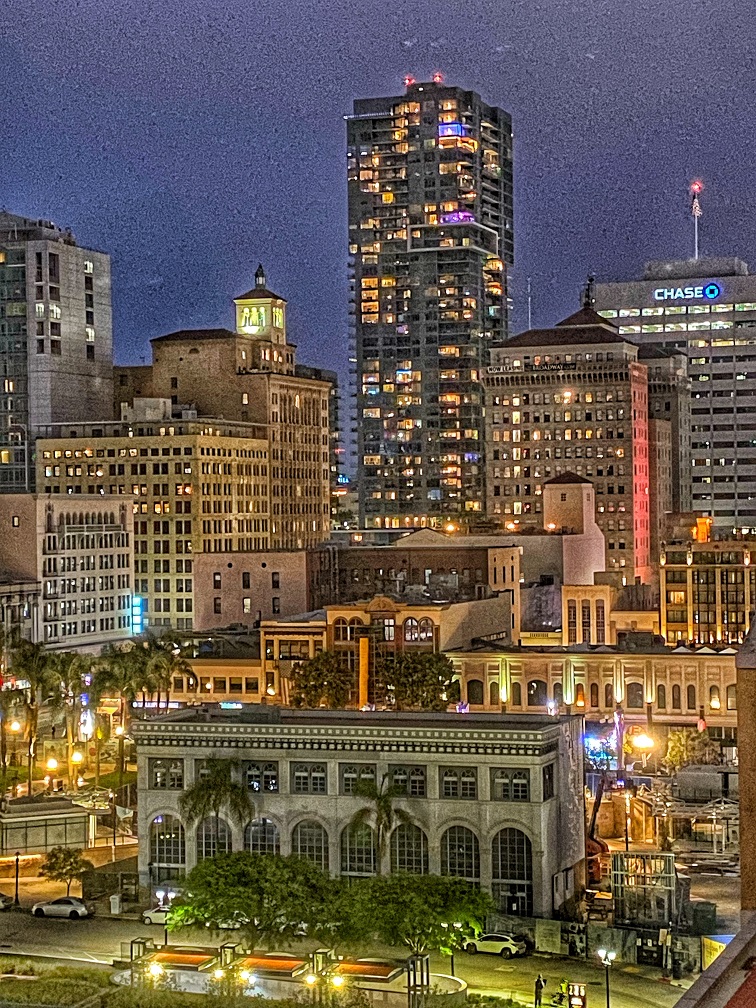 While in San Diego for work, I was on a very strange quest. I wanted to find cognac in miniature bottles (50 ml). Strange and dumb, you say? No problems, I accept the criticism. It is strange, but not criminal or immoral by any means, so let me continue my story.
I don’t know if you drink cognac, but if you do, you could’ve noticed that it is generally in a short supply, and often absurdly priced. Some stores carry no cognac at all. Some stores have a very limited selection, incomparable with other liquors – look at a typical tequila or bourbon selection – the ratio would be 10 to 1.
Why cognac all of sudden? A dear friend is coming over in a few weeks, and we always do a serious tasting of scotch/whiskey with her. What does “serious” mean? At any given moment I have 15–20 (or more, I honestly have no idea) bottles of whiskey open – some might be for 10 years – unlike wine, whiskey doesn’t care, nothing can change in the 46% – 70% ABV weather – as long as the bottle is closed well. This time around, the said dear friend said that she doesn’t want to do a scotch tasting, and would much prefer that we would change the subject – for example to the cognac.
While I love cognac, I prefer scotch for my occasional hard liquor sip. It is much more difficult to find a palatable, never mind tasty cognac which one also can afford – delicious whisky can still be acquired for less than $30, but drinkable cognac in that prices range is mostly a dream.
Okay, so back to that tasting. I set for myself a goal to have at least 15 different cognacs to taste, without spending a small fortune. I probably have 2 or 3 open. I procured two tasting sets (they are very hard to come around), and found one miniature of Courvoisier to include in the tasting, but that’s about it. So I went on the mission to find at least the main brands (Martell, Hennessy, Courvoisier, Remy Martin) and maybe some others – but seemed to be mission impossible in Connecticut and even in New Jersey.
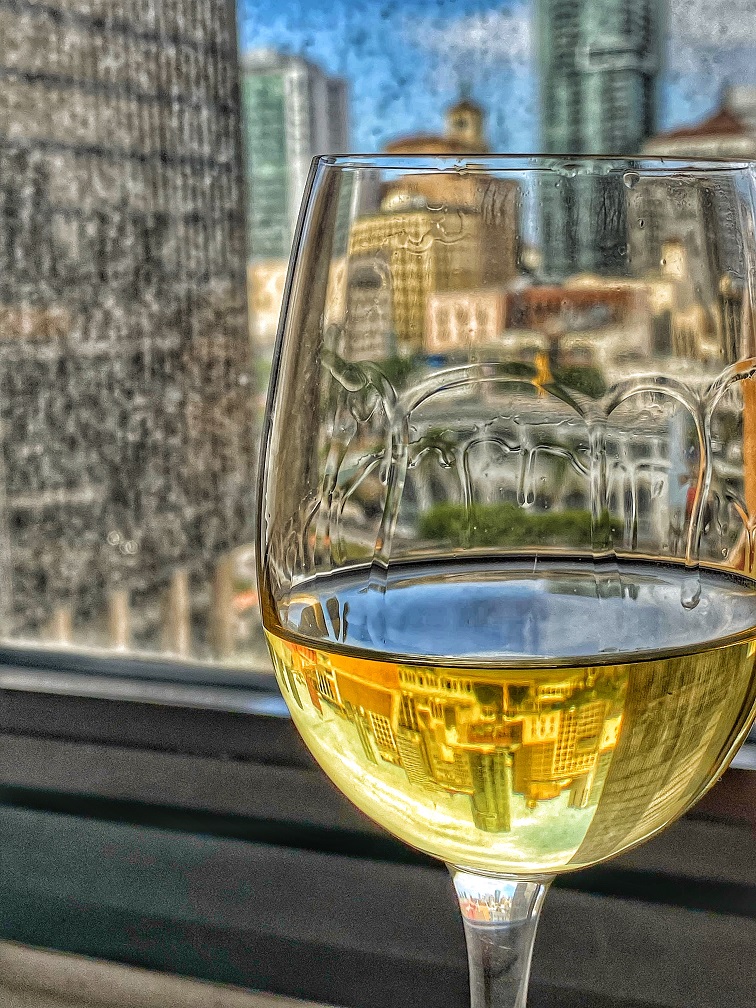
Wine Reflections, as promised
Which brings us to the wine store in San Diego. I honestly went to the wine store creatively called The Wine Bank to look for my cognac miniature bottles. Who goes to the store called The Wine Bank to buy cognac? Happy to be ostracized again, but if I would be looking for tequila, bourbon, or even gin believe me I wouldn’t leave the store empty-handed. But cognac? Nowhere to be found in any size.
The store was “much bigger on the inside” with a huge basement filled with wine shelves. So what should the wine lover do when he encounters wine heaven? At least take a look, right? Just a look. No touch. I promise. I was well behaved. But would you believe me if I would tell you that I left the store called The Wine Bank without buying a bottle? Even if you are naive, my reader(s?), don’t trust the wine lover visiting the wine store.
I was looking for something interesting, yet inexpensive. Interesting means I don’t readily have it at home and would love to drink often but drink rarely. And so I found my beloved Chinon (Cab Franc) and a white blend from the Rhône, $17 and $16 respectively.
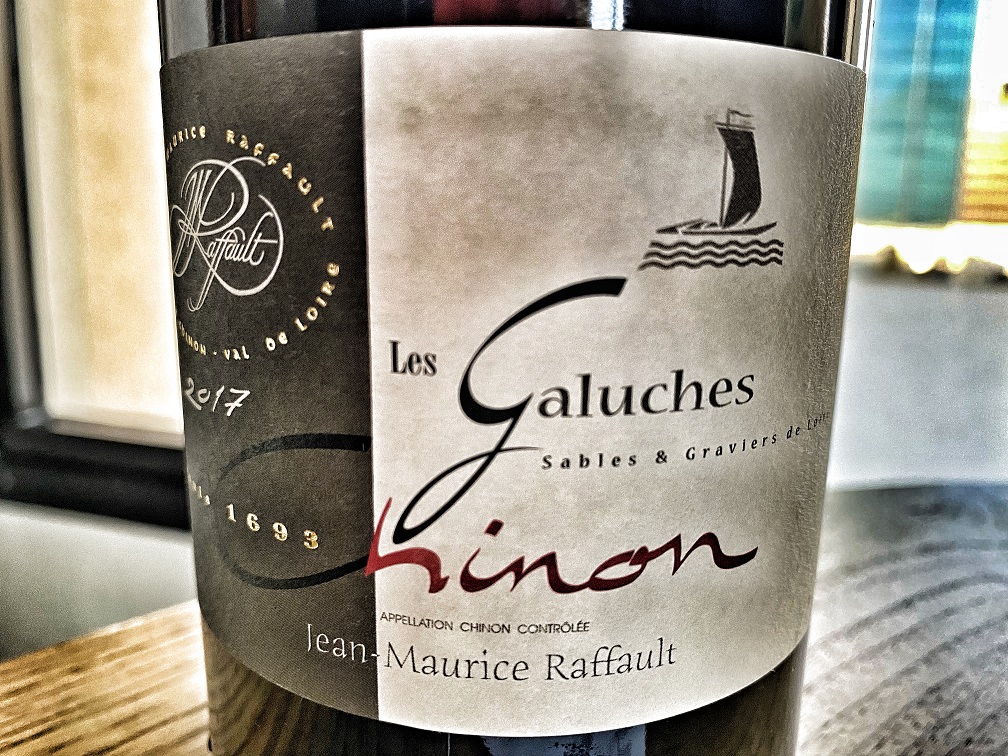
I really like Chinon wines, a classic, cold climate, old world renditions of Cabernet Franc. This wine was from the 2017 vintage, so it had 5 years of age on it. I previously had an amazing experience with Chinon wine from Olga Raffault, so now seeing the same name (Raffault family had been cultivating vines in Chinon for 14 generations!) together with the reasonable price has given the rationale for the decision.
I rarely drink white Rhône wines because there are very few of them available at most of the wine stores, and finding tasty ones is not an easy task as well. However, seeing 60% Roussanne on the back label – and Roussanne might be my favorite white grape – together with a reasonable price again made it an easy decision.
2017 Jean-Maurice Raffault Les Galuches Chinon AOC (13% ABV, $16.99, Les Galuches is the name of the vineyard, had been organically farmed since 2016) was interesting. When I just opened it, it had a beautiful classic nose with a touch of bell pepper, and an almost jammy load of the black currants on the palate, very generous. On the second day, the nose was somewhat closed, and black currants were still pleasant though somewhat scarce. On the third day the wine pretty much closed and offered mostly bell pepper and tart acidity. I don’t believe the wine turned – it should be either consumed upon opening or left alone for 10+ years to enjoy it later.
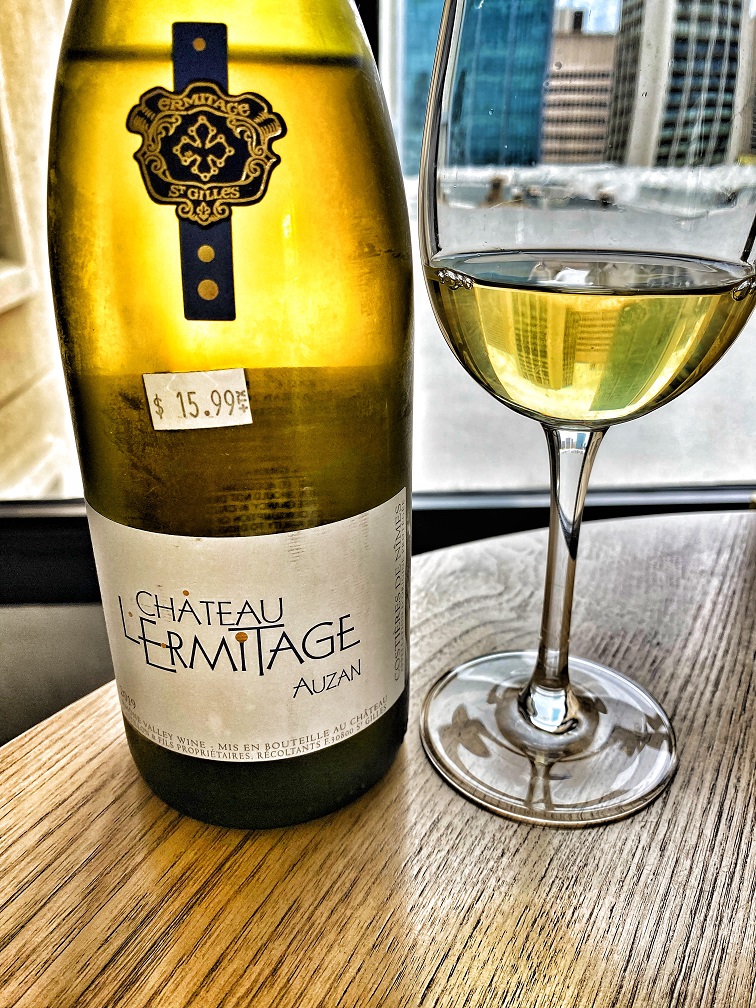
2019 Chateau L’Ermitage Auzan Blanc Costieres de Nimes AOP (13% ABV, $15.99, 60% Roussanne, 20% Grenache, 20% Viognier) was even more interesting. I chilled this wine first overnight in the fridge. When I opened it, I really wanted to like it, but I couldn’t. It was disjointed, with fruit and acidity randomly poking in different directions. As the wine warmed up, it became a lot more palatable and enjoyable, but the magic didn’t happen.
I left the wine bottle on the table overnight. When I tried it in the morning, I literally slapped myself on the forehead – this wine is 60% Roussanne, and Roussanne wines are showing much, much better at the room temperature or gently chilled compared to the full-blown “wine from the fridge”. The wine had gunflint on the nose, and boasted powerful, fully textured, plump, and round white stone fruit on the palate. A beautiful, classic, full-bodied Roussanne rendition.
Here you go, my friends – my wine (and cognac) reflections [directly and figurately] on the go. Drink well, whether you travel or not.
Cabernet Franc – Well Worthy of a Celebration
Cabernet Franc.
Let’s talk about it.
Cabernet Franc is a parent. Like most parents, Cabernet Franc is often overshadowed by the achievements of its kids – especially when its kids are none less than Cabernet Sauvignon and Merlot, some of the most famous in the wine world. It is interesting that Cabernet Franc is often described as “blending grape” – while it is true that Cabernet Franc is a popular choice in Bordeaux blends around the world (it typically ripens at a week earlier than Cabernet Sauvignon, so it offers winemakers an “insurance policy” of sorts), it also excels just by itself. As a blending grape, Cabernet Franc is typically used with Cabernet Sauvignon or Merlot, adding something important to the resulting wine. Meanwhile, the majority of single-grape Cabernet Franc wines have nothing else in the blend – just pure, unadulterated Cabernet Franc.
Today, we are talking about this pure Cabernet Franc. It grows successfully in the absolute majority of the winemaking regions – Bordeaux and Loire Valley in France, Italy, Argentina, Australia, Chile, Eastern Europe, Canada, New York, Virginia, New Jersey, California, Washington, Oregon, …. Pure Cabernet Franc wines typically happen to convey the terroir much better than Cabernet Sauvignon or Merlot. With Cabernet Sauvignon, no matter where it is coming from, everyone is trying to achieve the “golden standard” of Bordeaux or Napa Valley expression, even if the wine is made in Italy, Argentina, or Long Island, New York. Cabernet Franc typically conveys a sense of place first and foremost – lean, clean, and minerally driven from Chinon, tart and herbaceous from New York, round and luscious from California. Same grape, unlimited number of expressions.


Celebrating the range of expressions of Cabernet Franc I can simply offer you a few of my experiences from this year. Back in April, I had 2017 Hawk and Horse Vineyards Cabernet Franc Red Hills Lake County California, a biodynamically produced rendition that offered pristine beauty of cassis elegantly framed with the core of the well-integrated tannins. And then there was 2019 Domaine Bousquet Gaia Cabernet Franc Gualtallary Vineyards, minerally driven Cabernet Franc from the Argentinian dessert. Then there was the 2018 Terra Pacem Cabernet Franc Columbia Valley experience in Eugene, Oregon, offering pure Chinon-inspired, bell pepper and cassis rendition. And I can’t forget the 2011 Gran Enemigo Cabernet Franc Single Vineyard Gualtallary Argentina, again a high elevation desert beauty, which after the unimpressive start, opened up into an intricate interplay of iodine, cherries, cassis, and herbs (this one will definitely be on my 2021 top dozen list).
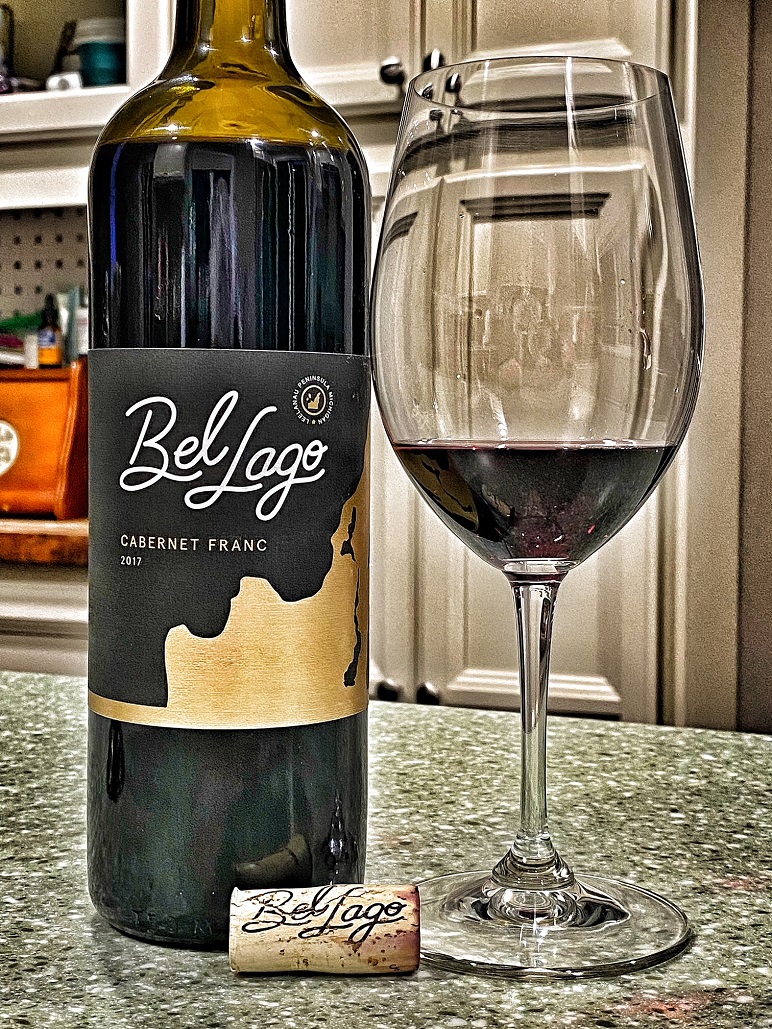 My most interesting Cabernet Franc wine discovery of this year came in the form of the bottle of Cabernet Franc from Bel Lago winery in … Michigan! My excitement comes from the fact that not only I got to taste the wine I never had before, but it also came from the region I had no prior experience with (so I got to update my Wines of 50 United States table the second time this year). And I also got to learn about winemaking in the new state.
2021 is an important year for the Michigan wine industry, as its oldest winery, St. Julian Winery, celebrates 100 years. Today, Michigan has 5 viticultural areas – Fennville, Lake Michigan Shore, Leelanau Peninsula, Old Mission Peninsula, and Tip of the Mitt. About 200 wineries operate in Michigan today, most of them located within 25 miles radius of Lake Michigan.
The Vitis Vinifera grapes were introduced in Michigan about 45 years ago, and today traditional cool-climate varieties, such as Gruner Veltliner, Pinot Blanc, Riesling, Cabernet Franc are doing very well there, and even Cabernet Sauvignon, Pinot, Merlot, Syrah, and Chardonnay had been successfully introduced. Michigan is particularly proud of its Cabernet Franc and even held its first Cabernet Franc Challenge in 2009, where 18 Michigan wineries and one of the French wineries from Chinon competed for the top prize (no, Chinon didn’t win it).
Bel Lago Winery (Bel Lago means Beautiful Lake in Italian) was founded in 1992 and opened its tasting room in 1999. The winery cultivates 100 grape varieties on 37 acres of land and produces between 17,000 and 20,000 cases per year. Bel Lago also produces fruit wines (Cherry wine is very popular) and a number of ciders.
2017 Bel Lago Cabernet Franc Leelanau Peninsula Michigan (13.5% ABV, $48, 87.5% Cabernet Franc, 12.5% Merlot, 34 months in French and American oak barrels) was a beautiful wine – currant leaves and anis on the nose, with a touch of tobacco. Restrained with good cassis expression and herbal notes on the palate with cut-through acidity. Definitely an enjoyable Cabernet Franc rendition, again with its own character, easy to drink, and delicious.
Here it is – new winemaking region and new Cabernet Franc experience. How was your #CabFrancDay experience? Did you learn something new or find a new Cabernet Franc wine that you like?
Celebrate Cabernet Franc!
What do you think of Cabernet Franc? Is that a grape worthy of its own, special celebration?
If I can take the liberty of answering my own question, it is an enthusiastic “yes” from me.
I don’t know if wine lovers realize the grand standing of Cabernet Franc. The grape is essential as part of the blend, in French Bordeaux and Bordeaux-style blends from anywhere in the world. At the same time, Cabernet Franc is perfect on its own, making delicious single-varietal wines literally everywhere – Argentina, Australia, California, Canada, Chile, France, Israel, Italy, New Jersey, New York, Oregon, South Africa, Washington, and everywhere in between.
While classic Cabernet Franc taste profile evolves around Black Currant ( a.k.a. Cassis), the overall expression varies from lean and dry in the wines coming from Loire Valley in France (Chinon, Saumur) to opulent, bigger-than-life renditions from Argentina and California. Another essential taste element of Cabernet Franc is bell peppers, which are typically most noticeable in the Loire wines but can be completely absent in the Californian wines, where bell peppers flavors often considered highly undesirable.
I talked about the history of Cabernet Franc in some of the older posts, so I’m not going to repeat it here. Instead, we can just get to the subject of today’s celebration and taste some wines.
#CabFrancDay holiday was invented about 5 years ago by Lori Budd of Dracaena Wines, a passionate Cabernet Franc producer out of Paso Robles in California and a tireless champion of her beloved grape. To celebrate the Cabernet Franc, I tasted two samples of the Cabernet Franc wines which I never had before, so let’s talk about them. We can even make a competition out of this tasting, a California versus Washington match.
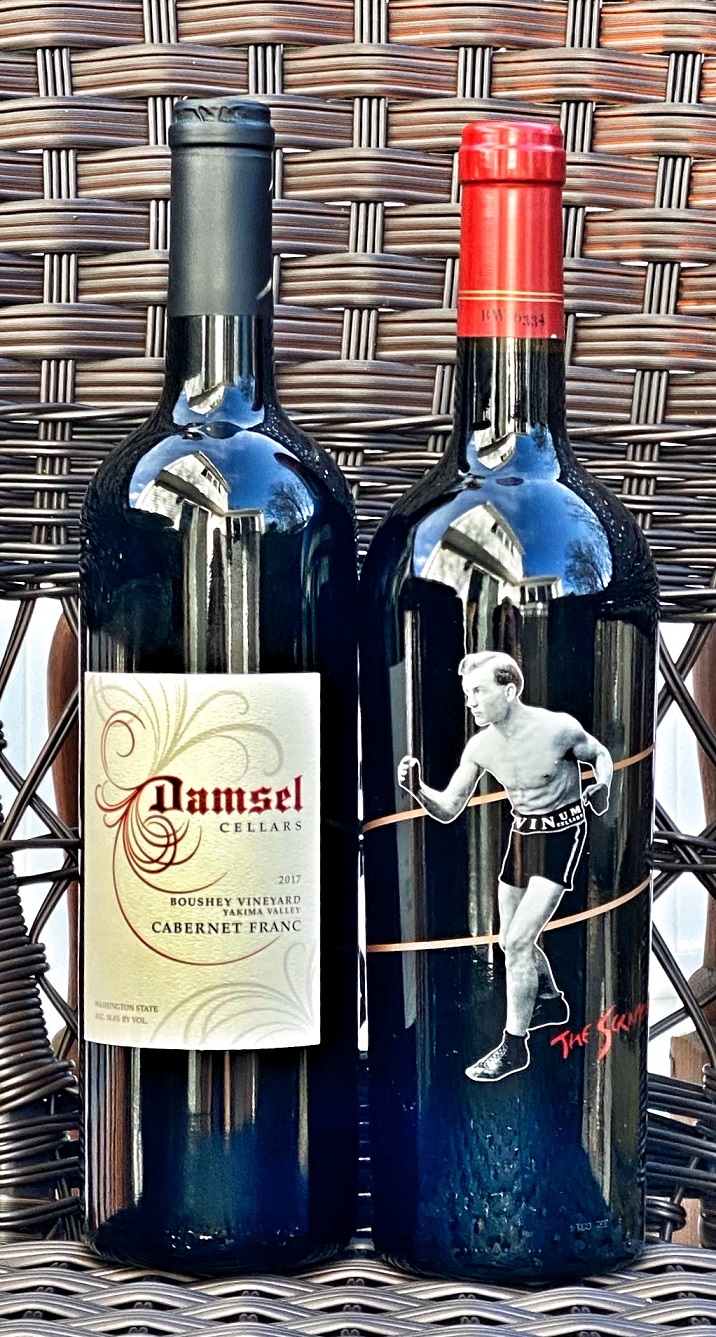
Let’s start in California, at Vinum Cellars in Napa Valley. As soon as I saw a bottle of 2016 Vinum Cellars The Scrapper Cabernet Franc El Dorado (15.18% ABV, $35, 26 months in 2-year-old French Oak) I realized that I have a lot of questions. Who and why is depicted on the bottle? What the mysterious number on the top of the bottle? Is there any reason to use grapes from El Dorado for the Napa-based winery? To answer these questions, I reached out to Maria Bruno, whose cousin, Richard Bruno, is the co-founder and co-winemaker at Vinum, where Maria helps with the winery’s social media and digital marketing efforts. Here are the answers to my questions which give you an excellent introduction to the winery and the wine:
1. Why the wine is called The Scrapper?
A scrapper is essentially a fighter and we call our wine that because Cabernet Franc is a varietal that has quickly been forgotten in the shadows of the more popular Cabernet Sauvignon. Our wine is made for the open-minded, the adventurous, and those who root for the underdog.
2. What is behind the image on the wine’s label?
The image on the front of the bottle is Gene Tunney. He was the 1926 Heavyweight Champion of the World, however, most modern day people have never even heard of him. But have you heard of Jack Dempsey? I’m sure you have. A little history lesson here: Gene Tunney defeated Jack Dempsey for the 1926 crown, and it was the second time he defeated the more popular fighter (no one else ever did that). So to complete the metaphor, if Gene Tunney is Cab Franc, and Jack Dempsey is Cab Sauv we then ask you, which is the better varietal? Because we know who the better boxer was…
3. On top of the foil capsule it says BW 6334. What is the meaning of that?
That’s our California Bonded Winery number. In 1997 we financed our own winery on credit cards and utilized the custom crush space at Napa Wine Company (they are Bonded Winery number 9! Literally, the 9th bonded winery in the state and currently the only single-digit bonded winery still in existence). We sold our first vintage, all 960 cases, out of the trunks of our cars, and here we are over 20 years later… still going strong!
4. Why El Dorado? What makes Cab Franc from El Dorado a special wine?
We source our Cab Franc from a hillside, red dirt soil single vineyard at an elevation of 1,600 feet within the Sierra Mountains in El Dorado County. The grower, Ron Mansfield, has a degree in renewable agriculture and has organically farmed this vineyard (though not certified) using sustainable practices for over 35 years. Ron also grows tree fruit such as peaches, nectarines, apples, and pears We have produced Cabernet Franc grown by Ron for over 20 years, and the 2016 vintage was our 19th. The entire vineyard only produces about 500 cases a year but it’s worth it (because it’s so good). The vineyard is 25 years old and is head-trained allowing more sunlight into the canopy and therefore a reduction in Pyrazines which are responsible for green and vegetal aromas and flavors.
How was the wine? Please allow me to introduce Damsel Cellars first, and then we will discuss the wines side by side.
Damsel Cellars is located in Woodinville, Washington. Just seeing Woodinville on the wine label puts a huge smile on my face, as it instantly brings back the happiest memories of discovering Woodinville some years back. Walking from one winery door to another, and tasting one delicious wine after another, I was hoping to replicate the experience a few months back as I was supposed to have a business meeting in Seattle, but you know how 2020 travel looks like…
Mari Womack, owner and winemaker of Damsel Cellars, got into the wine only 10 years ago, but tasting her wines you would never think so. After working at a number of Woodinville wineries, she started Damsel Cellars, with the sixth vintage on the way now.
The Grapes for 2017 Damsel Cellars Boushey Vineyard Cabernet Franc Yakima Valley (14.6% ABV, $36) come from the Boushey Vineyard in Yakima Valley, located on the southern slopes of the Rattlesnake Mountains. The first vines were planted there in 1980, and the last plantings took place in 2003. The vineyard is located on slopes from 700 to 1200 feet elevation, so the grapes can enjoy a cooler and drier climate.
Now, how did the wines compared? Both wines are 100% Cabernet Franc, which I find quite typical for any wines bearing the Cabernet Franc name. Both wines were similar in the pure black currant expression, and both wines didn’t offer any of the bell pepper undertones. Both wines required at least an hour to come to their senses. Vinum Cab Franc stayed perfectly powerful and polished over the course of 4 days, black currant all the way, a touch of dark chocolate, full-body, a roll of your tongue smooth, and perfectly balanced. Damsel Cab Franc’s power on the first day manifested in black currant notes weaved around expressive minerality, which I usually call “liquid rock” (this is one of the common traits I find among many Washington wines), perfectly balanced and delicious. On the second day, however, the ultra-distant touch of the bell pepper appeared, the fruit gently subsided, and the wine magically transposed into the old world – a perfectly balanced old world wine. In a blind tasting, I would put this wine squarely into the Loire Valley and would be very proud of my decision.
The verdict? I don’t have one. Yep, seriously, These are unquestionably Cab Franc wines, unquestionably delicious, and unquestionably different. Oh well. If I would be really hard pressed to chose one, I would go with Damsel Cab Franc – if anything, for the old world nostalgic emotions – I really drink very little of the old world wines, so I’m always excited to experience them again.
That’s all I have for you, my friends. How is your Cabernet Franc celebration going? Let me know what Cab Franc made you excited. Cheers!
CASARENA, The Next Level Of Argentinian Wines
The next level of Argentinian wines – I can literally see a “yeah, come on, really???” reaction from many of you. What does that even mean – the next level?
Okay, no need to get all feisty here – let’s talk about it. Argentinean wines require no introduction to any of the wine lovers today. Argentinian Malbec is practically a mandatory element of any bar or restaurant wine list, on equal footing with Cabernet Sauvignon from California. Cabernet Sauvignon and Bordeaux blends from Argentina also command topmost respect of wine lovers around the world. If the top-level is already achieved, what is the next level above it?
The “next level” here is my attempt to convey the emotion, the excitement of pleasure of tasting the delicious wines. While Argentinian wines are unquestionably the world-class, many of them are hardly distinguishable. The taste of Argentinian Malbec sometimes gets too predictable, and the wines lose their personality. Thus when you discover the wine which doesn’t conform to the “universal profile”, you feel like you are advancing to the next level of the game. I hope my tasting notes will convey my feeling about these wines, but let’s talk about the region first.
I perfectly remember listening to Kevin Zraly explaining the concept of quality of the wines. Imagine the set of enclosed circles. The biggest circle is equated to the big region – let’s say, California. Wines labeled with California as the region can be made from grapes grown anywhere in the state of California. The next circle is a sub-region – let’s say, Napa Valley. Wines labeled as Napa Valley can be produced only from the grapes grown in Napa Valley. That gives us a higher level of confidence in the quality of the wines, as Napa Valley is well known for the quality of the grapes. We can still narrow our circles, and now we are looking at the sub-region of the Napa Valley itself – Howell Mountain, Rutherford, Spring Mountain – there are many. Now your choice of grapes is restricted only to such a sub-region, which often offers a common taste profile coming from the vineyards in that subregion, such as famous Rutherford dust in the Cabernet Sauvignon wines sourced from the Rutherford appellation. And even now we might not be done with our circles, as we can restrict our source of grapes even further to the individual vineyard, such as Beckstoffer To-Kalon, and then even to the individual blocks and plots within the same vineyard. The smaller the circle is, the higher is the quality of the grapes, and that should translate into the quality of the wines.
Let’s now apply our circles to Argentina. We will start in Mendoza, probably the best-known winemaking area in Argentina – think about all the Argentinian Malbecs you are consuming. Continuing narrowing down, let’s now go to the Luján de Cuyo, the region located just south of Mendoza city. Luján de Cuyo is the first officially recognized appellation in Argentina (established in 1993), and home to some of the best known Argentinian wineries such as Catena Zapata and Cheval des Andes. Continuing narrowing down we now need to go to the town of Agrelo, where CASARENA Bodega & Viñedos is located.
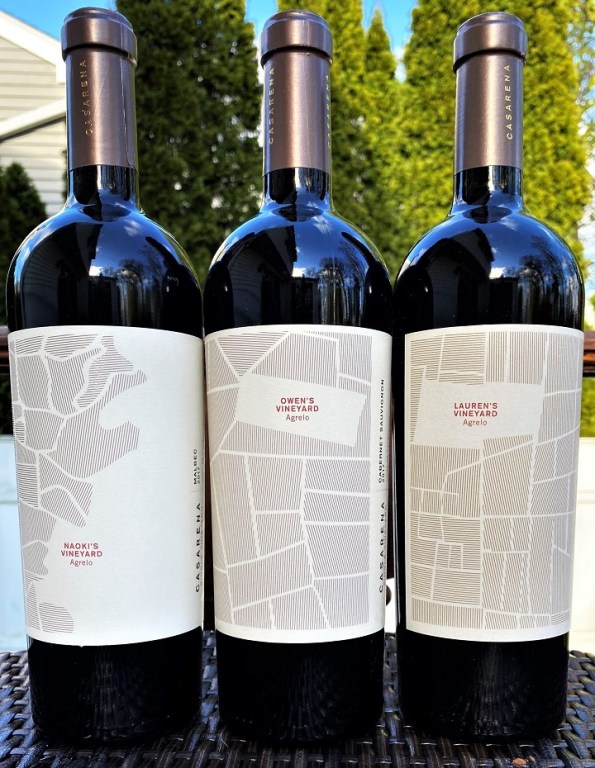
I don’t like to use cliché in my writing. Nevertheless, if I would try to describe what makes Luján de Cuyo (and Agrelo for that matter) a great winemaking region, I feel that I’m doing exactly that – shamelessly using all available wine cliché all the way. See for yourself: Most of the vineyards in the region are located on a high altitude, which increases the sun exposure during the day and also creates a significant temperature drop in the evening – we are talking about significant diurnal temperature variation which slows down the ripening and helps grapes to retain acidity. Close proximity to the Andes creates a desert-like environment as it significantly reduced the rainfall – now we are talking about dry farming. Many vineyards in the region are also located on the rocky soils, forcing the vines to work hard to reach the nutrients. There is rarely greatness without adversity, and the combination of all the factors mentioned above presents exactly the adversity needed to produce excellent grapes – and yes, this unavoidable wine cliché.
CASARENA Bodega & Viñedos was founded in 2007, with the first officially released vintage being 2009, starting, quite expectedly, with Malbec. After tasting its first commercial success with a slew of good critic ratings, CASARENA continued to narrow down the circles and created 7 single-vineyard wines coming from 4 different vineyards. I had the pleasure of tasting samples of 3 of these single-vineyard wines and was literally blown away by the quality.
Here are my notes:
2017 Casarena Malbec Naoki’s Vineyard Agrelo Luján de Cuyo Mendoza (14.5% ABV)
Dark garnet, very inviting
Dark fruit, cassis, tobacco, pencil shavings, a touch of mint
Medium to full body, succulent red fruit, vanilla, perfect acidity, silky smooth, well-integrated tannins, good minerality
8+, balanced, and delicious. Well refined compared to a typical Argentinian Malbec
2017 Casarena Cabernet Sauvignon Owen’s Vineyard Agrlo Luján de Cuyo Mendoza (14% ABV, 80 years old vines)
Dark garnet, practically black
Day 1:
Nose – dark, funky, concentrated, earth, tobacco
The palate is very contrasting to the nose, classic Cab with Cassis and bell pepper, not very expressive
Day 2:
Nose and palate are similar, more of a Malbec style – vanilla, blue fruit, coffee, dark chocolate.
Day 3:
Nose – Autumn forest, cherries, coffee
Palate – classic Bordeaux, a touch of currant, bell peppers, soft, supple, luscious, the well present core of minerality.
8/8+, excellent. My best analogy for this wine would be Dunn Howell Mountain wines, with the dark power imparted on the wines.
2017 Casarena Cabernet Franc Lauren’s Vineyard Agrelo Luján de Cuyo Mendoza (14.2% ABV, 18 months in new French oak)
Dark garnet, almost black
Coffee, a hint of cherries, minerally-driven
Cassis, cherries, soft, round, goos texture
8+, might be my favorite of the tasting.
These are three wines which would bring any dinner or friends gathering to the next level – I don’t know if you can see my point just by reading, the best way would be to pour a glass of CASARENA wine and take a quick trip to Argentina. Cheers!
American Pleasures – Part 2, Peju Napa Valley
 A few weeks ago I shared with you my view on [strictly wine] American pleasures – some of the wine samples which I had a pleasure to taste recently. Yes, it is the pure hedonistic pleasure we are talking about here – the wines which have a magical power of making you want another glass even before the first one is empty. Today I want to continue that conversation and talk about Peju Province Winery in Napa Valley.
The story of Peju Province Winery is simple and similar to many others – it started from a dream. Tony Peju had a drawing of the winery with the tower two years prior to the first Peju grape been harvested. Tony found early success in Los Angeles as a horticulturist, using his landscaping skills in the real estate, improving and reselling the houses. But his dream was to own the farm.
After his search for the farm land led him up north to the Napa Valley, he was able to find the location of his dreams – a 30 acres Stephanie vineyard in Rutherford, located next to Robert Mondavi, Inglenook and Beaulieu vineyards, growing Cabernet Sauvignon and Colombard vines, some 60 years old or maybe even older. Tony and his wife, Herta, purchased Stephanie vineyard in 1983. At first, Tony and Herta were only selling the grapes, however taking advantage of Tony’s green thumb, improving the vineyard and learning what it is capable of. They identified the section of the vineyard, about 5 acres in size, which produced the best Cabernet Sauvignon fruit. The vineyard, which was renamed into HB in honor of Tony’s wife, Herta Behensky, was replanted using cuttings from that best section grafted on the phylloxera-resistant rootstock. The time has come to start making Peju’s own wine.
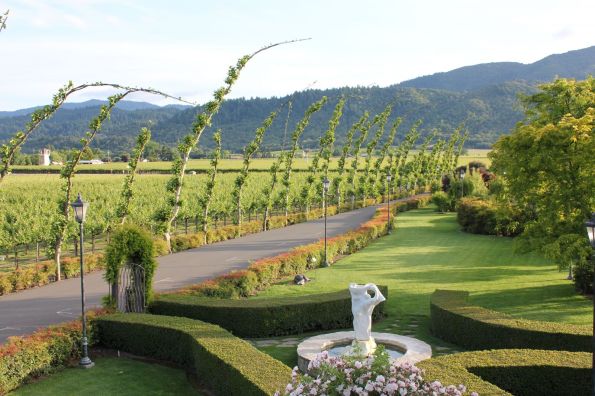
Peju Province Winery Grounds. Source: Peju Province Winery
Tony went on to get a degree in enology from UC Davis, and the rest was history. Well, there is one interesting hurdle worth mentioning. If you remember, Tony had a full drawing of the winery done in 1981, two years before HB vineyard was even found and purchased. Once they had the land and were ready to convert dreams into reality, in order to fund the project, Tony and Herta started selling wine out of their garage converted into the wine tasting room. This, however, was against Napa County’s rules, which required all the wine sales to be made from the legitimate winery building. However, California law allowed winegrowers to sell the wines in the place where the grapes were grown, so the issue ended up in the court. The judge sided with Peju, agreeing that if Tony is growing the grapes, he should be allowed to sell the wine. This became a pivotal case that significantly changed the landscape of the Napa Valley.
Peju went on to build the impressive 50-foot tall tower in the French Provencal style, using Brazilian cherry wood, beams from old Midwestern farm buildings and 1906 antique stained glass window. Way before that new winery building was complete, Peju acquired 350 acres of land at the 2000 feet elevation in the nearby Pope Valley section of Napa, which they named Persephone Vineyard, after the goddess of Greek mythology. In 1997, 120 acres of that land was planted to Cabernet Sauvignon (using HB Vineyard clone), as well as Cabernet Franc, Merlot, Syrah, Petit Verdot, Sauvignon Blanc, Chardonnay, and Zinfandel. In 2007, Rutherford HB vineyard became certified organic, and today all three of Peju vineyards are using sustainable viticultural methods. In 2009, Peju Province Winery was certified as a Napa County Green Winery and Bay Area Green Business. Also in 2006, Peju started installing solar panels on 10,000 square feet of winery roof and generating 35% of all electricity consumed at a winery.
Okay, so now you learned a lot about the winery, so let’s talk about the wines, as a proof is always in the glass. I had an opportunity to try 6 wines from Peju, and I was literally blown away by what I tasted. To be entirely honest, these wines were one of the most inspirational coming up with the title for this series – American Pleasures. 6 out of 6 delicious wines, one better than another – I taste enough wines during the year to tell you that this is not given. Below are my notes:


2018 Peju Province Winery Sauvignon Blanc Napa Valley (13.8% ABV, $25)
Straw pale, practically clear
A touch of freshly cut grass, white flowers, maybe a distant hint of cat pee – only because I want to find it there?
Layers of flavors. Crisp lemony acidity first, then a hint of plums and slightly underripe melon, unusual plumpness for the Sauvignon Blanc, the wine rolls off your tongue like a nice Marsanne.
8, excellent, a unique and different Sauvignon Blanc.
2015 Peju Province WineryCabernet Sauvignon Napa Valley (14.8% ABV, $60, 85% Cabernet Sauvignon, 8% Petit Verdot, 7% Merlot, 18 months in French and American oak, 45% new)
Dark garnet
Black currant, cherries, eucalyptus, sweet oak
A beautiful mix of black currant and cherries on the palate, a touch of herbal notes, good minerality, firm texture, vibrant acidity, medium+ finish
8/8+, the first sip says “I’m a Napa Cab”. Delicious.
The next wine is one of the few in “Nostalgia Series”, where every label depicts a moment in Peju’s history.
2015 Peju Province Winery Nostalgia Series The Farm Napa Valley (15.2% ABV, $80, 80% Cabernet Sauvignon, 20% Sangiovese, 18 months in oak)
Dark garnet, practically black
Dark fruit, eucalyptus, restrained, mineral undertones
Perfectly balanced fresh fruit, soft, luscious, black currant, tar pencil shavings, perfect balance, delicious.
8, delicious wine


2016 Peju Province Winery Merlot Napa Valley (14.8% ABV, $48, 95% Merlot, 4% Cabernet Sauvignon, 1% Petit Verdot, 18 months in oak)
Garnet
Sweet licorice, eucalyptus, underbrush
Coffee, tart cherries, cherry pit, minerality
8-, probably need more time. The finish is a bit astringent, however, it plays well with savory food (cheese and crackers)
Cabernet Franc is one of my favorite grapes – this wine was truly a Cabernet Franc experience.
2013 Peju Province Winery Petit Trois Cabernet Franc Napa Valley (14.8% ABV, $75, 100% Cabernet Franc, 18 months in oak, 333 cases produced)
Deep Garnet
Cassis, licorice, mocha, a hint of sweet tobacco
Cassis, mint, gently present tannins (after a few hours), firm structure, sweet oak, unmistakably California
9-, wow, tons of pleasure in every sip. Needs decanting. Outstanding on the second day.
This wine has its own story. It is the result of the barrel experiments run by Peju winemaker, Sara Fowler. For the 2017 vintage, she worked with 37 different barrel tasting styles and 22 coopers, then discussed the effects of the oak regimen with the group of the fellow Napa Valley winemakers. To have all new-oak, effectively a young wine, to be ready to drink from the get-go is something really incredible in my opinion.
2017 Peju Province Winery The Experiment Napa Valley (14.5% ABV, $100, 100% Cabernet Sauvignon, 18 months in French, American, and Hungarian oak, 100% new, 1075 cases produced)
Dark garnet
An “Oh my god!” nose – Black currant, eucalyptus, pure, intense
Wow, supple black currant, mint, eucalyptus, silky smooth tannins, good minerality, all delivered in layers. Clean acidity, impeccable balance, and immense pleasure.
9/9+, wow. An exemplary Napa Cab
There you have it, my friends – some incredible wines. Of course, these are not inexpensive wines, but in my opinion, the $100 bottle which gives you lots of pleasure is worth splurging for the right moment. Cheers!
Discover Wines Of Loire Valley
What do you think of the wines from the Loire Valley? Why, you say you are not sure? Come on, give yourself a credit – there is a good chance you had Loire Valley wines, but maybe you simply didn’t associate those wines with the Loire Valley? Let me help you – Sancerre, Pouilly-Fumé (not to be confused with Pouilly-Fuissé), Muscadet, Vouvray, Touraine, Anjou, Saumur, Chinon – had any of the wines with these words on the label? Ah, of course, you are saying? Then now you know – those are all the wines from the Loire Valley in France.
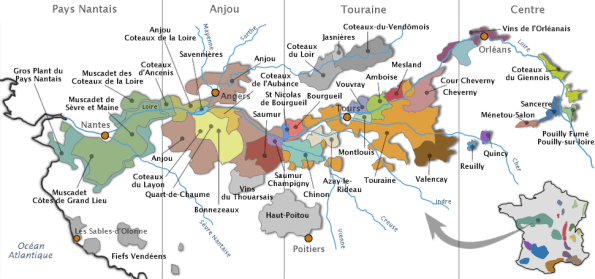
Loire Valley appellations map. Source: http://www.loirevalleywinetour.com/
The Loire Valley is not the most famous winemaking region in France, but it deserves the utmost respect. Here are some facts for you. Number one region in France for production of the white wines. The largest producer of the sparkling wines in France outside of Champagne. Number two producer of Rosè wines in France after Provence. The largest in France vineyard declared UNESCO World Heritage site. 79 sub-appellations and denominations and more than 2,000 years of winemaking history. These numbers speak for themselves. And to round up the stats – five grapes (Sauvignon Blanc, Chenin Blanc, Melon de Bourgeois, Cabernet Franc and Pinot Noir) comprise most of the Loire wines, but a total of 24 grapes are used there.
A few weeks ago, I was happy to attend the “Spring To Loire” trade tasting in New York City, alongside the inimitable, one and only JvB Uncorked – we definitely had lots of fun tasting through the Loire wines together. It was also literally the first tasting this year which I managed to attend, so “happy” is the right word. Besides, I love Loire wines, with Chinon and Saumur been personal pet peeves, as producers of delicious Cabernet Franc.
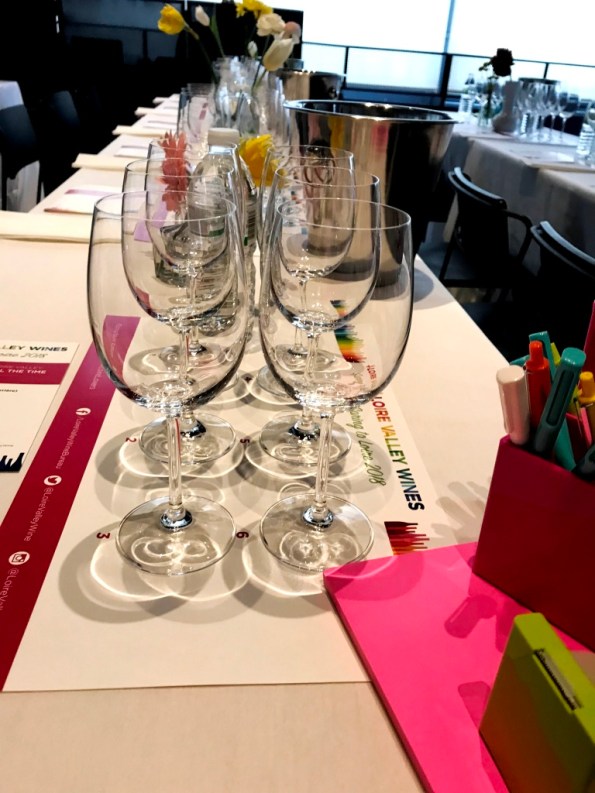
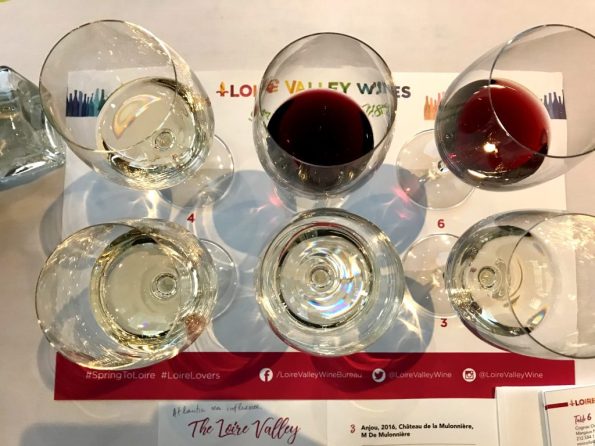
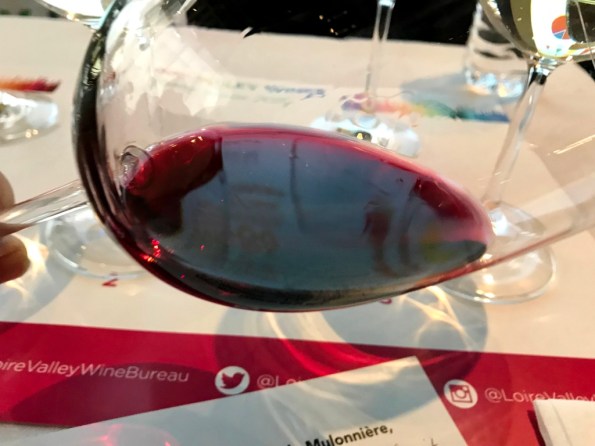
The tasting was unquestionably interesting. First, it had a couple of curious moments. There was a seminar which offered an excellent introduction to the region, tasting all major styles and varieties. Two of the reds in the tasting were rather green and aggressive. At the end of the tasting, I asked a lady sitting next to me how did she liked the wines, and she told me that she didn’t like the red wines individually, but she mixed them (!?!?) and they became more palatable – truly a wow moment in the professional tasting. And then it was another lady who (accidentally or not) dumped what seemed like a whole bottle of perfume on herself – trying to smell nuances of the wine standing next to her was beyond mission impossible. Some memorable moments…
Okay, let’s talk about the wines. I have a few favorites which I will be happy to mention, but first, let me give you my broad stroke impressions.
- Sancerre had a much lesser amount of fresh cut grass than I was expecting. Okay, I’m not an expert on Sancerre evolution, as I rarely drink them. However, based on what I remember from my education and some of the previous experiences, classic Sancerre is supposed to have pronounced grass and cat pee notes – didn’t find much of the Sancerre like that. Touraine Sauvignons, on another hand, were delicious across the board with an abundance of the freshly cut grass.
- Many of the Muscadet-Sèvre-et-Maine wines were lacking the characteristic acidity. When going for Muscadet, I’m expecting acidity which will plucker my mouth and make the cheeks to go meet each other. Many Muscadet in the tasting were nice white wines, but they were lacking their prized quality.
- The Chenin Blanc was a star. We had a number of delicious Vouvray and not only wines, which offered bright acidity, sometimes a touch of sweetness, a round mouthfeel – all which you would expect from a nicely done old world Chenin.
- Many of the Chinon and Saumur Reds were too tannic. This was a total surprise – the wines were fermented and aged in stainless steel tanks, nevertheless, the mouth was drying up almost as much as if you would be tasting the young Barolo. I was told that the whole cluster fermentation and aging was a culprit, but this was not a pleasant surprise. I really expect much more elegant and approachable wines to come from those regions. Nevertheless, we managed to find a few of the superb reds.
Done with my general impressions – here are some limited notes on my favorite wines.


Sparkling:
Crémant de Loire:
NV Maurice Bonnamy Crémant de Loire Brut (SRP: $16.99, 65% Chenin Blanc, 20% Chardonnay, 15% Cabernet Franc) – nice, refreshing, yeasty
NV Maurice Bonnamy Crémant de Loire Rosé (SRP: $16.99, 100% Cabernet Franc) – toasted bread and strawberries, nice, refreshing, great mouthfeel
NV Ackerman Crémant de Loire Brut (70% Sauvignon Blanc, Chardonnay and Cabernet Franc for the rest) – this wine was presented in the seminar, so I had a bit more time to spend with it – great nose, toasted bread, fresh, a touch on a sweeter side but still very nice
White:


Melon de Bourgogne:
2017 Sauvion Muscadet-Sèvre-et-Maine AOC (SRP $13.99) – crisp, fresh, great acidity
2014 Château de la Cormerais Monnieres-Saint Fiacre Muscadet Sèvre et Maine (SRP $19.99) – outstanding. fresh, clean
2012 Domaine de Colombier-Mouzillon-Tillières Muscadet Sèvre et Maine (SRP $19.99) – great complexity


Sauvignon Blanc:
2016 Domaine Pascal Jolivet Les Caillottes Sancerre AOC (SRP: $38) – steely acidity, crisp, a touch of grass.
2015 Domaine Pascal Jolivet Sauvage Sancerre AOC (SRP: $73) – this wine was just ok. The only reason to include it – this was probably the most expensive wine in the tasting, and it really didn’t deliver.
2016 Domaine Michel Vatan Calcaire Sancerre AOC – presented at the seminar – on the nose, minerality, lemon, distant touch of the grass, crisp, fresh. Excellent acidity on the palate, very nice overall.
2017 Raphael Midoir De Silex et Tuffeau Touraine AOC (SRP $14.99) – outstanding. Classic nose, delicious.
2016 Pierre Prieuré & Fils Domaine de Saint-Pierre Sancerre AOC (SRP $19.99) – excellent, fresh
2016 Raphael Midoir La Plaine des Cailloux Touraine-Oisly AOC (SRP $19.99) – outstanding, great complexity.


Chenin Blanc:
2016 Château de la Mulonnière M De Mulonnière Anjou – presented at the seminar – delicious. White stone fruit, peaches on the nose. A touch of sweetness and perfect balance on the palate. Outstanding.
2017 La Croix des Loges Anjou White AOC (SRP $14.99) – outstanding. Clean, fresh, touch of sweetness.
2014 La Croix des Loges Trois Failles Anjou AOC (SRP $22.99) – outstanding, gunflint on the nose, clean, balanced palate.
1977 La Croix des Loges Bonnezeaux AOC – yes, 1977, this is not a typo – this was an off the list, off the charts treat – a Chenin Blanc dessert wine, still elegant and complex.
Other:
2017 Domaine du Colombier Vla de Loire IGP ($14.99, 100% Sauvignon Gris) – excellent, fresh, complex.


Reds:
Cabernet Franc:
2015 Domaines des Varinelles Saumur-Champigny AOC (SRP: $20) – amazing similarity with Lodi wines on the palate – soft, aromatic, touch of cinnamon, ripe blueberries and raspberries, hint of blueberry compote. The similarity with Lodi is mind-boggling. Let’s not forget that this is Cabernet Franc wine, so there must be something there which can explain it. Need to dig deeper into this, I’m really curious.
2015 Domaines des Varinelles Laurintale Saumur-Champigny AOC (SRP: $24) – muted nose, and practically identical on the palate to the previous wine from the same domain. I will look into it… But two superb wines by all means – the wine are coming from the old world, but clearly, are screaming “new world”.
2017 Domaine du Raifault Chinon AOC (SRP: $17.95) – wow! Cassis on the nose, cassis on the palate – spectacular. This was my best of tasting red wine. This wine is not available in the US yes (we tasted one of only two bottles brought in for tasting) – in the process of being imported. Once it arrives, do yourself a favor – go find it and buy a case, or two. You can thank me later.
2016 Sauvion Chinon AOC (SRP: $17.99) – interesting dense nose, great palate, sandalwood, smoke, fresh, present. Tannins are still aggressive, but not as much as others.
Pinot Noir:
2014 Xavier Flouret Domaine de Chatenoy Menetou-Salon AOC (SRP: $20.95) – great Pinot Noir – excellent fresh nose, great balance of dark fruit on the palate, outstanding. 15 generations of vignerons know what they are doing. Definitely one of the highlights of the tasting.
2015 Domaine Gérard Millet Sancerre Red (SRP: $25) – fresh, crisp, herbs, spices, light.
Blends:
2014 Domaine de la Chaise Touraine-Chenonceaux AOC ($22, 70% Cabernet Franc, 30% Côt) – fresh, delicious, cassis and tobacco, excellent balance
The Spring is finally here (or at least it seems so in New York), so go on, find some Loire wines to explore on your own. Cheers!
Welcome Spring With Wines of Lieb Cellars
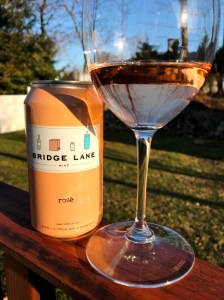 Considering the weather in the New England, “spring” is just a word. Still freezing temperatures during the night, and simply cold during the day, despite the sun been in a full swing. I’ve seen plenty of rain and sunshine, but snow and sunshine? For sure this was new for me. So seeing the way Mother Nature is, we simply have to proclaim that Spring has arrived, and behave appropriately – Mother Nature will have to eventually comply with that unyielding demand.
Spring is the renewal time for everything in nature – including wines. No, I didn’t mean the vines, the bud breaking and all other beautiful “new life” occurrences. I actually meant the wines, as to liquid in the bottle. Yes, Spring is the time for … new arrivals, for sure in the Northern hemisphere. New vintages, new wines, new excitement – this is the beauty of the wine. Every vintage is different, every bottle is different – pulling that cork (okay, it is more often twisting the screwtop nowadays) is always an exciting moment – you never know what you will find inside.
Last year I discovered the wines of Lieb Cellars from Long Island, and it was a very tasty discovery – in fact, I called Lieb Cellars wines “happiness-inducing”, so you understand how much I liked them. Obviously, I was very happy to receive the new vintage of the wines from Lieb Cellars and their daughter winery, Bridge Lane Wines.
This year, the wines from the Bridge Lane Wines showed up in the new packaging – cans. As an extra bonus, all the cans had winter-defying, bright and cheerful colors – a good way to feel spring even if you still need a thick jacket to spend any time outside. Bridge Lane Wines are now available in 4 different formats – 375 ml (1/2 bottle) cans, standard bottles (750 ml), 3L boxes and 20 liters plastic kegs – whatever format will better suit your needs. The lineup from Bridge Lane Cellars includes Chardonnay, Sauvignon Blanc, White Merlot, Rosé, and Red Blend – and below are my tasting notes (note that all prices are SRP for 375 ml cans):


2017 Bridge Lane Chardonnay New York State (12.5% ABV, $7.99, 100% Chardonnay)
C: straw pale
N: fresh apples, minerality, lemon, medium + intensity
P: crisp, tart, Granny Smith apples, pretty astringent, needs food – shellfish, preferably
V: 7, definitely needs food
2017 Bridge Lane Sauvignon Blanc New York State (12% ABV, $7.99, 100% Sauvignon Blanc)
C: light golden
N: touch of grass, touch of grapefruit,
P: lemony notes, grapefruit, good acidity, fresh
V: 7+, nice and simple
2017 Bridge Lane Rosé New York State (11.9% ABV, $7.99, 45% Cabernet Franc, 27% Merlot, 16% Malbec, 8% Pinot Noir, 4% Pinot Blanc)
C: beautiful salmon pink
N: fresh strawberries, clean, crisp
P: zinging acidity, lemon, crisp, vibrant, hint of underripe strawberries.
V: 8, outstanding. Will be a perfect shellfish wine
2017 Bridge Lane White Merlot New York State (12% ABV, $7.99, 86% Merlot, 8% Pinot Blanc, 3% Riesling, 3% Viognier)
C: straw pale
N: crisp, white stone fruit, green apples
P: crisp, lemon, lemon zest, clean, fresh
V: 7+, reminiscent of unoaked Chardonnay more than anything else
2016 Bridge Lane Red Blend New York State (12.9% ABV, $7.99, 44% Merlot, 22% Cabernet Franc, 13% Petit Verdot, 12% Malbec, 9% Cabernet Sauvignon, 6 months in Hungarian oak)
C: dark ruby
N: currant, eucalyptus, forest underbrush, medium+ intensity
P: crisp, fresh, good acidity, medium body, blackberries, cherries, nice extraction, smooth, good textural presence
V: 8-, very nice
As you can tell, the Rosé and Red Blend were my favorites, but White Merlot was definitely fun, tasty, and creative as well. Now, let’s get to the big guns – the Lieb Cellar main line of wines. I had 4 different wines to try – here we go:

2015 Lieb Cellars Reserve Sparkling Rosé North Fork of Long Island (13.2% ABV, $29.99, 80% Pinot Noir, 20% Chardonnay, 16 months in the bottle)
C: light onion peel pink, fine mousse
N: Provence-like, restrained, touch of fresh strawberries and yeast
P: same fresh strawberries, fresh, perfect acidity, tiny hint of sweetness, perfectly round, delicate and delicious.
V: 8, excellent wine, would happily drink it again at any time
2013 Lieb Cellars Reserve Sparkling Pinot Blanc North Fork of Long Island (13.2% ABV, $29.99, 100% Pinot Blanc, 42 months in the bottle)
C: straw pale, perfect mousse appearance
N: toasted bread (restrained) with a hint of nutmeg, intriguing
P: crisp, fresh, touch of brioche, golden delicious apple, more nutmeg, impeccable balance, delicious.
V: 8/8+, superb
2016 Lieb Cellars Estate Cabernet Franc North Fork of Long Island (12.8% ABV, $29.99, 80% Cabernet Franc, 14% cabernet sauvignon, 4% Petit Verdot, 2% Merlot)
C: dark garnet
N: mint, eucalyptus, underripe black currant, a touch of cherries
P: open, bright, welcoming, medium body, fresh blueberries and sweet cherries, pronounced acidity, good balance.
V: 8-, the wine feels extremely young and hints at a good aging potential.
2016 Lieb Cellars Estate Petit Verdot North Fork of Long Island (13.2% ABV, $35 tasting room only, 90% Petit Verdot, 8% Merlot, 2% Cabernet Sauvignon)
C: dark ruby
N: licorice, mint, grape leaves, a touch of sour cherries, restrained, medium intensity.
P: medium+ body, succulent, lip-smacking acidity, bright blackberries and cherries, impeccable balance
V: 9-, it’s a riot. A perfection of young, fresh, balanced Bordeaux. Dangerous wine – once you start, you can’t stop
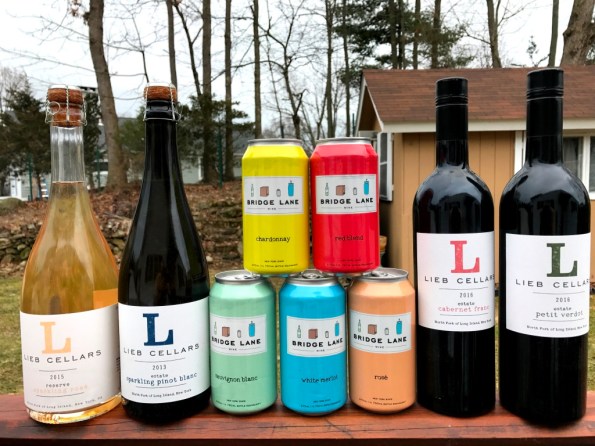
These were excellent wines, I can’t complain much about either one of the four – Sparkling Rosé was outstanding, Sparkling Pinot Blanc was superb and far exceeded my expectations. The Cab Franc was solid, and the Petit Verdot was, as I said, a riot. I did my usual “longevity test” with the Petit Verdot – pour a glass, close the wine, pour another glass next day and so on. For every day the wine stays tasty, I account 5-7 years of the aging time the wine can endure in the cellar. So Petit Verdot was fine for 2 days, but on the day number 3 it went down, so I would probably age it for another 5-7 years, but not much longer. But then with the screwtop, you never know…
Here you are, my friends. Spring, summer, fall or winter – Lieb Cellars have some fun and tasty wines waiting for you. Cheers!
Parent, Secret Power, Unsung Hero
You just read the title of this post. What do you think we will be talking about? Of course, it can be a story about a person who had all those great qualities – but this is the wine blog, right? Can all those qualities belong to a grape?
Let’s see. Parent – this is simple. When two grapes are crossed, they will give birth to the new grapes, and, of course, we can call both of the original grapes parents. Unsung hero? This is typically someone who can quietly come to the help of others and solve the big problem or save a life. Apart from saving a life, a grape can be very instrumental in assisting others to do their best, bringing out their best qualities while remaining literally unknown. For example, helping to make delicious wine as part of the blend. Now, the secret power? Every once in a while a person can be on a secret mission and save the world, all alone, “solo” – James Bond meets Wonder Woman, anyone? Okay, okay, I’m only talking about making delicious wines, all by itself, solo.
Now, as we are talking about the grape, can you think of one which would fit this description? There are thousands of grapes used in winemaking, so theoretically, there is more than one grape that will fit this profile, but I would dare to say that one grape might stand above others in all these roles. Know what I’m about to say? There is a good chance you do – you probably guessed it already – I’m talking about Cabernet Franc.
Cabernet Franc grapes, as shown in Wikipedia
It is hard to tell when Cabernet Franc became known as a grape variety. It is definitely old, probably not as old as Chardonnay, which can trace its history all the way to the 11th century, but still older than most other grapes. While Cabernet Franc is typically associated with Bordeaux and Loire, it appears that it originated from the Basque Country in Spain, from where it spread through the south of France and reached Bordeaux.
How Cabernet Franc is a Parent? Based on DNA research, Cabernet Franc was a parent of Cabernet Sauvignon, Merlot, and Carménère – a good group of kids, isn’t it?
How is it an unsung hero? Cabernet Franc ripens at least one week earlier than Cabernet Sauvignon. It can reach phenolic ripeness in the years when Cabernet Sauvignon will not, and thus in the blend, it will be a savior – this is why it was always so loved in Bordeaux, an insurance policy of sorts. While the tasting profile of Cabernet Franc is somewhat similar to Cabernet Sauvignon, it is typically softer and less tannic than its more famous offspring, so it makes the blend more approachable.
The Secret Power? When used in European wines, it is often unknown that the wine is made out of Cabernet Franc. For instance, Chateau Cheval Blanc, one of the most famous Bordeaux wines, is made predominantly out of the Cabernet Franc – but this is not widely known outside of the circle of wine aficionados. How about Olga Raffault Chinon? Chinon, a region in the Loire, is one of the best sources of delicious Cabernet Franc wines, but you have to simply know that. Coming to the new world, Cabernet Franc is not so secret anymore, as you can see it on the label, but I still can let you in on one little secret – this is one of the most versatile red grapes you can find. Talking about the United States, for instance, it is practically the only red grape which can consistently deliver delicious red wines both in California and in New York – and we don’t need to be so confined – Washington and Oregon are doing quite well with the Cabernet Franc, and so do Massachusets, New Jersey, and even Rhode Island. And let’s not forget Canada, where the grape goes beyond dry reds and offers some of the most stunning dessert wines – Cabernet Franc Ice Wine.
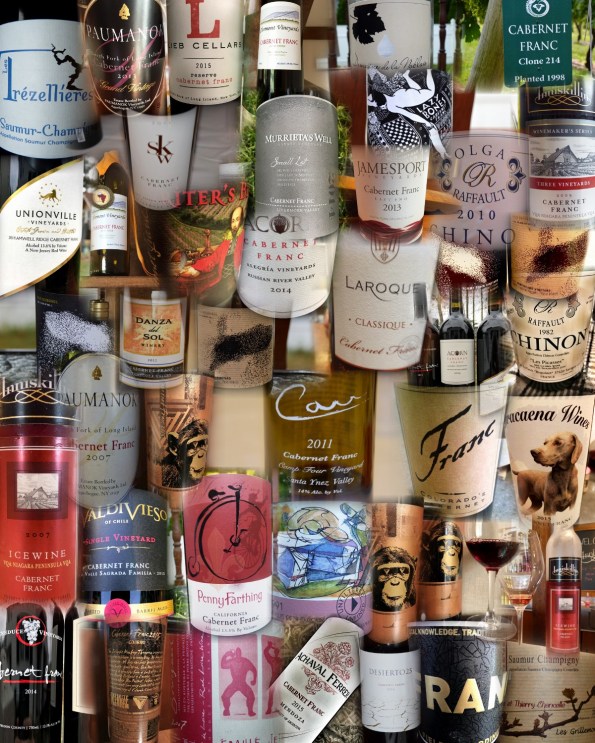
December 4th is when we celebrate this unique variety with the #CabFrancDay. The whole Cabernet Franc extravaganza is a product of the obsession of one person – Lori Budd, who singlehandedly started this grape holiday in 2015. Lori expresses her love for the grape not just by talking about it – she also makes her own Cabernet Franc wine in Paso Robles under the Dracaena Wines label. This year I was able to try the Dracaena Wines Cabernet Franc at the wine bloggers conference, and I can tell you that while I’m very particular about Cabernet Franc wines (prefer more old-world style than new), I really enjoyed Lori’s rendition.
Grape holidays are always fun – you have a good reason to open a special bottle that was stashed in the corner, and share your love for the grape with the world. Cabernet Franc’s celebration is important beyond that simple joy. Take a look at the Wikipedia article – it says that Cabernet Franc is “principally grown for blending with Cabernet Sauvignon and Merlot in the Bordeaux style, but can also be vinified alone”. The Vins de Bordeaux website says that Cabernet Franc “is the ultimate complimentary grape variety”. While this is true, Cabernet Franc is great for blending, this is also the grape which is excellent by itself, and we should recognize and acknowledge that, and change that perception of a “blending grape”.
This year, I had a great experience with beautiful Cabernet Franc wines from all over the world – 1982 Olga Raffault Chinon, Achaval-Ferrer Cabernet Franc from Argentina, Lieb Cabernet Franc from Long Island, New York, Dracaena Cabernet Franc from Paso Robles, and many others. But to celebrate Cabernet Franc Day in style, I had an opportunity to open 3 more wines especially for the holiday – for one, representing both coasts of the USA – and, surprisingly enough, representing both styles of Cabernet Franc, the old world and the new world.


2014 ACORN Alegría Vineyards Cabernet Franc Russian River Valley (12.5% ABV, $38, 93% Cabernet Franc, 2% Malbec, 2% Merlot, 2% Petit Verdot, 1% Cabernet Sauvignon and Tannat, 18 months in barrel) was uniquely Californian in style – in many ways. Alegría Vineyards are Certified Sustainable, which is really the way now for many vineyards in California, with a lot of manual labor-intensive effort going into helping grapes to achieve their best potential. All the wines ACORN produces are made as field blends, where different grapes are co-fermented together, according to the century-old field-blend vineyard traditions. The result was beautifully balanced, fruit-forward wine, boasting pure cassis flavors, supported by the medley of the red fruit and perfect acidity. The wine was clean and delicious.
Two more wines were a total surprise for me. These two Cabernet Franc wines were both made in New Jersey. I have very little experience with New Jersey wines, and that experience was not necessarily all positive, so yes, I didn’t have much expectation as I was pulling the corks, just a hope that the wines would be at least palatable.


While Unionville Vineyards were planted only in 1987 and the winery opened its doors to the public in 1993, the land where the vineyards a located was farmland even before the 1850s. As farmland, it went through many different plantings and such – peach orchard, apple orchard, dairy farm, grains, and horses – but returned to the fruits with the first grapevine plantings in 1987 – this is when the story of Unionville Vineyards started.


Beneduce Vineyards is located in the same Hunterdon County as Unionville Vineyards. Chardonnay, Riesling, and Gewurztraminer are the main white grape varieties at Beneduce Vineyards, and the list of reds includes Pinot Noir, Blaufränkisch and, of course, Cabernet Franc.
Last Bottle Sign Up ($10 credit)




 Talk-A-Vino