Archive
Sangiovese Games and Power of Words
 Okay, folks, this might be the scariest post I have ever written. This might lead to unsubscribes, unfollows, ostracism, and public shaming. Well, it is what it is.
Here it comes, my confession.
I don’t know how Sangiovese tastes like.
Here, I said it. You heard me right, and I can repeat. I do not know how Sangiovese tastes like.
Still here? Okay, then I would like to ask for a chance to explain.
I know how Cabernet Sauvignon tastes like. Whether it is produced in Bordeaux, California, Australia or Tuscany, I still expect to find cassis, maybe eucalyptus, maybe mint, maybe bell peppers.
I know how Pinot Noir tastes like. No matter whether it comes from Burgundy, South Africa, Oregon, New Zealand, or California, I still expect to find cherries, maybe plums, maybe violets, maybe some smoke.
I can continue – I know how Chardonnay tastes like (from anywhere), I know how Riesling tastes like (from anywhere), I know how Sauvignon Blanc tastes like (from anywhere). I still don’t know how Sangiovese tastes like.
While we are talking grapes, we are also talking about the power of words. As soon as we hear Cabernet Sauvignon, Pinot Noir, Chardonnay, Riesling, Sauvignon Blanc, we have an instant mental image, set our expectations, and the first sip of wine is judged against that mental image. Of course, we make regional adjustments – Pinot Noir from Oregon might offer dark chocolate, espresso, and mocha in addition to the cherries, but cherries will be there. Bordeaux (okay, it is usually a blend, so this might be a bad example) is expected to be leaner that’s California Cab, but it will still show that cassis core. And I still have no clue how Sangiovese should taste like.
I know how Brunello tastes. It is 100% Sangiovese, but it has its own unique taste profile with layers of tart cherries and cherry pits framed by oak notes and firm tannins. I know how Vino Nobile de Montepulciano tastes. It is also 100% Sangiovese, with tart cherries usually weaved around a core of acidity. I know how Chianti typically tastes. It has to be at least 80% Sangiovese, plus other grapes, and it will have the cherries usually surrounded by leather and tobacco.
Brunello, Vino Nobile, Chianti are renditions of Sangiovese, but they are references only to themselves. When I hear any of these names, I know what to expect. But I still don’t know how Sangiovese tastes like.
I don’t know if you ever had a chance to experience Shafer Firebreak. This wine used to be made from California Sangiovese (92%) with the addition of Cabernet Sauvignon (8%), the percentages are representative of the last vintage which was in 2003 (Sangiovese plantings were removed after that). This wine had nothing in common with any of the Italian Sangiovese renditions, but instead had a smoke, espresso, and powerful dark fruit. A very memorable rendition of Sangiovese – but not referenceable.


You might be annoyed at this point by me constantly repeating “I don’t know how Sangiovese tastes like” and wondering where I might be going with that. So this post was triggered by a few events. Last year, I got a few samples of Sangiovese from Castello di Amorosa. When I tasted them, they were reminiscent of Chianti, and I even had to open a bottle of Cecchi Chianti, which is an outstanding producer making Sangiovese wines with exemplary regional expressions, to compare. I also tasted a bottle of California Sangiovese which had only a name of Sangiovese, but really tasted more like a fruit compote mixed with a fruit cake. As the end result I realized that I have no idea how Sangiovese actually should taste like – and here I am, pondering at the subject with you, my dear reader (I hope someone is still reading this, eh?)
So let me take you a bit further with a few of the tasting notes and references.
First, I have to say that I probably found what can be considered a reference Sangiovese. Two years ago I had an opportunity to taste a range of wines from Cecchi, and one of the wines was called Sangiovese Toscana IGT. It was not Chianti of any kind, it was pretty much an unadulterated rendition of a pure Sangiovese from the motherland, from Tuscany, which was not even aged in oak, only 2 months in the bottle. Here are the notes:
2018 Cecchi Sangiovese Toscana IGP (13% ABV, $10)
Dark ruby
Cherries, coriander, sage
Light, bright, fresh cherries, crisp acidity, sweet basil, refreshing.
8+, can be perfect even on a summer day, but I can’t complain on a winter day either. Unique and different.
The wine was absolutely spectacular in its pristine beauty and an absolute steal for the money. Ever since I tasted this wine it became my reference for how pure Sangiovese might take like.
Now, the peculiar California Sangiovese I mentioned before was the 2017 Seghesio Venom. 100% Sangiovese from Rattlesnake Hill in Alexander Valley, 14.9% ABV, $55. Seghesio is a Zinfandel specialist, and they are good at that. If this wine would be called Zinfandel, I would have no issue with it. But under Sangiovese name, it makes me only wonder what possessed Seghesio to make a wine like that. A fruit compote with a bit of a structure doesn’t equate to Sangiovese in any shape and form. And at the price, if you just want to drink a California wine, it might be fine, but if you are looking for Sangiovese, just look elsewhere.
Well, you don’t need to look too far. Castello di Amorosa in Napa Valley is really focusing on bringing their Italian heritage to wines they craft in California. Yesterday I talked about their range of Pinot Noir wines, which was excellent. Their California Sangiovese can probably be called a glorious success as I even had to open a bottle of classic Chianti to compare the notes.


I tasted two Sangiovese wines from Castello di Amorosa (for the history of the Castello, which is very fascinating, I would like to refer you to the link I included above).
2017 Castello di Amorosa Sangiovese Napa Valley (14.7% ABV, $36)
Dark garnet
Plums, cherries, baking spices
Plums, tart cherries, light tannins, medium body, good structure, a hint of leather.
8-/8, it is reminiscent of the Chianti, nicely approachable, but will improve with time, judging by the late tannins on the finish on the second day.
2018 Castello di Amorosa Voyager Vineyard Sangiovese Napa Valley (14.5% ABV, $45, single vineyard)
Dark garnet
Smoke, granite, gunflint, tobacco, dark fruit, Very promising.
Tobacco, baking spices, cut through acidity, medium body. Very unusual. Needs a bit of time.
Tart cherries, a hint of vanilla, bright acidity. Reminiscent of Chianti, but not as earthy
8-
And then I opened a bottle of Cecchi Chianti and was pleasantly surprised how successful Castello di Amorosa was with their Californian Sangiovese rendition.
2017 Cecchi Chianti DOCG (13% ABV, $14)
Dark garnet
Herbs with a hint of cherries
Tart cherries, good acidity, fresh berry profile, medium body. Was earthy upon opening, but mellowed out after a few hours in the open bottle.
8-, easy to drink, nice.
As you can tell, the wines are similar, and I would call it a very successful effort.
Well, I still don’t know how Sangiovese should taste like, because this is all in the words. Unless we taste blind, we are bound by the power of words, and therefore our excitement and disappointment are fully dependent on those words. Was the Venom a bad wine? No, but it is an utter disappointment when called a Sangiovese. Thanks to Castello di Amorosa successfully offering a saving grace. While I still don’t know how Sangiovese should taste like, I’m willing to continue the quest for the tastiest rendition.
If you are still with me – thank you for reading and cheers.
Californian Stars, Italian Flair
 Californian stars.
Of course, we are talking about wines and grapes. What would those be?
I recently called California Cabernet Sauvignon a king. We can safely designate Chardonnay as a queen. But who would you call a prince? Capricious, spiky, moody royalty? Whatever grape you think of, the correct answer is Pinot Noir, because this is the grape I mostly would like to talk about today. And tell me if you think Pinot Noir is not qualified for the role of the royal prince – finicky, demanding, and unpredictable.
Okay, we got our stars for the day. Now, the Italian flair. How would you add the Italian flair to the Californian grapes?
There are a few options. For example, you can call your sparkling wine a Spumante. Or you can call your winery Castello, and build it in the form of a medieval Italian castle. You can also make wines out of Sangiovese – but this we will discuss later. Anyway, as you can see, you got options.
Vittorio Sattui, an Italian immigrant, founded St. Helena Wine Cellars in 1885. The business had to be closed due to the prohibition in 1920, but the Sattui family continued living at the winery. In 1975, Dario Sattui, great-grandson of Vittorio, restarted the family business by opening V. Sattui winery in St. Helena.
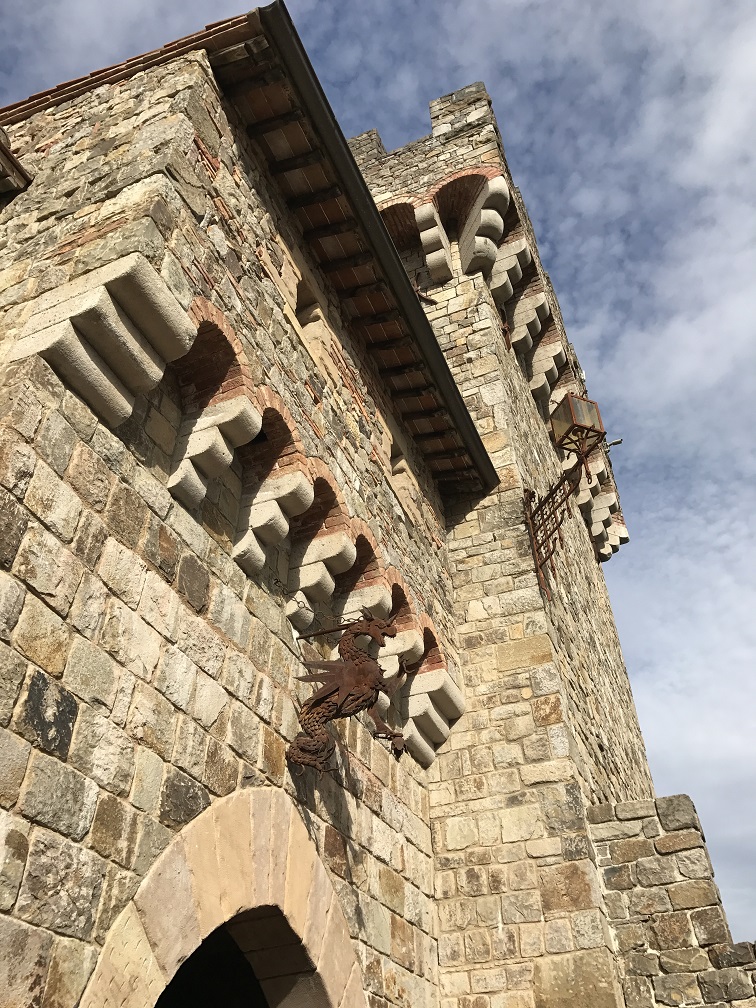
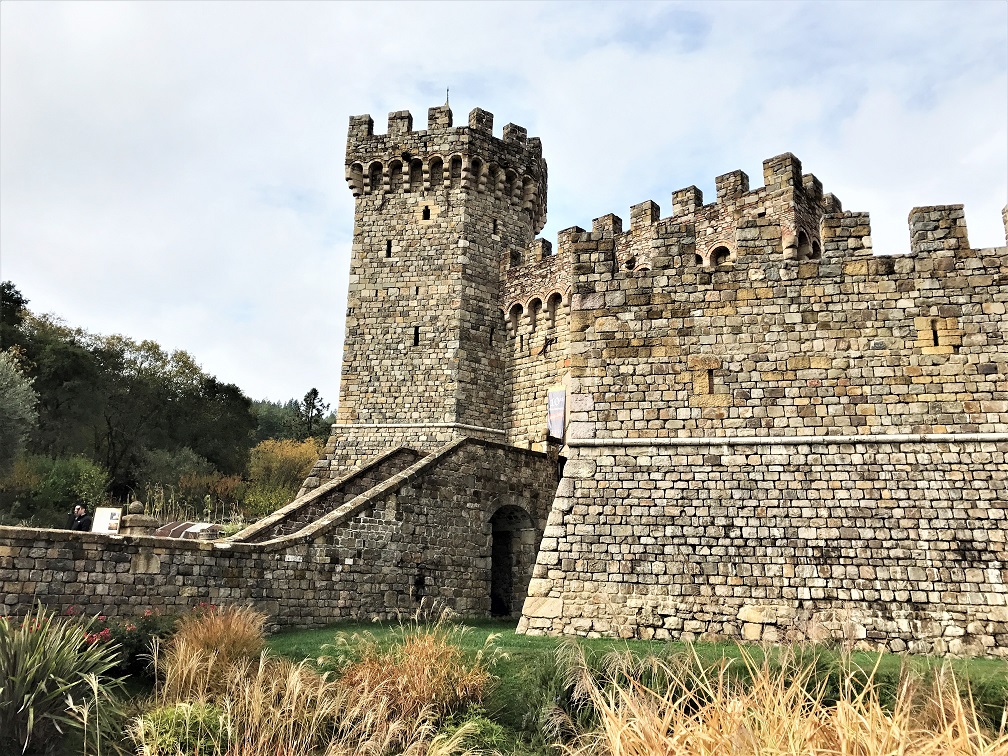
After finishing college, Dario traveled around Europe and became obsessed with medieval castles, monasteries, farmhouses. In 1993, Dario found the next home for his future winery – 171 acres parcel near Calistoga. In 1994, the construction began initially for the 8,500 sq. ft building without cellars. That slowly morphed into a 121,000 sq. ft. 13th-century Tuscan castle with 107 rooms, drawbridge, five towers, high defensive ramparts, courtyards and loggias, a chapel, stables, an armory, and even a torture chamber. Lots of bricks and artifacts were delivered directly from Europe to ensure the full authenticity of the castle. Castello de Amorosa (Castle of Love) opened its doors to visitors in 2007 after 15 years of construction.
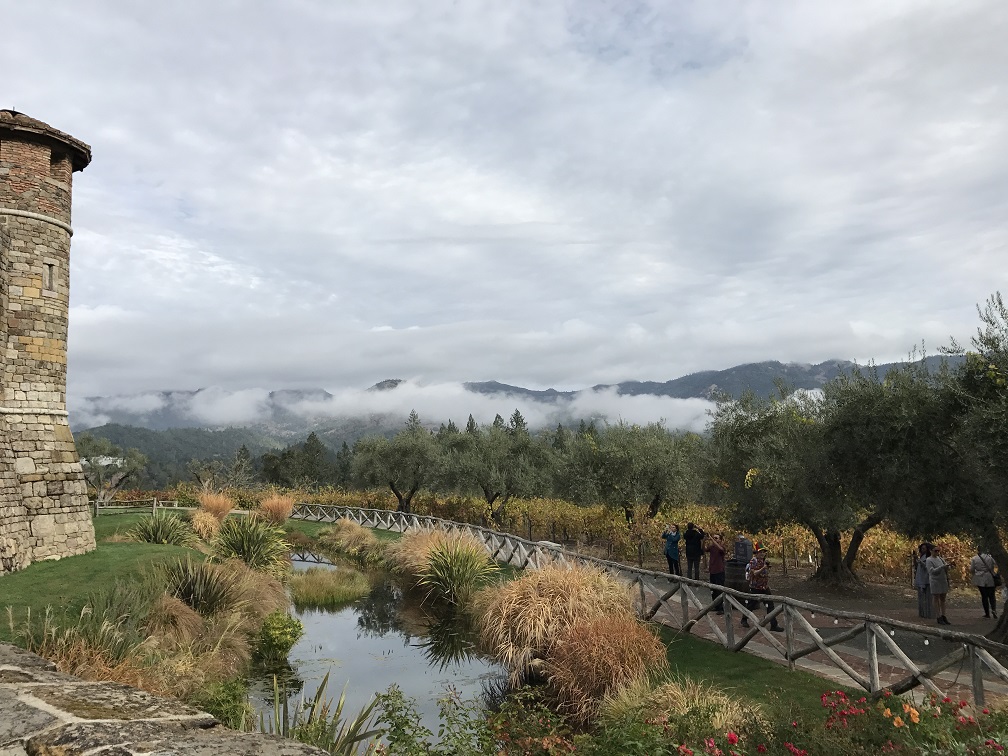
I was fortunate enough to visit the Castello di Amorosa in 2017 as part of the Wine Bloggers Conference 2017 in Santa Rosa, so I can share (inundate is a better word, of course) my first-hand impressions:


Thinking about misbehaving? Might not be recommended:


Touring the cellars:


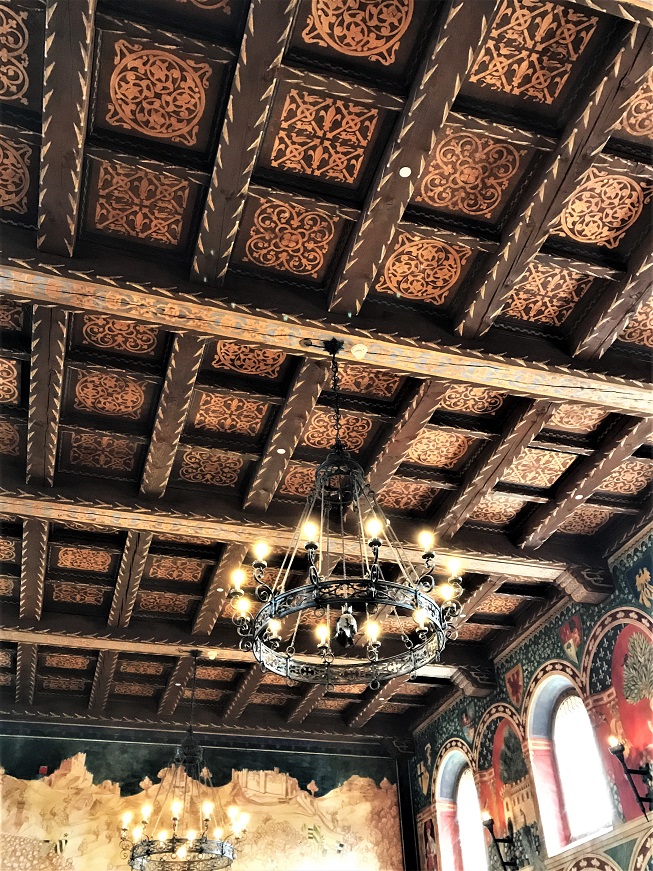
The ceiling of the room where we had our tasting in 2017:
A bit of education – Napa Valley Regions:


Castello di Amorosa works with 14 vineyards, most of them in Napa and Sonoma, out of which 6 are estate vineyards. The focus of winemaking is on showcasing each individual terroir and on the small-batch production.
I had an opportunity to taste a range of Pinot Noir expressions from Castello di Amorosa, and I have to honestly say that I was very much impressed with what I found in my glass.


First, two sparkling wines, both produced using the classic method.
2017 Castello di Amorosa Spumante del Castello Brut Napa Valley (12.5% ABV, $39, 73% Chardonnay, 27% Pinot Noir)
Light Golden, fine bubbles
Toasted bread, apples, gunflint
Toasted bread, Granny Smith apples, more gunflint, great minerality, a touch of sweetness, bigger body than typical champagne.
8, excellent,
2017 Castello di Amorosa Spumante del Castello Brut Rosé Napa Valley (12.5% ABV, $49, 100% Pinot Noir)
Salmon pink, fine mousse
Steely strawberries, a hint of toast
Dry, crisp, strawberries, clean acidity, good minerality
8, excellent
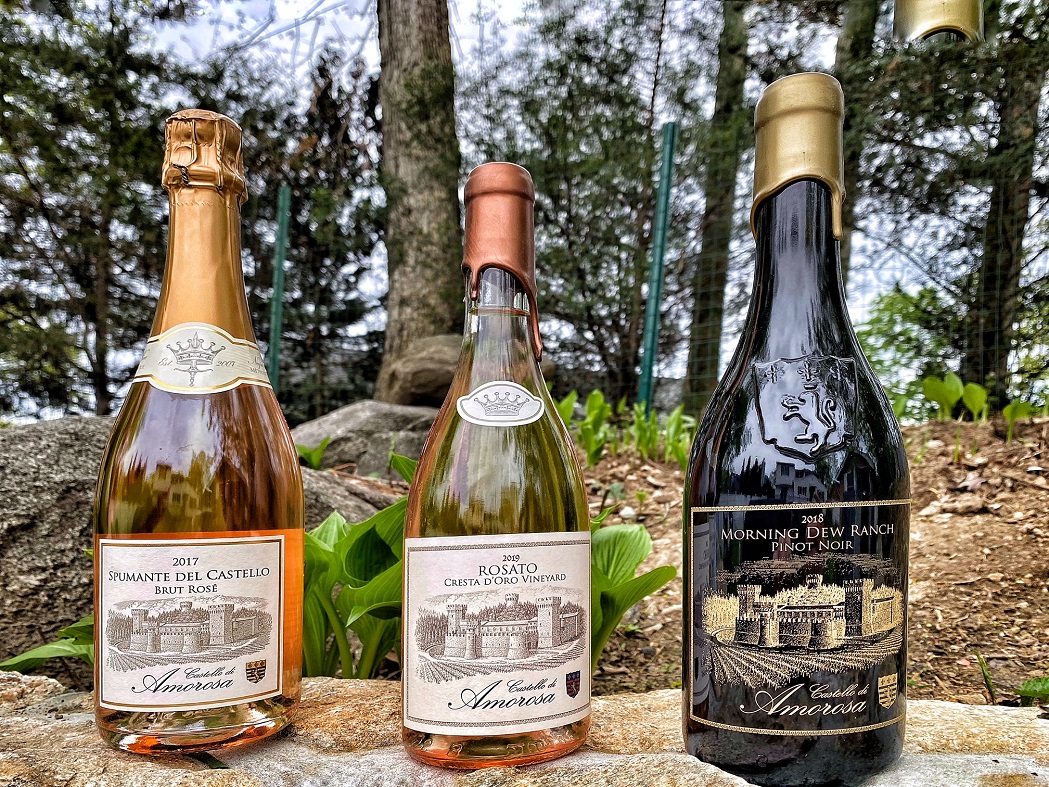
Next up, Rosé. The grapes for this wine come from the Green Valley area in the Russian River Valley AVA, and the wine is partially aged in concrete egg. I had an opportunity to taste both 2019 and 2020 vintages over a few months timeframe, and you can see that my tasting notes are almost identical for both wines. Somehow I missed including this wine into my 2021 top wines list, which makes me upset – this was one of the best Rosé wines and wines overall that I tasted during 2021.
2019 Castello di Amorosa Rosato Cresta d’Oro Vineyard Green Valley of Russian River Valley (13.6% ABV, $39, 100% Pinot Noir)
Light bright pink
Fresh ripe sweet strawberries, good intensity, inviting
Beautiful ripe strawberries, a touch of lemon, clean acidity, impeccable balance. Wow.
9-/9, one of the best Rosé I ever had. Just wow.
2020 Castello di Amorosa Rosato Cresta d’Oro Vineyard Green Valley of Russian River Valley (12.5% ABV, $39, 100% Pinot Noir)
Light bright pink
Fresh strawberries, a touch of herbs, crisp, inviting, and invigorating
Beautiful ripe strawberries, a touch of lemon, clean acidity, impeccable balance. Wow.
9, one of the best Rosé I ever had. Just wow. Superb.
Last up – Pinot Noir from Morning Dew Ranch in Anderson Valley. This vineyard was purchased in 2015 from Burt Williams, founder of the iconic William Selyem Winery. The 12-acre vineyard is in a very cool microclimate and divided into 9 blocks of Pinot Noir planted with DRC, 115, 777, Rochioli, 23, and 828 clones. All the blocks and clones give quite a bit of room to experiment to the winemaking team.
2018 Castello di Amorosa Morning Dew Ranch Pinot Noir Anderson Valley (13.1% ABV, $75, 11 months in Burgundian oak barrels)
Dark ruby
Somewhat unexpressive on the first day, a hint of fruit
Closed up, concentrated, dark fruit, not amazing
Classic Pinot on the second day – iodine, violets, underbrush
Beautifully elegant on the palate – good acidity, smoke, tobacco, fresh berries, cherries, firm structure combined with medium body, medium-long finish.
8+ second day, super-enjoyable.
Here you go, my friends – a little Italian oasis – scratch that – a large Italian Castle in the middle of Napa Valley, producing magnificent California wines. Castello di Amorosa is definitely a unique travel destination and a must-visit if you are ever in the area.
American Pleasures #6: A Tale of Two Cabs
Wine should give you pleasure – there is no point in drinking the wine if it does not. Lately, I had a number of samples of American wines, that were the delicious standouts – one after another, making me even wonder if someone cursed my palate. I enjoyed all of those wines so much that I decided to designate a new series to them – the American Pleasures.
California Cabernet Sauvignon.
Magical words for any wine connoisseur. Out of more than 100 grape varieties used in wine production in California, I would safely bet that Cabernet Sauvignon clout exceeds that of Chardonnay, Merlot, and Pinot Noir, and even including Pinot Noir in this list is a stretch. Cabernet Sauvignon is The One of California wines (if you are willing to disprove this with actual numbers, I will be happy to publish a correction, but until someone will step forward, this stands as unquestionable truth).
While we can agree that California Cabernet Sauvignon is an object of craving for uncounted many, it also should be recognized as an object of controversy. How do I mean it? Easy. There are probably 50 or so producers whose wines are impossible to get, due to both availability and pricing – you have to be on the mailing list with a waiting list stretching for 20 years or so, and once you get there you should be willing to pay $500++ per bottle of wine you will need to wait for another 10-15 years to enjoy. Alternatively, you need to be prepared to pay an upward of $500 per bottle and scour the internet daily looking for those special bottles.
On the flip side, you can join most of us walking into the wine store asking (begging?) for a good bottle of Cabernet Sauvignon under $20, trying not to notice the poorly hidden smirk on the face of the salesperson, who knows that we are on the quest for the impossible. If you like Cabernet Sauvignon and not buying those wines from your expense account, I’m sure you can relate to the experience firsthand. Even $50 per bottle doesn’t come with any guarantees. But – that number gives us hope. Yes, folks, it is possible to find a good bottle of Cabernet Sauvignon under $50. Let’s talk about it.


Lots of my wine learning and discoveries are linked to unimitable wine educator Kevin Zraly and his Windows on the World Wine School. I remember one of the lessons where we were talking about California Cabernet Sauvignon. One of the wines was particularly good, and I remember Kevin remarking that the wine was produced by Louis M Martini, who doesn’t charge nearly enough for the quality of the wines they produce. That reference got engraved in my memory literally forever, and Louis M Martini became somewhat of the safe bet when looking for reasonably priced and consistent California Cabernet Sauvignon.
Louis M Martiny winery was founded in 1922 when Prohibition was already in full swing. It was actually known as L.M. Martini Grape Products Company and was focused on the production of sacramental wines and concentrate for home winemaking. In 1933, expecting that Prohibition will end, the new winery building was constructed north of the town of Napa. This was the actual beginning of the Louis M Martini winery and pioneering role of the Martini family in the Californian wine industry, helping to establish Napa Valley Vintners Association in 1943, being one of the first to use wind machines to prevent frost in the vineyards, and being one of the first to bottle varietal Merlot in 1970.
Louis M Martini offers a substantial range of wines today, going way beyond standard Sonoma and Napa Cabernet Sauvignon offerings, including Cabernet Sauvignon from some of the best regions in Napa Valley such as Stagecoach Vineyard and Howell Mountain, as well as a number of Merlot, Malbec, Petite Sirah, and Zinfandel wines – unfortunately, most of those are priced well beyond the $50 we are talking about today. Sill, there is Sonoma Valley Cabernet Sauvignon which can be found at around $15, and Napa Valley Cabernet Sauvignon around $35. The Napa Valley bottling I tasted was simply outstanding with or without any regard to the price:
2016 Louis M Martini Cabernet Sauvignon Napa Valley (15.1% ABV, $40)
Garnet
Cassis, eucalyptus, baking spices
Roll of your tongue smooth, velvety, fresh cassis, perfectly ripe fruit but over, firm structure, long finish.
8+/9-, excellent, classic California Cabernet Sauvignon
If Louis M Martini can be called an iconic winery, then our next winery can be only referred to as the most iconic winery in Napa Valley. Charles Krug winery, established in 1861 in Napa Valley by Prussian immigrant Charles Krug was the very first winery in Napa Valley, the 540 acres estate which Charles Krug received via marriage. In 1943, an immigrant family from Italy, Mondavi, purchased the Charles Krug estate which had been run by the family now in 4th generation.
Charles Krug winery also offers a good number of wines, including Chardonnay, Malbec, Merlot, Zinfandel, and others, with Cabernet Sauvignon still being a flagship offering, including clonal selections (one of the Charles Krug Cabernet Sauvignon wines is called X Clone as it is produced as a blend of 10 Cabernet Sauvignon clones). I always wanted to try the Charles Krug wines, and finally, I was able to do so:
2017 Charles Krug Cabernet Sauvignon Napa Valley (14.1% ABV, $39, 87% Cabernet Sauvignon, 5% Merlot, 5% Petit Verdot, 3% Petite Sirah)
Dark garnet
Blueberry, blueberry jam, dark chocolate, pipe tobacco
A touch of nutmeg and cloves, much crispier on the second day, firm tannins, firm structure, good acidity.
8-/8, definite improvement on the second day.
Comparing these two Cabernet Sauvignon wines, Louis M Martini was a perfect pop and pour example, which is ultra rare among California Cabernet Sauvignon, where Charles Krug bottling definitely needed time.
Here you are, my friends. If you are looking for a good bottle of Cabernet Sauvignon under $50, there is still hope!
Sanford Winery: Evolution Of Growing Up
In the 1960s, two friends, Michael Benedict and Richard Sanford were looking for a good cool-climate site in California where they would be able to make wine rivaling in quality the best European wines.
In 1971, after successfully completing very extensive research, they decided on the location in the Sta. Rita Hills area, a part of the Santa Ynez Valley about 15 miles east of the Pacific Ocean. They first planted the vineyard to Chardonnay and Riesling, but in 1972 they were the first in the region to plant Pinot Noir (and now these are the oldest Pinot Noir plantings in the country).
In 1997, an adjacent hillside vineyard was planted next to Sanford and Benedict, named La Rinconada, which also became a home to the winery building and the tasting room. In 2001, Sta. Rita Hills area was officially certified as an AVA (American Viticultural Area). In 2002, the Terlato family became involved with the Sanford winery (the winery was only carrying the Sanford name as Michael Benedict part his ways with Richard Sanford in 1980), and in 2005 Terlato family became majority owners and partners at the winery. In 2006, John Terlato got closely involved with the winery operations, and that really opened a new chapter for Sanford winery.
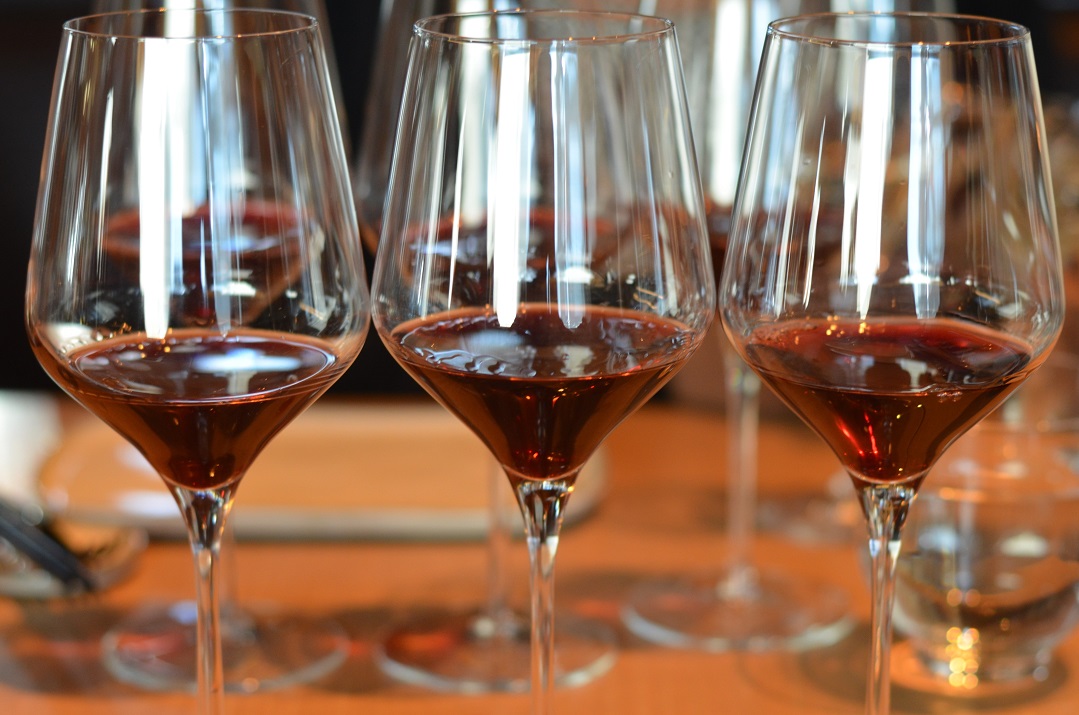
In June of 2019, I got invited to the Sanford winery tasting dinner with John Terlato and Michael Benedict at the Wild Ink restaurant in New York, in one of the hottest neighborhoods – Hudson Yards. I was, obviously, very excited. Which helped me to fail as a wine writer – read on, I will explain.
As we situated at the table, the wines started to appear in rapid succession – 2011 Sanford and Benedict Pinot Noir, 2012 Sanford and Benedict Pinot Noir, then 2013, 2014, 2015, 2016… I didn’t check the press packet in advance of the dinner, and was unprepared for the sheer number of wines presented – also the wines were just brought up one after another, without much of the pause, much of presentation, and too cold – I remember complaining about the wines being too cold and thus really not allowing for a proper evaluation. Don’t get me wrong – I loved the wines, but I had no opportunity to actually compare the vintages and understand the differences. We also tasted 2016 La Rinconada Chardonnay, 2015 Founders’ Vines Chardonnay, 2015 La Rinconada Pinot Noir and 2014 Founders’ Vines Pinot Noir – for which again I didn’t capture a single tasting note, carried away with a conversation, food, delicious wines, and amazing views of the sunset over Hudson.
Or maybe the tasting notes were not that important? In 2006, when John Terlato got involved in Sanford winery operations, he started learning about the best Pinot Noirs in the world. He went to Burgundy, met with winemakers, and tasted lots and lots of wines to understand what can be done differently at Sanford, what is next. He started the vineyard block program at Sanford, identifying unique vineyard blocks at both Sanford and Benedict and La Rinconada, with unique soil, microclimate and terroir, to let literally every bunch of grapes be the best they can be. John brought his notebooks to the dinner, and he was showing us pages and pages of copious notes, both about the wines he tasted in Burgundy and all the experiments and work done at the Sanford vineyards.


Both John and Michael were obviously proud of what they achieved, but what is important, they were both optimistic about their work at the winery and the best yet to come as the learning process doesn’t stop. “I want you to come to the winery and taste 2017, 2018, 2019, 2020, 2021… I want you to see how they [wines] change. I want you to see how much better they will become” said Michael Benedict in his quiet voice sitting next to me.
If I would’ve done my homework before coming to the dinner, I would’ve come armed with some incredible facts summarizing 13 years of hard work at the Sanford vineyards. Here are some numbers for you. 30% of the Sanford and Benedict vineyard are still planted on its original vines, which is very rare in California considering the spread of Phylloxera. The vineyard is home to the oldest Pinot Noir vines in Santa Barbara County, planted in 1971. Sanford and Benedict Vineyard has a total of 144 acres under vines – 109 acres of Pinot Noir, 33 of Chardonnay, and 2 of Viognier. There are more than 20 vineyard blocks identified, and there are more than 11 clones growing there.
La Rinconada, which was planted in 1997, is 117 acres in size, 63 acres of Pinot Noir, and 54 acres of Chardonnay. It also has 20 vineyard blocks and 12 clones. Between 2 vineyards, there are 261 total vine acres, 50+ Vineyard Blocks, 20+ clones, 6+ soil blends.
Taking all of this into perspective, it is amazing how Pinot Noir is becoming an obsession of the winemakers – I see this through all of the Stories of Passion and Pinot, through the deep research of soil done by Alit in Oregon. Identifying vineyard blocks, vinifying blocks separately, using multiple clones, blending, trying, and trying again. Passion and Pinot, truly.
Not writing about that memorable dinner was one of my biggest disappointments – to my disdain, I have a good memory for disappointments, so it was really hunting me down. But sometimes, life offers us second chances.
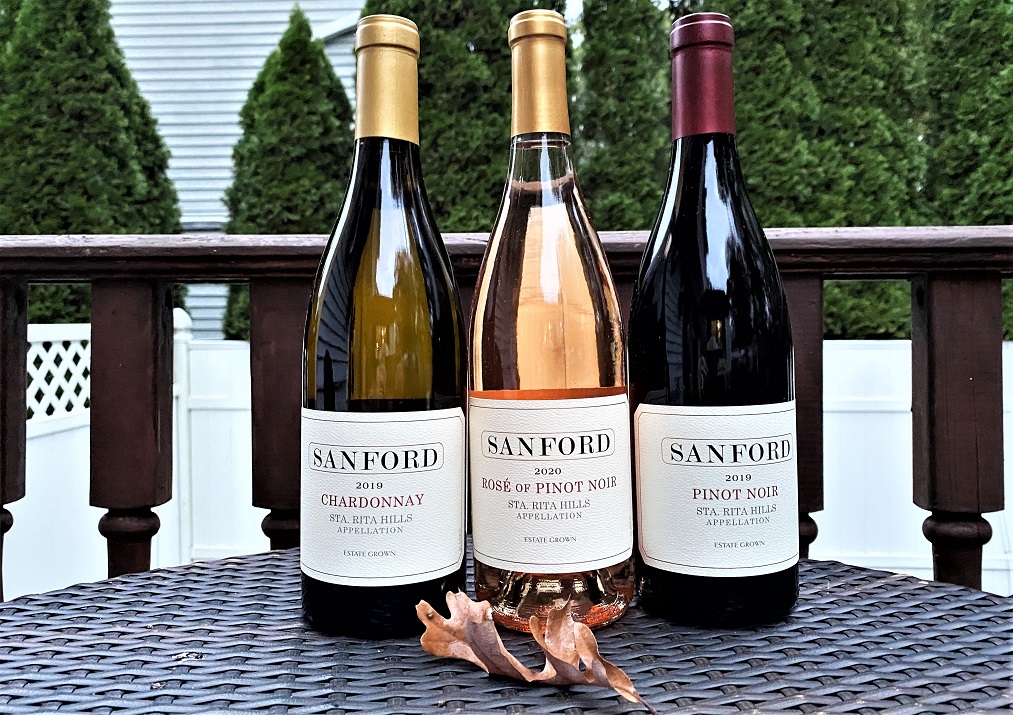
Trey Fletcher got schooled in world-class Pinot Noir and Chardonnay during his tenure at Littorai Winery, also learning biodynamic, organic, and sustainable viticulture at the same time. In 2011, Trey moved to Santa Barbara to become Winemaker and GM at Bien Nacido Vineyards. A few years back, Trey joined the Sanford team as Senior Winemaker, and 2019 became the first vintage where he was responsible for all the winemaking and blending decisions. I had an opportunity to taste Trey’s wines and here are my impressions:
2019 Sanford Chardonnay Sta. Rita Hills (13.5% ABV, $40, aged 11 months in French oak, 25% new)
Light golden
A hint of minerality, vanilla, apple, elegant, inviting
Similar profile on the palate – vanilla, apple, a distant touch of honey, perfect acidity, clean, fresh, delicious
8, an outstanding example of California Chardonnay
2020 Sanford Rosé of Pinot Noir Sta. Rita Hills (13% ABV, $20, aged 6 months in stainless steel and neutral barrels)
Salmon pink
Strawberries, nice mineral component
Tart strawberries, lemon, crisp, fresh, bigger body than a typical Provence, but still light and perfectly balanced. Nice medium-long finish.
8/8+
2019 Sanford Pinot Noir Sta. Rita Hills (13.5% ABV, $45, aged 11 months in French oak, 25% new)
Dark ruby
Plums, cherries, smoke. Classic Pinot nose
Sweet plums, tart cherries, probably a whole cluster fermentation based on a tiny hint of a green bite. Restrained, elegant, the sweetness is just hinted, and overall wine is well structured.
8, Should age well. A California Pinot with a lot of restraint
Pinot and Passion. There is truly something magical about the grape which becomes an obsession and an object of desire. The best proof, however, is always in the glass.
May you never stop growing.
American Pleasures #5: Burgundy in California, or the Wonders of Pop’n’Pour
Wine should give you pleasure – there is no point in drinking the wine if it does not. Lately, I had a number of samples of American wines, that were the delicious standouts – one after another, making me even wonder if someone cursed my palate. I enjoyed all of those wines so much that I decided to designate a new series to them – the American Pleasures.
Burgundy in California. Nonsense, right? Burgundy is located in France, and the last thing you want to hear is a review of Hearty Burgundy, proudly produced by Gallo (believe it or not, but you can still buy this wine at about $9 for 1.5L – a great deal, huh?). Rest assured – Gallo is the last wine I want to ever discuss on this blog. I would like, however, to talk about Burgundy’s star grape varieties, which are also working amazingly well in California – yes, you got it – Chardonnay and Pinot Noir.
California produces a lot of wine (#4 in the world, with 248 million cases in 2018), using a lot of different grapes – no matter where those grapes are typically from – from Clairette Blanc to Viura to Nebbiolo to Grenache to Tempranillo, you should expect to find them all in Californian wines. Aside from all of the abundance, there are some grapes that can be called California superstars.
With the white grapes, it is easy – Chardonnay clearly steals the show. California made Chardonnay its own way back, with Chateau Montelena already proving its prowess to the whole world by winning Judgement of Paris in 1976. Chardonnay’s style changed and changed again since those early days of success, and when you are opening a bottle of California Chardonnay today, very often you don’t know what to expect – too much butter, too little butter, too much oak, no oak. Most importantly, you have no guarantees that you will enjoy that bottle.
Speaking about red grapes, ask a wine lover to name the most famous California red grape, and I’m sure 9 out of 10 will say Cabernet Sauvignon. I love California Cabernet Sauvignon as much as every one of those 9 out of 10 people. But based on my experience, the majority of the California Cabernet Sauvignon need time and time again to mellow down, to transform, to become truly enjoyable, and not just “drink the label and keep smiling” type of beverages. California Pinot Noir typically give you a lot more hope for finding the delicious Pop’n’Pour wines. And don’t forget – Pinot Noir, Chardonnay – it is the pleasure we are looking for here, so “pop, pour, drink, and ask for a second glass” is a sequence of events we are hoping for in here.
Here is a collection of the well-known wines I had the pleasure of enjoying – and have been blown away by the Pop’n’Pour quality, truly.
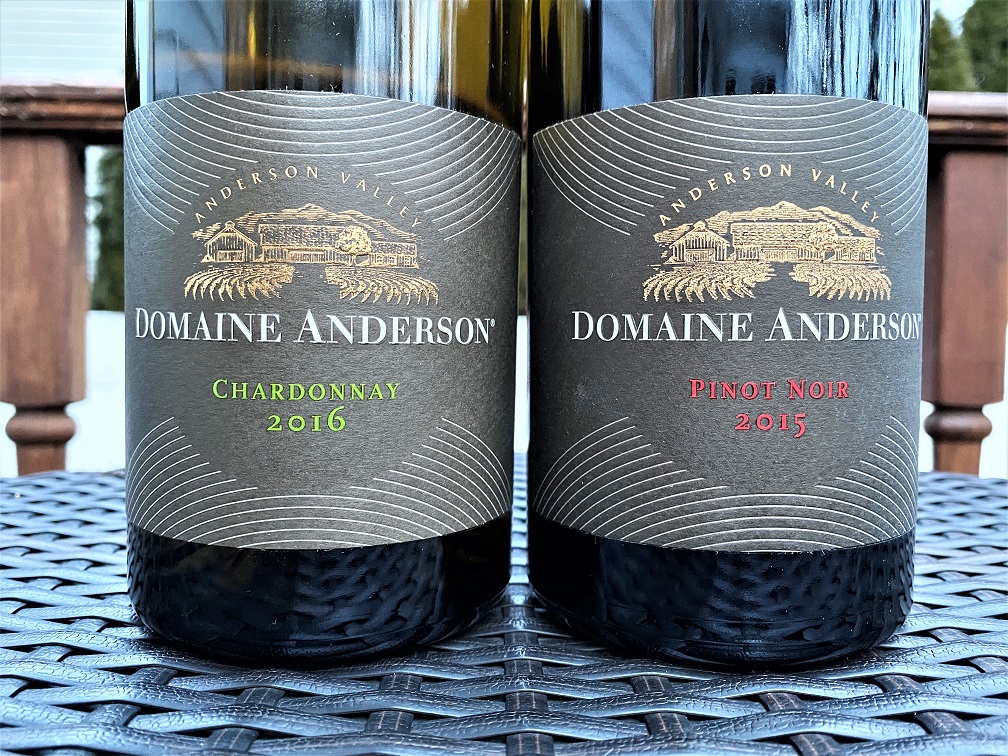
Domaine Anderson takes its roots from 1981, when Jean-Claude Rouzaud, patriarch of the Louis Roederer family came across Anderson Valley along the Mendocino coast in California, in search of the perfect spot to grow Chardonnay and Pinot Noir. Today, Domaine Anderson continues to be run by the Roederer family, farming organically and biodynamically 50 acres of Chardonnay and Pinot Noir vineyards. Here are 3 wines I had an opportunity to taste which were all just a perfection from the moment they were poured into the glass:
2017 Domaine Anderson Chardonnay (13.5% ABV, $30)
Light golden
Touch of honey, a hint of smoke, minerality
Clean acidity, tart lemon, a touch of smoke, texturally present, medium-plus body, earthy underpinning.
8/8+, this wine screams Chablis to me. Superb.
2015 Domain Anderson Pinot Noir Anderson Valley (13.8% ABV, $39.99, 15 months in French oak barrels, 19% new)
Dark ruby
Smoke, violets, earthy notes
Nicely restrained, good minerality, a touch of tart cherries
8, delicious
2017 Domaine Anderson Pinot Noir Anderson Valley (13.6% ABV, $45, 15 months in French oak barrels, 8% new)
Dark Ruby
Stewed plums, smoke, earthy undertones
Plums, cherries, lavender, tar, smoke, sweet tobacco, crisp, fresh, clean acidity, excellent balance
8, nicely restrained Pinot Noir, not over the board.
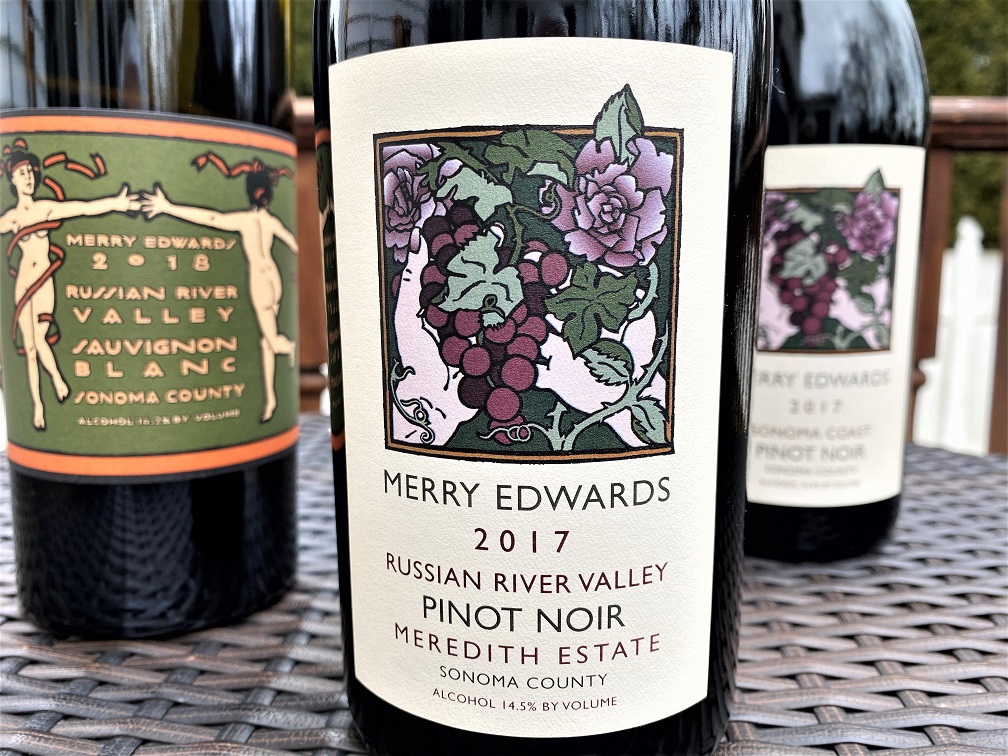
Merry Edwards Winery needs no introduction to wine lovers. Bright and noticeable labels always stand out on the shelf, it is hard to miss them. Merry Edwards’s sole focus is on the Russian River Valley Pinot Noir, which was first produced in 1999 (vintage 1997) – but she is also well known for her Sauvignon Blanc which was first produced in 2001. In addition to the passionate pursuit of Pinot Noir, Merry Edwards is also very passionate about sustainability, which is fully embraced at the winery and in the vineyards – you can read more about sustainability philosophy here.
2017 Merry Edwards Pinot Noir Meredith Estate Russian River Valley Sonoma County (14.5% ABV, $68)
Dark Garnet
Sage, tar, coffee, eucalyptus, freshly crushed dark berries
Tart, fresh cherries, crisp acidity, bright, invigorating
8, very uncalifornian, more Italian than anything else.
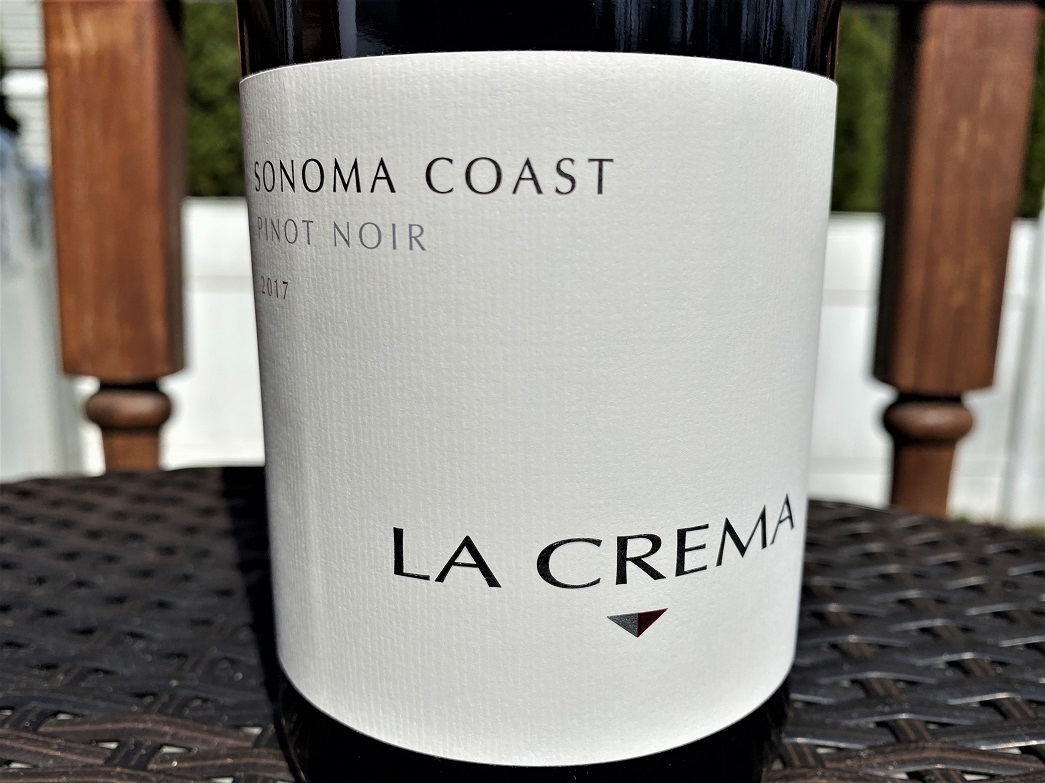
Considering how widely available La Crema wines are, I always made an effort to avoid them as “mass-produced”. After I tasted the wine, I completely changed my opinion – the wines might be produced in large quantities, but these are well-made wines. Also, the winery website has lots of good and well-presented information.
2017 La Crema Pinot Noir Sonoma Coast (13.5% ABV, $25)
Dark intense Ruby
Plums, fresh herbs, mineral undertones
Ripe fresh plums, mint, a touch of stewed strawberries, good acidity, good balance. Interestingly spicy finish.
8-, nice
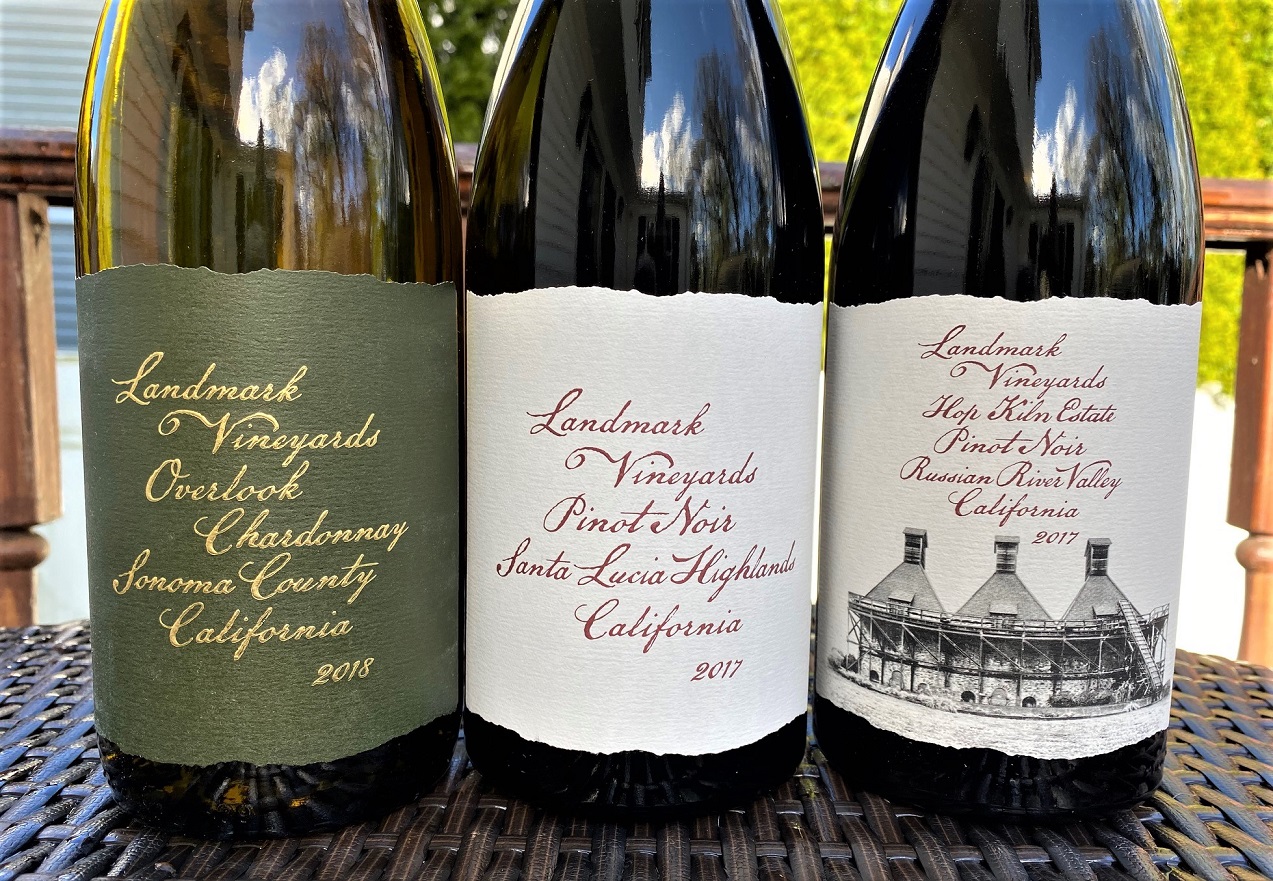


Landmark Vineyards was founded in 1974 by a group of people that included Damaris Deere Ford, the great-great-granddaughter of John Deere. In 1991, Damaris Deere Ford, now a sole proprietor of the Landmark Vineyards, focused exclusively on the production of Chardonnay and released the first vintage of the flagship Overlook Chardonnay. In 1993, Helen Turley started working as a consulting winemaker helping to create the Landmark’s signature style. Two years later, Landmark released the first vintage of its Pinot Noir under the name of Great Detour. In 2016, Landmark Vineyards extended into the Russian River Valley via the acquisition of the Hop Kiln Estate – and this was one of the wines I had an opportunity to taste.
2018 Landmark Vineyards Overlook Chardonnay Sonoma County (14.3% ABV, $27)
Light golden
Vanilla, apple, lemon
Vanilla, a touch of butter, golden delicious apples, citrus profile, roll-off-your-tongue round, excellent balance, delicious
8/8+, excellent
2017 Landmark Vineyards Pinot Noir Santa Lucia Highlands (14.3% ABV, $45, 14 months in French oak, 35% new)
Dark ruby
Plums, dirt, forest floor
Plums, cherries, tobacco, iodine, short finish, good acidity, good balance.
8-, excellent and classic
2017 Landmark Vineyards Pinot Noir Hop Kiln Vineyard Russian River Valley (14.5% ABV, $40, aged in 40% new French oak)
Intense ruby
Cherries, underbrush, the nose says Oregon with dark intensity
Tart cherries, dark chocolate, tobacco, complex bouquet
8/8+, superb.
Here are you – a collection of delicious Pop’n’Pour American Pleasures. And don’t worry, I have a lot more wines to share with you. Cheers!
A Quick Trip To California With Chalk Hill Estates
Have wine, will travel!
Let’s start with the question – equally eternal and pointless, but always fun – does size matter? Yes, of course, it does.
Now, a follow-up question – is bigger always better? Remember, this is still a wine blog, so please have the right perspective here.
While you are thinking about it, let me share what I learned from one and only Kevin Zraly during his Windows on the World Wine School class.
Kevin asked everyone to imagine a circle – let’s say, it would be California. Now let’s imagine a smaller circle inside of this one – let’s say, now it is Napa Valley. The wines from Napa Valley are better than the wines from the whole of California (I’m not doing any particular comparisons, just a general bottle of California appellation wine versus a general bottle of Napa Valley wine – there always will be exceptions, but this is not what we are concerned with right now).
Next, let’s place even a smaller circle inside of the Napa Valley – how about Oakville, one of the best appellations in Napa. Oakville designated wines should be (on average) better than Napa Valley designated wines, would you agree? But how about nesting next smaller circle inside – To-Kalon Vineyard, one of the most coveted vineyards in the whole of California? To-Kalon designated wines are some of the most sought-after wines in California, so the tendency is clear – the smaller circles get, the better wine should become. We don’t even have to stop at the vineyard level – we can continue to the blocks and plots, but I think you got the point.
So now, what is your answer to the question? Yes, when it comes to the wine appellations, smaller is usually better – but of course, don’t apply this logic when someone is asking if you would prefer a standard bottle of Screaming Eagle as your present, or if you would prefer a Jeroboam.
The Chalk Hill AVA (AVA is an abbreviation for the American Viticultural Area) is a tiny sliver of land located in the northeast corner of Russian River Valley AVA on the border with Alexander Valley AVA. The area is so small that it was first discovered by Fred Furth from his plane, while he was flying over the Russian River. Fred started the Chalk Hill Estates winery in 1972, and in 1983, the Chalk Hill area received the status of the AVA.
Chalk Hill’s name comes from the white chalk volcanic soils prevalent in the area. While Chalk Hill is a sub-appellation of the Rissian River Valley, it is warmer and has a lesser amount of fog, but more of the cooling breeze. Chalk Hill AVA is best known for its classically Californian grapes – Chardonnay, Sauvignon Blanc, Cabernet Sauvignon, Cabernet Franc, and Merlot. Malbec, Syrah, Sangiovese, and Zinfandel are also successfully growing there.
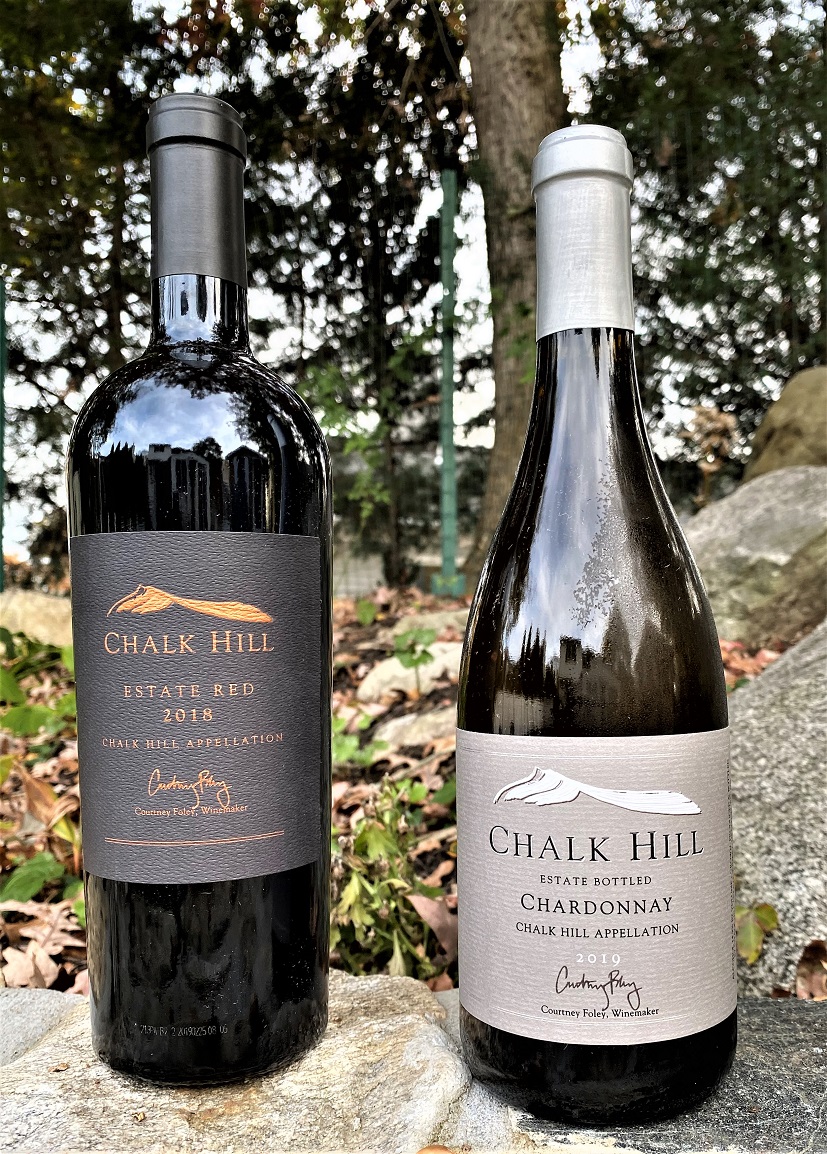
Chalk Hill Estate is a 1,300 acres property, with 350 acres of vineyards, planted vertically on the valley slopes. Chalk Hill Estate was acquired in 2010 from its original owner, Fred Furth, by Bill Foley, a successful financier turned vigneron, who smartly and successfully amassed a good number of famous California wineries under his Foley Family Wines brand. Actually, after the acquisition, Chalk Hill became home for the Foley family. Courtney Foley, the youngest daughter of Bill and Carol Foley, grew up surrounded by the beauty of Chalk Hill Estate, where now she became a winemaker working together with her dad.
Chalk Hill Estate vineyards are sustainably farmed, with a focus on soil and water conservation. Lots of work had been done in the vineyards to research how well different clones grow in the different sections of the vineyards, with particular emphasis on Chardonnay clones. To demonstrate the results of the study, Chalk Hill even produces a special Chalk Hill Clonal Collection set of wines.
I had an opportunity to try two of the Chalk Hill Estate latest release wines:
2019 Chalk Hill Estate Chardonnay Chalk Hill AVA (14.9% ABV, $45, 11 months in French oak, 40% new)
Light golden
A hint of gunflint, lemon, herbs
Butter, vanilla, good acidity, bitter undertones
7+, over-extracted for me, but I’m sure someone might like the raw power
2018 Chalk Hill Estate Red Chalk Hill AVA (15.5% ABV, $70, 54% Cabernet Sauvignon, 34% Malbec, 10% Petit Verdot, 2% Carménère, 21 months in French oak, 61% new)
Dark garnet
Cassis, pure cassis
Beautiful crunchy cassis, cherries, eucalyptus, a hint of espresso, well noticeable but not overbearing tannins, good balance, full-body, long finish.
8+, excellent
Somehow, the Chalk Hill Chardonnay is not made for me (this is not my first encounter with the wine, but the results are identical every time). The Estate Red was a pure delight, though.
And now it is time to conclude our trip. I hope you enjoyed a brief visit to the beautiful Chalk Hill Estate – next time, I’m sure it is worth a hands-on experience. Cheers!
Sparkle Every Day
Ohh, festive times… Bubbles, laughter, smiles, more bubbles, and more laughter and smiles.
We still think of bubbles as a holiday or otherwise celebratory wine, but it doesn’t have to be like this – every day is worth celebrating, and good bubbles bring something special – they have a magic power to make things better.
But now the bubbles are on everyone’s mind – the last two weeks before the New Year celebration, bubbles need to be consumed and gifted. Very appropriately, I’m inviting you on a trip around the world, to taste some sparkling wines, and maybe even find new favorites or discuss the old and familiar.
You can’t beat the classics, so let’s start in the place which started it all (I know it is contested, like everything else nowadays, but let’s just skip that discussion) – the Champagne, of course.


I’m starting today with Champagne which is unique and different, and in reality should warrant a full post, as this is Champagne with the story. In 1975, Bruno Paillard, tracing his family grower and negociant heritage back to 1704, started working as a Champagne negociant. In 1981, at 27 years of age, Bruno sold his old collectible Jaguar and started his own Champagne company with the vision of producing a different style of Champagne. In 1984, he designed a unique above-ground cellar to be able to fully control temperature during the production of Champagne. By 1988, he already was collecting raving reviews from the critics such as Hugh Johnson, and others.
Bruno Paillard calls his approach to Champagne production Multi-Vintage, as even non-vintage-designated wines still have known proportions of reserve (vintage) still wines used during production. Also, every bottle of Bruno Paillard Champagne carries a disgorgement date on its back label. I had an opportunity to taste Bruno Paillard Premiere Cuvee Champagne, which comprises 35 out of 320 Champagne crus, with up to 50% of the wine coming from 25 reserve vintage wines since 1985:
MV Bruno Paillard Premiere Cuvée Champagne (12% ABV, $60, 45% Pinot Noir, 33% Chardonnay, 22% Pinot Meunier, 36 months on the lees, 5 months in the bottle, disgorged in June 2020)
Fine mousse, crisp
Classic nose – toasted bread, very clean, delicate
Classic palate – toasted bread, minerality, a hint of apples, fresh, round, great energy, cut-through acidity, delicious overall
8+, superb. If you can drink it every day, more power to you – but it is well worth at least an occasional celebration.
As we are in Europe, let make another stop along the way – all the way down to the South of Italy – in Sicily.
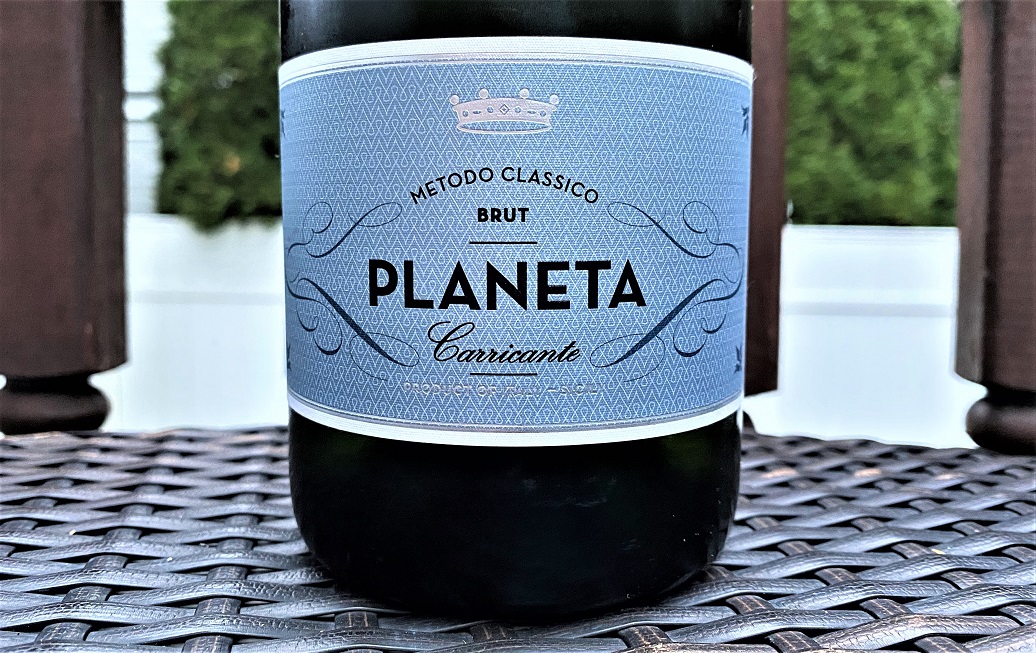
Italy is no stranger to spectacular classical style (method Champenoise) bubbles – powerful Ferrari and others up north in the Trentodoc, majestic Franciacorta in Lombardy, and more classic sparkling wines everywhere in between. However, this was my first encounter with the classic-style bubbles from Sicily.
Not to be overdone, this wine comes from Planeta, which is one of the most famous and best producers in Sicily – still, I never heard of their sparkling wines. This wine was made out of the local white grape called Carricante, but if you would try it blind, it would be very hard to distinguish this wine from an actual classic Champagne.
NV Planeta Carricante Brut Methodo Classico Sicilia DOC (12% ABV, $42, 100% Carricante)
Light Golden color
Beautiful intense nose, minerality, a touch of gunflint, toasted notes
A touch of green apple, minerality, toasted bread, good acidity, medium to full body.
8+, outstanding. Mostly available in restaurants, but you still can find it in a few liquor stores.


Now, let’s cross the Atlantic all the way and then some, going to the west side of North America – we are stopping by in California, to be precise. Here I have two wines to offer to your attention.
If you like California sparkling wines, then you don’t need an introduction to Scharffenberger. Found in 1981 by John Scharffenberger, the winery was built from the get-go for sparkling wine production, showcasing the terroir of Mendocino country.
In 2004, the winery became a part of the Roeder Collection. Overall, it continues the same traditions as 40 years ago, and today the 120 acres estate is sustainably farmed and Fish Friendly Farming certified.
Scharffenberger produces a range of Non-Vintage sparkling wines, all made using the classic method, all made from various proportions of Chardonnay and Pinot Noir. The wine I want to offer for your holiday festivities and casual daily life celebrations is Brut Rosé:
NV Scharffenberger Brut Rosé Excellence (12.5% ABV, $26, 55% Chardonnay, 45% Pinot Noir)
Salmon pink
Toasted bread, brioche, a touch of strawberries
Tart strawberries, hazelnut, freshly baked bread, crisp, generous, invigorating
8+, excellent bubbles for any day
Now, we are still staying in California, but moving about 2 hours south and east from Mendocino to the Russian River Valley. Here, in 1984, Judy Jordan started her J Vineyards and Winery (at the age of 25). Throughout the years, Judy acquired 9 vineyards, managing 300 acres of vines around the area. Her brother John Jordan manages the eponymous Jordan winery in Sonoma, producing “Chardonnay, Cabernet, and Hospitality” (I really love this quote of his as I had an opportunity to experience all three at the wine bloggers conference 2017).
During my first wine bloggers conference in 2014 in Santa Barbara, I attended joint Jordan reception, hosted by J Vineyards and Jordan Winery, creating the most magnificent experience between delicious J Vineyards bubbles and Jordan Cabernet verticals.
Why am I telling you all of this and how is it relevant to the J sparkling wine I tasted? Actually, there is no real connection, except the sad feeling of the loss of true authenticity, after J Vineyards was sold to E and J Gallo in 2015. If you visit the J Vineyards website today, it is all about selling the wine. There is no “about” section. There is no history of the estate. Just buy, buy, buy. Buy this or buy that. Okay, okay – I get it – wine is a business. But it can be a business with soul – sadly, I don’t think E and J Gallo know how to operate one.
This J Vineyards Cuvée 20 was originally produced to celebrate the 20th anniversary of the winery but then became a standard feature in the sparkling wine lineup.
NV J Vineyards Cuvée 20 Russian River Valley (12.5% ABV, $38)
Straw pale, fine mousse
Gunflint is a primary element
Toasted bread, gunflint, a touch of lemon, crisp, energetic, perfect cleansing acidity
8/8+, needs food – oysters, cheese, steak – any food.
Let’s now take a long flight down south, to the Argentinian desert, to visit Domaine Bousquet in Tupungato.


Actually, I already wrote a long post about Domaine Bousquet sparkling wines, at the beginning of this year. These are essentially the same wines I tasted before, only with the new labels. If you are interested in learning more about Domaine Bousquet, please refer to the post above, and I will just share my latest tasting notes here:
NV Domaine Bousquet Brut Tupungato Argentina (12% ABV, $13, 75% Chardonnay, 25% Pinot Noir, Charmat method, organic grapes, vegan)
A yellowish tint in the glass
A hint of apple, fresh, clean
Perfectly round, good acidity, a touch of toasted notes, apples, easy to drink
8-, very good
NV Domaine Bousquet Brut Tupungato Argentina (12% ABV, $13, 75% Pinot Noir, 25% Chardonnay, Charmat method, organic grapes, vegan)
beautiful salmon pink
fresh, a touch of strawberries
more strawberries on the palate, fresh, clean, good acidity, nice body
8-, perfect for every day
And we are done. I’m leaving you here with a few of the options for your festive and daily bubbles – different prices, different wines, but all worthy of a life celebration as it happens. Cheers!
Thanksgiving 2021
My love for Thanksgiving is a bit bittersweet – while this is one of the most favorite holidays of the year, its arrival also means that the year entered the finishing stretch and the four weeks between Thanksgiving and New Year will disappear literally with a blink of an eye. Is the ending of 2021 something to regret? Not really, not compared with any other year except its predecessor, 2020 – but so far we have not much hope for 2022 to be any better, so let’s count our blessings.
This year, Thanksgiving had a glimpse of normal. We managed to celebrate with the family in person at our house (yay!), and then we went to Boston to celebrate with our close friends, again in person (double yay!). So with the exception of the need to wear a mask here and there, and not materialized fears of celebrating with chicken instead of a turkey, this was a pretty standard Thanksgiving holiday.


As far as food goes, we managed to experience turkey 2 ways. First, at our house, we did a simple roasted turkey in the bag. I got the pre-brined turkey from Trader Joe’s, and it perfectly cooked in less than 4 hours, using the bag and convection bake in the oven. Then in Boston, we had a Turducken (turkey stuffed with a duck stuffed with chicken), but instead of making it ourselves, it was prepared at the butchery with the exception of roasting the final product. With perfect seasoning, this was definitely a standout. Of course, we had a bunch of appetizers, sides, and desserts, most of which simply was a repeat from the past years – roasted butternut squash and sweet potatoes, green beans sauteed with onions, acorn squash roasted with hazelnut butter, homemade cranberry sauce (using the recipe from Bobby Flay), Nantucket cranberry pie.


And then, of course, there were wines. A few weeks before Thanksgiving I got a note from Field Recordings offering two of the Nouveau wines, Rosé and Pinot Noir – as it is Nouveau wines, both were from the 2021 vintage. That gave me an idea to pair the whole Thanksgiving dinner with Field Recordings wines. I really wanted to have a Chardonnay at the dinner, but I had none from the Field Recordings, so I had to settle for their Chenin Blanc wine, from Jurassic Park vineyard. For the red, I decided to open one of my most favorite Field Recordings wines – actually, the wine which made me fall in love with Field Recordings – Fiction, with some nice age on it.
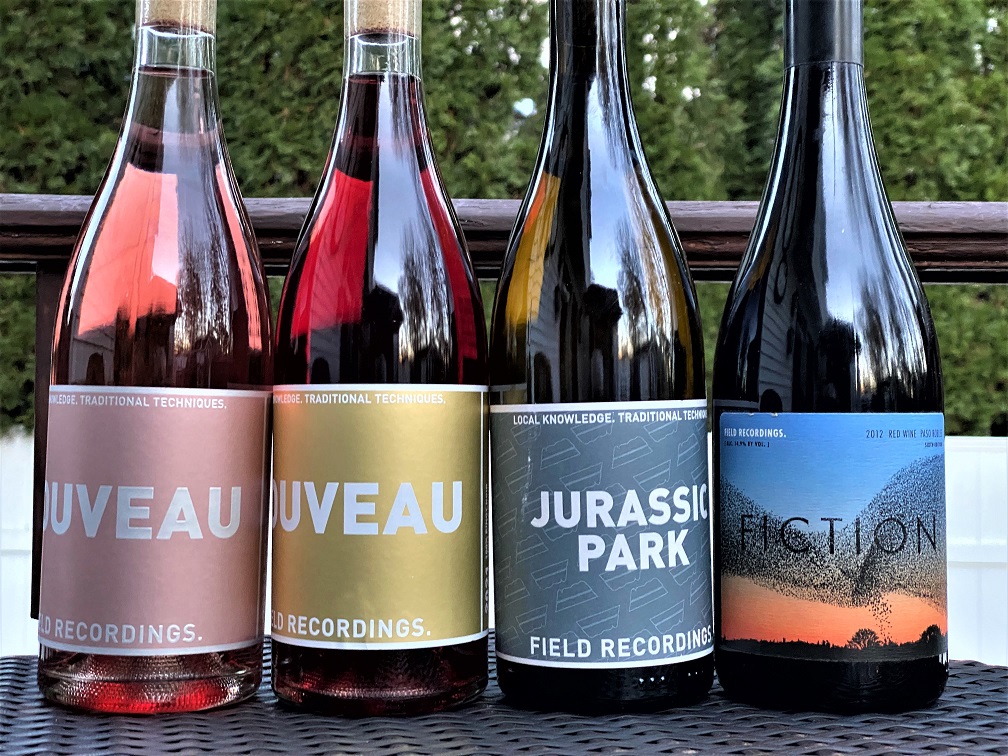
Let’s talk about these wine choices.
2021 Field Recordings Rosé Nouveau Edna Valley (10.9% ABV, blend of Grenache and Cinsaut from Morro View Vineyard in Edna Valley in California). The wine was a bit temperature-sensitive but overall outstanding. I served it slightly chilled, and the wine was tart with the strawberries profile, maybe ever slightly unbalanced. Chilling it another 4-5 degrees down magically transformed the experience into the fresh crunchy cranberries territory, with lots of cranberries in every sip – a pure delight.
2021 Field Recordings Pinot Noir Nouveau Edna Valley (12.9% ABV, Greengate Vineyard in Edna Valley in California) was quite similar to the classic French Beaujolais Nouveau, offering nicely restrained notes of fresh, young, just-crushed berries. This wine was also showing better with a higher degree of chill, being more composed with a more present body.
2018 Field Recordings Jurassic Park Chenin Blanc Santa Ynez Valley (11.3% ABV, 6 months in the hosch fuder 1000L) offered a glimpse of fresh apples and a hint of honey on the palate, all with crispy acidity. While this was not Chardonnay, the wine offered quite a bit of similarity and fit very nicely into my craving for Chardonnay, while being well reminiscent of a nice classic dry Vouvray.
The last bottle was unquestionably a bold move on my part.


2012 Field Recordings Fiction Paso Robles (14.9% ABV, 40% Zinfandel, 13% Tempranillo, 12% Petite Sirah, 11% Touriga Nacional, 10% Mourvedre, 8% Grenache, 6% Cinsault). This wine was the one that connected me with Field Recordings more than 10 years ago – I wrote a post about 2010 Fiction, and it was my 2011 Top wine of the year as well. I love those original labels a lot more than clean and rather boring labels currently in use at Field Recordings – and not only the label itself but also the text on the back label, talking about the early days of Andrew Jones, who was first and foremost grape grower before he started Field Recordings – you can read it for yourself.
9 years old wine under the screwtop and stored at room temperature – what would you expect? The wine was definitely showing the age, with an abundance of tertiary and dried fruit aromas (figs, cherries), but it still had some fresh fruit left together with the zipping acidity. I think if anything, this would be the wine that would actually turn into vinegar, give it another 4-5 years. But – it was still perfectly enjoyable now, and it was my second favorite of the evening together with the Nouveau Rosé.
There you go, my friends – my Thanksgiving 2021 escapades.
Oh, and before I forget – the last day of Thanksgiving weekend was also the first day of Hanukkah, so I simply had to make potato pancakes – thus this is the image I want to leave you with.

Happy Hanukkah to all who celebrate!
Daily Glass: Two Wines and The Sunset
Oenophiles are mysterious and easily influenced.
There.
Prove me wrong.
Here is the story of my weekend.
First, the “easily influenced” part, taking place on Saturday. My twitter wine friend Le Bov Vin #inmyglass likes to play a game – post a picture of a glass of wine with the description, asking everybody to guess the wine in the glass. Saturday’s post described the wine as “Redcherry.Blackfruit n strawberry,vanilla,licorice,hints of wood,smokedmeat Veryfresh,wellbalanced, polishedtannins,lingering finish“. My first guess was Pinotage, the second guess was leading to Washington Syrah/Grenache, but something here was also suggesting Spain, so I put all of these guesses into a tweet. After getting a confirmation that Spain is the right place, my first inclination was Ribera del Duero or Toro, as Rioja rarely would offer smoked meat notes – could’ve been something from Priorat, of course, but I decided to go with the first idea – and somehow I managed to hit it – the actual wine in the glass was Bodega Tinto Pesquera, one of the most classic producers from Ribera del Duero.
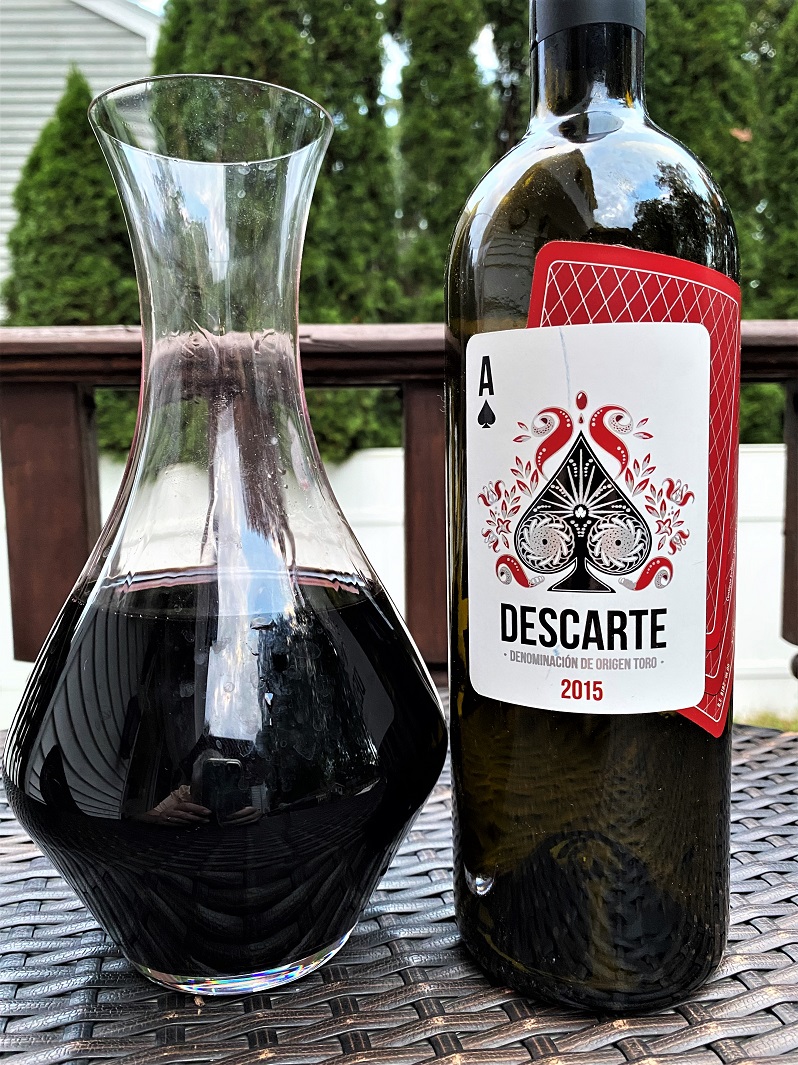
That made me crave Ribera del Duero wine, but somehow, while I always have a good amount of Rioja on hand, Ribera del Duero is a rare bird in my cellar. At this particular moment, it was as rare as none – but I recalled that I have a few bottles from Toro, the area down south from Ribera del Duero, producing densely concentrated and powerful renditions of Tempranillo, so I decided to obey my crave with 2015 Elias Mora Descarte Toro DO.
I wrote about this wine at the beginning of the year, when I called it Vinous Vino. Unlike the last time, I decided not to wait for the wine to come around slowly, and the wine went directly into the decanter upon opening. This definitely worked, as after about an hour in the decanter the wine showed massive and powerful, but also approachable enough to be enjoyed already, with dark cherries, espresso, and herbs-loaded profile.
Then there was Sunday, and the weather was noticeably cooler, one of the first cold days this fall so far. I wanted to sit down outside with a glass of wine, which obviously begged the question “what to open”. While going through the options inside my head, my inner voice insistingly proclaimed “Chardonnay”. I tried to argue – why Chardonnay, we can do Albarino, Chenin, Viognier, Riesling – but most importantly – why should it even be the white wine? It is cold enough to crave red! But the inner voice was unyielding – it has to be Chardonnay, there is nothing to discuss.
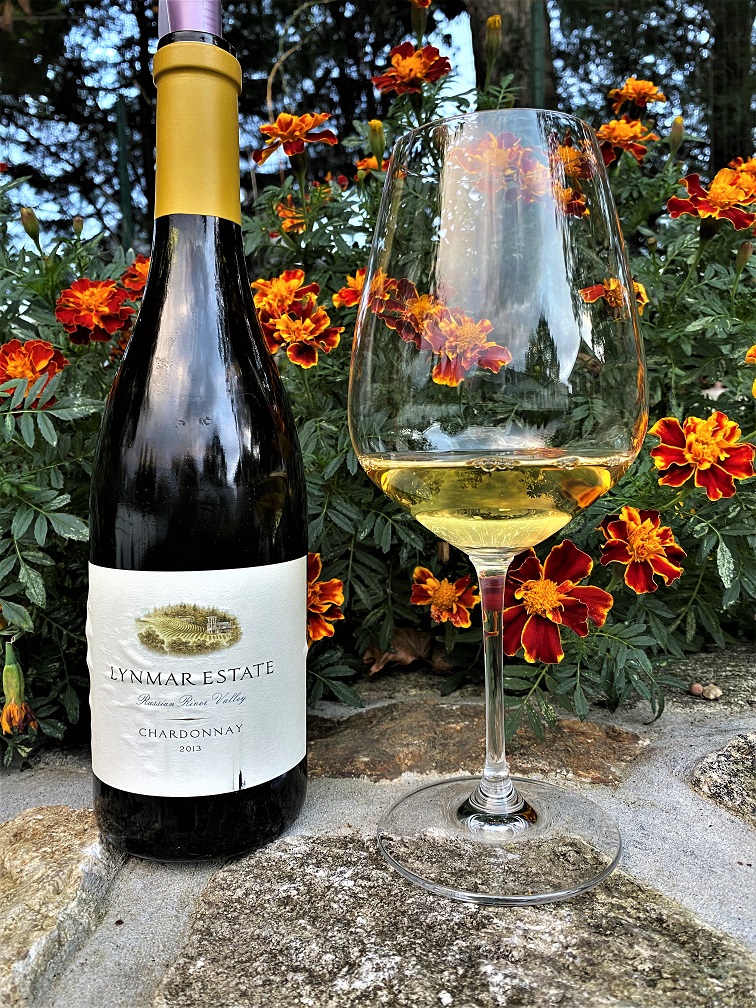
I don’t have a huge selection of Chardonnay, so the 2013 Lynmar Estate Chardonnay Russian River Valley (14.5% ABV) was almost the easiest choice. Boy, what a good choice it was… After a few minutes in the glass, the wine was singing with a core of vanilla with supporting voices of butter and green apples, all in perfect harmony. I don’t know if the wine was at its peak, or if it had another 10 years of life left – but it was perfect at the moment, no matter what mystery possessed me to open the bottle of Chardonnay.
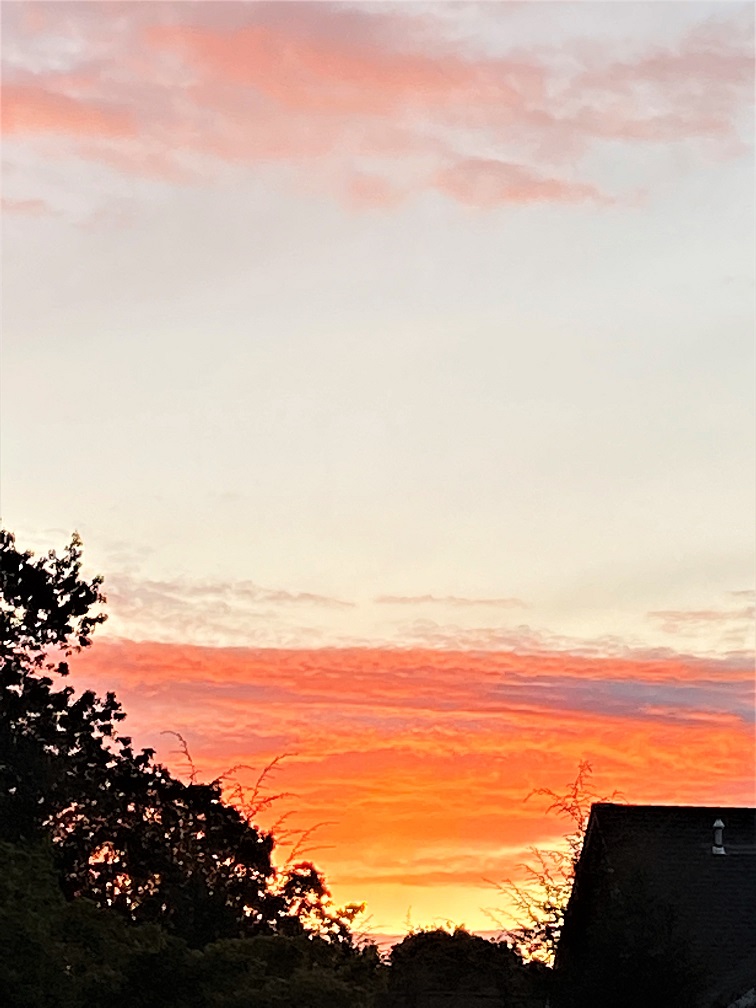
And then there was the sunset. I love taking pictures of the sunset, one of my most favorite types of photography. I often can take a decent picture of sunset right from my backyard – not all of those worth sharing though. But this Sunday sunset happened to be really special. A little rain started all of a sudden in the evening, forcing me to seek cover under the umbrella on the deck. The rain was very short, maybe 5 minutes or less. Once the rain didn’t look bothersome anymore, I stepped out from under the umbrella to go sit in the chair in the backyard – and then I saw THIS:
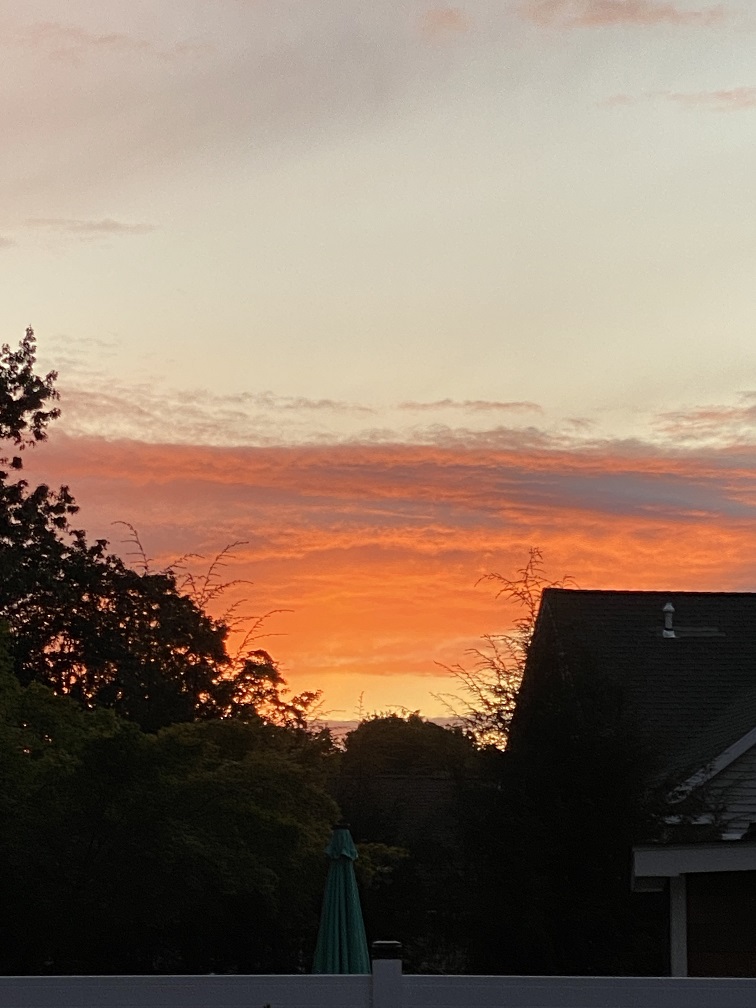
It appears that rain before the sunset creates some truly magical conditions for the sunset – some of the most memorable sunset experiences all took place after the rain. Once I saw this sunset, I spent the next 15 minutes taking pictures, with the glass and without, every moment being special and really worth capturing. Below are some of those pictures, I hope you will enjoy them as much as I did while talking them:
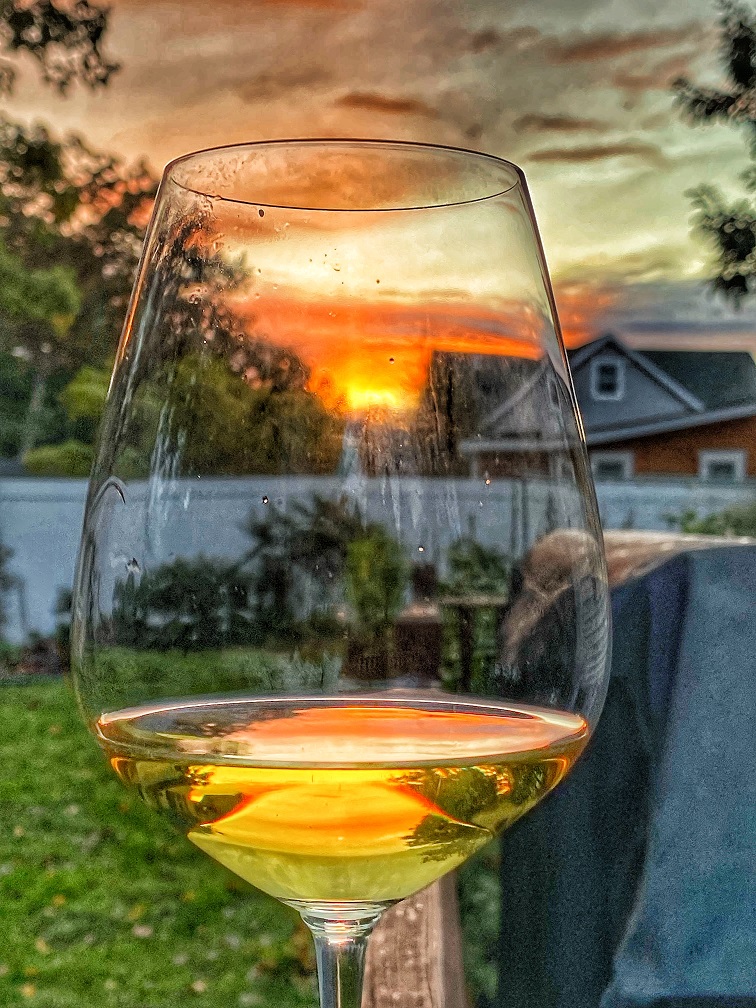
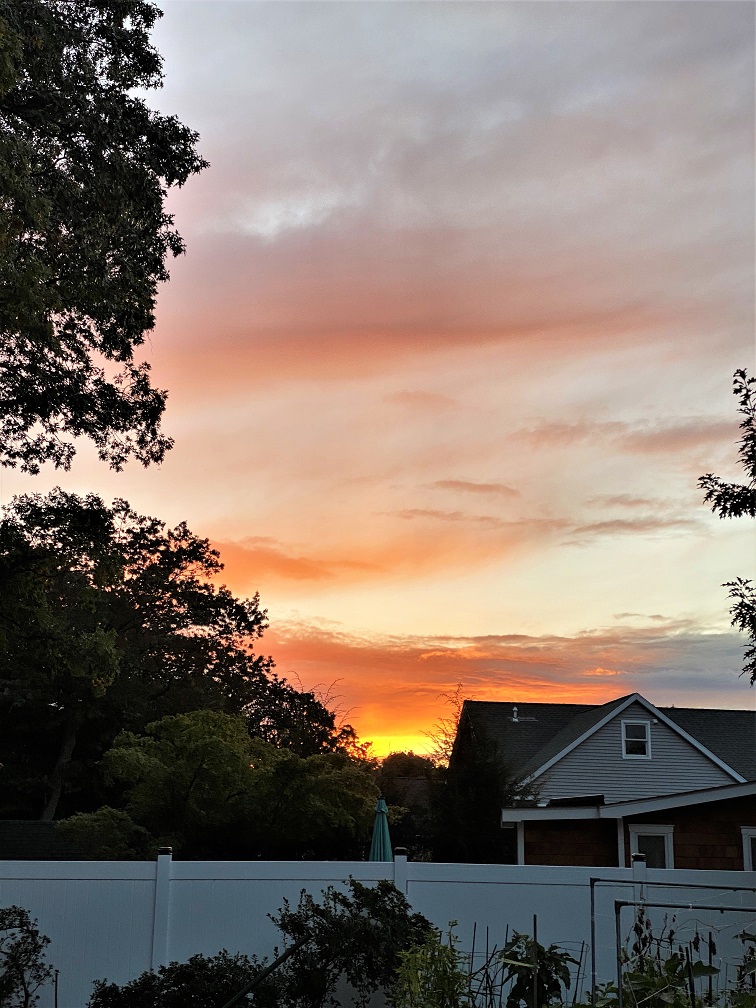
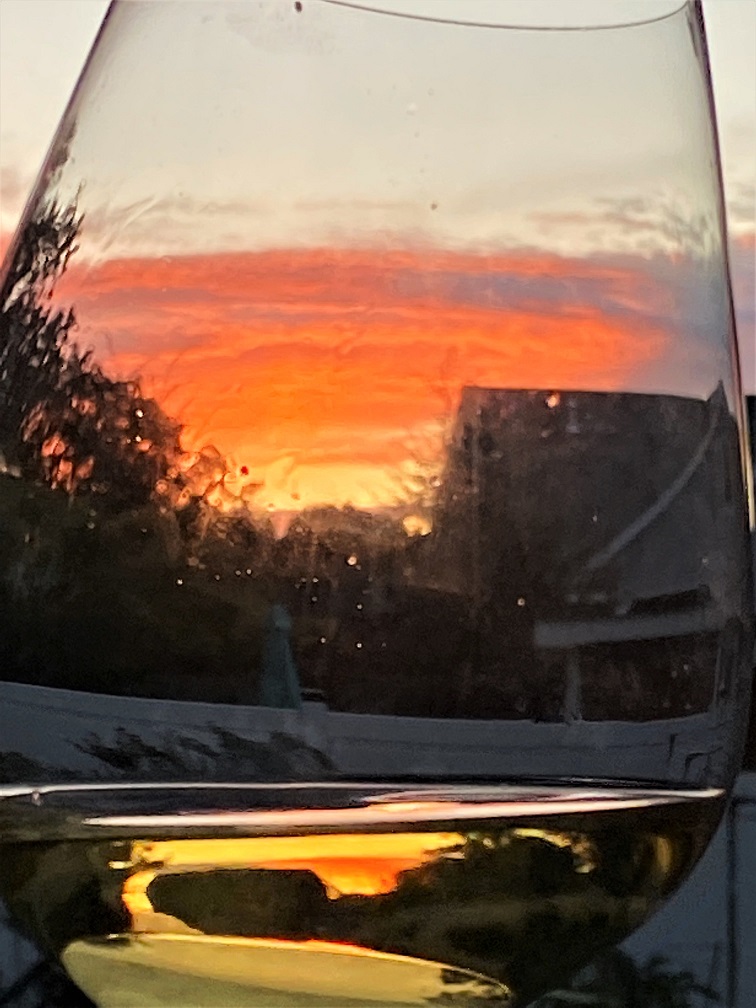
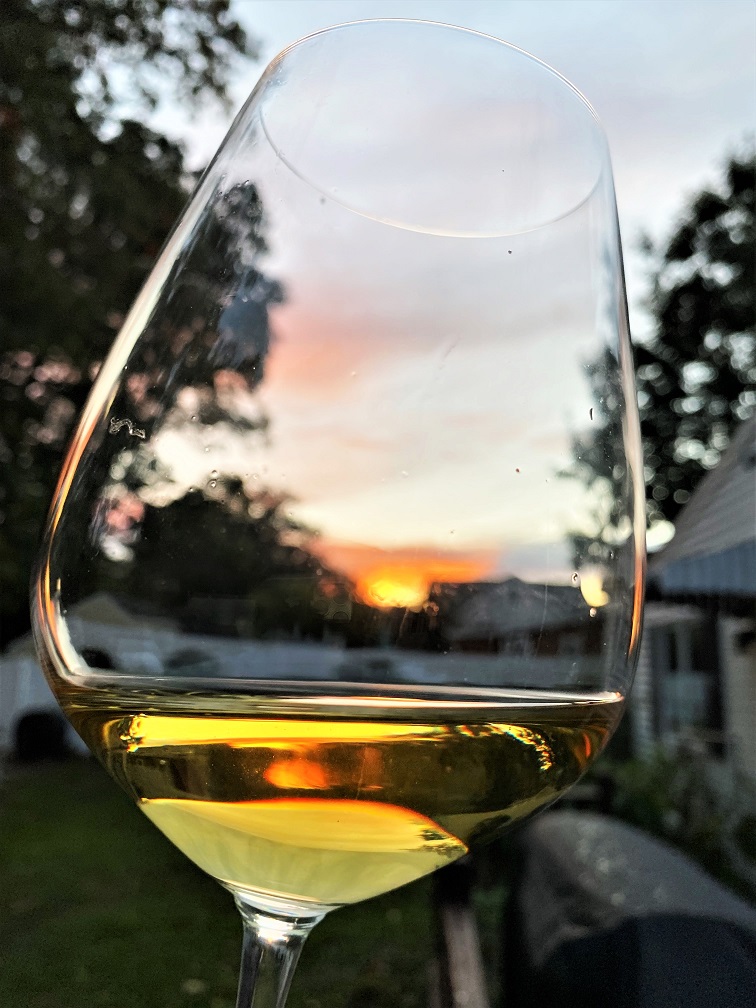
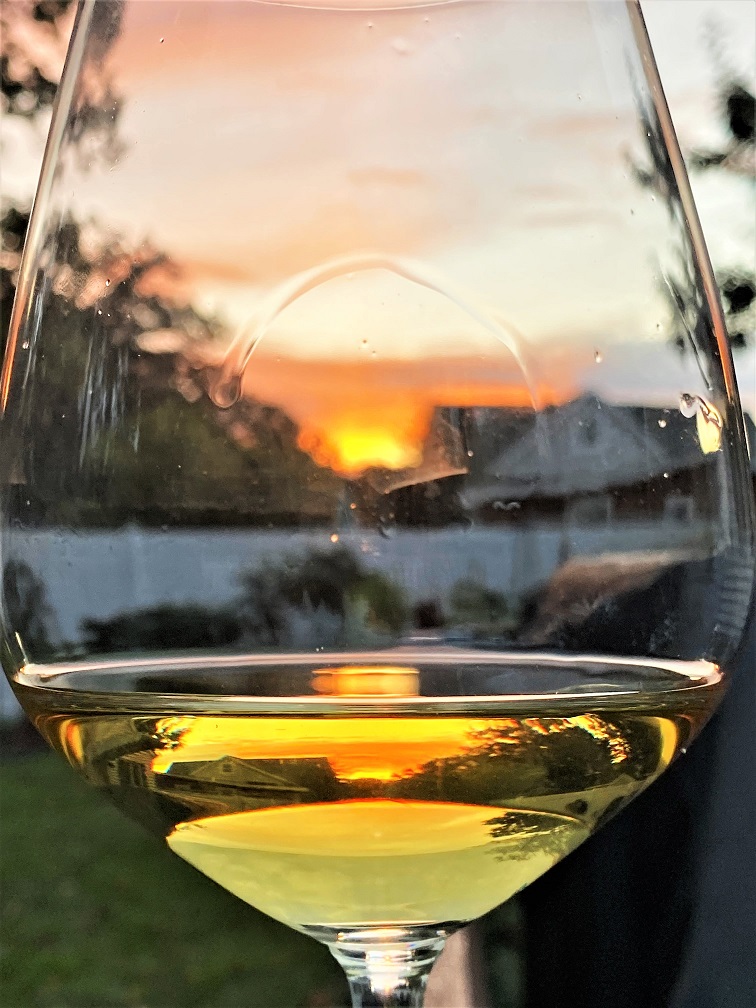
My failed attempt to catch the reflection of the sunset on the glass
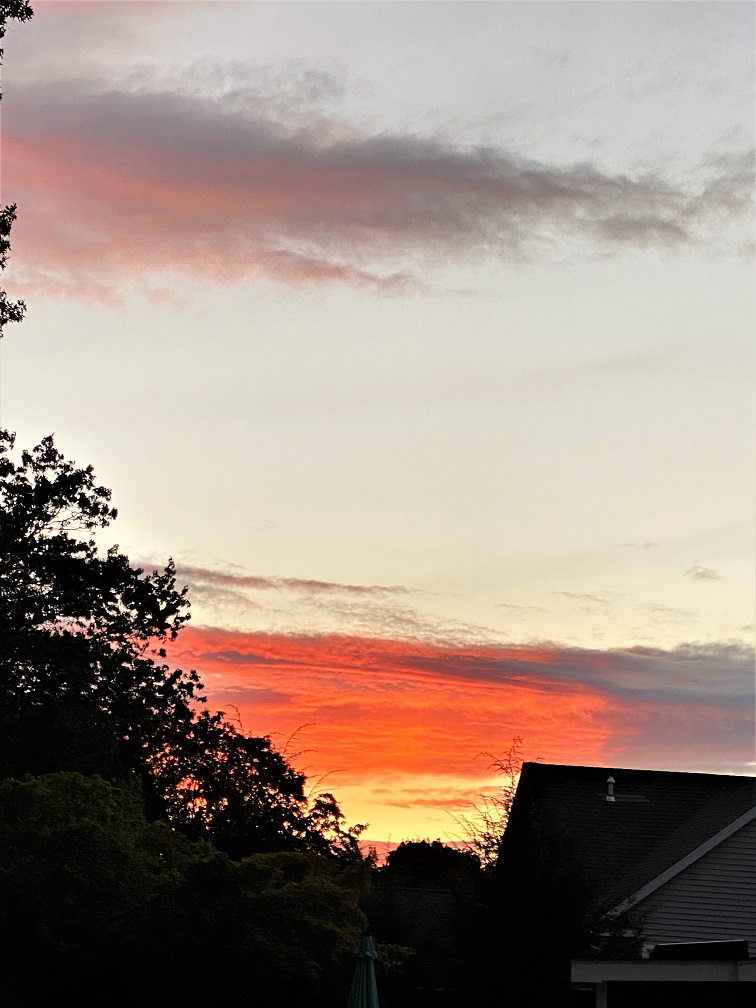
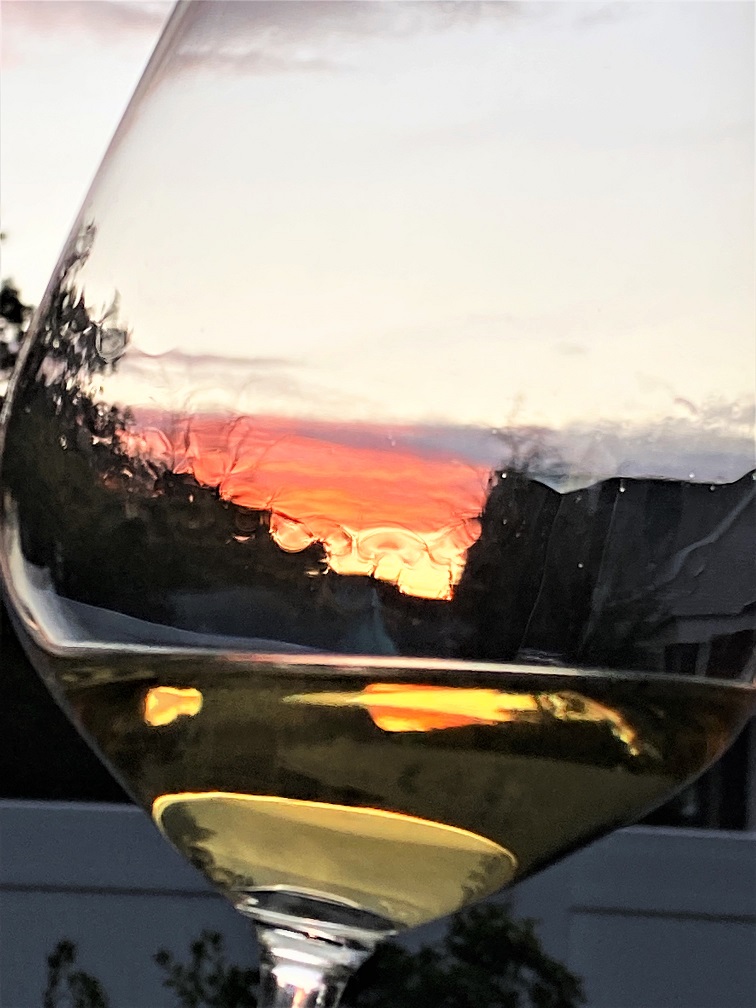
That’s all I have to share for now. How was your weekend?
Of Hydrangeas, Ocean, Sunsets, and Wine
I’m sure this cryptic title leaves you wondering what are we going to talk about in this post, right?
Yeah, a lame attempt at self-humor.
And as you can see I want to talk about some of my most favorite things – flowers, waves and sand, sunsets, and, of course, wine. Mostly in pictures – except the wine part.
We just came home after a weekend in Cape Cod, and if you ever visited The Cape as it is typically called, I’m sure you noticed the abundance of hydrangeas. There is rarely a house that doesn’t sport a beautiful hydrangeas display.
Hydrangeas come in many colors, which can be also influenced by what you feed the flowers. They typically bloom the whole summer and deliver non-stop pleasure – at least in my world. Let me share some of my favorites with you:


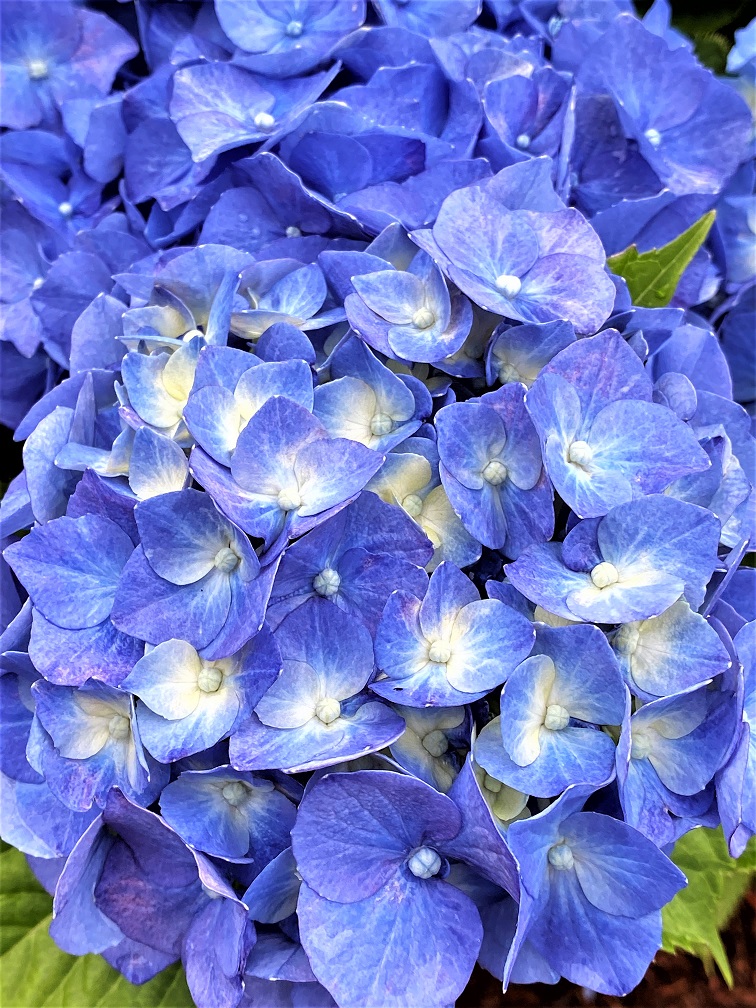
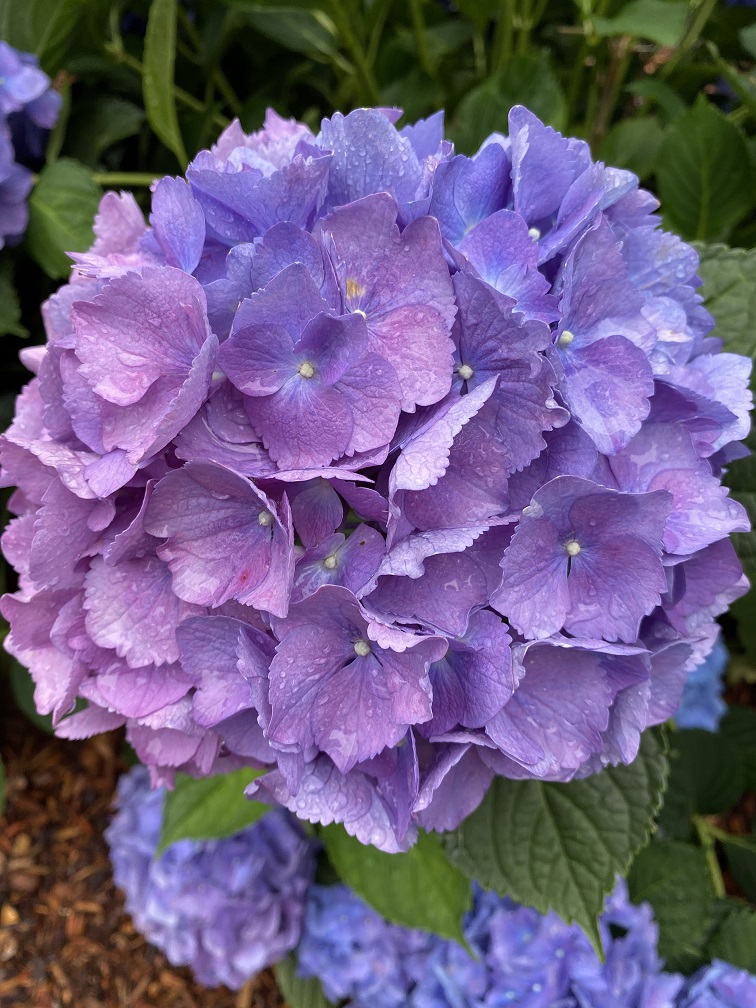
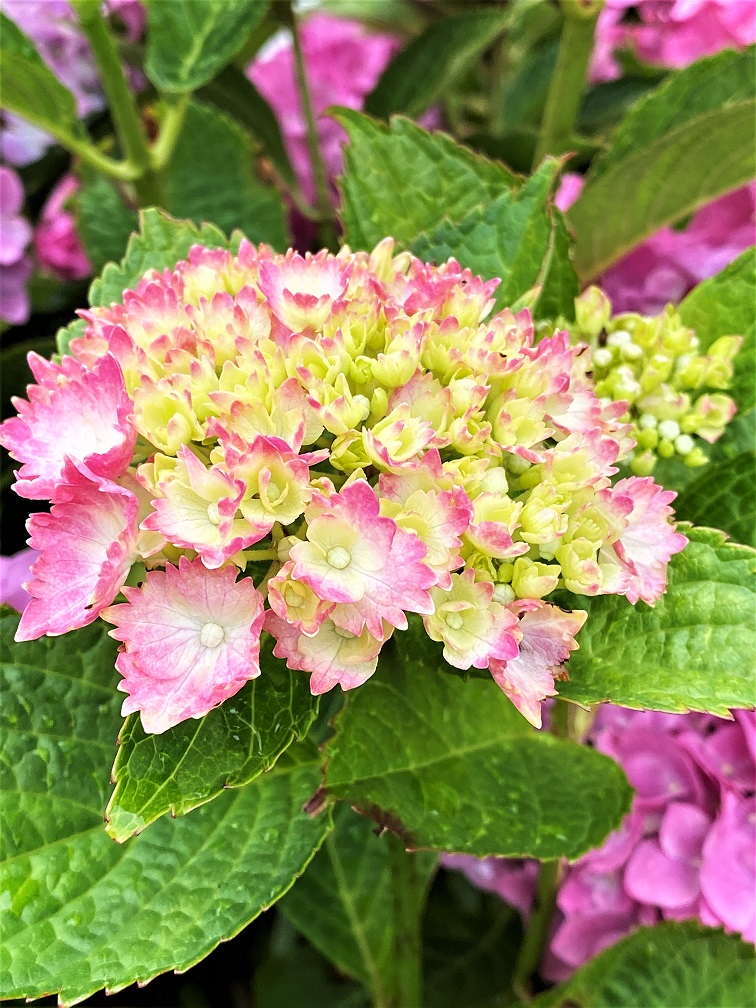

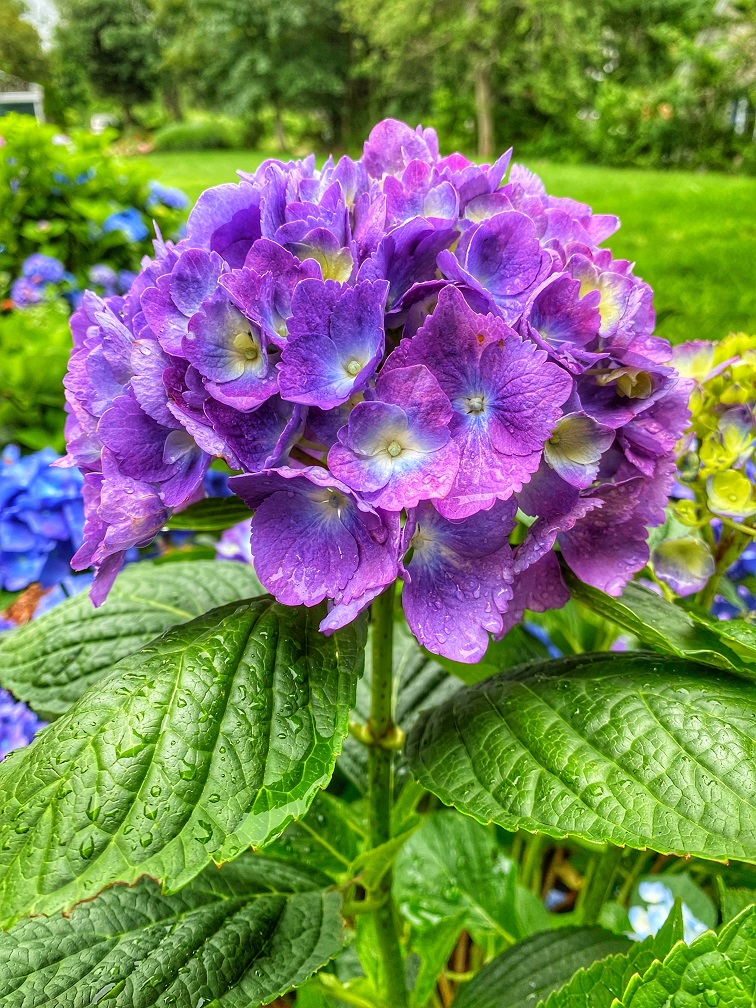
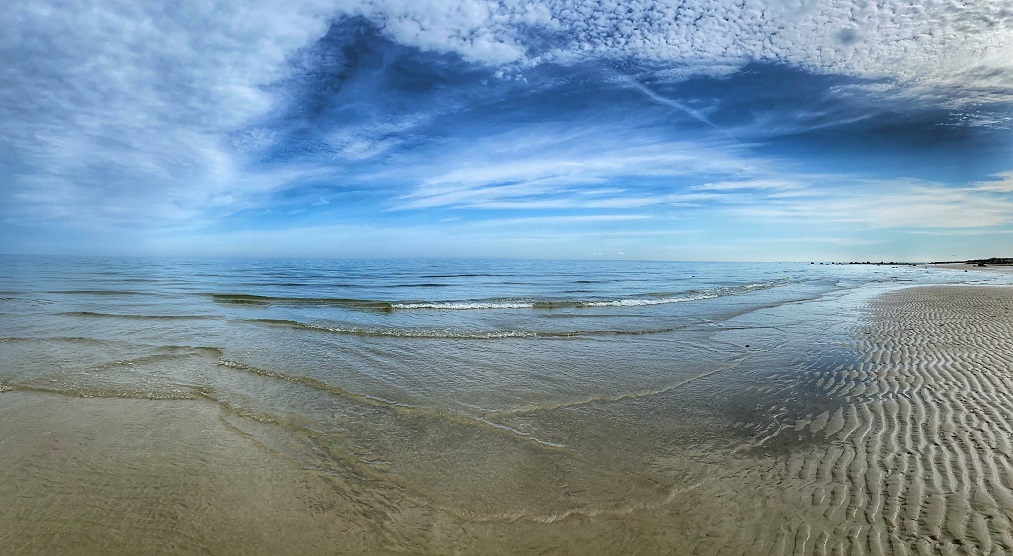
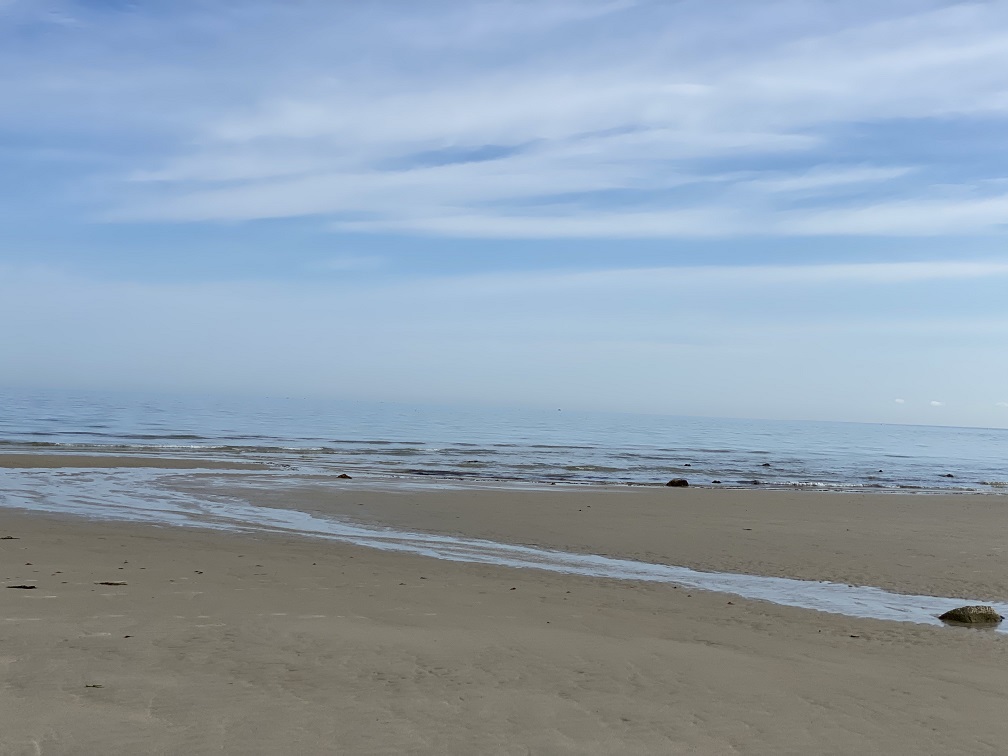
Our next subject is the ocean. Cape Cod is a special place, where you can find huge swathes of water only a few inches deep, or simply a wet send that goes for miles and miles during low tide. The water and the sky magically connect, creating an ultimate rhapsody in blue – see for yourself:
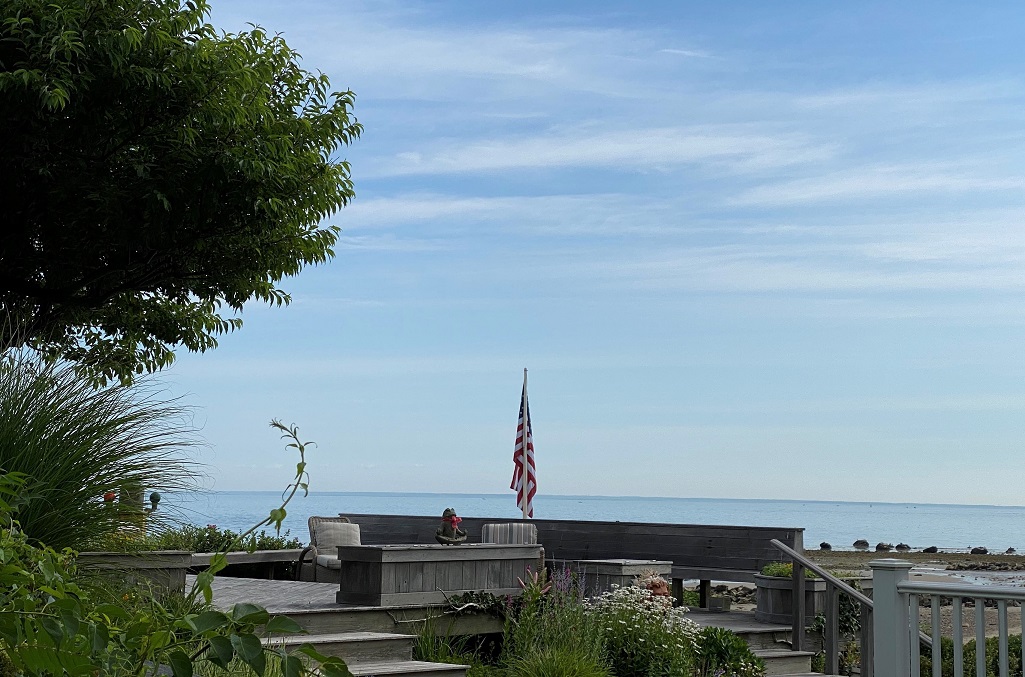


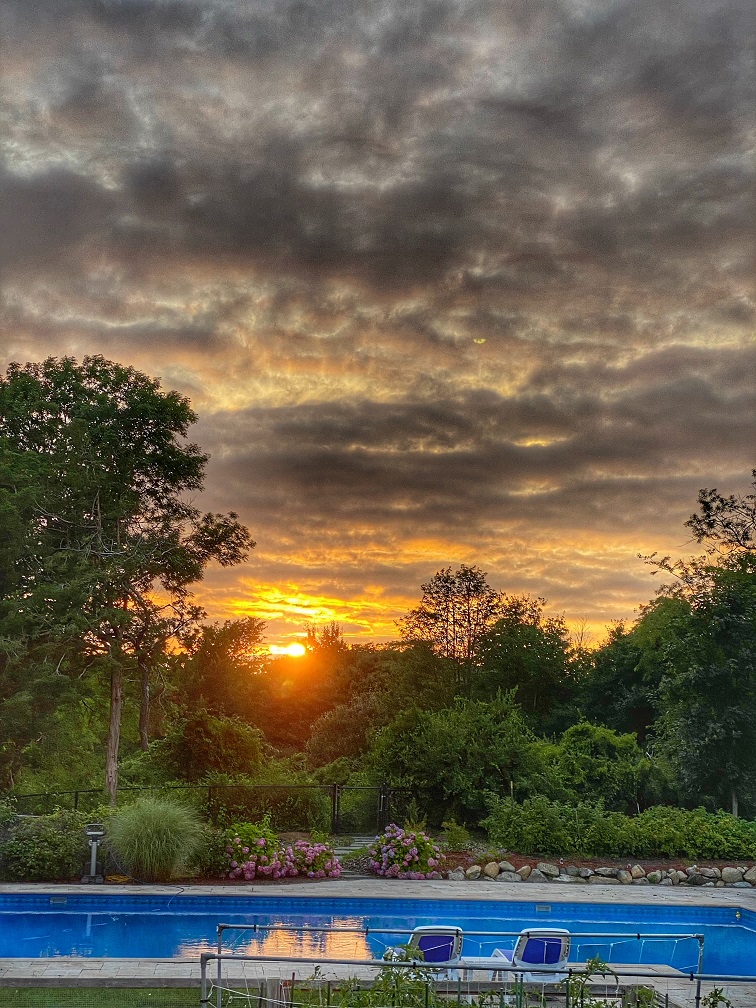
 The sunsets were challenging this time around. Two days out of three that we spent on The Cape, the weather was not good at all – rain, wind, and more of the rain and wind. Nevertheless, the weather was taking a break in the evening to present a beautiful sun setting imagery, which we enjoyed from the comfort of the deck – with a glass of wine in hand:
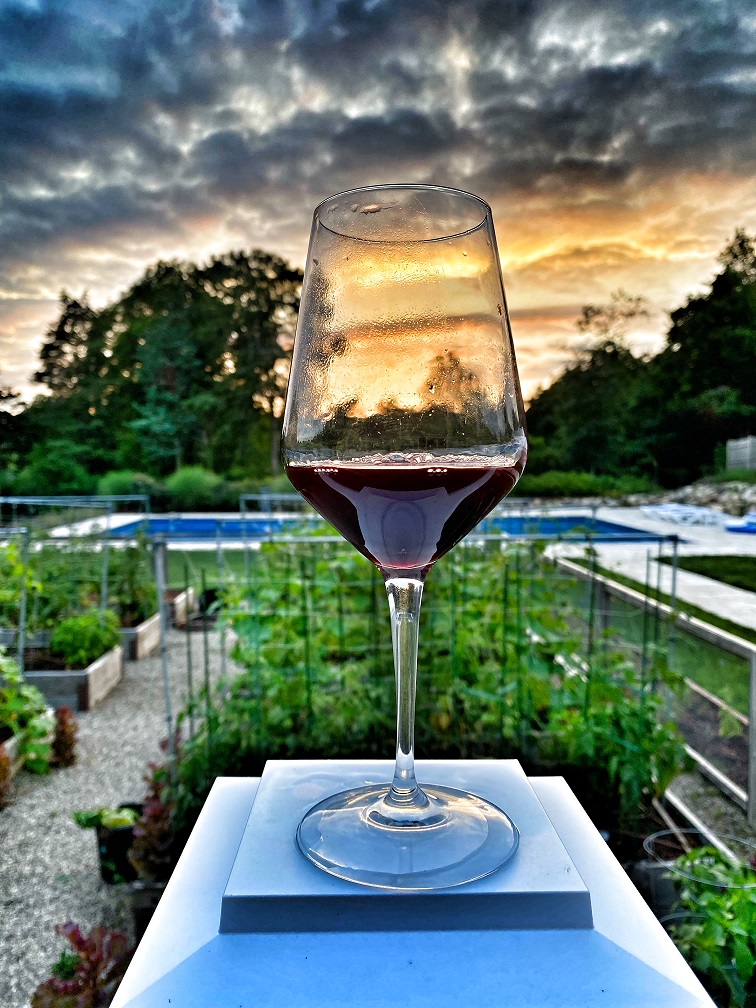
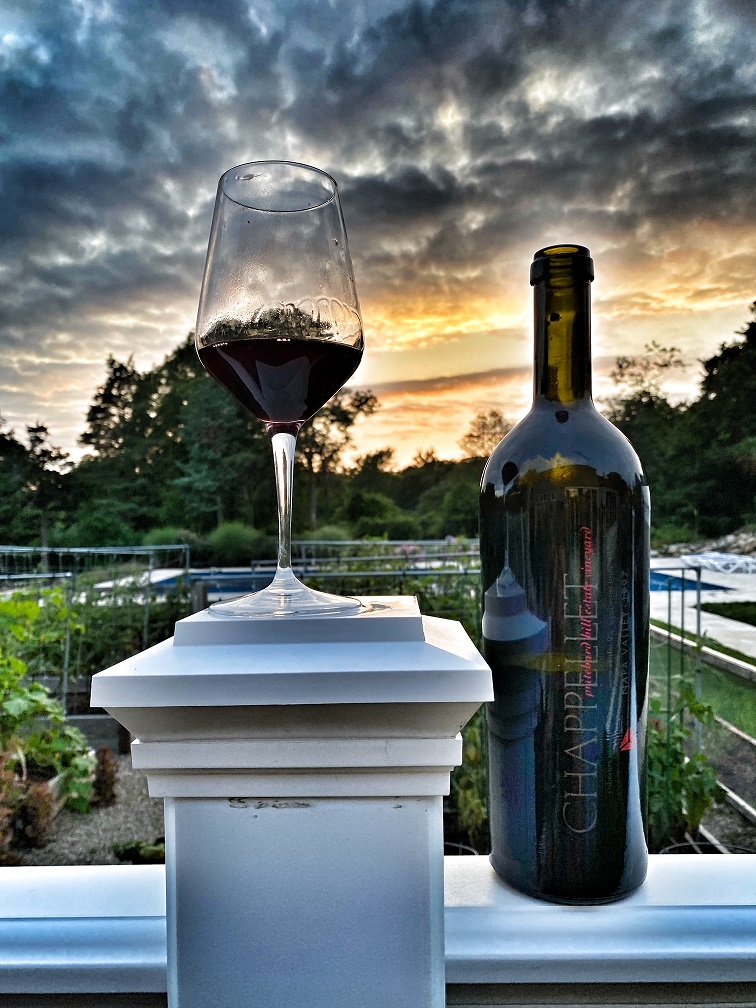 And this brings us to the last subject of today’s post – the wine. This was a vacation, and I was absolutely not interested in taking any sort of formal notes. But somehow, the majority of the wines we had were so good (with the exception of some sort of homemade wine from Moldova, which we had to pour out) that I can’t help it not to share the pleasure. Here are my brief notes.
We started with 2020 Hugues de Beauvignac Picpoul de Pinet AOP (14.1% ABV) – fresh, clean, well balanced. The wine offered a touch of the whitestone fruit and was a perfect welcome drink after 4 hours of driving. It is also very well priced at about $12 at Total Wines in Boston, which is almost a steal at that level of quality.
2019 Golan Heights Winery Yarden Sauvignon Blanc Galilee (13.5% ABV) offered a beautiful Sauvignon Blanc rendition with a hint of freshly cut grass and beautiful creaminess. This wine was more reminiscent of Sancerre than anything else – an excellent effort out of Israel.
2016 Sonoma Mountain Steiner Vineyard Grüner Veltliner (14.1% ABV) – one of the perennial favorites (I’m very disappointed when my Carlisle allocation doesn’t include Gruner Veltliner). Beautiful fresh Meyer lemon, grass, clean acidity – in a word, delicious.


The last white wine we had was 2016 Château de Tracy Pouilly-Fumé AOP (13% ABV). Another Sauvignon Blanc – plump, creamy, delicious. Nicely restrained and round. It is definitely a fun wine as long as the price is not taken into the consideration – otherwise, at about $40, both Yarden (under $20) and Picpoul wines would give it a great run for the money.
Our Rosé was fun 2020 Samuel Robert Winery Pinot Noir Rosé Vineyard Reserve Willamette Valley (13% ABV) – the Oregon Rosé is just not very common. This wine had nice strawberries all around – on the nose and on the palate. I would probably want it to be a tiny bit less sweet, but the wine was still quite enjoyable.
2017 Campochiarenti San Nicola Chianti Colli Senesi (14.5% ABV) is one of my favorite wines to surprise friends and even myself with. It starts as a solid Chianti would – cherries, tobacco, leather, iodine. But in a few minutes of breathing, it magically evolves to add sandalwood, nutmeg, and exotic spices. An incredibly heart-welcoming sip.
And to top of everything else, the 1997 Chappellet Pritchard Hill Estate Cabernet Sauvignon Napa Valey (87% Cabernet Sauvignon, 9% Petite Sirah, 4% Cabernet Franc) was thrown into the mix by my brother-in-law. This wine was a testament to California Cabernet Sauvignon; a simple proof that well made California Cab might be the best wine on Earth. This wine had no – none – signs of aging. Fresh, young, concentrated, cassis and cherries with a touch of mint and coffee, beautifully layered and well structured. This wine was not yet at its peak – I wonder how many more years it would require to reach the top…
And now, an absolute surprise – 2000 EOS Tears of Dew Late Harvest Moscato Paso Robles (10.5% ABV) – a late harvest wine from Paso. Beautiful orange color, and nose and palate loaded with ripe apricots – a hedonistic pleasure on multiple levels.
Now that is the whole story I wanted to share. What is your favorite flower? Have you tasted any amazing wines lately? Cheers!
Last Bottle Sign Up ($10 credit)




 Talk-A-Vino