How Art The Wine Is?
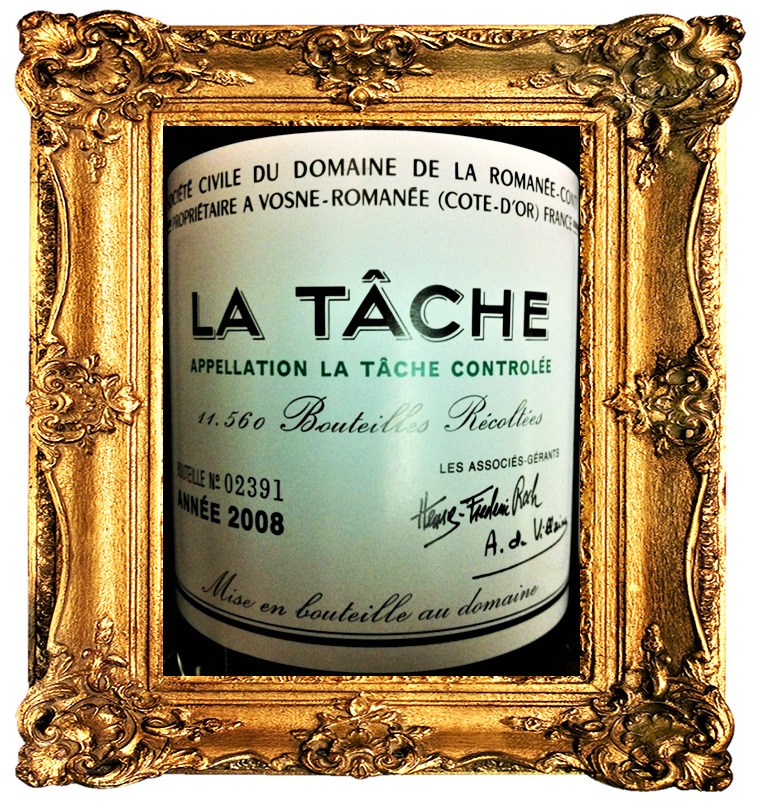 <rant>
Wine is Art.
I always say this, and I’m willing to fight anyone who disagrees.
Same as a painting, a classical music piece, a sculpture, an architectural masterpiece, or an elaborate flower garden, well-made wine solicits the emotional response, hence it is an art form. Defining this art, there is one key difference between, let’s say, a painting and a bottle of wine – we only need to look at the painting to trigger an emotion – but we need to drink the wine to make it an ultimate art form.
A few months ago, a friend told me “I have a wine question for you”. He is a wonderful friend, but he typically drinks Bartenura Moscato, so the wine question? Okay, let’s hear it. So the question was about the wine and NFTs. NFT, which stands for Non-Fungible Token is a form of cryptocurrency, typically used to guarantee authenticity and ownership of unique forms of art or objects – this article might help if you want to learn more. So the friend was asking if he should buy NFTs of some obscure wine (there was a choice in the catalog) – and if not this wine, then maybe that wine.
Literally the next day I got a call from another friend who was asking if he should invest a good amount of money in the fund which invests in fine wines. Technically, you pay for the case (or 5, it depends on availability and demand) of unreleased wine (futures). The fund company will take ownership of that case, will store it in the proper conditions, and will report back to you a current market value of your case, so you can sell it when you think it is time – with a very large profit, of course.
It seems that these investments are flying out faster than hot potatoes in the hands of an amateur chef. That same friend called me to complain that because I didn’t give him good advice right away, the wine he was asking about was already sold out and he had to get on the waiting list for the wine of supposedly a lesser pedigree.
During last month I also heard about the same offerings from yet another friend, and then even received a direct ad in the Instagram stories, to invest in wine with a guaranteed incredible return.
Now, my question to you – a collective “you”, anyone who would spend time – is this how it should be? Yes, I get it, it is capitalism, supply and demand, of course, but the wine is made to be drunk, consumed, mesmerized upon, start crying, laughing, grabbing someone excitedly on the shoulder – but not just to be another form of the stock certificate?
Of course, there is wine collecting. There are people with access, who accumulate lots and lots of bottles, many of them very expensive and very limited, but I would assume that even the wine collectors acquire the wine to be consumed and enjoyed – not all of it, but at least some of it? This wine investment fund idea relegates wine simply to the form of another agricultural commodity – corn, wheat, cattle. Commodity trading had been around forever – nobody owns 100 bushels of rice, but anyone can make (or lose) money on it. But rice is not art – rice is simply a necessity, and yes, if you are hungry, it will solicit the emotion, but it will not be the same as when you are truly enjoying a glass of wine.
The latest entrant into the NFT craze – Robert Mondavi winery. Three of the star winemakers produced 1966 magnums of wine called MCMLXVI (that is 1966 in Roman numerals – 1966 is the year when Robert Mondavi winery was founded), Cabernet Sauvignon and Cabernet Sauvignon blends from 2019 vintage. This wine will be packaged into specially designed porcelain bottles by the French porcelain designer Bernardaud, with each bottle having a unique QR code, and sold at $3,500. Now, when you will buy the bottle, you will get an NFT, which will assure your ownership, and there will be a connection between an NFT and that QR code on the bottle. In addition to the bottle of wine, each purchase will somehow include the generative artwork (you look it up – I guess it means a visual object/ painting generated by computer algorithm) by the artist Clay Heaton. Also, the QR code with NFT will serve as protection against counterfeiting – like the porcelain magnum bottle by itself is not enough.
So I wrote all of this, then took a pause and had to ask myself – what is your problem, dude? Everything sounds great in this picture – great winemakers, perfectly artful presentation of the perfect wine, guaranteed authenticity, and even a bonus in the form of the hot piece of art. What is my problem, really?
This wine is not created to be enjoyed as wine. This product is strictly a financial instrument. Star winemakers will attract attention. Unique packaging will attract attention. But then this is strictly sold as a financial instrument. NFTs are typically sold through an auction-like mechanism, so there clearly will be open bidding, with $3,500 being an initial price. There is also an opportunity to resell that piece of digital art, so all in all, this is strictly a money transaction. I wonder if any of these bottles will be ever open, or they will strictly exist for their monetary value.
Yes, wine is business. Yes, I’m naive. Yes, I’m romanticizing wine. Yes, you can call me old and stupid. That’s all fine. But the only way to enjoy wine is by drinking it. I love money as much as anyone else here, but still, if someone is buying wine only for its resale value, they don’t love wine, they only love money. Connecting NFTs to wine only amplifies the conversion of the wine into a financial instrument. And if wine is becoming only an abstract monetary instrument, one day someone will realize that it doesn’t matter what is in the bottle – any plonk will do. And then another day, someone will open that bottle… and… I really have no idea what will happen then. Or what will happen if one day, unhackable blockchain will be hacked, and all the NFTs will disappear – will someone then decide to drink that wine?
Wine is art. To be more precise, the wine in the closed bottle is only a potential art – or just another monetary instrument. Wine becomes art the moment it is poured into your glass. And that is the only reason for wine to exist.
</rant>
Am I missing something? Do NFTs have anything to do with enjoying the wine? Are NFTs really connected to the future of wine? Am I just jealous of the people with unlimited monetary resources? I’m ready to discuss…
Tempranillo, Transposed
How do you transpose a grape, any grape?
What does this title even mean? You transpose matrices (in algebra), or, at the very least, the notes of music. But Tempranillo???
Let me put my geek’s hat on, and let’s look at the definition of the “transpose” as the infinitely wise internet presents it:
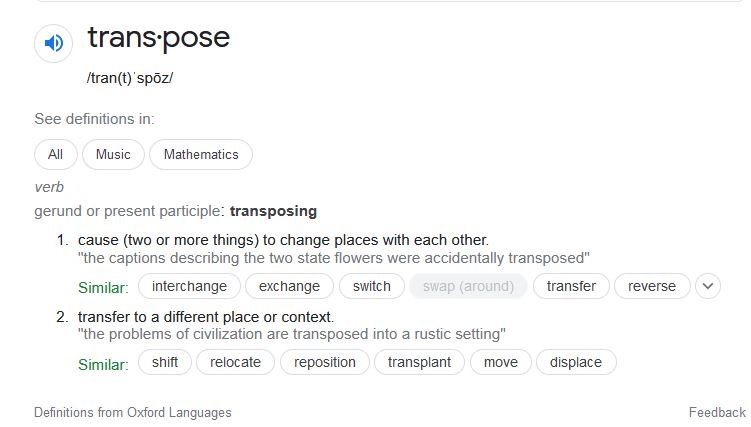
“transfer to a different place or context”
The legendary CVNE had been producing Tempranillo wines in Rioja since 1879. Step by step, new vineyards were planted, and new styles of Rioja were going into production, each one with its own unique style and character – CVNE, the original earthy Rioja; softer and gentler Viña Real, powerful and concentrated Imperial, elegant and modern Contino. These are all Rioja wines, a blend of Tempranillo and a few other varieties, each one with its own personality and its own following.
Achieving success, some of us can just sit quietly and enjoy it. And some of us just want to say “I’m here now, and this is great, but I can’t stop. Let’s go further”. And down south CVNE decided to go, into the Ribera del Duero area.
Rioja is unquestionably famous with its Tempranillo wines, with producer such as CVNE, Muga, La Rioja Alta, Lopez de Heredia, and Contador. Ribera del Duero, down south from Rioja, got Vega Sicilia, Pingus, Pesquera, Emilio Moro – all amazing Tempranillo renditions as well. Now, the question is – why would a famous Rioja producer expand into a different region? Well, this is somewhat of a “why did the chicken cross the road” type of question – simply to get to the other side. CVNE doesn’t want to stop. CVNE goes beyond Rioja, into Ribera del Duero, the land of 100% Tempranillo wines – and the folks in Rioja know a thing or two about Tempranillo…
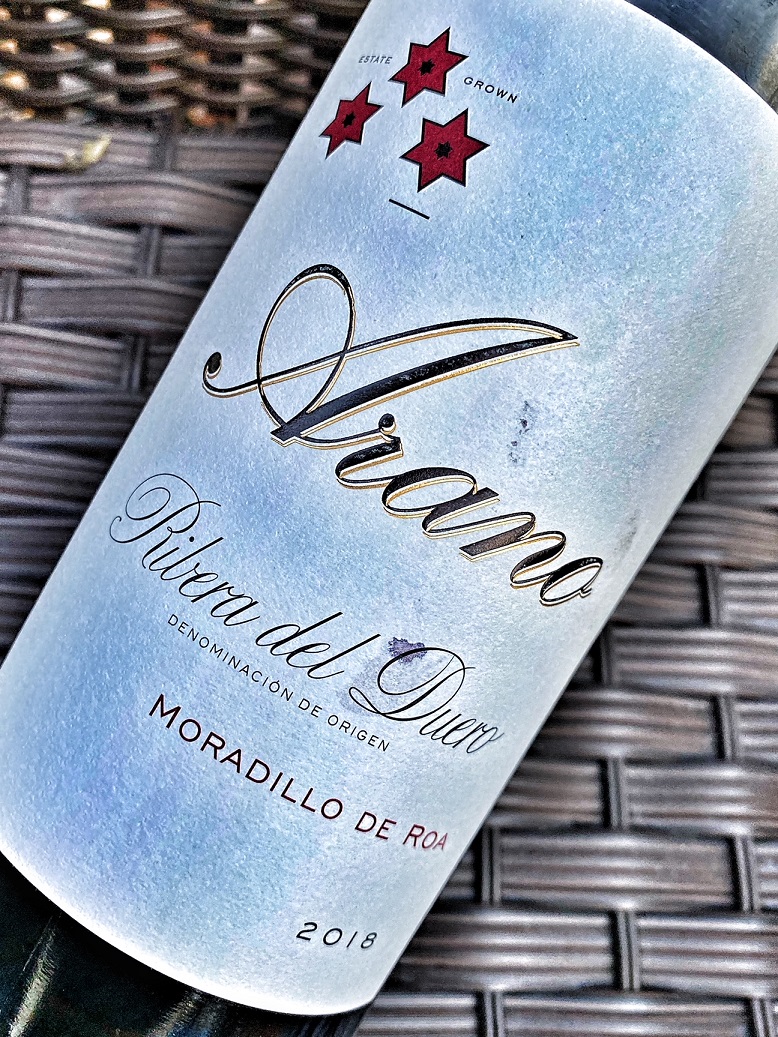
This is how the new brand of CVNE wines from Ribera del Duero was born – and it is called Arano. I had a few questions about this new adventure for CVNE, and so I asked those questions of Victor Urrutia, CEO of CVNE, to understand why the Arano name, why Tempranillo from Ribera del Duero, and what does the future hold. Victor graciously agreed to answer my questions – here is our conversation:
[TaV]: Why Arano label? What is the relationship between Arano and CVNE?
[Victor Urrutia]: CVNE is the owner and founder of Bela and Arano. The Bela and Arano labels are facsimiles of a label of ours, that is to say from CVNE in Rioja, from 1910. It is a simple and beautiful label from our archives. When we try and invent things we realise that we’re not very good at it, and that in fact, what our forefathers did is far better. CVNE is a family company and has been since it was founded in 1879. The 3 stars on the label represent the 3 children of CVNE’s cofounder, Eusebio Real de Asúa. He had 2 daughters and one son. Their names were Sofia, Ramon, and Aurea Minerva. The eldest, Sofia, was known as Bela. That is the name we have given to this winery, and it is also the first estate wine that we have made in Ribera del Duero. It’s the first star. The second star is for Arano. The only son was called Ramon and his mothers’ maiden name was Arano. We chose this name for the second estate wine to be released from the winery.
Bela is Tempranillo from our vineyard in the village of Villalba, on clay soils. Aged for 9 to 12 months in barrel. The vineyard is around 70 hectares. Arano is Tempranillo from our vineyard in the village of Moradillo de Roa, on limestone and pebbled soils. Aged over 12 months in barrel. The vineyard is around 9 hectares.
[TaV]: Why Ribera del Duero? What was the inspiration for CVNE to expand into Ribera del Duero?
[Victor Urrutia]: We want to bring our take on rioja’s elegance to rugged Ribera del Duero. The latter makes excellent wines and is a historic region. As ambassadors for Spain across the world, we felt it was our obligation to own vineyards and make wine in Ribera del Duero; and to make these known everywhere.
[TaV]: What is the future hold for Arano Ribera del Duero wines? Do you plan to produce Reserva and Gran Reserva?
[Victor Urrutia]: In Ribera del Duero we are making wines that express the vineyards that we own in this appellation. We label some of these as Crianza, for instance, because some consumers find it helpful; but it is not an important consideration for us when we conceive the wine. As we get to work and know our vineyards better, we will consider releasing new wines from this winery. After all, there is another star in the label, that we need to make a wine for. We haven’t yet found this vineyard. Or rather, haven’t found the way to express what must be our grand cru in this region. But we are working on it.
[TaV]: Any future plans for CVNE to expand further south, maybe into the Toro region?
[Victor Urrutia] There are some great producers in Toro, like the García family behind Mauro. But in general, we find the wines of Toro to be very dense and powerful, and I’m not sure we know how to make wines in that style. Our future lies in continuing to make wines of elegance and age-worthiness.
We need to continue looking for vineyards that will allow us to make those kinds of wines. They’re probably in higher elevations and northern exposures. There’s much to continue doing in Rioja, Ribera and of course, Galicia, where our Virgen del Galir winery has started to make wines of great depth from the vineyards that we bought as well those we’ve planted there. We bottle Godello, Mencia as well as Merenzao, varieties that we hardly knew about some years ago and the wines are phenomenal. We even have Palomino (locals call it Jerez, or sherry) that, arguably, expresses the terroir better than anything, given its neutral profile as a grape variety. Is it perfect? No, but it’s honest. And also quite interesting. Like everything that we try to do.
Now let’s talk about CVNE’s latest and greatest – 2018 Arano Crianza. As Victor mentioned, the grapes for this wine are coming from 4 different plots in the Moradillo de Roa vineyard, located at an altitude of about 3,000 feet above sea level. I had an opportunity to taste this wine, and it was unquestionably Ribera del Duero in style, much leaner and tighter than a typical Rioja wine. Here are my notes:
2018 Arano Crianza Ribera del Duero DO (14.5% ABV, $30, 15 months in French oak barrels, Vegan)
Dark garnet
Aromas of roasted meat and earth jump out of the glass at least a foot away from it. Espresso and herbs come at you at high intensity.
The palate is somewhat unexpectedly mellow, with dark fruit and herbs, good acidity, long and supple finish.
Better concentration on the second and third day, the wine feels tighter with more energy.
Drinkability: 8-. Enjoyable now, built for the long haul
The journey is getting more and more exciting by the minute. This is not algebra, but we are definitely looking at the case of the successful transposition of a grape – go find the results of this Tempranillo transposition, and we can compare notes. Cheers!
Cabernet Franc – Well Worthy of a Celebration
Cabernet Franc.
Let’s talk about it.
Cabernet Franc is a parent. Like most parents, Cabernet Franc is often overshadowed by the achievements of its kids – especially when its kids are none less than Cabernet Sauvignon and Merlot, some of the most famous in the wine world. It is interesting that Cabernet Franc is often described as “blending grape” – while it is true that Cabernet Franc is a popular choice in Bordeaux blends around the world (it typically ripens at a week earlier than Cabernet Sauvignon, so it offers winemakers an “insurance policy” of sorts), it also excels just by itself. As a blending grape, Cabernet Franc is typically used with Cabernet Sauvignon or Merlot, adding something important to the resulting wine. Meanwhile, the majority of single-grape Cabernet Franc wines have nothing else in the blend – just pure, unadulterated Cabernet Franc.
Today, we are talking about this pure Cabernet Franc. It grows successfully in the absolute majority of the winemaking regions – Bordeaux and Loire Valley in France, Italy, Argentina, Australia, Chile, Eastern Europe, Canada, New York, Virginia, New Jersey, California, Washington, Oregon, …. Pure Cabernet Franc wines typically happen to convey the terroir much better than Cabernet Sauvignon or Merlot. With Cabernet Sauvignon, no matter where it is coming from, everyone is trying to achieve the “golden standard” of Bordeaux or Napa Valley expression, even if the wine is made in Italy, Argentina, or Long Island, New York. Cabernet Franc typically conveys a sense of place first and foremost – lean, clean, and minerally driven from Chinon, tart and herbaceous from New York, round and luscious from California. Same grape, unlimited number of expressions.


Celebrating the range of expressions of Cabernet Franc I can simply offer you a few of my experiences from this year. Back in April, I had 2017 Hawk and Horse Vineyards Cabernet Franc Red Hills Lake County California, a biodynamically produced rendition that offered pristine beauty of cassis elegantly framed with the core of the well-integrated tannins. And then there was 2019 Domaine Bousquet Gaia Cabernet Franc Gualtallary Vineyards, minerally driven Cabernet Franc from the Argentinian dessert. Then there was the 2018 Terra Pacem Cabernet Franc Columbia Valley experience in Eugene, Oregon, offering pure Chinon-inspired, bell pepper and cassis rendition. And I can’t forget the 2011 Gran Enemigo Cabernet Franc Single Vineyard Gualtallary Argentina, again a high elevation desert beauty, which after the unimpressive start, opened up into an intricate interplay of iodine, cherries, cassis, and herbs (this one will definitely be on my 2021 top dozen list).
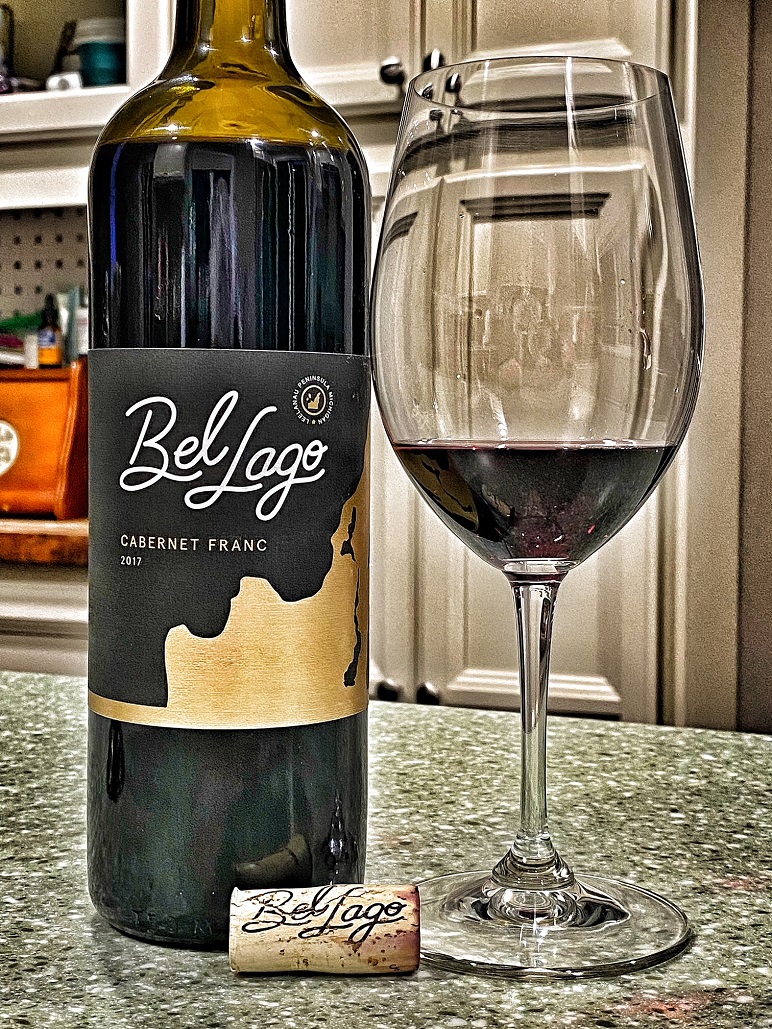 My most interesting Cabernet Franc wine discovery of this year came in the form of the bottle of Cabernet Franc from Bel Lago winery in … Michigan! My excitement comes from the fact that not only I got to taste the wine I never had before, but it also came from the region I had no prior experience with (so I got to update my Wines of 50 United States table the second time this year). And I also got to learn about winemaking in the new state.
2021 is an important year for the Michigan wine industry, as its oldest winery, St. Julian Winery, celebrates 100 years. Today, Michigan has 5 viticultural areas – Fennville, Lake Michigan Shore, Leelanau Peninsula, Old Mission Peninsula, and Tip of the Mitt. About 200 wineries operate in Michigan today, most of them located within 25 miles radius of Lake Michigan.
The Vitis Vinifera grapes were introduced in Michigan about 45 years ago, and today traditional cool-climate varieties, such as Gruner Veltliner, Pinot Blanc, Riesling, Cabernet Franc are doing very well there, and even Cabernet Sauvignon, Pinot, Merlot, Syrah, and Chardonnay had been successfully introduced. Michigan is particularly proud of its Cabernet Franc and even held its first Cabernet Franc Challenge in 2009, where 18 Michigan wineries and one of the French wineries from Chinon competed for the top prize (no, Chinon didn’t win it).
Bel Lago Winery (Bel Lago means Beautiful Lake in Italian) was founded in 1992 and opened its tasting room in 1999. The winery cultivates 100 grape varieties on 37 acres of land and produces between 17,000 and 20,000 cases per year. Bel Lago also produces fruit wines (Cherry wine is very popular) and a number of ciders.
2017 Bel Lago Cabernet Franc Leelanau Peninsula Michigan (13.5% ABV, $48, 87.5% Cabernet Franc, 12.5% Merlot, 34 months in French and American oak barrels) was a beautiful wine – currant leaves and anis on the nose, with a touch of tobacco. Restrained with good cassis expression and herbal notes on the palate with cut-through acidity. Definitely an enjoyable Cabernet Franc rendition, again with its own character, easy to drink, and delicious.
Here it is – new winemaking region and new Cabernet Franc experience. How was your #CabFrancDay experience? Did you learn something new or find a new Cabernet Franc wine that you like?
One on One with Winemaker: Dennis Murphy, Caprio Cellars
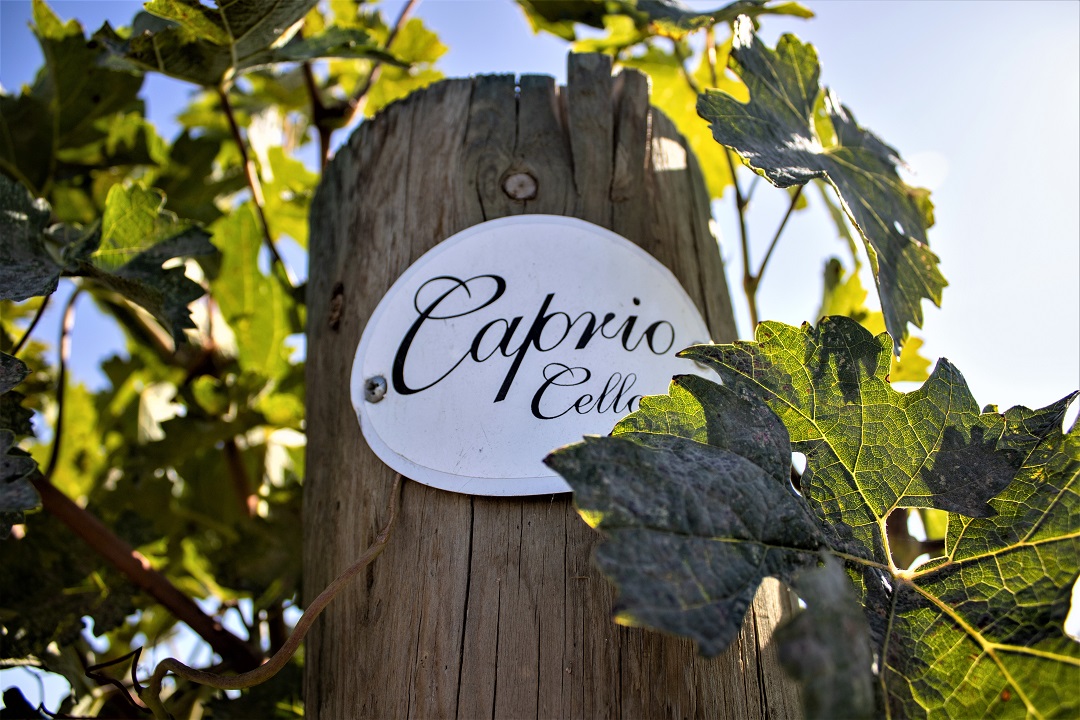
Source: Caprio Cellars
It is a known fact that wine is produced in all 50 states in the US. And I will clearly risk it to alienate many people, but with all due respect to New York, Texas, and Virginia, there are only three belonging to the “big three” – California, Oregon, and Washington. It is Washington I want to talk about today.
I don’t know how this works, but when I think about Washington wines, I feel warm and fuzzy. I don’t know if it relates to wonderful experiences, such as the visit to Chateau Ste. Michelle, getting lost in Woodinville or exploring Walla Walla, or maybe it is because of some of the most amazing American wines being produced in Washington, such as the whole range of Cayuse wines, L’Ecole No41, Guardian Cellars, Mark Ryan, and countless others.
And today, I want to bring to your attention one of my very latest Washington wine discoveries – Caprio Cellars in Walla Walla.
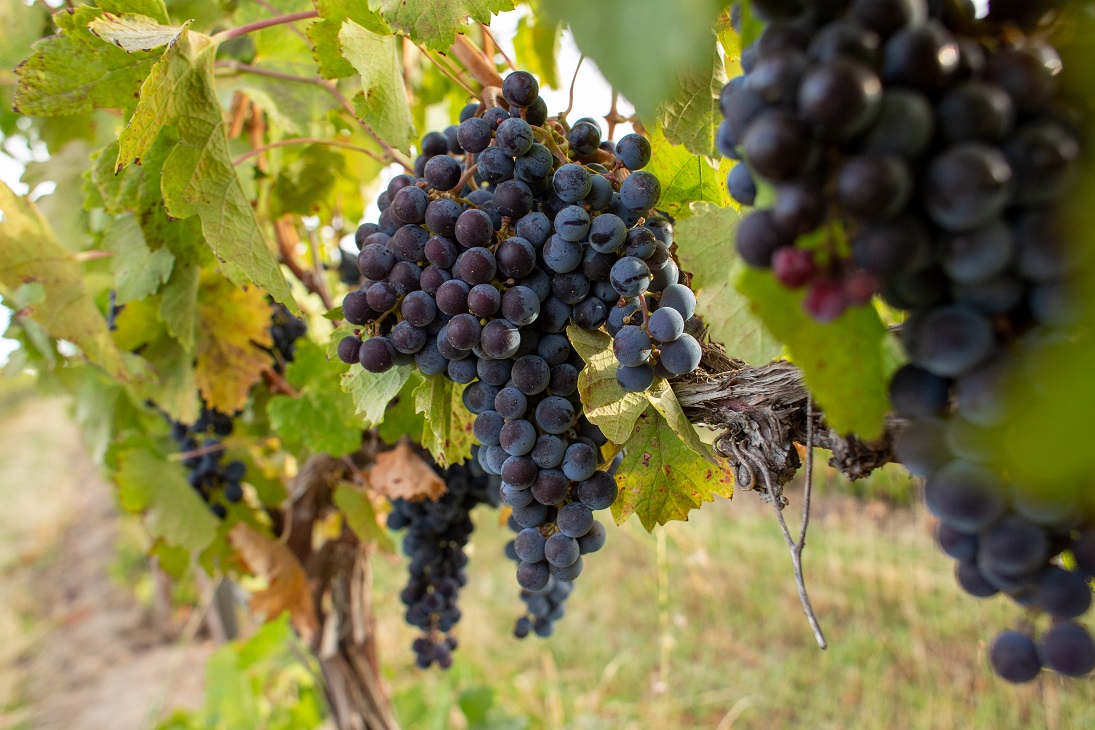
On one side, Caprio Cellars’ story is absolutely “normal” (yes, an interesting choice of word here – what does “normal” even mean, right?). Dennis Murphy purchased a plot of land in Walla Walla Valley (previously a wheat field) in 2003. The first vines were planted in 2005, and the vineyard was called Eleanor in honor of Dennis’ grandmother, Eleanor Caprio; after the first harvest in 2008, the winery got the name of Caprio Cellars, and the rest is history. The second vineyard, Octave, was planted on the hillside in 2007. The latest high-altitude vineyard, Sanitella, was planted on the Oregon side of the Walla Walla AVA. Bordeaux varieties – Cabernet Sauvignon, Cabernet Franc, Merlot, and Malbec are planted across all three sustainably farmed vineyards, with the addition of Sauvignon Blanc planted on Sanitella.
This is where “normal” ends. What is unique about Caprio cellars is that your tasting is always complimentary (okay, yes, this still can happen in the other places). You also have complimentary chef-prepared dishes accompanying your tasting flight, with the seasonal menu – yes, complimentary, as in “free of charge” (I hope you are getting as impressed as I am because I’m not sure where else you can find that). And Dennis is very passionate about charities he supports. That definitely puts Caprio Cellars in the category of its own.
After tasting a few of the Caprio Cellars wines, I was ready to talk to Dennis. While we were unable to meet in person (something I really hope to rectify in the near future), we sat down with Dennis virtually, and he patiently answered all of my questions – and now I would like to share our conversation with you. Before we begin, one small note – this is a long conversation, and you definitely shouldn’t miss the answers to the questions at the end of this conversation. So I suggest you will settle in your favorite chair, pour yourself a glass of wine, and come along!
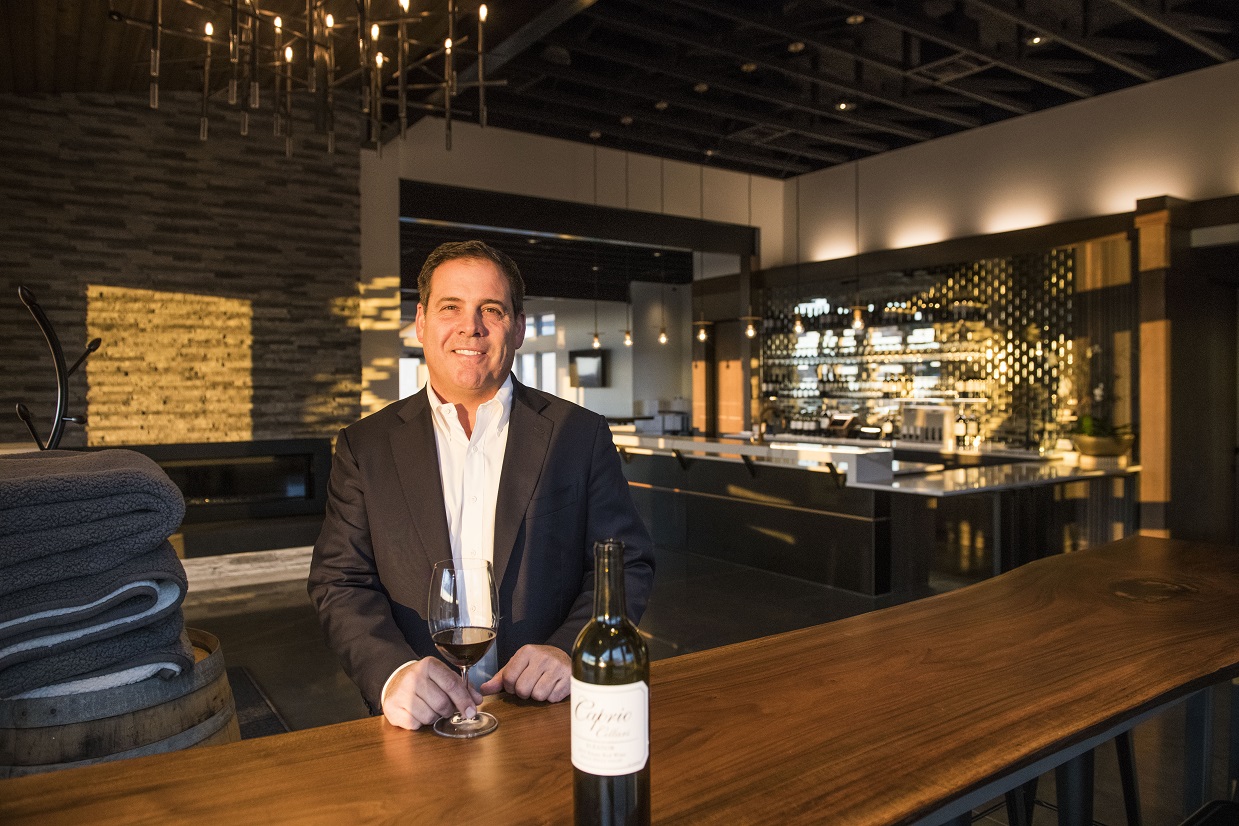
Dennis Murphy. Source: Caprio Cellars
[TaV]: Growing up, what was your exposure to the wine culture?
[DM]: Growing up, I remember my dad and grand parents making wine in the garage or the basement. Some was good, some was not so good. Wine was always a part of the dinner celebration, holidays and family gatherings.
[TaV]: Was there a pivotal wine in your life?
[DM]: The wine that brought me to Walla Walla was L’ Ecole No. 41 Merlot. I tasted this wine at a restaurant in Seattle and was blown away. I then started stopping at the winery and collecting the wine and eventually moved to Walla Walla.
[TaV]: When and how have you decided that you will own a winery?
[DM]: After tasting some Walla Walla wines and visiting Walla Walla, I fell in love with the town and moved. I could feel the energy in the wine scene emerging and moved to Walla Walla in 1999. There were just a hand full of wineries, so I started to make myself available during harvest and made some friends in the wine industry. In 2003 I purchased the winery estate property and in 2005 I planted my first vineyard, the Eleanor Vineyard.
[TaV]: Any plans for stepping outside of Bordeaux play – how about Syrah or Grenache which are so popular in Washington? Or maybe some Sangiovese or Tempranillo?
[DM]: I only make wines that I love to consume. I would look at Grenache, I love Grenache and think that the valley can produce some good fruit. We are making sparkling wine, I am intrigued to make a sparkling Rosé. I believe that focus is required to make world-class wine. I am focused on making world-class red Bordeaux-style wines from Walla Walla.
[TaV]: Considering your Italian heritage, do you have any favorite Italian wine regions, wines, or producers?
[DM]: It will not surprise you, I am a Super Tuscan guy. I think that the Cabernet Sauvignon and Merlot show very well. One of my favorite all time wines is the 1997 Ornellaia.
[TaV]: Are there any wineries and/or winemakers in Walla Walla who you would consider as your source of inspiration?
[DM]: Seven Hills/ Casey McClellan makes my favorite wine in the valley, the Pentad. Casey is a great winemaker, makes solid wines and the valley is fortunate to have him.
Source: Caprio Cellars
Source: Caprio Cellars
[TaV]: You are practicing sustainable farming – what does it entail in your daily routine?
[DM]: Sustainable farming is really about being as hands off the vineyard as possible, letting the land and crop do their thing naturally. Sustainable farming is very important for the industry and the environment. Mother Nature can provide anything that a chemical or synthetic can provide, you just have to work at it.
[TaV]: Any plans to advance your farming towards biodynamics?
[DM]: I do not have any current plans to farm biodynamic, but I have not ruled it out either.
[TaV]: First harvest at Caprio Cellars was in 2008. Do you still have any of those wines in your cellar? How are they evolving?
[DM]: Yes, I have the 2008 Caprio Cabernet Sauvignon, it was the only wine we made that year. I keep about 50 cases per vintage in the library, this would be considered a lot, but I like to keep more wine around for winemaker dinners, etc. The 2008 Caprio is holding up well and we get to visit it occasionally.
[TaV]: Any plans for more white wines in the future?
[DM]: Caprio grows Sauvignon Blanc and Semillon, these two varietals do well in our higher elevation Sanitella Vineyard. We release our Sauvignon Blanc in the spring, it is a crowd-pleaser and sells out quickly. We also make a rose’ of Cabernet Franc, this is a beautiful spring released wine as well.
[TaV]: Where do you see Caprio Cellars in 10-15 years?
[DM]: Caprio will be at our production goal of 5,000 cases per year. I believe this production is a sweet spot for a winery and you can still maintain quality. We will continue to provide a unique approach to hospitality, I am not sure what is next on that front, but we will continue to be the thought leader in our industry in the Walla Walla valley and push the envelope, it is in our DNA.


Let’s take a little break and taste some wines. I had an opportunity to taste two of the estate wines, Bordeaux blend, Eleanor, from 2017 and 2018 vintages. Here are my notes – and some related conversation right after:
2017 Caprio Cellars Eleanor Estate Red Walla Walla Valley (14.5% ABV, $48, 50% Cabernet Sauvignon, 28% Merlot, 12% Malbec, 10% Cabernet Franc, 65% Octave Vineyard / 35% Eleanor Vineyard, 18 months in 100% French oak – 35% new oak / 65% neutral barrel)
Dark Garnet
Minerality, underbrush, herbal profile – fruit undetectable
Expressive minerality, cherry pit, espresso, massive presence – typical Washington red which needs time (and hope) – and these are second day notes. Too big for my palate on the first day.
7+/8-
2018 Caprio Cellars Eleanor Estate Red Walla Walla Valley (14.5% ABV, $48, 59% Cabernet Sauvignon, 19% Merlot, 15% Malbec, 7% Cabernet Franc, 53% Octave Vineyard / 47% Eleanor Vineyard, 18 months in 100% French oak- 35% new oak / 65% neutral barrel)
Dark garnet
Blackberries, a touch of eucalyptus and cassis
Beautiful. Perfect mid-palate weight, silky smooth and velvety, cassis, cherries, supple, voluptuous.
8+, superb from the get-go.
[TaV]: This question is two-part about the wines I tasted:
First, the bottle of 2017 Eleanor is capped with foil, and 2018 is not. Why the change? Is this going to be the style moving forward?
[DM]: I am a traditional guy, I do love a foil cap on a bottle of wine. In line with our sustainability efforts, we held a customer focus group and it turns out that most customers prefer not to have the foil. We decided to leave it off in 2018 and it has been well received. I believe all future wines will not have a foil cap.
Now, the question which I never ask, but this time I have to. I tasted first 2017 Eleanor Red, and the wine was massive and tight – very typical for Washington reds, I call this type of wines “liquid rock” – lots of minerality and limited fruit. The wine opened up a bit on a second day but still was very tight. 2018 Eleanor Red, on the other hand, was approachable from the get go – Bordeaux style fruit, layered and smooth. Can you explain such a dramatic difference between these two wines? The grape composition is very similar, was that the terroir? Winemaking?
[DM]: Acid – the 2018 was the first vintage I nailed the acid level. It is a tight rope when it comes to acid, but 2018 and the 2019 are near perfect. I was pretty excited when I opened the 2018 Eleanor after bottling. Additionally, the vintages differed, 2017 was a tough year to get ripe, there were some photosynthesis issues that vintage. The 2018 vintage was a playbook vintage. What is funny is that in the tasing room we would taste the 2017 and 2018 side by side and the verdict was a 50/50 split. The 2017 was the fastest selling Eleanor we have produced, but the 2018 Eleanor is a critic’s favorite.
[TaV]: I understand that Caprio Cellars also supports a number of charities. What was the motivation behind this program? How do you decide what charities to support?
[DM]: Giving is a part of my every day living, it is in my fabric as a human. I created the phrase “give as you go”, this phrase is at the core of the purpose statement for my construction company. It was only natural for me to carry this belief to Caprio when we started. Caprio gives resources to many charities, mostly in the form of auction donations of wine and winemaker dinners. The winemaker dinners are very popular and bring a large amount of funds to the charity. Caprio focuses most monetary giving to First Story and Big Brother Big Sister. My construction company founded First Story and it helps families that otherwise would not have a home to get a home of their own. I have been a Big Brother for 18 years now and was on the board of directors, so it is a cause near and dear to me.


[TaV]: Last question is from the “how do they do it???” line. I understand that the wine tastings at Caprio Cellars are complementary. Not only that, but you also feed people! I read a number of discussions on professional wine forums with explanations that winery is a business and that literally how dare the wine lovers to expect their tasting to be complementary. And here is Caprio Cellars which does exactly that. So how do you do it and why? How is it working for you?
[DM]: I had no interest in opening a tasting room and charging a tasting fee. It seems like our industry has evolved into that business model. That model doesn’t make any sense to me. I wanted to disrupt the industry and focus on hospitality and the customer. Specifically focusing on the customer journey. We held focus groups at the beginning with Joseph Michelli (NYT bestselling author and consultant) from the Michelli group. Joseph believes that most businesses do not pay attention to their customers’ needs until it is too late in the customer journey. The Caprio tasting experience is based on the equity theory, I do something nice for you and in return, you will do something nice for me. The majority of the industry takes a tasting fee from the customer and gives it back “if you decide to buy”. We are all adults here; I do not need to take your money and give it back. I spent hours in other tasting rooms watching the customers sit in their group and have an agonizing group discussion on “how are we going to get out of here alive with our tasting fee”, discussions about you not liking the Syrah or him not liking the Chardonnay. Why put your customer through this process? At Caprio, we skip this pain point and we add the pleasure of a hand-crafted food pairing from our Executive Chef Ian Williams. My grandmother Eleanor Caprio is to blame or credit for the food pairing, if she knew I invited you over for a glass of wine and I didn’t offer you food, she would be very disappointed in me. The food program at Caprio was nonnegotiable when we opened, it is part of our program and a distinguishing advantage to our experience. Here is the punch line, if you like the food and wine pairing, we ask you to purchase a couple of additional bottles of Caprio to pay it forward to the next guest in our care. So far it is working out well and the ecosystem is taking care of itself, it is a beautiful thing, but somebody had to have the guts to try it.
Here we are, my friends. A wonderful story of passion, good wine, and a unique business approach. If your travel will bring you to Walla Walla, Caprio Cellars should be on your visit list. And if your travel will not bring you to Walla Walla … change your travel plans! Cheers!
Fun With Numbers – Analyzing 2021 Top 100 Lists
 Whoosh…
It is the last month of the year already – do you believe it? There are very few facts left in this life – time moving in one direction is still one of them.
The arrival of December means that it is the time to look back at the year which is about to bid adieu, and reflect. For example, on all the wines, good and bad ones. And maybe rate them, right?
I know that many of the true wine aficionados scoff at the bare idea of the wine ratings, especially those coming from major wine publications – I’m not talking about wine collectors who live and die by those. Top wine lists are usually equally ignored by those passionate wine lovers. I, however, appreciate all of the scores and top lists as a reference – and also the numbers I can play with.
At this point, all major wine publications produced their Top 100 wine lists – some even multiple Top 100 lists, such as James Suckling with Top 100 wines of Chile, France, Spain, New Zealand, and all other major winemaking regions… That means a lot of numbers to digest and dissect – not something I can pass. I set out to waste spend a good amount of time to convert Top 100 lists from James Suckling, Wine Enthusiast, and Wine Spectator from all the different formats into a set of excel files which then can be compared – and now I can report on my findings.
As I already mentioned, there are multitudes of Top 100 lists available from these wine publications – for this analysis, I used the Top 100 lists from Suckling and Wine Spectator, and Top 100 Cellar Selections from Wine Enthusiast – this one is the best match for the two other lists, unlike The Enthusiast 100 or 100 best buys. All the lists are produced based on the rating of more than 20,000 wines by each publication during 2021 (25,000 by James Suckling and 22,000 by Wine Enthusiast). Some publications also considered wine production volume and availability as an important decision factor.
Wine of the Year
Let’s start with the Top wine of 2021. It is interesting that out of these 3 top wines, 2 were whites – not something you see very often, but at least both whites were Chardonnays. James Suckling’s Top wine of 2021 was the 2020 Kumeu River Chardonnay Kumeu Mate’s Vineyard New Zealand (JS100, $73). Wine Enthusiast Top wine of 2021 was the 2018 Ramey Hyde Vineyard Charodnnay Carneros (WE100, $70). Lastly, the Wine Spectator Top wine of 2021 was the 2018 Dominus Estate Napa Valley (WS97, $269). Whether you like it or not, but Chardonnay and Cabernet Sauvignon clearly ruled the world in 2021…
Regions
In all three top lists, there was somewhat lesser diversity than in the lists from last year – 4 countries/regions present in the 2020 lists were absent in 2021. Here is the summary for you in the form of the table:
| Region | JS | WS | WE |
| Argentina | 5 | 4 | 1 |
| Australia | 7 | 4 | 2 |
| Austria | 2 | 1 | 3 |
| California | 18 | 24 | 20 |
| Canada | |||
| Chile | 5 | 2 | 2 |
| France | 22 | 17 | 25 |
| Germany | 12 | 2 | 4 |
| Greece | |||
| Hungary | 1 | 1 | |
| Israel | |||
| Italy | 15 | 23 | 17 |
| New York | 1 | 1 | |
| New Zealand | 3 | 3 | 2 |
| Oregon | 2 | 4 | 5 |
| Portugal | 1 | 3 | 6 |
| South Africa | 1 | 1 | 2 |
| Spain | 5 | 7 | 4 |
| Uruguay | |||
| Washington | 1 | 4 | 5 |
I purposefully didn’t remove the countries from last year’s lists so it is easy to see which are missing. Overall, there were not too many surprises. The US, France, and Italy dominated all 3 lists. It is interesting to note a good number of wines from Portugal in the Wine Enthusiast list, as well as good showing by Oregon and Washington in Wine Enthusiast and Wine Spectator lists. The biggest surprise for me might be a relative weakness of Chile’s presence across lists and literally negligible showing by South African wines.
Wine Types
I don’t believe I paid much attention to the types of wines on the Top 100 lists last year – I built a comparison table though this year:
| Type | JS | WS | WE |
| Dessert | 2 | 1 | 5 |
| Red | 72 | 65 | 72 |
| Rosé | 2 | ||
| Sparkling | 3 | 5 | 6 |
| White | 23 | 27 | 17 |
I classified all wines as dessert, red, Rosé, sparkling, and white. Port and sweet Riesling wines (BA etc.) were classified as dessert. As you can see, red wines rule the world. While the Wine Enthusiast list includes no Rosé, at least it has a good showing of dessert and sparkling wines, which makes perfect sense. I honestly believe we should see more of the Rosé wines in the Top 100 lists, but oh well… Also wondering when we are going to see skin-fermented wines on the Top 100 lists – unless I missed something this year.
Ratings
Ratings this year are radically contrasting between different lists. James Suckling’s list doesn’t have any wines with ratings less than 98. And Wine Spectator’s list has no wines with 100 ratings, only one wine with 99 rating, but 12 wines with the rating of 90:
| Rating | JS | WS | WE |
| 100 | 25 | 9 | |
| 99 | 45 | 1 | 7 |
| 98 | 30 | 3 | 10 |
| 97 | 6 | 12 | |
| 96 | 2 | 17 | |
| 95 | 18 | 12 | |
| 94 | 14 | 17 | |
| 93 | 14 | 10 | |
| 92 | 10 | 5 | |
| 91 | 20 | 1 | |
| 90 | 12 |
Both James Suckling and Wine Enthusiast lists have a substantial showing of 100-rated wines – either the wines are getting better and better, or the critics are getting more and more lenient – still, 25 wines with 100 rating is very impressive.
Prices
This might be one of the most interesting and most irrelevant parts of the top 100 wine lists information – and analysis. It is interesting because of course, wine aficionados what to know “how much”. It is irrelevant because the majority of these wines can’t be acquired due to limited availability and high demand – everyone wants to drink “best wines”. Nevertheless, let’s talk about prices.
The wines on James Suckling’s list are ranging from $1,723 per bottle (most expensive) to $24 for the least expensive. Only 45 wines are priced at less than $100. You will need to spend whopping $23,595 to acquire all 100 top wines and $2,108 on the Top 10 wines. It is important to note that prices are not included on the James Suckling Top 100 list – each wine has a link to the wine-searcher page which lists the price according to the wine-searcher’s algorithm.
Wine Enthusiast Top 100 list wines are priced from $780 to $20. 65 wines cost less than $100, and 28 wines are less than $50. You will need to spend $11,061 to acquire all Top 100 wines and $1,047 on the Top 10. Wine prices are included on the Wine Enthusiast list, but I’m not sure how they were sourced, as some of the wines are priced at $222 or $343, which can’t be MSRP pricing.
Wine Spectator’s list happens to be the least expensive overall, with only $6,194 needed to acquire all top 100 wines. Top 10 will set you back by $1,444. The wines are ranging in price from $309 to $13. 85 wines are priced at less than $100, and 68 wines are less than $50.
Conclusion
I hope you are having as much fun looking through all the data as I had compiling it. There is nothing to be concluded from this exercise, but I find it fun. If you think there is any other data you would like to see as part of this analysis – I will be happy to oblige.
Enjoy!
Thanksgiving 2021
My love for Thanksgiving is a bit bittersweet – while this is one of the most favorite holidays of the year, its arrival also means that the year entered the finishing stretch and the four weeks between Thanksgiving and New Year will disappear literally with a blink of an eye. Is the ending of 2021 something to regret? Not really, not compared with any other year except its predecessor, 2020 – but so far we have not much hope for 2022 to be any better, so let’s count our blessings.
This year, Thanksgiving had a glimpse of normal. We managed to celebrate with the family in person at our house (yay!), and then we went to Boston to celebrate with our close friends, again in person (double yay!). So with the exception of the need to wear a mask here and there, and not materialized fears of celebrating with chicken instead of a turkey, this was a pretty standard Thanksgiving holiday.


As far as food goes, we managed to experience turkey 2 ways. First, at our house, we did a simple roasted turkey in the bag. I got the pre-brined turkey from Trader Joe’s, and it perfectly cooked in less than 4 hours, using the bag and convection bake in the oven. Then in Boston, we had a Turducken (turkey stuffed with a duck stuffed with chicken), but instead of making it ourselves, it was prepared at the butchery with the exception of roasting the final product. With perfect seasoning, this was definitely a standout. Of course, we had a bunch of appetizers, sides, and desserts, most of which simply was a repeat from the past years – roasted butternut squash and sweet potatoes, green beans sauteed with onions, acorn squash roasted with hazelnut butter, homemade cranberry sauce (using the recipe from Bobby Flay), Nantucket cranberry pie.


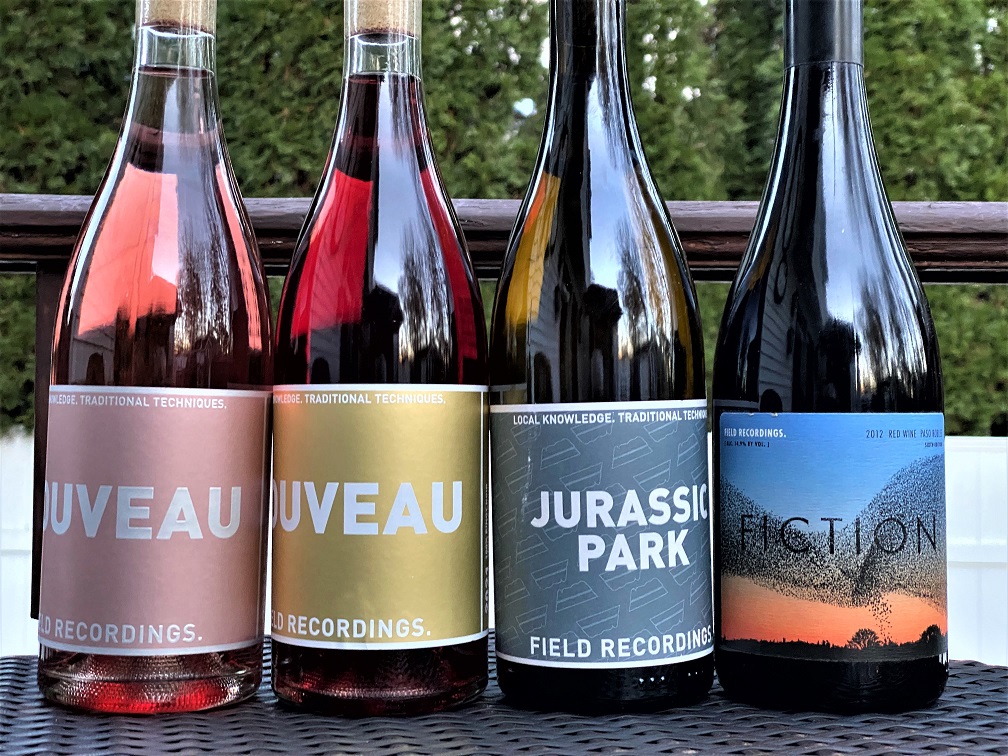
And then, of course, there were wines. A few weeks before Thanksgiving I got a note from Field Recordings offering two of the Nouveau wines, Rosé and Pinot Noir – as it is Nouveau wines, both were from the 2021 vintage. That gave me an idea to pair the whole Thanksgiving dinner with Field Recordings wines. I really wanted to have a Chardonnay at the dinner, but I had none from the Field Recordings, so I had to settle for their Chenin Blanc wine, from Jurassic Park vineyard. For the red, I decided to open one of my most favorite Field Recordings wines – actually, the wine which made me fall in love with Field Recordings – Fiction, with some nice age on it.
Let’s talk about these wine choices.
2021 Field Recordings Rosé Nouveau Edna Valley (10.9% ABV, blend of Grenache and Cinsaut from Morro View Vineyard in Edna Valley in California). The wine was a bit temperature-sensitive but overall outstanding. I served it slightly chilled, and the wine was tart with the strawberries profile, maybe ever slightly unbalanced. Chilling it another 4-5 degrees down magically transformed the experience into the fresh crunchy cranberries territory, with lots of cranberries in every sip – a pure delight.
2021 Field Recordings Pinot Noir Nouveau Edna Valley (12.9% ABV, Greengate Vineyard in Edna Valley in California) was quite similar to the classic French Beaujolais Nouveau, offering nicely restrained notes of fresh, young, just-crushed berries. This wine was also showing better with a higher degree of chill, being more composed with a more present body.
2018 Field Recordings Jurassic Park Chenin Blanc Santa Ynez Valley (11.3% ABV, 6 months in the hosch fuder 1000L) offered a glimpse of fresh apples and a hint of honey on the palate, all with crispy acidity. While this was not Chardonnay, the wine offered quite a bit of similarity and fit very nicely into my craving for Chardonnay, while being well reminiscent of a nice classic dry Vouvray.
The last bottle was unquestionably a bold move on my part.


2012 Field Recordings Fiction Paso Robles (14.9% ABV, 40% Zinfandel, 13% Tempranillo, 12% Petite Sirah, 11% Touriga Nacional, 10% Mourvedre, 8% Grenache, 6% Cinsault). This wine was the one that connected me with Field Recordings more than 10 years ago – I wrote a post about 2010 Fiction, and it was my 2011 Top wine of the year as well. I love those original labels a lot more than clean and rather boring labels currently in use at Field Recordings – and not only the label itself but also the text on the back label, talking about the early days of Andrew Jones, who was first and foremost grape grower before he started Field Recordings – you can read it for yourself.
9 years old wine under the screwtop and stored at room temperature – what would you expect? The wine was definitely showing the age, with an abundance of tertiary and dried fruit aromas (figs, cherries), but it still had some fresh fruit left together with the zipping acidity. I think if anything, this would be the wine that would actually turn into vinegar, give it another 4-5 years. But – it was still perfectly enjoyable now, and it was my second favorite of the evening together with the Nouveau Rosé.
There you go, my friends – my Thanksgiving 2021 escapades.
Oh, and before I forget – the last day of Thanksgiving weekend was also the first day of Hanukkah, so I simply had to make potato pancakes – thus this is the image I want to leave you with.

Happy Hanukkah to all who celebrate!
Daily Glass: There is Nothing Wrong with Kirsch!
Let me make this clear – this is not the post about Kirsch, a brandy made out of [originally] morello cherries. This is rather self-talk as I’m answering my own comment made a few days ago on Twitter.
About a month ago, right before Halloween, Last Bottle Wines, one of my favorite sources of great wines at reasonable prices, run their Mystery Cases event. I participated in this fun event last year, got a $144 mystery case with 12 bottles, and loved every one of them. I would be happy to get again a 12 bottles case, but I missed it, so I decided to try a $150 mystery case – except this was a 6 bottles case. I had a $30 credit with Last Bottle wines, thanks to someone signing up with Last Bottle Wines using my link, so that brought the deal to $120 for 6 bottles, which translates into about $20 per bottle – not a bad deal in my book.
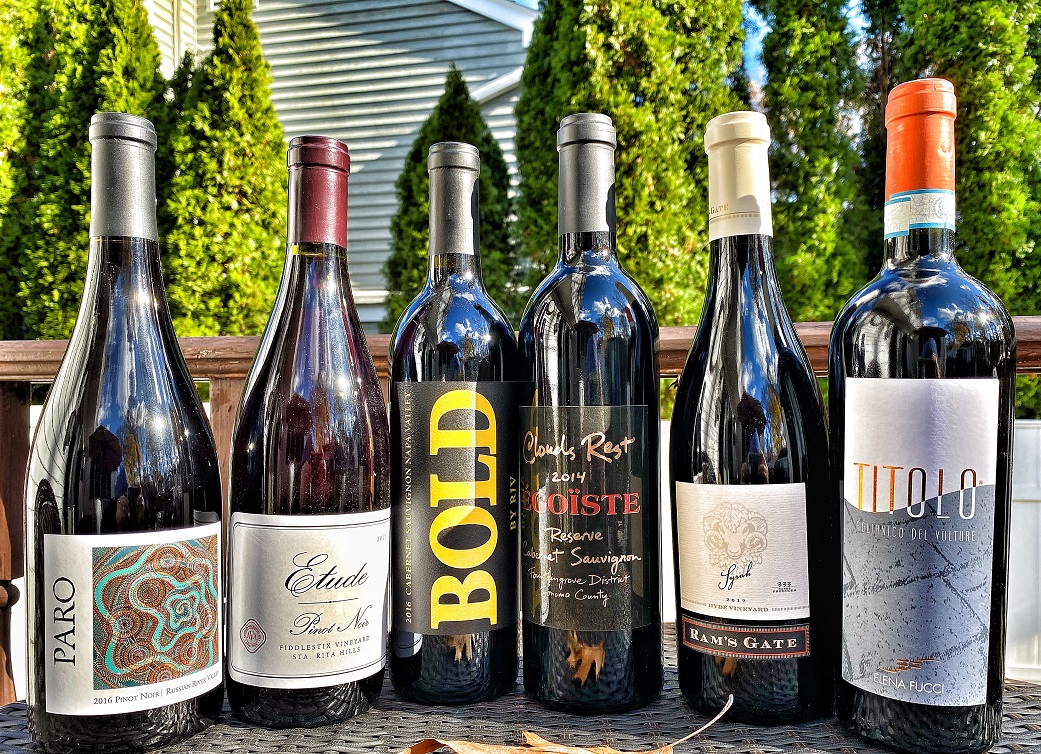
On Monday, I received the wine. Inside, there were 6 bottles, all red, 5 wines from California, and one from Italy. I read the enclosed description of the wines, and two of them had the word “Kirsch” used in the description, and one was also mentioning “blueberry pie”.
I have to admit – I don’t drink a lot of Kirsch. Heck, I just don’t drink Kirsch. So in my memory from maybe 10 years ago, Kirsch is something sweet, and I don’t like my wines sweet unless it is strictly a dessert wine. I shared my frustration on Twitter, also asking if anyone knew anything about these wines, but it appears some folks were only familiar with the Italian wine, but not with any from California.
As I started prepping for Thanksgiving dinner tomorrow, I needed to drink something. After deciding that I don’t want to touch any samples as I have a whole wine program already planned for tomorrow, I decided that it might be a good idea to pop one of the latest arrivals. Pinot Noir seemed like something I wanted, so I pulled this bottle of 2016 PARO Pinot Noir Hogan’s Run Vineyard Russian River Valley (14.5% ABV).
I never heard the name of the producer so I had to do some research. PARO name is made out of the names of two friends, Patrick Murray and Rob Scherer, who came to the winemaking after successfully crafting many batches of beer.
After some successful experiments, Patrick decided to embrace winemaking professionally, got an enology degree from the state university in Fresno California, and after graduation started working at Field Stone Winery as an assistant winemaker. One wine that was not made at the winery was Pinot Noir, and Patrick always had a passion for the grape. In 2004, he asked for permission to make Pinot Noir, and this was the beginning of PARO.


Today PARO makes a number of Pinot Noir wines (6 according to the list on the website at the moment of writing) which are available either directly from the winery, via the wine club, or in a few select restaurants.
So how about that Kirsch?
Here is the Last Bottle description of the wine: “Kirsch, plums, and strawberry, with Asian spices and good medium-weight texture. Simply delicious”. After the very first sip, I realized that Kirsch is not the enemy – I rather should drink more Kirsch if it tastes that good. And I can wholeheartedly sign under “simply delicious”. Beautifully constructed, fresh wine with lots of energy, Kirsch:), crunchy, crisp cherries brimming with acidity, a touch of the forest floor, medium finish. A pure delight (Drinkability: 8+).
I want to also mention the label of the wine. Each vintage of PARO is paired with a specific painting that finds its way on the wine’s label. The 2016 vintage was paired with the work by the artist Susan Reid called Unwind.
My last year’s mystery case was 12 out of 12 successful. I like how this case already looks promising and hoping once again to reach a perfect 6 out 6 score. Until the next time – cheers!
Spain’s Great Match, 2021 Edition
Spanish wines are some of my most favorite wines in the world.
Spain’s Great Match event in New York is one of my most favorites wine events of the year, always offering an opportunity to discover something new.
And I had not been to New York City in the past 18 months – lots of good reasons to be excited, would you agree?
For the second time in a row, Spain’s Great Match event was held at Mercado Little Spain, a Mecca of Spanish cuisine in one of New York’s hottest new neighborhoods, Hudson Yards. I was able to attend the walk-around tasting and two of the seminars, so here I want to share my impressions.
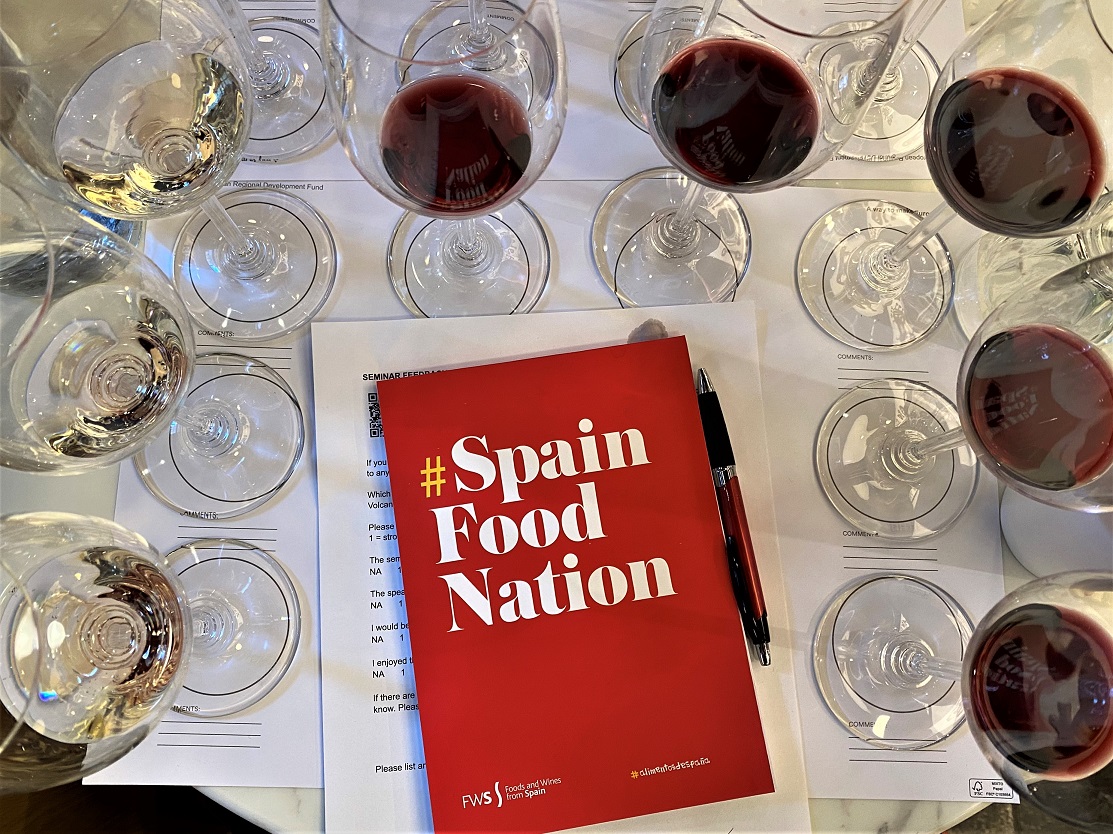
Before we get to the event, just a few facts about Spain’s wine industry. Spain has the biggest grape planting area in the world – more than 2.9 million acres. Spain today (2021) is the second-largest wine producer in the world after Italy. There are more than 600 grape varieties grown in Spain (only about 20 are used to produce the majority of the wines though). Spain has more than 130 defined wine-growing areas.
Now, let me share my observations.
First, Spanish wines are popular. Duh? I can’t argue – I’m starting with the most banal conclusion, but let me explain. Spanish wines were always regarded as the best-kept secret among wine professionals – whatever the general public likes to drink is fine, but the wine professionals would most often resort to the Spanish wines to share amongst themselves and with friends. I don’t know how many people attended the consumer portion of the event in the evening, but the trade event was incredibly busy, also with a significant number of MS and MW in the audience – I never saw these many Masters of Wine and Master Sommeliers attending this event. It might be just me not seeing it before, or it might be a testament to the growing popularity of Spanish wines. I think this popularity is also reflected in the increased prices of the Spanish wines – don’t know if supply issues are muddying things up, but otherwise, it seems that the prices are inching higher.
The trend of “internationalization”. Spanish Rioja and Ribera del Duero wines, the keystones of Tempranillo expression, always had its unique taste profile, driven by well-integrated tannins, minerality, and spicy undertones. This character was largely defined by the use of American oak which was traditional in Rioja. I didn’t taste each and every Rioja wine presented at the event, but based on what I managed to taste, it seems that there is a shift towards using the French oak, which completely changes the presentation of the wine, leading with grippy, mouth-drying tannins which completely lock the front of your mouth for a few minutes after the sip. Barolo used to be like that, and it became much better with tannins lately. Now Rioja is offering this internationally indistinguishable style which becomes borderline boring. If I want to drink a grippy powerful wine, I got plenty of choices outside of Rioja – I understand that this might be a trend with young wine drinkers, but it will be very difficult to maintain individuality and build a following if you are simply “one of many similar ones”.
Where did the Godello go? I saw a very little presence of Godello wines, which was surprising. I always thought that this white grape has an excellent future – this might still be the case, but this was not obvious with 3 whites ruling the show – Rioja Blanco, Albariño, and Verdejo Rueda.
Jerez is absolutely delightful. My love of Jerez is back, and the wines we tasted during the seminar (more details forthcoming) were simply superb.
Don’t forget Spanish bubbles. I tasted a bunch of Cavas, and none of them were mediocre. Fresh, clean, approachable, and reasonably priced – great QPR wines for every day.
Now, here are the wines I tasted during the event (with the exception of the seminar wines). Everything which is mentioned below was well drinkable, and the specific favorites are marked (bold) as such.


2020 Santiago Ruiz Santiago Ruiz D.O. Rias Baixas ($25)
2017 Bodegas LAN Rioja Crianza D.O.Ca. Rioja ($18) – probably my favorite from the Bodegas LAN selection. The most approachable and balanced from this group.
2015 Bodegas LAN Rioja Reserva D.O.Ca. Rioja ($24)
2017 Bodegas LAN D-12 D.O.Ca. Rioja ($25) – single vineyard
2017 Bodegas LAN Xtreme 2017 D.O.Ca. Rioja ($25)
2015 Bodegas LAN Viña Lanaciano D.O.Ca. Rioja ($30)
2018 Bodegas LAN Edicion Limitada D.O.Ca. Rioja ($55)
2015 Bodegas LAN Culmen D.O.Ca. Rioja ($70)
2016 Vins el Cep Gelida Brut Gran Reserva D.O. Cava ($20)
NV Bodegas Llopart Brut Reserva Rosé Corpinnat ($28)
2020 Bodegas Vatán Nisia Las Suertes D.O. Rueda ($32)
2018 Bodegas La Caña Navia D.O. Rias Baixas ($32)
2019 Bodegas Avancia Mencía Old Vines D.O. Valdeorras ($35)
2018 Bodegas Breca Garnacha D.O. Calatayud ($16) – clean, simple
2018 Bodegas Vatán Tritón Tinta de Toro D.O. Toro ($20)
2018 Bodegas Vatán Tinta de Toro D.O. Toro ($45)


2018 Bodegas Muga Flor de Muga Blanco D.O.Ca. Rioja ($50) – my favorite wine white of the event – clean, round, fresh, elegant
2014 Bodegas Muga Prado Enea Gran Reserva D.O.Ca. Rioja ($100) – surprisingly ready to drink
2011 Bodegas Sierra Cantabria Gran Reserva D.O.Ca. Rioja ($40)
2014 Bodegas Alvear Alvear Fino en Rama D.O. Montilla Moriles ($22) – outstanding. It is very rare to find dry sherry made from 100% Pedro Ximenes grapes.
2016 Sierra Salinas Mira Salinas D.O. Alicante ($18, Monastrell) – Elegant, fresh, perfect acidity
2016 Ramirez de la Piscina Ramirez de la Piscina Reserva D.O.Ca. Rioja ($22)
2018 Rafael Cañizares Bodegas Volver Tempranillo Single Vineyards D.O. La Mancha ($20)
2020 Rafael Cañizares Bodegas Volver Paso A Paso Tempranillo Tierra De Castilla ($35) – excellent, elegant, open


All three were excellent:
2013 Agustí Torelló Mata Cava Agustí Torelló Mata Brut Nature Gran Reserva D.O. Cava ($26)
2017 Agustí Torelló Mata Cava Agustí Torelló Mata Brut Reserva D.O. Cava ($21)
2011 Agustí Torelló Mata | Cava Kripta Brut Nature Gran Reserva D.O. Cava ($85) – unique and different, would make a perfect geeky present
2019 Bodegas San Valero S.Coop Cabeza Casa D.O. Cariñena ($11, Garnacha) – elegant, round, excellent QPR
2018 Bodegas San Valero Celebrities Syrah D.O. Cariñena ($11)
MV Bodegas San Valero 801 D.O. Cariñena ($20, blend of 2014 Cabernety Sauvignon, 2015 Merlot, 2016 Syrah) – very good, unusual, multi-vintage
2019 Bodegas San Valero Particular Garnacha D.O. Cariñena ($12)
Now, the seminars. The Jerez seminar was superb, offering lots and lots of knowledge about the fascinating world of sherries. Three white grapes – Palomino Fino, Pedro Ximenez, and Moscatel – are behind the tremendous range of wines, all with unique characters and tastes ranging from absolutely bone dry (sugar content less than 5 g/l) to the syrup level with more than 300 grams of sugar per liter. Another fascinating element of Sherry is the Solera production method, where the resulting wine might technically have trace amounts of 200+ years old wines. Lots and lots of care and attention go into the Sherry production. During the “Spotlight on Sherry” seminar, led by incomparable César Saldaña, General Director of the Jerez Control Board, we learned a lot about sherries and tasted through the outstanding flight of 8 wines (with the exception of the last 2 which I didn’t enjoy that much).
Here are my notes regarding the 8 wines we tasted:
Bodegas Hidalgo Manzanilla La Gitana
4 years Solera
Almonds, hazelnut, sage, brioche
Crisp, dry, fresh, hazelnut, pecorino cheese, sapidity, dusty palate
Excellent, perfect aperitif, and perfect for food
2021 Tio Pepe Fino Tio Pepe en Rama-Saca
Unique and different, blend of selection of 82 butts of Tio Pepe Solera
Bottled unfiltered
Beautiful floral nose,
Crisp, clean, elegant, mostly lemon and 0 sugar, chalky note – typical for this type of wine.
Great complexity, elegant
Valdespino Jerez Fino Ynocente
Single Vineyard in Pago Macharnudo
50 years old Palomino Fino vines
Fermented in cask
10 years Solera, Criaderras Solera
Very elegant, apples, lemon
Chalk, lemon, sapidity, 0 sugar
Williams Humber Amontillado Don Zoilo
Solera 12 years
Biologically aged until the full absence of flor
Butterscotch!
Crisp, fresh, herbaceous
Lustau Almagenista Oloroso Pata de Gallina
Almagenista: Juan Garcia Jarana
38 casks, aged on average 15 years
Butterscotch, caramel
Crisp acidity, sapidity, great complexity, hazelnut
Osborne Palo Cortado Capuchin VORS
Solera was founded in 1790! Potentially, there were traces of 230 years old wine!
5 criaderas
Average age 30 years
Tobacco, mint, basil
Pepper, tobacco, caramel, complex, long finish.
Superb
Bodegas Tradicion Cream Tradicion VOS
Blend of 30 years Oloroso (70%), 6 years old Pedro Ximénez (30%)
Average age 25 years
Dry fruit
Concentrated sugar, not great.
Barbadillo Pedro Ximénez la Chila
Solera system average 5 years
Amazing nose – raisins, figs,
Pure liquid raisins on the palate. I would like more acidity.
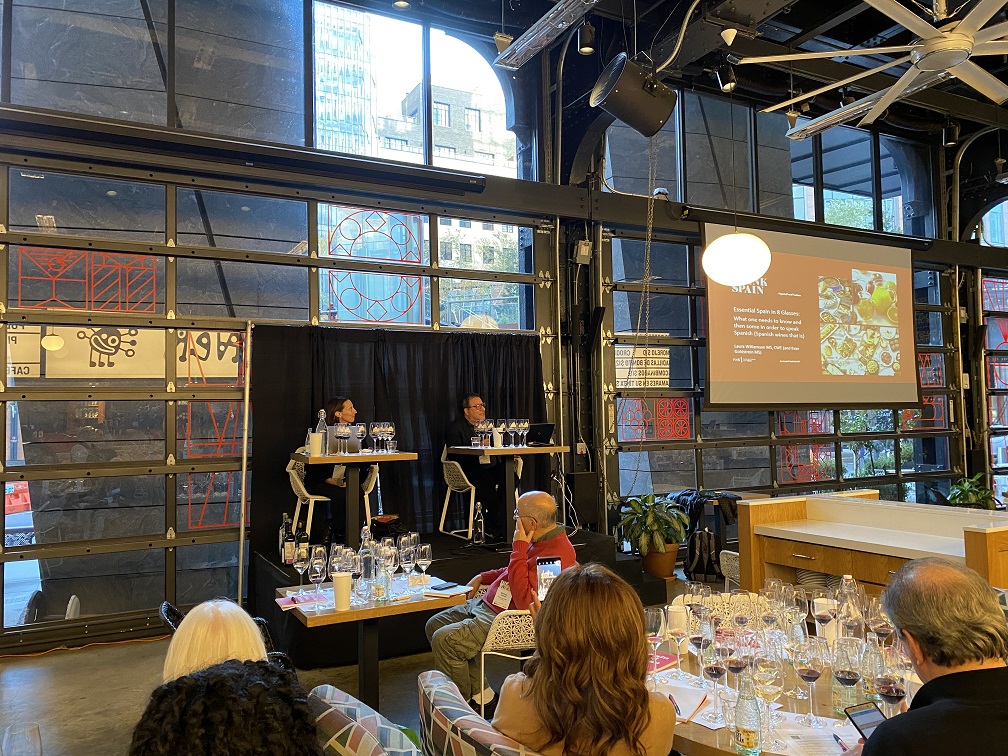
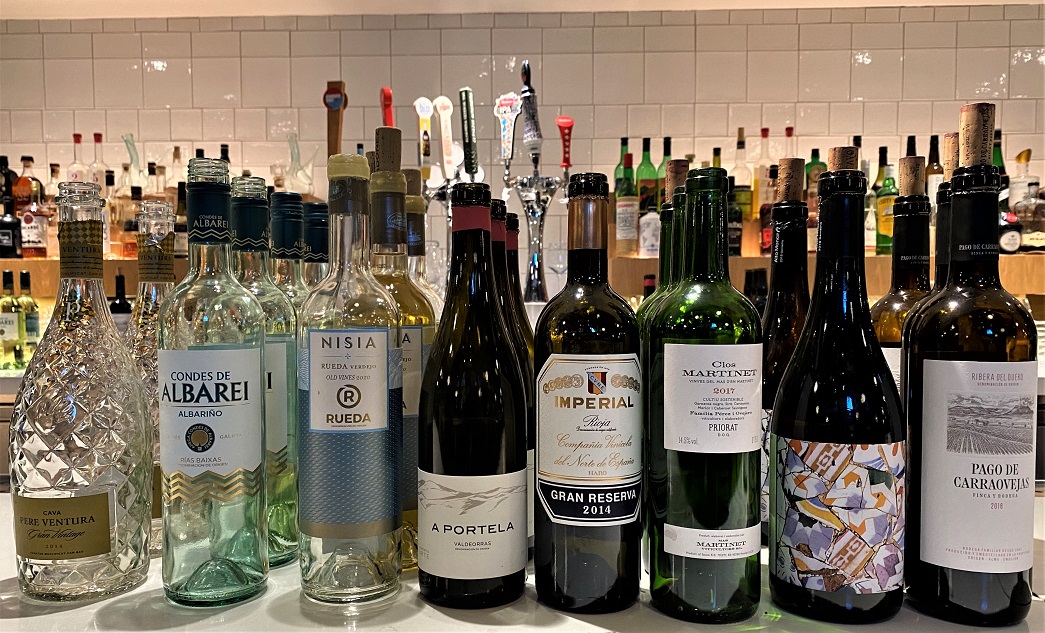
Finally, I attended the seminar called “Essential Spain in 8 Glasses”, presented by Laura Williamson, MS, and Evan Goldstein, MS.
If the country is the second-largest wine producer in the world, cultivating about 600 different grape varieties, is it even fathomable to present such a complex wine world in the format of 8 wines? While it is not easy, you can get reasonably close. I think the presenters made a good effort by including Cava, Albariño, Verdejo, Mencia, Rioja, Priorat, Garnacha, and Ribera del Duero.
2012 Pere Ventura Gran Vintage Brut Paraje Clasificada Cava DO ($55)
Yeasty nose, fresh dough
Crisp, yeasty, yeasty, yeasty, yeasty – not my wine
2020 Condes de Albarei Albariño ($16)
Tropical fruit nose
Acidic, Whitestone fruit, crisp, simple
2020 Bodegas Ordoñez Nisa Verdejo Old World Rueda ($32)
Intense nose with a hint of freshly cut grass, flowers
Rich, caramel component, overdone
2015 Ole Imports a-Portela Mencia ($29)
Very nice nose, fresh, open, fresh berries
Beautiful herbal/gamey component, but then very bitter on the palate – whole cluster not done right?
2014 Imperial Gran Reserva Rioja ($85)
Outstanding. Delicious all around.
2017 Clos Martinet Priorat (65% Grenache, 20% Syrah, 10% Carignan, 4% Merlot, 1% Cabernet Sauvignon)
Smoke, roasted notes
Red and black fruit, perfect balance, great acidity, a touch of chocolate
2018 Also Moncayo VERATON ($35, Garnacha)
Plums, cherries,
Good acidity, fresh, cherries, crisp, great finesse
2018 Pago de Carraovejas Ribera Duero ($39)
Chalk, a hint of cherries,
Cherries, dark concentrated fruit, restrained. Very nice.
Last but not least – there was food! The food was carried around in all the different forms – I didn’t have much time to enjoy it, so I was mostly grabbing pieces of Jamon and Manchego between the tastings – these are the pictures I will leave you with.


This concludes my report. Have you had any Spanish wine discoveries as of late? What are your thoughts about the new wines and new styles?
Beaujolais Nouveau Est Arrivé! 2021 Edition
Beaujolais Nouveau Est Arrivé!
It is the third Thursday in November, and that means that the time has come to celebrate this year’s harvest – Beaujolais Nouveau has arrived at the wine store next to you (at least I hope it did, but if you want to get it, you might have to hurry as there is a good chance there is not much of it available).
I had been proactively keeping track of this celebration since this blog has started in 2010 – you can find the full retrospective here, mostly in chronological order. I keep saying that every year Beaujolais Nouveau gets better and better – and this year was no exception – I really enjoyed the 2021 Beaujolais in my glass.

Nevertheless, this year was an exception. Ever since I started writing about Beaujolais Nouveau, there was never a year when I only had one Beaujolais Nouveau wine – for example, last year I had 3 Beaujolais Nouveau wines and one Nouveau from Oregon. Most of the years I had at least 3, and a few years there were only two. But this year there was only one, and even that has limited availability and most likely will not last even until Thanksgiving, at least at the store where I bought it. Yep, you knew this already – supply chain issues. There might be more of the Beaujolais Nouveau showing up later on, but it is not very clear what and when.
Few more interesting Beaujolais Nouveau-related tidbits I never thought of before. First, according to the Burgundy Report, this year there were only 100 different Beaujolais Nouveau wines produced in France, which is significantly down from the last year’s number of 160. I was sure that there are many Beaujolais Nouveau wines produced in France, but I didn’t expect the number to be that high.


While searching for the information online, I came across the article where I learned about the Georges Duboeuf First Wine of the Harvest sweepstakes! Each cork of Georges Duboeuf Beaujolais Nouveau wine carries a unique number (who knew!), which can be entered on the First Wine of the Harvest website, and you will be instantly notified if you won something (I have no idea what you can win, and I won nothing). Apparently, this is not the first the sweepstakes are played, but if I wouldn’t read about it online I would still have no idea it existed.
Finally, let’s talk about the wine. According to the same Burgundy Report I mentioned before, Beaujolais regional Marketing board defined the vintage as “combative” – frost in April, and summer of rain and hail are not exactly the ideal grape-growing conditions. Relatively calm and cool September offer some relief, and while overall yield was significantly down, it was possible to preserve the quality of the harvest.
2021 Georges Duboeuf Beaujolais Nouveau AOP (12.5% ABV, $12.99) has a bright ruby color, a restrained nose of the freshly crushed fruit, and copious amounts of fresh raspberries and cherries on the palate with good acidity on the finish. While the wine is perfectly drinkable at room temperature (68°F), it is showing the best slightly chilled at around 58°F – 60°F.
Back in 2017, Georges Duboeuf started the “Artist Collector Series” of the Beaujolais Nouveau wine labels, where the public is given an opportunity to vote for the favorite design which will be then printed on the label. This year’s Beaujolais Nouveau label features work by the artist Felice Kite called “For The Love Of Flowers”.
Before I conclude my Beaujolais Nouveau 2021 report, I want to offer you a fun exercise – below is the collection of the Beaujolais Nouveau labels from 2010 until 2021 (note that I came across two distinct labels in 2015). I want you to choose a favorite (or 3, or 5) and share your opinion in the comments. I guarantee you that you will get no prize for participation in this exercise, but hopefully, it will be fun.


Beaujolais Nouveau 2021 has arrived, it is definitely worth your attention, it will be perfect with Thanksgiving turkey if you will be so inclined – but you can’t procrastinate if you want to try it. Cheers!
Expect the Unexpected?
Wine is meant to go with food.
Food is meant to go with wine.
Together, food and wine are supposed to give you a much better experience than two individually.
You already know all of this.
And yet this is theory. When met at the table, sometimes food and wine actually work together and deliver a heavenly, memorable experience. Sometimes, food and wine just coexist without interfering. And sometimes they clash, ruining the experience completely.
The food and wine pairings typically work in one of two cases:
- Food and wine are professionally paired. The chef and sommelier work together, adjusting the flavors of the dish to work with the wine which was selected as a pairing.
- Food and wine come from the same place and had been playing together nicely for centuries. Think about Beef Bourgogne paired with Bourgogne wine – I think we can trust this combination, don’t we? Or would you ever question Chianti with the pasta with nice red sauce?
Now, for most of the time, we are not traveling and we are not eating at the high-end restaurant, yet we still should be able to enjoy the elevated food and wine experience at home – the rules are simple, right?
Maybe the rules are simple indeed, but we need to tread carefully. Beef Bourgogne is made with Bourgogne wine, and all Bourgogne reds are made from Pinot Noir. So what would happen if we will make the dish with actual Bourgogne, and then try pairing it with a nice big Pinot from California? There is a good chance that you will not enjoy that combination, not at all.
Chianti is made out of the Sangiovese grape (predominantly) – but don’t try to pair your pasta with the Sangiovese from California – again, there lies a great opportunity for disappointment.
I’m not saying that Beef Bourgogne will never work with the California Pinot – find a more restrained version, such as Sanford Pinot Noir, for example, and you might be fine – or better yet, simply cook the dish using the same wine you want to drink. Similarly, there are some California Sangiovese that might perfectly complement and elevate your favorite spaghetti dish, such as Castello di Amorosa Sangiovese – but you should expect some trial and error on the road to perfection.
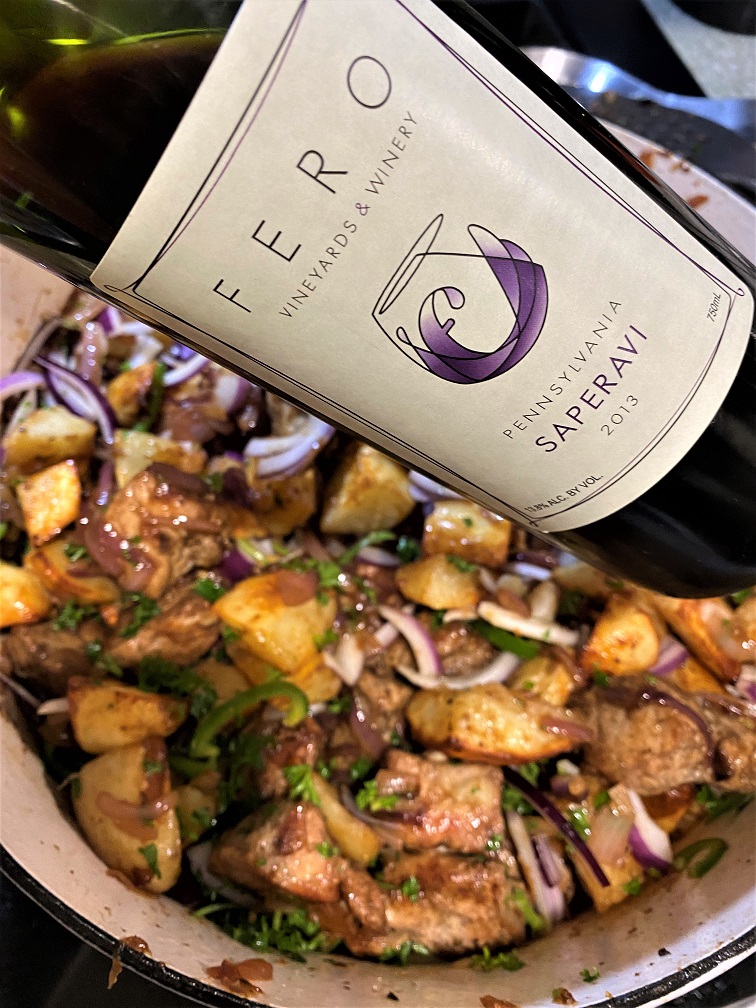
I love Georgian wines. I would gladly drink Georgian Saperavi on any day. I love Georgian cuisine – properly made, the flavors are incredible and so is the pleasure you will derive out of each and every dish. And considering that wine is an indelible part of the Georgian lifestyle literally for thousands of years, it is rather logical to assume that Georgian wines should work perfectly with Georgian dishes.
While I love Georgian cuisine, this is not the food I would generally try to make on my own, I prefer to defer the cooking to a few of the Georgian restaurants which we have in reasonable proximity, even though the experience is typically a mix of hit and miss. However, when my sister in law sent me the video with the recipe of the Georgian dish called Odjakhuri, the video looked so good that I decided that I must make the dish as soon as possible, considering that the main ingredients are near and dear to me from the childhood – meat and potatoes.
Back in 2015, we visited a winery in Pennsylvania called Fero Vineyards. In addition to all of the traditional east coast wines, the winery also was making the wine out of my beloved Georgian grape, Saperavi. I tried the wine during our visit, liked it very much (Fero Saperavi made it to the 2015 edition of my annual Top Dozen wines of the year list as #12), and brought home a bottle. After I decided that I will make an Odjakhuri for the Friday night dinner, I realized that I have no Georgian wines on hand – but then I remembered that I had a bottle of Fero Saperavi which I had been looking for a good reason to open for quite some time – and what can I be a better reason than trying it at a family dinner with Georgian dish?
To tell you the truth, I had no idea how it is going to work. First, the bottle I had was the 2013 Fero Saperavi. Who knows if the wine from Pennsylvania can age for 8 years? The wine might be gone already, way gone. But even if the wine is not gone, would Saperavi from Pennsylvania work with the flavors of the dish? Local wines work with local dishes because they went through a slow process of alignment over hundreds of years – well, maybe that is one of the reasons. And here we have a dish with the supposedly proper flavor profile, and proper grape from totally different terroir – everything is possible…
When I was opening the bottle of Fero, I had no expectations. Let me take that back. When I was opening the bottle of Fero, I was expecting that the wine will be past prime. And even if it will be still drinkable, that it will not work with the dish, not for a second. And I’m glad I didn’t make any bets with anyone because I lost on both counts.
The wine was perfectly fresh. It had a ruby color, not hinting at any age. On the nose, there were cherries and herbs, nicely restrained. On the palate, the wine showed a hint of cherries, sage, gamey undertones, tobacco. Perfectly live, perfectly fresh, excellent acidity, medium-plus finish.
The wine also perfectly complemented the dish, enhancing and elevating the flavors and creating a better experience.
Was this pure luck on both counts? The wine was perfectly drinkable and it complimented the dish very well? I don’t have an answer, I’m just reporting on the experience, and raising the question – where are the wine and food pairings created?
This pretty much ends my story about expecting the unexpected, but before we part, I want to leave you with the recipe for this simple and delicious dish.
Disclaimer: Odjakhuri in translation from Georgian means “family”. So as a family meal, I’m sure there are tons of “correct” recipes for this dish. The recipe which I’m sharing is exactly the one we made, thus this is the one I recommend.
Apology: I would love to share a video with you, but an actual video that I have is in the Russian language. Still, I believe it will be useful even without understanding the language, so here it is:
Odjakhuri – Georgian meat and potatoes family dish
Ingredients:
- Meat (pork, beef, chicken) – 2 lb
- Potatoes (Russet would work the best) – 4 lb
- Red onion, medium size, sliced – 4
- Garlic, chopped – 4 cloves
- Cilantro (can be replaced with parsley), chopped – 2 tbsp
- Hot pepper, sliced – 1
- Coriander, ground – 1 tsp
- Sweet paprika – 1 tsp
- Cayenne pepper – 1/2 tsp
- Dill (dried) – 1/2 tsp, optional
- Black pepper, ground – 1/2 tsp
- Salt, by taste
- Olive oil
Steps:
- Potatoes: Preheat oven to 375F. Peel potatoes and slice them into the pieces about 1 inch in size. Put into a large bowl. Add olive oil (you can use any oil you like for roasting), coriander, black pepper, cayenne, paprika, dill (if using), and 2 tbsp of salt (I prefer kosher salt). Mix everything together. Line roasting pan with parchment paper and arrange potatoes preferably in a single layer. Roast for 45-50 minutes – check readiness, potatoes should be crispy but shouldn’t be overlooked. Once ready, get it out of the oven and put it aside.
- Meat. Meat should be prepared as it would be for a kebab. Ideally, it should be sliced into 1-inch cubes and marinated overnight. You can, of course, just roast the meat without marinating it, but marination will add to the flavor of the dish. In our dish, we used bone-in pork loin, I just cut the meat off the bone. If you will be using pork, look for darker meat, it is less prone to drying up while frying.
- Once you put potatoes in the oven, you can start on the meat. Heat a small amount of oil on medium-high heat in the cast iron dutch oven, and fry the meat until ready. If meat is not marinated, use salt, pepper, and any other spices you would like. When ready, get the meat out of the pan. make an effort not to overcook the meat.
- Reduce heat to medium-low, add 3 sliced onions and sauté them slowly, pay attention not to burn them. When almost ready, in about 12 minutes, add garlic and let it cook for another 3 minutes. Now it is time to assemble the dish.
- Reduce heat to low. Return meat to the dutch oven, add roasted potatoes. Add fresh cilantro (or parsley), sliced hot pepper, and last sliced onion, mix everything lightly (try not to crush the potatoes). Let the dish heat up, uncovered, for about 10 minutes, to let the flavors meld. In 10 minutes, turn off the heat, serve and enjoy!
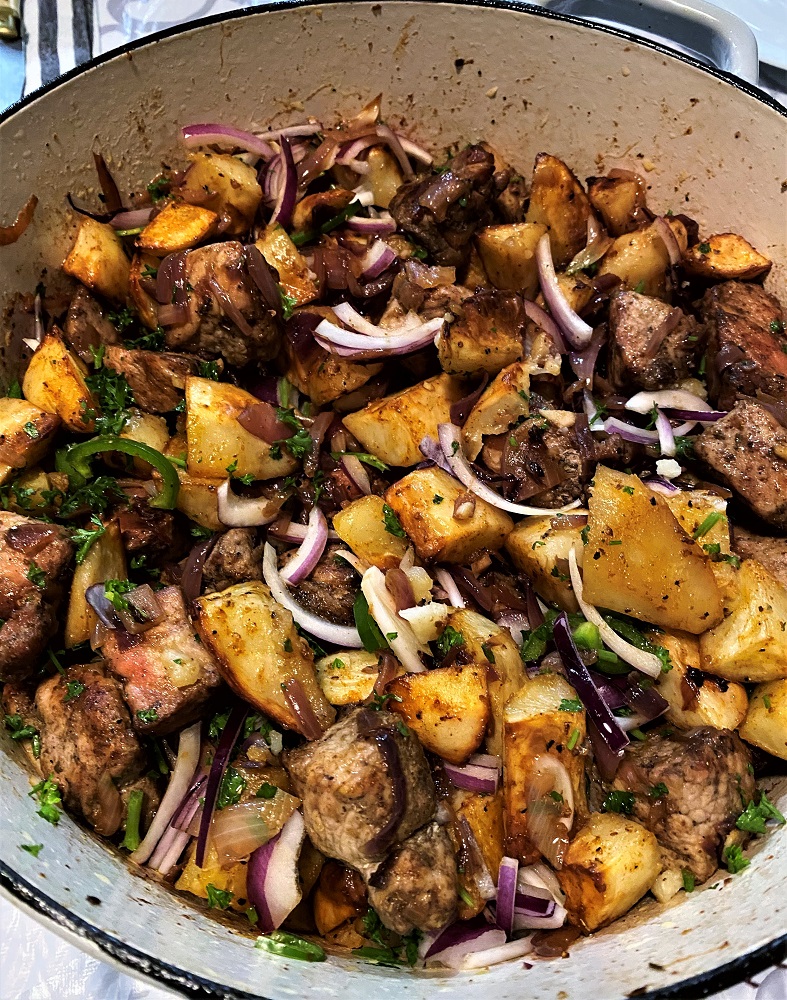
There you have it, my friends. If you don’t have Saperavi on hand, try it with any wine you’d like, and expect the unexpected. Cheers!
Last Bottle Sign Up ($10 credit)




 Talk-A-Vino