Archive
Passion and Pinot Updates: Bells Up Winery 2025
When I was planning blind Pinot Noir tasting with friends, I reached out to some of the old friends in Oregon to see if I could include some of the Oregon Pinot Noir in that blind tasting. Sara and Dave Specter of “micro-boutique, un-domaine” Bells Up Winery graciously agreed to participate and sent me three samples of their latest Pinot Noir releases.
Bells Up was one of the 19 wineries profiled in the Stories of Passion and Pinot series, probably the youngest one, founded in 2013. Youngest or not, but Bells Up might be one of the most adventurous, going well past traditional Pinot Noir and Chardonnay with their plantings of Schioppettino and Seyval Blanc. You can learn more about the winery and its vision from the original interview I did with Dave in 2019, and an update after I visited the winery in 2021.
When we spoke about the wines (it was the end of last year, 2024), I also wanted to have a short mini-interview with Dave – it is a bit less timely right now, but hey, 2025 is still young. Here is our short (virtual) conversation:
[TaV]: How was the 2024 vintage? What should we expect from the 2024 wines when they will be released?
[DS]: Well, we’re still in the very early stages of evaluating the 2024 vintage so it’s hard to tell at this stage but we have every reason to be optimistic. We had one of our better growing seasons in some time – warmer than usual early in the season but then settling into a more temperate pattern the rest of the way. We harvested in late September and early October which is right on schedule and the sugars and acids were pretty much on the money. The 2024 vintage whites will be released in the spring of 2025 and the reds will be released (most likely) in 2026 and 2027.
[TaV]: What was Bells Up’s best moment of 2024?
[DS]: Our best moment was getting to see the results from the “proof of concept” 2023 harvest of our young Schioppettino planting. For only third leaf vines, we’re seeing wonderful flavor development with the distinctive Italian grape licorice elements present. We are now confident that our first commercial vintage in 2024 will be a great addition to our portfolio.
[TaV]: By the same token, what was the worst?
[DS]: The entire industry was hit hard by a decrease in visitorship to the area in 2024, and wine sales suffered accordingly. This was the result of many factors and ultimately resulted in a difficult year for our business.
[TaV]: What are you looking forward to in 2025?
[DS]: We will have our first estate Pinot Blanc release in 2025! We will also see the return of our sparkling Seyval Blanc (Joy) which was so popular in its first release back in 2023. And we are also hoping that we see visitorship recover as travel patterns return to normal after the pandemic.
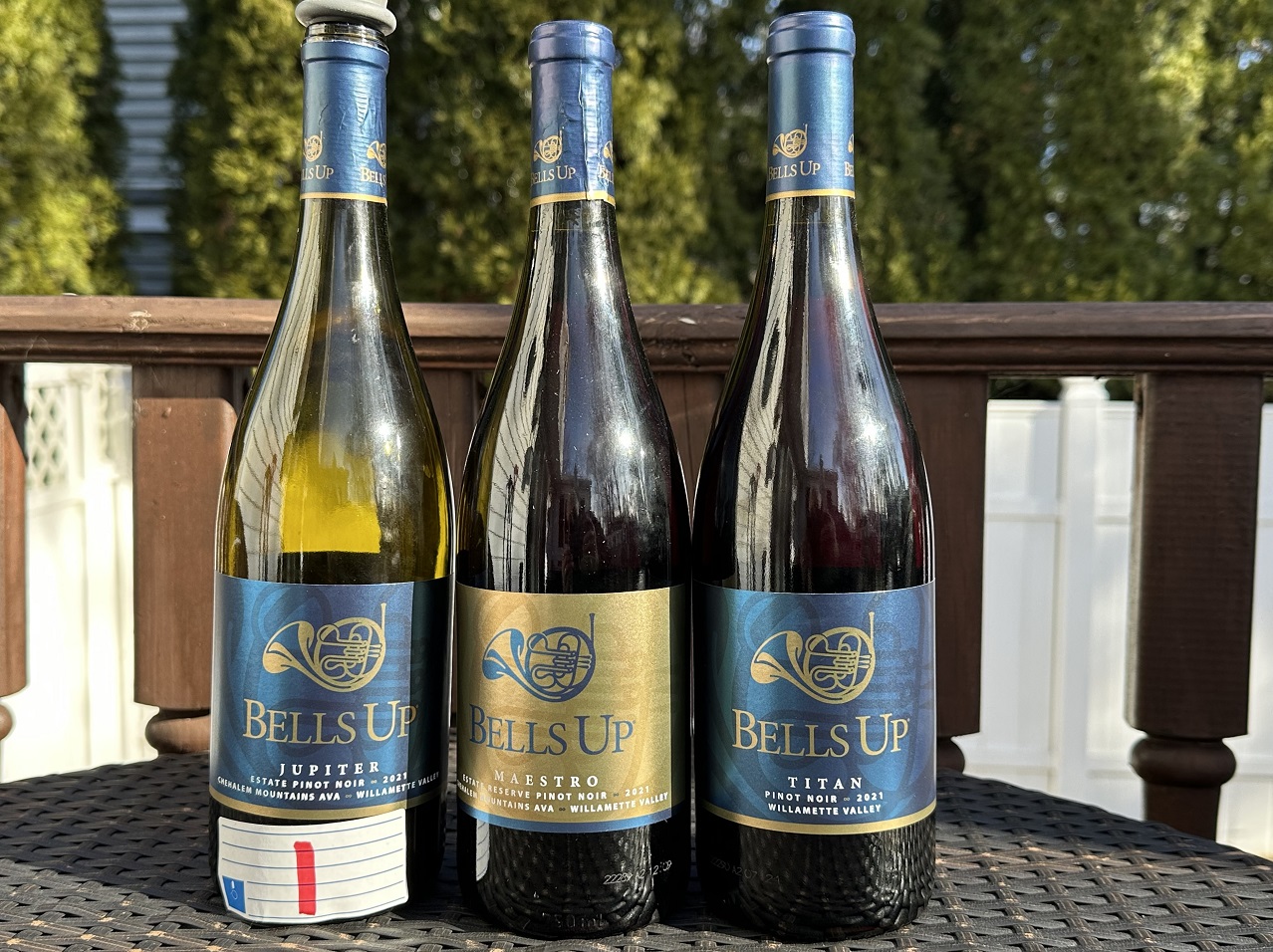
And then there were wines.
I got three sample bottles, out of which one, Jupiter Pinot Noir, was included in the blind tasting (based on Sara’s recommendation). Here are the notes for all three wines, with the first one written a bit differently as it is based on the notes taken during the blind tasting.
2021 Bells Up Jupiter Pinot Noir Estate Chehalem Mountains AVA (13.5% ABV, $50, 58.8% heritage clone Pommard, 25.8% Dijon clone 667 (8-year old vines), 15.4% Dijon clone 113 (6-year old vines), 154 cases produced)
New World (have no idea what I was thinking, I guess something outside of Europe), Vintage: 2021. Cherries, lots of cherries, raspberries, tart cherries on the palate, good balance, nice.
Drinkability: 8
2021 Bells Up Maestro Reserve Pinot Noir Estate Chehalem Mountains AVA (13.3% ABV, $56, 50% Dijon clone 943, 27.8% 667, 22.2% 113; 77 cases produced, club members exclusive)
Dark garnet
Smoke, earthy notes, dark fruit, hint of cherries
Sweet and tart cherries both, iodine, crisp acidity, medium body, a bit of medicinal finish
Drinkability: 8-
2021 Bells Up Titan Pinot Noir Willamette Valley AVA (13.8% ABV, $46, 22.3% 8-year-old Pommard Bells Up’s estate, 38.8% Dijon Clones 115 and 38.8% 777, MonksGate Vineyard’s in Yamhill-Carlton AVA, 19- and 20-year-old vines respectively; 12 months in French oak, 27% new; 111 cases produced)
Garnet
A hint of bell pepper, eucalyptus, raspberries
Black plums, cherries, medium palate weight, medium body, good acidity on the finish. Needs food.
Drinkability: 7+/8-
Here we are – a quick Bells Up winery update and the notes for three of their latest Pinot Noir releases.
Until next time…
This post is a part of the Stories of Passion and Pinot series – click the link for more stories…
The Art Of Living Nobile – The Avignonesi Way
 Have you heard of Vino Nobile di Montepulciano? If you have – great, if you have not – don’t despair, this is what we want to talk about today. Not to confuse anyone, we will be talking here about wines produced near the town in Tuscany called Montepulciano, where the wines are made from the same grape that shines everywhere in Tuscany – Sangiovese, and not about the grape called Montepulciano.
Wines had been produced in the Montepulciano area for a very long time (it’s Italy to you), and in 1685 Montepulciano wine was declared a “king of all wines“. But it was not until the 1930th when the name “Nobile” made it on the wine label thanks to the efforts of winemaker Adamo Fanetti. From there on, the wines previously known as “special Montepulciano red wines” became known as Vino Nobile di Montepulciano.
Okay, what is this “Living Nobile” all about you might ask. Let’s talk about it.
I asked the glorified search engine, now also known as AI “What does it mean to live Nobile” – and here is the answer I received:
“To live nobile” means to live a life characterized by high moral principles, displaying qualities like kindness, integrity, generosity, and a strong sense of duty towards others, essentially embodying the idea of “nobility” in one’s actions and character; it signifies living with a focus on doing good and acting with dignity, rather than seeking personal gain or power.”
This seems to be reasonably clear, would you agree? But where is the connection to the wine?
Ahh, I thought you would never ask. Cue in Avignonesi, one of the premier wineries in the Vino Nobile di Montepulciano area, founded in 1974.
Avignonesi was instrumental in advancing the whole region forward, being the driving force behind Vine Nobile di Montepulciano becoming one of the very first regions in Italy to be awarded DOCG (Denominazione di Origine Controllata e Garantita) status, the highest level of quality in Italian wine denomination system, along with all the famous “B”s – Barolo, Brunello, and Barbaresco.
That is not all. Avignonesi today is a certified organic and biodynamic winery, and it is also a certified B Corporation since July of 2022. Now this gives is even better connection to the “live Nobile” concept as outlined above.
To become a B (B stands for Benefit) Corporation, a for-profit company has to be certified (every 3 years) to meet high level standards for social and environmental performance. As of February 2024, there were 8,254 certified B Corporations across 162 industries in 96 countries. Out of that total number, there are only 52 wineries, and Avignonesi is one of them.
Here are more helpful suggestions from the AI:
Wineries that become B Corps often commit to:
Using low impact farming methods
Managing resources responsibly
Treating their workforce, community, and natural surroundings fairly and responsibly
As you can tell, these are perfecly aligned with the “living Nobile” concept.

To promote “living Nobile” concept, Avignonesi recently engaged in an entire campaign promoting this concept. The winery also created a special release of their flagship 2014 Vino Nobile de Montepulciano wine adorned with a special label designed by the artist Amrita Marino. I had an opportunity to sit down (virtually) with Avignonesi CEO, Matteo Giustiniani, have him explain the concept behind “living nobile” and answer a few of my questions. Here is what transpired in our conversation:
[TaV]: Can you explain the idea behind ““living Nobile””?
[MG]: We always keep in mind our extra long-term vision: to be good ancestors, planting trees under whose shade we will never sit. Recently, we started asking ourselves how we could deeper connect with our consumers, deepening their understanding of the Nobile di Montepulciano appellation and bridging the gap in understanding the values that drive us in caring for each grape, each bottle, and every consumer, beyond all technical aspects that do remain fundamental to our striving for excellence.
And here it came! The Live Nobile communication platform: a veritable movement that brings wine into cultural conversations and gives it a fresh and renewed relevance. It tells us what living Nobile means, highlighting the importance of lightheartedness and enlisting the help of Amrita Marino to illustrate our points, supporting us in telling what Live Nobile is. For us, Live Nobile it’s sharing ravioli, saving seats, arriving on time, or celebrating small wins. Yet, it’s also about embracing slow living or it’s the impromptu refill; and again, it’s also the airplane mode and being the designated driver. But most important, looking forward, it’s everything we can recognize aligned to our deepest set of values, giving to us spectrum for so many facets and personal interpretations.
[TaV]: What is the inspiration behind these “artist label” releases?
[MG]: We see our featured artists to our greater end. Today it’s Amrita, but tomorrow it could be a visual artist, writer, photographer, or calligrapher. We are selecting key individuals to represent the aesthetic values of our platform, Live Nobile.
[TaV]: Why ten new labels for the 2014 release? Will all of these labels be available in all of the markets? What is the inspiration behind these labels?
[MG]: 10 labels as we are marking a decade since we first harvested grapes, giving through each label a visual life to our already imagined platform.
[TaV]: Do you plan to continue these special “artist label” releases? Will you have such a special release next year? Will you work with different artists for he subsequent releases?
[MG]: Absolutely, yes! We will have special releases next year (and the following ones) featuring a variety of creative people.
[TaV]: I’m assuming this 2014 is also considered a “vintage release”? The tech note you sent me is for the regular 2014 Vino Nobile di Montepulciano – was the wine with the artist labels simply a part of the same general 2014 batch, or were they specially selected?
[MG]: The 2014 Vino Nobile di Montepulciano was originally released as part of the standard vintage back in 2014. However, 10 years ago, we made the decision to set aside a very limited number of bottles to age in our cellar, and we are now re-releasing them with updated packaging. These bottles are still part of the general 2014 batch.
[TaV]: Were some wines released under the general label, and some reserved for the later release, bottled, stored at the winery, then recently labeled and offered as an “artist series”?
[MG]: Yes, this is correct
[TaV]: Or were these special-label wines from different plots/vineyards?
[MG]: No, same general batch.
As you can tell, living Nobile is simple, and we should all embrace this beautiful concept. You can learn more about living Nobile on the Avignonesi website, and also there you can see all ten artistic labels celebrating this special release.
So how were the wines? I had an opportunity to try both nicely aged classic Vino Nobile and a special treat – a super-Tuscan wine called Desiderio.
2014 Avignonesi Vino Nobile di Montepulciano DOCG (13.5% ABV)
Ruby with brickish hues
Leather, tobacco, a hint of a gunflint
Cherries, leather, roasted notes, earthy notes, good acidity, cherries on the finish.
Drinkability: 8, very nice

I think Desiderio wine deserves a little introduction, and I’m not going to regurgitate a perfect explanaton as it appears on Avignonesi website. Here it is:
“Desiderio was a bull which lived on Avignonesi’s Capezzine farm more than one hundred years ago. The largest bull in Tuscany at that time, this majestic animal helped define the Chianina cattle race, specific to the Bistecca Fiorentina. It came as a natural choice to dedicate this Merlot to the beloved bull as a testimony to the wines’ origin. This is Merlot from Tuscany at its best.
The iconic white bull is today an illustration of the vintage. There is more to the label than meets the eyes. Compare them with each other, and you will notice a few clues about the climate. Look at the sky, and you will understand whether it was cold, hot, or balanced and you can decipher many other hints.”
2020 Avignonesi Desiderio Toscana IGT Merlot (14.5% ABV, 100% Merlot, organic grapes)
Garnet
Cherries, eucalyptus
Dark cherries, firm structure, well integrated pleasant tannins, hint of bell peppers and cassis leaves, perfect balance, medium-long finish
Drinkability: 8+, excellent
The world will definitely be a better place if we would all adopt this simple “living Nobile” concept. Let’s try to do just that.
The Land Whispers… You Just Need To Listen
 I love wine dinners. Especially the wine dinners with the winemaker.
I dread wine dinners. Especially the wine dinners with the winemaker.
I know, I don’t make much sense at the moment. Wine dinners are wonderful, and I really do love them. The dreadful part comes from the experience of not being able to write about those wine dinners in a timely fashion. “Timely fashion”, huh – there are wine dinners I never wrote about in 5 years and such memories can hunt you down – they definitely do for me. I don’t know why this is happening on a regular basis – the elation often experienced during open and engaging conversations about wine becomes an ephemeral spirit, woefully resistful and easily escaping the slightest attempt to capture it in the form of words…
Let’s see if I will be able to break my unsettling tradition.
Last week I had a wonderful time and experience tasting the wines of Viñedos Veramonte and speaking with Gonzalo Bertelsen, General Manager and Head Winemaker in a small group of wine lovers, around the dinner table at the Monterey Brasserie in New York. The conversation topics were ranging from low-alcohol wines (is that really a trend? Are people really asking for it or is that just a gimmick?) to the production of organic and biodynamic wines to “why Germans don’t want to drink organic wines from Chile” (I will not tell you why but you are welcome to guess) and to many other far and between. But most importantly we got to enjoy Viñedos Veramonte wines with and without the food.
Viñedos Veramonte was one of the first wineries in the Casablanca region, founded in 1990 by Agustin Huneeus, a Chilean wine pioneer. From the very beginning, the winery embraced organic viticulture – and more recently, the winery spent more than 6 years making estate vineyards officially organic certified, obtaining ECOCERT® organic certification, one of the most respected in the world. The project involved the conversion of more than 1,200 acres of vineyards in Casablanca and Colchagua valleys to organic and biodynamic farming, with the aim to also become fully Demeter’s biodynamic certified – which requires making changes in the winery, not only in the vineyard – plus importers also have to be biodynamic certified.
Viñedos Veramonte produces 4 distinct lines of wines – Veramonte, Ritual, Primus, and Neyen – all from organic grapes, of course. We had an opportunity to taste wines from all 4 lines.


We started with the 2022 Veramonte Sauvignon Blanc Reserva Casablanca Valley ($13.99 SRP). This wine has one of the biggest productions, and it is very important for Veramonte. Preserving freshness is paramount, so special care is taken to prevent any oxidation of the grapes and juice, and the wine is bottled as soon as possible. The wine was herbaceous and crisp, delicious on its own but also nicely supporting our first course – Grande Plateau of seafood containing oysters, clams, tuna tartare, and lobster. The Sauvignon Blanc pairing with the oysters was the best – and the oysters were delicious, probably my favorite component of the Grand Plateau.


Next, we moved on to the 2019 Ritual Chardonnay Casablanca Valley ($20.99 SRP, fermented in oak barrels and concrete tanks). I wrote about Ritual wines many times, last time only a few months ago – the wines are consistently delicious. The wine was paired with a choice of appetizer – crispy artichokes or barbecued prawns. I selected crispy artichokes, forgetting that artichokes are notoriously difficult to be paired with wine. The dish was delicious on its own, and the wine was also good – on its own.
We also tried the 2020 Primus Carmenere Apalta DO ($20.99 SRP) with our appetizer course. The wine was excellent and had a nice profile of cassis supported by the bell peppers, showing off the pyrazines. Some of the winemakers are trying to prevent the pyrazines from showing up by changing growing conditions, harvesting regime and more – but I personally enjoy the pyrazines’ flavor very much, it adds to the authenticity of the wine. While Carmenere was still not a perfect match for the artichokes, it offered a bit better pairing than the Chardonnay.
Now we were ready for the main course, and the new wine arrived.
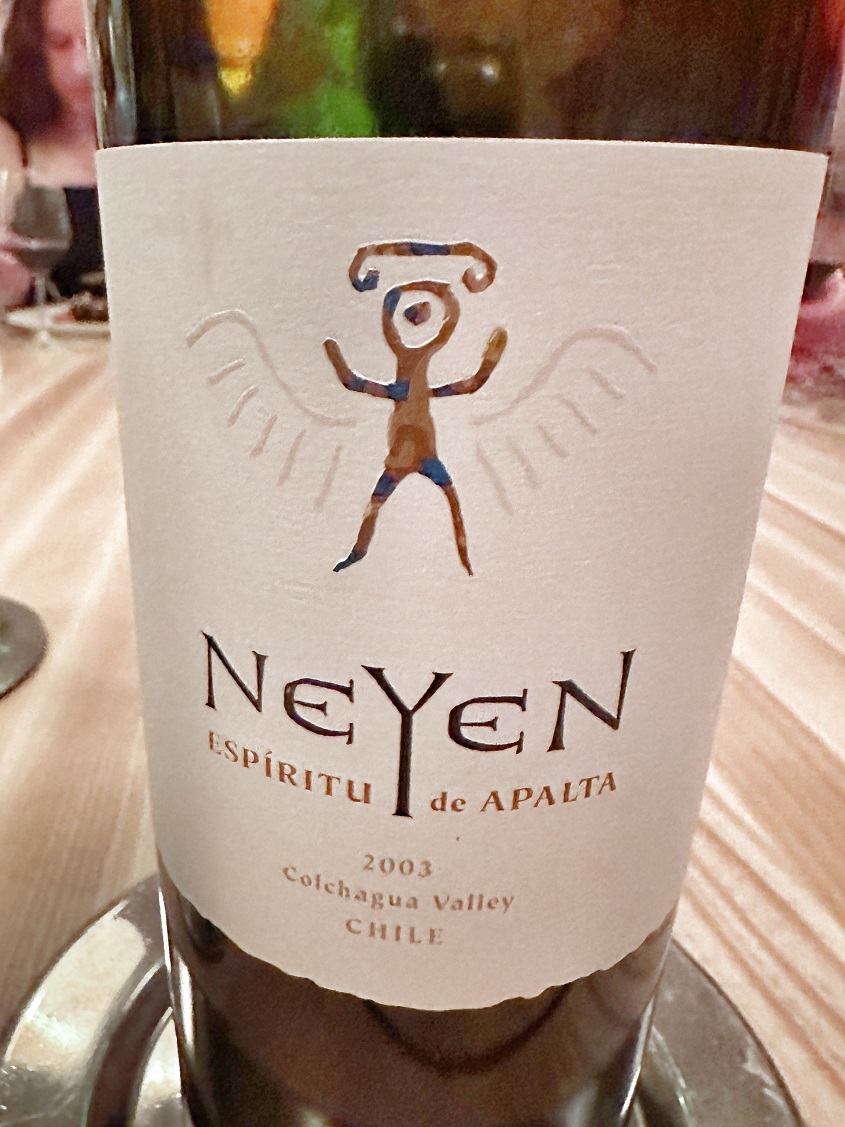


Last December I had an opportunity to try for the first time yet another Veramonte wine called Neyen. Neyen vineyards are located on a small parcel of land situated between the Andes Mountains and the Coastal Range. Neyen wines are literally always a blend of 50% Cabernet Sauvignon and 50% Carmenere, both coming from truly the old vines – Cabernet Sauvignon vines were planted in 1889, joined by Carmenere in 1936, which makes the vines respectively 134 and 87 years old.
In the local dialect, Neyen means “whisper”. The land whispers, you only need to listen to her – low intervention is what the Neyen winemakers practice. And this is the whisper you can taste.
The wine literally stopped me in my tracks. You know that stupid smile that you can’t control when something good is happening? This was my face upon the first whiff of the 2003 Neyen Espíritu de Apalta Apalta DO ($N/A) – the first vintage of Neyen wine ever produced. The time stopped – there was only the endless pleasure of aromatics that only mature wine can bring.
Time, wait. Don’t move. I’m still enjoying it. Please, just a few more moments.
Cassis and eucalyptus on the nose. Cassis and eucalyptus on the palate, silky smooth, perfectly integrated tannins, full body of the mature wine at its absolute peak, pleasure slowly descending layer after layer. This is the case where the words are clearly insufficient to describe the joy of the oenophile, but I hope I offered at least a glimpse.
For the main course, I selected Bluefin Tuna au Poivre with baby beets and citrus sauce – and to my delight, the 2003 Neyen offered a perfect pairing, elevating every bite of the food.
We also had the 2016 Neyen, Espíritu de Apalta Apalta DO ($N/A). Tasting 2016 after 2003 was somewhat of a mistake. 2016 is an excellent wine, but the beautiful core we were able to experience in 2003 was still covered by layers of baby fat, the wine showing a lot richer, almost jammy on the first sip, and in need of time to open up.
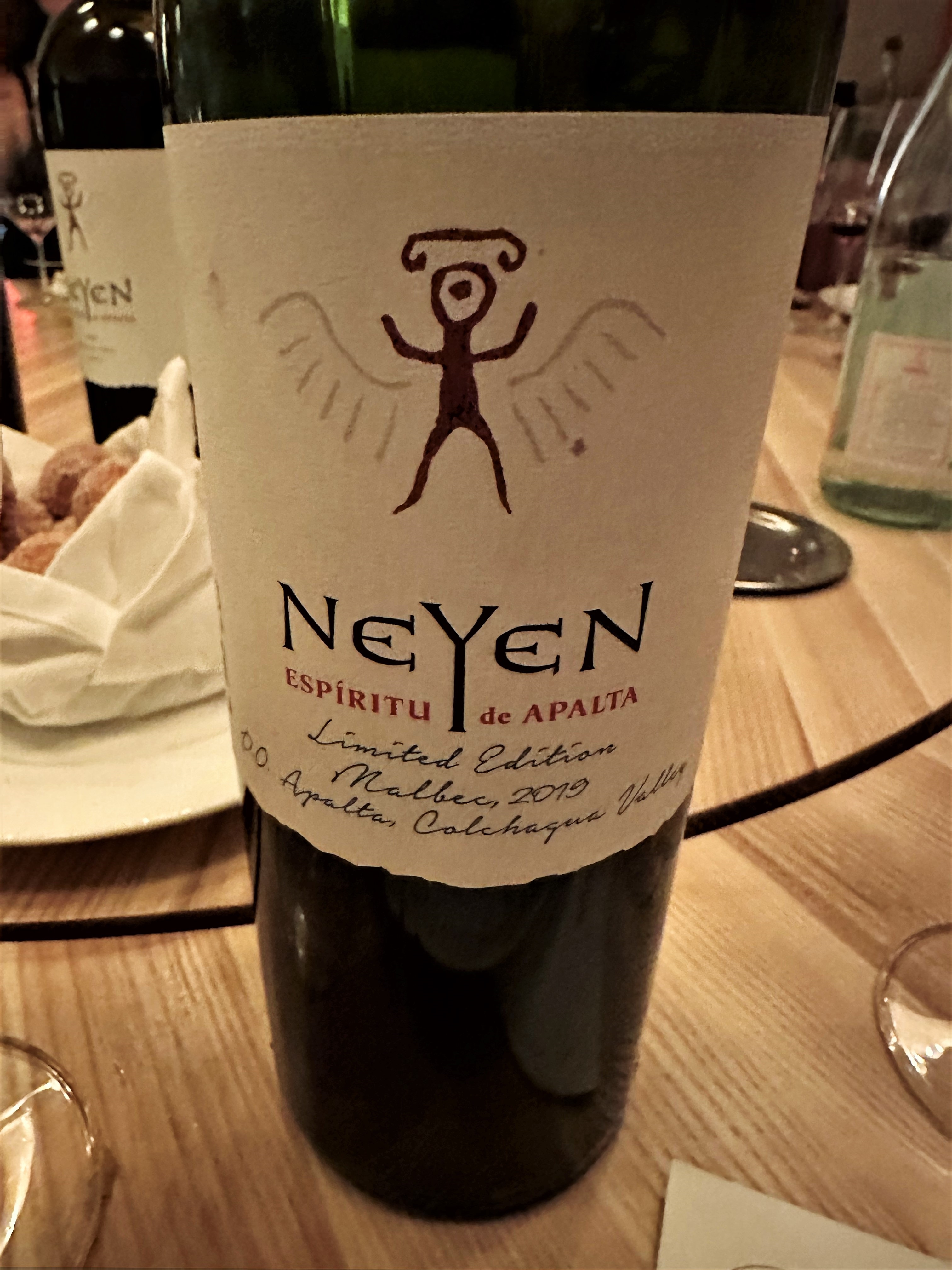
The culmination point of our evening, though, was … a bit unexpectedly, as we are talking about Chilean wines … the Malbec. 2019 Neyen Espíritu de Apalta Malbec Apalta DO ($149.99 SRP). 2016 was the first released vintage of this super low-intervention wine – harvested and destemmed by hand, fermented in small tanks, no machines, no electricity used in the production of this wine, aging only in 3rd and 4th use French oak barrels. This is the crown jewel of the Veramonte Neyen collection – even James Suckling agrees, rating this wine at 100 points. Only 200 cases of the wine were produced in 2019, with the US allocation standing at 40 cases.
The main word I would use to describe this wine would be “elegant”. The wine was showing beautiful eucalyptus notes, a lot leaner than most of the Argentinian Malbecs, begging comparison with old world Malbec, the Cahors. Elegant, layered, delicious.
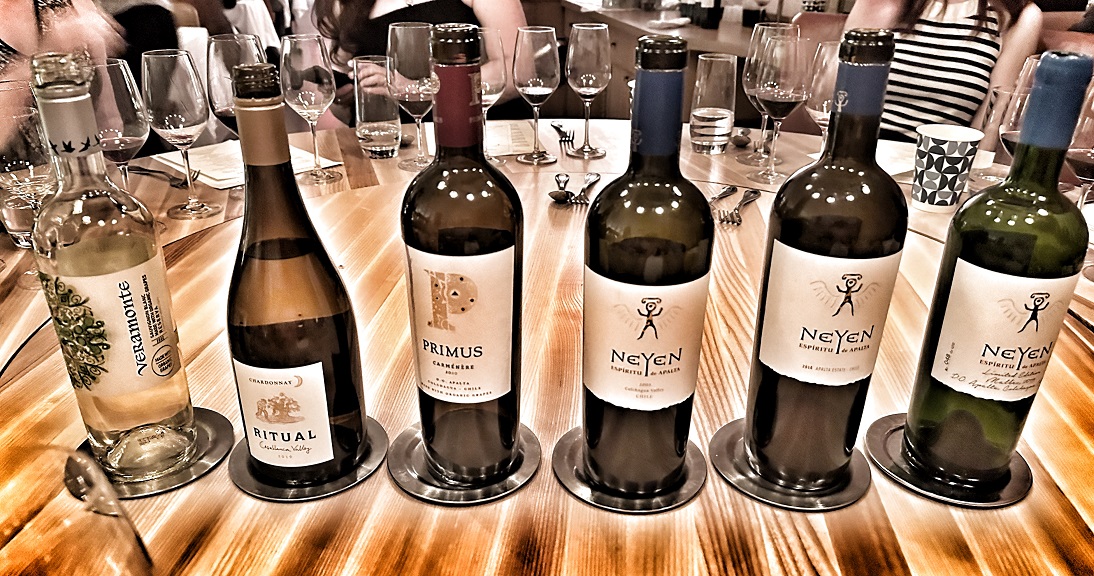
And this, my friends, brings us to the end of the wonderful evening. The company was great, the food was excellent, the wines were amazing.
Mother Nature whispers, and good things happen when we listen. I wish I had a case of this 2003 Neyen Espiritu de Apalta – that would really make me happy. Well, we generally don’t get to have all the things we want – and I’m grateful for the opportunity to experience such wines at least once.
Veramonte wines offer a great selection for every budget and every palate – check them out when you will have a chance. Cheers!
Celebrating Oregon Wine Month with Potter’s Vineyard Wines
I guess there is something special in the month of May as everybody wants to appropriate it..for their wine purposes. The story differs from year to year, but this particular May 2023 has at least 4 wine designations (if I missed something – I profusely apologize) – May is Finger Lakes Wine Month, Michigan Wine Month, Oregon Wine Month, and Washington Wine Month.
The good thing is – there are 31 days in the month of May – which is enough to celebrate the wines of many more states – or maybe even all 50 – with proper planning. But for today, I only would like to focus on one of the wine months – Oregon.
Oregon wine is near and dear to my heart. First of all, Oregon itself is a beautiful place – I love the pure, open, clean, spacious, and airy pine forest oh so different from New England’s sprawling intersection of ivies, and stunning vineyard views which you can enjoy everywhere. Some of the very best American wines are produced in Oregon. And the longest-running series of articles on this blog – Stories of Passion and Pinot, conversations with winemakers – is dedicated to Oregon winemakers who made Pinot Noir the passion of their lives.
20 years ago, Oregon wines could’ve been known as a one-trick pony with its sole focus on Pinot Noir. Today, that world-class Pinot Noir is joined by Chardonnay, Pinot Gris, Riesling, Syrah, Tempranillo, Sangiovese, and even Tannat. Sparkling wines and Rosé can be found almost at any winery. And Pinot Noir is not just for reds anymore – Pinot Noir Blanc, a.k.a. White Pinot Noir is the wine to look for. Oregon winemakers continue studying their vineyards, identifying unique blocks and plots in a quest to produce the most terroir-driven wines.
One of my most recent conversations in the Passion and Pinot series was with Bill Sanchez, the proprietor and winemaker at Potter’s Vineyard. Potter’s Vineyard is a small, 3.5 acres estate in Laurelwood District AVA in Willamette Valley, producing about 1,000 cases annually. Potter’s Vineyard is organic, LIVE and Salmon Safe certified, and committed to staying small – you can learn about this commitment and the overall philosophy of Potter’s Vineyard from our conversation which can be found here.
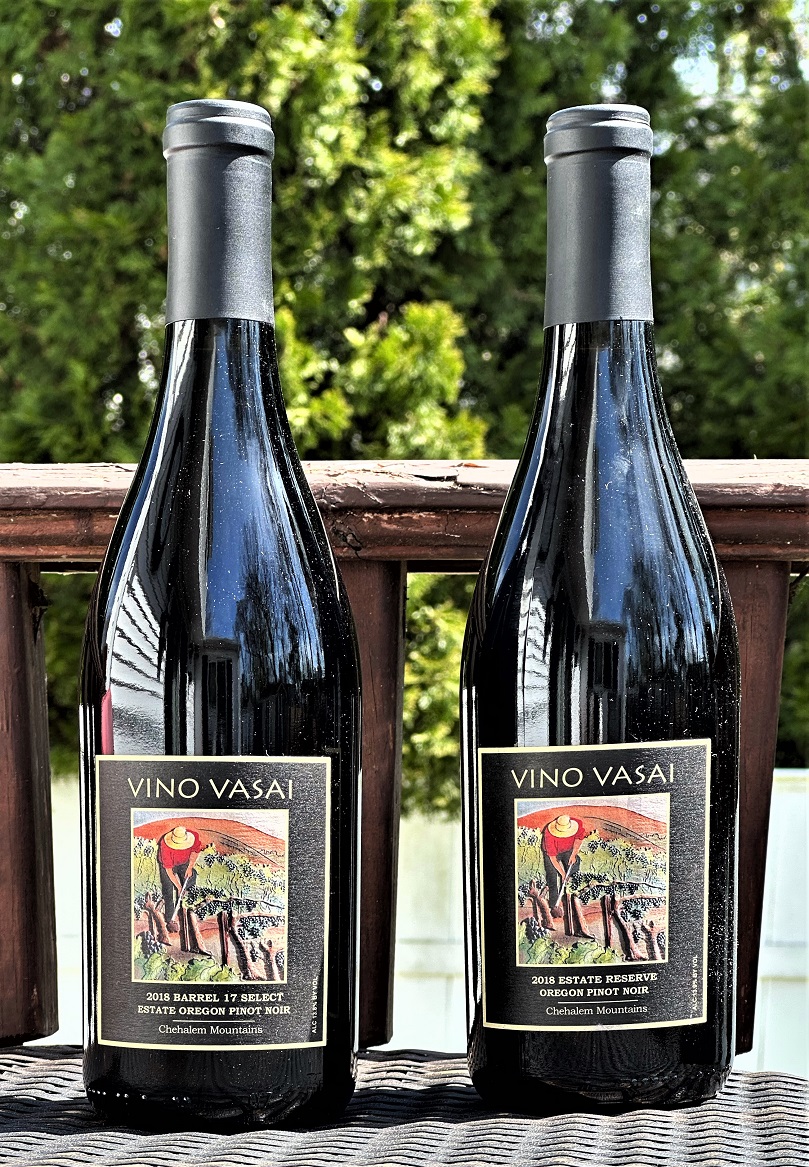
I don’t know about you, but I really admire these labels
Now I had an opportunity to taste a couple of the Potter’s Vineyard estate Pinot Noir wines, Barrel 17 Select and Reserve. Here are my notes:
2018 Vino Vasai Barrel 17 Select Estate Oregon Pinot Noir Chehalem Mountains (13.8% ABV, $48, Dijon clones)
Dark Ruby
Dark cherries, violets, minerality
Dark cherries, plums, medium to full body, firm structure, well-integrated tannins, luscious layers followed by the tart, long finish
8, excellent. Upon opening, the wine was lean and tight, Burgundian style. The next day opened up to show more of the Oregon Pinot power, still governed by restraint.
2018 Vino Vasai Pinot Noir Estate Reserve Chehalem Mountains (13.9% ABV, $58, Pommard clone, 75% new French oak )
Garnet
Beautiful legs (I rarely pay attention to those, but couldn’t help to notice)
Very enticing nose with sweet cherries, plums, eucalyptus
Cherries on the palate, tart, perfectly structured, harmonious and perfectly balanced. Craving food, but I can polish a bottle by myself.
8/8+, excellent.
Here you are, my friends – more of the delicious Oregon wines worth seeking. Oregon wine month is upon us, so if you need any suggestions, just click here.
And don’t be shy – if you got any of the Oregon wine favorites, please comment and leave notes for others.
Until the next time – cheers!
P.S. For more stories of Passion and Pinot please visit the series’ main page.
Stories of Passion and Pinot: Looking Back and Looking Forward 2023
 What started from the little idea “yea, I don’t know, I don’t believe in it, but maybe I will try anyway” now became one of my favorite ongoing series in this blog – Stories of Passion and Pinot. Stories of Passion and Pinot are exactly what the title says – these are the stories of the winemakers passionate about one of the most finicky grapes there is – Pinot Noir.
It is a fun exercise to take a retrospective in the ongoing series and see how far I have gone from time to time. So here is the latest update – for me, and for you if you care to read it.
First, last year I created a new landing page for the whole series. This page is kept current, all new interviews are now added to this page and you always know when the page was updated last.
Four new stories were added since the last update: David Adelsheim of Adelsheim Vineyard, Shane Moore of Gran Moraine, Erik Kramer of Willakenzie Estate, and Bill Sanchez of Potter’s Vineyard. All of these are excellent, in-depth interviews – if you have not had a chance to read them yet, you really should do it now.
Interviews in the series have questions tailored to the individual wineries and winemakers with a little overlap between them. However, sometimes it is fun to ask people the same question and enjoy the diversity of the replies. I asked the same two questions to some of the winemakers who had been already profiled in this series – and now I want to share our short Q&A with you.
Sara Specter of Bells Up Winery, Bill Sanchez of Potter’s Vineyard, and Wayne Bailey of Youngberg Hill have graciously agreed to answer my questions, so below you can see my questions – and their answers:
[TaV]: How was the year 2022 for you? New grapes, new plantings, new wines, vineyard discoveries (a new plot/block, for example), new winemaking styles, new wine club, new tasting room, new markets, growing season and the vintage – please share anything and everything you are willing to with our readers.
[Bells Up Winery]: Harvest 2022 was our 10th under the Bells Up label, having moved to Newberg, Oregon in 2012 and making our first vintage in 2013. Harvest 2022 was also what we’ve been calling “the end of the beginning.” It was the first year we were “100% Pinot Independent,” meaning we didn’t source Pinot Noir from any other grower for the first time. It was a wonderful experience working with other micro-site growers who were very much like us. But our goal has always been to be as close to 100% estate as possible, and now we are… at least for the Pinot Noir. We were also delighted to see that the Pinot Blanc we planted in Fall 2021 and the Schioppettino we planted in Fall 2020 continued to do well, despite some initial concern from the late frost we had in April.
[Potter’s Vineyard]: 2022 was good but tough. It was tough due to the spring frost that wiped out 80% of the primary buds in our vineyard. The cool, wet spring led to a late start to bloom and fruit set. We literally did not know if we would have only a tiny harvest or something close to normal until late in the season, which led to a lot of turmoil. We decided to stay the course and farm it normally assuming that we would have something and of course take care of the vines for the following year. Amazingly, the vines rebounded and we ended up with about 70% of our normal yield. And because we farmed and sprayed diligently we did not suffer from the very high amount of powdery mildew that descended upon the Northern Willamette Valley that year. It was also a year where we added some new effective organic compounds to our organic farming spray program that probably helped fend off powdery mildew. The Pinot noir fruit was beautiful but we had much less of it. 2022 was also a pivotal year for us in our business. We bottled our 10th vintage and pondered all year what we would do for the next 10 years. We’ve made good wine but we decided to try to make better wine as our goal. We hired a Burgundy trained winery consultant with 35+ years experience. Combined with our 15+ years we now had over 50 years of combined experience to gain from. We fine tuned every protocol we had in place and added a lot of additional analyses to our tool box. We also added a new barrel-side wine analysis device to help us get more analyses done more efficiently and timely. This helped us get through a tough set of late fermentations of our other varietals that ripened later than normal due to cool spring throughout the NW. So for us it was a long, tough, and educational year but successful due to our added help and resources.
[Youngberg Hill]: Great growing season. Great balance and complexity in the fruit. A more typical season for the Willamette Valley, later wet spring, cool September and October harvest.
[TaV]: What are your plans for 2023? What do you think the future holds?
[Bells Up Winery]: In 2023 we hope to get enough fruit from the Schioppettino to make a proof-of-concept batch. We will also be releasing our very first bottling of bubbles. The 2022 crop of Seyval Blanc from our estate (first planting in the Willamette Valley of this French hybrid and only the second in the state of Oregon) will be released in a brut style under a new label, “Joy.” In keeping with our practice of naming wines after pieces of music that have terrific French Horn parts, this one is named for Ludwig van Beethoven’s Symphony No. 9 in D Minor, “Ode to Joy.”
[Potter’s Vineyard]: We plan to continue with this new approach to taste the ‘fruits of our labor’ and continue improving as much as we can. We know the future will be tough with another global recession looming, however, we will continue to work hard to provide wine lovers a small vineyard & clay art gallery experience and premium wine.
[Youngberg Hill]: We will get our first fruit from the new Wayne’s World block this year, clones 667 and 115. Regarding what the future holds – who knows?
It is so interesting to see different takes on the vintage, the conditions, etc – and of course the future plans. It will also make it fun to ask the exact same questions next year.
There is a number of new interview ideas in the works, so as they like to say it – watch this space…
Stories of Passion and Pinot: Bill Sanchez of Potter’s Vineyard
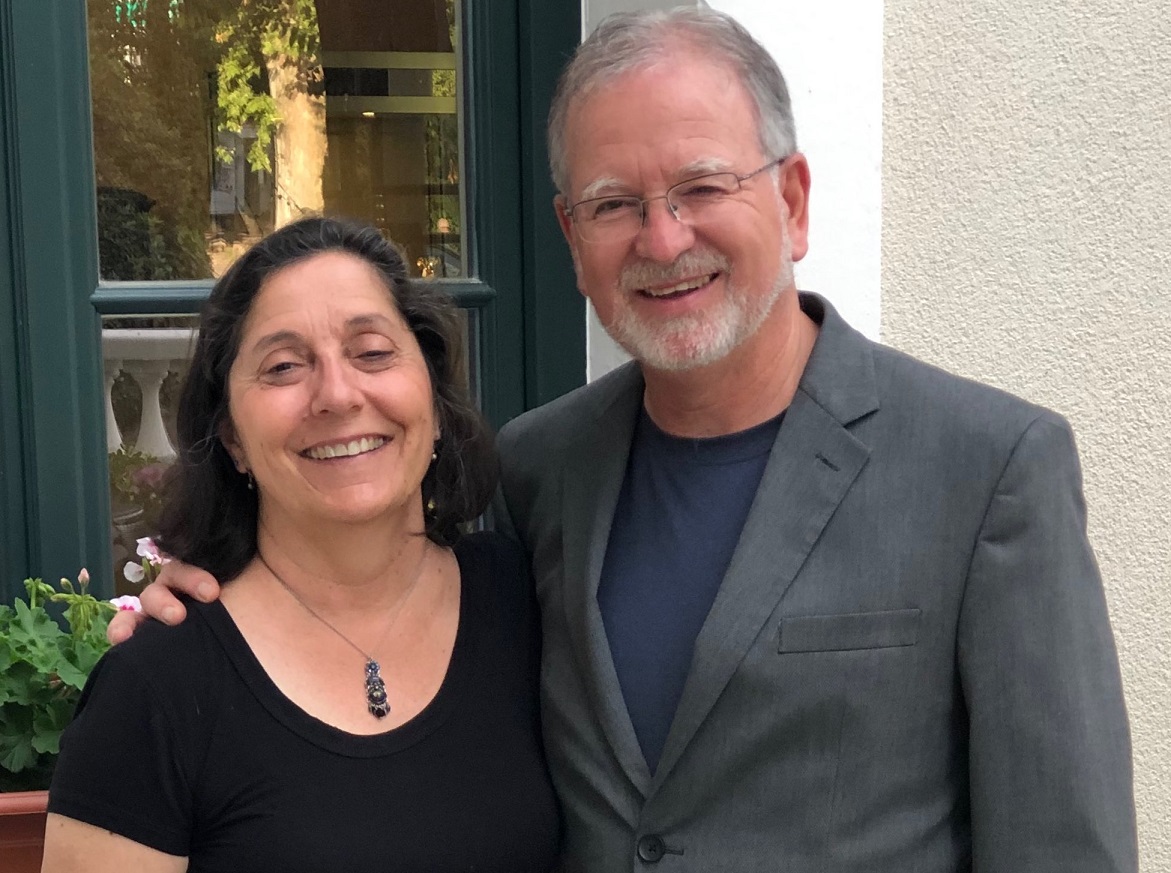
Bill and Sandy Sanchez. Source: Potter’s Vineyard
Wine is art.
More often than not, the connection goes beyond that simple statement. Have you visited wineries that are housed in beautifully designed buildings, or offer various pieces of art – paintings, sculptures – for everyone’s viewing enjoyment? Wine is a form of art, made by artists, and it thrives surrounded by art in a multitude of shapes and forms.
Bill Sanchez extended his 30+ years of PhD experience in nutritional science and 15 years as a professional Potter to the art of winemaking when he and his wife Sandy bought 3.5 acres estate winery in Laurelwood District AVA in Oregon from Laura Volkman in September of 2012. He had to learn 1,000 steps of making great Oregon Pinot Noir from Laura, who planted the vineyard in 2001. Guided by this knowledge, love of art, and utmost respect for one of the most famous artists of all time, Michelangelo, Bill and Sandy operate their winery with a full commitment to “staying small”.
Organic, LIVE and Salmon Safe certified winery, Potter’s Vineyard produces about 1,000 cases annually, supplementing estate Pinot Noir with Chardonnay, Cabernet, Merlot, Sangiovese, and Syrah coming from single vineyard estates in Washington. Connecting visitors to art, the winery also offers a full exhibit of handcrafted Clay Art.
I had an opportunity to sit down (yes, virtually) with Bill Sanchez and ask him a few questions about his passion for Pinot and art. Here is what transpired in our conversation:
[TaV]: What is Vino Vasai Wines and how it is different from Potter’s Vineyard wines?
[BillS]: There’s a back story on Vino Vasai, which means Wine of The Potter. We used it when a large company said ‘they would oppose’ our trademark for Potter’s Vineyard. Vino Vasai is the wine brand, and Potter’s Vineyard is the name of our company and Estate Vineyard.
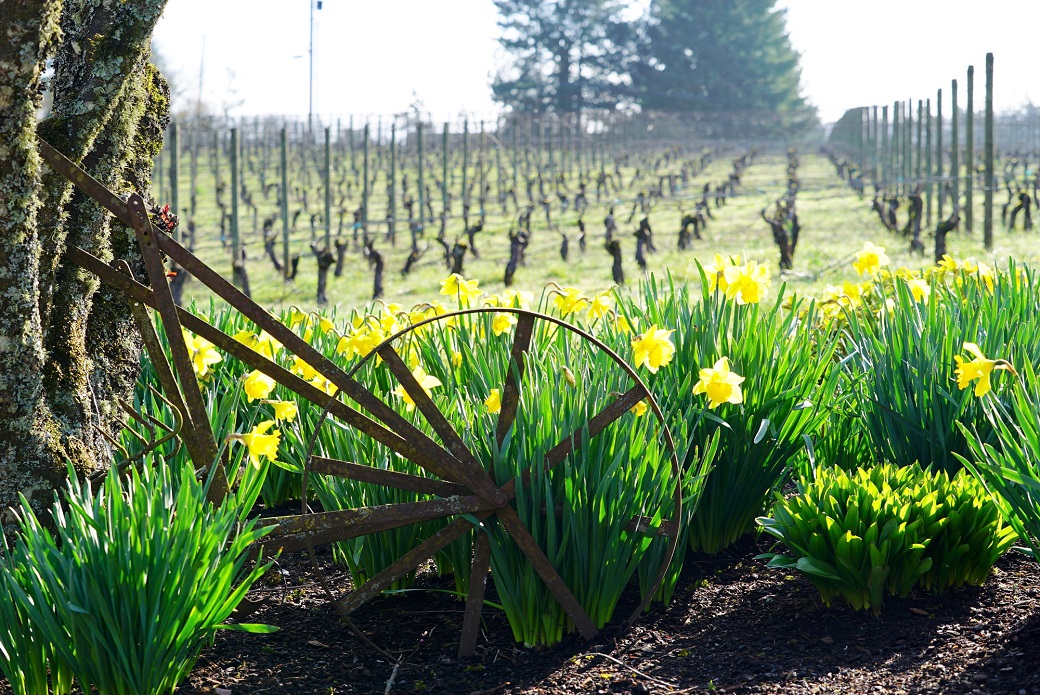
Source: Potter’s Vineyard
[TaV]: You worked for 35 years in nutritional science field. How does this experience affect your work in the vineyard and the winery?
[BillS]: That experience has focused my work on the vineyard where I am taking a ‘nutritional health’ approach to our farming. We practice organic farming and use natural ‘nutritional compounds’ to improve the health of the vineyard. We are gathering clinical data that shows this helps to prevent major pests like powdery mildew.
[TaV]: I read in your story that you learned 1,000 steps of making great Oregon Pinot. Can you please tell me what step 367 is all about? 🙂 just kidding 🙂 but seriously, what are these 1,000 steps all about?
[BillS]: When you break everything down there is probably many, many starting with 30 passes in the vineyard (that starts in January by the way), and many more steps involved in growing quality fruit (pruning, tying down, flailing, rubbing buds, trellising, mowing, spraying, hedging, etc. Then, when you add all the steps after harvest you get many, many more – I know I exaggerated it at 1,000 but someday I will add them all up and I know I will be closer to 1,000 than 100!
[TaV]: Especially because of your extensive scientific background, I have to ask you the same question I like to ask many winemakers – Biodynamics. What do you think of biodynamics? Would you ever implement it at your winery?
[BillS]: I’m very intrigued, but I don’t understand it yet, especially the ‘cosmos’ connection. I understand Organic much better and am excited to see the increasing amount of quality science that demonstrates not only that Organic farming works, but that it is healthier for the entire farm.
[TaV]: Pottery seems to be your other passion besides wine. Today, amphorae are popular vessels among winemakers to work with their wines (fermentation, aging, etc.). Do you use amphorae at your winery? As a potter, would you attempt to simply make one for this purpose?
[BillS]: Again, I’m very intrigued by amphorae but I haven’t yet found them to deliver higher quality wines compared to oak barrels. This is especially true for reds and chardonnay, which are my primary focus. I have tried some delicious crisp whites from amphorae, but I am not working with those varietals (yet)! I would rather buy Amphorae from my neighbor, fellow potter and winemaker, Andrew Beckham than attempt to make one myself (especially at the size needed to make enough wine for a club pickup).
[TaV]: I understand that you and your wife are big fans of Michelangelo and his work. How does Michelangelo’s work inspire you in your daily dealings at the vineyard and the winery?
[BillS]: I like the fact that Michelangelo was so diverse in his work (sculpture, painter, and architect) and I think we all aspire to be like him, not only one of greatest in his time but one of the greatest of all time!
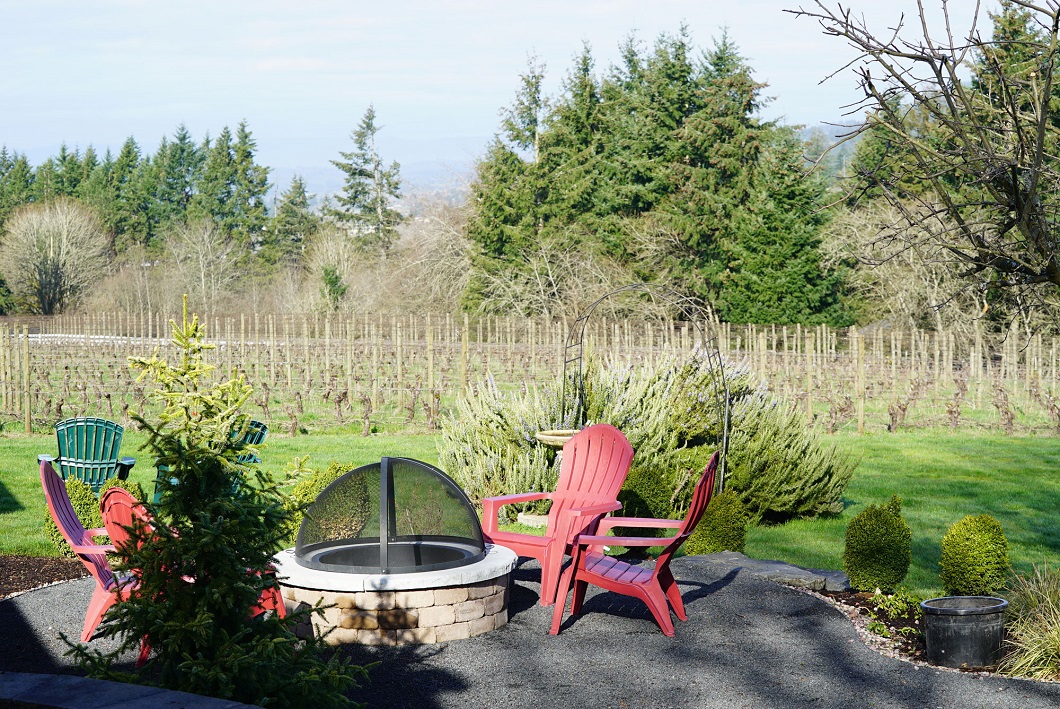
Source: Potter’s Vineyard
[TaV]: You stated that Potter’s Vineyards is dedicated to staying small. How difficult it is keep that resolution and to stay small?
[BllS]: It’s most difficult financially, but because my wife and I did not plan on needing the income into our retirement years, we are happy to break even and live and work with less stress.
[TaV]: How does this decision affect your daily work?
[BillS]: It is very rewarding to have something we enjoy very much that keeps us busy every day and provides a product that enriches people’s lives, especially in creating a pleasurable memory they can share with family and friends.
[TaV]: Potter’s Vineyards is a certified sustainable winery. Can you talk about your approach to sustainability and why sustainability is important to you?
[BillS]: Our approach is to focus on the health of the entire farm. I like to think about the health of the soil (insects, microbes, organic matter), the vegetation diversity between the rows, the flowering plants surrounding the vineyard, the birds, the bees, the insects and of course the people who visit. I believe this approach will allow the farm to thrive for many years (if not forever).
[TaV]: You have two wine clubs, B club and M club. I understand that M stands for Michelangelo. What B stands for?
[BillS]: Botticelli (another great Italian artist)
[TaV]: In terms of distribution, what percentage of your wine is sold through the club and local visits?
[BillS]:Over 90%.
[TaV]: Are your wines available in retail or maybe the restaurants?
[BillS]: We don’t actively pursue distribution, but if local retailers request our wines, we make them available and support these local establishments. Our wines are currently available at Our Table Farm Store in Sherwood, OR., 503 Uncorked Wine Bar in Sherwood, OR., Old Town Bar & Grill in Newberg, OR., and Crushed & Crafted Wine Bar in Newport.
[TaV]: I see that you produce a Sangiovese wine. Sangiovese is largely atypical for an Oregon winery. Is that a nod to your Italian connection?
[BillS]: Yes, my wife Sandy actually.
[TaV]: How popular is this wine with your customers?
[BillS]: They love it and love the story where we discovered Sangiovese during our trip to Italy in 2011 and then bought our vineyard in 2012. Releasing a Sangiovese in our 10th year of business was truly a dream come true!
[TaV]: You already make a full line of Pinot Noir wines (sparkling, Rosé, white Pinot and of course the large range of Pinot wines themselves). You also make Cabernet Sauvignon, Merlot, Sangiovese. Do you plan to plant any new grape varieties or make new wines?
[BillS]: Someday we may offer a Sauvignon Blanc, but Sandy says that’s it after that!
[Tav]: Where do you see Potter Vineyard in 10 years? What would you like to accomplish during the next 10 years?
[BillS]: If my children take a serious interest, I would love for the business to grow enough to support their families into the next generation and beyond but if not, we will find someone to nurture it along just as Laura Volkman found us!
There you are, my friends – another story of Passion and Pinot, another story of wine and art.
I didn’t get a chance to try Bill’s wines yet, so please stay tuned for the update…
P.S. For more stories of Passion and Pinot please visit the series’ main page.
Stories of Passion and Pinot: David Adelsheim
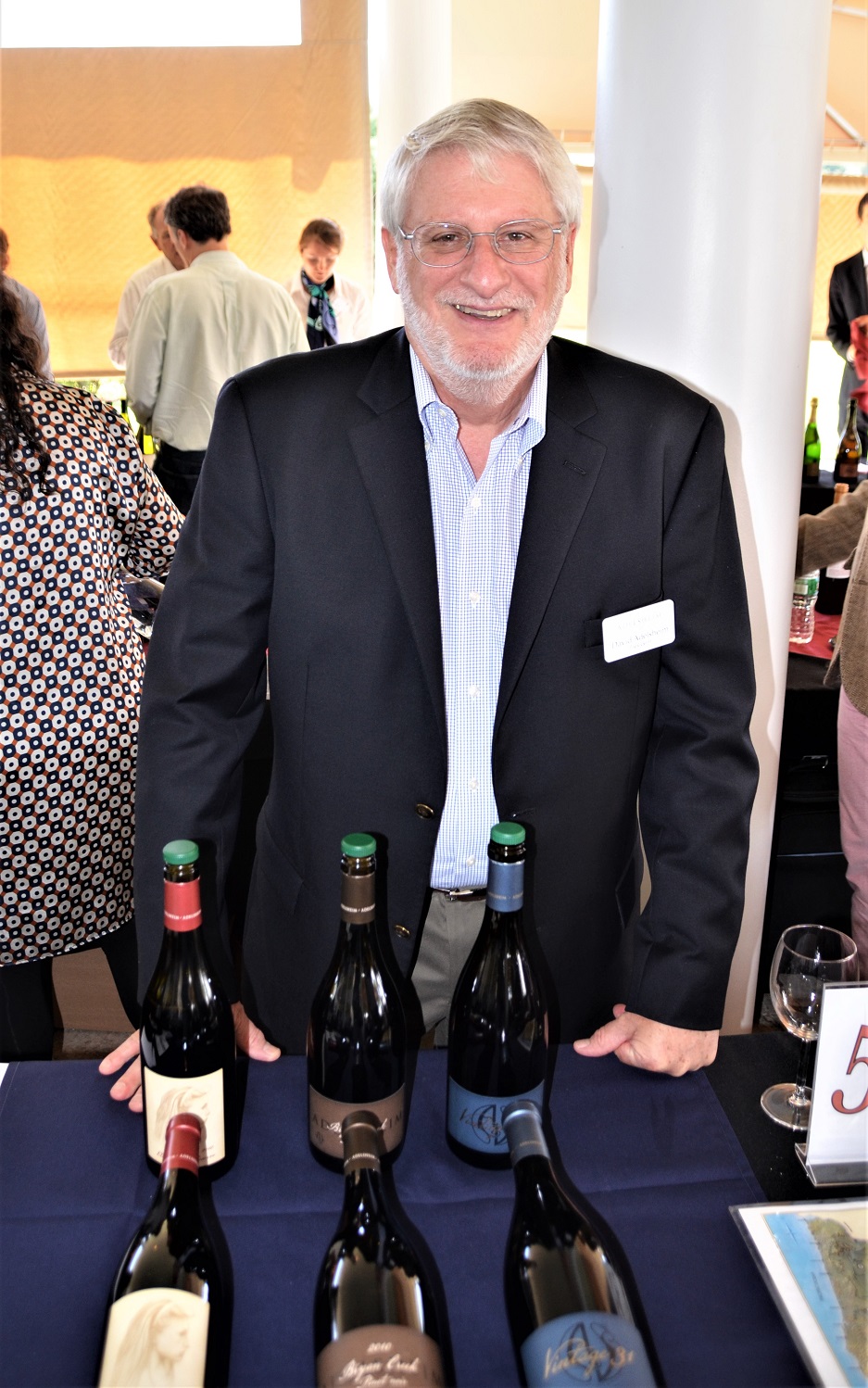 For those of us, eternal optimists and romanticists, who also happen to be wine lovers, wine always has a story. A glass of good wine always solicits an emotional response, and we truly believe that passion trumpets the world of wine. To create a wine that can move emotions, passion must be one of the key ingredients.
In the wine world, passion alone will not get you very far. It needs to be supported by hard labor. Unwavering resolve. Gumption and belief that you can not fail. Or so I learned by talking with winemakers in Oregon who made Pinot Noir their passion, growing it sometimes in places where nothing is supposed to grow. These conversations became the series that I called Stories of Passion and Pinot – in these stories you can see for yourself what that passion means.
Among winemakers, there are those who rightly deserve to be called pioneers. They come first, building the road that others can follow. David and Ginny Adelsheim were such pioneers, planting some of the first Pinot Noir vines in Willamette Valley in 1971, starting Adelsheim Vineyard, and never looking back. I had the pleasure of briefly meeting David about 10 years ago at a trade wine tasting in Connecticut and tasting some of his wines. A few months ago, Carl Giavanti helped me to actually have a conversation with David and ask him a few questions albeit virtually. David’s achievements over the 50 years and his role in promoting Oregon wines and bringing them to the world stage are nothing short of legendary and very hard to capture in a short interview format – but I believe it still will be well worth a few minutes of your time.
[TaV]: You learned a lot over the 50 years. If you would start the winery again, would you do something differently?
[DA]: Probably, I’d try to focus more attention on the quality of wines we produced and the fiscal stability of the winery. Or hire a winemaking consultant and a CFO, who could do those things, since my time is probably better spent helping the industry and selling wine.
[TaV]: Over the course of your winemaking career, what were your favorite vintages and why?
[DA]: I don’t really have favorite vintages because it was my job to be excited about every vintage. There are vintages, like 2021, where the weather cooperated, and the vineyard and winery logistics were easy. There are vintages, like 1983, 1988, 1990, 1999, 2005, 2012, and 2019, where the wines received great scores from the critics. There are vintages, like 1986, 1991, 1997, 2007, 2013, where the wines got so-so scores, but with time became glorious. There have been a couple of disastrous vintages like 1984 that, with time in bottle, became better than I would have expected. And then there are a few vintages, like 2003, 2006, 2009, and 2015, that ended up being very ripe.
[TaV]: Not to go too far on this tangent, but what is your opinion of biodynamic winemaking?
[DA]: Our vineyards are not biodynamically farmed, and our winery does not follow biodynamic principles. All our vineyards are LIVE-certified as is our winery. In addition, we use no herbicides in our vineyards.

Quarter Mile Lane Vineyard. Source: Adelsheim Vineyard
[TaV]: Adelsheim Vineyard farms about 200 acres in Chehalem Mountains AVA with a large variety of soil types and microclimates. Based on your experience, is this the time to think about establishing additional sub-AVAs?
[DA]: The 1979 regulations establishing the system of American Viticultural Areas is not rigorous enough. The word “wine” does not appear, no expertise is required to submit a petition, and there is no top-down guidance to ensure a logical, helpful system of AVAs. It is time to help everyone, from consumers to our own winemakers, understand the connection between where grapes come from and how a wine smells and tastes. In the Chehalem Mountains, we have undertaken a project to define distinct neighborhoods of wine, using a winemaker tasting panel working under the guidance of a researcher in Burgundy. If we are able to define such neighborhoods, just by tasting single vineyard wines, the wineries in the Chehalem Mountains area will have to decide whether to petition for additional nested, nested-AVAs (like Ribbon Ridge and Laurelwood District) or devise a better way to communicate with the public.
[TaV]: What are the oldest Adelsheim wines in the winery’s cellar?
[DA]: We have an extensive library that is supposed to contain examples of every wine we’ve ever produced, included from 1978, our first vintage.
[TaV]: How are they holding up?
[DA]: I haven’t tasted the 1978s in a pretty long time. The estate Pinot noir was served at our 40th anniversary in 2011. I was surprised that had held up. The whites – an estate Chardonnay and a WA Sémillon – are, of course, pretty oxidized but both still have fruit. And I bet that the two WA Merlots are pretty stunning – I can’t remember when I last tried one.
[TaV]: Over the last 4-5 years, significant efforts were made to protect the origins of Willamette Valley wines, such as the case against Copper Cane from California. How widespread is this problem, and what more needs to be done to better protect the Oregon wine industry?
[DA]: The Copper Cane case is getting resolved, I believe. But it illustrates that there are people, who would like to take advantage of the geographic brands we created – like Oregon and Willamette Valley. We saw a Chilean Pinot noir, bottled by a company with “Oregon” in their brand name. That’s illegal under TTB rules, but where’s the enforcement? Of course, I believe that the Willamette Valley AVA should have stricter rules – a 100% requirement to use the varietal name and 100% to use the Willamette Valley AVA or its nested AVAs. But proposing that to the 2019 legislature ended up splitting the industry so there’s little appetite for a second round any time soon.
[TaV]: Last year, the EU awarded Protected Geographical Indication status to Willamette Valley. Is that sufficient to protect the Oregon wine industry as a whole, or more needs to be done?
[DA]: We probably should figure out how to protect the name “Willamette Valley” in China and, perhaps, other parts of the world. Napa isn’t going through the work of protecting the names of their nested AVAs with the EU, so we probably don’t have to do that either.
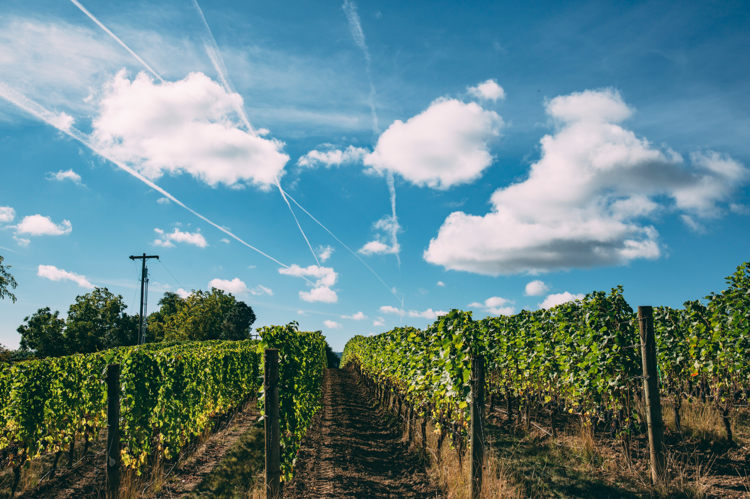
Calkins Lane Vineyard. Source: Adelsheim Vineyard
[TaV]: Should Oregon also receive a PGI status?
[DA]: Probably, yes. But someone will need to volunteer to complete the incredibly long application and the revisions required. It took Harry Peterson-Nedry ten years to get the EU to grant Willamette Valley TGI status. The Oregon Wine Board should do that application. But probably doesn’t have the bandwidth.
[TaV]: You are often referred to as an ambassador of Oregon wines to the world. Are Oregon wines well recognized worldwide?
[DA]: Well, the top wines from the Willamette Valley (mostly Pinot noirs) are starting to be recognized in markets that can afford them. The problem is that they are being called “Oregon,” which leads to confusion of consumers. We need to stop using “Oregon” when we’re referring only to the wines of the Willamette Valley.
[TaV]: What are the main exporting countries for Willamette Valley Pinot noir?
[DA]: Number 1 is Canada, followed by the UK and Japan, followed by Sweden and Denmark. Other Asia markets (Korea, Singapore, Taiwan, the Philippines) are growing as are Caribbean markets. In the EU, there are countries that can afford WV PNs – Germany, France, Italy, Holland, Belgium in particular. But they continue to focus primarily on French, German, and Mediterranean wines.
[TaV]: What needs to be done to make Willamette Valley wines better known internationally?
[DA]: Education of the importers about our region and the brands available in the particular country. Once enough wineries have representation, then we can start educating the media and the trade. Finally, once the wines are available in stores and restaurants, with stories appearing in wine and lifestyle media, then we can start education consumers.
[TaV]: What are the main problems facing the Willamette Valley wine industry, now, and say, over the next 20 years?
[DA]: You mean besides global climates change, which threatens all of today’s top wine regions. Well, beyond that, we need to ensure that Oregonians are buying the State’s successful wineries, not just wine companies from outside the State and, often, outside the country. You can’t talk about Avis being the best rental car company if it’s owned by Hertz.
[TaV]: What would be your advice to the young winemakers who are just getting started?
[DA]: They don’t seem to need my advice. They have figured out the pathway to starting their own brand – start at the bottom, working for others. Buy grapes and rent space to make tiny amounts of amazing wine. Grow slowly, never making enough wine, always over-delivering on quality. Don’t borrow capital. Once they have a strong reputation and a successful brand, they can start thinking about their own vineyards, and way down the road, their own bricks-and-mortar winery.
[TaV]: If you could select just “one thing” you’d like to be remembered for, let’s call it your legacy trademark, what would that one thing be?
[DA]: Heck if I know; you pick one:
1973 – Worked with Bill Blosser, Dick Erath and others to map where grapes could be grown in Yamhill County, which led to the saving of YC hillsides for agriculture; and adoption of a similar approach in other counties
1973-1977 – Drafted the strict Oregon Labeling Regulations, lobbied the industry to support and the OLCC to adopt them
1974 – Realized the importance of PN & CH clones in Burgundy while an intern at the Lycée Viticole in Beaune
1974-1983 – Helped establish the clonal importation & evaluation programs at OSU
1975 – Coordinated the importation of clones from Alsace, including first Pinot blanc in the U.S.
1976 – Coordinated the importation of clones from ANTAV, including first Gamay noir in the U.S.
1977 – Participated in the effort to pass legislation to establish the TWRAB
1982 – Wrote petitions to establish the Willamette Valley and Umpqua Valley AVAs
1983-1993 – Led the discussion program at the Steamboat PN Conference each summer
1987 – Requested Raymond Bernard send clones of Chardonnay (incl 95) and Pinot noir (incl 667 and 777) to OSU
1987 – Helping Robert Drouhin find and buy land for DDO
1987/8 – Responsible for the Burgundians attending first and second IPNC
2000 – Cofounded OPC with Pat Dudley
2002 – Wrote the petition to establish the Chehalem Mountains AVA
2003 – Led the lobbying effort to change OWAB to OWB
2005 – Drafted extensive amendments to the labeling regulations
2005 – Helped lead the effort to rebuild the WVWA into one of the U.S.’s most important wine marketing organizations
2014 – Founded Chehalem Mountains Winegrowers
2015 – Proposed and led the creation of the first Chardonnay Technical Tasting that has elevated the style of WV Chardonnay
2015 – Leader in the effort to pass legislation to limit the number of non-sales-related events at wineries
2016 – Helped envision Willamette Valley: the Pinot Noir Auction
2019 – Leader in the lobbying effort for stricter regulations for varietal content and origin for WV wines, which failed
2020-202? – Envisioned and played a leadership role in the Neighborhoods Project for the region of the Ribbon Ridge, Laurelwood District and Chehalem Mountains AVAs
2021 – Conducted and edited the Founders’ Stories for Adelsheim’s 50th anniversary
2022/3 – Working with Josh Bergstöm on a technical winemaker event for Pinot noir
[TaV]: It seems that your motto is “never stop”, and for sure when it is necessary to advocate for and advance the Willamette Valley wine industry. What special Willamette Valley wine projects are you involved in now?
[DA]: I mentioned the Neighborhoods Project, focused on Pinot noirs from the Ribbon Ridge, Laurelwood District and the Chehalem Mountains AVAs back under question #5. I’m finishing up video interviews of the Founders of the first ten wineries in the Willamette Valley. Short versions are on our winery’s website (“Founders’ Stories.”) Videos of the entire interviews are in the Linfield University Wine History Archive. I’m working with other winemakers to create a way to come together and taste each other’s wines, so that the Pinot noirs of the Willamette Valley can evolve in a thoughtful way. Yeah, and the book… everyone says I need to write a book, and maybe I will.
Here you are – another addition to the Stories of Passion and Pinot. I hope you enjoyed this encounter with the winemaker’s passion and maybe even learned something new.
Until the next time…
P.S. For more stories of Passion and Pinot please visit the series’ main page.
Study in Sustainability: Lugana DOC
If you like wine and read about it from time to time, I’m sure you can easily identify all the buzzwords – organic, biodynamic, sustainable, clean, natural, and there are probably a few more I’m missing. Some of these terms are well defined and well understood, such as organic (even though the meaning of “organic wine” differs in Europe and the USA). Some of those terms are unquestionably controversial, such as “natural”, and don’t even think about discussing “clean” wines. And while I like the “organic” concept, and “biodynamic” sounds whimsical, I believe sustainability is the most important word here.
If we will check the Oxford Languages definition, sustainability is defined as “the ability to be maintained at a certain rate or level”. The second definition is a bit closer to our subject of farming (growing grapes is just one of the farming applications, of course) – “avoidance of the depletion of natural resources in order to maintain an ecological balance” – I’m stressing the word “balance” here, Balance is the name of the game. We get what we want (grapes and wine) without destroying the source, so those who will come after us will have enough left for them, and once they are gone, there will be enough left for yet the others. Primitive drawing skills I have, no doubt, but I’m sure you got the picture I’m trying to paint.
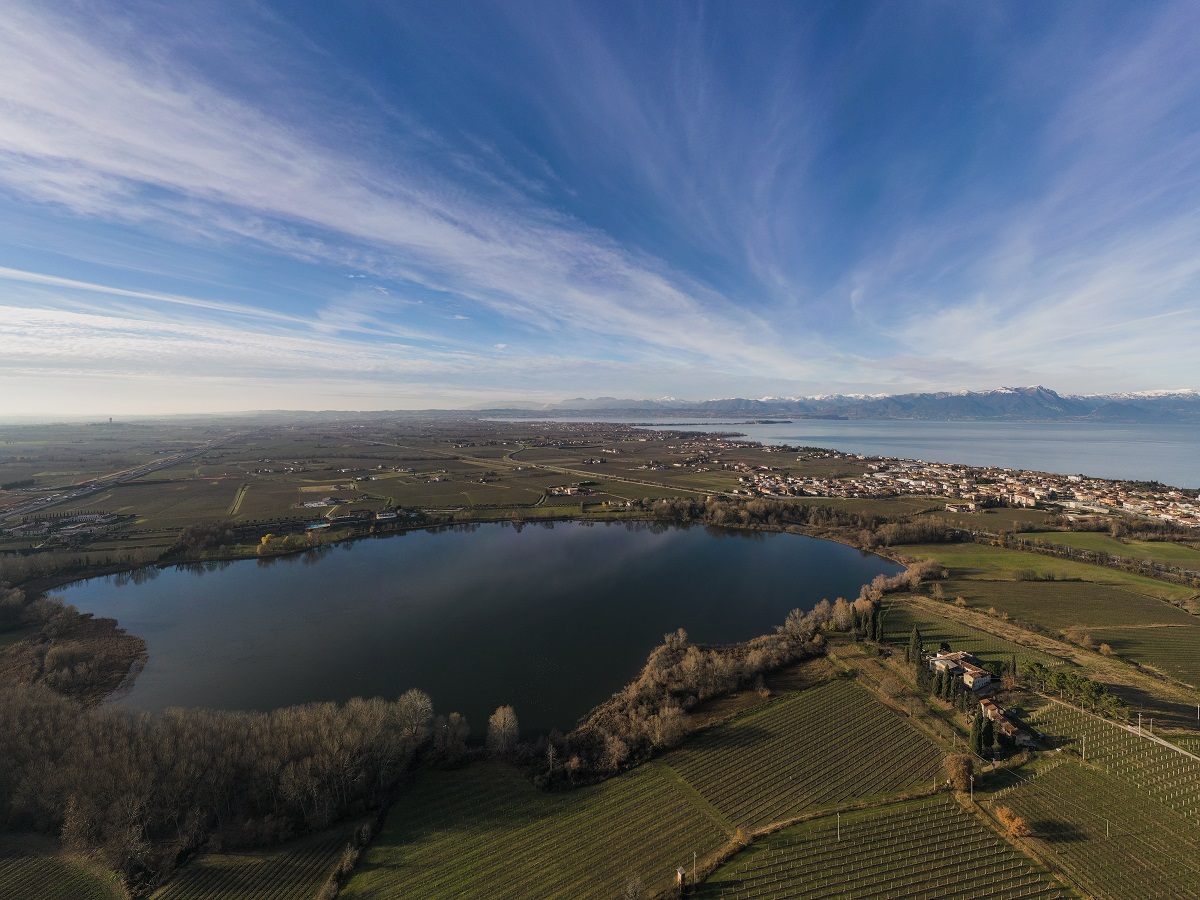
Source: Consorzio Tutela Lugana D.O.C

Source: Consorzio Tutela Lugana D.O.C
Lugana is one of the oldest designated wine-growing areas in Italy, after obtaining its DOC status in 1967, the first in Lombardy, with about 1,000 acres under the vines. Lugana is also one of the few unique DOCs in Italy, spanning two regions and two provinces – the province of Brescia in Lombardy and the province of Verona in Veneto. Most of Lugana’s 5,500 acres of vineyards are adjacent to Lake Garda, which creates a unique, mild microclimate, atypical for Northern Italy. Most of the wine produced in Lugana is white, made out of a local indigenous grape called Turbiana. For a long time, Turbiana was erroneously considered to be Trebbiano di Lugana, until DNA analyses had shown that Turbiana is its own, unique variety.
As in most of Italy, the history of winemaking in Lugana goes back to Roman times, with the wines from the area praised on multiple occasions throughout the times. Lugana managed to stay a best-kept secret for a long time in the 20th century, with its wines being best known to the tourists flocking to the picturesque villages surrounding the lake. Slowly, the quality of the wines prevailed and the wines became thought after around the world, in part due to their excellent aging ability. In 2018, there were 17.5 million bottles produced in Lugana, 70% of which were exported around the world, with the US being Lugana’s 4th largest market.

Source: Consorzio Tutela Lugana D.O.C
Sustainability is definitely a trend among the wineries in Lugana. The winemakers want to preserve their land, their farms, and their vineyards for many generations to come and do everything in their power to make this happen. I wanted to give you a first-hand account of sustainability and virtually sat down with the kind folks at 6 wineries, who answered the same group of questions. Grab a glass of wine (or two), and hear it for yourself.
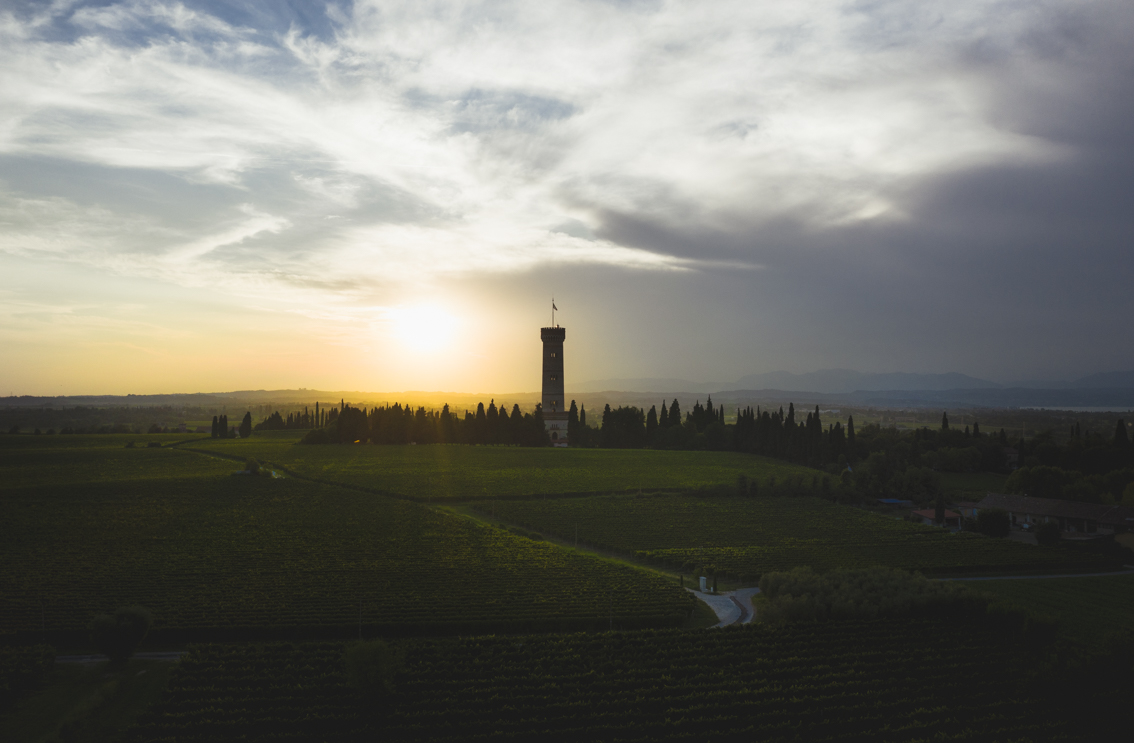
Source: CITARI
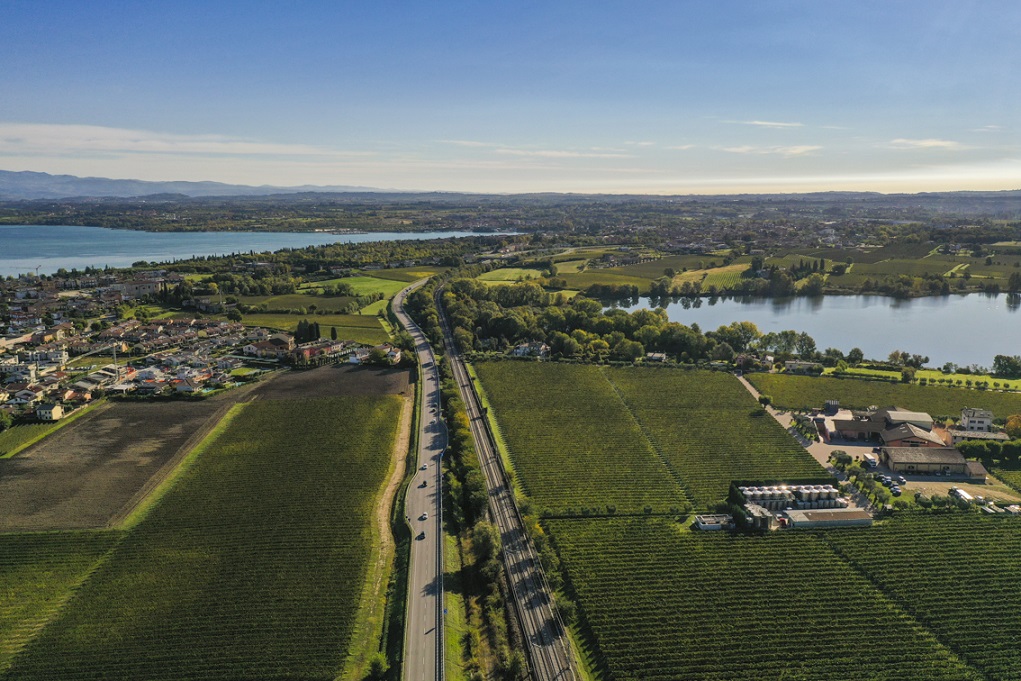
Source: CITARI
CITARI:
CITARI winery was founded in 1975, and today is farming about 90 acres of vineyards, producing about 300,000 bottles of wine annually. CITARI takes advantage of the close proximity of the winery to the vineyards, ensuring that the grapes are processed in the shortest time after the harvest, preserving aromatics and minimizing oxidative processes. CITARI had been recognized as a “Low Environmental Impact Farm” and won the “Verallia Ecofriendly Company” award over a number of years.
Here is our conversation:
– Why sustainability is important to you?
Wine producers, as farmers, are the guardians and keepers of a territory. Sustainability is necessary.
It also helps to obtain a superior quality product, and to maintain this high quality over time.
– How do you define sustainability for your winery, vineyards, and business?
Sustainability helps us to preserve the soil, the area, the quality.
– When did you start the conversion to sustainable viticulture and operations?
About 6 years ago
– How long did it take to achieve your goals?
We are still working on improving the best practices
– Was it worth it?
Of course!
– Would you do it again?
Yes, but better planning first all the costs, even in terms of time spent and bureaucracy.
– When did you achieve sustainability? Do you see a difference in the wines before you used sustainable viticulture and after?
The sustainable agricultural method we use (reductions of treatments and products used, regular controls on soil and plants) respects the soil, the plants and give us a healthier product. We do not have direct feedback from customers about it, but customers are increasing and they like our wines very much!
– What is next – organic, biodynamic, or are you happy with where you are right now?
We are thinking about adding green manure to preserve bees and other “good” insects.
– What advice would you offer to those who are starting a sustainability journey right now?
It is not easy, but it is necessary, be prepared!

Source: Consorzio Tutela Lugana D.O.C
Le Morette:
Azienda Agricola Valerio Zenato Le Morette was founded in 1955, and today farms about 75 acres of vineyards. Sustainability is at the core of operations at Le Morette, and here is how the winery describes this work: “In the vineyard, Le Morette Agricultural Company has chosen precise working methods aimed at a sustainable agriculture, favoring those natural processes that allow to preserve the “environmental resource”, with great attention to the use of water, favoring blooms and proliferation of numerous species of insects useful for the vineyard ecosystem, maintaining the biodiversity of flora and fauna.”
Here is what transpired in our conversation:
– Why sustainability is important to you?
To respect the environment is the key factor for us and means to deeply know every single aspect of it: sustainability, habitat and knowledge represents the focus to carry on a conscious development in the vineyard and in the winery. For us to produce “healthier wine” is a choice, not a constriction.
– How do you define sustainability for your winery, vineyards, and business?
To be Sustainable we follow the “Three E” rules:
1. ECONOMICS: Sustainable means to salvaguard the Companies’ income via the use of techniques with a low environmental impact and measures to avoid wasting water and other natural resources. Costs have to be affordable to be sustainable on a long term basis. Only when the winemaker is earning properly, he’s able to think and develop a proper Environmental and Social Sustainability.
2. ENVIRONMENT: Sustainable winegrowing conserves natural resources, improves air and water quality, and protects ecosystems and wildlife habitat. Sustainability is good for grapes and wine, as well: winegrowing requires in-depth attention to detail and continuous improvement resulting in high quality wine grapes and wine.
3. EQUITY (SOCIAL): Sustainable winegrowing promotes stewardship of natural and human resources, as per eg. supporting internships and education programs for young employees or carrying on healthcare classes and social charity events, contributing to our community culturally and socially.
– When did you start the conversion to sustainable viticulture and operations? How long did it take to achieve your goals?
We’ve always been following sustainable principles since 1960, when our business started with the first few hectares along the Frassino Lake bank in San Benedetto di Lugana, a natural protected site recognized by the European Community. We began as vinenursers and still we are after three generations. Our roots and knowledge of the indigenous variety Turbiana design our path.
– Was it worth it? Would you do it again?
Sure, when you have an inner green soul you have to stay stuck with it. It’s a heritage we’ve received from our grandfather Gino Zenato and is part of our identity. It’s inevitable to be in tune with Nature for us and we are proud to respect our environment every day with a set of concrete approaches and practices to preserve and improve this legacy.
– When did you achieve sustainability? Do you see a difference in the wines before you used sustainable viticulture and after? Do you think your regular customers can also tell the difference?
We received the official Biodiversity Certificate in 2020 from the WBA (World Biodiversity Association) but we’ve always applied sustainable principles since the beginning. We don’t have any difference, then: it belongs to our philosophy.
– What is next – organic, biodynamic, or are you happy with where you are right now?
Our next step is to improve and protect biodiversity in our ecosystem. We already do it but we want to do more, with the belief that a Biodiversity is the key choice for a healthier process whole based on sustainable principles.
– What advice would you offer to those who are starting a sustainability journey right now?
To set up some virtuous practices, essential to advocate biodiversity in the vineyard. Biodiversity is the first pillar for sustainability and whoever wants to start this journey, has to be conscious that being sustainable is not only an ideal choice, but a set of concrete actions that you have to put into practice on a daily basis.

Source: Consorzio Tutela Lugana D.O.C
Famiglia Olivini
Famiglia Olivini was founded in 1970, and today is farming 80 acres of vineyards. With the utmost focus on sustainability, Famiglia Olivini registered a brand called Agricoultura Regionata. In the words of the winery, “Agricoltura Ragionata identifies our working method during the entire vinification process: starting from the seed, soil, vine ending with bottled product. Our main goal is to act in a reasonable (ragionata) and thoughtful way, starting from the work we do in our fields, into the winery and then reflected with how our staff treats the product. We take all these actions in order to insure we avoid any invasive and harmful practices to agriculture (agricoltura).”
Here is what transpired in our conversation:
– Why sustainability is important to you?
Sustainability for us is not just a philosophy, a way of thinking and talk about our daily taking care of the land but is truly a way of working passed down for generations by our founder it is an approach that preserves the territory, the lands, and ultimately shows in all of our products
– How do you define sustainability for your winery, vineyards, and business?
Being sustainable is our working method starting from the seed, soil, vine ending with the bottled product and in every process of the business. The essence of sustainability for us on each of this aspect is ‘keep everything in balance’.
– When did you start the conversion to sustainable viticulture and operations? How long did it take to achieve your goals?
We have conceived our sustainable viticulture in our own registered brand which is Agricoltura Ragionata (Reasonable Agriculture). Before that, our vineyard were already sustainable certified. It did not take much because since ever our ‘best practices’ were naturally considered sustainable.
– Was it worth it? Would you do it again?
Even after the certification, we did not ‘spent’ any logo on the label. Talking about sustainability and Agricoltura Ragionata brand is part of our storytelling. But we have noticed that more and more people are interested to this and like to know that the wines they are drinking are coming from a sustainable viticulture
– When did you achieve sustainability? Do you see a difference in the wines before you used sustainable viticulture and after? Do you think your regular customers can also tell the difference?
Once again, for us the sustainable certification was not a ‘conversion’ but just a certification of our everyday practice in the field. So, we did not see any impact in the quality of the wine. We think people likes to know and be informed about sustainability but not really interested in looking for a difference in the products.
– What is next – organic, biodynamic, or are you happy with where you are right now?
For us it will be nice to make Agricoltura Ragionata a shared brand about sustainability, involving other producers in the use of this brand and practices
– What advice would you offer to those who are starting a sustainability journey right now?
Find your real way before finding a protocol. Sustainability can’t be just a set of rules, must be your way of thinking your land, winery, wines.

Source: Consorzio Tutela Lugana D.O.C
Marangona
Maragonia was founded in 1970, and today farming about 75 acres of land. Some of the vines are 50 years old. Today Marangona is an Organic Farm and uses cement tanks and amphorae in production.
Here is what transpired during our conversation:
– Why sustainability is important to you?
None of us have zero impact on the environment. We all have to do our best to minimize that impact. A careful farm has a big difference compared to a not careful one.
– How do you define sustainability for your winery, vineyards, and business?
Commit day by day to try to make the best decisions to make environment and profit coexist
– When did you start the conversion to sustainable viticulture and operations? How long did it take to achieve your goals?
My sister and I are the new management of the family business, since 2007. Initially in low environmental impact, since 2012 in organic conversion, since 2017 fully certified, both vineyards and cellar.
– Was it worth it? Would you do it again?
Of course,
– When did you achieve sustainability? Do you see a difference in the wines before you used sustainable viticulture and after? Do you think your regular customers can also tell the difference?
Unfortunately, I don’t believe that true sustainability can be achieved.
I believe more about limiting the impact to the minimum possible.
For me the difference is a lot.
For some customers too, for others nothing changes.
So there are no contraindications
– What is next – organic, biodynamic, or are you happy with where you are right now?
At the moment we are certified organic and from a bureaucratic point of view it suits us well, We don’t think we want to increase the amount of paper and documents.
I find the next step of the Biodynamics to be a very remote possibility in our production area. Not all areas and varieties are predisposed to such a strict philosophy.
So for now the goal is to continue learning new things about our vineyards to reduce the environmental impact to a minimum while keeping the qualitative objective we want to have very clear.
– What advice would you offer to those who are starting a sustainability journey right now?
Advice none.
Comparisons on how to deal with different problems certainly as often as possible.

Source: Consorzio Tutela Lugana D.O.C
Montonale
Motonale is the oldest winery we are discussing today, founded in 1911. The winery went through a turbulent history, starting from cleaning 3+ acres of land only with a shovel. In the 60s, the winery expanded to more than 150 acres, only to shrink to harvesting 10 rows in 1998. Two years later, a great-uncle got involved and that became a second birth for the winery. which is now solely focused on sustainability, using manual harvest and local indigenous yeast among many other things.
Here is our conversation:
– Why sustainability is important to you?
Sustainability is important to us because our wines are Mother Earth’s products. We owe her respect, because we do not have to think only about us, but also about the future generations.
– How do you define sustainability for your winery, vineyards, and business?
At Montonale, sustainability is understood as an all-round attitude, all aspects of the production chain are involved. I bring a very topical practical example, considering the critical issues we are experiencing in Europe in terms of energy: the roof of our cellar is entirely covered with photovoltaic panels and to make the most of them we concentrate consumption during the day. A winning choice, because once again this year we will close the winery’s energy consumption balance.
– When did you start the conversion to sustainable viticulture and operations? How long did it take to achieve your goals?
The conversion began 10 years ago with the fourth generation. Our main goal for the next 10 years is to reach a zero-carbon footprint.
– Was it worth it? Would you do it again?
It was obviously worth it and we would do it again. We must preserve our heritage which is connected to the Earth, to the weather and to the environment.
– When did you achieve sustainability? Do you see a difference in the wines before you used sustainable viticulture and after? Do you think your regular customers can also tell the difference?
We have seen and also perceived the difference in tasting our wines, since the process of their production was respectful to the environment where they were born.
– What is next – organic, biodynamic, or are you happy with where you are right now?
As previously mentioned, our main goal is to reach zero CO2 emissions.
– What advice would you offer to those who are starting a sustainability journey right now?
Do it before it is too late, there is no planet B.
Sguardi di Terra
Societa Agricola Sguardi di Terra is the youngest and smallest in our group, founded in 2015 and having around 17 acres under vine. From the moment the winery was formed, the focus was on sustainability and organic viticulture.
In lieu of Q&A, Sguardi di Terra offered the following sustainability information:
Our winery is organically certificated since we bought the vineyards in 2016. This also means that every year deducted audit bodies check that we respect the rules for organic viticulture and every year renew our certificate.
Our company does not have a cellar, we cooperate with Giovanni Pasini winery which is organic too and reflects our values. So we bring them our grapes and then we follow each step of vinification in their cellar.
The decision to buy organic vineyards wasn’t accidental. We truly believe in respect for the environment, by limiting the exploitation of natural resources and contributing to the preservation of biodiversity. Moreover, drinking organic wines is a way to prevent the accumulation of harmful residues in the body. Drinking organic wines = respecting nature + your body.
The advice that we would offer to those who are starting a sustainability journey right now is:
Believe in an ethical approach at every stage of the wine production chain. This is something you must feel inside, not because of the trend. Organic farming is not regarding only the present. It’s about the future too. We should choose organic farming to leave better soil for posterity than we have found.

Are you still here? This is definitely the longest post ever at Talk-a-Vino, and we didn’t even get yet to the wines.
I had an opportunity to try the wines from these 6 wineries (provided as samples), so here are my notes:
2021 Marangona Lugana DOC (12.5% ABV, organic grapes)
Brilliant straw pale
Beautiful, inviting, a touch of lemon, very fresh
Clean, crips, mellow and round. Mayer lemon, perfect acidity, delicious.
8, outstanding
2021 Famiglia Olivini Lugana DOC (13% ABV)
Straw pale, almost clear
A touch of honey, tropical fruit, lemon undertones
Clean, crisp, a hint of honey presence without the sweetness, round, delicious
8-
2021 Citari Conchiglia Lugana DOC (12.5% ABV)
Light straw pale, practically clear
Herbaceous nose, restrained
A hint of tropical fruit, good acidity, clean, refreshing, short to medium finish
8-
2021 Valerio Zenato Le Morette Mandolara Lugana DOC (12.5% ABV)
Straw pale
Hint of Whitestone fruit, very restrained
Peach, herbal undertones, round, plump. Short finish.
8-
2021 Sguardi di Terra Scapüscia Lugana DOC (13% ABV)
Very light golden
Complex nose, honey, spices, open and inviting
A touch of honey, herbs, freshly cut grass.
8-
2021 Montonale Montunal Lugana DOC (13.5% ABV)
Straw pale
Complex, Whitestone fruit, precise
white stone fruit, a touch of honey, good acidity, round, fresh, plump
8, excellent
Here you are, my friends – the story of sustainable viticulture in Lugana.
Hey, and there is more!
Starting on November 7th, Destination Lugana will be celebrated in New York City:
Destination Lugana is a full week of celebration of Lugana DOC wines, during which 28 producers will offer their latest vintages to 13 restaurants in Manhattan. Each location will create a special menu to enhance the qualities and main characteristics of these wines. The project is made possible by the Consorzio Tutela Lugana D.O.C, which has been monitoring, defending, and promoting Lugana D.O.C. wines since 1990.
You will find more information at the official website: https://www.destinationlugana.com/, Here you will also find the list of 13 restaurants in Manhattan that will create special menus.
And we are done. Now it is your chance to discover the beautiful wines of Lugana. Cheers!
One on One with Winemaker – Maya Hood White of Early Mountain Vineyards, Virginia
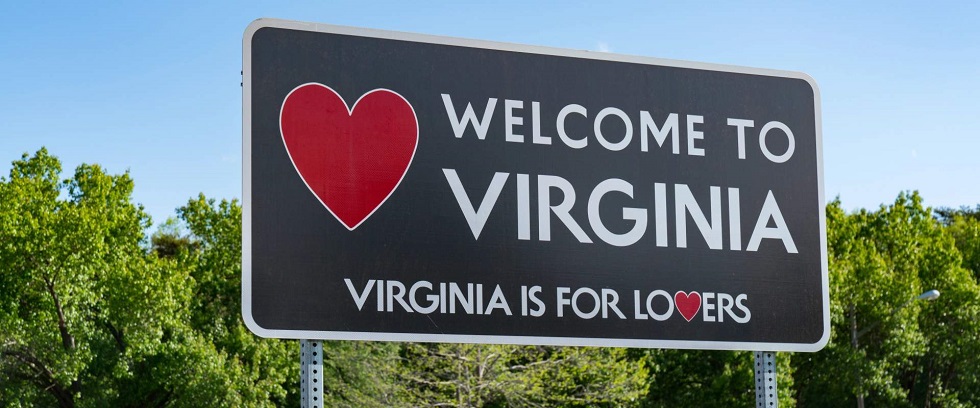
Source: Virginia.org.
Virginia Is For Lovers.
This simple slogan, coined in 1969, became the foundation of one of the best marketing campaigns of all time. It is simple, it gets stuck in your head and once you hear “Virginia” the image of a red heart with the words “Virginia is for Lovers” automatically pops up in your mind.
Virginia is for lovers, but what many people might not realize, Virginia is for Wine Lovers. Virginia is probably the oldest wine-producing state in the USA, where Thomas Jefferson planted vineyards in the last quarter of the 17th Century, way before any wineries were established in New York and California. Virginia’s climate is one of the closest to Bordeaux out of all wine-producing states in the USA. But if you don’t live in Virginia or close by, you might not even know that Virginia produces world-class wines. But Virginia actually does, and we need to rectify this gap in your knowledge, one winery at a time.
Early Mountain is a relatively young winery, founded only 10 years ago, in 2012. However, it was founded by Steve and Jean Case – founders of AOL, the legendary early days Internet provider for millions of Americans. Early Mountain was founded with the vision and mission of representing and promoting the Virginia wine industry. In the Early Mountain tasting room, you can order Best of Virginia wine flights and taste the wines from the 10 vineyards around Virginia – of course, in addition to the full range of wines Early Mountain produces.
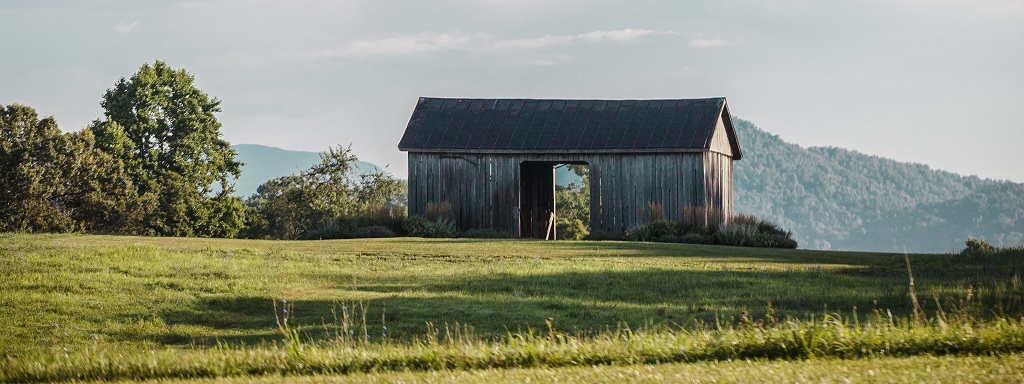
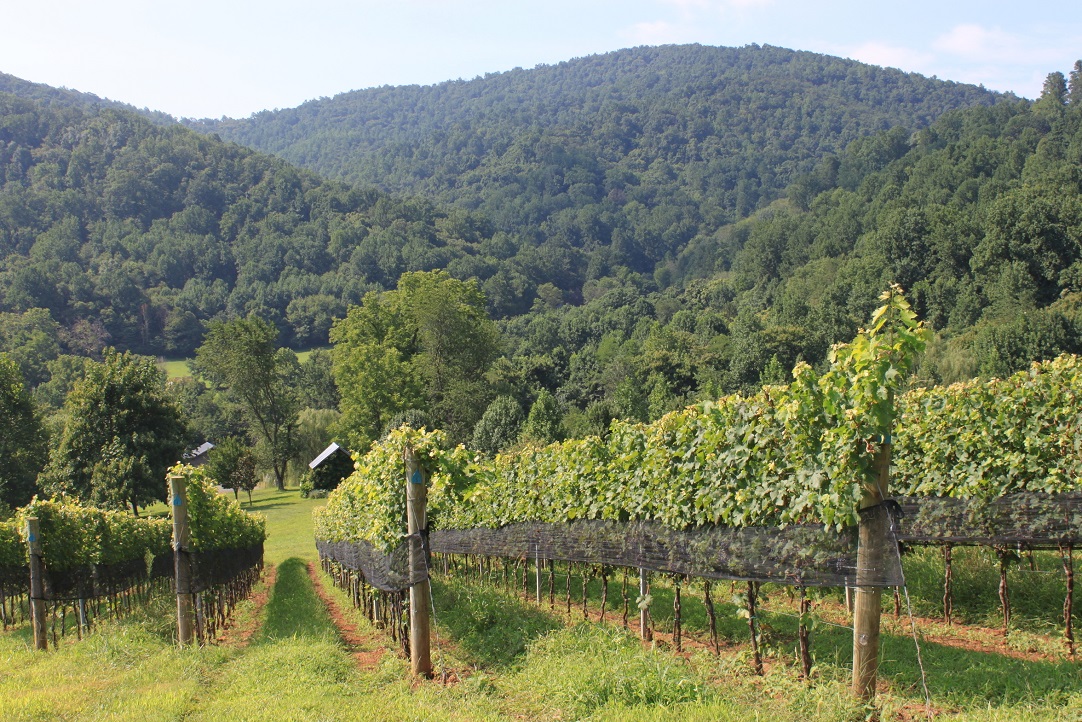
The original Early Mountain vineyard which gives the name to the winery was planted in 2006; the Quaker Run vineyard, the second major holding of Early Mountain was planted in 1999. Early Mountain farms about 350 acres of land, out of which 55 are planted under vines. The estate-produced fruit is also complemented by the fruit coming from the local Virginia growers, in an approximately 50/50 ratio.
I had an opportunity to speak with Maya Hood White, Early Mountain’s winemaker over a zoom session, and taste Early Mountain wines. As this was a live interview, below you will find pretty much a transcript of our conversation, not a detailed account that I manage to provide using an email interview format. I still hope you will get enough information, and most importantly, will be curious enough to go and find Early Mountain wines.
Why Early Mountain?
– The name relates to John Early, a historical figure who lived in Virginia in the second half of the 17th century. There is also a historic building on the property that relates to John Early.
What are those curved lines on your wine label?
– It is a topographic map. The lines represent the true topography of the land surrounding the winery.
What does the logo mean?
– These are letters E and M 🙂 (my reaction – duh…)
What is the meaning of the pointer arrow?
– Again, it is a map attribute, a locational arrow.


At this point, we poured our first glass, 2021 Early Mountain Rosé Virginia (11.3% ABV, $26, 72% Merlot, 10% Malbec, 9% Cabernet Franc, 6% Cabernet Franc, 3% Syrah) – Early Mountain site fruit is used to produce this wine. Grapes for Rosé are harvested earlier than the grapes for the red wines. Depending on the year some grapes are co-fermented. Mostly stainless steel but some Acacia barrels were used as well. The wine was beautiful, salmon pink color, leading with strawberries, cranberries, and cleansing acidity. Very present, balanced, and refreshing.
Speaking with the winemaker always offers us, mere mortal oenophiles, a chance to geek out and learn. When you hear about clones, the first thought is always Pinot Noir, maybe a Chardonnay. Maya works with clones of Sauvignon Blanc, and those clones produce dramatically different wines. She also works a lot with and was speaking fondly of Petite Manseng, the grape best known in Southwest France. Petite Manseng is producing excellent wines in Virginia, and it makes one of the flagship wines at Early Mountain. Petite Manseng grapes grow in such tight clusters that Maya prefers to harvest them after the rain, it helps to process the grapes better.
I asked Maya about Viognier, which is considered to be a star in Virginia. First, I learned an interesting fact from her: Viognier looks like a white grape version of Syrah – the same format of clusters, the same shape of leaves – I guess it is not surprising that Viognier is often used in winemaking to play together with Syrah. It appears that Viognier was growing before at Early Mountain, and it was pulled out and replaced – Viognier is a problematic grape that ripens irregularly and sometimes doesn’t ripen at all. It is definitely preferred to work with more reliable grapes.
We continued our tasting with 2021 Early Mountain Five Forks Virginia (12.9% ABV, $27, Petit Manseng 59%, Sauvignon Blanc 38%, Malvasia Blanca 2%, Muscat 1%) – rich and inviting white fruit nose, followed by a crisp, clean, playful bouquet on the palate. I loved the plumpness, roundness of the wine, reminding me of my favorite Roussanne bottles. The wine was perfect cold, and it was very tasty at room temperature – this is my standard hallmark test of good white wine – good white wine is delicious cold or not.
And then there was time to ask more questions:
What is your winemaking philosophy?
– Maya oversees grape growing as well as production. Listening to the vineyard – not set on what should be produced from the specific lot. Sites are closely watched for what they can do best – vines can be pulled and replaced.
What does the line of Young Wines represent?
– Approachable, low-intervention, fruit is sourced from the growers in the Shenandoah Valley. Wines are often made using a whole cluster approach. Also, the wines in the Young Wines line appeal more to younger wine drinkers.
Where do you stand on sustainability/organic?
– The low-touch approach, use biodynamic teas, certain blocks are processed only in an “organic” way. The holistic approach to the overall vine growing – over cropping, etc. low touch is a key.
What is your take on biodynamics?
– There is a lot to learn. Compost teas, herbal teas, oak bark – many things work, but the approach is more “what makes sense” than religious.
What winemaking vessels do you use? Oak barrels, amphorae, concrete tanks, stainless steel?
– I gravitate towards bigger casks; we have concrete egg, which is used primarily for whites. We also work with Northern European oak, Acacia wood


Next, we had two Cabernet Franc wines. Cabernet Franc is one of my favorite grapes and a staple of Virginia winemaking, so I was definitely looking forward to trying the wines.
We started with 2020 Early Mountain Cabernet Franc Shenandoah Valley Virginia (13.3% ABV, $30) – pulled from different sites in Shenandoah Valley. Uses larger size barrels, 500 liters or larger, Northern European oak barrels. 2020 was a rainy vintage, and the wine was rather on the mellow side. When I tried the wine during our zoom session, I was not terribly impressed. While the wine had all the traits of Cabernet Franc – cassis, bell pepper – it was a bit underwhelming. The next day, the wine really came around offering a lot more depth and structure.
My second Cabernet Franc was supposed to be a 2019 Cabernet Franc Quaker Run Vineyard, which Maya was absolutely raving about, defining the 2019 vintage as an epiphany. However, the bottle I got was the 2018 Early Mountain Cabernet Franc Quaker Run Vineyard Virginia (12.5% ABV, $45). 2018 was a very challenging vintage – too much rain, even the road was washed away. I never thought of Cabernet Franc in terms of clones, but it appears that this wine was composed of 2 different clones with different aromatics. Despite the vintage challenges (or maybe thanks to? :)) the wine was superb from the getgo – a good amount of dark fruit, good structure, cassis, eucalyptus, herbal underpinning – this Cabernet Franc was more expressive than a typical Chinon or Saumur, but less fruity than a typical west coast Cabernet Franc. Delicious.
Another interesting note from Maya – there is completely anecdotal evidence that in Virginia, even vintages are lean, and odd vintages give you bigger wines. I will need to pay attention next time I will be drinking Virginia wine, to see if this observation would hold true.
And a few more questions to complete our conversation.
How is the harvest in 2022? What to expect?
– Ha! Harvest is still ongoing, 10 days to 2 weeks later than last year, and some of the white grapes are still on the vine. Rain showers got in the way. Reds have another month. Hard to tell yet. There was a got fruit set, some fruit was dropped, so it is too early to tell.
What’s ahead? Single block wines? New varieties?
– New hybrids are coming from Italy – Merlot Kanthus, Sauvignon Rytos, VCR Tocai, The new grapes will account for about 1%. Will be planted in 2023. These new hybrids are important as they are disease resistant, and with grape diseases, the question is not if, but when. There will be also a new wine made from Petite Manseng which was planted instead of Cabernet Sauvignon.
That concluded our conversation with Maya, the time flew by very quickly.
If you are familiar with Virginia wines already, the Early Mountain can offer an excellent refresher course. And if you are not – what are you waiting for? Virginia wine has lots to offer, start your journey already.
Passion and Pinot Updates: Bells Up Winery
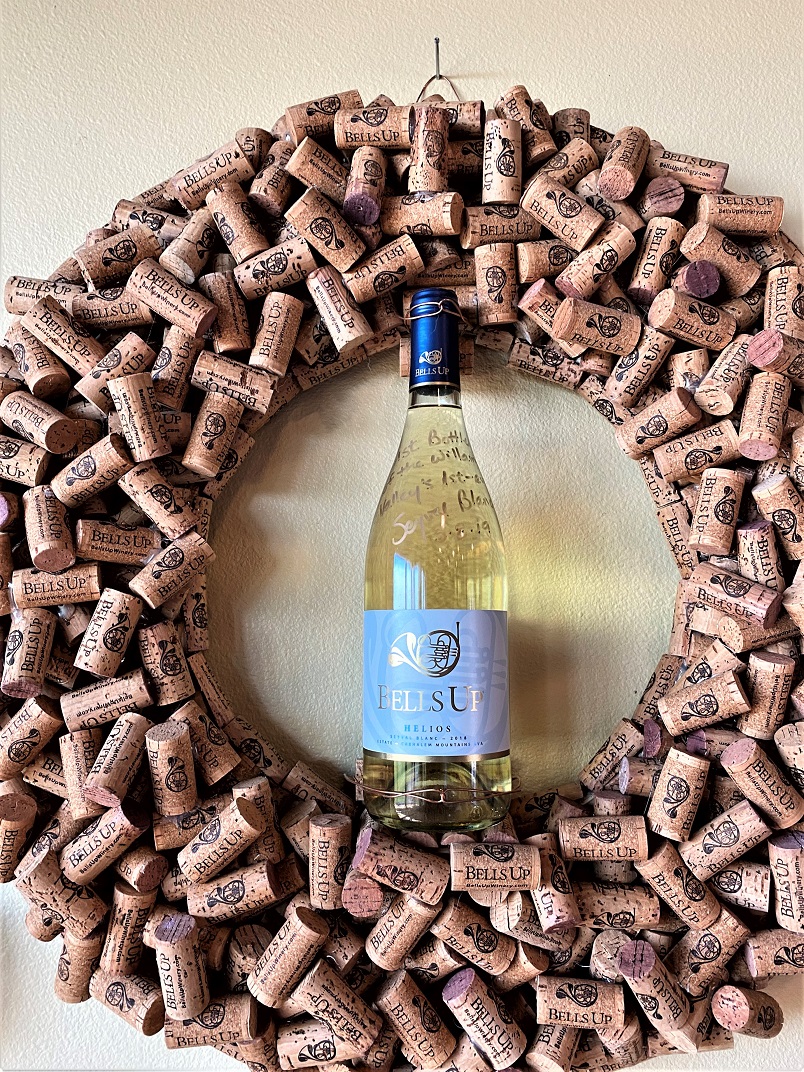 And then we arrived at “micro-boutique, un-domaine” Bells Up Winery, our final stop of the Oregon wine country touring.
Out of 13 wineries profiled in the Stories of Passion and Pinot series, Bells Up is the youngest one, having been founded in 2013, with the first vineyard plantings of Pinot Noir going into the ground in 2014. Despite being a young winery, Dave (the winemaker) and Sara (the Boss) Specter have a clear vision as to where they are going with their distinctly un-domaine wine – if you are curious why I keep saying “un-domaine”, I would like to direct you to the (virtual) interview I did with Dave in 2019 – he explains the concept of un-domaine very well.
Everything is distinctly un-domaine (see, you need to read that interview) at Bells Up. The vineyard with a gentle slope, the winery right in the middle of the vineyard, a simple but elegantly appointed tasting room with lots of fresh flowers and beautiful views of the vineyards. Here you go – pictures, pictures, pictures:
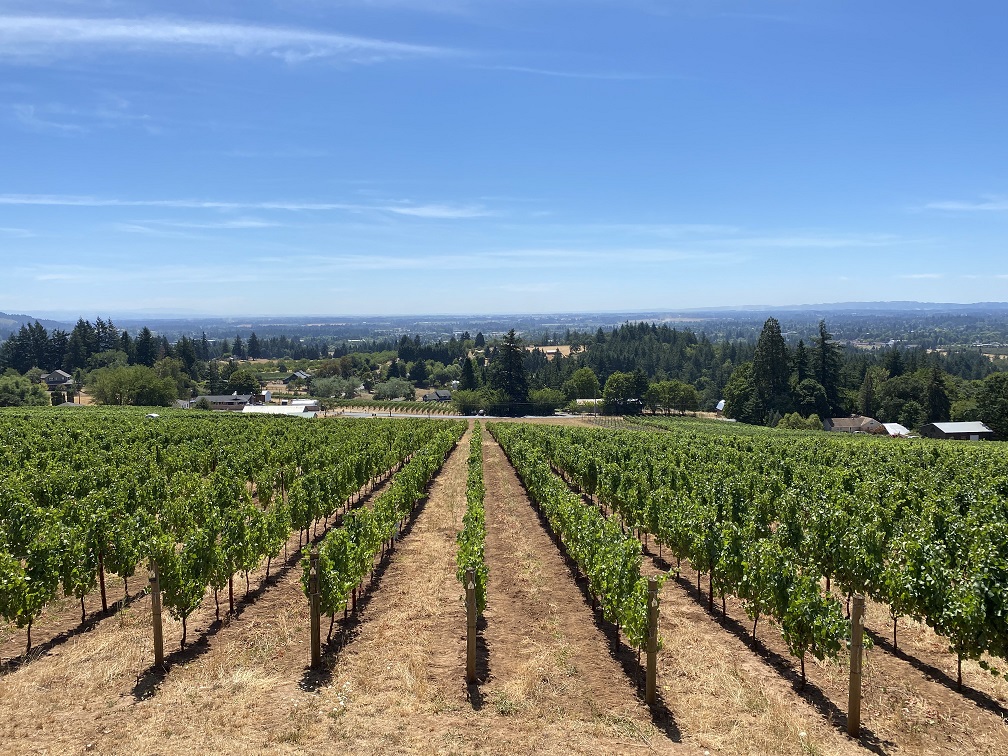


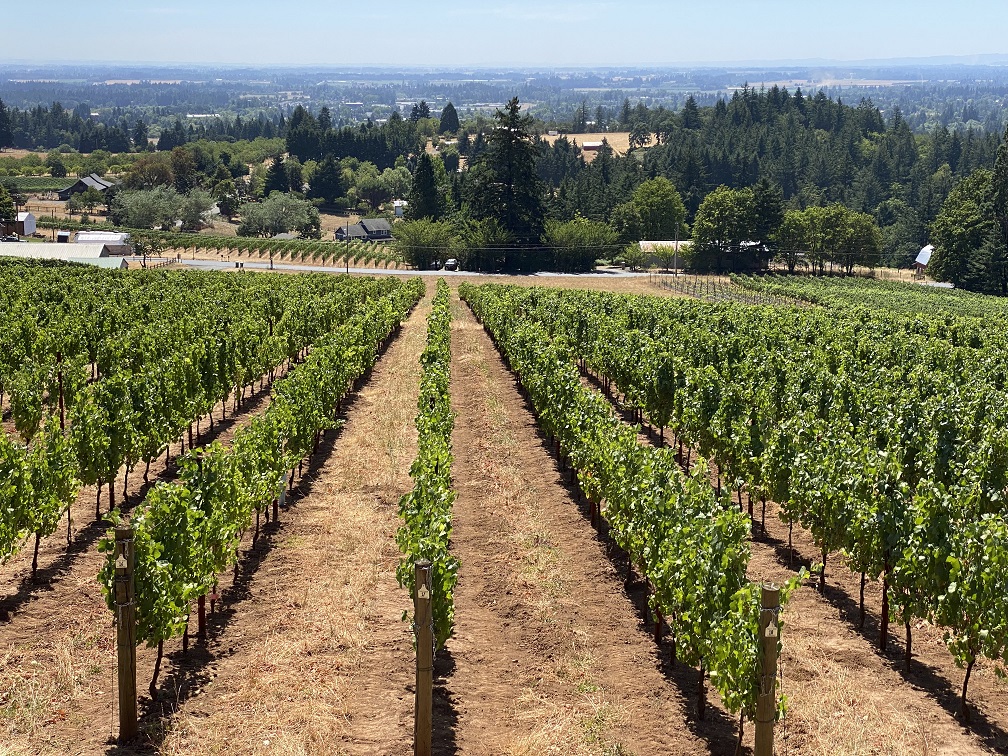
After admiring all the views we proceeded with lunch and tasting. Our lunch was prepared by Sara and while it was somewhat of a simplistic summer chicken salad, the amazing part was that this salad perfectly paired with the majority of wines we tasted – if you ever tried pairing the salad with wine, you would have to agree that achieving great pairing is very far from easy.
As I mentioned, Dave and Sara have a clear vision of the future direction for Bells Up. While Bells Up estate vineyard will be mostly planted with Pinot Noir, and by 2022 Bells Up plans to be at 100% estate fruit for all Pinot Noir bottlings, they have a clear plan for making Bells Up unique and different – growing and producing Pinot Blanc instead of the more commonly available Pinot Gris; being first in Willamette Valley with Seyval Blanc plantings; planting (out of all grapes!) a little known Italian grape Scioppettino; already offering Syrah and adding Cabernet Sauvignon in the 2020 vintage. “Unique and different” is a good description, in my opinion.
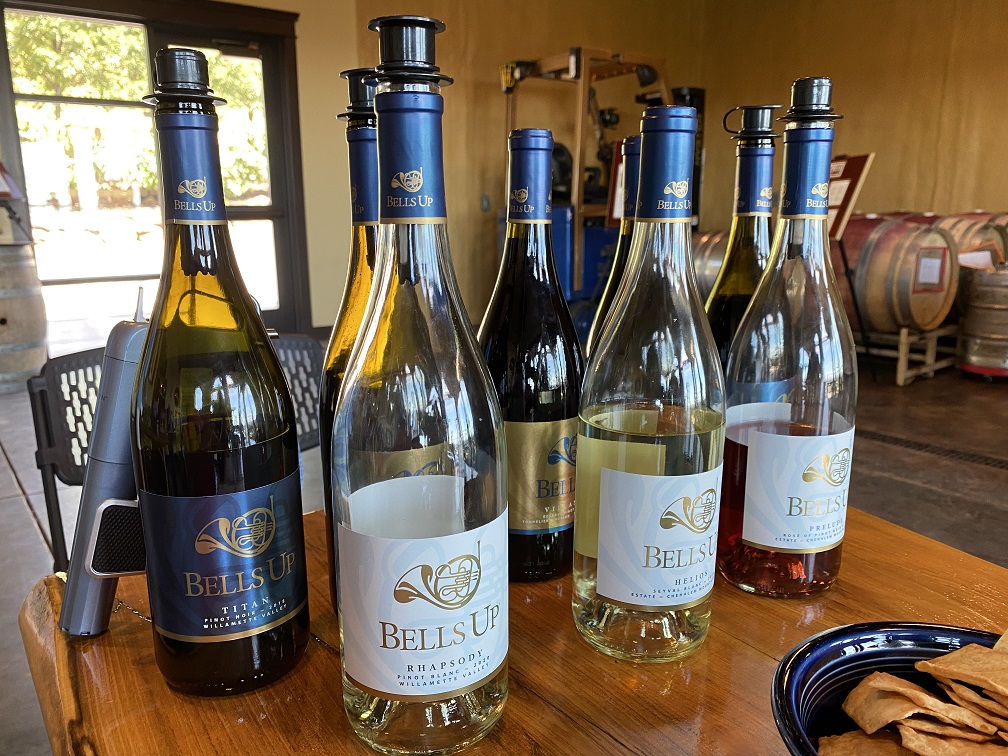


Before we talk about wines I would like to mention that none of the wine names you will see below are random. All the names have connections to the classical music pieces under the same name, and every choice of the name has an explanation as to why the particular piece was selected to connect with a given wine. If you are interested, there is even a Spotify playlist that includes all of the relevant music pieces – you can find that list directly on the Bells Up Our Wines page.
We started our tasting with Pinot Blanc:
2020 Bells Up Rhapsody Pinot Blanc Willamette Valley ($32)
Great complexity, lemon, gunflint
Great acidity, lemon, clean, crisp, refreshing
Perfect pairing with summer chicken salad
8, Excellent
We almost had to beg Dave to let us Seyval Blanc which was practically sold out. As a curiously interesting fact, Seyval Blanc plantings had to be protected by the net, as it happened that birds loved the grapes too.
2020 Bells Up Helios Seyval Blanc Estate Chehalem Mountains AVA ($40)
Gunflint, minerality,
Clean fruit, Meyer lemon, good acidity, good creaminess
Great with summer chicken salad.
8
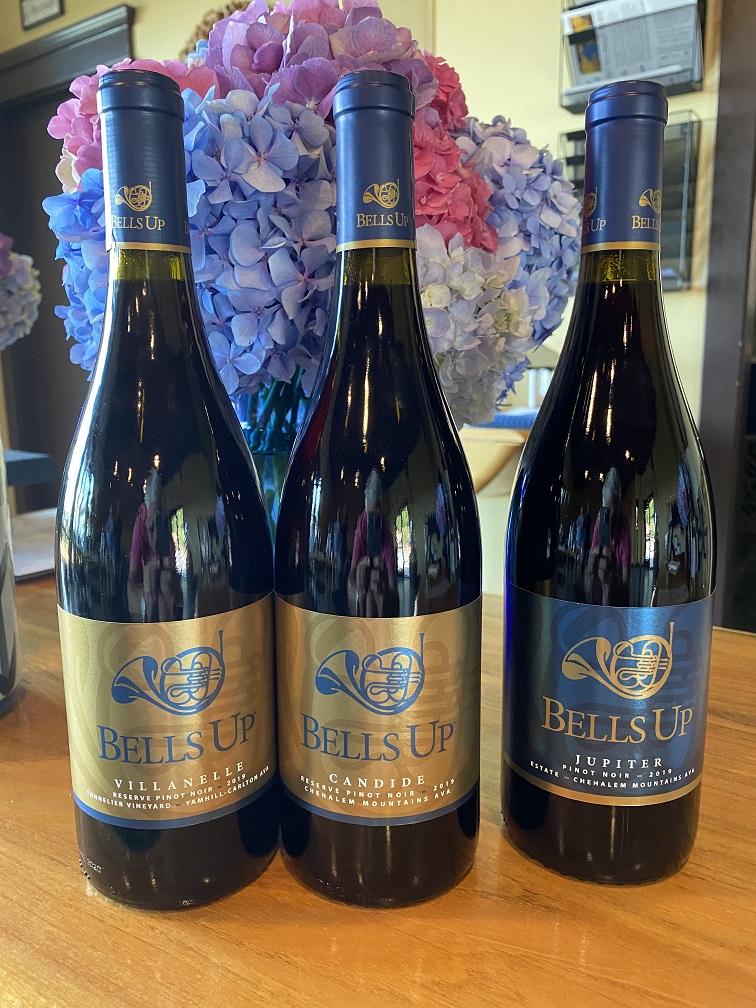
Next up was Pinot Noir Rosé, the first Pinot Noir wine entirely produced from the estate fruit:
2020 Bells Up Prelude Pinot Noir Rosé Estate Chehalem Mountains AVA ($28)
Strawberries, nice minerality
Strawberries, bigger body than Provence, good acidity, perfect balance.
8-
We followed up with the selection of Bells Up Pinot Noir wines:
2018 Bells Up Titan Pinot Noir Willamette Valley ($44)
Plums, violets, sandalwood
Crisp, clean, crunchy cranberry profile, a hint of cranberries, good acidity on the finish.
8-
2019 Bells Up Candide Pinot Noir Reserve Chehalem Mountains AVA ($54, 12 months in French oak)
Floral, nutmeg, warm spices
Cherries, cut through acidity, black pepper, perfect balance, delicious
8
2019 Bells Up Villanelle Pinot Noire Reserve Tonnelier Vineyard Yamhill-Carlton AVA ($58, 12 months in French oak, final vintage)
Blackberry/raspberry, Marionberry
Cassis leaves, light crunchy cherries, well-integrated tannins, good acidity on the finish, delicious.
8
2019 Bells Up Jupiter Estate Pinot Noir Chehalem Mountains AVA ($48, 12 months in French Oak)
Underbrush, summer forest, cherries, a touch of tobacco
Crunchy cherries, clean, fresh, delicious
8
While this is not a video, here is Dave talking about Bells Up wines:
Bells Up Syrah was served with an amazing seedless grape pie. As Sara explained, everyone gives wines as presents in Willamette Valley, but tasty grape pie is almost equivalent to the hard currency when exchanging gifts with neighbors. As I said, the pie was superb, and to think that sweet pie would pair with Walla Walla Syrah? I really wouldn’t – and I would be mistaken.
2019 Bells Up Firebird Syrah Summit View Vineyard Walla Walla Valley AVA ($52, 12 months in French oak)
Blueberries and blackberries on the nose
Berries all the way, nicely balanced
8, Amazing pairing with seedless grape pie with cardamom
Again, we almost had to twist Dave’s arm to let us taste the future release of Cabernet Sauvignon:
2020 Bells Up New World Cabernet Sauvignon Reserve Summit View Vineyard Walla Walla Valley AVA ($68, 12 months in French oak, barrel sample)
A hint of green bell pepper
Cassis, a hint of black pepper on the finish, good, round, smoky undertones.
8-
Here you have the summary of our “un-domaine” experience – an excellent set of wines and super-friendly hosts. If you will find yourself touring Willamette Valley, add Bells Up winery to your “must visit” list.
This is the last update in the Passion and Pinot series. For now, that is.
Until next time…
This post is a part of the Stories of Passion and Pinot series – click the link for more stories…
Last Bottle Sign Up ($10 credit)




 Talk-A-Vino