Archive
Devotion – The Blog Post I Can Not Write
 As soon as I saw the new theme for the Monthly Wine Writing Competition #7, Devotion, my very first thought was “hmmmm, this will be hard, or more precisely, extremely hard”. The problem is that when I hear the word “devotion”, the immediate mental picture is of a giant cross at the very best, or no picture at all – but I can assure you it ain’t the picture of a bottle of Cabernet Sauvignon.
Ever since the theme was announced I was struggling to find the connection of “devotion” to the wine world. I’m sure the examples of the true devotion are abundant in the wine world. May be even more than in many other trades, the success requires a lot of sweat, blood and sacrifice. Not been a wine historian, but rather only a very appreciative and dedicated consumer, I don’t have those stories of sweat and blood handy, and searching the Internet and rewriting someone else’s stories is not something I usually do, thus search for the connection between wine and devotion became literally a daily routine. To no avail.
I thought that I will start my post with the analysis of the word “devotion” – yes, the linguistic analysis. Oliver did it it perfectly in his post for the #MWWC7, as he was struggling with the theme in pretty much the same way as I did. Oliver took the Latin route for the meaning of “devotion”, so I can still refer to the English meaning of the word. Here is a nice representation of the Google search for the definition of “devotion”:
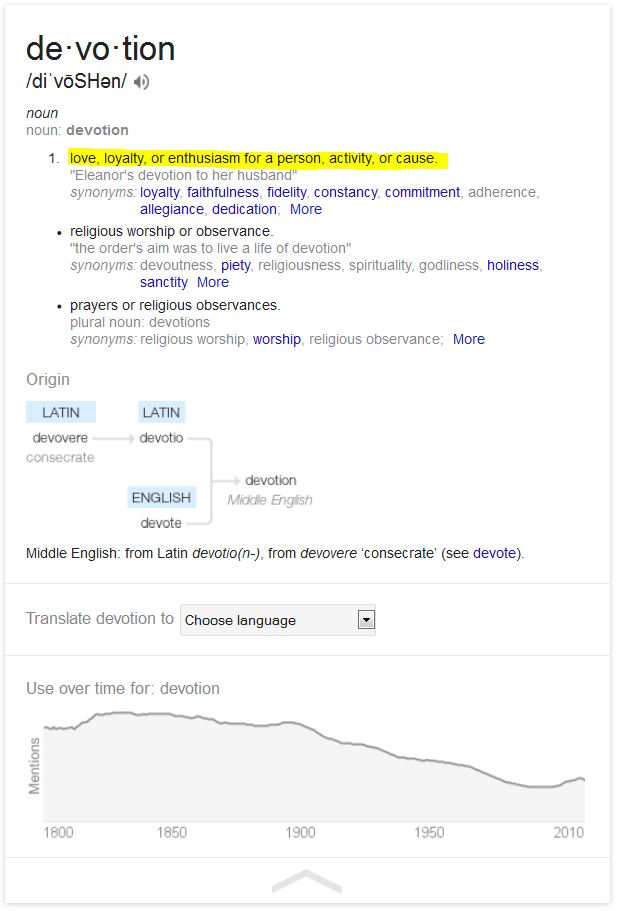
Yes, love and loyalty (or dedication for that matter) sound like the right way to go here – but if that is the direction, I would simply use the word love, and not devotion. Nope. It doesn’t connect.
So as today is a pretty much the last day to submit the entry, I still don’t have it.
But let me give you somewhat of an interesting twist here. Let’s put the word “devotion” aside for a minute, and let’s go back to the wine. Think about two sides of the wine world (not exclusively two – but let’s simplify here). On one side, winemaker should be willing to make an honest wine, the wine he or she will be willing (and proud) to offer (sell) to any consumer. On another side of the spectrum is the consumer who should be willing to buy the wine. Let’s make this statement even more precise – the consumer who should be willing (and eager) to drink the wine. Do you think we can find devotion on both sides here? Does it take devotion to make the best possible wine? Yes this is an easy case, I would say (and it was perfectly presented by Jeff at FoodWineClick in his photo essay about devotion of the winegrower). And how do we get to the devotion of the wine consumer? While this might not sound all too fitting for the term, but one should be devoted enough to the wine world to be willing to open the bottle – any bottle, a cult (DRC, Petrus, Screaming Eagle), or the most obscure, of unknown grape and producer; the wine which costs thousands, and the wine which costs $1.99. Open and give that wine a chance, step over the preconceived notions (“ahh, I don’t drink California Chardonnay”) and make an effort to understand the wine for what it is. Is that a behavior of the wine-devoted consumer, an oenophile? We are not talking here about people who buy the wine as an investment, with the sole purpose of selling the wine once its price will increase – those people are devoted to money, not to the wine. But for the oenophile, the wine is approached with an open mind – that doesn’t mean that the one should equally love all the different styles and tastes – but that one has equal respect to them all.
And let me tell about devotion of the winemaker through the eyes, nose and palate of the devoted oenophile (yep, myself in this case).
I brought the bottle of 1966 Louis M. Martini California Mountain Pinot Noir from Chicago about a month ago. I was in the store, shopping for the older vintage wines, and I couldn’t resist to buy such an old wine for $25 – yes,this is how much this wine was.
I didn’t want to hold it for too long, so Valentine’s Day seemed like a perfect opportunity to open a special bottle of wine (yes, I should’ve wait for the Open That Bottle Night, but we are always traveling over the actual OTBN day, as it generally falls on the kids’ school vacation).
When I told my friend Zak (who owns the wine store) that I will be opening the 1966 California Pinot Noir for the Valentine’s Day, his reaction was “why? You understand that the wine will not be any good, just keep the bottle as is for the decoration”. My thought was “I can always keep the empty bottle as a decoration. I have to give this wine a try”.
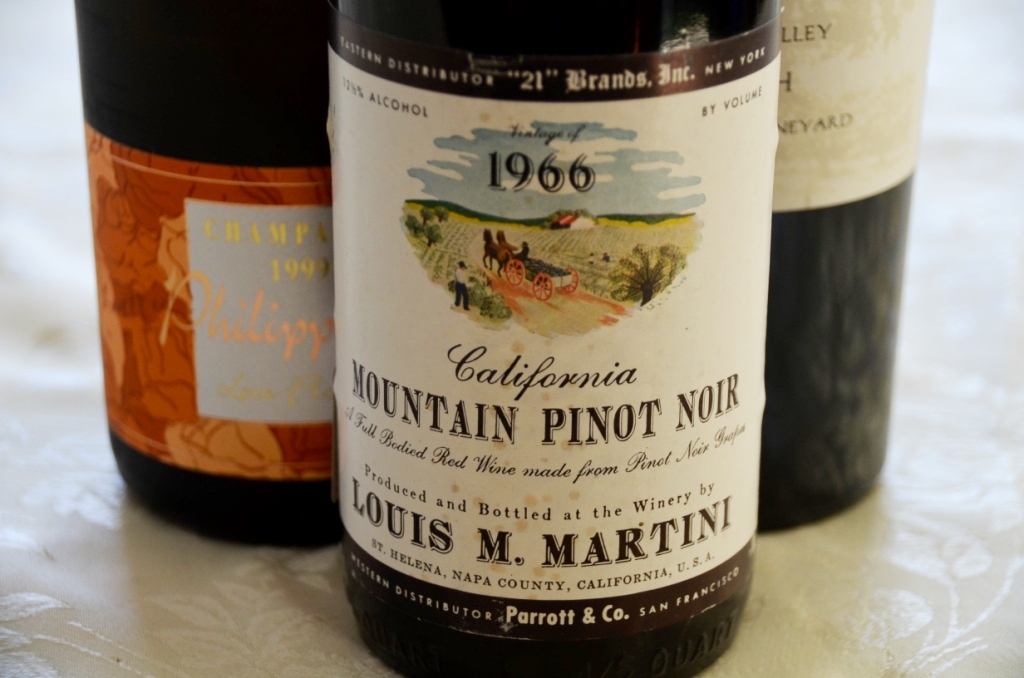
I honestly didn’t know what to expect. 1966 Pinot Noir from California? Not made by the star winemaker at the state of the art modern winery? The only thing I knew about the wine that it was made at Louis M. Martini winery. And Louis M. Martini doesn’t even make Pinot Noir wines today! Okay, let me come clean here – I had an additional reinforcement of my hope. I remember my wine class on Californian wines at the Windows on the World wine school, where after we tasted the line of California Cabernets, Kevin Zraly said “this wine is made by the Louis M. Martini. They make make excellent wines, and they could charge a lot more for them, but they chose not to”.
Louis M. Martini was an Italian immigrant who came to the United States in 1899. After working in the wine trade for a while, he opened Louis M. Martini winery in Napa Valley in 1933, as Prohibition was ending. Last year, the winery celebrated its 80th anniversary. You can read the history on the Louis M. Martini winery web site, but I want to mention that Louis P. Martini, the son of Louis M. Martini, went on to become one of the pioneers of California Pinot Noir and Merlot, and he was inducted to California Vintners Hall of Fame in 2008.
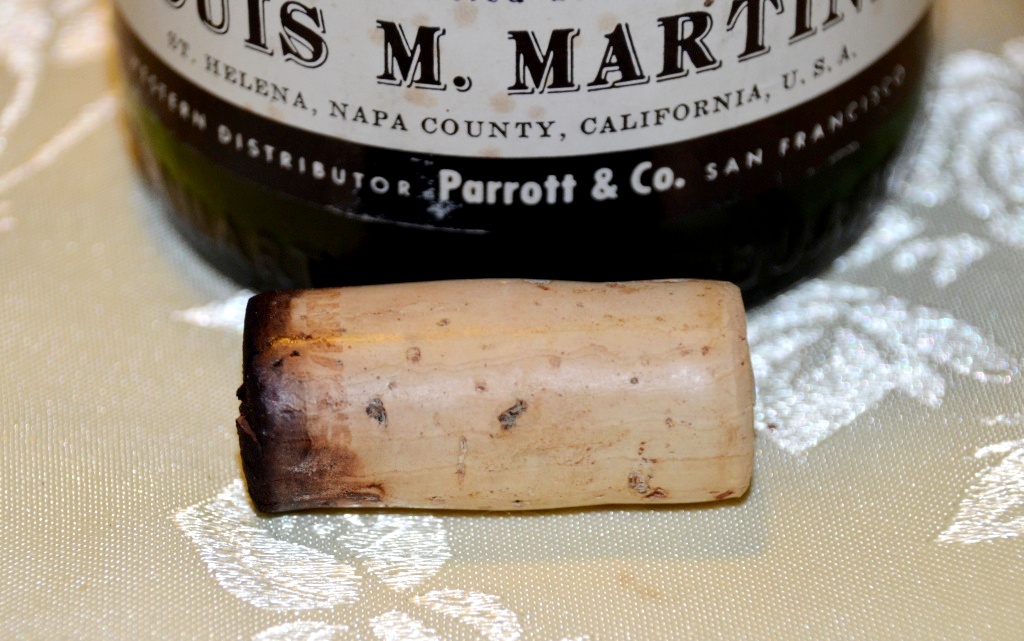
Let’s get back to the wine. It was the time to open that 1966 bottle, so I armed myself with the waiter’s corkscrew and the two-prong cork pull. I even had a thought of using Port Tongues, but that sounded a bit too fancy. Foil was cut, and I was presented with pristine looking cork top. Considering that appearance, I used the the regular waiter’s corkscrew, only moving it very slowly. The cork struggled only a tiny bit, and came out as a whole – and just look at this cork! I had 5 years old wines, where cork was in the terrible condition, never mind 48 years old wine!
 So I poured the wine into the glass – beautiful red brick color, with an orange hue, reminiscent of signature Barolo color. I was really concerned about the first smell – hoping not to find a sauerkraut or vinegar there – and the nose was perfect! Yes, the herbal flavors were prevailing over the fruit, but nevertheless, it was a very pleasant nose without anything disturbing. The first sip – wow. This wine is beautiful! Yes, lots of herbs – sage, eucalyptus, may be even lavender, but also with the nice plum component, and most importantly, balancing acidity. An extremely complex and thought provoking wine – but in the perfect elegance of all the components. The wine opened up a bit more, showing a bit more sweet fruit notes – and then it was gone – we finished it all. Truly spectacular and almost unbelievable – but it was real. I would love to compare this wine to the old Burgundy – I guess this is what it will taste like, if I’m lucky.
And you are looking for connection to the today’s theme, devotion? To me, it is simple. To make the wine which will last for so long and stay in such a perfect condition (go back and look at that cork again) requires a dedication, it requires the full devotion of the winemaker, it requires the unconditional love to what you do. And this wine had it all.
Raise your glasses, my friends, for the true devotion of the winemakers and oenophiles. Cheers!
Mystery of Wine
“Mystery” is a theme of the sixth round of the Monthly Wine Writing Competition, as selected by the originator of the series and winner of the previous round, The Drunken Cyclist.
Wine is a strange thing. If you think about it rationally, wine is just a fermented grape juice. This is where the mystery starts – how come this fermented grape juice became so important that it even made it into the Bible? How was this fermented grape juice discovered for the first time? How did it happened that this fermented grape juice became an object of study, worship, love, hate, desire, crime, greed, excitement, awe, horror, passion (continue the list on your own)? How come this fermented grape juice is such a facilitator of emotion? These are the mysteries of the wine, the fermented grape juice, and these mysteries are countless.
The subject of wine is vast, it allows all of us, people who are “into the wine” – oenophiles, aficionados, snobs, buffs, casual wine drinkers – whatever designation speaks to you – to ponder at all the different sides of all “things wine”, to find our own mysteries. Starting from the growing of the grapes, harvesting them, making the wine and getting it into the bottle, the mysteries are abound every step of the way. Once the wine goes into the bottle, this is when the actual “wine’s life” begins – of course, with its own set of mysteries, one of the biggest of which is a simple question: when to drink this wine?
The wine in the bottle is a living thing. It is changing all the time. It has its ups and downs, lows and highs. We have no way of knowing if the wine is at its”peak” until we open the bottle. Once the bottle is opened, there is no way of putting the wine back if we think we didn’t hit it right. Anyone who ever experienced the wine at its peak will tell you that you get an uncounted amount of pleasure from each and every sip. The moment we take on the opening of the bottle is a decision moment to solve that mystery – is this wine ready to give us tremendous joy – or not. Open the bottle too soon, when the wine is too young – and you don’t know what did you miss, what this wine could’ve become if you would only give it another 2, 5 or 10 years. Open the bottle too late, and you have so many regrets that you will never find out how great this wine was at its peak. Either way, the mystery will remain a mystery. Yes, you can listen to the experts about “wine drinking window”. You can solicit the opinion of your family, your friends, the bloggers and wine writers of all walks. You will build your own expertize. But every time with the bottle in one hand and the corkscrew in another, the mystery will be unsettling, until that corks is pulled and the wine will be going into the glass. And your hits and misses are unavoidable. You will go from “wow!” to “I can’t believe THIS WINE tastes likes this, what happened?”.
Every time I’m opening the bottle of wine, I’m experiencing the thrill of solving the mystery. Same as everybody else, I’m influenced by the label, by what I read about the wine, by the opinion of the others, by my prior experience. But those are only expectations – and those should be managed. Better yet, the expectations should be ignored. To solve the mystery, the cork must be pulled. And then… The best one is when you simply say “wow, this is amazing!”. Even then, is that the end of the mystery, you think? Quite often, this is not. As the true mystery will remain forever, unsolved, expressed by the two words: “how come?!”.
Need an example? I have one for you. Here is my mystery case in point:

Chateau Ste. Michelle Orphelin
2004 Chateau Ste. Michelle Orphelin Red Wine, Columbia Valley (13.9% ABV). It was one of my most favorite wines ever. I don’t remember the exact price, but I’m sure it was under $15, most likely even under $12 – I used to by this wine by the case. It was my favorite go to wine to share with the guests. Beautiful dark clean fruit, medium to full body, good firm tannins, balancing acidity – this was a pleasure in the glass. I was so disappointed when I was told ( I think some time in 2009, I might be off on that) – “you are buying the last bottles”. What? Why? The wine was only made for two years, 2004 and 2005 – and that was the end of it.
Okay, but I still had a few bottles in my wine fridge. And I remember to happily taking one of the bottles of 2004 Orphelin for a great occasion – Wine Century Club dinner, I believe in May of 2010. Those Wine Century Club dinners were arranged to take place all over the world on the same day, and we (Wine Centurions) were in competition with ourselves, trying to taste more unique and different grapes than we tasted last time. Thus my reason to bring this wine was two fold – yes, it was one of my favorites, but – it also packed in one bottle a very impressive line up of grapes: Syrah, Grenache, Cinsault, Mourvedre, Sangiovese, Petit Verdot, Cabernet Sauvignon, Souzao and Touriga – yeah, that’s what we call “the bang for the buck”.
So the cork was pulled, the wine was poured, the first sip is taken – and yes, my first thought, amplified by the facial expressions of the people around me, was “what happened”? The wine, instead of being great and energetic, was clearly past prime – a bit of the cooked fruit flavors, weak acidity, only the hint of the old greatness. How was that possible? The bottle was stored in the wine fridge all the time, and only recently it had being fresh and great. Yes, I heard that such a complex blends don’t age too well – but this was a great wine, how come?
Fast forward to December 2013. While going through the wine fridge, looking for the bottle to open (I love the fact that I have no system of storing the wines whatsoever – that allows me to extend the pleasure of touching many bottles in the search of one), I saw all of a sudden the familiar squares. Ha, what is that? I pulled the bottle of 2005 Orphelin. Ahh yes, now I recall – I also have a bottle of 2004 somewhere. Okay, fine, let’s free some space – let’s open the 2005. It probably will be “meh”, but okay. And it was … not! Had enough dark fruit both on the nose and the palate, not a sign of aging, supple tannins and robust acidity – definitely a pleasure to drink.
After the success of 2005, my thought was – so what is happening with 2004? How is that going to fare now? Will we be in for a treat or a bust?
Bottle found, cork is pulled, 2004 Orphelin pours into a glass. Dark ruby color, not a sign of age. The nose – perfectly fresh dark fruit, blackberries with a touch of plums. Palate – dense, firm, weaved together by the dark fruit and balancing acidity – clearly a perfect wine, at its peak – and I have no idea for long this peak will last.
Well, the duration of the peak is not that important anymore, as it was my last bottle. What happened with that wine back in 2010? What is a fluke, the bad bottle? Or was I super-lucky with my last bottle, which was not supposed to last that long, and it was just a pure luck, one out of a thousand? This will remain a mystery, which will never be solved. But I guess this is for the better. Every time, when pulling the cork, we are faced with the mystery – which we don’t need to solve. We only need to enjoy it. Let’s drink to the mysteries of our lives. Cheers!
Wednesday’s Meritage – Wine Quiz Answer, #MWWC5 Vote, Peter Mondavi Turns 99, The Oldest Wine Cellar?, and more
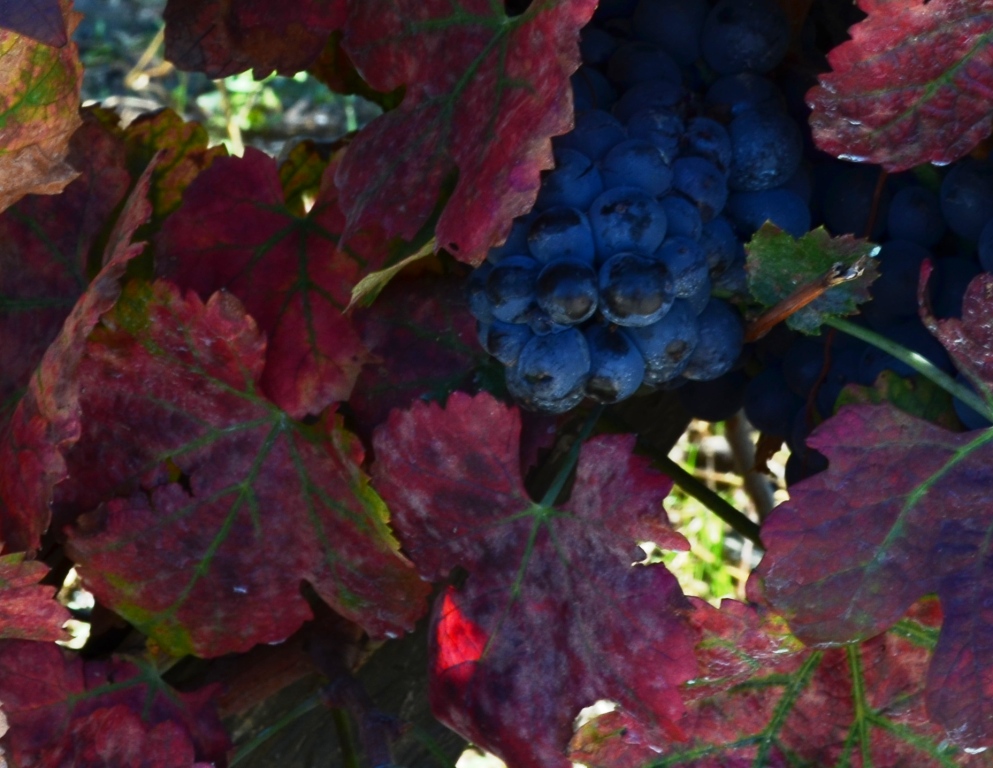
While not Carménère, this gives you an idea of color
Meritage time!
First, let’s start with the answer for the wine quiz #83, grape trivia – Carménère.
In the quiz, you were supposed to answer 5 questions about red grape called Carménère. Here are the questions, now with the answers:
Q1: Explain the name of the grape Carménère
A1: The name Carménère originates from the French word for crimson, carmin – that relates to the fact that the leaves of Carménère turn beautiful crimson color in the fall.
Q2:Similar to Merlot/Carménère confusion in Chile, the discovery was recently made in one of the well known old world wine producing countries – the grape they thought was ___, actually happened to be a Carménère. Name the grape, the country, and the region within this country where confusion took place.
A2: For the long time, winemakers in Friuli-Venezia Giulia in Italy thought that they were making the wines from Cabernet Franc – only to find out that it was actually a Carménère!
Q3: As the sequel to the previous question – the confusion also spread into the New Wolrd winemaking country. Name the grape been mistaken and the country.
A3: New Zealand imported Cabernet Franc vines out of all places, from Italy – oops? Yes, It was actually a Carménère!
Q4: Wine Spectator calls wines rated in 95-100 range Classic (the highest and the most prestigious category). True or False: there are no Carménère-based wines rated in the Classic category
A4: False . A number of Chilean wines from Casa Lapostolle got the 96 rating, and they are a Carménère-based blends
Q5: Name three grapes, often blended together with Carménère.
A5: Cabernet Sauvignon, Merlot and Cabernet Franc are often blended together with Carménère.
“We had rather a low participation in the quiz, but – we do have a winner” – was my opening line here. Now, with the last second entry, we have two winners! Patty from P’s 2013 photo project and Namie from Eat with Namie both correctly answered all 5 questions, and they both get the prize of unlimited bragging rights. Well done!
Now, to the interesting stuff around the vine and the web!
I have a few interesting things for you. First, you can vote now for the winner of the Monthly Wine Writing Challenge #5, with the theme called “Feast”. Here is the link to the blog post where you will find all the contenders’ blog posts and can vote!
The next article I want to bring to your attention is from the Wine Spectator, and it is dedicated to the Peter Mondavi – the older brother of Robert Mondavi. As amazing as it sounds, Peter Mondavi turns 99, and he still actively runs his winery, Charles Krug in Napa Valley. You can find the article here – definitely an interesting read, very relevant to the past and present of California wine.
How old do you think the oldest known wine cellar is and where do you think it is located? An archaelogical excavation in the norther Israel unearthed a cellar, which is estimated to be 3,700 years old. I think this is a very respectful age. No, the wine didn’t survive for that long, but nevertheless, I think this is a fascinating find. Here is the link for the Wall Street Journal article with more details.
Thanksgiving, an American holiday we will celebrate on Thursday, prompts lots of conversations about wine, and American wine in particular. I want to bring to your attention a very interesting article written by Mike Veseth at The Wine Economist blog, where he is talking about American wines. When we say “American Wines”, we actually don’t mean the wines made only in California – the wines are produced in all 50 states, and 12 of those states have more than a 100 wineries each! I find this information very interesting. Also from Mike’s article you can jump to the web site called Wines and Vines, which seems to offer a wealth of data regarding the wine industry – check it out.
Last but no least – don’t forget WTSO Gift Marathon on December 2nd (full details can be found here). WTSO just announced some of the wines which will be a part of the marathon – Beringer, Insignia, Philippe Prie, Caymus – I think it will be a very interesting event, so point your browser to the WTSO on Monday, December 2nd and happy hunting!
Ahh, and before we part – Happy Thanksgiving and Happy Hanukkah!
That’s all I have for you for today, folks. The glass is empty – but refill is on its way. Until the next time – cheers!
Wine’s Oops Moments
The Monthly Wine Writing Challenge started about four month ago with the goal to take the wine bloggers to the “next level” – one single word sets the theme, and all the willing wine bloggers create their best interpretation of the theme and its connection with the world of wine. In those four month the challenge themes went from “Transportation” to “Trouble”, then to “Possession”, and now to the current theme “Oops“, as set by the winner of the previous round, The Wine Kat.
Opps. What is the first thing which comes to mind when you here that short, but extremely universal expression? I don’t know about you, but somehow the first association for me was the song. I know I can’t compete with Food and Wine Hedonist when it comes to the hedonistic references to the popular culture, but in any case, Britney Spears “Oops, I did it again” was the very first thing which came to mind when I read the new theme, so here it is:
Yep, this video has nothing to do with wine, so let’s try to find our track here.
Life is generally filled with “oops” moments. Some can be funny, some can be sad. Some can be innocent, and some can be deadly, like missing the stop sign at a busy four-way intersection. The worst part of the oops moments is that they keep happening over and over, as we forget to learn from the previous ones. Technically, you are not supposed to step on the same rake twice, nevertheless, we like doing it over and over again.
Wine world is particularly prone to the oops moments. Problem is that you try one wine, and you think that you know them all. While there are so many factors affecting the taste of wine at a given moment – you mood, food, surroundings, company, price, label, your friend’s opinion, how long the bottle was open, is it at the optimal temperature… had enough? Nevertheless, it is enough to have one Chardonnay from Napa Valley not to our liking, where we will immediately generalize and come to the conclusion – okay, I’m not drinking Napa Chardonnay, just period – I had one, I know them all. That alone is a great source of the oops moments. But that is not all. Additionally, we are often not shy at all to state our opinion, as people think they have to have an opinion about wine, and it should be expressed, loud and clear – “yes, of course, they only make cheap wine in Australia”, “yes, I already had the Bordeaux once – it is a complete crap”. Often, it seems that wine simply breeds arrogance and snobbery – which leads to the multiple embarrassing oops moments.
Overcoming this tendency is actually a hard work, and we really need to keep the focus to stay humble and thoughtful around wine – for our own good.
Let me give you an example of couple of my own profound, embarrassing oops moments. About 6 years ago, I visited Ridge winery in California in Santa Cruz region. Ridge had being making wines since 1962, and has somewhat of the cult following, especially for their Monte Bello Cab. I visited the winery with the friend, and we were also on the mission to find a good bottle (at the reasonable price) to bring it that same evening for dinner at another friend’s house. So we tasted through the full line of wines, and we didn’t like a single one of them. I don’t know what could’ve caused that – may be it was a Root day for me, may be I was just in the wrong mood for the tasting, may be something else. But the important thing is that based on that tasting, I made a strong conclusion for myself – Ridge doesn’t make good wines, it is all marketing fluff. Then about 3 years ago, I saw a tweet from Jancis Robinson, where she mentioned that she is working on the line of classic wineries for a big tasting, and she is including Ridge as one of the exemplary wineries in US. Here comes me, who already tasted Ridge once, and therefore I’m an expert on the subject, with the comment that I don’t understand why is she even mentioning it, as I was at the winery and didn’t like any of their wines. Jancis responds to my comment that she disagrees, and Ridge shows perfect sense of place. Next thing someone sees my comment and gets very upset as it is impossible not to like Ridge, and if I don’t like it, I have to be blocked (I even wrote the post about it). Well, no, we didn’t get to the oops moment yet.
Then, about 8 month later, I was again in the close proximity of Ridge, and decided to give it another try. I don’t know what was different that time – may be a cheerful girl who was pouring the wine, a different weather, a flower or fruit day – don’t know, but… I not only liked the wine, I loved each and every wine I tasted (here is my post about the experience). Now, here you have a classic oops moment. I wish I could’ve kept quite in that twitter dialog with Jancis, I really wish I would’ve kept my opinion to myself – but no, I had to show my expertise – and eat my embarrassment thereafter.
In the spirit of “oops, I did it again”, I need to give you another example, this one is a very recent one. You see, I like New Zealand Sauvignon Blanc – fresh grapefruit, lemongrass, vivid acidity – very nice wine in general. I know that you can buy the majority of New Zealand Sauvignon Blanc in the range of $10 to $16, and they will be very good wines for the most of the cases. And then there is Cloudy Bay – a New Zealand Sauvignon Blanc which typically costs $26 or more. In my mind, the picture is clear – what can be so different about Cloudy Bay compare to any SB which is $10 to $16 cheaper – I had the others, I’m sure it can’t taste any differently (smart and not arrogant at all, right?). Then I see a blog post by Stefano, where he speaks very highly about Cloudy Bay, and the little genius inside gets me to make a comment that Cloudy Bay can’t be so much better and different to warrant paying that much more money for the bottle.
And then I come to the trade tasting, and see the Cloudy Bay being poured. I take the first sip, and it becomes my instant “oops” and “oh sh!t” moment, as the wine is stunningly beautiful, and of course I will be glad to pay more money for it – as it is really different from the mainstream.
There you have it my friends. The oops moments are unpleasant, and they will hunt you down – it really worth an effort to avoid at least the repetitions. Stay open, stay humble and keep learning – the wine world is yours to enjoy. Cheers!
P.S. If you got your own glorious “oops” moment and you are willing to share – this is what the comments section is for…
Wednesday’s Meritage – Wine Quiz Answer, #MWWC3 Vote, Greenwich Food and Wine Festival, [In]decent Wine Labels, and more
 Meritage time!
First, let’s start with the answer for the wine quiz #74, grape trivia – Trebbiano.
In the quiz, you were supposed to answer 5 questions about the white grape called Trebbiano (known in France as Ugni Blanc). Here are the questions, now with the answers:
Q1: Ugni Blanc is a main grape in the production of what famous spirit?
A1: Cognac.
Q2: Name the wine, in which Trebbiano was a required part of the blend, and it was considered to be the reason for a bad, flabby quality of that wine (it is no longer required to be used in that wine).
A2: Chianti. For the long time, Trebbiano was a mandatory part of the Chianti wines, rendering them dull and uninteresting.
Q3: Trebbiano is often a foundation for the popular food product (containing no alcohol). Do you know what food product it is?
A3: Balsamic Vinegar! Yes, of course when you look at the literally a black-colored balsamic vinegar, it is hard to imagine that it is made out of the white grape juice – but all the color comes from the ageing in wood. Trebbiano is a popular choice due to its neutral taste characteristics.
Q4: Contrary to the name, Trebbiano di Lugano is not considered to be a part of the Trebbiano family, but rather related to another Italian grape. Do you know what grape is that?
A4: Verdicchio. Based on genetic analysis, it is established that Trebbiano di Lugano is a close relative of Verdicchio grape from Marche region in Italy.
Q5: When used for the wine production (as opposed to the distilled spirits), Ugni Blanc is rarely used on its own – it is typically a part of the blend. Name 3 grapes, traditional blending partners of Ugni Blanc.
A5: Sauvignon Blanc, Muscadelle, Sémillon. While other combinations are possible, I was looking for classic Bordeaux lineup, which are these three grapes.
Now, when to comes to declaring the winners (or not) of this quiz, the becomes somewhat of a challenge. Both Michael (who has no web site) and Eat with Namie answered first 4 questions correctly, and provided a different answer to the question #5, compare to what I was looking for, but I can’t fully disqualify their answer. So we don’t have an absolute winner this week, but both Michael and Namie get an honorable mention. Well done!
Now, to the interesting stuff around the vine and the web!
First and foremost, 3rd Monthly Wine Writing Challenge (#MWWC3) concluded with 15 entries, taking on a difficult theme “possession”. Now it is your time to chose the host for #MWWC4, a.k.a. The Winner of #MWWC3. Here is the post from Sally, the winner of #MWWC2 and the host of #MWWC3, which summarizes all the entries. Your job is simple: 1. Get glass of wine. 2. Read. 3. Vote. Yes, don’t forget to vote!
Now, if you live in a close proximity of Greenwich , Connecticut, or plan to visit the area, here is the event you don’t want to miss – Greenwich Food and Wine Festival, taking place over 3 days, October 3 – 5. In its third year, the festival brings together more than 90 restaurants and vendors, chefs, musicians, sommeliers. You will find great food, great wines, cooking demos by celebrity chefs such as Duff Goldman, live music, BBQ, beer, competitions (had enough?) and more. For the schedule of events and tickets please click here.
Next – do you think some wine labels are going too far? Too suggestive, too sensual, simply indecent? May be some are. Take a look at Tyler Colman’s, a.k.a. Dr. Vino, blog post on the subject. Make sure to check the link to his article in the Details magazine – you will find some interesting labels there.
And the last one for today – another installment of Wine in China is available for your reading pleasure on the Wine Economist blog. This time you can learn about Chinese government involvement and its role in shaping up the Chinese wine industry.
That’s all I have for you for today, folks. The glass is empty – but refill is on its way. Until the next time – cheers!
How Possessive Are The Wine Lovers?
If you are following wine blogs, you might have noticed the theme “possession” showing up here are there. Yes, this is no accident – the common linking factor is the Monthly Wine Writing Challenge (MWWC for short), in its third incarnation.
The theme for the first challenge was “transportation” – it was relatively easy to tie up to the wine both directly and allegorically. The theme for the next challenge was “trouble”, which sent me home scrambling – “trouble” is not the first thing which comes to mind when you are looking at a glass of wine. In the end of the day, many bloggers successfully found the connection and produced a lot of interesting posts. The current theme, “Possession”, is a whole different game. On one side, it has a direct connection to the wine – but it is too direct for the nice intricate piece. “I possess wine. Sometimes, wine possesses me. The end”. On another side, it is almost forcing you to go into pretty much the exorcism route, which can be played, but this is not necessarily pretty (need examples? Do a google search for “wine possession” – you will find some stuff which might make you afraid to visit your cellar when it is dark).
So as you can deduce from my rant, I don’t have a good play on the theme. What you will find below is rather a collection of random thoughts, centered on the wine appreciation, with the nod towards the “possessive” relationship of wine lovers with the subject of their love.
So how possessive the wine lovers are? We can find few different types of “possessiveness” among the wine lovers as such. First, there are wine collectors (of course, that is an obvious one). But even among wine collectors there is one extreme group which I would like to exclude from the actual category of the wine lovers. That is the group which rather collect the money than anything else. Wine is strictly an investment for them, and they never think about bottle of wine in terms of the actual content. For this group, the wine is only an object which will appreciate in value, and at some point it will be exchanged for cash and profit. This group also includes the worst possible type – the wine-possessive ego-maniacs. For this group the wine which they stock in their cellars is intended to be an ego-booster – “I spent on that bottle 10 times more than you did”, and “my bottle is bigger and more round than yours”. In the end of the day, I’m not even sure if this group even belongs to the true wine lovers category.
Then there are those who love wine, but don’t care to possess it at all. Folks in this group happily drink the wine at any occasion, they serve the wine at their parties, and they buy a bottle on the way home when they feel like it. But they really don’t “possess” wine, as they don’t keep much wine in the house, and most importantly, they don’t assign any special attributes to any bottles.
And then comes the rest. The group of wine lovers who possesses the wine and actually, is possessed by the wine at the same time (I’m including myself in this group, so I’m continuing here from the collective of “we”). We keep the wine. We make the wine special by associating special mementos with those bottles – “ahh, this is the year we got married”, “remember we had this wine in Tuscany”, “this is the year our son was born”, “remember that winery visit”. We do our best to keep those bottles cool, quiet and comfortable. And then we wait. While buying the wine with mementos, we are also investing, of course. We are investing into exciting anticipation of how special this wine will taste when we will finally open it. While we hold on to the bottle, we can re-live that future moment over and over. We are possessed with finding the right moment for that special bottle. But what is important, that right moment also includes the right people. How many times have you thought “ohh, if they (whomever “they” are) are coming over, I got this special bottle we have to open”. Yes, we are possessed with wine. But we don’t buy it just to enjoy by ourselves. We are also possessed to share. We want to share the experience. We want to share the special moment. We don’t want to keep it to ourselves. Without special moment or a special company, that bottle never gets to be opened.
And that is what I want to leave you with. Possessed by wine. Possessed to share.
Wine … It Will Get You In Trouble
In June 2013, Jeff a.k.a.The Drunken Cyclist, started the Monthly Wine Writing Challenge, where the new theme is announced on about the monthly basis by the winner of the previous round. This month’s theme, as announced by The Armchair Sommelier, is “Trouble”.
To be entirely honest with you, I was about to give up on this challenge, as I couldn’t associate “wine” with “trouble”. Before I would “officially” give up, I did what would [probably] most of the married men do – ask the wife’s advice. So the first thing she said, “what do you mean you don’t know what to write about? How about the time when you quietly drunk most of the home-made plum wine when you were a kid”? Yeah, but I really never got into trouble for that, don’t think it was even noticed. “Okay, fine”, she said, “so what about that girl in the wine store…”? Aha – you could probably hear my brain clicking – now we are onto something…
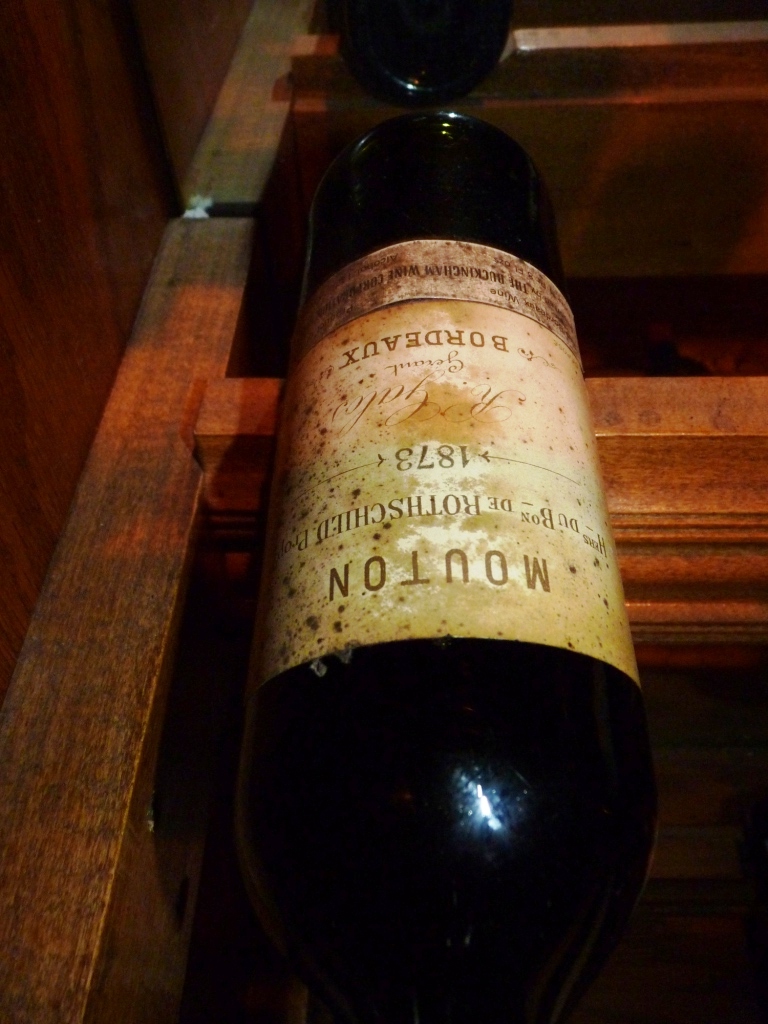
Mouton Rothschild
When you look at the bottle of wine, do you see a trouble lurking around ? No? Well, let me help you.
Think about bottle shapes. Probably 80% of all the wine bottles made worldwide will fall into one of two shape categories – Bordeaux or Burgundy. Yes, there are some shape variations even in those big classes, but they are nominal. Which means that if you will put next to each other a bottle of Bordeaux which retails for $6.99 and the one which will command $699, they will look very, very similar. What differentiates them? Yes, of course the content, but this is not something you know just by looking the bottle. So the only things which will differentiate those two bottles will be labels. See the trouble yet? Let’s continue.
In the wine store, one is guided by the visual cues – namely, the price tags. Take the cues out – and then even labels look identical. Yes, yes, before you call me an unintelligent low life and stop reading, give me a few more minutes and you will see where am I going. Of course, for the small group of crazy devoted wine geeks, every little word on the label is cherished and carefully assessed. 1982 vintage? Bordeaux? That’s nearly a heart attack. Tiny letters RM on the bottle of Champagne. La Turque, Qunitarelli, Alban, 1961, Pingus, Latour, 2000, To Kalon, Colgin, Riserva… I can go on and on and on with all those cherished words. We see any of those words on the label of the wine bottle, and the brain immediately sends out command for awe and appreciation.
Now, step outside of this crazy devoted circle. Outside of the wine store, does the bottle of 2009 Chateau Latour Bordeaux (about $1,600 per bottle, if you can find it) looks all that different from 2009 Chateau Moulin de Beausejour Bordeaux ($6.99, readily available at your Trader Joe‘s)? No, not really. Bottles look very similar in shape, both say “Bordeaux”, both have the same vintage listed – 2009, both have the word “Chateau” on them. Do you see it now? The trouble is not lurking anymore, it is looming, as a huge stormy cloud, full of wind and water.
Let me give two examples. Here are two real life stories of my friend Zak, the owner of the wine store in Stamford. The first one I only heard from Zak, and second one I witnessed myself.

2006 Ornellaia – sorry, Zak was out of Sassicaia
The lady comes into the store and asks for help. “I’m looking for the bottle of the Italian wine. I don’t remember the exact name, but I think it starts with “S”. If you will show me what you have, I will be able to recognize it”. Zak takes her to the Italian wines section. The lady looks around and says excitedly “this one!”, pointing at the bottle of Sassicaia. Then she looks at the price tag ($179 or so), looks at Zak, back at the price tag and says with the hope in her voice: “this is the case price, right?”. “No, madam, this is the bottle price”, answers Zak, and lady’s face becomes all overwhelmed with he emotions and she mutters “ahh, no wonder my husband got so upset when I used this wine for the pasta sauce…”. Turns out the husband was not at home, and the lady was looking for the bottle of red wine to add to the pasta sauce, and the bottle of Sassicaia looked not any different than any other bottle of the Italian wine… Trouble!
I’m standing in the store talking to Zak. The girl comes in with the bag of empty bottles and starts putting them one by one on the counter and then tells Zak: “I need to get this exact wines”. I’m, of course, curious, and I’m picking over Zak’s shoulder as he is looking at them one by one. Some kind of Spanish wine. Something else I don’t recognize. 1995 Chateau Mouton Rothschild. 1999 Riesling. Something … Wait, what? Mouton Rothschild 1995, one of the First Grows Bordeaux? That will be interesting. Zak points at that exact bottle and says: “I don’t have this wine, miss, and it will be hard to get it as this is an old vintage”. The girl asks if he can get the current vintage. Zak looks in the catalog and says “well, I’m not sure if it will be available, as this is highly allocated wine, but if it will be, it will be about $900… Yes, for a bottle”. You should have seen despair and horror on the girl’s face. Turns out her uncle left on a long trip, and left the girl to be house-sitting. Of course having the house party with the full access to the cellar was not what her uncle planned for, and now that he was coming back soon, the girl was on the recovery mission. Is that a trouble? One look at that girl’s face would tell you – yep, big time trouble!
There you have it, my friends. Wine is a dangerous thing, with the “trouble” spelled all over it… Or not. While there can be multiple personal “troubles” around the wine, which will seem serious to the person experiencing them (think about that girl), in a big schema things, we need to remember that at the most, all those troubles will become great (and funny, for the most part) stories to tell later on. Wine is just a beverage, and there always will be another bottle to drink. I can only wish to all of us, that the wine troubles would be the biggest troubles of our lives. You can pour another glass now. Cheers!
Wine Gadgets: Traveling With Wine
Few weeks ago, a fellow wine blogger Jeff, better known as The Drunken Cyclist in the wine blogging world, decided to challenge the wine bloggers to create blog posts relevant to the specific theme (this is a very popular trend among photography bloggers). The theme of the first challenge is Transportation. The post I’m about to present to you was supposed to the written in any case as part of the Wine Gadgets series, but it also very conveniently fits the theme of the challenge, so here we go.
A little intro: this is the fourth post in the Wine Gadgets series, where we are discussing different tools enhancing wine appreciation. In case you missed any of the prior posts, here are the links: Series Intro, Wine Pourers, Wine Preservers.
Can we use the words “wine” and “travel” interchangeably? Of course not, what kind of silly question is that! But think about your travel for a second. How often your travel plans include visiting the winery, no matter where you go? If you are reading this blog, I can safely say that for the most of you, if you are within the day travel from the winery, you are willing to make a detour. Do you visit the wine stores when you are visiting a different state or a different country? Of course you do! Thus it is safe to assume that your travel includes some happy encounters with wine.
But (oh, you knew the “but” is coming) – how many of you dreaded the trip back home, with all that wine you fell in love with, especially if that trip home include the scary, shiny beast called…a-e-r-o-p-l-a-n-e? The thought of the bottle of red wine in your luggage and then red liquid thinly covering your favorite shirt and dripping blood-like from the suitcase all over the luggage carousel can be paralyzing, no questions. But – there is no reason to be afraid of that scary, shiny beast. All you need to do is to use … of course, the wine gadgets.
So let’s talk about wine travel tools which you have at your disposal. And of course, not all the trips which include carrying of the wine include air travel – most of them will not, absolutely – thus we will talk about different tools, suitable for long distance wine travel and not.
Here is the list of some of the useful wine travel tools:
- Wine Picnic Carrier (can be called a Picnic Tote) – usually a short haul solution
- Wine Skin – pretty universal, but more applicable for the long haul
- Wine Luggage/Wine Transporter – mostly for the long haul
- Wine Tote – there are multiple versions, all for the short haul
- Wine Bag – definitely short haul, but most useful when visiting the wine store
Now, here are some pictures:


Wine bag
Now, let’s talk about these tools one by one.
Picnic wine carrier is a simple tool, suitable for short distance travel, or at least a travel where your luggage is not a subject of rough handling – having that wine tote in the trunk of your car is really not considered a “rough handling”. Added bonus is thermal insulation – if you will put a cold bottle of wine inside, the temperature will be preserved for a while. Many different kinds of the picnic tote are available, with capacity varying from 1 to 6 bottles.
Wine luggage is a serious tool. I bought mine about 5 years ago. For the most of those 5 years, I kept contemplating whether it is suitable for the trip or not. Problem is that this suitcase is really suitable just for wine, so traveling with two suitcases in the times when you only want to have carry on, doesn’t really sounds exciting. Besides, every time I would look at that suitcase, a fearful thought would visit – will it be actually able to protect the wine? Finally, for my last trip to Portugal, where I knew I will be around the wine I decided that it was now or never moment, and just went ahead. That was actually an excellent decision – wine suitcase performed perfectly, and I brought home 12 bottles of wine, all safe and sound. As you can see in the picture above, all the bottles are secured by the two straps, with the dividers between them. The suitcase also has sturdy sides and top and bottom, which protects your precious content quite well. From now on, when my plans will include carrying around substantial amount of wine, the wine suitcase is “it”.
Wine Tote is a simple tool to conveniently carry around a bottle or two of wine, also keeping it at colder temperature if it was previously chilled. I typically use it when I need to bring a bottle of white wine to the party. Then again, if you primarily travel by car, this tool has very limited value. If your travel includes public transportation and/or long distance walking, this can be quite convenient.
Next tool is called Wine Skin. Bubble wrap padded thick and sturdy plastic poach cut in the shape of a bottle – this tool is pure genius in my opinion (here is a link which explains how wine skin works). The poach has a bottom flap with adhesive, so you can completely enclose the bottle inside, air-tight. Even if your bottle will somehow break, the liquid will stay inside. Theoretically, this is single-use device, but I have my set of wine skins which I’m using and reusing for the past 4-5 years, and yet didn’t discard a single one – the adhesive still holds quite well. The great thing about wine skin that it has no weight, and it takes literally no space in your suitcase. Thus you have it with you in your trip, and in case you come across the wine you want to bring home, you can do it safely and without worrying – and if you don’t, that’s okay too.
Last tool for today is Wine Bag – at some point many wine stores carried them, and they were typically sold for $2.99. The wine bags are great for their intended purpose – to bring wine back from the wine store. Same way as it is popular now to go to the store with your own bag, the same idea works here. Wine bags are definitely a lot more convenient than a cardboard box which is hard to carry and then they should be disposed of, or the paper bags. But – I guess the problem is that a lot of wine store visits are very spontaneous, and people forget to bring the bag! Anyway, I have a few of those, and when I remember (!), I always bring them over.
If you are interested in any of these wine travel tools, here are few links from Amazon: Picnic Wine Carriers, Wine Skin
And as we have done before, here is our gadget poll:
So, what do you say? Do you have your preferred wine travel tools? What do you think about tools we discussed here?
In the next Gadgets post, we will talk about chillers. Until then – cheers!
Last Bottle Sign Up ($10 credit)




 Talk-A-Vino