Archive
Stories of Passion and Pinot: Bells Up Winery
Do you know by any chance what “bells up” means? If you do, you can already pat yourself on the back and pour yourself a glass of wine. If you don’t – you can pour yourself a glass of wine and ponder at the question for a bit – the answer will follow.
Meanwhile, let’s talk about the passion, an indelible component of winemaking, possibly even a key ingredient in a delicious wine.
Dave Specter started making wine in the basement of his home back in 2006. By 2009, he realized that passion for winemaking trumpets his (successful!) career of a corporate tax attorney, and Dave decided to let his passion lead the way. In 2012, Dave and his wife Sara found themselves in Newberg, Oregon, purchasing a dead Christmas tree farm in the Chehalem Mountains AVA, where they started planting their estate vineyard. The rest is history – of passion and Pinot, there is.
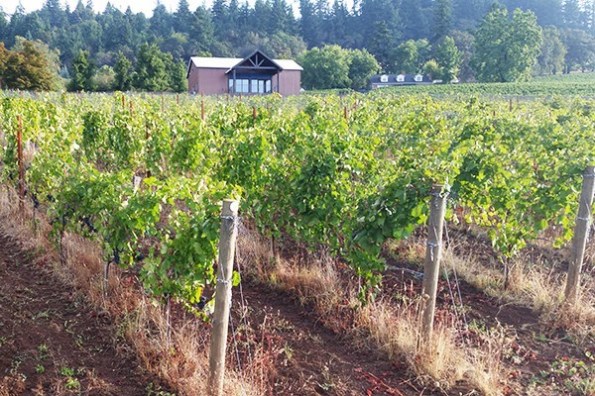
Bells Up vineyards. Source: Bells Up Winery
Before there was wine, there was music. For more than 20 years Dave had been playing the French horn. In classical music, there is always a moment which needs to be stressed – “Bells up” is the conductor’s instruction to the French horn players to lift the bells of their instruments and produce the sound of maximum intensity. “Bells up” became Dave’s motto in life, and it also gave the name to his winery – now you have your answer in case you are still wondering.
While Pinot Noir was the first grape planted at the newly minted Bells Up winery, the passion also led Dave to plant half an acre of Seyval Blanc, the grape he successfully used back in Ohio. That Seyval Blanc planting became the first in the Chehalem Mountains AVA, and second in Oregon. If you look at Bells Up winery website, you will see that the winery bills itself as micro-boutique and un-domaine – planting Seyval Blanc and not Pinot Gris in Oregon is clearly an un-domaine move. By the way, the “un-domaine” was one of the words which caught my eye while researching the Bells Up winery information. So I took the opportunity to sit down (virtually, albeit) with Dave and listen to him share his passion for wine. Here is what transpired in our conversation:
[TaV]: What kind of wine(s) did you make in your basement in Cincinnati?
[DS]: In the beginning, when my wife Sara and I started making wine in 2006 as a couple’s activity for our fifth wedding anniversary, we started with kit wines—juice in a bag, essentially. When I moved on to grapes, I sourced from both local and regional vineyards for Seyval Blanc, as well as through a Cincinnati vintners club that would truck in fruit from vineyards in California. From that I made Syrah, Petit Syrah, Cabernet Sauvignon, Cabernet Franc, Merlot—even a Pinot Noir, although that fruit was sourced from Lodi, and was completely unlike the Pinot I work within Oregon today. Essentially, it was a hobby that grew out of control.
[TaV]: Why Oregon? As a young winemaker, you had many options – what made you decide to go to Oregon?
[DS]: First, thank you for calling me young. We were a whole lot younger when we started this journey. After that first kit wine, I was hooked on the process and wanted to learn more. Sara graciously let me take over the basement, then the garage, then the dining room. And we started taking wine vacations to “hidden gem” wine regions—Texas Hill Country, Finger Lakes, and finally Oregon in 2008.
We had already visited Oregon briefly in 2004 and loved it. In 2008 we spent two weeks roaming the state, with the last few days in Newberg at a bed and breakfast just 400 feet up the mountain from the property that is now ours. We fell in love with Oregon, the scenery, the climate, the wines, and the intimate experiences tasting wines at the tiniest wineries with the winemaker. We decided then that this was the place for us.
[TaV]: Seyval Blanc is one of the most popular grapes in the Eastern US. But why Seyval Blanc in Oregon?
[DS]: When we moved to Oregon in 2012, we knew we wanted to plant a vine that connected to our story. I’d been working with Seyval Blanc for years in Ohio and when I won two amateur national winemaking competitions in 2011, one was with a 2010 Seyval Blanc. So, it was a great tie-in.
But also, we see an opportunity to differentiate ourselves with a white wine that nobody else has in the Willamette Valley—and only one other winery has in Oregon. Plus, we believed it would grow well here, and after two small harvests that resulted in some beautiful wine, we’re happy to be proven right. Note, however, we didn’t plant a lot of it: only about 250 vines (and not all of them made it—so Sara’s been propagating like crazy ever since for replants). We figured if it was a failure, we could always graft over it.
[TaV]: Any future plans for more mainstream Oregon white grapes – Chardonnay, Pinot Gris, Riesling?
[DS]: From a business perspective, we’ve taken a really close look at what other wineries in the area are making, and for a 500-ish case production winery like ours it’s best to have just one white wine available for sale at a given time. That’s because we don’t move enough volume and the whites generally don’t age as long as reds.
We currently make Pinot Blanc and we like it quite a bit. It’s a bit rarer in these parts than Pinot Gris or Chardonnay, which again helps to differentiate us. But as for expanding our white wine program, the ultimate plan is to phase out Pinot Blanc for Seyval Blanc and that will be the only white in our line-up. There are a lot of similarities between my Pinot Blanc and my Seyval
Blanc, so the transition from one to the other won’t be as jarring as a shift from another white varietal, such as Chardonnay.
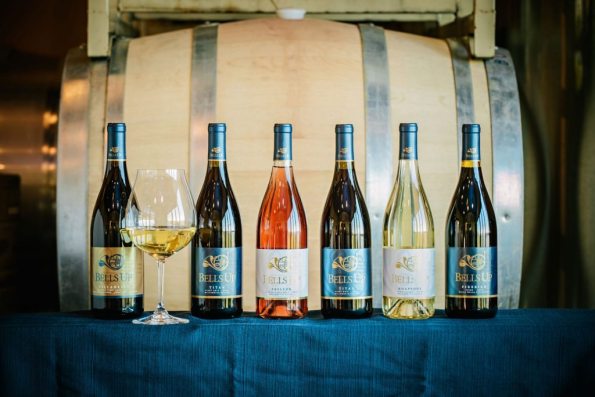
Bells Up wines. Source: Bells Up winery
[TaV]: Today you already make white, rosé, and red. Any plans to join seemingly the hottest Oregon trend and start producing sparkling wine?
[DS]: No. I know I keep coming back to the numbers, but I’m a finance guy with an MBA and a corporate tax law career. While we think there’s a place in the market for adding bubbles to still wines, if I made a sparkling wine I’d want to do it the right way (traditional method). That takes time, space and money. And at our volumes, what we’d have to charge per bottle to justify that type of investment is more than what the market would reasonably bear.
[TaV]: Continuing the same question – as you already produce Seyval Blanc, which makes very good dessert wines, any plans for some Late Harvest Seyval Blanc goodness?
[DS]: Don’t give Sara any ideas! Actually, we’ve been so focused on just getting these Seyval Blanc vines established and proving that our concept had legs that we really haven’t thought much farther than straight up Seyval Blanc. Our 2017 harvest yielded 100 pounds and made 23 bottles (yes, bottles)! Our 700-pound 2018 harvest produced 15 cases and we’ve made that available exclusively to our wine club members on a 2-bottle allocation. Give me a few years when I’ve got Seyval Blanc growing out of my ears and I’ll get back to you on a Late Harvest version.
[TaV]: Who are your winemaking mentors (if any)?
[DS]: First and foremost, Joe Henke of Henke Winery in Cincinnati. Joe took me under his wing as a basement winemaking hobbyist. He offered me a position as an unpaid cellar rat but promised he’d teach me everything he knew—open book—and he did. He even showed me his books because he wanted me to understand what he called “the good, the bad and the ugly of being a professional winemaker.” He’s an award-winning winemaker who makes 2,000 cases across roughly 15 different types of wines (including a phenomenal sparkling Chardonnay and an incredible Norton) in the basement of a 100-year-old house in an urban neighborhood with the bare essentials: barrels, a pump, a press, a pallet jack. I learned so much from him about the process of winemaking and the business of winemaking; that you don’t need a bunch of expensive equipment to make incredible wines. You just need to do a ton of cleaning. Amazing mentor.
Additionally, I did a harvest internship in the Fall of 2012 at Alexana in Dundee, Oregon under Bryan Weil. It was Bryan’s first harvest there as winemaker and Lynn Penner-Ash of Penner-Ash Wine Cellars was still working alongside Bryan, as she had been consulting winemaker for the label prior to Bryan coming on board. I soaked up as much as I could about working with Pinot Noir from both of them. Because, at age 39, I was not your typical harvest intern—plus I had three years of time at Henke Winery under my belt—Bryan was gracious enough to build my internship around what I needed to learn. He put me in the vineyard for sampling fruit, for example, something I’d never had the opportunity to do before. He had me set up the lab for him and run lots of testing because I knew how to do it. We’re still very close today and I appreciate everything he was gracious enough to share with me.
As far as winery business mentors, there have been so many people in the Willamette Valley who have generously offered advice and shared their successes and failures that it would be impossible to name them all. But they know who they are.
[TaV]: What is your view on sustainable viticulture, dry farming, organic methods?
[DS]: That’s what we do here in our own vineyard and at the vineyards we source from. We think it’s very important to be good stewards of the Earth—we’re farmers now! It also produces stronger vines that develop more flavorful grapes and ultimately better wines.
[TaV]: How did you choose the music pieces as the names of your wines? What was your thought process, what criteria? What message are you trying to convey with those names?
[DS]: Let me start by explaining the name of the winery. I played French Horn for more than 20 years (I’m horribly out of practice now—Sara says I only make noise) including after business and law schools, so it was a key part of my life. When it came time to name the winery, we wanted to name it something personal that wasn’t our last name (people are terrible at remembering names!) and I really wanted to tie it into the French Horn. Coincidentally, the property Sara found was on Bell Road in Newberg. So that tied in perfectly to the term “Bells Up,” which is a notation by the composer in the score of a piece of music. At a dramatic moment, it directs the French Horns to lift the bells of their instruments to project their sound with more intensity. It’s our time to shine—which is why I say the winery is my #bellsupmoment.
The pieces of music I chose to name each wine are all ones that prominently feature the French Horn, as well as epitomize the wine itself. George Gershwin’s “Rhapsody in Blue” inspired our Pinot Blanc to be named “Rhapsody” because it’s a jazzy, energetic white wine. Gustav Mahler—the French Horn player’s best friend because his pieces tend to be horn-heavy—wrote his Symphony No. 1 in D Major, called “Titan,” and it’s become regarded as his flagship work. Therefore, our Willamette Valley Pinot Noir, which we consider to be our flagship Pinot, is “Titan.” And so on. There’s a link at the top of our wines page to a playlist of all the pieces for those interested in hearing them.
[TaV]: Why “un-domaine”?
[DS]: It was a term that came up as we were discussing how to describe our casual tasting room vibe, our keep-it-simple winemaking approach, and our distinctive brand with a good friend who happens to be a wine writer. A couple of years ago after we opened our doors in 2015 there was a trend of new wineries opening in the Willamette Valley with the word “Domaine” in their name. We just aren’t. Our property is humble, our tasting room is a converted pole barn, you won’t find a marble fireplace. While Sara and I enjoy wine, nobody would ever confuse us with wine snobs.
Does “un-domaine” mean we’re not for everyone? Absolutely. There’s no cachet associated with owning or drinking a bottle of Bells Up wine. And that’s perfectly fine with us. We’d much rather be the bottle on your table every day of the week than the one gathering dust in the wine rack because you spent a ton of money on it and are waiting for a special occasion—and friends who will appreciate it—before it’s opened.
[TaV]: Did you have a pivotal wine in your life, the one which changed your wine worldview?
[DS]: Not so much a specific wine but a wine experience I had very early on. I had the pleasure of visiting some friends in Europe after graduating from law school and they took me to Beaune (in the heart of Burgundy) for a weekend. We did a lot of tasting in the touristy cellars, but also in garages and co-operatives where the atmosphere was much more down-to-earth. I knew absolutely nothing about wine prior to that but I was in awe of what I saw, smelled, and tasted. I couldn’t put my finger on it at the time, but I was in the heart of a culture that valued wine as an everyday experience—that part really resonated with my soul. Looking back, I’m sure that I would appreciate that experience more fully if I took the same trip now, but that time in Beaune has fueled my passion for wine ever since.
[TaV]: With the exception of your own wines, what are your favorite Oregon wines and /or producers?
[DS]: We truly have an embarrassment of riches here in the Willamette Valley—so many quality producers call this place home that a list of my favorite producers would fill about 3 dozen barrels. With every producer having their own unique style—plus the trailblazing nature of the Oregon wine industry—innovation is happening all the time: new grapes, new techniques, and so on. I think many people assume that a winemaker drinks only his or her own wine at home, but the truth is I almost never drink my own wines outside of the professional setting. I’d much rather be exploring the styles and fresh ideas that other winemakers here are creating and perhaps get inspired to try some of those ideas myself!
[TaV]: What are your favorite wines and/producers outside of Oregon?
[DS]: Again, way too many to answer! The wines I enjoy most are ones where I have a personal connection in some way and I’m fortunate to have so many talented friends in other parts of the winemaking world. Back in Ohio, my mentor Joe Henke at Henke Winery, of course, but also my friends Greg Pollman of Valley Vineyards and Bill Skvarla of Harmony Hill Vineyards make fantastic wines from grapes grown locally and regionally. Up in Woodinville, Washington my friend, Lisa Callan of Callan Cellars is making a name for herself with her Washington-focused program. And up over the border in Naramata, British Columbia my friend Jay Drysdale has founded Bella Sparkling Wines, BC’s only winery dedicated to sparkling wines. I know that some other friends have projects in the works and can’t wait to brag about them in a few years too.
[TaV]: Where do you see Bells Up Winery in 20 years?
[DS]: Not in the grocery store. Our customer base is national, but we have no aspirations for retail distribution. We’re perfectly content to sell direct-to-consumer and to a couple of local restaurants and a wine bar in Downtown Portland. When we hit 1,000-case production, that’s it. We won’t make any more than that annually because we both enjoy and believe wholeheartedly in the micro-boutique winery experience we’ve created. We want to have personal relationships with our customers. We specifically don’t have an online ordering portal because we want to have a conversation with our buyers either by phone or email. Making and maintaining those connections is really important to us, and we hope to grow those relationships over the next 20 years and beyond.


I’m sure you are ready to taste some wine by now. Before I will share with you my notes after tasting 3 of Dave’s wines, I want to bring something to your attention. By now you know that Bells Up wines are named after different musical compositions. In case you want to experience those musical compositions, either by themselves or together with the wine, Dave has a link to Spotify playlist of all the relevant music pieces available on the winery website. And now, here are my notes:
2018 Bells Up Helios Seyval Blanc Chehalem Mountains AVA (13.1% ABV, $38, 15 cases produced)
Light golden
Restrained, minerality-driven, touch of gunflint, a touch of fresh green apples
Excellent acidity, Granny Smith apples all the way, crisp, fresh, good texture. Has traits of Seyval Blanc (tropical fruit intent, I would say, like a hint of guava without any fruit notes), but put on a different core
8-, very interesting, thought-provoking and food friendly wine (acidity lingers on the finish for a good couple of minutes)
2018 Bells Up Prelude Rosé of Pinot Noir Chehalem Mountains (13% ABV, $22, 126 cases produced)
Light red
Medium plus intensity, distant hint of the barnyard, underripe cranberries, herbal notes
Bone dry, crunchy cranberries, excellent acidity, food-friendly wine, fruit showing up a bit later, excellent balance
8/8+, delicious and dangerous. I can keep drinking it until the bottle will be empty
2016 Bells Up Titan Pinot Noir Willamette Valley (13.1% ABV, $40, 12 months in French oak (39% new), 131 cases produced)
Dark ruby
Plums, a hint of smoke, violets
Slightly underripe plums, crisp cherries, sage undertones, good acidity, light to medium body,
8-, light, easy to drink, food friendly. Should improve with time.
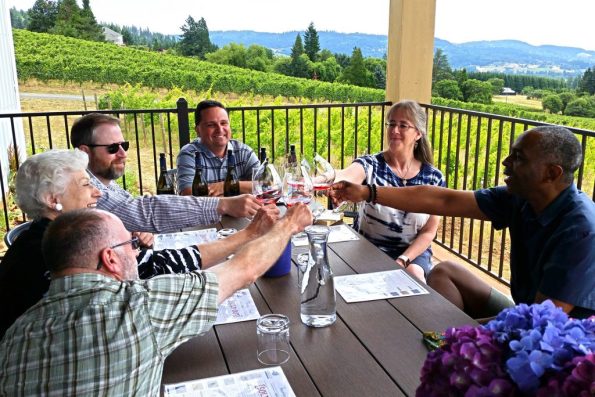
Dave Specter conducts the private tasting. Source: Bells Up Winery
Here you are, my friends. Another story of Passion and Pinot.
To be continued…
P.S. Here are the links to the posts profiling wineries in this Passion and Pinot series, in alphabetical order:
Alloro Vineyard, Ghost Hill Cellars, Ken Wright Cellars, Knudsen Vineyards, Lenné Estate, Tendril Cellars, Youngberg Hill Vineyards, Vidon Vineyard
Friday Night Wine
Isn’t Friday the best day of the week? Or to narrow it down even more – isn’t Friday night the best time of the week?
I know, it is considered lame. The right thing to do is to love Mondays, as this is your new chance to make a difference, and yada yada yada. Whatever.
So really, isn’t Friday night great? Especially when you don’t need to go anywhere. You don’t need to entertain anyone. The whole weekend lies ahead. Life is good.
Does such quiet Friday night deserve a special wine? This is a tough question, especially for someone who drinks wine only on the special occasions, such as days which names end with “y”. I can actually argue this both ways – I guess it only depends if you feel like making it special, or treat it as any other day and just open a random bottle. Well, but still – quiet Friday night is special, so a special bottle feels appropriate more often than not.
Finding the right bottle for the Friday night is an as difficult exercise as selecting a bottle for any special holidays or birthdays. On one side, it is the Friday night – on another side, it is just a Friday night, one of the 52. A Friday is not a special enough occasion to pull one of your most prized bottles, but you do want to celebrate the weekend coming, so it should be at least something unique and different.
It is hard to figure out how the brain decides on the bottle. After about 10 minutes of pulling the wine fridge shelves back and forth, I came across the 2011 Cahors, and the brain (or whatever is there) said: “that will do”.

2011 Jean-Luc Baldès Triguedina Clos Triguedina Cahors AOP (14.5% ABV, 85% Malbec, 10% Merlot, 5% Tannat) was one of my favorite discoveries of the past year while attending the Wines of Southwest of France event. I had only one bottle, but that is the same story with the absolute majority of my cellar, so I typically go through the regretful “second thoughts” process no matter what I decide to open.
Boy, was that a lucky decision… This wine had everything one can desire to make any day special – from the first smell to the first sip to the last sip; a perfect oenophile wine. Its major quality, outside of balance, was a tremendous range of expression. The nose started with a little funk, a touch of the barnyard, and fresh berries. The palate offered an exquisite bouquet and an ability to travel in the instant. The first sip squarely established – I’m not sitting on my deck anymore, I’m now in the winery’s cellar, breathing the vinous aromas which accumulated there during the centuries.
The wine continued evolving, offering tobacco, fresh blackberries, a touch of pepper, dark power, dark magic, and layers of pleasure. The acidity, the tannins, the fruit – everything was there in complete harmony. I call such wines a “vinous vino”, as these are the only words which come to mind. The wine was a beautiful rendition of Malbec – unquestionably an “old world”, and unquestionably delicious. If Cahors wines produced back in the middle ages were anything similar to this Clos Triguedina wine, I fully understand why it was so popular in Europe and Russia.
There you are, my friends. I hope your Friday night was filled with pleasure, just like mine was. Do you think Friday night wine should be special? What would you open to celebrate a quiet Friday night? Cheers!
Rediscovering Beaujolais
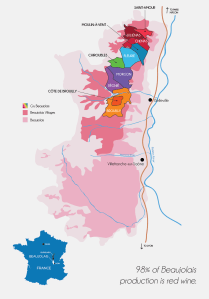
Source: Discover Beaujolais website
I remember learning about wine many moons ago at Kevin Zraly’s Windows on the World Wine School, where Beaujolais was one of the first French wine regions we discovered. We learned that there are general Beaujolais wines, which are not worth seeking, Beaujolais Villages, which are a bit better than the regular Beaujolais, and ten Cru wines (Brouilly, Chénas, Chiroubles, Côte de Brouilly, Fleurie, Juliénas, Morgon, Moulin-à-Vent, Régnié, and Saint-Amour) – and the Cru wines are something worth looking for.
There might be a few reasons why Cru Beaujolais wines are worth looking for – we should remember that Beaujolais is part of Burgundy, and thus it shares similar soils and climatic conditions as the rest of the Burgundy. Beaujolais wines are made out of Gamay Noir, not Pinot Noir, which is a king of Burgundy, but still – well-made Cru Beaujolais wines can offer a poor man’s alternative to its rarely affordable cousins.
But then there is this thing… Beaujolais Nouveau. The wine which became a glorious marketing success – and Achilles hill of Beaujolais wines. Beaujolais Nouveau became an international celebration of the new vintage, where the wine produced from the grapes just harvested a few months ago, hits the shelves of the wine stores worldwide on the third Thursday in November. While the success of Beaujolais Nouveau is unquestionable, its marketing message has a simple consequence – say “Beaujolais”, and most of the wine consumers immediately add the word “Nouveau” – overshadowing all the great Cru Beaujolais wines.
Yours truly is guilty as charged – in almost 10 years of blogging, I wrote about Beaujolais Nouveau literally every year – and I have only two posts covering Cru Beaujolais, after attending the tasting of the Duboeuf Cru Beaujolais portfolio back in 2012 (here are links to the Part 1 and Part 2 posts, if you are interested). I have to also say that the avoidance of Beaujolais wines was not conscious – there are few regions and types of wines which I intentionally avoid, such as generic Cotes du Rhone or similarly generic Argentinian Malbec – but the Beaujolais avoidance was rather subconscious.

Château de Bellevue. Source: CognacOne/Chateau de Bellevue
When I got the email from CognacOne, an importer with an excellent collection of French wines, introducing the new Cru Beaujolais wines from Château de Bellevue, something piqued my interest, and I got the sample of two Cru Beaujolais wines from Morgon and Fleurie.
Château de Bellevue was built at the beginning of the 19th century in the village of Villié-Morgon, with the addition of the cellar behind it in 1830. Today, Château de Bellevue is both the winery and Bed and Breakfast Inn. Château de Bellevue vineyards span 37 acres across a number of the Cru Beaujolais appellations (Moulin à Vent, Morgon, Fleurie, and Brouilly) – needless to say, Gamay Noir is the only grape which can be found there. While it is all Gamay grapes, the terroir rules, and wines from the different appellations are perfectly distinguishable.
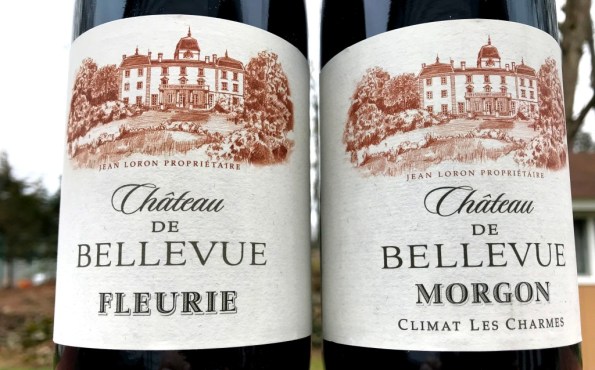
Here are the notes for the two wines I had an opportunity to try:
2015 Château de Bellevue Fleurie AOP (13% ABV, $25, aged 9 months in steel tanks)
Dark garnet
Crushed rock, iodine, underbrush, cherries
Medium plus body, crunchy berries, minerality, good tannins, good acidity, good balance
8, easy to drink, dangerous.
2015 Château de Bellevue Climat Les Charmes Morgon AOP (12.5% ABV, $25, aged 9-10 months (partially) in large French oak barrels)
Dark garnet
Raspberries, minerality, hot rocks
Nicely tart, well present tannins, tart cherries, excellent balance
8, a bit more earthy and bigger bodied, delicious.
Second day: 8+, the wine opened up magnificently, adding beautiful layers of fruit and spices.
Here you go, my friends. I know – too many wines, too little time – but I definitely intend on adding more Beaujolais wines to my cellar. How do Cru Beaujolais fare in your wine world? Cheers!
Wine Love: Lodi, California
 It is with the bittersweet feeling I confess my unconditional love to the wines of Lodi.
It is bittersweet, as on one side when the person is in love, they want to tell the whole world about it. On another side, I don’t want to tell the whole world about it – I want to keep it all to myself. I want Lodi to stay as a secret refuge for those who know. I want the Lodi wines to stay affordable, and the wineries to stay un-Napa – simple, humble, friendly, and worth visiting. But – this is not necessarily right for the winemakers of Lodi, who wants their wines to be known and drunk by the people, and therefore, it is my mission as a wine writer and wine aficionado to help with that, even risking that Lodi might not stay the same.
Bittersweet, yeah.
In general, Lodi is unknown and misunderstood. Wine lovers think that Lodi is only producing Zinfandel and high-power, high-alcohol fruit bombs. This can’t be any further away from the truth about what Lodi really is. So if this is what you thought of Lodi before, take it out of your head, and let me tell you what Lodi really is.
Historically, if California is an agricultural capital of the USA, Lodi is an agricultural capital of California. By the way, do you know where Robert Mondavi (yes, THAT Robert Mondavi) went to the high school? Yep, in Lodi. These are just fun facts, but now let’s get closer to the subject. Lodi is not about Zinfandel. First and foremost, Lodi is home to the Mediterranean grape varieties – Tempranillo, Sangiovese, Viognier, Albariño, Grenache, Cinsault, Syrah, Barbera, and many others. Lodi has a great climate for grape growing – it gets very hot during the day – temperatures in July/August can reach into the lover 100s – however, it cools off very nicely to “ohh, I need a jacket” on August night. That temperature range helps grapes to concentrate the flavor.
Lodi has sandy soils, which are not conducive for phylloxera, thus most vineyards in Lodi are planted on their original rootstocks. Lodi is home to some of the oldest continuously producing vineyards in the USA and in the world – for example, Carignane and Cinsault vineyards are 120+ years old, still bearing wine-worthy fruit. Lodi Rules, developed starting in 1992, became the standard of sustainable winegrowing in California (the same rules are even implemented at Yarden winery in Israel). And one of the most important elements – Lodi winemakers are some of the friendliest wine people you can find.
Until late 2016 I was square with the general public, equating Lodi with Zinfandel only. Then Wine Bloggers Conference happened, hosted in Lodi, and I was blown away by what I discovered upon arriving in Lodi. During that week I was also mesmerized by the attitude and hospitality of the winemakers, who took their time off the most important winemaking activity of the year – harvest – and spent time with the wine bloggers, sharing their love of the land. It is not only about the attitude – the absolute majority of the wines were tasted were delicious – I’m very particular in my expectations as to what good Syrah, Tempranillo, Barbera, or Albariño should taste like.
Two months after the wine bloggers conference I was in the Bay area on the business trip and had an open weekend. I tried to make some appointments in Napa, and when that didn’t work out, I went again to Lodi – had an amazing time tasting through the whole portfolios of Bokisch, Borra Vineyards, and Lucas Winery (the absolute beauty of 15 years old Lucas Chardonnay we tasted at the WBC16 speed tasting session still haunts me). I never wrote about that experience, but this is a whole another matter.

When I got an invitation from Snooth to join the virtual tasting session of Lodi wines, I almost jumped of joy – yes, I will be delighted to experience the Lodi wines, which are still hardly available outside of Lodi or California at the best (or is that a good thing :)?) Six wines, six producers, a unique and unusual set of grapes – what more wine aficionado can be excited about?
Below are my notes and thoughts about the wines. In case you want to follow along with the video of the virtual tasting, which provides way more information than I’m including here, here is the link for you.


2018 Acquiesce Winery & Vineyards Ingénue Mokelumne River AVA Lodi (13% ABV, $32, 35% Clairette Blanche, 35% Grenache Blanc, 20% Bourboulenc, 10% Picpoul Blanc, 350 cases produced) – Sue Tipton, winemaker and owner at Acquiesce Winery is known as a white wine specialist. She produces a range of wines made primarily out of the southern Rhone varieties.
Straw pale color
White stone fruit, candied fruit, concentrated
Day 1:
White stone fruit on the palate, good acidity, minerality, salinity
7+; it is really a 7+ out of respect to the wine which so many bloggers raving about. I clearly don’t get this wine, and no, it doesn’t give me pleasure.
Day 2-4:
Elegant, lemon and white peach notes, clean, good mid-palate weight, definitely resembling white Chateauneuf-du-Pape, uplifting, vibrant, perfectly balanced
8+; OMG. The wines can’t be any more different after being open for a few days. It changed dramatically, it opened up, it showed balance and elegance. This is an excellent wine, just give it 5-10 years to evolve (or longer).
2018 m2 Wines Vermentino Mokelumne River AVA Lodi (12.3% ABV, $20, 250 cases produced) – this Vermentino was unique and different in its show of minerality – it is quite rare for me to taste the wines like that.
Light straw pale, really non-existent color
Minerality-forward nose, granite, lemon undertones
Salinity on the palate, lemon, crisp acidity.
8-, tremendous minerality on this wine, it has more minerality than fruit. This wine also shows a bit more fruit after being opened for a few days, but it still retained all of its minerally character.


LangeTwins Winery & Vineyards 2018 Aglianico Rosé Lodi (13% ABV, $20, winery exclusive) – owned by the twin brothers, as the name says, LangeTwins is quite an unusual winery. Fun fact: their own production under LangeTwins label is quite small – however, as a contract winery their capacity to produce and store wines exceeds 2.2 million gallons. It is not the first time LangeTwins makes delicious Rosé from the Italian grapes – their Sangiovese Rosé has a cult following and impossible to get. This Aglianico Rosé is worthy of joining the cult ranks.
Beautiful pink color
Strawberries on the nose, nicely restrained, some minerality undertones
Delicate, balanced, perfect crunchy strawberries, crisp, refreshing
8, love this wine, would drink it any day
2016 Mettler Family Vineyards Pinotage Lodi (14.9% ABV, $25, winery exclusive, 350 cases produced) – not familiar with the winery, but seeing Pinotage on the label made me really wonder. Pinotage is a South African grape, which now produces much better wines than 20-30 years ago, but still with a very polarizing following (love/hate). This was my first taste of Pinotage produced outside of South Africa – and this was one unique and delicious wine.
Dark Garnet, almost black
Ripe blueberries, a touch of smoke, herbaceous undertones
Silky smooth, dark fruit, a touch of molasses, smoke, good textural presence, minerality, good acidity, good balance
8, lots of pleasure


2016 PRIE Winery Ancient Vine (1900), Block 4 Spenker Ranch Carignane Mokelumne River AVA Lodi (14.4% ABV, $29, 70 cases produced) – Just a thought if drinking the wines made from the grapes harvested from the vine which exists for 120 years, gives me quivers. An absolutely unique experience.
Bright garnet
Roasted meat, granite, chipotle
Great complexity, tart raspberries, rosemary, bright acidity, medium body, distant hint of cinnamon, excellent balance
8+/9-, it might sound like an oxymoron, but this wine is easy to drink and thought-provoking. Lots of pleasure in every sip
2016 Michael David Winery Ink Blot Cabernet Franc Lodi (15% ABV, $35, 85% Cabernet Franc, 8% Cabernet Sauvignon, 7% Petite Sirah, 65% 16 months neutral oak, 35% 16 months new French oak) – Michael David winery is known for its show of power in the wines. But when power is supported by elegance, that’s when you have an ultimate experience.
Dark garnet
Unmistakably Lodi, blueberries and blueberries compote, medium plus intensity, fresh
Lots of fresh berries – blueberries, blackberries, chewy, fleshy, well present. Touch of cinnamon, good acidity, overall good balance.
8, massive wine offering lots of pleasure. It just happened that soon after tasting, I had to leave the town for a business trip, so I just pumped the air out and left it standing on the floor. My wife didn’t have the opportunity to finish it, so when I came back 10 days later, I decided to taste it before I will pour it down the drain. To my horror surprise, the wine was still perfectly drinkable. That technically means that it has great aging potential, so maybe I need to lose a few bottles in my cellar.
Here you are, my friends. I hope I made you curious about the wines of Lodi. Definitely look for them in the store, but also keep Lodi in mind as your next winery excursion trip – just get ready to haul home a few cases of wine. Cheers!
Patches of Goodness – Introducing Ferzo
In Italian, Ferzo is a patch of fabric that is stitched together with others to create a sail. Let’s sail together into the world of wine.
Wine lovers are some of the happiest people in the world.
Don’t jump to any conclusions – the happiness starts before the bottle is open, not after the wine is consumed.
How I mean it? Let me explain.
I personally believe that travel is one of the best things people can do as a pastime. You get to experience a different culture, people, food, and lots more. Travel typically requires planning – money, time off work, finding someone to sit with your three dogs, water plants, feed goldfish … you get the picture. A successful trip requires one’s full, undivided involvement, from start to finish – and then it usually ends with happy memories.
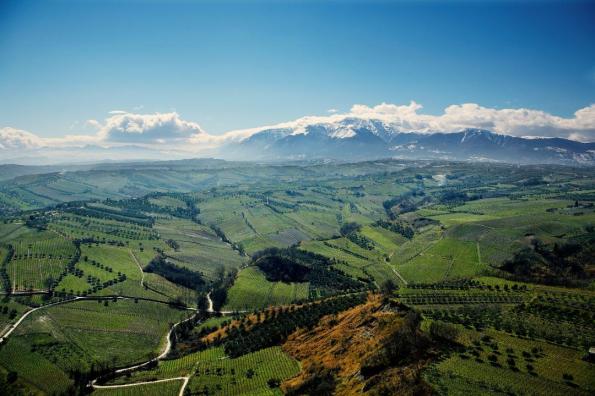
Wine lovers, on another hand, have it easy. It is enough to take a bottle of wine in your hands, and you are instantly transported. Your trip starts with the first look at the label, and then it is only limited by your imagination. The more you learn about the world of wine, the easier such travel becomes. You can instantly immerse into the culture, imagine visiting the vineyard, talking to the people, sitting in the tiny cafe with a glass of wine, just observing life as it happens. Sounds good? Can I take you on a trip right now, right at this moment? Of course, I know you are ready. I’m inviting you to visit Italy, the region called Abruzzo.
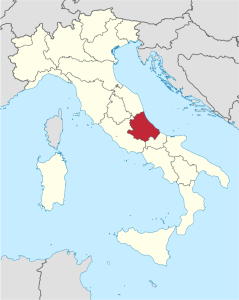 Abruzzo is a region in Central Italy, located along the Adriatic Sea coast. The territory of Abruzzo is about half of the size of the US state of New Jersey. However, the region boasts the biggest number of forests and parks compared to any other region in Italy, and thus sometimes it is referred to as “the lungs of Italy”.
There is nothing unique about winemaking in Abruzzo – it is only about a few thousand years old, on par with the rest of Italy. Well, jokes aside, the Abruzzo region is enclosed in the Apennines mountains, which historically provided natural defenses to the people living in the region – as well as ideal conditions for the winemaking.
Abruzzo wines became known internationally in the 17th century, largely thanks to the Spanish writer, Miguel de Cervantes, who praised the high quality of the region’s white wine, Trebbiano d’Abruzzo – however, today Abruzzo is first and foremost known for its red wine, Montepulciano di Abruzzo, produced from the grape called Montepulciano (try not to confuse it with the wine made in the Montepulciano village in Tuscany, which is made out of Sangiovese).
The wine is made is all four provinces of Abruzzo, however, the province of Chieti has the highest production of the four. While Montepulciano is a “king” of Abruzzo, the white grapes always played an essential role in the region. Today, the focus is shifting past the traditional Trebbiano towards until recently forgotten varieties, such as Pecorino, Passerina, and others.
Codice Citra is the largest winegrowing community in Abruzzo, uniting 3,000 winegrowing families from 9 different communes (wineries), collectively farming 15,000 acres of vineyards. Formed in 1973, Codice Citra had been making wines from the autochthonous varieties – Montepulciano, Trebbiano, Pecorino, Passerina and Cococciola.
With bottling capacity of 20,000 bottles per hour, you can imagine that Codice Citra produces quite a bit of wine. But this is not what we are talking about here. When you make wine year after year, you learn what works and what doesn’t. Little by little, you can identify the parcels of the vineyards, the patches, which produce different, maybe better grapes, year after year. And at some point, you decide – this patch is something special, maybe it deserves to be bottled on its own?


And that’s how Ferzo was born. Single grape wines, made from the plots with the vines of at least 20 years of age, representing the best Abruzzo has to offer – Montepulciano, Pecorino, Passerina and Cococciola. I had an opportunity to taste the line of Ferzo wines, graciously provided as samples by Donna White, and I was utterly impressed with the quality and the amount of pleasure each wine had to offer. Here are the notes:
Wine Lover’s Guide To Lesser Known Italian Wine Regions – Salice Salentino
Today, wine lovers, we are going on yet another wine journey in Italy. We are going all the way down almost to the bottom of the heel of the “Italian Boot”, to the area called Salice Salentino.
While we are on our way, I have a question for you – what do you know about first ever Rosé wine – ahh, we are in Italy, so let’s switch to the proper names – so again, what do you know about first ever Rosato wine bottled in Italy and exported to the USA? Do you know where, when, what was the name of it? I’ll let you ponder at it for a bit – the answer will come a bit later. And for now, let’s talk about Salice Salentino.
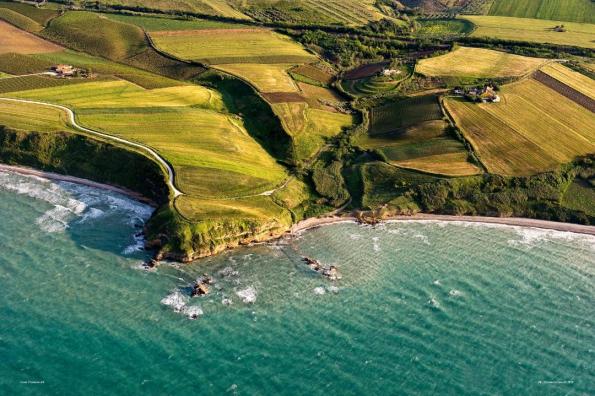
Salice Salentino is a small town located down south on the “heel” of Italy. If you will find it on the map, you will see that it is situated on a strip of the land, Salento, sandwiched between Adriatic and Ionian Seas (Gulf of Taranto, to be geographically precise). The town supposedly takes its name from the willow trees, which were growing in abundance in the area in the old days – you can see the willow tree showing up in the middle of a shield on Salice Salentino’s coat of arms. I don’t know if the land looked anything the picture below, but it is easy to imagine that this looks very authentic.

The town of Salice Salentino was founded in the 14th century, but wine… The wine was made on that land way, way before – let’s say, about 2000 years before, as the first mentions and artifacts of winemaking in the area go all the way back to at least the 6th century BC. And why not – you got rich soils with a lot of maritime influence, and despite the close proximity of the seas, hot and dry summers, which sport on average 300 sunny days. It is easy for grapes to ripen happily and abundantly in such conditions – may be, too easy – it is difficult to tame that amount of sugar later on at the winery. It is not very surprising that for the longest time, Salice Salentino was known as the source of grapes and bulk wine, and quantity was definitely trumpeting quality.
Come the 20th century, and the situation started to change, with more attention placed on the quality of the wine, controlling the yield and focusing on the quality of the grapes. Historically, Salice Salentino, and the whole big region it is a part of – Puglia – was focused on the red grapes and red wines; ohh – let’s not forget about olive trees (Puglia produces about 50% of all olive oil in Italy – but this is not the subject of today’s conversation). When Salice Salentino DOC was created in 1976, red wines were the only ones allowed under the DOC. Rules were subsequently changed in 1990 and 2010, and now both white and Rosato are produced in Salice Salentino.
To make wine, we need grapes, right? So let’s talk about grapes. Every region in Italy has its own, unique grapes – such grapes are called autochthonous (having a local origin). Salice Salentino is no exception – Negroamaro, Malvasia Nera (Black Malvasia, a red grape which is a sibling of the well known aromatic white grape, Malvasia), and Primitivo are three of the autochthonous grapes in that area.


Negroamaro is definitely the kind of Salice Salentino winemaking. The grape’s name can be translated as “black bitter”, due to its shiny black skin and bitter aromatics. It is widely considered that Negroamaro originated in Salentino area. The grape has no problems with dry hot climate and lack of water and can consistently achieve appropriate levels of ripeness. Most of the Salice Salentino DOC red wines contain 80% to 90% of Negroamaro grape.
Malvasia Nera is a dark-skinned member of Malvasia family. Malvasia Nera is growing around Italy, not only in Salice Salentino, and it is typically used as a blending grape, adding unique aromatics to the resulting wine.
You might not be familiar with Negroamaro and Malvasia Nera, but I’m sure you heard of Primitivo, which after the long research and often heated debates was recognized as an identical grape to American beloved Zinfandel. Primitivo is a star of the surrounding Puglia, especially in Primitivo de Manduria, however, in Salice Salentino it only plays supporting role in some of the blends, particularly with Aleatico.
In addition to the three grapes we already mentioned, Aleatico (red), Chardonnay, Pinot Bianco, and Fiano can be used. Overall, DOC rules allow the production of the full range of wines – sparkling (spumante) white, Rosato, red, and dessert (Dolce and Liquorosso).
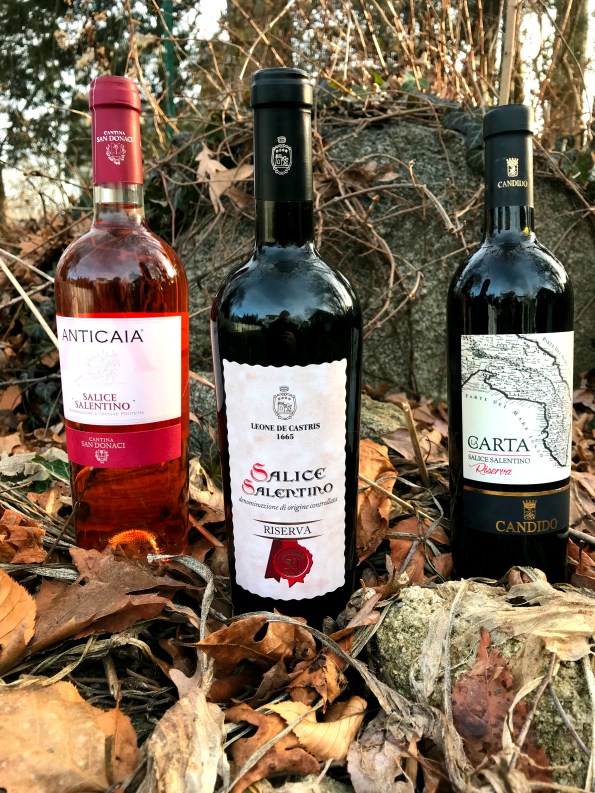
Now, it is time to taste some wines. I had an opportunity to taste three of the Salice Salentino wines, but before I will share my tasting notes, let me introduce you to the three wineries.
Leone de Castris
This is definitely one of the pioneering wine producers in Salice Salentino. The company started in 1665 in Salice Salentino, by planting vines and olive trees. In the 19th century, the Leone de Castris was exporting bulk wine to the United States. The first bottling under Leone de Castris name was produced in 1925.
Now, remember the question I asked you at the beginning of this post? You probably figured that already (o mighty google), but nevertheless: the very first Rosato produced and sold in Italy, and imported to the United States was made at Leone de Castris winery in 1943, under the name of Five Roses. The name signifies the fact that multiple generations of de Castris had 5 children each.
Gradually, Leone de Castris reduced their land ownership from 5,000 acres to under 900 acres, which is split between the vineyards and olive trees. The winery makes today around 2.5 million bottles per year, which includes red, white, Rosato, and sparkling wines.
Cantina San Donaci
Cantina San Donaci is also one of the oldest wineries in Salice Salentino. It was established in 1933 by 12 local farmers. Today, about 600 partners are involved in all aspects of winemaking – tending to about 1,250 acres of vineyards, harvesting the grapes and making the wines.
Production includes white, Rosato and red wines.
Candido Wines
Candido Wines started in 1929, producing bulk wine obtained from the 1,000 acres of vineyards. In 1957, the bottling started under its own label. Today, the winery owns 350 acres of organically farmed vineyards, focusing on the autochthonous varieties, as well as some of the international ones and producing the typical Salice Salentino range of wines.


Here are the notes for the 3 wines I tasted.
2015 Leone de Castris 50° Vendemmia Salice Salentino Riserva DOC (13.5% ABV, $12, 90% Negroamaro, 10% Malvasia Nera, 12+ months in barrel, 6+ months in bottle)
Dark ruby
Herbs- driven nose – sage, oregano, excellent minerality, underbrush, a touch of cherries
Ripe cherries on the palate, sweet tobacco, well-integrated tannins, a touch of sandalwood. Good balance.
8, the wine is super food-friendly, and it is a lot of wine for the money.
2017 Cantina San Donaci Anticaia Rosato Salice Salentino DOP (13.5% ABV, $8, 90% Negroamaro, 10% Malvasia Nera, 18-20 hours skin contact)
Beautiful Intense Rose color
A touch of strawberries, restrained,
Beautiful strawberries and cranberries, good acidity, fuller body than a typical rose, but nicely balanced, good tartness.
8-, very good
2015 Candido La Carta Salice Salentino Riserva DOC (13.5% ABV, $12, 95% Negroamaro, 5% Malvasia Nera, aged in large casks)
Garnet color
Tobacco, sweet oak, leather, medium plus intensity
Cherries, smoke, round, pleasant well-integrated tannins, delicious.
8+, superb. Absolutely delicious. Outstanding value and QPR.
As you can see, these Salice Salentino wines are offering an outstanding value – at $12, finding the wine which gives you so much pleasure is rather difficult – and these wines delivered. They are perfect on its own and would work very well with food – antipasti, traditional local hard sheep cheeses, such as Pecorino Sardo or Pecorino Romano, hearty stews, you name it.
I hope I helped you to discover a new Italian wine region. If you are looking for every day, great value, delicious glass of wine – Salice Salentino wines are worth seeking and experiencing. Cheers!
Wine Lover’s Guide To Lesser Known Italian Wine Regions – Alto Adige

Italian Wine Regions. source: Wikipedia
Italian wines are some of the most respected wines in the world. Well respected and well known, which is not surprising as Italy is the biggest wine producer and wine exporter in the world. But if you will ask a random wine lover about their favorite Italian wines, there is a good chance that all you will hear will be a few of Bs, most likely a C, and an S on a good day. I’m not trying to be cryptic here, just playing a bit – most likely you will hear about Brunello, Barolo, Chianti, and possibly, Super Tuscan. Some of the more advanced wine lovers might include Amarone. Someone might also include Prosecco, but that would pretty much complete the list.
When it comes to the regions, I expect the story to look very similar – Tuscany and Piedmont are two of the most likely contenders, everything else is open to the chance. Meanwhile, the wine is produced in Italy absolutely everywhere – otherwise, it is not that easy to be the number one wine producer and wine exporter in the world. When I say “wine is produced everywhere in Italy”, I mean exactly that – Italy has 20 administrative regions, and all 20 administrative regions are also wine regions.
There are many reasons why you want to expand your Italian wine horizons. For one, with the exception of Georgia and probably a few others, Italy is one of the oldest wine producing countries in the world with almost 3,000 years of history of the winemaking – that in itself deserves some respect. Another, and more important reason is that lesser-known regions usually mean great value – you can find the wines to enjoy with much better QPR than those coming from the best-known regions. And let’s not forget the sheer abundance of the grape varieties in Italy – about 350 used in winemaking today, out of which about 180 are so-called autochthonous (the grapes which originated in their respective local regions) – that translates into a tremendous range of wines available to the consumer.
Source: AltoAdigeWines.com
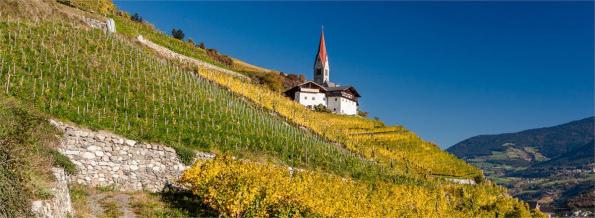
Let’s start our exploration. Let’s go to the northmost part of Italy, between Austria and Switzerland, where the Italian Alps are located. There are few names used for this region – Trentino, South Tyrol (Südtirol) and Alto Adige all point to the same area in the north. One of the oldest winemaking areas in Italy, with about 3,000 years of winemaking history, with the wines having significant Austrian influence and using a number of the same grapes, such as Müller-Thurgau and Gewürztraminer. While the region is small, there are about 5,000 grape growers and 150 wineries in Alto Adige, producing on average about 60% of the white and 40% of the red wines (colder climates enticing more production of the whites). The climate in the region is the Mediterranean, and it allows for proper ripening of both white and red grapes, without much worry about over-riping the grapes (unlike in the South of Italy). You can also imagine that it is not easy to work with the vineyards on the mountainous slopes, so grape cultivation in Aldo Adige is quite demanding.
Out of 17 or so grapes used in the winemaking in Alto Adige, three varieties are considered autochthonous – Gewürztraminer, Lagrein, and Schiava, with both Lagrein and Schiava being red grapes. I’m sure you are perfectly aware of “spicy aromatic” grape – Gewürztraminer is popular most everywhere around the world. However, it is not an easy grape to work with, as it always needs balancing acidity to avoid single-dimensional wines. Alto Adige Gewürztraminer might be one of the very best renditions on the market, along with Gewürztraminer from Alsace.
Lagrein is the indigenous red grape of Alto Adige, known for its high acidity and high level of tannins. Lately, Lagrein gained popularity around the world and now can be found in Australia, New Zealand, and the USA. Schiava, also known as Vernatsch and Trollinger, is the second indigenous red grape in Alto Adige. Schiava is known to produce the lighter-bodied wines with high acidity.
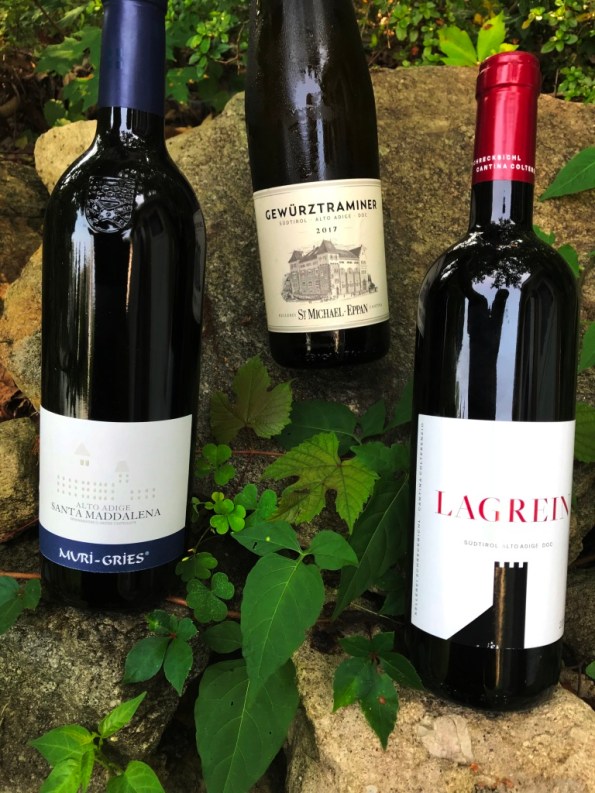


Let’s taste some wine, shall we? Why don’t we try exactly the grapes we were talking about – the autochthonous varieties:
2017 St. Michael-Eppan Gewürztraminer Alto Adige (13.5% ABV, $14) – St. Michael-Eppan winery is a cooperative of 340 winemaking families, formed in 1907. The winery produces a wide range of white, Rosé and red wine.
Light golden color
Intense, lychees and peaches, a touch of guava
More lychees on the palate, nicely restrained compared to the nose, good acidity, a touch of spicy notes, minerality showing up on the finish. very enjoyable.
8-, would be good with the food. Also, expect it to evolve over the next 5-7 years.
2017 Muri-Gries Santa Maddalena Alto Adige (12.5% ABV, $14, Schiava 93% and Lagrein 7%) – MURI-GRIES is the monastery, starting its history in 1845, when Benedictine monks moved into the monastery from Switzerland Today, MURI-GRIES makes a number of wines from Lagrein as one of the favorites, however, today we are tasting the Schiava wine and not the Lagrein from this producer. This Schiava comes from the well regarded single vineyard, Santa Maddalena
Light ruby color
Earthy nose, a touch of underripe raspberries, lavender
The light but supple palate, round and velvety, beautiful silky mouthfeel, more underripe raspberries, a touch of pepper and interesting salinity.
8-/8, the wine to ponder at
2017 Cantina Schreckbichl Colterenzio Lagrein Alto Adige (13% ABV, $14, 100% Lagrein) – and finally, Lagrein. Colterenzio winery was formed in 1960 by a group of 26 winegrowers. Today, more than 300 partners winemakers participate in the work of the winery.
Dark garnet, almost black
Roasted notes, a touch of smoke, black plums, a touch of oregano
Velvety palate, excellent extraction, a touch of pepper and herbaceous notes, black fruit, medium+ body, voluptuous and sexy
8, this wine has a mystery to it.
Alto Adige wines offer all wine lovers an opportunity to drink great wines at the very reasonable prices – may be that’s why we should keep it a secret? Have you had wine from Alto Adige? What do you think of them? Cheers!
Bubbles for the New Year 2019
I pride myself with not discriminating against any type of wine – white, red, sparkling, Rosé, dessert, fortified, $2, $10, $100 – doesn’t matter.
In theory.
In reality, most of the days, I drink red. And wish that I would drink more white and bubbles. Especially bubbles.
But luckily, we have at least a few holidays in the year, where the only appropriate choice of wine [for me] is bubbles. New Year’s Eve is absolutely The One – bubbles all the way.
As with all the holidays, a little prep is involved – the word “little” is a clear exaggeration, as deciding about the wine is mission impossible around here. However, this year it was easier than usual. Shortly before the New Year day, I received a special etched bottle of Ferrari Trento, the oldest Italian traditional method sparkling wine and one of my absolute favorites (I wrote about Ferrari many times in the past), so it was an easy decision regarding the bubbles to ring the New Year in with. I also wanted to start the evening with some vintage Champagne but considering that nobody was thoughtful enough to send me the gift of Krug Vintage, I had to settle for whatever I already had in the cellar. And then there was a bottle of generic French sparkler (non-Champagne) “just in case”.
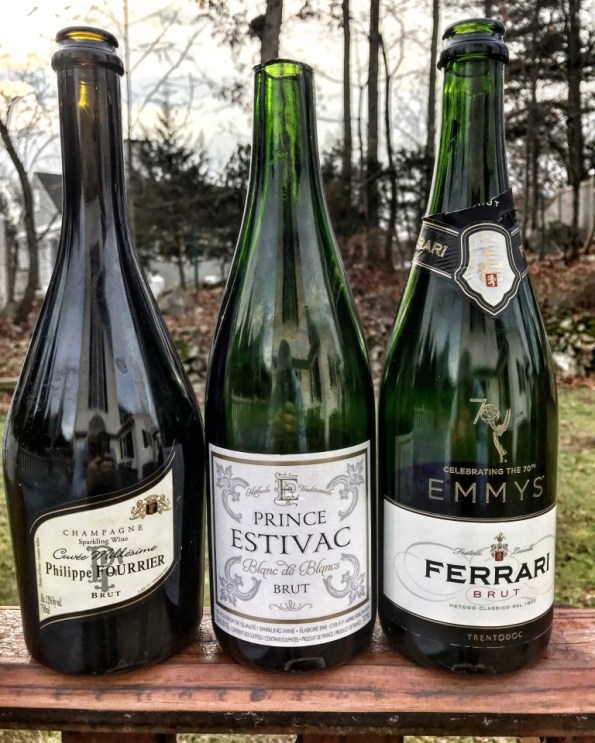
2008 Philippe Fourrier Cuvée Millésime Brut Champagne (12% ABV, $29.99 WTSO) was outstanding, just a perfect sip to start the holiday evening right. It had just the right amount of yeast and toasted bread notes on the nose, just enough to enjoy without going overboard. Apple and lemon notes on the palate, round, fresh, elegant, perfect balance – just a beautiful wine (Drinkability: 8+). It was also a steal at the price (seems that the wine is no longer available at WTSO).
The vintage Champagne disappeared in no time, it was still long before the apple would start its slide down in the Times Square, so the generic French sparkling wine was next. The weather outside was far from ideal for the New Year’s Eve (non-stop heavy rain) but it didn’t stop me from the pleasure of sabering the bottle into the darkness – worked like a charm even with the wine glass, unlike the #$%^ (insert your favorite expletive) with the saber at the French Laundry.
The NV Prince d’Estivac Blanc de Blancs Brut Vin Mousseux de Qualite (12% ABV, $13.99 WTSO, Melon de Bourgogne 50%, Ugni Blanc 25%, Chardonnay 25%) was excellent in its own right – fresh and vibrant, with rich mouthfeel, touch of a fresh apple, a bit bigger body than a typical Champagne – delicious in every drop (Drinkability: 8). It was also interesting learning for me as I’m not really familiar with “Vin Mousseux de Qualite” designation. It can be used for any French sparkling wine made with the traditional method. I’m assuming with the Vin Mousseux de Qualite designation the grapes can come from anywhere in France, where all of the Cremant wines (Cremant de Alsace, Cremant de Loire, …) require the grapes to be from the defined geographic area – if I’m wrong, please let me know in the comment.
Last but not least the time has come for the NV Ferrari Brut Trentodoc Emmys’ Special Edition (12.5% ABV, $24, 100% Chardonnay, 24+ month on the lees). Ferrari wines generally don’t disappoint, and this one was not an exception – crips, bright, bubbly (pun intended), good minerality, cut through acidity – sparkling wine worth any celebration (Drinkability: 8).
Of course, there was more than just the wine – New Year’s Eve is calling for a full table – here is a fragment of ours.
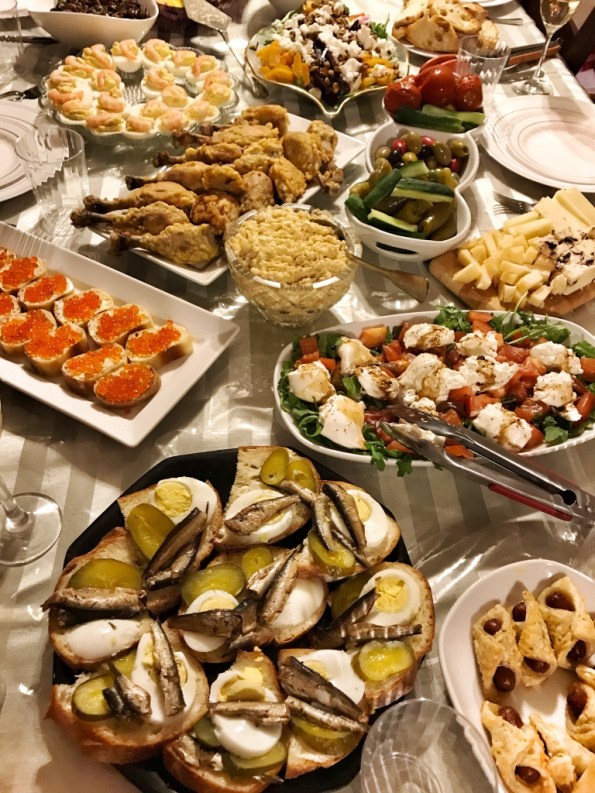
How did you celebrate the arrival of 2019? What were your bubbles of choice? Cheers!
Top Wines of 2018 – Second Dozen
Another year is about to become a history – which means special time on the Talk-a-Vino pages. It is the time to reflect on the wines of the past year and to relive some of the tasty moments once again.
This feature is run every year since I started the blog in 2010 so this will be the 9th annual list. The wines are included in this list on one simple premise – they have to be memorable. The easier for me to recall the wine, the better are the chances for the wine to be included here.
It is always not easy to designate a few dozens of wines to include into this list – I think I roughly taste about a thousand wines (that include all the trade tastings, of course) during the year, so deciding on the 20 something of the “best” is a challenging task – but it only makes it more fun.
With the exception of the wine #1, most of the wines in this list are not sorted in any kind of order – but the wine #1 would be the most memorable wine of the year. If I wrote about the wine before, I will always include the link to the existing post. For most of the cases, I don’t include the tasting notes in the Top Wines posts – just an explanation as to why the wine was included into the list. Ahh, and it is never just two dozens of wines – making the decision is hard, and 12 or 14 doesn’t make a whole lot of difference, right?
We are done with the introduction – now, let’s talk about the wines.


27. 2016 Château Peybonhomme-les-Tours Blaye Côtes de Bordeaux ($20) – this wine comes from the double-underappreciated category – Côtes de Bordeaux is regarded much less than the Bordeaux itself, and white Bordeaux is something people rarely ask for by name. However, once you will taste this wine, you wouldn’t care about its pedigree, you would only care about another glass. Beautiful combination of crispy, refreshing, and round. Look for this wine – but don’t settle for one bottle, or you are taking a great risk of upsetting yourself.
26. 2015 Lucas & Lewellen Toccata Classico Santa Barbara County ($29) – this is the wine you have to taste to believe. In a blind tasting, I would instantly designate it as an Italian – all the characteristic traits of a good, modern style Chianti, with generous sweet cherries and a touch of leather and tobacco on the back end are present in this wine – only it is made in California. Great effort, delicious wine.
25. 2016 Brooks Ara Riesling Willamette Valley ($38) – It is not every day you get to drink Riesling from Oregon. It is also not every day that you drink delicious Riesling not made in Germany, Alsace, or, at least, the Finger Lakes. Truly delicious, varietally correct Riesling. A beautiful wine worth seeking.
24. 2016 WineGirl Wines Butte PinUp Blend Lake Chelan ($40) – was blown away by how polished and well integrated this wine was during the Wine Bloggers Conference this year. This is one yummy, delicious and perfectly balanced wine, which you want to continue drinking and the bottle is …you know… empty?


23. 2007 Tishbi Cabernet-Petite Sirah Shomron Israel ($NA) – Tishbi is one of the oldest and best Israeli producers, yes. However, I really didn’t expect much from this 11 years old wine which was simply stored on the wine rack in the middle of the room in the apartment. And the wine was a total [good!] surprise – it was fragrant, it was mature, it was ultra-complex and delicious. It was probably at its peak, but who knows… By the time I wanted a second glass, it was gone.
22. 1997 Burgess Cellars Cabernet Sauvignon Napa Valley ($NA) – 1997 is a special year in my life (our marriage year), so I’m always looking for the wines from 1997. A while ago, I was lucky enough to score a few batches of Burgess Cellars 1997 Cabernet Sauvignon off the WTSO, and we had been enjoying it one bottle at a time. Every time I open a bottle I’m happy to see that it is still fresh, still can use a bit more time, and it is still perfectly delicious.
21. 2004 Viña Mayor Reserva Ribera Del Duero (~$20) – every time when I drink Ribera del Duero wines, especially at this level of quality, I wonder why I don’t drink them more often. Let’s also not forget that 2004 was an excellent vintage in Ribera del Duero. This 14 years old wine didn’t show any hint of age – powerful and structured, but generous and voluptuous at the same time. It was my last bottle, unfortunately – but I hope that even newer vintages will fare equally well.
20. 2014 Dunham Cellars XX Cabernet Sauvignon Walla Walla Valley ($45) – similarly to the Brooks Riesling and WineGirl red, this wine was also one of the highlights of the WBC18. A textbook example of the good Cabernet Sauvignon – cassis, eucalyptus, full body with gentle, layered tannins, perfect balance – just an excellent wine.
19. 2011 Jean-Luc Baldès Triguedina Clos Triguedina Cahors AOP ($40) – wines of the south of France are rare and definitely underappreciated, for sure in the USA. This wine was one of the highlights of the tasting of the wines of the south of France I attended earlier this year. The wine is primarily Malbec, but unlike Argentinian renditions, this is an old world wine, restrained, elegant, and thought-provoking.
18. 2016 Il Poggione Rosso di Montalcino ($27) – this wine was an indelible part of one of the most unique culinary experiences of the year – tasting Bistecca alla Fiorentina, made out of the Pat LaFrieda meat, perfectly accompanied by this Rosso. I always think “steak and Cab”, but this baby Brunello was simply singing with the meat, precisely matching the herbal components of the seasoning and adding layers of the tart cherries with every sip. I always appreciate good wine and food pairing, but I’m sure you know that good pairings are never easy to find – and this was pure perfection.


17. 2013 Willis Hall Razz-ma-Tazz v4.0 Washington ($NA) – Sweet wines are always a troubled category – everybody is ashamed to admit that they like sugar, so the sweet wines mostly stay in the “thinking about” realm – when we plan a dinner, we often think of finishing it with a bottle of dessert wine – by the time the dessert bottle should be opened, your gusts tell you that they don’t want anything else, especially not the dessert wine. So I was contemplating opening this bottle for the very long time, few times even getting it out of the cellar, only to put back when the guests are gone. I’m glad I finally pulled the cork as the wine was a pure delight. It is actually made out of raspberries, and it was ultra-elegant, with the pure, ripe, delicious raspberry taste matched with beautiful acidity.
16. 2009 Montalbera Laccento Ruche di Castagnole Monferrato Piedmont ($35) – This is not a very old wine, but this was definitely the case of the patience rewarded. I had current vintage Ruche from the same producer earlier this year, and while the wine was good, it clearly needed time. This 2009 Ruche was perfectly on point – dry, firm and structured, it had a beautiful bouquet already developed, offering perfumed leather, cherries and tobacco intermingling on the palate. Couple that with a good pizza – and this might be a glimpse of heaven on Earth moment.
15. 2014 Tendril Cellars Extrovert Pinot Noir Willamette Valley ($48) – tasting the wines of Tony Rynders of Tendril Cellars was a special experience – 5 different Pinot Noir, each one with its own personality. Somehow, the Extrovert left the most lasting impression out of the five – the finesse of Pinot Noir all enwrapped in the layers of silky power, as only Oregon Pinot Noir can deliver. If you are a fun of a fully extracted Oregon Pinot Noir, you will understand me well. If you are not, you need to find this wine and taste it for yourself.
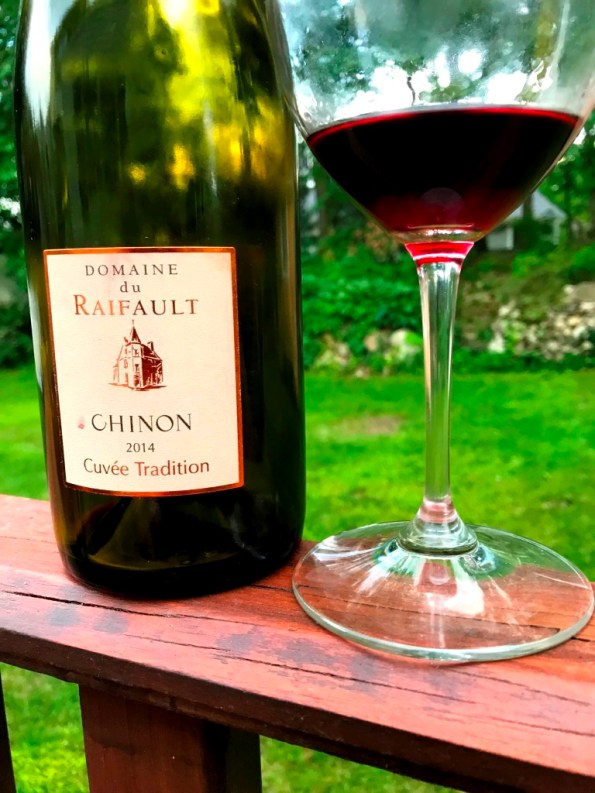
14. 2014 Domaine du Raifault Cuvée Tradition Chinon AOC ($17) – I’m a huge fan of Cabernet Franc wines, especially in the old world rendition, where the cassis is beautifully apparent and the wine stays on the lean side. This was a superb example of the old world Cabernet Franc, cassis forward and firmly structured. A delight.
This now concludes the presentation of the second dozen (and some) of the Talk-a-Vino Top Wines of 2018. The first dozen post will follow shortly. Cheers!
From $5 to $95
Taste of the wine is subjective. This is a very simple statement, but it is important to keep it in mind. It really helps to avoid disappointment, when, for example, you tell your friend that the wine is amazing, and your friend politely explains that “ahh, sorry, this is really not my thing”. This is also why all the ratings and medals simply mean that someone liked the wine – but they don’t offer any guarantee that you will like the wine too.
Not only the taste of the wine is “objectively subjective” (hope this makes sense to you), but it is also easily influenced (blind tasting is the only way to remove all the external influences and leave you one on one with the wine). There are many factors which influence the taste – bottle appearance, label, ratings, medals, friends and store clerks recommendations, and maybe most importantly, price.
Think about how you buy a bottle of wine as a present for someone. You would typically set yourself a price limit, and you will do your best not to exceed it. Let’s say you decided to spend $30 on a bottle. But what happens if the store’s employee would recommend you a bottle of wine at $15, saying also that the $15 bottle is equally good or even better than the one for $32 you hold in your hand. What will be your first thought? I bet your brain will say “ohh, this is too cheap! You can’t do this, take the one for $32!”.
It is obvious that price affects your buying decision. But the price is even more influential when you start drinking the wine, as the price sets the expectations. Feel free to tell me how wrong I am, but I’m willing to bet that you expect $10 bottle of wine to be mediocre, and you will be ultra-excited faced with the glass of $100 wine. The fun part about $10 bottle is that there is a great chance for a pleasant surprise. The sad part about the $100 bottle that there is a chance of a great disappointment. The best thing to do is to keep your expectations at bay and simply taste the wine and decide whether you like it or not – but this is usually easier said than done. Oh well, just keep working on it.
The message I’m trying to convey with all this pricing/influencing talk can be summarized like this: tasty wines exist at all price ranges. You can enjoy the wine for $5, and you can enjoy the wine for $95. Will you enjoy them equally? This is a tough question only you can answer. But let me share with you my experience with the wines from $5 to $95 which I tasted throughout this year – and then we can compare notes later on. Here we go:


Under $10:
2016 San Pedro Gato Negro Pinot Noir Valle Central DO Chile (13.5% ABV, $4.99)
Garnet
Characteristic Pinot Noir cherries and lavender on the nose, medium intensity
Simple, light, touch of tart cherries, baking spice, good acidity, overall not weary powerful, but offers lots of pleasure.
7+, simple but very nice glass of wine, and an amazing value.
2016 San Pedro 9 Lives Cabernet Sauvignon Reserve Chile (13.5% ABV, $9.99)
Garnet
Tobacco and cat pee
Pretty tannic, with some fruit notes hiding behind.
Not very good from the get-go.
After 3 days open – dramatic change, raspberries and blackberries on the palate, ripe fruit, good acidity, eucalyptus notes, medium body – very nice. Truly needed time ( even 2 days was not enough).
8- after 3 days.


Under $20:
2014 Domaine du Raifault Cuvée Tradition Chinon AOC (13% ABV, $17)
Bright Ruby color
Tobacco and cassis on the nose, bright and explicit
The same continues on the palate – cassis, tobacco, perfect acidity, bright, soft, round, delicious.
9, I can drink this wine any day, every day. Superb. This is the Cab Franc I want to drink.
2014 San Marzano Talò Salice Salentino DOP (13% ABV, $16.99, 85% Negroamaro, 15% Malvasia Nera, 6 months in French oak)
Dark garnet
Cherries, leather, earthy notes, granite, fresh, open, inviting
Ripe cherries, vanilla, toasted brioche, sweet tobacco, succulent, open, fresh acidity, medium+ body, excellent balance
8-/8, perfect from the get go
8+ on the second and next 3 days – lots of chewy dark fruit, generous, voluptuous, outstanding.


Under $40:
2013 Xavier Flouret Kavalier Riesling Kabinett Trocken Mosel (11% ABV, $25)
Bright Golden color
A touch of honey, lots of tropical fruit – guava, mango, white flowers, intense, pleasant
Cut trough acidity, lemon, green pineapple, intense minerality, excellent
8, great Riesling as it should be – I want to try it in 10 years.
2015 Markham Vineyards Merlot Napa Valley (14.5% ABV, $27, 86% Merlot, 12% Cabernet Sauvignon, 2% Petite Sirah, 15 months in barrel)
Dark garnet
Muted nose, a touch of blackberries, right, mint, minerality
The palate is also restrained, tart dark fruit, good structure, good acidity
8-, needs time.
2013 Attems Cicinis Sauvignon Blanc Collio DOC (13.5% ABV, $30, 8 months in French oak Barriques and 2 months in the bottle)
Light golden
Minerality driven nose, with a touch of truffle and sweet sage
Medium body, crisp, firm, excellent acidity but overall nice plumpness, savory lemon, crisp finish
Drinkability: 8, I would gladly drink it again any time


Above $40:
2013 Frescobaldi Castello Nipozzano Montesodi Toscana IGT (13.5% ABV, $44, 18 months in oak, 6 months in the bottle)
Garnet color
Leather, forest floor, minerality, cedar, medium+ intensity
A touch of smoke, tart cherries, tobacco, clean acidity, well integrated.
8, delicious from the get-go. Excellent aging potential.
2014 Domaine Ostertag Muenchberg Riesling Alsace Grand Cru Contrôlée (14% ABV, $50)
Light golden
Rich, intense, tropical fruit, guava, pineapple, distant hint of petrol
Delicious palate, a touch of honey and hazelnut, good acidity and tons of minerality. This is minerality driven wine right now, which will evolve into a total beauty over the next 10 years.
8, excellent.
2014 Luce Della Vite Toscana IGP (14.5% ABV, $95, Sangiovese/Merlot, 24 months in French oak)
Dark garnet
Pungent, dark chocolate, truffles, licorice
From the get-go, super gripping tannins. A little bit of dark fruit is immediately displaced by the tannins. Based on the initial sensation, lots of French oak.
Not drinkable from the get-go. Needs time.
3 days later – superb. Succulent cherries, firm structure, a touch of leather and tobacco, unmistakably Italian, and unmistakable super-Tuscan. Great acidity.
8+
As you can tell, I was equally struggling with the wines at $10 and $95, and my most favorite wine from the group was a mere $17 wine – but overall, there were no bad wines in this group. How do you see the prices of wine? How influential are prices when you buy the wine and when you drink it? Cheers!
Last Bottle Sign Up ($10 credit)