Archive
[Beaujolais] Nouveau Est Arrivé! 2024 Edition
Beaujolais Nouveau Est Arrivé!
Nouveau Est Arrivé!
Yes, it is the third Thursday in November, and it is an important day for those of us who still believe in the magic of wine – even if you shrug off the Beaujolais Nouveau as a marketing gimmick, you are still aware of the importance of the day, and whether you like it or not, consider yourself included 🙂
Every third Thursday in November and not a day earlier, Beaujolais Nouveau appears in wine stores around the world. Beaujolais Nouveau is the first wine of the new vintage in France, a young wine made to celebrate a new harvest. Georges Duboeuf is credited with making a centuries-old tradition into a marketing phenomenon more than 35 years ago – I’m not sure how much clout the celebration has today in the US, but it still has my attention.
Let me expand a bit on this. I’m traveling this week for work in Orlando, Florida. In Florida, wine is sold everywhere, from pharmacies to supermarkets to specialty wine stores. I visited the ABC Wines store (one of the popular wine retailers here, similar to Total Wines) at the beginning of the week and asked if they would be selling Beaujolais Nouveau on Thursday. The lady was not sure and suggested to call on Thursday to find out.
Today is that Thursday, and I started calling the store I visited on Monday. It took me four tries, but I finally got to a human. The lady on the phone said that they don’t have Beaujolais Nouveau at her store, but she was kind enough to check in the system and said that another ABC Wines store about 5 miles from the first one has it in stock.
Next, I decided to check if Whole Foods might have the wine in stock. I got to the human relatively quickly, but then the human said that she would go and check if they had Beaujolais Nouveau in stock. After 15+ minutes of music on hold, I decided that I would simply have to drive to the store to find out myself after I was done with work.
My first inclination was to drive to the ABC Wines location that was supposed to have the wine. After seeing that it would take me 35+ minutes to get there, I decided to try my luck with Whole Foods. Well, that didn’t work – no such luck. And now I was even further from ABC Wines which had the wine. Before giving up, I decided to make one more attempt – this time, with Trader Joe’s, which was only a mile away. A mile is not a mile in Florida, considering how overloaded the roads are and how long Florida traffic lights take… But nevertheless…
I arrived at Trader Joe’s, and found nothing after scouring the wine section for a few rounds. But unlike Whole Foods, in Trader Joe’s there is always someone you can ask (a floor manager). When I asked about Beaujolais Nouveau, there was a short pause during which I decided that there will be no Beaujolais Nouveau for me today, but then I heard – “hmmm, I think we got something last night, let me check”. 2 minutes later, the floor manager showed up with the bottle of Beaujolais Nouveau, which put a huge (huge!) smile on my face, and I thanked him profusely but managed not to hug him. After all, I was going to taste Beaujolais Nouveau on the day when it was released!
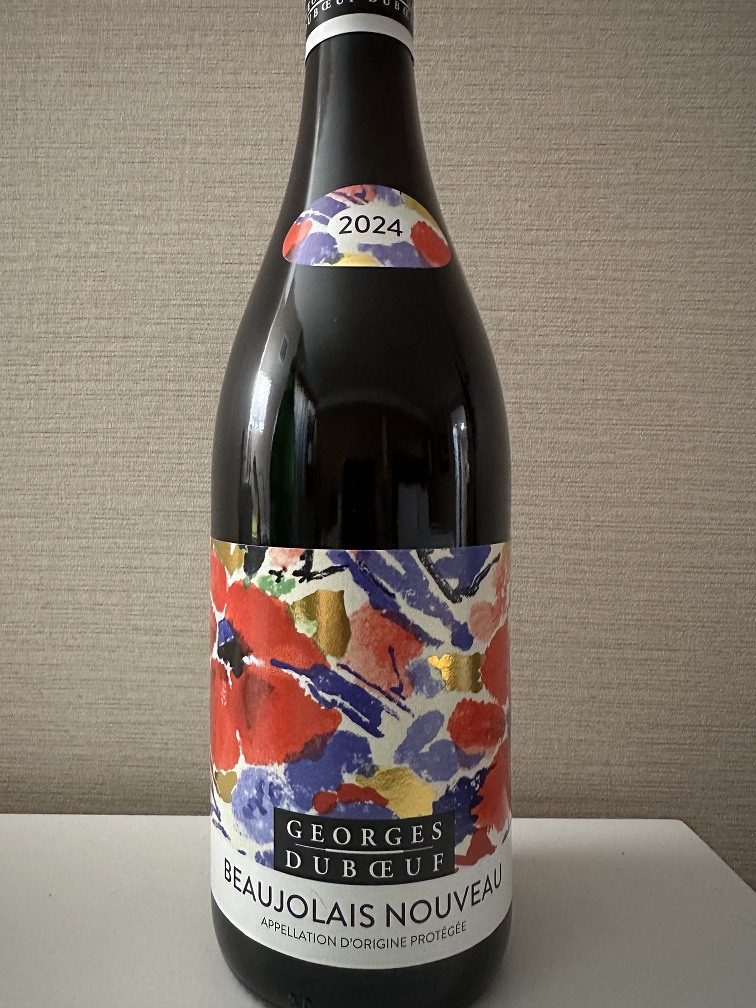
Every year I say that the quality of Beaujolais Nouveau gets better and better. I guess if I would sum up those statements, this Beaujolais Nouveau should taste better than DRC… I don’t know if it gets better every year anymore – at this point, I believe Beaujolais Nouveau got to the point of consistently high quality, good enough that I’m happy to drink it every year – at least Georges Duboeuf’s rendition for sure – here are my notes.
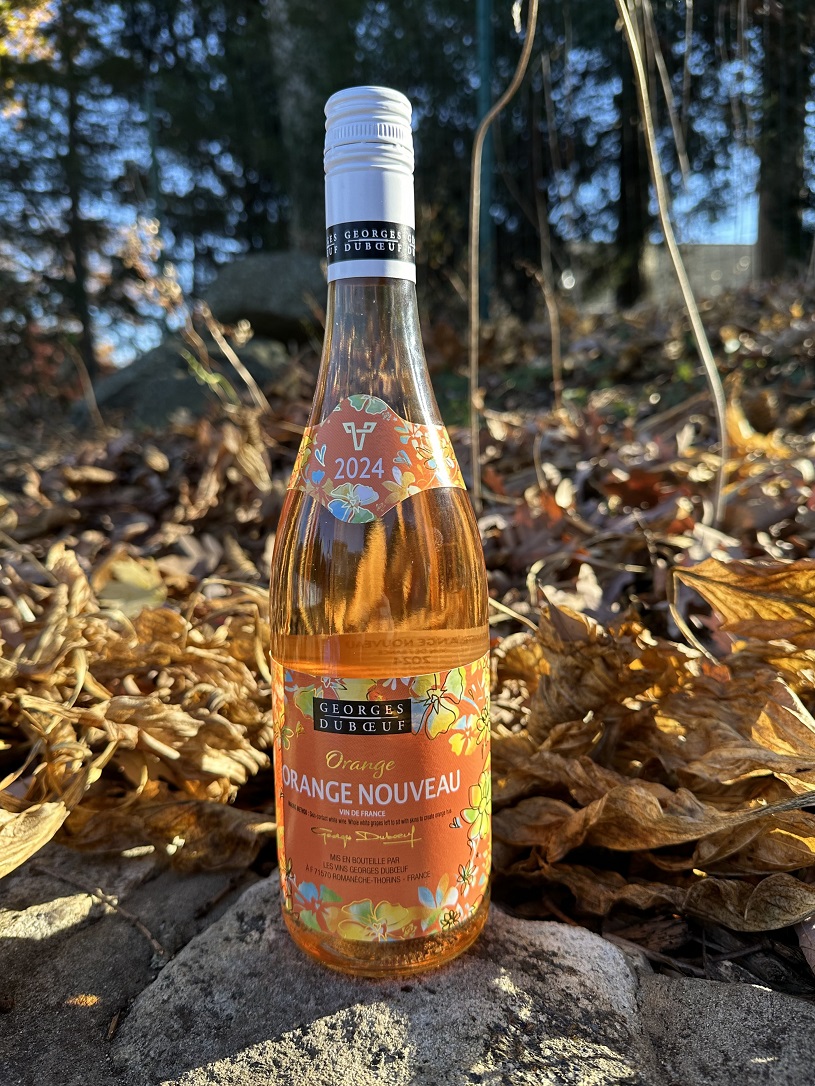


Lastly, here is a little treat for you:
Every year, the bottles of Beaujolais Nouveau are adorned with specially designed labels, sometimes even multiple labels from the same producer for the same wine – I have no idea how that works. As I have been writing about Beaujolais Nouveau every year since this blog started, I can offer you a collection of labels starting with the 2010 vintage. As Georges Dubouef is the one and only producer I was able to taste every year, below is my little “show and tell” limited only to the labels of Georges Duboeuf wines I tasted throughout the years. In case you feel like it, you can even choose your favorite label and share it in the comments (sorry, this is not a competition so no prizes will be awarded).
Here we go:


Beaujolais Nouveau 2024 has arrived, and if you haven’t tasted one yet – what are you waiting for? Taste it now and let me know what you think! Cheers!
Travel Diaries: Cote d’Azur, Pink Sunsets and Rare Grapes
Cote d’Azur.
French Riviera.
One of the most coveted vacation destinations in the world. I didn’t know that, but according to Wikipedia, “Riviera is an Italian word that originates from the ancient Ligurian territory of Italy, wedged between the Var and Magra rivers. Côte d’Azur is originally a nickname given by France to the County of Nice after its annexation in 1860, because the climate was similar to that of the north of Italy, even in winter, with “a sky as blue as its sea”.” I know it is summer, but here is my illustration of the point above:


An evening in Antibes
Over the past 10 years, I had to travel to Nice a good number of times, and always for business. As a business traveler, I always held a grudge against these trips to the South of France – I don’t like Nice airport, it is one of the most uncomfortable ones, and I had my share of bad experiences in Nice. But the last trip was admittedly better perceived – I stayed at a brand new Marriott property, Moxy in Sophia-Antipolis, which was very nice. And we spent most of our free evenings in Antibes, which is a beautiful small town – still with lots of tourists, but overall incomparable to the crowds of Nice itself.
As you already know, I’m here to inundate you with pictures. As we visited Antibes (and Nice once) only in the evening, the majority of the pictures are related to the sunset. Here you go:


It is not only the sunsets that provided a source of enjoyment during our walks. Thought-provoking, creative statues by Nicolas Lavarenne were another great entertaining element of the Antibes boardwalk – I have to say that I really enjoyed them. Here are a few of the highlights:


Here are more of the sunset pictures:


And now my most favorite, the one I promised you in the title of this post – pink sunset:

Before we part, a few words about the wine. I had a few of the decent wines during the week, some local, some not. 2023 Estandon Brise Marine Blanc Méditerranée IGP (Clairette, Ugni Blanc) and 2023 Estandon Brise Marine Rosé Méditerranée IGP (Cinsault, Grenache, Syrah) were both on point, crisp, refreshing and light. 2020 Caves de Rauzan Mascottes Olga Cabernet Sauvignon Merlot Bordeaux AOC (13.5% ABV) was also very good, on par with the excellent 2020 vintage, and overall very generous and supple.


My personal highlight was the 2020 Château de Bellet Rouge Bellet AOP (14.5% ABV, 35% Folle Noire, 25% Braquet, 40% Grenache). This was a super-local wine, with the vineyards and winery located in the Nice area. The wine had a nice core of dark fruit, a hint of my beloved barnyard and a silky-smooth texture. Not only the wine was delicious, but it also added two new rare grapes to my collection, inching closer to the coveted Hexavin goal.
That’s all I have for you today. Hope you enjoyed looking at the pictures as much as I had fun taking them.
Latest Wine News and Updates
There is never a dull moment in the world of wine – and there is not enough time in the day to track all the latest happenings. Here is a collection of recent and most notable wine news and updates.
Mars – wine’s next frontier
Yes, it is Mars, the fourth planet from the Sun. What Mars has to do with wine? If you ask Elon Musk, a lot. A relentless entrepreneur now has his sights on the world of wine, and apparently, he found a way to connect wine with another one of his passions – space. It appears that the 4 years long study conducted at UC Davis demonstrated that grown in space, the grapes had shown great potential for developing unparalleled taste profile while offering a substantial yield per vine, enabling the production of top-level wines at somewhat reasonable prices. Elon Musk teamed up with Paul Hobbs who was a consulting winemaker on the UC Davis project, and now he is building a fully enclosed vineyard set that will be delivered to Mars using a Space XM rocket. The vineyard will be installed and managed by the robotic staff, and the first harvest is expected to take place in 2030. The wine will be fully processed on Mars up to the bottling stage and will be delivered to Earth by the same Space XM rocket. No other details are available at the moment.
Screaming Eagle is going to produce what?
Screaming Eagle, the most iconic of all California wineries is secretly working on a new project, and it is not wine. Starting in 2028, the top 10% of the Screaming Eagle mailing list customers will have an opportunity to purchase the Marijuana extract, dissolved in neutral spirit and packaged into 175 ml bottles. The Marijuana plants are growing right between the Cabernet Sauvignon vines at Screaming Eagle vineyards. The plants are harvested by hand and processed within 3 hours of arrival to the winery, to retain absolute freshness. By growing in such symbiotic conditions with grape vines, marijuana plants acquire unique tasting characteristics and the elixir earned lots of praise from the focus group involved in the testing of this new product. The availability will be extremely limited. The pricing had not been publicly disclosed yet.
Coravin + AI =
Coravin, the utmost innovator and maker of wine tech gadgets teamed up with Google and Nvidia to add AI technology to the new top-tier A+W wine preservation systems. Each A+W device will be equipped with a Nvidia chip and connected to the Google AI cloud. The A+W device will be conducting real-time organoleptic analysis of the wine and the results will be further processed by the AI cloud to be able to assess the aging of the wine and drinking habits of the Coravin customers. All collected data will be also shared with the producers. It is expected that the next model of A+W will be able to detect non-ideal serving conditions of the wine and heat, cool, or filter the wine as needed for the optimum taste while the wine is being poured. Coravin’s chief scientist also predicts that at some point the Coravin devices will become smart enough to talk to each other and share their owner’s stories.
Amazon wine
Amazon finally decided to join the wine fray and start producing its own wines. Well, it is too early to talk about Amazon vineyards – for now, Amazon teamed up with Washington’s hallmark producer, Chateau St. Michelle to produce wine under Amazon labels. Amazon decided to use creative names for their wines, so the inaugural release will see “Mine is Better” Merlot, “Mine is Bigger” Cabernet Sauvignon, “Bottoms Up” Chardonnay, and “Sugar Rush” dessert wine.
Also taking the wine story even further, all the wine mentions in the Kindle books will become clickable in the text and readers will be able to order wines mentioned in the books with one click directly from their Kindle device. Inadvertent orders might be a concern here, so 007 readers, beware – Bollinger Champagne recently increased in price…
Wine G to Z
A concern about Gen Z not being interested in wine had been widely circulated throughout wine industry publications. E & J Gallo Winery, the biggest wine producer in the US, decided not to leave the wine story of Gen Z to a chance. E&J Gallo developed a special application called WineGZ to allow Gen Zs to fully customize their wine experience. As project director, Lotta Drinkin, explained “Gen Zs of the verified drinking age based on their country of residence will be able to fully customize their wine experience by selecting grapes, type, material and shape of the bottles, and many other characteristics to their exact liking”. For example, the grapes can be chosen strictly based on the carbon footprint of the vineyards, the ESG rating of the country of origin, and the social score of the winemaker. There is a choice of material for the bottle from glass to plastic to cardboard to metal to clay, and the shape of the bottle can be round, rectangular, or even “upload your own design” shapes. Based on the initial raving feedback, this project is expected to revolutionize the relationship between Gen Zs and the wine industry.
That’s all I have for you for today, but more news is coming. Cheers to the wine news and updates!
Month in Wines – January 2024
Ahh, the difference between the picture in your head and the reality. I know that I’ve written “Month in Wines” posts in the past, to discuss the wines I had during a given month. What I didn’t realize was that the last “Month in Wines” post was written 9 years ago, in 2015. Oh well, such is life. Let’s get to our subject – the wines I had during January of this year.
I would say that January, and December for that matter, are usually a bit more special, as both months are centered around holidays and celebrations. For a variety of reasons, we got to celebrate New Year, our most favorite holiday, on 3 separate occasions, and every one of those celebrations involved bubbles and special wines. Here are my brief notes on what transpired in January 2024, sorted by the type of wines.
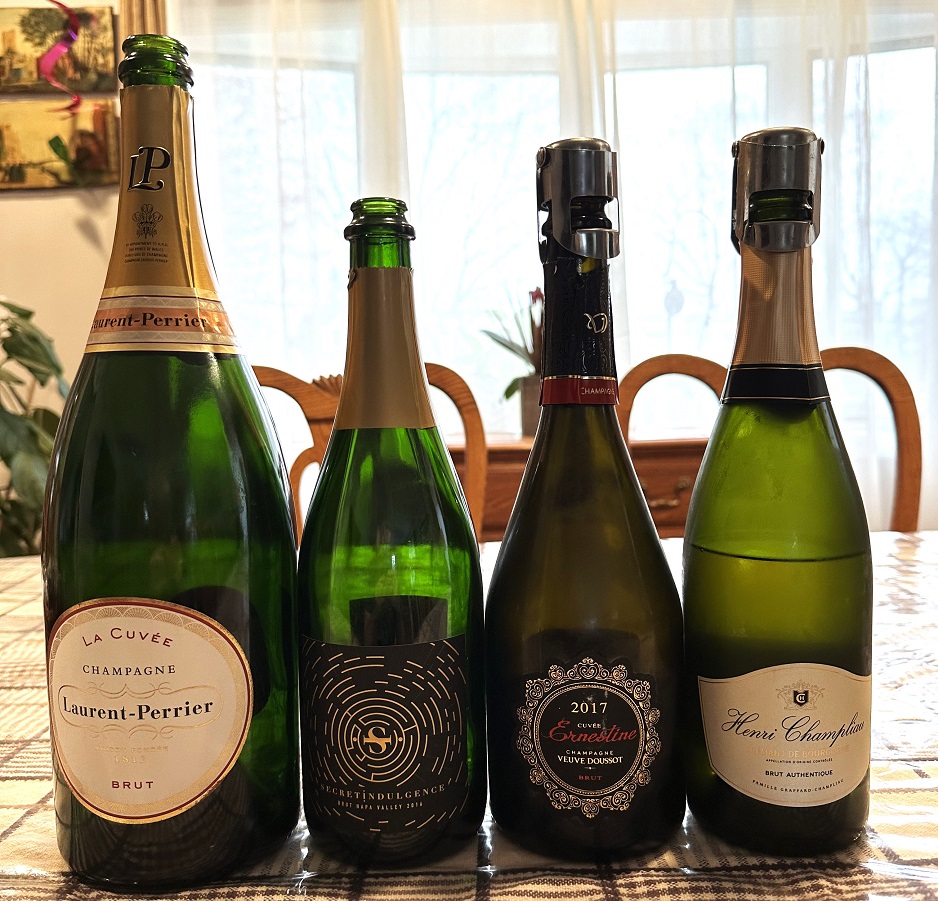
Some of the sparkling wines
Sparkling:
NV Veuve Clicquot Brut Champagne (12% ABV) – of course, no introduction is needed. As the most marketed Champagne brand, I find it annoying and thus drink rarely. We had a few bottles that my wife received as a present at work a few years back, so I decided to open one of them. The wine was not bad, I guess better than I expected. Not anything that would blow your mind off, but solid and drinkable (but not craveable if this is even a word).
NV André Chemin Brut Tradition Blanc de Noirs Champagne (12% ABV) – my favorite Champagne available from WTSO (or at least it used to be, great value at $26.99). Round, playful, beautiful toasty notes and perfectly balanced.
NV Laurent-Perrier La Cuvée Brut Champagne (12% ABV) – everything is better from the magnum right? Nice, clean, classic.
2016 Secret Indulgence Brut Blanc de Blancs Sparkling Wine Napa Valley (12.5% ABV) – a bit more substance than a typical Champagne. Just a touch more body, a bit more fruit, but overall perfectly restrained.
NV Maison Laudacius Cuvée Réservée Brut Méthode Traditionnelle Montlouis-sur-Loire AOP (12% ABV) – I grabbed this Cremant from the WTSO selection right before the holidays. This was nice and round, with clean acidity and just a touch of the fruit.
2017 Veuve Doussot Brut Cuvée Ernestine Champagne (12.5% ABV, 70% Pinot Noir, 30% Chardonnay, disgorged January 2022) – this one was just okay. Bubbles, but not much else to report.
NV Duval-Leroy Brut Reserve Champagne (12% ABV) – nice, round, clean, classic. A hint of apple, perfect acidity.
2011 Castello Bonomi Cru Perdu Millisimato Franciacorta (12.5% ABV) – excellent. Very generous, round, refreshing, a clean profile with a touch of fruit and a great substance.
2012 Charles Clément Brut Champagne (12% ABV, 60% Chardonnay, 20% Pinot Noir, 20% Pinot Meunier) – excellent specimen of a vintage Champagne. Toasted notes, brioche, fine mousse, all around delicious.
NV Henri Champliau Brut Authentique Crémeant de Bourgogne AOC (12.5% ABV, 85% Pinot Noir, 15% Chardonnay) – Zak, who brought this wine, mentioned that a “tik-tok sommelier” compared this wine with Veuve Clicquot and said that they are literally identical in the taste profile with this Cremant only costing a fraction of the Veuve. Upon first taste, we found no similarities, and the wine overall was kind of subpar, so we had to put it aside enclosed with the Champagne bottle sealer. The next day the wine was still not interesting. On the third day, it showed a much bigger body and became much more round and pleasant. I still don’t think the comparison with Veuve stands, but go figure…
NV Giacomo Scagliola SiFaSol Moscato d’Asti DOCG (5.5% ABV) – of course, this is a lightly fizzed sweet wine, but we had it as an aperitif, hence is it listed with other sparkling wines. When it comes to Asti wines, it is all about balance and acidity – and succulent white peaches in this wine were perfectly balanced by the lemony acidity, so overall the experience was light and refreshing.
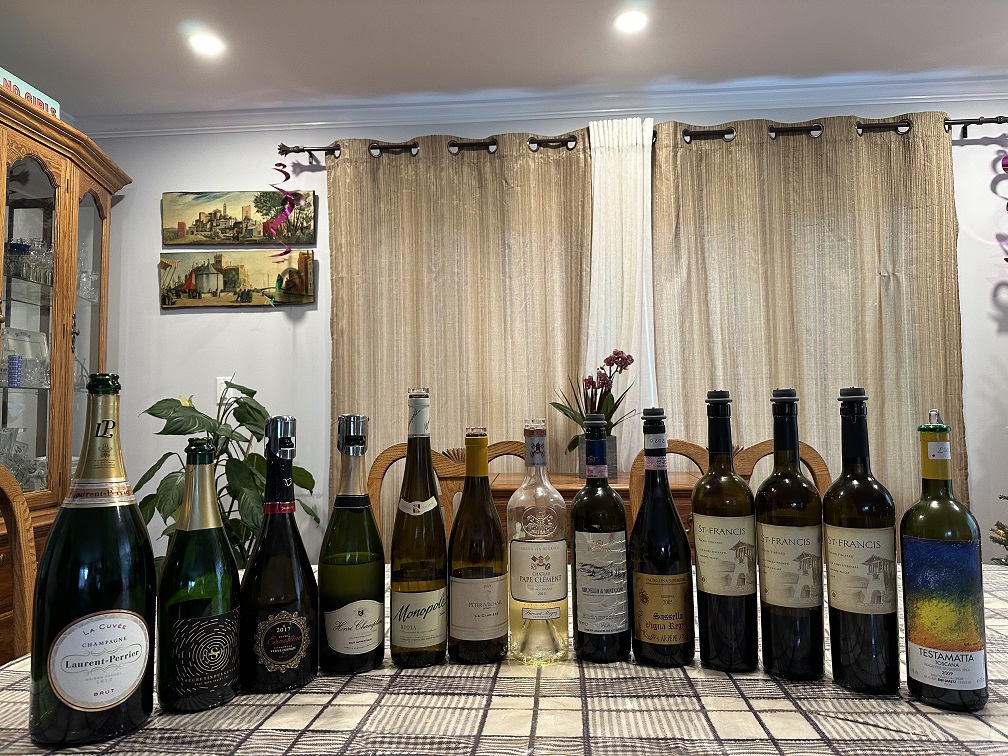
Final group
Whites:
2010 CVNE Monopole Rioja White Wine (13% ABV, 100% Viura) – I love unexpected [good] surprises, and this was definitely the one. I always enjoyed Monopole, the oldest white wine produced in Rioja (the first vintage was produced 110 years ago – in 2014) – but typically as a fresh, young wine. I kept one bottle as an experiment, not expecting anything special. The wine was excellent – not at the level of mature Riesling or a well-made white Burgundy, but it was good in its own class, with white-stone fruit, white plum, and lemon on the palate, and a tiny hint of oxidative/sherry notes, still with freshness and well noticeable acidity. Don’t know if it would age for much longer, and I was happy that I opened it now.
2015 Château Pape Clément Grand Cru Pessac-Leognan (14.5% ABV) – unlike the previous wine, this was not a good surprise. A very strange palate which I can’t even describe – kind of medicinal profile with basil and currant leaves, rather overwhelming. “Strange” would be the best descriptor.
2011 Peter Michael La Carrière Chardonnay Knights Valley Sonoma County (15.2% ABV) – another disappointing wine. 2011 was not a good year in California, and this wine was simply bitter and lacked any sort of balance.
Reds
Reds:
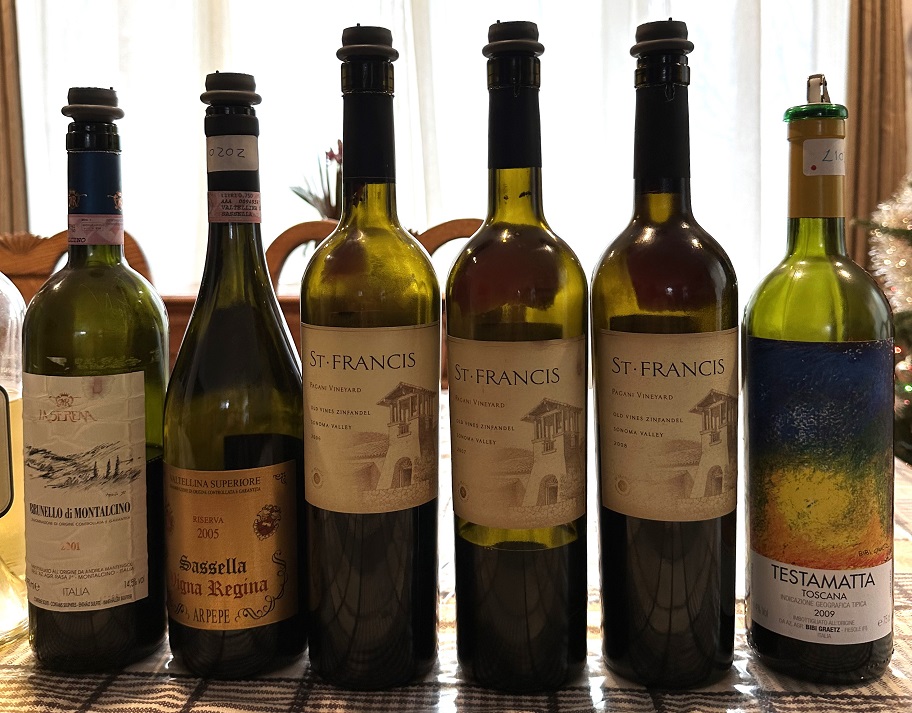
2006 St. Francis Old Vines Zinfandel Pagani Vineyard Sonoma Valley (15.6% ABV) – I kept this trio for a while but decided that the time had come to drink them. All 3 wines were very similar, focusing on blackberries, a hint of cherries and fresh herbs, round and delicious. I can’t complain about either one – they were all gone very quickly.
2007 St. Francis Old Vines Zinfandel Pagani Vineyard Sonoma Valley (15.4% ABV) – 2007 was the biggest wine of the 3, still retaining the same core of the fruit and herbs, but more assertive in its expression on the palate.
2008 St. Francis Old Vines Zinfandel Pagani Vineyard Sonoma Valley (15.4% ABV) – possibly the most elegant of the 3. Again, same profile, but with more finesse and restraint, focused on elegance.
2009 Bibi Graetz Testamatta Toscana IGT (14% ABV) – I was hoping it would be great, and it was not. Another disappointment of the tasting.
2005 ArPePe Sassella Vigna Regina Riserva Valtellina Superiore DOCG (13% ABV) – I have a lot of respect for ArPePe wines, but for whatever reason, this was far from amazing. I would describe it as “lean”. It is possible that the wine was open during its “sleeping” phase, but I would never be able to find out now.
2001 La Serena Brunello di Montalcino DOCG (14.5% ABV) – this was an interesting experience. From the get-go, the wine was not bad, with a pleasant dark cherries profile and good acidity. It was lacking a body a bit, so we decided to decant it. The decanter didn’t make much of a difference, with the wine remaining pleasant but not exciting. During the next two days, the wine transformed, showing a powerful structure and becoming more assertive. This wine could probably wait for another 5-10 years. Oh well…
2016 Carlisle Two Acres Russian River Valley Sonoma County (14.9% ABV, Mourvèdre, Petite Sirah, Syrah, Pelourcin, Carignane, Alicante Bouschet) – a rare case of Carlisle missing the mark. I can only assume I opened the wine while it was in its “sleeping” phase – at the moment it was simply lacking balance, and it didn’t improve even over the next few days. Strange, but happens.
2010 Clarendon Hills Brookman Merlot Wine of Australia (14.5% ABV) – I saw a very discouraging review of this wine somewhere online (might be Vivino), but somehow was convinced that my experience would be very different. No such luck. If I would ever decide to present the list of the worst wines of the year, this would be definitely one of the top contenders. This was a wine that showed nothing – not on the nose, not on the palate. Not good…
2017 Quinta do Vale Dão DOP (13% ABV, 40% Touriga Nacional, 40% Tinta Roriz, 20% Alfrocheiro) – Portuguese wines represent amazing value, and this was a simple proof of that. For under $10, this wine was singing – fresh, succulent berries, perfectly integrated tannins, playful, delicious.


2009 Sauvella Luscinia Canta Costers del Segre DO (14.1% ABV, Syrah, Cabernet Sauvignon, Grenache) – Spain never ceases to amaze. An eclectic mix of grapes (who blends Cabernet Sauvignon with Syrah and Grenache?) delivering outstanding wine – fragrant, playful, full of fresh succulent dark fruit and herbs, well-integrated tannins and long finish. By the way, 2009 is a current release (available in the stores now) and thought-provoking.
2017 Campochiarenti San Nicola Riserva Chianti Colli Senesi DOCG (14.5% ABV) – classic and precise. Beautiful, layered Chianti with all the attributes – succulent dark cherries, sweet tobacco, leather, perfect minerality, wonderful bouquet and overall just a quintessential Italian wine.
2008 Achaval-Ferrer Quimera Mendoza Argentina (14% ABV, Malbec, Merlot, Cabernet Sauvignon, Cabernet Franc, Petit Verdot, 12 months in 40% new and 60% old French oak barrels) – my last bottle. I can’t recall why but I was not happy about the previous bottle opened a few years back, so I had a bit of trepidation opening this one on the last day of the month. The wine was just perfect. Roll-off-your-tongue smooth, velvety tannins, succulent cherries surrounded by the black fruit. Perfectly balanced and supremely delicious.
This concludes the story of January month in wines. As you can tell, there were clear highs and there were clear lows. How was your January in wines?
The work on a sequel has already started.
Cheers!
The Art Of Italian Wine: Masciarelli
Italian wines are special.
Well, this statement says a lot and nothing at the same time.
Remember, wine is personable and subjective. Everyone has a right to have their own opinion, and that opinion can only be subjective.
What makes Italian wines special? I will allow myself to make a bold claim – Italian wines are distinguishable. At least the well-made Italian wines produced from the core Italian grape varieties. What I’m saying is that when you taste Chianti, Brunello, Nero d’Avola, Montepulciano, Barolo and others, you might not identify the exact wine and the exact producer, but you would be reasonably sure you are drinking an Italian wine.
When you drink wine made from Cabernet Sauvignon or Chardonnay, you might be well able to identify the grape, but the origin of the wine can be equally anywhere in the world – Bordeaux, California, Italy, Spain, Washington, Australia, Chile and everywhere in between can be a source of a great Cabernet Sauvignon. This would be also true for the absolute majority of the so-called international grape varieties – Cabernet Sauvignon, Merlot, Pinot Noir, Grenache, Syrah, Chardonnay, Sauvignon Blanc. But when you taste Sangiovese made in Italy, you might be easily mistaken about the exact region, but you would be reasonably certain you are drinking an Italian wine. An important disclaimer – it would definitely help if this would be a well-made Italian wine.
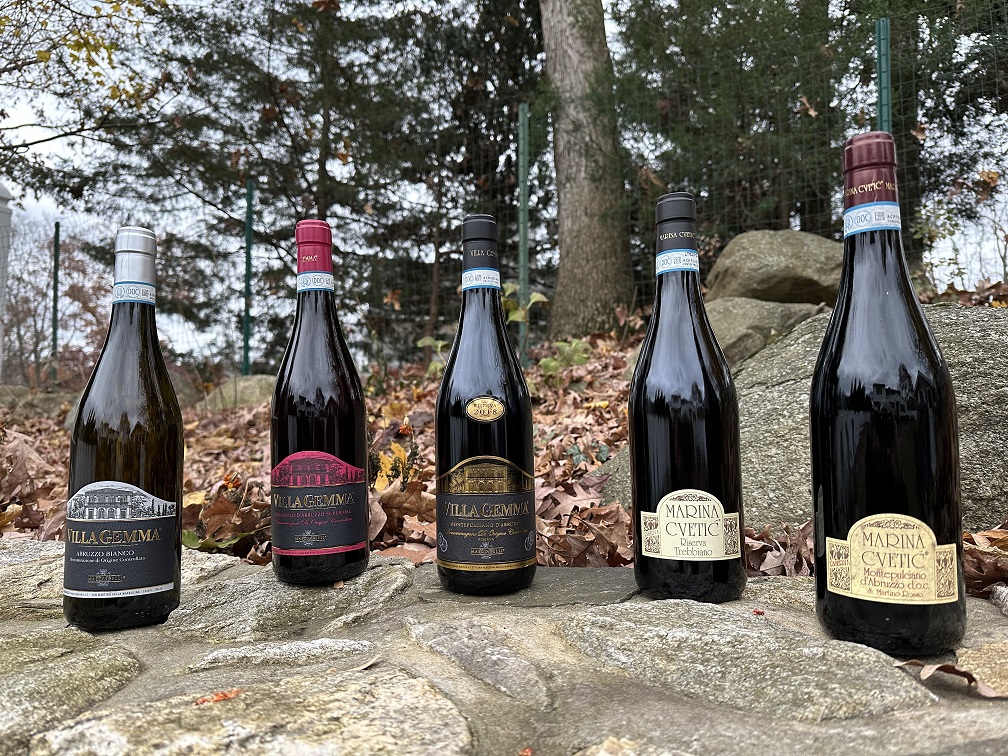
Here is a great example of the well-made, and thus easily recognizable Italian wine – or, rather, wines – Tenute Masciarelli in Abruzzo in Italy.
In terms of “wine time”, Masciarelli is a very young winery, founded in 1981 by Gianni Masciarelli. However, the impact in the wine world is not directly a function of time. Wine has been continuously produced throughout Italy for a few thousand years. In Abruzzo, a province located in central Italy along the Adriatic Sea, Montepulciano is the king. Simple Montepulciano red wines were produced forever in the region, perfectly quaffable, but not really comparable, for example, to the wines of Tuscany. Gianni Masciarelli spearheaded the change in the region, both in grape growing (he introduced the French Guyot training system for vines in the region) and production – he was the first to start using French oak barrels for aging the Montepulciano Abruzzo and Trebbiano d’Abruzzo wines. 1984 saw the first vintage of the Villa Gemma Montepulciano d’Abruzzo, the first of its kind single-vineyard Montepulciano d’Abruzzo wine, which will be celebrating 40 years of production this year.
Today, Masciarelly sustainably produces wines from all 4 provinces in Abruzzo. Annual wine production exceeds 1 million bottles across 7 different lines and 22 wine labels. A few months back, I had an opportunity to review Masciarelli’s introductory Linea Classica – 3 very well-made wines that were not only tasty but easily lasted for 5 days after being open – a testament to quality. Now, I had the pleasure of reviewing the latest releases from two more wine lines – Marina Cvetic and Villa Gemma.
Marina Cvetic line includes 2 of the classics – Trebbiano d’Abruzzo Riserva and Montepulciano d’Abruzzo – the second one is my perrenial favorite, I’m always happy to drink it. Additionally, the Marina Cvetic line includes four of international grape varieties (Chardonnay, Cabernet Sauvignon, Syrah, and Merlot) – however, I don’t think those are available in the US.
Villa Gemma, the winery’s flagship and the oldest produced line, includes three of the Abruzzo’s classics – white blend, Rosé, and Montepulciano d’Abruzzo Riserva.


Here are my notes:
2020 Masciarelli Marina Cvetić Trebbiano D’Abruzzo Riserva DOC (14% ABV, $60, 100% Trebbiano Abruzzese, 20-50 yo vines)
Light golden
A hint of tropical fruit, Whitestone fruit, honeysuckle
Round, clean, fresh, a hint of butter, soft and creamy texture with Meyer lemon finish
8, the wine is a bit aggressive when just opened, don’t over-chill it (I would serve it around 50F) and let it breathe, maybe 30 minutes in a decanter. Will stay fresh in the fridge for a few weeks.
2022 Masciarelli Villa Gemma Abruzzo Bianco DOC (14% ABV, $24, 50% Trebbiano, 30% Pecorino, 20% Cococciola)
Straw pale
whitestone fruit, lemon, clean, inviting
Crisp, clean, good acidity, lemon, expressive minerality, good balance
8, excellent
2022 Masciarelli Villa Gemma Cerasuolo D’Abruzzo Superiore DOC (14% ABV, $24, 100% Montepulciano)
Beautiful cranberry pink
Restrained nose of fresh strawberries, pleasant
Strawberries, cranberries, fresh, bright, excellent acidity, good balance, delicious
8
2019 Masciarelli Marina Cvetić Montepulciano d’Abruzzo Reserva DOC (14.6% ABV, $38, 100% Montepulciano, 15-30 yo vines, 12 months in French oak barrels)
Dark garnet, almost black
Dark cherries, espresso, tar, mocha, medium intensity
Dark cherries, silky smooth with beautifully present tannins, layered, round, well present, delicious.
8+, these are day 2 and day 6 notes, this wine is made of the long haul, was not very enjoyable upon opening, you need to decant it for 2-3 hours or forget it in the cellar for 10-15 years as the least.
2018 Masciarelli Villa Gemma Riserva Montepulciano D’Abruzzo DOC (15% ABV, $98, 100% Montepulciano, 35 yo vines, 12 months in French oak barrels)
Dark garnet, practically black
Black cherries, a hint of a barnyard
Black cherries, cherry pits, silky smooth roll-of-the-tongue texture, good acidity, excellent balance
8+, this is a big wine. It is surprisingly pop’n’pour, but will improve with the cellaring.
Here you are, my friends – wine, a liquid art form, made in Italy.
Do you think that Italian wines are easily distinguishable? What are your favorite Italian wine producers?
As Expected
Is “expectation” a wine term?
In a direct sense it is not, of course – “expectation” is not the name of the grape, not a wine descriptor, and not the name of the winemaking process. And nevertheless, for anyone who proclaims “serious affection, a.k.a love, a.k.a obsession” to the simple beverage produced from the grape juice, I would argue that “expectation” is a wine term, or at least, a wine-related term.
Expectations start from the very first look at the bottle – even before we see the label, the bottle’s shape and overall appearance initiate a thought process regarding the bottle’s content. Obviously, once we carefully look at the label, our expectations are enhanced further. Okay, young Barolo, I need to get the decanter ready. Ohh, this Sauvignon Blanc is too warm – I need to chill it before the guests arrive.
But then these are not even real expectations. Once you recognize the region, the grape, the producer – this is when the mind games of expectations start. Looking at the bottle of Opus One, Petrus, Penfolds Grange, or Dom Perignon, I’m sure that the mind of an average wine lover goes ballistic – “this is going to be amazing”. The brain would not accept anything less. Even after you try the wine, the brain will interject into the message from your palate if it is anything less than “oh my god, I love this”. But before I mount my favorite horse it appears that there is an idiom “to mount a hobbyhorse” (I hope there is a saying like this in English, as there is one in Russian), let me change the direction to where I’m actually trying to arrive.
As we are discussing the meaning of the wine term “expectations”, it is interesting to see how your expectations are built. Let’s say you tried a bottle of wine from an unknown producer, and you liked it. Then you tried another one. And another one – and I don’t mean in one sitting – slowly over time. As you keep liking the wines, your expectations are being built. You try new vintages, new wines from the same producer and your expectations keep growing. Once you become really familiar with the producer, you take a bottle you never had before, and before even opening it, you are confident that this will be a good wine – you expect nothing less. You might not love each and every wine from a given producer after you try them, but at least in terms of expectations, your ways are set. Just to give you an example, I expect excellent wines from La Rioja Alta, Lopez de Heredia, Field Recordings, Turley, Carlisle, Masciarelli, and lots of others – and yet while I’m writing this post, I’m drinking the wine from Carlisle that I don’t really enjoy at this moment (just opened the bottle, the wine needs to breathe). The fact that I don’t enjoy one particular wine doesn’t affect my general expectations – next time, holding a bottle of Carlisls in my hands, I would fully expect that I will like the wine “at hands”.
A “circle of expectations” is not cast in stone. As we taste wines from the new producer, we build confidence and our expectations are growing to the point of this unconditional trust. Today, I want to share with you one of my latest additions – Domaine Bousquet from Argentina.
 Domain Bousquet is not even 30 years old – it was founded in 1997, so in the wine world this is a very short period of time – but take a look at this simple picture above, which perfectly summarises Domain Bousquet’s achievements – Certified Organic with multiple designations, biodynamic Demeter certified, 1st in Argentina and 4 th in the world regenerative organic winery – you can continue researching this very impressive list on your own. But this is the wine we are talking about, so all of the certifications take a back seat to the content of the glass. What’s inside of glass matters – does it give you pleasure or not. And Domaine Bousquet produces damn impressive wines.
I was introduced to the wines of Domaine Bousquet exactly 3 years ago, and that introduction started with their Charmat method sparkling wines – organic, delicious, and inexpensive. Next, in August of the same year, 2021, I had an opportunity to taste an extended lineup of Domaine Bousquet wines, that were also excellent. Earlier this year I was blown away by their unoaked organic wines containing no added SO2, and then one more time in December when I tasted their Classic method sparkling wines which were world-class superb and an absolute steal at $18.
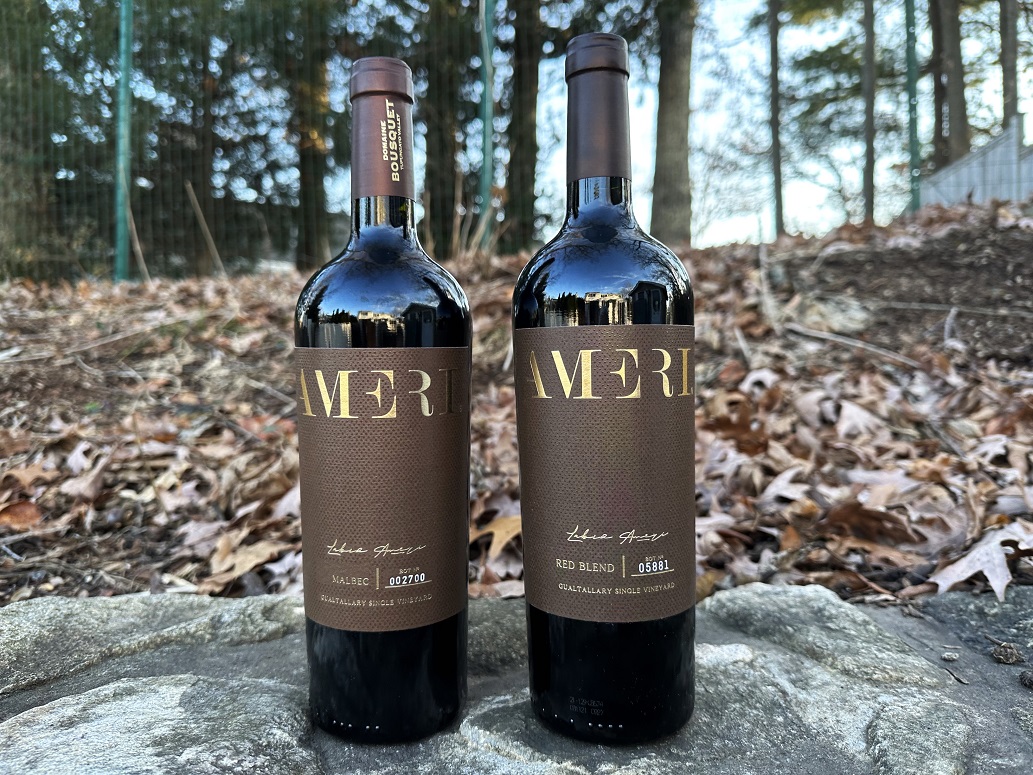 Now, I had an opportunity to taste some of their very best wines. These wines perfectly speak to my obsessed oenophile mind, as they are not even single-vineyard, but rather single-plot wines – and they are produced only in exceptional years. You know that I don’t like quoting the original winery notes, but I feel that in this case it is appropriate:
“Named for Domaine Bousquet co-owner Labid al Ameri, Ameri is not just“single vineyard” but “specific cluster,” and made only in exceptional years. At 1,257m/4,125 ft, the highest of the estate, the certified-organic vineyard, located in Gualtallary in the Andean foothills, gets a perfect combination of near constant intense daytime sunlight and huge day/night temperature differentials. The result is fruit with increased levels of sugar AND acid, flavor, and aromatics.”
Yes, I had expectations regarding these wines. I expected these wines to be well-made and tasty. And my expectations were met. Fully.
Here are my notes:
2020 Domaine Bousquet Ameri Malbec Gualtallary Mendoza Argentina (14.5% ABV, $37, 100% Malbec, 12 months in French oak)
Dark garnet, almost black
Cherries, plums, eucalyptus
Cherries, espresso, firm structure, good acidity, good balance
8, excellent
2020 Domaine Bousquet Ameri Red Blend Gualtallary Mendoza Argentina (14.5% ABV, $37, 60% Malbec, 20% Cabernet Sauvignon,10% Syrah, 10% Merlot, 12 months in French oak)
Dark garnet, almost black
Plums, fresh raspberries, mocha
Cherries, a hint of cassis, eucalyptus, sweet oak, perfectly integrated tannins, firm structure, excellent balance
8, delicious.
Both wines were just perfect from the get-go, but both also lasted for at least 5 days on the counter with the air being pumped out – a testament to the quality.
Here you are, my friends – all-organic, delicious, top-shelf wines from Argentina – delivering the pleasure.
As expected.
Top 23 of 2023
 2023 is
 almost over, which means that the time has come for the hotly anticipated perennial Talk-a-Vino feature – the list of top wine experiences of the year.
2023 was an interesting year for a variety of reasons, some of which are obvious, and some of which are not, but this is not the time and not the place to discuss it. We are here to dreadfully decide on the list of 24 23 best wines of the year – and share that list with you, my readers.
To explain how this top list is created, instead of re-writing the same explanation every year using barely different words, let me just quote what I explained before:
If you are a regular here on these pages, you know the story. Every year ever since this blog started in 2010, I come up with a list of the most memorable, most interesting/unique/unusual/stunning wines I tasted throughout the year. When I started these Top Wine lists, the goal was to identify a dozen (12) top wines. I was rarely successful with such limitation, and most of the Top wine lists consist of two dozen, a few times there were even two dozen plus a few.
As the year already ended, I will not try to separate the first and second dozens of the top wines – without further ado, here is the full list of the 23 most memorable wines of 2023 – and yes, the pun is intended:


23. 2021 Stolpman Vineyard Combe Trousseau Ballard Canyon ($24) – I had no idea Trousseau, a classic red grape from Jura in France is even grown in California, never mind by the Syrah specialist such as Stolpman Vineyard. I ordered this wine at a restaurant in New York as it seemed to be one of a very few somewhat affordable options. The wine was surprisingly brilliant, fresh, light, and uplifting – it was definitely a great find.
22. 2007 Leviathan California Red ($40) – this was my last bottle of the 2007 vintage of this legendary wine, an unofficial second label of Screaming Eagle. Beautiful California Cab that probably has another 20-25 years to go on. No, I wouldn’t want to wait that long.
21. 2019 Le Morette Riserva Lugana DOC ($NA) – this wine was probably my favorite from the Lugana wine tasting events, beautiful white wine with a substance. Going beyond just a specific bottle, consider this entry more a node to the Lugana wines of Northern Italy that represent an outstanding QPR and just a bunch of delicious wines.
20. 2018 Vino Vasai Pinot Noir Estate Reserve Chehalem Mountains ($58) – superbly balanced Oregon Pinot Noir – powerful and delicious, with a label to adore.
19. 2019 Plantaže Crnogorski Krstač Montenegro ($10) – love pleasant surprises. This wine was acquired strictly for being made from the unique grape I have not had before – it also happened to be simple and delicious – I’ll take this bonus any time.
18. 2016 Alban Patrina Estate Syrah Edna Valley ($58) – I don’t believe I ever I had a wine from Alban that I didn’t like – this Syrah was unctuous and delicious.
17. 2015 Carlisle Grenache Rossi Ranch Sonoma Valley ($39) – another favorite producer, Carlisle, with an absolutely delicious wine – beautiful nose and dark fruit intermingling with dark chocolate on the palate.


16. 2022 La Torre Girgentina Maltese Islands IGT ($15) – Similar to wine #19, this wine was acquired strictly to add to the rare grapes collection and to add another winemaking region to the Wines of the World page. The more interesting part was the bright, refreshing, round white wine, simply world-class delicious.
15. 2017 Etude Fiddlestix Vineyard Pinot Noir Santa Rita Hills ($NA) – Never paid much attention to Etude Pinot Noir – this wine was presented as a gift. The wine was definitely bigger than a typical Californian Pinot Noir – it was also better than the typical, with layers of dark fruit and cocoa. A tasty encounter.
14. 2018 Amichai by Shiloh Micah Judean Hills Israel ($57) – Shiloh is one of my favorite Israeli producers, but this is not the reason why this wine is listed among the top wines of the year. It is a perfect rendition of Cabernet Sauvignon, round and delicious.
13. 2018 El Coto Coto De Imaz Blanco Reserva Rioja DOC ($24.99) – this wine belongs to the “surprise” group, as I never had a Chardonnay from Rioja. Never mind the surprise part, this was simply delicious Chardonnay, bright and perfectly varietally correct. Pleasure in the glass.
12. NV Capetta Dolce Asti DOCG ($NA) – Asti wines are sooo underappreciated… They are often dismissed as light and sweet, but the whole point is in the balance. Yes, this wine was sweet, and nevertheless, cleansing acidity was making it impossible to put the glass down until the bottle was empty. Similar to the Lugana wines mentioned above, this wine is a nod to Asti wines as a category that is well worth everyone’s attention.
11. 2021 Domaine Bousquet Virgen Natural Malbec Tupungato Uco Valley Mendoza Argentina ($13) – Domain Bousquet makes excellent wines, for sure. But this unoaked organic malbec, made without any additional SO2 was unexpectedly delicious. Try it for yourself.
10. 2020/2021 Campochiarenti Sant’ Ambrogio Chianti Colli Senesi DOCG (€10) – I had both 2020 and 2021 wines, and couldn’t make up my mind which one do I like more. With or without taking into account an excellent price, this wine offers tremendous value for the money, as I often wish that the wines that cost 10 times more would taste as good as this wine. Another case of pure pleasure in the glass.


9. 1998 Chateau Saint-Nicolas Fronsac AOC ($19.99) – a perfect example of “wine is a living thing”. The wine which tasted like nothing on the first day, evolved into a beauty on the second day. It doesn’t happen always, but hey, give your wine a chance.
8. 2021 La Loggia Toscaia Sangiovese in Bianco Toscana IGT ($14) – I had before white Merlot and white Pinot Noir, but never a white Sangiovese – and this wine didn’t disappoint. It was masquerading a nice Chardonnay – and yet it was delicious in its own unique right.
7. 2019 Sine Qua Non Distenta 1 California White Wine ($150) – big, voluptuous, expressive, delicious. A perfect first experience with the wines of Sine Qua Non.
6. 1999 Beaulieu Vineyards Cabernet Sauvignon Rutherford Napa Valley ($30) – delicious wine from a legendary producer. A perfect rendition of the nicely aged Californian Cabernet Sauvignon which will continue to delight for many years, if someone would have enough patience, of course.
5. 2013 Stolpman Vineyards Sangiovese Ballad Canion ($30) – besides the total surprise factor that Stolpman even ever made Sangiovese, this wine tasted perfectly on par with outstanding Chianti that was opened at the same time, just adding a Californian touch to the cherry/leather/tobacco profile. Superb.
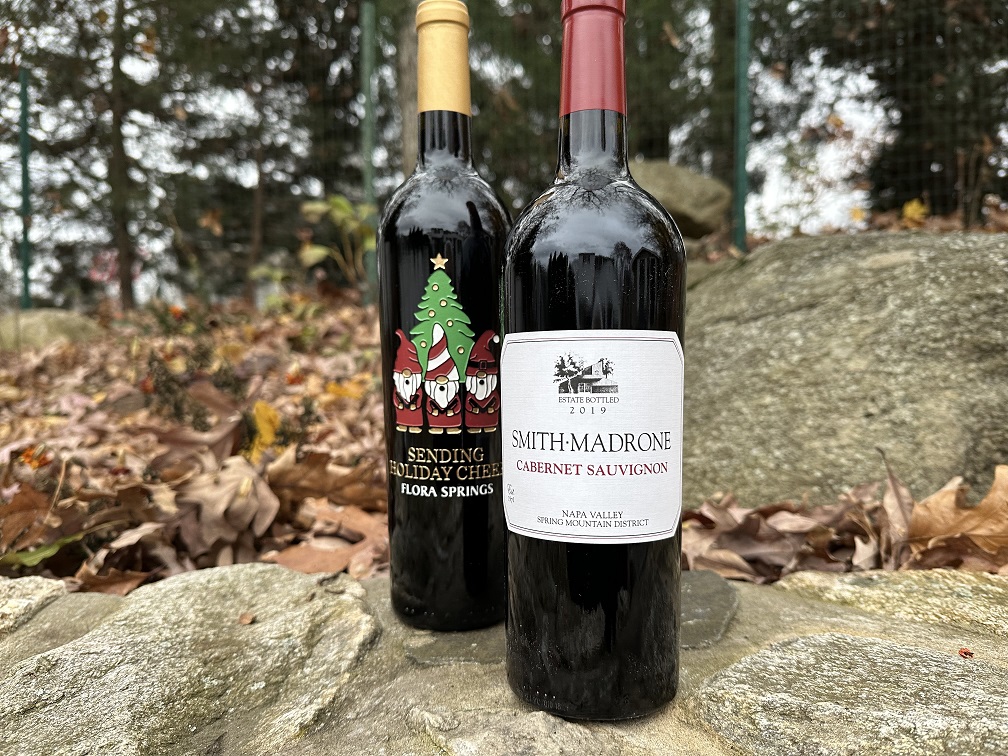
4. 2019 Flora Springs Red Wine Blend Napa Valley ($95) – a quintessential Napa Cabernet Sauvignon. Bold, voluptuous, unashamed, but impeccably balanced with all components in perfect harmony. A definition of hedonistic pleasure.
3. 2019 Smith-Madrone Cabernet Sauvignon Spring Mountain District Napa Valley ($65) – wines of Smith-Madrone are often featured in this blog. Smith-Madrone Cook’s Flat was the wine of the year in 2019. This 2019 Smith-Madrone Cabernet Sauvignon has such impeccable precision of a beautiful Cabernet Sauvignon, varietally correct and incredibly enticing, even coercing you into the nirvana state – yes, this is how good this wine is.


2. 2003 Neyen Espíritu de Apalta Apalta DO Chile ($N/A) – when poured at a table, this is the wine that has the power to stop everyone in their tracks, force them to forget that reality exists, and for a few minutes make everyone to communicate only using nods and smiles. The words are not needed in the presence of such greatness. Tasting this wine was one of the absolutely best experiences of 2023.
1. 2021 Balverne Chardonnay Russian River Valley AVA ($35) – when I tasted this wine for the first time, not only I was blown away, but my first thought was “this will be the wine of the year”. Don’t get me wrong – each and every wine in the top ten of this list would easily qualify for the Talk-a-Vino Wine of the Year position, but still, this wine will stay in my memory for a long time. This wine had a brilliant precision of Chardonnay which doesn’t even let you put your glass down. Truly, you need to experience this wine to share the feeling.
Here you are, my friends. 23 most memorable wines of 2023. Cheers to the new wine discoveries of 2024!
Happy Wines of Barra
What are happy wines you may ask? Can the wine be happy? Can the wine be unhappy? Can the wine actually express emotion?
The first two questions probably don’t have an answer. But can the wine express emotion? You bet. That’s the whole point of wine appreciation. The wine that gives you joy. The wine that brings back happy memories. The wine that gives you happiness. The wine that gives you pleasure. The wine that doesn’t leave you indifferent. Not every wine in your glass will do that for you – but some will. I think it will be fair to call them Happy Wines.
Happy wines are those that put a smile on your face. You open a bottle, put the liquid into the glass, swirl, sniff, sip – and smile, because the wine is actually that good. It doesn’t have to be the best wine you ever tasted. It doesn’t have to be expensive or inexpensive. As long as the wine puts a smile on your face and makes you happy, you can call it a Happy Wine.
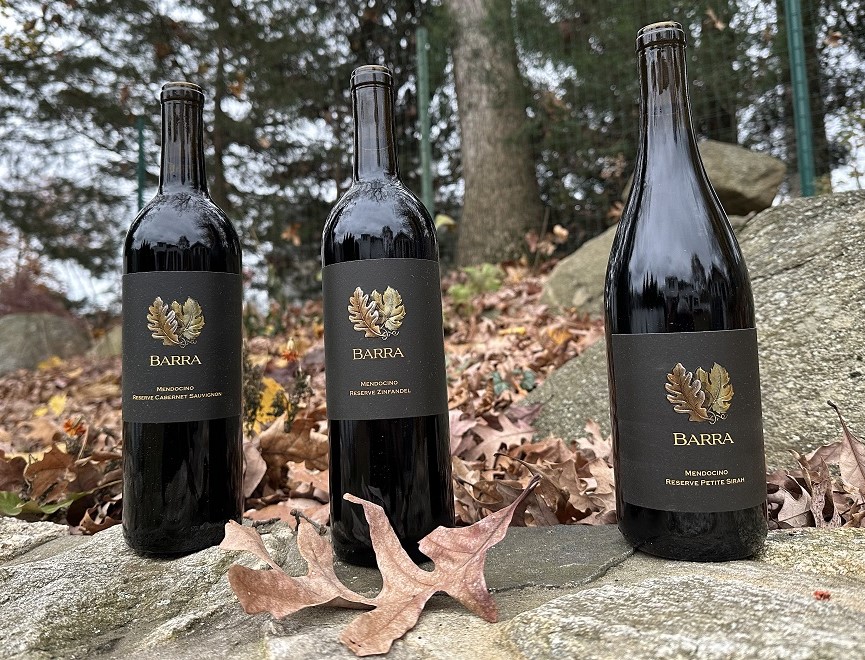
My latest happy wine discovery was the latest release of red wines from Barra of Mendocino. I already wrote about the winery before – you can find the complete two-part story here (part 1 and part 2) with all the details about this 50-year-old, 350-acre organically farmed estate located in Northern California, in Mendocino. Everything I tasted so far from Barra was outstanding, and this latest release of the 3 reserve red wines made from organic grapes didn’t disappoint either.
2020 Barra Reserve Petite Sirah Mendocino County (14.5% ABV, $28, 18 months / 30% new French oak, balance in neutral barrels, organic grapes)
Dark Garnet, practically black
Beautiful nose of red and black fruit
Sweet cherries, perfect acidity, well-integrated luscious tannins, layered, delicious.
8+, outstanding, and a unique rendition of PS which doesn’t require waiting.
2020 Barra Reserve Zinfandel Mendocino County (14.5% ABV, $26, 16 months / 25% new French oak, balance in neutral barrels, organic grapes)
Bright Ruby
Dark fruit and herbs on the nose, a hint of fresh coffee, tobacco
Tobacco, cherries, luscious texture, round, pleasant, with long finish.
8, excellent
I just wrote about Barra Cabernet Sauvignon in the previous post where I tasted it alongside two superb Napa Valley Cabs – but I’m happy to talk about this wine twice in a row 🙂
2021 Barra Reserve Cabernet Sauvignon Mendocino County (14.5% ABV, $28, 18 months / 30% new French oak, balance in neutral barrels, organic grapes)
Garnet
Eucalyptus, cherries, a hint of cassis
Eucalyptus, dark berries, cherries, cassis, well-integrated tannins, perfect balance, medium-long finish.
8, delicious
All three were happy wines – ready to drink from the moment the bottle was open, and thoroughly delicious, putting a smile on your face. I can also tell you that all three of these wines lasted for almost 7 days after being first opened, standing on the counter, with the air being pumped out – this is definitely a testament to the quality and to the longevity of these wines – while these wines will not set you back by anything comparable to any cult Californian wines, I guarantee you that they will age equally well or possibly even better.
Have you tried Barra of Mendocino wines? I would love to see the smile on your face once you do. Cheers!
Rioja Worth Seeking – El Coto de Rioja
 I love Rioja wines.
This is not a secret for anyone who has been following this blog for some time.
But despite such a strong proclamation, this love is not unconditional. Rather, it is very selective.
I have more of an exclusive club in Rioja. This is a club with a very limited membership. Anyone can apply, but only a select few can become members. Those in the club enjoy unconditional love and forgiveness for their little mistakes. For the rest of them… well, good luck making the cut.
I guess I need to change my opening line.
I’m a Rioja snob.
I love Rioja, but this love is very selective.
There, this would be a better opener.
The founding members of my exclusive club are CVNE with all of their lines (Vina Real, Imperial, Contino, …), La Rioja Alta, and Lopez de Heredia. Bodegas Tobias, Bodegas Beronia, and Bodegas Lan also have full membership.
Okay, let’s put another spin on this snobbish endeavor.
Rioja is a large region in Spain. There are about 14,800 grape growers, and about 574 wine producers in Rioja. That means lots of different styles and lots of different quality levels – even though all bottles will say “Rioja” on them. Seeing a bottle of Rioja doesn’t make me excited – seeing the name of a familiar producer who I know makes quality Rioja wine does. Hence my exclusive Rioja “club” – simply the list of my favorite Rioja producers.
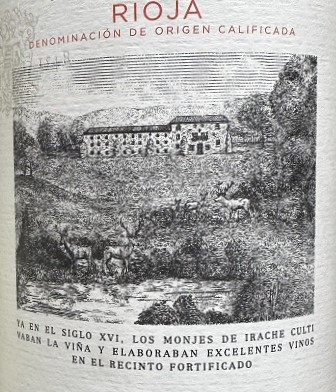
What might be more important is that this “club” is actively taking applications (the approval rate is very low though), and I feel that it is time to formally add one more member there – El Coto de Rioja. El Coto wines were mentioned a few times in the blog already, but now let’s make it official.
El Coto de Rioja was founded in 1970 located in the town of Oyón. Over the 50 years of its history, El Coto de Rioja became the largest winery in Rioja, farming 1804 acres of estate vineyards. El Coto de Rioja plantings include 8 individual vineyards located across all Rioja DOCa sub-zones, such as Rioja Alta, Rioja Baja and Rioja Alavesa. One of the vineyards, Finca Carbonera, located in Rioja Alta, is the highest altitude vineyard in Rioja DOCa. In addition to all of the traditional Rioja red grape varieties, a significant portion of plantings are dedicated to the white grape varieties including new ones for Rioja – Verdejo, Chardonnay, and Sauvignon Blanc. El Coto de Rioja also built a winery directly in the vineyard, dedicated to the white wine production.
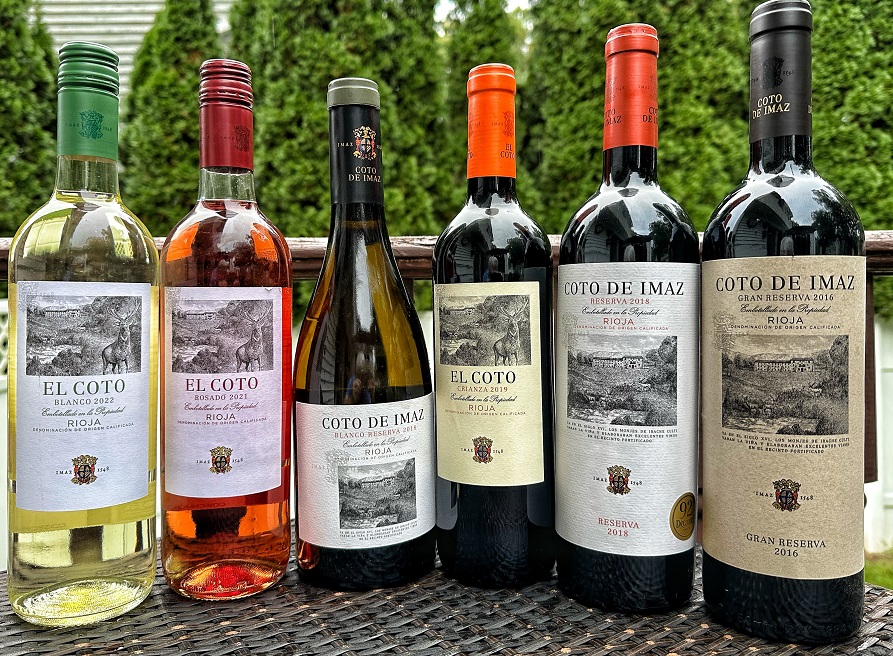
I had an opportunity to taste (samples) a range of wines from El Coto de Rioja – here are my notes:
2022 El Coto Coto de Imaz Blanco Rioja DOC (12% ABV, $11.99, 93% Viura, 4% Sauvignon Blanc, 3% Verdejo)
Pale green
An enticing nose with lemon, acidity and minerality, fresh and vibrant
Lemon, Whitestone fruit, crisp, clean, refreshing.
8, delicious.
2021 El Coto Coto de Imaz Rosado Rioja DOC (13.5% ABV, $11.99, 90% Tempranillo, 10% Garnacha)
Intense salmon pink
Beautiful, inviting, fresh strawberries
Fresh strawberries and cranberries on the palate, pleasant tartness, fresh and round
8, excellent
2018 El Coto Coto De Imaz Blanco Reserva Rioja DOC (12.5% ABV, $24.99, 100% Chardonnay, 12 months in new French oak)
Beautiful light golden color
A touch of butter and vanilla
A hint of butter, vanilla, Granny Smith apples, crisp, elegant, good acidity.
8, I want to try it in 5 years, I expect it to develop beautifully
2019 El Coto Imaz Crianza Rioja DOCa (14.5% ABV, $16.99, 100% Tempranillo, minimum of 12 months in American oak, at least 6 months in the bottle)
Garnet
Dark fruit, sapidity, gunflint, intense
Bright, uplifting, medium body, dark berries, smoke, crisp acidity, very “new world” in style, good balance, tannins show on the finish – will age and evolve well
8-
2018 El Coto Imaz Reserva Rioja DOCa (14.5% ABV, $22.99, 100% Tempranillo, minimum of 18 months in American oak, at least 18 months in the bottle)
Dark garnet
Dark fruit, earthy, being of herbs, medium intensity
Brilliant, classic Rioja, succulent cherries, cedar box, sage, salivating acidity intermingling with well integrated tannins, perfect balance.
8, delicious.
2016 El Coto Imaz Gran Reserva Rioja DOCa (14.5% ABV, $34.99, 100% Tempranillo, minimum of 24 months in American oak, at least 36 months in the bottle)
Dark garnet
A touch of minerality, cigar box, hint of cherries
Black fruit, concentrated, firm structure, well-integrated tannins, good acidity, good balance.
8, very good but will benefit from time in the cellar
I have to honestly say that while the red El Coto wines were good, I loved both whites and Rosé even more. The El Coto Rioja Blanco is a perfect quaffer any time you want a glass of refreshing white wine. Blanco Reserva is in the category of its own, a delicious Chardonnay rendition for any occasion when you crave a thought-provoking white wine.
El Coto de Rioja wines are well worth seeking – they are both delicious and still reasonably priced for the quality they deliver. And they are also widely available, so off you go to the store. Cheers!
Brilliance of the Bubbles
 Champagne, anyone?
Well, I’m not in the mood to celebrate anything going on in the world right now. But I still drink wine, and while Champagne = Celebration is deeply ingrained in our minds, here I’m just talking about Champagne as a type of wine, the same as white, red, and Rosé. And I need to further correct myself – I’m not even talking about Champagne, the sparkling wine produced only in the Champagne region of France. The subject of today’s post is generic “bubbles”, the sparkling wine produced elsewhere in the world.
Simplistic on the surface, “bubbles” is an interesting wine category. Nobody is born craving wine, wine is an acquired taste. Bubbles might be the next level of acquired taste compared to wine, especially if we can exclude social pressure from consideration. Classic Champagne typically boasts cut-through acidity and is expected to be devoid of any traces of fruit for the joy of purists. And god forbid any sweetness can be detected in the glass… Not the wine someone intuitively craves. But this is not the biggest issue with the “bubbles”. The bigger problem is that people are well-trained to recognize the word Champagne, and once they hear that word, whether they truly love the liquid in the glass or not becomes irrelevant – “ahh, it is Champagne!”.
As anecdotal evidence, my favorite example is Kevin Zraly’s Windows on the World wine classes. The last class in the series of 8 started with Champagne. 4 wines were poured blindly to the group of roughly 120 students. After tasting all 4 wines, we were asked to have a show of hands for our favorite Champagne. I don’t remember details about wines #1, #2, and #3, but there was a somewhat equal spread between these three wines. Wine #4, however, had barely any hands raised. As the wines were revealed, Kevin Zraly said “and this is why, people, you shouldn’t drink vintage Champagne” – wine #4 was Dom Perignon, creme de la cream of Champagne world. Have we known that we were drinking Dom Perignon, I guarantee that wine #4 would be adored by everyone.
Before you get any wrong ideas, let me assure you – this is not a Champagne-bashing post. I love good Champagne as much as any other hard-core Champagne aficionado is. 2002 Pol Roger Sir Winston Churchill Champagne was my wine of the year in 2016. I have enjoyed immensely Krug, both vintage and non-vintage. Champagne Lanson, Duval-Leroy, Piper-Heidsieck, Bollinger, and on, and on, and on. But the point I’m trying to make here is that when looking for bubbles, you shouldn’t hang up on Champagne and only Champagne – sparkling wines are made everywhere today, and there are lots and lots of very worthy bubbles you can enjoy, as long as you are willing to accept that great sparkling wines don’t have to come only from Champagne.
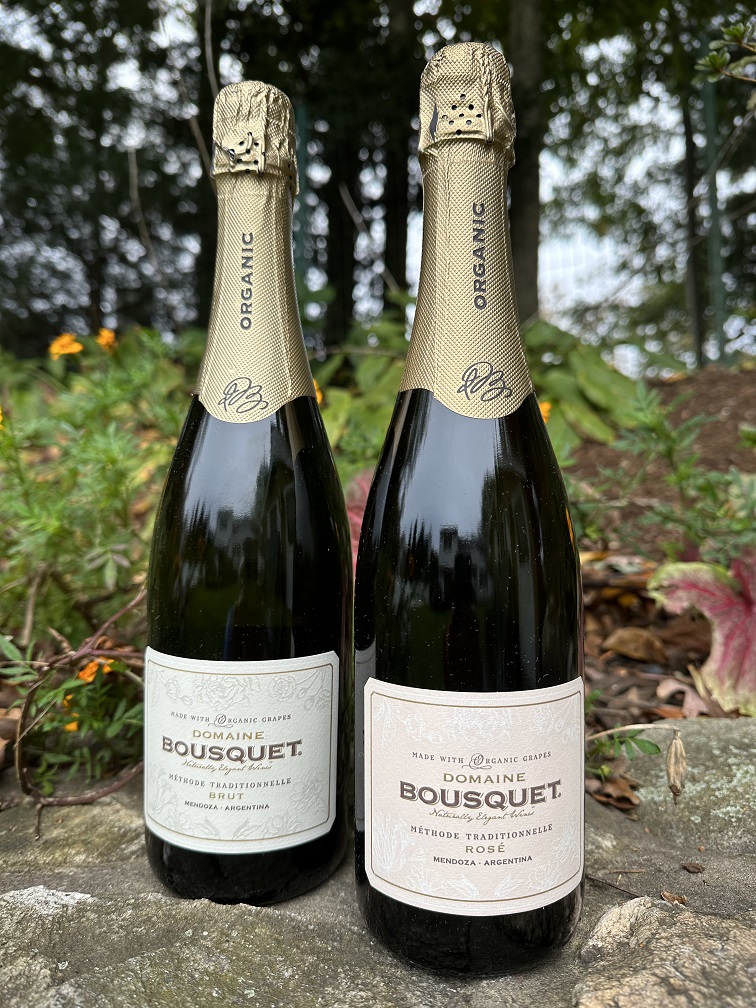
For an example of the great bubbles from outside of Champagne, let’s take a trip to Argentina. On a world scale, Argentina arguably didn’t reach yet the status of a world-class sparkling wine producer. And for me as a wine lover, this is very good news – it means I can still enjoy sparkling wines from Argentina at reasonable prices. Just to give you an example, we can look at the sparkling wines of South Africa, known as Cap Classique. Back 3 years ago, Graham Beck Brut Rosé Methode Cap Classique, one of my favorite sparkling wines from South Africa, could be found at my local wine shop for $16.99. The price two weeks ago? $30.99. So before it happens to Argentinian bubbles, let me bring you into the know.
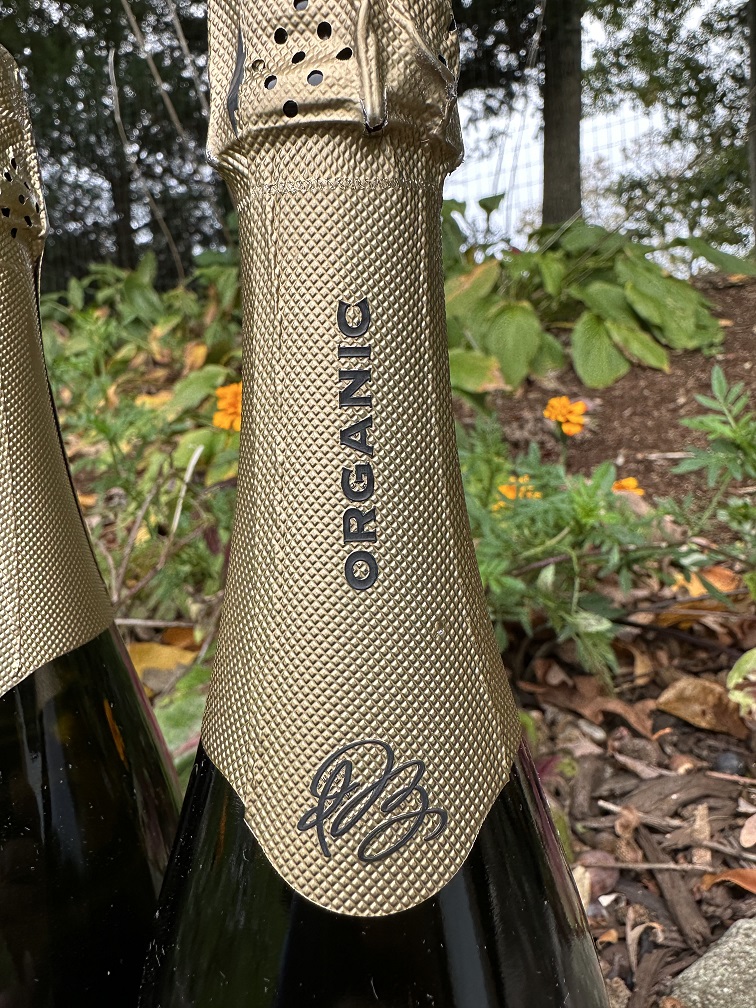
Please meet Domaine Bousquet. Well, this might not be the correct way to introduce Domaine Bousquet here – if you are reading this blog regularly (are you??) then you already met Domaine Bousquet on multiple occasions. If you look at the Domaine Bousquet website, you will see that they present themselves as the #1 organic, regenerative and sustainable winery in Argentina. When I think of Domaine Bousquet, especially after tasting their wines, my first thought usually is “how do they do it???”. As an example of “how do they do it”, Domaine Bousquet offers USDA-certified organic wines (!) called Virgen that taste great and cost only $13 as the suggested retail price. And my latest discovery in the “how do they do it” category is two of their classic method sparkling wines.
I wrote about Domaine Bousquet sparkling wines before. Those were excellent wines produced using the Charmat method (secondary fermentation in the tank), the same method that is used in the production of Prosecco. These two new wines I’m talking about are produced using the classic method, with the secondary fermentation in the bottle – the same way classic Champagne wines are produced, hence the name Classic Method, a.k.a. Méthode Champenoise, a.k.a. Méthode Traditionnelle.


From the very first whiff, both wines were just spectacular. NV Domaine Bousquet Brut Organic Méthode Traditionnelle Mendoza Argentina (12% ABV, $18 SRP, 75% Chardonnay, 25% Pinot Noir, 6 months on the lees) had a perfect nose of freshly toasted bread, brioche and apples. The palate was followed with the same toasted bread notes, perfectly fine mousse, crispy profile with just apple notes, just a pure delight.
And NV Domaine Bousquet Brut Rosé Organic Méthode Traditionnelle Mendoza Argentina (12% ABV, $18 SRP, 75% Pinot Noir, 25% Chardonnay, 6 months on the lees) was even better – the wine had an absolute precision that only the best Champagne and sparkling wines possess. Salmon pink in the glass, freshly baked, just out of the oven toasted bread on the nose – I couldn’t and didn’t want to put my glass down for a few minutes. After appropriately admiring the bouquet, the first sip perfectly matched the expectations – fine mousse, cut-through acidity, brioche, green apples, perfect structure, impeccable balance.
If I were to pair dinner with these two wines, I would have fresh oysters and seafood with the Brut, and then a steak with the Brut Rosé – you can keep the salad.
Here are two brilliant sparkling wines from Argentina – organic and delicious. In a blind tasting, these two wines can safely challenge any Champagne or sparkling wines – and I would definitely put my money on the Domaine Bousquet wines to win the popular vote.
Taking the price into account, and the holiday season upon us, these are definitely case-buy recommendations – these wines are perfect as a gift and perfect to enjoy at any moment, knowing that you didn’t have to break the bank to get the pleasure.
Have you had these wines? What are your favorite sparkling wines outside of Champagne? Cheers!
Last Bottle Sign Up ($10 credit)





