Archive
One on One With Winemaker: Jeff Fyfe from The Crossings Winery, New Zealand
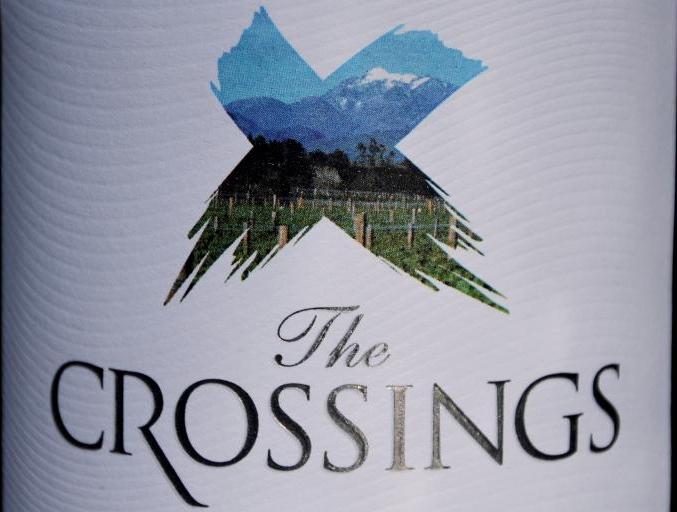 Few days ago I was offered an opportunity to meet Jeff Fyfe, senior winemaker at The Crossings Winery from New Zealand – only I couldn’t. What about the title of this post, you ask? No, I’m not trying to purposefully mislead you with some dark intent. What I did was very simple and logical 🙂 – I came up with a bunch of questions, and asked Jeff to answer them on his own. We can call it a “virtual interview”. I also had an opportunity to taste two of the latest wines from The Crossings – including the 2015 Sauvignon Blanc. I was quite excited about it, as my first wine of the current vintage typically is Beaujolais Nouveau, so this was a welcome deviation.
Let’s start with the interview. Imagine yourself out in the vineyard, on a sunny day, with the glass of cold and refreshing white wine, talking to Jeff Fyfe:
What was your favorite vintage(s) for both Pinot Noir and Sauvignon Blanc and why?
We have been extremely lucky in Marlborough in recent years with a number of great vintages in a row. In 2014 we had harvested all of the Pinot Noir prior to commencing any Sauvignon Blanc which is fairly unusual. This gave us the opportunity to focus on the varieties individually a little more than usual which was nice. There are some great Sauvignon Blancs from 2015 and we are excited about releasing them.
What was your most difficult vintage for both Pinot Noir and Sauvignon Blanc and why?
Both 2008 and 2009 were reasonably difficult vintages in the fact that the crops were slightly heavier than normal and we had some unseasonal rain during harvest making things difficult.
Many winemakers in NZ experiment with oak and Sauvignon Blanc. What do you think of that? Is this an up and coming trend? Do you make any oaked Sauvignon Blanc wines?
I don’t know if I would call it a trend, I think it is now a style in its own right in Marlborough. Many producers are making them, and have been for some time. Dog Point Section 94 is a great example of barrel fermented Sauvignon Blanc. They wines obviously age well, in my opinion the better examples show great balance and integration of the oak and the fruit. Some producers are also creating wines with small amounts of barrel fermented Sauvignon Blanc to add texture and weight to their tank fermented Sauvignon Blancs.
Today, there are many new grapes been planted in NZ – Chardonnay, Pinot Gris, Riesling, Gruner Veltliner, Syrah. I see that you are already making Riesling and Pinot Gris wines – do you have plans for any other new grapes?
Yes, we already make very small quantities of Chardonnay, Pinot Gris, and Riesling and we planted some Gruner Veltliner at our Willowflat vineyard 2 years ago, which is looking promising. I think Marlborough already produces world class aromatics, particularly from the cooler sites which enables longer ripening and extended hang time for the fruit which creates wines with texture, weight and acidity.
Outside of your own wines, what are your other favorite wines from New Zealand?
There are some great aromatics coming out of the Nelson region, Waimea, and Seifreid are favourites. Also Hawkes Bay Syrah, in my opinion the best examples can rival the great Syrahs of the world. Bilancia, Crossroads, Trinity Hill are all great examples.
What are your favorite Sauvignon Blanc wine outside of New Zealand – regions and/or producers?
White Bordeaux! If only I could drink them more often. Generally I like to drink Austrian or German Rieslings, there are so many amazing producers, Brundlmayer, Ansgar Clusserath, Donnhoff, Wittman to name a few.
Same question for Pinot Noir – favorite regions/wines/producers outside of New Zealand?
I tend to drink the wines coming from cooler climate regions as I like the elegance and finesse they can have, cooler parts of Australia such as Tasmania, and the Mornington Peninsula are great. There are obviously some pretty special wines coming out of Burgundy, I just can’t afford to drink them that often! Although when I do I enjoy wines from the appellation of Volnay.
If you would have a “do-over” opportunity – go back in time and start the winery again – would you still start it at the exact same place, or would you chose a different location, region or even country?
I wouldn’t change the location of the vineyards that’s for sure. We have 3 amazing vineyard locations in the Awatere Valley, each very unique which provides us with quality fruit to make the wines that we do.
Today, a lot of wineries around the world add sparkling and Rosé wines to their portfolios, but this trend doesn’t seem to catch up in New Zealand. Do you think this will change? Do you have any plans to start producing sparkling or Rosé wines?
There are already a number of producers in Marlborough making some great rosés. The demand for Marlborough Pinot Noir is strong, so I guess that has an impact on the ability of some producers to make Rose, hence why you don’t see them often on a global scale. At The Crossings we are hoping to make a rose in vintage 2016. It’s the same with sparkling wines in Marlborough, some world class wines being produced but on a reasonably small scale.
What is the oldest vintage of your own wines you ever tried? Do you think the wines held up well?
We recently had a vertical tasting of The Crossings Sauvignon Blanc from 2005 to 2015. We were pleasantly surprised at how well the wines were holding up. The majority of the older vintages still looked fresh, showing varietal character and maintained the mineral acidity that is signature of the Awatere Valley. All of the wines were under screw cap
* * *
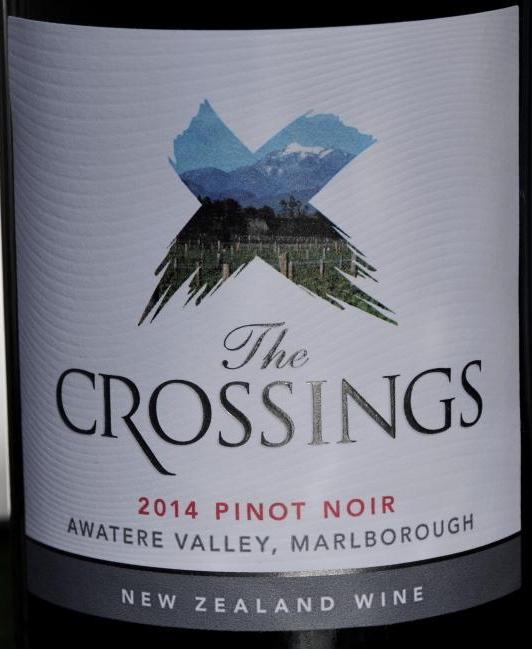 I think Jeff provided great answers. Hearing that 10 years old Sauvignon Blanc is still fresh makes me very happy – I love wines with an age on them, and I love it when the wines are aging gracefully, so I would love to try it by myself. Well, yes, I didn’t try the 2005 – instead, I tried the wine from the vintage Jeff was so happy about it – the 2015. I tasted latest releases of both Sauvignon Blanc and Pinot Noir, which I got as samples, courtesy of the importer, Deutsch Family Wine & Spirits. For you to understand how new the 2015 was, the bottle even didn’t have an official label on it yet.
Here are my tasting notes:
2015 The Crossings Sauvignon Blanc Awatare Valley Marlboro, New Zealand (13% ABV, SRP $14)
C: straw pale
N: beautiful fresh cut grass, just a hint of grapefruit, lemon zest
P: clean acidity, fresh, lemon undertones, herbal notes, perfectly balanced
V: 8, one of the very best NZ sauvignon Blanc wines I ever tasted. Summer day in the glass.
2014 The Crossings Pinot Noir Awatare Valley Marlboro, New Zealand (14% ABV, SRP $18)
C: dark ruby
N: smoke and raspberries, lavender, touch of mint, baking spices
P: sweet cherries, plums, hint of vanilla, touch of spices, good balance, medium body, medium-long finish.
V: 7+/8-, classic Marlboro Pinot Noir
There you have it, my friends – virtual interview and very real, delicious wines. Now, let me ask you a question – if you would have an opportunity to talk to the winemaker, what would be your questions? What do you think of our Q&A session? Happy Friday and Cheers!
New Zealand, Familiar and Not
 Here is your motivational quote of the day: “open your mind, and discovery will follow”. If you are wondering what the heck is wrong with this Talkavino guy starting the wine post with motivational quote, read on, I will explain.
Today we will be talking about the wines of New Zealand. What is the first wine which comes to mind when you think “New Zealand”? Don’t know about you, but for me it is a Sauvignon Blanc. Closely followed by Pinot Noir. But then there is beautiful Chardonnay, and Bordeaux blends, and Riesling – please, don’t forget the Riesling!
Two weeks ago I attended the New Zealand wine tasting event in New York. The event consisted of the seminar and the tasting, so below you will find my notes from both. But before I will inundate you with the wines and the tasting notes, let me share some general thoughts.
New Zealand wine industry is relatively young. First Sauvignon Blanc was planted in 1973, and first commercial release took place in 1979. [However, the first vines were planted in New Zealand in 1819, and in 1881 Pinot Noir from Central Otago got gold medal in the “Burgundy” category at the wine show in Sydney – but let’s leave it aside for now]. Through the 1980s, Cloudy Bay found its magic, and New Zealand wines spread out throughout the world (definitely in US). The New Zealand wine export had been growing steadily for many years, from 30M gallons of wine in 2009 to the 44M gallons in 2013, also reaching almost US $1B in revenues in 2013. Also, a lot of New Zealand wineries utilize sustainable winemaking methods and use organic grapes (you can read more here).
What I also sense from reading the blogs and listening to the experts is that the New Zealand winemakers are feeling constrained by what they already achieved and are trying to break the boundaries. Few simple facts for you. There are 11 defined wine regions in New Zealand. However, many winemakers believe that this is not enough, and want to define the sub-regions with much smaller boundaries. Such sub-regions are not yet official [I might stand corrected here – according to the New Zealand wine web site, the sub-regions are defined, but I still don’t know how widespread or how official those designations are], but on many labels you can already see designations for the sub-regions, such as Awatere or Waihopai in Marlborough, or Pisa in Central Otago. Different soils, different micro-climates, different terroirs, if you will – all lead to production of stylistically different wines coming from the different areas of the same bigger region.
There is more to this “breaking the boundaries”. New Zealand wine is not only a Sauvignon Blanc and Pinot Noir. There are Syrah, Merlot, Pinot Gris, Chardonnay and even Grüner Veltliner and Chenin Blanc wines which are shining. And even familiar Sauvignon Blanc is taking to the totally new territories, by using oak and not only – which leads us to the seminar, so we can finally talk wines.
The seminar was very interesting. It was done in the unusual format. There was no classroom with a head table and presenters. There was a big roundtable (well, it was actually a square), with presenters and winemakers sitting around the room among the participants. But this was not the most unique characteristic of the event. There were 9 Sauvignon Blanc wines presented in the event. And all 9 were … oaked. With the various degree, but yes, all Sauvignon Blanc wines went through some oak ageing process. There was also a 7 years old Sauvignon Blanc wine, which was quite unique for me. All in all, it was very different and interesting. Was it successful? I will defer you to my notes below. Here we go.
2014 Amisfield Sauvignon Blanc Central Otago (SRP $20)
C: pale straw
N: fresh cut grass, very restrained, lemon notes, minerality, touch of sapidity, interesting complexity.
P: tremendous acidity, more of a Muscadet style, lots of minerality, food wine (oysters!)
V: nice and restrained, Drinkability: 8-
2014 Nautilus Sauvignon Blanc Marlboro (SRP $17.99)
C: light straw, greenish
N: concentrated green notes, more of a fresh vegetables greens in the garden than grass. Touch of sweetness after swirling the glass.
P: very restrained, complex, salinity, white stone fruit, acidity on the finish.
V: Drinkability: 7+
2014 Huia Sauvignon Blanc Marlboro (SRP $19)
C: pale straw
N: hint of gasoline – disappeared after intense swirling. Touch of white fruit, restrained. Hint of lemon. Overall, nose is not very pronounced.
P: tremendous acidity, hint of Granny Smith apples
V: wine finishes nowhere, lacking conclusion. Drinkability: 7-
2014 Neudorf Sauvignon Blanc Nelson (SRP $17.95)
C: light straw yellow
N: non-typical. But may be a distant hint of grass.
P: lemon, fresh, supple, good acidity, nice textural presence. Still, tremendous amount of acidity is coming through, plus tannins in the finish!
V: Drinkability: 7+, okay wine
2014 Craggy Range Te Muna Road Sauvignon Blanc Marlboro (SRP $28.99)
C: pale yellow
N: touch of vanilla, touch of tropical fruit, hint of grapefruit
P: great complexity, restrained, guava, lemon, minerality, grass, touch of tannins, but it is well integrated.
V: Drinkability: 7+
2013 Seresin Marama Sauvignon Blanc Marlboro (SRP $40)
C: light yellow
N: butter, vanilla, butterscotch- wow, is this is a Chard? Pronounced, concentrated flavors!
P: vanilla, butter, more akin to a butterscotch candy, fresh and exuberant! The clearest expression of butterscotch candy of any wines I ever had (bold, I know)
V: it gets 8 (or even 8+) as a Chardonnay and 6 as Sauvignon Blanc. I would be glad to drink this wine – just don’t tell me what it is.
2013 Trinity Hill Sauvignon Blanc Hawke’s Bay (SRP $16.99)
C: light straw yellow
N: very inexpressive. Whatever I think I smell, is a product of my imagination. After 5 minutes of swirling, grass showed up, more of a typical expected SB. Still Very restrained.
P: nice acidity, good with oysters, nice touch of white fruit, fresh and clean
V: Drinkability: 7
2012 Pegasus Bay Sauvignon Blanc Waipara Valley (SRP $28)
C: pale straw yellow
N: complex aromatics, touch of oak, elevated white fruit (apples, hint of tropical fruit). One of the best on the nose so far. Distant hint of grass
P: Elegant, fresh, well integrated acidity, apples
V: one of the best in the tasting. Drinkability: 8-
2008 Mahi Ballot Block Sauvignon Blanc Marlborough (SRP $24)
C: light yellow, doesn’t show the age at all
N: some vegetative notes and fresh salami (yes, you can unfollow me if you want). Some distant resemblance of fruit. On a second thought, it has a Chablis-like minerality. The sausage is off, Chablis is in.
P: most elegant palate in the tasting. Acidity definitely wore off, but the wine is elegant, complex, mellow, just an interesting wine in the style of nicely aged white Rhône.
V: best of the tasting. Very round and elegant. Drinkability: 8.
And then there was a tasting. I didn’t get an opportunity to taste all the wines. Also, as you would expect, I liked some wines more than the others. Thus below are the wines which I liked the most from what I tasted. Oh wait, I still have to explain myself with that “open your mind” intro. Let me do it now, the story is rather simple.
What flavors do you typically associate with the Sauvignon Blanc? Grass? Check. Lemon? Check. Grapefruit? Check. Gooseberry? As Chris Kassel mentioned recently, most of the people who didn’t live in Europe have no idea how Gooseberry smells or tastes, but okay. Check. Some white tropical fruit? Possible and Check. But what about Black Currant? I don’t know about you, but I don’t associate red or black berry aromas with Sauvignon Blanc. But – black currant is one of the main characteristic aromas of Cabernet Sauvignon. And Sauvignon Blanc is a parent of Cabernet Sauvignon. Thus when I heard from one of the hosts talking about the wine “beautiful black currant aroma”, that was a nail on the head! Yes – exactly – the revelation – forget the damn Gooseberry, just open your mind (talking to myself) and understand that black fruit can be associated with white wine (I’m sure the opposite is true). I would honestly say this was my main discovery of the tasting, the revelation.
Now let’s get back to wines. My absolute favorites where Sophora Sparkling wines (simply a wow and an incredible QPR), Syrah from Elephant Hill, Chenin Blanc from Astrolabe, Sauvignon Blanc from Saint Clair, Doctors Grüner Veltliner and Lake Chalis lightly fizzed Sauvignon Blanc – all shown in blue below. But all in all, lots of delicious wines in the tasting. All prices are suggested retail as listed in the brochure. Let’s go:


2014 Amisfield Sauvignon Blanc Pisa, Otago ($20) – +++, clean, restrained
2013 Amisfield Pinot Gris Pisa, Otago ($25) – +++, nice touch of oak
2011 Amisfied Pinot Noir Pisa, Otago ($35) – ++1/2, nice balance, still needs time
2012 Amisfied Pinot Noir Pisa, Otago ($35) – +++, elegant, round, touch of green notes
2014 Ara Pathway Sauvignon Blanc Waihopai, Marlborough ($16.99) – +++, very good, traditional
2013 Ara Pathway Pinot Noir Waihopai, Marlborough ($18.99) – ++1/2, nice, clean
2014 Ara Single Estate Sauvignon Blanc Waihopai, Marlborough ($19.99) – +++, clean, balanced
2013 Ara Single Estate Pinot Noir Waihopai, Marlborough ($23.99) – ++1/2, very good, tannins, needs time
2012 Astrolabe Province Sauvignon Blanc Marlborough ($23) – +++, excellent, black currant, perfect balance
2014 Astrolabe Province Pinot Gris Marlborough ($23) – +++, beautiful aromatics
2012 Astrolabe Province Pinot Noir Marlborough ($28) – +++1/2, excellent!! Best of tatsing?
2013 Astrolabe Vineyards Chenin Blanc Wrekin Vineyard Southern Valleys, Marlborough ($22) – +++, concentrated, Vouvray-like, excellent, creamy
NV Sophora Sparkling Rosé Hawke’s Bay ($16) – +++, wow! beautiful – aromatics and structure of the classic Chgampagne. Outstanding QPR
NV Sophora Sparkling Cuvée Hawke’s Bay ($16) – +++, equally excellent as the previous wine
2012 Domaine-Thomson Surveyor Thomson Single Vineyard Pinot Noir Lowburn, Otago ($44) – ++1/2
2011 Domaine-Thomson Surveyor Thomson Single Vineyard Pinot Noir Lowburn, Otago ($44) – +++, excellent!
2013 Elephant Hill Syrah Hawke’s Bay ($28) – ++++, spectacular! An absolute precision of Syrah with peppery profile
2014 Fire Road Sauvignon Blanc Marlboro ($13) – ++1/2, nice, simple, balanced
2013 Fire Road Pinot Noir Marlboro ($15) – ++1/2, probably best QPR at the tasting
2013 Doctors Grüner Veltliner Marlborough ($18) – +++, touch of petrol, nice
2014 Doctors Sauvignon Blanc Marlborough ($18) – +++, nice, clean, good acidity
2013 Seifried Pinot Gris Nelson ($18) – ++1/2, clean, nice
2012 Seifried Riesling Nelson ($18) – +++, petrol, beautiful
2013 Maimai Syrah Hawke’s Bay ($20) – +++, excellent, dark
2014 Lake Chalis Cracklin’ Savie Sauvignon Blanc Marlborough ($18) – +++1/2, beautiful, fresh, lightly fizzed, very unique. Similar to Moscato in creaminess, but dry
2014 Lake Chalis Sauvignon Blanc Marlborough ($18) – +++, perfect, black currant, beautiful!
2014 Saint Clair Family Estate Sauvignon Blanc Marlborough ($17.99) – +++, beautiful balance
2014 Saint Clair Pioneer Block 18 Snap Block Sauvignon Blanc Marlborough ($26.99) – +++, interesting complexity
2012 Saint Clair Wairau Reserve Sauvignon Blanc Wairau, Marlborough ($31.99) – +++1/2, very complex, very unusual
2012 Saint Clair Pioneer Block 16 Pinot Noir Awatere, Marlborough ($17.99) – +++, Oregon-like, very elegant
And we are done here. What do you think of New Zealand wines? What are your favorites? Did you ever associated Sauvignon Blanc aromas with black currant? Until the next time – cheers!
Valentine’s Day Wine Experiences
 Last week I gave you some recommendations for the wines to serve on Valentine’s Day. Now, let’s see if I followed my own recommendations.
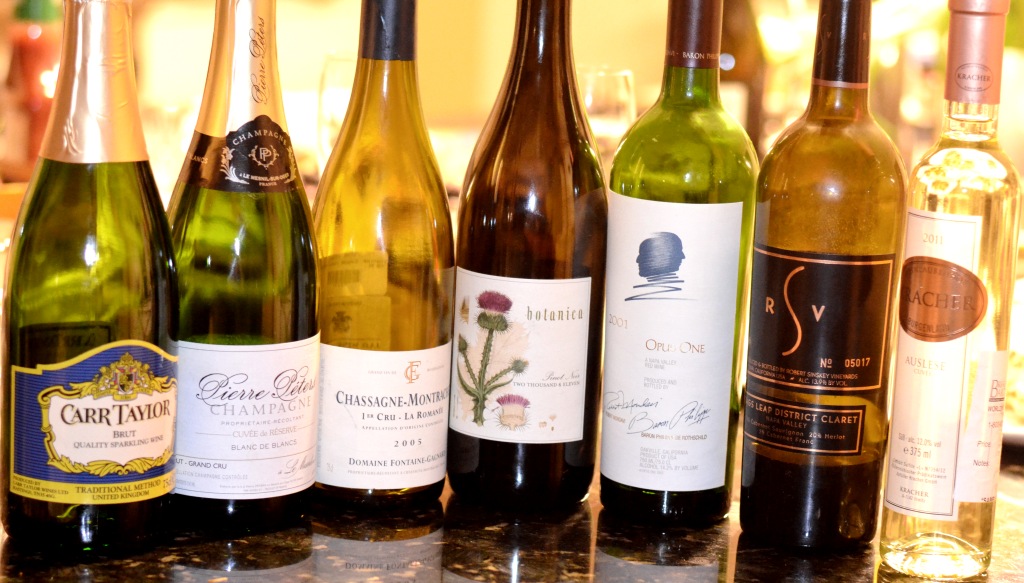
Of course the plan was to start the evening with the Champagne – and then there was a … but. I recently got my hands (told you many times before – I love my friends) on the very interesting sparkling wine from UK. What was the most interesting for me even before I tried the wine is that it contains one of the extremely difficult to find, rare grapes called Schönburger. As I mentioned last time regarding my quest to complete all the grapes in the original Wine Century Club application, Schönburger was one of those “last standing”, extremely difficult to find grapes – and the Carr Taylor Brut was the only wine containing Schönburger, which Wine-Searcher was able to find pretty much anywhere. In case you are curious, Schönburger is a rose grape created in 1979 in Germany as a cross of Pinot Noir, Chasselas and Muscat Hamburg, As an added bonus, the Carr Taylor Brut contained another grape I never heard of, another cross from Germany called Reichensteiner.
Okay, now that I provided a full disclosure, let’s talk about the wines. NV Carr Taylor Brut Sparkling Wine, England (12% ABV, $35) was an excellent start for the evening. Fine bubbles, very intense, very reminiscent of Champagne. Hint of toasted bread on the nose and may be a touch of almonds. The palate had all the toasted and yeasty notes, packaged together in compact but bright way – the wine had no sweetness, but nevertheless was perceived as a fuller body than a typical Champagne. I would gladly drink this wine again any time – if it would be available in US. Drinkability: 8-
Now it was the time for Champagne – Pierre Peters “Cuvée de Réserve” Brut Blanc de Blancs Champagne (12% ABV, $55) – very classic, a hint of brioche on the nose, and nice toasted notes on the palate. Quite honestly, after the first sparkling wine, I wanted a bit more life in the glass – this was clean and fine, but more of the usual. Drinkability: 7+
Our next wine was a white Burgundy. Considering my limited experience with Burgundy, I was concerned if 10 years old wine would hold well (all of you, Burgundy buffs, please stop laughing out there – I’m still learning), so the Valentine’s Day seemed to be quite a good occasion to find out. This 2005 Domaine Fontaine-Gagnard La Romanee, Chassagne-Montrachet Premier Cru, France (13.5% ABV, $65) was outright delicious – beautiful nose of fresh apples, and then apples and honey on the palate – full bodied, supple, with perfect lingering weight in the mouth – this was really a treat. Too bad it didn’t last – but this was definitely an excellent wine. Drinkability: 8
Time for the reds, don’t you think? Remembering the pleasure of the Antica Terra Ceras Pinot Noir (here is the post in case you missed it), I wanted to try another Pinot Noir from Antica Terra – this time it was 2011 Antica Terra Botanica Pinot Noir Willamete Valley (13.2% ABV, $75). The nose was very similar to the Ceras – cranberries, touch of forest floor, lavender, bright and intense. On the palate, this wine had much bigger shoulders than Ceras. Ceras Pinot Noir need no breathing time – it was ready to drink from the moment the bottle was opened. Botanica needed a bit of time. After about 20 minutes in the glass, it showed its structure, dark concentrated fruit, touch of coffee, earthiness, all with a perfect balance, and again, finesse. Drinkability: 8
And then there was Opus One. 2001 Opus One Napa Valley (14.2% ABV, $250). Quite honestly, when I learned that we will be opening Opus One, I was a bit concerned. Yes, this is one of the legendary California Cabernet Sauvignon wines, and yet when I tasted it before, I was not blown away. And when you are not visually excited about $250 bottle of wine, you feel that something is wrong with you, don’t you think? Bottle is opened, and wine is poured in the glass. Based on the color, the wine looks like it was bottled only yesterday – dark, very dark garnet. On the nose, the wine was somewhat muted but pleasant – touch of black fruit and eucalyptus. On the palate, the wine was simply closed – and aggressively tannic, with a touch of green brunches on the finish. Well, to the decanter, of course. After about an hour in decanter, the wine definitely changed for the better, showing touch of cassis and coffee notes on the palate – the tannins still stayed, but reduced, and the finish became spicy, peppery if you will – still not leading to the “wow” which you want to find in the bottle like that. Oh well. Drinkability: 7+
As we were waiting for Opus One to come around, another bottle was pulled out – 1996 Robert Sinskey Vineyards RSV Stag’s Leap District Claret Napa Valley (13.9% ABV, $55). This wine amply compensated for the Opus One shortcomings – in a word, it was delicious. Perfectly young appearance in the glass was supported by the fresh fruit on the nose. And the palate had cassis, touch of mint, mocha, sweet oak, silky smooth tannins, perfectly layered and perfectly balanced. This was Napa Valley Cabernet at its peak, and it was not afraid to show it. Drinkability: 8
Logically (Valentine’s Day!) we had to finish on a sweet note. This was my first experience with Austrian dessert wine, and it was also a first experience with Kracher – I only heard the name before, but never tasted the wines. 2011 Kracher Auslese Cuvée Burgenland, Austria (12% ABV, $22) had everything you want in the dessert wine and nothing you don’t – delicious light honey notes, lychees, vibrant acidity, lemon peel – it was an outstanding way to finish the evening. Drinkability: 8
That is the story of our Valentine’s Day wine experiences. Well, I can’t leave with the wines alone – the food was delicious too, so let me at least share some pictures – I spent time working on them, you know. Here we go:


And we are done here. So, what were your Valentine’s day wine highlights? Cheers!
What To Drink On Valentine’s Day
 I generally avoid holiday-related wine posts, and I do it for a number of reasons. First of all, every information source on the planet considers it to be their duty to produce some piece of writing with wine recommendations. And then for someone who drinks wine all the time, the holidays are not so much of a special occasion to have a reason to open a bottle of wine. Oh well – somehow I felt compelled to share my thoughts on the wines for the Valentine’s Day, hence this post…
Pink. Red. Extreme. Commercialized beyond belief, still increasingly so year after year. Heart-shaped to the point of insanity. There are many things which turn people away from the Valentine’s Day, and I can understand that. However, I take this holiday as an extra opportunity to celebrate love and life. All you need to do is to find your way – ignore pink paraphernalia, ignore meaningless cards, ignore conveyer belt – style experience at the restaurants – and celebrate love and romance as a pure meaning of this holiday.
Let’s agree that we will celebrate love and romance in our oenophile’s way, and let’s talk about wine – without wine on the table, celebration is … just another boring dinner, right? By the way, when I said “felt compelled” in the opening of this post, this was not entirely true. I also had a pleasure to be a guest at the Off the Vine Radio Show, talking with Benita and Latisha about … you guessed it – Valentine’s Day wines – thus as you can imagine, I gave some thought to the subject (and then yes, “felt compelled”). In case you have a bit of time, you can listen to that episode here.
What can I tell you about wines for the Valentine’s Day? First of all, if you have a plan already, it doesn’t matter what I have to say. If you have some specific celebratory dish in mind, and have a pairing ready – it doesn’t matter what I have to say. But if you are still thinking how to make this holiday special, then let me share my thoughts with you. But remember – drink what you like. The wine for the Valentine’s day doesn’t have to be pink, and it doesn’t have to be sweet. It has to be something which will give you pleasure – as simple as that.
The wine for the Valentine’s Day should have balance and it should have finesse. While thought provoking is good for the wine, on Valentine’s Day you should focus on romance and not on deciphering the complex flavors. Go after balance, finesse and simplicity. This is why I would never suggest, for instance, the natural wines of Frank Cornelissen or Jean-Pierre Robinot, or the dark magic of Randy Dunn with his Howell Mountain Cabernet Sauvignon – those wines will drain you emotionally, and it is a wrong angle for the Valentine’s day. Thus let’s talk about balance and finesse.
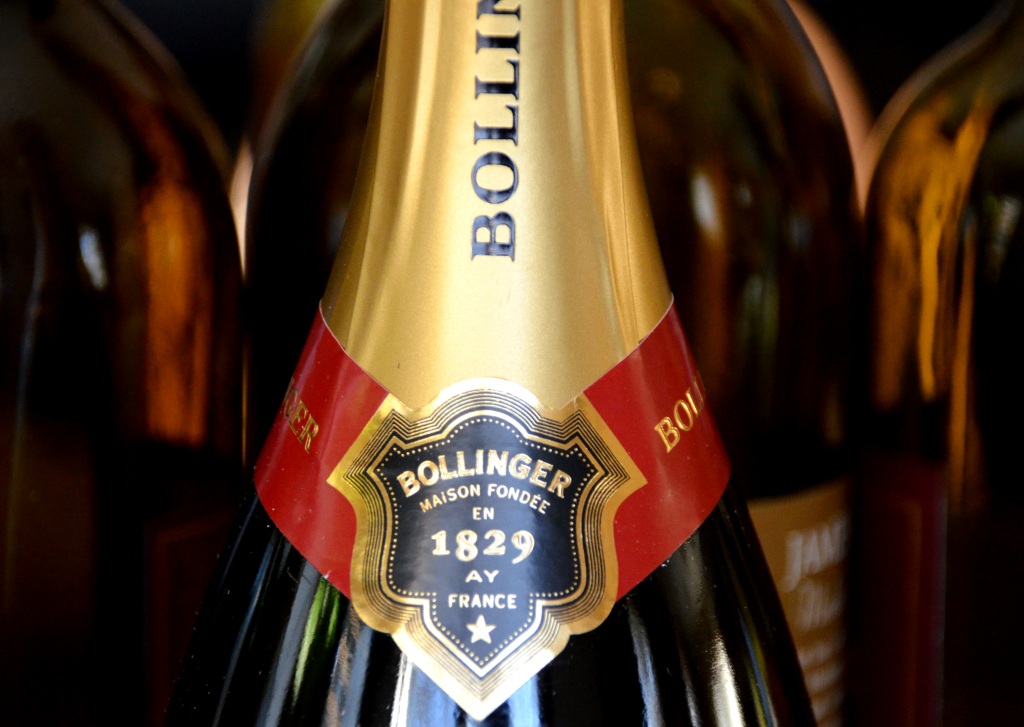
First wine I want you to consider is Champagne. As the very least, it can be an Italian Sparkling wine from Franciacorta or Trento, or some of the California sparklers. Prosecco, Cava and many other sparklers are simply not consistent enough, so for the Valentine’s Day, go with classic – remember – balance and finesse. For the Champagne, my choice would be Bollinger, as I think it is one of the finest non-vintage Champagnes, with lots of finesse. Ferrari from Trento and Bellavista from Franciacorta in Italy would definitely my next choice. But – I don’t want to forget California – Roederer Estate L’Ermitage, Schramsberg Rosé, J Cuvée 20 or any of the Gloria Ferrer sparkling wines would live you with a happy smile.
Moving on, let’s talk white wines. As we are looking for the balance and finesse, I have a few recommendations for you – and you might be surprised with these. For this holiday, I want you to step outside of your “usual circle”. My first recommendation is for the white wines of the Rhône valley in France. Yes, Rhône is mostly known for their reds, but the white wines there are equally stunning. For instance, try to find Domaine Saint Préfert Cuvée Speciale – I called this wine once “a symphony in the glass”. But in general, look for the Clairette or Grenache Blanc wines from Southern Rhône, or Marsanne/Roussanne from the North – those wines are often not easy to find, but they will deliver lots of balance, finesse and pleasure.
Let me give you a few more suggestions – equally difficult to find, but worth looking for. Viognier from Washington is a white wine worthy of celebrating love and romance with. Look for Mark Ryan or Willis Hall – their Viognier is nothing short of stunning. To close on the whites, here are 3 more rare beauties. First, 2 Sauvignon Blanc from … Italy: Gaja Alteni di Brassica and Poggio alle Gazze dell’Ornellaia – stunning balance and finesse. And the last one – Ken Forrester The FMC. You can’t go wrong with either one of these wines – go, start looking, you don’t have lots of time.
Now, we arrived at the red wine junction. Looking for the balance and finesse will dramatically reduce our choices. I would say, let’s go for Pinot Noir. I will limit my recommendations to this one grape only – and here is why. We are looking for the balance and finesse, right? Think about Cabernet Sauvignon from California – what would be the first word or words you would use to describe those wines – probably “big and powerful” – and this is not what I’m looking for suggesting the wines for the Valentine’s Day. Same goes for many Merlot, Syrah and Grenache wines – never mind the Petite Sirah. Even with my beloved Rioja – there are few wines, which will deliver that exact balance and finesse – La Rioja Alta Reserva Especiale would be definitely the one – and I highly recommend it. But for the Rioja – and then for Barolo, Brunello and even Super-Tuscan – as a general class, the probability of running into “big and powerful” is a lot higher than finding “balance and finesse”.
Talking about Pinot Noir, I wish I would recommend some of the classics to you – yes, the Burgundy – but unfortunately, my exposure to the Burgundy is way too limited, so you will need to ask your trusted wine merchant for the advice. Next up – California and Oregon. For the most of the time, California Pinot Noir will deliver exactly that – balance and finesse. To give you a few names, go look for Siduri, Loring Wine Company, Calera, Drew, Copain, Laetitia – but there are many others and it is hard to go wrong with California Pinot Noir. Oregon would be also a perfect choice – look for Adelsheim, Chehalem, Antica Terra, Evening Land – finesse is a middle name for the Oregon Pinot, so you will not be disappointed. And last but not least – don’t forget the New Zealand! Pinot Noir from Central Otago, Marlborough and Martinborough are typically well balanced and round, perfectly fitting our quest for finesse. Look for the wines from Craggy Range, Mt. Difficulty and Amisfield among the others.


Dessert time! People often underestimate how bad the dessert wines can be – one sip of the cloying, single-sugar-note wine would ruin the experience of an amazing dinner. You really have to put a lot of care in selecting the dessert wine which will have balance and finesse. Of course I would like to recommend Sauternes and Barsac wines for you, but again, my personal experience is very limited. I’m sure you can’t go wrong with Château d’Yquem – if you can afford it, go for it! What would be a bit easier to find (and afford) is a Port. Not just any Port – balance and finesse, remember – so go for a nicely aged Tawny, 20-, 30- or 40-years old. As Port ages, it loses power, and becomes fragrant and sublime, guaranteed to deliver lots of pleasure. Look for Rozes, Graham, Quinta do Noval – lot’s of excellent choices. Then of course, the king of the dessert wines – Riesling. For the special experience, I would only recommend to go to the BA and TBA levels – you know, the stuff which always comes in the small bottles. You see, it is very hard to mass-produce BA or TBA level Rieslings – you can’t harvest enough grapes at those sugar levels – thus it is hard to go wrong with BA or TBA Riesling from any producer. And the last recommendation for today – an Icewine. Not any Icewine, but I want to recommend my personal favorite – Inniskillin Cabernet Franc Icewine. This wine is vibrant, perfectly balanced and has lots of finesse – I guarantee you will finish your Valentine’s Day dinner on a high note with this wine.
Here you go, my friends – in the quest for the balance and finesse, these are some of my personal recommendations to enhance you Valentine’s Day experience. Let me know what do you think about my suggestions and feel free to provide your own. Happy Valentine’s Day and cheers!
Daily Glass: First, There Was A Smell
Drinking wine is a sensual experience. Okay, I can’t speak here for all the people who drink wine at one time or the other – but I’m sure that this selectively crazy passionate group, oenophiles, would wholeheartedly agree. Once the wine goes into the glass, of course the color matters first – but color is mostly a technical characteristic. The color can tell you what to expect – for instance, if a Chardonnay has rich golden, yellow color in the glass, you should prepare for the worst (the wine which will be well past prime). Or if a red wine looks almost black in the glass, get ready for the tannins encounter. Still, the most pleasure you can get from the color alone is to get excited – “look at this beautiful color!” type excited.
Your hedonistic pleasure starts with the smell. Technically, it starts and ends with the smell, as our taste buds don’t go beyond 4 (or 5) basic tastes, and even when you take a sip of the wine, it is still the sense of smell which leads you to the strawberries in that sip – but let’s not get technical here, we are talking about the pleasure. Yes, you start with the smell – it is the smell which takes you away and makes you go “wow”. It is the smell which grabs your attention and captivates you, and forces you to smell that wine again, and again and again. It is the smell which builds up the excitement and expectations of the first sip.
The first sip afterwards is a moment of truth – if you are lucky, the taste will match the smell and will take you to the oenophile’s heaven, at least for a moment. It doesn’t always work like that – more often than not, the excitement built by impeccable aromatics instantly dissipates after the first sip. But when you are in luck, this is how the wine memories are created.


What prompted this post was my undoubtedly lucky experience few days ago with two wines in the row, delivering that incredible combination of aromatics and taste. Sorry, I’m getting overly excited here, but the smell of the 2013 Hanna Sauvignon Blanc Russian River Valley ($15) was, in a word, spectacular. In the New World renditions, Sauvignon Blanc is very aromatic more often than not – but it would be typically aromatics of grapefruit and lemon, Here, from the get go, the glass was exuding with the aromas of the fresh cut grass and cat pee. Yes, I know that many people jump when the cat pee descriptor is used, but anyone who had owned a cat would perfectly understand what I’m talking about. And yes, cat pee is a known classic profile of Sancerre, the most classic Sauvignon Blanc of all. So this wine had it all, clean, bright and present on the nose – and the palate was beautiful, medium to full body, with fresh cut grass and touch of lemon peel. Definitely an outstanding example of California Sauvignon Blanc, now squarely engraved in my memory, right next to the Honig and Mara White Grass, which are always California Sauvignon Blanc staples for me. Drinkability: 8+
And then there was 2011 Antica Terra Ceras Pinot Noir Willamette Valley ($75). I’m not going to spend a lot of time talking about the winery – you can should read interesting stories on Antica Terra web site on your own. But this wine… Talking about attractive color, the wine was ruby with the light pinkish hue in the glass. And then the first smell… It was surreal. Here is where I fail as a wine writer, as I can’t give you the right set of words to describe the impressions from this wine. The smell had everything in it – the cranberries, forest floor, herbs and mushrooms – light, delicate and seductive, saying “and now, let’s take a sip…”. The palate was a natural, precisely fitted extension of the smell – all the same component, now packaged together. More cranberries, shallots and truffles, sage and lavender, minerality and whiff of the forest floor, effortlessly rolling off your tongue, delicate and present, with perfectly noticeable, silky texture and needless to say, perfect balance. This was for sure one of the most sensual wines I ever had. And yes, if you want to take this tasting note as an example “look at another moronic wine review” – I will still stand behind it, as this wine delivered lots and lots of pleasure. Drinkability: 9/9+
There you have it, my friends – two wines which will be etched in the memory for the very, very long time. I wish you all to have lots of sensual wine experiences and memorable wines. Cheers!
Daily Glass: A Super-Local Pinot
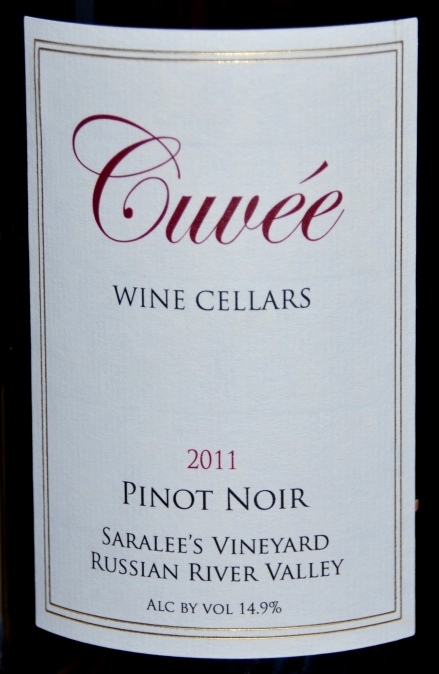 While talking to a friend on Facebook, she asked: “would like to try a local Pinot Noir”? Care to guess my response? Yeah, a dumb question, you know what I said – “of course” and “yes, please” (insert an appropriate number of exclamation points on your own). Mentioning that she will be sending the wine in a few days, she reiterated again – it will be a local Pinot Noir, or may be even rather a super-local.
As my friend lives in Silicon Valley in California, my thought was – okay, of course it will be a California Pinot Noir, so “local” means produced locally in California. I was of course curios what exact Pinot Noir it will be, but hey, patience is a virtue of a oenophile, isn’t it?
The package arrived, with the bottle of California Pinot Noir in it. 2012 Cuveé Wine Cellars Pinot Noir Saralee’s Vineyard Russian River Valley (14.9% ABV). Okay, so I’m sure that most of you never heard of Cuveé Wine Cellars – but the wine has Russian River Valley designation, so that’s the whole “local California” story, you ask?
Well, the wine actually is super-local. While the grapes were harvested in Russian River Valley, the wine was made locally in Silicon Valley, in the town of San Carlos, a small town near San Jose, where Cuveé Wine Cellars is located. As it often happens, especially with the urban wineries, the driving force behind Cuveé Wine Cellars is passion – and you can check their story on the Cuveé Wine Cellars web site.
How was the wine? In a few words – delicious with a great aging potential. When I opened it on the first day, the aromatics of Pinot Noir were incredible, one of the most pronounced California Pinot I ever had a pleasure to smell – forest floor, smoke, mushrooms, licorice – all very concentrated. The palate was well supporting the aroma, with silky-smooth, rich texture. Very concentrated (using the word again, sorry), with lots of fruit, chocolate, the same mushroom undertones and good acidity. But honestly, it was a bit too much. Don’t get me wrong – there was no jammy fruit or sharp biting alcohol in this wine – but you know how sometimes you are looking for the subtlety of the favors, for a bit more grace and mystery? My wish was granted on the day 3, when wine still had all the aromatics, but the palate became more mellow and intricate. Drinkability: 8+
That’s my story of the super-local Pinot – and an ode to the great friends. Cheers!
Daily Glass: Wonderwall Pinot Noir
I had to settle for this simple title of the post after a few futile attempts to be clever. “Don’t judge the wine by the first sip”, “Give it some time”, “Patience, the most important virtue of Oenophile” were all contenders, but none of them where hitting the spot, so I went for a simple, not catchy title for this post, just with the name of the wine.
But we have to talk about first sip, time and patience, as we have a great case in point. 2013 Wonderwall Pinot Noir Edna Valley (14.9% ABV) is made by Field Recordings, one of my all time favorite producers from California – I wrote about Field Recordings wines many times in this blog. I don’t think I ever had a Field Recordings wine I didn’t like. Or such was my very first thought after the very first sip of this wine.


On the first sip, the wine was simply … sweet. No, nothing is wrong with the sweet wines – but not when the wine is called Pinot Noir. The wine had tons of nice fresh fruit – but more in the compote flavor profile. Well, this is the young wine, very young – it is 2013 vintage, and probably was bottled just a few month ago – so the first thing to do, before declaring the wine been no good, is to give it time. Which I did. In about 30 minutes, the sweetness subsided, and acidity increased. The longer this wine was opened, the more restrained it became.
The next day the wine converted itself into a powerful, full bodied California Pinot Noir, with the hint of smoke on the nose, and ripe plums and hint of blueberries on the palate, with good structure and very good balance (Drinkability: 8 -). I was really glad that Field Recordings came around for me, and I can still call it a favorite producer without any afterthoughts.
And the general lesson(s)? Don’t judge the wine by the very first sip – in a lot of cases, freshly opened bottle might not taste as you expect it, especially if the wine is young – you should really refrain from judging the young wine until it had an opportunity to breathe and open up. And be patient. I’m sure this wine would show itself quite differently in the 4-5 years, so quite often, waiting for the wine to be ready, to be at its peak, makes a lot of sense.
Have you ever been in situation when you declared the wine “not good” based on the first sip, only to find out (or not) that the wine considerably improved after some breathing time? Comment away! Cheers!
Pinot Noir On The Go – At Vino Volo in Newark Airport
This is not the first tine I write about Vino Volo wine bar (you can find previous posts here). Just in case you are not familiar with Vino Volo, it is a great chain of the wine bars, offering all the wine lovers a refuge, alleviating dreadful and tiresome airport travel experience. Vino Volo is the place where you can sit down and enjoy a glass of good wine, or a tasting flight, at the reasonable price, accompanied by a tasty bite of food – a sandwich, olives, a little cheese platter and more.
Actually, this was my first time at Vino Volo wine bar at Newark airport. Generally, I’m flying in the morning, way before Vino Volo would be open, so I walked past the restaurant many times, only promising myself to hopefully come back at some point. This time, on the way to California, I had an early afternoon flight, so Vino Volo sounded like a perfect late lunch option.
As Vino Volo wine bars located in the different airports throughout the country, the wine offerings very often include local wines. You can expect to have an opportunity taste Texas wines while in Austin, and Virginia wines while in Washington, and Oregon wines in Portland. Typical selection on the Vino Volo wine menu would include 6-8 different wine flights, white, rose and reds. While Vino Volo in Newark didn’t offer any New Jersey wines (not sure I’m courageous enough even if they would), it was not easy to make a decision. Somehow, I settled on the Pinot Noir flight, which consisted three wines from Germany, Oregon and California. While I’m well familiar with Oregon and California Pinot Noirs, I have very limited (and until now, unsuccessful) exposure to the German Pinot Noirs – however, so many bloggers had being raving lately about German Pinot Noir wines, that I simply had to try it.

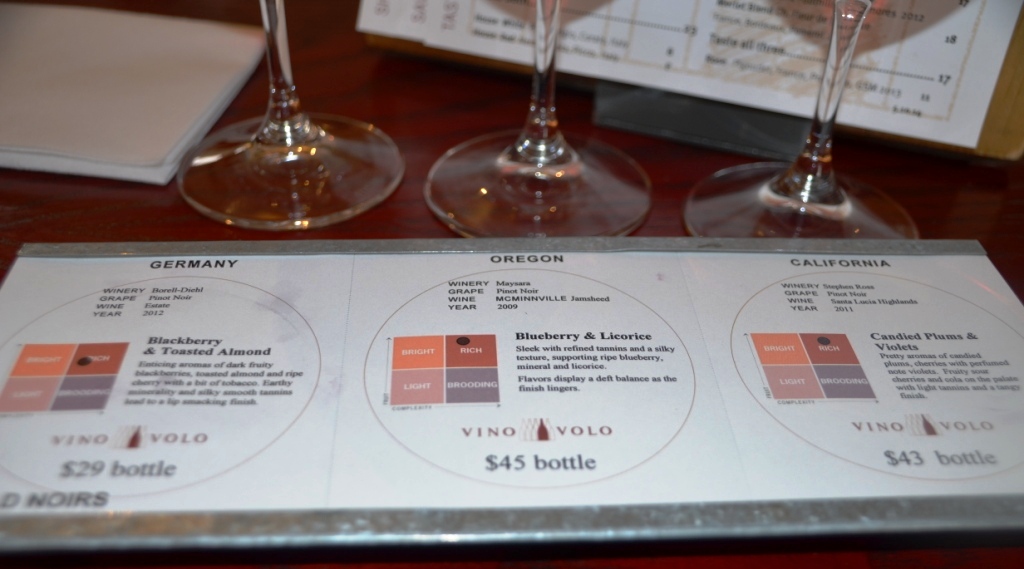 Here are my notes:
2012 Borell-Diehl Pinot Noir Estate, Germany
Color: Garnet
Nose: Blackberries, red fruit, clean, hint of minerality
Palate: Fresh, clean, bright acidity, very good balance, herbs, nice red fruit.
Verdict: Perfectly worked with my warm Tuscan chicken sandwich, great pairing. Overall very nice, food friendly wine. Drinkability: 7+
2009 Maysara Pinot Noir, McMinniville AVA, Oregon
Color: Ruby
Nose: Mocha, herbs, lavender, hint of root beer (I can’t believe I would say it, but Kirsten The Armchair Sommelier was right!)
Palate: Complex, delicious, nice acidity, good structure and backbone
Verdict: Also worked perfectly with the warm Tuscan chicken sandwich, very good wine overall. Drinkability: 8-
2011 Stephen Ross Pinot Noir, Santa Lucia Highlands, California
Color: Ruby
Nose: Concentrated, dark chocolate, pencil shavings, smoke, roasted plums
Palate: open fruit, bright, perfect balance, medium-long finish.
Verdict: didn’t work with the sandwich, but was delicious by itself. Drinkability: 8
There you have it – three excellent Pinot Noir wines on the go. Next time you are in the airport – remember, you have options. Vino Volo is continuing expanding, so there is a good chance that your airport experience will not be that dreadful after all. Cheers!
Vino Volo
Newark Airport
Terminal C, Gate 74
Phone: (973) 565-9250
Hours:
Monday – Saturday: 9 am – 9 pm, Sunday: 12 pm – 9 pm

Of Ancient Vines and Rhone Varietals – #winechat with Cline Cellars
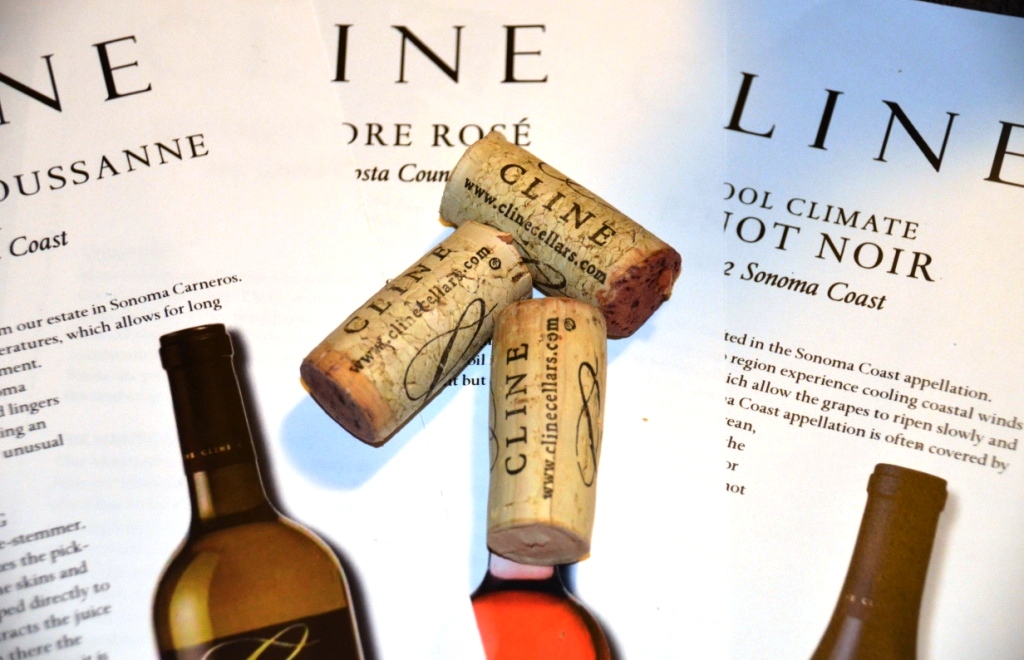 Think California wines, think California grapes – what is the first grape which comes to mind? I would guess that Cabernet Sauvignon would be the first. Zinfandel, Merlot, Pinot Noir and Chardonnay will trail near by (not in this exact order, of course). Are those the best grapes making the best California wines? Yes, before you beat me up, “best wine” is highly subjective, so let’s not drill on that. But – what else is there in California? Ever heard of Rhone Rangers? In the 1980s, a group of California winemakers made a significant effort to popularize Rhone varietals – Syrah, Grenache, Mourvèdre, Roussanne, Marsanne and many others. While this group of winemakers didn’t have any set structure, they became collectively known as Rhone Rangers. As the result of the work of this group, Syrah and Grenache became prominent players on the California wine landscape, with the other traditional Rhone varietals taking more on the supporting roles.
Fred Cline, the founder of the Cline Cellars winery in Contra Costa County, was one of the original Rhone Rangers. While Cline Cellars is most famous for their Zinfandel wines (7 different bottlings are produced), it also makes a number of wines from the traditional Rhone varietals. On Wednesday, April 30th, the worldly virtual tasting room, called #winechat, opened its doors to all the wine lovers, coming in to experience and to talk about the Cline Cellars Rhone-style wines. While Cline Cellars winery was officially founded in 1982, the family owned the vineyards since 1800s. After founding the winery, Fred Cline spent a lot of time and efforts to preserve and where necessary, to restore the ancient vines (some of the vines are 80 – 120 years old), hence the name “Ancient Vines” which you can see on the labels of many Cline Cellars wines. Today, Cline Cellars uses sustainable farming methods and it is Green String Certified winery. Wonder what it means? As explained by the @ClineCellars during the #winechat: “Since 2000, Cline Cellars farms the Green String way: naturally & sustainably &avoid chemical pesticides, fungicides & fertilizers”

So, how were the wines, you ask? During the #winechat, we had an opportunity to try 3 different wines. We started with 2012 Cline Marsanne Roussanne Sonoma Coast (14.5% ABV, 66% Marsanne, 34% Roussanne). Every time I say “these are some of my favorite grapes/wines/etc.”, I feel a bit uneasy. The reason is simple – when it comes to the wines, I like them all. Every time I talk about the subject, I can come up with the new list of favorites, so using that “some of my favorites” moniker feels almost like lying, just a tiny bit. Oh well. So yes, Marsanne and Roussanne are some of my favorite white grapes – the wines from Marsanne and Roussanne, both are core Rhone white grape varietals, are quite rare, no matter where they come from, so every opportunity to taste such wines is always very exciting.
When it comes to Marsanne and Roussanne wines, the interesting thing is that those wines should be consumed at the room temperature. I tried chilling various Marsanne/Roussanne wines, and it never worked for me. This wines works the best at the 18°C – 20°C/64°F – 68°F. Here are the notes:
Color: Light golden
Nose: Minerality, white flowers, touch of honey, touch of white peach, white grape aroma as the wine opened up.
Palate: Touch of sweetness, caramelized sugar, minerality, very complex.
Verdict: This is one delicious wine, which you can enjoy on its own or with some chicken and mushrooms dish, for instance. Drinkability: 7+
Our next wine was 2013 Cline Mourvèdre Rosé Contra Costa County (13.5% ABV, ~100 years old vines), another traditional Rhone varietal. I tried to play with the temperature on this wine, but it really didn’t work – this wine should be only served well chilled.
Color: Intense pink
Nose: Fruit forward, with lots of ripe strawberries
Palate: Strawberries, cranberries, nice acidity (when well chilled!). Very classic and supple Rosé.
Verdict: Ahh, it pairs so well with the strawberries! Serve either as an Aperitif, or with the fresh light salad (like kale and strawberries), or with the fresh fruit after a meal. Very refreshing. Drinkability: 7+


Last, but not least was 2012 Cline Cool Climate Pinot Noir Sonoma Coast (14.5% ABV, aged for 9 month in oak) – yes, not a Rhone varietal, but a California classic, coming from the classic area as well. The climate conditions of Sonoma Coast, with the fog settling down and cooling off the grapes every evening, allow grapes to ripen slowly and to build up a structure and nice acidic core. This wine was very much on par with the good California Pinot Noir expectations:
Color: Dark garnet
Nose: Smoke, minerals, touch of cherries, mushrooms, forest floor, roasted notes
Palate: Minerality, plums, nice acidity, well balanced.
Verdict: Very versatile wine. Perfectly enjoyable on its own, also paired well with wide variety of foods – fresh strawberries (!), roasted chicken, and believe it or not, but bacon cheddar (cheddar cheese with pieces of bacon) was the best pairing! Drinkability: 7+
As an added bonus, this wine even comes with the recipe attached to the back label – very clever idea!


That concludes yet another #winechat report. What is left to say is Thank You. First of all, thank you to the @ClineCellars for providing the excellent wines and enduring the barrage of questions during the intense one hour conversation. And of course, thank you to the Protocol Wine Studio, spearheading the whole #winechat program. And for you, my dear readers? Thank you for reading and come on over! See you next Wednesday on Twitter in the #winechat room. Cheers!
J Wrigley #WineChat – Continuing Oregon Pinot Noir Deep Immersion
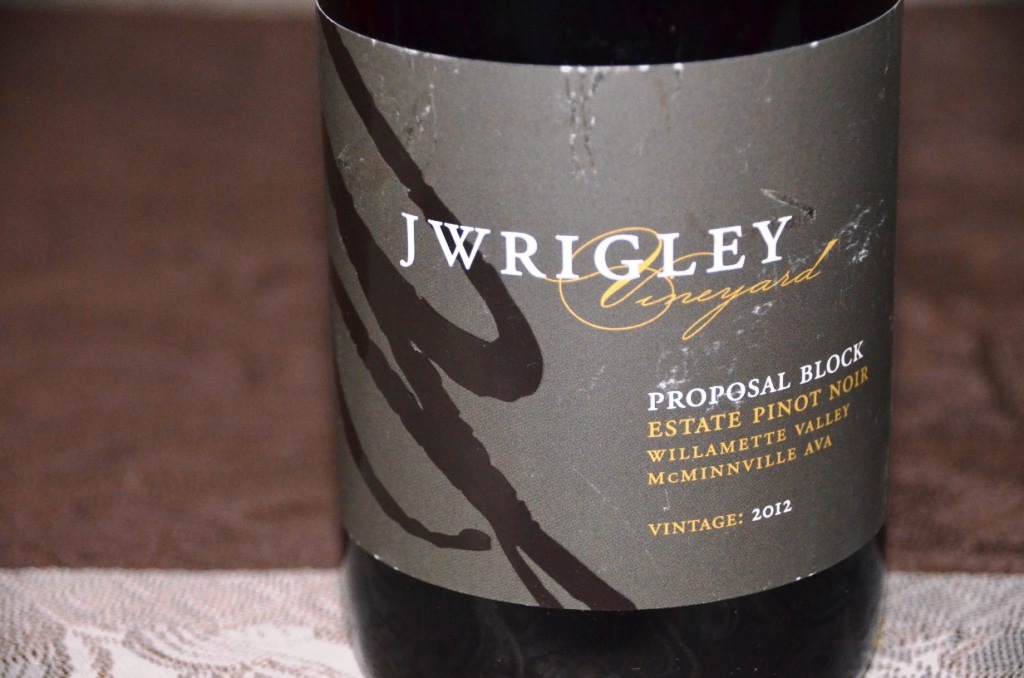 Last Wednesday, April 23, the virtual tasting room opened its #winechat doors to discuss for the third time in the row the endless subject of Oregon Pinot Noir. Presiding over in the hot seat was John Wrigley, the grape grower and winemaker at the J Wrigley Estate in McMinnville AVA in Oregon.
Let me start from the conclusion and tell you what I learned. The terroir, the soil, the elevation, and the winemaker are all matter. Duh, you wanna say? Well, yes, this sounds very pedestrian for the oenophile, like teaching an alphabet to the fifth-grader. However, when you drink the wine made with the soul, when you drink a thought-provoking wine, and when you also get a chance to discuss that thought-provoking wine with the someone who actually made it, and the group of like-minded people, the concept of soil and terroir stops being abstract, and rather becomes something you can…put in your mouth and taste!
We learned a lot during this #winechat. Once again we heard about the peavine soils, which make vines work really hard. We also heard about volcanic rocks and marine sediment soils. You can learn about the soils too – here is the link to the very interesting article about J Wrigley wines, which also includes the video of John Wrigley talking … dirt (not as a matter of speech, but as a substance).
We learned about something called Van Duzer effect. Ever heard of it? A narrow stretch of open land, called Van Duzer corridor, connects Willamette valley to the ocean. Every evening, the cold ocean air runs through that open space to cool off everything in the valley, especially all the grapes growing on elevations. The temperature drop can be in the range of 20°-30°, making grapes to ripen slowly, to retain acidity and concentrate sugars, which in turn means … better wines for us! Here is an article where you can read about Van Duzer effect in far more details.
We also learned about very interesting experiment, called the Cube Project. 3 wineries, 3 winemakers, 9 wines. 3 wineries – Anne Amie from Oregon, Bouchaine from Carneros and Lincourt from Sta. Rita Hills, each took their best Pinot Noir plots, capable of producing at least 6 tons of grapes each, and divided it into 3 equal parcels. Each winemaker had an opportunity to make wines from all three parcels, thus producing 9 different wines. When the wines were tasted by the group of professionals, it was concluded that winemaker style prevails over the terroir – the wines from different plots made by the same winemakers tasted closer than the wines made within the same parcels. I would really love to try all those wines by myself, or at least learn more about how the tasting was conducted – were the wines tasted blind, how many people tasted the wines and the number of other factors would all matter to me. But – as I can’t report first hand, here is a link to the article which explains the experiment in lots of details.
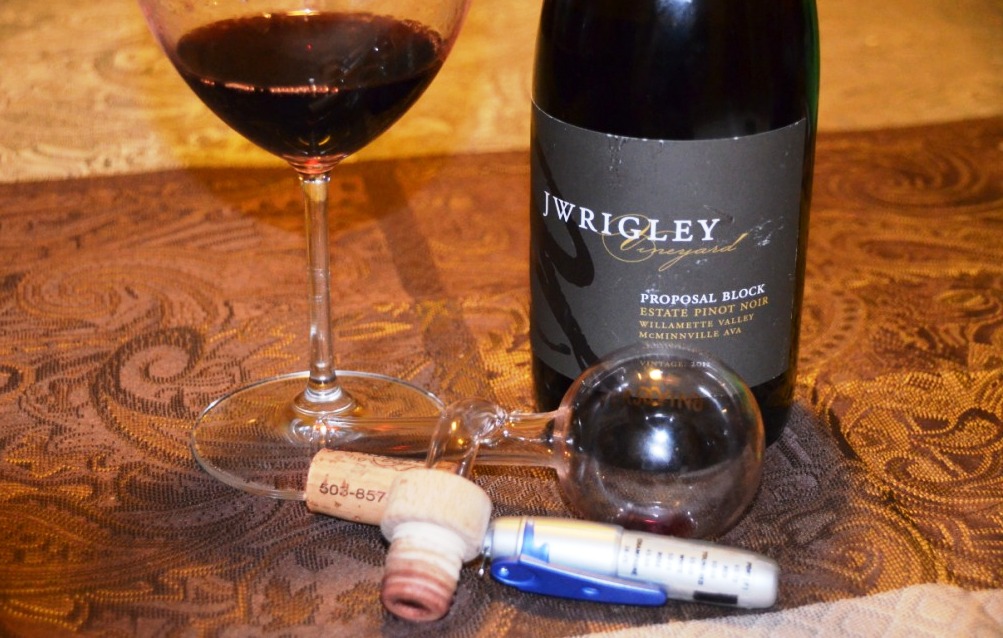
J Wrigley Pinot Noir and tools of the trade
Yes, we learned a lot, but how was the wine, you are probably wondering? This time around, I didn’t play with the temperature, I only measured it once – it was at 22.3°C/72°F. I played a bit with rapid decanting using VersoVino. This 2012 J Wrigley Estate Pinot Noir Proposal Block McMinnville AVA (14% ABV, aged 10 Month in French oak, 250 cases produced. $45 SRP) was very supportive of our conversation. Oh, by the way, can you guess where the name “Proposal Block” comes from? There is a good chance that you guessed it – this was the very first Pinot Noir planted vineyard at the estate, where John Wrigley proposed to his wife (wine and romantics – unbeatable!).
Now, here are some notes regarding the wine:
Color: Garnet
Nose: Fresh, ripe raspberries, floral notes, chocolate, mocha. Smokiness showed up later on.
Palate: Soft, round, good acidity. nice earhiness, dark fruit, very balanced. After a while, smokiness showed up in the back, and the the roasted notes.
Verdict: powerful and balanced Pinot Noir. Will drink well by itself, and can be well paired with food. For the full enjoyment, about one hour decanting is recommended. Will also age well for the next 10-12 years (or may be more, my crystal ball is broken, so I can’t be more precise). Drinkability: 8-
That conclude my report about J Wrigley #winechat and it also concludes the overall Oregon Pinot Noir series – definitely was learning, fun and entertaining experience for me. Don’t be shy – you should really try the #winechat for yourself (every Wednesday, at 9 PM Eastern/6PM Pacific) . Until then – cheers!
Last Bottle Sign Up ($10 credit)




 Talk-A-Vino