Archive
Celebrate Malbec! 2025 Edition
Do you know what I enjoy almost as much as sharing wine? Sharing pictures!
Today is World Malbec Day, where we celebrate a French grape called Malbec, or rather, Cot in its native Cahors region, which became a real star in Argentina. As bold a statement as it would be, Malbec made a world star wine producer out of Argentina, and Argentina made Malbec a world star grape.
As I mentioned before, the main reason for this post is to share my updated picture collage of some of my Malbec experiences. Here we go:
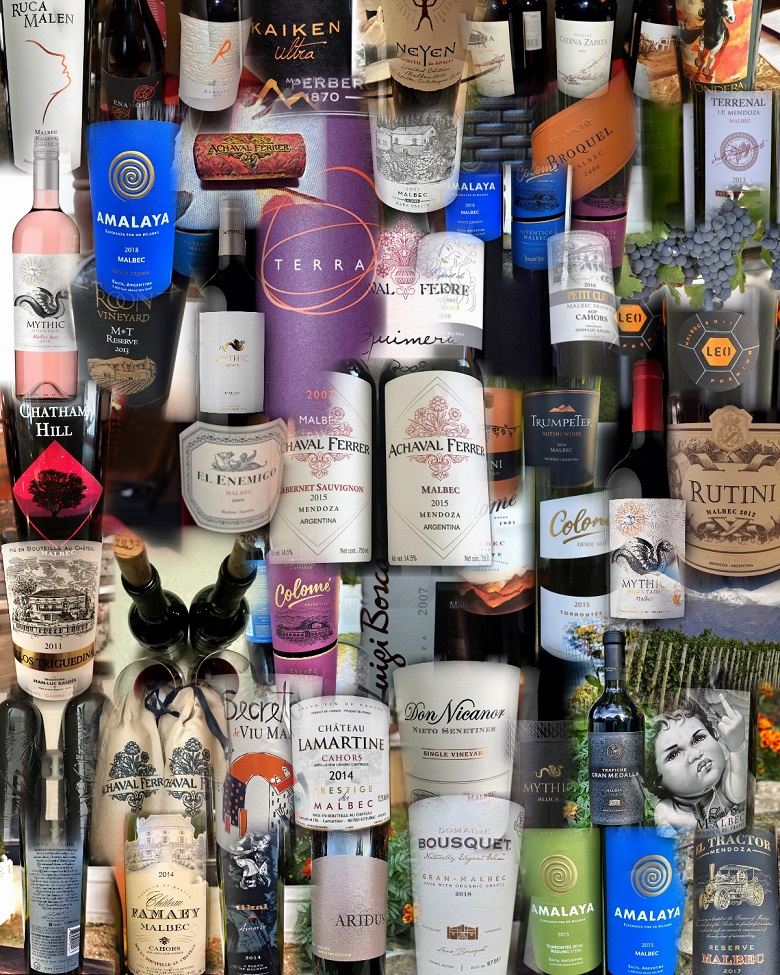
The last time I posted Malbec collage was 6 years ago, in 2019, you can find it here. Since then, in a true testament to the worldwide phenomenon of Malbec, I added a number of great Malbec experiences – organic Malbecs from Domain Bousquet in Argentina, a Little Fuck Malbec from Cahors in France, Flora Springs Ghost Winery Malbec from Napa Valley, Neyen Espíritu de Apalta Malbec from Chile, another Malbec from Argentina, Mythic, and I’m sure many more that I don’t even remember. Good Malbec is delicious, and we can leave it at that.
Don’t forget to celebrate Malbec. Even if you miss this special celebration, any day is a good day to drink Malbec. Oh yes, and if you have a favorite Malbec (or five), please share it in the comments!
Until the next grape holiday – cheers!
Brunello di Montalcino 2020: Captivating, Bright, Succulent
Benvenutto Brunello is one of my favorite wine tasting to attend. If you like Italian wines, Brunello needs no introduction (and if you don’t, I’m not sure we can be friends) – one of the 3 big Bs of Italian winemaking – Barolo, Barbaresco, and Brunello.
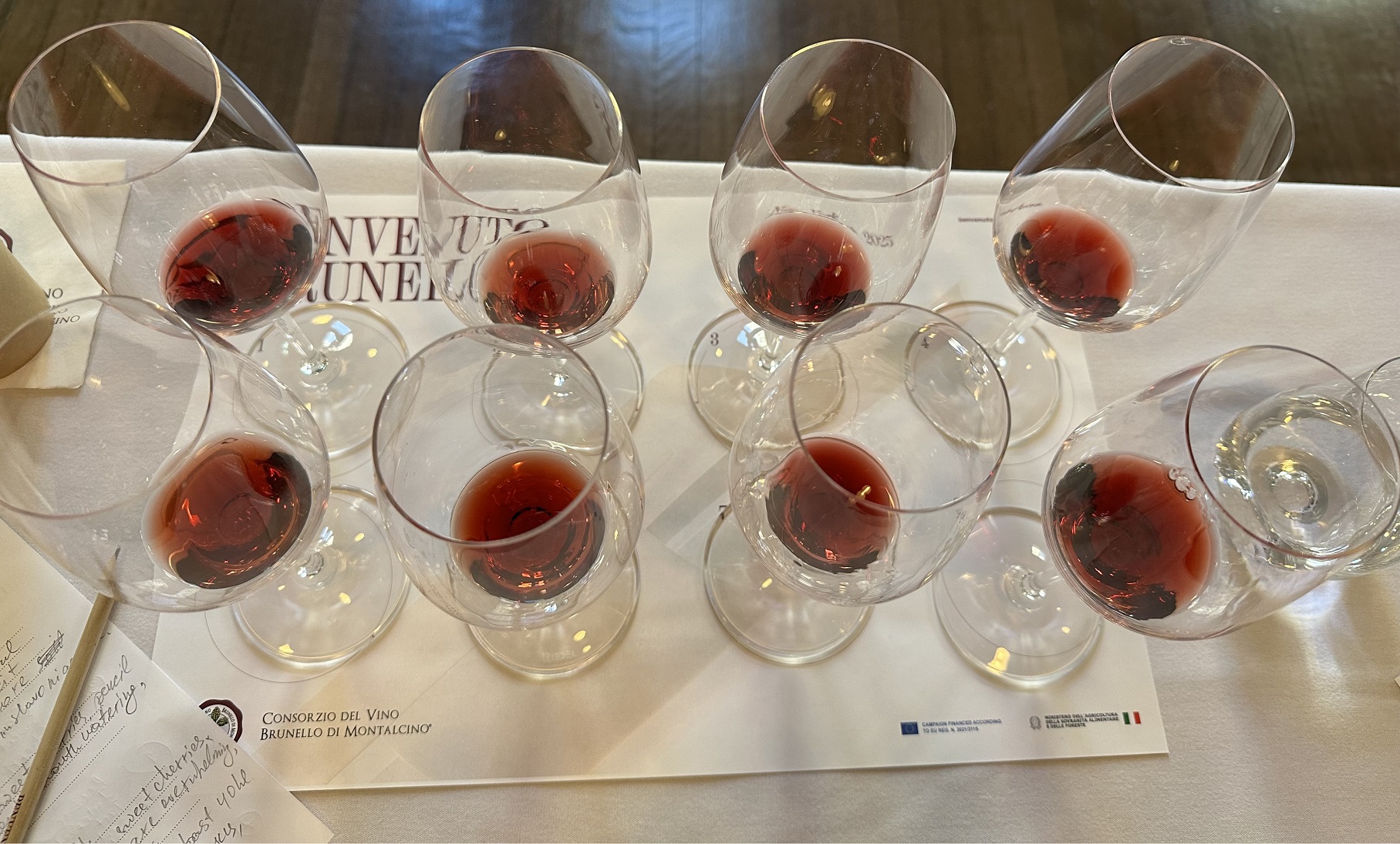
Brunello is an epitome of the expression of the best known Italian red grape – Sangiovese. The Sangiovese growing in the Brunello di Montalcino proper is considered a clone – Sangiovese Grosso, but it is a Sangiovese nevertheless.
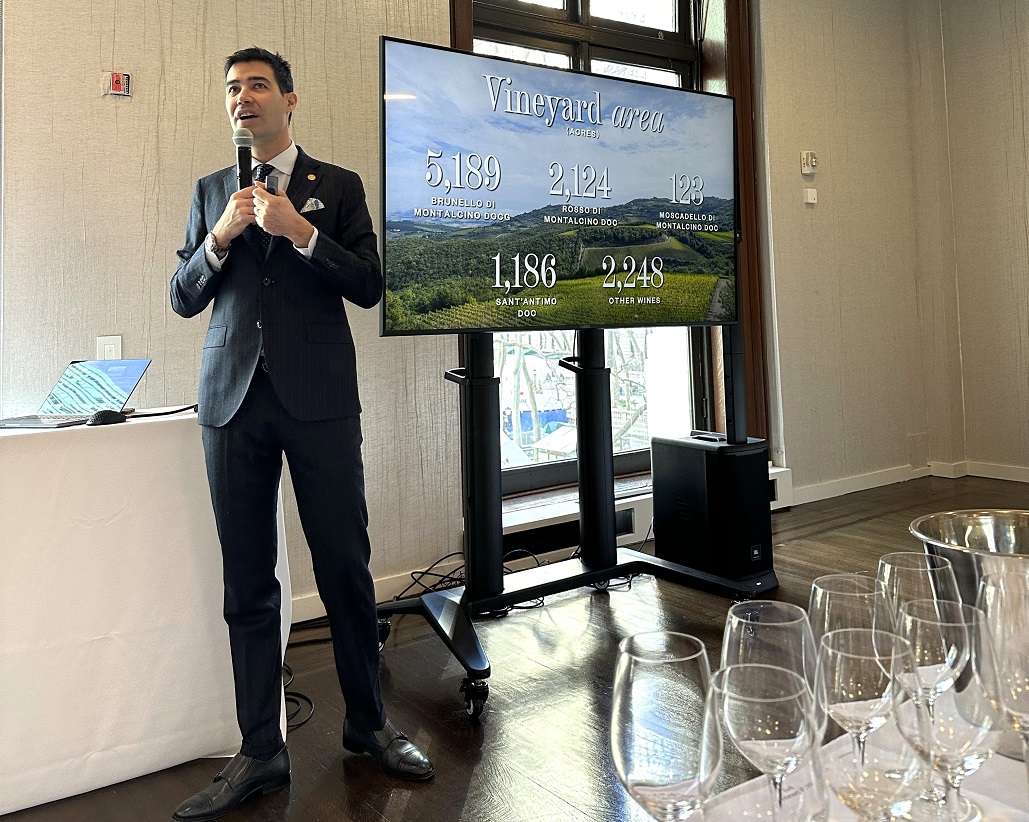
Brunello de Montalcino appellation is almost square, all located around the hill crowned with the town of Montalcino, with vineyards densely occupying 5,189 acres and located at various altitudes over a range of different soils. Different microclimate conditions, terroirs, guarantee a great diversity of styles among 200 or so producers in Brunello di Montalcino DOCG. Another interesting appellation within Brunello proper is Rosso di Montalcino DOC, occupying 2,124 acres (after expansion in 2020) of dedicated vineyards (Rosso DOC vineyards are only used for production of Rosso di Montalcino DOC). Take a look at this wonderful video providing an excellent overview of the Brunello di Montalcino region:
Gabrielle Gorelli, MW, led our highly informative Brunello Masterclass, providing a detailed overview of the 2020 vintage and the changes in vintage assessment that just went into effect.
The 2020 was a pivotal vintage for Brunello di Montalcino. Not because of the Brunello 2020 wines per se, but because of the fundamental changes made in assessment of the 2020 vintage and all future vintages to come.
Until 2020, Brunello di Montalcino vintages had quality assessment specified with the stars (from 1 to 5 stars) and a short slogan characterizing the vintage. For example, the 2014 vintage had a rating of 3 stars and was called “Grace under pressure”. 2015 had a rating of 5 stars, and it was called “Power and Purity”; the 2016 vintage was also rated 5 stars and called “Finesse and depth”.
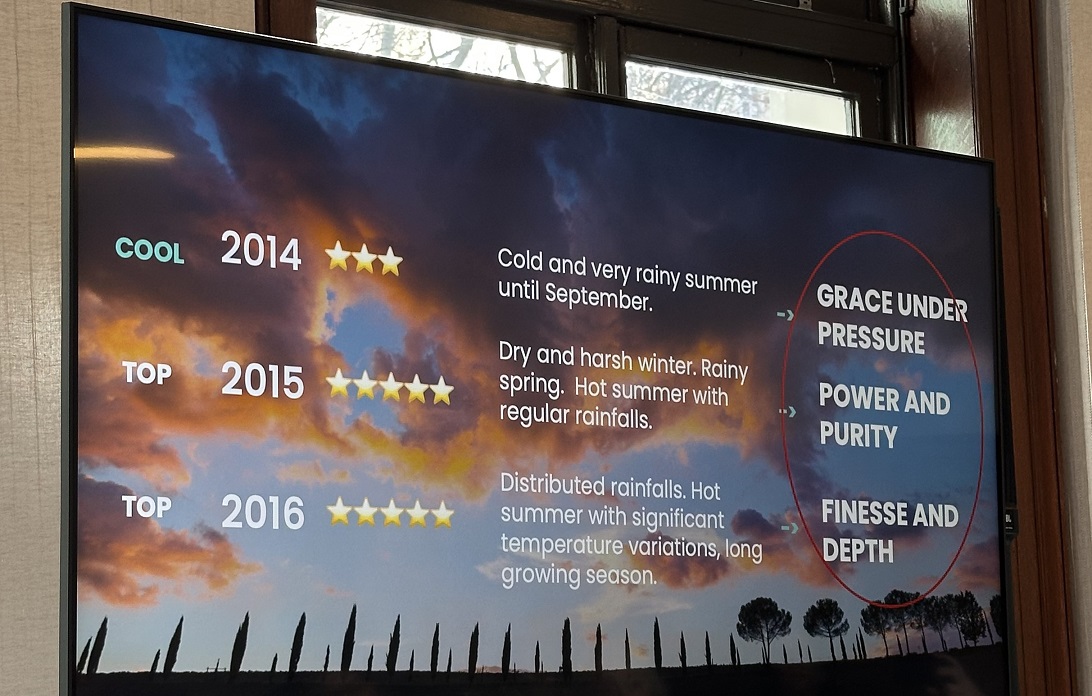
The 2020 Brunello vintage marks the end of the star ratings – this is the last vintage awarded a star rating (5 stars, in case you are wondering). Instead, Consorzio Brunello di Montalcino is introducing Brunello Forma, which will only provide a verbal description of the vintage moving forward.
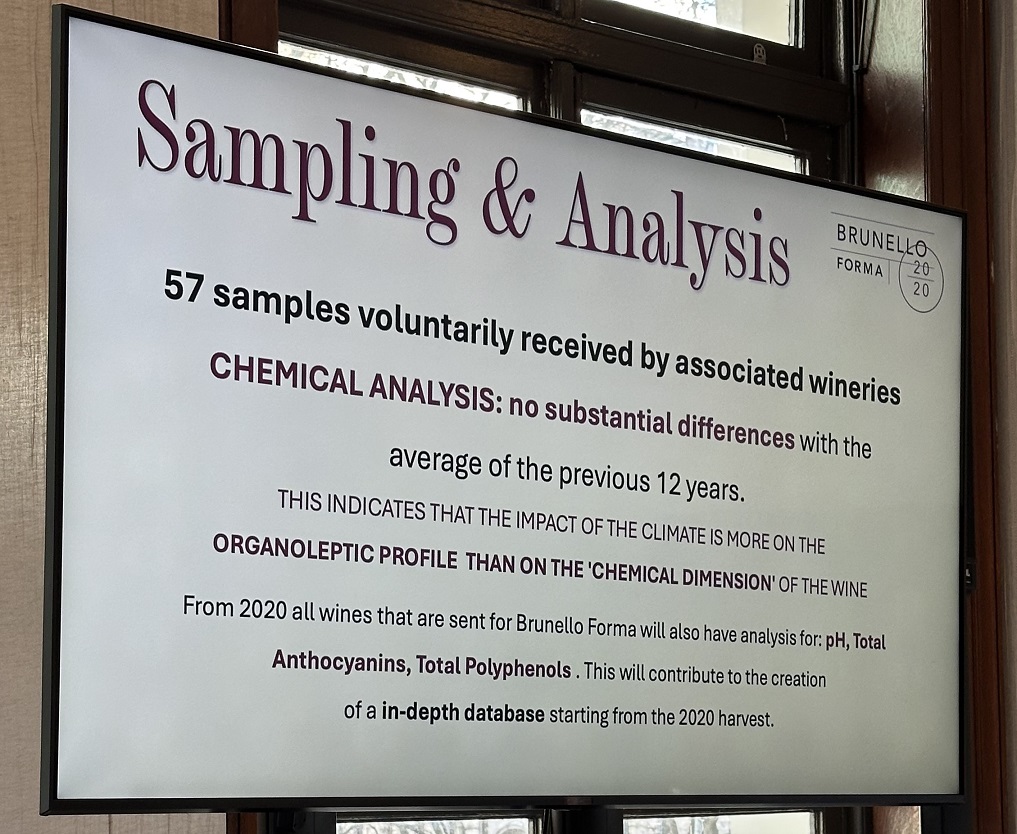
A significant amount of effort went into the creation of the new system. 39 weather stations were installed around the region to collect the microclimate data. Historical data of the past 12 years were collected and a significant number of samples from the past vintages were blind tasted to come up with the set of data which will allow to make vintage assessment more scientific, I guess.
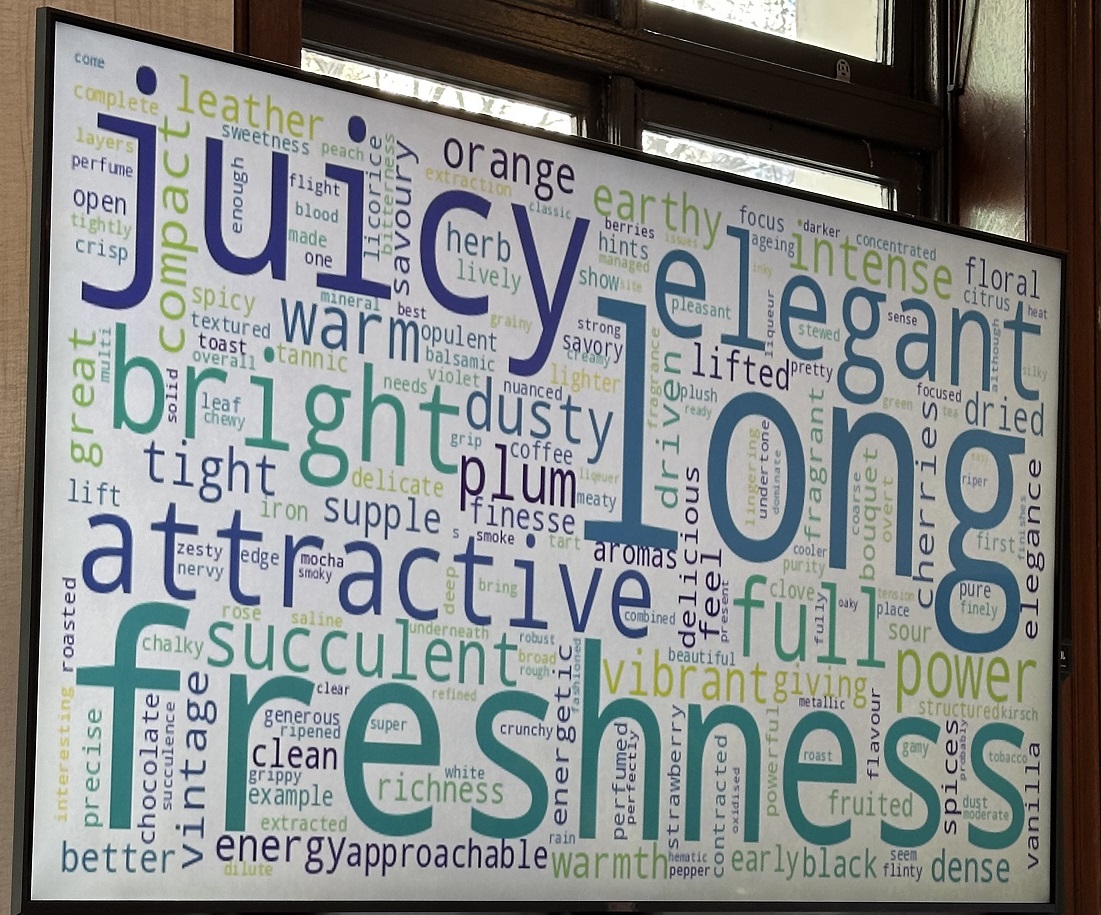
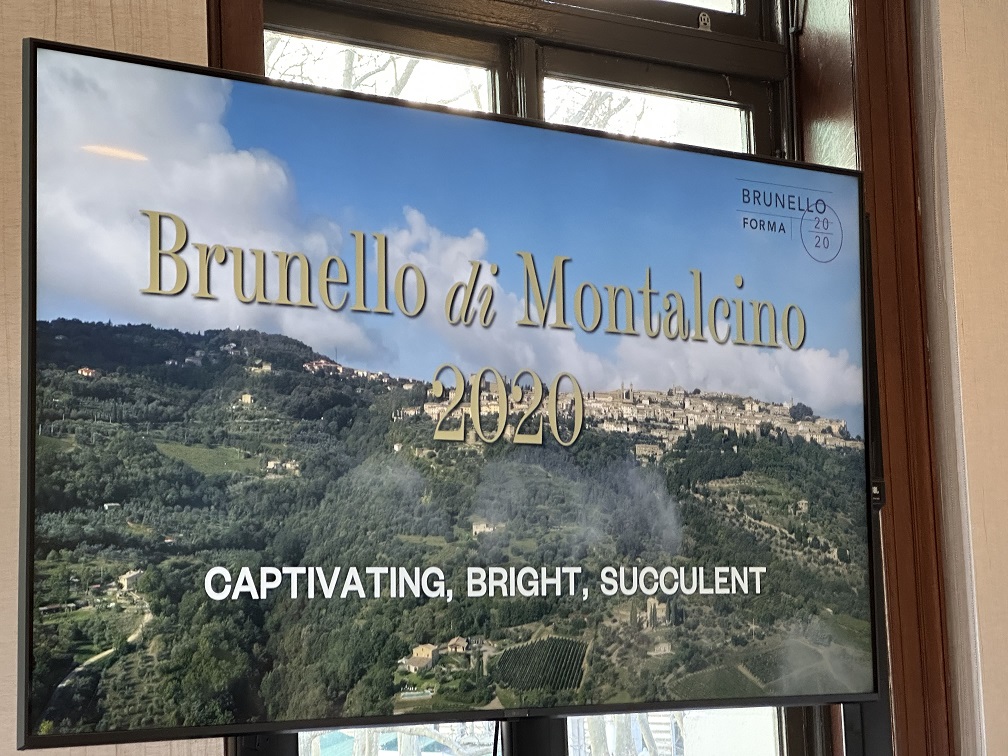
To come up with the vintage verbal assessment, a panel of industry experts (masters of wine, wine distributors, wine writers) ran extensive tasting of the 2020 wines, then collected and processed a large number of descriptors used by the panel members to crystallize the 2020 Brunello vintage description into these three words:
Captivating, Bright, Succulent
As an engineer at heart, I’m not a fan of words. Simple numerical (3 stars, 92) or verbal (fair, good, very good) rating quickly gives me everything I need to know about the vintage in general – captivating or succulent doesn’t set my expectations about a given wine – not now, and especially, not in the future.
However, as it was explained later on during the dinner with Giacomo Bartolommeo, Brunello winemaker at Caprili, the star ratings were hurting the wineries, as wine buyers preferred to ignore wines from 3-star vintages and focus on acquiring better-rated vintages, without much regard to the qualities of the particular wine. Moving to verbal descriptors eliminates the opportunity for a quick rating-based decision. Well, winemakers are in the business of selling their wines, so it is not my place to complain or judge.
Then, of course, there were wines. I have to say that in the traditional Italian style (please take no offence), the tasting order was changed by our presenter, Gabrielle Gorelli, MW, compared to the order written on the notes page. However, I have to say that our tasting order was definitely the right one, showing progression from very tight and lean wines to wines that were softer and more approachable now. I attended both seminars, so below are my notes:
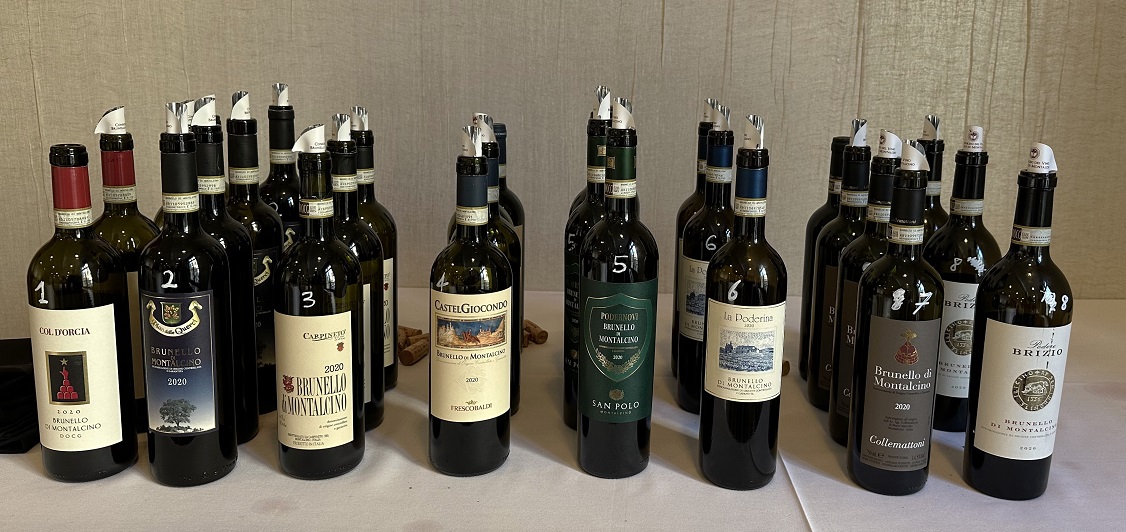
Morning Seminar
Col D’Orcia Brunello di Montalcino 2020
Ruby Color
Interesting nose, sapidity, earthy undertones, leather
Tart is the first sensation; tart cherries, expressive tannins, crisp acidity
Pian Delle Querci Brunello di Montalcino 2020 (36 months in Slavonian oak)
Dark ruby color
Sweet cherries, perfumy, very playful
Not as tart as the previous wine, but has very explicit tannins, good acidity, but lacking fruit, very lean
Carpineto Brunello di Montalcino 2020 (vineyards planted on the oldest soils, 3 years in big oak barrels)
Garnet color
Sweet tobacco, cherries, plums, attractive
Initially showed beautiful cherries, the tartness kicked in, followed by very dry finish with big but well integrated tannins
Marchesi Frescobaldi Castelgiocondo Brunello di Montalcino 2020 (single vineyard, aged in big casks)
Garnet color
Beautiful nose, elegant, perfumy, with a touch of sweet cherries.
Tart cherries on the palate, herbs, tart finish with well pronounced tannings.
San Polo Podernovi Brunello di Montalcino 2020 (30 months in light-toast 40hl casks)
Garnet color with bright reddish hues
Beautiful nose, elegant, perfumy, sweet cherries, eucalyptus.
Tart cherries, tannins are overwhelming, but the most elegant finish so far.
Probably can be enjoyed now after decanting
La Poderina Brunello di Montalcino 2020
Dark Garnet
Playful, bright red fruit, cherries, herbs, sweet oak.
Palate is a tad bitter, strange, had to swallow the wine instead of spitting to establish that it was not corked. Overall, not bad, but the nose is way better than the palate.
Collematoni Brunello di Montalcino 2020
Dark ruby color, beautiful
Beautiful nose, sweet fruit, cherries, sage, beautiful.
The best palate so far – round, with sweet and tart cherries, elegant, delicious.
8+
2020 Podere Brizio Brunello di Montalcino 2020 (38 months in oak)
Dark garnet
Beautiful, open, sweet fruit, sweet cherries, pencil shavings.
Tart cherries, explicit balsamic notes, succulent, mouthwatering, round, delicious, beautiful, superb.
8+
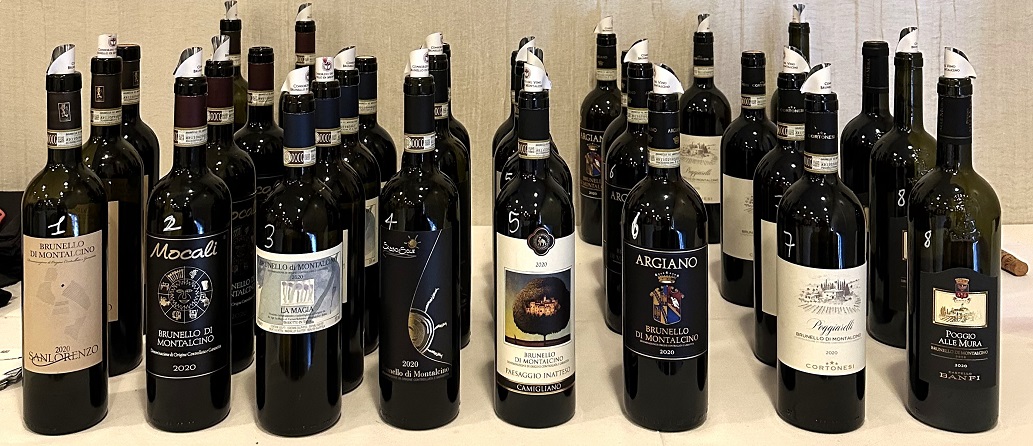
My favorite two wines of the morning seminar:


Afternoon seminar
Sanlorenzo Brunellodi Montalcino 2020 (aged in oak for about 3 years)
Garnet color
Beautiful, sweet fruit, cherries, dark undertones, earthiness.
Intense fruit quickly dissipates into very tart, very high expression tannins and acidity on the finish. Super-lean.
Mocali Brunello di Montalcino 2020
Dark garnet
Interesting nose, maybe racy is a good descriptor? Garrigue, some cherries show up a bit later.
Lots of sweet cherries which instantly disappear, but the finish is a bit less tart than the previous wine.
La Magia Brunello di Montalcino 2020
Very dark, practically black, darkest of the tasting so far
The nose is restrained, earthy and herbaceous
Sweet cherries, sweet oak, then tart, acidic, and ultra-tannic on the finish, very dry
Sassodisole Brunello di Montalcino 2020 (minimum 24 months in oak)
Dark Garnet
Cherries, sage, perfume, nice and open
Tart cherries, leather, well-integrated tannins
So far, the most approachable wine of the tasting
Camigliano Paesaggio Inatteso Brunello di Montalcino 2020 (30 months in oak barrels, 10 months in cement tanks after)
Bright ruby
Underbrush, a hint of smoke
Tart cherries, fresh cleansing acidity, acidic finish with some tannins, not bad.
Argiano Brunello di Montalcino 2020 (30 months in Slovenian oak casks of different capacities)
Dark garnet
Nice, inviting, round, dark fruit, a touch of crushed rocks.
Sweet cherries, crunchy and succulent, great energy, cherries on the finish, delicious.
8+, the best of the second seminar
Cortonesi Poggiarelli Brunello di Montalcino 2020 (24 months in oak)
Dark garnet, almost black, with bright hues
Amazing nose. Cherries that magically pull you in.
Fish and powerful opening on the palate, but bitter tannins set in.
Best nose of both tastings, 9-/9. Palate is not great right now – 7+
Banfi Poggio Alle Mura Brunello di Montalcino 2020 (24+ months in French oak)
Dark garnet with bright hues
Nice, open nose with lots of fresh herbs – sage, thyme.
Sweet dark fruit on the palate initially, then the palate is quickly shut down in front of the mouth. Again, if you swallow this wine instead of spitting, the wine is a lot more generous. Succulent is a perfect descriptor for such a wine. 8+
Best wines of the second seminar:


In addition to the seminars, there was tasting on the “main floor”. There were more of the excellent 2020 Brunellos, such as San Felice, Caprili, or Corte Pavone. There were also many of the 2019 Brunello di Montalcino Riserva wines, which were simply outstanding. Additionally, 2023 Rosso di Montalcino were presented by almost all participating wineries and were excellent across the board.
My Brunello deep immersion didn’t stop there. After the event was over, we went for dinner with John Fodera and Giacomo Bartolommei, the winemaker at Caprili, to the wonderful Italian New York restaurant Zero Otto Nove, famous not only for genuine Italian food but for the amazing wine list. There, Giacomo found 2001 Cerbaiona Brunello di Montalcino, which we ordered.
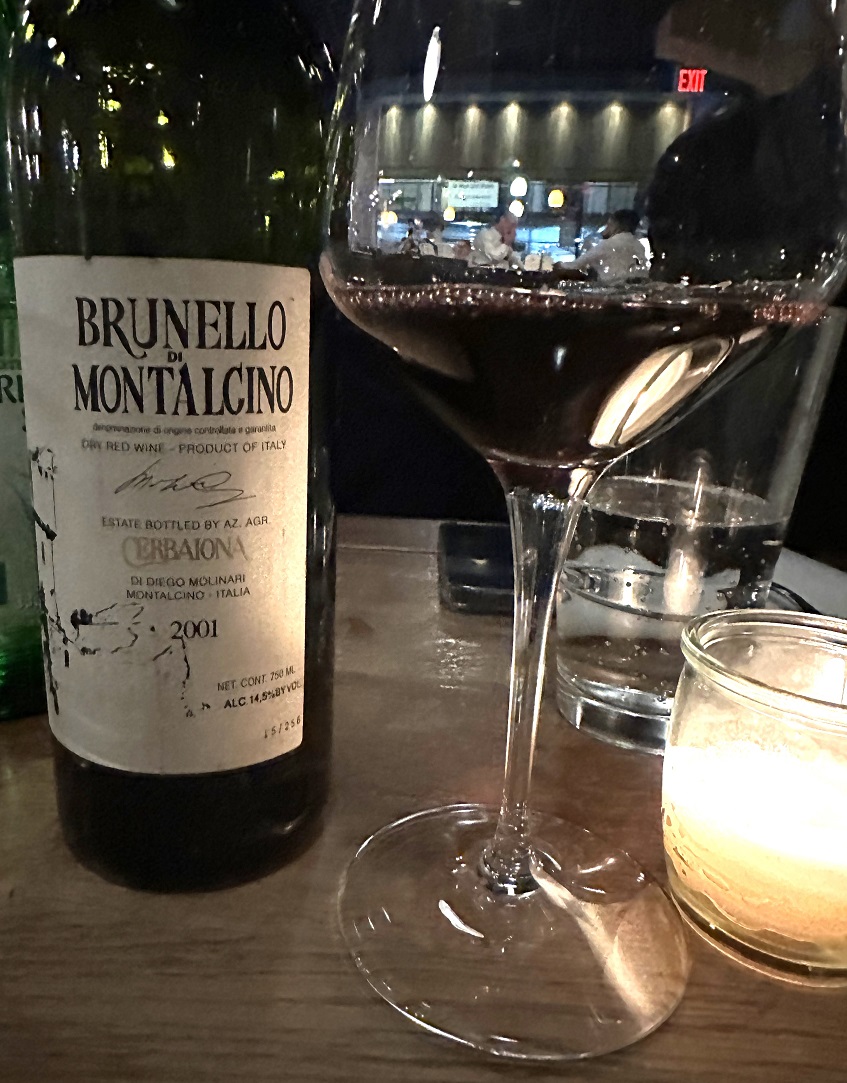


Wow, what a pleasure it was. Perfumy nose of succulent cherries, anis, eucalyptus. You can’t stop smelling the wine, you don’t even think of drinking it for a few minutes. Then you take a careful sip and experience an explosion of flavor with succulent cherries, balscami vinegar, iodine, and magic that only an Italian wine with age can offer. The experience was not identical to 1999 Soldera, but it was pretty darn close.
And now my Brunello report is complete. The 2020 vintage offers beautiful aromatics; it is approachable, it is succulent, it is captivating. Let’s raise the glass to the new era in Brunello and more tasty Brunello wines for us. Cheers!
Valentine’s Day 2025 – Reflecting on Wines
In my previous post, I complained about frustration with choosing the right wine for the right moment. That post ended with a picture of the wines I selected for Valentine’s Day 2025 – and now I want to talk about those wines.
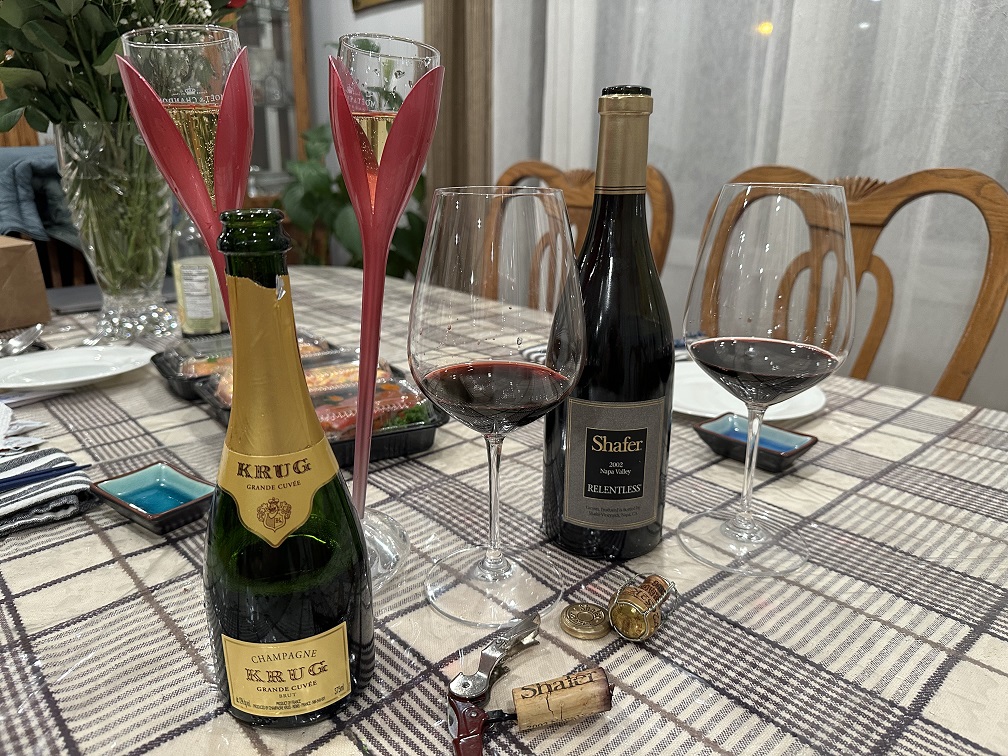
Following my own advice, our first wine was sparkling. Not just any sparkling – it was Champagne. And not just any Champagne – it was Krug.
I don’t want to sound elitist, but the only way to put is this: those who know, know Krug.
For the wine lovers en masse, the epitome of champagne is Dom Perignon. Maybe also Crystal on a good day. Krug definitely is lesser known, but for those who know, Krug is a cult, a religion, the only Champagne one can drink.
I joined that cult after experiencing Krug vintage and non-vintage wines during the PJ Wine Grand tasting in New York in 2010. Krug was an absolute revelation, I have never tasted anything like that ever before.
Then a few years later, in 2012, I came across an article by Alice Feiring, talking about changes in winemaking at Krug in 2003 which she said resulted in more or less the “end of Krug”. I referred to her article in my post, but unfortunately, the original article can’t be found so I can’t share any more details. I only remember tasting Krug at the trade tasting in the same year or maybe the year after, and thinking “well, it is not as good as I remembered it“.
Trade tasting is not always the best place to fully understand the wine, so Krug remained high on my “wines I want” list. Then a few years back, I got this half-bottle of Krug as a present for the new year, and this year I decided that Valentine’s Day is a perfect reason to open that bottle.
After struggling a bit with the cork, I managed to get the wine into our flutes (I know, I know – but it is a holiday, okay?). Smelling and tasting it left both me and my wife underwhelmed. Crisp and acidic for sure, but that’s what literally every other Champagne has, and Krug should really give you more. A few more sips and I closed the bottle, and back into the fridge it went.
Not so long ago, I read an article from a champagne pro, and he suggested that Champagne, similar to any other still wine, can and usually improves after opening. It can be placed into the fridge and enjoyed slowly over the next few days, and many of the Champagnes simply taste better the next day.
Why is this important? When I poured what was left of Krug into the glass the next day (okay, it was a regular glass), that was a totally different wine. Rich, layered, with toasted bread and apples. This was the real deal and it was delicious. I can’t tell you if it tasted like the one I was blown away by in 2010, but it was definitely an excellent Champagne. I guess there is an interesting lesson here for future encounters with Champagne, and not only with Krug.


After Krug’s image was somewhat restored in my eyes, I decided to learn more about the wine. Nowadays every bottle of Krug comes with its own unique code. When you go to the Krug website and type in the code, you get the most detailed information about the wine you can wish for – here are a few excerpts related to my bottle:
“Krug Grande Cuvée 170ème Édition
Composed around the harvest of 2014, Krug Grande Cuvée 170ème Édition is a blend of 195 wines from 12 different years. The youngest is from the year 2014 and the oldest dates back to 1998.
In all, reserve wines from the House’s extensive library made up 45% of the final blend, bringing the breadth and roundness so essential to each Édition of Krug Grande Cuvée.
The final composition of this champagne is 51% Pinot Noir, 38% Chardonnay and 11% Meunier.
Time in the cellar:
This half-bottle spent around 7 years in Krug’s cellars developing its generosity and elegance, receiving its cork in Autumn 2020.”
According to Julie Cavil, Krug Cellar Master:
“In this blend, the dynamic Pinot Noirs of 2014 came from a wide range of plots throughout the Champagne region, while fruity and full-bodied Chardonnays were selected from plots in the Montagne de Reims, Sézannais and Côte des Blancs. The Meuniers from the Vallée de la Marne Rive Gauche were particularly bright, with magnificent fruit expression from plots in Leuvrigny. To complement the wines of the year, we selected reserve Pinot Noirs from plots in the Montagne de Reims Sud renowned for their structure, including an Ambonnay from 2005. Reserve Chardonnays from plot’s wines from Avize and Mesnil-sur-Oger over a wide spectrum of years have a nice share of voice in this blend, while reserve plot’s wines of Meuniers add freshness, intensity and chiselled structure.”
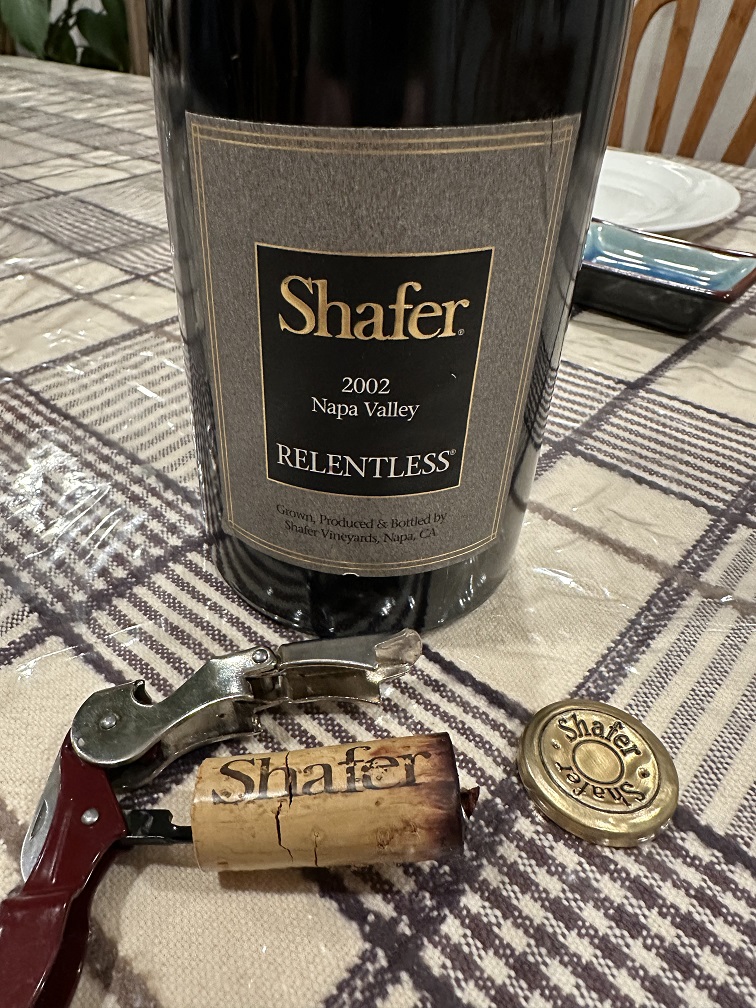
And then there was 2002 Shafer Relentless Napa Valley (14.5% ABV, 80% Syrah, 20% Petite Sirah). I tasted this wine a few times before at the trade tastings, but never had an opportunity to really spend some time with it.
Shafer needs no introductions to California wine lovers, with its fame closely associated with the flagship wine, Shafer Hillside Select Cabernet Sauvignon. Shafer Relentless is not as well known, but this Syrah blend has been around for more than two decades, named in honor of Shafer’s [relentless] winemaker, Elias Fernandez.
We didn’t decant the wine – it would probably help a bit, but I just didn’t want to deal with it. At first, the wine was tight, with well-noticeable tannins and an interplay of tar and cherries, with the addition of pepper. After some time in the glass and opened bottle, the tar subsided, leaving delicious peppery cherries to be admired around a layered but firm core. This 23 years old wine showed beautifully and it was a real treat.
Now the last piece – food. We stopped going out to the restaurants on Valentine’s Day a long time ago – the experience just not worth it. We were craving sushi for some reason, so that is what completed our Valentine’s Day dinner – here you can see some creative rolls from an Asian restaurant not too far from our house.


There you are my friends – our V-day reflections. How was your celebration? Any special wine experiences? Do tell! And until the next time – cheers!
Pinot Noir Battle – Let the Best (but Most Unexpected) Win…Again
It all started with a few tweets. I noticed a very high praise for the German Pinot Noirs shared by some of the European wine lovers I’m connected to on Twitter (still can’t make myself call it X, so you will have to forgive me for that). Particularly, Pinot Noir from Ahr was regarded as the best in the world, handily beating Burgundies on any occasion. I was intrigued and started searching for the Pinot Noir from Ahr, which proved to be challenging.
Ahr is a tiny region, one of the smallest in Germany – according to Wines of Germany, Ahr has only about 529 hectares of vineyards (around 1,323 acres), which comprises 40 single vineyards. 65% of the vineyard area is planted with Pinot Noir, about 860 acres – for comparison, the Jackson Family mostly Pinot Noir plantings in Oregon alone amount to roughly 600 acres. You can imagine that finding Pinot Noir from Ahr in the US was rather challenging.
The more I saw Ahr Pinot-praising tweets, the more I wanted to try it. Then one day I checked Wine.com, and there it was – Pinot Noir from Ahr, made by Meyer-Näkel. I quickly went to the Twitter folks to check if this wine would sufficiently represent the Ahr region, got an approving nod, and bought a bottle.
Once the wine arrived, I thought of the best way to try it. When it comes to learning about wine, tasting wines side by side is the best way to learn. Oh yeah, and if you want to be honest with yourself, blind tasting is the only way. We tend to be led by what we know, by our beliefs. Once we know that the wine costs $100, we want to believe that it is better than the bottle which costs $50. Once we see a bottle of Cabernet Sauvignon from Napa Valley in California, we automatically assume that it will be much better than the Cabernet Sauvignon from Lake County or Lodi. Nothing is wrong with us, this is how the brain works – so once you remove all the factors of influence, once you get one on one with the liquid in your glass without knowing the producer, the region, the price – it is very easy to be honest with yourself. So blind tasting it is.
Sometimes we don’t realize how fast the time passes. I love talking about blind tastings when I’m talking about wine, and I have a few of my favorite blind tasting examples, one of them particularly being the Pinot Noir blind tasting we have done in the past. What I didn’t realize is that the particular wine tasting I remember so well took place almost 15 years ago (time flies, isn’t it). The outcome of the tasting was very surprising, with South African Pinot Noir from Hamilton Russell beating California, Burgundy, and others – 15 years ago I didn’t even know that South Africa produced Pinot Noir!
Many things have happened in the wine world over these 15 years – of course, Pinot Noir is one of the oldest red wines produced in the world, but now it is literally produced everywhere – I don’t know if today there is a country which doesn’t produce Pinot Noir wines (maybe Spain?). Also, the quality of Pinot Noir throughout the world got a lot higher. The tasting you are about to read about is the perfect illustration of both points – the widespread geography and quality.
Okay, a blind tasting of Pinot Noir. The Ahr Pinot Noir got high praise, so we need to compare it with the best of the best – which means that we have to have California, Oregon, and Burgundy in the tasting, plus whatever else we might be able to find. I asked for a few samples of Oregon Pinot Noir. Very conveniently, Last Bottle had an offer for Chacra Pinot Noir from Patagonia – a different Pinot Noir from Chacra was James Suckling’s wine of the year recently, so this was a good addition to the tasting. Bottle by bottle, we assembled 12 Pinot Noirs from around the world, and the battlefield was ready to be set up.
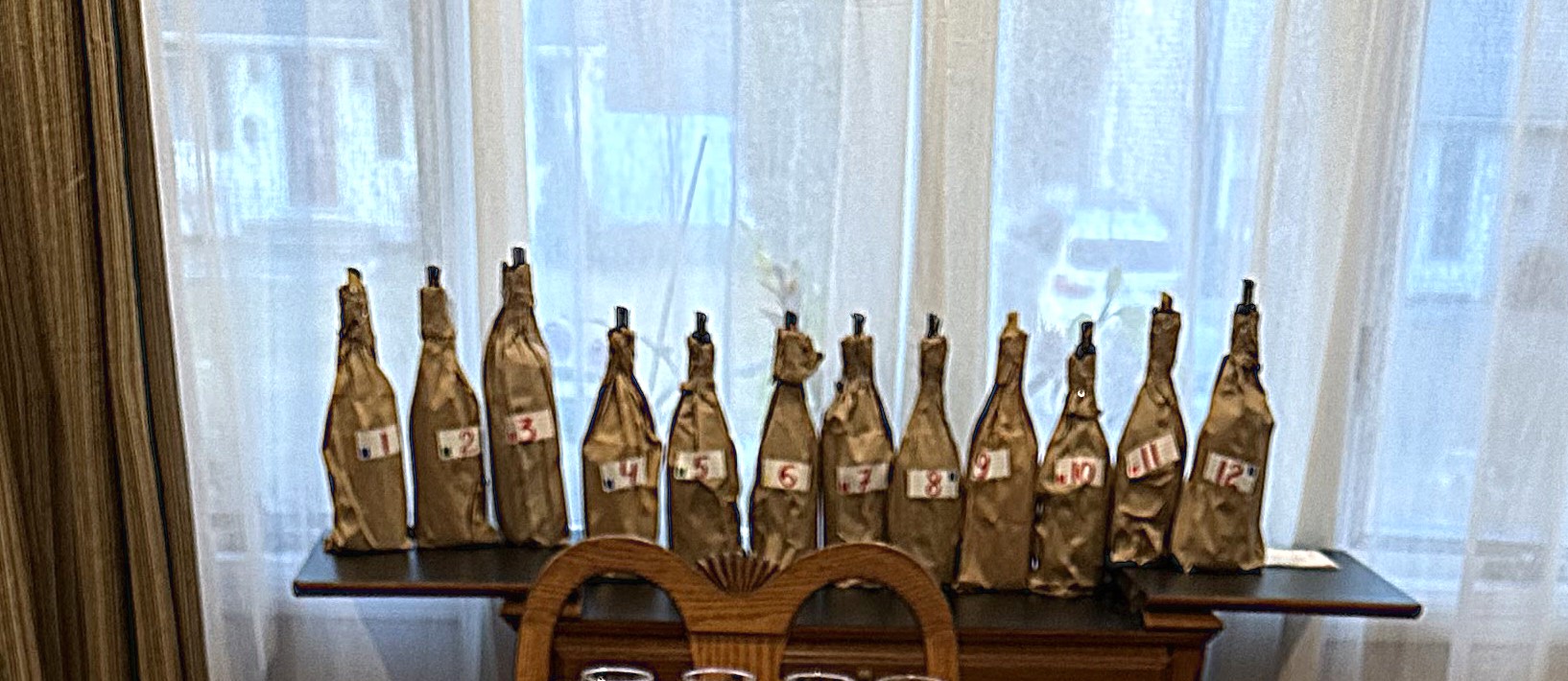
This is a blind tasting, so we placed all bottles in the paper bags, and then my daughter who was now a participant in the tasting put the labels randomly on the bags (15 years ago her role was limited only to attaching the labels :)). I also prepared a few of the “reference points” for everybody to use in the form of the crushed fruit in the glass – I didn’t find plums in the store, but we had many other relevant “references” – cherries, pomegranate, blueberries, raspberries, blackberries, and even liquid smoke.


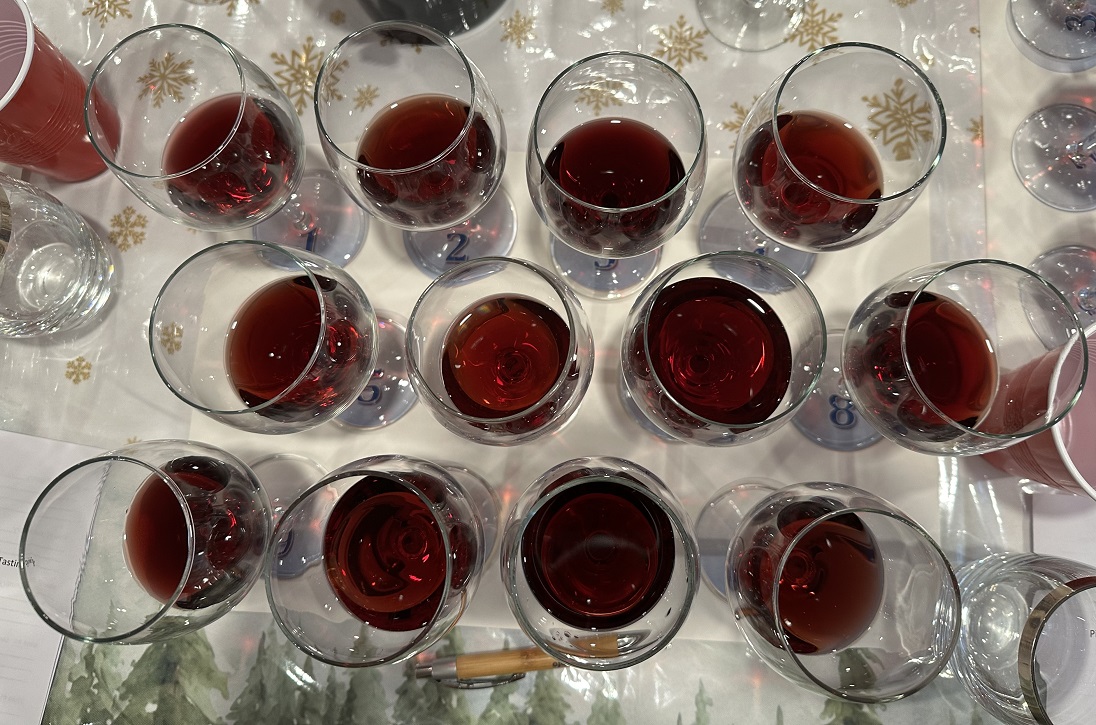
We also had paper for taking notes, and as a reference, I included all the countries that were present in the tasting so we could try guessing the countries for each wine. All countries except the two, as both Zak and I brought in one “surprise” each – Pinot Noir from the countries that are not really known as Pinot Noir producers – we didn’t know what wine the other person was bringing. Here is the list of countries that were offered for everyone’s reference: Argentina (Patagonia), California (Santa Rita Hills), France (Burgundy), Germany (Ahr), New York (Finger Lakes), New Zealand (Central Otago), Oregon (Willamette Valley, 2 wines), Poland, Washington, Surprise 1 (European country not listed above), Surprise 2.
Off we went, tasting and discussing the wines, trying to figure out what was what. Consciously tasting 12 wines in a row is not an easy fit, especially when you try to at least identify the countries. Also, each person (there were 8 of us) was supposed to decide on 3 of their favorite wines so we would be able to vote for the most popular wine of the night, so we had to score each wine. Here score is simply comparative within your notes – 1 through 5, E to A, doesn’t matter, as long as everyone can decide on their favorites.
Here are my notes for all 12 wines as the tasting was happening.
Wine #1: Country: New World (have no idea what I was thinking, I guess something outside of Europe), Vintage: 2021. Cherries, lots of cherries, raspberries, tart cherries on the palate, good balance, nice. Score: 8
Wine #2: Country: Oregon, Vintage: 2021. Iodine, cherries, tart, pepper, tannins, earthy, rocky. Score: 8+
Wine #3: Country: Poland?, Vintage: 2021. Cherries, initially fresh berries, fresh raspberries, sweet cherries, good balance. Score: 8
Wine #4: Country: Argentina?, Vintage: 2019. Gunflint, fresh, crisp, tart, rocky, cherries, excellent. Score:8/8+. Tasting again at the end of the tasting, the wine lost something, so finally score is 8
Wine #5: Country: California?, Vintage: ? Almost black color, dark, aged, medicinal nose, iodine, sweet cherries on the palate, tart. Score: 8-, after retesting later – 8, wine improved.
Wine #6: Country: Oregon? No, Vintage: ?, carrot juice on the nose, very grippy tannins on the palate, cherries. Score: 7+
Wine #7: Country: ? , Vintage: ? Beautiful color, Rutherford dust, hint of cherries, tannins and cherries on the palate, good balance. Score: 8 initially, 8+ after breathing
Wine #8: Country: Germany, Vintage: ? Love the garnet color, smoke, tar, concentrated nose. Wow! Superb – cherries, concentrated, good acidity, good balance. Score: 8++
Wine #9: Country: Oregon, Vintage: ? Pencil shavings, Rutherford dust, tannins, cherries, elegant but needs a touch more acidity. Score: 8
Wine #10: Country: ?, Vintage: ? Pomegranate seeds, cherries, very tight. Cool aid, cherry cola Score: 8-
Wine #11: Country: Finger Lakes, Vintage: ? Smoke and rubber, tar, on the nose. Rubber, tannins, cherries, became more balanced after breathing Score: 7+ initially, improved to 8 on the second tasting.
Wine #12: Country: Oregon, Vintage: ? Cherries, vegetation, cool aid on the nose. Cherries, good balance, good acidity, excellent. Score: 8+, went down to 8 after re-tasting as the finish showed sugar candy.
Ugh, this was not an easy tasting, but it was finally complete. Time to decide on favorites. First, everyone had to make their own decisions for the 3 favorite wines. After re-tasting and struggling, my list of favorites in descending order looked like this:
1st favorite: #8
2nd favorite: #2
3rd favorite: #7
Next, the vote. Remember, each person (there were 8 of us) was allowed to vote for 3 favorite wines, thus we just called the wine number and asked to see a show of hands. Here are the results.
Wine #1 – 1
Wine #2 – 5
Wine #3 – 1
Wine #4 – 0
Wine #5 – 0
Wine #6 – 3
Wine #7 – 3
Wine #8 – 3
Wine #9 – 3
Wine #10 – 1
Wine #11 – 1
Wine #12 – 3
Therefore we had a clear winner – wine number 2, and 5 wines in the second place with 3 votes each – #6, #7, #8, #9, and #12.
Next came the best and final part of the blind tasting – the reveal! Would you believe me If I told you that the revealed bottle elicited a loud “oh, wow, really” literally from everyone? Surprise after surprise after surprise.
The most popular wine? Pinot Noir from (drum roll, please)
Japan!
Seriously, Japan??? How? Yes, Japan makes wine, but to make Pinot Noir that shows better than Oregon, California, Burgundy, and all other countries? Just wow. Apparently, this is an impossible-to-get “cult” wine, produced in minuscule quantities, $100 wholesale but $300 retail if you can even find it? That was the first “surprise” wine.


Pinot Noir from Poland that was very good? How about that? My favorite wine of the tasting, Southern Lines from Central Otago, by some absolute miracle was $15 per bottle – how is that even possible (it is a case buy if you can find it at that price).
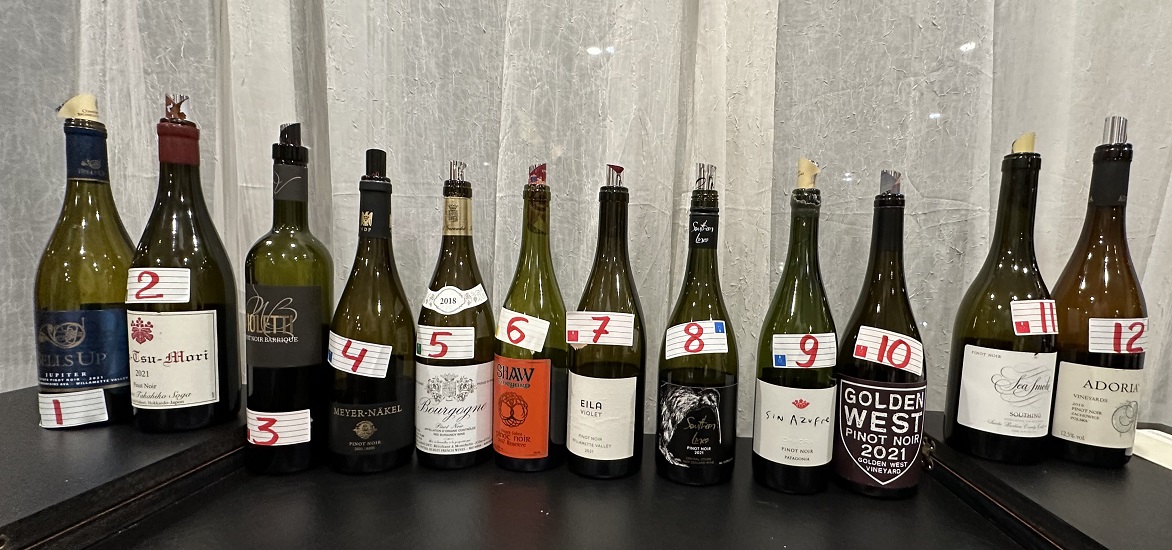
Here is the full list of wines in the numbered order:
- 2021 Bells Up Jupiter Pinot Noir Estate Chehalem Mountains AVA (13.5% ABV, $50)
- 2021 Domaine Takahiko Soga Nana-Tsu-Mori Pinot Noir Hokkaido Japan (13% ABV, $300?)
- 2022 Violetti-Rebbau Pinot Noir Barrique Vin de Pays Suisse (13% ABV, $N/A)
- 2021 Meyer-Näkel Pinot Noir Ahr Germany (12.5% ABV, $56 at Wine.com)
- 2018 Paul Garaudet Pinot Noir Bourgogne AOC (13% ABV, $39)
- 2017 Shaw Vineyard Pinot Noir Reserve Finger Lakes New York (13% ABV, $N/A)
- 2021 EILA Violet Pinot Noir Willamette Valley (12.7% ABV, $65)
- 2021 Southern Lines Pinot Noir Central Otago New Zealand (13.5% ABV, $15)
- 2022 Chakra Sin AzuFre Pinot Noir Patagonia Argentina (12% ABV, $30 Last Bottle)
- 2021 Golden West Pinot Noir Goden West Vineyard Royal Slope Washington (14% ABV, $21)
- 2011 Sea Smoke Southing Pinot Noir Santa Rita Hills Santa Barbara County (14.5% ABV, $100?)
- 2021 Adoria Vineyards Pinot Noir Zachowice Poland (12.5% ABV, $25)
You see, this is what blind tasting does. Under the guise of the brown bag, all wines are “the same”. You are not influenced by anything – “ahh, I brought this wine, it must be better”, “ahh, the guy in the store was raving about it so much”, “ahh, it got 99 points from Suckling” – none of this matters. You let your palate be the judge. Wine has to give you pleasure.


As the wines were left at my house after the tasting, I was the lucky bastard who had an opportunity to taste them over the few next days. This is not how the general population consumes wines, so this has very little bearing on the results and the whole tasting process, but I can tell you that for example, the Sea Smoke Southing became literally my favorite wine – it developed a depth of flavor and a beautiful complexity – if it would taste like that during the tasting it would be handily the wine number 1, for sure for me. The Pinot Noir from Ahr also developed additional layers, with gunflint and roasted meat notes now dominating the flavor profile in a very respectful manner, making it a lot more pleasant to drink – again, in that state it would again get a much higher rating in my book. And pretty much across the board, the Pinot Noirs continued their evolution and most of them were still drinkable even 5 days after being open – a testament to quality.
Here we are. 15 years later, the most unexpected Pinot Noir wins again. But this is the beauty of wine. The mystery, the enigma, the art. Wine is a liquid art form, and this tasting delivered an unmeasurable amount of pleasure and created new memories. This is what life is all about, isn’t it? Creating good great memories. And wine is exceptionally good at that. Onward and upward.
An Evening of Pure Pleasure
Do you know what makes an oenophile’s heart melt and pound, what fills it with joy? Hearing their friends say after you pour the wine into their glasses
“Oh my god, this is so good!”
This brings a double pleasure – it is not only you now getting the pleasure from the aroma and the bouquet – but your friends also enjoying it as much as you do. Wine is meant for sharing, and this makes sharing so much more enjoyable…
Wine can never be taken for granted. Let’s remember that the wine continues changing even after bottling – each time we open the bottle, we find the content of the bottle in its unique state. Yes, we can hope that if you open all 12 bottles from the case at the same time, all wines will taste the same – but it is still a game of probabilities, with opportunities for the “bottle variation” to be increasingly more noticeable as the wine ages. And I’m not even talking about potential wine faults…
Next, there are expectations. Expectations are a big deal for the oenophile. Just one look at the bottle and an oenophile forms expectations – bottle appearance, place, producer, type of wine, vintage – everything is taken into account, and we know what to expect. It is the most joyous moment when the liquid in the glass meets expectations – and the most daunting when it does not (let’s not get to the corner case of Two Bucks Chuck, please). But there is more to the expectations in wine. One of the biggest challenges with wine expectations lies in the fact that it doesn’t matter how much you like the wine and how well your great expectations are met – everyone’s palate is different. It is hard learning to be okay with the fact that while you enjoy the wine immensely, your friend doesn’t care for it. It doesn’t make the wine bad. It doesn’t mean that you are wrong or did anything wrong. It simply means that taste is personal, you just need to learn to accept this simple fact of life – and not get upset.
You might wonder why I am talking about all this wine geek mumbo jumbo, why is that important? Simple. No matter how familiar you are with the wine you are pouring, or how many times you have had the wine from the same vintage and producer, when the wine reaches the glass, it is always the moment of revelation. Double that (triple? quadruple?) when you are poring wine for your friends. And even if you think that wine is perfectly perfect, you can never assume your friends will think the same. Wine can never be taken for granted.
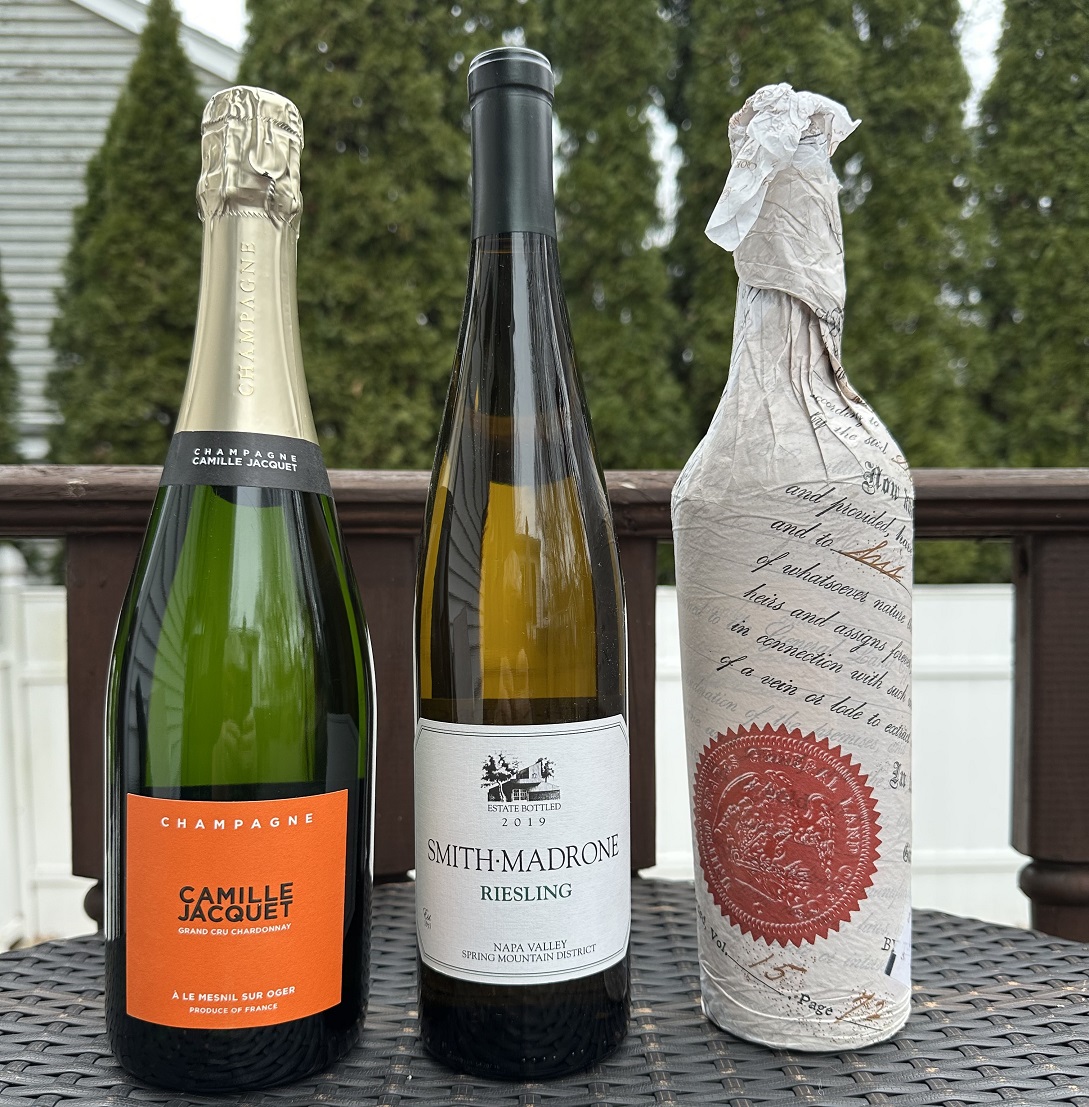 I guess I got lucky. At last weekend’s evening with our dear friends, I managed to hit a double “trifecta” :). Three delicious wines out of three, and my friends loved all three to the “oh my god, this is so good!” moment.
First wine – NV Champagne Camille Jacquet Brut Grand Cru Chardonnay A Le Mesnil-sur-Oger (12% ABV). I do not know the producer, but I had high expectations for this wine possibly for a silly reason. A small village Le Mesnil-sur-Oger is well known for the quality of its Chardonnay vineyards and a home to some of the best (if not the best ) Blanc de Blancs Champagnes in the world – Salon le Mesnil and Krug Clos du Mesnil. Knowing that Camille Jacquet Champagne comes from basically the same vineyard gave me high hopes (silly, as I said) for this Champagne. And my high expectations were perfectly met. Beautiful nose of toasted bread with a touch of apple, impeccably crisp, fresh and precise on the palate. The acidity was fully in check with the complexity of the toasted, baked goods on the palate, leading to an impeccable (yes, I know I already used that word) balance. “Oh my god, this is so good!” said my friends, and the wine disappeared in a jiffy.
Next, two beautiful wines from one of my favorite producers ever. Over the years, I wrote about Smith-Madrone wines extensively. Cooks’s Flat had been one of the Talk-a-Vino Top 10 Wines of the Year 2019 top wines (that year, I had 3 #1 wines, tell me about my inability to make decisions), and Smith-Madrone Cabernet Sauvignon was #3 on the Talk-a-Vino Top 23 of 2023. So I was very happy that I got the samples of Riesling and Cook’s Flat and was able to share both wines with my friends (I will also taste a nice vertical of Smith-Madrone Riesling, it will take a central stage on these pages soon).
Smith-Madrone Riesling is one of my favorite Rieslings in the world – it is one of the 3 if you are interested – Grosset Polish Hill Claire Valley Australia, Smith-Madrone from Napa Valley, and Brooks Ara from Oregon. This 2019 Smith-Madrone Riesling Spring Mountain District Napa Valley (13.3# ABV) was spectacular. First, it offered a tremendous pop of petrol on the nose – and nothing makes my Riesling lover’s heart happier than these petrol aromatics, coupled with a whiff of honeysuckle. On the palate, it was fresh, energetic, with a wide range of citrus flavors readily present, from Meyer lemon to oranges and mandarines, supported by clean acidity and a perfectly cleansing acidic finish. Delicious, and the second “oh my god, this is so good!” wine.


Finally, the 2018 Smith-Madrone Cook’s Flat Reserve Spring Mountain District Napa Valley (14.2% ABV, 87% Cabernet Sauvignon, 13% Cabernet Franc, 20 months in new French Oak). This wine is designated as “Reserve” and this is not random – it represents the best of the best Smith-Madrone makes, using the best plots, best grapes, and produced only in the best years. This wine also has a historical connection to the parcel of land where Smith-Madrone vineyards where replanted in 1972 – the tissue wrapping the Cook’s Flat bottle is a copy of a land grant document, signed by the President of the United States. Here is the description from the Smith-Madrone website:
“Cook’s Flat Reserve is a proprietary name for a wine that is the culmination of our 50 years of growing grapes and making wine in the mountains of the Spring Mountain District. The name refers to George Cook, the first owner of the property. ‘Cook’s Flat’ was the local oldtimers’ name for the eight-acre plateau-like vineyard block which was replanted in 1972.
The packaging expresses the property’s history and an uncompromising attention to detail. Each bottle is numbered and only around one thousand bottles are produced in each vintage. Each bottle is wrapped in tissue which has been printed with a multi-colored copy of the U.S. Land Office Patent which granted ownership to George Cook and was signed by President Chester Arthur on December 5, 1885. We proudly display the original at the winery.”
What I love about Smith-Madrone wines is textbook precision. So far literally everything I tasted from the winery had this textbook precision of flavor – Riesling is unmistakably Riesling, Chardonnay is unmistakably Chardonnay, Cabernet Sauvignon is unmistakably Cabernet Sauvignon.
This 2018 Cook’s Flat, a blend of Cabernet Sauvignon and Cabernet Franc, was also unmistakably a Cabernet. A core of black currant, a.k.a. cassis, and eucalyptus, supported by sweet tobacco and sweet oak, with a whiff of the bell pepper (love it). On the palate, the textbook flavors continued with succulent cassis, eucalyptus, a touch of mint and bell peppers, firm structure, perfectly integrated and perfectly present tannins, impeccable balance. Just a pure joy. “Oh my god, this is so good!” wine again disappeared in no time, with the last drops almost squeezed out of the bottle.
Here you are, my friends. An evening of pure pleasure – and a happy oenophile who managed to make his friends “oh my god, this is so good!” happy.
I have more happy stories to tell – stay tuned…
For The Love Of The Cab: Cabernet Deep Dive with Domaine Bousquet
I can’t speak for all oenophiles, but at least speaking about moi, there is one question that I dread the most:
What is your favorite wine?
This is not a question I ever want to hear – of course, as soon as people figure that you are “into wine”, this is the question everyone thinks is the most appropriate. And yet this is bad – scrap that – horrible question as it doesn’t have an answer. Or it has an answer – accepting that the answer will be different every time the question is asked.
Maybe a better question to ask is
What is your favorite wine today?
At least this is a question that I can answer.
Today, my favorite wine is Cabernet, or Cabernet Sauvignon and Cabernet Franc, to be more precise. Cabernet is what we are going to talk about today. And not just any Cabernet – all organic Cabernet from Argentina.
I have to admit that Cabernet Sauvignon is one of my most favorite wines not only today but on any day. I find a classic profile of cassis, eucalyptus, and bell pepper, sometimes accompanied by mint and anise simply magical. When I see Cabernet Sauvignon on the label, this immediately sets my expectations – and that is exactly where a huge disappointment opportunity lies. The wine might be very good, but if it is called Cabernet Sauvignon, and then doesn’t offer the aforementioned classic traits, that immediately becomes a letdown, sometimes even unjustifiably so. The good thing is that Argentinian Cabernet Sauvignon is usually very well versed in its classic expression, so it is generally a Cabernet Sauvignon that doesn’t disappoint.
Domaine Bousquet is one of the most impressive wine businesses in the world. I wrote about the history of Domaine Bousquet very extensively on these pages, so I’m not going to regurgitate everything that I already said – instead, I would like to suggest that you read this post, and also this one. However, I will illustrate my statement about the most impressive wine business with a few pictures. Here is what high altitude (1,200 m/4,000 ft) desert looked like in 1990 when Frenchman Jean Bousquet first fell in love with the area while on vacation in Argentina:
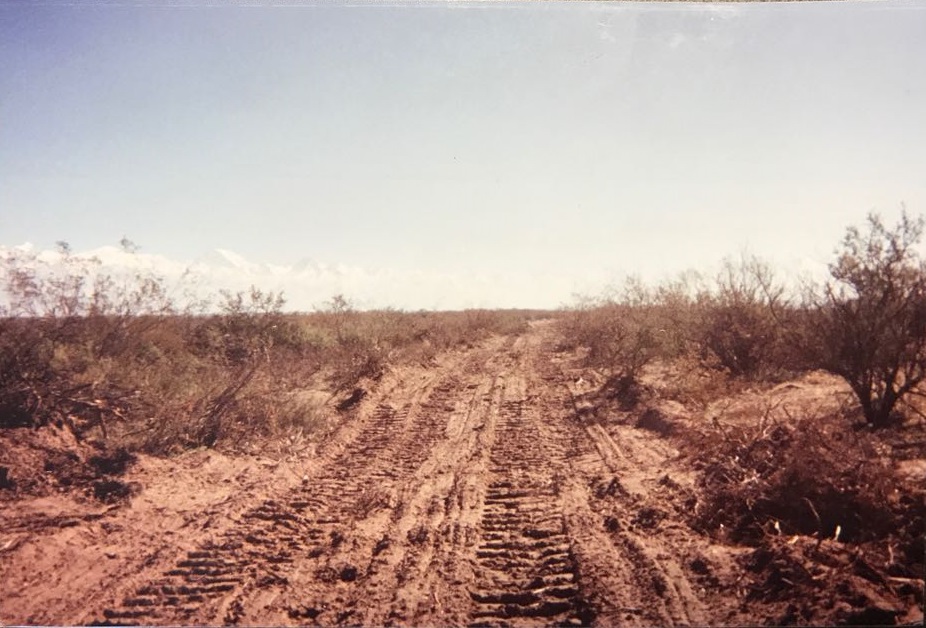
Source: Domaine Bousquet
Here is what it looks like today:
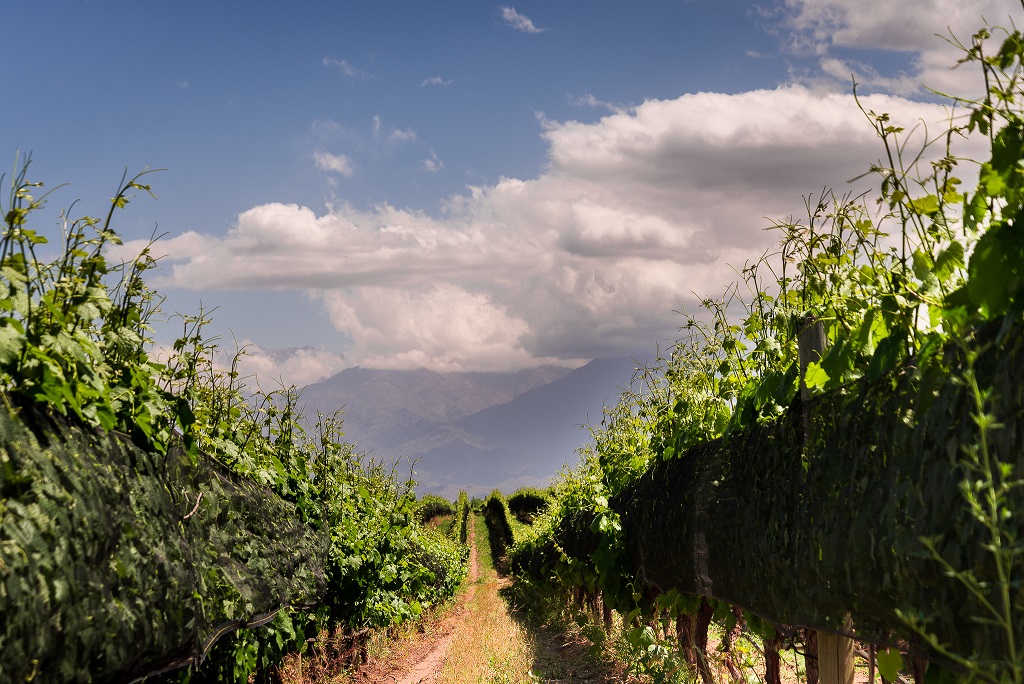
Source: Domaine Bousquet
Here is what domain Bousquet has accomplished in less than 30 years, after being formed in 1997:

Certified B corporation, certified regenerative organic, biodynamic, USDA organic… you can continue decoding the icons on your own. 5 million bottles are produced annually, and I never had a wine from Domaine Bousquet that I didn’t like. I rest my case.
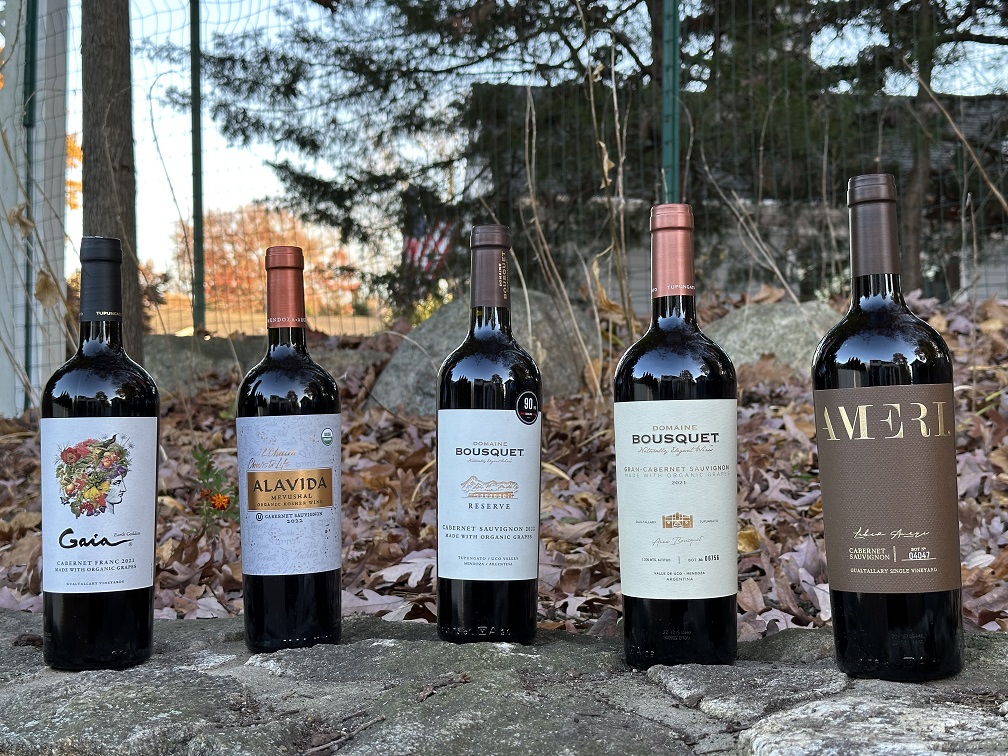
Today we are focusing on Cabernet wines from Domaine Bousquet. While Malbec might be a king of Argentinian wines, Cabernet Sauvignon probably is a royal prince. Argentinian Cabernet Sauvignon wines are world-famous and well sought after. Domaine Bousquet offers a full range of Cabernet wines, both in price and in style. I had an opportunity to taste through such a range, so here are my impressions.
Let’s start with Cabernet Franc first. I love the label for this wine, it is very lively and colorful.
2021 Domaine Bousquet Gaia Organic Cabernet Franc Uco Valley (14.5% ABV, $20, 100% Cabernet Franc, 10 months in used French oak)
Dark garnet
Classic, a distant hint of bell pepper, cassis, eucalyptus.
Cassis, soft tannins with firm structure, a touch of peppery notes, good acidity, excellent balance.
8, delicious and classic
Similar to Hebrew’s L’Chaim! Alavidaalso means To Life! in Spanish. USDA Organic (no SO2 added), unoaked, and Kosher wine is perfect not just for the holidays, but for any day.
2022 Domaine Bousquet Alavida Kosher USDA-Certified Organic Cabernet Sauvignon Uco Valley (14.5% ABV, $18, 100% Cabernet Sauvignon, no added SO2, Kosher)
Dark garnet, almost black
Dark fruit, a hint of dark chocolate
Fresh wild berries, playful, good mid-palate weight, herbs, a touch of sweet oak, excellent balance, delicious.
8, excellent
2022 Domaine Bousquet Cabernet Sauvignon Reserve Tupungato / Uco Valley (14.5% ABV, $18, 6-8 months in French oak, organic grapes, vegan friendly)
Dark garnet
Blueberries on the nose, a hint of eucalyptus
A touch of cassis, tart, a bit astringent, but still well balanced. Tannins are noticeable but well integrated.
7+, needs time
2022 Gran Bousquet Organic Cabernet Sauvignon Uco Valley (14.5% ABV, $25, 85% Cabernet Sauvignon, 15% Malbec, 10 months in French oak, 50% new, 50% used)
Dark garnet
Cassis and eucalyptus in the nose
Cassis, a touch of bell pepper, voluptuous, generous, perfectly balanced, excellent acidity; a delight.
8+, outstanding. This wine was a “California rendition” of Cabernet Sauvignon. Also at this price point, it is a steal.
Ameri is not just a single vineyard but also plot-specific wine made only in exceptional years.
2021 Domaine Bousquet Ameri Single Vineyard Organic Cabertnet Sauvignon Uco Valley (14.5% ABV, $36, 100 Cabernet Sauvignon, 12
months in French oak, 65% new, 35% used)
Dark garnet
Cassis, a hint of bell peppers, a whiff of a leather and sweet oak, complex and inviting.
The beautifully restrained palate leads with acidity, cassis, dark chocolate, well integrated tannins. Wine lost none of its freshness after 3 days. Can age for 25+ years. Outstanding.
8+, delicious. Old world, acidity-driven style, reminiscent of Bordeaux.
Here you are, my friends. 5 beautiful organic, high-altitude Cabernet wines, well worth seeking and enjoying.
Have you had Domaine Bousquet wines? What are your thoughts? Cheers!
Asti: Everyday Wine You Love To Drink But Afraid To Admit It
 Let me ask you a favor: can you please be honest with me?
No, scrap that. Can you please be honest with yourself?
When/if you read this, can you honestly answer a question for yourself: do you like sweet wines?
Be honest with yourself. This is strictly between you and you. Nobody will ever know what you will say. But if you do, have at least the courage to admit it to yourself – “yes, I like sweet wines”.
We are afraid of sugar. When we consume it, we prefer not to even think of it. We are so ashamed at the thought that someone might think we like sugar. You are supposed to hate sugar. We are supposed to enjoy things that are not associated with sugar. Sugar is bad news. Period. This is why nobody would ever want to publicly admit they like sweet wines, as they are evil.
Even if you are not afraid to admit to your affection, sweet wines are a special category. It seems that even the smallest bottle is usually too big. And by the time the dessert is served, nobody wants to drink more wine. But leaving that aside, there is a critical element for the sweet wine to be called enjoyable. I’m sure you can easily guess it, but I will give you a moment to think about it.
Got it?
That element is important across all wines, but in the sweet wines it is really critical – and this element is balance. Balance of all elements can make or break any wine, but in sweet wines, it has to be impeccable for the wine to be enjoyable. The sweetness must be balanced by acidity. If it is not, the wine becomes simply cloying, and not enjoyable (yes, I’m talking about lack of acidity in the sweet wines – never tasted the one with too much acidity). And perfectly balanced sweet wine becomes an ultimate indulgence. Perfectly balanced sweet wine is so sensual, so seductive that… well, I better let your imagination run wild.
Now, is there a way to make this sweet wine experience better? Of course – what if we will add some fizz to this perfectly balanced sweet wine? And make it affordable? And reduce the amount of alcohol – not eliminate, but simply reduce? Would you enjoy it every day? I’m sure the answer is yes. And I have a wine to suggest which will perfectly fit this profile – Asti wines from Northern Italy.

Source: Consorzio Asti DOCG

Source: Consorzio Asti DOCG

Source: Consorzio Asti DOCG
Sweet wines of notice were produced around the towns of Asti and Alba in southeastern Piedmont as early as the 17th century using a grape called Moscato Bianco. It is possible that the wines were produced even earlier, as Moscato Bianco had been growing in Piedmont as long as the Piedmont’s king was, Nebbiolo. The Classic Method of Champagne production has traveled to Piedmont and the first sweet classic sparkling wine was produced in the region in 1870. After the Martinotti method of producing sparkling wines in the tank instead of the bottles was invented in 1895 by Federico Martinotti, it quickly displaced Methode Champenoise as less expensive and significantly less time-consuming. The same method is used in the production of Prosecco. Oh, and look at these beautiful vineyards…

Source: Consorzio Asti DOCG
In 1932, Consorzio per la Tutela dell’Asti (Consortium for the Protection of Asti) was established to develop and ensure the guidelines for the production of Asti wines, known at that time as Asti Spumante. Things were going well until Asti Spumante became a victim of its own success. After World War II, American soldiers coming back were bringing light, sweet, fizzy Asti wines with them, bringing a surge in popularity. As the history of many wine regions shows (Chianti, Amarone, Australian wines at the beginning of the 2000s), such an increase in demand leads to overproduction and a dramatic drop in quality – exactly what happened with the Asti wines which subsequently lost their popularity due to poor quality.
Moving forward, Asti had to redefine itself, step by step. When Asti Spumante DOC was promoted to DOCG status in 1993, producers decided to ditch the Spumante portion of the name, becoming simply Asti instead of Asti Spumante. Producers also changed their production methods and quality controls, often moving towards a less sweet, drier style. The consortium also established a maximum yield for the grapes’ harvest and minimum alcohol levels that need to be achieved after fermentation.
While Asti wines are perfectly enjoyable on their own, they also make one of the very best food-pairing wines. Craving spicy food? Asti will work perfectly with that. Something substantial and salty? Bring on the Asti. Maybe most importantly – and uniquely – Asti wines are incomparable when it comes to pairing with desserts. If you never experienced a glass of Asti with an apple tart or a peach cobbler, you are missing on some of the greatest pleasures in life – you really should try it next time.
As Consorzio is expanding its presence in the US, I had an opportunity to sit down (virtually) with Consorzio per la Tutela dell’Asti Director Giacomo Pondini and ask him a few questions about Asti wines. Here is what transpired in our conversation.
[TaV]: What is the history of wine production in the region? Is Moscato Bianco the only grape that has been cultivated in the region? What kind of wines were produced there before the introduction of sparkling wines in 1865?
[GP]: As in many other places around Europe, the Romans have imported the wine production in Piedmont. And since then, it has thrived. Beyond Moscato Bianco, the historical grapes in the region are red varieties: Barbera, Freisa, Nebbiolo. Probably the most important step towards a more modern style of winemaking, at that time, was made by Camillo Benso Conte di Cavour. Before becoming a fundamental politician in Italian history, he devoted himself to the production of a wine based on Nebbiolo, named Barolo. In the history of Asti wines, the production of vermouth has laid the economical basis for developing the sparkling wine industry, based on Moscato Bianco grapes.
[TaV]: What is the difference between Asti Spumante DOCG and Moscato d’Asti DOCG wines?
[GP]: The main difference lies in the pressure – Asti Spumante, a proper sparkling wine, has to have at least 3.5 bar pressure, while Moscato d’Asti, which is a fizzy wine, 2.5. Then the difference lies in the residual sugar, higher in Moscato d’Asti, where sugars are less fermented and, therefore also less alcohol.
[TaV]: I understand that Asti Spumante wines can be produced using Classic and Charmat methods. What are the styles of Asti Spumante wines produced in the region, the official classification?
[GP]: The classification goes from pas dosè to sweet. Historically speaking, the sweet typology was the only one allowed until 2017, when extra dry, dry, demi-sec were introduced. From 2020, pas dosé, extra brut and brut were also authorized.
[TaV]: What are the best food pairings for the Asti Spumante wines? I know that in Sauternes in France, the region famous for its sweet wines, it is possible to have a full dinner paired with sauternes wines, from appetizer through the dessert. Is it possible to do the same with the Asti Spumante wines? If yes, can you share a sample menu for such a dinner?
[GP]: We know that in many countries Moscato d’Asti and Asti spumante are paired with a wide range of food: from the traditional desserts to cheese, from barbecue to Thai soups, to raw fish and curry.

Source: Consorzio Asti DOCG
[TaV]: What is the annual production of the Asti Spumante wines across all styles and including both DOCGs? How many producers and grape growers are in the region? Any other statistics you would want to share?
[GP]: In 2022 the annual production has reached 102 million bottles, 60% Asti Spumante and 40% Moscato d’Asti. Around 3,000 grape growers and 250 producers.
[TaV]: What countries are the main importers of the Asti Spumante wines? What percentage of annual production is going for export versus domestic consumption?
[GP]: Export covers 90% of the production, both for Asti Spumante and Moscato d’Asti. The main export markets for Asti Spumante are the USA, Russia, Great Britain, and Germany; USA by far is the most important market for Moscato d’Asti.
[TaV]: What is ahead of the Asti Spumante wines, let’s say, over the next 10 years?
[GP]: In commercial terms, an increasing presence in the Asian markets, while also growing the value and the perception. And also, a reason to visit Langhe-Roero Monferato, the area of production in Piedmont, UNESCO world heritage.
[TaV]: Sustainability and organic viticulture – are they used in the region? What percentage of the producers practices sustainable viticulture? Same for the organic?
[GP]: Around 25% of the growers are sustainable or moving in that direction. As a Consorzio we have just started the process of becoming a “sustainable territory”, a certification that involves all the grape growers and wineries in our area of production.
[TaV]: If someone had never had an Asti Spumante wine, how would you convince that person to try the wine for the first time?
[GP]: The aromatic profile of Asti Spumante, as well as Moscato d’Asti, cannot be found in any other wine. An immediate pleasure that makes these wines suited for any pairing or in any joyful moment.
I had an opportunity to taste several Asti wines of different styles – dry (it is Asti dry, not Champagne Brut Nature dry), sweet, sparkling and still. Acidity rules the pleasure in Asti wines – as long as the wine has enough acidity, all of the sweet elements – peaches, apricots, apples, pears, honey – will appear utmost delicious. As a reference, here are the wines I tasted and am happy to recommend – the first two being the most favorite:
NV Acquesi Asti DOCG (7% ABV)
NV Capetta Asti DOCG (7% ABV)
NV BOSCA Esploro Secco (dry) Asti DOCG (11% ABV, sugar 17–23 g/l)
NV Giacomo Scagliola “SiFaSol” Moscato d’Asti Canelli DOCG (5.5% ABV)
NV Bersano Monteolivo Moscato d’Asti DOCG (5.5% ABV)
NV Cascina Cerutti Siri Sandrinet Moscato d’Asti DOCG (5.5% ABV)
NV Matteo Soria Bric Prima Bella Asti DOCG Extra Dry (12% ABV)
2022 Vittorio Bear Moscato d’Asti DOCG (5% ABV)
NV Sanmaurizio SATI Asti DOCG Secco (11.5% ABV)
NV Arione Asti DOCG Extra Secco (12.5% ABV)
NV Tosti Asti DOCG (12% ABV)
NV Bussi Piero Moscato d’Asti DOCG (5.3% ABV)
Before we part, let me ask you something.
Are you convinced now that sweet wines are not evil, or do you still need more convincing? Let’s do a simple math here. A typical glass of Asti wine contains between 8 and 12 grams of sugar (dry Asti will have only about 4, but let’s leave dry Asti aside for now). That same glass of Asti, at 5% ABV, will have about 7 grams of alcohol (1 standard wine glass is 5 oz, which is equal to 142 (rounded up) grams, 5% from 142 is 7.1). According to the formulae I presented in this post, considering that 1 gram of sugar has 4 calories, and 1 gram of alcohol has 7, that glass of Asti will cost you 4*12+7*7 = a whopping 97 calories. Plus lots and lots of pleasure. Considering that a can of Coke has 140 calories, what would you choose?
The choice is yours, of course, but my choice would be pleasure. Any day. Wine should give you pleasure, this is the only reason to drink it, and Asti is good at that.
The holidays are upon us. But even between the holidays, you have to celebrate every day whose name ends with the “y”. And please promise me that you will try a glass of Asti with dessert. You owe it to yourself. Please…
Let’s drink sweet wines and to the sweet wines. There is nothing to be ashamed of. Cheers!
American Pleasures #10: Meyye Wines
Wine should give you pleasure – there is no point in drinking wine if it does not. Lately, I have had a number of samples of American wines that were delicious standouts – one after another, making me even wonder if someone cursed my palate. I enjoyed all those wines so much that I decided to designate a new series to them – the American Pleasures.
And we are back to talk about more delicious American wines.
Rob Campbell got into winemaking in 1992 when he started helping his future father-in-law Bruce Tichenor at Story Winery in Plymouth, California. 20 years and three other careers later, Rob decided that it was the time to go into the winemaking all the way, taking over the wine-making at the Story Winery. While producing award-winning wines at the Story Winery, Rob realized that he could also produce ultra-premium wines, capitalizing on the success of his 2014 Zinfandel. When the family decided to sell Story Winery in 2019, Rob finally got an opportunity to start making the wines he had always dreamt of, and he founded Meyye Wines.

With Meyye Wines, Rob wanted to honor his Native American heritage. Rob Campbell is a member of the Federated Indians of Graton Rancheria (Coastal Miwok/Southern Pomo), the tribe is based in Rohnert Park, California, which lies within Sonoma County. Meyye (pronounced may-yea) means ‘bird’ in the Coastal Miwok language, and the first 4 wines that Rob started producing are all called after the birds native to the different regions where Rob was sourcing the fruit from, using native Miwok names for the birds. You can also appreciate the beauty of these wine labels which started as photographs taken by acclaimed wildlife photographer Steve Zamek, expertly rendered to create a three-dimensional representation of an image of each bird.
As Rob explains:
“Native Americans have been making wine in California for over 250 years. I descend from multiple Mission Indians who worked vineyards or made wine in three different California missions in the 19th century (Mission San Jose, Sonoma, and San Rafael). I’m intentionally using the Coast Miwok language since the language was considered ‘officially dead’ in the past, but my people are making a concerted effort to restore it. In addition to being ultra-premium wines that taste great, it’s my small way of preserving our language by sharing it with native and non-native people alike. “
I had an opportunity to taste 4 of Rob’s wines, and they were literally one better than the other. I’m also sure you would be able to recognize the names of the vineyards and appreciate the pedigree of these wines.
Here are my notes:
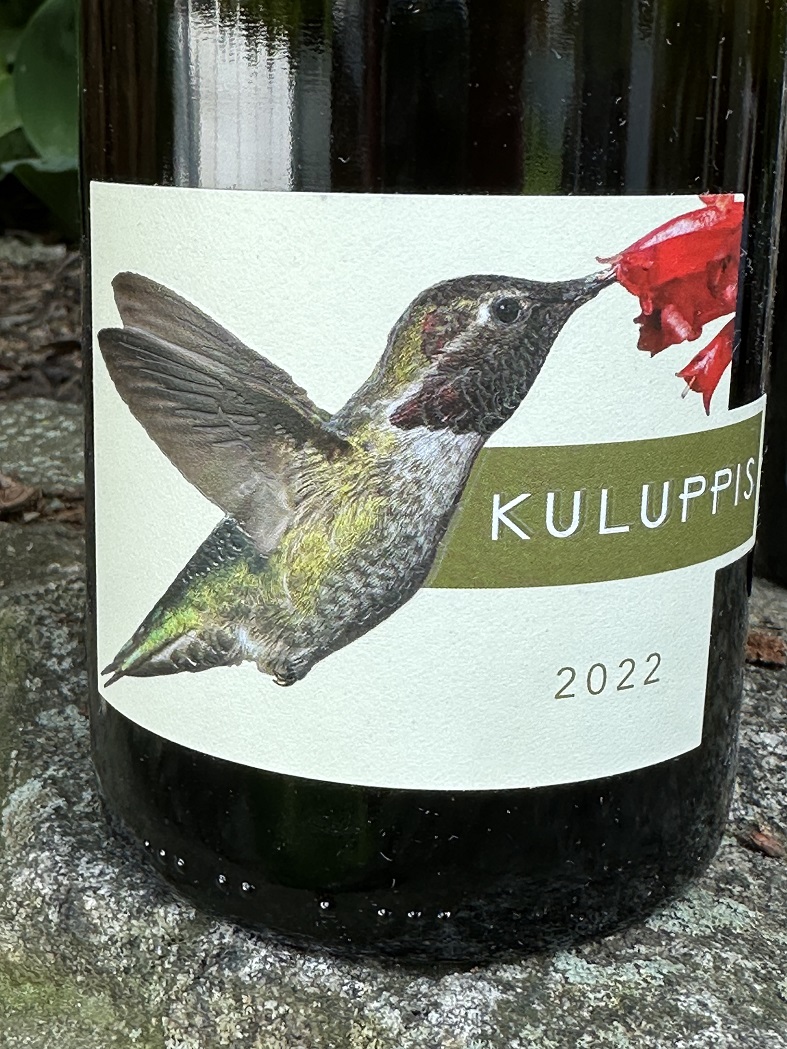
2022 Meyye Wines Kuluppis Chardonnay Sonoma County Los Carneros (13.7% ABV, $55, Sangiacomo vineyards, Kuluppis pronounced kuh-luu-pee; Anna’s hummingbird)
Light golden
Immediately upon opening – rich, opulent, butter, vanilla and tropical fruit on the nose, buttery toast on the palate, big, rich, hedonistic.
Literally 30 seconds later – a lot more restrained and leaner wine, all butter is gone, just some apples left. Well, no, there is still butter, just the toast is gone 🙂 nice and elegant, well balanced. Some perceived bitterness on the palate. Let’s see how it will develop.
Second day showed some honey notes and improved balance. Overall – excellent.
8+
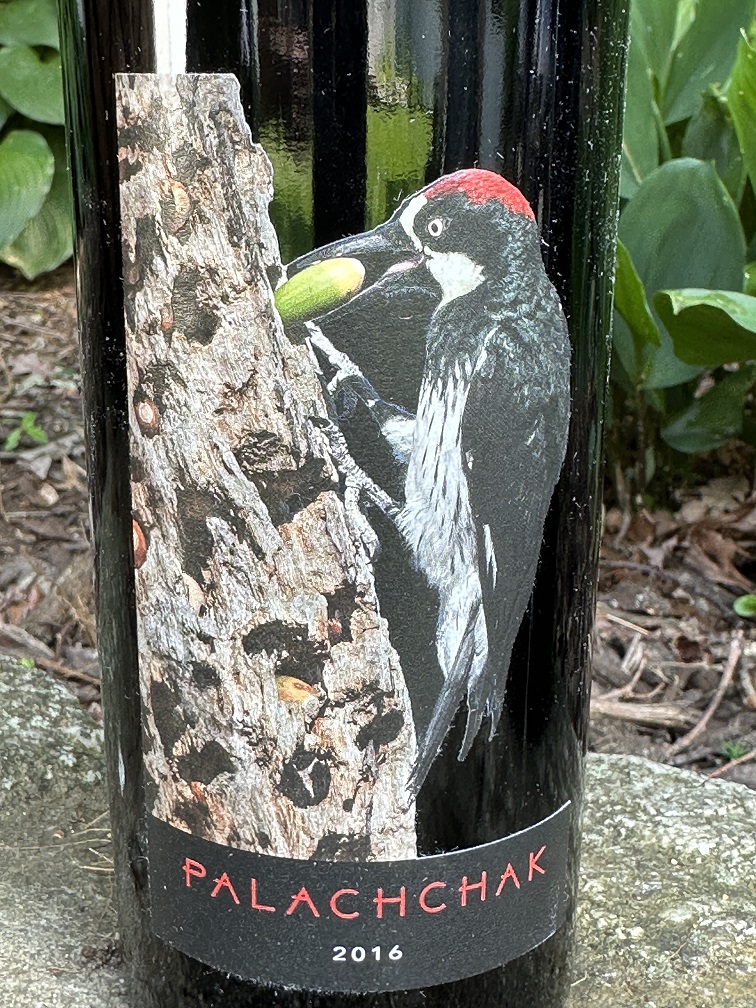
2016 Meyye Wines Palachchak Zinfandel Shenandoah Valley (15.5% ABV, $70, 90% Zinfandel, 10% Syrah, Palachchak pronounced pah-lah-chak; red-headed acorn woodpecker)
Dark chocolate and black currant, intense and beautiful
Blackberries and blueberries on the first day,
Dark chocolate with a touch of pepper, cherries, good structure, full body, clean acidity, good balance. Lasted for 4 days. Became a bit more round.
8
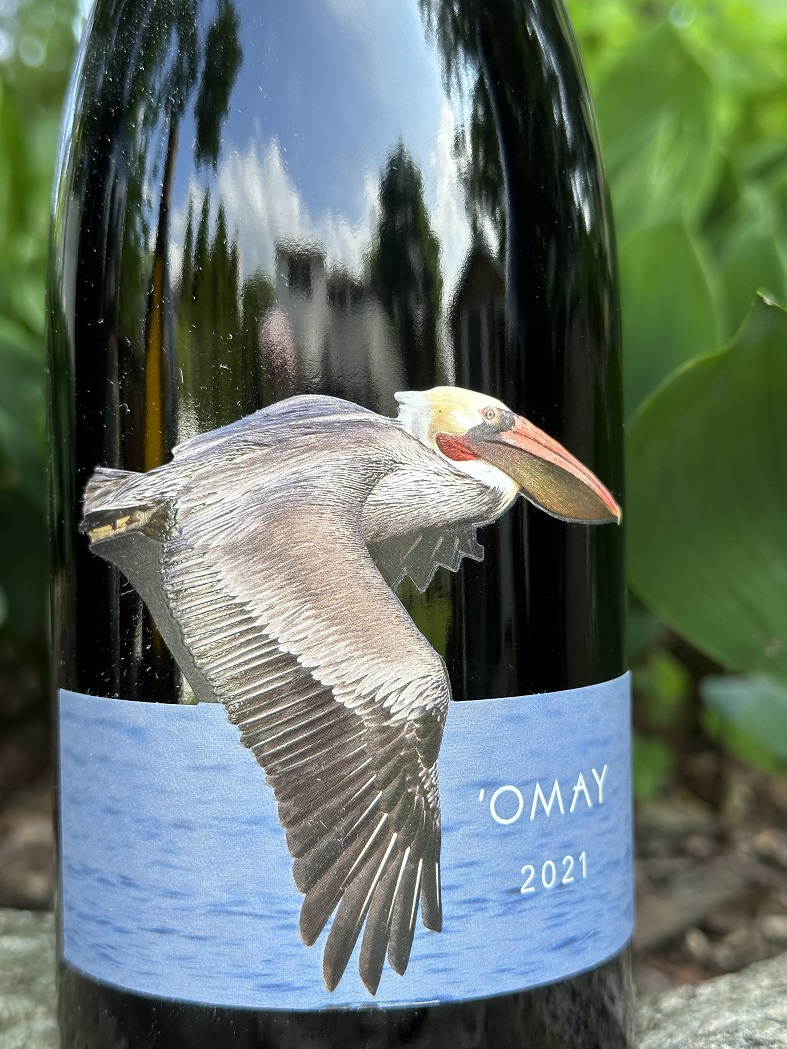
2021 Meyye Wines ‘Omay Pinot Noir Sonoma County Petaluma Gap AVA (13.9% ABV, $75, 100% Pommard Clone, Sangiacomo Vineyard, ‘Omay pronounced oh-may; brown pelican)
garnet
Smoke and plums, classic CA Pinot
Black Plums, violets, lavender, clean acidity, medium to full body – delicious.
8
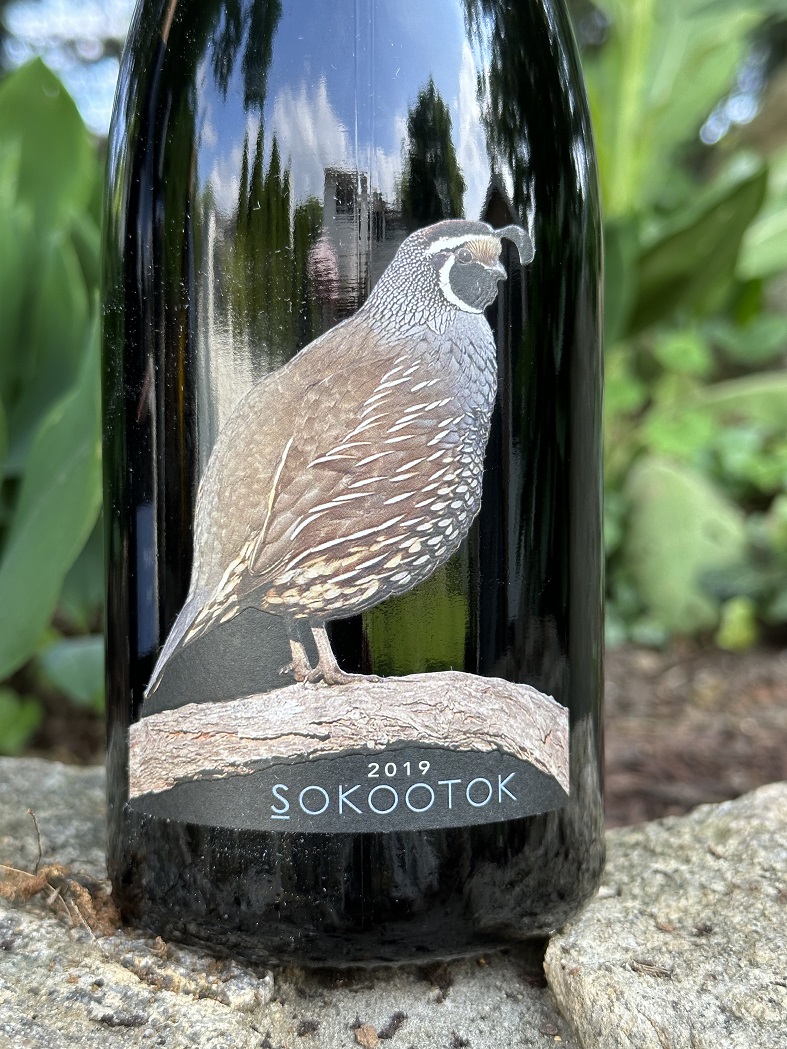
2019 Meyye Wines Sokootok Red Blend Sierra Foothills (14.5% ABV, $60, 50% Grenache, 28% Syrah, 10% Petite Sirah, 9% Counoise,
3% Zinfandel, Sokootok pronounced show-koh-tock; California quail)
Dark Ruby
Dark fruit, hint of minerality, sweet cherries, herbs
Black and red fruit, medium body, well-integrated tannins, good acidity, then tannins grip the finish – in a nice, but assertive way. This will develop nicely over the next 10-15 years.
8+, delicious.
Here you go, my friends. Another story of American Pleasures – delicious wines well worth seeking. And Meyye wines you will actually have to seek, due to their ultra-low production, so good luck to you.
Until the next time – cheers!
[Beaujolais] Nouveau Est Arrivé! 2024 Edition
Beaujolais Nouveau Est Arrivé!
Nouveau Est Arrivé!
Yes, it is the third Thursday in November, and it is an important day for those of us who still believe in the magic of wine – even if you shrug off the Beaujolais Nouveau as a marketing gimmick, you are still aware of the importance of the day, and whether you like it or not, consider yourself included 🙂
Every third Thursday in November and not a day earlier, Beaujolais Nouveau appears in wine stores around the world. Beaujolais Nouveau is the first wine of the new vintage in France, a young wine made to celebrate a new harvest. Georges Duboeuf is credited with making a centuries-old tradition into a marketing phenomenon more than 35 years ago – I’m not sure how much clout the celebration has today in the US, but it still has my attention.
Let me expand a bit on this. I’m traveling this week for work in Orlando, Florida. In Florida, wine is sold everywhere, from pharmacies to supermarkets to specialty wine stores. I visited the ABC Wines store (one of the popular wine retailers here, similar to Total Wines) at the beginning of the week and asked if they would be selling Beaujolais Nouveau on Thursday. The lady was not sure and suggested to call on Thursday to find out.
Today is that Thursday, and I started calling the store I visited on Monday. It took me four tries, but I finally got to a human. The lady on the phone said that they don’t have Beaujolais Nouveau at her store, but she was kind enough to check in the system and said that another ABC Wines store about 5 miles from the first one has it in stock.
Next, I decided to check if Whole Foods might have the wine in stock. I got to the human relatively quickly, but then the human said that she would go and check if they had Beaujolais Nouveau in stock. After 15+ minutes of music on hold, I decided that I would simply have to drive to the store to find out myself after I was done with work.
My first inclination was to drive to the ABC Wines location that was supposed to have the wine. After seeing that it would take me 35+ minutes to get there, I decided to try my luck with Whole Foods. Well, that didn’t work – no such luck. And now I was even further from ABC Wines which had the wine. Before giving up, I decided to make one more attempt – this time, with Trader Joe’s, which was only a mile away. A mile is not a mile in Florida, considering how overloaded the roads are and how long Florida traffic lights take… But nevertheless…
I arrived at Trader Joe’s, and found nothing after scouring the wine section for a few rounds. But unlike Whole Foods, in Trader Joe’s there is always someone you can ask (a floor manager). When I asked about Beaujolais Nouveau, there was a short pause during which I decided that there will be no Beaujolais Nouveau for me today, but then I heard – “hmmm, I think we got something last night, let me check”. 2 minutes later, the floor manager showed up with the bottle of Beaujolais Nouveau, which put a huge (huge!) smile on my face, and I thanked him profusely but managed not to hug him. After all, I was going to taste Beaujolais Nouveau on the day when it was released!
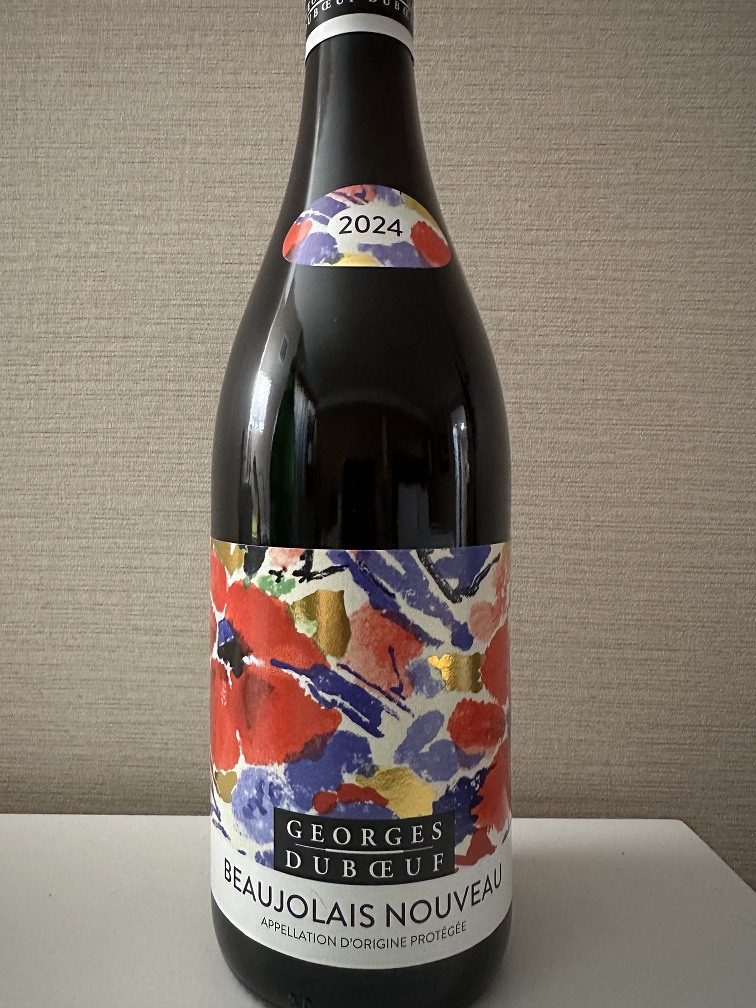
Every year I say that the quality of Beaujolais Nouveau gets better and better. I guess if I would sum up those statements, this Beaujolais Nouveau should taste better than DRC… I don’t know if it gets better every year anymore – at this point, I believe Beaujolais Nouveau got to the point of consistently high quality, good enough that I’m happy to drink it every year – at least Georges Duboeuf’s rendition for sure – here are my notes.
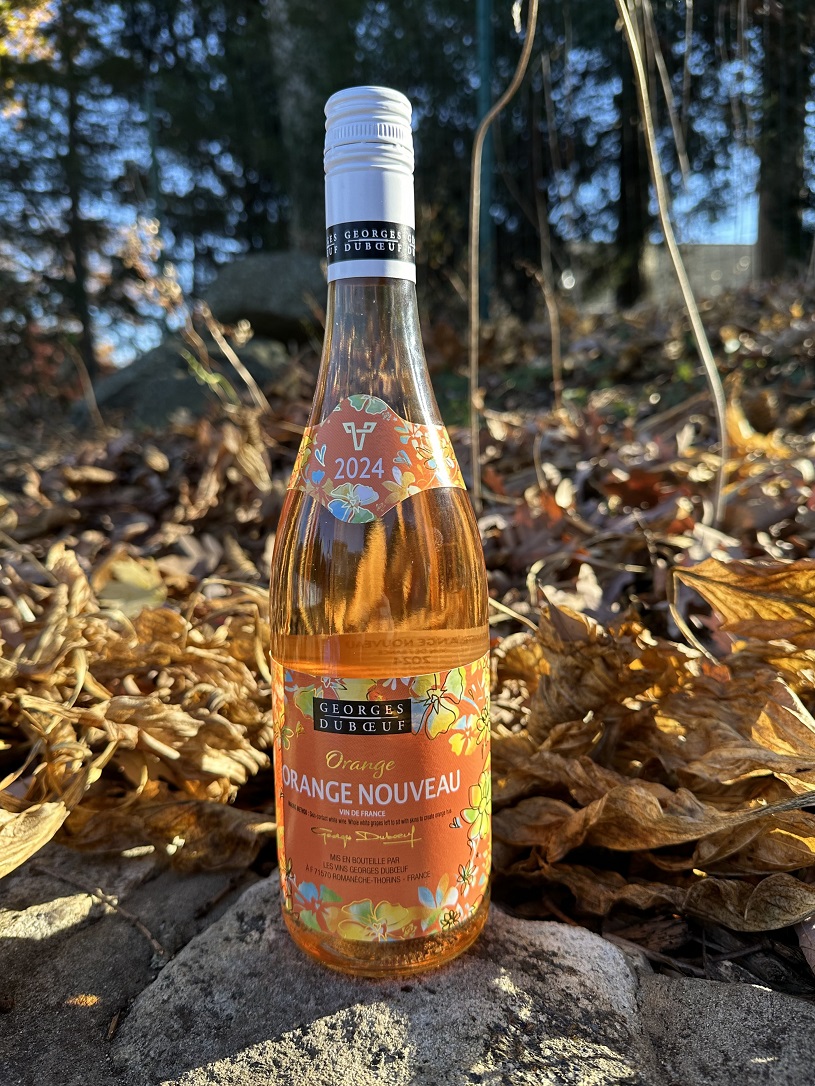


Lastly, here is a little treat for you:
Every year, the bottles of Beaujolais Nouveau are adorned with specially designed labels, sometimes even multiple labels from the same producer for the same wine – I have no idea how that works. As I have been writing about Beaujolais Nouveau every year since this blog started, I can offer you a collection of labels starting with the 2010 vintage. As Georges Dubouef is the one and only producer I was able to taste every year, below is my little “show and tell” limited only to the labels of Georges Duboeuf wines I tasted throughout the years. In case you feel like it, you can even choose your favorite label and share it in the comments (sorry, this is not a competition so no prizes will be awarded).
Here we go:


Beaujolais Nouveau 2024 has arrived, and if you haven’t tasted one yet – what are you waiting for? Taste it now and let me know what you think! Cheers!
A Perfect Monday Wine?
Is there such a thing as the perfect wine for Monday?
Or, can there be a specific perfect wine for every day of the week?
Yes and no.
The answer is yes if you feel like it. You can create your own tradition – for example, “every Friday I drink Cabernet Sauvignon”, or “every Sunday I drink Chardonnay”. Sure, you can create such a tradition, but why?
A better answer is “no, there is no specific wine for every day of the week”, there is only wine you want to drink today.
On second thought, maybe? Just for Monday?
There is an abundance of jokes about Monday – purportedly the most difficult day of the week. Arrival of Monday means the weekend is over – and there is a whole work week ahead. But then Monday night means the first day of the week is over – and the weekend just got a little bit closer – isn’t that a reason to celebrate?
And yet, even if Monday deserves its own special wine, what that can be?
Ha! The answer is simple. It is what you crave. Your idea of special Monday wine doesn’t have to be the same as my idea, or anyone else’s idea. Whatever you decide to drink on Monday will be your special Monday wine. For this one Monday, of course.
For whatever reason, today I was craving power. “Power” is not your typical wine descriptor, no doubt every wine lover would have a personal definition of this term. To me “power” means big wine which gives you a lot to “chew on”, but I don’t mean it in the sense of the new French oak tannins literally numbing your taste buds for the next 5 hours. I’m talking more about the massive presence of the wine on your palate, full-bodied, with dark fruit and a variety of spices. My power wines are Petite Sirah, Montefalco Sagrantino, wines made from the Eastern European grape Vranec, maybe some of the renditions of Alicante Bouschet (this is not universal).
In the majority of the cases, the “power” wine should also have some age on it, to make it drinkable. Anyone who tried young California Petite Sirah or Montefalco Sagrantino will understand what I’m talking about.

My choice of the power wine with age – the 2014 Turley Petite Syrah Pesenti Vineyard Paso Robles (14.4% ABV). Turley is best known for its Zinfandel wines, but it also produces a number of Petite Sirah wines, which are equally outstanding.
The wine had the perfect amount of power I was looking for. Abundant red and black fruit, cherries and cherry pits, firm structure, full body, espresso and pepper showing up at random, perfect acidity, impeccable balance. Answering Kevin Zraly’s question – “does this wine give you pleasure” I can only say that this wine was definitely giving the pleasure and lots of it, as I’m looking at an empty bottle right now.
What would be your Monday wine choice?
Last Bottle Sign Up ($10 credit)




 Talk-A-Vino