Archive
Oenophile’s Joy: Say Hello To Asti Rosé!
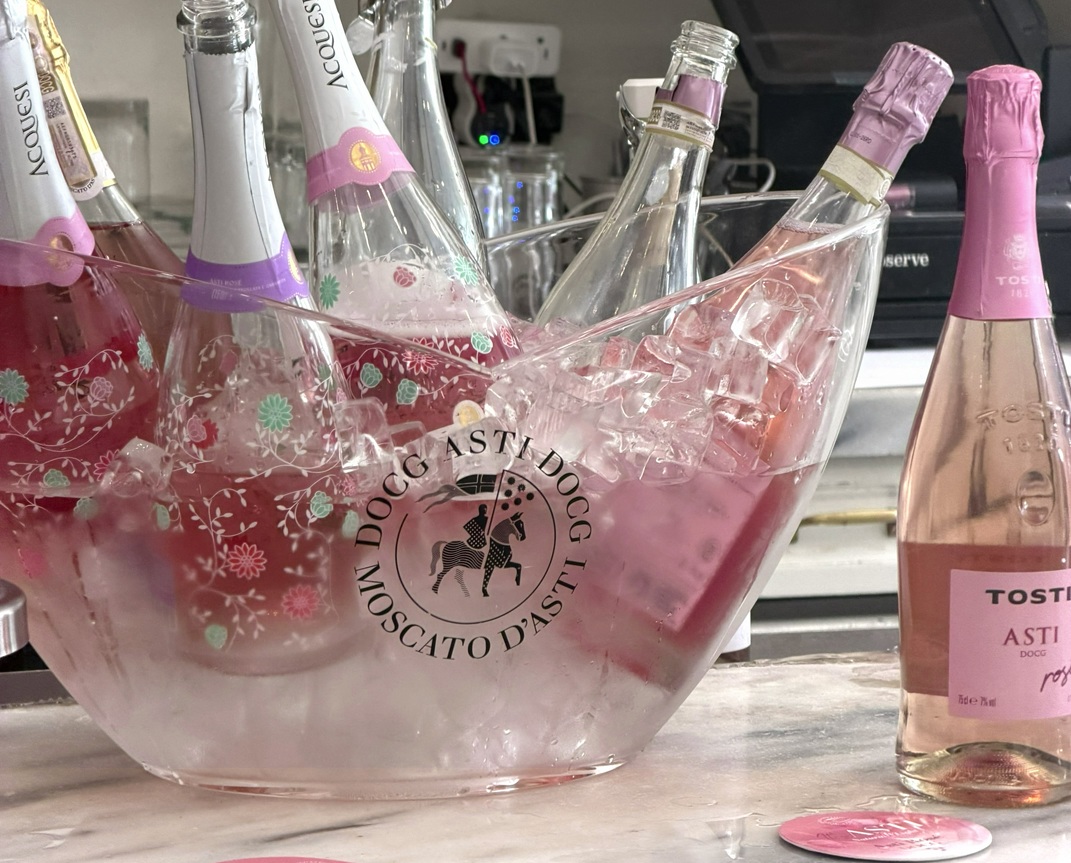
Do you consider yourself an oenophile?
I hope you are. If you are not, I hope it is “not yet”.
Next question: Do you like Asti wines?
Don’t tell me that you don’t. There are only two acceptable answers here: 1. I never tried them. 2. Of course, I love them. If you consider yourself an oenophile, you have tried Asti sparkling wines, and you want to tell me that you don’t like them, we probably can’t be friends.
Asti DOCG is the region in Northern Italy where sweet wines have been produced since the 17th century. In the 19th century, these sweet wines also developed bubbles and became a foundation for the modern Moscato d’Asti wines. Asti wines are typically low alcohol (around 7%), lightly fizzed, and effervescent. Asti wines can be a dessert in themselves, or they can perfectly accompany and elevate practically any dessert known to man. Most importantly, they give wine lovers lots of pleasure. To be entirely correct, Asti also makes dry wines, but let me focus for now on the sweet side of things.
Until now, Asti DOCG was producing only white wines. But now that joy in the bottle has a new color – pink! After becoming an official Asti Rosé DOCG in March of 2026, Consorzio dell’Asti DOCG officially introduced Asti Rosé wines this week in the US at the Vinitaly event in New York!
Considering the occasion, I had an opportunity to talk (albeit virtually) to Giacomo Pondini, the Director of the Consorzio, and ask him a few questions to help my readers understand what this new Asti Rosé DOCG is all about. Here is what transpired in our conversation:
[TaV]: Why Asti Rosé? What was the inspiration behind creating the category of Asti? Was this driven by the desire of the producers or did consumers express an interest, or both?
[GP]: It was really a combination of both producer initiative and growing consumer interest. Wineries in the region had already been seeing encouraging results with sparkling rosé wines made from Moscato, particularly in North America, where consumers were showing interest in fresh, aromatic, and approachable sparkling wines. This demonstrated that there was an opportunity to explore a new expression of the region’s winemaking tradition.
At the same time, producers recognized the potential to bring this style under the Asti DOCG designation, giving it a stronger identity and a clear connection to the territory. The key was the historical presence of Brachetto within the Asti production area, alongside Moscato Bianco. Bringing together these two natives Piedmontese aromatic grape varieties allowed us to create something distinctive, combining two winemaking traditions and two different aromatic profiles.
Asti Rosé therefore represents both a response to evolving consumer preferences and a natural evolution of the denomination: an opportunity to innovate while remaining firmly rooted in our region’s heritage and winemaking expertise.
[TaV]: Was Prosecco Rosé, created in 2020, also an inspiration of sorts?
[GP]: Not specifically. The inspiration behind Asti Rosé was more closely linked to the growing international appreciation for rosé wines in general, both still and sparkling. We saw an opportunity to respond to this trend, but in a way that was entirely consistent with the identity of Asti DOCG. Rather than following another denomination, our aim was to create something with its own personality, drawing on the aromatic character of Moscato Bianco and Brachetto, two grape varieties with deep roots in Piedmont.
[TaV]: So what is Asti Rosé in technical terms? Are there any specific percentages of grapes to be used, specific yields, other rules you can share?
[GP]: The production rules for Asti Rosé follow the yield requirements established in the respective production codes for Asti DOCG and Brachetto d’Acqui DOCG. In terms of grape composition, Asti Rosé is made from a blend of 70% to 90% Moscato Bianco grapes intended for the production of Asti DOCG and 10% to 30% Brachetto grapes, both grown within the designated production area.
Asti Rosé can be produced by blending the two grape varieties or by combining their musts before fermentation. The latter approach is generally more common, as Moscato Bianco and Brachetto have different ripening periods. Working with the musts allows producers to manage these differences while bringing the two varieties together to achieve the desired balance and style.
Another interesting aspect is the range of styles permitted, from sweet to Extra Brut, allowing producers to interpret Asti Rosé in different ways and respond to the preferences of individual markets.
[TaV]: What reaction do you expect from the consumers, both in Italy and around the world?
[GP]: We have already received encouraging responses to Asti Rosé, particularly in Great Britain and Eastern European markets, as well as in Italy. These early reactions are encouraging and suggest that there is interest in this new expression across different markets.
Looking ahead, we hope Asti Rosé will appeal both to consumers who already appreciate rosé wines and to those who are looking to discover something new. Our goal is to introduce it to an increasingly broad international audience and allow consumers to discover its versatility and distinctive identity.
[TaV]: What are your expectations in terms of export of Asti Rosé? Where do you think the biggest export markets will be?
[GP]: We expect exports to account for approximately 80% to 90% of total production, reflecting our confidence in its potential to reach consumers in international markets. While Italy will remain an important market, we see significant opportunities for growth abroad, building on the existing international recognition of the Asti DOCG denomination.
Once production is fully operational, we believe Asti Rosé could reach a total volume of around 5 million bottles. This would represent an important opportunity to further expand the denomination’s presence internationally, offering consumers a new expression of Asti DOCG while building on the reputation and heritage of the region. As for the biggest markets, I think we could look at the UK, Asia, and the United States!
[TaV]: Asti wines are very versatile when it comes to food. What food pairings would you suggest for the Asti Rosé?
[GP]: Asti Rosé is a versatile wine, so it’s difficult to choose just one food pairing. It really depends on the occasion and what you feel like eating. Today, I’d be in the mood for something Thai, such as Pad Kra Pao, a flavorful stir-fried dish with Thai basil and a savory, spicy profile.
I think Asti Rosé could be an interesting match for this type of cuisine, as its aromatic character and freshness can complement the dish’s bold flavors and spices.
For an aperitif, I would suggest smoked salmon crostini with crème fraîche, Gruyère and thyme gougères, or even hummus tartlets with a touch of lemon and fresh herbs. These are all excellent pairings for the drier styles of Asti, particularly Asti Rosé Brut.
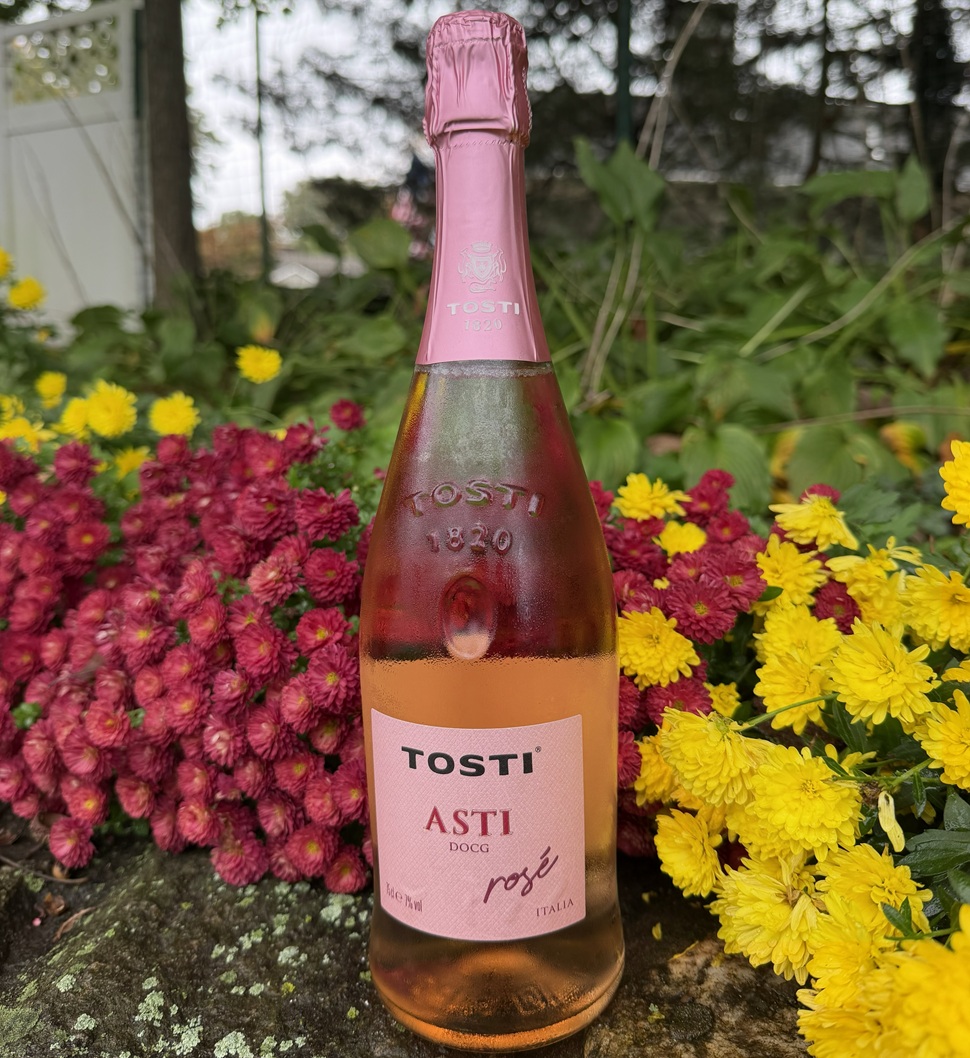
Now, the best part of the wine conversation is … yes, of course, a glass of wine! I had an opportunity to try Asti Rosé from one of the producers, and it was delicious!
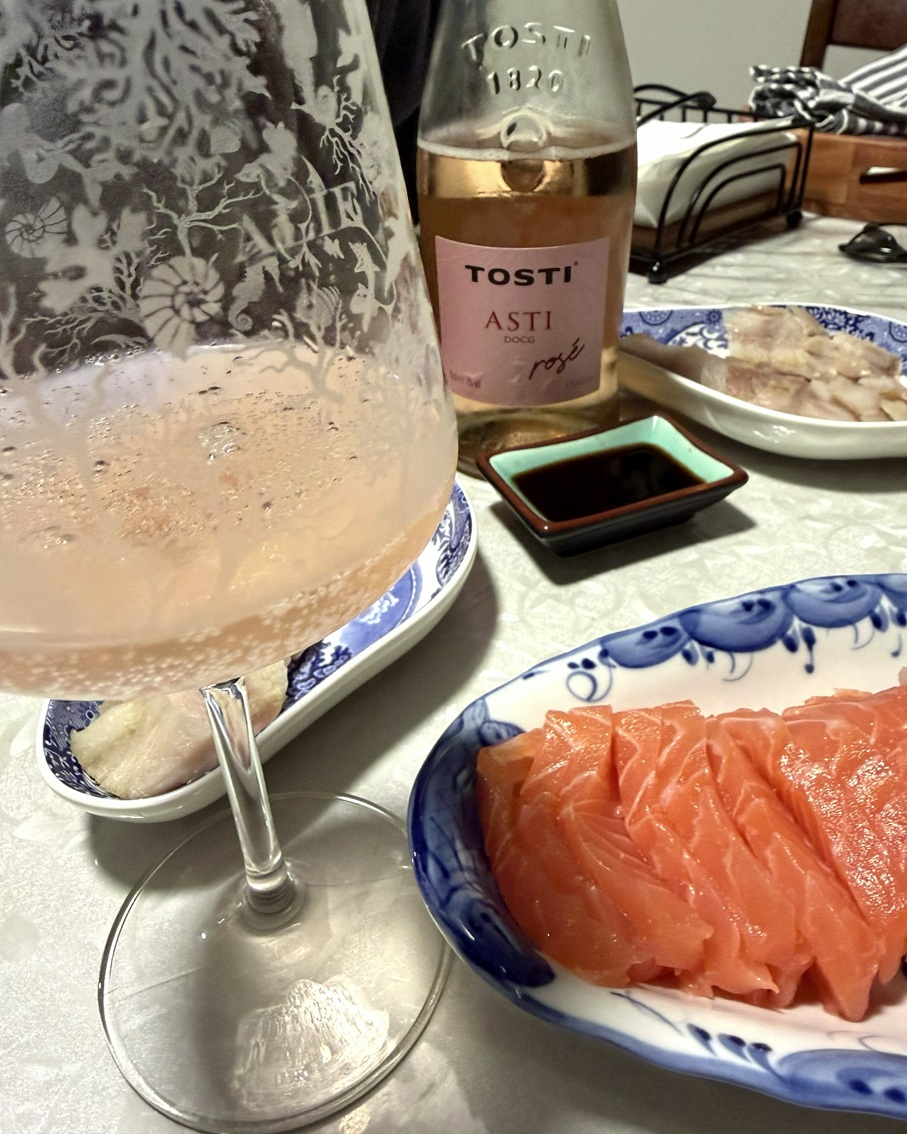
NV Tosti Asti Rosé DOCG (7% ABV) had a perfect amount of fizz, a very generous fine mousse. A hint of strawberries on the nose, and a berry assembly on the palate – light, playful, perfectly balanced, refreshing, and delicious. The wine was delicious by itself, and it perfectly complemented home-made salmon and hamachi sashimi, exactly as one would expect. As you can tell from the picture, I even procured my favorite wine glass for Rosé from the Frescobaldi Alie Rosé tasting (please, please, please, don’t ask me where you can get it, I have no clue).
There you are, my wine-loving friends – one more type of wine to look out for. It is simple, it is uplifting, and it is guaranteed to please, just give it a chance.
Please welcome Asti Rosé!
Asti: Everyday Wine You Love To Drink But Afraid To Admit It
 Let me ask you a favor: can you please be honest with me?
No, scrap that. Can you please be honest with yourself?
When/if you read this, can you honestly answer a question for yourself: do you like sweet wines?
Be honest with yourself. This is strictly between you and you. Nobody will ever know what you will say. But if you do, have at least the courage to admit it to yourself – “yes, I like sweet wines”.
We are afraid of sugar. When we consume it, we prefer not to even think of it. We are so ashamed at the thought that someone might think we like sugar. You are supposed to hate sugar. We are supposed to enjoy things that are not associated with sugar. Sugar is bad news. Period. This is why nobody would ever want to publicly admit they like sweet wines, as they are evil.
Even if you are not afraid to admit to your affection, sweet wines are a special category. It seems that even the smallest bottle is usually too big. And by the time the dessert is served, nobody wants to drink more wine. But leaving that aside, there is a critical element for the sweet wine to be called enjoyable. I’m sure you can easily guess it, but I will give you a moment to think about it.
Got it?
That element is important across all wines, but in the sweet wines it is really critical – and this element is balance. Balance of all elements can make or break any wine, but in sweet wines, it has to be impeccable for the wine to be enjoyable. The sweetness must be balanced by acidity. If it is not, the wine becomes simply cloying, and not enjoyable (yes, I’m talking about lack of acidity in the sweet wines – never tasted the one with too much acidity). And perfectly balanced sweet wine becomes an ultimate indulgence. Perfectly balanced sweet wine is so sensual, so seductive that… well, I better let your imagination run wild.
Now, is there a way to make this sweet wine experience better? Of course – what if we will add some fizz to this perfectly balanced sweet wine? And make it affordable? And reduce the amount of alcohol – not eliminate, but simply reduce? Would you enjoy it every day? I’m sure the answer is yes. And I have a wine to suggest which will perfectly fit this profile – Asti wines from Northern Italy.

Source: Consorzio Asti DOCG

Source: Consorzio Asti DOCG

Source: Consorzio Asti DOCG
Sweet wines of notice were produced around the towns of Asti and Alba in southeastern Piedmont as early as the 17th century using a grape called Moscato Bianco. It is possible that the wines were produced even earlier, as Moscato Bianco had been growing in Piedmont as long as the Piedmont’s king was, Nebbiolo. The Classic Method of Champagne production has traveled to Piedmont and the first sweet classic sparkling wine was produced in the region in 1870. After the Martinotti method of producing sparkling wines in the tank instead of the bottles was invented in 1895 by Federico Martinotti, it quickly displaced Methode Champenoise as less expensive and significantly less time-consuming. The same method is used in the production of Prosecco. Oh, and look at these beautiful vineyards…

Source: Consorzio Asti DOCG
In 1932, Consorzio per la Tutela dell’Asti (Consortium for the Protection of Asti) was established to develop and ensure the guidelines for the production of Asti wines, known at that time as Asti Spumante. Things were going well until Asti Spumante became a victim of its own success. After World War II, American soldiers coming back were bringing light, sweet, fizzy Asti wines with them, bringing a surge in popularity. As the history of many wine regions shows (Chianti, Amarone, Australian wines at the beginning of the 2000s), such an increase in demand leads to overproduction and a dramatic drop in quality – exactly what happened with the Asti wines which subsequently lost their popularity due to poor quality.
Moving forward, Asti had to redefine itself, step by step. When Asti Spumante DOC was promoted to DOCG status in 1993, producers decided to ditch the Spumante portion of the name, becoming simply Asti instead of Asti Spumante. Producers also changed their production methods and quality controls, often moving towards a less sweet, drier style. The consortium also established a maximum yield for the grapes’ harvest and minimum alcohol levels that need to be achieved after fermentation.
While Asti wines are perfectly enjoyable on their own, they also make one of the very best food-pairing wines. Craving spicy food? Asti will work perfectly with that. Something substantial and salty? Bring on the Asti. Maybe most importantly – and uniquely – Asti wines are incomparable when it comes to pairing with desserts. If you never experienced a glass of Asti with an apple tart or a peach cobbler, you are missing on some of the greatest pleasures in life – you really should try it next time.
As Consorzio is expanding its presence in the US, I had an opportunity to sit down (virtually) with Consorzio per la Tutela dell’Asti Director Giacomo Pondini and ask him a few questions about Asti wines. Here is what transpired in our conversation.
[TaV]: What is the history of wine production in the region? Is Moscato Bianco the only grape that has been cultivated in the region? What kind of wines were produced there before the introduction of sparkling wines in 1865?
[GP]: As in many other places around Europe, the Romans have imported the wine production in Piedmont. And since then, it has thrived. Beyond Moscato Bianco, the historical grapes in the region are red varieties: Barbera, Freisa, Nebbiolo. Probably the most important step towards a more modern style of winemaking, at that time, was made by Camillo Benso Conte di Cavour. Before becoming a fundamental politician in Italian history, he devoted himself to the production of a wine based on Nebbiolo, named Barolo. In the history of Asti wines, the production of vermouth has laid the economical basis for developing the sparkling wine industry, based on Moscato Bianco grapes.
[TaV]: What is the difference between Asti Spumante DOCG and Moscato d’Asti DOCG wines?
[GP]: The main difference lies in the pressure – Asti Spumante, a proper sparkling wine, has to have at least 3.5 bar pressure, while Moscato d’Asti, which is a fizzy wine, 2.5. Then the difference lies in the residual sugar, higher in Moscato d’Asti, where sugars are less fermented and, therefore also less alcohol.
[TaV]: I understand that Asti Spumante wines can be produced using Classic and Charmat methods. What are the styles of Asti Spumante wines produced in the region, the official classification?
[GP]: The classification goes from pas dosè to sweet. Historically speaking, the sweet typology was the only one allowed until 2017, when extra dry, dry, demi-sec were introduced. From 2020, pas dosé, extra brut and brut were also authorized.
[TaV]: What are the best food pairings for the Asti Spumante wines? I know that in Sauternes in France, the region famous for its sweet wines, it is possible to have a full dinner paired with sauternes wines, from appetizer through the dessert. Is it possible to do the same with the Asti Spumante wines? If yes, can you share a sample menu for such a dinner?
[GP]: We know that in many countries Moscato d’Asti and Asti spumante are paired with a wide range of food: from the traditional desserts to cheese, from barbecue to Thai soups, to raw fish and curry.

Source: Consorzio Asti DOCG
[TaV]: What is the annual production of the Asti Spumante wines across all styles and including both DOCGs? How many producers and grape growers are in the region? Any other statistics you would want to share?
[GP]: In 2022 the annual production has reached 102 million bottles, 60% Asti Spumante and 40% Moscato d’Asti. Around 3,000 grape growers and 250 producers.
[TaV]: What countries are the main importers of the Asti Spumante wines? What percentage of annual production is going for export versus domestic consumption?
[GP]: Export covers 90% of the production, both for Asti Spumante and Moscato d’Asti. The main export markets for Asti Spumante are the USA, Russia, Great Britain, and Germany; USA by far is the most important market for Moscato d’Asti.
[TaV]: What is ahead of the Asti Spumante wines, let’s say, over the next 10 years?
[GP]: In commercial terms, an increasing presence in the Asian markets, while also growing the value and the perception. And also, a reason to visit Langhe-Roero Monferato, the area of production in Piedmont, UNESCO world heritage.
[TaV]: Sustainability and organic viticulture – are they used in the region? What percentage of the producers practices sustainable viticulture? Same for the organic?
[GP]: Around 25% of the growers are sustainable or moving in that direction. As a Consorzio we have just started the process of becoming a “sustainable territory”, a certification that involves all the grape growers and wineries in our area of production.
[TaV]: If someone had never had an Asti Spumante wine, how would you convince that person to try the wine for the first time?
[GP]: The aromatic profile of Asti Spumante, as well as Moscato d’Asti, cannot be found in any other wine. An immediate pleasure that makes these wines suited for any pairing or in any joyful moment.
I had an opportunity to taste several Asti wines of different styles – dry (it is Asti dry, not Champagne Brut Nature dry), sweet, sparkling and still. Acidity rules the pleasure in Asti wines – as long as the wine has enough acidity, all of the sweet elements – peaches, apricots, apples, pears, honey – will appear utmost delicious. As a reference, here are the wines I tasted and am happy to recommend – the first two being the most favorite:
NV Acquesi Asti DOCG (7% ABV)
NV Capetta Asti DOCG (7% ABV)
NV BOSCA Esploro Secco (dry) Asti DOCG (11% ABV, sugar 17–23 g/l)
NV Giacomo Scagliola “SiFaSol” Moscato d’Asti Canelli DOCG (5.5% ABV)
NV Bersano Monteolivo Moscato d’Asti DOCG (5.5% ABV)
NV Cascina Cerutti Siri Sandrinet Moscato d’Asti DOCG (5.5% ABV)
NV Matteo Soria Bric Prima Bella Asti DOCG Extra Dry (12% ABV)
2022 Vittorio Bear Moscato d’Asti DOCG (5% ABV)
NV Sanmaurizio SATI Asti DOCG Secco (11.5% ABV)
NV Arione Asti DOCG Extra Secco (12.5% ABV)
NV Tosti Asti DOCG (12% ABV)
NV Bussi Piero Moscato d’Asti DOCG (5.3% ABV)
Before we part, let me ask you something.
Are you convinced now that sweet wines are not evil, or do you still need more convincing? Let’s do a simple math here. A typical glass of Asti wine contains between 8 and 12 grams of sugar (dry Asti will have only about 4, but let’s leave dry Asti aside for now). That same glass of Asti, at 5% ABV, will have about 7 grams of alcohol (1 standard wine glass is 5 oz, which is equal to 142 (rounded up) grams, 5% from 142 is 7.1). According to the formulae I presented in this post, considering that 1 gram of sugar has 4 calories, and 1 gram of alcohol has 7, that glass of Asti will cost you 4*12+7*7 = a whopping 97 calories. Plus lots and lots of pleasure. Considering that a can of Coke has 140 calories, what would you choose?
The choice is yours, of course, but my choice would be pleasure. Any day. Wine should give you pleasure, this is the only reason to drink it, and Asti is good at that.
The holidays are upon us. But even between the holidays, you have to celebrate every day whose name ends with the “y”. And please promise me that you will try a glass of Asti with dessert. You owe it to yourself. Please…
Let’s drink sweet wines and to the sweet wines. There is nothing to be ashamed of. Cheers!
Last Bottle Sign Up ($10 credit)