Archive
Oenophile’s Joy: Say Hello To Asti Rosé!
Do you consider yourself an oenophile?
I hope you are. If you are not, I hope it is “not yet”.
Next question: Do you like Asti wines?
Don’t tell me that you don’t. There are only two acceptable answers here: 1. I never tried them. 2. Of course, I love them. If you consider yourself an oenophile, you have tried Asti sparkling wines, and you want to tell me that you don’t like them, we probably can’t be friends.
Asti DOCG is the region in Northern Italy where sweet wines have been produced since the 17th century. In the 19th century, these sweet wines also developed bubbles and became a foundation for the modern Moscato d’Asti wines. Asti wines are typically low alcohol (around 7%), lightly fizzed, and effervescent. Asti wines can be a dessert in themselves, or they can perfectly accompany and elevate practically any dessert known to man. Most importantly, they give wine lovers lots of pleasure. To be entirely correct, Asti also makes dry wines, but let me focus for now on the sweet side of things.
Until now, Asti DOCG was producing only white wines. But now that joy in the bottle has a new color – pink! After becoming an official Asti Rosé DOCG in March of 2026, Consorzio dell’Asti DOCG officially introduced Asti Rosé wines this week in the US at the Vinitaly event in New York!
Considering the occasion, I had an opportunity to talk (albeit virtually) to Giacomo Pondini, the Director of the Consorzio, and ask him a few questions to help my readers understand what this new Asti Rosé DOCG is all about. Here is what transpired in our conversation:
[TaV]: Why Asti Rosé? What was the inspiration behind creating the category of Asti? Was this driven by the desire of the producers or did consumers express an interest, or both?
[GP]: It was really a combination of both producer initiative and growing consumer interest. Wineries in the region had already been seeing encouraging results with sparkling rosé wines made from Moscato, particularly in North America, where consumers were showing interest in fresh, aromatic, and approachable sparkling wines. This demonstrated that there was an opportunity to explore a new expression of the region’s winemaking tradition.
At the same time, producers recognized the potential to bring this style under the Asti DOCG designation, giving it a stronger identity and a clear connection to the territory. The key was the historical presence of Brachetto within the Asti production area, alongside Moscato Bianco. Bringing together these two natives Piedmontese aromatic grape varieties allowed us to create something distinctive, combining two winemaking traditions and two different aromatic profiles.
Asti Rosé therefore represents both a response to evolving consumer preferences and a natural evolution of the denomination: an opportunity to innovate while remaining firmly rooted in our region’s heritage and winemaking expertise.
[TaV]: Was Prosecco Rosé, created in 2020, also an inspiration of sorts?
[GP]: Not specifically. The inspiration behind Asti Rosé was more closely linked to the growing international appreciation for rosé wines in general, both still and sparkling. We saw an opportunity to respond to this trend, but in a way that was entirely consistent with the identity of Asti DOCG. Rather than following another denomination, our aim was to create something with its own personality, drawing on the aromatic character of Moscato Bianco and Brachetto, two grape varieties with deep roots in Piedmont.
[TaV]: So what is Asti Rosé in technical terms? Are there any specific percentages of grapes to be used, specific yields, other rules you can share?
[GP]: The production rules for Asti Rosé follow the yield requirements established in the respective production codes for Asti DOCG and Brachetto d’Acqui DOCG. In terms of grape composition, Asti Rosé is made from a blend of 70% to 90% Moscato Bianco grapes intended for the production of Asti DOCG and 10% to 30% Brachetto grapes, both grown within the designated production area.
Asti Rosé can be produced by blending the two grape varieties or by combining their musts before fermentation. The latter approach is generally more common, as Moscato Bianco and Brachetto have different ripening periods. Working with the musts allows producers to manage these differences while bringing the two varieties together to achieve the desired balance and style.
Another interesting aspect is the range of styles permitted, from sweet to Extra Brut, allowing producers to interpret Asti Rosé in different ways and respond to the preferences of individual markets.
[TaV]: What reaction do you expect from the consumers, both in Italy and around the world?
[GP]: We have already received encouraging responses to Asti Rosé, particularly in Great Britain and Eastern European markets, as well as in Italy. These early reactions are encouraging and suggest that there is interest in this new expression across different markets.
Looking ahead, we hope Asti Rosé will appeal both to consumers who already appreciate rosé wines and to those who are looking to discover something new. Our goal is to introduce it to an increasingly broad international audience and allow consumers to discover its versatility and distinctive identity.
[TaV]: What are your expectations in terms of export of Asti Rosé? Where do you think the biggest export markets will be?
[GP]: We expect exports to account for approximately 80% to 90% of total production, reflecting our confidence in its potential to reach consumers in international markets. While Italy will remain an important market, we see significant opportunities for growth abroad, building on the existing international recognition of the Asti DOCG denomination.
Once production is fully operational, we believe Asti Rosé could reach a total volume of around 5 million bottles. This would represent an important opportunity to further expand the denomination’s presence internationally, offering consumers a new expression of Asti DOCG while building on the reputation and heritage of the region. As for the biggest markets, I think we could look at the UK, Asia, and the United States!
[TaV]: Asti wines are very versatile when it comes to food. What food pairings would you suggest for the Asti Rosé?
[GP]: Asti Rosé is a versatile wine, so it’s difficult to choose just one food pairing. It really depends on the occasion and what you feel like eating. Today, I’d be in the mood for something Thai, such as Pad Kra Pao, a flavorful stir-fried dish with Thai basil and a savory, spicy profile.
I think Asti Rosé could be an interesting match for this type of cuisine, as its aromatic character and freshness can complement the dish’s bold flavors and spices.
For an aperitif, I would suggest smoked salmon crostini with crème fraîche, Gruyère and thyme gougères, or even hummus tartlets with a touch of lemon and fresh herbs. These are all excellent pairings for the drier styles of Asti, particularly Asti Rosé Brut.
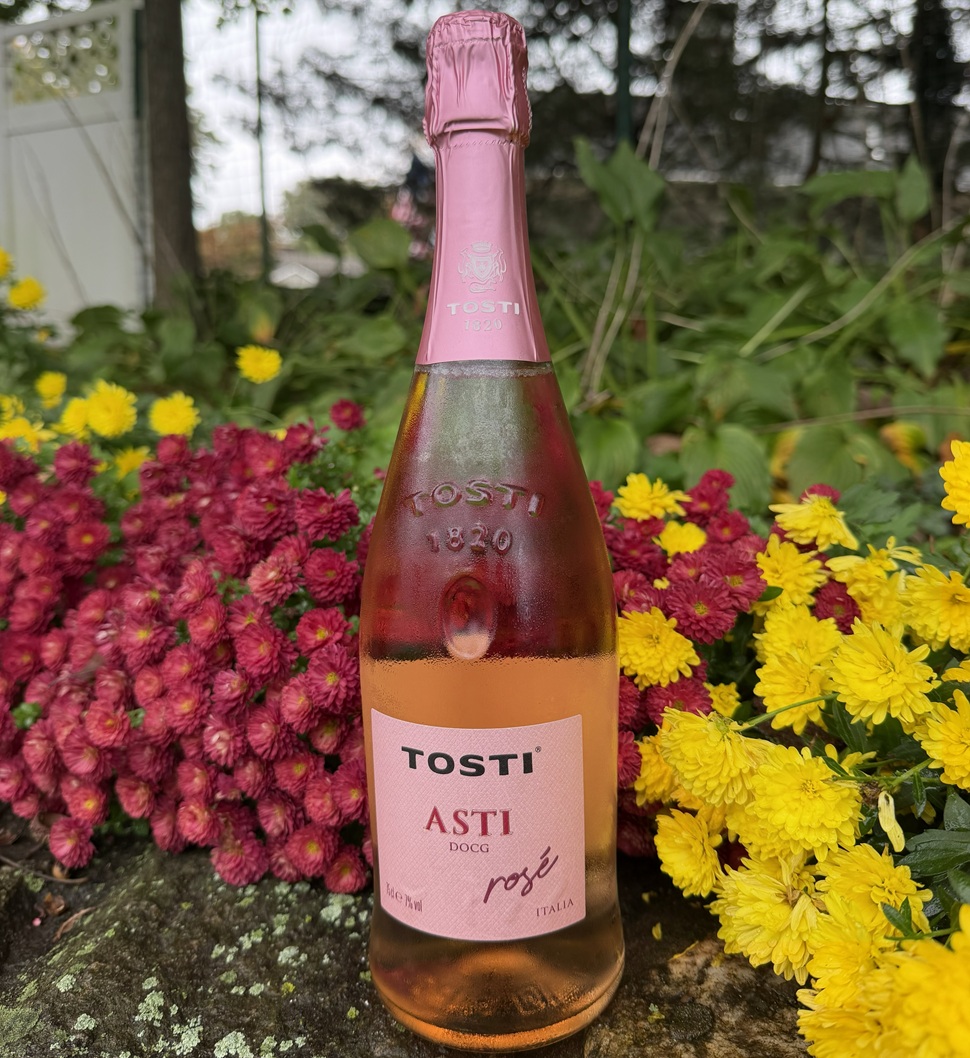
Now, the best part of the wine conversation is … yes, of course, a glass of wine! I had an opportunity to try Asti Rosé from one of the producers, and it was delicious!
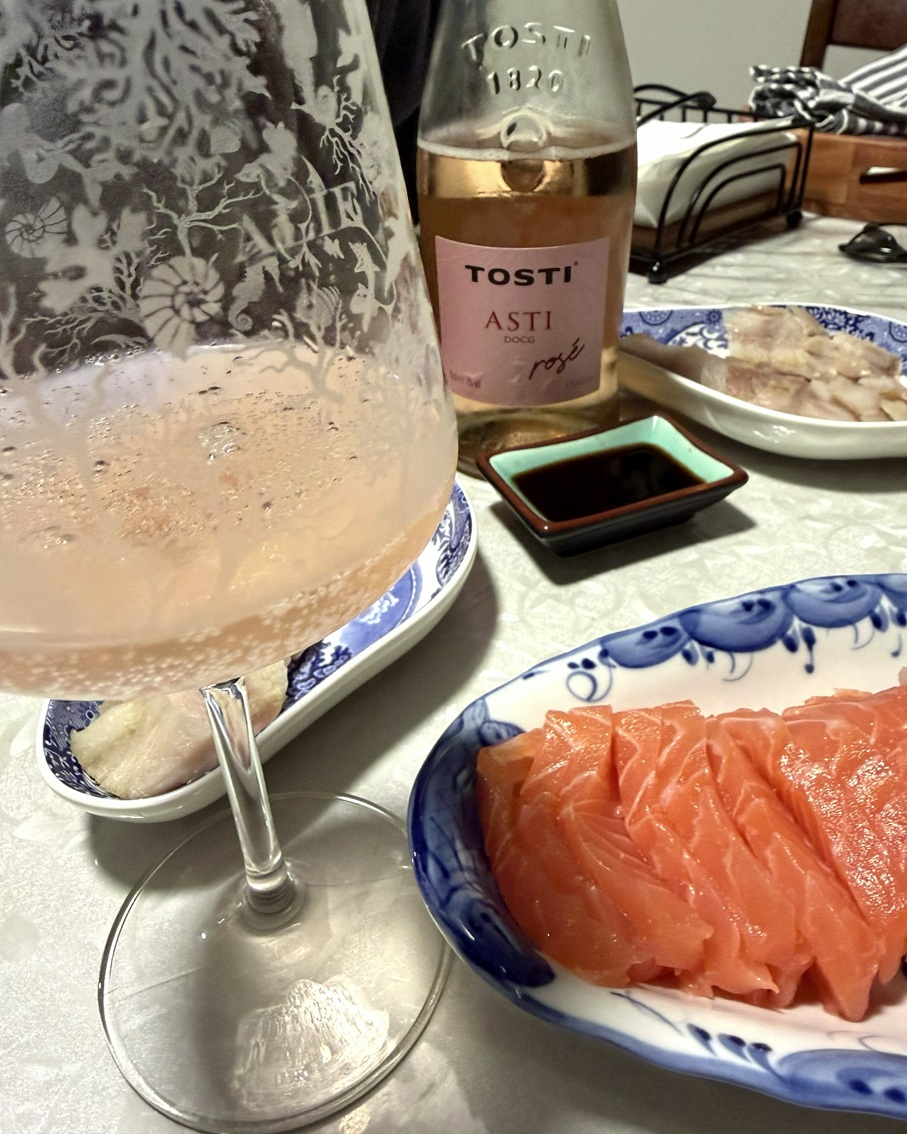
NV Tosti Asti Rosé DOCG (7% ABV) had a perfect amount of fizz, a very generous fine mousse. A hint of strawberries on the nose, and a berry assembly on the palate – light, playful, perfectly balanced, refreshing, and delicious. The wine was delicious by itself, and it perfectly complemented home-made salmon and hamachi sashimi, exactly as one would expect. As you can tell from the picture, I even procured my favorite wine glass for Rosé from the Frescobaldi Alie Rosé tasting (please, please, please, don’t ask me where you can get it, I have no clue).
There you are, my wine-loving friends – one more type of wine to look out for. It is simple, it is uplifting, and it is guaranteed to please, just give it a chance.
Please welcome Asti Rosé!
Last Bottle Sign Up ($10 credit)