Archive
Daily Glass: Cab And The Whole Nine Yards
 I’m sure you are well familiar with the phrase “The whole 9 yards” – technically translating into “lots of stuff”. You know what the fun part is? Nobody knows where this expression came from. There is a lot of research, a lot of “true origin” claims and an equal amount of disparaging remarks about the other side not knowing a squat about the subject (which seems to be the sign of times, sigh). We are not here to research or discuss the expression – my intention is to talk about a delicious Cabernet Sauvignon, but I will also give you the whole nine yards of related and unrelated “things”.
Everything started with a simple task – I was in need of the present for a friend’s birthday. My typical present is a bottle of wine of the birth year vintage (1977). However, it is getting more and more difficult to find the wine of such an old vintage at a reasonable price or even at all. After spending some time with Wine-Searcher and Benchmark Wine website, and finding nothing but a few bottles of the vintage Port, I decided that it is the time for the plan B, which means simply finding an interesting bottle of wine.
Next problem – where should I look for an interesting bottle of wine? Online seems to be the most obvious choice – but just to make things more interesting, I have to tell you that my gift recipient owns two liquor stores – yep, surprising him is not a trivial task.
Do you have an American Express credit card? Of course, you are wondering what it has to do with our story? It is most directly related. If you have the American Express credit card (AMEX for short), and if you ever looked at your account online, you probably saw the section called Amex Offers & Benefits. In that section, you can find 100 special offers, allowing you to earn additional points or save money on different items you can buy with the AMEX card. I have a good experience with these offers, these are real savings, so I have a habit of periodically logging into the account and scrolling through the offers. One of the offers I saw quickly attracted my attention – save $50 on a $150 purchase at WineAccess. I don’t know about you, but this sounds like a very good deal for me.
I was not familiar with Wine Access, so I got to the website to see if I can actually put this offer to good use. First thing I saw on the site is that $120 or 6 bottles purchase includes shipping, and if you are buying wine online, you know that shipping cost is one of the most annoying elements of the wine buying experience, so this made deal even sweeter – in case I can find something interesting.
I can’t tell you why and how, I first decided to search for Grosset, one of the very best Australian Riesling producers, and to my surprise and delight, I found Grosset Riesling available. So now I needed to add something else to reach my target number – $150.
I found an interesting Bordeaux, and next, I noticed a red blend from the Three Wine company in Napa, one of my favorite producers. My excitement happened to be premature, as once I started the checkout process, created an account and set my shipping address in Connecticut, I found out that I can’t complete my purchase as Three Wine red blend can’t be shipped to Connecticut (don’t you love US wine laws?).
I had to restart my search, and now I noticed Napa Cabernet Sauvignon called Idiosyncrasy – never heard of it, but Oakville Cab for $25 (this was a 50% discount off a standard price of $50) – why not to try one? I got two bottles, one for me, and one for my friend – done and done.
Once the order was placed I decided to check what exactly I just bought. I did a search for the Idiosyncrasy Cabernet online. I didn’t find too many references, but I did find a post which was very critical of the wine, saying that it was thin, and under-extracted Cabernet Sauvignon, absolutely no worthy of $43 which author paid for the wine. I also learned that this wine was specially produced for the Wine Access wine club by the well-known winemaker.
Truth be told – I don’t like wine clubs. What I learned about the wine, didn’t add confidence to my decision. Oh well – now I just had to wait for the shipment to arrive.
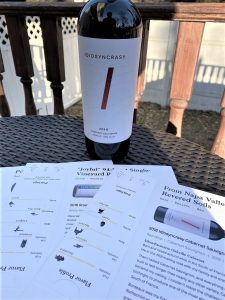
I didn’t have to wait for a long, the box showed up on the doorstep in a few days. Upon opening, I found not only 6 bottles which I ordered, but also neat, well-designed information cards – you can see it here:


Each card offered the story related to the wine, pairing suggestions, ideal drinking window put on the bottle tag which could be easily separated from the page and hang on the bottle in case you store it in the cellar. The back of the info card offered space for personal notes. Again, very well designed – would make any oenophile happy.
I read the story of the Idiosyncrasy Cabernet Sauvignon – it was written from the first person, as winemaker talked about his experience and how he came to the creation of this wine specifically for the Wine Access wine club. While the winemaker mentioned his work at Quintessa, Lail, Dalla Valle, and Purlieu, his latest adventure, his name was not found anywhere on the page. I had to figure out that his name was Julien Fayard by visiting Purlieu website.


Nice paper and story are important, but the truth is in the glass. Remembering the bad review, I poured the glass of 2016 Idiosyncrasy Cabernet Sauvignon Oakville Napa Valley (14.9% ABV), ready to be disappointed. To my delight, I was not. The keyword to describe this wine would be “elegant”. Varietally correct nose with touch cassis and mint. On the palate, the wine was rather of Bordeaux elegance – less ripe but perfectly present fruit, a touch of bell pepper, firm structure, perfect balance (Drinkability: 8/8+). Was this the best Cabernet Sauvignon I ever tasted? It was not. Was it the wine I would want to drink again? Absolutely, any day. Was it a good value at $25? This was a great value at $25, and even at $50, it would still be a good value.
Here you go, my friends – a story of the Cabernet Sauvignon and the whole nine yards. Cheers!
American Pleasures – Part 2, Peju Napa Valley
 A few weeks ago I shared with you my view on [strictly wine] American pleasures – some of the wine samples which I had a pleasure to taste recently. Yes, it is the pure hedonistic pleasure we are talking about here – the wines which have a magical power of making you want another glass even before the first one is empty. Today I want to continue that conversation and talk about Peju Province Winery in Napa Valley.
The story of Peju Province Winery is simple and similar to many others – it started from a dream. Tony Peju had a drawing of the winery with the tower two years prior to the first Peju grape been harvested. Tony found early success in Los Angeles as a horticulturist, using his landscaping skills in the real estate, improving and reselling the houses. But his dream was to own the farm.
After his search for the farm land led him up north to the Napa Valley, he was able to find the location of his dreams – a 30 acres Stephanie vineyard in Rutherford, located next to Robert Mondavi, Inglenook and Beaulieu vineyards, growing Cabernet Sauvignon and Colombard vines, some 60 years old or maybe even older. Tony and his wife, Herta, purchased Stephanie vineyard in 1983. At first, Tony and Herta were only selling the grapes, however taking advantage of Tony’s green thumb, improving the vineyard and learning what it is capable of. They identified the section of the vineyard, about 5 acres in size, which produced the best Cabernet Sauvignon fruit. The vineyard, which was renamed into HB in honor of Tony’s wife, Herta Behensky, was replanted using cuttings from that best section grafted on the phylloxera-resistant rootstock. The time has come to start making Peju’s own wine.
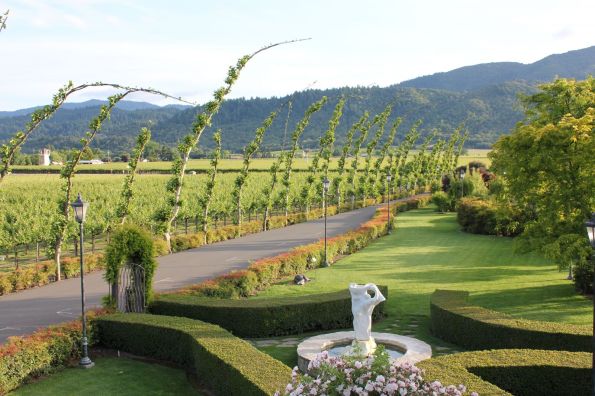
Peju Province Winery Grounds. Source: Peju Province Winery
Tony went on to get a degree in enology from UC Davis, and the rest was history. Well, there is one interesting hurdle worth mentioning. If you remember, Tony had a full drawing of the winery done in 1981, two years before HB vineyard was even found and purchased. Once they had the land and were ready to convert dreams into reality, in order to fund the project, Tony and Herta started selling wine out of their garage converted into the wine tasting room. This, however, was against Napa County’s rules, which required all the wine sales to be made from the legitimate winery building. However, California law allowed winegrowers to sell the wines in the place where the grapes were grown, so the issue ended up in the court. The judge sided with Peju, agreeing that if Tony is growing the grapes, he should be allowed to sell the wine. This became a pivotal case that significantly changed the landscape of the Napa Valley.
Peju went on to build the impressive 50-foot tall tower in the French Provencal style, using Brazilian cherry wood, beams from old Midwestern farm buildings and 1906 antique stained glass window. Way before that new winery building was complete, Peju acquired 350 acres of land at the 2000 feet elevation in the nearby Pope Valley section of Napa, which they named Persephone Vineyard, after the goddess of Greek mythology. In 1997, 120 acres of that land was planted to Cabernet Sauvignon (using HB Vineyard clone), as well as Cabernet Franc, Merlot, Syrah, Petit Verdot, Sauvignon Blanc, Chardonnay, and Zinfandel. In 2007, Rutherford HB vineyard became certified organic, and today all three of Peju vineyards are using sustainable viticultural methods. In 2009, Peju Province Winery was certified as a Napa County Green Winery and Bay Area Green Business. Also in 2006, Peju started installing solar panels on 10,000 square feet of winery roof and generating 35% of all electricity consumed at a winery.
Okay, so now you learned a lot about the winery, so let’s talk about the wines, as a proof is always in the glass. I had an opportunity to try 6 wines from Peju, and I was literally blown away by what I tasted. To be entirely honest, these wines were one of the most inspirational coming up with the title for this series – American Pleasures. 6 out of 6 delicious wines, one better than another – I taste enough wines during the year to tell you that this is not given. Below are my notes:


2018 Peju Province Winery Sauvignon Blanc Napa Valley (13.8% ABV, $25)
Straw pale, practically clear
A touch of freshly cut grass, white flowers, maybe a distant hint of cat pee – only because I want to find it there?
Layers of flavors. Crisp lemony acidity first, then a hint of plums and slightly underripe melon, unusual plumpness for the Sauvignon Blanc, the wine rolls off your tongue like a nice Marsanne.
8, excellent, a unique and different Sauvignon Blanc.
2015 Peju Province WineryCabernet Sauvignon Napa Valley (14.8% ABV, $60, 85% Cabernet Sauvignon, 8% Petit Verdot, 7% Merlot, 18 months in French and American oak, 45% new)
Dark garnet
Black currant, cherries, eucalyptus, sweet oak
A beautiful mix of black currant and cherries on the palate, a touch of herbal notes, good minerality, firm texture, vibrant acidity, medium+ finish
8/8+, the first sip says “I’m a Napa Cab”. Delicious.
The next wine is one of the few in “Nostalgia Series”, where every label depicts a moment in Peju’s history.
2015 Peju Province Winery Nostalgia Series The Farm Napa Valley (15.2% ABV, $80, 80% Cabernet Sauvignon, 20% Sangiovese, 18 months in oak)
Dark garnet, practically black
Dark fruit, eucalyptus, restrained, mineral undertones
Perfectly balanced fresh fruit, soft, luscious, black currant, tar pencil shavings, perfect balance, delicious.
8, delicious wine


2016 Peju Province Winery Merlot Napa Valley (14.8% ABV, $48, 95% Merlot, 4% Cabernet Sauvignon, 1% Petit Verdot, 18 months in oak)
Garnet
Sweet licorice, eucalyptus, underbrush
Coffee, tart cherries, cherry pit, minerality
8-, probably need more time. The finish is a bit astringent, however, it plays well with savory food (cheese and crackers)
Cabernet Franc is one of my favorite grapes – this wine was truly a Cabernet Franc experience.
2013 Peju Province Winery Petit Trois Cabernet Franc Napa Valley (14.8% ABV, $75, 100% Cabernet Franc, 18 months in oak, 333 cases produced)
Deep Garnet
Cassis, licorice, mocha, a hint of sweet tobacco
Cassis, mint, gently present tannins (after a few hours), firm structure, sweet oak, unmistakably California
9-, wow, tons of pleasure in every sip. Needs decanting. Outstanding on the second day.
This wine has its own story. It is the result of the barrel experiments run by Peju winemaker, Sara Fowler. For the 2017 vintage, she worked with 37 different barrel tasting styles and 22 coopers, then discussed the effects of the oak regimen with the group of the fellow Napa Valley winemakers. To have all new-oak, effectively a young wine, to be ready to drink from the get-go is something really incredible in my opinion.
2017 Peju Province Winery The Experiment Napa Valley (14.5% ABV, $100, 100% Cabernet Sauvignon, 18 months in French, American, and Hungarian oak, 100% new, 1075 cases produced)
Dark garnet
An “Oh my god!” nose – Black currant, eucalyptus, pure, intense
Wow, supple black currant, mint, eucalyptus, silky smooth tannins, good minerality, all delivered in layers. Clean acidity, impeccable balance, and immense pleasure.
9/9+, wow. An exemplary Napa Cab
There you have it, my friends – some incredible wines. Of course, these are not inexpensive wines, but in my opinion, the $100 bottle which gives you lots of pleasure is worth splurging for the right moment. Cheers!
American Pleasures
Yes, you read it right – we will be talking about American pleasures.
But don’t worry – this is still a wine blog. Yes, we will be talking about wine. And as the title suggests, we will be talking about wines made in the USA. As for the pleasures – this is what the wine is for. The wine should give you pleasure. If it does not, I don’t know what is the point of drinking it. For sure I don’t see it for myself – if I’m not enjoying the glass of wine, I’m not drinking it. It is the pleasure we, wine lovers, are after.
Lately, I had a number of samples of American wines sent to me. Mostly California wines, to be precise. And to my big surprise, I enjoyed all of them. I’m not implying that the wines I tasted were better than I expected, hence the surprise. While I pride myself with the willingness to try any and every wine, it doesn’t mean that I equally like any and every wine – I’m rather a picky (read: snobby?) wine taster. At a typical trade tasting, my “likeness” factor is about 1 out of 10 or so. And here, wine after wine, I kept telling myself “this is good!”, and then “wow, this is good too!”. Is my palate getting cursed or just old and tired? Maybe. But, as I still trust it and as I derived pleasure from every sip of these wines, I would like to share my excitement with you, hence this post, or rather, a series of posts. Let’s go.
First, let’s talk about the old. “Old” is a very respectful word here, as we will be talking about the winery which had been around for more than 40 years in Napa Valley. Back in 1976, Ron and Diane Miller purchased 105 acres vines on in Yountville, which is now known as Miller Ranch. Two years later, they acquired 226 acres in Stags Leap District, which was the vineyard called Silverado. Initially, the grapes were sold to the other wineries, until in 1981 the winery was built and the first harvest was crushed – the was the beginning of Silverado Vineyards as we know it. Today, Silverado Vineyards comprise 6 vineyards throughout Napa Valley, all Napa Green certified, which is an established standard for sustainable farming. Silverado Vineyards wines are exported to 25 countries and have won numerous accolades at a variety of competitions – and Silverado Vineyards garnered quite a few “winery of the year” titles along the years.
Two wines I tasted from Silverado Vineyards were Sauvignon Blanc and Rosé. I like California Sauvignon Blanc with a little restraint, not overly fruity, and with a good amount of grass and acidity – Honig Sauvignon Blanc and Mara White Grass would be two of my favorite examples. California Rosé is somewhat of a new category, still scarcely available in the stores on the East Coast – this is mostly wine club or winery tasting room category at the moment. Again, for the Rosé, restraint is a key – nobody needs to replicate Provençal Rosé in California, but the wine still should be light and balanced.


Silverado Vineyards perfectly delivered on both – here are my notes:
2018 Silverado Miller Ranch Sauvignon Blanc Yountville Napa Valley (13.9% ABV, $25)
Straw pale
Beautiful, classic CA Sauvignon Blanc – freshly cut grass, a touch of lemon, all nicely restrained. Nice minerality.
An interesting note of salinity, lemon, lemon zest, a touch of pink grapefruit, just an undertone with some bitterness. This is a multidimensional wine, with a good amount of complexity.
8-/8, a thought-provoking wine. Great with manchego cheese and Hungarian salami.
2018 Silverado Vineyards Sangiovese Rosato Napa Valley (14.5% ABV, $25, 100% Sangiovese)
Light Pink
A touch of strawberries, light and elegant
Strawberries and lemon on the palate, elegant, balanced, good textural presence, very refreshing.
8, and excellent Rosé overall, with its own character. And I have to tell you – I’m duly impressed with Californian Sangiovese, for sure when it is made into a Rosé – seems to be a complete winner here.
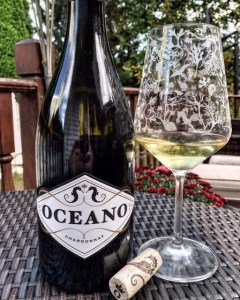
 Another wine I want to talk about here, is definitely from the “new” camp – only 5 years ago, Oceano winery was not even an idea. The winery has a great story, which you better read on the winery website. The story has everything – the love at first sight, the encounter with the seahorse, a wine label drawn on the napkin.
Oceano wines are made from the fruit coming from Spanish Springs Vineyard in San Luis Obispo – the vineyard which is closest to the Pacific Ocean not only in the Central Coast appellation but in entire California. Cool climate helps Chardonnay and Pinot Noir grapes to mature slowly and to accumulate great flavor. Not only Spanish Springs Vineyard provides ideal conditions for the grapes, but it is also SIP (Sustainable in Practice) Certified vineyard, which is considered a higher status than Organic due to the stringent requirements throughout the whole process of winemaking up to the point of bottling of the wine.
I had an opportunity to taste the second release of Oceano Chardonnay, and was simply blown away:
2017 Oceano Chardonnay Spanish Springs Vineyard San Luis Obispo County (13.6% ABV, $38)
Light golden
Vanilla, a hint of honey
Vanilla, a touch of butter, hint of almonds, nice golden apple and brioche, let’s not forget the delicious, freshly baked brioche – with tons of acidity on the long finish, tons and tons of acidity.
9-, outstanding rendition of the Chardonnay, worked perfectly well with a variety of foods – beef roast from Trader Joe’s, Brie, Spanish Cheeses (Manchego and San Simone) – this was totally an unexpected surprise. If you are looking for a delicious and versatile Chardonnay, this might be the wine you are looking for. It might easily be a star of your Thanksgiving wine program.
Here you are, my friends. These wines delivered lots and lots of pleasure, and these are the wines worth seeking. We are done for today, but we are very far from done seeking more wine pleasures. To be continued…
June – What a Month, in Wines and Pictures – Part 2
Warning – lots of pictures will be following. And you can find Part 1 post here.
My birthday celebration usually means “party”. This year we decided with my wife instead of cooking and cleaning for 2 days to spend time by ourselves and go to stay somewhere fun. We managed to pack a lot in mere 3 days.
As a collector of experiences, I’m trying to fill my Wines of 50 States map, so as we were driving to Portsmouth, New Hampshire, I decided to visit local New Hampshire winery. Fulchino Vineyard was almost on the way, so this was our first stop (the details are coming in the separate post). Then we arrived at our intended destination for the evening – Wentworth by the Sea, a magnificent property hosting the Marriott hotel.
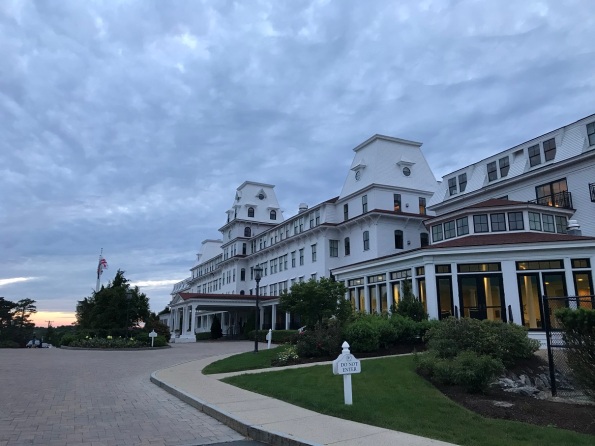
When I drove by that hotel 5–6 years ago, I still remember my admiration of a beautiful structure. It got stuck in my mind and I was waiting for an opportunity to visit – I’m glad it worked out. Beautiful building, beautiful views, beautiful property – we really enjoyed our short stay. And I will let you decide whether this place is beautiful or not take a look at a few pictures below.


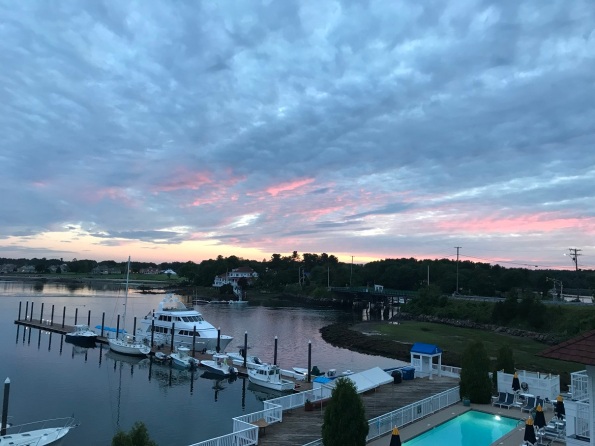
While Marriott was a great property in a magnificent setting, our next stop greatly exceeded my expectations. A few months ago I resubscribed to the Yankee magazine – it is a print magazine which is squarely focused on the happenings in New England part of the US, from Connecticut to Maine. As my “bonus”, I got a tiny leaflet called “Best of New England”, where one of the places that caught my attention was Inn at Woodstock Hill in Woodstock, Connecticut, mentioned as “Best Inn for privacy”. The Inn also conveniently hosted a restaurant with raving reviews, which sounded perfect for the birthday dinner.
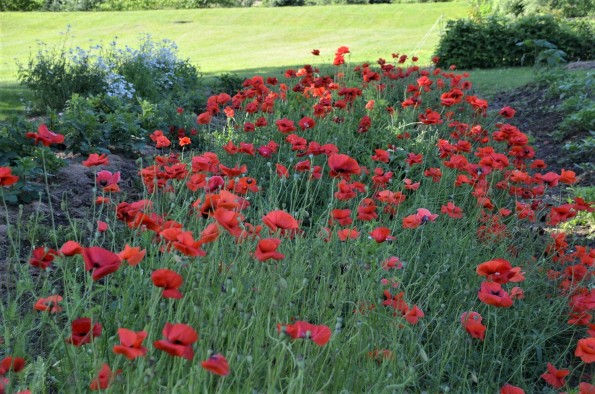
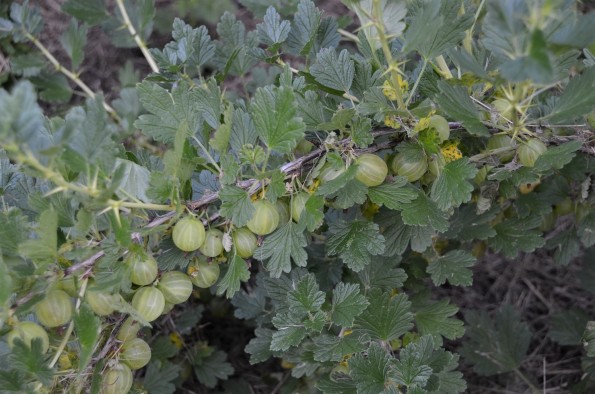
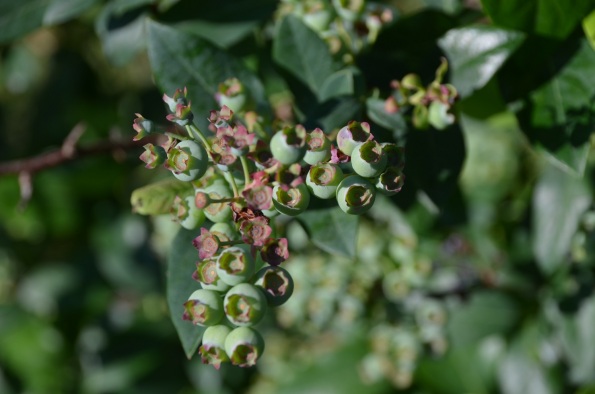
When we arrived at the Inn, we found out that our room was located not at the main building, but at the adjacent cottage, which has a total of three rooms, but we would be the only people to stay there. So we literally had a whole house to ourselves, with the deck and the view of the fields. In addition to the fields which looked perfectly untouched, we had a pleasure of walking around a small garden, where blueberries, black (I’m assuming) currant and gooseberries were all growing, and a small field of poppies was yet another source of great pleasure, as we don’t spend much time around those gentle flowers.



I brought with me a couple of bottles to celebrate the occasion. One of those bottles was 2015 Field Recordings Foeder Old Portero Vineyard Arroyo Grande Valley (14.9% ABV, 50% Syrah, 35% Zinfandel, 15% Mourvèvedre, aged for 12 months in 50 barrel American Oak Foeder). While I generally treat Field Recordings wines as every day delicious wines, good for any day which name ends with a “y”, some of those wines are a bit more special, as they are not produced regularly, and when produced, the quantities are minuscule. This was one of such wines, which I had for a couple of years, but then decided that birthday is a good enough occasion to have it open. This happened to be a mistake, as wine could definitely enjoy another 10 years to fully evolve, but even then, it was a delicious, fresh, acidity-forward concoction of sour cherries and blackberries, with well-defined structure and dense finish.


Our dinner didn’t disappoint either. First, the folks at the restaurant were very kind and let us bring our own wine despite having the full wine list (the corking charge was $15, which was totally fine, of course). The wine which I brought, 1998 Kirkland Ranch Merlot Napa Valley (14% ABV) was on my “to open” list for a while. I got a few of these bottles from Benchmark Wine and was really curious to see how the wine would fare, but the bottle went unopened on a few prior occasions. This time the cork was finally pulled out, and the wine delivered lots of pleasure. It started its journey to the peak but was still far from it – fresh, good acidity, a complex bouquet of roasted meat, coffee, dark fruit (cherries and plums), good balance – very enjoyable. The wine continued to evolve throughout the evening, giving me good hope for a few more bottles I have left.
The food at the Inn at Woodstock Hill (the restaurant doesn’t have its own name, and because of it you can’t find it on Yelp, but it has all information on the web) was delicious. We started with an Escargot, which was enjoyed to the last morsel, and Artichoke Bottoms, which were unique and delicious. Then I had The Wedge salad, which is one of my perennial favorites – you can get any salad off the menu complementary to your main dish, a very nice feature – and The Wedge again was delicious. My main dish was Pork Shank, which was… well, I don’t know if I should declare myself a pork shank connoisseur, but I’ve been through the Czech Republic, where pork is king – this dish was absolutely on par with the best versions I tasted in Prague. Yep, it was a delicious standout or it was standoutously delicious (yeah, I know it is not a word – but this is my blog :)), but I’m sure you got my point.
The morning with that fields view was just perfect. I couldn’t stop myself from taking more and more pictures…







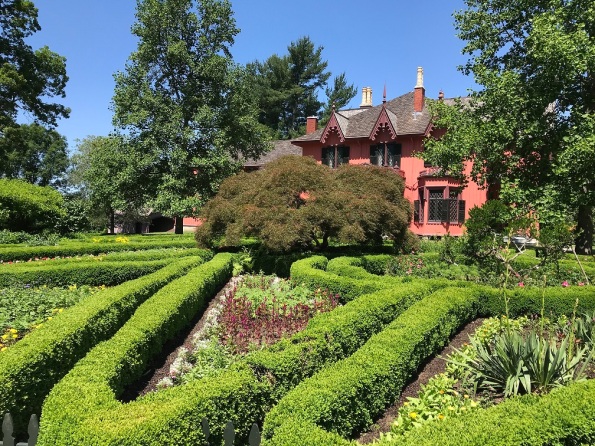
We made two more stops before finally getting home. First, we discovered the Rosewood Cottage, a pink-colored summer residence of Henry and Lucy Bowen, built in 1846, also sporting beautiful garden delimited by 150+ years old shrubs. The Cottage, which now belongs to the Historic New England organization, hosted 4 of the US Presidents visiting Bowen family on various occasions. Over these years, the house was painted 13 times in various shades of pink, has many of the original wall coverings (wallpaper) called lincrusta, and stained glass windows, some of those original since the house was built. It also houses the oldest in the United States indoor bowling alley! Does it worth a special trip? Yep, it does.



Our last stop was at the Taylor Brooke Winery, also located in Woodstock. Compared to my previous Connecticut wineries experience, this was definitely a better one – but more about it later.
Here you go, my friends – one memorable June of 2019. How was yours? Cheers!
Daily Glass: Oh, Turley
I remember discovering Turley Zinfandel many years ago for the first time at the pre-theater dinner in New York with my friend Henry. I wouldn’t tell you now if I heard something about Turley before we picked the bottle of Turley the off the wine list, or if it was just a happy accident. I just remember our reaction of a pure “wow” at how beautiful the wine was. Ever since that discovery, Turley wine almost became our secret handshake – when I show up with a bottle of Turley at my friend’s house, I get an understanding smirk and a nod – “you did good, buddy”.
Once the Turley was discovered, the very next question was – how can I get it. This is where I learned about the concept of the wine mailing list, starting with the waitlist (I talked about all those terms before – if you need a refresher, the link is here). I believe Turley was one of the first if not the first of the wine lists I signed up for (meaning, got on the waiting list for the mailing list). Turley also happened to be the very first mailing lists I got accepted to – to my big surprise and delight, as the wait was not that long (a few years).
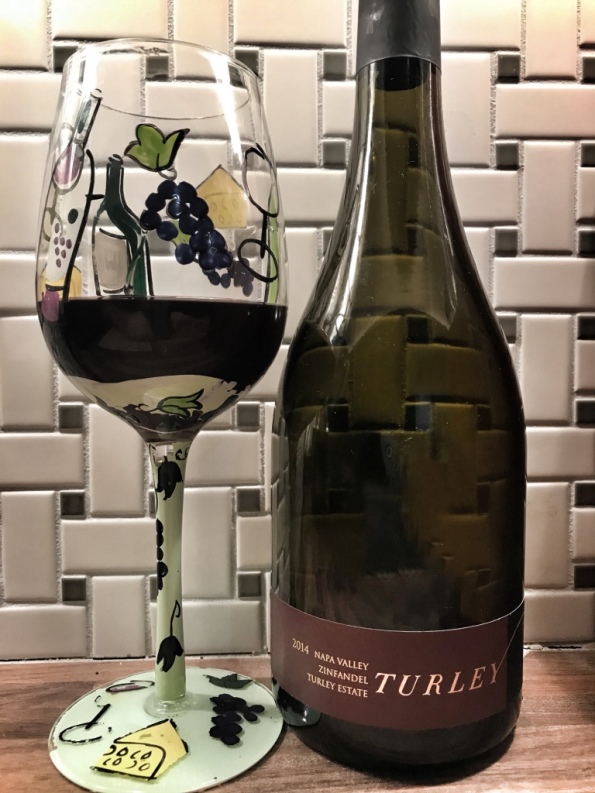
In case you are not familiar with Turley and don’t readily share into the excitement of the subject, here is a brief introduction. Turley Wine Cellars is a winery in Napa Valley in California, which specializes in Zinfandel and Petite Sirah. The winery was started in 1993 by Larry Turley, who was actively working in the wine before and developed a serious passion for Zinfandel and Petite Sirah, especially for the old vine Zinfandel (some of Turley vineyards are continuously producing since the late 1800s). Today, Turley produces 47 different wines from 50 different vineyards throughout Napa Valley, Paso Robles, Lodi, Amador Couty and other regions in California. You can find Turley wines in the stores and the restaurants, but they are scarcely available, as while they are making 47 different wines, most of the wines are produced in the hundreds of cases only, so the best way to get Turley wines is by signing up for the mailing list. One more thing I want to mention, as it is important to me – even with all the [rightly deserved] fame (they are definitely one of the top 5, or maybe even top 3 Zinfandel producers in the USA), Turley wines are still affordable on the mailing list, with some of the wines still priced at $20, and with absolution majority of the wines costing under $50 (Hanes Vineyard Zinfandel is probably the only exception at $75).
Since I got on the mailing list, Turley wines became my favorite present for the wine-loving friends. Every time we meet, my friend Patrick gets a bottle of Turley to take home to Switzerland – it is an equal exchange though, as I always get a bottle of unique and interesting Swiss wine – not something you can casually find here in the US. I also love the reaction such a present causes when people look at the bottle. I brought Turley for my friend Oz when we met in Singapore, and I handed it to him when we were finishing dinner. I perfectly remember huge, ear to ear smile on his face when he saw the bottle, and his exact words sharing the excitement with his friends “look, he got me a Turley!”. Lots of fond memories associated with Turley, in a variety of ways.
What caused this outpour of Turley love? Opening of the bottle of 2014 Turley Estate Zinfandel Napa Valley. How can I describe it? To me, a well made Zinfandel should have a perfect core of raspberries and blackberries with the addition of spices – it should have restrained sweetness and not be jammy. If you drink Zinfandel often, you know that what I just described is difficult to find. This wine had exactly that. A perfect core of ripe, succulent raspberries and blackberries, covered in pepper, sage, sweet tobacco and eucalyptus. Perfectly dry, with a firm structure and layers and layers of flavor. This is the wine you say “ahh” after every sip, and you say “ohh” when the bottle gets empty. And to complete my description, note that 15.6% ABV was not noticeable at all. A perfect balance and pure pleasure is what makes this wine so special.
Here it is, my wine love story of the day. What’s yours? Cheers!
Thanksgiving with Smith-Madrone, And a Few More Delights
Holidays are all about pleasure. The pleasure of the company. The pleasure of food. The pleasure of wine. As the very least, they should be.
Let me tell you about the pleasures of my recent Thanksgiving – in one picture:

If this would be an Instagram, I could end my post here, but in this blog, I can add a few words, right?
Let’s talk about the wine first. Everyone has their ideas as what is the best Thanksgiving wine. Some talk about how difficult it is to pair any wine with the Thanksgiving table, due to the large variety of dishes and often prevalent sweet flavors (this is not universal, of course). I have a very simplistic view of the wine and food pairing – give me tasty food and good wine, and if they don’t work together – no problems, I’m happy to consume them one by one. Difficult or not, pairing is not the focal point of my Thanksgiving wine selection. I really have only one strong preference for the Thanksgiving wines – they should be all American. Thanksgiving we celebrate here in the USA is all about this country, and so the wine should match that. And thinking about American wines, you understand how easy it is nowadays to have all-American wine experience.
How many of you heard of Napa Valley? Okay, I see that look, this was a stupid question, I know. But let me go on. How many of you heard of Spring Mountain District? Okay, I see your facial expression changing to say “hmmm, I’m not so sure”. And the last question – how many of you heard of Smith-Madrone? Okay, don’t feel too bad, at the end of the day it is one of the about 400 wineries located in the Napa Valley, so of course, one can’t know all of them. But – this is why I’m talking about it – this is the winery you might want to get better acquainted with.
Smith-Madrone is one of the oldest wineries in Napa Valley, started by brothers Stuart and Charles Smith in 1971. Smith-Madrone property is about 200 acres, with some parts of the vineyards planted more than 100 years ago, all located near the top of the Spring Mountain in Napa Valley. The name Smith-Madrone combines the family name with the name of the evergreen Madrone trees, prominently growing at the property. Well, instead of me trying to regurgitate the past and present of the Smith-Madrone winery, let me direct you to this article – it is a good story, well worth a few minutes of your time.

When was the last time you had Napa Valley Riesling? If you answered “never”, it could’ve been my answer too – until I discovered this Smith-Madrone Riesling. Riesling is simply not a common grape for the Napa Valley, but Smith-Madrone produces the absolutely beautiful rendition of the famous grape. It might be due to the mountain fruit – all the Smith-Madrone vineyards located at the altitude of 1300 to 2000 feet, with slopes reaching 34%. Sustainable dry farming and winemaking practices also play a role, but one way or the other, the 2015 Smith-Madrone Riesling Spring Mountain District Napa Valley (12.9% ABV, $32) was just delicious. varietally correct both on the nose (honeysuckle, a touch of tropical fruit, lemon, apples) and the palate, which was beautifully balanced with golden delicious apples, a touch of honey and acidity. To make me ultra-happy, the Riesling is sported a distant hint of petrol, which is my pet peeve.
2015 Smith-Madrone Chardonnay Spring Mountain District Napa Valley (14.4% ABV, $40, 10 months in French oak) was equally beautiful. Again, the wines of that styling I call in my book “classic”. A touch of vanilla and apples on the nose, a distant hint of butter, continuing with the same vanilla and white apples on the palate. Clean acidity, noticeable minerally undertones, restrained, balanced – a very classic example of “how to do chardonnay right”.
With the risk of sounding very boring and repetitive, I have one more classic wine for you – 2014 Smith-Madrone Cabernet Sauvignon Spring Mountain District Napa Valley (13.9% ABV, $52, 85% Cabernet Sauvignon, 8% Cabernet Franc, 7% Merlot, 70% new French oak, 30% one-year-old French oak for 18 months). How classic was this wine? Bordeaux-classic. The mountain fruit was shining, showing great restraint. This was not an exuberant typical Napa Cab – lean, tight, well-structured, with cassis both on the nose and the palate, the wine was very enjoyable now, and it will be equally or more enjoyable in 30 years.
So that was my main wine story on the Thanksgiving day. The rest was about the food – starting the smoker as 9 am in the 21°F weather (about -6°C), and then watching the turkey slowly getting to the right temperature. The silver lining of that cold weather was the fact that instead of 4-4.5 hours in the smoker, it took about 6 hours to get that big bird to the right doneness – and slower cooking results in more tender and more flavorful meat. A glass of Smith-Madrone Riesling was adding to the cooking enjoyment.


After celebrating Thanksgiving at our house, we went to see our close friends in Boston. What I love about that house is that there are always a few of the older wine bottles laying somewhere on the shelf. You never know what you will find in the older bottle, but that is what makes it fun, isn’t it?


The first bottle I opened was 2007 Tishbi Cabernet-Petite Sirah Shomron Israel (12% ABV, 70% Cabernet Sauvignon, 30% Petite Sirah). Judging by the pronounced brickish, almost orange, color, my first thought was “this probably fully turned”. And it was not! Complex nose of dried fruit and herbs was supported by plums and prunes forward, but balanced palate. Good amount of acidity, tertiary aromas – this was a very enjoyable glass of wine. Only one glass, I have to say – by the time I wanted the second, the wine was gone.
Without much thinking, I pulled another wine, realizing later that I opened another wine from the same vintage – 2007 Marani Kondoli Vineyards Saperavi-Merlot Kakheti Georgia (13.5% ABV). This wine couldn’t be more different from the previous 2007 – dark garnet color, not a sign of any aging, tight, fresh, blackberries and blueberries on the nose and the palate, firm, fresh and young. I’m really curious about how much longer this wine could’ve last.
One last wine to mention – 2010 Massandra White Muscat Crimea Ukraine (16% ABV). Massandra winery roots go back to the old Tsar’s Russia in late 1800, but their cellars hold wines from the 18th century (if you are not familiar with Massandra wines, here is an article by Jancis Robinson). Massandra is best known for sweet fortified Muscat wines, like the one we tasted. To me, this 2010 was most reminiscent of a Sherry, and not necessarily an ultra-balanced one. But then the same Jancis Robinson’s article says that Massandra wines require 45-60 for the full maturity, so I guess the wine tasted within the expectations…
Spring Mountain District in Napa Valley, Israel, Georgia, and Ukraine – not a bad wine play for the holiday, what do you say?
Here you go, my friends. I will leave you with some beautiful wines to look for. And how was your Thanksgiving, if you still remember it? Cheers!
WBC18: Merlot Deep Dive with Masters of Merlot
I remember my first “deep dive” into the Washington wines at the Chateau Ste. Michelle winery a few years ago, where I was told about the power of Washington Merlot. The explanation was given on the example of a group visiting Chateau Ste. Michelle from California, who were complaining that Washington Cabernet Sauvignon was too soft and mild as opposed to the Cabernet Sauvignon from California. The group was offered to taste the Washington Merlot wines next, and this is where they found the right amount of “power” they were looking for (or maybe even a bit more).
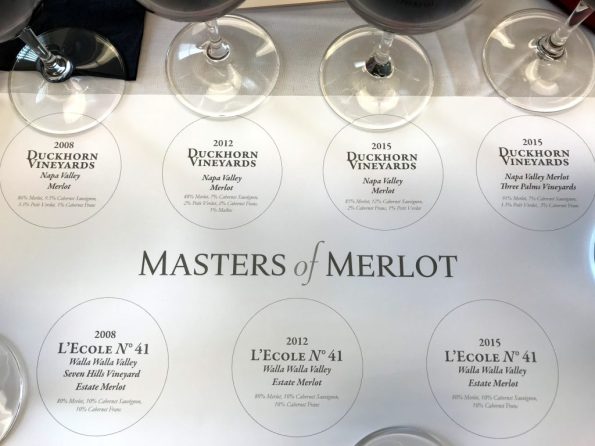
While attending Wine Bloggers Conference 2017, I was able to start the conference experience on a very high note with the deep dive pre-conference session on the California Cabernet Sauvignon, where we learned about one of the most classic California Cabs you can find – Beringer Cabernet Sauvignon. This year, at WBC18, we started on the equal, or maybe even higher note with the pre-conference session on Merlot. Very appropriately for being in Washington, and for the October being the #MerlotMe month, we were able not only taste a line of Merlot wines but to compare side by side the wines made by two of the Merlot pioneers and, unquestionably, the Masters – Duckhorn Vineyards from Napa Valley and L’Ecole No 41 from Walla Walla Valley.
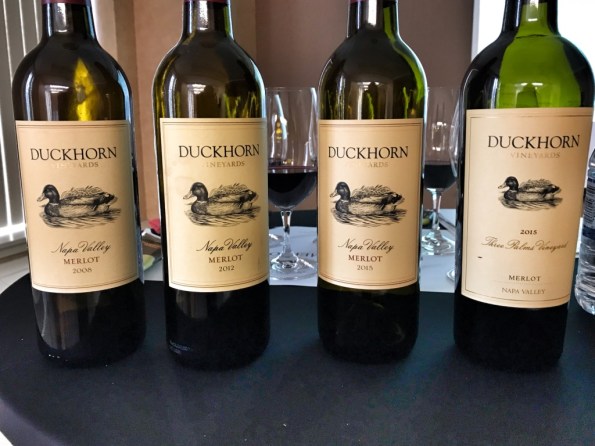
Dan and Margaret Duckhorn started Duckhorn Vineyards back in 1976, becoming one of the first 40 Napa Valley wineries. Even in those early days, it was clear that Cabernet Sauvignon was The Grape everybody wanted to work with. At that time, Dan and Margaret decided to proceed in their own way, and instead of joining the Cabernet Sauvignon movement, be unique and different and embrace the Merlot. Ever since their inaugural vintage in 1978, they never looked back and became known as Napa Valley Merlot pioneers and one of the best Merlot producers in the world, starting with their first release of Napa Valley Merlot in 1979. Today, Duckhorn Vineyards expanded dramatically and now comprise multiple wineries and brands around the USA – however, Merlot is the heart and soul of Duckhorn wines, and it is not surprising that 2014 Duckhorn Vineyards Three Palms Vineyard Merlot was the Wine Spectator’s 2017 Top 100 Wine of the Year.
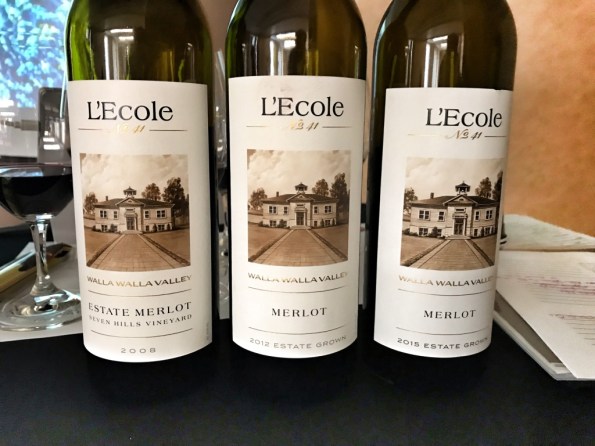
L’Ecole No 41 was founded by Baker and Jean Ferguson in 1983 when it became 3rd winery in Walla Walla, and 20th winery in the Washington state. Today the winery is run by the 3rd generation of the family, and sustainably farms estate Seven Hills and Ferguson vineyards. Merlot is the king in Washington, so it is not surprising that the L’Ecole crafts some of the best Merlot wines in Washington – however, their Cabernet Sauvignon, Syrah, and Bordeaux-style blends are equally world-famous.
Now that you know the bit of the history, let’s talk about our tasting. In our Masters of Merlot session, we had an opportunity to taste side by side Duckhorn Vineyards and L’Ecole No 41 Merlot from 2008, 2012 and 2015 vintages, plus a cherry on top (thank you, Duckhorn Vineyards) – 2015 Three Palms Merlot. Before I will leave you with the tasting notes for these beautiful Merlot wines, I just want to share some general observations. The three vintages of Duckhorn Merlot we were comparing had a different grape composition between the vintages while maintaining the same oak treatment for all the wines. As I mentioned in my summary post about WBC18 experiences, Washington weather is very consistent, so L’Ecole No 41 maintained the same grape percentages between the vintages and the same oak regimen – the changing parameters were only harvest dates and the vineyard source composition, which gradually shifted from solely a Seven Hills vineyard in 2008 to the 50/50 share between Seven Hills and Ferguson vineyards in 2015 (L’Ecole folks are ecstatic about the potential of the Ferguson Vineyard, now introducing more and more single vineyard wines from it).
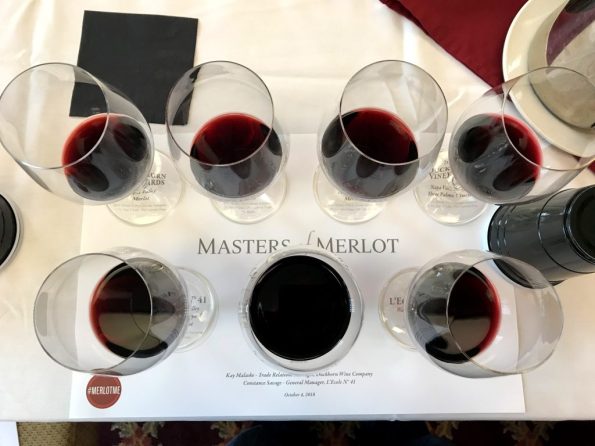
Now, it is (finally!) time to talk about the wines. Here we go, in the tasting order:
2008 L’Ecole No 41 Estate Merlot Seven Hills Vineyard Walla Walla Valley (14.5% ABV, $?, 80% Merlot, 10% Cabernet Sauvignon, 10% Cabernet Franc, 18 months in French oak)
Rutherford dust on the nose, chewy, dense, tart cherries, needs time! I want more fruit! Would love to try it in 5-8 years.
2008 Duckhorn Vineyards Merlot Napa Valley (14.5% ABV, $70, 86% Merlot, 9.5% Cabernet Sauvignon, 3.5% Petit Verdot, 1% Cabernet Franc, 16 months in French oak)
Raisins on the nose, very explicit, beautifully dry on the palate, sage, anise, tart, showed a bit of Rutherford dust after swirling, great acidity. Amarone! I want to drink it NOW!
2012 L’Ecole No 41 Estate Merlot Walla Walla Valley (14.5% ABV, $30, 80% Merlot, 10% Cabernet Sauvignon, 10% Cabernet Franc, 76% Seven Hills Vineyard, 24% Ferguson Vineyard, 18 months in French oak)
Espresso, Rutherford dust (a bit less explicit than 2008). More fruit on the palate, bright, beautiful.
2012 Duckhorn Vineyards Merlot Napa Valley (14.5% ABV, $65, 88% Merlot, 7% Cabernet Sauvignon, 2% Petit Verdot, 2% Cabernet Franc, 1% Malbec, 16 months in French oak)
Delicate, fresh plums, a touch of truffle notes, plums and lavender on the palate, delicate, fresh, round.
2015 L’Ecole No 41 Estate Merlot Walla Walla Valley (14.5% ABV, $36, 80% Merlot, 10% Cabernet Sauvignon, 10% Cabernet Franc, 50% Seven Hills Vineyard, 50% Ferguson Vineyard, 18 months in French oak)
Dark fruit, Rutherford dust, dark berries, a bit of bell pepper on the palate, plums, sapidity, interesting minerality. Needs time.
2015 Duckhorn Vineyards Merlot Napa Valley (14.5% ABV, $56, 85% Merlot, 12% Cabernet Sauvignon, 2% Cabernet Franc, 1% Petit Verdot, 16 months in French Oak)
Closed nose, a touch of mint, however – palate is beautifully ripe, open, clean, fresh fruit.
2015 Duckhorn Vineyards Merlot Three Palms Vineyard Napa Valley (14.7% ABV, $98, 91% Merlot, 7% Cabernet Sauvignon, 1.5% Petit Verdot, 0.5% Cabernet Franc, 18 months in French Oak)
Rich, opulent, caramel, anise, sage, on the palate coffee, ripe fruit, mocha, dark chocolate. Big and delicious.
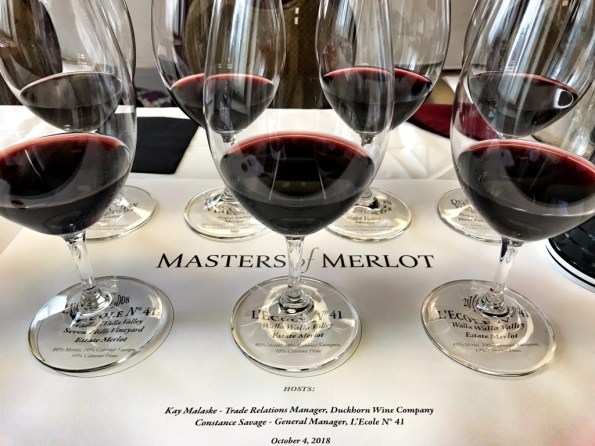
Were these wines similar, even between the different wineries? Of course. I love the presence of the Rutherford dust on many of the wines we tasted – after tasting best of the best in Rutherford in Napa Valley – the BV wines, I picked up that term and I always use it describe the perceived dusty impression of the wine’s aroma. L’Ecole Merlot was a lot more structured and minerally-driven. I would safely say that 2-3 hours in the decanter would help those wines a lot. The Duckhorn Merlot were a lot more fruit driven but offered an impeccable balance with that fruit. If I have to pick the favorite, it would be between 2008 Duckhorn (ahh, that Amarone-like beauty) and 2015 Duckhorn Three Palms, but there were really no bad wines in this tasting.
There you have it, my friends. Beautiful Merlot wines, easy to love and appreciate, and most importantly, offering lots of pleasure. How is your Merlot Me month going? What are your discoveries or the old favorites?
I have to say special thank you to Constance Savage of L’Ecole No 41 and Kay Malaske of Duckhorn Vineyards for offering this special tasting to the wine bloggers! Cheers!
Looking for Great Wine Values? Trader Joe’s Got Them
Another trip. Another stop at Trader Joe’s. Another “how do they do it?!” sentiment.
My typical strategy in Trader Joe’s is to see how many wines $20 can buy. This time around, I decided to change that. Somehow, being in San Diego in California, there was sudden desire to focus on California wines. That, and maybe a bit of France – 2018 had been my personal France tasting renaissance so far.
Of course, while I wanted to drink California wine, I was still on the lookout for reasonably priced bottles, not to exceed $20 – by the way, I know that good California wine under $20 is considered “mission impossible” by many, so this was another interesting challenge.
After touching and turning tens and tens of bottles, I settled for maybe not famous, but very well known producers – Benziger Family Winery and St. Clement Vineyards from California. I almost added French GSM to the basket, but instead, went with the Rhone-style white blend – a classic combination of grapes (Viognier/Roussanne/Marsanne), and a great value at $6.99. 
How did the wines fare? Let me tell you all about it.
2016 Pontificis Viognier-Roussanne-Marsanne Pay’s d’Oc IGP (13% ABV, $6.99, $50% Viognier, 35% Roussanne, 15% Marsanne). While Viognier/Roussanne/Marsanne combination is a classic blend of Northern Rhone, this wine came from Languedoc, the winemaking region where everything is possible. Was it different than the actual Northern Rhone would be? You bet. Was it still delicious in its own right? By all means.
Light golden color in the glass. After some time, the nose showed classic Viognier perfume of tropical fruit – nothing overboard, but well noticeable. As it is often the case with Marsanne/Roussanne combination, I almost preferred this white wine at the room temperature versus fridge-cold. A touch of lemon and lemon zest on the palate, characteristic plumpness, full body, with some hint of guava. Roll of your tongue goodness, with a perfect amount of acidity on the finish – just bring me some food. Drinkability: 8-/8. And good luck matching this value.
2014 St. Clement Vineyards Pinot Noir Napa Valley (14.5% ABV, $9.99). St. Clement Vineyards had been making wines in Napa Valley since the 1970s. One of their wines, a red blend called Oroppas, is one of my favorites, so this was an easy choice.
Bright ruby color in the glass. Dark chocolate, tobacco, and plums on the nose. The palate is perfectly balanced with supple raspberries and blackberries, good firm structure, excellent mouthfeel and presence, and an acidity cleanse on the finish. It might be pure luck – but luck or not, this was one tasty California wine. For $9.99. Drinkability: 8
2015 Benziger Family Winery Cabernet Sauvignon Sonoma County (13.5% ABV, $13.99, 16 months in oak). Benziger winery was founded in 1980, and in the year 2000 became a Demeter certified biodynamic farm. Benziger wines generally offer good value for the money, and who can refuse a California Cabernet from a good producer? Yep, not me.
Dark garnet, almost black in the glass. Beautiful nose of black currant and bell pepper. Unmistakable, textbook Cabernet Sauvignon on the palate – clean fruit, soft, open, black currant, eucalyptus, soft tannins, medium+ body. Lots of pleasure in every sip. Another great California value – well under $20. Drinkability: 8-/8.


Here you go, my friends. Trader Joe’s is unstoppable in its mission of bringing tasty power to the people. What was your favorite Trader Joe’s discovery as of late? I’m off to have another glass of Cab while you are thinking about it.
Daily Glass: Monday Night Escapades
Is there a special wine fitting every day of the week? I would guess that for many, Friday and Saturday are considered special nights, as it’s the weekend, and people think of drinking something better (higher end). Sunday is still the weekend, so the higher calling might still be in order.
But what about Monday? Does your choice of wine for Monday depend on your general outlook on life? “I love Mondays” … said not that many people, but isn’t it great that it is the first day of the week and we have the whole new week ahead of us, with lots of things to do, places to visit and people to meet? I guess one’s personal take on Mondays does depend on one’s take on life, so I will leave it for you to ponder at and if you have any words of wisdom to share, please do so after the beep … err in the comments section below.
I have two wine-related experiences from Monday which I want to share. First, I finally got to open the Field Recording’s Can Club shipment. What’s a big deal, you ask?


Field Recordings is one of the most innovative wineries I know. Small winery in Paso Robles, California, a brainchild of Andrew Jones, a vigneron, who started his career as a grape grower, first and foremost. Ever since I tried his Fiction Red, I became a passionate fan and I’m religiously following everything Filed Recordings does.
A few years ago, Field Recordings started experimenting with the wine in the can. Going beyond just the wine in the can, they also finishing their wines with the beer hops which creates truly a different experience. As soon as the “Can Club” was opened, I joined it. The wines were always good, but the shipments themselves went through a number of changes in the format, and pretty much every shipment had some little (and different) issues associated with them. Until now.
Once I opened the box, my very first reaction was “wow”. In my humble opinion, Field Recordings, under their Alloy Works brand, achieved perfection in the packaging of the canned wine. Simple, elegant, sturdy, economical, easy to handle – unpacking this shipment was absolutely a delightful experience. Ask any oenophile, the first thing which gets everyone excited is the opening of those boxes. With this delivery, Field Recordings Can Club achieved shipping nirvana – I hope they will continue it moving forward.
I can’t tell you much about the wines, as they needed to get chilled and went straight into the fridge; I can only mention that this shipment included 2 cans each of Weissland, sparkling dry hopped Chardonnay; Martian Galaxy – a dry-hopped, sparkling rose, a blend of Gamay and Mourvedre Martian Vineyard in Los Alamos; and Sangria, a blend of freshest, cold-pressed juice cocktail of cranberry, blood orange and lemon from Yes Cocktail Company mixed with Zinfandel from Old Potrero Vineyard. I don’t know about you, but I’m very excited to try these wines – and will report on the experience afterward.
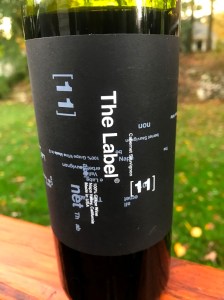 Now, let’s talk about that Monday night wine. Outside of special events, I never know in advance what am I going to open. Deciding on the bottle of wine is somewhat of a frustrating experience (first world problems, I know). Numerous bottles get touched and looked at, then rejected for a myriad of reasons. Finally, one is pulled out – usually for no other reason than “oh well, maybe this will do”. This time around the bottle happened to be Turley Cabernet Sauvignon called The Label.
Turley is not known as the Cabernet Sauvignon powerhouse – it is a coveted and well sought-after Zinfandel producer for the most. A few years ago, Turley finally got into the Cabernet Sauvignon wines and produced the wine which was called “The Label” – named after the words of Larry Turley, the proprietor at Turley Winery, who always said that Cabernet Sauvignon drinkers simply “drink the label”.
I don’t know if this should be considered funny or strange, but it appears that 2011 Turley The Label already was my choice of Monday wine – almost 4 years ago, in January of 2014 (here is the post). I really loved the wine then, but it evolved much further this time around. From the get-go, this 2011 Turley The Label Cabernet Sauvignon Napa Valley (13.4% ABV) showed a beautiful medley of the succulent berries, both on the nose and the palate – blackberries, blueberries, and black currant, tastefully accompanied by mint and eucalyptus and supported by clean acidity (Drinkability: 9-). It was reminiscent of a perfect Turley Zinfandel, fresh and playful – with a character of its own. Last time I said I want to taste this wine in 10 years. After almost four we are going in the right direction – I should have one more bottle somewhere so I will have to be careful to avoid any Monday blues prompts to open this wine until its due time.
What is your perfect Monday wine? Cheers!
Daily Glass: Will It Merlot?
 Yes, the title of this post is a play on the theme of some of the Good Mythical Morning episodes, where Rhett and Link are trying to figure out how far they can take the usual food items in the unusual directions, calling those episodes “Will It …” (if you are not watching the show, you really should, here is the link for you). But this is where the connection with the popular show ends.
And yes, we are talking about Merlot. But that also not very important, as the bottle was not opened just because I wanted to drink Merlot.
The vintage was the culprit – 2002 – as this is the year when my youngest daughter was born. And as I’m sure many of you, oenophiles, out there do, I love opening proper vintages to celebrate birthdays.
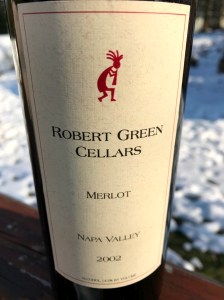
So the question was whether this 2002 Robert Green Cellars Merlot Napa Valley (14% ABV) would be still drinkable in 2017.
I presented this question to a few of the twitter winos, and the consensus was cautiously optimistic, presuming the wine was properly stored (the bottle actually never left wine fridge from the moment it got into the house). Wine Spectator rated 2002 Napa vintage at 89, and “Drink Recommendation” column had gloomy “Past peak” reference. I wanted to learn a bit more about the wine from the producer’s website, but the link on the back label was non-functional, and google didn’t offer much help searching for “Robert Green Cellars”.
Done with theoretical research – the proof is in the pudding wine glass anyway. The cork pulled out in a perfect condition. The wine is in the glass, and the first whiff had nice fruit in it, but the wine tasted a bit off. But – never judge the wine by the first sip, right? This rule is very important when it comes to the young wine, but this is even more important when it comes to the aged wines. 10 minutes in the glass brought this wine together – a perfect core of the dark fruit, maybe a touch of black currant, mint, firm structure, definitely a nice glass of wine.
About an hour and a half after the bottle was opened, it opened up even more, but somewhere in the distance, more on the finish than anything else, tertiary aromas started to appear – this is when I tweeted to the same group that the wine was perfect but at its peak. Another 30 minutes later, the wine started closing back, but only in a good sense – acidity came to the forefront, fresh young black and red fruit came to dominance – I was clearly looking at a young and delicious wine, not more than 3-4 years of age. Then, of course, the bottle was empty.


This was definitely a fun bottle of wine, with the self-attached “first world problems” – would the wine be still good or not. Believe it or not, but there was even the next level of fun associated with that wine. The little pictogram of the flute player, known as Kokopelli, which you see on the front label and the cork itself, most often is associated with fertility. What I didn’t know that Kokopelli also can be credited with the arrival of the spring. I have other 2002 bottles but somehow decided to open this particular one on the second official day of Spiring (the Spring in the USA started on March 20th). Oh well, as I said before, first world problems.
I think this wine Merlot perfectly, and I can only wish you same success and fun with your older bottles. I also want to leave you with the text from the back label of this bottle, as I think it perfectly finishes this post:
“The Joy Bringer” “This flute playing character is often credited with bringing the change of winter to spring, melting the snow and bringing about rain for a successful harvest. He is believed to represent the fertility of the untamed spirit of nature. Perhaps this joyful traveller’s greatest lesson is showing us that we shouldn’t take life so seriously. We hope the spirit of Kokopelli shines through in our wine and that it brings you as much joy and pleasure as it was for us to make. Enjoy the moment. Robert and Sue.”
Last Bottle Sign Up ($10 credit)




 Talk-A-Vino