Archive
Beautiful Wines of Smith-Madrone
I love the wines of Smith-Madrone.
I’m not even trying to make it a secret.
Yes, I’m biased. But I’m not ashamed of it.
Stu Smith and his brother, Charlie, founded the winery in 1971 in the Spring Mountain District of Napa Valley. When Stu was buying a property overflowing with trees, he was told that he was making the mistake of his life. But the best wines are born out of conviction – add perseverance, gamption, hard work, ingenuity, and imagination – just get all of these ingredients, and you might also be able to make some beautiful wines.
I told you that I love the wines of Smith-Madrone. Usually, love doesn’t require proof. But if you insist, I have one – not only I wrote about wines of Smith-Madrone on multiple occasions, but their wines had been included in my Top Wines of the Year lists 4 times – #11 in 2018 (Riesling), #1 (Cook’s Flat Reserve) and #14 (Riesling) in 2019, #3 in 2023 (Cabernet Sauvignon), and #4 in 2024 (Cook’s Flat Reserve). I don’t have any other wines that so consistently appear in the Top Wines lists.
For many years, Smith-Madrone produced only three wines – Riesling, Chardonnay, and Cabernet Sauvignon, with the addition of the Cook’s Flat Reserve Cabernet Sauvignon in exceptional years. A few years back, Rosé and Cabernet Franc joined the collection, and I was dying to try them ever since. This year, I finally got my hands on the wines (I rarely ask for samples, but this was one of such rare moments – I did ask…), so now I can share my tasting notes with you.
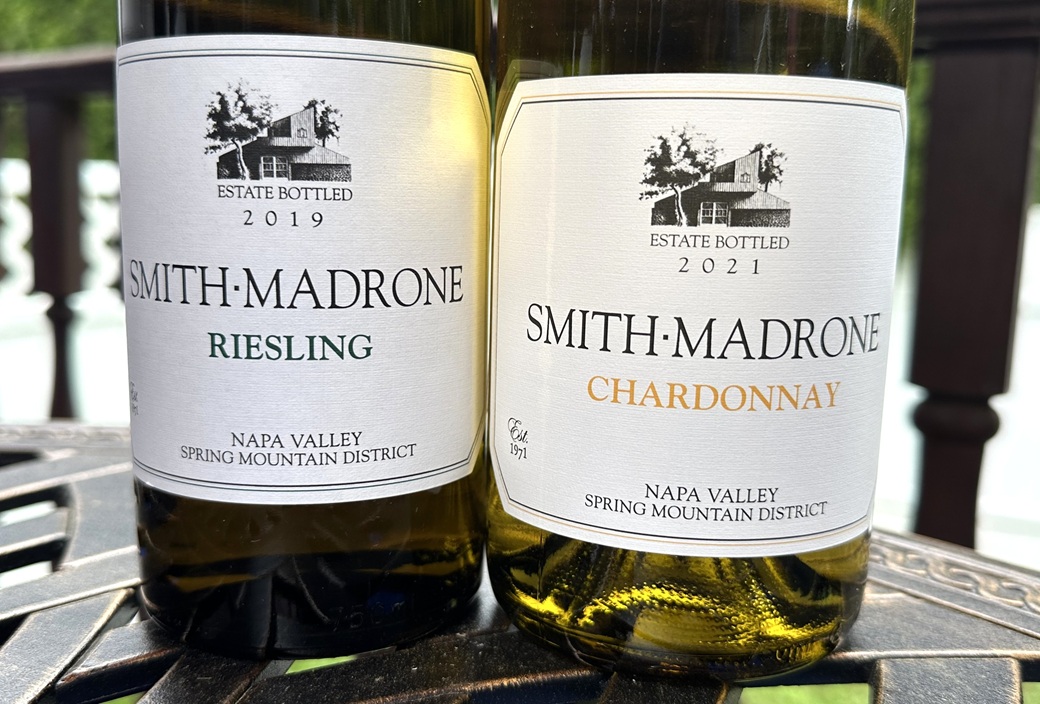
2019 Smith-Madrone Estate Riesling Spring Mountain District Napa Valley (13.3% ABV)
Light golden
Petrol mixed with honey and honeysuckle, a pure aromatherapy in the glass for a Riesling lover. Crisp, bright, honey with lemon in perfect harmony, clean and crisp finish with lots of energy.
9, a pure delight.
2021 Smith-Madrone Estate Chardonnay Spring Mountain District Napa Valley (14% ABV, 10 months in 50% new French oak)
Brilliant golden color
White plums and a touch of vanilla on the nose, a distant hint of gunflint (the wine is almost at room temperature). Apples, a touch of honey, vanilla, more apples, and a cleansing acidity. Delicious.
8+/9-, superb.


2023 Smith-Madrone Estate Rosé Spring Mountain District Napa Valley (14.2% ABV, 50% Merlot, 50% Cabernet Franc)
Beautiful, bright crimson red
Tart cherries, fresh, on the nose. Light, inviting, elegant.
Beautiful tart cherries on the palate, well present, round, delicious.
8+, delicious Rosé with character
2021 Smith-Madrone Estate Cabernet Franc Spring Mountain District Napa Valley (14.7% ABV, 89% Cabernet Franc, 11% Cabernet Sauvignon, 18 months in 60% new French oak)
Dark garnet
Ripe black currant, dark chocolate, fat, juicy, exciting. Delicious, black currant, dark chocolate, a rich California Cab Franc style, bell pepper came in later, together with a beautiful black pepper note, spicy and delicious.
8+/9-
Truth be told, I also got a sample of the 2021 Cabernet Sauvignon – but this is one of my most favorite Cabernet Sauvignons ever, so I couldn’t muster the courage to open the bottle yet, and will be waiting for the right occasion later this year – maybe a Thanksgiving celebration, as I did back in 2018.
I think both Rosé and Cabernet Franc are great additions to the portfolio. Both are produced in small quantities (131 cases of Rosé, 153 cases of Cabernet Franc), and Rosé is already gone (duh, summer is ending), but the Cab Franc is still available. And if we are talking about new additions, maybe we will see a sparkling wine one day? Or wait, I might have even a better idea – how about some late harvest Riesling? Knowing the quality of Smith-Madrone Riesling, if they were ever to produce a dessert-level Riesling, I’m sure it would be an absolute delight. Oh well, maybe one day…
Here you go, my friends. I hope you had a chance to discover the wines of Smith-Madrone for yourself. If you have not, head over to the Smith-Madrone website, admire the scenery of beautiful mountain vineyards, and get a few bottles for yourself to enjoy. I guarantee you will not regret it. Cheers!
Ode to Cab
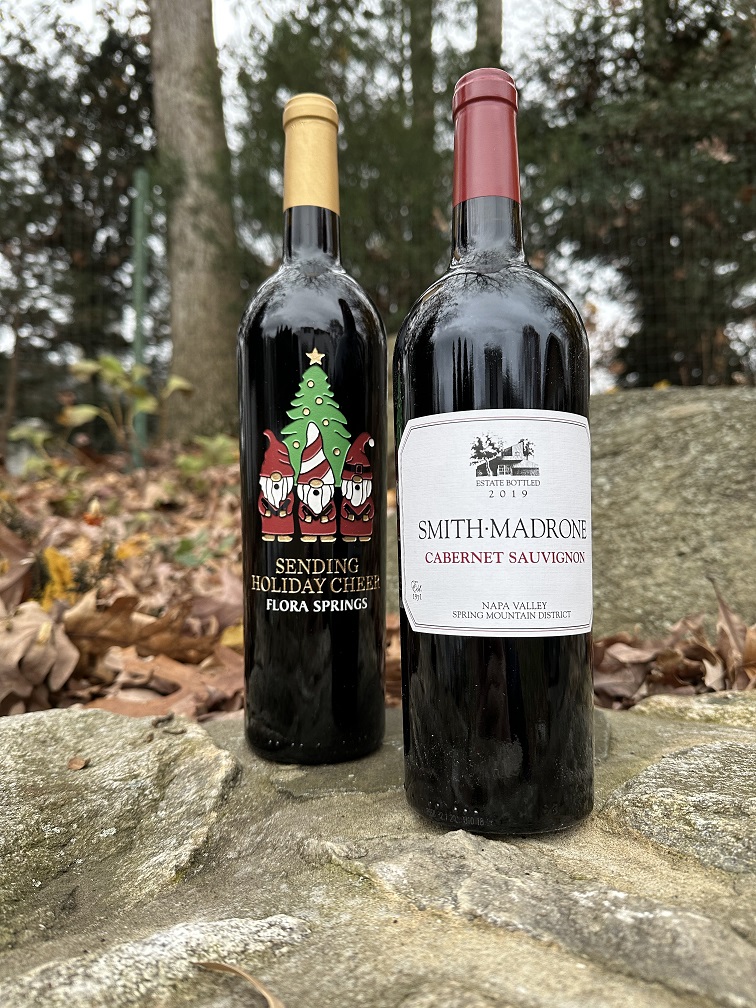 Ode to Cab.
Or we can just call it a Love Letter to Cabernet Sauvignon.
As an oenophile, I always try to maintain my “grape neutrality”. I can never name my favorite type of wine, never mind favorite wine. If you will hard press me against the wall with this question, I might say that it is Rioja, but the reality is a lot more complex than that.
If you search through articles in this blog, you will find a full range of wine styles and grapes. There are many blogs out there that cover specific region(s) or specific types of wine – but when I started writing close to 15 years ago, I knew that I would not be able to do that. This blog is about wine appreciation – any wine. “Wine should give you pleasure” – and so this is what my writing is primarily after – sharing the joy, the pleasure of wine, no matter what is the pedigree. Wines made from little-known grapes – Bobal, Trepat, Kekfrankos, Romorantin by tiny producers can give you as much pleasure as first growth Bordeaux, cult California, or best super-Tuscans. The liquid in the glass matters, and the only opinion that matters is yours and only yours – you can not enjoy the critic’s 100 points in your mouth.
This is my approach – try any wine with an open mind, and always be ready to be pleasantly surprised – or even blown away for that matter. And yet there is something about Cabernet Sauvignon that makes my heart race, especially coming from the producer I know or have heard of. Listen, I’m doing my best to tell you the truth, even though the “thought spoken is a lie”. But the brain gets all excited when I’m opening a bottle of the familiar Cabernet Sauvignon because I already know how good it can be. Very different from the excitement of the possible taste of DRC, Petrus, or Quintarelly (I’m yet to taste either) – because with those I wouldn’t know what to expect. But I do know what to expect from the well-made Cabernet Sauvignon that is ready to drink.
Even with the wines I happily call the favorites, I can’t tell you what I’m expecting to taste. I can’t describe my expectations when tasting La Rioja Alta, Ken Wright Pinot Noir, or Loacker Corte Pavone Brunello di Montalcino. I expect that I will like those wines as I know the producers and had their wines many times before – but I can’t tell you my exact expectations of the aroma or the taste of the wine. With Cabernet Sauvignon, I have very precise expectations of the aroma and the taste for me to like the wine. If I do not find the cassis (black currant) on both nose and palate when the bottle says “Cabernet Sauvignon” on it, there is no way I will like the wine, no matter how good the wine is for anyone else. Eucalyptus, mint, and a good structure are also expected, but with this some variations are possible. But when the expectations are met… the Cabernet Sauvignon is nothing but a pure, hedonistic pleasure.
So yes, deep down, Cabernet Sauvignon might be the most favorite wine of all – I just hope I will remember it next time I’m asked about my favorite wine.
Now, truth be told, I had a good reason for all this rambling about the beauty of Cabernet Sauvignon. A few weeks ago, I had an opportunity to conduct an accidental side-by-side tasting of the California Cabernet Sauvignon and the results were simply amazing.
With this tasting, we are taking a little trip. We will start in Northern California, where Barra of Mendocino is located. I wrote about their wines before, and now I have a few of the latest releases and I thought that Cabernet Sauvignon would be quite appropriate for the tasting.
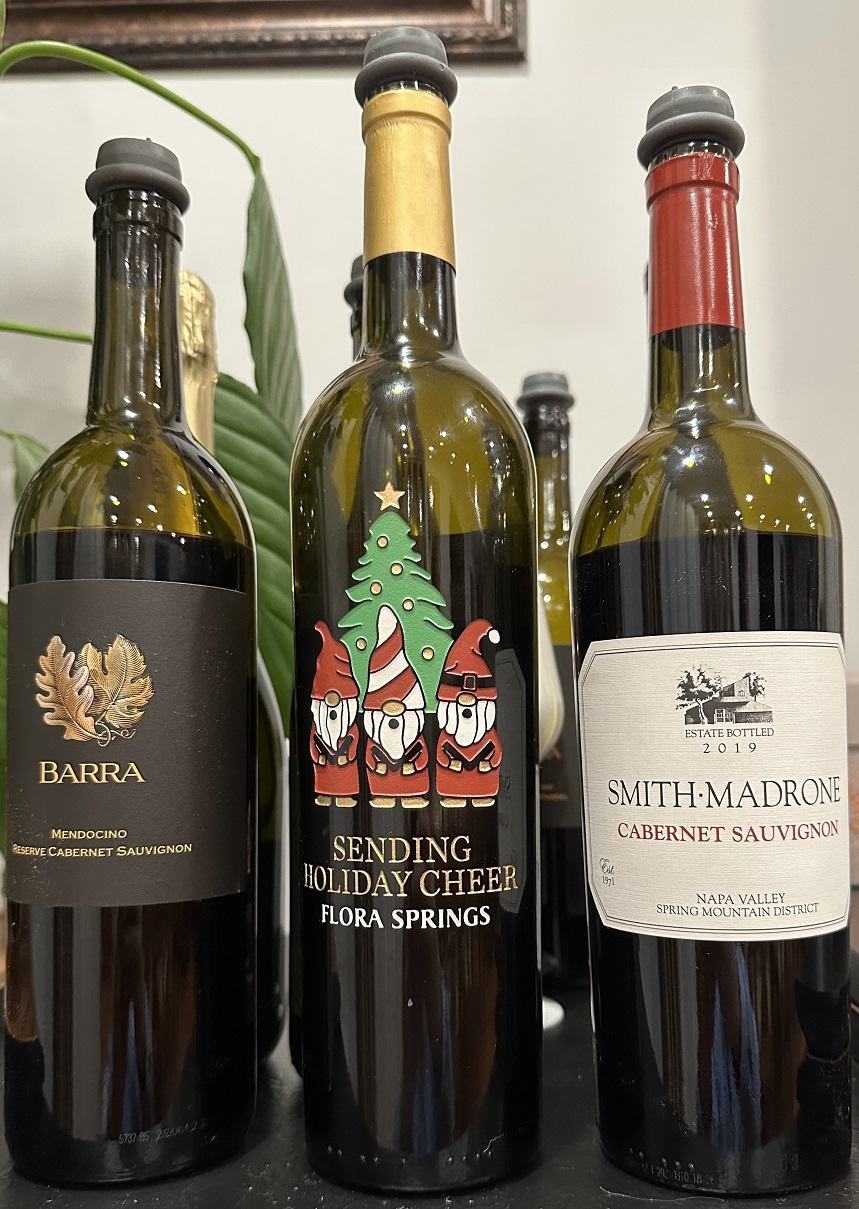
Barra Cabernet Sauvignon was the leanest of 3, but still had a perfectly recognizable Cabernet Sauvignon profile:
2021 Barra Reserve Cabernet Sauvignon Mendocino (14.5% ABV, $28, 18 months 30% new French oak, balance in neutral barrels)
Garnet
Eucalyptus, cherries, a hint of cassis
Eucalyptus, dark berries, cherries, cassis, well integrated tannins, perfect balance, medium-long finish.
8
Moving 80 miles southeast, we now arrive at the Flora Springs winery, located in the heart of the Napa Valley. Again, one of my favorite wineries in California, I wrote about their wines on multiple occasions.
The wine I had an opportunity to taste was a special holiday release. Flora Springs is big on the holiday celebration, so this bottle features etched gnomes, perfectly appropriate for the holidays. But it is what’s inside that counts, and this wine was nothing short of spectacular.
2019 Flora Springs Red Wine Blend Napa Valley (14.5% ABV, $95, predominantly Cabernet Sauvignon, 18 months in 70% French and 30% American oak barrels)
Dark garnet
Cassis, mint, black tea, cassis is playing in and out – you can smell this wine forever. Cassis is prevalent, wow.
Burst of cassis at first, then tannins come in, offering some bitter notes around the otherwise perfect Cabernet core. A very powerful, delicious wine that needs time to soften up. Either decant for a few hours, or lose it in the cellar for 10 years. The winery says you can enjoy it through 2036 – I’m sure you can easily add another 20 years on top of that.
8/8+
Going back about 8 miles northwest, we now arrive at the Smith-Madrone, the winery located in the Spring Mountain district of Napa Valley. Smith-Madrone is yet another one of my favorite wineries, and the one I feel a bit guilty about as a writer. I wrote about Smith-Madrone wines on many occasions in this blog – 5 years ago, Smith-Madrone were my wines of choice to celebrate Thanksgiving; in 2019, Smith-Madrone Cabernet Sauvignon was my wine of the year. And I’m still yearning to write a post fully designated to the winery…
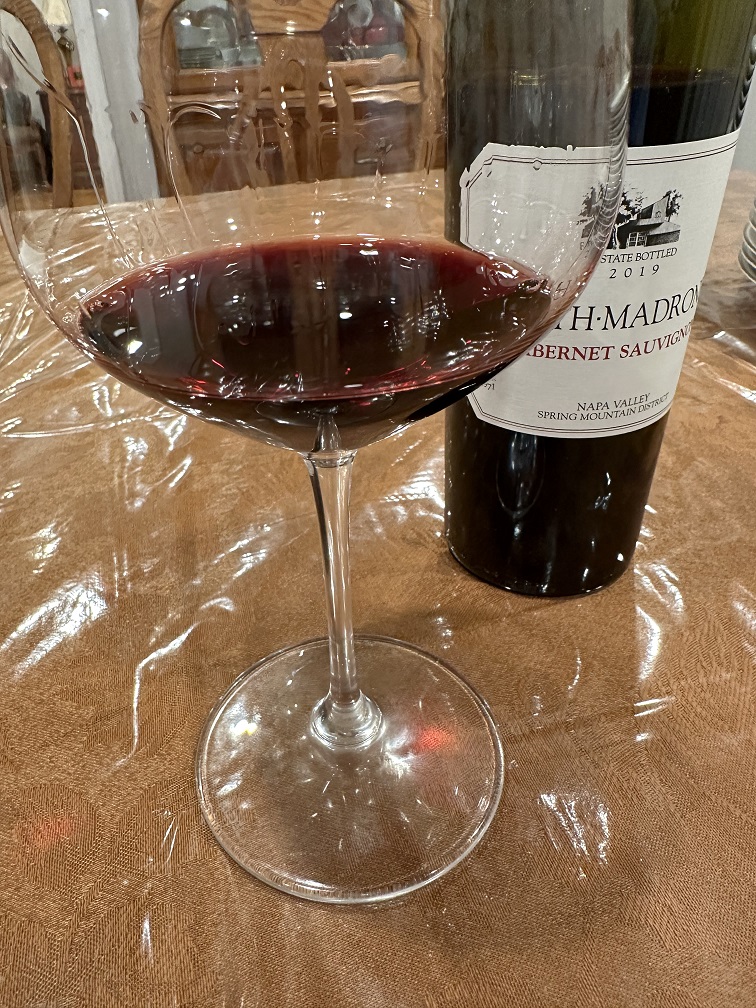
Nevertheless, Smith-Madrone Cabernet Sauvignon to me is one of the most textbook-proper, pure Cabernet Sauvignon wines there is. Not everyone would share my opinion – my sister-in-law with whom I was tasting these 3 Cabs, was preferring Flora Springs Cab, just for the sheer, unashamed beauty. But to me, a more subtle but very confident representation of the Cabernet Sauvignon by Smith-Madrone was just a perfection:
2019 Smith-Madrone Cabernet Sauvignon Spring Mountain District Napa Valley (14.3% ABV, $65, 83% Cabernet Sauvignon, 5% Merlot, 12% Cabernet Franc, 18 months in 55% new French oak)
Brilliant dark ruby
A perfection. A textbook Cabernet Sauvignon cassis, pure, perfectly precise cassis. You can think of a bell pepper – I’m not sure it is there, but it comes to mind.
The palate is amazing – cassis, eucalyptus, perfect minerality, a touch of the pencil shavings, salivating acidity. This is an impeccably balanced wine built for aging. In 10 years, it will be insanely good. In 20 – … well, I don’t want to even think about waiting that long…
9-, pure and superb.
If you like Cabernet Sauvignon, either one of these 3 wines will make you happy – each one perfectly representing their terroir and the vision of the winemaker, and yet unquestionably perfectly representing maybe the most noble grape of all.
So now you know what my secret passion, secret true wine love is. What’s yours?
American Pleasures #8: Flora Springs, Napa Valley
Wine should give you pleasure – there is no point in drinking the wine if it does not. Lately, I have had a number of samples of American wines that were delicious standouts – one after another, making me even wonder if someone cursed my palate. I enjoyed all those wines so much that I decided to designate a new series to them – the American Pleasures.
This very blog was born out of a desire to share with the world the excitement that a glass of wine can bring. To share an appreciation of a well-crafted glass of fermented grape juice that can inspire great paintings, great poetry, and great conversations.
Sometimes, it is not very easy to find the right words to share that excitement. Yes, there is a great arsenal of wine technical terms to describe body, aroma, bouquet, finish – but those words do a very poor job of conveying emotions. Yes, they describe wine, possibly correctly but subjectively (you say it is a blackberry, and I say it is black cherry) and possibly sufficiently to give another wine geek or professional an idea of how the wine might taste. But when one whiff from the glass literally stops you in your tracks, whether the aroma contains raspberries, black currant, or the hair of the wet dog is really irrelevant. What is important is that wine blew your mind and delivered an ultimate pleasure, which you can’t resist but share with the world.
Everyone derives wine pleasure on their own. For me, smell (aroma) and taste (bouquet) are two distinctly different categories. I had wines that had a magnificent aroma, and an underwhelming bouquet. I had wines where the aroma was either absent or borderline terrible, and the bouquet was magnificent. Of course, many have both. Taking about deriving the wine pleasure, mine definitely starts with the nose, the aroma. I’ve had wines that I didn’t start drinking for a good few minutes, just inhaling the aroma exuding from the glass. I can’t tell you why and how this works with the aromatics of some of the wines being so captivating – simply sharing my perspective here.
This was a long introduction to the gist of this post – two wines of Flora Spring from Napa Valley in California that I had an opportunity to taste lately.
From the moment I heard the name Flora Springs for the first time, there was something subconsciously attractive in that name – I have no idea why and how. But ever since the first encounter, I always expect magic while tasting Flora Springs wines.
Flora Springs Winery was founded in 1978 by Flora and Jerry Komes in Napa Valley, rooted deeply in the rich history of the US wine industry’s ups and downs, going from 763 wineries in California to only 40 surviving Prohibition. Name Flora in combination with the natural springs running through the property helped to define the winery’s name – Flora Springs. From the moment the winery was founded, it was truly a family affair, all built and developed by Jerry and Flora, their kids, grandkids and their families – you can learn all of it on Flora Springs’ website – and it is well worth a few minutes of your time.
The line of wines Flora Springs produces is something you would expect from the winery in Napa Valley – Chardonnay, Sauvignon Blanc, Cabernet Sauvignon, Merlot, and a few others. Yet the two wines which prompted this post belong to the Flagship category – the white blend called Soliloquy and the red Bordeaux blend called Trilogy.
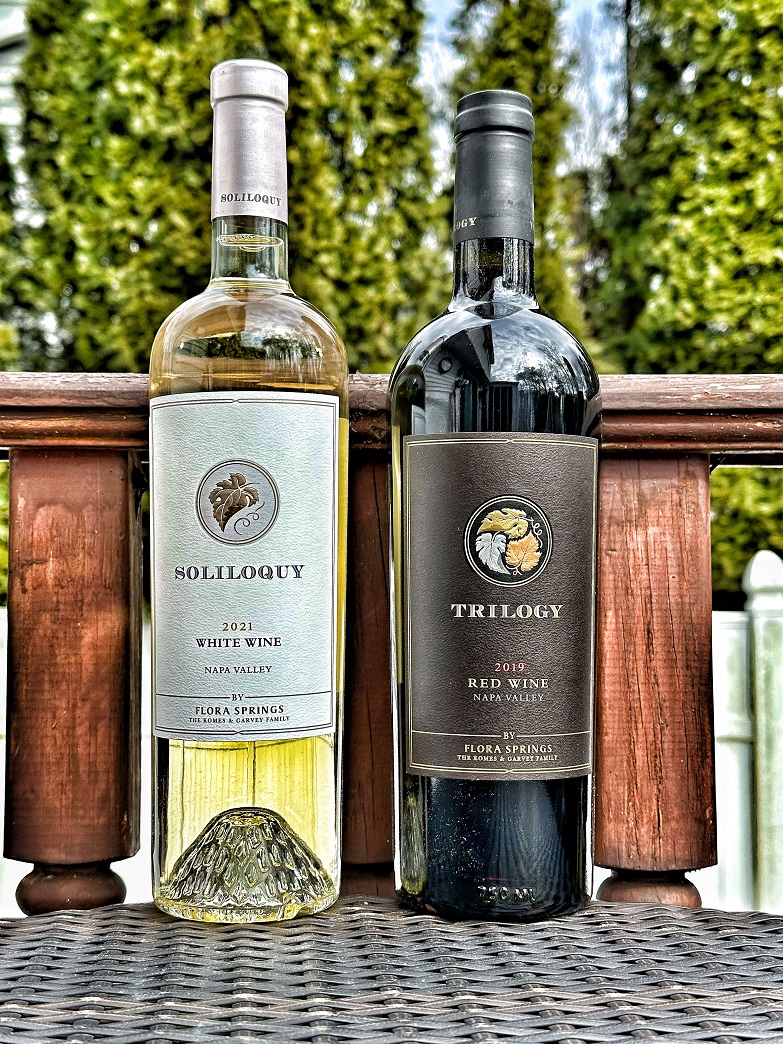
I tried Soliloquy for the first time 13 years ago – no, I don’t have such an amazing memory, I simply have my notes – in this very blog. The wine I tried back then was Sauvignon Blanc from Soliloquy Vineyard. Actually, Soliloquy Sauvignon Blanc is identified as a Sauvignon Blanc clone, certified by the UC Davis to be unique to Flora Springs, so I found that wine to add a unique grape to my collection (I actually added two, as that wine was a blend of Sauvignon Blanc Soliloquy and Sauvignon Musqué). My next encounter was about a year later when I was blown away by the 11 years old Soliloquy bottling.
It is worth noting that in the 1990s, the Soliloquy vines became nearly extinct due to the disease. The winery spent the next 8 years re-growing the Soliloquy vines first in the lab and then in the nursery before the plantings were restored in the vineyard.
2021 Flora Springs Soliloquy Napa Valley (14.2% ABV, SRP $60, 73% Sauvignon Blanc, 12% Chardonnay, 15% Malvasia, 7 months in French oak barrels), the wine which I had, is still made primarily from Soliloquy Sauvignon Blanc with the addition of Chardonnay and Malvasia. The wine offered beautiful bright aromatics, with the whitestone fruit and a distant hint of honey. The palate was full of energy, uplifting, showing more of the white stone fruit, Meyer lemon, crisp acidity, and overall perfect balance. A perfect example of the capabilities of the Napa Valley white.
Not to be overdone, my second wine was 2019 Flora Springs Trilogy Napa Valley (14.2% ABV, SRP $85, 75% Cabernet Sauvignon, 10% Petit Verdot, 8% Cabernet Franc, 7% Malbec, 18 months in French (80%) and American (20%) oak barrels). Trilogy wine was originally produced for the first time in 1984 (thus 2019 is the 35th vintage of the wine), with the name being a nod to the three main Bordeaux varieties comprising the blend.
This wine was truly a show-stopper. On the first whiff, the world slowed down. There was just me and the glass. Pure, delicious black currant, eucalyptus, currant leaves. Round, and around, and around. I few minutes later, I developed the courage to take a sip. To my delight, the palate delivered as much excitement as the nose. Polished, layered, seductive, Bordeaux-style textbook profile, black currants, well-integrated tannins, perfect structure, powerful but perfectly balanced. You really don’t expect the wine like that to be a pop’n’pour wine, and yet it was, in my glass. Absolutely delightful.
There you are, my friends. Another case of delicious American wines, delivering lots and lots of pleasure. These wines are not really everyday sippers but are well worth looking for to brighten up any special occasion.
I have more American pleasures to share, so stay tuned…
Pure Pleasure, And How To Express It
Does this glass give you pleasure?
You take a sip of wine. The wine is sublime. It is beautiful. It is complex. The wine solicits emotion – it makes you happy. It makes you moan quietly inside your head, you might extort an “OMG” or a “Wow”, and after a pause, you take another sip. You are not in a hurry. You want to extend this pleasure for as long as possible.
Wine is art. Wine doesn’t leave you indifferent. Wine solicits emotion.
Painting is art. Painting doesn’t leave you indifferent. Painting solicits emotion.
Music is art. Music doesn’t leave you indifferent. Music solicits emotion.
We can consider wine to be a form of art, the same as painting, music, poetry, architecture, and many other human creations which invite an emotional reaction. Do you know what makes wine a unique form of art? Your utter desire to share it.
You can quietly stare at a beautiful painting for a long time, slowly uncovering little details and being in the moment. Even if you stand next to someone else looking at the same painting, 99 out of 100 you are simply focused on your own personal moment.
When listening to the music, even if you are in the concert hall surrounded by thousands, the music is being played only for you and this is how you want to keep it. You can buy a recording and listen to it 100 times. Just by yourself, and you are happy about it.
Have you seen an oenophile get excited about wine? The excited oenophile grabs the total stranger by the sleeve, shoves the glass into their face and says “here, here, you must try this!!!” It is very important for an oenophile to be able to share the joy of the experience with others. There is an ultimate pleasure in sharing your excitement with others, as wine is an art that needs to be shared.
Sharing pleasure is easy in person. Have you tasted magnificent, life-altering wines in the group? If you had, you probably noticed the collective “ohh”, rolling the eyes, unprompted nodding, maybe a muttered “oh my god”, and then silence. The silence of the greatness of the moment, slowly settling in.
This in-person sharing of the pleasure is simple, and kind of just happens on its own. The real challenge comes when you decide to share that ultimate pleasure with the rest of the world.
So how can one express pure pleasure?
A typical way to describe the wine is via so-called tasting notes. Such tasting notes are often called “technical notes” as they usually describe the wine in terms of appearance, aroma, bouquet, and finish – using analogies such as “brickish color”, “smell of mushrooms”, or “taste of dark cherries”. The wine is described in the terms which the wine drinker is supposed to relate to – and it is a great review if you can relate to all of the terms used without trying to figure out what is Cascarilla and how it actually smells, or how Jabuticaba tastes like. What is usually not found in the tasting notes is the emotion – how this wine might make you feel; will you scream with joy when you will take a sip? Yes, I get it. Even the aromas and flavors are subjective. The emotion which you will experience while drinking the wine is yours and yours only – the person next to you might not experience the same enlightenment – and nevertheless, even the hope for greatness is worth sharing.
Can wine pleasure be expressed in the words by professional wine critics? You be the judge of it. Here is the collection of tatsing notes for the 1966 Domaine de la Romanée-Conti La Tâche Grand Cru. At this link, you will find the reviews from Robert Parker, Jancis Robinson, John Gilman, and others. Here is the best excerpt in my opinion. John Gilman: “La Tâche ‘66 is deep, full and opulent on the palate, with a grandiose delivery of thick, perfumed fruit, excellent balance, plenty of power, great focus and finesse, and an incredibly long, softly-tannic and astoundingly complex finish.” This might be the best description out of the six present, but does it convey the emotion?
Does this wine give you pleasure?
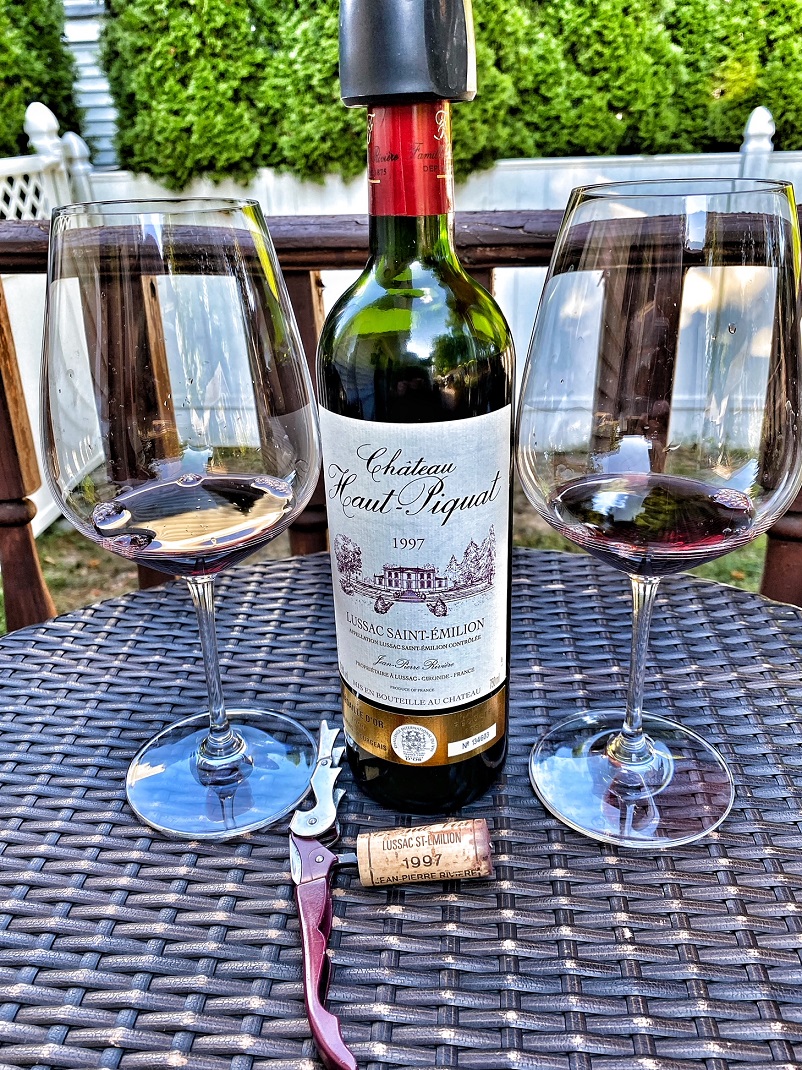
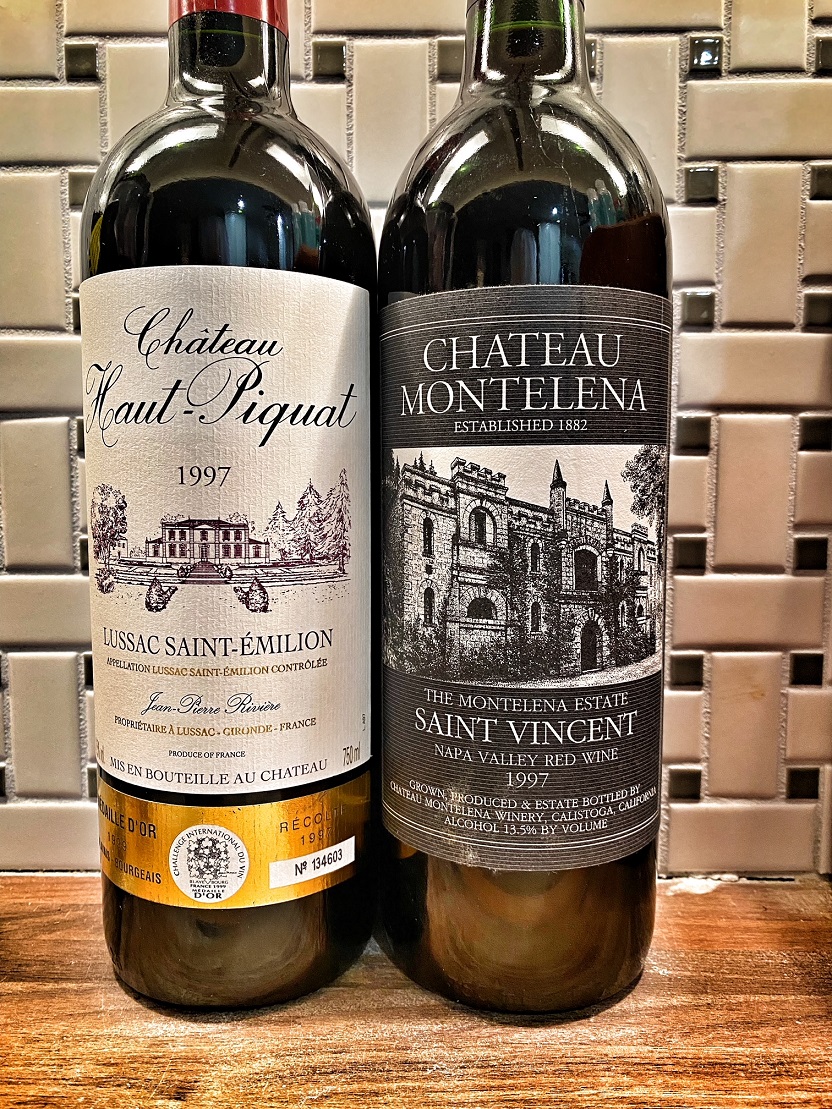
A few days ago, I had the pleasure of drinking two wines from the 1997 vintage (1997 is a special year for our family). These two wines really prompted this post. First, I opened the 1997 Château Haut-Piquat Lussac Saint-Émilion (12.5% ABV, 80% Merlot, 15% Cabernet Sauvignon, 5% Cabernet Franc). The wine was somewhat of a recent find at the Wine Exchange – after getting an email offer to buy 1997 Bordeaux for $19.99, I had no option but to get a few bottles. I was happy to see the cork coming out in its entirety with no issues. I was ready with the decanter, but the wine in the glass was quite approachable. After the initial grippy tannins dissipated in 20-30 minutes, what was left in the glass was an absolutely sublime beauty. You see, this is where the challenge lies. Here is the technical description from the Wine Exchange: “a wine that still possesses a youthful charm as there is something to be said for ex-chateau. A beautiful plum/garnet color with very little lightening for its age. This 1997 is full to medium-bodied, showing lots of forest floor, roasted herbs, cedar, tobacco, black cherry, blackcurrant, and new saddle leather. It is opulent and is just entering its plateau of full maturity. The tannins are soft and subtle with an elegant seamless finish. ”
The description is perfectly fine, but it doesn’t help me to express my emotion. The mind singing with every sip. Pure joy in each and every sip. Enough pleasure in every sip to have the nerve enough to tell my wife, who was enjoying the wine with me “this is almost as good as sex”. A personal perspective for sure, but yes, this was the wine.
I didn’t have many expectations for 1997 Chateau Montelena Saint Vincent Red Wine Napa Valley (13.5% ABV, blend of Zinfandel, Primitivo, Sangiovese). Chateau Montelena is absolutely legendary with its role in the Judgement of Paris, especially if you had an opportunity to see the movie Bottle Shock. But Saint Vincent is an eclectic blend, produced only for 5 years from 1995 till 1999, and it is not given that this type of wine can age for 25 years. While very different from the previous Bordeaux in its profile of cherries, eucalyptus, and herbs, it had such a lip-smacking, savory and satisfying bouquet, that every sip was demanding to be followed by another sip.
Do you want a second glass?
I have no idea how to convey the pure pleasure the wine can bring. Maybe emotion is the key. There are lots of good wines out there. The wines you are happy to drink any day every day. Maybe it is the excitement that needs to be measured. Or maybe this is simply in the unyielding desire to share this pleasure with the world. The act of telling the world how amazing the wine was, and hoping that everybody will see it that way too.
Let’s share our little joys with one another. And if you know how to convey this pure wine pleasure, please let me in on that secret.
Making The Same Mistakes
Are we humans prone to repeat ourselves all the time? Good and bad – first we repeat what was done again and again, then wonder why we achieve exactly the same result as before. There is nothing wrong with repeating the good things, except that we might be limiting ourselves – think about bench-pressing 150 lb all the time, without ever trying to increase the weight. That’s a good weight to press, of course, but you need to increase the weight if you want your muscles to grow.
The process of repeating the bad things is far more peculiar. We know that something doesn’t work. We know that we did something in the past and it painfully didn’t work. Should we learn? Should the brain have a mental capacity to remember the bad result of the past and then simply remember not to repeat it? You think? This is so obvious, and yet unattainable at the same time. Why? Really, why?
Case in point. My business trip took me to Anaheim in California. Going to Anaheim, people who travel occasionally would fly to LAX (Los Angeles airport), and then have quite an expensive (and potentially very long) taxi ride to get to Anaheim. People who travel know that the closest airport to Anaheim is John Wayne, a.k.a. Orange County a.k.a. Santa Ana airport. As I belong to the second group (I generally travel for business), I took an early morning flight from Newark, NJ to John Wayne airport, arriving even faster than anticipated and enjoying the easy trip.
When traveling inside the US, ideally you want to take the early flight – outside of mechanical and horrible weather issues, you stand the best chance to arrive at your destination on time and in a happy state of mind. As the day progresses, travel becomes more chaotic, as flight schedules start shifting, and every slight delay aggregates to bigger and bigger ones. See, I know my flying rules. And what I said is 10 times true for the most overloaded (and badly run) airports in the country – Newark, Washington Dulles, Houston, Boston are all stand out in this category – by the end of the day, Newark would typically aggregate about 2 to 3 hours delay – and this is in the best weather throughout the country, God forbid it rains somewhere.
See, I know my traveling stuff, right? Do you think this knowledge helped me? Yep. Of course, you figured out the answer already. No, it did not. Instead of taking 6:30 AM out of John Wayne airport to fly back to Newark, I decided to fly at 12:30. Would you expect me to apply my knowledge? Of course, but I didn’t not. After arriving at the airport about two hours prior to my on-time departure, I spent the next 4 and a half hours (that includes 2.5 hours of an actual delay) literally swearing at myself, at United, at Newark, and back to myself. What’s even worse, I managed to repeat yet another old mistake again.
Insanity – repeating the same thing over and over again, every time expecting a different result
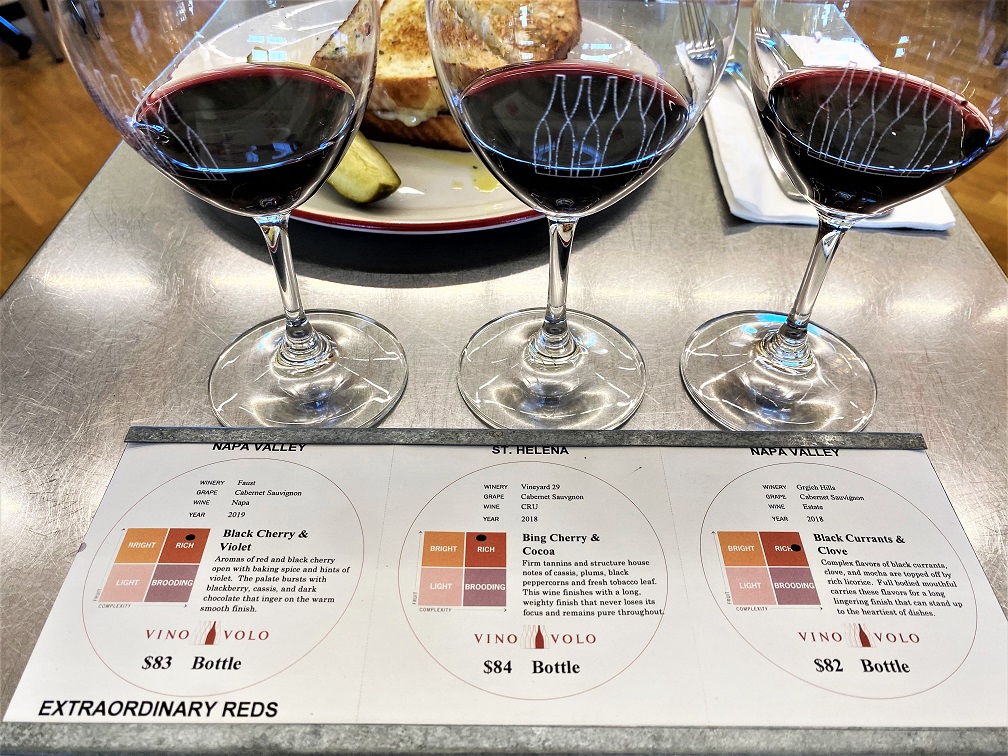
If you like wine, and if you ever traveled through Austin, Portland, San Francisco (and many other) airports, I’m sure you noticed restaurants/bars called Vino Volo. There are more than 50 Vino Volo locations around the country. Everything in Vino Volo revolves around wine. Every restaurant has a great selection of wines by the glass and wines to buy by the bottle – as they are located past security, you can buy a bottle of wine to bring to your destination if you are so inclined.
However, my main attraction at Vino Volo is wine tasting flights. At any given moment, Vino Volo offers 6-8 different tasting flights, red, white, Rosé, each flight typically consisting of 3 wines. Each flight is accompanied by detailed tasting notes. Very often you can find a selection of local wines offered as part of the flights – Oregon wines in Portland, Texas wines in Austin, and so on. When I have time, I never pass on an opportunity to visit a Vino Volo store and taste some new wines.
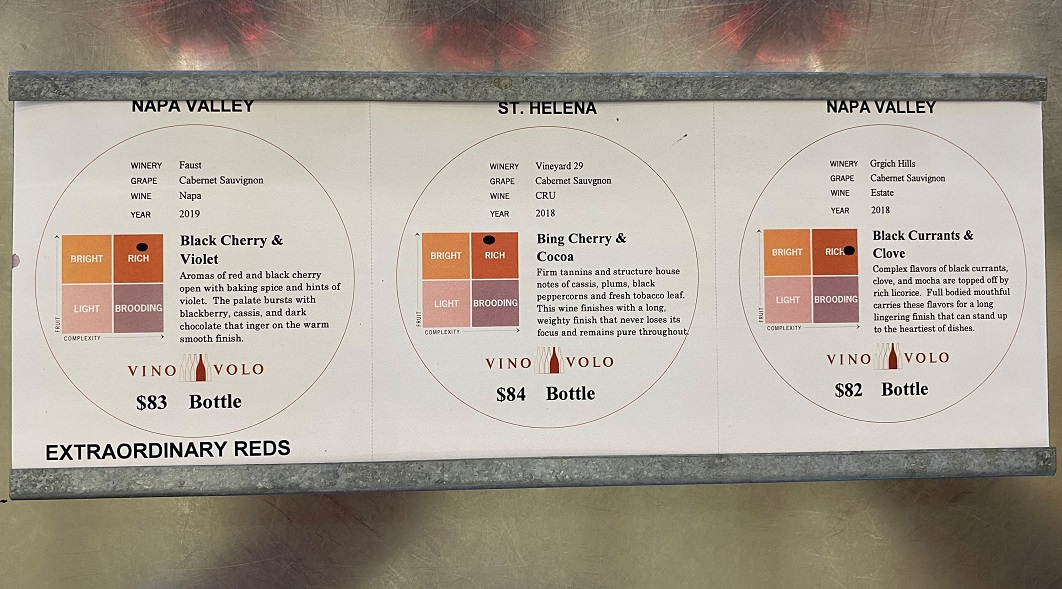
This brings us back to the subject of repeated mistakes. I know full well that young and expensive California Cabernet Sauvignon wines are undrinkable, 9 out of 10. I generally enjoy Vino Volo flights, with one memorable exception being Californian Bordeaux blend Overture, the second label of Opus, which I didn’t enjoy at all. And now, while at the John Wayne airport, I chose the flight of 3 high-end but young California Cabernet Sauvignon wines, instead of taking one of the other 7 or so. Why? Was a driven by the bad mood due to the flight already being delayed? Was there a hidden, subconscious desire to exacerbate the pain? I don’t know. But this was the flight I ordered. And it successfully exacerbated my pain – which you can see in these tasting notes:
2019 Faust Cabernet Sauvignon Napa Valley ($83)
Black currant, cherries, eucalyptus
Gripping tannins, green notes, black currants, tart finish.
Not enjoyable now.
2018 Vineyard 29 CRU Cabernet Sauvignon St. Helena ($84)
Cherries, dust
A bit more balanced than the previous wine, still weaved on the core of green notes, but definitely more approachable and enjoyable than the previous wine. Glimpses of greatness. Maybe decanting for an hour would make a miraculous change.
7+
2018 Grgich Hills Cabernet Sauvignon Estate Napa Valley ($82)
Distant hint of black currants and nutmeg
Tart, green, fruit is hiding. Almost flat in terms of soliciting an emotion.
Why do we do these bad things to ourselves? This question is half rhetorical, half actual. If you know the answer – or have a story to tell – please, I’m all ears.
Californian Stars, Italian Flair
 Californian stars.
Of course, we are talking about wines and grapes. What would those be?
I recently called California Cabernet Sauvignon a king. We can safely designate Chardonnay as a queen. But who would you call a prince? Capricious, spiky, moody royalty? Whatever grape you think of, the correct answer is Pinot Noir, because this is the grape I mostly would like to talk about today. And tell me if you think Pinot Noir is not qualified for the role of the royal prince – finicky, demanding, and unpredictable.
Okay, we got our stars for the day. Now, the Italian flair. How would you add the Italian flair to the Californian grapes?
There are a few options. For example, you can call your sparkling wine a Spumante. Or you can call your winery Castello, and build it in the form of a medieval Italian castle. You can also make wines out of Sangiovese – but this we will discuss later. Anyway, as you can see, you got options.
Vittorio Sattui, an Italian immigrant, founded St. Helena Wine Cellars in 1885. The business had to be closed due to the prohibition in 1920, but the Sattui family continued living at the winery. In 1975, Dario Sattui, great-grandson of Vittorio, restarted the family business by opening V. Sattui winery in St. Helena.
After finishing college, Dario traveled around Europe and became obsessed with medieval castles, monasteries, farmhouses. In 1993, Dario found the next home for his future winery – 171 acres parcel near Calistoga. In 1994, the construction began initially for the 8,500 sq. ft building without cellars. That slowly morphed into a 121,000 sq. ft. 13th-century Tuscan castle with 107 rooms, drawbridge, five towers, high defensive ramparts, courtyards and loggias, a chapel, stables, an armory, and even a torture chamber. Lots of bricks and artifacts were delivered directly from Europe to ensure the full authenticity of the castle. Castello de Amorosa (Castle of Love) opened its doors to visitors in 2007 after 15 years of construction.
I was fortunate enough to visit the Castello di Amorosa in 2017 as part of the Wine Bloggers Conference 2017 in Santa Rosa, so I can share (inundate is a better word, of course) my first-hand impressions:
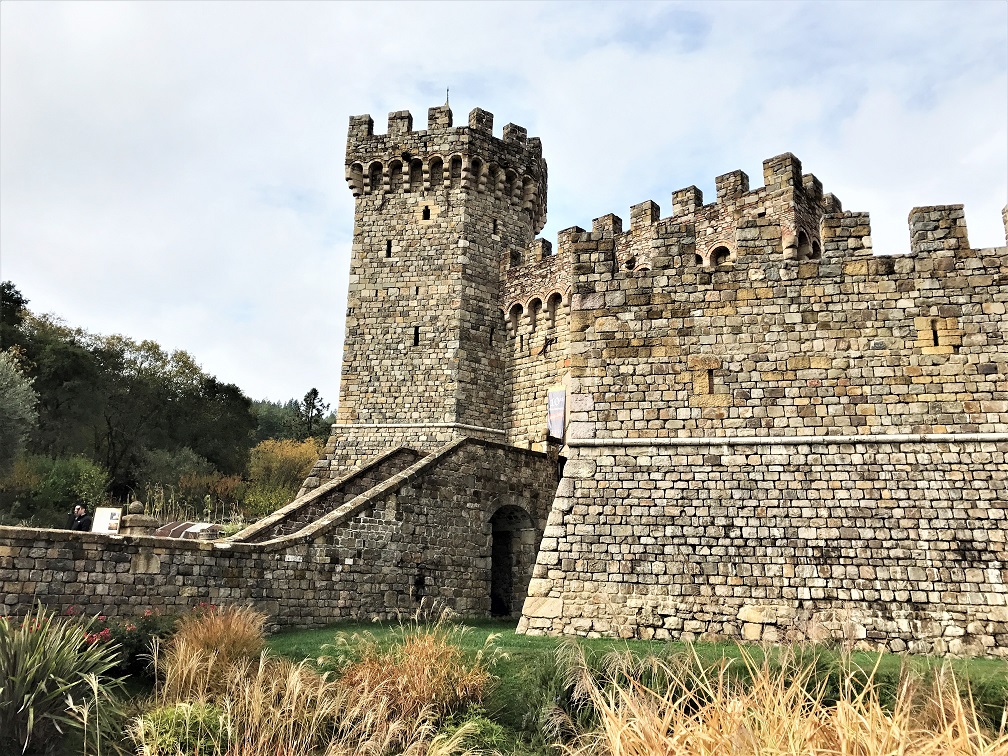
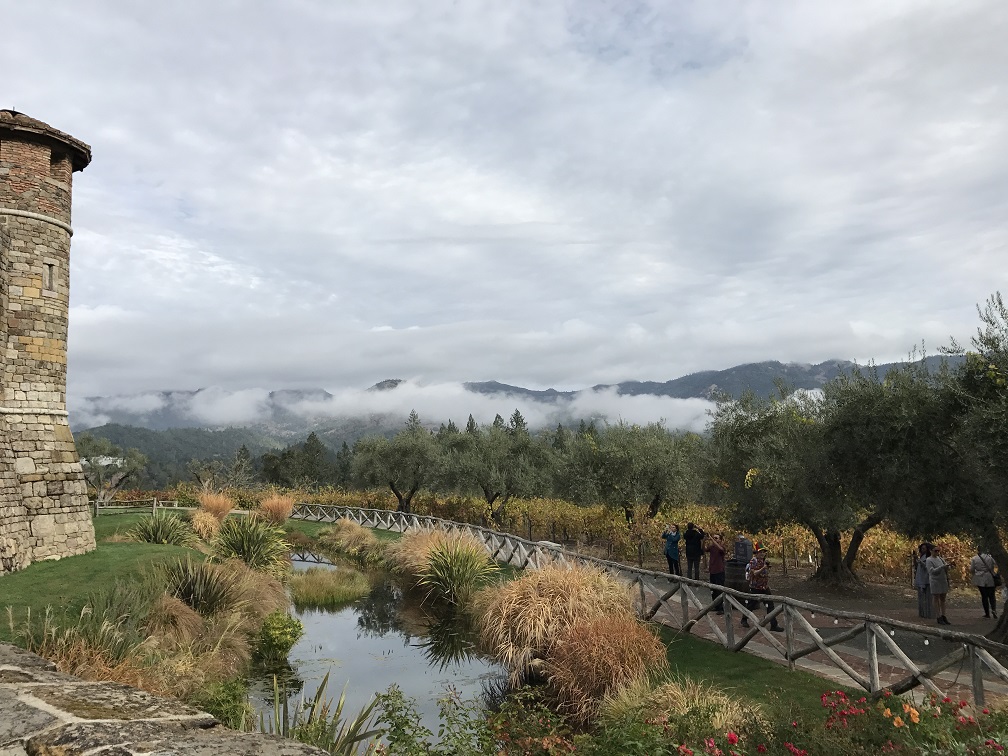


Thinking about misbehaving? Might not be recommended:


Touring the cellars:


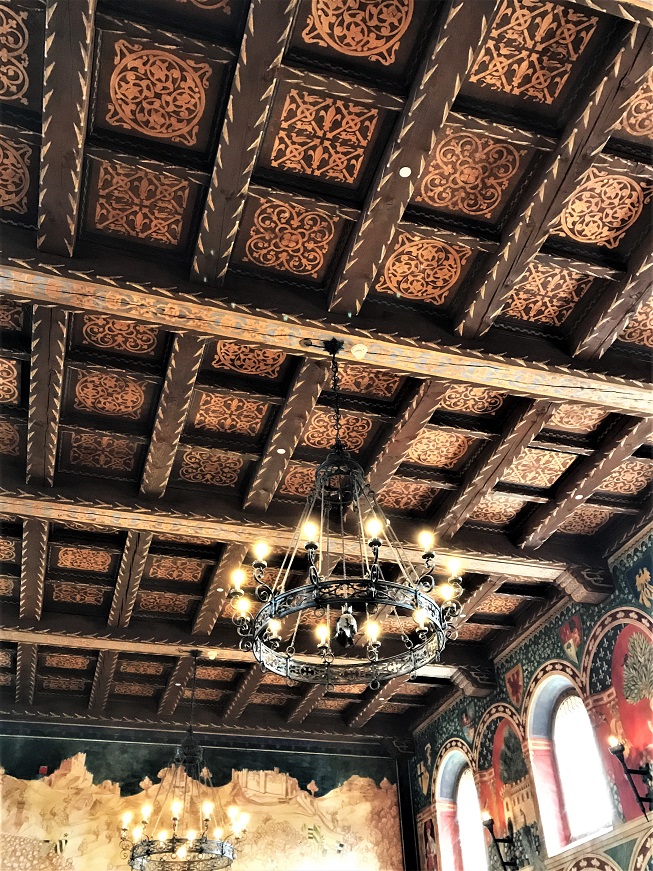
The ceiling of the room where we had our tasting in 2017:
A bit of education – Napa Valley Regions:


Castello di Amorosa works with 14 vineyards, most of them in Napa and Sonoma, out of which 6 are estate vineyards. The focus of winemaking is on showcasing each individual terroir and on the small-batch production.
I had an opportunity to taste a range of Pinot Noir expressions from Castello di Amorosa, and I have to honestly say that I was very much impressed with what I found in my glass.


First, two sparkling wines, both produced using the classic method.
2017 Castello di Amorosa Spumante del Castello Brut Napa Valley (12.5% ABV, $39, 73% Chardonnay, 27% Pinot Noir)
Light Golden, fine bubbles
Toasted bread, apples, gunflint
Toasted bread, Granny Smith apples, more gunflint, great minerality, a touch of sweetness, bigger body than typical champagne.
8, excellent,
2017 Castello di Amorosa Spumante del Castello Brut Rosé Napa Valley (12.5% ABV, $49, 100% Pinot Noir)
Salmon pink, fine mousse
Steely strawberries, a hint of toast
Dry, crisp, strawberries, clean acidity, good minerality
8, excellent
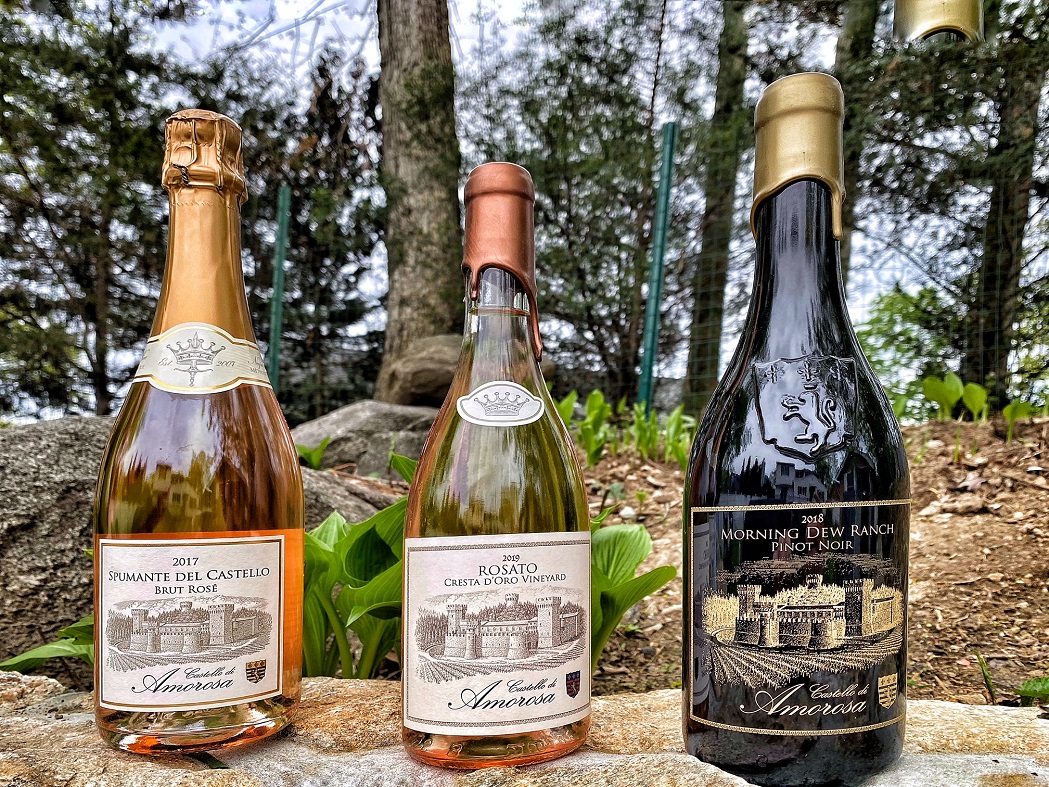
Next up, Rosé. The grapes for this wine come from the Green Valley area in the Russian River Valley AVA, and the wine is partially aged in concrete egg. I had an opportunity to taste both 2019 and 2020 vintages over a few months timeframe, and you can see that my tasting notes are almost identical for both wines. Somehow I missed including this wine into my 2021 top wines list, which makes me upset – this was one of the best Rosé wines and wines overall that I tasted during 2021.
2019 Castello di Amorosa Rosato Cresta d’Oro Vineyard Green Valley of Russian River Valley (13.6% ABV, $39, 100% Pinot Noir)
Light bright pink
Fresh ripe sweet strawberries, good intensity, inviting
Beautiful ripe strawberries, a touch of lemon, clean acidity, impeccable balance. Wow.
9-/9, one of the best Rosé I ever had. Just wow.
2020 Castello di Amorosa Rosato Cresta d’Oro Vineyard Green Valley of Russian River Valley (12.5% ABV, $39, 100% Pinot Noir)
Light bright pink
Fresh strawberries, a touch of herbs, crisp, inviting, and invigorating
Beautiful ripe strawberries, a touch of lemon, clean acidity, impeccable balance. Wow.
9, one of the best Rosé I ever had. Just wow. Superb.
Last up – Pinot Noir from Morning Dew Ranch in Anderson Valley. This vineyard was purchased in 2015 from Burt Williams, founder of the iconic William Selyem Winery. The 12-acre vineyard is in a very cool microclimate and divided into 9 blocks of Pinot Noir planted with DRC, 115, 777, Rochioli, 23, and 828 clones. All the blocks and clones give quite a bit of room to experiment to the winemaking team.
2018 Castello di Amorosa Morning Dew Ranch Pinot Noir Anderson Valley (13.1% ABV, $75, 11 months in Burgundian oak barrels)
Dark ruby
Somewhat unexpressive on the first day, a hint of fruit
Closed up, concentrated, dark fruit, not amazing
Classic Pinot on the second day – iodine, violets, underbrush
Beautifully elegant on the palate – good acidity, smoke, tobacco, fresh berries, cherries, firm structure combined with medium body, medium-long finish.
8+ second day, super-enjoyable.
Here you go, my friends – a little Italian oasis – scratch that – a large Italian Castle in the middle of Napa Valley, producing magnificent California wines. Castello di Amorosa is definitely a unique travel destination and a must-visit if you are ever in the area.
Of Hydrangeas, Ocean, Sunsets, and Wine
I’m sure this cryptic title leaves you wondering what are we going to talk about in this post, right?
Yeah, a lame attempt at self-humor.
And as you can see I want to talk about some of my most favorite things – flowers, waves and sand, sunsets, and, of course, wine. Mostly in pictures – except the wine part.
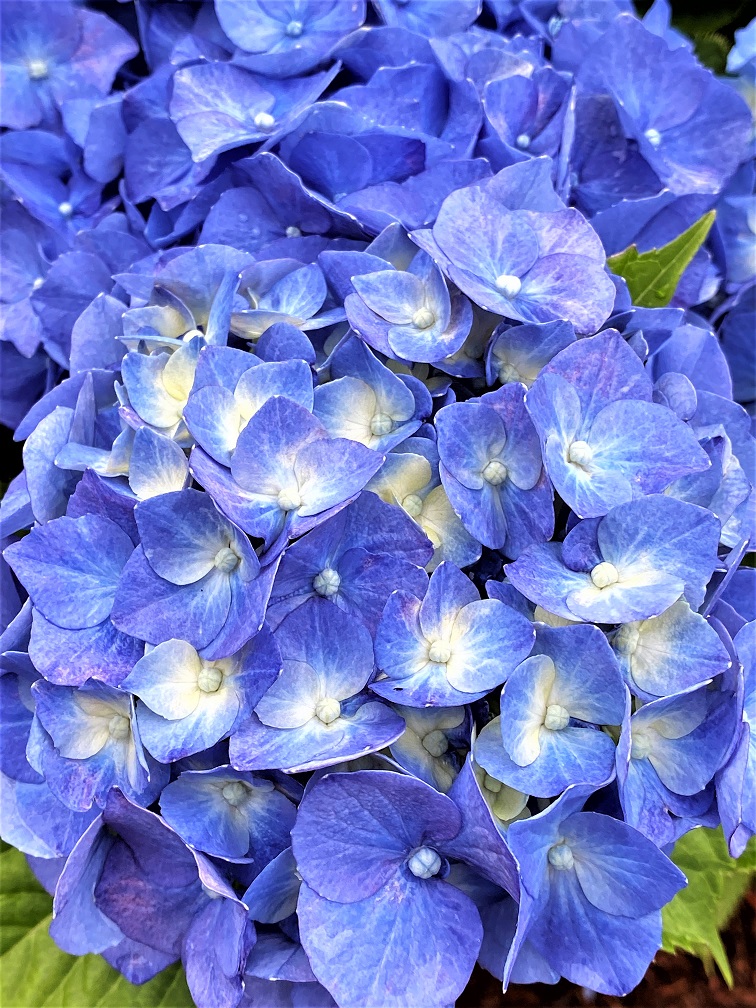
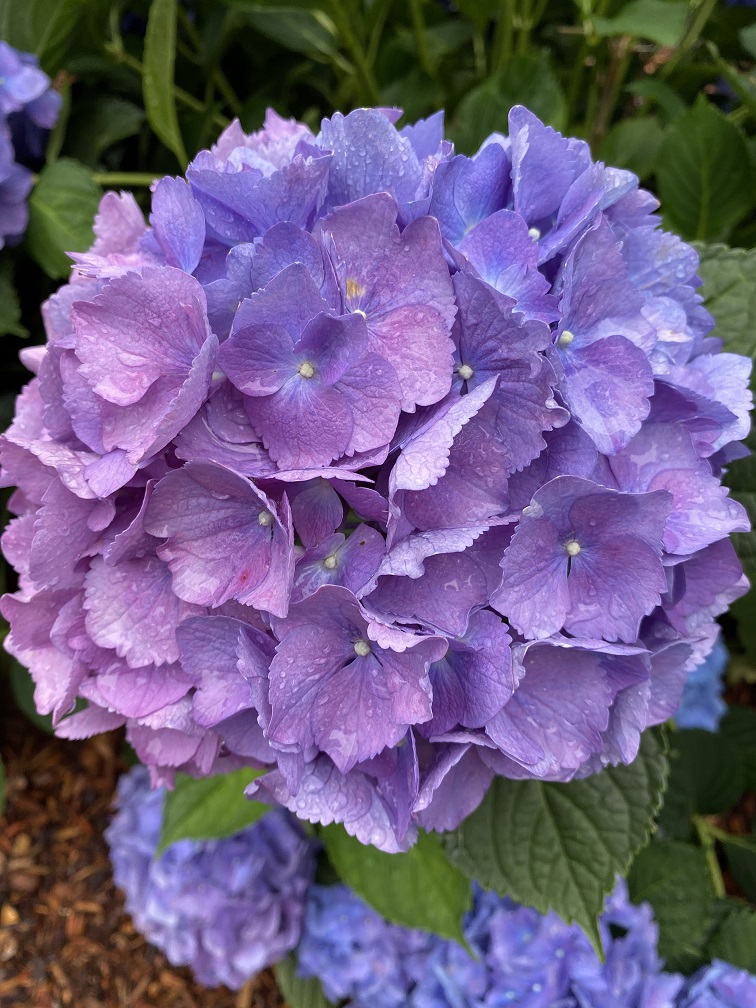
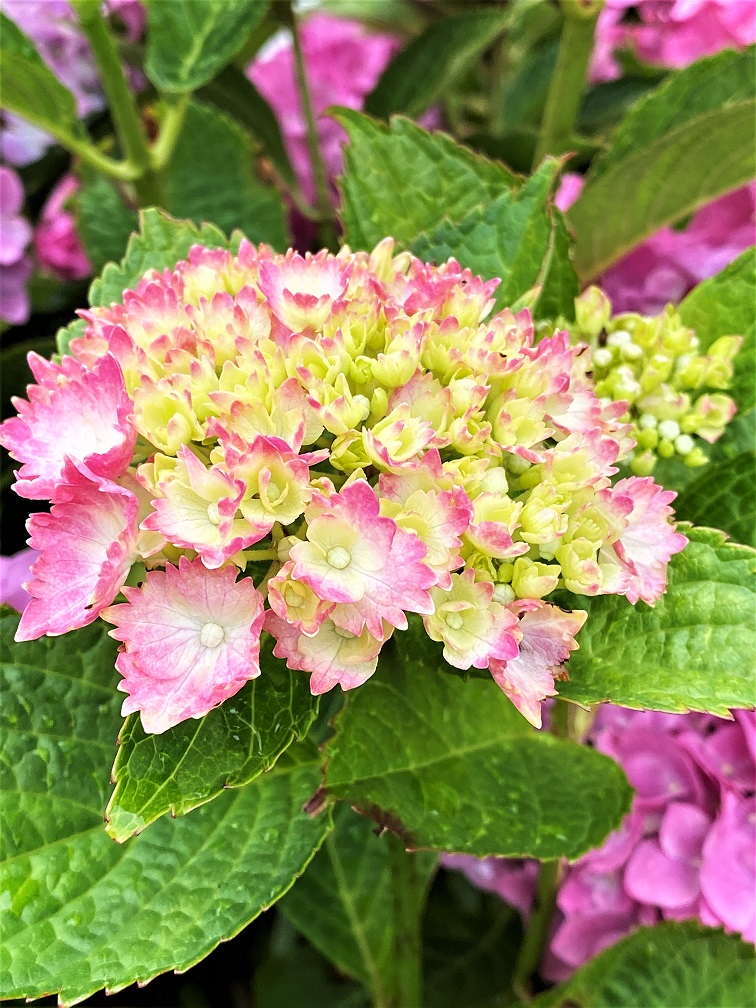
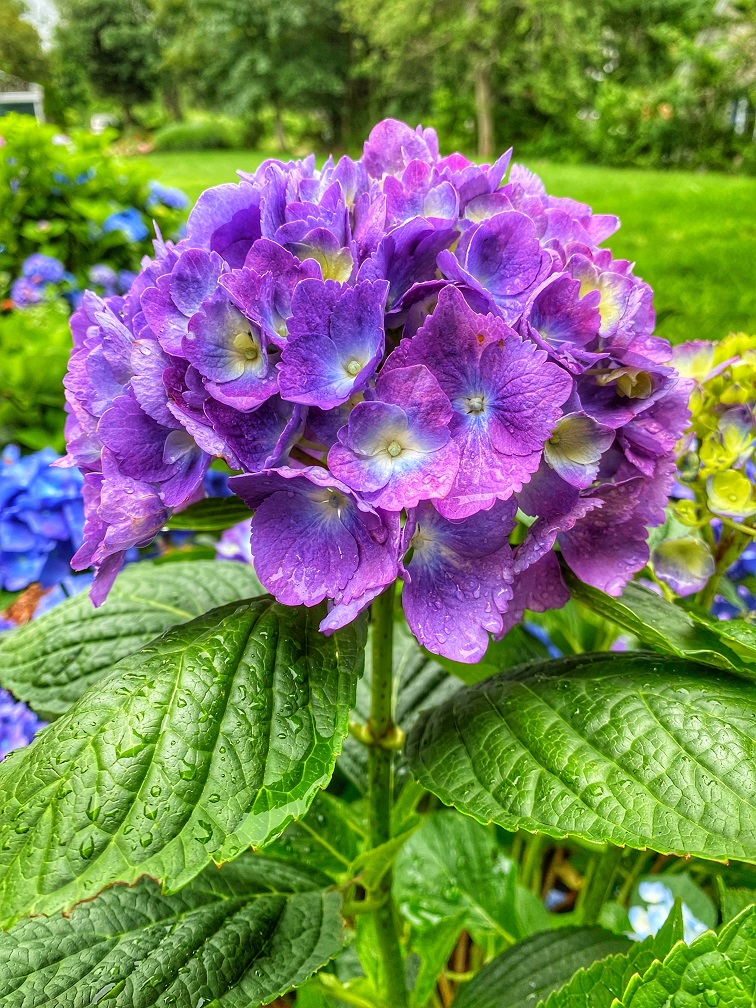
We just came home after a weekend in Cape Cod, and if you ever visited The Cape as it is typically called, I’m sure you noticed the abundance of hydrangeas. There is rarely a house that doesn’t sport a beautiful hydrangeas display.
Hydrangeas come in many colors, which can be also influenced by what you feed the flowers. They typically bloom the whole summer and deliver non-stop pleasure – at least in my world. Let me share some of my favorites with you:



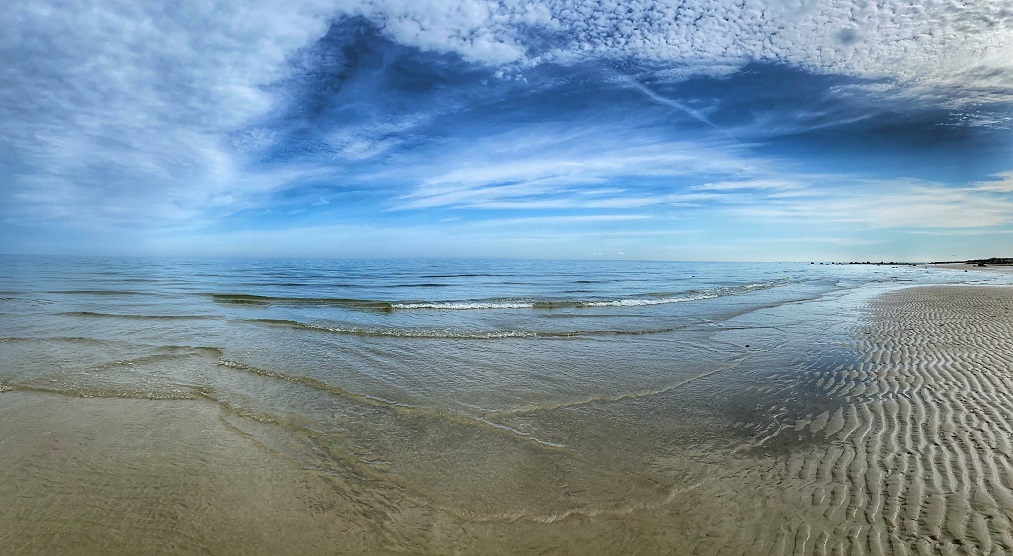
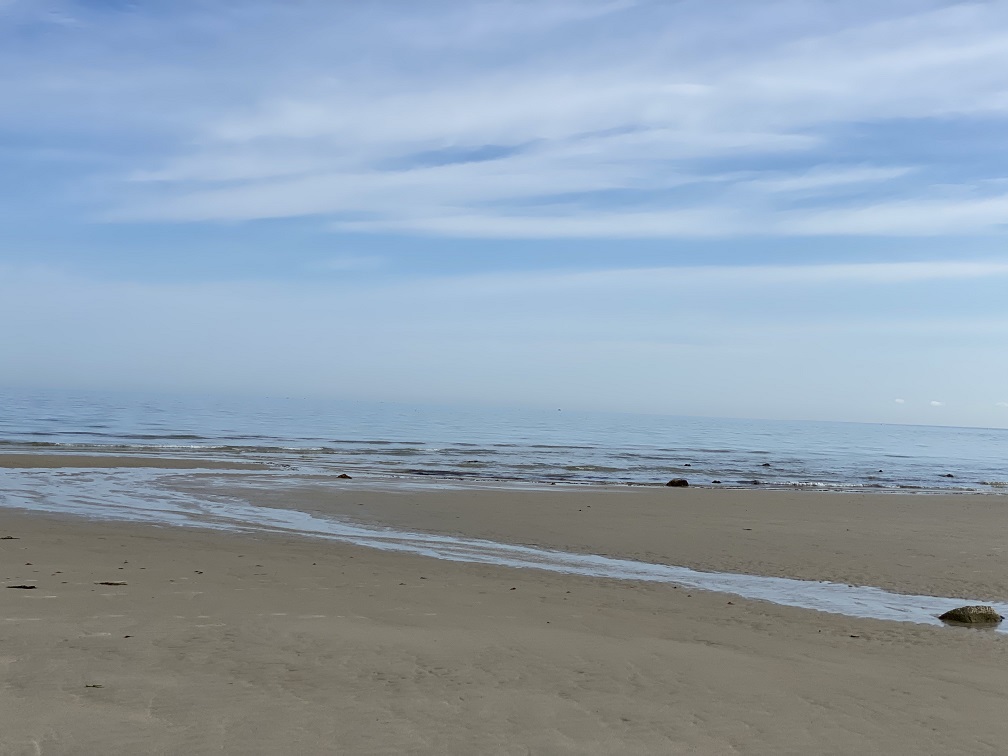
Our next subject is the ocean. Cape Cod is a special place, where you can find huge swathes of water only a few inches deep, or simply a wet send that goes for miles and miles during low tide. The water and the sky magically connect, creating an ultimate rhapsody in blue – see for yourself:
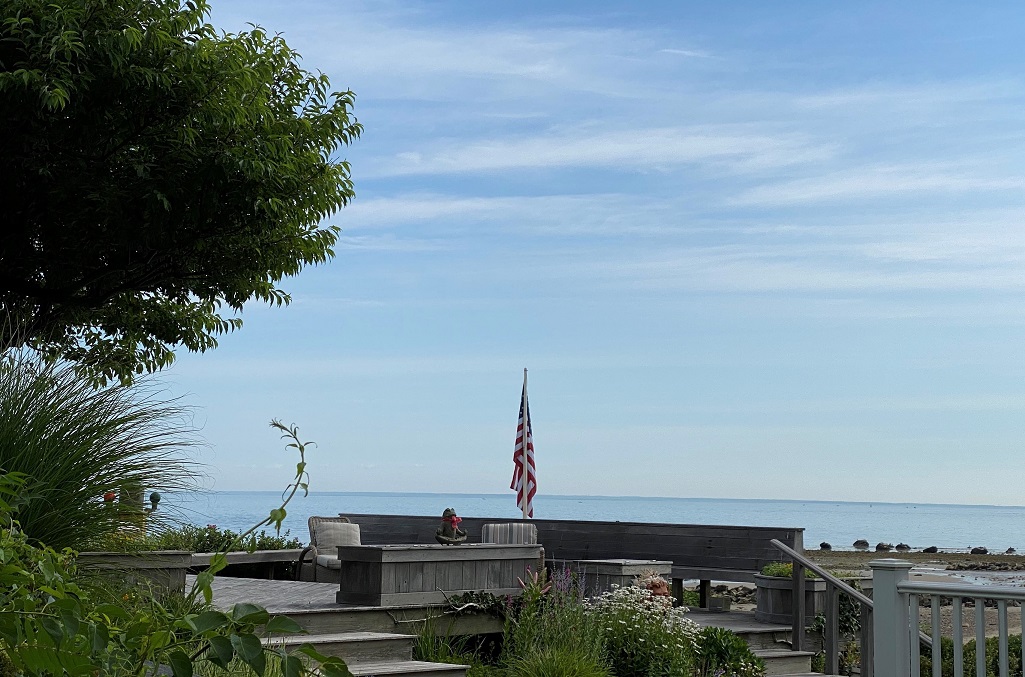


 The sunsets were challenging this time around. Two days out of three that we spent on The Cape, the weather was not good at all – rain, wind, and more of the rain and wind. Nevertheless, the weather was taking a break in the evening to present a beautiful sun setting imagery, which we enjoyed from the comfort of the deck – with a glass of wine in hand:
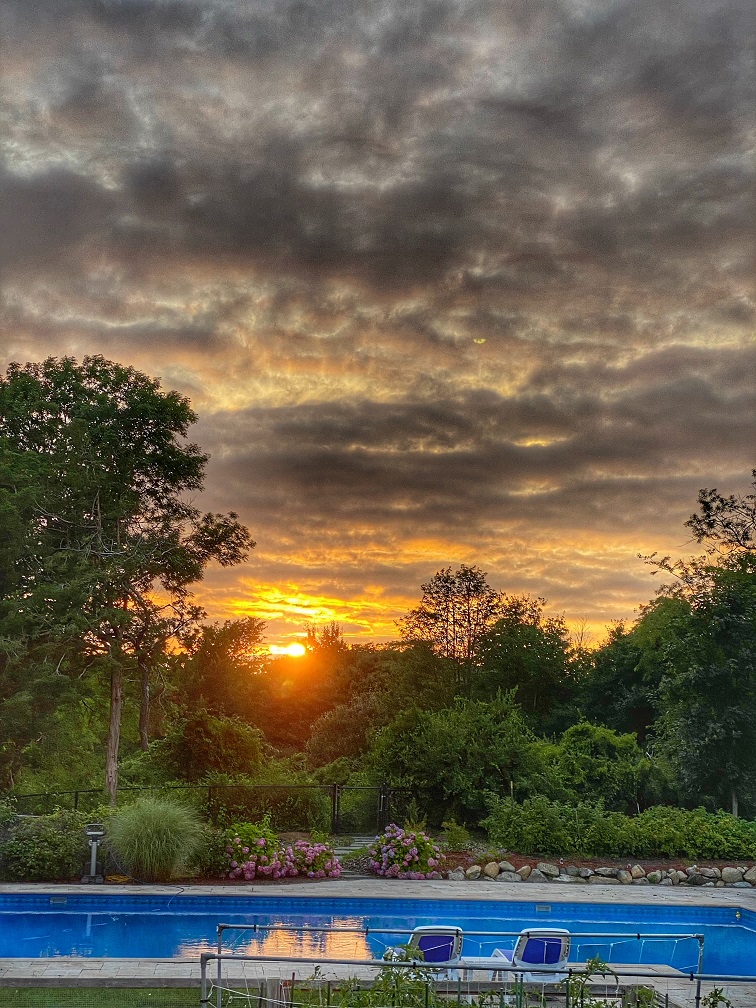
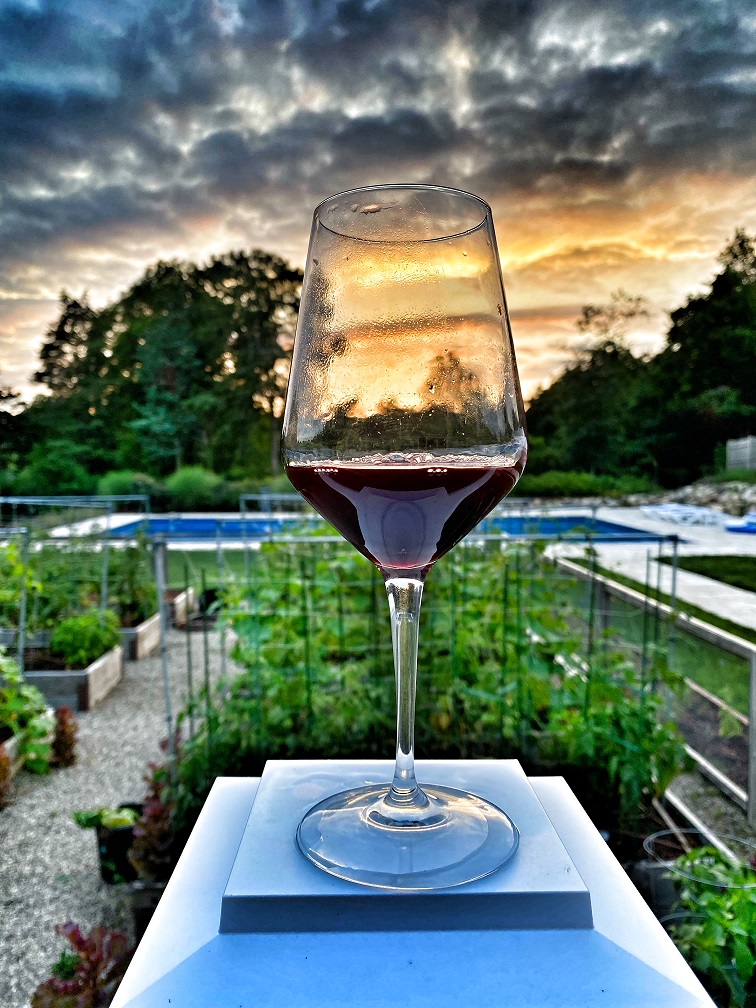
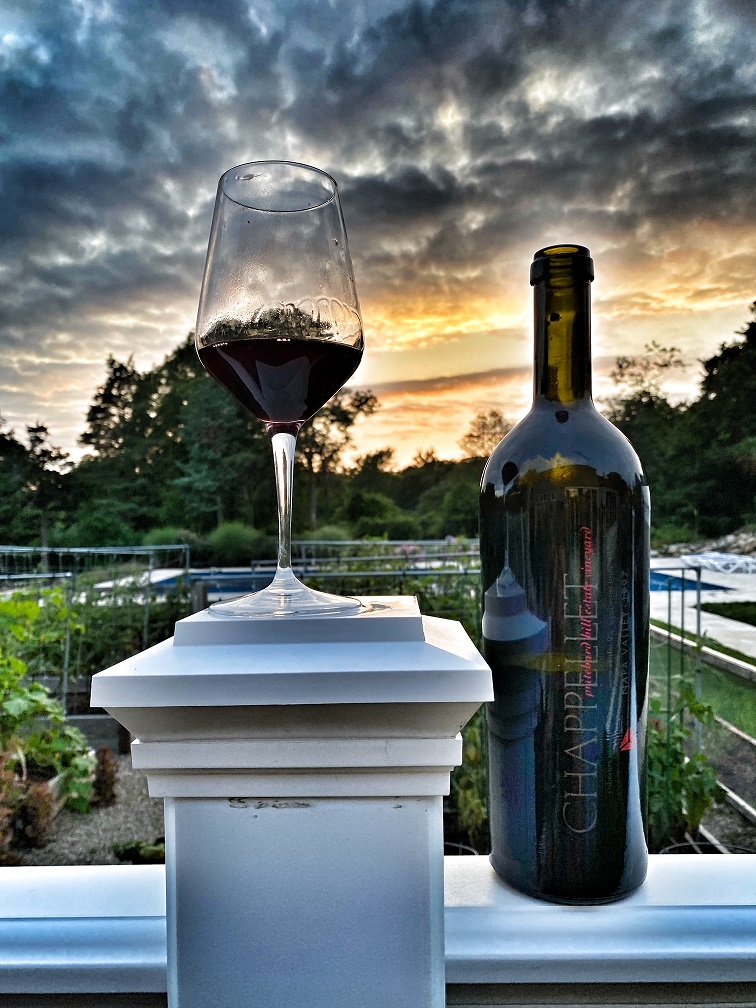 And this brings us to the last subject of today’s post – the wine. This was a vacation, and I was absolutely not interested in taking any sort of formal notes. But somehow, the majority of the wines we had were so good (with the exception of some sort of homemade wine from Moldova, which we had to pour out) that I can’t help it not to share the pleasure. Here are my brief notes.
We started with 2020 Hugues de Beauvignac Picpoul de Pinet AOP (14.1% ABV) – fresh, clean, well balanced. The wine offered a touch of the whitestone fruit and was a perfect welcome drink after 4 hours of driving. It is also very well priced at about $12 at Total Wines in Boston, which is almost a steal at that level of quality.
2019 Golan Heights Winery Yarden Sauvignon Blanc Galilee (13.5% ABV) offered a beautiful Sauvignon Blanc rendition with a hint of freshly cut grass and beautiful creaminess. This wine was more reminiscent of Sancerre than anything else – an excellent effort out of Israel.
2016 Sonoma Mountain Steiner Vineyard Grüner Veltliner (14.1% ABV) – one of the perennial favorites (I’m very disappointed when my Carlisle allocation doesn’t include Gruner Veltliner). Beautiful fresh Meyer lemon, grass, clean acidity – in a word, delicious.


The last white wine we had was 2016 Château de Tracy Pouilly-Fumé AOP (13% ABV). Another Sauvignon Blanc – plump, creamy, delicious. Nicely restrained and round. It is definitely a fun wine as long as the price is not taken into the consideration – otherwise, at about $40, both Yarden (under $20) and Picpoul wines would give it a great run for the money.
Our Rosé was fun 2020 Samuel Robert Winery Pinot Noir Rosé Vineyard Reserve Willamette Valley (13% ABV) – the Oregon Rosé is just not very common. This wine had nice strawberries all around – on the nose and on the palate. I would probably want it to be a tiny bit less sweet, but the wine was still quite enjoyable.
2017 Campochiarenti San Nicola Chianti Colli Senesi (14.5% ABV) is one of my favorite wines to surprise friends and even myself with. It starts as a solid Chianti would – cherries, tobacco, leather, iodine. But in a few minutes of breathing, it magically evolves to add sandalwood, nutmeg, and exotic spices. An incredibly heart-welcoming sip.
And to top of everything else, the 1997 Chappellet Pritchard Hill Estate Cabernet Sauvignon Napa Valey (87% Cabernet Sauvignon, 9% Petite Sirah, 4% Cabernet Franc) was thrown into the mix by my brother-in-law. This wine was a testament to California Cabernet Sauvignon; a simple proof that well made California Cab might be the best wine on Earth. This wine had no – none – signs of aging. Fresh, young, concentrated, cassis and cherries with a touch of mint and coffee, beautifully layered and well structured. This wine was not yet at its peak – I wonder how many more years it would require to reach the top…
And now, an absolute surprise – 2000 EOS Tears of Dew Late Harvest Moscato Paso Robles (10.5% ABV) – a late harvest wine from Paso. Beautiful orange color, and nose and palate loaded with ripe apricots – a hedonistic pleasure on multiple levels.
Now that is the whole story I wanted to share. What is your favorite flower? Have you tasted any amazing wines lately? Cheers!
Of Beautiful Things
Beauty is an interesting concept. It seems to be simple and universal. And nevertheless, the declaration of beauty might dramatically differ, even for the people going through the same experience. Take flowers, for example – if someone doesn’t like daisies, looking at the field of daisies will solicit no emotional response, but the same person might spend an hour admiring an orchid.
Whatever we see as “beautiful” solicit emotion, it gives us a tiny burst of positive energy, it makes us happy. But the proverbial “truth in the eye of the beholder” is fully in control – everyone decides on their own concept of beauty.
Photography is one of the best and simplest tools to capture the beauty of the moment and convert it into a tangible memory, something you can get back to. For sure I’m the one who heavily relies on photography for doing so. If you look at the pictures on my phone, you will have no problems figuring out that I consider wine, flowers, and sunsets as the most beautiful things in this life – well, this is not an absolute truth, but we can go with it for this post. Of course, sunsets and flowers are exactly what they are, but the wine bottles in the pictures simply represent the memory knots, the real beauty is inside the bottle, no matter how pretty the labels are.
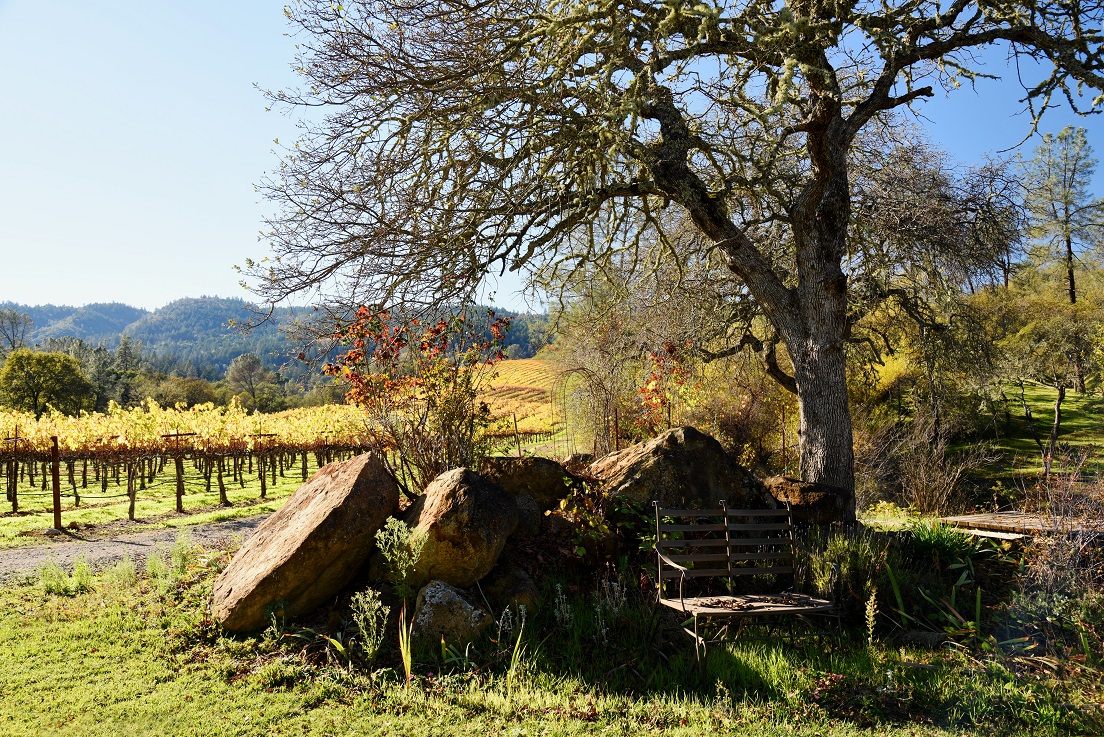
Garden at Calla Lily. Source: Calla Lily Winery
Calla Lily Estate & Winery is a project of renowned California winemaker, Cary Gott, and a group of business partners out of Hong Kong, who together started Calla Lily in 2013. Calla Lily is 95 acres of the estate in the Pope Valley section of Napa Valley, with the first vines planted in 1995. The estate’s vineyards comprise 12 acres of Cabernet Sauvignon, 5 acres of Petite Sirah, and 1 acre each of Merlot, Cabernet Franc, Malbec, and Petit Verdot.
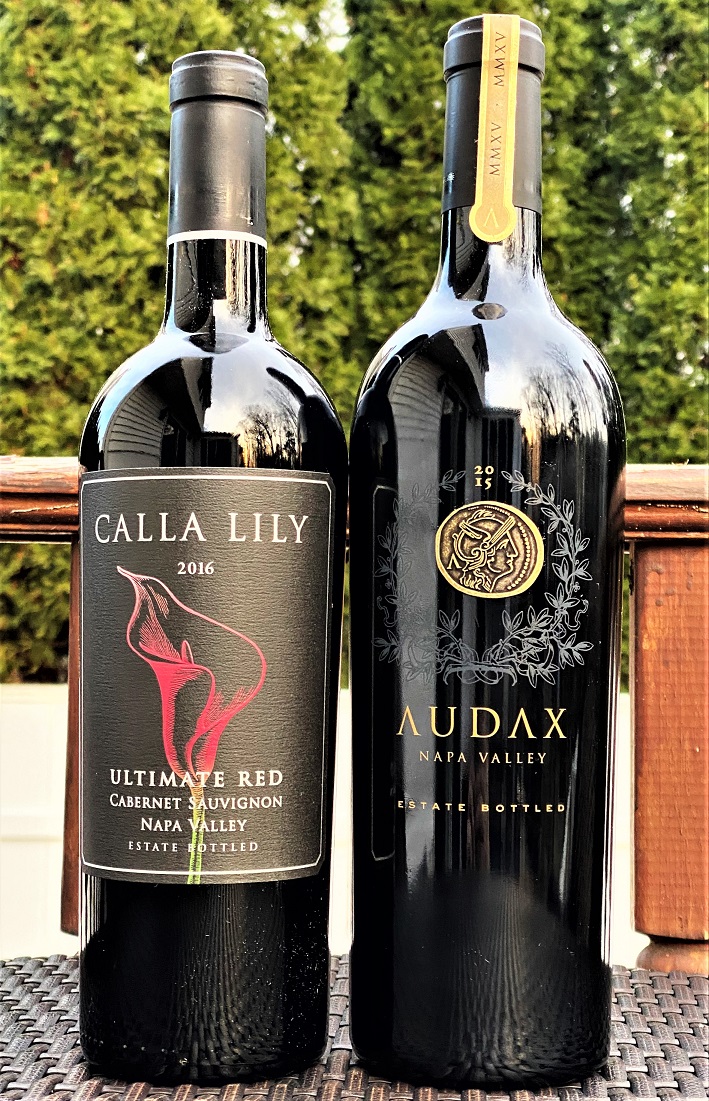
Calla Lily is not a random name. You can see the beautiful flower appear on the label of Cabernet Sauvignon, and it is both the name and the symbol. Calla is a type of lily flower, which takes its name from the ancient Greek word “Kallos” which means “beauty”. Calla Lily had been around a few thousand years and has a lot of symbolism associated with the flower in Greek, Roman, and Egyptian cultures, as well as in Christianity overall. You can read about Calla Lily symbolism further here, but I also can’t resist quoting the same source in regards to the meaning of the color of the Calla Lily flowers: ”
- White Calla Lilies: Purity and innocence.
- Yellow Calla Lilies: Joy and growth.
- Pink Calla Lilies: Appreciation and admiration.
- Red Calla Lilies: Intense passion.
- Blue Calla Lilies: Femininity and refined beauty.”
As you can see, red Calla Lily is depicted on the label of the Calla Lily wine, and after tasting the wine, I have to agree to the “intense passion” suggestion.
After talking about beautiful flowers, let’s talk about beautiful wines, as I had an opportunity to sample two of the Calla Lily wines.
2016 Calla Lily Ultimate Red Cabernet Sauvignon Napa Valley (14.5% ABV, $65, 84% Cabernet Sauvignon, 6% Cabernet Franc, 6% Merlot, 4% Petit Verdot, 26 months in 40% new French oak) was an interesting experience. While the nose was intense with red and black fruit, the wine on the palate was way too powerful for me to really enjoy it as “pop and pour”. The wine kept gradually improving over the next 4 days, finally offering soft rounds of cassis and mint, over the velvety texture. You need to wait for some beautiful things in life – for example, for a flower to fully open up from a tiny bud – this wine is beautiful, but you might need to wait for it – or decant it well in advance (Drinkability: 8- )
2015 Calla Lily Audax Cabernet Sauvignon Napa Valley (14.1% ABV, $120, 92% Cabernet Sauvignon, 4% Merlot, 3% Cabernet Franc, 1% Malbec, 27 months in 50% new French oak) is yet another interesting wine. “Audax” in Latin means “bold”, and this barrel-reserve wine is a tribute to the audacity of the pioneer winemakers, many of whom settled in the Pope Valley. Somewhat unexpectedly, the wine was more approachable from the get-go than the previous one – beautiful nose of cassis, and more cassis on the palate, accompanied by mint, pencil shavings, espresso, and cherry pit. Lots of beautifully balanced power with a firm, dense structure. (Drinkability: 8)
Here is the story of the two beautiful things in life – flowers and wine. Beautiful things are well worth seeking. What brings beauty into your world?
Daily Glass: Meeting The Expectations
Expectations are essential in any area of human life. We find great joy when our expectations are exceeded, no matter what those expectations apply to – service, conversation, book, a dish at a restaurant, final grade – truly anything and everything. We are equally disappointed when our expectations are not met – subpar service, empty talk, boring book, bland dish, a B grade instead of an A. Believe me, works every time. Expectations are important, as they function as gates to happiness.
In theory, having low expectations is a perfect path to happiness – a solid guarantee that expectations will be easily exceeded and we will feel happy. Well, it is easier said than done. More often than not, the expectations are set on a subconscious level. When you read the test question, the brain instantly jumps in “I know the answer!” – left unchecked, the test grade might not meet the expectations. Or think about one of my favorite sources of disappointment while visiting the restaurant – the dish description which doesn’t meet your expectations. If the dish described as “spicy” it is better actually be spicy and not dull…
Expectations work exactly like that in the world of wine. One quick glance at the label unleashes a slew of instant impressions – ahh, Turley, yes, had this last year, maybe a different vintage, I think this is a great year, should be delicious, maybe need some time to breathe, ahh, and I remember not liking that wine at first, yeah, I still remember that… can I pull that cork already? Yep – one quick glance is quite enough.
Exceeding expectations is great, but, more often than not, meeting them is quite enough – especially if your expectations are already high enough. Here is my account of two wines perfectly meeting my expectations.
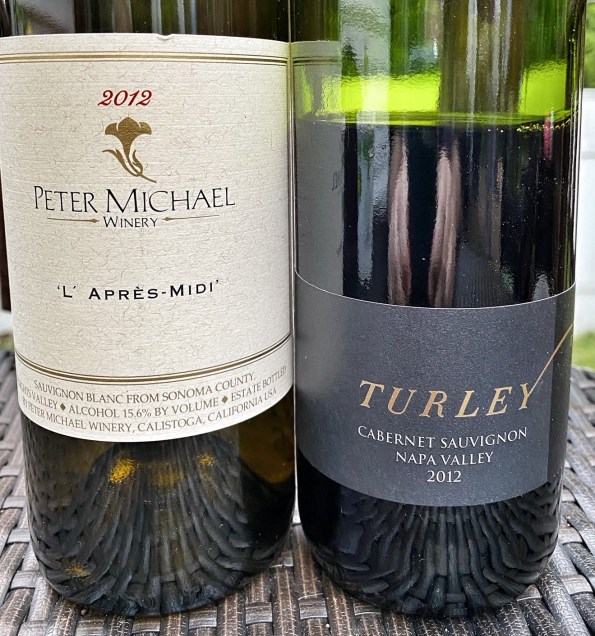
Peter Michael Winery requires no introduction to the wine lovers, producing some of the best Chardonnays, Pinot Noir, and Cabernet Sauvignon wines in California for more than 30 years. Turley Wine Cellars had been around for 27 years, and it is best known as producer of some of the most coveted Zinfandel wines. It is interesting that both wines I’m talking about here are sort of the oddballs for both producers – Peter Michael is not really known for its Sauvignon Blanc, and Larry Turley, the proprietor at Turley wines, was anti-Cabernet Sauvignon for a long time, so I’m not sure if wine lovers are even fully aware that Turley produces Cabernet Sauvignon for the past 5 years.
Both wineries are well known for their quality wines, and when you see their names on the label, you do expect to taste that quality in your glass. 2012 Peter Michael L’Aprés Midi Knights Valley Sonoma County (15.6% ABV) was superb from the get-go – a whiff of the fresh-cut grass, whitestone fruit, round mouthfeel, and clean acidity. The wine was really uncalifornian in its presentation – I would think I’m tasting Sancerre if I would taste this wine blind. The utmost elegance – and 8 years old fresh and vibrant Sauvignon Blanc is not an easy fit.
2012 Turley Cabernet Sauvignon Napa Cellars (14.1% ABV) also tasted as expected. As I opened the bottle, it was not the wine to drink – for sure not for my palate. Big, brooding, jammy, with a lot of semi-sweet dark chocolate and dark fruit. It was quintessential Californian and over the board. I’m sure it doesn’t sound great to many of you, but this is within the expectations, as Californian Cabernet Sauvignon are rarely pop’n’pour wines, and at 8 years of age, they are way too young. However, exactly as expected, the wine became magnificent on the second day. Cassis showed up, smothered with mint, eucalyptus, and a touch of anise. The medley of fruit and herbs was delicious, with perfect balancing acidity and velvety, roll-of-your-tongue, texture. Just the wine I would expect Turley to produce.
How often do you find the wines which meet your expectations? Better yet, how often your wine expectations are exceeded?
Daily Glass: Another Day, Another Enigma
 It was just another Sunday. It could’ve been any day in the oenophile’s house. You know, when you open a bottle which you think will be enough for the evening, but then people come over, and you open another, and another, and another. Yes, it doesn’t matter if it was Sunday or not. Just another day.
The important point here – wine is an enigma.
e·nig·ma
/iˈniɡmə/
noun
a person or thing that is mysterious, puzzling, or difficult to understand
This is not the first time I have to evoke the enigmatic virtue of wine – I had quite a few puzzling experiences, with the wines going amazing – undrinkable – amazing (here is one example), or with the wines needing 4-5 days to become drinkable after they had been open. The element of mystery of not knowing what you are going to find once the cork is pulled out of the most familiar bottle is definitely a big part of the excitement, but some times it becomes too much excitement, in my opinion. Anyway, let’s talk about that Sunday, shall we?
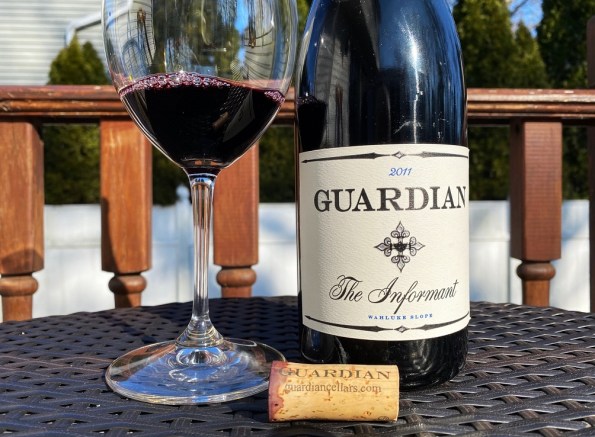
Guardian Cellars is a small produced in Woodinville, Washington. I visited the winery in 2014, and tasted through a bunch of wines which were one better than another (here is my excited post about that visit). I brought back with me a bottle of 2011 Guardian Cellars The Informant Wahluke Slope – 97% Syrah, 3% Viognier – and every time I would pull it off the shelf, I would put it back – you know how it is with single bottles, it is very hard to find the right moment to pull that cork. By the way, this bottle was simply stored in the wine cage standing in the room with temperature fluctuating around 70F and no direct sunlight – but not in the wine fridge or a cellar. Don’t really know what prompted me to finally get this bottle out, but I did. And it was delicious. Not a hint of age, dark garnet color, intense nose of blackberries, perfectly balanced dark berries, pepper, and crushed rocks on the palate. This was simply an excellent bottle – not the one which prompted my “enigma” outburst. And that note about storage conditions? People, don’t be afraid to keep your wine, even if you don’t have a cellar, wine fridge or a basement. If you do it right, you might be rewarded handsomely – well worth the risk.


I thought we might be able to get by with just one bottle, but then my daughter arrived with her friend who is “in the biz”, so the next bottle had to be special too. Another single bottle found its proper fate – 2006 Sequoia Groove Cabernet Sauvignon from Napa Valley (this one was stored in the wine fridge in case you are wondering). There was nothing enigmatic about this wine – well, except maybe how quickly it disappeared. The wine was an absolutely delicious, succulent example of Napa Valley greatness – still dark garnet, black currant, mint, and eucalyptus on the nose, ripe berries, currant leaves, touch of anise, good acidity, firm structure – a delight all in all.
So the Sequoia Groove was gone, what next? After short deliberations, 2013 Neyers Cabernet Sauvignon Napa Valley was pulled out. I really like Neyers wines, enjoyed many of them in the past, including the bottles from the same vintage. The bottle was opened with no issues, poured in the glass, and this is where the strange things started. The wine was too sweet. The nose was fine, but on the palate, it was just sugar, sugar, sugar. Okay, let’s decant. 30 minutes later, 1 hour later, 2 hours later, the wine stayed the same – a sugary concoction.
No wine can be wasted in this house, so the content of the decanter went back into the bottle. The next day it was the same. Two days later, the sugar significantly subsided, and the wine started to resemble a lot more a classic Napa Cabernet Sauvignon as one would expect.
So what was that? I know the wine is a living thing and transformation still continues in the bottle. Still, how one can know when the wine is drinkable, and when it is not? Was this a fluke, an issue with a particular bottle? Maybe. Over the years I noticed a significant bottle variation in Neyers wines overall, so this would support a theory of “just a fluke”. Or was it just a state of this 7 years old wine? Maybe. There is no good way to tell. However, I have two more bottles of the same wine, and they are not getting opened for a while.
Going back to our evening, just for the fun of sharing some pictures, our dinner menu included some BBQ chicken skewers – while I don’t have pictures of food, I have a couple pictures of burning charcoal which I’m happy to share 🙂


While Neyers was declared undrinkable, I had to entertain my guests with something else, so I pulled a bottle of 2015 Wind Gap Mi-Pente Pinot Noir Sonoma County, one of my latest Last Bottles finds. Wind Gap is best known as Syrah specialist, so I was surprised to even find Wind Gap Pinot Noir (I’m not even sure Wind Gap brand exists anymore – it used to be run by talented Pax Mahle, who now went back to his own brand Pax – this story definitely deserves its own post). The wine was delicious – crunchy cherries and smoke, firm structure, lots of energy – this was an excellent finish to the good Sunday evening.
Here you are, my friends. Wine is an enigma. Who else thinks that wine is an enigma? Raise your hands glasses.
Last Bottle Sign Up ($10 credit)




 Talk-A-Vino