Archive
Passion and Pinot Updates: Bells Up Winery
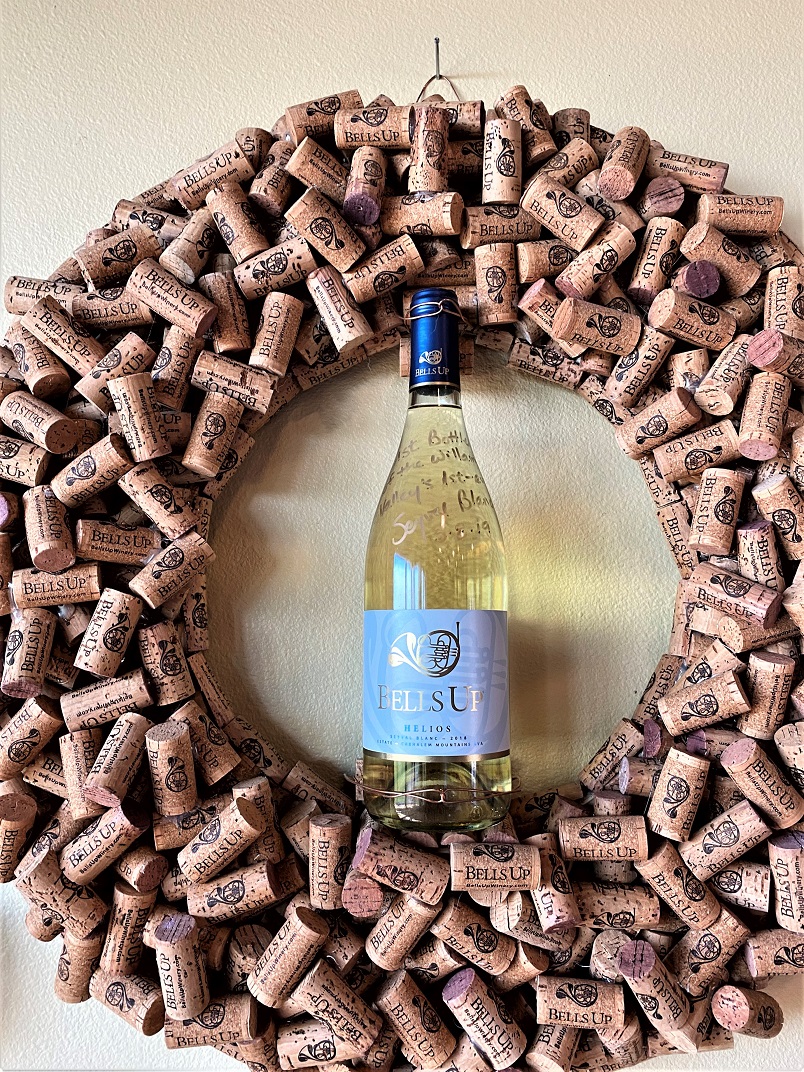 And then we arrived at “micro-boutique, un-domaine” Bells Up Winery, our final stop of the Oregon wine country touring.
Out of 13 wineries profiled in the Stories of Passion and Pinot series, Bells Up is the youngest one, having been founded in 2013, with the first vineyard plantings of Pinot Noir going into the ground in 2014. Despite being a young winery, Dave (the winemaker) and Sara (the Boss) Specter have a clear vision as to where they are going with their distinctly un-domaine wine – if you are curious why I keep saying “un-domaine”, I would like to direct you to the (virtual) interview I did with Dave in 2019 – he explains the concept of un-domaine very well.
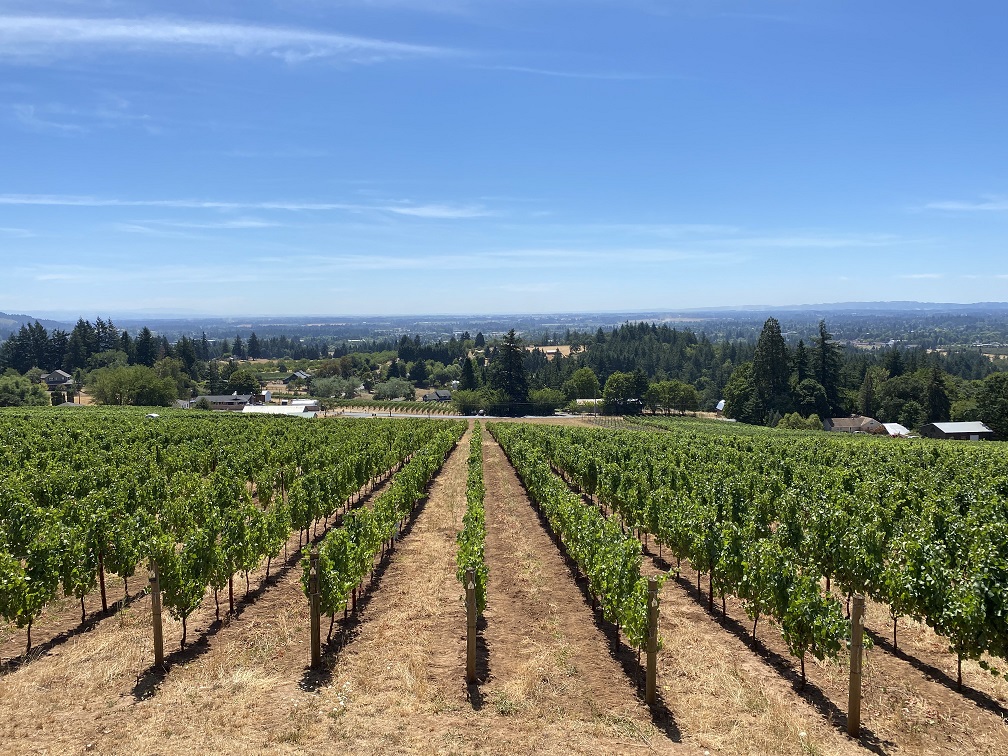
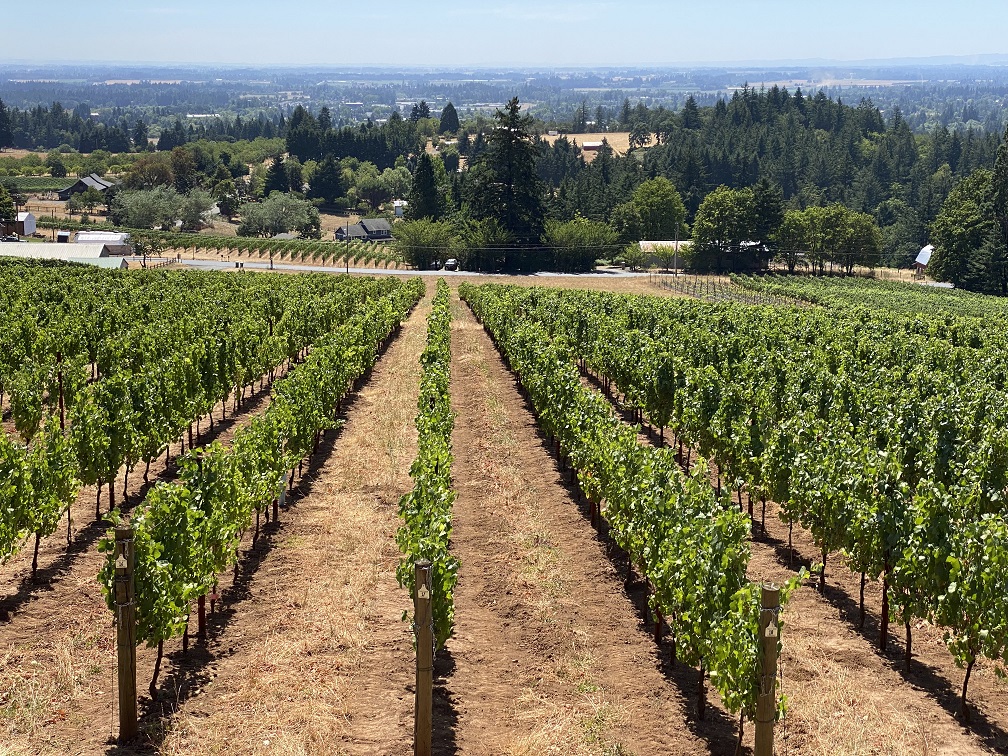
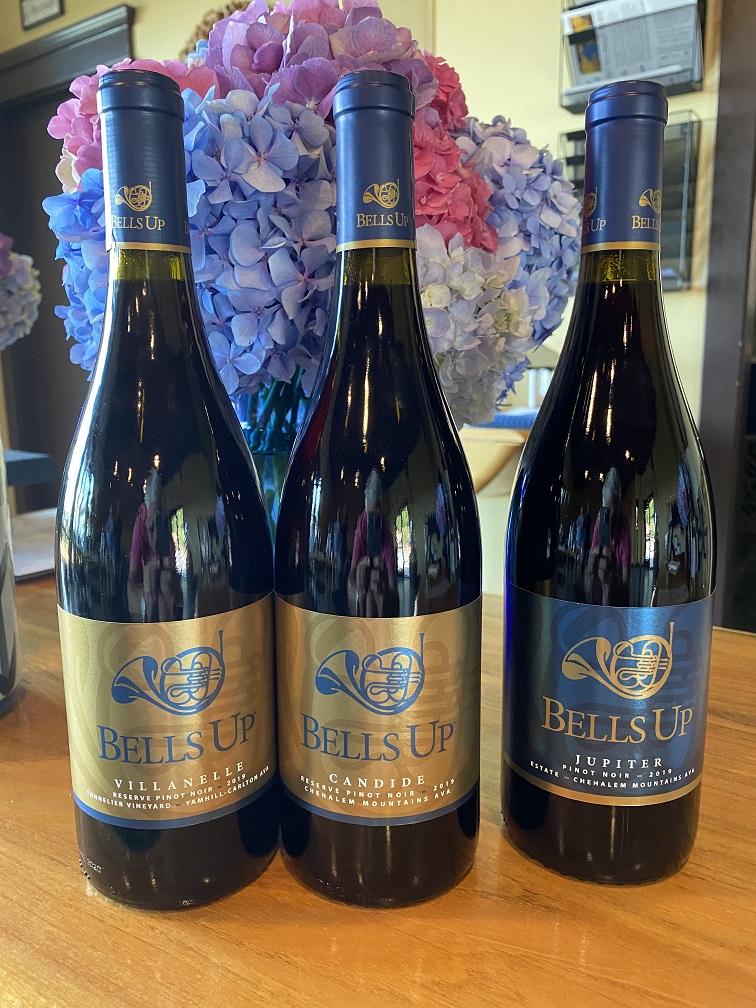
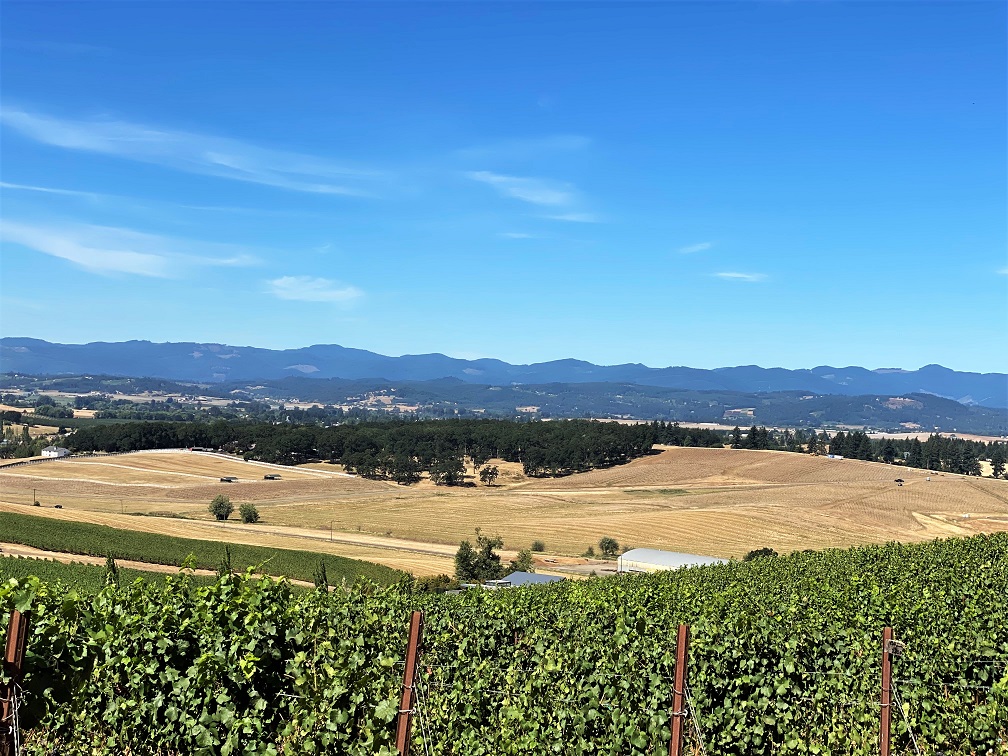
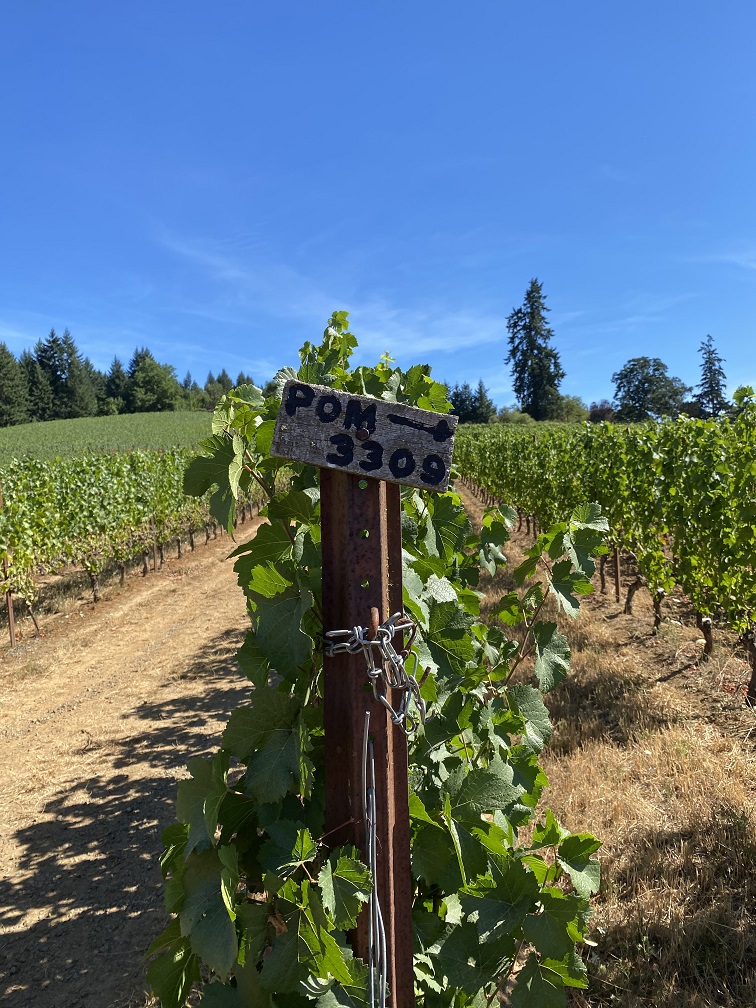
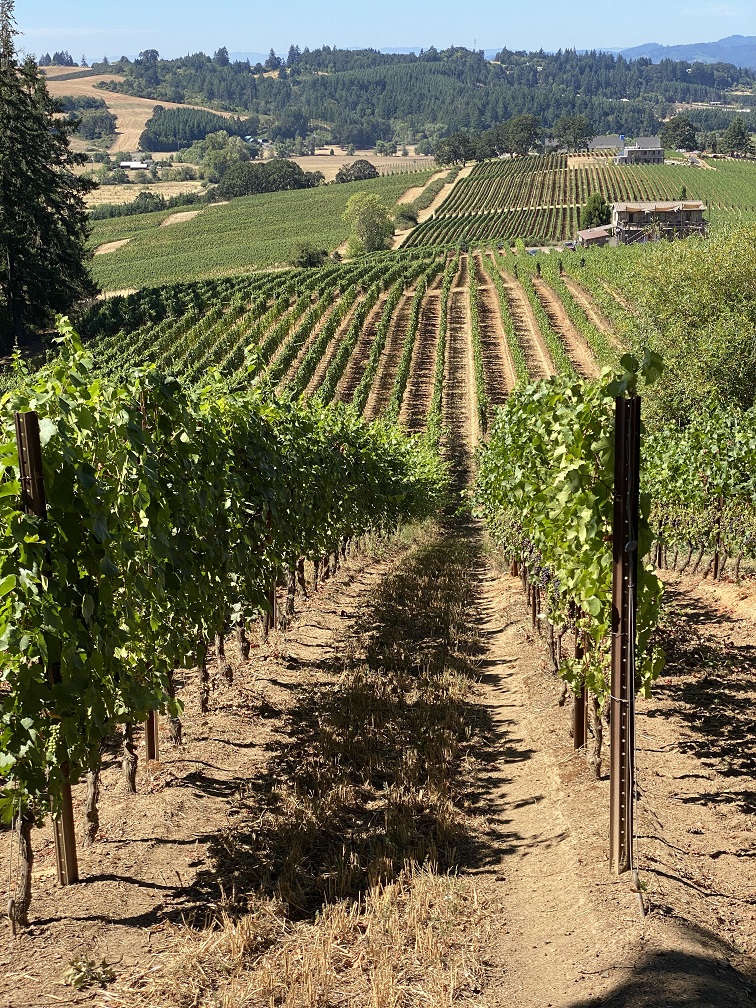
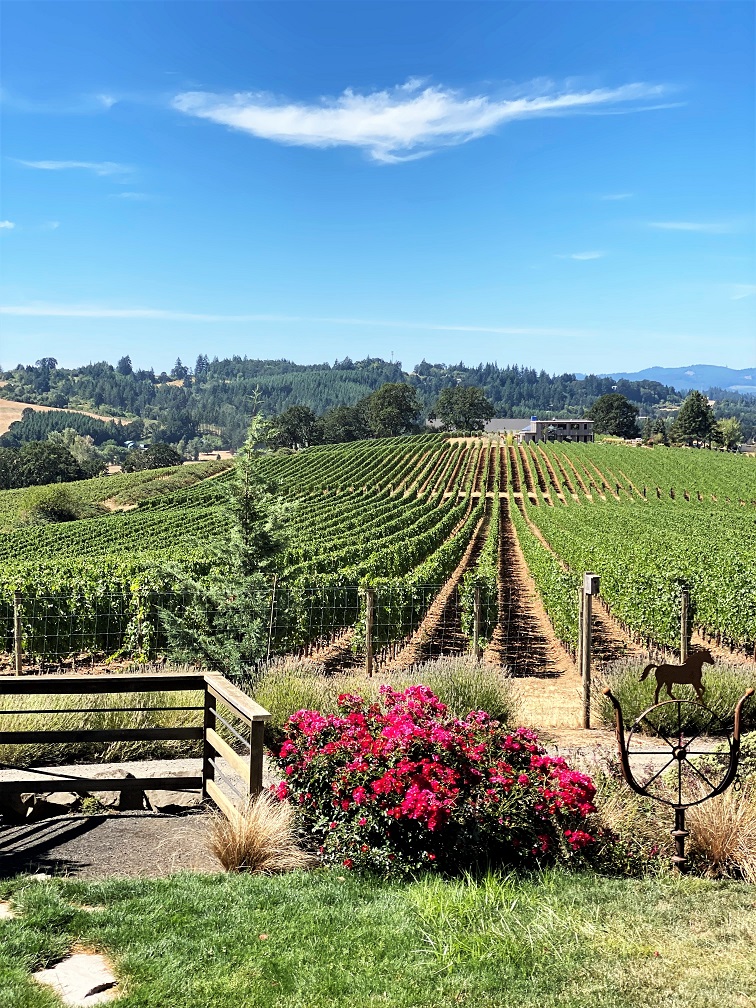
Everything is distinctly un-domaine (see, you need to read that interview) at Bells Up. The vineyard with a gentle slope, the winery right in the middle of the vineyard, a simple but elegantly appointed tasting room with lots of fresh flowers and beautiful views of the vineyards. Here you go – pictures, pictures, pictures:


After admiring all the views we proceeded with lunch and tasting. Our lunch was prepared by Sara and while it was somewhat of a simplistic summer chicken salad, the amazing part was that this salad perfectly paired with the majority of wines we tasted – if you ever tried pairing the salad with wine, you would have to agree that achieving great pairing is very far from easy.
As I mentioned, Dave and Sara have a clear vision of the future direction for Bells Up. While Bells Up estate vineyard will be mostly planted with Pinot Noir, and by 2022 Bells Up plans to be at 100% estate fruit for all Pinot Noir bottlings, they have a clear plan for making Bells Up unique and different – growing and producing Pinot Blanc instead of the more commonly available Pinot Gris; being first in Willamette Valley with Seyval Blanc plantings; planting (out of all grapes!) a little known Italian grape Scioppettino; already offering Syrah and adding Cabernet Sauvignon in the 2020 vintage. “Unique and different” is a good description, in my opinion.
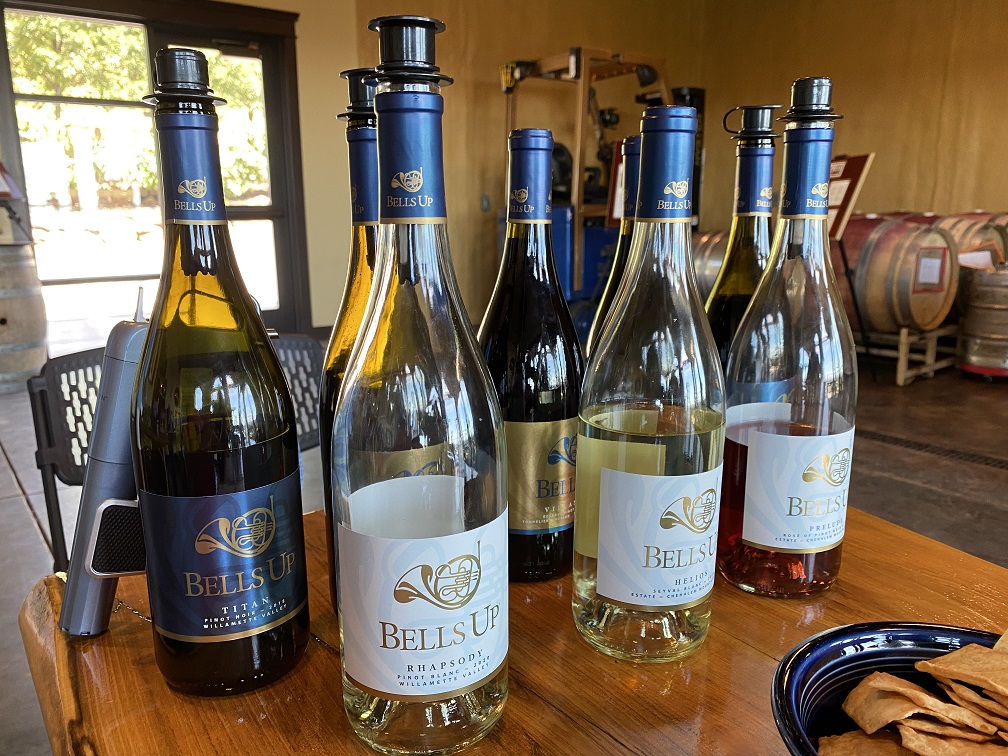


Before we talk about wines I would like to mention that none of the wine names you will see below are random. All the names have connections to the classical music pieces under the same name, and every choice of the name has an explanation as to why the particular piece was selected to connect with a given wine. If you are interested, there is even a Spotify playlist that includes all of the relevant music pieces – you can find that list directly on the Bells Up Our Wines page.
We started our tasting with Pinot Blanc:
2020 Bells Up Rhapsody Pinot Blanc Willamette Valley ($32)
Great complexity, lemon, gunflint
Great acidity, lemon, clean, crisp, refreshing
Perfect pairing with summer chicken salad
8, Excellent
We almost had to beg Dave to let us Seyval Blanc which was practically sold out. As a curiously interesting fact, Seyval Blanc plantings had to be protected by the net, as it happened that birds loved the grapes too.
2020 Bells Up Helios Seyval Blanc Estate Chehalem Mountains AVA ($40)
Gunflint, minerality,
Clean fruit, Meyer lemon, good acidity, good creaminess
Great with summer chicken salad.
8
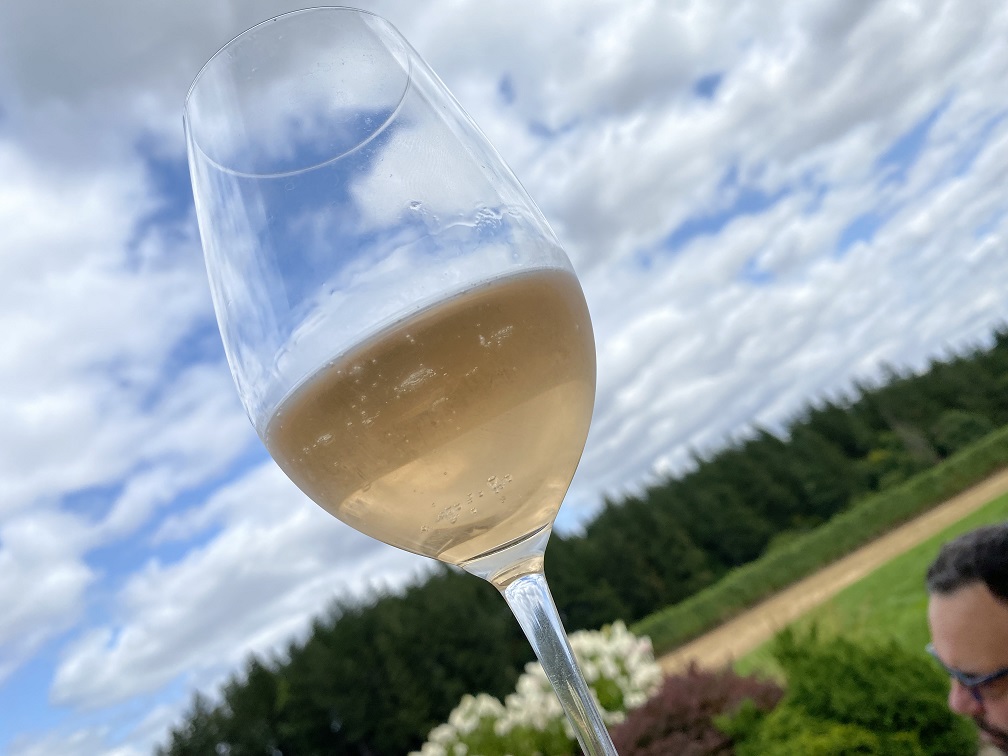
Next up was Pinot Noir Rosé, the first Pinot Noir wine entirely produced from the estate fruit:
2020 Bells Up Prelude Pinot Noir Rosé Estate Chehalem Mountains AVA ($28)
Strawberries, nice minerality
Strawberries, bigger body than Provence, good acidity, perfect balance.
8-
We followed up with the selection of Bells Up Pinot Noir wines:
2018 Bells Up Titan Pinot Noir Willamette Valley ($44)
Plums, violets, sandalwood
Crisp, clean, crunchy cranberry profile, a hint of cranberries, good acidity on the finish.
8-
2019 Bells Up Candide Pinot Noir Reserve Chehalem Mountains AVA ($54, 12 months in French oak)
Floral, nutmeg, warm spices
Cherries, cut through acidity, black pepper, perfect balance, delicious
8
2019 Bells Up Villanelle Pinot Noire Reserve Tonnelier Vineyard Yamhill-Carlton AVA ($58, 12 months in French oak, final vintage)
Blackberry/raspberry, Marionberry
Cassis leaves, light crunchy cherries, well-integrated tannins, good acidity on the finish, delicious.
8
2019 Bells Up Jupiter Estate Pinot Noir Chehalem Mountains AVA ($48, 12 months in French Oak)
Underbrush, summer forest, cherries, a touch of tobacco
Crunchy cherries, clean, fresh, delicious
8
While this is not a video, here is Dave talking about Bells Up wines:
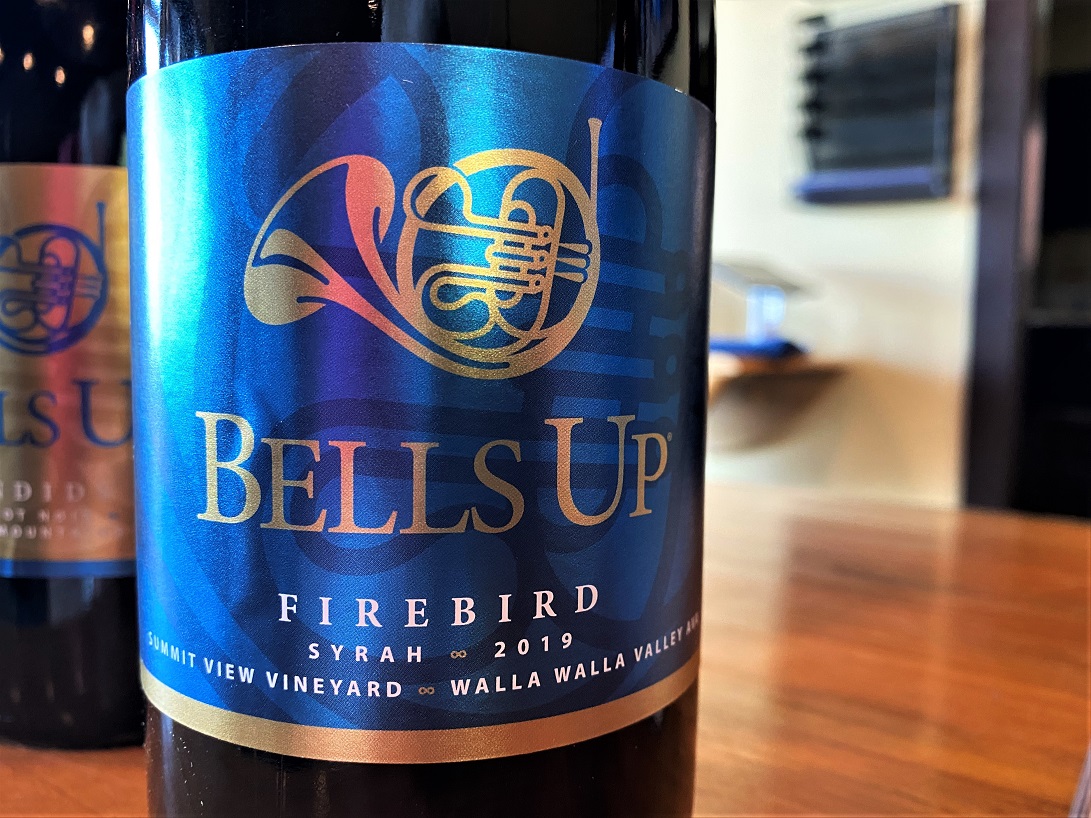
Bells Up Syrah was served with an amazing seedless grape pie. As Sara explained, everyone gives wines as presents in Willamette Valley, but tasty grape pie is almost equivalent to the hard currency when exchanging gifts with neighbors. As I said, the pie was superb, and to think that sweet pie would pair with Walla Walla Syrah? I really wouldn’t – and I would be mistaken.
2019 Bells Up Firebird Syrah Summit View Vineyard Walla Walla Valley AVA ($52, 12 months in French oak)
Blueberries and blackberries on the nose
Berries all the way, nicely balanced
8, Amazing pairing with seedless grape pie with cardamom
Again, we almost had to twist Dave’s arm to let us taste the future release of Cabernet Sauvignon:
2020 Bells Up New World Cabernet Sauvignon Reserve Summit View Vineyard Walla Walla Valley AVA ($68, 12 months in French oak, barrel sample)
A hint of green bell pepper
Cassis, a hint of black pepper on the finish, good, round, smoky undertones.
8-
Here you have the summary of our “un-domaine” experience – an excellent set of wines and super-friendly hosts. If you will find yourself touring Willamette Valley, add Bells Up winery to your “must visit” list.
This is the last update in the Passion and Pinot series. For now, that is.
Until next time…
This post is a part of the Stories of Passion and Pinot series – click the link for more stories…
Looking Back and Looking Forward, 2022 Edition
 Ahh, the self-reflection time.
The bad, the good, the ugly.
New Year resolutions.
Yada Yada Yada.
Okay, I know. Not the most enlightening post if I ever even write anything in that category. But hey, it is my blog. I write for myself, first and foremost. So as I get to set the rules here, I like to take a look back at the year which passed and get a little pleasure of re-living some of the best moments of otherwise not the brightest year.
New Experiences:
More often than not, I like to call myself a “collector of experiences” – I love those non-material things which you can add to your personal “been there, tried that” collection. While in absolute numbers these “achievements” sound dismal, under circumstances they are perfectly sufficient in my book.
Visiting new wine region
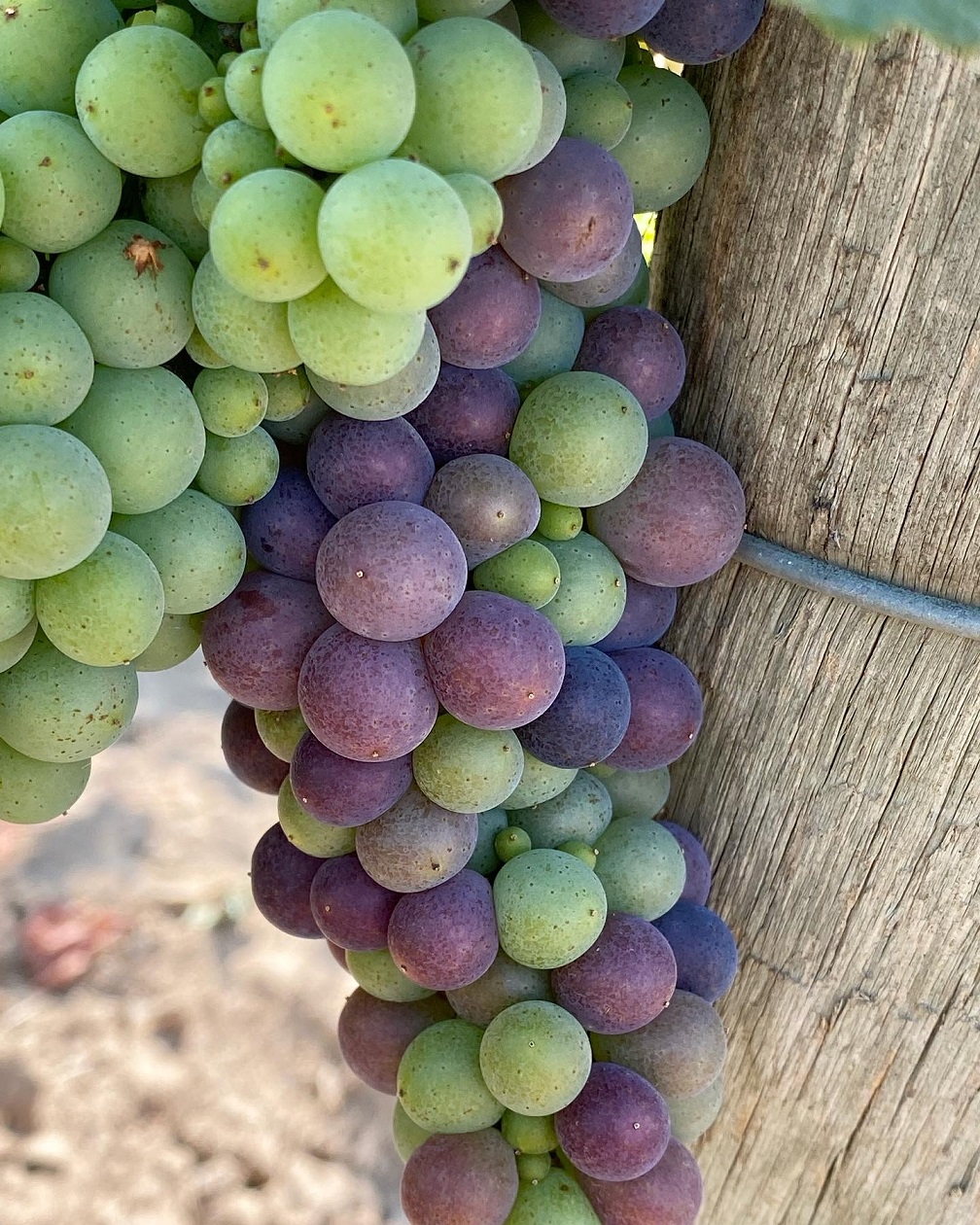
I visited Oregon on a number of occasions, and wrote about Oregon wines in this blog many times – but it was only 2021 when I set foot in the vineyard in Oregon, thanks to the Wine Media Conference 2021 held in Eugene, Oregon. Not only I visited a number of wineries in Oregon, but I also saw veraison for the first time, and tasted lots and lots of delicious wines, as reflected [dis]appropriately in the list of Top Wines of 2021 (more about it below).
Wine from the new state in the US
When I say that I’m collecting experiences, I mean exactly that – I keep track of how many wines from how many states I tasted, and in how many states I visited wineries. While Oregon was added to the list of states I visited the wineries at, I also tasted the wine from Michigan for the first time, and it was an excellent Cabernet Franc from Bel Lago. I keep my progress noted in this table in case you are interested.
Wine from the new country
Same as the wines of 50 United States, I also keep track of wines from different countries that I had an opportunity to taste. This year I added one of the oldest winemaking countries in the world to the list, after tasting the wines from Armenia. The wines were outstanding and Keush sparkling even made it into the Top Wines list. Same as with the 50 states, here is the table where I mark my progress.
More rare grapes
Ever since I had been bitten by The Wine Century Club bug, I had been hunting down rare grapes. This year I made possibly the slowest progress ever, but this journey is not getting any easier at this point. I only added 6 new grapes to the count (Cabernet Pfeffer, Voskehat, Khatouni, Areni, Yapincak, Ciass Negher), which now stands at the grand total of 561.
Top Wines 2021:
Same as every year, this was a fun project to go through the list (big word here – there is no such thing) of all the wines I tasted in 2021, and select 26 to be split into Second (generous) Dozen and the Top Dozen. Considering that visit to Oregon to be the biggest highlight of the year, it is not surprising that the top list is heavily skewed towards Oregon wines – still, it offers quite a bit of diversity as it is. My list of 26 is an easy one to analyze compared to all of the Top 100 lists I processed this year, so here is my distribution of the wines in the top list: Oregon – 8, California – 7, Spain – 5, Italy – 2, Argentina – 1, Armenia – 1, Pennsylvania – 1, Texas – 1. As you can see, France makes a notable absence, but the list clearly reflects my wine drinking habits – and I stand by all of my choices.
The year of Organic Grapes:
Made with Organic Grapes was one of the hot subjects in the blog (check the posts for yourself). In 2021, I tasted and wrote about multiple organic wines from multiple producers from Argentina, Chile, Italy, New Zealand, Spain – and I’m sure I will write about a lot more organic wines this year.
Catching up:
Much to my chagrin, I was really late with many of the posts, writing about events and tastings some of which were more than 2 years old. I really made an effort in December to clear up the backlog, turning it into one of the most prolific blogging months ever with 21 posts – in my almost 12 years of blogging there were very few months with 21 posts, and even fewer with 22. Catching up is not fun, but remembering about things you didn’t deliver is even less fun. There is more catching up to do, so I definitely hope I will be able to continue the streak.
What’s in the store for 2022:
My New Year resolution is not to have any New Year resolutions, so I can’t tell you really what’s ahead. Last year, I was keen on continuing the Wine Quiz and Wednesday Meritage series of posts, only to run out of steam somewhere in the middle of the year. So the plan for 2022 is to use a more opportunistic approach – there is no shortage of wine subjects worth writing about. I also need to up my wine game by paying more attention to French, Australian, and South African wines – I want to fill that gap for the 2022 Top Wines rendition.
* * *
Here we are, my friends. A quick revisit of 2021, and mostly hope for the good year 2022 with good surprises. I know that hope is not a strategy, but if I learned anything from my years of blogging, it would be proverbial “the road to hell is paved with good intentions”. So how was your 2021? Any plans for 2022? Cheers!
American Pleasures #6: A Tale of Two Cabs
Wine should give you pleasure – there is no point in drinking the wine if it does not. Lately, I had a number of samples of American wines, that were the delicious standouts – one after another, making me even wonder if someone cursed my palate. I enjoyed all of those wines so much that I decided to designate a new series to them – the American Pleasures.
California Cabernet Sauvignon.
Magical words for any wine connoisseur. Out of more than 100 grape varieties used in wine production in California, I would safely bet that Cabernet Sauvignon clout exceeds that of Chardonnay, Merlot, and Pinot Noir, and even including Pinot Noir in this list is a stretch. Cabernet Sauvignon is The One of California wines (if you are willing to disprove this with actual numbers, I will be happy to publish a correction, but until someone will step forward, this stands as unquestionable truth).
While we can agree that California Cabernet Sauvignon is an object of craving for uncounted many, it also should be recognized as an object of controversy. How do I mean it? Easy. There are probably 50 or so producers whose wines are impossible to get, due to both availability and pricing – you have to be on the mailing list with a waiting list stretching for 20 years or so, and once you get there you should be willing to pay $500++ per bottle of wine you will need to wait for another 10-15 years to enjoy. Alternatively, you need to be prepared to pay an upward of $500 per bottle and scour the internet daily looking for those special bottles.
On the flip side, you can join most of us walking into the wine store asking (begging?) for a good bottle of Cabernet Sauvignon under $20, trying not to notice the poorly hidden smirk on the face of the salesperson, who knows that we are on the quest for the impossible. If you like Cabernet Sauvignon and not buying those wines from your expense account, I’m sure you can relate to the experience firsthand. Even $50 per bottle doesn’t come with any guarantees. But – that number gives us hope. Yes, folks, it is possible to find a good bottle of Cabernet Sauvignon under $50. Let’s talk about it.


Lots of my wine learning and discoveries are linked to unimitable wine educator Kevin Zraly and his Windows on the World Wine School. I remember one of the lessons where we were talking about California Cabernet Sauvignon. One of the wines was particularly good, and I remember Kevin remarking that the wine was produced by Louis M Martini, who doesn’t charge nearly enough for the quality of the wines they produce. That reference got engraved in my memory literally forever, and Louis M Martini became somewhat of the safe bet when looking for reasonably priced and consistent California Cabernet Sauvignon.
Louis M Martiny winery was founded in 1922 when Prohibition was already in full swing. It was actually known as L.M. Martini Grape Products Company and was focused on the production of sacramental wines and concentrate for home winemaking. In 1933, expecting that Prohibition will end, the new winery building was constructed north of the town of Napa. This was the actual beginning of the Louis M Martini winery and pioneering role of the Martini family in the Californian wine industry, helping to establish Napa Valley Vintners Association in 1943, being one of the first to use wind machines to prevent frost in the vineyards, and being one of the first to bottle varietal Merlot in 1970.
Louis M Martini offers a substantial range of wines today, going way beyond standard Sonoma and Napa Cabernet Sauvignon offerings, including Cabernet Sauvignon from some of the best regions in Napa Valley such as Stagecoach Vineyard and Howell Mountain, as well as a number of Merlot, Malbec, Petite Sirah, and Zinfandel wines – unfortunately, most of those are priced well beyond the $50 we are talking about today. Sill, there is Sonoma Valley Cabernet Sauvignon which can be found at around $15, and Napa Valley Cabernet Sauvignon around $35. The Napa Valley bottling I tasted was simply outstanding with or without any regard to the price:
2016 Louis M Martini Cabernet Sauvignon Napa Valley (15.1% ABV, $40)
Garnet
Cassis, eucalyptus, baking spices
Roll of your tongue smooth, velvety, fresh cassis, perfectly ripe fruit but over, firm structure, long finish.
8+/9-, excellent, classic California Cabernet Sauvignon
If Louis M Martini can be called an iconic winery, then our next winery can be only referred to as the most iconic winery in Napa Valley. Charles Krug winery, established in 1861 in Napa Valley by Prussian immigrant Charles Krug was the very first winery in Napa Valley, the 540 acres estate which Charles Krug received via marriage. In 1943, an immigrant family from Italy, Mondavi, purchased the Charles Krug estate which had been run by the family now in 4th generation.
Charles Krug winery also offers a good number of wines, including Chardonnay, Malbec, Merlot, Zinfandel, and others, with Cabernet Sauvignon still being a flagship offering, including clonal selections (one of the Charles Krug Cabernet Sauvignon wines is called X Clone as it is produced as a blend of 10 Cabernet Sauvignon clones). I always wanted to try the Charles Krug wines, and finally, I was able to do so:
2017 Charles Krug Cabernet Sauvignon Napa Valley (14.1% ABV, $39, 87% Cabernet Sauvignon, 5% Merlot, 5% Petit Verdot, 3% Petite Sirah)
Dark garnet
Blueberry, blueberry jam, dark chocolate, pipe tobacco
A touch of nutmeg and cloves, much crispier on the second day, firm tannins, firm structure, good acidity.
8-/8, definite improvement on the second day.
Comparing these two Cabernet Sauvignon wines, Louis M Martini was a perfect pop and pour example, which is ultra rare among California Cabernet Sauvignon, where Charles Krug bottling definitely needed time.
Here you are, my friends. If you are looking for a good bottle of Cabernet Sauvignon under $50, there is still hope!
Passion and Pinot Updates: Utopia Vineyard
 And then we arrived in Utopia.
When your destination is called Utopia Vineyard, poking some fun is irresistible, isn’t it?
Upon our arrival to Utopia Vineyard in Ribbon Ridge AVA, we were warmly greeted by Dan Warnshuis, proprietor and winemaker, who poured us a glass of Utopia Pinot Noir Blanc (yep, a white wine made out of Pinot Noir) and took us on the tour of the vineyard, glass in hand. After speaking with Dan virtually about a year ago, it was definitely a pleasure to shake hands and move from the virtual to the real world where things can be touched and smelled.
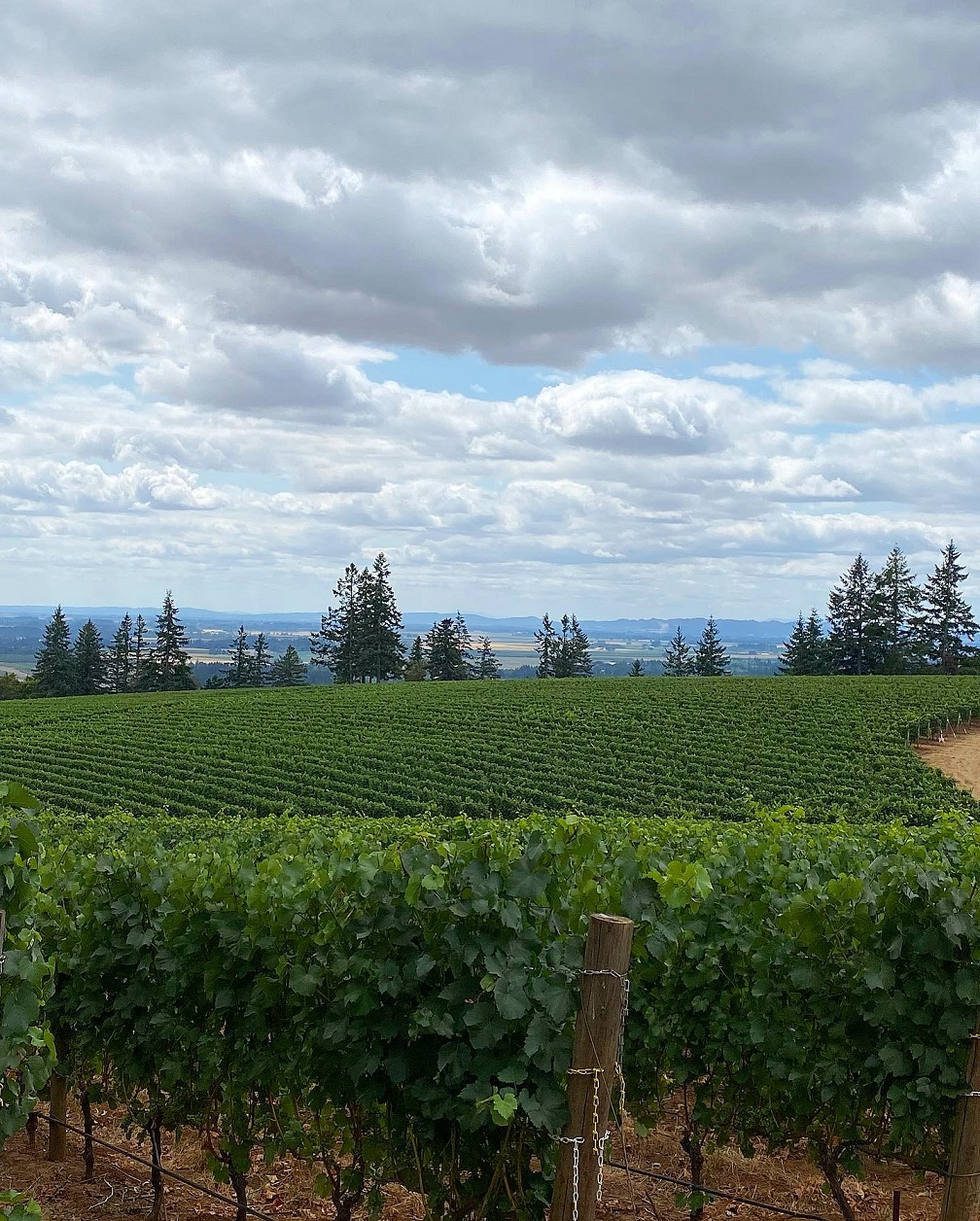
Utopia Vineyard looks different from Le Cadeau and Lenné – no fighting with the rocks here. Gentle slope elevation of only 20 feet from top to bottom makes it easier to tend for grapes. Utopia Vineyard is farmed using Sustainable Organic practices and was L.I.V.E. certified in 2008. Dan practices dry farming and uses cover crops every second row – in normal conditions though. Summer 2021 was so dry and hot that by the second week in August when we visited, all of the cover crops were removed so it will not compete with vines for access to water. The grapes looked perfectly healthy and beautiful despite the hot weather – you can see it for yourself in the pictures below.


I don’t know how the actual utopia should look like, but I find these vineyard views pretty compelling:

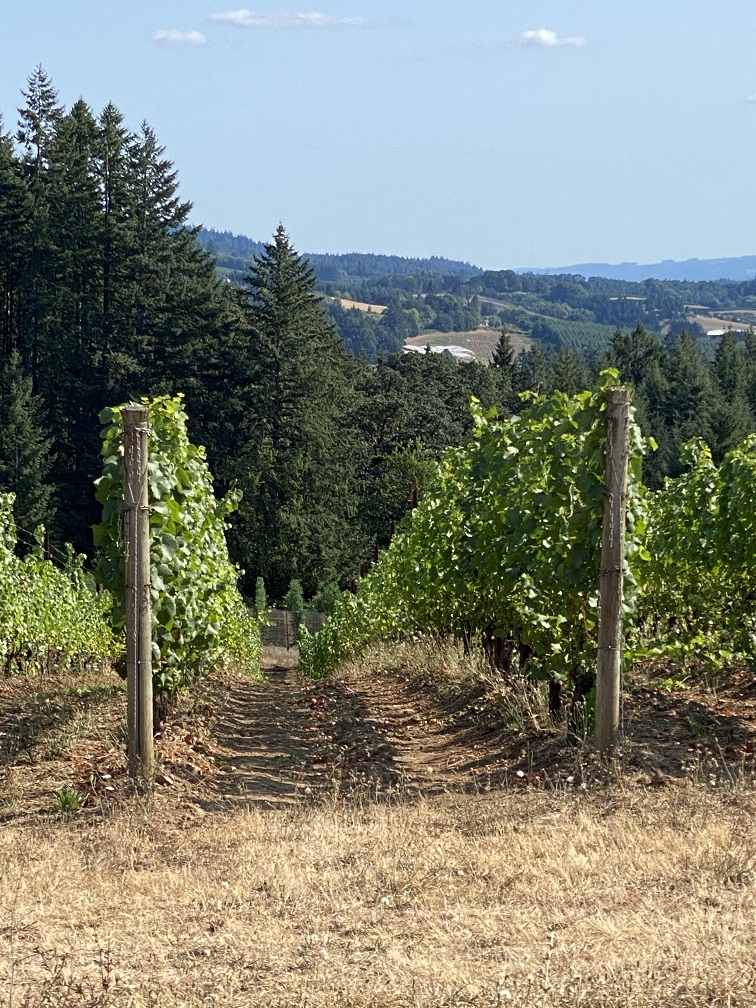
There are 12 clones of Pinot Noir growing at Utopia Vineyard – one of the wines we tasted was made out of all 12 clones. There are also 3 clones of Chardonnay growing there, planted in 2010. Talking about “fashionable wines”, Utopia Vineyard doesn’t produce sparkling wines, but Dan makes Pinot Noir Blanc, a white wine from the red grapes, which we tasted upon arrival, and also had the pleasure of tasting it directly from the barrel (all notes below).
In 2018, Dan acquired additional 35 acres of land not far from Utopia Vineyard’s original location. That parcel of land also had a 5,500 sq. ft building which by the time of our arrival 3 years after the acquisition was fully converted into a state-of-the-art winery. We stopped by the winery a few times during our visit, and what was the most mind-boggling to me was that Dan was pretty much operating everything at the winery just by himself – moving barrels, emptying tanks, and so on. His son-in-law comes to help during the harvest, but otherwise, Dan is a one-man operation.
This additional property also hosts a freshly constructed log cabin which is called exactly that – Utopia Vineyard Log Cabin, which offers beautiful accommodations and spectacular views:
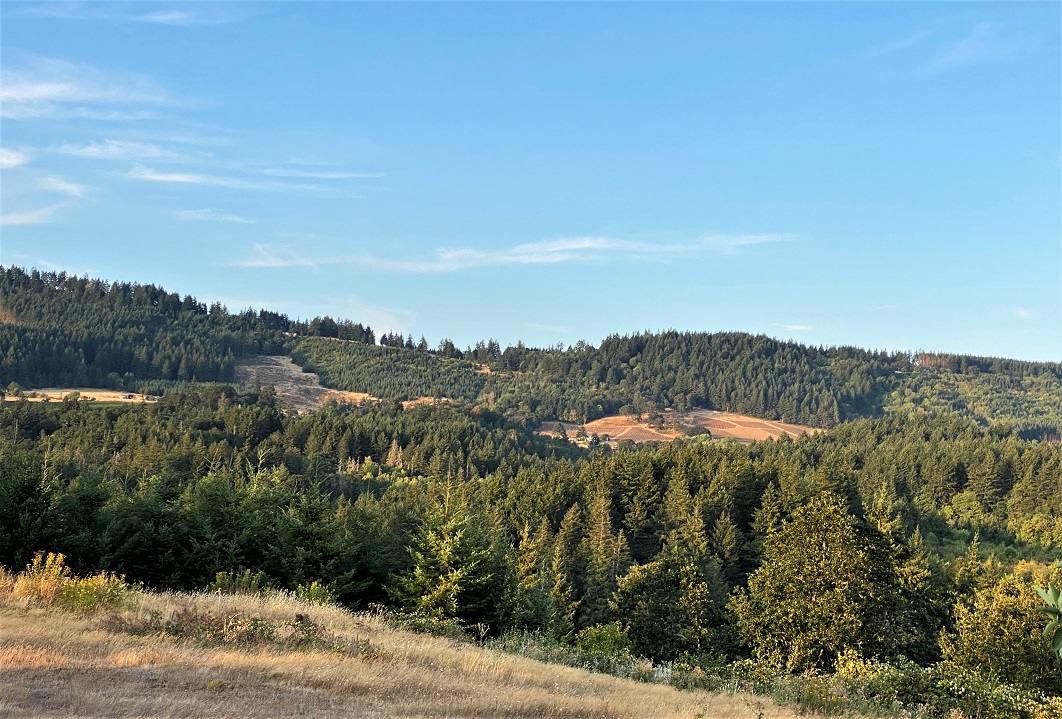
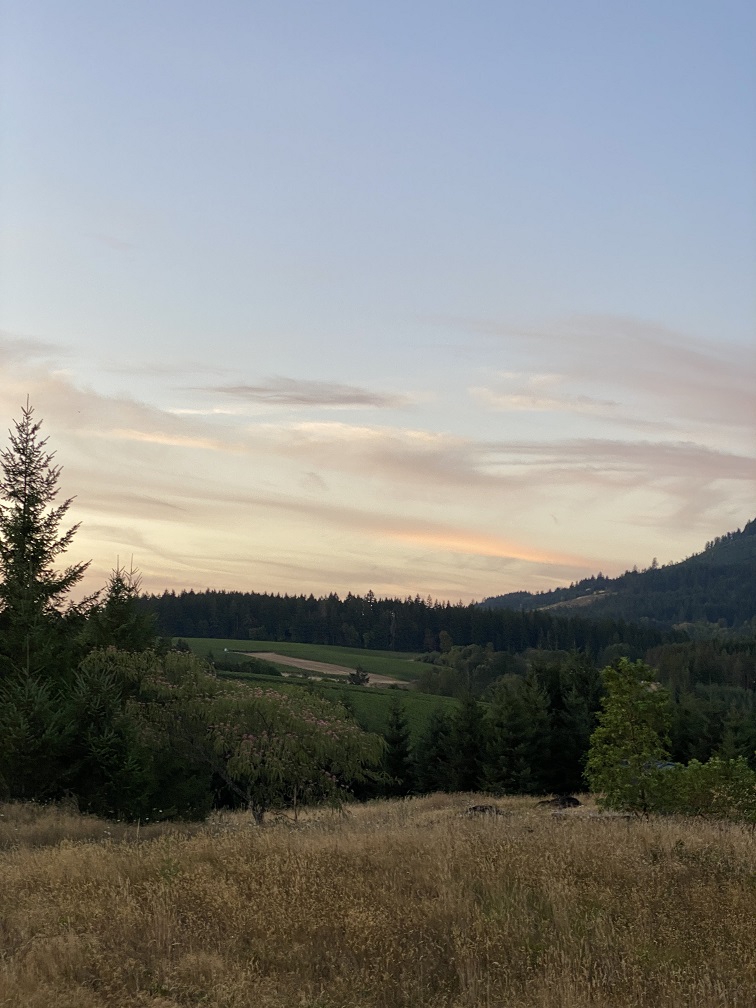
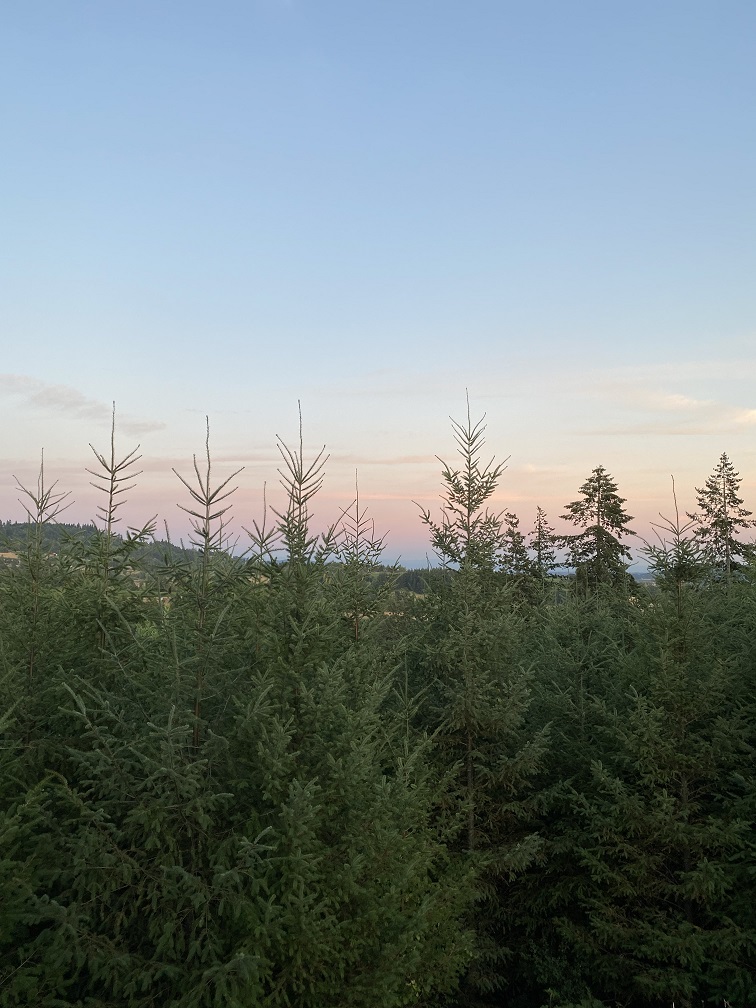

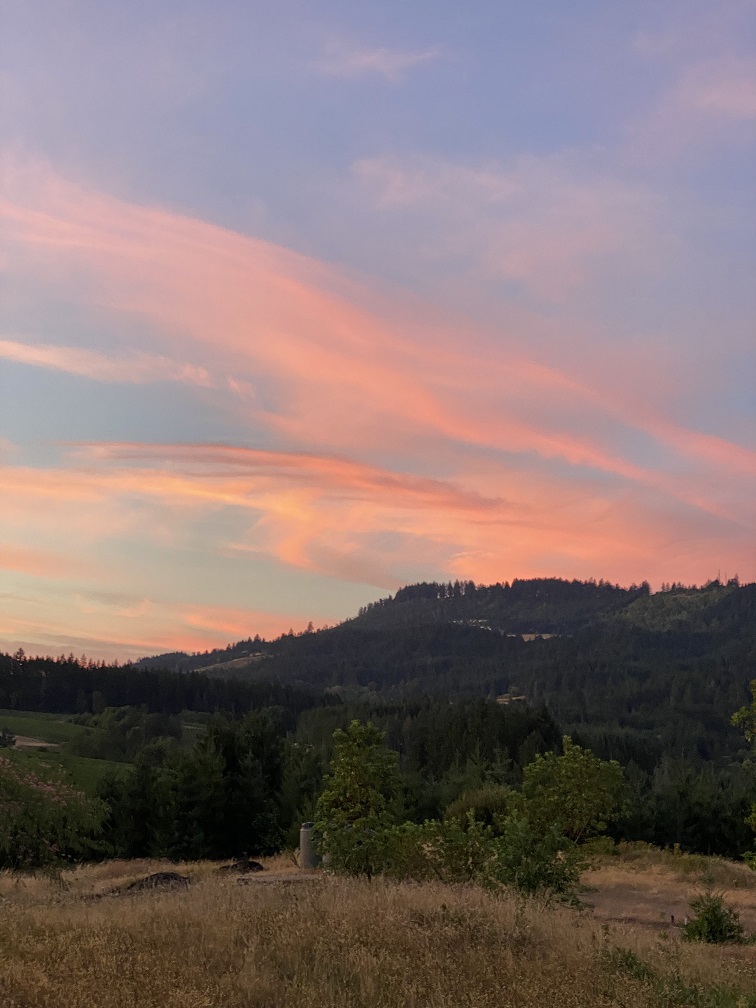
We visited Utopia Vineyard over two evenings and had some delicious food and tasted through a substantial range of Utopia Vineyard wines. I also learned about an interesting berry I never heard of before – Marionberry, which is a type of blackberry, which we tasted in the form of delicious pie – I wish this is something I can find here on the East coast. Marionberry takes its name from Marion County in Oregon, where it was selected in 1956 as a cross between Chehalem and Olallie blackberries.
Time to talk about wines – here are my notes:


2018 Utopia Bliss Pinot Noir Blanc Ribbon Ridge AVA ($45)
The nose of the buckwheat, yellow plums
Plums on the palate, good balance, good acidity, asks for food
8-


2015 Utopia Vineyard Chardonnay Estate Ribbon Ridge AVA ($45)
Nice, delicate, a hint of vanilla
A touch of vanilla, Golden delicious apples, good acidity
7+/8-
I mentioned before that we had an opportunity to taste some wines directly from the barrel.
2020 Chardonnay was outstanding, fresh apples and lemon, clean acidity, perfectly clean, vibrant, and balanced. If I would have an opportunity, I would drink this wine just like that.
2020 Pinot Noir Blanc from the barrel was even more exciting – a touch of toasted bread, a touch of fresh fruit, perfect minerality, vibrant, clean, full of energy. Again, I would love to drink this wine just like that.


2015 Utopia Vineyard Estate Pinot Noir Ribbon Ridge AVA ($55) – all 12 clones are used
Plums, cherries, a touch of iodine
Clean, crisp, plums, cherries and cranberries, good acidity
8, excellent
2014 Utopia Vineyard Estate Pinot Noir Ribbon Ridge AVA ($55)
A touch of sapidity, mushrooms,
Plums, round, soft, clean
8-


2013 Utopia Vineyard Estate Pinot Noir Ribbon Ridge AVA ($55)
Mushrooms, forest floor, underbrush
Earthy, restrained, plums, clean, round
8-
2017 Utopia Vineyard Estate Pinot Noir Ribbon Ridge AVA ($48)
Sweet plums, violets
Raspberries, red berries, round.
7+
2015 Utopia Vineyard Pinot Noir Clone 777 Estate Reserve Ribbon Ridge AVA ($65)
Violets, sweet plums, iodine
7+
2016 Utopia Paradise Pinot Noir Estate Reserve Ribbon Ridge AVA ($75)
Original 2002 plantings.
Mushrooms, underbrush, violets
Clean, ripe cherries, pepper, medium body,
8, excellent
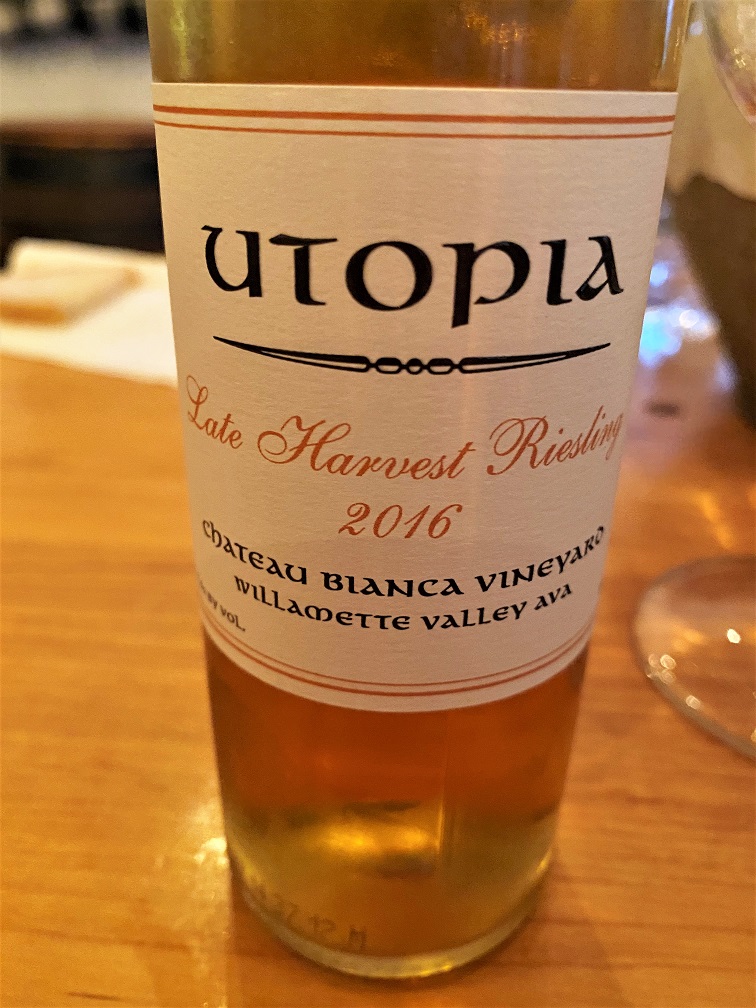
I was also excited to try a late harvest Riesling which was absolutely delicious:
2016 Utopia Late Harvest Riesling Chateau Bianca Vineyard Willamette Valley AVA ($40)
Beautiful apricots, a touch of honey, clean acidity, good balance. Delicious.
8
Talking to Dan we learned that 99 percent of the sales at the winery are direct to consumers, via the wine club and visitors. Dan also has a few customers who like to take his wines as a private label. Dan is very much involved with philanthropy, supporting the Oregon Museum of Science and Industry, The Hampton Opera center in Portland, OR, making wine donations, offering cabin stays, and more.
Utopia Vineyard offers something for everyone – if you will find yourself visiting Portland, you might want to take a 30 minutes trip southwest of Portland and find your utopia there. Or better yet, just stay in the cabin – everything else might be optional.
This post is a part of the Stories of Passion and Pinot series – click the link for more stories…
Daily Glass: Surprised Not Surprised
First, I want to use this opportunity again to wish everyone a healthy and happy New Year 2022!
Today, I want to talk about a couple of wines – one was surprising (and not), and another one was simply interesting.
Let’s talk about surprises first.
Have you heard of Harry and David? No, not about some random guys named Harry and David, but one of the most famous gourmet food gift catalogs? I don’t know if Harry and David has international fame, but in the USA this is definitely the most famous food gift catalog in existence. I remember for many many years literally drooling over the description of their most famous, and spoon-ready, Royal Riviera® Pears.
Harry and David’s food gifts are not limited to fruit, cheese, and crackers. Many gift selections also include wine, mostly from well-known California wineries – J Vineyards, Talbott, Louis M Martini, and others. And it turns out Harry and David also offers wine under its own label – Harry and David.
When we opened a holiday shipment from our friends, the appearance of Harry and David wines caught me by surprise – I really didn’t expect to see that name on the bottles. To be entirely honest, I’m not a big fan of food gift baskets, even though often they are the most convenient presents. Seeing a catalog-branded wine got my suspicion to the next level though. It is so easy to cut corners and put some random plonk into the bottle with a private label…
To make me worry even more, this was also a bottle of sparkling wine – and for my palate, finding a tasty sparkling wine is even trickier than a regular still wine. So I had a spare bottle of Champagne ready for the backup and only then proceeded with the opening of the Harry and David sparkling wine. The first sip made me instantly grab the bottle and look at the back label. My reaction to the second line on that back label was “aaah, of course, this is why the good taste is not surprising“. The wine was delicious, and the second line on that label said “Southern Oregon”, which instantly lead to the “not surprised” notion – having spent a week in August 2021 in Oregon, good Oregon bubbles are simply expected.


This 2020 Harry and David Vineyards Sparkling Wine Southern Oregon (11.7% ABV) was simply delightful – creamy, consistent mousse on the palate, a touch of fresh apples on the nose, and more of the fresh apples with a touch of the lemon notes on the palate, clean acidity, crisp, perfect balance, pleasure in every sip.
It is a pity that it is practically impossible to find actual wine information on the Harry and David website – or maybe I just lost my searching skills. I spent some time with google and was able to find this article from Oregon Wine Press, from which I learned that in 2012, Harry and David, which is headquartered in Medford, Oregon since 1934, has hired winemaker Linda Donovan of Pallet Wine Company in Medford to make wines for Harry and David. The grapes are primarily sourced from the vineyards in the Rogue Valley in Oregon. I would love to have more details about the vineyards, how they are managed, how the wine is made, and so on, but hey, good wine is a good wine.
Now, let’s talk about interesting wine. I was looking for a wine gift for a friend and came across Sandhi Rosé. Sandhi wines are not widely known, but as I had the pleasure of tasting Sandhi Pinot Noir and Chardonnay, I was definitely interested in trying the Rosé. Sandhi wines are produced by Rajat Parr in Santa Barbara in California, and the whole project was born out of the desire to produce supremely balanced low-alcohol wines.
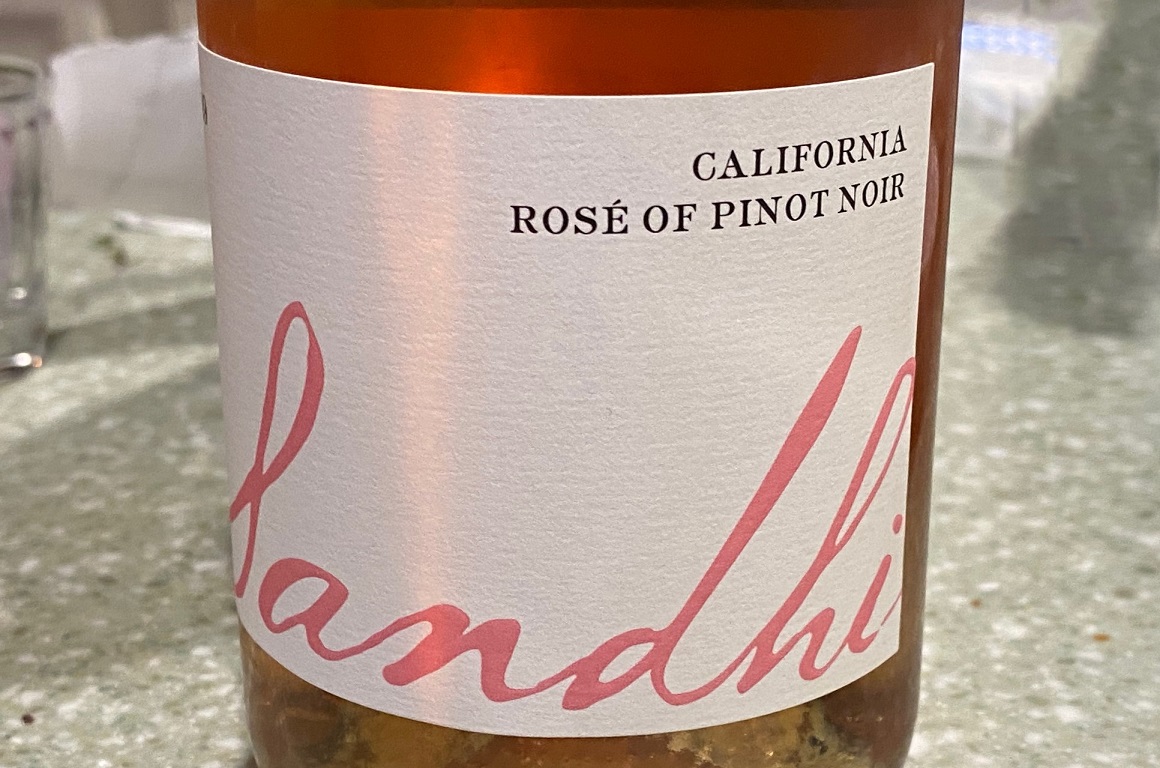
2019 Sandhi Rosé of Pinot Noir California (12.5% ABV, $20) was definitely an interesting wine. In my vocabulary, “interesting” wine or food is rarely a positive descriptor. This Rosé was if not interesting, then puzzling. Taken out of the refrigerator (so probably at around 38°F – 40°F, the wine was mostly closed, offering a bit of sapidity and onion peel, both on the nose and the palate. After warming up in the glass for about 10 minutes, the wine opened up offering a hint of strawberries with a touch of lemon, still void of any sugar but getting much closer to the traditional Provençal in its presentation. The need to play with the temperature was taking a bit away from otherwise a nice wine.
That is my first story of 2022. I want to leave you with a picture of the little present, a wine glass, I got from friends – looks like they know me well! Cheers!
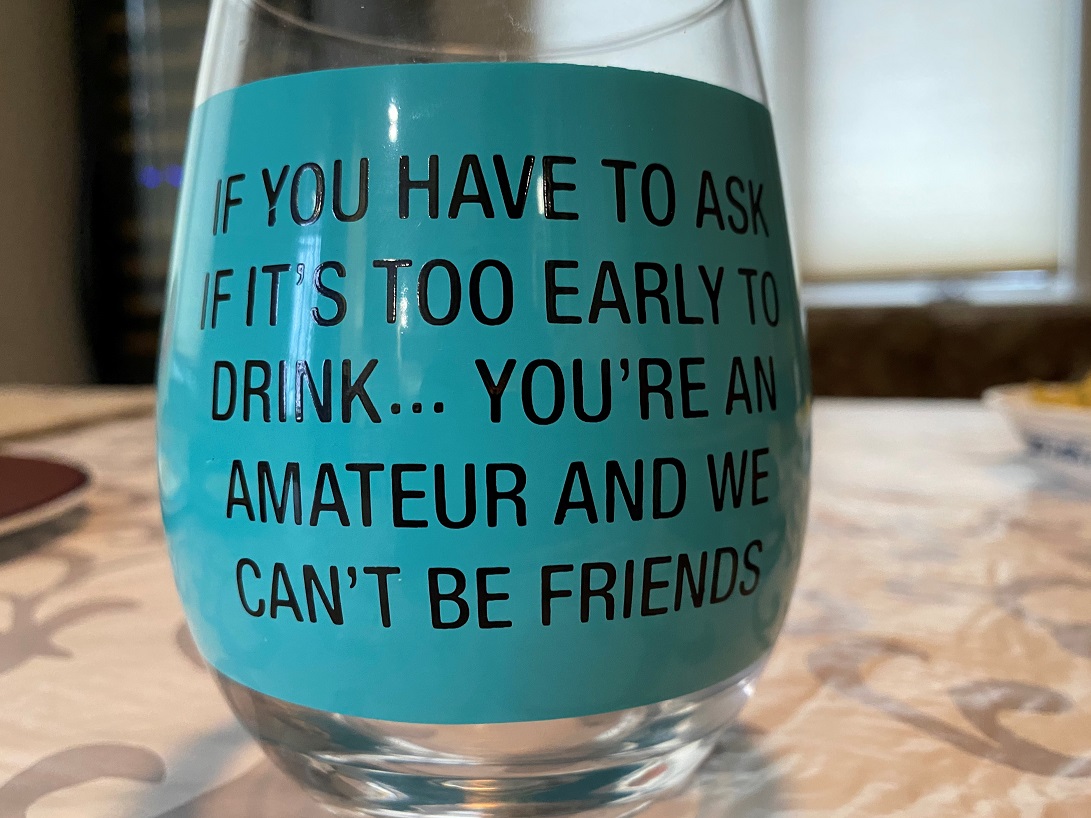
Happy New Year 2022!

I want to wish all of you a healthy, happy, and peaceful year 2022!
May it bring lots of new, memorable, and exciting experiences, and of course, lots of delicious wines!
2021 Top Dozen
 Here we go – a culmination point of the year in wine. Whatever 2021 was, it had no shortage of amazing, memorable wines.
Yes, my wine experiences were a little skewed, as you will see from the list, but hey, it just happened to be so.
You can click on any and all the wine names below if you want more information about the wines – I’m only offering brief impressions in this post.
Let’s dive into it, shall we?
12. 2018 Lenné Estate Cinq Élus Pinot Noir Yamhill-Carlton AVA ($85) – Superb Pinot Noir from Oregon. Lots of power, but amazingly balanced now, and has great aging potential. A world-class wine.
11. Osborne Palo Cortado Capuchin VORS ($90?) – This was my favorite sherry from the recent Sherry seminar in New York. Dry fruit, salinity, sapidity, ultra-complex with every little element perfectly in check.
10. 2020 Field Recordings Domo Arigato (Mr. Ramato) Skin Contact Pinot Grigio Central Coast (12% ABV, $25) – I’m a big fan of skin-contact wines (call them orange if you want), and this wine was somehow magical – two of us finished a bottle while talking, and when the bottle was empty, we both shared most sincere amazement – how is that empty? Was someone invisible quietly helping us? Just wow.


9. 2013 Lynmar Estate Chardonnay Russian River Valley (14.5% ABV, $30?) – a perfectly Californian, with a good amount of vanilla and butter, in your face and unapologetic. Beautifully capable to match the mood and deliver what you crave.
8. 2004 Zýmē Kairos Veneto IGT ($NA) – sigh. My last bottle. The closest I got so far to Quintarelli. I opened this bottle to celebrate OTBN (Open That Bottle Night) 2021 – a stunningly beautiful concoction. I’m sure it had at least another 10 years of life left, but hey, no regrets.
7. 2018 Terra Pacem Tempranillo Rogue Valley (14.2% ABV, $34) – This wine spurred a discussion with a fellow wine writer, Jeff Burrows – how should unadulterated Tempranillo taste? Typical Spanish Tempranillo is rarely made without oak. This wine seemed to be pristine and clean, and we agreed that this might perfectly be a textbook Tempranillo example.
6. 2019 Troon Vineyard Estate Syrah Applegate Valley ($35) – Speaking of unadulterated grape expressions – this Syrah was exactly as I always imagine it to be – complex, earthy, and perfectly peppery. Organic, biodynamic, and precise. A pleasure.
5. 2015 Youngberg Hill Vineyards Nicolette’s Select Pinot Noir McMinnville AVA (14.1% ABV, $85) – Pinot Noir overload in the Top Dozen? Impossible. There is never enough of the wines of such pristine beauty. This wine has everything you expect from Pinot Noir – plums, cherries, violets, a firm frame, and finesse, lots of finesse.
4. 2018 Le Cadeau Vineyard Chardonnay Willamette Valley (14.1% ABV, $45) – Le Cadeau was probably the best Oregon Chardonnay I tasted this year, even though deciding on this wine for the Top Dozen list was not simple. It really represents a world-class level of Oregon Chardonnays which now offer outstanding consistency – you can count on vanilla, apples, a hint of honey, and an impeccable balance. A pure joy.


3. 2007 Chappellet Pritchard Hill Napa Valley Cabernet Sauvignon ($NA, $289 for the 2017 vintage) – in a word, amazing. This was California Cabernet Sauvignon which everyone wants to drink. Classic cassis intertwined with hedonistic pleasure.
2. 2011 Gran Enemigo Cabernet Franc Single Vineyard Gualtallary Argentina ($93) – if I would call this wine “bloody brilliant”, would that make me a vampire? Upon opening, this wine was really unmoving. On the second day, this wine was a God’s nectar, bold, concentrated, layered. Incredible.
1. 2019 Battle Creek Cellars Amphora Series Carbonic Red Blend Oregon ($75) – pure, clean, unadulterated pleasure. Oh yes, I already used these words before. You can call me a bad writer, I will be okay with that. But I experienced the joy this wine delivers – and there is a good chance that you did not. Find it, try it – then we will see it an eye to eye.
Here you have it – Talk-a-Vino Top Dozen Wines of 2021.
What were your top wines of 2021?
And Happy New Year 2022!!!
Passion and Pinot Updates: Lenné Estate
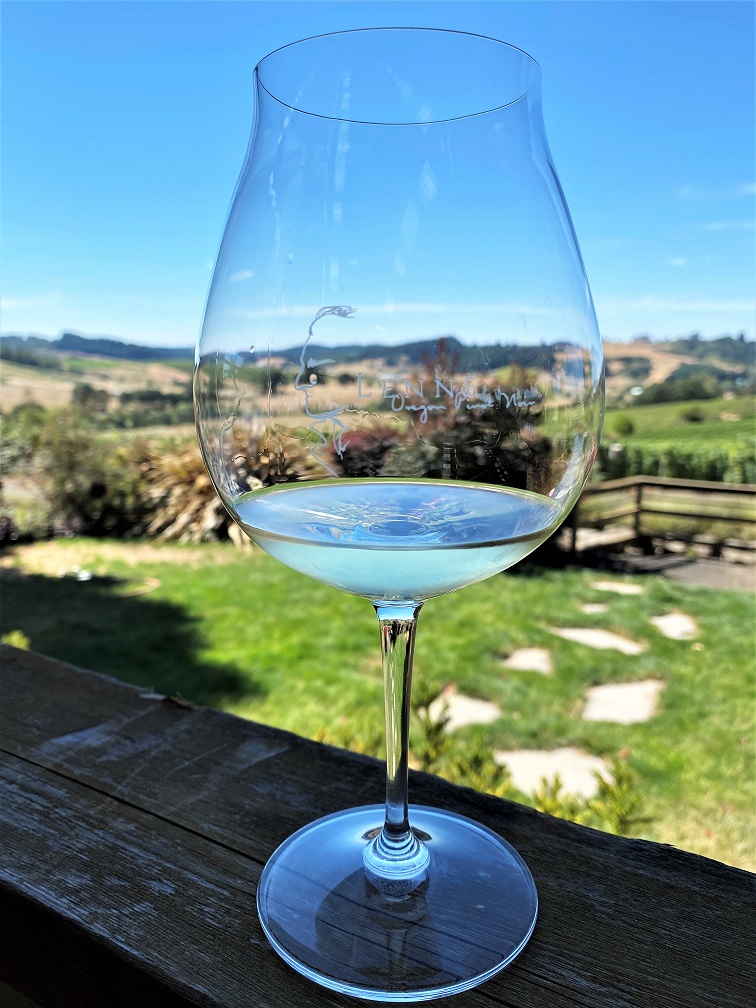 Out of the 13 Oregon wineries profiled to the date in the Stories of Passion and Pinot series, Lenné Estate stands aside. I had my first encounter with Steve Lutz and Lenné Estate in 2014, two years before the Stories of Passion and Pinot series was born, when Steve participated in the #WineChat event on Twitter. This is when I heard for the first time about Peavine soils, a mixture of clay and rocks, and Steve’s relentless, passionate pursuit of Pinot Noir winemaking in the place where it seems no vine can ever grow – read this original post to see what I mean. This passion I learned about while “listening” to Steve for the first time, the passion for the finicky grape became the reason for the name of the series.
When I spoke (virtually) to Steve in 2016 (you can find this conversation here), I learned a lot more about all the hard work establishing the vineyard, about Kill Hill, and about the wines which Steve produces, so when we arrived at Lenné Estate with Carl Giavanti, I felt like I knew Steve for a long time, and almost felt at home in the vineyard.
It is one thing to listen to someone talking about the soil, and it is totally different when you look at it (you can touch it too if you want) and think “how anything, really anything can grow in this soil”? Dry farming, no irrigation, and then you look at the soil – and you look at the grapes which it perfectly produces, and you can only say “wow”. I can tell you that out of the number of vineyards we already visited during the trip, the grapes at Lenné looked the best – tight bunches, beautiful colors of veraison, just a pleasure to look at.


More grapes:


We took a walk to the top of Kill Hill, and I can tell you that it was one steep walk. But the views from the vineyard were nothing short of spectacular.


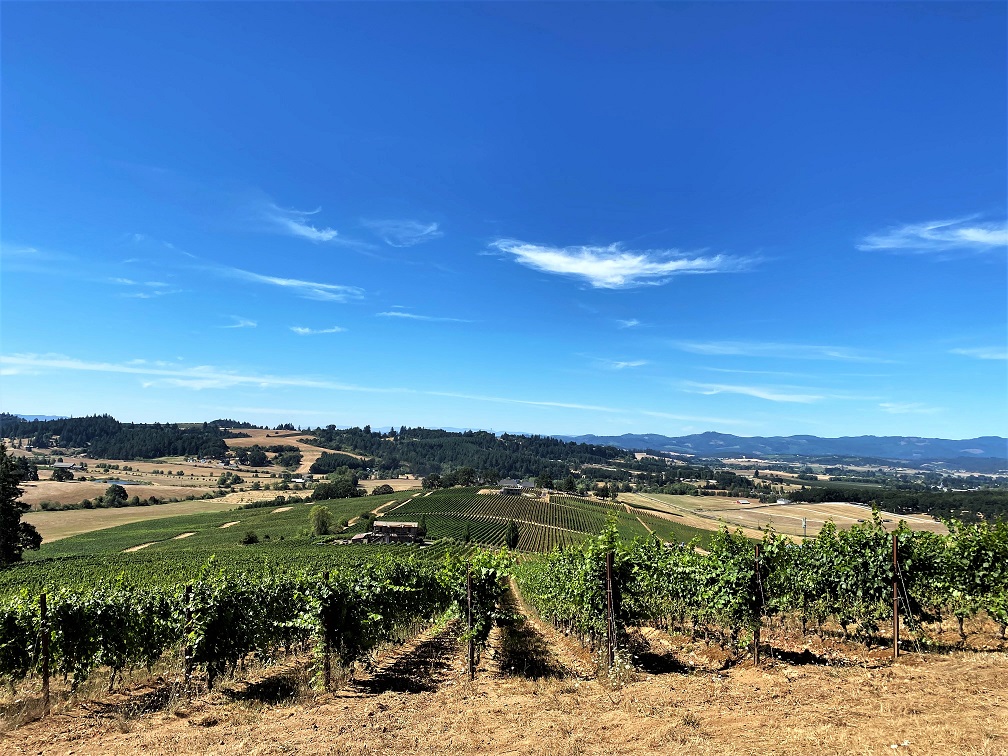

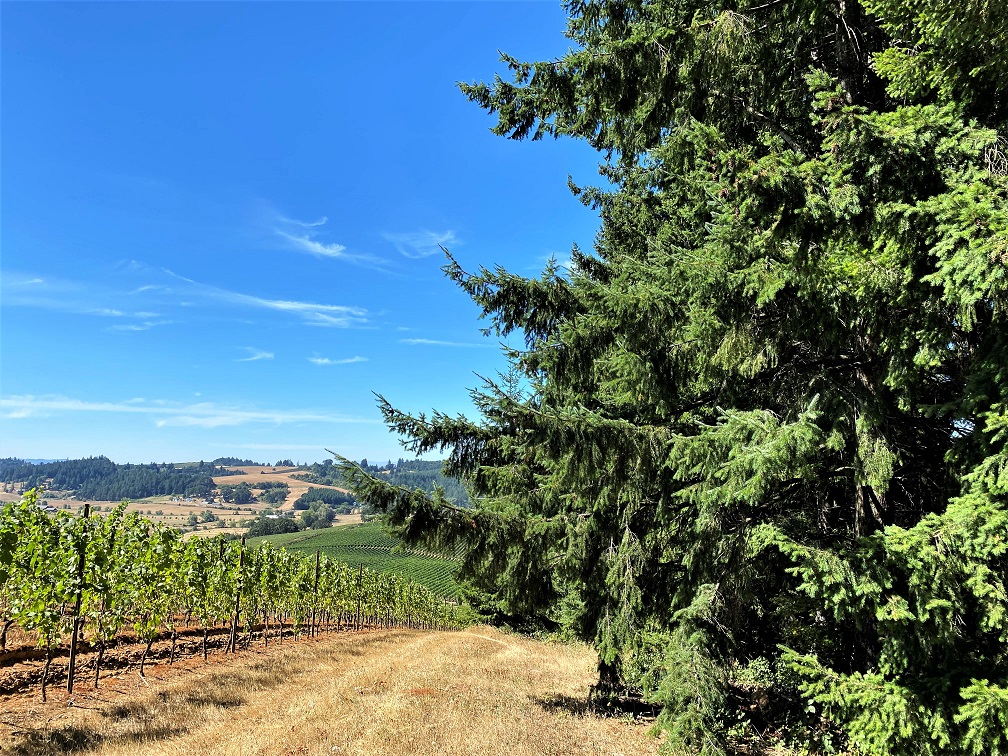
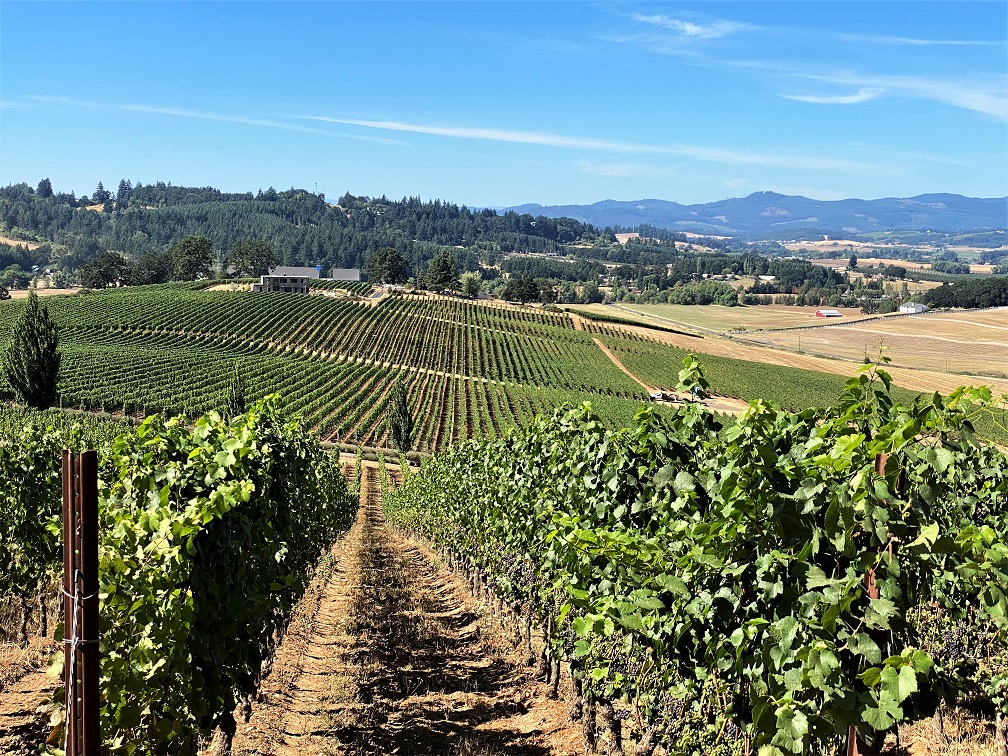
Yes, it is steep!
We talked about winemaking, and Steve mentioned that he typically prefers using commercial yeasts, because they produce more reliable and predictable results – however, he is not foreign to the idea of indigenous yeast, as we tasted in one of the wines. When we spoke back in 2016, Steve was not very big on producing white wines – I was happy to see that he changed his mind and now offers Lenné Estate Chardonnay. However, more as an exception to the rule at this point, Steve is still not ready to produce sparkling wines – however, I hope that this will change at some point – we will have to see.
After the walk, we went back to the tasting room, where Steve set up a full tasting, including the charcuterie and cheese boards.


View from the tasting room
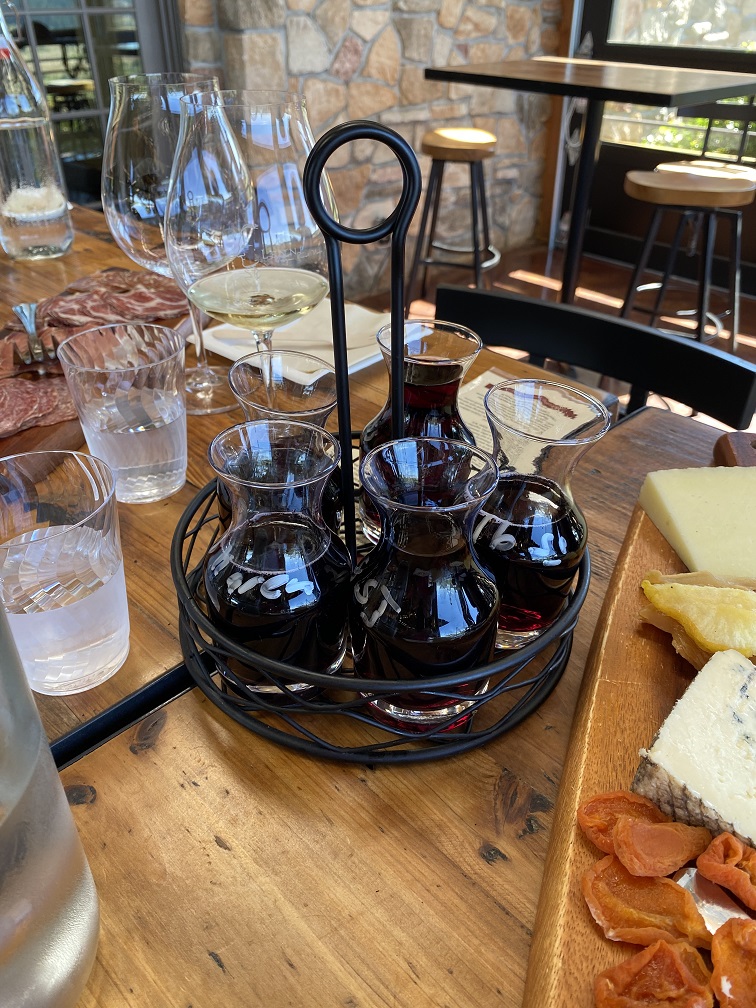
We started tasting with the Chardonnay, which was excellent
2019 Lenné Estate Scarlett’s Reserve Chardonnay Yamhill-Carlton AVA ($58)
A touch of honey, herbs, restrained
Crisp acidity, fresh, bright, Granny Smith apples, a touch of vanilla, creamy, excellent
8
Next, of course, we moved to the Pinot Noirs, where we tasted the whole range – here are tasting notes for the wines including some additional comments regarding the vintage and winemaking:
2017 Lenné Estate South Slope Pinot Noir Yamhill-Carlton AVA ($55)
Hot vintage with a big fruit set
Beautiful nose of sweet cherries and raspberries
Wow, red fruit all the way, cut through acidity, perfect balance
9-, superb
2016 Lenné Estate South Slope Pinot Noir Yamhill-Carlton AVA ($55)
Early vintage, cool August, harvest done by mid-September
Cherries, sage, floral notes
Clean, tart cherries, warm notes, good acidity,
8-
2018 Lenné Estate Sad Jack 777 Pinot Noir Yamhill-Carlton AVA ($55)
Indigenous yeast, spontaneous malolactic
Tart cherries, a hint of cherry pie, savory note
Tart cherries, clean, balanced, crisp, superb
8+
2018 Lenné Estate Karen’s Pommard Pinot Noir Yamhill-Carlton AVA ($60)
Commercial yeast and forced malolactic
Cherry, cherry pie, sweet oak
Tart cherries, dark fruit, good balance, well integrated tannins
8


The last wine was a culmination point of the tasting. “Cinq Élus” means “five chosen”, which in the case of this wine means five best barrels and 5 clones. The wine was simply superb:
2018 Lenné Estate Cinq Élus Pinot Noir Yamhill-Carlton AVA ($85)
5 best barrels from the vintage, 5 clones
The succulent nose of red and black berries, distant hint of gunflint, herbs, great complexity
Restrained, cherries, layered, complex, perfectly integrated, tannins come through on the finish, superb
9-
While we were tasting the wines, we also talked about blind tasting events which Steve runs at the winery, where attendees get an opportunity, for example, to compare Oregon Pinot Noir with the Burgundy, or Yamhill-Carlton Pinot Noir with Dundee Hills Pinot Noir and so on – here you can see what blind tastings are offered. Steve also leads European wine cruises where everything revolves around food and wine, as you can imagine – here you can find information about those.
On the Lenné Estate website, there is also an interesting section called Vintage Charts. Here you can find general information regarding the suggested drinking window for Oregon Pinot Noir in general, as well as particular recommendations specifically pertaining to the Lenné Estate wines.
There you are, my friends. If you are looking for mature, confident, and simply delicious Oregon Pinot Noir, you don’t need to look further than Lenné Estate.
But we are not done here yet. More Passion and Pinot updates are coming – stay tuned…
This post is a part of the Stories of Passion and Pinot series – click the link for more stories…
Passion and Pinot Updates: Youngberg Hill Vineyard
I virtually met with Wayne Bailey of Youngberg Hill Vineyards in September of 2016. Now, 5 years later, I was able to actually shake his hand, listen to the stories face to face and taste the latest wines.
We arrived at the winery in the morning and went on to meet Wayne at the winery building, which also serves as Bed and Breakfast. The views from the terrace of that building were simply incredible – I walked around trying to snap as many pictures as I could.
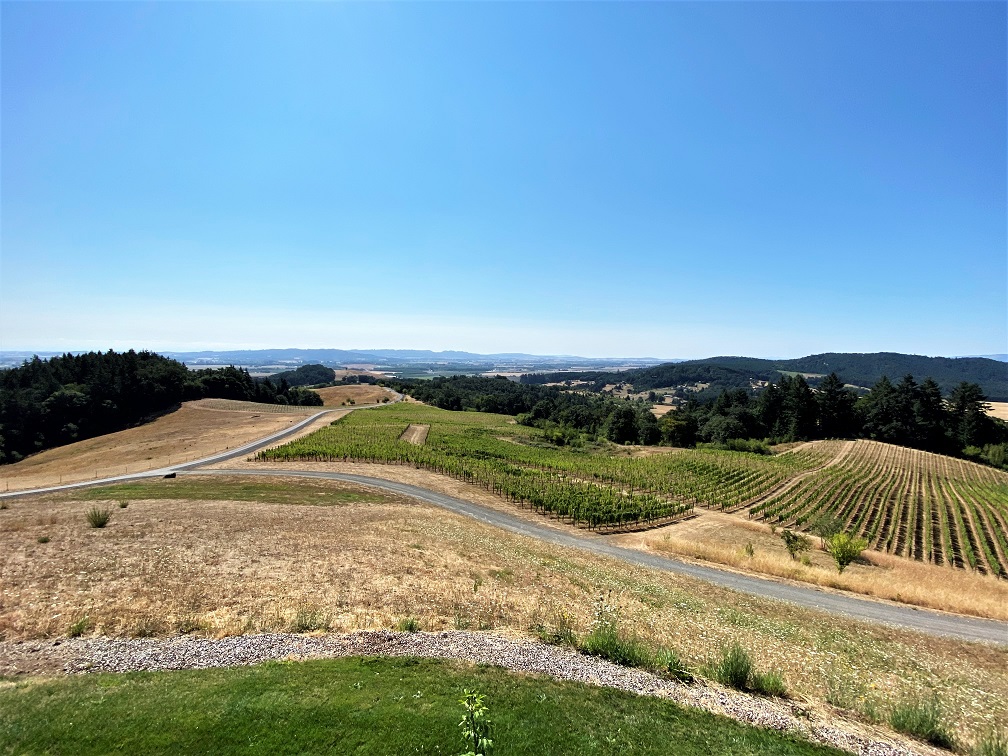
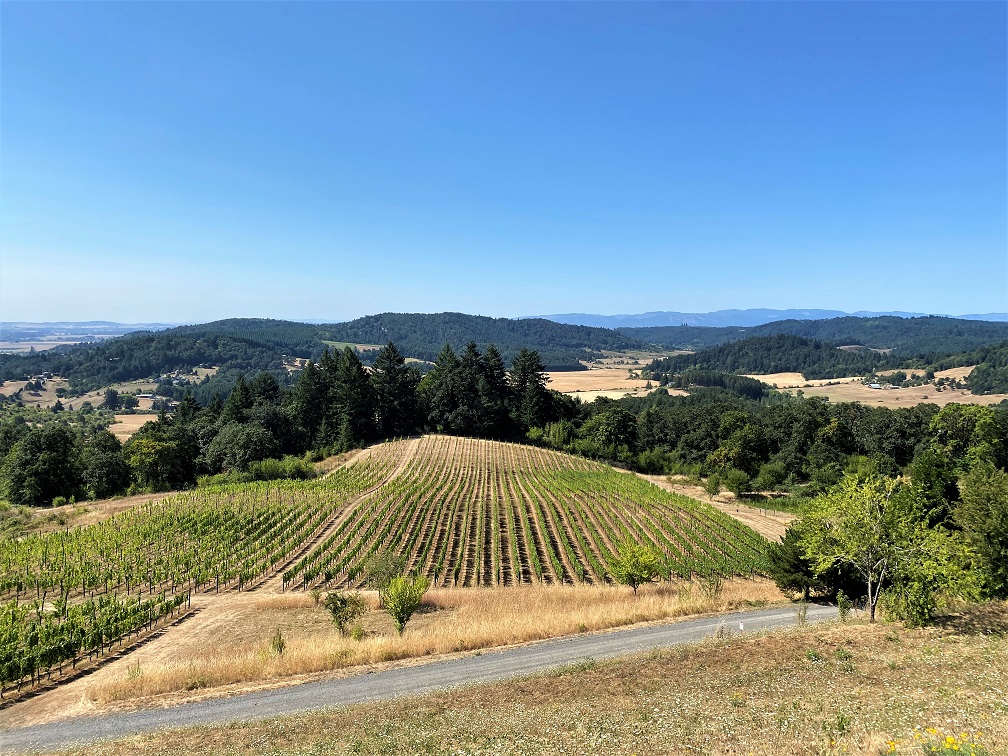
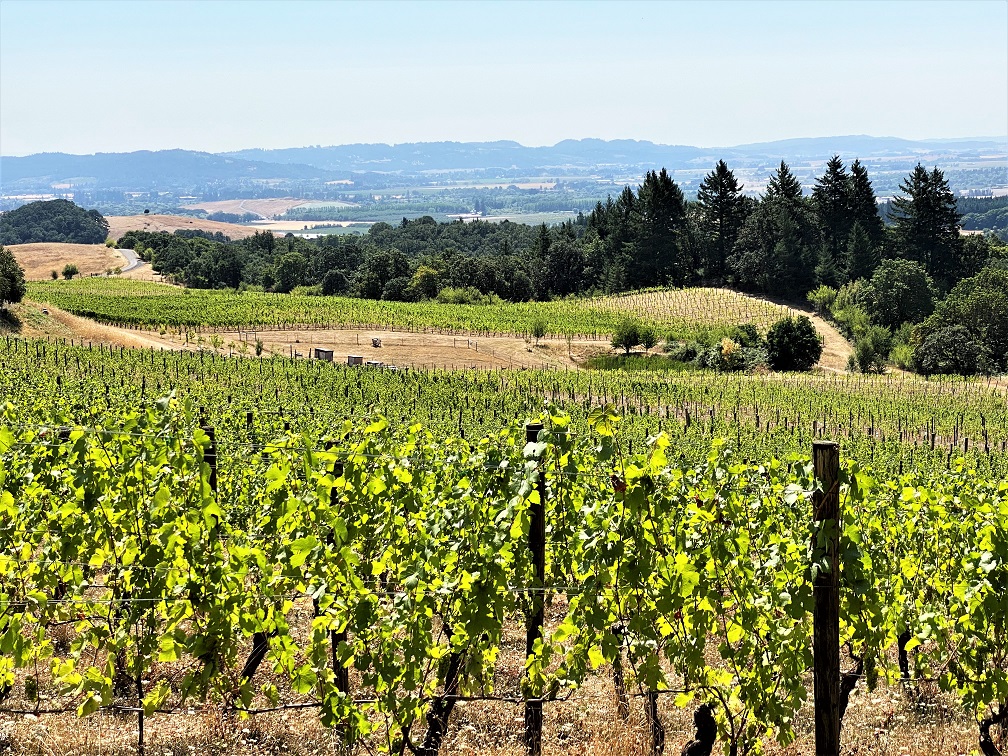
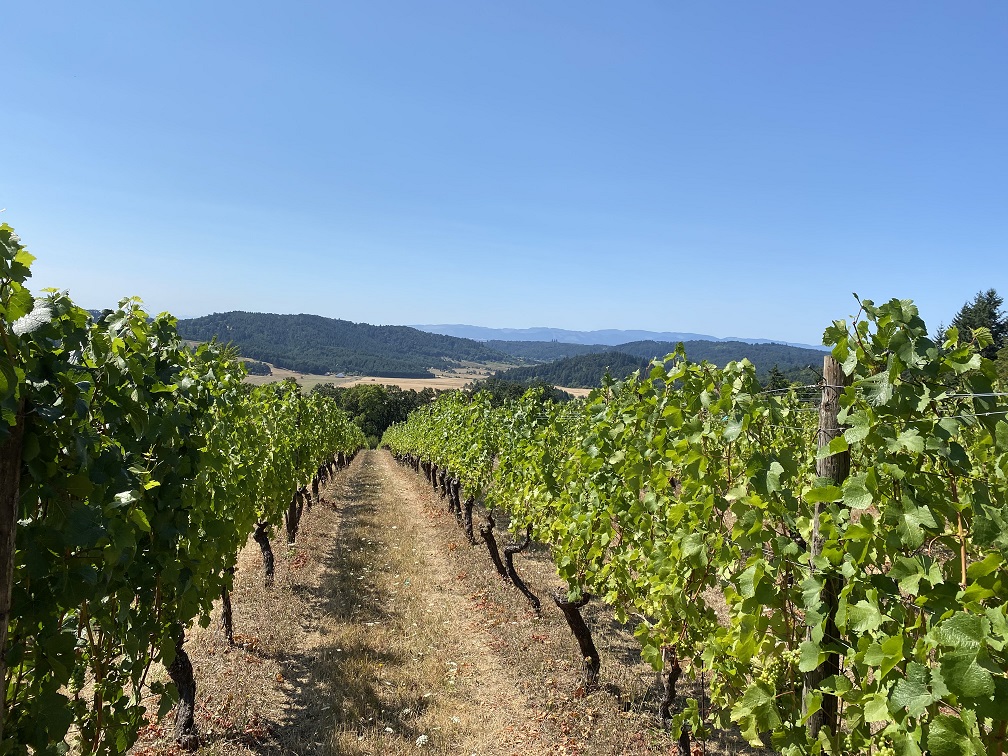
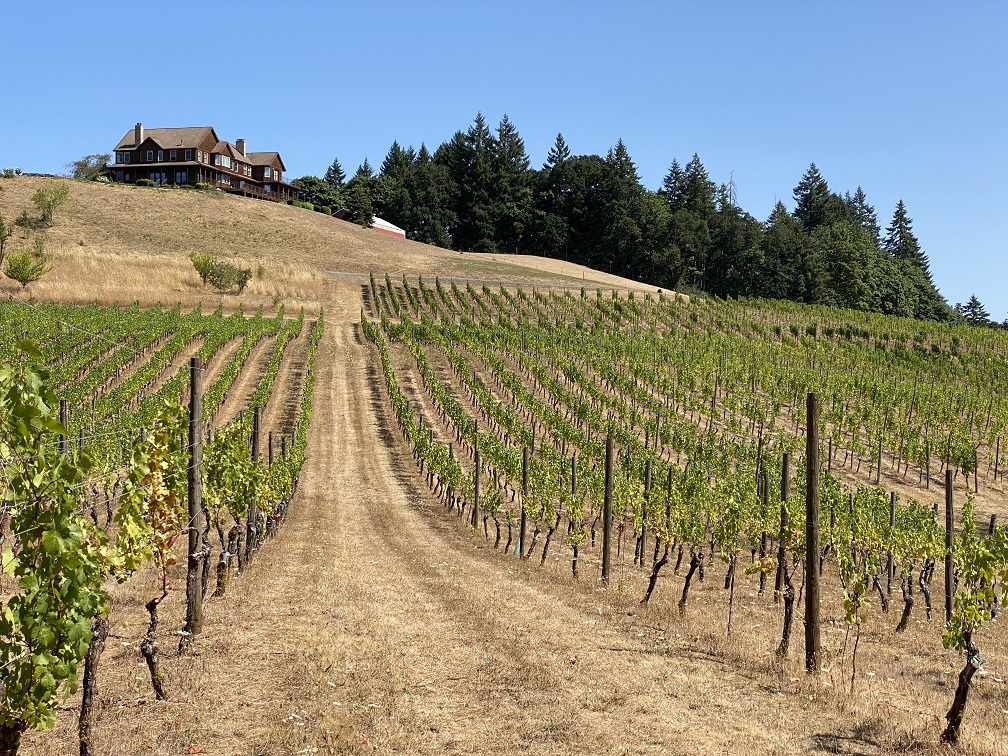


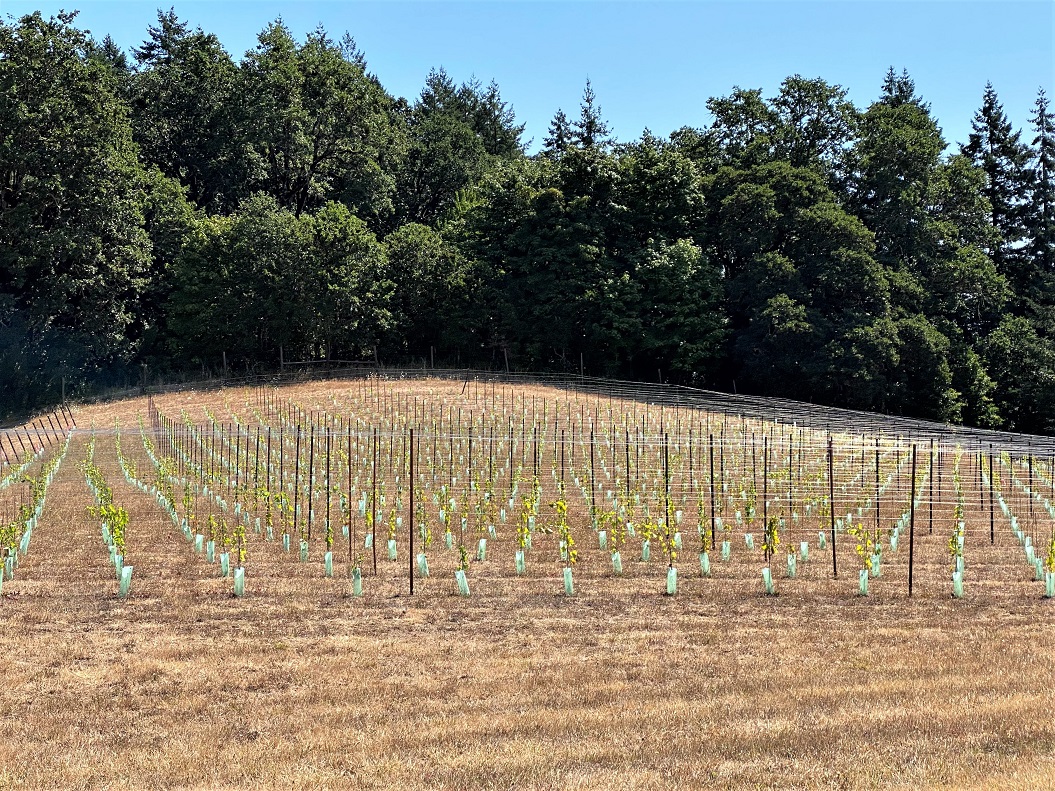
After meeting Wayne, we went on a tour of the estate. Actually, we drove around the vineyards in the baggie which Wayne was driving. Again, more of the beautiful views all around. We also got to meet a few of the cute animals which call Youngberg Hill home.


At the Youngberg Hill estate, it is all about the Bailey family – Wayne, his wife Nicolette, and daughters Natasha, Jordan, and Aspen. The Youngberg Hill vineyards were first planted in 1989 when the estate was founded, 12 acres of Pinot Noir vines. These 12 acres are divided into two blocks – 7 acres of Natasha block at the altitude of 600 feet on marine sediment soils, and 5 acres of Jordan block on volcanic soils at the altitude of 800 feet. There is 2 degrees difference in average temperatures between these two blocks, and as the Jordan block is a little bit cooler, the grapes usually ripen later than the ones on Natasha Block, with about 10 days difference in pick time.


Aspen block was first planted in 2006 with 5 acres of Pinot Gris. In 2014, half of the block (2.5 acres) was grafted over to Chardonnay. In 2008, Bailey’s block was planted with 3 acres of Pinot Noir, at 700 feet altitude and predominantly volcanic soils.
When we spoke back in 2016, 20 acres of vineyards were planted on the 50 acres estate. I asked Wayne if he has any plans to add additional plantings, and got a simple “no” answer. Well, I guess the old adage of “never say never” is perfectly at play here, as in 2018, 3 acres of Wayne’s World block was planted with two more clones of Pinot Noir, bringing a total to 5 clones, if I’m not mistaken. This block was planted mostly on marine sediment soils at an altitude between 500 and 600 feet.
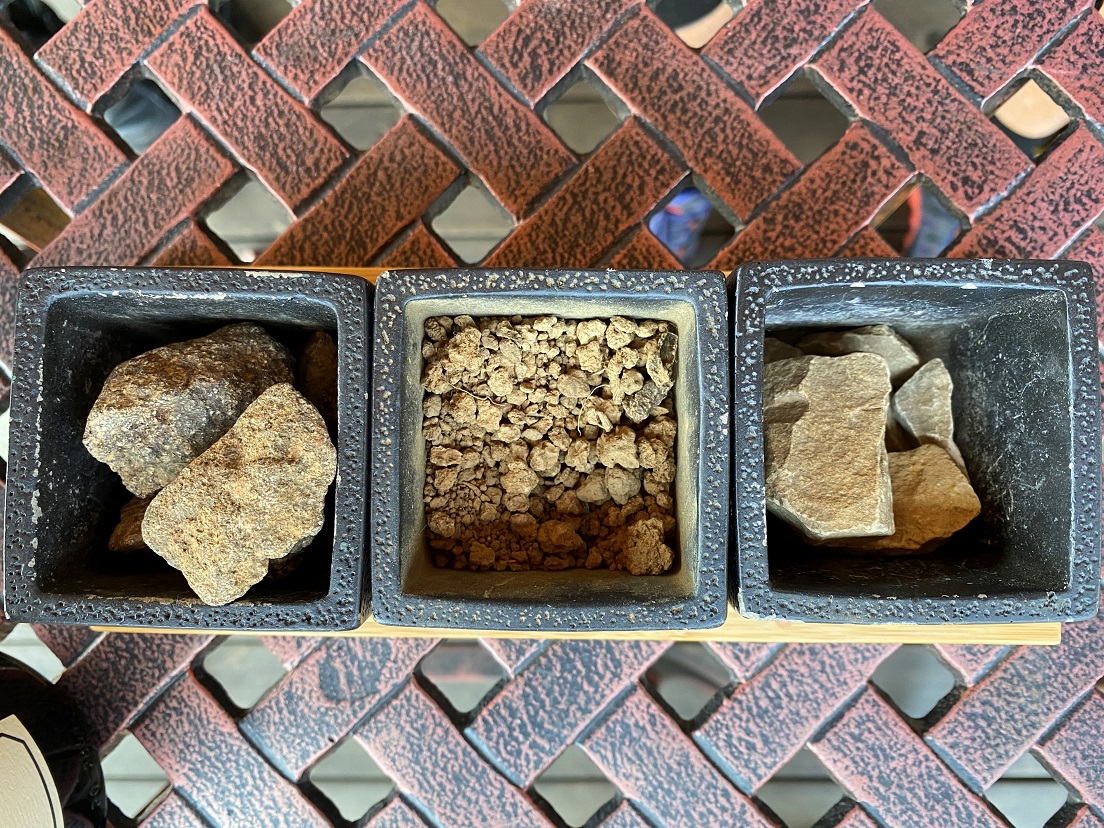
 Here you can see a sample of the soils at Youngberg Hill Vineyards.
After we finished the tour, it was time to taste the wines.


I was happy that we started our tasting with the sparkling wine – this is almost something you now expect from Oregon wineries. Similar to the sparkling wine we had at Le Cadeau, this wine was also made with first-pass grapes. The wine spent 2.5 years on the lees, so it is called the Extended Tirage sparkling.
2018 Youngberg Hill Vineyards Extended Tirage Sparkling Eola-Amity AVA (12.5% ABV, $55)
A touch of apple and vanilla
Crisp apple notes, fresh, good acidity, good body, delicious. Lingering acidity on the finish
8, excellent


Next, again to my delight, we had a couple of Chardonnays:
2019 Youngberg Hill Vineyards Aspen Chardonnay McMinnville AVA (12% ABV, $45)
Beautiful nose of apples, vanilla, and a touch of honey
Crisp, clean, great acidity, wow.
8, it would be amazing with age
Another change at the Youngberg Hill Vineyards since we last spoke was the new wine label introduced in 2019 – Bailey Family Wines. Bailey Family wines comprise a selection of the best plots and barrels. In addition to sparkling, Chardonnay, and Pinot Noir, the Bailey Family wines range also includes Grenache sourced from the Rogue Valley. We tasted the latest vintage of Bailey Family Chardonnay which was superb:
2018 Bailey Family Chardonnay McMinnville AVA Willamette Valley (13.4% ABV, $85)
Herbal notes, a touch of butter, honey, minerality
Great complexity, mouthwatering acidity, lean, green apples, a touch of sage. Perfect balance
8/8+


Next, we had the pleasure of going through the selection of the Pinot Noir wines, both current vintages from Natasha and Jordan blocks, as well as reserve wine, Nicolette’s Select:
2018 Youngberg Hill Vineyards Natasha Block Pinot Noir McMinnville AVA (14% ABV, $60)
Ripe cherries and cranberries
Restrained, tart cherries, firm structure, dusty palate, excellent balance.
8+
2018 Youngberg Hill Vineyards Jordan’s Block Pinot Noir McMinnville AVA (13.8% ABV, $60)
Cherries and violets
Bright popping ripe cherries, good acidity, perfect balance.
Both [Natasha Block and Jordan Block] are built for the long haul.
8+
2015 Youngberg Hill Vineyards Nicolette’s Select Pinot Noir McMinnville AVA (14.1% ABV, $85)
Great bouquet on the nose, cherries, pencil shavings, underbrush
Wow, an interplay of cherries, cranberries, mushrooms, dusty palate, layered, balanced
9-, superb.
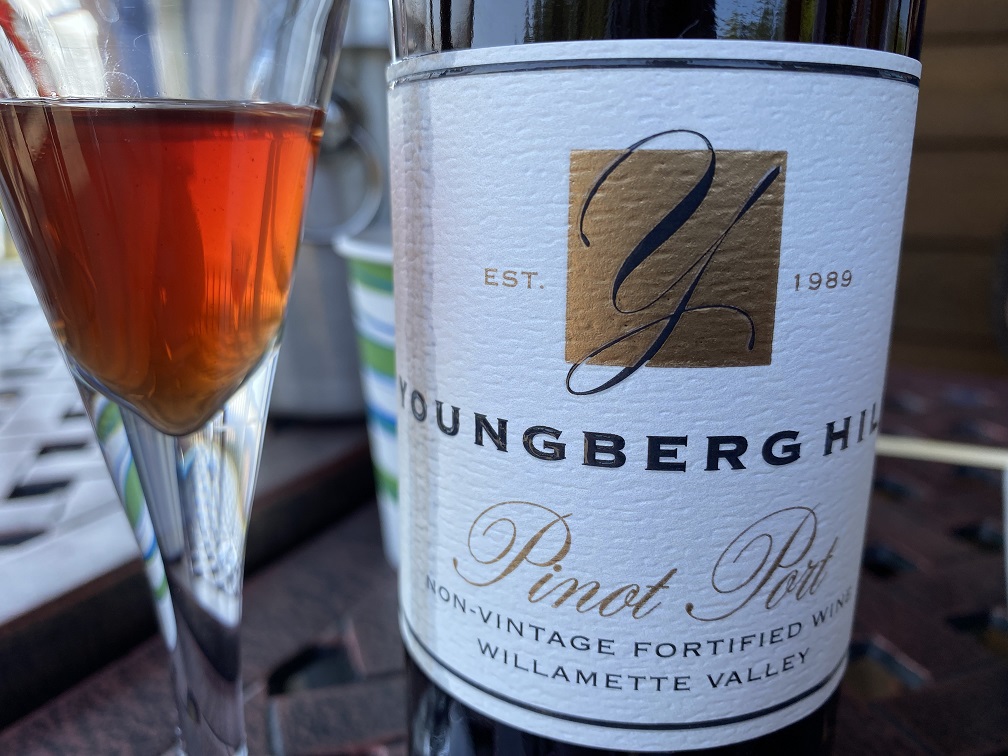
I keep going back to our 2016 conversation with Wayne. While preparing the interview questions I learned that Youngberg Hill produces a really unique wine – Pinot Port, as it was called – a Port-style wine made out of Pinot Noir grapes, something which I never heard of before. So now, being at the winery, I couldn’t miss the opportunity to taste the Pinot Port. Wayne was somewhat hesitant about it, as I don’t believe he is making this wine anymore, but I had my wish granted and had a sip of this delicious beverage:
NV Youngberg Hill Vineyards Pinot Port (19% ABV, $NA, 25 cases produced)
Nicely aged wine, dried fruit, good balance, very pleasant
There you are, my friends. Another story of Passion and Pinot, with the Pinot Noir (and Chardonnay, and bubbles) of truly a world-class, and in its own, Oregon style. These wines are worth seeking, and if you want to spend a few days in the wine country, surrounded by incredible views and delicious wines, that Inn at the Youngberg Hill sounds really, really attractive.
I got more of the Passion and Pinot updates to share with you, so until the next time…
This post is a part of the Stories of Passion and Pinot series – click the link for more stories…
Passion and Pinot Updates: Le Cadeau Vineyard
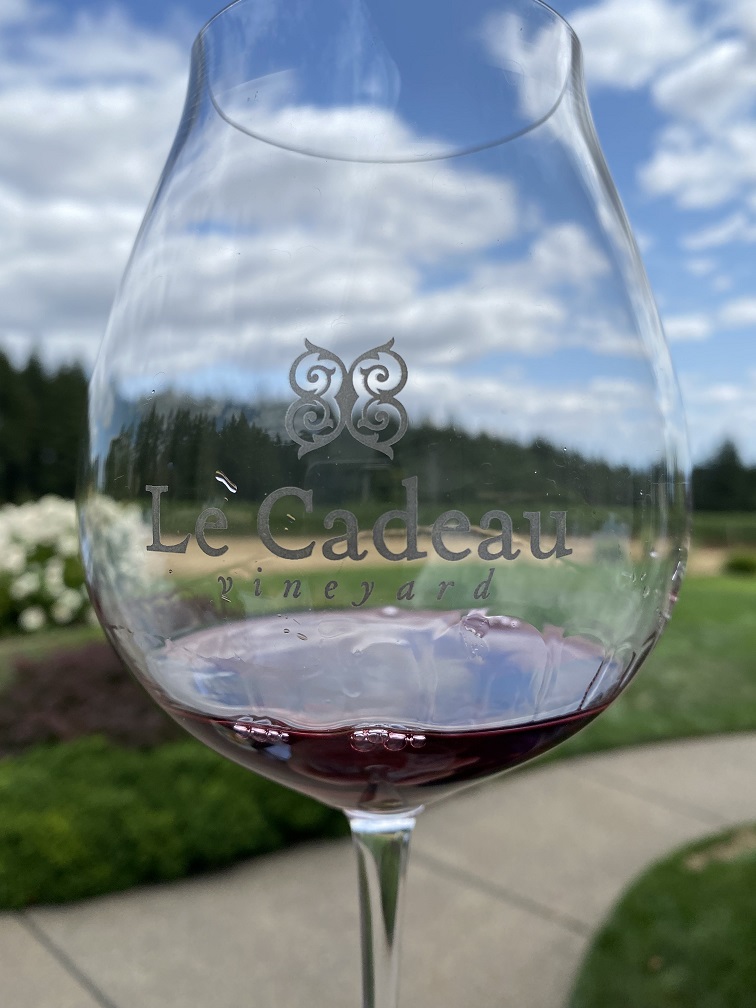 Five years ago, I started a new project in this blog called Stories of Passion and Pinot. The goal of the project was to interview winemakers in Oregon, who passionately went on to grow Pinot Noir and make wines often in conditions that many others would find impossible and untenable. All the way until August of 2021 my interviews were all virtual – I would read about the winery, come with the questions, get the answers, and then publish those conversations in this blog (you can find them using the top menu).
This year I attended Wine Media Conference 2021 which conveniently took place in Eugene, Oregon. After the conference was over, we drove with Carl Giavanti to meet some of the winemakers face to face – and now I can offer you updates, mostly in pictures, lots of pictures, and tasting notes for the wines I had an opportunity to taste.
Le Cadeau Vineyard was our first stop after we left Eugene.
Where do I start? First of all, the views. Le Cadeau Vineyard is a stunning oasis, surrounded by tall pine trees (I already told you how much I love those), and offering amazing views. You be the judge:
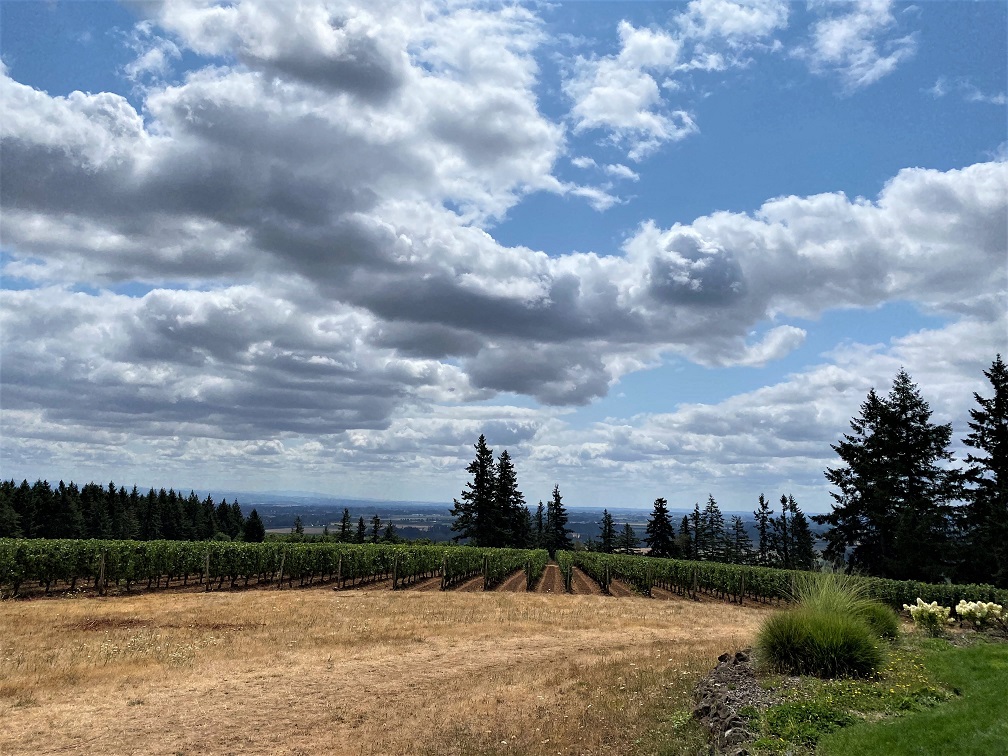
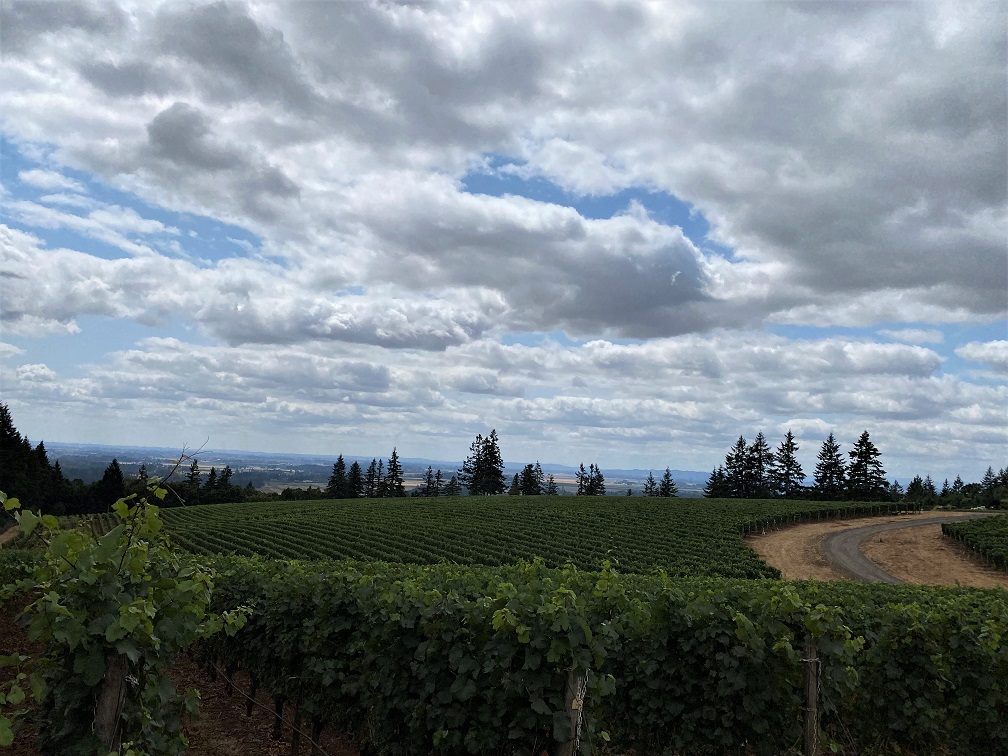
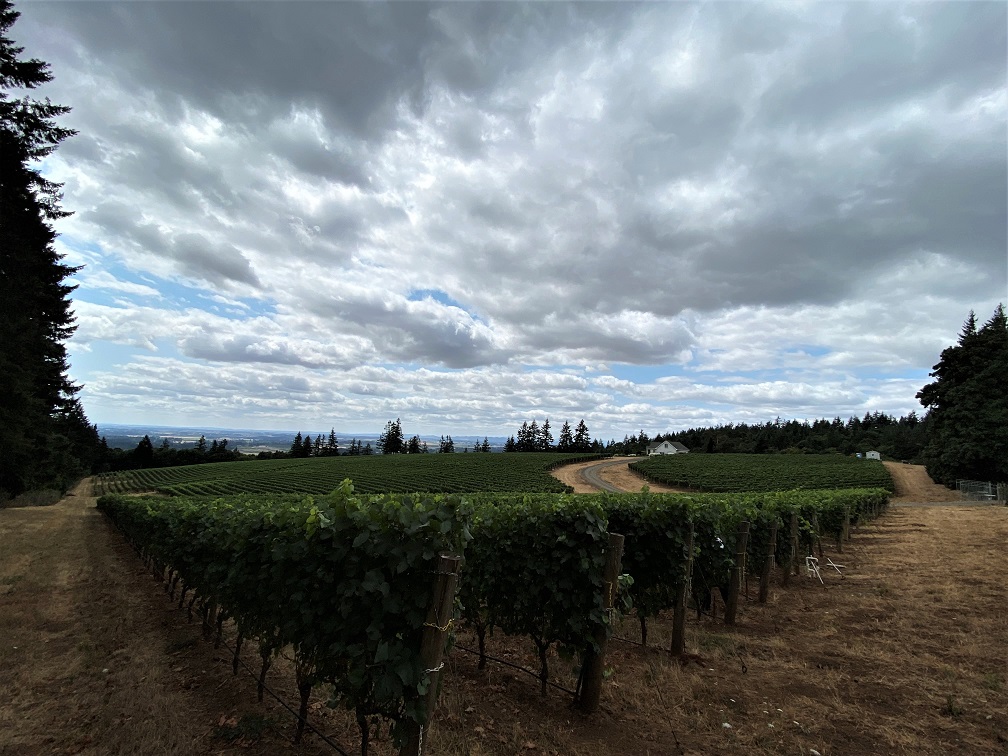
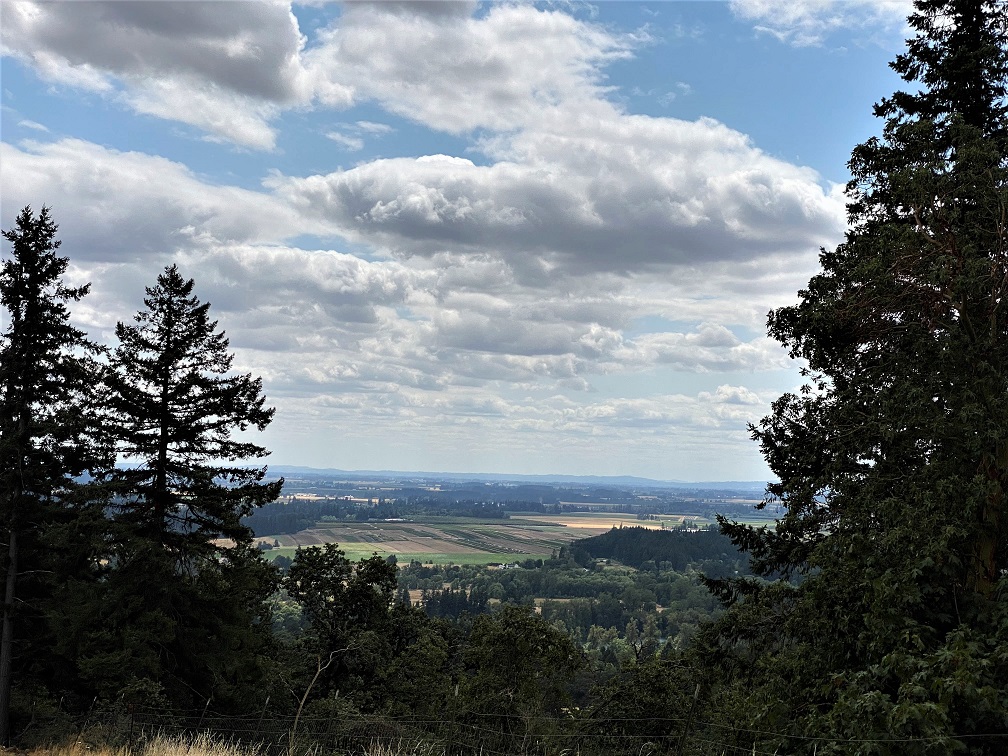
Tom Mortimer slowly walked us through the vineyard, talking about clones and all the work he invested into creating this vineyard simply on top of the rock (you can find the details in the original interview). It turns out that there are 18 Pinot Noir clones used in wine production at Le Cadeau – while I was somewhat shocked to hear that number (sounds high), it was simply due to my ignorance – for example, Sanford winery in Sta. Rita Hills uses more than 50 clones. Considering that Sanford winery is about 25 years older than the Le Cadeau, it is all makes sense. Tom was particularly proud of some of the clones, such as the Calera clone which is based on the DRC, and some additional Vosne clones (not trying to impress with the words here – Vosne here stands for Vosne-Romanée, one of the most coveted Pinot Noir production areas in Burgundy; DRC stands for Domaine Romanée-Conti, probably the most famous Pinot Noir producer in the world; Calera is one of the legendary California Pinot Noir producers and pioneers from Central Coast).
The beginning of August of this year (2021) happened to be the veraison time – the onset of ripening of the grapes when the grapes start changing their color. This was my first time actually being in the vineyard during veraison, so I couldn’t stop taking pictures as I saw bunches with more and more color – here are more pictures:


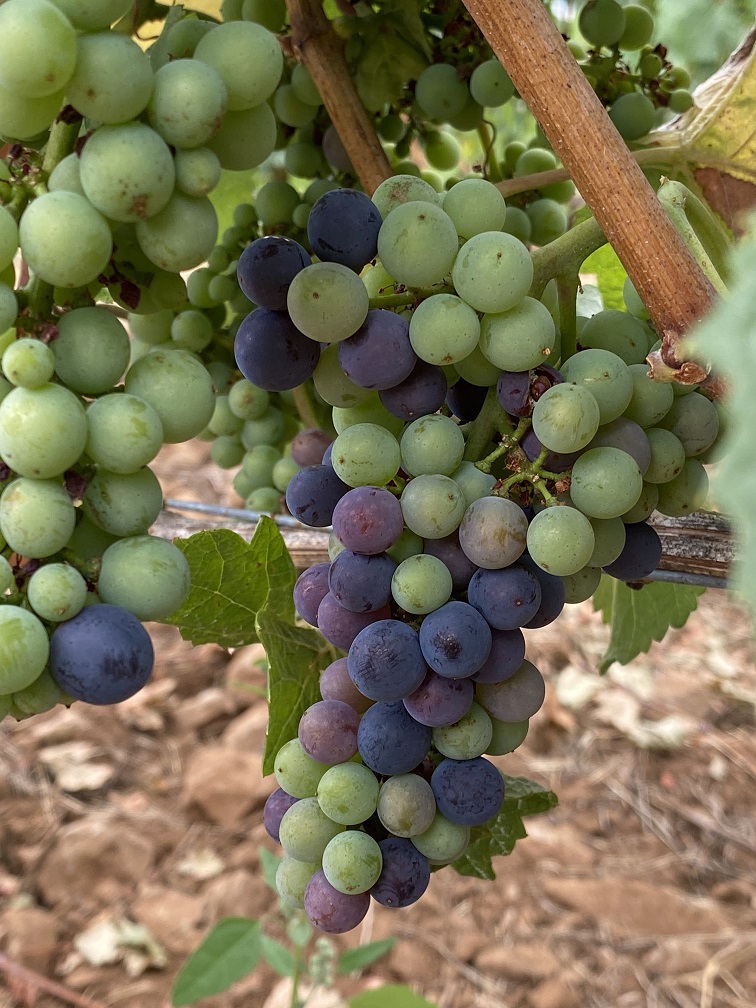


We also saw Chardonnay grapes growing:
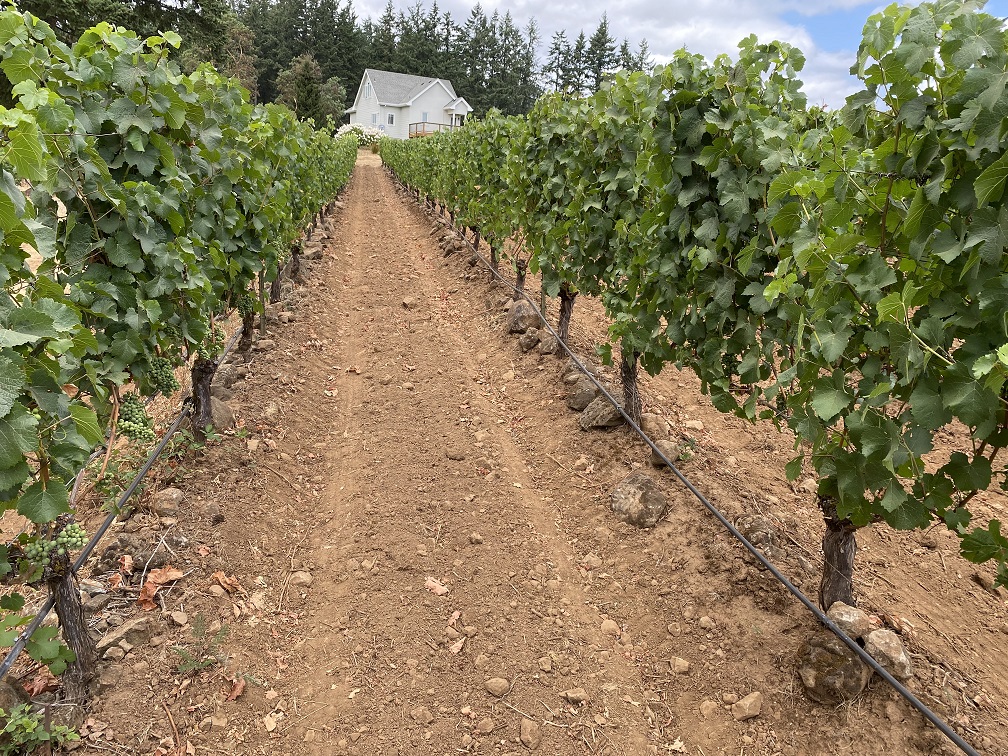
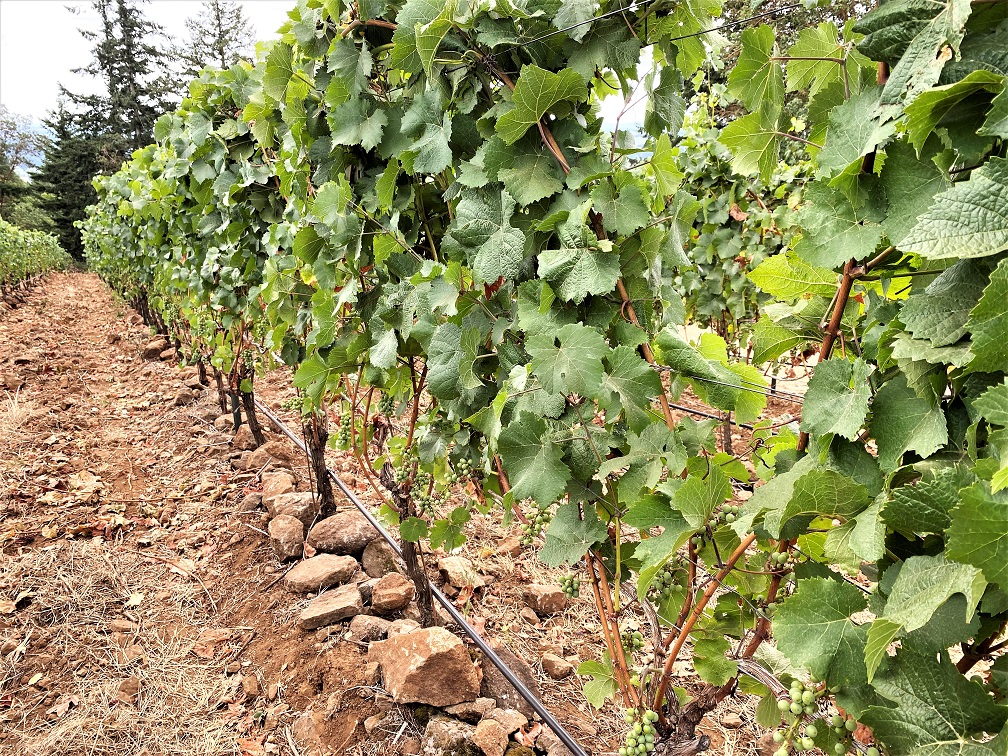
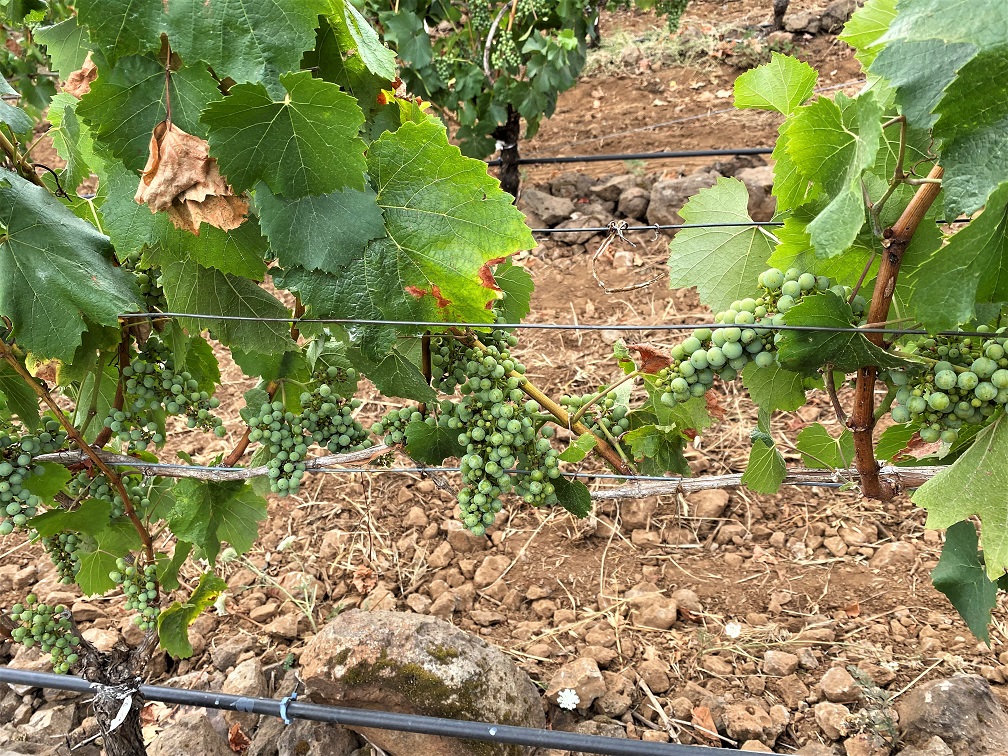
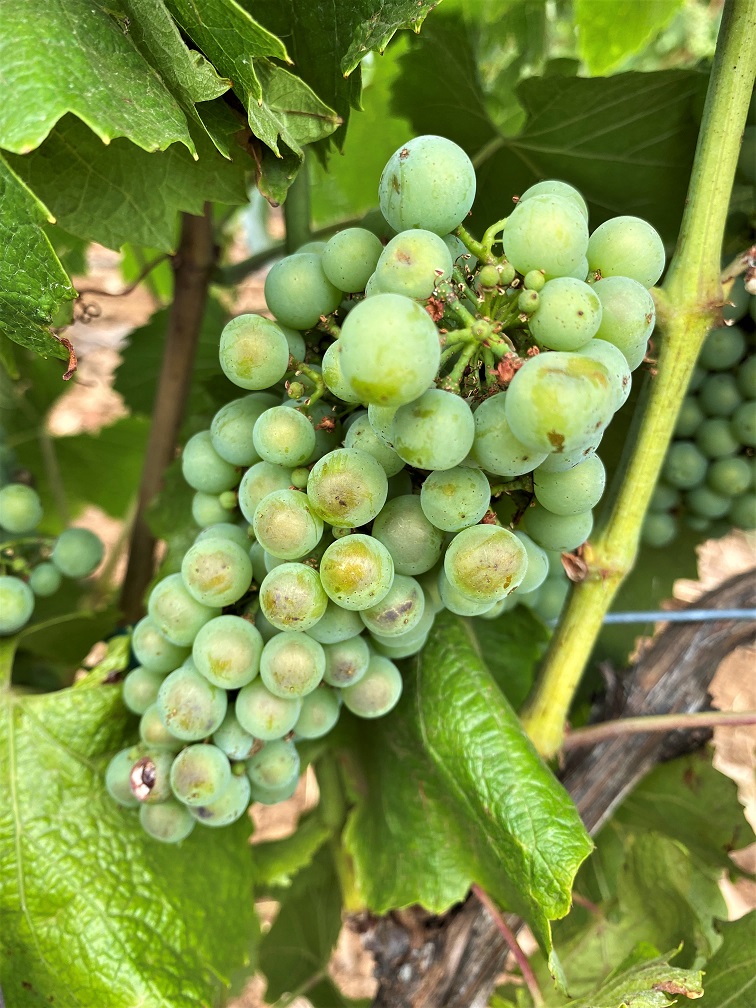
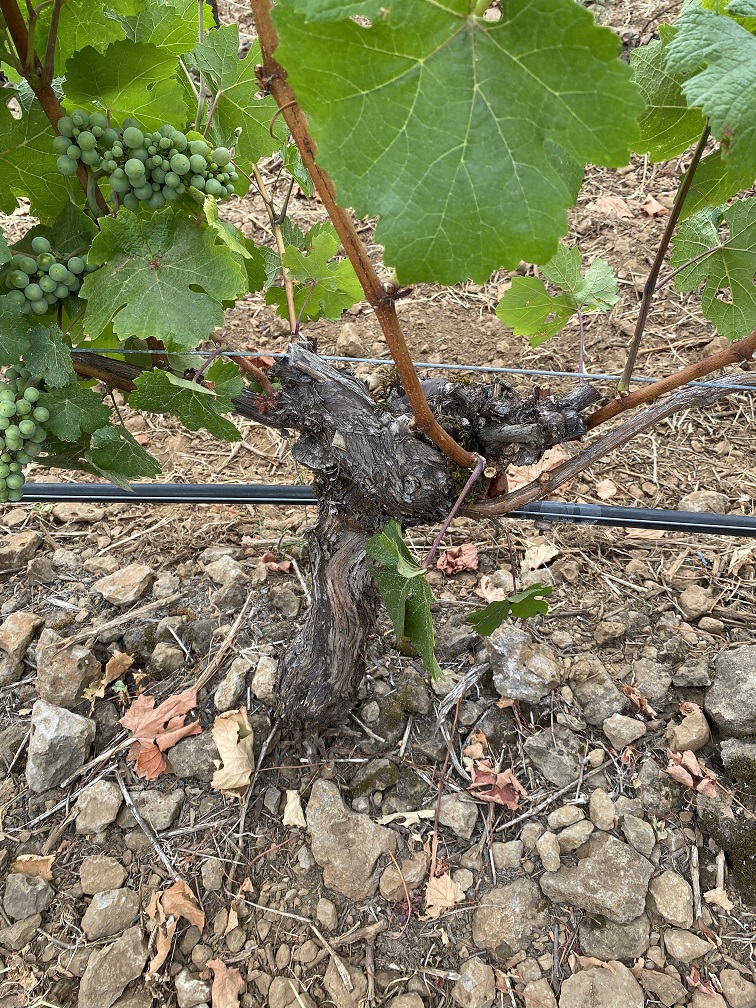
Remember, we are talking about passion here. The amount of labor of love and passion which this vineyard required to be established was simply incredible. Tom had to use a special machine to break through the basalt to help the vine roots to get established. There were a few rows where he decided not to use the machine, and those rows look particularly different from the rest of the vineyard. The rocks which you can see in these pictures give you a good idea of what he had to deal with while establishing the vineyard.


After we finished walking around we sat down to taste the wines with Tom and to continue the conversation about the winemaking. Tom is highly analytical, he uses a lot of different charts, such as Degree Day reports to estimate when he might need to start picking up the grapes based on the historical data and what is the potential weight of the grapes might be at the harvest. Harvest is usually done in multiple passes, depending on the year – in 2015 and 2018, for example, he had to pick grapes 5 times; in 2016 and 2020 there were three picks made.


We started our tasting with 2018 Chardonnay, which was outstanding:
2018 Le Cadeau Vineyard Chardonnay Willamette Valley (14.1% ABV, $45)
Beautiful nose of vanilla with a hint of butter
Vanilla, butter, Granny Smith apples on the palate, beautifully clean and balanced
8+
It is really amazing to see the level of finesse Oregon Chardonnay has developed over the years.


It appears that Tom also makes sparkling wines, and he loves it, as making sparkling wines nicely complements making still wines – you remove perfect grapes for the sparkling (high acid), and the other grapes can ripen better. The sparkling wine we tried, was again, in a word, outstanding:
2013 Le Cadeau Rosé Brut Oregon (13.1% ABV, $50, 4.5 years on the lees)
A touch of funk and toasted bread
Sapidity, yeast, toasted notes, clean acidity, delicious.
8+


Now we moved on to the Pinot Noir. Tom is working with the winemaking team to produce his wines, including the consultant from Burgundy. Le Cadeau makes some of the reserve wines, but those are only produced in the best years. We tasted through the 4 Pinot Noir wines which were all excellent in their own right.
2018 Le Cadeau Côte Est Pinot Noir Willamette Valley (13.9% ABV, $60)
Beautiful cherries on the nose
Cherries on the palate, clean, round, soft, a touch of earthiness, delicious.
8
2018 Le Cadeau Diversité Pinot Noir Chehalem Mountains AVA (14.1% ABV, $60)
Beautiful minerality, sweet cherries, a hint of cranberry
Tart cherries on the palate, pepper, clean, fresh, light
8+
2018 Le Cadeau Rocheux Chehalem Mountains AVA (13.5% ABV, $60)
Stunning nose, cranberries, cherries, violets, a hint of sage
Superb balance of power, fruit, acidity, structure – everything is in perfect harmony.
9-/8+
2017 Le Cadeau Merci Reserve Chehalem Mountains AVA (13.3% ABV, $80)
Incredible aromatics, floral, violets
Beautiful, round, clean, open
8+
It is interesting that when I tasted the 2017 Le Cadeau vintage for the interview post, Diversité was my favorite, and Rocheux was a close second. This time, Rosheux was my favorite Pinot Noir from the tasting.
That’s all I have for my update. I don’t drink much of Burgundy, so I can’t really offer any comparisons – but I don’t think comparisons are needed. Oregon Pinot Noir are unquestionably world-class wines in their own right. I remember reading in Wine Spectator Matt Kramer’s article where he mentioned that the main characteristic of a world-class Pinot Noir is finesse. Going by this measure, Le Cadeau definitely got it – finesse is the virtue of all their wines. If you are looking for the Pinot Noir for a special occasion – don’t look any further than Le Cadeau.
This post is a part of the Stories of Passion and Pinot series – click the link for more stories…
Last Bottle Sign Up ($10 credit)




 Talk-A-Vino