Wednesday’s Meritage – Wine Quiz Answer, #MWWC7 Few Days Left, Cali Crush Report, Wines At State Dinner, And More
Meritage time!
Let’s start with the answer for the wine quiz #92, grape trivia – Montepulciano. In the quiz, you were supposed to answer 5 questions about indigenous Italian grape called Montepulciano. Here are the questions, now with the answers:
Q1: In the number of regions, Montepulciano is often blended with … [name that grape]
A1: Sangiovese is a popular blending partner of Montepulciano.
Q2: Wine Spectator calls wines rated in 95-100 range Classic (the highest and the most prestigious category). True or False: there are no Montepulciano – based wines rated in the Classic category
A2: False. There a few Montepulciano wines with the ratings of 95 or above. For example, 2000 Emidio Pepe Montepulciano d’Abruzzo got 97 points from the Wine Spectator.
Q3: From the list below, which state in US doesn’t make any Montepulciano wines of notice:
a. California, b. Maryland, c. North Carolina, d. Texas, e. Washington
A3: Interestingly enough, Washington so far doesn’t have any Montepulciano plantings of notice.
Q4: True or false: from 2000 to 2010, plantings of Montepulciano in Italy increased by more than 15%
A4: True. Plantings of Montepulciano in Italy increased from 28,679 acres in 2000 to the 34,824 in 2010.
Q5: Best known Montepulciano wine comes from Abruzzo in Italy and it is known as Montepulciano d’Abruzzo. Do you know the name of the white wine commonly produced in Abruzzo?
A5: Trebbiano d’Abruzzo is a white wine from the Abruzzo region.
When it come to the results, first of all, we had very good participation in the quiz, quite a few answers. And, most importantly – we have a winner! Tracy Lee Karner answered all 5 questions correctly, so she gets the top prize of unlimited bragging rights! Great job! I also would like to acknowledge Suzanne of apuginthekitchen and Mario Plazio (no web site), who both got 4 questions out of 5 correctly. Very well done!
Now, to the interesting stuff around the vine and the web!
Boy, I have a lot of interesting reads for you. First of all, there are only a few days left to submit your entry for #MWWC7, “Devotion”. Over the past few days there were quite a few submission, which is great. I have a problem to come to grips with this theme, as “devotion” doesn’t trigger any mental image for me – I would much happier deal with “obsession” or at least a “dedication”. Anyway, may be my muse will still come, all covered in the snow? No matter – get your wine devotion story going! Here you will find rules and submissions to the date.
Like the grapes and the numbers? I personally do – I don’t even know why. Anyway, the California Agricultural Statistics service just released the numbers for the 2013 grape crush report – 4.23 million tons of grapes were crushed last year, up 5% from the 2012. The most crushed grape in California was Chardonnay, closely followed by Cabernet Sauvignon and then Zinfandel. For all the numbers please take a look at this article at WineBusiness.com.
Now, I want to share with you two interesting articles from the Dr. Vino’s blog. First, it is always interesting to know what the other people drink, right? Don’t you try to glance at the label of the wine been served at the table next to you? So this is not just some other random people we are talking about here – Dr. Vino analyses selection of the wines from the State Dinner given by US President in honor of the high guest from France. Here is the article – and similar to the Dr. Vino’s opinion, my question is – really? These are the best wines made in US? Okay, okay – I didn’t taste either one of the particular 3 wines served at that dinner – in case you have, I would be really interested in your opinion.
Last, but not least for today is another article from Dr. Vino’s blog – a short post about the sale of the wines at the auction in Chicago. Considering all the stories about the counterfeit wines nowadays, it is not surprising that the wines with the guaranteed provenance are sold at the premium nowadays. But for me personally, it is the data in that old receipt which is very interesting – $78.99 for the Echezeaux or $68.99 for Vosnee-Romanee – sigh, and another sigh – are those days gone forever?
And we are done here. The glass is empty – but the refill is on its way! Cheers!
Admit It – You Always Wanted To Learn More About Spanish Wines – Here Is Your Chance
 When it comes to wine, I never admit that I have favorites – I always say that I like them all. But deep, deep inside, I know that this is a little bit of a lie (just a tiny one, seriously) – it is Spanish wines I’m very particular to in many cases. Spain has the biggest area of the vineyards planted, and it is third wine producing country in the world, so you can imagine that there is quite a bit to learn about Spanish wines.
So, what I’m trying to tell you is this. If you are interested in learning about Spanish wines, and you live in a close proximity of Greenwich, CT, you are in luck! Barcelona Wine Bar and Restaurant in Greenwich, CT is offering to take you on the tour of four different regions in Spain, during the course of four evenings in March. Here is the description of the Passport Through Spain program from the Barcelona’s press release:
“Jet set through Spain in the best way imaginable with a glass (or several) of wine, expertly prepped tapas and the rustic, and warm environment of Barcelona Wine Bar & Restaurant in Greenwich, CT. Each one hour class in the series (there are four in total) will focus on a particular Spanish region, history behind the wines and the food that best accompanies them prepared by Chef Michael Lucente. These wine classes are designed to enlighten and inspire both the novice and enthusiast. Wine Steward, Jose Valverde will guide you along the way, with tips and tricks for successfully pairing your wines with local food.
The series will take place each Wednesday during the month of March beginning on March 5th at 7:00pm. The first wine-pairing class covers the Rioja region best known for its Old World style and their well-aged red wines. The second covers Galicia (March 12th), a seaside region. The third class on March 19th covers Montsant/Priorat, known for its powerful, elegant and complex wines and the last class on March 26th will focus on the Valencia region.
Attend one class or attend them all. With the first class you attend, you’ll receive a Barcelona Wine Bar & Restaurant passport. Each time you attend a class, your passport will be “stamped” and you receive a complimentary tapa token to redeem on your next visit. Attend all four classes in the series and receive a [$100] gift certificate for two people. Each class is $35 per person (plus tax and gratuity) with a maximum of 20 people attending. Reservations can be made by contacting rsvp@barteca.com.”


If you think about it, you will pay $140 for the four classes, and you will get four tapas tokens plus a gift certificate for $100 – which means that you will have great fun education basically… for free. Remember – there are only 20 seats available for each class, so don’t delay! Also, as Valentine’s Day is rapidly approaching, in case you are still thinking about the present, the gift of wine education might be just it! ¡Salud!
Meet the Winemaker: One on One With Morgon and Pouilly-Fuissé Vintners
Talking to the people who make magic is always an experience (yes, I’m comparing winemaking to the magic). I met the winemakers a number of times, but for the most of the cases, they were “in between” of some other important tasks (like harvest, for instance), so the idea of inundating them with questions never crossed my mind.
This time around it was a different experience – the winemakers where actually there to talk to me (feel special and scared at the same time), so I could (and rather was supposed to) to ask a lot of questions.
I met with two winemaking couples – Robert and Jeanine Béranger from Pouilly-Fuissé and Nicole and Pierre Descombes-Savoye from Morgon, both closely working with Georges Duboeuf, the famous French negociant, whose portfolio consists of about 400 different wines, mostly from Beaujolais (I met Georges and Frank Duboeuf a few years back, here is my post talking about it).
So I had an opportunity to ask the questions and then to taste the wines (each family produces only one wine!). Here are my questions with the answers (side note: really despise myself for thinking for the past 10-12 years “must learn French, must learn French” – and really not doing anything about it… The interview was done with the help of Heloise Pepin, brand ambassador for Georges Duboeuf wines).
Of course we started with the white wine, so my questions were directed first at Robert and Jeanine Béranger, whose family produces Domaine Béranger Pouilly-Fuissé wine for more than 200 years. The Domaine Béranger includes about 12 acres of Chardonnay, the only grape used in production of Pouilly-Fuissé wines. The vines at the domaine on average are 55 years old. All the harvesting is done by hand (you typically want to preserve clusters when harvesting the Chardonnay, this is why hand is the best instrument to use). Those 12 acres are split into 32 (!) different parcels, which are vinified separately and blended for the final release. Total production at the Domaine is about 26,000 bottles a year.
For what it worth, here are the questions I asked, together with the answers.
Q: What was most favorite vintage of your wines?
A: 1983 and 2003. 2003 was particularly interesting, as it was a very difficult vintage, and making of the wine was very challenging. 1976 was the exceptional year for the white wines.
Q: What was the oldest wine from your vineyards which you ever tasted?
A: 1969.
Q: For how long your wines can age?
A: In the exceptional vintage, the wines can easily age for 30 years, but generally they age well for about 15 years.
Q: When you are not drinking Pouilly-Fuissé wine, what are the other wines you like to drink?
A: Meursault, Chablis, New Zealand Sauvignon Blanc.

Next we tasted the wine, and here are my tasting notes.
2011 Emile Beranger Pouilly-Fuissé AOC (13% ABV, retail at about $26, 10% of the wine aged in 5 different types of oak barrels, then 14 month in the bottle before release) – pale yellow color in the glass. Hint of apples on the nose. On the palate there is a touch of butter, plump and creamy feeling. The wine is very round, roll-of-your-tongue, perfect acidity and perfect balance. A beautiful wine. Drinkability: 8+
Time to talk about the red wine, Domaine Jean Ernest Descombes from Morgon, so I directed my questions at Nicole and Pierre Descombes-Savoye. Domaine’s property includes 30 acres of the vineyards, all planted with Gamay grape, with three quarters of the vines been more than 50 years old. On average, the yearly production is 100,000 bottles. The grapes are harvested by hand to preserve the full clusters.
Here are some of my questions, along the same lines as the questions above.
Q. What was your favorite vintage of your wine?
A. 1973, as this was the year when our son was born.
Q. And how was that 1973 wine?
A. The wines were opened recently at the big party, and they were put against the 1973 Vosne-Romanée in the format of the blind tasting. Most of the guests at the party preferred the 1973 Morgon over the 1973 Vosne-Romanée. It is also interesting to note that as Gamay wine is aging, the freshness of Gamay grape is evolving into the complexity of Pinot Noir, so the results of the tasting are not surprising.
Q. For how long Morgon wines can last?
A. In the good vintage, the wines can easily last for 40 years or even longer.
Q. What do you drink when you are not drinking your own wine?
A. Burgundy and Bordeaux, especially the Saint-Émilion had been the favorite as of late. But we also like California wine.
Q: How would you compare the 2011 vintage with 2009?
A: Well, the vintage such as 2009, simply can’t happen again ( I’m sure mother nature has its own view on that), it was simply exceptional – and it is literally impossible to beat the 2009 vintage. But 2011 was a good year, and the wines from 2011 will easily last for 10-12 years or longer.
 And then it was the time to taste the wine.
2011 Domaine Jean Ernest Descombes Morgon AOC (12.9% ABV, aged for 6-8 month in cement tanks, $16.99 suggested retail) had bright ruby color in the glass. On the nose, the aroma of raspberries and cherries. Perfectly fresh on the palate, with more raspberry notes, clean, simple, with invigorating acidity and good balance. Drinkability: 8-
And that concludes my first sit down interview with the winemakers. It was fun, and I hope to be able to do more in the future. Cheers!
Beautiful Snow and Beautiful Wine
There was a lot of snow here in CT over the last week. Most of the snow is still here, and considering the forecast, will be lingering around for a while. Yes, the snow is nuisance and inconvenience, it is tough to shovel, and a lot of it became ice at this point. But when sun comes out, it really becomes a thing of beauty. This snow had also a very interesting characteristic – well, may be it is me who didn’t see it before, but this snow is really glowing blue, especially as you dig in and look at it. So for what it worth, here are some pictures, snapped literally just around the house. Plus, I also included a few pictures which my daughter made with her iPhone – it is pretty amazing what that little device can do. And if you will scroll all the way down, I will also talk a bit about the wine. Here we go:


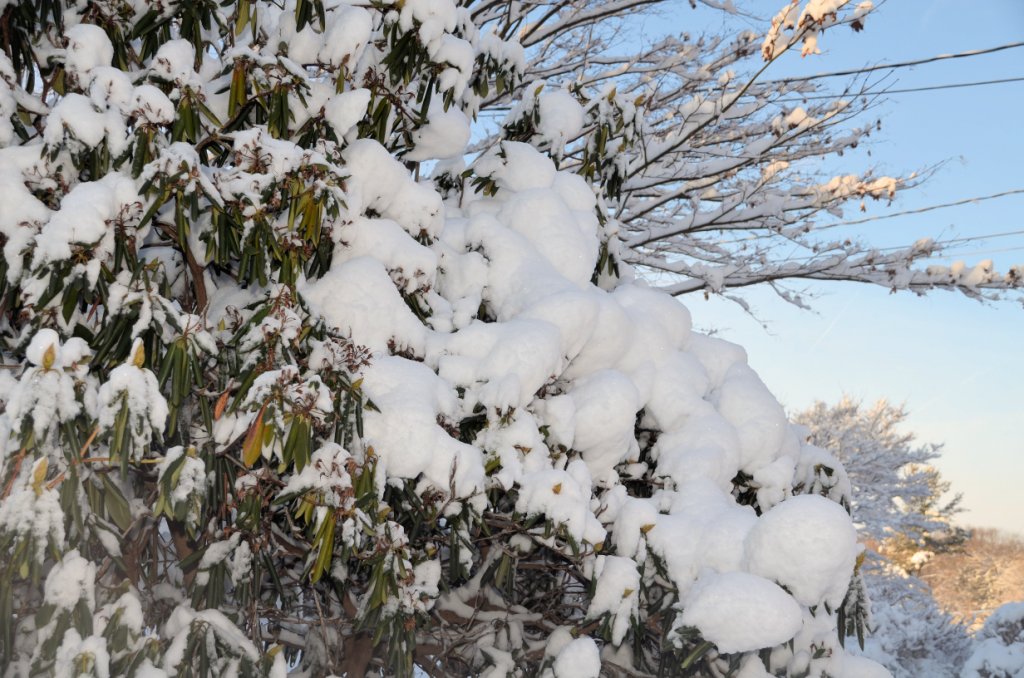

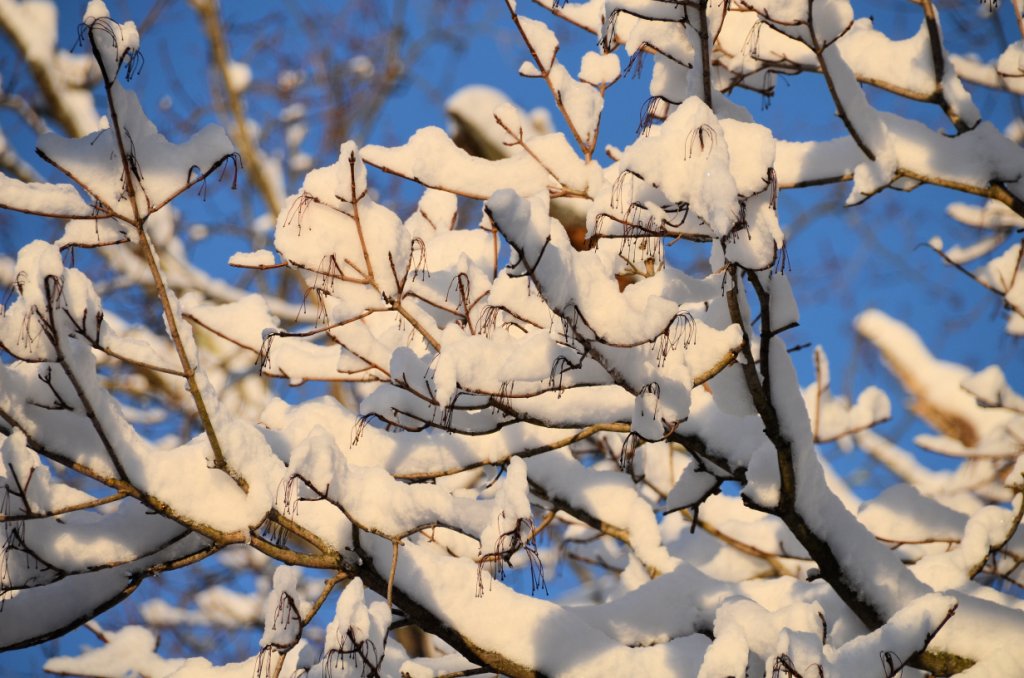


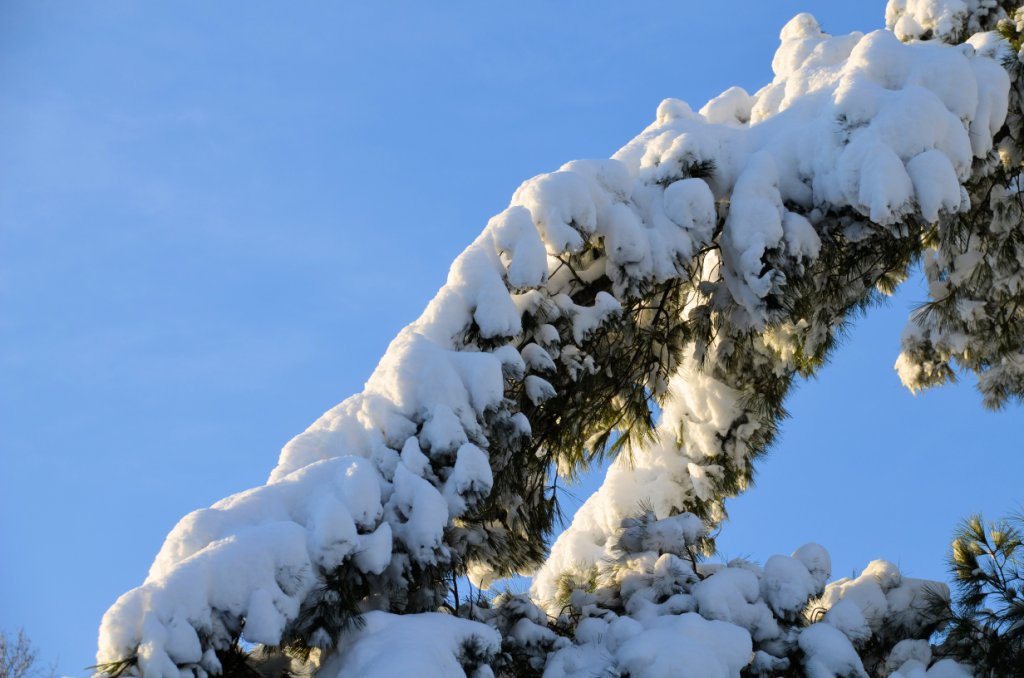
This is one of my favorites
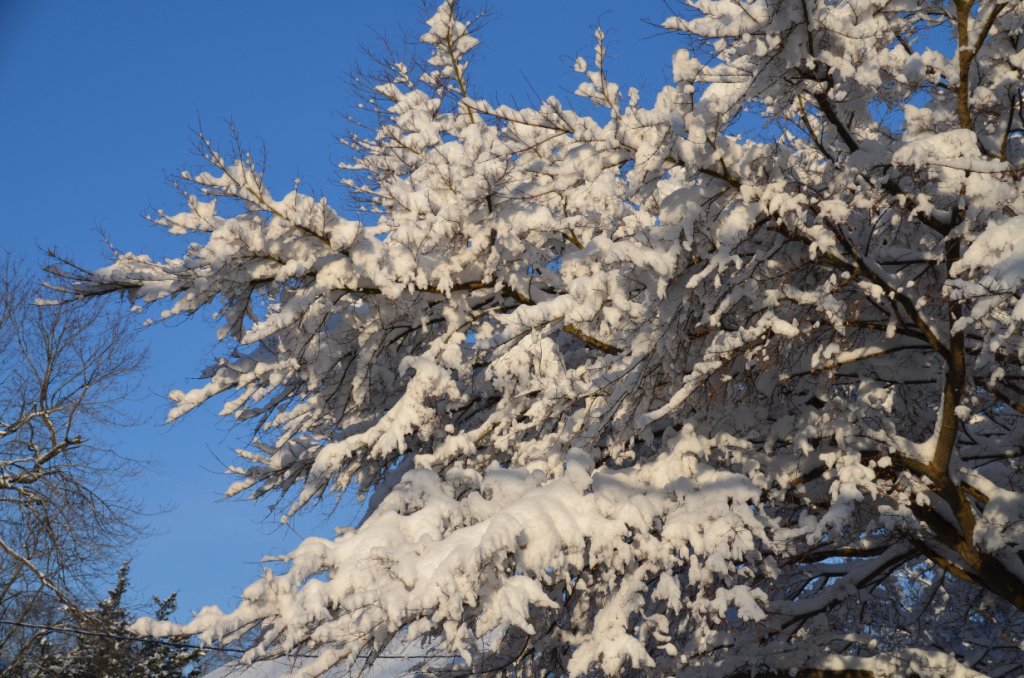

That snow and that sky…
 What makes snow so beautiful?
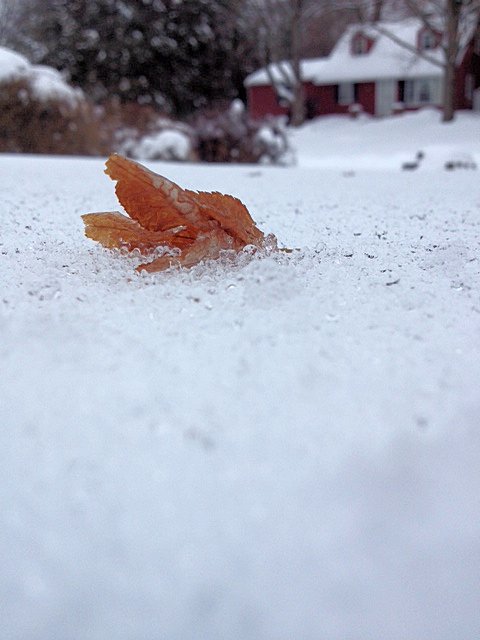 iPhone picture by Rina – the leaf
 The same, only black and white

And a bit of perspective

More perspective
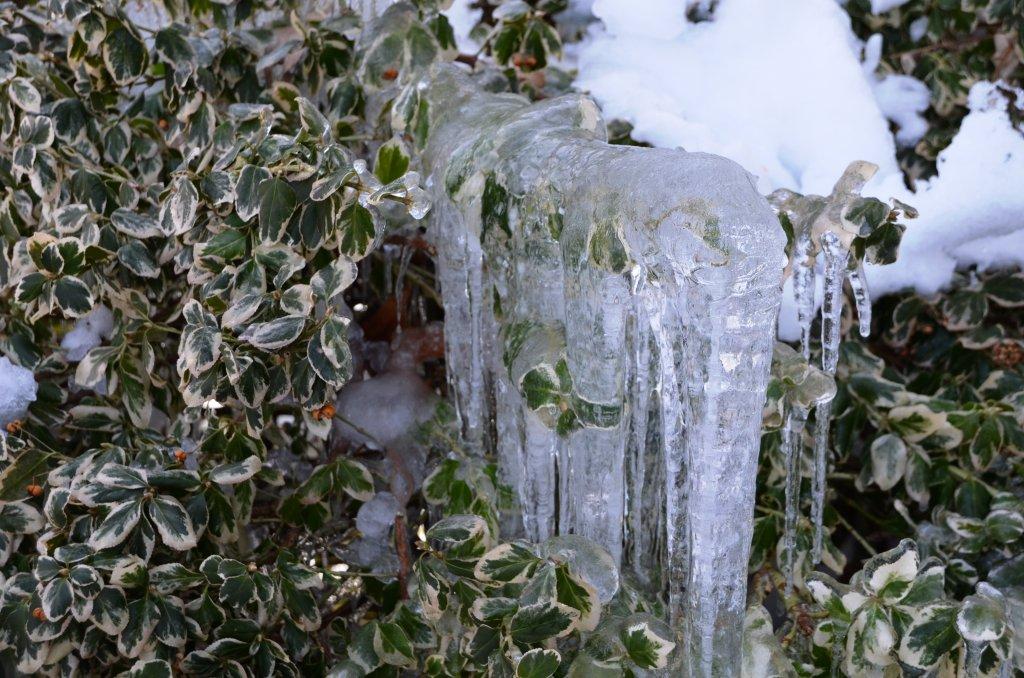
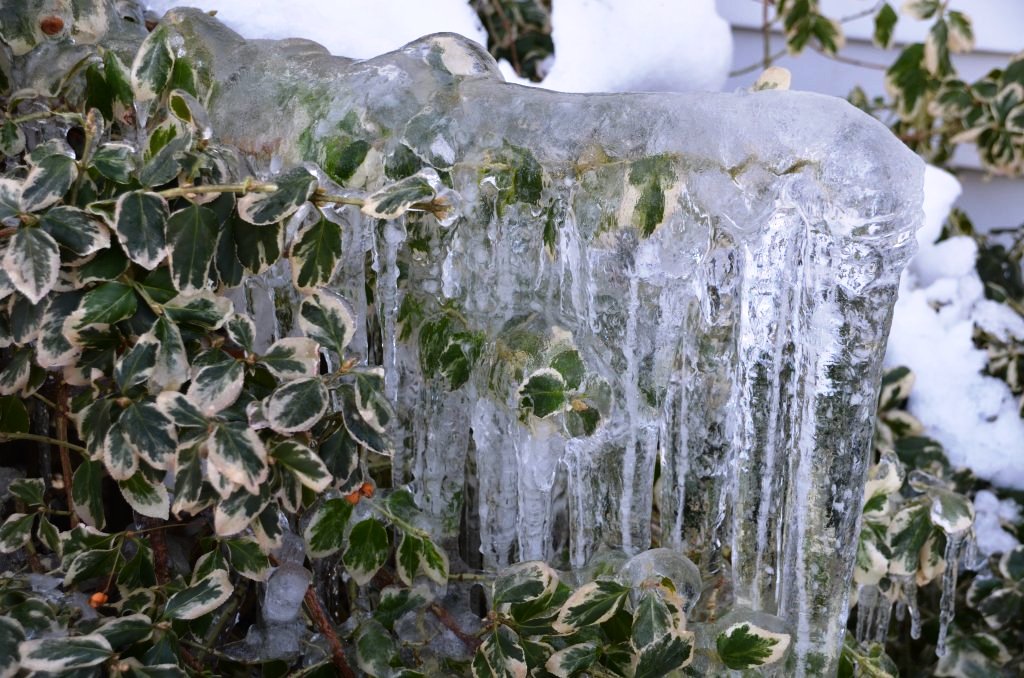
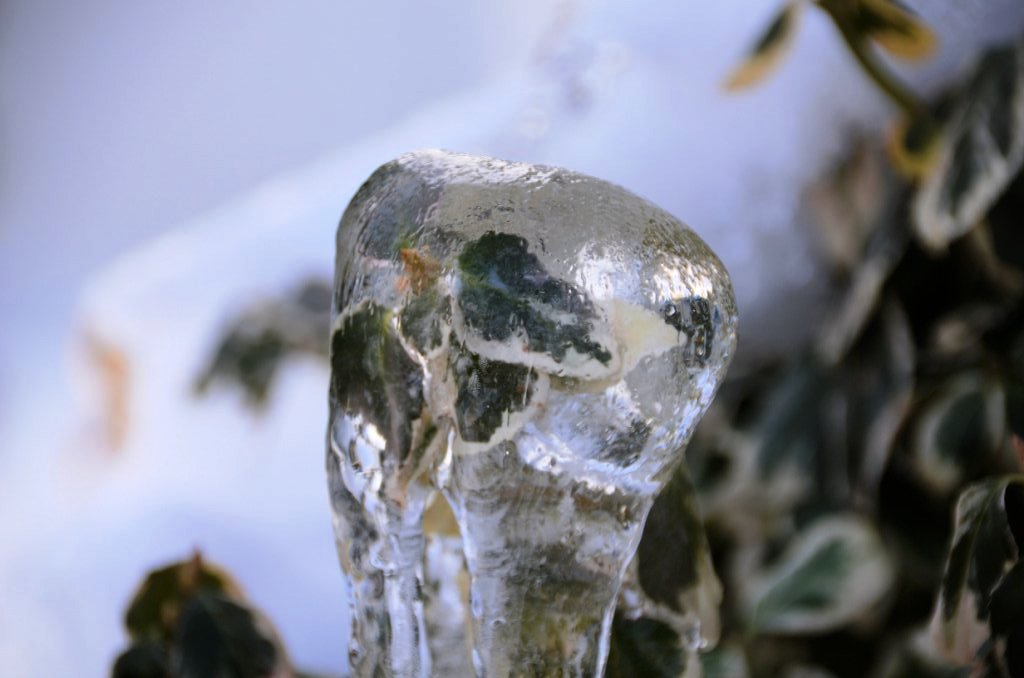
A frozen beauty
Yes, the snow was beautiful, but it got in the way. The snow on Wednesday was bad enough to affect the trains, so I had to miss the Basilicata winemakers dinner in the city, which I was really looking for. So I decided to compensate for that by opening the bottle of new vintage of one of my favorite wines – Fiction by Field Recordings. I’m sure some of you know at this point that I’m very particular to the Field Recordings wines in general, but Fiction is so unique, it is one of my all times most memorable wines ( and it was my Wine of the Year in 2011) – here is the blog post about my first experience with 2010 Fiction.
The 2012 Fiction by Field Recordings Red Wine Paso Robles (14.9% ABV, 40% Zinfandel, 13% Tempranillo, 12% Petite Sirah, 11% Touriga Nacional, 10% Mourvedre, 8% Grenache, 6% Cinsault) didn’t disappoint. The spectacular nose of fresh meadows – this is the wine which you can’t put down – one smell requires another, and another, and another. The aromatics of this wine absolutely spectacular – I don’t know how that works, but I can’t put the glass down. The palate is very playful, with lots of fresh fruit, raspberries, blueberries, cherries – everything is in one beautiful medley, supported by clean acidity and perfectly balanced. The 14.9% ABV are absolutely unnoticeable – this is the wine of the pure harmony. Drinkability: 8+
That is all I have for you for my report on snow and the wine. Stay warm and drink good wine. Cheers!
Weekly Wine Quiz #92: Grape Trivia – Montepulciano
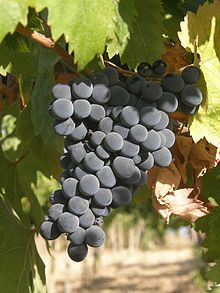
Montepulciano grapes Source: Wikipedia
The Wine Quiz series is not meant to intimidate. The whole idea here is to have fun and learn something new. When answering the questions, it is fully encouraged to use all available sources of information, including Google or any other search engine. There are no embarrassing answers – the most embarrassing thing is not giving it a try…
Welcome to the weekend and your new wine quiz!
We are continuing our grape trivia series, with the focus still on the red grapes, and today’s subject is Montepulciano.
Montepulciano is an indigenous Italian grape variety, recommended for use in 20 out of 95 wine regions in Italy, and one of the most planted red grapes in the country. The origins of Montepulciano are hard to pinpoint, with some sources citing the grape been growing on the hills of Abruzzo since the ancient times, and some sources suggesting that the grape was brought into the Abruzzo region from the neighboring Tuscany at the end of the 18th century. Also an interesting “gotcha” is associated with the name of the grape itself. It seems that the name of the grape, Montepulciano, is given after the town in Tuscany, also called Montepulciano, where the grape supposedly came from. But the problem is that the wine produced in Montepulciano has nothing to do with Montepulciano grape! Town of Montepulciano produces the wine called Vino Nobile di Montepulciano, which is made out of 100% Sangiovese grape! Yep, that’s what I call confusing.
Montepulciano is a late ripening variety, with thick black skin and relatively low acidity. It produces wines which are quite dry, with cherry and cherry pit (did you ever try to eat the content of the cherry pit?) flavors, full bodied and easy to drink. While a lot of Montepulciano wines are easy to drink but not necessarily memorable, proper care and reduced yields can result in the world-class wines. Absolute majority of Montepulciano wines are produced in Italy, with Montepulciano d’Abruzzo, Rosso Piceno and Rosso Conero probably been best known areas, but Montepulciano plantings also exist in Argentina, New Zealand and the United States.
And now, to the quiz!
Q1: In the number of regions, Montepulciano is often blended with … [name that grape]
Q2: Wine Spectator calls wines rated in 95-100 range Classic (the highest and the most prestigious category). True or False: there are no Montepulciano – based wines rated in the Classic category
Q3: From the list below, which state in US doesn’t make any Montepulciano wines of notice:
a. California
b. Maryland
c. North Carolina
d. Texas
e. Washington
Q4: True or false: from 2000 to 2010, plantings of Montepulciano in Italy increased by more than 15%
Q5: Best known Montepulciano wine comes from Abruzzo in Italy and it is known as Montepulciano d’Abruzzo. Do you know the name of the white wine commonly produced in Abruzzo?
Good luck, enjoy the quiz and your weekend! Cheers!
Wednesday’s Meritage – Wine Quiz Answer, #MWWC7 12 days left, Don’t Forget OTBN, How Much Would You Pay For A Cocktail?
Meritage time!
First, let’s start with the answer for the Wine Quiz #91, grape trivia – Cinsault. In the quiz, you were supposed to answer 5 questions about the red grape called Cinsault (it is Cinsaut for French-proper). Here are the questions, now with the answers:
Q1: Name 3 grapes, traditional blending partners of Cinsault in Provençal Rosé
A1: When it comes to Provençal Rosé, Carignan, Grenache and Mourvèdre are most often blended with Cinsault.
Q2: In which US state the history of winemaking is associated with Cinsault?
a. Oregon, b. Texas, c. Virginia, d. Washington
A2: Interestingly enough, early history of winemaking in Washington is associated with Cinsault, which was introduced in the Walla Walla region by Italian immigrants.
Q3: The oldest continuously producing Cinsault vineyard in the world is located in:
a. Algeria, b. France, c. South Africa, d. United States
A3: It was recently discovered that the small vineyard in California is actually the oldest continuously producing planting of Cinsault, and was planted in 1885. For more information, here is an interesting article by W. Blake Gray.
Q4: True or False: Cinsault is one of the 30 most planted grapes in the world
A4: True. According to the statistics of 2010, Cinsault was 25th most planted grape in the world with slightly less than 50,000 acres planted worldwide.
Q5: Considering Cinsault plantings worldwide, sort the countries below from the largest area plantings to the lowest:
a. Algeria, b. France, c. Morocco, d. South Africa
A5: France (about 20,000 acres), Algeria (about 7,500 acres), Morocco (about 3,500 acres), South Africa (about 2,000 acres).
Talking about the results, somehow this quiz had very low participation – may be the subject of somewhat obscure grape, may be the snow, but something got in the way of hundreds of people who I know wanted to play. Anyway, there is a next time for everything. But – one person attempted to solve the quiz, so I would like to acknowledge Suzanne of apuginthekitchen, as this also was her first participation in the wine quizzes here – well done!
And now, to the interesting news around the vine and the web!
First, I would like to remind everybody that the deadline for #MWWC7 is rapidly approaching – only 12 days are left until the deadline. Are you devoted to wine something or someone? Get your passion flowing, devote some time, pour yourself a glass of wine (want a “brute force” solution? find the bottle of Dowsett Family Wines Devotion Red and just do the review), but really, it is time to get more devoted to the #MWWC7. For all rules and regulations, please check SAHMMelier’s blog post.
Do you know what OTBN stands for? Need another two seconds? Okay. OTBN stands for Open That Bottle Night – the movement started by Dorothy J. Gaiter and John Brecher, brilliant wine columnists writing the wine column for Wall Street Journal for many years. The idea of OTBN is that all of us have our “special bottle(s)” waiting for the special moment(s) to be open. And for the sake of the wine – and our own sake – in many cases it is better for the wine and for the people to have that special bottle opened rather sooner than later. OTBN is meant to encourage people to open and enjoy that special bottle. OTBN is celebrated during the last Saturday of February, thus OTBN 2014 will be taking place on February 22nd – here you can find the full calendar of all past OTBN events. Start thinking about that special bottle of wine you will open – that is definitely a fun part of the experience.
Quick question – how much are you willing to pay for the cocktail? Okay, $11.95, of course. What are you saying? You can sometimes splurge the whole $30, especially if you are in the best New York hotel? Okay, sure, make sense. So, how about $50,000? Shocked? Absurd, you are saying? Yes, I’m with you – it is an absurd all the way if you ask me, but apparently someone found it quite palatable to pay $50K for the diamond studded glass filled with Hennessy Richard (most exquisite cognac made by Hennessy). I wonder if he got to keep the glass… Hope he did. To make it more fun, before you read the story, try to think about the place (city?) in the world where someone will pay $50K for the cocktail. Here is the link to the article about that $50K extravaganza.
That’s all I have for you for today. The glass is empty – but the refill is on its way. Cheers!
Benvenuto Brunello, or Notes from Brunello Deep Immersion
This is not a quiz post, however – let me start with the question: what do you think of Brunello di Montalcino, the noble wine made out of the Sangiovese? Well, technically it is Sangiovese, but in practicality Brunello di Montalcino is made out of the grape called Sangiovese Grosso, sometimes simply called Brunello. When people need to provide an example of the best Italian wines, the triple-B, Barolo, Barbaresco and Brunello, are the very first names which cross oenophile’s mind, so this is the Brunello we are talking about here. So, what is your experience with Brunello?
To carry the denomination of Brunello di Montalcino DOC or DOCG, the wines must be made from 100% Sangiovese Grosso grapes, and age at least 2 years in oak casks, and then at least 4 month in the bottle (at least 6 month for Riserva designation), but many producers age it for a lot longer. First time Brunello wines can appear on the store shelves is 5 years after the vintage date.
There are tons of books and web sites with countless pieces of information about the region, the history of the wines, the food, the people – I’m not going to simply repeat all of that. However, I can’t resist to share this magnificent picture of the Montalcino, as it was shared by the Brunello Consortium – I generally only use my own pictures in the blog, but this is soooo beautiful!

Montalcino Panoramic. Source: Brunello Consortium
To celebrate the release of 2009 vintage, The Consortium of the Brunello di Montalcino Wine (Cosorzio del Vino Brunello di Montalcino), an association of all Brunello producers, arranged the series of seminars and tastings in New York and Los Angeles, and I was fortunate enough to attend the event in New York – hence this post where I’m sharing my impressions. Before I will get down to the details and inundate you with tasting notes and pictures, let me share some general notes and observations (yes, you can call it an executive summary):
- According to the representative of the consortium, 2009 was a “4 star year” as opposed to the 5-star, such as 2007 or 2001 (or upcoming 2010). In 2009, growing season had rainy spring, but good hot and sunny September, which helped with overall quality. 2009 Brunello supposed to be more approachable at the younger age (my note: some were, and some were very far from being approachable).
- Some interesting facts:
- There are 90 clones of Sangiovese used in the production of Brunello di Montalcino.
- Montalcino is a large region, so different areas of Montalcino region produce different wines, due to vastly different soils and climate conditions (what is Italian for Terroir?) Unfortunately, those different areas are not indicated in any way on the label – you actually have to know the location of the vineyards for each respective producer to know what to expect. The special guide produced for the show had very helpful tiny maps showing the approximate location of each and every winery represented in the guide.
- The use of oak (type, duration, etc) is changed from vintage to vintage.
- I actually think that while deemed approachable, 2009 still needs time. Few of the 2004, 2005 and 2006 Brunellos which snuck into the tasting, showed up just magnificently.
- The 2012 vintage of Rosso di Montalcino, a simpler, typically less oaked wine, also made out of Sangiovese Grosso, is showing up in the stores. This wines should be ready to drink now (but many will age well too, depends on the winemaking style).
- Based on the tasting, I much preferred 2011 Rosso di Montalcino over the 2012 – don’t want to think too hard about the reason, but if you are looking for delicious bottle of a good Italian wine to drink now, 2011 Rosso di Montalcino might be “it”.
- Don’t know if this is a trend (and definitely don’t want to be spotting any trends), but in this tasting, there were surprisingly large number of corked bottles. I had to call out at least two bottles, and with another three I ate my words, only mumbling “aha, this is good”. I do attend trade tastings regularly, and this is not normal. I rarely drink Brunello, so if anyone who is reading this actually drinks a lot of Montalcino wines, I’m curious to know your opinion. Bottom line here – trust your palate. If you think the wine is corked, most likely it actually is!
Now, let’s talk about the seminar. Both the seminar and the tasting were, of course, about Montalcino wines. The difference is that during the seminar you are sitting down and listening to the presenter(s) as opposed to walking around with the glass and the book in your hand – but most importantly, you have enough time to completely analyze the wine – color, nose, palate – everything at your own pace, one by one. Here are my notes regarding the 8 wines presented during the seminar, in the order of tasting:

2009 Capanne Ricci Brunello di Montalcino DOCG (14.5% ABV, $54.99, aged 3 years in large oak barrels plus bottle age). Drinkability: 7
Color: Garnet color
Nose: Very pronounced and intense, with cherries and leather
Palate: Austere, just powerful tannins, some good background acidity. Way too tannic to be appreciated at the moment.
2009 Col D’Orcia Brunello di Montalcino DOCG (14.5% ABV, $55, aged 3 years in Slavonic and French oak casks plus 12 months in the bottle). Drinkability: 7+
Color: Bright ruby
Nose: Touch of plums
Palate: Nice cherries, much softer than the previous wine, can be drunk right now
2009 Loacker Corte Pavone Brunello di Montalcino DOCG (15% ABV, $75, aged 3 years in oak). Drinkability: 8-
Color: Dark garnet color
Nose: Spectacular, intense, with a lot of bright fruit.
Palate: Cherries and lots of bright fruit, has a lot going on. Still needs time, but very enjoyable already.
2009 Palazzo Brunello di Montalcino DOCG (14.5% ABV, $70, aged 36-40 months in oak, 8-12 months in the bottle). Drinkability: 7-
Color: Dark ruby
Nose: Overall quite restrained, with a hint of cherries
Palate: Cherries and then tannins and only tannins on the palate. The tannins feel over-extracted – this wine might never open.
2009 Pinino Brunello di Montalcino DOCG (14% ABV, $50, aged 30 months in Slavonic oak). Drinkability: 7
Color: Garnet with brick-ish hue
Nose: The fruitiest nose of all. Cherries and blueberries.
Palate: Cherries and tannins. Tannins overly intense in front of the mouth, and somewhat uni-dimensional.
2009 Tenute Silvio Nardi Brunello di Montalcino DOCG (14.5% ABV, $69.99, aged 12 months in new and old french barriques, 18 months in large Slavonic oak barrels, at least 12 months in the bottle). Drinkability: 7+
Color: Garnet.
Nose: Nice and balanced, with the hint of cinnamon and coffee.
Palate: Nice, open, with bright cherries and more manageable, but still aggressive tannins. Can be enjoyed now, but still needs more time.
2009 Il Grappolo Fortius Brunello di Montalcino DOCG (14.5% ABV, $N/A, aging in oak barrels plus bottle age). Drinkability: 8
Color: Garnet with brickish hue
Nose: Very promising, elegant, with cherries and raspberries.
Palate: Beautiful, lots of fruit, ripe cherries, present but not overpowering tannins. Best of tasting.
2009 Tenuta San Giorgio Brunello di Montalcino DOCG (14.5% ABV, $55-$60, aged 12 months in French oak barrels, then 24 months in large Slavonic oak casks, 12 months in the bottle). Drinkability: 7
Color: Garnet with brickish hue
Nose: soft and expressive, but shows off alcohol
Palate: nice fruit, sour (very sour) cherries, pepper in the back is a bit out of place. Aggressive tannins.


For the walk around tasting, I did my best to taste as many wines as possible, before my palate gave up (it is very hard to taste only red, intensely tannic wines – remember, there were no whites) and the place got really really crowded. I used the same system of plus signs (+, ++, +++) as I do in the trade tastings – of course with few of the ++++ exceptions. Below is the list of most exceptional wines I experienced in the tasting:
2009 Banfi Poggio Alle Mura Brunello di Montalcino DOCG – beautiful! +++
2007 Banfi Poggio Alle Mura Riserva Brunello di Montalcino DOCG – wow! ++++
2009 Belpoggio Brunello di Montalcino DOCG – very nice, approacheable
2012 Belpoggio Rosso di Montalcino DOC – beautiful fruit, open, herbs
2011 Brunelli Rosso di Montalcino DOC – integrated, beautiful! +++
2006 Camigliano Gualto Riserva Brunello di Montalcino DOCG – beautiful! nice depth, density. +++
2011 Capanna Rosso di Montalcino DOC – beautiful, open +++
2011 Caparzo Rosso di Montalcino DOC – one of the most unusual. Intense strawberries on the palate.
2009 Il Palazzone Brunello di Montalcino DOCG – nice, good fruit +++
2007 Il Poggione Vigna Paganelli Riserva Brunello di Montalcino DOCG – excellent, powerful and balanced
2011 Il Poggione Rosso di Montalcino DOC – excellent, great fruit +++
2008 La Togata Brunello di Montalcino DOCG – probably the most delicate, beautiful fruit, tobacco in the back ++++
2008 Podere Le Ripi Lupi Sirene Riserva Brunello di Montalcino DOCG – wow! beautiful! open! ++++
2006 Podere Le Ripi Lupi Sirene Riserva Brunello di Montalcino DOCG – wow! ++++
2009 Podere Le Ripi Amore & Magia Rosso di Montalcino DOC – beautiful! complex, Crème brûlée (no sugar!) on the palate ++++
2008 Podere Le Ripi Bonsai Rosso di Montalcino DOC – wow!
2007 Ridolfi Riserva Brunello di Montalcino DOCG – very good! needs more time +++
2009 Sasso di Sole Brunello di Montalcino DOCG – excellent fruit! +++
2004 Sasso di Sole Riserva Brunello di Montalcino DOCG – plums, cherries, wow! Perfect complexity, both nose and palate ++++
2011 Sasso di Sole Rosso di Montalcino DOC – spectacular nose, good fruit, tobacco, earthiness +++1/2
2012 Talenti Rosso di Montalcino DOC – tobacco, complexity, balance! +++
2009 Uccelliera Brunello di Montalcino DOCG – sweat and beautiful! +++
2008 Uccelliera Riserva Brunello di Montalcino DOCG – wow! stunning! ++++
2012 Uccelliera Rosso di Montalcino DOC – great! tobacco, fruit, exellent! +++
2011 Verbena Rosso di Montalcino DOC – wow! ++++
2011 Villa Poggio Salvi Rosso di Montalcino DOC – excellent! +++
2012 Voliero Rosso di Montalcino DOC – beautiful! +++
And we are done! But before we part, I have to leave you with the drool picture, the one which makes the oenophile’s heart race:
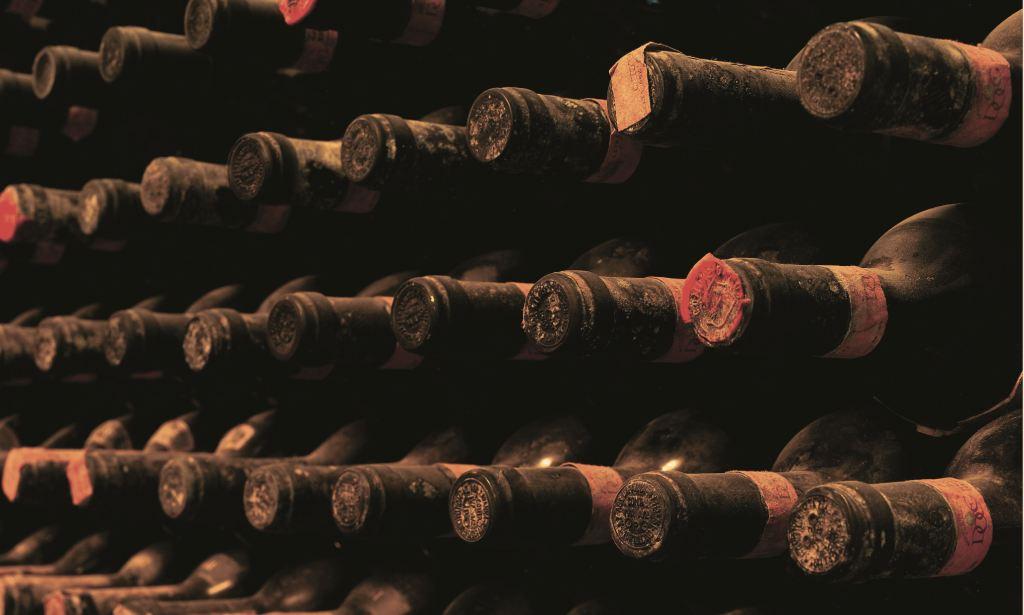
Old Brunello wines. Source: Brunello Consortium
This was a great experience, and I’m already looking forward to welcoming Brunello 2010. I have a sneaky suspicion it will be pretty tasty… Cheers!
Weekly Wine Quiz #91: Grape Trivia – Cinsault
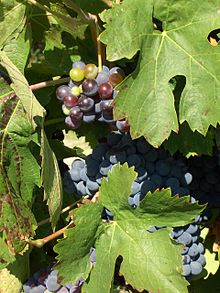
Cinsault Grapes. Source: Wikipedia
The Wine Quiz series is not meant to intimidate. The whole idea here is to have fun and learn something new. When answering the questions, it is fully encouraged to use all available sources of information, including Google or any other search engine. There are no embarrassing answers – the most embarrassing thing is not giving it a try…
Welcome to the weekend and your new wine quiz!
We are continuing our grape trivia series, with the focus still on the red grapes, and today’s subject is Cinsault – for the French purists, we should drop an “l” there and call the grape Cinsaut.
At first, I wanted to call Cinsault an “unsung hero”, but I don’t think it would be the right way to put it. Yes, about 20 years ago, Cinsault plantings in France were exceeding those of Cabernet Sauvignon – but this was 20 years ago. Cinsault is best known for 2 things: it is a blending grape in many of the Rosé wines in Provence and Languedoc, and it is a father (or mother, if you prefer) of Pinotage – the unique South African grape we talked about last time. Cinsault is a black-skinned, early ripening grape which has a tendency to overproduce, easily yielding 6 – 10 tons of grapes per acre (high yield typically means less flavor in each grape). When the yield is controlled at 2 – 4 tons, Cinsault produces very aromatic, fragrant grapes. Cinsault grapes also naturally low in tannin but impart good color, which makes them well suited for Rosé production.
While the biggest Cinsault plantings are still located in France, the grape is growing all other the world – Algeria, Chile, Italy, Morocco, South Africa, Turkey, United States and number of other countries have Cinsault plantings. What is interesting to note that today, when winemakers are constantly in the quest to produce unique and different wines, the single grape red (!) Cinsault bottlings from Chile, South Africa and the United States from the last few vintages have wine critics and writers rave about beautiful, fresh and elegant characteristics of the wines. I think we didn’t see the last of Cinsault yet.
And now, to the quiz!
Q1: Name 3 grapes, traditional blending partners of Cinsault in Provençal Rosé
Q2: In which US state the history of winemaking is associated with Cinsault?
a. Oregon
b. Texas
c. Virginia
d. Washington
Q3: The oldest continuously producing Cinsault vineyard in the world is located in:
a. Algeria
b. France
c. South Africa
d. United States
Q4: True or False: Cinsault is one of the 30 most planted grapes in the world
Q5: Considering Cinsault plantings worldwide, sort the countries below from the largest area plantings to the lowest:
a. Algeria
b. France
c. Morocco
d. South Africa
Good luck, enjoy the quiz and your weekend! Cheers!
Wednesday’s Meritage – Wine Quiz Answer, #MWWC7 Theme, Booze Map of the World, Wine Obsessions
Meritage Time!
Let’s start with the answer to the wine quiz #90, grape trivia – Pinotage. In this quiz, you were supposed to answer 5 questions about South Africa’s signature grape, Pinotage. Here are the questions, now with the answers:
Q1: Explain the origin of the name Pinotage
A1: While Pinotage was born as the result of the cross between Pinot Noir and Cinsault, Cinsault, one of the Rhone varietals, was known in South Africa as Hermitage (which is actually the name of the region in Northern Rhone), hence the name Pinotage.
Q2: While Pinotage primarily grows in South Africa, California also has some plantings of the grapes. Can you estimate the approximate size of Pinotage plantings in California?
a. 50 acres, b. 250 acres, c. 500 acres, d. more than 1000 acres
A2: The amount of Pinotage growing in California is miniscule, but it is trending up. The correct answer is 50.
Q3: Here is the list of of nasty aromas often associated with the smell of Pinotage wines, except one. Do you know which one doesn’t belong?
a. Burnt rubber, b. Rusty nails, c. Paint solvent, d. Sauerkraut
A3: Sauerkraut flavor is not generally associated with Pinotage.
Q4: Wine Spectator calls wines rated in 95-100 range Classic (the highest and the most prestigious category). True or False: there are no Pinotage-based wines rated in the Classic category
A4: True. 93 is the highest rating allotted by Wine Spectator to Kanonkop Pinotage.
Q5: Pinotage was created in 1925, but for the long time it was used only as blending grape. Do you know when single-grape Pinotage bottling was first released in South Africa?
a. 1946, b. 1961, c. 1976, d. 1989
A5: b, 1961. While the first released vintage was 1959, the wine was commercially available in 1961.
I’m glad to report that we had a good number of participants in the quiz, who also expressed a lot of admiration for Pinotage wines. We have 3 winners this time around – barring spelling mistakes, the drunken cyclist, the winegetter and Wine Everyday answered 5 questions correctly, so they all get the coveted prize of unlimited bragging rights. I would like to also acknowledge Caspernick who correctly answered 4 questions out of 5. Well done!
And now, to the interesting stuff around the vine and the web.
The new #MWWC7 Theme had been announced, and it is … Devotion! With all the love and devotion in the air (February 14th – Valentine’s Day – is rapidly approaching), the theme sounds very appropriate. Pour yourself a glass of wine, sharpen your pencil (okay, flex your fingers) and start writing! The submission deadline is February 17th. For the detailed rules and regulations, please take a look at the announcement post by SAHMMelier, the winner of #MWWC6.
Want to know what is the most popular drink in the United States? Italy? China? Now you can! Few days ago, Yahoo! published Booze Map of the World (if you want to skip the article, here is direct link to the map). So it seems that Vodka is a drink of choice in most of the places (USA included), but then Rum in Italy? Really? Was Grappa even on the list? Anyway, have fun analyzing the map.
Last but not least – are you wine obsessed? Do you search for the most unusual wine on the restaurant wine list? Do you remember what is the next “almost extinct” grape you always wanted to encounter in the bottle? Matt Kramer, one of my all time favorite wine writers and Wine Spectator columnist, wrote a very interesting article regarding the wine obsessions – I suggest you will read it for yourself here, it definitely worth your time.
That’s all I have for you for today. The glass is empty – but the refill is on the way! Cheers!
Last Bottle Sign Up ($10 credit)




 Talk-A-Vino