Archive
Following State Dinner, [Re]Discovering Hopkins Vineyard
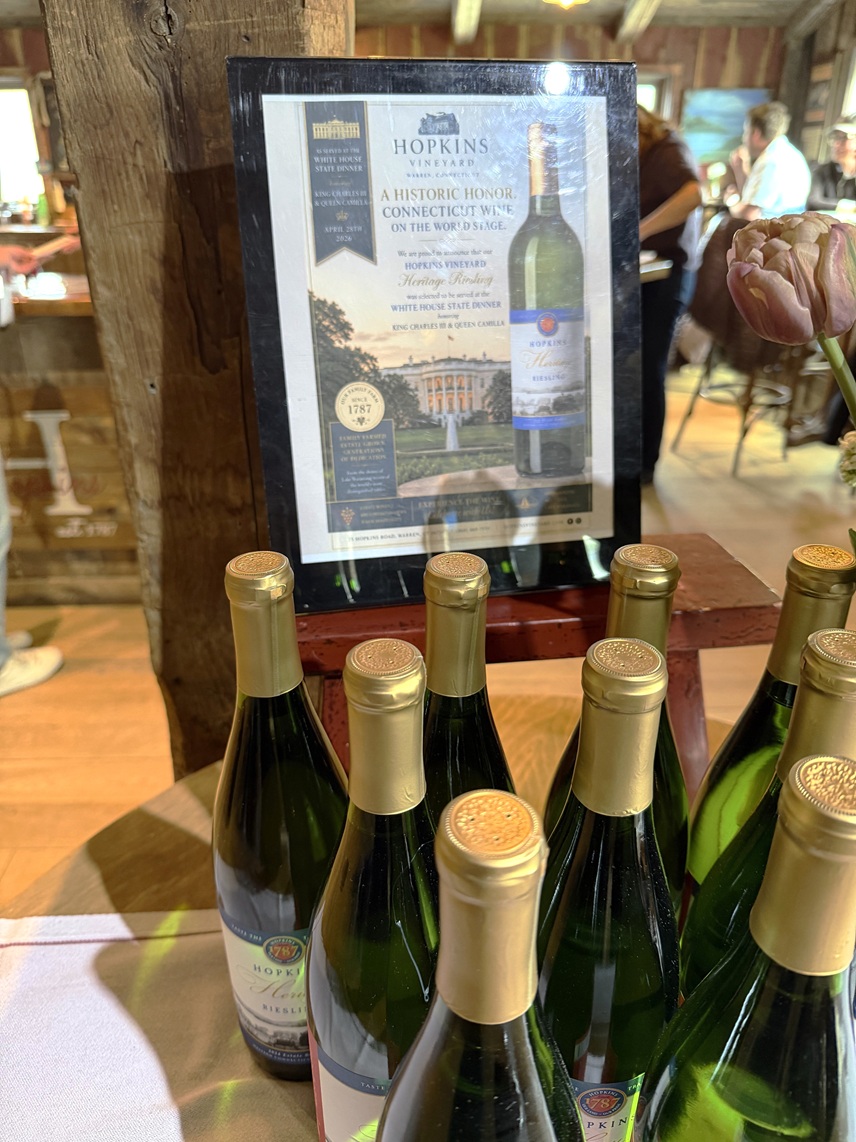 State Dinners are always fun.
Right?
Well, never been to one, so I can only assume. But no matter, we are here only for the wine, and maybe food.
I had been following the subject of State Dinners for as long as this blog has existed. For example, here is a post analyzing the selection of wines at Obama’s state dinner at the end of his presidency. You expect that the State Dinner represents your country, so only the best of the best should be served – yet when it comes to hundreds of thousands of wines (I’m talking about different labels and vintages, not production quantities) available, it is clear that deciding on “best” is not a simple task.
Once I heard of the dinner in honor of the King of England’s state visit, I knew I had to do some sleuthing. This time, it was very easy, as all information was clearly presented on White House’s website. Having an experience with web links disappearing with time, I will respectfully allow myself to copy the information from the White House website, so it will be available here for anyone who comes across this post some years later – here is the link to the original information.
MENU
First Course
Garden Vegetable Velouté (Hearts of Palm, Toasted Shallots, Micro Mint)Second Course
Spring Herbed Ravioli (Ricotta Cheese, Morels, Parmesan Emulsion)Third Course
Dover Sole Meunière (Potato Pavé, Spring Ramps, Snow Peas, Parsley Oil)Dessert
White House Honey & Vanilla Bean Crémeux (Flourless Chocolate Gâteau, Almond Joconde, Crème Fraîche Ice Cream)WINES
The following wines were selected to complement the menu while honoring the shared heritage and enduring friendship between the United States and the United Kingdom, and celebrating the strength of American winemaking today.
Hopkins Riesling “Heritage” 2024, Hopkins Vineyard, Connecticut
The Penner-Ash Pinot Noir “Willamette Valley” 2022, Penner-Ash Wine Cellars, Oregon
The Newton Chardonnay “Unfiltered” 2022, Newton Vineyard, California
Food sounds great, but we are here for the wines, so let’s talk about them.
First, highlighted in blue above is the explanation for the rationale behind choosing the wines. And knowing Melania’s level of attention to detail, we also have to assume that while representing the heritage is important, the wines have to pair well with the food.
I can perfectly see how Penner-Ash Pinot Noir, the wine from one of the most respected producers in Oregon, can perfectly match that pasta, anchoring on the Morel mushroom element, probably to perfectly complement the dish.
While I’m not really familiar with Newton Unfiltered Chardonnay, any California Chardonnay can be considered “iconic”, so again, I can see it perfectly complementing delicate Dover Sole in buttery sauce.
Which leaves us with Hopkins Heritage Riesling, and here we need to take a pause.
I have to be honest. When I saw a wine from Connecticut to be one of the 3 wines served at the State Dinner, my first reaction was “what?????? come again????”. I live in Connecticut. A few years back, we visited several Connecticut wineries with friends, and we were not very impressed.
Okay, so I wrote “a few years back” above, and then decided to check if I wrote anything about that visit. Well, yes, I did. And if 11 still qualifies as “a few”, we are good, but nevertheless, that visit took place in 2015. Yes, 11 years ago – a good chunk of time in the life of a winery.
In any case, I completely forgot the details of that trip – only a general (not a great one) impression. And you can imagine my surprise seeing a Connecticut wine presented at one of the highest honors in the country. But – I live in Connecticut, remember? Google Maps to the rescue – the Hopkins Vineyard winery is only 1.5 hours away, so it was rather a no-brainer – we have to visit the winery over the weekend and taste the Connecticut Riesling worthy of serving at the State Dinner.
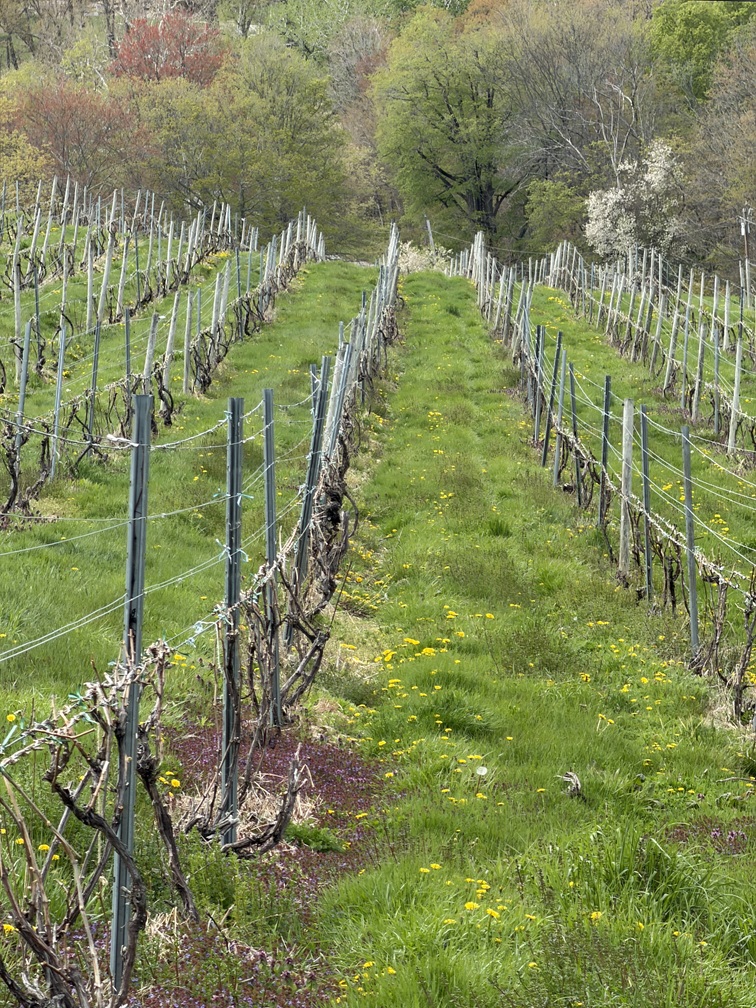
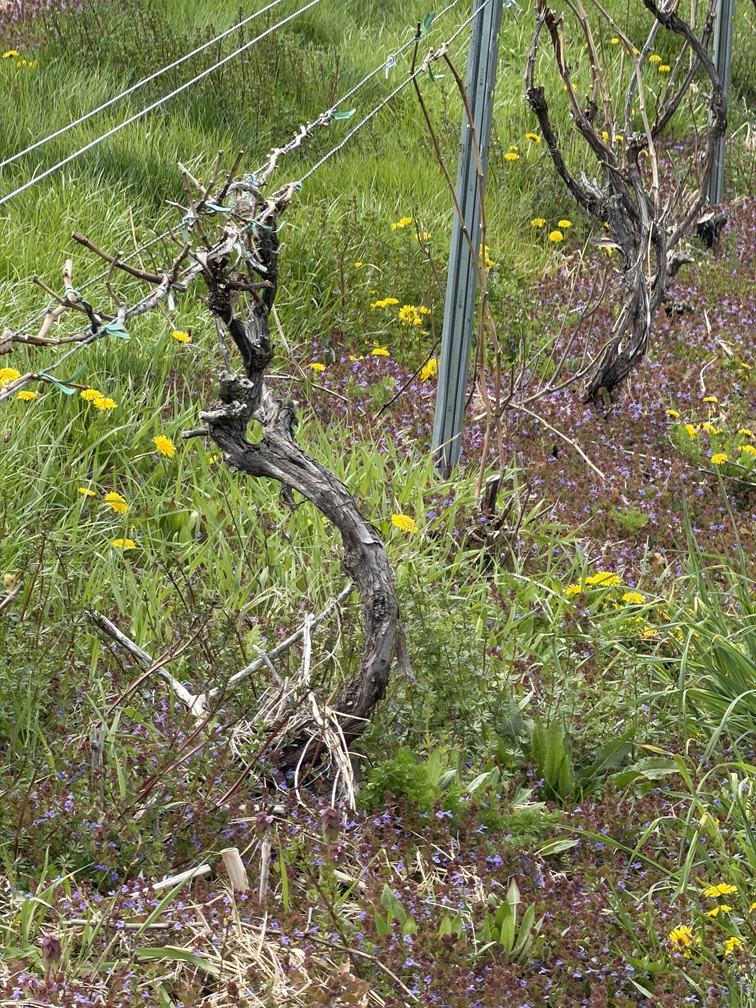
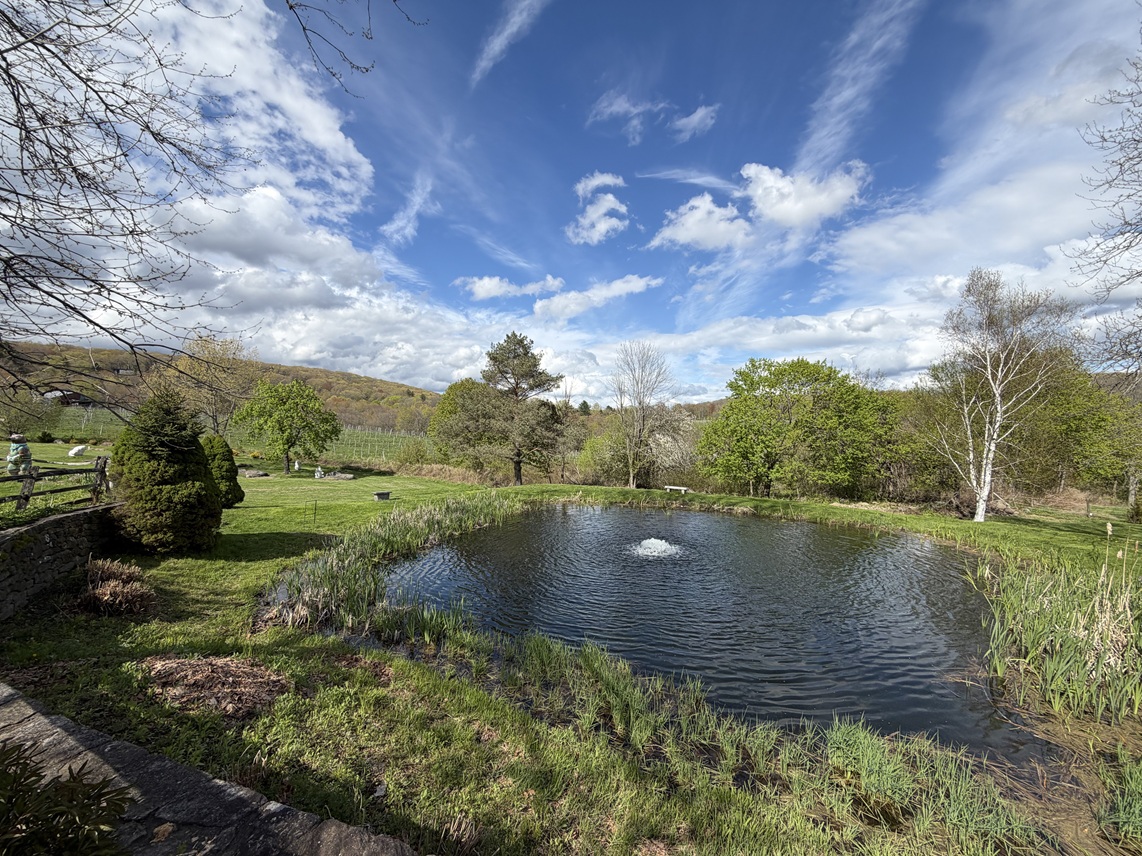
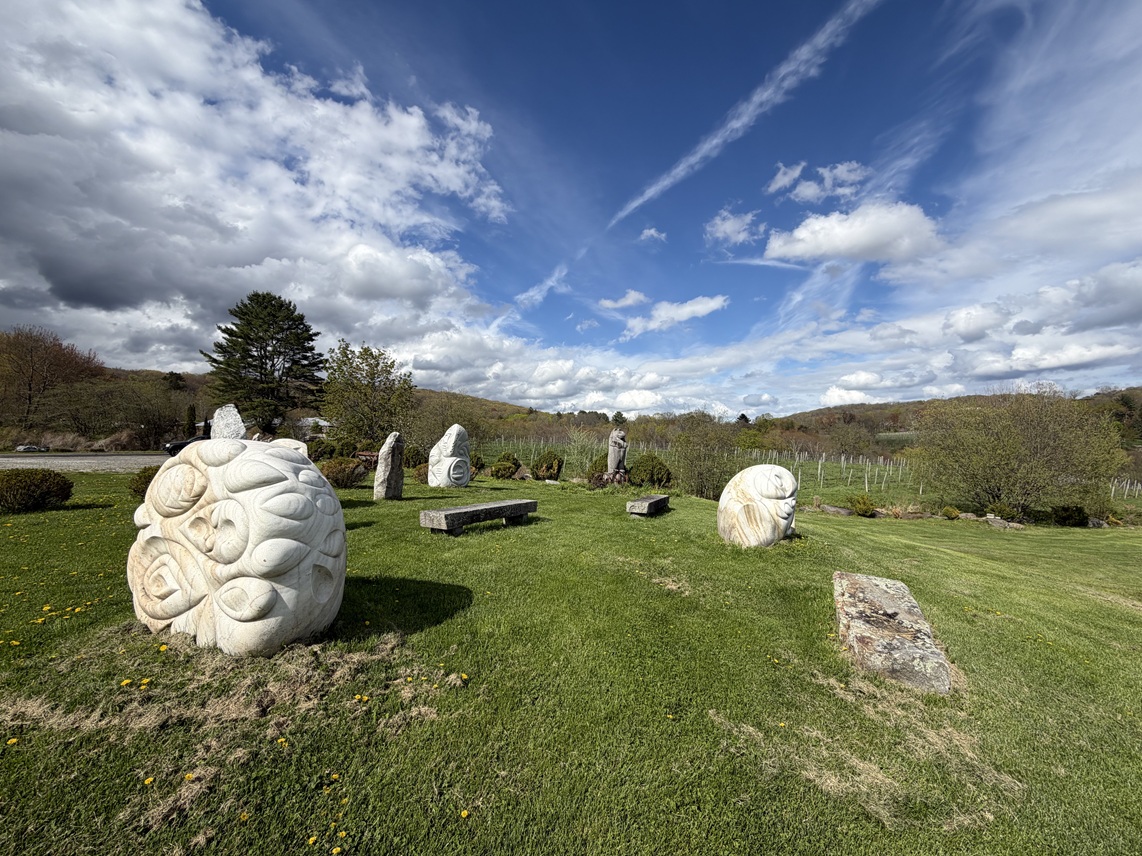
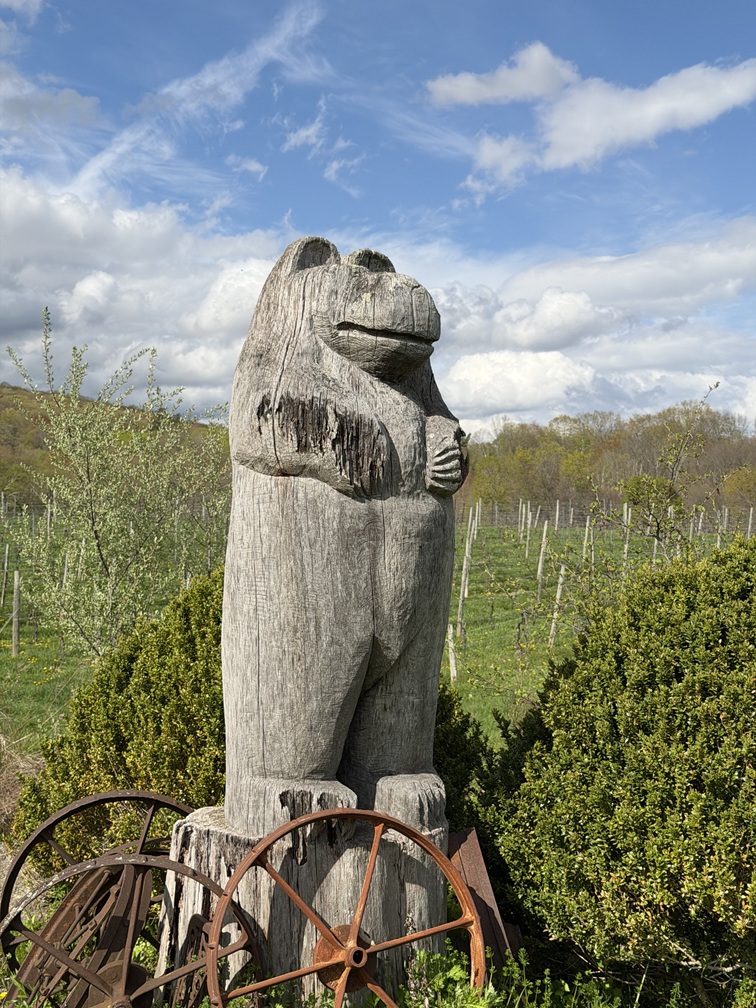
Finding the place was easy. Beautiful location, right by the lake. The winery was quite busy on an average Saturday in May, which is probably not surprising considering all the press they got. Obviously, Riesling had a special recognition. And it was not available for tasting, but we could buy a bottle, one per person. We decided to take a tasting flight, but before we talk about it, let’s answer possibly the most burning question: how did that Hopkins Vineyard Heritage Riesling end up served at the State Dinner?
First, I asked the gentleman who was pouring the wines. He said that he heard that someone had just called from the White House and asked for the wine to be sent there. I was not satisfied with this answer, as in my mind, it can’t be that simple. Then, when we were practically leaving, by pure chance, I ran into Hilary Hopkins Criollo, who happened to be the 10th-generation owner of the Hopkins Vineyard. I asked her the same question: how did it happen that your Riesling was served at the State Dinner, hoping to hear that it was some special connection she had. But actually, the story was exactly as I was already told. Some weeks prior to the State Dinner, Hilary got a call from the White House staff, asking her to send 4 bottles of her Riesling for tasting. A week or so later, she got another call, asking her to send 4 cases of that Riesling to the White House. End of story.
In retrospect, it all makes sense. The dinner was in honor of the King of England, so serving the wine from New England creates a perfect connection to the history. Hopkins Vineyard is the oldest family-owned winery in Connecticut, and the estate was founded in 1787, which makes it almost the same age as the USA itself – another great connection to the heritage, one of the important selection criteria mentioned on the White House website. And lastly, having tasted wines from many wineries in New England, and having tasted Hopkins Vineyards Heritage Riesling, this was potentially the best choice for serving a crisp white wine to complement the first dish on the menu above.
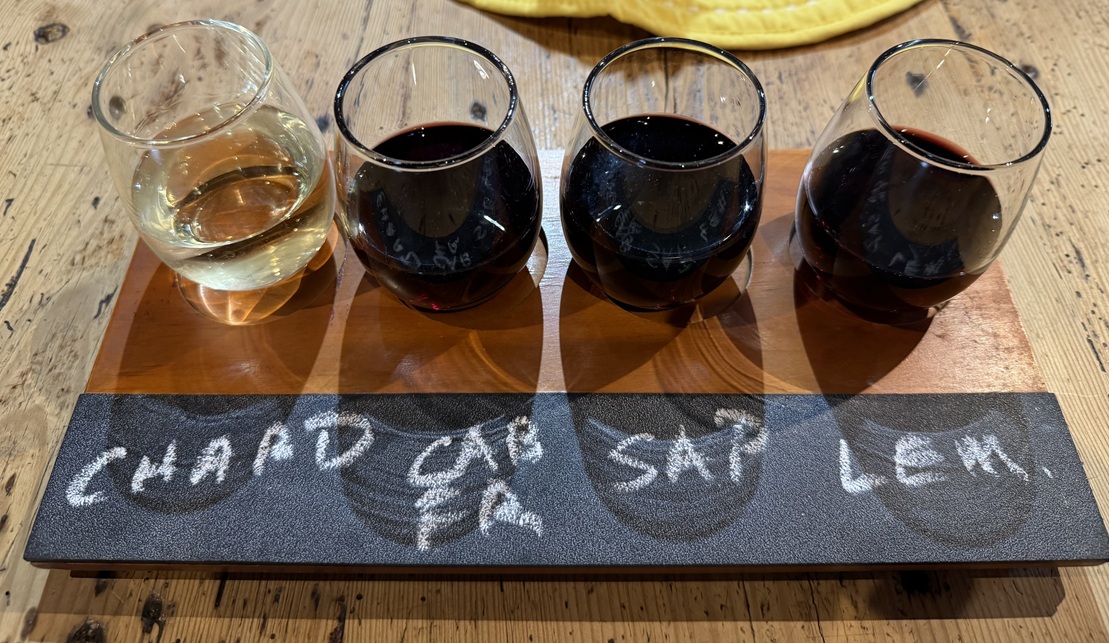
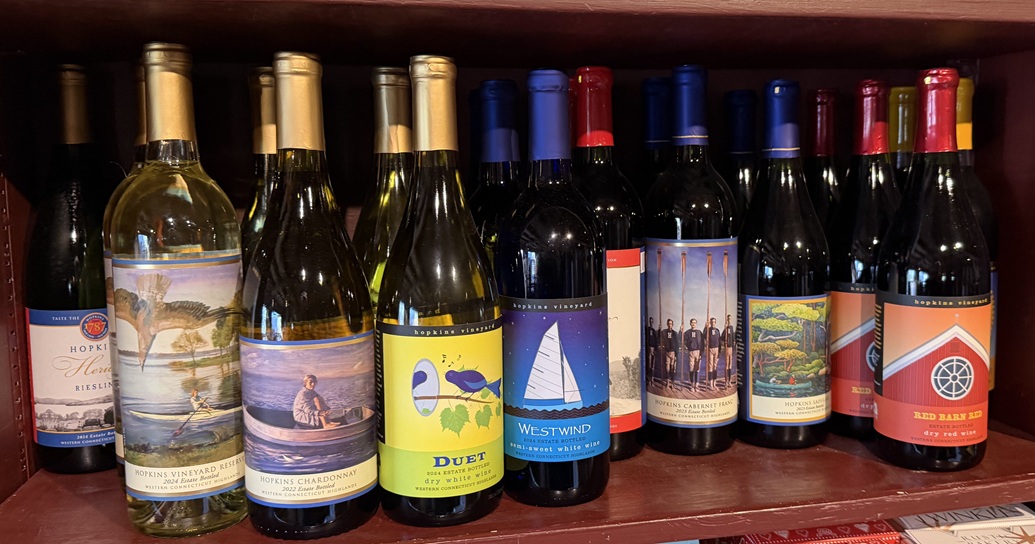


Now, let’s get back to the wines we tasted. You can build your own tasting set, so we took Chardonnay (easy choice :)), Cabernet Franc (a must on the East Coast), Saperavi (how can I resist), and Lemberger (another easy choice). Here are my notes:
2022 Hopkins Vineyard Chardonnay
At first, the nose is closed.
Nice, simple, good acidity, a hint of clove
After it warmed up a bit and opened a bit, a very nice Chardonnay with apples and vanilla. Definitely a solid effort.
2023 Hopkins Vineyard Cabernet Franc
Bell pepper (a hint of)
Bell pepper on the palate, black pepper, round and generous. A bit too warm.
2023 Hopkins Vineyard Saperavi
Mostly herbal nose
Varietally correct palate, needs to be served colder, but it is okay. Mostly acidic finish.
2024 Hopkins Vineyard Lemberger
Hint of dark fruit
Barnyard notes, nice and supple. Quaffable. Needs time to open up.
The Chardonnay was my favorite from this flight. For the reds, they were warmer than I would prefer for my palate, and overall, they were okay but not exciting.
We got our two bottles of Riesling and went back home. But of course, it was impossible to resist, so after a quick chill in the sleeve, the bottle was opened.
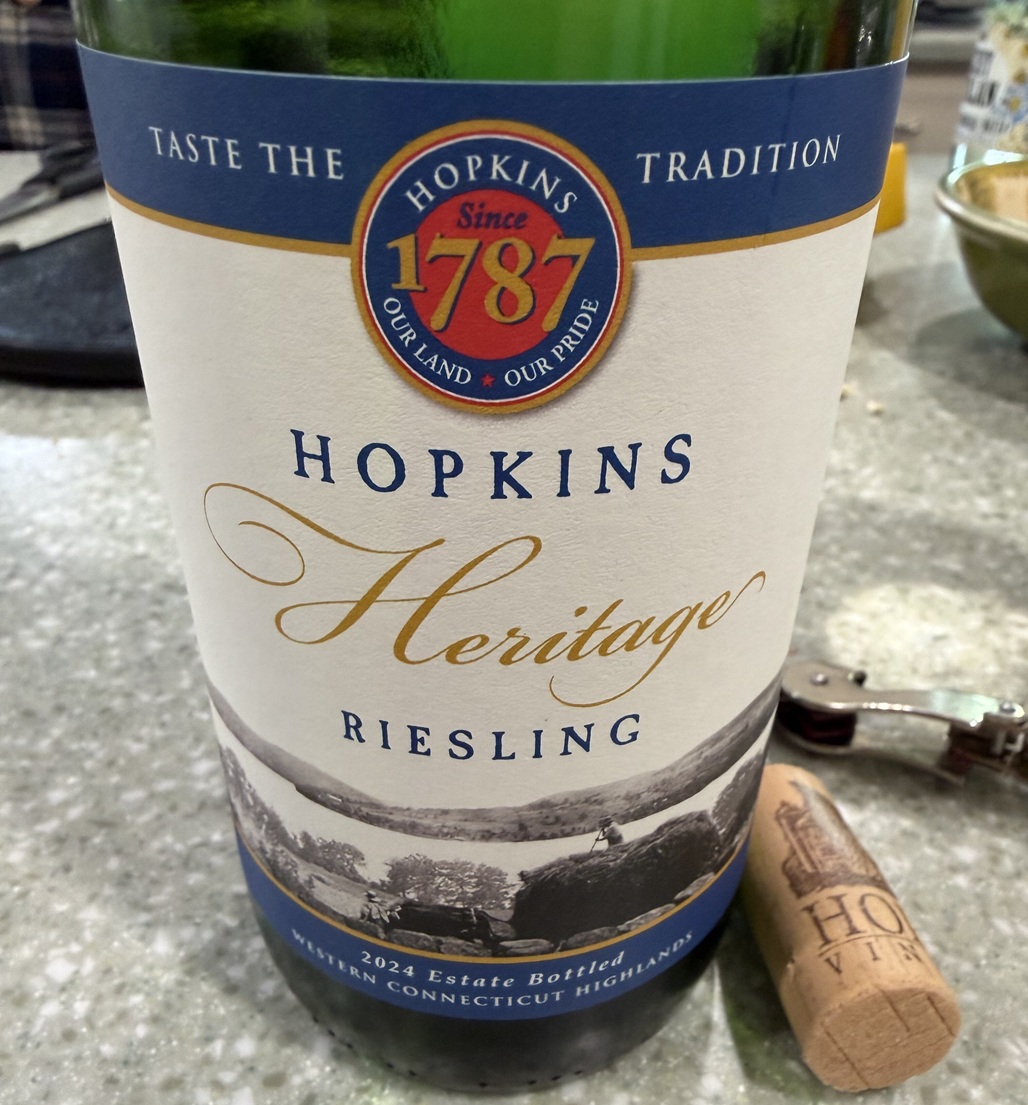
2024 Hopkins Vineyard Heritage Riesling Western Connecticut Highlands (12% ABVF, $33)
Light straw
Hint of tropical fruit on the nose, a hint of honey
Crisp, clear, vibrant, and elegant, a distant hint of tropical fruit, good balance, and great acidity on the finish.
8, very impressive
As you know, one way or another, I usually try to taste the wine over a period of a few days. It happened that I was finishing this bottle 6 days after it was first opened (I simply pumped the air out, as I always do), and the wine was still well drinkable. On the palate, the profile changed a bit, becoming more reminiscent of the East Coast Vidal, thus well adhering to the notion of East Coast terroir if we can define such a thing. But again, still very well drinkable.
Here you are, my friends. A winery rediscovered. And the wine worthy of a king, made (almost) in my backyard. The inner collector of experiences has a huge smile on its face. I still have another bottle to enjoy at some point, but the plan is to lose it for the next 5-10 years.
Until the next time – cheers!
Wednesday’s Meritage – Wine Quiz Answer, #MWWC7 Few Days Left, Cali Crush Report, Wines At State Dinner, And More
Meritage time!
Let’s start with the answer for the wine quiz #92, grape trivia – Montepulciano. In the quiz, you were supposed to answer 5 questions about indigenous Italian grape called Montepulciano. Here are the questions, now with the answers:
Q1: In the number of regions, Montepulciano is often blended with … [name that grape]
A1: Sangiovese is a popular blending partner of Montepulciano.
Q2: Wine Spectator calls wines rated in 95-100 range Classic (the highest and the most prestigious category). True or False: there are no Montepulciano – based wines rated in the Classic category
A2: False. There a few Montepulciano wines with the ratings of 95 or above. For example, 2000 Emidio Pepe Montepulciano d’Abruzzo got 97 points from the Wine Spectator.
Q3: From the list below, which state in US doesn’t make any Montepulciano wines of notice:
a. California, b. Maryland, c. North Carolina, d. Texas, e. Washington
A3: Interestingly enough, Washington so far doesn’t have any Montepulciano plantings of notice.
Q4: True or false: from 2000 to 2010, plantings of Montepulciano in Italy increased by more than 15%
A4: True. Plantings of Montepulciano in Italy increased from 28,679 acres in 2000 to the 34,824 in 2010.
Q5: Best known Montepulciano wine comes from Abruzzo in Italy and it is known as Montepulciano d’Abruzzo. Do you know the name of the white wine commonly produced in Abruzzo?
A5: Trebbiano d’Abruzzo is a white wine from the Abruzzo region.
When it come to the results, first of all, we had very good participation in the quiz, quite a few answers. And, most importantly – we have a winner! Tracy Lee Karner answered all 5 questions correctly, so she gets the top prize of unlimited bragging rights! Great job! I also would like to acknowledge Suzanne of apuginthekitchen and Mario Plazio (no web site), who both got 4 questions out of 5 correctly. Very well done!
Now, to the interesting stuff around the vine and the web!
Boy, I have a lot of interesting reads for you. First of all, there are only a few days left to submit your entry for #MWWC7, “Devotion”. Over the past few days there were quite a few submission, which is great. I have a problem to come to grips with this theme, as “devotion” doesn’t trigger any mental image for me – I would much happier deal with “obsession” or at least a “dedication”. Anyway, may be my muse will still come, all covered in the snow? No matter – get your wine devotion story going! Here you will find rules and submissions to the date.
Like the grapes and the numbers? I personally do – I don’t even know why. Anyway, the California Agricultural Statistics service just released the numbers for the 2013 grape crush report – 4.23 million tons of grapes were crushed last year, up 5% from the 2012. The most crushed grape in California was Chardonnay, closely followed by Cabernet Sauvignon and then Zinfandel. For all the numbers please take a look at this article at WineBusiness.com.
Now, I want to share with you two interesting articles from the Dr. Vino’s blog. First, it is always interesting to know what the other people drink, right? Don’t you try to glance at the label of the wine been served at the table next to you? So this is not just some other random people we are talking about here – Dr. Vino analyses selection of the wines from the State Dinner given by US President in honor of the high guest from France. Here is the article – and similar to the Dr. Vino’s opinion, my question is – really? These are the best wines made in US? Okay, okay – I didn’t taste either one of the particular 3 wines served at that dinner – in case you have, I would be really interested in your opinion.
Last, but not least for today is another article from Dr. Vino’s blog – a short post about the sale of the wines at the auction in Chicago. Considering all the stories about the counterfeit wines nowadays, it is not surprising that the wines with the guaranteed provenance are sold at the premium nowadays. But for me personally, it is the data in that old receipt which is very interesting – $78.99 for the Echezeaux or $68.99 for Vosnee-Romanee – sigh, and another sigh – are those days gone forever?
And we are done here. The glass is empty – but the refill is on its way! Cheers!
Last Bottle Sign Up ($10 credit)





