Looking Back and Looking Forward
 I’m sure you guessed from the title and the timing of this post that I want to talk about past year 2015 and freshly minted 2016. Yep, I’m predictable like that, you are correct.
So how was 2015 for 2015 for Talk-a-Vino in my own eyes? Great, but challenging. Very challenging. 2016 will be equally difficult, with great potential to be even more challenging, a lot more.
Sure, I will explain. Nothing happened with my love of wine or passion for blogging – both are as strong as ever. What I had (and will have) a problem with is time – my main line of work (the one which pays the bills, you know) is incomparably busier than two years back, and finding quiet time for the labor of love is now not easy at all. No, I’m not complaining, just explaining the change in cadence of the posts coming out.
Talking about 2015, there were few new things which I started doing. During the year, I was offered a few opportunities to meet with the winemakers, and was unable to find time – this is how the concept of virtual interviews came to life. I realized that even when I can’t sit down with the person in the same room, I can still ask questions – and get great answers. I also offered to profile wine apps for any of the app producers who would be interested, and so far had 3 posts in that series – by the way, the offer still stands if anyone is interested.
From the things which I didn’t like so much, but they still happened in 2015, was stopping the series of the Saturday wine quizzes. I had lots of fun creating those, but reached the point when it became very difficult to create challenging, but fun questions, so I had to stop the series, at least for the time being.
What should you expect in 2016? I definitely will continue the virtual interviews – as a matter of fact, one of them is coming out very shortly. I also have good number of posts which I really should’ve written last year, but did not. There were wine dinners, there were tastings, there were winery visits which never made it into the posts. However, the subjects are still worth taking about, so you should expect to see some of those “posts from the past”. I don’t know if I will make a series out of those posts (as an engineer, I like to organize things, may be even more than necessary), add short intro to those posts, or simply put them out without any regards to the “past” – no matter, they will still appear on Talk-a-Vino pages.
2016 is on, so let’s raise the glass to all the fun things which are ahead of us. Cheers!
Happy New Year 2016!
I would like to wish you and your families wonderful, healthy, happy, peaceful and prosperous New Year 2016, full of new experiences and great little moments which comprise life. I wish you to have just enough failures so you can grow and move forward in your life. And as this is the wine blog, I wish you lots of wonderful, life changing and emotional wine moments.
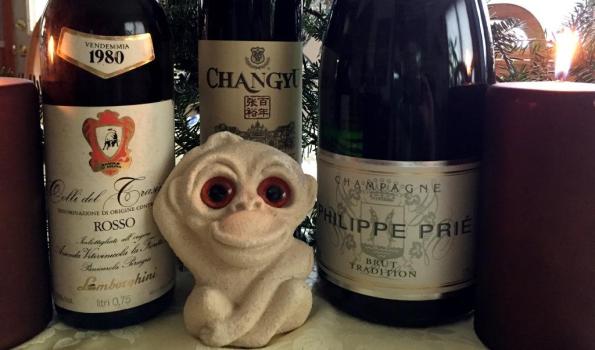 2016 is the year of the Monkey – in the Chinese calendar, of course, so it will actually start on February 4th. it is also a year of the Fire Monkey – but the monkey you see above was the only I had handy for this picture (and I really don’t know how fire monkey should look like). The wines you see in the picture is what will be opened over the next few days – I will tell you later on what I think of them.
Happy New Year and let’s raise a glass to life! Cheers!
A Puzzle of a Hundred Pieces
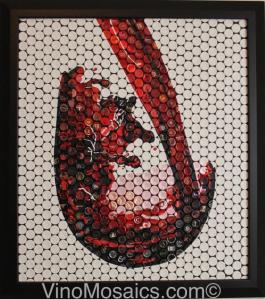
This beautiful artwork is constructed from tops of wine foils. Picture courtesy of Ryan Sorrell of VinoMosaic.com
Is there a person in this world who doesn’t like puzzles? You can save the “duh” exclamation for later – I’m sure there are some people who don’t, but an absolute majority enjoys the puzzles of some sort, whether expressed in the form of words, numbers, colorful picture pieces, link chains or whatever else.
So what if I tell you that you will be given a hundred of random pieces – not just you, but a group of people will receive a hundred of totally random pieces, but they all would have to build exactly one and the same picture out of those 100 random pieces – would you like to take part in such a challenge? Do you think you would be up for it?
While you still considering if you are up for a challenge, you are probably also wondering how puzzles relate to the wine and what you are still doing reading this nonsense where you were looking for the information on the wine, plain and simple. Actually, it appears that this type of puzzle with random pieces but the same resulting picture has very direct relationship with the world of wine. Not necessarily with the whole of it, but definitely with one of the most noble parts – the Champagne.
If you ever read the story of Benedictine monk Dom Perignon, often credited with creation of Champagne (”come quickly, I am drinking the stars”), many wine historians agree that major Dom Perignon achievement is not creation of Champagne itself, but perfection of the art of blending. If you think about it, blending resembles the process of putting together puzzle pieces. And to complete the picture, take a look at the description of any of the Champagne made by so called Champagne Houses – Veuve Clicquot, Moèt and Chandon, Bollinger, Perrie-Jouiet and hundreds of others – they all talk about a “signature taste” of their Champagne House, which is painstaking maintained exactly the same through the hundreds of vintages.
While I knew about significance of blending in production of Champagne, I never understood a true scale of an effort. A month ago (almost two month by the time I was able to finish this writing), I was lucky enough to attend a first ever Vins Clairs (give a few seconds – I will explain what this is) tasting hosted by the Champagne House of Piper-Heidsieck and Terlato Imports in the US – well, it was simply first ever Vins Clairs tasting conducted outside of France. The event was led by Régis Camus, Chef de Cave and Winemaker for Piper-Heidsick. And yes, we spent time learning about puzzles.
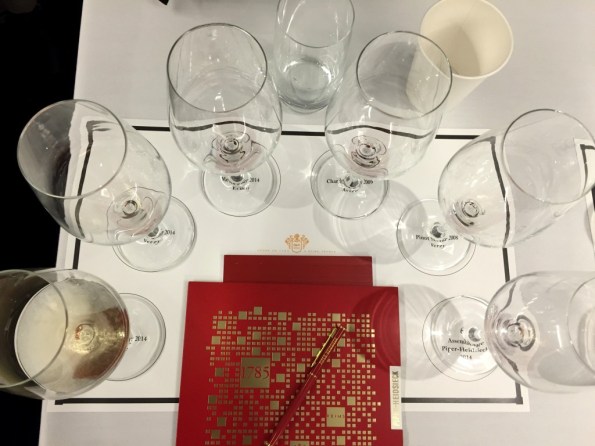
Let me give you a brief photo report for what was happening at the event first, and then of course we will go back to puzzles. When I arrived (early, to get a seat in front), the room was ready for the tasting:
 And the expectations started building as the carts showed up:
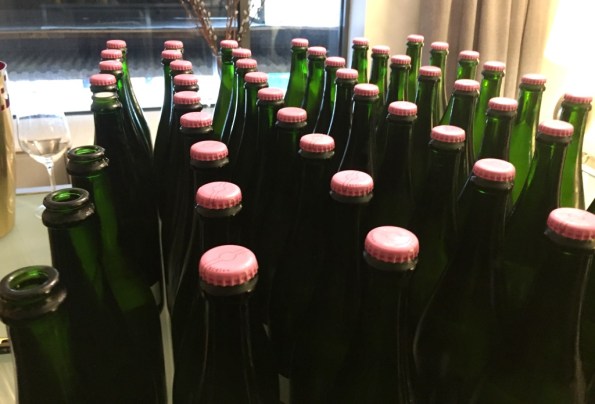
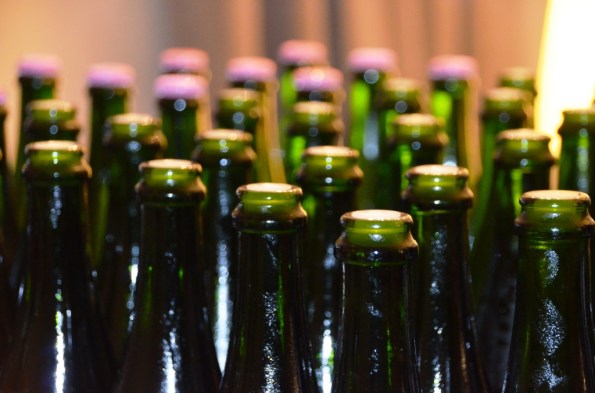 This is what went into our tasting glasses:
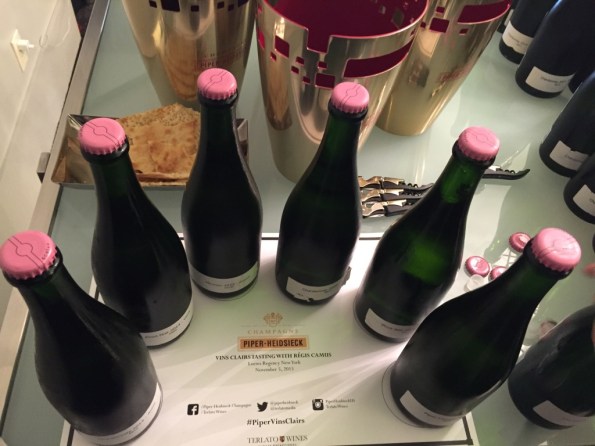
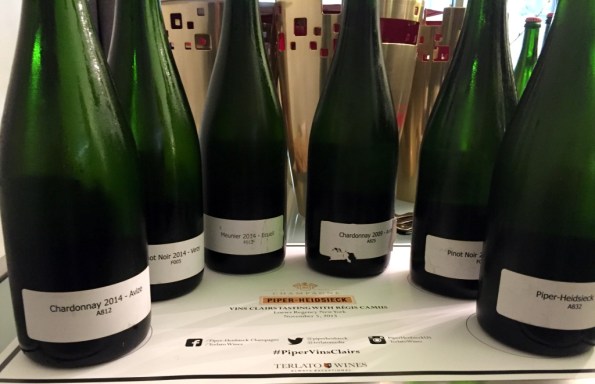
Bill Terlato welcomed everyone to the tasting:
 And then we started to learn about puzzle pieces. Of course, first talked about what Champagne is – “Champagne comes only from Champagne”:
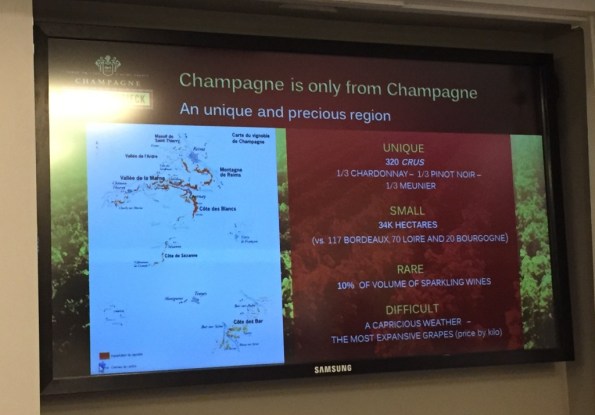 All grapes used in production of Champagne come from 320 different vineyards, which are also called CRUs. Out of those 320, only 17 have a status of Grand Crus – as they produce distinctly better grapes. Just to give you few more fun numbers – there are about 19,000 grape growers in Champagne, out of which only about 2,100 produce their own wine. There are also about 50,000 Champagne labels – which, of course, explains that it is always possible to come across a champagne bottle you never saw before.
But let’s get to our puzzle, as we still need to solve it. Every year, the grapes are harvested (just a quick reminder – there are 7 grapes allowed to be used in Champagne, but only 3 – Chardonnay, Pinot Noir and Pinot Meunier are really used), pressed and fermented into the still wine, same as it would be done with any other wines – with the exception of color – red grapes, such as Pinot Noir and Pinot Meunier, still produce clear juice if not kept in contact with skins, and this is what typically done in production of Champagne – unless Rosé is in the making. Once fermented, these still wines now become foundation of Champagne, known as Vins Clairs.
As common with any still wines, the year is a year is a year – every year is unique and different. If the year was great, let’s say, for Chardonnay, the Chardonnay Vins Clairs will become a Reserve wine and will rightfully occupy the place in the cellar. If the year was just okay, the wine, of course, will be used, but will not be cellared for long. If the year was terrible, the wine simply might not be produced. But it is okay – remember, we got lots of pieces to play with.
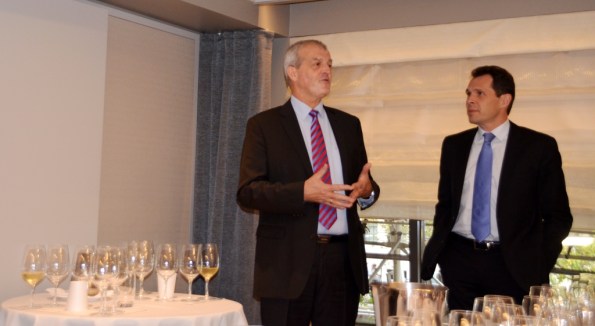
Régis Camus (on the left) explains what does it mean to create a Champagne wine
First, we tasted through 5 different Vins Clairs – each one a component in the Piper-Heidsieck Champagne, each one with its own role. Chardonnay brings fruit aroma, citrus, minerality. In reserve wines, Chardonnay will bring more aromas. Pinot Noir provides body and structure, and it is usually main component in Piper-Heidsieck Non-Vintage Champagne. Pinot Meunier brings fresh fruit. Below are my notes, almost verbatim, as I followed explanations and tasted the wines:
2014 Chardonnay Avize – Avize village is in the center of Côtes de Blanc, and it is one of the 17 Grand Crus. Straw pale color. Beautiful nose, minerality, fresh, citrus. Clean acidity on the palate, green apple, nice acidic finish. This wine was mostly used for vintage and reserve wines, and will be a part of non-vintage champagne in 5–6 years down the road.
2014 Pinot Noir Verzy – Verzy is also one of the 17 Grand Crus. Light golden color. Interesting nose, mostly white fruit, very serious acidity, lemon/lime level, very interesting. I would have to agree on structure. In a blind tasting I would say Muscadet.
2014 Pinot Meunier Ecueil (fleshy and fruity, red grape with white juice). Light golden color. Brings in fresh fruit to the blend. White fruit on the nose. Pinot Meunier rarely used for reserve wines. Still acidity, but acidity of the fruit, more of the green apples.
2009 Chardonnay Avize very interesting color – green into golden. Beautiful minerality, classic Chablis gunflint. Delicious. Creamy, medium body, white fruit, restrained acidity, long finish. I would gladly drink this wine by itself.
2008 Pinot Noir Verzy color similar to Chardonnay – green-golden. White fruit on the nose with touch of minerality. A bit more fruit on the palate, but still extremely pronounced acidity.
After we tasted through the 5 Vins Clairs, we were asked to refresh our palates with a sip of Pinot Meunier, and the final wine #6 was poured. Boy, what difference was that – mind boggling, starting from the color:
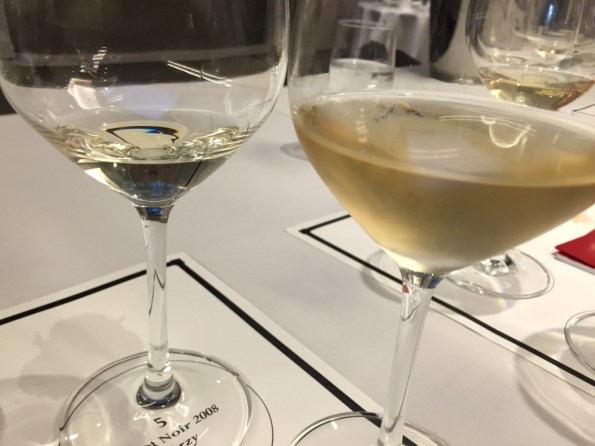
2014 Assemblage Piper-Heidsieck is to the right
2014 Assemblage Piper-Heidsieck – blend of 2014 (90%) and reserve wines (10%) – darkest color of all, beautiful nose with yeastiness, and fresh bread, good minerality. One would never guess that you can get that from individual wines. Color came from the fact that the wine was not stabilized yet. Delicious overall, excellent acidity. 55% Pinot Noir, 15% Chardonnay, the rest is Pinot Meunière. There are 100–110 crus in this final assemblage, and the work on it was finished very recently. This wine was bottled in 2015, and will be released in 2018.
Someone asked if it is possible that the puzzle will not be solved in some years. Régis Camus gave us a little smirk, and said that no, this is not possible – the puzzle will be always solved.
What can I tell you? This was definitely an eye-opening experience – we were allowed to touch the magic, the magic of creation of one of the most revered wines in the world, and it definitely exceeded my expectations.
This was the end of the Vins Clairs tasting, but the beginning of “no-holds-barred” Piper-Heidsieck Champagne tasting -we had an opportunity to try all the major Champagne Piper-Heidsieck offers – 2006 Brut Vintage, 2002 Rare Millesime, Rosé Sauvage and Cuvée Sublime (Demi-Sec)


At this point, I was part exhausted, part excited, and stopped taking notes – I can only tell you that 2006 Brut and Rosé Sauvage were two of my favorites, but I would have to leave it only at that.
Here you go, my friends – the magic of Champagne, a puzzle of a hundred pieces – but the puzzle which is always solved. The New Year is almost here, and of course it calls for a perfect bottle of Champagne – but even if not a New Year, we can simply celebrate life, and every day is a good day for that. Pour yourself a glass of sparkles and let’s drink to the magic, and life. Cheers!
My Favorite Wine?
Once people establish that I’m a wine snob [connoisseur, aficionado, oenophile – please insert one more appropriate], very often I hear one of the most dreadful, intimidating, difficult questions an oenophile can get – “so tell me, what is you favorite wine?”. When I shrug the question off and say “sorry, I don’t have one”, the usual continuation is “oh, come on, you must have one”.
It is hard to explain that my answer is not a coyly, flirting attempt to exaggerate my self-worth, but I think it would be true for any oenophile – it is impossible to name one wine and to say “this is it, this is my only favorite wine”. I’m not even talking about one specific wine from one specific producer, and it is not even one specific grape – either way you spin it, oenophile is always ready to give you a short and concise list of favorite 100 wines. Note that the longer the conversation will be, the longer the list will become. It should be much easier to answer question about the dream wine – the wine one obsessively wants to try – of course there always many on that list too, but at least for me it is easy to single out one dream wine – DRC (yes, I know that Domaine de la Romanée-Conti makes more than one wine, but I’m not picky, you know…).
It is really hard to pick the favorite wine as the more you taste, the wider your “circle of knowledge” becomes – and you are bound to find gems in every little cornier of the vast winemaking world, with hundred thousands new wines produced every year. To top that diversity off, even for one and the same person taste of wine is very subjective, affected by mood, weather, company and myriad of other factors. No, it is an impossible question.
Now, I want to offer you something instead. At the end of every year I make an effort to reflect on the wines I had a pleasure experiencing, and to summarize it in “Top Wines” post. So far I produced 5 such posts, which I call “Top Dozen”. I managed to keep those posts to a dozen only in 2010 and 2011, and then 2012 – 2014 all included two dozens of the top wines. As it is time to write the same for the 2015, let me reflect a bit on the past posts and give you a list of Top 10 wines from 2010 – 2014. While I always state that those top lists are given in random order, the wine #1 is always thought through, so those choice are not random. Lo and behold, here are the Top 10 Talk-a-Vino wines of 2010 – 2014:


2010
2. Rozes Over 40 Years Old Port ($90). My best port ever. I can close eyes and imagine the smell and taste of this wine – multiple layers, tremendous complexity and great opportunity to reflect on life when the finish lasts for 15 minutes. Find this wine and experience for yourself.
1. Mara Laughlin Road Ranch Pinot Noir 2007, Russian River Valley ($45). Incredibly balanced, silky smooth wine, very powerful and round. Alcohol content is 15.6%, and it can’t be noticed unless you read the label. Great wine now, will improve with some cellar time. Find it if you can.
2011
2. 2001 Masi Mazzano Amarone della Valpolicella ($130) – this was an Amarone I’m constantly looking for and can’t find. Stunning nose of the raisined fruit, a dried fruit extravaganza – with powerful, structured and balanced body – not a glimpse of overripe fruit which is so common in the nowadays Amarone. Truly beautiful wine for the special moments.
1. 2010 Fiction Red Wine Paso Robles by Field Recordings ($20) – First and foremost, it is a smell which doesn’t let you put the glass down. Fresh flowers, meadows, herbs, fresh summer air – it is all captured in the smell of this wine. On the palate, this wine shows bright red fruit, like raspberries and cherries, all perfectly balanced with a great finesse. Any time you want to experience beautiful summer day, reach out to that wine.
2012
2. 1947 Imperial Gran Reserva Rioja ($400) – 65 years old wine – still bright and youthful. This was one amazing experience – tasting the wine of such an age, and finding that you can really like it without looking for any age discounts. Fruit was still bright, all wrapped into cedar box and eucalyptus notes, with soft tannins and fresh acidity.
1. 2010 Phantasi Oregon White Wine ($100, Magnum price in the restaurant) – wine geeks, rejoice! This is your wine! If you read this blog for a while, you already know that I’m self-admitted wine snob. But – you probably also know that compare to the wine snob, I’m somewhat of a 100-fold wine geek. I would try absolutely any wine and I purposefully seek odd and unusual bottles.
When this wine was offered to us in the restaurant $100 for a magnum, this was an offer I couldn’t pass by. And what the wine it was! This is 100% Roussanne wine from Oregon, made by Antica Terra – unfortunately, you can’t even find any information about this wine on the winery web site.
The wine was served at the room temperature. Deep, pungent, concentrated – in the blind tasting (actually blind, so you would not be able to see the color in your glass) I’m sure this wine would be easily identified as red. Good acidity, good balance, very food friendly – and very unique.
2013
2. 2005 Frédéric Gueguen Chablis Les Grandes Vignes – I remember almost making fun of someone else using the word “gunflint” in the wine description. And here I am, taking a first sniff of this wine with the first word coming to my mind … gunflint! That sensation of gun powder-like smell, the smoke was incredible – and it was very pleasant at the same time. Tremendous minerality, lemony notes and some apples, clean and vibrant acidity and perfect balance. This wine was definitely an experience.
1. 1970 Quevedo White Port – even people in Portugal are not aware of the aged white Port – I witnessed a few surprised looks when talking to the people about white Port which is aged. This wine might be never bottled, as I’m sure it is hard to create a category from pretty much a single barrel of wine. Nevertheless, the ultimate complexity of this wine, coupled with the visual snapshot of tasting it in the Quevedo Port cellar (cue in all the aromatics and mysterious atmosphere), makes for an ultimate experience which will stay in memory forever.
2014
2. 2007 Pago Marqués de Griñon Emeritus, DO Dominio de Valdepusa ($75) – until I tasted this wine, yes, I knew that Spain produces good wines from the international grape varieties, such as Cabernet Sauvignon. But at such level? This wine was a true revelation – classic Cabernet Sauvignon with cassis, mint, eucalyptus and finesse.
1. 1966 Louis M. Martini California Mountain Pinot Noir ($NA) – I had no expectations when I opened the bottle of the 48 (!) years old wine. To be more precise, I was not expecting anything good. What I found in my glass was simply mind blowing – still fresh, still elegant, perfectly recognizable as Pinot Noir and delicious! This was the first wine ever to receive a 10 rating from me – I hope it tells you something.
Producing this Top Dozen list is somewhat of a daunting task, as the opportunity to second guess oneself is truly boundless – but then this exercise becomes a source of great pleasure as you get to re-live the whole year.
I understand you still don’t know what my favorite wine is (that makes at least two of us), but with the list above you know at least a bit more, don’t you? In case you are interested in seeing complete TaV “Top Dozen” lists, here are the links for 2010, 2011, 2012, 2013 and 2014.
Keep in mind that whether you consider yourself an oenophile or not, creating a top ten (insert your number) list is always fun, so take piece of paper, pour yourself glass of wine, and get to re-live the year through the wines and all the memories connected to them. Yes, the wine is an emotional connector. Happy reflections!
Sparkle Your Holidays!
The holidays are still upon us, and nobody would argue that bubbles in your glass make you feel excited and festive, and that is exactly what we want for these special days.
Bubbles – let’s properly call them “sparkling wines”, so nobody would think that we are talking about condiments for your bath time – come today absolutely from everywhere. Forget the times when Champagne was one and only, and Cava and Prosecco were known only to a few professionals. Now literally each and every winery offers at least one sparkling wine, even if it is produced in a few hundred cases for the tasting room only.
Such an abundance is great for the oenophiles, as you always have something new to try. Today I want to bring to your attention few of the sparklers I tried recently, which would go great with whatever holiday festivities you are planning. As an extra bonus, these sparkling wines can also serve as a perfect illustration to diversity of places and production methods.
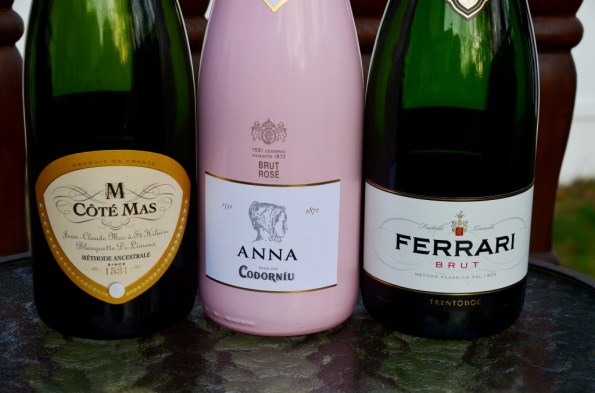
Let’s start from Champagne’s homeland, France – however, this wine is not produced using Méthode Champenoise. NV Coté Mas St. Hilaire Blanquette de Limoux Méthode Ancestrale (7.5% ABV, $15.99, 100% Mauzac) is produced using so called Méthode Ancestrale, which is very close to traditional method and most definitely precedes it. In case of Méthode Ancestrale, first fermentation is stopped before all sugar is converted into alcohol, and then secondary fermentation takes place in bottle with additional only of the yeast (no sugar is added). Unlike Champagne, Méthode Ancestrale sparkling wines undergo very short bottle ageing (3 month versus minimal 12 month and typical 2-3 years for Champagne). This Paul Mas’ sparkler had light golden color, showing yeast with touch of apple, good intensity, promise of a classic sparkling wine on the nose, and then touch of honey and honeysuckle, hint of ripe peach on the palate. As one would expect from only 7.5% ABV, it was quite sweet (similar to spatlese level of Riesling), but with the help of fine mousse, perceived very light and refreshing. I would serve it at the end of a good meal with a sharp cheese, they should go together very well. Drinkability: 7+
From south of France, it is short trip east to Italy, where outstanding sparkling wines are crafted in the northern region called Trento. Here the wines made using “metodo calsssico“, which an Italian name for Méthode Champenoise/Méthode Traditionelle. The requirements for metodo classico wines are even stricter than those for Champagne, with minimal bottle age starting from 15 month to the 10 years for the Riserva. And who can represent Trento DOC better than Ferrari – pioneer in both Chardonnay plantings and classic wine production in the region (Ferrari winery started in 1902). NV Ferrari Brut Metodo Classico Trentodoc (12.5% DOC, $25, 100% Chardonnay) had delicious nose of yeast and fresh apples, and clean acidity on the palate, with lemon and green apple. Classic, classic classic – clean, crisp and refreshing. Drinkability: 7+


Conversation about Sparkling wines would be incomplete without mentioning Cava – Spanish wine produced using classic Méthode Champenoise. Production of Cava is every bit as laborious as classic Champagne, with main differences been slightly shorter minimum bottle ageing requirements (9 month) and typical use of Spanish indigenous grape varietals. Anna Codorniu is one of the best representations of Cava and Spanish winemaking overall, producing wine since 1551 and pioneering Cava production in 1872. I wrote about NV Anna de Codorniu Brut Rosé Penedes DO (12% ABV, $14.99, 70% Pinot Noir, 30% Chardonnay) a few month ago – the wine is delicious, fresh, with fine mousse and pleasant body weight – it will complement any of your holiday festivities perfectly well. Drinkability: 8-
Now, I have two more interesting sparklers for you to consider, both coming from the USA. However, the place is rather unexpected – Finger Lakes region in New York. First one is made using the classic Méthode Champenoise – 2006 Glenora Brut Métode Champenoise Sparkling Wine Finger Lakes (12% ABV, $29.99, 52% Chardonnay, 48% Pinot Noir). Wine had light yellow color, fizz of light intensity. Classic nose – yeast, fresh bread, overall delicate. On the palate, it showed Granny Smith apples, touch of lemon, good acidity, fresh, clean. Overall, it was a good rendition of classic sparkling wine, however, to be consumed in one single day, as it lost all fizz by the second day. I can’t help to mention that at $29.99, QPR is not great. Drinkability: 7+.


To round off, while our last wine is also produced in Finger lakes, it is made using one more significant sparkling wine production technique – Transfer method, where after second fermentation in the bottle (6 month minimum), the wine is transferred to the pressurized tank, thus greatly reducing cost and labor which go into production of Méthode Champenoise wines. Italian Prosecco is made in somewhat similar way (sans the second fermentation in the bottle), and this Finger Lakes wine was modeled exactly after the Prosecco. 2013 Damiani Bollicini Bottle Fermented Sparkling Wine Finger Lakes (12.4% ABV, $15.99, 47% Cayuga, 35% Chardonnay + Pinot Noir, 16% Chardonnay, 2% Pinot Meunier) had straw pale color, touch of tropical fruit on the nose, complemented by a hint of gunflint. Nice creaminess on the palate, delicate fizz, clean, refreshing, crisp. Excellent overall, pleasure to drink, and would complements lots of different foods. Drinkability: 7+
That’s all I have for you for today. I wish you sparkling holidays, whatever bubbles tickle your fancy. Cheers!
Daily Glass: 17 Years Old Beauty
 Absolute majority of the 17 years old are beautiful. Well, at least when it comes to the people. With the wines, this can be a different story. 17 years old in the wine terms is quite an age – some of those 17 years old are slender and muscular, and some are flabby, tired, and barely stand on their feet. And the beauty of the wine is that you can’t know how the wine will be – until you get the bottle opened.
I have to admit that I had no expectations before opening this bottle of 1998 Shiraz from Australia. Aged Australian wines are hard to come by in US, thus I have very little experience with that class of wines. And having no expectations around the wines is generally good, as it often saves you from disappointment. However, I’m sure that you deduced from the title of this post that there was nothing disappointing about my experience.
Dutschke family owned the parcel of land with a few vineyards on it in Barossa valley in Australia since the end of the 19th century. In the late 1900 the grape plantings increased, with most of the grapes been sold to the other wineries. The first wines under the Dutschke name were produced only starting in 1990. Which makes the wine which I opened today one of the early wines produced at the winery.
As I opened the bottle of the 1998 Dutschke St. Jakobi Shiraz Barossa Valley (15% ABV, $25?), the first nice observation was perfect condition of the cork – not a sign of age. The color was very dark garnet – again, not a sign of age. And the smell – wow – concentrated fresh berries, lavender, sandalwood – bright and uplifting. Then the best part – the wine needed no breathing time. Pour, sip and enjoy the exuberance of the fresh berries, savory herbs, dark power, perfect structure, clean acidity and perfect balance. If I wouldn’t check the label, I would’ve never known the wine was 15% ABV – overall, it was perfectly integrated and perfectly enjoyable (Drinkability: 8+/9-). And then the wine just was.
Wish you lots of small pleasures this holiday season. Cheers!
Star Wars Last Bottle Wines Marathon – Starting Thursday, December 17
Finding great wine at even greater price is one of my favorite pet peeves, so I have to share this with you: Chrismukkapalooza (after publishing the post I learned that it was actually a Star Wars themed marathon, which coincides with the release of Star Wars flick #7) Last Bottle Wine Marathon is starting this Thursday, December 17th!

Yes, you heard me right – free up the room in your cellars, people. Last Bottle Wines is one of the very best purveyors of the fine wines at value wine prices, so their marathon events are not to be missed.
Starting at 12 pm US Eastern tine, the new wines will be offered at neck-breaking – sorry, rather finger-and-wallet-breaking – speed. You will have only split seconds to buy the wines, or they will be gone. There are no notifications of any kind during marathon, so all you can do is to hit refresh in your browser over and over again to see the new deals. Make sure you will be logged into your account during the process, because this will make a difference between “yes!” and “damn it!” (been there, done that many times). There are no minimums to get free shipping – all your orders will be accumulated and shipped at once a few days after marathon is over. The marathon will last for 2 days, but it can be shorter or longer, depending on how quickly all the wines will be sold out – and we are talking about 500 wines and 50,000 bottles. You will be also earning 2% back on every purchase, as usual, but not the $25 on the very last bottle.
Now, I’m sure many of you are already aware of Last Bottle wines and already have accounts with them. But for those of you who don’t have an account (and you need one to be able to buy the wines), you can use the link below to sign up:
http://www.lastbottlewines.com/invite/4618917ef4f90628fb70367611992bc630d41515.html
If you sign up using this link, you will get $5 credit on your first order. Yes, I will also get $20 bonus for signing you up – but remember that it will be you who will get $20 next time around when you will sign up your friends – and believe me, your friends will be thanking you profusely.
Happy Fine Wine hunting! Cheers!
How Do You Spell “Delicious” in Italian? Marchesi de’ Frescobaldi Might be a Good Answer
Virtual tastings are always fun. For sure for the conversation and learning part. And of course the best part is while your conversation is virtual, tasting of the real wines. As always with wines, you like some, and some you don’t (OMG, I let the cat out of the bag!!!). And sometimes you are simply blown away.
The tasting of wines of Marchesi de’ Frescobaldi was the latter. As a young oenophile, I heard about the wines of Machesi de’ Frescobaldi, a 700 years old winemaking family, for the first time in the early 2000, when I read an article in Wine Spectator, profiling Italy’s “big three” – Antinori, Banfi and Frescobaldi. However, until a few days ago, I wouldn’t claim that I had any real encounter with Frescobaldi wines.
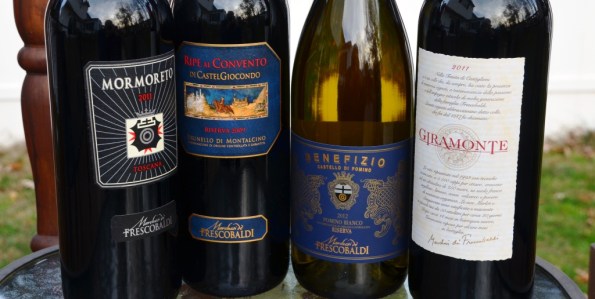
I guess there was a certain element of luck that my acquaintance with Frescobaldi wines started from their single vineyard, or so called “CRU” wines. Nevertheless, to be literally blown away by 4 wines out of 4 in the tasting is not something which happens often. I had plenty of single vineyard and high-end wines which left me simply indifferent. These 4 wines of Marchesi de’ Frescobaldi had me say “wow” every single time I had a sip.
I will not inundate you with the history of the winery or any other facts – you can read that at your leisure at the winery’s web site. However, each wine we tasted is unique in its own ways – and this is something I want to share with you here. Below are my tasting notes, including the interesting facts I pondered across. Here we go:


2012 Marchesi de’ Frescobaldi Pomino Bianco Benefizio Riserva DOC (13% ABV, $45, 100% Chardonnay)
C: light golden
N: classic – light touch of butter, vanilla, apples, delicious and inviting
P: delicious. Golden Delicious apple, touch of vanilla, touch of lemon, crisp acidity on the finish, perfectly lingering.
V: 8+/9-, a treat. Would compete with any white Burgundies in elegance, and has great aging potential
Interesting wine notes: Chardonnay was planted by Frescobaldi in 1855. In 1878, Pomino was awarded Gold medal at Paris Exposition. Benefizio was produced in 1973 from the vineyard with elevation 700 meters (2,200 feet), and it was the first barrel-fermented wine in Italy.
2011 Marchesi de’ Frescobaldi Mormoreto Toscana IGT (14.5% ABV, $79, 64% Cabernet Sauvignon, 26 % Cabernet Franc, 5% Petit Verdot, 5% Merlot)
C: dark garnet
N: dark fruit, plums, eucalyptus, hint of dark chocolate, intense, warm and inviting
P: spectacular. Firm, structured, black currant, chewy tannins, soft and powerful at the same time. Medium-long finish.
V: 8+, a “wow” wine. Would easily go up against any Bordeaux
Interesting wine notes: The vineyard of Mormoreto started in 1976 (while Cabernet Sauvignon, Cabernet Franc, Petite Verdot and Merlot had been growing there for 150 years), with the first harvest in 1983. The name “Mormoreto” means “murmur” in Italian – the constant breeze from the valley makes vine leaves to move all the time, creating soft and gentle “murmur” sound. The wine is only produced in most favorable years.


2011 Marchesi de’ Frescobaldi Giramonte Toscana IGT (14.5% ABV, $150, Merlot and Sangiovese)
C: dark garnet, almost black
N: beautiful, refined, restrained black berries, distant hint of dark chocolate
P: wow! Powerful, restrained, beautifully refined, dark fruit, fresh tannins, perfect balance, elegant, elegant, elegant. Long finish
V: 8+/9-. A wine in its own class. A clear nod to Italian heritage, weaved into a very modern, I-am-the-best, work of art.
2009 Marchesi de’ Frescobaldi Ripe al Convento di CastelGiocondo Brunello di Montalcino Riserva DOCG (15% ABV, $138, 100% Sangiovese)
C: dark ruby
N: plums, lavender, sweet oak, open, intense
P: complex, sweet plums, violets, nice herbal profile, delicious overall – perfectly ready to drink
V: 8+, delicious. One of the very best Brunello wines I ever had, period.
Four wines, one delicious tasting. Yes, these are not inexpensive wines, and for many people these can’t be everyday wines. However, any of these 4 wines are truly worth experiencing, so if you pride yourself with being an oenophile, put these wines on your “must try” list. Okay, you can thank me later. Cheers!
Many thanks to the kind folks at Colangelo PR for including me in the tasting and providing samples.
Month in Wines – November 2015
November 2015 was an interesting month. On one side, I traveled intensely throughout the month, which definitely affected memorable wine encounters. At the same time, this month brought some very unique highlights, such as Chinese wine and a full range of Beaujolais Nouveau wines (never before I tasted 5 Beaujolais Nouveau in the row). And I can’t help myself – I really love the labels on some of the Beaujolais Nouveau wines – festive and uplifting:


Here is what was “wine-interesting” in November 2015:
1421 Gold Chardonnay Xinjiang China – sorry, no idea about ABV or a price – very nice and classic in its Chardonnay profile, good apple and lemon notes, well rounded. 8-
2010 Tolaini Al Passo Toscana IGT (13.5% ABV, $20? – don’t know Costco price, Merlot/Sangiovese blend) – nicely restrained, unmistakably Italian, good taste profile, soft tannins, good acidity, good structure. 8-
2012 Penfolds Kalimna Shiraz Bin 28 South Australia (14.5% ABV, $28) – tar and tobacco on the nose, dark fruit, dark chocolate. Tobacco and pencil shavings on the palate, good fruit, good acidity, perfect balance. 8-
2011 Turley Estate Zinfandel Napa Valley (15.6% ABV, $38) – delicious nose of ripe raspberries with a touch of tobacco, a classic Zin. Soft and delicious on the palate, perfect balance, fresh fruit, dark chocolate, hint of smoke, perfect balance. An excellent wine. 8
Changyu Red Wine Blend Ningxia, China (ABV?, about $33 at a restaurant) – definitely a highlight – spot on Bordeaux taste profile, round and balanced. 8/8+


2005 Bernard Magrez Temperancia Toro, Spain (15% ABV, $11.99 WTSO price) – I got this wine earlier in the year from the Wine Til Sold Out (WTSO). It has a delicious dense core, with dark fruit and espresso. Full bodied and perfectly well integrated. 8-
2012 Casey Flat Ranch Open Range Proprietary Red, California (14.8% ABV, $9.99, Blend: 52% Syrah, 33% Petite Sirah, 8% Merlot, 5% Mourvedre, 2% Cabernet Franc) – concentrated dark fruit, plums, dark chocolate, touch of cinnamon and a touch of tar. Scrumptiously together. 8-
2006 Monasterio De Las Viñas Reserva Cariñena DO ($15?, Garnacha 70%, Tempranillo 20%, Cariñena 10%) – out of all places, had it at hotel in Korea, and it was outstanding – firm, well structured, medium to full bodied, lavender and plums on the palate, perfect balance. 8
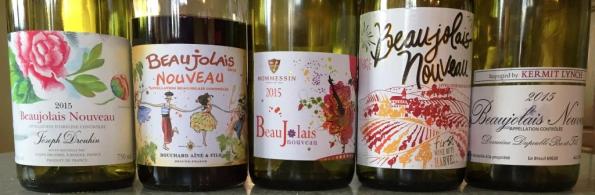
2015 Georges Dubœuf Beaujolais Nouveau (13% ABV, $10.99) – exceeding expectations. A new height for Beaujolais Nouveau. 8-
2015 Joseph Drouhin Beaujolais Nouveau (13% ABV, $11.99) – a solid effort. 7/7+
2015 Domaine Dupeuble Beaujolais Nouveau (13% ABV, $13.99) – rivaling Dubœuf with may be even slight edge up. Would never identify as Beaujolais Nouveau in a blind tasting. 8-/8
2015 Mommessin Beaujolais Nouveau (11%–14% ABV, $10.99) – Classic Beaujolais Nouveau. Enough said. 7+
2015 Bouchard Beaujolais Nouveau (11%–14% ABV, $9.99) – see above. 7+
And we are done here. Did you have any of the wines I’m talking about here? What were your recent wine highlights? Cheers!
From Marche to Mendoza, With Vine
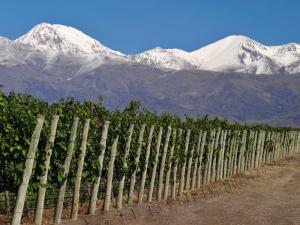
Rutini Vineyards. Source: Rutini Wines web site
In 1884, Felipe Rutini arrived to Mendoza area in Argentina. Continuing family traditions from the early 1800s when his father, Francisco Rutini, started making wine in the area known as Le Marche in Italy, he planted grapes and started making wine now in Argentina. Don Felipe, as he became later known at, was 19 years old when he founded La Rural winery in the district of Coquimbito. In 1925, Rutini family continued pioneering traditions of Don Felipe by planting first vines in the Tupungato area of the Uco Valley, a high altitude home to some of the very best vineyards in Argentina.
Today Rutini family is one of the biggest wine producers in Argentina, making about 9.5 million bottles of wine per year and exporting it to the 40 countries. You might be well familiar with the line of wines under a common name of Trumpeter, which include Chardonnay, Torrontes, Malbec, Cabernet Sauvignon, Pinot Noir and a number of others – Trumpeter is one of the 6 different ranges produced by Rutini Wines. Recently, Rutini Wines started introducing a new “Classic Series” line of wines in the United States, and I wanted to share my impressions from few of the wines in this line which I had an opportunity to taste.
But before we talk about the wines, let’s talk a bit more about Rutini family wine business today. Once again, I got together – well, yes, virtually, same as few times in the past – with Mariano Di Paola, head winemaker for Rutini Wines and one of the top winemakers in Argentina, and I had an opportunity to ask him a few questions. Here is what we talked about:
Q: Rutini family started making wines in Italy. Is there still a connection today at the Rutini Winery back to the traditions and customs of Region Marche?
A: No there are no direct links, but we still try to use the original Rutini winemaking influence today. Felipe Rutini was a visionary man who believed in Argentina’s winemaking capabilities, planting the first vines in Mendoza, and generations after we still work hard to maintain his legacy.
Q: If I understand correctly, Rutini is introducing its Classic Collection wines in the US. For how long had you been producing the Classic Collection wines? What were the main markets for it until now?
The Rutini collection was first released in Argentina with the 1996 Malbec, followed by Merlot and Gewürztraminer. It has been available in the U.S.: NY, TX, FL, MD, DC, MA, RI, and CA since the end of 2013.
Q: What are the oldest vines growing at Rutini vineyards?
A: Select Malbec vines in La Consulta date back over 100 years.
Q: What was the source of inspiration for the Rutini Sauvignon Blanc?
A: We wanted to create a well- balanced Sauvignon Blanc that spoke to the true characteristics of this varietal and represented the best quality of this wine.
Q: Sauvignon Blanc is really not the grape Argentina is known for. Do you think Argentinian Sauvignon Blanc has its own style and will become a wide movement?
A: Yes, Argentine Sauvignon Blanc has its own style which is heavily dictated by the particular growing region. Our continental climate, highly influenced by the Andes, and high altitude provide us with optimal grape growing conditions. Sunny day and dry summer conditions allow us to harvest fully ripened grapes. The cool evening temperatures and controlled irrigation serve to prolong hang time and to create a good balance between sugar and acidity. As there is more interest to try other Argentine varietals, there will be more Sauvignon Blanc production. Our Sauvignon Blanc style, of course, offers really good acidity, lemongrass aromas, floral aromas, but we also focus on producing a mineral style.
Q: Malbec is unquestionably a star red grape of Argentina. Is there a next great Argentinian Grape on the horizon, or is it going to be Malbec for a while?
A: We are always experimenting with different varietals, and while the native varietal Torrontes produces an exceptional and distinct white wine, Malbec will always shine when grown in this region, and it really speaks for the tradition and future of winemaking in Argentina.
Q: Do you use any of sustained, organic or biodynamic methods in production of your wines?
A: In our vineyards we do not practice organic or biodynamic methods, due to the health and hygiene of the plants themselves and the nobility of our soils, all of which , the use of pesticides that may eventually affect the vineyard is not necessary.
Q: It seems that most of the Rutini wines made from the grapes coming from the multiple vineyards. Do you have any plans to produce single vineyard or even single plot wines?
A: Yes, we do have plans to produce single-vineyard wines. At the moment wines are in the aging process and will launch in the market soon. ( Malbec and Cabernet Sauvignon ).
Q: Probably a very unexpected question 🙂 – I understand that Rutini wines are sold in China. How big and/or important that market for Rutini family wines? What wines sell best in China?
China is a very important market for Rutini. As of 2013, the U.S. and China represented 50% of our sales, with the Rutini collection being the most popular brand sold. Chinese consume mostly red wines /red blends and for Argentina, they prefer of course Malbec and Cabernet Sauvignon. Sparkling also sells well in this market.
So, what do you think? I think it was a very interesting conversation, albeit virtual. But now, I’m sure you are thirsty, so let’s have some wines. Here are my notes on the 3 Rutini wines form the Classic collection which I tasted:


2012 Rutini Wines Rutini Sauvignon Blanc Mendoza Argentina (12.5% ABV, $25, 3 months in oak, 50% new, 50% 2nd and 3rd use)
C: light golden
N: minerality, Chablis-like nose, very restrained
P: plump, creamy, delicious. I would never identify this as Sauvignon Blanc – Marsanne, Roussanne or Chardonnay come to mind. The wine was also not over-chilled, just chilled slightly. This wine is an enigma – coming straight from the fridge, it shows more of restrained sweetness, somewhat between New Zealand and California style
V: 8-, unique and interesting. The price looks somewhat high, but then this wine clearly aims at a nice Sancerre, so this provides a rationale behind it
2012 Rutini Wines Rutini Malbec Mendoza Argentina (14% ABV, $35, 12 months in oak, 80% new French oak, 20% new American oak)
C: dark garnet
N: licorice, a touch of tobacco, dark chocolate, blackberries, very inviting
P: fresh berries, touch dark chocolate, raspberries and blueberries, very smooth, medium body
V: 8-. I have to be very honest – this is not exactly my type of wine – however, there is a large category of wine drinkers who will be ecstatic about this wine because of its smoothness.
2012 Rutini Wines Rutini Cabernet Sauvignon Mendoza Argentina (14% ABV, $35, 14 months in oak, 50% new oak, 50% second use oak)
C: dark garnet
N: a touch of mint, fresh berries, black currant, a touch of barnyard, very interesting
P: surprisingly light and smooth, medium body (very unusual for the Cab), blackberries, vibrant acidity, good balance. Shows firmer structure after 10–15 minutes in the glass.
V: 8-, lighter style with lots of pleasure, this wine would definitely appeal to the people who prefer their reds to be not too heavy
Have you had any of the Rutini Wines, Classic Series, Trumpeter or any other? What are your thoughts?
I would like to thank kind folks at Gregory White PR for helping with the virtual interview and for providing the samples. Cheers!
Last Bottle Sign Up ($10 credit)




 Talk-A-Vino