Archive
WBC18: Speed (Live) Tasting – White and Rosé
In the previous post, I told you about our speed tasting session of red wines at the Wine Bloggers Conference 2018. During the second full conference day, we had a session for white and Rosé – only we didn’t get any Rosé at our table, so it was all for us (it is still 20+ different wines been presented around, but you only can taste just 10 during the allotted time.
If you read any of the previous posts or maybe attended the event, you know the drill. Snap, swirl, smell, sip, spit, share. Hmmm, next time I will call it a 6S exercise. You (1) snap a photo of a bottle. You (2) swirl the wine in your glass. You (3) smell it. Then you (4) sip it. Then you (5) spit it (well, there might be an exception to this rule, but you have to tread carefully here – if you can’t spit the wine, the wine bloggers conference is not for you). Lastly, you (6) share your notes with the world. All in 5 minutes. All repeated 10 times. There you have it.
Before I share the WBC18 wines with you now in this summary post, I will give you links to the WBC14, WBC16, and WBC17 I attended in the past, just in case you want to see what was happening there.
WBC18 speed tasting whites, here we go:
Wine 1: 2017 Desert Wind Chardonnay Heritage Series Wahluke Scope Washington (12.7% ABV, $28)
Wine 2: 2017 Bodega Bouza Albariño Montevideo Uruguay (13.5% ABV, $20)
Wine 3: 2016 Baroness Cellars Riesling Red Mountains (12.4% ABV, $25)
Wine 4: 2016 Rodney Strong Chardonnay Chalk Hill AVA (14.5% ABV, $22) – classic California Chardonnay, good wine at a good QPR.
Wine 5: 2016 Cadaretta SBS Columbia Valley (13.5% ABV, $23, 67% Sauvignon Blanc, 33% Semillon) – SBS stands exactly for Sauvignon Blanc Semillon. An excellent wine for a summer day? Well, I think I can drink it on a winter day too…
Wine 6: 2016 Frank Family Vineyards Chardonnay Carneros (14.4% ABV, $30)
Wine 7: 2016 J. Bookwalter Double Plot Chardonnay Conner-Lee Vineyard Columbia Valley (13.8% ABV, $40)
The next wine was presented with the statement to all of the Riesling haters – as shown here by Clifford Robben:
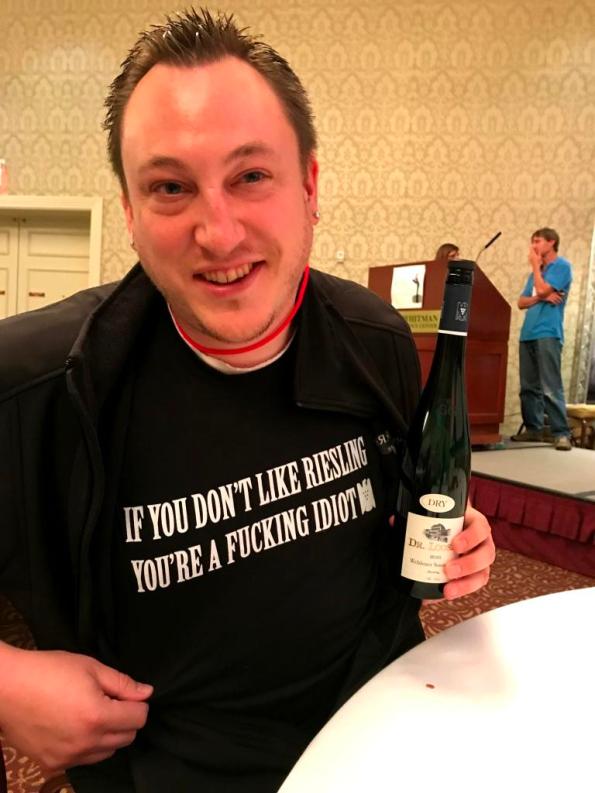
Wine 8: 2016 Dr. Loosen Wehlener Sonnenuhr Riesling GG Alte Reben Mosel (12.5% ABV, $56) – you can’t argue with greatness – this was one delicious Riesling
Wine 9: 2015 Brokenwood Semillon Hunter Valley (10.5% ABV, $22) – Hunter Valley Semillon might be one of the biggest secrets lucky attendees of WBC19 will discover. The wine might show as overly acidic when young, but with some age on it, it becomes an impeccable thing of beauty…
Wine 10: 2016 Brooks Ara Riesling Willamette Valley (12.8% ABV, $38) – another beautiful wine from the Brooks winery. From the tasting of the reds, Borrks Rastaban was my favorite wine. Now this Ara Riesling was equally impressive – and I didn’t know that Riesling was even made in Oregon. A delicious surprise.
There you go, my friends – the summary of one of my favorite exercises at the wine bloggers conference. Sorry, Chardonnay – the Riesling totally stole the crown this time. Cheers!
Wednesday’s Meritage: Chowdafest, Champagne in Space, WBC18, Losing the Donuts and more
Meritage Time!
I have a lot of interesting tidbits for you, so let’s get going.
 First and foremost, the Chowdafest. Now in its 11th year, one of my all-time favorite fun culinary events keep on going strong. Same as the last year, 40 culinary teams (restaurants, catering, etc) will compete in 5 categories (Classic New England Clam Chowder, Traditional Chowders (Manhattan/Rhode Island’s), Creative Chowder, Soup/Bisque, and Vegetarian). Even the lobster chowder is expected to be present this year. As usual, the guests will be sampling and judging. To put things in perspective, 40 of 1 oz samples make it for 40 oz of chowder – that is 2.5 lb of chowder combined! I don’t know how you see it, but this is a lot of chowder! Oh well, if you are anywhere within a few hours drive, the event is well worth it, so see you there!
Next one might be an old news for many (for sure my kids are already all over it) – the famed Dunkin’ Donuts is going to lose the donuts! Not to worry, only in its name. As it seems to be popular nowadays, the iconic chain which had been around since 1948, is going to change its name to just Dunkin’ – as my kids said, this is how everybody calls it anyway, so no big deal. I hope this renaming will be more successful compared to the recent failure of the IHOP->IHOB->IHOP attempt – and it most likely will. You can find more details about renaming at the Dunkin’s (can we already call them like that?) website.
The next subject I want to touch on is something I would typically include into my April 1st posts – but today is not April 1st, so this is actually not a joke and not a prank. It seems that in only a couple of years, anyone who has a spare $10M or so will be able to book their hotel room in … yes, space. It is obvious that such a unique achievement have to be properly celebrated – and what else says “celebration” if not a glass of Champagne? Challenge is that it is hard to pour a glass of revered bubbly in space – but have no fear, Champagne house of Mumm set out to solve the problems by teaming up with the designer Octave de Gaulle. The problem will be solved by creating a special two-chamber bottle which will create a foam out of Champagne, which will then return to its traditional bubbly state directly in the consumer’s mouth. For more details, please see the original article here (thanks to my friend Emil for bringing this to my attention).
Now, let’s talk about numbers – can you not like talking about numbers? When we hear numbers, we think we are in the know – if we can measure something, we are now in control, right? Okay, these are obviously wine-related numbers (you didn’t expect me to talk about Prius production here, didn’t you?) – and they relate to the wine consumption in different states in the USA. Well, not even wine – the alcohol consumption overall. VinePair just published a ranking of all 50 states in terms of the alcohol consumption per capita. Want to guess which state leads the pack? I will give you a moment to ponder at it. Ready? If you said New Hampshire, you won! Wait, I don’t have any prizes here. Well, pat yourself on the back, will you? New Hampshire is leading in terms of alcohol consumption in the USA, with 4.76 gallons per capita per year. Washington, DC is second, with 3.85, followed by Delaware at 3.72. At the bottom of the table is state of Utah (I’m sure we could predict that), with 1.34 gallons per capita. When it comes to numbers, I always remember the old adage of “there are lies, damn lies, and statistics” – I have no idea where all these numbers came from – for example, if most of my wines come directly from the wineries through the mailing lists, is that accounted for? Anyway, the numbers are always fun, so for the full report, please follow this link.
Last one for today, and it is not even really the news. The Wine Bloggers Conference of 2018 (WBC18 for short) will start in a mere week, on October 4th, in Walla Walla, Washington. I will be attending WBC18 (I know a lot of bloggers can’t make it, unfortunately), so if you are reading this and will be attending the conference, please find me and say “hi”. The state of Washington makes amazing wines, and Walla Walla is on the forefront of producing those amazing wines, so I’m definitely looking forward to experiencing the wines and meeting all the wine people next week.
And we are done here, my friends. The glass is empty, but the refill is on the way. Until the next time – cheers!
Sabering with a Steak Knife
When I’m opening a bottle of sparkling wine, my first desire is always to saber it. Sabering is a lot more fun than just twisting out the cork. Opening sparkling wine in the standard way, by twisting a bottle out of the cork, should produce no sound, maybe just a little “sigh”. When the bottle is sabered, the loud pop is expected, and the sparkling wine siphons out of the bottle – I hope you agree, this is lots more fun.
In the act of sabrage, the bottle is open with a small sword appropriately called the saber. This is how the typical saber would look:
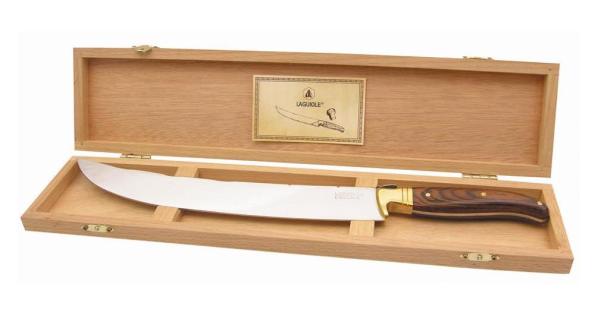 I don’t believe I ever used the proper saber before, but considering the weight of it, it should be a pretty easy exercise – I used the chef’s knife successfully a number of times, works perfectly on the properly chilled bottle of Champagne or similar classic-method sparkling wine (it is all about high pressure of the liquid in the bottle).
Instead of a saber, it is a lot more fun to try random objects for the sabrage. My sabering attempts are not anywhere as prolific as Jeff The Drunken Cyclist’s (here is his latest success with the “espresso thingy”), but I had my own documented successes with the wine glass, and failures with the stapler and even with the knife.
This time around, I was opening the bottle of Cava, and encouraged by the Jeff’s latest success, I wanted to use some random object for sabering – so the steak knife was something I grabbed.
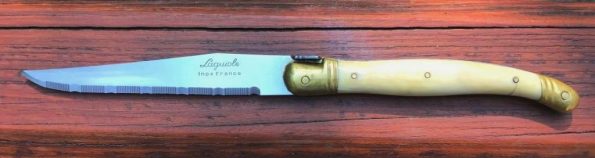 This is my beloved Laguiole steak knife, which is perfect for slicing the meat, beautiful and nicely balanced – however, it is very light. I was positive this will not work, but this is part of the fun! My first two strikes led to the glass starting to chip off around the neck, which lowered my confidence even further, but you can see this all for yourself here (apologies for the format of this video – a rookie mistake with the iPhone after not making videos in a while…):
As you can tell, it worked! Next time you will be opening a bottle of Champagne – have some fun with it. Cheers!
Wine News and Updates From Around The World
I’m happy to live during the times when wine is getting more and more popular – at least if you look at the wineries popping up all over the place, everywhere in the world, new wines coming out from the places where grapes were never planted before, and winemakers everywhere experimenting with new grapes, new tools (when did ceramic egg became “the thing”, huh?), and new styles (bourbon barrel-aged wine, anyone)? There is a tremendous amount of information available to the wine lovers everywhere, so I wanted to bring to your attention some of the latest news and developments in the world of wine which I found the most interesting.
There seems to be quite a bit of research pointing to the health benefits of the moderate wine consumption. More often than not, the health benefit is attributed to the red wine, not so much to the white, Rosé or Champagne. And then we also heard a famous story about Marilyn Monroe taking a Champagne bath (it supposedly took 350 bottles to fill the bathtub). What’s the connection, you ask? Based on the research conducted at Dartmouth University, it appears that Marilyn Monroe was onto something – the Champagne, with its high acidity and tiny persistent bubbles, has a great refreshing effect on the skin, so the 30 minutes bath is highly beneficial and rival most of the known skin rejuvenation treatments in its efficiency. Moving from theory to the practice, Veuve Cliquot, the leading Champagne producer, teamed up with Elizabeth Arden, leading American cosmetics and skin care company, to start offering Champagne treatments at select Red Door spa locations. The price is set for $10,000 for the 30 minutes, and the first 6 months of the appointments were booked within first 30 minutes of the initial offering. First trials at the spa showed excellent results and produced many happy clients. The only challenge? Someone has to constantly watch over the clients and remind them to drink Champagne only from the glass in the hand instead of taking the “deep dives” with their mouth open. Otherwise, the offering had been extremely successful and Veuve Cliquot is even considering to start offering treatments using La Grand Dame, but the pricing had not been unveiled yet.
There are no limits to the winemaking innovations today – aging wines in ceramic eggs and old bourbon barrels, mixing wine and coffee, filtering wines with the beer hops – bare mention of any of these would make winemakers and wine lovers cringe merely 10 years ago – but it is the norm today. Taking winemaking innovation to the next level, BrewDog out of the UK, the legendary producer of the world’s strongest beer (Tactical Nuclear Penguin clocks whooping 32% ABV), teamed up with the Australian winemaking legend, Penfolds, to produce the world’s strongest wine. The wine, called Penge Royal, uses the production methods of the Tactical Nuclear Penguin and Penfold’s flagship wine, Penfolds Grange. After aging the wine for 3 years in the old Scotch barrels, it then spends 60 days at the -32°C, and at the end of that period, reaches 70% ABV, beating most of the Absinthe on the market. It seems that the wine nicely preserves the flavor profile of Grange, but packs a substantial punch – as you would expect. The wine initially will only be available at the select markets in Australia and the UK, with the prices set at $5,000 per bottle. There were only 10 cases of 375 ml bottles produced, and they were all sold out immediately upon the offering. Would love to taste the Penge Royal one day, but getting one would not be easy.
I’m sure you heard about the so-called AI – Artificial Intelligence, and the robots, which will replace humans in pretty much everything we, humans, do. Going beyond the robot bartenders turns out that winemaking is also not immune to the automation and robot’s onslaught. The research team at Oxford University was working for the past two years on creating a robot which will be able to inspect the vineyards and decide on the day of the harvest, make all the decisions at the winery (how long fermentation should take, what strain of yeast to use, how and for how long to age wine, and also how to blend the final product). The project ran into an unexpected issue of many (if not most) of the winemakers not willing to share their knowledge, or even deliberately providing wrong information (no, you can’t wait until -10°C to harvest the Cabernet Sauvignon). Also, first results of blending by the winemaking robot were rather disastrous, with the resulting wine been completely not drinkable, not deserving even to be called a “plonk”. Hopefully the situation will change for the better, and the scientist will be able to make some progress, but for now, we will have to continue trusting humans to have a drinkable wine on the table.
If you are a serious wine enthusiast, I’m sure you run into this dilemma an uncounted number of time – I’m going to the dinner, should I wear a perfume? The perfume would interfere with the smell of wine and get in the way of truly appreciating it, both for oneself and for the people around us, right? The designers at Chanel, a leading French fashion house, set out to help all of us, oenophiles, to solve this dilemma and let us feel good about ourselves while going to a party while not disrupting the sensual pleasures of wine. Chanel’s designers created a new line of perfume specifically for the wine lovers, called W by Coco. The 3 years of experiments and hard work which went into the creation of W by Coco resulted in the perfume which offers a refreshing scent of the perfectly balanced wine, helping you to greatly accentuate aromas of the wine you are about to taste. All the Bordeaux First Growth producers supported the research, and as the result, the W by Coco line includes five different fragrances, one for each of the first growth Chateaux – Château Latour, Château Lafite Rothschild, Château Margaux, Château Haut-Brion and Château Mouton Rothschild. The fragrances available exclusively at Chanel boutiques in Paris, New York, Singapore and Tokyo and will cost wine lovers $450 for 30 ml. Reportedly, Château d’Yquem, Petrus, and Screaming Eagle all lined up to be included into the second release of the W by Coco line, but the date for the second release had not been confirmed yet.
Capitalizing on the popularity of the wine, literally every self-respecting brand is involved in the wine business, whether it is private label wines, special releases or simply store-branded lines of products – I’m sure you all had Kirkland wines, Trader Joe’s wines, Wine Farmer line at Whole Foods and more – never mind wine retailers such as Total Wines who offers thousands of private label wines in their “Winery Direct” program. Yes, we all know that and are usually not surprised by those private label wines. However, Walmart, the largest in the world retailer of discounted goods, managed to surprise everyone (and I meant it), by unveiling their partnership with none less than Old Rip Van Winkle, the producer of the most thought-after bourbon in the world. It appears that two of the iconic American companies joined forces to offer whiskey aficionados two new bourbons – Old Rip Wal Winkle 10 years old and Wal Winkle Special Reserve. The pricing and availability will be announced later, but it is expected that both whiskeys will appear in Walmart stores in the USA only at the beginning of 2019. Walmart shoppers and whiskey lovers, rejoice!
That’s all I have for you, my friends. Cheers!
Top Wines of 2017
And here are my top most memorable wines of 2017. A few days ago, I published the first part of the top wines list, and now the time has come to look at the most memorable wins of 2017. The logic behind the list is explained in the post about the second dozen of the top wines of 2017, so let’s just proceed.


12. 2016 Salabka LA COQUINE Chardonnay Praha Czech Republic (€25) – we finished the second dozen list with Chardonnay, and we are starting this one with Chardonnay, however, of a very different character. This was yet another surprise during Salabka winery visit in Prague – bright and upbeat, excellent core of acidity surrounded by tropical fruit and apples with a tiny touch of vanilla – a pure delight in a glass.
11. 2010 La Rioja Alta Viña Alberdi Reserva ($16) – I have an unquestionable love to La Rioja Alta wines – didn’t find yet the one I didn’t like. This 2010 Viña Alberdi is a classic, generous Rioja – red and black berries, cedar box, mint, sweet oak, rounded by clean acidity and delicious finish. It was literally my “go to” wine this – I took a number of bottles with me in my travels and the reaction everywhere was the same – “wow, this is a good wine!” – including the dinner at the wine bloggers conference this year.
10. 2011 Fiction Red Wine Paso Robles by Field Recordings ($20) – Field Recordings is one of my most favorite producers. Fiction red was also one of my “convert” or maybe rather a “discovery” wines – tasting the 2010 Fiction made me fall in love with Field Recordings wines. The 2010 Fiction was my Top Wine in 2011. This 2011 Fiction was almost a revelation this year – I didn’t expect much from the 6 years old screwtop wine, meanwhile – it evolved dramatically, showing delicious berry medley elevated with a dash of cinnamon and nutmeg, and a slimmer of sage on top. A wow wine.


9. 2007 Marchese Antinori Tenuta Montenisa Contessa Maggi Riserva Franciacorta ($50+) – drinking this wine at the old and authentic Montenisa Estate definitely had some effect – regardless, the wine was outstanding, boasting vintage sparkling wine qualities, freshly toasted, yeasty bread, plenty of fruit and beautiful acidity. A treat.
8. 1967 Fratelli Giacosa Barolo DOCG ($65 at Benchmark Wine) – 50 years old wine deserves respect, isn’t it? Still was drinkable with characteristic Barolo plums and lavender. It was showing a bit of an age, but still was going strong. Great example of excellent winemaking and a testament to Barolo’s longevity.
7. NV Piper-Heidsieck Rosé Sauvage Champagne ($50) – Sauvage means “wild” in French, and this is a perfect name for this champagne. Exuberant, in-your-face, fully loaded with fresh succulent strawberries – there is nothing subtle about this wine, it is very present in every sip you take – but it is unmistakably Champagne, delivering lots of pleasure. Will be definitely looking for this wine again – it will brighten up any occasion.


6. 2012 Gaja Pieve Santa Restituta Brunello di Montalcino DOCG ($75) – if I will say that this was Gaja Brunello – would that be enough of the description for you? Supremely delicious from the get-go, Brunello from one of the best producers in Italy, from one of the best vintages for Brunello. The wine was beautifully showing, fully extracted and powerful, but nevertheless perfectly balanced. Outstanding.
5. 2013 Sandhi Pinot Noir Santa Rita Hills ($35) – Sandhi Chardonnay was mentioned in the second dozen of top wines for 2017, but it was this Pinot Noir which made me say “wow” while discovering Sandhi wines. Unmistakably California Pinot Noir with gentle red fruit in the leading role and violets and sage supporting the bouquet. Luscious, silky smooth, perfectly dense and balanced – the wine which needs to be experienced.
4. 2014 Unionville Vineyards Amwell Ridge Cabernet Franc New Jersey ($28?) – It is interesting how many wines on this top list represent “surprises” ( but then, of course, the surprise factor is what makes the wine memorable, right?). This wine tremendously exceeded my expectations and showed a classic, perfectly balanced, new world Cabernet Franc – blackcurrant, a touch of mint, medium body, perfectly balanced with clean acidity. An excellent wine worth seeking.


3. 2011/2012 La Valle Brut Rosé Franciacorta DOCG ($45) – visiting La Valle winery in Franciacorta and meeting charismatic Stefano Camilucci was definitely one of the main highlights of our trip to Franciacorta. On top of that, this Rosé sparkling wine was yet another highlight – from beautiful presentation of the bottle to the delicious, perfectly clean and balanced, playfully effervescent liquid inside. 2011/2012 is not a mistake – most of the Franciacorta wines are vintage wines; I had both vintages, and they are both excellent. Yet another wine I recommend most highly.
2. 2015 Nevada Sunset Winery Syrah El Dorado County ($20) – I love surprises, and this was a big one! Tiny city winery, officially opened only two months prior to my visit, and then the wine which can be a crown jewel for any winery’s portfolio. Definitely a new world Syrah, but impeccably balanced. Intense dark fruit with chocolate and espresso on the nose, and the same matching profile on the palate with the addition of a touch of pepper – silky smooth, full-bodied, and – did I say it already – impeccably balanced. Wow.
1. 1982 Olga Raffault “Les Picasses” Chinon, Loire ($85?) – for any Cabernet Franc aficionado, Olga Raffault is “the name”, Chinon is “the place”, and 1982 was really a legendary vintage in France (for sure in Bordeaux, don’t know if this can be reciprocated to the Loire, but still). Tasting this 35 years old wine was a pure delight – no sign of age, cassis all the way, complex bouquet, great balance – what else can you wish for in wine?
Here we are, the Top wines of 2017. I could easily double the number of wines here, as lots and lots of well worthy wines were not included – ah, well… Let’s look at the “diversity” as we did for the second dozen. Out of 12 wines, 5 countries, 11 different regions, some of them I bet you never had the wines from such as Nevada and New Jersey – I believe it is an interesting mix and well on par with diversity in the wine world today.
As everything works in life, one list is finished, and the new one is starting right after. Happy wine year 2018! Cheers!
Usual Grapes, Unusual Places – The Oenophile Games
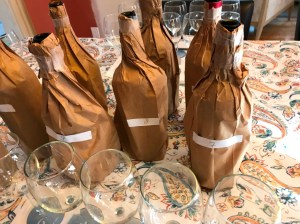 I love blind tastings. I’m talking about totally non-intimidating blind tasting, done in the relaxed atmosphere, where the goal is only to have fun – in other words, not when it is part of the test. The blind tasting as part of the test is really not fun – as Kirsten the Armchair Sommelier eloquently put it in a tweet “Nothing intimidates quite like a brown paper bag!!” – as a WSET diploma candidate, I’m sure she knows what she is talking about first hand.
So I’m talking about fun blind tasting here. Blind tasting removes all sources of bias, as only minimal information is available about the wine you are about to taste, depending on the theme of the tasting, and you can’t be influenced by the pretty label, by the big name or by the well-known place (ahh, this is the wine from Napa, it is definitely better than this one from New Jersey, right?). You are one on one with the liquid in the wine glass, and your only goal is to decide whether you like the wine or not and whether you like it more than the one you had before, or if you still like it more than the one which you had after. Of course, you can make things a lot more interesting by trying to guess the grape, the origin, the vintage and whatever else you would desire, but the beauty of the informal blind tasting is that you free to do as much or as little as you want.
The best accompaniments for the wine are good food and a good company. We started wine dinners with the blind tastings with friends more than 7 years ago. Our first blind tasting was about Pinot Noir, then we had one about Sparkling wines (the thought of this one still gives me shivers as it was utterly confusing), also Chardonnay, Mourvedre, Barolo and many, many others. We decide on the theme, set the rules (how many bottles, price limits or not, what wines can be considered, what wines will not fit and so on). The bottles are put in the brown bags, the numbers are randomly assigned to the bags, the wines are poured and off we go. We usually try to figure out group’s favorite, which sometimes easy, and sometimes it is not. The results are always most unexpected, and everybody gets a chance to say “I can’t believe it”.


The theme for this tasting was “usual grapes, unusual places“. Today, the mainstream grapes are totally international. Cabernet Sauvignon wines are produced in Bordeaux, in Napa Valley, in New York, in Argentina, Virginia, South Africa, Chile, Italy, Czech Republic and other hundreds of places. Same is true about Chardonnay, Merlot, Pinot Noir and Grenache – and even Tempranillo and Sangiovese are not an exception. Now the question is – can we still recognize Cabernet Sauvignon from Uruguay as Cabernet Sauvignon or Pinot Noir from the Czech Republic as Pinot Noir?
To play the game, the group of 10 wines was assembled. I couldn’t make up my mind on what to bring literally until the day before the tasting – kept changing my preferences. Nevertheless, we got together, the table was set and the wines were poured. As everybody was set on bringing the red wines, I decided to make things more interesting and brought two of the white wines to start the tasting with. Here are my notes and guesses on the 10 wines we tasted (obviously I knew what I’m tasting in the first two whites):
Wine 1 – beautiful nose, honeysuckle, tropical fruit, restrained palate, green, touch of pepper, contrast with the nose, interesting
Wine 2 – beautiful nose, plump, velvety, beautifully soft, silky smooth, outstanding, vanilla, delicious.
Wine 3 – typical Bordeaux blend on the nose. Tremendous salinity on the palate. Then acidity. Bordeaux blend from NJ. After 30 minutes – Barbera?
Wine 4 – Grenache nose, smoke and tobacco on the palate. My guess is Rhone varietal, but most likely Grenache
Wine 5 – Rutherford dust on the nose, touch of black currant, chipotle on the palate, herbal, unusual, very nice. Bordeaux varietal. Going for Carmenere.
Wine 6 – beautiful nose, Bordeaux-style, lots of smoke on the nose. Somewhat sweet on the palate. Core Bordeaux? or Syrah blend? Cab Franc dominant blend.
Wine 7 – smoke, dark fruit, beautiful tannins, cherries, beautiful. Bordeaux blend? Somewhat of extreme tannins.
Wine 8 – muted nose, mint, anise, Rutherford dust. Good acidity, soft, round. Bordeaux varietal?
Wine 9 – fresh, open, clean vanilla, dark fruit, excellent. Bordeaux varietal?
Wine 10 – beautiful nose, but a bit astringent. Interesting. Bordeaux varietal?
Before the wines can be revealed, we had to figure out group’s favorite. Everybody was allowed to vote for one of the two white wines, and then two votes for the favorites among 8 reds. Here are our votes (out of 8 people):
Wine 1 – 4
Wine 2 – 4
Wine 3 – 2
Wine 4 – 0
Wine 5 – 0
Wine 6 – 6
Wine 7 – 5
Wine 8 – 2
Wine 9 – 0
Wine 10 – 1
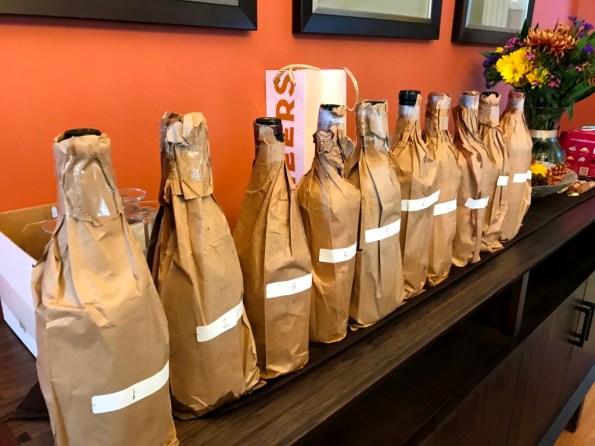

As you can tell, both whites fared equally well with the group clearly splitting the decision. Also for the reds, there was a clear winner and a clear runner-up, with the rest of the wines not faring that well – wine number 6 was preferred by the most, and wine number 7 was the second favorite. Now, the most anticipated part of the blind tasting – the reveal:
Wine 1: 2016 Onward Petillant Naturel Malvasia Blanca Suisun Valley, CA (12.6% ABV)
Wine 2: 2007 Krupp Brothers Black Bart Marsanne Stagecoach Vineyard Napa Valley (14% ABV)
Wine 3: 2004 Bodegas Carrau Vilasar Nebbiolo Uruguay (13.5% ABV, 100% Nebbiolo)
Wine 4: 2014 Chateau Famaey Malbec Cahors AOC (12.5% ABV, 100% Malbec)
Wine 5: Changyu Cabernet Sauvignon China (Cabernet Sauvignon?)
Wine 6: 2012 Caduceus La Corgtigiane Oneste New Mexico (13.5% ABV, 50% Barbera, 50% Merlot)
Wine 7: 2014 McManis Barbera Jamie Lynn Vineyard California (13.5% ABV, 100% Barbera)
Wine 8: 2015 Cantele Primitivo Salento IGT (13.5% ABV, 100% Primitivo)
Wine 9: 2014 Macedon Pinot Noir Macedonia (13.5% ABV, 100% Pinot Noir)
Wine 10: 2014 Agnus Merlot Serra Gaúcha Brazil (14% ABV, 100% Merlot)
Let’s look at these results. First, let me talk about the wines I contributed for the tasting. For the whites, they were both excellent – I got this Onward Petillant Naturel Malvasia Blanca from Jeff The Drunken Cyclist as part of our Secret Santa fun, and the wine was delicious. The second white, Krupp Brothers Marsanne was a rare closeout score a few years back. Sadly, it was my last bottle, but the wine needs to be drunk, so I’m glad I had it in a good company – I consider that to be one of the best California white wines, for sure for my palate. Now, the red which I brought was another story – it was the Changyu from China, for which I terrorized my Chinese-speaking friend trying to ensure that it was Cabernet Sauvignon and trying to figure out the vintage or ABV (fail). Well, the worst part was that many people not just disliked it, they literally hated it – and I had other reds from Changyu while in China with much higher success. Oh well.
The winning wine Caduceus La Corgtigiane Oneste was made out of the New Mexico grapes by the winery located in Arizona, with one of the grapes being Barbera – talk about rare and unusual. McManis Barbera, second favorite, was also quite unexpected – but looking at my notes and having tasted few of the California Barbera wines, I made a wrong guess with somewhat right descriptors. As you can tell, almost everything tasted to me like a Bordeaux blend – clearly, I don’t do well in the blind tastings, but one way or the other, this was lots of fun! And just think of the range of wines we tasted – Malvasia Blanca, Marsanne and Barbera from California, Nebbiolo from Uruguay, Merlot from Brazil, Pinot Noir from Macedonia, Cabernet Sauvignon from China, Merlot and Barbera from New Mexico – wow. The Malbec and Primitivo didn’t really belong on one side – but then on another side they kind of fit the bill too as Malbec from France is literally unknown to the wine consumers, and Primitivo is pretty much in the same boat, for sure in the USA. All in all, we clearly accomplished our goal of tasting usual grapes from unusual places.
Then, of course, there was food – lots and lots of delicious food, which everybody contributed to – I will just give you a quick overview in pictures, and that really only a fraction of what we had (at some point you get tired of constantly taking pictures of food…


We also drunk more wine, and this one was a standout. An unassuming California blend from Marietta in Sonoma – NV Marietta California Old Vine Red Lot Number Twenty. This is non-vintage, field blend of Zinfandel, Petite Sirah, Carignane, and Gamay, now, wait for it … which should be about 40 years old??? Current wine is called Lot Number 66, so if this was the Lot number 20, then we are simply making an assumption here… The wine was delicious – yes, it was mature, so showed the layer of delicious dried fruit and ripe plums – but it still had a perfect amount of acidity for everyone to say “wow”. I plan to write to the winery, so hopefully will be able to figure out the age of this wine, but this was clearly another amazing example of California wines which can age – and patience well rewarded.


Great fun and great learning experience, hands down. For anyone who is into the wine, the blind tasting is an endless source of enjoyment. If you love wine and never participated in the blind tasting, you really should fix it – get your friends together and have fun! If you need any “logistical support”, please reach out – will be very happy to help.
Ahh, and by the way, there is something even more intimidating than a paper bag – a black glass. But then your friends may start hating you, so tread gently. Have fun, my friends. Cheers!
Parent, Secret Power, Unsung Hero
You just read the title of this post. What do you think we will be talking about? Of course, it can be a story about a person who had all those great qualities – but this is the wine blog, right? Can all those qualities belong to a grape?
Let’s see. Parent – this is simple. When two grapes are crossed, they will give birth to the new grapes, and, of course, we can call both of the original grapes parents. Unsung hero? This is typically someone who can quietly come to the help of others and solve the big problem or save a life. Apart from saving a life, a grape can be very instrumental in assisting others to do their best, bringing out their best qualities while remaining literally unknown. For example, helping to make delicious wine as part of the blend. Now, the secret power? Every once in a while a person can be on a secret mission and save the world, all alone, “solo” – James Bond meets Wonder Woman, anyone? Okay, okay, I’m only talking about making delicious wines, all by itself, solo.
Now, as we are talking about the grape, can you think of one which would fit this description? There are thousands of grapes used in winemaking, so theoretically, there is more than one grape that will fit this profile, but I would dare to say that one grape might stand above others in all these roles. Know what I’m about to say? There is a good chance you do – you probably guessed it already – I’m talking about Cabernet Franc.
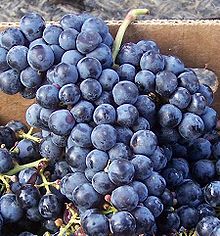
Cabernet Franc grapes, as shown in Wikipedia
It is hard to tell when Cabernet Franc became known as a grape variety. It is definitely old, probably not as old as Chardonnay, which can trace its history all the way to the 11th century, but still older than most other grapes. While Cabernet Franc is typically associated with Bordeaux and Loire, it appears that it originated from the Basque Country in Spain, from where it spread through the south of France and reached Bordeaux.
How Cabernet Franc is a Parent? Based on DNA research, Cabernet Franc was a parent of Cabernet Sauvignon, Merlot, and Carménère – a good group of kids, isn’t it?
How is it an unsung hero? Cabernet Franc ripens at least one week earlier than Cabernet Sauvignon. It can reach phenolic ripeness in the years when Cabernet Sauvignon will not, and thus in the blend, it will be a savior – this is why it was always so loved in Bordeaux, an insurance policy of sorts. While the tasting profile of Cabernet Franc is somewhat similar to Cabernet Sauvignon, it is typically softer and less tannic than its more famous offspring, so it makes the blend more approachable.
The Secret Power? When used in European wines, it is often unknown that the wine is made out of Cabernet Franc. For instance, Chateau Cheval Blanc, one of the most famous Bordeaux wines, is made predominantly out of the Cabernet Franc – but this is not widely known outside of the circle of wine aficionados. How about Olga Raffault Chinon? Chinon, a region in the Loire, is one of the best sources of delicious Cabernet Franc wines, but you have to simply know that. Coming to the new world, Cabernet Franc is not so secret anymore, as you can see it on the label, but I still can let you in on one little secret – this is one of the most versatile red grapes you can find. Talking about the United States, for instance, it is practically the only red grape which can consistently deliver delicious red wines both in California and in New York – and we don’t need to be so confined – Washington and Oregon are doing quite well with the Cabernet Franc, and so do Massachusets, New Jersey, and even Rhode Island. And let’s not forget Canada, where the grape goes beyond dry reds and offers some of the most stunning dessert wines – Cabernet Franc Ice Wine.
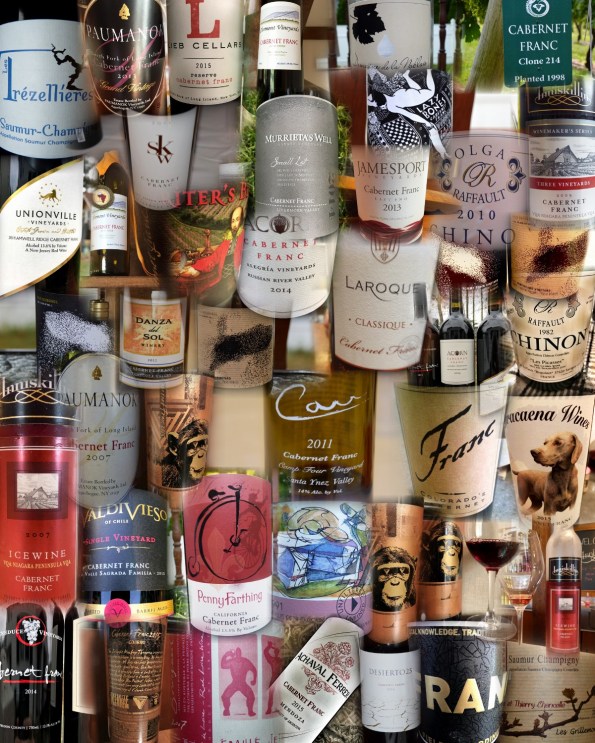
December 4th is when we celebrate this unique variety with the #CabFrancDay. The whole Cabernet Franc extravaganza is a product of the obsession of one person – Lori Budd, who singlehandedly started this grape holiday in 2015. Lori expresses her love for the grape not just by talking about it – she also makes her own Cabernet Franc wine in Paso Robles under the Dracaena Wines label. This year I was able to try the Dracaena Wines Cabernet Franc at the wine bloggers conference, and I can tell you that while I’m very particular about Cabernet Franc wines (prefer more old-world style than new), I really enjoyed Lori’s rendition.
Grape holidays are always fun – you have a good reason to open a special bottle that was stashed in the corner, and share your love for the grape with the world. Cabernet Franc’s celebration is important beyond that simple joy. Take a look at the Wikipedia article – it says that Cabernet Franc is “principally grown for blending with Cabernet Sauvignon and Merlot in the Bordeaux style, but can also be vinified alone”. The Vins de Bordeaux website says that Cabernet Franc “is the ultimate complimentary grape variety”. While this is true, Cabernet Franc is great for blending, this is also the grape which is excellent by itself, and we should recognize and acknowledge that, and change that perception of a “blending grape”.
This year, I had a great experience with beautiful Cabernet Franc wines from all over the world – 1982 Olga Raffault Chinon, Achaval-Ferrer Cabernet Franc from Argentina, Lieb Cabernet Franc from Long Island, New York, Dracaena Cabernet Franc from Paso Robles, and many others. But to celebrate Cabernet Franc Day in style, I had an opportunity to open 3 more wines especially for the holiday – for one, representing both coasts of the USA – and, surprisingly enough, representing both styles of Cabernet Franc, the old world and the new world.


2014 ACORN Alegría Vineyards Cabernet Franc Russian River Valley (12.5% ABV, $38, 93% Cabernet Franc, 2% Malbec, 2% Merlot, 2% Petit Verdot, 1% Cabernet Sauvignon and Tannat, 18 months in barrel) was uniquely Californian in style – in many ways. Alegría Vineyards are Certified Sustainable, which is really the way now for many vineyards in California, with a lot of manual labor-intensive effort going into helping grapes to achieve their best potential. All the wines ACORN produces are made as field blends, where different grapes are co-fermented together, according to the century-old field-blend vineyard traditions. The result was beautifully balanced, fruit-forward wine, boasting pure cassis flavors, supported by the medley of the red fruit and perfect acidity. The wine was clean and delicious.
Two more wines were a total surprise for me. These two Cabernet Franc wines were both made in New Jersey. I have very little experience with New Jersey wines, and that experience was not necessarily all positive, so yes, I didn’t have much expectation as I was pulling the corks, just a hope that the wines would be at least palatable.


While Unionville Vineyards were planted only in 1987 and the winery opened its doors to the public in 1993, the land where the vineyards a located was farmland even before the 1850s. As farmland, it went through many different plantings and such – peach orchard, apple orchard, dairy farm, grains, and horses – but returned to the fruits with the first grapevine plantings in 1987 – this is when the story of Unionville Vineyards started.


Beneduce Vineyards is located in the same Hunterdon County as Unionville Vineyards. Chardonnay, Riesling, and Gewurztraminer are the main white grape varieties at Beneduce Vineyards, and the list of reds includes Pinot Noir, Blaufränkisch and, of course, Cabernet Franc.
Drink Local, Colorado Edition (and Don’t Lose Hope)
I’m an eternal optimist. Even when I’m worrying about something, deep inside, I still believe that everything will be okay – one way or the other (sometimes we really have to look for this “okay”, but this is a subject for the whole other post).
This “life’s attitude”, of course, reflects on my approach to wines. Particularly, a belief that in today’s world, good wines can be made everywhere and anywhere – not only in a few places we know can produce the good wines. And anywhere I travel, I’m always looking to prove myself right – which I call “drink local”.
This time, my travel took me to Denver, Colorado. Colorado sounds as good as any other state in the US to be able to produce wines, so once I situated at my hotel in downtown of Denver, off I went to the closest liquor store in Denver.
While walking to the store, literally few steps before it, I saw a sign for the “Wild Women Winery” – I couldn’t even believe my luck, to find a city winery short walking distance from the hotel, also with a very cool sounding name. So I walked in and situated at a bar table, looking at the bottles with super-creative, super-colorful labels.
Talking to the bartender, I learned that while the winery is located in the Colorado (downtown Denver, to be precise), they make wines from the grape juice which they get from California Central Valley, as the winemaker believes that local Colorado grapes are too young to produce a good wine. Fine – the proof is always in the glass, right?
I decided to try 3 wines for $5 (happened to be an extremely wise decision, as opposed to trying 7 for $10, you will understand why in a minute).


The first wine was Viognier – a touch of overripe Apple with sage on the nose. Good fruity palate nice acidity, golden delicious apples. Not my favorite, but not bad. Not amazing, but drinkable.
My next choice was Cab/Merlot blend and that wine really threw me off – too sweet all around, no balance, no acidity, just a sweet fruit. Don’t remember when was the last time I disliked the wine so intently.
At that point I realized that all of the wines the winery offers are non-vintage wines, so I tried to discuss it with the bartender, but unfortunately, she didn’t know what “vintage” means, and I had to face the issue that certain basic concepts we, oenophiles, take for granted, are not so easy to explain in the simple terms. Nevermind.
The last wine, Petite Sirah, had a sweet chocolate nose, bitter-sweet type. Sweet fruit compote on the palate, definitely too sweet, but more acidity than the previous wine. Mostly plum notes with the equivalent acidity of just ripe, but not overripe plum. A marginal improvement.
This visit really left me at the feeling of deep disconcert – I see a lot of passion on the labels, but the soulless concoctions inside the bottles were really conflicting with the bright images.
I gladly left the winery and headed over to the liquor store. Here I had another surprise – a sticker shock. I understand that the wine store is located in the downtown of Denver. But Colorado wines aren’t that well-known, aren’t they? There was a good selection of the local Colorado wines present, none of them cheaper than $20 (okay, $19.99 if it makes you feel any better). Really? On my recent trip to Canada, I had a phenomenal selection of tasty wines under $15. Now, especially after the first tasting fiasco, I had to spend $20+ for a bottle which I might just have to pour down the drain?


After going back and forth and trying (unsuccessfully) to obtain an advice of the store clerk (”I tasted only this one wine”, “yeah, yeah”, “huh, you don’t like sweet wines? Really?”), I settled on the bottle which looked the most Colorado-authentic while still staying in the low $20s- Two Rivers Syrah – at least the information on the back label suggested that the grapes were harvested in Colorado.


The wine was definitely an upgrade over the previous experience, but still no cigars. As this was nevertheless a better wine, here are my typical-style notes:
2015 Two Rivers Château Deux Fleuves Vineyards Syrah Mesa County, Colorado (14.1% ABV, $22.95)
C: dark garnet, nice visible legs
N: blackberries, tar, tobacco, sage, medium to high intensity
P: sweet berries, tobacco, good acidity
V: 7-, it is drinkable, but sweetness too prevalent.
7 on my the second day – sweetness subsided a bit, and roasted meat notes showed up. Still, the finish is mostly sweet fruit with a touch of tobacco.
On the last day before leaving Denver, I still had a bit of the free time and decided to give Colorado wines one more try. I found another wine store, still within short walking distance from the hotel, with good reviews on Google, and took 20 minutes walk. This store had a much smaller selection of Colorado wines, but a little bit better prices (by a few dollars, nothing major), and incomparably better, knowledgeable service. I left with the bottle of The Infinite Monkey Theorem Cabernet Franc – The Infinite Monkey Theorem is another city winery – but unlike Wile Women Winery, this one I would be happy to visit if I had more time.


Remember I told you about eternal optimism? It finally worked, as this Cabernet Franc was well worth of writing home about:
2015 The Infinite Monkey Theorem Cabernet Franc, Colorado (12.9% ABV, $21)
C: dark ruby
N: tobacco, sweet bell peppers, freshly crushed blackberries
P: bright, fresh, freshly crushed berries, intense sweet tobacco, a touch of pepper, clean acidity, vibrant.
V: 8, outstanding. Would gladly drink that every day.
There you have it, my friends – my first real encounter with Colorado wines. I was happy to prove myself right and find a good wine made in Colorado. As a collector of experiences, I was also happy to add another checkmark to the list of states I tried the wines from – if you are like me, feel free to compare your records 🙂 Have you had the wines from Colorado? Express yourself in the comments section below. Cheers!
Argentina Beyond Malbec with Achaval-Ferrer and #WineStudio
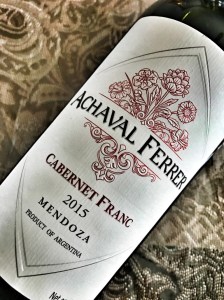 Of course, Argentina wine industry can’t be subsided only to Malbec – Torrontes and Chardonnay for the whites and Malbec and Cabernet Sauvignon (and Bordeaux-style blends, of course) for the reds comprise an absolute majority of Argentinian wines available at any given moment. You can find some Argentinian Bonarda, Pinot Noir and Sauvignon Blanc, but they don’t carry the full recognition of the 4 main grapes.
Winemaking has a long history in Argentina, starting in the 16th century and entering an international trade in the second half of 19th century. If we will take into account that most of the grape plantings in Argentina are at high altitude, with climatic conditions and terroir overall ideal for the grape growing and providing protection against many grape diseases, such as phylloxera, we will quickly realize that Argentina is home to some of the best and oldest vineyards in the world. However, it is only during the last 20-25 years Argentinian wines start receiving a full international recognition they deserve, with Malbec been the brightest shining star.
Achaval-Ferrer winery was founded in 1998, and over its relatively short history, became a leading winery in Argentina, garnering numerous awards and high critic scores for its wines. To the great pleasure of wine geeks, wines of Achaval-Ferrer were also a focus of April #WineStudio educational program, allowing us to experience some of the very best wines Argentina is capable of producing – Malbec, Cabernet Sauvignon and Bordeaux blend called Quimera. But for the last April session, Achaval-Ferrer and #WineStudio took us on the trip in entirely new direction with the inaugural vintage of the Cabernet Franc wine.
I guess it is time to reveal one of my (no, not darkest) deepest wine secrets – I have “a thing”, an obsessive passion for the Cabernet Franc wines. I can’t explain to you why or how. I don’t know how it happened that out of most grapes, the words “Cabernet Franc” make me literally jump. No matter how tired I am at the end of the large tasting, say to me “let’s go try Cab Franc” and I’m ready to run. Thus you can imagine how excited I was at this opportunity to try a new first release of Cabernet Franc.
There was a lot of excitement around this wine, seems everybody really enjoyed it. As for all the wines of Achaval-Ferrer, the grapes for this Cabernet Franc came from the high altitude vineyards (3,280 ft above sea level) in the Uco Valley, mostly sustainably farmed. Here are my tasting notes:
2015 Achaval-Ferrer Cabernet Franc Mendoza Argentina (14.5% ABV, $24.99, 100% Cabernet Sauvignon, 10 months in 3-year old French oak barrels)
C: Dark garnet
N: intense, baking spices, dark fruit, mint, dark chocolate
P: medium-full body, fresh cut-through acidity, mint, hint of cassis, touch of white pepper on the finish, smooth, long finish with tannins kicking in at the end and lingering. Needs time…
V: 8, nice, can be drunk on its own, will be great with the food, and will evolve with time – at least 10 years. The wine opened up more on the second day, and I’m sure will further improve on the 3rd.
Definitely an excellent wine which will be hard to find – 1,400 cases total production, and a lot of this wine went to Morton’s steakhouse (so if you plan to visit Morton’s keep that in mind) – but it is well worth seeking. If you will score some of these bottles, lay them down in the cellar and let them evolve. At least this is what I would do.
This wine concluded a delicious #WineStudio experience with the Achaval-Ferrer wines, and to sum it up, I want to leave you with the twitter quote from Tina Morey, the host of #WineStudio:
I can fully sign under every word here – beautiful, expressive wines, well representing what Argentina is capable of. Salud!
Geekiest Way to Celebrate #MalbecWorldDay – #WineStudio Blind Tasting with Achaval-Ferrer
 Starting in 2011, April 17th is the day when we celebrate Malbec – one of the noble French grapes, which almost disappeared in France, but found its new life in Argentina, where it became a star. I don’t want to bore you with the Malbec history – you can read it on your own in many places, including few posts in this very blog (here is a bit about the history of the Malbec grape, and here you can take a Malbec quiz).
Typical “grape holiday” celebration usually includes an opening of an upscale (high end, memorable, etc) varietally correct bottle. Our today’s celebration was a bit different, as it was based on the concept of pure, unadulterated, geeky wine lovers’ fun – a blind tasting, and, of course, guessing.
This blind tasting was a part of the educational program run by the WineStudio during the month of April. In case you are not aware of the Wine Studio, it is a brainchild of Tina Morey, and it is wine education and marketing program which helps to expand people’s wine horizon and help them discover new regions, new grapes and new wines. April program, quite appropriately (April is designated as a Malbec wine month), was focused on the wines of Achaval-Ferrer, one of the very best wine producers from Argentina.
To facilitate the blind tasting, all the participants received a set of two bottles, some wrapped in colorful foil, and some in the black plastic – mine were the second type:


About an hour before the session I opened the bottles to let the wines breathe a little, as it was suggested by the organizers. And then the session started.
Of course, this was not the usual blind tasting. There are many ways to run the blind tasting, some of them quite extreme – for instance, tasting the wine without any known information from the black glass – an extreme sensual challenge. Going less extreme, in a typical blind tasting you will have at least some kind of limits installed – Pinot Noir grape, for instance, or wines of Pauillac. Our #winestudio blind tasting was on one side a lot less challenging, as we knew that the wines were made by Achaval-Ferrer, so we didn’t expect to find Petite Sirah in any of those bottles, and we even knew the vintage years, 2013 and 2012. At the same time, for sure for me, it was almost more challenging, as I was trying to guess the wines based on what I knew about Achaval-Ferrer and thinking about what they might want to showcase in the tasting, instead of focusing on the actual wines.
 We were asked to evaluate wines using WSET Level 3 tasting grid (you can find it here if you are curious). Here is a summary of my tasting notes – I’m distinguishing the wines by their vintage:
Wine 2013
APPEARANCE
Clarity: clear
Intensity: deep
Colour: garnet
NOSE
Condition: clean
Intensity: medium
Aroma characteristics: touch of funk, mint, underbrush, blackberries
Development: youthful
PALATE
Sweetness: off-dry
Acidity: medium+
Tannin: medium
Alcohol: medium
Body: medium+
Flavour intensity: medium+
Flavour Characteristics: cassis, eucalyptus, mint, blackberries
Finish: medium-
CONCLUSIONS
Quality level: outstanding
Level of readiness for drinking/potential for ageing: can drink now, but has potential for ageing
Wine 2012
APPEARANCE
Clarity: clear
Intensity: deep
Colour: garnet
NOSE
Condition: clean
Intensity: medium+
Aroma characteristics: tar, tobacco
Development: developing
PALATE
Sweetness: off-dry
Acidity: medium+
Tannin: medium
Alcohol: medium
Body: medium+
Flavour intensity: medium+
Flavour Characteristics: red and black fruit, salinity, raspberries, anis
Finish: medium
CONCLUSIONS
Quality level: outstanding
Level of readiness for drinking/potential for ageing: can drink now, but has potential for ageing
As it is usually the case with the blind tastings, I didn’t do well. I really wanted the wines to be pure Malbec and Cab Franc, and this is what I included into my final guess:
then, of course, I second guessed myself and changed the answer:
When the bottles were finally unwrapped, we found this beautiful Bordeaux blend called Quimera been our Quimera for the night – it is no wonder every back label of Quimera explains the name: “Quimera. The Perfection we dream of and strive for. The search for an ideal wine”.


The wines were 2013 and 2012 Quimera, both classic Bordeaux blends, but with a high amount of Argentinian star variety – Malbec. Both vintages had the same composition: 50% Malbec, 24% Cab Franc, 16% Merlot, 8% Cab Sauv and 2% Petit Verdot. Just as a point of reference, I still have a few bottles of 2008 Quimera, and that wine has 40% of Malbec. Both wines were beautiful, but very different in its own right – and they will for sure age quite nicely. This was definitely a treat and yet another testament to the great wines Argentina is capable of producing.
Here you go, my friends. Another great night at #winestudio, celebrating the grape well worth a celebration. Next Tuesday, April 25, we will be tasting Achaval-Ferrer Cabernet Franc, their new single-varietal bottling – been Cab Franc aficionado, I can’t tell you how excited I am. Join the fun – see you at 9 pm! Cheers!
Last Bottle Sign Up ($10 credit)




 Talk-A-Vino