Archive
What Do I Need To Know To Enjoy A Glass Of Wine
 So you are wondering what do you need to know to enjoy a glass of wine.
This is actually a very simple question. Let me give you a very simple answer.
Nothing.
Nothing at all. You need to know nothing about the wine.
You don’t need to know who made it, where was it made, how was it made, what grapes were used, how much it costs. None of this matters.
The wine in your glass is binary. You either like it or not. If you are not sure if you like it, then ask yourself another simple question: “do I want a second glass, or not?” If you want a second glass, then it goes into the “I like it category”. If you don’t – well, you got my point.
I’ve not been fictitious or sarcastic here. I’m very serious. Wine is food. No, it is not a necessity, it is rather a luxury, it is a food you can live without. But still, wine is food, with about 100 calories in a standard size glass of dry red wine. When you take a bite of steak, your impression is binary – you either like it or not. The same is with wine – when you take a sip, you either like it or not. End of story.
Now, let’s get things straight. I’m not trying to invalidate here the whole wine ecosystem, where millions of people are studying and make their living around the oldest continuously produced beverage in the world. I’m not saying that wine is a simple subject. Depending on one’s life outlook, nothing is simple in this world, and the wine has unlimited levels of complexity (simple fact – at the moment of this writing, there are only 269 (!) Master Sommeliers (highest distinction of wine knowledge) in the world). Nevertheless, for a casual encounter with a glass of red, white, or pink liquid in the tulip-shaped glass, there are only two possible outcomes – “I like it” and “I don’t like it”.
Yesterday during the wine dinner I asked my neighbor at the table if she enjoys the wine we were drinking. “Well, I don’t know enough about wine”, she started, instead of simply answering the simple question – “yes, I do”, or “no, I don’t”. I heard this answer many times, and I find it instantly annoying. There is nothing you need to know to enjoy the wine in your glass. You don’t have to be a chef or a food critic to say if the omelet in front of you is tasty or not. The same is with wine – it either tastes good to you or not.
There is definitely a lot of intimidation around the wine. There are wine magazines that tell you what you should be drinking today. There are wine ratings – “here is an excellent wine for you – it got 95 points from Robert Parker”. You have no idea who Robert Parker is, but you would never admit it, “ahh, of course”. There are knowledgeable friends who tell you “try this – you are going to love this”. There are sommeliers and wine stewards at the restaurants who tell you that this is the best wine for your dinner tonight (nevermind that this is one of the most expensive wines on the list). All these things are part of the intimidation around the wine, and yes, it is very hard to say “hmmm, I don’t like it” if Robert Parker said that he did. But – you really have to learn to trust yourself. Everyone’s palate is different. There are only 4 basic tastes (sweet, sour, salty, bitter – we can skip the umami for this conversation) – but everyone perceives those tastes differently, has different sensitivity to each one of those (if you ever had to reduce salt consumption, you know that after a month or so of such a low-sodium diet, any restaurant dish comes as oversalted). And so what you taste is completely unique to you, and it is only you who is entitled to state “I like it” or “I don’t like it”, without any regard to any professional opinion in the world.
Again, I want to repeat my statement – you don’t need to know anything about wine to know if you enjoy it or not. But – and it is a major, major, supersized but – you might want to know about the wine as this might simply increase your level of enjoyment of that same wine. But even in this case, you don’t need to become an expert to better enjoy thye wine. You can start simple. When you find the wine you like and enjoy, take notice of the producer and the name of the wine (there are many apps today which can help you simplify this process). This can help you next time at the restaurant, trying to select wine from the list – once you see the wine you already tried and liked, this instantly reduces intimidation. Of course, it will also help you in the wine store, so you will get the wine you know you liked.
Maybe once you recognize some producers, you might start taking notice of the regions the wine is coming from. You might find, for example, that you are usually enjoying white wines from Germany and red wines from Piedmont. This knowledge can help you further in your quest for the enjoyable wine, as even when you have your favorite producer and wine, you might not be able to always find that specific wine at a restaurant or in the store. In this case, you can use that knowledge to select the wine from the different producers but still from the same region, as this still increases your chances of liking the wine.
You don’t have to stop at the producer and region, and you can continue your wine knowledge acquisition literally forever, as the subject of the wine is endless. Vintages, vineyards, single vineyards, blocks and plots, grapes, blends, terroir, climate conditions, winemakers, oak regimen, age of the vines, visits to the wine regions, and on, and on, and on – all of this knowledge might help you enjoy the wine more. I can even take it further and tell you that all this knowledge might change the perceived taste of wine, as, for example, trying the wine made at the winery you visited can trigger happy memories, and definitely make the wine to taste even better – to you. Very important – this knowledge will only change the way the wine tastes to you. If the friend you are sharing dinner with never visited the winery, he or she can’t necessarily share your excitement and wholeheartedly say that they enjoy the wine if they don’t. And that’s okay. Everyone’s palate is different, and tasting and liking of the wine are strictly individual.
Remember this next time you are at a restaurant. If you know about the wines, don’t intimidate your friends. they don’t have to like what you like. At the same time, if you know nothing about the wine, don’t get intimidated by anyone or anything. “The truth is in the eye of the beholder” – if you don’t enjoy the wine, it is your truth, and it is nothing to be ashamed of or to worry about. Everyone’s palate is different. End of the story.
I hope you learned today everything you need to know to enjoy a glass of wine. Which is, literally, nothing. And nothing should be standing in your way of enjoying the wine in your glass. Cheers!
Missing Vino Volo at Newark Airport – Oeno is Just Not It
Don’t know if you can figure out from the title, but yes, this will be a rant. There were a few rants in this blog before (I even have a dedicated category for that) – and every time I contemplate the same question – “should I do it or not”. The problem with the rant is that while it is often a quick “feel good” solution for the “rantee”, it can theoretically have some consequences for the object of rant. But outside of the letting the steam to blow off from a bad experience, I see the rant as a criticism, and criticism is a good thing – it identifies problems which can be fixed (or not, of course). Okay, let me not making this post a rant about rant – let’s proceed to our subject.
I’m regularly traveling for business for the long time. As previously reported in this blog, the situation with food significantly improved at most of the US airports. And not only with food, but with wine as well – on a multiple occasions I wrote happy posts about Vino Volo stores available in many airports – including the one at Newark Airport in New Jersey (here is the link). At Vino Volo, you can always expect to find an interesting wine flight at a reasonable price, especially considering the airport location, and a tasty and thoughtful bite of food.
Now, as it happened last year, Vino Volo was kicked out of the Terminal C, and replaced by the restaurant called Oeno Wine Bar. Oeno tried to replicate Vino Volo’s model by offering wine flights as well as wine by the glass and by the bottle, and of course, food to go with it. So far so good, right?
First thing as you walk into Oeno is that nobody greets you. Okay, quite common at the airport. Next, you have to find the table, sit yourself, and start navigating the iPad on the stand which crowns every table at the restaurant. The iPad presents all the food and wine, grouped in the number of categories. 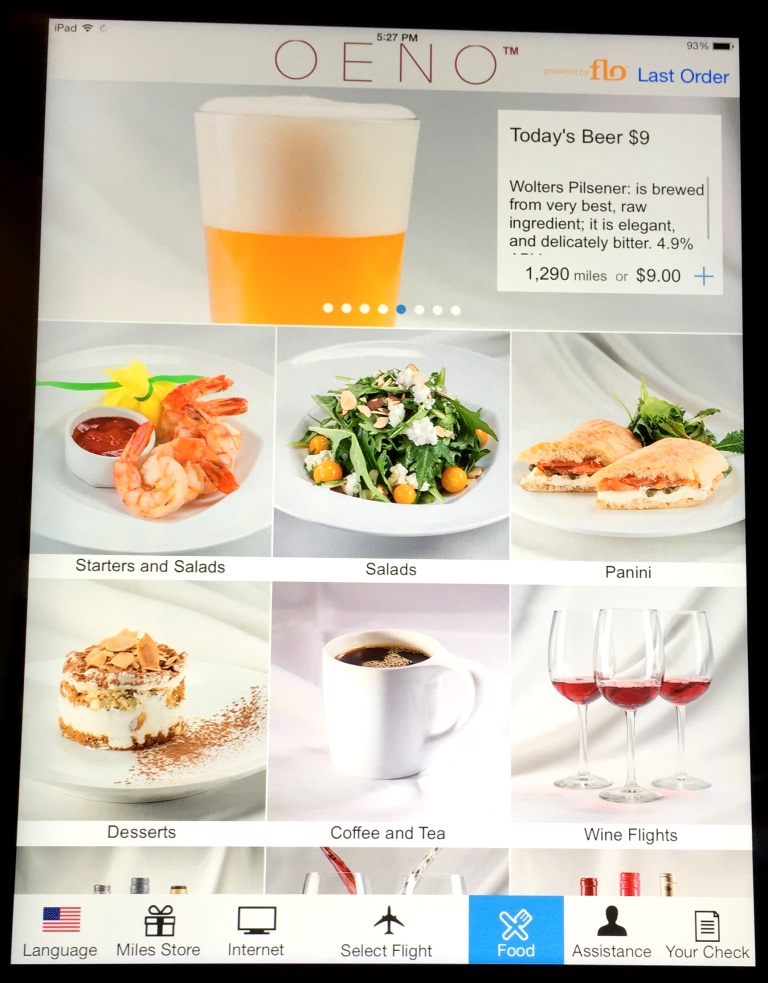
Now, as you try to dig into the wines, there are a few surprises which one runs into. First of all, the prices – there are 6 wine flights offered, priced either at $36 or $54 – most of the Vino Volo flights were priced under $25, so $54 for the tasting flight, seriously? The prices for the glass of wine range from $10 going into the $40s (not bad for the airport, right? – $40+ for a glass of wine on the go). But – for me, an oenophile who was served by Vino Volo very amicably, the biggest gripe is the full lack of information. Despite the fact that you have in front of you an iPad, an electronic device which allows to have pretty much an unlimited amount of information for each and every item offered, Oeno menu provides literally no relevant information. It seems that the only reason to offer the menus on the iPads is to make it easy to charge the customers in dollars or in frequent flyer currency – points/miles. Nobody cares also to provide a service with that, make sure people actually like what you are offering (yes, I mean “information” by the service).


Let me advance my gripe further. Considering complete lack of information, I decided to at least order something inexpensive, so I went with Jelu Pinot Noir, at $10.50 per glass. I couldn’t figure it out where the wine was from, as no information was available. After tasting something pretty much undrinakble – hot, unbalanced, biting wine – I had to look it up. It appears that this was a Pinot Noir from Argentina, and it also appears the the whole bottle cost as much in retail as I paid for the glass. Had I known that this was a Pinot Noir from Argentina, I would simply avoid ordering that – you can hardly go wrong with Malbec from Argentina at any price level, but when it comes to Pinot Noir, you better know the wine and/or producer.

Leaving the wine aside (as I did with my glass), the food was also marginally successful. I ordered a Smoked Salmon Panini. While I understand that Panini is a pressed sandwich, I didn’t expect that smoked salmon panini would be put under a hot press. Ever had hot smoked salmon? This is not the most delicious food in the world, as the heat accentuates the saltiness of the salmon, and really makes it marginally enjoyable. Never mind the price of $14.25 – for that amount of money, you can have 2 or even 3 excellent sandwiches in most of the European airports…
The iPad system at Oeno is really focused on getting money or miles (the points) out of you, at the same time providing as little service as possible, as you do everything on that iPad (you have to place an order and pay before anything gets to your table). To add insult to the injury, the tip of 20% is added to your payment at the time of the order (for some reason it is called “check-out”, even it is the first thing you have to do to get your food). The only service you get is your food placed in front of you, but nevertheless, you are paying as you are at a high end restaurant with great service.
And the last thing which I found extremely annoying: the push to get you to use your frequent flyer miles. If you travel enough, I’m sure you know that all those “rewards points” don’t come very easily, with the airlines constantly looking for the ways to reduce your frequent flyer benefits. Now, every item on the menu has price both in dollars and in miles. For the glass of Prosecco, you could elect to pay $14.10, or use 2,020 miles. As long as you don’t analyze the numbers, and have millions of frequent flyer miles in your account, you probably don’t care about “just 2000” miles. Now, think about this: if you have no status with United, to earn the same 2000 miles, you have to buy a $400+ ticket (it should be $400 before taxes and fees), as you are only getting 5 miles per dollar on United. If you are short 2,000 miles for your award ticket, you can buy them from United, at a measly price of $70 – but here you are, offered to spend that same 2,000 miles on a glass of bubbly instead of $14. And when you refuse to do so, you are asked to fill out a survey to explain why did you refuse the offer to pay with miles. Don’t know about you, but I find this preposterous.
Okay, let’s end this Friday rant. If you travel through Newark airport, and especially if you are an oenophile, I have only one recommendation for you – avoid Oeno. Unless someone at Oeno wakes up and makes changes to transform it into really a desirable destination, as Vino Volo was. Until then, take your hard earned money elsewhere, and – Vino Volo, I miss you very much… Cheers!
Oeno Wine Bar
Newark Liberty International Airport
Terminal C
Gates 70-89
Speak Up!
 This post is not really a rant, even though it can be classified as one. I would rather see it as a plea – not directed at someone particular, but to anyone who enjoys even an occasional glass of wine.
Wine can be intimidating at times. Heck yes, wine is often intimidating. It has an aureole of mystique. It seems to demand the special knowledge to be enjoyed, the years and years of hard study. And quite often, the “exclusivity” notion is enforced by the very people whose job is to help, to make the wine less intimidating, to make sure that “the customer” will simply enjoy the glass of wine.
True – the wine, as any other discipline, has a great depth of technical knowledge. It is not easy to make a good bottle of wine; it is very difficult to make a great bottle of wine. You need to study for many years almost 24×7, learn the exact names of hundreds of small villages in Germany, to become a Master Sommelier (there are only a few hundreds of them in the world). All of it is true. But not necessarily unique – most of what humans do today in so called “work” requires lots of studying and lots of specialized knowledge.
But wine is yet again different. While it requires knowledge to produce and explain it to others, when it comes to its basic purpose – drinking, it is, whether by itself or with the food – it is very simple. Forget all the nuances of the taste. Forget all the fancy descriptors and ratings. When it comes to the content of your glass, it is really all binary – you either like it or not.
Nobody questions their own ability to decide whether they like the burger or not. Or any other food for that matter – in most of the cases, people have no issues declaring “this is good” or “this is bad”. But when it comes to the wine, majority start second-guessing themselves. People often sheepishly say “but I don’t know much anything about the wine”. This proverbial “luck of knowledge” is used as an excused to keep quiet. People are afraid to state their opinion around wine, as they don’t want to appear disrespectful, or even worse, totally ignorant and not worthy. At the same time, when someone takes a sip, they know immediately whether they like the wine or not.
Now, let me get to the “Speak Up” part. No, I’m not advocating that everyone will start proclaiming “this is crap” or “this is nectar” on the very first sip of the wine in the various situations. For example, if you will open a bottle of young red wine, immediately pour it into a glass and take a sip, your first reaction might be “this is too sweet!”. Give this wine 5 minutes to breathe, and your next sip often will be totally different experience, with earthiness, minerality and acidity. As another example, the first taste of the cold white wine might feel extremely acidic, but the wine will mellow out right after. So, no, “speak up” is not about always declaring your opinion right away.
What is important for me is that if you drink wine even on a semi-regular basis, you know what you like and what you don’t. In case when you don’t like the wine, you also know why is that – too acidic, too sweet, too wimpy, too tannic, doesn’t taste well with food. There can be lots of reasons for not liking the wine. And it is all fine – taste is personal, and two people next to the same bottle don’t have to share the same opinion; there is nothing to speak up about here. With one exception: when the wine is spoiled.
There are many possible issues with wine, which affect its taste – these are called “wine faults”, and the end result is what we call a spoiled wine – the wine which tastes bad. This is not the case “I don’t like it”, this is the case “it is spoiled” – and nobody should drink it. Have you ever tasted spoiled milk, when the sweetness of milk is replaced with the off putting smell and sour taste? What you do with the spoiled milk? Anything but drink it, right? There are many potential faults in wine – brettanomyces (often called “brett” for short), volatile acidity, oxidation, heat damage (so called “cooked wine”), cork taint and many others (in case you want to read more, here is Wikipedia link). Some of the faults are less offensive than the others – for instance, brett is associated with barnyard aromas (so called “funk”) in the wine, which some people love (yours truly would be one of them). But most of the faults really kill the taste of wine; spoiled wine doesn’t deliver any pleasure the wine is supposed to bring.
One of most prominent offenders is the cork taint – typically caused by the cork material which was not cleaned properly – and the result of the cork taint is called a corked wine. What gives it away first of all is an aroma of the old, wet, musty basement – you know that smell, I’m sure you do. But this is not the worst part. On the palate, the corked wine is sharp, bitter, and devoid of fruit – the fruit is nowhere to be found in the corked wine. Sometimes the smell might be very minor, but then the sharp palate will give this fault away. And corked wine is something which you are not supposed to drink. Nor you should let anyone to drink that. This is the case when you have to trust yourself – and speak up.
How many of you ever been in the situation when you tasted the wine (or just smelled it) and said to yourself “this is corked”? And then, even when you are 100% convinced it is corked, you just kept quiet – you didn’t want to offend the host, you thought “ahh, may be something is wrong with me”, “but people already had been drinking the wine from this bottle for a while, how it can be corked”? Been there, done that? It’s okay, this blog is truly a non-judgement zone, please share your experiences. But I’m seriously telling you, if I may – I insist – speak up. Trust yourself and speak up.
I’ve done this many times in many different settings. Sometimes, the corked bottle is one and only, and all you can do is just to dump it or put it aside to return to the wine store (please note – most of the reputable wine stores will take the corked wine back and refund your money – they are not losing anything either, as they also will return the wine to the producer). But the best case is when the other bottle of the same wine can be open instead – and it shows all the beautiful aromas and fruit the wine was supposed to have. This is the best learning experience, of course – but even if you didn’t have that experience, you still have to speak up.
You need to understand that by keeping silent, you are not doing anyone any favors. If you keep silent, you drink the wine which tastes bad. You let others drink the wine which tastes bad. You letting down the winemaker as well. In many (most) cases, the corked wine is not even producer’s fault. And if you and others end up drinking bad tasting wine, you might say to yourself “I will never buy this wine again” – and trust me, this is not what the winemaker had in mind when the wine was produced with love and care.
You have to speak up – and you got nothing to lose. If you are wrong, and the wine is not corked but simply need the time to breathe – so be it. But I’m sure that once you experienced the corked wine, you will be able to identify it again, so if you think the wine is corked, there is a very good chance that it actually is. Trust yourself and speak up. When the next bottle is open, and everybody sigh with relief and pleasure, your host will be the first to thank you. And if you will feel happy, leave me a comment too. Cheers!
Vino Volo Experience – Mostly a Rant
Rant? Vino Volo? Really? There must be something wrong with this picture, right?
Yes, on a number of occasions I confessed my love to the Vino Volo wine sanctuaries at the US airports. This time, I was yet again very happy that the ride to the Newark airport in New Jersey was quick and uneventful, and I had enough time to visit Vino Volo. In case you are not familiar with the Vino Volo concept, please take a look here.
Now, I don’t know how the Vino Volo stores are operating. I would assume that the local stores have some freedom to select the wines, based on their locality and, of course, their clientele. It is quite expected that the Vino Volo’s selection at the Seattle airport will be slated towards Washington wines, and San Francisco location will be California-heavy, and the store in Austin will have a flight or a few of the Texas wines. In the Newark store, there was nothing local – no New Jersey, no New York wines. There were a few of the “international delights” and few of the “value delight” flights – none of them generated any excitement. Then I saw a Sommelier Selection flight – two wines at $25, both wines supposedly high end.
To be entirely honest, first I made the mistake I make quite often when it comes to the wine lists – I don’t pay attention to the small details – as an example, one extra word in the name can take the wine from the first growth to the second label. So below is what I thought was in the flight (yep, I was hoping for the coveted Opus One):
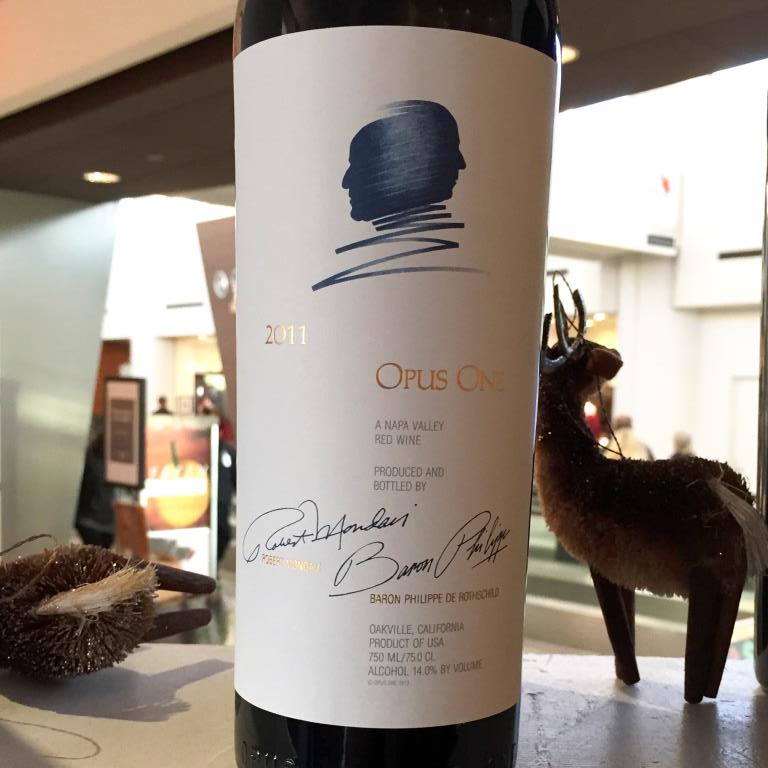 Well, there was no Opus One in the flight – instead, it was an Opus One Overture (see, one extra word!):
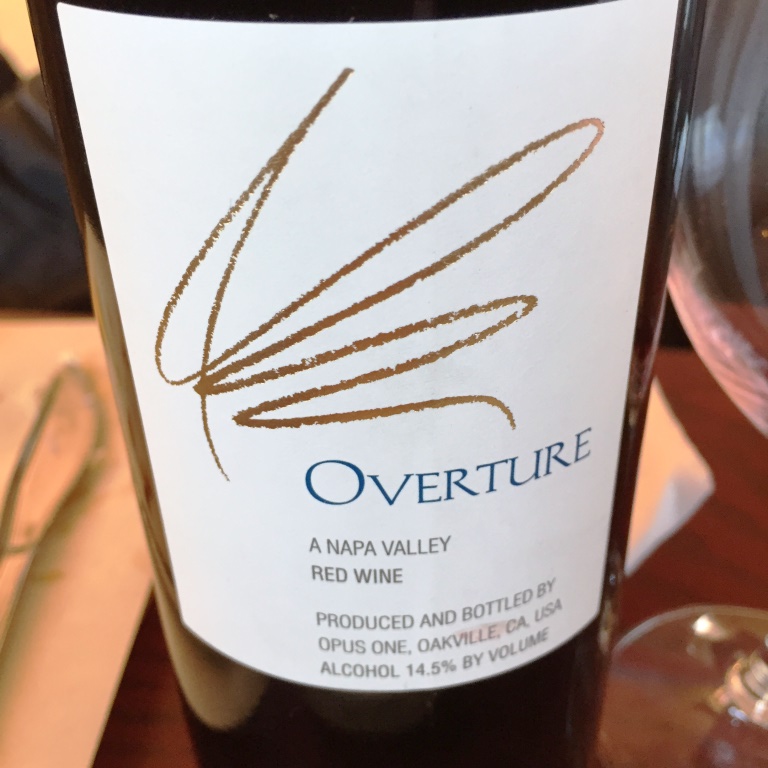 Okay, fine. You don’t expect me to rant about my own mistake, do you? Of course not. Let’s continue.
The flight arrived, and it looked like this:
 Just so you can actually read the “official” description, here is the same – without the glasses:
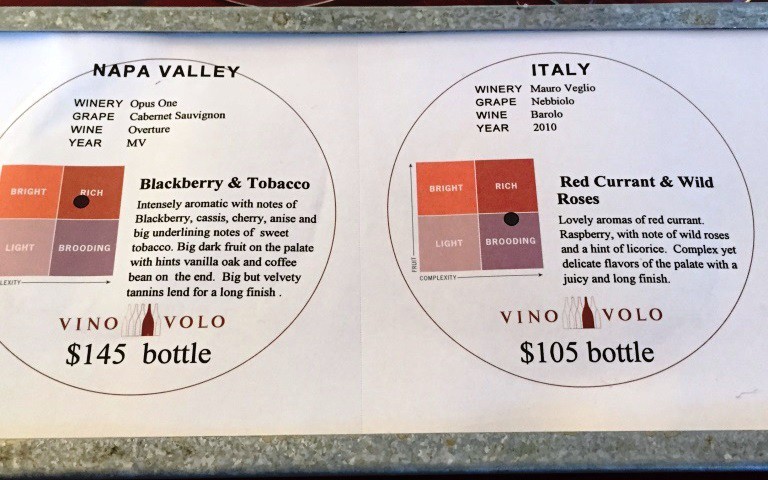 Okay, so I tasted the first wine, which was a non-vintage second label from Opus One, supposedly made with the surplus Cabernet Sauvignon grapes which were disqualified from the Opus One production. A bit thin, nice profile with touch of cassis, a bit green but palatable (but with the expectation of a lot more at the price of $145). While I understand that it is a non-vintage, I would assume that it is a young wine, and if it anything like the other top Mondavi Cabernet Sauvignon wines, it should be decanted to show best. Okay, let’s put it aside and let it breath, and let’s try the second wine, shall we?
Barolo from 2010. I don’t know about you, but I don’t consider 4 years old Barolo drinkable, unless it will spend good 3-4 hours in the decanter. I didn’t see a decanter at the bar, so I must assume that it was poured straight from the bottle. But even before that, if you want to really showcase the sommelier-selected wines, why would you put Barolo next to Cabernet Sauvignon? Wouldn’t you go to the Super Tuscan as the very least, showing California versus Italy? Okay, never mind all that, the proof is in the pudding, taste, right? Swirl, sip – there was nothing remotely reminiscent of Barolo in this wine – well, at least within my experience with Barolo and my expectation with “king of wines”. Very limited fruit expression, herbal nose, some tannins, very tart. Had it been decanted for the 3-4 hours, it would probably be a totally different experience – and should the folks, the professionals at Vino Volo known better?
Well, may be it was a root day after all. Or not. But there you have it, my friends – my first unsuccessful experience at Vino Volo. Let’s hope it was the last. Cheers!
P.S. I have my “formal” tasting notes – but I’m withholding them as I don’t think they will be of any use here.
P.P.S. If anyone had the 2010 Mauro Veglio Barolo and wants to say I have no idea what I’m talking about, please be my guest – your feedback will be greatly appreciated…
And All The Fuss About Wine Reviews…
 Few days ago I read an article by Joe Roberts, talking about wine reviews. The article, called “Does The Wisdom Of The Crowd Provide Better Wine Reviews Than The Experts?“, and the subsequent comments were evolving around the role of the “crowd-sourcing” in the wine reviews from the sites such as Cellar Tracker versus traditional wine critics and wine experts, the value of wine ratings and all the other critical analysis of wine. Instead of commenting in the thread, I decided to express my thoughts in the form of this post.
Warning – this might be long. You might want to arm yourself at least with one glass of wine. Or more…
It is very interesting to observe “are the wine reviews and wine critics relevant” discussions to periodically flare up all over the blogosphere and all of the digital media. Some of those discussions and opinions are quite antagonistic, from “death of Wine Advocate predicted” to “the number of wine bloggers will decrease dramatically” to “blind tasting puts wine experts to shame again”. Some of them are supported by some facts and findings which authors deem indisputable. And some are written just purely for the entertainment or quick publicity purposes.
For all of us obsessed with wine, the subject of wine ratings and wine reviews is near and dear to the heart. The world seems to rotate around those 98s, A and B, 4 stars and all other metrics. Meanwhile, majority of the wine consumers couldn’t care less. Based on the number of studies, people buy wine based on the label, advice of the store associate and the price. By the way, the price factor is funniest of all (should be a subject of a separate post) – when we buy for ourselves, we always want to find $10 wine which will taste like a $100; when we need to bring a present, we ask for the advice to find the best wine at the top of our budget, and then spend a few extra bucks just not to look cheap. In any case, very few consumers concern themselves with the ratings which are abundantly displayed in many stores (interestingly enough, there are quite a few stores nowadays which are doing away with all those rating displays). Yes, the people who buy more expensive wines are interested to know what the experts think about the wine they are about to shell $50, $80, or a $150 for. Of course wine collectors track all those ratings as they are stock tickers (well, they kind of are). But considering the world of wine, those people are an absolute minority (okay, don’t bring up the 80/20 or 90/10 – that is not the subject of the post).
So Joe Roberts argues that Cellar Tracker ratings might replace all the expert opinions simply because they are the crowd sourced and it is proven by many sources, which Joe is citing, that crowd-sourcing is the way to go in today’s world. It is stated that the crowd-sourcing works because it is proven by TripAdvisor, Yelp, Amazon and thousands of other sources soliciting people opinions. Well, may be, but it depends. Let’s look at Yelp, as the food world is probably more related to the wine world than travel or gadget shopping.
Different people review restaurant on Yelp, and for the most of the cases the reader of the review doesn’t know anything about the writer. But if you think about an average restaurant, a lot of aspects of the review are based on the common sense. The understanding of the “good service” is pretty much universal. The understanding of “clean” versus “dirty” is also quite universal. “Run down” is pretty well understood. When the food is served cold, or you have to wait for 30 minutes for a cup of coffee, you don’t have to be an expert to universally recognize it. And if you ordered steak in a restaurant, I have reasonable expectations that you know how good steak tastes like.
No, you can’t take the ratings on Yelp for granted. People get upset, people get unreasonable – true. But this is where crowd-sourcing works the best. If a restaurant on Yelp has four stars out of five, based on the average of a 150, or 300, or better yet, 1000 reviews, you know that your chances of good experience are pretty high. If the restaurant has five stars based on 3 reviews, you know that means nothing in terms of your potential experience. The fact that that restaurants are judged on the multitude of factors, many of which are universal and even independent of the type of restaurant (clean Thai restaurant with good service is not any different from clean steakhouse with good service), gives you a certain level of reliability of the crowd-sourced ratings.
Wine is different. There is no foundation to all those ratings, outside of smell, taste and ability to deliver pleasure. But – “tastes good” is highly individual. If someone only likes to drink California Cabernet, convincing the person that this Sagrantino was a great wine might be difficult. Now, if you look at the crowd-sourced ratings, like Cellar Tracker offers, it means nothing, as based on the rating alone you can’t align your base with the people who wrote the reviews. You don’t know if the person who rated that St. Joseph Syrah at 78 simply doesn’t like barnyard undertones, or the wine is actually bad. You have to read the review to try to figure out what is wrong with the wine, and why the reviewer didn’t like it, may be he was just in a bad mood or had the wrong food with it.
When it comes to the wine critics, the situation is different. Yes, I know, the most famous of them are periodically accused of bias and various forms of dishonesty, but this is not relevant here. As the critics, they are able (and expected) to judge the wine objectively. Also, wine critics typically have their area of expertise, like James Suckling focusing on Italian wines, Steve Heimoff on California or Allen Meadows on Burgundy. I’m not trying to say that if a critic rated the wine at 95, it means that this will be a great wine for you no matter what – but at the same time, that objective persistency, consistency of the ratings and narrow focus of the critic allows you to align the base, and then have a quick opinion, a probability of liking the wine based on the given rating by a known critic. I don’t buy my wines based on the ratings, and I’m not willing to pay $100 more for the bottle of Cabernet only because Parker gave it 96 versus the wine next to it with only a 90 rating – but that rating allows me to establish a frame of reference.
Let’s look at the big picture. We can see an increased interest to wine all over the world. We also see an increased wine production all over the world. People “en mass” are increasingly more comfortable and more knowledgeable about the wine, especially if we are talking about Millenials and younger generations. And that does lead to the reduced role of “The Wine Critic” (Wine Spectator, Wine Advocate, etc). But – the need for the critical information about the wine is increasing, and as people gain more knowledge and learn to trust their own palates, they are willing to take wine advice from the lesser figures than Parker or Suckling, and they are willing to take it from many different sources – blogs, twitter, web sites and other digital media outlets. People are building their own tribes. This is where Cellar Tracker comes to play – but only for the people who are inside, only for the people who uses the service and is able to align the base. My personal “wine experts” tribe consists of many bloggers I started following over the years, one by one. Reading their posts, tasting the wines they are talking about, having a dialog, I was able to build my alignment, little by little, one glass at a time. I know that I can rely on and willing to take Jeff’s (the drunken cyclist) advice for the Pinot Noir, or Oliver’s (the winegetter) for German Rieslings, Julian (VinoInLove) and Stefano (Clicks & Corks) for any of the Italian wine, or Alissa (SAHMmelier) for the wines of Texas. This is not my unique experience – I truly believe this “tribe concept” works for everybody, more and more so.
Are you still with me? Wow, I really have to thank you for sticking along. Let’s round this up. No, the wine world is not going to rotate around Cellar Tracker. Yes, the role of The Wine Critic will decrease, but in the end of the day we will still have more of them. There will be ever increasing number of people who will be willing to share their experiences (and sometimes put it in the form of numbers), and there will be ever increasing number of people willing to take that advice. Crowd-sourcing? Kind of, but very different. May be “Tribe-sourcing” is the word. The world of wine is big, and it is only getting bigger – I think we all can perfectly get along.
Don’t know about you, but I need a glass of wine. Cheers!
Thursday Rant–Wine Blogs
Here is the post from the fellow blogger Jeff @ The Drunken Cyclist, with my comment which was left on Jeff’s blog:
You idea of “themes” is exactly what existed in the wine blogging world for many years – this is what was called Wine Blogging Wednesday, or #WBW, where the theme was set once a month with the “host”, and then all would be writing for that theme and the blogs would be posted and summarize. There used to be even a dedicated web site for that – after running for about 80 months, it is now closed : ( But here is a glimpse for you for what it was: http://drinkwhatyoulike.wordpress.com/tag/wine-blogging-wednesday/
Yours truly even participated in a few of the #WBW events, and it was fun. I don’t think we can do it more often than once a month (speaking strictly for myself), but I will be glad to support “Wine Blogger Challenge” if you want to start that movement. We can have a joint “announcement” from all of the supporting bloggers and we will need to promote it on Twitter, but again – you can count me in. And as a show of the support, I’m going to reblog your post on my blog 🙂
Cheers!

I have nothing against wine blogs–quite the opposite, I technically write one, I guess. I also follow several really great blogs and really admire their authors and are inspired by them daily. The problem I have with them is that as a “unit” there is really not much cohesion and at the same time not much in the way of differing viewpoints.
Both could be certainly due to the subject of our blogs: Wine appreciation is rather personal and certainly contextual. I might like a wine simply due to the fact that it tastes good to me. I might like a wine because it was part of an overall incredible experience for me. Another drinker/taster might be drinking the exact same wine in a completely different (or even a very similar) context and have a different opinion of the wine. When you come right down to it, though…
View original post 759 more words
Thursday Rant–Tasting Fees
One of my fellow bloggers, TheDrunkenCyclist recently started a series of posts called Thursday Rant. His latest post managed to “hit the chord” as we call it – it is about winery tasting fees getting into totally absurd territories, especially when you are in the places like Napa valley. You should read the post below to see it for yourself – and then take a look at some of my suggestions:
There are a few things which you can do to avoid a paying an exorbitant amount of money for the wine tasting, outside of simply not visiting the wineries – but all of them will require planning ahead.
1. Connect with the wineries on Twitter and ask them to make special arrangements for you and your group for the tasting. It doesn’t mean that your tasting will be complementary, but you might have an opportunity to taste some interesting wines.
2. Talk to the people at your favorite wine store – tell them you plan to visit a particular winery. Your wine store is often connected to the winery either directly or through a distributor – the winery might be very accommodating to your needs.
Cheers!
Wednesday’s Meritage – Wine Quiz Answer, Results of Book Giveaway and a Rant
Meritage Time!
Let’s start from the answer for the Wine Quiz #45, an Easy One. In that quiz, you were supposed to answer 3 easy questions, and then simply talk about your favorite wines and wineries. All of it with an ultimate goal of leaving the comment so you can get the new wine book called “Rock and Vine” to be shipped to you. Free. And you know what – before we get to the answer and the results, let me get the rant out.
I don’t get it. So the free book (5 copies) was offered, pretty much for anyone who would care to leave a comment in the blog. According to the stats from the WordPress, the post had total of 56 views – and only 4 people left comments. Are people not reading books anymore? Did the people who wanted the book were too shy to leave a comment? Was it something I said (or didn’t say)? I’m puzzled… Honestly, I was not looking for the book giveaway as a cheap publicity shot, to attract more followers or something – I simply don’t do it. So as I said already, I’m puzzled – and if anyone want to offer a theory or explanation or simply tell me that I’m too dumb to get it – be my guest. End of the rant.
Now, let’s get to the wine quiz answers and the winners. We have two winners of the wine quiz and 3 winners of Rock and Vine book giveaway – Jeff (The Drunken Cyclist) and Oliver (The Wine Getter) are the winners of the wine quiz ( they got 3 out of 3 questions right) and both of them plus Emily (@WineMuse) are the winners of the book giveaway!
Now, if you want details, here are the first 3 questions with the answers:
1. In the famous movie “Sideways”, where (in which region) the action took place, and what were two grapes which Miles was so adamant about (one positive, one negative)?
Answers are Santa Barbara, Pinot Noir and Merlot – you can read more here.
2. Which grape is referred to as “The Real American Grape”?
Norton. By the way, Oliver, this is not my designation : ) – this designation is actually trademarked – here is the link.
3. What Judgement of Paris was all about and when did it t took place (provide short description)?
Judgement of Paris took place in 1976 and it was a blind tasting event where French wine critics overwhelmingly preferred California wines over similar French wines, which put California on a world-wide wine map. Here is the link for additional reading.
And the last two questions were:
4. Name three US wineries which you visited, want to visit or at least drunk the wine from
5. Thinking about your favorite wines, name one of them ( any one of them). As a bonus, provide short description and may be explain why is it one of your favorite wines.
Let me just quote the answers:
Emily (@WineMuse):
4. Failla, Varner, Littorai most recently
5. Whatever is in my glass at the moment  (but really, I do like all the wines mentioned above. They are extremely well-made and unique. I also really like & respect the people that make each of them)
TheWineGetter:
4. Chateau Grand Traverse, Brys Estate and Left Foot Charley – all Traverse City based wineries whose wines I have tried but never visited. This year is the year!
5. One of them would be the 2001 Poliziano Vino Nobile Asinone which I tried in their tasting room in the fall of 2005. The wine just hit me completely unexpectedly with its depth and earthiness and was so far above the regular vino nobile that Poliziano produces. It was just incredible. (I have to name a riesling, too! Sorry. One of the many was a 1990 Vereinigte Hospitien Erdener Prälat Auslese which we had at a birthday party for Nina. The wine was dark amber in color and I have never come across such a vanilla a yellow fruit bombs in a riesling again.)
TheDrunkenCyclist:
4. I have visited Clos Pepe, Littorai, and Freeman Wineries (among countless others).
5. One of my favorites wines is the Clos Pepe Pinot Noir. The wine is phenomenal, but above that, it is made by Wes Hagen, who is one of the true characters in the wine business today.
One last note – there are still 2 books I can give away. If you want them, leave a comment or otherwise send me a note over the next two days – first come, first serve…
That’s all I have for now, folks. Cheers!
Feeling Stupid and Sorry, Apologies to the Turley Wine Cellars, and Marketing 101
Yesterday I was a snob, today I feel more like an idiot. In yesterday’s rant, I was complaining about the feel, shape and overall appearance of the bottle of 2010 Turley The Label Cabernet Sauvignon – first release of Cabernet wine by the famed Zinfandel producer. Then, while reading the comment by VinoInLove, I realized that I should find the offering letter and see if I’m not missing something.
Unfortunately, I have a bad habit – I keep old papers and e-mails around. So of course I found it. And then I read it. And then complemented myself on being… yeah, I already said it. Here it is, the offering letter, pretty much in its entirety (to drill it deeper, I even highlighted the key sentence):
 So, my apologies to the Turley Wine Cellars – my yesterday’s rant was not justified. Or, was it, may be just a bit?
We can get good lessons from any situation, this one being no exception. Personal lesson – the rant have to wait. If I would give it a bit of time, do a bit of research (i.e., find that offer e-mail), this all would be averted and I will not have to call myself names. But – there is also a marketing lesson here. I believe fundamental marketing mistake took place. Brand new product was introduced. The [very] unusual product for the given producer. It should be expected that additional marketing would be needed to help people to accept that unusual product. All it would take was to put a piece of paper with exact same description into every box, and “bad surprise” problem would be probably 80% fixed. It would be even better if the same information would go on the back label, which is pretty much wasted right now. And that would fix 90% of the problem.
Now, this whole situation forced me to read the back label. Carefully. And now I’m puzzled again. The first sentence of the “Vision” statement above says that this wine is a modern reinterpretation of the 60’s and 70’s classic, with lower alcohol level. Care to guess the ABV listed? It is 14.5%. I have some serious doubts that California Cabernet of 60’s was listing 15% ABV. Now this gets interesting – I’m really curious how this wine will taste like. Thus – to be continued…
Expectations, Meet Your Nemesis, Reality
In the words of my blogging friend thedrunkencyclist, yes, I’m a snob. Actually, in general, I think I’m not – but sometimes, especially when it comes to the ruined expectations, I guess that I’m.
Today I received a shipment from Turley Wine Cellars. Until now, Turley was a well known Zinfandel producer ( they also make Petite Sirah and Charbono). Their wines are reasonably priced, and you really should be on the mailing list in order to get them (practically not available in the regular wine stores).
As I’m on the Turley mailing list, about a month ago I received an offer to buy an inaugural release of 2010 Turley Cabernet Sauvignon from Napa Valley, creatively called The Label. I thought that it is definitely worth a try, a brand new wine from a reputable producer.
So the box arrived today. Cut, pull, take out very clever packaging (never saw anything like it), and I grab the bottle. My first reaction – WTF! I don’t know what I was expecting to see, but definitely not what I pulled out of the box. The bottle was very light, absolutely flat on the bottom (bad sign for a quality wine), and with its whole appearance was screaming “Cheap”! Mind you, this is a $40 bottle of wine, and if you will factor in shipping and taxes, it becomes $50 bottle of wine. The closest resemblance – Crane Lake from California, a $3.99 bottle of wine ( nothing against Crane Lake – I was happily drinking it many times). Here it is:

For comparison, here is The Label next to the traditional Turley Zinfandel:
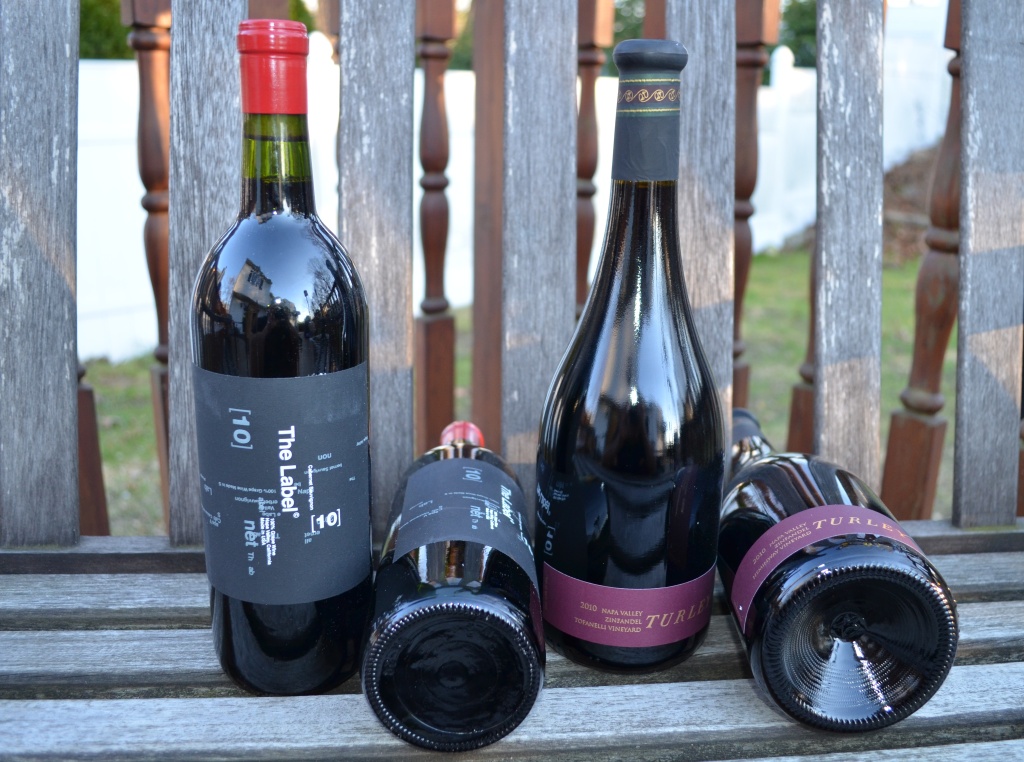
Note that the foil on top of The Label bottle doesn’t even cover the cork inside! I rest my case…
I’m disappointed and completely flabbergasted. What should possess a reputable company to use that type of bottles? Were they completely out of time, and those bottles were the only thing available? Is this a message to the Cabernet lovers from Zinfandel producer, saying “Cabernet sucks”?
I’m really at loss here. Yes, I know, I shouldn’t judge the book by its cover – I will hopefully give it a try on Friday (need to give the wine a few days to recover from shipping and to avoid the bottle shock) – so once I will do it, I will be definitely glad to tell you what I think about the taste of the wine.
Yes, I’m a snob…
Cheers!
Last Bottle Sign Up ($10 credit)




 Talk-A-Vino