Archive
Everyday Bubbles: Prosecco FIOL
 It might be hot outside. It might be a holiday, birthday, or a celebration. Or you just might be craving something refreshing after a long day.
May I suggest a glass of cold wine?
Wait, we can make it even better – how about cold wine with refreshing bubbles? May I interest you in a glass of Prosecco?
Prosecco is so popular today that it is an easy choice when one wants to enjoy some fizz in a glass. At the same time, it is interesting to note that Prosecco’s real story only started in 1989, literally being sold door to door in London. For comparison, Champagne was already in demand by the kings more than 200 years before that. But just to put things into perspective – based on 2023 data, Prosecco produced 2.5 times more bottles than Champagne – 880 million versus 299 million, and there were 4 times more of the Prosecco bottles imported into the US in 2022 – 134 million versus 33.7 million.
While both Champagne and Prosecco belong to the category of sparkling wines, they are different in many ways – grapes, production method, blending, ability to age, prices, and so on. But we should look at them exactly as they are – these are two types of wines in two different categories, each one suitable for different life moments. Yes, even the cheapest Champagne is typically at least twice as expensive as Prosecco – but in wine, the price is not a guarantee of pleasure – we can enjoy a glass of Processo as much as we might enjoy a glass of Champagne. Heck, we might enjoy a glass of Prosecco a lot more than a glass of Champagne. First-hand example – I really enjoyed a glass of Aperol Spritz in Italy, made with a no-name Prosecco – and I was really not happy about seemingly the same glass of Aperol Spritz proudly made with Mumm Champagne while in France – no-name Prosecco in this particular case was way better than the coveted Mumm. Don’t get me wrong – by no means am I encouraging you to stop drinking Champagne and wholeheartedly switch to Prosecco – I’m merely suggesting that each one can have its own joyful moment. The wine has to give you pleasure, that’s what matters – and pleasure is subjective.
So today, let’s enjoy a glass (or two or more) of Prosecco, and I have a Prosecco for you in mind.
Let me present Prosecco FIOL to you – a beautiful rendition of Prosecco that is well worth seeking.
First, let’s talk about the name. As per Prosecco FIOL’s website:
FIOL (/fee-ol/ • noun)
a term of endearment for a young man, originating from the old Venetian Republic language (1400s), similar to “son” or “chap” in English.
Prosecco FIOL was started in 2011 by 3 lifelong friends – Giovanni, Gian Luca, and Pietro, who found a way to express their passion for the land and the Italian and Venetian way of life. It is interesting to note that the fruit for production of FIOL is selected from about 2,300 (not a typo!) farmers, accounting for a combined 14,800+ acres of vineyards and terroirs to achieve the perfect blend.
I had an opportunity to try both Rosé and regular Prosecco, so here are my impressions.
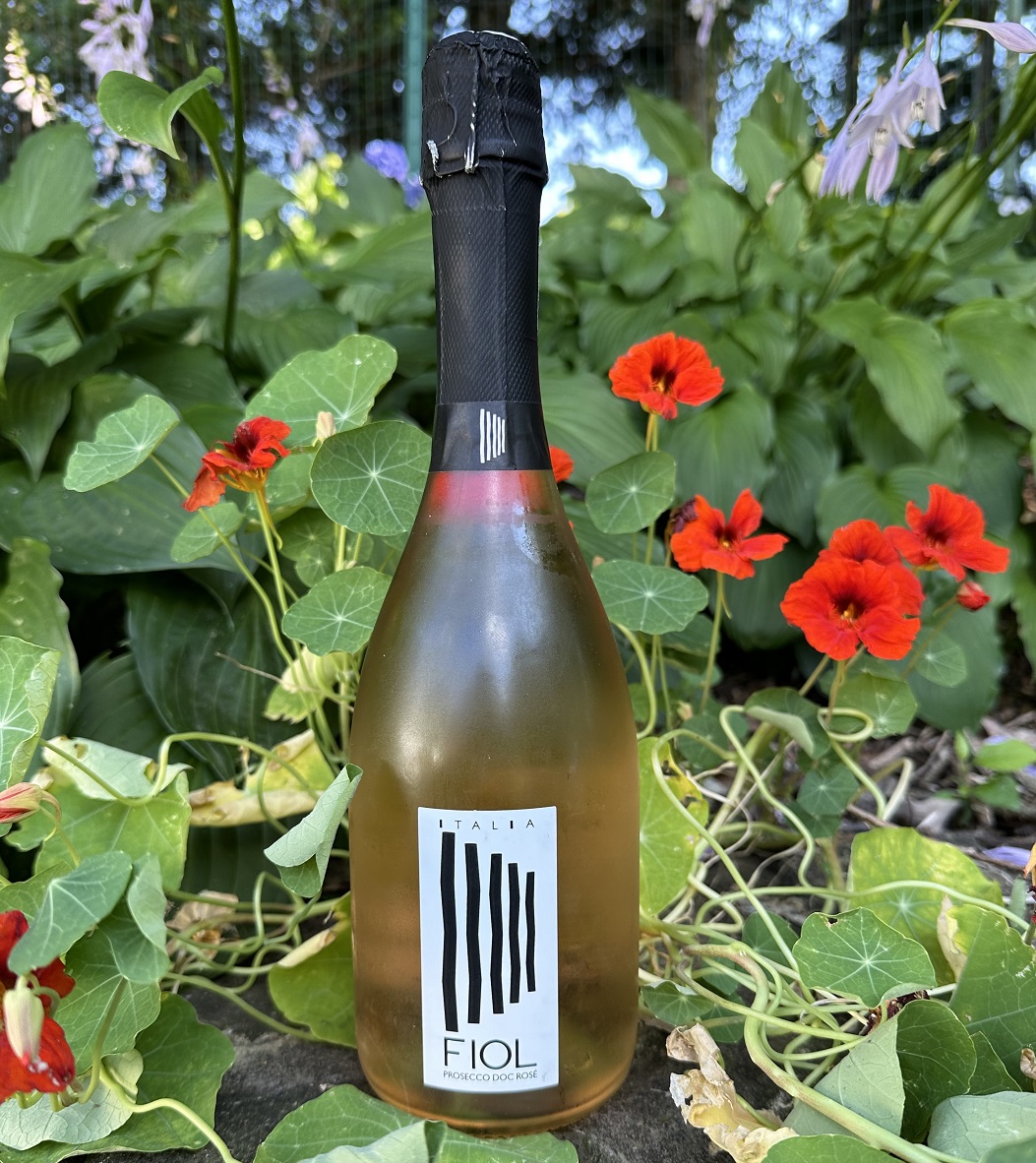
2021 FIOL Rosé Prosecco DOC Millesimato (11% ABV, $22, 85% Glera, 15% Pinot Nero)
Beautiful Salmon pink color
A whiff of strawberries on the nose, also a hint of strawberries on the palate, very generous mousse with lots of energy, a bit more plump than a typical brut champagne, exquisitely refreshing, and constantly encouraging another sip.
Superb.
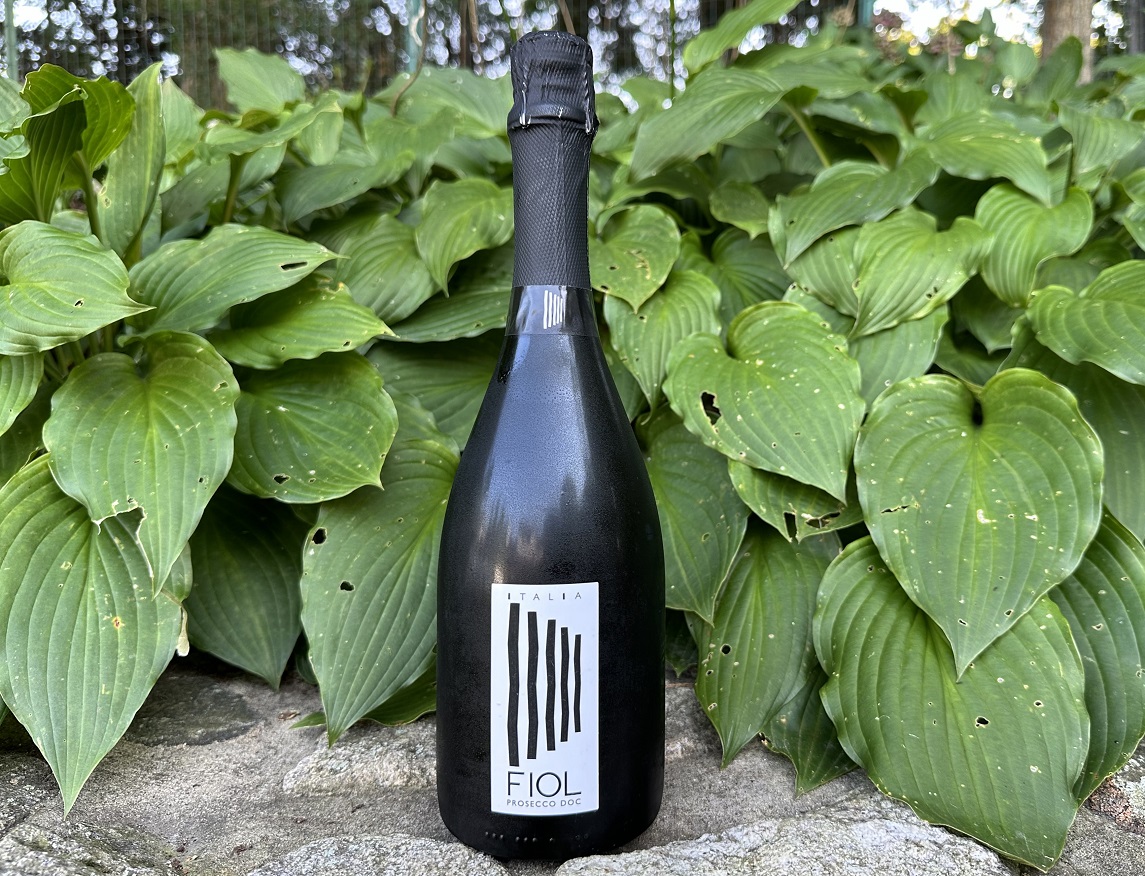
NV FIOL Prosecco Extra Dry Prosecco DOC (11% ABV, SRP $19/750 ml | $39/1.5 L)
Beautiful straw pale color, fine mousse
Apples, white flowers, fresh pear, light, inviting
Delicious apples on the palate, good body weight, light plumpiness, off-dry, long pleasant finish.
Made for a delicious Aperol, better than 90+ Prosecco
Here we go – two Prosecco bottlings, both delicious and perfectly suitable for everyday’s consumption without worrying about breaking the bank.
“Every day above ground is a great day”, so let’s celebrate it. With FIOL Prosecco in hand. Cheers!
Anatomy of Flavor
Anatomy of Flavor???
The author clearly goes on a tangent here. Everyone knows what anatomy means, and it has nothing to do with the wine. And nevertheless, let’s take a look at some definitions and see if we can actually analyze the anatomy of flavor.
Webster’s dictionary defines anatomy in a few different ways:


Definition number five describes anatomy as
structural makeup especially of an organism or any of its parts
Anatomy explains to us how living things are constructed. How do they move, jump, roll, smile, and cry.
Of course, the flavor is not a living being – but it is amorous, it changes, it morphs, it is perceived, and it is perceived differently every time, depending on many, many, many factors that we can spend days and days discussing.
I like definition number three more, as it is more appropriate for our purposes:
the art of separating the parts of an organism in order to ascertain their position, relations, structure, and function
Anatomy offers a firm structure – can we apply the same to flavor and understand how our perception of it works? Mostly, and luckily, no – we can’t. We have no idea how we will perceive the flavor of the particular wine once it is open – of course, we have expectations, but this is only one of the subjective factors in our perception of flavor, one of many. Instead, I can offer you to look at how the flavor is being built.
There is also definition number six:
a separating or dividing into parts for detailed examination
Anatomy explains to us how our muscles work and how they grow. Let’s see if we can take a similar look at the flavor of the wine.
We can’t do this with any random wine – if someone makes single-grape Syrah, Grenache, and Pinot Noir wines, all those wines are not connected to each other, they are unique and different – we can not taste Syrah and make expectations about Pinot Noir (assuming these are good quality wines) – as they have nothing in common. Most importantly, they better taste differently. But – there are wines which are perfectly suitable for our exercise. Do I have an example? Of course, glad you asked, but before we talk about particular wines, let’s take a look at the region they are coming from. Let’s go to Northern Italy, to the region called Valpolicella.
Valpolicella is a winemaking region east of Lake Garda, in the province of Verona, which is in turn located in Veneto. The region is influenced by the Alps to the north, Lake Garda to the west, and the Adriatic Sea to the east. Valpolicella received its DOC status in 1968, and Amarone and Recioto received the DOCG status in 2009. In terms of DOC wine production volume, Valpolicella is the second region in Italy after Chianti.
There are a few types of wines produced in the region – Valpolicella DOC, light wines considered to be similar in style to Beaujolais, Valpolicella Superiore, which should be aged at least one year, Valpolicella Ripasso, and, the most coveted wines, Amarone and Recioto.
It is not exactly known when winemaking started in Valpolicella. Still, it is typically associated with the ancient Greeks who were famous for making sweet wines made from partially dried grapes. That tradition of drying grapes before pressing is also a requirement for both Recioto and Amarone wines – this converts grapes to almost raisins and concentrates flavors. A lot of attention is also paid to preventing any sort of rot setting on the grapes as this imparts undesirable flavors.
Talking about red grapes, Corvina, Corvinone, Rondinella, and Molinara are considered the main winemaking grapes, even though many winemakers are trying to avoid Molinara as of late. Corvina should constitute between 45% and 95% of the blend – but up to 50% of Corvina can be substituted with Corvionone, which was identified as a distinct variety and not a clone of Corvina only in 1993. Out of all Val[policella wines, Ripasso stands aside as quite unique – it is made by macerating the Valpolicella wine with the pomace (grape skins) left after making Amarone and Recioto wines, which enriches the flavor of the wine – Valpolicella Ripasso is often referred to as “baby Amarone” (or “poor man Amarone” – you take your pick).
Of all wines made in Valpolicella (most of them are red), Amarone stands apart as the most sought-after. The grapes have to dry for anywhere between 3 and 4 months before they can be pressed to make Amarone. Those dried fruit flavors are retained by the final wine, assuming it is well made. The combination of the dried fruit aromas and powerful, dry, usually high-alcohol wine creates really a unique experience – if you have not had Amarone before, this is something that needs to be experienced by any wine lover.
Also going back to our “premise” with this post – to take a deeper look at the build-up, the anatomy of the flavor, Valpolicella wines offer an almost unique opportunity. Most of the Valpolicella wines are made from the same set of grapes, sometimes even used in the same proportions. The winemaking process is what creates the difference. Base Valpolicella wine can be aged for a year to get to Superiore designation. The same base wine can be macerated with Amarone pomace to become the Ripasso. The same grapes that are used for basic Valpolicella can also dry for 3-4 months, and then become an Amarone.
Let’s go one level deeper and look at some practical examples, shall we?
Tedeschi family ancestors purchased vineyards in Valpolicella four centuries ago, in 1630. The modern history of the Tedeschi winemaking family started 200 years ago, in 1824 when the family winery was established by Niccolò Tedeschi. Today the winery is operated by the fifth generation of the family, continuing the winemaking traditions.
Tedeschi estate is located in the village of Pedemonte di Valpolicella, with 75 acres of vineyards planted on the 200 acres estate. Tedeschi firmly believe that good wines are made in the vineyard, and they focus not only on showcasing the terroir but also conduct studies to understand the soil composition in the vineyard. Another important winemaking element is the use of not only the main 3 Valpolicella grapes (Corvine, Covinone, Rondinella) but the full range of grapes including Rossignola, Oseleta, Negrara, Dindarella, and Forselina. They also produce all types of Valpolicella wines – Valpolicella, Valpolicella Superiore, Ripasso, Amarone, and Recioto.
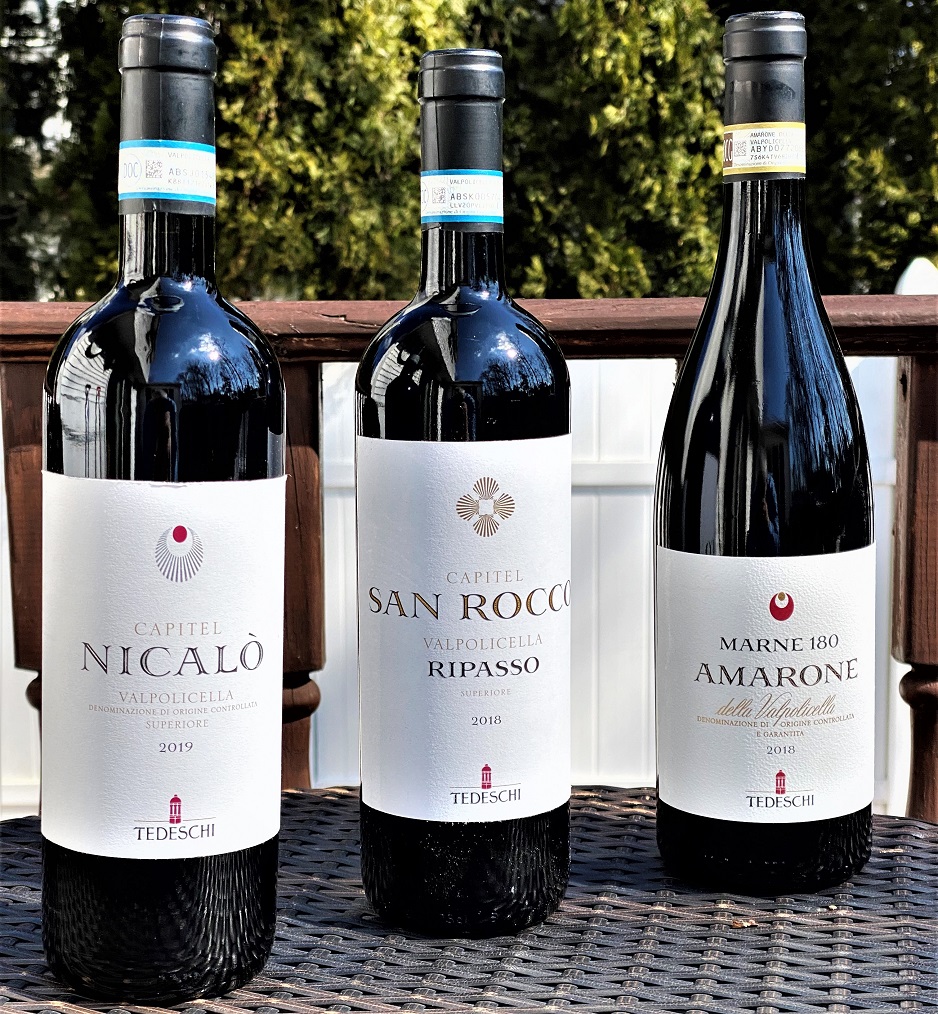
For our “anatomy” exercise, I had an opportunity to taste 3 of the Tedeschi wines – Valpolicella Superiore, Valpolicella Ripasso and Amarone della Valpolicela. All three wines are made from the identical set of grapes, used in the same proportions, so the difference is only in the winemaking techniques. Below are my notes with some additional information about the wines.
2019 Capitel Nicalò Valpolicella Superiore DOC (13.5% ABV, 35% Corvina, 35% Corvinone, 20% Rondinella, 10% Rossignola, Oseleta, Negrara, Dindarella, grapes drying for 1 month, 1-1.5 years in Slavonian oak barrels, 6 months in the bottle)
Dark ruby
Captivating nose of earthy dark fruit, tobacco, rocks
Beautiful fruit, blackberries, cherries, cherry pit, tart, focused, perfectly structured, perfectly balanced – lots of pleasure.
8/8+. Delicious.
2018 Capitel San Rocco Valpolicella Ripasso Superiore DOC (14.5% ABV, 14.5% ABV, 35% Corvina, 35% Corvinone, 20% Rondinella, 10% Rossignola, Oseleta, Negrara, Dindarella, alcoholic fermentation on the marc of Amarone and Recioto for 8-10 days, 1/2 years in Slavonian oak barrels, 6 months in the bottle)
Garnet
A hint of dried fruit, toasted nuts
Round fruit, cherries, soft, approachable, earthy undertones, well-integrated tannins, a hint of tobacco on the finish.
8/8+, delicious.
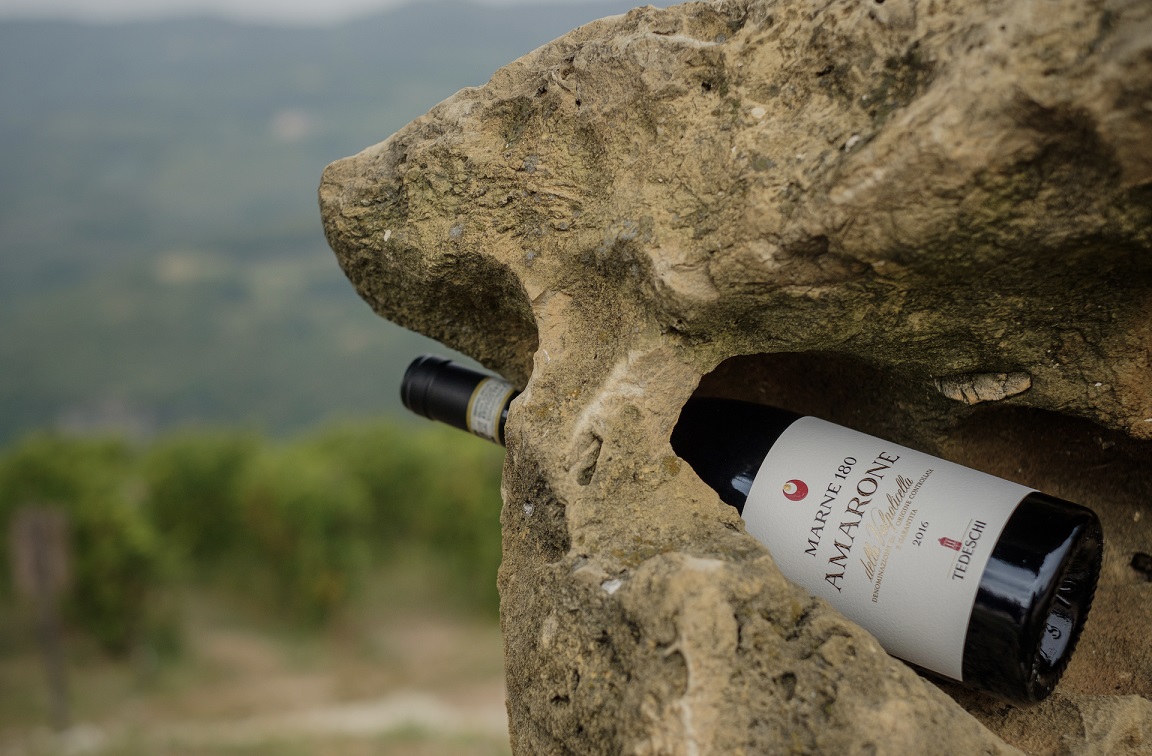
The name Marne 180 is a nod to the marl soils where the vineyard is located and 180 is degrees of exposure, from south-east to south-west. Source: Tedeschi
2018 Marne 180 Amarone della Valpolicella DOCG (16.5% ABV, 14.5% ABV, 35% Corvina, 35% Corvinone, 20% Rondinella, 10% Rossignola, Oseleta, Negrara, Dindarella, grapes drying for 4 months, 30 months in Slavonian oak barrels, 6 months in the bottle)
Dark garnet
Dark, concentrated, forest underbrush
Dried fruit, cherries, intermingled layers, powerful, well structured, delicious.
8+
Can we conclude anything from our flavor research? The wines share some similarities, but this is probably all I can say. I don’t see a clear progression from one wine to another, they are simply tasty wines, each one in its own right. Does it mean that we can’t talk about the anatomy of the flavor? I think we still can, but it is definitely more complicated than it seems.
The important outcome of this research project is three tasty wines from Tedeschi which I’m happy to recommend to you for your daily drinking pleasure. And this is the best conclusion we can make. Cheers!
Open That Bottle Night 2021 – What A Night!
Traditions, traditions, traditions.
Traditions need wine. Wine needs traditions. Makes sense? If not, express your disdain with a flaming comment. But if you are an oenophile (wine aficionado, wine snob, wine geek, …), you understand and can easily relate.
Open That Bottle Night, or OTBN for short, is one of the shortest living traditions of the wine world, where thousand years might be a good measure for some – OTBN was first celebrated in 1999 when it was created by the wine couple – Dorothy Gaiter and John Brecher, wine writers behind the “Tastings” column in Wall Street Journal. The OTBN was created to help wine lovers part with the special wine bottles which might otherwise become a waste.
There are two parts to any wine tradition – the first is a special wine itself, always carefully selected to match the tradition, and the second is sharing – sharing of that bottle with the world. Not with the whole world at once, but with the friends.
Let’s talk about finding and sharing.
Finding a proper bottle is never easy – and it might be even worse for the holiday such as OTBN, which was created specifically to help us part with the special bottle, the bottle which has a special meaning for us – no matter why and how, but special in whatever way. Sharing is typically not a problem – unless it is 2021 and the world is still mostly in lockdown – and that includes all of one’s wine friends.
I was lucky for the past many years to have wonderful celebrations of the OTBN with the friends, sharing the most amazing wine experiences (here is the first-hand account for 2017, 2019, and 2020). The only possible way to share OTBN 2021 was the one using for the majority of the gatherings during 2020 and 2021 – the virtual one. I’m not complaining – I’m grateful that at least we have the technology with allows us to spend time with each other face to face, no matter how physically distant we are. So sharing portion was rather easy, and now let’s talk about finding.
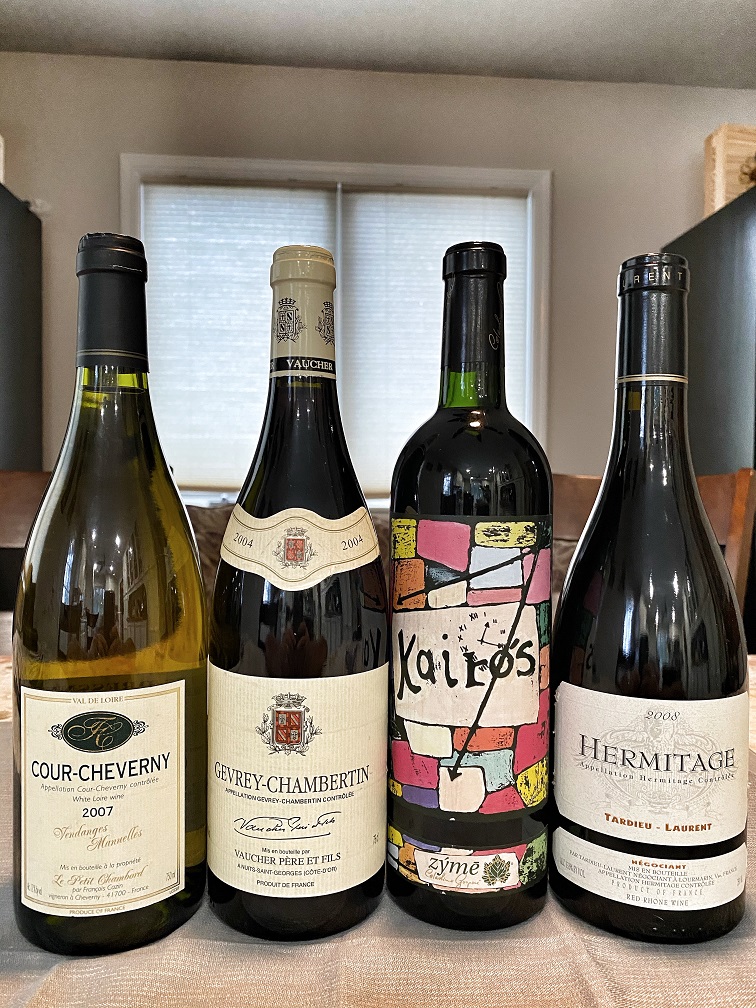
Finding is not even the right word. Finding is easy – but selecting is not. OTBN asks for that special bottle. Deciding on what makes one bottle more special than the other, when your cellar is full of unique bottles all present in the quantity of 1 (one), is the hard part. After some amount of deliberations, which included pulling numerous wine fridge shelves back and forth, back and forth, I settled on these four bottles:
Let me explain my selection logic so you will see why it is such a daunting process for me.
First, the white wine, as I’m a big proponent of the balanced diet. 2007 François Cazin Le Petit Chambord Cour-Cheverny AOC might be called my unicorn wine, at least when it comes to whites. The first time I tried a different vintage of this exact wine when it was 10 years old and this wine became one of the brightest memories for me – the beauty and interplay of bright fruit, honey, and acidity were simply unforgettable. When young, this wine from the Loire, made out of the rare grape called Romorantin, is a single note acidic. With age, it develops into an absolute beauty. When I opened the bottle of this wine back in 2015, the wine was superb. When I brought it to Jim’s house for the OTBN 2019, 4 years later, it was “interesting” but absolutely not exciting. I was hoping for redemption, so this was an easy choice.
My next selection was 2008 Tardieu-Laurent Hermitage AOC. When I see Hermitage written on the label, you can literally hear me sigh. Hermitage to me is synonymous with the Syrah, and I love classic Syrah. And so does my wife – Syrah is her favorite grape. I have very few Hermitage wines in my cellar – and this one was calling my name for a long time (meaning: it was pulled off the shelf and placed back many times). Considering that 2008 had a rainy growing season and the vintage has low ratings (WS86, for example) and “Drink now” recommendation, this was an easy decision – no point in waiting any longer.
How many unicorns can one have? Well, having a unicorn would be nice, but I guess I’m talking about chasing them. So how many unicorns can one chase? Clearly, it seems that I’m chasing many. Good Amarone is the wine I’m always chasing. Giuseppe Quintarelly Amarone is more of an ephemeral dream for me, considering the price and availability – and it is definitely one of those unicorns I’m talking about. With 2004 Zýmē Kairos Veneto IGT, I’m getting as close to that unicorn as I can. This wine is produced by Celestino Gaspari, the winemaker for Giuseppe Quintarelli. As the label says “Produced from 15 varietals of grapes of Verona, it is a reflection and interpretation of our soil and the culture of its terroir”. In case you are curious, the 15 grapes are Garganega, Trebbiano Toscano, SauvignonBlanc, Chardonnay, Corvina, Corvinone, Rondinella, CabernetSauvignon, CabernetFranc, Merlot, Syraz, Teroldego, Croatina, Oseleta, Sangiovese, and Marzemino. This was my last bottle, and I scanned the pages of this very blog for a good 20 minutes last night as I couldn’t believe that I could’ve never written about this wine before – apparently, I have not. Anyway, I was afraid that it might be the time for this wine, thus it was added to the OTBN group. By the way, another interesting tidbit about this wine is that the name “Kairos” means “timely”, “appropriate”, and “the perfect moment”.


Every good plan A needs plan B, right? The backup. Have you ever went to a friend’s house with a bottle of wine, while another bottle stayed in your car just in case the first one would be corked? Yep, that’s the plan B we are talking about. 2004 Vaucher Pere et Fils Gevrey-Chambertin was my plan B. I don’t have a lot of Burgundies, so opening one is always a special moment. 2004 vintage was so so, with WS88 rating and “drink” recommendation, so this bottle was rightfully on the OTBN list, should the need and opportunity come.
Now you know all about selecting, and I want to say a few more words about sharing. Sharing wine is one of the best pleasures of drinking wine. The approving, understanding nod from the fellow wine lover after he or she is taking the sip from the bottle you brought really fills you up with joy. It might be even more satisfying than your own enjoyment of the same wine. Yet in today’s world, sharing the wine face to face is literally impossible, OTBN or not. To at least share the moment, I reached out to the technology which seemed to save the world from going mad – a virtual get-together over video. Zoom is my tool of choice, so after sending the invites to the group of bloggers, we got together at 7 pm on the OTBN Saturday.
We were not a big group – even in the virtual world, people are busy and have their own plans. But I’m really grateful to everyone who was able to spend that special Saturday time together – some for the whole 2 hours, some for 20-30 minutes, talking about wines, sharing life stories and experiences, and most importantly, having fun. You can scroll through the pictures below, I’m sure you will see some familiar faces.
So how was my OTBN? In other words, let me tell you more about the wines.


The miracle didn’t happen, and the white wine didn’t become suddenly magical. If I need to describe this 2007 François Cazin Le Petit Chambord Cour-Cheverny AOC in one word, the word would be “strange”. At some moments, it was oxidative and plump. In other moments, it was acidic. It never showed that amazing lemon and honey notes I was expecting. I still have one more bottle, but now I really need to forget it for as long as possible and see if the miracle will happen.
The Hermitage was … superb. First of all, opening it was a breeze – cork was perfectly intact, regular waiter’s corkscrew worked just fine. Drinking this 2008 Tardieu-Laurent Hermitage AOC was a great pleasure – a touch of pepper, a distant hint of a barnyard, round and delicious fruit. The wine was just right – perfectly balanced, round, and smooth. I don’t have a lot of experience with Hermitage, but this wine was clearly one of the best renditions of Syrah I had in a long time. “Elegant” would be the single word descriptor I would use.
The Kairos was the bottle I was concerned about the most. It could’ve been gone by now, especially considering such an eclectic blend of grapes. When I started opening this 2004 Zýmē Kairos Veneto IGT, first I decided to use the regular corkscrew, which worked perfectly fine for the Hermitage. Looking at the way the screw was going in, the cork seemed to be too soft, so I decided that it was the job for Ah-So – I’m glad this decision was not an afterthought I usually have after the cork is already broken in half – Ah-So worked perfectly well and the cork came out with no issues.
And the wine… The wine was magical. Dark fruit with a hint of dried fruit on the palate, perfectly firm and structured, powerful and elegant, with clean acidity and an impeccable balance. The wine was delicious on Saturday, and I also enjoyed that over the next two days. So now I regret not having any more bottles left – but I’m glad I had this special experience. Magical would be the word.
As two bottles of red had no issues whatsoever, the Burgundy was left aside and now will be waiting for its special moment to be opened and enjoyed.
And that, my friends, concludes my OTBN 2021 report. While the sharing was virtual, the experience and pleasure of the wine and the company were real, and it will stay in my memory as yet another great OTBN night. Hope you had fun too. Cheers!
Hey French – Drink Italian
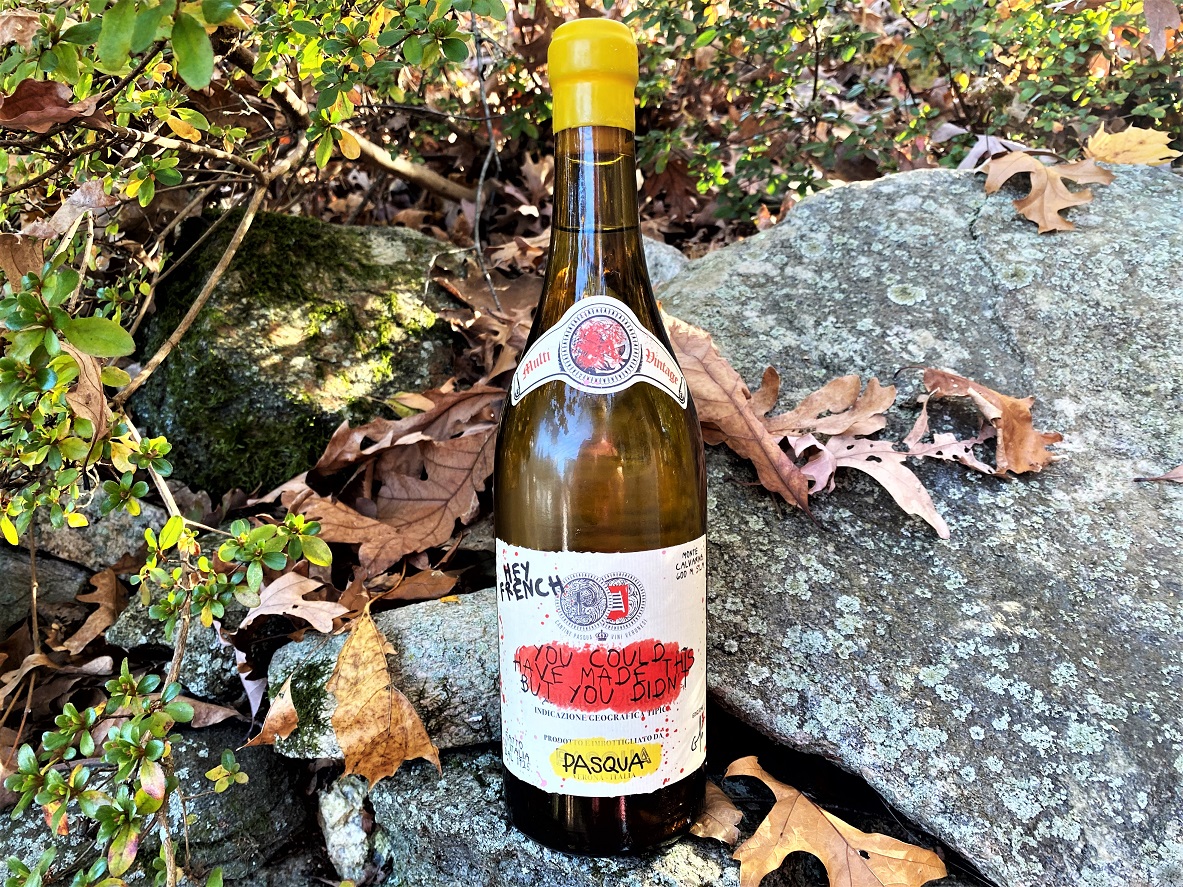 I mean no disrespect.
The title of this post is only suggesting that you should drink Italian wine. A particular Italian wine. And it doesn’t mean that French people should drink Italian wine – even though they will not regret if they will. Everybody can (should?) drink this Italian wine – Hey French.
The Pasqua brothers started Pasqua Vigneti e Cantine winery almost 100 years ago, in 1925 near the town of Verona in Northern Italy. Now with the family’s third generation at the helm, the winery continues and advances its traditions. I came across Pasqua wines for the first time almost 10 years ago – I found Pasqua Amarone at Trader Joe’s in Boston, and it was as good as Amarone under $20 can be. Then I discovered (also at Trader Joe’s) PassimentoSentimento, a tribute to the most famous Italians from Verona – Romeo & Juliet. At the beginning of this year, 2020, I had the pleasure of tasting Pasqua Famiglia Amarone at the Gambero Rosso event in New York. And then I was offered to try a sample of the latest addition to the Pasqua portfolio – maybe even a winner of the longest wine name contest – Hey French. You Could Have Made This Wine But You Didn’t.
This wine is definitely unique. To begin with, the wine is identified as “multi-vintage”, which is not a typical term in the wine world. The standard term is non-vintage, it is typically applied to Champagne and some other sparkling wines. And of course, a typical Champagne is a blend of multiple still wines from multiple vintages – however, it is rare to find a non-vintage still red or white wine. Hey French is deliberately identified as multi-vintage and it takes its inspiration from Champagne (hence Hey French in the wine’s name). The wine is made out of the grapes coming from the 4 best vintages of the decade – 2013, 2015, 2016, 2017, from one of the best vineyards in the area, Monte Calvarina, and 3 grapes – primarily Garganega (the grape used for the production of Soave Classico), with the addition of Pinot Bianco and Sauvignon Blanc. A total of 18 wines were used to produce Hey French Edizione 1.
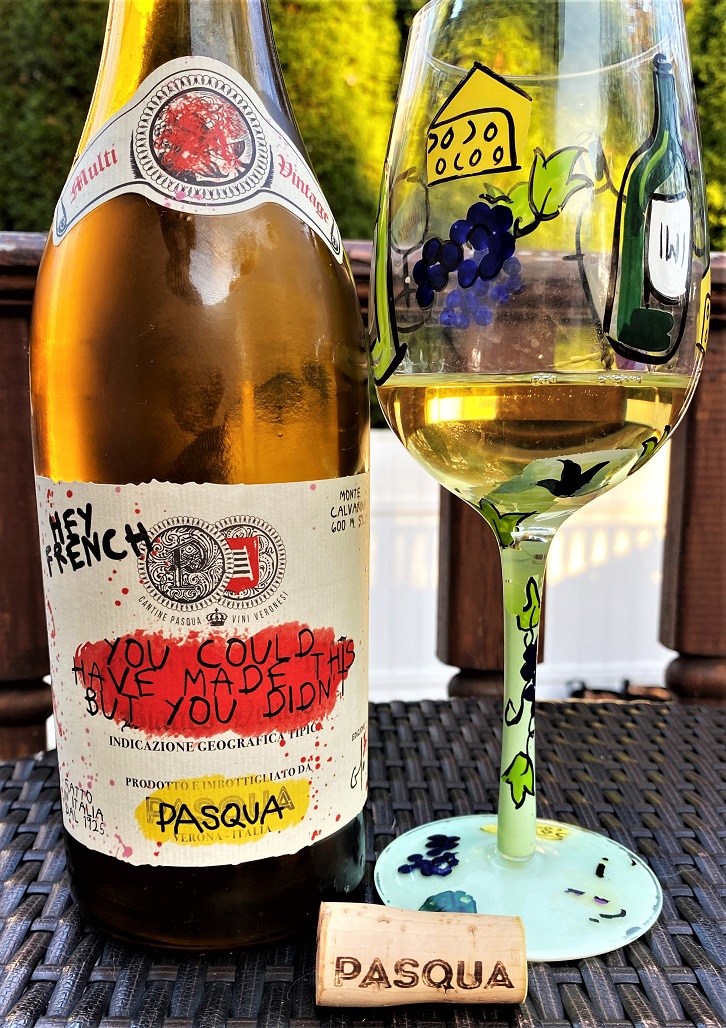
How was the wine? In a word, delicious.
Multi-vintage Pasqua Hey French You Could Have Made This Wine But You Didn’t Edizione 1 Veneto Bianco IGP (13.5% ABV, $40, blend of best 4 vintages of last decade)
Intense gold
Vanilla, apples, plums, Chardonnay-like
Fresh, lip-smacking, precise, clean acidity, whitestone fruit, granny smith apples, a hint of nutmeg, a hint of butter, round, plump, herbs, perfectly dry, delicious.
8/8+, superb.
Based on my experience with Pasqua wines so far, the company is accustomed to making bold moves (drinkable Amarone under $20 at Trader Joe’s clearly is a good indicator). This multi-vintage wine should also be categorized as such – $40 still wine without vintage designation with a playful label (designed by the celebrity Cuban-French artist CB Hoyo) might not be an easy sell. Once you try this wine, which is an absolutely solid, world-class wine, you would be happy to drink it again and again, but you know how preconceived notions work with wine…
The bottom line is simple – find this wine and try it. Additionally, offer it to your friends to taste blind, and then watch for the surprise on their faces once you reveal the wine – life’s little pleasures. Cheers!
Seeking, Overcoming, and Finding: Amarone for the Father’s Day
Let’s take this step by step, starting with seeking. What am I seeking?
If you read this blog for some time, you know that Amarone is my pet peeve. Ever since falling in love with Le Ragoze Amarone during Kevin Zraly’s Windows on the World Wine School session, Amarone has a special place in this wine lover’s heart. I generally would never admit the existence of the pivotal wine in my wine journey, but if I would really think about it, this will be the one. The combination of the dried fruit on the nose with the firm, powerful, impeccably balanced palate really created an everlasting memory. I had this experience about 17 years ago, in 2003, drinking 5 years old wine (1998 vintage) – and ever since I’m trying to replicate it. Which brings us to the next step: overcoming.
We are talking wine here, so what is there to overcome, you say? Fear. Trepidation. An attempt to avoid disappointment – over and over again. While seeking to replicate the amazing experience, over the years I tried many, many Amarone. A few times I managed to get close to that magical Le Ragoze experience – but the majority was really, really far from it. Why? Lack of balance. Let’s make it more precise: severe lack of balance. Often expressed in the form of the alcohol burn.
In the last 20 years, Amarone’s alcohol level progressed from the typical 14.8% ABV to the typical 16.5% ABV. I get it. What makes Amarone an Amarone is an additional step in the winemaking process, which is rarely used with any other wines – drying of the grapes before they are pressed. After the grapes are harvested, they are placed outside (historically, on the straw mats, but now, on specially arranged shelves) to dry under the sun, to literally shrivel into the raisins before they will be pressed – this process typically takes between 3 and 4 months. Drying concentrates sugars (and dramatically lowers the yield, which explains the high prices), and thus you can expect higher alcohol in the resulting wine. Yes, I get it – but still…
At 16.5% ABV, true mastery is required to achieve balance. True mastery is rare – and the real downside here is personal self-doubt. While tasting yet another hot and biting wine, a tiny voice in your head says “what is wrong with you? You really say you like this type of wine? Are you sure you are even remotely qualified as an oenophile? Maybe water should be your drink of choice?” So yes, tasting yet another Amarone requires overcoming this fear – who wants to prove oneself wrong time and time again?
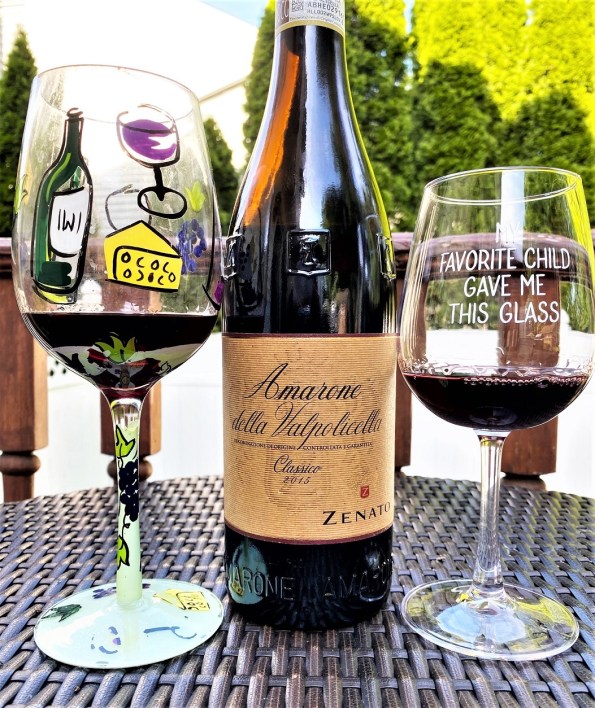
Now, let’s continue to finding.
When I was offered a sample of Zenato Amarone I said (not without fear) “of course, thank you”. Zenato, which started producing wines about 60 years ago, in the 1960s, initially white wines in Lugano, produced its first Amarone in 1988. The grapes for Zenato Amarone wines come from the Valpolicella Classico area, grown in Sant’Ambrogio township.
So what did I found in that bottle? The first sip instantly quelled all the fears and brought back happy memories. What made that Le Ragoze so memorable was the contrast. I know, I already said it – the wine had an intense nose of the dried fruit. I don’t know about you, but I love dried fruit – especially figs and raisins. But dried fruit is sweet, and this is what I expected from the wine to be – only it was not. The wine was dry, absolutely dry, massive, concentrated, and firmly structured. It was also perfectly balanced.
Those were the memories. And 2015 Zenato Amarone Della Valpolicella Classico DOCG (16.5% ABV, $60, 80% Corvina Veronese, 10% Rondinella, 10% Oseleta and Croatina, 4 months of drying, 36 months in oak) instantly brought them back with the delicate nose of the dried fruit and dry, massive, concentrated, but a perfectly balanced body. Firm structure, a touch of dried cherries, sage – just an excellent wine overall (Drinkability: 8+/9-). Wine is all about the balance. And pleasure. Zenato Amarone delivered both.
As I opened this bottle on Father’s Day, you can see in the picture a dilemma I now will be facing – I got another glass from another kid – now I will be forced to pick and chose the glass and try to avoid playing favorites… Oh well, not the worst problem to have, isn’t it?
Do you have a favorite Amarone that never disappoints? What’s your most memorable wine? Is there a wine out there you always crave?
Trader Joe’s Merlot Run
As some of you might know, I can never pass on visiting the local Trader Joe’s when traveling – as long as it offers wine (which seems to be the case so far in the most places I visit). Last week I was in Santa Clara in California, so the trip to the nearby Trader Joe’s was unavoidable.
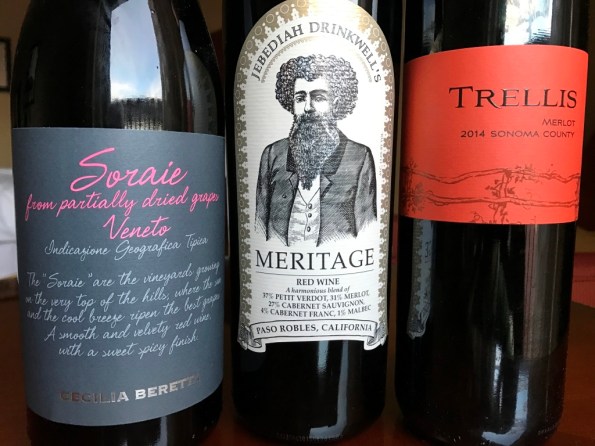 Deciding on what wine to buy at Trader Joe’s is difficult. I always take price into account, but then there are lots of wines in the same, super-reasonable prices range of $5 -$8. The next option is the label – yes, I’m a sucker for creative labels, and then, of course, the region comes to play.
As I slowly walked along the wine shelves, the label of Jebediah Drinkwell’s caught my eye – it was strangely attractive – plus I like Meritage wines, so it was an easy decision. I picked up Trellis Merlot because it was a Merlot (and October is a Merlot month) – and I was really curious to see what $4.99 can buy you from Sonoma. Cecilia Beretta was the third bottle I got – wanted to go outside of California, and “Partially dried grapes” always sounds like a music to me.
Looking at the wines later on, the idea of #MerlotMe dedication came along – would all these wines be Merlot based? To my delight, in addition to the 100% Merlot from Sonoma, two other wines also had substantial Merlot content, so here you go my friends, a Merlot run at Trader Joe’s.


Here are my notes:
NV Jebediah Drinkwell’s Meritage Red Wine Paso Robles ($5.99, 37% Petite Verdot, 31% Merlot, 27% Cabernet Sauvignon, 4% Cabernet Franc, 1% Malbec)
C: dark Ruby
N: touch of smoke, roasted meat,
P: soft fruit, blackberries, tobacco, good acidity, medium-long finish
V: 7+/8-, quite enjoyable
2014 Trellis Merlot Sonoma County (14.5% ABV, $4.99)
C: garnet
N: restrained, distant hint of cassis, herbs
P: soft, round, cassis, good acidity
V: 7+, excellent QPR
2014 Cecilia Beretta Soraie Veneto IGT (14% ABV, $7.99, 40% Merlot, 30% Corvina, 20% Cabernet, 10% Croatina, grapes dried for a few weeks before pressing)
C: dark garnet
N: touch of blueberry pie, quite restrained
P: touch of blueberries, tobacco, hint of dried fruit, good power but round, soft tannins, medium finish
V: 7+, will work well with food – pasta with some hearty tomato sauce would be perfect
As you can tell, it is pretty amazing what $18 can buy you at Trader Joe’s. Also, it is my second experience with non-vintage wine at Trader Joe’s, and I’m definitely impressed with the quality of that wine.
Do you buy wines at Trader Joe’s? Any interesting finds you care to share? Cheers!
Passion and Prosecco
 One of my favorite ways to start a conversation is to ask a trivia question, so here it is. We all take Prosecco for granted – if one wants to casually have a glass of wine with bubbles, Prosecco would handily beat any other sparkling wine as a top choice, no matter where in the world you are. Now, for the trivia part: do you know when Prosecco first appeared in London? I will give you few moments to ponder that question. Meanwhile, few basic facts: Prosecco hails from the hills of Veneto, where wines (still wines, it is) were produced for more than 500 years; Charmat-Martinotti method, used in the production of Prosecco, with the secondary fermentation taking place in a steel tank instead of the bottle (“secondary fermentation” is what produces those adorable bubbles), was first created in 1895. So when do you think Prosecco showed up in London?
The answer: 1989. And all due to the tenacity and passion. Bisol family had been producing the wine in Veneto for more than 20 generations (yes, I do call this a passion). When Gianluca Bisol approached his father and said that he wants to bring Prosecco to London, the father’s response was very quick (cue in Italian pronunciation and emotional hand gestures): “you are crazy!”. That didn’t stop Gianluca, and to London off he went. It appears that his father was almost right – selling unknown sparkling wine, door to door, in the downturn economic times, was not going swimmingly well, by any measure. Until a lucky coincidence (well, people would call it “luck”, but we all know that luck usually works best after applying lots and lots of hard, dedicated effort), when at one of the best restaurants in London, Gianluca met wine director who was not only Italian, but also born and raised in the same Veneto region, and was extremely happy to see his beloved Prosecco. As they like to say it in the books, the rest was history. Today, Prosecco outsells Champagne in UK 3 to 1. And annual production of Prosecco hit 540 million bottles in 2015. Just to finish with historical references, Prosecco made it to the US in 1992/1993 (in case you are wondering).
I had a pleasure of meeting Gianluca Bisol at lunch at Marta restaurant in the New York City, and we spend two hours talking, tasting wines and of course, eating tasty food (detailed account follows). This is where I heard the story of Prosecco concurring the UK, as well as many other interesting facts which all together can be summarized in one single word – passion. Passion for the land, vines and wines. Passion for the whole Veneto region. Passion for the traditions which are more than 20 generations strong. But also a passion for the not stopping, for continuing to innovate and to create – new wines and also new wineries.
Our tasting included 7 different wines, out of which 4 were Bisol wines, but 3 were from the winery called Maeli Colli Euganei, the winery which Gianluca helped to start in 2010. Actually the plan was that at the lunch, Gianluca will be joined by Elisa Dilavanzo, the owner of Maeli winery – unfortunately, Elisa got sick and had to stay behind, so Gianluca had a duty of representing both wineries – which he completed with flying honors, as you can imagine.


We started our tasting with 2014 Maeli Fior d’Arancio DOCG Sweet (6% ABV, SRP $27, Residual sugar 115 g/l, 100% Fior d’Arancia, a.k.a. Yellow Muscat) – nice sweetness, clean, minerality, beautiful sweet nose, bright white fruit, nice honey notes. The grapes for this wine come from volcanic soils, which gives it an interesting complexity, saving it from been “one singular note sweet bore”. It is not surprising that last year this wine was selected as “Best in Class” by Tom Stevenson in the UK in the sweet sparkling wines category. Another interesting fact is that in 2015, Maeli winery started Maeli Chef Cup competition, which will be now an annual event, where world-renown chefs compete to create the best dish pairing for Maeli Fior d’Arancia – if you are interested, here is the link detailing the 2015 competition.
Our next wine was NV Bisol Cartizze Valdobbiadene Superiore di Cartizze D.O.C.G. Spumante Dry (11.5% ABV, SRP $42, Residual sugar 23 g/l, 100% Glera) – some sweetness on the nose, but body very restrained, creamy mouthfeel, delicious aftertaste, beautiful supple palate. The wine can age – Gianluca had an opportunity to taste 20 years old Bisol Cartizze wine – it retained bubbles, but obviously acquired aromas of more mature fruit. As you can see, this wine is designated as Superiore di Cartizze D.O.C.G – Cartizze is a single vineyard, 106 hectares (about 255 acres) in size , one of the best vineyards in Italy (most expensive for sure). 139 families own parcels of the Cartizze vineyard – Bisol family owns their parcel for 21 generations. The cost of land on Cartizze is $2.5M per hectare, or $1M per acre – not sure if anyone is selling though.
Time to eat something, right? The first two wines were paired with the selection of appetizers:
Suppli Cacio e Pepe (Risotto Croquettes, Pecorino, Black Pepper) – nice crust, tasty, works the best with the wine.
Bietole Ai Ferri (Plancha-seared Forono Beets, Ricotta, Hazelnuts) – good, nice flavor, good acidity, hazelnuts work well to complement the wines.
Nebrodini Arrostiti (Wood-fired Mushroom Salad, Kale, Mustard Greens, Thyme, Lemon) – nice, good flavor.


We continued our tasting with NV Bisol Crede Valdobbiadene Prosecco Superiore D.O.C.G. Spumante Brut (11.5% ABV, SRP $25, Residual sugar 7.5 g/l, blend of Glera, Pinot Bianco and Verdiso). “Crede” is a “type of clay-laden soil with particular characteristics that greatly benefit the grapes”, according to the wine’s tech sheet. The wine had delicious nose, touch of fruit, fine mousse, perfect acidity, crisp, clean finish.
Now we go back to Maeli with our next wine, which was also the only still wine we had in the tasting. 2014 Maeli Colli Euganei Bianco Infinito ∞ Veneto IGT (12.4% ABV, SRP $24, Yellow Muscat 60%, Chardonnay 40%, aged 5 month in steel tanks, 3 month in the bottle) had nice aromatics, touch of lemon on the nose, vanilla, nice complexity on the palate. The name of this wine (infinito) comes from the accident – one of the workers called Elisa to inform her that one of the barrels needs attention, and when she asked which one, he said “infinito”. As she couldn’t understand what the worker was talking about, it appeared that the number “8” was written on the barrel at an angle, and so from there on the wine took the name “infinito”.
Now, the dishes which were paired with these two wines deserve their own commendation. You see, I rarely eat pizza. When I do, my absolute preference is that the pizza would have crisp, crunchy, literally paper-thin crust. This is exactly what I got at Marta – three pizzas, one better than the other (Funghi was my absolute favorite):
Stracciatella (House-made Stracciatella, Basil, Olio Verde) – perfect pairing. Delicious pizza – very thin crust.
Funghi (Fontina, Mozzarella, Hen of the Woods, Hedgehogs, Red Onion, Thyme) incredible, amazing flavor mushrooms and thyme. Great pairing with Bianco Infinito
Porri e Pancetta (Leeks, Bacon, Fontina, Scallion) – great flavor, very good pairing.


Last three wines were truly special and unique – but none of them are available in the US at the moment, unfortunately. 2015 Private Cartizze Zero Dosage Brut Valdobbiadene Superiore di Cartizze D.O.C.G. (second fermentation in the bottle, 12 month on the lees) – first Classic Method sparkling wine from Cartizze, 2015 vintage was bottled 45 days ago, 2011 was the first year of production, 3000 bottles produced in 2015 – classic champagne, yeast, outstanding.
Then we had 2011 Maeli Colli Euganei Rosévento IGT Spumante (12% ABV, Residual sugar 6.9 g/l, 100% Pinot Nero, 36 months on the lees) – another Classic method sparkling wine, yeasty, classic Rosè champagne nose with strawberries, delicious!
The last wine was truly unique – NV Jeio noSO2 Valdobbiadene Prosecco Superiore DOCG Spumante Extra Brut (100% Glera) – this innovative wine was produced without any added sulphur dioxide (hence the name), made specially for the sensitive consumers. The wine is packaged in the clear bottle wrapped into the foil, to protect it from the sunlight (the wine we were tasting was brought by Gianluca directly from the winery, so it didn’t have any foil or labeling, except the small pieces of paper around the bottle’s neck. The wine had an amazing nose, floral with a touch of white fruit, very dry and again, floral on the palate – very unique compared to any sparkling wine I had before. Delicious – you need to try it for yourself (well, you might have to visit the winery for that).


Our last two dishes were Pollo Ubriaco (Chicken Breast, Charred Cabbage, Brussels Sprouts, Fresno Chili, Mint), perfectly executed, and Salmerino (Arctic Char, Crispy Potato Cake, Horseradish Crema) – delicious, potato cakes were outstanding ( I would eat the whole plate alone), and the fish was cooked perfectly.


That’s all I have for you, my friends – a wonderful encounter with passion, great people, unique wines and delicious food. Next time you are in a mood for some bubbles in your glass, Bisol and Maeli offer a great range, suitable for any palate and taste. And even if you are not craving pizza right now, go visit Marta in New York – I’m sure you will be happy. And by the way, feel free to ask your friends if they know when Prosecco was first sold in London – you might become a party star, at least for one night. Cheers!
Marta
at Martha Washington hotel
29 E 29th St
New York, NY 10016
Ph: 212-651-3800
http://www.martamanhattan.com/
Gambero Rosso 2016: Tre Bicchieri Tasting
 Now, let’s talk about most intense part of the Gambero Rosso 2016 event – Tre Bicchieri grand tasting. Both Custoza DOC and Special Awards Master Class seminars were nice and relaxing – you are sitting down, you have at least an hour to evaluate 9 wines – this is “an oenophile at ease” experience. The grand tasting though is more of an “oenophile in hell”, or if this is too strong of an expression, think of it as marathon which you have to run on the tippy-toes – yep, that level of comfort.
Let me repeat the Gambero Rosso numbers – about 50,000 wines are evaluated by the Gambero Rosso staff in a year, comprise 20,000 different labels from more than 2,400 wineries. 421 wines received the coveted Tre Bicchieri (Three Glasses) award in 2016. 193 wineries were present at Tre Bicchieri 2016 tasting in New York, which would roughly translate into about 400 wines – not all of those wines are Tre Bicchieri winners, wineries are allowed to present the wines which got two glasses awards.
This was the fourth year in the row as I attended Gambero Rosso in New York, so at this point I knew the drill – which means that there will be no rant in this post. Nothing changed – there was still a limit of one glass per attendee for the whole tasting, the wineries were still organized by the distributors and not by the regions – but again, I was ready for that before I walked into the room. I had an opportunity to look at the show guide before tasting started, so I had my targets set and thus from the moment I walked into the tasting room, I went directly to the tables I wanted to visit first (where the wines would potentially run out). This was the right strategy and it worked quite well (as you will see in the list down below).
This was also the first time in 4 years my dear friend Stefano was unable to join me at the Gambero Rosso in New York – which also changed the dynamics for me. Usually when we are together, Stefano perseveres until the very last moment, still tasting wines and taking notes. Left to my own devices, I cut it short when I felt tired. By the way, the pictures below will give you an idea how the tasting room looks like in a middle of event – I always like to take a few shots which I call “Hail Mary” – just put the camera up and take a picture of whatever it will point to. I think it will give you an idea for the event:
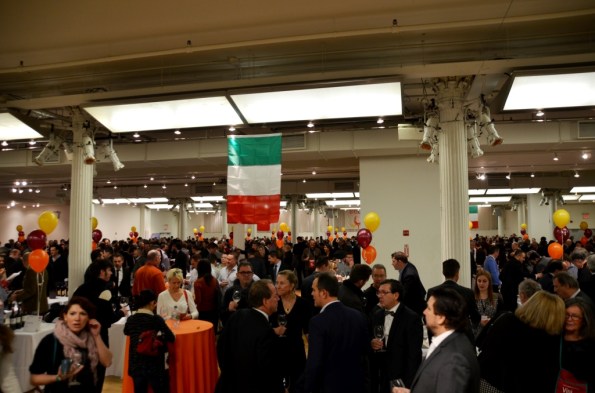
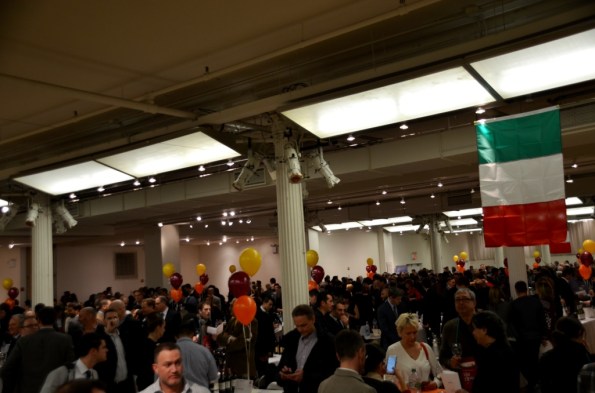 Before I will inundate you with the details on the wines I tasted, I want to offer you some of my main takeaways from the Tre Bicchieri 2016 tasting.
- Out of all the wines I tasted (90+), 4 wines were my absolute favorite:
- Tenuta dell’Ornellaia Bolgheri Superiore Ornellaia – stunning wine – young (2012), but perfectly drinkable, with the balance nothing short of amazing. Down below I will have pictures of the labels – note that starting with 2012 vintage, Ornellaia wines now will have artistic labels on portion of their bottles – 1 bottle in every 6 pack will have an artistic label.
- Eugenio Collavini Collio Bianco Broy – my favorite white wine of the tasting – beautiful clarity, impeccable balance and a bonus story
- Tenuta Viglione Gioia del Colle Primitivo Marpione Riserva – yes, I know that Primitivo is technically a Zinfandel, but I never yet tasted Primitivo which would be reminiscent of a good Zinfandel, like Turley, for instance. This wine was – fresh fruit, ripe raspberries and blackberries, playful – just an excellent wine all together.
- Rosset Terroir Valle d’Aosta Syrah – might be easily my favorite red wine in the tasting – if anything very comparable with Ornellaia in its ability to deliver pleasure. Amazing clarity of spicy fruit, just a pure vibrant note of black pepper – only a few times ever I experienced such pure expression of Syrah. Absolutely delightful.
- Very interesting how things changed in Italian wines. I tasted a number of Barolo, 4-6 years old – they were all very approachable, with good fruit and reasonable tannins – quite a departure even from the few years back. On another hand, most of the Super Tuscans were tannic bombs, with the happy exception of Ornellaia and Le Macchiole. I definitely welcome the Barolo change (will be interesting to see how those wines will age), but I think super Tuscan producers should dial down the use of the new oak – as they are, these wines need quite a bit of time to age.
- Italy is the #1 wine producer in the world (by volume) so it is not surprising that in addition to the ingenious grapes, such as Sangiovese, Nebbiolo, Montepulciano, Italians also mastered all the main international varietals – Cabernet Sauvignon, Cabernet Franc, Merlot, Grenache ( better known as Connonau), Zinfandel (yes, in the form of their native Primitivo) and now even Syrah. 3-4 years ago, I would never associate Italy with the world-class Syrah. But then was Syrah from Cartona, which is delicious, and this year’s discovery, Rosset Terroir Syrah from Valle d’Aosta, left me literally speechless in its purity of expression – and I loved it as much as I did the Ornellaia. So yes, Syrah is also squarely on the master list for Italy. Notable exception – Pinot Noir (should be called Pinot Nero in Italy), the finicky grape the world is in love with, which I yet to find to my liking coming from Italy. This will probably happen at some point, and if it does, I’m curious where and how.
Okay, now it is time to share the notes on my favorite wines. I visited about 45 tables, tasted about 90 wines. Below are the favorites – as typical for the trade tastings with lots of wines to evaluate, I use the “plus” system, where “+++” means “excellent wine”. The list below only includes “+++” or higher; I couldn’t contain my excitement and rated “++++1/2” both Ornellaia and Rosset Syrah, this is as high as I ever went. For what it worth, below are my brief tasting notes, all the wines are sorted by respective regions:


Abruzzo:
2012 Villa Medoro Montepulciano d’Abruzzo Colloie Teramene Adrano – +++1/2, delicious
Alto Adige:
2013 Abbazia di Novacela A.A. Valle Isarco Riesling Praepositus – ++++, clean, balanced
2014 Abbazia di Novacela A.A. Valle Isarco Kerner Praepositus – ++++, delicious!
2011 Elena Walch A.A. Lagrein Castel Ringberg Riserva – +++1/2, excellent, concentrated
2012 Cantina Terlano A.A. Terlano Nova Dominus Riserva – ++++, delicious! 60% Chardonnay, 30% Pinot Blanc, 10% Sauvignon
Basilicata:
2010 Re Manfredi Terre Degli Svevi Aglianico del Vulture Serpara – +++1/2, perfect, nice minerality


Friuli Venezia Giulia:
2013 Jermann Vintage Tunina – +++1/2, great complexity
2013 Jermann W…. Dreams…. – ++++, butter, vanilla, beautiful minerality
2014 Jermann Pinot Grigio – +++
2014 Eugenio Collavini Collio Bianco Broy – ++++, clean, beautiful, 50% Friulano, 30% Chardonnay, 20% Sauvignon, SRP $35, comes from the small small plot behind the house
2013 Livon Braide Alte – +++1/2, Chardonnay, Picolit, Moscato Gialo
Liguria:
2013 Poggio dei Gorgleri Rivera Ligure di Ponente Pigato Albium – +++1/2, Gunflint nose, clean palate


Lombardy:
2009 Ferghettina Franciacorta Extra Brut – +++, beautiful nose, a bit too sweet on the palate
2011 Nino Negri Valtellina Sfursat 5 Stelle – +++1/2, dried fruit, delicate, delicious. 2012 and 2014 were bad years, and no 5 Stelle wine will be produced
2008 Bellavista Franciacorta Extra Brut Vittorio Moretti Riserva – ++++, delicious, classic
Marche:
2013 Umani Ronchi Verdicchio dei Castelli di Jesi Superiore Vecchie Vigne – +++
2011 Umani Ronchi Canero Cùmaro Riesrva DOCG – +++1/2, delicious (Montepulciano 100%)
2011 Umani Ronchi Pelago Marche Rosso IGT – +++1/2, excellent (Cabernet Sauvignon 50%, Montepulciano 40%, Merlot 10%)


Piedmont:
2010 Abbona Barolo Cerviano – +++1/2, lavender, clean, wow!
2011 Marchesi di Barolo Barolo Cannubi – ++++, beautiful
2012 Michele Chiarlo Barbera d’Asti Superoiore Nizza La Court – ++++, outstanding
2011 Malvira Roero Mombeltramo Riserva – +++, nice, clean


Puglia:
2011 Tenuta Viglione Gioia del Colle Primitivo Marpione Riserva – +++1/2, wow, excellent, Zinfandel-comparable
2012 Tenuta Viglione Gioia del Colle Pri-mit-ivo – +++, excellent fruit and balance
Sardinia:
2013 Vigne Surrau Sincaru Cannonau di Sardegna – +++, excellent
2014 Vigne Surrau Sciala Vermentino di Gallura DOCG Superiore – +++
Tuscany:
2012 Poggio al Tesoro Dedicato a Walter Toscana IGT – +++, 100% Cabernet Franc
2012 Poggio al Tesoro Sondraia Bolgheri Superiore – ++++, excellent, Bordeaux blend (65% Cabernet Sauvignon, 25% Merlot, 10% Cabernet Franc
2012 Fabrizio Dionisio Cortona Syrah Il Castagno – +++1/2, beautiful nose, restrained, 100% Syrah


2012 Tenuta dell’Ornellaia Bolgheri Superiore Ornellaia – ++++1/2, wow! polished, ready
2013 Tenuta dell’Ornellaia Bolgheri Rosso Le Serre Nuove – ++++
2013 Tenuta dell’Ornellaia Poggio alle Gazze – ++++, outstanding
2010 Le Chiuse Brunello di Montalcino – +++1/2
2011 Le Chiuse Brunello di Montalcino – +++, beautiful
2013 Le Chiuse Rosso di Montalcino – +++, clean, simple
2012 Villa le Corti Chianti Classico Don Tommaso Gran Selezione – +++, excellent, soft
2012 Tenuta Sette Ponti Oreno – +++1/2, gripping tannins, wow
2013 Tenuta Sette Ponti Crognolo – +++


2012 PETRA Petra Rosso – +++1/2, good balance, Cabernet Sauvignon/ Merlot blend
2012 Le Macchiole Paleo Rosso – ++++, outstanding, 100% Cabernet Franc
Valle d’Aosta:
2013 Rosset Terroir Valle d’Aosta Syrah – ++++1/2, wow, perfect, spicy nose, clean, wow! 100% Syrah


Veneto:
2011 Tenuta Sant’ Antonio Amarone della Valpolicella Campo di Gigle – +++, closed on the nose, well present tannins, but balanced
2011 Viticoltori Speri Amarone della valpolicella Classico Vign Sant’Urbano – +++, good, round
2009 Masi Amarone della Valpolicella Classico Campolongo di Torbe – ++++, delicious!!! (yeah – single vineyard at about $150 retail)
2014 Valdobbiadene Brut Rive di Col San Martino Cuvée del Fondatore Graziano Merotto – +++1/2, nice complexity
2012 Vignalta Colli Euganei Fior d’Arancio Passito Alpianae – +++
Gambero Rosso 2016: Discovering Italian Wine Regions – Custoza DOC
Few weeks ago, I attended Gambero Rosso Tre Bicchieri event in New York. For those unfamiliar, Gambero Rosso is a leading Italian wine guide, where the wines are rated with the symbol of a glass (bicchiere in Italian). The wine can get a rating of one, two or three glasses, and those three glasses (Tre Bicchieri) rated wines considered to be some of the best wines the Italy has to offer. Every year, Gambero Rosso conducts a series of tastings worldwide, to celebrate these best Italian wines, and the tastings are called Gambero Rosso Tre Bicchieri events.
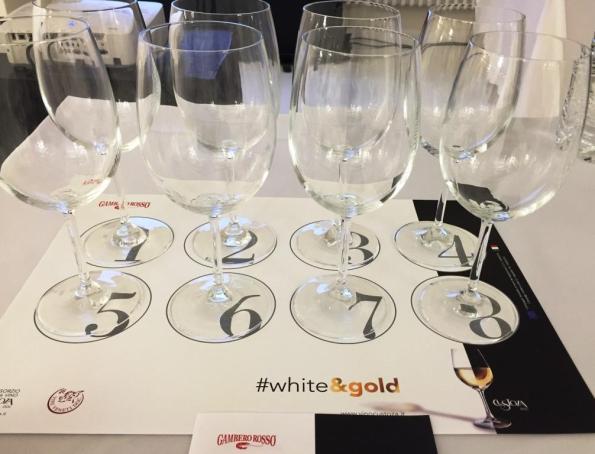
While I had been attending Tre Bicchieri events for the past 4 years, this year was the first time I also attended seminars conducted right before the general tasting. The first seminar was dedicated to the white wines of a small, and I would bet, largely unknown to the majority of the wine drinkers, region in Veneto, called Custoza.
Custoza is located at the south border of the Veneto region, on the shore of the Lake Garda. Excellent terroir to grow wine grapes, and white grapes in particular. Region has mild winters, which definitely helps not to worry about the frost. Another important characteristic of Custoza is mixed soil – clay, sandstone, limestone, which leads to a diversity in the wines. Overall, there are about 700 wine growers in Custoza, 70 wineries, and total wine production is roughly 12 million bottles per year (1 million cases). The region is fast growing on Italian market and represents great value for the money. A number of indigenous grape varieties are use in wine making in Custoza – Garganega, Fernanda/Bianca Fernanda (Cortese clone), Trebbiano di Soave, Trebbianello (known as Tokai Friulano in other regions), Riesling Italico (a.k.a. Welch Riesling), Incrocio Manzoni (cross created in 20th century).
Seminar presenters also made a statement about Custoza wines having a great aging potential – I would like to get back to that after presenting you with the tasting notes. We tasted total of 8 wines in this seminar:
2015 Tinazzi Custoza Cà dei Rocchi (Garganega 40%, Trebbiano di Soave 40%, Bianca Fernanda 20%)
C: pale straw
N: amazing, fresh sweet fruit, candies, through the roof aromatics. Green notes appear after a while.
P: crisp, clean, great acidity, fresh, will work great with seafood
V: 8-, food wine
2015 Gorgo Custoza San Michelin (Garganega, Cortese and Riesling Italico)
C: light gold
N: restrained, candied lemon, herbs, fresh caramel, opened into concentrated sweet baking spices. Smell is an enigma, keep changing. Yes, tropical fruit.
P: clean and crisp, but leaves sweet aftertaste. More concentrated than the previous wine, medium to full body, finish switched to more acidity
V: 7+/8-
2014 Cavalchina Custoza Superiore Amedeo (Garganega 40%, Fernanda 30% (Cortese clone), Trebbianello 15% (Tocai clone), Trebbiano Toscano
15%)
C: light golden
N: hint of smoke, gunflint
P: excellent, clean, green apple, fresh, perfect balance, acidity on the finish. Leaves me desire to take another sip
V: 8
2013 Albino Piona Custoza DOC (Garganega 30%, Trebbiano 35%, Friulano 20%, Trebbianello, Pinot Blanc and Riesling Italico)
C: light golden
N: medicinal, iodine, a nose almost suitable for a scotch
P: lots of fighting components, interesting. It is drinkable, but not together
V: 7-
2013 Menegotti Custoza Superiore Elianto (Cortese, Garganega, Trebbiano)
C: light golden
N: strange, vegetative
P: vegetative/sweet all over the place
V: 7
2013 Monte Del Frà Custoza Superiore Cà del Magro (40% Garganega, 20% Trebbiano Toscano, 5% Tocai Friulano, 10% Cortese, 10% Chardonnay-Riesling Italico-Malvasia and 15% Incrocio Manzoni)
C: golden, nice viscosity
N: minerality, hint of gunflint, white fruit sweetness, restrained
P: delicious. Ripe apples, white stone fruit, minerality, excellent balance
V: 8-
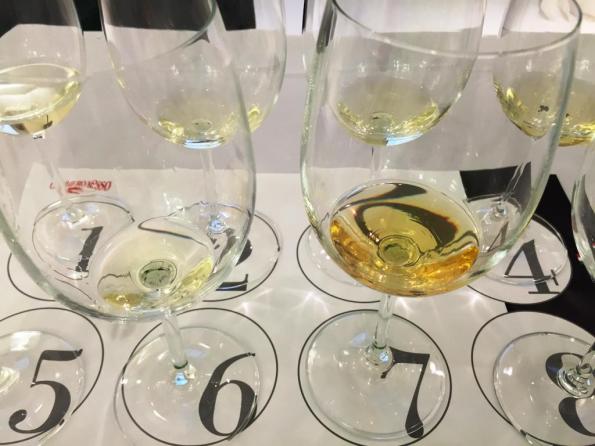
Take a look at the color difference with younger wines
2010 Monte Del Frà Custoza Superiore Cà del Magro (40% Garganega, 20% Trebbiano Toscano, 5% Tocai Friulano, 10% Cortese, 10% Chardonnay-Riesling Italico-Malvasia and 15% Incrocio Manzoni)
C: concentrated gold
N: minerality, volcanic soils, smoke, interesting
P: interesting complexity, still a touch of oxidation, vanilla, sea salt
V: 7+. This is a drinkable wine, and it will stay like that for a while.
2007 Cavalchina Custoza Superiore Amedeo (Garganega 40%, Fernanda 30% (Cortese clone), Trebbianello 15% (Tocai clone), Trebbiano Toscano
15%)
C: concentrated gold
N: slightly oxidative nose, similar to Jura whites
P: vanilla, steely notes
V: 7. May be good with cheese, but not enjoyable on its own
I very much enjoyed young Custoza wines – many were vibrant and delicious. When it comes to the two older wines, I wouldn’t say I was fun (I’m sure you can see it in my notes). Yes, I like tertiary aromas of older wines, but I still want the wine to have harmony and balance – and this was not the case here.
Very interesting learning experience in any case, plus a new grape (Incrocio Manzoni), or even two if I will count Fernanda as a separate clone/grape. So, have you ever had Custoza wines? What do you think of them?
In the next post, I will be talking about Gambero Rosso Special Awards master class, so until the next time – cheers!
To be continued…
The Wine I’m Willing To Drink For The Next Ten Days – Marcus by Marco Sambin
Yes, you read it right, and it is a pretty bold [personal] statement. “I will be glad to drink this wine over the next 10 days” was the first emotional reaction as I took a sip of this wine. The reason for this bold statement? Simple. The wine was ready to drink from the get go. You know how often you take a sip of wine and say “well, I think it needs to breathe a little”, or “nice, but let me give it some time”? This wine didn’t need time. Fruit, body, acidity, tannins – all present in a cohesive, as I often call it, “together” package. Instantly available. Instantly delicious.
What makes this “bold personal statement”? My reaction to the first sip was “ahh, I will be glad to drink this every day. Period”. I never experienced this before – with the best wines I had, I would still pick something else to drink the next day, even if that “best wine” was still available. With this wine – yes, I would gladly keep opening the same bottles day after day. Well, possibly that was a reaction to the fact that this was my one and only bottle.
This bottle was actually a sample, and before I will continue talking about the wine, I want to share my frustration with samples. I don’t actively solicit samples (as a general rule – but yes, with exceptions), but then I don’t refuse samples either; I always warn the submitters that the review will be posted only if I happen to like the wine. When the sample arrives, especially if it is a red wine, the frustrating cycle starts. On one hand, I need to open it sooner rather than later, as the sender is awaiting my feedback. On another hand, I treat samples same as the regular wines – I wouldn’t open wine just to take a sip and dump the rest, even if it is only a sample. And I would also make an effort to involve my wife into the tasting, and as she generally prefers the red wines, it becomes difficult to find the right time to open the bottle. All in all, I’m getting torn between the need to open the bottle and the desire to still find the right time for it. There, I let it out.
Now, this particular sample has its own story. Back in April I was contacted by the winery called Marco Sambin from Italy, inviting me to come and taste their flagship wine, called Marcus, at the Vinitaly expo in Verona. When I mentioned that I will not be attending the Vinitaly, they offered to send me a sample – however, they could deliver it only inside Italy. You know, I already said it many times in this blog – having good friends is one of the most important things in life. My dear friend Stefano, who is constantly in between US and Italy, was able to get this bottle for me (it took only about two month for the bottle to get from the Italy into my hands). It then also took me about 6 additional weeks for find the right moment to open the bottle – hence my rant about samples (see above).
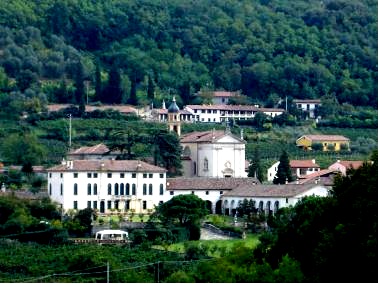
Villa Contarini in Valnogaredo, from the Marco Sambin presentation
Never mind all of that. What important is that I was able to experience a great bottle of wine. Marco Sambin winery (Azienda Agricola Marco Sambin), a small 10 acres estate, was founded in 2002 in Euganean Hills area in Veneto by Marco Sambin, Full Professor of Psychology at the University of Padova. I don’t want to recite all the information from the web site – you can read it for yourself here, and these are just some of the interesting facts. Cabernet Sauvignon, Merlot, Cabernet Franc and Syrah are all growing at the estate. The estate is farmed using organic and biodynamic principles. All the harvest is done by hand, and once the grapes are sorted and destemmed , they are gently crushed and fermentation process starts using only natural yeast, each grape variety fermented on its own. After the fermentation, which lasts for about 15 days, the wine is pressed and goes into the French oak barrels (both new and used), still each variety on its own; the wine will age in oak for the next 12 month. Only then the final cuvée is blended and bottled. Once bottled, the wine will still spend 6 -12 month before it can be released. On average, only 6,000 bottles are produced every year.


And now, here are my notes about the wine itself. The 2010 Marco Sambin Marcus Veneto IGT (14% ABV, Cabernet Sauvignon 45%, Merlot 40%, Cabernet Franc 10%, Syrah 5%) had very dark garnet color in the glass. On the nose, it showed concentrated red fruit, cassis, pencil shavings, baking spices and lavender, very complex and inviting. The palate delivered delicious fruit, perfectly present but not over the top, clean acidity, supple tannins and impeccable balance. Long finish, and every sip was leaving you craving another one. Drinkability: 9
Here you have it – the wine I’m willing to drink for the next ten days. Except it was my one and only bottle, and this wine is not available in US (if you are an importer who is reading this by any chance, the winery is looking for representation in the US – you can contact them using the information on the web site, or drop me a note, I will be glad to connect you). Is there a wine you will be glad to drink day after day after day? Cheers!
Last Bottle Sign Up ($10 credit)




 Talk-A-Vino