Archive
Daily Glass: Memorable Wines
 Wine = Memories. Well, okay, we need to correct that statement. Great Wines = Memories, now that is better. Of course we remember the wines we drink, and this is how the opinions are formed and this is how the wine list in the restaurant doesn’t look that intimidating anymore. But this should be characterized more as a general knowledge, not specifically as “memories”. Great wines, on the other hand (I’m not going to define the term “great wine” – this is highly personal, you define it for yourself), become memory anchors. We remember when, why and how, we remember who we shared it with, and we can retrieve those memories on the moment’s notice. That is what “great wine” can do to you.
Case in point – a great evening with friends, which had all three elements at its perfection – the wine, the food and the company. An evening, when the time flies so fast, you don’t understand how late it is already. And the wines – stunning, each one in its own right. We started with Gosset Grand Réserve Brut Champagne – a non-vintage Champagne from one of the old and classic producers. I have to honestly admit that I was never impressed with other Gosset wines in the past, but this Grand Réserve, poured from the magnum, was outstanding – round, creamy, yeasty just enough, with a touch of apple and fresh bread on the palate – an excellent start of the evening.
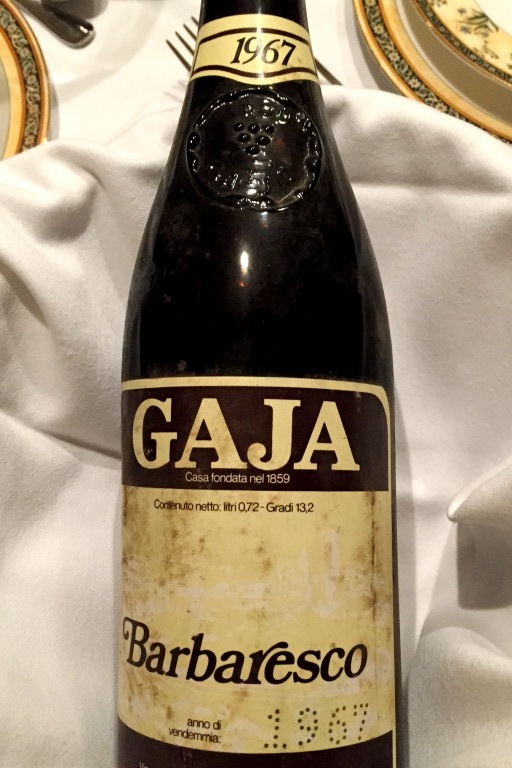
Then the awe inspiring, almost 50 years old 1967 Gaja Barbaresco was gently uncorked. It was not simple, as cork did crumble – but this is nothing which strainer and decanter can’t fix. The first whiff – nothing smells off, which is a great sign of relief. While we put the wine aside to let it breathe a bit, we reached out for another white – 2007 François Cazin Le Petit Chambord Cour-Cheverny AOC.
This is a rare French white wine made from 100% Romorantin grape. I remember a few years back trying this wine at a 10 years of age – and I remember been simply blown away by the exuberant beauty of this seemingly unassuming wine (new vintages retail at around $15 – the QPR is through the roof on this). The nose of that 2007 was amazing, with fresh white fruit, guava, mango, honeysuckle, lemon and lemon zest. On the palate, behind the first wave of Riesling-like appearance with touch of sweetness and tropical fruit notes, there were layers and layers of acidity and minerality. After about 10 minutes of breathing time, the wine was almost bone dry, very crisp and refreshing. I still have 3 bottles of the 2007, and now the trick will be to keep my hands away from them, as they still benefit from time.
Time to get back to that 1967 Barbaresco. We were somewhat waiting for the main course to start drinking it, and I was concerned that as it happens with many older wines, this wine might also succumb to the neverland if not consumed within that short window of time. Silly me. The wine kept going and opening for the next 2 hours. It had all those sweet plums, sapidity of the onion peel, minerality, all weaved around a well defined structure with perfect acidity and perfect balance. The “wows’ kept flowing until there was nothing left in the decanter – this was definitely a treat. And a perfect memory anchor, an experience which stays forever.


Our next wine was also very interesting and delicious in its own right, by fate or the accident made from the exact same grape as the Barbaresco, the Nebbiolo –2004 Ar.Pe.Pe Rocce Rosse Riserva, Valtellina Superiore Sassella DOCG, Italy. Valtellina red wines are typically made in the way similar to Amarone – with the grapes drying out after the harvest for about 120 days, and only then pressed and vinified. The Sassella Rocce Rosse from Ar.Pe.Pe stands apart, with Nebbiola grapes (locally known as Chiavennasca) left on the vine to raisin, and then pressed. Fresh, succulent plums and cherries on the nose and palate, together with effervescent lightness and firm structure (this might not make sense right away, but this is the way I perceive it), which I always find in Ar Pe Pe wines. Again, a delicious red.
Our last wine was 2003 Sella & Mosca Anghelu Ruju Rosso Passito Riserva Alghero DOC, Sardinia, Italy – very unique and interesting fortified wine, made out of partially sun-dried Grenache, locally known as Cannonau. This wine was mostly resembling the Port, with a hint of dried fruit on the nose, supported by perfectly balanced, soft body of plums and sweet oak, with perfect amount of sugar to make it a light dessert wine, but not an overbearing sweet monster.
Here we are – a perfect set of very memorable wines, compliments of dear friend Stefano (Clicks & Corks/Flora’s Table), and an evening with friends which will stay in memory, anchored by that 1967 Barbaresco. Considering that I’m finishing this post right on the Open That Bottle Night, I hope you increased your memory bank with some spectacular experiences, both of wines and the company – and I will be glad to hear about them. To the great life experiences! Cheers!
What To Drink During #ShirazWeek
 Yep, another wine holiday is upon us. This time, it is a week-long holiday, so you will surely get your opportunity to celebrate. What holiday, you ask? #ShirazWeek. Yep, the whole week dedicated to the Shiraz wines.
As we know, Shiraz is just a different name for the grape called Syrah, one of the most popular red grapes in the world. Today Syrah is literally growing everywhere – France, Spain, Italy, even Portugal, United States, Chile, Israel, South Africa, Australia and many others. But – what is the first country which comes to mind when you hear the word Shiraz? For me, the answer is simple – Australia.
Australia is one and only wine making country where you will not find wines called Syrah (well, may be you can, but with extreme difficulties). South Africa is probably next – most of South African Syrah wines are called “Shiraz”. For the rest of the world, Chile is often uses the name Shiraz, and you can find some of US wines called Shiraz as well (quite rare – Syrah prevails by a huge margin), and then it is Syrah all the way.
Shiraz is most popular red grape in Australia, with the plantings been second largest in the world after France. A quick question for you – do you know where the oldest, continuously producing Shiraz vines are located? Well, yeah, I’m sure it was easy to figure out in the context – yes, in Australia, in Barossa Valley, planted in 1847, now reaching a tender age of almost 170 years. Over the years Shiraz had its ups and downs, with the vineyards ripped out, including the old vines, with overproduction and quality problems – but it still remains Australia’s darling, and a world-class wine on its own, well worthy of a celebration. Shiraz is produced everywhere in Australia, but Barossa, Coonawarra, Clare Valley, Hunter Valley, Margaret River and McLaren Vale are probably the most famous regions for that wine.
Now, let’s talk about what to drink in honor of the #ShirazWeek. Of course I don’t think you should be drinking Shiraz for the whole week – but then you should do whatever you think is right – I’m merely here to provide some suggestions. As a self-made oenophile, I went through lots of Australian wines the bargain aisle has to offer – I had my fair share of Yellow Tail, Rosemount, Wolf Blass and Lindeman’s – the wines that comprise the glory and the curse of the Australian wine industry. But – I’m sure you don’t need my advice with that group. Let me instead suggest some names which I think would be worthy of your attention. The list below has no particular order – but these are all the producers I can related to, one way or the other. While some of these wines will be more expensive than the others, I don’t expect you to need to break the bank to taste any of them, so don’t be concerned.
-
- d’Arenberg The Footbolt Shiraz McLaren Vale 2007
-
- Dead Letter Office Shiraz
-
- Blue Eyed Boy
-
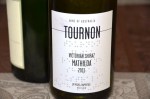
- Tournon Mathilda Shiraz
d’Arenberg – very well known producer in McLaren Vale, with many family generations involved in the winemaking. Footbolt Shiraz (under $20) and Dead Arm Shiraz (around $70) both worth your attention.
Jim Barry – Jim Barry is a well known producer in the Clare Valley. While they make a number of wines, the one I particularly recommend is Jim Barry McRae Wood ($50), a single vineyard Shiraz – very focused and delicious.
Two Hands Wines – their wines are exuberant, over the top, and never shy in alcohol – but they also manage to achieve an impeccable balance. Try whatever you can get your hands on. The wines are generally priced in the $30 – $100 range.
Mollydooker Wines – a wonderful producer in McLaren Vale. I love the way their wines are named – Carnival of Love, Blue Eyed Boy or Two Left Feet, for instance. Again, try anything you can get. Similarly to the Two Hands, their wines are priced in the $25 – $100 range.
Henry’s Drive – a producer in Padthaway in South Australia. I came across their Dead Letter Office Shiraz as a recommendation from Dorothy Gaiter and John Brecher, writers of the Wall Street Journal’s Tastings column, where 2005 Dead Letter Office Shiraz was rated as Delicious!, a highest honors in the Tastings column. I had an opportunity to taste and concur – and according to the Wine-Searcher, the 2005 is still available online at $26.
Pirramimma – a producer in McLaren Vale. I have to be honest – I never tried their wines, but – the 2005 Shiraz was listed in that exact same Tastings column with exact same Delicious! rating, hence my recommendation. I have a bottle of this wine, and will probably follow my recommendation soon.
Elderton Wines – another great producer from Barossa. I had an opportunity to try 2002 Elderton Command Shiraz, and this wine was simply stunning. It will set you back about $90 or so – but in that price category, it is well worth every penny.
M. Chapoutier – best known for their French Syrah wines, M. Chapoutier started producing Shiraz in Victoria, Australia in 2002. Tasting 2011 Domaine Tournon Mathilda Shiraz was literally a mind-blowing experience and it was one of my absolute favorite discoveries of the last year (here is my post). At less than $15, this might be the best Shiraz you can ever taste at a price.
There are lots and lots more Shiraz producers in Australia – as I said before, the list above only includes wines I can relate to, so feel free to suggest your favorites.
And just in case money are no object, I would like to suggest two Shiraz wines I didn’t have the opportunity to taste, but they should be able to provide a holistic experience, at least based on the price ($600+) and according to the people who tasted them. I’m talking about Penfolds Grange and Henschke Hill Of Grace Shiraz Eden Valley – both wines should be absolutely magnificent – but I will let you confirm or deny it in case you had the firsthand experience.
Now you are ready to celebrate the #ShirazWeek – and don’t forget to share your experiences on the AussieWine web site. Drop me a note too – I want to know what is in your glass and how do you like it. Cheers!
Valentine’s Day Wine Experiences
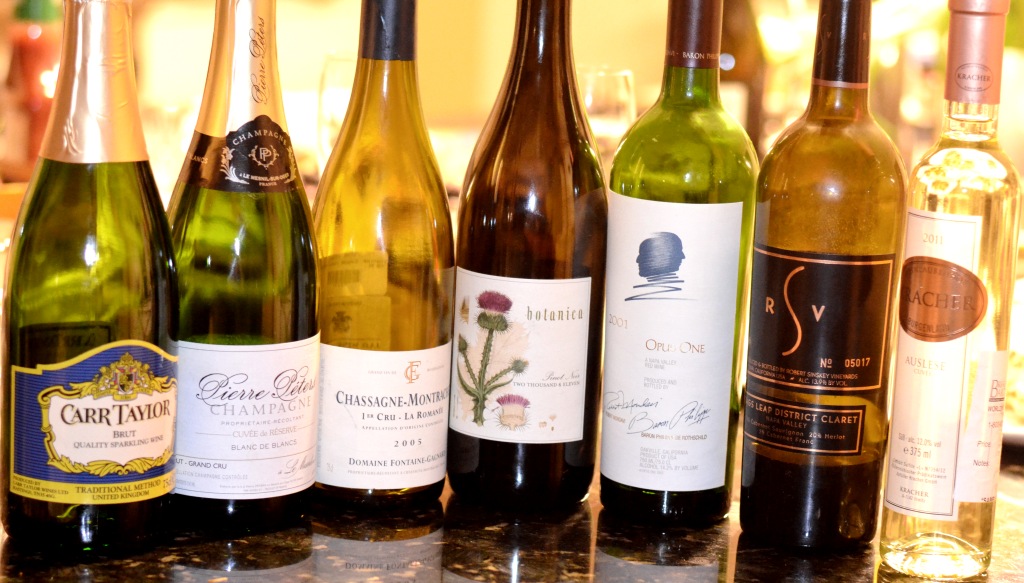 Last week I gave you some recommendations for the wines to serve on Valentine’s Day. Now, let’s see if I followed my own recommendations.
Of course the plan was to start the evening with the Champagne – and then there was a … but. I recently got my hands (told you many times before – I love my friends) on the very interesting sparkling wine from UK. What was the most interesting for me even before I tried the wine is that it contains one of the extremely difficult to find, rare grapes called Schönburger. As I mentioned last time regarding my quest to complete all the grapes in the original Wine Century Club application, Schönburger was one of those “last standing”, extremely difficult to find grapes – and the Carr Taylor Brut was the only wine containing Schönburger, which Wine-Searcher was able to find pretty much anywhere. In case you are curious, Schönburger is a rose grape created in 1979 in Germany as a cross of Pinot Noir, Chasselas and Muscat Hamburg, As an added bonus, the Carr Taylor Brut contained another grape I never heard of, another cross from Germany called Reichensteiner.
Okay, now that I provided a full disclosure, let’s talk about the wines. NV Carr Taylor Brut Sparkling Wine, England (12% ABV, $35) was an excellent start for the evening. Fine bubbles, very intense, very reminiscent of Champagne. Hint of toasted bread on the nose and may be a touch of almonds. The palate had all the toasted and yeasty notes, packaged together in compact but bright way – the wine had no sweetness, but nevertheless was perceived as a fuller body than a typical Champagne. I would gladly drink this wine again any time – if it would be available in US. Drinkability: 8-
Now it was the time for Champagne – Pierre Peters “Cuvée de Réserve” Brut Blanc de Blancs Champagne (12% ABV, $55) – very classic, a hint of brioche on the nose, and nice toasted notes on the palate. Quite honestly, after the first sparkling wine, I wanted a bit more life in the glass – this was clean and fine, but more of the usual. Drinkability: 7+
Our next wine was a white Burgundy. Considering my limited experience with Burgundy, I was concerned if 10 years old wine would hold well (all of you, Burgundy buffs, please stop laughing out there – I’m still learning), so the Valentine’s Day seemed to be quite a good occasion to find out. This 2005 Domaine Fontaine-Gagnard La Romanee, Chassagne-Montrachet Premier Cru, France (13.5% ABV, $65) was outright delicious – beautiful nose of fresh apples, and then apples and honey on the palate – full bodied, supple, with perfect lingering weight in the mouth – this was really a treat. Too bad it didn’t last – but this was definitely an excellent wine. Drinkability: 8
Time for the reds, don’t you think? Remembering the pleasure of the Antica Terra Ceras Pinot Noir (here is the post in case you missed it), I wanted to try another Pinot Noir from Antica Terra – this time it was 2011 Antica Terra Botanica Pinot Noir Willamete Valley (13.2% ABV, $75). The nose was very similar to the Ceras – cranberries, touch of forest floor, lavender, bright and intense. On the palate, this wine had much bigger shoulders than Ceras. Ceras Pinot Noir need no breathing time – it was ready to drink from the moment the bottle was opened. Botanica needed a bit of time. After about 20 minutes in the glass, it showed its structure, dark concentrated fruit, touch of coffee, earthiness, all with a perfect balance, and again, finesse. Drinkability: 8
And then there was Opus One. 2001 Opus One Napa Valley (14.2% ABV, $250). Quite honestly, when I learned that we will be opening Opus One, I was a bit concerned. Yes, this is one of the legendary California Cabernet Sauvignon wines, and yet when I tasted it before, I was not blown away. And when you are not visually excited about $250 bottle of wine, you feel that something is wrong with you, don’t you think? Bottle is opened, and wine is poured in the glass. Based on the color, the wine looks like it was bottled only yesterday – dark, very dark garnet. On the nose, the wine was somewhat muted but pleasant – touch of black fruit and eucalyptus. On the palate, the wine was simply closed – and aggressively tannic, with a touch of green brunches on the finish. Well, to the decanter, of course. After about an hour in decanter, the wine definitely changed for the better, showing touch of cassis and coffee notes on the palate – the tannins still stayed, but reduced, and the finish became spicy, peppery if you will – still not leading to the “wow” which you want to find in the bottle like that. Oh well. Drinkability: 7+
As we were waiting for Opus One to come around, another bottle was pulled out – 1996 Robert Sinskey Vineyards RSV Stag’s Leap District Claret Napa Valley (13.9% ABV, $55). This wine amply compensated for the Opus One shortcomings – in a word, it was delicious. Perfectly young appearance in the glass was supported by the fresh fruit on the nose. And the palate had cassis, touch of mint, mocha, sweet oak, silky smooth tannins, perfectly layered and perfectly balanced. This was Napa Valley Cabernet at its peak, and it was not afraid to show it. Drinkability: 8
Logically (Valentine’s Day!) we had to finish on a sweet note. This was my first experience with Austrian dessert wine, and it was also a first experience with Kracher – I only heard the name before, but never tasted the wines. 2011 Kracher Auslese Cuvée Burgenland, Austria (12% ABV, $22) had everything you want in the dessert wine and nothing you don’t – delicious light honey notes, lychees, vibrant acidity, lemon peel – it was an outstanding way to finish the evening. Drinkability: 8
That is the story of our Valentine’s Day wine experiences. Well, I can’t leave with the wines alone – the food was delicious too, so let me at least share some pictures – I spent time working on them, you know. Here we go:


And we are done here. So, what were your Valentine’s day wine highlights? Cheers!
What To Drink On Valentine’s Day
 I generally avoid holiday-related wine posts, and I do it for a number of reasons. First of all, every information source on the planet considers it to be their duty to produce some piece of writing with wine recommendations. And then for someone who drinks wine all the time, the holidays are not so much of a special occasion to have a reason to open a bottle of wine. Oh well – somehow I felt compelled to share my thoughts on the wines for the Valentine’s Day, hence this post…
Pink. Red. Extreme. Commercialized beyond belief, still increasingly so year after year. Heart-shaped to the point of insanity. There are many things which turn people away from the Valentine’s Day, and I can understand that. However, I take this holiday as an extra opportunity to celebrate love and life. All you need to do is to find your way – ignore pink paraphernalia, ignore meaningless cards, ignore conveyer belt – style experience at the restaurants – and celebrate love and romance as a pure meaning of this holiday.
Let’s agree that we will celebrate love and romance in our oenophile’s way, and let’s talk about wine – without wine on the table, celebration is … just another boring dinner, right? By the way, when I said “felt compelled” in the opening of this post, this was not entirely true. I also had a pleasure to be a guest at the Off the Vine Radio Show, talking with Benita and Latisha about … you guessed it – Valentine’s Day wines – thus as you can imagine, I gave some thought to the subject (and then yes, “felt compelled”). In case you have a bit of time, you can listen to that episode here.
What can I tell you about wines for the Valentine’s Day? First of all, if you have a plan already, it doesn’t matter what I have to say. If you have some specific celebratory dish in mind, and have a pairing ready – it doesn’t matter what I have to say. But if you are still thinking how to make this holiday special, then let me share my thoughts with you. But remember – drink what you like. The wine for the Valentine’s day doesn’t have to be pink, and it doesn’t have to be sweet. It has to be something which will give you pleasure – as simple as that.
The wine for the Valentine’s Day should have balance and it should have finesse. While thought provoking is good for the wine, on Valentine’s Day you should focus on romance and not on deciphering the complex flavors. Go after balance, finesse and simplicity. This is why I would never suggest, for instance, the natural wines of Frank Cornelissen or Jean-Pierre Robinot, or the dark magic of Randy Dunn with his Howell Mountain Cabernet Sauvignon – those wines will drain you emotionally, and it is a wrong angle for the Valentine’s day. Thus let’s talk about balance and finesse.
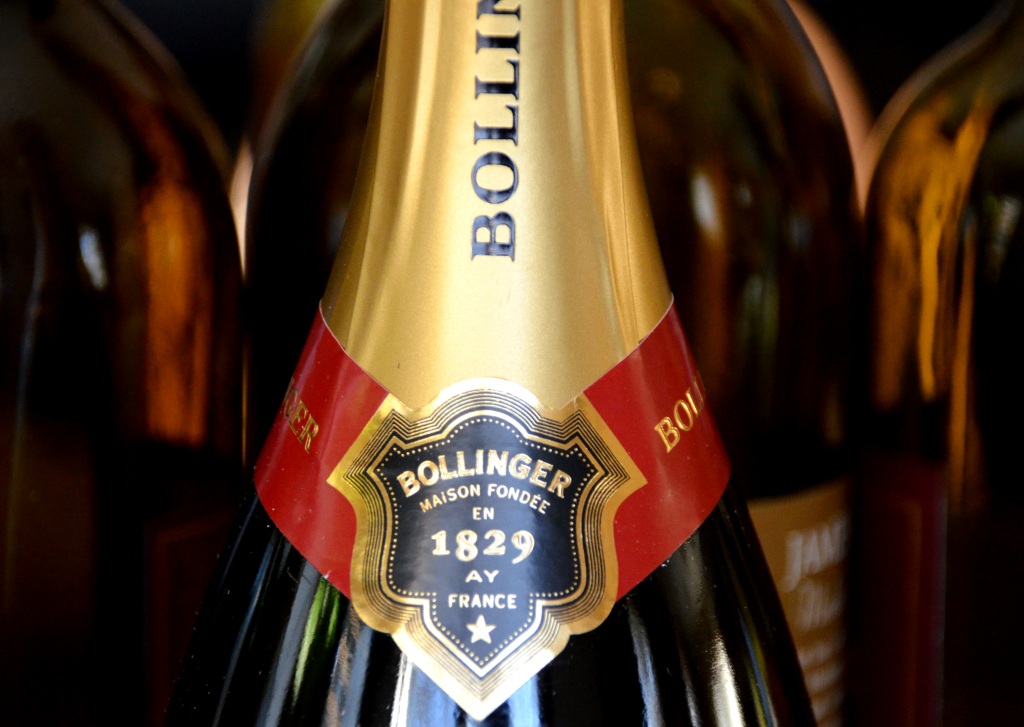
First wine I want you to consider is Champagne. As the very least, it can be an Italian Sparkling wine from Franciacorta or Trento, or some of the California sparklers. Prosecco, Cava and many other sparklers are simply not consistent enough, so for the Valentine’s Day, go with classic – remember – balance and finesse. For the Champagne, my choice would be Bollinger, as I think it is one of the finest non-vintage Champagnes, with lots of finesse. Ferrari from Trento and Bellavista from Franciacorta in Italy would definitely my next choice. But – I don’t want to forget California – Roederer Estate L’Ermitage, Schramsberg Rosé, J Cuvée 20 or any of the Gloria Ferrer sparkling wines would live you with a happy smile.
Moving on, let’s talk white wines. As we are looking for the balance and finesse, I have a few recommendations for you – and you might be surprised with these. For this holiday, I want you to step outside of your “usual circle”. My first recommendation is for the white wines of the Rhône valley in France. Yes, Rhône is mostly known for their reds, but the white wines there are equally stunning. For instance, try to find Domaine Saint Préfert Cuvée Speciale – I called this wine once “a symphony in the glass”. But in general, look for the Clairette or Grenache Blanc wines from Southern Rhône, or Marsanne/Roussanne from the North – those wines are often not easy to find, but they will deliver lots of balance, finesse and pleasure.
Let me give you a few more suggestions – equally difficult to find, but worth looking for. Viognier from Washington is a white wine worthy of celebrating love and romance with. Look for Mark Ryan or Willis Hall – their Viognier is nothing short of stunning. To close on the whites, here are 3 more rare beauties. First, 2 Sauvignon Blanc from … Italy: Gaja Alteni di Brassica and Poggio alle Gazze dell’Ornellaia – stunning balance and finesse. And the last one – Ken Forrester The FMC. You can’t go wrong with either one of these wines – go, start looking, you don’t have lots of time.
Now, we arrived at the red wine junction. Looking for the balance and finesse will dramatically reduce our choices. I would say, let’s go for Pinot Noir. I will limit my recommendations to this one grape only – and here is why. We are looking for the balance and finesse, right? Think about Cabernet Sauvignon from California – what would be the first word or words you would use to describe those wines – probably “big and powerful” – and this is not what I’m looking for suggesting the wines for the Valentine’s Day. Same goes for many Merlot, Syrah and Grenache wines – never mind the Petite Sirah. Even with my beloved Rioja – there are few wines, which will deliver that exact balance and finesse – La Rioja Alta Reserva Especiale would be definitely the one – and I highly recommend it. But for the Rioja – and then for Barolo, Brunello and even Super-Tuscan – as a general class, the probability of running into “big and powerful” is a lot higher than finding “balance and finesse”.
Talking about Pinot Noir, I wish I would recommend some of the classics to you – yes, the Burgundy – but unfortunately, my exposure to the Burgundy is way too limited, so you will need to ask your trusted wine merchant for the advice. Next up – California and Oregon. For the most of the time, California Pinot Noir will deliver exactly that – balance and finesse. To give you a few names, go look for Siduri, Loring Wine Company, Calera, Drew, Copain, Laetitia – but there are many others and it is hard to go wrong with California Pinot Noir. Oregon would be also a perfect choice – look for Adelsheim, Chehalem, Antica Terra, Evening Land – finesse is a middle name for the Oregon Pinot, so you will not be disappointed. And last but not least – don’t forget the New Zealand! Pinot Noir from Central Otago, Marlborough and Martinborough are typically well balanced and round, perfectly fitting our quest for finesse. Look for the wines from Craggy Range, Mt. Difficulty and Amisfield among the others.


Dessert time! People often underestimate how bad the dessert wines can be – one sip of the cloying, single-sugar-note wine would ruin the experience of an amazing dinner. You really have to put a lot of care in selecting the dessert wine which will have balance and finesse. Of course I would like to recommend Sauternes and Barsac wines for you, but again, my personal experience is very limited. I’m sure you can’t go wrong with Château d’Yquem – if you can afford it, go for it! What would be a bit easier to find (and afford) is a Port. Not just any Port – balance and finesse, remember – so go for a nicely aged Tawny, 20-, 30- or 40-years old. As Port ages, it loses power, and becomes fragrant and sublime, guaranteed to deliver lots of pleasure. Look for Rozes, Graham, Quinta do Noval – lot’s of excellent choices. Then of course, the king of the dessert wines – Riesling. For the special experience, I would only recommend to go to the BA and TBA levels – you know, the stuff which always comes in the small bottles. You see, it is very hard to mass-produce BA or TBA level Rieslings – you can’t harvest enough grapes at those sugar levels – thus it is hard to go wrong with BA or TBA Riesling from any producer. And the last recommendation for today – an Icewine. Not any Icewine, but I want to recommend my personal favorite – Inniskillin Cabernet Franc Icewine. This wine is vibrant, perfectly balanced and has lots of finesse – I guarantee you will finish your Valentine’s Day dinner on a high note with this wine.
Here you go, my friends – in the quest for the balance and finesse, these are some of my personal recommendations to enhance you Valentine’s Day experience. Let me know what do you think about my suggestions and feel free to provide your own. Happy Valentine’s Day and cheers!
Daily Glass: First, There Was A Smell
Drinking wine is a sensual experience. Okay, I can’t speak here for all the people who drink wine at one time or the other – but I’m sure that this selectively crazy passionate group, oenophiles, would wholeheartedly agree. Once the wine goes into the glass, of course the color matters first – but color is mostly a technical characteristic. The color can tell you what to expect – for instance, if a Chardonnay has rich golden, yellow color in the glass, you should prepare for the worst (the wine which will be well past prime). Or if a red wine looks almost black in the glass, get ready for the tannins encounter. Still, the most pleasure you can get from the color alone is to get excited – “look at this beautiful color!” type excited.
Your hedonistic pleasure starts with the smell. Technically, it starts and ends with the smell, as our taste buds don’t go beyond 4 (or 5) basic tastes, and even when you take a sip of the wine, it is still the sense of smell which leads you to the strawberries in that sip – but let’s not get technical here, we are talking about the pleasure. Yes, you start with the smell – it is the smell which takes you away and makes you go “wow”. It is the smell which grabs your attention and captivates you, and forces you to smell that wine again, and again and again. It is the smell which builds up the excitement and expectations of the first sip.
The first sip afterwards is a moment of truth – if you are lucky, the taste will match the smell and will take you to the oenophile’s heaven, at least for a moment. It doesn’t always work like that – more often than not, the excitement built by impeccable aromatics instantly dissipates after the first sip. But when you are in luck, this is how the wine memories are created.


What prompted this post was my undoubtedly lucky experience few days ago with two wines in the row, delivering that incredible combination of aromatics and taste. Sorry, I’m getting overly excited here, but the smell of the 2013 Hanna Sauvignon Blanc Russian River Valley ($15) was, in a word, spectacular. In the New World renditions, Sauvignon Blanc is very aromatic more often than not – but it would be typically aromatics of grapefruit and lemon, Here, from the get go, the glass was exuding with the aromas of the fresh cut grass and cat pee. Yes, I know that many people jump when the cat pee descriptor is used, but anyone who had owned a cat would perfectly understand what I’m talking about. And yes, cat pee is a known classic profile of Sancerre, the most classic Sauvignon Blanc of all. So this wine had it all, clean, bright and present on the nose – and the palate was beautiful, medium to full body, with fresh cut grass and touch of lemon peel. Definitely an outstanding example of California Sauvignon Blanc, now squarely engraved in my memory, right next to the Honig and Mara White Grass, which are always California Sauvignon Blanc staples for me. Drinkability: 8+
And then there was 2011 Antica Terra Ceras Pinot Noir Willamette Valley ($75). I’m not going to spend a lot of time talking about the winery – you can should read interesting stories on Antica Terra web site on your own. But this wine… Talking about attractive color, the wine was ruby with the light pinkish hue in the glass. And then the first smell… It was surreal. Here is where I fail as a wine writer, as I can’t give you the right set of words to describe the impressions from this wine. The smell had everything in it – the cranberries, forest floor, herbs and mushrooms – light, delicate and seductive, saying “and now, let’s take a sip…”. The palate was a natural, precisely fitted extension of the smell – all the same component, now packaged together. More cranberries, shallots and truffles, sage and lavender, minerality and whiff of the forest floor, effortlessly rolling off your tongue, delicate and present, with perfectly noticeable, silky texture and needless to say, perfect balance. This was for sure one of the most sensual wines I ever had. And yes, if you want to take this tasting note as an example “look at another moronic wine review” – I will still stand behind it, as this wine delivered lots and lots of pleasure. Drinkability: 9/9+
There you have it, my friends – two wines which will be etched in the memory for the very, very long time. I wish you all to have lots of sensual wine experiences and memorable wines. Cheers!
Wine On The Go, Spectacular Pairing, and Some Life Ramblings
 Life is an interesting thing (wow, what a deep opening thought, huh?). I was supposed to depart at 6 am on a direct flight from New York to Miami to attend the conference. Thanks to much-hyphed-but-never-really-happened blizzard, my flight was cancelled and I was automatically re-booked, now on the flight with the stop, connecting through Charlotte, North Carolina.
Charlotte. You know, there are some strong emotional words which I’m striving to avoid, whether conversing or writing. One of such words is “hate” – and I will explain the connection in a second.
I travel a lot, and I have interesting memories of the different airports and trips, some better and some worse. But – if there is an airport which I “hate”, that would be the Charlotte. The reason is simple – lots of memories of severely delayed flights, cancelled flights, indifferent customer service and even sleeping on the floor as no other options were available. Yes, I know – it is actually stupid to “hate” airport – but I wanted to explain my feelings when I saw that I’m connecting through the Charlotte.
Okay, so I have no choice (called my travel agent multiple times – no way no how, either I take the flight as it is, or just cancel the trip). Short uneventful ride to the La Guardia airport and I’m at the terminal C. It is probably been a few years since I used that terminal, so once I get through security and walking to the gate, and I’m literally saying “wow”. The terminal looks very modern, screens and everything. I stumble upon a cafe which has lots of seats, with an iPad standing in front of every seat. iPad can be used for ordering or just some limited internet browsing. The cafe features a very attractive looking menu with lots of food options, mostly written in French, the language of “love of sophisticated food”. And the wine list looks quite reasonable, both in terms of international selection and price. Yes, definitely not something I was expecting to find.
Anyway, it was kind of early for wine and I was not hungry, so this was mostly a “note to self” for next time I might be using the same airport. To my surprise, the flight departed on time (almost a miracle for the La Guardia airport), and arrived in Charlotte ahead of scheduled time.
Many times in the past while flying through the Charlotte I stumbled upon a little wine shop, more of a tasting room for the Yadkin Valley wines. My schedule never allowed me to actually visit it. Then I remember being at the Charlotte airport at the reasonable time, only to find that the store was gone. This time as I knew that I will be connecting through the Charlotte, I decided just in case to check if there are any of my favorite Vino Volo restaurants at the airport. Nope, there were none, but I found a wine bar called Beaudevin, with a number of raving reviews, including the mention in the very reputable Fodor’s travel guide as one of the 8 top wine destinations in the airports in the US. So the early arrival gave me enough time to stop by Beaudevin, which is conveniently located right in the middle of the terminal, in the section called Atrium.


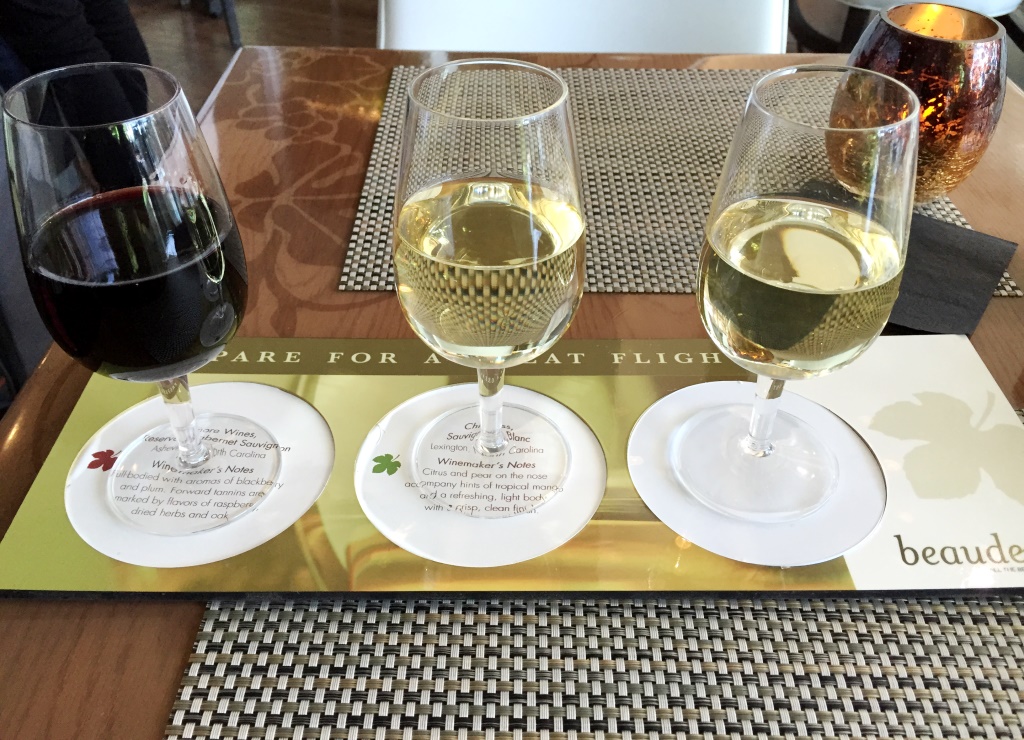
It appears that Beaudevin uses a similar model to the Vino Volo, offering wines both by the glass and as part of the tasting flights. To my delight, one of the featured flights consisted of North Carolina wines, and of course, this is what I went for.
Somehow it was stuck in my head that I recently read some rather negative reviews of North Carolina wines, so I approached these wines with a bit of trepidation. But – call it luck, fruit day or anything else, but I was rather blessed with a wonderful treat.
 https://talkavino.wordpress.com/wp-admin/post.php?post=13570&action=edit&message=10
The flight contained 3 wines, 2 whites and 1 red – Sauvignon Blanc, Viognier and Cabernet Sauvignon. I started with Sauvignon Blanc, and it was delicious, Viognier – delicious again, and then Cabernet Sauvignon – spot on! Here are the notes:
2011 Childress Sauvignon Blanc North Carolina (12.9% ABV) – Nose of white fruit, intense, with a touch of herbs, hint of fresh cut grass. On the palate, nice acidity, dry, tart, lemon notes, good minerality, medium to full body. This is an excellent summer wine – every sip makes you think of summer. Drinkability: 8-
2011 Childress Viognier North Carolina (13.9% ABV) – sweet candy on the nose, very intense, with the characteristic Viognier “perfume” showing in a distance. Compare to the nose, the wine is surprisingly restrained on the palate – hint of candied sweetness, white stone fruit, lychees. Excellent balance. Drinkability: 7+/8-
2012 Biltmore Reserve Cabernet Sauvignon North Carolina (13.6% ABV) – a welcoming nose of warm climate Cabernet Sauvignon, with sweet oak, vanilla, ripe blackberries. Very elegant on the palate, cassis, warm notes of red fruit, medium to full body, a touch of green bell peppers, luscious with soft tannins. Excellent balance. Drinkability: 8-
And now, let’s talk about the spectacular pairing. Beaudevin offers essentially a full restaurant menu – if you have a long connection, you can spend quite an enjoyable time there. As my time was limited, I decided on a Charcuterie salad (lettuce, prosciutto, dried cranberries, green beans, dried cheese), with the addition of smoked salmon.
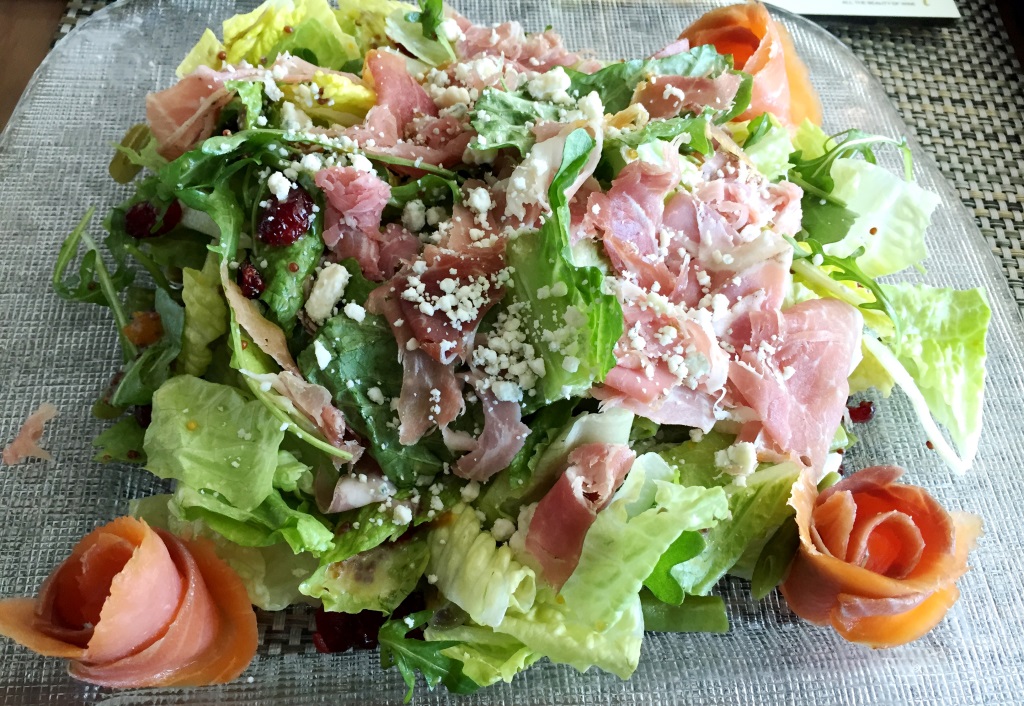
When it comes to the salad in general, I never even attempt to pair it with the wine – I believe generally it is not an easy undertaking. In my case here, I finished my “tasting” and “note taking” session, and I had the wine left, so I really had nothing to lose. I started from Viognier, and “wow” – the wine greatly complemented the sweet profile of the dried cranberries and dressing, so together it was almost a revelation. Next bite and sip, this time of Sauvignon Blanc – and yet another revelation – this time with the clean acidity cutting through the sweetness, contrasting and enhancing flavor. Last but not least, Cabernet Sauvignon perfectly complemented saltiness of the prosciutto and even smoked salmon – totally unexpected, but considering the soft and delicate profile of the wine, it was again a home run. Three wines out of three, working perfectly with one dish (salad!) – this was definitely not something I was expecting, but I’m glad I was able to experience it.
Life is an interesting thing. Cancelled flight led to the very pleasant and educational experience – life can take one thing away from us, and give us something else instead – for sure my case with this trip. Also, it is very interesting to see how the wine culture is changing in the US. From unfathomable plonk only 3–4 years ago (I would never think of ordering wine at the airport 4 years ago – beer would be my only choice), to the upscale wines and wine flights – we are definitely looking at the cultural shift, and I don’t know about you, but I’m very happy to see this happening. Heck, I might even start looking forward to my next trip through the Charlotte airport. Cheers!

Grenache! Grenache? Grenache!, Few Rare Grapes and a Recipe
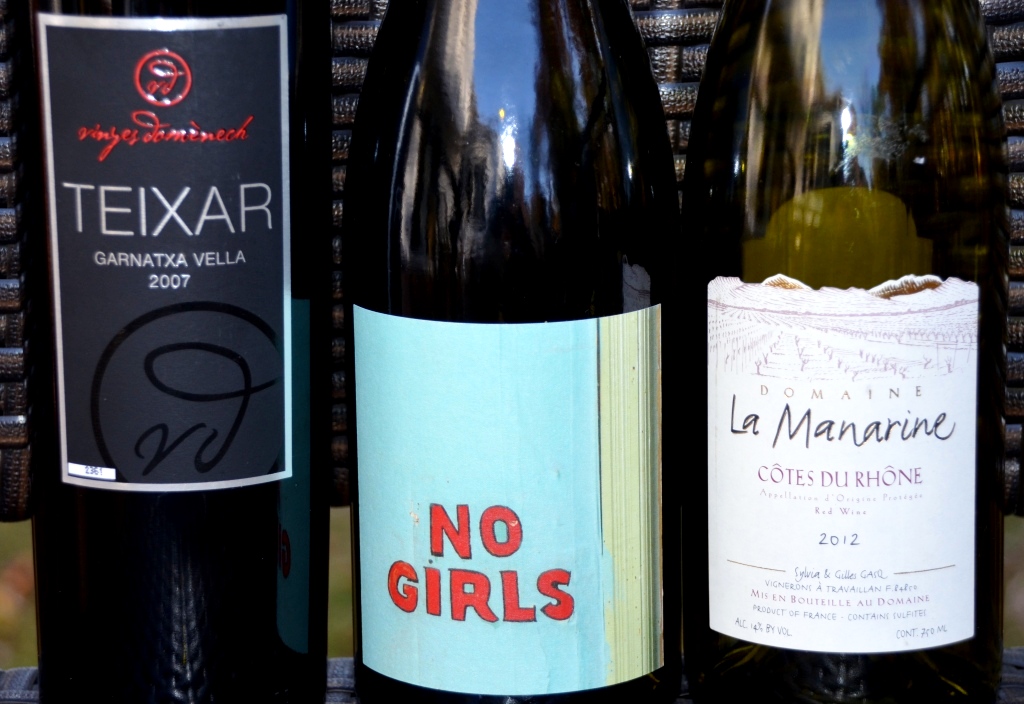 What’s up with Grenache? One of the most planted grapes in the world, a star of Spain, and often a foundation of greatness in the wines of Australia, France, California and Washington. A grape with the range of expression from light, fruity and frivolous to the dark, firm, brooding and confident. Yep, Grenache is well worth an oenophile’s attention. And a special wine dinner.
The theme was set, and then the dinner’s day arrived. This time around, we were a small group (6 adults), so we decided to skip the usual formal blind tasting with the multiple glasses, and instead simply integrate the tasting (still blind) into the format of the dinner. Each couple brought a bottle of Grenache wine, wrapped in paper bag. The wines were numbered at random and then poured one by one. All in all, quite simple.
But before we got to the Grenache, I wanted to share two special bottles. Don’t get all jumpy at the word “special” – it means different things for different people. Your idea of special bottle might be Chateau Latour, Penfolds Grange or Amarone from Quintarelly – well, if you want to share any of those with me, I’m available any day of the week. However, my idea of special is often limited to something simply unique and different, such as “rare grapes”, for instance – an opportunity to add to my grape count and reach the coveted Wine Century Pentavini (500 grapes).
Along these lines, the first “special” was the white wine from Spain, which was made mostly from Roussanne, but also contained the grape called Albillo. 2011 Navaherreros Blanco de Bernabeleva Vinos de Madrid DO (14.5% ABV, $14.99, 50% Roussanne, Albillo, Macabeo and other varieties) had beautiful golden color, inviting nose of white fruit, touch of vanilla. Full bodied, creamy, luscious on the palate, touch of earthiness and baking spices, touch of vanilla, good acidity. (Drinkability: 8). This was definitely a delicious way to start the evening.


The next wine was Rosé. It was not just some generic Rosé – it was actually made form the grape which is practically impossible to find, at least in US – and it was on my “target” list for the very, very long time. Just to explain – if you will look at the original Wine Century Club application, you will find 186 grapes listed there, so we can consider those 186 to be a mainstream. In that list, there are still 6 grapes which I never tasted. Well, let me take that back – now there are 5.
There is a good chance that you heard of or even tasted the wine called Picpoul de Pinet, a light, crisp white wine from Rhone made from the grape called Picpoul Blanc. Picpoul Blanc has a cousin, a red grape called Picpoul Noir, which is literally impossible to find. During one of my countless searches online, I found that Picpoul Noir Rosé was available in one (!) single store in US in San Francisco – and luckily, I had a friend there who was kind enough to get it for me. Here is what I thought of the Rosé made out of this super-rare grape: 2013 Julie Benau Pink Poul Rosé Vin de France (12.5% ABV, $17, 100% Picpoul Noir) – restrained nose with a hint of strawberries. The same restrained profile continues on the palate – limited fruit expression, medium to full body, good acidity, food friendly. (Drinkability: 7+)
Okay, now we can finally talk Grenache, which I mentioned 3 times in the title of this post, right? I think when it comes to the range of expression among 7-10 most widely known red grapes, Grenache offer the most versatility, competing may be only with Syrah. From over the top dark chocolate, tar and sweet cherries to the soft, earthy and even acidic, Grenache can showcase quite a range of winemaking styles and terroirs. Thinking more about our tasting, it served exactly as a confirmation to this statement.
The first Grenache we had was that exact over the top style – dark, concentrated, firm, loaded with sweet pleasure in every sip. The second Grenache couldn’t be more different than what we experienced – smoke, mushrooms, forest floor, earthiness, herbs – a restrained beauty which I would never even think of as Grenache – but it was. And the last bottle was all too shy and closed at the beginning, showing again differently from the first two – but as it opened up, it became a younger brother of the first wine – same traits, only dialed down. The 3 bottles we chose completely at random managed to demonstrate that tremendous Grenache range. When we removed brown bags, we learned that we traveled from Spain to Washington and then to France – a very interesting journey.


Here are a bit more formal notes for the the wines, in the tasting order:
2007 Vinyes Doménech Teixar Garnatxa Vella Montsant DO, Spain (14.5% ABV, $75) – Delicious! Dark chocolate on the nose, very intense, ripe red fruit. The same continues on the palate – firm texture, dark chocolate, touch of plums, earthiness, perfect balance and long finish. 8+/9-
2008 No Girls Grenache La Paciencia Vineyard Walla Walla Valley (14.2% ABV, $65) – very interesting. Both nose and the palate show a profile of concentrated Oregon Pinot Noir. Smokey fruit, earthiness, very concentrated, touch of coffee, licorice, raspberries, sage and lavender. Very unique. 8
2012 Domaine La Manarine Côtes du Rhône (14% ABV, $16) – closed nose, similarly closed palate. Opened up after a while, just enough to show some dark fruit (plums, cherries) and a touch of chocolate on the palate. 7+
Okay, enough about wines. Now, this was a dinner, and I promised you the recipe, remember? The dish I made, and the recipe I would like to share will perfectly pair with the cold weather, and it is one of the ultimate comfort dishes ever – braised short ribs. Starting from the ease of cooking and the simplicity of the recipe, and then admiring the goodness of the smell during the long, slow cooking – this is definitely one of the ways to properly spell the word comfort.
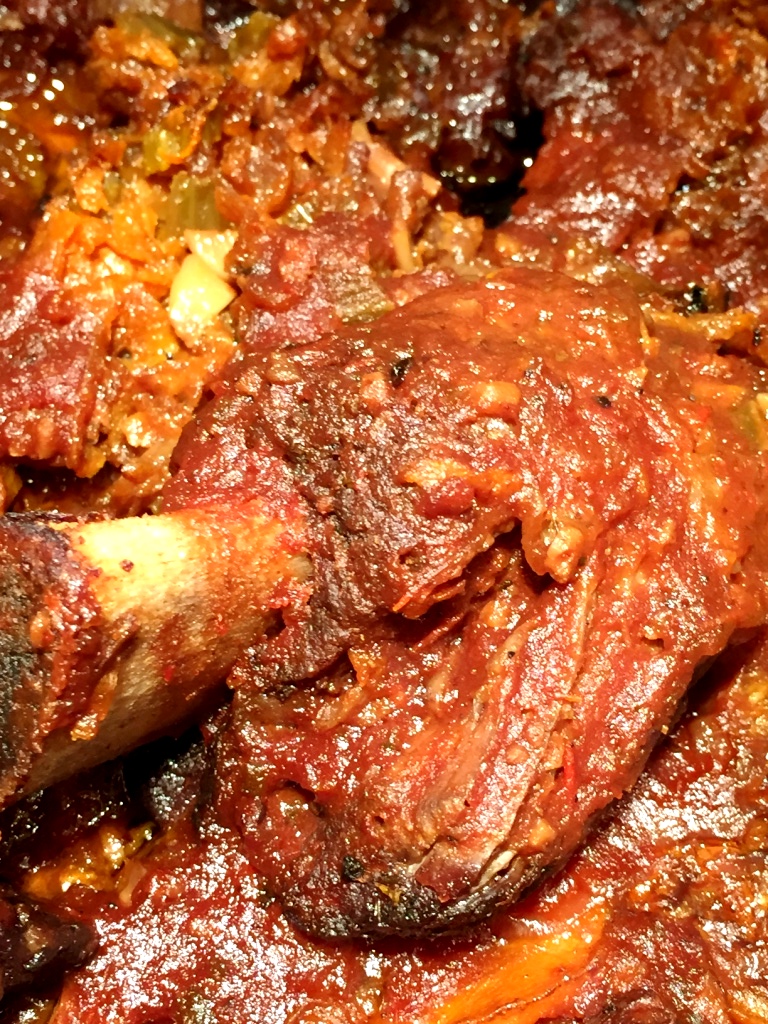
Doesn’t it say “comfort”?
Here is the recipe:
Braised Short Ribs
Prep time: about 1 hour. Cooking time: 4-5 hours
Yield: 10 servings of two ribs each
8-10 lb beef short ribs – I don’t go specifically by the weight – I generally like to cook considering 2 ribs per person
1 bottle of red wine – Pinot Noir or Beaujolais
5 medium yellow onions
8 sticks of celery
4 large carrots
BBQ/Grilling spices – I use Penzeys spices
4 tbsp Olive oil
Salt and pepper
Serve with: mashed potatoes, rice, pasta, etc.
First of all, decide on what spices you want to use. I generally combine different Penzeys spices, but really – feel free to use anything you have:
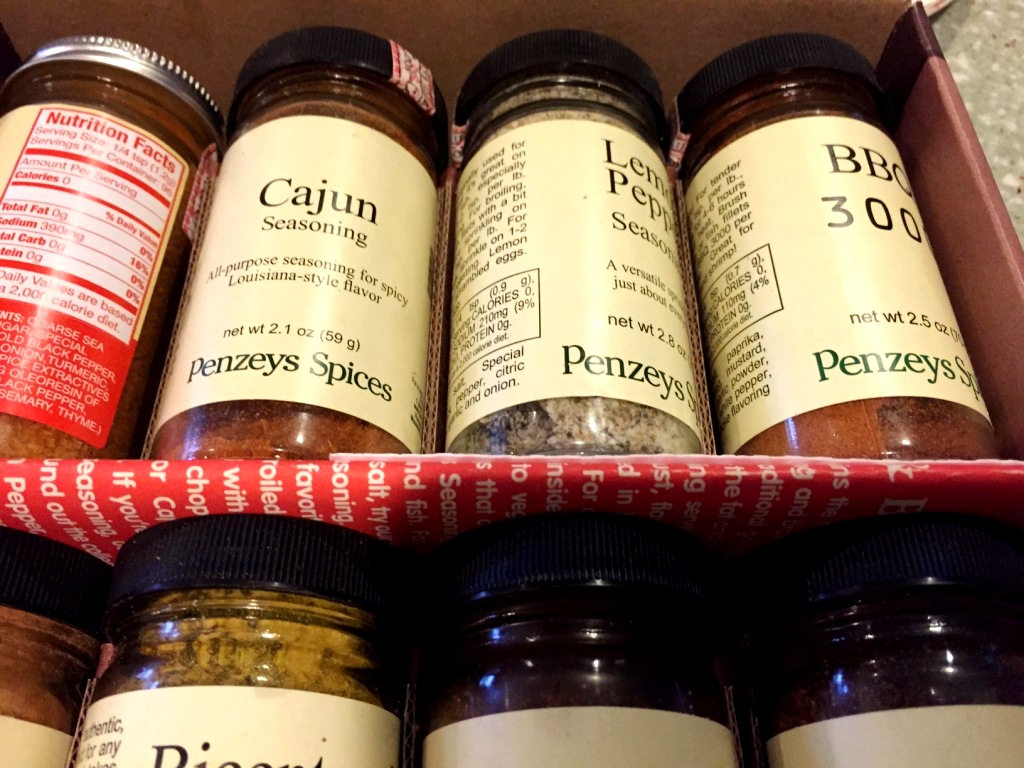
Next, take the meat out of the fridge and line it up on the prepping board, then sprinkle with the spices on both sides, add salt and pepper as needed:


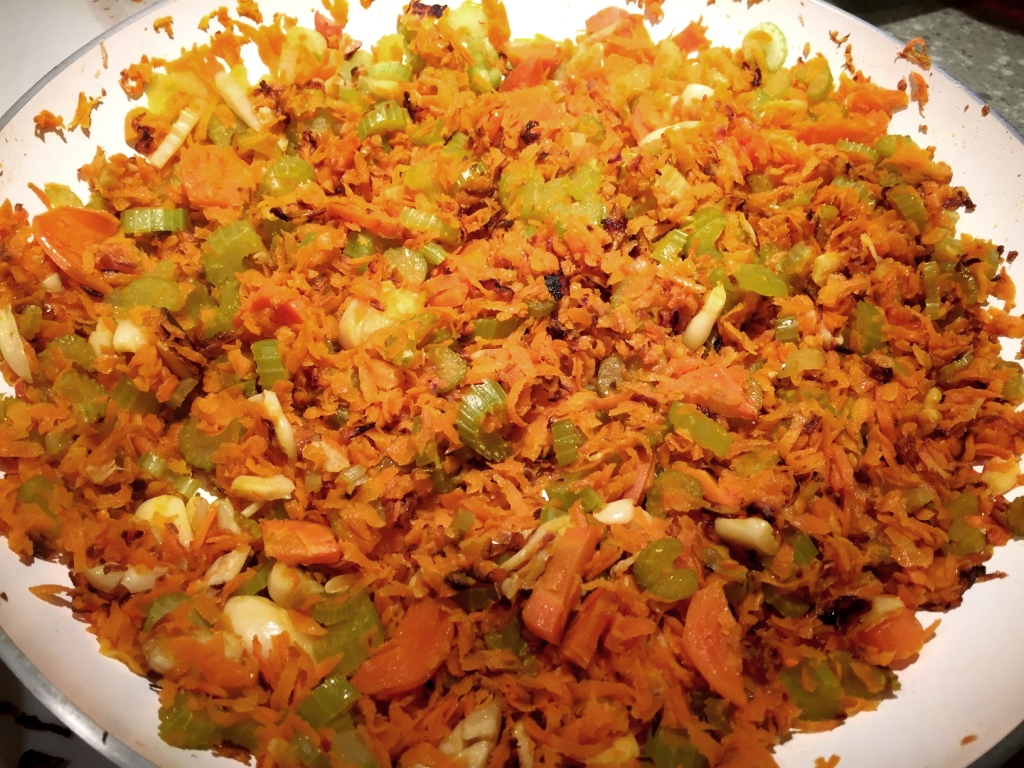
Let meat warm up to the room temperature. Preheat over to 325ºF. While the meat is warming up, you can start working on your “trifecta”. Dice the onions and start sauteing them in the skillet or dutch oven with 2 tbsp of olive oil on the medium heat. Dice carrots and celery. Once onions become soft and translucent and then start gaining color (usually takes about 20 minutes), add carrots and celery and sauté all together for another 10 minutes, then set aside.
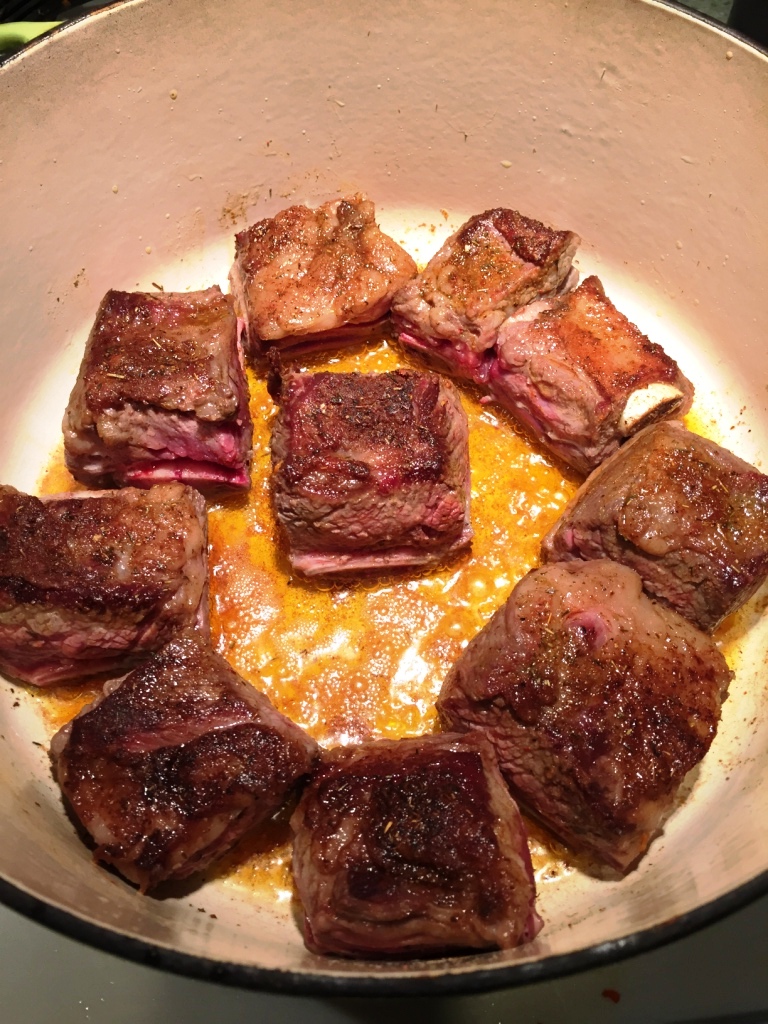
 Now, put remaining olive oil into the dutch oven, and heat it up to the high heat. Start searing the short ribs, meaty side down first. You might have to work in the batches, as you want all of the ribs to be nicely seared on both sides:
 Once all the ribs are seared, combine them all in the dutch oven, then add the onions, carrots and celery:
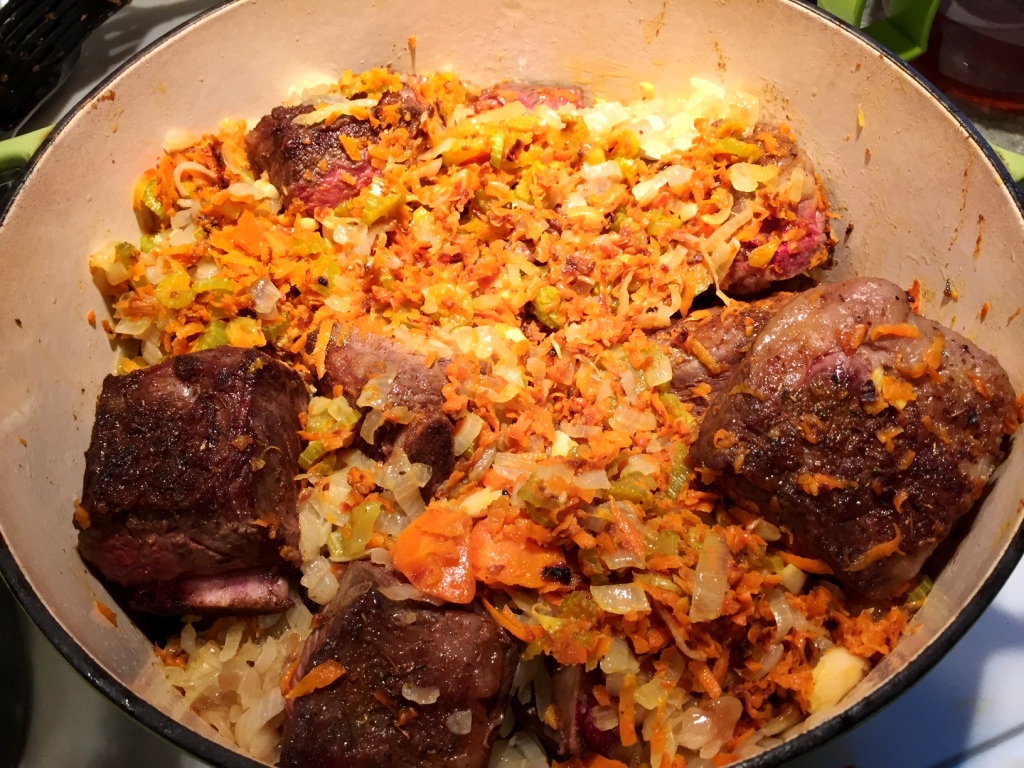 Add a bottle of wine, cover, put it in the oven and forget it for the next 4-5 hours (you really don’t want to rush this process). When done, you probably will find something like this:
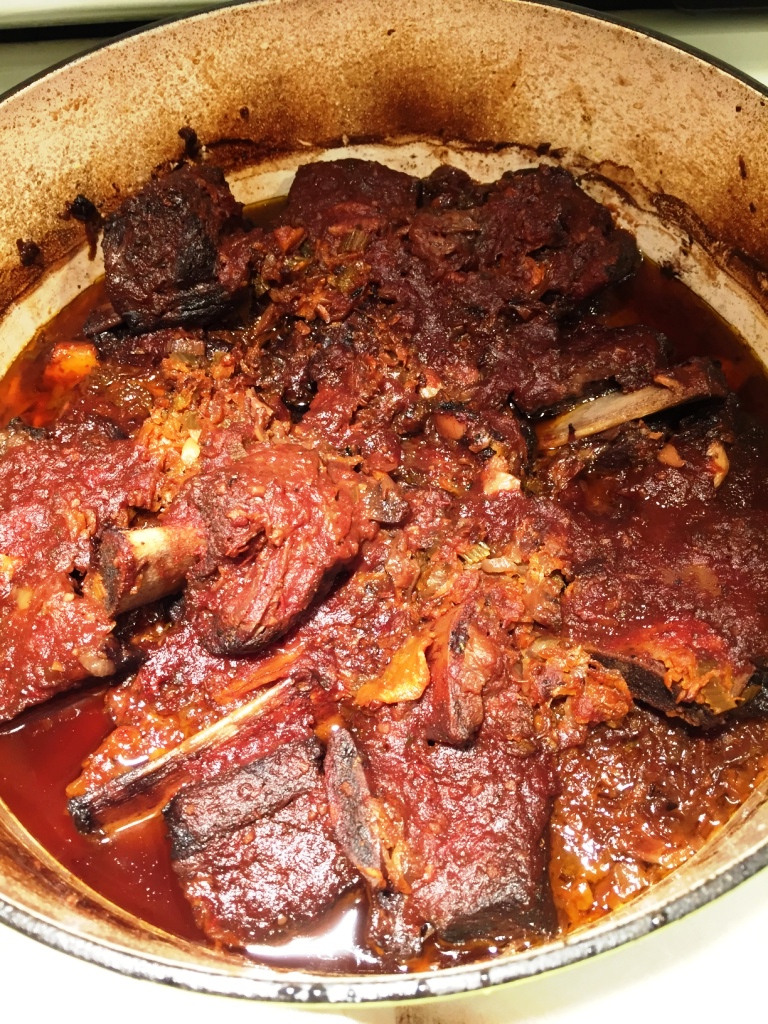 As you can imagine, hearty Grenache is a perfect pairing for such a hearty, homey dish – but of course this shouldn’t be your only choice.
Here we are, my friends. A few rare grapes, an amazing range of Grenache wines, and winter-storm-alleviating-ultimately-comforting dish. Stay warm and drink well. Cheers!
Daily Glass: A Super-Local Pinot
 While talking to a friend on Facebook, she asked: “would like to try a local Pinot Noir”? Care to guess my response? Yeah, a dumb question, you know what I said – “of course” and “yes, please” (insert an appropriate number of exclamation points on your own). Mentioning that she will be sending the wine in a few days, she reiterated again – it will be a local Pinot Noir, or may be even rather a super-local.
As my friend lives in Silicon Valley in California, my thought was – okay, of course it will be a California Pinot Noir, so “local” means produced locally in California. I was of course curios what exact Pinot Noir it will be, but hey, patience is a virtue of a oenophile, isn’t it?
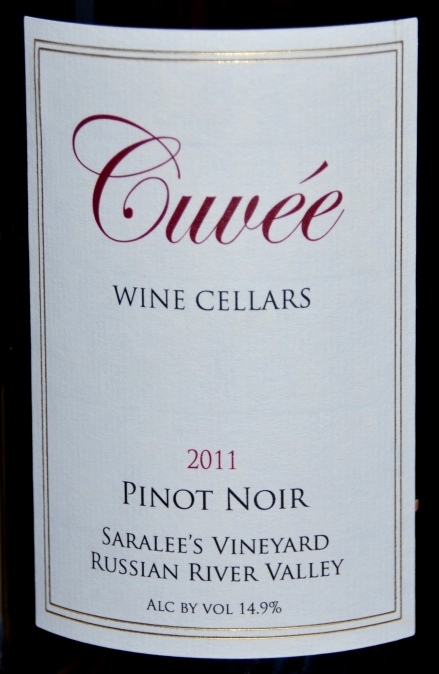
The package arrived, with the bottle of California Pinot Noir in it. 2012 Cuveé Wine Cellars Pinot Noir Saralee’s Vineyard Russian River Valley (14.9% ABV). Okay, so I’m sure that most of you never heard of Cuveé Wine Cellars – but the wine has Russian River Valley designation, so that’s the whole “local California” story, you ask?
Well, the wine actually is super-local. While the grapes were harvested in Russian River Valley, the wine was made locally in Silicon Valley, in the town of San Carlos, a small town near San Jose, where Cuveé Wine Cellars is located. As it often happens, especially with the urban wineries, the driving force behind Cuveé Wine Cellars is passion – and you can check their story on the Cuveé Wine Cellars web site.
How was the wine? In a few words – delicious with a great aging potential. When I opened it on the first day, the aromatics of Pinot Noir were incredible, one of the most pronounced California Pinot I ever had a pleasure to smell – forest floor, smoke, mushrooms, licorice – all very concentrated. The palate was well supporting the aroma, with silky-smooth, rich texture. Very concentrated (using the word again, sorry), with lots of fruit, chocolate, the same mushroom undertones and good acidity. But honestly, it was a bit too much. Don’t get me wrong – there was no jammy fruit or sharp biting alcohol in this wine – but you know how sometimes you are looking for the subtlety of the favors, for a bit more grace and mystery? My wish was granted on the day 3, when wine still had all the aromatics, but the palate became more mellow and intricate. Drinkability: 8+
That’s my story of the super-local Pinot – and an ode to the great friends. Cheers!
Daily Glass: The Wine That Begs The Eternal Question
 Eternal question, you say? Which one of them? Wine is a well known suitor of the Eternal, so yeah, a few questions are lurking for a while…
The one I’m talking about is akin “chicken and egg” case, with a spin. Is the wine made in the vineyard or at the winery? Is it winemaker or the grape? Well, rest assured – I’m not trying to jump on this subject just for the sake of conversation. It just happened that the wine I opened yesterday made me ponder at that exact question.
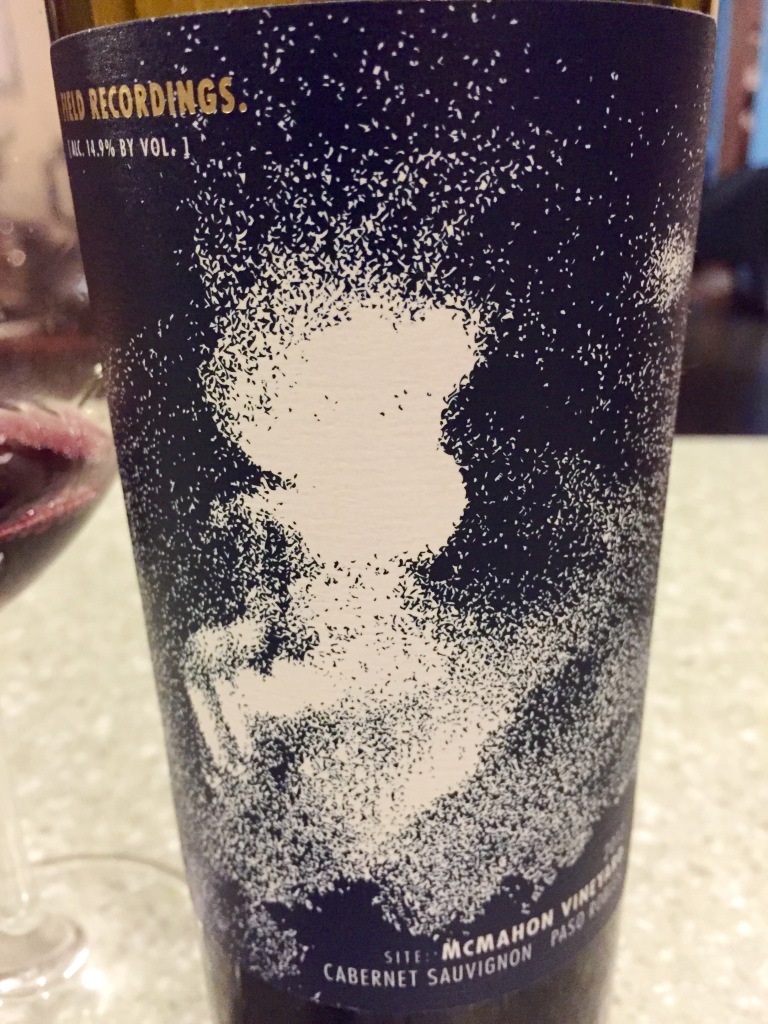
What wine? 2012 Field Recordings Cabernet Sauvignon McMahon Vineyard Paso Robles (14.9% ABV, $29, 83% Cabernet Sauvignon, 17% Tempranillo, 16 month in 89% new French oak, 11% new American oak). What made me to think of the terroir versus winemaker? The aromatics. The wine had not a glimpse of Cabernet Sauvignon characteristic aromas – no cassis, no bell peppers, no eucalyptus. But on the nose there were plenty of spices. There was a hint of a forest floor, mushrooms, a touch of barnyard. There was also a smoke, and plenty of it. There was pepper. And there was tar and pencil shavings. So, what do you say – was that a winemaker talking, or the vineyard?
The palate, unfortunately, didn’t fully support the excitement. There was lots happening (still no cassis or anything else reminiscent of Cabernet Sauvignon), but there was lots of fruit, and vibrant acidity. At times, the wine was borderline jammy, only to be cleansed with the subsequent punch of acidity. I was looking for more balance, and it didn’t happen. Drinkability: 7
So in the end, I got no answers and more questions. Was that a bad wine? I don’t think so, as aromatics brought in lots of pleasure, and it was thought provoking on the palate. Did I open this wine too early? Yep, I’m quite convinced I did. Was that wine made in the vineyard or in the winery? I have no idea, so yes, the floor is yours… Cheers!
Celebrating New Harvest – Beaujolais Nouveau 2014
 On Thursday, November 20th, all wine (and probably well beyond wine) social media outlets were filled with “Le Beaujolais Nouveau Est Arrivé” messages, pictures and videos. For more than 30 years, what was at some point a simple local celebration of the new harvest, became a big international affair. Always happening on the third Thursday in November, the wine called Beaujolais Nouveau magically appears on the shelves of the wine stores and on the restaurant tables all over the world to ring in the harvest.
This international celebration is largely a result of the efforts of one man with the vision – Georges Duboeuf, the famous french wine négociant and producer. It was his vision and hard work which lead to the event celebrated from Paris to New York to Tokyo. At some point the Beaujolais Nouveau phenomenon became oversubscribed, leading to the glut of insipid wines saturating the market, creating a bad image associated with the whole Beaujolais Nouveau idea. But with the modern winemaking improvements, the quality of the Beaujolais Nouveau wines started to improve year after year, which brought the feeling of the celebration back over the last 5-6 years.
I had been closely following the Beaujolais Nouveau celebration ever since this blog started – here are the posts from 2010, 2011, 2012 and 2013. While working on this post, I checked my notes on the past releases of Beaujolais Nouveau, and it looks like with the exception of 2011, all the vintages were very consistent, offering good quality, very drinkable wine which gave a lot of pleasure. I know that some people dismiss Beaujolais Nouveau as a marketing gimmick and simply refuse to drink the wines – however, I wholeheartedly disagree and I believe this young celebratory wine well worth wine aficionados’ attention.


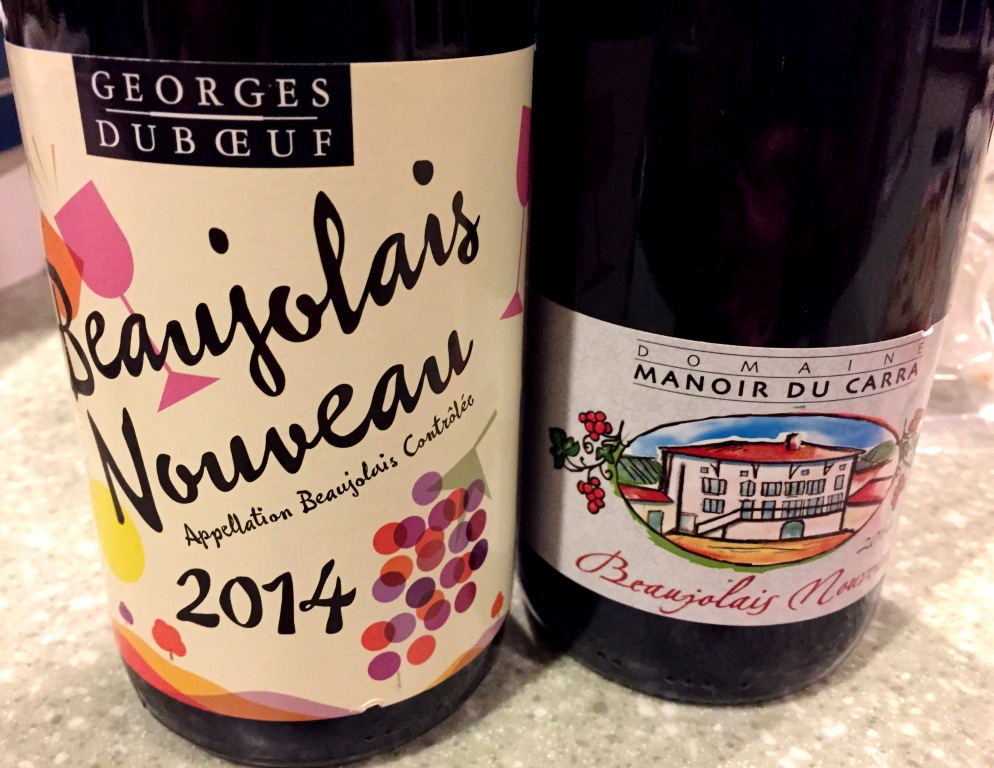
This year, I had an opportunity to try two different Beaujolais wines – 2014 Georges Duboeuf Beaujolais Nouveau (12% ABV, $9.99) and 2014 Domaine Manoir du Carra Beaujolais Nouveau (12.5% ABV, $10.99). Talking about interesting experiences, for the first time I remember drinking Beaujolais Nouveau, and definitely for the first time while writing this blog, I found two of the different bottles of wine which taste nearly identical. This was very puzzling experience, as I was looking for the different descriptors, and couldn’t find any. Okay, they were not 100% the same wines, of course – but differences were very subtle, may be in the particular fruit profile being more pronounced in one wine and not in the other, and majority of the description would stay the same. To acknowledge that, I will give you a description for both wines at the same time.
Color: Bright Garnet
Nose: Freshly crushed red fruit, lavender, unmistakable aroma of the young wine
Palate: Red fruit, cherries, tart blackberries, violet, lavender, medium body with some structure, vibrant acidity, good balance, medium finish.
Verdict: a good wine, easy to drink, fresh, should play well with the wide range of food due to the substantial acidity. Yes it will do just fine on your Thanksgiving table (will be definitely on mine). Drinkability: 7+/8- for both – really hard to decide.
Yet another Beaujolais Nouveau day becomes a history. Well, of course not so fast – the wines will be available for a while, and while they are not meant for aging, overall textural presence of the two wines I tasted suggests that these wines can last for the few years – but this is definitely not what you want to do. And than that mind boggling similarity between the two totally different wines – I don’t know what to think of it, except that may be the similar winemaking methods used, like carbonic maceration and such, lead to the similar results for the two totally unrelated wines. Perhaps this is not a very solid explanation, so I would love to hear your theory if you got one.
Did you already have the Beaujolais Nouveau 2014? If you did, what kind and what did you think of it? Cheers!
Last Bottle Sign Up ($10 credit)




 Talk-A-Vino