Archive
Valentine’s Day Wine Experiences
 Last week I gave you some recommendations for the wines to serve on Valentine’s Day. Now, let’s see if I followed my own recommendations.
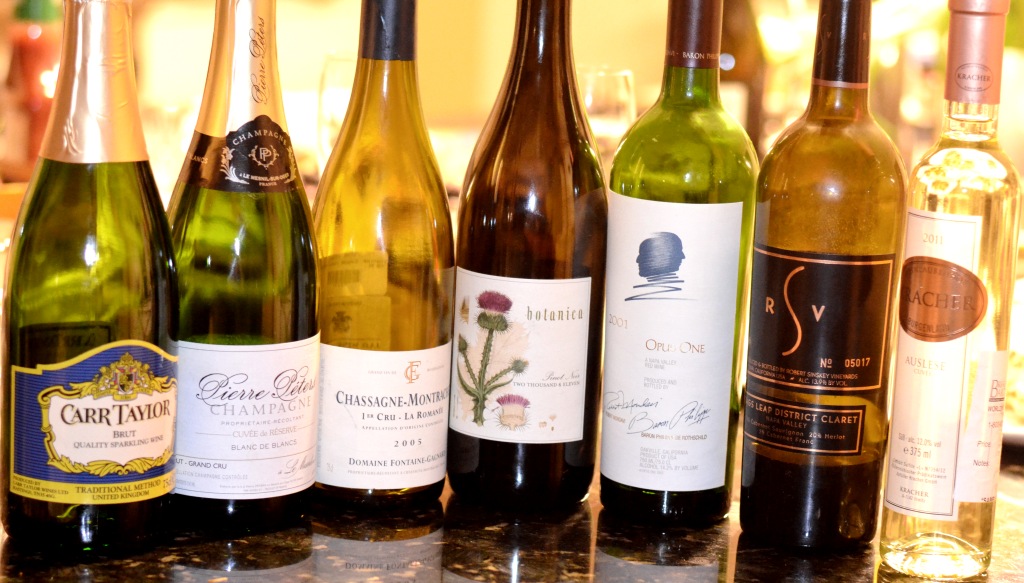
Of course the plan was to start the evening with the Champagne – and then there was a … but. I recently got my hands (told you many times before – I love my friends) on the very interesting sparkling wine from UK. What was the most interesting for me even before I tried the wine is that it contains one of the extremely difficult to find, rare grapes called Schönburger. As I mentioned last time regarding my quest to complete all the grapes in the original Wine Century Club application, Schönburger was one of those “last standing”, extremely difficult to find grapes – and the Carr Taylor Brut was the only wine containing Schönburger, which Wine-Searcher was able to find pretty much anywhere. In case you are curious, Schönburger is a rose grape created in 1979 in Germany as a cross of Pinot Noir, Chasselas and Muscat Hamburg, As an added bonus, the Carr Taylor Brut contained another grape I never heard of, another cross from Germany called Reichensteiner.
Okay, now that I provided a full disclosure, let’s talk about the wines. NV Carr Taylor Brut Sparkling Wine, England (12% ABV, $35) was an excellent start for the evening. Fine bubbles, very intense, very reminiscent of Champagne. Hint of toasted bread on the nose and may be a touch of almonds. The palate had all the toasted and yeasty notes, packaged together in compact but bright way – the wine had no sweetness, but nevertheless was perceived as a fuller body than a typical Champagne. I would gladly drink this wine again any time – if it would be available in US. Drinkability: 8-
Now it was the time for Champagne – Pierre Peters “Cuvée de Réserve” Brut Blanc de Blancs Champagne (12% ABV, $55) – very classic, a hint of brioche on the nose, and nice toasted notes on the palate. Quite honestly, after the first sparkling wine, I wanted a bit more life in the glass – this was clean and fine, but more of the usual. Drinkability: 7+
Our next wine was a white Burgundy. Considering my limited experience with Burgundy, I was concerned if 10 years old wine would hold well (all of you, Burgundy buffs, please stop laughing out there – I’m still learning), so the Valentine’s Day seemed to be quite a good occasion to find out. This 2005 Domaine Fontaine-Gagnard La Romanee, Chassagne-Montrachet Premier Cru, France (13.5% ABV, $65) was outright delicious – beautiful nose of fresh apples, and then apples and honey on the palate – full bodied, supple, with perfect lingering weight in the mouth – this was really a treat. Too bad it didn’t last – but this was definitely an excellent wine. Drinkability: 8
Time for the reds, don’t you think? Remembering the pleasure of the Antica Terra Ceras Pinot Noir (here is the post in case you missed it), I wanted to try another Pinot Noir from Antica Terra – this time it was 2011 Antica Terra Botanica Pinot Noir Willamete Valley (13.2% ABV, $75). The nose was very similar to the Ceras – cranberries, touch of forest floor, lavender, bright and intense. On the palate, this wine had much bigger shoulders than Ceras. Ceras Pinot Noir need no breathing time – it was ready to drink from the moment the bottle was opened. Botanica needed a bit of time. After about 20 minutes in the glass, it showed its structure, dark concentrated fruit, touch of coffee, earthiness, all with a perfect balance, and again, finesse. Drinkability: 8
And then there was Opus One. 2001 Opus One Napa Valley (14.2% ABV, $250). Quite honestly, when I learned that we will be opening Opus One, I was a bit concerned. Yes, this is one of the legendary California Cabernet Sauvignon wines, and yet when I tasted it before, I was not blown away. And when you are not visually excited about $250 bottle of wine, you feel that something is wrong with you, don’t you think? Bottle is opened, and wine is poured in the glass. Based on the color, the wine looks like it was bottled only yesterday – dark, very dark garnet. On the nose, the wine was somewhat muted but pleasant – touch of black fruit and eucalyptus. On the palate, the wine was simply closed – and aggressively tannic, with a touch of green brunches on the finish. Well, to the decanter, of course. After about an hour in decanter, the wine definitely changed for the better, showing touch of cassis and coffee notes on the palate – the tannins still stayed, but reduced, and the finish became spicy, peppery if you will – still not leading to the “wow” which you want to find in the bottle like that. Oh well. Drinkability: 7+
As we were waiting for Opus One to come around, another bottle was pulled out – 1996 Robert Sinskey Vineyards RSV Stag’s Leap District Claret Napa Valley (13.9% ABV, $55). This wine amply compensated for the Opus One shortcomings – in a word, it was delicious. Perfectly young appearance in the glass was supported by the fresh fruit on the nose. And the palate had cassis, touch of mint, mocha, sweet oak, silky smooth tannins, perfectly layered and perfectly balanced. This was Napa Valley Cabernet at its peak, and it was not afraid to show it. Drinkability: 8
Logically (Valentine’s Day!) we had to finish on a sweet note. This was my first experience with Austrian dessert wine, and it was also a first experience with Kracher – I only heard the name before, but never tasted the wines. 2011 Kracher Auslese Cuvée Burgenland, Austria (12% ABV, $22) had everything you want in the dessert wine and nothing you don’t – delicious light honey notes, lychees, vibrant acidity, lemon peel – it was an outstanding way to finish the evening. Drinkability: 8
That is the story of our Valentine’s Day wine experiences. Well, I can’t leave with the wines alone – the food was delicious too, so let me at least share some pictures – I spent time working on them, you know. Here we go:


And we are done here. So, what were your Valentine’s day wine highlights? Cheers!
[Wednesday’s] Meritage – Wine Quiz Answer, Merlot is Back, Harvest Everywhere, About Yelp and more
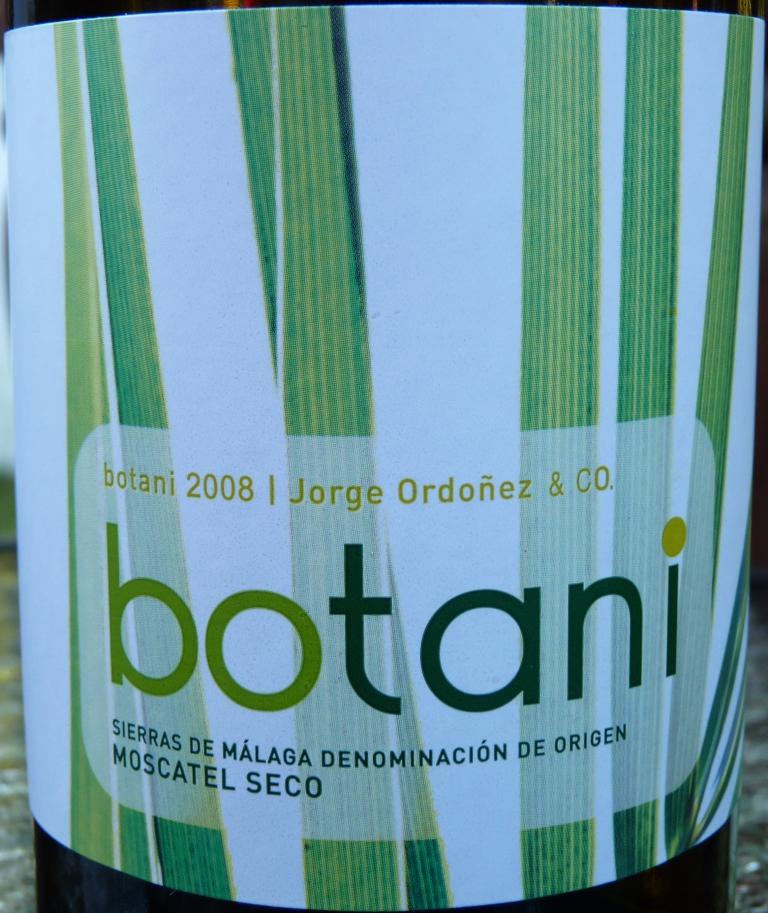
Botani Moscatel Seco Sierras de Malaga DO 2008
Meritage time!
Let’s start with the answer to the wine quiz #115: Grape Trivia – Muscat.
In the quiz, you were supposed to answer 5 questions about one of the oldest cultivated grapes – Muscat.
Here are the questions, now with the answers:
Q1: This Italian wine, made out of the Muscat of Alexandria grapes (which has a different local name), is quite unique in having a given vintage receive top ratings from all main Italian wine publications, including Gambero Rosso, Slow Wine, Bibenda and Veronelli. Can you name this wine?
A1: Donnafugata produces dessert wine called Ben Ryé, made out of Zibibbo grapes, which is the local name for Muscat of Alexandria. Ben Ryé typically gets awarded highest ratings by various Italian publications, year in and year out.
Q2: This Muscat wine was the last solace of exiled Emperor, Napoleon Bonaparte. Can you name the wine and the country where it was made?
A2: This legendary wine is Klein Constantia Vin de Constance from South Africa
Q3: Which one doesn’t belong and why?
a. Banyuls, b. Beaumes de Venise, c. Frontignan, d. Rivesaltes
A3: Banyuls – while Banyuls is known for its dessert wines, same as the three other AOCs, Grenahce Noir is the main grape used in Banyuls, not the Muscat which dominates the others.
Q4: Muscat wines often get very high ratings from the reviewers. Based on Wine Spectator Classic wines (95 – 100 rating), which country do you think has the most Muscat wines rated as Classic:
a. Australia, b. France, c. Italy, d. Portugal,
A4: It might come as a surprise, but this country is the Australia – 9 out of 10 Muscat wines with topmost ratings are from Australia, including a 100 points Campbells Muscat Rutherglen Merchant Prince Rare NV.
Q5: Which should be excluded and why?
a. Muscat of Alexandria, b. Muscadelle, c. Moscato Giallo, d. Muscat of Hamburg, e. Morio Muskat
A5: This was a bit of a tricky question – actually 2 grapes don’t belong – Muscadelle, which has nothing to do with Muscat, and Morio Muskat, which is a blend of Sylvaner and Pinot Blanc.
When it comes to the results, we had no winners, unfortunately, but I’m glad to see Oliver the winegetter back in the game. There is always the next time!
Now, to the interesting stuff around the vine and the web!
Let’s start with … Merlot! Merlot is back, and to make sure everyone will notice, October is designated as the Merlot month! If you think about it, Merlot never left, and Chateau Petrus didn’t switch all of a sudden to the Cabernet Sauvignon as a main grape. Still, Merlot wines are now demanded by name, so it is definitely a reason to celebrate. Drink it, talk about it, write about it – just don’t be indifferent about it. Here is the web site which will help to plan your Merlot festivities.
Harvest is under way in many parts of the Northern Hemisphere, so here are few of the updates. Long stretch of a warm weather in September greatly helped vintners in Burgundy and Bordeaux. The summer was cold and rainy in both regions, and the hailstorms didn’t help either. However, warm and steady September weather greatly improved the overall outlook; while the 2014 vintage is not expected to exceptional, both Bordeaux and Burgundy expecting good results. White Burgundy look especially promising in many appellations, including Chablis. Here are the links with more details – Burgundy and Bordeaux. California weather was quite opposite compare to France – very hot and dry summer forced an early harvest start in the Northern California, with some estates picking up grapes as early as July 29th – one of the earliest starts in a decade. Here is the link with more information about California harvest.
When I’m looking for the good restaurant, especially in the unfamiliar area, my first choice of information source is usually one and the same – Yelp. I generally can’t complain, and for majority of the cases I’m quite happy with Yelp recommendations – I’m sure it saved me from the number of a bad experiences. This is why it is even more upsetting to read about the issues businesses face with Yelp forcing them to take advertizing deals or be punished by artificial manipulation of ratings. Unfortunately, this is what happens when shareholder value becomes the purpose of business existence and trumpets the relationship with the real customers (which eventually drives company out of business). Case in point – the restaurant called Botto Bistro in San Francisco, which refused to badge with Yelp’s demand for advertizement placement, and instead started fighting back with Yelp by undermining the core of the Yelp’s existence – the rating system. The restaurant requested all of their patrons to leave negative one-start reviews, which people did. Take a look at the this article which lists a lot of examples of such a one- star “negative” – or rather super-funny – reviews. Yelp have to get its business integrity together, or it will disappear.
If you are actually a writer, how often do your read your writing, edit it, then read again and edit again? You don’t need to answer this question, but the number of the read/edit cycles is better be substantial if you want to end up with the quality outcome. Here is an interesting article by Jo Diaz, where he talks about the importance of the editor and the editing process. It is clear that most of us are not going to hire an editor for our “labor of love” blog posts – however, the editing still remains an essential part of the “writing well” process, and you really should find the way to implement it.
And we are done here. The glass is empty – but the refill is on its way! Cheers!
From Languedoc, With Love and Pride – Wines of Paul Mas
 Talking about wines of Languedoc, with the risk of being boring, let me mention a few of the basic facts about the region. Languedoc is the biggest single wine-producing region not only in France, but also in the world. According to Wikipedia, only 13 years ago (in 2001), Languedoc was producing more wine than entire United States. Another important distinction of Languedoc is the fact that it practically has no restrictions on the type of grapes which can be grown there. While Mourvedre, Syrah, Cinsault and Grenache might be main red varietals, pretty much any of the international varietals are also permitted and grown in Languedoc. While such a liberal approach encourages winemaking, its flip side is that a lot of wines are produced under the designation of Vin de Pays d’Oc, which technically stands for “country wines”, a step below in classification compare appellation-specific wines (AOC wines such as Bordeaux, Pomerol, Medoc, etc.).
What this all means to the wine consumer? Value. For the long time, Languedoc had being known as a hidden gem, a secret source of excellent wines which you can enjoy every day, without the need for the special occasion (I actually wrote a post about Languedoc as one of the wine world hidden secrets – you can find it here).
Let me explain why we are talking now about Languedoc wines. A short while ago, I was invited to participate in the virtual tasting of the wines of Chateau Paul Mas. Paul Mas family had been making wines in Languedoc since 1892. Jean-Claude Mas, the 4th generation winemaker, set out to expand farther the family vineyards and winemaking business overall. Starting in 2000, Domaines Paul Mas plantings increased from about 86 acres to 440 acres of vineyards, and it has another 2000 acres under the contract. Just to give you few more facts, in 2006 Jean-Claude was awarded the title of International Mediterranean Entrepreneur of the Year by Ernst and Young; in 2008, he was named one of the Top 30 Winemakers of Tomorrow by L’Express magazine in France.
Domaines Paul Mas vineyards are planted with more than 25 varieties including Syrah, Grenache, Cabernet Sauvignon, Merlot, Viognier and Chardonnay. Obviously, there is a wide range of wines produced under the Domaines Paul Mas label, including some of the widely successful everyday wines such as Arrogant Frog.
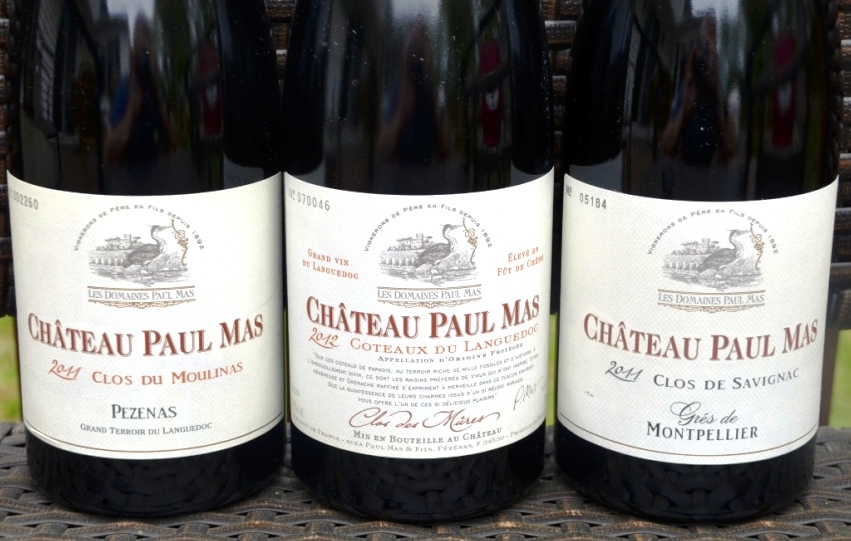
The focus of our tasting was on the single vineyard wines of Chateau Paul Mas. Guillaume Borrot, the winemaker of the Chateau Paul Mas, who was presenting the wines during the virtual tasting, touted them as “affordable luxury”. And the wines were actually made to support this claim. Even the bottle itself, Burgundian in shape and very heavy, was supporting the “luxury” claim. And the fact that all three wines we tasted are available in retail for less than $25 each, definitely makes them affordable.
Well, it is not the look and weight of the wine bottle which will determine the “luxurious” designation. It is the wine itself which should support that claim – and all three wines perfectly delivered. Dense, concentrated and balanced, all well made and ready to be consumed now, or 5-10 years down the road – if you have enough patience though. Here are the more detailed notes on the 3 wines we tasted:
2012 Château Paul Mas Clos des Mures Coteaux du Languedoc AOP (14.5% ABV, 85% Syrah, 10% Grenache, 5% Mourvedre, 10 month aged in oak)
Color: Dark Garnet
Nose: Dark fruit, touch of spices, earthiness
Palate: Spicy cherries, touch of pepper, earthy profile, espresso, soft tannins, medium-long finish.
Verdict: Needs time, should develop nicely. Drinkability: 8-
2011 Château Paul Mas Grés de Montpellier Clos des Savignac Coteaux du Languedoc AOP (14.5% ABV, 50% Mourvedre, 30% Syrah, 20% Grenache, 2 month aged in oak barrels)
Color: Practically black
Nose: Rich, dark chocolate, ripe blueberries, spices
Palate: Loads of pepper, dark ripe fruit, blueberries, perfect balance.
Verdict: Delicious! Drinkability: 8
2011 Château Paul Mas Pezenas Clos du Moulinas Coteaux du Languedoc AOP (14.5% ABV, 55% Syrah, 45% Grenache, 12 month aged in oak barrels, 3,500 cases produced)
Color: Very dark garnet, almost black
Nose: Loads of fruit, nice, open, touch of earthiness
Palate: Earth, hint of sweet fruit, loads of complexity, leather, tobacco, pepper, perfect balance, wow!
Verdict: My favorite wine of the tasting, Has great potential. Drinkability: 9-
There you have it – an encounter with everyday luxury wines, made with love and pride in Languedoc. Some of these wines should be available in US, so make sure to look for them.
Have you had Domaines Paul Mas wines before? Do you have any favorites? What do you think about Languedoc wines in general? Cheers!
Month in Wines – April 2014
April was a good month for the good wines, with some of the gems worthy of Top Dozen consideration. Syrah and Pinot Noir were probably the biggest stars, but not the only stars. I already wrote about some of the wines before, so I will not inundate you with the repetitive details, and instead will simply give you the reference to the prior post. All the wines are rated on the 10 points scale, with + and – adjustments. These summary posts only include the wines with the ratings of 8- and higher – in the very very rare cases, I might include 7+ wines if I feel that the wine was simply unique.
Let’s go!


2010 Lenné Estate Pinot Noir Yamhill-Carlton AVA, Oregon (14% ABV, $45) – dark and delicious, and will age well for the next 10-12 years. 8+
2010 Renieri Invetro Rosso Toscano IGT (14% ABV) – delicious Super-Tuscan, powerful, round, a pure joy. 8+
2011 Michel Chapoutier Tournon Mathilda Shiraz Victoria, Australia (13% ABV, $14.99) – simply spectacular. A clear pepper profile on the nose and the palate. A stunning beauty. 9
2003 J.L. Chave Offerus Saint-Joseph, France (13.5% ABV) – Barnyard, touch of spice (pepper), dark and delicious. 8
2005 Domaine Philippe Bornard Arbois Pupillin La Chamade Ploussard (12.8% ABV) – beautiful, powerful, multi-layred. Pleasure in every sip. 8+
2012 J Wrigley Estate Pinot Noir Proposal Block McMinnville AVA (14% ABV, aged 10 Month in French oak, 250 cases produced. $45 SRP) – chocolate, mocha, a bit of mushrooms. Nice and balanced, and will age well. 8-
2010 Joel Gott Cabernet Sauvignon Napa Valley (SRP: $47.99) – perfect Claret, if you will. This wine would rival many top California Cabernet Sauvignon wines, which would also cost at least 2-3 times as much. 8
2007 La Rioja Alta Vina Alberdi Rioja Riserva, Spain (SRP: $19.99) – Perfect balance of fruit, structure, power and earthiness which only Rioja possess. Beautifully round and delicious. 8+
2001 La Rioja Alta 904 Rioja Gran Riserva, Spain (SRP: $47.99) – Mature and delicious, with lots of subtle nuances. A thought provoking wine. 8+


2009 Shiloh Legend Judean Hills, Israel (14.2% ABV, 45% Shiraz, 40% Petite Sirah, 9% Petite Verdot, 6% Merlot, each grape vinified and oak-cask aged separately for 8 month, then blended and aged for another 8 month) – round, velvety, delicious, with dark fruit core and firm structure. Perfect balance of power and concentration. 8
2012 Tousey Chardonnay Estate, Hudson River, New York (12% ABV) – a Chablis on Hudson would be a good way to define this wine. Chablis style minerality and hint of gunflint on the nose, creamy and round on the palate, with subtle apple and vanilla notes. Delicious Chardonnay. 8-
2012 M. Chapoutier Les Vignes des Bila-Haut White Côtes-du-Roussillon (13% ABV, $13.99, blend of Grenache Blanc, Grenache Gris and Macabeu) – in a word, delicious. Bright white fruit on the nose, fresh lemon, some earthiness. Perfect balance on the palate, each sip makes you crave for another. 8+
2004 Bodegas Ondarre Rioja Reserva Rioja DOC (13% ABV) – dark fruit on the nose, with the hint of eucalyptus and cigar box. Palate full of dark fruit with earthy profile, supple tannins and bright acidity, very balanced. 8-
2010 Chapelle-St-Arnoux Côtes du Rhône AOC (13.5 % ABV, $10.99) – nose of inviting dark fruit, the same on the palate with addition of dark chocolate notes and rounding acidity. Very dense and well structured for Côtes du Rhône. A steal for the price (sorry, it was some sort of closeout). 8
2010 Les Trois Chemins Côtes du Rhône AOP (13% ABV, $8.99) – fresh red fruit on the nose, blackberries and cherries, more of the same on the palate, coupled with bright acidity. Simple and elegant, and beyond steal at the price (again, a closeout of sorts). 8-
That concludes my report on the April wine highlights. Did you taste any of these wines? What were your best wine experiences of the month? Cheers!
Passion For Jura – The Wines
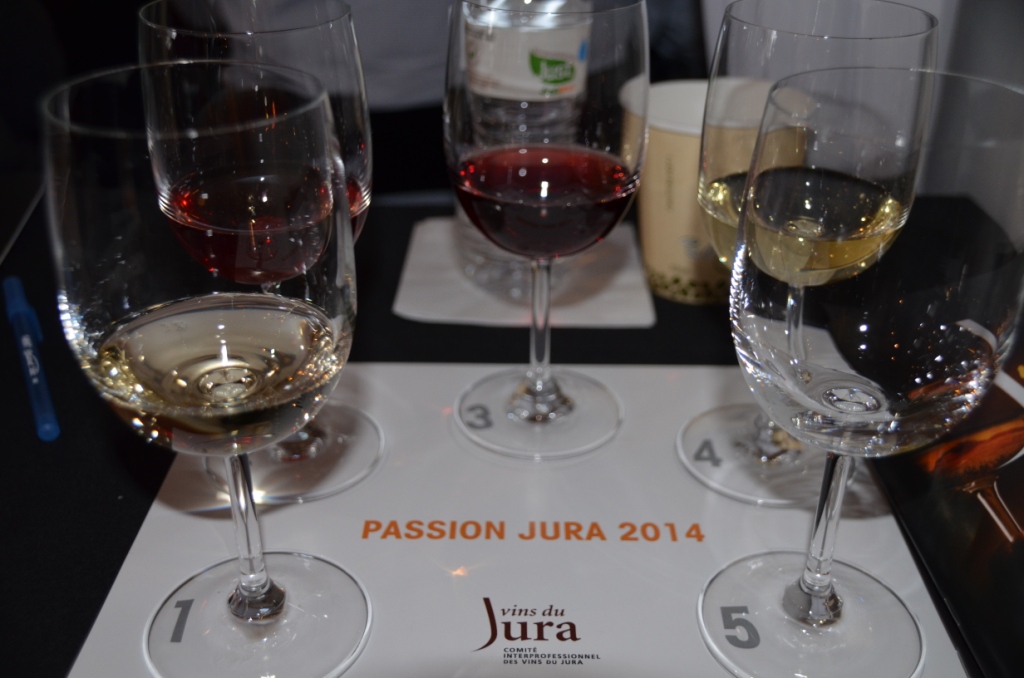 In the previous “Passion for Jura” post, we talked about the region – history, terroir, grapes and types of wines – but we didn’t talk about the wines themselves. “Passion for Jura” was the name of the seminar and tasting which I recently attended in New York city, where I had an opportunity for the first time to really immerse into the fascinating world of one of the oldest wine producing regions, which is really unknown in US.
During the seminar, 6 wines were presented by the winemakers themselves. The idea was to let us experience the full range of the Jura wines (for some strange reason, Vin Jaune was not presented during the seminar). Here are the wines we tasted:
NV Domaine Jacques Tissot Cremant du Jura Blanc Brut (12% ABV) – 100% Chardonnay, refreshing grassy nose, very acidic, bubbles are present but somewhat muted in the glass. Creamy mouthfeel with toasted bread and apple on the nose. Overall, not bad, but lacking a bit an overall energy of the sparkling wine.
2011 Domaine de la Pinte Jura Arbois Polsard de L’Ami Karl (11.5% ABV) – light, refreshing, cranberries with the touch of barnyard, herbs (sage), light but with the nice tannins. Very interesting and very enjoyable.
2011 Benoit Badoz Vermiel (13.5% ABV, 70% Trosseau, 30% Pinot Noir) – fresh grapey nose – not a pronounced as Beaujolais Nouveau, but still quite explicit. Cherries and blackberries show up next. Beautiful, smokey notes on the palate, a bit sharp, but fresh. Clean acidity, long pleasant finish. Somewhat similar to Oregon Pinot Noir, but more round. Also has a noticeable green component.
Compare the colors of the two red wines in the tasting:


2011 Domaine Champ Divin Cotes du Jura (13% ABV, Chardonnay/Savagnin blend) – vanilla, minerality on the nose. Delicious. Acidity and minerality on the palate, fresh apples, very refreshing
2009 Fruitiére D’Arbois Savagnin Arbois AOC (14% ABV, 100% Savagnin) – oxidation is very much pronounced, pretty much like with Sherry, both on the nose and the palate. This wine is typically made as Vin Jaune, but it requires lesser aging time. After the wine breathes, it becomes much less aggressive and comes through as clean, despite the oxidation.
2009 Domaine Pierre Richard Vin de Paille (15% ABV) – delicious nose. Palate is beautiful, with refreshing acidity, touch of bitterness, and full of fresh juicy apricots. Wow!
And here is the list of some of the wines I tasted during the walk around tasting. The place was small, and got very crowded after a while, so I didn’t taste the wines from all 20 producers. As usual for the trade tasting, I’m using the “+” sign system. The wines mentioned below were my favorites, for the most cases with “+++” ratings with some exceptions (of course), such as “++-|” and “++++”.
2010 Domaine Jacques Tissot Arbois Chardonnay (12.5% ABV) – +++, beautiful!
2012 Domaine Jacques Tissot Arbois Chardonnay La Mailloche (12.5% ABV) – +++-|, butter and balance! perfect.
2009 Domaine Jacques Tissot Arbois Savagnin (13% ABV) – +++, very elegant
2006 Domaine Jacques Tissot Arbois Vin Jaune (14.5% ABV) – +++, mushrooms and forest floor! should be amazing with savory dishes. Vin Jaune can last for 6 month after being opened.
2010 Domaine Jacques Tissot Arbois Trousseau (12.5% ABV) – ++-|, clean, elegant, light – red which more feels like white
NV Domaine Jacques Tissot Macvin du Jura (17% ABV) – very unusual palate, with raspberries, almost taste like Framboise, very nice. Can last for 6 month in the fridge.
2010 Domaine Jacques Tissot Cotes du Jura Pinot Noir (12% ABV) – ++-|, very interesting and unusual for a Pinot Noir
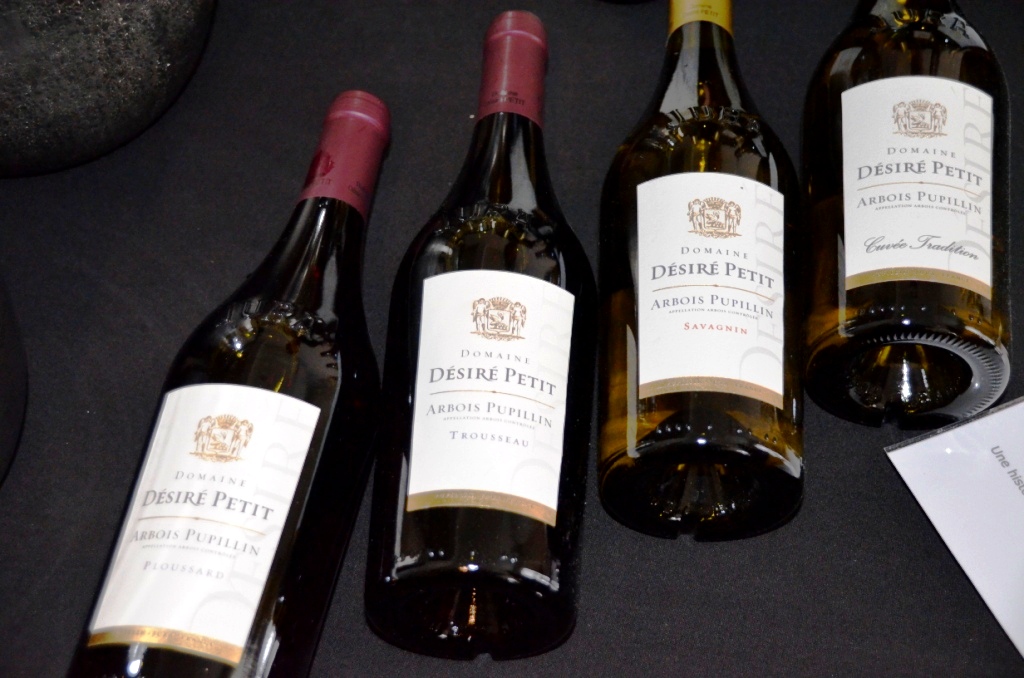
2012 Domaine Désire Petit Ploussard (12.5% ABV) – +++, smokey nose!
2012 Domaine Désire Petit Trousseau (12.5% ABV) – ++-|, dry, clean, nice
2012 Domaine Désire Petit Chardonnay (12.5% ABV) – ++-|, clean, classic, minerality!
2012 Domaine Désire Petit Savagnin Ouillé (13% ABV) – +++, 6 month in oak, very complex wine
2011 Domaine Désire Petit Tradition (12.5% ABV, 25% Savagnin) – +++, perfect acidity
2008 Domaine Désire Petit Savagnin(13% ABV) – ++-|, delicate, elegant
2007 Domaine Désire Petit Vin de Paille (14.5% ABV) – +++, prunes on the nose! perfect balance
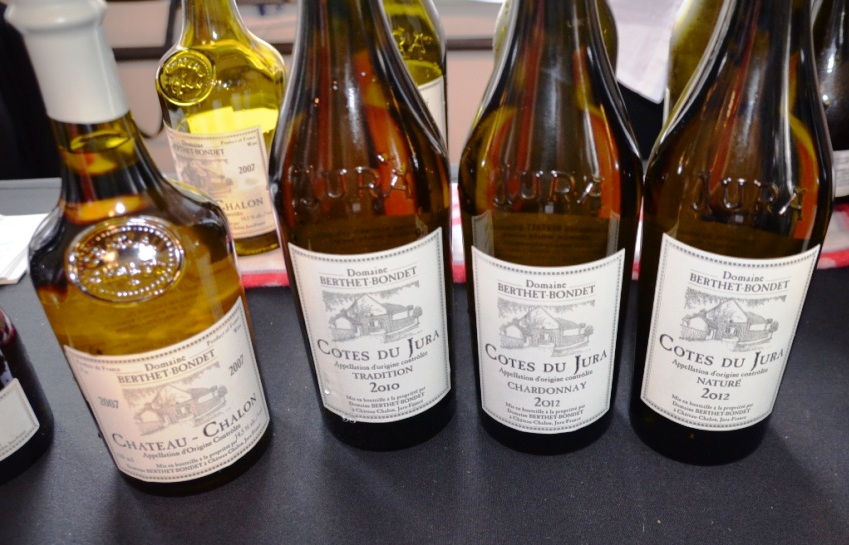
2012 Domaine Berthet-Bondet Cotes du Jura Chardonnay (12.5% ABV) – ++-|, light, round
2012 Domaine Berthet-Bondet Cotes du Jura Naturé (13% ABV) -+++, good fruit
2012 Domaine Berthet-Bondet Cotes du Jura Tradition (13% ABV) -+++, delicious
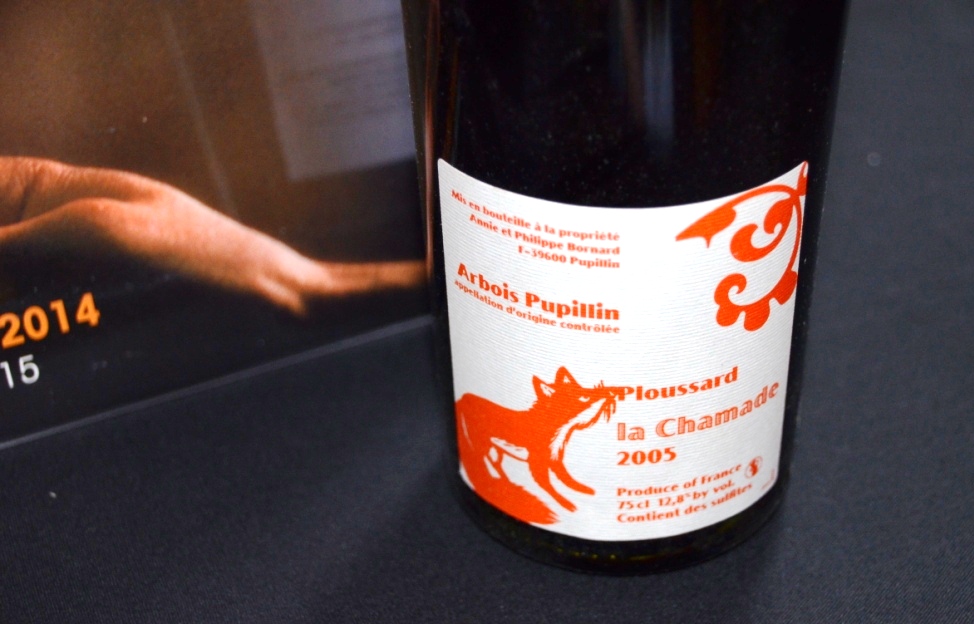
2005 Domaine Philippe Bornard Ploussard La Chamade – Best of tasting!
2005 Domaine Philippe Bornard Arbois Pupillin La Chamade Ploussard (12.8% ABV) – ++++, wow!
2011 Domaine Philippe Bornard Arbois Pupillin La Chamade Ploussard (13.5% ABV) – +++, wow! delicious, sweet undertones
2011 Domaine Philippe Bornard Arbois Pupillin Trousseau Le Ginglet (12% ABV) – +++, delicious complexity in the back
2011 Domaine Philippe Bornard Arbois Pupillin Savagnin Ouille Les Chassagnes (13.5% ABV) – ++-|, complex
2011 Domaine Philippe Bornard Chardonnay Les Gaudrettes (12.5% ABV) – +++, complex, delicate!
2011 Domaine Philippe Bornard Arbois Pupillin L’Ivresse de Noé (14% ABV) – +++, late harvest Savagnin, a touch of sweetness, delicious complexity
I also tasted 4 different Vin Jaune wines from Domaine André & Mireille Tissot, all from 2007 vintage, all single vineyard, and all delicious, with the one from Chateau-Chalon being the best – unfortunately, as all those wines were not listed in the tasting brochure, I can’t give you their exact names – but look for Domaine André & Mireille Tissot Vin Jaune – they are well worth your attention.
That concludes my report on the Passion for Jura tasting. Based on my experience, I can simply tell you – Jura makes delicious wines, and you need to experience them. Go to your wine merchant and ask for the Jura wines by name – and let me know how you will like them. Cheers!
Passion for Jura – The Land
 Let’s say you are talking to an oenophile. Ask her to name the major wine regions in France. I’m sure that Bordeaux, Burgundy and Champagne will be first. With the small pause, Loire and Rhone will follow, and then may be (may be!) Languedoc. I wonder how many of the oenophiles will mention Jura? Next question might be even more “tricky” – how many oenophiles tasted Jura wines? And the trickiest question of all – how many of you, my readers, tasted Jura wines? No, you don’t need to answer – Jura wines are almost impossible to find in US, and very difficult to find outside of France in general, so it is not surprising that they are not winning popularity contests, and thus it is really not your fault that you are not familiar with Jura wines.
We live in the times of the dramatic globalization of wine. Not only wine is exceedingly produced in the new and unusual places, but wine availability is becoming more and more global. No, Jura is not a newcomer to the world of wine, if anything, it is quite the opposite – Jura wines had been produced for more than two thousand years. The global availability is what changed – as consumers demand more and different wines, Jura wines, which are definitely unique and different, are becoming better known and more demanded.
Few days ago I was lucky to attend the wine tasting in New York City, called Passion for Jura, which was a great learning experience. The event consisted of seminar and walk around tasting, with more than 20 producers represented. Before we talk about wines themselves, lets take a look at the Jura region and many of its unique qualities first.
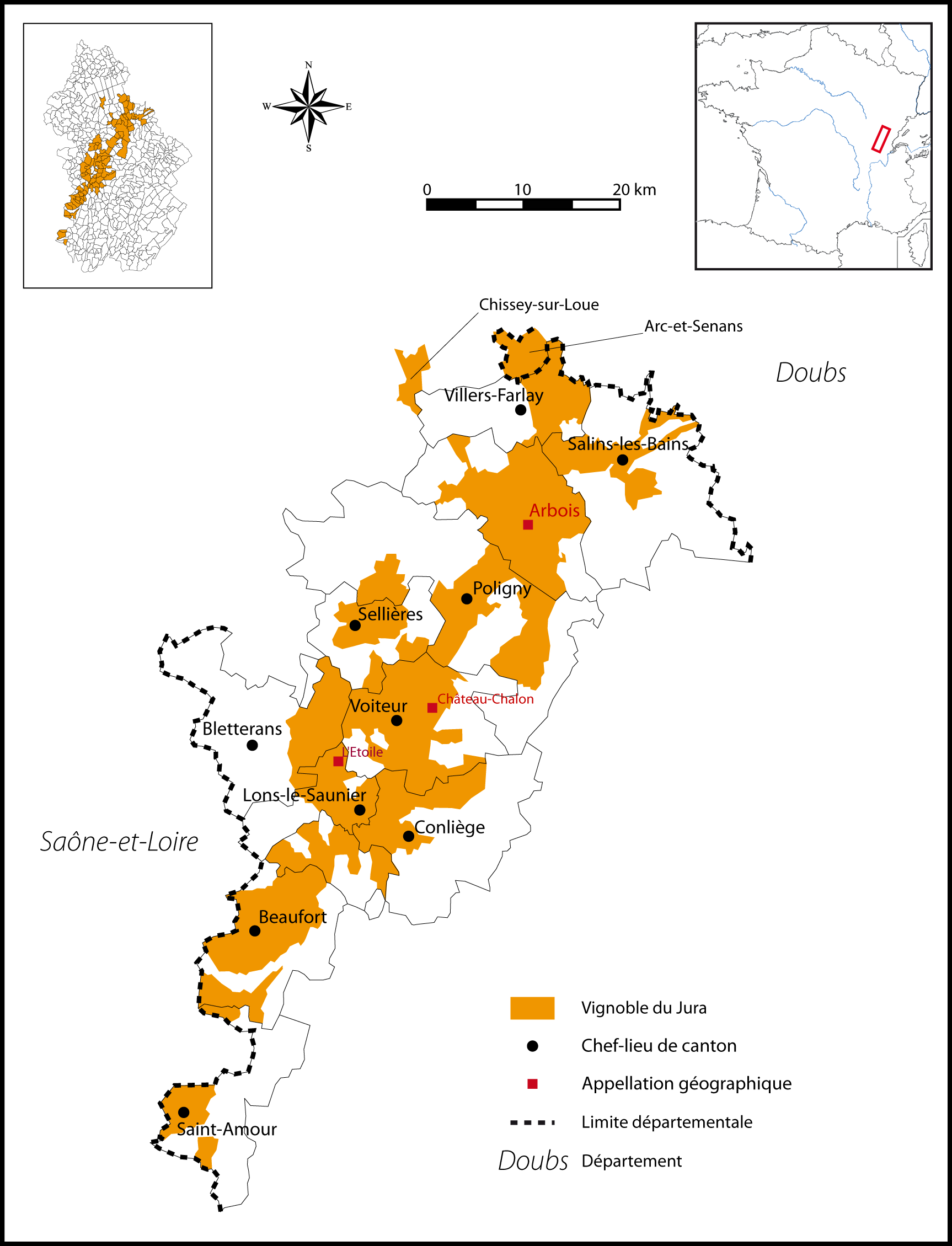
Jura region is a narrow stretch of land, about 50 miles long and less than 2 miles wide, in the north-west part of France, sandwiched between Burgundy and Switzerland. First mentions of the Jura region go all the way back to 80 A.D. When it comes to the different aspects of terroir, climate in Jura is somewhat similar to Burgundy, with the potential for more severe cold temperatures, especially during winter time. Soils are probably the most unique aspect of Jura terroir, with some of the shale formations aging between 200 and 230 million years – so yes, you can probably find dinosaur imprints in that soil, if you look deep enough. Overall, the difference in the age of soil can be quite dramatic, tens of millions of years between the neighboring vineyards.
Jura wines were well regarded in France, with Arbois (one of the main towns in the region) wines being known for what they are since the 10th century, and Château-Chalon wines (this is where the famous Vin Jaune is made) being well known since the 16th century. Similarly to all other winemaking regions in France, Phylloxera wrecked havoc in Jura’s wine industry. Before the Phylloxera, Jura region had about 50,000 acres under the vine, with 42 grape varieties, out of which 14 were identified in 1774 as “good grapes”. Today, Jura region has only about 5,000 acres planted, and only 5 varietals are used in the winemaking. Of course everything has two sides – only the best areas were replanted after the Phylloxera epidemic, and only with the grapes which produced the best results, so yes, there is silver lining in most everything in this life.
It is impossible to talk about Jura and not to mention a few of the famous people who dramatically impacted the wine world, while living in Jura at the same time. First, of course is Louis Pasteur, whose seminal work “Studies its diseases, their causes and new preservation and aging process“, published in 1886, was really a key element of the modern oenology. While Pasteur’s name is probably familiar to many, I wonder how many people will recognize the name of Alexis Millardet, also of Jura – meanwhile, he came up with the technique of grafting French vines on the American rootstock, which allowed to restart the French wine industry after the Phylloxera devastation. And the last person I would like to mention here is Joseph Girard, a resident of Arbois, who founded INAO (National Institute of Denominations of Origin) and was instrumental in establishing the AOC system of quality, which was subsequently copied all over the world. It is probably not very surprising that the very first AOC in France, established in 1936, was … the Arbois AOC!
Let’s talk about the grapes. Now, this is somewhat of the simple task, as there are only 5 grapes growing in Jura – 3 reds and 2 whites. Here they are:
Poulsard – indigenous red grape of Jura, sometimes also called Ploussard. Most planted red grape in Jura (about 40% of all red grape plantings), and about 14% of total grape plantings. Produces bright looking wines, almost Rosé in color, which are very refreshing and age quite well.
Trousseau – another red grape of Jura, part of the Savagnin family, most likely originated in Jura. The same grape is known as Bastardo in Portugal. Has about 8% of the total planted area, and about 22% of the red grape plantings. Often blended with Pinot Noir.
Pinot Noir – was introduced in Jura in 14th century. Has about 13% of the total plantings, and a bit less that 40% of the red grape plantings. Early ripening variety, thus has high degree of risk of frost damage in spring.
Chardonnay – same as Pinot Noir, was introduced in Jura in 14th century. Also known as Melon d’Arbois in the north, and Gamay Blanc in the south. Few vignerons are still growing Melon á Queue Rouge, a rare red clone of Chardonnay. Chardonnay is the most popular grape in Jura, at about 43% of total area plantings and 2/3 of the white grapes plantings.
Savagnin – most famous grape of Jura, and the only one allowed to be used in Vin Jaune. Late ripening variety with low yield. makes up about 22% of the total grape plantings and about 1/3 of the white grape plantings.
Before we get to the styles of wines and regions, let me give you a few interesting numbers. With 5,000 acres planted, there are about 300 grape growers in Jura, each taking care of about 17 acres of vineyards. There are also about 200 producers and about 100 villages in the Jura region.
With only 5 grapes, Jura produces a great variety of stylistically very different wines. Historically, Jura wine were very unique, as oxidation always played a very important role in the white wines of Jura. While oxidation is great, as the oxidized wine can be preserved almost forever, it doesn’t necessarily appeal to the tastes of the mass of the wine drinkers in the world. Starting in 1990, the style of Jura wines started to change, to move from oxidized to fresh, generally more acceptable style. As the result, there is a number of styles which you need to be aware of in order to make sure the wine will actually taste as you would expect instead of “OMG, what is it???”. Additional problem is that these styles are not necessarily clearly indicated on the from label, so sometimes you really need to look through all the information on the labels and outside in order to understand what type of wine it is. The oxidation is only relevant to the white wines, so the styles of the white wines are:
- Ouillé – non-oxidized
- non-Ouillé – oxidized
- Naturé – Savagnin wine in the oxidized style
- Tradition – a blend of oxidized Savagnin and Chardonnay
For what I understand, all it means is that if you don’t see the word Ouillé somewhere on the label or description of the wine, there is a good chance that the wine will be oxidized – if anyone who reads this post has better knowledge of the subject, I would greatly appreciate the comment!
Tired yet? We are almost done! Last part – let’s talk about wine styles and appellations. Before we get to the Jura details, one general note. Have you noticed the words AOP showing up more and more on the wine labels, especially on the latest releases of wine? This is because the French government, following overall EU requirements, is changing the AOC (Appellation d’Origine Contrôlée) nomenclature to the AOP (Appellation d’Origine Protégée), so you should expect to see the words AOP more and more on the bottles of French wines.
Jura uses total of 6 appellation designations – 2 of them are product designations, and 4 are geographical designations. Additionally, there are two wines which can be made in different appellations but they still have very specific product requirements. Here we are:
 Crémant du Jura AOP – this is the product AOP for Sparkling wines in Jura. Made by the traditional (méthode champenoise) method, with 9 month minimum aging on lees. The wine can be produced anywhere in Jura, using all 5 varietals. Grapes should be harvested by hand and whole-cluster pressed.
Macvin du Jura AOP – this is the product AOP for fortified dessert wines. Can be made anywhere in Jura AOPs using any of the 5 grapes. The wine is made by blending of 2/3 of unfermented grape juice with 1/3 of the local brandy, called Marc du Jura, which should be made at the same property from the grape skin pomace. The wine should be aged for at least 12 month in the oak barrels before release.
Arbois AOP – geographic AOP, the biggest in terms of production. All 5 grapes are grown and permitted in production of the wines, with all types of wine allowed for production.
Château-Chalon AOP – a dedicated geographic AOP for production of Vin Jaune. Savagnin is the only allowed grape, harvested late. If any other wines are made, they are designated as Côtes du Jura. For more details, please see below.
Côtes du Jura AOP – a geographic AOP. All 5 grapes are allowed to be used, and all styles of wines can be produced.
L’Étoile AOP – a geographic AOP, the smallest in Jura, consisting of only 4 villages. Only Chardonnay, Savagnin and Poulsard are allowed. All styles of the wines can be produced.
Vin Jaune – Most famous wine of Jura, so called “yellow” or “golden” wine. Can be made only out of the 100% Savagnin, in any of the 4 geographic AOPs. The grape is harvested late, and vinified as any other white wine would. After that, the wine is aged in the oak barrels which are not completely filled up. The barrels are never topped off and never racked. Similar to the Jerez, the thin film is formed on the wine’s surface, which is called The Veil – it allows the wine to age gently. The minimum age of the wine before it can be bottled is 6 years and 3 month. The wine requires pre-tasting prior to the bottling, and it is produced only in the good years. Vin Jaune is bottled in the special bottles called Clavelin, which contain 620 ml – Jura winemakers had to endure a long fight with the authorities in order to keep the historical, but not EU standard size (750ml) of the bottle.
Vin de Paille – the dessert! Generally produced from Chardonnay, Savagnin, Poulsard and sometimes Trousseau in Arbois, L’Étoile or Côtes du Jura AOPs. The grapes are harvested early and then dried up either in the boxes or hanged up in the air for 3 -5 month. After pressing, the wine have to age for at least 3 years with minimum of 18 month in the oak.
Whew, and we are pretty much done. Believe it or not, but I think this is probably the longest ever post with the least number of pictures – if not The longest, then definitely one of the longest. Jura is unique and special region, as you will see when we will be talking about the wines in the next post, and I really wanted to give you all the information together, without breaking it into the pieces. If you are still reading it – I definitely want to thank you for your patience. I hope you learned something new here. Also, if you have an experience with Jura wines, your comments and opinion will be greatly appreciated. Hell, your comments will be greatly appreciated even if you never heard of Jura wines till today. With that, until the next time – cheers!
Syrah – Nice and Spectacular, Plus a Case Buy Recommendation
Syrah wines have a special status in our house – this is my wife’s most favorite type of wine, so I’m always trying to keep some on hand. With the status of “favorite”, it is customary for us to open a bottle of Syrah for different celebratory occasions. Sometimes, Friday feels like a special occasion (I’m sure you can easily relate to that), so yes, Syrah it was.
I was thinking about opening this wine for a while. As I don’t employ any cellar organization systems, neither software nor paper, I simply have a general idea of the wines I have, and then I get more opportunities to touch many bottles in the search of one to be opened. I noticed that particular Syrah bottle during few of the recent searches, so I was mentally getting ready to part with it (most of the bottles I have are in the single bottle quantities, so yes, I need some mental prep to deal with that). Thus when the Friday came, it was an easy decision – it will will be a Syrah Friday (well, to be entirely honest, Syrah Friday decision was made on Thursday, but I don’t think it matters here all that much).

2003 J.L. Chave Offerus Saint-Joseph, France (13.5% ABV), a 100% Syrah from Northern Rhone appellation. Just to give a you a bit of the reference, J.L Chave (Jean-Louis Chave) represents the latest generation of the winemaking family from Northern Rhone. Their first Hemitage wine was produced in 1481. Try to remember J.L. Chave name next time you are looking for the Rhone wines, you can’t go wrong with their wines.
Talking about this 2003 Syrah – no sign of age on the color – dark, concentrated garnet ruby. On the nose, the wine had a whiff of the barnyard, which I personally find very attractive, and some dark fruit. The palate was showing more of the dark fruit, plums and blackberries, with a touch of minerality and clean acidity. Elegant, round, perfectly structured, full bodied, with spicy kick in the back and long finish. The bottle disappeared without a trace. I think “restrained elegance” would be the best descriptor for this wine. Drinkability: 8
And then there was another Syrah. About a week ago, I got an e-mail from PJ Wine, one of the best wine stores in New York, describing “secret” Shiraz. That wine was made by an excellent French producer, Michel Chapoutier (a seventh generation winemaker himself), in Australia, and it had 94 rating by Robert Parker, while priced under $12. I generally don’t buy the wines based on ratings, and I also consider that we have a “palate misalignment” with Mr. Parker, but 94 points and $12 is definitely something to think about. When I saw the wine in my local Cost Less Wines, I simply had to get it (it was $14.99 here in CT).

2011 Michel Chapoutier Tournon Mathilda Shiraz Victoria, Australia (13% ABV) – screw top is off, wine is poured. Bright ruby color in the glass. First smell and the very first reaction – what is it? Really? Pepper? Wow! Yes, peppery notes are the signature of the Syrah grape – but I’m used to finding it after the sip, not in-you-face once you smell the wine. Here it was – bright, fresh black pepper, as I was smelling the pepper mill instead of a glass. The first sip extends the “wow” moment even further – it is a rare luck in my experience, when there is a full match between the smell and the taste. Here is was – freshly ground black pepper, perfectly present without overpowering the taste. The black pepper was elegantly weaved into a core of red plums and tart cherries – delicious, sip after sip. This was definitely an exciting wine – clean, elegant, alive, sexy and vibrant. The grapes for this wine were macerated for 2-3 weeks in stainless steel and cement tanks for the better tannins extraction, and then aged for 12 month in stainless steel and cement tanks (no oak!). A pure expression of a beautiful Syrah. This is the wine to be experienced – and to buy by the case. It is gone at PJ Wine, unfortunately, but according to the wine-searcher, it is still available in the number of other stores find this wine. I don’t say it too often, but I feel this is very appropriate now – this is the wine to buy by the case! Drinkability: 9
That concludes the tale of two Syrah wines. While Offerus was very classic old world version, the Tournon Mathilda was definitely an eye-opener for me – if you can find this wine, you should experience it just to get acquainted with Syrah in its pure expression – it was a very delicious encounter for me. And I guess I need to look for more Robert Parker recommended wines – either his palate is changing, or may be its mine… Cheers!
Weekly Wine Quiz #96: Grape Trivia – Alicante Bouschet
The Wine Quiz series is not meant to intimidate. The whole idea here is to have fun and learn something new. When answering the questions, it is fully encouraged to use all available sources of information, including Google or any other search engine. There are no embarrassing answers – the most embarrassing thing is not giving it a try…
Welcome to the weekend and your new wine quiz!
We are continuing our grape trivia series, still focusing on the red grapes, and today’s subject is Alicante Bouschet, or Alicante Henri Bouschet, if we want to use the full and official name.
How many of you ever heard of Alicante Bouschet, let alone tasted the wines made from that grape? How about Garnacha Tintorera? Still nada? Yes, I know – at this point, I’m reaching into the obscure grapes territory, the dark side of the wine world. But this grape, Alicante Bouschet, is so unique and different, in its past and present, that I can’t pass an opportunity to learn about it together with you.
Alicante Bouschet grape was created in 1866 by Henri Bouschet as a cross between Petit Bouschet and Grenache. To make things a bit more interesting, it is worth noting that Petit Bouschet was created by Louis Bouschet, the father of Henri Bouschet, this time as a cross between two ancient varietals, Teinturier du Cher and Aramon. Talking about unique – Alicante Bouschet is one of the very few red grapes in the world which are classified as teinturier – the grape which makes the juice of red color. Take any of the well known red grapes – Cabernet Sauvignon, Pinot Noir, Merlot, most anything – and break it apart. The juice which will be coming out will be clear. It is the skin which gives the color to majority of the red wines. When it comes to Alicante Bouschet (and other teinturier grapes, which are very few), the juice will be coming out as red.
After being created in 1866, Alicante Bouschet somewhat rapidly spread out all over the world. It was used in France to replant vineyards after the phylloxera devastation. It made it to Portugal and Spain, where it is known under the name of Garnacha Tintorera, and continued its successful journey further into Italy, Australia, Chile, United States and the number of other countries.
Alicante Bouschet is known to produce not even large, but rather huge crop. It is also an early ripening grape, which creates somewhat of a problem, as it doesn’t accumulate enough flavor depth and enough sugar to make it into the single-varietal wine. As the result, it is often used as part of the blend just with the purpose of adding the color (and the color it got!). Another important characteristic of the grape is a very thick skin, which helps it to withstand the long distance transportation. This quality of Alicante Bouschet made it extremely popular grape during prohibition times in the US, as it could sustain the long railroad voyage from west coast to the east. In addition to handling the long distance transportation quite well, Alicante Bouschet think skin and juicy flesh was allowing for it to be pressed three times (most of the common grapes will allow for one, or an absolute maximum of two pressings), thus one could get more decently colored wine from much lesser amount of grapes.
Today, the plantings of Alicante Bouschet decreased in the countries like France and United States, where it is used mostly for blending. However, the grape is increasingly popular in Portugal, where it makes wonderful concentrated wines in the Alentejo region. Southern Spain also has very substantial plantings of Garnacha Tintorera, and with controlled yield produces outstanding single-varietal wines.
And now, to the quiz!
Q1: True or False: according to the 2010 data, Alicante Bouschet is one of the 15 most planted red grapes in the world?
Q2: Wine Spectator calls wines with 90-94 ratings “Outstanding: a wine of superior character and style”. True or False: There are no Alicante Bouschet-based wines rated as Outstanding by Wine Spectator.
Q3: Alicante Bouschet makes a very popular addition (albeit in miniscule quantities, about 5% or less) to some of the very well known and popular California varietal wines. Can you name two of those popular California grape varieties?
Q4: Below is the list of countries growing Alicante Bouschet/ Garnacha Tintorera. Based on 2010 data, sort that list from the biggest area plantings to the smallest:
a. Chile
b. France
c. Italy
d. Portugal
e. Spain
Q5: Which one doesn’t belong and why?
a. Carlisle
b. Francis Ford Coppola
c. Ridge
d. Turley
Good luck, enjoy the quiz and your weekend! Cheers!
Recreating Classic Recipes: Beef Bourguignon
I know, I know – this is the wine blog, and I’m sure you are surprised with the number of food posts lately. I guess this is all because of the holidays? Well, but then this blog is all about “wine, food and life”, so I guess talking about the food is quite appropriate. Anyway, we will be talking about food today – but this food is made with wine, so we will technically cover both subjects.
When it comes to the French cooking, there are a few dishes which squarely belong to the so called “classic category”. Beef Bourguignon is definitely one of them, fighting for supremacy with Coq au Vin. Today we will be talking about Beef Bourguignon, a.k.a. Boeuf Bourguignon, a.k.a. Beef Burgundy, a stew-like dish, generally attributed to the Burgundy area in France. I personally like all of the stew style dishes, as they generally are easy to make and very rustic and comforting as food, which to me is a very important characteristic.
Main components of Beef Bourguignon are beef, wine, few of the vegetables and aromatic herbs. For a while, I had being making Beef Bourguignon using the recipe from the book called “France: A Culinary Journey”, which is quite simple. In a nutshell, you quickly fry beef, onion carrots and celery together on the high heat, then add the wine and aromatic herbs, close the cover, and let the magic happen over the next few hours. Then I came across some recipes on internet which were a lot more complex, with marinating the meat, boiling the wine before cooking, adding bacon and mushrooms, and so on. After reading through probably 5 or 6 different recipes, all claiming originality and “classicism”, I decided that I have to come up with my own, as none of the recipes really spoke to me. Before I will talk about the recipe itself, let me give you couple of the points I find important.
Wine: The source of this recipe is Burgundy, so stick with the classics on this – Pinot Noir is your ideal case, but I also have done it a few times with Gamay wines (Beaujolais), and it worked quite well. In the wine, you are looking for acidity and light fruity profile. In general, avoid high alcohol, aggressively fruity wines – they will impart an unpleasant flavor. The wine doesn’t have to be expensive, but general rule is very simple – cook with the wine you want to drink.
Marinating the meat: based on my reading and conversations, marinating the meat in the wine is an essential step. It seems to be highly recommended for both Beef Bourguignon and Coq au Vin, so I’m going with this. I usually marinate the meat in the wine for the kabobs, which tenderizes the meat and makes it to absorb the flavor, so this definitely makes sense to use the same approach here.
Bacon: My general notion is that bacon makes everything better. However, in the case of Beef Bourguignon, the recipes usually call for making of the lardons (fried square pieces of bacon), which are then added to the meat during the last 15 minutes of cooking. As you are not cooking with an actual pork fat, I see such an addition only as textural, and I don’t believe it adds anything to the dish which is already quite rich, so here I’m saying no to bacon.
Okay, enough of the introductions, let’s proceed with the recipe.
Beef Bourguignon:
Prep time: about 1 hour. Cooking time: About 3 hours.
6 lb beef for stew – use stew-cut meat from the good store, or take chuck or roast cuts and cut them into 1″ – 1.5″ cubes)
1 bottle of red wine – Pinot Noir or Beaujolais
5 large onions (one for marinade, 4 for cooking)
10 sticks of celery (2 for marinade, 8 for cooking)
4 large carrots (I really mean large, thick carrots – if they are thin, double the amount)
1.5 lb of whole mushrooms
1/2 cup of all-purpose flour
4 cups beef broth
2 sprigs of thyme
6 fresh bay leaves
1 tsp allspice
1 tbsp peppercorn
Olive oil for frying
Salt and pepper
Serve with: boiled potatoes (classic!), egg noodles, pasta
As a first step, you need to marinate the meat, preferably overnight, so you should start cooking in the evening of the day before. Take two stalks of celery, cut in half. Peel one onion, cat in four pieces. If you are using the whole piece of meat, cut it up into 1″ – 1.5″ chunks. Put celery and onion into the large bowl, put all the chunks of meat on top, pour in a bottle of wine. The wine should fully cover the meat – if it is not – sorry, get another bottle. Take cheese cloth, put in 3 bay leaves, a sprig of thyme and allspice. Tie cheesecloth together and put it into the same bowl with meat. Cover, and put in the fridge overnight.
In the morning, get the bowl out of the fridge, strain and reserve all the liquid (you will use it for cooking). Discard celery, onion and herbs, let the meat to drain completely and warm up to the room temperature.

Meat after marinating
Now, you can start with vegetables. Dice all of the the onions and start sauteing it in the skillet with the small amount of oil – use medium heat. Meanwhile, prepare the rest of the vegetables. Dice the celery, put aside. Cut up the carrots in the big chunks – round slices of about 3/4″ in size. If the carrot is too thick, you can first cut it in half lengthwise. Put aside together with celery.
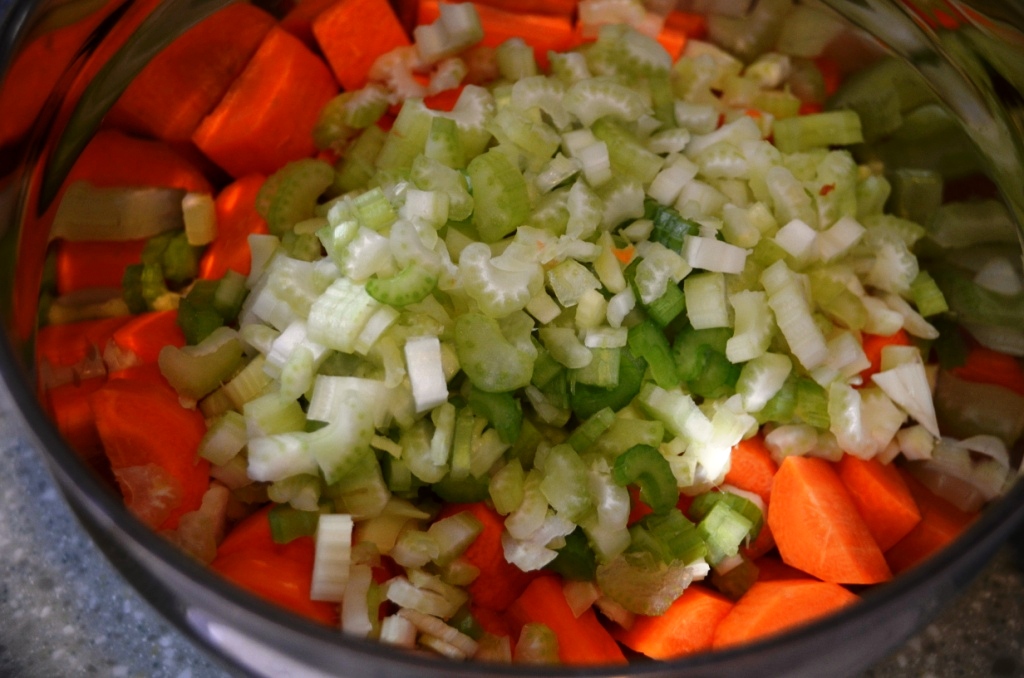
Carrots and Celery
Wash and cut up mushrooms into the half or quarters, depending on the size of mushrooms. Start sauteing the mushrooms in the separate pan with small amount of olive oil and medium to high heat.

Sauteing the mushrooms
Cover the pan initially, as you want mushrooms to release the water, stir a few times. After 3-4 minutes, remover the cover and let the liquid to evaporate. Continue cooking for another 5-6 minutes, or until the liquid will completely evaporated and the mushrooms are lightly fried. Add celery and carrots to the same pan, mix and continue sauteing for about another 10 minutes, stirring periodically.Turn off the heat, put aside.
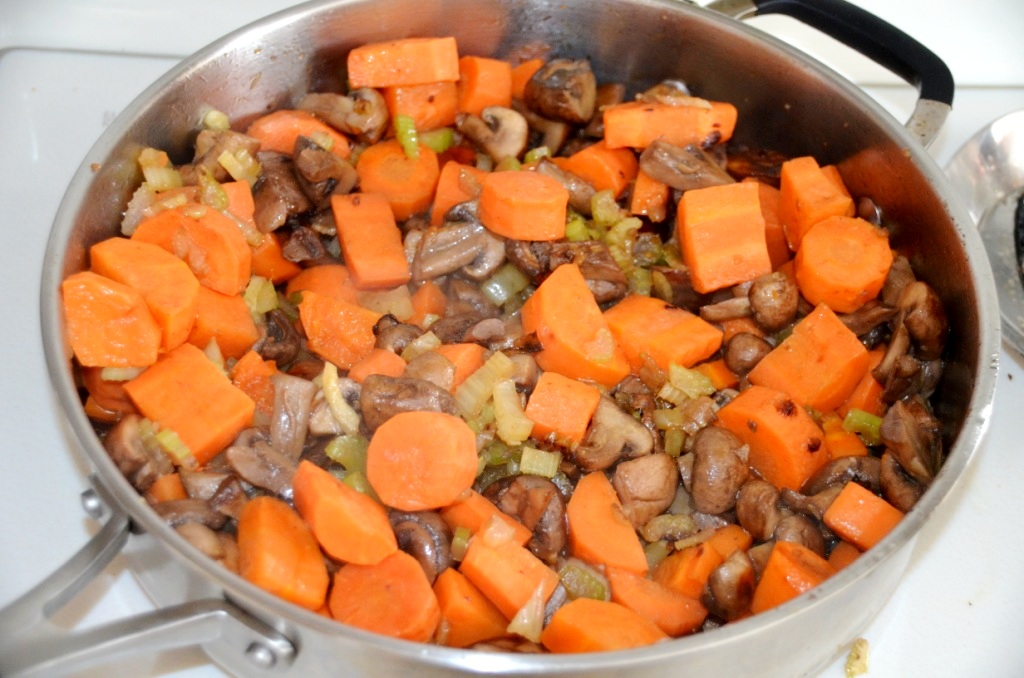
Roasting all vegetables together
After about 10 -15 minutes of sauteing the onions (they should gain color and become translucent at this point), turn off the heat and set aside.
Time to start working with the meat. First, we need to sear it. Put the cast iron casserole on the high heat (definition of the high heat depends on your stove – mine is electric, and if I use the highest dial setting of 10, everything burns before it sears, so my high heat setting for the cast iron vessel is 8). Add couple of tablespoons of the olive oil, and let it heat up. Put the flour on the plate, add salt and pepper, and drench the first batch of meat in the flour.
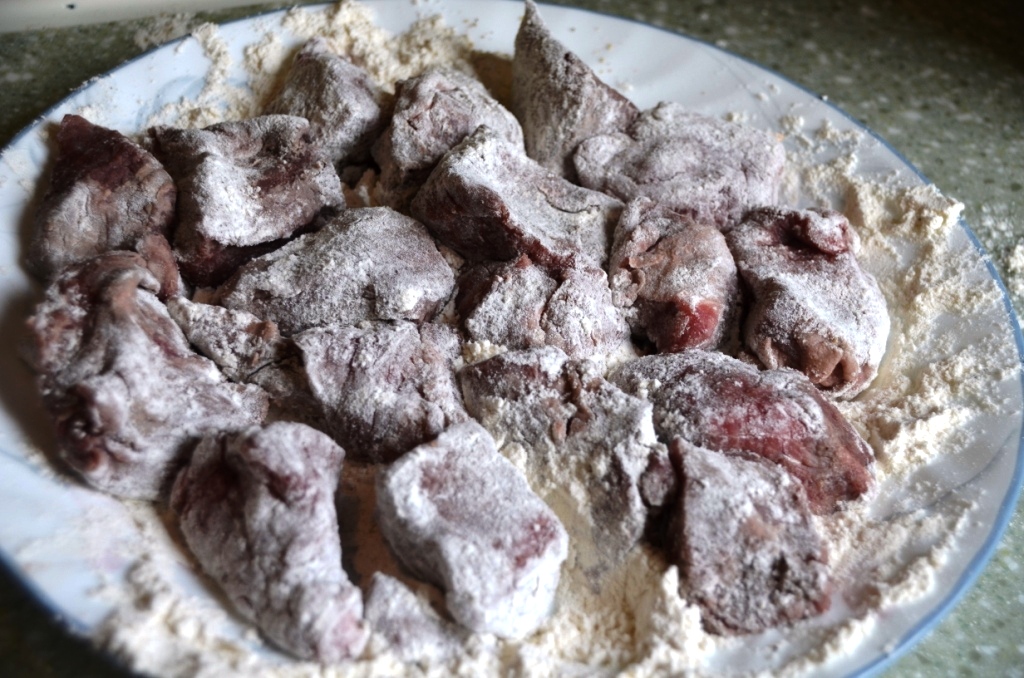
Beef in flour, ready to be seared
Once casserole is heated up sufficiently, put the meat inside in the single layer, and don’t touch it for about 3 minutes. Turn around, and let it sear for another 3 minutes – you want to get a nice color on the meat.


Prepare the next batch of meat (drench in the flour). Remote the seared meat to another plate, and repeat the process until all the meat is seared. Once the last batch is seared enough, splash some of the reserved wine into the casserole and use your spatula to deglaze it. Reduce heat to medium-low, put back all the meat, add sauteed mushrooms and vegetables. Pour back the rest of the reserved wine, add four cups or beef broth. Prepare the bouquet garni: take cheese cloth, put in thyme sprig, 3 bay leaves and peppercorns. Tie together and put in the casserole (immerse in liquid). Give the content of the casserole a good steer. Cover with the lid, pour yourself a glass of wine and relax, your work is mostly done.
Check the casserole periodically and give the content a good stir every time. Make sure the liquid is slowly simmering and not rapidly boiling – reduce heat further if it is. Also, check the sauce for salt – adjust the amount to your liking. The cooking process should take about 3 hours from the moment you combined all the ingredients – check the meat periodically to see if it is done to your liking. Tougher cuts of meat might take a little longer.
When done, remove the bouquet garni. Prepare your favorite starch and … voilà! You are ready to serve Beef Bourguignon and accept complements from your guests. Of yes, and I hope you didn’t use all the wine – you might enjoy some with your dinner.
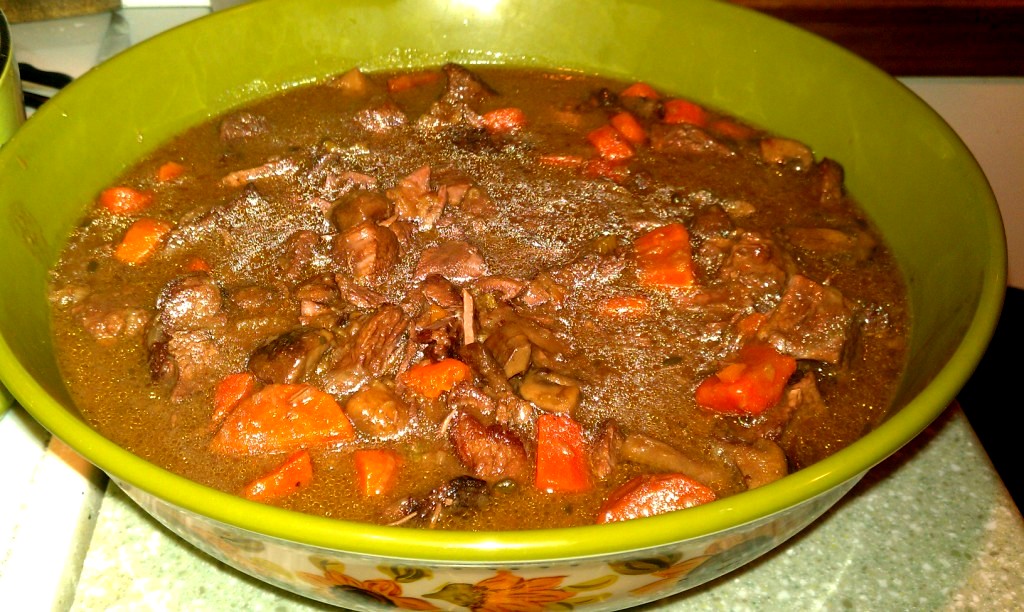
Beef Bourguignon
So, what do you think? Do you have your own twist for Beef Bourguignon? What do you think of this recipe? Cheers!
Style and Substance – Rouge Brasserie & Oyster Bar in Greenwich, CT
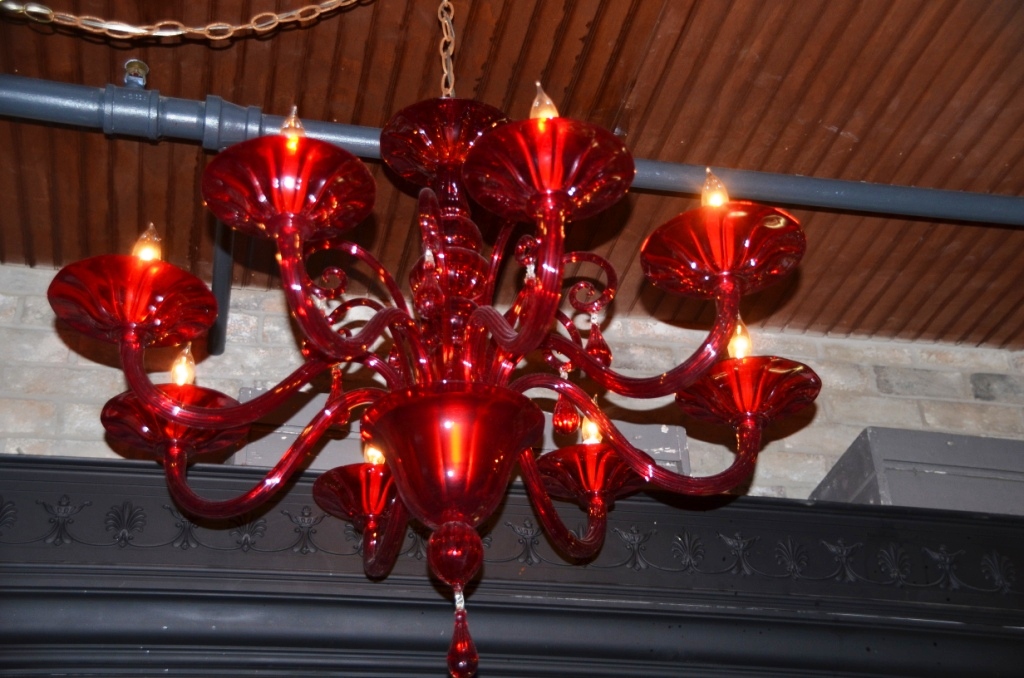
Before you get to this post, just a little word of caution – if you are hungry, can I ask you to go eat first? Please?
Let me ask you a question: when it comes to the restaurants, how often can you recall the exact decor of the restaurant? Well, let me be careful with this – of course this question is intended for the foodies and not for the interior design majors. We typically remember great food and wine experiences (yes, extremely bad experiences get stuck in the head too – I still remember the worst spaghetti in my life in the little restaurant by the Lake George). Sometimes the exceptional service is also staying with you. But I would bet that decor for the most cases would be the last thing you would remember, especially if you visit the restaurant only once. But then there are exceptions. I still remember old Tavern on the Green, with all its imperial embellishments, or the wonderful Belgium restaurant we visited on Aruba, called Le Dome, which had 4 different dining rooms, each decorated in its own unique style. Why am I asking all the questions about remembering the decor? Please read on, you will see in a second.
Okay, so the goal of this post is not to take you on the memory lane, but to share our recent dining experience at the new restaurant in Greenwich, Connecticut called Rouge Brasserie & Oyster Bar. We happened to come in a bit before our dining companions, so I had a little bit of time to walk around. The unique decor and variety of styles within somewhat of a limited space were strikingly different from most of the places I’d been to. The way the different sections were appointed were going from country French to cozy corner to the Royal French – all tastefully decorated and oh so different. Yes, as usual, I plan to inundate you with pictures, so take a look:


As it almost became customary, we started our evening at the bar. While the list of cocktails at Rouge is not too long, everything we had was very well made and very refreshing. Brigitte Bardot (cognac, fresh Lemon, sugar, raspberries and champagne) and Broken Heart Margarita (tequila, elderflower liquor, fresh sour, cointreau, raspberry grape & pink peppercorn) were both done just right, not too sweet (I’m really not a big fun of the sweet cocktails), withgood amount of alcohol, but very balanced at the same time. And it was just fun sitting by the shiny, well lit bar and watch Kelly compose the tasty concoctions.
Before we talk about food, I need to say a few words about the wine. I didn’t get a chance to see the wine list, so obviously I can’t comment on it – but during the evening, we were drinking two wines which were both, shall I say it, surprisingly outstanding. Our white wine was 2012 Domaine Saint-Lannes Côtes de Gascogne IGP (80% French Colombard, 20% Gros Manseng) – perfect nose of the bright white fruit, very inviting, light and round on the palate, with white apples, touch of lemon, dry and refreshingly crisp, excellent balance (Drinkability: 8). May be the fact that the white wine was good was not all that surprising, but for the red… Our red wine was 2010 Chateau Gobert Bordeaux AOC. Can you point to the “surprising” part just based on the name? I remember when I was just starting with wine, which was a bit more than 10 years ago, the year 2000 was declared the “Vintage of the Century” in Bordeaux, and I decided to try those best wines, buying Bordeaux AOC wines for $7 in the discount supermarket in New Jersey. When I tried to drink those wines, which were green, branch-chewy and plain harsh, for the life of me I couldn’t understand how that can be a great wine (of course I would never admit it in public). As I was learning about the wines, and especially listening to the Kevin Zraly’s explanations about circles of quality, I realized that basic Bordeaux, sourced from the grapes from the whole region, in general is something to avoid. Now, at the dinner, the red wine was poured (I didn’t see the label), and my first impression was “wow, this is very nice” – soft dark fruit on the nose, quite fruit forward on the palate, but without much exuberance or going over the top – some plums, ripe raspberries, touch of green bell pepper in the back, soft tannins, nice acidity, overall very balanced (Drinkability: 8-). When I saw the label, my first reaction was “Really?” – for a few seconds, I couldn’t believe this was actually a basic Bordeaux red wine. I will have to start paying attention to the Bordeaux AOC wines again, as this was one eye opening experience. And I want to complement whomever selected these wines for the restaurant – great choice!


Okay, time to talk about the food! In a word, we were treated royally at the Rouge – it was literally no holds barred type of dinner – everything you can think of was on the table – the caviar, the oysters, the lobster, and lots more.
First, our bread arrived in the form of tiny, but ohh so tasty baguettes, accompanies by the butter, fresh young radishes and cornichons:


From our appetizer course, the very first dish was Fish Eggs and Chips (house made potato chips, Crème fraîche) – as you can see from the name, it was a play on “Fish and Chips”, only instead of the actual fish we had something which could’ve become a fish – both black and red caviar was sprinkled over the house made potato chips:


I understand the word play here, and the dish overall was interesting – but I would probably use something more neutral as a medium instead of potato chips – some kind of white bread crackers or even crispy water crackers would play better with the saltiness of the caviar. But again, I can’t complain about the caviar as a starter – not at all.
When you start with the caviar, what is the next thing you should expect? The best selection of the fresh seafood, of course. And the best it was! Plateux De Fruits De Mer had fresh oysters, fresh clams, lobster tails and claws, and prawns, accompanies by the trio of sauces (shrimp cocktails, mayo with herbs and onion/vinegar for the oysters). Fresh and immaculate, one of the best seafood platters I ever had. I’m generally not a big fun of fresh clams – and these were delicious.


Seafood platters can be served in different types of restaurants, but nobody would argue that with Escargots Bourguignon (shallot parsley butter) we are getting into the real French traditional cooking. The escargot were excellent, succulent and satisfying. My only complaint was that I would serve the escargot separately from the toast, as the toast was completely soaked in butter in and out, but then I heard a number of people praising that exact butter-soaked toast. Anyway, this was definitely a delicious appetizer.


From French Classic to the French Classic – our next dish was Classic Steak Tartare (hand cut prime filet with charred country toast) – I tried steak tartare in Paris for the first time, and while I was scared with the plate put in front of me (raw ground beef was glaring at me, asking “will you dare put me in your mouth”), once that raw ground beef was mixed with all the condiments, it became one of my favorite dishes of the French cuisine. In our case, the steak was already premixed, so all we had to do was to put it on the toast and enjoy – which is exactly what we did! It was very tasty.


Our last appetizer was Warm Onion Tart (tomato confit & nicoise olives) – if you look at the size of that thing, it was literally the whole pizza! It turns out that the restaurant inherited a real pizza oven from one of the restaurants located before in the same space, so they definitely took a full advantage of that. That tart was delicious, withcrispy crust, and mild bitterness of arugula perfectly complementing sweetness of the onion. Great dish!


This was the end of our appetizer round, and while we were quite well fed already, the best was yet to come.
Our entrees included:
Skate Meuniere (parsley new potatoes, lemon brown butter) – outstanding, perfectly cooked fish, very meaty, nice lemony bite, without any fish aftertaste (you know, like the one you get sometimes from tilapia or catfish). This dish made many of us wonder why we don’t eat skate more often.
Moules Frites (white wine, garlic & fine herbs) – may be the best mussels ever. The sauce was soooo tasty, we had to request [lots of] additional bread. Simply delicious. Mussles were also served with very tasty french fries.
Short Rib Bourguignon (red wine sauce with pearl onions & truffled potatoes) – is there any other food in this world which spells “comfort” better than the slow cooked meat? Probably not. We were really full at this point, but nobody could resist that voluptuous (interesting word to describe the cooked meat, huh?), succulent meat. Sauce was exceptional, just perfectly savory without any unnecessary sweetness. Great finish to our wonderful meal.
Well, of course there was a dessert – luckily a small one, but super tasty! Chocolate French Custard was just perfect, not too sweet, with the very light and fluffy texture. And by the way, while we were at dessert, I learned something new! It appears that when you eat dessert (at least the one like this custard), you are supposed to turn the spoon upside down in your mouth, so the tongue with all its tastebuds will get in contact with the food, and not with the back of the spoon. I had no idea!


Last, but not least at all, we had a chance to talk to and express our heartfelt Thanks to the Executive Chef Josh Moulton, the mastermind behind this exceptional experience, Diego, our Maître D’, and Fabiana, the designer who created all that exceptional style I described at the beginning of this post.


If you will have an opportunity, I definitely recommend that you will ignore all my writing and go experience Rouge on your own. For those who are too far away, sorry, but you will have to take my word for it – this was definitely an outstanding meal, with great style and substance. Cheers!
Disclaimer: I attended the restaurant as a guest of management. All opinions are my own.
Rouge Brasserie & Oyster Bar
230 Mill Street
Greenwich, CT 06830
Phone: (203) 813-3555

Last Bottle Sign Up ($10 credit)




 Talk-A-Vino