Archive
Taste Of Wine – Engineering Approach
This was one of my early blog posts – almost 4 years ago, I was blogging only for about 4 month, and had probably 1.5 readers (okay, fine, may be 1.7). This is one of my most favorite blog posts in this blog, which I think is still very relevant. Therefore, as I’m incredibly behind my publishing plans, I would like to share it with you on this rainy [in Connecticut] Thursday – and of course I would love to hear your comments. Cheers!
J Wrigley #WineChat – Continuing Oregon Pinot Noir Deep Immersion
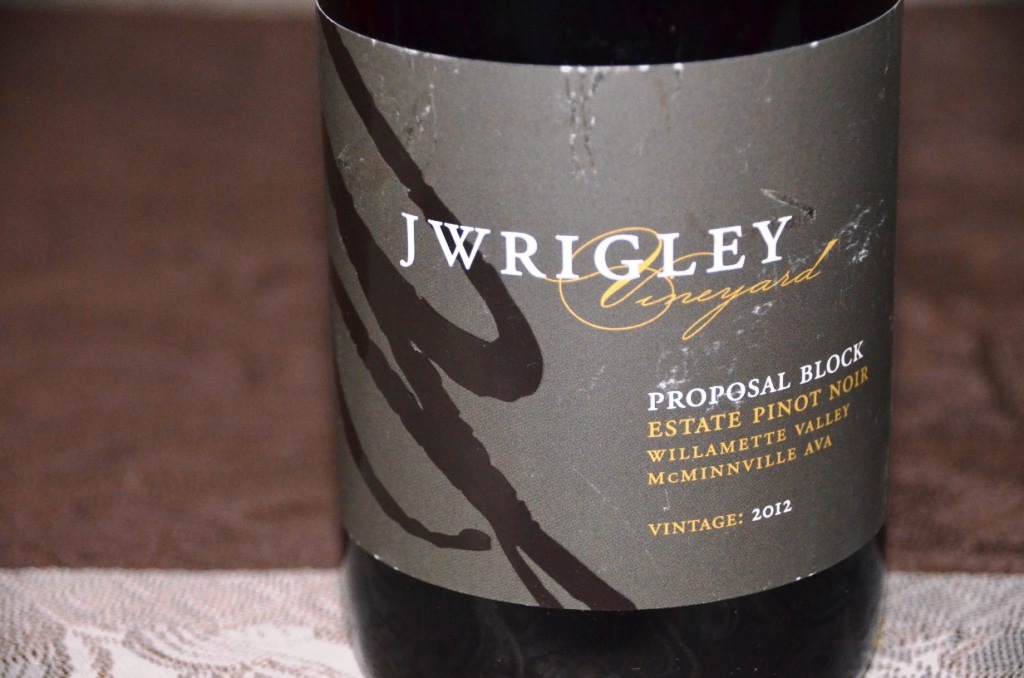 Last Wednesday, April 23, the virtual tasting room opened its #winechat doors to discuss for the third time in the row the endless subject of Oregon Pinot Noir. Presiding over in the hot seat was John Wrigley, the grape grower and winemaker at the J Wrigley Estate in McMinnville AVA in Oregon.
Let me start from the conclusion and tell you what I learned. The terroir, the soil, the elevation, and the winemaker are all matter. Duh, you wanna say? Well, yes, this sounds very pedestrian for the oenophile, like teaching an alphabet to the fifth-grader. However, when you drink the wine made with the soul, when you drink a thought-provoking wine, and when you also get a chance to discuss that thought-provoking wine with the someone who actually made it, and the group of like-minded people, the concept of soil and terroir stops being abstract, and rather becomes something you can…put in your mouth and taste!
We learned a lot during this #winechat. Once again we heard about the peavine soils, which make vines work really hard. We also heard about volcanic rocks and marine sediment soils. You can learn about the soils too – here is the link to the very interesting article about J Wrigley wines, which also includes the video of John Wrigley talking … dirt (not as a matter of speech, but as a substance).
We learned about something called Van Duzer effect. Ever heard of it? A narrow stretch of open land, called Van Duzer corridor, connects Willamette valley to the ocean. Every evening, the cold ocean air runs through that open space to cool off everything in the valley, especially all the grapes growing on elevations. The temperature drop can be in the range of 20°-30°, making grapes to ripen slowly, to retain acidity and concentrate sugars, which in turn means … better wines for us! Here is an article where you can read about Van Duzer effect in far more details.
We also learned about very interesting experiment, called the Cube Project. 3 wineries, 3 winemakers, 9 wines. 3 wineries – Anne Amie from Oregon, Bouchaine from Carneros and Lincourt from Sta. Rita Hills, each took their best Pinot Noir plots, capable of producing at least 6 tons of grapes each, and divided it into 3 equal parcels. Each winemaker had an opportunity to make wines from all three parcels, thus producing 9 different wines. When the wines were tasted by the group of professionals, it was concluded that winemaker style prevails over the terroir – the wines from different plots made by the same winemakers tasted closer than the wines made within the same parcels. I would really love to try all those wines by myself, or at least learn more about how the tasting was conducted – were the wines tasted blind, how many people tasted the wines and the number of other factors would all matter to me. But – as I can’t report first hand, here is a link to the article which explains the experiment in lots of details.
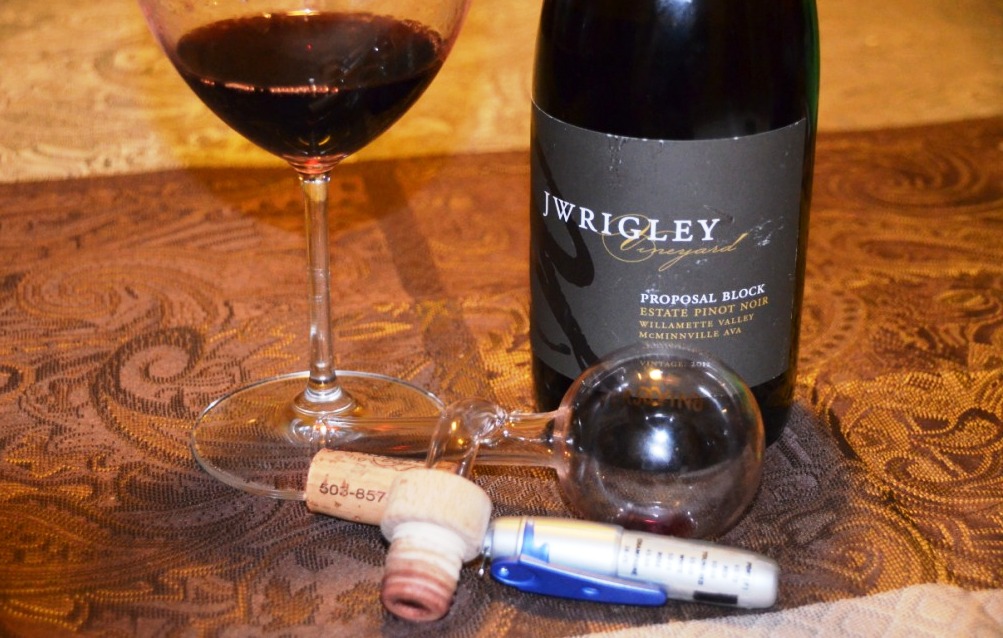
J Wrigley Pinot Noir and tools of the trade
Yes, we learned a lot, but how was the wine, you are probably wondering? This time around, I didn’t play with the temperature, I only measured it once – it was at 22.3°C/72°F. I played a bit with rapid decanting using VersoVino. This 2012 J Wrigley Estate Pinot Noir Proposal Block McMinnville AVA (14% ABV, aged 10 Month in French oak, 250 cases produced. $45 SRP) was very supportive of our conversation. Oh, by the way, can you guess where the name “Proposal Block” comes from? There is a good chance that you guessed it – this was the very first Pinot Noir planted vineyard at the estate, where John Wrigley proposed to his wife (wine and romantics – unbeatable!).
Now, here are some notes regarding the wine:
Color: Garnet
Nose: Fresh, ripe raspberries, floral notes, chocolate, mocha. Smokiness showed up later on.
Palate: Soft, round, good acidity. nice earhiness, dark fruit, very balanced. After a while, smokiness showed up in the back, and the the roasted notes.
Verdict: powerful and balanced Pinot Noir. Will drink well by itself, and can be well paired with food. For the full enjoyment, about one hour decanting is recommended. Will also age well for the next 10-12 years (or may be more, my crystal ball is broken, so I can’t be more precise). Drinkability: 8-
That conclude my report about J Wrigley #winechat and it also concludes the overall Oregon Pinot Noir series – definitely was learning, fun and entertaining experience for me. Don’t be shy – you should really try the #winechat for yourself (every Wednesday, at 9 PM Eastern/6PM Pacific) . Until then – cheers!
Passion For Jura – The Wines
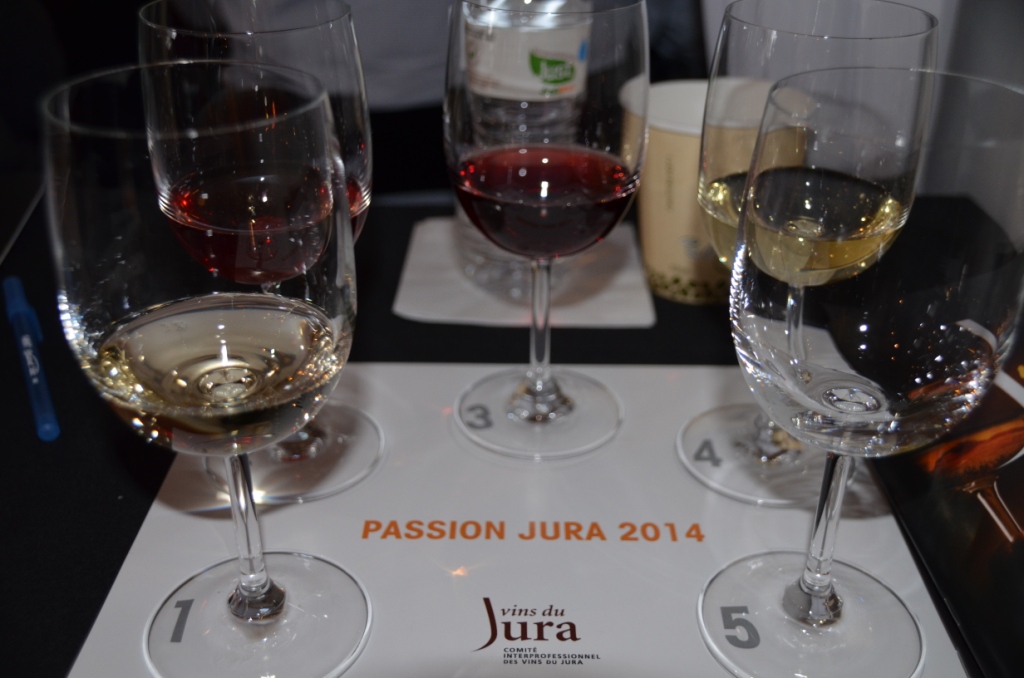 In the previous “Passion for Jura” post, we talked about the region – history, terroir, grapes and types of wines – but we didn’t talk about the wines themselves. “Passion for Jura” was the name of the seminar and tasting which I recently attended in New York city, where I had an opportunity for the first time to really immerse into the fascinating world of one of the oldest wine producing regions, which is really unknown in US.
During the seminar, 6 wines were presented by the winemakers themselves. The idea was to let us experience the full range of the Jura wines (for some strange reason, Vin Jaune was not presented during the seminar). Here are the wines we tasted:
NV Domaine Jacques Tissot Cremant du Jura Blanc Brut (12% ABV) – 100% Chardonnay, refreshing grassy nose, very acidic, bubbles are present but somewhat muted in the glass. Creamy mouthfeel with toasted bread and apple on the nose. Overall, not bad, but lacking a bit an overall energy of the sparkling wine.
2011 Domaine de la Pinte Jura Arbois Polsard de L’Ami Karl (11.5% ABV) – light, refreshing, cranberries with the touch of barnyard, herbs (sage), light but with the nice tannins. Very interesting and very enjoyable.
2011 Benoit Badoz Vermiel (13.5% ABV, 70% Trosseau, 30% Pinot Noir) – fresh grapey nose – not a pronounced as Beaujolais Nouveau, but still quite explicit. Cherries and blackberries show up next. Beautiful, smokey notes on the palate, a bit sharp, but fresh. Clean acidity, long pleasant finish. Somewhat similar to Oregon Pinot Noir, but more round. Also has a noticeable green component.
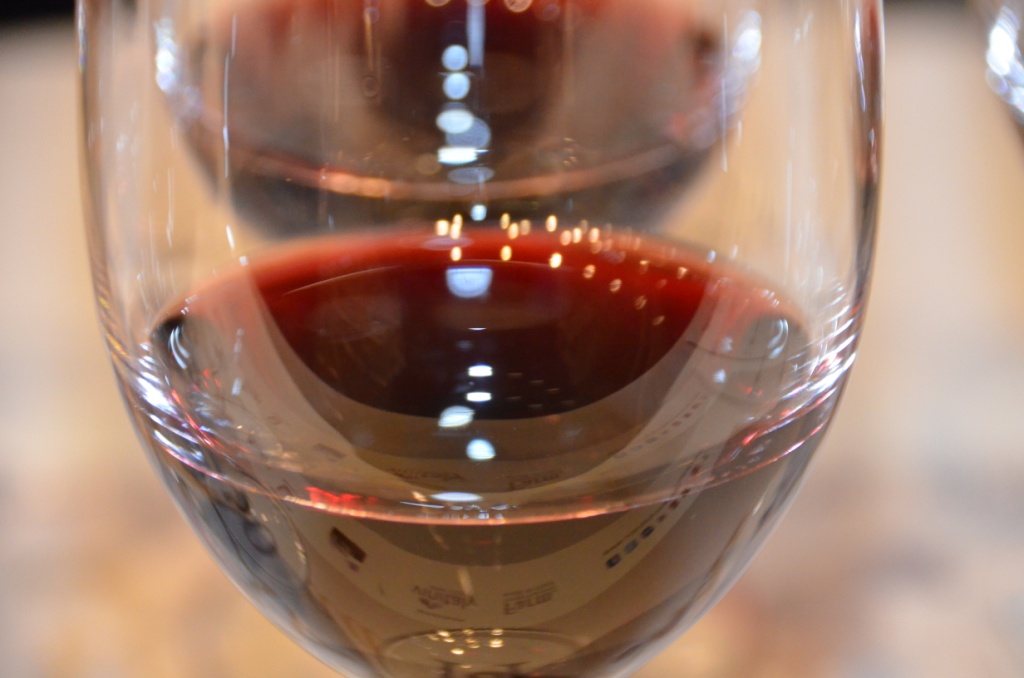
Compare the colors of the two red wines in the tasting:


2011 Domaine Champ Divin Cotes du Jura (13% ABV, Chardonnay/Savagnin blend) – vanilla, minerality on the nose. Delicious. Acidity and minerality on the palate, fresh apples, very refreshing
2009 Fruitiére D’Arbois Savagnin Arbois AOC (14% ABV, 100% Savagnin) – oxidation is very much pronounced, pretty much like with Sherry, both on the nose and the palate. This wine is typically made as Vin Jaune, but it requires lesser aging time. After the wine breathes, it becomes much less aggressive and comes through as clean, despite the oxidation.
2009 Domaine Pierre Richard Vin de Paille (15% ABV) – delicious nose. Palate is beautiful, with refreshing acidity, touch of bitterness, and full of fresh juicy apricots. Wow!
And here is the list of some of the wines I tasted during the walk around tasting. The place was small, and got very crowded after a while, so I didn’t taste the wines from all 20 producers. As usual for the trade tasting, I’m using the “+” sign system. The wines mentioned below were my favorites, for the most cases with “+++” ratings with some exceptions (of course), such as “++-|” and “++++”.
2010 Domaine Jacques Tissot Arbois Chardonnay (12.5% ABV) – +++, beautiful!
2012 Domaine Jacques Tissot Arbois Chardonnay La Mailloche (12.5% ABV) – +++-|, butter and balance! perfect.
2009 Domaine Jacques Tissot Arbois Savagnin (13% ABV) – +++, very elegant
2006 Domaine Jacques Tissot Arbois Vin Jaune (14.5% ABV) – +++, mushrooms and forest floor! should be amazing with savory dishes. Vin Jaune can last for 6 month after being opened.
2010 Domaine Jacques Tissot Arbois Trousseau (12.5% ABV) – ++-|, clean, elegant, light – red which more feels like white
NV Domaine Jacques Tissot Macvin du Jura (17% ABV) – very unusual palate, with raspberries, almost taste like Framboise, very nice. Can last for 6 month in the fridge.
2010 Domaine Jacques Tissot Cotes du Jura Pinot Noir (12% ABV) – ++-|, very interesting and unusual for a Pinot Noir
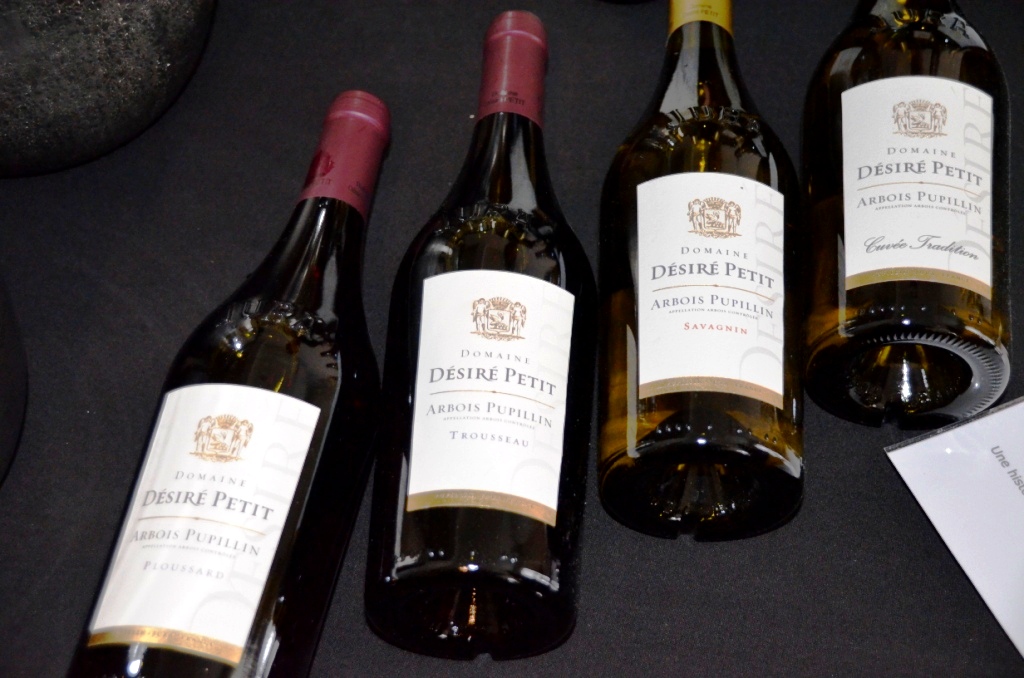
2012 Domaine Désire Petit Ploussard (12.5% ABV) – +++, smokey nose!
2012 Domaine Désire Petit Trousseau (12.5% ABV) – ++-|, dry, clean, nice
2012 Domaine Désire Petit Chardonnay (12.5% ABV) – ++-|, clean, classic, minerality!
2012 Domaine Désire Petit Savagnin Ouillé (13% ABV) – +++, 6 month in oak, very complex wine
2011 Domaine Désire Petit Tradition (12.5% ABV, 25% Savagnin) – +++, perfect acidity
2008 Domaine Désire Petit Savagnin(13% ABV) – ++-|, delicate, elegant
2007 Domaine Désire Petit Vin de Paille (14.5% ABV) – +++, prunes on the nose! perfect balance
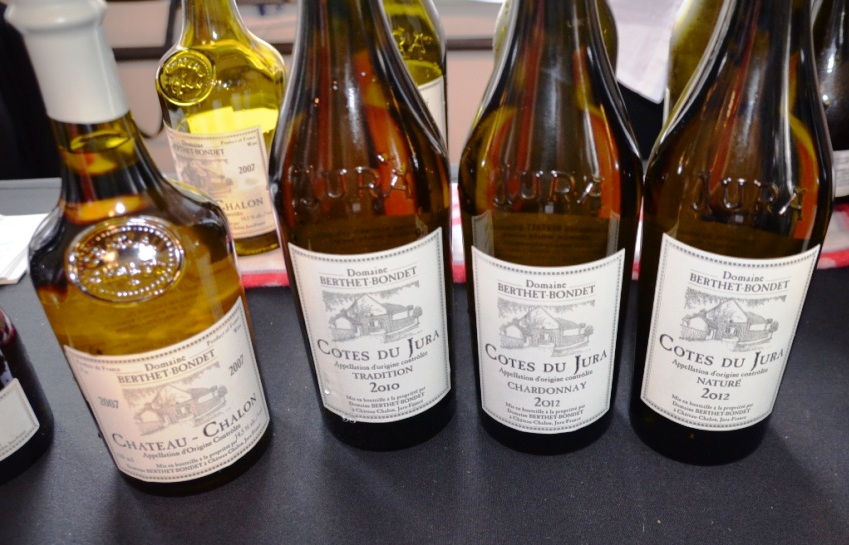
2012 Domaine Berthet-Bondet Cotes du Jura Chardonnay (12.5% ABV) – ++-|, light, round
2012 Domaine Berthet-Bondet Cotes du Jura Naturé (13% ABV) -+++, good fruit
2012 Domaine Berthet-Bondet Cotes du Jura Tradition (13% ABV) -+++, delicious
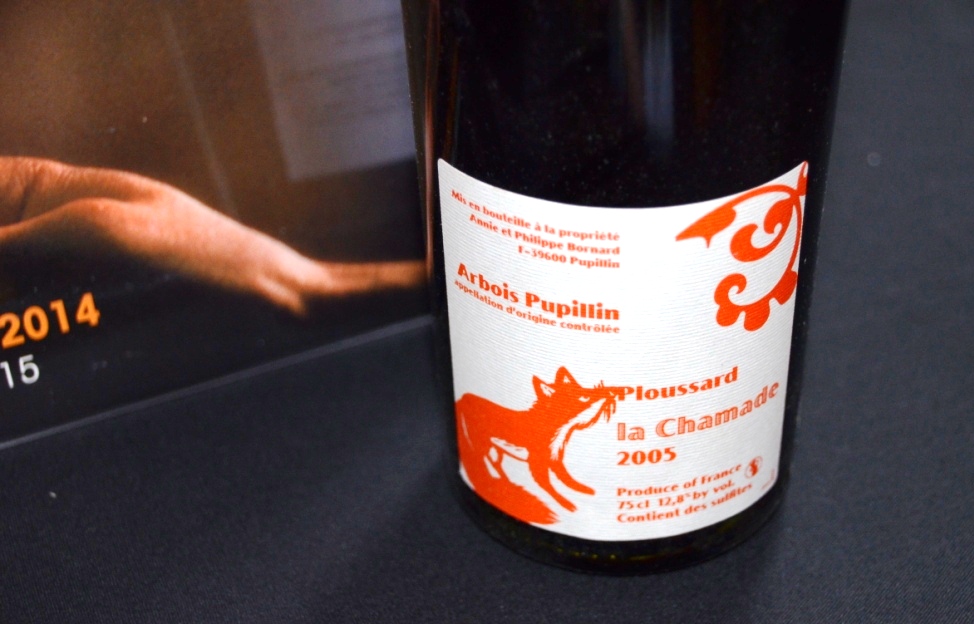
2005 Domaine Philippe Bornard Ploussard La Chamade – Best of tasting!
2005 Domaine Philippe Bornard Arbois Pupillin La Chamade Ploussard (12.8% ABV) – ++++, wow!
2011 Domaine Philippe Bornard Arbois Pupillin La Chamade Ploussard (13.5% ABV) – +++, wow! delicious, sweet undertones
2011 Domaine Philippe Bornard Arbois Pupillin Trousseau Le Ginglet (12% ABV) – +++, delicious complexity in the back
2011 Domaine Philippe Bornard Arbois Pupillin Savagnin Ouille Les Chassagnes (13.5% ABV) – ++-|, complex
2011 Domaine Philippe Bornard Chardonnay Les Gaudrettes (12.5% ABV) – +++, complex, delicate!
2011 Domaine Philippe Bornard Arbois Pupillin L’Ivresse de Noé (14% ABV) – +++, late harvest Savagnin, a touch of sweetness, delicious complexity
I also tasted 4 different Vin Jaune wines from Domaine André & Mireille Tissot, all from 2007 vintage, all single vineyard, and all delicious, with the one from Chateau-Chalon being the best – unfortunately, as all those wines were not listed in the tasting brochure, I can’t give you their exact names – but look for Domaine André & Mireille Tissot Vin Jaune – they are well worth your attention.
That concludes my report on the Passion for Jura tasting. Based on my experience, I can simply tell you – Jura makes delicious wines, and you need to experience them. Go to your wine merchant and ask for the Jura wines by name – and let me know how you will like them. Cheers!
A Night of Great Food and Great Wine – Arezzo in Westport, CT
 Have you ever been in the situation where you read about the restaurant and look at the menu, and your first thought is “ahh, it’s that same thing again…”? Continuing the situation, how many times did you actually still ended up going to the restaurant, and afterwards were glad you did? My personal account – more often than I care to admit! My latest experience – the restaurant called Arezzo Ristorante & Bar in Westport, Connecticut.
Arezzo is located at the intersection of route 1 and Riverside Ave, with its patio overlooking Saugatuck river. While restaurant had been in the same location for a while, you can consider it brand new – Juan Ceballos and chefs/brothers Llanos are the new owners of the Arezzo restaurant.
What I really like in the restaurants is the diversity of the setting – this is when the restaurant inside doesn’t look “uniformly the same”. Arezzo has a number of different areas – a spacious bar, almost as a separate room, a “foyer” with soft and comfy chairs, the main dining room, huge patio – you can come to the restaurant many times and every time discover something new.
Open kitchen and huge wood-fired oven, imported directly from Italy, are definitely creating the next level of excitement for the guests – I don’t know about you, but I can stare at the tamed flames for a very long time…


We started our evening in the bar. I personally made a rookie mistake of ordering Espresso Martini as my first drink – while very tasty, this was definitely a drink to have after the meal, not before. Well, I’m still working on my cocktail culture…


As usual, a few words about the wine list. May be only two words – Very Good. While the list is not big (which is a good thing in many cases – flipping through 50 pages looking for a bottle of wine is not the fun for all), it is modern, attractive and not boring, sporting a number of unusual wines by the glass together with some safe choices. Bottle selection is also very good, and reasonably priced, which for me is always important.
The wine list is focused on the Italian wines, with some California and France. After the fiasco with espresso martini, I needed to refresh my palate, so I started with 2011 Donnachiara Irpina Coda di Volpe DOC, Campania (13% ABV), the wine made out of indigenous Italian grape from Campania, Coda di Volpe. Bright golden color in the glass, inviting nose of white stone fruit and perfectly vibrant acidity on the palate, paired with dense and round, medium to full body mouthfeel – just what I needed (Drinkability: 7+).
The red wine, suggested by Juan, was an absolute favorite of the group. Renieri is an excellent producer, making the wines in the number of regions in Italy. While I was somewhat familiar with their Brunello wines, this wine was new to me – 2010 Renieri Invetro Ross Toscano IGT (14% ABV), a super-Tuscan blend of 50% Sangiovese, 25% Cabernet and 25% Merlot. Dark ruby in the glass, clean nose of dark red fruit, very inviting, and beautifully refreshing palate – ripe raspberries, cassis, plums, warm spices, touch of minerality, full bodied and perfectly balanced with tannins and acidity in check. Great wine overall. Drinkability: 8+.


And then, there was food.
A number of appetizers were served while we were at the bar.
Pizza Margherita ( fresh tomato, basil, homemade Mozzarella) – fresh, sweet tomato, basil – always a winning combination.
Focaccia Robiola di Arezzo (white truffle oil) – this was sublime, as anything with the right amount of truffle oil.
Lobster Arrancini (saffron aioli and Lemon) – absolutely delicious, very tasty bites!
Rosemary Marinated Shrimp Skewers – one of the group favorites – incredible balance of flavors.
Italian Sausages Skewers with Roasted Peppers – simple and very well executed. Also a pleasure to look at.


The rest of our dinner was served at the table. First, a trio of pasta:
Risotto (fresh porcini mushrooms, truffle oil) – incredible, simply incredible. If you like mushrooms, I’m sure you are not going to leave a single morsel on the plate, no matter how big the portion will be. The umami factor simply doesn’t let you put the fork down.
Short Rib Tortellini (braised us jus sauce) – why all the braised, slow cooked meat invokes such a homey feeling? This was delicious.
Cavatelli ai Piselli (home-made pea-ricotta, how and sweet sausage ragout) – this was perfectly on par with two other dishes – savory and satisfying.


Pan Seared Pink Snapper (caponata purée, fregola, vegetables) – one of the best pieces of fish ever – flaky, perfectly seasoned and cooked.


Roasted New Zealand Lamb Chop (spinach, tomato, Yukon gold potatoes) – to tell you the truth., I’m extremely picky about my lamb chop – I don’t want any fat on it, I want it to be perfectly seasoned, so it will not have that unpleasant lamb flavor – yes, I’m high maintenance when it comes to the lamb chop. So what can I tell you about the lamb chop which was served to us? In a word, wow. In another word – delicious. Seasoning, texture, taste – wow.


For dessert we had Pannacotta and Nutella Pizza – yes, it was very tasty, and I will spare you my lame attempts to describe it.


And we are done here. The only thing left to do, as usual, is to thank Juan Ceballos and Executive Chef Vinicio Llanos for the wonderful food and wine. Whether you are living in the area or visiting, Arezzo will be a perfect dining destination for you. Cheers!
Disclaimer: I attended the restaurant as a guest of management. All opinions are my own.
Arezzo Ristorante & Bar
5 Riverside Ave
Westport, CT 06880
 203-557-9375
http://www.arezzowestport.com/

How Hard Is It To Be #1? – Frank Pepe Pizzeria Napolitana
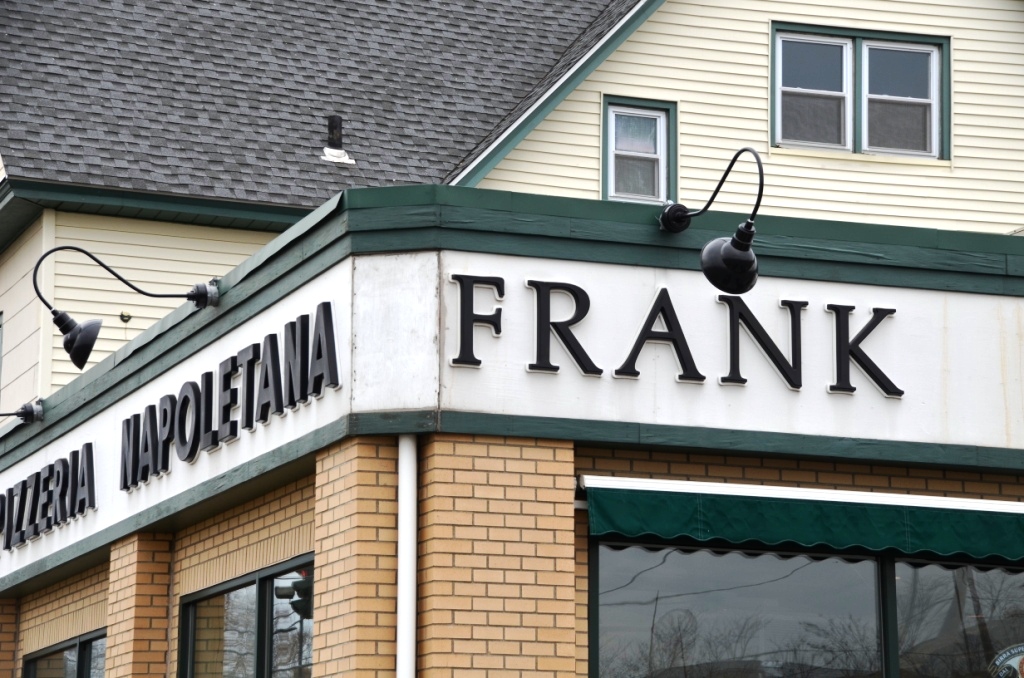 Have you heard of Frank Pepe Pizzeria? Chances are, if you don’t live in Connecticut, you had not. With 2 pizzerias on literally every corner of every town (there are about 70,000 Pizza restaurants in US!), should you be concerned with the fact that possibly you never heard of Frank Pepe Pizzeria? Well, you decide for yourself – according to the Daily Meal publication in October of 2013, White Clam Pizza from Frank Pepe Pizzeria in New Haven, Connecticut was named the Best Pizza in the United States out of 101 pizzas considered for that title (see, may be it is time to visit Connecticut after all?).
So, how hard it is to be #1? Here is one recipe for success – in three easy steps:
- Do one thing, and be very focused on that one thing.
- Do that one thing very very well.
- Keep doing this one thing very very well, over and over again.
Easy enough, right? This is somewhat of a story of the Frank Pepe Pizzeria.
Together with the group of bloggers, I had a great pleasure of meeting Gary, the grandson of Frank Pepe, at the Frank Pepe Pizzeria in Fairfield, CT. Frank Pepe came to the United States at the beginning of the last century from Italy, in his early teens. He came through New York and ended up in New Haven, Connecticut. He got the job at the bakery and macaroni factory, as those were the skills he already had. Frank went back to Italy to fight in the World War I, then came back to the US, got married, and at some point started selling small pizzas from the cart which he was rolling around. His wife encouraged him to open the store in 1925, which he did. This is where the Frank Pepe Pizzeria Napolitana officially started.
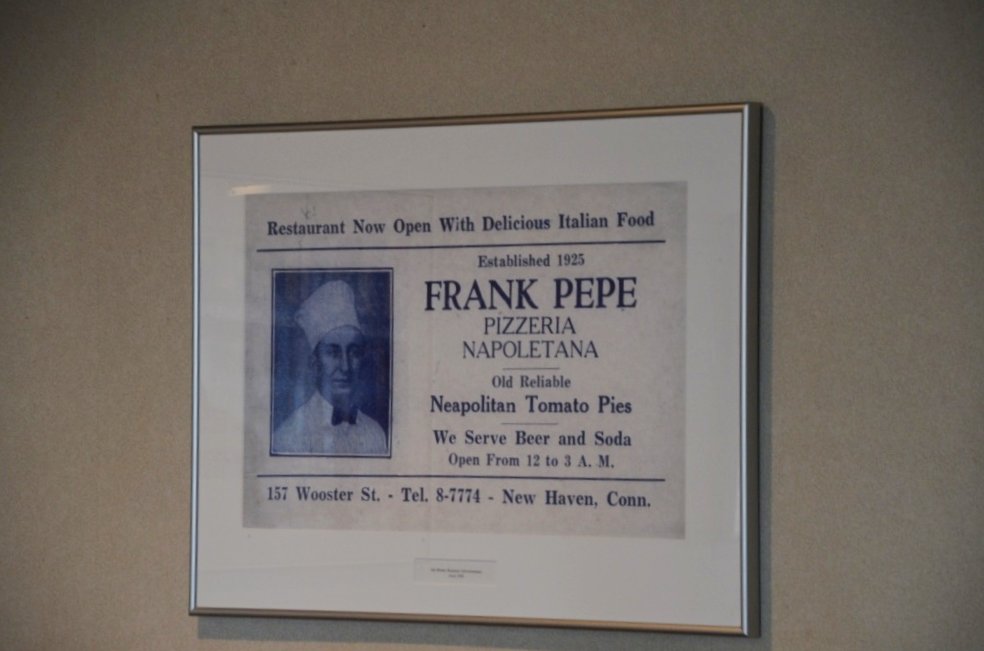 Frank managed to run a successful business throughout the depression years. Take a look at the picture of the Frank Pepe sign from those old days. Do you see the words “old reliable” there? It means exactly what it says – the business you can rely on. Always persistent quality, always persistent taste, always there when you need it. Frank was known as the guy you can knock on the window of at 2 AM in the morning, and he will get up and go make a pizza for you. If this is not dedication and reliability, I don’t know what is.
When Frank Pepe passed away in 1969, he had only two daughters; they took over running of the business and got family involved, so now 7 of Frank’s grandchildren run the business. Gary, Frank’s grandson we talked to, started working in the business when he was 14. Just an interesting fact – he took his first vacation when he was … wait for it… 35.
Remember at the beginning of this post I gave you a short list of things you need to do to be the #1? So I can tell you that, as you probably expected, there are few other small things which matter. One of the seemingly “small things” is an attention to details. Let me explain and also give you few really fascinating facts and numbers along the way.
- One and the same brand of Romano cheese is used by Frank Pepe at all of the stores for over 50 years. The tomatoes are imported from Italy, and they should have a specific taste profile (Gary and his cousin are the official taste testers). That tomato taste profile family keeps secret. More than 15,000 cases of tomatoes are imported in a year, which translates into 90,000 cans! More little details: tomato cans can’t sit under the sun in the truck – the taste is changing, so logistics matter!
- Family was always focused on just continuing the family tradition and family recipe. Only in the past 10 years family slowly started to expand its business, now operating in 7 locations, most of them in Connecticut and one in Yonkers, New York. The family is looking to expand further into New England, but they really move very cautiously. For every new location, the large part of the effort is training of the new staff and setting up the restaurant in exactly the same way as other operate (which starts with oven).
- The charcoal oven matters! It should be properly seasoned, and time is mostly the only way to do it right. The family operates 3 ovens in New Haven alone, and each oven produces slightly different pizza.
- The ovens are kept all the time at the temperature of about 600°F. It takes roughly 7-8 minutes to bake a pizza in the oven.
- All restaurants go through roughly a 500,000 pounds of mozzarella cheese in a year.
- The most asked for pizza in most of the locations is Mozzarella with sausage


- The menu at all Frank Pepe restaurants has nothing but the pizza (I’m talking about the food – soda, beer and wine are offered at all locations). Only 2 years ago green salad was added to the menu!
- Pizza Margherita is being slowly added to the menu throughout the restaurants only now, literally in 2014
- The whole Frank Pepe Pizzeria started from the original tomato pie. Next anchovies were added, then cream cheese, and then sausage. All the sausage used in the Frank Pepe restaurants comes from the same local supplier New Haven. Frank Pepe location in New Haven alone goes through 400-500 pounds of sausage per week!
- Clam pizza evolved back in mid-40s. There was a guy who was selling the clams on the half shell from the cart. He asked Frank to put it on the pizza, Frank agreed, and it became the signature pizza – clam, garlic, oregano – that’s it. In New Haven alone the restaurant goes through 70 bushels of clams per month, 90 during summer. Frank Pepe uses 3 clams suppliers, with the very strict guidelines as to type, size, type of beds etc., and all clams are sourced from New England.
- Since starting working at the restaurant at the age of 14, Gary made more than 1,000,000 pizzas in his life – by himself!
I think you got the picture by now – yes, it is easy to be #1 – you just have to work really hard until you get there.
Let’s talk about the pizza now. We tried three different pizzas – the original tomato, regular cheese and of course, the #1, White Clam Pizza.
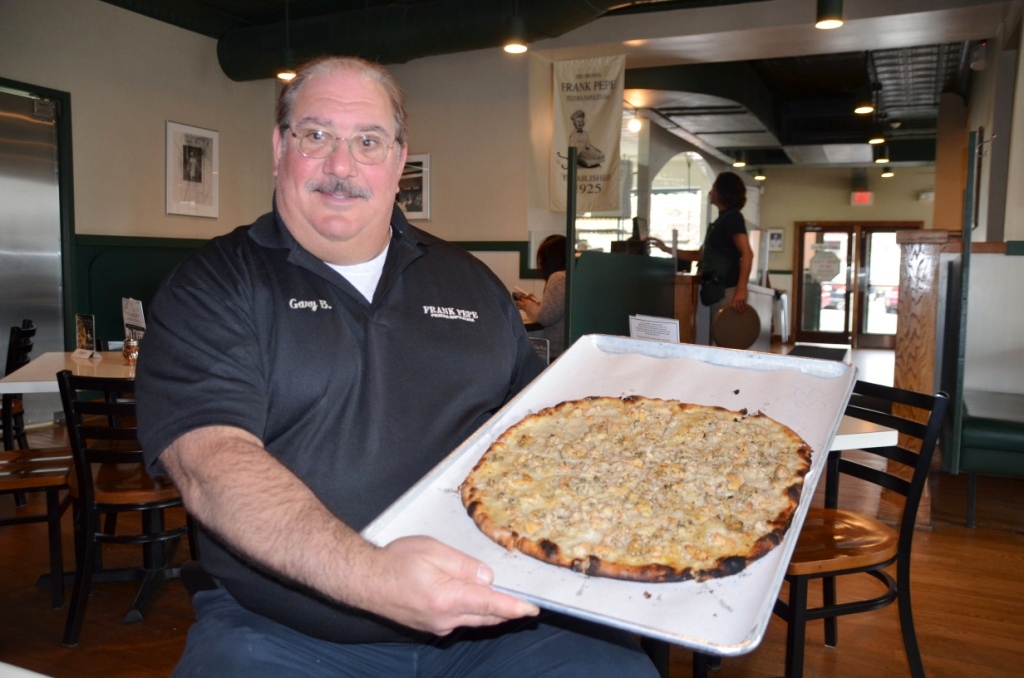
Gary, Frank Pepe’s grandson, holding the #1 Pizza in US – White Clam pizza
The original tomato Pizza was very interesting – the tomatoes were unusually forthcoming, it is now easy to understand why this specific tomato taste profile is so important, it makes the pizza all unique and different. Make no mistake – of course it has cheese sprinkled on top, but the tomato is the star here.


Cheese pizza was also excellent. I don’t know about you, but for me, the crust is very important on the pizza – I need it thin, I need it slightly charred and I need it to break up when I’m folding it – this pizza completely delivered.


You know, I don’t want to lie to you. My favorite pizza, by all means, was the white clam. Before we tried this white clam pizza, I was wondering – how the clams will taste? Will they be chewy and “squeaky” as clams often get? Nope, it was absolutely delicious. Soft pieces of clams, with perfect texture, accompanied by perfect amount of garlic and fresh herbs – I’m generally not a pizza guy, but I’m craving a piece as I’m writing this. Yes, you have to taste it to believe it.


This concludes the description of the wonderful experience we had a Frank Pepe Pizzeria in Fairfield, Connecticut. Now I definitely want to visit the original restaurant in New Haven – after learning so much about the history of this restaurant, I want to experience the place where it all started.
Yes, we are done here. Until the next time – cheers!

A Trip to Spain – at Barcelona Restaurant in Greenwich, CT
 About a month ago I got a note, which I shared with all my readers – Barcelona Restaurant in Greenwich is offering a special wine education program, called Passport Through Spain – 4 evenings of exploring the wines of the different regions in Spain, of course accompanied by the food. I didn’t have a chance to attend the classes until the very last one – but boy, am I happy I was able to attend at least one class!
The last class was focused on the region called Valencia. Valencia is more known for its paella and oranges than for its wines – but this is probably what made it more fun for me. The previous three classes were focused on Rioja, Galicia and Priorat, and I’m somewhat familiar with the wines of those three regions – but Valencia is quite unknown to me, and thus intriguing.
Region of Valencia is located on the east coast of Spain, along the Mediterranean sea line. There is a number of winemaking areas in Valencia, with Jumilla probably being the most known. There is a mix of climate zones in the region, some been more Mediterranean, and some more continental, but the very hot temperatures are quite common throughout the summer. However, in the areas with the continental climate the temperatures can drop very low in the evening, so the grapes can achieve great flavor concentration and depth. Similar to all other regions in Spain, the quality of wines in Valencia is steadily increasing, with the regions such as Valencia, Utiel-Requena and Alicante taking their place on the wine map. There is a mix of indigenous and international varieties growing in the region, with probably Malvasia and Moscatel being stars among the whites, and Monstrell, Bobal, Garnacha Tintorera and Garnacha Tinto among the reds.


The Valencia wine class was conducted by Jose Valverde, the Sommelier at Barcelona Greenwich, who is the wealth of knowledge and just a pleasure to listen to. We started with the wine called 2010 Bodegas Rafael Cambra Soplo Valencia DO (14% ABV, 100% Alicante Bouschet/Garnacha Tintorera, 3 month aging in oak) – it was this wine, made out of the Alicante Bouschet, known in Spain as Garnacha Tintorera, which prompted my last wine quiz – so here you can read some interesting facts about that grape.
Here are my notes about the wine:
Color: Dark ruby, concentrated
Nose: Earthy, warm, inviting, with touch of espresso, cherries and pencil shavings, very intense
Palate: Perfect acidity, cassis, almost a Cabernet Sauvignon/Cabernet Franc profile, espresso, touch of bell peppers, very restrained.
Verdict: Beautiful wine, you just can’t put your glass down. Drinkability: 8+
Barcelona is actually a restaurant group, and they have a number of restaurants in Connecticut and even outside, all focused, of course, on Spanish food and wine. It was very interesting for me to learn that Barcelona takes the idea of cultural heritage very seriously – yes, I’m talking here firstly about food, cooking and overall Spanish cuisine traditions. Every year the group of chefs and other people who make your restaurant experience special, travel to Spain to immerse into, to embrace the cuisine, the food, the wines, to learn the ways Spanish restaurants operate. Best of the best is brought back home and then shared with us, lucky customers, in the form of special food and special experiences. The very first dish which was served to us, lucky customers, was the Toast with Bacalao Spread. Executive Chef Michael Lucente tasted that dish at one of the restaurants in Spain while being on educational trip. He loved the dish, and he asked for the recipe. Guess what – he didn’t get it, as the chef outright refused to share it. Chef Michael spent a year (!) perfecting that recipe, but as a foodie I think it was totally worth it. Incredible balance of flavors, and texturally interesting – this was one delicious tapas.
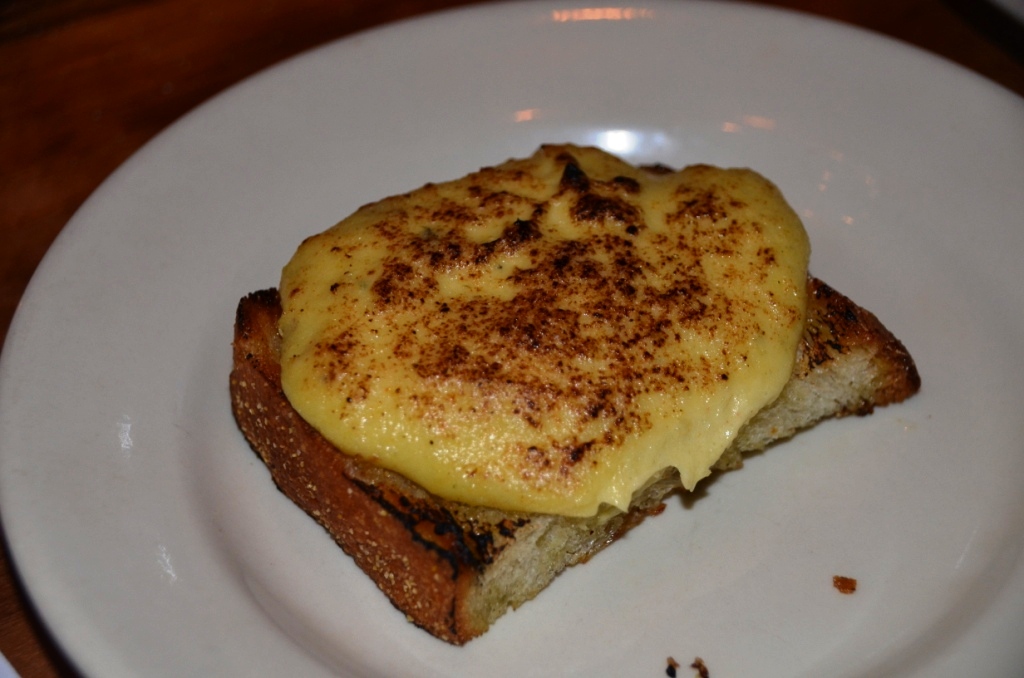
We continued our journey through Valencia with 2010 Bodegas Sierra Norte Pasión de Bobal Utiel-Requena DO (13.5% ABV, 100% Bobal). Bobal is a unique Spanish grape, which doesn’t grow anywhere else – however. there is plenty of it growing in Spain, with more than 80,000 acres, which makes it one of the most planted red grapes in the world. The climate in Utiel-Requena is one of the harshest in Spain, with very hot summers and cold winters with frost and hail, but still, the grapes persevere!
Here are the notes for this wine:
Color: Ruby
Nose: Freshly crushed grapes, but restrained. Brighter nose than the previous wine, with some black cherries, herbs and tobacco.
Palate: Noticeable tannins, but overall light, open and clean, should be very food friendly. I crave the complexity of the first wine!
Verdict: Nice, simple and very food friendly – will complement wide range of foods! Drinkability: 7+
The dish which was served with dish was Roasted Hen with pimento, fried chick peas and cilantro. The dish itself was very tasty, with all the flavors perfectly melding together – and it also worked perfectly with the wine! All those mild flavors of the wine very complementing bold flavors of Mediterranean cuisine, so this was definitely an excellent match.


Our last wine of the evening was 2009 Pedro Luis Martínez Arriba Término de Hilanda Monastrell, Jumilla DO (14.5%ABV, 100% Monastrell, 14 month aging in new American and French oak) – Monastrell, which is a lot more international grape than the previous one (it is known as Mourvedre in France and Mataro in Australia), is definitely the best known grape in this tasting group. One problem I often have with Monastrell wines is that they are made overly jammy, with lots of in-your-face overcooked fruit. Luckily, not this wine!
Here are the notes:
Color: Dark ruby, concentrated, almost black
Nose: Closed
Palate: Powerful, coffee, dark chocolate, espresso, black plums, firm structure with spicy undertones, tar. Thought provoking, with excellent balance.
Verdict: Excellent wine, one of the best Monastrell wines I ever tasted. Drinkability: 8-
Care to guess what our last dish was? Yes, Paella! You can’t have a class on Valencia wine and not experience the classic of the cuisine. It was not even one paella, but two – both seafood and meat (rabbit and sausages) paella were served, and they both were absolutely delicious! No, I’m not going to describe them to you – just get to the restaurant and taste it for yourself.


That was definitely an evening of fun learning, great food, great wine and great conversations. There are only a few things are left for me to do here. First of all, I want to thank Barcelona Greenwich Sommelier Jose Valverde, Executive Chef Michael Lucente and PR Director Ria Rueda for the excellent program and great experience of Spanish wines and Spanish cuisine. Also, I want to bring to your attention the fact that Barcelona Restaurant group does a lot of work to educate the customers on both food and wines of Spain, so you will do yourself a lot of good if you will check their calendar and sign up for updates – there are great events happening literally every week! You can find Barcelona Restaurant and Wine Bar calendar right here – it covers all of the Barcelona locations and even more general events where Barcelona restaurants participate, so don’t think you should live in a close proximity of Greenwich to take an advantage of these special events.

Sommelier Jose Valverde and Executive Chef Michael Lucente
And we are done here. If you are looking for the great Spanish food and wine experience – there might be a Barcelona restaurant near you! Cheers!
Barcelona Greenwich
18 West Putnam Ave.
Greenwich, CT 06830
Tel: 203.983.6400203.983.6400

Instant Gratification, and Arrival of the Spring
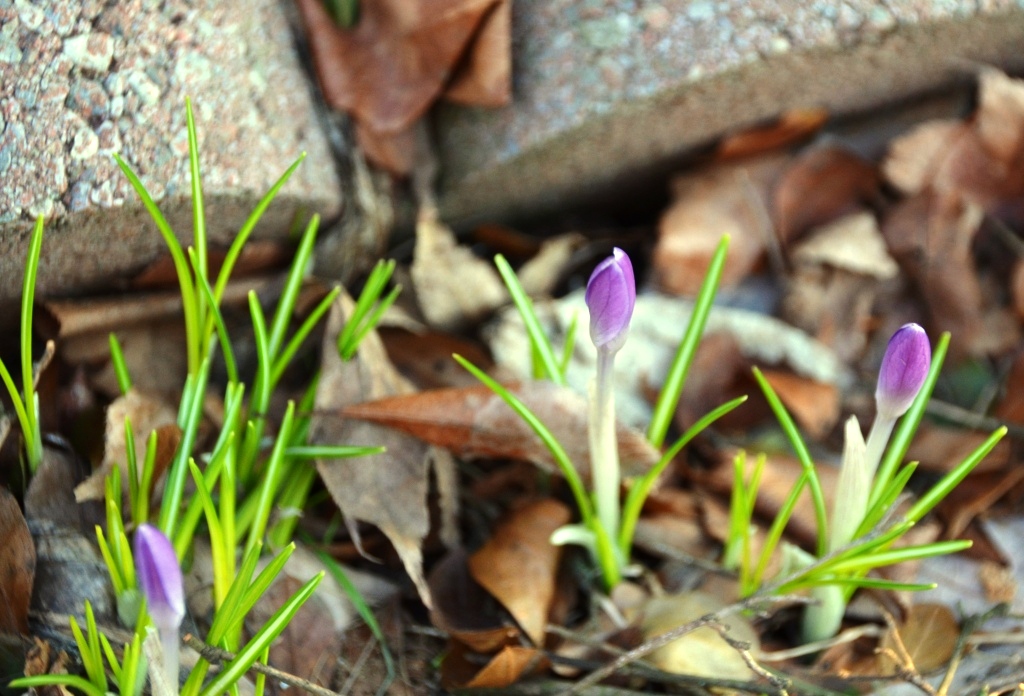 You know, when the winter is like the one we had in New England, you get to the point when you sort of stop believing that the spring will come. You wake up in the morning, your thermometer shows 20F, and your mind doesn’t even comprehends the concept of spring, flowers, grass – no, those leftovers of the snow are going to stay forever. Only a few days ago I was explaining to my daughter about the flowers called snowdrop in English, which are usually showing up as soon as snow melts, and I was lamenting that this year we probably will see no snowdrops as the winter was so brutal here.
Then today was the first official day of spring, and while it was still cold outside, it was definitely more palatable (read: warmer), and the snow was almost gone. And walking around the house all of a sudden I saw… flowers! It was simply magic, the magic of life happening right here, right now. No matter how brutal the winter is, the spring will come no matter what – and I was looking at the proof. Don’t know if this is exactly a snowdrop or simply a similar flower, but I was definitely happy to see it.
Okay, so spring is here. And for the instant gratification part? Easy. Here I’m talking about wine (wow – total surprise, huh?). You know, I can define the instant gratification as a sequence of a few very simple steps – twist, pour, sniff, say “ahh”, sip, roll your eyes towards the ceiling – have a moment of bliss. The wine which gave me this moment of blissful instant gratification – 2006 Mt. Difficulty Pinot Noir Central Otago, New Zealand. I wanted to have a good glass of wine, and as I only have a vague idea of what wines are in the cellar, I was simply looking through the wines on one of the shelves – and when I saw this bottle Mt. Difficulty, I thought – yes, that will do it – and it delivered. Beautiful classic Pinot Noir on the nose – a little smoky, a little earthy – and perfectly fresh, full of juicy cherries and herbs, harmonious palate. You know, the one which gives you an instant gratification. I loved that wine so much that I simply had to connect the first flowers with this wine – as you can see it in the picture below:

The spring is here! Let’s drink to Life! Cheers!
Make Cooking Fun and Easy – with Chef Neil Fuentes
When I got a note that there are some spots available in the Tapas cooking class with Singing Chef Neil Fuentes, of course the first word which got my attention was “tapas” – tapas, or “small plates”, is generally my favorite type of food in any restaurant, Spanish or not – so the invitation definitely attracted my attention. The very next question was – who is Singing Chef Neil Fuentes?
I don’t know what we are going to do if one day Internet will disappear – I know this is rhetorical, but don’t you have a tiny, tini tiny fear deep inside, that this incredible source of knowledge, capable of answering any questions you might, or even might not want to ask, will disappear one day? Oh well, I digress. So I used the powerful Internet to quickly come up with lots of answers about Chef Neil – yes, he is a Singing Chef because he can actually sing and dance, he is fun to watch, and he also competed on Chopped (that might be the biggest influence factor for me – huge fun of the show, and have the utmost respect for every Chef who has enough courage to enter that kitchen). Yep, I definitely want to meet Chef Neil Fuentes.
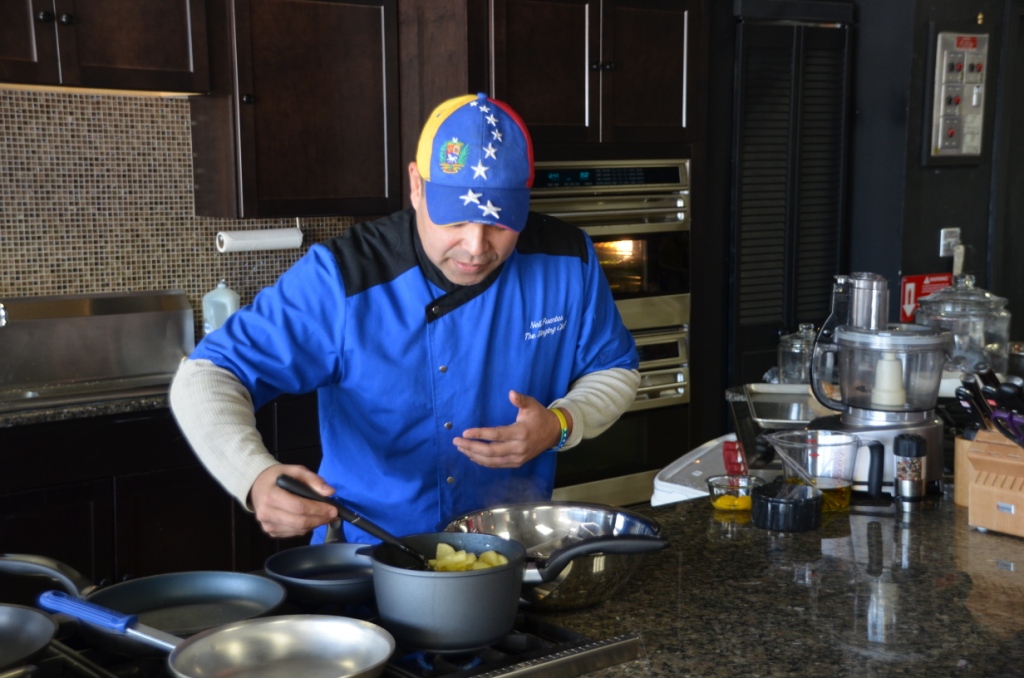
The cooking class was conducted at the kitchen at Chef’s Equipment Emporium in Orange, CT (a heaven for anyone who is into the cooking, if you ask me). When I arrived there, Chef Fuentes was, of course, already in the kitchen, preparing for the class:

All ingredients around looked very promising too:


And then the class started. I can tell you – Chef Fuentes was a pleasure to watch. He managed to cook, entertain and teach all at the same time, with ease. We found out that Chef Fuentes was born and raised in Venezuela, and he started cooking pretty much from the age of 6, as cooking was important in his family. Hmmm, let me clarify the “important” part. Neil Fuentes grew up on the farm, where cooking was done only with the fresh ingredients (yep, that includes the meat). Later on, Neil became flight attendant for the Venezuela airline, which played an important role in his culinary upbringing. You see, Venezuela airline had only 5 planes, but it was serving almost the same number of international destinations as United Airlines. How is that possible and what it has to do with culinary skills building, you ask? Let me explain. The flights were taking place once a week, so the flight crew had a week of time at their respective destinations. Instead of spending time in the restaurants and bars, Chef Fuentes, who has a great ability to make friends, preferred to visit friends and … yes, you got it – to cook with them! This way, he had an opportunity to learn a lot about world cuisines, and build the skills, which he now gladly shares with others.
After arriving to US, Neil Fuentes started in Bridgeport as a waiter at the Taco Loco restaurant. Then he joined SBC Brewing company, eventually becoming the catering manager, until he started his carrier as Private Chef. Then, there was television. To the date, Chef Fuentes recorded 69 episodes on the Channel 8, and he is planning to start his own Chef Fuentes Live show on the Youtube – with special guests appearances, promotions, and the whole “bam” appeal of Emeril Lagasse show (this is definitely an aspiration). But – remember – Neil Fuentes is the Singing Chef! He teaches musical class on Saturdays, writing musical for kids and loves to perform on stage. Okay, let’s get back to food.
During the class, Chef Fuentes cooked 3 different dishes. The first dish which he started cooking was Tortilla Española, which is a traditional Spanish breakfast dish. To make this dish, you need to first to dice potatoes and onions (we used 3 potatoes and 2 onions), and then simmer them in a light olive oil over a medium heat.


Please note the keyword here – “simmer”, not deep fry. Effectively, you cook the potatoes and onions in the oil instead of water. You simmer the potatoes until they will become soft (will take about 20 minutes), then drain potatoes and onions and put aside to cool off. Meanwhile, Chef Fuentes whisked 12 eggs, then added potatoes and onions to the mix, with salt and pepper, and pour mix into the pan over the low to medium heat, for the next 3-4 minutes.
While the tortilla was cooking, Chef Fuentes started working on home-made mayonnaise. which was made out of the egg yolks, Dijon mustard, lemon juice, pepper, olive oil and Chipotle peppers in adobo sauce – the mayo was accompanying the Tortilla Española.
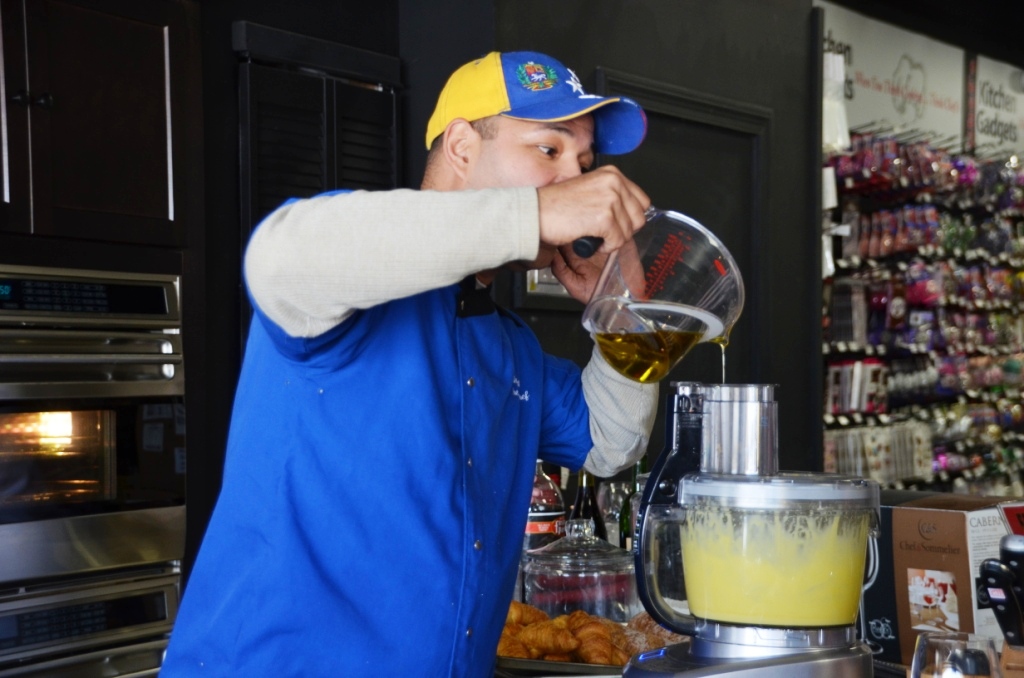 After 3-4 minutes of cooking, the tortilla was gently flipped, just to cook for another 3-4 minutes, and then it was flipped again – you want to reach a nice consistency of color. And then – voila! Tortilla Española ready, sliced up Tapas style and served with that home-made mayo. Yummy! I would gladly eat that dish for breakfast (and not only) any day.


Remember, I said 3 dishes, right? Next up – Mushrooms with Quail Eggs. Mushrooms is one of my very favorite foods (mushrooms were always an object of craving in my family as I was growing up), I can eat mushrooms every day. I love cooking them, but unfortunately, I butcher them way too often, rendering them super-dry. What Chef Fuentes did with mushrooms was, in my book, literally a masterpiece. A combination of regular white mushrooms with Shitake mushrooms was used in dish. I found it interesting that Chef Fuentes suggested using Thyme with mushrooms, as it nicely complements mushroom flavor (never done it before, but will do now). Mushrooms are sliced, minced garlic, thyme, salt and pepper are heated up over the medium heat, mushrooms are added afterwards. In about 10 minutes, mushrooms will reduce to about half of the size – and this is when they are pretty much ready. Quail eggs are fried sunny side up, and the final dish is assembled on top of the small, fresh and buttery croissant – perfect!


Last, but not least dish – Ham and Cheese Bruschetta. First the minced garlic goes into the pan with medium hot oil, and the small tomatoes are cut in half. Once the garlic heated up sufficiently and released the flavor, tomatoes go into the same pan, cut side down. Slice the baguette into long slices, and prepare cheese slices (Manchego works perfectly well) and Prosciutto rolls. Once the tomatoes become somewhat soft, start assembling the bruschetta. Take slice of bread, take half of the tomato with the oil and garlic, and simply spread it all over the bread ( you will discard the skin of the tomato when you are done). Put slice of cheese on top of the bread, then prosciutto roll on top of cheese and … enjoy!


Just to give you an idea how much I loved that dish – on the way home, I called my wife to tell her that I’m making an appetizer for everybody as soon as I will arrive. Stopped by Trader Joe’s, got baguette, tomatoes, Manchego cheese and Prosciutto, and in 15 minutes family was enjoying this wonderful bruschetta.
So I told you about fun and entertainment, now – what did I learn? A few simple, but very useful things:
1. Don’t use the knife or the edge of the bowl to break the eggs – this is how you get the shell crumbles! Instead, hit the egg lightly at the flat surface – and effortlessly get the egg’s content into the bowl.
2. When you cook the garlic first, don’t do it over the high heat, it will make garlic bitter! Start with medium heat and let the oil to absorb the garlic flavor – without burning the garlic pieces.
3. Well, don’t know if this is universally important, but – mushrooms pair very well with Thyme.
What else can I leave you with? First, lots of information about Chef Fuentes – here is the link to his website, where you can get to know him, and see him sing, dance, entertain, and of course, cook. Note that Chef Fuentes does both cooking classes and private events – if you live close enough to New Haven, Connecticut, you might consider hiring him. Also, Chef’s Equipment Emporium is running a constant slew of the educational classes and events, make sure to check their events schedule here.
As Chef Fuentes said, food and cooking should be fun and easy – and that’s what you definitely get in his class. Thank you, Chef, for the great time and great food! Cheers!
Daily Glass: Wine, Beautiful and Different
Have you ever caught yourself using the same expression over and over again, to the point of being annoyed with oneself, but not been able to do anything about it? One of my expressions, pretty much a single word, is “beautiful”. Yes, of course I mean it in the wine context. The best case scenarios include the first “wow” once your nose encounters the aroma exuding from the glass, connecting to the “wow, this is beautiful” after the first sip, when aroma and bouquet altogether transform into a beautiful (oops, sorry), memorable experience. Yes, I know, reading the wine reviews consisting of “wow, this is beautiful” notes is somewhat pointless, and if it draws your ire, feel free to take it out in the comments section below – but I have to say it when it happens.
The wine I’m talking about today was exactly like that. I got this bottle from a friend back in October. The wine is made by his father in Sicily – a small family production, for all I understand. One consequence is the fact that there is no information available on internet – and the bottle doesn’t have a back label, so I can only share my impressions. But – it was a beautiful wine.

The color of this 2012 Contrada Santa Croce Casteltermini Sicilia Cuvée Artisanale Chardonnay Grillot (13.5% ABV) was intense yellow with an orange hue – I don’t think the wine was aged in oak, but it was definitely fermented on the lees, and probably was aged on the lees for a good few month, to have such an intense color. It was also showing a bit cloudy in the glass – I can assume it was unfiltered.
And then there was was the nose. You know, that aroma which you can commonly pick up on many wines from Sicily – the volcanic soils, the touch of sun and minerals, inviting and promising, with hint of lemon zest. And then the palate. Totally unique. Starting from light, dry, almost effervescent midpalate feel. Then showing mature fruit, apricot and apricot pit, finishing with mouthwatering acidity, prickling sides of the tongue with fresh lemon notes. One sip inviting another. Until the wine is gone, and you are left with the memory.
Let’s drink for the beautiful wines and people making them. Cheers!
VIA Masterclass: Amarone
 Continuing the subject of VIA Masterclass (here is the link to the previous post about Barolo masterclass), I want to talk about Amarone, one of the most uniquely Italian wines. The class was called “Amarone – The Velvet Underground”, and I think the name is very fitting. Let me explain.
Have you ever experienced a great Amarone? To me, the great Amarone starts with the nose which you can’t forget. As the wine is made from the grapes which had been dried under the sun for at least 90 days and thus more resembling the raisins than actual grapes before they will be pressed, it shows all those beautiful flavors of the dry, sun-aged fruit. After the aromas, which you can’t stop inhaling, comes the body – perfectly dry, perfectly full, perfectly powerful. This is what good Amarone is supposed to be. If you will think about the process, you will understand why Amarone has its price (think about the fact that most of the grapes lose about 40% of their mass – how many more grapes do you need to make the same bottle of wine?) – but if good Amarone is your wine, you will be willing to pay the price.
If you will search my blog for Amarone, you will find many posts, a lot of them complaining, hinting at my disappointment (I very rarely talk negatively about wines – I prefer not to write about bad experiences instead of bashing them). As of late, it became increasingly difficult to find Amarone as I described above, soft and velvety, but powerful and beautiful at the same time. A lot of the wines have very muted nose, and super-alcoholic, over-extracted, unbalanced body (and I just boasted about my non-confrontational style, huh).
This is where information from our Masterclass became very helpful. Yes, first we listened to the history of Amarone (discovered by accident, when the cask of Recioto, a famous sweet wine made from the dried grapes (passito) , was allowed to ferment through and became a dry elegant wine with – alas – bitter taste! Hence the name – Amarone, from the word Amaro – bitter). Then we talked about the geography and various sub-zones of Valpolicella region in Veneto – this is where Amarone is produced, with the best Amarone coming from the (not surprisingly!) hillside vineyards. Over the last decade, there was a huge increase in demand for Amarone worldwide. Think about the following facts. Consortium of Amarone producers was established in 1973 to regulate production of Amarone – so the production statistics are available from approximately that time. Amarone area plantings increased from 11431 acres in 1972 to 15723 in 2009. At the same time, all the way until early 2000s, there were about 1 million bottles of Amarone produced per year. In 2007, this number jumped to 8 (!) million, and then to the 16 (!!) million in 2008. Yes, it is great to have such a demand, but – where do you get the grapes to increase your production so dramatically over such a short period of time? You have to allow your vineyards to overproduce, and you have to lower your standards of quality and harvest the grapes from the vineyards which in the past you will never take the grapes from for your flagship wines. You see, Amarone is a top wine of Valpolicella. Amarone wines are typically made from Corvina, Corvinone, Molinara and Rondinella grapes, taken in the different ratios as each grape brings its own qualities tot he wine. Wines of Valpolicella are made from the same grapes – but it would be those which were not good enough to be made into Amarone.
To satisfy this huge demand in Amarone, there is also a push to extend the production area of Amarone, which would lead to the further deterioration of quality. In 2013, Amarone Consortium approved the increase of Amarone production zone by 30%, which will mainly come from the flatlands. To fight against it, 12 Amarone producers (Allegrini, Begali, Brigaldara, Masi, Musella, Nicolis, Speri, Tedeschi, Tenuta Sant’Antonio, Tommasi, Venturini, Zenato) created Amarone Family association (Famiglia dell’Amarone d’Arte) back in 2009, with the goal of pushing back and defending traditions of quality in production of Amarone. Marilisa Allegrini, currently the Head of Amarone Family association was present at the masterclass and she had an opportunity to talk briefly to all the attendees.
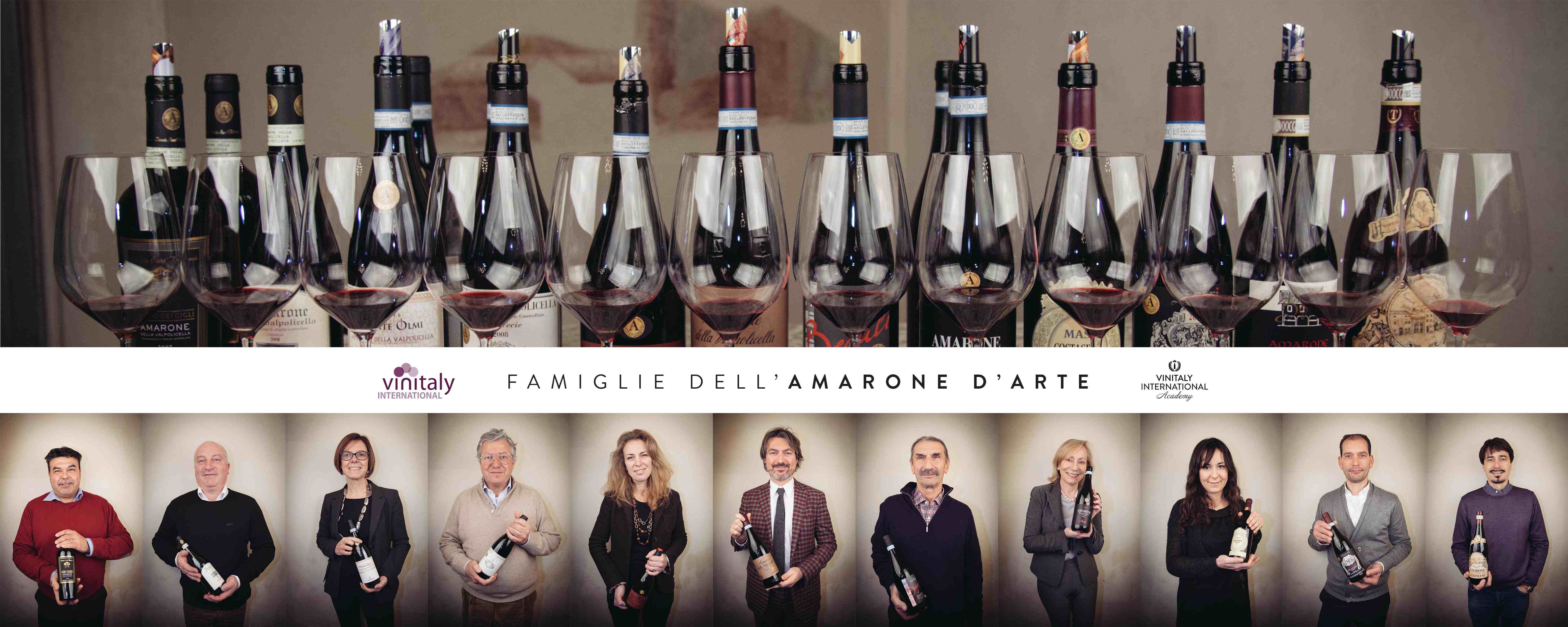 And then there was the tasting, of course. We went through 11 different Amarone wines, and here are the notes (this are my actual notes in its progression, like declaring the wine “best so far”).
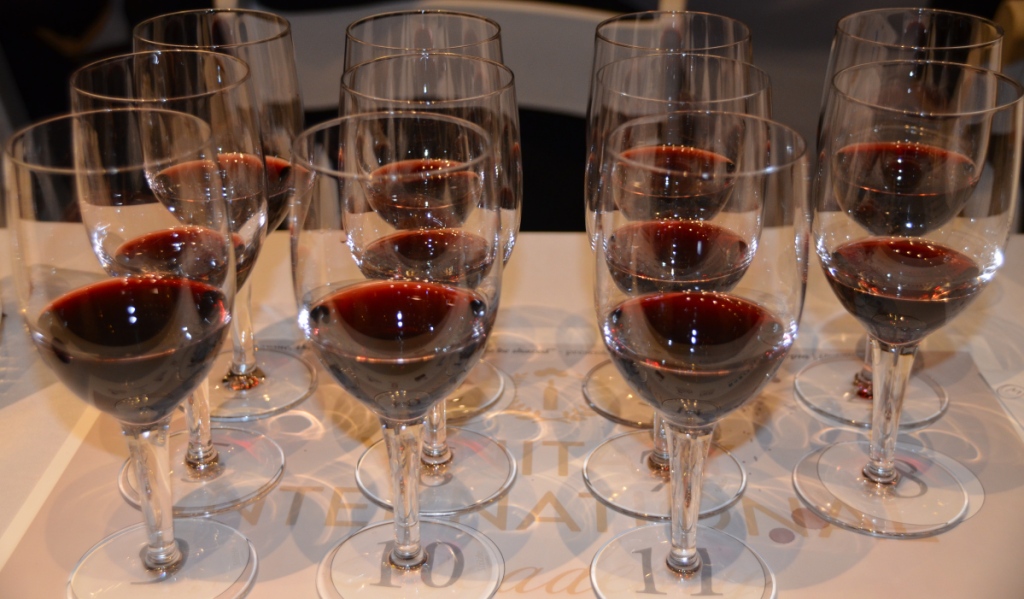
1. 2010 Tommasi Viticoltori Amarone della Valpolicella Classico DOC
Nose: ok, traditional nose of a red wine, but not Amarone
Palate: over extracted and super-bitter
2. 2008 Begali Amarone Classico
Nose: campfire, then dark fruit with medicinal undertones
Palate: bitter, biting
3. 2009 Speri Amarone Classico Vegneto Monte Sant’Urbano
Nose: green and vegetative
Palate: bitter, over extracted.
4. 2009 Masi Agricola SPA Amarone Costasera
Nose: nice, open, hint of sweet fruit
Palate: not bad. Not too bitter, good power, clean balance. ++-|
5. 2009 Allegrini Amarone
Nose: best so far – beautiful, nice, open, fresh berries
Palate: closed, bitter
6. 2009 Zenato Amarone della Valpolicella Classico DOC
Nose: exceptional – true Amarone nose – fresh jammy fruit, but very balanced – raisins, figs – wow! +++
Palate: nice, soft, round – very good.
7. 2008 Musella Amarone della Valpolicella Riserva
Nose: nice! Fresh, open, good fruit
Palate: excellent. Best so far – nice, clean wine, powerful tannins without bitterness. +++
8. 2008 Brigaldara Amarone Case Vecie
Nose: nice, good dried fruit
Palate: good, clean, round – outstanding! Even better than the previous wine +++
9. 2008 Tedeschi Capitel Monte Olmi della Valpolicella Classico DOC
Nose: nice, concentrated fruit, good
Palate: needs time, but still perfectly round +++
10. 2008 Venturini Amarone
Nose: interesting nose, but pretty closed.
Palate: too austere. Not bad as a wine, but not good as Amarone
11. 2007 Tenuta Sant’Antonio Amarone Campo dei Gigli
Nose: dark, concentrated fruit, blueberries, raspberries
Palate: very good, but a bit bitter. It’s a bummer as I had a great experience with this wine at the tasting in September.
That’s all I have for you for today. What do you think of Amarone? Share your experience! Cheers!
Last Bottle Sign Up ($10 credit)





