Archive
[Mind Boggling] Price of Wine
I’m again [lucky bastard] in Portugal, and get to enjoy this beautiful country. Of course one of the first places I have to visit is a supermarket, to see what’s new in the wine section (you can find some illustrations for my first encounter here). My eyes stop on the bottle of wine from the unknown region for me – Tejo. There were both red and white wines, standing next to each other, so I decided to grab both.

Let me give you description of the wines.
2012 Enóloga Antonina Barbosa Vinho Branco Tejo Vinho Regional (12.5% ABV, made from the Portuguese grape called Fernao Pires): Light yellowish color in the glass. Spectacular perfumed nose, resembling some of the best French Viognier – shows bright perfumed fruit, very elegant, not over the top. Very round and delicate on the palate, touch of apricot, peach and white apple, fresh acidity, perfectly dry and balanced. Drinkability: 8
2012 Enóloga Antonina Barbosa Vinho Tinto Tejo Vinho Regional (13% ABV, a blend of Aragonez, Castelao and Cabernet Sauvignon): Ruby red color in the glass. Fresh fruit nose, shows nice ripe concentrated fruit and a touch of earthiness. On the palate, very restrained, dry, touch of tart cherries, some earthiness and light tannins presence. Good acidity and good overall balance. Drinkability: 7
So we are looking at two good wines. Now, let me ask you a question. Based on the description above, how much these wines should cost?
I will give you a few seconds to think about.
And a few more seconds.
And a few more.
Ready? What do you think?
Okay, we can skip the drum roll, but let me know if you expected to see this number.
€1.29 each.
A whooping €1.29.
I think this is pretty impressive, that such a level of quality can be achieved at such a price of the wine. This wine is a private label, made for the Pingo Doce stores, by the Falua winery. Of course as this is the case with the private labels, no additional details can be found on the winery web site.
I also learned about relatively new designation for the Portuguese wines – Tejo Vinha Regional, which was created in 2009 to be used in the Ribatejo region. Ribatejo DOC (higher classification) is retained for some specific areas of the region.
That’s all I have for you for now. There were many other great wines, food and very special experiences, like Port barrel tasting all the way to the 1970 – this all hopefully will be shared in this blog in the orderly fashion.
So, can you top my quality/price ratio? I will let you think about it. Cheers!
And All The Fuss About Wine Reviews…
 Few days ago I read an article by Joe Roberts, talking about wine reviews. The article, called “Does The Wisdom Of The Crowd Provide Better Wine Reviews Than The Experts?“, and the subsequent comments were evolving around the role of the “crowd-sourcing” in the wine reviews from the sites such as Cellar Tracker versus traditional wine critics and wine experts, the value of wine ratings and all the other critical analysis of wine. Instead of commenting in the thread, I decided to express my thoughts in the form of this post.
Warning – this might be long. You might want to arm yourself at least with one glass of wine. Or more…
It is very interesting to observe “are the wine reviews and wine critics relevant” discussions to periodically flare up all over the blogosphere and all of the digital media. Some of those discussions and opinions are quite antagonistic, from “death of Wine Advocate predicted” to “the number of wine bloggers will decrease dramatically” to “blind tasting puts wine experts to shame again”. Some of them are supported by some facts and findings which authors deem indisputable. And some are written just purely for the entertainment or quick publicity purposes.
For all of us obsessed with wine, the subject of wine ratings and wine reviews is near and dear to the heart. The world seems to rotate around those 98s, A and B, 4 stars and all other metrics. Meanwhile, majority of the wine consumers couldn’t care less. Based on the number of studies, people buy wine based on the label, advice of the store associate and the price. By the way, the price factor is funniest of all (should be a subject of a separate post) – when we buy for ourselves, we always want to find $10 wine which will taste like a $100; when we need to bring a present, we ask for the advice to find the best wine at the top of our budget, and then spend a few extra bucks just not to look cheap. In any case, very few consumers concern themselves with the ratings which are abundantly displayed in many stores (interestingly enough, there are quite a few stores nowadays which are doing away with all those rating displays). Yes, the people who buy more expensive wines are interested to know what the experts think about the wine they are about to shell $50, $80, or a $150 for. Of course wine collectors track all those ratings as they are stock tickers (well, they kind of are). But considering the world of wine, those people are an absolute minority (okay, don’t bring up the 80/20 or 90/10 – that is not the subject of the post).
So Joe Roberts argues that Cellar Tracker ratings might replace all the expert opinions simply because they are the crowd sourced and it is proven by many sources, which Joe is citing, that crowd-sourcing is the way to go in today’s world. It is stated that the crowd-sourcing works because it is proven by TripAdvisor, Yelp, Amazon and thousands of other sources soliciting people opinions. Well, may be, but it depends. Let’s look at Yelp, as the food world is probably more related to the wine world than travel or gadget shopping.
Different people review restaurant on Yelp, and for the most of the cases the reader of the review doesn’t know anything about the writer. But if you think about an average restaurant, a lot of aspects of the review are based on the common sense. The understanding of the “good service” is pretty much universal. The understanding of “clean” versus “dirty” is also quite universal. “Run down” is pretty well understood. When the food is served cold, or you have to wait for 30 minutes for a cup of coffee, you don’t have to be an expert to universally recognize it. And if you ordered steak in a restaurant, I have reasonable expectations that you know how good steak tastes like.
No, you can’t take the ratings on Yelp for granted. People get upset, people get unreasonable – true. But this is where crowd-sourcing works the best. If a restaurant on Yelp has four stars out of five, based on the average of a 150, or 300, or better yet, 1000 reviews, you know that your chances of good experience are pretty high. If the restaurant has five stars based on 3 reviews, you know that means nothing in terms of your potential experience. The fact that that restaurants are judged on the multitude of factors, many of which are universal and even independent of the type of restaurant (clean Thai restaurant with good service is not any different from clean steakhouse with good service), gives you a certain level of reliability of the crowd-sourced ratings.
Wine is different. There is no foundation to all those ratings, outside of smell, taste and ability to deliver pleasure. But – “tastes good” is highly individual. If someone only likes to drink California Cabernet, convincing the person that this Sagrantino was a great wine might be difficult. Now, if you look at the crowd-sourced ratings, like Cellar Tracker offers, it means nothing, as based on the rating alone you can’t align your base with the people who wrote the reviews. You don’t know if the person who rated that St. Joseph Syrah at 78 simply doesn’t like barnyard undertones, or the wine is actually bad. You have to read the review to try to figure out what is wrong with the wine, and why the reviewer didn’t like it, may be he was just in a bad mood or had the wrong food with it.
When it comes to the wine critics, the situation is different. Yes, I know, the most famous of them are periodically accused of bias and various forms of dishonesty, but this is not relevant here. As the critics, they are able (and expected) to judge the wine objectively. Also, wine critics typically have their area of expertise, like James Suckling focusing on Italian wines, Steve Heimoff on California or Allen Meadows on Burgundy. I’m not trying to say that if a critic rated the wine at 95, it means that this will be a great wine for you no matter what – but at the same time, that objective persistency, consistency of the ratings and narrow focus of the critic allows you to align the base, and then have a quick opinion, a probability of liking the wine based on the given rating by a known critic. I don’t buy my wines based on the ratings, and I’m not willing to pay $100 more for the bottle of Cabernet only because Parker gave it 96 versus the wine next to it with only a 90 rating – but that rating allows me to establish a frame of reference.
Let’s look at the big picture. We can see an increased interest to wine all over the world. We also see an increased wine production all over the world. People “en mass” are increasingly more comfortable and more knowledgeable about the wine, especially if we are talking about Millenials and younger generations. And that does lead to the reduced role of “The Wine Critic” (Wine Spectator, Wine Advocate, etc). But – the need for the critical information about the wine is increasing, and as people gain more knowledge and learn to trust their own palates, they are willing to take wine advice from the lesser figures than Parker or Suckling, and they are willing to take it from many different sources – blogs, twitter, web sites and other digital media outlets. People are building their own tribes. This is where Cellar Tracker comes to play – but only for the people who are inside, only for the people who uses the service and is able to align the base. My personal “wine experts” tribe consists of many bloggers I started following over the years, one by one. Reading their posts, tasting the wines they are talking about, having a dialog, I was able to build my alignment, little by little, one glass at a time. I know that I can rely on and willing to take Jeff’s (the drunken cyclist) advice for the Pinot Noir, or Oliver’s (the winegetter) for German Rieslings, Julian (VinoInLove) and Stefano (Clicks & Corks) for any of the Italian wine, or Alissa (SAHMmelier) for the wines of Texas. This is not my unique experience – I truly believe this “tribe concept” works for everybody, more and more so.
Are you still with me? Wow, I really have to thank you for sticking along. Let’s round this up. No, the wine world is not going to rotate around Cellar Tracker. Yes, the role of The Wine Critic will decrease, but in the end of the day we will still have more of them. There will be ever increasing number of people who will be willing to share their experiences (and sometimes put it in the form of numbers), and there will be ever increasing number of people willing to take that advice. Crowd-sourcing? Kind of, but very different. May be “Tribe-sourcing” is the word. The world of wine is big, and it is only getting bigger – I think we all can perfectly get along.
Don’t know about you, but I need a glass of wine. Cheers!
How Possessive Are The Wine Lovers?
 If you are following wine blogs, you might have noticed the theme “possession” showing up here are there. Yes, this is no accident – the common linking factor is the Monthly Wine Writing Challenge (MWWC for short), in its third incarnation.
The theme for the first challenge was “transportation” – it was relatively easy to tie up to the wine both directly and allegorically. The theme for the next challenge was “trouble”, which sent me home scrambling – “trouble” is not the first thing which comes to mind when you are looking at a glass of wine. In the end of the day, many bloggers successfully found the connection and produced a lot of interesting posts. The current theme, “Possession”, is a whole different game. On one side, it has a direct connection to the wine – but it is too direct for the nice intricate piece. “I possess wine. Sometimes, wine possesses me. The end”. On another side, it is almost forcing you to go into pretty much the exorcism route, which can be played, but this is not necessarily pretty (need examples? Do a google search for “wine possession” – you will find some stuff which might make you afraid to visit your cellar when it is dark).
So as you can deduce from my rant, I don’t have a good play on the theme. What you will find below is rather a collection of random thoughts, centered on the wine appreciation, with the nod towards the “possessive” relationship of wine lovers with the subject of their love.
So how possessive the wine lovers are? We can find few different types of “possessiveness” among the wine lovers as such. First, there are wine collectors (of course, that is an obvious one). But even among wine collectors there is one extreme group which I would like to exclude from the actual category of the wine lovers. That is the group which rather collect the money than anything else. Wine is strictly an investment for them, and they never think about bottle of wine in terms of the actual content. For this group, the wine is only an object which will appreciate in value, and at some point it will be exchanged for cash and profit. This group also includes the worst possible type – the wine-possessive ego-maniacs. For this group the wine which they stock in their cellars is intended to be an ego-booster – “I spent on that bottle 10 times more than you did”, and “my bottle is bigger and more round than yours”. In the end of the day, I’m not even sure if this group even belongs to the true wine lovers category.
Then there are those who love wine, but don’t care to possess it at all. Folks in this group happily drink the wine at any occasion, they serve the wine at their parties, and they buy a bottle on the way home when they feel like it. But they really don’t “possess” wine, as they don’t keep much wine in the house, and most importantly, they don’t assign any special attributes to any bottles.
And then comes the rest. The group of wine lovers who possesses the wine and actually, is possessed by the wine at the same time (I’m including myself in this group, so I’m continuing here from the collective of “we”). We keep the wine. We make the wine special by associating special mementos with those bottles – “ahh, this is the year we got married”, “remember we had this wine in Tuscany”, “this is the year our son was born”, “remember that winery visit”. We do our best to keep those bottles cool, quiet and comfortable. And then we wait. While buying the wine with mementos, we are also investing, of course. We are investing into exciting anticipation of how special this wine will taste when we will finally open it. While we hold on to the bottle, we can re-live that future moment over and over. We are possessed with finding the right moment for that special bottle. But what is important, that right moment also includes the right people. How many times have you thought “ohh, if they (whomever “they” are) are coming over, I got this special bottle we have to open”. Yes, we are possessed with wine. But we don’t buy it just to enjoy by ourselves. We are also possessed to share. We want to share the experience. We want to share the special moment. We don’t want to keep it to ourselves. Without special moment or a special company, that bottle never gets to be opened.
And that is what I want to leave you with. Possessed by wine. Possessed to share.
Gumption, Tenacity and Whiskey
 Ralph Erenzo had a dream. Being an avid rock-climber, he had a vision of building a “resort” for the rock climbers, a place where they will be able to relax and have fun. With that vision in mind, in 2001, he acquired an old 35 acres farm in upstate New York, about 80 miles up north from New York City.
It appears that his new neighbors had their own idea of who the rock climbers are, as the first thing they told him was that they will do everything in their power to prevent him from successfully realizing his dream – they don’t need all these “bad people rock climbers” to come to their quiet neighborhood. And they did. Two years down the road, having sold 15 acres out of the 35 and practically out of money, Ralph had to think about what to do next.
He talked to the local authorities, asking “what can I do here”, and he got somewhat of an obvious answer – well, it is a farm, so nobody can object if you will use it as a farm. So, what can you do at the farm? Creating a vineyard was one option – but the wait time until the vines will be able to bear decent fruit was not acceptable to Ralph. Then something interesting caught his eye – New York state passed the law encouraging creation of the small distilleries, thus reducing the license fees from $60,000 to only $1,000 for three years. That was an “aha” moment, and this is how Tuthilltown distillery was born.
Ralph had no idea about spirits and distillation, but he was eager to learn – thus he built his first distilling apparatus out of the copper tea kettle and proceeded with practical exercises in the comfort of his own kitchen (boy, am I glad the Prohibition was over) – you can now see that original machinery on display in the tasting room at the distillery:

how the things started…
From there on, there was a lot of excitement, learning, selling, upgrading, building of a real business, selling it and much much more. You know what – let me ask for the 18 minutes of your time – you will much better learn everything which happened from the Ralph Erenzo himself. In return, I will tell you that you will learn about gumption and tenacity, and may be some of you will even feel encouraged to do something they’ve being postponing for the long time. Watch this TEDx video, and then come back for more fun facts and pictures.
When we visited distillery few weeks ago, Ralph Erenzo was leading our tour.

Ralph Erenzo leading our tour
It was really a great experience, listening to someone who “made it”, and who is nevertheless very much down to earth. I hope you watched the video, as I don’t plan to repeat what was said there. In the day to day operations of Tuthilltown, there is a constant desire to optimize, improve, waste nothing, be self-sufficient and most importantly, to be a fun place to work at (the distillery currently employs 25 people on staff). Just to give you few examples of the mindset:
Ralph showed us their new steam boiler waiting to be installed – acquired on eBay for the absolute fraction of the price of the new one.
Big solar panels are installed right on property – on a good sunny day, they generate enough electricity to power up the whole production and return electricity back to the grid.
Tuthilltown also grows its own apples (750 trees are planted, and another 750 will be planted soon), some of them on those 15 acres which Ralph had to sell, but later was able to buy back.
The distillery owns a cooperage, so they have control over the wooden casks, which are [the most] important part of making the whiskey.
After the grains are crushed, fermented and converted to liquid with alcohol, the leftover mass needs to be removed. Today, it means hauling it to the town dump and paying for the disposal. The distillery is about to install the machine which will convert the leftovers into the water (which will be used back at the distillery) and a little bit of ash – making the distillery completely green and even more self-sufficient.
The distillery needs grains to make whiskey. The grains are typically stored in silos. Say the word “silo” – what picture comes to mind? A super-boring, huge column, colored in gray or brown, right? Well, not at Tuthilltown. The graffiti artists were invited, to make the silos look like the museum pieces:

Silos at Tuthilltown Distillery

you can see solar panels in the back
Let’s talk quickly about how the whiskey are made (yes, I have a few more pictures to share). To make a whiskey, you need corn, or rye, or barley, or some other grain – something like you see below, only in slightly bigger quantities:

The beginning of whiskey
Then you have to run it through the mill, like this one used at Tuthilltown distillery (circa 1930s):
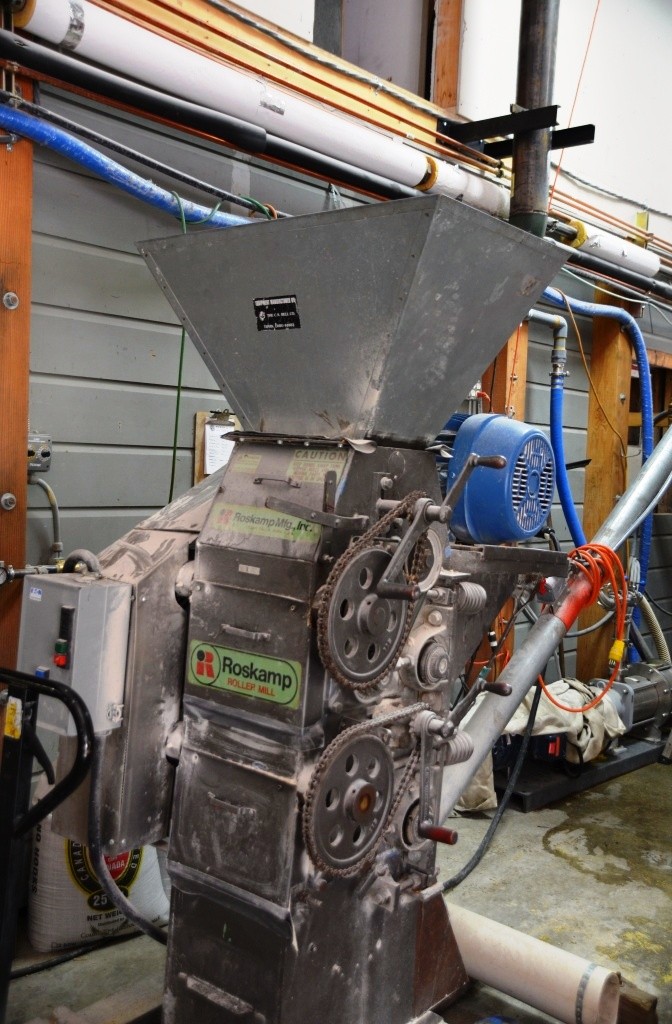
Manually operated (!) grain mill
Add water and yeast to the coarsely ground grains, get some heat going, and fermentation will start. Once you are done fermenting, the leftovers mash will be disposed, and the water with alcohol will go through the distillation process, where they will be separated.

Distillation column at Tuthilltown
Once you have the alcohol, it can be either bottled as is, or it can be aged in the barrels. When it comes to ageing, Tuthilltown uses heavily charred new American Oak casks (made by the cooperage which they own).

Small American oak cask
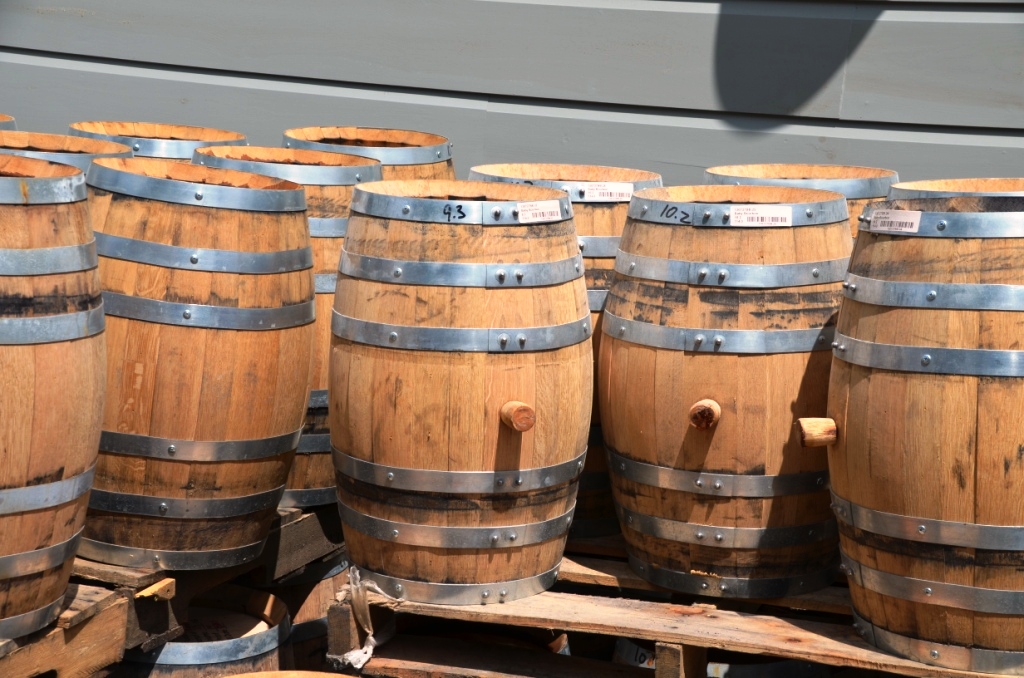
Ageing goodness
American whiskey is typically aged for 30-40 days per gallon, so if you have a 10 gallon cask, it will take a bit longer than a year to reach the proper age – of course whiskey can be aged for any period of time, but at least today Tuthilltown doesn’t produce any whiskey with extended ageing.
Once the ageing is done or close to be done, bottlers will decide when the particular batch is ready to be bottled. The bottling operation is located in the basement of Tuthilltown distillery. The process starts from filling the empty bottles:
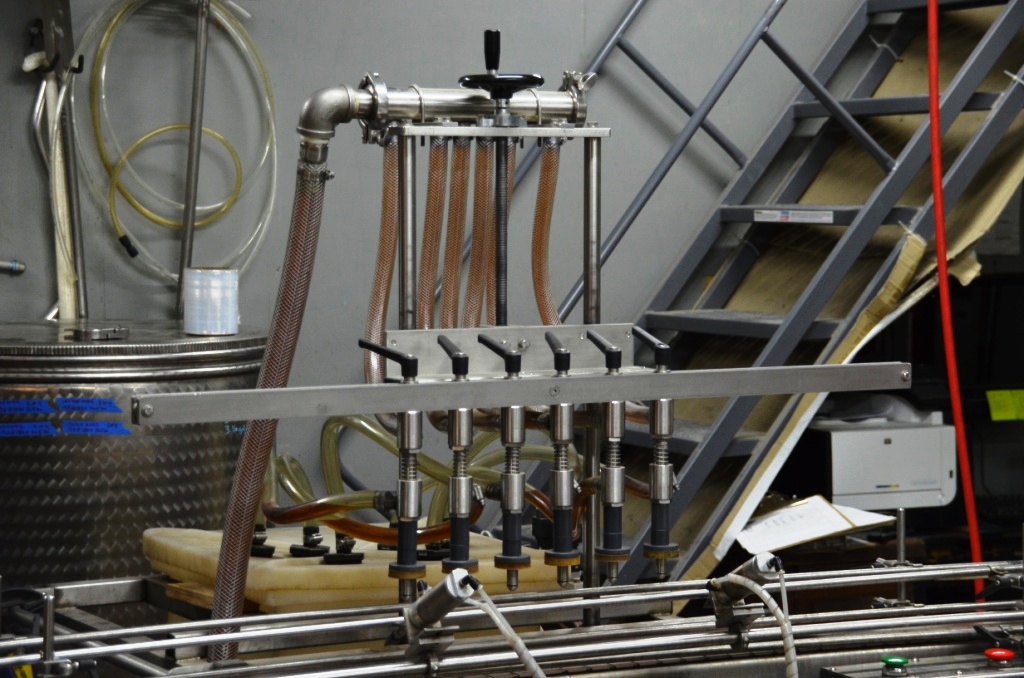
this is where the bottles are filled
Then the bottles are closed with cork, and dipped into the hot wax and lastly, labeled:
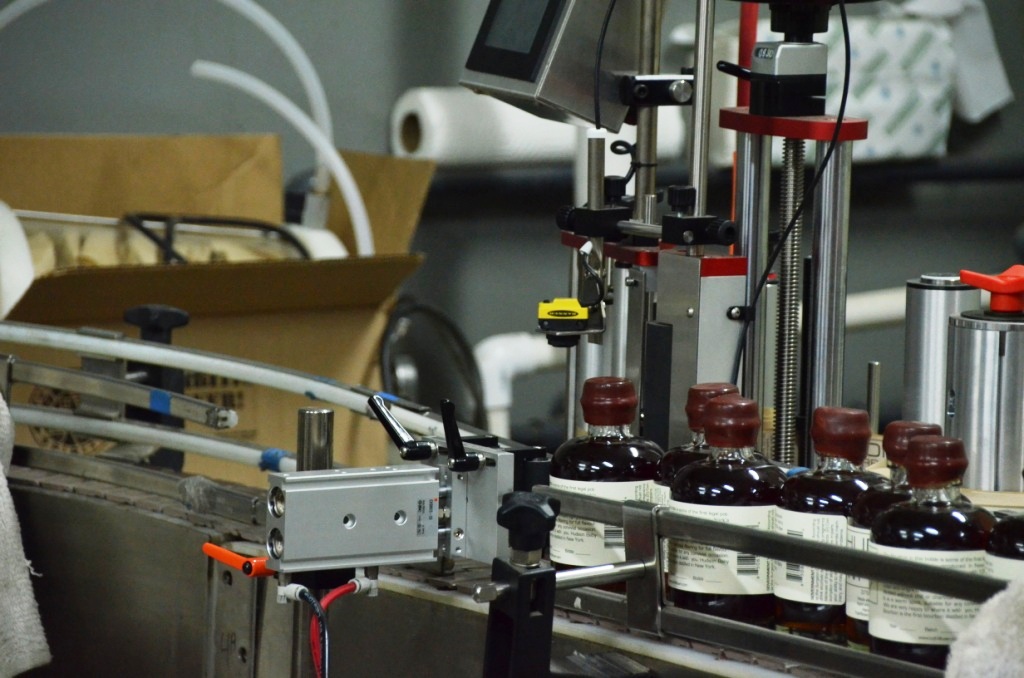
labeling part
Labeling was one of the most mundane tasks which Tuthilltown automated very recently. By automating this task, it allowed people to use the freed up time for something useful and creative – and the new product, called Basement Bitters was born ( beautiful aromatic drops for your cocktail).
And once you are done with the labeling, you get … lots of whiskey, ready to be numbered (by hand!) and shipped for all of us to enjoy:
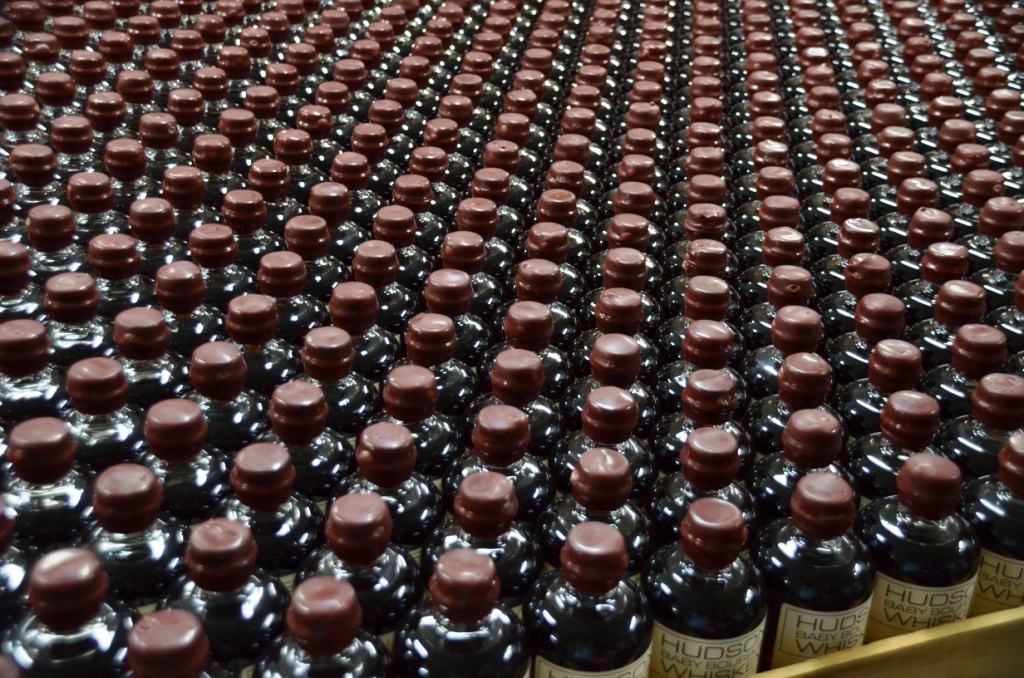
Ready to go

yes, ready
And of course after the tour you can go and taste the whiskey (and vodka, and gin) in the tasting room:

Tasting time!

Don’t forget the bitters
Tuthilltown lineup includes Indigenous Vodka (made out of apples), Half Moon Orchard Gin, Hudson New York Corn Whiskey (unaged), Hudson Baby Bourbon, Hudson Four Grains Bourbon and Hudson Manhattan Rye Whiskey ( last three are all aged whiskeys). Hudson Baby Bourbon is my favorite, but hey, you have to taste it for yourself.
And I think we are done here. I hope you found the time to watch the video. And what I want to leave you with is this:
Dictionary.com defines “gumption” as:
2. courage; spunk; guts
Follow your dreams! Cheers!
Wine … It Will Get You In Trouble
In June 2013, Jeff a.k.a.The Drunken Cyclist, started the Monthly Wine Writing Challenge, where the new theme is announced on about the monthly basis by the winner of the previous round. This month’s theme, as announced by The Armchair Sommelier, is “Trouble”.
To be entirely honest with you, I was about to give up on this challenge, as I couldn’t associate “wine” with “trouble”. Before I would “officially” give up, I did what would [probably] most of the married men do – ask the wife’s advice. So the first thing she said, “what do you mean you don’t know what to write about? How about the time when you quietly drunk most of the home-made plum wine when you were a kid”? Yeah, but I really never got into trouble for that, don’t think it was even noticed. “Okay, fine”, she said, “so what about that girl in the wine store…”? Aha – you could probably hear my brain clicking – now we are onto something…
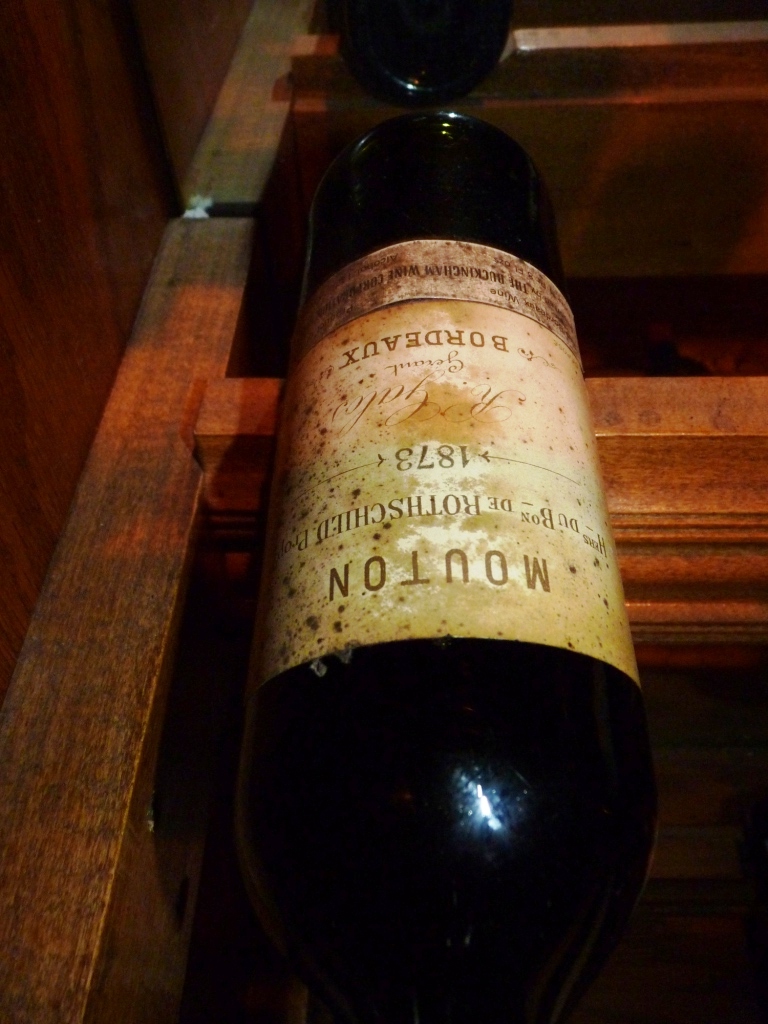
Mouton Rothschild
When you look at the bottle of wine, do you see a trouble lurking around ? No? Well, let me help you.
Think about bottle shapes. Probably 80% of all the wine bottles made worldwide will fall into one of two shape categories – Bordeaux or Burgundy. Yes, there are some shape variations even in those big classes, but they are nominal. Which means that if you will put next to each other a bottle of Bordeaux which retails for $6.99 and the one which will command $699, they will look very, very similar. What differentiates them? Yes, of course the content, but this is not something you know just by looking the bottle. So the only things which will differentiate those two bottles will be labels. See the trouble yet? Let’s continue.
In the wine store, one is guided by the visual cues – namely, the price tags. Take the cues out – and then even labels look identical. Yes, yes, before you call me an unintelligent low life and stop reading, give me a few more minutes and you will see where am I going. Of course, for the small group of crazy devoted wine geeks, every little word on the label is cherished and carefully assessed. 1982 vintage? Bordeaux? That’s nearly a heart attack. Tiny letters RM on the bottle of Champagne. La Turque, Qunitarelli, Alban, 1961, Pingus, Latour, 2000, To Kalon, Colgin, Riserva… I can go on and on and on with all those cherished words. We see any of those words on the label of the wine bottle, and the brain immediately sends out command for awe and appreciation.
Now, step outside of this crazy devoted circle. Outside of the wine store, does the bottle of 2009 Chateau Latour Bordeaux (about $1,600 per bottle, if you can find it) looks all that different from 2009 Chateau Moulin de Beausejour Bordeaux ($6.99, readily available at your Trader Joe‘s)? No, not really. Bottles look very similar in shape, both say “Bordeaux”, both have the same vintage listed – 2009, both have the word “Chateau” on them. Do you see it now? The trouble is not lurking anymore, it is looming, as a huge stormy cloud, full of wind and water.
Let me give two examples. Here are two real life stories of my friend Zak, the owner of the wine store in Stamford. The first one I only heard from Zak, and second one I witnessed myself.

2006 Ornellaia – sorry, Zak was out of Sassicaia
The lady comes into the store and asks for help. “I’m looking for the bottle of the Italian wine. I don’t remember the exact name, but I think it starts with “S”. If you will show me what you have, I will be able to recognize it”. Zak takes her to the Italian wines section. The lady looks around and says excitedly “this one!”, pointing at the bottle of Sassicaia. Then she looks at the price tag ($179 or so), looks at Zak, back at the price tag and says with the hope in her voice: “this is the case price, right?”. “No, madam, this is the bottle price”, answers Zak, and lady’s face becomes all overwhelmed with he emotions and she mutters “ahh, no wonder my husband got so upset when I used this wine for the pasta sauce…”. Turns out the husband was not at home, and the lady was looking for the bottle of red wine to add to the pasta sauce, and the bottle of Sassicaia looked not any different than any other bottle of the Italian wine… Trouble!
I’m standing in the store talking to Zak. The girl comes in with the bag of empty bottles and starts putting them one by one on the counter and then tells Zak: “I need to get this exact wines”. I’m, of course, curious, and I’m picking over Zak’s shoulder as he is looking at them one by one. Some kind of Spanish wine. Something else I don’t recognize. 1995 Chateau Mouton Rothschild. 1999 Riesling. Something … Wait, what? Mouton Rothschild 1995, one of the First Grows Bordeaux? That will be interesting. Zak points at that exact bottle and says: “I don’t have this wine, miss, and it will be hard to get it as this is an old vintage”. The girl asks if he can get the current vintage. Zak looks in the catalog and says “well, I’m not sure if it will be available, as this is highly allocated wine, but if it will be, it will be about $900… Yes, for a bottle”. You should have seen despair and horror on the girl’s face. Turns out her uncle left on a long trip, and left the girl to be house-sitting. Of course having the house party with the full access to the cellar was not what her uncle planned for, and now that he was coming back soon, the girl was on the recovery mission. Is that a trouble? One look at that girl’s face would tell you – yep, big time trouble!
There you have it, my friends. Wine is a dangerous thing, with the “trouble” spelled all over it… Or not. While there can be multiple personal “troubles” around the wine, which will seem serious to the person experiencing them (think about that girl), in a big schema things, we need to remember that at the most, all those troubles will become great (and funny, for the most part) stories to tell later on. Wine is just a beverage, and there always will be another bottle to drink. I can only wish to all of us, that the wine troubles would be the biggest troubles of our lives. You can pour another glass now. Cheers!
Screw Top Versus Cork – The Jury Is Still Out
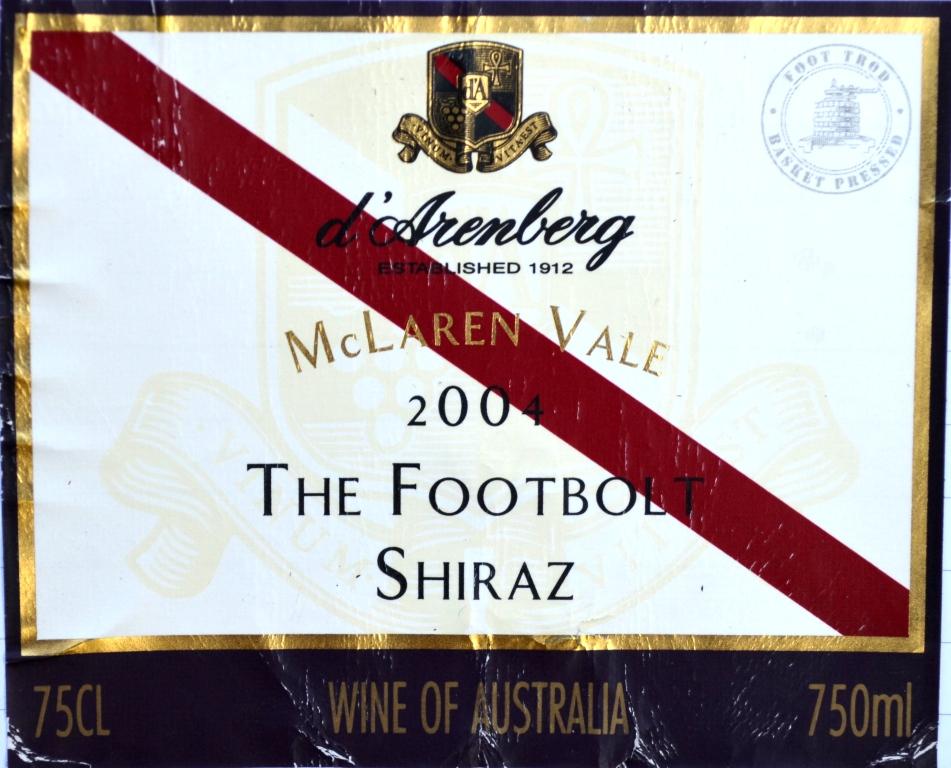 Inadvertently, I run an experiment of cork versus screw top, and the results were interesting enough to discuss them here.
About a week ago, I pulled out of the cellar (which is actually a wine fridge) the bottle of 2004 d’Arenberg The Footbolt Shiraz MacLaren Vale from Australia (14.5% ABV). As I confessed in my blogging addiction in the recent post, before the bottle is open, in addition to just regular anticipation of wine experience itself, now I have added anticipation of the possible blog post which can be written based on the wine experience.
Or not. There are many possible was for the experience not becoming a blog post. Too many things to write about, too little time. Or you just hit the “writer’s block”. Or the experience is not worthy of being captured. Which was the case with this Shiraz.
d’Arenberg is a well known Australian winery, which just celebrated 100 years last year, producing substantial range of typical Australian wines, such as Shiraz, Grenache, Chardonnay, Cabernet Sauvignon and more. I had pleasure of meeting Chester Osborn, d’Arenberg’s winemaker in third generation, and even have couple of bottles with his signature in my cellar (by the way, what do you do with those signed bottles? I should make a separate post to discuss this interesting question).
Now, I didn’t know what to expect from this bottle of Shiraz. The Footbolt is one of the introductory level Shiraz wines from d’Arenberg, but that doesn’t mean anything. Cork is out (regular cork, just keep reading to see why it is important), and judging by the color alone, this wine didn’t reach its prime yet – dark ruby in color. But the nose and then the palate were inconclusive. Acidity would jump up and down with every sip, and while the wine had enough fruit, it was simply not getting together, definitely lacking the balance which is all so important for me in the wine. So, based on this wine alone, the blog post was not born.
And then yesterday I pulled out another bottle of d’Arenberg wine from the same vintage:
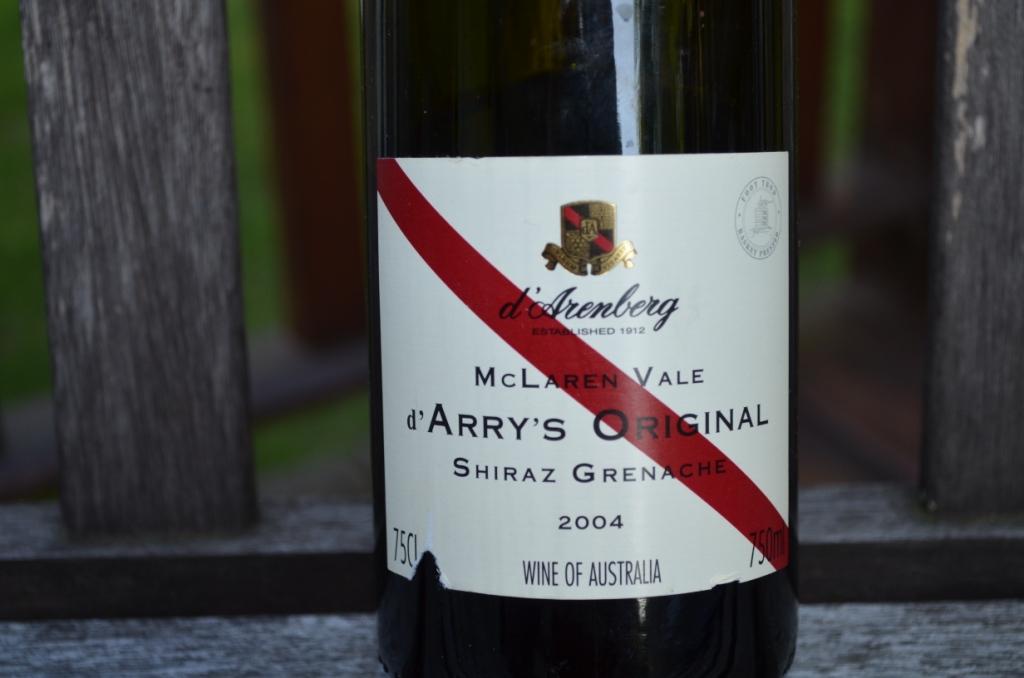
d’Arenberg Shiraz Grenache
2004 d’Arry’s Original Shiraz Grenache McLaren Vale (14.5% ABV) – a blend of 50% Shiraz and 50% Grenache . With the screw top. That was an “aha” moment. Same vintage as the previous wine – but wit the screw top – how different the experience will it be?
No “pop” of the pulled cork. Just a quiet “tsk-tsk-tsk” of unscrewing the top. In the glass, this wine looked like it was made yesterday – dark ruby, very concentrated color. From the get go, the wine showed beautiful fruit on the nose, ripe plums, equally supported on the palate with fresh fruit and energetic acidity.
About 45 minutes or so later, when I poured another glass, the wine tasted almost sweet – the thought was “what happened”? This was a totally a different wine compare to the way the wine started. Another half an hour or so – and we were presented with the new wine again – dark concentrated fruit, firm structure, tannins and acidity all summing up into a gorgeous balanced wine.
Wine ageing in the bottle is typically associated with the tiny inflow of oxygen through the cork. In case of screwtop, the oxygen doesn’t get to the wine at all. Thus my theory is that once you open a bottle under the screwtop, the very quick ageing process starts off, which takes the wine through the different “taste stages” in the rapid succession. Then at the same time, the wine is changing its taste in the glass no matter what, so may be that rapid taste changing has nothing to do with the way the bottle was closed.
Ideally, of course, I would love to compare two identical bottles (same wine, same vintage), only one closed with the screwtop and another one with the regular cork (I believe I actually read about some producers who are doing that). In this experiment, the Shiraz Grenache under the screwtop was a clear winner, but it is hard to tell what it has to do with the screwtop versus regular cork versus the two wines being just differently made.
I guess I can end this report with the words “to be continued…” – and I would love to hear your thoughts. Cheers!
Rioja for the Stars, Or Don’t Miss The Oscars on Sunday!
And the Best Picture Award goes to … what, do you really think I know? Even if I do, I’m not telling… But – I know what you should be sipping while watching all the glitz and glamor – Rioja!
Why Rioja? May be because this is one of my all time most favorite wines? Okay, yeah, never mind. Then may be because Rioja is ready for the big Oscar celebration?
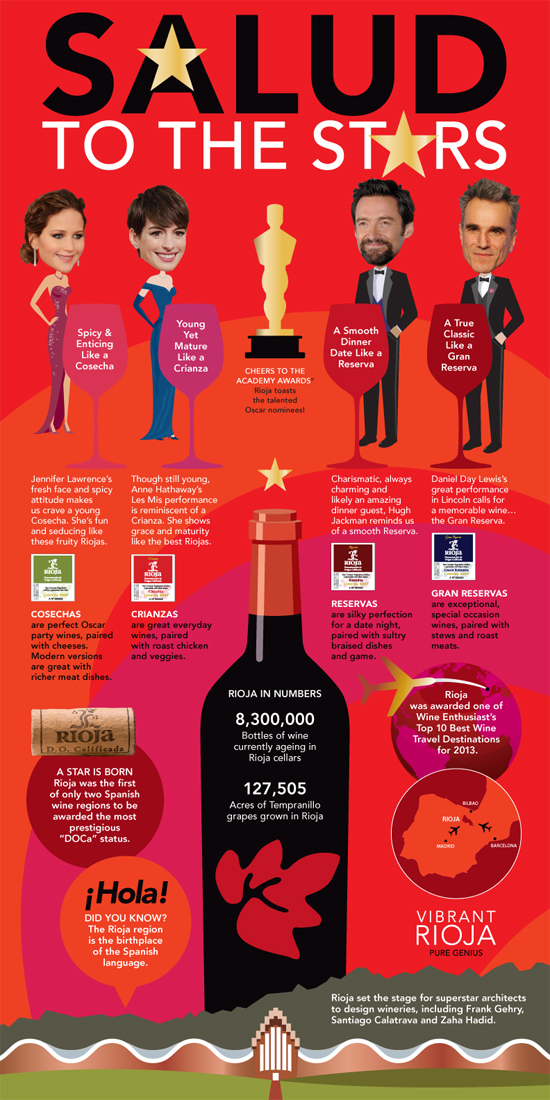
Yep, here is tons of information about Rioja and your favorite actors – all courtesy of Vibrant Rioja!
You can also mark your winners in advance and play the game of “Told you so!” later on with your friends:

Here is the link if you want to download an actual PDF file.
So, what are you going to open? I heard that 1996 Lopez de Heredia Viña Tondonia White Reserva should be able to help you to get through the opening ceremony, and 2001 La Rioja Alta Vina Ardanza Reserva Especial will pair perfectly with the “Best Movie” award, but then again, it is your choice.
No matter what you will end up doing, I hope you got my point – Rioja is always appropriate, no matter what the occasion. Open the bottle and enjoy! Cheers!
Words of Wisdom For All The Bloggers Out There – Seth Godin: Writer’s Block and The Drip
How many of you heard of Seth Godin? He has done (and continues doing) a lot of things in this life – he is an entrepreneur, a marketer, a consultant, an author, but I think above all, he is The Mentor. His books, his blog posts, his seminars are teaching, motivating, pushing, pulling, making uncomfortable, touching hundreds and hundreds of thousands of people around the world (quick example – Seth Godin is in 98,000+ circles on Google+).
I’m subscribed to his blog, and every day a get a little snippet of wisdom. Sometimes it is 2 lines. Sometimes, it is 20 lines. It resonates 99 times out of a 100 – for me it does. Unfortunately, I act upon what I read about 0 times out of a hundred, but this is a whole another story.
Seth’s Godin’s post of couple of days ago stroke a cord again – and this time it is about blogging. I know that many of my readers are also passionate bloggers, so I want to share this with you. Enjoy!
Touching Time
 I have a special fascinations with man made things which last through time. I remember looking almost in awe at the stone in London which had guarding rail around it and little plaque declaring that this stone was laid there in 1012 (I might be off by a few years, but you got the idea). On another occasion ( about 20 years ago, very shortly after I came to US), I was visiting Metropolitan Museum in New York, and I saw a large structure in one of the rooms which resembled Egypt Pyramid, actually bearing the age of many thousands years. I couldn’t help myself not to put a hand on the wall and touch those thousands of years – the very next second extremely loud and angry voice came out with the words “Don’t touch the Temple!”.
Wine holds special place for me when it comes to its relationship with wine (here is an earlier post on that subject). While in Miami, I was able to literally touch upon wine and time once again (only touch, not taste). We went for a dinner to the restaurant called The Forge, located in North Miami Beach. This restaurant is a landmark on its own, being in existence sine 1920s. But the object of particular interest is their wine cellar, located on the lower floor.
From the first look you take on those bottles, the only thing you can say is “wow”. Then you say it again and again, as you walk around that spacious cellar, beautifully appointed in mahogany. Inside the cellar there is a separate gated section which holds owner’s private collection. That collection has a full line of Chateau Lafite, starting from 1822! The collection is curated by the Chateau Lafite itself, and recently the bottles were re-corked and toppled off with 1982 Chateau Lafite, which was deemed “good enough” for that purpose.
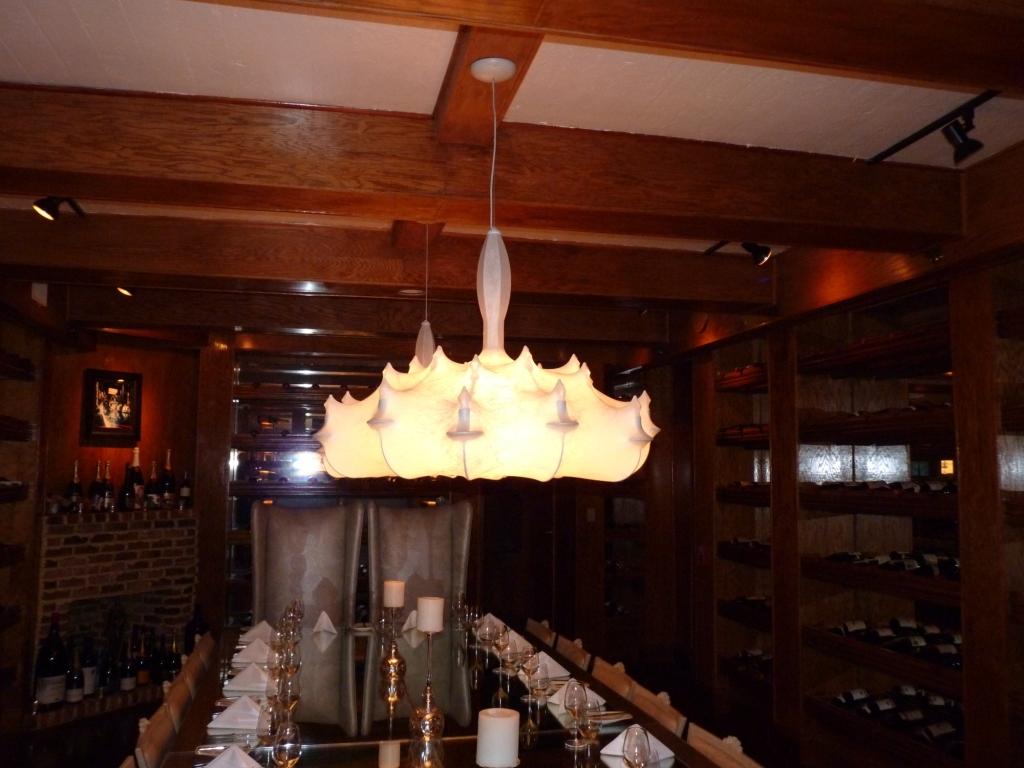
Leaving owner’s collection aside, the main cellar holds so many jewels that any oenophile will tremble in the knees just walking around. Here are few pictures I would like to share with you.
1873 Mouton Rothschild: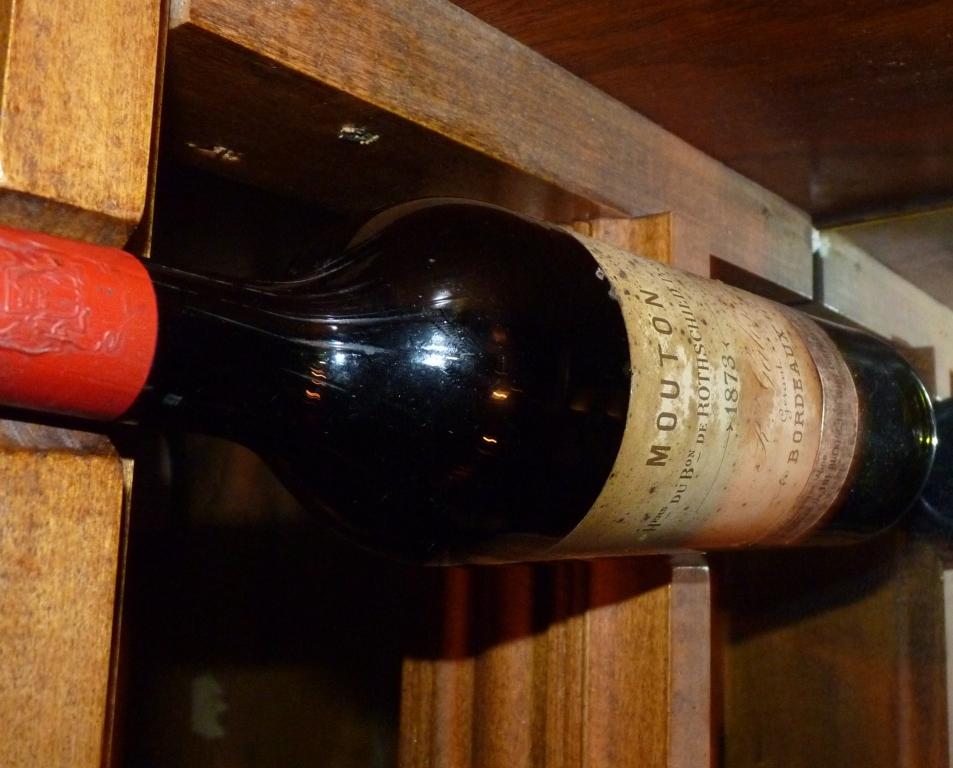
Here is close up on the label, in case you can’t see well enough on the previous picture:
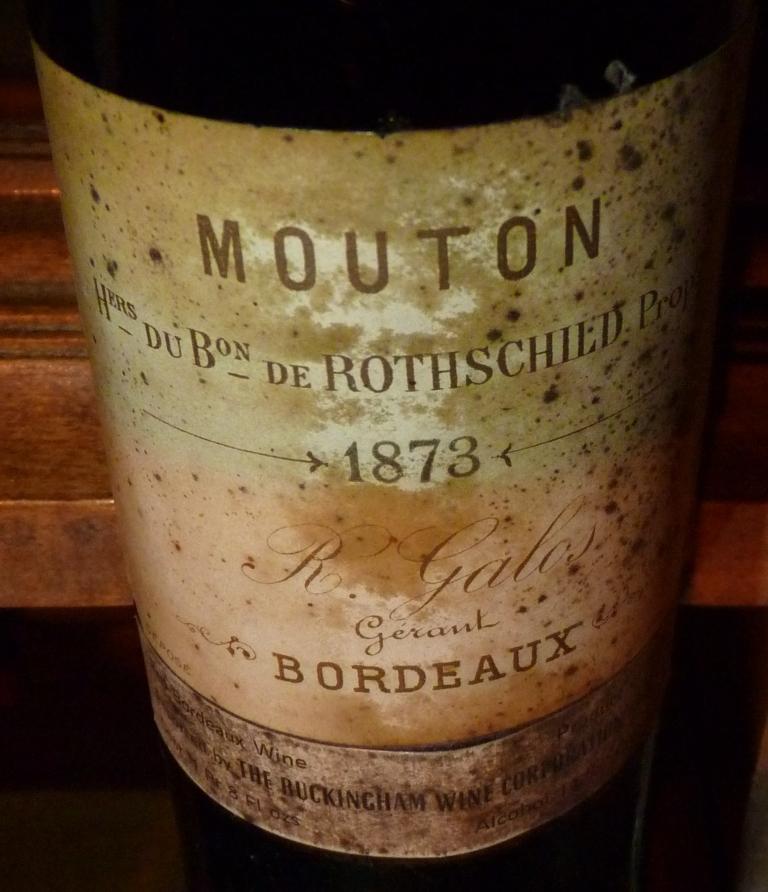
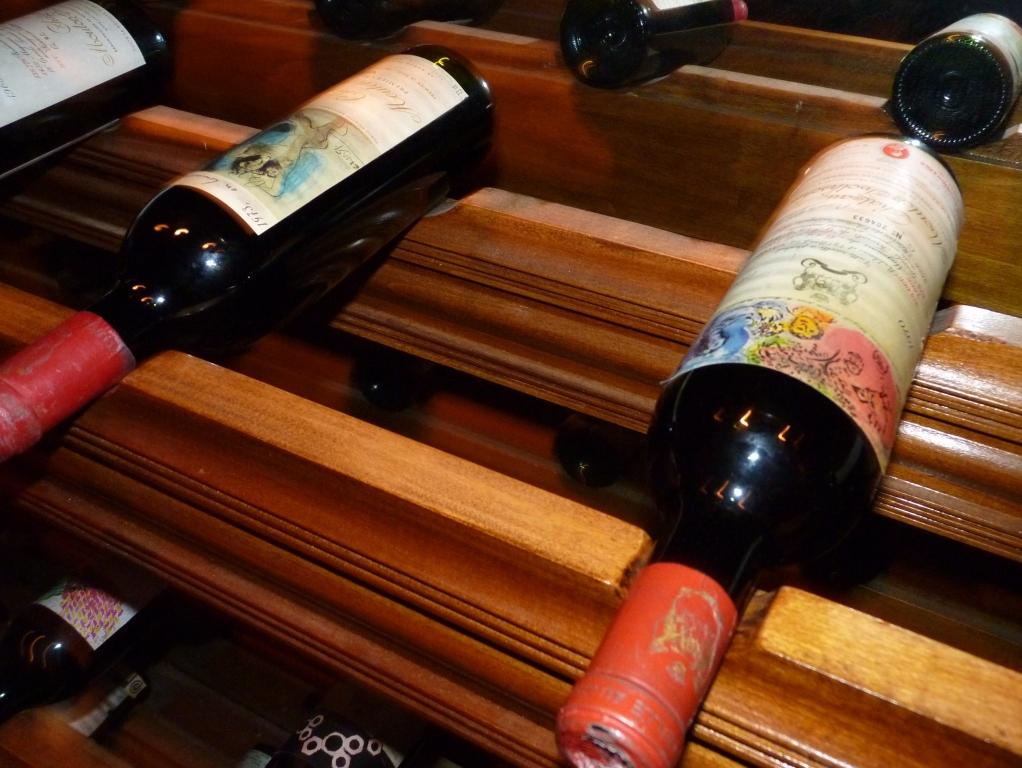
Mouton Rothschild Artistic series ( don’t know if picture is good enough for you to see, but it is Chagal and Picasso labels):
Domaine Romanee Conti, of course:

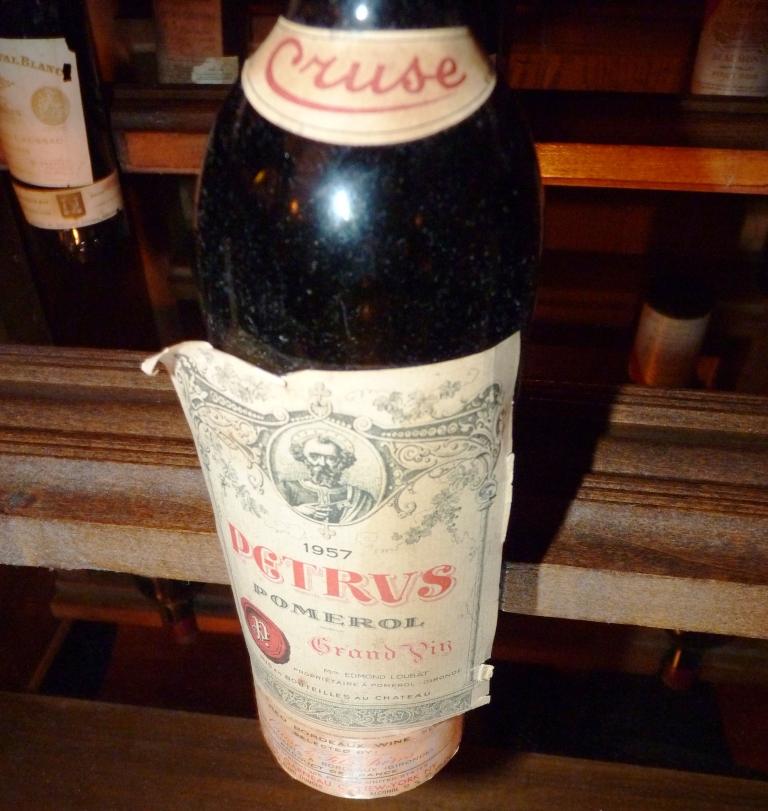
Look at this beauty – 1957 Petrus!
The cellar holds quite a few large format bottles:

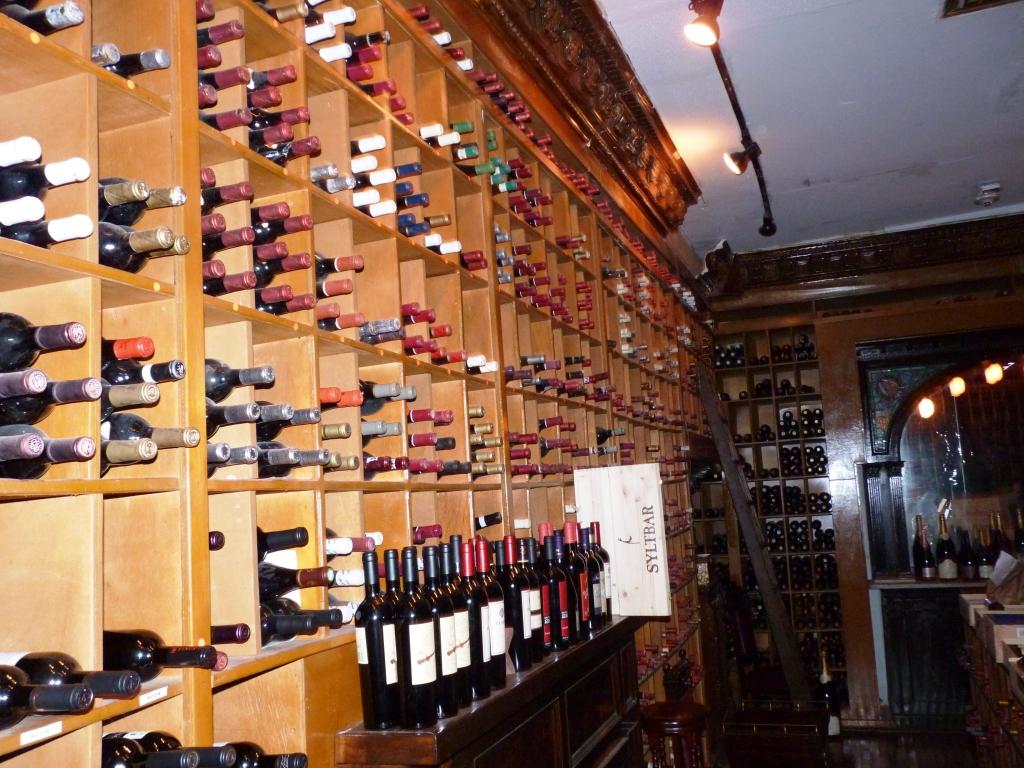
And here are couple of general views ( note that cellar is available for private parties…):
And one more:
 If you are curious if the opportunity to look at the bottles was enough to replace the dinner – no, we had dinner there – but food was not on par with the view we had before.
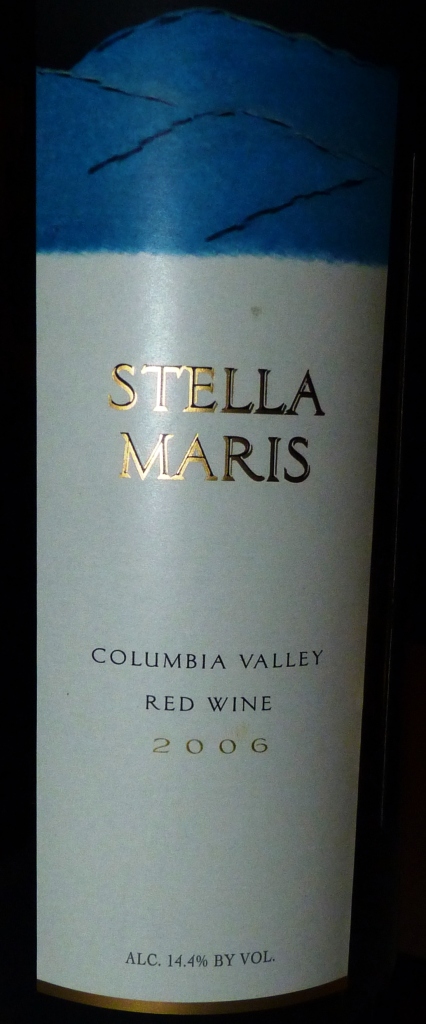
We did pretty good with the wine – 2006 Stella Maris Red Wine from Washington state was nice, round wine, with good red and black fruit both on the nose and the palate, good acidity, medium to full body. Overall, while wine list appears to be a huge book, split into countries and styles of wine, it is not easy to find something interesting and affordable at the same time. Of course, you will be gladly served that 1957 Petrus for about $45,000, so if you plan to celebrate something that special, can I please (did I say “pleeease”?) get an invitation?
Talking about the food, for the appetizers we ordered Salmon Croquets and Roaster Cauliflower florets. The Cauliflower was probably one of the tastiest I ever had, but the salmon croquets were on the mushy side. Here is the picture:

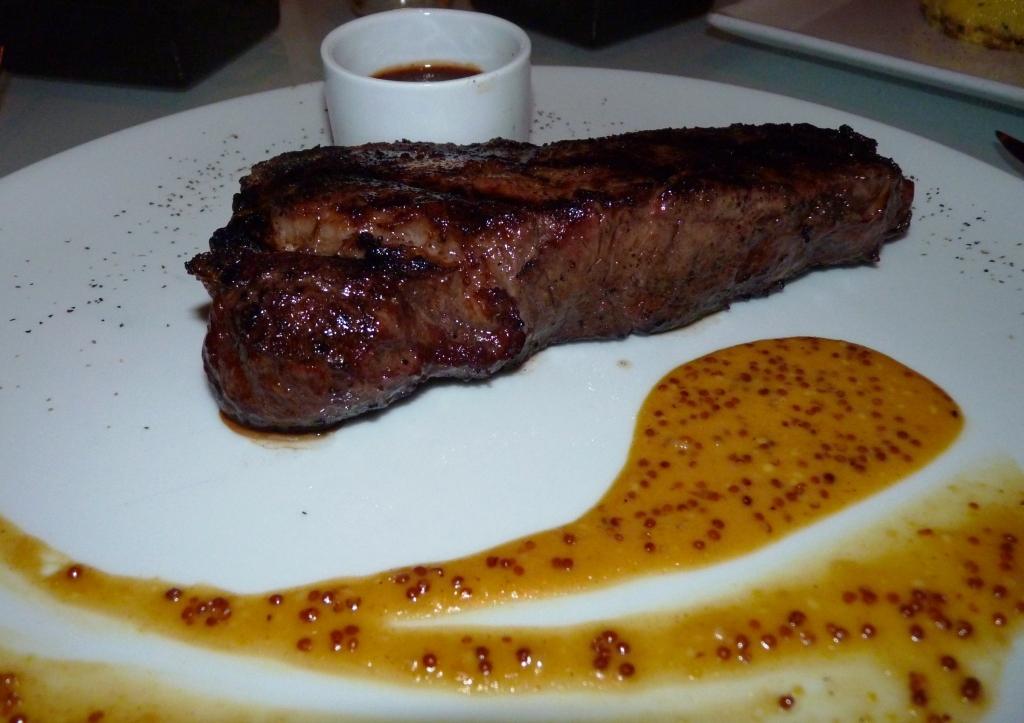
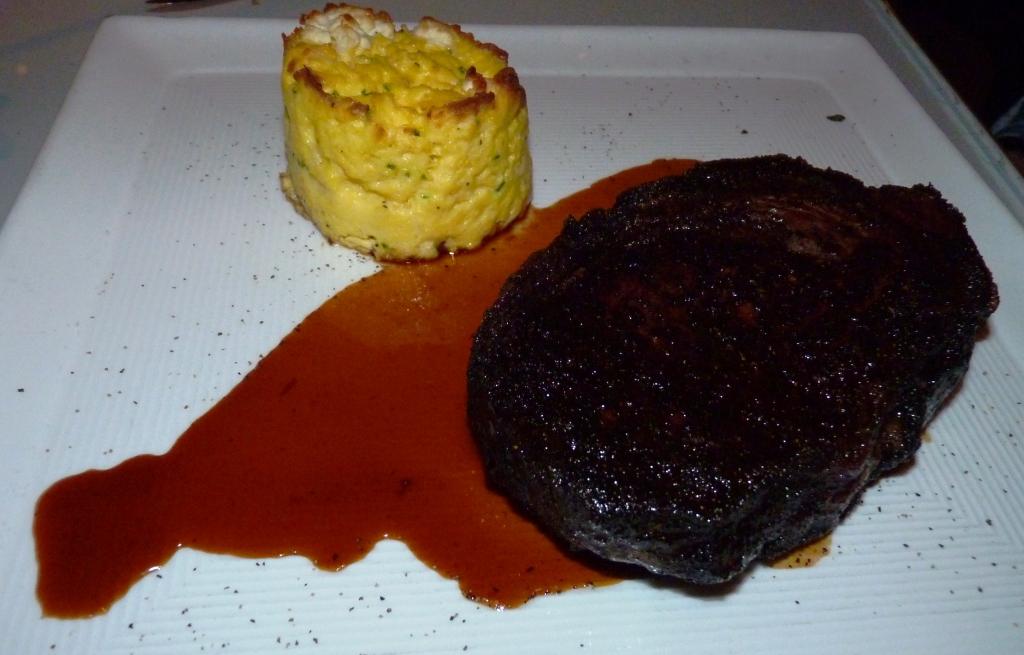
Then we had two steaks, and while the place is considered to be a steakhouse, they were just average, not memorable at all (I would gladly take instead Capital Grille steak at any time). Here are two pictures –
New York Strip:
And “steak and eggs”, steak was encrusted with coffee and pan-seared:
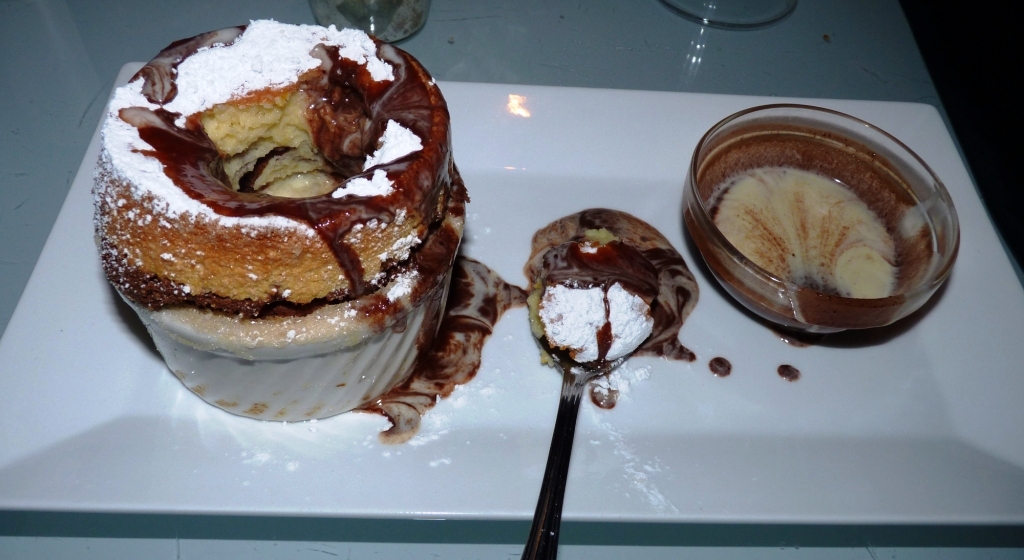
The dessert somewhat compensated for the entrees, though, as it was the best souffle I ever had – chocolate grand marnier souffle:
All in all, it was a great and very memorable visit. If you have an expense account, your possibilities are endless at The Forge. If you are like me, coming for the great “wine and time” experience, you might have better luck with fish. Cheers!
Wine and Time
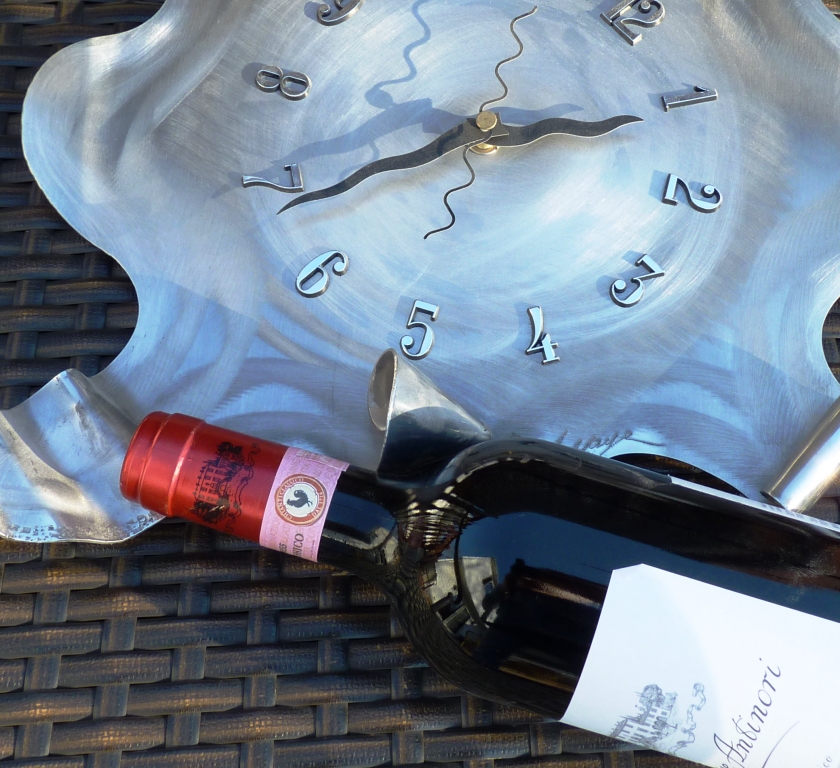 Of course time had being here forever, always moving, and always in one direction (someone, please prove me wrong!). Wine had being around for about 8,000 years, first appearing in the ancient Georgia (no, not the one down south, but the one from the Caucus region, on another continent). Wine is one of the few products literally not changed for such a long time in its form and its production methods – sans reverse osmosis machines, electrical presses and micro-oxygenation boxes. Considering such a long history, you can imagine that relationship between wine and time is very complex, and you would be right.
First, time is a necessary part and an attribute of the wine making process. For the vast majority of wines, if you read winery’s description of the wine, you will see something like “aged for so many month in …”. Sometimes the wine is aged in stainless steel tanks. Sometimes the wine is aged in clay vessels (very popular in Georgia now, the vessels are called Kvevri and produce very distinct wines). Lots of red wines are aged in oak barrels – American oak, French oak, Hungarian Oak, new oak, old oak – variations are endless. For many wines, duration and the type of the aging is a sole decision of winemaker (no pressure, but this decision will greatly affect quality and the taste of wine, and will define success and failure for it). For some of the wines, aging in a specific type of barrels is mandatory before the wine can be released – Rioja Gran Reserva should be aged for a minimum of 2 years in oak barrel and 3 years in the bottle to be officially designated as Rioja Gran Reserva. Barolo must be aged for 3 years, at least two of them in the oak barrel, and Barolo Riserva should be aged at least for 5 years. During the aging process, the wine is changing. Oak imparts very specific flavor, which we, humans, tend to like. Oak aging also acts as a preservative and helps wines to live long life.
Once all the aging is complete (in the tanks, barrels and bottles – whatever the aging was), wine is released – and this is when the second phase of the wine and time relationship kicks in.
This second phase is as tricky, if not trickier, as the first. Have you heard the phrase “needs time” in relation to the particular bottle of wine? If you will look at the wine reviews in Wine Spectator or any other publication which provides wine reviews, you would often see one of the phrases “Drink now”, “Best 2014-2020”, “Best after 2013” – these are the suggestions for how long the wine should be kept in the cellar before it should be consumed.
Why is that? What with all this aging? Why not open the bottle right away and just drink the wine? What was discovered at some point (don’t ask me when, but it was long time ago) is that wine actually changes its taste as it spends time in the bottle (the aging). And it doesn’t just change the taste arbitrarily, it tastes better. Young wines are often sharp, or somewhat single-toned in their taste – you might get pronounced acidity, or only sweetness, or lots of white apples – but only white apples. During aging, trace amounts of air are making its way into he bottle, and they lead to the wine changing its taste, improving to the better in majority of the cases – it becomes complex, bite softens up, bright and diverse fruit tones compensate for the pronounced acidity and the wine brings a lot more pleasure compare to the young wines. Mature wines deliver more pleasure – this is the whole philosophy behind wine aging.
Simple and easy, right? Well, this is were everything becomes complicated and confusing – as not all the wines should be aged (do not try to age Beaujolais Noveau, please) and also it is very tricky to make sure you would drink the wine at its peak – as whatever comes up, goes down in mother nature. This is where time transforms from the friend to the foe – and as a foe, it is merciless. After reaching maturity and staying there for a while, the wines are typically starting their decline in the taste (wine loses fruit, become very acidic, may be oxidized – and it stops delivering pleasure). Different wines made in the different styles will have different peak times and different lifespans. Some of the Jerez, Madeira and similar wines can go on literally for the hundreds of years. Good Rioja, Barolo or Bordeaux can be perfectly aged for 50 years or longer. Simple Cote du Rhone might only last for 3-5 years, same would be true for many of the Chardonnay wines. There is not crystal ball telling you precisely how long the wine will last and when will it taste the best – human trial and error is the best way to find that out. Of course there are many factors which might help you to decide whether to age the wine and if yes, for how long – the winery, the winemaker, the region’s wine style, success of the vintage and many others – but in the end of the day you would need to do the work (err, I meant the wine drinking) as the wine ages to find out when it tastes best to you.
So, does it worth to age wines if you don’t know what will happen to them in the end? For anyone who is into wines, and who had an opportunity to try a mature wine, the wine which reached its optimum taste, I’m sure this is a no-brainer question – yes, of course, and please, please give me more.
How one can experience aged wines? You got a few options. First, you can age it in your own cellar. Second, you can buy aged wines, either in a good wine store, such as Cost Less Wines in Stamford or Benchmark Wine Company. Note that you have to buy aged wines only from the trusted source – not aging the wines in the right conditions will simply ruin them, so you have to trust your source. Third option is to attend a wine tasting, such as PJ Wine Grand Tasting, where you can taste really amazing wines. However, you don’t have to wait of the Grand tasting, which takes place only once a year. If you live in a close proximity to Stamford, CT, you can attend a wine tasting at the Franklin Street Works gallery on Thursday, January 19th at 5:30 pm (here is the link for RSVP). The event is free and open to all. Here are the wines which will be presented in the tasting (the list might change at any time):
2003 Riesling, Mosel Saar River, Germany
1998 Merlot, Italy
2009 Stag’s Leap Hands of Time, Napa Valley
2009 Stag’s Leap Hands of Time, hyper-decanted using Nathan Myhrvold’s methodology.
So you should come and experience the relationship between time and wine for yourself – there is a good chance that you will even enjoy it! Cheers!
Last Bottle Sign Up ($10 credit)




 Talk-A-Vino