Archive
Daily Glass: Oregon Pinot Delight
 If you like Pinot Noir, you already know that Oregon Pinot Noir is one of the best Pinot Noir wines in the world. Wonderful Pinot Noirs are produced everywhere, yes, but Oregon definitely holds its own. Heck, according to Ken Wright, it is better than Burgundy, the hallmark of Pinot Noir wines. “We can see the Burgundy Pinot Noir in the rear view mirror,” Ken said in my interview with him for the Stories of Passion and Pinot series on this blog.
Hey, I’m not trying to start here some sort of scuffle “which Pinot Noir is better” – I only want to share a wonderful experience I had with an amazing Oregon Pinot Noir, luckily even with some age on it.
I got literally double pleasure writing about this wine, as not only does this wine come from one of my favorite producers (sigh, who has now retired), but I also had a great interview with this producer for the same Passion and Pinot series – Vidon Vineyard.
I was in Bellevue, Washington, for work, and had a chance to meet my good wine friend Wendy, who happened to live just 5 minutes away from the hotel where I was staying. When we figured out that we would be able to meet, Wendy said, “I will get some older Pinot for you from the storage”. She knows that I love Pinot Noir, but I also know that she is a fan of bigger wines (think young Cayuse), so I didn’t know what Pinot that might be.
Seeing her with a bottle of 2014 Vidon Vineyard Brigita Clone 777 Estate Pinot Noir Chehalem Mountains made me very happy.
11 years old Oregon Pinot Noir under a glass enclosure (Don Hagge, proprietor at Vidon Vineyard and ex-NASA scientist, was religious about using glass corks) – a great opportunity to learn how well Oregon Pinot Noir under a glass enclosure ages. Plus, it is Vidon Pinot Noir, and you don’t need to ask me twice to drink Vidon wines.
The reason Wendy picked that wine is because she finds Pinot Noir wines made from the 777 clone to be a bit bigger than your average Pinot Noir, so she gets to enjoy the wine too. I have to tell you that after a glass of the Pinot, she switched to the 2 years old Cabernet Sauvignon from Darby – a great Washington producer, but I need a good dollop of time with his wines to be able to enjoy them.


The Vidon Vineyard Pinot Noir was just a pure pleasure in the glass. Brilliant garnet color, the classic Pinot nose of plums, cherries, violets and a whiff of smoke – the aromas you can enjoy for a while without taking a sip. The palate followed with succulent, fresh berries, plums and cherries, a touch of smoke, sapidity and umami, roll-of-your-tongue beautiful and seductive “ha, I know you want another sip” elixir, perfectly balanced with the finish you can reflect upon.
We decided to get a Thai food takeout for dinner – I had mildly spicy beef drunken noodles, and to my great surprise, this Vidon Pinot Noir perfectly complemented the food.
That’s my story. There is a bit of a sad part here, as Don Hagge sold his winery a few years back, and it doesn’t look like the new owners will uphold the level of perfection Don was so attuned to. If you have Vidon wines in your cellar, don’t be afraid to keep them a little longer. And if by some miracle you will come across Vidon wines in wine stores – buy whatever you will be able to, as you will not be buying wine – you will be buying pleasure.
Pinot Noir Battle – Let the Best (but Most Unexpected) Win…Again
It all started with a few tweets. I noticed a very high praise for the German Pinot Noirs shared by some of the European wine lovers I’m connected to on Twitter (still can’t make myself call it X, so you will have to forgive me for that). Particularly, Pinot Noir from Ahr was regarded as the best in the world, handily beating Burgundies on any occasion. I was intrigued and started searching for the Pinot Noir from Ahr, which proved to be challenging.
Ahr is a tiny region, one of the smallest in Germany – according to Wines of Germany, Ahr has only about 529 hectares of vineyards (around 1,323 acres), which comprises 40 single vineyards. 65% of the vineyard area is planted with Pinot Noir, about 860 acres – for comparison, the Jackson Family mostly Pinot Noir plantings in Oregon alone amount to roughly 600 acres. You can imagine that finding Pinot Noir from Ahr in the US was rather challenging.
The more I saw Ahr Pinot-praising tweets, the more I wanted to try it. Then one day I checked Wine.com, and there it was – Pinot Noir from Ahr, made by Meyer-Näkel. I quickly went to the Twitter folks to check if this wine would sufficiently represent the Ahr region, got an approving nod, and bought a bottle.
Once the wine arrived, I thought of the best way to try it. When it comes to learning about wine, tasting wines side by side is the best way to learn. Oh yeah, and if you want to be honest with yourself, blind tasting is the only way. We tend to be led by what we know, by our beliefs. Once we know that the wine costs $100, we want to believe that it is better than the bottle which costs $50. Once we see a bottle of Cabernet Sauvignon from Napa Valley in California, we automatically assume that it will be much better than the Cabernet Sauvignon from Lake County or Lodi. Nothing is wrong with us, this is how the brain works – so once you remove all the factors of influence, once you get one on one with the liquid in your glass without knowing the producer, the region, the price – it is very easy to be honest with yourself. So blind tasting it is.
Sometimes we don’t realize how fast the time passes. I love talking about blind tastings when I’m talking about wine, and I have a few of my favorite blind tasting examples, one of them particularly being the Pinot Noir blind tasting we have done in the past. What I didn’t realize is that the particular wine tasting I remember so well took place almost 15 years ago (time flies, isn’t it). The outcome of the tasting was very surprising, with South African Pinot Noir from Hamilton Russell beating California, Burgundy, and others – 15 years ago I didn’t even know that South Africa produced Pinot Noir!
Many things have happened in the wine world over these 15 years – of course, Pinot Noir is one of the oldest red wines produced in the world, but now it is literally produced everywhere – I don’t know if today there is a country which doesn’t produce Pinot Noir wines (maybe Spain?). Also, the quality of Pinot Noir throughout the world got a lot higher. The tasting you are about to read about is the perfect illustration of both points – the widespread geography and quality.
Okay, a blind tasting of Pinot Noir. The Ahr Pinot Noir got high praise, so we need to compare it with the best of the best – which means that we have to have California, Oregon, and Burgundy in the tasting, plus whatever else we might be able to find. I asked for a few samples of Oregon Pinot Noir. Very conveniently, Last Bottle had an offer for Chacra Pinot Noir from Patagonia – a different Pinot Noir from Chacra was James Suckling’s wine of the year recently, so this was a good addition to the tasting. Bottle by bottle, we assembled 12 Pinot Noirs from around the world, and the battlefield was ready to be set up.
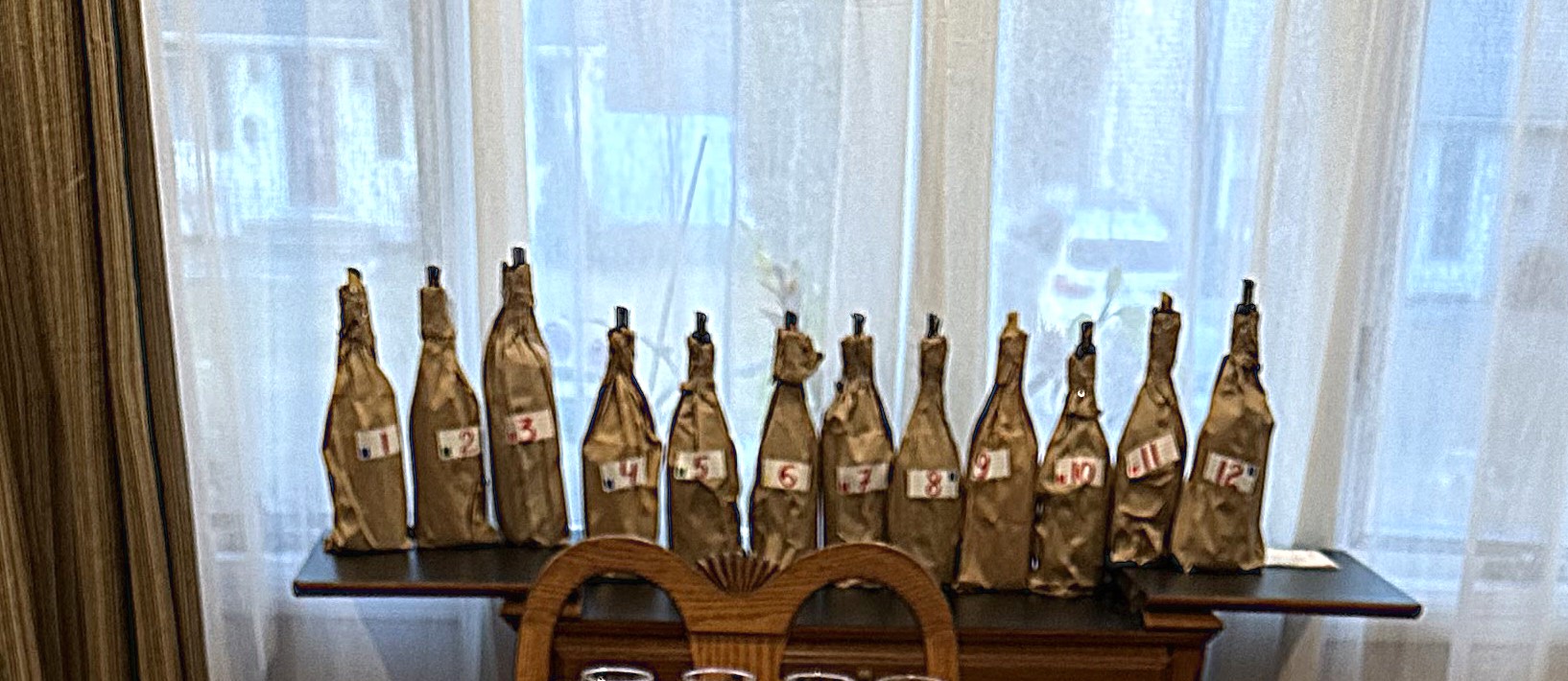
This is a blind tasting, so we placed all bottles in the paper bags, and then my daughter who was now a participant in the tasting put the labels randomly on the bags (15 years ago her role was limited only to attaching the labels :)). I also prepared a few of the “reference points” for everybody to use in the form of the crushed fruit in the glass – I didn’t find plums in the store, but we had many other relevant “references” – cherries, pomegranate, blueberries, raspberries, blackberries, and even liquid smoke.


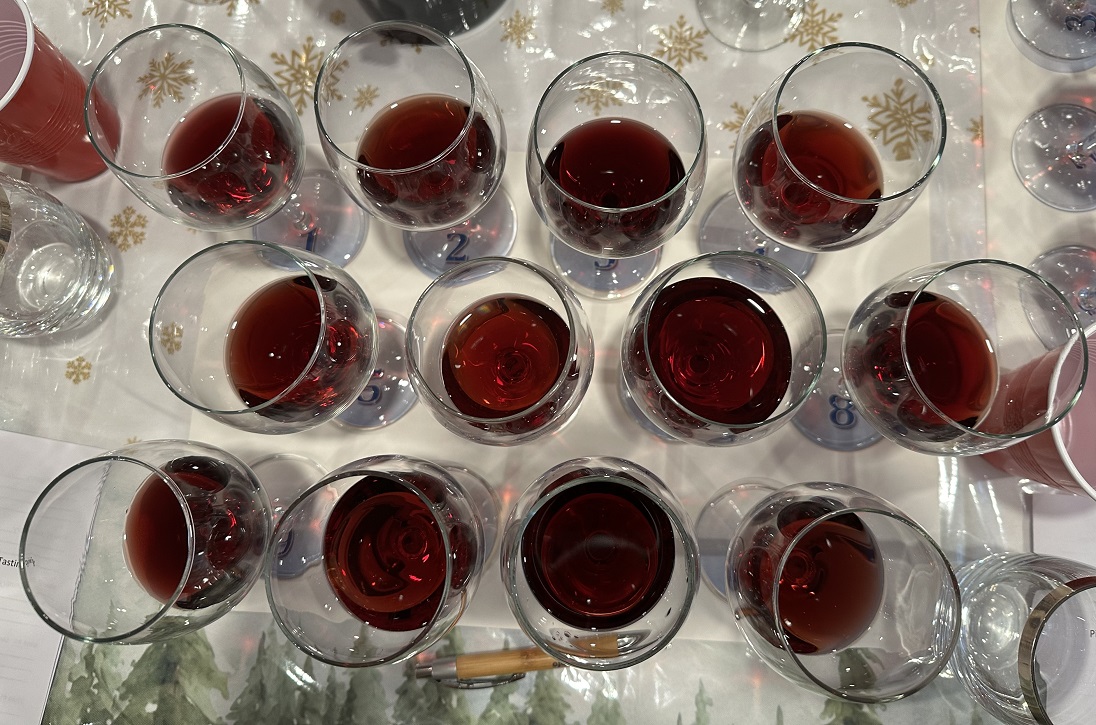
We also had paper for taking notes, and as a reference, I included all the countries that were present in the tasting so we could try guessing the countries for each wine. All countries except the two, as both Zak and I brought in one “surprise” each – Pinot Noir from the countries that are not really known as Pinot Noir producers – we didn’t know what wine the other person was bringing. Here is the list of countries that were offered for everyone’s reference: Argentina (Patagonia), California (Santa Rita Hills), France (Burgundy), Germany (Ahr), New York (Finger Lakes), New Zealand (Central Otago), Oregon (Willamette Valley, 2 wines), Poland, Washington, Surprise 1 (European country not listed above), Surprise 2.
Off we went, tasting and discussing the wines, trying to figure out what was what. Consciously tasting 12 wines in a row is not an easy fit, especially when you try to at least identify the countries. Also, each person (there were 8 of us) was supposed to decide on 3 of their favorite wines so we would be able to vote for the most popular wine of the night, so we had to score each wine. Here score is simply comparative within your notes – 1 through 5, E to A, doesn’t matter, as long as everyone can decide on their favorites.
Here are my notes for all 12 wines as the tasting was happening.
Wine #1: Country: New World (have no idea what I was thinking, I guess something outside of Europe), Vintage: 2021. Cherries, lots of cherries, raspberries, tart cherries on the palate, good balance, nice. Score: 8
Wine #2: Country: Oregon, Vintage: 2021. Iodine, cherries, tart, pepper, tannins, earthy, rocky. Score: 8+
Wine #3: Country: Poland?, Vintage: 2021. Cherries, initially fresh berries, fresh raspberries, sweet cherries, good balance. Score: 8
Wine #4: Country: Argentina?, Vintage: 2019. Gunflint, fresh, crisp, tart, rocky, cherries, excellent. Score:8/8+. Tasting again at the end of the tasting, the wine lost something, so finally score is 8
Wine #5: Country: California?, Vintage: ? Almost black color, dark, aged, medicinal nose, iodine, sweet cherries on the palate, tart. Score: 8-, after retesting later – 8, wine improved.
Wine #6: Country: Oregon? No, Vintage: ?, carrot juice on the nose, very grippy tannins on the palate, cherries. Score: 7+
Wine #7: Country: ? , Vintage: ? Beautiful color, Rutherford dust, hint of cherries, tannins and cherries on the palate, good balance. Score: 8 initially, 8+ after breathing
Wine #8: Country: Germany, Vintage: ? Love the garnet color, smoke, tar, concentrated nose. Wow! Superb – cherries, concentrated, good acidity, good balance. Score: 8++
Wine #9: Country: Oregon, Vintage: ? Pencil shavings, Rutherford dust, tannins, cherries, elegant but needs a touch more acidity. Score: 8
Wine #10: Country: ?, Vintage: ? Pomegranate seeds, cherries, very tight. Cool aid, cherry cola Score: 8-
Wine #11: Country: Finger Lakes, Vintage: ? Smoke and rubber, tar, on the nose. Rubber, tannins, cherries, became more balanced after breathing Score: 7+ initially, improved to 8 on the second tasting.
Wine #12: Country: Oregon, Vintage: ? Cherries, vegetation, cool aid on the nose. Cherries, good balance, good acidity, excellent. Score: 8+, went down to 8 after re-tasting as the finish showed sugar candy.
Ugh, this was not an easy tasting, but it was finally complete. Time to decide on favorites. First, everyone had to make their own decisions for the 3 favorite wines. After re-tasting and struggling, my list of favorites in descending order looked like this:
1st favorite: #8
2nd favorite: #2
3rd favorite: #7
Next, the vote. Remember, each person (there were 8 of us) was allowed to vote for 3 favorite wines, thus we just called the wine number and asked to see a show of hands. Here are the results.
Wine #1 – 1
Wine #2 – 5
Wine #3 – 1
Wine #4 – 0
Wine #5 – 0
Wine #6 – 3
Wine #7 – 3
Wine #8 – 3
Wine #9 – 3
Wine #10 – 1
Wine #11 – 1
Wine #12 – 3
Therefore we had a clear winner – wine number 2, and 5 wines in the second place with 3 votes each – #6, #7, #8, #9, and #12.
Next came the best and final part of the blind tasting – the reveal! Would you believe me If I told you that the revealed bottle elicited a loud “oh, wow, really” literally from everyone? Surprise after surprise after surprise.
The most popular wine? Pinot Noir from (drum roll, please)
Japan!
Seriously, Japan??? How? Yes, Japan makes wine, but to make Pinot Noir that shows better than Oregon, California, Burgundy, and all other countries? Just wow. Apparently, this is an impossible-to-get “cult” wine, produced in minuscule quantities, $100 wholesale but $300 retail if you can even find it? That was the first “surprise” wine.


Pinot Noir from Poland that was very good? How about that? My favorite wine of the tasting, Southern Lines from Central Otago, by some absolute miracle was $15 per bottle – how is that even possible (it is a case buy if you can find it at that price).
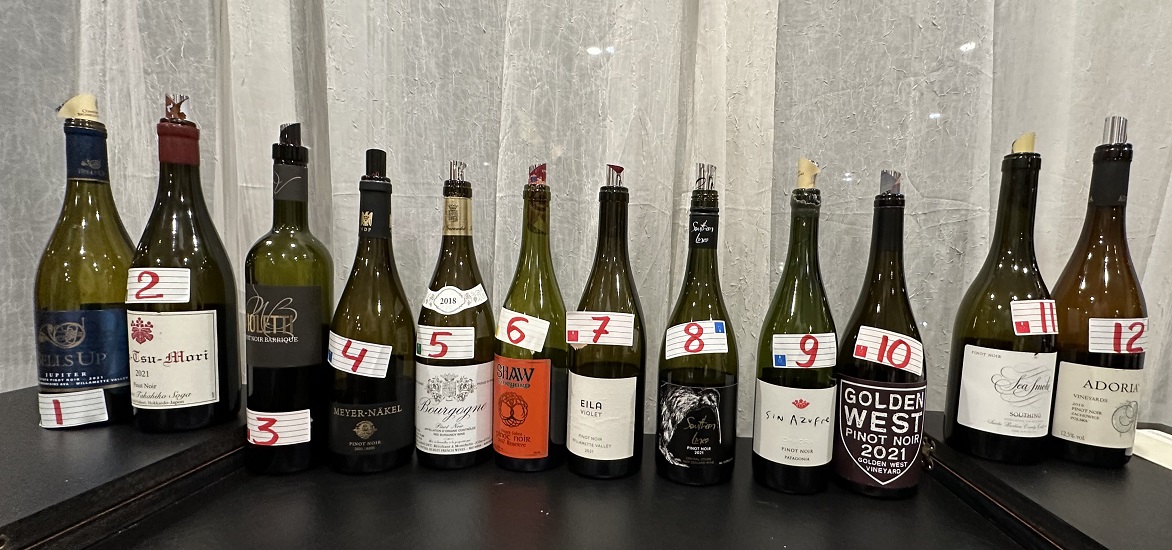
Here is the full list of wines in the numbered order:
- 2021 Bells Up Jupiter Pinot Noir Estate Chehalem Mountains AVA (13.5% ABV, $50)
- 2021 Domaine Takahiko Soga Nana-Tsu-Mori Pinot Noir Hokkaido Japan (13% ABV, $300?)
- 2022 Violetti-Rebbau Pinot Noir Barrique Vin de Pays Suisse (13% ABV, $N/A)
- 2021 Meyer-Näkel Pinot Noir Ahr Germany (12.5% ABV, $56 at Wine.com)
- 2018 Paul Garaudet Pinot Noir Bourgogne AOC (13% ABV, $39)
- 2017 Shaw Vineyard Pinot Noir Reserve Finger Lakes New York (13% ABV, $N/A)
- 2021 EILA Violet Pinot Noir Willamette Valley (12.7% ABV, $65)
- 2021 Southern Lines Pinot Noir Central Otago New Zealand (13.5% ABV, $15)
- 2022 Chakra Sin AzuFre Pinot Noir Patagonia Argentina (12% ABV, $30 Last Bottle)
- 2021 Golden West Pinot Noir Goden West Vineyard Royal Slope Washington (14% ABV, $21)
- 2011 Sea Smoke Southing Pinot Noir Santa Rita Hills Santa Barbara County (14.5% ABV, $100?)
- 2021 Adoria Vineyards Pinot Noir Zachowice Poland (12.5% ABV, $25)
You see, this is what blind tasting does. Under the guise of the brown bag, all wines are “the same”. You are not influenced by anything – “ahh, I brought this wine, it must be better”, “ahh, the guy in the store was raving about it so much”, “ahh, it got 99 points from Suckling” – none of this matters. You let your palate be the judge. Wine has to give you pleasure.


As the wines were left at my house after the tasting, I was the lucky bastard who had an opportunity to taste them over the few next days. This is not how the general population consumes wines, so this has very little bearing on the results and the whole tasting process, but I can tell you that for example, the Sea Smoke Southing became literally my favorite wine – it developed a depth of flavor and a beautiful complexity – if it would taste like that during the tasting it would be handily the wine number 1, for sure for me. The Pinot Noir from Ahr also developed additional layers, with gunflint and roasted meat notes now dominating the flavor profile in a very respectful manner, making it a lot more pleasant to drink – again, in that state it would again get a much higher rating in my book. And pretty much across the board, the Pinot Noirs continued their evolution and most of them were still drinkable even 5 days after being open – a testament to quality.
Here we are. 15 years later, the most unexpected Pinot Noir wins again. But this is the beauty of wine. The mystery, the enigma, the art. Wine is a liquid art form, and this tasting delivered an unmeasurable amount of pleasure and created new memories. This is what life is all about, isn’t it? Creating good great memories. And wine is exceptionally good at that. Onward and upward.
Celebrate Pinot Noir!
And just like that, I almost missed International Pinot Noir Day, the celebration of one of the most popular red grapes in the world.
Pinot Noir is definitely one of the most popular, even though great Pinot Noirs are mainly limited to only four countries and regions – Burgundy, Oregon, New Zealand, and California – unlike Cabernet Sauvignon and Merlot, which definitely win the popularity contest worldwide, growing successfully absolutely everywhere. Of course, you have Pinot Nero from Italy, Spätburgunder from Germany, Blauburgunder from Austria, Pinot Noir from Australia, Chile, and Argentina, but those rarely take your breath away.

Most popular or not can be contested, but Pinot Noir without a doubt makes the most expensive wines in the world. You can check it for yourself using this “Most expensive wines” page but at the moment of writing (August 18, 2023), Domaine Leroy Musigny Grand Cru is listed by wine-searcher for $43,869 per bottle, which I believe is more than the whole index of the most expensive Cabernet Sauvignon wines on the same day. I really can’t tell if wine can be worth this much to someone to drink it, but hey, it is a free world.
Pinot Noir is definitely a big subject in this blog. I decided to check on some numbers to see how Pinot Noir would stand up against other grapes. In terms of overall mentions, Pinot Noir is the second red grape with 378 posts mentioning it (Cabernet Sauvignon is ahead by almost 100 with 477 posts mentioning it). However, when it comes to tags, Pinot Noir has the highest number of posts, 79, tagged with “pinot noir”, well ahead of any other grape. This is important simply because the tag is matching the content of the post, so at least 79 posts are dedicated to Pinot Noir.
This shouldn’t come as a surprise as Pinot Noir is one of the central subjects of this blog, starring in the series of the Oregon winemakers’ interviews called Stories of Passion and Pinot. The series contains more than 25 articles, highlighting the “passion for the finicky grape” as I typically like to present it through the series of conversations with winemakers who got bitten by the Pinot Noir bug and never looked back. Whether you like Oregon Pinot Noir or not, I still recommend that you would get a glass (or two, or three) of your favorite Pinot Noir ready and go read some stories.
While I love Pinot Noir, I do have one gripe – the price. You can find an amazing Rioja for under $20. You can definitely find a nice Grenache, Sangiovese, or Syrah in that price range. Heck, you might even get lucky with Cabernet Sauvignon or Bordeaux blend. But with the exception of Chile, there is literally no such thing as a drinkable Pinot Noir in the under $20 range. I can’t refer much to Burgundies, but anything tasty from New Zealand’s Central Otago or Marlboro is pushing $40, and all delicious Oregon Pinot Noirs now really sit north of $50. California might offer some exceptions, but I’m not aware of a drinkable sub-$20 California Pinot Noir. Not that I’m complaining here, just stating the obvious.
As today’s celebration caught me off guard, I didn’t have many options to choose from. I have a few random burgundies which I need to look for and think about, nothing from Oregon or New Zealand, leaving California as a primary hope. I remembered that I should have a California Pinot somewhere as it was recently gifted to me, so I was quickly able to locate the 2017 Etude Fiddlestix Vineyard Pinot Noir Santa Rita Hills (14.1% ABV).
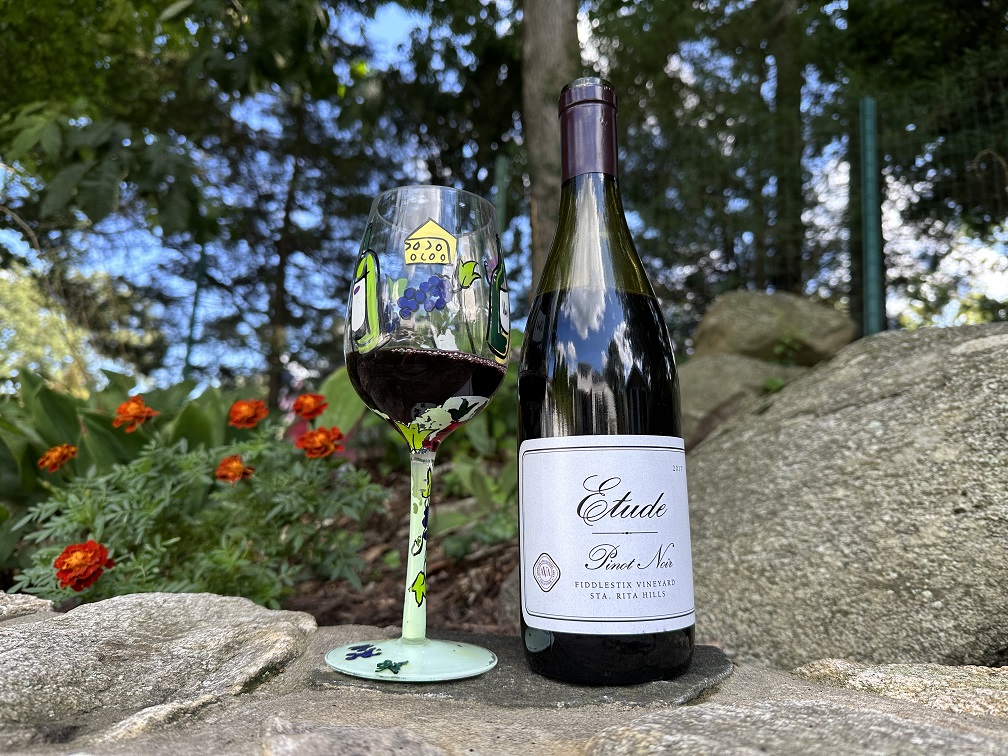
I know the name of the producer – Etude, but I don’t think I had tasted their wines before. Turns out this wine was a very appropriate choice for the Pinot Noir Day celebration, as Etude was founded in 1982 in Carneros in California in a quest to produce world-class Pinot Noir. I love this quote I found on Etude’s website from the founder and winemaker Tony Soter: “Pinot Noir is the most appropriate vehicle with which to study wine growing, precisely because of its demanding nature but also because of its delicacy and transparency. Make no mistake it is a humbling pursuit, but when it’s right, Pinot Noir is a glorious and moving thing. It is in the pursuit of that experience that we all work.” This is a perfect summary of the nature of Pinot Noir that also helps to explain what makes it so good when it is good. Etude produces more than 20 designation-specific Pinot Noir wines – they might be a perfect candidate for the Passion and Pinot series, even if the winery is located in California.
So how was the wine you might ask? In a word, delicious. Dark, unctuous fruit on the nose and the palate, a hint of vanilla, mocha and dark chocolate, nicely layered with perfect structural presence but not overpowering, perfect acidity and perfect balance. An excellent celebratory wine.
There you are, my friends. Another grape holiday just passed by. Hope you had an opportunity to celebrate, and if not – every day is a perfect day to have a glass of Pinot Noir. Until the next time – cheers!
Stories of Passion and Pinot: Kate Ayres of Penner-Ash Wine Cellars
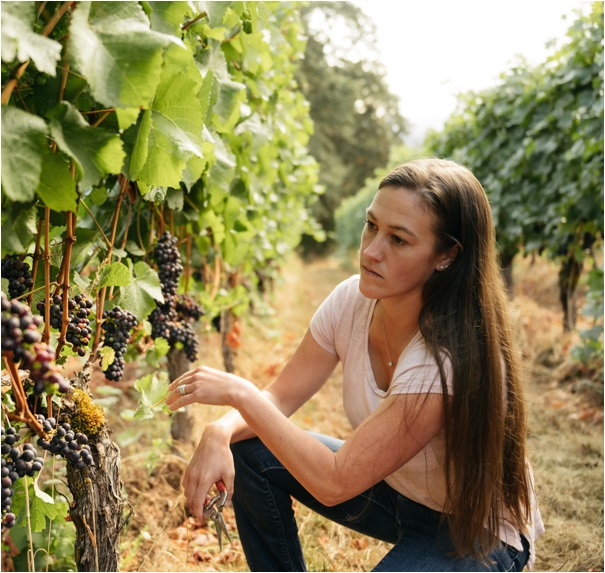
Kate Ayres. Source: Jackson Family Wines
125 cases of Pinot Noir in 1998.
9,000 cases of Pinot Noir, Syrah, Riesling, and Viognier in 2011.
16,000 square-foot winery building designed with human ergonomics in mind.
12 vineyards.
Numerous accolades.
This is a brief “history in numbers” of Penner-Ash Wine Cellars, founded by Lynn and Ron Penner-Ash in Northern Willamette Valley Yamhill-Carlton AVA in 1998. The winery quickly grew to prominence, best known for its lush, layered Pinot Noir. In 2016, Penner-Ash Wine Cellars was acquired by Jackson Family Wines (JFW), joining Gran Moraine, Zena Crown and other Oregon wineries as part of JFW’s “cool-climate” Pinot Noir portfolio.
Kate Ayres had become the Winemaker at Penner-Ash Wine Cellars in the spring of 2018. Continuing traditions is not an easy job, and so I had an opportunity to sit down (virtually) with Kate and ask her a few questions.
Here is what transpired in our conversation.
[TaV]: Reading about the history of the winery, I came across the fact that the winery was designed with “human ergonomics” in mind. Can you expand on this, provide some details for someone who never visited the winery?
[KA]: Lynn and I are both petite female winemakers and that was really a driving factor when creating our gravity flow winery. We tend to ferment in small fermenters (one-, two- and three-ton) that are just short enough that I can smell the tops of each tank at standing height. The tanks are all easily moveable by pallet jack and require very little “heavy lifting.” In addition, because of the tiered nature of the winery, we rarely use pumps and aren’t hauling hoses up and down the winery.
[TaV]: Also in the same historical overview, I found an interesting mention of “unanticipated soil diversity”. Why “unanticipated”, and how is this impactful from the point of view of the Penner-Ash wines overall?
[KA]: I believe this is in respect to our Estate Vineyard. We have 15 acres planted to Pinot Noir in the Yamhill-Carlton AVA, which is typically characterized as sedimentary soil. In the case of our vineyard, we have a volcanic line running down the middle of our upper Pommard and 666 blocks, down through our lower Pommard blocks.
[TaV]: What is your winemaking philosophy – whole cluster fermentation, natural yeast versus inoculated yeast, oak regimen, etc?
[KA]: We love experimentation in the winery and will pivot depending on what the vintage is throwing at us. There are some vineyards that we love to whole cluster ferment, but I wouldn’t consider us a “whole cluster” house. 25-40% in a fermenter is our happy spot. While we have a plethora of inoculated yeast strains we like to use, we are also happy to let tanks head in the native direction when it fits. Our oak regimen has evolved over the years to match our changing environment. We like lower impact barrels that can provide structure and sweetness, but less overt “oaky” aroma. Our basic philosophy at Penner-Ash remains the same as it was on our starting day. We craft beautifully textured and layered wines that are approachable and ageable. This is done with a diversity of vineyard sites, a simple approach to winemaking, and a delicate handling of the wines through their life.
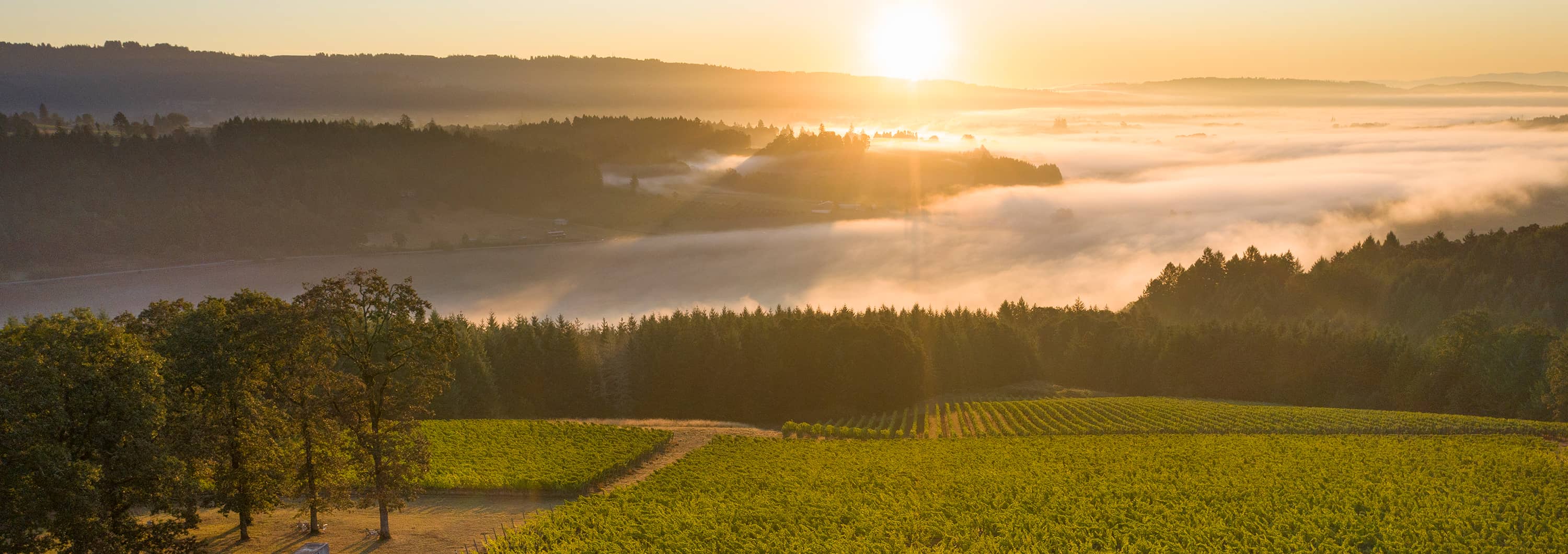
Penner-Ash Cellars. Source: Jackson Family Wines
[TaV]: At Penner-Ash, you get to work with many different vineyards. Do you have a most favorite and most challenging one?
[KA]: How cruel to pit them against each other! Each vineyard is so special to its location, and that is what makes my job so incredibly exciting and invigorating each harvest. For example, there are times when certain weather events just hit a single sub-AVA. So while that particular vineyard might be more difficult for that vintage, other vineyards may remain unaffected.
[TaV]: One question I like to ask all the winemakers I have a chance to speak with – what is your take on biodynamic viticulture?
[KA]: I think this has become such a polarizing question. There are many aspects to biodynamic viticulture which make so much sense to me. Working within the natural balance and diversity of the ecosystem seems like a no-brainer. I find it harder to see the relevance of the spray schedules, mixtures, and decisions based on moon phase.
[TaV]: Based on what I can see on your website, Penner-Ash offers today a large number of white and red wines. Sparkling and Rosé make a notable absence. Do you make any of the sparkling or Rosé? If not, any future plans?
[KA]: We make a rosé, but not a sparkling wine. As you’ve noted, we make many wines. At this point in time, I’d like to keep my focus on those wines that we know and we make well.
[TaV]: Practically all of your wines are vineyard-specific. Have you ever considered producing block-specific wines, from Penner-Ash Estate or any other vineyards?
[KA]: We have dabbled in block specific (clonal specific) wines for fun with the Shea Vineyard and have in the past put together a complete set for the consumer. It was a fun thing to show people, but was a huge labor of love (all hand bottled). They are certainly fun one-off projects to toy with, but harder to consider as a long-term product.
[TaV]: Going back to the wine lineup – the majority of the wines produced by Penner-Ash are Chardonnay and Pinot Noir. And then you have lonely Riesling and Syrah. Any plans for any other grape varieties? Maybe a Pinot Gris? Tempranillo? Something more eclectic?
[KA]: I’d love to dabble in a new red or two and we’ve also done some fun tasting of Chenin Blanc and Sauvignon Blanc from Oregon. I think Sauvignon Blanc coming out of the Willamette Valley is really interesting and fun.
[TaV]: Can you describe your typical day in the vineyards?
[KA]: As the growing season progresses my days usually start in the vineyard for the first couple of hours before returning to the winery to taste/blend/crush samples. We have a lot of vineyards to cover, so I tend to try to visit 2-3 vineyards in a morning if possible.
[TaV]: We can’t ignore climate change – how do you take the effects of it in your day to day operation? How are you taking it into account for the longer period, say the next 10 years?
[KA]: Looking at alternative varieties is certainly high on the list. In the more immediate future I’ve pulled back the amount of cap manipulation the wine sees in its lifetime. There was a time where we would punch down a fermenter three times a day. Now we find ourselves doing one punchdown a day and touching it twice just in the peak of fermentation. Our oak regimen as discussed earlier is also in response to warmer years. Of course it would be remiss of me if I didn’t note that much of the work is done in the vineyard. Whether it be in cover crops, tilling or not tilling between rows, leaf removal (or not), etc. These are all things we are working on for a warmer trend.
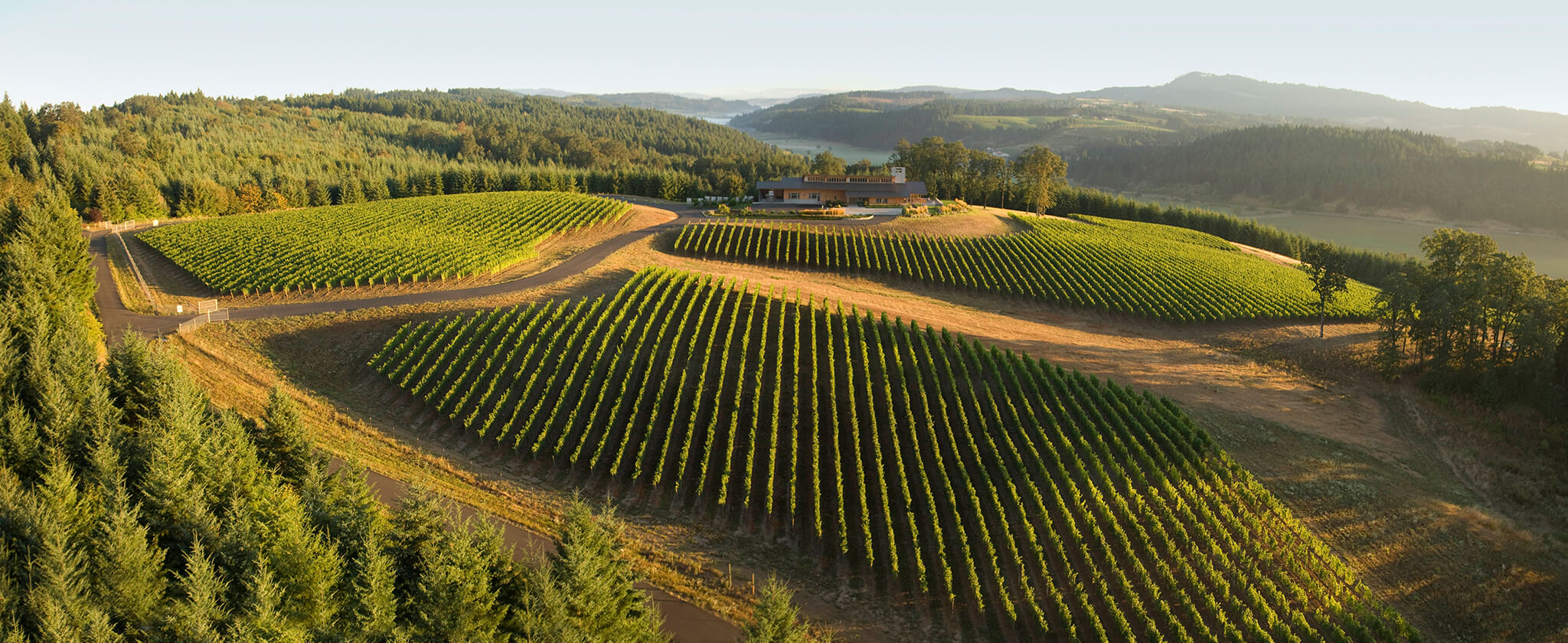
Penner-Ash Cellars. Source: Jackson Family Wines
[TaV]: Given an opportunity to work anywhere in the world, is there a winery or a winemaker you would choose to work at/with?
[KA]: I’ve been lucky enough to work in several winemaking regions in the world, but never in France. Given the relationship with Domaine Drouhin Oregon, I’d love to get a chance to work with Véronique.
[TaV]: Along the same lines – is there a wine you always wanted to make but didn’t get the chance to do it yet?
[KA]: That’s a hard one to answer. There are so many varieties of wine out there that it’s hard to put a finger on what exactly I’d desire to make most. I’m just happy that my early learning years took me to winegrowing areas that broadened my experiences and gave me an opportunity to create many different varieties of wines.
[TaV]: What was it like working with Lynn when you started at Penner-Ash in 2018?
[KA]: I actually started working with Lynn in May of 2016 but was promoted Winemaker in 2018. Working with Lynn has been one of the biggest delights of my career. As we all know, Lynn is a staple in this industry and that in and of itself can be intimidating, but she created such a warm and welcoming environment for me. We really worked in lockstep as she taught me about each of the vineyards we source fruit from; the pillars on which Penner-Ash rests. I can’t begin to recount the funny conversations we shared across the blending table from each other, the barrels we’ve tasted and scored, the fermenters we smelled together each morning. The relationship I was able to form with Lynn over the past nearly seven years has been nothing less than incredible. She was a mentor, but even more she became the most amazing colleague.


As usual, I had an opportunity to try a few wines from the Penner-Ash cellars – here are my notes:
2021 Penner-Ash Chardonnay Willamette Valley (14.6% ABV)
Straw pale
Apples, a touch of vanilla
Clean, crisp, Whitestone fruit and apples on the palate, distant hint of honeysuckle. The fruit quickly dissipated on the finish, with lingering tartness and afterward, acidity.
7+/8-, if you are looking for classic but very lean chardonnay, this is your wine.
2021 Penner-Ash Pinot Noir Willamette Valley (14.1% ABV)
Dark Ruby
Cherries, plums, and violets -classic Pinot nose
Very interesting temperature dependency
At room temperature, the wine appears as classic California Pinot Noir, with sweet cherries, plums, vanilla, borderline flabby
When served chilled, the wine is dark and concentrated, with a core of tart cherries and some espresso notes. Perfectly structured and full of energy.
Room temperature: 7/7+
Fridge temperature: 8-
Here you, my friends. Another story of passion for the finicky grape. Until the next time – cheers!
P.S. For more stories of Passion and Pinot please visit the series’ main page.
Celebrating Oregon Wine Month with Potter’s Vineyard Wines
I guess there is something special in the month of May as everybody wants to appropriate it..for their wine purposes. The story differs from year to year, but this particular May 2023 has at least 4 wine designations (if I missed something – I profusely apologize) – May is Finger Lakes Wine Month, Michigan Wine Month, Oregon Wine Month, and Washington Wine Month.
The good thing is – there are 31 days in the month of May – which is enough to celebrate the wines of many more states – or maybe even all 50 – with proper planning. But for today, I only would like to focus on one of the wine months – Oregon.
Oregon wine is near and dear to my heart. First of all, Oregon itself is a beautiful place – I love the pure, open, clean, spacious, and airy pine forest oh so different from New England’s sprawling intersection of ivies, and stunning vineyard views which you can enjoy everywhere. Some of the very best American wines are produced in Oregon. And the longest-running series of articles on this blog – Stories of Passion and Pinot, conversations with winemakers – is dedicated to Oregon winemakers who made Pinot Noir the passion of their lives.
20 years ago, Oregon wines could’ve been known as a one-trick pony with its sole focus on Pinot Noir. Today, that world-class Pinot Noir is joined by Chardonnay, Pinot Gris, Riesling, Syrah, Tempranillo, Sangiovese, and even Tannat. Sparkling wines and Rosé can be found almost at any winery. And Pinot Noir is not just for reds anymore – Pinot Noir Blanc, a.k.a. White Pinot Noir is the wine to look for. Oregon winemakers continue studying their vineyards, identifying unique blocks and plots in a quest to produce the most terroir-driven wines.
One of my most recent conversations in the Passion and Pinot series was with Bill Sanchez, the proprietor and winemaker at Potter’s Vineyard. Potter’s Vineyard is a small, 3.5 acres estate in Laurelwood District AVA in Willamette Valley, producing about 1,000 cases annually. Potter’s Vineyard is organic, LIVE and Salmon Safe certified, and committed to staying small – you can learn about this commitment and the overall philosophy of Potter’s Vineyard from our conversation which can be found here.
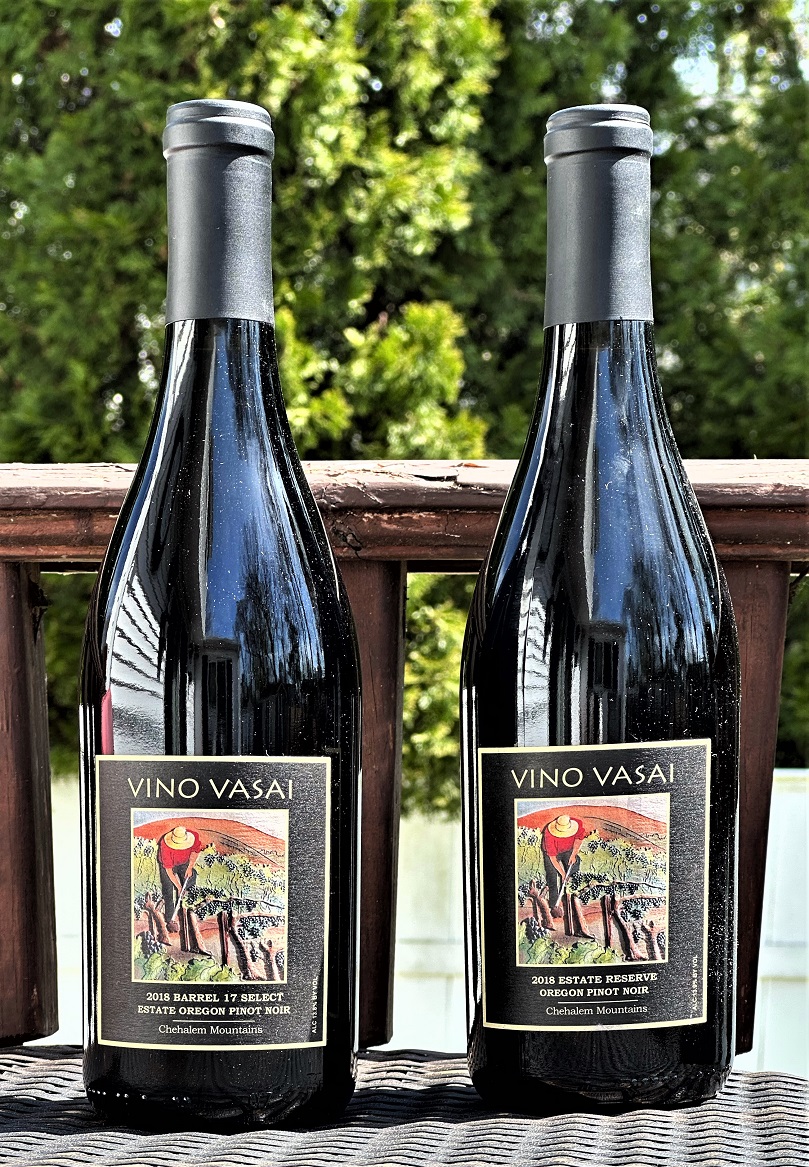
I don’t know about you, but I really admire these labels
Now I had an opportunity to taste a couple of the Potter’s Vineyard estate Pinot Noir wines, Barrel 17 Select and Reserve. Here are my notes:
2018 Vino Vasai Barrel 17 Select Estate Oregon Pinot Noir Chehalem Mountains (13.8% ABV, $48, Dijon clones)
Dark Ruby
Dark cherries, violets, minerality
Dark cherries, plums, medium to full body, firm structure, well-integrated tannins, luscious layers followed by the tart, long finish
8, excellent. Upon opening, the wine was lean and tight, Burgundian style. The next day opened up to show more of the Oregon Pinot power, still governed by restraint.
2018 Vino Vasai Pinot Noir Estate Reserve Chehalem Mountains (13.9% ABV, $58, Pommard clone, 75% new French oak )
Garnet
Beautiful legs (I rarely pay attention to those, but couldn’t help to notice)
Very enticing nose with sweet cherries, plums, eucalyptus
Cherries on the palate, tart, perfectly structured, harmonious and perfectly balanced. Craving food, but I can polish a bottle by myself.
8/8+, excellent.
Here you are, my friends – more of the delicious Oregon wines worth seeking. Oregon wine month is upon us, so if you need any suggestions, just click here.
And don’t be shy – if you got any of the Oregon wine favorites, please comment and leave notes for others.
Until the next time – cheers!
P.S. For more stories of Passion and Pinot please visit the series’ main page.
Stories of Passion and Pinot: Bill Sanchez of Potter’s Vineyard

Bill and Sandy Sanchez. Source: Potter’s Vineyard
Wine is art.
More often than not, the connection goes beyond that simple statement. Have you visited wineries that are housed in beautifully designed buildings, or offer various pieces of art – paintings, sculptures – for everyone’s viewing enjoyment? Wine is a form of art, made by artists, and it thrives surrounded by art in a multitude of shapes and forms.
Bill Sanchez extended his 30+ years of PhD experience in nutritional science and 15 years as a professional Potter to the art of winemaking when he and his wife Sandy bought 3.5 acres estate winery in Laurelwood District AVA in Oregon from Laura Volkman in September of 2012. He had to learn 1,000 steps of making great Oregon Pinot Noir from Laura, who planted the vineyard in 2001. Guided by this knowledge, love of art, and utmost respect for one of the most famous artists of all time, Michelangelo, Bill and Sandy operate their winery with a full commitment to “staying small”.
Organic, LIVE and Salmon Safe certified winery, Potter’s Vineyard produces about 1,000 cases annually, supplementing estate Pinot Noir with Chardonnay, Cabernet, Merlot, Sangiovese, and Syrah coming from single vineyard estates in Washington. Connecting visitors to art, the winery also offers a full exhibit of handcrafted Clay Art.
I had an opportunity to sit down (yes, virtually) with Bill Sanchez and ask him a few questions about his passion for Pinot and art. Here is what transpired in our conversation:
[TaV]: What is Vino Vasai Wines and how it is different from Potter’s Vineyard wines?
[BillS]: There’s a back story on Vino Vasai, which means Wine of The Potter. We used it when a large company said ‘they would oppose’ our trademark for Potter’s Vineyard. Vino Vasai is the wine brand, and Potter’s Vineyard is the name of our company and Estate Vineyard.
Source: Potter’s Vineyard
[TaV]: You worked for 35 years in nutritional science field. How does this experience affect your work in the vineyard and the winery?
[BillS]: That experience has focused my work on the vineyard where I am taking a ‘nutritional health’ approach to our farming. We practice organic farming and use natural ‘nutritional compounds’ to improve the health of the vineyard. We are gathering clinical data that shows this helps to prevent major pests like powdery mildew.
[TaV]: I read in your story that you learned 1,000 steps of making great Oregon Pinot. Can you please tell me what step 367 is all about? 🙂 just kidding 🙂 but seriously, what are these 1,000 steps all about?
[BillS]: When you break everything down there is probably many, many starting with 30 passes in the vineyard (that starts in January by the way), and many more steps involved in growing quality fruit (pruning, tying down, flailing, rubbing buds, trellising, mowing, spraying, hedging, etc. Then, when you add all the steps after harvest you get many, many more – I know I exaggerated it at 1,000 but someday I will add them all up and I know I will be closer to 1,000 than 100!
[TaV]: Especially because of your extensive scientific background, I have to ask you the same question I like to ask many winemakers – Biodynamics. What do you think of biodynamics? Would you ever implement it at your winery?
[BillS]: I’m very intrigued, but I don’t understand it yet, especially the ‘cosmos’ connection. I understand Organic much better and am excited to see the increasing amount of quality science that demonstrates not only that Organic farming works, but that it is healthier for the entire farm.
[TaV]: Pottery seems to be your other passion besides wine. Today, amphorae are popular vessels among winemakers to work with their wines (fermentation, aging, etc.). Do you use amphorae at your winery? As a potter, would you attempt to simply make one for this purpose?
[BillS]: Again, I’m very intrigued by amphorae but I haven’t yet found them to deliver higher quality wines compared to oak barrels. This is especially true for reds and chardonnay, which are my primary focus. I have tried some delicious crisp whites from amphorae, but I am not working with those varietals (yet)! I would rather buy Amphorae from my neighbor, fellow potter and winemaker, Andrew Beckham than attempt to make one myself (especially at the size needed to make enough wine for a club pickup).
[TaV]: I understand that you and your wife are big fans of Michelangelo and his work. How does Michelangelo’s work inspire you in your daily dealings at the vineyard and the winery?
[BillS]: I like the fact that Michelangelo was so diverse in his work (sculpture, painter, and architect) and I think we all aspire to be like him, not only one of greatest in his time but one of the greatest of all time!
Source: Potter’s Vineyard
[TaV]: You stated that Potter’s Vineyards is dedicated to staying small. How difficult it is keep that resolution and to stay small?
[BllS]: It’s most difficult financially, but because my wife and I did not plan on needing the income into our retirement years, we are happy to break even and live and work with less stress.
[TaV]: How does this decision affect your daily work?
[BillS]: It is very rewarding to have something we enjoy very much that keeps us busy every day and provides a product that enriches people’s lives, especially in creating a pleasurable memory they can share with family and friends.
[TaV]: Potter’s Vineyards is a certified sustainable winery. Can you talk about your approach to sustainability and why sustainability is important to you?
[BillS]: Our approach is to focus on the health of the entire farm. I like to think about the health of the soil (insects, microbes, organic matter), the vegetation diversity between the rows, the flowering plants surrounding the vineyard, the birds, the bees, the insects and of course the people who visit. I believe this approach will allow the farm to thrive for many years (if not forever).
[TaV]: You have two wine clubs, B club and M club. I understand that M stands for Michelangelo. What B stands for?
[BillS]: Botticelli (another great Italian artist)
[TaV]: In terms of distribution, what percentage of your wine is sold through the club and local visits?
[BillS]:Over 90%.
[TaV]: Are your wines available in retail or maybe the restaurants?
[BillS]: We don’t actively pursue distribution, but if local retailers request our wines, we make them available and support these local establishments. Our wines are currently available at Our Table Farm Store in Sherwood, OR., 503 Uncorked Wine Bar in Sherwood, OR., Old Town Bar & Grill in Newberg, OR., and Crushed & Crafted Wine Bar in Newport.
[TaV]: I see that you produce a Sangiovese wine. Sangiovese is largely atypical for an Oregon winery. Is that a nod to your Italian connection?
[BillS]: Yes, my wife Sandy actually.
[TaV]: How popular is this wine with your customers?
[BillS]: They love it and love the story where we discovered Sangiovese during our trip to Italy in 2011 and then bought our vineyard in 2012. Releasing a Sangiovese in our 10th year of business was truly a dream come true!
[TaV]: You already make a full line of Pinot Noir wines (sparkling, Rosé, white Pinot and of course the large range of Pinot wines themselves). You also make Cabernet Sauvignon, Merlot, Sangiovese. Do you plan to plant any new grape varieties or make new wines?
[BillS]: Someday we may offer a Sauvignon Blanc, but Sandy says that’s it after that!
[Tav]: Where do you see Potter Vineyard in 10 years? What would you like to accomplish during the next 10 years?
[BillS]: If my children take a serious interest, I would love for the business to grow enough to support their families into the next generation and beyond but if not, we will find someone to nurture it along just as Laura Volkman found us!
There you are, my friends – another story of Passion and Pinot, another story of wine and art.
I didn’t get a chance to try Bill’s wines yet, so please stay tuned for the update…
P.S. For more stories of Passion and Pinot please visit the series’ main page.
Stories of Passion and Pinot: Erik Kramer of WillaKenzie

Source: WillaKenzie Estate
The first LIVE Certified Sustainable winery in the Pacific Northwest, LIVE member 0001. Wines worthy of serving at the White House gala, state dinners, and even to the French President and British First lady. One of the first Direct to Consumer wine programs in Willamette valley. The list of accolades of the WillaKenzie Estate can go on and on.
Founded a little more than 30 years ago, WillaKenzie Estate takes its name from the eponymous sedimentary soils of Willamette Valley in Oregon where the winery is located. The name is also a tribute to the Willamette Valley’s two major rivers, the Willamette and McKenzie which are also displayed on the winery’s crest.
WilleKenzie Estate was founded in 1991 by Bernard and Ronni Lacroute who purchased 420 acres of farmland near the town of Yamhill, Oregon. Bernard and Ronni brought their Burgundian heritage to the newly planted vineyards, and with the help of another Frenchman, Laurent Montalieu, the first winemaker at WillaKanzie, produced its first vintage in 1995. The rest is history, as they say (if you are interested in more historical details, here is the link). In 2016, Lacroutes entrusted their legacy to the Jackson Family Wines.
In 2017, Erik Kramer became WillaKenzie’s third winemaker. I had an opportunity to sit down with Erik (yes, virtually), and ask him a few questions. Here is what transpired in our conversation:
[TaV]: Before making wines in Willamette Valley, you were working in New Zealand. New Zealand is also world-famous for its Pinot Noirs. How would you compare New Zealand and Oregon Pinot Noirs?
[EK]: That’s a broad question. With the Willamette Valley, we’re generally talking about one region with a few sub-appellations (e.g. Yamhill Carlton, Dundee Hills, etc.). When speaking about Pinot from the Willamette, it’s tough for me to do so without speaking about the climate, which moves between Mediterranean and Maritime. The result is a balanced expression of Pinot anchored in freshness and clarity of fruit. With New Zealand, there are quite a few different regions within the country where Pinot is being grown and each is a bit different. The region in New Zealand that often seems to garner the most attention is Central Otago, which has a climate that is much more continental than the Willamette Valley and it’s reflected in the wines that are grown there (dark, savory, and energetic). For me, the region in New Zealand that most resembles the Willamette Valley in terms of Pinot expression is Martinborough (complex Pinots with great energy and complexity). I believe Martinborough leans toward Mediterranean in terms of climate with similar levels of heat accumulation to the Willamette. It may just be a little drier on a year-round basis.
[TaV]: This conversation series is about “Passion for Pinot Noir”. What drives your passion for this grape commonly identified as a “finicky grape”?
[EK]: One of the things I love about Pinot is the level of complexity and cellaring potential it can offer in such a graceful and balanced package. It really can be the proverbial ‘iron fist in the velvet glove.’ One of my favorite Pinot memories dates to a conversation I had one evening at the home of a famous consulting oenologist named Andrea Paoletti. He’d consulted with many of the world’s best producers on viticulture, what to plant and where, clones, etc. We were sitting on his patio, overlooking his olive tree grove on a hillside just outside Chianti (it was a great evening!). I remember him saying to me over a glass of wine, “when Pinot Noir is good, I think it’s the best one.” He was speaking about the grape compared to all the others he’d worked with. That stuck with me, and I tend to agree.


[TaV]: It seems that you grow all the components of the sparkling wines (Chardonnay, Pinot Noir, even Pinot Meunier), and yet I don’t see a sparkling wine as part of WillaKenzie’s offerings. Will this change in the future, or do you have a particular reason not to produce Sparkling wines?
[EK]: Funny you ask this question! We tirage bottled our first WillaKenzie Estate Brut from the 2019 vintage in the summer of 2020 and have been bottling sparkling wines ever since then (made from the grapes you asked about). We just haven’t released anything yet. Our club members will be the first to get a glimpse of our first-ever Brut later this year.
[TaV]: Outside of the sparkling wines, any plans to plant new grapes? How about new types of wines, maybe Pinot Noir Blanco?
[EK]: On the new planting front, Chardonnay has become a much more important role player in our portfolio. We added about 4 acres of Chardonnay a few years ago and have an additional 3 acres planned for this spring (and more a few years down the road). We produce several terroir specific Pinot Noirs from several parts of the Estate and are moving in the same direction with Chardonnay (blanc and rouges from the same location). As far as new wines go, we bottled our first vintage of Tourdion (named after a 14th century Burgundian dance meant to signify a play on grape varieties). It’s a barrel fermented white blend that is made from Pinot Noir, Pinot Blanc, Pinot Gris and Pinot Meunier.
[TaV]: Today you make single vineyard wines. Any plans to produce “single block” wines?
[EK]: WillaKenzie Estate is a large, contiguous farm from which we produce several terroir specific wines that tell a story about the place. In essence, they are all single block wines from one Estate.
[TaV]: WillaKenzie was the first winery in Oregon to receive LIVE certification back in 2008. How do you see sustainability evolving at WillaKenzie today? Are there things you would like to change to further advance sustainability?
[EK]: Sustainability has always been an important part of the WillaKenzie identity. The farm has been managed sustainably since it was established in 1992. Maintaining a healthy, biologically diverse landscape is part of our holistic approach to land management. More recently, we established a bee colony on the Estate as well as experimented with different wildflower species. We also have several initiatives in place aimed at lowering our carbon footprint. We already have a solar array that provides between 40% and 50% of our power and we are looking at increasing the size of our array to provide up to 100% of our power. With that, we’re transitioning heavily to an all-electric model to move away from greenhouse gases and become more carbon neutral. We have a brand-new Ford F150 Lightning pickup truck that just rolled up last week. We already have one electric forklift and next year, we’ll replace the remaining gas-powered forklift with another electric unit. So yeah, we have a lot going on here.
[TaV]: Other than WKE, if you would have an opportunity to make wine at any winery in the world, what winery would you choose and why?
[EK]: This is a tough one. So many choices! I’ve already been very fortunate to work at some great places in and outside of the US. I guess if push comes to shove, I’d go with Ata Rangi in Martinborough, New Zealand right now. Those Pinots are so delicious, and I’ve not worked in Martinborough, but love the area. The bonus would be that I’d be able to visit my son on weekends (he’ll be studying at the University of Auckland for the next few years, which is only a few hours drive from there). Ask me again in 4 years and I’ll have a different answer. Probably something more obscure like living and working at Boutari in Santorini making delicious Asyrtiko and enjoying the view after work and on the weekend.
[TaV]: Where do you see yourself, and also WillaKenzie in 10 years?
[EK]: Me? I honestly don’t know and am not looking that far ahead right now, which is unusual since I’m a goal-oriented planner. Perhaps I’m still involved with WillaKenzie in some capacity? Perhaps I’m working on some exciting new wine project outside of the U.S.? Perhaps I’m teaching wine production or viticulture classes at some community college? As Eddie Vetter sings in the song ‘Release’ off Pearl Jam’s first album (Ten) – I’ll ride the wave where it takes me!
WillaKenzie in ten years? That’s easier. It’s regarded as one of the great estates of the Willamette Valley. The winery’s Estate Cuvee Pinot Noir and Chardonnay are on important wine lists around the country. Our club members have been enjoying WillaKenzie’s Brut and Blanc de Blanc in their club shipments. We are not just growing terroir specific Pinot Noirs from places on the Estate like Aliette and Emery, but also Chardonnays. Tourdion (that exciting white blend) is available nationally. The winery’s solar array now provides 100% of the Estate’s power supply. Our HVAC systems have been modified from LPG to electric. We have not just one bee colony, but several and our club members are taking WillaKenzie Estate honey home as gifts at club events. The list goes on and the future is very bright.

Okay, it is time to taste some wines:
2018 WillaKenzie Estate Chardonnay Yamhill-Carlton (13.8% ABV)
Straw pale
Apples, vanilla, a touch of honey, hint of fresh herbs
Granny Smith apple, tart lemon and lemon zest, good structure, crisp, good body, well integrated tannins on the finish
8, excellent by itself, but will work well with a range of dishes.
2019 WillaKenzie Estate Cuvée Pinot Noir Yamhill-Carlton (13.9% ABV)
Dark garnet
Cherries, sage, violets
Cherries, a hint of dark chocolate, cut-through, lip-smacking acidity supported by well-integrated tannins on the back end. Good structure, good balance. Succulent dark cherries on the medium+ finish.
8-/8, very nice.
Here you, my friends. Another story of passion for the finicky grape. When it’s good, it is really good. Until the next time – cheers!
P.S. For more stories of Passion and Pinot please visit the series’ main page.
Celebrate Pinot Noir!
Celebrate Pinot Noir!
Another grape holiday is upon us. This time we celebrate none less than Pinot Noir.
None less, huh? Is Pinot Noir so unique and special? Well, you be the judge.
Pinot Noir is the grape behind the world’s most expensive wines. While there are 10 or so major red grapes (Cabernet Sauvignon, Cabernet Franc, Merlot, Pinot Noir, Sangiovese, Tempranillo, Syrah, Grenache, Zinfandel, Nebbiolo), the ultimate supremacy crown can only be decided between Pinot Noir and Cabernet Sauvignon. Yes, it is bad to use money as a measure of influence, but it is one of the “objective” characteristics of wine in the free market. According to the Wine-Searcher lists of most expensive wines (by the way, there is a new feature on this blog – a new page Most Expensive Wines allows you to see always current list of most expensive wines for a select number of grapes and regions), red Burgundies (made out of 100% Pinot Noir) on average are 12 times (!) more expensive than Cabernet Sauvignon wines
Pinot Noir might be the most versatile red grape out there. Unlike most other red grapes, it produces a full range of wine styles. Let’s see.
White wine? Check. Pinot Noir Blanc is increasingly popular in Oregon and not only. Remember, the juice of Pinot Noir is clear, so it is not a problem to produce white Pinot Noir.
Sparkling wine? Triple check, I guess. Champagne Blanc de Noir is very often made from 100% Pinot Noir grapes and needs to introduction to wine lovers.
Rosé? Check. An increasingly popular addition to the repertoire of any Pinot Noir producer, in Oregon, California, and beyond.
Red wine? Well, duh. No check needed – first and foremost, Pinot Noir is a king of red wines.
Sweet/dessert? This is the only category that is still more an exception than the norm, but if you will look, you will have no problems finding late harvest Pinot Noir wines or Port-style Pinot Noir wines.
See – the whole range of wine styles. You can easily pair a whole dinner, from oysters to fish to steak and then dessert with Pinot Noir wines – try that with Cabernet.
One more unique fact about Pinot Noir is that it is practically never blended with any other grapes, with the exception of Champagne/sparkling wines. There can be lots of Pinot Noir clones mixed together – some of the producers grow 20 clones and more – but still, those are just clones. Of course, there are 100% Cabernet Sauvignon wines out there, but this is far from being the norm.
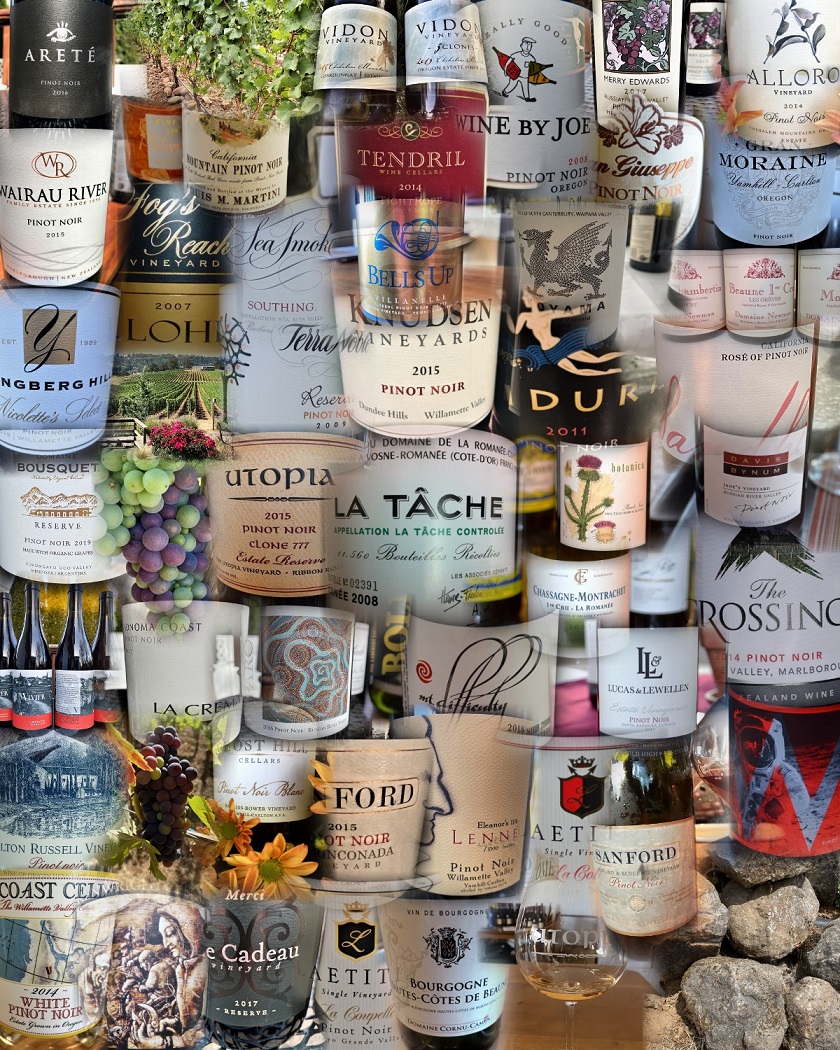
Pinot Noir is featured frequently on this very blog. As I was preparing this post, I decided to look at some statistics. It appears that Pinot Noir is the second most frequently mentioned red grape on the blog, with 356 posts related to the Pinot Noir (Cabernet Sauvignon is mentioned in 445 posts). It is interesting that Chardonnay is mentioned in the 357 posts, literally identical to Pinot Noir.
But it is not just the mentions – there are many memories associated with Pinot Noir.
I love saying that blind tasting is the best arbiter of the wines – in a blind tasting, it is just you and the liquid in the glass, nothing else influences your impression of the wine. It seems that our Pinot Noir blind tasting took place only yesterday – I was literally shocked to see that this post is 12 years old – the tasting took place in August of 2010. Who couldn’ve thought that 2008 Hamilton Russell Pinot Noir from South Africa would be our group’s favorite wine, beating grand cru Burgundy and cult Californian Pinot? I still have a bottle of that wine and I’m looking forward to experiencing the 12 years of evolution.
Another favorite Pinot Noir memory is the 1966 Louis M. Martini California Mountain Pinot Noir – an accidental $25 buy that ended up being a transcendental experience tasting the 48 years old wine from the Cabernet Sauvignon producer who is absolutely not known for the Pinot Noir wines.
And then there are lots and lots of memories of not only the wines but also of the people, passionate Pinot Noir winemakers, acquired through the work on the Stories of Passion and Pinot, an ongoing series of posts dedicated to Oregon Pinot Noir producers and Oregon Pinot Noir wines.
Did I prove my point? Is Pinot Noir the true King of Grapes? I don’t know. But for sure it is a grape worth celebrating. Cheers!
Stories and Passion and Pinot: Shane Moore of Gran Moraine
“Gran Moraine prides itself on producing experiential art in the form of Chardonnay, Pinot Noir and sparkling wines made to express the exquisite terroir of our Yamhill-Carlton Estate Vineyards.”
Experiential Art.
Not a bad way to introduce the winery, what do you think? Wine is art, all wine lovers can sign under such a statement, so “experiential art” sounds very near and dear to any wine lover’s heart.

Gran Moraine vineyard was planted in 2004 by Premier Pacific Vineyards in the Yamhill-Carlton district of Willamette Valley in Oregon, with 200 acres of hillside vines of Pinot Noir and Chardonnay. The vineyard took its name from moraines, glacial sediment left after the glacier movements in the last ice age. In 2013, the Gran Moraine Vineyard was acquired by Jackson Family and it is one of the 4 major properties owned by the Jackson Family in Oregon Willamette Valley.
I visited Gran Moraine last August and had an opportunity to taste a number of the wines and have a quick chat with the winemaker, Shane Moore. Then I followed up with the usual, virtual “conversation” and here is what transpired:
[TaV]: Was there a pivotal wine in your life?
{SM]: I’ve had plenty of wines that have possibly changed my life’s trajectory. However, I feel like the most pivotal wines in my existence have been those that seem to stop time. These wines provide my most fond wine moments and provide me with the most inspiration.
[TaV]: Is there a winemaker you would call your mentor? Someone you learned the most from as a winemaker?
[SM]: I think if I gave any specific shoutouts I’d be doing a disservice to so many of the amazingly talented and thoughtful winemakers I have had the pleasure to have worked with. Over my time I worked with and under at least 40 winemakers – I for sure learned a great deal from all of them. Another great group I both learned a lot and derived much inspiration from are the seasonal cellar workers we hire each year. With that I’m proud to say many have went on to become winemakers themselves.
[TaV]: Pinot Noir and Chardonnay wines are all about blocks and clones. How many clones of Pinot Noir and how many clones of Chardonnay do you grow? How many individual blocks do you identify for the Pinot Noir and Chardonnay?
[SM]: At the Gran Moraine Vineyard, there are 6 different clones of Pinot Noir and only 2 of Chardonnay. Every block is harvested and vinified separately. At any given time, there are around 100-120 different lots of wines. There are approximately 80 blocks – I don’t bring them all in – it’s too big of a vineyard for that – I bring in what I think of as around the top 30% of the acres.
[TaV]: Following up on the previous question – what is your approach to the blending of the final wines, both Pinot Noir and Chardonnay? Do you ever produce single block or single clone wines, and if you don’t do it now, do you have a plan to start producing such wines in the future?
[SM]: Blending final wines starts with having an abstract notion of the experience which you would like to have said “wine endue.” Then you purposely work within the parameters of the vineyard, the growing season and your production capabilities to craft something with that end goal in mind.
We will sometimes produce single clone or block wines when the wine is so profound that it would be a disservice to humanity to blend it away.
[TaV]: You already produce a few of the sparkling wines. What is your approach to harvesting the grapes for those wines – do you have specific plots which you designate for sparkling wines, or do you take an early pass through the vineyard prior to general harvest to get the grapes for the sparkling wine production?
[SM]: You know when you eat something so acidic that it makes your ears ring? I like to pick the fruit for sparkling wine when it’s just a little riper than that. We use specific blocks for the sparkling wine that are purposely farmed. Generally, these blocks are some of the most marginal sites on the vineyard; for example, north facing and heavier soils.
[TaV]: How much focus the sparkling wines program gets at Gran Moraine? Do you expect to produce more sparkling wines in the future, or you expect to stay at the level where you are at?
[SM]: Sparkling wine is currently about 15% of our production. I can see it growing some, it seems to be very popular.
[TaV]: Gran Moraine is a ~200 acres vineyard. If I understand it correctly, it is all planted with Pinot Noir and Chardonnay. Do you plan to plant any other grapes – Pinot Gris, for example, or will it stay strictly as it is right now?
[SM]: The suitable acres on the piece of land are pretty much planted out. I don’t think we’ll be grafting any of the Chardonnay or Pinot Noir over to anything else anytime soon.
[TaV]: When you make Gran Moraine Chardonnay, is there a specific style you are trying to achieve?
[SM]: I want the Chardonnay to have umami, electricity and tension. Of course, I also want it to be delicious.
[TaV]: Same question for the Gran Moraine Pinot Noir?
[SM]: With the Pinot I try to focus on it being beautiful and sleek creating power and complexity daftly by DJing with great music and surrounding it with happy people.
[TaV]: What are your favorite producers in Oregon? In the USA? In the world?
[SM]: Oregon: Adelsheim, Antica Terra, Antiquim Farm, Alexana, Belle Ponte, Brickhouse, Beaux Freres, Bethel Heights…..that’s just getting to the B’s! Too many really to mention – I’m always trading wine with people. I’m totally in love with Oregon wine.
USA: I’d have to go to CA and say some of my favorites there are Ridge, Drew, Papapietro Perry, Navarro, Hartford.
[TaV]: Is there a winemaker you would love to work with? A dream winemaker so to speak?
[SM]: Jean-Herve and Laurent Chiquet of Jacquesson. I hope they are listening. I’ve got ideas.
[TaV]: What’s ahead for Gran Moraine? Where do you see it in 10 years?
[SM]: We’ll probably be doing the same thing but hopefully with even more intention and weirder.
[TaV]: Is there a dream wine you always wanted to make? What would that be?
[SM]: A great New World Nebbiolo.


Here are the tasting notes for a few of the Gran Moraine wines I had an opportunity to taste during the visit:
Gran Moraine Brut Rosé Sparkling Wine Yamhill-Carlton (58% Pinot Noir, 41% Chardonnay, 6% Pinot Meunier)
Toasted notes on the nose
toasted bread, a touch of yeast, good acidity, crisp, clean
8, delicious
2018 Gran Moraine Chardonnay Yamhill-Carlton
A touch of honey notes, vanilla
Good acidity, good acidity, needs time
7+
2018 Gran Moraine Pinot Noir Estate
Brilliant fresh cherry notes, sage
Crisp, restrained, tart cherries and earthy notes, fresh tannins
7+
2017 Gran Moraine Upland Pinot Noir
Restrained nose, a touch of funk, cherries
Light palate, fresh, bright, cherries and cranberries
8-
Here you go, my friends. Another winery, another story of Passion and Pinot. Until the next time – cheers!
This post is a part of the Stories of Passion and Pinot series – click the link for more stories…
Passion and Pinot Updates: Le Cadeau Vineyard
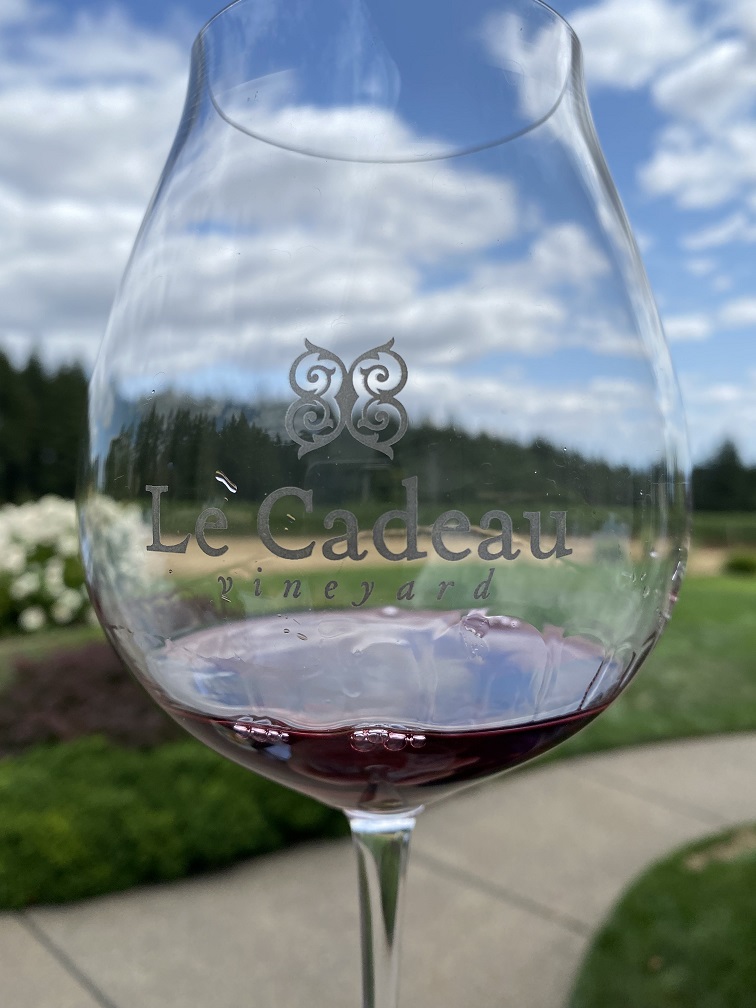 Five years ago, I started a new project in this blog called Stories of Passion and Pinot. The goal of the project was to interview winemakers in Oregon, who passionately went on to grow Pinot Noir and make wines often in conditions that many others would find impossible and untenable. All the way until August of 2021 my interviews were all virtual – I would read about the winery, come with the questions, get the answers, and then publish those conversations in this blog (you can find them using the top menu).
This year I attended Wine Media Conference 2021 which conveniently took place in Eugene, Oregon. After the conference was over, we drove with Carl Giavanti to meet some of the winemakers face to face – and now I can offer you updates, mostly in pictures, lots of pictures, and tasting notes for the wines I had an opportunity to taste.
Le Cadeau Vineyard was our first stop after we left Eugene.
Where do I start? First of all, the views. Le Cadeau Vineyard is a stunning oasis, surrounded by tall pine trees (I already told you how much I love those), and offering amazing views. You be the judge:
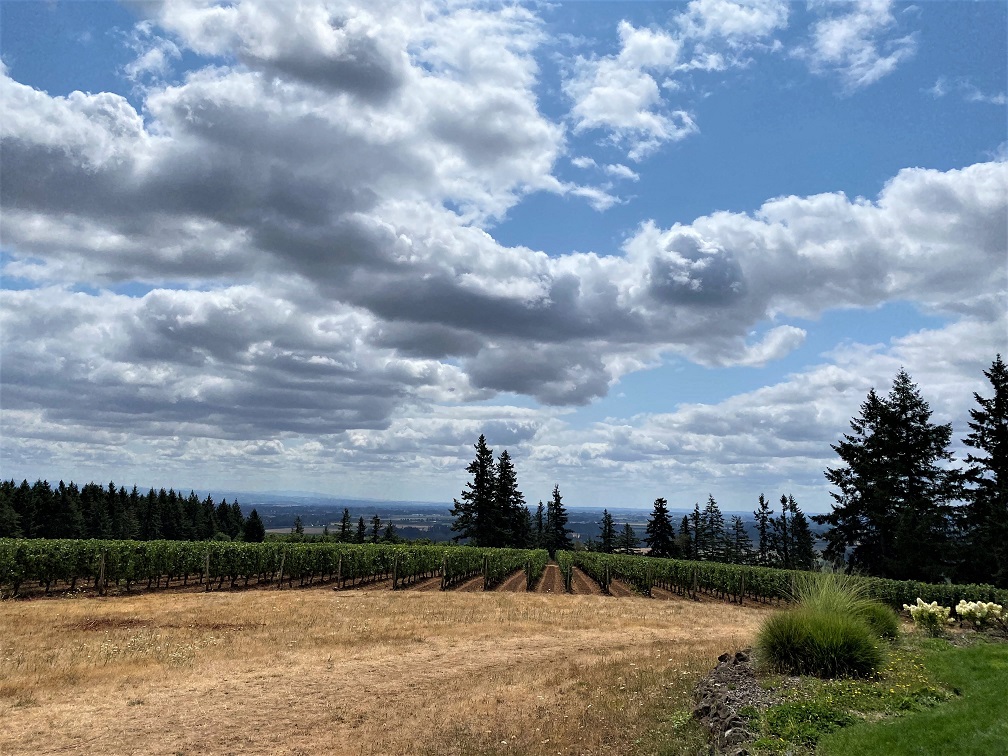
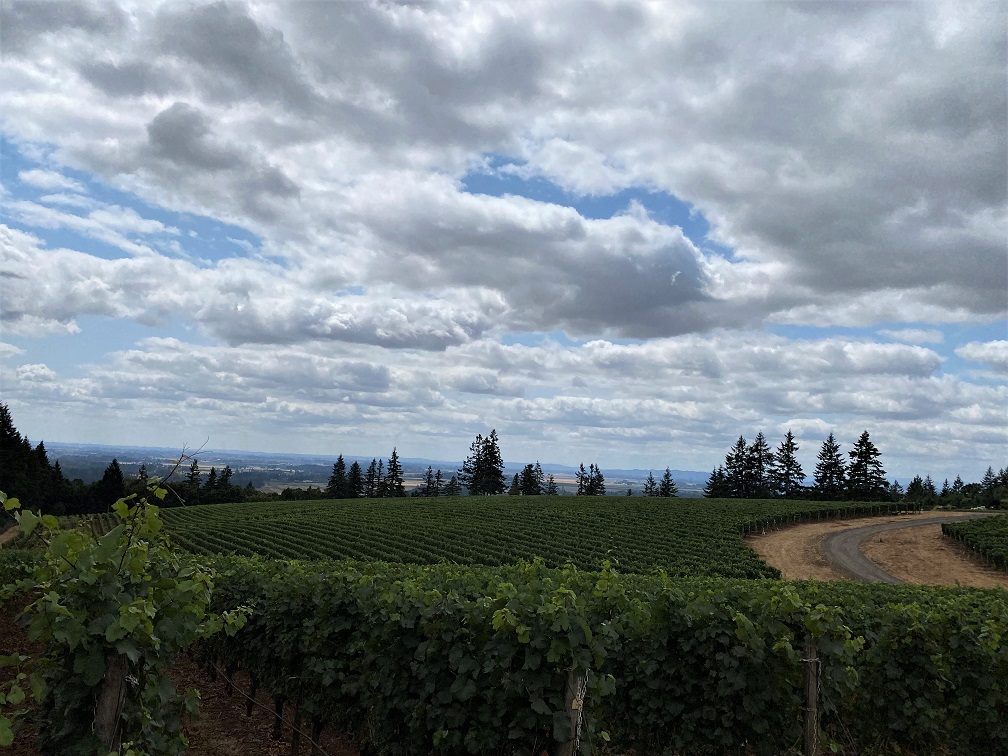
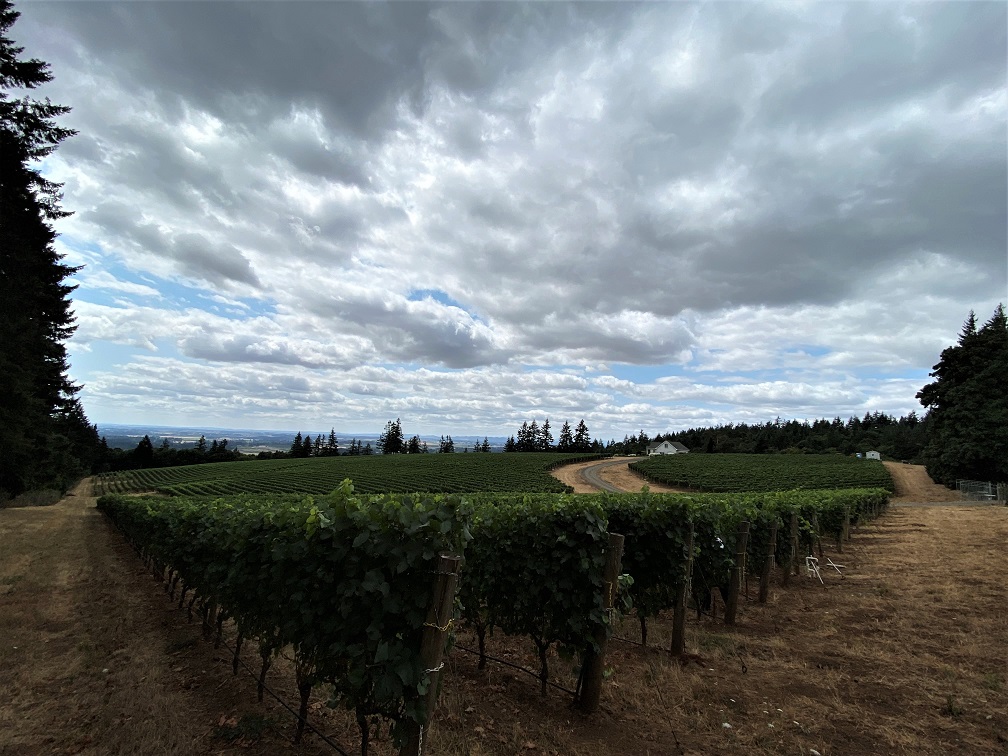
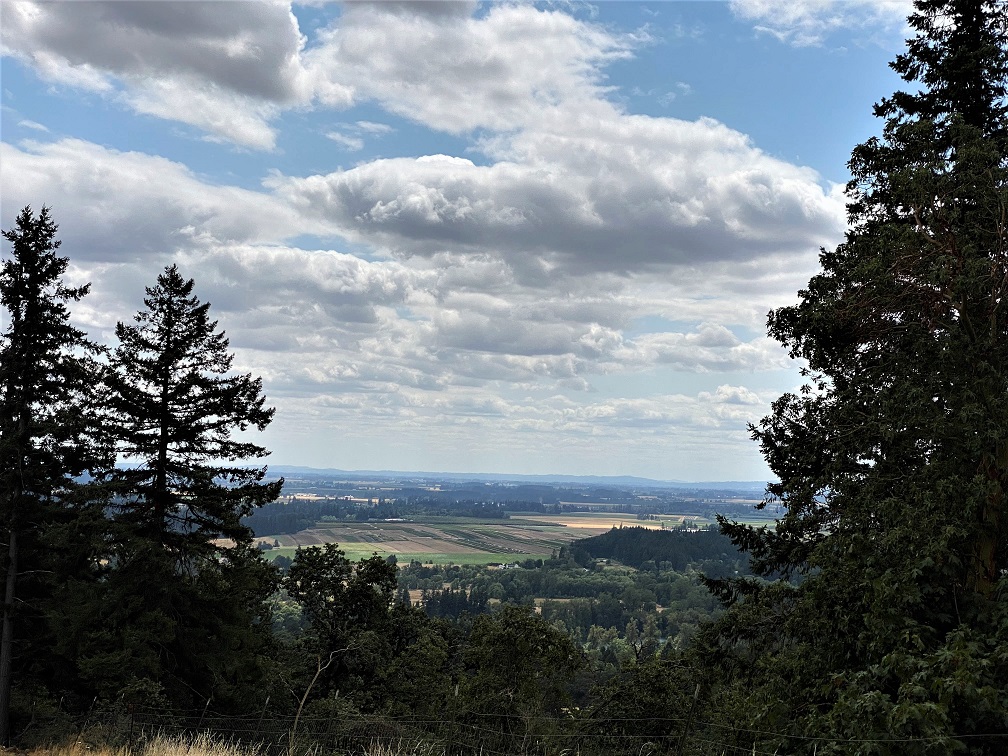
Tom Mortimer slowly walked us through the vineyard, talking about clones and all the work he invested into creating this vineyard simply on top of the rock (you can find the details in the original interview). It turns out that there are 18 Pinot Noir clones used in wine production at Le Cadeau – while I was somewhat shocked to hear that number (sounds high), it was simply due to my ignorance – for example, Sanford winery in Sta. Rita Hills uses more than 50 clones. Considering that Sanford winery is about 25 years older than the Le Cadeau, it is all makes sense. Tom was particularly proud of some of the clones, such as the Calera clone which is based on the DRC, and some additional Vosne clones (not trying to impress with the words here – Vosne here stands for Vosne-Romanée, one of the most coveted Pinot Noir production areas in Burgundy; DRC stands for Domaine Romanée-Conti, probably the most famous Pinot Noir producer in the world; Calera is one of the legendary California Pinot Noir producers and pioneers from Central Coast).
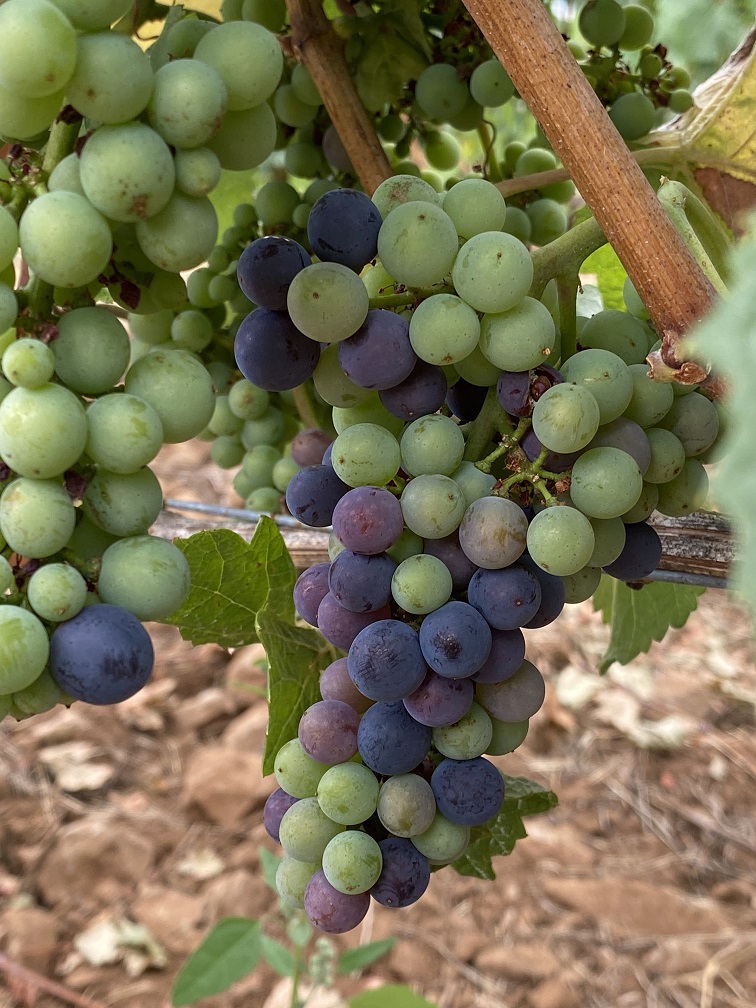
The beginning of August of this year (2021) happened to be the veraison time – the onset of ripening of the grapes when the grapes start changing their color. This was my first time actually being in the vineyard during veraison, so I couldn’t stop taking pictures as I saw bunches with more and more color – here are more pictures:




We also saw Chardonnay grapes growing:
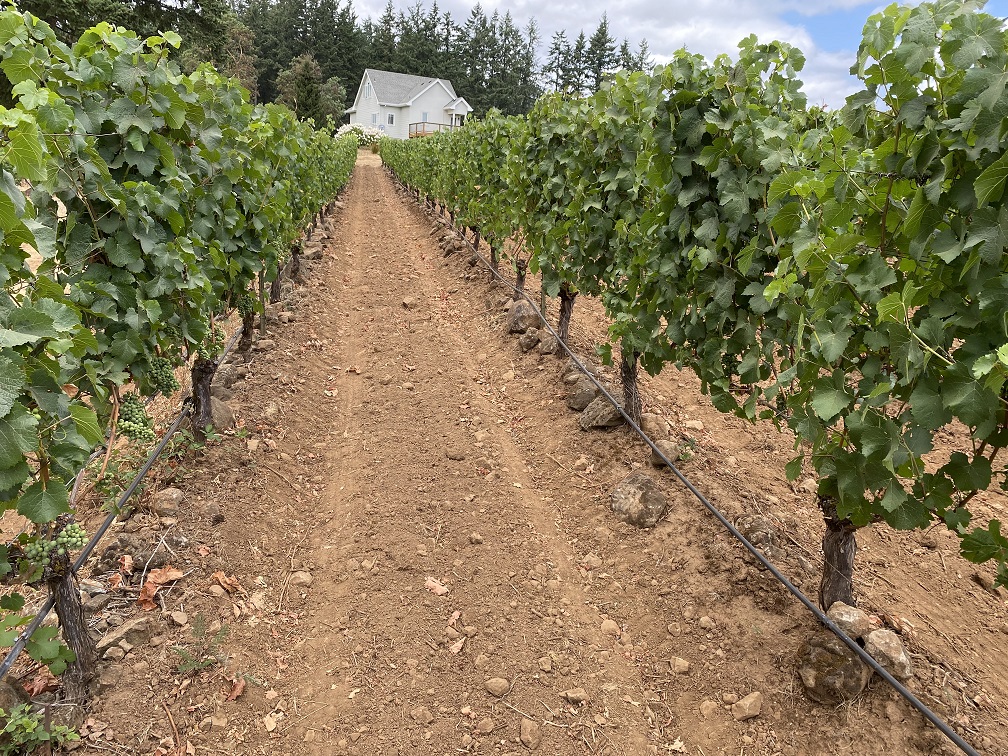
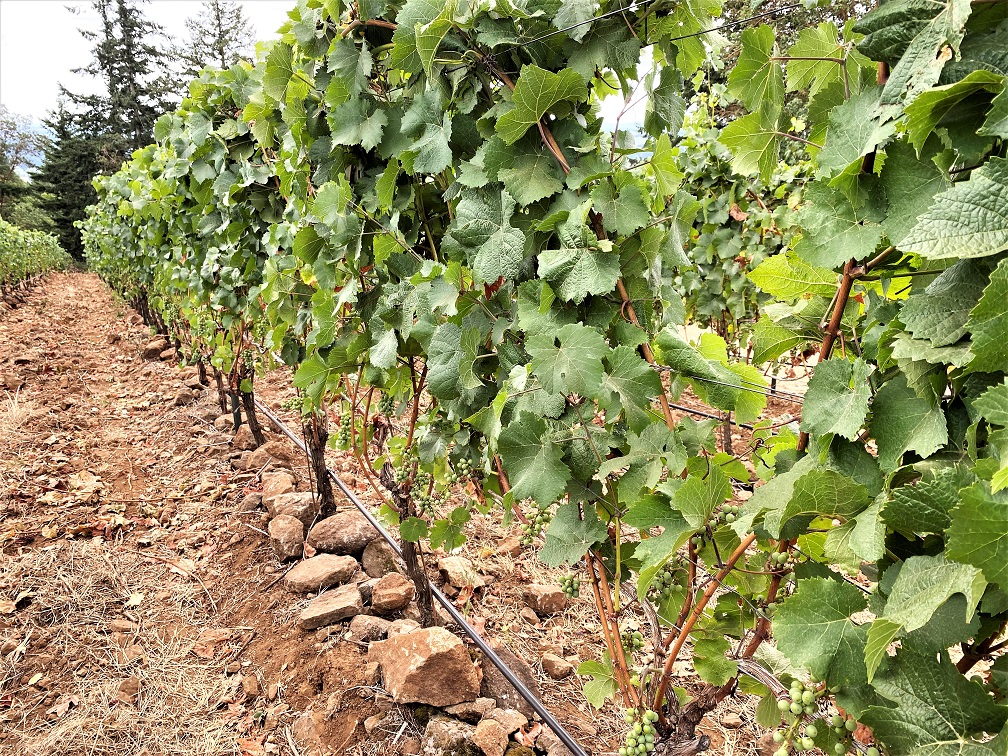
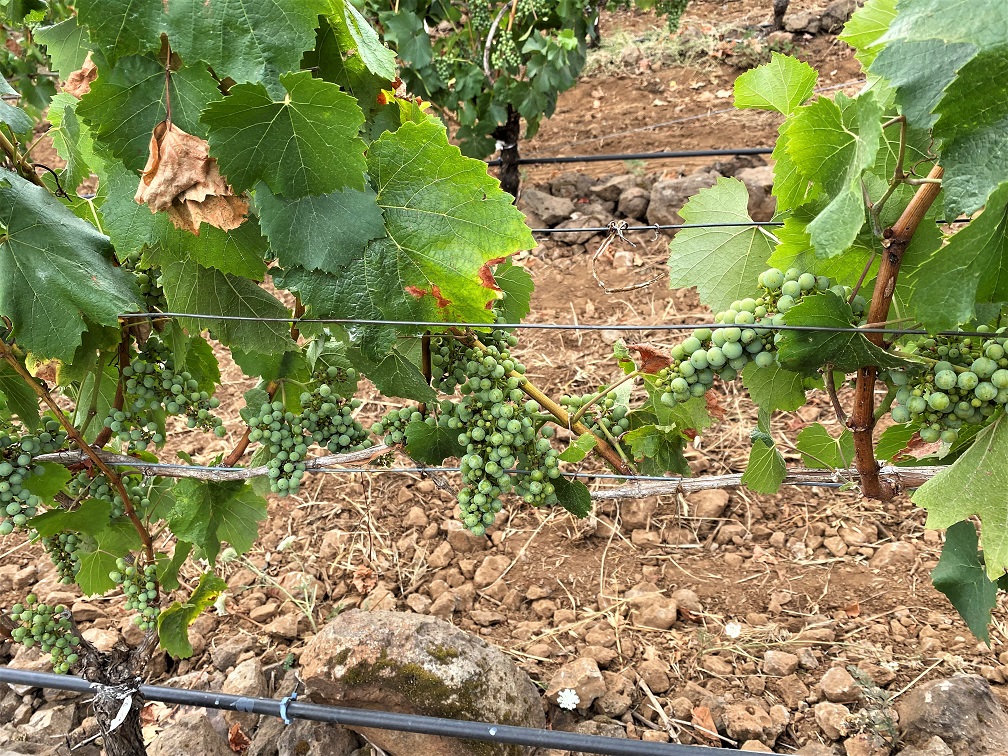
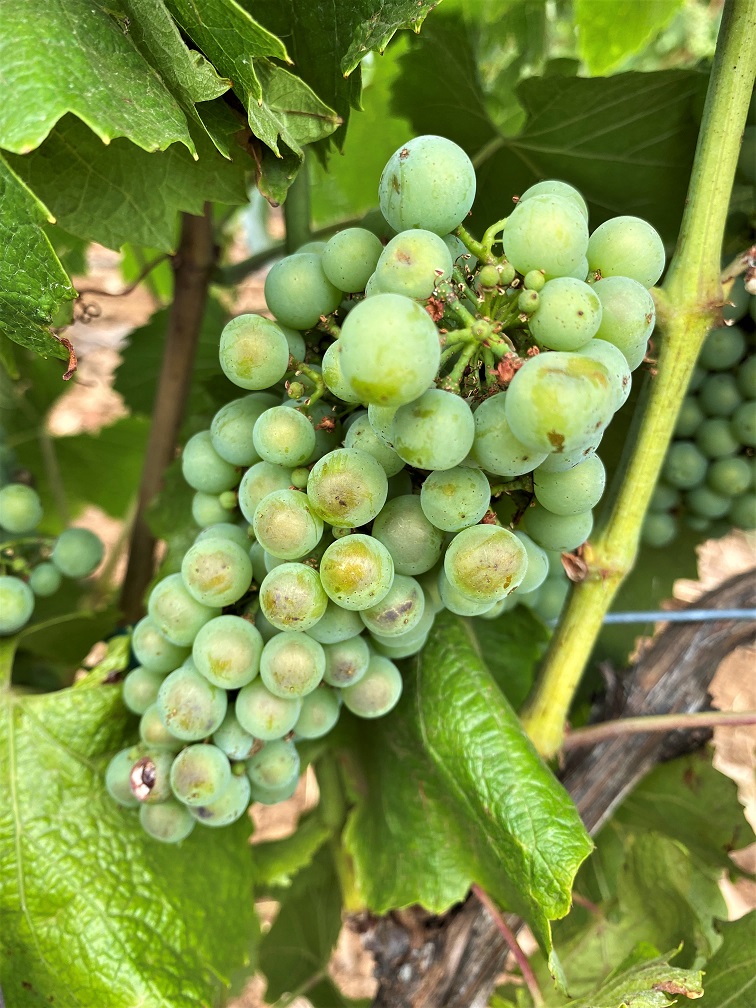
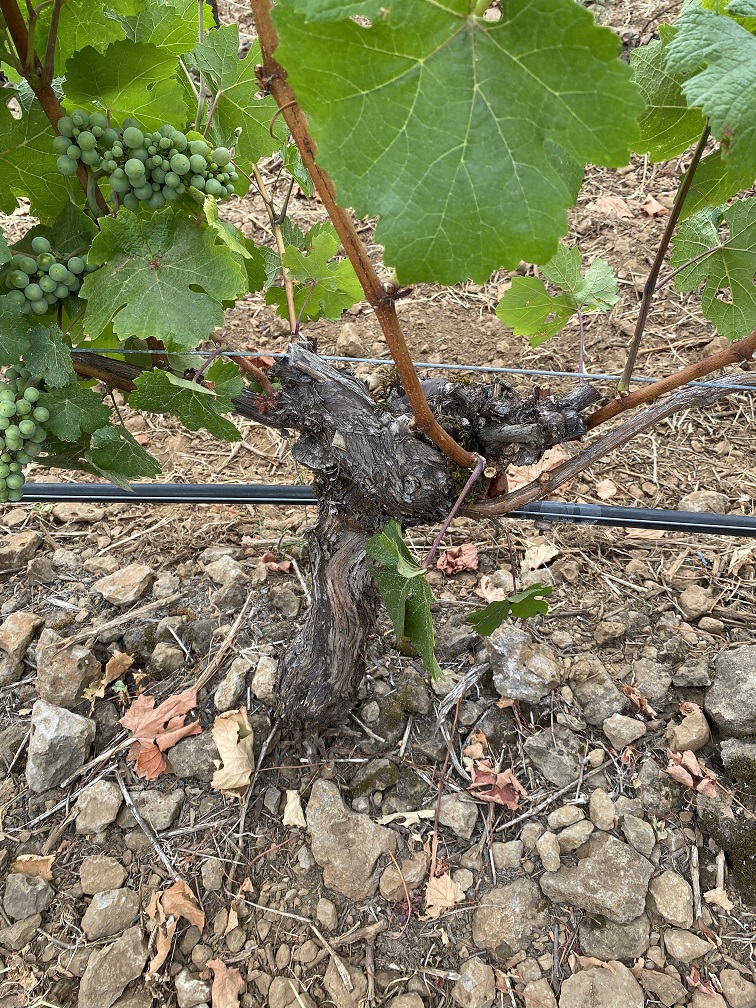
Remember, we are talking about passion here. The amount of labor of love and passion which this vineyard required to be established was simply incredible. Tom had to use a special machine to break through the basalt to help the vine roots to get established. There were a few rows where he decided not to use the machine, and those rows look particularly different from the rest of the vineyard. The rocks which you can see in these pictures give you a good idea of what he had to deal with while establishing the vineyard.


After we finished walking around we sat down to taste the wines with Tom and to continue the conversation about the winemaking. Tom is highly analytical, he uses a lot of different charts, such as Degree Day reports to estimate when he might need to start picking up the grapes based on the historical data and what is the potential weight of the grapes might be at the harvest. Harvest is usually done in multiple passes, depending on the year – in 2015 and 2018, for example, he had to pick grapes 5 times; in 2016 and 2020 there were three picks made.


We started our tasting with 2018 Chardonnay, which was outstanding:
2018 Le Cadeau Vineyard Chardonnay Willamette Valley (14.1% ABV, $45)
Beautiful nose of vanilla with a hint of butter
Vanilla, butter, Granny Smith apples on the palate, beautifully clean and balanced
8+
It is really amazing to see the level of finesse Oregon Chardonnay has developed over the years.
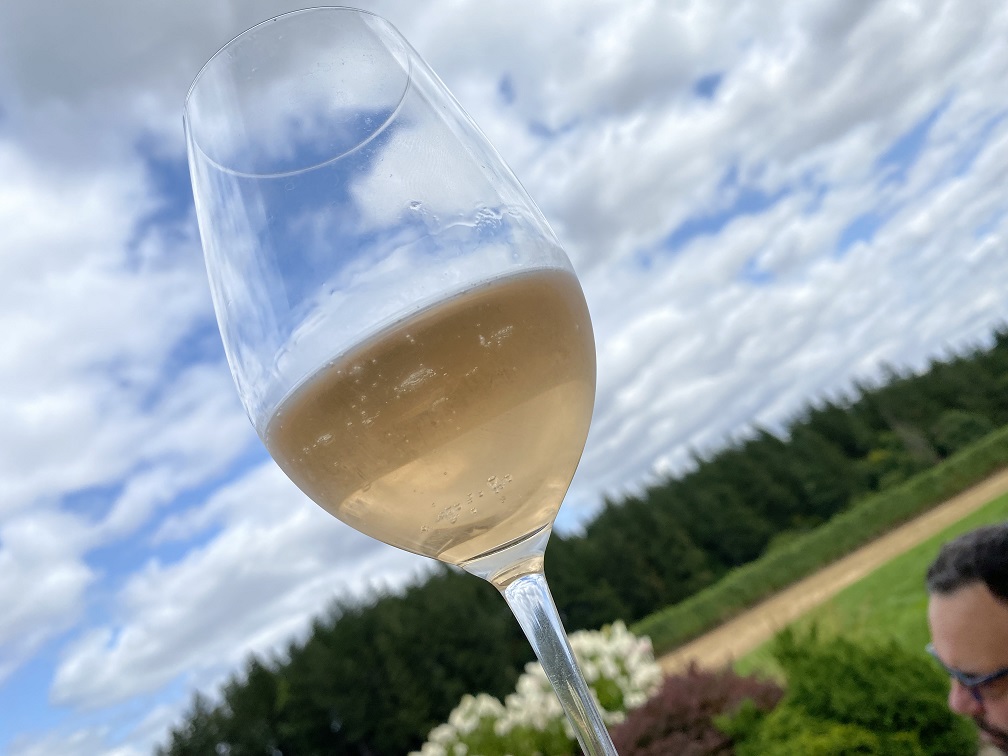


It appears that Tom also makes sparkling wines, and he loves it, as making sparkling wines nicely complements making still wines – you remove perfect grapes for the sparkling (high acid), and the other grapes can ripen better. The sparkling wine we tried, was again, in a word, outstanding:
2013 Le Cadeau Rosé Brut Oregon (13.1% ABV, $50, 4.5 years on the lees)
A touch of funk and toasted bread
Sapidity, yeast, toasted notes, clean acidity, delicious.
8+


Now we moved on to the Pinot Noir. Tom is working with the winemaking team to produce his wines, including the consultant from Burgundy. Le Cadeau makes some of the reserve wines, but those are only produced in the best years. We tasted through the 4 Pinot Noir wines which were all excellent in their own right.
2018 Le Cadeau Côte Est Pinot Noir Willamette Valley (13.9% ABV, $60)
Beautiful cherries on the nose
Cherries on the palate, clean, round, soft, a touch of earthiness, delicious.
8
2018 Le Cadeau Diversité Pinot Noir Chehalem Mountains AVA (14.1% ABV, $60)
Beautiful minerality, sweet cherries, a hint of cranberry
Tart cherries on the palate, pepper, clean, fresh, light
8+
2018 Le Cadeau Rocheux Chehalem Mountains AVA (13.5% ABV, $60)
Stunning nose, cranberries, cherries, violets, a hint of sage
Superb balance of power, fruit, acidity, structure – everything is in perfect harmony.
9-/8+
2017 Le Cadeau Merci Reserve Chehalem Mountains AVA (13.3% ABV, $80)
Incredible aromatics, floral, violets
Beautiful, round, clean, open
8+
It is interesting that when I tasted the 2017 Le Cadeau vintage for the interview post, Diversité was my favorite, and Rocheux was a close second. This time, Rosheux was my favorite Pinot Noir from the tasting.
That’s all I have for my update. I don’t drink much of Burgundy, so I can’t really offer any comparisons – but I don’t think comparisons are needed. Oregon Pinot Noir are unquestionably world-class wines in their own right. I remember reading in Wine Spectator Matt Kramer’s article where he mentioned that the main characteristic of a world-class Pinot Noir is finesse. Going by this measure, Le Cadeau definitely got it – finesse is the virtue of all their wines. If you are looking for the Pinot Noir for a special occasion – don’t look any further than Le Cadeau.
This post is a part of the Stories of Passion and Pinot series – click the link for more stories…
Last Bottle Sign Up ($10 credit)




 Talk-A-Vino